<?xml version="1.0" encoding="ISO-8859-1"?><article xmlns:mml="http://www.w3.org/1998/Math/MathML" xmlns:xlink="http://www.w3.org/1999/xlink" xmlns:xsi="http://www.w3.org/2001/XMLSchema-instance">
<front>
<journal-meta>
<journal-id>0012-7353</journal-id>
<journal-title><![CDATA[DYNA]]></journal-title>
<abbrev-journal-title><![CDATA[Dyna rev.fac.nac.minas]]></abbrev-journal-title>
<issn>0012-7353</issn>
<publisher>
<publisher-name><![CDATA[Universidad Nacional de Colombia]]></publisher-name>
</publisher>
</journal-meta>
<article-meta>
<article-id>S0012-73532015000500002</article-id>
<article-id pub-id-type="doi">10.15446/dyna.v82n193.42903</article-id>
<title-group>
<article-title xml:lang="en"><![CDATA[Methodological design for the prevention of risk in production processes]]></article-title>
<article-title xml:lang="es"><![CDATA[Diseño metodológico para la prevención de riesgos en procesos de producción]]></article-title>
</title-group>
<contrib-group>
<contrib contrib-type="author">
<name>
<surname><![CDATA[Pulido-Rojano]]></surname>
<given-names><![CDATA[Alexander De Jesús]]></given-names>
</name>
<xref ref-type="aff" rid="A01"/>
</contrib>
</contrib-group>
<aff id="A01">
<institution><![CDATA[,Universidad Simón Bolívar  ]]></institution>
<addr-line><![CDATA[Barranquilla ]]></addr-line>
<country>Colombia</country>
</aff>
<pub-date pub-type="pub">
<day>00</day>
<month>10</month>
<year>2015</year>
</pub-date>
<pub-date pub-type="epub">
<day>00</day>
<month>10</month>
<year>2015</year>
</pub-date>
<volume>82</volume>
<numero>193</numero>
<fpage>16</fpage>
<lpage>22</lpage>
<copyright-statement/>
<copyright-year/>
<self-uri xlink:href="http://www.scielo.org.co/scielo.php?script=sci_arttext&amp;pid=S0012-73532015000500002&amp;lng=en&amp;nrm=iso"></self-uri><self-uri xlink:href="http://www.scielo.org.co/scielo.php?script=sci_abstract&amp;pid=S0012-73532015000500002&amp;lng=en&amp;nrm=iso"></self-uri><self-uri xlink:href="http://www.scielo.org.co/scielo.php?script=sci_pdf&amp;pid=S0012-73532015000500002&amp;lng=en&amp;nrm=iso"></self-uri><abstract abstract-type="short" xml:lang="en"><p><![CDATA[This paper proposes a methodological design based on the development, creation, adaptation and implementation of some analysis tools and the deployment of the risk management process content in standard ISO 31000. This allows for the design of a monitoring and quality control system of critical variables associated with equipment and operating conditions for the purpose of identifying and mitigating sources diversions product specifications. It also seeks to harmonize work philosophies with international management standards. The validation was performed by an industrial company from the city of Barranquilla. The content of this paper provides professionals and industry with a way to address and improve the capacity of any type of manufacturing process in any organization through standardized steps.]]></p></abstract>
<abstract abstract-type="short" xml:lang="es"><p><![CDATA[La presente investigación propone un diseño metodológico fundamentado en el desarrollo, creación, adaptación e implementación de algunas herramientas de análisis y en el despliegue del proceso de gestión de riesgo contenido en la norma ISO 31000, permitiendo diseñar un sistema de monitoreo y control de calidad de variables críticas asociadas con condiciones de operación de equipos, para identificar y mitigar en línea potenciales fuentes de desviación de especificaciones de producto, armonizando filosofías de trabajo con normas internacionales de gestión y cuya validación se realizó en una empresa del sector industrial de la ciudad de Barranquilla. El contenido de este artículo ofrece a los profesionales e industriales una forma de abordar y mejorar cualquier tipo de proceso de fabricación en cualquier tipo de organización por medio de pasos estandarizados.]]></p></abstract>
<kwd-group>
<kwd lng="en"><![CDATA[Statistical process control]]></kwd>
<kwd lng="en"><![CDATA[risk management process]]></kwd>
<kwd lng="en"><![CDATA[risk assessment]]></kwd>
<kwd lng="en"><![CDATA[critical variables]]></kwd>
<kwd lng="en"><![CDATA[analysis tools]]></kwd>
<kwd lng="es"><![CDATA[Control estadístico de procesos]]></kwd>
<kwd lng="es"><![CDATA[Proceso de gestión de riesgos]]></kwd>
<kwd lng="es"><![CDATA[Evaluación del riesgo]]></kwd>
<kwd lng="es"><![CDATA[variables críticas]]></kwd>
<kwd lng="es"><![CDATA[herramientas de análisis]]></kwd>
</kwd-group>
</article-meta>
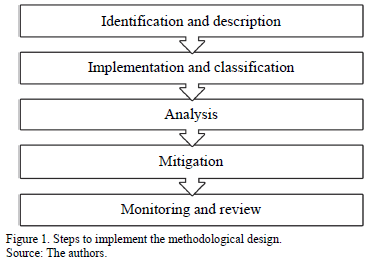
</front><body><![CDATA[ <p><font size="1" face="Verdana, Arial, Helvetica, sans-serif"><b>DOI:</b> <a href="http://dx.doi.org/10.15446/dyna.v82n193.42903" target="_blank">http://dx.doi.org/10.15446/dyna.v82n193.42903</a></font></p>     <p align="center"><font size="4" face="Verdana, Arial, Helvetica, sans-serif"><b>Methodological design for the prevention of risk   in production processes</b></font></p>     <p align="center"><font size="3"><b><font face="Verdana, Arial, Helvetica, sans-serif"><i>Dise&ntilde;o   metodol&oacute;gico para la prevenci&oacute;n de riesgos en procesos de producci&oacute;n</i></font></b></font></p>     <p align="center">&nbsp;</p>     <p align="center"><font size="2" face="Verdana, Arial, Helvetica, sans-serif"><b>Alexander De Jes&uacute;s Pulido-Rojano <i><sup>a</sup></i></b></font></p>     <p align="center">&nbsp;</p>     <p align="center"><font size="2" face="Verdana, Arial, Helvetica, sans-serif"><sup><i>a </i></sup><i>Industrial Engineering Program, Universidad Sim&oacute;n Bol&iacute;var,   Barranquilla, Colombia. <a href="mailto:apulido3@unisimonbolivar.edu.co">apulido3@unisimonbolivar.edu.co</a></i></font></p>     <p align="center">&nbsp;</p>     <p align="center"><font size="2" face="Verdana, Arial, Helvetica, sans-serif"><b>Received: April 2<sup>nd</sup>, 2014. Received in revised   form: February 23<sup>th</sup>, 2015. Accepted: July 11<sup>th</sup>, 2015.</b></font></p>     <p align="center">&nbsp;</p>     ]]></body>
<body><![CDATA[<p align="center"><font size="1" face="Verdana, Arial, Helvetica, sans-seriff"><b>This work is licensed under a</b> <a rel="license" href="http://creativecommons.org/licenses/by-nc-nd/4.0/">Creative Commons Attribution-NonCommercial-NoDerivatives 4.0 International License</a>.</font><br />   <a rel="license" href="http://creativecommons.org/licenses/by-nc-nd/4.0/"><img style="border-width:0" src="https://i.creativecommons.org/l/by-nc-nd/4.0/88x31.png" /></a></p> <hr>     <p><font size="2" face="Verdana, Arial, Helvetica, sans-serif"><b>Abstract    <br>   </b></font><font size="2" face="Verdana, Arial, Helvetica, sans-serif">This paper proposes a methodological design based on the   development, creation, adaptation and implementation of some analysis tools and   the deployment of the risk management process content in standard ISO 31000.   This allows for the design of a monitoring and quality control system of   critical variables associated with equipment and operating conditions for the   purpose of identifying and mitigating sources diversions product   specifications. It also seeks to harmonize work philosophies with international   management standards. The validation was performed by an industrial company from   the city of Barranquilla. The content of this paper provides professionals and   industry with a way to address and improve the capacity of any type of   manufacturing process in any organization through standardized steps.</font></p>     <p><font size="2" face="Verdana, Arial, Helvetica, sans-serif"><i>Keywords</i>: Statistical   process control; risk management process; risk assessment; critical variables;   analysis tools.</font></p>     <p><font size="2" face="Verdana, Arial, Helvetica, sans-serif"><b>Resumen    <br>   </b></font><font size="2" face="Verdana, Arial, Helvetica, sans-serif">La presente   investigaci&oacute;n propone un dise&ntilde;o metodol&oacute;gico fundamentado en el desarrollo,   creaci&oacute;n, adaptaci&oacute;n e implementaci&oacute;n de algunas herramientas de an&aacute;lisis y en   el despliegue del proceso de gesti&oacute;n de riesgo contenido en la norma ISO 31000,   permitiendo dise&ntilde;ar un sistema de monitoreo y control de calidad de variables   cr&iacute;ticas asociadas con condiciones de operaci&oacute;n de equipos, para identificar y   mitigar en l&iacute;nea potenciales fuentes de desviaci&oacute;n de especificaciones de   producto, armonizando filosof&iacute;as de trabajo con normas internacionales de   gesti&oacute;n y cuya validaci&oacute;n se realiz&oacute; en una empresa del sector industrial de la   ciudad de Barranquilla. El contenido de este art&iacute;culo ofrece a los   profesionales e industriales una forma de abordar y mejorar cualquier tipo de   proceso de fabricaci&oacute;n en cualquier tipo de organizaci&oacute;n por medio de pasos   estandarizados.</font></p>     <p><font size="2" face="Verdana, Arial, Helvetica, sans-serif"><i>Palabras clave</i>: Control estad&iacute;stico de procesos; Proceso de   gesti&oacute;n de riesgos; Evaluaci&oacute;n del riesgo; variables cr&iacute;ticas; herramientas de   an&aacute;lisis.</font></p> <hr>     <p>&nbsp;</p>     <p><font size="3" face="Verdana, Arial, Helvetica, sans-serif"><b>1. Introduction</b></font></p>     <p><font size="2" face="Verdana, Arial, Helvetica, sans-serif">Organizations' concern to offer the best product or   service requires the use of a large number of statistical tools and standards   to achieve optimum quality, to meet needs and largely fulfill the expectations   of its customers or users &#91;1&#93;.</font></p>     ]]></body>
<body><![CDATA[<p><font size="2" face="Verdana, Arial, Helvetica, sans-serif">The statistical and quality tools have been widely used to   assist the operation of production systems and compliance with products and   services' specification requirements &#91;2-9&#93;. They are implemented by   organizations to demonstrate their commitment and orientation to continuous   improvement &#91;10&#93;. Moreover, risk management has been vital in the financial &#91;11,12&#93;,   the Project Management &#91;13-16&#93;, the Health and Safety &#91;17&#93; and the information   technology sectors &#91;18&#93;.</font></p>     <p><font size="2" face="Verdana, Arial, Helvetica, sans-serif">Problems arise when it is necessary to combine statistical   techniques with management rules for compliance with national and international   standards.</font></p>     <p><font size="2" face="Verdana, Arial, Helvetica, sans-serif">Given that, until now, there is little evidence of the   implementation of a risk-based approach in production systems. In this paper we   present a methodological design that enables the integration of some   statistical and quality tools with the deployment of the risk management   process contained in ISO 31000. It has   been designed to become a useful tool for the detection and mitigation of   defects in lines of production and the identification of potential sources of   non-conformities, as well as harmonizing working philosophies with national and   international standards of management. The methodological design has been   implemented for industrial production, more precisely, in a company in the   industrial sector in Barranquilla-Colombia that is dedicated to transformation   of glass and aluminum.</font></p>     <p><font size="2" face="Verdana, Arial, Helvetica, sans-serif">This article is organized as follows. Section 2 describes   our methodology and its constituent parts. The computational results are   presented in Section 3 and show the effectiveness of our method and final   remarks are made in Section 4.</font></p>     <p>&nbsp;</p>     <p><font size="3" face="Verdana, Arial, Helvetica, sans-serif"><b>2. Methodological   design</b></font></p>     <p><font size="2" face="Verdana, Arial, Helvetica, sans-serif">The proposed methodological design has been established as   a simple process that summarizes the steps to be followed in order for it to be   implemented it in any production process. The steps begin with the   identification and description of products and processes to be monitored and   then the proposed actions to mitigate undesired deviations, risks and   non-conformities identified in the manufacturing process are reviewed and   monitored (<a href="#fig01">Fig. 1</a>).</font></p>     <p align="center"><font size="2" face="Verdana, Arial, Helvetica, sans-serif"><a name="fig01"></a></font><img src="/img/revistas/dyna/v82n193/v82n193a02fig01.gif"></p>     <p><font size="2" face="Verdana, Arial, Helvetica, sans-serif">Also, seeking to provide guidance and clarity the   following section describes each of the steps:</font></p> <ul>       <li><font size="2" face="Verdana, Arial, Helvetica, sans-serif"> Identification and description: In this first     step, processes and products which will be monitored are identified, a detailed     description of the production stages, activities, working methods and resources     used is presented. This seeks to find possible failings or deviations, risks     and causes of nonconformity.</font></li>       ]]></body>
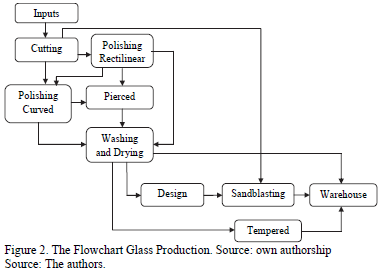
<body><![CDATA[<li><font size="2" face="Verdana, Arial, Helvetica, sans-serif"> Implementation     and Classification: In this step, the implementing of the statistical and     quality tools is classified using the cause-effect diagram, as well as the     causes of nonconformities, deviations or risks identified in each process     identified for monitoring. Additionally, instruments for monitoring and     statistical process control are implemented by means of control charts, and     finally, using the Pareto chart, occurrences of deviations or non-conformances     are identified. The tools implemented at this stage will depend on the type of     process that is being analyzed.</font></li>       <li><font size="2" face="Verdana, Arial, Helvetica, sans-serif">Analysis: At     this stage a statistical analysis of processes and data analysis of the occurrence     of nonconformities based on the results obtained in the implementation stage     and classification is performed.</font></li>       <li><font size="2" face="Verdana, Arial, Helvetica, sans-serif">Mitigation: In     order to reduce risks, deviations and non-conformities detected in the     production process and the deployment of the risk management process is     proposed according to ISO 31000. Also, containment actions, reaction actions     and prevention actions will be implemented to mitigate the occurrence of     nonconformities are identified.</font></li>       <li><font size="2" face="Verdana, Arial, Helvetica, sans-serif">Monitoring and     review: Being a process of continuous improvement, monitoring and reviewing of     the effectiveness of the proposed actions is performed. At this stage, new     actions are recommended in case the actions first suggested have not been     effective, or if updating the system in the step of identifying of new risks is     desired.</font></li>     </ul>     <p>&nbsp;</p>     <p><font size="3" face="Verdana, Arial, Helvetica, sans-serif"><b>3. Results and   analysis</b></font></p>     <p><font size="2" face="Verdana, Arial, Helvetica, sans-serif">To validate the proposed   methodological design that was described in the previous section, a company   founded in Barranquilla, Colombia was identified that is dedicated to the   manufacture and processing of glass and aluminum. We focus on the study and   analysis of the glass production line, which consists of eight threads of   transformation: cutting, polishing rectilinear, Polishing Curved, Pierced,   washing and drying, design, Sandblasting and Tempered. The Flowchart Glass   Production is shown in <a href="#fig02">Fig. 2</a>. For the purpose of showing the development of   the methodological design its application in the Cutting process will be   presented. There are similar results in the remaining processes.</font></p>     <p align="center"><font size="2" face="Verdana, Arial, Helvetica, sans-serif"><a name="fig02"></a></font><img src="/img/revistas/dyna/v82n193/v82n193a02fig02.gif"></p>     <p><font size="2" face="Verdana, Arial, Helvetica, sans-serif"><b><i>3.1. Identification and description</i></b></font></p>     ]]></body>
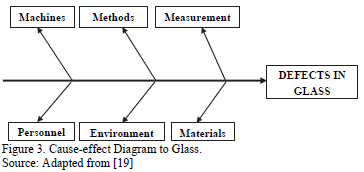
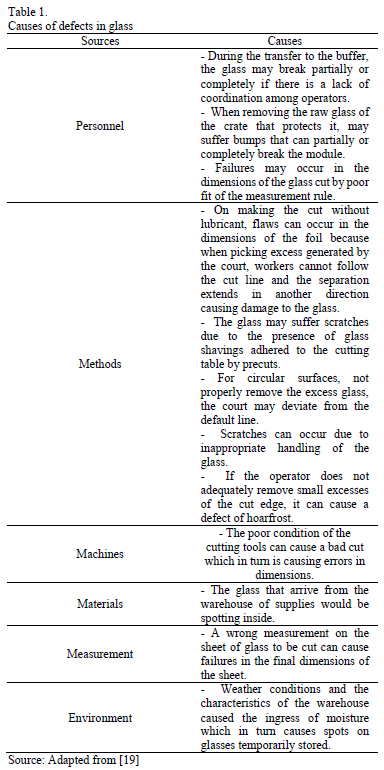
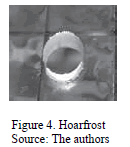
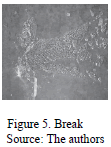
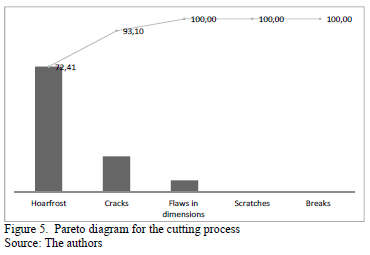
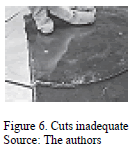
<body><![CDATA[<p><font size="2" face="Verdana, Arial, Helvetica, sans-serif">Operations and tools used in the cutting process,   particular aspects that may be relevant in the operation, the sequential steps   in the processing activity of the glass and the identification and analysis of   causes of nonconformities, deviations or related risks were identified.</font></p>     <p><font size="2" face="Verdana, Arial, Helvetica, sans-serif"><b><i>3.2. Implementation   and classification</i></b></font></p>     <p><font size="2" face="Verdana, Arial, Helvetica, sans-serif">In this second stage, by using the cause-effect diagram   the classifying of origin of some of the deviations is achieved, and the risks   and non-conformities are identified at the stage of identification and description.   Some are shown in <a href="#fig03">Fig. 3</a> and <a href="#tab01">Table 1</a>.</font></p>     <p align="center"><font size="2" face="Verdana, Arial, Helvetica, sans-serif"><a name="fig03"></a></font><img src="/img/revistas/dyna/v82n193/v82n193a02fig03.gif"></p>     <p align="center"><font size="2" face="Verdana, Arial, Helvetica, sans-serif"><a name="tab01"></a></font><img src="/img/revistas/dyna/v82n193/v82n193a02tab01.gif"></p>     <p><font size="2" face="Verdana, Arial, Helvetica, sans-serif">To determine the frequency of occurrence of defects in   glass in the cutting process, (scratches, breaks, inadequate cuts and others)   (See <a href="#fig04">Figs. 4</a>-<a href="#fig06">6</a>), the Pareto diagram is implemented, which looks to prioritize   and recognize if the process is critical in the production line. The Pareto   diagram is shown in <a href="#fig05">Fig.5</a>.</font></p>     <p align="center"><font size="2" face="Verdana, Arial, Helvetica, sans-serif"><a name="fig04"></a></font><img src="/img/revistas/dyna/v82n193/v82n193a02fig04.gif"></p>     <p align="center"><font size="2" face="Verdana, Arial, Helvetica, sans-serif"><a name="fig05"></a></font><img src="/img/revistas/dyna/v82n193/v82n193a02fig05.gif"></p>     <p align="center"><font size="2" face="Verdana, Arial, Helvetica, sans-serif"><a name="fig05"></a></font><img src="/img/revistas/dyna/v82n193/v82n193a02fig051.gif"></p>     <p align="center"><font size="2" face="Verdana, Arial, Helvetica, sans-serif"><a name="fig06"></a></font><img src="/img/revistas/dyna/v82n193/v82n193a02fig06.gif"><font size="2" face="Verdana, Arial, Helvetica, sans-serif"> </font></p> <font size="2" face="Verdana, Arial, Helvetica, sans-serif">     ]]></body>
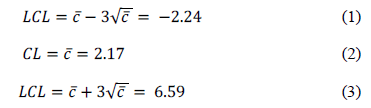
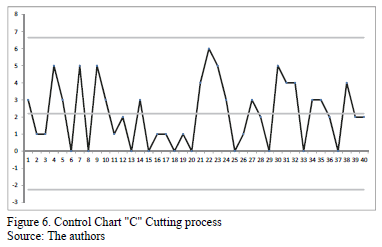
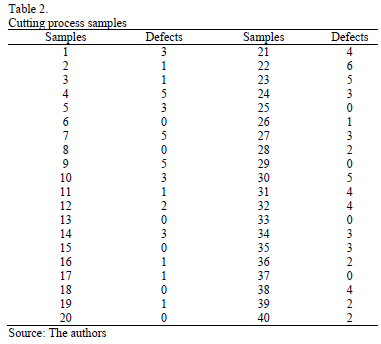
<body><![CDATA[<p>Also, as a tool for   monitoring and following up all processes in the manufacture of glass, chart   &quot;c&quot; is used. This is because the behavior is analyzed for the   occurrence of defects in a product unit, which is represented by a sheet of   glass. To calculate the control limits, forty product samples were taken in   each process and the defects found in each sample, caused by identified   sources, were quantified. To determine the sample size Montgomery's &#91;19&#93; theory   was used, which suggests that the sample size should provide a 50% probability   of detecting a shift in the process. Evidence for this application is shown in <a href="#fig06">Fig.6</a>. Defects for 40 samples taken randomly from the cutting process are   presented in <a href="#tab02">Table 2</a>.</p> </font>     <p align="center"><font size="2" face="Verdana, Arial, Helvetica, sans-serif"><a name="fig06"></a><img src="/img/revistas/dyna/v82n193/v82n193a02fig061.gif"></font></p> <font size="2" face="Verdana, Arial, Helvetica, sans-serif"></font>     <p align="center"><font size="2" face="Verdana, Arial, Helvetica, sans-serif"><a name="tab02"></a></font><img src="/img/revistas/dyna/v82n193/v82n193a02tab02.gif"></p> <font size="2" face="Verdana, Arial, Helvetica, sans-serif">     <p>After the processing of the data, the value of the lower,   central and upper limits of the process were:</p> </font>     <p><img src="/img/revistas/dyna/v82n193/v82n193a02eq0103.gif"></p>     <p><font size="2" face="Verdana, Arial, Helvetica, sans-serif"><b><i>3.3. Analysis</i></b></font></p>     <p><font size="2" face="Verdana, Arial, Helvetica, sans-serif">The analysis was performed taking into account the   classification of nonconformities by the cause-effect diagram. The analysis of   the incidence of defects was prioritized through the Pareto and statistical   control charts.</font></p>     <p><font size="2" face="Verdana, Arial, Helvetica, sans-serif">It is noted that in the process of cutting that about 93%   of nonconformities correspond to Hoarfrost and Cracks, often caused by personnel   and the methods used in the process. Furthermore, it is evident that the   maximum number of defects per unit of product is 6.59 with a mean of 2.17. For   this case, the lower control limit is negative so it is replaced with zero,   since there can be no adverse effects in the glass.</font></p>     <p><font size="2" face="Verdana, Arial, Helvetica, sans-serif"><b><i>3.4. Mitigation</i></b></font></p>     <p><font size="2" face="Verdana, Arial, Helvetica, sans-serif">This phase is performed under the general approach of the   risk management process included in ISO 31000:2009, and it also takes into   consideration the treatment and management of risk on causes of deviations or   non-conformances identified in phase of identification and description.</font></p>     ]]></body>
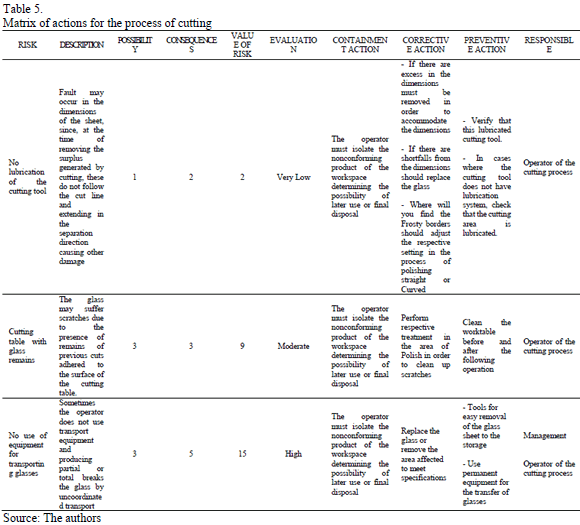
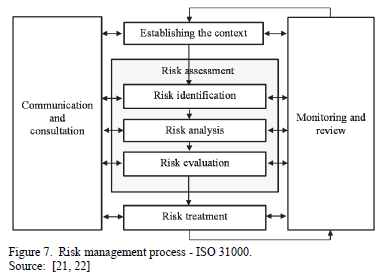
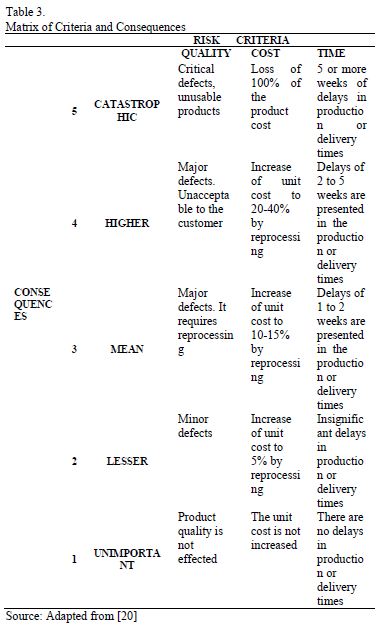
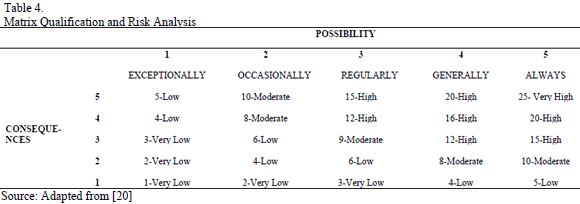
<body><![CDATA[<p><font size="2" face="Verdana, Arial, Helvetica, sans-serif">Risk management   involves the company establishing elements that are suitable in terms of   infrastructure and culture. By applying a systematic and logical method for   establishing the context, identifying, evaluating, treating, monitoring and communicating risks associated with any activity,   function or process in a way that will enable organizations to minimize losses   and maximize profits &#91;20-22&#93;. The different stages of risk management are   presented in <a href="#fig07">Fig. 7</a>.</font></p>     <p align="center"><font size="2" face="Verdana, Arial, Helvetica, sans-serif"><a name="fig07"></a></font><img src="/img/revistas/dyna/v82n193/v82n193a02fig07.gif"></p> <ul>       <li><font size="2" face="Verdana, Arial, Helvetica, sans-serif">Establishing     the context: The establishing of criteria for risks, the impact of which will     affect product quality, costs and production times, is determined by the     identified processes, stages and activities. <a href="#tab03">Table 3</a> shows the criteria used in     this research.</font></li>       <li><font size="2" face="Verdana, Arial, Helvetica, sans-serif">Risk     identification: The identification of risks in terms of what can happen and how     it can occur, are contained in the information collected at the identification     stage and the description of the proposed methodological design.</font></li>       <li><font size="2" face="Verdana, Arial, Helvetica, sans-serif">Risk analysis:     The possibility risk occurrence and consequences based on the Qualification     matrix and Risk Analysis (<a href="#tab04">Table 4</a>) was measured. The risk evaluation is     assigned when the possibility and the consequences of each risk are multiplied.     We can see in <a href="#tab03">Table 4</a> that for each level of consequence and possibility - into     a range from one to five- the risk can take values from 1 to 25. The     information on the possibility and consequences of risk were provided and     coordinated by the company's experienced staff who were directly involved with     the process.</font></li>       <li><font size="2" face="Verdana, Arial, Helvetica, sans-serif">Risk     evaluation: To determine how priority is a risk, we refer to results obtained     in the qualification matrix and risk analysis. By observing the various     qualifications of risk and its class, considering its value within a range from     1 to 25, the risks can be classified as very low, low, moderate, high or very     high.</font></li>       <li><font size="2" face="Verdana, Arial, Helvetica, sans-serif">Risk     treatment: At this stage, the &quot;Matrix of actions&quot;(<a href="#tab05">Table 5</a>) is created with the     aim of proposing and implementing the necessary actions to mitigate the risks     of higher priority.</font></li>     </ul>     <p align="center"><font size="2" face="Verdana, Arial, Helvetica, sans-serif"><a name="tab03"></a></font><img src="/img/revistas/dyna/v82n193/v82n193a02tab03.gif"></p>     <p align="center"><font size="2" face="Verdana, Arial, Helvetica, sans-serif"><a name="tab04"></a></font><img src="/img/revistas/dyna/v82n193/v82n193a02tab04.gif"></p>     ]]></body>
<body><![CDATA[<p align="center"><font size="2" face="Verdana, Arial, Helvetica, sans-serif"><a name="tab05"></a></font><img src="/img/revistas/dyna/v82n193/v82n193a02tab05.gif"></p>     <p><font size="2" face="Verdana, Arial, Helvetica, sans-serif">The actions matrix,   seeks to minimize risk impacts, deviations or causes that give rise to   non-compliance of the product in the different production stages. Through   various actions taken at each stage of production, there are aims to reduce the possibility of occurrence and any negative consequences that may   result from the presence of risk or causes of undesired deviations. The   effectiveness of the actions will be reflected in the reduction in the   occurrence of risks and nonconformity of the product.</font></p>     <p><font size="2" face="Verdana, Arial, Helvetica, sans-serif">The matrix of actions is   built on MS Excel worksheets and its structure sequentially shows the causes or   risks identified in the different processes that affect the product. In the   worksheets the risks are described -what they are and how these risks are   presented. Subsequently, the risk assessment is presented in terms of   possibility and consequence. This is in   order to focus attention on the risk values that are higher, because they   represent a greater impact on the deterioration of quality, resource consumption   and delays in production and delivery times.</font></p>     <p><font size="2" face="Verdana, Arial, Helvetica, sans-serif">Additionally,   containment actions, reaction and prevention are proposed in case of occurrence   of the risk. This will allow the operation of any process to make decisions in   real time to prevent or contain more serious results.</font></p>     <p><font size="2" face="Verdana, Arial, Helvetica, sans-serif"><b><i>3.5. Monitoring and review</i></b></font></p>     <p><font size="2" face="Verdana, Arial, Helvetica, sans-serif">Samples are collected to   update the analysis tools in the glass production line are taken at least every   two days. This is to maintain the proper functioning of the methodological   design. This will help identify any unnatural cause that affects the process or   will otherwise recognize if the proposed actions to mitigate the risks are   efficient and definitely include them in the process.</font></p>     <p><font size="2" face="Verdana, Arial, Helvetica, sans-serif">Also, the updating of   the risks in each of the processes should be performed in a period not exceeding   90 working days, after implementing the action or actions needed to reduce or   eliminate these risks in order to identify new causes of deviations. If the   actions are effective and permanently eliminate or reduce some of the   identified risks, management must keep records of the results contributing to   the theme of lessons learned within the organization.</font></p>     <p>&nbsp;</p>     <p><font size="3" face="Verdana, Arial, Helvetica, sans-serif"><b>4. Conclusions</b></font></p>     <p><font size="2" face="Verdana, Arial, Helvetica, sans-serif">We have presented a methodological design for the   identification, treatment, mitigation and monitoring of deviations from product   specifications in production processes. In developing the paper we were able to   combine statistical and quality tools with international management standards.   In addition, we have proposed solutions to mitigate the causes or risks that   generate deviations or non-conformances to the monitored product. During the   validation of methodological design, some improvements were implemented to   minimize the occurrence of risks and to take the best course of action based on   the operating characteristics of the company.</font></p>     ]]></body>
<body><![CDATA[<p><font size="2" face="Verdana, Arial, Helvetica, sans-serif">The statistical and quality tools helped process the data   collected, contributed to the analysis, and helped with understanding and   monitoring of processes. Also, graphics monitoring identified any positive or   negative change due to the treatment of risks. </font></p>     <p><font size="2" face="Verdana, Arial, Helvetica, sans-serif">Also, the design and implementation of the &quot;Matrix of   Actions&quot;, based on the ISO 31000:2009 for risk management, allowed us to   make a diagnosis for each of the processes and propose actions to prevent   significant risks for the organization.</font></p>     <p><font size="2" face="Verdana, Arial, Helvetica, sans-serif">Finally, The Risk Management process establishes a course   of action and proposed activities that guide the operator of the production   process to make decisions in real time and to prevent or contain undesirable   results. It is suggested that these are applied in an environment of services   or production processes that require the use of different types of control   charts or instrument for monitoring processes.</font></p>     <p>&nbsp;</p>     <p><font size="3" face="Verdana, Arial, Helvetica, sans-serif"><b>References</b></font></p>     <!-- ref --><p><font size="2" face="Verdana, Arial, Helvetica, sans-serif"><b>&#91;1&#93;</b> ISO   9000. (International Standardization for Organization). Basic concepts and   language. ISO 9000:2005. Ginebra, Suiza. 2005.    &nbsp;&nbsp;&nbsp;&nbsp;&nbsp;&nbsp;&nbsp;&nbsp;[&#160;<a href="javascript:void(0);" onclick="javascript: window.open('/scielo.php?script=sci_nlinks&ref=000088&pid=S0012-7353201500050000200001&lng=','','width=640,height=500,resizable=yes,scrollbars=1,menubar=yes,');">Links</a>&#160;]<!-- end-ref --></font></p>     <!-- ref --><p><font size="2" face="Verdana, Arial, Helvetica, sans-serif"><b>&#91;2&#93;</b> Cachutt-Alvarado, C., Illada-Garc&iacute;a, R.A.,   Barreto-Alvarado, J.R. y Pinto-Rodr&iacute;guez, F.E., An&aacute;lisis de los procesos de   fabricaci&oacute;n en una empresa manufacturera mediante gr&aacute;ficos de control   integrado. Revista Universidad, Ciencia y Tecnolog&iacute;a, 12 (49), pp. 227-234,   2008.    &nbsp;&nbsp;&nbsp;&nbsp;&nbsp;&nbsp;&nbsp;&nbsp;[&#160;<a href="javascript:void(0);" onclick="javascript: window.open('/scielo.php?script=sci_nlinks&ref=000090&pid=S0012-7353201500050000200002&lng=','','width=640,height=500,resizable=yes,scrollbars=1,menubar=yes,');">Links</a>&#160;]<!-- end-ref --></font></p>     <!-- ref --><p><font size="2" face="Verdana, Arial, Helvetica, sans-serif"><b>&#91;3&#93;</b> D&iacute;az, E., D&iacute;az, C., Flores, L. and Heyser,   S., Estudio de la variabilidad de proceso en el &aacute;rea de envasado de un producto   en polvo. Revista Informaci&oacute;n Tecnol&oacute;gica, 20 (6), pp. 105-113,   2009. DOI:   10.4067/s0718-07642009000600013</font>&nbsp;&nbsp;&nbsp;&nbsp;&nbsp;&nbsp;&nbsp;&nbsp;[&#160;<a href="javascript:void(0);" onclick="javascript: window.open('/scielo.php?script=sci_nlinks&ref=000092&pid=S0012-7353201500050000200003&lng=','','width=640,height=500,resizable=yes,scrollbars=1,menubar=yes,');">Links</a>&#160;]<!-- end-ref --><!-- ref --><p><font size="2" face="Verdana, Arial, Helvetica, sans-serif"><b>&#91;4&#93;</b> Pineda, U., Estrada, M. and Parra, C.M.,   Aplicaci&oacute;n del modelo Servqual y herramientas de ingenier&iacute;a de la calidad para   la planificaci&oacute;n del servicio en la Biblioteca Central de la Universidad de   Antioquia. Revista Interamericana de Bibliotecolog&iacute;a, 34 (3), pp. 243-255,   2011.    &nbsp;&nbsp;&nbsp;&nbsp;&nbsp;&nbsp;&nbsp;&nbsp;[&#160;<a href="javascript:void(0);" onclick="javascript: window.open('/scielo.php?script=sci_nlinks&ref=000093&pid=S0012-7353201500050000200004&lng=','','width=640,height=500,resizable=yes,scrollbars=1,menubar=yes,');">Links</a>&#160;]<!-- end-ref --></font></p>     <!-- ref --><p><font size="2" face="Verdana, Arial, Helvetica, sans-serif"><b>&#91;5&#93;</b> P&eacute;rez, P., Control estad&iacute;stico de calidad   multivariado, para el monitoreo e identificaci&oacute;n de causas de variabilidad en   procesos de cr&eacute;dito del sector financiero. 2012. Obtenido de Universidad   Nacional: <a href="http://www.bdigital.unal.edu.co/8232/1/8910504.2012.pdf" target="_blank">www.bdigital.unal.edu.co/8232/1/8910504.2012.pdf</a></font>&nbsp;&nbsp;&nbsp;&nbsp;&nbsp;&nbsp;&nbsp;&nbsp;[&#160;<a href="javascript:void(0);" onclick="javascript: window.open('/scielo.php?script=sci_nlinks&ref=000095&pid=S0012-7353201500050000200005&lng=','','width=640,height=500,resizable=yes,scrollbars=1,menubar=yes,');">Links</a>&#160;]<!-- end-ref --><!-- ref --><p><font size="2" face="Verdana, Arial, Helvetica, sans-serif"><b>&#91;6&#93;</b> Zapata-G&oacute;mez, A. Efecto de las t&eacute;cnicas de   ingenier&iacute;a de la calidad en el dise&ntilde;o de productos. Revista Ingenier&iacute;a y   Universidad, 17 (2), pp. 409-425, 2013.    &nbsp;&nbsp;&nbsp;&nbsp;&nbsp;&nbsp;&nbsp;&nbsp;[&#160;<a href="javascript:void(0);" onclick="javascript: window.open('/scielo.php?script=sci_nlinks&ref=000096&pid=S0012-7353201500050000200006&lng=','','width=640,height=500,resizable=yes,scrollbars=1,menubar=yes,');">Links</a>&#160;]<!-- end-ref --></font></p>     <!-- ref --><p><font size="2" face="Verdana, Arial, Helvetica, sans-serif"><b>&#91;7&#93;</b> Lee-Ho,   L. and Costa-Quinino, R., An attribute control chart for monitoring the   variability of a process. Int. J. Production Economics, 145, pp 263-267,   2013. DOI: 10.1016/j.ijpe.2013.04.046</font>&nbsp;&nbsp;&nbsp;&nbsp;&nbsp;&nbsp;&nbsp;&nbsp;[&#160;<a href="javascript:void(0);" onclick="javascript: window.open('/scielo.php?script=sci_nlinks&ref=000098&pid=S0012-7353201500050000200007&lng=','','width=640,height=500,resizable=yes,scrollbars=1,menubar=yes,');">Links</a>&#160;]<!-- end-ref --><!-- ref --><p><font size="2" face="Verdana, Arial, Helvetica, sans-serif"><b>&#91;8&#93;</b> Epprecht,   E., Aparisi, F., Ruiz, O. and Veiga, A., Reducing sampling costs in multivariate   SPC with a double-dimension T2 control chart. Int. J. Production Economics,   144, pp. 90-104, 2013. DOI:   10.1016/j.ijpe.2013.01.022</font>&nbsp;&nbsp;&nbsp;&nbsp;&nbsp;&nbsp;&nbsp;&nbsp;[&#160;<a href="javascript:void(0);" onclick="javascript: window.open('/scielo.php?script=sci_nlinks&ref=000099&pid=S0012-7353201500050000200008&lng=','','width=640,height=500,resizable=yes,scrollbars=1,menubar=yes,');">Links</a>&#160;]<!-- end-ref --><!-- ref --><p><font size="2" face="Verdana, Arial, Helvetica, sans-serif"><b>&#91;9&#93;</b> Pe&ntilde;abaena-Niebles,   R., Oviedo-Trespalacios, O., Cuentas-Hernandez, S. and Garc&iacute;a-Solano, E.,   Methodology for the implementation of an economic and/or statistical design for   x-bar charts with variable parameters (VP). DYNA, 81 (184), pp. 150-157,   2014. DOI: 10.15446/dyna.v81n184.35510.    &nbsp;&nbsp;&nbsp;&nbsp;&nbsp;&nbsp;&nbsp;&nbsp;[&#160;<a href="javascript:void(0);" onclick="javascript: window.open('/scielo.php?script=sci_nlinks&ref=000100&pid=S0012-7353201500050000200009&lng=','','width=640,height=500,resizable=yes,scrollbars=1,menubar=yes,');">Links</a>&#160;]<!-- end-ref --></font></p>     <!-- ref --><p><font size="2" face="Verdana, Arial, Helvetica, sans-serif"><b>&#91;10&#93;</b> Peach,   R.W., Manual de ISO, 3ra ed., M&eacute;xico D.F., M&eacute;xico: McGraw Hill, 2001.    &nbsp;&nbsp;&nbsp;&nbsp;&nbsp;&nbsp;&nbsp;&nbsp;[&#160;<a href="javascript:void(0);" onclick="javascript: window.open('/scielo.php?script=sci_nlinks&ref=000102&pid=S0012-7353201500050000200010&lng=','','width=640,height=500,resizable=yes,scrollbars=1,menubar=yes,');">Links</a>&#160;]<!-- end-ref --></font></p>     <!-- ref --><p><font size="2" face="Verdana, Arial, Helvetica, sans-serif"><b>&#91;11&#93;</b> Arbel&aacute;ez, J., et al, Riesgo operacional:   Reto actual de las entidades financieras. Revista Ingenier&iacute;as   Universidad de Medell&iacute;n, 5 (9), pp. 97-110, 2006.    &nbsp;&nbsp;&nbsp;&nbsp;&nbsp;&nbsp;&nbsp;&nbsp;[&#160;<a href="javascript:void(0);" onclick="javascript: window.open('/scielo.php?script=sci_nlinks&ref=000104&pid=S0012-7353201500050000200011&lng=','','width=640,height=500,resizable=yes,scrollbars=1,menubar=yes,');">Links</a>&#160;]<!-- end-ref --></font></p>     <!-- ref --><p><font size="2" face="Verdana, Arial, Helvetica, sans-serif"><b>&#91;12&#93;</b> Bot&iacute;n,   J.A.,Guzm&aacute;n, R.R. and Smith, M.L., A methodological model to assist in the   optimization and risk management of mining investment decisions. DYNA, 78   (170), pp. 221-226, 2011.    &nbsp;&nbsp;&nbsp;&nbsp;&nbsp;&nbsp;&nbsp;&nbsp;[&#160;<a href="javascript:void(0);" onclick="javascript: window.open('/scielo.php?script=sci_nlinks&ref=000106&pid=S0012-7353201500050000200012&lng=','','width=640,height=500,resizable=yes,scrollbars=1,menubar=yes,');">Links</a>&#160;]<!-- end-ref --></font></p>     <!-- ref --><p><font size="2" face="Verdana, Arial, Helvetica, sans-serif"><b>&#91;13&#93;</b> Gasca-Hurtado, G.P., Estudio de similitud   del proceso de gesti&oacute;n de riesgos en proyectos de outsourcing de software:   utilizaci&oacute;n de un m&eacute;todo. Revista Ingenier&iacute;as Universidad de Medell&iacute;n, 9   (17), pp. 119-130, 2010.    &nbsp;&nbsp;&nbsp;&nbsp;&nbsp;&nbsp;&nbsp;&nbsp;[&#160;<a href="javascript:void(0);" onclick="javascript: window.open('/scielo.php?script=sci_nlinks&ref=000108&pid=S0012-7353201500050000200013&lng=','','width=640,height=500,resizable=yes,scrollbars=1,menubar=yes,');">Links</a>&#160;]<!-- end-ref --></font></p>     <!-- ref --><p><font size="2" face="Verdana, Arial, Helvetica, sans-serif"><b>&#91;14&#93;</b> L&oacute;pez,   C. and Salmer&oacute;n, J., Ranking risks in ambient intelligence projects. Journal of   Applied Research and Technology, 9 (3), pp. 419-429 2011.    &nbsp;&nbsp;&nbsp;&nbsp;&nbsp;&nbsp;&nbsp;&nbsp;[&#160;<a href="javascript:void(0);" onclick="javascript: window.open('/scielo.php?script=sci_nlinks&ref=000110&pid=S0012-7353201500050000200014&lng=','','width=640,height=500,resizable=yes,scrollbars=1,menubar=yes,');">Links</a>&#160;]<!-- end-ref --></font></p>     <!-- ref --><p><font size="2" face="Verdana, Arial, Helvetica, sans-serif"><b>&#91;15&#93;</b> Espinosa, F., Dias, A. and Salinas, G., Un   procedimiento para evaluar el riesgo de la innovaci&oacute;n en la gesti&oacute;n del   mantenimiento industrial. Ingeniare. Revista Chilena de Ingenier&iacute;a, 20   (2), pp. 242-254, 2012. DOI:   10.4067/S0718-33052012000200011</font>&nbsp;&nbsp;&nbsp;&nbsp;&nbsp;&nbsp;&nbsp;&nbsp;[&#160;<a href="javascript:void(0);" onclick="javascript: window.open('/scielo.php?script=sci_nlinks&ref=000112&pid=S0012-7353201500050000200015&lng=','','width=640,height=500,resizable=yes,scrollbars=1,menubar=yes,');">Links</a>&#160;]<!-- end-ref --><!-- ref --><p><font size="2" face="Verdana, Arial, Helvetica, sans-serif"><b>&#91;16&#93;</b> Mart&iacute;nez, G., Moreno, B. and Rubio, M.C.,   Gesti&oacute;n del riesgo en proyectos de ingenier&iacute;a. El caso del campus universitario   PTS. Universidad de Granada (Espa&ntilde;a). DYNA, 79 (173), pp. 7-14, 2012.    &nbsp;&nbsp;&nbsp;&nbsp;&nbsp;&nbsp;&nbsp;&nbsp;[&#160;<a href="javascript:void(0);" onclick="javascript: window.open('/scielo.php?script=sci_nlinks&ref=000113&pid=S0012-7353201500050000200016&lng=','','width=640,height=500,resizable=yes,scrollbars=1,menubar=yes,');">Links</a>&#160;]<!-- end-ref --></font></p>     <!-- ref --><p><font size="2" face="Verdana, Arial, Helvetica, sans-serif"><b>&#91;17&#93;</b> P&eacute;rez-Vidal, A., Am&eacute;zquita-Marroqu&iacute;n, C.P.   and Torres-Lozada, P., Identificaci&oacute;n y priorizaci&oacute;n de peligros como   herramientas de la gesti&oacute;n del riesgo en sistemas de distribuci&oacute;n de agua   potable. Revista Ingenier&iacute;a y Universidad, 16 (2), pp. 449-469, 2012.    &nbsp;&nbsp;&nbsp;&nbsp;&nbsp;&nbsp;&nbsp;&nbsp;[&#160;<a href="javascript:void(0);" onclick="javascript: window.open('/scielo.php?script=sci_nlinks&ref=000115&pid=S0012-7353201500050000200017&lng=','','width=640,height=500,resizable=yes,scrollbars=1,menubar=yes,');">Links</a>&#160;]<!-- end-ref --></font></p>     <!-- ref --><p><font size="2" face="Verdana, Arial, Helvetica, sans-serif"><b>&#91;18&#93;</b> G&oacute;mez, R., P&eacute;rez, D., Donoso, Y. y   Herrera, A., Metodolog&iacute;a y gobierno de la gesti&oacute;n de riesgos de tecnolog&iacute;as de   la informaci&oacute;n. Revista de Ingenier&iacute;a, 31, pp. 109-118, 2010. DOI:   10.16924/riua.v0i31.217</font>&nbsp;&nbsp;&nbsp;&nbsp;&nbsp;&nbsp;&nbsp;&nbsp;[&#160;<a href="javascript:void(0);" onclick="javascript: window.open('/scielo.php?script=sci_nlinks&ref=000117&pid=S0012-7353201500050000200018&lng=','','width=640,height=500,resizable=yes,scrollbars=1,menubar=yes,');">Links</a>&#160;]<!-- end-ref --><!-- ref --><p><font size="2" face="Verdana, Arial, Helvetica, sans-serif"><b>&#91;19&#93;</b> Montgomery   C.D., Introduction to statistical quality control, 6th Ed., United States of   America, John Wiley &amp; Sons, Inc. 2009.    &nbsp;&nbsp;&nbsp;&nbsp;&nbsp;&nbsp;&nbsp;&nbsp;[&#160;<a href="javascript:void(0);" onclick="javascript: window.open('/scielo.php?script=sci_nlinks&ref=000118&pid=S0012-7353201500050000200019&lng=','','width=640,height=500,resizable=yes,scrollbars=1,menubar=yes,');">Links</a>&#160;]<!-- end-ref --></font></p>     <!-- ref --><p><font size="2" face="Verdana, Arial, Helvetica, sans-serif"><b>&#91;20&#93;</b> Poveda-Orjuela, P. and Lopez-Giraldo, M.,   Configuraci&oacute;n de herramientas gu&iacute;a para la gesti&oacute;n integral de riesgos de   inocuidad seg&uacute;n ISO 31000 e ISO 22000 (Vol. 1). Barranquilla, Colombia:   Ediciones Uninorte, 2010.    &nbsp;&nbsp;&nbsp;&nbsp;&nbsp;&nbsp;&nbsp;&nbsp;[&#160;<a href="javascript:void(0);" onclick="javascript: window.open('/scielo.php?script=sci_nlinks&ref=000120&pid=S0012-7353201500050000200020&lng=','','width=640,height=500,resizable=yes,scrollbars=1,menubar=yes,');">Links</a>&#160;]<!-- end-ref --></font></p>     <!-- ref --><p><font size="2" face="Verdana, Arial, Helvetica, sans-serif"><b>&#91;21&#93;</b> NTC-5254   (Norma T&eacute;cnica Colombiana), Directrices para la Gesti&oacute;n de Riesgos, Bogot&aacute;,   Colombia: ICONTEC, 2007.    &nbsp;&nbsp;&nbsp;&nbsp;&nbsp;&nbsp;&nbsp;&nbsp;[&#160;<a href="javascript:void(0);" onclick="javascript: window.open('/scielo.php?script=sci_nlinks&ref=000122&pid=S0012-7353201500050000200021&lng=','','width=640,height=500,resizable=yes,scrollbars=1,menubar=yes,');">Links</a>&#160;]<!-- end-ref --></font></p>     <!-- ref --><p><font size="2" face="Verdana, Arial, Helvetica, sans-serif"><b>&#91;22&#93;</b> Australian/New   Zealand Standard ISO 31000, AS/NZ ISO 31000 Risk Management. Principles and   Guidelines. Sidney: AS/NZ S Standards, 2009.    &nbsp;&nbsp;&nbsp;&nbsp;&nbsp;&nbsp;&nbsp;&nbsp;[&#160;<a href="javascript:void(0);" onclick="javascript: window.open('/scielo.php?script=sci_nlinks&ref=000124&pid=S0012-7353201500050000200022&lng=','','width=640,height=500,resizable=yes,scrollbars=1,menubar=yes,');">Links</a>&#160;]<!-- end-ref --></font></p>     <p>&nbsp;</p>     <p><font size="2" face="Verdana, Arial, Helvetica, sans-serif"><b>A.D.   Pulido-Rojano</b>, received his BSc. Eng in Industrial Engineering in 2006 from   the Universidad de la Costa, Barranquilla, Colombia, his MSc. degree in   Industrial Engineering in 2012 from the Universidad del Norte, Barranquilla, Colombia,   and is currently undertaking his Doctoral Program in Statistics and   Optimization, at the Universitat Politècnica de València. Valencia, Espa&ntilde;a. He   has worked on various research projects. He is currently a professor in the   Industrial Engineering Program at the Universidad Sim&oacute;n Bolivar de Barranquilla,   Colombia. His research interests include: inventory, operations management,   statistical process control and optimization of process and services. ORCID: 0000-0001-5599-7977</font></p>      ]]></body><back>
<ref-list>
<ref id="B1">
<label>1</label><nlm-citation citation-type="">
<collab>International Standardization for Organization</collab>
<source><![CDATA[Basic concepts and language: ISO 9000:2005]]></source>
<year>2005</year>
<publisher-loc><![CDATA[Ginebra ]]></publisher-loc>
</nlm-citation>
</ref>
<ref id="B2">
<label>2</label><nlm-citation citation-type="journal">
<person-group person-group-type="author">
<name>
<surname><![CDATA[Cachutt-Alvarado]]></surname>
<given-names><![CDATA[C.]]></given-names>
</name>
<name>
<surname><![CDATA[Illada-García]]></surname>
<given-names><![CDATA[R.A.]]></given-names>
</name>
<name>
<surname><![CDATA[Barreto-Alvarado]]></surname>
<given-names><![CDATA[J.R.]]></given-names>
</name>
<name>
<surname><![CDATA[Pinto-Rodríguez]]></surname>
<given-names><![CDATA[F.E.]]></given-names>
</name>
</person-group>
<article-title xml:lang="es"><![CDATA[Análisis de los procesos de fabricación en una empresa manufacturera mediante gráficos de control integrado]]></article-title>
<source><![CDATA[Revista Universidad, Ciencia y Tecnología]]></source>
<year>2008</year>
<volume>12</volume>
<numero>49</numero>
<issue>49</issue>
<page-range>227-234</page-range></nlm-citation>
</ref>
<ref id="B3">
<label>3</label><nlm-citation citation-type="journal">
<person-group person-group-type="author">
<name>
<surname><![CDATA[Díaz]]></surname>
<given-names><![CDATA[E.]]></given-names>
</name>
<name>
<surname><![CDATA[Díaz]]></surname>
<given-names><![CDATA[C.]]></given-names>
</name>
<name>
<surname><![CDATA[Flores]]></surname>
<given-names><![CDATA[L.]]></given-names>
</name>
<name>
<surname><![CDATA[Heyser]]></surname>
<given-names><![CDATA[S.]]></given-names>
</name>
</person-group>
<article-title xml:lang="es"><![CDATA[Estudio de la variabilidad de proceso en el área de envasado de un producto en polvo.]]></article-title>
<source><![CDATA[Revista Información Tecnológica]]></source>
<year>2009</year>
<volume>20</volume>
<numero>6</numero>
<issue>6</issue>
<page-range>105-113</page-range></nlm-citation>
</ref>
<ref id="B4">
<label>4</label><nlm-citation citation-type="journal">
<person-group person-group-type="author">
<name>
<surname><![CDATA[Pineda]]></surname>
<given-names><![CDATA[U.]]></given-names>
</name>
<name>
<surname><![CDATA[Estrada]]></surname>
<given-names><![CDATA[M.]]></given-names>
</name>
<name>
<surname><![CDATA[Parra]]></surname>
<given-names><![CDATA[C.M.]]></given-names>
</name>
</person-group>
<article-title xml:lang="es"><![CDATA[Aplicación del modelo Servqual y herramientas de ingeniería de la calidad para la planificación del servicio en la Biblioteca Central de la Universidad de Antioquia.]]></article-title>
<source><![CDATA[Revista Interamericana de Bibliotecología]]></source>
<year>2011</year>
<volume>34</volume>
<numero>3</numero>
<issue>3</issue>
<page-range>243-255</page-range></nlm-citation>
</ref>
<ref id="B5">
<label>5</label><nlm-citation citation-type="">
<person-group person-group-type="author">
<name>
<surname><![CDATA[Pérez]]></surname>
<given-names><![CDATA[P.]]></given-names>
</name>
</person-group>
<source><![CDATA[Control estadístico de calidad multivariado, para el monitoreo e identificación de causas de variabilidad en procesos de crédito del sector financiero.]]></source>
<year>2012</year>
</nlm-citation>
</ref>
<ref id="B6">
<label>6</label><nlm-citation citation-type="journal">
<person-group person-group-type="author">
<name>
<surname><![CDATA[Zapata-Gómez]]></surname>
<given-names><![CDATA[A.]]></given-names>
</name>
</person-group>
<article-title xml:lang="es"><![CDATA[Efecto de las técnicas de ingeniería de la calidad en el diseño de productos.]]></article-title>
<source><![CDATA[Revista Ingeniería y Universidad]]></source>
<year>2013</year>
<volume>17</volume>
<numero>2</numero>
<issue>2</issue>
<page-range>409-425</page-range></nlm-citation>
</ref>
<ref id="B7">
<label>7</label><nlm-citation citation-type="journal">
<person-group person-group-type="author">
<name>
<surname><![CDATA[Lee-Ho]]></surname>
<given-names><![CDATA[L.]]></given-names>
</name>
<name>
<surname><![CDATA[Costa-Quinino]]></surname>
<given-names><![CDATA[R.]]></given-names>
</name>
</person-group>
<article-title xml:lang="en"><![CDATA[An attribute control chart for monitoring the variability of a process]]></article-title>
<source><![CDATA[Int. J. Production Economics]]></source>
<year>2013</year>
<numero>145</numero>
<issue>145</issue>
<page-range>263-267</page-range></nlm-citation>
</ref>
<ref id="B8">
<label>8</label><nlm-citation citation-type="journal">
<person-group person-group-type="author">
<name>
<surname><![CDATA[Epprecht]]></surname>
<given-names><![CDATA[E.]]></given-names>
</name>
<name>
<surname><![CDATA[Aparisi]]></surname>
<given-names><![CDATA[F.]]></given-names>
</name>
<name>
<surname><![CDATA[Ruiz]]></surname>
<given-names><![CDATA[O.]]></given-names>
</name>
<name>
<surname><![CDATA[Veiga]]></surname>
<given-names><![CDATA[A.]]></given-names>
</name>
</person-group>
<article-title xml:lang="en"><![CDATA[Reducing sampling costs in multivariate SPC with a double-dimension T2 control chart.]]></article-title>
<source><![CDATA[Int. J. Production Economics]]></source>
<year>2013</year>
<numero>144</numero>
<issue>144</issue>
<page-range>90-104</page-range></nlm-citation>
</ref>
<ref id="B9">
<label>9</label><nlm-citation citation-type="journal">
<person-group person-group-type="author">
<name>
<surname><![CDATA[Peñabaena-Niebles]]></surname>
<given-names><![CDATA[R.]]></given-names>
</name>
<name>
<surname><![CDATA[Oviedo-Trespalacios]]></surname>
<given-names><![CDATA[O.]]></given-names>
</name>
<name>
<surname><![CDATA[Cuentas-Hernandez]]></surname>
<given-names><![CDATA[S.]]></given-names>
</name>
<name>
<surname><![CDATA[García-Solano]]></surname>
<given-names><![CDATA[E.]]></given-names>
</name>
</person-group>
<article-title xml:lang="en"><![CDATA[Methodology for the implementation of an economic and/or statistical design for x-bar charts with variable parameters (VP)]]></article-title>
<source><![CDATA[DYNA]]></source>
<year>2014</year>
<volume>81</volume>
<numero>184</numero>
<issue>184</issue>
<page-range>150-157</page-range></nlm-citation>
</ref>
<ref id="B10">
<label>10</label><nlm-citation citation-type="book">
<person-group person-group-type="author">
<name>
<surname><![CDATA[Peach]]></surname>
<given-names><![CDATA[R.W.]]></given-names>
</name>
</person-group>
<source><![CDATA[Manual de ISO]]></source>
<year>2001</year>
<edition>3ra</edition>
<publisher-loc><![CDATA[México D.F. ]]></publisher-loc>
<publisher-name><![CDATA[McGraw Hill]]></publisher-name>
</nlm-citation>
</ref>
<ref id="B11">
<label>11</label><nlm-citation citation-type="journal">
<person-group person-group-type="author">
<name>
<surname><![CDATA[Arbeláez]]></surname>
<given-names><![CDATA[J.]]></given-names>
</name>
</person-group>
<article-title xml:lang="es"><![CDATA[Riesgo operacional: Reto actual de las entidades financieras]]></article-title>
<source><![CDATA[Revista Ingenierías Universidad de Medellín]]></source>
<year>2006</year>
<volume>5</volume>
<numero>9</numero>
<issue>9</issue>
<page-range>97-110</page-range></nlm-citation>
</ref>
<ref id="B12">
<label>12</label><nlm-citation citation-type="journal">
<person-group person-group-type="author">
<name>
<surname><![CDATA[Botín]]></surname>
<given-names><![CDATA[J.A.]]></given-names>
</name>
<name>
<surname><![CDATA[Guzmán]]></surname>
<given-names><![CDATA[R.R.]]></given-names>
</name>
<name>
<surname><![CDATA[Smith]]></surname>
<given-names><![CDATA[M.L.]]></given-names>
</name>
</person-group>
<article-title xml:lang="en"><![CDATA[A methodological model to assist in the optimization and risk management of mining investment decisions]]></article-title>
<source><![CDATA[DYNA]]></source>
<year>2011</year>
<volume>78</volume>
<numero>170</numero>
<issue>170</issue>
<page-range>221-226</page-range></nlm-citation>
</ref>
<ref id="B13">
<label>13</label><nlm-citation citation-type="journal">
<person-group person-group-type="author">
<name>
<surname><![CDATA[Gasca-Hurtado]]></surname>
<given-names><![CDATA[G.P.]]></given-names>
</name>
</person-group>
<article-title xml:lang="es"><![CDATA[Estudio de similitud del proceso de gestión de riesgos en proyectos de outsourcing de software: utilización de un método]]></article-title>
<source><![CDATA[Revista Ingenierías Universidad de Medellín]]></source>
<year>2010</year>
<volume>9</volume>
<numero>17</numero>
<issue>17</issue>
<page-range>119-130</page-range></nlm-citation>
</ref>
<ref id="B14">
<label>14</label><nlm-citation citation-type="journal">
<person-group person-group-type="author">
<name>
<surname><![CDATA[López]]></surname>
<given-names><![CDATA[C.]]></given-names>
</name>
<name>
<surname><![CDATA[Salmerón]]></surname>
<given-names><![CDATA[J.]]></given-names>
</name>
</person-group>
<article-title xml:lang="en"><![CDATA[Ranking risks in ambient intelligence projects]]></article-title>
<source><![CDATA[Journal of Applied Research and Technology]]></source>
<year>2011</year>
<volume>9</volume>
<numero>3</numero>
<issue>3</issue>
<page-range>419-429</page-range></nlm-citation>
</ref>
<ref id="B15">
<label>15</label><nlm-citation citation-type="journal">
<person-group person-group-type="author">
<name>
<surname><![CDATA[Espinosa]]></surname>
<given-names><![CDATA[F.]]></given-names>
</name>
<name>
<surname><![CDATA[Dias]]></surname>
<given-names><![CDATA[A.]]></given-names>
</name>
<name>
<surname><![CDATA[Salinas]]></surname>
<given-names><![CDATA[G.]]></given-names>
</name>
</person-group>
<article-title xml:lang="es"><![CDATA[Un procedimiento para evaluar el riesgo de la innovación en la gestión del mantenimiento industrial]]></article-title>
<source><![CDATA[Ingeniare. Revista Chilena de Ingeniería]]></source>
<year>2012</year>
<volume>20</volume>
<numero>2</numero>
<issue>2</issue>
<page-range>242-254</page-range></nlm-citation>
</ref>
<ref id="B16">
<label>16</label><nlm-citation citation-type="journal">
<person-group person-group-type="author">
<name>
<surname><![CDATA[Martínez]]></surname>
<given-names><![CDATA[G.]]></given-names>
</name>
<name>
<surname><![CDATA[Moreno]]></surname>
<given-names><![CDATA[B.]]></given-names>
</name>
<name>
<surname><![CDATA[Rubio]]></surname>
<given-names><![CDATA[M.C.]]></given-names>
</name>
</person-group>
<article-title xml:lang="es"><![CDATA[Gestión del riesgo en proyectos de ingeniería.: El caso del campus universitario PTS. Universidad de Granada (España)]]></article-title>
<source><![CDATA[DYNA]]></source>
<year>2012</year>
<volume>79</volume>
<numero>173</numero>
<issue>173</issue>
<page-range>7-14</page-range></nlm-citation>
</ref>
<ref id="B17">
<label>17</label><nlm-citation citation-type="journal">
<person-group person-group-type="author">
<name>
<surname><![CDATA[Pérez-Vidal]]></surname>
<given-names><![CDATA[A.]]></given-names>
</name>
<name>
<surname><![CDATA[Amézquita-Marroquín]]></surname>
<given-names><![CDATA[C.P.]]></given-names>
</name>
<name>
<surname><![CDATA[Torres-Lozada]]></surname>
<given-names><![CDATA[P.]]></given-names>
</name>
</person-group>
<article-title xml:lang="es"><![CDATA[Identificación y priorización de peligros como herramientas de la gestión del riesgo en sistemas de distribución de agua potable.]]></article-title>
<source><![CDATA[Revista Ingeniería y Universidad]]></source>
<year>2012</year>
<volume>16</volume>
<numero>2</numero>
<issue>2</issue>
<page-range>449-469</page-range></nlm-citation>
</ref>
<ref id="B18">
<label>18</label><nlm-citation citation-type="journal">
<person-group person-group-type="author">
<name>
<surname><![CDATA[Gómez]]></surname>
<given-names><![CDATA[R.]]></given-names>
</name>
<name>
<surname><![CDATA[Pérez]]></surname>
<given-names><![CDATA[D.]]></given-names>
</name>
<name>
<surname><![CDATA[Donoso]]></surname>
<given-names><![CDATA[Y.]]></given-names>
</name>
<name>
<surname><![CDATA[Herrera]]></surname>
<given-names><![CDATA[A.]]></given-names>
</name>
</person-group>
<article-title xml:lang="es"><![CDATA[Metodología y gobierno de la gestión de riesgos de tecnologías de la información.]]></article-title>
<source><![CDATA[Revista de Ingeniería]]></source>
<year>2010</year>
<numero>31</numero>
<issue>31</issue>
<page-range>109-118</page-range></nlm-citation>
</ref>
<ref id="B19">
<label>19</label><nlm-citation citation-type="book">
<person-group person-group-type="author">
<name>
<surname><![CDATA[Montgomery]]></surname>
<given-names><![CDATA[C.D.]]></given-names>
</name>
</person-group>
<source><![CDATA[Introduction to statistical quality control]]></source>
<year>2009</year>
<edition>6th</edition>
<publisher-name><![CDATA[John Wiley & Sons, Inc.]]></publisher-name>
</nlm-citation>
</ref>
<ref id="B20">
<label>20</label><nlm-citation citation-type="book">
<person-group person-group-type="author">
<name>
<surname><![CDATA[Poveda-Orjuela]]></surname>
<given-names><![CDATA[P.]]></given-names>
</name>
<name>
<surname><![CDATA[Lopez-Giraldo]]></surname>
<given-names><![CDATA[M.]]></given-names>
</name>
</person-group>
<source><![CDATA[Configuración de herramientas guía para la gestión integral de riesgos de inocuidad según ISO 31000 e ISO 22000 (Vol. 1)]]></source>
<year>2010</year>
<publisher-loc><![CDATA[Barranquilla ]]></publisher-loc>
<publisher-name><![CDATA[Ediciones Uninorte]]></publisher-name>
</nlm-citation>
</ref>
<ref id="B21">
<label>21</label><nlm-citation citation-type="book">
<source><![CDATA[NTC-5254 (Norma Técnica Colombiana): Directrices para la Gestión de Riesgos]]></source>
<year>2007</year>
<publisher-loc><![CDATA[Bogotá ]]></publisher-loc>
<publisher-name><![CDATA[ICONTEC]]></publisher-name>
</nlm-citation>
</ref>
<ref id="B22">
<label>22</label><nlm-citation citation-type="book">
<source><![CDATA[Australian/New Zealand Standard ISO 31000: AS/NZ ISO 31000 Risk Management. Principles and Guidelines.]]></source>
<year>2009</year>
<publisher-loc><![CDATA[Sidney ]]></publisher-loc>
<publisher-name><![CDATA[AS/NZ S Standards]]></publisher-name>
</nlm-citation>
</ref>
</ref-list>
</back>
</article>