<?xml version="1.0" encoding="ISO-8859-1"?><article xmlns:mml="http://www.w3.org/1998/Math/MathML" xmlns:xlink="http://www.w3.org/1999/xlink" xmlns:xsi="http://www.w3.org/2001/XMLSchema-instance">
<front>
<journal-meta>
<journal-id>0012-7353</journal-id>
<journal-title><![CDATA[DYNA]]></journal-title>
<abbrev-journal-title><![CDATA[Dyna rev.fac.nac.minas]]></abbrev-journal-title>
<issn>0012-7353</issn>
<publisher>
<publisher-name><![CDATA[Universidad Nacional de Colombia]]></publisher-name>
</publisher>
</journal-meta>
<article-meta>
<article-id>S0012-73532015000500007</article-id>
<article-id pub-id-type="doi">10.15446/dyna.v82n193.45667</article-id>
<title-group>
<article-title xml:lang="en"><![CDATA[Impact of previous acclimatization of biomass and alternative substrates in sunflower oil biodegradation]]></article-title>
<article-title xml:lang="es"><![CDATA[Incidencia de la aclimatación previa de la biomasa y sustrato alternativo en la biodegradación de aceite girasol]]></article-title>
</title-group>
<contrib-group>
<contrib contrib-type="author">
<name>
<surname><![CDATA[Cisterna-Osorio]]></surname>
<given-names><![CDATA[Pedro]]></given-names>
</name>
<xref ref-type="aff" rid="A01"/>
</contrib>
<contrib contrib-type="author">
<name>
<surname><![CDATA[Lavin]]></surname>
<given-names><![CDATA[Antonio Gutiérrez]]></given-names>
</name>
<xref ref-type="aff" rid="A02"/>
</contrib>
<contrib contrib-type="author">
<name>
<surname><![CDATA[Sastre-Andres]]></surname>
<given-names><![CDATA[Herminio]]></given-names>
</name>
<xref ref-type="aff" rid="A01"/>
</contrib>
</contrib-group>
<aff id="A01">
<institution><![CDATA[,Universidad del Bio Bio  ]]></institution>
<addr-line><![CDATA[Concepción ]]></addr-line>
<country>Chile</country>
</aff>
<aff id="A02">
<institution><![CDATA[,Universidad de Oviedo  ]]></institution>
<addr-line><![CDATA[Oviedo ]]></addr-line>
<country>España</country>
</aff>
<pub-date pub-type="pub">
<day>00</day>
<month>10</month>
<year>2015</year>
</pub-date>
<pub-date pub-type="epub">
<day>00</day>
<month>10</month>
<year>2015</year>
</pub-date>
<volume>82</volume>
<numero>193</numero>
<fpage>56</fpage>
<lpage>61</lpage>
<copyright-statement/>
<copyright-year/>
<self-uri xlink:href="http://www.scielo.org.co/scielo.php?script=sci_arttext&amp;pid=S0012-73532015000500007&amp;lng=en&amp;nrm=iso"></self-uri><self-uri xlink:href="http://www.scielo.org.co/scielo.php?script=sci_abstract&amp;pid=S0012-73532015000500007&amp;lng=en&amp;nrm=iso"></self-uri><self-uri xlink:href="http://www.scielo.org.co/scielo.php?script=sci_pdf&amp;pid=S0012-73532015000500007&amp;lng=en&amp;nrm=iso"></self-uri><abstract abstract-type="short" xml:lang="en"><p><![CDATA[The aim of this work is to evaluate the incidence rate of the previous acclimatization of biomass and the presence of any other easily biodegradable substrates, such as sucrose. This experiment will be undertaken with sunflower oil biodegradation in a batch reactor with suspended biomass. It used a biomass concentration of 5000 mg/l in batch reactors, and in every condition the elimination of oil by means of biodegradation was achieved with levels ranging from 10 to 90 % It was noticed that sludge acclimation substantially improves biodegradation efficiency by increasing the average biodegradation from a value of 30% to 80%. When adding sucrose to an acclimatized biomass stage, biodegradation sunflower oil is reduced, from an average value of 80% to 60%.]]></p></abstract>
<abstract abstract-type="short" xml:lang="es"><p><![CDATA[El objetivo de este trabajo es evaluar la incidencia de la aclimatación previa de la biomasa y la presencia de otro sustrato, de fácil biodegradación como es la sacarosa, sobre la biodegradación del aceite girasol en un reactor discontinuo con biomasa en suspensión. Se trabajó con concentraciones de biomasa del orden de los 5000 mg/l en los reactores discontinuos y en todas las condiciones se logró eliminar aceite por la vía de la biodegradación desde niveles que van de un 10% hasta un 90% aproximadamente y observándose que la aclimatación de los lodos mejora sustancialmente la eficiencia de biodegradación aumentando la biodegradación promedio de un 30% a un valor de 80% y al agregar sacarosa en un escenario de biomasa aclimatada se reduce la biodegradación del aceite girasol, de un valor medio de 80% a un 60%.]]></p></abstract>
<kwd-group>
<kwd lng="en"><![CDATA[Biodegradability]]></kwd>
<kwd lng="en"><![CDATA[Fat and oils]]></kwd>
<kwd lng="en"><![CDATA[Acclimatization]]></kwd>
<kwd lng="es"><![CDATA[Biodegradabilidad]]></kwd>
<kwd lng="es"><![CDATA[Grasas y Aceites]]></kwd>
<kwd lng="es"><![CDATA[Aclimatación]]></kwd>
</kwd-group>
</article-meta>
</front><body><![CDATA[ <p><font size="1" face="Verdana, Arial, Helvetica, sans-serif"><b>DOI:</b> <a href="http://dx.doi.org/10.15446/dyna.v82n193.45667" target="_blank">http://dx.doi.org/10.15446/dyna.v82n193.45667</a></font></p>     <p align="center"><font size="4" face="Verdana, Arial, Helvetica, sans-serif"><b>Impact of previous acclimatization of biomass and   alternative substrates in sunflower oil biodegradation </b></font></p>     <p align="center"><i><font size="3"><b><font face="Verdana, Arial, Helvetica, sans-serif">Incidencia   de la aclimataci&oacute;n previa de la biomasa y sustrato alternativo en la   biodegradaci&oacute;n de aceite girasol</font></b></font></i></p>     <p align="center">&nbsp;</p>     <p align="center"><font size="2" face="Verdana, Arial, Helvetica, sans-serif"><b>Pedro Cisterna-Osorio <i><sup>a</sup></i>, Antonio Guti&eacute;rrez Lavin <i><sup>b </sup></i>&amp; Herminio Sastre-Andres <i><sup>a</sup></i></b></font></p>     <p align="center">&nbsp;</p>     <p align="center"><font size="2" face="Verdana, Arial, Helvetica, sans-serif"><sup><i>a </i></sup><i>Universidad del Bio Bio,Concepci&oacute;n, Chile. <a href="mailto:pcisterna@ubiobio.cl">pcisterna@ubiobio.cl</a>    <br>   <sup>b</sup> Universidad de Oviedo, Oviedo, Espa&ntilde;a. <a href="mailto:agl@uniovi.es">agl@uniovi.es</a></i></font></p>     <p align="center">&nbsp;</p>     <p align="center"><font size="2" face="Verdana, Arial, Helvetica, sans-serif"><b>Received: September 23<sup>th</sup>, 2014. Received in   revised form: May 13<sup>th</sup>, 2015. Accepted: August 11<sup>th</sup>,   2015.</b></font></p>     ]]></body>
<body><![CDATA[<p align="center">&nbsp;</p>     <p align="center"><font size="1" face="Verdana, Arial, Helvetica, sans-seriff"><b>This work is licensed under a</b> <a rel="license" href="http://creativecommons.org/licenses/by-nc-nd/4.0/">Creative Commons Attribution-NonCommercial-NoDerivatives 4.0 International License</a>.</font><br />   <a rel="license" href="http://creativecommons.org/licenses/by-nc-nd/4.0/"><img style="border-width:0" src="https://i.creativecommons.org/l/by-nc-nd/4.0/88x31.png" /></a></p> <hr>     <p><font size="2" face="Verdana, Arial, Helvetica, sans-serif"><b>Abstract    <br>   </b></font><font size="2" face="Verdana, Arial, Helvetica, sans-serif">The aim of this   work is to evaluate the incidence rate of the previous acclimatization of   biomass and the presence of any other easily biodegradable substrates, such as   sucrose. This experiment will be undertaken with sunflower oil biodegradation   in a batch reactor with suspended biomass. It used a biomass concentration of   5000 mg/l in batch reactors, and in every condition the elimination of oil by   means of biodegradation was achieved with levels ranging from 10 to 90 % It was   noticed that sludge acclimation substantially improves biodegradation   efficiency by increasing the average biodegradation from a value of 30% to 80%.   When adding sucrose to an acclimatized biomass stage, biodegradation sunflower   oil is reduced, from an average value of 80% to 60%.</font></p>     <p><font size="2" face="Verdana, Arial, Helvetica, sans-serif"><i>Keywords:</i> Biodegradability; Fat and oils; Acclimatization.</font></p>     <p><font size="2" face="Verdana, Arial, Helvetica, sans-serif"><b>Resumen    <br>   </b></font><font size="2" face="Verdana, Arial, Helvetica, sans-serif">El objetivo de este trabajo es evaluar la incidencia de la aclimataci&oacute;n   previa de la biomasa y la presencia de otro sustrato, de f&aacute;cil biodegradaci&oacute;n   como es la sacarosa, sobre la biodegradaci&oacute;n del aceite girasol en un reactor   discontinuo con biomasa en suspensi&oacute;n. Se trabaj&oacute; con concentraciones de   biomasa del orden de los 5000 mg/l en los reactores discontinuos y en todas las   condiciones se logr&oacute; eliminar aceite por la v&iacute;a de la biodegradaci&oacute;n desde   niveles que van de un 10% hasta un 90% aproximadamente y observ&aacute;ndose que la   aclimataci&oacute;n de los lodos mejora sustancialmente la eficiencia de   biodegradaci&oacute;n aumentando la biodegradaci&oacute;n promedio de un 30% a un valor de   80% y al agregar sacarosa en un escenario de biomasa aclimatada se reduce la   biodegradaci&oacute;n del aceite girasol, de un valor medio de 80% a un 60%. </font></p>     <p><font size="2" face="Verdana, Arial, Helvetica, sans-serif"><i>Palabras-clave:</i> Biodegradabilidad, Grasas y Aceites, Aclimataci&oacute;n.</font></p> <hr>     <p>&nbsp;</p>     <p><font size="3" face="Verdana, Arial, Helvetica, sans-serif"><b>1. Introduction </b></font></p>     ]]></body>
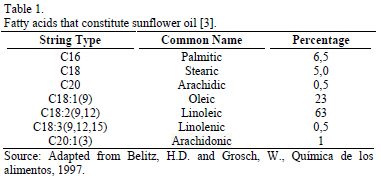
<body><![CDATA[<p><font size="2" face="Verdana, Arial, Helvetica, sans-serif">Fats and oils are an important component in both domestic wastewater   and some types of industrial wastewater. The amount of lipids in municipal   wastewater is approximately 30 to 40% of the organic matter, which is measured   as Oxygen Chemical Demand &#91;14&#93;.</font></p>     <p><font size="2" face="Verdana, Arial, Helvetica, sans-serif">However, the exact behavior of lipids in these processes   is not well understood. The literature generally states that lipids and fatty   acids are removed by biological treatment methods that inhibit microbial   growth, and cause foam formation, which is the growth of filamentous bacteria   and floating floc &#91;9&#93;.</font></p>     <p><font size="2" face="Verdana, Arial, Helvetica, sans-serif">Currently, Flotation is used in the separation of   immiscible fluids or fluids, while solids are increasingly used in sewage   treatment. There are three different types of flotation characterized by the   use of air at atmospheric pressure, dissolved air and induced air. The   difference lies in the way of introducing air into the wastewater &#91;28&#93;.</font></p>     <p><font size="2" face="Verdana, Arial, Helvetica, sans-serif">Physico-chemical treatment is applied to highly emulsified   and dispersed systems, and the size of fat particles is less than 20 microns.   It has been found that when using a DAF system to treat waters in the oil   industry the efficiency of the process increases from 50% to 88% &#91;13&#93; with the   addition of chemicals. A more recent alternative, electro coagulation, has   shown high effectiveness in destabilizing such emulsions and the subsequent   removal of oils and fats &#91;7&#93;. </font></p>     <p><font size="2" face="Verdana, Arial, Helvetica, sans-serif">As for the biodegradability of fats and oils, there is   generic information on which of these are classified as slowly biodegradable   substances. As for their degradations, cells initially save these substances on   their cytoplasm and later, through an enzymatic process, they perform   hydrolysis to produce an assimilable substrate that can be biodegraded &#91;27&#93;.   The results of the biodegradability obtained were between 0 and 40 % for   mineral oils and from 60 to 90% &#91;8&#93; for vegetable oils and diesters.</font></p>     <p><font size="2" face="Verdana, Arial, Helvetica, sans-serif">This research studies the biodegradation of sunflower oil,   for which tests are carried out in a discontinuous system with a behavior that   approaches suspended biomass. The sunflower oil choice was based on the   following criteria:</font></p> <ul>       <li><font size="2" face="Verdana, Arial, Helvetica, sans-serif">It is the most frequent oil used in Chile.</font></li>       <li><font size="2" face="Verdana, Arial, Helvetica, sans-serif">It is a product that is easy to access as well     as being a standardized one.</font></li>     </ul>     <p><font size="2" face="Verdana, Arial, Helvetica, sans-serif">Among the oils supplied in Chile, the most common is fish   oil, and to a lesser extent, sunflower oil, canola and corn.</font></p>     ]]></body>
<body><![CDATA[<p><font size="2" face="Verdana, Arial, Helvetica, sans-serif">Many of the crude oils are imported, mainly soybean and   sunflower &#91;12&#93;. </font></p>     <p><font size="2" face="Verdana, Arial, Helvetica, sans-serif">Sunflower oil removal by means of biodegradation in a   batch type reactor was studied and a comparative analysis of the behavior of   sunflower oil biodegradation with acclimated and non-acclimated sludge was   undertaken.</font></p>     <p><font size="2" face="Verdana, Arial, Helvetica, sans-serif">Other experiments that added sucrose as a different   substrate were also undertaken as this provides competition phenomena that must   be taken into account. </font></p>     <p><font size="2" face="Verdana, Arial, Helvetica, sans-serif">It is known that oils are formed by the condensation of   glycerol and fatty acids. </font></p>     <p><font size="2" face="Verdana, Arial, Helvetica, sans-serif"><b><i>1.2. Biological treatment of oils and fats</i></b></font></p>     <p><font size="2" face="Verdana, Arial, Helvetica, sans-serif">The specific   problem of fatty and oily influent in the activated sludge treatment (the most   commonly used method) is related to the release of free fat in the aeration   stage. This limits and reduces the BOD5 removal during the early stage and also   floating floc in the clarification stage. </font></p>     <p><font size="2" face="Verdana, Arial, Helvetica, sans-serif">Anaerobic   treatment is commonly preferred to treat strong effluent with high organic   content, in which fat and oil are the most common substrates from the food   industries. The assessment for treatment usage is usually based on factors such   as cost of aeration, sludge treatment, and disposal, etc.</font></p>     <p align="center"><font size="2" face="Verdana, Arial, Helvetica, sans-serif"><a name="tab01"></a></font><img src="/img/revistas/dyna/v82n193/v82n193a07tab01.gif"></p>     <p><font size="2" face="Verdana, Arial, Helvetica, sans-serif">It is presumed that these meet the   requirements of organic matter in the effluent. This consideration is important   for the selection of an appropriate treatment technology &#91;15&#93;.</font></p>     <p><font size="2" face="Verdana, Arial, Helvetica, sans-serif">Regardless of which type of   biological treatment is chosen, acclimatization of degrading biomass and the   presence of other substrates affect the biodegradation of fats and oils.</font></p>     ]]></body>
<body><![CDATA[<p><font size="2" face="Verdana, Arial, Helvetica, sans-serif">The composition and the particle substrate's size also   determine the hydrolysis and biodegradation speed and mechanism in wastewater   treatment system &#91;24&#93;. </font></p>     <p><font size="2" face="Verdana, Arial, Helvetica, sans-serif">There have been some experiences, when treating industrial   effluents vegetable oil, of anaerobic treatment preceded by aerobic treatment   having been applied. These processes are affected by several problems such as   the development of micelles, and the excess of biomass due to a high   coefficient of performance, etc. Therefore, the addition of a physicochemical   pretreatment, implemented to selectively remove biorefractory organics before   anaerobic treatment has been implemented, yielding satisfactory results &#91;30&#93;.</font></p>     <p><font size="2" face="Verdana, Arial, Helvetica, sans-serif">The process of biodegradation of fats and oils requires   the involvement of enzymes in the hydrolysis. Enzymes are proteins which act as   catalysts during reactions. They have the particular characteristic that is   used for a specific reaction and specific substrate type. Typically the degree   of specificity of an enzyme is associated with the biological role played.   &#91;22&#93;.</font></p>     <p><font size="2" face="Verdana, Arial, Helvetica, sans-serif">Hydrolysis begins with the biodegradation of fats and   oils. This refers to the breakdown of the primary organic substrate present in   the original wastewater into smaller products that can be captured and   subsequently biodegraded by bacteria &#91;33&#93;.</font></p>     <p><font size="2" face="Verdana, Arial, Helvetica, sans-serif">Microbial enzymes catalyze three reactions types:   Hydrolitic, Oxidatives and those of synthesis. The hydrolytic enzymes are used   to hydrolyze insoluble complex compounds on simple components that are able to   pass through the cellular membrane by diffusion. </font></p>     <p><font size="2" face="Verdana, Arial, Helvetica, sans-serif">These enzymes can act outside the cell wall, meaning that they can be intracellular or extracellular enzymes, such as   oxirreductasas, which operate within the cell &#91;26&#93;.</font></p>     <p><font size="2" face="Verdana, Arial, Helvetica, sans-serif">These enzymes can act outside the cell wall, and they can be intracellular or extracellular enzymes, such as oxirreductasas, which operate   within the cell</font></p>     <p><font size="2" face="Verdana, Arial, Helvetica, sans-serif">Fats and oils are attacked by a wide range of   organisms in a process in which extracellular enzymes called lipases are used   to free fatty acids &#91;20&#93;. In this case the fatty acids can be biodegraded by a   broader range of microorganisms. Those that do not produce lipolitic   extracellular enzymes are also included in the process &#91;25&#93;.</font></p>     <p><font size="2" face="Verdana, Arial, Helvetica, sans-serif">One of the tools that is most commonly used is the   acclimatization of biomass, a procedure which allows the pollutants to be   removed biologically. &#91;26&#93;. Due to the complex nature of the   sensitive microbial ecosystems, they dynamically provide answers regarding environmental conditions such as temperature, pH, availability and substrates type. &#91;26&#93;. </font></p>     <p><font size="2" face="Verdana, Arial, Helvetica, sans-serif">In this context, acclimatization it is associated with a   type of substrate that is to be used as an energy source; therefore, biomass   carries out the biodegradation thereof.</font></p>     ]]></body>
<body><![CDATA[<p><font size="2" face="Verdana, Arial, Helvetica, sans-serif">Also, in this context, the importance of the   acclimatization of sludge to a type of substance that was initially described   as harmful is confirmed. When considering the existing literature, fats and   oils are substances that do not favor the development and growth of bacterial   colonies. As sludge is acclimatized for a considerable time to the new type of   influent, it appears that the biomass adapted to it. This is explained by   mutations, or changes caused by chemical or physical agents, which change the   DNA and impart new features to the cell, thereby allowing the cell to degrade   xenobiotic substances or ones that are a result of biodegradation. Spontaneous   mutations occur in one of 106 cells. However, the DNA molecule is capable of   auto-repeating &#91;6&#93;.</font></p>     <p><font size="2" face="Verdana, Arial, Helvetica, sans-serif">In recent years, use has been made of commercial   microbial supplements that are bioincreasers as they remove of fats and oils,   and make a distinction between those with a variety of bacteria from those that   contain a specified one &#91;7&#93;.</font></p>     <p><font size="2" face="Verdana, Arial, Helvetica, sans-serif">The nature of organic, soluble or particulate   substrates as well as the concentration of nutrients, which dissolve oxygen in   the reactor and the organic load, and the sludge age are some of the main   factors affecting competition &#91;1&#93;.</font></p>     <p><font size="2" face="Verdana, Arial, Helvetica, sans-serif">Given the possibility that heterogeneous communities   of bacteria simultaneously metabolize individual components of mixtures of   carbon compounds, they are dependent on the concentration of the respective   substrates &#91;29&#93;. </font></p>     <p><font size="2" face="Verdana, Arial, Helvetica, sans-serif">Finally, in the case of mineral oils, the OECD   current standards require both a knowledge of the chemical structure to   calculate the theoretical value of the rate of oxygen consumption (OUR) and CO2   evolution, and an experimental determination of the value for these parameters,   which is closely associated with ecological impacts &#91;5&#93;. In fact, pollution   from oil spills in marine ecosystems and reserves accelerates the repair of the   damaged ecosystem through bioremediation techniques. These are based on the   application of microbial metabolic activity to degrade petroleum hydrocarbons   &#91;2&#93;, which is also based on the principles of acclimatization.</font></p>     <p>&nbsp;</p>     <p><font size="3" face="Verdana, Arial, Helvetica, sans-serif"><b>2. Methodology</b></font></p>     <p><font size="2" face="Verdana, Arial, Helvetica, sans-serif"><b><i>2.1. Batch Team</i></b></font></p>     <p><font size="2" face="Verdana, Arial, Helvetica, sans-serif">The batch   reactors are beakers of 250 m,   which are filled with bacterial biomass generated from the biodegradation of   sucrose, which has a suspended solids concentration in the range of 4000 to   6000 mg/l as well as a stirring device.</font></p>     <p><font size="2" face="Verdana, Arial, Helvetica, sans-serif"><b><i>2.2. Food Preparation </i></b></font></p>     ]]></body>
<body><![CDATA[<p><font size="2" face="Verdana, Arial, Helvetica, sans-serif">The batch reactor   was fed with synthetic wastewater, prepared according to the typical   characteristics of a strong urban wastewater &#91;23&#93; This has a COD of about 1000   mg/l, with the proportions of nitrogen and phosphorus, which are given by the   COD: N: P=100:5:1. In addition to the carbonaceous substrates, potassium   hydrogen phosphate and ammonium chloride were added.</font></p>     <p><font size="2" face="Verdana, Arial, Helvetica, sans-serif"><b><i>2.3. Analytical Testing</i></b></font></p>     <p><font size="2" face="Verdana, Arial, Helvetica, sans-serif">Equipment and   instruments used to determine the various parameters to characterize the   wastewater were used. The following parameters with their corresponding methods   were measured:</font></p>     <p><font size="2" face="Verdana, Arial, Helvetica, sans-serif">&bull; Total Suspended   Solids (TSS), </font></p>     <p><font size="2" face="Verdana, Arial, Helvetica, sans-serif">TSS is determined   by filtering a known volume of sample on Whatman   4.7 cm GF/C glass fiber   filters and then drying it at 103- 105°C.   The difference in weight of the filter before and after filtration is used to   calculate the content SST, 209C   method &#91;1&#93;.</font></p>     <p><font size="2" face="Verdana, Arial, Helvetica, sans-serif">&bull; Fats and Oils</font></p>     <p><font size="2" face="Verdana, Arial, Helvetica, sans-serif">When determining the fats and oils, the Gravimetric Assay   Soxhlet method is used, which quantifies substances with similar   characteristics on the basis of their common solubility in an appropriate   solvent, 213E method &#91;1&#93;.</font></p>     <p><font size="2" face="Verdana, Arial, Helvetica, sans-serif">The experimental   design of this work starts with a comparative experience, using acclimatized   and non-acclimatized biomass, with different concentrations of TSS in an   exploratory phase in order to verify the effect of acclimatization on the   biodegradation of fats and oils.</font></p>     <p><font size="2" face="Verdana, Arial, Helvetica, sans-serif">In the second   experiment, when working with the additional substrate -sucrose- in all   scenarios, the same concentration of TSS was used with acclimatized and   non-acclimatized biomass.</font></p>     <p>&nbsp;</p>     ]]></body>
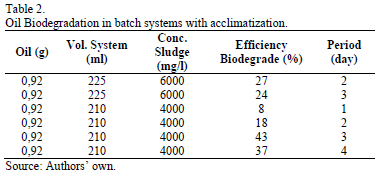
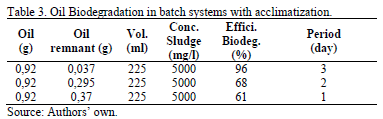
<body><![CDATA[<p><font size="3" face="Verdana, Arial, Helvetica, sans-serif"><b>3. Results</b></font></p>     <p><font size="2" face="Verdana, Arial, Helvetica, sans-serif">The biodegradation sunflower oil tests were performed in   an incubator at a temperature of 30°C   and an agitation of 200 (rev/min).</font></p>     <p><font size="2" face="Verdana, Arial, Helvetica, sans-serif"><b><i>3.1. Acclimated   sludge</i></b></font></p>     <p><font size="2" face="Verdana, Arial, Helvetica, sans-serif">The results obtained are reported in terms of the biodegradation   that is left by the removal of the oil type, 0.92 g, using two different   concentrations of non-acclimatized biomass, 4000 and 6000 mg/l.</font></p>     <p><font size="2" face="Verdana, Arial, Helvetica, sans-serif">A relationship is observed between the levels of   biodegradation and the time that the substrate remains in the reactor. This is   a consequence of the specific features that the oil has in terms of its   solubility and buoyancy. These features result in a random situation regarding   the meeting of microorganisms with the oil molecules. It is observed that   biodegradation levels range from 8% for 1 day to 43% for 4 days in terms of residence   time, <a href="#tab02">Table 2</a>. The increase in biomass concentration is not a relevant factor.</font></p>     <p align="center"><font size="2" face="Verdana, Arial, Helvetica, sans-serif"><a name="tab02"></a></font><img src="/img/revistas/dyna/v82n193/v82n193a07tab02.gif"></p>     <p><font size="2" face="Verdana, Arial, Helvetica, sans-serif">In order to develop microbial wastewater treatment,   contaminated edible oils were selected that contained microorganisms capable of   quickly biodegrading edible oil. The screening study showed a co-culture of   yeast strain that was comprised of Rhodotorula pacifica ST3411 and ST3412</font><font size="2" face="Verdana, Arial, Helvetica, sans-serif"> strain Cryptococcus laurentii. The   degradation rate in 24h 3,000 ppm of mixed oils (salad oil / butter / beef   tallow, 1:01 w/w) at 20&deg;C   was 39.8%. Faster degradation was observed at 20&deg;C and pH 8. In a larger scale   experiment, the salad oil was rapidly degraded by a cocultivation of 67152.0 to   14396.7 ppm in 24 hours, and the degradation rate was 79.4% &#91;32&#93;.</font></p>     <p align="center"><font size="2" face="Verdana, Arial, Helvetica, sans-serif"><a name="tab03"></a></font><img src="/img/revistas/dyna/v82n193/v82n193a07tab03.gif"></p>     <p><font size="2" face="Verdana, Arial, Helvetica, sans-serif"><b><i>3.2. Acclimated   sludge</i></b></font></p>     <p><font size="2" face="Verdana, Arial, Helvetica, sans-serif">In order to measure the acclimatization effect of the   sludge, experiments with acclimated sludge (C/A) on a batch reactor were   developed. The following results were obtained:</font></p>     ]]></body>
<body><![CDATA[<p><font size="2" face="Verdana, Arial, Helvetica, sans-serif">In the above results the   importance of acclimation of sludge in biological treatment can be observed.   Conversion levels between acclimated sludge reactors were compared with ones   that had not been acclimatized, and the differences noted. For the cases with   acclimated sludge, biodegradation levels over 60% produced values of up to 98%,   and in the case of sludge without acclimatization values ranging from 8 to 42%   were obtained. An important factor is the acclimatization of the sludge, which   plays an important role. High concentrations of lipids emulsified, about 400   mg/l are absorbed quickly and efficiently when they are brought into contact   with activated sludge previously acclimated to low concentrations of lipids of   30 mg/l.&#91;18&#93;</font></p>     <p><font size="2" face="Verdana, Arial, Helvetica, sans-serif">These results are very similar to those obtained by other   research on biodegradation of olive oil in a batch activated sludge system   using both acclimated and non-acclimated sludge. For non-acclimated sludge,   levels of biodegradability obtained between day 1 and day 4 were from 6% to   68%, while for acclimated sludge, results vary from day 2 to day 5 by 58% and 96%   &#91;34&#93;.</font></p>     <p><font size="2" face="Verdana, Arial, Helvetica, sans-serif">The feasibility of sewage sludge co-digestion using   intermediate waste generated inside a wastewater treatment plant, i.e. trapped   grease waste from the dissolved air flotation unit, has been assessed in a continuous   stirred lab reactor operating at 35   °C with a hydraulic retention time of 20 days. The   results indicate that a slow increase in the grease waste dose could be a   strategy that favors biomass acclimation to fat-rich co-substrate, which increases   long chain fatty acid degradation and reduces the latter's inhibitory effect.   &#91;31&#93;.</font></p>     <p><font size="2" face="Verdana, Arial, Helvetica, sans-serif">Moreover, there are laboratory studies for commercial   supplements -multi bioaugmenters type   species- that have verified the increase in the removal of fats and oils from   37% to 62% &#91;6&#93;. This bears some similarity to the effect of acclimatization of   sludge: also being a biological type.</font></p>     <p><font size="2" face="Verdana, Arial, Helvetica, sans-serif">The use of bio   augmenters was applied to bakery wastewater, which is rich in oils and fats.   During this process, the pH, and the aeration system of an external mix   bioreactor was properly adjusted to optimize the efficiency of treatment tank   and the biological filter. The main function of the external mix bioreactor is   producing and injecting the improved biomass into the main system. A large reduction   of fats and oils 1.5g / 0.03g / l was achieved. This improvement was been   observed over a period of 20 months &#91;19&#93;.</font></p>     <p><font size="2" face="Verdana, Arial, Helvetica, sans-serif">In other cases that are based on acclimatization,   the bioremediation of a contaminated soil was compared with a gasoline-diesel   fuel mixture on a laboratory scale, to evaluate biostimulation against natural attenuation   and bioaugmentation. The reduction of Total Petroleum Hydrocarbons (TPH)   concentration over the course of three months was 52.79% for natural   attenuation, 60.45% for biostimulation and 64.92% for bioaugmentation. A   bacterium with the capacity to degrade hydrocarbons identified as Bacillus sp. was   isolated during inoculation in the bioaugmentation treatment &#91;16&#93;.</font></p>     <p><font size="2" face="Verdana, Arial, Helvetica, sans-serif">A similar study for Yarrowia lipolytica W29 that was   immobilized by calcium alginate was considered. In this case the main objective   was to degrade the chemical oxygen demand (COD) and oil. Biodegradation by   immobilized cells (cell density of 6.65 × 10<sup>6</sup> CFU/ml), was able to remove   up to 2000 mg/l of oil and up to 2000 mg /l of COD in 50 hours of treatment at 30°C (pH 7, 150 r/min). Similarly,   using free cells, it was observed that the resulting biodegradation efficiency was   80% of the previously cited figures &#91;21&#93;.</font></p>     <p><font size="2" face="Verdana, Arial, Helvetica, sans-serif"><b><i>3.3. Effects of   Joint Food</i></b></font></p>     <p><font size="2" face="Verdana, Arial, Helvetica, sans-serif">Experiences of biodegradation in batch systems for two   types of influent, one with mixed feeding and another that only has oil were   measured in order to assess the effects on the biodegradation of an additional   substrate in the influent. </font></p>     <p><font size="2" face="Verdana, Arial, Helvetica, sans-serif"><b>A non-acclimated biomass </b></font></p>     ]]></body>
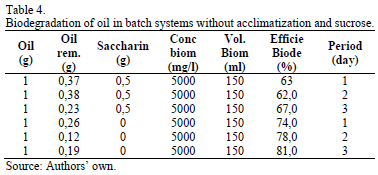
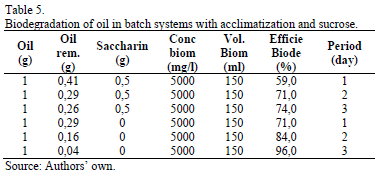
<body><![CDATA[<p><font size="2" face="Verdana, Arial, Helvetica, sans-serif">When comparing the   results shown in the above tables that correspond to levels of biodegradation   obtained in a batch reactor, both strictly oily sucrose and mixed influent, the   effect of acclimatization is confirmed. Higher levels of biodegradation are   checked for acclimated sludge. This was undertaken at a temperature of 30°C and 200 (rev/min).</font></p>     <p align="center"><font size="2" face="Verdana, Arial, Helvetica, sans-serif"><a name="tab04"></a></font><img src="/img/revistas/dyna/v82n193/v82n193a07tab04.gif"></p>     <p><font size="2" face="Verdana, Arial, Helvetica, sans-serif">These results allow the effect of sucrose to be evaluated on   the biodegradation of oil, which is manifested at a reduced level of oil   biodegradability. This is explained by the fact that microorganisms have an   alternative carbon source and competitive phenomena occur. It can be said that   the presence of sucrose causes an inhibitory effect on the biodegradation of   oil.</font></p>     <p align="center"><font size="2" face="Verdana, Arial, Helvetica, sans-serif"><a name="tab05"></a></font><img src="/img/revistas/dyna/v82n193/v82n193a07tab05.gif"></p>     <p><font size="2" face="Verdana, Arial, Helvetica, sans-serif">In this case, sunflower oil biodegradation was studied in   a batch-type system for both types of influent, over a period of three days, with   the same concentration of biomass, at a temperature of 30°C and 200 (rev/min).</font></p>     <p><font size="2" face="Verdana, Arial, Helvetica, sans-serif">As can be seen from   the results, for the cases where the influent only has oil and the   biodegradation growth level achieved ranges from 71% to 96%, for acclimatized biomass   with levels between 73,6 to 81%, and for non-acclimatized biomass, a higher level of biodegradation is   observed. For the influent case in which biomass was acclimatized at between   62.2 to 66,7%, and for non-acclimatized biomass that has sucrose as well as the   oils, biodegradation ranges from between a 59% and 74%, and the reaction times   are from one to three days. </font></p>     <p><font size="2" face="Verdana, Arial, Helvetica, sans-serif">In similar experiences, considering the same amount of   biomass (500 mg/l), where only vegetable oil is present in the effluent, a   range of biodegradation is observed between 74% and 81% for the non-acclimated   biomass. These results are clearly lower than the range observed for acclimated   biomass (71 to 96%)</font></p>     <p><font size="2" face="Verdana, Arial, Helvetica, sans-serif">The intake besides oil also contains saccharin. The   biodegradation reaches ranges of between 62% and 67% for the non-acclimated   biomass and 59% and 71% for the acclimated biomass. </font></p>     <p><font size="2" face="Verdana, Arial, Helvetica, sans-serif">In both experiments the processing time ranges from between   one to three days. Similarly, in both cases, with and without acclimation, it   is observed that the procedure improves the oil biodegradation level, and the   alternative substratum (saccharin) also competes with the oil reducing in both cases   its degradation levels. </font></p>     <p><font size="2" face="Verdana, Arial, Helvetica, sans-serif">This confirms the   previously obtained results regarding acclimatization. It also appears that the concentration of   TSS is not relevant between the 4000-6000 mg/l range.</font></p>     ]]></body>
<body><![CDATA[<p><font size="2" face="Verdana, Arial, Helvetica, sans-serif">The experiments   conducted characterized the transformation of lipids in the activated sludge   under aerobic conditions. The results show that the total lipid content in the   effluent could not be reduced to values below 300 mg/l from an initial   concentration of 2000 mg/l &#91;9&#93;. This is a value that is consistent with those   obtained in this investigation, which reached 98% within three days of   residence time, larger than   that of activated sludge.</font></p>     <p><font size="2" face="Verdana, Arial, Helvetica, sans-serif">This study   investigates the COD removal of two-phase anaerobic digestion to treat a   mixture (1/5 v/v) of used vegetable oil waste and pig manure. It uses two   semi-continuous digesters that were operated at a mesophilic temperature. One   of the experiments was conducted at a hydraulic retention time (HRT) of 4 days   in the first stage (acidifier) and at a HRT of 20 days in the second stage   (methanizer). The CODs removal efficiency were 44% and 79,5% respectively &#91;17&#93;.</font></p>     <p>&nbsp;</p>     <p><font size="3" face="Verdana, Arial, Helvetica, sans-serif"><b>4. Conclusions</b></font></p>     <p><font size="2" face="Verdana, Arial, Helvetica, sans-serif">Under all   conditions it was possible to remove oil biodegradation pathways with levels   ranging from 10% to about 90%.</font></p>     <p><font size="2" face="Verdana, Arial, Helvetica, sans-serif">It was found that   acclimation of sludge substantially improves the efficiency of biodegradation,   increasing it from an average value of 30% with no biomass acclimated to an   average of 80% over a period ranging from 1 to 3 and 1 to 4 days.</font></p>     <p><font size="2" face="Verdana, Arial, Helvetica, sans-serif">The presence of   other more biodegradable substrates, such as saccharine, reduces the efficiency   of biodegradation of sunflower oil, from an average value of 80% to 65%.</font></p>     <p>&nbsp;</p>     <p><font size="3" face="Verdana, Arial, Helvetica, sans-serif"><b>References</b></font></p>     <!-- ref --><p><font size="2" face="Verdana, Arial, Helvetica, sans-serif"><b>&#91;1&#93;</b> APHA   - AWWA - WPFC, M&eacute;todos normalizados para el an&aacute;lisis de agua potable y aguas   residuales, Editorial D&iacute;az de Santos, Madrid, 17 Edici&oacute;n, 1992.    &nbsp;&nbsp;&nbsp;&nbsp;&nbsp;&nbsp;&nbsp;&nbsp;[&#160;<a href="javascript:void(0);" onclick="javascript: window.open('/scielo.php?script=sci_nlinks&ref=000112&pid=S0012-7353201500050000700001&lng=','','width=640,height=500,resizable=yes,scrollbars=1,menubar=yes,');">Links</a>&#160;]<!-- end-ref --></font></p>     <!-- ref --><p><font size="2" face="Verdana, Arial, Helvetica, sans-serif"><b>&#91;2&#93;</b> Barrios,   Y., Bioremediaci&oacute;n: Una herramienta para el saneamiento de ecosistemas marinos   contaminados con petr&oacute;leo, Biotecnolog&iacute;a Aplicada, 28, pp. 60-68, 2011.    &nbsp;&nbsp;&nbsp;&nbsp;&nbsp;&nbsp;&nbsp;&nbsp;[&#160;<a href="javascript:void(0);" onclick="javascript: window.open('/scielo.php?script=sci_nlinks&ref=000114&pid=S0012-7353201500050000700002&lng=','','width=640,height=500,resizable=yes,scrollbars=1,menubar=yes,');">Links</a>&#160;]<!-- end-ref --></font></p>     <!-- ref --><p><font size="2" face="Verdana, Arial, Helvetica, sans-serif"><b>&#91;3&#93;</b> Belitz,   H.D. y Grosch, W., Qu&iacute;mica de los Alimentos, 2<sup>da</sup> Ed., Editorial   Acribia S.A., Zaragoza, Espa&ntilde;a, 1997.    &nbsp;&nbsp;&nbsp;&nbsp;&nbsp;&nbsp;&nbsp;&nbsp;[&#160;<a href="javascript:void(0);" onclick="javascript: window.open('/scielo.php?script=sci_nlinks&ref=000116&pid=S0012-7353201500050000700003&lng=','','width=640,height=500,resizable=yes,scrollbars=1,menubar=yes,');">Links</a>&#160;]<!-- end-ref --></font></p>     <!-- ref --><p><font size="2" face="Verdana, Arial, Helvetica, sans-serif"><b>&#91;4&#93;</b> Bergmann,   H, Electrochemical treatment of cooling lubricants, Chemical Engineering and   Processing, 42 (2), pp. 105-119, 2003. DOI: 10.1016/S0255-2701(02)00020-X</font>&nbsp;&nbsp;&nbsp;&nbsp;&nbsp;&nbsp;&nbsp;&nbsp;[&#160;<a href="javascript:void(0);" onclick="javascript: window.open('/scielo.php?script=sci_nlinks&ref=000118&pid=S0012-7353201500050000700004&lng=','','width=640,height=500,resizable=yes,scrollbars=1,menubar=yes,');">Links</a>&#160;]<!-- end-ref --><!-- ref --><p><font size="2" face="Verdana, Arial, Helvetica, sans-serif"><b>&#91;5&#93;</b> Betton,   C.I., Lubricants, en: Orszulik S.T, Ed., Enviromental technology in the oil   industry, Blackie Academic Professional, London, 1997, pp. 367-381.    &nbsp;&nbsp;&nbsp;&nbsp;&nbsp;&nbsp;&nbsp;&nbsp;[&#160;<a href="javascript:void(0);" onclick="javascript: window.open('/scielo.php?script=sci_nlinks&ref=000119&pid=S0012-7353201500050000700005&lng=','','width=640,height=500,resizable=yes,scrollbars=1,menubar=yes,');">Links</a>&#160;]<!-- end-ref --></font></p>     <!-- ref --><p><font size="2" face="Verdana, Arial, Helvetica, sans-serif"><b>&#91;6&#93;</b> Bitton,   G., Wastewater Microbiology, John Wiley &amp; Sons, New York, 1994.    &nbsp;&nbsp;&nbsp;&nbsp;&nbsp;&nbsp;&nbsp;&nbsp;[&#160;<a href="javascript:void(0);" onclick="javascript: window.open('/scielo.php?script=sci_nlinks&ref=000121&pid=S0012-7353201500050000700006&lng=','','width=640,height=500,resizable=yes,scrollbars=1,menubar=yes,');">Links</a>&#160;]<!-- end-ref --></font></p>     ]]></body>
<body><![CDATA[<!-- ref --><p><font size="2" face="Verdana, Arial, Helvetica, sans-serif"><b>&#91;7&#93;</b> <em>Brooksbank,</em> A.M., <em>Latchford, </em>J.W. and <em>Mudge, </em>S.M., Degradation and modification   of fats, oils and grease by commercial microbial supplements, World Journal of   Microbiology and Biotechnology, 23, pp. 977-985, 2007. DOI:   10.1007/s11274-006-9323-1.    &nbsp;&nbsp;&nbsp;&nbsp;&nbsp;&nbsp;&nbsp;&nbsp;[&#160;<a href="javascript:void(0);" onclick="javascript: window.open('/scielo.php?script=sci_nlinks&ref=000123&pid=S0012-7353201500050000700007&lng=','','width=640,height=500,resizable=yes,scrollbars=1,menubar=yes,');">Links</a>&#160;]<!-- end-ref --></font></p>     <!-- ref --><p><font size="2" face="Verdana, Arial, Helvetica, sans-serif"><b>&#91;8&#93;</b> Cain,   R., Designing biodegradable molecules for the oleochemicals industries, Journal   Chem. Tech. Biotechnology, 55, pp. 397-414, 1992. DOI: 10.1002/jctb.280550424</font>&nbsp;&nbsp;&nbsp;&nbsp;&nbsp;&nbsp;&nbsp;&nbsp;[&#160;<a href="javascript:void(0);" onclick="javascript: window.open('/scielo.php?script=sci_nlinks&ref=000125&pid=S0012-7353201500050000700008&lng=','','width=640,height=500,resizable=yes,scrollbars=1,menubar=yes,');">Links</a>&#160;]<!-- end-ref --><!-- ref --><p><font size="2" face="Verdana, Arial, Helvetica, sans-serif"><b>&#91;9&#93;</b> Chipasa,   K.B. and Medrzycka, K., Behavior of lipids in biological wastewater treatment   processes, Journal of industrial microbiology and biotechnology, 33 (8), pp.   635-45, 2006. DOI:   10.1007/s00284-009-9525-5</font>&nbsp;&nbsp;&nbsp;&nbsp;&nbsp;&nbsp;&nbsp;&nbsp;[&#160;<a href="javascript:void(0);" onclick="javascript: window.open('/scielo.php?script=sci_nlinks&ref=000126&pid=S0012-7353201500050000700009&lng=','','width=640,height=500,resizable=yes,scrollbars=1,menubar=yes,');">Links</a>&#160;]<!-- end-ref --><!-- ref --><p><font size="2" face="Verdana, Arial, Helvetica, sans-serif"><b>&#91;10&#93;</b> Chipasa,   K.B. y Medrzycka, K., Characterization of the fate of lipids in activated   sludge, Journal of environmental sciencies (China), 20(5), pp. 536-42, 2008.    &nbsp;&nbsp;&nbsp;&nbsp;&nbsp;&nbsp;&nbsp;&nbsp;[&#160;<a href="javascript:void(0);" onclick="javascript: window.open('/scielo.php?script=sci_nlinks&ref=000127&pid=S0012-7353201500050000700010&lng=','','width=640,height=500,resizable=yes,scrollbars=1,menubar=yes,');">Links</a>&#160;]<!-- end-ref --></font></p>     <!-- ref --><p><font size="2" face="Verdana, Arial, Helvetica, sans-serif"><b>&#91;11&#93;</b> Chudoba,   J., Ottova, V. and Madera, V., Control of activated sludge filamentous   bulking-I. Effect of the hidraulic regime on degree of mixing in an aereation   tank, Water Resources, 7, pp. 1163-1182, 1973.    &nbsp;&nbsp;&nbsp;&nbsp;&nbsp;&nbsp;&nbsp;&nbsp;[&#160;<a href="javascript:void(0);" onclick="javascript: window.open('/scielo.php?script=sci_nlinks&ref=000129&pid=S0012-7353201500050000700011&lng=','','width=640,height=500,resizable=yes,scrollbars=1,menubar=yes,');">Links</a>&#160;]<!-- end-ref --></font></p>     <!-- ref --><p><font size="2" face="Verdana, Arial, Helvetica, sans-serif"><b>&#91;12&#93;</b> CONAMA, Gu&iacute;a para el control y   prevenci&oacute;n de la contaminaci&oacute;n industrial, Fabricaci&oacute;n de grasas y aceites   vegetales y subproductos, 1998.    &nbsp;&nbsp;&nbsp;&nbsp;&nbsp;&nbsp;&nbsp;&nbsp;[&#160;<a href="javascript:void(0);" onclick="javascript: window.open('/scielo.php?script=sci_nlinks&ref=000131&pid=S0012-7353201500050000700012&lng=','','width=640,height=500,resizable=yes,scrollbars=1,menubar=yes,');">Links</a>&#160;]<!-- end-ref --></font></p>     ]]></body>
<body><![CDATA[<!-- ref --><p><font size="2" face="Verdana, Arial, Helvetica, sans-serif"><b>&#91;13&#93;</b> De Turris, A., Yabroudi, S.C.,   Valbuena, B., Gutierrez, C., Cardenas, C., Herrera, L. y Rojas, C., Tratamiento   de aguas de producci&oacute;n por flotaci&oacute;n con aire disuelto, Interciencia, 36 (3),   pp. 211-218, 2011.    &nbsp;&nbsp;&nbsp;&nbsp;&nbsp;&nbsp;&nbsp;&nbsp;[&#160;<a href="javascript:void(0);" onclick="javascript: window.open('/scielo.php?script=sci_nlinks&ref=000133&pid=S0012-7353201500050000700013&lng=','','width=640,height=500,resizable=yes,scrollbars=1,menubar=yes,');">Links</a>&#160;]<!-- end-ref --> </font></p>     <!-- ref --><p><font size="2" face="Verdana, Arial, Helvetica, sans-serif"><b>&#91;14&#93;</b> Dueholm,   T.E., Andreasen, K.H. and Nielsen, P.H., Transformation of lipids in activated   sludge, Water Sciencie and Technology, 43 (1), pp. 165-172, 2001.    &nbsp;&nbsp;&nbsp;&nbsp;&nbsp;&nbsp;&nbsp;&nbsp;[&#160;<a href="javascript:void(0);" onclick="javascript: window.open('/scielo.php?script=sci_nlinks&ref=000135&pid=S0012-7353201500050000700014&lng=','','width=640,height=500,resizable=yes,scrollbars=1,menubar=yes,');">Links</a>&#160;]<!-- end-ref --></font></p>     <!-- ref --><p><font size="2" face="Verdana, Arial, Helvetica, sans-serif"><b>&#91;15&#93;</b> Germirli,   F., Cekyay, E., Eremektar, G. and Orhon, D., Pollutions loads and inert COD in   the laying chicken industry, Water Science and Technology, 40 (1), pp. 207-213,   1999. DOI: 10.1016/S0273-1223(99)00386-8</font>&nbsp;&nbsp;&nbsp;&nbsp;&nbsp;&nbsp;&nbsp;&nbsp;[&#160;<a href="javascript:void(0);" onclick="javascript: window.open('/scielo.php?script=sci_nlinks&ref=000137&pid=S0012-7353201500050000700015&lng=','','width=640,height=500,resizable=yes,scrollbars=1,menubar=yes,');">Links</a>&#160;]<!-- end-ref --><!-- ref --><p><font size="2" face="Verdana, Arial, Helvetica, sans-serif"><b>&#91;16&#93;</b> Gomez, W., Gaviria, J. y Cardona, S.,   Evaluaci&oacute;n de la bioestimulaci&oacute;n frente a la atenuaci&oacute;n natural y la   bioaumentaci&oacute;n en un suelo contaminado con una mezcla de gasolina -di&eacute;sel. DYNA 76 (160), pp. 83-93,   2009.    &nbsp;&nbsp;&nbsp;&nbsp;&nbsp;&nbsp;&nbsp;&nbsp;[&#160;<a href="javascript:void(0);" onclick="javascript: window.open('/scielo.php?script=sci_nlinks&ref=000138&pid=S0012-7353201500050000700016&lng=','','width=640,height=500,resizable=yes,scrollbars=1,menubar=yes,');">Links</a>&#160;]<!-- end-ref --></font></p>     <!-- ref --><p><font size="2" face="Verdana, Arial, Helvetica, sans-serif"><b>&#91;17&#93;</b> Hidalgo, D., Gomez, M.,   Aguado, A., Martin, J and Sastre, E., Valorization of residues from refining of   used vegetable oils. DYNA 81 (184), pp. 20-27, 2014. DOI:   10.1016/S0273-1223(99)00386-8</font>&nbsp;&nbsp;&nbsp;&nbsp;&nbsp;&nbsp;&nbsp;&nbsp;[&#160;<a href="javascript:void(0);" onclick="javascript: window.open('/scielo.php?script=sci_nlinks&ref=000140&pid=S0012-7353201500050000700017&lng=','','width=640,height=500,resizable=yes,scrollbars=1,menubar=yes,');">Links</a>&#160;]<!-- end-ref --><!-- ref --><p><font size="2" face="Verdana, Arial, Helvetica, sans-serif"><b>&#91;18&#93;</b> Hrudey,   S.E., Factors limiting emulsified lipid treatment capacity of activated sludge,   Journal Water Pollution Control Federation, 54 (8), pp. 1207-1214, 1982.    &nbsp;&nbsp;&nbsp;&nbsp;&nbsp;&nbsp;&nbsp;&nbsp;[&#160;<a href="javascript:void(0);" onclick="javascript: window.open('/scielo.php?script=sci_nlinks&ref=000141&pid=S0012-7353201500050000700018&lng=','','width=640,height=500,resizable=yes,scrollbars=1,menubar=yes,');">Links</a>&#160;]<!-- end-ref --></font></p>     ]]></body>
<body><![CDATA[<!-- ref --><p><font size="2" face="Verdana, Arial, Helvetica, sans-serif"><b>&#91;19&#93;</b> Keenan,   D. and Sabelnikov, A., Biological augmentation eliminates grease and oil in   bakery wastewater, Water Environment Research, 72 (2), pp. 141-146, 2000. DOI: 10.2175/106143000X137202</font>&nbsp;&nbsp;&nbsp;&nbsp;&nbsp;&nbsp;&nbsp;&nbsp;[&#160;<a href="javascript:void(0);" onclick="javascript: window.open('/scielo.php?script=sci_nlinks&ref=000143&pid=S0012-7353201500050000700019&lng=','','width=640,height=500,resizable=yes,scrollbars=1,menubar=yes,');">Links</a>&#160;]<!-- end-ref --><!-- ref --><p><font size="2" face="Verdana, Arial, Helvetica, sans-serif"><b>&#91;20&#93;</b> Kurashige,   J., Matsuzaki, N. and Makabe, K., Modifications of fats and oils by lipases, J.   Dispersion Sciencie and Technology, 10, pp. 531-559, 1989. DOI: 10.1080/01932698908943187</font>&nbsp;&nbsp;&nbsp;&nbsp;&nbsp;&nbsp;&nbsp;&nbsp;[&#160;<a href="javascript:void(0);" onclick="javascript: window.open('/scielo.php?script=sci_nlinks&ref=000144&pid=S0012-7353201500050000700020&lng=','','width=640,height=500,resizable=yes,scrollbars=1,menubar=yes,');">Links</a>&#160;]<!-- end-ref --><!-- ref --><p><font size="2" face="Verdana, Arial, Helvetica, sans-serif"><b>&#91;21&#93;</b> Lan,   W., Gang, G.E. and Jinbao, W., Biodegradation of oil wastewater by free and   immobilized Yarrowia lipolytica W29, Journal of Environmental Sciences, 21, pp.   237-242, 2008.    &nbsp;&nbsp;&nbsp;&nbsp;&nbsp;&nbsp;&nbsp;&nbsp;[&#160;<a href="javascript:void(0);" onclick="javascript: window.open('/scielo.php?script=sci_nlinks&ref=000145&pid=S0012-7353201500050000700021&lng=','','width=640,height=500,resizable=yes,scrollbars=1,menubar=yes,');">Links</a>&#160;]<!-- end-ref --></font></p>     <!-- ref --><p><font size="2" face="Verdana, Arial, Helvetica, sans-serif"><b>&#91;22&#93;</b> Martinez,   O., Wilhelm, A.M. and Riba, J.P., Kinetic study of an enzimatic liquid-liquid   reaction: The hydrolysis of tributyrin by Candida cilindracea lipase, J. Chem.   Tech. Biotechnology, 53, pp. 373-378, 1992. DOI: 10.1002/jctb.280530409</font>&nbsp;&nbsp;&nbsp;&nbsp;&nbsp;&nbsp;&nbsp;&nbsp;[&#160;<a href="javascript:void(0);" onclick="javascript: window.open('/scielo.php?script=sci_nlinks&ref=000147&pid=S0012-7353201500050000700022&lng=','','width=640,height=500,resizable=yes,scrollbars=1,menubar=yes,');">Links</a>&#160;]<!-- end-ref --><!-- ref --><p><font size="2" face="Verdana, Arial, Helvetica, sans-serif"><b>&#91;23&#93;</b> METCALF   - EDDY, Wastewater engineering: Treatment and reuse, Ed. McGraw Hil, 4ª Ed.,   2002.    &nbsp;&nbsp;&nbsp;&nbsp;&nbsp;&nbsp;&nbsp;&nbsp;[&#160;<a href="javascript:void(0);" onclick="javascript: window.open('/scielo.php?script=sci_nlinks&ref=000148&pid=S0012-7353201500050000700023&lng=','','width=640,height=500,resizable=yes,scrollbars=1,menubar=yes,');">Links</a>&#160;]<!-- end-ref --></font></p>     <!-- ref --><p><font size="2" face="Verdana, Arial, Helvetica, sans-serif"><b>&#91;24&#93;</b> Morgenroth,   E., Kommedal, R. and Harremoes, P., Process and modeling of hydrolysis of   particulate organic matter in aerobic wastewater treatment - a review, Water   Sciencie and Technology, 45 (6), pp. 25-40, 2002.    &nbsp;&nbsp;&nbsp;&nbsp;&nbsp;&nbsp;&nbsp;&nbsp;[&#160;<a href="javascript:void(0);" onclick="javascript: window.open('/scielo.php?script=sci_nlinks&ref=000150&pid=S0012-7353201500050000700024&lng=','','width=640,height=500,resizable=yes,scrollbars=1,menubar=yes,');">Links</a>&#160;]<!-- end-ref --></font></p>     <!-- ref --><p><font size="2" face="Verdana, Arial, Helvetica, sans-serif"><b>&#91;25&#93;</b> Ratledge,   C., Microbial oxidations of fatty alcohols and fatty acids, J. Chem. Tech.   Biotechnology, 55, pp. 399-400, 1992. DOI: 10.1002/jctb.280550418</font>&nbsp;&nbsp;&nbsp;&nbsp;&nbsp;&nbsp;&nbsp;&nbsp;[&#160;<a href="javascript:void(0);" onclick="javascript: window.open('/scielo.php?script=sci_nlinks&ref=000152&pid=S0012-7353201500050000700025&lng=','','width=640,height=500,resizable=yes,scrollbars=1,menubar=yes,');">Links</a>&#160;]<!-- end-ref --><!-- ref --><p><font size="2" face="Verdana, Arial, Helvetica, sans-serif"><b>&#91;26&#93;</b> Rittmann,   B. y Mccarty, P, Biotecnologia del medio ambiente, Ed. Mc Graw Hill, Madrid,   Espa&ntilde;a, 2001.    &nbsp;&nbsp;&nbsp;&nbsp;&nbsp;&nbsp;&nbsp;&nbsp;[&#160;<a href="javascript:void(0);" onclick="javascript: window.open('/scielo.php?script=sci_nlinks&ref=000153&pid=S0012-7353201500050000700026&lng=','','width=640,height=500,resizable=yes,scrollbars=1,menubar=yes,');">Links</a>&#160;]<!-- end-ref --></font></p>     <!-- ref --><p><font size="2" face="Verdana, Arial, Helvetica, sans-serif"><b>&#91;27&#93;</b> Ronzano,   E. y Dapena, J., Tratamiento biol&oacute;gico de las aguas residuales, 2ª Ed.,   Ediciones D&iacute;az de Santos, Madrid, Espa&ntilde;a, 2002.    &nbsp;&nbsp;&nbsp;&nbsp;&nbsp;&nbsp;&nbsp;&nbsp;[&#160;<a href="javascript:void(0);" onclick="javascript: window.open('/scielo.php?script=sci_nlinks&ref=000155&pid=S0012-7353201500050000700027&lng=','','width=640,height=500,resizable=yes,scrollbars=1,menubar=yes,');">Links</a>&#160;]<!-- end-ref --></font></p>     <!-- ref --><p><font size="2" face="Verdana, Arial, Helvetica, sans-serif"><b>&#91;28&#93;</b> Sainz, J., Ingenier&iacute;a Qu&iacute;mica, Separaci&oacute;n de aceites de efluentes   industriales, 409, pp. 93-99, 2004.    &nbsp;&nbsp;&nbsp;&nbsp;&nbsp;&nbsp;&nbsp;&nbsp;[&#160;<a href="javascript:void(0);" onclick="javascript: window.open('/scielo.php?script=sci_nlinks&ref=000157&pid=S0012-7353201500050000700028&lng=','','width=640,height=500,resizable=yes,scrollbars=1,menubar=yes,');">Links</a>&#160;]<!-- end-ref --></font></p>     <!-- ref --><p><font size="2" face="Verdana, Arial, Helvetica, sans-serif"><b>&#91;29&#93;</b> Schönborn, W., Biotechnology:   Microbial Degraadation, VCH. Verlagsgesellschaft, Weinheim, Germany, 8, 1986.    &nbsp;&nbsp;&nbsp;&nbsp;&nbsp;&nbsp;&nbsp;&nbsp;[&#160;<a href="javascript:void(0);" onclick="javascript: window.open('/scielo.php?script=sci_nlinks&ref=000159&pid=S0012-7353201500050000700029&lng=','','width=640,height=500,resizable=yes,scrollbars=1,menubar=yes,');">Links</a>&#160;]<!-- end-ref --></font></p>     <!-- ref --><p><font size="2" face="Verdana, Arial, Helvetica, sans-serif"><b>&#91;30&#93;</b> Scott,   J.P. and Ollis, D.F., Integration of chemicals and biological oxidation   processes for water treatment: Review and recommendations, Environmental   Progress, 14 (2), pp. 88-103, 1995. DOI:   10.1002/ep.670140212</font>&nbsp;&nbsp;&nbsp;&nbsp;&nbsp;&nbsp;&nbsp;&nbsp;[&#160;<a href="javascript:void(0);" onclick="javascript: window.open('/scielo.php?script=sci_nlinks&ref=000161&pid=S0012-7353201500050000700030&lng=','','width=640,height=500,resizable=yes,scrollbars=1,menubar=yes,');">Links</a>&#160;]<!-- end-ref --><!-- ref --><p><font size="2" face="Verdana, Arial, Helvetica, sans-serif"><b>&#91;31&#93;</b> Silvestrea,   G., Rodriguez-Abaldea, B., Fernandez, X., Flotatsa, X. and Bonmatia, A., Biomass   adaptation over anaerobic co-digestion of sewage sludge and trapped grease   waste, Bioresource Technology, 102 (13), pp 6830-6836, 2011. DOI: 10.1016/j.biortech.2011.04.019.    &nbsp;&nbsp;&nbsp;&nbsp;&nbsp;&nbsp;&nbsp;&nbsp;[&#160;<a href="javascript:void(0);" onclick="javascript: window.open('/scielo.php?script=sci_nlinks&ref=000162&pid=S0012-7353201500050000700031&lng=','','width=640,height=500,resizable=yes,scrollbars=1,menubar=yes,');">Links</a>&#160;]<!-- end-ref --></font></p>     <!-- ref --><p><font size="2" face="Verdana, Arial, Helvetica, sans-serif"><b>&#91;32&#93;</b> Sugimori,   D., Edible oil degradation by using yeast coculture og Rhodotorula Pacifica ST   3411 and cryptococus Laurentii ST 3412, Applied Microbiology and biotechnology,   82 (2), pp. 351-357, 2009. DOI: 10.1007/s00253-008-1834-2</font>&nbsp;&nbsp;&nbsp;&nbsp;&nbsp;&nbsp;&nbsp;&nbsp;[&#160;<a href="javascript:void(0);" onclick="javascript: window.open('/scielo.php?script=sci_nlinks&ref=000164&pid=S0012-7353201500050000700032&lng=','','width=640,height=500,resizable=yes,scrollbars=1,menubar=yes,');">Links</a>&#160;]<!-- end-ref --><!-- ref --><p><font size="2" face="Verdana, Arial, Helvetica, sans-serif"><b>&#91;33&#93;</b> Van   Loosdrecht, M. and Henze, M., Maintenance, endogeneous respiration, lysis,   decay and predation, Water Sciencie and Technology, 39 (1), pp. 107-117, 1999. DOI: 10.1016/S0273-1223(98)00780-X</font>&nbsp;&nbsp;&nbsp;&nbsp;&nbsp;&nbsp;&nbsp;&nbsp;[&#160;<a href="javascript:void(0);" onclick="javascript: window.open('/scielo.php?script=sci_nlinks&ref=000165&pid=S0012-7353201500050000700033&lng=','','width=640,height=500,resizable=yes,scrollbars=1,menubar=yes,');">Links</a>&#160;]<!-- end-ref --><!-- ref --><p><font size="2" face="Verdana, Arial, Helvetica, sans-serif"><b>&#91;34&#93;</b> Wakelin,   N.G. and Forster, C.F., An investigation into microbial removal of fats, oils   and greases, Bioresource Technology, 59, pp. 37-43, 1997. DOI: 10.1016/S0960-8524(96)00134-4</font>&nbsp;&nbsp;&nbsp;&nbsp;&nbsp;&nbsp;&nbsp;&nbsp;[&#160;<a href="javascript:void(0);" onclick="javascript: window.open('/scielo.php?script=sci_nlinks&ref=000166&pid=S0012-7353201500050000700034&lng=','','width=640,height=500,resizable=yes,scrollbars=1,menubar=yes,');">Links</a>&#160;]<!-- end-ref --><p>&nbsp;</p>     <p><font size="2" face="Verdana, Arial, Helvetica, sans-serif"><b>P.   Cisterna-Osorio, </b>received his degree in BSc. in Chemical Eng. in 1988, and   his degree BSc. in Industrial Engineering in 1991, both from the University of   Concepcion, Concepcion, Chile. He is currently an Environmental Engineering PhD   candidate in the University of Oviedo, Oviedo, Spain. From 1990 to 2000 he worked   in the industry on tasks relating to the treatment of wastewater. From 2000 he worked   as professor at the University of Bio Bio, Concepcion, Chile. He is now   full-time professor in the Department of Civil and Environmental Engineering.   His research interests include: water treatment, residues management and air   contamination. ORCID: orcid.org/0000-0003-0460-5640</font></p>     <p><font size="2" face="Verdana, Arial, Helvetica, sans-serif"><b>Gutierrez-Lavin,</b> is an associate professor at Oviedo University. He received his degree BSc. in Chemical Engineering in 1974 and his PhD in Chemical Engineering   in 1985, from the Oviedo University, Oviedo, Spain. His areas of interest are   particle technologies, water treatment and energy applications from biomass.   His most important publications in recent years are: Evolution of   phytoplankton cultures after ultraviolet light treatment. Mar. Pollut. Bull.   64, 556-562 (2012); Characterization of Spanish Biomass wastes for energy use, Bioresource   103,1 249-258 (2012) Technology, 103; New Developments in Sedimentation and   Sedimentator Design; Recent Patents on Chemical Engineering, 2010, 3, 129-141   (2010); Vortex finder optimum length in hydrocyclone separation. Chem. Eng. Process. 47(2), 192-199   (2008). ORDID:   orcid.org/0000-0003-0011-2531</font></p>     <p><font size="2" face="Verdana, Arial, Helvetica, sans-serif"><b>H Sastre-Andres</b>, Dr. en Ciencias Qu&iacute;micas por la   Universidad de Oviedo con Premio Extraordinario de Licenciatura y de Doctorado   y Catedr&aacute;tico de Tecnolog&iacute;a del Medio Ambiente de la Universidad de Oviedo,   donde ha impartido docencia en Ingenier&iacute;a Qu&iacute;mica e Ingenier&iacute;a Ambiental desde   1976. Estancias de estudios e investigaci&oacute;n en la Universidad de Trondheim   (Noruega, 1979), Universidad Tecnol&oacute;gica de Pardubice (Checoslovaquia, 1980)   Universidad de Sherbrooke (Canad&aacute;, 1985) y la Universidad de Pittsburgh   (Estados Unidos, 1986). Sus areas de   interes son el tratamiento de gaus residuales, gestion de residuos solidos y   los procesos cataliticos.</font></p>      ]]></body><back>
<ref-list>
<ref id="B1">
<label>1</label><nlm-citation citation-type="book">
<collab>APHA</collab>
<collab>AWWA</collab>
<collab>WPFC</collab>
<source><![CDATA[Métodos normalizados para el análisis de agua potable y aguas residuales]]></source>
<year>1992</year>
<edition>17</edition>
<publisher-loc><![CDATA[Madrid ]]></publisher-loc>
<publisher-name><![CDATA[Editorial Díaz de Santos]]></publisher-name>
</nlm-citation>
</ref>
<ref id="B2">
<label>2</label><nlm-citation citation-type="journal">
<person-group person-group-type="author">
<name>
<surname><![CDATA[Barrios]]></surname>
<given-names><![CDATA[Y.]]></given-names>
</name>
</person-group>
<article-title xml:lang="es"><![CDATA[Bioremediación: Una herramienta para el saneamiento de ecosistemas marinos contaminados con petróleo]]></article-title>
<source><![CDATA[Biotecnología Aplicada]]></source>
<year>2011</year>
<numero>28</numero>
<issue>28</issue>
<page-range>60-68</page-range></nlm-citation>
</ref>
<ref id="B3">
<label>3</label><nlm-citation citation-type="book">
<person-group person-group-type="author">
<name>
<surname><![CDATA[Belitz]]></surname>
<given-names><![CDATA[H.D.]]></given-names>
</name>
<name>
<surname><![CDATA[Grosch]]></surname>
<given-names><![CDATA[W.]]></given-names>
</name>
</person-group>
<source><![CDATA[Química de los Alimentos]]></source>
<year>1997</year>
<edition>2da</edition>
<publisher-loc><![CDATA[Zaragoza ]]></publisher-loc>
<publisher-name><![CDATA[Editorial Acribia S.A.]]></publisher-name>
</nlm-citation>
</ref>
<ref id="B4">
<label>4</label><nlm-citation citation-type="journal">
<person-group person-group-type="author">
<name>
<surname><![CDATA[Bergmann]]></surname>
<given-names><![CDATA[H]]></given-names>
</name>
</person-group>
<article-title xml:lang="es"><![CDATA[Electrochemical treatment of cooling lubricants]]></article-title>
<source><![CDATA[Chemical Engineering and Processing]]></source>
<year>2003</year>
<volume>42</volume>
<numero>2</numero>
<issue>2</issue>
<page-range>105-119</page-range></nlm-citation>
</ref>
<ref id="B5">
<label>5</label><nlm-citation citation-type="book">
<person-group person-group-type="author">
<name>
<surname><![CDATA[Betton]]></surname>
<given-names><![CDATA[C.I.]]></given-names>
</name>
</person-group>
<article-title xml:lang="en"><![CDATA[Lubricants]]></article-title>
<person-group person-group-type="editor">
<name>
<surname><![CDATA[Orszulik]]></surname>
<given-names><![CDATA[S.T]]></given-names>
</name>
</person-group>
<source><![CDATA[Enviromental technology in the oil industry]]></source>
<year>1997</year>
<page-range>367-381</page-range><publisher-loc><![CDATA[London ]]></publisher-loc>
<publisher-name><![CDATA[Blackie Academic Professional]]></publisher-name>
</nlm-citation>
</ref>
<ref id="B6">
<label>6</label><nlm-citation citation-type="book">
<person-group person-group-type="author">
<name>
<surname><![CDATA[Bitton]]></surname>
<given-names><![CDATA[G.]]></given-names>
</name>
</person-group>
<source><![CDATA[Wastewater Microbiology]]></source>
<year>1994</year>
<publisher-loc><![CDATA[New York ]]></publisher-loc>
<publisher-name><![CDATA[John Wiley & Sons]]></publisher-name>
</nlm-citation>
</ref>
<ref id="B7">
<label>7</label><nlm-citation citation-type="journal">
<person-group person-group-type="author">
<name>
<surname><![CDATA[Brooksbank]]></surname>
<given-names><![CDATA[A.M.]]></given-names>
</name>
<name>
<surname><![CDATA[Latchford]]></surname>
<given-names><![CDATA[J.W.]]></given-names>
</name>
<name>
<surname><![CDATA[Mudge]]></surname>
<given-names><![CDATA[S.M.]]></given-names>
</name>
</person-group>
<article-title xml:lang="en"><![CDATA[Degradation and modification of fats, oils and grease by commercial microbial supplements]]></article-title>
<source><![CDATA[World Journal of Microbiology and Biotechnology]]></source>
<year>2007</year>
<numero>23</numero>
<issue>23</issue>
<page-range>977-985</page-range></nlm-citation>
</ref>
<ref id="B8">
<label>8</label><nlm-citation citation-type="journal">
<person-group person-group-type="author">
<name>
<surname><![CDATA[Cain]]></surname>
<given-names><![CDATA[R.]]></given-names>
</name>
</person-group>
<article-title xml:lang="en"><![CDATA[Designing biodegradable molecules for the oleochemicals industries]]></article-title>
<source><![CDATA[Journal Chem. Tech. Biotechnology]]></source>
<year>1992</year>
<numero>55</numero>
<issue>55</issue>
<page-range>397-414</page-range></nlm-citation>
</ref>
<ref id="B9">
<label>9</label><nlm-citation citation-type="journal">
<person-group person-group-type="author">
<name>
<surname><![CDATA[Chipasa]]></surname>
<given-names><![CDATA[K.B.]]></given-names>
</name>
<name>
<surname><![CDATA[Medrzycka]]></surname>
<given-names><![CDATA[K.]]></given-names>
</name>
</person-group>
<article-title xml:lang="en"><![CDATA[Behavior of lipids in biological wastewater treatment processes]]></article-title>
<source><![CDATA[Journal of industrial microbiology and biotechnology]]></source>
<year>2006</year>
<volume>33</volume>
<numero>8</numero>
<issue>8</issue>
<page-range>635-45</page-range></nlm-citation>
</ref>
<ref id="B10">
<label>10</label><nlm-citation citation-type="journal">
<person-group person-group-type="author">
<name>
<surname><![CDATA[Chipasa]]></surname>
<given-names><![CDATA[K.B.]]></given-names>
</name>
<name>
<surname><![CDATA[Medrzycka]]></surname>
<given-names><![CDATA[K.]]></given-names>
</name>
</person-group>
<article-title xml:lang="en"><![CDATA[Characterization of the fate of lipids in activated sludge]]></article-title>
<source><![CDATA[Journal of environmental sciencies]]></source>
<year>2008</year>
<volume>20</volume>
<numero>5</numero>
<issue>5</issue>
<page-range>536-42</page-range></nlm-citation>
</ref>
<ref id="B11">
<label>11</label><nlm-citation citation-type="journal">
<person-group person-group-type="author">
<name>
<surname><![CDATA[Chudoba]]></surname>
<given-names><![CDATA[J.]]></given-names>
</name>
<name>
<surname><![CDATA[Ottova]]></surname>
<given-names><![CDATA[V.]]></given-names>
</name>
<name>
<surname><![CDATA[Madera]]></surname>
<given-names><![CDATA[V.]]></given-names>
</name>
</person-group>
<article-title xml:lang="en"><![CDATA[Control of activated sludge filamentous bulking-I.: Effect of the hidraulic regime on degree of mixing in an aereation tank]]></article-title>
<source><![CDATA[Water Resources]]></source>
<year>1973</year>
<numero>7</numero>
<issue>7</issue>
<page-range>1163-1182</page-range></nlm-citation>
</ref>
<ref id="B12">
<label>12</label><nlm-citation citation-type="">
<collab>CONAMA</collab>
<source><![CDATA[Guía para el control y prevención de la contaminación industrial: Fabricación de grasas y aceites vegetales y subproductos]]></source>
<year>1998</year>
</nlm-citation>
</ref>
<ref id="B13">
<label>13</label><nlm-citation citation-type="journal">
<person-group person-group-type="author">
<name>
<surname><![CDATA[De Turris]]></surname>
<given-names><![CDATA[A.]]></given-names>
</name>
<name>
<surname><![CDATA[Yabroudi]]></surname>
<given-names><![CDATA[S.C.]]></given-names>
</name>
<name>
<surname><![CDATA[Valbuena]]></surname>
<given-names><![CDATA[B.]]></given-names>
</name>
<name>
<surname><![CDATA[Gutierrez]]></surname>
<given-names><![CDATA[C.]]></given-names>
</name>
<name>
<surname><![CDATA[Cardenas]]></surname>
<given-names><![CDATA[C.]]></given-names>
</name>
<name>
<surname><![CDATA[Herrera]]></surname>
<given-names><![CDATA[L.]]></given-names>
</name>
<name>
<surname><![CDATA[Rojas]]></surname>
<given-names><![CDATA[C.]]></given-names>
</name>
</person-group>
<article-title xml:lang="es"><![CDATA[Tratamiento de aguas de producción por flotación con aire disuelto]]></article-title>
<source><![CDATA[Interciencia]]></source>
<year>2011</year>
<volume>36</volume>
<numero>3</numero>
<issue>3</issue>
<page-range>211-218</page-range></nlm-citation>
</ref>
<ref id="B14">
<label>14</label><nlm-citation citation-type="journal">
<person-group person-group-type="author">
<name>
<surname><![CDATA[Dueholm]]></surname>
<given-names><![CDATA[T.E.]]></given-names>
</name>
<name>
<surname><![CDATA[Andreasen]]></surname>
<given-names><![CDATA[K.H.]]></given-names>
</name>
<name>
<surname><![CDATA[Nielsen]]></surname>
<given-names><![CDATA[P.H.]]></given-names>
</name>
</person-group>
<article-title xml:lang="en"><![CDATA[Transformation of lipids in activated sludge]]></article-title>
<source><![CDATA[Water Sciencie and Technology]]></source>
<year>2001</year>
<volume>43</volume>
<numero>1</numero>
<issue>1</issue>
<page-range>165-172</page-range></nlm-citation>
</ref>
<ref id="B15">
<label>15</label><nlm-citation citation-type="journal">
<person-group person-group-type="author">
<name>
<surname><![CDATA[Germirli]]></surname>
<given-names><![CDATA[F.]]></given-names>
</name>
<name>
<surname><![CDATA[Cekyay]]></surname>
<given-names><![CDATA[E.]]></given-names>
</name>
<name>
<surname><![CDATA[Eremektar]]></surname>
<given-names><![CDATA[G.]]></given-names>
</name>
<name>
<surname><![CDATA[Orhon]]></surname>
<given-names><![CDATA[D.]]></given-names>
</name>
</person-group>
<article-title xml:lang="en"><![CDATA[Pollutions loads and inert COD in the laying chicken industry]]></article-title>
<source><![CDATA[Water Science and Technology]]></source>
<year>1999</year>
<volume>40</volume>
<numero>1</numero>
<issue>1</issue>
<page-range>207-213</page-range></nlm-citation>
</ref>
<ref id="B16">
<label>16</label><nlm-citation citation-type="journal">
<person-group person-group-type="author">
<name>
<surname><![CDATA[Gomez]]></surname>
<given-names><![CDATA[W.]]></given-names>
</name>
<name>
<surname><![CDATA[Gaviria]]></surname>
<given-names><![CDATA[J.]]></given-names>
</name>
<name>
<surname><![CDATA[Cardona]]></surname>
<given-names><![CDATA[S.]]></given-names>
</name>
</person-group>
<article-title xml:lang="es"><![CDATA[Evaluación de la bioestimulación frente a la atenuación natural y la bioaumentación en un suelo contaminado con una mezcla de gasolina -diésel.]]></article-title>
<source><![CDATA[DYNA]]></source>
<year>2009</year>
<volume>76</volume>
<numero>160</numero>
<issue>160</issue>
<page-range>83-93</page-range></nlm-citation>
</ref>
<ref id="B17">
<label>17</label><nlm-citation citation-type="journal">
<person-group person-group-type="author">
<name>
<surname><![CDATA[Hidalgo]]></surname>
<given-names><![CDATA[D.]]></given-names>
</name>
<name>
<surname><![CDATA[Gomez]]></surname>
<given-names><![CDATA[M.]]></given-names>
</name>
<name>
<surname><![CDATA[Aguado]]></surname>
<given-names><![CDATA[A.]]></given-names>
</name>
<name>
<surname><![CDATA[Martin]]></surname>
<given-names><![CDATA[J]]></given-names>
</name>
<name>
<surname><![CDATA[Sastre]]></surname>
<given-names><![CDATA[E.]]></given-names>
</name>
</person-group>
<article-title xml:lang="en"><![CDATA[Valorization of residues from refining of used vegetable oils]]></article-title>
<source><![CDATA[DYNA]]></source>
<year>2014</year>
<volume>81</volume>
<numero>184</numero>
<issue>184</issue>
<page-range>20-27</page-range></nlm-citation>
</ref>
<ref id="B18">
<label>18</label><nlm-citation citation-type="journal">
<person-group person-group-type="author">
<name>
<surname><![CDATA[Hrudey]]></surname>
<given-names><![CDATA[S.E.]]></given-names>
</name>
</person-group>
<article-title xml:lang="en"><![CDATA[Factors limiting emulsified lipid treatment capacity of activated sludge]]></article-title>
<source><![CDATA[Journal Water Pollution Control Federation]]></source>
<year>1982</year>
<volume>54</volume>
<numero>8</numero>
<issue>8</issue>
<page-range>1207-1214</page-range></nlm-citation>
</ref>
<ref id="B19">
<label>19</label><nlm-citation citation-type="journal">
<person-group person-group-type="author">
<name>
<surname><![CDATA[Keenan]]></surname>
<given-names><![CDATA[D.]]></given-names>
</name>
<name>
<surname><![CDATA[Sabelnikov]]></surname>
<given-names><![CDATA[A.]]></given-names>
</name>
</person-group>
<article-title xml:lang="en"><![CDATA[Biological augmentation eliminates grease and oil in bakery wastewater]]></article-title>
<source><![CDATA[Water Environment Research]]></source>
<year>2000</year>
<volume>72</volume>
<numero>2</numero>
<issue>2</issue>
<page-range>141-146</page-range></nlm-citation>
</ref>
<ref id="B20">
<label>20</label><nlm-citation citation-type="journal">
<person-group person-group-type="author">
<name>
<surname><![CDATA[Kurashige]]></surname>
<given-names><![CDATA[J.]]></given-names>
</name>
<name>
<surname><![CDATA[Matsuzaki]]></surname>
<given-names><![CDATA[N.]]></given-names>
</name>
<name>
<surname><![CDATA[Makabe]]></surname>
<given-names><![CDATA[K.]]></given-names>
</name>
</person-group>
<article-title xml:lang="en"><![CDATA[Modifications of fats and oils by lipases]]></article-title>
<source><![CDATA[J. Dispersion Sciencie and Technology]]></source>
<year>1989</year>
<numero>10</numero>
<issue>10</issue>
<page-range>531-559</page-range></nlm-citation>
</ref>
<ref id="B21">
<label>21</label><nlm-citation citation-type="journal">
<person-group person-group-type="author">
<name>
<surname><![CDATA[Lan]]></surname>
<given-names><![CDATA[W.]]></given-names>
</name>
<name>
<surname><![CDATA[Gang]]></surname>
<given-names><![CDATA[G.E.]]></given-names>
</name>
<name>
<surname><![CDATA[Jinbao]]></surname>
<given-names><![CDATA[W.]]></given-names>
</name>
</person-group>
<article-title xml:lang="en"><![CDATA[Biodegradation of oil wastewater by free and immobilized Yarrowia lipolytica W29]]></article-title>
<source><![CDATA[Journal of Environmental Sciences]]></source>
<year>2008</year>
<numero>21</numero>
<issue>21</issue>
<page-range>237-242</page-range></nlm-citation>
</ref>
<ref id="B22">
<label>22</label><nlm-citation citation-type="journal">
<person-group person-group-type="author">
<name>
<surname><![CDATA[Martinez]]></surname>
<given-names><![CDATA[O.]]></given-names>
</name>
<name>
<surname><![CDATA[Wilhelm]]></surname>
<given-names><![CDATA[A.M.]]></given-names>
</name>
<name>
<surname><![CDATA[Riba]]></surname>
<given-names><![CDATA[J.P.]]></given-names>
</name>
</person-group>
<article-title xml:lang="en"><![CDATA[Kinetic study of an enzimatic liquid-liquid reaction: The hydrolysis of tributyrin by Candida cilindracea lipase]]></article-title>
<source><![CDATA[J. Chem. Tech. Biotechnology]]></source>
<year>1992</year>
<numero>53</numero>
<issue>53</issue>
<page-range>373-378</page-range></nlm-citation>
</ref>
<ref id="B23">
<label>23</label><nlm-citation citation-type="book">
<collab>METCALF</collab>
<collab>EDDY</collab>
<source><![CDATA[Wastewater engineering: Treatment and reuse]]></source>
<year>2002</year>
<edition>4ª</edition>
<publisher-name><![CDATA[Ed. McGraw Hil]]></publisher-name>
</nlm-citation>
</ref>
<ref id="B24">
<label>24</label><nlm-citation citation-type="journal">
<person-group person-group-type="author">
<name>
<surname><![CDATA[Morgenroth]]></surname>
<given-names><![CDATA[E.]]></given-names>
</name>
<name>
<surname><![CDATA[Kommedal]]></surname>
<given-names><![CDATA[R.]]></given-names>
</name>
<name>
<surname><![CDATA[Harremoes]]></surname>
<given-names><![CDATA[P.]]></given-names>
</name>
</person-group>
<article-title xml:lang="en"><![CDATA[Process and modeling of hydrolysis of particulate organic matter in aerobic wastewater treatment: a review]]></article-title>
<source><![CDATA[Water Sciencie and Technology]]></source>
<year>2002</year>
<volume>45</volume>
<numero>6</numero>
<issue>6</issue>
<page-range>25-40</page-range></nlm-citation>
</ref>
<ref id="B25">
<label>25</label><nlm-citation citation-type="journal">
<person-group person-group-type="author">
<name>
<surname><![CDATA[Ratledge]]></surname>
<given-names><![CDATA[C.]]></given-names>
</name>
</person-group>
<article-title xml:lang="en"><![CDATA[Microbial oxidations of fatty alcohols and fatty acids]]></article-title>
<source><![CDATA[J. Chem. Tech. Biotechnology]]></source>
<year>1992</year>
<numero>55</numero>
<issue>55</issue>
<page-range>399-400</page-range></nlm-citation>
</ref>
<ref id="B26">
<label>26</label><nlm-citation citation-type="book">
<person-group person-group-type="author">
<name>
<surname><![CDATA[Rittmann]]></surname>
<given-names><![CDATA[B.]]></given-names>
</name>
<name>
<surname><![CDATA[Mccarty]]></surname>
<given-names><![CDATA[P]]></given-names>
</name>
</person-group>
<source><![CDATA[Biotecnologia del medio ambiente]]></source>
<year>2001</year>
<publisher-loc><![CDATA[Madrid ]]></publisher-loc>
<publisher-name><![CDATA[Ed. Mc Graw Hill]]></publisher-name>
</nlm-citation>
</ref>
<ref id="B27">
<label>27</label><nlm-citation citation-type="book">
<person-group person-group-type="author">
<name>
<surname><![CDATA[Ronzano]]></surname>
<given-names><![CDATA[E.]]></given-names>
</name>
<name>
<surname><![CDATA[Dapena]]></surname>
<given-names><![CDATA[J.]]></given-names>
</name>
</person-group>
<source><![CDATA[Tratamiento biológico de las aguas residuales]]></source>
<year>2002</year>
<edition>2ª</edition>
<publisher-loc><![CDATA[Madrid ]]></publisher-loc>
<publisher-name><![CDATA[Ediciones Díaz de Santos]]></publisher-name>
</nlm-citation>
</ref>
<ref id="B28">
<label>28</label><nlm-citation citation-type="">
<person-group person-group-type="author">
<name>
<surname><![CDATA[Sainz]]></surname>
<given-names><![CDATA[J.]]></given-names>
</name>
</person-group>
<source><![CDATA[Ingeniería Química: Separación de aceites de efluentes industriales]]></source>
<year>2004</year>
<page-range>93-99</page-range></nlm-citation>
</ref>
<ref id="B29">
<label>29</label><nlm-citation citation-type="book">
<person-group person-group-type="author">
<name>
<surname><![CDATA[Schönborn]]></surname>
<given-names><![CDATA[W.]]></given-names>
</name>
</person-group>
<source><![CDATA[Biotechnology: Microbial Degraadation]]></source>
<year>1986</year>
<page-range>8</page-range><publisher-loc><![CDATA[Weinheim ]]></publisher-loc>
<publisher-name><![CDATA[VCH]]></publisher-name>
</nlm-citation>
</ref>
<ref id="B30">
<label>30</label><nlm-citation citation-type="journal">
<person-group person-group-type="author">
<name>
<surname><![CDATA[Scott]]></surname>
<given-names><![CDATA[J.P.]]></given-names>
</name>
<name>
<surname><![CDATA[Ollis]]></surname>
<given-names><![CDATA[D.F.]]></given-names>
</name>
</person-group>
<article-title xml:lang="en"><![CDATA[Integration of chemicals and biological oxidation processes for water treatment: Review and recommendations]]></article-title>
<source><![CDATA[Environmental Progress]]></source>
<year>1995</year>
<volume>14</volume>
<numero>2</numero>
<issue>2</issue>
<page-range>88-103</page-range></nlm-citation>
</ref>
<ref id="B31">
<label>31</label><nlm-citation citation-type="journal">
<person-group person-group-type="author">
<name>
<surname><![CDATA[Silvestrea]]></surname>
<given-names><![CDATA[G.]]></given-names>
</name>
<name>
<surname><![CDATA[Rodriguez-Abaldea]]></surname>
<given-names><![CDATA[B.]]></given-names>
</name>
<name>
<surname><![CDATA[Fernandez]]></surname>
<given-names><![CDATA[X.]]></given-names>
</name>
<name>
<surname><![CDATA[Flotatsa]]></surname>
<given-names><![CDATA[X.]]></given-names>
</name>
<name>
<surname><![CDATA[Bonmatia]]></surname>
<given-names><![CDATA[A.]]></given-names>
</name>
</person-group>
<article-title xml:lang="en"><![CDATA[Biomass adaptation over anaerobic co-digestion of sewage sludge and trapped grease waste]]></article-title>
<source><![CDATA[Bioresource Technology]]></source>
<year>2011</year>
<volume>102</volume>
<numero>13</numero>
<issue>13</issue>
<page-range>6830-6836</page-range></nlm-citation>
</ref>
<ref id="B32">
<label>32</label><nlm-citation citation-type="journal">
<person-group person-group-type="author">
<name>
<surname><![CDATA[Sugimori]]></surname>
<given-names><![CDATA[D.]]></given-names>
</name>
</person-group>
<article-title xml:lang="en"><![CDATA[Edible oil degradation by using yeast coculture og Rhodotorula Pacifica ST 3411 and cryptococus Laurentii ST 3412]]></article-title>
<source><![CDATA[Applied Microbiology and biotechnology]]></source>
<year>2009</year>
<volume>82</volume>
<numero>2</numero>
<issue>2</issue>
<page-range>351-357</page-range></nlm-citation>
</ref>
<ref id="B33">
<label>33</label><nlm-citation citation-type="journal">
<person-group person-group-type="author">
<name>
<surname><![CDATA[Van Loosdrecht]]></surname>
<given-names><![CDATA[M.]]></given-names>
</name>
<name>
<surname><![CDATA[Henze]]></surname>
<given-names><![CDATA[M.]]></given-names>
</name>
</person-group>
<article-title xml:lang="en"><![CDATA[Maintenance, endogeneous respiration, lysis, decay and predation]]></article-title>
<source><![CDATA[Water Sciencie and Technology]]></source>
<year>1999</year>
<volume>39</volume>
<numero>1</numero>
<issue>1</issue>
<page-range>107-117</page-range></nlm-citation>
</ref>
<ref id="B34">
<label>34</label><nlm-citation citation-type="journal">
<person-group person-group-type="author">
<name>
<surname><![CDATA[Wakelin]]></surname>
<given-names><![CDATA[N.G.]]></given-names>
</name>
<name>
<surname><![CDATA[Forster]]></surname>
<given-names><![CDATA[C.F.]]></given-names>
</name>
</person-group>
<article-title xml:lang="en"><![CDATA[An investigation into microbial removal of fats, oils and greases]]></article-title>
<source><![CDATA[Bioresource Technology]]></source>
<year>1997</year>
<numero>59</numero>
<issue>59</issue>
<page-range>37-43</page-range></nlm-citation>
</ref>
</ref-list>
</back>
</article>