<?xml version="1.0" encoding="ISO-8859-1"?><article xmlns:mml="http://www.w3.org/1998/Math/MathML" xmlns:xlink="http://www.w3.org/1999/xlink" xmlns:xsi="http://www.w3.org/2001/XMLSchema-instance">
<front>
<journal-meta>
<journal-id>0012-7353</journal-id>
<journal-title><![CDATA[DYNA]]></journal-title>
<abbrev-journal-title><![CDATA[Dyna rev.fac.nac.minas]]></abbrev-journal-title>
<issn>0012-7353</issn>
<publisher>
<publisher-name><![CDATA[Universidad Nacional de Colombia]]></publisher-name>
</publisher>
</journal-meta>
<article-meta>
<article-id>S0012-73532015000500008</article-id>
<article-id pub-id-type="doi">10.15446/dyna.v82n193.45928</article-id>
<title-group>
<article-title xml:lang="en"><![CDATA[Analysis of the partial discharge pulse propagation in the stator winding of a synchronous machine]]></article-title>
<article-title xml:lang="es"><![CDATA[Análisis de la propagación de pulsos de descarga parcial en el devanado del estator de una máquina sincrónica]]></article-title>
</title-group>
<contrib-group>
<contrib contrib-type="author">
<name>
<surname><![CDATA[Oslinger-Gutiérrez]]></surname>
<given-names><![CDATA[José Luis]]></given-names>
</name>
<xref ref-type="aff" rid="A01"/>
</contrib>
<contrib contrib-type="author">
<name>
<surname><![CDATA[Muñoz-Muñoz]]></surname>
<given-names><![CDATA[Fabio Andrés]]></given-names>
</name>
<xref ref-type="aff" rid="A02"/>
</contrib>
<contrib contrib-type="author">
<name>
<surname><![CDATA[Vanegas-Iriarte]]></surname>
<given-names><![CDATA[Jaime Antonio]]></given-names>
</name>
<xref ref-type="aff" rid="A03"/>
</contrib>
</contrib-group>
<aff id="A01">
<institution><![CDATA[,Universidad del Valle Facultad de Ingeniería ]]></institution>
<addr-line><![CDATA[ ]]></addr-line>
</aff>
<aff id="A02">
<institution><![CDATA[,Universidad del Valle Facultad de Ingeniería ]]></institution>
<addr-line><![CDATA[ ]]></addr-line>
</aff>
<aff id="A03">
<institution><![CDATA[,Universidad del Valle Facultad de Ingeniería ]]></institution>
<addr-line><![CDATA[ ]]></addr-line>
</aff>
<pub-date pub-type="pub">
<day>00</day>
<month>10</month>
<year>2015</year>
</pub-date>
<pub-date pub-type="epub">
<day>00</day>
<month>10</month>
<year>2015</year>
</pub-date>
<volume>82</volume>
<numero>193</numero>
<fpage>62</fpage>
<lpage>69</lpage>
<copyright-statement/>
<copyright-year/>
<self-uri xlink:href="http://www.scielo.org.co/scielo.php?script=sci_arttext&amp;pid=S0012-73532015000500008&amp;lng=en&amp;nrm=iso"></self-uri><self-uri xlink:href="http://www.scielo.org.co/scielo.php?script=sci_abstract&amp;pid=S0012-73532015000500008&amp;lng=en&amp;nrm=iso"></self-uri><self-uri xlink:href="http://www.scielo.org.co/scielo.php?script=sci_pdf&amp;pid=S0012-73532015000500008&amp;lng=en&amp;nrm=iso"></self-uri><abstract abstract-type="short" xml:lang="en"><p><![CDATA[In this paper, a study of the propagation of partial discharge pulses in the stator winding of a synchronous machine is presented. This study was performed by injecting artificial partial discharge pulses in the stator winding of a 2.4 kV/210 kVA salient-pole synchronous machine. It was found that the propagation of the partial-discharge PD signals is presented in two modes: the slow mode, in which the coil acts as a transmission line; and the fast mode, in which the pulse propagates through the overhangs. The fast mode is due to capacitive and inductive couplings in the overhangs. In the slow mode, a PD signal manifests itself at the generator terminals after a transit time that depends on the distance traveled by the pulse. A strong positive linear correlation was observed between the arrival time in the slow mode and the length traveled by the pulse in this mode. The DC ohmic resistance between the injection point and the measurement point was used to represent the distance traveled by the pulse in the slow mode. The capacitive and inductive couplings also cause a crosstalk between the phases. As a consequence, a PD signal can be measured at different phases to the origin phase. In the slow mode, the signal will suffer attenuation in amplitude due to the dispersion and the absorption of energy while it propagates in the slow mode.]]></p></abstract>
<abstract abstract-type="short" xml:lang="es"><p><![CDATA[En este artículo se presenta un estudio de la propagación de pulsos de descarga parcial en el devanado del estator de una máquina eléctrica sincrónica. El estudio se realizó inyectando pulsos artificiales de descarga parcial en el devanado del estator de una máquina sincrónica de polos salientes de 2.4 kV/210 kVA. Se encontró que la propagación de la señal de descarga parcial se presenta en dos modos: el modo lento, en el cual las bobinas actúan como una línea de transmisión, y el modo rápido, en el que el pulso se propaga a través de las cabezas de bobina. El modo rápido es debido a los acoplamientos capacitivos e inductivos de las cabezas de bobina. En el modo lento, una señal de descarga parcial se manifiesta en los terminales del generador después de un tiempo de viaje que depende de la distancia recorrida por el pulso. Se encontró una fuerte correlación positiva entre el tiempo de llegada del modo lento y la longitud recorrida por el pulso en el modo lento. La resistencia óhmica de DC entre el punto de inyección y el punto de medición fue utilizada para representar la distancia recorrida por el pulso en el modo lento. Los acoplamientos capacitivos e inductivos de las cabezas de bobina ocasionan crosstalk entre fases. Como consecuencia, una señal de PD puede ser medida en fases diferentes a la de origen. En el modo lento, las señales sufren atenuación en su amplitud, debido a la dispersión de la señal y a la absorción de energía, a medida que se propagan en el modo lento.]]></p></abstract>
<kwd-group>
<kwd lng="en"><![CDATA[partial discharge]]></kwd>
<kwd lng="en"><![CDATA[partial discharge pulse propagation]]></kwd>
<kwd lng="en"><![CDATA[stator winding]]></kwd>
<kwd lng="en"><![CDATA[rotating electrical machine]]></kwd>
<kwd lng="es"><![CDATA[descargas parciales]]></kwd>
<kwd lng="es"><![CDATA[propagación de pulsos de descarga parcial]]></kwd>
<kwd lng="es"><![CDATA[devanado del estator]]></kwd>
<kwd lng="es"><![CDATA[máquina eléctrica rotativa]]></kwd>
</kwd-group>
</article-meta>
</front><body><![CDATA[ <p><font size="1" face="Verdana, Arial, Helvetica, sans-serif"><b>DOI:</b> <a href="http://dx.doi.org/10.15446/dyna.v82n193.45928" target="_blank">http://dx.doi.org/10.15446/dyna.v82n193.45928</a></font></p>     <p align="center"><font size="4" face="Verdana, Arial, Helvetica, sans-serif"><b>Analysis of the partial discharge pulse   propagation in the stator winding of a synchronous machine</b></font></p>     <p align="center"><i><b><font size="3" face="Verdana, Arial, Helvetica, sans-serif">An&aacute;lisis   de la propagaci&oacute;n de pulsos de descarga parcial en el devanado del estator de   una m&aacute;quina sincr&oacute;nica</font></b></i></p>     <p align="center">&nbsp;</p>     <p align="center"><font size="2" face="Verdana, Arial, Helvetica, sans-serif"><b>Jos&eacute; Luis Oslinger-Guti&eacute;rrez <i><sup>a</sup>,</i> Fabio Andr&eacute;s Mu&ntilde;oz-Mu&ntilde;oz <i><sup>b</sup></i> &amp; Jaime Antonio Vanegas-Iriarte <i><sup>c</sup></i></b></font></p>     <p align="center">&nbsp;</p>     <p align="center"><font size="2" face="Verdana, Arial, Helvetica, sans-serif"><sup><i>a </i></sup><i>Facultad de Ingenier&iacute;a, Universidad del Valle, Cali, Colombia. <a href="mailto:jose.oslinger@correounivalle.edu.co">jose.oslinger@correounivalle.edu.co</a>    <br>   <sup>b</sup> Facultad de Ingenier&iacute;a, Universidad del Valle, Cali, Colombia. <a href="mailto:fabio.a.munoz@correounivalle.edu.co">fabio.a.munoz@correounivalle.edu.co</a>    <br>   <sup>c</sup> Facultad de Ingenier&iacute;a, Universidad del Valle, Cali, Colombia. <a href="mailto:jaime.vanegas@correounivalle.edu.co">jaime.vanegas@correounivalle.edu.co</a></i></font></p>     <p align="center">&nbsp;</p>     ]]></body>
<body><![CDATA[<p align="center"><font size="2" face="Verdana, Arial, Helvetica, sans-serif"><b>Received: October 2<sup>nd</sup>, 2014. Received in   revised form: January 20<sup>th</sup>, 2015. Accepted: February 20<sup>th</sup>,   2015.</b></font></p>     <p>&nbsp;</p>     <p align="center"><font size="1" face="Verdana, Arial, Helvetica, sans-seriff"><b>This work is licensed under a</b> <a rel="license" href="http://creativecommons.org/licenses/by-nc-nd/4.0/">Creative Commons Attribution-NonCommercial-NoDerivatives 4.0 International License</a>.</font><br />   <a rel="license" href="http://creativecommons.org/licenses/by-nc-nd/4.0/"><img style="border-width:0" src="https://i.creativecommons.org/l/by-nc-nd/4.0/88x31.png" /></a></p> <hr>     <p><font size="2" face="Verdana, Arial, Helvetica, sans-serif"><b>Abstract    <br>   </b></font><font size="2" face="Verdana, Arial, Helvetica, sans-serif">In this paper, a study   of the propagation of partial discharge pulses in the stator winding of a   synchronous machine is presented. This study was performed by injecting   artificial partial discharge pulses in the stator winding of a   2.4 kV/210 kVA salient-pole synchronous machine. It was found that   the propagation of the partial-discharge PD signals is presented in two modes:   the slow mode, in which the coil acts as a transmission line; and the fast   mode, in which the pulse propagates through the overhangs. The fast mode is due   to capacitive and inductive couplings in the overhangs. In the slow mode, a PD   signal manifests itself at the generator terminals after a transit time that   depends on the distance traveled by the pulse. A strong positive linear   correlation was observed between the arrival time in the slow mode and the   length traveled by the pulse in this mode. The DC ohmic resistance between the   injection point and the measurement point was used to represent the distance   traveled by the pulse in the slow mode. The capacitive and inductive couplings   also cause a crosstalk between the phases. As a consequence, a PD signal can be   measured at different phases to the origin phase. In the slow mode, the signal   will suffer attenuation in amplitude due to the dispersion and the absorption   of energy while it propagates in the slow mode.</font></p>     <p><font size="2" face="Verdana, Arial, Helvetica, sans-serif">Keywords: partial discharge, partial discharge pulse   propagation, stator winding, rotating electrical machine.</font></p>     <p><font size="2" face="Verdana, Arial, Helvetica, sans-serif"><b>Resumen    <br>   </b></font><font size="2" face="Verdana, Arial, Helvetica, sans-serif">En este art&iacute;culo se presenta un estudio de la propagaci&oacute;n de pulsos de   descarga parcial en el devanado del estator de una m&aacute;quina el&eacute;ctrica   sincr&oacute;nica. El estudio se realiz&oacute; inyectando pulsos artificiales de descarga   parcial en el devanado del estator de una m&aacute;quina sincr&oacute;nica de polos salientes   de 2.4 kV/210 kVA. Se encontr&oacute; que la propagaci&oacute;n de la se&ntilde;al de   descarga parcial se presenta en dos modos: el modo lento, en el cual las   bobinas act&uacute;an como una l&iacute;nea de transmisi&oacute;n, y el modo r&aacute;pido, en el que el   pulso se propaga a trav&eacute;s de las cabezas de bobina. El modo r&aacute;pido es debido a   los acoplamientos capacitivos e inductivos de las cabezas de bobina. En el modo   lento, una se&ntilde;al de descarga parcial se manifiesta en los terminales del   generador despu&eacute;s de un tiempo de viaje que depende de la distancia recorrida   por el pulso. Se encontr&oacute; una fuerte correlaci&oacute;n positiva entre el tiempo de   llegada del modo lento y la longitud recorrida por el pulso en el modo lento.   La resistencia &oacute;hmica de DC entre el punto de inyecci&oacute;n y el punto de medici&oacute;n   fue utilizada para representar la distancia recorrida por el pulso en el modo   lento. Los acoplamientos capacitivos e inductivos de las cabezas de bobina   ocasionan <i>crosstalk </i>entre fases. Como   consecuencia, una se&ntilde;al de PD puede ser medida en fases diferentes a la de   origen. En el modo lento, las se&ntilde;ales sufren atenuaci&oacute;n en su amplitud, debido   a la dispersi&oacute;n de la se&ntilde;al y a la absorci&oacute;n de energ&iacute;a, a medida que se   propagan en el modo lento. </font></p>     <p><font size="2" face="Verdana, Arial, Helvetica, sans-serif"><i>Palabras clave</i>: descargas parciales; propagaci&oacute;n de pulsos de   descarga parcial, devanado del estator, m&aacute;quina el&eacute;ctrica rotativa.</font></p> <hr>     <p>&nbsp;</p>     ]]></body>
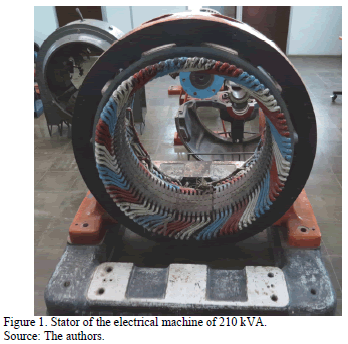
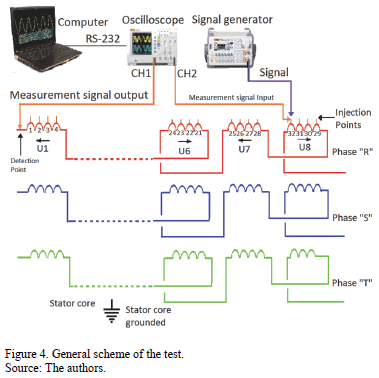
<body><![CDATA[<p><font size="3" face="Verdana, Arial, Helvetica, sans-serif"><b>1. Introduction</b></font></p>     <p><font size="2" face="Verdana, Arial, Helvetica, sans-serif">In &#91;1&#93;, it was found that 56% of faults that arise in   hydro generators are due to the failure of the stator winding insulation   system.</font></p>     <p><font size="2" face="Verdana, Arial, Helvetica, sans-serif">Partial discharges arise within the insulation winding and   generate electromagnetic waves that propagate inside and outside of the   winding. Many systems of partial discharge measurement are based on the capture and processing of these signals   &#91;2&#93;.</font></p>     <p><font size="2" face="Verdana, Arial, Helvetica, sans-serif">Perhaps the most   extreme example of propagation path complexity is found in rotating machines   &#91;3&#93;. The geometry, wide range of materials and interfaces, and complexity of   the physical and electrical paths of rotating machines all conspire to modify   the discharge pulse in a way that makes characterization extremely difficult.   Therefore, the electromagnetic waves will propagate in different modes &#91;4&#93;,   will suffer attenuation and reflections and will find complex and variable   impedances in regions of slots and overhangs.</font></p>     <p><font size="2" face="Verdana, Arial, Helvetica, sans-serif">Previous studies have found the presence of two modes of signal propagation &#91;4,5&#93;, the slow mode, or   traveling wave, and the fast mode, or coupling wave. In the slow mode, a   discharge pulse will propagate through the stator winding as in a transmission   line &#91;6&#93;, where the energy is transmitted by a conduction current and   propagated in the space around the conductor. In the slow mode, the winding   acts as a guide, along which electromagnetic energy moves &#91;7&#93;. In the fast   mode, the wave travels through the capacitive and inductive coupling of the   overhangs &#91;6,8&#93;, causing a leakage field in which energy is coupled to the   surrounding conductors through a displacement current &#91;5&#93;. The propagation time   in the fast mode is very short compared to the slow mode because the distance   is much smaller. The propagation speed is the speed of light in a vacuum, c,   because the propagation medium is air &#91;8&#93;. These propagation modes are strongly   associated with the spectral components of the PD signal, with the slow mode   corresponding to the low frequencies of the signal and the fast mode   corresponding to the high frequencies of the signal &#91;6&#93;. In the slow   mode, while the wave propagates, the signal attenuates and changes shape due to   the dispersion &#91;4&#93;.</font></p>     <p><font size="2" face="Verdana, Arial, Helvetica, sans-serif">This paper presents the test results of the   electromagnetic characterization of the propagation of an artificial partial   discharge pulse in the stator winding of a 2.4 kV/210 kVA   salient-pole electrical machine.</font></p>     <p>&nbsp;</p>     <p><font size="3" face="Verdana, Arial, Helvetica, sans-serif"><b>2. Experimental   Setup</b></font></p>     <p><font size="2" face="Verdana, Arial, Helvetica, sans-serif">For this study, we used the stator winding of a   210 kVA/2.4 kV three-phase salient-pole synchronous generator   (without rotor), as shown in <a href="#fig01">Fig. 1</a>. The stator is lap type with four slots per   phase and per pole (q=4), a double layer and a coil pitch of y = 8. The machine   has 96 coils, so each phase has 32 coils. The number of turns per coil is 7,   and the conductor is composed of two strands. </font></p>     <p align="center"><font size="2" face="Verdana, Arial, Helvetica, sans-serif"><a name="fig01"></a></font><img src="/img/revistas/dyna/v82n193/v82n193a08fig01.gif"></p>     ]]></body>
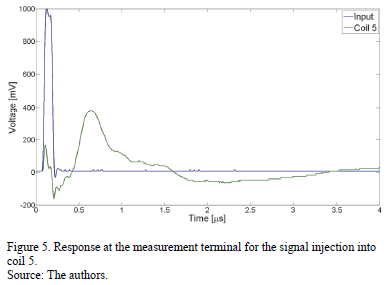
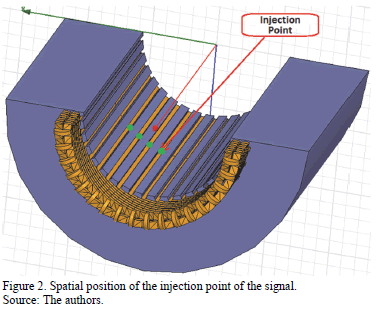
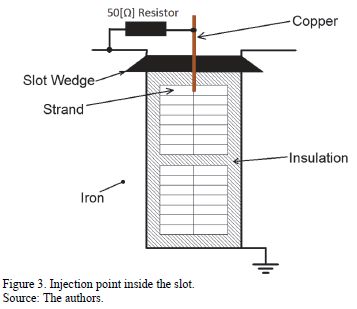
<body><![CDATA[<p><font size="2" face="Verdana, Arial, Helvetica, sans-serif">A   RIGOL® DS1052E digital oscilloscope with a 50 MHz bandwidth was used to   measure the signals. The injection of a simulated PD signal was performed using   a DG1022 RIGOL® signal generator with a 50 <font face="Symbol">W</font> source impedance.</font></p>     <p><font size="2" face="Verdana, Arial, Helvetica, sans-serif">For the signal injection, a hole was made in the   middle of the top layer of each of the 32 coils of phase R. Copper conductors   were installed in these holes, as shown in <a href="#fig02">Fig. 2</a>. and <a href="#fig03">Fig. 3</a>. The signals were   injected through these conductors directly to the stator winding. A   50 <font face="Symbol">W</font> resistor was installed in parallel at the injection point to avoid pulse   reflection.</font></p>     <p align="center"><font size="2" face="Verdana, Arial, Helvetica, sans-serif"><a name="fig02"></a></font><img src="/img/revistas/dyna/v82n193/v82n193a08fig02.gif"></p>     <p align="center"><font size="2" face="Verdana, Arial, Helvetica, sans-serif"><a name="fig03"></a></font><img src="/img/revistas/dyna/v82n193/v82n193a08fig03.gif"></p>     <p><font size="2" face="Verdana, Arial, Helvetica, sans-serif">The general scheme of the   test is presented in <a href="#fig04">Fig. 4</a>.</font></p>     <p align="center"><font size="2" face="Verdana, Arial, Helvetica, sans-serif"><a name="fig04"></a></font><img src="/img/revistas/dyna/v82n193/v82n193a08fig04.gif"></p>     <p>&nbsp;</p>     <p><font size="3" face="Verdana, Arial, Helvetica, sans-serif"><b>3. Experimental results</b></font></p>     <p><font size="2" face="Verdana, Arial, Helvetica, sans-serif"><b><i>3.1. Propagation   modes</i></b></font></p>     <p><font size="2" face="Verdana, Arial, Helvetica, sans-serif">A simulated signal of partial discharge, such as a   Gaussian pulse of amplitude 1 V, rise time of 27.5 ns and pulse width   of 100 ns, was injected at coil 5. The response at the high voltage   terminal of phase R is shown in <a href="#fig05">Fig. 5</a>.</font></p>     ]]></body>
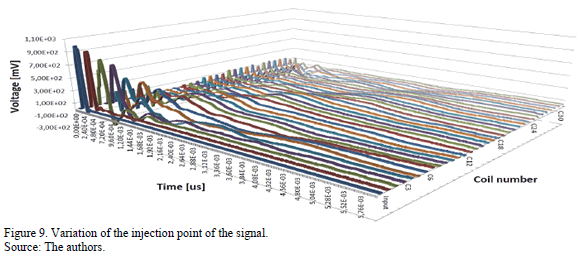
<body><![CDATA[<p align="center"><font size="2" face="Verdana, Arial, Helvetica, sans-serif"><a name="fig05"></a></font><img src="/img/revistas/dyna/v82n193/v82n193a08fig05.gif"></p>     <p><font size="2" face="Verdana, Arial, Helvetica, sans-serif"><a href="#fig05">Fig. 5</a> shows that the signal propagation arrives at the measurement terminal in two   modes. The first is detected almost immediately after the signal was injected   and thus has been commonly called <i>fast or   wave coupling</i>. The second mode arrives at the measurement terminal with a   significant time delay; this propagation mode is known as <i>traveling wave or slow mode</i>.</font></p>     <p><font size="2" face="Verdana, Arial, Helvetica, sans-serif"><b><i>3.2. Signal processing</i></b></font></p>     <p><font size="2" face="Verdana, Arial, Helvetica, sans-serif">After injecting the signals in all of the coils, the   responses were measured at the measurement terminal, and signal processing was   applied to these signals. Such processing includes noise removal and the   separation of the two propagation modes, slow and fast. To separate the   propagation modes, we used the discrete wavelet transform because this   transform is formed by passing the PD signal through a series of quadrature   filters consisting of a high-pass and a low-pass filter &#91;9&#93;, as shown in <a href="#fig06">Fig.   6</a>. In general, wavelets are functions defined over a finite interval that   possess an average value of zero. The CWT is a tool for dividing functions into   components of different frequency, which allows us to study each component   separately &#91;10&#93;. Wavelet decomposition produces an 'approximation', A, as the   output of the low-pass filter and a 'detail', D, as the output of the high-pass   filter &#91;9&#93;, as shown in <a href="#fig07">Fig. 7</a>. &#91;11&#93;. We used various discrete wavelet   transforms, obtaining the best results with the Daubechies 20 (DB20) in five   levels. The coefficient a5 of this transform represents the slow mode. The sum   of coefficients d5, d4, and d3 represents the fast mode. Coefficients d1 and d2   are considered noise. <a href="#fig08">Fig. 8</a> presents the signal processing to the signal   obtained at the high voltage terminal after injecting the pulse at coil 5.</font></p>     <p align="center"><font size="2" face="Verdana, Arial, Helvetica, sans-serif"><a name="fig06"></a></font><img src="/img/revistas/dyna/v82n193/v82n193a08fig06.gif"></p>     <p align="center"><font size="2" face="Verdana, Arial, Helvetica, sans-serif"><a name="fig07"></a></font><img src="/img/revistas/dyna/v82n193/v82n193a08fig07.gif"></p>     <p align="center"><font size="2" face="Verdana, Arial, Helvetica, sans-serif"><a name="fig08"></a></font><img src="/img/revistas/dyna/v82n193/v82n193a08fig08.gif"></p>     <p><font size="2" face="Verdana, Arial, Helvetica, sans-serif"><b><i>3.3. Variation of   the injection point.</i></b></font></p>     <p><font size="2" face="Verdana, Arial, Helvetica, sans-serif"><a href="#fig09">Fig. 9</a> shows the response at the measurement terminal when   the signal is injected successively in each coil of phase R.</font></p>     <p align="center"><font size="2" face="Verdana, Arial, Helvetica, sans-serif"><a name="fig09"></a></font><img src="/img/revistas/dyna/v82n193/v82n193a08fig09.gif"></p>     ]]></body>
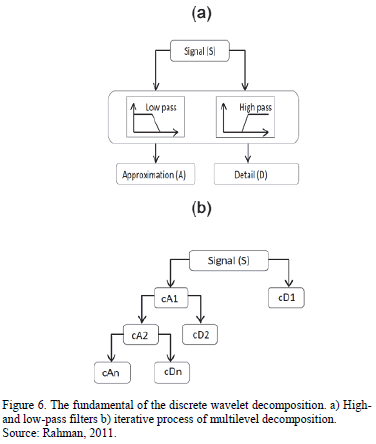
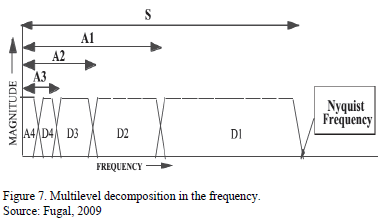
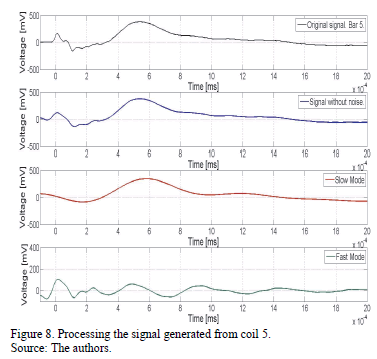
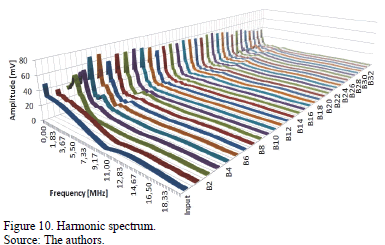
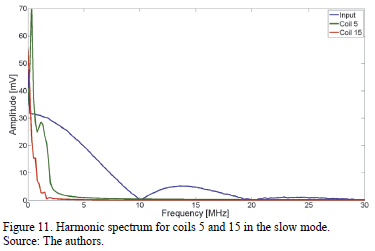
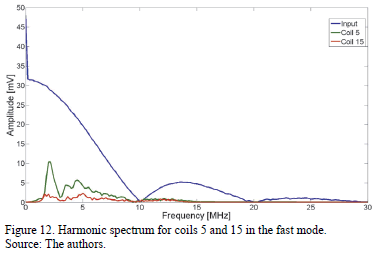
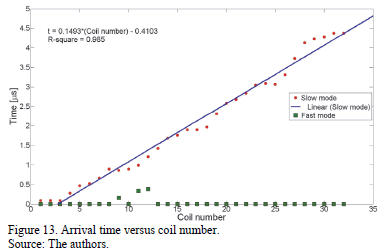
<body><![CDATA[<p><font size="2" face="Verdana, Arial, Helvetica, sans-serif">Both propagation modes are present in every signal. <a href="#fig09">Fig. 9</a> also shows that the propagation time of the slow mode increased as the   injection point moved away from the measurement terminal.</font></p>     <p><font size="2" face="Verdana, Arial, Helvetica, sans-serif"><b><i>3.4. Harmonic spectrum</i></b></font></p>     <p><font size="2" face="Verdana, Arial, Helvetica, sans-serif"><a href="#fig10">Fig.   10</a> shows the harmonic spectrum of the response at the high-voltage   terminal of phase R due to the injection of an artificial pulse of PD at each   of the 32 coils of phase R.</font></p>     <p align="center"><font size="2" face="Verdana, Arial, Helvetica, sans-serif"><a name="fig10"></a></font><img src="/img/revistas/dyna/v82n193/v82n193a08fig10.gif"></p>     <p><font size="2" face="Verdana, Arial, Helvetica, sans-serif"><a href="#fig11">Figs.   11</a> and <a href="#fig12">12</a> show the   harmonic spectrum of the slow and fast propagation modes of the signals   measured due to injection of an artificial pulse at coils 5 and 15.</font></p>     <p align="center"><font size="2" face="Verdana, Arial, Helvetica, sans-serif"><a name="fig11"></a></font><img src="/img/revistas/dyna/v82n193/v82n193a08fig11.gif"></p>     <p align="center"><font size="2" face="Verdana, Arial, Helvetica, sans-serif"><a name="fig12"></a></font><img src="/img/revistas/dyna/v82n193/v82n193a08fig12.gif"></p>     <p>&nbsp;</p>     <p><font size="3" face="Verdana, Arial, Helvetica, sans-serif"><b>4. Analysis</b></font></p>     <p><font size="2" face="Verdana, Arial, Helvetica, sans-serif"><b><i>4.1. Arrival time</i></b></font></p>     ]]></body>
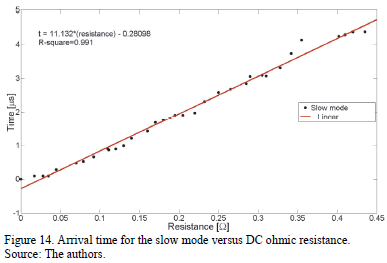
<body><![CDATA[<p><font size="2" face="Verdana, Arial, Helvetica, sans-serif">After performing signal processing using the wavelet   transform, we proceed to determine, via the energy method &#91;12&#93;, the arrival   time of the propagation modes versus the coil number. This plot is shown in <a href="#fig13">Fig. 13</a>.</font></p>     <p align="center"><font size="2" face="Verdana, Arial, Helvetica, sans-serif"><a name="fig13"></a></font><img src="/img/revistas/dyna/v82n193/v82n193a08fig13.gif"></p>     <p><font size="2" face="Verdana, Arial, Helvetica, sans-serif">In <a href="#fig13">Fig. 13</a>, one can observe that the arrival time of   the fast mode is independent of the injection point of the signal. Unlike the   arrival time of the fast mode, that of the slow mode presents a strong positive   linear correlation with the distance traveled by the pulse at the winding.</font></p>     <p><font size="2" face="Verdana, Arial, Helvetica, sans-serif">Because the winding   is lap type and has four slots per pole and per phase, the coil number is not   the most appropriate parameter for relating to the length traveled by the pulse in the slow mode. Therefore,   presenting the arrival time of the slow mode versus the real length traveled by   the pulse is most appropriate. Measuring the real length traveled by the pulse in the   stator winding is difficult. Therefore, we used the DC ohmic resistance   measured between the injection point and the high voltage terminal as an   indirect measure of the winding phase length. <a href="#fig14">Fig. 14</a> shows the arrival time at   the slow mode versus the DC ohmic resistance.</font></p>     <p align="center"><font size="2" face="Verdana, Arial, Helvetica, sans-serif"><a name="fig14"></a></font><img src="/img/revistas/dyna/v82n193/v82n193a08fig14.gif"></p>     <p><font size="2" face="Verdana, Arial, Helvetica, sans-serif"><b><i>4.2. Propagation velocity of the slow mode</i></b></font></p>     <p><font size="2" face="Verdana, Arial, Helvetica, sans-serif">The propagation velocity of the signal is constant over the whole winding. This   propagation velocity is called the group velocity &#91;13&#93; and is dependent on the   harmonic content of the injected signal, i.e., if a pulse is injected with   different characteristics, a pulse with different harmonic content and a different propagation velocity is   obtained &#91;8,14,15&#93;. </font></p>     <p><font size="2" face="Verdana, Arial, Helvetica, sans-serif">The propagation velocity of the slow mode is obtained by performing linear regression of the   data presented in <a href="#fig14">Fig. 14</a>. The linear regression is presented in eq. (1).</font></p>     <p><img src="/img/revistas/dyna/v82n193/v82n193a08eq01.gif"></p>     <p><font size="2" face="Verdana, Arial, Helvetica, sans-serif">where t is the arrival time of the slow mode and R is the DC ohmic resistance in <font face="Symbol">W</font>.</font></p>     ]]></body>
<body><![CDATA[<p><font size="2" face="Verdana, Arial, Helvetica, sans-serif">Conductor DC ohmic resistance is defined by</font></p>     <p><img src="/img/revistas/dyna/v82n193/v82n193a08eq02.gif"></p>     <p><font size="2" face="Verdana, Arial, Helvetica, sans-serif">where L is the length of conductor, S is the cross-section and <font face="Symbol">r</font> is the resistivity.</font></p>     <p><font size="2" face="Verdana, Arial, Helvetica, sans-serif">Substituting eq. (2) in eq. (1), we have</font></p>     <p><img src="/img/revistas/dyna/v82n193/v82n193a08eq03.gif"></p>     <p><font size="2" face="Verdana, Arial, Helvetica, sans-serif">Solving eq.   (3) gives</font></p>     <p><img src="/img/revistas/dyna/v82n193/v82n193a08eq04.gif"></p>     <p><font size="2" face="Verdana, Arial, Helvetica, sans-serif">In our specific case, the cross section of the conductor is 14.44 µm<sup>2</sup> and it is   assumed that resistivity is equal to the resistivity of copper, i.e.,   1.7&bull;10<sup>-8</sup> <font face="Symbol">W</font>m. Substituting these values into eq.   (4), we have</font></p>     <p><img src="/img/revistas/dyna/v82n193/v82n193a08eq05.gif"></p>     <p><font size="2" face="Verdana, Arial, Helvetica, sans-serif">Assuming that</font></p>     ]]></body>

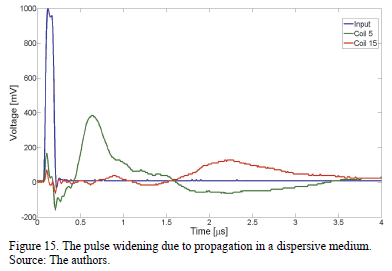
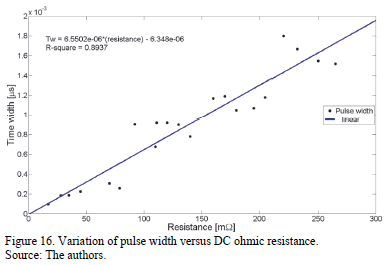
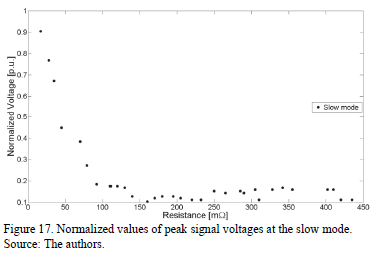
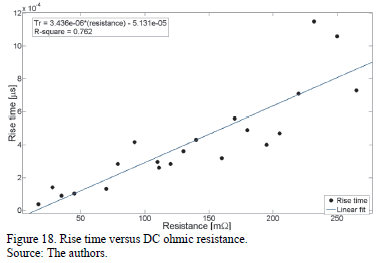
<body><![CDATA[<p><img src="/img/revistas/dyna/v82n193/v82n193a08eq06.gif"></p>     <p><font size="2" face="Verdana, Arial, Helvetica, sans-serif">We have that the propagation velocity of the slow mode of   the signal is approximately 76.30 m/<font face="Symbol">m</font>s or 25.43% of the speed of light in vacuum. In &#91;4&#93;, a   propagation velocity of 9.1 m/<font face="Symbol">m</font>s was found. In &#91;6&#93;, a propagation   velocity of 70 m/<font face="Symbol">m</font>s was found. These velocities are slower than   propagation velocity found in this case. The resistance is not involved in the   velocity of the pulse, and, in this paper, it is only used as an indicator of   the winding length.</font></p>     <p><font size="2" face="Verdana, Arial, Helvetica, sans-serif"><b><i>4.3. Attenuation and dispersion of the   electromagnetic wave</i></b></font></p>     <p><font size="2" face="Verdana, Arial, Helvetica, sans-serif">In the slow mode, the signal suffers an   attenuation of the voltage amplitude due to power loss and signal dispersion   &#91;11,12&#93;. Energy loss is caused by the absorption of energy by the ferromagnetic core, the conductor and the   insulation of the winding. The propagation medium for the slow mode in a stator   winding is dispersive due to the geometry and materials involved in the   propagation path. A dispersive medium</font> <font size="2" face="Verdana, Arial, Helvetica, sans-serif">causes   the speeds of the harmonic components of the pulse to be different, which means   that the shape of the signal is not preserved as it moves through the winding   &#91;13&#93;. The effect of dispersion on the pulse is widening in time &#91;16,17&#93;, as   shown in <a href="#fig15">Fig. 15</a>. and <a href="#fig16">Fig. 16</a>. If the energy loss of the electromagnetic wave   is negligible, the area under the curve of the pulse must remain approximately   constant, and, hence, the widening in time causes a decrease in the voltage amplitude. <a href="#fig17">Fig. 17</a> shows the normalized peak voltage values for the slow propagation mode   versus the DC ohmic resistance.</font></p>     <p align="center"><font size="2" face="Verdana, Arial, Helvetica, sans-serif"><a name="fig15"></a></font><img src="/img/revistas/dyna/v82n193/v82n193a08fig15.gif"></p>     <p align="center"><font size="2" face="Verdana, Arial, Helvetica, sans-serif"><a name="fig16"></a></font><img src="/img/revistas/dyna/v82n193/v82n193a08fig16.gif"></p>     <p align="center"><font size="2" face="Verdana, Arial, Helvetica, sans-serif"><a name="fig17"></a></font><img src="/img/revistas/dyna/v82n193/v82n193a08fig17.gif"></p>     <p><font size="2" face="Verdana, Arial, Helvetica, sans-serif"><b><i>4.4. Variation of   the rise time.</i></b></font></p>     <p><font size="2" face="Verdana, Arial, Helvetica, sans-serif"><a href="#fig18">Fig. 18</a> shows the effect of the slow mode propagation on   the rise time of the signal. The rise time is dependent on the injection point.   &#91;18-20&#93; stated the same fact for the electrical machines and cables.</font></p>     <p align="center"><font size="2" face="Verdana, Arial, Helvetica, sans-serif"><a name="fig18"></a></font><img src="/img/revistas/dyna/v82n193/v82n193a08fig18.gif"></p>     ]]></body>
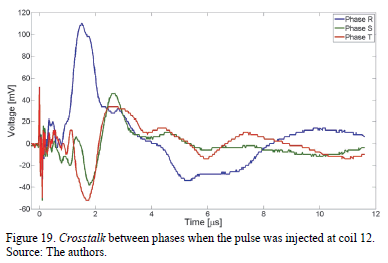
<body><![CDATA[<p><font size="2" face="Verdana, Arial, Helvetica, sans-serif"><b><i>4.5. Crosstalk</i></b></font></p>     <p><font size="2" face="Verdana, Arial, Helvetica, sans-serif">As mentioned above, in the fast mode, the electromagnetic   wave propagates through the capacitive and inductive coupling of the overhangs,   which means that the fast mode of the injected signal at phase R will engage   with phases S and T. Therefore, a signal injected at phase R can be detected in   phases S and T. <a href="#fig19">Fig. 19</a> shows the crosstalk due to the injection of a signal at   coil 12 of phase R and the measured response at the measurement terminals of   phases</font> <font size="2" face="Verdana, Arial, Helvetica, sans-serif">R, S and T. All the injected signals produced crosstalk,   and the signals induced are similar to the injected signal and may even have a   greater voltage magnitude &#91;4&#93;.</font></p>     <p align="center"><font size="2" face="Verdana, Arial, Helvetica, sans-serif"><a name="fig19"></a></font><img src="/img/revistas/dyna/v82n193/v82n193a08fig19.gif"></p>     <p>&nbsp;</p>     <p><font size="3" face="Verdana, Arial, Helvetica, sans-serif"><b>5. Conclusions.</b></font></p>     <p><font size="2" face="Verdana, Arial, Helvetica, sans-serif">In the slow mode, the PD pulse arrives at the generator terminals with a time delay. The   time delay has a strong positive linear correlation with the length traveled by   the pulse. In this case, the DC ohmic resistance between the injection point   and the measurement point was used as an indicator of the winding phase length.</font></p>     <p><font size="2" face="Verdana, Arial, Helvetica, sans-serif">We found that the signal velocity at the slow mode is   76.30 m/<font face="Symbol">m</font>s or 25.43% of the speed of light in a vacuum.</font></p>     <p><font size="2" face="Verdana, Arial, Helvetica, sans-serif">The slow mode amplitude decreases as the injection point of the signal move away from the   measuring point.</font></p>     <p><font size="2" face="Verdana, Arial, Helvetica, sans-serif">At the slow mode,   the signal widens in time while it propagates through the winding.</font></p>     <p><font size="2" face="Verdana, Arial, Helvetica, sans-serif">The rise time of the slow mode was found to increase while the electromagnetic wave   propagates through the winding.</font></p>     ]]></body>
<body><![CDATA[<p><font size="2" face="Verdana, Arial, Helvetica, sans-serif">Due to capacitive and inductive coupling in the region of the overhangs, at high frequencies,   we found a second mode of propagation, which is commonly known as the fast mode or coupling wave because it   manifests in the terminals without appreciable delay.</font></p>     <p><font size="2" face="Verdana, Arial, Helvetica, sans-serif">Due to crosstalk or coupling between the phases, a measured PD signal in a phase does not   necessarily indicate that the signal originated from a discharge at this phase.</font></p>     <p>&nbsp;</p>     <p><font size="3" face="Verdana, Arial, Helvetica, sans-serif"><b>Acknowledgments</b></font></p>     <p><font size="2" face="Verdana, Arial, Helvetica, sans-serif">The authors gratefully acknowledge the support of Colciencias, Colombia.</font></p>     <p>&nbsp;</p>     <p><font size="3" face="Verdana, Arial, Helvetica, sans-serif"><b>References</b></font></p>     <!-- ref --><p><font size="2" face="Verdana, Arial, Helvetica, sans-serif"><b>&#91;1&#93;</b> Sumereder, C., Statistical lifetime of hydro   generators and failure analysis. IEEE   Transactions on Dielectrics and Electrical Insulation, 15 (3), pp. 678-685, 2008. DOI: 10.1109/TDEI.2008.4543104</font>&nbsp;&nbsp;&nbsp;&nbsp;&nbsp;&nbsp;&nbsp;&nbsp;[&#160;<a href="javascript:void(0);" onclick="javascript: window.open('/scielo.php?script=sci_nlinks&ref=000110&pid=S0012-7353201500050000800001&lng=','','width=640,height=500,resizable=yes,scrollbars=1,menubar=yes,');">Links</a>&#160;]<!-- end-ref --><!-- ref --><p><font size="2" face="Verdana, Arial, Helvetica, sans-serif"><b>&#91;2&#93;</b> IEEE, IEEE   Trial-use guide to the measurement of partial discharges in rotating machinery. Electrical Insulation (ISEI),   2000. DOI: 10.1109/IEEESTD.2000.91905</font>&nbsp;&nbsp;&nbsp;&nbsp;&nbsp;&nbsp;&nbsp;&nbsp;[&#160;<a href="javascript:void(0);" onclick="javascript: window.open('/scielo.php?script=sci_nlinks&ref=000111&pid=S0012-7353201500050000800002&lng=','','width=640,height=500,resizable=yes,scrollbars=1,menubar=yes,');">Links</a>&#160;]<!-- end-ref --><!-- ref --><p><font size="2" face="Verdana, Arial, Helvetica, sans-serif"><b>&#91;3&#93;</b> Zhu, H. and Kemp,   I.J., Pulse propagation in rotating machines and its relationship to partial discharge   measurements. In Conference Record of   the 1992 IEEE International Symposium on Electrical Insulation, pp. 411-414,   1992. DOI: 10.1109/ELINSL.1992.246970</font>&nbsp;&nbsp;&nbsp;&nbsp;&nbsp;&nbsp;&nbsp;&nbsp;[&#160;<a href="javascript:void(0);" onclick="javascript: window.open('/scielo.php?script=sci_nlinks&ref=000112&pid=S0012-7353201500050000800003&lng=','','width=640,height=500,resizable=yes,scrollbars=1,menubar=yes,');">Links</a>&#160;]<!-- end-ref --><!-- ref --><p><font size="2" face="Verdana, Arial, Helvetica, sans-serif"><b>&#91;4&#93;</b> Pemen, A.J.M.,   van der Laan, P.C.T. and de Leeuw, W., Propagation of partial discharge signals in stator windings of turbine   generators. IEEE Transactions on   Energy Conversion, 21 (1),   pp. 155-161, 2006. DOI: 10.1109/TEC.2005.847949</font>&nbsp;&nbsp;&nbsp;&nbsp;&nbsp;&nbsp;&nbsp;&nbsp;[&#160;<a href="javascript:void(0);" onclick="javascript: window.open('/scielo.php?script=sci_nlinks&ref=000113&pid=S0012-7353201500050000800004&lng=','','width=640,height=500,resizable=yes,scrollbars=1,menubar=yes,');">Links</a>&#160;]<!-- end-ref --><!-- ref --><p><font size="2" face="Verdana, Arial, Helvetica, sans-serif"><b>&#91;5&#93;</b> Zhou, C. and   Kemp, I.J., On the use of the travelling wave for partial discharge location in   rotating machine stator windings. In 1998   Annual Report Conference on Electrical Insulation and Dielectric Phenomena   (Cat. No.98CH36257), pp. 379-382, 1998. DOI: 10.1109/CEIDP.1998.732915</font>&nbsp;&nbsp;&nbsp;&nbsp;&nbsp;&nbsp;&nbsp;&nbsp;[&#160;<a href="javascript:void(0);" onclick="javascript: window.open('/scielo.php?script=sci_nlinks&ref=000114&pid=S0012-7353201500050000800005&lng=','','width=640,height=500,resizable=yes,scrollbars=1,menubar=yes,');">Links</a>&#160;]<!-- end-ref --><!-- ref --><p><font size="2" face="Verdana, Arial, Helvetica, sans-serif"><b>&#91;6&#93;</b> Wilson, A.,   Jackson, R. and Wang, N., Discharge detection techniques for stator windings. Electric Power Applications, 132 (5),   pp. 234-244, 1985. DOI: 10.1049/ip-b.1985.0034</font>&nbsp;&nbsp;&nbsp;&nbsp;&nbsp;&nbsp;&nbsp;&nbsp;[&#160;<a href="javascript:void(0);" onclick="javascript: window.open('/scielo.php?script=sci_nlinks&ref=000115&pid=S0012-7353201500050000800006&lng=','','width=640,height=500,resizable=yes,scrollbars=1,menubar=yes,');">Links</a>&#160;]<!-- end-ref --><!-- ref --><p><font size="2" face="Verdana, Arial, Helvetica, sans-serif"><b>&#91;7&#93;</b> Matveev, Electricidad y   Magnetismo. URSS: Editorial MIR, 1988.    &nbsp;&nbsp;&nbsp;&nbsp;&nbsp;&nbsp;&nbsp;&nbsp;[&#160;<a href="javascript:void(0);" onclick="javascript: window.open('/scielo.php?script=sci_nlinks&ref=000116&pid=S0012-7353201500050000800007&lng=','','width=640,height=500,resizable=yes,scrollbars=1,menubar=yes,');">Links</a>&#160;]<!-- end-ref --></font></p>     <!-- ref --><p><font size="2" face="Verdana, Arial, Helvetica, sans-serif"><b>&#91;8&#93;</b> Zhou, C., Kemp,   I.J. and Allaa, M., The PD pulse behaviour in rotating machine stator windings.   In Proceedings of 1995 Conference on   Electrical Insulation and Dielectric Phenomena, pp. 372-375, 1995. DOI: 10.1109/CEIDP.1995.483740</font>&nbsp;&nbsp;&nbsp;&nbsp;&nbsp;&nbsp;&nbsp;&nbsp;[&#160;<a href="javascript:void(0);" onclick="javascript: window.open('/scielo.php?script=sci_nlinks&ref=000118&pid=S0012-7353201500050000800008&lng=','','width=640,height=500,resizable=yes,scrollbars=1,menubar=yes,');">Links</a>&#160;]<!-- end-ref --><!-- ref --><p><font size="2" face="Verdana, Arial, Helvetica, sans-serif"><b>&#91;9&#93;</b> Rahman, M.S.A.,   Hao, L. and Lewin, P.L., Partial discharge location within a transformer   winding using principal component analysis. &#91;Online&#93;. In 17th International Symposium on High Voltage   Engineering, 2011. Avalilable on: <a href="http://eprints.soton.ac.uk/272708/" target="_blank">http://eprints.soton.ac.uk/272708/</a></font>&nbsp;&nbsp;&nbsp;&nbsp;&nbsp;&nbsp;&nbsp;&nbsp;[&#160;<a href="javascript:void(0);" onclick="javascript: window.open('/scielo.php?script=sci_nlinks&ref=000119&pid=S0012-7353201500050000800009&lng=','','width=640,height=500,resizable=yes,scrollbars=1,menubar=yes,');">Links</a>&#160;]<!-- end-ref --><!-- ref --><p><font size="2" face="Verdana, Arial, Helvetica, sans-serif"><b>&#91;10&#93;</b> Mijarez, R., Baltazar, A.,   Rodr&iacute;guez- Rodr&iacute;guez, J. and Ram&iacute;rez-Ni&ntilde;o, J., Damage detection in ACSR cables   based on ultrasonic guided waves. DYNA,   81 (186), pp. 226-233, 2014. DOI: 10.15446/dyna.v81n186.40252</font>&nbsp;&nbsp;&nbsp;&nbsp;&nbsp;&nbsp;&nbsp;&nbsp;[&#160;<a href="javascript:void(0);" onclick="javascript: window.open('/scielo.php?script=sci_nlinks&ref=000120&pid=S0012-7353201500050000800010&lng=','','width=640,height=500,resizable=yes,scrollbars=1,menubar=yes,');">Links</a>&#160;]<!-- end-ref --><!-- ref --><p><font size="2" face="Verdana, Arial, Helvetica, sans-serif"><b>&#91;11&#93;</b> Fugal, D.L., Conceptual wavelets in digital signal   processing. Signals Technical Publishing, 2009.    &nbsp;&nbsp;&nbsp;&nbsp;&nbsp;&nbsp;&nbsp;&nbsp;[&#160;<a href="javascript:void(0);" onclick="javascript: window.open('/scielo.php?script=sci_nlinks&ref=000121&pid=S0012-7353201500050000800011&lng=','','width=640,height=500,resizable=yes,scrollbars=1,menubar=yes,');">Links</a>&#160;]<!-- end-ref --></font></p>     ]]></body>
<body><![CDATA[<!-- ref --><p><font size="2" face="Verdana, Arial, Helvetica, sans-serif"><b>&#91;12&#93;</b> Wagenaars, P.,   Wouters, P.A.A.F., Van Der Wielen, P.C.J.M. and Steennis, E. F., Accurate   estimation of the time-of-arrival of partial discharge pulses in cable systems   in service. IEEE Transactions on   Dielectrics and Electrical Insulation, 15 (4), pp. 1190-1199, 2008. DOI: 10.1109/TDEI.2008.4591242</font>&nbsp;&nbsp;&nbsp;&nbsp;&nbsp;&nbsp;&nbsp;&nbsp;[&#160;<a href="javascript:void(0);" onclick="javascript: window.open('/scielo.php?script=sci_nlinks&ref=000123&pid=S0012-7353201500050000800012&lng=','','width=640,height=500,resizable=yes,scrollbars=1,menubar=yes,');">Links</a>&#160;]<!-- end-ref --><!-- ref --><p><font size="2" face="Verdana, Arial, Helvetica, sans-serif"><b>&#91;13&#93;</b> Nikolski, V.V., Electrodin&aacute;mica y   propagaci&oacute;n de ondas de radio.Mosc&uacute;, URSS: Editorial MIR, 671 P., 1976.    &nbsp;&nbsp;&nbsp;&nbsp;&nbsp;&nbsp;&nbsp;&nbsp;[&#160;<a href="javascript:void(0);" onclick="javascript: window.open('/scielo.php?script=sci_nlinks&ref=000124&pid=S0012-7353201500050000800013&lng=','','width=640,height=500,resizable=yes,scrollbars=1,menubar=yes,');">Links</a>&#160;]<!-- end-ref --></font></p>     <!-- ref --><p><font size="2" face="Verdana, Arial, Helvetica, sans-serif"><b>&#91;14&#93;</b> Su, Q., Analysis   of partial discharge pulse propagation along generator stator windings.   &#91;Online&#93;. Power Engineering Society   Winter Meeting, pp. 3-6, 2000. Availabel at: <a href="http://ieeexplore.ieee.org/xpls/abs_all.jsp?arnumber=849969" target="_blank">http://ieeexplore.ieee.org/xpls/abs_all.jsp?arnumber=849969</a></font>&nbsp;&nbsp;&nbsp;&nbsp;&nbsp;&nbsp;&nbsp;&nbsp;[&#160;<a href="javascript:void(0);" onclick="javascript: window.open('/scielo.php?script=sci_nlinks&ref=000126&pid=S0012-7353201500050000800014&lng=','','width=640,height=500,resizable=yes,scrollbars=1,menubar=yes,');">Links</a>&#160;]<!-- end-ref --><!-- ref --><p><font size="2" face="Verdana, Arial, Helvetica, sans-serif"><b>&#91;15&#93;</b> Gross, D.W.,   Signal transmission and calibration of on-line partial discharge measurements. &#91;Online&#93;.   In Proceedings of the 7<sup>th</sup> International Conference on Properties and Applications of Dielectric   Materials, pp. 335-338, 2003. Available at: DOI: 10.1109/ICPADM.2003.1218420</font>&nbsp;&nbsp;&nbsp;&nbsp;&nbsp;&nbsp;&nbsp;&nbsp;[&#160;<a href="javascript:void(0);" onclick="javascript: window.open('/scielo.php?script=sci_nlinks&ref=000127&pid=S0012-7353201500050000800015&lng=','','width=640,height=500,resizable=yes,scrollbars=1,menubar=yes,');">Links</a>&#160;]<!-- end-ref --><!-- ref --><p><font size="2" face="Verdana, Arial, Helvetica, sans-serif"><b>&#91;16&#93;</b> Hayt, W. and Buck, J., Teor&iacute;a Electromagn&eacute;tica, Mc Graw   Hill, 2012.    &nbsp;&nbsp;&nbsp;&nbsp;&nbsp;&nbsp;&nbsp;&nbsp;[&#160;<a href="javascript:void(0);" onclick="javascript: window.open('/scielo.php?script=sci_nlinks&ref=000128&pid=S0012-7353201500050000800016&lng=','','width=640,height=500,resizable=yes,scrollbars=1,menubar=yes,');">Links</a>&#160;]<!-- end-ref --></font></p>     <!-- ref --><p><font size="2" face="Verdana, Arial, Helvetica, sans-serif"><b>&#91;17&#93;</b> Jackson, J.D., Classical Electrodynamics, Wiley,   1998.    &nbsp;&nbsp;&nbsp;&nbsp;&nbsp;&nbsp;&nbsp;&nbsp;[&#160;<a href="javascript:void(0);" onclick="javascript: window.open('/scielo.php?script=sci_nlinks&ref=000130&pid=S0012-7353201500050000800017&lng=','','width=640,height=500,resizable=yes,scrollbars=1,menubar=yes,');">Links</a>&#160;]<!-- end-ref --></font></p>     <!-- ref --><p><font size="2" face="Verdana, Arial, Helvetica, sans-serif"><b>&#91;18&#93;</b> Gottin, B., Analyse   multi-capteurs de signaux transitoires issus de systèmes &eacute;lectriques. PhD   Thesis., Universit&eacute; de Grenoble, France., 2010.    &nbsp;&nbsp;&nbsp;&nbsp;&nbsp;&nbsp;&nbsp;&nbsp;[&#160;<a href="javascript:void(0);" onclick="javascript: window.open('/scielo.php?script=sci_nlinks&ref=000132&pid=S0012-7353201500050000800018&lng=','','width=640,height=500,resizable=yes,scrollbars=1,menubar=yes,');">Links</a>&#160;]<!-- end-ref --></font></p>     <!-- ref --><p><font size="2" face="Verdana, Arial, Helvetica, sans-serif"><b>&#91;19&#93;</b> Clark, D.,   Mackinlay, R., Giussani, R., Renforth, L. and Shuttleworth, R., Partial   discharge pulse propagation, localisation and measurements in medium voltage power   cables. In 2013 48<sup>th</sup> International Universities' Power Engineering Conference (UPEC), pp. 1-6,   2013. DOI: 10.1109/UPEC.2013.6714937</font>&nbsp;&nbsp;&nbsp;&nbsp;&nbsp;&nbsp;&nbsp;&nbsp;[&#160;<a href="javascript:void(0);" onclick="javascript: window.open('/scielo.php?script=sci_nlinks&ref=000134&pid=S0012-7353201500050000800019&lng=','','width=640,height=500,resizable=yes,scrollbars=1,menubar=yes,');">Links</a>&#160;]<!-- end-ref --><!-- ref --><p><font size="2" face="Verdana, Arial, Helvetica, sans-serif"><b>&#91;20&#93;</b> Bartnikas, R., A comment concerning the rise   times of partial discharge pulses IEEE Transactions on Dielectrics and Electrical Insulation, 12 (2),   pp. 196-202, 2005. DOI: 10.1109/TDEI.2005.1430390</font>&nbsp;&nbsp;&nbsp;&nbsp;&nbsp;&nbsp;&nbsp;&nbsp;[&#160;<a href="javascript:void(0);" onclick="javascript: window.open('/scielo.php?script=sci_nlinks&ref=000135&pid=S0012-7353201500050000800020&lng=','','width=640,height=500,resizable=yes,scrollbars=1,menubar=yes,');">Links</a>&#160;]<!-- end-ref --><p>&nbsp;</p>     <p><font size="2" face="Verdana, Arial, Helvetica, sans-serif"><b>J.L.   Oslinger-Guti&eacute;rrez,</b> completed his BSc. Eng in Electrical Engineering in   1996, and his PhD degree in Electrical Engineering in 2007, all of them at   Universidad del Valle, Cali, Colombia. Currently, he is a Full Professor at the   Electrical and Electronic School, Facultad de Ingenier&iacute;a, Universidad del   Valle, Cali, Colombia. His research interests include: design, simulation,   modeling and diagnosis of electrical machines.</font></p>     <p><font size="2" face="Verdana, Arial, Helvetica, sans-serif"><b>F.A.   Mu&ntilde;oz-Mu&ntilde;oz,</b> completed his BSc. Eng in Electrical Engineering in 2011 at   Universidad del Valle, Cali, Colombia. Currently, he is a PhD student at the   Electrical and Electronic School, Facultad de Ingenier&iacute;a, Universidad del   Valle, Cali, Colombia. His research interests include: simulation, modeling and   diagnosis of electrical machines.</font></p>     <p><font size="2" face="Verdana, Arial, Helvetica, sans-serif"><b>J.A.   Vanegas-Iriarte,</b> completed his BSc. Eng in Electrical Engineering in 2012   at Universidad del Valle, Cali, Colombia. Currently, he is a MSc. student at   the Electrical and Electronic School, Facultad de Ingenier&iacute;a, Universidad del   Valle, Cali, Colombia. His research interests include: simulation, modeling and   diagnosis of electrical machines.</font></p>      ]]></body><back>
<ref-list>
<ref id="B1">
<label>1</label><nlm-citation citation-type="journal">
<person-group person-group-type="author">
<name>
<surname><![CDATA[Sumereder]]></surname>
<given-names><![CDATA[C.]]></given-names>
</name>
</person-group>
<article-title xml:lang="en"><![CDATA[Statistical lifetime of hydro generators and failure analysis.]]></article-title>
<source><![CDATA[IEEE Transactions on Dielectrics and Electrical Insulation]]></source>
<year>2008</year>
<volume>15</volume>
<numero>3</numero>
<issue>3</issue>
<page-range>678-685</page-range></nlm-citation>
</ref>
<ref id="B2">
<label>2</label><nlm-citation citation-type="confpro">
<collab>IEEE</collab>
<article-title xml:lang="en"><![CDATA[IEEE Trial-use guide to the measurement of partial discharges in rotating machinery]]></article-title>
<source><![CDATA[]]></source>
<year></year>
<conf-name><![CDATA[ Electrical Insulation]]></conf-name>
<conf-date>2000</conf-date>
<conf-loc> </conf-loc>
</nlm-citation>
</ref>
<ref id="B3">
<label>3</label><nlm-citation citation-type="confpro">
<person-group person-group-type="author">
<name>
<surname><![CDATA[Zhu]]></surname>
<given-names><![CDATA[H.]]></given-names>
</name>
<name>
<surname><![CDATA[Kemp]]></surname>
<given-names><![CDATA[I.J.]]></given-names>
</name>
</person-group>
<article-title xml:lang="en"><![CDATA[Pulse propagation in rotating machines and its relationship to partial discharge measurements.]]></article-title>
<source><![CDATA[]]></source>
<year>1992</year>
<conf-name><![CDATA[ Conference Record of the 1992 IEEE International Symposium on Electrical Insulation]]></conf-name>
<conf-loc> </conf-loc>
<page-range>411-414</page-range></nlm-citation>
</ref>
<ref id="B4">
<label>4</label><nlm-citation citation-type="journal">
<person-group person-group-type="author">
<name>
<surname><![CDATA[Pemen]]></surname>
<given-names><![CDATA[A.J.M.]]></given-names>
</name>
<name>
<surname><![CDATA[van der Laan]]></surname>
<given-names><![CDATA[P.C.T.]]></given-names>
</name>
<name>
<surname><![CDATA[de Leeuw]]></surname>
<given-names><![CDATA[W.]]></given-names>
</name>
</person-group>
<article-title xml:lang="en"><![CDATA[Propagation of partial discharge signals in stator windings of turbine generators]]></article-title>
<source><![CDATA[IEEE Transactions on Energy Conversion]]></source>
<year>2006</year>
<volume>21</volume>
<numero>1</numero>
<issue>1</issue>
<page-range>155-161</page-range></nlm-citation>
</ref>
<ref id="B5">
<label>5</label><nlm-citation citation-type="confpro">
<person-group person-group-type="author">
<name>
<surname><![CDATA[Zhou]]></surname>
<given-names><![CDATA[C.]]></given-names>
</name>
<name>
<surname><![CDATA[Kemp]]></surname>
<given-names><![CDATA[I.J.]]></given-names>
</name>
</person-group>
<article-title xml:lang="en"><![CDATA[On the use of the travelling wave for partial discharge location in rotating machine stator windings]]></article-title>
<source><![CDATA[]]></source>
<year>1998</year>
<conf-name><![CDATA[ 1998 Annual Report Conference on Electrical Insulation and Dielectric Phenomena (Cat. No.98CH36257)]]></conf-name>
<conf-loc> </conf-loc>
<page-range>379-382</page-range></nlm-citation>
</ref>
<ref id="B6">
<label>6</label><nlm-citation citation-type="journal">
<person-group person-group-type="author">
<name>
<surname><![CDATA[Wilson]]></surname>
<given-names><![CDATA[A.]]></given-names>
</name>
<name>
<surname><![CDATA[Jackson]]></surname>
<given-names><![CDATA[R.]]></given-names>
</name>
<name>
<surname><![CDATA[Wang]]></surname>
<given-names><![CDATA[N.]]></given-names>
</name>
</person-group>
<article-title xml:lang="en"><![CDATA[Discharge detection techniques for stator windings]]></article-title>
<source><![CDATA[Electric Power Applications]]></source>
<year>1985</year>
<volume>132</volume>
<numero>5</numero>
<issue>5</issue>
<page-range>234-244</page-range></nlm-citation>
</ref>
<ref id="B7">
<label>7</label><nlm-citation citation-type="book">
<collab>^rND^sWilson^nA.</collab>
<source><![CDATA[Electricidad y Magnetismo]]></source>
<year>1988</year>
<publisher-name><![CDATA[Editorial MIR]]></publisher-name>
</nlm-citation>
</ref>
<ref id="B8">
<label>8</label><nlm-citation citation-type="confpro">
<person-group person-group-type="author">
<name>
<surname><![CDATA[Zhou]]></surname>
<given-names><![CDATA[C.]]></given-names>
</name>
<name>
<surname><![CDATA[Kemp]]></surname>
<given-names><![CDATA[I.J.]]></given-names>
</name>
<name>
<surname><![CDATA[Allaa]]></surname>
<given-names><![CDATA[M.]]></given-names>
</name>
</person-group>
<article-title xml:lang="en"><![CDATA[The PD pulse behaviour in rotating machine stator windings.]]></article-title>
<source><![CDATA[]]></source>
<year>1995</year>
<conf-name><![CDATA[ 1995 Conference on Electrical Insulation and Dielectric Phenomena]]></conf-name>
<conf-loc> </conf-loc>
<page-range>372-375</page-range></nlm-citation>
</ref>
<ref id="B9">
<label>9</label><nlm-citation citation-type="confpro">
<person-group person-group-type="author">
<name>
<surname><![CDATA[Rahman]]></surname>
<given-names><![CDATA[M.S.A.]]></given-names>
</name>
<name>
<surname><![CDATA[Hao]]></surname>
<given-names><![CDATA[L.]]></given-names>
</name>
<name>
<surname><![CDATA[Lewin]]></surname>
<given-names><![CDATA[P.L.]]></given-names>
</name>
</person-group>
<article-title xml:lang="en"><![CDATA[Partial discharge location within a transformer winding using principal component analysis.]]></article-title>
<source><![CDATA[]]></source>
<year></year>
<conf-name><![CDATA[17th International Symposium on High Voltage Engineering]]></conf-name>
<conf-date>2011</conf-date>
<conf-loc> </conf-loc>
</nlm-citation>
</ref>
<ref id="B10">
<label>10</label><nlm-citation citation-type="journal">
<person-group person-group-type="author">
<name>
<surname><![CDATA[Mijarez]]></surname>
<given-names><![CDATA[R.]]></given-names>
</name>
<name>
<surname><![CDATA[Baltazar]]></surname>
<given-names><![CDATA[A.]]></given-names>
</name>
<name>
<surname><![CDATA[Rodríguez- Rodríguez]]></surname>
<given-names><![CDATA[J.]]></given-names>
</name>
<name>
<surname><![CDATA[Ramírez-Niño]]></surname>
<given-names><![CDATA[J.]]></given-names>
</name>
</person-group>
<article-title xml:lang="en"><![CDATA[Damage detection in ACSR cables based on ultrasonic guided waves.]]></article-title>
<source><![CDATA[DYNA]]></source>
<year>2014</year>
<volume>81</volume>
<numero>186</numero>
<issue>186</issue>
<page-range>226-233</page-range></nlm-citation>
</ref>
<ref id="B11">
<label>11</label><nlm-citation citation-type="book">
<person-group person-group-type="author">
<name>
<surname><![CDATA[Fugal]]></surname>
<given-names><![CDATA[D.L.]]></given-names>
</name>
</person-group>
<source><![CDATA[Conceptual wavelets in digital signal processing]]></source>
<year>2009</year>
<publisher-name><![CDATA[Signals Technical Publishing]]></publisher-name>
</nlm-citation>
</ref>
<ref id="B12">
<label>12</label><nlm-citation citation-type="journal">
<person-group person-group-type="author">
<name>
<surname><![CDATA[Wagenaars]]></surname>
<given-names><![CDATA[P.]]></given-names>
</name>
<name>
<surname><![CDATA[Wouters]]></surname>
<given-names><![CDATA[P.A.A.F.]]></given-names>
</name>
<name>
<surname><![CDATA[Van Der Wielen]]></surname>
<given-names><![CDATA[P.C.J.M.]]></given-names>
</name>
<name>
<surname><![CDATA[Steennis]]></surname>
<given-names><![CDATA[E. F.]]></given-names>
</name>
</person-group>
<article-title xml:lang="en"><![CDATA[Accurate estimation of the time-of-arrival of partial discharge pulses in cable systems in service.]]></article-title>
<source><![CDATA[IEEE Transactions on Dielectrics and Electrical Insulation]]></source>
<year>2008</year>
<volume>15</volume>
<numero>4</numero>
<issue>4</issue>
<page-range>1190-1199</page-range></nlm-citation>
</ref>
<ref id="B13">
<label>13</label><nlm-citation citation-type="book">
<person-group person-group-type="author">
<name>
<surname><![CDATA[Nikolski]]></surname>
<given-names><![CDATA[V.V.]]></given-names>
</name>
</person-group>
<source><![CDATA[Electrodinámica y propagación de ondas de radio.]]></source>
<year>1976</year>
<publisher-loc><![CDATA[Moscú ]]></publisher-loc>
<publisher-name><![CDATA[Editorial MIR]]></publisher-name>
</nlm-citation>
</ref>
<ref id="B14">
<label>14</label><nlm-citation citation-type="confpro">
<person-group person-group-type="author">
<name>
<surname><![CDATA[Su]]></surname>
<given-names><![CDATA[Q.]]></given-names>
</name>
</person-group>
<article-title xml:lang="en"><![CDATA[Analysis of partial discharge pulse propagation along generator stator windings.]]></article-title>
<source><![CDATA[]]></source>
<year>2000</year>
<conf-name><![CDATA[ Power Engineering Society Winter Meeting]]></conf-name>
<conf-loc> </conf-loc>
<page-range>3-6</page-range></nlm-citation>
</ref>
<ref id="B15">
<label>15</label><nlm-citation citation-type="confpro">
<person-group person-group-type="author">
<name>
<surname><![CDATA[Gross]]></surname>
<given-names><![CDATA[D.W.]]></given-names>
</name>
</person-group>
<article-title xml:lang="en"><![CDATA[Signal transmission and calibration of on-line partial discharge measurements.]]></article-title>
<source><![CDATA[]]></source>
<year>2003</year>
<conf-name><![CDATA[7th International Conference on Properties and Applications of Dielectric Materials]]></conf-name>
<conf-loc> </conf-loc>
<page-range>335-338</page-range></nlm-citation>
</ref>
<ref id="B16">
<label>16</label><nlm-citation citation-type="book">
<person-group person-group-type="author">
<name>
<surname><![CDATA[Hayt]]></surname>
<given-names><![CDATA[W.]]></given-names>
</name>
<name>
<surname><![CDATA[Buck]]></surname>
<given-names><![CDATA[J.]]></given-names>
</name>
</person-group>
<source><![CDATA[Teoría Electromagnética]]></source>
<year>2012</year>
<publisher-name><![CDATA[Mc Graw Hill]]></publisher-name>
</nlm-citation>
</ref>
<ref id="B17">
<label>17</label><nlm-citation citation-type="book">
<person-group person-group-type="author">
<name>
<surname><![CDATA[Jackson]]></surname>
<given-names><![CDATA[J.D.]]></given-names>
</name>
</person-group>
<source><![CDATA[Classical Electrodynamics]]></source>
<year>1998</year>
<publisher-name><![CDATA[Wiley]]></publisher-name>
</nlm-citation>
</ref>
<ref id="B18">
<label>18</label><nlm-citation citation-type="">
<person-group person-group-type="author">
<name>
<surname><![CDATA[Gottin]]></surname>
<given-names><![CDATA[B.]]></given-names>
</name>
</person-group>
<source><![CDATA[Analyse multi-capteurs de signaux transitoires issus de systèmes électriques]]></source>
<year></year>
</nlm-citation>
</ref>
<ref id="B19">
<label>19</label><nlm-citation citation-type="confpro">
<person-group person-group-type="author">
<name>
<surname><![CDATA[Clark]]></surname>
<given-names><![CDATA[D.]]></given-names>
</name>
<name>
<surname><![CDATA[Mackinlay]]></surname>
<given-names><![CDATA[R.]]></given-names>
</name>
<name>
<surname><![CDATA[Giussani]]></surname>
<given-names><![CDATA[R.]]></given-names>
</name>
<name>
<surname><![CDATA[Renforth]]></surname>
<given-names><![CDATA[L.]]></given-names>
</name>
<name>
<surname><![CDATA[Shuttleworth]]></surname>
<given-names><![CDATA[R.]]></given-names>
</name>
</person-group>
<article-title xml:lang="en"><![CDATA[Partial discharge pulse propagation, localisation and measurements in medium voltage power cables.]]></article-title>
<source><![CDATA[]]></source>
<year>2013</year>
<conf-name><![CDATA[48th International Universities' Power Engineering Conference (UPEC)]]></conf-name>
<conf-date>2013</conf-date>
<conf-loc> </conf-loc>
<page-range>1-6</page-range></nlm-citation>
</ref>
<ref id="B20">
<label>20</label><nlm-citation citation-type="journal">
<person-group person-group-type="author">
<name>
<surname><![CDATA[Bartnikas]]></surname>
<given-names><![CDATA[R.]]></given-names>
</name>
</person-group>
<article-title xml:lang="fr"><![CDATA[A comment concerning the rise times of partial discharge pulses]]></article-title>
<source><![CDATA[IEEE Transactions on Dielectrics and Electrical Insulation]]></source>
<year>2005</year>
<volume>12</volume>
<numero>2</numero>
<issue>2</issue>
<page-range>196-202</page-range></nlm-citation>
</ref>
</ref-list>
</back>
</article>