<?xml version="1.0" encoding="ISO-8859-1"?><article xmlns:mml="http://www.w3.org/1998/Math/MathML" xmlns:xlink="http://www.w3.org/1999/xlink" xmlns:xsi="http://www.w3.org/2001/XMLSchema-instance">
<front>
<journal-meta>
<journal-id>0012-7353</journal-id>
<journal-title><![CDATA[DYNA]]></journal-title>
<abbrev-journal-title><![CDATA[Dyna rev.fac.nac.minas]]></abbrev-journal-title>
<issn>0012-7353</issn>
<publisher>
<publisher-name><![CDATA[Universidad Nacional de Colombia]]></publisher-name>
</publisher>
</journal-meta>
<article-meta>
<article-id>S0012-73532015000500010</article-id>
<article-id pub-id-type="doi">10.15446/dyna.v82n193.45988</article-id>
<title-group>
<article-title xml:lang="en"><![CDATA[Thermal and energy evaluation of a novel polymer-ceramic composite as insulation for a household refrigerator]]></article-title>
<article-title xml:lang="es"><![CDATA[Evaluación térmica y energética de un nuevo composite polímero-cerámico como aislante en un refrigerador doméstico]]></article-title>
</title-group>
<contrib-group>
<contrib contrib-type="author">
<name>
<surname><![CDATA[Belman-Flores]]></surname>
<given-names><![CDATA[Juan Manuel]]></given-names>
</name>
<xref ref-type="aff" rid="A01"/>
</contrib>
<contrib contrib-type="author">
<name>
<surname><![CDATA[González-Rolón]]></surname>
<given-names><![CDATA[Bárbara]]></given-names>
</name>
<xref ref-type="aff" rid="A01"/>
</contrib>
<contrib contrib-type="author">
<name>
<surname><![CDATA[Serrano-Arellano]]></surname>
<given-names><![CDATA[Juan]]></given-names>
</name>
<xref ref-type="aff" rid="A01"/>
</contrib>
<contrib contrib-type="author">
<name>
<surname><![CDATA[Gámez-Arredondo]]></surname>
<given-names><![CDATA[Sergio]]></given-names>
</name>
<xref ref-type="aff" rid="A01"/>
</contrib>
</contrib-group>
<aff id="A01">
<institution><![CDATA[,Universidad de Guanajuato Campus Irapuato Department of Mechanical Engineering]]></institution>
<addr-line><![CDATA[Salamanca ]]></addr-line>
<country>Mexico</country>
</aff>
<aff id="A">
<institution><![CDATA[,barbara@ugto.mx  ]]></institution>
<addr-line><![CDATA[ ]]></addr-line>
</aff>
<aff id="A">
<institution><![CDATA[,johnnsear@hotmail.com  ]]></institution>
<addr-line><![CDATA[ ]]></addr-line>
</aff>
<aff id="A">
<institution><![CDATA[,sa.gamez@hotmail.com  ]]></institution>
<addr-line><![CDATA[ ]]></addr-line>
</aff>
<pub-date pub-type="pub">
<day>00</day>
<month>10</month>
<year>2015</year>
</pub-date>
<pub-date pub-type="epub">
<day>00</day>
<month>10</month>
<year>2015</year>
</pub-date>
<volume>82</volume>
<numero>193</numero>
<fpage>77</fpage>
<lpage>82</lpage>
<copyright-statement/>
<copyright-year/>
<self-uri xlink:href="http://www.scielo.org.co/scielo.php?script=sci_arttext&amp;pid=S0012-73532015000500010&amp;lng=en&amp;nrm=iso"></self-uri><self-uri xlink:href="http://www.scielo.org.co/scielo.php?script=sci_abstract&amp;pid=S0012-73532015000500010&amp;lng=en&amp;nrm=iso"></self-uri><self-uri xlink:href="http://www.scielo.org.co/scielo.php?script=sci_pdf&amp;pid=S0012-73532015000500010&amp;lng=en&amp;nrm=iso"></self-uri><abstract abstract-type="short" xml:lang="en"><p><![CDATA[This article presents a feasibility study of a new polymer-ceramic composite material applied as a thermal insulator on the surface of a low net volume household refrigerator. This paper describes its manufacture in a succinct manner, and a thermal and energy comparison between the factory refrigerator and the refrigerator with the composite installed. Based on the experiments, it is concluded that when using the composite, the average internal temperature of the fridge is increased by 1°C, for practical and design purposes, the refrigerator still functions below 3°C. It was also found that at stable operating conditions the energy consumption using the composite saves approximately 1.5%. Despite these slight savings, the pyro-expanded perlite composite acts as a thermal isolating material. This material may exhibit better ease of use and thermal, energetic and economic benefits, without omitting the environmental characteristics that they favor.]]></p></abstract>
<abstract abstract-type="short" xml:lang="es"><p><![CDATA[Este artículo presenta un estudio de viabilidad de un nuevo material compuesto polímero-cerámico aplicado como aislante térmico sobre una superficie de un refrigerador doméstico de pequeña capacidad volumétrica. Este trabajo describe de manera sucinta su manufactura así como la comparación energética y térmica entre el refrigerador de referencia (cuando sale de fábrica) y el refrigerador con el composite instalado. Experimentalmente, cuando se usa el composite la temperatura interna promedio del frigobar incrementa alrededor de 1°C, que para propósitos prácticos y de diseño, el refrigerador aún funciona por debajo de los 3°C. Además, para condiciones de operación estables, la energía consumida usando el composite ahorra aproximadamente 1.5% en comparación con el refrigerador de referencia. A pesar de este ligero ahorro, la perlita pyro-expandida actúa como material aislante. Este material puede exhibir mejor facilidad de uso y beneficios térmicos, energéticos y económicos, sin omitir las características ambientales a su favor.]]></p></abstract>
<kwd-group>
<kwd lng="en"><![CDATA[household refrigerator]]></kwd>
<kwd lng="en"><![CDATA[composite]]></kwd>
<kwd lng="en"><![CDATA[energy consumption]]></kwd>
<kwd lng="en"><![CDATA[pyro-expanded perlite]]></kwd>
<kwd lng="es"><![CDATA[refrigerador doméstico]]></kwd>
<kwd lng="es"><![CDATA[composite]]></kwd>
<kwd lng="es"><![CDATA[consumo de energía]]></kwd>
<kwd lng="es"><![CDATA[perlita pyro-expandida]]></kwd>
</kwd-group>
</article-meta>
</front><body><![CDATA[ <p><font size="1" face="Verdana, Arial, Helvetica, sans-serif"><b>DOI:</b> <a href="http://dx.doi.org/10.15446/dyna.v82n193.45988" target="_blank">http://dx.doi.org/10.15446/dyna.v82n193.45988</a></font></p>     <p align="center"><font size="4" face="Verdana, Arial, Helvetica, sans-serif"><b>Thermal and energy evaluation of a novel   polymer-ceramic composite as insulation for a household refrigerator</b></font></p>     <p align="center"><i><font size="3"><b><font face="Verdana, Arial, Helvetica, sans-serif">Evaluaci&oacute;n   t&eacute;rmica y energ&eacute;tica de un nuevo composite pol&iacute;mero-cer&aacute;mico como aislante en   un refrigerador dom&eacute;stico</font></b></font></i></p>     <p align="center">&nbsp;</p>     <p align="center"><b><font size="2" face="Verdana, Arial, Helvetica, sans-serif">Juan   Manuel Belman-Flores<i>, </i>B&aacute;rbara   Gonz&aacute;lez-Rol&oacute;n, Juan Serrano-Arellano &amp; Sergio G&aacute;mez-Arredondo</font></b></p>     <p align="center">&nbsp;</p>     <p align="center"><font size="2" face="Verdana, Arial, Helvetica, sans-serif"><i>Department of   Mechanical Engineering, Engineering Division, Campus Irapuato-Salamanca,   Universidad de Guanajuato, Salamanca, Gto. Mexico <a href="mailto:jfbelman@ugto.mx">jfbelman@ugto.mx</a>, <a href="mailto:barbara@ugto.mx">barbara@ugto.mx</a>, <a href="mailto:johnnsear@hotmail.com">johnnsear@hotmail.com</a>, <a href="mailto:sa.gamez@hotmail.com">sa.gamez@hotmail.com</a></i></font></p>     <p align="center">&nbsp;</p>     <p align="center"><font size="2" face="Verdana, Arial, Helvetica, sans-serif"><b>Received: October   4<sup>rd</sup>, 2014. Received in revised form: April 9<sup>th</sup>, 2015.   Accepted: April 23<sup>th</sup>, 2015</b></font></p>     <p align="center">&nbsp;</p>     ]]></body>
<body><![CDATA[<p align="center"><font size="1" face="Verdana, Arial, Helvetica, sans-seriff"><b>This work is licensed under a</b> <a rel="license" href="http://creativecommons.org/licenses/by-nc-nd/4.0/">Creative Commons Attribution-NonCommercial-NoDerivatives 4.0 International License</a>.</font><br />   <a rel="license" href="http://creativecommons.org/licenses/by-nc-nd/4.0/"><img style="border-width:0" src="https://i.creativecommons.org/l/by-nc-nd/4.0/88x31.png" /></a></p> <hr>     <p><font size="2" face="Verdana, Arial, Helvetica, sans-serif"><b>Abstract    <br>   </b></font><font size="2" face="Verdana, Arial, Helvetica, sans-serif">This article presents a feasibility study of a new polymer-ceramic   composite material applied as a thermal insulator on the surface of a low net   volume household refrigerator. This paper describes its manufacture in a   succinct manner, and a thermal and energy comparison between the factory   refrigerator and the refrigerator with the composite installed. Based on the experiments,   it is concluded that when using the composite, the average internal temperature   of the fridge is increased by 1°C, for practical and design purposes, the   refrigerator still functions below 3°C. It was also found that at stable   operating conditions the energy consumption using the composite saves   approximately 1.5%. Despite these slight savings, the   pyro-expanded perlite composite acts as a thermal isolating material. This   material may exhibit better ease of use and thermal, energetic and economic   benefits, without omitting the environmental characteristics that they favor.</font></p>     <p><font size="2" face="Verdana, Arial, Helvetica, sans-serif"><i>Keywords</i>: household   refrigerator; composite; energy consumption; pyro-expanded perlite.</font></p>     <p><font size="2" face="Verdana, Arial, Helvetica, sans-serif"><b>Resumen    <br>   </b></font><font size="2" face="Verdana, Arial, Helvetica, sans-serif">Este   art&iacute;culo presenta un estudio de viabilidad de un nuevo material compuesto   pol&iacute;mero-cer&aacute;mico aplicado como aislante t&eacute;rmico sobre una superficie de un   refrigerador dom&eacute;stico de peque&ntilde;a capacidad volum&eacute;trica. Este trabajo describe   de manera sucinta su manufactura as&iacute; como la comparaci&oacute;n energ&eacute;tica y t&eacute;rmica   entre el refrigerador de referencia (cuando sale de f&aacute;brica) y el refrigerador   con el composite instalado. Experimentalmente, cuando se usa el composite la   temperatura interna promedio del frigobar incrementa alrededor de 1°C, que para   prop&oacute;sitos pr&aacute;cticos y de dise&ntilde;o, el refrigerador a&uacute;n funciona por debajo de   los 3°C. Adem&aacute;s, para condiciones de operaci&oacute;n estables, la energ&iacute;a consumida   usando el composite ahorra aproximadamente 1.5% en comparaci&oacute;n con el refrigerador   de referencia. A pesar de este ligero ahorro, la perlita pyro-expandida act&uacute;a   como material aislante. Este material puede exhibir mejor facilidad de uso y   beneficios t&eacute;rmicos, energ&eacute;ticos y econ&oacute;micos, sin omitir las caracter&iacute;sticas   ambientales a su favor.</font></p>     <p><font size="2" face="Verdana, Arial, Helvetica, sans-serif"><i>Palabras clave</i>: refrigerador dom&eacute;stico; composite; consumo   de energ&iacute;a; perlita pyro-expandida.</font></p> <hr>     <p>&nbsp;</p>     <p><font size="3" face="Verdana, Arial, Helvetica, sans-serif"><b>1. Introduction</b></font></p>     <p><font size="2" face="Verdana, Arial, Helvetica, sans-serif">Presently, companies involved in the production of   household appliances face heavy regulations related to energy consumption,   emissions of greenhouse gases and environmental impact, among others.   Refrigerators are among the most manufactured devices because their use is   essential in homes. Refrigerators based on vapor compression are major energy   consumers, and its incidence is increasing in less developed countries. The   annual production of refrigerators worldwide in 2009 was approximately 80   million units, which is increasing rapidly &#91;1&#93;. For instance, in Mexico 80% of   the housing owns at least one refrigerator, this counts for more than 23   million domestic refrigerators working &#91;2&#93;. In order to evaluate instantaneous domestic power consumptions, a   house simulator has been developed &#91;3&#93;, in which the household refrigerator is   considered an appliance of medium priority with high energy consumption. In   addition, the electric power consumed by a household refrigerator is considered to be very   costly, a reduction in the electricity consumption of a refrigerator could   generate not only a competitive advantage for the manufacturer, but also in   terms of the savings in overall energy use and a reduction of the total   environmental impact of the product. Several alternatives to improve the   thermal-energy behavior found in refrigerators have been reported in the   scientific literature &#91;4&#93;. The most common approaches to reduce the energy   consumption of household refrigerators to date include the use of optimized   insulation &#91;5&#93;, energy efficient compressors and enhanced heat transfer in heat   exchangers &#91;6&#93;.</font></p>     ]]></body>
<body><![CDATA[<p><font size="2" face="Verdana, Arial, Helvetica, sans-serif">In the area of   thermal insulation, studies that incorporate vacuum insulating panels in   expansion foaming have been carried out &#91;7&#93; and also studies on geo-polymerized   perlite foams &#91;8&#93;. It is well known that blowing agents are most widely used in   domestic refrigeration &#91;9&#93;. The rigid polyurethane as thermal insulation was   being developed but manufacturers first abandoned the use of R11 (CFC) as   blowing agent, to make way for R141b (HCFC) and the next generation R245fa   (HFC) and cyclopentane (HC). However, the use of these blowing agents still has   drawbacks, both environmental and energy, and initial investment in changing   production lines, as well as the lack of a safe operation for the case of the   cyclopentane. Recently, a new molecule, Forane1233zd was announced as blowing   agent and of low global warming potential (GWP) by the company Arkema &#91;10&#93;.   Evaluations by the company cast that this new blowing agent provides better   energy performance compared with conventional agents. Thermal insulation is   very important in the cold generation industry, which is looking for new and   better materials for use as insulation, among which are compounds or   composites.</font></p>     <p><font size="2" face="Verdana, Arial, Helvetica, sans-serif">The aim of this   paper is to present the simple application of a novel polymer-ceramic composite   as thermal insulation in a household refrigerator of small capacity. For this   purpose, the feasibility of the composite is evaluated in an experimental   facility from both the thermal and energetic points of view. It is concluded   that the composite acts as insulation under the experimental conditions and   development of this material. Thus it enables a promising proposal in the field   of refrigeration.</font></p>     <p>&nbsp;</p>     <p><font size="3" face="Verdana, Arial, Helvetica, sans-serif"><b>2. Polymer-ceramic   composite</b></font></p>     <p><font size="2" face="Verdana, Arial, Helvetica, sans-serif">Composite materials are not a human invention, many   materials found in nature are composites, and wood is a typical example of what   is constituted by cellulose fibers wrapped in a matrix of natural resins. The   fibers provide the resistance needed, in some directions, to the plant. A   composite material is a combination of two or more different materials that do   not chemically react. The materials that constitute it maintain their   properties in the composite, even though the combination produces more than the   sum of its parts. One of the materials that constitute the composite is in the   continuous phase and is called the matrix. The other principal constituent is a   backbone in the form of fibers or particles that, in general, are added to the   matrix in order to improve its properties. The backbone forms a discontinuous   phase that is uniformly dispersed across the matrix.</font></p>     <p><font size="2" face="Verdana, Arial, Helvetica, sans-serif">Currently,   composite materials have been put to use in diverse applications, due to the   ease of processing, good mechanical and thermal properties, favorable   environmental aspects and, savings in production costs, besides presenting an   alternative for energy saving &#91;11-13&#93;. The field of application of composite   materials is wide, for example, for engineering applications at low   temperatures there has been interest in using poly-ceramic composites. Not only   because it provides a good isolation from heat and sound, but also because it   is environmentally clean in its production and its application &#91;14&#93;.</font></p>     <p><font size="2" face="Verdana, Arial, Helvetica, sans-serif">In this way,   this paper presents the thermal and energetic accountability of a composite   material developed in the Materials Lab of the Engineering Division of the   University of Guanajuato, Mexico, as an alternative thermal isolation element   in refrigeration systems &#91;15&#93;.</font></p>     <p><font size="2" face="Verdana, Arial, Helvetica, sans-serif"><b><i>2.1. Manufacturing the composite </i></b></font></p>     <p><font size="2" face="Verdana, Arial, Helvetica, sans-serif">The composite is made of perlite fibers in the shape of   strands supported in a matrix of thermo-stable resin, which consists of   diglycidyl ether of bisphenol-A (DGEBA) and diethylentriamine (DETA). The   composite material was manufactured for the purpose of evaluating its   application as a thermal insulator in household refrigeration. The method and   process involved in manufacturing the composite is based on the work of a   master's thesis developed in the Materials Laboratory of the Engineering   Division in the University of Guanajuato &#91;16&#93;.</font></p>     <p><font size="2" face="Verdana, Arial, Helvetica, sans-serif"><b>2.1.1. Preparation   for the perlite pyro-expanded </b></font></p>     ]]></body>
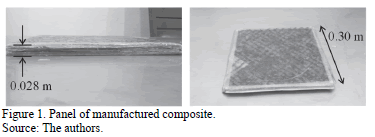
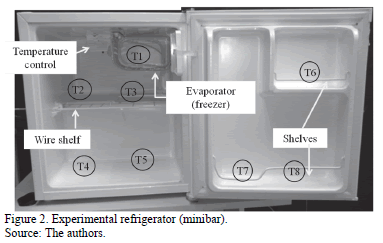
<body><![CDATA[<p><font size="2" face="Verdana, Arial, Helvetica, sans-serif">The pyro-expanded perlite is named like this because it is   a mineral with water trapped in its structure, by subjecting it to higher   temperatures the water vaporizes, which causes the material to expand and   thereby reduce its density without affecting its thermal conductivity. As such,   it is used to make inorganic foam materials for thermal isolation due to its   excellent thermo-physical properties; additionally it is inflammable and is   therefore safe for human use, as well as in the environment. Commercially, the   normal temperature range that this isolating material can withstand ranges from   1 K to 1033 K.</font></p>     <p><font size="2" face="Verdana, Arial, Helvetica, sans-serif">Pyro-expanded perlite is used as a primer material for the   synthesis of the composite, this is due to the idea of fabricating an isolating   material with a density apparently similar to conventional insulators applied   to household refrigeration. This is not possible using non-expanded perlite as   its density is approximately 1100 kg/m<sup>3</sup>, whilst the density of   pyro-expanded perlite is between 30 and 150 kg/m<sup>3</sup> &#91;8&#93;. The   preparation of the fibers is the most important part of the fabrication of the   composite as its physical, mechanical and thermal properties are strongly   determined by the backbone fibers.</font></p>     <p><font size="2" face="Verdana, Arial, Helvetica, sans-serif">The   initial material of pyro-expanded perlite presents itself in the shape of small   amorphous rocks, which are ground and sieved until it reaches a fine   consistency, similar to 150 <font face="Symbol"><i>m</i></font><i>m</i> talc.   The fibres are made using this powder through thermal treatment in mullite   moulds, which have good mechanical resistance, low density,   inflammable, exhibit dimensional stability and are also good thermal and   electrical isolators. The fibres formed through this process have different   lengths due to the limited controls on manufacture. Epoxy resins are used in a   great number of cryogenic applications due to their resistance to low   temperatures and they give the composite excellent mechanical properties. The   epoxy resin used as a matrix in the composite was prepared following   instructions from the manufacturer. The epoxy (ID 4D114) and the hardener (ID   NC566) were obtained from the EPOXEMEX Company. After obtaining the fibers and having prepared the matrix, we progressed   to the formation of the panel of the composite through a geometric arrangement   of the fibers embedded in the matrix, whose final structure is shown in <a href="#fig01">Fig. 1</a>.</font></p>     <p align="center"><font size="2" face="Verdana, Arial, Helvetica, sans-serif"><a name="fig01"></a></font><img src="/img/revistas/dyna/v82n193/v82n193a10fig01.gif"></p>     <p><font size="2" face="Verdana, Arial, Helvetica, sans-serif">Among the advantages offered by this material, and based   upon its particular application in this research, it is its low thermal   conductivity of about 0.025 W/m K. Besides, the composite material has a good   mechanical resistance and tenacity at low temperatures. More information on the   properties and the manufacture of the composite may be found in &#91;15&#93;. As such,   it is of great importance to highlight the environmentally favorable aspects of   the composite as compared to conventional thermal insulating foams, the   composite does not use hydrocarbons, clorofluorocarbons, hydrofluorocarbons nor   hidrochlorofluorocarbons; but it uses a naturally occurring mineral,   pyro-expanded perlite. This means that its manufacture avoids large emissions   of pollutants that cause global warming or wastage of the ozone layer.</font></p>     <p>&nbsp;</p>     <p><font size="3" face="Verdana, Arial, Helvetica, sans-serif"><b>3. Experimental   refrigerator</b></font></p>     <p><font size="2" face="Verdana, Arial, Helvetica, sans-serif">Experimental tests were   performed for a commercial minibar (see <a href="#fig02">Fig. 2</a>) with a net capacity of 0.046 m<sup>3</sup> (1.6 ft<sup>3</sup>). The external dimensions of the experimental refrigerator   are 0.44 m x 0.5 m x 0.47 m (width x depth x height) and the wall thickness is   approximately 0.037 m of polyurethane with a mixture of R141b/R22 as blowing   agent, its thermal conductivity is between a range of 0.0175 a 0.024 W/m K. A   refrigerator with a small storage capacity was chosen for practical reasons as   less composite needs to be produced in order to replace the original   insulation.</font></p>     <p align="center"><font size="2" face="Verdana, Arial, Helvetica, sans-serif"><a name="fig02"></a></font><img src="/img/revistas/dyna/v82n193/v82n193a10fig02.gif"></p>     <p><font size="2" face="Verdana, Arial, Helvetica, sans-serif">The experimental refrigerator has one compartment   divided by a wire shelf, the door also has shelves protected by wire and there   is also an exposed evaporator type roll bond, which works by natural convection   and comprises the area of a small freezer. The minibar is based on compression   vapor technology. </font></p>     ]]></body>
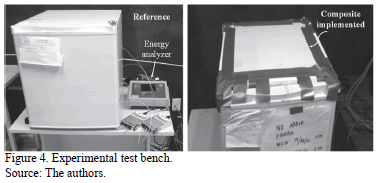
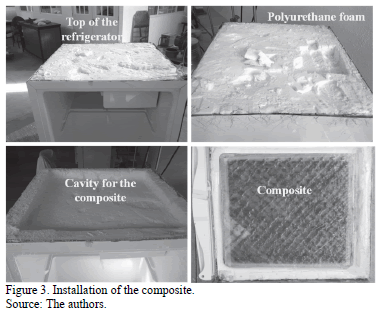
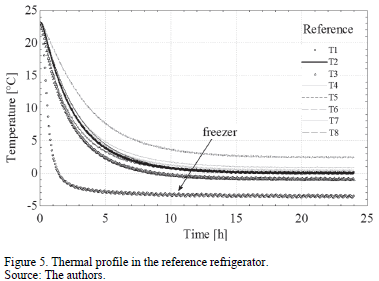
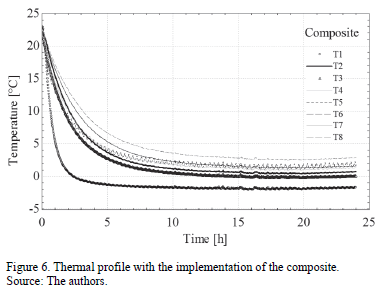
<body><![CDATA[<p><font size="2" face="Verdana, Arial, Helvetica, sans-serif"><b><i>3.1. Installation of the composite</i></b></font></p>     <p><font size="2" face="Verdana, Arial, Helvetica, sans-serif">In order to   evaluate the composite developed, we installed the material at the top of the refrigerator.   This location was chosen in order to replace the conventional insulation the   purpose of which is to avoid damaging the hot pipelines that pass through the   lateral walls of this kind of refrigerator. In addition, the placement of the   panel was analyzed according to the location of the evaporator; a zone where   the lower temperatures are present and it may be the area of higher energy   transfer within the enclosed environment. <a href="#fig03">Fig. 3</a> shows the implementation of   the panel composite.</font></p>     <p align="center"><font size="2" face="Verdana, Arial, Helvetica, sans-serif"><a name="fig03"></a></font><img src="/img/revistas/dyna/v82n193/v82n193a10fig03.gif"></p>     <p><font size="2" face="Verdana, Arial, Helvetica, sans-serif">In order to   adequately align the panel, several holes were partially filled with   conventional foam in order to exert pressure whilst installing the top sheet of   the refrigerator.</font></p>     <p><font size="2" face="Verdana, Arial, Helvetica, sans-serif"><b><i>3.2. Instrumentation and measurements</i></b></font></p>     <p><font size="2" face="Verdana, Arial, Helvetica, sans-serif">The refrigerator under study has attached sensors in order   to measure parameters such as temperature and energy consumption. The tests   were carried out at position 4 of the temperature dial, which are the   refrigerator factory settings. The temperature sensors are calibrated in our   laboratory using certified references, obtaining an uncertainty of ±0.3 K, </font><font size="2" face="Verdana, Arial, Helvetica, sans-serif">while the energy consumption is   measured using an energy analyzer fluke with a certified accuracy within &plusmn; 0.7 %. In order to measure the   temperature in the compartment, seven thermocouples were placed inside   containers of 0.245 l (0.000245 m<sup>3</sup>) with a mixture at 50% in volume   of water and glycol. The containers were distributed on the wire shelf and the   door shelves (see <a href="#fig02">Fig. 2</a>). The temperature measurement in the freezer was   obtained with one thermocouple placed inside a wood block in order to avoid   density and volume changes during the test.</font></p>     <p><font size="2" face="Verdana, Arial, Helvetica, sans-serif">Several tests were performed within approximately 24   hours, including the transitory performance during the startup and halt of the   compressor. The refrigerator operated at a room temperature of 295 K ± 1 K and with a relative humidity of 70 ±   5%. The signals generated by the temperature measurement device were stored in   a data acquisition system based on a PC with LabVIEW SignalExpress® software.   The energy analyzer is configured for data storage in a lapse of 24 hours each   40 seconds, and both temperature and energy measurements are taken in parallel   form.</font></p>     <p>&nbsp;</p>     <p><font size="3" face="Verdana, Arial, Helvetica, sans-serif"><b>4. Experimental   results</b></font></p>     <p><font size="2" face="Verdana, Arial, Helvetica, sans-serif">The experimental analysis involves comparing the thermal   and energy conditions of the minibar in its reference state (using refrigerator   Factory settings) and with the modification (implementation of composite). The   refrigerator in both tests is evaluated with the door shut and without load,   i.e. empty, only with thermocouples inside for measurements. The tests are   started at approximately the same external conditions of temperature and   humidity. For this, tests were performed for a duration of approximately 24   hours in both cases. <a href="#fig04">Fig. 4</a> shows the experimental test bench.</font></p>     ]]></body>
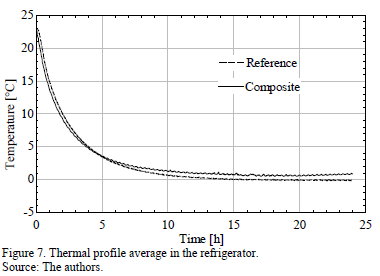
<body><![CDATA[<p align="center"><font size="2" face="Verdana, Arial, Helvetica, sans-serif"><a name="fig04"></a></font><img src="/img/revistas/dyna/v82n193/v82n193a10fig04.gif"></p>     <p><font size="2" face="Verdana, Arial, Helvetica, sans-serif"><b><i>4.1. Thermal   analysis</i></b></font></p>     <p><font size="2" face="Verdana, Arial, Helvetica, sans-serif">In <a href="#fig06">Figs. 5</a> and <a href="#fig06">6</a>, the thermal profile of the reference   refrigerator and the refrigerator with the composite implementation are show   respectively. <a href="#fig06">Fig. 5</a> clearly shows that the lower temperature corresponds to   the small freezer compartment. It is reasonable that the stability in this region   is reached in less time, whereas practically all of the measurements are above   0°C. Also, it may be noted that the steady thermal behavior of this   refrigerator of low capacity begins within approximately 10 hours of starting   the test.</font></p>     <p align="center"><font size="2" face="Verdana, Arial, Helvetica, sans-serif"><a name="fig06"></a></font><img src="/img/revistas/dyna/v82n193/v82n193a10fig05.gif"></p>     <p align="center"><font size="2" face="Verdana, Arial, Helvetica, sans-serif"><a name="fig06"></a></font><img src="/img/revistas/dyna/v82n193/v82n193a10fig06.gif"></p>     <p><font size="2" face="Verdana, Arial, Helvetica, sans-serif">Regarding the   thermal behavior using the composite material, <a href="#fig06">Fig. 6</a> shows the thermal   profile. Entrance similarity is observed in the temperature   trends, it is observed that the measurement of some points shows slight   increases in the temperature of the refrigerator using the composite. The most   notable case is the thermocouple located in the freezer. The slight thermal   variations present in the refrigerator using the composite are due simply to   the structure of the material affecting the behavior of the energy transfer by   natural convection in the cooling compartment. </font></p>     <p><font size="2" face="Verdana, Arial, Helvetica, sans-serif">A lack of thermal cycles   is also observed in both thermal performances (<a href="#fig06">Fig. 5</a> and <a href="#fig06">6</a>). First, this may   be due to the type of calibration of the unit in relation to the times of   startup and halt of the compressor, all of this taking into account that the   refrigerator was evaluated with the door shut; second, because of the size of   the refrigerator, which represents a much smaller space and little disturbance   by external conditions. Here is highlighted the proper application of the   composite which causes a similar thermal behavior in respect to the reference   refrigerator. Continuing with the thermal   comparison, in <a href="#fig07">Fig. 7</a> the average temperature profile is compared between the   reference refrigerator and the one with the composite.</font></p>     <p align="center"><font size="2" face="Verdana, Arial, Helvetica, sans-serif"><a name="fig07"></a></font><img src="/img/revistas/dyna/v82n193/v82n193a10fig07.gif"></p>     <p><font size="2" face="Verdana, Arial, Helvetica, sans-serif">Analyzing the range of   stabilization, it may be concluded that a difference of 1°C exists between the   unit working with the composite and the unit with the conventional insulator.   Upon evaluation of the practical application of the composite as a thermal   isolator, we may say that it takes an acceptable temperature within the factory   settings at position 4 (around 3°C).</font></p>     <p><font size="2" face="Verdana, Arial, Helvetica, sans-serif">According to the thermal profiles, it is possible to   establish that during the experimental use of the composite, the internal   temperature of the equipment is slightly above the reference state. However, it   is possible to maintain a stable thermal profile that guarantees the correct   functioning of the refrigerator. With the application of the composite it is   concluded that the refrigerator is functioning within an adequate thermal   range, which leads us to presume that this material may be put to good use in   this kind of system.</font></p>     ]]></body>
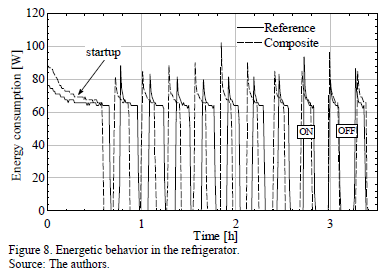
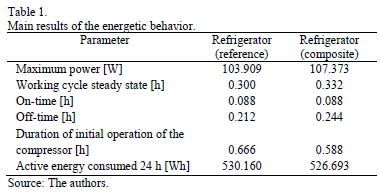
<body><![CDATA[<p><font size="2" face="Verdana, Arial, Helvetica, sans-serif"><b><i>4.2. Energy   analysis</i></b></font></p>     <p><font size="2" face="Verdana, Arial, Helvetica, sans-serif">This section compares the energy consumption of both kinds   of refrigerator. <a href="#fig08">Fig. 8</a> shows the initial operation cycles, whose behavior is   constant in the successive cycles during the 24 hour test time. It was observed   that the first functioning cycle (start-up) lasts longer; this is due to the   initial temperature difference between the refrigerator and its environment. </font></p>     <p align="center"><font size="2" face="Verdana, Arial, Helvetica, sans-serif"><a name="fig08"></a></font><img src="/img/revistas/dyna/v82n193/v82n193a10fig08.gif"></p>     <p><font size="2" face="Verdana, Arial, Helvetica, sans-serif">For this reason, the form of the figure has a larger   start-up cycle for the reference refrigerator, which is due to the test   starting at a slightly higher temperature, which is why the compressor works   harder in order to reach a certain calibration temperature. Additionally, in   the figure, it may be observed that for the previous functioning cycles the   operation time (with the compressor turned on) is similar for both functioning   cases.</font></p>     <p><font size="2" face="Verdana, Arial, Helvetica, sans-serif">The most interesting energetic behavior results are   indicated in <a href="#tab01">Table 1</a>. For the comparison between the two functioning states,   the operating difference radiates in the time it takes to turn off the   compressor, which presented a difference of 0.032 hours. When the insulating   composite is installed in the refrigerator, the compressor operates for 0.088   hours and rests for a total of 0.244 hours, meaning that a complete cycle   occurs in 0.332 hours.</font></p>     <p align="center"><font size="2" face="Verdana, Arial, Helvetica, sans-serif"><a name="tab01"></a></font><img src="/img/revistas/dyna/v82n193/v82n193a10tab01.gif"></p>     <p><font size="2" face="Verdana, Arial, Helvetica, sans-serif">Once the characteristic functioning times have been   analyzed, it is determined that the reference refrigerator under stable   functioning conditions has a higher number of operating cycles during a set   period. For example, from the analysis of the energy consumption in the last   four hours of operation of each one of the tests, it may be concluded that the   refrigerator with the composite saves approximately 1.5% more energy than the   reference refrigerator. This is a good indication that, at least, the composite   as insulation has adequate energy performance; all of this under the test   conditions performed in our laboratory. The authors consider that more   significant energy savings can be achieved through the improvement in the   development of the material. Moreover, this energy comparative represents the   composite application in one of the most critical parts of the minibar because   of the closeness to the evaporator and what it represents in terms of the   temperature difference in this space and its surroundings.</font></p>     <p><font size="2" face="Verdana, Arial, Helvetica, sans-serif">It should be   highlighted that the composite developed has been exposed to high service   requirements against conventional cellular foam, which is the most common   insulator used in household refrigerators. Also, the composite adheres to the   imperfections generated during the (experimental) manufacturing process, such   as: the quantity of material used, uniformity of the fiber, porosity of the   material, adherence between layers, etc. as well as adequately fixing the   material to the appropriate space. Despite all this, the pyro-expanded   composite complies as a thermal isolating material.</font></p>     <p><font size="2" face="Verdana, Arial, Helvetica, sans-serif">On the other hand, one of the possible doubts generated in   the development of the material, is its manufacture. According to the   development of the material presented in this work, it seems that it was a   pretty lengthy and costly process. However, it should not be forgotten that   this process was planned and developed only at the laboratory level, using   small specimens and molds, additionally; a limiting factor was the manufacturing   capacity of the pyro-expanded perlite fibers. We consider that the same   process, but at an industrial or mass scale level may exhibit greater ease, and   thermal, energetic and economic benefits, without omitting the environmentally   favorable characteristics. Within the parameters that must be taken into   account to improve the composite and to present better thermal and energy   performances are: the shape, size, distribution, quantity, material type and   its particular properties in the dispersed phase, which in this case is   ceramic. Moreover, the matrix is providing, in its chemical composition,   properties that are the most homogeneous as possible and in the amounts   presented in this composite. In the case of this work and in the traditional   way, other geometry could be tested for the stacking of the disperse phase.</font></p>     <p>&nbsp;</p>     ]]></body>
<body><![CDATA[<p><font size="3" face="Verdana, Arial, Helvetica, sans-serif"><b>5. Conclusions</b></font></p>     <p><font size="2" face="Verdana, Arial, Helvetica, sans-serif">This article briefly presented the development in the lab   and the principle characteristics of a new composite material, proposed as a   thermal insulator. The emphasis of the study consisted in the evaluation of the   feasibility of the new material implemented in the upper wall of a refrigerator   with a small capacity (minibar). The   research focused on a comparison of the thermal and energy performance of the   fridge at factory settings and the fridge with the composite installed. It is   concluded that the refrigerator with the composite exhibits an average increase   of 1°C as compared to the reference refrigerator (using factory settings). On   the energy side and for a stable period in the last four operation hours of the   refrigerator, it was found that the refrigerator with the implemented composite   saves approximately 1.5% more energy than the reference refrigerator with its   factory settings. </font></p>     <p><font size="2" face="Verdana, Arial, Helvetica, sans-serif">More generally, the new material proposed in this paper as   an insulator may be an interesting alternative that has room for improvement.   Although the composite was made by hand in this case, it presented acceptable   results, making it an option in the field of domestic refrigeration.</font></p>     <p>&nbsp;</p>     <p><font size="3" face="Verdana, Arial, Helvetica, sans-serif"><b>Acknowledgments</b></font></p>     <p><font size="2" face="Verdana, Arial, Helvetica, sans-serif">The authors wish to thank the Directorate for Research   Support and Postgraduate Programs at the University of Guanajuato for their   support in the translation and editing of the English-language version of this   article</font></p>     <p>&nbsp;</p>     <p><font size="3" face="Verdana, Arial, Helvetica, sans-serif"><b>References</b></font></p>     <!-- ref --><p><font size="2" face="Verdana, Arial, Helvetica, sans-serif"><b>&#91;1&#93;</b> Seong, S.J. and Soo, H.J., Experimental study   of heat transfer characteristics for a refrigerator by using reverse heat loss   method. International   Communications in Heat and Mass Transfer, 38 (5), pp. 572-576, 2011. DOI: 10.1016/J.Icheatmasstransfer.2011.02.007</font>&nbsp;&nbsp;&nbsp;&nbsp;&nbsp;&nbsp;&nbsp;&nbsp;[&#160;<a href="javascript:void(0);" onclick="javascript: window.open('/scielo.php?script=sci_nlinks&ref=000081&pid=S0012-7353201500050001000001&lng=','','width=640,height=500,resizable=yes,scrollbars=1,menubar=yes,');">Links</a>&#160;]<!-- end-ref --><!-- ref --><p><font size="2" face="Verdana, Arial, Helvetica, sans-serif"><b>&#91;2&#93;</b> Centro Nacional de Poblaci&oacute;n y   Vivienda, Instituto Nacional de Estad&iacute;stica y Geograf&iacute;a (INEGI), M&eacute;xico, 2010.    &nbsp;&nbsp;&nbsp;&nbsp;&nbsp;&nbsp;&nbsp;&nbsp;[&#160;<a href="javascript:void(0);" onclick="javascript: window.open('/scielo.php?script=sci_nlinks&ref=000082&pid=S0012-7353201500050001000002&lng=','','width=640,height=500,resizable=yes,scrollbars=1,menubar=yes,');">Links</a>&#160;]<!-- end-ref --></font></p>     <!-- ref --><p><font size="2" face="Verdana, Arial, Helvetica, sans-serif"><b>&#91;3&#93;</b> Miceli, R., Energy management and smart grids. Energies, 6 (4), pp. 2262-2290, 2013. DOI: 10.3390/en6042262</font>&nbsp;&nbsp;&nbsp;&nbsp;&nbsp;&nbsp;&nbsp;&nbsp;[&#160;<a href="javascript:void(0);" onclick="javascript: window.open('/scielo.php?script=sci_nlinks&ref=000084&pid=S0012-7353201500050001000003&lng=','','width=640,height=500,resizable=yes,scrollbars=1,menubar=yes,');">Links</a>&#160;]<!-- end-ref --><!-- ref --><p><font size="2" face="Verdana, Arial, Helvetica, sans-serif"><b>&#91;4&#93;</b> Bansal, P., Vineyard, E. and   Abdelaziz, O., Advances in household appliances - A review. Applied Thermal   Engineering, 31 (17-18), pp. 3748-3760, 2011. DOI: 10.1016/J.Applthermaleng.2011.07.023</font>&nbsp;&nbsp;&nbsp;&nbsp;&nbsp;&nbsp;&nbsp;&nbsp;[&#160;<a href="javascript:void(0);" onclick="javascript: window.open('/scielo.php?script=sci_nlinks&ref=000085&pid=S0012-7353201500050001000004&lng=','','width=640,height=500,resizable=yes,scrollbars=1,menubar=yes,');">Links</a>&#160;]<!-- end-ref --><!-- ref --><p><font size="2" face="Verdana, Arial, Helvetica, sans-serif"><b>&#91;5&#93;</b> Yoon, W.J., Seo, K. and Kim,   Y., Development of an optimization strategy for insulation thickness of a   domestic refrigerator-freezer. International Journal of Refrigeration, 36 (3),   pp. 1162-1172, 2013. DOI: 10.1016/J.Ijrefrig.2012.11.013</font>&nbsp;&nbsp;&nbsp;&nbsp;&nbsp;&nbsp;&nbsp;&nbsp;[&#160;<a href="javascript:void(0);" onclick="javascript: window.open('/scielo.php?script=sci_nlinks&ref=000086&pid=S0012-7353201500050001000005&lng=','','width=640,height=500,resizable=yes,scrollbars=1,menubar=yes,');">Links</a>&#160;]<!-- end-ref --><!-- ref --><p><font size="2" face="Verdana, Arial, Helvetica, sans-serif"><b>&#91;6&#93;</b> Marques, A.C., Davies, G.F.,   Evans, J.A., Maidment, G.G. and Wood, I.D., Theoretical modelling and   experimental investigation of a thermal energy storage refrigerator. Energy, 55   (15), pp. 457-465, 2013. DOI: 10.1016/j.energy.2013.03.091</font>&nbsp;&nbsp;&nbsp;&nbsp;&nbsp;&nbsp;&nbsp;&nbsp;[&#160;<a href="javascript:void(0);" onclick="javascript: window.open('/scielo.php?script=sci_nlinks&ref=000087&pid=S0012-7353201500050001000006&lng=','','width=640,height=500,resizable=yes,scrollbars=1,menubar=yes,');">Links</a>&#160;]<!-- end-ref --><!-- ref --><p><font size="2" face="Verdana, Arial, Helvetica, sans-serif"><b>&#91;7&#93;</b> Koebel, M., Rigacci, A. and   Achard, P., Aerogel-based thermal superinsulation: An overview. Journal of   Sol-Gel Science and Technology, 63, pp.   315-339, 2012. DOI:   10.1007/s10971-012-2792-9</font>&nbsp;&nbsp;&nbsp;&nbsp;&nbsp;&nbsp;&nbsp;&nbsp;[&#160;<a href="javascript:void(0);" onclick="javascript: window.open('/scielo.php?script=sci_nlinks&ref=000088&pid=S0012-7353201500050001000007&lng=','','width=640,height=500,resizable=yes,scrollbars=1,menubar=yes,');">Links</a>&#160;]<!-- end-ref --><!-- ref --><p><font size="2" face="Verdana, Arial, Helvetica, sans-serif"><b>&#91;8&#93;</b> Vaou, V. and Panias, D., Thermal insulating foamy geopolymers   from perlite. Minerals Engineering, 23 (14), pp. 1146-1151, 2010. DOI:   10.1016/j.mineng.2010.07.015</font>&nbsp;&nbsp;&nbsp;&nbsp;&nbsp;&nbsp;&nbsp;&nbsp;[&#160;<a href="javascript:void(0);" onclick="javascript: window.open('/scielo.php?script=sci_nlinks&ref=000089&pid=S0012-7353201500050001000008&lng=','','width=640,height=500,resizable=yes,scrollbars=1,menubar=yes,');">Links</a>&#160;]<!-- end-ref --><!-- ref --><p><font size="2" face="Verdana, Arial, Helvetica, sans-serif"><b>&#91;9&#93;</b> Johnson, R.W., The effect of blowing agent choice on energy use and   global warming impact of a refrigerator. International Journal of Refrigeration, 27 (7), pp.   794-799, 2004. DOI:   10.1016/j.ijrefrig.2004.07.005</font>&nbsp;&nbsp;&nbsp;&nbsp;&nbsp;&nbsp;&nbsp;&nbsp;[&#160;<a href="javascript:void(0);" onclick="javascript: window.open('/scielo.php?script=sci_nlinks&ref=000090&pid=S0012-7353201500050001000009&lng=','','width=640,height=500,resizable=yes,scrollbars=1,menubar=yes,');">Links</a>&#160;]<!-- end-ref --><!-- ref --><p><font size="2" face="Verdana, Arial, Helvetica, sans-serif"><b>&#91;10&#93;</b> Arkema reveals new low-GWP blowing agent for   polyurethane foams. Additives for Polymers, 2013 (11), pp. 3-3, 2013. DOI: 10.1016/S0306-3747(13)70169-6</font>&nbsp;&nbsp;&nbsp;&nbsp;&nbsp;&nbsp;&nbsp;&nbsp;[&#160;<a href="javascript:void(0);" onclick="javascript: window.open('/scielo.php?script=sci_nlinks&ref=000091&pid=S0012-7353201500050001000010&lng=','','width=640,height=500,resizable=yes,scrollbars=1,menubar=yes,');">Links</a>&#160;]<!-- end-ref --><!-- ref --><p><font size="2" face="Verdana, Arial, Helvetica, sans-serif"><b>&#91;11&#93;</b> Yamsaengsung, W. and   Sombatsompop, N., Effect of chemical blowing agent on cell structure   and mechanical properties of EPDM foam, and peel strength and thermal   conductivity of wood/NR composite-EPDM foam laminates. Composites Part B:   Engineering, 40 (7), pp. 594-600, 2009. DOI: 10.1016/j.compositesb.2009.04.003</font>&nbsp;&nbsp;&nbsp;&nbsp;&nbsp;&nbsp;&nbsp;&nbsp;[&#160;<a href="javascript:void(0);" onclick="javascript: window.open('/scielo.php?script=sci_nlinks&ref=000092&pid=S0012-7353201500050001000011&lng=','','width=640,height=500,resizable=yes,scrollbars=1,menubar=yes,');">Links</a>&#160;]<!-- end-ref --><!-- ref --><p><font size="2" face="Verdana, Arial, Helvetica, sans-serif"><b>&#91;12&#93;</b> Rios-Soberanis, C.R.,   Cruz-Estrada, R.H., Rodr&iacute;guez-Laviada, J. and P&eacute;rez-Pacheco, E., Study of   mechanical behavior of textil reiforced composite materials. DYNA, 79 (176),   pp. 115-123, 2012.    &nbsp;&nbsp;&nbsp;&nbsp;&nbsp;&nbsp;&nbsp;&nbsp;[&#160;<a href="javascript:void(0);" onclick="javascript: window.open('/scielo.php?script=sci_nlinks&ref=000093&pid=S0012-7353201500050001000012&lng=','','width=640,height=500,resizable=yes,scrollbars=1,menubar=yes,');">Links</a>&#160;]<!-- end-ref --></font></p>     <!-- ref --><p><font size="2" face="Verdana, Arial, Helvetica, sans-serif"><b>&#91;13&#93;</b> Guti&eacute;rrez, J., Cadena, C. and   Bula, A., Thermal insulation produced from rice husk agglomerated using starch   produced by saccharomyces cerevisiae. DYNA, 81 (184), pp. 138-143. 2014.    &nbsp;&nbsp;&nbsp;&nbsp;&nbsp;&nbsp;&nbsp;&nbsp;[&#160;<a href="javascript:void(0);" onclick="javascript: window.open('/scielo.php?script=sci_nlinks&ref=000095&pid=S0012-7353201500050001000013&lng=','','width=640,height=500,resizable=yes,scrollbars=1,menubar=yes,');">Links</a>&#160;]<!-- end-ref --></font></p>     <!-- ref --><p><font size="2" face="Verdana, Arial, Helvetica, sans-serif"><b>&#91;14&#93;</b> Mallick, P.K., Composites   Engineering Handbook, in Composites Engineering Handbook (Materials Engineering   Series). New York: Marcel Dekker, Inc., 1997.    &nbsp;&nbsp;&nbsp;&nbsp;&nbsp;&nbsp;&nbsp;&nbsp;[&#160;<a href="javascript:void(0);" onclick="javascript: window.open('/scielo.php?script=sci_nlinks&ref=000097&pid=S0012-7353201500050001000014&lng=','','width=640,height=500,resizable=yes,scrollbars=1,menubar=yes,');">Links</a>&#160;]<!-- end-ref --></font></p>     <!-- ref --><p><font size="2" face="Verdana, Arial, Helvetica, sans-serif"><b>&#91;15&#93;</b> G&aacute;mez-Arredondo, S.A.,   Application of polimer/ceramic composite for improvement thermal and energetic   of a domestic refrigerator, MSc. Thesis, Department of Mechanical Engineering,   University of Guanajuato, M&eacute;xico, 2013.    &nbsp;&nbsp;&nbsp;&nbsp;&nbsp;&nbsp;&nbsp;&nbsp;[&#160;<a href="javascript:void(0);" onclick="javascript: window.open('/scielo.php?script=sci_nlinks&ref=000099&pid=S0012-7353201500050001000015&lng=','','width=640,height=500,resizable=yes,scrollbars=1,menubar=yes,');">Links</a>&#160;]<!-- end-ref --></font></p>     <!-- ref --><p><font size="2" face="Verdana, Arial, Helvetica, sans-serif"><b>&#91;16&#93;</b> Enr&iacute;quez-Guti&eacute;rrez, V.M.,   Design of a composite of perlite piro-expanded/epoxy for thermal insulation in   cryogenic process, MSc. Thesis, Department of Mechanical Engineering,   University of Guanajuato, M&eacute;xico, 2011.    &nbsp;&nbsp;&nbsp;&nbsp;&nbsp;&nbsp;&nbsp;&nbsp;[&#160;<a href="javascript:void(0);" onclick="javascript: window.open('/scielo.php?script=sci_nlinks&ref=000101&pid=S0012-7353201500050001000016&lng=','','width=640,height=500,resizable=yes,scrollbars=1,menubar=yes,');">Links</a>&#160;]<!-- end-ref --></font></p>     ]]></body>
<body><![CDATA[<p>&nbsp;</p>     <p><font size="2" face="Verdana, Arial, Helvetica, sans-serif"><b>J.M. Belman-Flores,</b> obtained the PhD degree from University Jaume I, Spain in 2008. He is currently   a full-time professor in the engineering division at the University of   Guanajuato, Mexico. Over 70 papers have been published in National and   International Congress/Journals. His research interests includes:   refrigeration, thermal systems, energy saving and modeling systems.</font></p>     <p><font size="2" face="Verdana, Arial, Helvetica, sans-serif"><b>B. Gonz&aacute;lez-Rol&oacute;n, </b>received Dra. in Science of Materials from UNAM, Mexico in 1997. She is a   full-time professor in the materials science in the Department of Mechanical   Engineering, at University of Guanajuato, Mexico. Teaching: 228 Graduate   courses, 20 Master's courses, 9 Doctoral courses. Supervised theses: 18   Graduate, 8 Master's degrees, and 2 Doctoral degrees. Theses currently being   supervised: 3 Graduate degrees, 3 Master's degrees, and 2 doctoral degrees.   Keynote speech at Mejico University in Nagoya, Japan, entitled &quot;Present status   of insulating materials in Mexico&quot;. September 2000, Nagoya, Japan. </font></p>     <p><font size="2" face="Verdana, Arial, Helvetica, sans-serif"><b>J. Serrano-Arellano, </b>received his Dr. degree in Mechanical Engineering in 2013 in the National   Center for Research and Technological Development (CENIDET). Currently he is   performing postdoctoral studies at the University of Guanajuato, Mexico. His   areas of interest are heat transfer, mass transfer, ventilation systems, and   renewable energy among others.</font></p>     <p><font size="2" face="Verdana, Arial, Helvetica, sans-serif"><b>S. G&aacute;mez-Arredondo, </b>received his MSc. degree in Mechanical Engineering in 2013 in the   University of Guanajuato, Mexico. Currently he is working at the InverCost   Group, Mexico. His areas of interest are thermal and power systems.</font></p>      ]]></body><back>
<ref-list>
<ref id="B1">
<label>1</label><nlm-citation citation-type="journal">
<person-group person-group-type="author">
<name>
<surname><![CDATA[Seong]]></surname>
<given-names><![CDATA[S.J.]]></given-names>
</name>
<name>
<surname><![CDATA[Soo]]></surname>
<given-names><![CDATA[H.J.]]></given-names>
</name>
</person-group>
<article-title xml:lang="en"><![CDATA[Experimental study of heat transfer characteristics for a refrigerator by using reverse heat loss method.]]></article-title>
<source><![CDATA[International Communications in Heat and Mass Transfer]]></source>
<year>2011</year>
<volume>38</volume>
<numero>5</numero>
<issue>5</issue>
<page-range>572-576</page-range></nlm-citation>
</ref>
<ref id="B2">
<label>2</label><nlm-citation citation-type="">
<collab>Centro Nacional de Población y Vivienda</collab>
<collab>Instituto Nacional de Estadística y Geografía</collab>
<source><![CDATA[]]></source>
<year>2010</year>
</nlm-citation>
</ref>
<ref id="B3">
<label>3</label><nlm-citation citation-type="journal">
<person-group person-group-type="author">
<name>
<surname><![CDATA[Miceli]]></surname>
<given-names><![CDATA[R.]]></given-names>
</name>
</person-group>
<article-title xml:lang="en"><![CDATA[Energy management and smart grids]]></article-title>
<source><![CDATA[Energies]]></source>
<year>2013</year>
<volume>6</volume>
<numero>4</numero>
<issue>4</issue>
<page-range>2262-2290</page-range></nlm-citation>
</ref>
<ref id="B4">
<label>4</label><nlm-citation citation-type="journal">
<person-group person-group-type="author">
<name>
<surname><![CDATA[Bansal]]></surname>
<given-names><![CDATA[P.]]></given-names>
</name>
<name>
<surname><![CDATA[Vineyard]]></surname>
<given-names><![CDATA[E.]]></given-names>
</name>
<name>
<surname><![CDATA[Abdelaziz]]></surname>
<given-names><![CDATA[O.]]></given-names>
</name>
</person-group>
<article-title xml:lang="en"><![CDATA[Advances in household appliances: A review]]></article-title>
<source><![CDATA[Applied Thermal Engineering]]></source>
<year>2011</year>
<volume>31</volume>
<numero>17-18</numero>
<issue>17-18</issue>
<page-range>3748-3760</page-range></nlm-citation>
</ref>
<ref id="B5">
<label>5</label><nlm-citation citation-type="journal">
<person-group person-group-type="author">
<name>
<surname><![CDATA[Yoon]]></surname>
<given-names><![CDATA[W.J.]]></given-names>
</name>
<name>
<surname><![CDATA[Seo]]></surname>
<given-names><![CDATA[K.]]></given-names>
</name>
<name>
<surname><![CDATA[Kim]]></surname>
<given-names><![CDATA[Y.]]></given-names>
</name>
</person-group>
<article-title xml:lang="en"><![CDATA[Development of an optimization strategy for insulation thickness of a domestic refrigerator-freezer.]]></article-title>
<source><![CDATA[International Journal of Refrigeration]]></source>
<year>2013</year>
<volume>36</volume>
<numero>3</numero>
<issue>3</issue>
<page-range>1162-1172</page-range></nlm-citation>
</ref>
<ref id="B6">
<label>6</label><nlm-citation citation-type="journal">
<person-group person-group-type="author">
<name>
<surname><![CDATA[Marques]]></surname>
<given-names><![CDATA[A.C.]]></given-names>
</name>
<name>
<surname><![CDATA[Davies]]></surname>
<given-names><![CDATA[G.F.]]></given-names>
</name>
<name>
<surname><![CDATA[Evans]]></surname>
<given-names><![CDATA[J.A.]]></given-names>
</name>
<name>
<surname><![CDATA[Maidment]]></surname>
<given-names><![CDATA[G.G.]]></given-names>
</name>
<name>
<surname><![CDATA[Wood]]></surname>
<given-names><![CDATA[I.D.]]></given-names>
</name>
</person-group>
<article-title xml:lang="en"><![CDATA[Theoretical modelling and experimental investigation of a thermal energy storage refrigerator.]]></article-title>
<source><![CDATA[Energy]]></source>
<year>2013</year>
<volume>55</volume>
<numero>15</numero>
<issue>15</issue>
<page-range>457-465</page-range></nlm-citation>
</ref>
<ref id="B7">
<label>7</label><nlm-citation citation-type="journal">
<person-group person-group-type="author">
<name>
<surname><![CDATA[Koebel]]></surname>
<given-names><![CDATA[M.]]></given-names>
</name>
<name>
<surname><![CDATA[Rigacci]]></surname>
<given-names><![CDATA[A.]]></given-names>
</name>
<name>
<surname><![CDATA[Achard]]></surname>
<given-names><![CDATA[P.]]></given-names>
</name>
</person-group>
<article-title xml:lang="en"><![CDATA[Aerogel-based thermal superinsulation: An overview]]></article-title>
<source><![CDATA[Journal of Sol-Gel Science and Technology]]></source>
<year>2012</year>
<numero>63</numero>
<issue>63</issue>
<page-range>315-339</page-range></nlm-citation>
</ref>
<ref id="B8">
<label>8</label><nlm-citation citation-type="journal">
<person-group person-group-type="author">
<name>
<surname><![CDATA[Vaou]]></surname>
<given-names><![CDATA[V.]]></given-names>
</name>
<name>
<surname><![CDATA[Panias]]></surname>
<given-names><![CDATA[D.]]></given-names>
</name>
</person-group>
<article-title xml:lang="en"><![CDATA[Thermal insulating foamy geopolymers from perlite.]]></article-title>
<source><![CDATA[Minerals Engineering]]></source>
<year>2010</year>
<volume>23</volume>
<numero>14</numero>
<issue>14</issue>
<page-range>1146-1151</page-range></nlm-citation>
</ref>
<ref id="B9">
<label>9</label><nlm-citation citation-type="journal">
<person-group person-group-type="author">
<name>
<surname><![CDATA[Johnson]]></surname>
<given-names><![CDATA[R.W.]]></given-names>
</name>
</person-group>
<article-title xml:lang="en"><![CDATA[The effect of blowing agent choice on energy use and global warming impact of a refrigerator]]></article-title>
<source><![CDATA[International Journal of Refrigeration]]></source>
<year>2004</year>
<volume>27</volume>
<numero>7</numero>
<issue>7</issue>
<page-range>794-799</page-range></nlm-citation>
</ref>
<ref id="B10">
<label>10</label><nlm-citation citation-type="">
<source><![CDATA[Arkema reveals new low-GWP blowing agent for polyurethane foams: Additives for Polymers]]></source>
<year>2013</year>
<month>20</month>
<day>13</day>
<volume>11</volume>
<page-range>3-3</page-range></nlm-citation>
</ref>
<ref id="B11">
<label>11</label><nlm-citation citation-type="journal">
<person-group person-group-type="author">
<name>
<surname><![CDATA[Yamsaengsung]]></surname>
<given-names><![CDATA[W.]]></given-names>
</name>
<name>
<surname><![CDATA[Sombatsompop]]></surname>
<given-names><![CDATA[N.]]></given-names>
</name>
</person-group>
<article-title xml:lang="en"><![CDATA[Effect of chemical blowing agent on cell structure and mechanical properties of EPDM foam, and peel strength and thermal conductivity of wood/NR composite-EPDM foam laminates.]]></article-title>
<source><![CDATA[Composites Part B: Engineering]]></source>
<year>2009</year>
<volume>40</volume>
<numero>7</numero>
<issue>7</issue>
<page-range>594-600</page-range></nlm-citation>
</ref>
<ref id="B12">
<label>12</label><nlm-citation citation-type="journal">
<person-group person-group-type="author">
<name>
<surname><![CDATA[Rios-Soberanis]]></surname>
<given-names><![CDATA[C.R.]]></given-names>
</name>
<name>
<surname><![CDATA[Cruz-Estrada]]></surname>
<given-names><![CDATA[R.H.]]></given-names>
</name>
<name>
<surname><![CDATA[Rodríguez-Laviada]]></surname>
<given-names><![CDATA[J.]]></given-names>
</name>
<name>
<surname><![CDATA[Pérez-Pacheco]]></surname>
<given-names><![CDATA[E.]]></given-names>
</name>
</person-group>
<article-title xml:lang="en"><![CDATA[Study of mechanical behavior of textil reiforced composite materials.]]></article-title>
<source><![CDATA[DYNA]]></source>
<year>2012</year>
<volume>79</volume>
<numero>176</numero>
<issue>176</issue>
<page-range>115-123</page-range></nlm-citation>
</ref>
<ref id="B13">
<label>13</label><nlm-citation citation-type="journal">
<person-group person-group-type="author">
<name>
<surname><![CDATA[Gutiérrez]]></surname>
<given-names><![CDATA[J.]]></given-names>
</name>
<name>
<surname><![CDATA[Cadena]]></surname>
<given-names><![CDATA[C.]]></given-names>
</name>
<name>
<surname><![CDATA[Bula]]></surname>
<given-names><![CDATA[A.]]></given-names>
</name>
</person-group>
<article-title xml:lang="en"><![CDATA[Thermal insulation produced from rice husk agglomerated using starch produced by saccharomyces cerevisiae.]]></article-title>
<source><![CDATA[DYNA]]></source>
<year>2014</year>
<volume>81</volume>
<numero>184</numero>
<issue>184</issue>
<page-range>138-143</page-range></nlm-citation>
</ref>
<ref id="B14">
<label>14</label><nlm-citation citation-type="book">
<person-group person-group-type="author">
<name>
<surname><![CDATA[Mallick]]></surname>
<given-names><![CDATA[P.K.]]></given-names>
</name>
</person-group>
<article-title xml:lang="en"><![CDATA[Composites Engineering Handbook]]></article-title>
<source><![CDATA[Composites Engineering Handbook]]></source>
<year>1997</year>
<publisher-loc><![CDATA[New York ]]></publisher-loc>
<publisher-name><![CDATA[Marcel Dekker, Inc.]]></publisher-name>
</nlm-citation>
</ref>
<ref id="B15">
<label>15</label><nlm-citation citation-type="">
<person-group person-group-type="author">
<name>
<surname><![CDATA[Gámez-Arredondo]]></surname>
<given-names><![CDATA[S.A.]]></given-names>
</name>
</person-group>
<source><![CDATA[Application of polimer/ceramic composite for improvement thermal and energetic of a domestic refrigerator]]></source>
<year></year>
</nlm-citation>
</ref>
<ref id="B16">
<label>16</label><nlm-citation citation-type="">
<person-group person-group-type="author">
<name>
<surname><![CDATA[Enríquez-Gutiérrez]]></surname>
<given-names><![CDATA[V.M.]]></given-names>
</name>
</person-group>
<source><![CDATA[Design of a composite of perlite piro-expanded/epoxy for thermal insulation in cryogenic process]]></source>
<year></year>
</nlm-citation>
</ref>
</ref-list>
</back>
</article>