<?xml version="1.0" encoding="ISO-8859-1"?><article xmlns:mml="http://www.w3.org/1998/Math/MathML" xmlns:xlink="http://www.w3.org/1999/xlink" xmlns:xsi="http://www.w3.org/2001/XMLSchema-instance">
<front>
<journal-meta>
<journal-id>0012-7353</journal-id>
<journal-title><![CDATA[DYNA]]></journal-title>
<abbrev-journal-title><![CDATA[Dyna rev.fac.nac.minas]]></abbrev-journal-title>
<issn>0012-7353</issn>
<publisher>
<publisher-name><![CDATA[Universidad Nacional de Colombia]]></publisher-name>
</publisher>
</journal-meta>
<article-meta>
<article-id>S0012-73532015000500013</article-id>
<article-id pub-id-type="doi">10.15446/dyna.v82n193.46196</article-id>
<title-group>
<article-title xml:lang="en"><![CDATA[A methodology to obtain an analytical formula for the elastic modulus of lightweight aggregate concrete]]></article-title>
<article-title xml:lang="es"><![CDATA[Una metodología para obtener una fórmula analítica para el módulo de elasticidad del hormigón de áridos ligeros]]></article-title>
</title-group>
<contrib-group>
<contrib contrib-type="author">
<name>
<surname><![CDATA[Souza-Barbosa]]></surname>
<given-names><![CDATA[Flávio de]]></given-names>
</name>
<xref ref-type="aff" rid="A01"/>
</contrib>
<contrib contrib-type="author">
<name>
<surname><![CDATA[Resende-Farage]]></surname>
<given-names><![CDATA[Michèle Cristina]]></given-names>
</name>
<xref ref-type="aff" rid="A01"/>
</contrib>
<contrib contrib-type="author">
<name>
<surname><![CDATA[Lage-Bonifácio]]></surname>
<given-names><![CDATA[Aldemon]]></given-names>
</name>
<xref ref-type="aff" rid="A01"/>
</contrib>
<contrib contrib-type="author">
<name>
<surname><![CDATA[Beaucour]]></surname>
<given-names><![CDATA[Anne-Lise]]></given-names>
</name>
<xref ref-type="aff" rid="A02"/>
</contrib>
<contrib contrib-type="author">
<name>
<surname><![CDATA[Ortola]]></surname>
<given-names><![CDATA[Sophie]]></given-names>
</name>
<xref ref-type="aff" rid="A03"/>
</contrib>
</contrib-group>
<aff id="A01">
<institution><![CDATA[,Universidade Federal de Juiz de Fora Faculdade de Engenharia ]]></institution>
<addr-line><![CDATA[Juiz de Fora ]]></addr-line>
<country>Brazil</country>
</aff>
<aff id="A">
<institution><![CDATA[,michele.farage@ufjf.edu.br  ]]></institution>
<addr-line><![CDATA[ ]]></addr-line>
</aff>
<aff id="A">
<institution><![CDATA[,aldemon.bonifacio@engenharia.ufjf.br  ]]></institution>
<addr-line><![CDATA[ ]]></addr-line>
</aff>
<aff id="A02">
<institution><![CDATA[,Université de Cergy-Pointoise Laboratoire de Mécanique et Matériaux du Génie Civil ]]></institution>
<addr-line><![CDATA[Cergy-Pointoise ]]></addr-line>
<country>France</country>
</aff>
<aff id="A03">
<institution><![CDATA[,Université Paris Ouest Nanterre la Défense Laboratoire Energétique Mécanique Electromagnétisme ]]></institution>
<addr-line><![CDATA[Ville d'Avray ]]></addr-line>
<country>France</country>
</aff>
<pub-date pub-type="pub">
<day>00</day>
<month>10</month>
<year>2015</year>
</pub-date>
<pub-date pub-type="epub">
<day>00</day>
<month>10</month>
<year>2015</year>
</pub-date>
<volume>82</volume>
<numero>193</numero>
<fpage>98</fpage>
<lpage>103</lpage>
<copyright-statement/>
<copyright-year/>
<self-uri xlink:href="http://www.scielo.org.co/scielo.php?script=sci_arttext&amp;pid=S0012-73532015000500013&amp;lng=en&amp;nrm=iso"></self-uri><self-uri xlink:href="http://www.scielo.org.co/scielo.php?script=sci_abstract&amp;pid=S0012-73532015000500013&amp;lng=en&amp;nrm=iso"></self-uri><self-uri xlink:href="http://www.scielo.org.co/scielo.php?script=sci_pdf&amp;pid=S0012-73532015000500013&amp;lng=en&amp;nrm=iso"></self-uri><abstract abstract-type="short" xml:lang="en"><p><![CDATA[This work proposes a methodology to predict the elastic modulus of lightweight aggregate concretes. To this end an analytical formula is achieved by curve fitting experimental results from 135 concrete samples made of 45 different mixes. The validation of the proposed methodology is carried out by applying the obtained analytical formula to a set of 90 concrete samples made of 30 different mixes. Comparisons with other methods applied to predicting the elastic modulus of lightweight aggregate concretes indicate that the results show good agreement and suggest that the proposed methodology could be applied in practical situations.]]></p></abstract>
<abstract abstract-type="short" xml:lang="es"><p><![CDATA[Este trabajo propone una metodología para evaluar el módulo elástico de los hormigones de agregados livianos. Para ello una fórmula analítica se logra mediante el ajuste de la curva de los resultados experimentales de 135 muestras de hormigón hechas de 45 mezclas diferentes. La validación de la metodología propuesta se lleva a cabo mediante la aplicación de la fórmula analítica obtenida a otro conjunto de 90 muestras de hormigón hecha de 30 mezclas diferentes. Las comparaciones con otros métodos utilizados para predecir el módulo de elasticidad de hormigones de agregados livianos muestran que los resultados sean justos y sugieren que la metodología propuesta podría aplicarse en situaciones prácticas.]]></p></abstract>
<kwd-group>
<kwd lng="en"><![CDATA[lightweight aggregate concrete]]></kwd>
<kwd lng="en"><![CDATA[elastic modulus]]></kwd>
<kwd lng="es"><![CDATA[hormigón de áridos ligeros]]></kwd>
<kwd lng="es"><![CDATA[módulo elástico]]></kwd>
</kwd-group>
</article-meta>
</front><body><![CDATA[ <p><font size="1" face="Verdana, Arial, Helvetica, sans-serif"><b>DOI:</b> <a href="http://dx.doi.org/10.15446/dyna.v82n193.46196" target="_blank">http://dx.doi.org/10.15446/dyna.v82n193.46196</a></font></p>     <p align="center"><font size="4" face="Verdana, Arial, Helvetica, sans-serif"><b>A methodology to obtain an analytical formula for   the elastic modulus of lightweight aggregate concrete</b></font></p>     <p align="center"><i><b><font size="3" face="Verdana, Arial, Helvetica, sans-serif">Una   metodolog&iacute;a para obtener una f&oacute;rmula anal&iacute;tica para el m&oacute;dulo de elasticidad   del hormig&oacute;n de &aacute;ridos ligeros</font></b></i></p>     <p align="center">&nbsp;</p>     <p align="center"><b><font size="2" face="Verdana, Arial, Helvetica, sans-serif">Fl&aacute;vio de Souza-Barbosa <i><sup>a</sup></i>,   Michèle Cristina Resende-Farage <i><sup>a</sup></i>,   Aldemon Lage-Bonif&aacute;cio <i><sup>a</sup>,</i> Anne-Lise Beaucour <i><sup>b</sup></i> &amp;   Sophie Ortola <i><sup>c</sup></i></font></b></p>     <p align="center">&nbsp;</p>     <p align="center"><font size="2" face="Verdana, Arial, Helvetica, sans-serif"><sup><i>a </i></sup><i>Faculdade de Engenharia, Universidade Federal de Juiz de Fora,   Juiz de Fora, Brazil. <a href="mailto:flavio.barbosa@ufjf.edu.br">flavio.barbosa@ufjf.edu.br</a>, <a href="mailto:michele.farage@ufjf.edu.br">michele.farage@ufjf.edu.br</a>, <a href="mailto:aldemon.bonifacio@engenharia.ufjf.br">aldemon.bonifacio@engenharia.ufjf.br</a>    <br>   <sup>b</sup> Laboratoire de M&eacute;canique et Mat&eacute;riaux du G&eacute;nie Civil. Universit&eacute; de Cergy-Pointoise, Cergy-Pointoise,   France. <a href="mailto:anne-lise.beaucour@u-cergy.fr">anne-lise.beaucour@u-cergy.fr</a>    <br>   <sup>c</sup> Laboratoire Energ&eacute;tique M&eacute;canique   Electromagn&eacute;tisme. Universit&eacute;   Paris Ouest Nanterre la D&eacute;fense, Ville d'Avray, France. <a href="mailto:sophie.ortola@u-paris10.fr">sophie.ortola@u-paris10.fr</a></i></font></p>     <p align="center">&nbsp;</p>     ]]></body>
<body><![CDATA[<p align="center"><font size="2" face="Verdana, Arial, Helvetica, sans-serif"><b>Received: October   14<sup>th</sup>, 2014. Received in revised form: January 26<sup>th</sup>, 2015.   Accepted: April 07<sup>th</sup>, 2015</b></font></p>     <p align="center">&nbsp;</p>     <p align="center"><font size="1" face="Verdana, Arial, Helvetica, sans-seriff"><b>This work is licensed under a</b> <a rel="license" href="http://creativecommons.org/licenses/by-nc-nd/4.0/">Creative Commons Attribution-NonCommercial-NoDerivatives 4.0 International License</a>.</font><br />   <a rel="license" href="http://creativecommons.org/licenses/by-nc-nd/4.0/"><img style="border-width:0" src="https://i.creativecommons.org/l/by-nc-nd/4.0/88x31.png" /></a></p> <hr>     <p><font size="2" face="Verdana, Arial, Helvetica, sans-serif"><b>Abstract    <br>   </b></font><font size="2" face="Verdana, Arial, Helvetica, sans-serif">This work proposes a methodology to predict the elastic   modulus of lightweight aggregate concretes. To this end an analytical formula   is achieved by curve fitting experimental results from 135 concrete samples   made of 45 different mixes. The validation of the proposed methodology is   carried out by applying the obtained analytical formula to a set of 90 concrete   samples made of 30 different mixes. Comparisons with other methods applied to   predicting the elastic modulus of lightweight aggregate concretes indicate that   the results show good agreement and suggest that the proposed methodology could   be applied in practical situations.</font></p>     <p><font size="2" face="Verdana, Arial, Helvetica, sans-serif"><i>Keywords</i>:   lightweight aggregate concrete; elastic modulus.</font></p>     <p><font size="2" face="Verdana, Arial, Helvetica, sans-serif"><b>Resumen    <br>   </b></font><font size="2" face="Verdana, Arial, Helvetica, sans-serif">Este trabajo propone una metodolog&iacute;a para evaluar el   m&oacute;dulo el&aacute;stico de los hormigones de agregados livianos. Para ello una f&oacute;rmula   anal&iacute;tica se logra mediante el ajuste de la curva de los resultados   experimentales de 135 muestras de hormig&oacute;n hechas de 45 mezclas diferentes. La   validaci&oacute;n de la metodolog&iacute;a propuesta se lleva a cabo mediante la aplicaci&oacute;n   de la f&oacute;rmula anal&iacute;tica obtenida a otro conjunto de 90 muestras de hormig&oacute;n   hecha de 30 mezclas diferentes. Las comparaciones con otros m&eacute;todos utilizados   para predecir el m&oacute;dulo de elasticidad de hormigones de agregados livianos   muestran que los resultados sean justos y sugieren que la metodolog&iacute;a propuesta   podr&iacute;a aplicarse en situaciones pr&aacute;cticas.</font></p>     <p><font size="2" face="Verdana, Arial, Helvetica, sans-serif"><i>Palabras clave</i>: hormig&oacute;n de &aacute;ridos ligeros; m&oacute;dulo   el&aacute;stico.</font></p> <hr>     <p>&nbsp;</p>     ]]></body>
<body><![CDATA[<p><font size="3" face="Verdana, Arial, Helvetica, sans-serif"><b>1. Introduction</b></font></p>     <p><font size="2" face="Verdana, Arial, Helvetica, sans-serif">The structural   application of Lightweight Aggregate Concrete (LWAC) is increasing around the   world for economic and environmental reasons. The material leads to smaller   dead loads, allowing lighter structural members and less amounts of reinforced   steel, with no harm to safety. Due to this relatively recent tendency, many   works have been dedicated to evaluate the long-term behavior of LWAC &#91;1,2&#93;.   Another advantage of this kind of concrete is the fact that its thermal   characteristics are normally attached to high levels of insulation &#91;3&#93;. </font></p>     <p><font size="2" face="Verdana, Arial, Helvetica, sans-serif">On the other hand,   mechanical properties of LWAC are frequently lower than those of ordinary   concrete. For these reason, papers addressing the study of the elastic modulus,   for instance, may be easily found in the literature &#91;4-7&#93;. Cui <i>et al</i> &#91;5&#93;, for example, propose   analytical formulas to evaluate LWAC elastic modulus based on a multiple linear   regression analysis. </font></p>     <p><font size="2" face="Verdana, Arial, Helvetica, sans-serif">The present work aims to contribute to the practical   application of LWAC, by proposing a methodology to achieve a simple analytical   equation to evaluate the elastic modulus (<i>E<sub>c</sub></i>)   of LWACs made of varied formulations.</font></p>     <p><font size="2" face="Verdana, Arial, Helvetica, sans-serif">It is well known that the elastic modulus plays a   paramount role in structural design, since most of the practical applications   adopt the theory of elasticity in the material modeling. Thus, it is very   convenient for a structural engineer to dispose of a formula that supplies a   reliable prevision of the elastic modulus of concrete. To this end a number of   codes based on empirical formulas regarding LWAC are available in the   literature - in which <i>E<sub>c</sub></i> is given in terms of two quantities: LWAC's characteristic compressive strength   (<i>f<sub>ck</sub></i>) and oven-dry density   of the LWAC (<i>r<sub>s</sub></i>).</font></p>     <p><font size="2" face="Verdana, Arial, Helvetica, sans-serif">The American Concrete Institute - ACI &#91;8&#93; adopts   expression 1: </font></p>     <p><img src="/img/revistas/dyna/v82n193/v82n193a13eq01.gif"></p>     <p><font size="2" face="Verdana, Arial, Helvetica, sans-serif">The Eurocode 2 (EN 1992-1-1) &#91;9&#93; indicates equation 2: </font></p>     <p><img src="/img/revistas/dyna/v82n193/v82n193a13eq02.gif"></p>     <p><font size="2" face="Verdana, Arial, Helvetica, sans-serif">Where <i>f<sub>cm</sub></i> (MPa) is the mean value of concrete compressive strength. In Eqs. 1-2, <i>E<sub>c</sub></i>and <i>f<sub>ck</sub></i> are given in MPa and <i>r<sub>s</sub></i> in   kg/m<sup>3</sup>.</font></p>     ]]></body>
<body><![CDATA[<p><font size="2" face="Verdana, Arial, Helvetica, sans-serif">Another approach for predicting the elastic modulus of a   LWAC consists of expressions in terms of the lightweight aggregate (LWA)   properties. For instance, Cui et al &#91;5&#93; suggest the analytical equation   presented in Eq. (5), where the LWAC's Young modulus is evaluated as a function   of the volumetric fraction of the aggregate (<i>V<sub>a</sub></i>); the oven-dried density of the LWA (<i>r<sub>a</sub></i>)   and aggregate shape factor (<i>I<sub>s</sub></i>).</font></p>     <p><img src="/img/revistas/dyna/v82n193/v82n193a13eq03.gif"></p>     <blockquote>       <p><font size="2" face="Verdana, Arial, Helvetica, sans-serif">Where, <i>r<sub>a </sub></i>is given in kg/m<sup>3</sup>; <i>V<sub>a</sub></i> and <i>I<sub>s</sub></i> are dimensionless. </font></p> </blockquote>     <p><font size="2" face="Verdana, Arial, Helvetica, sans-serif">It is also possible to   predict concrete's mechanical properties by applying computational intelligence   technics, such as Artificial Neural Network, Fuzzy Logic or Genetic Algorithms.   Those kinds of methods require a set of experimental data in order to calibrate   a computational based predictor and another set of laboratory results is   applied to validate the quality of the adjusted numerical model. Several works   in the literature deal with this strategy in order to predict concrete's   mechanical properties &#91;10,11&#93;.</font></p>     <p><font size="2" face="Verdana, Arial, Helvetica, sans-serif">The present work proposes an approach in which   the evaluation of <i>E<sub>c</sub></i> is   accomplished by using the oven-dry density (<i>r<sub>a</sub></i>) of the lightweight aggregate (LWA); volumetric fraction </font><font size="2" face="Verdana, Arial, Helvetica, sans-serif">of   the aggregate (<i>V<sub>a</sub></i>); and   the Young modulus of the mortar (<i>E<sub>M</sub></i>). The main   advantage of the proposed methodology, when compared with Eqs. 1 and 2,   is the fact that it does not demand previous knowledge of the concrete's   compressive strength. Once the mortar elastic modulus is obtained, even for a   different kind and/or amount of aggregate in the concrete, the proposed   methodology is able to fairly predict <i>E<sub>c</sub></i>. </font></p>     <p>&nbsp;</p>     <p><font size="3" face="Verdana, Arial, Helvetica, sans-serif"><b>2. Proposed   methodology</b></font></p>     <p><font size="2" face="Verdana, Arial, Helvetica, sans-serif">In order to predict Ec, the basic function presented in   Eq. 5 was taken as a starting point, based on the parameters to be adjusted   according to the experimental database:</font></p>     <p><img src="/img/revistas/dyna/v82n193/v82n193a13eq04.gif"></p>     ]]></body>
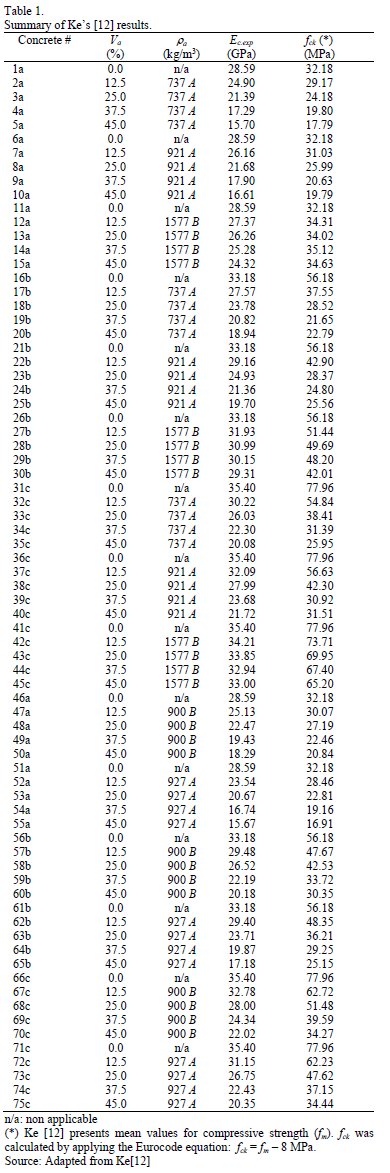
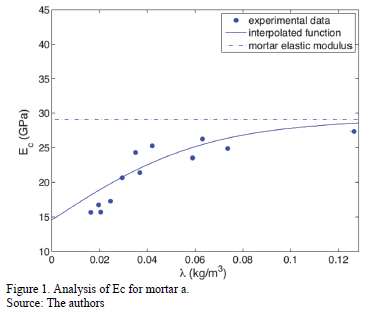
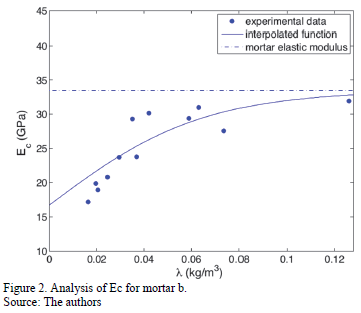
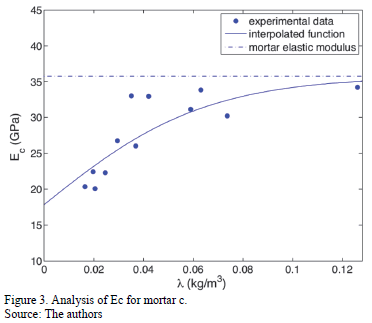
<body><![CDATA[<p><font size="2" face="Verdana, Arial, Helvetica, sans-serif">Where <i>E<sub>M</sub></i> is the elastic modulus of the mortar,   standing for its influence on <i>E<sub>c</sub></i>,   and <i>G </i>(<i>l</i>)   represents the contribution of LWA for the<i> E<sub>c</sub></i>, where <i>l</i> = &#91;(<i>r<sub>a</sub>/</i>1000)/<i>V<sub>a</sub></i>&#93;. </font></p>     <p><font size="2" face="Verdana, Arial, Helvetica, sans-serif">Admitting that the mortar has an elastic modulus equal or   superior to the LWA's, the maximum value of <i>E<sub>c </sub></i>should be <i>E<sub>M</sub></i> and <i>G </i>(<i>l</i>)   &le; 1. The next step is to identify the   function <i>G </i>(<i>l</i>)<i>.</i> To this end, a set of experimental   results, presented by Ke&#91;M1&#93; &#91;12&#93; in his PhD thesis, was used. Three kinds of mortar for five different   types of LWA and five levels for the amount of concrete, resulting in 75   different mixes were tested. For each mix, three samples were tested, leading   to 225 samples, and the mean values were named as <i>E<sub>c</sub></i>. Tab. 1 summarizes Ke's &#91;12&#93; results. In this table   only the mean values for <i>E<sub>c</sub></i> (column <i>E<sub>c,exp</sub></i> in <a href="#tab01">Table 1</a>)   are presented and <i>f<sub>ck</sub></i> is   omitted. The concrete number (column # in <a href="#tab01">Table 1</a>) is followed by a letter (a,   b or c) indicating the respective mortar. Two kinds of LWA were tested:   expanded clay and shale. The oven-dry density (column <i>r<sub>s</sub></i> in <a href="#tab01">Table 1</a>) is followed by   the aggregate type: &quot;<i>A&quot;</i> for expanded   clay and &quot;<i>B&quot;</i> for expanded shale. The   shape factor (<i>I<sub>s</sub></i>) for clay   and shale are, respectively, 1.240 and 1.873.</font></p>     <p align="center"><font size="2" face="Verdana, Arial, Helvetica, sans-serif"><a name="tab01"></a></font><img src="/img/revistas/dyna/v82n193/v82n193a13tab01.gif"></p>     <p><font size="2" face="Verdana, Arial, Helvetica, sans-serif">Concretes from #1a to #45c were used to investigate   function <i>G </i>(<i>l</i>). <a href="#fig01">Figs 1</a> to <a href="#fig03">3</a> show a comparison between experimental   results and <i>E<sub>c</sub></i> obtained   with Eq. 5, considering <i>G </i>(<i>l</i>) as described in Eq. 6: </font></p>     <p><img src="/img/revistas/dyna/v82n193/v82n193a13eq05.gif"></p>     <blockquote>       <p><font size="2" face="Verdana, Arial, Helvetica, sans-serif">Where <i>a</i> = 30.82 m<sup>3</sup>/kg. </font></p> </blockquote>     <p align="center"><font size="2" face="Verdana, Arial, Helvetica, sans-serif"><a name="fig01"></a></font><img src="/img/revistas/dyna/v82n193/v82n193a13fig01.gif"></p>     <p align="center"><font size="2" face="Verdana, Arial, Helvetica, sans-serif"><a name="fig02"></a></font><img src="/img/revistas/dyna/v82n193/v82n193a13fig02.gif"></p>     <p align="center"><font size="2" face="Verdana, Arial, Helvetica, sans-serif"><a name="fig03"></a></font><img src="/img/revistas/dyna/v82n193/v82n193a13fig03.gif"></p>     ]]></body>
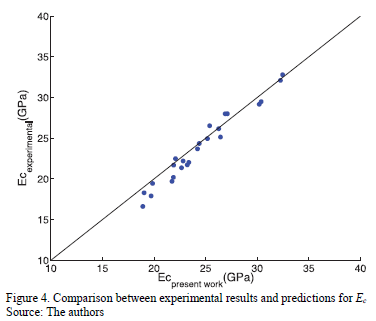
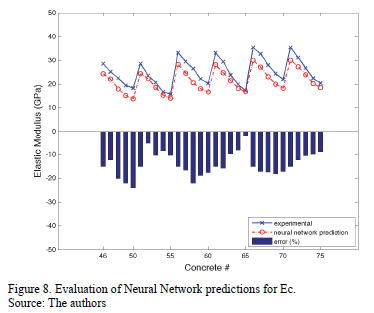
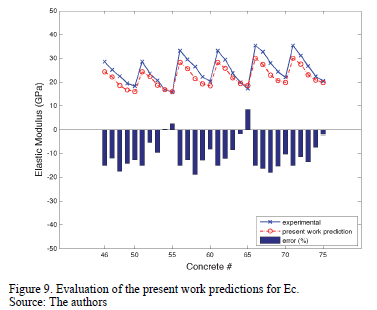
<body><![CDATA[<p><font size="2" face="Verdana, Arial, Helvetica, sans-serif">The parameter <i>a </i>is achieved by curve fitting Eq. 5,   with <i>G </i>(<i>l</i>)   showed in Eq. 6, for each analyzed mortar, resulting in three <i>a</i> parameters. The adopted value for <i>a </i>is the mean of them. The applied   methodology for curve fitting was the mean square method.</font></p>     <p>&nbsp;</p>     <p><font size="3" face="Verdana, Arial, Helvetica, sans-serif"><b>3. Validation of   the proposed methodology</b></font></p>     <p><font size="2" face="Verdana, Arial, Helvetica, sans-serif">By applying the achieved expression for <i>E<sub>c</sub></i> to the concretes from #46a   to #75c the validation of the proposed methodology is carried out. <a href="#fig04">Fig. 4</a> presents a comparison between the experimental results for <i>E<sub>c</sub></i> and the predicted counterparts.</font></p>     <p align="center"><font size="2" face="Verdana, Arial, Helvetica, sans-serif"><a name="fig04"></a></font><img src="/img/revistas/dyna/v82n193/v82n193a13fig04.gif"></p>     <p><font size="2" face="Verdana, Arial, Helvetica, sans-serif">It is possible to observe in <a href="#fig04">Fig. 4</a> that the proposed   methodology allows a good prediction for <i>E<sub>c</sub></i>.</font></p>     <p>&nbsp;</p>     <p><font size="3" face="Verdana, Arial, Helvetica, sans-serif"><b>4. Comparisons   with available expressions</b></font></p>     <p><font size="2" face="Verdana, Arial, Helvetica, sans-serif">The performance of the proposed formula was assessed by   comparing its results to those obtained from expressions available in the   literature (Eqs. 1 and 2). </font></p>     <p><font size="2" face="Verdana, Arial, Helvetica, sans-serif">For comparison purposes, a multilayer perceptron artificial   neural network was adopted, which is a technique applied to several kind of   problems &#91;13&#93;. The network adopted herein has one hidden layer and eight   neurons in the hidden layer. Concretes from #1 to #45 were used for the network   training.</font></p>     ]]></body>
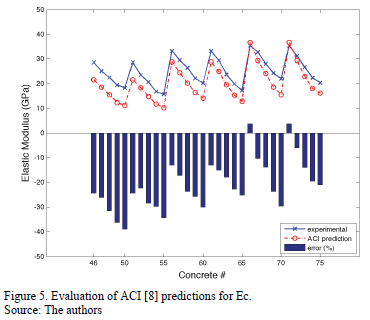
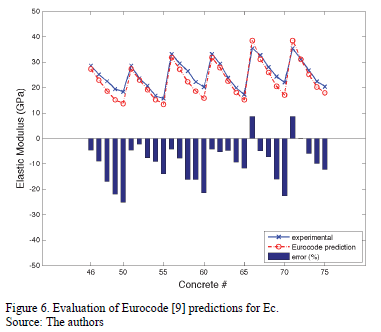
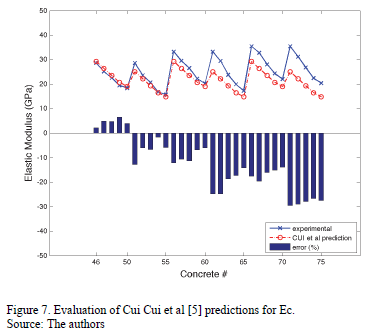
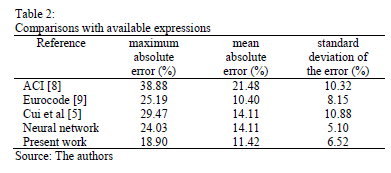
<body><![CDATA[<p><font size="2" face="Verdana, Arial, Helvetica, sans-serif">The performance of each predictor can be better observed   in <a href="#fig05">Figs. 5</a>-<a href="#fig09">9</a>. In order to avoid distorted results in favor of the presented   methodology, only the concretes used in the validation process were considered   in these figures. For the</font> <font size="2" face="Verdana, Arial, Helvetica, sans-serif">proposed methodology, the neural   network, and Cui <i>et al</i> &#91;5&#93; results,   the predictions for <i>E<sub>c</sub></i> were multiplied by 0.85 aiming to consider a safety design parameter. This   value was arbitrarily chosen and it tries to assure that practically all   predictions for <i>E<sub>c</sub></i> are   inferior to the experimental counterparts. For ACI and Eurocode, safety design   coefficients are implicitly included in the respective Eqs. 1 and 2.</font></p>     <p align="center"><font size="2" face="Verdana, Arial, Helvetica, sans-serif"><a name="fig05"></a></font><img src="/img/revistas/dyna/v82n193/v82n193a13fig05.gif"></p>     <p align="center"><font size="2" face="Verdana, Arial, Helvetica, sans-serif"><a name="fig06"></a></font><img src="/img/revistas/dyna/v82n193/v82n193a13fig06.gif"></p>     <p align="center"><font size="2" face="Verdana, Arial, Helvetica, sans-serif"><a name="fig07"></a></font><img src="/img/revistas/dyna/v82n193/v82n193a13fig07.gif"></p>     <p align="center"><font size="2" face="Verdana, Arial, Helvetica, sans-serif"><a name="fig08"></a></font><img src="/img/revistas/dyna/v82n193/v82n193a13fig08.gif"></p>     <p align="center"><font size="2" face="Verdana, Arial, Helvetica, sans-serif"><a name="fig09"></a></font><img src="/img/revistas/dyna/v82n193/v82n193a13fig09.gif"></p>     <p><font size="2" face="Verdana, Arial, Helvetica, sans-serif">It is possible to observe from <a href="#fig05">Figs. 5</a>-<a href="#fig09">9</a> that all   formulations give conservative predictions for <i>E<sub>c</sub></i> for practically all concretes. Only a limited number   of concretes had estimations for <i>E<sub>c</sub></i> slightly superior than the experimental counterparts. </font></p>     <p><font size="2" face="Verdana, Arial, Helvetica, sans-serif">THE results of the overall comparison are calculated in <a href="#tab02">Table 2</a>. </font></p>     <p align="center"><font size="2" face="Verdana, Arial, Helvetica, sans-serif"><a name="tab02"></a></font><img src="/img/revistas/dyna/v82n193/v82n193a13tab02.gif"></p>     <p><font size="2" face="Verdana, Arial, Helvetica, sans-serif">From <a href="#tab02">Table 2</a> and <a href="#fig05">Figs. 5</a>-<a href="#fig09">9</a> one can observe that:</font></p> <ul>       ]]></body>
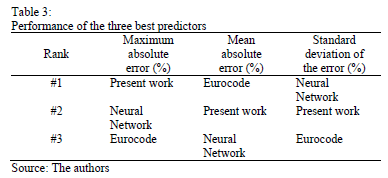
<body><![CDATA[<li><font size="2" face="Verdana, Arial, Helvetica, sans-serif">ACI &#91;8&#93; results are the most conservative.     Moreover, one verifies that the ACI method allows the greatest maximum and mean     absolute errors;</font></li>       <li><font size="2" face="Verdana, Arial, Helvetica, sans-serif">CUI <i>et al</i> &#91;5&#93; results allow the second biggest maximum absolute error and the greatest     standard deviation;</font></li>       <li><font size="2" face="Verdana, Arial, Helvetica, sans-serif">Eurocode, neural network and the present work     have good performances amongst the studied criteria. These methods were     considered as the best predictors for Ec. <a href="#tab03">Table 3</a> aims to     rank the three best predictors:</font></li>     </ul>     <p align="center"><font size="2" face="Verdana, Arial, Helvetica, sans-serif"><a name="tab03"></a></font><img src="/img/revistas/dyna/v82n193/v82n193a13tab03.gif"></p>     <p><font size="2" face="Verdana, Arial, Helvetica, sans-serif">Considering <a href="#tab02">Tables 2</a> and <a href="#tab03">3</a>, it is possible to conclude that, for the set of studied concretes,   Eurocode, neural network and the present work present fair results for the   prediction of <i>E<sub>c</sub></i>.   Moreover, in view of the fact that the present work has the best performance in   terms of maximum absolute error and the second best performance for the other   two criteria, it is possible to consider that the fair results achieved by   applying the proposed methodology are slightly better than the other methods.</font></p>     <p>&nbsp;</p>     <p><font size="3" face="Verdana, Arial, Helvetica, sans-serif"><b>5. Conclusions</b></font></p>     <p><font size="2" face="Verdana, Arial, Helvetica, sans-serif">The present work deals   with an analytical expression to evaluate the elastic modulus of Lightweight   Aggregate concretes,aimed towards practical applications by design engineers.   The main feature of the proposed formula is the fact that the input parameters   are: mortar Young's modulus, instead of concrete compressive strength;   aggregate's density and amount of aggregate. The principal advantage of the   proposed methodology is to avoid laboratory tests to determine concrete   compressive strength for any prediction of <i>E<sub>c</sub></i>.   Once the Young's modulus of the mortar is obtained, the estimation of <i>E<sub>c</sub></i> may be fairly achieved   without further laboratory tests, even for different kinds or/and amounts of   aggregates. The results for the set of analyzed concretes are considered as fair   and the performance, when compared to other formulas, was slightly superior to   Eurocode and neural network, and clearly superior to the other evaluated   formulations.</font></p>     <p><font size="2" face="Verdana, Arial, Helvetica, sans-serif">Finally, It is important to observe that this article   proposes a methodology and not an expression for the estimation of <i>E<sub>c</sub></i>. The results were achieved   by analyzing two kinds of LWAs. A general formula demands more laboratory tests   considering a large number of LWA types. Despite this, the proposed methodology   could be applied for other kinds of aggregates, by adjusting <i>a</i> parameter for each LWA type. In the present work, the results were considered   as fair for LWACs made by expanded clay and expanded shale, using the same   adjusted <i>a</i> parameter. A separate analysis for each LWA would be less generic but more   accurate. </font></p>     ]]></body>
<body><![CDATA[<p>&nbsp;</p>     <p><font size="3" face="Verdana, Arial, Helvetica, sans-serif"><b>Acknowledgements:</b></font></p>     <p><font size="2" face="Verdana, Arial, Helvetica, sans-serif">The authors   would like to thank FAPEMIG (Fundação de Amparo à Pesquisa do Estado de Minas   Gerais), CNPq (Conselho Nacional de Desenvolvimento Cient&iacute;fico e Tecnol&oacute;gico)   and CAPES (Coordenação de Aperfeiçoamento de Pessoal de N&iacute;vel Superior) for   financial support.</font></p>     <p>&nbsp;</p>     <p><font size="3" face="Verdana, Arial, Helvetica, sans-serif"><b>References</b></font></p>     <!-- ref --><p><font size="2" face="Verdana, Arial, Helvetica, sans-serif"><b>&#91;1&#93;</b> Youm,   K.S, Jeong Y.J., Han E.S.H. and Yun, T.S., Experimental investigation on annual   changes in mechanical properties of structural concretes with various types of   lightweight aggregates. Construction and Building Materials, 73, pp. 442-451,   2014. DOI:   10.1016/j.conbuildmat.2014.09.044</font>&nbsp;&nbsp;&nbsp;&nbsp;&nbsp;&nbsp;&nbsp;&nbsp;[&#160;<a href="javascript:void(0);" onclick="javascript: window.open('/scielo.php?script=sci_nlinks&ref=000088&pid=S0012-7353201500050001300001&lng=','','width=640,height=500,resizable=yes,scrollbars=1,menubar=yes,');">Links</a>&#160;]<!-- end-ref --><!-- ref --><p><font size="2" face="Verdana, Arial, Helvetica, sans-serif"><b>&#91;2&#93;</b> Bogas,   J.A. and Cabaço, J.B., Long-term behaviour of concrete produced with recycled   lightweight expanded clay aggregate concrete. Construction and Building   Materials, 65, pp. 470-479, 2014. DOI:   10.1016/j.conbuildmat.2014.05.003</font>&nbsp;&nbsp;&nbsp;&nbsp;&nbsp;&nbsp;&nbsp;&nbsp;[&#160;<a href="javascript:void(0);" onclick="javascript: window.open('/scielo.php?script=sci_nlinks&ref=000089&pid=S0012-7353201500050001300002&lng=','','width=640,height=500,resizable=yes,scrollbars=1,menubar=yes,');">Links</a>&#160;]<!-- end-ref --><!-- ref --><p><font size="2" face="Verdana, Arial, Helvetica, sans-serif"><b>&#91;3&#93;</b> Nguyen,   L.H., Beaucour, A.-L., Ortola, S. and Noumow&eacute;, A., Influence of the volume   fraction and the nature of fine lightweight aggregates on the thermal and   mechanical properties of   structural concrete. Construction and Building Materials, 51, pp. 121-132,   2014. DOI: 10.1016/j.conbuildmat.2013.11.019</font>&nbsp;&nbsp;&nbsp;&nbsp;&nbsp;&nbsp;&nbsp;&nbsp;[&#160;<a href="javascript:void(0);" onclick="javascript: window.open('/scielo.php?script=sci_nlinks&ref=000090&pid=S0012-7353201500050001300003&lng=','','width=640,height=500,resizable=yes,scrollbars=1,menubar=yes,');">Links</a>&#160;]<!-- end-ref --><!-- ref --><p><font size="2" face="Verdana, Arial, Helvetica, sans-serif"><b>&#91;4&#93;</b> Ke,   Y., Beaucour, A.L., Ortola, S., Dumontet, H. and Cabrillac, R., Influence of   volume fraction and characteristics of lightweight aggregates on the mechanical   properties of concrete. Construction and Building Materials, 23, pp. 2821-2828,   2009. DOI: 10.1016/j.conbuildmat.2009.02.038</font>&nbsp;&nbsp;&nbsp;&nbsp;&nbsp;&nbsp;&nbsp;&nbsp;[&#160;<a href="javascript:void(0);" onclick="javascript: window.open('/scielo.php?script=sci_nlinks&ref=000091&pid=S0012-7353201500050001300004&lng=','','width=640,height=500,resizable=yes,scrollbars=1,menubar=yes,');">Links</a>&#160;]<!-- end-ref --><!-- ref --><p><font size="2" face="Verdana, Arial, Helvetica, sans-serif"><b>&#91;5&#93;</b> Cui,   H.Z., Lo T.Y., Memon, S.A., Xing, F. and Shi, X., Analytical model for   compressive strength, elastic modulus and peak strain of structural lightweight   aggregate concrete. Construction and Building Materials, 36, pp. 1036-1043,   2012. DOI: 10.1016/j.conbuildmat.2012.06.041. DOI: 10.1016/j.conbuildmat.2012.06.034</font>&nbsp;&nbsp;&nbsp;&nbsp;&nbsp;&nbsp;&nbsp;&nbsp;[&#160;<a href="javascript:void(0);" onclick="javascript: window.open('/scielo.php?script=sci_nlinks&ref=000092&pid=S0012-7353201500050001300005&lng=','','width=640,height=500,resizable=yes,scrollbars=1,menubar=yes,');">Links</a>&#160;]<!-- end-ref --><!-- ref --><p><font size="2" face="Verdana, Arial, Helvetica, sans-serif"><b>&#91;6&#93;</b> Zhang,   M.H. and Gjorv, O., E. Mechanical properties of high-strength lightweight   concrete. ACI Materials Journal, 88, pp. 240-247, 1991.    &nbsp;&nbsp;&nbsp;&nbsp;&nbsp;&nbsp;&nbsp;&nbsp;[&#160;<a href="javascript:void(0);" onclick="javascript: window.open('/scielo.php?script=sci_nlinks&ref=000093&pid=S0012-7353201500050001300006&lng=','','width=640,height=500,resizable=yes,scrollbars=1,menubar=yes,');">Links</a>&#160;]<!-- end-ref --></font></p>     <!-- ref --><p><font size="2" face="Verdana, Arial, Helvetica, sans-serif"><b>&#91;7&#93;</b> Slate,   F.O., Nilson, A.H. and Martinez, S., Mechanical properties of high-strength   lightweight concrete. ACI Journal, Proceedings, 88, pp. 606-613, 1986.    &nbsp;&nbsp;&nbsp;&nbsp;&nbsp;&nbsp;&nbsp;&nbsp;[&#160;<a href="javascript:void(0);" onclick="javascript: window.open('/scielo.php?script=sci_nlinks&ref=000095&pid=S0012-7353201500050001300007&lng=','','width=640,height=500,resizable=yes,scrollbars=1,menubar=yes,');">Links</a>&#160;]<!-- end-ref --></font></p>     <!-- ref --><p><font size="2" face="Verdana, Arial, Helvetica, sans-serif"><b>&#91;8&#93;</b> ACI   213R-03 - Guide for structural lightweight-aggregate concrete. American   Concrete Institute standard, 2003.    &nbsp;&nbsp;&nbsp;&nbsp;&nbsp;&nbsp;&nbsp;&nbsp;[&#160;<a href="javascript:void(0);" onclick="javascript: window.open('/scielo.php?script=sci_nlinks&ref=000097&pid=S0012-7353201500050001300008&lng=','','width=640,height=500,resizable=yes,scrollbars=1,menubar=yes,');">Links</a>&#160;]<!-- end-ref --></font></p>     <!-- ref --><p><font size="2" face="Verdana, Arial, Helvetica, sans-serif"><b>&#91;9&#93;</b> Eurocode.   Design of concrete structures (EN 1992-1-1). 1992.    &nbsp;&nbsp;&nbsp;&nbsp;&nbsp;&nbsp;&nbsp;&nbsp;[&#160;<a href="javascript:void(0);" onclick="javascript: window.open('/scielo.php?script=sci_nlinks&ref=000099&pid=S0012-7353201500050001300009&lng=','','width=640,height=500,resizable=yes,scrollbars=1,menubar=yes,');">Links</a>&#160;]<!-- end-ref --></font></p>     <!-- ref --><p><font size="2" face="Verdana, Arial, Helvetica, sans-serif"><b>&#91;10&#93;</b> Bilgehan, M., A   comparative study for the concrete compressive strength estimation using neural   network and neuro-fuzzy modelling approaches. Nondestruct Test Eva, 26, pp.   35-55, 2011. DOI:   10.1080/10589751003770100</font>&nbsp;&nbsp;&nbsp;&nbsp;&nbsp;&nbsp;&nbsp;&nbsp;[&#160;<a href="javascript:void(0);" onclick="javascript: window.open('/scielo.php?script=sci_nlinks&ref=000101&pid=S0012-7353201500050001300010&lng=','','width=640,height=500,resizable=yes,scrollbars=1,menubar=yes,');">Links</a>&#160;]<!-- end-ref --><!-- ref --><p><font size="2" face="Verdana, Arial, Helvetica, sans-serif"><b>&#91;11&#93;</b> Yuan, Z., Wang,   L-N. and Ji, X., Prediction of concrete compressive strength: Research on   hybrid models genetic based algorithms and ANFIS. Advances in Engineering   Software, 67, pp. 156-163, 2014. DOI:   10.1016/j.advengsoft.2013.09.004</font>&nbsp;&nbsp;&nbsp;&nbsp;&nbsp;&nbsp;&nbsp;&nbsp;[&#160;<a href="javascript:void(0);" onclick="javascript: window.open('/scielo.php?script=sci_nlinks&ref=000102&pid=S0012-7353201500050001300011&lng=','','width=640,height=500,resizable=yes,scrollbars=1,menubar=yes,');">Links</a>&#160;]<!-- end-ref --><!-- ref --><p><font size="2" face="Verdana, Arial, Helvetica, sans-serif"><b>&#91;12&#93;</b> Ke, Y.,   Characterization of the mechanical behavior of lightweight aggregate concretes:   Experiment and modelling, PhD. Thesis, Universit&eacute; de Cergy- Pontoise, 2008.    &nbsp;&nbsp;&nbsp;&nbsp;&nbsp;&nbsp;&nbsp;&nbsp;[&#160;<a href="javascript:void(0);" onclick="javascript: window.open('/scielo.php?script=sci_nlinks&ref=000103&pid=S0012-7353201500050001300012&lng=','','width=640,height=500,resizable=yes,scrollbars=1,menubar=yes,');">Links</a>&#160;]<!-- end-ref --></font></p>     <!-- ref --><p><font size="2" face="Verdana, Arial, Helvetica, sans-serif"><b>&#91;13&#93;</b> Velasquez,   H., Juan, D., Montoya, M. y Santiago, F., Modelado del indice de precios al   consumidor usando um modelo hibrido basado en redes neuronales artificiales,   DYNA rev.fac.minas, 72, pp.85-93, 2005.    &nbsp;&nbsp;&nbsp;&nbsp;&nbsp;&nbsp;&nbsp;&nbsp;[&#160;<a href="javascript:void(0);" onclick="javascript: window.open('/scielo.php?script=sci_nlinks&ref=000105&pid=S0012-7353201500050001300013&lng=','','width=640,height=500,resizable=yes,scrollbars=1,menubar=yes,');">Links</a>&#160;]<!-- end-ref --></font></p>     <p>&nbsp;</p>     <p><font size="2" face="Verdana, Arial, Helvetica, sans-serif"><b>F. de Souza-Barbosa,</b> is an associate professor and research engineer at the Federal University of   Juiz de Fora - UFJF, Brazil. He received his BSc. from UFJF, Brazil in 1994, MSc   from Federal University of Rio de Janeiro - UFRJ, Brazil in 1996 and PhD. from   UFRJ, Brazil, in 2000. He is member of   the Editorial Board of the IABSE Journal - Structural Engineering International   (SEI). His research interests include structural dynamics, concrete structures   and computational modeling of structures. </font></p>     <p><font size="2" face="Verdana, Arial, Helvetica, sans-serif"><b>M. C. Resende-Farage,</b> is an associate professor and research engineer at the Federal University of   Juiz de Fora - UFJF, Brazil. She received her BS from UFJF in 1991, M.Sc from   Federal University of Rio de Janeiro - UFRJ in 1995 and Ph.D. from UFRJ in   2000. Her research interests include experimental analysis and computational   modeling of concrete structures. </font></p>     <p><font size="2" face="Verdana, Arial, Helvetica, sans-serif"><b>A. Lage-Bonif&aacute;cio,</b> is Ph.D. student in the graduation program in computational modeling in the   Federal University of Juiz de Fora - UFJF, Brazil.</font></p>     <p><font size="2" face="Verdana, Arial, Helvetica, sans-serif"><b>A.-L. Beaucour,</b> is an associate professor at the University of Cergy-Pontoise, France. She   graduated from the National School of Geology (ENSG) in 1993 and received her PhD   in civil engineering from INSA de Lyon in 1997. Her research activities concern   sustainable construction and high temperature behavior of concretes.</font></p>     <p><font size="2" face="Verdana, Arial, Helvetica, sans-serif"><b>S. Ortola,</b> is   a lecturer at Paris Ouest Nanterre la D&eacute;fense University, France. She received   her BSc, MSc and PhD. in mechanics from Universit&eacute; Pierre &amp; Marie   Curie (UPMC, Paris6, France) in 1988, 1989 and 1992. Her research interests   focus on modeling and numerical simulation of the behaviors of heterogeneous   materials and structures. Applications concern constructions and building   materials such as lightweight aggregate concrete or polymer mortar, subjected to   thermo-mechanical solicitations</font></p>     ]]></body>
<body><![CDATA[ ]]></body><back>
<ref-list>
<ref id="B1">
<label>1</label><nlm-citation citation-type="journal">
<person-group person-group-type="author">
<name>
<surname><![CDATA[Youm]]></surname>
<given-names><![CDATA[K.S]]></given-names>
</name>
<name>
<surname><![CDATA[Jeong]]></surname>
<given-names><![CDATA[Y.J.]]></given-names>
</name>
<name>
<surname><![CDATA[Han]]></surname>
<given-names><![CDATA[E.S.H.]]></given-names>
</name>
<name>
<surname><![CDATA[Yun]]></surname>
<given-names><![CDATA[T.S.]]></given-names>
</name>
</person-group>
<article-title xml:lang="en"><![CDATA[Experimental investigation on annual changes in mechanical properties of structural concretes with various types of lightweight aggregates.]]></article-title>
<source><![CDATA[Construction and Building Materials]]></source>
<year>2014</year>
<numero>73</numero>
<issue>73</issue>
<page-range>442-451</page-range></nlm-citation>
</ref>
<ref id="B2">
<label>2</label><nlm-citation citation-type="journal">
<person-group person-group-type="author">
<name>
<surname><![CDATA[Bogas]]></surname>
<given-names><![CDATA[J.A.]]></given-names>
</name>
<name>
<surname><![CDATA[Cabaço]]></surname>
<given-names><![CDATA[J.B.]]></given-names>
</name>
</person-group>
<article-title xml:lang="en"><![CDATA[Long-term behaviour of concrete produced with recycled lightweight expanded clay aggregate concrete.]]></article-title>
<source><![CDATA[Construction and Building Materials]]></source>
<year>2014</year>
<page-range>470-479</page-range></nlm-citation>
</ref>
<ref id="B3">
<label>3</label><nlm-citation citation-type="journal">
<person-group person-group-type="author">
<name>
<surname><![CDATA[Nguyen]]></surname>
<given-names><![CDATA[L.H.]]></given-names>
</name>
<name>
<surname><![CDATA[Beaucour]]></surname>
<given-names><![CDATA[A.-L.]]></given-names>
</name>
<name>
<surname><![CDATA[Ortola]]></surname>
<given-names><![CDATA[S.]]></given-names>
</name>
<name>
<surname><![CDATA[Noumowé]]></surname>
<given-names><![CDATA[A.]]></given-names>
</name>
</person-group>
<article-title xml:lang="en"><![CDATA[Influence of the volume fraction and the nature of fine lightweight aggregates on the thermal and mechanical properties of structural concrete.]]></article-title>
<source><![CDATA[Construction and Building Materials]]></source>
<year>2014</year>
<numero>51</numero>
<issue>51</issue>
<page-range>121-132</page-range></nlm-citation>
</ref>
<ref id="B4">
<label>4</label><nlm-citation citation-type="journal">
<person-group person-group-type="author">
<name>
<surname><![CDATA[Ke]]></surname>
<given-names><![CDATA[Y.]]></given-names>
</name>
<name>
<surname><![CDATA[Beaucour]]></surname>
<given-names><![CDATA[A.L.]]></given-names>
</name>
<name>
<surname><![CDATA[Ortola]]></surname>
<given-names><![CDATA[S.]]></given-names>
</name>
<name>
<surname><![CDATA[Dumontet]]></surname>
<given-names><![CDATA[H.]]></given-names>
</name>
<name>
<surname><![CDATA[Cabrillac]]></surname>
<given-names><![CDATA[R.]]></given-names>
</name>
</person-group>
<article-title xml:lang="en"><![CDATA[Influence of volume fraction and characteristics of lightweight aggregates on the mechanical properties of concrete]]></article-title>
<source><![CDATA[Construction and Building Materials]]></source>
<year>2009</year>
<numero>23</numero>
<issue>23</issue>
<page-range>2821-2828</page-range></nlm-citation>
</ref>
<ref id="B5">
<label>5</label><nlm-citation citation-type="journal">
<person-group person-group-type="author">
<name>
<surname><![CDATA[Cui]]></surname>
<given-names><![CDATA[H.Z.]]></given-names>
</name>
<name>
<surname><![CDATA[Lo]]></surname>
<given-names><![CDATA[T.Y.]]></given-names>
</name>
<name>
<surname><![CDATA[Memon]]></surname>
<given-names><![CDATA[S.A.]]></given-names>
</name>
<name>
<surname><![CDATA[Xing]]></surname>
<given-names><![CDATA[F.]]></given-names>
</name>
<name>
<surname><![CDATA[Shi]]></surname>
<given-names><![CDATA[X.]]></given-names>
</name>
</person-group>
<article-title xml:lang="en"><![CDATA[Analytical model for compressive strength, elastic modulus and peak strain of structural lightweight aggregate concrete.]]></article-title>
<source><![CDATA[Construction and Building Materials]]></source>
<year>2012</year>
<numero>36</numero>
<issue>36</issue>
<page-range>1036-1043</page-range></nlm-citation>
</ref>
<ref id="B6">
<label>6</label><nlm-citation citation-type="journal">
<person-group person-group-type="author">
<name>
<surname><![CDATA[Zhang]]></surname>
<given-names><![CDATA[M.H.]]></given-names>
</name>
<name>
<surname><![CDATA[Gjorv]]></surname>
<given-names><![CDATA[O., E]]></given-names>
</name>
</person-group>
<article-title xml:lang="en"><![CDATA[Mechanical properties of high-strength lightweight concrete]]></article-title>
<source><![CDATA[ACI Materials Journal]]></source>
<year>1991</year>
<numero>88</numero>
<issue>88</issue>
<page-range>240-247</page-range></nlm-citation>
</ref>
<ref id="B7">
<label>7</label><nlm-citation citation-type="journal">
<person-group person-group-type="author">
<name>
<surname><![CDATA[Slate]]></surname>
<given-names><![CDATA[F.O.]]></given-names>
</name>
<name>
<surname><![CDATA[Nilson]]></surname>
<given-names><![CDATA[A.H.]]></given-names>
</name>
<name>
<surname><![CDATA[Martinez]]></surname>
<given-names><![CDATA[S.]]></given-names>
</name>
</person-group>
<article-title xml:lang="en"><![CDATA[Mechanical properties of high-strength lightweight concrete]]></article-title>
<source><![CDATA[ACI Journal, Proceedings]]></source>
<year>1986</year>
<numero>88</numero>
<issue>88</issue>
<page-range>606-613</page-range></nlm-citation>
</ref>
<ref id="B8">
<label>8</label><nlm-citation citation-type="book">
<source><![CDATA[ACI 213R-03 - Guide for structural lightweight-aggregate concrete]]></source>
<year>2003</year>
<publisher-name><![CDATA[American Concrete Institute standard]]></publisher-name>
</nlm-citation>
</ref>
<ref id="B9">
<label>9</label><nlm-citation citation-type="">
<collab>Eurocode</collab>
<source><![CDATA[Design of concrete structures (EN 1992-1-1)]]></source>
<year>1992</year>
</nlm-citation>
</ref>
<ref id="B10">
<label>10</label><nlm-citation citation-type="journal">
<person-group person-group-type="author">
<name>
<surname><![CDATA[Bilgehan]]></surname>
<given-names><![CDATA[M.]]></given-names>
</name>
</person-group>
<article-title xml:lang="en"><![CDATA[A comparative study for the concrete compressive strength estimation using neural network and neuro-fuzzy modelling approaches.]]></article-title>
<source><![CDATA[Nondestruct Test Eva]]></source>
<year>2011</year>
<numero>26</numero>
<issue>26</issue>
<page-range>35-55</page-range></nlm-citation>
</ref>
<ref id="B11">
<label>11</label><nlm-citation citation-type="journal">
<person-group person-group-type="author">
<name>
<surname><![CDATA[Yuan]]></surname>
<given-names><![CDATA[Z.]]></given-names>
</name>
<name>
<surname><![CDATA[Wang]]></surname>
<given-names><![CDATA[L-N.]]></given-names>
</name>
<name>
<surname><![CDATA[Ji]]></surname>
<given-names><![CDATA[X.]]></given-names>
</name>
</person-group>
<article-title xml:lang="en"><![CDATA[Prediction of concrete compressive strength: Research on hybrid models genetic based algorithms and ANFIS]]></article-title>
<source><![CDATA[Advances in Engineering Software]]></source>
<year>2014</year>
<numero>67</numero>
<issue>67</issue>
<page-range>156-163</page-range></nlm-citation>
</ref>
<ref id="B12">
<label>12</label><nlm-citation citation-type="">
<person-group person-group-type="author">
<name>
<surname><![CDATA[Ke]]></surname>
<given-names><![CDATA[Y.]]></given-names>
</name>
</person-group>
<source><![CDATA[Characterization of the mechanical behavior of lightweight aggregate concretes: Experiment and modelling]]></source>
<year></year>
</nlm-citation>
</ref>
<ref id="B13">
<label>13</label><nlm-citation citation-type="journal">
<person-group person-group-type="author">
<name>
<surname><![CDATA[Velasquez, H.]]></surname>
<given-names><![CDATA[Juan, D.]]></given-names>
</name>
<name>
<surname><![CDATA[Montoya]]></surname>
<given-names><![CDATA[M.]]></given-names>
</name>
<name>
<surname><![CDATA[Santiago]]></surname>
<given-names><![CDATA[F.]]></given-names>
</name>
</person-group>
<article-title xml:lang="es"><![CDATA[Modelado del indice de precios al consumidor usando um modelo hibrido basado en redes neuronales artificiales]]></article-title>
<source><![CDATA[DYNA rev.fac.minas]]></source>
<year>2005</year>
<numero>72</numero>
<issue>72</issue>
<page-range>85-93</page-range></nlm-citation>
</ref>
</ref-list>
</back>
</article>