<?xml version="1.0" encoding="ISO-8859-1"?><article xmlns:mml="http://www.w3.org/1998/Math/MathML" xmlns:xlink="http://www.w3.org/1999/xlink" xmlns:xsi="http://www.w3.org/2001/XMLSchema-instance">
<front>
<journal-meta>
<journal-id>0012-7353</journal-id>
<journal-title><![CDATA[DYNA]]></journal-title>
<abbrev-journal-title><![CDATA[Dyna rev.fac.nac.minas]]></abbrev-journal-title>
<issn>0012-7353</issn>
<publisher>
<publisher-name><![CDATA[Universidad Nacional de Colombia]]></publisher-name>
</publisher>
</journal-meta>
<article-meta>
<article-id>S0012-73532015000500014</article-id>
<article-id pub-id-type="doi">10.15446/dyna.v82n193.46657</article-id>
<title-group>
<article-title xml:lang="en"><![CDATA[Wear resistance of vanadium-niobium carbide layers grown via TRD]]></article-title>
<article-title xml:lang="es"><![CDATA[Resistencia al desgaste de capas de carburo de vanadio-niobio crecidas por medio de TRD]]></article-title>
</title-group>
<contrib-group>
<contrib contrib-type="author">
<name>
<surname><![CDATA[Castillejo-Nieto]]></surname>
<given-names><![CDATA[Fabio Enrique]]></given-names>
</name>
<xref ref-type="aff" rid="A01"/>
</contrib>
<contrib contrib-type="author">
<name>
<surname><![CDATA[Olaya-Florez]]></surname>
<given-names><![CDATA[Jhon Jairo]]></given-names>
</name>
<xref ref-type="aff" rid="A02"/>
</contrib>
<contrib contrib-type="author">
<name>
<surname><![CDATA[Alfonso]]></surname>
<given-names><![CDATA[José Edgar]]></given-names>
</name>
<xref ref-type="aff" rid="A03"/>
</contrib>
</contrib-group>
<aff id="A01">
<institution><![CDATA[,Universidad Santo Tomas de Aquino Departamento de Ciencias Básicas ]]></institution>
<addr-line><![CDATA[Bogotá ]]></addr-line>
<country>Colombia</country>
</aff>
<aff id="A02">
<institution><![CDATA[,Universidad Nacional de Colombia Departamento de Ingeniería Mecánica y Mecatrónica ]]></institution>
<addr-line><![CDATA[Bogotá ]]></addr-line>
<country>Colombia</country>
</aff>
<aff id="A03">
<institution><![CDATA[,Universidad Nacional de Colombia Departamento de Física Grupo de Ciencia de Materiales y Superficies]]></institution>
<addr-line><![CDATA[Bogotá ]]></addr-line>
<country>Colombia</country>
</aff>
<pub-date pub-type="pub">
<day>00</day>
<month>10</month>
<year>2015</year>
</pub-date>
<pub-date pub-type="epub">
<day>00</day>
<month>10</month>
<year>2015</year>
</pub-date>
<volume>82</volume>
<numero>193</numero>
<fpage>104</fpage>
<lpage>109</lpage>
<copyright-statement/>
<copyright-year/>
<self-uri xlink:href="http://www.scielo.org.co/scielo.php?script=sci_arttext&amp;pid=S0012-73532015000500014&amp;lng=en&amp;nrm=iso"></self-uri><self-uri xlink:href="http://www.scielo.org.co/scielo.php?script=sci_abstract&amp;pid=S0012-73532015000500014&amp;lng=en&amp;nrm=iso"></self-uri><self-uri xlink:href="http://www.scielo.org.co/scielo.php?script=sci_pdf&amp;pid=S0012-73532015000500014&amp;lng=en&amp;nrm=iso"></self-uri><abstract abstract-type="short" xml:lang="en"><p><![CDATA[Nb-V complex carbide coatings were produced on AISI D2 steel substrates using the thermo-reactive diffusion (TRD) process in order to improve the surface hardness and wear resistance of this tool steel. The carbide coating treatment was performed using molten borax with added ferroniobium, ferrovanadium, and aluminum at temperatures of 1223, 1293, and 1363 K for 2, 3, 4, and 5 h. The coating layers were characterized with scanning electron microscopy (SEM), X-ray diffraction (XRD) and energy-dispersive X-ray spectroscopy (EDS). The growth rates of the coatings were studied, and a kinetic model of the layer thickness was constructed as a function of the time and temperature treatment. The hardness and friction coefficient (COF) of the coatings was measured through nanoindentation and pin on disk test respectively. The carbide layers had a homogeneous thickness and a hardness of 37.63 GPa, which is close to values obtained in super-hard materials, and the COF was in the range of 0,3 for the coated steels.]]></p></abstract>
<abstract abstract-type="short" xml:lang="es"><p><![CDATA[Recubrimientos mixtos de carburos de niobio - vanadio se fabricaron utilizando el proceso de difusión termo-reactiva (TRD) a fin de mejorar la resistencia al desgaste en aceros para herramientas. Los recubrimientos fueron depositados en un baño de bórax con ferroniobio, ferrovanadio y aluminio, con temperaturas de depósito de 1223, 1293 y 1363 K para 2, 3, 4 y 5 h. Los recubrimientos producidos se caracterizaron con microscopía electrónica de barrido (SEM), difracción de rayos X (DRX) y espectroscopia de dispersión de energía (EDS). Se estudiaron las tasas de crecimiento de los recubrimientos, y se construyó un modelo de la cinética del espesor de la capa como una función del tiempo y la temperatura del proceso. La dureza y el coeficiente de fricción (COF) de los recubrimientos se midieron a través de nanoindentación y bola sobre disco, respectivamente. Las capas de carburo presentaron un espesor homogéneo alcanzando durezas de 37,63 GPa que está cerca de valores obtenidos en materiales súper-duros, y el COF presento valores cercanos de 0,3 para los aceros recubiertos.]]></p></abstract>
<kwd-group>
<kwd lng="en"><![CDATA[Thermo Reactive Diffusion]]></kwd>
<kwd lng="en"><![CDATA[Niobium-Vanadium Carbide]]></kwd>
<kwd lng="en"><![CDATA[Hardness]]></kwd>
<kwd lng="en"><![CDATA[wear]]></kwd>
<kwd lng="es"><![CDATA[Difusión Termo-Reactiva]]></kwd>
<kwd lng="es"><![CDATA[Carburo de Niobio-Vanadio]]></kwd>
<kwd lng="es"><![CDATA[dureza]]></kwd>
<kwd lng="es"><![CDATA[desgaste]]></kwd>
</kwd-group>
</article-meta>
</front><body><![CDATA[ <p><font size="1" face="Verdana, Arial, Helvetica, sans-serif"><b>DOI:</b> <a href="http://dx.doi.org/10.15446/dyna.v82n193.46657" target="_blank">http://dx.doi.org/10.15446/dyna.v82n193.46657</a></font></p>     <p align="center"><font size="4" face="Verdana, Arial, Helvetica, sans-serif"><b>Wear resistance of vanadium-niobium carbide layers   grown via TRD</b></font></p>     <p align="center"><i><b><font size="3" face="Verdana, Arial, Helvetica, sans-serif">Resistencia   al desgaste de capas de   carburo de vanadio-niobio crecidas por medio de TRD</font></b></i></p>     <p align="center">&nbsp;</p>     <p align="center"><b><font size="2" face="Verdana, Arial, Helvetica, sans-serif">Fabio Enrique Castillejo-Nieto <i><sup>a</sup></i>, Jhon Jairo Olaya-Florez <i><sup>b </sup></i>&amp; Jos&eacute; Edgar Alfonso <i><sup>c</sup></i></font></b></p>     <p align="center">&nbsp;</p>     <p align="center"><font size="2" face="Verdana, Arial, Helvetica, sans-serif"><sup><i>a </i></sup><i>Departamento de Ciencias B&aacute;sicas, Universidad Santo Tomas de   Aquino, Bogot&aacute;, Colombia. <a href="mailto:fabiocastillejo@usantotomas.edu.co">fabiocastillejo@usantotomas.edu.co</a>    <br>   <sup>b</sup> Departamento de Ingenier&iacute;a Mec&aacute;nica y Mecatr&oacute;nica, Universidad   Nacional de Colombia, Bogot&aacute;, Colombia. <a href="mailto:jjolayaf@unal.edu.co">jjolayaf@unal.edu.co</a>    <br>   <sup>c </sup>Grupo de Ciencia de Materiales y Superficies, Departamento de   F&iacute;sica, Universidad Nacional de Colombia, Bogot&aacute;, Colombia. <a href="mailto:jealfonsoo@unal.edu.co">jealfonsoo@unal.edu.co</a></i></font></p>     <p align="center">&nbsp;</p>     ]]></body>
<body><![CDATA[<p align="center"><font size="2" face="Verdana, Arial, Helvetica, sans-serif"><b>Received: July 05<sup>th</sup>, 2014. Received in revised   form: April 5<sup>th</sup>, 2015. Accepted: July 27<sup>th</sup>, 2015.</b></font></p>     <p align="center">&nbsp;</p>     <p align="center"><font size="1" face="Verdana, Arial, Helvetica, sans-seriff"><b>This work is licensed under a</b> <a rel="license" href="http://creativecommons.org/licenses/by-nc-nd/4.0/">Creative Commons Attribution-NonCommercial-NoDerivatives 4.0 International License</a>.</font><br />   <a rel="license" href="http://creativecommons.org/licenses/by-nc-nd/4.0/"><img style="border-width:0" src="https://i.creativecommons.org/l/by-nc-nd/4.0/88x31.png" /></a></p> <hr>     <p><font size="2" face="Verdana, Arial, Helvetica, sans-serif"><b>Abstract    <br>   </b></font><font size="2" face="Verdana, Arial, Helvetica, sans-serif">Nb-V complex carbide coatings were produced on AISI D2   steel substrates using the thermo-reactive diffusion (TRD) process in order to   improve the surface hardness and wear resistance of this tool steel. The   carbide coating treatment was performed using molten borax with added   ferroniobium, ferrovanadium, and aluminum at temperatures of 1223, 1293, and   1363 K for 2, 3, 4, and 5 h. The coating layers were characterized with scanning   electron microscopy (SEM), X-ray diffraction (XRD) and energy-dispersive X-ray   spectroscopy (EDS). The growth rates of the coatings were studied, and a   kinetic model of the layer thickness was constructed as a function of the time   and temperature treatment. The hardness and friction coefficient (COF) of the   coatings was measured through nanoindentation and pin on disk test   respectively. The carbide layers had a homogeneous thickness and a hardness of   37.63 GPa, which is close to values obtained in super-hard materials, and the   COF was in the range of 0,3 for the coated steels.</font></p>     <p><font size="2" face="Verdana, Arial, Helvetica, sans-serif"><i>Keywords</i>:   Thermo Reactive Diffusion, Niobium-Vanadium Carbide, Hardness, wear</font></p>     <p><font size="2" face="Verdana, Arial, Helvetica, sans-serif"><b>Resumen    <br>   </b></font><font size="2" face="Verdana, Arial, Helvetica, sans-serif">Recubrimientos   mixtos de carburos de niobio - vanadio se fabricaron utilizando el proceso de   difusi&oacute;n termo-reactiva (TRD) a fin de mejorar la resistencia al desgaste en   aceros para herramientas. Los recubrimientos fueron depositados en un ba&ntilde;o de b&oacute;rax   con ferroniobio, ferrovanadio y aluminio, con temperaturas de dep&oacute;sito de 1223,   1293 y 1363 K para 2, 3, 4 y 5 h. Los recubrimientos producidos se   caracterizaron con microscop&iacute;a electr&oacute;nica de barrido (SEM), difracci&oacute;n de   rayos X (DRX) y espectroscopia de dispersi&oacute;n de energ&iacute;a (EDS). Se estudiaron las   tasas de crecimiento de los recubrimientos, y se construy&oacute; un modelo de la cin&eacute;tica   del espesor de la capa como una funci&oacute;n del tiempo y la temperatura del   proceso. La dureza y el coeficiente de   fricci&oacute;n (COF) de los recubrimientos se midieron a trav&eacute;s de nanoindentaci&oacute;n y   bola sobre disco, respectivamente. Las capas de carburo presentaron un espesor   homog&eacute;neo alcanzando durezas de 37,63 GPa que est&aacute; cerca de valores obtenidos   en materiales s&uacute;per-duros, y el COF presento valores cercanos de 0,3 para los   aceros recubiertos.</font></p>     <p><font size="2" face="Verdana, Arial, Helvetica, sans-serif"><i>Palabras clave</i>: Difusi&oacute;n Termo-Reactiva, Carburo de Niobio-Vanadio,   dureza, desgaste.</font></p> <hr>     <p>&nbsp;</p>     ]]></body>
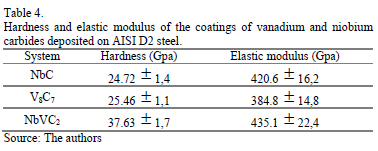
<body><![CDATA[<p><font size="3" face="Verdana, Arial, Helvetica, sans-serif"><b>1. Introduction</b></font></p>     <p><font size="2" face="Verdana, Arial, Helvetica, sans-serif">Various surface treatments are used to produce coatings,   mainly of carbides and nitrides of transition metals, in order to improve the   tribological performance of materials that are subjected to conditions of high   wear, such as forming dies and cutting tools such as drills and chisels in the   metalworking sector. These coatings are generally produced using techniques   such as physical vapor phase deposition (PVD) and chemical deposition in the   vapor phase (CVD) &#91;1,2&#93;. These procedures require the use of complex equipment   and high-vacuum conditions, which makes their industrial implementation costly.   An affordable and competitive alternative has been the application of hard   coatings with excellent wear resistance through deposition via the thermo   reactive diffusion (TRD) process &#91;3&#93; on substrates containing a carbon   percentage higher than 0.3% w &#91;4&#93;. The coatings deposited through this process   exhibit good adhesion to the substrate, good thickness uniformity, low friction   coefficients, and a high degree of hardness. &#91;5&#93;. In the TRD process, a bath of   molten salts formed by borax, aluminum as a reducing element, and carbide   forming elements (CFE's) such as titanium, niobium, chromium, and vanadium can   be used &#91;4&#93;. The carbide is formed when the metal element dissolved in the salt   bath has a relatively low energy of formation of carbide and an energy of   formation of the oxide higher than that of boron oxide (B2O3) &#91;6,7&#93;. If this   condition is not fulfilled, the boron atoms are not oxidized and are free to   diffuse in the steel, where they combine with the iron to form layers of iron   boride (FeB or Fe2B) &#91;8,9&#93;.</font></p>     <p><font size="2" face="Verdana, Arial, Helvetica, sans-serif">The research reported to date has studied binary metal   carbides deposited via the TRD process, and has characterized its wear   resistance, microstructure, and mechanical behavior. For example, several   studies have focused on producing VC and NbC coatings on substrates of AISI   H13, AISI M2, and AISI D2 steel, reporting hardness values of up to 2300 HV   &#91;3,5&#93;. Other investigations have studied the growth kinetics of niobium   carbides on AISI 1040 &#91;10&#93;, iron boride on AISI 4140 steel &#91;11&#93;, and chromium   carbide on AISI D2 steel &#91;12| These papers reported the growth kinetics for   binary systems such as NbC or VC, obtaining a layer thickness that depended on   the time and the temperature of the treatment. Regarding electrochemical   behavior, there are studies of iron boride and aluminum formed using borax on   steels AISI S1, S2, and S3, varying the manganese content &#91;13&#93; and there are   also studies about tribological and electrochemical performance of   niobium-chromium carbides &#91;14&#93;. However, there are few micro-structural and   electrochemical studies of possible ternary systems produced using two EFC's.   Therefore, the aim of this work is to deposit ternary niobium-vanadium carbide   coatings on a D2 steel substrate using the thermo reactive deposition technique   and to study their structure, hardness, and wear resistance.</font></p>     <p>&nbsp;</p>     <p><font size="3" face="Verdana, Arial, Helvetica, sans-serif"><b>2. Experimental   Methods</b></font></p>     <p><font size="2" face="Verdana, Arial, Helvetica, sans-serif">Coatings of ternary carbides were deposited on AISI D2   tool steel. The dimensions of the substrate were 15 mm in diameter and 4 mm in   thickness. The preparation of the samples was performed through metallographic   polishing with 220, 360, 400, 600, 1000, and 1200 sandpaper, ending with an   ultrasonic cleaning in acetone. The chemical composition of the steel, as   stated by the manufacturer, was 1.5% wt C, 11.5-12.5% wt Cr, 0.15-0.45% wt Mn,   0.8% wt Mo, 0.8 wt% V and Fe balance. The steel samples were supplied in the   annealed condition with a maximum hardness of 2.6 GPa.</font></p>     <p><font size="2" face="Verdana, Arial, Helvetica, sans-serif">The coatings were produced using a salt bath formed by   molten borax (Na2B4O7), 8% wt ferro-niobium (Fe-Nb), 8% wt ferro-vanadium   (Fe-V) and 3% wt aluminum (Al). The aluminum that is added in the salt bath had   the role of a reducing agent, i.e., it reduced boron oxide and oxidized it in   order to prevent the added metal (niobium or vanadium) from oxidizing so that   these metals are released and can bind with the carbon of the steel to form   carbides. The growth rates of the coatings were studied through surface   treatment with TRD at three different temperatures of 1223, 1293, and 1363 K   for 2, 3, 4, and 5 hours, with preheating at 873 K.</font></p>     <p><font size="2" face="Verdana, Arial, Helvetica, sans-serif">The crystallographic structure of the coatings was   analyzed using an X-PertPro Panalytical difractometer operating at 45 kV and 40   mA, with a configuration of <font face="Symbol">q</font> - 2<font face="Symbol">q</font> at an interval of 30° to 90° and   steps of 0.02°, with the K<font face="Symbol">a</font> line of copper (1.594 Å). The average   thickness of the coatings was measured with a Philips scanning electron   microscope, working at 40 KV and the EDX was used to determine the chemical   composition of the coatings surfaces. The wear cracks were observed using the   confocal microscopy. The hardness and the elastic modulus of the coatings were   determined from measurements of nano-indentation using CSM Instruments   equipment, with a Berkovich indenter at a speed of approach to the sample of   2000 nm/min with a load application rate of 10 mN/min and a maximum load of 30   mN every 15 s. The results obtained were results from an average of 6   measurements. The tribological properties of the coatings were measured at room   temperature, via a CETR-UMC-2 tribometer, using the ball-on-disk technique with   Al2O3 balls of 6 mm diameter and applying a load of 4 N at a speed of 50mm/s   for 10 minutes with a humidity of 60%.</font></p>     <p>&nbsp;</p>     <p><font size="3" face="Verdana, Arial, Helvetica, sans-serif"><b>3. Results and   Discussion</b></font></p>     ]]></body>
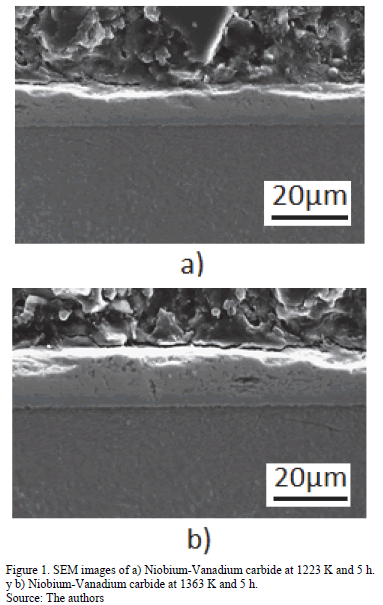
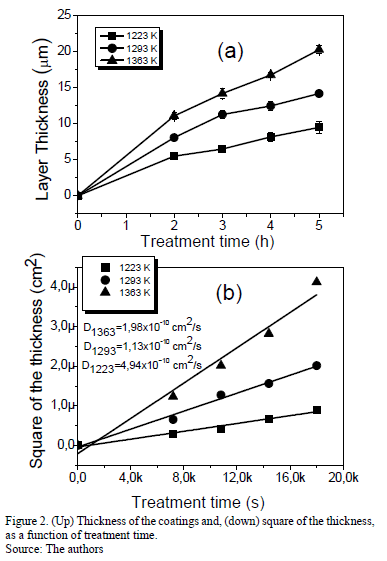
<body><![CDATA[<p><font size="2" face="Verdana, Arial, Helvetica, sans-serif"><b><i>3.1. Microstructure and growth kinetics of the   coatings</i></b></font></p>     <p><font size="2" face="Verdana, Arial, Helvetica, sans-serif"><a href="#fig01">Fig. 1</a> shows the cross section (SEM) of two coatings of   vanadium-niobium obtained at temperatures of 1363 and 1223 K for a deposit time   of 5h for both coatings. The images allow it to be established that the   coatings have thicknesses of 19.3±3.2 <font face="Symbol">m</font>m and 9.6±0.8 <font face="Symbol">m</font>m,   respectively. Higher values of thickness were obtained at the higher temperature.   Furthermore, the micrograph allows it to be seen that coatings were formed by   splats with dimensions on the order of a micron.</font></p>     <p align="center"><font size="2" face="Verdana, Arial, Helvetica, sans-serif"><a name="fig01"></a></font><img src="/img/revistas/dyna/v82n193/v82n193a14fig01.gif"></p>     <p><a href="#fig02"><font size="2" face="Verdana, Arial, Helvetica, sans-serif">Fig. 2</font></a><font size="2" face="Verdana, Arial, Helvetica, sans-serif"> shows the coating thickness as a function of time,   with the temperature as a study parameter. Fig. 2a shows that the thickness   does not exhibit linear behavior with respect to the time of thermal treatment.   Therefore, it can be assumed that the rate of diffusion of carbon in the layer   determines the growth rate of the coatings &#91;15&#93;, and if the layer growth is   perpendicular to the substrate surface, we can assume that the film growth rate   obeys an Arrhenius function (see eq. 1) &#91;10&#93;. From <a href="#fig02">Fig. 2b</a>, the coefficient of   diffusion of carbon into the substrate was determined.</font></p>     <p><img src="/img/revistas/dyna/v82n193/v82n193a14eq01.gif"></p>     <p><font size="2" face="Verdana, Arial, Helvetica, sans-serif">Where x is the thickness (cm), D is the diffusion   coefficient (cm<sup>2</sup>/s) and t is the processing time (s). Given that the   carbon that diffuses also reacts to form carbides, the diffusion coefficient   calculated using Eq. (1) is an effective diffusion coefficient and, therefore,   it does not correspond to pure diffusion of carbon in the substrate.</font></p>     <p align="center"><font size="2" face="Verdana, Arial, Helvetica, sans-serif"><a name="fig02"></a></font><img src="/img/revistas/dyna/v82n193/v82n193a14fig02.gif"></p>     <p><font size="2" face="Verdana, Arial, Helvetica, sans-serif">The relationship between diffusion coefficient and   temperatures is given by &#91;10&#93;:</font></p>     <p><img src="/img/revistas/dyna/v82n193/v82n193a14eq02.gif"></p>     <p><font size="2" face="Verdana, Arial, Helvetica, sans-serif">Where <i>D<sub>0</sub></i> is the frequency factor, <i>Q</i> is the   activation energy, <i>R</i> the gas constant   and <i>T</i> is the absolute temperature.   Linearizing this function, one obtains:</font></p>     ]]></body>
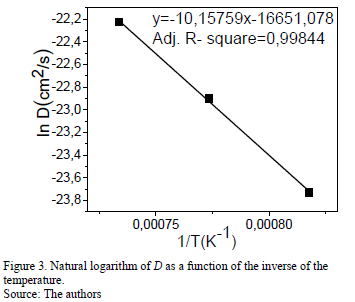
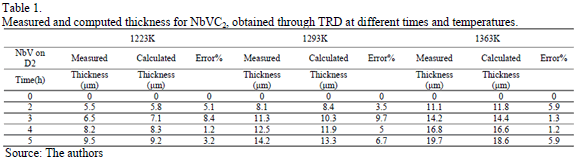
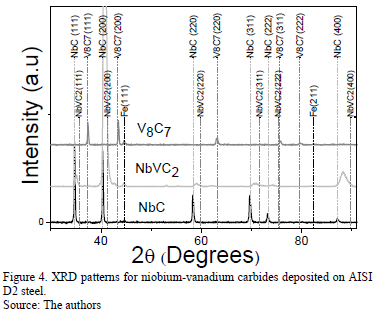
<body><![CDATA[<p><img src="/img/revistas/dyna/v82n193/v82n193a14eq03.gif"></p>     <p><font size="2" face="Verdana, Arial, Helvetica, sans-serif"><a href="#fig03">Fig. 3</a> shows the behavior of <i>ln D</i> as a function of the reciprocal of the temperature. In the   inset, we show the values of the slope and the intercept, which allow   determining that the activation energy <i>Q</i> = 137.688 kJ/mol (Ec. 3) and the value of <i>D<sub>0</sub></i> is 3.88x10<sup>-5</sup>. Substituting these numerical values into Equation 1,   Equation 4 is obtained.</font></p>     <p><img src="/img/revistas/dyna/v82n193/v82n193a14eq04.gif"></p>     <p><font size="2" face="Verdana, Arial, Helvetica, sans-serif">This expression allows calculating the thickness (t) of   the coating in microns. In <a href="#fig03">Table 1</a>, the measured and calculated thickness   values are shown.</font></p>     <p align="center"><font size="2" face="Verdana, Arial, Helvetica, sans-serif"><a name="fig03"></a></font><img src="/img/revistas/dyna/v82n193/v82n193a14fig03.gif"></p>     <p align="center"><font size="2" face="Verdana, Arial, Helvetica, sans-serif"><a name="tab01"></a></font><img src="/img/revistas/dyna/v82n193/v82n193a14tab01.gif"></p>     <p><font size="2" face="Verdana, Arial, Helvetica, sans-serif"><a href="#fig04">Fig. 4</a> shows the XRD   patterns of the coatings of the ternary vanadium-niobium carbides, obtained at   a temperature of 1263 K and a time of 4 h of heat treatment. In order to   establish the difference between the crystallographic phases in NbC and VC   binary coatings &#91;16&#93; and in the ternary system, the three systems are included   in the figure. Comparing XRD patterns allows establishing that the ternary   vanadium-niobium carbides exhibit only the NbC crystallographic phase &#91;17&#93;.   This result can be explained by considering that the free energy of the   formation of NbC (-33.6 kcal) &#91;18&#93; is less than the free energy of formation of   VC (-24 kJ / mol) &#91;18&#93;.</font></p>     <p align="center"><font size="2" face="Verdana, Arial, Helvetica, sans-serif"><a name="fig04"></a></font><img src="/img/revistas/dyna/v82n193/v82n193a14fig04.gif"></p>     <p><font size="2" face="Verdana, Arial, Helvetica, sans-serif">Moreover, peaks with lower intensities present in the XRD   pattern of the ternary system were assigned to the NbVC2 phase. The angular   positions and the corresponding planes are shown in <a href="#tab03">Table 2</a>. The theoretical   value was calculated with Powder Cell 2.4 software, in which values of the NbVC<sub>2</sub> crystallographic system were provided, such as the space group, the group   number, and the Wyckoff parameters of this compound &#91;19&#93;.</font></p>     <p align="center"><font size="2" face="Verdana, Arial, Helvetica, sans-serif"><a name="tab02"></a></font><img src="/img/revistas/dyna/v82n193/v82n193a14tab02.gif"></p>     ]]></body>
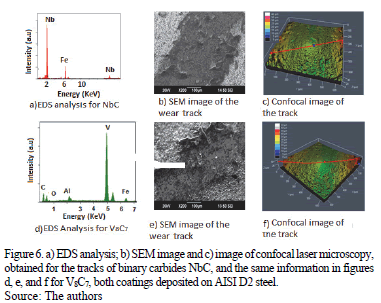
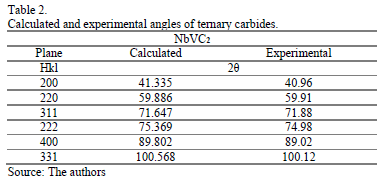
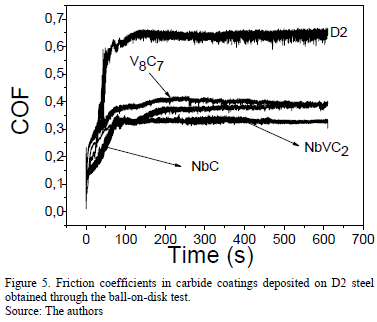
<body><![CDATA[<p><font size="2" face="Verdana, Arial, Helvetica, sans-serif"><b><i>3.2. Chemical   composition and mechanical properties</i></b></font></p>     <p><font size="2" face="Verdana, Arial, Helvetica, sans-serif"><a href="#tab03">Table   3</a> shows the atomic percent measured through EDS analysis for every coating. The   result shows that there is a greater   percent of niobium than vanadium in the carbides; this can be explained based   on the low formation energy of this carbide in comparison with the vanadium   carbide.</font></p>     <p align="center"><font size="2" face="Verdana, Arial, Helvetica, sans-serif"><a name="tab03"></a></font><img src="/img/revistas/dyna/v82n193/v82n193a14tab03.gif"></p>     <p><font size="2" face="Verdana, Arial, Helvetica, sans-serif"><a href="#tab04">Table 4</a> shows the values of hardness and elastic modulus   of the coatings. Overall, the results show that coatings with ternary carbides   increase their hardness value. </font></p>     <p align="center"><font size="2" face="Verdana, Arial, Helvetica, sans-serif"><a name="tab04"></a></font><img src="/img/revistas/dyna/v82n193/v82n193a14tab04.gif"></p>     <p><font size="2" face="Verdana, Arial, Helvetica, sans-serif">This increase in   hardness may be associated with two factors: i) the crystal size reduction   forming the coating, which is evidenced by the increased FWHM (Full Width at   Half Maximum) of the peaks in the XRD, and ii) the macro-deformation, which is   evidenced by the shift of the peaks with respect to their position in a binary   carbide sample (see <a href="#fig04">Fig. 4</a>) &#91;20-22&#93;. The values of the hardness of the ternary   coatings are close to those of the super-hard materials. &#91;23&#93;.</font></p>     <p><font size="2" face="Verdana, Arial, Helvetica, sans-serif"><b><i>3.3. Coefficient   of friction</i></b></font></p>     <p><font size="2" face="Verdana, Arial, Helvetica, sans-serif"><a href="#fig05">Fig. 5</a> shows the curve   of the coefficient of friction as a function of the duration of wear testing   for binary and ternary carbides systems deposited on AISI D2 steel. From the   figure it can be established that the coefficient of friction (COF) of the   binary carbides is less by about a factor two compared to the COF substrate.   These results agree with those obtained in other studies &#91;24-26&#93;. In the   ternary carbide systems, the COF values exhibit little change as a function of   the percentage of vanadium, the coating with less vanadium having a lower COF   value. The decrease of the COF in the coatings can be explained considering   that on their surface there is an excess of aliphatic carbon atoms and   graphite, which have Van der Waals type bonds. Calculation of the wear was not   carried out because the depth of the wear scar was comparable to the roughness   of the coating.</font></p>     <p align="center"><font size="2" face="Verdana, Arial, Helvetica, sans-serif"><a name="fig05"></a></font><img src="/img/revistas/dyna/v82n193/v82n193a14fig05.gif"></p>     <p><font size="2" face="Verdana, Arial, Helvetica, sans-serif"><a href="#fig06">Figs. 6a</a> to 6c show   the EDS analysis, the morphology, and an image of confocal laser microscopy,   respectively, of the NbC coatings. The EDS analysis shows signals of lines   energy of Nb, Fe belonging to the substrate, and C. The SEM micrograph shows   the plastic deformation of the coating, and the confocal image shows areas of   maximum and minimum height of the coating and the line along which the   roughness calculation was made. In <a href="#fig06">Figs. 6d</a> to <a href="#fig06">6f</a>, we show the same   information, but for vanadium carbide. The EDS analysis shows the presence of   the K line of V, K line of Fe from the substrate, and K line of Al, possibly   present in the salt bath. The confocal image allows the delamination of this   carbide (dark green areas) to be observed, which appears mainly on the wear   track.</font></p>     ]]></body>
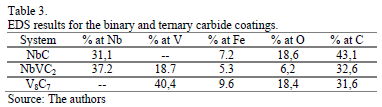
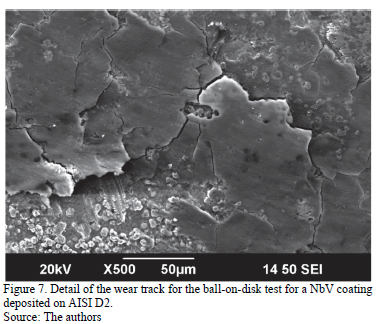
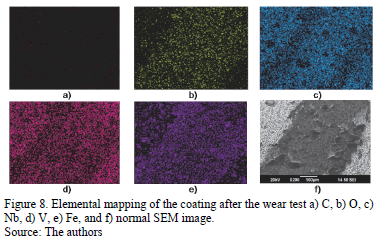
<body><![CDATA[<p align="center"><font size="2" face="Verdana, Arial, Helvetica, sans-serif"><a name="fig06"></a></font><img src="/img/revistas/dyna/v82n193/v82n193a14fig06.gif"></p>     <p><font size="2" face="Verdana, Arial, Helvetica, sans-serif"><a href="#fig07">Fig. 7</a> shows a SEM image for a wear track of NbVC<sub>2</sub> carbide deposited on AISI D2 steel. The cracking and delamination of the   deposited carbide and the grooves or channels on the worn area is shown. The   wear mechanism is based on the formation of cracks and parallel channels during   the wear test. According to Adachi and Hutchings, this situation is known as a   slotted wear, or an abrasion of two bodies &#91;27&#93;. These slots arise as a result   of the cutting action of abrasive microparticles that remain essentially   embedded in the ball during the wear test.</font></p>     <p align="center"><font size="2" face="Verdana, Arial, Helvetica, sans-serif"><a name="fig07"></a></font><img src="/img/revistas/dyna/v82n193/v82n193a14fig07.gif"></p>     <p><font size="2" face="Verdana, Arial, Helvetica, sans-serif"><a href="#fig08">Fig. 8</a> shows the elemental mapping of the coating after   the wear test. In the figure it is possible to see the reduction of niobium and   vanadium in the wear area, and a large amount of iron is observed in the   delaminated layer.</font></p>     <p align="center"><font size="2" face="Verdana, Arial, Helvetica, sans-serif"><a name="fig08"></a></font><img src="/img/revistas/dyna/v82n193/v82n193a14fig08.gif"></p>     <p>&nbsp;</p>     <p><font size="3" face="Verdana, Arial, Helvetica, sans-serif"><b>4. Conclusions</b></font></p>     <p><font size="2" face="Verdana, Arial, Helvetica, sans-serif">Ternary coatings of vanadium-niobium carbides were   deposited via TRD; using XRD it was determined that the coatings were formed by   binary compounds (NbC and VC) and a ternary one (NbVC2). The hardness value   obtained was 38 GPa, which is close to the value obtained in super-hard   materials. This increase in hardness can be explained by the formation of   micro-deformations in the carbide and a decrease in crystal size, which is   evidenced by a broadening of the XRD peaks that are exhibited in the ternary   coatings. Additionally, the coating-substrate system was shown to have a lower   coefficient of friction than that of the naked substrate. The binary systems   show a good performance with hardness between 24 and 25 GPa and better wear   performance than uncoated D2 steel.</font></p>     <p>&nbsp;</p>     <p><font size="3" face="Verdana, Arial, Helvetica, sans-serif"><b>Acknowledgements</b></font></p>     ]]></body>
<body><![CDATA[<p><font size="2" face="Verdana, Arial, Helvetica, sans-serif">The authors acknowledge the financial support of the   Administrative Department of Science, Technology, and Innovation (Colciencias),   through the project code 1101-521-28337 and contract 338-2011.</font></p>     <p>&nbsp;</p>     <p><font size="3" face="Verdana, Arial, Helvetica, sans-serif"><b>References</b></font></p>     <!-- ref --><p><font size="2" face="Verdana, Arial, Helvetica, sans-serif"><b>&#91;1&#93;</b> Marulanda,   D. and Olaya, J.J., Unbalanced magnetron sputtering for producing corrosion   resistance multilayer coatings. DYNA, 79 (171), pp. 74-79, 2012.    &nbsp;&nbsp;&nbsp;&nbsp;&nbsp;&nbsp;&nbsp;&nbsp;[&#160;<a href="javascript:void(0);" onclick="javascript: window.open('/scielo.php?script=sci_nlinks&ref=000076&pid=S0012-7353201500050001400001&lng=','','width=640,height=500,resizable=yes,scrollbars=1,menubar=yes,');">Links</a>&#160;]<!-- end-ref --> </font></p>     <!-- ref --><p><font size="2" face="Verdana, Arial, Helvetica, sans-serif"><b>&#91;2&#93;</b> Su,   Y.L. and Kao, W.H. Optimum   multilayer TiN-TiCN coatings for wear resistance and actual application. Wear,   223, pp. 119-130, 1998. DOI:   10.1016/S0043-1648(98)00276-2</font>&nbsp;&nbsp;&nbsp;&nbsp;&nbsp;&nbsp;&nbsp;&nbsp;[&#160;<a href="javascript:void(0);" onclick="javascript: window.open('/scielo.php?script=sci_nlinks&ref=000078&pid=S0012-7353201500050001400002&lng=','','width=640,height=500,resizable=yes,scrollbars=1,menubar=yes,');">Links</a>&#160;]<!-- end-ref --><!-- ref --><p><font size="2" face="Verdana, Arial, Helvetica, sans-serif"><b>&#91;3&#93;</b> Castillejo,   F.E., Marulanda, D., Rodriguez, O. and Olaya, J.J., Electrical furnace for   producing carbide coatings using the thermoreactive deposition/diffusion   technique. DYNA, 78 (170), pp. 192-197, 2011.    &nbsp;&nbsp;&nbsp;&nbsp;&nbsp;&nbsp;&nbsp;&nbsp;[&#160;<a href="javascript:void(0);" onclick="javascript: window.open('/scielo.php?script=sci_nlinks&ref=000079&pid=S0012-7353201500050001400003&lng=','','width=640,height=500,resizable=yes,scrollbars=1,menubar=yes,');">Links</a>&#160;]<!-- end-ref --></font></p>     <!-- ref --><p><font size="2" face="Verdana, Arial, Helvetica, sans-serif"><b>&#91;4&#93;</b> Arai,   T. and Harper, S., ASM Handbook, 4 - Heat Treating. OH, USA: ASM International,   Materials Park, 1991, 448 P.    &nbsp;&nbsp;&nbsp;&nbsp;&nbsp;&nbsp;&nbsp;&nbsp;[&#160;<a href="javascript:void(0);" onclick="javascript: window.open('/scielo.php?script=sci_nlinks&ref=000081&pid=S0012-7353201500050001400004&lng=','','width=640,height=500,resizable=yes,scrollbars=1,menubar=yes,');">Links</a>&#160;]<!-- end-ref --></font></p>     ]]></body>
<body><![CDATA[<!-- ref --><p><font size="2" face="Verdana, Arial, Helvetica, sans-serif"><b>&#91;5&#93;</b> Oliveira,   C.K.N., Mu&ntilde;oz Riofano, R.M. and Castiletti, L.C., Evaluation of hard coatings   obtained on AISI D2 steel by thermo-reactive deposition treatment. Surface and Coatings Technology, 201, pp. 1880-1885,   2006. DOI:   10.1016/j.surfcoat.2006.03.036</font>&nbsp;&nbsp;&nbsp;&nbsp;&nbsp;&nbsp;&nbsp;&nbsp;[&#160;<a href="javascript:void(0);" onclick="javascript: window.open('/scielo.php?script=sci_nlinks&ref=000083&pid=S0012-7353201500050001400005&lng=','','width=640,height=500,resizable=yes,scrollbars=1,menubar=yes,');">Links</a>&#160;]<!-- end-ref --><!-- ref --><p><font size="2" face="Verdana, Arial, Helvetica, sans-serif"><b>&#91;6&#93;</b> Arai,   T., Fujita, H., Sugimoto, Y. and Ohta, Y., Diffusion carbide coatings formed in   molten Borax systems. Journal of Materials Engineering, 9 (2), pp. 183-189,   1987. DOI: 10.1007/BF02833709</font>&nbsp;&nbsp;&nbsp;&nbsp;&nbsp;&nbsp;&nbsp;&nbsp;[&#160;<a href="javascript:void(0);" onclick="javascript: window.open('/scielo.php?script=sci_nlinks&ref=000084&pid=S0012-7353201500050001400006&lng=','','width=640,height=500,resizable=yes,scrollbars=1,menubar=yes,');">Links</a>&#160;]<!-- end-ref --><!-- ref --><p><font size="2" face="Verdana, Arial, Helvetica, sans-serif"><b>&#91;7&#93;</b> Child   H.C., Plumb, S.A. and McDermott, J.J. Proc. Heat Treatment'84, The Metals   Society, 310, 1984.    &nbsp;&nbsp;&nbsp;&nbsp;&nbsp;&nbsp;&nbsp;&nbsp;[&#160;<a href="javascript:void(0);" onclick="javascript: window.open('/scielo.php?script=sci_nlinks&ref=000085&pid=S0012-7353201500050001400007&lng=','','width=640,height=500,resizable=yes,scrollbars=1,menubar=yes,');">Links</a>&#160;]<!-- end-ref --></font></p>     <!-- ref --><p><font size="2" face="Verdana, Arial, Helvetica, sans-serif"><b>&#91;8&#93;</b> Sinha.   A.K., ASM Handbook, 4 - Heat Treating. OH, USA: ASM International, Materials   Park, 1991. pp. 437 P.    &nbsp;&nbsp;&nbsp;&nbsp;&nbsp;&nbsp;&nbsp;&nbsp;[&#160;<a href="javascript:void(0);" onclick="javascript: window.open('/scielo.php?script=sci_nlinks&ref=000087&pid=S0012-7353201500050001400008&lng=','','width=640,height=500,resizable=yes,scrollbars=1,menubar=yes,');">Links</a>&#160;]<!-- end-ref --></font></p>     <!-- ref --><p><font size="2" face="Verdana, Arial, Helvetica, sans-serif"><b>&#91;9&#93;</b> Sen,   S., Ozbek, I., Sen, U. and Bindal, C.,   Mechanical behavior of borides formed on borided cold work tool steel. Surface and Coatings Technology, 135, pp. 173-177,   2001. DOI: 10.1016/S0257-8972(00)01064-1</font>&nbsp;&nbsp;&nbsp;&nbsp;&nbsp;&nbsp;&nbsp;&nbsp;[&#160;<a href="javascript:void(0);" onclick="javascript: window.open('/scielo.php?script=sci_nlinks&ref=000089&pid=S0012-7353201500050001400009&lng=','','width=640,height=500,resizable=yes,scrollbars=1,menubar=yes,');">Links</a>&#160;]<!-- end-ref --><!-- ref --><p><font size="2" face="Verdana, Arial, Helvetica, sans-serif"><b>&#91;10&#93;</b> Sen, U., Kinetics of niobium carbide   coating produced on AISI 1040 steel by thermo-reactive deposition technique.   Materials Chemistry and Physics, 86 (1), pp. 189-194, 2004. DOI: 10.1016/j.matchemphys.2004.03.002</font>&nbsp;&nbsp;&nbsp;&nbsp;&nbsp;&nbsp;&nbsp;&nbsp;[&#160;<a href="javascript:void(0);" onclick="javascript: window.open('/scielo.php?script=sci_nlinks&ref=000090&pid=S0012-7353201500050001400010&lng=','','width=640,height=500,resizable=yes,scrollbars=1,menubar=yes,');">Links</a>&#160;]<!-- end-ref --><!-- ref --><p><font size="2" face="Verdana, Arial, Helvetica, sans-serif"><b>&#91;11&#93;</b> Sen, S., Sen, U. and Bindal, C., The growth kinetics of borides formed on boronized   AISI 4140 steel. Vacuum, 77 (2), pp. 195-202,   2005. DOI: 10.1016/j.vacuum.2004.09.005</font>&nbsp;&nbsp;&nbsp;&nbsp;&nbsp;&nbsp;&nbsp;&nbsp;[&#160;<a href="javascript:void(0);" onclick="javascript: window.open('/scielo.php?script=sci_nlinks&ref=000091&pid=S0012-7353201500050001400011&lng=','','width=640,height=500,resizable=yes,scrollbars=1,menubar=yes,');">Links</a>&#160;]<!-- end-ref --><!-- ref --><p><font size="2" face="Verdana, Arial, Helvetica, sans-serif"><b>&#91;12&#93;</b> Sen, S., A study on kinetics of Cr<sub>x</sub>C-coated   high-chromium steel by thermo-reactive diffusion technique. Vacuum, 79 (1-2),   pp. 63-70, 2005. DOI: 10.1016/j.vacuum.2005.01.009</font>&nbsp;&nbsp;&nbsp;&nbsp;&nbsp;&nbsp;&nbsp;&nbsp;[&#160;<a href="javascript:void(0);" onclick="javascript: window.open('/scielo.php?script=sci_nlinks&ref=000092&pid=S0012-7353201500050001400012&lng=','','width=640,height=500,resizable=yes,scrollbars=1,menubar=yes,');">Links</a>&#160;]<!-- end-ref --><!-- ref --><p><font size="2" face="Verdana, Arial, Helvetica, sans-serif"><b>&#91;13&#93;</b> Tavakoli, H. and Mousavi Khoie, S.M.,   An electrochemical study of the corrosion resistance of boride coating obtained   by thermo-reactive diffusion. Material Chemistry and Physics, 124 (2-3), pp.   1134-1138, 2010. DOI:   10.1016/j.matchemphys.2010.08.047</font>&nbsp;&nbsp;&nbsp;&nbsp;&nbsp;&nbsp;&nbsp;&nbsp;[&#160;<a href="javascript:void(0);" onclick="javascript: window.open('/scielo.php?script=sci_nlinks&ref=000093&pid=S0012-7353201500050001400013&lng=','','width=640,height=500,resizable=yes,scrollbars=1,menubar=yes,');">Links</a>&#160;]<!-- end-ref --><!-- ref --><p><font size="2" face="Verdana, Arial, Helvetica, sans-serif"><b>&#91;14&#93;</b> Castillejo, F.E., Marulanda,   D.M., Olaya, J.J. and Alfonso, J.E., Wear and corrosion resistance of niobium-chromium carbide coatings on   AISI D2 produced through TRD. Surface &amp; Coatings Technology, 254, pp.   104-111, 2014. DOI: 10.1016/j.surfcoat.2014.05.069</font>&nbsp;&nbsp;&nbsp;&nbsp;&nbsp;&nbsp;&nbsp;&nbsp;[&#160;<a href="javascript:void(0);" onclick="javascript: window.open('/scielo.php?script=sci_nlinks&ref=000094&pid=S0012-7353201500050001400014&lng=','','width=640,height=500,resizable=yes,scrollbars=1,menubar=yes,');">Links</a>&#160;]<!-- end-ref --><!-- ref --><p><font size="2" face="Verdana, Arial, Helvetica, sans-serif"><b>&#91;15&#93;</b> Arai, T., Komatsu, N. and Mizutani,   M., Diffusion layers on steel surfaces immersed in fused borax baths containing   various kinds of additives. Journal of the Japan Institute of Metals, 39, pp.   247-255, 1975.    &nbsp;&nbsp;&nbsp;&nbsp;&nbsp;&nbsp;&nbsp;&nbsp;[&#160;<a href="javascript:void(0);" onclick="javascript: window.open('/scielo.php?script=sci_nlinks&ref=000095&pid=S0012-7353201500050001400015&lng=','','width=640,height=500,resizable=yes,scrollbars=1,menubar=yes,');">Links</a>&#160;]<!-- end-ref --></font></p>     <!-- ref --><p><font size="2" face="Verdana, Arial, Helvetica, sans-serif"><b>&#91;16&#93;</b> Castillejo, F., Marulanda, D., Olaya,   J.J. and Rodriguez, O., Electrical furnace for producing carbide coatings using   the Thermoreactive deposition/diffusion technique. DYNA, 78 (170), pp. 192-197,   2011.    &nbsp;&nbsp;&nbsp;&nbsp;&nbsp;&nbsp;&nbsp;&nbsp;[&#160;<a href="javascript:void(0);" onclick="javascript: window.open('/scielo.php?script=sci_nlinks&ref=000097&pid=S0012-7353201500050001400016&lng=','','width=640,height=500,resizable=yes,scrollbars=1,menubar=yes,');">Links</a>&#160;]<!-- end-ref --></font></p>     <!-- ref --><p><font size="2" face="Verdana, Arial, Helvetica, sans-serif"><b>&#91;17&#93;</b> Villars, P. and Calvert, L.D., Pearson`s   Handbook of Crystallographic Phases. USA: ASM international, 1991.    &nbsp;&nbsp;&nbsp;&nbsp;&nbsp;&nbsp;&nbsp;&nbsp;[&#160;<a href="javascript:void(0);" onclick="javascript: window.open('/scielo.php?script=sci_nlinks&ref=000099&pid=S0012-7353201500050001400017&lng=','','width=640,height=500,resizable=yes,scrollbars=1,menubar=yes,');">Links</a>&#160;]<!-- end-ref --></font></p>     <!-- ref --><p><font size="2" face="Verdana, Arial, Helvetica, sans-serif"><b>&#91;18&#93;</b> Worrell, W.L. and Chipman, J., The   free energies of formation of the vanadium, niobium, and tantalum carbides.   Journal of Physical Chemistry, 68 (4), pp. 860-866, 1964. DOI: 10.1021/j100786a027</font>&nbsp;&nbsp;&nbsp;&nbsp;&nbsp;&nbsp;&nbsp;&nbsp;[&#160;<a href="javascript:void(0);" onclick="javascript: window.open('/scielo.php?script=sci_nlinks&ref=000101&pid=S0012-7353201500050001400018&lng=','','width=640,height=500,resizable=yes,scrollbars=1,menubar=yes,');">Links</a>&#160;]<!-- end-ref --><!-- ref --><p><font size="2" face="Verdana, Arial, Helvetica, sans-serif"><b>&#91;19&#93;</b> Paunovic, M. and Schlesinger, M.,   Fundamentals of electrochemical deposition, New York, USA: John Wiley &amp;   Sons, Inc., 1999.    &nbsp;&nbsp;&nbsp;&nbsp;&nbsp;&nbsp;&nbsp;&nbsp;[&#160;<a href="javascript:void(0);" onclick="javascript: window.open('/scielo.php?script=sci_nlinks&ref=000102&pid=S0012-7353201500050001400019&lng=','','width=640,height=500,resizable=yes,scrollbars=1,menubar=yes,');">Links</a>&#160;]<!-- end-ref --></font></p>     <!-- ref --><p><font size="2" face="Verdana, Arial, Helvetica, sans-serif"><b>&#91;20&#93;</b> Oliver, W.C. and Pharr, G.M., An   improved technique for determining hardness and elastic modulus using load and   displacement sensing indentation experiments. Journal of Materials Research, 7   (6), pp 1564-1583, 1992. DOI:   10.1557/JMR.1992.1564</font>&nbsp;&nbsp;&nbsp;&nbsp;&nbsp;&nbsp;&nbsp;&nbsp;[&#160;<a href="javascript:void(0);" onclick="javascript: window.open('/scielo.php?script=sci_nlinks&ref=000104&pid=S0012-7353201500050001400020&lng=','','width=640,height=500,resizable=yes,scrollbars=1,menubar=yes,');">Links</a>&#160;]<!-- end-ref --><!-- ref --><p><font size="2" face="Verdana, Arial, Helvetica, sans-serif"><b>&#91;21&#93;</b> Niels, H., Hall-Petch relation and   boundary strengthening. Scripta Materialia, 51 (8), pp. 801-806, 2004. DOI: 10.1016/j.scriptamat.2004.06.002</font>&nbsp;&nbsp;&nbsp;&nbsp;&nbsp;&nbsp;&nbsp;&nbsp;[&#160;<a href="javascript:void(0);" onclick="javascript: window.open('/scielo.php?script=sci_nlinks&ref=000105&pid=S0012-7353201500050001400021&lng=','','width=640,height=500,resizable=yes,scrollbars=1,menubar=yes,');">Links</a>&#160;]<!-- end-ref --><!-- ref --><p><font size="2" face="Verdana, Arial, Helvetica, sans-serif"><b>&#91;22&#93;</b> Veprek, S., Niederhofer, A., Moto,   K., Bolom, T., M&auml;nnling, H.-D., Nesladek, P., Dollinger, G., and Bergmaier, A.,   Composition, nanostructure and origin of the ultrahardness in nc-TiN/a-Si<sub>3</sub>N<sub>4</sub>/a-   and nc-TiSi<sub>2</sub> nanocomposites with H<sub>V</sub>=80 to &#8805;105 GPa.   Surface and Coatings Technology, (133-134), pp. 152-159, 2000. DOI: 10.1016/S0257-8972(00)00957-9</font>&nbsp;&nbsp;&nbsp;&nbsp;&nbsp;&nbsp;&nbsp;&nbsp;[&#160;<a href="javascript:void(0);" onclick="javascript: window.open('/scielo.php?script=sci_nlinks&ref=000106&pid=S0012-7353201500050001400022&lng=','','width=640,height=500,resizable=yes,scrollbars=1,menubar=yes,');">Links</a>&#160;]<!-- end-ref --><!-- ref --><p><font size="2" face="Verdana, Arial, Helvetica, sans-serif"><b>&#91;23&#93;</b> Bourithis, L. and Papadimitriou,   G.D., The effect of microstructure and wear conditions on the wear resistance   of steel metal matrix composites fabricated with PTA alloying technique. Wear,   266 (11-12), pp. 1155-1164, 2009. DOI:   10.1016/j.wear.2009.03.032</font>&nbsp;&nbsp;&nbsp;&nbsp;&nbsp;&nbsp;&nbsp;&nbsp;[&#160;<a href="javascript:void(0);" onclick="javascript: window.open('/scielo.php?script=sci_nlinks&ref=000107&pid=S0012-7353201500050001400023&lng=','','width=640,height=500,resizable=yes,scrollbars=1,menubar=yes,');">Links</a>&#160;]<!-- end-ref --><!-- ref --><p><font size="2" face="Verdana, Arial, Helvetica, sans-serif"><b>&#91;24&#93;</b> Staia, M.H., P&eacute;rez-Delgado, Y.,   Sanchez, C., Castro, A., Le Bourhis, E. and Puchi-Cabrera, E.S., Hardness   properties and high-temperature wear behavior of nitrided AISI D2 tool steel, prior   and after PAPVD coating. Wear, 267 (9-10), pp. 1452-1461, 2009. DOI: 10.1016/j.wear.2009.03.045</font>&nbsp;&nbsp;&nbsp;&nbsp;&nbsp;&nbsp;&nbsp;&nbsp;[&#160;<a href="javascript:void(0);" onclick="javascript: window.open('/scielo.php?script=sci_nlinks&ref=000108&pid=S0012-7353201500050001400024&lng=','','width=640,height=500,resizable=yes,scrollbars=1,menubar=yes,');">Links</a>&#160;]<!-- end-ref --><!-- ref --><p><font size="2" face="Verdana, Arial, Helvetica, sans-serif"><b>&#91;25&#93;</b> Castro,   G., Fern&aacute;ndez-Vicente, A. and Cid, J., Influence of the nitriding time in the   wear behaviour of an AISI H13 steel during a crankshaft forging process. Wear,   263 (7-12), pp. 1375-1385, 2007. DOI:   0.1016/j.wear.2007.02.007</font>&nbsp;&nbsp;&nbsp;&nbsp;&nbsp;&nbsp;&nbsp;&nbsp;[&#160;<a href="javascript:void(0);" onclick="javascript: window.open('/scielo.php?script=sci_nlinks&ref=000109&pid=S0012-7353201500050001400025&lng=','','width=640,height=500,resizable=yes,scrollbars=1,menubar=yes,');">Links</a>&#160;]<!-- end-ref --><!-- ref --><p><font size="2" face="Verdana, Arial, Helvetica, sans-serif"><b>&#91;26&#93;</b> Castillejo, F.E. and Olaya, J.J., Recubrimientos de   carburos ternarios depositados con la t&eacute;cnica TRD, PhD. Thesis, Departmento de   Inenier&iacute;a Mec&aacute;nica y Mecatr&oacute;nica, Universidad Nacional de Colombia, Bogot&aacute;,   Colombia, 2013.    &nbsp;&nbsp;&nbsp;&nbsp;&nbsp;&nbsp;&nbsp;&nbsp;[&#160;<a href="javascript:void(0);" onclick="javascript: window.open('/scielo.php?script=sci_nlinks&ref=000110&pid=S0012-7353201500050001400026&lng=','','width=640,height=500,resizable=yes,scrollbars=1,menubar=yes,');">Links</a>&#160;]<!-- end-ref --></font></p>     <!-- ref --><p><font size="2" face="Verdana, Arial, Helvetica, sans-serif"><b>&#91;27&#93;</b> Adachi K.,   and Hutchings I.M., Wear-mode mapping for the micro-scale abrasion test. Wear,   255 (1-6), pp. 23-29, 2003. DOI:   10.1016/S0043-1648(03)00073-5</font>&nbsp;&nbsp;&nbsp;&nbsp;&nbsp;&nbsp;&nbsp;&nbsp;[&#160;<a href="javascript:void(0);" onclick="javascript: window.open('/scielo.php?script=sci_nlinks&ref=000112&pid=S0012-7353201500050001400027&lng=','','width=640,height=500,resizable=yes,scrollbars=1,menubar=yes,');">Links</a>&#160;]<!-- end-ref --><p>&nbsp;</p>     <p><font size="2" face="Verdana, Arial, Helvetica, sans-serif"><b>F.E. Castillejo-Nieto,</b> received his BSc. Eng in Metallurgical Engineering in 1997, his MSc. in Physics   in 2005, and his PhD degree in Engineering in 2014, all of them from the   Universidad Nacional de Colombia. Medellin, Colombia. His research interests   include: Coatings and thin films, wear and corrosion resistance of materials.</font></p>     <p><font size="2" face="Verdana, Arial, Helvetica, sans-serif"><b>J.J. Olaya,</b> is an associate   professor at the Departamento de Ingenier&iacute;a y Mecatr&oacute;nica in the Universidad   Nacional de Colombia, Bogot&aacute;, Colombia. He   conducts research in the general area of development and applications of thin   films deposited by plasma assisted techniques, corrosion and wear. He received   his PhD in 2005 from the Universidad Nacional Autonoma de M&eacute;xico, Mexico.</font></p>     <p><font size="2" face="Verdana, Arial, Helvetica, sans-serif"><b>J.E. Alfonso,</b> completed his BSc. degree in Physics in 1987 and his MSc. degree in Science -   Physics in 1991, all of them being obtained from the Universidad Nacional de   Colombia. In 1997 he completed his PhD in Science - Physics in the Universidad   Autonoma de Madrid, Spain. He has taught at the Universidad Nacional de   Colombia as a professor since 2000, where his research has been focused on   material science, particularly on thin film processing as well as performance   characterization, studying thin film optical, electrical and mechanical   properties.</font></p>      ]]></body><back>
<ref-list>
<ref id="B1">
<label>1</label><nlm-citation citation-type="journal">
<person-group person-group-type="author">
<name>
<surname><![CDATA[Marulanda]]></surname>
<given-names><![CDATA[D.]]></given-names>
</name>
<name>
<surname><![CDATA[Olaya]]></surname>
<given-names><![CDATA[J.J.]]></given-names>
</name>
</person-group>
<article-title xml:lang="en"><![CDATA[Unbalanced magnetron sputtering for producing corrosion resistance multilayer coatings]]></article-title>
<source><![CDATA[DYNA]]></source>
<year>2012</year>
<volume>79</volume>
<numero>171</numero>
<issue>171</issue>
<page-range>74-79</page-range></nlm-citation>
</ref>
<ref id="B2">
<label>2</label><nlm-citation citation-type="journal">
<person-group person-group-type="author">
<name>
<surname><![CDATA[Su]]></surname>
<given-names><![CDATA[Y.L.]]></given-names>
</name>
<name>
<surname><![CDATA[Kao]]></surname>
<given-names><![CDATA[W.H.]]></given-names>
</name>
</person-group>
<article-title xml:lang="en"><![CDATA[Optimum multilayer TiN-TiCN coatings for wear resistance and actual application.]]></article-title>
<source><![CDATA[Wear]]></source>
<year>1998</year>
<numero>223</numero>
<issue>223</issue>
<page-range>119-130</page-range></nlm-citation>
</ref>
<ref id="B3">
<label>3</label><nlm-citation citation-type="journal">
<person-group person-group-type="author">
<name>
<surname><![CDATA[Castillejo]]></surname>
<given-names><![CDATA[F.E.]]></given-names>
</name>
<name>
<surname><![CDATA[Marulanda]]></surname>
<given-names><![CDATA[D.]]></given-names>
</name>
<name>
<surname><![CDATA[Rodriguez]]></surname>
<given-names><![CDATA[O.]]></given-names>
</name>
<name>
<surname><![CDATA[Olaya]]></surname>
<given-names><![CDATA[J.J.]]></given-names>
</name>
</person-group>
<article-title xml:lang="en"><![CDATA[Electrical furnace for producing carbide coatings using the thermoreactive deposition/diffusion technique]]></article-title>
<source><![CDATA[DYNA]]></source>
<year>2011</year>
<volume>78</volume>
<numero>170</numero>
<issue>170</issue>
<page-range>192-197</page-range></nlm-citation>
</ref>
<ref id="B4">
<label>4</label><nlm-citation citation-type="book">
<person-group person-group-type="author">
<name>
<surname><![CDATA[Arai]]></surname>
<given-names><![CDATA[T.]]></given-names>
</name>
<name>
<surname><![CDATA[Harper]]></surname>
<given-names><![CDATA[S.]]></given-names>
</name>
</person-group>
<source><![CDATA[ASM Handbook: 4 - Heat Treating]]></source>
<year>1991</year>
<publisher-loc><![CDATA[^eOH OH]]></publisher-loc>
<publisher-name><![CDATA[ASM International]]></publisher-name>
</nlm-citation>
</ref>
<ref id="B5">
<label>5</label><nlm-citation citation-type="journal">
<person-group person-group-type="author">
<name>
<surname><![CDATA[Oliveira]]></surname>
<given-names><![CDATA[C.K.N.]]></given-names>
</name>
<name>
<surname><![CDATA[Muñoz Riofano]]></surname>
<given-names><![CDATA[R.M.]]></given-names>
</name>
<name>
<surname><![CDATA[Castiletti]]></surname>
<given-names><![CDATA[L.C.]]></given-names>
</name>
</person-group>
<article-title xml:lang="en"><![CDATA[Evaluation of hard coatings obtained on AISI D2 steel by thermo-reactive deposition treatment]]></article-title>
<source><![CDATA[Surface and Coatings Technology]]></source>
<year>2006</year>
<numero>201</numero>
<issue>201</issue>
<page-range>1880-1885</page-range></nlm-citation>
</ref>
<ref id="B6">
<label>6</label><nlm-citation citation-type="journal">
<person-group person-group-type="author">
<name>
<surname><![CDATA[Arai]]></surname>
<given-names><![CDATA[T.]]></given-names>
</name>
<name>
<surname><![CDATA[Fujita]]></surname>
<given-names><![CDATA[H.]]></given-names>
</name>
<name>
<surname><![CDATA[Sugimoto]]></surname>
<given-names><![CDATA[Y.]]></given-names>
</name>
<name>
<surname><![CDATA[Ohta]]></surname>
<given-names><![CDATA[Y.]]></given-names>
</name>
</person-group>
<article-title xml:lang="en"><![CDATA[Diffusion carbide coatings formed in molten Borax systems.]]></article-title>
<source><![CDATA[Journal of Materials Engineering]]></source>
<year>1987</year>
<volume>9</volume>
<numero>2</numero>
<issue>2</issue>
<page-range>183-189</page-range></nlm-citation>
</ref>
<ref id="B7">
<label>7</label><nlm-citation citation-type="confpro">
<person-group person-group-type="author">
<name>
<surname><![CDATA[Child]]></surname>
<given-names><![CDATA[H.C.]]></given-names>
</name>
<name>
<surname><![CDATA[Plumb]]></surname>
<given-names><![CDATA[S.A.]]></given-names>
</name>
<name>
<surname><![CDATA[McDermott]]></surname>
<given-names><![CDATA[J.J.]]></given-names>
</name>
</person-group>
<source><![CDATA[]]></source>
<year>1984</year>
<conf-name><![CDATA[ Proc. Heat Treatment'84]]></conf-name>
<conf-loc> </conf-loc>
<publisher-name><![CDATA[The Metals Society]]></publisher-name>
</nlm-citation>
</ref>
<ref id="B8">
<label>8</label><nlm-citation citation-type="book">
<person-group person-group-type="author">
<name>
<surname><![CDATA[Sinha.]]></surname>
<given-names><![CDATA[A.K.]]></given-names>
</name>
</person-group>
<source><![CDATA[ASM Handbook: 4 - Heat Treating.]]></source>
<year>1991</year>
<publisher-loc><![CDATA[^eOH OH]]></publisher-loc>
<publisher-name><![CDATA[ASM International]]></publisher-name>
</nlm-citation>
</ref>
<ref id="B9">
<label>9</label><nlm-citation citation-type="journal">
<person-group person-group-type="author">
<name>
<surname><![CDATA[Sen]]></surname>
<given-names><![CDATA[S.]]></given-names>
</name>
<name>
<surname><![CDATA[Ozbek]]></surname>
<given-names><![CDATA[I.]]></given-names>
</name>
<name>
<surname><![CDATA[Sen]]></surname>
<given-names><![CDATA[U.]]></given-names>
</name>
<name>
<surname><![CDATA[Bindal]]></surname>
<given-names><![CDATA[C.]]></given-names>
</name>
</person-group>
<article-title xml:lang="en"><![CDATA[Mechanical behavior of borides formed on borided cold work tool steel.]]></article-title>
<source><![CDATA[Surface and Coatings Technology]]></source>
<year>2001</year>
<numero>135</numero>
<issue>135</issue>
<page-range>173-177</page-range></nlm-citation>
</ref>
<ref id="B10">
<label>10</label><nlm-citation citation-type="journal">
<person-group person-group-type="author">
<name>
<surname><![CDATA[Sen]]></surname>
<given-names><![CDATA[U.]]></given-names>
</name>
</person-group>
<article-title xml:lang="en"><![CDATA[Kinetics of niobium carbide coating produced on AISI 1040 steel by thermo-reactive deposition technique]]></article-title>
<source><![CDATA[Materials Chemistry and Physics]]></source>
<year>2004</year>
<volume>86</volume>
<numero>1</numero>
<issue>1</issue>
<page-range>189-194</page-range></nlm-citation>
</ref>
<ref id="B11">
<label>11</label><nlm-citation citation-type="journal">
<person-group person-group-type="author">
<name>
<surname><![CDATA[Sen]]></surname>
<given-names><![CDATA[S.]]></given-names>
</name>
<name>
<surname><![CDATA[Sen]]></surname>
<given-names><![CDATA[U.]]></given-names>
</name>
<name>
<surname><![CDATA[Bindal]]></surname>
<given-names><![CDATA[C.]]></given-names>
</name>
</person-group>
<article-title xml:lang="en"><![CDATA[The growth kinetics of borides formed on boronized AISI 4140 steel]]></article-title>
<source><![CDATA[Vacuum]]></source>
<year>2005</year>
<volume>77</volume>
<numero>2</numero>
<issue>2</issue>
<page-range>195-202</page-range></nlm-citation>
</ref>
<ref id="B12">
<label>12</label><nlm-citation citation-type="journal">
<person-group person-group-type="author">
<name>
<surname><![CDATA[Sen]]></surname>
<given-names><![CDATA[S.]]></given-names>
</name>
</person-group>
<article-title xml:lang="en"><![CDATA[A study on kinetics of Cr xC-coated high-chromium steel by thermo-reactive diffusion technique]]></article-title>
<source><![CDATA[Vacuum]]></source>
<year>2005</year>
<volume>79</volume>
<numero>1-2</numero>
<issue>1-2</issue>
<page-range>63-70</page-range></nlm-citation>
</ref>
<ref id="B13">
<label>13</label><nlm-citation citation-type="journal">
<person-group person-group-type="author">
<name>
<surname><![CDATA[Tavakoli]]></surname>
<given-names><![CDATA[H.]]></given-names>
</name>
<name>
<surname><![CDATA[Mousavi Khoie]]></surname>
<given-names><![CDATA[S.M.]]></given-names>
</name>
</person-group>
<article-title xml:lang="en"><![CDATA[An electrochemical study of the corrosion resistance of boride coating obtained by thermo-reactive diffusion.]]></article-title>
<source><![CDATA[Material Chemistry and Physics]]></source>
<year>2010</year>
<volume>124</volume>
<numero>2-3</numero>
<issue>2-3</issue>
<page-range>1134-1138</page-range></nlm-citation>
</ref>
<ref id="B14">
<label>14</label><nlm-citation citation-type="journal">
<person-group person-group-type="author">
<name>
<surname><![CDATA[Castillejo]]></surname>
<given-names><![CDATA[F.E.]]></given-names>
</name>
<name>
<surname><![CDATA[Marulanda]]></surname>
<given-names><![CDATA[D.]]></given-names>
</name>
<name>
<surname><![CDATA[Olaya]]></surname>
<given-names><![CDATA[J.J.]]></given-names>
</name>
<name>
<surname><![CDATA[Alfonso]]></surname>
<given-names><![CDATA[J.E.]]></given-names>
</name>
</person-group>
<article-title xml:lang="en"><![CDATA[Wearand corrosion resistance of niobium-chromium carbide coatings on AISI D2 produced through TRD]]></article-title>
<source><![CDATA[Surface & Coatings Technology]]></source>
<year>2014</year>
<numero>254</numero>
<issue>254</issue>
<page-range>104-111</page-range></nlm-citation>
</ref>
<ref id="B15">
<label>15</label><nlm-citation citation-type="journal">
<person-group person-group-type="author">
<name>
<surname><![CDATA[Arai]]></surname>
<given-names><![CDATA[T.]]></given-names>
</name>
<name>
<surname><![CDATA[Komatsu]]></surname>
<given-names><![CDATA[N.]]></given-names>
</name>
<name>
<surname><![CDATA[Mizutani]]></surname>
<given-names><![CDATA[M.]]></given-names>
</name>
</person-group>
<article-title xml:lang="en"><![CDATA[Diffusion layers on steel surfaces immersed in fused borax baths containing various kinds of additives]]></article-title>
<source><![CDATA[Journal of the Japan Institute of Metals]]></source>
<year>1975</year>
<numero>39</numero>
<issue>39</issue>
<page-range>247-255</page-range></nlm-citation>
</ref>
<ref id="B16">
<label>16</label><nlm-citation citation-type="journal">
<person-group person-group-type="author">
<name>
<surname><![CDATA[Castillejo]]></surname>
<given-names><![CDATA[F.]]></given-names>
</name>
<name>
<surname><![CDATA[Marulanda]]></surname>
<given-names><![CDATA[D.]]></given-names>
</name>
<name>
<surname><![CDATA[Olaya]]></surname>
<given-names><![CDATA[J.J.]]></given-names>
</name>
<name>
<surname><![CDATA[Rodriguez]]></surname>
<given-names><![CDATA[O.]]></given-names>
</name>
</person-group>
<article-title xml:lang="en"><![CDATA[Electrical furnace for producing carbide coatings using the Thermoreactive deposition/diffusion technique]]></article-title>
<source><![CDATA[DYNA]]></source>
<year>2011</year>
<volume>78</volume>
<numero>170</numero>
<issue>170</issue>
<page-range>192-197</page-range></nlm-citation>
</ref>
<ref id="B17">
<label>17</label><nlm-citation citation-type="book">
<person-group person-group-type="author">
<name>
<surname><![CDATA[Villars]]></surname>
<given-names><![CDATA[P.]]></given-names>
</name>
<name>
<surname><![CDATA[Calvert]]></surname>
<given-names><![CDATA[L.D.]]></given-names>
</name>
</person-group>
<source><![CDATA[Pearson's Handbook of Crystallographic Phases]]></source>
<year>1991</year>
<publisher-name><![CDATA[ASM international]]></publisher-name>
</nlm-citation>
</ref>
<ref id="B18">
<label>18</label><nlm-citation citation-type="journal">
<person-group person-group-type="author">
<name>
<surname><![CDATA[Worrell]]></surname>
<given-names><![CDATA[W.L.]]></given-names>
</name>
<name>
<surname><![CDATA[Chipman]]></surname>
<given-names><![CDATA[J.]]></given-names>
</name>
</person-group>
<article-title xml:lang="en"><![CDATA[The free energies of formation of the vanadium, niobium, and tantalum carbides.]]></article-title>
<source><![CDATA[Journal of Physical Chemistry]]></source>
<year>1964</year>
<volume>68</volume>
<numero>4</numero>
<issue>4</issue>
<page-range>860-866</page-range></nlm-citation>
</ref>
<ref id="B19">
<label>19</label><nlm-citation citation-type="book">
<person-group person-group-type="author">
<name>
<surname><![CDATA[Paunovic]]></surname>
<given-names><![CDATA[M.]]></given-names>
</name>
<name>
<surname><![CDATA[Schlesinger]]></surname>
<given-names><![CDATA[M.]]></given-names>
</name>
</person-group>
<source><![CDATA[Fundamentals of electrochemical deposition]]></source>
<year>1999</year>
<publisher-loc><![CDATA[New York ]]></publisher-loc>
<publisher-name><![CDATA[John Wiley & Sons, Inc.]]></publisher-name>
</nlm-citation>
</ref>
<ref id="B20">
<label>20</label><nlm-citation citation-type="journal">
<person-group person-group-type="author">
<name>
<surname><![CDATA[Oliver]]></surname>
<given-names><![CDATA[W.C.]]></given-names>
</name>
<name>
<surname><![CDATA[Pharr]]></surname>
<given-names><![CDATA[G.M.]]></given-names>
</name>
</person-group>
<article-title xml:lang="en"><![CDATA[An improved technique for determining hardness and elastic modulus using load and displacement sensing indentation experiments.]]></article-title>
<source><![CDATA[Journal of Materials Research]]></source>
<year>1992</year>
<volume>7</volume>
<numero>6</numero>
<issue>6</issue>
<page-range>1564-1583</page-range></nlm-citation>
</ref>
<ref id="B21">
<label>21</label><nlm-citation citation-type="journal">
<person-group person-group-type="author">
<name>
<surname><![CDATA[Niels]]></surname>
<given-names><![CDATA[H.]]></given-names>
</name>
</person-group>
<article-title xml:lang="en"><![CDATA[Hall-Petch relation and boundary strengthening]]></article-title>
<source><![CDATA[Scripta Materialia]]></source>
<year>2004</year>
<volume>51</volume>
<numero>8</numero>
<issue>8</issue>
<page-range>801-806</page-range></nlm-citation>
</ref>
<ref id="B22">
<label>22</label><nlm-citation citation-type="journal">
<person-group person-group-type="author">
<name>
<surname><![CDATA[Veprek]]></surname>
<given-names><![CDATA[S.]]></given-names>
</name>
<name>
<surname><![CDATA[Niederhofer]]></surname>
<given-names><![CDATA[A.]]></given-names>
</name>
<name>
<surname><![CDATA[Moto]]></surname>
<given-names><![CDATA[K.]]></given-names>
</name>
<name>
<surname><![CDATA[Bolom]]></surname>
<given-names><![CDATA[T.]]></given-names>
</name>
<name>
<surname><![CDATA[Männling]]></surname>
<given-names><![CDATA[H.-D.]]></given-names>
</name>
<name>
<surname><![CDATA[Nesladek]]></surname>
<given-names><![CDATA[P.]]></given-names>
</name>
<name>
<surname><![CDATA[Dollinger]]></surname>
<given-names><![CDATA[G.]]></given-names>
</name>
<name>
<surname><![CDATA[Bergmaier]]></surname>
<given-names><![CDATA[A.]]></given-names>
</name>
</person-group>
<article-title xml:lang="en"><![CDATA[Composition, nanostructure and origin of the ultrahardness in nc-TiN/a-Si3N4/a- and nc-TiSi2 nanocomposites with H V=80 to &#8805;105 GPa]]></article-title>
<source><![CDATA[Surface and Coatings Technology]]></source>
<year>2000</year>
<numero>133-134</numero>
<issue>133-134</issue>
<page-range>152-159</page-range></nlm-citation>
</ref>
<ref id="B23">
<label>23</label><nlm-citation citation-type="journal">
<person-group person-group-type="author">
<name>
<surname><![CDATA[Bourithis]]></surname>
<given-names><![CDATA[L.]]></given-names>
</name>
<name>
<surname><![CDATA[Papadimitriou]]></surname>
<given-names><![CDATA[G.D.]]></given-names>
</name>
</person-group>
<article-title xml:lang="en"><![CDATA[The effect of microstructure and wear conditions on the wear resistance of steel metal matrix composites fabricated with PTA alloying technique]]></article-title>
<source><![CDATA[Wear]]></source>
<year>2009</year>
<volume>266</volume>
<numero>11-12</numero>
<issue>11-12</issue>
<page-range>1155-1164</page-range></nlm-citation>
</ref>
<ref id="B24">
<label>24</label><nlm-citation citation-type="journal">
<person-group person-group-type="author">
<name>
<surname><![CDATA[Staia]]></surname>
<given-names><![CDATA[M.H.]]></given-names>
</name>
<name>
<surname><![CDATA[Pérez-Delgado]]></surname>
<given-names><![CDATA[Y.]]></given-names>
</name>
<name>
<surname><![CDATA[Sanchez]]></surname>
<given-names><![CDATA[C.]]></given-names>
</name>
<name>
<surname><![CDATA[Castro]]></surname>
<given-names><![CDATA[A.]]></given-names>
</name>
<name>
<surname><![CDATA[Le Bourhis]]></surname>
<given-names><![CDATA[E.]]></given-names>
</name>
<name>
<surname><![CDATA[Puchi-Cabrera]]></surname>
<given-names><![CDATA[E.S.]]></given-names>
</name>
</person-group>
<article-title xml:lang="en"><![CDATA[Hardness properties and high-temperature wear behavior of nitrided AISI D2 tool steel, prior and after PAPVD coating]]></article-title>
<source><![CDATA[Wear]]></source>
<year>2009</year>
<volume>267</volume>
<numero>9-10</numero>
<issue>9-10</issue>
<page-range>1452-1461</page-range></nlm-citation>
</ref>
<ref id="B25">
<label>25</label><nlm-citation citation-type="journal">
<person-group person-group-type="author">
<name>
<surname><![CDATA[Castro]]></surname>
<given-names><![CDATA[G.]]></given-names>
</name>
<name>
<surname><![CDATA[Fernández-Vicente]]></surname>
<given-names><![CDATA[A.]]></given-names>
</name>
<name>
<surname><![CDATA[Cid]]></surname>
<given-names><![CDATA[J.]]></given-names>
</name>
</person-group>
<article-title xml:lang="en"><![CDATA[Influence of the nitriding time in the wear behaviour of an AISI H13 steel during a crankshaft forging process.]]></article-title>
<source><![CDATA[Wear]]></source>
<year>2007</year>
<volume>263</volume>
<numero>7-12</numero>
<issue>7-12</issue>
<page-range>1375-1385</page-range></nlm-citation>
</ref>
<ref id="B26">
<label>26</label><nlm-citation citation-type="">
<person-group person-group-type="author">
<name>
<surname><![CDATA[Castillejo]]></surname>
<given-names><![CDATA[F.E.]]></given-names>
</name>
<name>
<surname><![CDATA[Olaya]]></surname>
<given-names><![CDATA[J.J.]]></given-names>
</name>
</person-group>
<source><![CDATA[Recubrimientos de carburos ternarios depositados con la técnica TRD]]></source>
<year></year>
</nlm-citation>
</ref>
<ref id="B27">
<label>27</label><nlm-citation citation-type="journal">
<person-group person-group-type="author">
<name>
<surname><![CDATA[Adachi]]></surname>
<given-names><![CDATA[K.]]></given-names>
</name>
<name>
<surname><![CDATA[Hutchings]]></surname>
<given-names><![CDATA[I.M.]]></given-names>
</name>
</person-group>
<article-title xml:lang="en"><![CDATA[Wear-mode mapping for the micro-scale abrasion test.]]></article-title>
<source><![CDATA[Wear]]></source>
<year>2003</year>
<volume>255</volume>
<numero>1-6</numero>
<issue>1-6</issue>
<page-range>23-29</page-range></nlm-citation>
</ref>
</ref-list>
</back>
</article>