<?xml version="1.0" encoding="ISO-8859-1"?><article xmlns:mml="http://www.w3.org/1998/Math/MathML" xmlns:xlink="http://www.w3.org/1999/xlink" xmlns:xsi="http://www.w3.org/2001/XMLSchema-instance">
<front>
<journal-meta>
<journal-id>0012-7353</journal-id>
<journal-title><![CDATA[DYNA]]></journal-title>
<abbrev-journal-title><![CDATA[Dyna rev.fac.nac.minas]]></abbrev-journal-title>
<issn>0012-7353</issn>
<publisher>
<publisher-name><![CDATA[Universidad Nacional de Colombia]]></publisher-name>
</publisher>
</journal-meta>
<article-meta>
<article-id>S0012-73532015000500024</article-id>
<article-id pub-id-type="doi">10.15446/dyna.v82n193.53495</article-id>
<title-group>
<article-title xml:lang="en"><![CDATA[Agile human centered methodologies to develop educational software]]></article-title>
<article-title xml:lang="es"><![CDATA[Metodologías ágiles centradas en personas para desarrollar software educativo]]></article-title>
</title-group>
<contrib-group>
<contrib contrib-type="author">
<name>
<surname><![CDATA[González-González]]></surname>
<given-names><![CDATA[Carina S.]]></given-names>
</name>
<xref ref-type="aff" rid="A01"/>
</contrib>
<contrib contrib-type="author">
<name>
<surname><![CDATA[Toledo-Delgado]]></surname>
<given-names><![CDATA[Pedro]]></given-names>
</name>
<xref ref-type="aff" rid="A01"/>
</contrib>
<contrib contrib-type="author">
<name>
<surname><![CDATA[Muñoz-Cruz]]></surname>
<given-names><![CDATA[Vanesa]]></given-names>
</name>
<xref ref-type="aff" rid="A01"/>
</contrib>
</contrib-group>
<aff id="A01">
<institution><![CDATA[,Universidad de La Laguna Escuela de Ingeniería y Tecnología ]]></institution>
<addr-line><![CDATA[ ]]></addr-line>
</aff>
<aff id="A">
<institution><![CDATA[,petode@ull.edu.es  ]]></institution>
<addr-line><![CDATA[ ]]></addr-line>
</aff>
<aff id="A">
<institution><![CDATA[,vmunoz@ull.edu.es  ]]></institution>
<addr-line><![CDATA[ ]]></addr-line>
</aff>
<pub-date pub-type="pub">
<day>00</day>
<month>10</month>
<year>2015</year>
</pub-date>
<pub-date pub-type="epub">
<day>00</day>
<month>10</month>
<year>2015</year>
</pub-date>
<volume>82</volume>
<numero>193</numero>
<fpage>187</fpage>
<lpage>194</lpage>
<copyright-statement/>
<copyright-year/>
<self-uri xlink:href="http://www.scielo.org.co/scielo.php?script=sci_arttext&amp;pid=S0012-73532015000500024&amp;lng=en&amp;nrm=iso"></self-uri><self-uri xlink:href="http://www.scielo.org.co/scielo.php?script=sci_abstract&amp;pid=S0012-73532015000500024&amp;lng=en&amp;nrm=iso"></self-uri><self-uri xlink:href="http://www.scielo.org.co/scielo.php?script=sci_pdf&amp;pid=S0012-73532015000500024&amp;lng=en&amp;nrm=iso"></self-uri><abstract abstract-type="short" xml:lang="en"><p><![CDATA[This paper presents a methodological proposal that is based on powerful current approaches to the software development process: agile methodologies (SCRUM, Lean UX), user-centered design (UCD) and user experience design (UXD). Specifically, we have adapted some of the characteristics of the agile methodologies, which have allowed us to produce useful prototypes that are focused on the users while receiving constant feedback from them. The main goal of the proposed methodology is to identify usability problems and UX factors in the early stages of educational software development. Furthermore, we have also applied and validated the proposal during the framework development of an educational software project for users with special educational needs. A specific case taking into account key usability issues to support students with special education needs (SEN) is presented. In conclusion, we state that the proposed methodology could be a good design process philosophy to follow in the development of software projects in general, and in educational projects in particular.]]></p></abstract>
<abstract abstract-type="short" xml:lang="es"><p><![CDATA[Este artículo presenta una propuesta metodológica basada en los enfoques actuales del proceso de desarrollo de software: las metodologías ágiles (SCRUM), centradas en el usuario (UCD) y el diseño de experiencia de usuario (UXDy Lean UX). Así, hemos adaptado algunas de las características de las metodologías ágiles que nos han permitido producir prototipos centrados en los usuarios con retroalimentación constante de ellos. El objetivo principal de esta propuesta es identificar problemas de usabilidad y factores UX en las primeras etapas de desarrollo de software educativo. Además, hemos aplicado y validado esta propuesta en el marco de un proyecto de software educativo para los usuarios con necesidades educativas especiales. La metodología propuesta puede ser una buena filosofía de diseño a seguir en los proyectos de desarrollo de software en general, y en proyectos educativos en particular.]]></p></abstract>
<kwd-group>
<kwd lng="en"><![CDATA[UCD]]></kwd>
<kwd lng="en"><![CDATA[UXD]]></kwd>
<kwd lng="en"><![CDATA[SCRUM]]></kwd>
<kwd lng="en"><![CDATA[Human Factors]]></kwd>
<kwd lng="en"><![CDATA[Usability]]></kwd>
<kwd lng="en"><![CDATA[Prototyping]]></kwd>
<kwd lng="es"><![CDATA[UCD]]></kwd>
<kwd lng="es"><![CDATA[UXD]]></kwd>
<kwd lng="es"><![CDATA[SCRUM]]></kwd>
<kwd lng="es"><![CDATA[HCD]]></kwd>
<kwd lng="es"><![CDATA[Agile UX]]></kwd>
<kwd lng="es"><![CDATA[Lean UX]]></kwd>
<kwd lng="es"><![CDATA[Factores Humanos]]></kwd>
<kwd lng="es"><![CDATA[Usabilidad]]></kwd>
<kwd lng="es"><![CDATA[Prototipado]]></kwd>
</kwd-group>
</article-meta>
</front><body><![CDATA[ <p><font size="1" face="Verdana, Arial, Helvetica, sans-serif"><b>DOI:</b> <a href="http://dx.doi.org/10.15446/dyna.v82n193.53495" target="_blank">http://dx.doi.org/10.15446/dyna.v82n193.53495</a></font></p>     <p align="center"><font size="4" face="Verdana, Arial, Helvetica, sans-serif"><b>Agile human centered methodologies to develop   educational software </b></font></p>     <p align="center"><b><font size="3" face="Verdana, Arial, Helvetica, sans-serif">Metodolog&iacute;as   &aacute;giles centradas en personas para desarrollar software educativo</font></b></p>     <p align="center">&nbsp;</p>     <p align="center"><b><font size="2" face="Verdana, Arial, Helvetica, sans-serif">Carina S. Gonz&aacute;lez-Gonz&aacute;lez, Pedro   Toledo-Delgado &amp; Vanesa Mu&ntilde;oz-Cruz</font></b></p>     <p align="center">&nbsp;</p>     <p align="center"><font size="2" face="Verdana, Arial, Helvetica, sans-serif"><i>Escuela de Ingenier&iacute;a y Tecnolog&iacute;a.   Universidad de La Laguna, La Laguna, Tenerife, Spain {<a href="mailto:cjgonza@ull.edu.es">cjgonza</a>;<a href="mailto:petode@ull.edu.es">petode</a>;<a href="mailto:vmunoz@ull.edu.es">vmunoz</a>}@ull.edu.es</i></font></p>     <p align="center">&nbsp;</p>     <p align="center"><font size="2" face="Verdana, Arial, Helvetica, sans-serif"><b>Received: February 02<sup>nd</sup>, 2015. Received in   revised form: March 24<sup>th</sup>, 2015. Accepted: September 28<sup>th</sup>,   2015</b></font></p>     <p align="center">&nbsp;</p>     ]]></body>
<body><![CDATA[<p align="center"><font size="1" face="Verdana, Arial, Helvetica, sans-seriff"><b>This work is licensed under a</b> <a rel="license" href="http://creativecommons.org/licenses/by-nc-nd/4.0/">Creative Commons Attribution-NonCommercial-NoDerivatives 4.0 International License</a>.</font><br />   <a rel="license" href="http://creativecommons.org/licenses/by-nc-nd/4.0/"><img style="border-width:0" src="https://i.creativecommons.org/l/by-nc-nd/4.0/88x31.png" /></a></p> <hr>     <p><font size="2" face="Verdana, Arial, Helvetica, sans-serif"><b>Abstract    <br>   </b></font><font size="2" face="Verdana, Arial, Helvetica, sans-serif">This paper presents a methodological proposal that is   based on powerful current approaches to the software development process: agile   methodologies (SCRUM, Lean UX), user-centered design (UCD) and user experience   design (UXD). Specifically, we have adapted some of the characteristics of the   agile methodologies, which have allowed us to produce useful prototypes that   are focused on the users while receiving constant feedback from them. The main   goal of the proposed methodology is to identify usability problems and UX   factors in the early stages of educational software development. Furthermore,   we have also applied and validated the proposal during the framework   development of an educational software project for users with special educational   needs. A specific case taking into account key usability issues to support   students with special education needs (SEN) is presented. In conclusion, we   state that the proposed methodology could be a good design process philosophy   to follow in the development of software projects in general, and in   educational projects in particular. </font></p>     <p><font size="2" face="Verdana, Arial, Helvetica, sans-serif"><i>Keywords</i>: UCD,   UXD, SCRUM, Human Factors, Usability, Prototyping.</font></p>     <p><font size="2" face="Verdana, Arial, Helvetica, sans-serif"><b>Resumen    <br>   </b></font><font size="2" face="Verdana, Arial, Helvetica, sans-serif">Este art&iacute;culo   presenta una propuesta metodol&oacute;gica basada en los enfoques actuales del proceso   de desarrollo de software: las metodolog&iacute;as &aacute;giles (SCRUM), centradas en el   usuario (UCD) y el dise&ntilde;o de experiencia de usuario (UXDy Lean UX). As&iacute;, hemos   adaptado algunas de las caracter&iacute;sticas de las metodolog&iacute;as &aacute;giles que nos han   permitido producir prototipos centrados en los usuarios con retroalimentaci&oacute;n   constante de ellos. El objetivo principal de esta propuesta es identificar   problemas de usabilidad y factores UX en las primeras etapas de desarrollo de   software educativo. Adem&aacute;s, hemos aplicado y validado esta propuesta en el   marco de un proyecto de software educativo para los usuarios con necesidades   educativas especiales. La metodolog&iacute;a propuesta puede ser una buena filosof&iacute;a   de dise&ntilde;o a seguir en los proyectos de desarrollo de software en general, y en   proyectos educativos en particular.</font></p>     <p><font size="2" face="Verdana, Arial, Helvetica, sans-serif"><i>Palabras clave</i>: UCD, UXD, SCRUM, HCD, Agile UX, Lean UX,   Factores Humanos, Usabilidad, Prototipado.</font></p> <hr>     <p>&nbsp;</p>     <p><font size="3" face="Verdana, Arial, Helvetica, sans-serif"><b>1. Introduction</b></font></p>     <p><font size="2" face="Verdana, Arial, Helvetica, sans-serif">The user-centered design (UCD) philosophy indicates that   the software development process must be focused on the users rather than on   the developers &#91;1&#93;. Nowadays there seems to be an increase in the concern   regarding user satisfaction and in the willingness to provide a software   solution that fulfills the needs of the costumer. This seems to be more   important than including other functionalities that developers find useful and   that generally only contribute to making the application more complex and less   usable.</font></p>     ]]></body>
<body><![CDATA[<p><font size="2" face="Verdana, Arial, Helvetica, sans-serif">Furthermore, UCD is mostly approached by sticking with the   four traditional phases of the software development (analysis of requirements,   design, implementation and deployment), which usually means development based   on a traditional heavyweight work methodology. The great novelty of the UCD is   that it pays special attention to the customers and final users of the product.   Hence, prototypes are included as a crucial part of the process, as they are   fundamental to understand requirements and to improve usability. These   prototypes are continuously validated during meetings, in which this functional   software is examined carefully by the experts, customers and final users,   usually including a usability test with them &#91;2&#93;.</font></p>     <p><font size="2" face="Verdana, Arial, Helvetica, sans-serif">Moreover, rapid or agile development models &#91;3&#93; are being   introduced to usability engineering. This approach is based on the mix of agile   processes (especially Scrum) with user-centered techniques (e.g. &#91;4&#93;). For   example, consider design and user involvement inside sprints &#91;5&#93;. In contrast   with the traditional software development model, the agile approach involves   the user in the design, development and testing. Additionally, Agile methodologies   such as Scrum &#91;6&#93; or XP &#91;7&#93; avoid fixed phases and downplay the role of the   analysis and design stages, instead focusing on the implementation by an   iterative approach. Therefore, requirements are met through client feedback on   the implemented uncompleted software during several meetings. Design and   architecture emerge out of refactoring, after coding &#91;8&#93;. Furthermore, agile   methodologies, and Scrum particularly, provide us with a fixed duration for   each one of the iterations, allowing the team to fix the sprints duration and,   therefore, we are given a schedule and framework to develop certain amount of   functionalities &#91;9&#93;. </font></p>     <p><font size="2" face="Verdana, Arial, Helvetica, sans-serif">Some characteristics of agile methodologies can be very   useful in the user-centered design. For example, the principle of producing   useful prototypes is in keeping with the aim of user testing that it desired   for new functionalities. In addition, one of the benefits of agile   methodologies is that they welcome changing requirements, despite how advanced   the project is &#91;10&#93;. Hence, lightweight development boosts individual   motivation in the development team and avoids the excessive amount of   documentation and rigid phases of traditional approaches that in general   discourage and demotivate the development team. In terms of UCD, a lightweight   methodology cannot be used in its entirety due to its quality of being   developer-centric. This is a cause of the disagreement expressed by some   authors; &#91;11&#93;> nevertheless, there are many ideas that come from agile   methodologies that could be found interesting while trying to start a project   that has the aim of having an UCD approach and motivating the development team   while at the same time speeding up the actual development. In fact, there are   some authors &#91;12&#93;, as well as companies &#91;13&#93; who have already successfully   mixed UCD with an agile development methodology: with a high rate of   satisfaction.</font></p>     <p><font size="2" face="Verdana, Arial, Helvetica, sans-serif">In relation to user centered design and Agile methodology,   a philosophy has been developed recently: Lean UX &#91;5&#93;. This philosophy has   three main components: design thinking, Lean production and Agile development.   Lean UX considers the software as a hypothesis of what the user might need. So,   the user test attempts to confirm if this hypothesis is valid or not. In this   sense, the users must be represented in the development process &#91;14,15&#93;. The   most common methods to represent users in agile software development are   &quot;personas&quot; or &quot;protopersonas&quot;. These methods are actively utilized in user   stories. User story is a de facto standard way to describe system functionality   in Agile &#91;16&#93;. User stories refer to personas who desire to achieve identified   goals through specific actions. As such, our approach uses the &quot;personas&quot;   method.</font></p>     <p><font size="2" face="Verdana, Arial, Helvetica, sans-serif">Thus, in the design and development of our educational   software projects, we found that it is even more important for designers to   have a framework for identifying usability problems in early designs and also   in more mature prototypes. So, we decided to adopt some interesting ideas from   user-centered design (UCD), user experience design (UXD) and agile   methodologies (SCRUM, Lean UX) &#91;17&#93; in order to be able to produce useful   prototypes from an early stage &#91;18-20&#93;. Additionally, our proposal also allows   us to focus on the software design by making use of the users' requirements. </font></p>     <p><font size="2" face="Verdana, Arial, Helvetica, sans-serif">In this paper we use our methodological approach to   investigate the interaction design and usability of an interactive interface to   solve addition and subtraction algorithms tailored for students with learning   difficulties: Down syndrome (DS). We focus on finding the human factors in   software design relating to the particular characteristics of DS students. The   rest of the paper is organized as follows: first, we describe the Agile UXD   approach that applies to our project. We then present the educational software   design and studies on it (participatory design, persona technique, prototyping   testing, usability testing) that have been carried out by experts. Finally,   conclusions are presented.</font></p>     <p>&nbsp;</p>     <p><font size="3" face="Verdana, Arial, Helvetica, sans-serif"><b>2. Development of   an educational software with agile methodologies</b></font></p>     <p><font size="2" face="Verdana, Arial, Helvetica, sans-serif">The most important roles in the learning process are those   of the teachers and students. Thus, we will have to pay attention to two   different roles involved in the development of e-learning platforms: the   learners and the educational experts. Therefore, to be successful, the   development of e-learning tools should follow a user-centered design that is   focused on the two roles within the e-learning projects.</font></p>     <p><font size="2" face="Verdana, Arial, Helvetica, sans-serif">From the educational experts we will obtain advice in the   first stages of the development as they are familiar with the learning process   and they know the best practices to ease the learning process. In the later   stages we will take into consideration the opinion of the future users of the   tool: the learners. In their case, the main source of feedback will be the   usability tests that they will carry out. As in the case of standard UCD, this   approach usually involves the use of heavyweight methodologies that not only   usually produce fewer amounts of useful prototypes during the development   process, but also make the meetings more few and far between, thereby reducing   the participation of users and experts during the development stage. Having   less useful prototypes and meetings, we cannot carry out enough usability tests   to have the views of users and experts reflected in the system. Moreover, the   changing requirements are much more difficult to introduced. These factors   could lead to dissatisfied end users &#91;20&#93;.</font></p>     ]]></body>
<body><![CDATA[<p><font size="2" face="Verdana, Arial, Helvetica, sans-serif">The development of e-learning applications through agile   methodologies, in which the design is traditionally developer-centered, could   result in a lack of usability tests with users and experts, as well as   insufficient advice from the educational experts. This is often a very serious   shortcoming for the project as frequently, when the experts and learners are   set aside throughout the e-learning tools development process, the final   product does not meet their needs. This means that it has been developed   without their advice and this means dismal failure and a waste of time and   money.</font></p>     <p><font size="2" face="Verdana, Arial, Helvetica, sans-serif">However, we strongly believe that better outcomes can be   achieved in the development of e-learning systems with a combination of agile   development, based on short sprints and the development of iterative   incremental prototypes. These should have usability tests performed by learners   and educational experts during various review meetings of different sprints.   All the feedback provided by them should then be taken into consideration thus   preserving a learner-centered design while undertaking an agile development.   Hence, our final development methodology, especially after the first weeks of   analysis and design, was a variation of SCRUM mixed with UCD. In our   methodology, the sprints had a one-week duration and, as a result, always   produced a prototype. The product backlog was set at the very first stage of   the project and was enriched with new ideas throughout the successive sprints.   Moreover, in every sprint planning meeting, a series of tasks from the product   backlog were planned for the subsequent sprint, as a sprint backlog. Furthermore,   we had sprint review meetings and sprint retrospectives. In the first of these   two meetings, we reviewed and discussed the advances during the sprint, and we   usually carried out some tests with educational experts and sometimes also with   end users (children). In the sprint retrospectives the IT team reflected on the   past sprint, considering possible improvements and solutions to the problems   encountered. The roles in the meetings were rather similar to those of the   original SCRUM, were the educators had the role of Product Owner and one member   of the IT team was the Scrum Master.</font></p>     <p><font size="2" face="Verdana, Arial, Helvetica, sans-serif">The approach consists of several stages that are   iteratively executed: requirements analysis, user analysis, prototyping and   evaluation. UCD is specified in ISO 13407- Human Centered Design Processes for   Interactive Systems (ISO 13407:1999) &#91;21&#93;. It is both a broad philosophy and   variety of methods, but the important concept is that users are involved in the   entire process &#91;22&#93;. In this sense, the roots of User Experience Design (UXD)   &#91;23&#93; can be found in the principles of Human Centered Design, which can be   summarized as: </font></p> <ul>       <li><font size="2" face="Verdana, Arial, Helvetica, sans-serif">Positioning the user as a central concern in the     design process. </font></li>       <li><font size="2" face="Verdana, Arial, Helvetica, sans-serif">Identifying the aspects of the design that are     important to the target user group.</font></li>       <li><font size="2" face="Verdana, Arial, Helvetica, sans-serif">Developing the design iteratively and inviting     users' participation.</font></li>       <li><font size="2" face="Verdana, Arial, Helvetica, sans-serif">Collecting evidence of user-specific factors to     assess a design. </font></li>     </ul>     <p><font size="2" face="Verdana, Arial, Helvetica, sans-serif">In principle, UXD is no different from UCD &#91;24&#93;. However,   UXD adds important dimensions, such as User Experience (UX) factors &#91;25&#93;. While   traditional usability factors were largely related to performance and smooth   interaction, new UX factors relate to effect, interpretation and meaning. Some   UX factors, such as social and aesthetic aspects, are likely to be very   different in character from the traditional concerns &#91;26&#93;. This presents UX   practitioners with significant challenges in terms of identifying which UX   factors they need to consider when embarking on a design project. In any case,   it is usual that a design team will only be able to deal with a few critical UX   factors that influence the suitability of the design for a typical usage   situation. Consequently, a big challenge for design teams is to make sense of   the available information during the early phases of the UXD process. In order   to capture UX factors during the early development stages, we believe that   heuristics can particularly be a fast and cost-efficient but still effective   and accurate evaluation method of user experience. </font></p>     <p><font size="2" face="Verdana, Arial, Helvetica, sans-serif">Heuristic evaluation is one of the so-called expert-based   usability inspection methods &#91;27&#93;. It is an efficient analytical and low-cost   usability method that is to be repeatedly applied during a development process,   starting at the very beginning of a project design circle &#91;28&#93;. In a traditional   user-interface evaluation, three to five experts (in the field of the   application, usability or both) inspect a system according to recognized and   established usability principles. Thus, our research group is formed by   computer science engineers, educators, graphic designers and psychologists,   which allow us to test the tools with the experts. However, we also tested   tools with children as final users, who were supervised by the   interdisciplinary team to capture UX factor requirements from their usage.</font></p>     ]]></body>
<body><![CDATA[<p><font size="2" face="Verdana, Arial, Helvetica, sans-serif">In the next section, we describe the application of the   agile human centered methodologies to a particular case: the EMATIC software   design and development.</font></p>     <p>&nbsp;</p>     <p><font size="3" face="Verdana, Arial, Helvetica, sans-serif"><b>3. Educational   software proposal: EMATIC</b></font></p>     <p><font size="2" face="Verdana, Arial, Helvetica, sans-serif">EMATIC is a multi-device web tool that is oriented towards   digital tablets and mobile phones, to teach basic mathematical operations to   children with SEN. The software is adapted to mobile devices and aimed at two   distinct profiles: adults such as the specialists who need to create quick and   easy educational and cognitive rehabilitation activities and SEN children who   need friendly and fun software with which to perform the activities recommended   by specialists.</font></p>     <p><font size="2" face="Verdana, Arial, Helvetica, sans-serif">Due to the special characteristics of our target   population, for the design of our first prototype, we took into account the   methodologies that guide universal and inclusive design &#91;29-31&#93;. Moreover, we   also considered the seven principles proposed by the Center for Universal   Design at North Carolina State University (1997) &#91;32&#93;: </font></p> <ul>       <li><font size="2" face="Verdana, Arial, Helvetica, sans-serif">Equitable use: the design is useful and     marketable to people with diverse abilities.</font></li>       <li><font size="2" face="Verdana, Arial, Helvetica, sans-serif">Flexibility in use: the design accommodates a     wide range of individual preferences and abilities.</font></li>       <li><font size="2" face="Verdana, Arial, Helvetica, sans-serif">Simple and intuitive use: use of the design is     easy to understand, regardless of the user's experience, knowledge, language     skills, or current concentration level.</font></li>       <li><font size="2" face="Verdana, Arial, Helvetica, sans-serif">Perceptible information: the design communicates     necessary information effectively to the user, regardless of ambient conditions     or the user's sensory abilities.</font></li>       <li><font size="2" face="Verdana, Arial, Helvetica, sans-serif">Tolerance for error: the design minimizes     hazards and the adverse consequences of accidental or unintended actions.</font></li>       ]]></body>
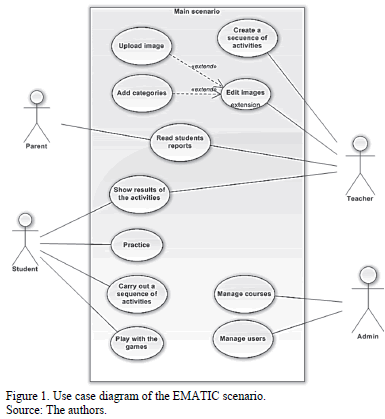
<body><![CDATA[<li><font size="2" face="Verdana, Arial, Helvetica, sans-serif">Low physical effort: the design can be used     efficiently and comfortably and with a minimum of fatigue.</font></li>       <li><font size="2" face="Verdana, Arial, Helvetica, sans-serif">Size and space for approach and use: appropriate     size and space is provided for approach, reach, manipulation and use regardless     of the user's body size, posture or mobility.</font></li>     </ul>     <p><font size="2" face="Verdana, Arial, Helvetica, sans-serif">Additionally, for the learning design, we consider   students' main difficulties in specific learning areas. Errors provide us with   information to improve the teaching-learning process in our system. Research   with children without disabilities shows a very wide range of errors in basic   mathematic operations &#91;33,34&#93;. </font></p>     <p><font size="2" face="Verdana, Arial, Helvetica, sans-serif">Furthermore, several requisites were considered when   designing the interface of our first prototype in an effort to overcome the   problems faced by DS children. These were problems such as language problems,   difficulty in the transference and consolidation of learning and fine motor   skills problems.</font></p>     <p><font size="2" face="Verdana, Arial, Helvetica, sans-serif">Technologically, the system was developed in Python   language and one can chose between MySQL, PostgreSQL and Oracle as a database   engine. The interfaces are based on HTML5, CSS3 and JavaScript. This web   platform gives access to different users of the application (students, teachers   or administrators), and allows each role to access only the granted processes   and assigned actions (<a href="#fig01">Fig. 1</a>).</font></p>     <p align="center"><font size="2" face="Verdana, Arial, Helvetica, sans-serif"><a name="fig01"></a></font><img src="/img/revistas/dyna/v82n193/v82n193a24fig01.gif"></p>     <p><font size="2" face="Verdana, Arial, Helvetica, sans-serif">Furthermore, the system has been designed with modular   software architecture. The topic that is to be taught is defined in the <i>domain module</i>. The individual   characteristics of the student and the individual knowledge about the domain   are stored in the <i>student model</i>. </font></p>     <p><font size="2" face="Verdana, Arial, Helvetica, sans-serif">EMATIC also includes a module for creating   educational activities, which allows the educational professionals to design   custom activities for a pupil or group of students (<i>authoring module</i>). Those designs may be either completely fixed, or   allow randomized variations of the activity in an adapted sequence to the   student. This module allows pedagogical experts to be able to design and   construct activities</font> <font size="2" face="Verdana, Arial, Helvetica, sans-serif">strategies (<i>tutor module</i>). These strategies may include very different   behaviors such as: free navigation through activities, fixed sequences,   conditional sequences and gamifications. Furthermore, teachers can manage   users, groups and activities through the <i>management   module</i>, and the students can complete their activities using the execution   module. Finally, results may be explored using the <i>visualization module</i>. Individual record visualizations are   especially suited to the use of students, parents or tutors and teachers. The   visualization and analysis of aggregated group results may be accessed by   teachers and education directors.</font></p>     <p><font size="2" face="Verdana, Arial, Helvetica, sans-serif"><b><i>3.1. Domain   Model's Module</i></b></font></p>     ]]></body>
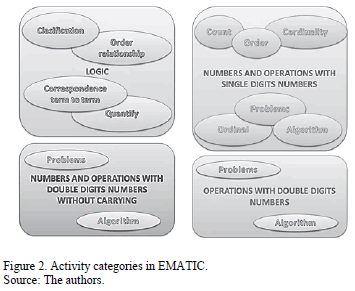
<body><![CDATA[<p><font size="2" face="Verdana, Arial, Helvetica, sans-serif">This domain model's module contains subject knowledge and   the rules and relations among its concepts. The tutor module can obtain the   knowledge to be imparted from this module.</font></p>     <p><font size="2" face="Verdana, Arial, Helvetica, sans-serif">The EMATIC domain is made up from the concepts of logic,   numbers and operations with single and double digit numbers, problems and   addition and subtraction algorithms. Relating to these concepts, there are 10   different types of activities categories (classification, relationships, mapping,   quantifiers, counting, recognition, cardinality, ordering, ordinality and   problems) &#91;35&#93; and more than 150 task templates (<a href="#fig02">Fig. 2</a>). </font></p>     <p align="center"><font size="2" face="Verdana, Arial, Helvetica, sans-serif"><a name="fig02"></a></font><img src="/img/revistas/dyna/v82n193/v82n193a24fig02.gif"></p>     <p><font size="2" face="Verdana, Arial, Helvetica, sans-serif"><b><i>3.2. Student   Model's Module</i></b></font></p>     <p><font size="2" face="Verdana, Arial, Helvetica, sans-serif">The student model stores all the information on the pupil   (knowledge, preferences, learning styles, etc.) It is composed by the student   profile (persistent information such as cognitive age or disability) and the   student's records (collected data through the interaction with the system).   EMATIC software facilitates the processing of interaction data for cognitive   reasoning tracing of the child during the undertaking of a task or set of   tasks. So, based on the domain model, the student model is responsible for the   generation of the student knowledge state.</font></p> <font size="2" face="Verdana, Arial, Helvetica, sans-serif"><b><i>3.3. Authoring Module</i></b></font>     <p><font size="2" face="Verdana, Arial, Helvetica, sans-serif">A setting up of the activities is possible in order to   limit randomness when creating personalized exercises and group exercises for   the students. The setting up of an activity depends on the particular   definition of a type of activity in the system (classification, ordering,   relations, etc.). Teachers can record a custom audio for the instruction in   order to replace the &quot;Text To Speech Agent&quot; (TTS). They can also set up the   maximum time for testing and the maximum number of attempts to pass the   activity. Moreover, teachers can choose and replace the picture's collections   to be used in the activity, selecting the most suitable for each type of   activity.</font></p>     <p><font size="2" face="Verdana, Arial, Helvetica, sans-serif"><b><i>3.4. Tutor Module</i></b></font></p>     <p><font size="2" face="Verdana, Arial, Helvetica, sans-serif">The tutor module contains knowledge about teaching   strategies in order to adapt the strategy, taking into account the student   module information (knowledge state and profile). Thus, the student model   delivers the style which best suits the user, then the tutor module selects the   most suitable pedagogical style according to the particular characteristics of   each student. Moreover, this module has the gaming mechanics of the systems.</font></p>     <p><font size="2" face="Verdana, Arial, Helvetica, sans-serif"><b><i>3.5. Management   Module</i></b></font></p>     <p><font size="2" face="Verdana, Arial, Helvetica, sans-serif">In the management module, teachers can create and manage   their students and their groups by assigning particular characteristics to   students. Teachers may be in charge of several groups, for example, they can   have different students in diverse institutions. Besides, teachers can assign   the student's group with a new activity setting.</font></p>     ]]></body>
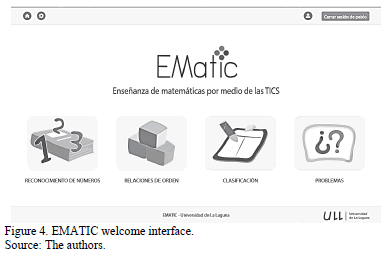
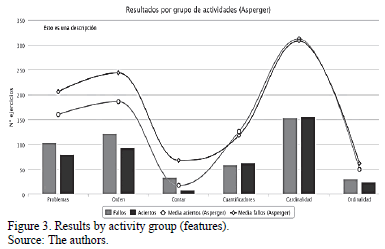
<body><![CDATA[<p><font size="2" face="Verdana, Arial, Helvetica, sans-serif"><b><i>3.6. Execution   Module</i></b></font></p>     <p><font size="2" face="Verdana, Arial, Helvetica, sans-serif">Typical systems   only record the final results of the activities and save them. After,   they analyze the interactions made during the resolution of a given task.   EMATIC stores all data on user interaction, which is recorded ¨step-by-step¨ by   the system in order to determine and infer the child's reasoning during the   task execution.</font></p>     <p><font size="2" face="Verdana, Arial, Helvetica, sans-serif">Each exercise evaluates some cognitive ability. These   exercises are randomly generated based on the collections and images loaded   into the database. When a student selects an exercise, it is generated and then   shown to the student. When the student responses, it is stored in the database   with specific data (images that show collections relate, etc.) This defines the   features that are shown to the student.</font></p>     <p><font size="2" face="Verdana, Arial, Helvetica, sans-serif">The results of the session are compiled and interpreted by   the tutor module. The result obtained is the knowledge (or not) of the subjects   taught. This also updates the goals that need to be fulfilled in the session. </font></p>     <p><font size="2" face="Verdana, Arial, Helvetica, sans-serif"><b><i>3.7. Visualization   Module</i></b></font></p>     <p><font size="2" face="Verdana, Arial, Helvetica, sans-serif">EMATIC   includes a data visualization module, which provides a specialist tool to   discover patterns in certain learning difficulties as a result of data mining.   Moreover, teachers can analyze different groups of students with the same problem (for example,   Asperger) (<a href="#fig03">Fig. 3</a>). Students can also see their results through the   visualization module, but with a specific adaptation to their profiles.</font></p>     <p align="center"><font size="2" face="Verdana, Arial, Helvetica, sans-serif"><a name="fig03"></a></font><img src="/img/revistas/dyna/v82n193/v82n193a24fig03.gif"></p>     <p>&nbsp;</p>     <p><font size="3" face="Verdana, Arial, Helvetica, sans-serif"><b>4. Evaluation</b></font></p>     <p><font size="2" face="Verdana, Arial, Helvetica, sans-serif">The EMATIC interfaces have been designed based on   usability standards for both a mobile device (such as a tablet) and a desktop   computer (<a href="#fig04">Fig. 4</a>). This allows for interaction with visual elements using mouse   and touch on the tablet. However, we consider that is necessary to endeavor to   overcome the problems faced by SEN children (such as language problems,   difficulty in with transference and consolidation of learning and final motor   skills problems). </font></p>     ]]></body>
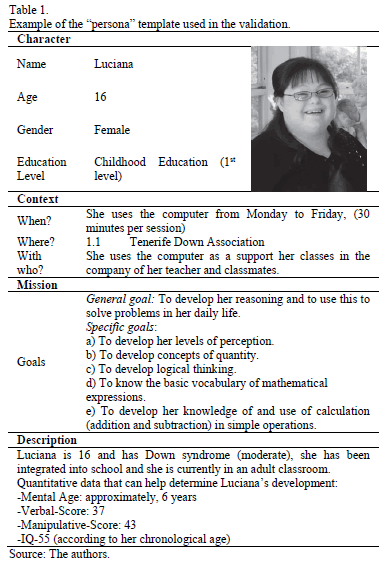
<body><![CDATA[<p align="center"><font size="2" face="Verdana, Arial, Helvetica, sans-serif"><a name="fig04"></a></font><img src="/img/revistas/dyna/v82n193/v82n193a24fig04.gif"></p>     <p><font size="2" face="Verdana, Arial, Helvetica, sans-serif">As has been stated   above, the seven principles proposed by the Centre for Universal Design at North   Carolina State University (1997) have also been considered &#91;31&#93;.</font></p>     <p><font size="2" face="Verdana, Arial, Helvetica, sans-serif">Researchers and designers' experiences are very different   to those of SEN users, which make it difficult to identify with or relate to   these users. Involving people with impairments in the design process is very   challenging, especially when these impairments affect cognitive functions or   communication. In order to achieve the set research goals, the participatory   design (PD) approach &#91;36&#93; was used. The study involved a group of experts in   mathematics, psychologists and teachers from University of La Laguna. Different   kinds of techniques </font><font size="2" face="Verdana, Arial, Helvetica, sans-serif">were conducted with experts:   persona &#91;14,15, 37&#93; (<a href="#tab01">Table 1</a>), prototype testing and interactive redesign and   usability evaluation &#91;39&#93;. </font></p>     <p align="center"><font size="2" face="Verdana, Arial, Helvetica, sans-serif"><a name="tab01"></a></font><img src="/img/revistas/dyna/v82n193/v82n193a24tab01.gif"></p>     <p><font size="2" face="Verdana, Arial, Helvetica, sans-serif">The tests were   used to complement each other. The topics for testing were adapted from the 11   usability heuristics, with there being more than one hundred items to evaluate   the user interface design (Nielsen &#91;27&#93; and Pierotti &#91;39&#93;).</font></p>     <p><font size="2" face="Verdana, Arial, Helvetica, sans-serif">We also conducted a focus group with experts, combining this   with the persona technique &#91;14, 15&#93; in order to analyze the weaknesses and   straightness of the interface, taking into consideration a user profile.</font></p>     <p>&nbsp;</p>     <p><font size="3" face="Verdana, Arial, Helvetica, sans-serif"><b>5. Results</b></font></p>     <p><font size="2" face="Verdana, Arial, Helvetica, sans-serif">The heuristics evaluated were the following: </font></p> <ol>       <li><font size="2" face="Verdana, Arial, Helvetica, sans-serif"> The visibility of system status</font></li>       ]]></body>
<body><![CDATA[<li><font size="2" face="Verdana, Arial, Helvetica, sans-serif"> Matches between systems and the real world </font></li>       <li><font size="2" face="Verdana, Arial, Helvetica, sans-serif"> User control and freedom </font></li>       <li><font size="2" face="Verdana, Arial, Helvetica, sans-serif"> Consistency and standards</font></li>       <li><font size="2" face="Verdana, Arial, Helvetica, sans-serif"> Error prevention</font></li>       <li><font size="2" face="Verdana, Arial, Helvetica, sans-serif"> Recognition rather than recall </font></li>       <li><font size="2" face="Verdana, Arial, Helvetica, sans-serif"> Flexibility and efficiency of use </font></li>       <li><font size="2" face="Verdana, Arial, Helvetica, sans-serif"> Aesthetic and minimalist design </font></li>       <li><font size="2" face="Verdana, Arial, Helvetica, sans-serif">Helping users recognize, diagnose and recover from     errors </font></li>       <li><font size="2" face="Verdana, Arial, Helvetica, sans-serif"> Help and documentation</font></li>       <li><font size="2" face="Verdana, Arial, Helvetica, sans-serif"> Skills</font></li>     ]]></body>
<body><![CDATA[</ol>     <p><font size="2" face="Verdana, Arial, Helvetica, sans-serif">Each heuristic was measured according the following   severity, numbers becoming increasingly severe (possible answers): </font></p> <ol>       <li><font size="2" face="Verdana, Arial, Helvetica, sans-serif"> No     usability problem: &quot;I don't agree that this is a usability problem&quot; </font></li>       <li><font size="2" face="Verdana, Arial, Helvetica, sans-serif"> Cosmetic problem: &quot;I think it's an esthetical usability problem&quot;</font></li>       <li><font size="2" face="Verdana, Arial, Helvetica, sans-serif"> Minor     usability problem: &quot;I think it's a low usability problem&quot; </font></li>       <li><font size="2" face="Verdana, Arial, Helvetica, sans-serif"> Major     usability problem; important to fix: &quot;I think it's a high usability problem&quot;</font></li>       <li><font size="2" face="Verdana, Arial, Helvetica, sans-serif"> Usability catastrophe; imperative to fix: &quot;I think it's a catastrophically     usability problem&quot;</font></li>     </ol>     <p><font size="2" face="Verdana, Arial, Helvetica, sans-serif">The results of heuristic evaluation are shown in <a href="#tab02">Table 2</a>. </font></p>     <p align="center"><font size="2" face="Verdana, Arial, Helvetica, sans-serif"><a name="tab02"></a>Table 2. </font></p>     ]]></body>
<body><![CDATA[<p><font size="2" face="Verdana, Arial, Helvetica, sans-serif">The system should inform users of system status, giving   appropriate feedback within a reasonable timeframe. More than half of   responders (61%) think that there is no usability problem, but other people   think that there is an esthetical problem (15%). A catastrophic usability   problem is lower than the other options (6%). </font></p>     <p><font size="2" face="Verdana, Arial, Helvetica, sans-serif">In relation to language, the system must use the language   that users are familiar with, words or phrases that are known, rather than the   terms that are used in the system, so that the user does not find it difficult   to use the system. Most responders (71%) think that there is no problem with   this usability issue.</font></p>     <p><font size="2" face="Verdana, Arial, Helvetica, sans-serif">When users choose an option from the system by mistake,   the system should have the undo and redo options to provide users with an easy   way out without them having to use extended dialogue. This is an important   aspect to improve in EMATIC, which has a 19% critical usability problem and 21%   of high usability problem.</font></p>     <p><font size="2" face="Verdana, Arial, Helvetica, sans-serif">Consistency is a fundamental design principle for usable   user interfaces. It dictates that users should follow general rules and   conventions in the system. Regarding this issue, however, the results show a   low usability problem (67%). However, a catastrophically usability problem is   moderately significant with 12%.</font></p>     <p><font size="2" face="Verdana, Arial, Helvetica, sans-serif">Error messages should be expressed in plain language,   precisely indicate the problem and be constructive. On this issue, while the   59% of experts think that this is not a usability problem, 33% of respondents   were found to have answered to have found it to be between a catastrophically   and high usability problem.</font></p>     <p><font size="2" face="Verdana, Arial, Helvetica, sans-serif">Even better than good error messages is a careful design   that prevents a problem from occurring in the first place. In this usability   heuristic we found that 63% do not think that it is a usability problem;   however, 12% think that it is high or extreme usability problem. So, a careful   design is needed t prevents problems before they occur.</font></p>     <p><font size="2" face="Verdana, Arial, Helvetica, sans-serif">The system should minimize   the amount of information that the user must remember. Instructions to use the   system should be visible or accessible to the user when required. Ematic has   made significant effort in this area, as the results show (70% of experts do   not think that it is a usability problem). </font></p>     <p><font size="2" face="Verdana, Arial, Helvetica, sans-serif">Regarding the user efficiency and flexibility heuristic,   it is important that the system allows itself to be customized. The results   show us much more needs to be done on this issue (42% claim a high and extreme   usability problem).</font></p>     <p><font size="2" face="Verdana, Arial, Helvetica, sans-serif">Design is much more than making something look pretty.   Studies have shown that designs that look good have a higher probability of   being used, and users also perceive that the system is easier to use &#91;40&#93;. The   interface should not contain information that is not relevant or is rarely   used, because each additional unit of information in a dialogue competes with   the relevant units of information and diminishes their relative visibility. For   this reason, we believe that the results obtained are positive (72% do not   think that it is a usability problem). </font></p>     <p><font size="2" face="Verdana, Arial, Helvetica, sans-serif">The help and documentation of the system has to be easy to   find, and focused on user tasks. 29% of experts think that this heuristic is a   high or extreme usability problem. Therefore it is an important issue to   improve in the next version of EMATIC.</font></p>     ]]></body>
<body><![CDATA[<p><font size="2" face="Verdana, Arial, Helvetica, sans-serif">To conclude, we analyzed the skills necessary to be able   to fully use system. It is important to remember that the following data must   be contextualized in a Down syndrome environment. Within this condition we have   found the highest usability problems (57%). At the same time, this issue is a   major challenge for the EMATIC system: to create a usable, accessible and   adaptive system for the Down syndrome profile, taking into account their   limitations and skills.</font></p>     <p><font size="2" face="Verdana, Arial, Helvetica, sans-serif">Moreover, as   result of the focus group, the weaknesses of the interface that were detected   by experts are the following:</font></p> <ul>       <li><font size="2" face="Verdana, Arial, Helvetica, sans-serif"> The     interface is not available for people with hearing or visual disabilities, and     this is a high usability problem.</font></li>       <li><font size="2" face="Verdana, Arial, Helvetica, sans-serif"> The randomness in the     creation of activities causes several problems, for example: drawings of     activities that cannot be understood or distinguished from the background, and     exercises that have no logical pictures or semantic sense. Sometimes the     interface is highly charged with objects, and on other occasions there are only     a few objects.</font></li>       <li><font size="2" face="Verdana, Arial, Helvetica, sans-serif"> There     is little accuracy when objects are being dragged and dropped in an area.</font></li>       <li><font size="2" face="Verdana, Arial, Helvetica, sans-serif"> It is     necessary to give aural feedback along with the results of exercises.</font></li>       <li><font size="2" face="Verdana, Arial, Helvetica, sans-serif"> A more     expressive virtual agent is needed.</font></li>       <li><font size="2" face="Verdana, Arial, Helvetica, sans-serif"> Sometimes     the computer energy saver interrupts the activity.</font></li>       <li><font size="2" face="Verdana, Arial, Helvetica, sans-serif"> The     tablet keyboard is complex to enter text answers (in our case, it is needed     only for login).</font></li>       <li><font size="2" face="Verdana, Arial, Helvetica, sans-serif"> Regarding     the skills needed to work with the tablet, the experts think that it could be     difficult for people with SEN to work autonomously. </font></li>       ]]></body>
<body><![CDATA[<li><font size="2" face="Verdana, Arial, Helvetica, sans-serif"> It is     easy to exit the program unintentionally.</font></li>       <li><font size="2" face="Verdana, Arial, Helvetica, sans-serif"> If the     user makes a mistake it is not corrected.</font></li>     </ul>     <p><font size="2" face="Verdana, Arial, Helvetica, sans-serif">Experts commented   on the following issues being strengths:</font></p> <ul>       <li><font size="2" face="Verdana, Arial, Helvetica, sans-serif"> It is     excellent to have specific support for tablets.</font></li>       <li><font size="2" face="Verdana, Arial, Helvetica, sans-serif"> It     could be a highly motivating tool if applied properly.</font></li>       <li><font size="2" face="Verdana, Arial, Helvetica, sans-serif"> The     advantage of the touch device is that it is a more intuitive interface for     children or people with disabilities.</font></li>       <li><font size="2" face="Verdana, Arial, Helvetica, sans-serif"> The     customization of the user interface and its adaptation to different levels and     abilities are good features of EMATIC.</font></li>     </ul>     <p><font size="2" face="Verdana, Arial, Helvetica, sans-serif">Another important   issue that experts suggested was about the menus. They should be shown through   pictures, not text-based and the access to the system should be through avatars   related to each user.</font></p>     ]]></body>
<body><![CDATA[<p>&nbsp;</p>     <p><font size="3" face="Verdana, Arial, Helvetica, sans-serif"><b>6. Conclusions</b></font></p>     <p><font size="2" face="Verdana, Arial, Helvetica, sans-serif">In this paper we presented a software development approach   based on agile human centered methodologies (SCRUM, UCD, UXD and Lean UX).   Also, we focused on the usability analysis and human factors that influence the   interface design.</font></p>     <p><font size="2" face="Verdana, Arial, Helvetica, sans-serif">Usability is an issue that is becoming increasingly   important in software development. In the current environment, in which   software systems are aimed at a special audience (SEN children) and   increasingly at experts in a management system, usability is a fundamental   attribute that dictates the success of a software application. </font></p>     <p><font size="2" face="Verdana, Arial, Helvetica, sans-serif">For this reason, it is   important to invest in usability to build the system. It is very usual to find   serious usability errors when the project is about to end, and then time may   have to be extended in order to correct such problems. Once it is known how the   user interacted with the system, and thus why the problems occurred, we can   endeavor to improve the phase.</font></p>     <p><font size="2" face="Verdana, Arial, Helvetica, sans-serif">The most important usability problems found were about   user control and freedom, user support and error recovery and skills needed to   use the application. Moreover, our best findings were related with and   esthetical, minimalist design and user language.</font></p>     <p><font size="2" face="Verdana, Arial, Helvetica, sans-serif">Currently, EMATIC is correcting the different bugs   reported that affect flexibility and efficiency, design, support, languages and   sounds, consistence, error prevention, etc. in order to meet special users and   professional's expectations who interact with it.</font></p>     <p><font size="2" face="Verdana, Arial, Helvetica, sans-serif">Future work will look at the validation of the system in   different areas of SEN children, having already improved the software.</font></p>     <p>&nbsp;</p>     <p><font size="3" face="Verdana, Arial, Helvetica, sans-serif"><b>Acknowledgments</b></font></p>     ]]></body>
<body><![CDATA[<p><font size="2" face="Verdana, Arial, Helvetica, sans-serif">We would like to thank the experts in the fields of   Didactics of Mathematics and Psychology who have participated in this study. We   are especially very grateful to the Tenerife Downs Association for their   support and collaboration with our research. </font></p>     <p>&nbsp;</p>     <p><font size="3" face="Verdana, Arial, Helvetica, sans-serif"><b>References</b></font></p>     <!-- ref --><p><font size="2" face="Verdana, Arial, Helvetica, sans-serif"><b>&#91;1&#93;</b> Cecil,   R., Clash of the titans: Agile and UCD. UXmatters &#91;Online&#93; 2006. Available at: <a href="http://www.uxmatters.com/mt/archives/2006/12/clash-of-the-titans-agile-and-ucd.php" target="_blank">http://www.uxmatters.com/mt/archives/2006/12/clash-of-the-titans-agile-and-ucd.php</a>.    &nbsp;&nbsp;&nbsp;&nbsp;&nbsp;&nbsp;&nbsp;&nbsp;[&#160;<a href="javascript:void(0);" onclick="javascript: window.open('/scielo.php?script=sci_nlinks&ref=000156&pid=S0012-7353201500050002400001&lng=','','width=640,height=500,resizable=yes,scrollbars=1,menubar=yes,');">Links</a>&#160;]<!-- end-ref --> </font></p>     <!-- ref --><p><font size="2" face="Verdana, Arial, Helvetica, sans-serif"><b>&#91;2&#93;</b> Colfelt,   A., Bringing user centered design to the agile environment boxes and arrows.   &#91;Online&#93; 2010. Available at: <a href="http://www.boxesand arrows.com/view/bringing-user" target="_blank">http://www.boxesand arrows.com/view/bringing-user</a>.    &nbsp;&nbsp;&nbsp;&nbsp;&nbsp;&nbsp;&nbsp;&nbsp;[&#160;<a href="javascript:void(0);" onclick="javascript: window.open('/scielo.php?script=sci_nlinks&ref=000158&pid=S0012-7353201500050002400002&lng=','','width=640,height=500,resizable=yes,scrollbars=1,menubar=yes,');">Links</a>&#160;]<!-- end-ref --> </font></p>     <!-- ref --><p><font size="2" face="Verdana, Arial, Helvetica, sans-serif"><b>&#91;3&#93;</b> Martin,   R.C., Agile software development: Principles, patterns and practices. Pearson   Education. 2002. ISBN 0-13-597444-5.    &nbsp;&nbsp;&nbsp;&nbsp;&nbsp;&nbsp;&nbsp;&nbsp;[&#160;<a href="javascript:void(0);" onclick="javascript: window.open('/scielo.php?script=sci_nlinks&ref=000160&pid=S0012-7353201500050002400003&lng=','','width=640,height=500,resizable=yes,scrollbars=1,menubar=yes,');">Links</a>&#160;]<!-- end-ref --></font></p>     <!-- ref --><p><font size="2" face="Verdana, Arial, Helvetica, sans-serif"><b>&#91;4&#93;</b> Memmel, T.,   Gundelsweiler, F. and Reiterer, H., Agile human-centered software engineering.   Proceedings of the 21<sup>st</sup> British HCI Group Annual Conference on   People and Computers, 1. pp. 167-175, 2007.    &nbsp;&nbsp;&nbsp;&nbsp;&nbsp;&nbsp;&nbsp;&nbsp;[&#160;<a href="javascript:void(0);" onclick="javascript: window.open('/scielo.php?script=sci_nlinks&ref=000162&pid=S0012-7353201500050002400004&lng=','','width=640,height=500,resizable=yes,scrollbars=1,menubar=yes,');">Links</a>&#160;]<!-- end-ref --></font></p>     <!-- ref --><p><font size="2" face="Verdana, Arial, Helvetica, sans-serif"><b>&#91;5&#93;</b> Gothelf,   J. and Seiden, J., Lean UX: Applying lean principles to improve user   experience. O'Reilly Media, Inc., Sebastopol, CA, 2013.    &nbsp;&nbsp;&nbsp;&nbsp;&nbsp;&nbsp;&nbsp;&nbsp;[&#160;<a href="javascript:void(0);" onclick="javascript: window.open('/scielo.php?script=sci_nlinks&ref=000164&pid=S0012-7353201500050002400005&lng=','','width=640,height=500,resizable=yes,scrollbars=1,menubar=yes,');">Links</a>&#160;]<!-- end-ref --></font></p>     <!-- ref --><p><font size="2" face="Verdana, Arial, Helvetica, sans-serif"><b>&#91;6&#93;</b> Takeuchi,   H. and Nonaka, I., The new product development game. Harvard Business Review,   1986.    &nbsp;&nbsp;&nbsp;&nbsp;&nbsp;&nbsp;&nbsp;&nbsp;[&#160;<a href="javascript:void(0);" onclick="javascript: window.open('/scielo.php?script=sci_nlinks&ref=000166&pid=S0012-7353201500050002400006&lng=','','width=640,height=500,resizable=yes,scrollbars=1,menubar=yes,');">Links</a>&#160;]<!-- end-ref --></font></p>     <!-- ref --><p><font size="2" face="Verdana, Arial, Helvetica, sans-serif"><b>&#91;7&#93;</b> Beck,   K., Extreme programming explained: Embrace change. Addison-Wesley Professional,   1999.    &nbsp;&nbsp;&nbsp;&nbsp;&nbsp;&nbsp;&nbsp;&nbsp;[&#160;<a href="javascript:void(0);" onclick="javascript: window.open('/scielo.php?script=sci_nlinks&ref=000168&pid=S0012-7353201500050002400007&lng=','','width=640,height=500,resizable=yes,scrollbars=1,menubar=yes,');">Links</a>&#160;]<!-- end-ref --></font></p>     <!-- ref --><p><font size="2" face="Verdana, Arial, Helvetica, sans-serif"><b>&#91;8&#93;</b> Neil,   C.J. and Laplante, P.A., Paying down design debt with strategic refactoring.   Computer, 39 (12), pp. 131-134, 2006. DOI: 10.1109/MC.2006.435</font>&nbsp;&nbsp;&nbsp;&nbsp;&nbsp;&nbsp;&nbsp;&nbsp;[&#160;<a href="javascript:void(0);" onclick="javascript: window.open('/scielo.php?script=sci_nlinks&ref=000170&pid=S0012-7353201500050002400008&lng=','','width=640,height=500,resizable=yes,scrollbars=1,menubar=yes,');">Links</a>&#160;]<!-- end-ref --><!-- ref --><p><font size="2" face="Verdana, Arial, Helvetica, sans-serif"><b>&#91;9&#93;</b> Smite,   D., Moe, N.B. and Gerfalk, P.R.J., Agility across time and space: Implementing   agile methods in global software projects. Springer Publishing Company, 2010. DOI: 10.1007/978-3-642-12442-6</font>&nbsp;&nbsp;&nbsp;&nbsp;&nbsp;&nbsp;&nbsp;&nbsp;[&#160;<a href="javascript:void(0);" onclick="javascript: window.open('/scielo.php?script=sci_nlinks&ref=000171&pid=S0012-7353201500050002400009&lng=','','width=640,height=500,resizable=yes,scrollbars=1,menubar=yes,');">Links</a>&#160;]<!-- end-ref --><!-- ref --><p><font size="2" face="Verdana, Arial, Helvetica, sans-serif"><b>&#91;10&#93;</b> Detweiler,   M., Managing UCD within agile projects. ACM Interactions, 14 (3), pp. 40-42,   2007. DOI: 10.1145/1242421.1242447</font>&nbsp;&nbsp;&nbsp;&nbsp;&nbsp;&nbsp;&nbsp;&nbsp;[&#160;<a href="javascript:void(0);" onclick="javascript: window.open('/scielo.php?script=sci_nlinks&ref=000172&pid=S0012-7353201500050002400010&lng=','','width=640,height=500,resizable=yes,scrollbars=1,menubar=yes,');">Links</a>&#160;]<!-- end-ref --><!-- ref --><p><font size="2" face="Verdana, Arial, Helvetica, sans-serif"><b>&#91;11&#93;</b> Armitage,   J., Are agile methods good for design?. ACM Interactions, 11 (1), pp. 14-23,   2004. DOI: 10.1145/962342.962352</font>&nbsp;&nbsp;&nbsp;&nbsp;&nbsp;&nbsp;&nbsp;&nbsp;[&#160;<a href="javascript:void(0);" onclick="javascript: window.open('/scielo.php?script=sci_nlinks&ref=000173&pid=S0012-7353201500050002400011&lng=','','width=640,height=500,resizable=yes,scrollbars=1,menubar=yes,');">Links</a>&#160;]<!-- end-ref --><!-- ref --><p><font size="2" face="Verdana, Arial, Helvetica, sans-serif"><b>&#91;12&#93;</b> Mcinerney,   P., UCD in agile projects: Dream team or odd couple?. ACM Interactions, 12 (6),   pp. 19-23, 2005. DOI: 10.1145/1096554.1096556</font>&nbsp;&nbsp;&nbsp;&nbsp;&nbsp;&nbsp;&nbsp;&nbsp;[&#160;<a href="javascript:void(0);" onclick="javascript: window.open('/scielo.php?script=sci_nlinks&ref=000174&pid=S0012-7353201500050002400012&lng=','','width=640,height=500,resizable=yes,scrollbars=1,menubar=yes,');">Links</a>&#160;]<!-- end-ref --><!-- ref --><p><font size="2" face="Verdana, Arial, Helvetica, sans-serif"><b>&#91;13&#93;</b> Sy,   D., Adapting usability investigations for agile user-centered design. Journal   of Usability Studies, 2 (3), pp 112-132, 2007.    &nbsp;&nbsp;&nbsp;&nbsp;&nbsp;&nbsp;&nbsp;&nbsp;[&#160;<a href="javascript:void(0);" onclick="javascript: window.open('/scielo.php?script=sci_nlinks&ref=000175&pid=S0012-7353201500050002400013&lng=','','width=640,height=500,resizable=yes,scrollbars=1,menubar=yes,');">Links</a>&#160;]<!-- end-ref --></font></p>     <!-- ref --><p><font size="2" face="Verdana, Arial, Helvetica, sans-serif"><b>&#91;14&#93;</b> Grudin,   J. and Pruitt, J., Personas, participatory design and product development: An   infrastructure for engagement. Proceedings of PDC, pp. 144-161, 2002.    &nbsp;&nbsp;&nbsp;&nbsp;&nbsp;&nbsp;&nbsp;&nbsp;[&#160;<a href="javascript:void(0);" onclick="javascript: window.open('/scielo.php?script=sci_nlinks&ref=000177&pid=S0012-7353201500050002400014&lng=','','width=640,height=500,resizable=yes,scrollbars=1,menubar=yes,');">Links</a>&#160;]<!-- end-ref --></font></p>     <!-- ref --><p><font size="2" face="Verdana, Arial, Helvetica, sans-serif"><b>&#91;15&#93;</b> Pruitt,   J. and Grudin, J., Personas: practice and theory. Proceedings of Conference on   Designing for User Experiences (DUX2003), ACM Press, pp 1-15, 2003. DOI: 10.1145/997078.997089</font>&nbsp;&nbsp;&nbsp;&nbsp;&nbsp;&nbsp;&nbsp;&nbsp;[&#160;<a href="javascript:void(0);" onclick="javascript: window.open('/scielo.php?script=sci_nlinks&ref=000179&pid=S0012-7353201500050002400015&lng=','','width=640,height=500,resizable=yes,scrollbars=1,menubar=yes,');">Links</a>&#160;]<!-- end-ref --><!-- ref --><p><font size="2" face="Verdana, Arial, Helvetica, sans-serif"><b>&#91;16&#93;</b> Liikkanen,   L., Kilpiö, H., Svan, L. and Hiltunen, M., Lean UX - The next generation of   user-centered agile?, Proceedings of the 8<sup>th</sup> Nordic Conference on   Human-Computer Interaction (NordiCHI '14). ACM, pp. 1095-1100, 2014.    &nbsp;&nbsp;&nbsp;&nbsp;&nbsp;&nbsp;&nbsp;&nbsp;[&#160;<a href="javascript:void(0);" onclick="javascript: window.open('/scielo.php?script=sci_nlinks&ref=000180&pid=S0012-7353201500050002400016&lng=','','width=640,height=500,resizable=yes,scrollbars=1,menubar=yes,');">Links</a>&#160;]<!-- end-ref --></font></p>     <!-- ref --><p><font size="2" face="Verdana, Arial, Helvetica, sans-serif"><b>&#91;17&#93;</b> Schwaber,   K., Agile project management with SCRUM. Microsoft Press, 2009.    &nbsp;&nbsp;&nbsp;&nbsp;&nbsp;&nbsp;&nbsp;&nbsp;[&#160;<a href="javascript:void(0);" onclick="javascript: window.open('/scielo.php?script=sci_nlinks&ref=000182&pid=S0012-7353201500050002400017&lng=','','width=640,height=500,resizable=yes,scrollbars=1,menubar=yes,');">Links</a>&#160;]<!-- end-ref --></font></p>     <!-- ref --><p><font size="2" face="Verdana, Arial, Helvetica, sans-serif"><b>&#91;18&#93;</b> Nielsen,   J., Agile development projects and usability, Nielsen Norman Group, &#91;Online&#93;   2008. &#91;date of reference February 25<sup>th</sup> of 2014&#93; Available at: <a href="http://www.useit.com/alertbox/agile-methods.html" target="_blank">http://www.useit.com/alertbox/agile-methods.html</a>.    &nbsp;&nbsp;&nbsp;&nbsp;&nbsp;&nbsp;&nbsp;&nbsp;[&#160;<a href="javascript:void(0);" onclick="javascript: window.open('/scielo.php?script=sci_nlinks&ref=000184&pid=S0012-7353201500050002400018&lng=','','width=640,height=500,resizable=yes,scrollbars=1,menubar=yes,');">Links</a>&#160;]<!-- end-ref --></font></p>     <!-- ref --><p><font size="2" face="Verdana, Arial, Helvetica, sans-serif"><b>&#91;19&#93;</b> Nielsen,   J., Agile user experience projects. Nielsen Norman Group. &#91;Online&#93; 2009. &#91;date   of reference February 25<sup>th</sup> of 2014&#93; Available at: <a href="http://www.useit.com/alertbox/agile-user-experience.html" target="_blank">http://www.useit.com/alertbox/agile-user-experience.html</a>.    &nbsp;&nbsp;&nbsp;&nbsp;&nbsp;&nbsp;&nbsp;&nbsp;[&#160;<a href="javascript:void(0);" onclick="javascript: window.open('/scielo.php?script=sci_nlinks&ref=000186&pid=S0012-7353201500050002400019&lng=','','width=640,height=500,resizable=yes,scrollbars=1,menubar=yes,');">Links</a>&#160;]<!-- end-ref --></font></p>     <!-- ref --><p><font size="2" face="Verdana, Arial, Helvetica, sans-serif"><b>&#91;20&#93;</b> Nielsen-Norman   Group. Report agile usability: Best practices for user experience on agile   development projects, Nielsen Norman Group 2<sup>nd</sup> edition. &#91;Online&#93;   2008. &#91;date of reference Feb 25<sup>th</sup> of 2014&#93; Available at: <a href="http://www.nngroup.com/reports/agile/" target="_blank">http://www.nngroup.com/reports/agile/</a>.    &nbsp;&nbsp;&nbsp;&nbsp;&nbsp;&nbsp;&nbsp;&nbsp;[&#160;<a href="javascript:void(0);" onclick="javascript: window.open('/scielo.php?script=sci_nlinks&ref=000188&pid=S0012-7353201500050002400020&lng=','','width=640,height=500,resizable=yes,scrollbars=1,menubar=yes,');">Links</a>&#160;]<!-- end-ref --></font></p>     <!-- ref --><p><font size="2" face="Verdana, Arial, Helvetica, sans-serif"><b>&#91;21&#93;</b> Garreta,   M. and Santanach, F., Open to the users' needs: Combining user-centered design,   standards and open source software. Proceedings of open ED Conference, &#91;Online&#93;   2010. &#91;date of reference Feb 25<sup>th</sup> of 2014&#93; Available at: <a href="http://openaccess.uoc.edu/webapps/o2/handle/10609/4865" target="_blank">http://openaccess.uoc.edu/webapps/o2/handle/10609/4865</a>.    &nbsp;&nbsp;&nbsp;&nbsp;&nbsp;&nbsp;&nbsp;&nbsp;[&#160;<a href="javascript:void(0);" onclick="javascript: window.open('/scielo.php?script=sci_nlinks&ref=000190&pid=S0012-7353201500050002400021&lng=','','width=640,height=500,resizable=yes,scrollbars=1,menubar=yes,');">Links</a>&#160;]<!-- end-ref --></font></p>     <!-- ref --><p><font size="2" face="Verdana, Arial, Helvetica, sans-serif"><b>&#91;22&#93;</b> ISO   13407:1999. Human-centred design processes for interactive systems. International   Organization for Standardization, Geneva, Switzerland.1999.    &nbsp;&nbsp;&nbsp;&nbsp;&nbsp;&nbsp;&nbsp;&nbsp;[&#160;<a href="javascript:void(0);" onclick="javascript: window.open('/scielo.php?script=sci_nlinks&ref=000192&pid=S0012-7353201500050002400022&lng=','','width=640,height=500,resizable=yes,scrollbars=1,menubar=yes,');">Links</a>&#160;]<!-- end-ref --></font></p>     <!-- ref --><p><font size="2" face="Verdana, Arial, Helvetica, sans-serif"><b>&#91;23&#93;</b> Abras,   C., Maloney-Krichmar, D. and Preece, J., User-centered design. Berkshire   encyclopedia of human-computer interaction. Thousand Oaks: Sage Publications,   pp. 763-767, 2004.    &nbsp;&nbsp;&nbsp;&nbsp;&nbsp;&nbsp;&nbsp;&nbsp;[&#160;<a href="javascript:void(0);" onclick="javascript: window.open('/scielo.php?script=sci_nlinks&ref=000194&pid=S0012-7353201500050002400023&lng=','','width=640,height=500,resizable=yes,scrollbars=1,menubar=yes,');">Links</a>&#160;]<!-- end-ref --></font></p>     <!-- ref --><p><font size="2" face="Verdana, Arial, Helvetica, sans-serif"><b>&#91;24&#93;</b> Roto,   V., Law, E., Vermeeren, A. and Hoonhout, J., User experience white paper.   Bringing clarity to the concept of user experience. &#91;Online&#93; 2011. &#91;date of   reference February 12<sup>th</sup> of 2014&#93; Available   at: <a href="http://www.allaboutux.org/files/UX-WhitePaper.pdf" target="_blank">http://www.allaboutux.org/files/UX-WhitePaper.pdf</a>.    &nbsp;&nbsp;&nbsp;&nbsp;&nbsp;&nbsp;&nbsp;&nbsp;[&#160;<a href="javascript:void(0);" onclick="javascript: window.open('/scielo.php?script=sci_nlinks&ref=000196&pid=S0012-7353201500050002400024&lng=','','width=640,height=500,resizable=yes,scrollbars=1,menubar=yes,');">Links</a>&#160;]<!-- end-ref --> </font></p>     <!-- ref --><p><font size="2" face="Verdana, Arial, Helvetica, sans-serif"><b>&#91;25&#93;</b> Larsen,   J.M., Evaluating user experience - how game reviewers do it. Workshop on   evaluating user experiences in games, at the 2008 Conference on Human Factors   in Computing Systems (CHI '08). 2008.    &nbsp;&nbsp;&nbsp;&nbsp;&nbsp;&nbsp;&nbsp;&nbsp;[&#160;<a href="javascript:void(0);" onclick="javascript: window.open('/scielo.php?script=sci_nlinks&ref=000198&pid=S0012-7353201500050002400025&lng=','','width=640,height=500,resizable=yes,scrollbars=1,menubar=yes,');">Links</a>&#160;]<!-- end-ref --></font></p>     <!-- ref --><p><font size="2" face="Verdana, Arial, Helvetica, sans-serif"><b>&#91;26&#93;</b> Constantine,   L. and Lockwood, L.A.D., Usage-centered engineering for web applications. IEEE   Software, 19 (2), pp. 42-50, 2002. DOI: 10.1109/52.991331</font>&nbsp;&nbsp;&nbsp;&nbsp;&nbsp;&nbsp;&nbsp;&nbsp;[&#160;<a href="javascript:void(0);" onclick="javascript: window.open('/scielo.php?script=sci_nlinks&ref=000200&pid=S0012-7353201500050002400026&lng=','','width=640,height=500,resizable=yes,scrollbars=1,menubar=yes,');">Links</a>&#160;]<!-- end-ref --><!-- ref --><p><font size="2" face="Verdana, Arial, Helvetica, sans-serif"><b>&#91;27&#93;</b> Nielsen,   J. and Mack, R.L. (Eds.), Usability inspection methods. John Wiley &amp; Sons,   New York, NY, 1994. DOI: 10.1145/259963.260531</font>&nbsp;&nbsp;&nbsp;&nbsp;&nbsp;&nbsp;&nbsp;&nbsp;[&#160;<a href="javascript:void(0);" onclick="javascript: window.open('/scielo.php?script=sci_nlinks&ref=000201&pid=S0012-7353201500050002400027&lng=','','width=640,height=500,resizable=yes,scrollbars=1,menubar=yes,');">Links</a>&#160;]<!-- end-ref --><!-- ref --><p><font size="2" face="Verdana, Arial, Helvetica, sans-serif"><b>&#91;28&#93;</b> Stephanidis   C. (Ed.) User interfaces for all - concepts, methods and tools. Lawrence   Erlbaum Associates, Mahwah, NJ. 2001.    &nbsp;&nbsp;&nbsp;&nbsp;&nbsp;&nbsp;&nbsp;&nbsp;[&#160;<a href="javascript:void(0);" onclick="javascript: window.open('/scielo.php?script=sci_nlinks&ref=000202&pid=S0012-7353201500050002400028&lng=','','width=640,height=500,resizable=yes,scrollbars=1,menubar=yes,');">Links</a>&#160;]<!-- end-ref --></font></p>     <!-- ref --><p><font size="2" face="Verdana, Arial, Helvetica, sans-serif"><b>&#91;29&#93;</b> Nielsen,   J., Alternative interfaces for accessibility. &#91;Online&#93; 2003. &#91;date of reference   February 25<sup>th</sup> of 2014&#93; Available at: <a href="http://www.useit.com/alertbox/20030407.html" target="_blank">http://www.useit.com/alertbox/20030407.html</a>.    &nbsp;&nbsp;&nbsp;&nbsp;&nbsp;&nbsp;&nbsp;&nbsp;[&#160;<a href="javascript:void(0);" onclick="javascript: window.open('/scielo.php?script=sci_nlinks&ref=000204&pid=S0012-7353201500050002400029&lng=','','width=640,height=500,resizable=yes,scrollbars=1,menubar=yes,');">Links</a>&#160;]<!-- end-ref --> </font></p>     <!-- ref --><p><font size="2" face="Verdana, Arial, Helvetica, sans-serif"><b>&#91;30&#93;</b> Lazar,   J. (Ed.), Universal usability: Designing computer interfaces for diverse user   populations. John Wiley &amp; Sons,   2007.    &nbsp;&nbsp;&nbsp;&nbsp;&nbsp;&nbsp;&nbsp;&nbsp;[&#160;<a href="javascript:void(0);" onclick="javascript: window.open('/scielo.php?script=sci_nlinks&ref=000206&pid=S0012-7353201500050002400030&lng=','','width=640,height=500,resizable=yes,scrollbars=1,menubar=yes,');">Links</a>&#160;]<!-- end-ref --></font></p>     <!-- ref --><p><font size="2" face="Verdana, Arial, Helvetica, sans-serif"><b>&#91;31&#93;</b> Center   for universal design. Guidelines for use of the principles of universal design.   &#91;Online&#93; 2002. &#91;date of reference February 25<sup>th</sup> of 2014&#93;. Available   at: <a href="http://www.ncsu.edu/www/ncsu/design/sod5/cud/about_ud/udprinciples.htm" target="_blank">http://www.ncsu.edu/www/ncsu/design/sod5/cud/about_ud/udprinciples.htm</a>.    &nbsp;&nbsp;&nbsp;&nbsp;&nbsp;&nbsp;&nbsp;&nbsp;[&#160;<a href="javascript:void(0);" onclick="javascript: window.open('/scielo.php?script=sci_nlinks&ref=000208&pid=S0012-7353201500050002400031&lng=','','width=640,height=500,resizable=yes,scrollbars=1,menubar=yes,');">Links</a>&#160;]<!-- end-ref --> </font></p>     <!-- ref --><p><font size="2" face="Verdana, Arial, Helvetica, sans-serif"><b>&#91;32&#93;</b> Roberts,   G.H., The failure strategies of third grade arithmetic's pupils. The Arithmetic   Teacher 15 (5), pp. 442-446, 1968.    &nbsp;&nbsp;&nbsp;&nbsp;&nbsp;&nbsp;&nbsp;&nbsp;[&#160;<a href="javascript:void(0);" onclick="javascript: window.open('/scielo.php?script=sci_nlinks&ref=000210&pid=S0012-7353201500050002400032&lng=','','width=640,height=500,resizable=yes,scrollbars=1,menubar=yes,');">Links</a>&#160;]<!-- end-ref --></font></p>     <!-- ref --><p><font size="2" face="Verdana, Arial, Helvetica, sans-serif"><b>&#91;33&#93;</b> Cox,   L.S., Systematic errors in the four algorithms in normal and handicapped   populations. Journal for Research in Mathematics Education, 6 (4), pp. 202-220,   1975. DOI: 10.2307/748696</font>&nbsp;&nbsp;&nbsp;&nbsp;&nbsp;&nbsp;&nbsp;&nbsp;[&#160;<a href="javascript:void(0);" onclick="javascript: window.open('/scielo.php?script=sci_nlinks&ref=000212&pid=S0012-7353201500050002400033&lng=','','width=640,height=500,resizable=yes,scrollbars=1,menubar=yes,');">Links</a>&#160;]<!-- end-ref --><!-- ref --><p><font size="2" face="Verdana, Arial, Helvetica, sans-serif"><b>&#91;34&#93;</b> Mu&ntilde;oz, V., Dise&ntilde;o e implementaci&oacute;n de   planificadores instruccionales en sistemas tutoriales inteligentes mediante el uso combinado de metodolog&iacute;as   borrosa y multiagente. PhD.   Thesis dissertation, Department of Computer Science, University of La Laguna, Spain,   2007.    &nbsp;&nbsp;&nbsp;&nbsp;&nbsp;&nbsp;&nbsp;&nbsp;[&#160;<a href="javascript:void(0);" onclick="javascript: window.open('/scielo.php?script=sci_nlinks&ref=000213&pid=S0012-7353201500050002400034&lng=','','width=640,height=500,resizable=yes,scrollbars=1,menubar=yes,');">Links</a>&#160;]<!-- end-ref --></font></p>     <!-- ref --><p><font size="2" face="Verdana, Arial, Helvetica, sans-serif"><b>&#91;35&#93;</b> Gonz&aacute;lez-Gonz&aacute;lez   C., Noda, A., Bruno, A., Moreno, L., Mu&ntilde;oz, V., Learning subtraction and   addition through digital boards: A down syndrome case. International Journal   Universal Access in the Information Society - UAIS, 29 pp. 29-44, 2013. DOI: 10.1007/s10209-013-0330-3</font>&nbsp;&nbsp;&nbsp;&nbsp;&nbsp;&nbsp;&nbsp;&nbsp;[&#160;<a href="javascript:void(0);" onclick="javascript: window.open('/scielo.php?script=sci_nlinks&ref=000215&pid=S0012-7353201500050002400035&lng=','','width=640,height=500,resizable=yes,scrollbars=1,menubar=yes,');">Links</a>&#160;]<!-- end-ref --><!-- ref --><p><font size="2" face="Verdana, Arial, Helvetica, sans-serif"><b>&#91;36&#93;</b> Muller,   M.J., Participatory design: The third space in HCI. In Jacko, J. and Sears, A.   (eds.), Handbook of HCI 2nd Edition. Mahway, NJ, USA: Erlbaum, 2007, pp. 1051-1068. DOI: 10.1201/9781410615862.ch54</font>&nbsp;&nbsp;&nbsp;&nbsp;&nbsp;&nbsp;&nbsp;&nbsp;[&#160;<a href="javascript:void(0);" onclick="javascript: window.open('/scielo.php?script=sci_nlinks&ref=000216&pid=S0012-7353201500050002400036&lng=','','width=640,height=500,resizable=yes,scrollbars=1,menubar=yes,');">Links</a>&#160;]<!-- end-ref --><!-- ref --><p><font size="2" face="Verdana, Arial, Helvetica, sans-serif"><b>&#91;37&#93;</b> Nielsen,   L., Engaging personas and narrative scenarios: A study on how user-centered   approach influenced the perception of the design process in the e-business   group at Astra Zeneca, København: Samfundslitteratur, 2004.    &nbsp;&nbsp;&nbsp;&nbsp;&nbsp;&nbsp;&nbsp;&nbsp;[&#160;<a href="javascript:void(0);" onclick="javascript: window.open('/scielo.php?script=sci_nlinks&ref=000217&pid=S0012-7353201500050002400037&lng=','','width=640,height=500,resizable=yes,scrollbars=1,menubar=yes,');">Links</a>&#160;]<!-- end-ref --></font></p>     <!-- ref --><p><font size="2" face="Verdana, Arial, Helvetica, sans-serif"><b>&#91;38&#93;</b> Dow,   S., Fortuna, J., Schwartz, D., Altringer, B., Schwartz, B. and Klemmer, S.,   Prototyping dynamics: Sharing multiple designs improves exploration, group   rapport and results. ACM Conference on Human Factors in Computing Systems   (CHI'11), pp. 2807-2816. 2011.   DOI: 10.1145/1978942.1979359</font>&nbsp;&nbsp;&nbsp;&nbsp;&nbsp;&nbsp;&nbsp;&nbsp;[&#160;<a href="javascript:void(0);" onclick="javascript: window.open('/scielo.php?script=sci_nlinks&ref=000219&pid=S0012-7353201500050002400038&lng=','','width=640,height=500,resizable=yes,scrollbars=1,menubar=yes,');">Links</a>&#160;]<!-- end-ref --><!-- ref --><p><font size="2" face="Verdana, Arial, Helvetica, sans-serif"><b>&#91;39&#93;</b> Pierotti, D.,   Heuristic evaluation, a system checklist, Xerox Corporation. &#91;Online&#93; 1995.   &#91;date of reference March 18<sup>th</sup> of 2014&#93;. Available at: <a href="http://www.stcsig.org/usability/topics/articles/he-checklist.html" target="_blank">http://www.stcsig.org/usability/topics/articles/he-checklist.html</a></font>&nbsp;&nbsp;&nbsp;&nbsp;&nbsp;&nbsp;&nbsp;&nbsp;[&#160;<a href="javascript:void(0);" onclick="javascript: window.open('/scielo.php?script=sci_nlinks&ref=000220&pid=S0012-7353201500050002400039&lng=','','width=640,height=500,resizable=yes,scrollbars=1,menubar=yes,');">Links</a>&#160;]<!-- end-ref --><!-- ref --><p><font size="2" face="Verdana, Arial, Helvetica, sans-serif"><b>&#91;40&#93;</b> Lidwell,   W., Butler, J. and Holden, K., Universal principles of design. Beverly, MA:   Rockport Publishers. 2003.    &nbsp;&nbsp;&nbsp;&nbsp;&nbsp;&nbsp;&nbsp;&nbsp;[&#160;<a href="javascript:void(0);" onclick="javascript: window.open('/scielo.php?script=sci_nlinks&ref=000221&pid=S0012-7353201500050002400040&lng=','','width=640,height=500,resizable=yes,scrollbars=1,menubar=yes,');">Links</a>&#160;]<!-- end-ref --></font></p>     ]]></body>
<body><![CDATA[<p>&nbsp;</p>     <p><font size="2" face="Verdana, Arial, Helvetica, sans-serif"><b>C.S. Gonz&aacute;lez-Gonz&aacute;lez, </b>received her PhD. in Computer Science in 2001 from the University of La   Laguna, Spain. She is an associated professor in the Computer Engineering   Department at the University of La Laguna, Spain. Her main research focus areas   are related to human computer interaction (HCI), natural and adaptive   interfaces, serious games and gamification in Education and gender in HCI.   Also, she has a great experience in e-learning best practices and LMS systems. </font></p>     <p><font size="2" face="Verdana, Arial, Helvetica, sans-serif"><b>P. Toledo-Delgado, </b>received his MSc. in Computer Science Engineering from the University of La   Laguna, Spain in 2004. He has been a PhD. student at the same university since   2004, in the Computer Engineering Department. His current research interests include Reinforcement Learning, Graph   Mining, and Workflow Induction.</font></p>     <p><font size="2" face="Verdana, Arial, Helvetica, sans-serif"><b>V. Mu&ntilde;oz-Cruz, </b>received   her MSc. in Computer Science in 2001 and her PhD. in Computer Science in 2007   from the University of La Laguna, Spain. She is a professor in the Computer   Engineering Department of the University of La Laguna, Canary Islands, Spain.   Her current research interests are decision-making, discrete event simulation,   intelligent agents, intelligent tutorial systems and computer education.</font></p>      ]]></body><back>
<ref-list>
<ref id="B1">
<label>1</label><nlm-citation citation-type="">
<person-group person-group-type="author">
<name>
<surname><![CDATA[Cecil]]></surname>
<given-names><![CDATA[R.]]></given-names>
</name>
</person-group>
<source><![CDATA[Clash of the titans: Agile and UCD]]></source>
<year>2006</year>
</nlm-citation>
</ref>
<ref id="B2">
<label>2</label><nlm-citation citation-type="">
<person-group person-group-type="author">
<name>
<surname><![CDATA[Colfelt]]></surname>
<given-names><![CDATA[A.]]></given-names>
</name>
</person-group>
<source><![CDATA[Bringing user centered design to the agile environment boxes and arrows.]]></source>
<year>2010</year>
</nlm-citation>
</ref>
<ref id="B3">
<label>3</label><nlm-citation citation-type="">
<person-group person-group-type="author">
<name>
<surname><![CDATA[Martin]]></surname>
<given-names><![CDATA[R.C.]]></given-names>
</name>
</person-group>
<source><![CDATA[Agile software development: Principles, patterns and practices]]></source>
<year>2002</year>
</nlm-citation>
</ref>
<ref id="B4">
<label>4</label><nlm-citation citation-type="confpro">
<person-group person-group-type="author">
<name>
<surname><![CDATA[Memmel]]></surname>
<given-names><![CDATA[T.]]></given-names>
</name>
<name>
<surname><![CDATA[Gundelsweiler]]></surname>
<given-names><![CDATA[F.]]></given-names>
</name>
<name>
<surname><![CDATA[Reiterer]]></surname>
<given-names><![CDATA[H.]]></given-names>
</name>
</person-group>
<article-title xml:lang="en"><![CDATA[Agile human-centered software engineering]]></article-title>
<source><![CDATA[]]></source>
<year>2007</year>
<volume>1</volume>
<conf-name><![CDATA[21st British HCI Group Annual Conference on People and Computers]]></conf-name>
<conf-loc> </conf-loc>
<page-range>167-175</page-range></nlm-citation>
</ref>
<ref id="B5">
<label>5</label><nlm-citation citation-type="book">
<person-group person-group-type="author">
<name>
<surname><![CDATA[Gothelf]]></surname>
<given-names><![CDATA[J.]]></given-names>
</name>
<name>
<surname><![CDATA[Seiden]]></surname>
<given-names><![CDATA[J.]]></given-names>
</name>
</person-group>
<source><![CDATA[Lean UX: Applying lean principles to improve user experience]]></source>
<year>2013</year>
<publisher-loc><![CDATA[Sebastopol^eCA CA]]></publisher-loc>
<publisher-name><![CDATA[O'Reilly Media, Inc.]]></publisher-name>
</nlm-citation>
</ref>
<ref id="B6">
<label>6</label><nlm-citation citation-type="book">
<person-group person-group-type="author">
<name>
<surname><![CDATA[Takeuchi]]></surname>
<given-names><![CDATA[H.]]></given-names>
</name>
<name>
<surname><![CDATA[Nonaka]]></surname>
<given-names><![CDATA[I.]]></given-names>
</name>
</person-group>
<source><![CDATA[The new product development game.]]></source>
<year>1986</year>
<publisher-name><![CDATA[Harvard Business Review]]></publisher-name>
</nlm-citation>
</ref>
<ref id="B7">
<label>7</label><nlm-citation citation-type="book">
<person-group person-group-type="author">
<name>
<surname><![CDATA[Beck]]></surname>
<given-names><![CDATA[K.]]></given-names>
</name>
</person-group>
<source><![CDATA[Extreme programming explained: Embrace change]]></source>
<year>1999</year>
<publisher-name><![CDATA[Addison-Wesley Professional]]></publisher-name>
</nlm-citation>
</ref>
<ref id="B8">
<label>8</label><nlm-citation citation-type="journal">
<person-group person-group-type="author">
<name>
<surname><![CDATA[Neil]]></surname>
<given-names><![CDATA[C.J.]]></given-names>
</name>
<name>
<surname><![CDATA[Laplante]]></surname>
<given-names><![CDATA[P.A.]]></given-names>
</name>
</person-group>
<article-title xml:lang="en"><![CDATA[Paying down design debt with strategic refactoring]]></article-title>
<source><![CDATA[Computer]]></source>
<year>2006</year>
<volume>39</volume>
<numero>12</numero>
<issue>12</issue>
<page-range>131-134</page-range></nlm-citation>
</ref>
<ref id="B9">
<label>9</label><nlm-citation citation-type="book">
<person-group person-group-type="author">
<name>
<surname><![CDATA[Smite]]></surname>
<given-names><![CDATA[D.]]></given-names>
</name>
<name>
<surname><![CDATA[Moe]]></surname>
<given-names><![CDATA[N.B.]]></given-names>
</name>
<name>
<surname><![CDATA[Gerfalk]]></surname>
<given-names><![CDATA[P.R.J.]]></given-names>
</name>
</person-group>
<source><![CDATA[Agility across time and space: Implementing agile methods in global software projects.]]></source>
<year>2010</year>
<publisher-name><![CDATA[Springer Publishing Company]]></publisher-name>
</nlm-citation>
</ref>
<ref id="B10">
<label>10</label><nlm-citation citation-type="journal">
<person-group person-group-type="author">
<name>
<surname><![CDATA[Detweiler]]></surname>
<given-names><![CDATA[M.]]></given-names>
</name>
</person-group>
<article-title xml:lang="en"><![CDATA[Managing UCD within agile projects]]></article-title>
<source><![CDATA[ACM Interactions]]></source>
<year>2007</year>
<volume>14</volume>
<numero>3</numero>
<issue>3</issue>
<page-range>40-42</page-range></nlm-citation>
</ref>
<ref id="B11">
<label>11</label><nlm-citation citation-type="journal">
<person-group person-group-type="author">
<name>
<surname><![CDATA[Armitage]]></surname>
<given-names><![CDATA[J.]]></given-names>
</name>
</person-group>
<article-title xml:lang="en"><![CDATA[Are agile methods good for design?]]></article-title>
<source><![CDATA[ACM Interactions]]></source>
<year>2004</year>
<volume>11</volume>
<numero>1</numero>
<issue>1</issue>
<page-range>14-23</page-range></nlm-citation>
</ref>
<ref id="B12">
<label>12</label><nlm-citation citation-type="journal">
<person-group person-group-type="author">
<name>
<surname><![CDATA[Mcinerney]]></surname>
<given-names><![CDATA[P.]]></given-names>
</name>
</person-group>
<article-title xml:lang="en"><![CDATA[UCD in agile projects: Dream team or odd couple?]]></article-title>
<source><![CDATA[ACM Interactions]]></source>
<year>2005</year>
<volume>12</volume>
<numero>6</numero>
<issue>6</issue>
<page-range>19-23</page-range></nlm-citation>
</ref>
<ref id="B13">
<label>13</label><nlm-citation citation-type="journal">
<person-group person-group-type="author">
<name>
<surname><![CDATA[Sy]]></surname>
<given-names><![CDATA[D.]]></given-names>
</name>
</person-group>
<article-title xml:lang="en"><![CDATA[Adapting usability investigations for agile user-centered design]]></article-title>
<source><![CDATA[Journal of Usability Studies]]></source>
<year>2007</year>
<volume>2</volume>
<numero>3</numero>
<issue>3</issue>
<page-range>112-132</page-range></nlm-citation>
</ref>
<ref id="B14">
<label>14</label><nlm-citation citation-type="confpro">
<person-group person-group-type="author">
<name>
<surname><![CDATA[Grudin]]></surname>
<given-names><![CDATA[J.]]></given-names>
</name>
<name>
<surname><![CDATA[Pruitt]]></surname>
<given-names><![CDATA[J.]]></given-names>
</name>
</person-group>
<article-title xml:lang="en"><![CDATA[Personas, participatory design and product development: An infrastructure for engagement]]></article-title>
<source><![CDATA[]]></source>
<year>2002</year>
<conf-name><![CDATA[ PDC]]></conf-name>
<conf-loc> </conf-loc>
<page-range>144-161</page-range></nlm-citation>
</ref>
<ref id="B15">
<label>15</label><nlm-citation citation-type="confpro">
<person-group person-group-type="author">
<name>
<surname><![CDATA[Pruitt]]></surname>
<given-names><![CDATA[J.]]></given-names>
</name>
<name>
<surname><![CDATA[Grudin]]></surname>
<given-names><![CDATA[J.]]></given-names>
</name>
</person-group>
<article-title xml:lang="en"><![CDATA[Personas: practice and theory]]></article-title>
<source><![CDATA[]]></source>
<year>2003</year>
<conf-name><![CDATA[ Conference on Designing for User Experiences (DUX2003)]]></conf-name>
<conf-loc> </conf-loc>
<page-range>1-15</page-range><publisher-name><![CDATA[ACM Press]]></publisher-name>
</nlm-citation>
</ref>
<ref id="B16">
<label>16</label><nlm-citation citation-type="confpro">
<person-group person-group-type="author">
<name>
<surname><![CDATA[Liikkanen]]></surname>
<given-names><![CDATA[L.]]></given-names>
</name>
<name>
<surname><![CDATA[Kilpiö]]></surname>
<given-names><![CDATA[H.]]></given-names>
</name>
<name>
<surname><![CDATA[Svan]]></surname>
<given-names><![CDATA[L.]]></given-names>
</name>
<name>
<surname><![CDATA[Hiltunen]]></surname>
<given-names><![CDATA[M.]]></given-names>
</name>
</person-group>
<article-title xml:lang="en"><![CDATA[Lean UX - The next generation of user-centered agile?]]></article-title>
<source><![CDATA[]]></source>
<year>2014</year>
<conf-name><![CDATA[8th Nordic Conference on Human-Computer Interaction (NordiCHI '14)]]></conf-name>
<conf-loc> </conf-loc>
<page-range>1095-1100</page-range><publisher-name><![CDATA[ACM]]></publisher-name>
</nlm-citation>
</ref>
<ref id="B17">
<label>17</label><nlm-citation citation-type="book">
<person-group person-group-type="author">
<name>
<surname><![CDATA[Schwaber]]></surname>
<given-names><![CDATA[K.]]></given-names>
</name>
</person-group>
<source><![CDATA[Agile project management with SCRUM]]></source>
<year>2009</year>
<publisher-name><![CDATA[Microsoft Press]]></publisher-name>
</nlm-citation>
</ref>
<ref id="B18">
<label>18</label><nlm-citation citation-type="">
<person-group person-group-type="author">
<name>
<surname><![CDATA[Nielsen]]></surname>
<given-names><![CDATA[J.]]></given-names>
</name>
</person-group>
<collab>Nielsen Norman Group</collab>
<source><![CDATA[Agile development projects and usability]]></source>
<year></year>
</nlm-citation>
</ref>
<ref id="B19">
<label>19</label><nlm-citation citation-type="">
<person-group person-group-type="author">
<name>
<surname><![CDATA[Nielsen]]></surname>
<given-names><![CDATA[J.]]></given-names>
</name>
</person-group>
<collab>Nielsen Norman Group</collab>
<source><![CDATA[Agile user experience projects]]></source>
<year>2009</year>
</nlm-citation>
</ref>
<ref id="B20">
<label>20</label><nlm-citation citation-type="">
<collab>Nielsen-Norman Group</collab>
<source><![CDATA[Report agile usability: Best practices for user experience on agile development projects]]></source>
<year>2008</year>
<edition>2nd</edition>
</nlm-citation>
</ref>
<ref id="B21">
<label>21</label><nlm-citation citation-type="confpro">
<person-group person-group-type="author">
<name>
<surname><![CDATA[Garreta]]></surname>
<given-names><![CDATA[M.]]></given-names>
</name>
<name>
<surname><![CDATA[Santanach]]></surname>
<given-names><![CDATA[F.]]></given-names>
</name>
</person-group>
<article-title xml:lang="en"><![CDATA[Open to the users' needs: Combining user-centered design, standards and open source software]]></article-title>
<source><![CDATA[]]></source>
<year>2010</year>
<conf-name><![CDATA[ open ED Conference]]></conf-name>
<conf-loc> </conf-loc>
</nlm-citation>
</ref>
<ref id="B22">
<label>22</label><nlm-citation citation-type="book">
<source><![CDATA[ISO 13407:1999: Human-centred design processes for interactive systems]]></source>
<year>1999</year>
<publisher-loc><![CDATA[Geneva ]]></publisher-loc>
<publisher-name><![CDATA[International Organization for Standardization]]></publisher-name>
</nlm-citation>
</ref>
<ref id="B23">
<label>23</label><nlm-citation citation-type="book">
<person-group person-group-type="author">
<name>
<surname><![CDATA[Abras]]></surname>
<given-names><![CDATA[C.]]></given-names>
</name>
<name>
<surname><![CDATA[Maloney-Krichmar]]></surname>
<given-names><![CDATA[D.]]></given-names>
</name>
<name>
<surname><![CDATA[Preece]]></surname>
<given-names><![CDATA[J.]]></given-names>
</name>
</person-group>
<source><![CDATA[User-centered design.]]></source>
<year>2004</year>
<page-range>763-767</page-range><publisher-loc><![CDATA[Thousand Oaks ]]></publisher-loc>
<publisher-name><![CDATA[Sage Publications]]></publisher-name>
</nlm-citation>
</ref>
<ref id="B24">
<label>24</label><nlm-citation citation-type="">
<person-group person-group-type="author">
<name>
<surname><![CDATA[Roto]]></surname>
<given-names><![CDATA[V.]]></given-names>
</name>
<name>
<surname><![CDATA[Law]]></surname>
<given-names><![CDATA[E.]]></given-names>
</name>
<name>
<surname><![CDATA[Vermeeren]]></surname>
<given-names><![CDATA[A.]]></given-names>
</name>
<name>
<surname><![CDATA[Hoonhout]]></surname>
<given-names><![CDATA[J.]]></given-names>
</name>
</person-group>
<source><![CDATA[User experience white paper.: Bringing clarity to the concept of user experience.]]></source>
<year>2011</year>
</nlm-citation>
</ref>
<ref id="B25">
<label>25</label><nlm-citation citation-type="confpro">
<person-group person-group-type="author">
<name>
<surname><![CDATA[Larsen]]></surname>
<given-names><![CDATA[J.M.]]></given-names>
</name>
</person-group>
<article-title xml:lang="en"><![CDATA[Evaluating user experience: how game reviewers do it]]></article-title>
<source><![CDATA[]]></source>
<year></year>
<conf-name><![CDATA[ Conference on Human Factors in Computing Systems (CHI '08)]]></conf-name>
<conf-date>2008</conf-date>
<conf-loc> </conf-loc>
</nlm-citation>
</ref>
<ref id="B26">
<label>26</label><nlm-citation citation-type="journal">
<person-group person-group-type="author">
<name>
<surname><![CDATA[Constantine]]></surname>
<given-names><![CDATA[L.]]></given-names>
</name>
<name>
<surname><![CDATA[Lockwood]]></surname>
<given-names><![CDATA[L.A.D.]]></given-names>
</name>
</person-group>
<article-title xml:lang="en"><![CDATA[Usage-centered engineering for web applications]]></article-title>
<source><![CDATA[IEEE Software]]></source>
<year>2002</year>
<volume>19</volume>
<numero>2</numero>
<issue>2</issue>
<page-range>42-50</page-range></nlm-citation>
</ref>
<ref id="B27">
<label>27</label><nlm-citation citation-type="book">
<person-group person-group-type="author">
<name>
<surname><![CDATA[Nielsen]]></surname>
<given-names><![CDATA[J.]]></given-names>
</name>
<name>
<surname><![CDATA[Mack]]></surname>
<given-names><![CDATA[R.L.]]></given-names>
</name>
</person-group>
<source><![CDATA[Usability inspection methods.]]></source>
<year>1994</year>
<publisher-loc><![CDATA[New York^eNY NY]]></publisher-loc>
<publisher-name><![CDATA[John Wiley & Sons]]></publisher-name>
</nlm-citation>
</ref>
<ref id="B28">
<label>28</label><nlm-citation citation-type="book">
<person-group person-group-type="author">
<name>
<surname><![CDATA[Stephanidis]]></surname>
<given-names><![CDATA[C.]]></given-names>
</name>
</person-group>
<source><![CDATA[User interfaces for all: concepts, methods and tools]]></source>
<year>2001</year>
<publisher-loc><![CDATA[Mahwah^eNJ NJ]]></publisher-loc>
<publisher-name><![CDATA[Lawrence Erlbaum Associates]]></publisher-name>
</nlm-citation>
</ref>
<ref id="B29">
<label>29</label><nlm-citation citation-type="">
<person-group person-group-type="author">
<name>
<surname><![CDATA[Nielsen]]></surname>
<given-names><![CDATA[J.]]></given-names>
</name>
</person-group>
<source><![CDATA[Alternative interfaces for accessibility]]></source>
<year>2003</year>
</nlm-citation>
</ref>
<ref id="B30">
<label>30</label><nlm-citation citation-type="book">
<person-group person-group-type="author">
<name>
<surname><![CDATA[Lazar]]></surname>
<given-names><![CDATA[J.]]></given-names>
</name>
</person-group>
<source><![CDATA[Universal usability: Designing computer interfaces for diverse user populations.]]></source>
<year>2007</year>
<publisher-name><![CDATA[John Wiley & Sons]]></publisher-name>
</nlm-citation>
</ref>
<ref id="B31">
<label>31</label><nlm-citation citation-type="">
<collab>Center for universal design</collab>
<source><![CDATA[Guidelines for use of the principles of universal design]]></source>
<year>2002</year>
</nlm-citation>
</ref>
<ref id="B32">
<label>32</label><nlm-citation citation-type="journal">
<person-group person-group-type="author">
<name>
<surname><![CDATA[Roberts]]></surname>
<given-names><![CDATA[G.H.]]></given-names>
</name>
</person-group>
<article-title xml:lang="en"><![CDATA[The failure strategies of third grade arithmetic's pupils]]></article-title>
<source><![CDATA[The Arithmetic Teacher]]></source>
<year>1968</year>
<volume>15</volume>
<numero>5</numero>
<issue>5</issue>
<page-range>442-446</page-range></nlm-citation>
</ref>
<ref id="B33">
<label>33</label><nlm-citation citation-type="journal">
<person-group person-group-type="author">
<name>
<surname><![CDATA[Cox]]></surname>
<given-names><![CDATA[L.S.]]></given-names>
</name>
</person-group>
<article-title xml:lang="en"><![CDATA[Systematic errors in the four algorithms in normal and handicapped populations]]></article-title>
<source><![CDATA[Journal for Research in Mathematics Education]]></source>
<year>1975</year>
<volume>6</volume>
<numero>4</numero>
<issue>4</issue>
<page-range>202-220</page-range></nlm-citation>
</ref>
<ref id="B34">
<label>34</label><nlm-citation citation-type="">
<person-group person-group-type="author">
<name>
<surname><![CDATA[Muñoz]]></surname>
<given-names><![CDATA[V.]]></given-names>
</name>
</person-group>
<source><![CDATA[Diseño e implementación de planificadores instruccionales en sistemas tutoriales inteligentes mediante el uso combinado de metodologías borrosa y multiagente.]]></source>
<year></year>
</nlm-citation>
</ref>
<ref id="B35">
<label>35</label><nlm-citation citation-type="journal">
<person-group person-group-type="author">
<name>
<surname><![CDATA[González-González]]></surname>
<given-names><![CDATA[C.]]></given-names>
</name>
<name>
<surname><![CDATA[Noda]]></surname>
<given-names><![CDATA[A.]]></given-names>
</name>
<name>
<surname><![CDATA[Bruno]]></surname>
<given-names><![CDATA[A.]]></given-names>
</name>
<name>
<surname><![CDATA[Moreno]]></surname>
<given-names><![CDATA[L.]]></given-names>
</name>
<name>
<surname><![CDATA[Muñoz]]></surname>
<given-names><![CDATA[V.]]></given-names>
</name>
</person-group>
<article-title xml:lang="en"><![CDATA[Learning subtraction and addition through digital boards: A down syndrome case]]></article-title>
<source><![CDATA[International Journal Universal Access in the Information Society - UAIS]]></source>
<year>2013</year>
<numero>29</numero>
<issue>29</issue>
<page-range>29-44</page-range></nlm-citation>
</ref>
<ref id="B36">
<label>36</label><nlm-citation citation-type="">
<person-group person-group-type="author">
<name>
<surname><![CDATA[Muller]]></surname>
<given-names><![CDATA[M.J.]]></given-names>
</name>
</person-group>
<article-title xml:lang="en"><![CDATA[Participatory design: The third space in HCI]]></article-title>
<person-group person-group-type="editor">
<name>
<surname><![CDATA[Jacko]]></surname>
<given-names><![CDATA[J.]]></given-names>
</name>
<name>
<surname><![CDATA[Sears]]></surname>
<given-names><![CDATA[A.]]></given-names>
</name>
</person-group>
<source><![CDATA[Handbook of HCI]]></source>
<year>2007</year>
<edition>2nd</edition>
<page-range>1051-1068</page-range><publisher-loc><![CDATA[Erlbaum ]]></publisher-loc>
</nlm-citation>
</ref>
<ref id="B37">
<label>37</label><nlm-citation citation-type="book">
<person-group person-group-type="author">
<name>
<surname><![CDATA[Nielsen]]></surname>
<given-names><![CDATA[L.]]></given-names>
</name>
</person-group>
<source><![CDATA[Engaging personas and narrative scenarios: A study on how user-centered approach influenced the perception of the design process in the e-business group at Astra Zeneca]]></source>
<year>2004</year>
<publisher-loc><![CDATA[København ]]></publisher-loc>
<publisher-name><![CDATA[Samfundslitteratur]]></publisher-name>
</nlm-citation>
</ref>
<ref id="B38">
<label>38</label><nlm-citation citation-type="confpro">
<person-group person-group-type="author">
<name>
<surname><![CDATA[Dow]]></surname>
<given-names><![CDATA[S.]]></given-names>
</name>
<name>
<surname><![CDATA[Fortuna]]></surname>
<given-names><![CDATA[J.]]></given-names>
</name>
<name>
<surname><![CDATA[Schwartz]]></surname>
<given-names><![CDATA[D.]]></given-names>
</name>
<name>
<surname><![CDATA[Altringer]]></surname>
<given-names><![CDATA[B.]]></given-names>
</name>
<name>
<surname><![CDATA[Schwartz]]></surname>
<given-names><![CDATA[B.]]></given-names>
</name>
<name>
<surname><![CDATA[Klemmer]]></surname>
<given-names><![CDATA[S.]]></given-names>
</name>
</person-group>
<article-title xml:lang="en"><![CDATA[Prototyping dynamics: Sharing multiple designs improves exploration, group rapport and results]]></article-title>
<source><![CDATA[]]></source>
<year>2011</year>
<conf-name><![CDATA[ ACM Conference on Human Factors in Computing Systems (CHI'11)]]></conf-name>
<conf-loc> </conf-loc>
<page-range>2807-2816</page-range></nlm-citation>
</ref>
<ref id="B39">
<label>39</label><nlm-citation citation-type="book">
<person-group person-group-type="author">
<name>
<surname><![CDATA[Pierotti]]></surname>
<given-names><![CDATA[D.]]></given-names>
</name>
</person-group>
<source><![CDATA[Heuristic evaluation, a system checklist]]></source>
<year>1995</year>
<publisher-name><![CDATA[Xerox Corporation.]]></publisher-name>
</nlm-citation>
</ref>
<ref id="B40">
<label>40</label><nlm-citation citation-type="book">
<person-group person-group-type="author">
<name>
<surname><![CDATA[Lidwell]]></surname>
<given-names><![CDATA[W.]]></given-names>
</name>
<name>
<surname><![CDATA[Butler]]></surname>
<given-names><![CDATA[J.]]></given-names>
</name>
<name>
<surname><![CDATA[Holden]]></surname>
<given-names><![CDATA[K.]]></given-names>
</name>
</person-group>
<source><![CDATA[Universal principles of design]]></source>
<year>2003</year>
<publisher-loc><![CDATA[Beverly^eMA MA]]></publisher-loc>
<publisher-name><![CDATA[Rockport Publishers]]></publisher-name>
</nlm-citation>
</ref>
</ref-list>
</back>
</article>