<?xml version="1.0" encoding="ISO-8859-1"?><article xmlns:mml="http://www.w3.org/1998/Math/MathML" xmlns:xlink="http://www.w3.org/1999/xlink" xmlns:xsi="http://www.w3.org/2001/XMLSchema-instance">
<front>
<journal-meta>
<journal-id>0012-7353</journal-id>
<journal-title><![CDATA[DYNA]]></journal-title>
<abbrev-journal-title><![CDATA[Dyna rev.fac.nac.minas]]></abbrev-journal-title>
<issn>0012-7353</issn>
<publisher>
<publisher-name><![CDATA[Universidad Nacional de Colombia]]></publisher-name>
</publisher>
</journal-meta>
<article-meta>
<article-id>S0012-73532015000500025</article-id>
<article-id pub-id-type="doi">10.15446/dyna.v82n193.53496</article-id>
<title-group>
<article-title xml:lang="en"><![CDATA[Prediction of take-over time in highly automated driving by two psychometric tests]]></article-title>
<article-title xml:lang="es"><![CDATA[Predicción de control sobre el tiempo en conducción altamente automatizada en dos tests psicométricos]]></article-title>
</title-group>
<contrib-group>
<contrib contrib-type="author">
<name>
<surname><![CDATA[Körber]]></surname>
<given-names><![CDATA[Moritz]]></given-names>
</name>
<xref ref-type="aff" rid="A01"/>
</contrib>
<contrib contrib-type="author">
<name>
<surname><![CDATA[Weißgerber]]></surname>
<given-names><![CDATA[Thomas]]></given-names>
</name>
<xref ref-type="aff" rid="A01"/>
</contrib>
<contrib contrib-type="author">
<name>
<surname><![CDATA[Kalb]]></surname>
<given-names><![CDATA[Luis]]></given-names>
</name>
<xref ref-type="aff" rid="A01"/>
</contrib>
<contrib contrib-type="author">
<name>
<surname><![CDATA[Blaschke]]></surname>
<given-names><![CDATA[Christoph]]></given-names>
</name>
<xref ref-type="aff" rid="A02"/>
</contrib>
<contrib contrib-type="author">
<name>
<surname><![CDATA[Farid]]></surname>
<given-names><![CDATA[Mehdi]]></given-names>
</name>
<xref ref-type="aff" rid="A02"/>
</contrib>
</contrib-group>
<aff id="A01">
<institution><![CDATA[,Technische Universität München Institute of Ergonomics ]]></institution>
<addr-line><![CDATA[ ]]></addr-line>
</aff>
<aff id="A">
<institution><![CDATA[,weissgerber@lfe.mw.tum.de  ]]></institution>
<addr-line><![CDATA[ ]]></addr-line>
</aff>
<aff id="A">
<institution><![CDATA[,kalb@lfe.mw.tum.de  ]]></institution>
<addr-line><![CDATA[ ]]></addr-line>
</aff>
<aff id="A02">
<institution><![CDATA[,BMW Group  ]]></institution>
<addr-line><![CDATA[ ]]></addr-line>
</aff>
<aff id="A">
<institution><![CDATA[,mehdi.farid@bmw.de  ]]></institution>
<addr-line><![CDATA[ ]]></addr-line>
</aff>
<pub-date pub-type="pub">
<day>00</day>
<month>10</month>
<year>2015</year>
</pub-date>
<pub-date pub-type="epub">
<day>00</day>
<month>10</month>
<year>2015</year>
</pub-date>
<volume>82</volume>
<numero>193</numero>
<fpage>195</fpage>
<lpage>201</lpage>
<copyright-statement/>
<copyright-year/>
<self-uri xlink:href="http://www.scielo.org.co/scielo.php?script=sci_arttext&amp;pid=S0012-73532015000500025&amp;lng=en&amp;nrm=iso"></self-uri><self-uri xlink:href="http://www.scielo.org.co/scielo.php?script=sci_abstract&amp;pid=S0012-73532015000500025&amp;lng=en&amp;nrm=iso"></self-uri><self-uri xlink:href="http://www.scielo.org.co/scielo.php?script=sci_pdf&amp;pid=S0012-73532015000500025&amp;lng=en&amp;nrm=iso"></self-uri><abstract abstract-type="short" xml:lang="en"><p><![CDATA[In this study, we investigated if the driver's ability to take over vehicle control when being engaged in a secondary task (Surrogate Reference Task) can be predicted by a subject's multitasking ability and reaction time. 23 participants performed a multitasking test and a simple response task and then drove for about 38 min highly automated on a highway and encountered five take-over situations. Data analysis revealed significant correlations between the multitasking performance and take-over time as well as gaze distributions for Situations 1 and 2, even when reaction time was controlled. This correlation diminished beginning with Situation 3, but a stable difference between the worst multitaskers and the best multitaskers persisted. Reaction time was not a significant predictor in any situation. The results can be seen as evidence for stable individual differences in dual task situations regarding automated driving, but they also highlight effects associated with the experience of a take-over situation.]]></p></abstract>
<abstract abstract-type="short" xml:lang="es"><p><![CDATA[En este estudio se investigó la capacidad del conductor para tomar el control del vehículo, en una tarea secundaria puede predecirse por la habilidad multitarea del sujeto y la reacción inmediata. Participaron 23 personas ejecutando una prueba de tareas múltiples y una de simple respuesta , conduciendo durante 38 min de forma altamente automatizada, encontrándose cinco situaciones de toma de posesión. Los datos revelaron una correlación significativa entre el rendimiento multitarea y la toma del tiempo, así como la distribución de la situación 1 y 2, aunque el tiempo de reacción se controló. Esta relación disminuye comenzando con la situación 3, persistiendo una diferencia estable en la toma en el tiempo entre los peores y los mejores. El tiempo de reacción no fue un predictor significativo. Los resultados pueden ser vistos como evidencia de las diferencias individuales estables en situaciones de doble tarea respecto a la conducción automática.]]></p></abstract>
<kwd-group>
<kwd lng="en"><![CDATA[Automated driving]]></kwd>
<kwd lng="en"><![CDATA[out of the loop]]></kwd>
<kwd lng="en"><![CDATA[dual task]]></kwd>
<kwd lng="en"><![CDATA[multitasking]]></kwd>
<kwd lng="en"><![CDATA[reaction time]]></kwd>
<kwd lng="en"><![CDATA[take over time]]></kwd>
<kwd lng="es"><![CDATA[Conducción automática]]></kwd>
<kwd lng="es"><![CDATA[tareas duales]]></kwd>
<kwd lng="es"><![CDATA[multitarea]]></kwd>
<kwd lng="es"><![CDATA[tiempo de reacción]]></kwd>
<kwd lng="es"><![CDATA[toma de tiempo]]></kwd>
</kwd-group>
</article-meta>
</front><body><![CDATA[ <p><font size="1" face="Verdana, Arial, Helvetica, sans-serif"><b>DOI:</b> <a href="http://dx.doi.org/10.15446/dyna.v82n193.53496" target="_blank">http://dx.doi.org/10.15446/dyna.v82n193.53496</a></font></p>     <p align="center"><font size="4" face="Verdana, Arial, Helvetica, sans-serif"><b>Prediction of take-over time in highly automated   driving by two psychometric tests</b></font></p>     <p align="center"><i><b><font size="3" face="Verdana, Arial, Helvetica, sans-serif">Predicci&oacute;n   de control sobre el tiempo en conducci&oacute;n altamente automatizada en dos tests   psicom&eacute;tricos</font></b></i></p>     <p align="center">&nbsp;</p>     <p align="center"><b><font size="2" face="Verdana, Arial, Helvetica, sans-serif">Moritz Körber <i><sup>a</sup></i>,   Thomas Weißgerber <i><sup>a</sup></i>, Luis   Kalb <i><sup>a</sup></i>, Christoph Blaschke <i><sup>b </sup></i>&amp; Mehdi Farid <i><sup>b</sup></i></font></b></p>     <p align="center">&nbsp;</p>     <p align="center"><font size="2" face="Verdana, Arial, Helvetica, sans-serif"><sup><i>a </i></sup><i>Institute of Ergonomics, Technische Universität   München, Garching, Germany. {<a href="mailto:koerber@lfe.mw.tum.de">koerber</a>, <a href="mailto:weissgerber@lfe.mw.tum.de">weissgerber</a>, <a href="mailto:kalb@lfe.mw.tum.de">kalb</a>}@lfe.mw.tum.de    <br>   <sup>b </sup>BMW Group {<a href="mailto:christoph.blaschke@bmw.de">christoph.blaschke</a>, <a href="mailto:mehdi.farid@bmw.de">mehdi.farid</a>}@bmw.de</i></font></p>     <p align="center">&nbsp;</p>     <p align="center"><font size="2" face="Verdana, Arial, Helvetica, sans-serif"><b>Received: February 18<sup>th</sup>, 2015. Received in   revised form: March 16<sup>th</sup>, 2015. Accepted: September 29<sup>th</sup>,   2015</b></font></p>     ]]></body>
<body><![CDATA[<p align="center">&nbsp;</p>     <p align="center"><font size="1" face="Verdana, Arial, Helvetica, sans-seriff"><b>This work is licensed under a</b> <a rel="license" href="http://creativecommons.org/licenses/by-nc-nd/4.0/">Creative Commons Attribution-NonCommercial-NoDerivatives 4.0 International License</a>.</font><br />   <a rel="license" href="http://creativecommons.org/licenses/by-nc-nd/4.0/"><img style="border-width:0" src="https://i.creativecommons.org/l/by-nc-nd/4.0/88x31.png" /></a></p> <hr>     <p><font size="2" face="Verdana, Arial, Helvetica, sans-serif"><b>Abstract    <br>   </b></font><font size="2" face="Verdana, Arial, Helvetica, sans-serif">In this study, we investigated if the driver's ability to   take over vehicle control when being engaged in a secondary task (Surrogate   Reference Task) can be predicted by a subject's multitasking ability and   reaction time. 23 participants performed a multitasking test and a simple   response task and then drove for about 38 min highly automated on a   highway and encountered five take-over situations. Data analysis revealed   significant correlations between the multitasking performance and take-over   time as well as gaze distributions for Situations 1 and 2, even when reaction   time was controlled. This correlation diminished beginning with Situation 3,   but a stable difference between the worst multitaskers and the best   multitaskers persisted. Reaction time was not a significant predictor in any   situation. The results can be seen as evidence for stable individual   differences in dual task situations regarding automated driving, but they also   highlight effects associated with the experience of a take-over situation.</font></p>     <p><font size="2" face="Verdana, Arial, Helvetica, sans-serif"><i>Keywords:</i> Automated driving; out of the loop; dual task; multitasking; reaction time;   take over time.</font></p>     <p><font size="2" face="Verdana, Arial, Helvetica, sans-serif"><b>Resumen    <br>   </b></font><font size="2" face="Verdana, Arial, Helvetica, sans-serif">En este estudio se investig&oacute; la capacidad del   conductor para tomar el control del veh&iacute;culo, en una tarea secundaria puede   predecirse por la habilidad multitarea del sujeto y la reacci&oacute;n inmediata.   Participaron 23 personas ejecutando una prueba de tareas m&uacute;ltiples y una de   simple respuesta , conduciendo durante 38 min de forma altamente automatizada,   encontr&aacute;ndose cinco situaciones de toma de posesi&oacute;n. Los datos revelaron una correlaci&oacute;n   significativa entre el rendimiento multitarea y la toma del tiempo, as&iacute; como la distribuci&oacute;n de la   situaci&oacute;n 1 y 2, aunque el tiempo de reacci&oacute;n se control&oacute;. Esta relaci&oacute;n   disminuye comenzando con la situaci&oacute;n 3, persistiendo una diferencia estable en   la toma en el tiempo entre los peores y los mejores. El tiempo de reacci&oacute;n no   fue un predictor significativo. Los resultados pueden ser vistos como evidencia   de las diferencias individuales estables en situaciones de doble tarea respecto   a la conducci&oacute;n autom&aacute;tica.</font></p>     <p><font size="2" face="Verdana, Arial, Helvetica, sans-serif"><i>Palabras clave</i>: Conducci&oacute;n autom&aacute;tica,   tareas duales, multitarea, tiempo de reacci&oacute;n, toma de tiempo.</font></p> <hr>     <p>&nbsp;</p>     <p><font size="3" face="Verdana, Arial, Helvetica, sans-serif"><b>1. Introduction</b></font></p>     ]]></body>
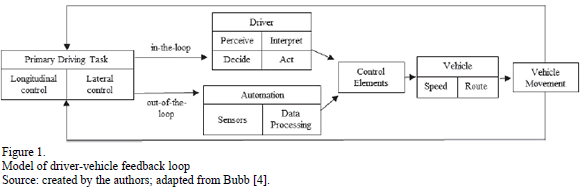
<body><![CDATA[<p><font size="2" face="Verdana, Arial, Helvetica, sans-serif"><b><i>1.1. Automation   Effects in Vehicle Control</i></b></font></p>     <p><font size="2" face="Verdana, Arial, Helvetica, sans-serif">Technological progress in advanced driver assistance   systems (ADAS; &#91;9&#93;) is currently initiating a shift   in vehicle control from manual driving to automated driving since current   sensory technology and data processing now provide the ability to allow   longitudinal control as well as lateral control be carried out by an automation &#91;13&#93;. In this case, the driver is   completely removed from the task of driving in such a way that, in contrast to   manual driving, a vehicle automation system fully operates the vehicle. This   change in vehicle control is accompanied by a change in the driver's tasks and the   resulting task demands. Firstly, in case of partial automation (&#91;11&#93;; level 2 in &#91;27&#93;), the driver has to constantly   monitor the automation , i.e. the active role of driving is replaced with a   passive role as a monitor. Secondly, if a system limit or failure occurs, the   driver has to switch from passive automated control to manually steering the   vehicle. Thirdly, the   automation provides the driver with the ability to engage in   non-driving-related activities since vehicle control is carried out by the   automation. As a result, the driver now has to switch between two tasks if he   needs to regain control of the vehicle. The goals of introducing vehicle automation   are to reduce the driver's workload &#91;34&#93; and to increase traffic safety &#91;22,29&#93; and comfort &#91;35&#93;. Since possible problems in   the interaction between human and automation have already been found in other fields,   such as aviation &#91;28,39&#93;, it is necessary to review   not only the technological but also the human aspect of safety. Issues   associated with human-automation interaction are subsumed under the term <i>automation effect</i>. According our   definition, this is: </font></p>     <blockquote>       <p><font size="2" face="Verdana, Arial, Helvetica, sans-serif"><i>an effect that is caused by the difference     in demands and tasks of the operator between automation and manual operation     and is detrimental to the operator's capability to perform.</i></font></p> </blockquote>     <p><font size="2" face="Verdana, Arial, Helvetica, sans-serif"><b><i>1.2. The Out-of-the-loop state as a Consequence of Automated   Vehicle Control</i></b></font></p>     <p><font size="2" face="Verdana, Arial, Helvetica, sans-serif">Vehicle control can be seen as an interaction between   human, machine and environment &#91;21&#93; and, therefore, the paradigm   of a feedback loop of a human-machine system is applicable &#91;3,33&#93;. The driving task represents   the input parameter and the set point is represented by the target speed and   route. Vehicle movement is the resultant output parameter. The driver acts as a   controller of the loop in order to minimize the discrepancy between actual and   target speed or route. To successfully undertake this controller task, the   driver has to continuously observe the environment, traffic and his own vehicle   movement. This loop is shown in <a href="#fig01">Fig. 1</a>.</font></p>     <p align="center"><font size="2" face="Verdana, Arial, Helvetica, sans-serif"><a name="fig01"></a></font><img src="/img/revistas/dyna/v82n193/v82n193a25fig01.gif"></p>     <p><font size="2" face="Verdana, Arial, Helvetica, sans-serif">In case of an automated drive, the vehicle automation   takes over the task of the controller so that the driver is taken out of the   (feedback) loop. Negative consequences of this state are subsumed under the term <i>out-of-the-loop </i>&#91;8&#93; state. We define <i>out-of-the-loop</i> as: </font></p>     <p><font size="2" face="Verdana, Arial, Helvetica, sans-serif"><i>a driver state of readiness in which the   driver is not able to immediately intervene in the feedback loop comprised of   controller and vehicle. In this state, the driver does not have up-to-date   knowledge of the parameters that are relevant for the controlling task, e.g.   his own speed, position, or a headway vehicle. He is also not able to predict   the situation insofar as to create a time window for himself that is long   enough to react to events in a manner that is safe for road traffic. </i></font></p>     <p><font size="2" face="Verdana, Arial, Helvetica, sans-serif">The state is not binary   but a continuous dimension with in-the-loop and out-of-the-loop as poles.   Therefore, drivers can be out-of-the-loop to varied extents. The consequences   of this state are longer reaction times &#91;24,36&#93;, omission of a reaction &#91;7&#93;, or errors in information collection &#91;2&#93;. A high   out-of-the-loop state can be reached as a result of different causes, but   increased engagement in a secondary activity as a behavioral adaption to   automation is the automation effect with the strongest link to it. Contrary to   manual driving, where the driver's attention on the road is constantly   required, automated driving allows the driver to engage in other activities,   such as reading the newspaper or playing a video game. Marras &#91;23&#93; considers boredom that arises during a drive to be   a consequence of not undertaking the driving task, which could lead to   increased engagement in secondary activities. Accordingly, Carsten and   Colleagues &#91;6&#93; found that the engagement in a secondary activity   increases as the level of automation rises. As a consequence, the driver   allocates at least a part of his attention to a non-driving-related task and no   longer completes the aforementioned task of updating the relevant situation   parameters and therefore reaches, to a certain degree, the out-of-the-loop   state.</font></p>     ]]></body>
<body><![CDATA[<p><font size="2" face="Verdana, Arial, Helvetica, sans-serif"><b><i>1.3. Evidence for   Individual Differences </i></b></font></p>     <p><font size="2" face="Verdana, Arial, Helvetica, sans-serif">In their literature review, Körber and Bengler &#91;19&#93; point out that potential   inter-individual differences could exist in automation effects and imply that   they should be taken into account in sampling and should be investigated in   empirical studies. In order to keep the out-of-the-loop-state low, the driver   has to have the ability to constantly update the relevant parameters for   driving safety (e.g. road, other traffic, his own movement), while being   engaged in a secondary task at the same time. This ability can be seen as an application   of the construct <i>multitasking ability</i>:   the ability to work on two tasks at the same time. Previous research has   revealed evidence for stable individual differences in multitasking: Bühner and   colleagues &#91;5&#93; found that working memory   performance was the best predictor of multitasking, ahead of reasoning and   attention. Accordingly, Morgan and colleagues &#91;25&#93; also found working memory and   scholastic aptitude to be significant predictors of multitasking in a flight   simulation. Working memory load also induces an attentional blindness &#91;10&#93; and could therefore be   detrimental in terms of detecting hazards in traffic while driving. Kahneman,   Ben-Ishai, and Lotan &#91;17&#93; were able to link the ability   to relocate attention with a driver's accident history as lower performance was   associated with higher accident frequency. Alzahabi and </font><font size="2" face="Verdana, Arial, Helvetica, sans-serif">Becker &#91;1&#93; split their participants into light and heavy   multitaskers based on their frequency of engaging in two media activities at   the same time. Although no difference was found with regard to working on two   tasks simultaneously, heavy multitaskers were more capable of switching between   two tasks. Beyond this, Watson and Strayer &#91;38&#93; found no performance decrement in a difficult   dual task setting for 2.5% of their participants, who they named <i>supertaskers</i>. This evidence suggests   that drivers vary in their multitasking abilities and thus differ in their   potential to reach a critical out-of-the-loop state by engaging in a secondary   task. Since the out-of-the-loop state lead to longer reaction times, we   therefore expect that the ability to multitask is directly related to the time   needed to take over an automated vehicle</font></p>     <blockquote>       <p><font size="2" face="Verdana, Arial, Helvetica, sans-serif">H1: The     performance in a multitasking test is negatively correlated to take-over time. </font></p> </blockquote>     <p><font size="2" face="Verdana, Arial, Helvetica, sans-serif">In their work, Körber   and Bengler &#91;19&#93; list the <i>individual   reaction time</i> as another factor influencing take-over time. This seems   intuitive as, since even if the driving task is carried out by the vehicle   automation, the driver is required to quickly take back control as a response   to a take-over request (TOR; e.g. an earcon) by the vehicle if the automation   reaches a system limit or fails. We therefore predict the following   relationship:</font></p>     <blockquote>       <p><font size="2" face="Verdana, Arial, Helvetica, sans-serif">H2: The     individual reaction time is positively correlated to take-over time.</font></p> </blockquote>     <p><font size="2" face="Verdana, Arial, Helvetica, sans-serif">Since we expect two different mechanisms in relationship to   take over time, we assume that both multitasking and individual reaction times   have independent unique influences on it. Therefore, we predict the following   relationship:</font></p>     <blockquote>       <p><font size="2" face="Verdana, Arial, Helvetica, sans-serif">H3: The     performance in a multitasking test and the individual reaction time are in an     independent relationship with take-over time. </font></p> </blockquote>     ]]></body>
<body><![CDATA[<p>&nbsp;</p>     <p><font size="3" face="Verdana, Arial, Helvetica, sans-serif"><b>2. Method</b></font></p>     <p><font size="2" face="Verdana, Arial, Helvetica, sans-serif"><b><i>2.1. Sample</i></b></font></p>     <p><font size="2" face="Verdana, Arial, Helvetica, sans-serif">Originally, 30   participants were recruited through a written announcement. Due to data logging   problems, 7 participants had to be excluded, leaving the sample size for data   analysis at <i>n </i>= 23, comprised of 13   (56.5 %) males and 10 (43.5 %) females. The mean age was <i>M </i>= 34.7 (<i>SD</i> = 13.27), with a range of 21-59 years. Of all participants,   11 (47.83 %) were students, 3 (13.04 %) were research assistants and   9 (39.13 %) were employed. All participants had held a driving license for   a minimum of 4 years, with a mean of <i>M</i> = 16.70 years (<i>SD </i>= 12.51). The   subjects reported to have driven <i>M</i> =   20304.34 km (<i>SD </i>= 21274.04) over   the last year. They rated their experience with driver assistance systems on a   5-point Likert-scale with a mean of <i>M</i> = 3.35 (<i>SD </i>= 0.93). Participation was   rewarded with 20 euros.</font></p>     <p><font size="2" face="Verdana, Arial, Helvetica, sans-serif"><b><i>2.2. Measures</i></b></font></p>     <p><font size="2" face="Verdana, Arial, Helvetica, sans-serif"><b>2.2.1 Take over time (TOT)</b></font></p>     <p><font size="2" face="Verdana, Arial, Helvetica, sans-serif">The dependent variable of the experimental design is the   take over time (TOT): the point in time a subject consciously took over   control, i.e. either braked or started to steer. This time point is indicated   relative to the TOR and, as such, represents the time span before or after the TOR signal. A subject with   a TOT of 0 ms has, therefore, taken over exactly at the same moment as the   TOR was emitted.</font></p>     <p><font size="2" face="Verdana, Arial, Helvetica, sans-serif"><b>2.2.1. Multitasking   Test (MT)</b></font></p>     <p><font size="2" face="Verdana, Arial, Helvetica, sans-serif">The multitasking test was conducted on two separate   monitors, on the left a Fujitsu Siemens P17-1 (screen size: 17&quot;) and on the   right a Samsung Syncmaster 245B (screen size: 24&quot;). The two monitors were   placed on a table at a distance of 60 cm (frame to frame). The subjects sat in seats   about 40 cm in front of the monitors, which were set at an angle of 45° to the   subject who was facing straight ahead. On the left monitor, the subjects had to   perform a reaction time task that is a modified version of the PEBL Perceptual   Vigilance Task &#91;18, 26&#93;: A white fixation cross   appeared for 400 ms in the center of the screen on a black background.   Next, a red dot appeared at random intervals from the set &#91;4, 5, …, 8&#93; s.   Subjects had to respond by pressing the space bar as quickly as possible. Upon   pressing the space bar, the dot disappeared and a new trial started. </font></p>     <p><font size="2" face="Verdana, Arial, Helvetica, sans-serif">On the right screen, a version of the PEBL Visual Search   Task &#91;37&#93;was used. Subjects had to   search for the letter X, which was presented next to a random selection of 10,   20 or 30 distractor letters (&quot;U&quot;, &quot;D&quot;, &quot;G&quot;, &quot;C&quot;, &quot;Q&quot;). All letters were written   in white color, the background was black. If the subject found the letter, he   had to respond with a left click on the mouse. All of the letters shown turned   into white circles and participants had to left click on the spot where the   target was previously displayed. The resultant measure was the sum of both the   reaction time of the left and the right test. Participants had to work at both   tasks at the same time for 3 min. The dependent variable was the combined   reaction time of both tasks.</font></p>     ]]></body>
<body><![CDATA[<p><font size="2" face="Verdana, Arial, Helvetica, sans-serif"><b>2.2.2.  Reaction   Time Test (SRT)</b></font></p>     <p><font size="2" face="Verdana, Arial, Helvetica, sans-serif">We used a modified version of the PEBL Simple Response   Time (SRT) &#91;30&#93; to measure the individual   reaction time. For this task, the Fujitsu Siemens P17-1 monitor was used again.   Subjects were presented with a black letter &quot;X&quot; on a grey background at random   inter-stimulus intervals from the set &#91;500, 750, 1000, …, 2500&#93; ms. The   required response was to press the &quot;X&quot; key on the keyboard as quickly as   possible. Each key stroke started a new   trial. Reaction times shorter than 150 ms and longer than 3000 ms   were excluded from the analysis. The test was run for 75 trials.</font></p>     <p><font size="2" face="Verdana, Arial, Helvetica, sans-serif"><b>2.2.3. The Secondary Task: Surrogate Reference Task (SuRT)</b></font></p>     <p><font size="2" face="Verdana, Arial, Helvetica, sans-serif">Driver distraction is often caused by texting with a cell   phone, using a navigation system or a media system, all of which can all be   subsumed under the &quot;visual-manual&quot; category &#91;15&#93;. To simulate visual-manual   distraction we used the <i>Surrogate   Reference Task </i>(SuRT; a detailed description can be found in &#91;16&#93;). Subjects had to solve this   task in the <i>hard </i>mode. The task was   implemented on a Lenovo ThinkVision LT1421 (screen size: 14&quot;) placed atop of   the central information display of the mockup. The subjects input their   responses by a special keyboard that only contained the cursor keys. The task   is easily interruptible and requires the subject to switch their visual focus   between road/environment and the task. In order to motivate the participants to   engage in the SuRT, they were told that each solved task would be rewarded with   10 cents, whereas their rewards would be halved if they collide with an   obstacle.</font></p>     <p><font size="2" face="Verdana, Arial, Helvetica, sans-serif"><b>2.2.4. Eye Tracking</b></font></p>     <p><font size="2" face="Verdana, Arial, Helvetica, sans-serif">We recorded each participant's eye movements using the eye   tracking system <i>Dikablis</i>from   Ergoneers GmbH. We set up two areas of interest: one area of interest was the   screen of the secondary task, to be referred to as <i>SuRT</i>. The other area of interest was the road and the surrounding   environment, to be referred to as <i>road/environment</i>.   The analyzed parameter was the glance location probability.</font></p>     <p><font size="2" face="Verdana, Arial, Helvetica, sans-serif"><b>2.2.5. Driving   Simulation Scenario</b></font></p>     <p><font size="2" face="Verdana, Arial, Helvetica, sans-serif">The study was conducted in a static driving simulator that   provided a front field view of approximately 180° and three additional screens   for the rear mirrors. The participants drove highly automated, i.e.   longitudinal as well as lateral control was carried out by the vehicle   automation for about 38 min at a speed of 80 km/h in the middle lane   of a six lane highway. The automation could be switched on by pressing a button   and off, by steering, or by using the gas pedal or brake. The subject's vehicle   was surrounded by 12 other road users driving at varying distances between 40-125 m.   Five situations were set up in the simulator track where the participants were   requested to take back vehicle control when hearing an acoustic signal. The   reasons for take-over situations were obstacles in the middle lane, e.g. three   rear-end collision accidents and two cars that had broken down. The view of the   obstacles was obstructed by two headway vehicles until the time to collision   (TTC) was 10 s. At a TTC of 3 s (66.67 m), the automation   signaled that a system limit is reached and that the subject has to take over   control. The appropriate reaction in this situation is to slow the vehicle down   until two vehicles driving on the left and right lane respectively have passed   the subject's vehicle and then to change lanes in order to pass the obstacle.   Driving time between the situations was approximately 5 min. The subjects   were requested to turn on the automation again and to return to the middle lane   after each situation.</font></p>     <p><font size="2" face="Verdana, Arial, Helvetica, sans-serif"><b><i>2.3. Procedure</i></b></font></p>     <p><font size="2" face="Verdana, Arial, Helvetica, sans-serif">After being welcomed by the experimenter, the participants   filled out a demographic questionnaire. Next, the subjects were introduced to   the SRT and could complete trials until they felt comfortable starting the   task. Then, they performed the SRT. Following this, they were introduced to the   multitasking test. They could try out both tasks separately until experimenter   and subject felt confident in starting the test, at which point the   multitasking test was run. Participants then took a seat in the driving simulator   and performed an introductory drive that consisted of manual driving, driving </font><font size="2" face="Verdana, Arial, Helvetica, sans-serif">with high automation and a take-over   situation. After that, subjects could practice the SuRT until they felt   comfortable performing it during a drive. The experimental drive then started.   The introduction to the experimental drive stated that vehicle control is   carried out by the automation if activated, but the responsibility for safe   driving still lies with the driver. After the experimental drive was completed,   the subjects received their monetary compensation.</font></p>     ]]></body>
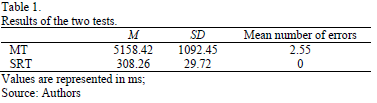
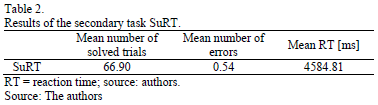
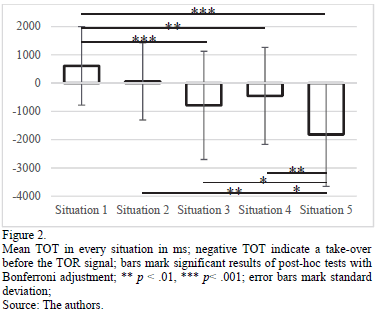
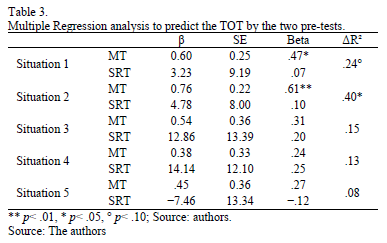
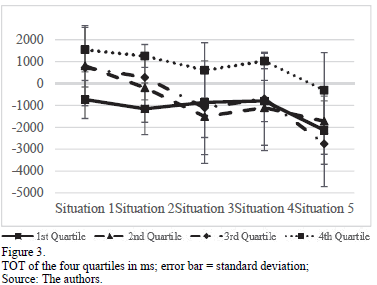
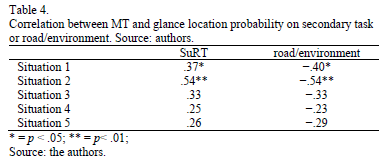
<body><![CDATA[<p>&nbsp;</p>     <p><font size="3" face="Verdana, Arial, Helvetica, sans-serif"><b>3. Results</b></font></p>     <p><font size="2" face="Verdana, Arial, Helvetica, sans-serif">For   all statistical tests, a significance level of <font face="Symbol">a</font> = .05 was set. <a href="#tab01">Table 1</a> shows the results of the multitasking test (MT) and the SRT. To determine the   performance in the tests, the mean reaction time was calculated. <a href="#tab02">Table 2</a> shows   the results for the secondary task SuRT. We analyzed the mean number of solved   trials, the mean number of errors made and the mean processing time for each   trial. <a href="#fig02">Fig. 2</a> shows the mean TOT in Situations 1-5. There were significant   differences between the means of the situations (<i>F</i>(4, 88) = 17.15, <i>p</i>&lt;   .001, <font face="Symbol">h</font><sub>p</sub>² = .44), and the means decreased in a linear manner (<i>F</i>(1, 22) = 36.83, <i>p</i>&lt; .001, <font face="Symbol">h</font><sub>p</sub>² = .63). We further   investigated the significant differences in means by post-hoc tests with   adjustment of the significance level following the Bonferroni method.   Significant post-hoc tests are also marked in </font><font size="2" face="Verdana, Arial, Helvetica, sans-serif"><a href="#fig02">Fig. 2</a>. To   test our hypothesis of the unique influence of MT and SRT on the TOT, we   conducted a multiple linear regression using the &quot;Enter&quot; method to include   predictors. Results of this regression analysis are presented in <a href="#tab03">Table 3</a>. We   found significant regression coefficients for the MT in Situation 1 and   Situation 2, but not in other Situations. The SRT was not in a significant   relationship with the TOT in any situation. Thus, hypothesis H1 was only   supported for Situations 1 and 2. Since the SRT was, in no situation, in a   significant relation-ship with the TOT, Hypothesis H2 was not supported by the   data. Since the MT was in a significant relationship with the TOT even if the   SRT was included in the regression model, hypothesis H3 was supported by data   for Situation 1 and 2, but not for other situations.</font></p> <font size="2" face="Verdana, Arial, Helvetica, sans-serif">     <p align="center"><font size="2" face="Verdana, Arial, Helvetica, sans-serif"><a name="tab01"></a></font><img src="/img/revistas/dyna/v82n193/v82n193a25tab01.gif"></p> </font>     <p align="center"><font size="2" face="Verdana, Arial, Helvetica, sans-serif"><a name="tab02"></a></font><img src="/img/revistas/dyna/v82n193/v82n193a25tab02.gif"></p> <font size="2" face="Verdana, Arial, Helvetica, sans-serif">     <p align="center"><a name="fig02"></a><img src="/img/revistas/dyna/v82n193/v82n193a25fig02.gif"></p> </font>     <p align="center"><font size="2" face="Verdana, Arial, Helvetica, sans-serif"><a name="tab03"></a></font><img src="/img/revistas/dyna/v82n193/v82n193a25tab03.gif"></p> <font size="2" face="Verdana, Arial, Helvetica, sans-serif">     <p>In order to investigate why the correlation   decreases, we divided the subjects into four quartiles based on their   multitasking performance and plotted their TOT in the course of the five   situations (see <a href="#fig03">Fig.3</a>). The addition of this between factors increased the   explained variance of the within factor situation (<i>F</i>(4, 76) = 17.47, <i>p</i>&lt;   .001, <font face="Symbol">h</font><sub>p</sub>² = .48), but only a trend for quartile group (<i>F</i>(3, 19) = 3.25, <i>p</i> = .09, <font face="Symbol">h</font><sub>p</sub>² = .15) and no significant   interaction effect (<i>F</i>(12, 76) = 1.47, <i>p </i>= .16, <font face="Symbol">h</font><sub>p</sub>²   = .19) was found. However, it can be seen that the means of quartile 1-3   converge until Situation 3 and the difference disappears. Nevertheless,   although the worst multitaskers also decrease their TOT in the course of the   experiment, their means do not converge to the other quartiles and a gap   remains. Furthermore, we investigated the relationship between MT results and   glance distribution and calculated Pearson's correlation coefficient (results   listed in <a href="#tab04">Table 4</a>). For Situation 1 and 2 we observed medium to large positive   correlations with the SuRT and medium to large negative correlations to the   road/environment. That means that the worse the performance in the MT was, the   more the subjects looked at the secondary task and the less they scanned the   road and environment. </p> </font>     <p align="center"><font size="2" face="Verdana, Arial, Helvetica, sans-serif"><a name="fig03"></a></font><img src="/img/revistas/dyna/v82n193/v82n193a25fig03.gif"></p>     <p align="center"><font size="2" face="Verdana, Arial, Helvetica, sans-serif"><a name="tab04"></a></font><img src="/img/revistas/dyna/v82n193/v82n193a25tab04.gif"></p>     ]]></body>
<body><![CDATA[<p><font size="2" face="Verdana, Arial, Helvetica, sans-serif">For the othersituations the same   trend was found, but the correlations were not significant. The correlations   decreased linearly from Situation 2 to Situation 5 for both AOIs. </font></p>     <p>&nbsp;</p>     <p><font size="3" face="Verdana, Arial, Helvetica, sans-serif"><b>4. Discussion</b></font></p>     <p><font size="2" face="Verdana, Arial, Helvetica, sans-serif">The aim of this study was to investigate if take over time   can be uniquely predicted by performance in a multitasking test and in a reaction   time test.</font></p>     <p><font size="2" face="Verdana, Arial, Helvetica, sans-serif">The take-over time decreased linearly with every take over   situation (except for Situation 4). Hence, the participants learned how to cope   with the dual task situation and became quicker at switching tasks. </font></p>     <p><font size="2" face="Verdana, Arial, Helvetica, sans-serif">We found a significant relationship between the   multitasking test and the take over time, even when we controlled for   individual reaction time. The worse the participants performed in this test,   the longer was the needed time to take-over Situations 1 and 2. This finding is   supported by the eye tracking data: subjects with low multitasking concentrated   their gaze more on the secondary task and less on the road and environment. It   is conceivable that subjects who have difficulties performing two tasks at the   same time alleviated task induced stress by prioritizing one task. However,   both relationships diminish in the course of the other three situations. To   investigate the reason for this, we divided the subjects into four quartiles   regarding their multitasking performance. For quartile 1-3, the 75 % best multitaskers,   the mean take-over time converges until Situation 3 and is then on an equal   level. It could be possible that the participants in the 2<sup>nd</sup> and 3<sup>rd</sup> quartile either changed their strategy, increased their effort or improved their   multitasking skill by learning. Improvement of their multitasking skill seems   unreasonable since the 4<sup>th</sup> quartile (the lowest 25 % of   performers) also experiences a decrement in take over time, but there remains a   gap between the other groups. Quartiles 2 and 3 would, therefore, also have to   differ in a covariate that allows them to learn faster than quartile 4. Moreover,   the quartiles' performance is equivalent for the first time in Situation 3,   thus it can be seen that it took more than one situation to adapt to the task.   The experience of one take-over seems that it should have been enough to adapt   the glance strategy. Nevertheless, stable differences in multitasking ability   appear to exist, since quartile 4 also became accommodated to the dual task situation   (and therefore the take over time decreases), but never achieve the same   performance level that the good multitaskers demonstrate. A subsequent study   should clarify the reasons for the differences in performance development.</font></p>     <p><font size="2" face="Verdana, Arial, Helvetica, sans-serif">Individual reaction was in not a significant predictor of   take-over time in any situation. The reason for this could lie in the   difference in the actions required for the tasks. While the SRT required only a   simple button press upon the appearance of a letter, a take-over is more   complex, since it requires the driver to relocate their attention to the road,   to process and interpret the situation, to choose a reaction, to locate the   steering wheel or brake and then to execute a maneuver &#91;12&#93;. Another point of   consideration is the low standard deviation of the SRT reaction times. Without   an existing variance, no correlation can be found. A more difficult task or a   larger sample could have precluded this limitation.</font></p>     <p><font size="2" face="Verdana, Arial, Helvetica, sans-serif">Certainly, the study's conclusions have limitations. The   SuRT is a very artificial secondary task that is not very interesting or   distracting. Since the task was new to the subjects, they had no practice of it   previously, not had they developed strategies as one would expect when using a   navigation device. Moreover, the subjects engaged in the task because of the   reward and compliance, but in everyday real-life automated driving, the   motivation for engagement in other activities is rather intrinsic (e.g.   enjoyment of a game). Beyond this, the sample's mean age was quite low. As   Körber and Bengler &#91;19&#93; pointed out, the effects of   age could be very relevant to a take-over situation. Other researchers have   already found difficulties for elderly people in working memory tasks &#91;31&#93;, task switching &#91;20&#93;, multitasking &#91;14&#93; and prolonged reaction times &#91;32&#93;. These skills are required   for a safe engagement in a secondary task. Therefore, elderly people should be   investigated as subjects in future studies on take-over times. In addition,   secondary tasks with greater external validity such as games or difficult topic   conference calls could be used in studies. Inter-individual differences with   respect to trust in automation, attention allocation (e.g. complacency) or   proneness to boredom in topics that have not yet been well researched in an   automotive context should therefore also be considered in further studies.</font></p>     <p><font size="2" face="Verdana, Arial, Helvetica, sans-serif">In conclusion, a multitasking test can predict initial   take over time and initial attention allocation when a driver is engaged with a   secondary task. This relationship diminishes in the course of the experiment   for the majority of participants, possibly due to training or a change in   strategy. For the worst multitaskers, a stable difference in take-over time   remains throughout every situation and can be seen as evidence for stable   individual differences in dual task performance. A reaction time task, however,   cannot predict take over time. </font></p>     <p>&nbsp;</p>     ]]></body>
<body><![CDATA[<p><b><font size="3" face="Verdana, Arial, Helvetica, sans-serif">References</font></b></p>     <!-- ref --><p><font size="2" face="Verdana, Arial, Helvetica, sans-serif"><b>&#91;1&#93;</b> Alzahabi,   R. and Becker, M.W., The association between media multitasking, task-switching   and dual-task performance. Journal of Experimental Psychology: Human Perception   and Performance 39 (5), pp. 1485-1495, 2013. DOI: 10.1037/a0031208</font>&nbsp;&nbsp;&nbsp;&nbsp;&nbsp;&nbsp;&nbsp;&nbsp;[&#160;<a href="javascript:void(0);" onclick="javascript: window.open('/scielo.php?script=sci_nlinks&ref=000084&pid=S0012-7353201500050002500001&lng=','','width=640,height=500,resizable=yes,scrollbars=1,menubar=yes,');">Links</a>&#160;]<!-- end-ref --><!-- ref --><p><font size="2" face="Verdana, Arial, Helvetica, sans-serif"><b>&#91;2&#93;</b> Barnard,   Y. and Lai, F., Spotting sheep in Yorkshire: Using eye-tracking for studying   situation awareness in a driving simulator. In Human factors. A system view of   human, technology and organisation, De Waard, D., Axelsson, A., Berglund, M.,   Peters, B. and Weikert, C., Eds. Shaker Publishing, Maastricht, pp. 249-261.   2010.    &nbsp;&nbsp;&nbsp;&nbsp;&nbsp;&nbsp;&nbsp;&nbsp;[&#160;<a href="javascript:void(0);" onclick="javascript: window.open('/scielo.php?script=sci_nlinks&ref=000085&pid=S0012-7353201500050002500002&lng=','','width=640,height=500,resizable=yes,scrollbars=1,menubar=yes,');">Links</a>&#160;]<!-- end-ref --></font></p>     <!-- ref --><p><font size="2" face="Verdana, Arial, Helvetica, sans-serif"><b>&#91;3&#93;</b> Bergmeier,   U., Kontaktanalog markierendes nachtsichtsystem. Entwicklung und experimentelle   absicherung. Dissertation, Technische Universität München, Deutschland, 2009.    &nbsp;&nbsp;&nbsp;&nbsp;&nbsp;&nbsp;&nbsp;&nbsp;[&#160;<a href="javascript:void(0);" onclick="javascript: window.open('/scielo.php?script=sci_nlinks&ref=000087&pid=S0012-7353201500050002500003&lng=','','width=640,height=500,resizable=yes,scrollbars=1,menubar=yes,');">Links</a>&#160;]<!-- end-ref --></font></p>     <!-- ref --><p><font size="2" face="Verdana, Arial, Helvetica, sans-serif"><b>&#91;4&#93;</b> Bubb,   H., Untersuchung über die anzeige des bremsweges im kraftfahrzeug.   Dissertation, Technische Universität München, Deutschland, 1975.    &nbsp;&nbsp;&nbsp;&nbsp;&nbsp;&nbsp;&nbsp;&nbsp;[&#160;<a href="javascript:void(0);" onclick="javascript: window.open('/scielo.php?script=sci_nlinks&ref=000089&pid=S0012-7353201500050002500004&lng=','','width=640,height=500,resizable=yes,scrollbars=1,menubar=yes,');">Links</a>&#160;]<!-- end-ref --></font></p>     <!-- ref --><p><font size="2" face="Verdana, Arial, Helvetica, sans-serif"><b>&#91;5&#93;</b> Bühner,   M., König, C.J., Pick, M. and Krumm, S., Working memory dimensions as   differential predictors of the speed and error aspect of multitasking   performance. Human Performance 19 (3), pp. 253-275, 2006. DOI: 10.1207/s15327043hup1903_4</font>&nbsp;&nbsp;&nbsp;&nbsp;&nbsp;&nbsp;&nbsp;&nbsp;[&#160;<a href="javascript:void(0);" onclick="javascript: window.open('/scielo.php?script=sci_nlinks&ref=000091&pid=S0012-7353201500050002500005&lng=','','width=640,height=500,resizable=yes,scrollbars=1,menubar=yes,');">Links</a>&#160;]<!-- end-ref --><!-- ref --><p><font size="2" face="Verdana, Arial, Helvetica, sans-serif"><b>&#91;6&#93;</b> Carsten,   O., Lai, F.C.H., Barnard, Y., Jamson, A.H. and Merat, N., Control task   substitution in semiautomated driving: Does it matter what aspects are   automated?, Human Factors: The Journal of the Human Factors and Ergonomics   Society, 54 (5), pp. 747-761, 2012. DOI: 10.1177/0018720812460246</font>&nbsp;&nbsp;&nbsp;&nbsp;&nbsp;&nbsp;&nbsp;&nbsp;[&#160;<a href="javascript:void(0);" onclick="javascript: window.open('/scielo.php?script=sci_nlinks&ref=000092&pid=S0012-7353201500050002500006&lng=','','width=640,height=500,resizable=yes,scrollbars=1,menubar=yes,');">Links</a>&#160;]<!-- end-ref --><!-- ref --><p><font size="2" face="Verdana, Arial, Helvetica, sans-serif"><b>&#91;7&#93;</b> Damböck,   D., Weissgerber, T., Kienle, M. and Bengler, K., Requirements for cooperative   vehicle guidance. In 16th International IEEE Conference on Intelligent   Transportation Systems (ITSC 2013), pp. 1656-1661, 2013. DOI: 10.1109/ITSC.2013.6728467. DOI: 10.1109/ITSC.2013.6728467</font>&nbsp;&nbsp;&nbsp;&nbsp;&nbsp;&nbsp;&nbsp;&nbsp;[&#160;<a href="javascript:void(0);" onclick="javascript: window.open('/scielo.php?script=sci_nlinks&ref=000093&pid=S0012-7353201500050002500007&lng=','','width=640,height=500,resizable=yes,scrollbars=1,menubar=yes,');">Links</a>&#160;]<!-- end-ref --><!-- ref --><p><font size="2" face="Verdana, Arial, Helvetica, sans-serif"><b>&#91;8&#93;</b> Endsley,   M.R. and Kiris, E.O., The Out-of-the-loop performance problem and level of   control in automation. Human Factors 37 (2), pp. 381-394, 1995. DOI: 10.1518/001872095779064555</font>&nbsp;&nbsp;&nbsp;&nbsp;&nbsp;&nbsp;&nbsp;&nbsp;[&#160;<a href="javascript:void(0);" onclick="javascript: window.open('/scielo.php?script=sci_nlinks&ref=000094&pid=S0012-7353201500050002500008&lng=','','width=640,height=500,resizable=yes,scrollbars=1,menubar=yes,');">Links</a>&#160;]<!-- end-ref --><!-- ref --><p><font size="2" face="Verdana, Arial, Helvetica, sans-serif"><b>&#91;9&#93;</b> Flemisch,   F.O., Bengler, K., Bubb, H., Winner, H. and Bruder, R., Towards cooperative   guidance and control of highly automated vehicles: H-mode and conduct-by-wire.   Ergonomics, 57 (3), pp. 343-360, 2014. DOI: 10.1080/00140139.2013.869355</font>&nbsp;&nbsp;&nbsp;&nbsp;&nbsp;&nbsp;&nbsp;&nbsp;[&#160;<a href="javascript:void(0);" onclick="javascript: window.open('/scielo.php?script=sci_nlinks&ref=000095&pid=S0012-7353201500050002500009&lng=','','width=640,height=500,resizable=yes,scrollbars=1,menubar=yes,');">Links</a>&#160;]<!-- end-ref --><!-- ref --><p><font size="2" face="Verdana, Arial, Helvetica, sans-serif"><b>&#91;10&#93;</b> Fougnie,   D. and Marois, R., Executive working memory load induces inattentional   blindness. Psychonomic Bulletin &amp; Review, 14 (1), pp. 142-147, 2007. DOI: 10.3758/BF03194041</font>&nbsp;&nbsp;&nbsp;&nbsp;&nbsp;&nbsp;&nbsp;&nbsp;[&#160;<a href="javascript:void(0);" onclick="javascript: window.open('/scielo.php?script=sci_nlinks&ref=000096&pid=S0012-7353201500050002500010&lng=','','width=640,height=500,resizable=yes,scrollbars=1,menubar=yes,');">Links</a>&#160;]<!-- end-ref --><!-- ref --><p><font size="2" face="Verdana, Arial, Helvetica, sans-serif"><b>&#91;11&#93;</b> Gasser,   T.M., Rechtsfolgen zunehmender Fahrzeugautomatisierung. Gemeinsamer   Schlussbericht der Projektgruppe, F 83, 2012.    &nbsp;&nbsp;&nbsp;&nbsp;&nbsp;&nbsp;&nbsp;&nbsp;[&#160;<a href="javascript:void(0);" onclick="javascript: window.open('/scielo.php?script=sci_nlinks&ref=000097&pid=S0012-7353201500050002500011&lng=','','width=640,height=500,resizable=yes,scrollbars=1,menubar=yes,');">Links</a>&#160;]<!-- end-ref --></font></p>     <!-- ref --><p><font size="2" face="Verdana, Arial, Helvetica, sans-serif"><b>&#91;12&#93;</b> Gold,   C. and Bengler, K., Taking over control from highly automated vehicles. In   Proceedings of the 5<sup>th</sup> International Conference on Applied Human Factors   and Ergonomics AHFE 2014, In Press.    &nbsp;&nbsp;&nbsp;&nbsp;&nbsp;&nbsp;&nbsp;&nbsp;[&#160;<a href="javascript:void(0);" onclick="javascript: window.open('/scielo.php?script=sci_nlinks&ref=000099&pid=S0012-7353201500050002500012&lng=','','width=640,height=500,resizable=yes,scrollbars=1,menubar=yes,');">Links</a>&#160;]<!-- end-ref --></font></p>     <!-- ref --><p><font size="2" face="Verdana, Arial, Helvetica, sans-serif"><b>&#91;13&#93;</b> Gold,   C., Damböck, D., Lorenz, L. and Bengler, K., &quot;Take over!&quot; How long   does it take to get the driver back into the loop? Proceedings of the Human   Factors and Ergonomics Society Annual Meeting 57 (1), pp. 1938-1942, 2013. DOI: 10.1177/1541931213571433</font>&nbsp;&nbsp;&nbsp;&nbsp;&nbsp;&nbsp;&nbsp;&nbsp;[&#160;<a href="javascript:void(0);" onclick="javascript: window.open('/scielo.php?script=sci_nlinks&ref=000101&pid=S0012-7353201500050002500013&lng=','','width=640,height=500,resizable=yes,scrollbars=1,menubar=yes,');">Links</a>&#160;]<!-- end-ref --><!-- ref --><p><font size="2" face="Verdana, Arial, Helvetica, sans-serif"><b>&#91;14&#93;</b> Hartley,   A.A., Age differences in dual-task interference are localized to   response-generation processes. Psychology and Aging 16 (1), pp. 47-54, 2001. DOI: 10.1037/0882-7974.16.1.47</font>&nbsp;&nbsp;&nbsp;&nbsp;&nbsp;&nbsp;&nbsp;&nbsp;[&#160;<a href="javascript:void(0);" onclick="javascript: window.open('/scielo.php?script=sci_nlinks&ref=000102&pid=S0012-7353201500050002500014&lng=','','width=640,height=500,resizable=yes,scrollbars=1,menubar=yes,');">Links</a>&#160;]<!-- end-ref --><!-- ref --><p><font size="2" face="Verdana, Arial, Helvetica, sans-serif"><b>&#91;15&#93;</b> Horberry,   T., Anderson, J., Regan, M.A., Triggs, T.J. and Brown, J., Driver distraction:   The effects of concurrent in-vehicle tasks, road environment complexity and age   on driving performance. Accident Analysis &amp; Prevention, 38 (1), pp. 185-191,   2006. DOI: 10.1037/0882-7974.16.1.47</font>&nbsp;&nbsp;&nbsp;&nbsp;&nbsp;&nbsp;&nbsp;&nbsp;[&#160;<a href="javascript:void(0);" onclick="javascript: window.open('/scielo.php?script=sci_nlinks&ref=000103&pid=S0012-7353201500050002500015&lng=','','width=640,height=500,resizable=yes,scrollbars=1,menubar=yes,');">Links</a>&#160;]<!-- end-ref --><!-- ref --><p><font size="2" face="Verdana, Arial, Helvetica, sans-serif"><b>&#91;16&#93;</b> ISO14198.   PD ISO/TS 14198:2012 - Road vehicles - Ergonomic aspects of transport   information and control systems - Calibration tasks for methods which asses   driver demand due to the use of in-vehicle systems. BSI, 2012.    &nbsp;&nbsp;&nbsp;&nbsp;&nbsp;&nbsp;&nbsp;&nbsp;[&#160;<a href="javascript:void(0);" onclick="javascript: window.open('/scielo.php?script=sci_nlinks&ref=000104&pid=S0012-7353201500050002500016&lng=','','width=640,height=500,resizable=yes,scrollbars=1,menubar=yes,');">Links</a>&#160;]<!-- end-ref --></font></p>     <!-- ref --><p><font size="2" face="Verdana, Arial, Helvetica, sans-serif"><b>&#91;17&#93;</b> Kahneman,   D., Ben-Ishai, R. and Lotan, M., Relation of a test of attention to road   accidents. Journal of Applied Psychology 58 (1), pp. 113-115, 1973. DOI: 10.1037/h0035426</font>&nbsp;&nbsp;&nbsp;&nbsp;&nbsp;&nbsp;&nbsp;&nbsp;[&#160;<a href="javascript:void(0);" onclick="javascript: window.open('/scielo.php?script=sci_nlinks&ref=000106&pid=S0012-7353201500050002500017&lng=','','width=640,height=500,resizable=yes,scrollbars=1,menubar=yes,');">Links</a>&#160;]<!-- end-ref --><!-- ref --><p><font size="2" face="Verdana, Arial, Helvetica, sans-serif"><b>&#91;18&#93;</b> Karlen,   W., Cardin, S., Thalmann, D. and Floreano, D., Enhancing pilot performance with   a SymBodic system. In Annual international conference of the IEEE Engineering   in Medicine and Biology Society (EMBC). IEEE, Piscataway, NJ, pp. 6599-6602,   2010. DOI: 10.1109/IEMBS.2010.5627127. DOI: 10.1109/IEMBS.2010.5627127</font>&nbsp;&nbsp;&nbsp;&nbsp;&nbsp;&nbsp;&nbsp;&nbsp;[&#160;<a href="javascript:void(0);" onclick="javascript: window.open('/scielo.php?script=sci_nlinks&ref=000107&pid=S0012-7353201500050002500018&lng=','','width=640,height=500,resizable=yes,scrollbars=1,menubar=yes,');">Links</a>&#160;]<!-- end-ref --><!-- ref --><p><font size="2" face="Verdana, Arial, Helvetica, sans-serif"><b>&#91;19&#93;</b> Körber,   M. and Bengler, K., Potential individual differences regarding automation   effects in automated driving. In Interacci&oacute;n '14: Proceedings of the XV   International Conference on Human Computer Interaction. ACM, New York, NY, USA,   2014. DOI: 10.1145/2662253.2662275</font>&nbsp;&nbsp;&nbsp;&nbsp;&nbsp;&nbsp;&nbsp;&nbsp;[&#160;<a href="javascript:void(0);" onclick="javascript: window.open('/scielo.php?script=sci_nlinks&ref=000108&pid=S0012-7353201500050002500019&lng=','','width=640,height=500,resizable=yes,scrollbars=1,menubar=yes,');">Links</a>&#160;]<!-- end-ref --><!-- ref --><p><font size="2" face="Verdana, Arial, Helvetica, sans-serif"><b>&#91;20&#93;</b> Kray,   J. and Lindenberger, U., Adult age differences in task switching. Psychology   and Aging 15 (1), pp. 126-147, 2000. DOI: 10.1037/0882-7974.15.1.126</font>&nbsp;&nbsp;&nbsp;&nbsp;&nbsp;&nbsp;&nbsp;&nbsp;[&#160;<a href="javascript:void(0);" onclick="javascript: window.open('/scielo.php?script=sci_nlinks&ref=000109&pid=S0012-7353201500050002500020&lng=','','width=640,height=500,resizable=yes,scrollbars=1,menubar=yes,');">Links</a>&#160;]<!-- end-ref --><!-- ref --><p><font size="2" face="Verdana, Arial, Helvetica, sans-serif"><b>&#91;21&#93;</b> Lange,   C., Wirkung von fahrerassistenz auf der führungsebene in abhängigkeit der   modalität und des automatisierungsgrades. Dissertation, Technische Universität   München, Deutschland, 2008.    &nbsp;&nbsp;&nbsp;&nbsp;&nbsp;&nbsp;&nbsp;&nbsp;[&#160;<a href="javascript:void(0);" onclick="javascript: window.open('/scielo.php?script=sci_nlinks&ref=000110&pid=S0012-7353201500050002500021&lng=','','width=640,height=500,resizable=yes,scrollbars=1,menubar=yes,');">Links</a>&#160;]<!-- end-ref --></font></p>     <!-- ref --><p><font size="2" face="Verdana, Arial, Helvetica, sans-serif"><b>&#91;22&#93;</b> Makishita,   H. and Matsunaga, K., Differences of drivers' reaction times according to age   and mental workload. Accident Analysis &amp; Prevention, 40 (2), pp. 567-575, 2008. DOI: 10.1016/j.aap.2007.08.012</font>&nbsp;&nbsp;&nbsp;&nbsp;&nbsp;&nbsp;&nbsp;&nbsp;[&#160;<a href="javascript:void(0);" onclick="javascript: window.open('/scielo.php?script=sci_nlinks&ref=000112&pid=S0012-7353201500050002500022&lng=','','width=640,height=500,resizable=yes,scrollbars=1,menubar=yes,');">Links</a>&#160;]<!-- end-ref --><!-- ref --><p><font size="2" face="Verdana, Arial, Helvetica, sans-serif"><b>&#91;23&#93;</b> Marras,   W.S., Bored beyond Belief: How automation is boring us to distraction.   Proceedings of the Human Factors and Ergonomics Society 54<sup>th</sup> annual   meeting. HFES 2010, San Francisco, California, USA. Human Factors and   Ergonomics Society, Santa Monica, CA, 758, 2010. DOI: 10.1177/154193121005401102.    &nbsp;&nbsp;&nbsp;&nbsp;&nbsp;&nbsp;&nbsp;&nbsp;[&#160;<a href="javascript:void(0);" onclick="javascript: window.open('/scielo.php?script=sci_nlinks&ref=000113&pid=S0012-7353201500050002500023&lng=','','width=640,height=500,resizable=yes,scrollbars=1,menubar=yes,');">Links</a>&#160;]<!-- end-ref --></font></p>     <!-- ref --><p><font size="2" face="Verdana, Arial, Helvetica, sans-serif"><b>&#91;24&#93;</b> Merat,   N. and Jamson, A.H., How do drivers behave in a highly automated car.   Proceedings of the Fifth International Driving Symposium on Human Factors in   Driver Assessment, Training and Vehicle Design, pp. 514-521, 2009.    &nbsp;&nbsp;&nbsp;&nbsp;&nbsp;&nbsp;&nbsp;&nbsp;[&#160;<a href="javascript:void(0);" onclick="javascript: window.open('/scielo.php?script=sci_nlinks&ref=000115&pid=S0012-7353201500050002500024&lng=','','width=640,height=500,resizable=yes,scrollbars=1,menubar=yes,');">Links</a>&#160;]<!-- end-ref --></font></p>     <!-- ref --><p><font size="2" face="Verdana, Arial, Helvetica, sans-serif"><b>&#91;25&#93;</b> Morgan,   B., D'Mello, S., Abbott, R., Radvansky, G., Haass, M. and Tamplin, A.,   Individual differences in multitasking ability and adaptability. Human Factors:   The Journal of the Human Factors and Ergonomics Society, 55 (4), pp. 776-788, 2013. DOI: 10.1177/0018720812470842</font>&nbsp;&nbsp;&nbsp;&nbsp;&nbsp;&nbsp;&nbsp;&nbsp;[&#160;<a href="javascript:void(0);" onclick="javascript: window.open('/scielo.php?script=sci_nlinks&ref=000117&pid=S0012-7353201500050002500025&lng=','','width=640,height=500,resizable=yes,scrollbars=1,menubar=yes,');">Links</a>&#160;]<!-- end-ref --><!-- ref --><p><font size="2" face="Verdana, Arial, Helvetica, sans-serif"><b>&#91;26&#93;</b> Mueller,   S.T. and Piper, B.J., The Psychology experiment building language (PEBL) and   PEBL test battery. Journal of neuroscience methods 222, pp. 250-259, 2014. DOI: 10.1016/j.jneumeth.2013.10.024</font>&nbsp;&nbsp;&nbsp;&nbsp;&nbsp;&nbsp;&nbsp;&nbsp;[&#160;<a href="javascript:void(0);" onclick="javascript: window.open('/scielo.php?script=sci_nlinks&ref=000118&pid=S0012-7353201500050002500026&lng=','','width=640,height=500,resizable=yes,scrollbars=1,menubar=yes,');">Links</a>&#160;]<!-- end-ref --><!-- ref --><p><font size="2" face="Verdana, Arial, Helvetica, sans-serif"><b>&#91;27&#93;</b> National   Highway Traffic Safety Administration. Preliminary statement of policy   concerning automated vehicles, Washington, DC., USA, 2013.    &nbsp;&nbsp;&nbsp;&nbsp;&nbsp;&nbsp;&nbsp;&nbsp;[&#160;<a href="javascript:void(0);" onclick="javascript: window.open('/scielo.php?script=sci_nlinks&ref=000119&pid=S0012-7353201500050002500027&lng=','','width=640,height=500,resizable=yes,scrollbars=1,menubar=yes,');">Links</a>&#160;]<!-- end-ref --></font></p>     <!-- ref --><p><font size="2" face="Verdana, Arial, Helvetica, sans-serif"><b>&#91;28&#93;</b> Norman,   D.A., The 'problem' with automation: Inappropriate feedback and interaction,   not 'over-automation'. Philos. Trans. R. Soc. Lond., B, Biol. Sci. 327 (1241), pp.   585-593, 1990. DOI: 10.1098/rstb.1990.0101</font>&nbsp;&nbsp;&nbsp;&nbsp;&nbsp;&nbsp;&nbsp;&nbsp;[&#160;<a href="javascript:void(0);" onclick="javascript: window.open('/scielo.php?script=sci_nlinks&ref=000121&pid=S0012-7353201500050002500028&lng=','','width=640,height=500,resizable=yes,scrollbars=1,menubar=yes,');">Links</a>&#160;]<!-- end-ref --><!-- ref --><p><font size="2" face="Verdana, Arial, Helvetica, sans-serif"><b>&#91;29&#93;</b> Recarte,   M.A. and Nunes, L.M., Mental workload while driving: Effects on visual search,   discrimination and decision making. Journal of Experimental Psychology: Applied   9 (2), pp. 119-137, 2003. DOI: 10.1037/1076-898X.9.2.119</font>&nbsp;&nbsp;&nbsp;&nbsp;&nbsp;&nbsp;&nbsp;&nbsp;[&#160;<a href="javascript:void(0);" onclick="javascript: window.open('/scielo.php?script=sci_nlinks&ref=000122&pid=S0012-7353201500050002500029&lng=','','width=640,height=500,resizable=yes,scrollbars=1,menubar=yes,');">Links</a>&#160;]<!-- end-ref --><!-- ref --><p><font size="2" face="Verdana, Arial, Helvetica, sans-serif"><b>&#91;30&#93;</b> Robinson,   M.D. and Tamir, M., Neuroticism as mental noise: a relation between neuroticism   and reaction time standard deviations. J Pers Soc Psychol, 89 (1), pp. 107-114,   2005. DOI: 10.1037/0022-3514.89.1.107</font>&nbsp;&nbsp;&nbsp;&nbsp;&nbsp;&nbsp;&nbsp;&nbsp;[&#160;<a href="javascript:void(0);" onclick="javascript: window.open('/scielo.php?script=sci_nlinks&ref=000123&pid=S0012-7353201500050002500030&lng=','','width=640,height=500,resizable=yes,scrollbars=1,menubar=yes,');">Links</a>&#160;]<!-- end-ref --><!-- ref --><p><font size="2" face="Verdana, Arial, Helvetica, sans-serif"><b>&#91;31&#93;</b> Salthouse,   T.A., Mediation of adult age differences in cognition by reductions in working   memory and speed of processing. Psychological Science 2 (3), pp. 179-183, 1991. DOI: 10.1111/j.1467-9280.1991.tb00127.x</font>&nbsp;&nbsp;&nbsp;&nbsp;&nbsp;&nbsp;&nbsp;&nbsp;[&#160;<a href="javascript:void(0);" onclick="javascript: window.open('/scielo.php?script=sci_nlinks&ref=000124&pid=S0012-7353201500050002500031&lng=','','width=640,height=500,resizable=yes,scrollbars=1,menubar=yes,');">Links</a>&#160;]<!-- end-ref --><!-- ref --><p><font size="2" face="Verdana, Arial, Helvetica, sans-serif"><b>&#91;32&#93;</b> Salthouse,   T.A., When does age-related cognitive decline begin? Neurobiology of Aging 30 (4),   pp. 507-514, 2009. DOI: 10.1016/j.neurobiolaging.2008.09.023</font>&nbsp;&nbsp;&nbsp;&nbsp;&nbsp;&nbsp;&nbsp;&nbsp;[&#160;<a href="javascript:void(0);" onclick="javascript: window.open('/scielo.php?script=sci_nlinks&ref=000125&pid=S0012-7353201500050002500032&lng=','','width=640,height=500,resizable=yes,scrollbars=1,menubar=yes,');">Links</a>&#160;]<!-- end-ref --><!-- ref --><p><font size="2" face="Verdana, Arial, Helvetica, sans-serif"><b>&#91;33&#93;</b> Schmidtke,   H. and Bernotat, R., Ergonomie. Hanser, München &#91;u.a.&#93;, 1993.    &nbsp;&nbsp;&nbsp;&nbsp;&nbsp;&nbsp;&nbsp;&nbsp;[&#160;<a href="javascript:void(0);" onclick="javascript: window.open('/scielo.php?script=sci_nlinks&ref=000126&pid=S0012-7353201500050002500033&lng=','','width=640,height=500,resizable=yes,scrollbars=1,menubar=yes,');">Links</a>&#160;]<!-- end-ref --></font></p>     <!-- ref --><p><font size="2" face="Verdana, Arial, Helvetica, sans-serif"><b>&#91;34&#93;</b> Stanton,   N.A. and Young, M.S., Vehicle automation and driving performance. Ergonomics 41   (7), pp. 1014-1028, 1998. DOI: 10.1080/001401398186568</font>&nbsp;&nbsp;&nbsp;&nbsp;&nbsp;&nbsp;&nbsp;&nbsp;[&#160;<a href="javascript:void(0);" onclick="javascript: window.open('/scielo.php?script=sci_nlinks&ref=000128&pid=S0012-7353201500050002500034&lng=','','width=640,height=500,resizable=yes,scrollbars=1,menubar=yes,');">Links</a>&#160;]<!-- end-ref --><!-- ref --><p><font size="2" face="Verdana, Arial, Helvetica, sans-serif"><b>&#91;35&#93;</b> Stanton,   N.A. and Young, M.S., Driver behaviour with adaptive cruise control. Ergonomics   48 (10), pp. 1294-1313, 2005. DOI: 10.1080/00140130500252990</font>&nbsp;&nbsp;&nbsp;&nbsp;&nbsp;&nbsp;&nbsp;&nbsp;[&#160;<a href="javascript:void(0);" onclick="javascript: window.open('/scielo.php?script=sci_nlinks&ref=000129&pid=S0012-7353201500050002500035&lng=','','width=640,height=500,resizable=yes,scrollbars=1,menubar=yes,');">Links</a>&#160;]<!-- end-ref --><!-- ref --><p><font size="2" face="Verdana, Arial, Helvetica, sans-serif"><b>&#91;36&#93;</b> Strand,   N., Nilsson, J., Karlsson, I.M. and Nilsson, L., Semi-automated versus highly   automated driving in critical situations caused by automation failures.   Transportation Research Part F: Traffic Psychology and Behaviour 27, pp.   218-228, 2014. DOI: 10.1016/j.trf.2014.04.005</font>&nbsp;&nbsp;&nbsp;&nbsp;&nbsp;&nbsp;&nbsp;&nbsp;[&#160;<a href="javascript:void(0);" onclick="javascript: window.open('/scielo.php?script=sci_nlinks&ref=000130&pid=S0012-7353201500050002500036&lng=','','width=640,height=500,resizable=yes,scrollbars=1,menubar=yes,');">Links</a>&#160;]<!-- end-ref --><!-- ref --><p><font size="2" face="Verdana, Arial, Helvetica, sans-serif"><b>&#91;37&#93;</b> Treisman,   A., Preattentive processing in vision. Computer Vision, Graphics and Image   Processing, 31 (2), pp.156-177, 1985. DOI: 10.1016/S0734-189X(85)80004-9</font>&nbsp;&nbsp;&nbsp;&nbsp;&nbsp;&nbsp;&nbsp;&nbsp;[&#160;<a href="javascript:void(0);" onclick="javascript: window.open('/scielo.php?script=sci_nlinks&ref=000131&pid=S0012-7353201500050002500037&lng=','','width=640,height=500,resizable=yes,scrollbars=1,menubar=yes,');">Links</a>&#160;]<!-- end-ref --><!-- ref --><p><font size="2" face="Verdana, Arial, Helvetica, sans-serif"><b>&#91;38&#93;</b> Watson,   J.M. and Strayer, D.L., Supertaskers: Profiles in extraordinary multitasking   ability. Psychonomic Bulletin &amp; Review 17 (4), pp. 479-485, 2010. DOI: 10.3758/PBR.17.4.479</font>&nbsp;&nbsp;&nbsp;&nbsp;&nbsp;&nbsp;&nbsp;&nbsp;[&#160;<a href="javascript:void(0);" onclick="javascript: window.open('/scielo.php?script=sci_nlinks&ref=000132&pid=S0012-7353201500050002500038&lng=','','width=640,height=500,resizable=yes,scrollbars=1,menubar=yes,');">Links</a>&#160;]<!-- end-ref --><!-- ref --><p><font size="2" face="Verdana, Arial, Helvetica, sans-serif"><b>&#91;39&#93;</b> Wiener,   E.L. and Curry, R.E., Flight-deck automation: Promises and problems. Ergonomics   23 (10), pp. 995-1011,   1980. DOI: 10.1080/00140138008924809</font>&nbsp;&nbsp;&nbsp;&nbsp;&nbsp;&nbsp;&nbsp;&nbsp;[&#160;<a href="javascript:void(0);" onclick="javascript: window.open('/scielo.php?script=sci_nlinks&ref=000133&pid=S0012-7353201500050002500039&lng=','','width=640,height=500,resizable=yes,scrollbars=1,menubar=yes,');">Links</a>&#160;]<!-- end-ref --><p>&nbsp;</p>     <p><font size="2" face="Verdana, Arial, Helvetica, sans-serif"><b>M. Körber,</b> is a graduate research assistant under Professor Dr. Klaus Bengler at the   Institute of Ergonomics at the Technische Universität München. In 2012, he   earned his diploma (German equivalent to a Master's degree) in psychology and   business at the University of Regensburg. His Thesis topic was &quot;Ethical   leadership and its influence on employees' challenging citizenship behavior&quot;.   After working on several User Experience projects, his primary research   interests are vigilance, fatigue, and automation effects on driver attention. ORCID: 0000-0002-5839-8643 </font></p>     <p><font size="2" face="Verdana, Arial, Helvetica, sans-serif"><b>T. Weißgerber,</b> graduated with a diploma in Mechanical Eng. at the Technische Universität   München. Since 2011 he has been a graduate research assistant at the Institute   of Ergonomics (Professor Dr. Klaus Bengler). His main research interest is   automated driving with augmented reality.</font></p>     <p><font size="2" face="Verdana, Arial, Helvetica, sans-serif"><b>L. Kalb, </b>is   currently studying mechanical engineering at the Technische Universität   München. He wrote his BSc. Thesis on an examination of eye tracking and   automated driving.</font></p>     <p><font size="2" face="Verdana, Arial, Helvetica, sans-serif"><b>C. Blaschke, </b>graduated   with a diploma in Psychology at the Philipps Universität Marburg and received a   PhD in Eng. at the Universität der Bundeswehr München. Since 2013 he has been   working on &quot;Safety in use&quot; at the BMW group.</font></p>     <p><font size="2" face="Verdana, Arial, Helvetica, sans-serif"><b>M. Farid, </b>earned   his diploma in Electrical Eng. at the Technische Universität München. He has   been working on &quot;Safety in use of Highly Automated Driving&quot; at the BMW Group   since 2009.</font></p>      ]]></body><back>
<ref-list>
<ref id="B1">
<label>1</label><nlm-citation citation-type="journal">
<person-group person-group-type="author">
<name>
<surname><![CDATA[Alzahabi]]></surname>
<given-names><![CDATA[R.]]></given-names>
</name>
<name>
<surname><![CDATA[Becker]]></surname>
<given-names><![CDATA[M.W.]]></given-names>
</name>
</person-group>
<article-title xml:lang="en"><![CDATA[The association between media multitasking, task-switching and dual-task performance]]></article-title>
<source><![CDATA[Journal of Experimental Psychology: Human Perception and Performance]]></source>
<year>2013</year>
<volume>39</volume>
<numero>5</numero>
<issue>5</issue>
<page-range>1485-1495</page-range></nlm-citation>
</ref>
<ref id="B2">
<label>2</label><nlm-citation citation-type="book">
<person-group person-group-type="author">
<name>
<surname><![CDATA[Barnard]]></surname>
<given-names><![CDATA[Y.]]></given-names>
</name>
<name>
<surname><![CDATA[Lai]]></surname>
<given-names><![CDATA[F.]]></given-names>
</name>
</person-group>
<article-title xml:lang="en"><![CDATA[Spotting sheep in Yorkshire: Using eye-tracking for studying situation awareness in a driving simulator.]]></article-title>
<person-group person-group-type="editor">
<name>
<surname><![CDATA[De Waard]]></surname>
<given-names><![CDATA[D.]]></given-names>
</name>
<name>
<surname><![CDATA[Axelsson]]></surname>
<given-names><![CDATA[A.]]></given-names>
</name>
<name>
<surname><![CDATA[Berglund]]></surname>
<given-names><![CDATA[M.]]></given-names>
</name>
<name>
<surname><![CDATA[Peters]]></surname>
<given-names><![CDATA[B.]]></given-names>
</name>
<name>
<surname><![CDATA[Weikert]]></surname>
<given-names><![CDATA[C.]]></given-names>
</name>
</person-group>
<source><![CDATA[Human factors: A system view of human, technology and organisationShaker Publishing]]></source>
<year>2010</year>
<page-range>249-261</page-range><publisher-name><![CDATA[Maastricht]]></publisher-name>
</nlm-citation>
</ref>
<ref id="B3">
<label>3</label><nlm-citation citation-type="book">
<person-group person-group-type="author">
<name>
<surname><![CDATA[Bergmeier]]></surname>
<given-names><![CDATA[U.]]></given-names>
</name>
</person-group>
<source><![CDATA[Kontaktanalog markierendes nachtsichtsystem: Entwicklung und experimentelle absicherung]]></source>
<year>2009</year>
<publisher-name><![CDATA[Technische Universität München]]></publisher-name>
</nlm-citation>
</ref>
<ref id="B4">
<label>4</label><nlm-citation citation-type="book">
<person-group person-group-type="author">
<name>
<surname><![CDATA[Bubb]]></surname>
<given-names><![CDATA[H.]]></given-names>
</name>
</person-group>
<source><![CDATA[Untersuchung über die anzeige des bremsweges im kraftfahrzeug]]></source>
<year>1975</year>
<publisher-name><![CDATA[Technische Universität München]]></publisher-name>
</nlm-citation>
</ref>
<ref id="B5">
<label>5</label><nlm-citation citation-type="journal">
<person-group person-group-type="author">
<name>
<surname><![CDATA[Bühner]]></surname>
<given-names><![CDATA[M.]]></given-names>
</name>
<name>
<surname><![CDATA[König]]></surname>
<given-names><![CDATA[C.J.]]></given-names>
</name>
<name>
<surname><![CDATA[Pick]]></surname>
<given-names><![CDATA[M.]]></given-names>
</name>
<name>
<surname><![CDATA[Krumm]]></surname>
<given-names><![CDATA[S.]]></given-names>
</name>
</person-group>
<article-title xml:lang="en"><![CDATA[Working memory dimensions as differential predictors of the speed and error aspect of multitasking performance]]></article-title>
<source><![CDATA[Human Performance]]></source>
<year>2006</year>
<volume>19</volume>
<numero>3</numero>
<issue>3</issue>
<page-range>253-275</page-range></nlm-citation>
</ref>
<ref id="B6">
<label>6</label><nlm-citation citation-type="journal">
<person-group person-group-type="author">
<name>
<surname><![CDATA[Carsten]]></surname>
<given-names><![CDATA[O.]]></given-names>
</name>
<name>
<surname><![CDATA[Lai]]></surname>
<given-names><![CDATA[F.]]></given-names>
</name>
<name>
<surname><![CDATA[Barnard]]></surname>
<given-names><![CDATA[Y.]]></given-names>
</name>
<name>
<surname><![CDATA[Jamson]]></surname>
<given-names><![CDATA[A.H.]]></given-names>
</name>
<name>
<surname><![CDATA[Merat]]></surname>
<given-names><![CDATA[N.]]></given-names>
</name>
</person-group>
<article-title xml:lang="en"><![CDATA[Control task substitution in semiautomated driving: Does it matter what aspects are automated?]]></article-title>
<source><![CDATA[Human Factors: The Journal of the Human Factors and Ergonomics Society]]></source>
<year>2012</year>
<volume>54</volume>
<numero>5</numero>
<issue>5</issue>
<page-range>747-761</page-range></nlm-citation>
</ref>
<ref id="B7">
<label>7</label><nlm-citation citation-type="confpro">
<person-group person-group-type="author">
<name>
<surname><![CDATA[Damböck]]></surname>
<given-names><![CDATA[D.]]></given-names>
</name>
<name>
<surname><![CDATA[Weissgerber]]></surname>
<given-names><![CDATA[T.]]></given-names>
</name>
<name>
<surname><![CDATA[Kienle]]></surname>
<given-names><![CDATA[M.]]></given-names>
</name>
<name>
<surname><![CDATA[Bengler]]></surname>
<given-names><![CDATA[K.]]></given-names>
</name>
</person-group>
<article-title xml:lang="en"><![CDATA[Requirements for cooperative vehicle guidance]]></article-title>
<source><![CDATA[]]></source>
<year>2013</year>
<conf-name><![CDATA[16th International IEEE Conference on Intelligent Transportation Systems (ITSC 2013)]]></conf-name>
<conf-loc> </conf-loc>
<page-range>1656-1661</page-range></nlm-citation>
</ref>
<ref id="B8">
<label>8</label><nlm-citation citation-type="journal">
<person-group person-group-type="author">
<name>
<surname><![CDATA[Endsley]]></surname>
<given-names><![CDATA[M.R.]]></given-names>
</name>
<name>
<surname><![CDATA[Kiris]]></surname>
<given-names><![CDATA[E.O.]]></given-names>
</name>
</person-group>
<article-title xml:lang="en"><![CDATA[The Out-of-the-loop performance problem and level of control in automation]]></article-title>
<source><![CDATA[Human Factors]]></source>
<year>1995</year>
<volume>37</volume>
<numero>2</numero>
<issue>2</issue>
<page-range>381-394</page-range></nlm-citation>
</ref>
<ref id="B9">
<label>9</label><nlm-citation citation-type="journal">
<person-group person-group-type="author">
<name>
<surname><![CDATA[Flemisch]]></surname>
<given-names><![CDATA[F.O.]]></given-names>
</name>
<name>
<surname><![CDATA[Bengler]]></surname>
<given-names><![CDATA[K.]]></given-names>
</name>
<name>
<surname><![CDATA[Bubb]]></surname>
<given-names><![CDATA[H.]]></given-names>
</name>
<name>
<surname><![CDATA[Winner]]></surname>
<given-names><![CDATA[H.]]></given-names>
</name>
<name>
<surname><![CDATA[Bruder]]></surname>
<given-names><![CDATA[R.]]></given-names>
</name>
</person-group>
<article-title xml:lang="en"><![CDATA[Towards cooperative guidance and control of highly automated vehicles: H-mode and conduct-by-wire]]></article-title>
<source><![CDATA[Ergonomics]]></source>
<year>2014</year>
<volume>57</volume>
<numero>3</numero>
<issue>3</issue>
<page-range>343-360</page-range></nlm-citation>
</ref>
<ref id="B10">
<label>10</label><nlm-citation citation-type="journal">
<person-group person-group-type="author">
<name>
<surname><![CDATA[Fougnie]]></surname>
<given-names><![CDATA[D.]]></given-names>
</name>
<name>
<surname><![CDATA[Marois]]></surname>
<given-names><![CDATA[R.]]></given-names>
</name>
</person-group>
<article-title xml:lang="en"><![CDATA[Executive working memory load induces inattentional blindness.]]></article-title>
<source><![CDATA[Psychonomic Bulletin & Review]]></source>
<year>2007</year>
<volume>14</volume>
<numero>1</numero>
<issue>1</issue>
<page-range>142-147</page-range></nlm-citation>
</ref>
<ref id="B11">
<label>11</label><nlm-citation citation-type="book">
<person-group person-group-type="author">
<name>
<surname><![CDATA[Gasser]]></surname>
<given-names><![CDATA[T.M.]]></given-names>
</name>
</person-group>
<source><![CDATA[Rechtsfolgen zunehmender Fahrzeugautomatisierung]]></source>
<year>2012</year>
<publisher-name><![CDATA[Gemeinsamer Schlussbericht der Projektgruppe]]></publisher-name>
</nlm-citation>
</ref>
<ref id="B12">
<label>12</label><nlm-citation citation-type="confpro">
<person-group person-group-type="author">
<name>
<surname><![CDATA[Gold]]></surname>
<given-names><![CDATA[C.]]></given-names>
</name>
<name>
<surname><![CDATA[Bengler]]></surname>
<given-names><![CDATA[K.]]></given-names>
</name>
</person-group>
<article-title xml:lang="en"><![CDATA[Taking over control from highly automated vehicles]]></article-title>
<source><![CDATA[]]></source>
<year></year>
<conf-name><![CDATA[5th International Conference on Applied Human Factorsand Ergonomics AHFE]]></conf-name>
<conf-date>2014</conf-date>
<conf-loc> </conf-loc>
</nlm-citation>
</ref>
<ref id="B13">
<label>13</label><nlm-citation citation-type="confpro">
<person-group person-group-type="author">
<name>
<surname><![CDATA[Gold]]></surname>
<given-names><![CDATA[C.]]></given-names>
</name>
<name>
<surname><![CDATA[Damböck]]></surname>
<given-names><![CDATA[D.]]></given-names>
</name>
<name>
<surname><![CDATA[Lorenz]]></surname>
<given-names><![CDATA[L.]]></given-names>
</name>
<name>
<surname><![CDATA[Bengler]]></surname>
<given-names><![CDATA[K.]]></given-names>
</name>
</person-group>
<article-title xml:lang="en"><![CDATA["Take over!" How long does it take to get the driver back into the loop?]]></article-title>
<source><![CDATA[]]></source>
<year>2013</year>
<volume>57</volume>
<conf-name><![CDATA[ Human Factorsand Ergonomics Society Annual Meeting]]></conf-name>
<conf-loc> </conf-loc>
<page-range>1938-1942</page-range></nlm-citation>
</ref>
<ref id="B14">
<label>14</label><nlm-citation citation-type="journal">
<person-group person-group-type="author">
<name>
<surname><![CDATA[Hartley]]></surname>
<given-names><![CDATA[A.A.]]></given-names>
</name>
</person-group>
<article-title xml:lang="en"><![CDATA[Age differences in dual-task interference are localized to response-generation processes]]></article-title>
<source><![CDATA[Psychology and Aging]]></source>
<year>2001</year>
<volume>16</volume>
<numero>1</numero>
<issue>1</issue>
<page-range>47-54</page-range></nlm-citation>
</ref>
<ref id="B15">
<label>15</label><nlm-citation citation-type="journal">
<person-group person-group-type="author">
<name>
<surname><![CDATA[Horberry]]></surname>
<given-names><![CDATA[T.]]></given-names>
</name>
<name>
<surname><![CDATA[Anderson]]></surname>
<given-names><![CDATA[J.]]></given-names>
</name>
<name>
<surname><![CDATA[Regan]]></surname>
<given-names><![CDATA[M.A.]]></given-names>
</name>
<name>
<surname><![CDATA[Triggs]]></surname>
<given-names><![CDATA[T.J.]]></given-names>
</name>
<name>
<surname><![CDATA[Brown]]></surname>
<given-names><![CDATA[J.]]></given-names>
</name>
</person-group>
<article-title xml:lang="en"><![CDATA[Driver distraction: The effects of concurrent in-vehicle tasks, road environment complexity and age on driving performance]]></article-title>
<source><![CDATA[Accident Analysis & Prevention]]></source>
<year>2006</year>
<volume>38</volume>
<numero>1</numero>
<issue>1</issue>
<page-range>185-191</page-range></nlm-citation>
</ref>
<ref id="B16">
<label>16</label><nlm-citation citation-type="book">
<source><![CDATA[ISO14198. PD ISO/TS 14198:2012 - Road vehicles: Ergonomic aspects of transport information and control systems - Calibration tasks for methods which asses driver demand due to the use of in-vehicle systems]]></source>
<year>2012</year>
<publisher-name><![CDATA[BSI]]></publisher-name>
</nlm-citation>
</ref>
<ref id="B17">
<label>17</label><nlm-citation citation-type="journal">
<person-group person-group-type="author">
<name>
<surname><![CDATA[Kahneman]]></surname>
<given-names><![CDATA[D.]]></given-names>
</name>
<name>
<surname><![CDATA[Ben-Ishai]]></surname>
<given-names><![CDATA[R.]]></given-names>
</name>
<name>
<surname><![CDATA[Lotan]]></surname>
<given-names><![CDATA[M.]]></given-names>
</name>
</person-group>
<article-title xml:lang="en"><![CDATA[Relation of a test of attention to road accidents]]></article-title>
<source><![CDATA[Journal of Applied Psychology]]></source>
<year>1973</year>
<volume>58</volume>
<numero>1</numero>
<issue>1</issue>
<page-range>113-115</page-range></nlm-citation>
</ref>
<ref id="B18">
<label>18</label><nlm-citation citation-type="confpro">
<person-group person-group-type="author">
<name>
<surname><![CDATA[Karlen]]></surname>
<given-names><![CDATA[W.]]></given-names>
</name>
<name>
<surname><![CDATA[Cardin]]></surname>
<given-names><![CDATA[S.]]></given-names>
</name>
<name>
<surname><![CDATA[Thalmann]]></surname>
<given-names><![CDATA[D.]]></given-names>
</name>
<name>
<surname><![CDATA[Floreano]]></surname>
<given-names><![CDATA[D.]]></given-names>
</name>
</person-group>
<article-title xml:lang="en"><![CDATA[Enhancing pilot performance with a SymBodic system]]></article-title>
<source><![CDATA[]]></source>
<year>2010</year>
<conf-name><![CDATA[ Annual international conference of the IEEE Engineering in Medicine and Biology Society]]></conf-name>
<conf-loc>Piscataway NJ</conf-loc>
<page-range>6599-6602</page-range></nlm-citation>
</ref>
<ref id="B19">
<label>19</label><nlm-citation citation-type="confpro">
<person-group person-group-type="author">
<name>
<surname><![CDATA[Körber]]></surname>
<given-names><![CDATA[M.]]></given-names>
</name>
<name>
<surname><![CDATA[Bengler]]></surname>
<given-names><![CDATA[K.]]></given-names>
</name>
</person-group>
<article-title xml:lang="en"><![CDATA[Potential individual differences regarding automation effects in automated driving]]></article-title>
<source><![CDATA[]]></source>
<year>2014</year>
<conf-name><![CDATA[XV International Conference on Human Computer Interaction]]></conf-name>
<conf-loc>New York NY</conf-loc>
</nlm-citation>
</ref>
<ref id="B20">
<label>20</label><nlm-citation citation-type="journal">
<person-group person-group-type="author">
<name>
<surname><![CDATA[Kray]]></surname>
<given-names><![CDATA[J.]]></given-names>
</name>
<name>
<surname><![CDATA[Lindenberger]]></surname>
<given-names><![CDATA[U.]]></given-names>
</name>
</person-group>
<article-title xml:lang="en"><![CDATA[Adult age differences in task switching]]></article-title>
<source><![CDATA[Psychology and Aging]]></source>
<year>2000</year>
<volume>15</volume>
<numero>1</numero>
<issue>1</issue>
<page-range>126-147</page-range></nlm-citation>
</ref>
<ref id="B21">
<label>21</label><nlm-citation citation-type="book">
<person-group person-group-type="author">
<name>
<surname><![CDATA[Lange]]></surname>
<given-names><![CDATA[C.]]></given-names>
</name>
</person-group>
<source><![CDATA[Wirkung von fahrerassistenz auf der führungsebene in abhängigkeit der modalität und des automatisierungsgrades]]></source>
<year>2008</year>
<publisher-name><![CDATA[Technische Universität München]]></publisher-name>
</nlm-citation>
</ref>
<ref id="B22">
<label>22</label><nlm-citation citation-type="journal">
<person-group person-group-type="author">
<name>
<surname><![CDATA[Makishita]]></surname>
<given-names><![CDATA[H.]]></given-names>
</name>
<name>
<surname><![CDATA[Matsunaga]]></surname>
<given-names><![CDATA[K.]]></given-names>
</name>
</person-group>
<article-title xml:lang="en"><![CDATA[Differences of drivers' reaction times according to age and mental workload]]></article-title>
<source><![CDATA[Accident Analysis & Prevention]]></source>
<year>2008</year>
<volume>40</volume>
<numero>2</numero>
<issue>2</issue>
<page-range>567-575</page-range></nlm-citation>
</ref>
<ref id="B23">
<label>23</label><nlm-citation citation-type="confpro">
<person-group person-group-type="author">
<name>
<surname><![CDATA[Marras]]></surname>
<given-names><![CDATA[W.S.]]></given-names>
</name>
</person-group>
<article-title xml:lang="en"><![CDATA[Bored beyond Belief: How automation is boring us to distraction]]></article-title>
<source><![CDATA[]]></source>
<year>2010</year>
<conf-name><![CDATA[54th Human Factorsand Ergonomics Society]]></conf-name>
<conf-loc>San Francisco California</conf-loc>
<publisher-loc><![CDATA[Santa Monica^eCA CA]]></publisher-loc>
<publisher-name><![CDATA[Human Factorsand Ergonomics Society]]></publisher-name>
</nlm-citation>
</ref>
<ref id="B24">
<label>24</label><nlm-citation citation-type="confpro">
<person-group person-group-type="author">
<name>
<surname><![CDATA[Merat]]></surname>
<given-names><![CDATA[N.]]></given-names>
</name>
<name>
<surname><![CDATA[Jamson]]></surname>
<given-names><![CDATA[A.H.]]></given-names>
</name>
</person-group>
<article-title xml:lang="en"><![CDATA[How do drivers behave in a highly automated car]]></article-title>
<source><![CDATA[]]></source>
<year>2009</year>
<conf-name><![CDATA[Fifth International Driving Symposium on Human Factorsin Driver Assessment, Training and Vehicle Design]]></conf-name>
<conf-loc> </conf-loc>
<page-range>514-521</page-range></nlm-citation>
</ref>
<ref id="B25">
<label>25</label><nlm-citation citation-type="journal">
<person-group person-group-type="author">
<name>
<surname><![CDATA[Morgan]]></surname>
<given-names><![CDATA[B.]]></given-names>
</name>
<name>
<surname><![CDATA[D'Mello]]></surname>
<given-names><![CDATA[S.]]></given-names>
</name>
<name>
<surname><![CDATA[Abbott]]></surname>
<given-names><![CDATA[R.]]></given-names>
</name>
<name>
<surname><![CDATA[Radvansky]]></surname>
<given-names><![CDATA[G.]]></given-names>
</name>
<name>
<surname><![CDATA[Haass]]></surname>
<given-names><![CDATA[M.]]></given-names>
</name>
<name>
<surname><![CDATA[Tamplin]]></surname>
<given-names><![CDATA[A.]]></given-names>
</name>
</person-group>
<article-title xml:lang="en"><![CDATA[Individual differences in multitasking ability and adaptability]]></article-title>
<source><![CDATA[Human Factors: The Journal of the Human Factorsand Ergonomics Society]]></source>
<year>2013</year>
<volume>55</volume>
<numero>4</numero>
<issue>4</issue>
<page-range>776-788</page-range></nlm-citation>
</ref>
<ref id="B26">
<label>26</label><nlm-citation citation-type="journal">
<person-group person-group-type="author">
<name>
<surname><![CDATA[Mueller]]></surname>
<given-names><![CDATA[S.T.]]></given-names>
</name>
<name>
<surname><![CDATA[Piper]]></surname>
<given-names><![CDATA[B.J.]]></given-names>
</name>
</person-group>
<article-title xml:lang="en"><![CDATA[The Psychology experiment building language (PEBL) and PEBL test battery]]></article-title>
<source><![CDATA[Journal of neuroscience methods]]></source>
<year>2014</year>
<numero>222</numero>
<issue>222</issue>
<page-range>250-259</page-range></nlm-citation>
</ref>
<ref id="B27">
<label>27</label><nlm-citation citation-type="">
<collab>National Highway Traffic Safety Administration</collab>
<source><![CDATA[Preliminary statement of policy concerning automated vehicles]]></source>
<year>2013</year>
<publisher-loc><![CDATA[Washington^eDC DC]]></publisher-loc>
</nlm-citation>
</ref>
<ref id="B28">
<label>28</label><nlm-citation citation-type="journal">
<person-group person-group-type="author">
<name>
<surname><![CDATA[Norman]]></surname>
<given-names><![CDATA[D.A.]]></given-names>
</name>
</person-group>
<article-title xml:lang="en"><![CDATA[The 'problem' with automation: Inappropriate feedback and interaction, not 'over-automation']]></article-title>
<source><![CDATA[Philos. Trans. R. Soc. Lond., B, Biol. Sci.]]></source>
<year>1990</year>
<volume>327</volume>
<numero>1241</numero>
<issue>1241</issue>
<page-range>585-593</page-range></nlm-citation>
</ref>
<ref id="B29">
<label>29</label><nlm-citation citation-type="journal">
<person-group person-group-type="author">
<name>
<surname><![CDATA[Recarte]]></surname>
<given-names><![CDATA[M.A.]]></given-names>
</name>
<name>
<surname><![CDATA[Nunes]]></surname>
<given-names><![CDATA[L.M.]]></given-names>
</name>
</person-group>
<article-title xml:lang="en"><![CDATA[Mental workload while driving: Effects on visual search, discrimination and decision making]]></article-title>
<source><![CDATA[Journal of Experimental Psychology: Applied]]></source>
<year>2003</year>
<volume>9</volume>
<numero>2</numero>
<issue>2</issue>
<page-range>119-137</page-range></nlm-citation>
</ref>
<ref id="B30">
<label>30</label><nlm-citation citation-type="journal">
<person-group person-group-type="author">
<name>
<surname><![CDATA[Robinson]]></surname>
<given-names><![CDATA[M.D.]]></given-names>
</name>
<name>
<surname><![CDATA[Tamir]]></surname>
<given-names><![CDATA[M.]]></given-names>
</name>
</person-group>
<article-title xml:lang="en"><![CDATA[Neuroticism as mental noise: a relation between neuroticism and reaction time standard deviations]]></article-title>
<source><![CDATA[J Pers Soc Psychol]]></source>
<year>2005</year>
<volume>89</volume>
<numero>1</numero>
<issue>1</issue>
<page-range>107-114</page-range></nlm-citation>
</ref>
<ref id="B31">
<label>31</label><nlm-citation citation-type="journal">
<person-group person-group-type="author">
<name>
<surname><![CDATA[Salthouse]]></surname>
<given-names><![CDATA[T.A.]]></given-names>
</name>
</person-group>
<article-title xml:lang="en"><![CDATA[Mediation of adult age differences in cognition by reductions in working memory and speed of processing]]></article-title>
<source><![CDATA[Psychological Science]]></source>
<year>1991</year>
<volume>2</volume>
<numero>3</numero>
<issue>3</issue>
<page-range>179-183</page-range></nlm-citation>
</ref>
<ref id="B32">
<label>32</label><nlm-citation citation-type="journal">
<person-group person-group-type="author">
<name>
<surname><![CDATA[Salthouse]]></surname>
<given-names><![CDATA[T.A.]]></given-names>
</name>
</person-group>
<article-title xml:lang="en"><![CDATA[When does age-related cognitive decline begin?]]></article-title>
<source><![CDATA[Neurobiology of Aging]]></source>
<year>2009</year>
<volume>30</volume>
<numero>4</numero>
<issue>4</issue>
<page-range>507-514</page-range></nlm-citation>
</ref>
<ref id="B33">
<label>33</label><nlm-citation citation-type="book">
<person-group person-group-type="author">
<name>
<surname><![CDATA[Schmidtke]]></surname>
<given-names><![CDATA[H.]]></given-names>
</name>
<name>
<surname><![CDATA[Bernotat]]></surname>
<given-names><![CDATA[R.]]></given-names>
</name>
</person-group>
<source><![CDATA[Ergonomie]]></source>
<year>1993</year>
<publisher-loc><![CDATA[München ]]></publisher-loc>
<publisher-name><![CDATA[Hanser]]></publisher-name>
</nlm-citation>
</ref>
<ref id="B34">
<label>34</label><nlm-citation citation-type="journal">
<person-group person-group-type="author">
<name>
<surname><![CDATA[Stanton]]></surname>
<given-names><![CDATA[N.A.]]></given-names>
</name>
<name>
<surname><![CDATA[Young]]></surname>
<given-names><![CDATA[M.S.]]></given-names>
</name>
</person-group>
<article-title xml:lang="en"><![CDATA[Vehicle automation and driving performance]]></article-title>
<source><![CDATA[Ergonomics]]></source>
<year>1998</year>
<volume>41</volume>
<numero>7</numero>
<issue>7</issue>
<page-range>1014-1028</page-range></nlm-citation>
</ref>
<ref id="B35">
<label>35</label><nlm-citation citation-type="journal">
<person-group person-group-type="author">
<name>
<surname><![CDATA[Stanton]]></surname>
<given-names><![CDATA[N.A.]]></given-names>
</name>
<name>
<surname><![CDATA[Young]]></surname>
<given-names><![CDATA[M.S.]]></given-names>
</name>
</person-group>
<article-title xml:lang="en"><![CDATA[Driver behaviour with adaptive cruise control]]></article-title>
<source><![CDATA[Ergonomics]]></source>
<year>2005</year>
<volume>48</volume>
<numero>10</numero>
<issue>10</issue>
<page-range>1294-1313</page-range></nlm-citation>
</ref>
<ref id="B36">
<label>36</label><nlm-citation citation-type="journal">
<person-group person-group-type="author">
<name>
<surname><![CDATA[Strand]]></surname>
<given-names><![CDATA[N.]]></given-names>
</name>
<name>
<surname><![CDATA[Nilsson]]></surname>
<given-names><![CDATA[J.]]></given-names>
</name>
<name>
<surname><![CDATA[Karlsson]]></surname>
<given-names><![CDATA[I.M.]]></given-names>
</name>
<name>
<surname><![CDATA[Nilsson]]></surname>
<given-names><![CDATA[L.]]></given-names>
</name>
</person-group>
<article-title xml:lang="en"><![CDATA[Semi-automated versus highly automated driving in critical situations caused by automation failures.]]></article-title>
<source><![CDATA[Transportation Research Part F: Traffic Psychology and Behaviour]]></source>
<year>2014</year>
<numero>27</numero>
<issue>27</issue>
<page-range>218-228</page-range></nlm-citation>
</ref>
<ref id="B37">
<label>37</label><nlm-citation citation-type="journal">
<person-group person-group-type="author">
<name>
<surname><![CDATA[Treisman]]></surname>
<given-names><![CDATA[A.]]></given-names>
</name>
</person-group>
<article-title xml:lang="en"><![CDATA[Preattentive processing in vision]]></article-title>
<source><![CDATA[Computer Vision, Graphics and Image Processing]]></source>
<year>1985</year>
<volume>31</volume>
<numero>2</numero>
<issue>2</issue>
<page-range>156-177</page-range></nlm-citation>
</ref>
<ref id="B38">
<label>38</label><nlm-citation citation-type="journal">
<person-group person-group-type="author">
<name>
<surname><![CDATA[Watson]]></surname>
<given-names><![CDATA[J.M.]]></given-names>
</name>
<name>
<surname><![CDATA[Strayer]]></surname>
<given-names><![CDATA[D.L.]]></given-names>
</name>
</person-group>
<article-title xml:lang="en"><![CDATA[Supertaskers: Profiles in extraordinary multitasking ability]]></article-title>
<source><![CDATA[Psychonomic Bulletin & Review]]></source>
<year>2010</year>
<volume>17</volume>
<numero>4</numero>
<issue>4</issue>
<page-range>479-485</page-range></nlm-citation>
</ref>
<ref id="B39">
<label>39</label><nlm-citation citation-type="journal">
<person-group person-group-type="author">
<name>
<surname><![CDATA[Wiener]]></surname>
<given-names><![CDATA[E.L.]]></given-names>
</name>
<name>
<surname><![CDATA[Curry]]></surname>
<given-names><![CDATA[R.E.]]></given-names>
</name>
</person-group>
<article-title xml:lang="en"><![CDATA[Flight-deck automation: Promises and problems.]]></article-title>
<source><![CDATA[Ergonomics]]></source>
<year>1980</year>
<volume>23</volume>
<numero>10</numero>
<issue>10</issue>
<page-range>995-1011</page-range></nlm-citation>
</ref>
</ref-list>
</back>
</article>