<?xml version="1.0" encoding="ISO-8859-1"?><article xmlns:mml="http://www.w3.org/1998/Math/MathML" xmlns:xlink="http://www.w3.org/1999/xlink" xmlns:xsi="http://www.w3.org/2001/XMLSchema-instance">
<front>
<journal-meta>
<journal-id>0012-7353</journal-id>
<journal-title><![CDATA[DYNA]]></journal-title>
<abbrev-journal-title><![CDATA[Dyna rev.fac.nac.minas]]></abbrev-journal-title>
<issn>0012-7353</issn>
<publisher>
<publisher-name><![CDATA[Universidad Nacional de Colombia]]></publisher-name>
</publisher>
</journal-meta>
<article-meta>
<article-id>S0012-73532015000600002</article-id>
<article-id pub-id-type="doi">10.15446/dyna.v82n194.44028</article-id>
<title-group>
<article-title xml:lang="en"><![CDATA[Using waste energy from the Organic Rankine Cycle cogeneration in the Portland cement industry]]></article-title>
<article-title xml:lang="es"><![CDATA[Aprovechamiento del calor residual por cogeneración con Ciclo Rankine Orgánico en la industria del cemento Portland]]></article-title>
</title-group>
<contrib-group>
<contrib contrib-type="author">
<name>
<surname><![CDATA[Paredes-Sánchez]]></surname>
<given-names><![CDATA[José Pablo]]></given-names>
</name>
<xref ref-type="aff" rid="A01"/>
</contrib>
<contrib contrib-type="author">
<name>
<surname><![CDATA[Restrepo-Baena]]></surname>
<given-names><![CDATA[Oscar Jaime]]></given-names>
</name>
<xref ref-type="aff" rid="A02"/>
</contrib>
<contrib contrib-type="author">
<name>
<surname><![CDATA[álvarez-Rodríguez]]></surname>
<given-names><![CDATA[Beatriz]]></given-names>
</name>
<xref ref-type="aff" rid="A03"/>
</contrib>
<contrib contrib-type="author">
<name>
<surname><![CDATA[Osorio-Correa]]></surname>
<given-names><![CDATA[Adriana Marcela]]></given-names>
</name>
<xref ref-type="aff" rid="A04"/>
</contrib>
<contrib contrib-type="author">
<name>
<surname><![CDATA[Restrepo]]></surname>
<given-names><![CDATA[Gloria]]></given-names>
</name>
<xref ref-type="aff" rid="A04"/>
</contrib>
</contrib-group>
<aff id="A01">
<institution><![CDATA[,Universidad de Oviedo Departamento de Energía ]]></institution>
<addr-line><![CDATA[Oviedo ]]></addr-line>
<country>España</country>
</aff>
<aff id="A02">
<institution><![CDATA[,Universidad Nacional de Colombia Facultad de Minas ]]></institution>
<addr-line><![CDATA[Medellín ]]></addr-line>
<country>Colombia</country>
</aff>
<aff id="A03">
<institution><![CDATA[,Universidad de León Escuela Superior y Técnica de Ingenieros de Minas ]]></institution>
<addr-line><![CDATA[León ]]></addr-line>
<country>España</country>
</aff>
<aff id="A04">
<institution><![CDATA[,Universidad de Antioquia Facultad de Ingeniería ]]></institution>
<addr-line><![CDATA[Medellín ]]></addr-line>
<country>Colombia</country>
</aff>
<aff id="A">
<institution><![CDATA[,gloma@udea.edu.co  ]]></institution>
<addr-line><![CDATA[ ]]></addr-line>
</aff>
<pub-date pub-type="pub">
<day>00</day>
<month>12</month>
<year>2015</year>
</pub-date>
<pub-date pub-type="epub">
<day>00</day>
<month>12</month>
<year>2015</year>
</pub-date>
<volume>82</volume>
<numero>194</numero>
<fpage>15</fpage>
<lpage>20</lpage>
<copyright-statement/>
<copyright-year/>
<self-uri xlink:href="http://www.scielo.org.co/scielo.php?script=sci_arttext&amp;pid=S0012-73532015000600002&amp;lng=en&amp;nrm=iso"></self-uri><self-uri xlink:href="http://www.scielo.org.co/scielo.php?script=sci_abstract&amp;pid=S0012-73532015000600002&amp;lng=en&amp;nrm=iso"></self-uri><self-uri xlink:href="http://www.scielo.org.co/scielo.php?script=sci_pdf&amp;pid=S0012-73532015000600002&amp;lng=en&amp;nrm=iso"></self-uri><abstract abstract-type="short" xml:lang="en"><p><![CDATA[Cement production is intensive in terms of energy consumption. An analysis of the resources involved in manufacturing clinker needs a corresponding mass and energy balance. This balance may indicate the existence of residual heat flows that are not used. This paper summarizes the development of a protocol for the evaluation of a cement plant rotary kiln to implement an Organic Rankine Cycle (ORC) system for cogeneration. The results show that 19.2% of the energy preheater exhaust gas can be recovered to be used in producing 5.5 GWh/year of electricity and 23.7 GWh/year of thermal energy in the cement plant. The electricity generated would represent annual savings of 1.18 $/t cement. The thermal energy produced in cogeneration, equivalent to coal in the plant itself, represents cement savings of 0.51 $/t cement and emissions reductions of 8 kt CO2/year.]]></p></abstract>
<abstract abstract-type="short" xml:lang="es"><p><![CDATA[La producción de cemento es intensiva en consumo de energía. Un análisis de los recursos involucrados en la fabricación del clinker requiere de su correspondiente balance de materia y energía. Este balance puede indicar la existencia de flujos de calor residual que no son aprovechados. Este trabajo resume el desarrollo de un protocolo de evaluación de un horno rotatorio de planta cementera para la implementación de un sistema Ciclo Orgánico de Rankine (ORC) para cogeneración. Los resultados permiten la recuperación de 19.2% de la energía del gas de escape del precalentador para su aprovechamiento en la producción de 5.5 GWh/año de electricidad y 23.7 GWh/año de energía térmica en la planta de cemento. La electricidad generada supondría un ahorro anual de 1.18 $/t cemento. La energía térmica producida, equivalente al carbón de la planta, supone un ahorro de 0.51 $/t cemento y una reducción de emisiones de 8 kt CO2/año.]]></p></abstract>
<kwd-group>
<kwd lng="en"><![CDATA[energy balance]]></kwd>
<kwd lng="en"><![CDATA[heat recovery]]></kwd>
<kwd lng="en"><![CDATA[Portland cement]]></kwd>
<kwd lng="en"><![CDATA[Organic Rankine Cycle]]></kwd>
<kwd lng="es"><![CDATA[balance de energía]]></kwd>
<kwd lng="es"><![CDATA[recuperación de calor]]></kwd>
<kwd lng="es"><![CDATA[Cemento Portland]]></kwd>
<kwd lng="es"><![CDATA[Ciclo Orgánico de Rankine]]></kwd>
</kwd-group>
</article-meta>
</front><body><![CDATA[ <p><font size="1" face="Verdana, Arial, Helvetica, sans-serif"><b>DOI:</b> <a href="http://dx.doi.org/10.15446/dyna.v82n194.44028" target="_blank">http://dx.doi.org/10.15446/dyna.v82n194.44028</a></font></p>    <p align="center"><font size="4" face="Verdana, Arial, Helvetica, sans-serif"><b>Using waste energy from the Organic Rankine Cycle  cogeneration in the Portland cement industry</b></font></p>     <p align="center"><i><b><font size="3" face="Verdana, Arial, Helvetica, sans-serif">Aprovechamiento  del calor residual por cogeneraci&oacute;n con Ciclo Rankine Org&aacute;nico en la industria del cemento Portland</font></b></i></p>     <p align="center">&nbsp;</p>     <p align="center"><font size="2" face="Verdana, Arial, Helvetica, sans-serif"><b>Jos&eacute; Pablo Paredes-S&aacute;nchez <i><sup>a</sup>, </i>Oscar Jaime Restrepo-Baena <i><sup>b</sup>, </i>Beatriz &aacute;lvarez-Rodr&iacute;guez <i><sup>c</sup></i>, Adriana Marcela Osorio-Correa <i><sup>d</sup></i> &amp; Gloria Restrepo<i> <sup>d</sup></i></b></font></p>     <p align="center">&nbsp;</p>     <p align="center"><font size="2" face="Verdana, Arial, Helvetica, sans-serif"><sup><i>a </i></sup><i>Departamento de Energ&iacute;a, Universidad de Oviedo, Oviedo, Espa&ntilde;a.       <a href="mailto:paredespablo@uniovi.es">paredespablo@uniovi.es</a>    <br>   <sup>b</sup> Facultad de Minas, Universidad Nacional de Colombia, Medell&iacute;n, Colombia.     <a href="mailto:ojrestrepo@unal.edu.co">ojrestrepo@unal.edu.co</a>    <br>     <sup>c</sup> Escuela Superior y T&eacute;cnica de Ingenieros de Minas, Universidad de       Le&oacute;n, Le&oacute;n, Espa&ntilde;a. <a href="mailto:balvr@unileon.es">balvr@unileon.es</a>    <br>       <sup>d</sup> Facultad de Ingenier&iacute;a, Universidad de Antioquia, Medell&iacute;n, Colombia. <a href="mailto:adriana.osorio@udea.edu.co">adriana.osorio@udea.edu.co</a>, <a href="mailto:gloma@udea.edu.co">gloma@udea.edu.co</a></i></font></p>     ]]></body>
<body><![CDATA[<p align="center">&nbsp;</p>     <p align="center"><font size="2" face="Verdana, Arial, Helvetica, sans-serif"><b>Received: June 16<sup>th</sup>, 2014. Received in revised   form: September 13<sup>th</sup>, 2015. Accepted: October 25<sup>th</sup>, 2015.</b></font></p>     <p align="center">&nbsp;</p>     <p align="center"><font size="1" face="Verdana, Arial, Helvetica, sans-seriff"><b>This work is licensed under a</b> <a rel="license" href="http://creativecommons.org/licenses/by-nc-nd/4.0/">Creative Commons Attribution-NonCommercial-NoDerivatives 4.0 International License</a>.</font><br /><a rel="license" href="http://creativecommons.org/licenses/by-nc-nd/4.0/"><img style="border-width:0" src="https://i.creativecommons.org/l/by-nc-nd/4.0/88x31.png" /></a></p><hr>     <p><font size="2" face="Verdana, Arial, Helvetica, sans-serif"><b>Abstract    <br> </b></font><font size="2" face="Verdana, Arial, Helvetica, sans-serif">Cement  production is intensive in terms of energy consumption. An analysis of the resources involved in  manufacturing clinker needs a corresponding mass and energy balance. This  balance may indicate the existence of residual heat flows that are not  used. This paper summarizes the  development of a protocol for the evaluation of a cement plant rotary kiln to  implement an Organic Rankine Cycle (ORC) system for  cogeneration. The results show that 19.2% of the energy preheater exhaust gas  can be recovered to be used in producing 5.5 GWh/year of electricity and 23.7  GWh/year of thermal energy in the cement plant. The electricity generated would represent annual savings of 1.18 $/t  cement. The thermal energy produced in cogeneration, equivalent to coal in the  plant itself, represents cement savings of 0.51 $/t cement and emissions reductions of 8 kt CO<sub>2</sub>/year.</font></p>     <p><font size="2" face="Verdana, Arial, Helvetica, sans-serif"><i>Keywords</i>:  energy balance; heat recovery; Portland cement; Organic Rankine Cycle (ORC).</font></p>     <p><font size="2" face="Verdana, Arial, Helvetica, sans-serif"><b>Resumen    <br> </b></font><font size="2" face="Verdana, Arial, Helvetica, sans-serif">La producci&oacute;n  de cemento es intensiva en consumo de energ&iacute;a. Un an&aacute;lisis de los recursos  involucrados en la fabricaci&oacute;n del clinker requiere de su correspondiente  balance de materia y energ&iacute;a. Este balance puede indicar la existencia de  flujos de calor residual que no son aprovechados. Este trabajo resume el desarrollo de un  protocolo de evaluaci&oacute;n de un horno rotatorio de planta cementera para la  implementaci&oacute;n de un sistema Ciclo Org&aacute;nico de Rankine (ORC) para cogeneraci&oacute;n.  Los resultados permiten la recuperaci&oacute;n de 19.2% de la energ&iacute;a del gas de  escape del precalentador para su aprovechamiento en la producci&oacute;n de 5.5  GWh/a&ntilde;o de electricidad y 23.7 GWh/a&ntilde;o de energ&iacute;a t&eacute;rmica en la planta de  cemento. La electricidad generada  supondr&iacute;a un ahorro anual de 1.18 $/t cemento. La energ&iacute;a t&eacute;rmica producida,  equivalente al carb&oacute;n de la planta, supone un ahorro de 0.51 $/t cemento y una reducci&oacute;n de emisiones de 8 kt CO<sub>2</sub>/a&ntilde;o.</font></p>     <p><font size="2" face="Verdana, Arial, Helvetica, sans-serif"><i>Palabras clave</i>: balance de energ&iacute;a; recuperaci&oacute;n de calor; Cemento  Portland; Ciclo Org&aacute;nico de Rankine (ORC).</font></p> <hr>     ]]></body>
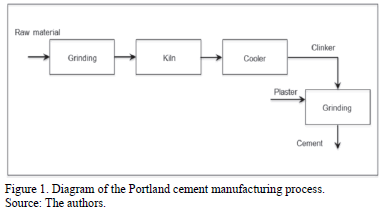
<body><![CDATA[<p>&nbsp;</p>     <p><font size="3" face="Verdana, Arial, Helvetica, sans-serif"><b>1. Introduction</b></font></p>     <p><font size="2" face="Verdana, Arial, Helvetica, sans-serif"><b><i>1.1. Paper size,  margins, columns and paragraphs</i></b></font></p>     <p><font size="2" face="Verdana, Arial, Helvetica, sans-serif">Cement is essential  within the current economic development, but it requires large quantities of  resources. Portland cement manufacturing is one of the  most costly processes in the production of non-metallic minerals, in terms of  energy consumption, as its production costs are above 25% &#91;1,2&#93;. Theoretically,  this activity requires a minimum of 1.6 GJ to produce a tonne of clinker &#91;3&#93;.  Added to this are the CO<sub>2</sub> emissions resulting from the use of fossil  fuels, necessary for the calcination process and the emissions from the  limestone decarbonation. This means that the cement sector is responsible for  about 5% of the total anthropogenic CO<sub>2</sub> emissions &#91;4&#93;.</font></p>     <p><font size="2" face="Verdana, Arial, Helvetica, sans-serif">A number of studies  have been carried out to evaluate Portland cement manufacturing's energy  consumption and CO<sub>2 </sub>emissions &#91;5-7&#93;, due to the growing interest in  energy efficiency in the cement industry &#91;3,8&#93;. The high cost of energy makes  it necessary to perform audits to analyze the possibilities of reducing the  consumption in the clinker production process &#91;9&#93;. The study of mass and energy  flows allows the possibilities of recovery of the residual heat &#91;10-12&#93; to be  analyzed, which is recognized as a potential means to improve energy efficiency  in the cement manufacturing process.</font></p>     <p><font size="2" face="Verdana, Arial, Helvetica, sans-serif">The Organic Rankine Cycle (ORC) is commonly accepted as a  viable technology to convert heat at low temperature to electricity. Further  benefits include low maintenance, favorable operating pressures and autonomous  operation &#91;13&#93;. Having been proven in other industries, the interest in the ORC  is increasing in the cement industry due to the fact that improvements in  clinker production have led to lower exhaust gas temperatures &#91;14&#93;.</font></p>     <p><font size="2" face="Verdana, Arial, Helvetica, sans-serif">The analysis of mass and energy balances of a typical  rotary kiln cement plant is performed in this paper. The objectives are to  evaluate the mass and energy balances in the cement plant, in order to  determine the overall energy efficiency of the process and to enable their  recovery by installing an ORC plant cogeneration system.</font></p>     <p>&nbsp;</p>     <p><font size="3" face="Verdana, Arial, Helvetica, sans-serif"><b>2. Process   description and data collection</b></font></p>     <p><font size="2" face="Verdana, Arial, Helvetica, sans-serif">A dry process Portland cement production plant with a  production capacity of about 1.7 kt/day has been chosen as a reference. The  rotary kiln is located in the intermediate part of the production process; this  can be seen in <a href="#fig01">Fig. 1</a></font></p>     ]]></body>
<body><![CDATA[<p align="center"><font size="2" face="Verdana, Arial, Helvetica, sans-serif"><a name="fig01"></a></font><img src="/img/revistas/dyna/v82n194/v82n194a02fig01.gif"></p>     <p><font size="2" face="Verdana, Arial, Helvetica, sans-serif">The assessed oven has a cylindrical tubular geometry,  measuring about 3.5 m x 54 m; it is longitudinally inclined with a slope of about  1º. It is lined with refractory brick inside and it is made of steel outside.  The assembly rotates at a speed of about 30 rpm. In the kiln, the raw material  is heated up to 1450 °C in such a way that it reacts to form clinker (a mixture  of calcium silicates and aluminates). The process requires  the introduction of air so that it operates with an excess of oxygen, otherwise  there may be deficiencies, either by the formation of other phases or by  incomplete formation of the components &#91;15&#93;.</font></p>     <p><font size="2" face="Verdana, Arial, Helvetica, sans-serif">Due to the complexity of cement production &#91;16&#93; and energy  flows that occur around the rotary kiln, a number of considerations were  contemplated:</font></p> <ul>       <li><font size="2" face="Verdana, Arial, Helvetica, sans-serif"> Raw material, fuel and slag create a constant     chemical composition.</font></li>       <li><font size="2" face="Verdana, Arial, Helvetica, sans-serif">There is loss of negligible air.</font></li>       <li><font size="2" face="Verdana, Arial, Helvetica, sans-serif"> There are constant average ambient temperatures     (T&infin; = 303 K), kiln surface (Ts = 581 K), cooler surface (Ts = 353 K) and     preheater surface (Ts = 348 K).</font></li>       <li><font size="2" face="Verdana, Arial, Helvetica, sans-serif"> Combustion is complete.</font></li>       <li><font size="2" face="Verdana, Arial, Helvetica, sans-serif"> The operation is undertaken at a steady state     and there are equilibrium conditions.</font></li>     </ul>     <p><font size="2" face="Verdana, Arial, Helvetica, sans-serif">The methodology used follows these steps:</font></p> <ol>       ]]></body>
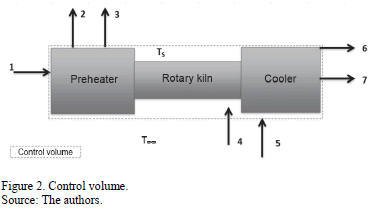
<body><![CDATA[<li><font size="2" face="Verdana, Arial, Helvetica, sans-serif"> Definition     of the control volume. </font></li>       <li><font size="2" face="Verdana, Arial, Helvetica, sans-serif">Identification     and characterization of the main flows. </font></li>       <li><font size="2" face="Verdana, Arial, Helvetica, sans-serif">Formulation     of mass balance. </font></li>       <li><font size="2" face="Verdana, Arial, Helvetica, sans-serif">Formulation     of energy balance</font></li>     </ol>     <p><font size="2" face="Verdana, Arial, Helvetica, sans-serif"><b><i>2.1. Control  volume</i></b></font></p>     <p><font size="2" face="Verdana, Arial, Helvetica, sans-serif">The control volume includes a preheater, a rotary kiln and  a clinker cooler, <a href="#fig02">Fig. 2</a></font></p>     <p align="center"><font size="2" face="Verdana, Arial, Helvetica, sans-serif"><a name="fig02"></a></font><img src="/img/revistas/dyna/v82n194/v82n194a02fig02.gif"></p>     <p><font size="2" face="Verdana, Arial, Helvetica, sans-serif">Where: </font></p> <ol start="5">       <li><font size="2" face="Verdana, Arial, Helvetica, sans-serif"> Raw     material. </font></li>       ]]></body>
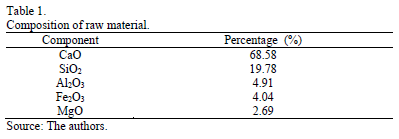
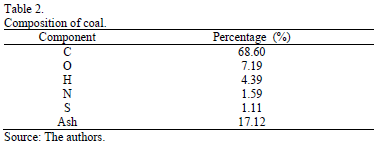
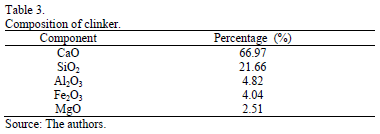
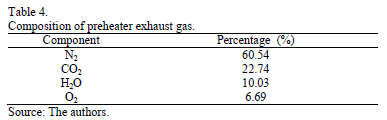
<body><![CDATA[<li><font size="2" face="Verdana, Arial, Helvetica, sans-serif"> Preheater     exhaust gas. </font></li>       <li><font size="2" face="Verdana, Arial, Helvetica, sans-serif"> Preheater     dust. </font></li>       <li><font size="2" face="Verdana, Arial, Helvetica, sans-serif"> Coal. </font></li>       <li><font size="2" face="Verdana, Arial, Helvetica, sans-serif"> Cooling     air. </font></li>       <li><font size="2" face="Verdana, Arial, Helvetica, sans-serif">Clinker. </font></li>       <li><font size="2" face="Verdana, Arial, Helvetica, sans-serif">Cooler     hot air.</font></li>     </ol>     <p><font size="2" face="Verdana, Arial, Helvetica, sans-serif"><b><i>2.2. Identification and characterization of the main mass flows</i></b></font></p>     <p><font size="2" face="Verdana, Arial, Helvetica, sans-serif">The inflow is the raw material in the control volume  preheater (1); the raw material in the rotary kiln is the fuel (4) and, in the  cooler, it is the air (5), <a href="#fig02">Fig. 2</a>.</font></p>     <p><font size="2" face="Verdana, Arial, Helvetica, sans-serif">The composition of the raw materials, the fuel (coal in  this case), the clinker and the preheater exhaust gas are shown in <a href="#tab01">Tables 1</a>-<a href="#tab04">4</a>,  respectively.</font></p>     ]]></body>
<body><![CDATA[<p align="center"><font size="2" face="Verdana, Arial, Helvetica, sans-serif"><a name="tab01"></a></font><img src="/img/revistas/dyna/v82n194/v82n194a02tab01.gif"></p>     <p align="center"><font size="2" face="Verdana, Arial, Helvetica, sans-serif"><a name="tab02"></a></font><img src="/img/revistas/dyna/v82n194/v82n194a02tab02.gif"></p>     <p align="center"><font size="2" face="Verdana, Arial, Helvetica, sans-serif"><a name="tab03"></a></font><img src="/img/revistas/dyna/v82n194/v82n194a02tab03.gif"></p>     <p align="center"><font size="2" face="Verdana, Arial, Helvetica, sans-serif"><a name="tab04"></a></font><img src="/img/revistas/dyna/v82n194/v82n194a02tab04.gif"></p>     <p><font size="2" face="Verdana, Arial, Helvetica, sans-serif"><b><i>2.3. Mass balance</i></b></font></p>     <p><font size="2" face="Verdana, Arial, Helvetica, sans-serif">The following reactions produced in the system must be  considered, eq. (1-5).</font></p>     <p><font size="2" face="Verdana, Arial, Helvetica, sans-serif">- Calcination:</font></p>     <p><img src="/img/revistas/dyna/v82n194/v82n194a02eq0102.gif"></p>     <p><font size="2" face="Verdana, Arial, Helvetica, sans-serif">- Combustion:</font></p>     <p><img src="/img/revistas/dyna/v82n194/v82n194a02eq0305.gif"></p>     ]]></body>
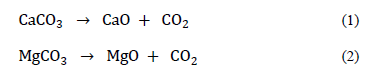
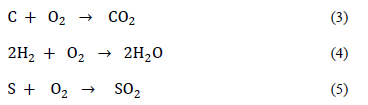
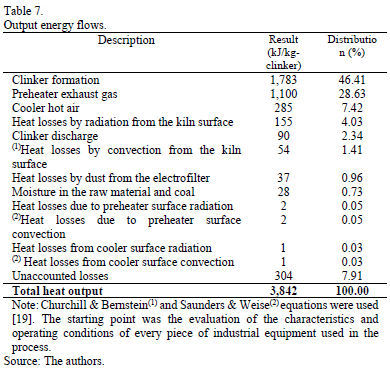
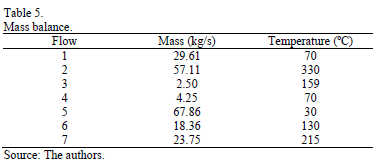
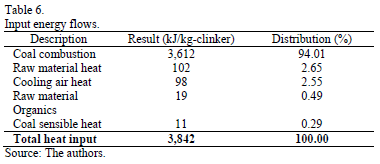
<body><![CDATA[<p><font size="2" face="Verdana, Arial, Helvetica, sans-serif">The main component of the gas produced is CO<sub>2</sub>, which  is derived from the combustion and decarbonation reactions. It is considered  that, to manufacture cement, about half of the CO<sub>2</sub> emissions come  from combustion and the other half are produced in the decomposition of the  calcium carbonate in clinker production &#91;17&#93;. Only traces of SO<sub>2</sub> are  present due to the combustion of the fuel sulphur. In the final part of the  cement producing process, approximately 5% gypsum is added to the clinker. </font></p>     <p><font size="2" face="Verdana, Arial, Helvetica, sans-serif"><b><i>2.4. Energy balance</i></b></font></p>     <p><font size="2" face="Verdana, Arial, Helvetica, sans-serif">The energy balance uses the physical data and equations  described in the Peray manual &#91;18&#93;; these have been used in </font><font size="2" face="Verdana, Arial, Helvetica, sans-serif">several papers about mass and  energy balances in cement plants &#91;1,11,19&#93;. The first step is to  carry out a balance of the enthalpy variation flows.  To do this, both the temperature and calorific value of the fuel (28,000 kJ/kg)  are characterized.</font></p>     <p><font size="2" face="Verdana, Arial, Helvetica, sans-serif">The results are presented as percentage of the total  energy released by combustion of fuel in the kiln.</font></p>     <p>&nbsp;</p>     <p><font size="3" face="Verdana, Arial, Helvetica, sans-serif"><b>3. Results and   Discussion</b></font></p>     <p><font size="2" face="Verdana, Arial, Helvetica, sans-serif">The results of the mass  balance are shown in <a href="#tab05">Table 5</a>.</font></p>     <p align="center"><font size="2" face="Verdana, Arial, Helvetica, sans-serif"><a name="tab05"></a></font><img src="/img/revistas/dyna/v82n194/v82n194a02tab05.gif"></p>     <p><font size="2" face="Verdana, Arial, Helvetica, sans-serif">The heat flows  described have been considered for the energy balance. It is important to note  that the moisture content in the raw materials due to energetic potential may  be affected. The calculations have been made considering amounts per kg of produced clinker. <a href="#tab06">Tables 6</a> and  <a href="#tab07">7</a> show the results of the energy balance for the different flows.</font></p>     <p align="center"><font size="2" face="Verdana, Arial, Helvetica, sans-serif"><a name="tab06"></a></font><img src="/img/revistas/dyna/v82n194/v82n194a02tab06.gif"></p>     ]]></body>
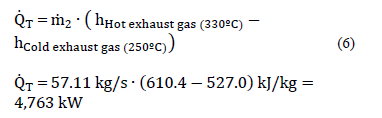
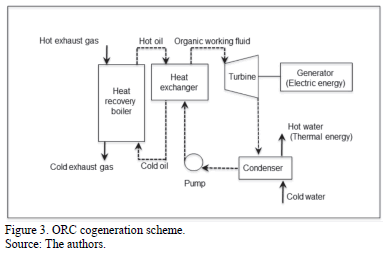
<body><![CDATA[<p align="center"><font size="2" face="Verdana, Arial, Helvetica, sans-serif"><a name="tab07"></a></font><img src="/img/revistas/dyna/v82n194/v82n194a02tab07.gif"></p>     <p><font size="2" face="Verdana, Arial, Helvetica, sans-serif">Energy recovery in cement plants has been studied in  different works &#91;10,11,21&#93;, as has the importance of ORC as an energy  production system &#91;22,23&#93; and the use of cogeneration systems in the industry  &#91;1,24&#93;. According to the results, (<a href="#tab07">Table 7</a>), there are opportunities for residual  heat flow energy recovery. Thus, emissions and heat loss into the environment  would be avoided. The largest residual heat flow corresponds to the preheater  exhaust gas, which reaches 330 ºC, accounting for 53.4% of total losses. Part  of this flow can be recovered by an ORC cogeneration system, <a href="#fig03">Fig. 3</a></font></p>     <p align="center"><font size="2" face="Verdana, Arial, Helvetica, sans-serif"><a name="fig03"></a></font><img src="/img/revistas/dyna/v82n194/v82n194a02fig03.gif"></p>     <p><font size="2" face="Verdana, Arial, Helvetica, sans-serif">The proposed  cogeneration system is shown in <a href="#fig03">Fig. 3</a>. The energy is transferred from the  preheater exhaust gas to the organic fluid, used in the system's Rankine cycle,  by means of a thermal oil. The circuit operates with a minimum temperature of  250 °C, which, to prevent intensive modifications to the plant, comes from the  preheater exhaust gas at the outlet of the heat exchanger. The system allows it  to be used as thermal energy for the hot water leaving the condenser  manufacturing process. According to the final temperatures and operating  conditions, it is possible to calculate the total available thermal energy (<img src="/img/revistas/dyna/v82n194/v82n194a02eq018.gif">) from the preheater exhaust gas  mass flow (<img src="/img/revistas/dyna/v82n194/v82n194a02eq020.gif">) &#91;25&#93;, eq. (6).</font></p>     <p><img src="/img/revistas/dyna/v82n194/v82n194a02eq06.gif"></p>     <p><font size="2" face="Verdana, Arial, Helvetica, sans-serif">In order to determine  the power of the electric generator, an overall efficiency (h) of 85% is estimated for the recovery of heat in  this flow by the cogeneration ORC process (Q<sub>ORC</sub>), eq. (7)&#91;26&#93;.</font></p>     <p><img src="/img/revistas/dyna/v82n194/v82n194a02eq07.gif"></p>     <p><font size="2" face="Verdana, Arial, Helvetica, sans-serif">Considering that 18% of the recovered energy can be  transformed into electricity, it is possible to achieve a power of 729 kW &#91;26&#93;.  7,500 operating hours per year at the plant would allow energy  savings of 5.5 GWh/year. Taking energy costs to be 0.13 $/kWh &#91;27&#93; the value of  such energy savings would amount to 1.18 $/t cement.</font></p>     <p><font size="2" face="Verdana, Arial, Helvetica, sans-serif">A preliminary estimation of the costs associated with the  implementation of the ORC cogeneration system would need to include the  necessary equipment and installation expenses. The investment and profitability  significantly depend on the location and size of the ORC plant. For the whole  system (<a href="#fig03">Fig. 3</a>) a 3 million dollar budget is estimated,  which includes shipping, installation and commissioning. Therefore, an estimate  of the period of a simple return on investment (p) can be shown in eq. (8).</font></p>     <p><img src="/img/revistas/dyna/v82n194/v82n194a02eq08.gif"></p>     ]]></body>
<body><![CDATA[<p><font size="2" face="Verdana, Arial, Helvetica, sans-serif">It was calculated that  82% of the unused energy for electricity production is available for thermal  use. If 4% of it is deducted due to heat losses in the system, the remaining  78% can be collected in hot water at 80 °C at the condenser outlet, which is  equivalent to 23.7 GWh per year. This thermal energy, calculated annually, is  equivalent to about 3 kt/year of coal used at the plant at a cost of 100 $/t  &#91;27&#93;, which represents about 0.31 million dollars. The use of this energy is  equivalent to 8 kt CO<sub>2 </sub>annual emissions. However, the particular  characteristics of each plant, due to economic, environmental and technical  factors, determine the viability of these types of projects.</font></p>     <p><font size="2" face="Verdana, Arial, Helvetica, sans-serif">Energy savings, through using an ORC cogeneration system,  would also improve the energy efficiency of the plant. It should be noted that  these calculations might vary according to the plant operating conditions and  other economic factors.</font></p>     <p>&nbsp;</p>     <p><font size="3" face="Verdana, Arial, Helvetica, sans-serif"><b>4. Conclusions</b></font></p>     <p><font size="2" face="Verdana, Arial, Helvetica, sans-serif">The proposed methodology can be quickly applied to any  cement plant with a rotary kiln that is used as a first assessment. The results  of the audit, depending on the input and output thermal energy, indicate that  the clinker production system has an efficiency of 46.4%. The main heat losses  that occur in the kiln are with the preheater exhaust gas (28.6%), the hot air  from the cooler (7.4%) and in radiation and convection (5.6%).</font></p>     <p><font size="2" face="Verdana, Arial, Helvetica, sans-serif">Recovering waste heat from the preheater exhaust gas flow  is feasible and can provide about 0.7 MW of electric power, by using an ORC  cogeneration system. The results obtained would allow the recovery of 19.2%  from the preheater exhaust gas energy to produce 5.5 GWh/year of electricity  and 23.7 GWh/year of thermal energy.</font></p>     <p><font size="2" face="Verdana, Arial, Helvetica, sans-serif">The use of the  electricity generated in cogeneration would save about 0.72 million dollars per  year (1.18 $/t cement). The equivalent in thermal energy, in terms of coal used  by the plant itself, represents a cost of 0.31 million dollars (0.51 $/t  cement) and would avoid 8 kt/year of CO<sub>2</sub> emissions. The expected  payback period for the investment in the proposed facility is 4.2 years.</font></p>     <p>&nbsp;</p>     <p><font size="3" face="Verdana, Arial, Helvetica, sans-serif"><b>Acknowledgement</b></font></p>     <p><font size="2" face="Verdana, Arial, Helvetica, sans-serif">Adriana Marcela Osorio Correa and Gloria Restrepo are  grateful to COLCIENCIAS and the Sustainability Strategy Program 2013-2014 of  Antioqu&iacute;a University (Colombia). </font></p>     ]]></body>
<body><![CDATA[<p>&nbsp;</p>     <p><font size="3" face="Verdana, Arial, Helvetica, sans-serif"><b>References</b></font></p>     <!-- ref --><p><font size="2" face="Verdana, Arial, Helvetica, sans-serif"><b>&#91;1&#93;</b> Khurana,  S., Banerjee, R. and Gaitonde, U., Energy balance and cogeneration for a cement  plant. Applied Thermal Engineering, 22(5), pp. 485-494, 2002. DOI: 10.1016/S1359-4311(01)00128-4</font>&nbsp;&nbsp;&nbsp;&nbsp;&nbsp;&nbsp;&nbsp;&nbsp;[&#160;<a href="javascript:void(0);" onclick="javascript: window.open('/scielo.php?script=sci_nlinks&ref=000105&pid=S0012-7353201500060000200001&lng=','','width=640,height=500,resizable=yes,scrollbars=1,menubar=yes,');">Links</a>&#160;]<!-- end-ref --><!-- ref --><p><font size="2" face="Verdana, Arial, Helvetica, sans-serif"><b>&#91;2&#93;</b> Madlool,  N.A., Saidur, R., Rahim, N.A., Islam, M.R. and Hossian, M.S., An  exergy analysis for cement industries: An overview. Renewable and  Sustainable Energy Reviews, 16(1), pp. 921-932, 2012. DOI: 10.1016/J.Rser.2011.09.013</font>&nbsp;&nbsp;&nbsp;&nbsp;&nbsp;&nbsp;&nbsp;&nbsp;[&#160;<a href="javascript:void(0);" onclick="javascript: window.open('/scielo.php?script=sci_nlinks&ref=000106&pid=S0012-7353201500060000200002&lng=','','width=640,height=500,resizable=yes,scrollbars=1,menubar=yes,');">Links</a>&#160;]<!-- end-ref --><!-- ref --><p><font size="2" face="Verdana, Arial, Helvetica, sans-serif"><b>&#91;3&#93;</b> Liu,  F., Ross, M. and Wang, S., Energy efficiency of China's cement industry.  Energy, 20(7), pp. 669-681, 1995. DOI: 10.1016/0360-5442(95)00002-X</font>&nbsp;&nbsp;&nbsp;&nbsp;&nbsp;&nbsp;&nbsp;&nbsp;[&#160;<a href="javascript:void(0);" onclick="javascript: window.open('/scielo.php?script=sci_nlinks&ref=000107&pid=S0012-7353201500060000200003&lng=','','width=640,height=500,resizable=yes,scrollbars=1,menubar=yes,');">Links</a>&#160;]<!-- end-ref --><!-- ref --><p><font size="2" face="Verdana, Arial, Helvetica, sans-serif"><b>&#91;4&#93;</b> Humphreys,  K. and Mahasenan, M., Toward a sustainable cement industry. Substudy 8, Climate  change &#91;online&#93;, World Business Council for Sustainable Development, 2002  &#91;accessed 21<sup>th</sup>, May, 2014&#93;.  Available at: <a href="http://wbcsdcement.org/pdf/battelle/final_report8.pdf" target="_blank">http://wbcsdcement.org/pdf/battelle/final_report8.pdf</a></font>&nbsp;&nbsp;&nbsp;&nbsp;&nbsp;&nbsp;&nbsp;&nbsp;[&#160;<a href="javascript:void(0);" onclick="javascript: window.open('/scielo.php?script=sci_nlinks&ref=000108&pid=S0012-7353201500060000200004&lng=','','width=640,height=500,resizable=yes,scrollbars=1,menubar=yes,');">Links</a>&#160;]<!-- end-ref --><!-- ref --><p><font size="2" face="Verdana, Arial, Helvetica, sans-serif"><b>&#91;5&#93;</b> Capros,  P., Kouvaritakis, N. and Mantzos, L., Economic evaluation of sectoral emission  reduction objectives for climate change: Top-down analysis of greenhouse gas  emission possibilities in the EU &#91;online&#93;, European Comission, Contribution to  a Study for DG Environment, 2001 &#91;accessed 21<sup>th</sup>, May, 2014&#93;.  Available at: <a href="http://ec.europa.eu/environment/enveco/climate_change/pdf/top_down_analysis.pdf" target="_blank">http://ec.europa.eu/environment/enveco/climate_change/pdf/top_down_analysis.pdf</a></font>&nbsp;&nbsp;&nbsp;&nbsp;&nbsp;&nbsp;&nbsp;&nbsp;[&#160;<a href="javascript:void(0);" onclick="javascript: window.open('/scielo.php?script=sci_nlinks&ref=000109&pid=S0012-7353201500060000200005&lng=','','width=640,height=500,resizable=yes,scrollbars=1,menubar=yes,');">Links</a>&#160;]<!-- end-ref --><!-- ref --><p><font size="2" face="Verdana, Arial, Helvetica, sans-serif"><b>&#91;6&#93;</b> Gartner,  E., Industrially interesting approaches to &quot;low-CO<sub>2</sub>&quot; cements. Cement and Concrete Research, 34(9), pp. 1489-1498, 2004. DOI: 10.1016/j.cemconres.2004.01.021</font>&nbsp;&nbsp;&nbsp;&nbsp;&nbsp;&nbsp;&nbsp;&nbsp;[&#160;<a href="javascript:void(0);" onclick="javascript: window.open('/scielo.php?script=sci_nlinks&ref=000110&pid=S0012-7353201500060000200006&lng=','','width=640,height=500,resizable=yes,scrollbars=1,menubar=yes,');">Links</a>&#160;]<!-- end-ref --><!-- ref --><p><font size="2" face="Verdana, Arial, Helvetica, sans-serif"><b>&#91;7&#93;</b> Alvarez-Rodriguez, B., Menendez-Aguado,  J.M., Rosa-Dizioba, B. y Coello-Vel&aacute;zquez, A.L., Evaluaci&oacute;n de materias primas  en una planta de beneficio de arena de s&iacute;lice para aumentar la eficiencia  energ&eacute;tica del proceso de molienda DYNA, 80(177), pp. 95-100. 2013. DOI: 10.15446/dyna</font>&nbsp;&nbsp;&nbsp;&nbsp;&nbsp;&nbsp;&nbsp;&nbsp;[&#160;<a href="javascript:void(0);" onclick="javascript: window.open('/scielo.php?script=sci_nlinks&ref=000111&pid=S0012-7353201500060000200007&lng=','','width=640,height=500,resizable=yes,scrollbars=1,menubar=yes,');">Links</a>&#160;]<!-- end-ref --><!-- ref --><p><font size="2" face="Verdana, Arial, Helvetica, sans-serif"><b>&#91;8&#93;</b> Hasanbeigi,  A., Price, L., Lu, H. and Lan, W., Analysis of energy-efficiency opportunities  for the cement industry in Shandong Province, China: A case study of 16 cement  plants. Energy, 35(8), pp. 3461-3473, 2010. DOI: 10.1016/j.energy.2010.04.046</font>&nbsp;&nbsp;&nbsp;&nbsp;&nbsp;&nbsp;&nbsp;&nbsp;[&#160;<a href="javascript:void(0);" onclick="javascript: window.open('/scielo.php?script=sci_nlinks&ref=000112&pid=S0012-7353201500060000200008&lng=','','width=640,height=500,resizable=yes,scrollbars=1,menubar=yes,');">Links</a>&#160;]<!-- end-ref --><!-- ref --><p><font size="2" face="Verdana, Arial, Helvetica, sans-serif"><b>&#91;9&#93;</b> Osorio,  A., Restrepo, G. and Mar&iacute;n, J., Cement clinker grinding: Evaluation of mill  spin speed, residence time and grinding media. DYNA, 76(158), pp. 69-77, 2009.  DOI: 10.15446/dyna</font>&nbsp;&nbsp;&nbsp;&nbsp;&nbsp;&nbsp;&nbsp;&nbsp;[&#160;<a href="javascript:void(0);" onclick="javascript: window.open('/scielo.php?script=sci_nlinks&ref=000113&pid=S0012-7353201500060000200009&lng=','','width=640,height=500,resizable=yes,scrollbars=1,menubar=yes,');">Links</a>&#160;]<!-- end-ref --><!-- ref --><p><font size="2" face="Verdana, Arial, Helvetica, sans-serif"><b>&#91;10&#93;</b> Sogut,  M.Z., Oktay, Z. and Hepbasli, A., Energetic and exergetic assessment of a trass  mill process in a cement plant. Energy Conversion and Management, 50(9), pp.  2316-2323, 2009. DOI: 10.1016/j.enconman.2009.05.013</font>&nbsp;&nbsp;&nbsp;&nbsp;&nbsp;&nbsp;&nbsp;&nbsp;[&#160;<a href="javascript:void(0);" onclick="javascript: window.open('/scielo.php?script=sci_nlinks&ref=000114&pid=S0012-7353201500060000200010&lng=','','width=640,height=500,resizable=yes,scrollbars=1,menubar=yes,');">Links</a>&#160;]<!-- end-ref --><!-- ref --><p><font size="2" face="Verdana, Arial, Helvetica, sans-serif"><b>&#91;11&#93;</b> Kabir,  G., Abubakar, A.I. and El-Nafaty, U.A., Energy audit and conservation  opportunities for pyroprocessing unit of a typical dry process cement plant.  Energy, 35(3), pp. 1237-1243, 2010. DOI: 10.1016/j.energy.2009.11.003</font>&nbsp;&nbsp;&nbsp;&nbsp;&nbsp;&nbsp;&nbsp;&nbsp;[&#160;<a href="javascript:void(0);" onclick="javascript: window.open('/scielo.php?script=sci_nlinks&ref=000115&pid=S0012-7353201500060000200011&lng=','','width=640,height=500,resizable=yes,scrollbars=1,menubar=yes,');">Links</a>&#160;]<!-- end-ref --><!-- ref --><p><font size="2" face="Verdana, Arial, Helvetica, sans-serif"><b>&#91;12&#93;</b> Sö&#287;üt,  Z., Oktay, Z. and Karakoç, H., Mathematical modeling of heat recovery from a  rotary kiln. Applied Thermal Engineering, 30(8-9), pp. 817-825, 2010. DOI:  10.1016/j.applthermaleng.2009.12.009</font>&nbsp;&nbsp;&nbsp;&nbsp;&nbsp;&nbsp;&nbsp;&nbsp;[&#160;<a href="javascript:void(0);" onclick="javascript: window.open('/scielo.php?script=sci_nlinks&ref=000116&pid=S0012-7353201500060000200012&lng=','','width=640,height=500,resizable=yes,scrollbars=1,menubar=yes,');">Links</a>&#160;]<!-- end-ref --><!-- ref --><p><font size="2" face="Verdana, Arial, Helvetica, sans-serif"><b>&#91;13&#93;</b> Lecompte,  S. et al., Review of organic Rankine cycle (ORC) architectures for waste heat  recovery. Renewable and Sustainable Energy Reviews, 47, pp. 448-461, 2015. DOI: 10.1016/j.rser.2015.03.089</font>&nbsp;&nbsp;&nbsp;&nbsp;&nbsp;&nbsp;&nbsp;&nbsp;[&#160;<a href="javascript:void(0);" onclick="javascript: window.open('/scielo.php?script=sci_nlinks&ref=000117&pid=S0012-7353201500060000200013&lng=','','width=640,height=500,resizable=yes,scrollbars=1,menubar=yes,');">Links</a>&#160;]<!-- end-ref --><!-- ref --><p><font size="2" face="Verdana, Arial, Helvetica, sans-serif"><b>&#91;14&#93;</b> Schneider,  M., Process technology for efficient and sustainable cement production. Cement  and Concrete Research. In press. 2015. DOI: 1016/j.cemconres.2015.05.014</font>&nbsp;&nbsp;&nbsp;&nbsp;&nbsp;&nbsp;&nbsp;&nbsp;[&#160;<a href="javascript:void(0);" onclick="javascript: window.open('/scielo.php?script=sci_nlinks&ref=000118&pid=S0012-7353201500060000200014&lng=','','width=640,height=500,resizable=yes,scrollbars=1,menubar=yes,');">Links</a>&#160;]<!-- end-ref --><!-- ref --><p><font size="2" face="Verdana, Arial, Helvetica, sans-serif"><b>&#91;15&#93;</b> Tob&oacute;n,  J.I., Restrepo, O.J. and Pay&aacute;, J., Comparative analysis of performance of  Portland cement blended with nanosilica and silica fume. DYNA 77(163), pp  37-46, 2010. DOI: /10.15446/dyna</font>&nbsp;&nbsp;&nbsp;&nbsp;&nbsp;&nbsp;&nbsp;&nbsp;[&#160;<a href="javascript:void(0);" onclick="javascript: window.open('/scielo.php?script=sci_nlinks&ref=000119&pid=S0012-7353201500060000200015&lng=','','width=640,height=500,resizable=yes,scrollbars=1,menubar=yes,');">Links</a>&#160;]<!-- end-ref --><!-- ref --><p><font size="2" face="Verdana, Arial, Helvetica, sans-serif"><b>&#91;16&#93;</b> Giraldo, C., Mendoza, O., Tob&oacute;n, J.I.,  Restrepo, O. y Restrepo, J.C. Durabilidad del cemento P&oacute;rtland blanco  adicionado con pigmento azul ultramar. DYNA 77(164), pp 45-51, 2010. DOI: 10.15446/dyna</font>&nbsp;&nbsp;&nbsp;&nbsp;&nbsp;&nbsp;&nbsp;&nbsp;[&#160;<a href="javascript:void(0);" onclick="javascript: window.open('/scielo.php?script=sci_nlinks&ref=000120&pid=S0012-7353201500060000200016&lng=','','width=640,height=500,resizable=yes,scrollbars=1,menubar=yes,');">Links</a>&#160;]<!-- end-ref --><!-- ref --><p><font size="2" face="Verdana, Arial, Helvetica, sans-serif"><b>&#91;17&#93;</b> Anand,  S., Vrat, P. and Dahiya, R.P., Application of a system dynamics approach for assessment and mitigation of CO<sub>2</sub> emissions from the  cement industry. Journal of environmental management, 79(4), pp. 383-398, 2006.  DOI: 10.1016/j.jenvman.2005.08.007</font>&nbsp;&nbsp;&nbsp;&nbsp;&nbsp;&nbsp;&nbsp;&nbsp;[&#160;<a href="javascript:void(0);" onclick="javascript: window.open('/scielo.php?script=sci_nlinks&ref=000121&pid=S0012-7353201500060000200017&lng=','','width=640,height=500,resizable=yes,scrollbars=1,menubar=yes,');">Links</a>&#160;]<!-- end-ref --><!-- ref --><p><font size="2" face="Verdana, Arial, Helvetica, sans-serif"><b>&#91;18&#93;</b> Peray,  K.E., Cement Manufacturers Handbook. New York Chemical Publishing Company,  1979.    &nbsp;&nbsp;&nbsp;&nbsp;&nbsp;&nbsp;&nbsp;&nbsp;[&#160;<a href="javascript:void(0);" onclick="javascript: window.open('/scielo.php?script=sci_nlinks&ref=000122&pid=S0012-7353201500060000200018&lng=','','width=640,height=500,resizable=yes,scrollbars=1,menubar=yes,');">Links</a>&#160;]<!-- end-ref --></font></p>     <!-- ref --><p><font size="2" face="Verdana, Arial, Helvetica, sans-serif"><b>&#91;19&#93;</b> Engin,  T. and Ari, V., Energy auditing and recovery for dry type cement rotary kiln  systems-A case study. Energy Conversion and Management, 46(4), pp. 551-562,  2005. DOI: 10.1016/j.enconman.2004.04.007</font>&nbsp;&nbsp;&nbsp;&nbsp;&nbsp;&nbsp;&nbsp;&nbsp;[&#160;<a href="javascript:void(0);" onclick="javascript: window.open('/scielo.php?script=sci_nlinks&ref=000124&pid=S0012-7353201500060000200019&lng=','','width=640,height=500,resizable=yes,scrollbars=1,menubar=yes,');">Links</a>&#160;]<!-- end-ref --><!-- ref --><p><font size="2" face="Verdana, Arial, Helvetica, sans-serif"><b>&#91;20&#93;</b> Prieto, M.M. y Su&aacute;rez, I., Tablas y  gr&aacute;ficos para la resoluci&oacute;n de problemas de transmisi&oacute;n de calor. Oviedo;  Servicio de Publicaciones de la Universidad de Oviedo, 2008.    &nbsp;&nbsp;&nbsp;&nbsp;&nbsp;&nbsp;&nbsp;&nbsp;[&#160;<a href="javascript:void(0);" onclick="javascript: window.open('/scielo.php?script=sci_nlinks&ref=000125&pid=S0012-7353201500060000200020&lng=','','width=640,height=500,resizable=yes,scrollbars=1,menubar=yes,');">Links</a>&#160;]<!-- end-ref --></font></p>     <!-- ref --><p><font size="2" face="Verdana, Arial, Helvetica, sans-serif"><b>&#91;21&#93;</b> Castrillon,  R.P., Gonz&aacute;lez, A.J. and Quispe, E.C., Energy efficiency improvement in the  cement industry by wet process through integral energy management system  implementation. DYNA, 80(177), pp. 115-123, 2013. DOI: 10.15446/dyna</font>&nbsp;&nbsp;&nbsp;&nbsp;&nbsp;&nbsp;&nbsp;&nbsp;[&#160;<a href="javascript:void(0);" onclick="javascript: window.open('/scielo.php?script=sci_nlinks&ref=000127&pid=S0012-7353201500060000200021&lng=','','width=640,height=500,resizable=yes,scrollbars=1,menubar=yes,');">Links</a>&#160;]<!-- end-ref --><!-- ref --><p><font size="2" face="Verdana, Arial, Helvetica, sans-serif"><b>&#91;22&#93;</b> Raj,  N.T., Iniyan, S. and Goic, R., A review of renewable energy based cogeneration  technologies. Renewable and Sustainable Energy Reviews, 15(8), pp. 3640-3648,  2011. DOI: 10.1016/j.rser.2011.06.003</font>&nbsp;&nbsp;&nbsp;&nbsp;&nbsp;&nbsp;&nbsp;&nbsp;[&#160;<a href="javascript:void(0);" onclick="javascript: window.open('/scielo.php?script=sci_nlinks&ref=000128&pid=S0012-7353201500060000200022&lng=','','width=640,height=500,resizable=yes,scrollbars=1,menubar=yes,');">Links</a>&#160;]<!-- end-ref --><!-- ref --><p><font size="2" face="Verdana, Arial, Helvetica, sans-serif"><b>&#91;23&#93;</b> Madlool,  N.A., Saidur, R., Hossain, M.S. and Rahim, N.A., A critical review on  energy use and savings in the cement industries. Renewable and  Sustainable Energy Reviews, 15(4), pp. 2042-2060, 2011. DOI: 10.1016/j.rser.2011.01.005</font>&nbsp;&nbsp;&nbsp;&nbsp;&nbsp;&nbsp;&nbsp;&nbsp;[&#160;<a href="javascript:void(0);" onclick="javascript: window.open('/scielo.php?script=sci_nlinks&ref=000129&pid=S0012-7353201500060000200023&lng=','','width=640,height=500,resizable=yes,scrollbars=1,menubar=yes,');">Links</a>&#160;]<!-- end-ref --><!-- ref --><p><font size="2" face="Verdana, Arial, Helvetica, sans-serif"><b>&#91;24&#93;</b> de  Oliveira, R.C., de Souza, R.D. and de Lima Tostes, M.E., A methodology for  analysis of cogeneration projects using oil palm biomass wastes as an energy  source in the Amazon. DYNA, 82(190), pp. 105-112, 2015. DOI: 10.15446/dyna.v82n190.43298</font>&nbsp;&nbsp;&nbsp;&nbsp;&nbsp;&nbsp;&nbsp;&nbsp;[&#160;<a href="javascript:void(0);" onclick="javascript: window.open('/scielo.php?script=sci_nlinks&ref=000130&pid=S0012-7353201500060000200024&lng=','','width=640,height=500,resizable=yes,scrollbars=1,menubar=yes,');">Links</a>&#160;]<!-- end-ref --><!-- ref --><p><font size="2" face="Verdana, Arial, Helvetica, sans-serif"><b>&#91;25&#93;</b> Nellis,  G.F. and Klein, S.A., Heat Transfer. New York: Cambridge, 2009.    &nbsp;&nbsp;&nbsp;&nbsp;&nbsp;&nbsp;&nbsp;&nbsp;[&#160;<a href="javascript:void(0);" onclick="javascript: window.open('/scielo.php?script=sci_nlinks&ref=000131&pid=S0012-7353201500060000200025&lng=','','width=640,height=500,resizable=yes,scrollbars=1,menubar=yes,');">Links</a>&#160;]<!-- end-ref --></font></p>     ]]></body>
<body><![CDATA[<!-- ref --><p><font size="2" face="Verdana, Arial, Helvetica, sans-serif"><b>&#91;26&#93;</b> Turboden  &#91;online&#93;.Technical Reports, 2014 &#91;accessed 12<sup>th</sup>, July, 2015&#93;.  Available at: <a href="http://www.turboden.eu/" target="_blank">http://www.turboden.eu/</a> </font>&nbsp;&nbsp;&nbsp;&nbsp;&nbsp;&nbsp;&nbsp;&nbsp;[&#160;<a href="javascript:void(0);" onclick="javascript: window.open('/scielo.php?script=sci_nlinks&ref=000133&pid=S0012-7353201500060000200026&lng=','','width=640,height=500,resizable=yes,scrollbars=1,menubar=yes,');">Links</a>&#160;]<!-- end-ref --><!-- ref --><p><font size="2" face="Verdana, Arial, Helvetica, sans-serif"><b>&#91;27&#93;</b> Ministerio de Minas y Energ&iacute;a. Gobierno de  Colombia. Informe de precios Energ&eacute;ticos Observados en el Sector Industrial  &#91;online&#93;, 2012 &#91;accessed 24<sup>th</sup>, May, 2014&#93;. Available  at: <a href="http://www.sipg.gov.co/Portals/0/Precios/Industria/Precios%20Industria%20Enero2012.pdf" target="_blank">http://www.sipg.gov.co/Portals/0/Precios/Industria/Precios%20Industria%20Enero2012.pdf</a> </font>&nbsp;&nbsp;&nbsp;&nbsp;&nbsp;&nbsp;&nbsp;&nbsp;[&#160;<a href="javascript:void(0);" onclick="javascript: window.open('/scielo.php?script=sci_nlinks&ref=000134&pid=S0012-7353201500060000200027&lng=','','width=640,height=500,resizable=yes,scrollbars=1,menubar=yes,');">Links</a>&#160;]<!-- end-ref --><p>&nbsp;</p>     <p><font size="2" face="Verdana, Arial, Helvetica, sans-serif"><b>J.P.  Paredes-S&aacute;nchez,</b> is a lecturer in the Department of Energy at the  University of Oviedo, Spain. He received his PhD in Energy Engineering in 2010,  at the University of Oviedo, Spain and has been associated with renewable  energy projects at the Oviedo Higher Technical School of Mining and Engineering  since 2007. He is the author or co-author of papers and conferences on  renewable energy. He has published several books about university education. He  is also involved in EU programs for updating renewable energy research and  higher education. ORCID: 0000-0002-1065-904X</font></p>     <p><font size="2" face="Verdana, Arial, Helvetica, sans-serif"><b>O.J.  Restrepo-Baena, </b>obtained his BSc. degree in Mining and Metallurgy  Engineering at the Universidad Nacional de Colombia, Medell&iacute;n, Colombia; MSc.  in Environmental Engineering and PhD in Metallurgy and Materials at the  Universidad de Oviedo, Spain. He works in the Facultad de Minas at the Universidad Nacional de Colombia,  Medell&iacute;n, Colombia, and his research interests are focused in extractive  metallurgy and materials of engineering: cements, ceramics, pigments. ORCID: 0000-0003-3944-9369</font></p>     <p><font size="2" face="Verdana, Arial, Helvetica, sans-serif"><b>B.  &aacute;lvarez-Rodr&iacute;guez,</b> has a PhD in Mining Engineering from the Universidad  de Oviedo, Spain. She works at the Universidad de Le&oacute;n (UNILEON) and worked at  the Universidad Polit&eacute;cnica de Catalu&ntilde;a (UPC), Spain. She has completed a  Master's in renewable energies. She has taught and directed courses on mineral  processing and renewable energies at the Universidad de Oviedo, Spain, Universidad  Nacional de San Luis, Argentina, Universidad Nacional de La Rioja, Argentina  and Universidad Nacional de Colombia. She is currently involved in a European  research project on mineral processing (OptimOre). Her research focuses on  extractive metallurgy, mineral processing and energy efficiency. ORCID: 0000-0002-2194-4604</font></p>     <p><font size="2" face="Verdana, Arial, Helvetica, sans-serif"><b>A.M. Osorio  Correa</b>, received her BSc. Eng in Chemical Engineering in 2006, her M.Sc. in  Engineering with emphasis on Chemistry in 2009, and her Ph.D. in Engineering  with emphasis in Materials in 2014, all from the Universidad de Antioquia,  Medellin, Colombia. From 2006 until now, she worked as a researcher in the  Procesos Fisicoqu&iacute;micos Aplicados research group. Currently, she teaches a  solids operations course in the Chemical Engineering Department, at the  Facultad de Ingenier&iacute;a, Universidad de Antioquia. Her research interests  include: solids handling, grinding and classification process, soil  stabilization, mass balance and energy balance in processes. ORCID: 0000-0002-6413-9023</font></p>     <p><font size="2" face="Verdana, Arial, Helvetica, sans-serif"><b>G. Restrepo,</b> obteined his BSc. in Chemical Engineering in 1988 at Universidad Pontificia Bolivariana;  Medell&iacute;n, Colombia, is PhD in Chemical Sciences in 1999, from the Universidad  de Sevilla and the Instituto de Ciencias de Materiales de Sevilla, Spain. She  has a certified in the area of foundations, modelling and management of air  quality. Currently is a titular professor at Universidad de Antioquia, Colombia,  attached at Facultad de Ingenier&iacute;a where she teachs undergraduate and  postgraduate courses and coordinates the research group Procesos Fisicoqu&iacute;micos  Aplicados, PFA. She has led and participated in more than forty research  projects, mainly in materials and solids processing areas, technology of  particles, environmental physicochemical and advanced oxidation processes; she  is author and coauthor of several national and international papers. ORCID: 0000-0001-6716-8834</font></p>      ]]></body><back>
<ref-list>
<ref id="B1">
<label>1</label><nlm-citation citation-type="journal">
<person-group person-group-type="author">
<name>
<surname><![CDATA[Khurana]]></surname>
<given-names><![CDATA[S.]]></given-names>
</name>
<name>
<surname><![CDATA[Banerjee]]></surname>
<given-names><![CDATA[R.]]></given-names>
</name>
<name>
<surname><![CDATA[Gaitonde]]></surname>
<given-names><![CDATA[U.]]></given-names>
</name>
</person-group>
<article-title xml:lang="en"><![CDATA[Energy balance and cogeneration for a cement plant]]></article-title>
<source><![CDATA[Applied Thermal Engineering]]></source>
<year>2002</year>
<volume>22</volume>
<numero>^s5</numero>
<issue>^s5</issue>
<supplement>5</supplement>
<page-range>485-494</page-range></nlm-citation>
</ref>
<ref id="B2">
<label>2</label><nlm-citation citation-type="journal">
<person-group person-group-type="author">
<name>
<surname><![CDATA[Madlool]]></surname>
<given-names><![CDATA[N.A.]]></given-names>
</name>
<name>
<surname><![CDATA[Saidur]]></surname>
<given-names><![CDATA[R.]]></given-names>
</name>
<name>
<surname><![CDATA[Rahim]]></surname>
<given-names><![CDATA[N.A.]]></given-names>
</name>
<name>
<surname><![CDATA[Islam]]></surname>
<given-names><![CDATA[M.R.]]></given-names>
</name>
<name>
<surname><![CDATA[Hossian]]></surname>
<given-names><![CDATA[M.S.]]></given-names>
</name>
</person-group>
<article-title xml:lang="en"><![CDATA[An exergy analysis for cement industries: An overview]]></article-title>
<source><![CDATA[Renewable and Sustainable Energy Reviews]]></source>
<year>2012</year>
<volume>16</volume>
<numero>1</numero>
<issue>1</issue>
<page-range>921-932</page-range></nlm-citation>
</ref>
<ref id="B3">
<label>3</label><nlm-citation citation-type="journal">
<person-group person-group-type="author">
<name>
<surname><![CDATA[Liu]]></surname>
<given-names><![CDATA[F.]]></given-names>
</name>
<name>
<surname><![CDATA[Ross]]></surname>
<given-names><![CDATA[M.]]></given-names>
</name>
<name>
<surname><![CDATA[Wang]]></surname>
<given-names><![CDATA[S.]]></given-names>
</name>
</person-group>
<article-title xml:lang="en"><![CDATA[Energy efficiency of China's cement industry]]></article-title>
<source><![CDATA[Energy]]></source>
<year>1995</year>
<volume>20</volume>
<numero>7</numero>
<issue>7</issue>
<page-range>669-681</page-range></nlm-citation>
</ref>
<ref id="B4">
<label>4</label><nlm-citation citation-type="book">
<person-group person-group-type="author">
<name>
<surname><![CDATA[Humphreys]]></surname>
<given-names><![CDATA[K.]]></given-names>
</name>
<name>
<surname><![CDATA[Mahasenan]]></surname>
<given-names><![CDATA[M.]]></given-names>
</name>
</person-group>
<source><![CDATA[Toward a sustainable cement industry.: Substudy 8, Climate change]]></source>
<year>2002</year>
<publisher-name><![CDATA[World Business Council for Sustainable Development]]></publisher-name>
</nlm-citation>
</ref>
<ref id="B5">
<label>5</label><nlm-citation citation-type="book">
<person-group person-group-type="author">
<name>
<surname><![CDATA[Capros]]></surname>
<given-names><![CDATA[P.]]></given-names>
</name>
<name>
<surname><![CDATA[Kouvaritakis]]></surname>
<given-names><![CDATA[N.]]></given-names>
</name>
<name>
<surname><![CDATA[Mantzos]]></surname>
<given-names><![CDATA[L.]]></given-names>
</name>
</person-group>
<source><![CDATA[Economic evaluation of sectoral emission reduction objectives for climate change: Top-down analysis of greenhouse gas emission possibilities in the EU]]></source>
<year>2001</year>
<publisher-name><![CDATA[European Comission, Contribution to a Study for DG Environment]]></publisher-name>
</nlm-citation>
</ref>
<ref id="B6">
<label>6</label><nlm-citation citation-type="journal">
<person-group person-group-type="author">
<name>
<surname><![CDATA[Gartner]]></surname>
<given-names><![CDATA[E.]]></given-names>
</name>
</person-group>
<article-title xml:lang="en"><![CDATA[Industrially interesting approaches to "low-CO2" cements]]></article-title>
<source><![CDATA[Cement and Concrete Research]]></source>
<year>2004</year>
<volume>34</volume>
<numero>9</numero>
<issue>9</issue>
<page-range>1489-1498</page-range></nlm-citation>
</ref>
<ref id="B7">
<label>7</label><nlm-citation citation-type="journal">
<person-group person-group-type="author">
<name>
<surname><![CDATA[Alvarez-Rodriguez]]></surname>
<given-names><![CDATA[B.]]></given-names>
</name>
<name>
<surname><![CDATA[Menendez-Aguado]]></surname>
<given-names><![CDATA[J.M.]]></given-names>
</name>
<name>
<surname><![CDATA[Rosa-Dizioba]]></surname>
<given-names><![CDATA[B.]]></given-names>
</name>
<name>
<surname><![CDATA[Coello-Velázquez]]></surname>
<given-names><![CDATA[A.L.]]></given-names>
</name>
</person-group>
<article-title xml:lang="es"><![CDATA[Evaluación de materias primas en una planta de beneficio de arena de sílice para aumentar la eficiencia energética del proceso de molienda]]></article-title>
<source><![CDATA[DYNA]]></source>
<year>2013</year>
<volume>80</volume>
<numero>177</numero>
<issue>177</issue>
<page-range>95-100</page-range></nlm-citation>
</ref>
<ref id="B8">
<label>8</label><nlm-citation citation-type="journal">
<person-group person-group-type="author">
<name>
<surname><![CDATA[Hasanbeigi]]></surname>
<given-names><![CDATA[A.]]></given-names>
</name>
<name>
<surname><![CDATA[Price]]></surname>
<given-names><![CDATA[L.]]></given-names>
</name>
<name>
<surname><![CDATA[Lu]]></surname>
<given-names><![CDATA[H.]]></given-names>
</name>
<name>
<surname><![CDATA[Lan]]></surname>
<given-names><![CDATA[W.]]></given-names>
</name>
</person-group>
<article-title xml:lang="en"><![CDATA[Analysis of energy-efficiency opportunities for the cement industry in Shandong Province, China: A case study of 16 cement plants]]></article-title>
<source><![CDATA[Energy]]></source>
<year>2010</year>
<volume>35</volume>
<numero>8</numero>
<issue>8</issue>
<page-range>3461-3473</page-range></nlm-citation>
</ref>
<ref id="B9">
<label>9</label><nlm-citation citation-type="journal">
<person-group person-group-type="author">
<name>
<surname><![CDATA[Osorio]]></surname>
<given-names><![CDATA[A.]]></given-names>
</name>
<name>
<surname><![CDATA[Restrepo]]></surname>
<given-names><![CDATA[G.]]></given-names>
</name>
<name>
<surname><![CDATA[Marín]]></surname>
<given-names><![CDATA[J.]]></given-names>
</name>
</person-group>
<article-title xml:lang="en"><![CDATA[Cement clinker grinding: Evaluation of mill spin speed, residence time and grinding media]]></article-title>
<source><![CDATA[DYNA]]></source>
<year>2009</year>
<volume>76</volume>
<numero>158</numero>
<issue>158</issue>
<page-range>69-77</page-range></nlm-citation>
</ref>
<ref id="B10">
<label>10</label><nlm-citation citation-type="journal">
<person-group person-group-type="author">
<name>
<surname><![CDATA[Sogut]]></surname>
<given-names><![CDATA[M.Z.]]></given-names>
</name>
<name>
<surname><![CDATA[Oktay]]></surname>
<given-names><![CDATA[Z.]]></given-names>
</name>
<name>
<surname><![CDATA[Hepbasli]]></surname>
<given-names><![CDATA[A.]]></given-names>
</name>
</person-group>
<article-title xml:lang="en"><![CDATA[Energetic and exergetic assessment of a trass mill process in a cement plant]]></article-title>
<source><![CDATA[Energy Conversion and Management]]></source>
<year>2009</year>
<volume>50</volume>
<numero>9</numero>
<issue>9</issue>
<page-range>2316-2323</page-range></nlm-citation>
</ref>
<ref id="B11">
<label>11</label><nlm-citation citation-type="journal">
<person-group person-group-type="author">
<name>
<surname><![CDATA[Kabir]]></surname>
<given-names><![CDATA[G.]]></given-names>
</name>
<name>
<surname><![CDATA[Abubakar]]></surname>
<given-names><![CDATA[A.I.]]></given-names>
</name>
<name>
<surname><![CDATA[El-Nafaty]]></surname>
<given-names><![CDATA[U.A.]]></given-names>
</name>
</person-group>
<article-title xml:lang="en"><![CDATA[Energy audit and conservation opportunities for pyroprocessing unit of a typical dry process cement plant]]></article-title>
<source><![CDATA[Energy]]></source>
<year>2010</year>
<volume>35</volume>
<numero>3</numero>
<issue>3</issue>
<page-range>1237-1243</page-range></nlm-citation>
</ref>
<ref id="B12">
<label>12</label><nlm-citation citation-type="journal">
<person-group person-group-type="author">
<name>
<surname><![CDATA[Sö&#287;üt]]></surname>
<given-names><![CDATA[Z.]]></given-names>
</name>
<name>
<surname><![CDATA[Oktay]]></surname>
<given-names><![CDATA[Z.]]></given-names>
</name>
<name>
<surname><![CDATA[Karakoç]]></surname>
<given-names><![CDATA[H.]]></given-names>
</name>
</person-group>
<article-title xml:lang="en"><![CDATA[Mathematical modeling of heat recovery from a rotary kiln]]></article-title>
<source><![CDATA[Applied Thermal Engineering]]></source>
<year>2010</year>
<volume>30</volume>
<numero>8-9</numero>
<issue>8-9</issue>
<page-range>817-825</page-range></nlm-citation>
</ref>
<ref id="B13">
<label>13</label><nlm-citation citation-type="journal">
<person-group person-group-type="author">
<name>
<surname><![CDATA[Lecompte]]></surname>
<given-names><![CDATA[S.]]></given-names>
</name>
</person-group>
<article-title xml:lang="en"><![CDATA[Review of organic Rankine cycle (ORC) architectures for waste heat recovery]]></article-title>
<source><![CDATA[Renewable and Sustainable Energy Reviews]]></source>
<year>2015</year>
<numero>47</numero>
<issue>47</issue>
<page-range>448-461</page-range></nlm-citation>
</ref>
<ref id="B14">
<label>14</label><nlm-citation citation-type="journal">
<person-group person-group-type="author">
<name>
<surname><![CDATA[Schneider]]></surname>
<given-names><![CDATA[M.]]></given-names>
</name>
</person-group>
<article-title xml:lang="en"><![CDATA[Process technology for efficient and sustainable cement production]]></article-title>
<source><![CDATA[Cement and Concrete Research]]></source>
<year>2015</year>
</nlm-citation>
</ref>
<ref id="B15">
<label>15</label><nlm-citation citation-type="journal">
<person-group person-group-type="author">
<name>
<surname><![CDATA[Tobón]]></surname>
<given-names><![CDATA[J.I.]]></given-names>
</name>
<name>
<surname><![CDATA[Restrepo]]></surname>
<given-names><![CDATA[O.J.]]></given-names>
</name>
<name>
<surname><![CDATA[Payá]]></surname>
<given-names><![CDATA[J.]]></given-names>
</name>
</person-group>
<article-title xml:lang="en"><![CDATA[Comparative analysis of performance of Portland cement blended with nanosilica and silica fume]]></article-title>
<source><![CDATA[DYNA]]></source>
<year>2010</year>
<volume>77</volume>
<numero>163</numero>
<issue>163</issue>
<page-range>37-46</page-range></nlm-citation>
</ref>
<ref id="B16">
<label>16</label><nlm-citation citation-type="journal">
<person-group person-group-type="author">
<name>
<surname><![CDATA[Giraldo]]></surname>
<given-names><![CDATA[C.]]></given-names>
</name>
<name>
<surname><![CDATA[Mendoza]]></surname>
<given-names><![CDATA[O.]]></given-names>
</name>
<name>
<surname><![CDATA[Tobón]]></surname>
<given-names><![CDATA[J.I.]]></given-names>
</name>
<name>
<surname><![CDATA[Restrepo]]></surname>
<given-names><![CDATA[O.]]></given-names>
</name>
<name>
<surname><![CDATA[Restrepo]]></surname>
<given-names><![CDATA[J.C.]]></given-names>
</name>
</person-group>
<article-title xml:lang="es"><![CDATA[Durabilidad del cemento Pórtland blanco adicionado con pigmento azul ultramar]]></article-title>
<source><![CDATA[DYNA]]></source>
<year>2010</year>
<volume>77</volume>
<numero>164</numero>
<issue>164</issue>
<page-range>45-51</page-range></nlm-citation>
</ref>
<ref id="B17">
<label>17</label><nlm-citation citation-type="journal">
<person-group person-group-type="author">
<name>
<surname><![CDATA[Anand]]></surname>
<given-names><![CDATA[S.]]></given-names>
</name>
<name>
<surname><![CDATA[Vrat]]></surname>
<given-names><![CDATA[P.]]></given-names>
</name>
<name>
<surname><![CDATA[Dahiya]]></surname>
<given-names><![CDATA[R.P.]]></given-names>
</name>
</person-group>
<article-title xml:lang="en"><![CDATA[Application of a system dynamics approach for assessment and mitigation of CO2 emissions from the cement industry]]></article-title>
<source><![CDATA[Journal of environmental management]]></source>
<year>2006</year>
<volume>79</volume>
<numero>4</numero>
<issue>4</issue>
<page-range>383-398</page-range></nlm-citation>
</ref>
<ref id="B18">
<label>18</label><nlm-citation citation-type="book">
<person-group person-group-type="author">
<name>
<surname><![CDATA[Peray]]></surname>
<given-names><![CDATA[K.E.]]></given-names>
</name>
</person-group>
<source><![CDATA[Cement Manufacturers Handbook.]]></source>
<year>1979</year>
<publisher-name><![CDATA[New York Chemical Publishing Company]]></publisher-name>
</nlm-citation>
</ref>
<ref id="B19">
<label>19</label><nlm-citation citation-type="journal">
<person-group person-group-type="author">
<name>
<surname><![CDATA[Engin]]></surname>
<given-names><![CDATA[T.]]></given-names>
</name>
<name>
<surname><![CDATA[Ari]]></surname>
<given-names><![CDATA[V.]]></given-names>
</name>
</person-group>
<article-title xml:lang="en"><![CDATA[Energy auditing and recovery for dry type cement rotary kiln systems-A case study.]]></article-title>
<source><![CDATA[Energy Conversion and Management]]></source>
<year>2005</year>
<volume>46</volume>
<numero>4</numero>
<issue>4</issue>
<page-range>551-562</page-range></nlm-citation>
</ref>
<ref id="B20">
<label>20</label><nlm-citation citation-type="book">
<person-group person-group-type="author">
<name>
<surname><![CDATA[Prieto]]></surname>
<given-names><![CDATA[M.M.]]></given-names>
</name>
<name>
<surname><![CDATA[Suárez]]></surname>
<given-names><![CDATA[I.]]></given-names>
</name>
</person-group>
<source><![CDATA[Tablas y gráficos para la resolución de problemas de transmisión de calor.]]></source>
<year>2008</year>
<publisher-loc><![CDATA[Oviedo ]]></publisher-loc>
<publisher-name><![CDATA[Servicio de Publicaciones de la Universidad de Oviedo]]></publisher-name>
</nlm-citation>
</ref>
<ref id="B21">
<label>21</label><nlm-citation citation-type="journal">
<person-group person-group-type="author">
<name>
<surname><![CDATA[Castrillon]]></surname>
<given-names><![CDATA[R.P.]]></given-names>
</name>
<name>
<surname><![CDATA[González]]></surname>
<given-names><![CDATA[A.J.]]></given-names>
</name>
<name>
<surname><![CDATA[Quispe]]></surname>
<given-names><![CDATA[E.C.]]></given-names>
</name>
</person-group>
<article-title xml:lang="en"><![CDATA[Energy efficiency improvement in the cement industry by wet process through integral energy management system implementation]]></article-title>
<source><![CDATA[DYNA]]></source>
<year>2013</year>
<volume>80</volume>
<numero>177</numero>
<issue>177</issue>
<page-range>115-123</page-range></nlm-citation>
</ref>
<ref id="B22">
<label>22</label><nlm-citation citation-type="journal">
<person-group person-group-type="author">
<name>
<surname><![CDATA[Raj]]></surname>
<given-names><![CDATA[N.T.]]></given-names>
</name>
<name>
<surname><![CDATA[Iniyan]]></surname>
<given-names><![CDATA[S.]]></given-names>
</name>
<name>
<surname><![CDATA[Goic]]></surname>
<given-names><![CDATA[R.]]></given-names>
</name>
</person-group>
<article-title xml:lang="en"><![CDATA[A review of renewable energy based cogeneration technologies.]]></article-title>
<source><![CDATA[Renewable and Sustainable Energy Reviews]]></source>
<year>2011</year>
<volume>15</volume>
<numero>8</numero>
<issue>8</issue>
<page-range>3640-3648</page-range></nlm-citation>
</ref>
<ref id="B23">
<label>23</label><nlm-citation citation-type="journal">
<person-group person-group-type="author">
<name>
<surname><![CDATA[Madlool]]></surname>
<given-names><![CDATA[N.A.]]></given-names>
</name>
<name>
<surname><![CDATA[Saidur]]></surname>
<given-names><![CDATA[R.]]></given-names>
</name>
<name>
<surname><![CDATA[Hossain]]></surname>
<given-names><![CDATA[M.S.]]></given-names>
</name>
<name>
<surname><![CDATA[Rahim]]></surname>
<given-names><![CDATA[N.A.]]></given-names>
</name>
</person-group>
<article-title xml:lang="en"><![CDATA[A critical review on energy use and savings in the cement industries]]></article-title>
<source><![CDATA[Renewable and Sustainable Energy Reviews]]></source>
<year>2011</year>
<volume>15</volume>
<numero>4</numero>
<issue>4</issue>
<page-range>2042-2060</page-range></nlm-citation>
</ref>
<ref id="B24">
<label>24</label><nlm-citation citation-type="journal">
<person-group person-group-type="author">
<name>
<surname><![CDATA[de Oliveira]]></surname>
<given-names><![CDATA[R.C.]]></given-names>
</name>
<name>
<surname><![CDATA[de Souza]]></surname>
<given-names><![CDATA[R.D.]]></given-names>
</name>
<name>
<surname><![CDATA[de Lima Tostes]]></surname>
<given-names><![CDATA[M.E.]]></given-names>
</name>
</person-group>
<article-title xml:lang="en"><![CDATA[A methodology for analysis of cogeneration projects using oil palm biomass wastes as an energy source in the Amazon]]></article-title>
<source><![CDATA[DYNA]]></source>
<year>2015</year>
<volume>82</volume>
<numero>190</numero>
<issue>190</issue>
<page-range>105-112</page-range></nlm-citation>
</ref>
<ref id="B25">
<label>25</label><nlm-citation citation-type="">
<person-group person-group-type="author">
<name>
<surname><![CDATA[Nellis]]></surname>
<given-names><![CDATA[G.F.]]></given-names>
</name>
<name>
<surname><![CDATA[Klein]]></surname>
<given-names><![CDATA[S.A.]]></given-names>
</name>
</person-group>
<source><![CDATA[Heat Transfer.]]></source>
<year>2009</year>
<publisher-loc><![CDATA[New York ]]></publisher-loc>
</nlm-citation>
</ref>
<ref id="B26">
<label>26</label><nlm-citation citation-type="">
<source><![CDATA[Turboden: Technical Reports]]></source>
<year>2014</year>
</nlm-citation>
</ref>
<ref id="B27">
<label>27</label><nlm-citation citation-type="">
<collab>Gobierno de Colombia^dMinisterio de Minas y Energía</collab>
<source><![CDATA[Informe de precios Energéticos Observados en el Sector Industrial]]></source>
<year>2012</year>
</nlm-citation>
</ref>
</ref-list>
</back>
</article>