<?xml version="1.0" encoding="ISO-8859-1"?><article xmlns:mml="http://www.w3.org/1998/Math/MathML" xmlns:xlink="http://www.w3.org/1999/xlink" xmlns:xsi="http://www.w3.org/2001/XMLSchema-instance">
<front>
<journal-meta>
<journal-id>0012-7353</journal-id>
<journal-title><![CDATA[DYNA]]></journal-title>
<abbrev-journal-title><![CDATA[Dyna rev.fac.nac.minas]]></abbrev-journal-title>
<issn>0012-7353</issn>
<publisher>
<publisher-name><![CDATA[Universidad Nacional de Colombia]]></publisher-name>
</publisher>
</journal-meta>
<article-meta>
<article-id>S0012-73532015000600003</article-id>
<article-id pub-id-type="doi">10.15446/dyna.v82n194.44201</article-id>
<title-group>
<article-title xml:lang="en"><![CDATA[The production, molecular weight and viscosifying power of alginate produced by Azotobacter vinelandii is affected by the carbon source in submerged cultures]]></article-title>
<article-title xml:lang="es"><![CDATA[La producción, el peso molecular y el poder viscosificante del alginato producido por Azotobacter vinelandii es afectado por la fuente de carbono en cultivos sumergidos]]></article-title>
</title-group>
<contrib-group>
<contrib contrib-type="author">
<name>
<surname><![CDATA[Trujillo-Roldán]]></surname>
<given-names><![CDATA[Mauricio A.]]></given-names>
</name>
<xref ref-type="aff" rid="A01"/>
</contrib>
<contrib contrib-type="author">
<name>
<surname><![CDATA[Monsalve-Gil]]></surname>
<given-names><![CDATA[John F.]]></given-names>
</name>
<xref ref-type="aff" rid="A02"/>
</contrib>
<contrib contrib-type="author">
<name>
<surname><![CDATA[Cuesta-álvarez]]></surname>
<given-names><![CDATA[Angélica M.]]></given-names>
</name>
<xref ref-type="aff" rid="A03"/>
</contrib>
<contrib contrib-type="author">
<name>
<surname><![CDATA[Valdez-Cruz]]></surname>
<given-names><![CDATA[Norma A.]]></given-names>
</name>
<xref ref-type="aff" rid="A04"/>
</contrib>
</contrib-group>
<aff id="A01">
<institution><![CDATA[,Universidad Nacional Autónoma de México Instituto de Investigaciones Biomédicas ]]></institution>
<addr-line><![CDATA[México DF ]]></addr-line>
<country>México</country>
</aff>
<aff id="A02">
<institution><![CDATA[,Universidad Nacional de Colombia Facultad de Minas ]]></institution>
<addr-line><![CDATA[Medellín ]]></addr-line>
<country>Colombia</country>
</aff>
<aff id="A03">
<institution><![CDATA[,Universidad Nacional de Colombia Facultad de Minas ]]></institution>
<addr-line><![CDATA[Medellín ]]></addr-line>
<country>Colombia</country>
</aff>
<aff id="A04">
<institution><![CDATA[,Universidad Nacional Autónoma de México Instituto de Investigaciones Biomédicas ]]></institution>
<addr-line><![CDATA[México DF ]]></addr-line>
<country>México</country>
</aff>
<pub-date pub-type="pub">
<day>00</day>
<month>12</month>
<year>2015</year>
</pub-date>
<pub-date pub-type="epub">
<day>00</day>
<month>12</month>
<year>2015</year>
</pub-date>
<volume>82</volume>
<numero>194</numero>
<fpage>21</fpage>
<lpage>26</lpage>
<copyright-statement/>
<copyright-year/>
<self-uri xlink:href="http://www.scielo.org.co/scielo.php?script=sci_arttext&amp;pid=S0012-73532015000600003&amp;lng=en&amp;nrm=iso"></self-uri><self-uri xlink:href="http://www.scielo.org.co/scielo.php?script=sci_abstract&amp;pid=S0012-73532015000600003&amp;lng=en&amp;nrm=iso"></self-uri><self-uri xlink:href="http://www.scielo.org.co/scielo.php?script=sci_pdf&amp;pid=S0012-73532015000600003&amp;lng=en&amp;nrm=iso"></self-uri><abstract abstract-type="short" xml:lang="en"><p><![CDATA[Alginate is a linear polymer composed of b-1,4 linked mannuronic acid and its epimer, a-L-guluronic acid, and frequently extracted from marine algae, as from bacteria such as Azotobacter and Pseudomonas. Here, we show the impact of conventional and unconventional carbon sources on A. vinelandii growth, alginate production, its mean molecular weight (MMW) and its viscosifying power. Starting with 20 g/L of sugars, the highest biomass concentration was obtained using deproteinized and hydrolyzed whey (6.67±0.72 g/L), and sugarcane juice (6.68±0.45 g/L). However, the maximum alginate production was achieved using sucrose (5.11±0.37 g/L), as well the highest alginate yield and specific productivity. Otherwise, the higher alginate MMW was obtained using sugarcane juice (1203±120 kDa), and the higher viscosifying power was obtained using deproteinized/ hydrolyzed whey (23.8±2.6 cps L/g alg). This information suggests that it is possible to manipulate the productivity and molecular characteristics of alginates, as a function of the carbon source used. All this, together with the knowledge of the effects of environmental conditions will allow for high yields of high added value biopolymers.]]></p></abstract>
<abstract abstract-type="short" xml:lang="es"><p><![CDATA[El alginato es un polímero lineal compuesto por ácidos b-1,4 manurónico y su epímero, a-L- gulurónico y con frecuencia se extrae de algas marinas, como también de bacterias como Azotobacter y Pseudomonas. En este trabajo, se presenta el impacto de diferentes fuentes de carbono convencionales y no convencionales en el crecimiento de A. vinelandii, producción de alginato, su peso molecular promedio (PMP) y su capacidad viscosificante. Todos los experimentos se iniciaron con 20 g/L de azúcares totales, donde la más alta concentración de biomasa se obtuvo utilizando suero de leche hidrolizado y desproteinizado (6.67±0.72 g/L), y jugo de caña de azúcar (6.68±0.45 g/L). Sin embargo, la producción máxima de alginato se logró utilizando sacarosa (5.11±0.37 g/L), así como el más alto rendimiento de alginato y productividad específica. Por otra parte, el mayor PMP de alginato se obtuvo con jugo de caña de azúcar (1203±120 kDa). Además, la capacidad viscosificante más alta se obtuvo utilizando suero de leche desproteinizado e hidrolizado (23.8±2.6 cpsL/g alg). Esta información sugiere que es posible manipular la productividad y las características moleculares de alginatos como función de la fuente de carbono utilizada. En conjunto con el conocimiento de los efectos de las condiciones ambientales se lograrían altos rendimientos de biopolímeros de alto valor agregado.]]></p></abstract>
<kwd-group>
<kwd lng="en"><![CDATA[alginates]]></kwd>
<kwd lng="en"><![CDATA[Azotobacter vinelandii]]></kwd>
<kwd lng="en"><![CDATA[viscosifying power]]></kwd>
<kwd lng="en"><![CDATA[unconventional carbon sources]]></kwd>
<kwd lng="es"><![CDATA[alginatos]]></kwd>
<kwd lng="es"><![CDATA[Azotobacter vinelandii]]></kwd>
<kwd lng="es"><![CDATA[capacidad viscosificante]]></kwd>
<kwd lng="es"><![CDATA[fuentes de carbono no convencionales]]></kwd>
</kwd-group>
</article-meta>
</front><body><![CDATA[ <p><font size="1" face="Verdana, Arial, Helvetica, sans-serif"><b>DOI:</b> <a href="http://dx.doi.org/10.15446/dyna.v82n194.44201" target="_blank">http://dx.doi.org/10.15446/dyna.v82n194.44201</a></font></p>    <p align="center"><font size="4" face="Verdana, Arial, Helvetica, sans-serif"><b>The production,  molecular weight and viscosifying power of alginate produced by <i>Azotobacter  vinelandii</i> is affected by the carbon source in submerged cultures</b></font></p>     <p align="center"><b><font size="3" face="Verdana, Arial, Helvetica, sans-serif"><i>La producci&oacute;n, el peso molecular y el poder  viscosificante del alginato producido por Azotobacter vinelandii es afectado por la fuente de carbono en cultivos sumergidos </i></font></b></p>     <p align="center">&nbsp;</p>     <p align="center"><font size="2" face="Verdana, Arial, Helvetica, sans-serif"><b>Mauricio A. Trujillo-Rold&aacute;n <i><sup>a</sup></i>, John F. Monsalve-Gil <i><sup>b</sup></i>, Ang&eacute;lica M. Cuesta-&aacute;lvarez <i><sup>c</sup></i> &amp; Norma A. Valdez-Cruz <i><sup>d</sup></i></b></font></p>     <p align="center">&nbsp;</p>     <p align="center"><font size="2" face="Verdana, Arial, Helvetica, sans-serif"><sup><i>a</i></sup><i> Instituto de Investigaciones Biom&eacute;dicas, Universidad Nacional   Aut&oacute;noma de M&eacute;xico, M&eacute;xico DF, M&eacute;xico. <a href="mailto:maurotru@gmail.com">maurotru@gmail.com</a>    <br>   <sup>b</sup> Facultad de Minas, Universidad Nacional de Colombia, Sede Medell&iacute;n,   Medell&iacute;n, Colombia. <a href="mailto: angelmcuesta@yahoo.com">angelmcuesta@yahoo.com</a>    <br>   <sup>c </sup>Facultad de Minas, Universidad Nacional de Colombia, Sede Medell&iacute;n,   Medell&iacute;n, Colombia. <a href="mailto:monsalvegil@hotmail.com">monsalvegil@hotmail.com</a>    <br>   <sup>d</sup> Instituto de Investigaciones Biom&eacute;dicas, Universidad Nacional   Aut&oacute;noma de M&eacute;xico, M&eacute;xico DF, M&eacute;xico. <a href="mailto:adrivaldez1@gmail.com">adrivaldez1@gmail.com</a></i></font></p>     ]]></body>
<body><![CDATA[<p align="center">&nbsp;</p>     <p align="center"><font size="2" face="Verdana, Arial, Helvetica, sans-serif"><b>Received: June 29<sup>th</sup>, 2014. Received in revised   form: September 13<sup>th</sup>, 2015. Accepted: October 25<sup>th</sup>, 2014.</b></font></p>     <p>&nbsp;</p>     <p align="center"><font size="1" face="Verdana, Arial, Helvetica, sans-seriff"><b>This work is licensed under a</b> <a rel="license" href="http://creativecommons.org/licenses/by-nc-nd/4.0/">Creative Commons Attribution-NonCommercial-NoDerivatives 4.0 International License</a>.</font><br /><a rel="license" href="http://creativecommons.org/licenses/by-nc-nd/4.0/"><img style="border-width:0" src="https://i.creativecommons.org/l/by-nc-nd/4.0/88x31.png" /></a></p><hr>     <p><font size="2" face="Verdana, Arial, Helvetica, sans-serif"><b>Abstract    <br> </b></font><font size="2" face="Verdana, Arial, Helvetica, sans-serif">Alginate is a linear polymer composed of b-1,4  linked mannuronic acid and its epimer, a-L-guluronic acid, and  frequently extracted from marine algae, as  from bacteria such as <i>Azotobacter</i> and <i>Pseudomonas</i>. Here, we show the  impact of conventional and unconventional carbon sources on<i> A. vinelandii</i> growth, alginate production, its mean molecular  weight (MMW) and its viscosifying power. Starting with 20 g/L of sugars, the  highest biomass concentration was obtained using deproteinized and hydrolyzed  whey (6.67±0.72 g/L), and sugarcane juice (6.68±0.45 g/L). However, the maximum  alginate production was achieved using sucrose (5.11±0.37 g/L), as well the  highest alginate yield and specific productivity. Otherwise, the higher  alginate MMW was obtained using sugarcane juice (1203±120 kDa), and the higher  viscosifying power was obtained using deproteinized/ hydrolyzed whey (23.8±2.6  cps L/g<sub>alg</sub>). This information suggests that it is possible to  manipulate the productivity and molecular characteristics of alginates, as a  function of the carbon source used. All this, together with the knowledge of  the effects of environmental conditions will allow for high yields of high added value biopolymers. </font></p>     <p><font size="2" face="Verdana, Arial, Helvetica, sans-serif"><i>Keywords</i>: alginates; <i>Azotobacter vinelandii</i>; viscosifying  power; unconventional carbon sources.</font></p>     <p><font size="2" face="Verdana, Arial, Helvetica, sans-serif"><b>Resumen    <br> </b></font><font size="2" face="Verdana, Arial, Helvetica, sans-serif">El alginato es un pol&iacute;mero lineal compuesto por &aacute;cidos b-1,4 manur&oacute;nico y su ep&iacute;mero, a-L- gulur&oacute;nico y con frecuencia se extrae de algas  marinas, como tambi&eacute;n de bacterias como <i>Azotobacter</i> y <i>Pseudomonas</i>.  En este trabajo, se presenta el impacto de diferentes fuentes de carbono  convencionales y no convencionales en el crecimiento de <i>A. vinelandii</i>,  producci&oacute;n de alginato, su peso molecular promedio (PMP) y su capacidad  viscosificante. Todos los experimentos se iniciaron con 20 g/L de az&uacute;cares  totales, donde la m&aacute;s alta concentraci&oacute;n de biomasa se obtuvo utilizando suero  de leche hidrolizado y desproteinizado (6.67±0.72 g/L), y jugo de ca&ntilde;a de  az&uacute;car (6.68±0.45 g/L). Sin embargo, la producci&oacute;n m&aacute;xima de alginato se logr&oacute;  utilizando sacarosa (5.11±0.37 g/L), as&iacute; como el m&aacute;s alto rendimiento de  alginato y productividad espec&iacute;fica. Por otra parte, el mayor PMP de alginato  se obtuvo con jugo de ca&ntilde;a de az&uacute;car (1203±120 kDa). Adem&aacute;s, la capacidad  viscosificante m&aacute;s alta se obtuvo utilizando suero de leche desproteinizado e  hidrolizado (23.8±2.6 cpsL/g<sub>alg</sub>). Esta informaci&oacute;n sugiere que es  posible manipular la productividad y las caracter&iacute;sticas moleculares de  alginatos como funci&oacute;n de la fuente de carbono utilizada. En conjunto con el  conocimiento de los efectos de las condiciones ambientales se lograr&iacute;an altos rendimientos de biopol&iacute;meros de alto valor agregado.</font></p>     <p><font size="2" face="Verdana, Arial, Helvetica, sans-serif"><i>Palabras clave:</i> alginatos, <i>Azotobacter vinelandii</i> ,  capacidad viscosificante, fuentes de carbono no convencionales.</font></p> <hr>     ]]></body>
<body><![CDATA[<p>&nbsp;</p>     <p><font size="3" face="Verdana, Arial, Helvetica, sans-serif"><b>1. Introduction</b></font></p>     <p><font size="2" face="Verdana, Arial, Helvetica, sans-serif">Alginates are  polysaccharides composed of b-1,4 linked to mannuronic acid and its epimer, a-L-guluronic  acid, and is used as a thickener,  stabilizer, and gelling agent in the textile, pharmaceutical, and food  industries &#91;1,2&#93;. These polymers are extracted from marine algae, and can also  be obtained from bacterial sources such as the <i>Azotobacter</i> and <i>Pseudomonas</i> species &#91;2-4&#93;. The industrial importance of alginates is their ability to  modify rheological properties of aqueous systems, and this is determined by the  composition of the polymer. Alginate composition (or quality) is ruled by many  factors, such as: the mean molecular weight (MMW), the polydispersity index  (PI), the monomers ratio (mannuronic and guluronic acid residues, M/G ratio),  the sequence pattern and the <i>O-</i>acetylation degree in mannuronic acid  residues &#91;5-9&#93;. One of the main  challenges in the production of microbial alginates is the ability to influence  their quality by controlling the environmental conditions (such as dissolved  oxygen, pH and temperature) and the culture medium, on bioreactors. This has  been widely reported and reviewed &#91;2,10&#93;. </font></p>     <p><font size="2" face="Verdana, Arial, Helvetica, sans-serif">Previous work has demonstrated the significant role of the culture medium components on  alginate productivity by <i>A. vinelandii</i>, such as carbon source  (C-source), calcium and phosphates concentration &#91;6,11-13&#93;, and carbon to  nitrogen ratio (C/N) &#91;12,14&#93;. In recent  years, the effect of different nutrients on the alginate molecular  characteristics has been reported, such as the effect of different nitrogen  sources and the C/N ratio on MMW &#91;14&#93;. Moreover, other components of the culture medium such as 3-(N-morpholino)-propane-sulfonic  acid (MOPS) affect the acetylation of alginate but not the MMW &#91;15&#93;. Also, the alginate produced by <i>A.  vinelandii</i> by using 4-hydroxybenzoic acid as C-source is different to these  produce by using glucose in terms of its M/G ratio and acetyl groups &#91;6&#93;.</font></p>     <p><font size="2" face="Verdana, Arial, Helvetica, sans-serif">The growth of <i>A.  vinelandii</i>, the alginate production and its molecular characteristics are  affected by operational factors in bioreactors, such as agitation speed  &#91;16-18&#93;, the concentration of dissolved CO<sub>2</sub> &#91;19&#93;, and dissolved  oxygen tension (DOT) &#91;17, 20-22&#93;. In particular, DOT affects the M/G ratio  &#91;18&#93;, the acetylation degree &#91;9&#93; and the MMW &#91;17,20,21,23&#93;. Other studies succeeded in demonstrating that  under the manipulation of the specific growth rate, the productivity and the  MMW of alginate can be controlled. This through modification of the influx of  carbon sources by setting up the dilution rate (D as the ratio of flux inlet/tank volume), in fed-batch cultures &#91;24&#93; and  in continuous cultures &#91;25,26&#93;. However,  in these continuous cultures both the manipulation of the growth rate and the  concentration of the C-source in the influent medium modify the MMW of the  alginate obtained &#91;25&#93;. </font></p>     <p><font size="2" face="Verdana, Arial, Helvetica, sans-serif">Previous research reported that the specific consumption rate of sucrose is highly related with  changes in alginate productivity &#91;17&#93;. Furthermore, a possible link between the  specific carbon source consumption rate and the MMW of alginate has been  proposed &#91;25&#93;. It can be assumed that the changes in metabolizing different  C-sources may modify the production rate of mannuronic acid residues (through  the enzymes AlgA, AlgC and AlgD), and in turn might be affecting the  polymerization rate, where the key enzymes Alg8, Alg60 and Alg44 are involved  &#91;21,23&#93;. As far as we know, there are no  previous papers documenting the direct effects of non-conventional and  conventional C-sources on alginate molecular weight, and its polydispersity  index by <i>A. vinelandii.</i> Therefore, In the search for higher value-added  alginates, we evaluated different carbon sources on the production, the mean  molecular weight, the polydispersity index, the viscosifying power of alginate,  the growth of <i>A. vinelandii</i> and the consumption of these sources. </font></p>     <p>&nbsp;</p>     <p><font size="3" face="Verdana, Arial, Helvetica, sans-serif"><b>2. Materials and   Methods</b></font></p>     <p><font size="2" face="Verdana, Arial, Helvetica, sans-serif"><b><i>2.1. Microorganism,  culture media and growth conditions</i></b></font></p>     <p><font size="2" face="Verdana, Arial, Helvetica, sans-serif">The strain of<i> Azotobacter vinelandii</i> ATTC-9046 was  used, and maintained by monthly subculture on Burk's agar (18%) slopes, and  stored at 4°C &#91;16,17&#93;. <i>A. vinelandii</i> was grown in a modified  Burk's medium of the following composition (in g/l): yeast extract (Difco) 3.0,  K<sub>2</sub>HPO<sub>4</sub> 0.66, KH<sub>2</sub>PO<sub>4</sub> 0.16, MOPS  1.42, CaSO<sub>4</sub> 0.05, NaCl 0.2, MgSO<sub>4</sub>-7H<sub>2</sub>O 0.2, Na<sub>2</sub>MoO<sub>4</sub>-2H<sub>2</sub>O  0.0029, FeSO<sub>4</sub>-7H<sub>2</sub>O 0.027 &#91;16&#93;. The C-source for each  experiment was added at a concentration of 20 g/L. A concentrated NaOH solution was used to  adjust the initial pH to 7.2 in all cultures. 500X solution of salts MgSO<sub>4</sub>-7H<sub>2</sub>O,  FeSO<sub>4</sub>-7H2O and Na<sub>2</sub>MoO<sub>4</sub>-2H<sub>2</sub>O were  prepared and sterilized independently to avoid precipitation. The required volume of sterile salts was  added at the moment of inoculation. Previously to sterilization, sugarcane  juice was filtered through 0.45 mm  filter membrane (Millipore<sup>TM</sup>, USA). Acid hydrolysis of the whey was conducted at pH 5.5, 90°C for 20  minutes, protein was recovered by centrifugation at 5000 xg for 10 min. The pH  was adjusted to 1.5 with HCl, and brought to 121°C for 30 minutes. Pre-cultures  were performed in a rotary shaker (with a rotatory diameter of 2.54 cm) at 200  rpm and 29ºC, for 24 h &#91;16&#93; by using three colonies (from Petri dishes)  inoculated in 250-mL flasks, containing 50 mL of the medium. </font></p>     ]]></body>
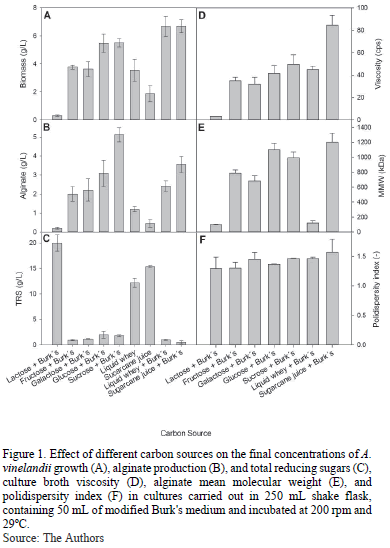
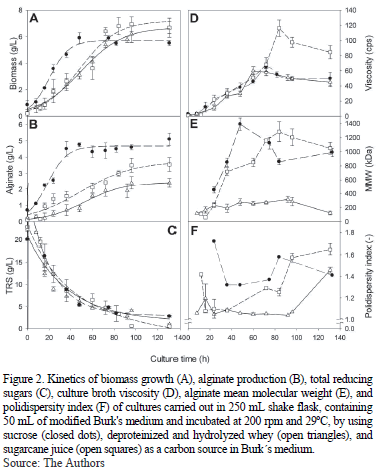
<body><![CDATA[<p><font size="2" face="Verdana, Arial, Helvetica, sans-serif">Washed cells from pre-cultures were inoculated to start  with an optical density near 0.15 absorbance units in 250 mL shake flask,  containing 50 mL of modified Burk's medium, and incubated in a rotary shaker  (with a rotatory diameter of 2.54 cm) at 200 rpm and 29ºC. Under these  conditions, the cells were grown under oxygen limitation &#91;16&#93;. The aim of using washed cells as inoculum was  to avoid the exhaust inoculum broth components (as extracellular alginate-lyase  activity and alginate). It has been shown that the exhausted broth components  from the inoculum play important regulatory roles in alginate biosynthesis, and  in determining its molecular weight &#91;27&#93;. Two flasks were removed from the  incubator for kinetic analysis as needed &#91;16&#93;.</font></p>     <p><font size="2" face="Verdana, Arial, Helvetica, sans-serif"><b><i>2.2. Analytical  determinations</i></b></font></p>     <p><font size="2" face="Verdana, Arial, Helvetica, sans-serif">Biomass and alginate  were determined gravimetrically as previously described &#91;16&#93;. The total reducing sugars (TRS) were  evaluated by the dinitrosalicylic acid (DNS) method, and an acidic hydrolysis  was undertaken when necessary. A standard correlation was made for each carbon  source. Viscosity was measured on a cone  and plate viscometer (Wells-Brookfield, USA) using a CP-52 cone at a rotational  speed of 6 rpm, which corresponds to a shear rate of 12 s<sup>-1</sup> at room  temperature &#91;16&#93;. Mean molecular weight  (MMW), polydispersity index (PI) and molecular weight distributions (MWD) of  alginates were estimated by gel-permeation chromatography as previously  reported &#91;16,21&#93;, and pullulans from <i>Aureobasidium pullulans</i> (from 5,800  to 1,600,000 Da) were used as standards. The polydispersity index (PI) was defined as the ratio of MMW (weighting  the polymer molecules based on the weight of those having a specific molecular  mass) to mean number weight (weighting the molecules based on the number of  those with a specific molecular mass) &#91;12,13&#93;. All cultures were carried out at  least in triplicate. <a href="#fig01">Figs 1</a> and <a href="#fig02">2</a> show the mean value of at least three  independent cultures and the standard deviation among replicas.</font></p>     <p align="center"><font size="2" face="Verdana, Arial, Helvetica, sans-serif"><a name="fig01"></a></font><img src="/img/revistas/dyna/v82n194/v82n194a03fig01.gif"></p>     <p align="center"><font size="2" face="Verdana, Arial, Helvetica, sans-serif"><a name="fig02"></a></font><img src="/img/revistas/dyna/v82n194/v82n194a03fig02.gif"></p>     <p>&nbsp;</p>     <p><font size="3" face="Verdana, Arial, Helvetica, sans-serif"><b>3. Results and   Discussion</b></font></p>     <p><font size="2" face="Verdana, Arial, Helvetica, sans-serif">Five different carbon  sources were evaluated (fructose, galactose, glucose, lactose, and sucrose) in  modified Burk´s medium. Moreover,  hydrolyzed and deproteinized liquid whey and sugarcane juice were also  evaluated alone, or as a complement of Burk´s medium, always maintaining an  initial concentration of 20 g/L of total reducing sugars (TRS). All cultures were carried out for 120 h and  the final concentrations of biomass, alginate and TRS are shown in <a href="#fig01">Fig. 1</a>. If considering just the conventional carbon sources, the carbon source that yields the highest biomass  (5.51±0.3 g/L) and alginate (5.11±0.37 g/L) production was sucrose, followed by  glucose (5.47±0.65 and 3.1±0.70 g/L for biomass and alginate,  respectively). Lower biomass growth and  alginate production was obtained using fructose and galactose (<a href="#fig01">Fig. 1A</a> and  <a href="#fig01">1B</a>). These results confirm that <i>A.  vinelandii</i> can use any of these three monomers to produce alginate as  previously reported by Pindar and Bucke &#91;28&#93;. However, no biomass growth (nor alginate production) was observed using  lactose as a carbon source in Burk´s medium &#91;28&#93;. </font></p>     <p><font size="2" face="Verdana, Arial, Helvetica, sans-serif">Page et al. &#91;29&#93; demonstrated that large production of PHB  (19 to 22 g/L) is supported when <i>A. vinelandii </i>is grown with complex,  unrefined carbohydrate sources such as cane and beet molasses. In addition, these complex substrates may  have other desirable effects on the production of PHB, such as culture growth  promotion and reducing the time for PHB formation. Taking into account data reported by Page et  al. &#91;29&#93;, we evaluated two complex carbon sources (hydrolyzed and deproteinized  whey and sugarcane juice) in the production of alginates by <i>A. vinelandii</i> and determined the effect of this process on their molecular characteristics, <i>i.e.</i> mean molecular weight and polidispersity index. </font></p>     <p><font size="2" face="Verdana, Arial, Helvetica, sans-serif">In cultures using hydrolyzed and deproteinized whey, a  biomass concentration of 3.55±0.79 g/L and 1.20±0.13 g/L of alginate were  obtained. While, using sugarcane juice 1.87±0.59 g/L of biomass and 0.45±0.20  g/L of alginate were obtained. It should  be mentioned that those unconventional C-source cultures were carried out by  just adjusting the initial pH to 7.2, TRS to 20 g/L and adding any buffer or  salt. However, by complementing these  unconventional C-sources with Burk´s medium (without sucrose), 6.67±0.72 g/L  and 6.68±0.45 g/L of biomass were obtained, and 2.42±0.28 g/L and 3.55±0.42 g/L  of alginate were achieved by using hydrolyzed and deproteinized whey or  sugarcane juice, respectively.</font></p>     ]]></body>
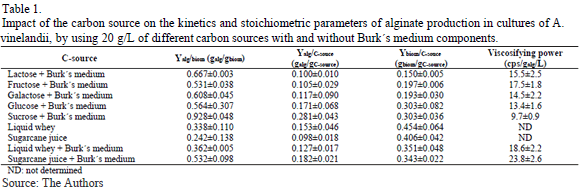
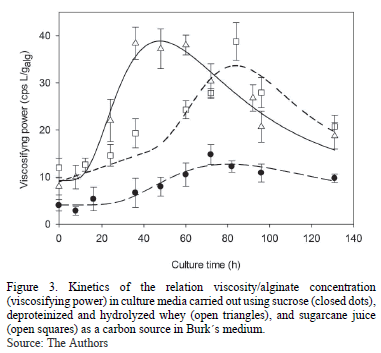
<body><![CDATA[<p><font size="2" face="Verdana, Arial, Helvetica, sans-serif">When reviewing the consumption of C-sources, measured as  total reducing sugars, as shown in <a href="#fig01">Fig. 1C</a>, no C-source uptake was observed  using lactose, which is congruent with no obtaining biomass growth, nor  alginate production. Furthermore, when hydrolyzed and deproteinized whey or  sugarcane juice (without Burk´s medium) were used, less than half the C-source  was consumed (<a href="#fig01">Fig. 1C</a>). In glucose,  sucrose, galactose, hydrolyzed and deproteinized whey and sugarcane juice with  Burk´s medium, the consumption of the C-source was nearly complete, and only  residual values of less than 2.0 g/L were observed (<a href="#fig01">Fig. 1C</a>).</font></p>     <p><font size="2" face="Verdana, Arial, Helvetica, sans-serif">The highest alginate/biomass yield was found using sucrose  as C-source with a value of 0.928±0.048 g<sub>alginate</sub>/g<sub>biomass</sub> (<a href="#tab01">Table 1</a>), and also the best alginate/C-source yield was obtained (0.281±0.043  g<sub>alginate</sub>/g<sub>sucrose</sub>). Alternatively, the best yield biomass/C-source was obtained using  hydrolyzed and deproteinized whey (0.454±0.064 g<sub>biomass</sub>/g<sub>whey</sub>)  and sugarcane juice (0.406±0.042 g<sub>biom</sub>/g<sub>sugarcane</sub>) not  fortified with Burk´s medium (<a href="#tab01">Table 1</a>). However, the lowest alginate/C-source yields of all were obtained for  hydrolyzed and deproteinized whey (0.153±0.046 g<sub>alginate</sub>/g<sub>C-source</sub>)  and sugarcane juice (0.098±0.018 g<sub>alginate</sub>/g<sub>C-source</sub>).  This might be due to the lower concentrations of a nitrogen source, decreasing  alginate production, but increasing biomass growth &#91;14&#93;.</font></p>     <p align="center"><font size="2" face="Verdana, Arial, Helvetica, sans-serif"><a name="tab01"></a></font><img src="/img/revistas/dyna/v82n194/v82n194a03tab01.gif"></p>     <p><font size="2" face="Verdana, Arial, Helvetica, sans-serif">Using sugarcane juice-Burk culture medium, the highest  viscosity was obtained (85±9 cps), with 3.55±0.42 g/L of alginate, and a MMW of  1203±120 kDa (<a href="#fig01">Fig. 1B</a>, <a href="#fig01">1D</a> and <a href="#fig01">1E</a>). Compared to sucrose-Burk medium, the  viscosity was 50±9 cps with a final alginate concentration of 5.11±0.37 g/L and  a MMW of 990±80 kDa. In glucose, the  viscosity was 41±7 cps with 3.08±0.70 g/L of alginate and MMW of 1100±90 kDa  (<a href="#fig01">Fig.s 1B</a>, <a href="#fig01">1D</a> and <a href="#fig01">1E</a>). The polydispersity  index of alginates obtained from all C-sources was less than 2.0. These values  demonstrated that alginates are monodisperse, without significant differences  (<a href="#fig01">Fig. 1F</a>), at least in the experiments carried out in this work for shake  flasks.</font></p>     <p><font size="2" face="Verdana, Arial, Helvetica, sans-serif">Pe&ntilde;a et al. &#91;10&#93; propose &quot;viscosifying power&quot; as  the way to compare the viscosifying capacity of alginates from different  sources or processes, which can be defined as the viscosity generated per unit  of polymer concentration. In order to compare the differences in the viscosifying  power of alginates obtained from each C-source, viscosity/concentration ratio  were calculated from final cultures of <i>A. vinelandii</i> (<a href="#tab01">Table 1</a>). The  higher viscosifying power was found in those cultures carried out with  sugarcane juice + Burk´s medium (23.8±2.6 cps L/g<sub>alginate</sub>), and was  twice the lowest viscosifying power obtained by using sucrose + Burk´s  components (9.69±0.95 cps L/g<sub>alginate</sub>). The most interesting result  was the viscosifying power of 18.57±2.16 cps L/g<sub>alginate</sub> obtained  from cultures carried out with hydrolyzed and deproteinized whey + Burk´s components  (<a href="#tab01">Table 1</a>), due to the lower MMW of the alginate obtained (121±27 kDa) (<a href="#fig01">Fig.  1D</a>). These results cannot be explained only by MMW differences, because there  are other factors such as the monomers ratio (M/G ratio), the sequence pattern  and the O-acetylation degree in mannuronic acid residues that might also affect  viscosifying power &#91;6,9,10&#93;. On the other hand, Pe&ntilde;a et al. &#91;30&#93; reported that  the viscosifying power, the degree of O-acetylation and the MMW of the alginate  produced by <i>A. vinelandii</i> in shake flasks are determined by the oxygen  transfer rate (OTR). Those data are in  agreement with our data in terms that the OTR might be affected by the C-source  used, as previously reported in <i>E. coli</i> cultures &#91;31,32&#93;. There is a  well documented strong relationship between alginate production, its molecular  characteristics and OTR &#91;9, 10,33,34&#93;.</font></p>     <p><font size="2" face="Verdana, Arial, Helvetica, sans-serif">The alginate viscosity production and MMW differences  between this work and those reported by Pe&ntilde;a et al. &#91;16&#93;, where sucrose + Burk´s  medium were used, might be due to the Erlenmeyer shake flasks dimensions,  volumes and inoculation form. Pe&ntilde;a et al. &#91;16&#93; used shake flasks of 500 mL  containing 100 mL of medium, inoculating 10% of the pre-culture (around 0.1-0.3  g/L, dry weight), reporting a maximum alginate concentration (obtained at 72 h)  of 4.5 g/L, viscosity of 520 cps and a MMW of 1.98x10<sup>6</sup> Da with a  polidispersity index (PI) of 1.50, whereas, in this work, we used 250 mL shake  flasks with 50 mL of culture medium, inoculated with washed cells. On the other  hand, Pe&ntilde;a et al. &#91;16&#93; reported that alginate production change as a function  of the filling volume in shake flasks, modifying also its MMW. Thus, it is not  surprising-comparing our results with those previously reported-that alginate  molecular characteristics were different in spite of using the same strain of <i>A. vinelandii</i>.</font></p>     <p><font size="2" face="Verdana, Arial, Helvetica, sans-serif">In order to dissect  the role of non-conventional carbon sources in <i>A. vinelandii</i> growth,  C-source consumption and alginate molecular characteristics, a complete  kinetics of <i>A. vinelandii</i> growth and alginate production was undertaken  by using sucrose, deproteinized and hydrolyzed whey and sugarcane juice in  Burk´s medium (<a href="#fig02">Fig. 2</a>). A similar final biomass was obtained using whey and  sugarcane juice in Burk´s medium (6.7±0.7 g/L and 6.7±0.4 g/L, respectively),  with similar specific growth rates (0.047±0.003 and 0.046±0.004 h<sup>-1</sup>,  respectively). But lower biomass was obtained using sucrose (5.5±0.2 g/L) with  a higher specific growth rate (0.052±0.002 h<sup>-1</sup>) (<a href="#fig02">Fig. 2.A</a>). However,  lower alginate production, and lower specific alginate production rates were  obtained by using hydrolyzed whey (2.4±0.3 g/L and 3.77x10<sup>-3</sup>±0.3x10<sup>-3</sup> g<sub>alginate</sub>/g<sub>biomass</sub>h, respectively), and sugarcane juice  (3.6±0.4 g/L and 5.54x10<sup>-3</sup>±0.6x10<sup>-3</sup> g<sub>alginate</sub>/g<sub>biomass</sub>h,  respectively) in Burk´s medium, than in sucrose (5.1±0.4 g/L and 25.8x10<sup>-3</sup>±2x10<sup>-3 </sup>g<sub>alginate</sub>/g<sub>biomass</sub>h, respectively) (<a href="#fig02">Fig. 2.B</a>). In  terms of C-source consumption, almost all were consumed, but no significant  differences were obtained in specific consumption rates with an average of  3.46x10<sup>-3</sup>±0.27x10<sup>-3</sup> g<sub>C-source</sub>/g<sub>biomass.</sub>h  (<a href="#fig02">Fig. 2.C</a>). A similar viscosity kinetics was found between those cultures grown  using deproteinized and hydrolyzed whey and sucrose in Burk´s medium (<a href="#fig02">Fig.  2.D</a>). These similarities are not correlated to MMW kinetics, where an almost  five times lower MMW was obtained in those cultures grown using hydrolyzed and  deproteinized whey (<a href="#fig02">Fig. 2.E</a>). To explain this behavior, the viscosifying power  was plotted as a function of culture time (<a href="#fig03">Fig. 3</a>). This relation can be a  quantitative approach to define the quality of alginates &#91;10&#93;. Viscosifying  power increases during culture, and decreases at the end of the exponential  phase, possibly due to the action of alginate lyases &#91;21,35&#93;. Moreover, there  is no relationship between biomass growth kinetics, Alginate MMW and its  production and the viscosifying capacity. This may be due to differences in the  biopolymer molecular characteristics, such as the M/G ratio and the acetylation  degree &#91;15,30&#93;. <a href="#tab01">Table 1</a> outlines the final viscosifying power of cultures. The  highest viscosifying power was obtained using deproteinized and hydrolyzed  whey, and sugarcane juice in Burk´s culture medium. However, it is clear that  higher values of viscosifying capacity can be achieved during cultivation (<a href="#fig03">Fig.  3</a>) as a response of the increases in the MMW &#91;2,9,15,30&#93;, and the final values  presented in <a href="#tab01">Table 1</a> are the result of the alginate lyase activity &#91;21,23,35&#93;.</font></p>     <p align="center"><font size="2" face="Verdana, Arial, Helvetica, sans-serif"><a name="fig03"></a></font><img src="/img/revistas/dyna/v82n194/v82n194a03fig03.gif"></p>     <p><font size="2" face="Verdana, Arial, Helvetica, sans-serif">Here, we could suggest that using alternative C-sources,  and consequently more complex but less expensive ones, alginates with different  molecular properties than those obtained with conventional C-sources can be  produced.</font></p>     <p>&nbsp;</p>     ]]></body>
<body><![CDATA[<p><font size="3" face="Verdana, Arial, Helvetica, sans-serif"><b>4. Concluding  remarks</b></font></p>     <p><font size="2" face="Verdana, Arial, Helvetica, sans-serif">To our knowledge, this is the first work reporting the  effect of non-conventional and conventional C-sources on alginate MMW and  viscosifying power produced by <i>A. vinelandii</i>. Although the highest concentration of biomass  was obtained with the use of alternative C-sources (deproteinized and  hydrolyzed whey and sugarcane juice), </font><font size="2" face="Verdana, Arial, Helvetica, sans-serif">the  highest concentration of alginate was obtained using sucrose in Burk&acute;s medium.  Furthermore, the best alginate yields and specific alginate production rates  were obtained using sucrose, compared to unconventional C-sources. Moreover,differences  in viscosifying power clearly demonstrated that the alginates produced by <i>A.  vinelandii</i> when using deproteinized and hydrolyzed whey are surely  different in composition than those produced with sugar cane or sucrose, said  differences lying depending on the monomers ratio (M/G), the sequence pattern  and the acetylation degree in mannuronic acid residues. Based on the data  presented here, it can be assumed that it is possible to produce alginates with  different molecular characteristics by modifying only the components of the  culture, such as the C-source. This knowledge associated with the understanding  of the effects of environmental conditions, would yield high concentrations of  high added value alginates.</font></p>     <p>&nbsp;</p>     <p><font size="3" face="Verdana, Arial, Helvetica, sans-serif"><b>Acknowledgements</b></font></p>     <p><font size="2" face="Verdana, Arial, Helvetica, sans-serif">This work was  financed by Consejo Nacional de Ciencia y Tecnolog&iacute;a (CONACyT 178528,  CONACYT-INNOVAPYME 214404), and Programa de Apoyo a Proyectos de Investigaci&oacute;n  e Innovaci&oacute;n Tecnol&oacute;gica, Universidad Nacional Aut&oacute;noma de M&eacute;xico (PAPIIT-UNAM  IN-210013 and IN-209113). The authors would like to thank Drs. Enrique  Galindo, Carlos Pe&ntilde;a and Celia Flores for technical assistance. We also thank  Ana Carmen Delgado for reviewing the English version of the manuscript. </font></p>     <p>&nbsp;</p>     <p><font size="3" face="Verdana, Arial, Helvetica, sans-serif"><b>References</b></font></p>     <!-- ref --><p><font size="2" face="Verdana, Arial, Helvetica, sans-serif"><b>&#91;1&#93;</b> Rehm, B.H.  and Valla, S., Bacterial alginates: Biosynthesis and applications. Appl Microbiol Biotechnol 48, pp.  281-288, 1997. DOI: 10.1007/s10529-006-9156-x</font>&nbsp;&nbsp;&nbsp;&nbsp;&nbsp;&nbsp;&nbsp;&nbsp;[&#160;<a href="javascript:void(0);" onclick="javascript: window.open('/scielo.php?script=sci_nlinks&ref=000060&pid=S0012-7353201500060000300001&lng=','','width=640,height=500,resizable=yes,scrollbars=1,menubar=yes,');">Links</a>&#160;]<!-- end-ref --><!-- ref --><p><font size="2" face="Verdana, Arial, Helvetica, sans-serif"><b>&#91;2&#93;</b> Galindo, E.,  Pe&ntilde;a, C., Nu&ntilde;ez, C., Segura, D. and Espin, G., Molecular and bioengineering  strategies to improve alginate and polydydroxyalkanoate production by <i>Azotobacter  vinelandii</i>. Microb Cell Fact.  &#91;online&#93;. 6:7, 2007. Avalilable at:  <a href="http://www.microbialcellfactories.com/content/6/1/7" target="_blank">http://www.microbialcellfactories.com/content/6/1/7</a>. DOI: 10.1186/1475-2859-6-7</font>&nbsp;&nbsp;&nbsp;&nbsp;&nbsp;&nbsp;&nbsp;&nbsp;[&#160;<a href="javascript:void(0);" onclick="javascript: window.open('/scielo.php?script=sci_nlinks&ref=000061&pid=S0012-7353201500060000300002&lng=','','width=640,height=500,resizable=yes,scrollbars=1,menubar=yes,');">Links</a>&#160;]<!-- end-ref --><!-- ref --><p><font size="2" face="Verdana, Arial, Helvetica, sans-serif"><b>&#91;3&#93;</b> Rehman,  Z.U., Wang, Y., Moradali, M.F., Hay, I.D. and Rehm, B.H., Insight into assembly  of the alginate biosynthesis machinery in <i>Pseudomonas aeruginosa</i>. Appl Environ Microbiol, 79(10), pp.  3264-3272, 2013. DOI: 10.1128/AEM.00460-13</font>&nbsp;&nbsp;&nbsp;&nbsp;&nbsp;&nbsp;&nbsp;&nbsp;[&#160;<a href="javascript:void(0);" onclick="javascript: window.open('/scielo.php?script=sci_nlinks&ref=000062&pid=S0012-7353201500060000300003&lng=','','width=640,height=500,resizable=yes,scrollbars=1,menubar=yes,');">Links</a>&#160;]<!-- end-ref --><!-- ref --><p><font size="2" face="Verdana, Arial, Helvetica, sans-serif"><b>&#91;4&#93;</b> Hay, I.D.,  Wang, Y., Moradali, M.F., Rehman, Z.U. and Rehm, B.H.A., Genetics and regulation  of bacterial alginate production. Environ  Microbiol. 16(10), pp. 2997-3011, 2014. DOI: 10.1111/1462-2920.12389.    &nbsp;&nbsp;&nbsp;&nbsp;&nbsp;&nbsp;&nbsp;&nbsp;[&#160;<a href="javascript:void(0);" onclick="javascript: window.open('/scielo.php?script=sci_nlinks&ref=000063&pid=S0012-7353201500060000300004&lng=','','width=640,height=500,resizable=yes,scrollbars=1,menubar=yes,');">Links</a>&#160;]<!-- end-ref --> </font></p>     <!-- ref --><p><font size="2" face="Verdana, Arial, Helvetica, sans-serif"><b>&#91;5&#93;</b> Skjåk-Braek,  G., Grasdalen, H. and Larsen, B., Monomer sequence and acetylation pattern in  some bacterial alginates. Carbohydr  Res. 154, pp. 239-250, 1986. DOI: 10.1016/S0008-6215(00)90036-3</font>&nbsp;&nbsp;&nbsp;&nbsp;&nbsp;&nbsp;&nbsp;&nbsp;[&#160;<a href="javascript:void(0);" onclick="javascript: window.open('/scielo.php?script=sci_nlinks&ref=000065&pid=S0012-7353201500060000300005&lng=','','width=640,height=500,resizable=yes,scrollbars=1,menubar=yes,');">Links</a>&#160;]<!-- end-ref --><!-- ref --><p><font size="2" face="Verdana, Arial, Helvetica, sans-serif"><b>&#91;6&#93;</b> Vargas-Garcia,  M.C., Lopez, M.J., Elorrieta, M.A., Suarez, F. and Moreno, J., Properties of  polysaccharide produced by <i>Azotobacter vinelandii</i> cultured on  4-hydroxybenzoic acid. J App Microbiol, 94, pp. 388-395, 2003. DOI:  10.1046/j.1365-2672.2003.01842.x</font>&nbsp;&nbsp;&nbsp;&nbsp;&nbsp;&nbsp;&nbsp;&nbsp;[&#160;<a href="javascript:void(0);" onclick="javascript: window.open('/scielo.php?script=sci_nlinks&ref=000066&pid=S0012-7353201500060000300006&lng=','','width=640,height=500,resizable=yes,scrollbars=1,menubar=yes,');">Links</a>&#160;]<!-- end-ref --><!-- ref --><p><font size="2" face="Verdana, Arial, Helvetica, sans-serif"><b>&#91;7&#93;</b> Moresi, M.,  Bruno, M. and Parente, E., Viscoelastic properties of microbial alginate gels  by oscillatory dynamic tests. J Food  Eng., 64, pp. 179-186, 2004. DOI: 10.1016/j.jfoodeng.2003.09.030</font>&nbsp;&nbsp;&nbsp;&nbsp;&nbsp;&nbsp;&nbsp;&nbsp;[&#160;<a href="javascript:void(0);" onclick="javascript: window.open('/scielo.php?script=sci_nlinks&ref=000067&pid=S0012-7353201500060000300007&lng=','','width=640,height=500,resizable=yes,scrollbars=1,menubar=yes,');">Links</a>&#160;]<!-- end-ref --><!-- ref --><p><font size="2" face="Verdana, Arial, Helvetica, sans-serif"><b>&#91;8&#93;</b> Remminghorst,  U and, Rehm, B.H., Bacterial alginates: From biosynthesis to applications. Biotechnol Lett, 28, pp. 1701-1712,  2006. DOI: 10.1007/s10529-006-9156-x</font>&nbsp;&nbsp;&nbsp;&nbsp;&nbsp;&nbsp;&nbsp;&nbsp;[&#160;<a href="javascript:void(0);" onclick="javascript: window.open('/scielo.php?script=sci_nlinks&ref=000068&pid=S0012-7353201500060000300008&lng=','','width=640,height=500,resizable=yes,scrollbars=1,menubar=yes,');">Links</a>&#160;]<!-- end-ref --><!-- ref --><p><font size="2" face="Verdana, Arial, Helvetica, sans-serif"><b>&#91;9&#93;</b> Castillo,  T., Galindo, E. and Pe&ntilde;a, C., The acetylation degree of alginates in <i>Azotobacter vinelandii </i>ATCC9046 is  determined by dissolved oxygen and specific growth rate: Studies in  glucose-limited chemostat cultivations. J  Ind Microbiol Biotechnol, 40(7), pp. 715-723, 2013. DOI:  10.1007/s10295-013-1274-6</font>&nbsp;&nbsp;&nbsp;&nbsp;&nbsp;&nbsp;&nbsp;&nbsp;[&#160;<a href="javascript:void(0);" onclick="javascript: window.open('/scielo.php?script=sci_nlinks&ref=000069&pid=S0012-7353201500060000300009&lng=','','width=640,height=500,resizable=yes,scrollbars=1,menubar=yes,');">Links</a>&#160;]<!-- end-ref --><!-- ref --><p><font size="2" face="Verdana, Arial, Helvetica, sans-serif"><b>&#91;10&#93;</b> Pe&ntilde;a, C.,  Castillo, T., Nu&ntilde;ez, C. and Segura, D., Bioprocess design: Fermentation  strategies for improving the production of alginate and  poly-beta-hydroxyalkanoates (PHAs) by <i>Azotobacter  vinelandii</i>. In Carpi, A. (ed).  Progress in molecular and environmental bioengineering - From analysis and  modeling to technology applications, 2011. DOI: 10.5772/20393.    &nbsp;&nbsp;&nbsp;&nbsp;&nbsp;&nbsp;&nbsp;&nbsp;[&#160;<a href="javascript:void(0);" onclick="javascript: window.open('/scielo.php?script=sci_nlinks&ref=000070&pid=S0012-7353201500060000300010&lng=','','width=640,height=500,resizable=yes,scrollbars=1,menubar=yes,');">Links</a>&#160;]<!-- end-ref --></font></p>     <!-- ref --><p><font size="2" face="Verdana, Arial, Helvetica, sans-serif"><b>&#91;11&#93;</b> Horan, N.J.,  Jarman, T.R. and Dawes, E.A., Effects of carbon source and inorganic phosphate  concentration on the production of alginic acid by a mutant of <i>Azotobacter vinelandii </i>and on the  enzymes involved in its biosynthesis. J Gen Microbiol, 127, pp. 185-191,  1981. DOI: 10.1099/00221287-127-1-185</font>&nbsp;&nbsp;&nbsp;&nbsp;&nbsp;&nbsp;&nbsp;&nbsp;[&#160;<a href="javascript:void(0);" onclick="javascript: window.open('/scielo.php?script=sci_nlinks&ref=000072&pid=S0012-7353201500060000300011&lng=','','width=640,height=500,resizable=yes,scrollbars=1,menubar=yes,');">Links</a>&#160;]<!-- end-ref --><!-- ref --><p><font size="2" face="Verdana, Arial, Helvetica, sans-serif"><b>&#91;12&#93;</b> Clementi, F., Fantozzi, P., Mancini, F. and Moresi, M., Optimal conditions for alginate production by <i>Azotobacter  vinelandii</i>. Enzyme Microb Tech. 17, pp. 983-988, 1995. DOI: 10.1016/0141-0229(95)00007-0</font>&nbsp;&nbsp;&nbsp;&nbsp;&nbsp;&nbsp;&nbsp;&nbsp;[&#160;<a href="javascript:void(0);" onclick="javascript: window.open('/scielo.php?script=sci_nlinks&ref=000073&pid=S0012-7353201500060000300012&lng=','','width=640,height=500,resizable=yes,scrollbars=1,menubar=yes,');">Links</a>&#160;]<!-- end-ref --><!-- ref --><p><font size="2" face="Verdana, Arial, Helvetica, sans-serif"><b>&#91;13&#93;</b> Clementi,  F., Alginate production by <i>Azotobacter vinelandii</i>. Crit Rev Biotechnol, 17, pp. 327-361,  1997. DOI: 10.3109/07388559709146618</font>&nbsp;&nbsp;&nbsp;&nbsp;&nbsp;&nbsp;&nbsp;&nbsp;[&#160;<a href="javascript:void(0);" onclick="javascript: window.open('/scielo.php?script=sci_nlinks&ref=000074&pid=S0012-7353201500060000300013&lng=','','width=640,height=500,resizable=yes,scrollbars=1,menubar=yes,');">Links</a>&#160;]<!-- end-ref --><!-- ref --><p><font size="2" face="Verdana, Arial, Helvetica, sans-serif"><b>&#91;14&#93;</b> Zapata-V&eacute;lez, A.M. and Trujillo-Rold&aacute;n, M.A., The lack of a nitrogen source and/or the C/N  ratio affects the molecular weight of alginate and its productivity in  submerged cultures of <i>Azotobacter  vinelandii</i>. Ann Microbiol, 60, pp. 661-668, 2010. DOI: 10.1007/s13213-010-0111-7</font>&nbsp;&nbsp;&nbsp;&nbsp;&nbsp;&nbsp;&nbsp;&nbsp;[&#160;<a href="javascript:void(0);" onclick="javascript: window.open('/scielo.php?script=sci_nlinks&ref=000075&pid=S0012-7353201500060000300014&lng=','','width=640,height=500,resizable=yes,scrollbars=1,menubar=yes,');">Links</a>&#160;]<!-- end-ref --><!-- ref --><p><font size="2" face="Verdana, Arial, Helvetica, sans-serif"><b>&#91;15&#93;</b> Pe&ntilde;a, C.,  Hernandez, L. and Galindo, E., Manipulation of the acetylation degree of <i>Azotobacter  vinelandii</i> alginate by supplementing the culture medium with  3-(N-morpholino)-propane-sulfonic acid. Lett  Appl Microbiol, 43, pp. 200-204, 2006. DOI:  10.1111/j.1472-765X.2006.01925.x</font>&nbsp;&nbsp;&nbsp;&nbsp;&nbsp;&nbsp;&nbsp;&nbsp;[&#160;<a href="javascript:void(0);" onclick="javascript: window.open('/scielo.php?script=sci_nlinks&ref=000076&pid=S0012-7353201500060000300015&lng=','','width=640,height=500,resizable=yes,scrollbars=1,menubar=yes,');">Links</a>&#160;]<!-- end-ref --><!-- ref --><p><font size="2" face="Verdana, Arial, Helvetica, sans-serif"><b>&#91;16&#93;</b> Pe&ntilde;a, C.,  Campos, N. and Galindo, E., Changes in alginate molecular mass distributions,  broth viscosity and morphology of <i>Azotobacter vinelandii</i> cultured in  shake flasks. Appl Microbiol  Biotechnol, 48 pp. 510-515, 1997. DOI: 10.1007/s002530051088</font>&nbsp;&nbsp;&nbsp;&nbsp;&nbsp;&nbsp;&nbsp;&nbsp;[&#160;<a href="javascript:void(0);" onclick="javascript: window.open('/scielo.php?script=sci_nlinks&ref=000077&pid=S0012-7353201500060000300016&lng=','','width=640,height=500,resizable=yes,scrollbars=1,menubar=yes,');">Links</a>&#160;]<!-- end-ref --><!-- ref --><p><font size="2" face="Verdana, Arial, Helvetica, sans-serif"><b>&#91;17&#93;</b> Pe&ntilde;a, C.,  Trujillo-Rold&aacute;n, M.A. and Galindo, E., Influence of dissolved oxygen tension  and agitation speed on alginate production and its molecular weight in cultures  of <i>Azotobacter vinelandii</i>. Enzyme Microb Technol, 27, pp.  390-398, 2000. DOI: 10.1016/S0141-0229(00)00221-0</font>&nbsp;&nbsp;&nbsp;&nbsp;&nbsp;&nbsp;&nbsp;&nbsp;[&#160;<a href="javascript:void(0);" onclick="javascript: window.open('/scielo.php?script=sci_nlinks&ref=000078&pid=S0012-7353201500060000300017&lng=','','width=640,height=500,resizable=yes,scrollbars=1,menubar=yes,');">Links</a>&#160;]<!-- end-ref --><!-- ref --><p><font size="2" face="Verdana, Arial, Helvetica, sans-serif"><b>&#91;18&#93;</b> Kivilcimdan,  M.C. and Sanin, F.D., An investigation of agitation speed as a factor affecting  the quantity and monomer distribution of alginate from <i>Azotobacter vinelandii</i> ATCC(R) 9046. J Ind Microbiol Biotechnol, 39, pp. 513-519, 2012. DOI:  10.1007/s10295-011-1043-3</font>&nbsp;&nbsp;&nbsp;&nbsp;&nbsp;&nbsp;&nbsp;&nbsp;[&#160;<a href="javascript:void(0);" onclick="javascript: window.open('/scielo.php?script=sci_nlinks&ref=000079&pid=S0012-7353201500060000300018&lng=','','width=640,height=500,resizable=yes,scrollbars=1,menubar=yes,');">Links</a>&#160;]<!-- end-ref --><!-- ref --><p><font size="2" face="Verdana, Arial, Helvetica, sans-serif"><b>&#91;19&#93;</b> Sea&ntilde;ez, G.,  Pe&ntilde;a, C. and Galindo, E., High CO<sub>2</sub> affects alginate production and  prevents polymer degradation in cultures of <i>Azotobacter vinelandii</i>. Enzyme Microb Technol, 29, pp.  535-540, 2001. DOI: 10.1016/S0141-0229(01)00435-5</font>&nbsp;&nbsp;&nbsp;&nbsp;&nbsp;&nbsp;&nbsp;&nbsp;[&#160;<a href="javascript:void(0);" onclick="javascript: window.open('/scielo.php?script=sci_nlinks&ref=000080&pid=S0012-7353201500060000300019&lng=','','width=640,height=500,resizable=yes,scrollbars=1,menubar=yes,');">Links</a>&#160;]<!-- end-ref --><!-- ref --><p><font size="2" face="Verdana, Arial, Helvetica, sans-serif"><b>&#91;20&#93;</b> Trujillo-Rold&aacute;n,  M.A., Pe&ntilde;a, C., Ramirez, O.T. and Galindo, E., Effect of oscillating dissolved  oxygen tension on the production of alginate by <i>Azotobacter vinelandii</i>. Biotechnol  Prog. 17, pp. 1042-1048, 2001.  DOI: 10.1021/bp010106d</font>&nbsp;&nbsp;&nbsp;&nbsp;&nbsp;&nbsp;&nbsp;&nbsp;[&#160;<a href="javascript:void(0);" onclick="javascript: window.open('/scielo.php?script=sci_nlinks&ref=000081&pid=S0012-7353201500060000300020&lng=','','width=640,height=500,resizable=yes,scrollbars=1,menubar=yes,');">Links</a>&#160;]<!-- end-ref --><!-- ref --><p><font size="2" face="Verdana, Arial, Helvetica, sans-serif"><b>&#91;21&#93;</b> Trujillo-Rold&aacute;n,  M.A., Moreno, S., Espin, G. and Galindo, E., The roles of oxygen and  alginate-lyase in determining the molecular weight of alginate produced by <i>Azotobacter vinelandii</i>. Appl Microbiol Biotechnol, 63, pp.  742-747, 2004. DOI: 10.1007/s00253-003-1419-z</font>&nbsp;&nbsp;&nbsp;&nbsp;&nbsp;&nbsp;&nbsp;&nbsp;[&#160;<a href="javascript:void(0);" onclick="javascript: window.open('/scielo.php?script=sci_nlinks&ref=000082&pid=S0012-7353201500060000300021&lng=','','width=640,height=500,resizable=yes,scrollbars=1,menubar=yes,');">Links</a>&#160;]<!-- end-ref --><!-- ref --><p><font size="2" face="Verdana, Arial, Helvetica, sans-serif"><b>&#91;22&#93;</b> D&iacute;az-Barrera,  A., Silva, P., Avalos, R. and Acevedo, F., Alginate molecular mass produced by <i>Azotobacter  vinelandii</i> in response to changes of the O<sub>2</sub> transfer rate in  chemostat cultures. Biotechnol Lett, 31, pp. 825-829, 2009. DOI: 10.1007/s10529-009-9949-9</font>&nbsp;&nbsp;&nbsp;&nbsp;&nbsp;&nbsp;&nbsp;&nbsp;[&#160;<a href="javascript:void(0);" onclick="javascript: window.open('/scielo.php?script=sci_nlinks&ref=000083&pid=S0012-7353201500060000300022&lng=','','width=640,height=500,resizable=yes,scrollbars=1,menubar=yes,');">Links</a>&#160;]<!-- end-ref --><!-- ref --><p><font size="2" face="Verdana, Arial, Helvetica, sans-serif"><b>&#91;23&#93;</b> Flores, C.,  Moreno, S., Espin, G., Pe&ntilde;a, C. and Galindo, E., Expression of alginases and  alginate polymerase genes in response to oxygen, and their relationship with  the alginate molecular weight in <i>Azotobacter vinelandii</i>. Enzyme Microb Technol, 53, pp. 85-91,  2013. DOI: 10.1016/j.enzmictec.2013.04.010</font>&nbsp;&nbsp;&nbsp;&nbsp;&nbsp;&nbsp;&nbsp;&nbsp;[&#160;<a href="javascript:void(0);" onclick="javascript: window.open('/scielo.php?script=sci_nlinks&ref=000084&pid=S0012-7353201500060000300023&lng=','','width=640,height=500,resizable=yes,scrollbars=1,menubar=yes,');">Links</a>&#160;]<!-- end-ref --><!-- ref --><p><font size="2" face="Verdana, Arial, Helvetica, sans-serif"><b>&#91;24&#93;</b> Priego-Jimen&eacute;z,  R., Pe&ntilde;a, C., Ram&iacute;rez, O.T. and Galindo, E., Specific growth rate determines  the molecular mass of the alginate produced by <i>Azotobacter vinelandii</i>. Biochem Engin J., 25, pp. 187-193,  2005. DOI: 10.1016/j.bej.2005.05.003</font>&nbsp;&nbsp;&nbsp;&nbsp;&nbsp;&nbsp;&nbsp;&nbsp;[&#160;<a href="javascript:void(0);" onclick="javascript: window.open('/scielo.php?script=sci_nlinks&ref=000085&pid=S0012-7353201500060000300024&lng=','','width=640,height=500,resizable=yes,scrollbars=1,menubar=yes,');">Links</a>&#160;]<!-- end-ref --><!-- ref --><p><font size="2" face="Verdana, Arial, Helvetica, sans-serif"><b>&#91;25&#93;</b> D&iacute;az-Barrera,  A., Silva, P., Berrios, J. and Acevedo, F., Manipulating the molecular weight  of alginate produced by <i>Azotobacter vinelandii</i> in continuous cultures. Bioresour Technol, 101, pp.  9405-9408, 2010. DOI: 10.1016/j.biortech.2010.07.038</font>&nbsp;&nbsp;&nbsp;&nbsp;&nbsp;&nbsp;&nbsp;&nbsp;[&#160;<a href="javascript:void(0);" onclick="javascript: window.open('/scielo.php?script=sci_nlinks&ref=000086&pid=S0012-7353201500060000300025&lng=','','width=640,height=500,resizable=yes,scrollbars=1,menubar=yes,');">Links</a>&#160;]<!-- end-ref --><!-- ref --><p><font size="2" face="Verdana, Arial, Helvetica, sans-serif"><b>&#91;26&#93;</b> D&iacute;az-Barrera,  A., Soto, E. and Altamirano, C., Alginate production and <i>alg8</i> gene  expression by <i>Azotobacter vinelandii</i> in continuous cultures. J Ind  Microbiol Biotechnol, 39, pp. 613-621, 2012. DOI: 10.1007/s10295-011-1055-z</font>&nbsp;&nbsp;&nbsp;&nbsp;&nbsp;&nbsp;&nbsp;&nbsp;[&#160;<a href="javascript:void(0);" onclick="javascript: window.open('/scielo.php?script=sci_nlinks&ref=000087&pid=S0012-7353201500060000300026&lng=','','width=640,height=500,resizable=yes,scrollbars=1,menubar=yes,');">Links</a>&#160;]<!-- end-ref --><!-- ref --><p><font size="2" face="Verdana, Arial, Helvetica, sans-serif"><b>&#91;27&#93;</b> Trujillo-Rold&aacute;n,  M.A., Pe&ntilde;a, C. and Galindo, E., Components in the inoculum determine the  kinetics of <i>Azotobacter vinelandii </i>cultures  and the molecular weight of its alginate. Biotechnol Lett, 25, pp. 1251-1254, 2003. DOI:  10.1023/A:1025027010892</font>&nbsp;&nbsp;&nbsp;&nbsp;&nbsp;&nbsp;&nbsp;&nbsp;[&#160;<a href="javascript:void(0);" onclick="javascript: window.open('/scielo.php?script=sci_nlinks&ref=000088&pid=S0012-7353201500060000300027&lng=','','width=640,height=500,resizable=yes,scrollbars=1,menubar=yes,');">Links</a>&#160;]<!-- end-ref --><!-- ref --><p><font size="2" face="Verdana, Arial, Helvetica, sans-serif"><b>&#91;28&#93;</b> Pindar, D.F.  and Bucke, C., The biosynthesis of alginic acid by <i>Azotobacter vinelandii</i>. Biochem J., 152, pp. 617-622,  1975.    &nbsp;&nbsp;&nbsp;&nbsp;&nbsp;&nbsp;&nbsp;&nbsp;[&#160;<a href="javascript:void(0);" onclick="javascript: window.open('/scielo.php?script=sci_nlinks&ref=000089&pid=S0012-7353201500060000300028&lng=','','width=640,height=500,resizable=yes,scrollbars=1,menubar=yes,');">Links</a>&#160;]<!-- end-ref --></font></p>     <!-- ref --><p><font size="2" face="Verdana, Arial, Helvetica, sans-serif"><b>&#91;29&#93;</b> Page, W.J.,  Manchak, J. and Rudy, B., Formation of poly(hydroxybutyrate-co-hydroxyvalerate)  by <i>Azotobacter vinelandii</i> UWD. Appl Environ Microbiol, 58(9), pp. 2866-2873, 1992.    &nbsp;&nbsp;&nbsp;&nbsp;&nbsp;&nbsp;&nbsp;&nbsp;[&#160;<a href="javascript:void(0);" onclick="javascript: window.open('/scielo.php?script=sci_nlinks&ref=000091&pid=S0012-7353201500060000300029&lng=','','width=640,height=500,resizable=yes,scrollbars=1,menubar=yes,');">Links</a>&#160;]<!-- end-ref --></font></p>     ]]></body>
<body><![CDATA[<!-- ref --><p><font size="2" face="Verdana, Arial, Helvetica, sans-serif"><b>&#91;30&#93;</b> Pe&ntilde;a, C.,  Galindo, E. and Büchs, J., The viscosifying power, degree of acetylation and  molecular mass of the alginate produced by <i>Azotobacter  vinelandii </i>in shake flasks are determined by the oxygen transfer rate. Process Biochem, 46, pp. 290-297,  2011. DOI: 10.1016/j.procbio.2010.08.025</font>&nbsp;&nbsp;&nbsp;&nbsp;&nbsp;&nbsp;&nbsp;&nbsp;[&#160;<a href="javascript:void(0);" onclick="javascript: window.open('/scielo.php?script=sci_nlinks&ref=000093&pid=S0012-7353201500060000300030&lng=','','width=640,height=500,resizable=yes,scrollbars=1,menubar=yes,');">Links</a>&#160;]<!-- end-ref --><!-- ref --><p><font size="2" face="Verdana, Arial, Helvetica, sans-serif"><b>&#91;31&#93;</b> Kunze, M.,  Huber, R., Gutjahr, C., Mullner, S. and Büchs, J., Predictive tool for  recombinant protein production in <i>Escherichia coli</i> shake-flask cultures  using an on-line monitoring system. Biotechnol  Prog. 28, pp. 103-113, 2012. DOI: 10.1002/btpr.719</font>&nbsp;&nbsp;&nbsp;&nbsp;&nbsp;&nbsp;&nbsp;&nbsp;[&#160;<a href="javascript:void(0);" onclick="javascript: window.open('/scielo.php?script=sci_nlinks&ref=000094&pid=S0012-7353201500060000300031&lng=','','width=640,height=500,resizable=yes,scrollbars=1,menubar=yes,');">Links</a>&#160;]<!-- end-ref --><!-- ref --><p><font size="2" face="Verdana, Arial, Helvetica, sans-serif"><b>&#91;32&#93;</b> Ukkonen, K.,  Veijola, J., Vasala, A. and Neubauer, P., Effect of culture medium, host strain  and oxygen transfer on recombinant Fab antibody fragment yield and leakage to  medium in shaken <i>E. coli</i> cultures. Microb Cell Fact, 12, 73 P., 2013. DOI: 10.1186/1475-2859-12-73</font>&nbsp;&nbsp;&nbsp;&nbsp;&nbsp;&nbsp;&nbsp;&nbsp;[&#160;<a href="javascript:void(0);" onclick="javascript: window.open('/scielo.php?script=sci_nlinks&ref=000095&pid=S0012-7353201500060000300032&lng=','','width=640,height=500,resizable=yes,scrollbars=1,menubar=yes,');">Links</a>&#160;]<!-- end-ref --><!-- ref --><p><font size="2" face="Verdana, Arial, Helvetica, sans-serif"><b>&#91;33&#93;</b> D&iacute;az-Barrera,  A., Aguirre, A., Berrios, J. and Acevedo, F., Continuous cultures for alginate  production by <i>Azotobacter vinelandii</i> growing at different oxygen uptake  rates. Process Biochem, 46, pp.  1879-1883, 2011. DOI:  10.1016/j.procbio.2011.06.022</font>&nbsp;&nbsp;&nbsp;&nbsp;&nbsp;&nbsp;&nbsp;&nbsp;[&#160;<a href="javascript:void(0);" onclick="javascript: window.open('/scielo.php?script=sci_nlinks&ref=000096&pid=S0012-7353201500060000300033&lng=','','width=640,height=500,resizable=yes,scrollbars=1,menubar=yes,');">Links</a>&#160;]<!-- end-ref --><!-- ref --><p><font size="2" face="Verdana, Arial, Helvetica, sans-serif"><b>&#91;34&#93;</b> Lozano, E.,  Galindo, E. and Pe&ntilde;a, C., Oxygen transfer rate during the production of  alginate by <i>Azotobacter vinelandii</i> under oxygen-limited and non  oxygen-limited conditions. Microb Cell Fact, 10, 13 P., 2011. DOI: 10.1186/1475-2859-10-13</font>&nbsp;&nbsp;&nbsp;&nbsp;&nbsp;&nbsp;&nbsp;&nbsp;[&#160;<a href="javascript:void(0);" onclick="javascript: window.open('/scielo.php?script=sci_nlinks&ref=000097&pid=S0012-7353201500060000300034&lng=','','width=640,height=500,resizable=yes,scrollbars=1,menubar=yes,');">Links</a>&#160;]<!-- end-ref --><!-- ref --><p><font size="2" face="Verdana, Arial, Helvetica, sans-serif"><b>&#91;35&#93;</b> Trujillo-Rold&aacute;n, M.A., Moreno, S., Segura, D.,  Galindo, E. and Espin, G., Alginate production by an <i>Azotobacter vinelandii </i>mutant unable to produce alginate lyase. Appl Microbiol Biotechnol, 60, pp.  733-737, 2003, DOI: 10.1007/s00253-002-1173-7</font>&nbsp;&nbsp;&nbsp;&nbsp;&nbsp;&nbsp;&nbsp;&nbsp;[&#160;<a href="javascript:void(0);" onclick="javascript: window.open('/scielo.php?script=sci_nlinks&ref=000098&pid=S0012-7353201500060000300035&lng=','','width=640,height=500,resizable=yes,scrollbars=1,menubar=yes,');">Links</a>&#160;]<!-- end-ref --><p>&nbsp;</p>     <p><font size="2" face="Verdana, Arial, Helvetica, sans-serif"><b>M.A.  Trujillo-Rold&aacute;n, </b><i>Corresponding  autor</i>, is Ph.D. Head of the Unidad de Bioprocesos, Instituto de  Investigaciones Biom&eacute;dicas, Universidad Nacional Aut&oacute;noma de M&eacute;xico. ORCID: 0000-0002-7497-4452</font></p>     <p><font size="2" face="Verdana, Arial, Helvetica, sans-serif"><b>J.F.  Monsalve-Gil, </b>is Chemical  Engineeering of the Facultad de Minas, Universidad Nacional de Colombia, Sede  Medell&iacute;n, coolombia. ORCID: 0000-0001-7400-9372 </font></p>     <p><font size="2" face="Verdana, Arial, Helvetica, sans-serif"><b>A.M.  Cuesta-&aacute;lvarez,</b> is  Chemical Engineering of the Facultad de Minas, Universidad Nacional de  Colombia, Sede Medell&iacute;n, Colombia. ORCID: 0000-0003-3374-9715</font></p>     ]]></body>
<body><![CDATA[<p><font size="2" face="Verdana, Arial, Helvetica, sans-serif"><b>N.A.  Valdez-Cruz,</b> is Ph.D.,  Departamento de Biolog&iacute;a Molecular y Biotecnolog&iacute;a, Instituto de  Investigaciones Biom&eacute;dicas, Universidad Nacional Aut&oacute;noma de M&eacute;xico, M&eacute;xico. ORCID:  0000-0002-8581-1173</font></p>      ]]></body><back>
<ref-list>
<ref id="B1">
<label>1</label><nlm-citation citation-type="journal">
<person-group person-group-type="author">
<name>
<surname><![CDATA[Rehm]]></surname>
<given-names><![CDATA[B.H.]]></given-names>
</name>
<name>
<surname><![CDATA[Valla]]></surname>
<given-names><![CDATA[S.]]></given-names>
</name>
</person-group>
<article-title xml:lang="en"><![CDATA[Bacterial alginates: Biosynthesis and applications]]></article-title>
<source><![CDATA[Appl Microbiol Biotechnol]]></source>
<year>1997</year>
<numero>48</numero>
<issue>48</issue>
<page-range>281-288</page-range></nlm-citation>
</ref>
<ref id="B2">
<label>2</label><nlm-citation citation-type="journal">
<person-group person-group-type="author">
<name>
<surname><![CDATA[Galindo]]></surname>
<given-names><![CDATA[E.]]></given-names>
</name>
<name>
<surname><![CDATA[Peña]]></surname>
<given-names><![CDATA[C.]]></given-names>
</name>
<name>
<surname><![CDATA[Nuñez]]></surname>
<given-names><![CDATA[C.]]></given-names>
</name>
<name>
<surname><![CDATA[Segura]]></surname>
<given-names><![CDATA[D.]]></given-names>
</name>
<name>
<surname><![CDATA[Espin]]></surname>
<given-names><![CDATA[G.]]></given-names>
</name>
</person-group>
<article-title xml:lang="en"><![CDATA[Molecular and bioengineering strategies to improve alginate and polydydroxyalkanoate production by Azotobacter vinelandii]]></article-title>
<source><![CDATA[Microb Cell Fact.]]></source>
<year>2007</year>
<volume>6</volume>
<numero>7</numero>
<issue>7</issue>
</nlm-citation>
</ref>
<ref id="B3">
<label>3</label><nlm-citation citation-type="journal">
<person-group person-group-type="author">
<name>
<surname><![CDATA[Rehman]]></surname>
<given-names><![CDATA[Z.U.]]></given-names>
</name>
<name>
<surname><![CDATA[Wang]]></surname>
<given-names><![CDATA[Y.]]></given-names>
</name>
<name>
<surname><![CDATA[Moradali]]></surname>
<given-names><![CDATA[M.F.]]></given-names>
</name>
<name>
<surname><![CDATA[Hay]]></surname>
<given-names><![CDATA[I.D.]]></given-names>
</name>
<name>
<surname><![CDATA[Rehm]]></surname>
<given-names><![CDATA[B.H.]]></given-names>
</name>
</person-group>
<article-title xml:lang="en"><![CDATA[Insight into assembly of the alginate biosynthesis machinery in Pseudomonas aeruginosa]]></article-title>
<source><![CDATA[Appl Environ Microbiol]]></source>
<year>2013</year>
<volume>79</volume>
<numero>10</numero>
<issue>10</issue>
<page-range>3264-3272</page-range></nlm-citation>
</ref>
<ref id="B4">
<label>4</label><nlm-citation citation-type="journal">
<person-group person-group-type="author">
<name>
<surname><![CDATA[Hay]]></surname>
<given-names><![CDATA[I.D.]]></given-names>
</name>
<name>
<surname><![CDATA[Wang]]></surname>
<given-names><![CDATA[Y.]]></given-names>
</name>
<name>
<surname><![CDATA[Moradali]]></surname>
<given-names><![CDATA[M.F.]]></given-names>
</name>
<name>
<surname><![CDATA[Rehman]]></surname>
<given-names><![CDATA[Z.U.]]></given-names>
</name>
<name>
<surname><![CDATA[Rehm]]></surname>
<given-names><![CDATA[B.H.A.]]></given-names>
</name>
</person-group>
<article-title xml:lang="en"><![CDATA[Genetics and regulation of bacterial alginate production.]]></article-title>
<source><![CDATA[Environ Microbiol.]]></source>
<year>2014</year>
<volume>16</volume>
<numero>10</numero>
<issue>10</issue>
<page-range>2997-3011</page-range></nlm-citation>
</ref>
<ref id="B5">
<label>5</label><nlm-citation citation-type="journal">
<person-group person-group-type="author">
<name>
<surname><![CDATA[Skjåk-Braek]]></surname>
<given-names><![CDATA[G.]]></given-names>
</name>
<name>
<surname><![CDATA[Grasdalen]]></surname>
<given-names><![CDATA[H.]]></given-names>
</name>
<name>
<surname><![CDATA[Larsen]]></surname>
<given-names><![CDATA[B.]]></given-names>
</name>
</person-group>
<article-title xml:lang="en"><![CDATA[Monomer sequence and acetylation pattern in some bacterial alginates.]]></article-title>
<source><![CDATA[Carbohydr Res.]]></source>
<year>1986</year>
<numero>154</numero>
<issue>154</issue>
<page-range>239-250</page-range></nlm-citation>
</ref>
<ref id="B6">
<label>6</label><nlm-citation citation-type="journal">
<person-group person-group-type="author">
<name>
<surname><![CDATA[Vargas-Garcia]]></surname>
<given-names><![CDATA[M.C.]]></given-names>
</name>
<name>
<surname><![CDATA[Lopez]]></surname>
<given-names><![CDATA[M.J.]]></given-names>
</name>
<name>
<surname><![CDATA[Elorrieta]]></surname>
<given-names><![CDATA[M.A.]]></given-names>
</name>
<name>
<surname><![CDATA[Suarez]]></surname>
<given-names><![CDATA[F.]]></given-names>
</name>
<name>
<surname><![CDATA[Moreno]]></surname>
<given-names><![CDATA[J.]]></given-names>
</name>
</person-group>
<article-title xml:lang="en"><![CDATA[Properties of polysaccharide produced by Azotobacter vinelandii cultured on 4-hydroxybenzoic acid]]></article-title>
<source><![CDATA[J App Microbiol]]></source>
<year>2003</year>
<volume>94</volume>
<page-range>388-395</page-range></nlm-citation>
</ref>
<ref id="B7">
<label>7</label><nlm-citation citation-type="journal">
<person-group person-group-type="author">
<name>
<surname><![CDATA[Moresi]]></surname>
<given-names><![CDATA[M.]]></given-names>
</name>
<name>
<surname><![CDATA[Bruno]]></surname>
<given-names><![CDATA[M.]]></given-names>
</name>
<name>
<surname><![CDATA[Parente]]></surname>
<given-names><![CDATA[E.]]></given-names>
</name>
</person-group>
<article-title xml:lang="en"><![CDATA[Viscoelastic properties of microbial alginate gels by oscillatory dynamic tests.]]></article-title>
<source><![CDATA[J Food Eng.]]></source>
<year>2004</year>
<numero>64</numero>
<issue>64</issue>
<page-range>179-186</page-range></nlm-citation>
</ref>
<ref id="B8">
<label>8</label><nlm-citation citation-type="journal">
<person-group person-group-type="author">
<name>
<surname><![CDATA[Remminghorst]]></surname>
<given-names><![CDATA[U]]></given-names>
</name>
<name>
<surname><![CDATA[Rehm]]></surname>
<given-names><![CDATA[B.H.]]></given-names>
</name>
</person-group>
<article-title xml:lang="en"><![CDATA[Bacterial alginates: From biosynthesis to applications]]></article-title>
<source><![CDATA[Biotechnol Lett]]></source>
<year>2006</year>
<numero>28</numero>
<issue>28</issue>
<page-range>1701-1712</page-range></nlm-citation>
</ref>
<ref id="B9">
<label>9</label><nlm-citation citation-type="journal">
<person-group person-group-type="author">
<name>
<surname><![CDATA[Castillo]]></surname>
<given-names><![CDATA[T.]]></given-names>
</name>
<name>
<surname><![CDATA[Galindo]]></surname>
<given-names><![CDATA[E.]]></given-names>
</name>
<name>
<surname><![CDATA[Peña]]></surname>
<given-names><![CDATA[C.]]></given-names>
</name>
</person-group>
<article-title xml:lang="en"><![CDATA[The acetylation degree of alginates in Azotobacter vinelandii ATCC9046 is determined by dissolved oxygen and specific growth rate: Studies in glucose-limited chemostat cultivations.]]></article-title>
<source><![CDATA[J Ind Microbiol Biotechnol]]></source>
<year>2013</year>
<volume>40</volume>
<numero>7</numero>
<issue>7</issue>
<page-range>715-723</page-range></nlm-citation>
</ref>
<ref id="B10">
<label>10</label><nlm-citation citation-type="">
<person-group person-group-type="author">
<name>
<surname><![CDATA[Peña]]></surname>
<given-names><![CDATA[C.]]></given-names>
</name>
<name>
<surname><![CDATA[Castillo]]></surname>
<given-names><![CDATA[T.]]></given-names>
</name>
<name>
<surname><![CDATA[Nuñez]]></surname>
<given-names><![CDATA[C.]]></given-names>
</name>
<name>
<surname><![CDATA[Segura]]></surname>
<given-names><![CDATA[D.]]></given-names>
</name>
</person-group>
<article-title xml:lang="en"><![CDATA[Bioprocess design: Fermentation strategies for improving the production of alginate and poly-beta-hydroxyalkanoates (PHAs) by Azotobacter vinelandii]]></article-title>
<person-group person-group-type="editor">
<name>
<surname><![CDATA[Carpi]]></surname>
<given-names><![CDATA[A.]]></given-names>
</name>
</person-group>
<source><![CDATA[Progress in molecular and environmental bioengineering: From analysis and modeling to technology applications]]></source>
<year>2011</year>
</nlm-citation>
</ref>
<ref id="B11">
<label>11</label><nlm-citation citation-type="journal">
<person-group person-group-type="author">
<name>
<surname><![CDATA[Horan]]></surname>
<given-names><![CDATA[N.J.]]></given-names>
</name>
<name>
<surname><![CDATA[Jarman]]></surname>
<given-names><![CDATA[T.R.]]></given-names>
</name>
<name>
<surname><![CDATA[Dawes]]></surname>
<given-names><![CDATA[E.A.]]></given-names>
</name>
</person-group>
<article-title xml:lang="en"><![CDATA[Effects of carbon source and inorganic phosphate concentration on the production of alginic acid by a mutant of Azotobacter vinelandii and on the enzymes involved in its biosynthesis.]]></article-title>
<source><![CDATA[J Gen Microbiol]]></source>
<year>1981</year>
<numero>127</numero>
<issue>127</issue>
<page-range>185-191</page-range></nlm-citation>
</ref>
<ref id="B12">
<label>12</label><nlm-citation citation-type="journal">
<person-group person-group-type="author">
<name>
<surname><![CDATA[Clementi]]></surname>
<given-names><![CDATA[F.]]></given-names>
</name>
<name>
<surname><![CDATA[Fantozzi]]></surname>
<given-names><![CDATA[P.]]></given-names>
</name>
<name>
<surname><![CDATA[Mancini]]></surname>
<given-names><![CDATA[F.]]></given-names>
</name>
<name>
<surname><![CDATA[Moresi]]></surname>
<given-names><![CDATA[M.]]></given-names>
</name>
</person-group>
<article-title xml:lang="en"><![CDATA[Optimal conditions for alginate production by Azotobacter vinelandii.]]></article-title>
<source><![CDATA[Enzyme Microb Tech.]]></source>
<year>1995</year>
<numero>17</numero>
<issue>17</issue>
<page-range>983-988</page-range></nlm-citation>
</ref>
<ref id="B13">
<label>13</label><nlm-citation citation-type="journal">
<person-group person-group-type="author">
<name>
<surname><![CDATA[Clementi]]></surname>
<given-names><![CDATA[F.]]></given-names>
</name>
</person-group>
<article-title xml:lang="en"><![CDATA[Alginate production by Azotobacter vinelandii.]]></article-title>
<source><![CDATA[Crit Rev Biotechnol]]></source>
<year>1997</year>
<numero>17</numero>
<issue>17</issue>
<page-range>327-361</page-range></nlm-citation>
</ref>
<ref id="B14">
<label>14</label><nlm-citation citation-type="journal">
<person-group person-group-type="author">
<name>
<surname><![CDATA[Zapata-Vélez]]></surname>
<given-names><![CDATA[A.M.]]></given-names>
</name>
<name>
<surname><![CDATA[Trujillo-Roldán]]></surname>
<given-names><![CDATA[M.A.]]></given-names>
</name>
</person-group>
<article-title xml:lang="en"><![CDATA[The lack of a nitrogen source and/or the C/N ratio affects the molecular weight of alginate and its productivity in submerged cultures of Azotobacter vinelandii.]]></article-title>
<source><![CDATA[Ann Microbiol]]></source>
<year>2010</year>
<numero>60</numero>
<issue>60</issue>
<page-range>661-668</page-range></nlm-citation>
</ref>
<ref id="B15">
<label>15</label><nlm-citation citation-type="journal">
<person-group person-group-type="author">
<name>
<surname><![CDATA[Peña]]></surname>
<given-names><![CDATA[C.]]></given-names>
</name>
<name>
<surname><![CDATA[Hernandez]]></surname>
<given-names><![CDATA[L.]]></given-names>
</name>
<name>
<surname><![CDATA[Galindo]]></surname>
<given-names><![CDATA[E.]]></given-names>
</name>
</person-group>
<article-title xml:lang="en"><![CDATA[Manipulation of the acetylation degree of Azotobacter vinelandii alginate by supplementing the culture medium with 3-(N-morpholino)-propane-sulfonic acid.]]></article-title>
<source><![CDATA[Lett Appl Microbiol]]></source>
<year>2006</year>
<numero>43</numero>
<issue>43</issue>
<page-range>200-204</page-range></nlm-citation>
</ref>
<ref id="B16">
<label>16</label><nlm-citation citation-type="journal">
<person-group person-group-type="author">
<name>
<surname><![CDATA[Peña]]></surname>
<given-names><![CDATA[C.]]></given-names>
</name>
<name>
<surname><![CDATA[Campos]]></surname>
<given-names><![CDATA[N.]]></given-names>
</name>
<name>
<surname><![CDATA[Galindo]]></surname>
<given-names><![CDATA[E.]]></given-names>
</name>
</person-group>
<article-title xml:lang="en"><![CDATA[Changes in alginate molecular mass distributions, broth viscosity and morphology of Azotobacter vinelandii cultured in shake flasks.]]></article-title>
<source><![CDATA[Appl Microbiol Biotechnol]]></source>
<year>1997</year>
<numero>48</numero>
<issue>48</issue>
<page-range>510-515</page-range></nlm-citation>
</ref>
<ref id="B17">
<label>17</label><nlm-citation citation-type="journal">
<person-group person-group-type="author">
<name>
<surname><![CDATA[Peña]]></surname>
<given-names><![CDATA[C.]]></given-names>
</name>
<name>
<surname><![CDATA[Trujillo-Roldán]]></surname>
<given-names><![CDATA[M.A.]]></given-names>
</name>
<name>
<surname><![CDATA[Galindo]]></surname>
<given-names><![CDATA[E.]]></given-names>
</name>
</person-group>
<article-title xml:lang="en"><![CDATA[Influence of dissolved oxygen tension and agitation speed on alginate production and its molecular weight in cultures of Azotobacter vinelandii]]></article-title>
<source><![CDATA[Enzyme Microb Technol]]></source>
<year>2000</year>
<numero>27</numero>
<issue>27</issue>
<page-range>390-398</page-range></nlm-citation>
</ref>
<ref id="B18">
<label>18</label><nlm-citation citation-type="journal">
<person-group person-group-type="author">
<name>
<surname><![CDATA[Kivilcimdan]]></surname>
<given-names><![CDATA[M.C.]]></given-names>
</name>
<name>
<surname><![CDATA[Sanin]]></surname>
<given-names><![CDATA[F.D.]]></given-names>
</name>
</person-group>
<article-title xml:lang="en"><![CDATA[An investigation of agitation speed as a factor affecting the quantity and monomer distribution of alginate from Azotobacter vinelandii ATCC(R) 9046.]]></article-title>
<source><![CDATA[J Ind Microbiol Biotechnol]]></source>
<year>2012</year>
<numero>39</numero>
<issue>39</issue>
<page-range>513-519</page-range></nlm-citation>
</ref>
<ref id="B19">
<label>19</label><nlm-citation citation-type="journal">
<person-group person-group-type="author">
<name>
<surname><![CDATA[Seañez]]></surname>
<given-names><![CDATA[G.]]></given-names>
</name>
<name>
<surname><![CDATA[Peña]]></surname>
<given-names><![CDATA[C.]]></given-names>
</name>
<name>
<surname><![CDATA[Galindo]]></surname>
<given-names><![CDATA[E.]]></given-names>
</name>
</person-group>
<article-title xml:lang="en"><![CDATA[High CO2 affects alginate production and prevents polymer degradation in cultures of Azotobacter vinelandii.]]></article-title>
<source><![CDATA[Enzyme Microb Technol]]></source>
<year>2001</year>
<numero>29</numero>
<issue>29</issue>
<page-range>535-540</page-range></nlm-citation>
</ref>
<ref id="B20">
<label>20</label><nlm-citation citation-type="journal">
<person-group person-group-type="author">
<name>
<surname><![CDATA[Trujillo-Roldán]]></surname>
<given-names><![CDATA[M.A.]]></given-names>
</name>
<name>
<surname><![CDATA[Peña]]></surname>
<given-names><![CDATA[C.]]></given-names>
</name>
<name>
<surname><![CDATA[Ramirez]]></surname>
<given-names><![CDATA[O.T.]]></given-names>
</name>
<name>
<surname><![CDATA[Galindo]]></surname>
<given-names><![CDATA[E.]]></given-names>
</name>
</person-group>
<article-title xml:lang="en"><![CDATA[Effect of oscillating dissolved oxygen tension on the production of alginate by Azotobacter vinelandii.]]></article-title>
<source><![CDATA[Biotechnol Prog.]]></source>
<year>2001</year>
<numero>17</numero>
<issue>17</issue>
<page-range>1042-1048</page-range></nlm-citation>
</ref>
<ref id="B21">
<label>21</label><nlm-citation citation-type="journal">
<person-group person-group-type="author">
<name>
<surname><![CDATA[Trujillo-Roldán]]></surname>
<given-names><![CDATA[M.A.]]></given-names>
</name>
<name>
<surname><![CDATA[Moreno]]></surname>
<given-names><![CDATA[S.]]></given-names>
</name>
<name>
<surname><![CDATA[Espin]]></surname>
<given-names><![CDATA[G.]]></given-names>
</name>
<name>
<surname><![CDATA[Galindo]]></surname>
<given-names><![CDATA[E.]]></given-names>
</name>
</person-group>
<article-title xml:lang="en"><![CDATA[The roles of oxygen and alginate-lyase in determining the molecular weight of alginate produced by Azotobacter vinelandii.]]></article-title>
<source><![CDATA[Appl Microbiol Biotechnol]]></source>
<year>2004</year>
<numero>63</numero>
<issue>63</issue>
<page-range>742-747</page-range></nlm-citation>
</ref>
<ref id="B22">
<label>22</label><nlm-citation citation-type="journal">
<person-group person-group-type="author">
<name>
<surname><![CDATA[Díaz-Barrera]]></surname>
<given-names><![CDATA[A.]]></given-names>
</name>
<name>
<surname><![CDATA[Silva]]></surname>
<given-names><![CDATA[P.]]></given-names>
</name>
<name>
<surname><![CDATA[Avalos]]></surname>
<given-names><![CDATA[R.]]></given-names>
</name>
<name>
<surname><![CDATA[Acevedo]]></surname>
<given-names><![CDATA[F.]]></given-names>
</name>
</person-group>
<article-title xml:lang="en"><![CDATA[Alginate molecular mass produced by Azotobacter vinelandii in response to changes of the O2 transfer rate in chemostat cultures.]]></article-title>
<source><![CDATA[Biotechnol Lett]]></source>
<year>2009</year>
<numero>31</numero>
<issue>31</issue>
<page-range>825-829</page-range></nlm-citation>
</ref>
<ref id="B23">
<label>23</label><nlm-citation citation-type="journal">
<person-group person-group-type="author">
<name>
<surname><![CDATA[Flores]]></surname>
<given-names><![CDATA[C.]]></given-names>
</name>
<name>
<surname><![CDATA[Moreno]]></surname>
<given-names><![CDATA[S.]]></given-names>
</name>
<name>
<surname><![CDATA[Espin]]></surname>
<given-names><![CDATA[G.]]></given-names>
</name>
<name>
<surname><![CDATA[Peña]]></surname>
<given-names><![CDATA[C.]]></given-names>
</name>
<name>
<surname><![CDATA[Galindo]]></surname>
<given-names><![CDATA[E.]]></given-names>
</name>
</person-group>
<article-title xml:lang="en"><![CDATA[Expression of alginases and alginate polymerase genes in response to oxygen, and their relationship with the alginate molecular weight in Azotobacter vinelandii.]]></article-title>
<source><![CDATA[Enzyme Microb Technol]]></source>
<year>2013</year>
<numero>53</numero>
<issue>53</issue>
<page-range>85-91</page-range></nlm-citation>
</ref>
<ref id="B24">
<label>24</label><nlm-citation citation-type="journal">
<person-group person-group-type="author">
<name>
<surname><![CDATA[Priego-Jimenéz]]></surname>
<given-names><![CDATA[R.]]></given-names>
</name>
<name>
<surname><![CDATA[Peña]]></surname>
<given-names><![CDATA[C.]]></given-names>
</name>
<name>
<surname><![CDATA[Ramírez]]></surname>
<given-names><![CDATA[O.T.]]></given-names>
</name>
<name>
<surname><![CDATA[Galindo]]></surname>
<given-names><![CDATA[E.]]></given-names>
</name>
</person-group>
<article-title xml:lang="en"><![CDATA[Specific growth rate determines the molecular mass of the alginate produced by Azotobacter vinelandii.]]></article-title>
<source><![CDATA[Biochem Engin J.]]></source>
<year>2005</year>
<numero>25</numero>
<issue>25</issue>
<page-range>187-193</page-range></nlm-citation>
</ref>
<ref id="B25">
<label>25</label><nlm-citation citation-type="journal">
<person-group person-group-type="author">
<name>
<surname><![CDATA[Díaz-Barrera]]></surname>
<given-names><![CDATA[A.]]></given-names>
</name>
<name>
<surname><![CDATA[Silva]]></surname>
<given-names><![CDATA[P.]]></given-names>
</name>
<name>
<surname><![CDATA[Berrios]]></surname>
<given-names><![CDATA[J.]]></given-names>
</name>
<name>
<surname><![CDATA[Acevedo]]></surname>
<given-names><![CDATA[F.]]></given-names>
</name>
</person-group>
<article-title xml:lang="en"><![CDATA[Manipulating the molecular weight of alginate produced by Azotobacter vinelandii in continuous cultures.]]></article-title>
<source><![CDATA[Bioresour Technol]]></source>
<year>2010</year>
<numero>101</numero>
<issue>101</issue>
<page-range>9405-9408</page-range></nlm-citation>
</ref>
<ref id="B26">
<label>26</label><nlm-citation citation-type="journal">
<person-group person-group-type="author">
<name>
<surname><![CDATA[Díaz-Barrera]]></surname>
<given-names><![CDATA[A.]]></given-names>
</name>
<name>
<surname><![CDATA[Soto]]></surname>
<given-names><![CDATA[E.]]></given-names>
</name>
<name>
<surname><![CDATA[Altamirano]]></surname>
<given-names><![CDATA[C.]]></given-names>
</name>
</person-group>
<article-title xml:lang="en"><![CDATA[Alginate production and alg8 gene expression by Azotobacter vinelandii in continuous cultures]]></article-title>
<source><![CDATA[J Ind Microbiol Biotechnol]]></source>
<year>2012</year>
<numero>39</numero>
<issue>39</issue>
<page-range>613-621</page-range></nlm-citation>
</ref>
<ref id="B27">
<label>27</label><nlm-citation citation-type="journal">
<person-group person-group-type="author">
<name>
<surname><![CDATA[Trujillo-Roldán]]></surname>
<given-names><![CDATA[M.A.]]></given-names>
</name>
<name>
<surname><![CDATA[Peña]]></surname>
<given-names><![CDATA[C.]]></given-names>
</name>
<name>
<surname><![CDATA[Galindo]]></surname>
<given-names><![CDATA[E.]]></given-names>
</name>
</person-group>
<article-title xml:lang="en"><![CDATA[Components in the inoculum determine the kinetics of Azotobacter vinelandii cultures and the molecular weight of its alginate]]></article-title>
<source><![CDATA[Biotechnol Lett]]></source>
<year>2003</year>
<numero>25</numero>
<issue>25</issue>
<page-range>1251-1254</page-range></nlm-citation>
</ref>
<ref id="B28">
<label>28</label><nlm-citation citation-type="journal">
<person-group person-group-type="author">
<name>
<surname><![CDATA[Pindar]]></surname>
<given-names><![CDATA[D.F.]]></given-names>
</name>
<name>
<surname><![CDATA[Bucke]]></surname>
<given-names><![CDATA[C.]]></given-names>
</name>
</person-group>
<article-title xml:lang="en"><![CDATA[The biosynthesis of alginic acid by Azotobacter vinelandii.]]></article-title>
<source><![CDATA[Biochem J.]]></source>
<year>1975</year>
<numero>152</numero>
<issue>152</issue>
<page-range>617-622</page-range></nlm-citation>
</ref>
<ref id="B29">
<label>29</label><nlm-citation citation-type="journal">
<person-group person-group-type="author">
<name>
<surname><![CDATA[Page]]></surname>
<given-names><![CDATA[W.J.]]></given-names>
</name>
<name>
<surname><![CDATA[Manchak]]></surname>
<given-names><![CDATA[J.]]></given-names>
</name>
<name>
<surname><![CDATA[Rudy]]></surname>
<given-names><![CDATA[B.]]></given-names>
</name>
</person-group>
<article-title xml:lang="en"><![CDATA[Formation of poly(hydroxybutyrate-co-hydroxyvalerate) by Azotobacter vinelandii UWD.]]></article-title>
<source><![CDATA[Appl Environ Microbiol]]></source>
<year>1992</year>
<volume>58</volume>
<numero>9</numero>
<issue>9</issue>
<page-range>2866-2873</page-range></nlm-citation>
</ref>
<ref id="B30">
<label>30</label><nlm-citation citation-type="journal">
<person-group person-group-type="author">
<name>
<surname><![CDATA[Peña]]></surname>
<given-names><![CDATA[C.]]></given-names>
</name>
<name>
<surname><![CDATA[Galindo]]></surname>
<given-names><![CDATA[E.]]></given-names>
</name>
<name>
<surname><![CDATA[Büchs]]></surname>
<given-names><![CDATA[J.]]></given-names>
</name>
</person-group>
<article-title xml:lang="en"><![CDATA[The viscosifying power, degree of acetylation and molecular mass of the alginate produced by Azotobacter vinelandii in shake flasks are determined by the oxygen transfer rate]]></article-title>
<source><![CDATA[Process Biochem]]></source>
<year>2011</year>
<numero>46</numero>
<issue>46</issue>
<page-range>290-297</page-range></nlm-citation>
</ref>
<ref id="B31">
<label>31</label><nlm-citation citation-type="journal">
<person-group person-group-type="author">
<name>
<surname><![CDATA[Kunze]]></surname>
<given-names><![CDATA[M.]]></given-names>
</name>
<name>
<surname><![CDATA[Huber]]></surname>
<given-names><![CDATA[R.]]></given-names>
</name>
<name>
<surname><![CDATA[Gutjahr]]></surname>
<given-names><![CDATA[C.]]></given-names>
</name>
<name>
<surname><![CDATA[Mullner]]></surname>
<given-names><![CDATA[S.]]></given-names>
</name>
<name>
<surname><![CDATA[Büchs]]></surname>
<given-names><![CDATA[J.]]></given-names>
</name>
</person-group>
<article-title xml:lang="en"><![CDATA[Predictive tool for recombinant protein production in Escherichia coli shake-flask cultures using an on-line monitoring system]]></article-title>
<source><![CDATA[Biotechnol Prog.]]></source>
<year>2012</year>
<numero>28</numero>
<issue>28</issue>
<page-range>103-113</page-range></nlm-citation>
</ref>
<ref id="B32">
<label>32</label><nlm-citation citation-type="journal">
<person-group person-group-type="author">
<name>
<surname><![CDATA[Ukkonen]]></surname>
<given-names><![CDATA[K.]]></given-names>
</name>
<name>
<surname><![CDATA[Veijola]]></surname>
<given-names><![CDATA[J.]]></given-names>
</name>
<name>
<surname><![CDATA[Vasala]]></surname>
<given-names><![CDATA[A.]]></given-names>
</name>
<name>
<surname><![CDATA[Neubauer]]></surname>
<given-names><![CDATA[P.]]></given-names>
</name>
</person-group>
<article-title xml:lang="en"><![CDATA[Effect of culture medium, host strain and oxygen transfer on recombinant Fab antibody fragment yield and leakage to medium in shaken E. coli cultures.]]></article-title>
<source><![CDATA[Microb Cell Fact]]></source>
<year>2013</year>
<numero>12</numero>
<issue>12</issue>
</nlm-citation>
</ref>
<ref id="B33">
<label>33</label><nlm-citation citation-type="journal">
<person-group person-group-type="author">
<name>
<surname><![CDATA[Díaz-Barrera]]></surname>
<given-names><![CDATA[A.]]></given-names>
</name>
<name>
<surname><![CDATA[Aguirre]]></surname>
<given-names><![CDATA[A.]]></given-names>
</name>
<name>
<surname><![CDATA[Berrios]]></surname>
<given-names><![CDATA[J.]]></given-names>
</name>
<name>
<surname><![CDATA[Acevedo]]></surname>
<given-names><![CDATA[F.]]></given-names>
</name>
</person-group>
<article-title xml:lang="en"><![CDATA[Continuous cultures for alginate production by Azotobacter vinelandii growing at different oxygen uptake rates.]]></article-title>
<source><![CDATA[Process Biochem]]></source>
<year>2011</year>
<numero>46</numero>
<issue>46</issue>
<page-range>1879-1883</page-range></nlm-citation>
</ref>
<ref id="B34">
<label>34</label><nlm-citation citation-type="journal">
<person-group person-group-type="author">
<name>
<surname><![CDATA[Lozano]]></surname>
<given-names><![CDATA[E.]]></given-names>
</name>
<name>
<surname><![CDATA[Galindo]]></surname>
<given-names><![CDATA[E.]]></given-names>
</name>
<name>
<surname><![CDATA[Peña]]></surname>
<given-names><![CDATA[C.]]></given-names>
</name>
</person-group>
<article-title xml:lang="en"><![CDATA[Oxygen transfer rate during the production of alginate by Azotobacter vinelandii under oxygen-limited and non oxygen-limited conditions]]></article-title>
<source><![CDATA[Microb Cell Fact]]></source>
<year>2011</year>
<numero>10</numero>
<issue>10</issue>
</nlm-citation>
</ref>
<ref id="B35">
<label>35</label><nlm-citation citation-type="journal">
<person-group person-group-type="author">
<name>
<surname><![CDATA[Trujillo-Roldán]]></surname>
<given-names><![CDATA[M.A.]]></given-names>
</name>
<name>
<surname><![CDATA[Moreno]]></surname>
<given-names><![CDATA[S.]]></given-names>
</name>
<name>
<surname><![CDATA[Segura]]></surname>
<given-names><![CDATA[D.]]></given-names>
</name>
<name>
<surname><![CDATA[Galindo]]></surname>
<given-names><![CDATA[E.]]></given-names>
</name>
<name>
<surname><![CDATA[Espin]]></surname>
<given-names><![CDATA[G.]]></given-names>
</name>
</person-group>
<article-title xml:lang="en"><![CDATA[Alginate production by an Azotobacter vinelandii mutant unable to produce alginate lyase]]></article-title>
<source><![CDATA[Appl Microbiol Biotechnol]]></source>
<year>2003</year>
<numero>60</numero>
<issue>60</issue>
<page-range>733-737</page-range></nlm-citation>
</ref>
</ref-list>
</back>
</article>