<?xml version="1.0" encoding="ISO-8859-1"?><article xmlns:mml="http://www.w3.org/1998/Math/MathML" xmlns:xlink="http://www.w3.org/1999/xlink" xmlns:xsi="http://www.w3.org/2001/XMLSchema-instance">
<front>
<journal-meta>
<journal-id>0012-7353</journal-id>
<journal-title><![CDATA[DYNA]]></journal-title>
<abbrev-journal-title><![CDATA[Dyna rev.fac.nac.minas]]></abbrev-journal-title>
<issn>0012-7353</issn>
<publisher>
<publisher-name><![CDATA[Universidad Nacional de Colombia]]></publisher-name>
</publisher>
</journal-meta>
<article-meta>
<article-id>S0012-73532015000600004</article-id>
<article-id pub-id-type="doi">10.15446/dyna.v82n194.54463</article-id>
<title-group>
<article-title xml:lang="en"><![CDATA[Supply chain knowledge management: A linked data-based approach using SKOS]]></article-title>
<article-title xml:lang="es"><![CDATA[Administración del conocimiento en cadenas de suministro: Un enfoque basado en Linked Data usando SKOS]]></article-title>
</title-group>
<contrib-group>
<contrib contrib-type="author">
<name>
<surname><![CDATA[Rodríguez-Enríquez]]></surname>
<given-names><![CDATA[Cristian Aarón]]></given-names>
</name>
<xref ref-type="aff" rid="A01"/>
</contrib>
<contrib contrib-type="author">
<name>
<surname><![CDATA[Alor-Hernández]]></surname>
<given-names><![CDATA[Giner]]></given-names>
</name>
<xref ref-type="aff" rid="A02"/>
</contrib>
<contrib contrib-type="author">
<name>
<surname><![CDATA[Sánchez-Ramírez]]></surname>
<given-names><![CDATA[Cuauhtémoc]]></given-names>
</name>
<xref ref-type="aff" rid="A03"/>
</contrib>
<contrib contrib-type="author">
<name>
<surname><![CDATA[Córtes-Robles]]></surname>
<given-names><![CDATA[Guillermo]]></given-names>
</name>
<xref ref-type="aff" rid="A04"/>
</contrib>
</contrib-group>
<aff id="A01">
<institution><![CDATA[,Instituto Tecnológico de Orizaba  ]]></institution>
<addr-line><![CDATA[Orizaba ]]></addr-line>
<country>México</country>
</aff>
<aff id="A02">
<institution><![CDATA[,Instituto Tecnológico de Orizaba  ]]></institution>
<addr-line><![CDATA[Orizaba ]]></addr-line>
<country>México</country>
</aff>
<aff id="A03">
<institution><![CDATA[,Instituto Tecnológico de Orizaba  ]]></institution>
<addr-line><![CDATA[Orizaba ]]></addr-line>
<country>México</country>
</aff>
<aff id="A04">
<institution><![CDATA[,Instituto Tecnológico de Orizaba  ]]></institution>
<addr-line><![CDATA[Orizaba ]]></addr-line>
<country>México</country>
</aff>
<pub-date pub-type="pub">
<day>00</day>
<month>12</month>
<year>2015</year>
</pub-date>
<pub-date pub-type="epub">
<day>00</day>
<month>12</month>
<year>2015</year>
</pub-date>
<volume>82</volume>
<numero>194</numero>
<fpage>27</fpage>
<lpage>35</lpage>
<copyright-statement/>
<copyright-year/>
<self-uri xlink:href="http://www.scielo.org.co/scielo.php?script=sci_arttext&amp;pid=S0012-73532015000600004&amp;lng=en&amp;nrm=iso"></self-uri><self-uri xlink:href="http://www.scielo.org.co/scielo.php?script=sci_abstract&amp;pid=S0012-73532015000600004&amp;lng=en&amp;nrm=iso"></self-uri><self-uri xlink:href="http://www.scielo.org.co/scielo.php?script=sci_pdf&amp;pid=S0012-73532015000600004&amp;lng=en&amp;nrm=iso"></self-uri><abstract abstract-type="short" xml:lang="en"><p><![CDATA[Nowadays, knowledge is a powerful tool in order to obtain benefits within organizations. This is especially true when semantic web technologies are being adapted for the requirements of enterprises. In this regard, the Simple Knowledge Organization System (SKOS) is an area of work developing specifications and standards to support the use of knowledge organization systems. Over recent years, SKOS has become one of the sweet spots in the linked data (LD) ecosystems. In this paper, we propose a linked data-based approach using SKOS, in order to manage the knowledge from supply chains. Additionally, this paper covers how SKOS can be enriched by ontologies and LD to further improve semantic information management. This is due to the fact that the supply chain literature focuses on assets, data, and information elements of exchange between supply chain partners, despite improved integration and collaboration requiring the development of more complex features of know-how and knowledge.]]></p></abstract>
<abstract abstract-type="short" xml:lang="es"><p><![CDATA[Hoy en día, el conocimiento es una poderosa herramienta para obtener beneficios en cualquier organización. Especialmente cuando las tecnologías de la Web semántica son adaptadas a los requerimientos de las empresas. En este sentido, el sistema simple de organización de conocimiento (SKOS) es un área de trabajo que ha desarrollado especificaciones y estándares para trabajar con sistemas de organización de conocimiento. Tomando esto en cuenta, en los últimos años SKOS se ha convertido en uno de los puntos clave en el ecosistema de Linked Data (LD). En este artículo, proponemos un enfoque basado en LD usando SKOS, con la finalidad de administrar el conocimiento en las cadenas de suministro. Adicionalmente este artículo cubre como SKOS puede ser enriquecido por ontologías y LD para mejorar la semántica en la administración del conocimiento. Esto se debe a que la literatura de cadenas de suministro se enfoca en los recursos, los datos y la información que se intercambian entre los socios de la cadena de suministro, a pesar del hecho que para mejorar la integración y colaboración entre socios requiere del desarrollo de características complejas de "saber-hacer" y conocimiento.]]></p></abstract>
<kwd-group>
<kwd lng="en"><![CDATA[knowledge]]></kwd>
<kwd lng="en"><![CDATA[linked data]]></kwd>
<kwd lng="en"><![CDATA[management]]></kwd>
<kwd lng="en"><![CDATA[semantic]]></kwd>
<kwd lng="en"><![CDATA[SKOS]]></kwd>
<kwd lng="en"><![CDATA[supply chain]]></kwd>
<kwd lng="es"><![CDATA[administración]]></kwd>
<kwd lng="es"><![CDATA[cadena de suministro]]></kwd>
<kwd lng="es"><![CDATA[conocimiento]]></kwd>
<kwd lng="es"><![CDATA[Linked Data]]></kwd>
<kwd lng="es"><![CDATA[semántica]]></kwd>
<kwd lng="es"><![CDATA[SKOS]]></kwd>
</kwd-group>
</article-meta>
</front><body><![CDATA[ <p><font size="1" face="Verdana, Arial, Helvetica, sans-serif"><b>DOI:</b> <a href="http://dx.doi.org/10.15446/dyna.v82n194.54463" target="_blank">http://dx.doi.org/10.15446/dyna.v82n194.54463</a></font></p>    <p align="center"><b><font size="4" face="Verdana, Arial, Helvetica, sans-serif">Supply chain knowledge  management: A linked data-based approach using SKOS</font></b></p>     <p align="center"><i><b><font size="3" face="Verdana, Arial, Helvetica, sans-serif">Administraci&oacute;n  del conocimiento en cadenas de suministro: Un enfoque basado en Linked Data usando SKOS</font></b></i></p>     <p align="center">&nbsp;</p>     <p align="center"><font size="2" face="Verdana, Arial, Helvetica, sans-serif"><b>Cristian Aar&oacute;n Rodr&iacute;guez-Enr&iacute;quez <i><sup>a</sup>,</i> Giner Alor-Hern&aacute;ndez <i><sup>b</sup>,</i> Cuauht&eacute;moc  S&aacute;nchez-Ram&iacute;rez<i><sup> c </sup>&amp; </i>Guillermo C&oacute;rtes-Robles <i><sup>d</sup></i></b></font></p>     <p align="center">&nbsp;</p>     <p align="center"><font size="2" face="Verdana, Arial, Helvetica, sans-serif"><sup><i>a </i></sup><i>Instituto Tecnol&oacute;gico de Orizaba, Orizaba, M&eacute;xico.       <a href="mailto:crodriguezen@gmail.com">crodriguezen@gmail.com</a>    <br>   <sup>b </sup>Instituto Tecnol&oacute;gico de Orizaba, Orizaba, M&eacute;xico.     <a href="mailto:galor@itorizaba.edu.mx">galor@itorizaba.edu.mx</a>    <br>     <sup>c </sup>Instituto Tecnol&oacute;gico de Orizaba, Orizaba, M&eacute;xico.       <a href="mailto:csanchez@itorizaba.edu.mx">csanchez@itorizaba.edu.mx</a>    <br>       <sup>d </sup>Instituto Tecnol&oacute;gico de Orizaba, Orizaba, M&eacute;xico.         <a href="mailto:grobles@itorizaba.edu.mx">grobles@itorizaba.edu.mx</a></i></font></p>     ]]></body>
<body><![CDATA[<p align="center">&nbsp;</p>     <p align="center"><font size="2" face="Verdana, Arial, Helvetica, sans-serif"><b>Received: November 6<sup>th</sup>, 2014. Received in   revised form: February 24<sup>th</sup>, 2015. Accepted: November 03<sup>rd</sup>,   2015.</b></font></p>     <p>&nbsp;</p>     <p align="center"><font size="1" face="Verdana, Arial, Helvetica, sans-seriff"><b>This work is licensed under a</b> <a rel="license" href="http://creativecommons.org/licenses/by-nc-nd/4.0/">Creative Commons Attribution-NonCommercial-NoDerivatives 4.0 International License</a>.</font><br /><a rel="license" href="http://creativecommons.org/licenses/by-nc-nd/4.0/"><img style="border-width:0" src="https://i.creativecommons.org/l/by-nc-nd/4.0/88x31.png" /></a></p> <hr>     <p><font size="2" face="Verdana, Arial, Helvetica, sans-serif"><b>Abstract    <br> </b></font><font size="2" face="Verdana, Arial, Helvetica, sans-serif">Nowadays, knowledge is a  powerful tool in order to obtain benefits within organizations. This is especially  true when semantic web technologies are being adapted for the requirements of  enterprises. In this regard, the Simple Knowledge Organization System (SKOS) is  an area of work developing specifications and standards to support the use of  knowledge organization systems. Over recent years, SKOS has become one of the  sweet spots in the linked data (LD) ecosystems. In this paper, we propose a  linked data-based approach using SKOS, in order to manage the knowledge from  supply chains. Additionally, this paper covers how SKOS can be enriched by  ontologies and LD to further improve semantic information management. This is  due to the fact that the supply chain literature focuses on assets, data, and  information elements of exchange between supply chain partners, despite  improved integration and collaboration requiring the development of more complex features of know-how and knowledge.</font></p>     <p><font size="2" face="Verdana, Arial, Helvetica, sans-serif"><i>Keywords</i>: knowledge; linked data; management; semantic; SKOS;  supply chain.</font></p>     <p><font size="2" face="Verdana, Arial, Helvetica, sans-serif"><b>Resumen    <br> </b></font><font size="2" face="Verdana, Arial, Helvetica, sans-serif">Hoy en d&iacute;a, el conocimiento es una poderosa  herramienta para obtener beneficios en cualquier organizaci&oacute;n. Especialmente  cuando las tecnolog&iacute;as de la Web sem&aacute;ntica son adaptadas a los requerimientos  de las empresas. En este sentido, el sistema simple de organizaci&oacute;n de  conocimiento (SKOS) es un &aacute;rea de trabajo que ha desarrollado especificaciones  y est&aacute;ndares para trabajar con sistemas de organizaci&oacute;n de conocimiento.  Tomando esto en cuenta, en los &uacute;ltimos a&ntilde;os SKOS se ha convertido en uno de los  puntos clave en el ecosistema de Linked Data (LD). En este art&iacute;culo, proponemos  un enfoque basado en LD usando SKOS, con la finalidad de administrar el  conocimiento en las cadenas de suministro. Adicionalmente este art&iacute;culo cubre  como SKOS puede ser enriquecido por ontolog&iacute;as y LD para mejorar la sem&aacute;ntica  en la administraci&oacute;n del conocimiento. Esto se debe a que la literatura de  cadenas de suministro se enfoca en los recursos, los datos y la informaci&oacute;n que  se intercambian entre los socios de la cadena de suministro, a pesar del hecho  que para mejorar la integraci&oacute;n y colaboraci&oacute;n entre socios requiere del desarrollo de caracter&iacute;sticas complejas de &quot;saber-hacer&quot; y conocimiento.</font></p>     <p><font size="2" face="Verdana, Arial, Helvetica, sans-serif"><i>Palabras clave</i>: administraci&oacute;n; cadena de  suministro; conocimiento; Linked Data; sem&aacute;ntica; SKOS.</font></p> <hr>     ]]></body>
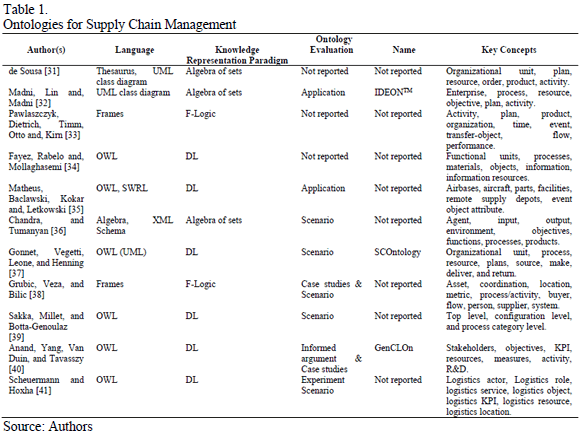
<body><![CDATA[<p>&nbsp;</p>     <p><font size="3" face="Verdana, Arial, Helvetica, sans-serif"><b>1 Introduction</b></font></p>     <p><font size="2" face="Verdana, Arial, Helvetica, sans-serif">Nowadays, the efficient use of knowledge has been critical  to the organization's survival as well as its success in competitive global  markets. It has a strong potential to problem solve, make organizational  performance enhancements, undertake decision-making, and innovate. There is a  growing recognition that supply chain management (SCM) offers significant  opportunities for organizations to create strategic advantages Wen and Gu &#91;1&#93;. In this regard, knowledge  management (KM) is the process of capturing, developing, sharing, and  effectively using organizational knowledge &#91;2&#93;. The term SCM was coined in  1982 by Laseter and Oliver &#91;3&#93;. According to Mentzer, DeWitt,  Keebler, Min, Nix, Smith and Zacharia &#91;4&#93;, supply chain management  (SCM) is &quot;the systemic, strategic coordination of the traditional business  functions and the tactics across these business functions within a particular  company and across businesses within the supply chain, for the purposes of  improving the long-term performance of the individual companies and the supply  chain as a whole&quot;. Due to the relevance of KM in organizations, several  pieces of research and industry efforts have been focused on the topic in order  to improve supply chain knowledge management (SCKM). In the literature, there  are seminal research works with different approaches to KM, for instance, Cap&oacute;-Vicedo, Mula and  Cap&oacute; &#91;5&#93;  propose a social network-based model to improve knowledge management in  multi-level supply chains formed by small and medium-sized enterprises (SMEs);Shih, Hsu, Zhu and  Balasubramanian &#91;6&#93;  propose a knowledge management architecture to facilitate knowledge management  within a collaborative supply chain; and Raisinghani and Meade  &#91;7&#93;  explore the linkage between organization performance criteria and the  dimensions of agility, e-supply-chain  drivers, and knowledge management, among other approaches. Lopez and Eldridge &#91;8&#93; presented a working prototype  to promote creation and control in a knowledge supply chain with the objective  of diffusing the best practices among supply chain practitioners. In this  sense, the adoption of best practices in conjunction with information  technologies represents an advantage for organizations.</font></p>     <p><font size="2" face="Verdana, Arial, Helvetica, sans-serif">In addition to the relevance of knowledge management in  organizations, collaboration between supply-chain partners is one of the most  promising areas of study for academics and practitioners. This is because there  are several benefits that can be achieved by companies and supply chains such  as, intelligent inventory management, new product development, collaborative  product design management, to mention but a few. </font></p>     <p><font size="2" face="Verdana, Arial, Helvetica, sans-serif">According to Andreas Blumauer, since 2014 the Simple Knowledge  Organization System (SKOS) has become one of the 'sweet spots' in the linked  data ecosystems. This is due to SKOS playing a key role in order to improve  semantic information management, especially in terms of its following  capabilities, taxonomy and thesaurus management, text mining and entity  extraction, and finally knowledge engineering and ontology management. SKOS is  an area of work in which there are developing specifications and standards to  support the use of knowledge organization systems (KOS), such as thesauri,  classification schemes, subject heading systems, and taxonomies within the  framework of the Semantic Web.</font></p>     <p><font size="2" face="Verdana, Arial, Helvetica, sans-serif">However, even though many studies have reported  theoretical and practical foundations for knowledge management, there has been  very little research reported using semantic technologies and SKOS. </font></p>     <p><font size="2" face="Verdana, Arial, Helvetica, sans-serif">In this regard, Linked Data based IT-architectures cover  all of SKOS's capabilities, and provide the means for agile data, information,  and knowledge management. SKOS can increase the value of organizations data and  better use of existing data can be fostered by semantic searches, agile data  integration and content personalization. Taking this into consideration, a  linked data-based approach in combination with SKOS is feasible for organizing  knowledge management in organizations, specifically for supply chain  management, due to its ability to coordinate and synchronize interdependent  processes, and to integrate information systems and to cope with distributed  learning &#91;9&#93;.</font></p>     <p><font size="2" face="Verdana, Arial, Helvetica, sans-serif">The aim of this paper is to introduce a linked data based  approach-using SKOS in order to improve and facilitate knowledge management  between supply chain partners. The importance of using a new approach relies on  the benefits of linked data and SKOS. These benefits are: 1) obtaining open  data sources of knowledge (linked open data), 2) automatizing data organization  and procurement for non-expert organizations, 3) improving organizations'  process, 4) improving operational and organizational performance, and 5)  improving the decision-making process, to mention but a few. This paper is  structured as follows: in section 2, the related works are discussed, in  section 3 the linked data-based approach using SKOS for supply chain knowledge  management is presented, in section 4 a brief case study is conducted, section  5 discusses future work possibilities in order to talk about this research  limitations and implications, and, finally, section 4 concludes with this  research's findings.</font></p>     <p>&nbsp;</p>     <p><font size="3" face="Verdana, Arial, Helvetica, sans-serif"><b>2 Related works</b></font></p>     ]]></body>
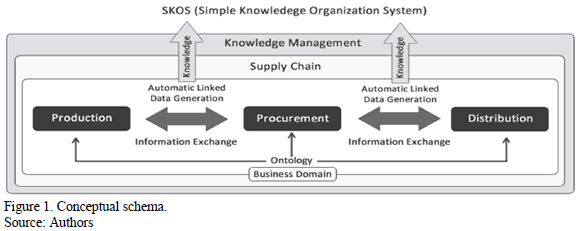
<body><![CDATA[<p><font size="2" face="Verdana, Arial, Helvetica, sans-serif">Recent advances in the field of knowledge management and  semantic technologies have increased the significance of knowledge management  in organizations using information technologies. Through electronic networks,  organizations can achieve integration by tightly coupling processes at the  interfaces between each stage of the value chain. According to Williams  Jr &#91;10&#93;, electronic linkages in  the value chains have been fundamentally changing the nature of  inter-organizational relationships. Organizations are redesigning their  internal structure and their external relationships, creating networks of  knowledge to facilitate the communication of data, information, and knowledge,  while improving coordination, decision making, and planning. Taking into  account these organizational changes, the use of flexible and scalable  information technologies is preferred in order to take advantage of the  know-how from the supply chains. In this  section, each of the most significant papers related to this work will be presented,  starting with the exploitation of knowledge sharing across the supply chain.</font></p>     <p><font size="2" face="Verdana, Arial, Helvetica, sans-serif">Wu &#91;11&#93; addressed the problem of coordination among  multi-agent systems. The issue of coordination problems in supply chains was  presented, and how to design multi-agent systems to improve information and  knowledge sharing was highlighted. Becker and Zirpoli &#91;12&#93; carried out research on the theme of knowledge  transfer in outsourcing activities. In particular, the focus was on designing  an outsourcing strategy to improve knowledge integration. Holtbrügge and Berg &#91;13&#93; carried out a study of the knowledge transfer  process in German multinational corporations (MNCs). These three works focused  on knowledge sharing and how exploit it. This is due to the fact that one of  the most suitable ways to improve processes in organizations is through  knowledge exploitation. In this regard, Sivakumar and Roy &#91;14&#93; proposed the concept of knowledge redundancy as  a critical factor for supply chain value creation. Knowledge redundancy deals  with there being a sufficient knowledge overlap to provide the opportunity to  have good communication and, thus, effective operation activities. At the  moment that an organization exploits the knowledge, some benefits can be  obtained; for instance, Raisinghani and Meade &#91;7&#93; investigated the links between the supply chain,  the firm's agility, and knowledge management. Their focus was on the strategic  decision making perspective. In this perspective, knowledge comes from every  relationship in the supply chain. Hult, Ketchen and Arrfelt &#91;15&#93; stated that knowledge acquisition activities,  knowledge distribution activities and shared meaning were related with faster  cycle time. For instance, Piramuthu &#91;16&#93; developed a knowledge-based framework for a  dynamic re-configuration of supply chains over time.</font></p>     <p><font size="2" face="Verdana, Arial, Helvetica, sans-serif">In Garc&iacute;a-C&aacute;ceres,  Perdomo, Ortiz, Beltr&aacute;n and L&oacute;pez's research &#91;17&#93;,  the authors analyzed the supply and value chains of the Colombian cocoa  agribusiness, in order to detect the agents, phases, stages, and factors influencing  the planting and harvesting of the product. They also analyzed =the chocolate  and confection production process, as well as the final consumption. Within the  supply chain stage identification and effects context, Avelar-Sosa,  Garc&iacute;a-Alcaraz, Cedillo-Campos and Adarme-Jaimes's &#91;18&#93;  work analyzes the effects of regional infrastructure and the services in supply  chain performance in manufacturing companies found in Ciudad Juarez, Chihuahua,  Mexico. The results indicate that if regional infrastructure has a good level  then there will be a positive impact on logistics services, and as a  consequence, on costs. In addition to these works, Espinal  and Montoya's research &#91;19&#93; identifies  the state of the art and the current use of Information and Communications  Technologies (ICT) in the supply chain as well as its application level in  Colombian industry. The research does this through analysis of existing studies  and, at the end of the review, the authors observed that most of these  technologies contribute to cost reduction and improvement of the information  flow among the actors in the supply chain.</font></p>     <p><font size="2" face="Verdana, Arial, Helvetica, sans-serif">Other approaches were also seen in the literature, for  example, Lau,  Ho, Zhao and Chung &#91;20&#93; analyzed a  process mining system for supporting knowledge discovery in daily logistics  operations. Niemi,  Huiskonen and Kärkkäinen &#91;21&#93; pointed out  the process of knowledge accumulation. They presented it as an ongoing  procedure in which the implementation of organizational processes and inventory  techniques takes place gradually. Niemi,  Huiskonen, and Karkkainen's aim &#91;22&#93; was to  evaluate the adoption of complex supply chain management practices. In order to  do this, Niemi et al. used the knowledge maturity model and strategies to  accelerate knowledge creation as theoretical frameworks. The purpose of their  approach was to intend to provide meaningful knowledge management. Halley,  Nollet, Beaulieu, Roy, and Bigras &#91;23&#93;  suggested that the management of the relationships present in the supply chain  could be useful to share and acquire knowledge, instead of building external  business relationships.</font></p>     <p><font size="2" face="Verdana, Arial, Helvetica, sans-serif">Apart from the previous research, Douligeris  and Tilipakis &#91;24&#93; carried out a study on  the new opportunities provided by the semantic web. They focused their  attention on the introduction of web technologies on supply chain management.  In particular, the use of ontologies in improving knowledge management  applications was described. Taking this into consideration, Huang  and Lin &#91;25&#93; addressed the problem of  managing knowledge heterogeneity in the context of interoperability among  multi-entities in a supply chain. They proposed a solution for sharing  knowledge using the semantic web. Their solution was based on a semi-structured  knowledge model to describe knowledge, not only in an explicit and sharable  way, but knowledge that also had a meaningful format, an agent-based annotation  process to determine issues related with the heterogeneity of knowledge  documents, and an articulation mechanism to improve the efficiency of  interoperability between two heterogeneous ontologies.</font></p>     <p><font size="2" face="Verdana, Arial, Helvetica, sans-serif">The aforementioned research works emphasized the  importance of integrating information and knowledge flows within the  manufacturing supply chain, and highlighted the importance of handling  distributed knowledge. For instance, Craighead,  Hult, and Ketchen Jr &#91;26&#93; used an  economics perspective to measure the impact of a knowledge development capacity  on supply chain performance. They measured the effects of an innovation-cost  strategy on the supply chain. They found that knowledge development capacity  and intellectual capital efforts are a good complement to other supply chain  strategies. However, these works lack the availability of data sources due to  the requirements of managing and organizing data in organizations.  Additionally, this task it's very complex for small and medium size  organizations. Moreover, some of the techniques used for knowledge management  were conceived to manage the data, and not to infer knowledge from raw data.  Finally, some organizations do not have the right tools to manage knowledge.  This is due to the nature of the data; in some domains the same words have  different meanings. In this regard, we propose a linked data-based approach for  supply chain knowledge management using SKOS.</font></p>     <p>&nbsp;</p>     <p><font size="3" face="Verdana, Arial, Helvetica, sans-serif"><b>3. Linked   data-based approach for supply chain knowledge management using SKOS</b></font></p>     <p><font size="2" face="Verdana, Arial, Helvetica, sans-serif">Interest in supply chain management has steadily increased  since the 1980s when firms saw the benefits of collaborative relationships  within and beyond their own organization. Firms are finding that they can no  longer compete effectively while isolated from their suppliers or other  entities in the supply chain &#91;27&#93;.  The term supply chain management has a variety of different meanings, some related  to management processes, others to the structural organization of businesses.  Supply chain management itself integrates the management of supply and demand.  According to the Council of Supply Chain Management Professionals (2014), it  encompasses &quot;the planning and management of all activities involved in sourcing  and procurement, conversion and logistics.&quot; Supply chain management also covers  coordination and collaboration with channel partners, such as customers,  suppliers, distributors, and service providers. </font></p>     <p><font size="2" face="Verdana, Arial, Helvetica, sans-serif">According to Thomas  and Griffin &#91;28&#93; historically, there are three  fundamental stages of the supply chain, procurement, production, and  distribution. These have been managed independently and buffered by large  inventories. Increasing competitive pressures and market globalization are  forcing firms to develop supply chains that can quickly respond to customer  needs. To remain competitive, these firms must reduce operating costs while  continuously improving customer service. Taking this into consideration, with  recent advances in communications and information technology, especially in  semantic Web technologies, organizations have had an opportunity to reduce  operating costs by coordinating the planning of these stages. In order to  manifest the general idea about this proposal, in <a href="#fig01">Fig. 1</a> a conceptual schema  was depicted.</font></p>     ]]></body>
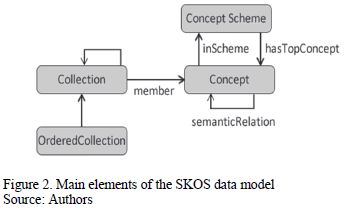
<body><![CDATA[<p align="center"><font size="2" face="Verdana, Arial, Helvetica, sans-serif"><a name="fig01"></a></font><img src="/img/revistas/dyna/v82n194/v82n194a04fig01.gif"></p>     <p><font size="2" face="Verdana, Arial, Helvetica, sans-serif">As can be seen from the conceptual schema, this proposal  focuses its efforts on the automatic knowledge generation and management  through linked data using SKOS and ontologies. These efforts were focused on  technical information flows across the supply chain. This is due to the strong  positive relationship that was found between the knowledge management process  and the operational and organizational performance. In general terms, as a  result of the information exchange across the supply chain among production,  procurement, and distribution, Linked Data was produced in an automated way.  This was due to domain specific knowledge (business domain) that was inferred  from the ontology, and finally passed out to SKOS in order to provide both  meaningful information and benefits for organizations. Due to the ontologies'  relevance on this scenario, in the next subsection a brief table of highlights  is included in order to explain the ontology used for this proposal in the  context of a particular business domain.</font></p>     <p>&nbsp;</p>     <p><font size="2" face="Verdana, Arial, Helvetica, sans-serif"><i><b>3.1. Ontology </b></i></font></p>     <p><font size="2" face="Verdana, Arial, Helvetica, sans-serif">Originally, the term  ontology has its roots in philosophy. An ontology denotes &quot;the science of what  is, of the kinds and structures of objects, properties events, processes, and  relations in every area of reality&quot; &#91;29&#93;. Ontologies can be a component of  knowledge-based systems, but also provide a &quot;common language&quot; for communication  between domain analysts, developers, and users. In our proposal, SKOS can be  improved with the use of ontologies. In this sense, a brief comparative  analysis was performed on the results of the initial search query for &quot;supply  chain&quot; AND &quot;ontology&quot; using online databases which were used for a  keyword-based search. We also used the following alternative terms to reflect  the actual use of various terms for the key concepts: &quot;supply network&quot;, &quot;supply  chain management&quot;, &quot;knowledge model&quot;, &quot;semantic model&quot;, and &quot;ontology model&quot;.  These terms were based on the parameters proposed by Scheuermann and Leukel &#91;30&#93; in their literature review. The literature  provides various SCM ontologies for a range of industries and tasks. <a href="#tab01">Table 1</a> lists the suitable ontologies reported in the literature for this work.</font></p>     <p align="center"><font size="2" face="Verdana, Arial, Helvetica, sans-serif"><a name="tab01"></a></font><font size="2" face="Verdana, Arial, Helvetica, sans-serif"><img src="/img/revistas/dyna/v82n194/v82n194a04tab01.gif"></font></p>     <p><font size="2" face="Verdana, Arial, Helvetica, sans-serif">A more detailed discussion about the ontologies presented  in <a href="#tab01">Table 1 </a>was found in Scheuermann  and Leukel's research &#91;30&#93;, which is a  review about ontologies for supply chain management. Taking into consideration  the results discovered in the literature, IDEONTM and SCOntology are suitable  for the purposes of this work. In this sense, these approaches have been used  in the design of the software architecture used as a basis for Linked Data  generation and knowledge management using SKOS.</font></p>     <p><font size="2" face="Verdana, Arial, Helvetica, sans-serif">IDEONTM is an extensible ontology for designing,  integrating, and managing collaborative distributed enterprises, and SCOntology  is a formal approach that gives a unified and integrated view of the supply  chain. We found that IDEONTM and SCOntology are suitable for the purposes of  this work due to the support it gives for processes, activities, resources,  deliveries, and return schemas provided for each one.</font></p>     <p><font size="2" face="Verdana, Arial, Helvetica, sans-serif"><b><i>3.2. SKOS</i></b></font></p>     <p><font size="2" face="Verdana, Arial, Helvetica, sans-serif">Using SKOS, concepts can be identified using URIs (strings  of characters used to identify the name of a resource). These are labeled with  lexical strings in one or more natural languages (for instance, a business  domain language), they are assigned notations (lexical codes), documented with  various types of note, linked to other concepts and organized into informal  hierarchies and association networks, aggregated into concept schemes, grouped  into labeled and/or ordered collections, and mapped to concepts in other  schemes. All these features allow the integration and management of knowledge  in a particular domain, for instance in supply chain management. In <a href="#fig02">Fig. 2</a> the  main elements of the SKOS data model was depicted.</font></p>     ]]></body>
<body><![CDATA[<p align="center"><font size="2" face="Verdana, Arial, Helvetica, sans-serif"><a name="fig02"></a></font><img src="/img/revistas/dyna/v82n194/v82n194a04fig02.gif"></p>     <p><font size="2" face="Verdana, Arial, Helvetica, sans-serif">The SKOS data model enables the features &#91;42&#93;  listed above by defining the elements depicted in <a href="#fig02">Fig. 2</a>. These features are: </font></p> <ul>       <li><font size="2" face="Verdana, Arial, Helvetica, sans-serif"> Identifying</font></li>       <li><font size="2" face="Verdana, Arial, Helvetica, sans-serif"> Labeling</font></li>       <li><font size="2" face="Verdana, Arial, Helvetica, sans-serif"> Documenting</font></li>       <li><font size="2" face="Verdana, Arial, Helvetica, sans-serif"> Linking and mapping concepts (even in other     schemas)</font></li>       <li><font size="2" face="Verdana, Arial, Helvetica, sans-serif"> Aggregating concepts into concept schemes or     collections</font></li>     </ul>     <p><font size="2" face="Verdana, Arial, Helvetica, sans-serif">Taking into consideration SKOS' features, for the purposes  of this research, SKOS has been used to express, in an interoperable way,  different types of Knowledge Organization Systems (specifically for a supply  chain model)-sets of terms or concepts, whether listed with definitions (glossaries),  in hierarchical structures (basic classifications or taxonomies), or  characterized by more complex semantic relations (thesauri, subject heading  lists, or other advanced structures). In the next section an overview of the  proposed architecture was described.</font></p>     <p><font size="2" face="Verdana, Arial, Helvetica, sans-serif"><b><i>3.3. Architecture</i></b></font></p>     ]]></body>
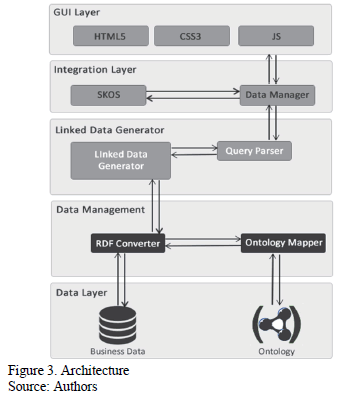
<body><![CDATA[<p><font size="2" face="Verdana, Arial, Helvetica, sans-serif">The knowledge management focuses on the supply side; in  contrast, knowledge creation is located on the demand side. Johnson  and Whang &#91;43&#93; proposed the term  e-collaboration for systems that facilitate the Internet-based coordination of  decisions for all members of the supply chain. Taking this into consideration,  our approach is focused on the demand side, through an Internet-based  coordination of knowledge. The use of the proposed technologies was intended to  generate raw knowledge in an automated way.</font></p>     <p><font size="2" face="Verdana, Arial, Helvetica, sans-serif">Our architecture has a  layered design in order to organize its components. This layered design allows  scalability and easy maintenance because its tasks and responsibilities are  distributed.</font></p>     <p><font size="2" face="Verdana, Arial, Helvetica, sans-serif">The general architecture is shown in <a href="#fig03">Fig. 3</a>. Each  component has a function explained as follows:</font></p>     <p align="center"><font size="2" face="Verdana, Arial, Helvetica, sans-serif"><a name="fig03"></a></font><img src="/img/revistas/dyna/v82n194/v82n194a04fig03.gif"></p>     <p><font size="2" face="Verdana, Arial, Helvetica, sans-serif"><b>Data layer:</b> This layer stores supply chain management data; additionally, it contains all  the configuration tables allowing the operation of the modules and services  offered by our proposal. This layer comprises two key components, the business  data and the ontology; these components are the core of the knowledge of the  entire software architecture.</font></p>     <p><font size="2" face="Verdana, Arial, Helvetica, sans-serif"><b>Data Management  layer:</b> This layer communicates with the Data layer in order to obtain  business data and provide their representation through the ontology mapper in  order to converting it to RDF.</font></p>     <p><font size="2" face="Verdana, Arial, Helvetica, sans-serif"><b>Linked Data  Generator:</b> All data retrieved from Data layer through the Data Management  layer is parsed in RFD in order to publish a local dataset of Linked Data.</font></p>     <p><font size="2" face="Verdana, Arial, Helvetica, sans-serif"><b>Integration Layer  &#91;API&#93;:</b> This allows the creation of new educational applications through a  series of public interfaces, which provide easy access to a set of services  provided by the architecture. Service compositions are presented and defined in  this layer. Specifically, the Data Manager component is responsible for  providing interaction through raw data and the user interface.</font></p>     <p><font size="2" face="Verdana, Arial, Helvetica, sans-serif"><b>Presentation Layer:</b> In this layer, the architecture determines the best way to display the business  data by using XHTML when HTML5 is not supported. The Presentation Layer does  not know what events are taking place inside inferior layers and how the  services are provided; it only uses them to show the end-user interface. It is  worthwhile to mention that, for the purposes of this work, a graphic user interface  was not used. However, the software architecture has been designed in order to  support a Web-based user interface.</font></p>     <p><font size="2" face="Verdana, Arial, Helvetica, sans-serif">In additionally to the layer  descriptions, there are a few main components that also need to be described:</font></p>     ]]></body>
<body><![CDATA[<p><font size="2" face="Verdana, Arial, Helvetica, sans-serif"><b>Business Data:</b> As part of the Data Layer, in this repository (actually a database of  structured or non-structured data), this component is responsible for the  storage of the raw data from information exchanges across the supply chain.</font></p>     <p><font size="2" face="Verdana, Arial, Helvetica, sans-serif"><b>Ontology:</b> This  component is responsible for managing the data representation and structure of  the supply chain knowledge. In this component the IDEONTM and SCOntolgy has  been used.</font></p>     <p><font size="2" face="Verdana, Arial, Helvetica, sans-serif"><b>RDFConverter:</b> In order to generate a Linked Data dataset, this component converted raw data  mapped through the Ontology Mapper component to RDF (Resource Description  Framework).</font></p>     <p><font size="2" face="Verdana, Arial, Helvetica, sans-serif"><b>Linked Data  Generator:</b> This component is responsible for Linked Data Generation. In  this component a local dataset of Linked Data is managed through the Query  Parser component. At the end of the process, a set of structured RDF data is  created and managed by a Linked Data engine.</font></p>     <p><font size="2" face="Verdana, Arial, Helvetica, sans-serif"><b>Query Parser:</b> This was used in order to translate a user-defined query into a natural  language (a business domain specific language). This component translates the  original query into SPARQL in order to retrieve the desired data, in this case  the supply chain knowledge.</font></p>     <p><font size="2" face="Verdana, Arial, Helvetica, sans-serif"><b>SKOS:</b> In  thesauri and other structured Knowledge Organizations Systems, concepts can be  classified into semantically meaningful bundles. For example, arrays are used  to group specializations of a concept that share a common feature: the concept  &quot;cars&quot; might be primarily grouped by a feature &quot;cars by engine&quot; (&quot;V8'', 'V6'',  among others), and a second group of &quot;cars by function&quot; (&quot;transport&quot;, &quot;family&quot;,  &quot;sport&quot;, among others). Taking this as starting point, the SKOS component is  responsible for the classification and management of the vocabulary used by the  Data Manager component to retrieve processed and managed knowledge from the  presentation layer.</font></p>     <p><font size="2" face="Verdana, Arial, Helvetica, sans-serif"><b>Data Management:</b> This component is responsible for managing the petitions performed by the GUI  Layer, specifically the user request for data and knowledge.</font></p>     <p><font size="2" face="Verdana, Arial, Helvetica, sans-serif">It is worthwhile mentioning that Carrer-Neto,  Hern&aacute;ndez-Alcaraz; Valencia-Garc&iacute;a, and Garc&iacute;a-S&aacute;nchez; &#91;44&#93; and Ruiz-Mart&iacute;nez,  Valencia-Garc&iacute;a, Mart&iacute;nez-B&eacute;jar, and Hoffmann's work &#91;45&#93; present the use of a top  level ontology based framework to populate biomedical ontologies from texts and  a social knowledge-based recommender system represent. These can be used to  improve our software architecture in future work with the use of their  techniques to extract knowledge from texts as a data source, and recommend  knowledge resources through social network interactions among supply chain  customers.</font></p>     <p><font size="2" face="Verdana, Arial, Helvetica, sans-serif"><b><i>3.4. Data  acquisition</i></b></font></p>     <p><font size="2" face="Verdana, Arial, Helvetica, sans-serif">This knowledge is related to the following aspects, which  should be improved in supply chain management:</font></p> <ul>       ]]></body>
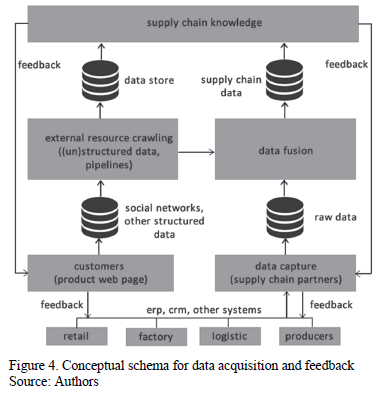
<body><![CDATA[<li><font size="2" face="Verdana, Arial, Helvetica, sans-serif"><b>Demand:</b> Demand management is an essential element in supply chain management. It     focuses companies and their partners on meeting the needs of customers, rather     than the production process.</font></li>       <li><font size="2" face="Verdana, Arial, Helvetica, sans-serif"><b>Integration:</b> Integrating supply chain processes helps each member to reduce their inventory     costs.</font></li>       <li><font size="2" face="Verdana, Arial, Helvetica, sans-serif"><b>Collaboration:</b> Collaboration in the supply chain strengthens relationships between members by     improving teamwork and helping all members increase their business.</font></li>       <li><font size="2" face="Verdana, Arial, Helvetica, sans-serif"><b>Communication:</b> Effective communication helps the entire supply chain improve the efficiency     and productivity of its operations by enabling all members to share the same     demand and operational information.</font></li>     </ul>     <p><font size="2" face="Verdana, Arial, Helvetica, sans-serif">For this research, the information required was obtained  from broker web pages, ERPs, CRMs, and intranet applications, to mention but a  few. In <a href="#fig04">Fig. 4</a> a conceptual schema for data acquisition was depicted.</font></p>     <p align="center"><font size="2" face="Verdana, Arial, Helvetica, sans-serif"><a name="fig04"></a></font><img src="/img/revistas/dyna/v82n194/v82n194a04fig04.gif"></p>     <p>&nbsp;</p>     <p><b><font size="3" face="Verdana, Arial, Helvetica, sans-serif">4. Case study:   Detecting processing issues in a milk supply chain</font></b></p>     <p><font size="2" face="Verdana, Arial, Helvetica, sans-serif">The purpose of this case study was to put our knowledge  management approach into practice. This case study should encourage supply  chain practitioners and managers to use the experience and learning of this  application to be able to develop and refine the application of knowledge  management by using semantic web technologies. </font></p>     ]]></body>
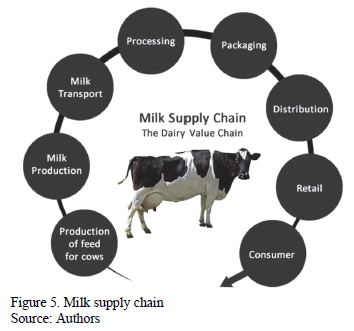
<body><![CDATA[<p><font size="2" face="Verdana, Arial, Helvetica, sans-serif">Let us suppose that a supply chain in the field of milk  production in the United States requires information (knowledge) about the  delay that occurs between the procurement stage and distribution stage. This  will be caused, in some scenarios, as a result of the product expiring because  of the transit time, which represents losses and extra fees for the  organization. The eight stages in the milk supply chain are:</font></p> <ol type="a">       <li><font size="2" face="Verdana, Arial, Helvetica, sans-serif"> Production of feed for cows: The dairy supply chain     begins with growing crops such as corn, alfalfa hay, and soybeans to feed dairy     cows.</font></li>       <li><font size="2" face="Verdana, Arial, Helvetica, sans-serif">Milk production: Dairy cows are housed, fed, and     milked on dairy farms across the country.</font></li>       <li><font size="2" face="Verdana, Arial, Helvetica, sans-serif"> Milk transportation: Milk is transported from the farm     to the processing company in insulated tanker trucks. The average truck carries     5800 gallons of milk and travels approximately 500 miles on a round trip.</font></li>       <li><font size="2" face="Verdana, Arial, Helvetica, sans-serif">Processing: There are more than 1,000 U.S. processing     plants that turn milk into cheese, yogurt, ice cream, powdered milk, and other     products.</font></li>       <li><font size="2" face="Verdana, Arial, Helvetica, sans-serif">Packaging: This is typically done by the dairy     processor. Both paperboard and plastic containers are designed to keep dairy     products fresh, clean and wholesome.</font></li>       <li><font size="2" face="Verdana, Arial, Helvetica, sans-serif"> Distribution: Distribution companies deliver dairy     products from the processor to retailers, schools, and other outlets in     refrigerated trucks.</font></li>       <li><font size="2" face="Verdana, Arial, Helvetica, sans-serif"> Retail: Milk and dairy products are available at     178,000 retail outlets of all shapes and sizes.</font></li>       <li><font size="2" face="Verdana, Arial, Helvetica, sans-serif">Consumer: Milk and milk products deliver nine     essential nutrients to consumers.</font></li>     </ol>     ]]></body>
<body><![CDATA[<p><font size="2" face="Verdana, Arial, Helvetica, sans-serif">These stages should be grouped into the three main  categories previously mentioned in the conceptual schema contained in section  3. The groups are: 1) production (production of feed for cows and milk  production), 2) procurement (processing and packaging), and 3) distribution  (distribution and retail). </font></p>     <p><font size="2" face="Verdana, Arial, Helvetica, sans-serif">In order to understand the full supply chain cycle, <a href="#fig05">Fig. 5</a> shows the value chain of milk production.</font></p>     <p align="center"><font size="2" face="Verdana, Arial, Helvetica, sans-serif"><a name="fig05"></a></font><img src="/img/revistas/dyna/v82n194/v82n194a04fig05.gif"></p>     <p><font size="2" face="Verdana, Arial, Helvetica, sans-serif">Following the previously mentioned scenario, knowledge  acquisition through the SKOS approach retrieved the following information:</font></p> <ul>       <li><font size="2" face="Verdana, Arial, Helvetica, sans-serif"> Production of     feed for cows either increases or decreases the milk production.</font></li>       <li><font size="2" face="Verdana, Arial, Helvetica, sans-serif"> Production of     feed for cows affects the quality of the produced milk.</font></li>       <li><font size="2" face="Verdana, Arial, Helvetica, sans-serif"> Due to the lack of communication     between the processing and packaging phases, the milk spends a lot of time in     the packaging process. The packaging unit does not accurately know way which     milk product is to be released first. This is due to of the variation in milk     quality. Some derivate products cannot be produced within the same processing     time.</font></li>     </ul>     <p><font size="2" face="Verdana, Arial, Helvetica, sans-serif">In general terms, the lack of communication affects the  operation of all stages in the milk supply chain. The degree of implication is  directly proportional to the time needed to take countermeasures to change the  production process in early stages. In order to take advantage of the knowledge  produced in the supply chain, a more detailed analysis about production  implications in the retail stage (sales, profits, among others) is required. In  this sense, analysts can use data mining and big data tools. In  future work, an analytic module must be added to our architecture in order to  complete the cycle of knowledge management and data exploitation.</font></p>     <p>&nbsp;</p>     ]]></body>
<body><![CDATA[<p><font size="3" face="Verdana, Arial, Helvetica, sans-serif"><b>6. Conclusions and   future directions</b></font></p>     <p><font size="2" face="Verdana, Arial, Helvetica, sans-serif">The primary contribution of this paper to the literature  is to show how supply chain knowledge management can be improved with semantic  web technologies. Fast evolving Web-based and semantic technologies provide,  not only platforms for the development of powerful applications, but also  opportunities to alleviate linguistic barriers to supply chain data across  partners. In this study, a linked data-based approach using SKOS for supply  chain knowledge management was presented. The findings showed how SKOS can be  enriched using ontologies. Additionally, with automatic generation of linked  data from supply chains, small and medium organizations without expertise,  infrastructure, or resources to organize information can benefit from knowledge  management. In this regard, knowledge sharing and reuse are important factors  that affect the performance of supply chains. Due to this, a novel approach  that combines the generation of Linked Data and ontology enriched SKOS was  presented in this work, which can improve supply chain knowledge management.</font></p>     <p><font size="2" face="Verdana, Arial, Helvetica, sans-serif">Thinking about possible future directions, this research  potentially has two key limitations or opportunities. First, the proposal  contained in this case study addressed one particular business domain. In this  regard, we need to prove this approach can be effectively used in other  domains, which has to do with the Linked Data generation mechanism and their  ontology-based knowledge management and acquisition. Second, there is a need to  know and control the full scenario of the supply chain management. What will  happen if one of the three stages (production, procurement, and distribution)  it is out of scope, and the information exchange is not accessible for analysis  and interaction? These two key limitations represent an opportunity to improve  this proposal. Consequently, we plan to elaborate on this research in order to  fulfill this gap. </font></p>     <p>&nbsp;</p>     <p><font size="3" face="Verdana, Arial, Helvetica, sans-serif"><b>Acknowledgments</b></font></p>     <p><font size="2" face="Verdana, Arial, Helvetica, sans-serif">This work was supported by the Tecnol&oacute;gico Nacional de  M&eacute;xico. Additionally, it was sponsored by the National Council of Science and  Technology (CONACYT) and the Public Education Secretary (SEP), through PROMEP.</font></p>     <p>&nbsp;</p>     <p><font size="3" face="Verdana, Arial, Helvetica, sans-serif"><b>References</b></font></p>     <!-- ref --><p><font size="2" face="Verdana, Arial, Helvetica, sans-serif"><b>&#91;1&#93;</b> Wen, H. and Gu, Q., The elements of supply  chain management in new environmental era. Springer Berlin Heidelberg, City,  2014.    &nbsp;&nbsp;&nbsp;&nbsp;&nbsp;&nbsp;&nbsp;&nbsp;[&#160;<a href="javascript:void(0);" onclick="javascript: window.open('/scielo.php?script=sci_nlinks&ref=000121&pid=S0012-7353201500060000400001&lng=','','width=640,height=500,resizable=yes,scrollbars=1,menubar=yes,');">Links</a>&#160;]<!-- end-ref --></font></p>     ]]></body>
<body><![CDATA[<!-- ref --><p><font size="2" face="Verdana, Arial, Helvetica, sans-serif"><b>&#91;2&#93;</b> Davenport,  T.H. Saving IT's soul: Human-Centered information management. Harvard Business  Review, 72(2), pp. 119-131, 1994.    &nbsp;&nbsp;&nbsp;&nbsp;&nbsp;&nbsp;&nbsp;&nbsp;[&#160;<a href="javascript:void(0);" onclick="javascript: window.open('/scielo.php?script=sci_nlinks&ref=000123&pid=S0012-7353201500060000400002&lng=','','width=640,height=500,resizable=yes,scrollbars=1,menubar=yes,');">Links</a>&#160;]<!-- end-ref --></font></p>     <!-- ref --><p><font size="2" face="Verdana, Arial, Helvetica, sans-serif"><b>&#91;3&#93;</b> Laseter,  T. and Oliver, K., When will supply chain management grow up? Strategy and  Business. pp. 32-37, 2003.    &nbsp;&nbsp;&nbsp;&nbsp;&nbsp;&nbsp;&nbsp;&nbsp;[&#160;<a href="javascript:void(0);" onclick="javascript: window.open('/scielo.php?script=sci_nlinks&ref=000125&pid=S0012-7353201500060000400003&lng=','','width=640,height=500,resizable=yes,scrollbars=1,menubar=yes,');">Links</a>&#160;]<!-- end-ref --></font></p>     <!-- ref --><p><font size="2" face="Verdana, Arial, Helvetica, sans-serif"><b>&#91;4&#93;</b> Mentzer,  J.T., DeWitt, W., Keebler, J.S., Min, S., Nix, N.W., Smith, C.D. and Zacharia,  Z.G., Defining supply chain management. Journal of Business Logistics, 22(2), pp.  1-25, 2001. DOI: 10.1002/j.2158-1592.2001.tb00001.x</font>&nbsp;&nbsp;&nbsp;&nbsp;&nbsp;&nbsp;&nbsp;&nbsp;[&#160;<a href="javascript:void(0);" onclick="javascript: window.open('/scielo.php?script=sci_nlinks&ref=000127&pid=S0012-7353201500060000400004&lng=','','width=640,height=500,resizable=yes,scrollbars=1,menubar=yes,');">Links</a>&#160;]<!-- end-ref --><!-- ref --><p><font size="2" face="Verdana, Arial, Helvetica, sans-serif"><b>&#91;5&#93;</b> Cap&oacute;-Vicedo,  J., Mula, J. and Cap&oacute;, J., A social network-based organizational model for  improving knowledge management in supply chains. Supply Chain Management: An  International Journal, 16(5), pp. 379-388, 2011. DOI: 10.1108/13598541111155884</font>&nbsp;&nbsp;&nbsp;&nbsp;&nbsp;&nbsp;&nbsp;&nbsp;[&#160;<a href="javascript:void(0);" onclick="javascript: window.open('/scielo.php?script=sci_nlinks&ref=000128&pid=S0012-7353201500060000400005&lng=','','width=640,height=500,resizable=yes,scrollbars=1,menubar=yes,');">Links</a>&#160;]<!-- end-ref --><!-- ref --><p><font size="2" face="Verdana, Arial, Helvetica, sans-serif"><b>&#91;6&#93;</b> Shih,  S.C., Hsu, S.H.Y., Zhu, Z. and Balasubramanian, S.K., Knowledge sharing-A key  role in the downstream supply chain. Information &amp; Management, 49(2), pp. 70-80,  2012. DOI: 10.1016/j.im.2012.01.001</font>&nbsp;&nbsp;&nbsp;&nbsp;&nbsp;&nbsp;&nbsp;&nbsp;[&#160;<a href="javascript:void(0);" onclick="javascript: window.open('/scielo.php?script=sci_nlinks&ref=000129&pid=S0012-7353201500060000400006&lng=','','width=640,height=500,resizable=yes,scrollbars=1,menubar=yes,');">Links</a>&#160;]<!-- end-ref --><!-- ref --><p><font size="2" face="Verdana, Arial, Helvetica, sans-serif"><b>&#91;7&#93;</b> Raisinghani,  M.S. and Meade, L.L., Strategic decisions in supply-chain intelligence using  knowledge management: An analytic-network-process framework. Supply Chain  Management: An International Journal, 10(2),pp. 114-121, 2005. DOI: 10.1108/13598540510589188</font>&nbsp;&nbsp;&nbsp;&nbsp;&nbsp;&nbsp;&nbsp;&nbsp;[&#160;<a href="javascript:void(0);" onclick="javascript: window.open('/scielo.php?script=sci_nlinks&ref=000130&pid=S0012-7353201500060000400007&lng=','','width=640,height=500,resizable=yes,scrollbars=1,menubar=yes,');">Links</a>&#160;]<!-- end-ref --><!-- ref --><p><font size="2" face="Verdana, Arial, Helvetica, sans-serif"><b>&#91;8&#93;</b> Lopez,  G. and Eldridge, S., A working prototype to promote the creation and control of  knowledge in supply chains. International Journal of Networking and Virtual  Organisations, 7(2), pp. 150-162, 2010. DOI: 10.1504/IJNVO.2010.031215</font>&nbsp;&nbsp;&nbsp;&nbsp;&nbsp;&nbsp;&nbsp;&nbsp;[&#160;<a href="javascript:void(0);" onclick="javascript: window.open('/scielo.php?script=sci_nlinks&ref=000131&pid=S0012-7353201500060000400008&lng=','','width=640,height=500,resizable=yes,scrollbars=1,menubar=yes,');">Links</a>&#160;]<!-- end-ref --><!-- ref --><p><font size="2" face="Verdana, Arial, Helvetica, sans-serif"><b>&#91;9&#93;</b> Simatupang,  T.M., Wright, A.C. and Sridharan, R., The knowledge of coordination for supply  chain integration. Business process Management Journal, 8(3), pp. 289-308, 2002. DOI: 10.1108/14637150210428989</font>&nbsp;&nbsp;&nbsp;&nbsp;&nbsp;&nbsp;&nbsp;&nbsp;[&#160;<a href="javascript:void(0);" onclick="javascript: window.open('/scielo.php?script=sci_nlinks&ref=000132&pid=S0012-7353201500060000400009&lng=','','width=640,height=500,resizable=yes,scrollbars=1,menubar=yes,');">Links</a>&#160;]<!-- end-ref --><!-- ref --><p><font size="2" face="Verdana, Arial, Helvetica, sans-serif"><b>&#91;10&#93;</b> Williams  Jr, P.L., Factors affecting the adoption of E-business: An automotive industry  study. ProQuest, 2008.    &nbsp;&nbsp;&nbsp;&nbsp;&nbsp;&nbsp;&nbsp;&nbsp;[&#160;<a href="javascript:void(0);" onclick="javascript: window.open('/scielo.php?script=sci_nlinks&ref=000133&pid=S0012-7353201500060000400010&lng=','','width=640,height=500,resizable=yes,scrollbars=1,menubar=yes,');">Links</a>&#160;]<!-- end-ref --></font></p>     <!-- ref --><p><font size="2" face="Verdana, Arial, Helvetica, sans-serif"><b>&#91;11&#93;</b> Wu,  D.-J., Software agents for knowledge management: Coordination in multi-agent  supply chains and auctions. Expert Systems with Applications, 20(1), pp. 51-64,  2001. DOI: 10.1016/S0957-4174(00)00048-8</font>&nbsp;&nbsp;&nbsp;&nbsp;&nbsp;&nbsp;&nbsp;&nbsp;[&#160;<a href="javascript:void(0);" onclick="javascript: window.open('/scielo.php?script=sci_nlinks&ref=000135&pid=S0012-7353201500060000400011&lng=','','width=640,height=500,resizable=yes,scrollbars=1,menubar=yes,');">Links</a>&#160;]<!-- end-ref --><!-- ref --><p><font size="2" face="Verdana, Arial, Helvetica, sans-serif"><b>&#91;12&#93;</b> Becker,  M.C. and Zirpoli, F., Organizing new product development: Knowledge  hollowing-out and knowledge integration-the FIAT auto case. International  Journal of Operations &amp; Production Management, 23(9), pp. 1033-1061, 2003. DOI: 10.1108/01443570310491765</font>&nbsp;&nbsp;&nbsp;&nbsp;&nbsp;&nbsp;&nbsp;&nbsp;[&#160;<a href="javascript:void(0);" onclick="javascript: window.open('/scielo.php?script=sci_nlinks&ref=000136&pid=S0012-7353201500060000400012&lng=','','width=640,height=500,resizable=yes,scrollbars=1,menubar=yes,');">Links</a>&#160;]<!-- end-ref --><!-- ref --><p><font size="2" face="Verdana, Arial, Helvetica, sans-serif"><b>&#91;13&#93;</b> Holtbrügge,  D. and Berg, N., Knowledge transfer in multinational corporations: Evidence  from German firms. Springer, City, 2004.    &nbsp;&nbsp;&nbsp;&nbsp;&nbsp;&nbsp;&nbsp;&nbsp;[&#160;<a href="javascript:void(0);" onclick="javascript: window.open('/scielo.php?script=sci_nlinks&ref=000137&pid=S0012-7353201500060000400013&lng=','','width=640,height=500,resizable=yes,scrollbars=1,menubar=yes,');">Links</a>&#160;]<!-- end-ref --></font></p>     <!-- ref --><p><font size="2" face="Verdana, Arial, Helvetica, sans-serif"><b>&#91;14&#93;</b> Sivakumar,  K. and Roy, S., Knowledge redundancy in supply chains: A framework. Supply  Chain Management: An International Journal, 9(3), pp. 241-249, 2004. DOI: 10.1108/13598540410544935</font>&nbsp;&nbsp;&nbsp;&nbsp;&nbsp;&nbsp;&nbsp;&nbsp;[&#160;<a href="javascript:void(0);" onclick="javascript: window.open('/scielo.php?script=sci_nlinks&ref=000139&pid=S0012-7353201500060000400014&lng=','','width=640,height=500,resizable=yes,scrollbars=1,menubar=yes,');">Links</a>&#160;]<!-- end-ref --><!-- ref --><p><font size="2" face="Verdana, Arial, Helvetica, sans-serif"><b>&#91;15&#93;</b> Hult,  G.T.M., Ketchen, D.J. and Arrfelt, M., Strategic supply chain management:  Improving performance through a culture of competitiveness and knowledge  development. Strategic Management Journal, 28(10), pp. 1035-1052, 2007. DOI: 10.1002/smj.627</font>&nbsp;&nbsp;&nbsp;&nbsp;&nbsp;&nbsp;&nbsp;&nbsp;[&#160;<a href="javascript:void(0);" onclick="javascript: window.open('/scielo.php?script=sci_nlinks&ref=000140&pid=S0012-7353201500060000400015&lng=','','width=640,height=500,resizable=yes,scrollbars=1,menubar=yes,');">Links</a>&#160;]<!-- end-ref --><!-- ref --><p><font size="2" face="Verdana, Arial, Helvetica, sans-serif"><b>&#91;16&#93;</b> Piramuthu,  S., Knowledge-based framework for automated dynamic supply chain configuration.  European Journal of Operational Research, 165(1), pp. 219-230, 2005. DOI: 10.1016/j.ejor.2003.12.023</font>&nbsp;&nbsp;&nbsp;&nbsp;&nbsp;&nbsp;&nbsp;&nbsp;[&#160;<a href="javascript:void(0);" onclick="javascript: window.open('/scielo.php?script=sci_nlinks&ref=000141&pid=S0012-7353201500060000400016&lng=','','width=640,height=500,resizable=yes,scrollbars=1,menubar=yes,');">Links</a>&#160;]<!-- end-ref --><!-- ref --><p><font size="2" face="Verdana, Arial, Helvetica, sans-serif"><b>&#91;17&#93;</b> Garc&iacute;a-C&aacute;ceres,  R.G., Perdomo, A., Ortiz, O., Beltr&aacute;n, P. and L&oacute;pez, K., Characterization of  the supply and value chains of Colombian cocoa. DYNA, 81(187), pp. 30-40. 2014. DOI: 10.15446/dyna.v81n187.39555</font>&nbsp;&nbsp;&nbsp;&nbsp;&nbsp;&nbsp;&nbsp;&nbsp;[&#160;<a href="javascript:void(0);" onclick="javascript: window.open('/scielo.php?script=sci_nlinks&ref=000142&pid=S0012-7353201500060000400017&lng=','','width=640,height=500,resizable=yes,scrollbars=1,menubar=yes,');">Links</a>&#160;]<!-- end-ref --><!-- ref --><p><font size="2" face="Verdana, Arial, Helvetica, sans-serif"><b>&#91;18&#93;</b> Avelar-Sosa,  L., Garc&iacute;a-Alcaraz, J.L., Cedillo-Campos, M.G. and Adarme-Jaimes, W., Effects  of regional infrastructure and offered services in the supply chains  performance: Case Ciudad Juarez. DYNA, 81(186) pp. 208-217, 2014.    &nbsp;&nbsp;&nbsp;&nbsp;&nbsp;&nbsp;&nbsp;&nbsp;[&#160;<a href="javascript:void(0);" onclick="javascript: window.open('/scielo.php?script=sci_nlinks&ref=000143&pid=S0012-7353201500060000400018&lng=','','width=640,height=500,resizable=yes,scrollbars=1,menubar=yes,');">Links</a>&#160;]<!-- end-ref --></font></p>     <!-- ref --><p><font size="2" face="Verdana, Arial, Helvetica, sans-serif"><b>&#91;19&#93;</b> Espinal, A.C. y Montoya, R.A.G.,  Tegnolog&iacute;as de la informaci&oacute;n en la cadena de suministro information  technologies in supply chain management. Dyna, 76(157), pp. 37-48, 2009.    &nbsp;&nbsp;&nbsp;&nbsp;&nbsp;&nbsp;&nbsp;&nbsp;[&#160;<a href="javascript:void(0);" onclick="javascript: window.open('/scielo.php?script=sci_nlinks&ref=000145&pid=S0012-7353201500060000400019&lng=','','width=640,height=500,resizable=yes,scrollbars=1,menubar=yes,');">Links</a>&#160;]<!-- end-ref --></font></p>     <!-- ref --><p><font size="2" face="Verdana, Arial, Helvetica, sans-serif"><b>&#91;20&#93;</b> Lau,  H.C.W., Ho, G.T.S., Zhao, Y. and Chung, N.S.H., Development of a process mining  system for supporting knowledge discovery in a supply chain network.  International Journal of Production Economics, 122(1), pp. 176-187, 2009. DOI: 10.1016/j.ijpe.2009.05.014</font>&nbsp;&nbsp;&nbsp;&nbsp;&nbsp;&nbsp;&nbsp;&nbsp;[&#160;<a href="javascript:void(0);" onclick="javascript: window.open('/scielo.php?script=sci_nlinks&ref=000147&pid=S0012-7353201500060000400020&lng=','','width=640,height=500,resizable=yes,scrollbars=1,menubar=yes,');">Links</a>&#160;]<!-- end-ref --><!-- ref --><p><font size="2" face="Verdana, Arial, Helvetica, sans-serif"><b>&#91;21&#93;</b> Niemi,  P., Huiskonen, J. and Kärkkäinen, H., Understanding the knowledge accumulation  process-Implications for the adoption of inventory management techniques.  International Journal of Production Economics, 118(1), pp. 160-167, 2009. DOI: 10.1016/j.ijpe.2008.08.028</font>&nbsp;&nbsp;&nbsp;&nbsp;&nbsp;&nbsp;&nbsp;&nbsp;[&#160;<a href="javascript:void(0);" onclick="javascript: window.open('/scielo.php?script=sci_nlinks&ref=000148&pid=S0012-7353201500060000400021&lng=','','width=640,height=500,resizable=yes,scrollbars=1,menubar=yes,');">Links</a>&#160;]<!-- end-ref --><!-- ref --><p><font size="2" face="Verdana, Arial, Helvetica, sans-serif"><b>&#91;22&#93;</b> Niemi,  P., Huiskonen, J. and Karkkainen, H., Supply chain development as a knowledge  development task. International Journal of Networking and Virtual Organisations,  7(2), pp. 132-149, 2010. DOI: 10.1504/IJNVO.2010.031214</font>&nbsp;&nbsp;&nbsp;&nbsp;&nbsp;&nbsp;&nbsp;&nbsp;[&#160;<a href="javascript:void(0);" onclick="javascript: window.open('/scielo.php?script=sci_nlinks&ref=000149&pid=S0012-7353201500060000400022&lng=','','width=640,height=500,resizable=yes,scrollbars=1,menubar=yes,');">Links</a>&#160;]<!-- end-ref --><!-- ref --><p><font size="2" face="Verdana, Arial, Helvetica, sans-serif"><b>&#91;23&#93;</b> Halley,  A., Nollet, J., Beaulieu, M., Roy, J. and Bigras, Y., The impact of the supply  chain on core competencies and knowledge management: Directions for future  research. International Journal of Technology Management, 49(4), pp. 297-313,  2010. DOI: 10.1504/IJTM.2010.030160</font>&nbsp;&nbsp;&nbsp;&nbsp;&nbsp;&nbsp;&nbsp;&nbsp;[&#160;<a href="javascript:void(0);" onclick="javascript: window.open('/scielo.php?script=sci_nlinks&ref=000150&pid=S0012-7353201500060000400023&lng=','','width=640,height=500,resizable=yes,scrollbars=1,menubar=yes,');">Links</a>&#160;]<!-- end-ref --><!-- ref --><p><font size="2" face="Verdana, Arial, Helvetica, sans-serif"><b>&#91;24&#93;</b> Douligeris,  C. and Tilipakis, N., A knowledge management paradigm in the supply chain.  EuroMed Journal of Business, 1(1), pp. 66-83, 2006. DOI: 10.1504/IJTM.2010.030160</font>&nbsp;&nbsp;&nbsp;&nbsp;&nbsp;&nbsp;&nbsp;&nbsp;[&#160;<a href="javascript:void(0);" onclick="javascript: window.open('/scielo.php?script=sci_nlinks&ref=000151&pid=S0012-7353201500060000400024&lng=','','width=640,height=500,resizable=yes,scrollbars=1,menubar=yes,');">Links</a>&#160;]<!-- end-ref --><!-- ref --><p><font size="2" face="Verdana, Arial, Helvetica, sans-serif"><b>&#91;25&#93;</b> Huang,  C.-C. and Lin, S.-H., Sharing knowledge in a supply chain using the semantic  web. Expert Systems with Applications, 37(4), pp. 3145-3161, 2010. DOI: 10.1016/j.eswa.2009.09.067</font>&nbsp;&nbsp;&nbsp;&nbsp;&nbsp;&nbsp;&nbsp;&nbsp;[&#160;<a href="javascript:void(0);" onclick="javascript: window.open('/scielo.php?script=sci_nlinks&ref=000152&pid=S0012-7353201500060000400025&lng=','','width=640,height=500,resizable=yes,scrollbars=1,menubar=yes,');">Links</a>&#160;]<!-- end-ref --><!-- ref --><p><font size="2" face="Verdana, Arial, Helvetica, sans-serif"><b>&#91;26&#93;</b> Craighead,  C.W., Hult, G. T.M. and Ketchen Jr, D.J., The effects of innovation-cost  strategy, knowledge, and action in the supply chain on firm performance.  Journal of Operations Management, 27(5), pp. 405-421, 2009. DOI: 0.1016/j.jom.2009.01.002</font>&nbsp;&nbsp;&nbsp;&nbsp;&nbsp;&nbsp;&nbsp;&nbsp;[&#160;<a href="javascript:void(0);" onclick="javascript: window.open('/scielo.php?script=sci_nlinks&ref=000153&pid=S0012-7353201500060000400026&lng=','','width=640,height=500,resizable=yes,scrollbars=1,menubar=yes,');">Links</a>&#160;]<!-- end-ref --><!-- ref --><p><font size="2" face="Verdana, Arial, Helvetica, sans-serif"><b>&#91;27&#93;</b> Lummus,  R.R. and Vokurka, R.J., Defining supply chain management: A historical  perspective and practical guidelines. Industrial Management &amp; Data Systems,  99(1), pp. 11-17, 1999. DOI: 10.1108/02635579910243851</font>&nbsp;&nbsp;&nbsp;&nbsp;&nbsp;&nbsp;&nbsp;&nbsp;[&#160;<a href="javascript:void(0);" onclick="javascript: window.open('/scielo.php?script=sci_nlinks&ref=000154&pid=S0012-7353201500060000400027&lng=','','width=640,height=500,resizable=yes,scrollbars=1,menubar=yes,');">Links</a>&#160;]<!-- end-ref --><!-- ref --><p><font size="2" face="Verdana, Arial, Helvetica, sans-serif"><b>&#91;28&#93;</b> Thomas,  D.J. and Griffin, P.M., Coordinated supply chain management. European Journal  of Operational Research, 94(1), pp. 1-15, 1996. DOI: 10.1016/0377-2217(96)00098-7</font>&nbsp;&nbsp;&nbsp;&nbsp;&nbsp;&nbsp;&nbsp;&nbsp;[&#160;<a href="javascript:void(0);" onclick="javascript: window.open('/scielo.php?script=sci_nlinks&ref=000155&pid=S0012-7353201500060000400028&lng=','','width=640,height=500,resizable=yes,scrollbars=1,menubar=yes,');">Links</a>&#160;]<!-- end-ref --><!-- ref --><p><font size="2" face="Verdana, Arial, Helvetica, sans-serif"><b>&#91;29&#93;</b> Smith,  B. and Ontology, L.F., Blackwell guide to the philosophy of computing and  information. Blackwell Guide to the Philosophy of Computing and Information,  2003.    &nbsp;&nbsp;&nbsp;&nbsp;&nbsp;&nbsp;&nbsp;&nbsp;[&#160;<a href="javascript:void(0);" onclick="javascript: window.open('/scielo.php?script=sci_nlinks&ref=000156&pid=S0012-7353201500060000400029&lng=','','width=640,height=500,resizable=yes,scrollbars=1,menubar=yes,');">Links</a>&#160;]<!-- end-ref --></font></p>     <!-- ref --><p><font size="2" face="Verdana, Arial, Helvetica, sans-serif"><b>&#91;30&#93;</b> Scheuermann,  A. and Leukel, J., Supply chain management ontology from an ontology  engineering perspective. Computers in Industry, 2014. DOI: 10.1016/j.compind.2014.02.009</font>&nbsp;&nbsp;&nbsp;&nbsp;&nbsp;&nbsp;&nbsp;&nbsp;[&#160;<a href="javascript:void(0);" onclick="javascript: window.open('/scielo.php?script=sci_nlinks&ref=000158&pid=S0012-7353201500060000400030&lng=','','width=640,height=500,resizable=yes,scrollbars=1,menubar=yes,');">Links</a>&#160;]<!-- end-ref --><!-- ref --><p><font size="2" face="Verdana, Arial, Helvetica, sans-serif"><b>&#91;31&#93;</b> de  Sousa, J.P., Distributed planning and control systems for the virtual  enterprise: Organizational requirements and development life-cycle. Journal of  Intelligent Manufacturing, 11(3), pp. 253-270, 2000. DOI: 10.1023/A:1008967209167</font>&nbsp;&nbsp;&nbsp;&nbsp;&nbsp;&nbsp;&nbsp;&nbsp;[&#160;<a href="javascript:void(0);" onclick="javascript: window.open('/scielo.php?script=sci_nlinks&ref=000159&pid=S0012-7353201500060000400031&lng=','','width=640,height=500,resizable=yes,scrollbars=1,menubar=yes,');">Links</a>&#160;]<!-- end-ref --><!-- ref --><p><font size="2" face="Verdana, Arial, Helvetica, sans-serif"><b>&#91;32&#93;</b> Madni,  A.M., Lin, W. and Madni, C.C., IDEONTM: An extensible ontology for designing,  integrating, and managing collaborative distributed enterprises. Systems  Engineering, 4(1), pp. 35-48, 2001. DOI: 10.1002/1520-6858(2001)4:1&lt;35::AID-SYS4&gt;3.0.CO;2-F</font>&nbsp;&nbsp;&nbsp;&nbsp;&nbsp;&nbsp;&nbsp;&nbsp;[&#160;<a href="javascript:void(0);" onclick="javascript: window.open('/scielo.php?script=sci_nlinks&ref=000160&pid=S0012-7353201500060000400032&lng=','','width=640,height=500,resizable=yes,scrollbars=1,menubar=yes,');">Links</a>&#160;]<!-- end-ref --><!-- ref --><p><font size="2" face="Verdana, Arial, Helvetica, sans-serif"><b>&#91;33&#93;</b> Pawlaszczyk,  D., Dietrich, A.J., Timm, I.J., Otto, S. and Kirn, S., Ontologies supporting  cooperation in mass customization. A pragmatic approach. Citeseer, City, 2004.    &nbsp;&nbsp;&nbsp;&nbsp;&nbsp;&nbsp;&nbsp;&nbsp;[&#160;<a href="javascript:void(0);" onclick="javascript: window.open('/scielo.php?script=sci_nlinks&ref=000161&pid=S0012-7353201500060000400033&lng=','','width=640,height=500,resizable=yes,scrollbars=1,menubar=yes,');">Links</a>&#160;]<!-- end-ref --></font></p>     ]]></body>
<body><![CDATA[<!-- ref --><p><font size="2" face="Verdana, Arial, Helvetica, sans-serif"><b>&#91;34&#93;</b> Fayez,  M., Rabelo, L. and Mollaghasemi, M., Ontologies for supply chain simulation  modeling. IEEE, City, 2005.    &nbsp;&nbsp;&nbsp;&nbsp;&nbsp;&nbsp;&nbsp;&nbsp;[&#160;<a href="javascript:void(0);" onclick="javascript: window.open('/scielo.php?script=sci_nlinks&ref=000163&pid=S0012-7353201500060000400034&lng=','','width=640,height=500,resizable=yes,scrollbars=1,menubar=yes,');">Links</a>&#160;]<!-- end-ref --></font></p>     <!-- ref --><p><font size="2" face="Verdana, Arial, Helvetica, sans-serif"><b>&#91;35&#93;</b> Matheus,  C.J., Baclawski, K., Kokar, M.M. and Letkowski, J.J., Using SWRL and OWL to  capture domain knowledge for a situation awareness application applied to a  supply logistics scenario. Springer, City, 2005.    &nbsp;&nbsp;&nbsp;&nbsp;&nbsp;&nbsp;&nbsp;&nbsp;[&#160;<a href="javascript:void(0);" onclick="javascript: window.open('/scielo.php?script=sci_nlinks&ref=000165&pid=S0012-7353201500060000400035&lng=','','width=640,height=500,resizable=yes,scrollbars=1,menubar=yes,');">Links</a>&#160;]<!-- end-ref --></font></p>     <!-- ref --><p><font size="2" face="Verdana, Arial, Helvetica, sans-serif"><b>&#91;36&#93;</b> Chandra,  C. and Tumanyan, A., Organization and problem ontology for supply chain  information support system. Data &amp; Knowledge Engineering, 61(2), pp. 263-280,  2007. DOI: 10.1016/j.datak.2006.06.005</font>&nbsp;&nbsp;&nbsp;&nbsp;&nbsp;&nbsp;&nbsp;&nbsp;[&#160;<a href="javascript:void(0);" onclick="javascript: window.open('/scielo.php?script=sci_nlinks&ref=000167&pid=S0012-7353201500060000400036&lng=','','width=640,height=500,resizable=yes,scrollbars=1,menubar=yes,');">Links</a>&#160;]<!-- end-ref --><!-- ref --><p><font size="2" face="Verdana, Arial, Helvetica, sans-serif"><b>&#91;37&#93;</b> Gonnet,  S., Vegetti, M., Leone, H. and Henning, G., SCOntology: A formal approach  toward a unified and integrated view of the supply chain. Adaptive technologies  and business integration: Social, managerial and organizational dimensions, IGI  Global, Hershey, 2007, pp. 137-158.    &nbsp;&nbsp;&nbsp;&nbsp;&nbsp;&nbsp;&nbsp;&nbsp;[&#160;<a href="javascript:void(0);" onclick="javascript: window.open('/scielo.php?script=sci_nlinks&ref=000168&pid=S0012-7353201500060000400037&lng=','','width=640,height=500,resizable=yes,scrollbars=1,menubar=yes,');">Links</a>&#160;]<!-- end-ref --></font></p>     <!-- ref --><p><font size="2" face="Verdana, Arial, Helvetica, sans-serif"><b>&#91;38&#93;</b> Grubic,  T., Veza, I. and Bilic, B., Integrating process and ontology to support supply  chain modelling. International Journal of Computer Integrated Manufacturing,  24(9), pp. 847-863, 2011. DOI: 10.1080/0951192X.2011.593047</font>&nbsp;&nbsp;&nbsp;&nbsp;&nbsp;&nbsp;&nbsp;&nbsp;[&#160;<a href="javascript:void(0);" onclick="javascript: window.open('/scielo.php?script=sci_nlinks&ref=000170&pid=S0012-7353201500060000400038&lng=','','width=640,height=500,resizable=yes,scrollbars=1,menubar=yes,');">Links</a>&#160;]<!-- end-ref --><!-- ref --><p><font size="2" face="Verdana, Arial, Helvetica, sans-serif"><b>&#91;39&#93;</b> Sakka,  O., Millet, P.-A. and Botta-Genoulaz, V., An ontological approach for strategic  alignment: A supply chain operations reference case study. International  Journal of Computer Integrated Manufacturing, 24(11), pp. 1022-1037, 2011. DOI: 10.1080/0951192X.2011.575798</font>&nbsp;&nbsp;&nbsp;&nbsp;&nbsp;&nbsp;&nbsp;&nbsp;[&#160;<a href="javascript:void(0);" onclick="javascript: window.open('/scielo.php?script=sci_nlinks&ref=000171&pid=S0012-7353201500060000400039&lng=','','width=640,height=500,resizable=yes,scrollbars=1,menubar=yes,');">Links</a>&#160;]<!-- end-ref --><!-- ref --><p><font size="2" face="Verdana, Arial, Helvetica, sans-serif"><b>&#91;40&#93;</b> Anand,  N., Yang, M., Van Duin, J.H.R. and Tavasszy, L., GenCLOn: An ontology for city  logistics. Expert Systems with Applications, 39(15), pp. 11944-11960, 2012.  DOI: 10.1016/j.eswa.2012.03.068</font>&nbsp;&nbsp;&nbsp;&nbsp;&nbsp;&nbsp;&nbsp;&nbsp;[&#160;<a href="javascript:void(0);" onclick="javascript: window.open('/scielo.php?script=sci_nlinks&ref=000172&pid=S0012-7353201500060000400040&lng=','','width=640,height=500,resizable=yes,scrollbars=1,menubar=yes,');">Links</a>&#160;]<!-- end-ref --><!-- ref --><p><font size="2" face="Verdana, Arial, Helvetica, sans-serif"><b>&#91;41&#93;</b> Scheuermann,  A. and Hoxha, J., Ontologies for intelligent provision of logistics services.  City, 2012.    &nbsp;&nbsp;&nbsp;&nbsp;&nbsp;&nbsp;&nbsp;&nbsp;[&#160;<a href="javascript:void(0);" onclick="javascript: window.open('/scielo.php?script=sci_nlinks&ref=000173&pid=S0012-7353201500060000400041&lng=','','width=640,height=500,resizable=yes,scrollbars=1,menubar=yes,');">Links</a>&#160;]<!-- end-ref --></font></p>     <!-- ref --><p><font size="2" face="Verdana, Arial, Helvetica, sans-serif"><b>&#91;42&#93;</b> Baker,  T., Bechhofer, S., Isaac, A., Miles, A., Schreiber, G. and Summers, E., Key  choices in the design of Simple Knowledge Organization System (SKOS). Web  Semantics: Science, Services and Agents on the World Wide Web, 20, pp. 35-49, 2013.  DOI: 0.1016/j.websem.2013.05.001</font>&nbsp;&nbsp;&nbsp;&nbsp;&nbsp;&nbsp;&nbsp;&nbsp;[&#160;<a href="javascript:void(0);" onclick="javascript: window.open('/scielo.php?script=sci_nlinks&ref=000175&pid=S0012-7353201500060000400042&lng=','','width=640,height=500,resizable=yes,scrollbars=1,menubar=yes,');">Links</a>&#160;]<!-- end-ref --><!-- ref --><p><font size="2" face="Verdana, Arial, Helvetica, sans-serif"><b>&#91;43&#93;</b> Johnson,  M.E. and Whang, S., E-Business and supply chain management: An overview  and framework*. Production and Operations management, 11(4), pp. 413-423, 2002.  DOI: 10.1111/j.1937-5956.2002.tb00469.x</font>&nbsp;&nbsp;&nbsp;&nbsp;&nbsp;&nbsp;&nbsp;&nbsp;[&#160;<a href="javascript:void(0);" onclick="javascript: window.open('/scielo.php?script=sci_nlinks&ref=000176&pid=S0012-7353201500060000400043&lng=','','width=640,height=500,resizable=yes,scrollbars=1,menubar=yes,');">Links</a>&#160;]<!-- end-ref --><!-- ref --><p><font size="2" face="Verdana, Arial, Helvetica, sans-serif"><b>&#91;44&#93;</b> Carrer-Neto,  W., Hern&aacute;ndez-Alcaraz, M.L., Valencia-Garc&iacute;a, R. and Garc&iacute;a-S&aacute;nchez, F., Social  knowledge-based recommender system. Application to the movies domain. Expert  Systems with Applications, 39(12), pp. 10990-11000, 2012. DOI: 10.1016/j.eswa.2012.03.025</font>&nbsp;&nbsp;&nbsp;&nbsp;&nbsp;&nbsp;&nbsp;&nbsp;[&#160;<a href="javascript:void(0);" onclick="javascript: window.open('/scielo.php?script=sci_nlinks&ref=000177&pid=S0012-7353201500060000400044&lng=','','width=640,height=500,resizable=yes,scrollbars=1,menubar=yes,');">Links</a>&#160;]<!-- end-ref --><!-- ref --><p><font size="2" face="Verdana, Arial, Helvetica, sans-serif"><b>&#91;45&#93;</b> Ruiz-Mart&iacute;nez,  J.M., Valencia-Garc&iacute;a, R., Mart&iacute;nez-B&eacute;jar, R. and Hoffmann, A., BioOntoVerb: A  top level ontology based framework to populate biomedical ontologies from  texts. Knowledge-Based Systems, 36, pp. 68-80, 2012. DOI: 10.1016/j.knosys.2012.06.002</font>&nbsp;&nbsp;&nbsp;&nbsp;&nbsp;&nbsp;&nbsp;&nbsp;[&#160;<a href="javascript:void(0);" onclick="javascript: window.open('/scielo.php?script=sci_nlinks&ref=000178&pid=S0012-7353201500060000400045&lng=','','width=640,height=500,resizable=yes,scrollbars=1,menubar=yes,');">Links</a>&#160;]<!-- end-ref --><p>&nbsp;</p>     <p><font size="2" face="Verdana, Arial, Helvetica, sans-serif"><b>C.A.  Rodr&iacute;guez-Enr&iacute;quez,</b> is a full-time student of the Division of Research and  Postgraduate Studies at the Instituto Tecnologico de Orizaba, Mexico. He  received his BSc. Eng. in Systems Engineering in 2009, his MSc. in Systems  Engineering in 2011, and is currently a PhD candidate in Engineering Sciences.  All of these qualifications were undertaken at the Instituto Tecnol&oacute;gico de  Orizaba. Orizaba, M&eacute;xico. His research interests include: semantic web, linked  open data, web development, software generation, and multi-modal user  interfaces.</font></p>     <p><font size="2" face="Verdana, Arial, Helvetica, sans-serif"><b>G.  Alor-Hernandez, </b>is a full-time researcher of the Division of Research and  Postgraduate Studies at the Instituto Tecnologico de Orizaba, Mexico. He  received his MSc. and a PhD. in computer science at the Center for Research and  Advanced Studies of the National Polytechnic Institute (CINVESTAV), Mexico. He  has led ten Mexican research projects that were granted money from CONACYT,  DGEST and PROMEP. He is the main author of the book entitled <i>Frameworks, Methodologies, and Tools for  Developing Rich Internet Applications, </i>published by IGI Global Publishing.  His research interests include Web services, e-commerce, Semantic Web, Web 2.0,  service-oriented and event-driven architectures, and enterprise application  integration. He is an IEEE and ACM Member. He is a National Researcher  recognized by the National Council of Science &amp; Technology of Mexico  (CONACYT). ORCID: 0000-0003-3296-0981. Scopus Author ID: 17433252100</font></p>     <p><font size="2" face="Verdana, Arial, Helvetica, sans-serif"><b>C. S&aacute;nchez-Ram&iacute;rez,</b> is a full-time researcher of the Division of Research and Postgraduate Studies  at the Orizaba Technology Institute, Mexico. He received his PhD. in Industrial  Engineering from COMIMSA, the center for research of the National Council of  Science &amp; Technology of Mexico (CONACYT). His research projects have been  granted money from CONACYT, DGEST, and PROMEP. Dr. S&aacute;nchez is member founding  of the Mexican Logistics and Supply Chain Association (AML) and a member of the  CONACYT National Research System. His research interests are modeling and  simulation of logistical processes and supply chains from a system dynamics  approach. He is author/coauthor of around 30 Journal and conference papers in  logistics and Supply Chain Management.</font></p>     ]]></body>
<body><![CDATA[<p><font size="2" face="Verdana, Arial, Helvetica, sans-serif"><b>G. Cortes  Robles, </b>received his BSc. in Electronic Eng. in 1995from the Instituto  Tecnologico de Orizaba (ITO), Mexico. He obtained his MSc. in Science in  Industrial Eng. from the same institution and a PhD. in Industrial Systems from  the Institut National Polytechnique de Toulouse in France. His doctoral thesis  combined the TRIZ theory with the Case-Based Reasoning solving process. He is  currently professor of engineering science at the ITO's postgraduate school,  and specifically focuses on the Master's in engineering management and science  engineering doctoral students. His research interests are the application of  TRIZ theory combined with several approaches, knowledge management, decision  support systems, simulation, different design approaches, lean manufacturing,  and creativity techniques, which have the aim of accelerating the innovation  process. He is currently the general secretary of the Mexican TRIZ association  (AMETRIZ) and responsible for the www.innovasolver.com initiative.</font></p>      ]]></body><back>
<ref-list>
<ref id="B1">
<label>1</label><nlm-citation citation-type="book">
<person-group person-group-type="author">
<name>
<surname><![CDATA[Wen]]></surname>
<given-names><![CDATA[H.]]></given-names>
</name>
<name>
<surname><![CDATA[Gu]]></surname>
<given-names><![CDATA[Q.]]></given-names>
</name>
</person-group>
<source><![CDATA[The elements of supply chain management in new environmental era]]></source>
<year>2014</year>
<publisher-name><![CDATA[Springer Berlin Heidelberg]]></publisher-name>
</nlm-citation>
</ref>
<ref id="B2">
<label>2</label><nlm-citation citation-type="journal">
<person-group person-group-type="author">
<name>
<surname><![CDATA[Davenport]]></surname>
<given-names><![CDATA[T.H.]]></given-names>
</name>
</person-group>
<article-title xml:lang="en"><![CDATA[Saving IT's soul: Human-Centered information management]]></article-title>
<source><![CDATA[Harvard Business Review]]></source>
<year>1994</year>
<volume>72</volume>
<numero>2</numero>
<issue>2</issue>
<page-range>119-131</page-range></nlm-citation>
</ref>
<ref id="B3">
<label>3</label><nlm-citation citation-type="">
<person-group person-group-type="author">
<name>
<surname><![CDATA[Laseter]]></surname>
<given-names><![CDATA[T.]]></given-names>
</name>
<name>
<surname><![CDATA[Oliver]]></surname>
<given-names><![CDATA[K.]]></given-names>
</name>
</person-group>
<article-title xml:lang="en"><![CDATA[When will supply chain management grow up?]]></article-title>
<source><![CDATA[Strategy and Business]]></source>
<year>2003</year>
<page-range>32-37</page-range></nlm-citation>
</ref>
<ref id="B4">
<label>4</label><nlm-citation citation-type="journal">
<person-group person-group-type="author">
<name>
<surname><![CDATA[Mentzer]]></surname>
<given-names><![CDATA[J.T.]]></given-names>
</name>
<name>
<surname><![CDATA[DeWitt]]></surname>
<given-names><![CDATA[W.]]></given-names>
</name>
<name>
<surname><![CDATA[Keebler]]></surname>
<given-names><![CDATA[J.S.]]></given-names>
</name>
<name>
<surname><![CDATA[Min]]></surname>
<given-names><![CDATA[S.]]></given-names>
</name>
<name>
<surname><![CDATA[Nix]]></surname>
<given-names><![CDATA[N.W.]]></given-names>
</name>
<name>
<surname><![CDATA[Smith]]></surname>
<given-names><![CDATA[C.D.]]></given-names>
</name>
<name>
<surname><![CDATA[Zacharia]]></surname>
<given-names><![CDATA[Z.G.]]></given-names>
</name>
<name>
<surname><![CDATA[management]]></surname>
<given-names><![CDATA[Defining supply chain]]></given-names>
</name>
</person-group>
<source><![CDATA[Journal of Business Logistics]]></source>
<year>2001</year>
<volume>22</volume>
<numero>2</numero>
<issue>2</issue>
<page-range>1-25</page-range></nlm-citation>
</ref>
<ref id="B5">
<label>5</label><nlm-citation citation-type="journal">
<person-group person-group-type="author">
<name>
<surname><![CDATA[Capó-Vicedo]]></surname>
<given-names><![CDATA[J.]]></given-names>
</name>
<name>
<surname><![CDATA[Mula]]></surname>
<given-names><![CDATA[J.]]></given-names>
</name>
<name>
<surname><![CDATA[Capó]]></surname>
<given-names><![CDATA[J.]]></given-names>
</name>
</person-group>
<article-title xml:lang="en"><![CDATA[A social network-based organizational model for improving knowledge management in supply chains]]></article-title>
<source><![CDATA[Supply Chain Management: An International Journal]]></source>
<year>2011</year>
<volume>16</volume>
<numero>5</numero>
<issue>5</issue>
<page-range>379-388</page-range></nlm-citation>
</ref>
<ref id="B6">
<label>6</label><nlm-citation citation-type="journal">
<person-group person-group-type="author">
<name>
<surname><![CDATA[Shih]]></surname>
<given-names><![CDATA[S.C.]]></given-names>
</name>
<name>
<surname><![CDATA[Hsu]]></surname>
<given-names><![CDATA[S.H.Y.]]></given-names>
</name>
<name>
<surname><![CDATA[Zhu]]></surname>
<given-names><![CDATA[Z.]]></given-names>
</name>
<name>
<surname><![CDATA[Balasubramanian]]></surname>
<given-names><![CDATA[S.K.]]></given-names>
</name>
</person-group>
<article-title xml:lang="en"><![CDATA[Knowledge sharing-A key role in the downstream supply chain]]></article-title>
<source><![CDATA[Information & Management]]></source>
<year>2012</year>
<volume>49</volume>
<numero>2</numero>
<issue>2</issue>
<page-range>70-80</page-range></nlm-citation>
</ref>
<ref id="B7">
<label>7</label><nlm-citation citation-type="journal">
<person-group person-group-type="author">
<name>
<surname><![CDATA[Raisinghani]]></surname>
<given-names><![CDATA[M.S.]]></given-names>
</name>
<name>
<surname><![CDATA[Meade]]></surname>
<given-names><![CDATA[L.L.]]></given-names>
</name>
</person-group>
<article-title xml:lang="en"><![CDATA[Strategic decisions in supply-chain intelligence using knowledge management: An analytic-network-process framework]]></article-title>
<source><![CDATA[Supply Chain Management: An International Journal]]></source>
<year>2005</year>
<volume>10</volume>
<numero>2</numero>
<issue>2</issue>
<page-range>114-121</page-range></nlm-citation>
</ref>
<ref id="B8">
<label>8</label><nlm-citation citation-type="journal">
<person-group person-group-type="author">
<name>
<surname><![CDATA[Lopez]]></surname>
<given-names><![CDATA[G.]]></given-names>
</name>
<name>
<surname><![CDATA[Eldridge]]></surname>
<given-names><![CDATA[S.]]></given-names>
</name>
</person-group>
<article-title xml:lang="en"><![CDATA[A working prototype to promote the creation and control of knowledge in supply chains]]></article-title>
<source><![CDATA[International Journal of Networking and Virtual Organisations]]></source>
<year>2010</year>
<volume>7</volume>
<numero>2</numero>
<issue>2</issue>
<page-range>150-162</page-range></nlm-citation>
</ref>
<ref id="B9">
<label>9</label><nlm-citation citation-type="journal">
<person-group person-group-type="author">
<name>
<surname><![CDATA[Simatupang]]></surname>
<given-names><![CDATA[T.M.]]></given-names>
</name>
<name>
<surname><![CDATA[Wright]]></surname>
<given-names><![CDATA[A.C.]]></given-names>
</name>
<name>
<surname><![CDATA[Sridharan]]></surname>
<given-names><![CDATA[R.]]></given-names>
</name>
</person-group>
<article-title xml:lang="en"><![CDATA[The knowledge of coordination for supply chain integration]]></article-title>
<source><![CDATA[Business process Management Journal]]></source>
<year>2002</year>
<volume>8</volume>
<numero>3</numero>
<issue>3</issue>
<page-range>289-308</page-range></nlm-citation>
</ref>
<ref id="B10">
<label>10</label><nlm-citation citation-type="book">
<person-group person-group-type="author">
<name>
<surname><![CDATA[Williams Jr]]></surname>
<given-names><![CDATA[P.L.]]></given-names>
</name>
</person-group>
<source><![CDATA[Factors affecting the adoption of E-business: An automotive industry study]]></source>
<year>2008</year>
<publisher-name><![CDATA[ProQuest]]></publisher-name>
</nlm-citation>
</ref>
<ref id="B11">
<label>11</label><nlm-citation citation-type="journal">
<person-group person-group-type="author">
<name>
<surname><![CDATA[Wu]]></surname>
<given-names><![CDATA[D.-J.]]></given-names>
</name>
</person-group>
<article-title xml:lang="en"><![CDATA[Software agents for knowledge management: Coordination in multi-agent supply chains and auctions]]></article-title>
<source><![CDATA[Expert Systems with Applications]]></source>
<year>2001</year>
<volume>20</volume>
<numero>1</numero>
<issue>1</issue>
<page-range>51-64</page-range></nlm-citation>
</ref>
<ref id="B12">
<label>12</label><nlm-citation citation-type="journal">
<person-group person-group-type="author">
<name>
<surname><![CDATA[Becker]]></surname>
<given-names><![CDATA[M.C.]]></given-names>
</name>
<name>
<surname><![CDATA[Zirpoli]]></surname>
<given-names><![CDATA[F.]]></given-names>
</name>
</person-group>
<article-title xml:lang="en"><![CDATA[Organizing new product development: Knowledge hollowing-out and knowledge integration-the FIAT auto case]]></article-title>
<source><![CDATA[International Journal of Operations & Production Management]]></source>
<year>2003</year>
<volume>23</volume>
<numero>9</numero>
<issue>9</issue>
<page-range>1033-1061</page-range></nlm-citation>
</ref>
<ref id="B13">
<label>13</label><nlm-citation citation-type="book">
<person-group person-group-type="author">
<name>
<surname><![CDATA[Holtbrügge]]></surname>
<given-names><![CDATA[D.]]></given-names>
</name>
<name>
<surname><![CDATA[Berg]]></surname>
<given-names><![CDATA[N.]]></given-names>
</name>
</person-group>
<source><![CDATA[Knowledge transfer in multinational corporations: Evidence from German firms.]]></source>
<year>2004</year>
<publisher-name><![CDATA[Springer]]></publisher-name>
</nlm-citation>
</ref>
<ref id="B14">
<label>14</label><nlm-citation citation-type="journal">
<person-group person-group-type="author">
<name>
<surname><![CDATA[Sivakumar]]></surname>
<given-names><![CDATA[K.]]></given-names>
</name>
<name>
<surname><![CDATA[Roy]]></surname>
<given-names><![CDATA[S.]]></given-names>
</name>
</person-group>
<article-title xml:lang="en"><![CDATA[Knowledge redundancy in supply chains: A framework]]></article-title>
<source><![CDATA[Supply Chain Management: An International Journal]]></source>
<year>2004</year>
<volume>9</volume>
<numero>3</numero>
<issue>3</issue>
<page-range>241-249</page-range></nlm-citation>
</ref>
<ref id="B15">
<label>15</label><nlm-citation citation-type="journal">
<person-group person-group-type="author">
<name>
<surname><![CDATA[Hult]]></surname>
<given-names><![CDATA[G.T.M.]]></given-names>
</name>
<name>
<surname><![CDATA[Ketchen]]></surname>
<given-names><![CDATA[D.J.]]></given-names>
</name>
<name>
<surname><![CDATA[Arrfelt]]></surname>
<given-names><![CDATA[M.]]></given-names>
</name>
</person-group>
<article-title xml:lang="en"><![CDATA[Strategic supply chain management: Improving performance through a culture of competitiveness and knowledge development]]></article-title>
<source><![CDATA[Strategic Management Journal]]></source>
<year>2007</year>
<volume>28</volume>
<numero>10</numero>
<issue>10</issue>
<page-range>1035-1052</page-range></nlm-citation>
</ref>
<ref id="B16">
<label>16</label><nlm-citation citation-type="journal">
<person-group person-group-type="author">
<name>
<surname><![CDATA[Piramuthu]]></surname>
<given-names><![CDATA[S.]]></given-names>
</name>
</person-group>
<article-title xml:lang="en"><![CDATA[Knowledge-based framework for automated dynamic supply chain configuration]]></article-title>
<source><![CDATA[European Journal of Operational Research]]></source>
<year>2005</year>
<volume>165</volume>
<numero>1</numero>
<issue>1</issue>
<page-range>219-230</page-range></nlm-citation>
</ref>
<ref id="B17">
<label>17</label><nlm-citation citation-type="journal">
<person-group person-group-type="author">
<name>
<surname><![CDATA[García-Cáceres]]></surname>
<given-names><![CDATA[R.G.]]></given-names>
</name>
<name>
<surname><![CDATA[Perdomo]]></surname>
<given-names><![CDATA[A.]]></given-names>
</name>
<name>
<surname><![CDATA[Ortiz]]></surname>
<given-names><![CDATA[O.]]></given-names>
</name>
<name>
<surname><![CDATA[Beltrán]]></surname>
<given-names><![CDATA[P.]]></given-names>
</name>
<name>
<surname><![CDATA[López]]></surname>
<given-names><![CDATA[K.]]></given-names>
</name>
</person-group>
<article-title xml:lang="en"><![CDATA[Characterization of the supply and value chains of Colombian cocoa]]></article-title>
<source><![CDATA[DYNA]]></source>
<year>2014</year>
<volume>81</volume>
<numero>187</numero>
<issue>187</issue>
<page-range>30-40</page-range></nlm-citation>
</ref>
<ref id="B18">
<label>18</label><nlm-citation citation-type="journal">
<person-group person-group-type="author">
<name>
<surname><![CDATA[Avelar-Sosa]]></surname>
<given-names><![CDATA[L.]]></given-names>
</name>
<name>
<surname><![CDATA[García-Alcaraz]]></surname>
<given-names><![CDATA[J.L.]]></given-names>
</name>
<name>
<surname><![CDATA[Cedillo-Campos]]></surname>
<given-names><![CDATA[M.G.]]></given-names>
</name>
<name>
<surname><![CDATA[Adarme-Jaimes]]></surname>
<given-names><![CDATA[W.]]></given-names>
</name>
</person-group>
<article-title xml:lang="en"><![CDATA[Effects of regional infrastructure and offered services in the supply chains performance: Case Ciudad Juarez]]></article-title>
<source><![CDATA[DYNA]]></source>
<year>2014</year>
<volume>81</volume>
<numero>186</numero>
<issue>186</issue>
<page-range>208-217</page-range></nlm-citation>
</ref>
<ref id="B19">
<label>19</label><nlm-citation citation-type="journal">
<person-group person-group-type="author">
<name>
<surname><![CDATA[Espinal]]></surname>
<given-names><![CDATA[A.C.]]></given-names>
</name>
<name>
<surname><![CDATA[Montoya]]></surname>
<given-names><![CDATA[R.A.G.]]></given-names>
</name>
</person-group>
<article-title xml:lang="en"><![CDATA[information technologies in supply chain management]]></article-title>
<source><![CDATA[Dyna]]></source>
<year>2009</year>
<volume>76</volume>
<numero>157</numero>
<issue>157</issue>
<page-range>37-48</page-range></nlm-citation>
</ref>
<ref id="B20">
<label>20</label><nlm-citation citation-type="journal">
<person-group person-group-type="author">
<name>
<surname><![CDATA[Lau]]></surname>
<given-names><![CDATA[H.C.W.]]></given-names>
</name>
<name>
<surname><![CDATA[Ho]]></surname>
<given-names><![CDATA[G.T.S.]]></given-names>
</name>
<name>
<surname><![CDATA[Zhao]]></surname>
<given-names><![CDATA[Y.]]></given-names>
</name>
<name>
<surname><![CDATA[Chung]]></surname>
<given-names><![CDATA[N.S.H.]]></given-names>
</name>
</person-group>
<article-title xml:lang="en"><![CDATA[Development of a process mining system for supporting knowledge discovery in a supply chain network]]></article-title>
<source><![CDATA[International Journal of Production Economics]]></source>
<year>2009</year>
<volume>122</volume>
<numero>1</numero>
<issue>1</issue>
<page-range>176-187</page-range></nlm-citation>
</ref>
<ref id="B21">
<label>21</label><nlm-citation citation-type="journal">
<person-group person-group-type="author">
<name>
<surname><![CDATA[Niemi]]></surname>
<given-names><![CDATA[P.]]></given-names>
</name>
<name>
<surname><![CDATA[Huiskonen]]></surname>
<given-names><![CDATA[J.]]></given-names>
</name>
<name>
<surname><![CDATA[Kärkkäinen]]></surname>
<given-names><![CDATA[H.]]></given-names>
</name>
</person-group>
<article-title xml:lang="en"><![CDATA[Understanding the knowledge accumulation process-Implications for the adoption of inventory management techniques]]></article-title>
<source><![CDATA[International Journal of Production Economics]]></source>
<year>2009</year>
<volume>118</volume>
<numero>1</numero>
<issue>1</issue>
<page-range>160-167</page-range></nlm-citation>
</ref>
<ref id="B22">
<label>22</label><nlm-citation citation-type="journal">
<person-group person-group-type="author">
<name>
<surname><![CDATA[Niemi]]></surname>
<given-names><![CDATA[P.]]></given-names>
</name>
<name>
<surname><![CDATA[Huiskonen]]></surname>
<given-names><![CDATA[J.]]></given-names>
</name>
<name>
<surname><![CDATA[Karkkainen]]></surname>
<given-names><![CDATA[H.]]></given-names>
</name>
</person-group>
<article-title xml:lang="en"><![CDATA[Supply chain development as a knowledge development task]]></article-title>
<source><![CDATA[International Journal of Networking and Virtual Organisations]]></source>
<year>2010</year>
<volume>7</volume>
<numero>2</numero>
<issue>2</issue>
<page-range>132-149</page-range></nlm-citation>
</ref>
<ref id="B23">
<label>23</label><nlm-citation citation-type="journal">
<person-group person-group-type="author">
<name>
<surname><![CDATA[Halley]]></surname>
<given-names><![CDATA[A.]]></given-names>
</name>
<name>
<surname><![CDATA[Nollet]]></surname>
<given-names><![CDATA[J.]]></given-names>
</name>
<name>
<surname><![CDATA[Beaulieu]]></surname>
<given-names><![CDATA[M.]]></given-names>
</name>
<name>
<surname><![CDATA[Roy]]></surname>
<given-names><![CDATA[J.]]></given-names>
</name>
<name>
<surname><![CDATA[Bigras]]></surname>
<given-names><![CDATA[Y.]]></given-names>
</name>
</person-group>
<article-title xml:lang="en"><![CDATA[The impact of the supply chain on core competencies and knowledge management: Directions for future research]]></article-title>
<source><![CDATA[International Journal of Technology Management]]></source>
<year>2010</year>
<volume>49</volume>
<numero>4</numero>
<issue>4</issue>
<page-range>297-313</page-range></nlm-citation>
</ref>
<ref id="B24">
<label>24</label><nlm-citation citation-type="journal">
<person-group person-group-type="author">
<name>
<surname><![CDATA[Douligeris]]></surname>
<given-names><![CDATA[C.]]></given-names>
</name>
<name>
<surname><![CDATA[Tilipakis]]></surname>
<given-names><![CDATA[N.]]></given-names>
</name>
</person-group>
<article-title xml:lang="en"><![CDATA[A knowledge management paradigm in the supply chain]]></article-title>
<source><![CDATA[EuroMed Journal of Business]]></source>
<year>2006</year>
<volume>1</volume>
<numero>1</numero>
<issue>1</issue>
<page-range>66-83</page-range></nlm-citation>
</ref>
<ref id="B25">
<label>25</label><nlm-citation citation-type="journal">
<person-group person-group-type="author">
<name>
<surname><![CDATA[Huang]]></surname>
<given-names><![CDATA[C.-C.]]></given-names>
</name>
<name>
<surname><![CDATA[Lin]]></surname>
<given-names><![CDATA[S.-H.]]></given-names>
</name>
<name>
<surname><![CDATA[web.]]></surname>
<given-names><![CDATA[Sharing knowledge in a supply chain using the semantic]]></given-names>
</name>
</person-group>
<source><![CDATA[Expert Systems with Applications]]></source>
<year>2010</year>
<volume>37</volume>
<numero>4</numero>
<issue>4</issue>
<page-range>3145-3161</page-range></nlm-citation>
</ref>
<ref id="B26">
<label>26</label><nlm-citation citation-type="journal">
<person-group person-group-type="author">
<name>
<surname><![CDATA[Craighead]]></surname>
<given-names><![CDATA[C.W.]]></given-names>
</name>
<name>
<surname><![CDATA[Hult]]></surname>
<given-names><![CDATA[G. T.M.]]></given-names>
</name>
<name>
<surname><![CDATA[Ketchen Jr]]></surname>
<given-names><![CDATA[D.J.]]></given-names>
</name>
</person-group>
<article-title xml:lang="en"><![CDATA[The effects of innovation-cost strategy, knowledge, and action in the supply chain on firm performance.]]></article-title>
<source><![CDATA[Journal of Operations Management]]></source>
<year>2009</year>
<volume>27</volume>
<numero>5</numero>
<issue>5</issue>
<page-range>405-421</page-range></nlm-citation>
</ref>
<ref id="B27">
<label>27</label><nlm-citation citation-type="journal">
<person-group person-group-type="author">
<name>
<surname><![CDATA[Lummus]]></surname>
<given-names><![CDATA[R.R.]]></given-names>
</name>
<name>
<surname><![CDATA[Vokurka]]></surname>
<given-names><![CDATA[R.J.]]></given-names>
</name>
</person-group>
<article-title xml:lang="en"><![CDATA[Defining supply chain management: A historical perspective and practical guidelines]]></article-title>
<source><![CDATA[Industrial Management & Data Systems]]></source>
<year>1999</year>
<volume>99</volume>
<numero>1</numero>
<issue>1</issue>
<page-range>11-17</page-range></nlm-citation>
</ref>
<ref id="B28">
<label>28</label><nlm-citation citation-type="journal">
<person-group person-group-type="author">
<name>
<surname><![CDATA[Thomas]]></surname>
<given-names><![CDATA[D.J.]]></given-names>
</name>
<name>
<surname><![CDATA[Griffin]]></surname>
<given-names><![CDATA[P.M.]]></given-names>
</name>
</person-group>
<article-title xml:lang="en"><![CDATA[Coordinated supply chain management]]></article-title>
<source><![CDATA[European Journal of Operational Research]]></source>
<year>1996</year>
<volume>94</volume>
<numero>1</numero>
<issue>1</issue>
<page-range>1-15</page-range></nlm-citation>
</ref>
<ref id="B29">
<label>29</label><nlm-citation citation-type="">
<person-group person-group-type="author">
<name>
<surname><![CDATA[Smith]]></surname>
<given-names><![CDATA[B.]]></given-names>
</name>
<name>
<surname><![CDATA[Ontology]]></surname>
<given-names><![CDATA[L.F.]]></given-names>
</name>
</person-group>
<source><![CDATA[Blackwell guide to the philosophy of computing and information.]]></source>
<year>2003</year>
</nlm-citation>
</ref>
<ref id="B30">
<label>30</label><nlm-citation citation-type="journal">
<person-group person-group-type="author">
<name>
<surname><![CDATA[Scheuermann]]></surname>
<given-names><![CDATA[A.]]></given-names>
</name>
<name>
<surname><![CDATA[Leukel]]></surname>
<given-names><![CDATA[J.]]></given-names>
</name>
</person-group>
<article-title xml:lang="en"><![CDATA[Supply chain management ontology from an ontology engineering perspective]]></article-title>
<source><![CDATA[Computers in Industry]]></source>
<year>2014</year>
</nlm-citation>
</ref>
<ref id="B31">
<label>31</label><nlm-citation citation-type="journal">
<person-group person-group-type="author">
<name>
<surname><![CDATA[de Sousa]]></surname>
<given-names><![CDATA[J.P.]]></given-names>
</name>
</person-group>
<article-title xml:lang="en"><![CDATA[Distributed planning and control systems for the virtual enterprise: Organizational requirements and development life-cycle]]></article-title>
<source><![CDATA[Journal of Intelligent Manufacturing]]></source>
<year>2000</year>
<volume>11</volume>
<numero>3</numero>
<issue>3</issue>
<page-range>253-270</page-range></nlm-citation>
</ref>
<ref id="B32">
<label>32</label><nlm-citation citation-type="journal">
<person-group person-group-type="author">
<name>
<surname><![CDATA[Madni]]></surname>
<given-names><![CDATA[A.M.]]></given-names>
</name>
<name>
<surname><![CDATA[Lin]]></surname>
<given-names><![CDATA[W.]]></given-names>
</name>
<name>
<surname><![CDATA[Madni]]></surname>
<given-names><![CDATA[C.C.]]></given-names>
</name>
</person-group>
<article-title xml:lang="en"><![CDATA[IDEONTM: An extensible ontology for designing, integrating, and managing collaborative distributed enterprises]]></article-title>
<source><![CDATA[Systems Engineering]]></source>
<year>2001</year>
<volume>4</volume>
<numero>1</numero>
<issue>1</issue>
<page-range>35-48</page-range></nlm-citation>
</ref>
<ref id="B33">
<label>33</label><nlm-citation citation-type="book">
<person-group person-group-type="author">
<name>
<surname><![CDATA[Pawlaszczyk]]></surname>
<given-names><![CDATA[D.]]></given-names>
</name>
<name>
<surname><![CDATA[Dietrich]]></surname>
<given-names><![CDATA[A.J.]]></given-names>
</name>
<name>
<surname><![CDATA[Timm]]></surname>
<given-names><![CDATA[I.J.]]></given-names>
</name>
<name>
<surname><![CDATA[Otto]]></surname>
<given-names><![CDATA[S.]]></given-names>
</name>
<name>
<surname><![CDATA[Kirn]]></surname>
<given-names><![CDATA[S.]]></given-names>
</name>
</person-group>
<source><![CDATA[Ontologies supporting cooperation in mass customization.: A pragmatic approach.]]></source>
<year>2004</year>
<publisher-name><![CDATA[Citeseer]]></publisher-name>
</nlm-citation>
</ref>
<ref id="B34">
<label>34</label><nlm-citation citation-type="book">
<person-group person-group-type="author">
<name>
<surname><![CDATA[Fayez]]></surname>
<given-names><![CDATA[M.]]></given-names>
</name>
<name>
<surname><![CDATA[Rabelo]]></surname>
<given-names><![CDATA[L.]]></given-names>
</name>
<name>
<surname><![CDATA[Mollaghasemi]]></surname>
<given-names><![CDATA[M.]]></given-names>
</name>
</person-group>
<source><![CDATA[Ontologies for supply chain simulation modeling.]]></source>
<year>2005</year>
<publisher-name><![CDATA[IEEE]]></publisher-name>
</nlm-citation>
</ref>
<ref id="B35">
<label>35</label><nlm-citation citation-type="book">
<person-group person-group-type="author">
<name>
<surname><![CDATA[Matheus]]></surname>
<given-names><![CDATA[C.J.]]></given-names>
</name>
<name>
<surname><![CDATA[Baclawski]]></surname>
<given-names><![CDATA[K.]]></given-names>
</name>
<name>
<surname><![CDATA[Kokar]]></surname>
<given-names><![CDATA[M.M.]]></given-names>
</name>
<name>
<surname><![CDATA[Letkowski]]></surname>
<given-names><![CDATA[J.J.]]></given-names>
</name>
</person-group>
<source><![CDATA[Using SWRL and OWL to capture domain knowledge for a situation awareness application applied to a supply logistics scenario]]></source>
<year>2005</year>
<publisher-name><![CDATA[Springer]]></publisher-name>
</nlm-citation>
</ref>
<ref id="B36">
<label>36</label><nlm-citation citation-type="journal">
<person-group person-group-type="author">
<name>
<surname><![CDATA[Chandra]]></surname>
<given-names><![CDATA[C.]]></given-names>
</name>
<name>
<surname><![CDATA[Tumanyan]]></surname>
<given-names><![CDATA[A.]]></given-names>
</name>
</person-group>
<article-title xml:lang="en"><![CDATA[Organization and problem ontology for supply chain information support system]]></article-title>
<source><![CDATA[Data & Knowledge Engineering]]></source>
<year>2007</year>
<volume>61</volume>
<numero>2</numero>
<issue>2</issue>
<page-range>263-280</page-range></nlm-citation>
</ref>
<ref id="B37">
<label>37</label><nlm-citation citation-type="book">
<person-group person-group-type="author">
<name>
<surname><![CDATA[Gonnet]]></surname>
<given-names><![CDATA[S.]]></given-names>
</name>
<name>
<surname><![CDATA[Vegetti]]></surname>
<given-names><![CDATA[M.]]></given-names>
</name>
<name>
<surname><![CDATA[Leone]]></surname>
<given-names><![CDATA[H.]]></given-names>
</name>
<name>
<surname><![CDATA[Henning]]></surname>
<given-names><![CDATA[G.]]></given-names>
</name>
</person-group>
<article-title xml:lang="en"><![CDATA[SCOntology: A formal approach toward a unified and integrated view of the supply chain]]></article-title>
<source><![CDATA[Adaptive technologies and business integration: Social, managerial and organizational dimensions]]></source>
<year>2007</year>
<page-range>137-158</page-range><publisher-loc><![CDATA[Hershey ]]></publisher-loc>
<publisher-name><![CDATA[IGI Global]]></publisher-name>
</nlm-citation>
</ref>
<ref id="B38">
<label>38</label><nlm-citation citation-type="journal">
<person-group person-group-type="author">
<name>
<surname><![CDATA[Grubic]]></surname>
<given-names><![CDATA[T.]]></given-names>
</name>
<name>
<surname><![CDATA[Veza]]></surname>
<given-names><![CDATA[I.]]></given-names>
</name>
<name>
<surname><![CDATA[Bilic]]></surname>
<given-names><![CDATA[B.]]></given-names>
</name>
</person-group>
<article-title xml:lang="en"><![CDATA[Integrating process and ontology to support supply chain modelling]]></article-title>
<source><![CDATA[International Journal of Computer Integrated Manufacturing]]></source>
<year>2011</year>
<volume>24</volume>
<numero>9</numero>
<issue>9</issue>
<page-range>847-863</page-range></nlm-citation>
</ref>
<ref id="B39">
<label>39</label><nlm-citation citation-type="journal">
<person-group person-group-type="author">
<name>
<surname><![CDATA[Sakka]]></surname>
<given-names><![CDATA[O.]]></given-names>
</name>
<name>
<surname><![CDATA[Millet]]></surname>
<given-names><![CDATA[P.-A.]]></given-names>
</name>
<name>
<surname><![CDATA[Botta-Genoulaz]]></surname>
<given-names><![CDATA[V.]]></given-names>
</name>
</person-group>
<article-title xml:lang="en"><![CDATA[An ontological approach for strategic alignment: A supply chain operations reference case study]]></article-title>
<source><![CDATA[International Journal of Computer Integrated Manufacturing]]></source>
<year>2011</year>
<volume>24</volume>
<numero>11</numero>
<issue>11</issue>
<page-range>1022-1037</page-range></nlm-citation>
</ref>
<ref id="B40">
<label>40</label><nlm-citation citation-type="journal">
<person-group person-group-type="author">
<name>
<surname><![CDATA[Anand]]></surname>
<given-names><![CDATA[N.]]></given-names>
</name>
<name>
<surname><![CDATA[Yang]]></surname>
<given-names><![CDATA[M.]]></given-names>
</name>
<name>
<surname><![CDATA[Van Duin]]></surname>
<given-names><![CDATA[J.H.R.]]></given-names>
</name>
<name>
<surname><![CDATA[Tavasszy]]></surname>
<given-names><![CDATA[L.]]></given-names>
</name>
</person-group>
<article-title xml:lang="en"><![CDATA[GenCLOn: An ontology for city logistics]]></article-title>
<source><![CDATA[Expert Systems with Applications]]></source>
<year>2012</year>
<volume>39</volume>
<numero>15</numero>
<issue>15</issue>
<page-range>11944-11960</page-range></nlm-citation>
</ref>
<ref id="B41">
<label>41</label><nlm-citation citation-type="">
<person-group person-group-type="author">
<name>
<surname><![CDATA[Scheuermann]]></surname>
<given-names><![CDATA[A.]]></given-names>
</name>
<name>
<surname><![CDATA[Hoxha]]></surname>
<given-names><![CDATA[J.]]></given-names>
</name>
</person-group>
<source><![CDATA[Ontologies for intelligent provision of logistics services.]]></source>
<year>2012</year>
</nlm-citation>
</ref>
<ref id="B42">
<label>42</label><nlm-citation citation-type="journal">
<person-group person-group-type="author">
<name>
<surname><![CDATA[Baker]]></surname>
<given-names><![CDATA[T.]]></given-names>
</name>
<name>
<surname><![CDATA[Bechhofer]]></surname>
<given-names><![CDATA[S.]]></given-names>
</name>
<name>
<surname><![CDATA[Isaac]]></surname>
<given-names><![CDATA[A.]]></given-names>
</name>
<name>
<surname><![CDATA[Miles]]></surname>
<given-names><![CDATA[A.]]></given-names>
</name>
<name>
<surname><![CDATA[Schreiber]]></surname>
<given-names><![CDATA[G.]]></given-names>
</name>
<name>
<surname><![CDATA[Summers]]></surname>
<given-names><![CDATA[E.]]></given-names>
</name>
</person-group>
<article-title xml:lang="en"><![CDATA[Key choices in the design of Simple Knowledge Organization System (SKOS)]]></article-title>
<source><![CDATA[Web Semantics: Science, Services and Agents on the World Wide Web]]></source>
<year>2013</year>
<numero>20</numero>
<issue>20</issue>
<page-range>35-49</page-range></nlm-citation>
</ref>
<ref id="B43">
<label>43</label><nlm-citation citation-type="journal">
<person-group person-group-type="author">
<name>
<surname><![CDATA[Johnson]]></surname>
<given-names><![CDATA[M.E.]]></given-names>
</name>
<name>
<surname><![CDATA[Whang]]></surname>
<given-names><![CDATA[S.]]></given-names>
</name>
</person-group>
<article-title xml:lang="en"><![CDATA[E-Business and supply chain management: An overview and framework*]]></article-title>
<source><![CDATA[Production and Operations management]]></source>
<year>2002</year>
<volume>11</volume>
<numero>4</numero>
<issue>4</issue>
<page-range>413-423</page-range></nlm-citation>
</ref>
<ref id="B44">
<label>44</label><nlm-citation citation-type="journal">
<person-group person-group-type="author">
<name>
<surname><![CDATA[Carrer-Neto]]></surname>
<given-names><![CDATA[W.]]></given-names>
</name>
<name>
<surname><![CDATA[Hernández-Alcaraz]]></surname>
<given-names><![CDATA[M.L.]]></given-names>
</name>
<name>
<surname><![CDATA[Valencia-García]]></surname>
<given-names><![CDATA[R.]]></given-names>
</name>
<name>
<surname><![CDATA[García-Sánchez]]></surname>
<given-names><![CDATA[F.]]></given-names>
</name>
</person-group>
<article-title xml:lang="en"><![CDATA[Social knowledge-based recommender system.: Application to the movies domain]]></article-title>
<source><![CDATA[Expert Systems with Applications]]></source>
<year>2012</year>
<volume>39</volume>
<numero>12</numero>
<issue>12</issue>
<page-range>10990-11000</page-range></nlm-citation>
</ref>
<ref id="B45">
<label>45</label><nlm-citation citation-type="journal">
<person-group person-group-type="author">
<name>
<surname><![CDATA[Ruiz-Martínez]]></surname>
<given-names><![CDATA[J.M.]]></given-names>
</name>
<name>
<surname><![CDATA[Valencia-García]]></surname>
<given-names><![CDATA[R.]]></given-names>
</name>
<name>
<surname><![CDATA[Martínez-Béjar]]></surname>
<given-names><![CDATA[R.]]></given-names>
</name>
<name>
<surname><![CDATA[Hoffmann]]></surname>
<given-names><![CDATA[A.]]></given-names>
</name>
</person-group>
<article-title xml:lang="en"><![CDATA[BioOntoVerb: A top level ontology based framework to populate biomedical ontologies from texts]]></article-title>
<source><![CDATA[Knowledge-Based Systems]]></source>
<year>2012</year>
<numero>36</numero>
<issue>36</issue>
<page-range>68-80</page-range></nlm-citation>
</ref>
</ref-list>
</back>
</article>