<?xml version="1.0" encoding="ISO-8859-1"?><article xmlns:mml="http://www.w3.org/1998/Math/MathML" xmlns:xlink="http://www.w3.org/1999/xlink" xmlns:xsi="http://www.w3.org/2001/XMLSchema-instance">
<front>
<journal-meta>
<journal-id>0012-7353</journal-id>
<journal-title><![CDATA[DYNA]]></journal-title>
<abbrev-journal-title><![CDATA[Dyna rev.fac.nac.minas]]></abbrev-journal-title>
<issn>0012-7353</issn>
<publisher>
<publisher-name><![CDATA[Universidad Nacional de Colombia]]></publisher-name>
</publisher>
</journal-meta>
<article-meta>
<article-id>S0012-73532015000600005</article-id>
<article-id pub-id-type="doi">10.15446/dyna.v82n194.54466</article-id>
<title-group>
<article-title xml:lang="en"><![CDATA[The green supplier selection as a key element in a supply chain: A review of cases studies]]></article-title>
<article-title xml:lang="es"><![CDATA[Selección de proveedores verde como un elemento clave en la cadena de suministro: Una revisión de casos de estudio]]></article-title>
</title-group>
<contrib-group>
<contrib contrib-type="author">
<name>
<surname><![CDATA[Villanueva-Ponce]]></surname>
<given-names><![CDATA[Rodrigo]]></given-names>
</name>
<xref ref-type="aff" rid="A01"/>
</contrib>
<contrib contrib-type="author">
<name>
<surname><![CDATA[Avelar-Sosa]]></surname>
<given-names><![CDATA[Liliana]]></given-names>
</name>
<xref ref-type="aff" rid="A02"/>
</contrib>
<contrib contrib-type="author">
<name>
<surname><![CDATA[Alvarado-Iniesta]]></surname>
<given-names><![CDATA[Alejandro]]></given-names>
</name>
<xref ref-type="aff" rid="A03"/>
</contrib>
<contrib contrib-type="author">
<name>
<surname><![CDATA[Cruz-Sánchez]]></surname>
<given-names><![CDATA[Vianey Guadalupe]]></given-names>
</name>
<xref ref-type="aff" rid="A04"/>
</contrib>
</contrib-group>
<aff id="A01">
<institution><![CDATA[,Universidad Autónoma de Ciudad Juárez Instituto de Ingeniería y Tecnología ]]></institution>
<addr-line><![CDATA[Juárez ]]></addr-line>
<country>México</country>
</aff>
<aff id="A02">
<institution><![CDATA[,Universidad Autónoma de Ciudad Juárez Instituto de Ingeniería y Tecnología ]]></institution>
<addr-line><![CDATA[Juárez ]]></addr-line>
<country>México</country>
</aff>
<aff id="A03">
<institution><![CDATA[,Universidad Autónoma de Ciudad Juárez Instituto de Ingeniería y Tecnología ]]></institution>
<addr-line><![CDATA[Juárez ]]></addr-line>
<country>México</country>
</aff>
<aff id="A04">
<institution><![CDATA[,Universidad Autónoma de Ciudad Juárez Instituto de Ingeniería y Tecnología ]]></institution>
<addr-line><![CDATA[Juárez ]]></addr-line>
<country>México</country>
</aff>
<pub-date pub-type="pub">
<day>00</day>
<month>12</month>
<year>2015</year>
</pub-date>
<pub-date pub-type="epub">
<day>00</day>
<month>12</month>
<year>2015</year>
</pub-date>
<volume>82</volume>
<numero>194</numero>
<fpage>36</fpage>
<lpage>45</lpage>
<copyright-statement/>
<copyright-year/>
<self-uri xlink:href="http://www.scielo.org.co/scielo.php?script=sci_arttext&amp;pid=S0012-73532015000600005&amp;lng=en&amp;nrm=iso"></self-uri><self-uri xlink:href="http://www.scielo.org.co/scielo.php?script=sci_abstract&amp;pid=S0012-73532015000600005&amp;lng=en&amp;nrm=iso"></self-uri><self-uri xlink:href="http://www.scielo.org.co/scielo.php?script=sci_pdf&amp;pid=S0012-73532015000600005&amp;lng=en&amp;nrm=iso"></self-uri><abstract abstract-type="short" xml:lang="en"><p><![CDATA[The current pressure of global competition is demanding faster, reliable, flexible, and cheaper products. Thus, in order to keep up with customer demands, companies need to continuously improve their manufacturing systems and develop new strategies. Supply chain management (SCM) is currently the most important tactic for modern companies to maintain their competitiveness. Supplier selection process (SSP) plays an important role in SCM and has been studied extensively in the past years as a tool to provide guidance and help to researchers and decision makers. Green supply chain management (GSCM) arose due to the recent increase in environmental protection. Consequently, the correspondent green supplier selection process (GSSP) has become more and more critical in GSCM. This paper presents a review of studies published in scientific journals during the last five years about green criteria utilized in multi-criterion decision making (MCDM) techniques for GSSP. Furthermore, it identifies the most commonly used MCDM techniques, in journals, universities, and academic departments where this type of research is being developed.]]></p></abstract>
<abstract abstract-type="short" xml:lang="es"><p><![CDATA[La presión actual de la competencia global está demandando productos más rápidos, confiables, flexibles y más baratos; por lo tanto, con el fin de mantenerse al día con las demandas de los clientes, las empresas necesitan mejorar continuamente sus sistemas de fabricación y desarrollar nuevas estrategias. La gestión de la cadena de suministro (GCS) es actualmente la táctica más importante que utilizan las empresas modernas para mantener su competitividad. El proceso de selección de proveedores (PSP) desempeña un papel importante en la GCS y ha sido ampliamente estudiado en los últimos años como una herramienta para orientar y ayudar a los investigadores y tomadores de decisiones. La gestión de la cadena de suministro verde (GCSV) surge debido al reciente incremento en la protección del medio ambiente. Entonces, el proceso de selección de proveedores verde (PSPV) se ha convertido en un elemento crítico en la GCSV. El presente manuscrito muestra una revisión de los trabajos publicados en revistas científicas en los últimos 5 años sobre los criterios verdes utilizados en la decisión multicriterio. Además, identifica las técnicas de selección multicriterio (TSM) más utilizadas, revistas, universidades y departamentos académicos, donde este tipo de investigación se está desarrollando.]]></p></abstract>
<kwd-group>
<kwd lng="en"><![CDATA[Supply Chain Management]]></kwd>
<kwd lng="en"><![CDATA[Green Supply Chain Management]]></kwd>
<kwd lng="en"><![CDATA[Supplier Selection Process]]></kwd>
<kwd lng="en"><![CDATA[Green Supplier Selection Process]]></kwd>
<kwd lng="en"><![CDATA[Multi-criteria Decision Making]]></kwd>
<kwd lng="en"><![CDATA[Case Studies]]></kwd>
<kwd lng="es"><![CDATA[Gestión de la Cadena de Suministro]]></kwd>
<kwd lng="es"><![CDATA[Gestión de la Cadena de Suministro Verde]]></kwd>
<kwd lng="es"><![CDATA[Proceso de Selección de Proveedores]]></kwd>
<kwd lng="es"><![CDATA[Proceso de Selección de Proveedores Verde]]></kwd>
<kwd lng="es"><![CDATA[Técnicas de Selección Multicriterio]]></kwd>
<kwd lng="es"><![CDATA[Casos de estudio]]></kwd>
</kwd-group>
</article-meta>
</front><body><![CDATA[ <p><font size="1" face="Verdana, Arial, Helvetica, sans-serif"><b>DOI:</b> <a href="http://dx.doi.org/10.15446/dyna.v82n194.54466" target="_blank">http://dx.doi.org/10.15446/dyna.v82n194.54466</a></font></p>    <p align="center"><font size="4" face="Verdana, Arial, Helvetica, sans-serif"><b>The green supplier selection as a key element in a  supply chain: A review of cases studies</b></font></p>     <p align="center"><font size="3"><b><font face="Verdana, Arial, Helvetica, sans-serif"><i>Selecci&oacute;n  de proveedores verde como un elemento clave en la cadena de suministro: Una revisi&oacute;n de casos de estudio</i></font></b></font></p>     <p align="center">&nbsp;</p>     <p align="center"><font size="2" face="Verdana, Arial, Helvetica, sans-serif"><b>Rodrigo Villanueva-Ponce <i><sup>a</sup></i>, Liliana Avelar-Sosa <i><sup>b</sup></i>, Alejandro Alvarado-Iniesta <i><sup>c</sup></i> &amp; Vianey Guadalupe Cruz-S&aacute;nchez <i><sup>d</sup></i></b></font></p>     <p align="center">&nbsp;</p>     <p align="center"><font size="2" face="Verdana, Arial, Helvetica, sans-serif"><i><sup>a </sup>Instituto   de Ingenier&iacute;a y Tecnolog&iacute;a, Universidad Aut&oacute;noma de Ciudad Ju&aacute;rez, Ju&aacute;rez,   M&eacute;xico. <a href="mailto:villanueva.rodrigo@outlook.com">villanueva.rodrigo@outlook.com</a>    <br>   <sup>b</sup></i> <i>Instituto     de Ingenier&iacute;a y Tecnolog&iacute;a, Universidad Aut&oacute;noma de Ciudad Ju&aacute;rez, Ju&aacute;rez, M&eacute;xico. <a href="mailto:liliana.avelar@uacj.mx">liliana.avelar@uacj.mx</a>    <br>   <sup>c</sup> Instituto de Ingenier&iacute;a y       Tecnolog&iacute;a, Universidad Aut&oacute;noma de Ciudad Ju&aacute;rez, Ju&aacute;rez, M&eacute;xico. <a href="mailto:alejandro.alvarado@uacj.mx">alejandro.alvarado@uacj.mx</a>    <br>   </i></font><font size="2" face="Verdana, Arial, Helvetica, sans-serif"><i><sup>d</sup> Instituto de Ingenier&iacute;a y         Tecnolog&iacute;a, Universidad Aut&oacute;noma de Ciudad Ju&aacute;rez, Ju&aacute;rez, M&eacute;xico.         <a href="mailto:vianey.cruz@uacj.mx">vianey.cruz@uacj.mx</a></i></font></p>     ]]></body>
<body><![CDATA[<p align="center">&nbsp;</p>     <p align="center"><font size="2" face="Verdana, Arial, Helvetica, sans-serif"><b>Received: November 6<sup>th</sup>, 2014. Received in   revised form: February 20<sup>th</sup>, 2015. Accepted: November 17<sup>rd</sup>,   2015.</b></font></p>     <p>&nbsp;</p>     <p align="center"><font size="1" face="Verdana, Arial, Helvetica, sans-seriff"><b>This work is licensed under a</b> <a rel="license" href="http://creativecommons.org/licenses/by-nc-nd/4.0/">Creative Commons Attribution-NonCommercial-NoDerivatives 4.0 International License</a>.</font><br /><a rel="license" href="http://creativecommons.org/licenses/by-nc-nd/4.0/"><img style="border-width:0" src="https://i.creativecommons.org/l/by-nc-nd/4.0/88x31.png" /></a></p><hr>     <p><font size="2" face="Verdana, Arial, Helvetica, sans-serif"><b>Abstract    <br> </b></font><font size="2" face="Verdana, Arial, Helvetica, sans-serif">The current pressure  of global competition is demanding faster, reliable, flexible, and cheaper  products. Thus, in order to keep up with customer demands, companies need to  continuously improve their manufacturing systems and develop new strategies.  Supply chain management (SCM) is currently the most important tactic for modern  companies to maintain their competitiveness. Supplier selection process (SSP)  plays an important role in SCM and has been studied extensively in the past  years as a tool to provide guidance and help to researchers and decision  makers. Green supply chain management (GSCM) arose due to the recent increase  in environmental protection. Consequently, the correspondent green supplier  selection process (GSSP) has become more and more critical in GSCM. This paper  presents a review of studies published in scientific journals during the last  five years about green criteria utilized in multi-criterion decision making  (MCDM) techniques for GSSP. Furthermore, it identifies the most commonly used  MCDM techniques, in journals, universities, and academic departments where this type of research is being developed.</font></p>     <p><font size="2" face="Verdana, Arial, Helvetica, sans-serif"><i>Keywords</i>:  Supply Chain Management (SCM); Green Supply Chain Management (GSCM); Supplier  Selection Process (SSP); Green Supplier Selection Process (GSSP);  Multi-criteria Decision Making (MCDM); Case Studies.</font></p>     <p><font size="2" face="Verdana, Arial, Helvetica, sans-serif"><b>Resumen    <br> </b></font><font size="2" face="Verdana, Arial, Helvetica, sans-serif">La presi&oacute;n actual de la competencia global est&aacute; demandando productos m&aacute;s  r&aacute;pidos, confiables, flexibles y m&aacute;s baratos; por lo tanto, con el fin de  mantenerse al d&iacute;a con las demandas de los clientes, las empresas necesitan  mejorar continuamente sus sistemas de fabricaci&oacute;n y desarrollar nuevas  estrategias. La gesti&oacute;n de la cadena de suministro (GCS) es actualmente la  t&aacute;ctica m&aacute;s importante que utilizan las empresas modernas para mantener su  competitividad. El proceso de selecci&oacute;n de proveedores (PSP) desempe&ntilde;a un papel  importante en la GCS y ha sido ampliamente estudiado en los &uacute;ltimos a&ntilde;os como  una herramienta para orientar y ayudar a los investigadores y tomadores de  decisiones. La gesti&oacute;n de la cadena de suministro verde (GCSV) surge debido al  reciente incremento en la protecci&oacute;n del medio ambiente. Entonces, el proceso  de selecci&oacute;n de proveedores verde (PSPV) se ha convertido en un elemento  cr&iacute;tico en la GCSV. El presente manuscrito muestra una revisi&oacute;n de los trabajos  publicados en revistas cient&iacute;ficas en los &uacute;ltimos 5 a&ntilde;os sobre los criterios  verdes utilizados en la decisi&oacute;n multicriterio. Adem&aacute;s, identifica las t&eacute;cnicas  de selecci&oacute;n multicriterio (TSM) m&aacute;s utilizadas, revistas, universidades y  departamentos acad&eacute;micos, donde este tipo de investigaci&oacute;n se est&aacute; desarrollando.</font></p>     <p><font size="2" face="Verdana, Arial, Helvetica, sans-serif"><i>Palabras Clave:</i> Gesti&oacute;n de la Cadena de Suministro (GCS); Gesti&oacute;n  de la Cadena de Suministro Verde (GCSV); Proceso de Selecci&oacute;n de Proveedores  (PSP); Proceso de Selecci&oacute;n de Proveedores Verde (PSPV); T&eacute;cnicas de Selecci&oacute;n  Multicriterio (TSM); Casos de estudio.</font></p> <hr>     ]]></body>
<body><![CDATA[<p>&nbsp;</p>     <p><font size="3" face="Verdana, Arial, Helvetica, sans-serif"><b>1. Introduction</b></font></p>     <p><font size="2" face="Verdana, Arial, Helvetica, sans-serif">Supply chain management  (SCM) is an important strategy used by contemporary companies. The members of the  supply chain (SC) need to be able to solve the most critical processes  concerning the correct supplier selection. Making the appropriate decision  helps to reduce costs, improves quality, and promotes long-term relationships  between companies and suppliers, increasing company competitiveness. Therefore,  the objective of supplier selection process (SSP) is to identify suppliers with  the highest potential to fulfill the company's necessities.</font></p>     <p><font size="2" face="Verdana, Arial, Helvetica, sans-serif">Selecting a supplier is  an extremely important step in the SC. The supplier will provide an  organization with the adequate raw material or products at a competitive price.  A supplier will also help improve environmental performance while avoiding  hazardous substances and considering green design. With increasing government  regulations and stronger public awareness in environmental protection, firms  today cannot ignore environmental issues when selecting a supplier if they want  to survive in the global market &#91;1&#93;. In order to respond to increasing  environmental regulations, new terms have been created: green supply chain  (GSC) and green supplier selection (GSS).</font></p>     <p><font size="2" face="Verdana, Arial, Helvetica, sans-serif">This paper presents a  careful review of studies about the GSS process, highlighting the methods  utilized to select a supplier. The studies reviewed were published in  international journals from 2007 to 2013 that present a case of study related  to GSS and emphasize the main green criteria and multi-criteria decision making  (MCDM) techniques utilized in green supply chain management (GSCM). </font></p>     <p><font size="2" face="Verdana, Arial, Helvetica, sans-serif">The rest of this paper  is organized as follows: In Section 2, a series of useful definitions related  to SCM, GSCM, SSP, and GSS is provided. Section 3 presents the details of the  methodology used for the literature review. Section 4 presents the information  obtained in Section 3 and is organized by the following subsections:  Distribution of papers published, green criteria utilized, MCDM techniques  applied, journals publishing papers about GSS, countries, universities, and  academic departments developing this type of research. The analysis of the  results are shown in Section 5. Finally, in Section 6 the conclusions are  shown.</font></p>     <p>&nbsp;</p>     <p><font size="3" face="Verdana, Arial, Helvetica, sans-serif"><b>2. The supplier selection process (SSP)</b></font></p>     <p><font size="2" face="Verdana, Arial, Helvetica, sans-serif">The evolution of supply relationships is underlined by the  fact that suppliers are required to have an adequate set of competencies to be  part of a supply system capable of facing market competition. Therefore, this  section will describe the main concepts involved in the SSP within a SC.</font></p>     <p><font size="2" face="Verdana, Arial, Helvetica, sans-serif"><b><i>2.1. Supply chain  (SC)</i></b></font></p>     ]]></body>
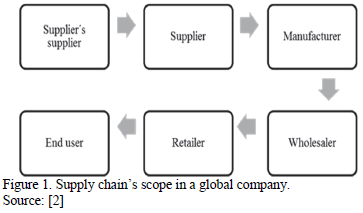
<body><![CDATA[<p><font size="2" face="Verdana, Arial, Helvetica, sans-serif">Blanchard &#91;2&#93; defines the SC as the sequence of events that  covers the entire lifecycle of a product or service from the beginning to the  end, as can be seen in <a href="#fig01">Fig. 1</a>. It requires companies to be attentive throughout  the whole manufacturing process, considering material delivery, material costs,  manufacturing processes, distribution packaging, methods, and costs. </font></p>     <p align="center"><font size="2" face="Verdana, Arial, Helvetica, sans-serif"><a name="fig01"></a></font><img src="/img/revistas/dyna/v82n194/v82n194a05fig01.gif"></p>     <p><font size="2" face="Verdana, Arial, Helvetica, sans-serif">The SC can be extremely complex, since it integrates  independent organizations that interact together to control and manage a  product that will be used by an end customer &#91;3&#93;. If a member of the SC fails  to deliver a component on time, there will be an impact in all of the other  members of the SC. Therefore, the good integration of these independent  companies will lead to a successful SC.</font></p>     <p><font size="2" face="Verdana, Arial, Helvetica, sans-serif"><b><i>2.2. Supply chain  management (SCM) and Green supply chain management (GSCM)</i></b></font></p>     <p><font size="2" face="Verdana, Arial, Helvetica, sans-serif">In the following subsections, we explain the SCM and GSCM  systems. </font></p>     <p><font size="2" face="Verdana, Arial, Helvetica, sans-serif"><b>2.2.1. Supply  Chain Management (SCM)</b></font></p>     <p><font size="2" face="Verdana, Arial, Helvetica, sans-serif">According to Li and Wang &#91;4&#93;, SCM integrates internal  operational decisions and activities with external customer demands to be able  to enhance competitiveness and profit (after production process). Su et  al. &#91;5&#93; state that SCM reveals the advantages of coordination with suppliers  (before production process). Thus, SCM has become a critical strategy for  organizations to create competitive advantages, transforming suppliers and  customers into partners. One of the reasons why a supplier is so important is  because the cost of raw materials frequently represents 70% of the final  product's cost. Therefore, the purchasing department plays an important role in  reducing this total figure &#91;6,7&#93;.</font></p>     <p><font size="2" face="Verdana, Arial, Helvetica, sans-serif"><b>2.2.2. Green  Supply Chain Management (GSCM)</b></font></p>     <p><font size="2" face="Verdana, Arial, Helvetica, sans-serif">Lee et al. &#91;8&#93; note that with growing worldwide awareness  of environmental protection, green production has become an important issue for  almost every manufacturer and will determine the sustainability of a  manufacturer in the long term. GSCM is generally involves suppliers based on  their environmental performance and business is only done with those that meet  certain environmental regulations or standards &#91;9&#93;.</font></p>     <p><font size="2" face="Verdana, Arial, Helvetica, sans-serif">Due to some violations in regulations, certain countries  have taken action. For example, in 2001 more than 1.3 million boxes of  PlayStation 2 games consoles, produced by the Sony Corporation, were blocked by  the Dutch government due to an excessive amount of the toxic element Cadmium  found in the cables of the game controls. This led to losses exceeding $130  million, and indirectly led to the re-inspection of over 6,000 factories and  the establishment of a new supplier management system &#91;10&#93;. </font></p>     ]]></body>
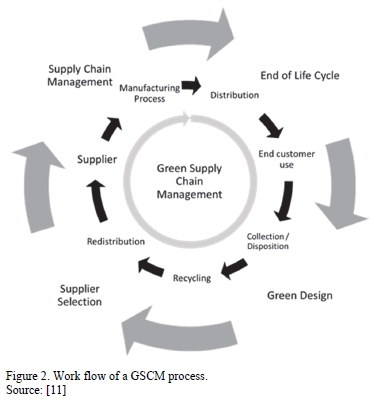
<body><![CDATA[<p><font size="2" face="Verdana, Arial, Helvetica, sans-serif">The previous is an example of the focus given to  environmental care around the world and the importance that this trend has  among leading companies in all fields. The fact that firms assess their environmental  impact, regardless of the driver, represents significant growth in  environmental awareness.</font></p>     <p><font size="2" face="Verdana, Arial, Helvetica, sans-serif">GSCM has been adopted  as a strategy by leading industry companies to put pressure on their suppliers  in order to achieve a certain level of environmental performance, stimulating  operational cooperation of all SC members. The GSC approach seeks to reduce a  product's ecological impact to a bare minimum. GSCM is, in essence, the same as  a typical SCM. A typical example of how a GSCM works is shown in <a href="#fig02">Fig. 2</a>.</font></p>     <p align="center"><font size="2" face="Verdana, Arial, Helvetica, sans-serif"><a name="fig02"></a></font><img src="/img/revistas/dyna/v82n194/v82n194a05fig02.gif"></p>     <p><font size="2" face="Verdana, Arial, Helvetica, sans-serif"><b><i>2.3. Supplier  selection process (SSP)</i></b></font></p>     <p><font size="2" face="Verdana, Arial, Helvetica, sans-serif">As the first element in a SC, suppliers have a direct  impact on the quality, cost, and delivery time of new products &#91;12-14&#93;. The  supplier selection (SS) consists of measuring the performance of a group of  suppliers to select the best option improving the effectiveness of the whole  supply system. </font></p>     <p><font size="2" face="Verdana, Arial, Helvetica, sans-serif">SS is not an easy task, since various potential suppliers  may have similar performance characteristics for different attributes. For many  years, the traditional approach to SSP has mainly considered quality, cost, and  lead time. However, currently, due to the environmental care issue, this is no  longer enough, and companies have had to incorporate the environmental culture  into the common SSP criteria. </font></p>     <p><font size="2" face="Verdana, Arial, Helvetica, sans-serif">A green supplier is  expected, not only to achieve environmental compliance, but also to undertake  efficient, green product design, and end-of-life cycle studies. Thus, in  a GSC, companies need to have extensive SSP and performance evaluation  processes &#91;15&#93;. A green supplier evaluation system is needed for a company to  be able to meet the GSCM requirements and establish competitiveness. GSS is  clearly a critical activity in purchasing, and buyers need to focus on the  procurement of products and services from suppliers that can provide these with  a low cost, good quality, short lead time, and environmental responsibility.</font></p>     <p><font size="2" face="Verdana, Arial, Helvetica, sans-serif"><b><i>2.4. Evaluating attributes and Multi-criteria decision  making (MCDM)</i></b></font></p>     <p><font size="2" face="Verdana, Arial, Helvetica, sans-serif">Decision making has always been a matter of concern for  humankind. One of the most important tasks in decision making is to structure  decision problems into a formal and manageable format &#91;16&#93;. Decision-making  situations typically involve more than one attribute. MCDM has been created to  help researchers and decision makers find the best solution to decision  problems. There are several techniques, depending on the problem to be  evaluated; however, all techniques follow the methodology suggested by De Boer  et al. &#91;17&#93; for selecting a supplier: </font></p> <ul>       <li><font size="2" face="Verdana, Arial, Helvetica, sans-serif"> SSP definition</font></li>       ]]></body>
<body><![CDATA[<li><font size="2" face="Verdana, Arial, Helvetica, sans-serif"> Identification of criteria</font></li>       <li><font size="2" face="Verdana, Arial, Helvetica, sans-serif"> Supplier evaluation by chosen technique</font></li>       <li><font size="2" face="Verdana, Arial, Helvetica, sans-serif"> SS</font></li>     </ul>     <p><font size="2" face="Verdana, Arial, Helvetica, sans-serif">In order to apply De Boer's methodology for SS, there has  to be a way to determine and define the main attributes to be integrated into a  technique for the SSP. The attributes used to evaluate a supplier fall into two  classifications: quantitative and qualitative attributes.</font></p>     <p><font size="2" face="Verdana, Arial, Helvetica, sans-serif"><b>2.4.1. Quantitative  attributes</b></font></p>     <p><font size="2" face="Verdana, Arial, Helvetica, sans-serif">In simple terms, these attributes are composed of  everything that can be measured and physically describe elements of a product,  such as cost, speed, size, capacity, etc.</font></p>     <p><font size="2" face="Verdana, Arial, Helvetica, sans-serif"><b>2.4.2. Qualitative  attributes</b></font></p>     <p><font size="2" face="Verdana, Arial, Helvetica, sans-serif">These types of attributes are subjective; their  application depends on the assigned weight, depending on the importance given  to them by the organization. They describe products that need to be evaluated  in a decision-making process to fulfill a requirement.</font></p>     <p>&nbsp;</p>     ]]></body>
<body><![CDATA[<p><font size="3" face="Verdana, Arial, Helvetica, sans-serif"><b>3. Material collection methodology</b></font></p>     <p><font size="2" face="Verdana, Arial, Helvetica, sans-serif">The literature review was undertaken in the 3 following  steps: a) <i>Material collection</i>: The material to be collected is defined. b) <i>Review of articles</i>: The articles found  were reviewed in order to obtain information to establish a categorization. c) <i>Information analysis</i>: For easy  management of the article's information, classification software was used to  generate tables and crosstabs showing data groups. </font></p>     <p><font size="2" face="Verdana, Arial, Helvetica, sans-serif"><b><i>3.1. First step:  Material collection</i></b></font></p>     <p><font size="2" face="Verdana, Arial, Helvetica, sans-serif">During this first step, a literature review was completed  of English-language articles published in high-quality, peer-reviewed  international journals between 2007 and 2013. The article search was performed  in major databases such as: Science Direct, as a leading full-text scientific  database that offers journal articles and book chapters; IEEE, which is  considered the world's largest professional association for the advancement of  technology; and ProQuest, which is a widely recognized dissertation database.</font></p>     <p><font size="2" face="Verdana, Arial, Helvetica, sans-serif">The selected journals were <i>Experts Systems with Applications</i>, <i>Journal of Cleaner Production</i>, <i>International  Journal of Production Economics</i>, and <i>Industrial  Engineering and Engineering Management</i>.</font></p>     <p><font size="2" face="Verdana, Arial, Helvetica, sans-serif">The search was performed by entering the keywords &quot;green  supplier evaluation&quot; and &quot;green supplier selection&quot;. The word &quot;green&quot; was then  replaced by &quot;environmental&quot; and &quot;ecologic&quot;. The word &quot;supplier&quot; was also replaced  by &quot;vendor&quot;. The words &quot;evaluation&quot; and &quot;selection&quot; were replaced by  &quot;assessment&quot; and &quot;qualification&quot;. A second set of keywords was then entered:  &quot;environmental criteria for supplier selection&quot;, &quot;green multi-criteria decision  making&quot;, and &quot;green criteria for supplier selection&quot;.</font></p>     <p><font size="2" face="Verdana, Arial, Helvetica, sans-serif">The screening process consisted of looking for articles  presenting a case of study in which a GSS problem was identified and a  multi-criteria technique was used to solve the selection problem.</font></p>     <p><font size="2" face="Verdana, Arial, Helvetica, sans-serif"><b><i>3.2. Second step:  Review of articles</i></b></font></p>     <p><font size="2" face="Verdana, Arial, Helvetica, sans-serif">The articles were gathered and reviewed by obtaining  information to establish a classification. The articles presented a SS case of  study. The information obtained from the articles was then entered into  software for easy management of the data.</font></p>     <p><font size="2" face="Verdana, Arial, Helvetica, sans-serif"><b><i>3.3. Third step:  Data entry using software</i></b></font></p>     ]]></body>
<body><![CDATA[<p><font size="2" face="Verdana, Arial, Helvetica, sans-serif">The classification categories used for the review were:</font></p>     <p><font size="2" face="Verdana, Arial, Helvetica, sans-serif"><b>3.3.1. Year of  publication</b></font></p>     <p><font size="2" face="Verdana, Arial, Helvetica, sans-serif">The search was limited to the period of time from 2007 to  2013. All the papers were classified according to their year of publication, in  order to establish the progress in time.</font></p>     <p><font size="2" face="Verdana, Arial, Helvetica, sans-serif"><b>3.3.2. Universities</b></font></p>     <p><font size="2" face="Verdana, Arial, Helvetica, sans-serif">The university in which the study was performed is  important in order to understand the region in the planet that is working in  this topic.</font></p>     <p><font size="2" face="Verdana, Arial, Helvetica, sans-serif"><b>3.3.3. Journal  Name</b></font></p>     <p><font size="2" face="Verdana, Arial, Helvetica, sans-serif">The journal category identifies the different disciplinary  areas that contribute to the GSSP.</font></p>     <p><font size="2" face="Verdana, Arial, Helvetica, sans-serif"><b>3.3.4. Case of  study</b></font></p>     <p><font size="2" face="Verdana, Arial, Helvetica, sans-serif">The study provides a wide variety of applications in which  a SS problem may exist. The case presents the different stages in an SS process,  the technique, and the environmental criteria utilized.</font></p>     <p><font size="2" face="Verdana, Arial, Helvetica, sans-serif"><b>3.3.5. SS  Technique implemented</b></font></p>     ]]></body>
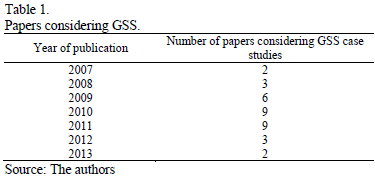
<body><![CDATA[<p><font size="2" face="Verdana, Arial, Helvetica, sans-serif">The multi-criteria technique used in the cases studies is  one of the main objectives in the categorization. It is imperative to  understand the main techniques utilized in the SS problem.</font></p>     <p><font size="2" face="Verdana, Arial, Helvetica, sans-serif"><b>3.3.6. Green  attributes employed in the selection</b></font></p>     <p><font size="2" face="Verdana, Arial, Helvetica, sans-serif">The case studies  presented particular decision problems being solved. In most of the cases, the  problem was related to a green supplier selection decision, for which  attributes help evaluate the provided options. The attributes used in the GSS  may vary depending on the type or product being supplied. </font></p>     <p>&nbsp;</p>     <p><font size="3" face="Verdana, Arial, Helvetica, sans-serif"><b>4. Material collection results</b></font></p>     <p><font size="2" face="Verdana, Arial, Helvetica, sans-serif">A total of 34 articles  were found in the material collection process, and these were reviewed and  grouped as is described in Section 3. This section shows the material collection  results.</font></p>     <p><font size="2" face="Verdana, Arial, Helvetica, sans-serif"><b><i>4.1. Year of  publication</i></b></font></p>     <p><font size="2" face="Verdana, Arial, Helvetica, sans-serif">The distribution of the articles from 2007 to 2013 is  shown in <a href="#tab01">Table 1</a>. It can be seen that 2010 and 2011 are the years with the  highest number of publications.</font></p>     <p align="center"><font size="2" face="Verdana, Arial, Helvetica, sans-serif"><a name="tab01"></a></font><img src="/img/revistas/dyna/v82n194/v82n194a05tab01.gif"></p>     <p><font size="2" face="Verdana, Arial, Helvetica, sans-serif"><b><i>4.2. Universities  and academic departments</i></b></font></p>     ]]></body>
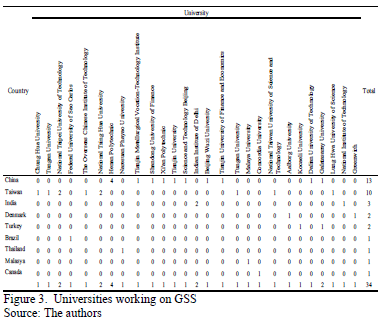
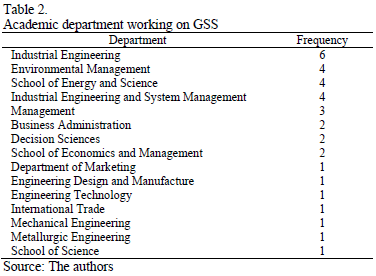
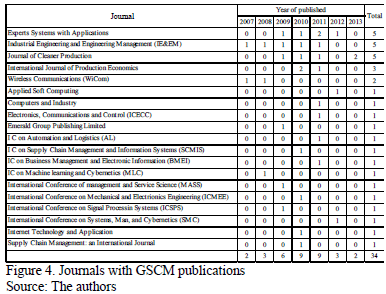
<body><![CDATA[<p><font size="2" face="Verdana, Arial, Helvetica, sans-serif">An additional way to present the information gathered in  this review is to identify the university and academic department at which the  first author works, providing work on the GSS topic. </font></p>     <p><font size="2" face="Verdana, Arial, Helvetica, sans-serif"><a href="#fig03">Fig. 3</a> shows the universities at which the first authors  conducted their research.</font></p>     <p align="center"><font size="2" face="Verdana, Arial, Helvetica, sans-serif"><a name="fig03"></a></font><img src="/img/revistas/dyna/v82n194/v82n194a05fig03.gif"></p>     <p><font size="2" face="Verdana, Arial, Helvetica, sans-serif">The universities with the highest number of published  articles are The Henan Polytechnic (4), located in China, followed by The  University of Technology (2), National Tsing Hua University (2), and National  Taipei Malaya University (2), all located in Taiwan, and then the Indian  Institute of Delhi (2), located in India. The rest of the universities produced  only one article. It can clearly be seen that China and Taiwan are the places  where there are more research groups investigating aspects related to GSS techniques  -representing 67.6% of this review- followed by India, Denmark, and Turkey with  20.5%, and finally, Brazil, Thailand, Malaysia, and Canada with 11.76%.</font></p>     <p><font size="2" face="Verdana, Arial, Helvetica, sans-serif"><a href="#tab02">Table 2</a> presents the academic department within the  universities that developed this type of research. It can be seen that the  department with the most studies over these years is the Industrial Engineering  Department, followed by the Environmental Management, and Energy and Science  Departments.</font></p>     <p align="center"><font size="2" face="Verdana, Arial, Helvetica, sans-serif"><a name="tab02"></a></font><img src="/img/revistas/dyna/v82n194/v82n194a05tab02.gif"></p>     <p><font size="2" face="Verdana, Arial, Helvetica, sans-serif"><b><i>4.3. Journals</i></b></font></p>     <p><font size="2" face="Verdana, Arial, Helvetica, sans-serif">The journal distribution shown in <a href="#fig04">Fig. 4</a> identifies the  different disciplinary areas contributing to the GSS process.</font></p>     <p align="center"><font size="2" face="Verdana, Arial, Helvetica, sans-serif"><a name="fig04"></a></font><img src="/img/revistas/dyna/v82n194/v82n194a05fig04.gif"></p>     <p><font size="2" face="Verdana, Arial, Helvetica, sans-serif">There are three main  journals identified in this literature review with the highest number of  published articles on this topic: <i>Experts  Systems with Applications</i>, <i>Industrial  Engineering and Engineering Management</i> (IE and EM), and <i>Journal of Cleaner Production, all</i> with  five published articles. The list continues with the <i>International Journal of Production Economics</i> with three published  articles, followed by the <i>Wireless  Communications</i> (WiCom) with two. The rest of the journals listed in the  table have only one paper published on the topic. The information in this  figure shows that the interest in green issues and environmental concern is  being addressed in different areas.</font></p>     ]]></body>
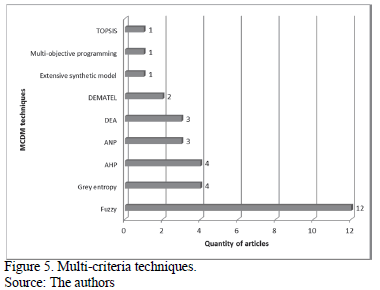
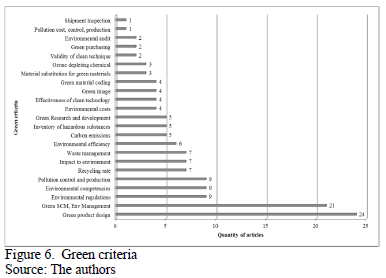
<body><![CDATA[<p><font size="2" face="Verdana, Arial, Helvetica, sans-serif"><b><i>4.4. Multi-criteria Techniques</i></b></font></p>     <p><font size="2" face="Verdana, Arial, Helvetica, sans-serif">There were 34 articles reviewed, and all but two considered  a case study being applied where a SS problem was presented, and a MCDM  technique was developed using traditional and green criteria in the selection  process. <a href="#fig05">Fig. 5</a> provides a summary of these techniques. </font></p>     <p align="center"><font size="2" face="Verdana, Arial, Helvetica, sans-serif"><a name="fig05"></a></font><img src="/img/revistas/dyna/v82n194/v82n194a05fig05.gif"></p>     <p><font size="2" face="Verdana, Arial, Helvetica, sans-serif">A total of 12 articles present a review using fuzzy logic  models. A comparison of the GSS between the American, Japanese, and Taiwanese  electronics industry in China is shown in &#91;35&#93;. The case of a printed circuit  board manufacturer in Taiwan that seeks to implement GSCM is illustrated in  &#91;36&#93;. A fuzzy multi-criteria decision problem approach with vague sets in an  iron and steel company is shown in &#91;37&#93; and &#91;38&#93;. A new ranking method on the  basis of fuzzy inference system (FIS) is applied in &#91;27&#93;. </font></p>     <p><font size="2" face="Verdana, Arial, Helvetica, sans-serif">The next MCDM used was  the Grey entropy model, which was in four papers: Chiou et al. &#91;39&#93; developed a  model where subjectivity can be avoided in ascertaining weights of lower  hierarchy factors. An improved grey correlative method applied in a previous  publication is shown in &#91;39&#93; and &#91;40&#93;. An introduction of additional levels of  analysis and application of grey entropy is presented in &#91;41&#93;. Finally, four  papers are related to the use of Analytic Hierarchy Process (AHP) models  &#91;42-45&#93;.</font></p>     <p><font size="2" face="Verdana, Arial, Helvetica, sans-serif"><b><i>4.5. Green  attributes</i></b></font></p>     <p><font size="2" face="Verdana, Arial, Helvetica, sans-serif">In  the traditional SCM, SS criteria consisted of the common qualities, cost and  time, but due to the increased </font><font size="2" face="Verdana, Arial, Helvetica, sans-serif">awareness of environmental  protection these are no longer important. Therefore, the traditional SSP  incorporates green criteria in order to comply with environmental regulations,  social consciousness, and industry performance.</font></p>     <p><font size="2" face="Verdana, Arial, Helvetica, sans-serif">From a total number of 34 published articles, 24 concurred  that green product design is a criterion to be used when evaluating and  selecting a supplier, 21 saw green supply management as being important, 9  environmental regulations, 9 environmental competencies, 9 pollution control  and production, 7 recycling rate, 7 impact to the environment, 7 waste  management, 6 environmental efficiency, 5 carbon emissions, 5 inventory of  hazardous substances, and 5 green research and development. This can be seen in  <a href="#fig06">Fig. 6</a>.</font></p>     <p align="center"><font size="2" face="Verdana, Arial, Helvetica, sans-serif"><a name="fig06"></a></font><img src="/img/revistas/dyna/v82n194/v82n194a05fig06.gif"></p>     <p>&nbsp;</p>     ]]></body>
<body><![CDATA[<p><font size="3" face="Verdana, Arial, Helvetica, sans-serif"><b>5. Analysis of the results and discussion</b></font></p>     <p><font size="2" face="Verdana, Arial, Helvetica, sans-serif">In this section, the key findings that resulted from the  material collection are presented. The main goal of this study was to identify  how GSS has evolved over recent years and which characteristics are  discernible. Then, based on the review as well as the results, this section  explains how the green criteria are useful in any GSS.</font></p>     <p><font size="2" face="Verdana, Arial, Helvetica, sans-serif"><b><i>5.1. Analysis of  publication distribution </i></b></font></p>     <p><font size="2" face="Verdana, Arial, Helvetica, sans-serif">There was a growing trend from 2007 to 2011 that showed an  evolution in awareness regarding environmental impact issues. Based on the  wider awareness of environmental concerns over the last decade, it is foreseen  that research on the topic will continue to progress.</font></p>     <p><font size="2" face="Verdana, Arial, Helvetica, sans-serif"><b><i>5.2. Analysis of  environmental criteria in GSS</i></b></font></p>     <p><font size="2" face="Verdana, Arial, Helvetica, sans-serif">Environmental consideration of SS is a key competitive issue  for large and medium-sized enterprises, and thus maintaining long-term  relationships with these suppliers should be taken into account. De Boer et al.  &#91;17&#93; proposed a knowledge-based system to evaluate the supplier's environmental  performance, which can be sectioned into several categories: environmental  costs, management competencies, green image, green design, environmental  management system, and environmental competencies.</font></p>     <p><font size="2" face="Verdana, Arial, Helvetica, sans-serif">This section explores the broad environmental criteria of  either quantitative or qualitative attributes with regard to environmental  cost, production process, product, and management systems.</font></p>     <p><font size="2" face="Verdana, Arial, Helvetica, sans-serif"><b>5.2.1. Environmental  competencies</b></font></p>     <p><font size="2" face="Verdana, Arial, Helvetica, sans-serif">The percentage of companies that have established a GSC in  order to incorporate ecological care is low. Nevertheless, there are companies  that have a big concern for environmental issues and have actually established  a plan to respond to regulations and social concern. In some cases the bigger  the company, the greater the interest in integrating a GSC. </font></p>     <p><font size="2" face="Verdana, Arial, Helvetica, sans-serif">The development of environmental plan must include some  important points in order for the response to be successful:</font></p> <ul>       ]]></body>
<body><![CDATA[<li><font size="2" face="Verdana, Arial, Helvetica, sans-serif">Environmental impact assessments that define the     current situation and areas that have opportunities.</font></li>       <li><font size="2" face="Verdana, Arial, Helvetica, sans-serif">Environmental education and training, to provide     information and develop environmental culture.</font></li>       <li><font size="2" face="Verdana, Arial, Helvetica, sans-serif">Green design training, to increase design core     groups' eco-engineering skills.</font></li>       <li><font size="2" face="Verdana, Arial, Helvetica, sans-serif">Environmental policies and standards     development, to establish an efficient operating system.</font></li>       <li><font size="2" face="Verdana, Arial, Helvetica, sans-serif">Pollution prevention and control systems, to     continuously improve and innovate product designs and manufacturing processes.</font></li>       <li><font size="2" face="Verdana, Arial, Helvetica, sans-serif">Waste management systems implementation, to     establish future re-use, recycling, and disposal of material.</font></li>       <li><font size="2" face="Verdana, Arial, Helvetica, sans-serif">Strategic planning, monitoring, and reporting     systems.</font></li>     </ul>     <p><font size="2" face="Verdana, Arial, Helvetica, sans-serif"><b>5.2.2. Green  product design</b></font></p>     <p><font size="2" face="Verdana, Arial, Helvetica, sans-serif">One of the most important criteria in SSP is the  capability for green design, which can promote product-oriented GSC  implementation. According to Humphreys et al. &#91;18&#93;, the strongest testament to  the greening of international markets is the expanding number of companies  seriously addressing environmental concerns as part of their product  development process. A product is considered eco-friendly if it does not  represent a threat to the environment when released into the air, water, or  earth, either when it is in use or at the end of its life cycle. Green product  design is extremely important because it is a key element in establishing a  GSC. Green design can indicate the direction that each SC component will  follow. Companies need to invest in design core groups and help to develop an  understanding of how design decisions impact the products' entire life cycle.</font></p>     ]]></body>
<body><![CDATA[<p><font size="2" face="Verdana, Arial, Helvetica, sans-serif"><b>5.2.3. Carbon  emissions management</b></font></p>     <p><font size="2" face="Verdana, Arial, Helvetica, sans-serif">Carbon (CO2) emissions result from a variety of activities  that humans undertake in their daily lives. Growing levels of anthropocentric  CO2 emissions are known to cause global warming &#91;20&#93;. As the public becomes  more aware of environmental issues and global warming, consumers will be asking  more questions about the products they are purchasing. The term carbon  footprinting refers to the total amount of CO2 or greenhouse gases emissions an  individual or organization is responsible for. Companies will have to expect  questions about the state of their green manufacturing processes, their SC,  their carbon footprint, and how they recycle. Luckily, CO2 emissions can safely  be dealt with and predicted if a well-defined green design and manufacturing  process is established within the company.</font></p>     <p><font size="2" face="Verdana, Arial, Helvetica, sans-serif"><b>5.2.4. Energy/Resource  consumption</b></font></p>     <p><font size="2" face="Verdana, Arial, Helvetica, sans-serif">Due to global competition, it is crucial for an enterprise  to enhance its ability to improve energy utilization and efficiency through the  enterprise's inner energy audit and energy management &#91;21&#93;. Energy conservation  management projects promoted by the government, and energy audits have been  undertaken in developed countries since the 1970s &#91;22&#93;. </font></p>     <p><font size="2" face="Verdana, Arial, Helvetica, sans-serif"> As shown by Zhang  et al. &#91;23&#93;, the case study detailed in this paper's main objective is to  discover energy auditing and energy management problems in regions such as China.  The case study reveals that if enterprises are unwilling to cooperate actively  with the energy audit, then the government should improve the energy  performance assessment system, increase capital investment, and develop  energy-saving tax incentives.</font></p>     <p><font size="2" face="Verdana, Arial, Helvetica, sans-serif">All the current lean manufacturing methods, which have the  primary objective of eliminating waste in a production process, are associated  with energy and resource consumption. This attribute is really important, as  can be seen in modern GSCs. When selecting a supplier, not only the traditional  evaluation criteria is used, green criteria is also incorporated. In order to  eliminate waste, there has to be better consumption of the current resources  (raw materials, water, air, etc.,), as well as more consideration of the energy  needed to manufacture a product. </font></p>     <p><font size="2" face="Verdana, Arial, Helvetica, sans-serif"><b>5.2.5. Green  material coding</b></font></p>     <p><font size="2" face="Verdana, Arial, Helvetica, sans-serif">ISO 11496 specifies a system for the uniform marking of  products that have been fabricated from plastic materials. It intends to help  identify plastic products for subsequent decisions concerning handling, waste,  recovery, or disposal. These days, a common company practice is to incorporate  the material specification code on a visible location on the part; this helps  distinguish materials from a pile of products. There are companies that can  handle a variety of plastic parts, and having the material code engraved in the  component will easily help with the disposal of these parts at the end of their  lives.</font></p>     <p><font size="2" face="Verdana, Arial, Helvetica, sans-serif">Material coding is also important when disposing of the  products that have reached their end of their lives. It provides an immediate  identification of hazardous and non-hazardous materials. Eveloy et al. &#91;24&#93;  recommend that all lead-free materials, components, and boards should be  assigned new part numbers to distinguish them from lead-based ones.</font></p>     <p><font size="2" face="Verdana, Arial, Helvetica, sans-serif"><b>5.2.6. Management  of hazardous substances</b></font></p>     ]]></body>
<body><![CDATA[<p><font size="2" face="Verdana, Arial, Helvetica, sans-serif">There is a serious-restricted use of hazardous substances  during the production; therefore, companies have taken special interest in  reducing the utilization of these substances and complying with environmental  regulations. The International Electrotechnical Commission (IEC) set up the  Hazardous Substance Process Management (HSPM) standard - namely, IECQ QC 080000  HSPM. As shown by Hsu and Hu &#91;25&#93;, obtaining a certification helps companies  mitigate risks associated with hazardous substances.</font></p>     <p><font size="2" face="Verdana, Arial, Helvetica, sans-serif"><b>5.2.7. Waste  management system</b></font></p>     <p><font size="2" face="Verdana, Arial, Helvetica, sans-serif">Waste is produced in  all human activity; there is always something leftover. Therefore, the key  point is to reduce the impact of this residue on the environment. In order to  ensure the protection of the environment, a waste management system needs to be  established. For example, all of the current lean manufacturing methods like  SMED, Six Sigma, or Kaisen help companies achieve this reduction in operational  costs and waste. For instance, according to Z&uacute;&ntilde;iga-Ceron and Gandini-Ayerbe  &#91;26&#93;, the final disposal of sugar cane waste represents a huge environmental  challenge. Therefore, the industry is looking for solutions such as the  conversion of their residues into sub products to obtain economic gain, and at  the same time reduce the environmental impact.</font></p>     <p><font size="2" face="Verdana, Arial, Helvetica, sans-serif">After the establishment of Waste Electrical and Electronic  Equipment (WEEE), Restriction of Hazardous Substances (RoHS), and Eco-design  for Energy-using Products (EuP), directives have been passed by the European  Union (EU), and GSCM has been adopted as a strategy by leading electronics  companies, including Dell, HP, IBM, Motorola, Sony, Panasonic, NEC, Fujitsu,  and Toshiba &#91;27&#93;.</font></p>     <p><font size="2" face="Verdana, Arial, Helvetica, sans-serif">A proper waste management system may integrate the  following:</font></p> <ul>       <li><font size="2" face="Verdana, Arial, Helvetica, sans-serif">Green product design can define the easy     disposal of the product at its end-of-life cycle.</font></li>       <li><font size="2" face="Verdana, Arial, Helvetica, sans-serif">Reduce waste releases to water, land, or air by     resource management consumption.</font></li>       <li><font size="2" face="Verdana, Arial, Helvetica, sans-serif">Reuse of discarded waste products will help     reduce generation of unnecessary material.</font></li>       <li><font size="2" face="Verdana, Arial, Helvetica, sans-serif">Recycling materials will lower the waste rate.</font></li>     </ul>     ]]></body>
<body><![CDATA[<p><font size="2" face="Verdana, Arial, Helvetica, sans-serif"><b>5.2.8. Recycling</b></font></p>     <p><font size="2" face="Verdana, Arial, Helvetica, sans-serif">According to Yi and Wang &#91;28&#93;, there are three types of  reverse SC recycle models in developed countries:</font></p> <ol>       <li><font size="2" face="Verdana, Arial, Helvetica, sans-serif"> Manufacturer     Take-Back (MT). This recycling model requires that the manufacturer build an     enormous recycling network at an excessive cost.</font></li>       <li><font size="2" face="Verdana, Arial, Helvetica, sans-serif"> Retailer     Take-Back (RT). This recycling model can effectively utilize the stronger     marketing network of a retailer, but the manufacturer has to face some     coordination problems with the retailer, such as recycle pricing.</font></li>       <li><font size="2" face="Verdana, Arial, Helvetica, sans-serif">Third     Party Take-Back (TPT). This category includes companies that lack investment     and knowledge to develop their own reverse logistic system. The companies     outsource this requirement to a third party, requiring less effort from them.</font></li>     </ol>     <p><font size="2" face="Verdana, Arial, Helvetica, sans-serif"><b>5.2.9. Green  purchasing</b></font></p>     <p><font size="2" face="Verdana, Arial, Helvetica, sans-serif">The purchasing department has become much more important  due to the recent agile improvement of network technology and economic  globalization &#91;29&#93;. Buyers in an SC are in the ideal position to identify an  environmental risk and formulate requirements for suppliers to meet. The  purchasing department needs to be at the forefront of all the environmental  regulations in order to maintain a close relationship with the engineering  group developing the product. This will help eliminate mistakes or conditions  that lead to selecting an incorrect supplier. Environmental standards in  purchasing provide a basis for constructive dialogue with suppliers within a  joint commitment to quality progress context, and should motivate suppliers to  promote these activities with their own suppliers &#91;30&#93;. </font></p>     <p><font size="2" face="Verdana, Arial, Helvetica, sans-serif"><b>5.2.10. Green  research and development</b></font></p>     <p><font size="2" face="Verdana, Arial, Helvetica, sans-serif">The technology, method, and tool research relating to a  green product has also become important &#91;31&#93;. The different GSC approaches -  green sourcing, green manufacturing processes, green design, and reverse  logistics -together provide new sources of innovation and continuous  improvement of current management systems. For instance, as shown by Chen &#91;32&#93;,  the printed circuit board construction process is currently migrating from  traditional eutectic Pb-Sn alloy to different lead-free alloys. This  replacement attempts to alleviate the problem of the Pb-Sn solder alloy, which  is toxic. However, this does not change the component separation problem for  reuse and/or disposal of these materials without harming the environment. This  means that, regardless of implementing an action to reduce the impact of one  material or practice, the action needs to be deeply explored in order to  measure its future impact as well.</font></p>     ]]></body>
<body><![CDATA[<p><font size="2" face="Verdana, Arial, Helvetica, sans-serif"><b>5.2.11. Green  image</b></font></p>     <p><font size="2" face="Verdana, Arial, Helvetica, sans-serif">Enhancing a companies' image is one of the most common  reasons for assuming a green strategy, and, according to Canal-Marques et al.  &#91;33&#93;, companies that invest in environmental efforts are able to improve their  corporate image and develop new markets, as well as increase their competitive  advantages. People's awareness has pushed companies to act and incorporate  green practices in complying with environmental regulatory constrains for the  purpose of gaining market profit. Companies that embrace the green environment  concept with environmentally friendly products and packaging can charge  relatively high prices for their products, and thus increase their products'  differentiation advantages &#91;34, 35&#93;.</font></p>     <p><font size="2" face="Verdana, Arial, Helvetica, sans-serif"><b>5.2.12. Environmental Regulations</b></font></p>     <p><font size="2" face="Verdana, Arial, Helvetica, sans-serif">Suppliers who have acquired environmental management  systems (EMS) certifications (ISO14001) can state that an organization has  implemented a management system that documents the its environmental aspects  and impacts, and has identified a pollution prevention process that is  continually improved over time &#91;34,35&#93;. Having this certification helps  companies acquire a green public image, looks after the environment, and  confers external legitimacy &#91;35&#93;. Companies may also be able to use ISO 14001  to increase their internal efficiencies and create competitive advantage  opportunities and economic benefits &#91;36&#93;.</font></p>     <p><font size="2" face="Verdana, Arial, Helvetica, sans-serif">There are several reasons, as mentioned by Coglianese and  Nash &#91;37&#93;, why companies implement ISO 14001:</font></p> <ul>       <li><font size="2" face="Verdana, Arial, Helvetica, sans-serif"> It is the best external valuation and they     improve their corporate reputation.</font></li>       <li><font size="2" face="Verdana, Arial, Helvetica, sans-serif"> They prove their social responsibility and     commitment to the environment.</font></li>       <li><font size="2" face="Verdana, Arial, Helvetica, sans-serif"> They will have continuous improvement.</font></li>       <li><font size="2" face="Verdana, Arial, Helvetica, sans-serif"> It helps with and ensures the legality of     compliance with environmental legislation.</font></li>       <li><font size="2" face="Verdana, Arial, Helvetica, sans-serif"> It is different from the competition.</font></li>       ]]></body>
<body><![CDATA[<li><font size="2" face="Verdana, Arial, Helvetica, sans-serif"> Its administration is easy and its     implementation is promoted.</font></li>       <li><font size="2" face="Verdana, Arial, Helvetica, sans-serif"> It improves competition scores and is mandatory.</font></li>       <li><font size="2" face="Verdana, Arial, Helvetica, sans-serif"> It improves safety at work.</font></li>       <li><font size="2" face="Verdana, Arial, Helvetica, sans-serif"> It promotes growth.</font></li>     </ul>     <p>&nbsp;</p>     <p><b><font size="3" face="Verdana, Arial, Helvetica, sans-serif">6. Conclusions and further work</font></b></p>     <p><font size="2" face="Verdana, Arial, Helvetica, sans-serif">SC professionals are under pressure to build a successful  SC strategy that will raise productivity and competitiveness, respond to demand  variations and environmental regulations, while at the same time empower  product innovation and promote continuous improvement. Several years ago, there  was a lack of environmental care and social awareness, with no connection to  investment and profitability. This is no longer the situation. Social concern  about environmental issues and global warming is causing consumers to demand  that the products they are purchasing go green. Companies are being questioned  about how green their manufacturing processes and SCM are, and what they are  currently doing to reduce their carbon footprint and tackle global warming.</font></p>     <p><font size="2" face="Verdana, Arial, Helvetica, sans-serif">This paper informed the reader of the following: that GSCM  is being adopted; that green criteria are being incorporated within evaluation  techniques; that selecting a supplier is an important decision. This is the  case, not only with respect to providing the organization with the right  products at the right cost, but also taking into consideration environmental  performance by eliminating contaminants, and reducing the energy to produce the  products, etc.</font></p>     <p><font size="2" face="Verdana, Arial, Helvetica, sans-serif">It could be worthwhile to undertake further research on  topics such as how companies deal with balancing the different GSS practices  and how this practice could be more effective. </font></p>     ]]></body>
<body><![CDATA[<p>&nbsp;</p>     <p><font size="3" face="Verdana, Arial, Helvetica, sans-serif"><b>References</b></font></p>     <!-- ref --><p><font size="2" face="Verdana, Arial, Helvetica, sans-serif"><b>&#91;1&#93;</b> Lee,  A.H.I., A fuzzy supplier selection model with the consideration of benefits  opportunities, costs and risks, Expert Systems with Applications, 36(2), pp.  2879-2893, 2009. DOI: 10.1016/j.eswa.2008.01.045</font>&nbsp;&nbsp;&nbsp;&nbsp;&nbsp;&nbsp;&nbsp;&nbsp;[&#160;<a href="javascript:void(0);" onclick="javascript: window.open('/scielo.php?script=sci_nlinks&ref=000185&pid=S0012-7353201500060000500001&lng=','','width=640,height=500,resizable=yes,scrollbars=1,menubar=yes,');">Links</a>&#160;]<!-- end-ref --><!-- ref --><p><font size="2" face="Verdana, Arial, Helvetica, sans-serif"><b>&#91;2&#93;</b> Blanchard,  D., Supply chain management best practices, 2nd. Edition. John Wiley and Sons,  2010.    &nbsp;&nbsp;&nbsp;&nbsp;&nbsp;&nbsp;&nbsp;&nbsp;[&#160;<a href="javascript:void(0);" onclick="javascript: window.open('/scielo.php?script=sci_nlinks&ref=000186&pid=S0012-7353201500060000500002&lng=','','width=640,height=500,resizable=yes,scrollbars=1,menubar=yes,');">Links</a>&#160;]<!-- end-ref --></font></p>     <!-- ref --><p><font size="2" face="Verdana, Arial, Helvetica, sans-serif"><b>&#91;3&#93;</b> Wu,  C.H., Chen, C.W. and Hsieh, C.C., Competitive pricing decisions in a  two-echelon supply chain with horizontal and vertical competition,  International Journal of Production Economics, 135(1), pp. 265-274, 2012. DOI: 10.1016/j.ijpe.2011.07.020</font>&nbsp;&nbsp;&nbsp;&nbsp;&nbsp;&nbsp;&nbsp;&nbsp;[&#160;<a href="javascript:void(0);" onclick="javascript: window.open('/scielo.php?script=sci_nlinks&ref=000188&pid=S0012-7353201500060000500003&lng=','','width=640,height=500,resizable=yes,scrollbars=1,menubar=yes,');">Links</a>&#160;]<!-- end-ref --><!-- ref --><p><font size="2" face="Verdana, Arial, Helvetica, sans-serif"><b>&#91;4&#93;</b> Li,  X. and Wang, Q., Coordination mechanism of supply chain systems, European  Journal of Operational Research, 179(1), pp. 1-16, 2007. DOI: /10.1016/j.ejor.2006.06.023</font>&nbsp;&nbsp;&nbsp;&nbsp;&nbsp;&nbsp;&nbsp;&nbsp;[&#160;<a href="javascript:void(0);" onclick="javascript: window.open('/scielo.php?script=sci_nlinks&ref=000189&pid=S0012-7353201500060000500004&lng=','','width=640,height=500,resizable=yes,scrollbars=1,menubar=yes,');">Links</a>&#160;]<!-- end-ref --><!-- ref --><p><font size="2" face="Verdana, Arial, Helvetica, sans-serif"><b>&#91;5&#93;</b> Su,  Q., Shi, J.H. and Lai, S.J., Study on supply chain management of Chinese firms  from the institutional view, International Journal of Production Economics,  115(2), pp. 362-373, 2008. DOI: 10.1016/j.ijpe.2007.11.016</font>&nbsp;&nbsp;&nbsp;&nbsp;&nbsp;&nbsp;&nbsp;&nbsp;[&#160;<a href="javascript:void(0);" onclick="javascript: window.open('/scielo.php?script=sci_nlinks&ref=000190&pid=S0012-7353201500060000500005&lng=','','width=640,height=500,resizable=yes,scrollbars=1,menubar=yes,');">Links</a>&#160;]<!-- end-ref --><!-- ref --><p><font size="2" face="Verdana, Arial, Helvetica, sans-serif"><b>&#91;6&#93;</b> Ghodsypour,  S.H. and O'Brien, C., A decision support system for supplier selection using an  integrated analytic hierarchy process and linear programming, International  Journal of Production Economics, 56-57(1), pp. 199-212, 1998. DOI: 10.1016/S0925-5273(97)00009-1</font>&nbsp;&nbsp;&nbsp;&nbsp;&nbsp;&nbsp;&nbsp;&nbsp;[&#160;<a href="javascript:void(0);" onclick="javascript: window.open('/scielo.php?script=sci_nlinks&ref=000191&pid=S0012-7353201500060000500006&lng=','','width=640,height=500,resizable=yes,scrollbars=1,menubar=yes,');">Links</a>&#160;]<!-- end-ref --><!-- ref --><p><font size="2" face="Verdana, Arial, Helvetica, sans-serif"><b>&#91;7&#93;</b> Aksoy,  A. and Öztürk, N., Supplier selection and performance evaluation in  just-in-time production environments. Expert Systems with Applications, 38(5),  pp. 6351-6359, 2011. DOI: 10.1016/j.eswa.2010.11.104</font>&nbsp;&nbsp;&nbsp;&nbsp;&nbsp;&nbsp;&nbsp;&nbsp;[&#160;<a href="javascript:void(0);" onclick="javascript: window.open('/scielo.php?script=sci_nlinks&ref=000192&pid=S0012-7353201500060000500007&lng=','','width=640,height=500,resizable=yes,scrollbars=1,menubar=yes,');">Links</a>&#160;]<!-- end-ref --><!-- ref --><p><font size="2" face="Verdana, Arial, Helvetica, sans-serif"><b>&#91;8&#93;</b> Lee,  A.H.I., Kang, H.Y., Hsu, C.F. and Hung, H.C., A green supplier selection model  for high-tech industry. Expert Systems with Applications, 36(4), pp. 7917-7927,  2009. DOI: 10.1016/j.eswa.2008.11.052</font>&nbsp;&nbsp;&nbsp;&nbsp;&nbsp;&nbsp;&nbsp;&nbsp;[&#160;<a href="javascript:void(0);" onclick="javascript: window.open('/scielo.php?script=sci_nlinks&ref=000193&pid=S0012-7353201500060000500008&lng=','','width=640,height=500,resizable=yes,scrollbars=1,menubar=yes,');">Links</a>&#160;]<!-- end-ref --><!-- ref --><p><font size="2" face="Verdana, Arial, Helvetica, sans-serif"><b>&#91;9&#93;</b> Rao,  P., Greening the supply chain a new initiative in southeast Asia. International  Journal of Operations and Production Management, 22(6), pp. 632-55, 2002. DOI: 10.1108/01443570210427668</font>&nbsp;&nbsp;&nbsp;&nbsp;&nbsp;&nbsp;&nbsp;&nbsp;[&#160;<a href="javascript:void(0);" onclick="javascript: window.open('/scielo.php?script=sci_nlinks&ref=000194&pid=S0012-7353201500060000500009&lng=','','width=640,height=500,resizable=yes,scrollbars=1,menubar=yes,');">Links</a>&#160;]<!-- end-ref --><!-- ref --><p><font size="2" face="Verdana, Arial, Helvetica, sans-serif"><b>&#91;10&#93;</b> Esty,  D.C. and Winston, A.S. Green to gold: How smart companies use environmental  strategies to innovate, create value, and build competitive advantage,  Thesis,Yale University Press, New Haven, CT, USA, 2009.    &nbsp;&nbsp;&nbsp;&nbsp;&nbsp;&nbsp;&nbsp;&nbsp;[&#160;<a href="javascript:void(0);" onclick="javascript: window.open('/scielo.php?script=sci_nlinks&ref=000195&pid=S0012-7353201500060000500010&lng=','','width=640,height=500,resizable=yes,scrollbars=1,menubar=yes,');">Links</a>&#160;]<!-- end-ref --> </font></p>     <!-- ref --><p><font size="2" face="Verdana, Arial, Helvetica, sans-serif"><b>&#91;11&#93;</b> Diabat,  A. and Govindan, K., An analysis of the drivers affecting the implementation of  green supply chain management, Resources, Conservation and Recycling, 55, pp.  659-667, 2011. DOI: 10.1016/j.resconrec.2010.12.002</font>&nbsp;&nbsp;&nbsp;&nbsp;&nbsp;&nbsp;&nbsp;&nbsp;[&#160;<a href="javascript:void(0);" onclick="javascript: window.open('/scielo.php?script=sci_nlinks&ref=000197&pid=S0012-7353201500060000500011&lng=','','width=640,height=500,resizable=yes,scrollbars=1,menubar=yes,');">Links</a>&#160;]<!-- end-ref --><!-- ref --><p><font size="2" face="Verdana, Arial, Helvetica, sans-serif"><b>&#91;12&#93;</b> Vokurka,  R.J. and Fliedner, G.J., The journey toward agility, Industrial Data and  Management Systems, 98(4), pp. 165-171, 1998. DOI: 10.1108/02635579810219336</font>&nbsp;&nbsp;&nbsp;&nbsp;&nbsp;&nbsp;&nbsp;&nbsp;[&#160;<a href="javascript:void(0);" onclick="javascript: window.open('/scielo.php?script=sci_nlinks&ref=000198&pid=S0012-7353201500060000500012&lng=','','width=640,height=500,resizable=yes,scrollbars=1,menubar=yes,');">Links</a>&#160;]<!-- end-ref --><!-- ref --><p><font size="2" face="Verdana, Arial, Helvetica, sans-serif"><b>&#91;13&#93;</b> Meade,  L. and Sarkis, J., Analyzing organizational project alternatives for agile  manufacturing processes: An analytical network approach, International Journal of  Production Research, 37(2), pp. 241-261, 1999. DOI: 10.1080/002075499191751</font>&nbsp;&nbsp;&nbsp;&nbsp;&nbsp;&nbsp;&nbsp;&nbsp;[&#160;<a href="javascript:void(0);" onclick="javascript: window.open('/scielo.php?script=sci_nlinks&ref=000199&pid=S0012-7353201500060000500013&lng=','','width=640,height=500,resizable=yes,scrollbars=1,menubar=yes,');">Links</a>&#160;]<!-- end-ref --><!-- ref --><p><font size="2" face="Verdana, Arial, Helvetica, sans-serif"><b>&#91;14&#93;</b> Humphreys,  P., Huang, G., Cadden, T., and McIvor, R., Integrating design metrics within  the early supplier selection process, Journal of Purchasing and Supply  Management, 13(1), pp. 42-52, 2007. DOI: 10.1016/j.pursup.2007.03.006</font>&nbsp;&nbsp;&nbsp;&nbsp;&nbsp;&nbsp;&nbsp;&nbsp;[&#160;<a href="javascript:void(0);" onclick="javascript: window.open('/scielo.php?script=sci_nlinks&ref=000200&pid=S0012-7353201500060000500014&lng=','','width=640,height=500,resizable=yes,scrollbars=1,menubar=yes,');">Links</a>&#160;]<!-- end-ref --><!-- ref --><p><font size="2" face="Verdana, Arial, Helvetica, sans-serif"><b>&#91;15&#93;</b> Kainuma,  Y. and Tawara, N., A multiple attribute utility theory approach to lean and  green supply chain management, International Journal of Production Economics,  101(1), pp. 99-10, 2006. DOI: 10.1016/j.ijpe.2005.05.010</font>&nbsp;&nbsp;&nbsp;&nbsp;&nbsp;&nbsp;&nbsp;&nbsp;[&#160;<a href="javascript:void(0);" onclick="javascript: window.open('/scielo.php?script=sci_nlinks&ref=000201&pid=S0012-7353201500060000500015&lng=','','width=640,height=500,resizable=yes,scrollbars=1,menubar=yes,');">Links</a>&#160;]<!-- end-ref --><!-- ref --><p><font size="2" face="Verdana, Arial, Helvetica, sans-serif"><b>&#91;16&#93;</b> Rezagholizadeh,  M., Fereidunian, A.R., Dehghan, B., Moshiri, B. and Lesani, H., Multi criteria  decision making (MCDM): A modified partial order theory (POT) approach, 3th  International Conference on Advanced Computer Control (ICACC), pp. 650-655,  2011. DOI: 10.1109/icacc.2011.6016495</font>&nbsp;&nbsp;&nbsp;&nbsp;&nbsp;&nbsp;&nbsp;&nbsp;[&#160;<a href="javascript:void(0);" onclick="javascript: window.open('/scielo.php?script=sci_nlinks&ref=000202&pid=S0012-7353201500060000500016&lng=','','width=640,height=500,resizable=yes,scrollbars=1,menubar=yes,');">Links</a>&#160;]<!-- end-ref --><!-- ref --><p><font size="2" face="Verdana, Arial, Helvetica, sans-serif"><b>&#91;17&#93;</b> De  Boer, L., Labro, E. and Morlacchi, P., A review of methods supporting supplier  selection, European Journal of Purchasing and Supply Management, 7(2), pp.  75-89, 2001. DOI: 10.1016/S0969-7012(00)00028-9</font>&nbsp;&nbsp;&nbsp;&nbsp;&nbsp;&nbsp;&nbsp;&nbsp;[&#160;<a href="javascript:void(0);" onclick="javascript: window.open('/scielo.php?script=sci_nlinks&ref=000203&pid=S0012-7353201500060000500017&lng=','','width=640,height=500,resizable=yes,scrollbars=1,menubar=yes,');">Links</a>&#160;]<!-- end-ref --><!-- ref --><p><font size="2" face="Verdana, Arial, Helvetica, sans-serif"><b>&#91;18&#93;</b> Humphreys,  P.K., Wong, Y.K. and Chen, F.T.S., Integrating environmental criteria into the  supplier selection process, Journal of Materials Processing Technology,  138(1-3), pp. 349-356, 2003. DOI: 10.1016/S0924-0136(03)00097-9</font>&nbsp;&nbsp;&nbsp;&nbsp;&nbsp;&nbsp;&nbsp;&nbsp;[&#160;<a href="javascript:void(0);" onclick="javascript: window.open('/scielo.php?script=sci_nlinks&ref=000204&pid=S0012-7353201500060000500018&lng=','','width=640,height=500,resizable=yes,scrollbars=1,menubar=yes,');">Links</a>&#160;]<!-- end-ref --><!-- ref --><p><font size="2" face="Verdana, Arial, Helvetica, sans-serif"><b>&#91;19&#93;</b> Lewis,  H., Gertsakis, J., Grant, T., Morelli, N. and Weatman, A., Design and  environment: A global guide to designing greener goods, Greenleaf Publishing,  Sheffield, UK, 2001.    &nbsp;&nbsp;&nbsp;&nbsp;&nbsp;&nbsp;&nbsp;&nbsp;[&#160;<a href="javascript:void(0);" onclick="javascript: window.open('/scielo.php?script=sci_nlinks&ref=000205&pid=S0012-7353201500060000500019&lng=','','width=640,height=500,resizable=yes,scrollbars=1,menubar=yes,');">Links</a>&#160;]<!-- end-ref --></font></p>     <!-- ref --><p><font size="2" face="Verdana, Arial, Helvetica, sans-serif"><b>&#91;20&#93;</b> Kumar,  A. and Jain, V., Supplier selection: A green approach with carbon footprint  monitoring, 8<sup>th</sup> IEEE International Conference on Supply Chain  Management and Information Systems (SCMIS), pp. 1-8, 2010.    &nbsp;&nbsp;&nbsp;&nbsp;&nbsp;&nbsp;&nbsp;&nbsp;[&#160;<a href="javascript:void(0);" onclick="javascript: window.open('/scielo.php?script=sci_nlinks&ref=000207&pid=S0012-7353201500060000500020&lng=','','width=640,height=500,resizable=yes,scrollbars=1,menubar=yes,');">Links</a>&#160;]<!-- end-ref --> </font></p>     <!-- ref --><p><font size="2" face="Verdana, Arial, Helvetica, sans-serif"><b>&#91;21&#93;</b> Kipnis,  A.B., Audit cultures: Neoliberal govern mentality, socialist legacy, or  technologies of governing? American Ethnologist, 35(2), pp. 275-289, 2008. DOI: 10.1111/j.1548-1425.2008.00034.x</font>&nbsp;&nbsp;&nbsp;&nbsp;&nbsp;&nbsp;&nbsp;&nbsp;[&#160;<a href="javascript:void(0);" onclick="javascript: window.open('/scielo.php?script=sci_nlinks&ref=000209&pid=S0012-7353201500060000500021&lng=','','width=640,height=500,resizable=yes,scrollbars=1,menubar=yes,');">Links</a>&#160;]<!-- end-ref --><!-- ref --><p><font size="2" face="Verdana, Arial, Helvetica, sans-serif"><b>&#91;22&#93;</b> Rosen,  D.H. and Houser, T., China energy: A guide for the perplexed. &#91;Online&#93;</b> 2007.  Available at: <a href="http://www.iie.com/publications/papers/rosen0507.pdf" target="_blank">http://www.iie.com/publications/papers/rosen0507.pdf</a></font>&nbsp;&nbsp;&nbsp;&nbsp;&nbsp;&nbsp;&nbsp;&nbsp;[&#160;<a href="javascript:void(0);" onclick="javascript: window.open('/scielo.php?script=sci_nlinks&ref=000210&pid=S0012-7353201500060000500022&lng=','','width=640,height=500,resizable=yes,scrollbars=1,menubar=yes,');">Links</a>&#160;]<!-- end-ref --><!-- ref --><p><font size="2" face="Verdana, Arial, Helvetica, sans-serif"><b>&#91;23&#93;</b> Zhang,  J., Zhang, Y., Chen, S. and Gong, S., How to reduce energy consumption by  energy audits and energy management: The case of province Jilin in China, The  International Conference on Technology Management in the Energy Smart World  (PICMET), pp. 1-5, 2011.    &nbsp;&nbsp;&nbsp;&nbsp;&nbsp;&nbsp;&nbsp;&nbsp;[&#160;<a href="javascript:void(0);" onclick="javascript: window.open('/scielo.php?script=sci_nlinks&ref=000211&pid=S0012-7353201500060000500023&lng=','','width=640,height=500,resizable=yes,scrollbars=1,menubar=yes,');">Links</a>&#160;]<!-- end-ref --> </font></p>     ]]></body>
<body><![CDATA[<!-- ref --><p><font size="2" face="Verdana, Arial, Helvetica, sans-serif"><b>&#91;24&#93;</b> Eveloy,  V., Ganesan, S., Fukuda, Y., Wu, J. and Pecht, M.G., Are you ready for  lead-free electronics? IEEE Transactions on Components and Packaging  Technologies, 28(4), pp. 884-889, 2005. DOI: 10.1109/TCAPT.2005.859353</font>&nbsp;&nbsp;&nbsp;&nbsp;&nbsp;&nbsp;&nbsp;&nbsp;[&#160;<a href="javascript:void(0);" onclick="javascript: window.open('/scielo.php?script=sci_nlinks&ref=000213&pid=S0012-7353201500060000500024&lng=','','width=640,height=500,resizable=yes,scrollbars=1,menubar=yes,');">Links</a>&#160;]<!-- end-ref --><!-- ref --><p><font size="2" face="Verdana, Arial, Helvetica, sans-serif"><b>&#91;25&#93;</b> Hsu,  C.W. and Hu, A.H., Applying hazardous substance management to supplier  selection using analytic network process, Journal of Cleaner Production, 17(2),  pp. 255-264, 2009. DOI: 10.1016/j.jclepro.2008.05.004</font>&nbsp;&nbsp;&nbsp;&nbsp;&nbsp;&nbsp;&nbsp;&nbsp;[&#160;<a href="javascript:void(0);" onclick="javascript: window.open('/scielo.php?script=sci_nlinks&ref=000214&pid=S0012-7353201500060000500025&lng=','','width=640,height=500,resizable=yes,scrollbars=1,menubar=yes,');">Links</a>&#160;]<!-- end-ref --><!-- ref --><p><font size="2" face="Verdana, Arial, Helvetica, sans-serif"><b>&#91;26&#93;</b> Z&uacute;&ntilde;iga-Ceron,  V. y Gandini-Ayerbe, M.A., Caracterizaci&oacute;n ambiental de las vinazas de residuos  de ca&ntilde;a de az&uacute;car resultantes de la producci&oacute;n de etanol, DYNA, 80(177), pp.  124-131, 2013.    &nbsp;&nbsp;&nbsp;&nbsp;&nbsp;&nbsp;&nbsp;&nbsp;[&#160;<a href="javascript:void(0);" onclick="javascript: window.open('/scielo.php?script=sci_nlinks&ref=000215&pid=S0012-7353201500060000500026&lng=','','width=640,height=500,resizable=yes,scrollbars=1,menubar=yes,');">Links</a>&#160;]<!-- end-ref --></font></p>     <!-- ref --><p><font size="2" face="Verdana, Arial, Helvetica, sans-serif"><b>&#91;27&#93;</b> Zhu,  Q. and Sarkis, J., An inter-sectoral comparison of green supply chain  management in China: Drivers and practices, Journal of Cleaner Production,  14(5), pp. 472-486, 2006. DOI: 10.1016/j.jclepro.2005.01.003</font>&nbsp;&nbsp;&nbsp;&nbsp;&nbsp;&nbsp;&nbsp;&nbsp;[&#160;<a href="javascript:void(0);" onclick="javascript: window.open('/scielo.php?script=sci_nlinks&ref=000217&pid=S0012-7353201500060000500027&lng=','','width=640,height=500,resizable=yes,scrollbars=1,menubar=yes,');">Links</a>&#160;]<!-- end-ref --><!-- ref --><p><font size="2" face="Verdana, Arial, Helvetica, sans-serif"><b>&#91;28&#93;</b> Yi,  J. and Wang, S., Optimal contract design of reverse supply chain considering  uncertain recycle price, International Conference on E-Business and  E-Government, pp. 1-4, 2011.    &nbsp;&nbsp;&nbsp;&nbsp;&nbsp;&nbsp;&nbsp;&nbsp;[&#160;<a href="javascript:void(0);" onclick="javascript: window.open('/scielo.php?script=sci_nlinks&ref=000218&pid=S0012-7353201500060000500028&lng=','','width=640,height=500,resizable=yes,scrollbars=1,menubar=yes,');">Links</a>&#160;]<!-- end-ref --></font></p>     <!-- ref --><p><font size="2" face="Verdana, Arial, Helvetica, sans-serif"><b>&#91;29&#93;</b> Amindoust,  A., Ahmed, S., Ahmed, S., Saghafinia, A. and Bahreininejad, A., Sustainable  supplier selection: A ranking model based on fuzzy inference system, Applied  Soft Computing, 12(6), pp. 1668-1677, 2012. DOI: 10.1016/j.asoc.2012.01.023</font>&nbsp;&nbsp;&nbsp;&nbsp;&nbsp;&nbsp;&nbsp;&nbsp;[&#160;<a href="javascript:void(0);" onclick="javascript: window.open('/scielo.php?script=sci_nlinks&ref=000220&pid=S0012-7353201500060000500029&lng=','','width=640,height=500,resizable=yes,scrollbars=1,menubar=yes,');">Links</a>&#160;]<!-- end-ref --><!-- ref --><p><font size="2" face="Verdana, Arial, Helvetica, sans-serif"><b>&#91;30&#93;</b> Lamming,  R. and Hampson, J., The environment as a supply chain management issue, British  Journal of Management, 7(1), pp. S45-S62, 1996. DOI: 10.1111/j.1467-8551.1996.tb00147.x</font>&nbsp;&nbsp;&nbsp;&nbsp;&nbsp;&nbsp;&nbsp;&nbsp;[&#160;<a href="javascript:void(0);" onclick="javascript: window.open('/scielo.php?script=sci_nlinks&ref=000221&pid=S0012-7353201500060000500030&lng=','','width=640,height=500,resizable=yes,scrollbars=1,menubar=yes,');">Links</a>&#160;]<!-- end-ref --><!-- ref --><p><font size="2" face="Verdana, Arial, Helvetica, sans-serif"><b>&#91;31&#93;</b> Xiaoye,  Z., Qingshan, Z., Miao, Z. and Xiaorong, L., Research on evaluation and  development of green product design project in manufacturing industry, 4th  International Conference on Wireless Communications, Networking and Mobile  Computing (WiCOM), pp. 1-5. Shenyang, Liaoning, China, 2008.    &nbsp;&nbsp;&nbsp;&nbsp;&nbsp;&nbsp;&nbsp;&nbsp;[&#160;<a href="javascript:void(0);" onclick="javascript: window.open('/scielo.php?script=sci_nlinks&ref=000222&pid=S0012-7353201500060000500031&lng=','','width=640,height=500,resizable=yes,scrollbars=1,menubar=yes,');">Links</a>&#160;]<!-- end-ref --></font></p>     <!-- ref --><p><font size="2" face="Verdana, Arial, Helvetica, sans-serif"><b>&#91;32&#93;</b> Chen,Y.S.,  The driver of green innovation and green image: Green core competence, Journal  of Business Ethics, 81, pp. 531-543, 2008. DOI: 10.1007/s10551-007-9522-1</font>&nbsp;&nbsp;&nbsp;&nbsp;&nbsp;&nbsp;&nbsp;&nbsp;[&#160;<a href="javascript:void(0);" onclick="javascript: window.open('/scielo.php?script=sci_nlinks&ref=000224&pid=S0012-7353201500060000500032&lng=','','width=640,height=500,resizable=yes,scrollbars=1,menubar=yes,');">Links</a>&#160;]<!-- end-ref --><!-- ref --><p><font size="2" face="Verdana, Arial, Helvetica, sans-serif"><b>&#91;33&#93;</b> Canal-Marques,  A., Ortega-Vega, M.R., Cabrera J.M. and De Fraga-Malfatti, C., Alternative  methods to attach components in printed circuit boards to improve their  recyclability, DYNA, 81 (186), pp. 146-152, 2014. DOI: 10.15446/dyna.v81n186.39760</font>&nbsp;&nbsp;&nbsp;&nbsp;&nbsp;&nbsp;&nbsp;&nbsp;[&#160;<a href="javascript:void(0);" onclick="javascript: window.open('/scielo.php?script=sci_nlinks&ref=000225&pid=S0012-7353201500060000500033&lng=','','width=640,height=500,resizable=yes,scrollbars=1,menubar=yes,');">Links</a>&#160;]<!-- end-ref --><!-- ref --><p><font size="2" face="Verdana, Arial, Helvetica, sans-serif"><b>&#91;34&#93;</b> Shrivastava,  P., Environmental technologies and competitive advantage. Business Ethics and  Strategy, 1, pp. 317-334, 2007.    &nbsp;&nbsp;&nbsp;&nbsp;&nbsp;&nbsp;&nbsp;&nbsp;[&#160;<a href="javascript:void(0);" onclick="javascript: window.open('/scielo.php?script=sci_nlinks&ref=000226&pid=S0012-7353201500060000500034&lng=','','width=640,height=500,resizable=yes,scrollbars=1,menubar=yes,');">Links</a>&#160;]<!-- end-ref --></font></p>     <!-- ref --><p><font size="2" face="Verdana, Arial, Helvetica, sans-serif"><b>&#91;35&#93;</b> Bansal,  P. and Hunter, T., Strategic explanations for the early adoption of ISO 14001,  Journal of Business Ethics, 46(3), pp. 289-299, 2003. DOI: 10.1023/A:1025536731830</font>&nbsp;&nbsp;&nbsp;&nbsp;&nbsp;&nbsp;&nbsp;&nbsp;[&#160;<a href="javascript:void(0);" onclick="javascript: window.open('/scielo.php?script=sci_nlinks&ref=000228&pid=S0012-7353201500060000500035&lng=','','width=640,height=500,resizable=yes,scrollbars=1,menubar=yes,');">Links</a>&#160;]<!-- end-ref --><!-- ref --><p><font size="2" face="Verdana, Arial, Helvetica, sans-serif"><b>&#91;36&#93;</b> Darnall,  N., Why firms mandate ISO 14001 certification, Business and  Society, 45(3), pp. 354-381, 2006. DOI: 10.1177/0007650306289387</font>&nbsp;&nbsp;&nbsp;&nbsp;&nbsp;&nbsp;&nbsp;&nbsp;[&#160;<a href="javascript:void(0);" onclick="javascript: window.open('/scielo.php?script=sci_nlinks&ref=000229&pid=S0012-7353201500060000500036&lng=','','width=640,height=500,resizable=yes,scrollbars=1,menubar=yes,');">Links</a>&#160;]<!-- end-ref --><!-- ref --><p><font size="2" face="Verdana, Arial, Helvetica, sans-serif"><b>&#91;37&#93;</b> Coglianese,  C. and Nash, J., Regulating from the inside: Can environmental management  systems achieve policy goals? Routledge Publishing, New York, USA, 2001.    &nbsp;&nbsp;&nbsp;&nbsp;&nbsp;&nbsp;&nbsp;&nbsp;[&#160;<a href="javascript:void(0);" onclick="javascript: window.open('/scielo.php?script=sci_nlinks&ref=000230&pid=S0012-7353201500060000500037&lng=','','width=640,height=500,resizable=yes,scrollbars=1,menubar=yes,');">Links</a>&#160;]<!-- end-ref --></font></p>     <!-- ref --><p><font size="2" face="Verdana, Arial, Helvetica, sans-serif"><b>&#91;38&#93;</b> Seijo-Garc&iacute;a,  M.A., Filgueira-Vizoso, A. y Mu&ntilde;oz-Camacho, E., Consecuencias positivas de la  implantaci&oacute;n de la certificaci&oacute;n ISO 14001 en las empresas gallegas (Espa&ntilde;a),  DYNA, 80 (177), pp. 13-21, 2013.    &nbsp;&nbsp;&nbsp;&nbsp;&nbsp;&nbsp;&nbsp;&nbsp;[&#160;<a href="javascript:void(0);" onclick="javascript: window.open('/scielo.php?script=sci_nlinks&ref=000232&pid=S0012-7353201500060000500038&lng=','','width=640,height=500,resizable=yes,scrollbars=1,menubar=yes,');">Links</a>&#160;]<!-- end-ref --></font></p>     <!-- ref --><p><font size="2" face="Verdana, Arial, Helvetica, sans-serif"><b>&#91;39&#93;</b> Chiou,  C.Y., Hsu, C.W.W. and Hwang, W.Y., Comparative investigation on green supplier  selection of the American, Japanese and Taiwanese electronics industry in  China, IEEE Industrial Engineering and Engineering Management (IE and EM), pp.  1909-1914, 2008.    &nbsp;&nbsp;&nbsp;&nbsp;&nbsp;&nbsp;&nbsp;&nbsp;[&#160;<a href="javascript:void(0);" onclick="javascript: window.open('/scielo.php?script=sci_nlinks&ref=000234&pid=S0012-7353201500060000500039&lng=','','width=640,height=500,resizable=yes,scrollbars=1,menubar=yes,');">Links</a>&#160;]<!-- end-ref --></font></p>     <!-- ref --><p><font size="2" face="Verdana, Arial, Helvetica, sans-serif"><b>&#91;40&#93;</b> Tseng,  M.L. and Chiu, A.S.F., Evaluating firm's green supply chain management in  linguistic preferences, Journal of Cleaner Production, 40, pp. 22-31,  2013. DOI: 10.1016/j.jclepro.2010.08.007</font>&nbsp;&nbsp;&nbsp;&nbsp;&nbsp;&nbsp;&nbsp;&nbsp;[&#160;<a href="javascript:void(0);" onclick="javascript: window.open('/scielo.php?script=sci_nlinks&ref=000236&pid=S0012-7353201500060000500040&lng=','','width=640,height=500,resizable=yes,scrollbars=1,menubar=yes,');">Links</a>&#160;]<!-- end-ref --><!-- ref --><p><font size="2" face="Verdana, Arial, Helvetica, sans-serif"><b>&#91;41&#93;</b> Ying-Tuo,  P. and Yang, C., Iron and steel companies green suppliers' selection model  based on vague sets group decision-making method, IEEE International Conference  on Electronics Communication and Control, pp. 2702-2705, 2011. DOI: 10.1109/icecc.2011.6066284</font>&nbsp;&nbsp;&nbsp;&nbsp;&nbsp;&nbsp;&nbsp;&nbsp;[&#160;<a href="javascript:void(0);" onclick="javascript: window.open('/scielo.php?script=sci_nlinks&ref=000237&pid=S0012-7353201500060000500041&lng=','','width=640,height=500,resizable=yes,scrollbars=1,menubar=yes,');">Links</a>&#160;]<!-- end-ref --><!-- ref --><p><font size="2" face="Verdana, Arial, Helvetica, sans-serif"><b>&#91;42&#93;</b> Zheng,  W. and Zhao, L., Research on the selection of strategic supplier based on grey  relation and multi-level fuzzy evaluation in the electronics industry, International  Conference on Systems, Man and Cybernetics, pp.12-16, 2012. DOI: 10.1109/icsmc.2012.6377669</font>&nbsp;&nbsp;&nbsp;&nbsp;&nbsp;&nbsp;&nbsp;&nbsp;[&#160;<a href="javascript:void(0);" onclick="javascript: window.open('/scielo.php?script=sci_nlinks&ref=000238&pid=S0012-7353201500060000500042&lng=','','width=640,height=500,resizable=yes,scrollbars=1,menubar=yes,');">Links</a>&#160;]<!-- end-ref --><!-- ref --><p><font size="2" face="Verdana, Arial, Helvetica, sans-serif"><b>&#91;43&#93;</b> Yang,  Y.Z. and Wu, L.Y., Grey entropy method for green supplier selection, IEEE  International Conference on Wireless Communications, Networking and Mobile  Computing (WiCOM), pp. 4682-4685, 2007. DOI: 10.1109/wicom.2007.1150</font>&nbsp;&nbsp;&nbsp;&nbsp;&nbsp;&nbsp;&nbsp;&nbsp;[&#160;<a href="javascript:void(0);" onclick="javascript: window.open('/scielo.php?script=sci_nlinks&ref=000239&pid=S0012-7353201500060000500043&lng=','','width=640,height=500,resizable=yes,scrollbars=1,menubar=yes,');">Links</a>&#160;]<!-- end-ref --><!-- ref --><p><font size="2" face="Verdana, Arial, Helvetica, sans-serif"><b>&#91;44&#93;</b> Li,  X. and Zhao, C., Selection of suppliers of vehicle components based on green  supply chain, 16<sup>th</sup> International Conference on Industrial  Engineering and Engineering Management, pp. 1588-1591, 2009.    &nbsp;&nbsp;&nbsp;&nbsp;&nbsp;&nbsp;&nbsp;&nbsp;[&#160;<a href="javascript:void(0);" onclick="javascript: window.open('/scielo.php?script=sci_nlinks&ref=000240&pid=S0012-7353201500060000500044&lng=','','width=640,height=500,resizable=yes,scrollbars=1,menubar=yes,');">Links</a>&#160;]<!-- end-ref --></font></p>     <!-- ref --><p><font size="2" face="Verdana, Arial, Helvetica, sans-serif"><b>&#91;45&#93;</b> Bai,  C. and Sarkis, J., Integrating sustainability into supplier selection with grey  system and rough set methodologies, International Journal of Production  Economics, 124(1), pp. 252-264, 2010. DOI: 10.1016/j.ijpe.2009.11.023</font>&nbsp;&nbsp;&nbsp;&nbsp;&nbsp;&nbsp;&nbsp;&nbsp;[&#160;<a href="javascript:void(0);" onclick="javascript: window.open('/scielo.php?script=sci_nlinks&ref=000242&pid=S0012-7353201500060000500045&lng=','','width=640,height=500,resizable=yes,scrollbars=1,menubar=yes,');">Links</a>&#160;]<!-- end-ref --><!-- ref --><p><font size="2" face="Verdana, Arial, Helvetica, sans-serif"><b>&#91;46&#93;</b> Yan,  G., Research on green suppliers' evaluation based on AHP and genetic algorithm,  IEEE International Conference on Signal Processing System, pp. 615-619,  2009. DOI: 10.1109/icsps.2009.92</font>&nbsp;&nbsp;&nbsp;&nbsp;&nbsp;&nbsp;&nbsp;&nbsp;[&#160;<a href="javascript:void(0);" onclick="javascript: window.open('/scielo.php?script=sci_nlinks&ref=000243&pid=S0012-7353201500060000500046&lng=','','width=640,height=500,resizable=yes,scrollbars=1,menubar=yes,');">Links</a>&#160;]<!-- end-ref --><!-- ref --><p><font size="2" face="Verdana, Arial, Helvetica, sans-serif"><b>&#91;47&#93;</b> Xu,  W., Daoping, W. and Yan, W., Study on the vendor selection index system of iron  and steel industry for green purchasing, International Conference on Management  and Service Science (MASS), pp. 1-4, 2009.    &nbsp;&nbsp;&nbsp;&nbsp;&nbsp;&nbsp;&nbsp;&nbsp;[&#160;<a href="javascript:void(0);" onclick="javascript: window.open('/scielo.php?script=sci_nlinks&ref=000244&pid=S0012-7353201500060000500047&lng=','','width=640,height=500,resizable=yes,scrollbars=1,menubar=yes,');">Links</a>&#160;]<!-- end-ref --></font></p>     <!-- ref --><p><font size="2" face="Verdana, Arial, Helvetica, sans-serif"><b>&#91;48&#93;</b> Thongchattu,  C., and Siripokapirom, S., Green supplier selection consensus by neural  network, 2nd International Conference on Mechanical and Electronics  Engineering: VS313-VS316, Phayao, Thailand, 2010.    &nbsp;&nbsp;&nbsp;&nbsp;&nbsp;&nbsp;&nbsp;&nbsp;[&#160;<a href="javascript:void(0);" onclick="javascript: window.open('/scielo.php?script=sci_nlinks&ref=000246&pid=S0012-7353201500060000500048&lng=','','width=640,height=500,resizable=yes,scrollbars=1,menubar=yes,');">Links</a>&#160;]<!-- end-ref --> </font></p>     <!-- ref --><p><font size="2" face="Verdana, Arial, Helvetica, sans-serif"><b>&#91;49&#93;</b> Shaw,  K., Shankar, R., Yadav, S. and Thakur, L.S., Supplier selection using fuzzy AHP  and fuzzy multi-objective linear programming for developing low carbon supply  chain, Expert Systems with Applications, 39(9), pp. 8182-8192, 2012. DOI: 10.1016/j.eswa.2012.01.149</font>&nbsp;&nbsp;&nbsp;&nbsp;&nbsp;&nbsp;&nbsp;&nbsp;[&#160;<a href="javascript:void(0);" onclick="javascript: window.open('/scielo.php?script=sci_nlinks&ref=000248&pid=S0012-7353201500060000500049&lng=','','width=640,height=500,resizable=yes,scrollbars=1,menubar=yes,');">Links</a>&#160;]<!-- end-ref --><p>&nbsp;</p>     <p><font size="2" face="Verdana, Arial, Helvetica, sans-serif"><b>R. Villanueva-Ponce,</b> was born in Estado de M&eacute;xico, M&eacute;xico on June 17<sup>th</sup> 1978. He gained his BSc. in Electromechanical Engineering in 2001, from  the Ciudad Juarez Institute of Technology, Ju&aacute;rez; M&eacute;xico; his MSc. in  Manufacturing Engineering in 2011 and his PhD. in Engineering Sciences in 2014  both from the Autonomous University of Ciudad Juarez, Juarez; M&eacute;xico. His  fields of interest include supplier selection criteria and multi-criteria  decision making techniques within a supply chain.</font></p>     <p><font size="2" face="Verdana, Arial, Helvetica, sans-serif"><b>L. Avelar-Sosa,</b> was born in Durango, M&eacute;xico on May 10<sup>th</sup> 1977. She  received her BSc. in 2001, in Electronic Engineering from the Technological  Institute of Durango, Durango., M&eacute;xico; her M.Sc. in Industrial Engineering in  2005, from the Technological Institute of Ciudad Juarez, in Ciudad Ju&aacute;rez,  M&eacute;xico, and her PhD. in Engineering Sciences in 2014 from the Autonomous  University of Ciudad Juarez, M&eacute;xico. She is currently working as a full  professor in the Industrial and Manufacturing Department, in the Institute of  Engineering and Technology at the Autonomous University of Ciudad Juarez,  Ju&aacute;rez, M&eacute;xico. She has published papers in journals recognized by the Journal  Citation Report, and participated in research in other universities outside  Mexico. Her research interests include: supply chain, supply chain performance,  logistics, structural equation modeling, and manufacturing processes.</font></p>     <p><font size="2" face="Verdana, Arial, Helvetica, sans-serif"><b>A.  Alvarado-Iniesta,</b> is currently an assistant professor in the Department of  Industrial and Manufacturing Engineering in the Autonomous University of Ciudad  Juarez, Juarez, Mexico. He obtained his BSc. in Electronics Engineering, has a MSc.  in Industrial Engineering, and a PhD. in Engineering, specializing in  Industrial Engineering. His research interests are in the optimization and  control of manufacturing processes such as plastic injection molding. His areas  of research are focused on methodologies such as fuzzy logic, artificial neural  networks employed as surrogate models, evaluative algorithms, and swarm  intelligence.</font></p>     ]]></body>
<body><![CDATA[<p><font size="2" face="Verdana, Arial, Helvetica, sans-serif"><b>V. Cruz-S&aacute;nchez,</b> was born in C&aacute;rdenas, Tabasco, M&eacute;xico, on September 14<sup>th</sup> 1978. She  gained her BSc. in Computer Engineering in 2000, from the Instituto Tecnol&oacute;gico  de Cerro Azul, M&eacute;xico, her MSc. in Computer Science in 2004, from the Center of  Research and Technological Development (CENIDET) and her PhD. in Computer  Science in 2010 from CENIDET. She currently works as a professor at the  Autonomous University of Ciudad Juarez, M&eacute;xico. She is a member of the IEEE  Computer Society. Her fields of interest include neuro-symbolic hybrid systems,  digital image processing, knowledge representation, artificial neural networks,  and augmented reality.</font></p>      ]]></body><back>
<ref-list>
<ref id="B1">
<label>1</label><nlm-citation citation-type="journal">
<person-group person-group-type="author">
<name>
<surname><![CDATA[Lee]]></surname>
<given-names><![CDATA[A.H.I.]]></given-names>
</name>
</person-group>
<article-title xml:lang="en"><![CDATA[A fuzzy supplier selection model with the consideration of benefits opportunities, costs and risks]]></article-title>
<source><![CDATA[Expert Systems with Applications]]></source>
<year>2009</year>
<volume>36</volume>
<numero>2</numero>
<issue>2</issue>
<page-range>2879-2893</page-range></nlm-citation>
</ref>
<ref id="B2">
<label>2</label><nlm-citation citation-type="book">
<person-group person-group-type="author">
<name>
<surname><![CDATA[Blanchard]]></surname>
<given-names><![CDATA[D.]]></given-names>
</name>
</person-group>
<source><![CDATA[Supply chain management best practices]]></source>
<year>2010</year>
<edition>2nd</edition>
<publisher-name><![CDATA[John Wiley and Sons]]></publisher-name>
</nlm-citation>
</ref>
<ref id="B3">
<label>3</label><nlm-citation citation-type="journal">
<person-group person-group-type="author">
<name>
<surname><![CDATA[Wu]]></surname>
<given-names><![CDATA[C.H.]]></given-names>
</name>
<name>
<surname><![CDATA[Chen]]></surname>
<given-names><![CDATA[C.W.]]></given-names>
</name>
<name>
<surname><![CDATA[Hsieh]]></surname>
<given-names><![CDATA[C.C.]]></given-names>
</name>
</person-group>
<article-title xml:lang="en"><![CDATA[Competitive pricing decisions in a two-echelon supply chain with horizontal and vertical competition]]></article-title>
<source><![CDATA[International Journal of Production Economics]]></source>
<year>2012</year>
<volume>135</volume>
<numero>1</numero>
<issue>1</issue>
<page-range>265-274</page-range></nlm-citation>
</ref>
<ref id="B4">
<label>4</label><nlm-citation citation-type="journal">
<person-group person-group-type="author">
<name>
<surname><![CDATA[Li]]></surname>
<given-names><![CDATA[X.]]></given-names>
</name>
<name>
<surname><![CDATA[Wang]]></surname>
<given-names><![CDATA[Q.]]></given-names>
</name>
</person-group>
<article-title xml:lang="en"><![CDATA[Coordination mechanism of supply chain systems]]></article-title>
<source><![CDATA[European Journal of Operational Research]]></source>
<year>2007</year>
<volume>179</volume>
<numero>1</numero>
<issue>1</issue>
<page-range>1-16</page-range></nlm-citation>
</ref>
<ref id="B5">
<label>5</label><nlm-citation citation-type="journal">
<person-group person-group-type="author">
<name>
<surname><![CDATA[Su]]></surname>
<given-names><![CDATA[Q.]]></given-names>
</name>
<name>
<surname><![CDATA[Shi]]></surname>
<given-names><![CDATA[J.H.]]></given-names>
</name>
<name>
<surname><![CDATA[Lai]]></surname>
<given-names><![CDATA[S.J.]]></given-names>
</name>
</person-group>
<article-title xml:lang="en"><![CDATA[Study on supply chain management of Chinese firms from the institutional view]]></article-title>
<source><![CDATA[International Journal of Production Economics]]></source>
<year>2008</year>
<volume>115</volume>
<numero>2</numero>
<issue>2</issue>
<page-range>362-373</page-range></nlm-citation>
</ref>
<ref id="B6">
<label>6</label><nlm-citation citation-type="journal">
<person-group person-group-type="author">
<name>
<surname><![CDATA[Ghodsypour]]></surname>
<given-names><![CDATA[S.H.]]></given-names>
</name>
<name>
<surname><![CDATA[O'Brien]]></surname>
<given-names><![CDATA[C.]]></given-names>
</name>
</person-group>
<article-title xml:lang="en"><![CDATA[A decision support system for supplier selection using an integrated analytic hierarchy process and linear programming]]></article-title>
<source><![CDATA[International Journal of Production Economics]]></source>
<year>1998</year>
<volume>56-57</volume>
<numero>1</numero>
<issue>1</issue>
<page-range>199-212</page-range></nlm-citation>
</ref>
<ref id="B7">
<label>7</label><nlm-citation citation-type="journal">
<person-group person-group-type="author">
<name>
<surname><![CDATA[Aksoy]]></surname>
<given-names><![CDATA[A.]]></given-names>
</name>
<name>
<surname><![CDATA[Öztürk]]></surname>
<given-names><![CDATA[N.]]></given-names>
</name>
</person-group>
<article-title xml:lang="en"><![CDATA[Supplier selection and performance evaluation in just-in-time production environments.]]></article-title>
<source><![CDATA[Expert Systems with Applications]]></source>
<year>2011</year>
<volume>38</volume>
<numero>5</numero>
<issue>5</issue>
<page-range>6351-6359</page-range></nlm-citation>
</ref>
<ref id="B8">
<label>8</label><nlm-citation citation-type="journal">
<person-group person-group-type="author">
<name>
<surname><![CDATA[Lee]]></surname>
<given-names><![CDATA[A.H.I.]]></given-names>
</name>
<name>
<surname><![CDATA[Kang]]></surname>
<given-names><![CDATA[H.Y.]]></given-names>
</name>
<name>
<surname><![CDATA[Hsu]]></surname>
<given-names><![CDATA[C.F.]]></given-names>
</name>
<name>
<surname><![CDATA[Hung]]></surname>
<given-names><![CDATA[H.C.]]></given-names>
</name>
</person-group>
<article-title xml:lang="en"><![CDATA[A green supplier selection model for high-tech industry]]></article-title>
<source><![CDATA[Expert Systems with Applications]]></source>
<year>2009</year>
<volume>36</volume>
<numero>4</numero>
<issue>4</issue>
<page-range>7917-7927</page-range></nlm-citation>
</ref>
<ref id="B9">
<label>9</label><nlm-citation citation-type="journal">
<person-group person-group-type="author">
<name>
<surname><![CDATA[Rao]]></surname>
<given-names><![CDATA[P.]]></given-names>
</name>
</person-group>
<article-title xml:lang="en"><![CDATA[Greening the supply chain a new initiative in southeast Asia]]></article-title>
<source><![CDATA[International Journal of Operations and Production Management]]></source>
<year>2002</year>
<volume>22</volume>
<numero>6</numero>
<issue>6</issue>
<page-range>632-55</page-range></nlm-citation>
</ref>
<ref id="B10">
<label>10</label><nlm-citation citation-type="">
<person-group person-group-type="author">
<name>
<surname><![CDATA[Esty]]></surname>
<given-names><![CDATA[D.C.]]></given-names>
</name>
<name>
<surname><![CDATA[Winston]]></surname>
<given-names><![CDATA[A.S.]]></given-names>
</name>
</person-group>
<source><![CDATA[Green to gold: How smart companies use environmental strategies to innovate, create value, and build competitive advantage]]></source>
<year></year>
</nlm-citation>
</ref>
<ref id="B11">
<label>11</label><nlm-citation citation-type="journal">
<person-group person-group-type="author">
<name>
<surname><![CDATA[Diabat]]></surname>
<given-names><![CDATA[A.]]></given-names>
</name>
<name>
<surname><![CDATA[Govindan]]></surname>
<given-names><![CDATA[K.]]></given-names>
</name>
</person-group>
<article-title xml:lang="en"><![CDATA[An analysis of the drivers affecting the implementation of green supply chain management]]></article-title>
<source><![CDATA[Resources, Conservation and Recycling]]></source>
<year>2011</year>
<numero>55</numero>
<issue>55</issue>
<page-range>659-667</page-range></nlm-citation>
</ref>
<ref id="B12">
<label>12</label><nlm-citation citation-type="journal">
<person-group person-group-type="author">
<name>
<surname><![CDATA[Vokurka]]></surname>
<given-names><![CDATA[R.J.]]></given-names>
</name>
<name>
<surname><![CDATA[Fliedner]]></surname>
<given-names><![CDATA[G.J.]]></given-names>
</name>
</person-group>
<article-title xml:lang="en"><![CDATA[The journey toward agility]]></article-title>
<source><![CDATA[Industrial Data and Management Systems]]></source>
<year>1998</year>
<volume>98</volume>
<numero>4</numero>
<issue>4</issue>
<page-range>165-171</page-range></nlm-citation>
</ref>
<ref id="B13">
<label>13</label><nlm-citation citation-type="journal">
<person-group person-group-type="author">
<name>
<surname><![CDATA[Meade]]></surname>
<given-names><![CDATA[L.]]></given-names>
</name>
<name>
<surname><![CDATA[Sarkis]]></surname>
<given-names><![CDATA[J.]]></given-names>
</name>
</person-group>
<article-title xml:lang="en"><![CDATA[Analyzing organizational project alternatives for agile manufacturing processes: An analytical network approach]]></article-title>
<source><![CDATA[International Journal of Production Research]]></source>
<year>1999</year>
<volume>37</volume>
<numero>2</numero>
<issue>2</issue>
<page-range>241-261</page-range></nlm-citation>
</ref>
<ref id="B14">
<label>14</label><nlm-citation citation-type="journal">
<person-group person-group-type="author">
<name>
<surname><![CDATA[Humphreys]]></surname>
<given-names><![CDATA[P.]]></given-names>
</name>
<name>
<surname><![CDATA[Huang]]></surname>
<given-names><![CDATA[G.]]></given-names>
</name>
<name>
<surname><![CDATA[Cadden]]></surname>
<given-names><![CDATA[T.]]></given-names>
</name>
<name>
<surname><![CDATA[McIvor]]></surname>
<given-names><![CDATA[R.]]></given-names>
</name>
</person-group>
<article-title xml:lang="en"><![CDATA[Integrating design metrics within the early supplier selection process]]></article-title>
<source><![CDATA[Journal of Purchasing and Supply Management]]></source>
<year>2007</year>
<volume>13</volume>
<numero>1</numero>
<issue>1</issue>
<page-range>42-52</page-range></nlm-citation>
</ref>
<ref id="B15">
<label>15</label><nlm-citation citation-type="journal">
<person-group person-group-type="author">
<name>
<surname><![CDATA[Kainuma]]></surname>
<given-names><![CDATA[Y.]]></given-names>
</name>
<name>
<surname><![CDATA[Tawara]]></surname>
<given-names><![CDATA[N.]]></given-names>
</name>
</person-group>
<article-title xml:lang="en"><![CDATA[A multiple attribute utility theory approach to lean and green supply chain management]]></article-title>
<source><![CDATA[International Journal of Production Economics]]></source>
<year>2006</year>
<volume>101</volume>
<numero>1</numero>
<issue>1</issue>
<page-range>99-10</page-range></nlm-citation>
</ref>
<ref id="B16">
<label>16</label><nlm-citation citation-type="confpro">
<person-group person-group-type="author">
<name>
<surname><![CDATA[Rezagholizadeh]]></surname>
<given-names><![CDATA[M.]]></given-names>
</name>
<name>
<surname><![CDATA[Fereidunian]]></surname>
<given-names><![CDATA[A.R.]]></given-names>
</name>
<name>
<surname><![CDATA[Dehghan]]></surname>
<given-names><![CDATA[B.]]></given-names>
</name>
<name>
<surname><![CDATA[Moshiri]]></surname>
<given-names><![CDATA[B.]]></given-names>
</name>
<name>
<surname><![CDATA[Lesani]]></surname>
<given-names><![CDATA[H.]]></given-names>
</name>
</person-group>
<article-title xml:lang="en"><![CDATA[Multi criteria decision making (MCDM): A modified partial order theory (POT) approach]]></article-title>
<source><![CDATA[]]></source>
<year>2011</year>
<conf-name><![CDATA[3th International Conference on Advanced Computer Control (ICACC)]]></conf-name>
<conf-loc> </conf-loc>
<page-range>650-655</page-range></nlm-citation>
</ref>
<ref id="B17">
<label>17</label><nlm-citation citation-type="journal">
<person-group person-group-type="author">
<name>
<surname><![CDATA[De Boer]]></surname>
<given-names><![CDATA[L.]]></given-names>
</name>
<name>
<surname><![CDATA[Labro]]></surname>
<given-names><![CDATA[E.]]></given-names>
</name>
<name>
<surname><![CDATA[Morlacchi]]></surname>
<given-names><![CDATA[P.]]></given-names>
</name>
</person-group>
<article-title xml:lang="en"><![CDATA[A review of methods supporting supplier selection, European]]></article-title>
<source><![CDATA[Journal of Purchasing and Supply Management]]></source>
<year>2001</year>
<volume>7</volume>
<numero>2</numero>
<issue>2</issue>
<page-range>75-89</page-range></nlm-citation>
</ref>
<ref id="B18">
<label>18</label><nlm-citation citation-type="journal">
<person-group person-group-type="author">
<name>
<surname><![CDATA[Humphreys]]></surname>
<given-names><![CDATA[P. K.]]></given-names>
</name>
<name>
<surname><![CDATA[Wong]]></surname>
<given-names><![CDATA[Y.K.]]></given-names>
</name>
<name>
<surname><![CDATA[Chen]]></surname>
<given-names><![CDATA[F.T.S.]]></given-names>
</name>
</person-group>
<article-title xml:lang="en"><![CDATA[Integrating environmental criteria into the supplier selection process]]></article-title>
<source><![CDATA[Journal of Materials Processing Technology]]></source>
<year>2003</year>
<volume>138</volume>
<numero>1-3</numero>
<issue>1-3</issue>
<page-range>349-356</page-range></nlm-citation>
</ref>
<ref id="B19">
<label>19</label><nlm-citation citation-type="book">
<person-group person-group-type="author">
<name>
<surname><![CDATA[Lewis]]></surname>
<given-names><![CDATA[H.]]></given-names>
</name>
<name>
<surname><![CDATA[Gertsakis]]></surname>
<given-names><![CDATA[J.]]></given-names>
</name>
<name>
<surname><![CDATA[Grant]]></surname>
<given-names><![CDATA[T.]]></given-names>
</name>
<name>
<surname><![CDATA[Morelli]]></surname>
<given-names><![CDATA[N.]]></given-names>
</name>
<name>
<surname><![CDATA[Weatman]]></surname>
<given-names><![CDATA[A.]]></given-names>
</name>
</person-group>
<source><![CDATA[Design and environment: A global guide to designing greener goods]]></source>
<year>2001</year>
<publisher-loc><![CDATA[Sheffield ]]></publisher-loc>
<publisher-name><![CDATA[Greenleaf Publishing]]></publisher-name>
</nlm-citation>
</ref>
<ref id="B20">
<label>20</label><nlm-citation citation-type="confpro">
<person-group person-group-type="author">
<name>
<surname><![CDATA[Kumar]]></surname>
<given-names><![CDATA[A.]]></given-names>
</name>
<name>
<surname><![CDATA[Jain]]></surname>
<given-names><![CDATA[V.]]></given-names>
</name>
</person-group>
<article-title xml:lang="en"><![CDATA[Supplier selection: A green approach with carbon footprint monitoring]]></article-title>
<source><![CDATA[]]></source>
<year>2010</year>
<conf-name><![CDATA[8th IEEE International Conference on Supply Chain Management and Information Systems (SCMIS)]]></conf-name>
<conf-loc> </conf-loc>
<page-range>1-8</page-range></nlm-citation>
</ref>
<ref id="B21">
<label>21</label><nlm-citation citation-type="journal">
<person-group person-group-type="author">
<name>
<surname><![CDATA[Kipnis]]></surname>
<given-names><![CDATA[A.B.]]></given-names>
</name>
</person-group>
<article-title xml:lang="en"><![CDATA[Audit cultures: Neoliberal govern mentality, socialist legacy, or technologies of governing?]]></article-title>
<source><![CDATA[American Ethnologist]]></source>
<year>2008</year>
<volume>35</volume>
<numero>2</numero>
<issue>2</issue>
<page-range>275-289</page-range></nlm-citation>
</ref>
<ref id="B22">
<label>22</label><nlm-citation citation-type="">
<person-group person-group-type="author">
<name>
<surname><![CDATA[Rosen]]></surname>
<given-names><![CDATA[D.H.]]></given-names>
</name>
<name>
<surname><![CDATA[Houser]]></surname>
<given-names><![CDATA[T.]]></given-names>
</name>
</person-group>
<source><![CDATA[China energy: A guide for the perplexed]]></source>
<year>2007</year>
</nlm-citation>
</ref>
<ref id="B23">
<label>23</label><nlm-citation citation-type="confpro">
<person-group person-group-type="author">
<name>
<surname><![CDATA[Zhang]]></surname>
<given-names><![CDATA[J.]]></given-names>
</name>
<name>
<surname><![CDATA[Zhang]]></surname>
<given-names><![CDATA[Y.]]></given-names>
</name>
<name>
<surname><![CDATA[Chen]]></surname>
<given-names><![CDATA[S.]]></given-names>
</name>
<name>
<surname><![CDATA[Gong]]></surname>
<given-names><![CDATA[S.]]></given-names>
</name>
</person-group>
<article-title xml:lang="en"><![CDATA[How to reduce energy consumption by energy audits and energy management: The case of province Jilin in China]]></article-title>
<source><![CDATA[]]></source>
<year>2011</year>
<conf-name><![CDATA[ The International Conference on Technology Management in the Energy Smart World (PICMET)]]></conf-name>
<conf-loc> </conf-loc>
<page-range>1-5</page-range></nlm-citation>
</ref>
<ref id="B24">
<label>24</label><nlm-citation citation-type="journal">
<person-group person-group-type="author">
<name>
<surname><![CDATA[Eveloy]]></surname>
<given-names><![CDATA[V.]]></given-names>
</name>
<name>
<surname><![CDATA[Ganesan]]></surname>
<given-names><![CDATA[S.]]></given-names>
</name>
<name>
<surname><![CDATA[Fukuda]]></surname>
<given-names><![CDATA[Y.]]></given-names>
</name>
<name>
<surname><![CDATA[Wu]]></surname>
<given-names><![CDATA[J.]]></given-names>
</name>
<name>
<surname><![CDATA[Pecht]]></surname>
<given-names><![CDATA[M.G.]]></given-names>
</name>
</person-group>
<article-title xml:lang="en"><![CDATA[Are you ready for lead-free electronics?]]></article-title>
<source><![CDATA[IEEE Transactions on Components and Packaging Technologies]]></source>
<year>2005</year>
<volume>28</volume>
<numero>4</numero>
<issue>4</issue>
<page-range>884-889</page-range></nlm-citation>
</ref>
<ref id="B25">
<label>25</label><nlm-citation citation-type="journal">
<person-group person-group-type="author">
<name>
<surname><![CDATA[Hsu]]></surname>
<given-names><![CDATA[C.W.]]></given-names>
</name>
<name>
<surname><![CDATA[Hu]]></surname>
<given-names><![CDATA[A.H.]]></given-names>
</name>
</person-group>
<article-title xml:lang="en"><![CDATA[Applying hazardous substance management to supplier selection using analytic network process]]></article-title>
<source><![CDATA[Journal of Cleaner Production]]></source>
<year>2009</year>
<volume>17</volume>
<numero>2</numero>
<issue>2</issue>
<page-range>255-264</page-range></nlm-citation>
</ref>
<ref id="B26">
<label>26</label><nlm-citation citation-type="journal">
<person-group person-group-type="author">
<name>
<surname><![CDATA[Zúñiga-Ceron]]></surname>
<given-names><![CDATA[V.]]></given-names>
</name>
<name>
<surname><![CDATA[Gandini-Ayerbe]]></surname>
<given-names><![CDATA[M.A.]]></given-names>
</name>
</person-group>
<article-title xml:lang="es"><![CDATA[Caracterización ambiental de las vinazas de residuos de caña de azúcar resultantes de la producción de etanol]]></article-title>
<source><![CDATA[DYNA]]></source>
<year>2013</year>
<volume>80</volume>
<numero>177</numero>
<issue>177</issue>
<page-range>124-131</page-range></nlm-citation>
</ref>
<ref id="B27">
<label>27</label><nlm-citation citation-type="journal">
<person-group person-group-type="author">
<name>
<surname><![CDATA[Zhu]]></surname>
<given-names><![CDATA[Q.]]></given-names>
</name>
<name>
<surname><![CDATA[Sarkis]]></surname>
<given-names><![CDATA[J.]]></given-names>
</name>
</person-group>
<article-title xml:lang="en"><![CDATA[An inter-sectoral comparison of green supply chain management in China: Drivers and practices]]></article-title>
<source><![CDATA[Journal of Cleaner Production]]></source>
<year>2006</year>
<volume>14</volume>
<numero>5</numero>
<issue>5</issue>
<page-range>472-486</page-range></nlm-citation>
</ref>
<ref id="B28">
<label>28</label><nlm-citation citation-type="confpro">
<person-group person-group-type="author">
<name>
<surname><![CDATA[Yi]]></surname>
<given-names><![CDATA[J.]]></given-names>
</name>
<name>
<surname><![CDATA[Wang]]></surname>
<given-names><![CDATA[S.]]></given-names>
</name>
</person-group>
<article-title xml:lang="en"><![CDATA[Optimal contract design of reverse supply chain considering uncertain recycle price]]></article-title>
<source><![CDATA[]]></source>
<year>2011</year>
<conf-name><![CDATA[ International Conference on E-Business and E-Government]]></conf-name>
<conf-loc> </conf-loc>
<page-range>1-4</page-range></nlm-citation>
</ref>
<ref id="B29">
<label>29</label><nlm-citation citation-type="journal">
<person-group person-group-type="author">
<name>
<surname><![CDATA[Amindoust]]></surname>
<given-names><![CDATA[A.]]></given-names>
</name>
<name>
<surname><![CDATA[Ahmed]]></surname>
<given-names><![CDATA[S.]]></given-names>
</name>
<name>
<surname><![CDATA[Ahmed]]></surname>
<given-names><![CDATA[S.]]></given-names>
</name>
<name>
<surname><![CDATA[Saghafinia]]></surname>
<given-names><![CDATA[A.]]></given-names>
</name>
<name>
<surname><![CDATA[Bahreininejad]]></surname>
<given-names><![CDATA[A.]]></given-names>
</name>
</person-group>
<article-title xml:lang="en"><![CDATA[Sustainable supplier selection: A ranking model based on fuzzy inference system]]></article-title>
<source><![CDATA[Applied Soft Computing]]></source>
<year>2012</year>
<volume>12</volume>
<numero>6</numero>
<issue>6</issue>
<page-range>1668-1677</page-range></nlm-citation>
</ref>
<ref id="B30">
<label>30</label><nlm-citation citation-type="journal">
<person-group person-group-type="author">
<name>
<surname><![CDATA[Lamming]]></surname>
<given-names><![CDATA[R.]]></given-names>
</name>
<name>
<surname><![CDATA[Hampson]]></surname>
<given-names><![CDATA[J.]]></given-names>
</name>
</person-group>
<article-title xml:lang="en"><![CDATA[The environment as a supply chain management issue]]></article-title>
<source><![CDATA[British Journal of Management]]></source>
<year>1996</year>
<volume>7</volume>
<numero>1</numero>
<issue>1</issue>
<page-range>S45-S62</page-range></nlm-citation>
</ref>
<ref id="B31">
<label>31</label><nlm-citation citation-type="confpro">
<person-group person-group-type="author">
<name>
<surname><![CDATA[Xiaoye]]></surname>
<given-names><![CDATA[Z.]]></given-names>
</name>
<name>
<surname><![CDATA[Qingshan]]></surname>
<given-names><![CDATA[Z.]]></given-names>
</name>
<name>
<surname><![CDATA[Miao]]></surname>
<given-names><![CDATA[Z.]]></given-names>
</name>
<name>
<surname><![CDATA[Xiaorong]]></surname>
<given-names><![CDATA[L.]]></given-names>
</name>
</person-group>
<article-title xml:lang="en"><![CDATA[Research on evaluation and development of green product design project in manufacturing industry]]></article-title>
<source><![CDATA[]]></source>
<year>2008</year>
<conf-name><![CDATA[4th International Conference on Wireless Communications, Networking and Mobile Computing (WiCOM)]]></conf-name>
<conf-loc> </conf-loc>
<page-range>1-5</page-range><publisher-loc><![CDATA[Shenyang^eLiaoning Liaoning]]></publisher-loc>
</nlm-citation>
</ref>
<ref id="B32">
<label>32</label><nlm-citation citation-type="journal">
<person-group person-group-type="author">
<name>
<surname><![CDATA[Chen]]></surname>
<given-names><![CDATA[Y.S.]]></given-names>
</name>
</person-group>
<article-title xml:lang="en"><![CDATA[The driver of green innovation and green image: Green core competence]]></article-title>
<source><![CDATA[Journal of Business Ethics]]></source>
<year>2008</year>
<numero>81</numero>
<issue>81</issue>
<page-range>531-543</page-range></nlm-citation>
</ref>
<ref id="B33">
<label>33</label><nlm-citation citation-type="journal">
<person-group person-group-type="author">
<name>
<surname><![CDATA[Canal-Marques]]></surname>
<given-names><![CDATA[A.]]></given-names>
</name>
<name>
<surname><![CDATA[Ortega-Vega]]></surname>
<given-names><![CDATA[M.R.]]></given-names>
</name>
<name>
<surname><![CDATA[Cabrera]]></surname>
<given-names><![CDATA[J.M.]]></given-names>
</name>
<name>
<surname><![CDATA[De Fraga-Malfatti]]></surname>
<given-names><![CDATA[C.]]></given-names>
</name>
</person-group>
<article-title xml:lang="en"><![CDATA[Alternative methods to attach components in printed circuit boards to improve their recyclability]]></article-title>
<source><![CDATA[DYNA]]></source>
<year>2014</year>
<volume>81</volume>
<numero>186</numero>
<issue>186</issue>
<page-range>146-152</page-range></nlm-citation>
</ref>
<ref id="B34">
<label>34</label><nlm-citation citation-type="">
<person-group person-group-type="author">
<name>
<surname><![CDATA[Shrivastava]]></surname>
<given-names><![CDATA[P.]]></given-names>
</name>
</person-group>
<source><![CDATA[Environmental technologies and competitive advantage]]></source>
<year>2007</year>
<page-range>317-334</page-range></nlm-citation>
</ref>
<ref id="B35">
<label>35</label><nlm-citation citation-type="journal">
<person-group person-group-type="author">
<name>
<surname><![CDATA[Bansal]]></surname>
<given-names><![CDATA[P.]]></given-names>
</name>
<name>
<surname><![CDATA[Hunter]]></surname>
<given-names><![CDATA[T.]]></given-names>
</name>
</person-group>
<article-title xml:lang="en"><![CDATA[Strategic explanations for the early adoption of ISO 14001]]></article-title>
<source><![CDATA[Journal of Business Ethics]]></source>
<year>2003</year>
<volume>46</volume>
<numero>3</numero>
<issue>3</issue>
<page-range>289-299</page-range></nlm-citation>
</ref>
<ref id="B36">
<label>36</label><nlm-citation citation-type="journal">
<person-group person-group-type="author">
<name>
<surname><![CDATA[Darnall]]></surname>
<given-names><![CDATA[N.]]></given-names>
</name>
</person-group>
<article-title xml:lang="en"><![CDATA[Why firms mandate ISO 14001 certification]]></article-title>
<source><![CDATA[Business and Society]]></source>
<year>2006</year>
<volume>45</volume>
<numero>3</numero>
<issue>3</issue>
<page-range>354-381</page-range></nlm-citation>
</ref>
<ref id="B37">
<label>37</label><nlm-citation citation-type="book">
<person-group person-group-type="author">
<name>
<surname><![CDATA[Coglianese]]></surname>
<given-names><![CDATA[C.]]></given-names>
</name>
<name>
<surname><![CDATA[Nash]]></surname>
<given-names><![CDATA[J.]]></given-names>
</name>
</person-group>
<source><![CDATA[Regulating from the inside: Can environmental management systems achieve policy goals?]]></source>
<year>2001</year>
<publisher-loc><![CDATA[New York ]]></publisher-loc>
<publisher-name><![CDATA[Routledge Publishing]]></publisher-name>
</nlm-citation>
</ref>
<ref id="B38">
<label>38</label><nlm-citation citation-type="journal">
<person-group person-group-type="author">
<name>
<surname><![CDATA[Seijo-García]]></surname>
<given-names><![CDATA[M.A.]]></given-names>
</name>
<name>
<surname><![CDATA[Filgueira-Vizoso]]></surname>
<given-names><![CDATA[A.]]></given-names>
</name>
<name>
<surname><![CDATA[Muñoz-Camacho]]></surname>
<given-names><![CDATA[E.]]></given-names>
</name>
</person-group>
<article-title xml:lang="es"><![CDATA[Consecuencias positivas de la implantación de la certificación ISO 14001 en las empresas gallegas (España)]]></article-title>
<source><![CDATA[DYNA]]></source>
<year>2013</year>
<volume>80</volume>
<numero>177</numero>
<issue>177</issue>
<page-range>13-21</page-range></nlm-citation>
</ref>
<ref id="B39">
<label>39</label><nlm-citation citation-type="">
<person-group person-group-type="author">
<name>
<surname><![CDATA[Chiou]]></surname>
<given-names><![CDATA[C.Y.]]></given-names>
</name>
<name>
<surname><![CDATA[Hsu]]></surname>
<given-names><![CDATA[C.W.W.]]></given-names>
</name>
<name>
<surname><![CDATA[Hwang]]></surname>
<given-names><![CDATA[W.Y.]]></given-names>
</name>
</person-group>
<source><![CDATA[Comparative investigation on green supplier selection of the American, Japanese and Taiwanese electronics industry in China]]></source>
<year>2008</year>
<page-range>1909-1914</page-range></nlm-citation>
</ref>
<ref id="B40">
<label>40</label><nlm-citation citation-type="journal">
<person-group person-group-type="author">
<name>
<surname><![CDATA[Tseng]]></surname>
<given-names><![CDATA[M.L.]]></given-names>
</name>
<name>
<surname><![CDATA[Chiu]]></surname>
<given-names><![CDATA[A.S.F.]]></given-names>
</name>
</person-group>
<article-title xml:lang="en"><![CDATA[Evaluating firm's green supply chain management in linguistic preferences]]></article-title>
<source><![CDATA[Journal of Cleaner Production]]></source>
<year>2013</year>
<numero>40</numero>
<issue>40</issue>
<page-range>22-31</page-range></nlm-citation>
</ref>
<ref id="B41">
<label>41</label><nlm-citation citation-type="confpro">
<person-group person-group-type="author">
<name>
<surname><![CDATA[Ying-Tuo]]></surname>
<given-names><![CDATA[P.]]></given-names>
</name>
<name>
<surname><![CDATA[Yang]]></surname>
<given-names><![CDATA[C.]]></given-names>
</name>
</person-group>
<article-title xml:lang="en"><![CDATA[Iron and steel companies green suppliers' selection model based on vague sets group decision-making method]]></article-title>
<source><![CDATA[]]></source>
<year>2011</year>
<conf-name><![CDATA[ IEEE International Conference on Electronics Communication and Control]]></conf-name>
<conf-loc> </conf-loc>
<page-range>2702-2705</page-range></nlm-citation>
</ref>
<ref id="B42">
<label>42</label><nlm-citation citation-type="confpro">
<person-group person-group-type="author">
<name>
<surname><![CDATA[Zheng]]></surname>
<given-names><![CDATA[W.]]></given-names>
</name>
<name>
<surname><![CDATA[Zhao]]></surname>
<given-names><![CDATA[L.]]></given-names>
</name>
</person-group>
<article-title xml:lang="en"><![CDATA[Research on the selection of strategic supplier based on grey relation and multi-level fuzzy evaluation in the electronics industry]]></article-title>
<source><![CDATA[]]></source>
<year>2012</year>
<conf-name><![CDATA[ International Conference on Systems, Man and Cybernetics]]></conf-name>
<conf-loc> </conf-loc>
<page-range>12-16</page-range></nlm-citation>
</ref>
<ref id="B43">
<label>43</label><nlm-citation citation-type="confpro">
<person-group person-group-type="author">
<name>
<surname><![CDATA[Yang]]></surname>
<given-names><![CDATA[Y.Z.]]></given-names>
</name>
<name>
<surname><![CDATA[Wu]]></surname>
<given-names><![CDATA[L.Y.]]></given-names>
</name>
</person-group>
<article-title xml:lang="en"><![CDATA[Grey entropy method for green supplier selection]]></article-title>
<source><![CDATA[]]></source>
<year>2007</year>
<conf-name><![CDATA[ IEEE International Conference on Wireless Communications, Networking and Mobile Computing (WiCOM)]]></conf-name>
<conf-loc> </conf-loc>
<page-range>4682-4685</page-range></nlm-citation>
</ref>
<ref id="B44">
<label>44</label><nlm-citation citation-type="confpro">
<person-group person-group-type="author">
<name>
<surname><![CDATA[Li]]></surname>
<given-names><![CDATA[X.]]></given-names>
</name>
<name>
<surname><![CDATA[Zhao]]></surname>
<given-names><![CDATA[C.]]></given-names>
</name>
</person-group>
<article-title xml:lang="en"><![CDATA[Selection of suppliers of vehicle components based on green supply chain]]></article-title>
<source><![CDATA[]]></source>
<year></year>
<conf-name><![CDATA[16th International Conference on Industrial Engineering and Engineering Management]]></conf-name>
<conf-loc> </conf-loc>
<page-range>1588-1591</page-range></nlm-citation>
</ref>
<ref id="B45">
<label>45</label><nlm-citation citation-type="journal">
<person-group person-group-type="author">
<name>
<surname><![CDATA[Bai]]></surname>
<given-names><![CDATA[C.]]></given-names>
</name>
<name>
<surname><![CDATA[Sarkis]]></surname>
<given-names><![CDATA[J.]]></given-names>
</name>
</person-group>
<article-title xml:lang="en"><![CDATA[Integrating sustainability into supplier selection with grey system and rough set methodologies]]></article-title>
<source><![CDATA[International Journal of Production Economics]]></source>
<year>2010</year>
<volume>124</volume>
<numero>1</numero>
<issue>1</issue>
<page-range>252-264</page-range></nlm-citation>
</ref>
<ref id="B46">
<label>46</label><nlm-citation citation-type="confpro">
<person-group person-group-type="author">
<name>
<surname><![CDATA[Yan]]></surname>
<given-names><![CDATA[G.]]></given-names>
</name>
</person-group>
<article-title xml:lang="en"><![CDATA[Research on green suppliers' evaluation based on AHP and genetic algorithm]]></article-title>
<source><![CDATA[]]></source>
<year>2009</year>
<conf-name><![CDATA[ IEEE International Conference on Signal Processing System]]></conf-name>
<conf-loc> </conf-loc>
<page-range>615-619</page-range></nlm-citation>
</ref>
<ref id="B47">
<label>47</label><nlm-citation citation-type="confpro">
<person-group person-group-type="author">
<name>
<surname><![CDATA[Xu]]></surname>
<given-names><![CDATA[W.]]></given-names>
</name>
<name>
<surname><![CDATA[Daoping]]></surname>
<given-names><![CDATA[W.]]></given-names>
</name>
<name>
<surname><![CDATA[Yan]]></surname>
<given-names><![CDATA[W.]]></given-names>
</name>
</person-group>
<article-title xml:lang="en"><![CDATA[Study on the vendor selection index system of iron and steel industry for green purchasing]]></article-title>
<source><![CDATA[]]></source>
<year>2009</year>
<conf-name><![CDATA[ International Conference on Management and Service Science (MASS)]]></conf-name>
<conf-loc> </conf-loc>
<page-range>1-4</page-range></nlm-citation>
</ref>
<ref id="B48">
<label>48</label><nlm-citation citation-type="confpro">
<person-group person-group-type="author">
<name>
<surname><![CDATA[Thongchattu]]></surname>
<given-names><![CDATA[C.]]></given-names>
</name>
<name>
<surname><![CDATA[Siripokapirom]]></surname>
<given-names><![CDATA[S.]]></given-names>
</name>
</person-group>
<article-title xml:lang="en"><![CDATA[Green supplier selection consensus by neural network]]></article-title>
<source><![CDATA[]]></source>
<year></year>
<conf-name><![CDATA[2nd International Conference on Mechanical and Electronics Engineering]]></conf-name>
<conf-date>2010</conf-date>
<conf-loc>Phayao </conf-loc>
</nlm-citation>
</ref>
<ref id="B49">
<label>49</label><nlm-citation citation-type="journal">
<person-group person-group-type="author">
<name>
<surname><![CDATA[Shaw]]></surname>
<given-names><![CDATA[K.]]></given-names>
</name>
<name>
<surname><![CDATA[Shankar]]></surname>
<given-names><![CDATA[R.]]></given-names>
</name>
<name>
<surname><![CDATA[Yadav]]></surname>
<given-names><![CDATA[S.]]></given-names>
</name>
<name>
<surname><![CDATA[Thakur]]></surname>
<given-names><![CDATA[L.S.]]></given-names>
</name>
</person-group>
<article-title xml:lang="en"><![CDATA[Supplier selection using fuzzy AHP and fuzzy multi-objective linear programming for developing low carbon supply chain]]></article-title>
<source><![CDATA[Expert Systems with Applications]]></source>
<year>2012</year>
<volume>39</volume>
<numero>9</numero>
<issue>9</issue>
<page-range>8182-8192</page-range></nlm-citation>
</ref>
</ref-list>
</back>
</article>