<?xml version="1.0" encoding="ISO-8859-1"?><article xmlns:mml="http://www.w3.org/1998/Math/MathML" xmlns:xlink="http://www.w3.org/1999/xlink" xmlns:xsi="http://www.w3.org/2001/XMLSchema-instance">
<front>
<journal-meta>
<journal-id>0012-7353</journal-id>
<journal-title><![CDATA[DYNA]]></journal-title>
<abbrev-journal-title><![CDATA[Dyna rev.fac.nac.minas]]></abbrev-journal-title>
<issn>0012-7353</issn>
<publisher>
<publisher-name><![CDATA[Universidad Nacional de Colombia]]></publisher-name>
</publisher>
</journal-meta>
<article-meta>
<article-id>S0012-73532015000600007</article-id>
<article-id pub-id-type="doi">10.15446/dyna.v82n194.44432</article-id>
<title-group>
<article-title xml:lang="en"><![CDATA[Valorization of vinasse as binder modifier in asphalt mixtures]]></article-title>
<article-title xml:lang="es"><![CDATA[Revalorización de la vinaza como modificador de betún para mezclas bituminosas]]></article-title>
</title-group>
<contrib-group>
<contrib contrib-type="author">
<name>
<surname><![CDATA[Martínez-Echevarría-Romero]]></surname>
<given-names><![CDATA[Mª José]]></given-names>
</name>
<xref ref-type="aff" rid="A01"/>
</contrib>
<contrib contrib-type="author">
<name>
<surname><![CDATA[García-Travé]]></surname>
<given-names><![CDATA[Gema]]></given-names>
</name>
<xref ref-type="aff" rid="A01"/>
</contrib>
<contrib contrib-type="author">
<name>
<surname><![CDATA[Rubio-Gámez]]></surname>
<given-names><![CDATA[Mª Carmen]]></given-names>
</name>
<xref ref-type="aff" rid="A01"/>
</contrib>
<contrib contrib-type="author">
<name>
<surname><![CDATA[Moreno-Navarro]]></surname>
<given-names><![CDATA[Fernando]]></given-names>
</name>
<xref ref-type="aff" rid="A01"/>
</contrib>
<contrib contrib-type="author">
<name>
<surname><![CDATA[Pérez-Mira]]></surname>
<given-names><![CDATA[Domingo]]></given-names>
</name>
<xref ref-type="aff" rid="A02"/>
</contrib>
</contrib-group>
<aff id="A01">
<institution><![CDATA[,Universidad de Granada Laboratorio de Ingeniería de la Construcción ]]></institution>
<addr-line><![CDATA[Granada ]]></addr-line>
<country>España</country>
</aff>
<aff id="A">
<institution><![CDATA[,labic@ugr.es  ]]></institution>
<addr-line><![CDATA[ ]]></addr-line>
</aff>
<aff id="A">
<institution><![CDATA[,mcrubio@ugr.es  ]]></institution>
<addr-line><![CDATA[ ]]></addr-line>
</aff>
<aff id="A">
<institution><![CDATA[,fmoreno@ugr.es  ]]></institution>
<addr-line><![CDATA[ ]]></addr-line>
</aff>
<aff id="A02">
<institution><![CDATA[,Construcciones AZVI Departamento I+D+i ]]></institution>
<addr-line><![CDATA[Sevilla ]]></addr-line>
<country>España</country>
</aff>
<pub-date pub-type="pub">
<day>00</day>
<month>12</month>
<year>2015</year>
</pub-date>
<pub-date pub-type="epub">
<day>00</day>
<month>12</month>
<year>2015</year>
</pub-date>
<volume>82</volume>
<numero>194</numero>
<fpage>52</fpage>
<lpage>56</lpage>
<copyright-statement/>
<copyright-year/>
<self-uri xlink:href="http://www.scielo.org.co/scielo.php?script=sci_arttext&amp;pid=S0012-73532015000600007&amp;lng=en&amp;nrm=iso"></self-uri><self-uri xlink:href="http://www.scielo.org.co/scielo.php?script=sci_abstract&amp;pid=S0012-73532015000600007&amp;lng=en&amp;nrm=iso"></self-uri><self-uri xlink:href="http://www.scielo.org.co/scielo.php?script=sci_pdf&amp;pid=S0012-73532015000600007&amp;lng=en&amp;nrm=iso"></self-uri><abstract abstract-type="short" xml:lang="en"><p><![CDATA[The reutilization of waste generated by industrial processes has become a majorenvironmental objective in scientific and technical research. In the construction sector, there is a broad range of techniques for the exploitation of different types of waste, which can then be used as a replacement for raw materials. This paper presents the results of a study of vinasse, a by-product of biomass ethanol, andanalyzes its viability as a bitumen modifier in asphalt mixes. For this purpose, four AC-16S asphalt mixes were evaluated for moisture sensitivity, plastic deformation, stiffness, and fatigue. The mix formulas were the following: (Mix 1) 50/70 bitumen; (Mix 2) 50/70 bitumen modified with 10% vinasse; (Mix 3) rubber bitumen; (Mix 4) rubber bitumen modified with 10% vinasse. The results of this study showed that bitumen modified with vinasse improved the mechanical performance of the AC-16S mix and also contributed to the valorization of vinasse waste.]]></p></abstract>
<abstract abstract-type="short" xml:lang="es"><p><![CDATA[La reutilización de los residuos derivados de los procesos industriales se ha convertido en uno de los objetivos prioritarios de carácter ambiental en la investigación científica y técnica. En el sector de la construcción, se pueden aprovechar materiales residuales de otros procesos en sustitución de materias primas. Este artículo presenta los resultados de un estudio desarrollado con el objetivo de valorizar la vinaza residual del proceso de fabricación de etanol a partir de biomasa, como material modificante del betún utilizado en las mezclas bituminosas. Se han fabricado cuatro mezclas bituminosas tipo AC-16S (1: Betún 50/70, 2: Betún 50/70 + 10%vinaza, 3: Betún-caucho, 4: Betún-caucho + 10%vinaza) y se han realizado ensayos de caracterización como son sensibilidad al agua, resistencia a las deformaciones plásticas, rigidez y fatiga.Los resultados muestran que las mezclas modificadas con vinaza mejoran el comportamiento mecánico de la mezcla AC-16 S y contribuye a la revalorización del residuo.]]></p></abstract>
<kwd-group>
<kwd lng="en"><![CDATA[Asphalt mixture]]></kwd>
<kwd lng="en"><![CDATA[binder modifier]]></kwd>
<kwd lng="en"><![CDATA[mechanical behavior]]></kwd>
<kwd lng="en"><![CDATA[vinasse]]></kwd>
<kwd lng="es"><![CDATA[Mezcla bituminosa]]></kwd>
<kwd lng="es"><![CDATA[betún modificado]]></kwd>
<kwd lng="es"><![CDATA[comportamiento mecánico]]></kwd>
<kwd lng="es"><![CDATA[vinaza]]></kwd>
</kwd-group>
</article-meta>
</front><body><![CDATA[ <p><font size="1" face="Verdana, Arial, Helvetica, sans-serif"><b>DOI:</b> <a href="http://dx.doi.org/10.15446/dyna.v82n194.44432" target="_blank">http://dx.doi.org/10.15446/dyna.v82n194.44432</a></font></p>    <p align="center"><font size="4" face="Verdana, Arial, Helvetica, sans-serif"><b>Valorization of vinasse as binder modifier in  asphalt mixtures</b></font></p>     <p align="center"><i><font size="3"><b><font face="Verdana, Arial, Helvetica, sans-serif">Revalorizaci&oacute;n de la vinaza como modificador de bet&uacute;n para mezclas bituminosas</font></b></font></i></p>     <p align="center">&nbsp;</p>     <p align="center"><b><font size="2" face="Verdana, Arial, Helvetica, sans-serif">Mª Jos&eacute;   Mart&iacute;nez-Echevarr&iacute;a-Romero <i><sup>a</sup></i>, Gema Garc&iacute;a-Trav&eacute; <i><sup>a</sup></i>,   Mª Carmen Rubio-G&aacute;mez <i><sup>a</sup></i>,</font> <font size="2" face="Verdana, Arial, Helvetica, sans-serif">Fernando Moreno-Navarro <i><sup>a</sup></i> &amp; Domingo P&eacute;rez-Mira <i><sup>b</sup></i></font></b></p>     <p align="center">&nbsp;</p>     <p align="center"><font size="2" face="Verdana, Arial, Helvetica, sans-serif"><sup><i>a</i></sup><i> Laboratorio de Ingenier&iacute;a de  la Construcci&oacute;n, Universidad de Granada, Granada, Espa&ntilde;a,. <a href="mailto:mjmartinez@ugr.es">mjmartinez@ugr.es</a>, <a href="mailto:labic@ugr.es">labic@ugr.es</a>, <a href="mailto:mcrubio@ugr.es">mcrubio@ugr.es</a>, <a href="mailto:fmoreno@ugr.es">fmoreno@ugr.es</a>    <br> <sup>b </sup>Departamento I+D+i, Construcciones AZVI, Sevilla, Espa&ntilde;a. <a href="mailto:dperez@construccionesazvi.es">dperez@construccionesazvi.es</a> </i></font></p>     <p align="center">&nbsp;</p>     <p align="center"><font size="2" face="Verdana, Arial, Helvetica, sans-serif"><b>Received: July 15<sup>th</sup>, 2014. Received in revised   form: July 29<sup>th</sup>, 2015. Accepted: October 22<sup>th</sup>, 2015.</b></font></p>     ]]></body>
<body><![CDATA[<p align="center">&nbsp;</p>     <p align="center"><font size="1" face="Verdana, Arial, Helvetica, sans-seriff"><b>This work is licensed under a</b> <a rel="license" href="http://creativecommons.org/licenses/by-nc-nd/4.0/">Creative Commons Attribution-NonCommercial-NoDerivatives 4.0 International License</a>.</font><br /><a rel="license" href="http://creativecommons.org/licenses/by-nc-nd/4.0/"><img style="border-width:0" src="https://i.creativecommons.org/l/by-nc-nd/4.0/88x31.png" /></a></p><hr>     <p><font size="2" face="Verdana, Arial, Helvetica, sans-serif"><b>Abstract    <br> </b></font><font size="2" face="Verdana, Arial, Helvetica, sans-serif">The reutilization of waste generated by industrial  processes has become a majorenvironmental objective in scientific and technical  research. In the construction sector, there is a broad range of techniques for  the exploitation of different types of waste, which can then be used as a  replacement for raw materials. This paper presents the results of a study of vinasse,  a by-product of biomass ethanol, andanalyzes its viability as a bitumen  modifier in asphalt mixes. For this purpose, four AC-16S asphalt mixes were  evaluated for moisture sensitivity, plastic deformation, stiffness, and  fatigue. The mix formulas were the following: (Mix 1) 50/70 bitumen; (Mix 2)  50/70 bitumen modified with 10% vinasse; (Mix 3) rubber bitumen; (Mix 4) rubber  bitumen modified with 10% vinasse. The results of this study showed that  bitumen modified with vinasse improved the mechanical performance of the AC-16S mix and also contributed to the valorization of vinasse waste.</font></p>     <p><font size="2" face="Verdana, Arial, Helvetica, sans-serif"><i>Keywords:</i> Asphalt mixture, binder modifier, mechanical behavior, vinasse.</font></p>     <p><font size="2" face="Verdana, Arial, Helvetica, sans-serif"><b>Resumen    <br> </b></font><font size="2" face="Verdana, Arial, Helvetica, sans-serif">La reutilizaci&oacute;n de los residuos derivados de los procesos industriales  se ha convertido en uno de los objetivos prioritarios de car&aacute;cter ambiental en  la investigaci&oacute;n cient&iacute;fica y t&eacute;cnica. En el sector de la construcci&oacute;n, se  pueden aprovechar materiales residuales de otros procesos en sustituci&oacute;n de  materias primas. Este art&iacute;culo presenta los resultados de un estudio  desarrollado con el objetivo de valorizar la vinaza residual del proceso de  fabricaci&oacute;n de etanol a partir de biomasa, como material modificante del bet&uacute;n  utilizado en las mezclas bituminosas. Se han fabricado cuatro mezclas  bituminosas tipo AC-16S (1: Bet&uacute;n 50/70, 2: Bet&uacute;n 50/70 + 10%vinaza, 3:  Bet&uacute;n-caucho, 4: Bet&uacute;n-caucho + 10%vinaza) y se han realizado ensayos de  caracterizaci&oacute;n como son sensibilidad al agua, resistencia a las deformaciones pl&aacute;sticas, rigidez y fatiga.Los  resultados muestran que las mezclas modificadas con vinaza mejoran el  comportamiento mec&aacute;nico de la mezcla AC-16 S y contribuye a la revalorizaci&oacute;n del residuo.</font></p>     <p><font size="2" face="Verdana, Arial, Helvetica, sans-serif"><i>Palabras clave: </i>Mezcla bituminosa,  bet&uacute;n modificado, comportamiento mec&aacute;nico, vinaza</font></p> <hr>     <p>&nbsp;</p>     <p><font size="3" face="Verdana, Arial, Helvetica, sans-serif"><b>1. Introduction</b></font></p>     ]]></body>
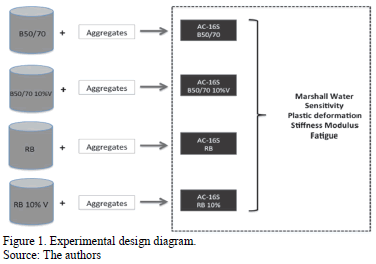
<body><![CDATA[<p><font size="2" face="Verdana, Arial, Helvetica, sans-serif">Vinasse is a by-product that remains in the distillation  column when ethanol is produced from biomass. It is the main waste material  generated in alcohol distilleries and its release without previous treatment  has an extremely negative impact on the environment. The composition of vinasse  can vary depending on the nature of the distillation process. However, vinasse typically  has a low pH (3-5) and a high content of organic matter (35,000-50,000 mg O<sub>2</sub>/L  BOD),which makes it a toxic substance&#91;1&#93;. </font></p>     <p><font size="2" face="Verdana, Arial, Helvetica, sans-serif">The uncontrolled discharge  of vinasse into the soil can negatively affect soil quality by increasing  thesalinity of the soil, thusdeteriorating its structure, porosity, and  fertility&#91;2&#93;. Furthermore, since the production temperature ofvinasse is  50-80ºC, its release into aquatic environments without previous cooling can  increase water temperature and lower the oxygen content to a level at which  fish cannot survive&#91;3,4&#93;. In addition, the turbidity and color of vinasse can  trigger processes of photosynthesis that also endanger aquatic life forms &#91;5&#93;.</font></p>     <p><font size="2" face="Verdana, Arial, Helvetica, sans-serif">Currently, more and more countries are enacting stricter  laws that regulate the discharge of waste from alcohol distilleries. For  example, in 2005, the Indian government decided to rapidly transform  distillation industries into zero-discharge industries &#91;6&#93;. Europe is also  implementing similar measures to achieve the same objective by processing waste  in waste treatment plants as well as by reusing and recycling it&#91;7&#93;. </font></p>     <p><font size="2" face="Verdana, Arial, Helvetica, sans-serif">The anaerobic digestion of vinasse is an interesting way  to reduce vinasse waste, because, in addition to promoting the stabilization of  organic matter, it also enables energy generation from biogas, as Bruna S.  Moraes reflects in her study&#91;8&#93;.</font></p>     <p><font size="2" face="Verdana, Arial, Helvetica, sans-serif">Another way to reuse waste is by incorporating it into  bituminous mixes. A wide range of studies have analyzed how the characteristics  of these mixes can be enhanced with the addition of recycled waste material or  by using this waste instead of one of the mix ingredients. This is an excellent  way of reducing waste deposits and discharges. It is also more cost-effective  since there is less need to use raw materials. Glass, steelworks slag, plastic,  and rubber are examples of different types of waste material that have been  used in asphalt mixes&#91;9&#93;. However, in  recent years, the main focus has been on rubber from end-of-life tires and  polymers &#91;10-14&#93;.</font></p>     <p><font size="2" face="Verdana, Arial, Helvetica, sans-serif">In this study, vinasse was the waste used to manufacture  bituminous mixes. The objective was to study the mechanical performance of  these mixes when vinasse binder was added to modify the bitumen. For this  purpose, we analyzed an AC 16 S bituminous mix, manufactured with 50/70 bitumen  modified with 10% vinasse,as well as a rubber bitumen mix also modified with  10% vinasse. The performance of thevinassemixes was compared to that of the  same mixes manufactured with unmodified bitumen and rubber bitumen.</font></p>     <p>&nbsp;</p>     <p><font size="3" face="Verdana, Arial, Helvetica, sans-serif"><b>2. Material and methods</b></font></p>     <p><font size="2" face="Verdana, Arial, Helvetica, sans-serif">For this study  the asphalt mix used wasan AC-16S mix, which is commonly used in wearing  courses in countries throughout the world. It is a dense asphalt concrete mix  with an air voids percentage of 4-6%, a continuous coarse grain size (maximum  particle size of 22 mm) and a bitumen content of 3.5-5% of the total mix  weight. The mix is usually spread in layers of 5-8 centimetres.</font></p>     <p><font size="2" face="Verdana, Arial, Helvetica, sans-serif">Before beginning  the battery of laboratory tests, four AC-16 S mixes were manufactured. The  first two were regarded as the reference mixes. The first mix was manufactured  with conventional penetration grade bitumen B 50/70 and the second with rubber  bitumen. The third and fourth mixes were  also manufactured with the same types of bitumen as the first two, but they  were modified with biopolymers obtained from vinasse. In other words, the third  mix was made from penetration grade bitumen B 50/70 modified with 10% vinasse  and the fourth mix was made from rubber bitumen, also modified with 10%  vinasse.</font></p>     ]]></body>
<body><![CDATA[<p><font size="2" face="Verdana, Arial, Helvetica, sans-serif">The bitumen was  supplied by the University of Huelva in southern Spain where it was  characterized and modified with the previously mentioned percentage of vinasse.  The laboratory tests in this research study start with the design of the  asphalt mixes by determining the optimal bitumen content for four mixes with  the same mineral skeleton. This bitumen content was ascertained with the  Marshall Test, as described in the Spanish Standard NLT 159/00 and in article  542 (guidelines for hot bituminous mixes) of the General Technical  Specifications for Road and Bridge Works (PG3). </font></p>     <p><font size="2" face="Verdana, Arial, Helvetica, sans-serif">As previously  mentioned, the substance used to modify the bitumen was vinasse, the liquid  waste remaining after alcohol distillation. The phase separation of vinasse  effluent (pH =4.58) is characterized by a precipitate with a higher  concentration at the bottom and a supernatant with suspended solids on the  surface. Before being mixed with the bitumen, the vinasse was first dehydrated  at 70º in a convection oven. Its grain  size was reduced with a laboratory blade mill (IKA, Werke model) as well as a  sieve with a mesh size of 3.0 mm. The final product was then added to the  bitumen in a proportion of 10%. </font></p>     <p><font size="2" face="Verdana, Arial, Helvetica, sans-serif">Ophite was used  as an aggregate in the mix for the coarse fraction, and limestone was used for the  fine fraction. The filler was CEM II /B-L 32,5 N cement. The materials in the  mixes were first characterized as specified in article 542 (guidelines for hot  bituminous mixes) of the General Technical Specifications for Road  and Bridge Works (PG3). </font></p>     <p><font size="2" face="Verdana, Arial, Helvetica, sans-serif">The same set of  tests was then applied to all four mixes in order to study their mechanical  performance and to compare the mixes with modified bitumen withthe mixes made  of unmodified bitumen. The tests performed were the following: </font></p>     <p><font size="2" face="Verdana, Arial, Helvetica, sans-serif">The moisture  sensitivity test. Water action is one of the most common road pavement  pathologies. The presence of moisture causes problems such as potholes,  aggregate peeling or stripping which eventually lead to the structural failure  of the pavement. There are numerous laboratory tests that analyze the  susceptibility of bituminous mixes to moisture, providing a qualitative or  quantitative evaluation &#91;15&#93;. In this work, the test performed was the moisture  sensitivity test as described in the Spanish Standard UNE-EN 12697-12, which  determines the response of mixes to water action.</font></p>     <p><font size="2" face="Verdana, Arial, Helvetica, sans-serif">The  wheel-tracking. Rutting causes the loss of road surface regularity, so it is  necessary to analyze this damage to avoid a negative impact on the quality of  service to users. In this work, the test performed was the wheel-tracking test  as described in the Spanish Standard UNE-EN 12697-22 &#91;16&#93;</font></p>     <p><font size="2" face="Verdana, Arial, Helvetica, sans-serif">Determination of  the dynamic modulus according to the Spanish Standard UNE-EN 12697-26 to  calculate the stiffness of the samples.The modulus is a parameter used in the  mechanical design of asphalt mixes. For this reason, it was interesting to  discover whether the modulus value changed when the bitumen was modified &#91;17&#93;. </font></p>     <p><font size="2" face="Verdana, Arial, Helvetica, sans-serif">The fatigue test  characterizes the performance of bituminous mixes when they are subjected to  repeated loads at a constant mode of loading. A mix's fatigue resistance can be  determined by different methods such as two, three, or four-point bending  flexural tests on parallelepiped test specimens or the diametral compression  test in which loads are applied to test cylinders. This test is described in  Annex E of the Spanish Standard UNE-EN 12697-24 and was the one used in this  research.</font></p>     <p><font size="2" face="Verdana, Arial, Helvetica, sans-serif">The experimental  design is shown in <a href="#fig01">Fig. 1</a>: </font></p>     <p align="center"><font size="2" face="Verdana, Arial, Helvetica, sans-serif"><a name="fig01"></a></font><img src="/img/revistas/dyna/v82n194/v82n194a07fig01.gif"></p>     ]]></body>
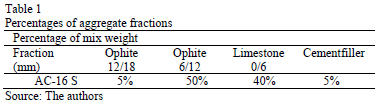
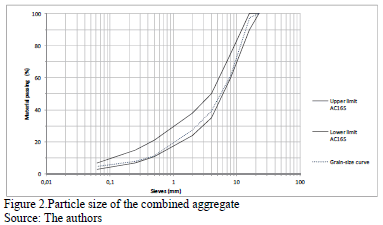
<body><![CDATA[<p>&nbsp;</p>     <p><font size="3" face="Verdana, Arial, Helvetica, sans-serif"><b>3. Results and  Discussion</b></font></p>     <p><font size="2" face="Verdana, Arial, Helvetica, sans-serif">The mineral skeleton of  the mix had the following composition: (i) 5% ophite aggregatewith a grain size  of 12/18; (ii) 50% ophite aggregatewith a grain size of 6/12; (iii) 40%  limestone aggregate with a grain size of 0/6 (sand); (iv) 5% cement filler. The  composition of the mineral skeleton is shown in <a href="#tab01">Table 1</a>.</font></p>     <p align="center"><font size="2" face="Verdana, Arial, Helvetica, sans-serif"><a name="tab01"></a></font><img src="/img/revistas/dyna/v82n194/v82n194a07tab01.gif"></p>     <p><font size="2" face="Verdana, Arial, Helvetica, sans-serif">The aggregate was mixed in the percentages shown in <a href="#tab01">Table 1</a>, and the  following grain size of the combined aggregate was obtained. When represented  in a graph, (<a href="#fig02">Fig.2</a>), the grain-size curve of the mineral skeleton is a continuous  line that falls within the envelope of an AC mix.</font></p>     <p align="center"><font size="2" face="Verdana, Arial, Helvetica, sans-serif"><a name="fig02"></a></font><img src="/img/revistas/dyna/v82n194/v82n194a07fig02.gif"></p>     <p><font size="2" face="Verdana, Arial, Helvetica, sans-serif">As previously mentioned, the mixes in this study all had the same  mineral skeleton in which the combined aggregate fit within the grain-size  envelope corresponding to that of an AC 16S mix.</font></p>     <p><font size="2" face="Verdana, Arial, Helvetica, sans-serif">The optimal binder content was determined by means of the Marshall Test  as described in Spanish Technical Standard NLT 159/00. The parameters used for  this purpose were the following:Design Marshall stability,Design Marshall  deformation, Maximum Marshall stability, Maximum Marshall deformation, Density,  Air voids and aggregate voids.</font></p>     <p><font size="2" face="Verdana, Arial, Helvetica, sans-serif">Regarding the first two mixes, Mix 1 was made from 50/70 bitumen, and  Mix 2 was made from 50/70 bitumen modified with 10% vinasse. Both mixes had the mineral skeleton shown in     <a href="#tab01">Table 1</a>. A set of test specimens were then manufactured, each with a different  binder content (3.5%, 4 %, 4.5%,and 5% b/m). The manufacturing temperatures  were 160ºC for the 50/70 bitumen mix (Mix 1) and 170-175ºC for the bituminous  mix modified with vinasse (Mix 2). The compaction temperatures were 155-160ºC  for the first mix and 165-170ºC for the second.</font></p>     <p><font size="2" face="Verdana, Arial, Helvetica, sans-serif">The specimens were compacted with 75 blows to each side by a Marshall  hammer. The density of each specimen was determined according to Spanish  Standard UNE-EN 12697-6 Procedure B, Dry Saturated Surface. Air voids were  calculated by determining the maximum density (UNE-EN 12697-5.Procedure A:  Volumetricof the mix for each of the specimens).</font></p>     ]]></body>
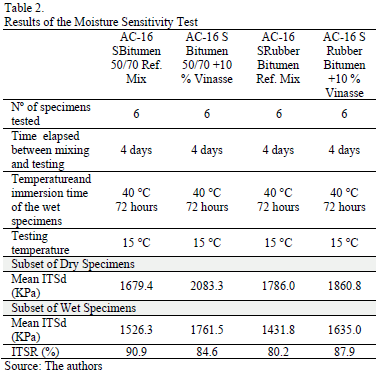
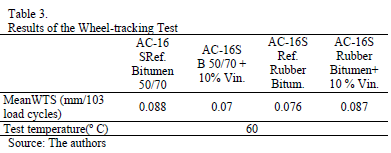
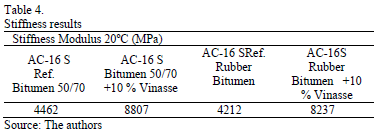
<body><![CDATA[<p><font size="2" face="Verdana, Arial, Helvetica, sans-serif">To obtain the stability and deformation values, the specimens were fractured  in theMarshall stability breaking head. Based on the results of this test, the  optimal bitumen content was 4.0 % of the mix weight. This same process was also  followed to determine the bitumen content for the second mix with bitumen  modified with 10% vinasse. In this case, the optimal bitumen content was 4.2%  of the mix weight. Regarding the mixes made of rubber bitumen, and of rubber  bitumen modified with 10% vinasse, the optimal binder contents were 4.5% and  4.6%, respectively.</font></p>     <p><font size="2" face="Verdana, Arial, Helvetica, sans-serif">As can be observed, the optimal bitumen content was slightly higher when  the bitumen binder was modified with vinasse. This occurred because the  addition of this biopolymer also increased binder viscosity. Consequently, more  binder was needed to guarantee a good mixture of the aggregate.</font></p>     <p><font size="2" face="Verdana, Arial, Helvetica, sans-serif">After the optimal bitumen content was calculated, the moisture  sensitivity of the mix was tested. <a href="#tab02">Table 2</a> shows the values obtained:</font></p>     <p align="center"><font size="2" face="Verdana, Arial, Helvetica, sans-serif"><a name="tab02"></a></font><img src="/img/revistas/dyna/v82n194/v82n194a07tab02.gif"></p>     <p><font size="2" face="Verdana, Arial, Helvetica, sans-serif">The results of the  moisture sensitivity test for reference Mix 1 with bitumen 50/70 was very  satisfactory with an ITSR valueof 90.6 %. When this bitumen was modified with  vinasse (Mix 2), the ITSR value was somewhat less. This less satisfactory  performance could be due to a slight reduction in aggregate-binder adhesion  caused by the incorporation of the biopolymer. Reference Mix 3with rubber  bitumen obtained an ITSR of 80.2%. However, in the case of Mix 4, rubber  bitumen modified with vinasse, the addition of the biopolymer improved mix  performance by 7.7% with an ITSR value of 87.9%.</font></p>     <p><font size="2" face="Verdana, Arial, Helvetica, sans-serif">Another result worth highlighting is the increase in  indirect tensile strength in the four groups of test specimens, the dry  specimens as well as the wet ones. This shows that the vinasse-modified binder  improved mix cohesion.</font></p>     <p><font size="2" face="Verdana, Arial, Helvetica, sans-serif">Results obtained of the Wheel-Tracking Test are  shown in <a href="#tab03">Table 3</a>.</font></p>     <p align="center"><font size="2" face="Verdana, Arial, Helvetica, sans-serif"><a name="tab03"></a></font><img src="/img/revistas/dyna/v82n194/v82n194a07tab03.gif"></p>     <p align="center"><font size="2" face="Verdana, Arial, Helvetica, sans-serif"><a name="tab04"></a></font><img src="/img/revistas/dyna/v82n194/v82n194a07tab04.gif"></p>     <p><font size="2" face="Verdana, Arial, Helvetica, sans-serif">It can be observed that the mix with vinasse-modified  bitumen and the one with vinasse-modified rubber bitumen have a considerable  increase in stiffness due to the impact of the biopolymer. This can be regarded  as an advantage since it could enhance the bearing capacity of the mix.</font></p>     ]]></body>
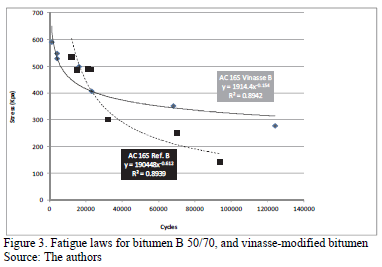
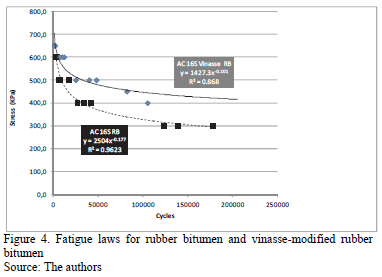
<body><![CDATA[<p><font size="2" face="Verdana, Arial, Helvetica, sans-serif">In order to analyze  the fatigue performance of the mixes, test cylinders specimens were  manufactured for each of the four mixes, as specified in Spanish Standard  UNE-EN 12697-24. For this purpose, the test cylinders specimens were first  maintained at 20ºC for four hours. They were then subjected to  repetitivesinusoidal loading until fracture occurred. </font></p>     <p><font size="2" face="Verdana, Arial, Helvetica, sans-serif">Each test cylinder  specimen was subjected to repeated compression loads with haversine loading  through the vertical diametric plane. This resulted in the application of a  uniform stress perpendicular to the direction of the applied load and  throughout the vertical diametric plane. This eventually led to the failure of  the test cylinder specimen, which eventually splitalong the central  sectionvertical diameter.</font></p>     <p><font size="2" face="Verdana, Arial, Helvetica, sans-serif"><a href="#fig03">Fig.3</a> reflects the results of the fatigue tests with the  data obtained from the test specimens manufactured with conventional bitumen  B50/70 and bitumen B50/70+10% vinasse. They-axis shows the stress applied to  the specimens and the x-axis, the number of loading cycles until fracture  occurred. </font></p>     <p align="center"><font size="2" face="Verdana, Arial, Helvetica, sans-serif"> <a name="fig03"></a></font><img src="/img/revistas/dyna/v82n194/v82n194a07fig03.gif"></p>     <p><font size="2" face="Verdana, Arial, Helvetica, sans-serif">The analysis of the fatigue lines shows that in the  initial cycles, the performance of the reference mix with bitumen B 50/70 wasmore  satisfactory than that of the other mixes. However, at a stress less than 400  KPa, the vinasse-modified bitumen became more resistant to fatigue. As can be  observed, the slope of the line representing the fatigue life of this mix  becomes considerably gentler when compared to that of the reference mix.</font></p>     <p><font size="2" face="Verdana, Arial, Helvetica, sans-serif">In <a href="#fig04">Fig. 4</a>, the performance of the mixes manufactured with  rubber bitumen and vinasse-modified rubber bitumen shows a similar  tendency. At stresses less than 700KPa,  the fatigue life of the vinasse-modified rubber bitumen mix was found to be  more satisfactory.</font></p>     <p align="center"><font size="2" face="Verdana, Arial, Helvetica, sans-serif"><a name="fig04"></a></font><img src="/img/revistas/dyna/v82n194/v82n194a07fig04.gif"></p>     <p>&nbsp;</p>     <p><font size="3" face="Verdana, Arial, Helvetica, sans-serif"><b>4. Conclusions </b></font></p>     <p><font size="2" face="Verdana, Arial, Helvetica, sans-serif">Based on the results obtained, it was found that the use  of vinasse-modified bitumen influenced the mechanical performance of the  bituminous mix used in the study. Generally speaking, the modified bitumen had  a positive impact since its addition produced an overall enhancement of the  characteristics of the mix. The following conclusions can be derived from this  study:</font></p> <ol>       ]]></body>
<body><![CDATA[<li><font size="2" face="Verdana, Arial, Helvetica, sans-serif">Vinasse enhances mix cohesion. This was evident in the     increase in indirect tensile strength, as reflected in the values obtained in     the fracture of the specimens with the Marshall stability breaking head as well     as in the results of the indirect tensile test to perform the moisture     sensitivity test.</font></li>       <li><font size="2" face="Verdana, Arial, Helvetica, sans-serif">The variations obtained in the permanent deformation     tests were not very significant. Nevertheless, in one of the cases, there was a     slight improvement in mix performance, possibly due to the lesser influence of     the temperature on the mix manufactured with vinasse. These results complied     with the requirements for the most demanding traffic loads. Furthermore, the     deformation values obtained were lower than that of the reference mix.</font></li>       <li><font size="2" face="Verdana, Arial, Helvetica, sans-serif">Regarding the dynamic tests, the stiffness of the mix     increased to almost double its value. </font></li>       <li><font size="2" face="Verdana, Arial, Helvetica, sans-serif">The expressions for the fatigue laws reflected an     improvement in the performance of the mixes modified with 10% vinasse, when     subjected to repeated loads.</font></li>       <li><font size="2" face="Verdana, Arial, Helvetica, sans-serif">The results obtained in this research study show that     when vinasse was used to modify the bitumen in the AC-16 S bituminous mixes     studied in this work, the addition of this biopolymer improved their mechanical     performance and at the same time, revalued a highly-polluting industrial waste     that is otherwise very difficult to eliminate.</font></li>     </ol>     <p>&nbsp;</p>     <p><font size="3" face="Verdana, Arial, Helvetica, sans-serif"><b>Acknowledgments</b></font></p>     <p><font size="2" face="Verdana, Arial, Helvetica, sans-serif">The authors would like to thank the Spanish Ministry of  Science and Innovation for the financial support provided to develop this  research.</font></p>     <p>&nbsp;</p>     ]]></body>
<body><![CDATA[<p><font size="3" face="Verdana, Arial, Helvetica, sans-serif"><b>References</b></font></p>     <!-- ref --><p><font size="2" face="Verdana, Arial, Helvetica, sans-serif"><b>&#91;1&#93;</b> Robles-Gonz&aacute;lez,  V., Integrated treatment of mescal vinasses for depuration and discharge.  Doctoral Thesis. ENCB del INP. M&eacute;xico D.F. M&eacute;xico, 2011.    &nbsp;&nbsp;&nbsp;&nbsp;&nbsp;&nbsp;&nbsp;&nbsp;[&#160;<a href="javascript:void(0);" onclick="javascript: window.open('/scielo.php?script=sci_nlinks&ref=000084&pid=S0012-7353201500060000700001&lng=','','width=640,height=500,resizable=yes,scrollbars=1,menubar=yes,');">Links</a>&#160;]<!-- end-ref --></font></p>     <!-- ref --><p><font size="2" face="Verdana, Arial, Helvetica, sans-serif"><b>&#91;2&#93;</b> Tejada,  M., Moreno, J.L., Hern&aacute;ndez, M.T. and Garc&iacute;a, C., Application of two beet  vinasse forms in soil restoration: Effects on soil properties and environment  in southern Spain. Agric. Ecosyst. Environ., 119(3-4), pp. 289-298, 2007. DOI: 10.1016/j.agee.2006.07.019</font>&nbsp;&nbsp;&nbsp;&nbsp;&nbsp;&nbsp;&nbsp;&nbsp;[&#160;<a href="javascript:void(0);" onclick="javascript: window.open('/scielo.php?script=sci_nlinks&ref=000086&pid=S0012-7353201500060000700002&lng=','','width=640,height=500,resizable=yes,scrollbars=1,menubar=yes,');">Links</a>&#160;]<!-- end-ref --><!-- ref --><p><font size="2" face="Verdana, Arial, Helvetica, sans-serif"><b>&#91;3&#93;</b> Jim&eacute;nez,  A.M., Borja, R., Mart&iacute;n, A. and Raposo, F., Mathematical modelling of aerobic  degradation of vinasses with Penicilliumdecumbens. Process Biochem., 40(8)<b>,</b> pp. 2805-2811, 2005. DOI: 10.1016/j.procbio.2004.12.011</font>&nbsp;&nbsp;&nbsp;&nbsp;&nbsp;&nbsp;&nbsp;&nbsp;[&#160;<a href="javascript:void(0);" onclick="javascript: window.open('/scielo.php?script=sci_nlinks&ref=000087&pid=S0012-7353201500060000700003&lng=','','width=640,height=500,resizable=yes,scrollbars=1,menubar=yes,');">Links</a>&#160;]<!-- end-ref --><!-- ref --><p><font size="2" face="Verdana, Arial, Helvetica, sans-serif"><b>&#91;4&#93;</b> Mane,  J.D., Modi, S., Nagawade, S., Phadnis, S.P. and Bhandari, V.M., Treatment of  spentwash using chemically modified bagasse and colour removal studies.  Bioresour, Technol., 97(14), pp. 1752-1755, 2006. DOI: 10.1016/j.biortech.2005.10.016</font>&nbsp;&nbsp;&nbsp;&nbsp;&nbsp;&nbsp;&nbsp;&nbsp;[&#160;<a href="javascript:void(0);" onclick="javascript: window.open('/scielo.php?script=sci_nlinks&ref=000088&pid=S0012-7353201500060000700004&lng=','','width=640,height=500,resizable=yes,scrollbars=1,menubar=yes,');">Links</a>&#160;]<!-- end-ref --><!-- ref --><p><font size="2" face="Verdana, Arial, Helvetica, sans-serif"><b>&#91;5&#93;</b> Fitzgibbon,  F.J., Nigam, P., Singh, D., Marchant, R., Biological treatment of distillery  waste for pollution-remediation. J. Basic Microbiol., 35(5), pp. 293-301, 1995.    &nbsp;&nbsp;&nbsp;&nbsp;&nbsp;&nbsp;&nbsp;&nbsp;[&#160;<a href="javascript:void(0);" onclick="javascript: window.open('/scielo.php?script=sci_nlinks&ref=000089&pid=S0012-7353201500060000700005&lng=','','width=640,height=500,resizable=yes,scrollbars=1,menubar=yes,');">Links</a>&#160;]<!-- end-ref --></font></p>     <!-- ref --><p><font size="2" face="Verdana, Arial, Helvetica, sans-serif"><b>&#91;6&#93;</b> Pant,  D. and Adholeya, A., Biological approaches for treatment of distillery  wastewater: a review. Bioresour Technology, 98(12), pp. 2321-2334, 2007. DOI: 10.1016/j.biortech.2006.09.027</font>&nbsp;&nbsp;&nbsp;&nbsp;&nbsp;&nbsp;&nbsp;&nbsp;[&#160;<a href="javascript:void(0);" onclick="javascript: window.open('/scielo.php?script=sci_nlinks&ref=000091&pid=S0012-7353201500060000700006&lng=','','width=640,height=500,resizable=yes,scrollbars=1,menubar=yes,');">Links</a>&#160;]<!-- end-ref --><!-- ref --><p><font size="2" face="Verdana, Arial, Helvetica, sans-serif"><b>&#91;7&#93;</b> Asghar,  N., Khan, S. and Mushtaq, S., Management of treated pulp and paper mill  effluent to achieve zero discharge. J. Environ. Manage, 88(4), pp. 1285-1299,  2008. DOI: 10.1016/j.jenvman.2007.07.004</font>&nbsp;&nbsp;&nbsp;&nbsp;&nbsp;&nbsp;&nbsp;&nbsp;[&#160;<a href="javascript:void(0);" onclick="javascript: window.open('/scielo.php?script=sci_nlinks&ref=000092&pid=S0012-7353201500060000700007&lng=','','width=640,height=500,resizable=yes,scrollbars=1,menubar=yes,');">Links</a>&#160;]<!-- end-ref --><!-- ref --><p><font size="2" face="Verdana, Arial, Helvetica, sans-serif"><b>&#91;8&#93;</b> Moraes,  B.S., Junqueiraa, T.L., Pavanelloa, L.G., Cavaletta, O., Mantelattoa, P.E.,  Bonomia, A. and Zaiatb, M., Anaerobic digestion of vinasse from sugarcane  biorefineries in Brazil from energy, environmental and economic perspectives:  Profit or expense?, Applied Energy, 113, pp. 825-835, 2014. DOI: 10.1016/j.apenergy.2013.07.018</font>&nbsp;&nbsp;&nbsp;&nbsp;&nbsp;&nbsp;&nbsp;&nbsp;[&#160;<a href="javascript:void(0);" onclick="javascript: window.open('/scielo.php?script=sci_nlinks&ref=000093&pid=S0012-7353201500060000700008&lng=','','width=640,height=500,resizable=yes,scrollbars=1,menubar=yes,');">Links</a>&#160;]<!-- end-ref --><!-- ref --><p><font size="2" face="Verdana, Arial, Helvetica, sans-serif"><b>&#91;9&#93;</b> Huang,  Y., Bird, R.N., Heidrich, O., A review of the use of recycled solid waste  materials in asphalt pavements. J. Resour. Conserv. Recy., 52(1), pp.  1065-1071, 2007. DOI: 10.1016/j.resconrec.2007.02.002</font>&nbsp;&nbsp;&nbsp;&nbsp;&nbsp;&nbsp;&nbsp;&nbsp;[&#160;<a href="javascript:void(0);" onclick="javascript: window.open('/scielo.php?script=sci_nlinks&ref=000094&pid=S0012-7353201500060000700009&lng=','','width=640,height=500,resizable=yes,scrollbars=1,menubar=yes,');">Links</a>&#160;]<!-- end-ref --><!-- ref --><p><font size="2" face="Verdana, Arial, Helvetica, sans-serif"><b>&#91;10&#93;</b> Moreno,  F., Rubio, M.C. and Mart&iacute;nez-Echevarr&iacute;a, M.J., The mechanical performance of  dry-process crumb rubber modified hot bituminous mixes: The influence of  digestion time and crumb rubber percentage. J. Cons. and Build. Materials, 26(1),  pp. 466-474, 2011. DOI: 10.1016/j.conbuildmat.2011.06.046</font>&nbsp;&nbsp;&nbsp;&nbsp;&nbsp;&nbsp;&nbsp;&nbsp;[&#160;<a href="javascript:void(0);" onclick="javascript: window.open('/scielo.php?script=sci_nlinks&ref=000095&pid=S0012-7353201500060000700010&lng=','','width=640,height=500,resizable=yes,scrollbars=1,menubar=yes,');">Links</a>&#160;]<!-- end-ref --><!-- ref --><p><font size="2" face="Verdana, Arial, Helvetica, sans-serif"><b>&#91;11&#93;</b> Arabani,  M., Mirabdolazimi, S.M. and Sasani, A.R., The effect of waste tire thread mesh  on the dynamic behaviour of asphalt mixtures. J. Cons. and Build. Materials,  24(6), pp. 1060-1068, 2010. DOI: 10.1016/j.conbuildmat.2009.11.011</font>&nbsp;&nbsp;&nbsp;&nbsp;&nbsp;&nbsp;&nbsp;&nbsp;[&#160;<a href="javascript:void(0);" onclick="javascript: window.open('/scielo.php?script=sci_nlinks&ref=000096&pid=S0012-7353201500060000700011&lng=','','width=640,height=500,resizable=yes,scrollbars=1,menubar=yes,');">Links</a>&#160;]<!-- end-ref --><!-- ref --><p><font size="2" face="Verdana, Arial, Helvetica, sans-serif"><b>&#91;12&#93;</b> Katman,  H.Y., Karim, M.R., Mahrez, A. and Ibrahim V.R., Performance of wet mix  rubberized porous asphalt. Proc. Eastern Asia Soc. for Transport. Stud., 5, pp.  695-708, 2005.    &nbsp;&nbsp;&nbsp;&nbsp;&nbsp;&nbsp;&nbsp;&nbsp;[&#160;<a href="javascript:void(0);" onclick="javascript: window.open('/scielo.php?script=sci_nlinks&ref=000097&pid=S0012-7353201500060000700012&lng=','','width=640,height=500,resizable=yes,scrollbars=1,menubar=yes,');">Links</a>&#160;]<!-- end-ref --></font></p>     <!-- ref --><p><font size="2" face="Verdana, Arial, Helvetica, sans-serif"><b>&#91;13&#93;</b> Casey,  D., McNally, C., Gibney, A. and Gilchrist, M.D., Development of a recycled  polymer modified binder for use in stone mastic asphalt. J. Reour. Conserv.  Recy., 52(10), pp. 1167-1174, 2008. DOI: 10.1016/j.resconrec.2008.06.002</font>&nbsp;&nbsp;&nbsp;&nbsp;&nbsp;&nbsp;&nbsp;&nbsp;[&#160;<a href="javascript:void(0);" onclick="javascript: window.open('/scielo.php?script=sci_nlinks&ref=000099&pid=S0012-7353201500060000700013&lng=','','width=640,height=500,resizable=yes,scrollbars=1,menubar=yes,');">Links</a>&#160;]<!-- end-ref --><!-- ref --><p><font size="2" face="Verdana, Arial, Helvetica, sans-serif"><b>&#91;14&#93;</b> Hinishoglu,  S. and Agar, E., Use of waste high density polyethylene as bitumen modifier in  asphalt concrete mix. J. Mater Lett., 58(3), pp. 267-271, 2004. DOI:  10.1016/S0167-577X(03)00458-0</font>&nbsp;&nbsp;&nbsp;&nbsp;&nbsp;&nbsp;&nbsp;&nbsp;[&#160;<a href="javascript:void(0);" onclick="javascript: window.open('/scielo.php?script=sci_nlinks&ref=000100&pid=S0012-7353201500060000700014&lng=','','width=640,height=500,resizable=yes,scrollbars=1,menubar=yes,');">Links</a>&#160;]<!-- end-ref --><!-- ref --><p><font size="2" face="Verdana, Arial, Helvetica, sans-serif"><b>&#91;15&#93;</b> Moreno,  F., Garc&iacute;a, G., Rubio, M.C. and Mart&iacute;nez-Echevarr&iacute;a, M.J. Analysis of the  moisture susceptibility of hot bituminous mixes based on the comparison of two  laboratory test methods. DYNA, 81(183), pp 49-59, 2013.    &nbsp;&nbsp;&nbsp;&nbsp;&nbsp;&nbsp;&nbsp;&nbsp;[&#160;<a href="javascript:void(0);" onclick="javascript: window.open('/scielo.php?script=sci_nlinks&ref=000101&pid=S0012-7353201500060000700015&lng=','','width=640,height=500,resizable=yes,scrollbars=1,menubar=yes,');">Links</a>&#160;]<!-- end-ref --></font></p>     ]]></body>
<body><![CDATA[<!-- ref --><p><font size="2" face="Verdana, Arial, Helvetica, sans-serif"><b>&#91;16&#93;</b> Garc&iacute;a,  G., Mart&iacute;nez-Echevarr&iacute;a, M.J., Rubio, M.C. and Moreno, F., Bituminous mix  response to plastic deformations: Comparison of the Spanish NLT-173 and UNE-EN  12697-22 Wheel-Tracking test. DYNA, 79(174), pp 51-57, 2012.    &nbsp;&nbsp;&nbsp;&nbsp;&nbsp;&nbsp;&nbsp;&nbsp;[&#160;<a href="javascript:void(0);" onclick="javascript: window.open('/scielo.php?script=sci_nlinks&ref=000103&pid=S0012-7353201500060000700016&lng=','','width=640,height=500,resizable=yes,scrollbars=1,menubar=yes,');">Links</a>&#160;]<!-- end-ref --></font></p>     <!-- ref --><p><font size="2" face="Verdana, Arial, Helvetica, sans-serif"><b>&#91;17&#93;</b> Del  R&iacute;o, M., Castro, D., Vega, A. and S&aacute;nchez, E., Effects of aggregate shape and  size and surfactants on the resilient modulus of bituminous mixes. Canadian  Journal of Civil Engineers, 38, pp. 893-899, 2011.    &nbsp;&nbsp;&nbsp;&nbsp;&nbsp;&nbsp;&nbsp;&nbsp;[&#160;<a href="javascript:void(0);" onclick="javascript: window.open('/scielo.php?script=sci_nlinks&ref=000105&pid=S0012-7353201500060000700017&lng=','','width=640,height=500,resizable=yes,scrollbars=1,menubar=yes,');">Links</a>&#160;]<!-- end-ref --></font></p>     <p>&nbsp;</p>     <p><font size="2" face="Verdana, Arial, Helvetica, sans-serif"><b>M.J.  Mart&iacute;nez-Echevarr&iacute;a-Romero,</b> is PhD. in Civil Engineering, is a professor in  the Department of Construction Engineering and Engineering Projects and in  charge of the Laboratory work in the Universidad de Granada, Espa&ntilde;a. Her  research interests include asphalt mixes, fatigue cracking, reuse of wastes in  construction and concrete. ORICD: 0000-0001-5799-1843</font></p>     <p><font size="2" face="Verdana, Arial, Helvetica, sans-serif"><b>G. Garc&iacute;a-Trav&eacute;,</b> is PhD Degree in Chemistry, is a researcher in the Construction Engineering  Laboratory research group at the Universidad de Granada, Espa&ntilde;a. Her research  interests include asphalt mixes, asphalt binders and reuse of wastes in  construction. ORCID: 0000-0002-5101-1610</font></p>     <p><font size="2" face="Verdana, Arial, Helvetica, sans-serif"><b>M.C.  Rubio-G&aacute;mez,</b> is Ph.D. in Civil Engineering, is a professor in the  Department of Construction Engineering and Engineering Projects and Head of the  Construction Engineering Laboratory research group at the Universidad de  Granada, Espa&ntilde;a. Her research interests include asphalt mixes, fatigue  cracking, reuse of wastes in construction. ORCID: 0000-0002-1874-5129</font></p>     <p><font size="2" face="Verdana, Arial, Helvetica, sans-serif"><b>F.  Moreno-Navarro,</b> is PhD. in Civil Engineering, is a lecturer in the  Department of Construction Engineering and Engineering Projects and research  coordinator of the Construction Engineering Laboratory research group at the  Universidad de Granada, Espa&ntilde;a. His  research interests include asphalt mixes, fatigue cracking, reuse of wastes in  construction, railway materials, and concrete. ORCID: 0000-0001-6758-8695</font></p>     <p><font size="2" face="Verdana, Arial, Helvetica, sans-serif"><b>D. P&eacute;rez-Mira,</b> is an Industrial Engineer. He is in charge of the I+D+i Department in AZVI  CNES, Espa&ntilde;a, with ample experience in materials research in different fields. ORCID: 0000-0002-2240-567X</font></p>     ]]></body>
<body><![CDATA[ ]]></body><back>
<ref-list>
<ref id="B1">
<label>1</label><nlm-citation citation-type="">
<person-group person-group-type="author">
<name>
<surname><![CDATA[Robles-González]]></surname>
<given-names><![CDATA[V.]]></given-names>
</name>
</person-group>
<source><![CDATA[Integrated treatment of mescal vinasses for depuration and discharge.]]></source>
<year></year>
</nlm-citation>
</ref>
<ref id="B2">
<label>2</label><nlm-citation citation-type="journal">
<person-group person-group-type="author">
<name>
<surname><![CDATA[Tejada]]></surname>
<given-names><![CDATA[M.]]></given-names>
</name>
<name>
<surname><![CDATA[Moreno]]></surname>
<given-names><![CDATA[J.L.]]></given-names>
</name>
<name>
<surname><![CDATA[Hernández]]></surname>
<given-names><![CDATA[M.T.]]></given-names>
</name>
<name>
<surname><![CDATA[García]]></surname>
<given-names><![CDATA[C.]]></given-names>
</name>
</person-group>
<article-title xml:lang="en"><![CDATA[Application of two beet vinasse forms in soil restoration: Effects on soil properties and environment in southern Spain]]></article-title>
<source><![CDATA[Agric. Ecosyst. Environ.]]></source>
<year>2007</year>
<volume>119</volume>
<numero>3-4</numero>
<issue>3-4</issue>
<page-range>289-298</page-range></nlm-citation>
</ref>
<ref id="B3">
<label>3</label><nlm-citation citation-type="journal">
<person-group person-group-type="author">
<name>
<surname><![CDATA[Jiménez]]></surname>
<given-names><![CDATA[A.M.]]></given-names>
</name>
<name>
<surname><![CDATA[Borja]]></surname>
<given-names><![CDATA[R.]]></given-names>
</name>
<name>
<surname><![CDATA[Martín]]></surname>
<given-names><![CDATA[A.]]></given-names>
</name>
<name>
<surname><![CDATA[Raposo]]></surname>
<given-names><![CDATA[F.]]></given-names>
</name>
</person-group>
<article-title xml:lang="en"><![CDATA[Mathematical modelling of aerobic degradation of vinasses with Penicilliumdecumbens]]></article-title>
<source><![CDATA[Process Biochem.]]></source>
<year>2005</year>
<volume>40</volume>
<numero>8</numero>
<issue>8</issue>
<page-range>2805-2811</page-range></nlm-citation>
</ref>
<ref id="B4">
<label>4</label><nlm-citation citation-type="journal">
<person-group person-group-type="author">
<name>
<surname><![CDATA[Mane]]></surname>
<given-names><![CDATA[J.D.]]></given-names>
</name>
<name>
<surname><![CDATA[Modi]]></surname>
<given-names><![CDATA[S.]]></given-names>
</name>
<name>
<surname><![CDATA[Nagawade]]></surname>
<given-names><![CDATA[S.]]></given-names>
</name>
<name>
<surname><![CDATA[Phadnis]]></surname>
<given-names><![CDATA[S.P.]]></given-names>
</name>
<name>
<surname><![CDATA[Bhandari]]></surname>
<given-names><![CDATA[V.M.]]></given-names>
</name>
</person-group>
<article-title xml:lang="en"><![CDATA[Treatment of spentwash using chemically modified bagasse and colour removal studies]]></article-title>
<source><![CDATA[Bioresour, Technol.]]></source>
<year>2006</year>
<volume>97</volume>
<numero>14</numero>
<issue>14</issue>
<page-range>1752-1755</page-range></nlm-citation>
</ref>
<ref id="B5">
<label>5</label><nlm-citation citation-type="journal">
<person-group person-group-type="author">
<name>
<surname><![CDATA[Fitzgibbon]]></surname>
<given-names><![CDATA[F.J.]]></given-names>
</name>
<name>
<surname><![CDATA[Nigam]]></surname>
<given-names><![CDATA[P.]]></given-names>
</name>
<name>
<surname><![CDATA[Singh]]></surname>
<given-names><![CDATA[D.]]></given-names>
</name>
<name>
<surname><![CDATA[Marchant]]></surname>
<given-names><![CDATA[R.]]></given-names>
</name>
</person-group>
<article-title xml:lang="en"><![CDATA[Biological treatment of distillery waste for pollution-remediation]]></article-title>
<source><![CDATA[J. Basic Microbiol.]]></source>
<year>1995</year>
<volume>35</volume>
<numero>5</numero>
<issue>5</issue>
<page-range>293-301</page-range></nlm-citation>
</ref>
<ref id="B6">
<label>6</label><nlm-citation citation-type="journal">
<person-group person-group-type="author">
<name>
<surname><![CDATA[Pant]]></surname>
<given-names><![CDATA[D.]]></given-names>
</name>
<name>
<surname><![CDATA[Adholeya]]></surname>
<given-names><![CDATA[A.]]></given-names>
</name>
</person-group>
<article-title xml:lang="en"><![CDATA[Biological approaches for treatment of distillery wastewater: a review]]></article-title>
<source><![CDATA[Bioresour Technology]]></source>
<year>2007</year>
<volume>98</volume>
<numero>12</numero>
<issue>12</issue>
<page-range>2321-2334</page-range></nlm-citation>
</ref>
<ref id="B7">
<label>7</label><nlm-citation citation-type="journal">
<person-group person-group-type="author">
<name>
<surname><![CDATA[Asghar]]></surname>
<given-names><![CDATA[N.]]></given-names>
</name>
<name>
<surname><![CDATA[Khan]]></surname>
<given-names><![CDATA[S.]]></given-names>
</name>
<name>
<surname><![CDATA[Mushtaq]]></surname>
<given-names><![CDATA[S.]]></given-names>
</name>
</person-group>
<article-title xml:lang="en"><![CDATA[Management of treated pulp and paper mill effluent to achieve zero discharge]]></article-title>
<source><![CDATA[J. Environ. Manage]]></source>
<year>2008</year>
<volume>88</volume>
<numero>4</numero>
<issue>4</issue>
<page-range>1285-1299</page-range></nlm-citation>
</ref>
<ref id="B8">
<label>8</label><nlm-citation citation-type="journal">
<person-group person-group-type="author">
<name>
<surname><![CDATA[Moraes]]></surname>
<given-names><![CDATA[B.S.]]></given-names>
</name>
<name>
<surname><![CDATA[Junqueiraa]]></surname>
<given-names><![CDATA[T.L.]]></given-names>
</name>
<name>
<surname><![CDATA[Pavanelloa]]></surname>
<given-names><![CDATA[L.G.]]></given-names>
</name>
<name>
<surname><![CDATA[Cavaletta]]></surname>
<given-names><![CDATA[O.]]></given-names>
</name>
<name>
<surname><![CDATA[Mantelattoa]]></surname>
<given-names><![CDATA[P.E.]]></given-names>
</name>
<name>
<surname><![CDATA[Bonomia]]></surname>
<given-names><![CDATA[A.]]></given-names>
</name>
<name>
<surname><![CDATA[Zaiatb]]></surname>
<given-names><![CDATA[M.]]></given-names>
</name>
</person-group>
<article-title xml:lang="en"><![CDATA[Anaerobic digestion of vinasse from sugarcane biorefineries in Brazil from energy, environmental and economic perspectives: Profit or expense?]]></article-title>
<source><![CDATA[Applied Energy]]></source>
<year>2014</year>
<numero>113</numero>
<issue>113</issue>
<page-range>825-835</page-range></nlm-citation>
</ref>
<ref id="B9">
<label>9</label><nlm-citation citation-type="journal">
<person-group person-group-type="author">
<name>
<surname><![CDATA[Huang]]></surname>
<given-names><![CDATA[Y.]]></given-names>
</name>
<name>
<surname><![CDATA[Bird]]></surname>
<given-names><![CDATA[R.N.]]></given-names>
</name>
<name>
<surname><![CDATA[Heidrich]]></surname>
<given-names><![CDATA[O.]]></given-names>
</name>
</person-group>
<article-title xml:lang="en"><![CDATA[A review of the use of recycled solid waste materials in asphalt pavements.]]></article-title>
<source><![CDATA[J. Resour. Conserv. Recy.]]></source>
<year>2007</year>
<volume>52</volume>
<numero>1</numero>
<issue>1</issue>
<page-range>1065-1071</page-range></nlm-citation>
</ref>
<ref id="B10">
<label>10</label><nlm-citation citation-type="journal">
<person-group person-group-type="author">
<name>
<surname><![CDATA[Moreno]]></surname>
<given-names><![CDATA[F.]]></given-names>
</name>
<name>
<surname><![CDATA[Rubio]]></surname>
<given-names><![CDATA[M.C.]]></given-names>
</name>
<name>
<surname><![CDATA[Martínez-Echevarría]]></surname>
<given-names><![CDATA[M.J.]]></given-names>
</name>
</person-group>
<article-title xml:lang="en"><![CDATA[The mechanical performance of dry-process crumb rubber modified hot bituminous mixes: The influence of digestion time and crumb rubber percentage]]></article-title>
<source><![CDATA[J. Cons. and Build. Materials]]></source>
<year>2011</year>
<volume>26</volume>
<numero>1</numero>
<issue>1</issue>
<page-range>466-474</page-range></nlm-citation>
</ref>
<ref id="B11">
<label>11</label><nlm-citation citation-type="journal">
<person-group person-group-type="author">
<name>
<surname><![CDATA[Arabani]]></surname>
<given-names><![CDATA[M.]]></given-names>
</name>
<name>
<surname><![CDATA[Mirabdolazimi]]></surname>
<given-names><![CDATA[S.M.]]></given-names>
</name>
<name>
<surname><![CDATA[Sasani]]></surname>
<given-names><![CDATA[A.R.]]></given-names>
</name>
</person-group>
<article-title xml:lang="en"><![CDATA[The effect of waste tire thread mesh on the dynamic behaviour of asphalt mixtures.]]></article-title>
<source><![CDATA[J. Cons. and Build. Materials]]></source>
<year>2010</year>
<volume>24</volume>
<numero>6</numero>
<issue>6</issue>
<page-range>1060-1068</page-range></nlm-citation>
</ref>
<ref id="B12">
<label>12</label><nlm-citation citation-type="journal">
<person-group person-group-type="author">
<name>
<surname><![CDATA[Katman]]></surname>
<given-names><![CDATA[H.Y.]]></given-names>
</name>
<name>
<surname><![CDATA[Karim]]></surname>
<given-names><![CDATA[M.R.]]></given-names>
</name>
<name>
<surname><![CDATA[Mahrez]]></surname>
<given-names><![CDATA[A.]]></given-names>
</name>
<name>
<surname><![CDATA[Ibrahim]]></surname>
<given-names><![CDATA[V.R.]]></given-names>
</name>
</person-group>
<article-title xml:lang="en"><![CDATA[Performance of wet mix rubberized porous asphalt]]></article-title>
<source><![CDATA[Proc. Eastern Asia Soc. for Transport. Stud.]]></source>
<year>2005</year>
<numero>5</numero>
<issue>5</issue>
<page-range>695-708</page-range></nlm-citation>
</ref>
<ref id="B13">
<label>13</label><nlm-citation citation-type="journal">
<person-group person-group-type="author">
<name>
<surname><![CDATA[Casey]]></surname>
<given-names><![CDATA[D.]]></given-names>
</name>
<name>
<surname><![CDATA[McNally]]></surname>
<given-names><![CDATA[C.]]></given-names>
</name>
<name>
<surname><![CDATA[Gibney]]></surname>
<given-names><![CDATA[A.]]></given-names>
</name>
<name>
<surname><![CDATA[Gilchrist]]></surname>
<given-names><![CDATA[M.D.]]></given-names>
</name>
</person-group>
<article-title xml:lang="en"><![CDATA[Development of a recycled polymer modified binder for use in stone mastic asphalt]]></article-title>
<source><![CDATA[J. Reour. Conserv. Recy.]]></source>
<year>2008</year>
<volume>52</volume>
<numero>10</numero>
<issue>10</issue>
<page-range>1167-1174</page-range></nlm-citation>
</ref>
<ref id="B14">
<label>14</label><nlm-citation citation-type="journal">
<person-group person-group-type="author">
<name>
<surname><![CDATA[Hinishoglu]]></surname>
<given-names><![CDATA[S.]]></given-names>
</name>
<name>
<surname><![CDATA[Agar]]></surname>
<given-names><![CDATA[E.]]></given-names>
</name>
</person-group>
<article-title xml:lang="en"><![CDATA[Use of waste high density polyethylene as bitumen modifier in asphalt concrete mix]]></article-title>
<source><![CDATA[J. Mater Lett.]]></source>
<year>2004</year>
<volume>58</volume>
<numero>3</numero>
<issue>3</issue>
<page-range>267-271</page-range></nlm-citation>
</ref>
<ref id="B15">
<label>15</label><nlm-citation citation-type="journal">
<person-group person-group-type="author">
<name>
<surname><![CDATA[Moreno]]></surname>
<given-names><![CDATA[F.]]></given-names>
</name>
<name>
<surname><![CDATA[García]]></surname>
<given-names><![CDATA[G.]]></given-names>
</name>
<name>
<surname><![CDATA[Rubio]]></surname>
<given-names><![CDATA[M.C.]]></given-names>
</name>
<name>
<surname><![CDATA[Martínez-Echevarría]]></surname>
<given-names><![CDATA[M.J.]]></given-names>
</name>
</person-group>
<article-title xml:lang="en"><![CDATA[Analysis of the moisture susceptibility of hot bituminous mixes based on the comparison of two laboratory test methods]]></article-title>
<source><![CDATA[DYNA]]></source>
<year>2013</year>
<volume>81</volume>
<numero>183</numero>
<issue>183</issue>
<page-range>49-59</page-range></nlm-citation>
</ref>
<ref id="B16">
<label>16</label><nlm-citation citation-type="journal">
<person-group person-group-type="author">
<name>
<surname><![CDATA[García]]></surname>
<given-names><![CDATA[G.]]></given-names>
</name>
<name>
<surname><![CDATA[Martínez-Echevarría]]></surname>
<given-names><![CDATA[M.J.]]></given-names>
</name>
<name>
<surname><![CDATA[Rubio]]></surname>
<given-names><![CDATA[M.C.]]></given-names>
</name>
<name>
<surname><![CDATA[Moreno]]></surname>
<given-names><![CDATA[F.]]></given-names>
</name>
</person-group>
<article-title xml:lang="en"><![CDATA[Bituminous mix response to plastic deformations: Comparison of the Spanish NLT-173 and UNE-EN 12697-22 Wheel-Tracking test]]></article-title>
<source><![CDATA[DYNA]]></source>
<year>2012</year>
<volume>79</volume>
<numero>174</numero>
<issue>174</issue>
<page-range>51-57</page-range></nlm-citation>
</ref>
<ref id="B17">
<label>17</label><nlm-citation citation-type="journal">
<person-group person-group-type="author">
<name>
<surname><![CDATA[Del Río]]></surname>
<given-names><![CDATA[M.]]></given-names>
</name>
<name>
<surname><![CDATA[Castro]]></surname>
<given-names><![CDATA[D.]]></given-names>
</name>
<name>
<surname><![CDATA[Vega]]></surname>
<given-names><![CDATA[A.]]></given-names>
</name>
<name>
<surname><![CDATA[Sánchez]]></surname>
<given-names><![CDATA[E.]]></given-names>
</name>
</person-group>
<article-title xml:lang="en"><![CDATA[Effects of aggregate shape and size and surfactants on the resilient modulus of bituminous mixes]]></article-title>
<source><![CDATA[Canadian Journal of Civil Engineers]]></source>
<year>2011</year>
<numero>38</numero>
<issue>38</issue>
<page-range>893-899</page-range></nlm-citation>
</ref>
</ref-list>
</back>
</article>