<?xml version="1.0" encoding="ISO-8859-1"?><article xmlns:mml="http://www.w3.org/1998/Math/MathML" xmlns:xlink="http://www.w3.org/1999/xlink" xmlns:xsi="http://www.w3.org/2001/XMLSchema-instance">
<front>
<journal-meta>
<journal-id>0012-7353</journal-id>
<journal-title><![CDATA[DYNA]]></journal-title>
<abbrev-journal-title><![CDATA[Dyna rev.fac.nac.minas]]></abbrev-journal-title>
<issn>0012-7353</issn>
<publisher>
<publisher-name><![CDATA[Universidad Nacional de Colombia]]></publisher-name>
</publisher>
</journal-meta>
<article-meta>
<article-id>S0012-73532015000600008</article-id>
<article-id pub-id-type="doi">10.15446/dyna.v82n194.44476</article-id>
<title-group>
<article-title xml:lang="en"><![CDATA[Comparison of consistency assessment models for isolated horizontal curves in two-lane rural highways]]></article-title>
<article-title xml:lang="es"><![CDATA[Comparación de modelos de análisis de consistencia para curvas horizontales aisladas en carreteras de dos carriles]]></article-title>
</title-group>
<contrib-group>
<contrib contrib-type="author">
<name>
<surname><![CDATA[Cárdenas-Aguilar]]></surname>
<given-names><![CDATA[Danilo]]></given-names>
</name>
<xref ref-type="aff" rid="A01"/>
</contrib>
<contrib contrib-type="author">
<name>
<surname><![CDATA[Echaveguren]]></surname>
<given-names><![CDATA[Tomás]]></given-names>
</name>
<xref ref-type="aff" rid="A02"/>
</contrib>
</contrib-group>
<aff id="A01">
<institution><![CDATA[,Universidad de Concepción Facultad de Ingeniería Depatamento de Ingeniería Civil]]></institution>
<addr-line><![CDATA[Concepción ]]></addr-line>
<country>Chile</country>
</aff>
<aff id="A02">
<institution><![CDATA[,Universidad de Concepción Facultad de Ingeniería Depatamento de Ingeniería Civil]]></institution>
<addr-line><![CDATA[Concepción ]]></addr-line>
<country>Chile</country>
</aff>
<pub-date pub-type="pub">
<day>00</day>
<month>12</month>
<year>2015</year>
</pub-date>
<pub-date pub-type="epub">
<day>00</day>
<month>12</month>
<year>2015</year>
</pub-date>
<volume>82</volume>
<numero>194</numero>
<fpage>57</fpage>
<lpage>65</lpage>
<copyright-statement/>
<copyright-year/>
<self-uri xlink:href="http://www.scielo.org.co/scielo.php?script=sci_arttext&amp;pid=S0012-73532015000600008&amp;lng=en&amp;nrm=iso"></self-uri><self-uri xlink:href="http://www.scielo.org.co/scielo.php?script=sci_abstract&amp;pid=S0012-73532015000600008&amp;lng=en&amp;nrm=iso"></self-uri><self-uri xlink:href="http://www.scielo.org.co/scielo.php?script=sci_pdf&amp;pid=S0012-73532015000600008&amp;lng=en&amp;nrm=iso"></self-uri><abstract abstract-type="short" xml:lang="en"><p><![CDATA[This consistency assessment of highways' geometrical design has the objective of providing safer roads. There are two types of models for consistency assessment: aggregated and disaggregated. The first one considers the difference between design and operating speed at the middle point of isolated horizontal curves. The second one considers the spatial variation of the operating speed profile along the horizontal curve. This paper compares the two types of consistency assessment models, using naturalistic speed and geometry data obtained in 34 horizontal curves of two-lane rural roads in Chile, using a 10 Hz GPS. Results obtained showed that in only 19 cases both methods are equivalent. This equivalence occurred only when operating speed profiles have the lowest spatial variance along the curves. If the operating speed profile has a high variance the consistency level obtained using both methods is different and the better option is combine it.]]></p></abstract>
<abstract abstract-type="short" xml:lang="es"><p><![CDATA[El análisis de consistencia del diseño geométrico de carreteras tiene por objetivo contar con carreteras más seguras. Para analizar consistencia existen dos tipos de modelos: agregados y desagregados. Los primeros consideran diferencias de velocidades de diseño y operación en la mitad de la curva. Los segundos consideran la variación espacial del perfil de velocidad de operación. Este trabajo comparó los dos métodos usando datos empíricos de velocidad de operación obtenidos con un GPS de 10 Hz en 34 curvas horizontales simples de carreteras de dos carriles en Chile. Los resultados permitieron concluir que solo en 19 casos los métodos resultaron equivalentes entre sí. Esta compatibilidad sólo se da cuando el perfil de velocidad de operación posee poca varianza especial. Si el perfil de velocidad de operación es muy variable espacialmente, el nivel de consistencia obtenido usando los 2 métodos es diferente, caso en el cual resulta más conveniente combinarlos.]]></p></abstract>
<kwd-group>
<kwd lng="en"><![CDATA[consistency]]></kwd>
<kwd lng="en"><![CDATA[design speed]]></kwd>
<kwd lng="en"><![CDATA[operating speed]]></kwd>
<kwd lng="en"><![CDATA[isolated horizontal curves]]></kwd>
<kwd lng="es"><![CDATA[consistencia]]></kwd>
<kwd lng="es"><![CDATA[velocidad de diseño]]></kwd>
<kwd lng="es"><![CDATA[velocidad de operación]]></kwd>
<kwd lng="es"><![CDATA[curvas horizontales aisladas]]></kwd>
</kwd-group>
</article-meta>
</front><body><![CDATA[ <p><font size="1" face="Verdana, Arial, Helvetica, sans-serif"><b>DOI:</b> <a href="http://dx.doi.org/10.15446/dyna.v82n194.44476" target="_blank">http://dx.doi.org/10.15446/dyna.v82n194.44476</a></font></p>    <p align="center"><font size="4" face="Verdana, Arial, Helvetica, sans-serif"><b>Comparison of consistency assessment models for  isolated horizontal curves in two-lane rural highways</b></font></p>     <p align="center"><i><font size="3"><b><font face="Verdana, Arial, Helvetica, sans-serif">Comparaci&oacute;n  de modelos de an&aacute;lisis de consistencia para curvas horizontales aisladas en carreteras de dos carriles</font></b></font></i></p>     <p align="center">&nbsp;</p>     <p align="center"><b><font size="2" face="Verdana, Arial, Helvetica, sans-serif">Danilo C&aacute;rdenas-Aguilar <i><sup>a</sup></i> &amp; Tom&aacute;s Echaveguren <i><sup>b</sup></i></font></b></p>     <p align="center">&nbsp;</p>     <p align="center"><font size="2" face="Verdana, Arial, Helvetica, sans-serif"><sup><i>a </i></sup><i>Depatamento de Ingenier&iacute;a Civil, Facultad de Ingenier&iacute;a,   Universidad de Concepci&oacute;n, Concepci&oacute;n, Chile. <a href="mailto:ercardenas@udec.cl">ercardenas@udec.cl</a>    <br>   <sup>b</sup> Depatamento de Ingenier&iacute;a Civil, Facultad de Ingenier&iacute;a,  Universidad de Concepci&oacute;n, Concepci&oacute;n, Chile. <a href="mailto:techaveg@udec.cl">techaveg@udec.cl</a></i></font><a href="mailto:techaveg@udec.cl"></a></p>     <p align="center">&nbsp;</p>     <p align="center"><font size="2" face="Verdana, Arial, Helvetica, sans-serif"><b>Received: July 17<sup>th</sup>, 2014. Received in revised   form: May 29<sup>th</sup>, 2015. Accepted: October 22<sup>th</sup>, 2015.</b></font></p>     ]]></body>
<body><![CDATA[<p align="center">&nbsp;</p>     <p align="center"><font size="1" face="Verdana, Arial, Helvetica, sans-seriff"><b>This work is licensed under a</b> <a rel="license" href="http://creativecommons.org/licenses/by-nc-nd/4.0/">Creative Commons Attribution-NonCommercial-NoDerivatives 4.0 International License</a>.</font><br /><a rel="license" href="http://creativecommons.org/licenses/by-nc-nd/4.0/"><img style="border-width:0" src="https://i.creativecommons.org/l/by-nc-nd/4.0/88x31.png" /></a></p><hr>     <p><font size="2" face="Verdana, Arial, Helvetica, sans-serif"><b>Abstract    <br> </b></font><font size="2" face="Verdana, Arial, Helvetica, sans-serif">This consistency assessment of highways' geometrical  design has the objective of providing safer roads. There are two types of  models for consistency assessment: aggregated and disaggregated. The first one  considers the difference between design and operating speed at the middle point  of isolated horizontal curves. The second one considers the spatial variation  of the operating speed profile along the horizontal curve. This paper compares  the two types of consistency assessment models, using naturalistic speed and  geometry data obtained in 34 horizontal curves of two-lane rural roads in  Chile, using a 10 Hz GPS. Results obtained showed that in only 19 cases both  methods are equivalent. This equivalence occurred only when operating speed  profiles have the lowest spatial variance along the curves. If the operating  speed profile has a high variance the consistency level obtained using both methods is different and the better option is combine it.</font></p>     <p><font size="2" face="Verdana, Arial, Helvetica, sans-serif"><i>Keywords</i>:  consistency; design speed; operating speed; isolated horizontal curves.</font></p>     <p><font size="2" face="Verdana, Arial, Helvetica, sans-serif"><b>Resumen    <br> </b></font><font size="2" face="Verdana, Arial, Helvetica, sans-serif">El an&aacute;lisis de consistencia del dise&ntilde;o geom&eacute;trico de carreteras tiene  por objetivo contar con carreteras m&aacute;s seguras. Para analizar consistencia  existen dos tipos de modelos: agregados y desagregados. Los primeros consideran  diferencias de velocidades de dise&ntilde;o y operaci&oacute;n en la mitad de la curva. Los  segundos consideran la variaci&oacute;n espacial del perfil de velocidad de operaci&oacute;n.  Este trabajo compar&oacute; los dos m&eacute;todos usando datos emp&iacute;ricos de velocidad de  operaci&oacute;n obtenidos con un GPS de 10 Hz en 34 curvas horizontales simples de  carreteras de dos carriles en Chile. Los resultados permitieron concluir que  solo en 19 casos los m&eacute;todos resultaron equivalentes entre s&iacute;. Esta  compatibilidad s&oacute;lo se da cuando el perfil de velocidad de operaci&oacute;n posee poca  varianza especial. Si el perfil de velocidad de operaci&oacute;n es muy variable  espacialmente, el nivel de consistencia obtenido usando los 2 m&eacute;todos es diferente, caso en el cual resulta m&aacute;s conveniente combinarlos.</font></p>     <p><font size="2" face="Verdana, Arial, Helvetica, sans-serif"><i>Palabras clave</i>: consistencia; velocidad de dise&ntilde;o; velocidad  de operaci&oacute;n; curvas horizontales aisladas.</font></p> <hr>     <p>&nbsp;</p>     <p><font size="3" face="Verdana, Arial, Helvetica, sans-serif"><b>1. Introduction</b></font></p>     ]]></body>
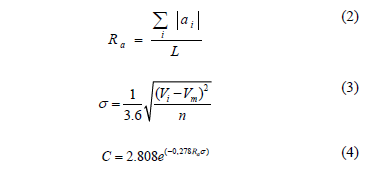
<body><![CDATA[<p><font size="2" face="Verdana, Arial, Helvetica, sans-serif">The consistency of the geometrical design can be defined  as the harmony between drivers' expectancy and the geometry of the road. If  this harmony is high, drivers can guide their vehicles along the road  alignment, minimizing the possibility of making a mistake and having an  accident &#91;1&#93;. Consistency assessment provides a tool for highway engineers to  discriminate between safer and less safe road designs, and to improve designs,  including re-design or to use posted speed signs. There are various consistency  assessment models (CAM) that, even though they all seek the same objective, the  framework, procedures and indexes are different. A simple taxonomy of CAM makes  two classifications: aggregate and disaggregates &#91;2&#93;. The disaggregated CAM allows  isolated and &quot;s&quot; shaped horizontal curves to be analyzed and considers the  operating speed at the middle point of each curve; the Lamm's model &#91;3&#93; is a  good example. Another model is presented in Camacho - Torregrosa et al &#91;4&#93;. The  aggregated CAM uses the operating speed profile along road segments to assess  the consistency level. The Polus' model falls into this category &#91;5&#93;. Each type  of CAM estimates a consistency level of a certain road section, based on  consistency indexes. Practical questions include, which model is more suitable  for consistency studies, are the models case - dependent, and are the aggregated  and disaggregated CAM equivalent? The state of the art does not provide answers  to these questions.</font></p>     <p><font size="2" face="Verdana, Arial, Helvetica, sans-serif">The aim of this paper  is to compare the Lamm's and Polus' models and to try to seek answers to the  above questions. The paper begins with a description of Lamm's and Polus'  models, including the algorithms for estimating the consistency index and the  consistency levels provided by each one. After the data collection is  described, including the road test section selection, the speed and geometry  data collection procedure and the data processing are presented. The database  used for the study is also included. This is followed by an estimation of the operating  and design speed profiles, an estimation of consistency indexes and a  description of their comparisons. Finally, a proposal for the integration of a  consistency assessment model is presented, based on the findings of this  research.</font></p>     <p>&nbsp;</p>     <p><font size="3" face="Verdana, Arial, Helvetica, sans-serif"><b>2. Models to be   used for consistency assessment</b></font></p>     <p><b><font size="2" face="Verdana, Arial, Helvetica, sans-serif"><i>2.1. The Lamm's  model</i></font></b></p>     <p><font size="2" face="Verdana, Arial, Helvetica, sans-serif">The model postulates that the consistency of isolated  horizontal curves is described by using the differences between the operating  speed (V<sub>85</sub>, in km/h) and the design speed (V<sub>D</sub>, in km/h)  at the middle point of the curve. This is shown in eq. (1). The IC is a  consistency index (in km/h) for isolated horizontal curves. If the IC value is  high, the difference between operating speeds is high, the consistency level is  low and the accident risk increases. </font></p>     <p><img src="/img/revistas/dyna/v82n194/v82n194a08eq01.gif"></p>     <p><font size="2" face="Verdana, Arial, Helvetica, sans-serif">The design speed (V<sub>D</sub>)  can be obtained from project drawings or by back-calculating its value from  in-field measurements of the curve geometry. The operating speed (V<sub>85</sub>)  is the 85<sup>th</sup> percentile of the cumulated frequency distribution of  the speed obtained from in-field measurements of instantaneous speed, usually  measured at the middle point of the curve. If the operating speed cannot be  measured, for instance if there is a new design, it can be obtained by using  speed-radius models that are locally calibrated. The Lamm's model grades  consistency with the levels &quot;good&quot;, &quot;fair&quot; and &quot;poor&quot;, using the following  thresholds for the IC &#91;6&#93;:</font></p> <ul>       <li><font size="2" face="Verdana, Arial, Helvetica, sans-serif">&quot;good&quot; design: IC &le; 10 km/h</font></li>       <li><font size="2" face="Verdana, Arial, Helvetica, sans-serif">&quot;fair&quot; design: 10 km/h &lt; IC &le; 20 km/h</font></li>       ]]></body>

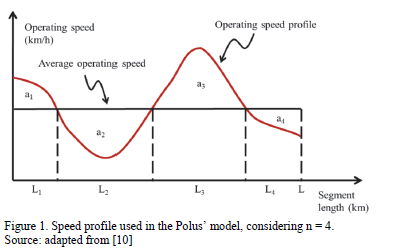
<body><![CDATA[<li><font size="2" face="Verdana, Arial, Helvetica, sans-serif">&quot;poor&quot; design: IC &gt; 20 km/h</font></li>     </ul>     <p><font size="2" face="Verdana, Arial, Helvetica, sans-serif">Depending on the  consistency level, the road improvements needs can be: do nothing, for &quot;good&quot;  designs; limit speed signs, for &quot;fair&quot; or &quot;poor&quot; designs; and redesign, for  &quot;poor&quot; designs. Some methods based on consistency levels for estimating speed  limits in horizontal curves can be seen in &#91;7,8&#93;.</font></p>     <p><font size="2" face="Verdana, Arial, Helvetica, sans-serif"><b><i>2.2. The Polus'  model</i></b></font></p>     <p><font size="2" face="Verdana, Arial, Helvetica, sans-serif">The model estimates the consistency index C of eq. (4),  and considers the variability of the operating speed profile around the spatial  mean of the operating speed along a road segment &#91;9&#93;. If the variability of the  operating speed is high, its variance <font face="Symbol">s</font> (eq. (3), in m/s) is high, the  speed parameter R<sub>a</sub> (eq. (2), in m/s) is high and the consistency  index is low. Lower values of C mean a &quot;poor&quot; consistency level, and higher  values mean a &quot;good&quot; consistency level. Therefore, in a consistent design of  isolated horizontal curves, a flat speed profile is expected. However, it is  not a guarantee that the operating speed will be similar to the design speed.</font></p>     <p><img src="/img/revistas/dyna/v82n194/v82n194a08eq0204.gif"></p>     <p><font size="2" face="Verdana, Arial, Helvetica, sans-serif">In eq. (2), Ra represents the relative area between the  speed profile and the mean speed, normalized by the length of a road section.  (See <a href="#fig01">Fig. 1</a>). The term <font face="Symbol">S</font>|a<sub>i</sub>| is the absolute sum of  unitary areas, in m<sup>2</sup>/s. The term L is the segment length, in m. In  eq. (3) the term <font face="Symbol">s</font> represents the standard deviation of the operating  speeds, in m/s. V<sub>i</sub> is the operating speed at the discrete element of  length &quot;i&quot;, in km/h. V<sub>m</sub> is the spatial average operating speed along  the segment of length L and n is the number of discrete elements of length  along the segment L, which can be selected arbitrarily. The model rates the  consistency level as &quot;good&quot;, &quot;fair&quot; and &quot;poor&quot;, using the following thresholds  for C &#91;9&#93;:</font></p> <ul>       <li><font size="2" face="Verdana, Arial, Helvetica, sans-serif">&quot;good&quot; design: C &gt; 2 m/s</font></li>       <li><font size="2" face="Verdana, Arial, Helvetica, sans-serif">&quot;fair&quot; design: 1 &lt; C &le; 2 m/s</font></li>       <li><font size="2" face="Verdana, Arial, Helvetica, sans-serif">&quot;poor&quot; design: C &le; 1 m/s</font></li>     ]]></body>
<body><![CDATA[</ul>     <p align="center"><font size="2" face="Verdana, Arial, Helvetica, sans-serif"><a name="fig01"></a></font><img src="/img/revistas/dyna/v82n194/v82n194a08fig01.gif"></p>     <p>&nbsp;</p>     <p><font size="3" face="Verdana, Arial, Helvetica, sans-serif"><b>3. Field data  collection</b></font></p>     <p><b><font size="2" face="Verdana, Arial, Helvetica, sans-serif"><i>3.1. Test sections  selection</i></font></b><i></i></p>     <p><font size="2" face="Verdana, Arial, Helvetica, sans-serif">In this research a test section is defined, which is an  isolated horizontal curve with a tangent length of up to 400 m in length at the  both sides of the curve. It ensures that the horizontal curve is isolated from  the neighboring horizontal curves. The selection of test sections was performed  in two</font> <font size="2" face="Verdana, Arial, Helvetica, sans-serif">stages. In the first stage, a preliminary  set of test sections was obtained using satellite images, the road network  stored in the GIS at the University of Concepcion's Transport Laboratory , the  National Road Traffic Survey and the National Road Inventory both Chilean  Ministry of Public Works &#91;11-13&#93;. Using this database and the following  criteria, 67 test sections were selected.</font></p> <ul>       <li><font size="2" face="Verdana, Arial, Helvetica, sans-serif">Location: only test sections near to Concepcion     City were selected in order to reduce the operating costs of taking the     measurements. </font></li>       <li><font size="2" face="Verdana, Arial, Helvetica, sans-serif">Type of pavement surface: only paved surfaces.</font></li>       <li><font size="2" face="Verdana, Arial, Helvetica, sans-serif">Traffic: annual average daily traffic lower than     5000 vehicles/day-year, according to &#91;14&#93;.</font></li>       <li><font size="2" face="Verdana, Arial, Helvetica, sans-serif">Access: without lateral access or intersections.</font></li>       ]]></body>
<body><![CDATA[<li><font size="2" face="Verdana, Arial, Helvetica, sans-serif">Land use: outside urban areas and without a     presence of houses, schools, and farms in the test section or near in order to     avoid pedestrian, non-motorized and agricultural machine traffic.</font></li>     </ul>     <p><font size="2" face="Verdana, Arial, Helvetica, sans-serif">In the second stage, each test section, selected using the  previous criteria was inspected in-field. The criteria considered were the  following:</font></p> <ul>       <li><font size="2" face="Verdana, Arial, Helvetica, sans-serif">Good pavement condition.</font></li>       <li><font size="2" face="Verdana, Arial, Helvetica, sans-serif">Test sections without road works.</font></li>       <li><font size="2" face="Verdana, Arial, Helvetica, sans-serif">Test section with proper lateral clearance and     without facilities in lateral areas that could interrupt traffic.</font></li>       <li><font size="2" face="Verdana, Arial, Helvetica, sans-serif">Test sections in areas in which satellite signal     could be destabilized were avoided, such as in areas with dense forest or that     have high tension electric towers or electric stations.</font></li>       <li><font size="2" face="Verdana, Arial, Helvetica, sans-serif">For safety, only test sections with enough     clearance for vehicle maneuvers or parking of probe vehicles were selected.</font></li>       <li><font size="2" face="Verdana, Arial, Helvetica, sans-serif">Test section with low roadside hazard index     according to &#91;15&#93;.</font></li>     </ul>     ]]></body>
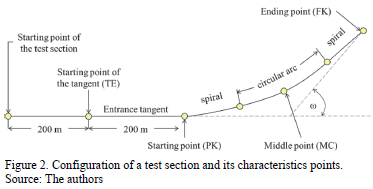
<body><![CDATA[<p><font size="2" face="Verdana, Arial, Helvetica, sans-serif"><b><i>3.2. Speed and  geometry measurements in the test sections</i></b></font></p>     <p><font size="2" face="Verdana, Arial, Helvetica, sans-serif">A 10 Hz GPS logger was used for speed measurements. The  GPS obtained position data from eight satellites based on RTK (Real Time  Kinematics) technology and speed was based on the Doppler Effect, which allows  location and speed data to be obtained from a vehicle in motion. The device  simultaneously measured position, time, distance, longitudinal speed and  heading, as well as other parameters, every 0.1 s, with a precision of 0.2 km/h  for speed, 0.05 % for distance and 0.1° for heading &#91;16&#93;. The device uses  software for raw-data processing and to generate data reports, with which it is  possible to build a speed and position data base. The device can be easily  mounted and dis-mounted in a probe vehicle. The device was mounted in the  interior part of the windshield of the car and then connected to the GPS  antenna. It was placed on the roof and aligned to the longitudinal axis of the  vehicle. This position is fixed during the speed measurements.</font></p>     <p><font size="2" face="Verdana, Arial, Helvetica, sans-serif">Speed measurements were obtained using the car following  procedure in which the probe vehicle is the follower and the vehicle followed  is the leader. The objective is to replicate the speed of the leader vehicle  using a probe vehicle (the follower). While this is taking place the probe  vehicle tries to keep a constant gap between both vehicles. Details of this  measurement procedure can be seen in &#91;17&#93;. The measurement started with the  probe vehicle being parked at the roadside with the GPS logger aligned and  paused, waiting for a vehicle to enter the test section. Once the vehicle  overtakes the probe, the driver turns on the GPS and the probe begins to follow  the car and adjusts its speed until the distance between both vehicles is  stable, by approximately 50 m. The stabilization of the speed is in the  entrance tangent. If the probe vehicle confronts road or traffic conditions  that force it to change speed, trajectory or abandon the pursuit, the  measurement was discarded. The procedure was repeated between 20 and 30 times  per test section, in order to obtain enough speed, position and heading data  points.</font></p>     <p><font size="2" face="Verdana, Arial, Helvetica, sans-serif"><b><i>3.3. Data  processing</i></b></font></p>     <p><font size="2" face="Verdana, Arial, Helvetica, sans-serif">The data processing allows the horizontal curve geometry  and the operating speed to be estimated. The process begins with the coupling  and debugging of raw-data by using the Kalman filter implemented in the  software of the GPS logger. Data coupling allows the speed-distance and  heading-distance signals along the test section to be obtained. The depuration  of data consisted in correcting data anomalies or data missing that was caused  by dropouts (satellite signal disruption or degradation due to, for instance,  the presence of dense forest or high voltage transmission towers). After this  distance profiles were built for each run and test section heading: distance  and speed -.</font></p>     <p>&nbsp;</p>     <p><font size="3" face="Verdana, Arial, Helvetica, sans-serif"><b>4. Geometry and  speed profiles estimation</b></font></p>     <p><b><font size="2" face="Verdana, Arial, Helvetica, sans-serif"><i>4.1. Geometry  estimation</i></font></b></p>     <p><font size="2" face="Verdana, Arial, Helvetica, sans-serif">The geometry of the test section was obtained from the  heading-distance profile. In these types of diagrams the slope changes allowed  the starting and ending point of the curve (PK and FK respectively) to be  detected. Once both points are identified, the middle point of the curve (MC)  and the starting point (TE) of the entrance tangent were obtained. The TE was  located 200 m from the starting point of the curve. After locating the  characteristic point, the radius was estimated to be the inverse of the  curvature and the curve length to be the distance between the PK and FK points.  <a href="#fig02">Fig. 2</a> shows a generic diagram of the test section.</font></p>     <p align="center"><font size="2" face="Verdana, Arial, Helvetica, sans-serif"><a name="fig02"></a></font><img src="/img/revistas/dyna/v82n194/v82n194a08fig02.gif"></p>     ]]></body>
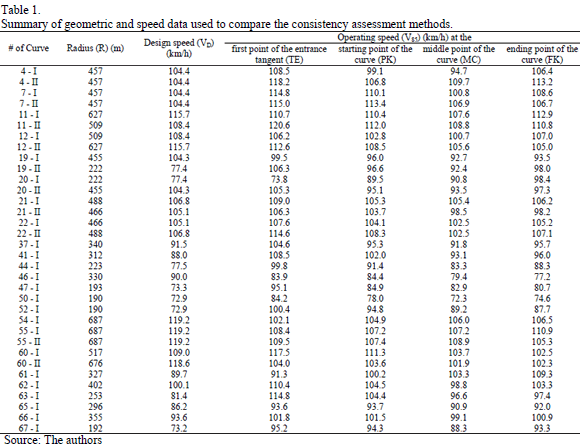
<body><![CDATA[<p><font size="2" face="Verdana, Arial, Helvetica, sans-serif"><b><i>4.2 Operating speed profile  estimation</i></b></font></p>     <p><font size="2" face="Verdana, Arial, Helvetica, sans-serif">In  each test section the speed-distance diagram of each run were organized in such  way that the TE, PK, MC and FK points coincided as much as was possible.  Because the trajectory of the probe vehicle is slightly different for each run,  an exact coincidence of these points is not possible. Anomalous speed-distance  data were erased from the database, and a total of 34 test sections with 20  runs were used in the remainder of the study. The speed-distance profiles were  used to estimate operating speed at each characteristic point of the test  section. The departure tangent was not considered as drivers usually accelerate  and rapidly increase their speed when leaving the horizontal curve, which changes  the distance from the probe vehicle. In this case </font><font size="2" face="Verdana, Arial, Helvetica, sans-serif">the  car pursuit method loses accuracy and does not represent the speed of the  leader vehicle. The operating speed was estimated at points TE, PK, MC, and FK  as follows. Around each one of these points the 40 neighbor speed data points  were grouped (20 data points per side). This procedure was repeated for each  run. After the speed data points were grouped, a sample of between 820 and 1230  speed data points was obtained, depending on the number of runs. This sample  was used to elaborate an empirical probability density function (pdf). It was  fitted to a normal pdf to finally estimate the 85th speed percentile.</font></p>     <p><font size="2" face="Verdana, Arial, Helvetica, sans-serif"><b><i>4.3. Design speed  profile estimation</i></b></font></p>     <p><font size="2" face="Verdana, Arial, Helvetica, sans-serif">It was assumed that the design speed is constant along the  test section. The design speed was estimated according to the design criterion  of the Chilean Highways Manual, which recommends designing horizontal curves,  assuming that the superelevation is twice the design friction &#91;18&#93;. Considering  this criterion in the mass-point model for horizontal curves design, the design  speed (V<sub>D</sub> in km/h) can be obtained by using eq. (5), in which R is  the radius (in m) and f is the design friction coefficient (decimal). </font></p>     <p><img src="/img/revistas/dyna/v82n194/v82n194a08eq05.gif"></p>     <p><font size="2" face="Verdana, Arial, Helvetica, sans-serif"><b><i>4.4. Summary of  data</i></b></font></p>     <p><font size="2" face="Verdana, Arial, Helvetica, sans-serif">The data obtained for each test section was summarized in  an isolated database as is shown <a href="#tab01">Table 1</a>. It includes the geometrical radius,  the design speed and the operating speed at each point of the test section.</font></p>     <p align="center"><font size="2" face="Verdana, Arial, Helvetica, sans-serif"><a name="tab01"></a></font><img src="/img/revistas/dyna/v82n194/v82n194a08tab01.gif"></p>     <p>&nbsp;</p>     <p><font size="3" face="Verdana, Arial, Helvetica, sans-serif"><b>5. Comparison of  Lamm's and Polus' models</b></font></p>     ]]></body>

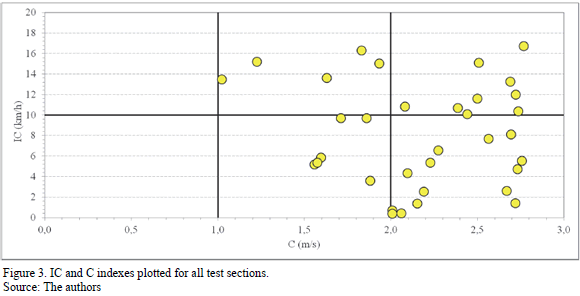
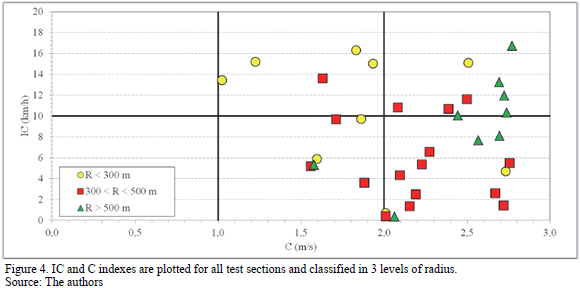
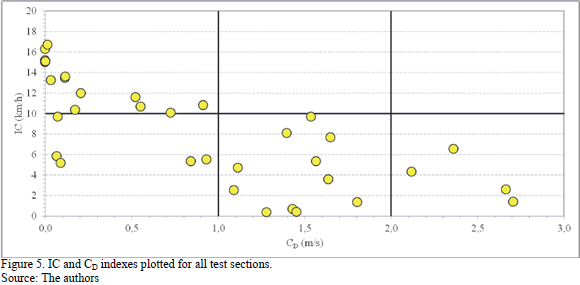
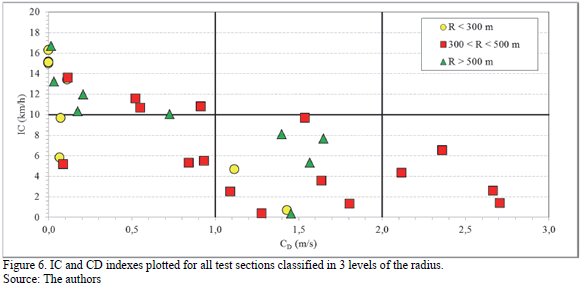
<body><![CDATA[<p><b><font size="2" face="Verdana, Arial, Helvetica, sans-serif"><i>5.1. Estimation of  the consistency indexes</i></font></b></p>     <p><font size="2" face="Verdana, Arial, Helvetica, sans-serif">The consistency indexes  were estimated using the data from <a href="#tab01">Table 1</a>. The operating speed at the middle  point of the curve (MC) was used to estimate the IC of eq. (1). To estimate the  C index of eq. (4) two sceneries were considered. In the first, the value of  <font face="Symbol">s</font> (eq. (3)) was obtained using the operating speed and the spatial average  value of the operating speed from <a href="#tab01">Table 1</a>. In the second, the mean value of the  operating speed was replaced by the design speed in eq. (3), consequently  obtaining eq. (6) and eq. (7). </font></p>     <p><img src="/img/revistas/dyna/v82n194/v82n194a08eq0607.gif"></p>     <p><font size="2" face="Verdana, Arial, Helvetica, sans-serif">The term Ra of eq. (6) remains the same, but the  expression <font face="Symbol">S</font>|a<sub>i</sub>| is estimated in terms of the  operating speed and design speed in each test section. It was assumed that the parameters of the models do not vary if the spatial average speed is replaced  by the design speed.</font></p>     <p><font size="2" face="Verdana, Arial, Helvetica, sans-serif"><b><i>5.2. Comparison of consistency  indexes</i></b></font></p>     <p><font size="2" face="Verdana, Arial, Helvetica, sans-serif">The comparison  considered four analyses: (a) comparison between the IC and C indexes for all  the test sections (<a href="#fig03">Fig. 3</a>); (b) comparison between the IC and C indexes for all  the test sections for 3 levels of radius (<a href="#fig04">Fig. 4</a>); (c) comparison between the  IC and C indexes for all test sections, but replacing the spatial average of  the operating speed by the design speed (<a href="#fig05">Fig 5</a>); and (d), comparison between  the IC and C indexes for 3 levels of radius and replacing the spatial average  of the operating speed by the design speed (<a href="#fig06">Fig. 6</a>). In <a href="#fig03">Fig. 3</a> - <a href="#fig06">6</a> the  quadrants 1 to 3 represents a &quot;fair&quot; consistency level and the quadrants 4 to 6  represents a &quot;good&quot; consistency level, both according to Lamm's model. Note  that for the data analyzed none of the test sections was rated as &quot;poor&quot;  according to Lamm's model. Similarly, according to the Polus' model, the  quadrants 1 and 4 represent a &quot;poor&quot; consistency level, the quadrants 2 and 5 a  &quot;fair&quot; consistency level and the quadrants 3 and 6 a &quot;good&quot; consistency level.  Thereby, only in quadrants 2 and 6 are both models of consistency assessment  equivalent. </font></p>     <p align="center"><font size="2" face="Verdana, Arial, Helvetica, sans-serif"><a name="fig03"></a></font><img src="/img/revistas/dyna/v82n194/v82n194a08fig03.gif"></p>     <p align="center"><font size="2" face="Verdana, Arial, Helvetica, sans-serif"><a name="fig04"></a></font><img src="/img/revistas/dyna/v82n194/v82n194a08fig04.gif"></p>     <p align="center"><font size="2" face="Verdana, Arial, Helvetica, sans-serif"><a name="fig05"></a></font><img src="/img/revistas/dyna/v82n194/v82n194a08fig05.gif"></p>     <p align="center"><font size="2" face="Verdana, Arial, Helvetica, sans-serif"><a name="fig06"></a></font><img src="/img/revistas/dyna/v82n194/v82n194a08fig06.gif"></p>     ]]></body>

<body><![CDATA[<p><font size="2" face="Verdana, Arial, Helvetica, sans-serif">According to <a href="#fig03">Fig. 3</a>, <a href="#fig05">5</a> test sections were rated as having  a &quot;fair&quot; design and 14 as having a &quot;good&quot; design by the two models (quadrants 2  and 6). However, 15 test sections were rated as having a different consistency  level, depending on the method used (quadrants 3 and 5). This ambiguity shows  that the actual consistency level cannot be obtained by separately using the  CAM.</font></p>     <p><font size="2" face="Verdana, Arial, Helvetica, sans-serif">The test sections located in quadrant 3 of <a href="#fig03">Fig. 3</a>, have  differences between the operating and design speeds that are higher than 10  km/h as the operating speed profiles of these curves are approximately uniform  along the test sections and the variability of the speed is low. As a consequence, the value of Ra and <font face="Symbol">s</font>  are low and, therefore, the C index is high. The consistency level according  Polus' model was &quot;good&quot; despite the consistency level according to Lamm's model  being described as &quot;fair&quot;. This means that if the operating speed profile is  uniform, the consistency level will tend to be &quot;good&quot; when using Polus' method,  but at the same time it will have a &quot;poor&quot; or &quot;fair&quot; consistency level  according to Lamm's method, depending on the differences between the operating  and design speeds. </font></p>     <p><font size="2" face="Verdana, Arial, Helvetica, sans-serif">The test sections  located in quadrant 5 have a &quot;good&quot; consistency level according to Lamm's  model, because the difference between the operating and design speed was lower  than 10 km/h. Also, because the operating speed profiles in these test sections  were not uniform the values of Ra and <font face="Symbol">s</font> tended to be higher and  consequently the C value tends to be low. This behavior is typical of  horizontal curves in which the operating speed diminishes at the entrance  tangent up to the design speed inside the curve. In this case, Polus' method  detected high variability, but Lamm's method only detected harmony between  operating and design speed at the middle point of the horizontal curve.</font></p>     <p><font size="2" face="Verdana, Arial, Helvetica, sans-serif">In a second analysis,  the comparison of consistency models considered three levels of radius, as  shown in <a href="#fig04">Fig. 4</a>. In test sections with a radius lower than 300 m, the  consistency level obtained is similar for both models. In test sections with a  radius between 300 and 500 m the variability of operating speeds tends to  diminish, but the difference between operating speed and design speed do not  follow a clear pattern. For this reason, in this segment of radius, the  consistency level tends to be &quot;good&quot; when using Polus' model and &quot;good&quot; or  &quot;fair&quot; when using Lamm's model. For a radius higher than 500 m, the speed  profiles tend to be uniform and the C values tends to be higher. As a  consequence, test sections can be located in quadrants 3 or 6 depending on the  IC value. The variability of the IC index for higher radius is explained for  the operating speed at the entrance tangent. Because the speed profiles are  uniforms, if the operating speed at the entrance tangent is very different to  the design speed, the CI values increase and the consistency level decrease. Conversely,  if the radius is low, the variability of the speed profile increases,  especially if the operating speed at the entrance tangent is high. In this  case, the C value decreases but the IC value will depend on the difference of  that speed with regards to the design speed.</font></p>     <p><font size="2" face="Verdana, Arial, Helvetica, sans-serif"><a href="#fig05">Fig. 5</a> and <a href="#fig06">6</a> show the  comparison between the IC index and the modified index of Polus' model (see eq.  (7)). Following the same order of the previous analysis, <a href="#fig05">Fig. 5</a> plots the  consistency index for all the test sections and <a href="#fig06">Fig. 6</a> for three radius levels.  The consistency index's observed pattern is different to these observed in <a href="#fig03">Fig.  3</a> and <a href="#fig04">4</a>, because both consistency indexes are linked by design speed. In <a href="#fig05">Fig. 5</a> the test sections that have a low consistency level using the IC index also  have a low consistency level using the C index. This means that the test  sections exhibit a speed profile that is highly variable that, at the same  time, has an operating speed higher than 10 km/h (quadrant 1). Conversely, the  test sections that have low IC values, also have higher C values, which means  that they have a better consistency level. This is due to the low variability  of operating speed profile and the low difference between the operating and  design speed.</font></p>     <p><font size="2" face="Verdana, Arial, Helvetica, sans-serif">As <a href="#fig06">Fig. 6</a> shows, this  pattern is not only dependent on the radius of the horizontal curves. The  pattern is not absolutely clear, but the general trend shows that the test  sections with low radii tend to be less consistent than those with higher  radii. Test sections with radii lower than 300 m (V<sub>D</sub> &lt; 85 km/h)  simultaneously exhibit high IC values (&quot;fair&quot; design) and low C values (&quot;poor&quot;  or &quot;fair&quot; design). This means that the gap between operating and design speed  increases at the same time that the operating speed profile oscillates around  the design speed. For radii between 300 and 500 m, the pattern is more  attenuated. The gap between operating and design speed decreases but not  necessarily the variability of the speed profile. However, the oscillation is  sufficiently low to increase the consistency level, and according to Polus'  model obtains more stable speed profiles. </font></p>     <p><font size="2" face="Verdana, Arial, Helvetica, sans-serif"><b><i>5.3. Integrated  Consistency assessment</i></b></font></p>     <p><font size="2" face="Verdana, Arial, Helvetica, sans-serif">From the previous discussion the following aspects can be  highlighted:</font></p> <ul>       <li><font size="2" face="Verdana, Arial, Helvetica, sans-serif">The Lam and Polus models are not equivalent but     complimentary.</font></li>       <li><font size="2" face="Verdana, Arial, Helvetica, sans-serif">The lack of equivalence is due to Lamm's model     not considering the variability of the speed profile and Polus' model     considering the spatial variability of the speed profile with a mean value of     operating speed and not with the design speed.</font></li>       ]]></body>
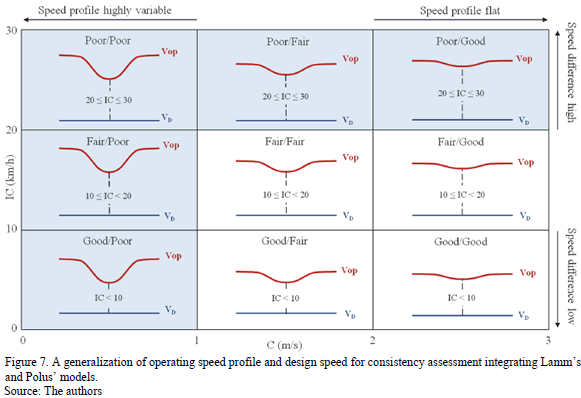
<body><![CDATA[<li><font size="2" face="Verdana, Arial, Helvetica, sans-serif">If     complimentary, the consistency level obtained using both models at the same     time, depends on the radius, operating speed at the entrance tangent and on the     design speed. </font></li>       <li><font size="2" face="Verdana, Arial, Helvetica, sans-serif">Although that the sample size is not enough to     establishes a definitive pattern, when design speed is included in Polus'     model, it is observed that both models tend to be correlated. Therefore if the     consistency level is &quot;good&quot; according to Lamm's model, it will also be &quot;good&quot;     according to Polus' model. </font></li>     </ul>     <p><font size="2" face="Verdana, Arial, Helvetica, sans-serif">For  purposes of geometrical design, the findings of this research are summarized in     <a href="#fig07">Fig. 7</a>. This figure shows a generic shape of the speed profile in isolated  horizontal curves and the gap between operating speed and design speed,  assuming that the operating speed at the entrance tangent is high and that the  driver always decelerates when entering the curve. In the figure, Vop  represents the operating speed and V<sub>D</sub> the design speed. </font></p>     <p align="center"><font size="2" face="Verdana, Arial, Helvetica, sans-serif"><a name="fig07"></a></font><img src="/img/revistas/dyna/v82n194/v82n194a08fig07.gif"></p>     <p><font size="2" face="Verdana, Arial, Helvetica, sans-serif"><a href="#fig07">Fig. 7</a> shows that the better design (the more consistent  one) is that in which the operating speed profile is flat and similar to the  design speed (quadrant &quot;Good/Good&quot;). The worst design (least consistent) is  that in which the operating speed profile is highly variable and the gap  between operating speed and design speed is high (quadrant &quot;Poor/Poor&quot;). Other  acceptable designs (slightly consistent) are those that obtain speed profiles  such as the &quot;Fair/Good&quot;, &quot;Fair/Fair&quot; and &quot;Good/Fair&quot; quadrants, in which the  operating speed profile is relatively flat and the difference between operating  and design speed is lower than 20 km/h. However it is recommended that in these  cases the geometrical design included an advisory speed at the entrance tangent  to inform drivers about the curve's lack of consistency. Other designs that  promote speed profiles associated with the consistency levels &quot;Poor/Poor&quot;,  &quot;Poor/Fair&quot;, &quot;Poor/Good&quot;, &quot;Fair/Poor&quot; and &quot;Good/Poor&quot; are not desirable,  because lack of consistency increases the risk of accident (The highlighted  quadrants in <a href="#fig07">Fig. 7</a>).</font></p>     <p>&nbsp;</p>     <p><font size="3" face="Verdana, Arial, Helvetica, sans-serif"><b>6. Conclusions</b></font></p>     <p><font size="2" face="Verdana, Arial, Helvetica, sans-serif">This paper compared two models for consistency assessment:  the Lamm's model, which estimates the consistency level using the difference  between the operating and design speed; and the Polus' model, which estimates  the consistency level by assessing the spatial variability of the speed profile  along a road segment. The comparison was performed for 34 isolated horizontal  curves on two-lane rural roads. Speed data, position and headings were obtained  using a GPS device.</font></p>     <p><font size="2" face="Verdana, Arial, Helvetica, sans-serif">Lamm's model compares the operating speed with the design  speed at the middle point of the curve, and this is not capable of detecting  the spatial variability of the operating speed profile. On the other hand,  Polus' model detects variability but is not capable of estimating the  differences between operating speeds and design speeds. For this reason it was  hypothesized that both models are not equivalent but complementary. The results  obtained for the 34 horizontal curves studied show evidence of this assumption.  Some horizontal curves were rated as &quot;good&quot; using Polus' model because the  speed profile was flat, but at the same time were rated as &quot;fair&quot; using Lamm's  model because the operating speeds were quite different to the design speed and  vice versa.</font></p>     ]]></body>
<body><![CDATA[<p><font size="2" face="Verdana, Arial, Helvetica, sans-serif">The study also shows that if the spatial average of the  operating speed is replaced by the design speed in Polus' model, coherence with  Lamm's model increases. In fact, when the consistency level obtained using  Polus' model is high, it is also high under Lamm's model. However, to improve  Polus' model using the design speed, a recalibration of the coefficient of the  C index could be necessary. As such, this finding should be studied in more  detail.</font></p>     <p><font size="2" face="Verdana, Arial, Helvetica, sans-serif">The results obtained with empirical data allow us to  propose a general guideline to promote consistent designs of isolated  horizontal curves, which was synthetized in a conceptual diagram that included  the combination of operating speed profiles and design speed desirables  associated to the geometrical design. In general, designs that promote flat  operating speed profiles and are similar to designs speed are preferable to  ensure that drivers can guide their vehicles along the road in an aligned  manner, minimizing the possibility of making a mistake and suffering an  accident. This is the essence of consistent geometrical design.</font></p>     <p>&nbsp;</p>     <p><font size="3" face="Verdana, Arial, Helvetica, sans-serif"><b>Acknowledgements</b></font></p>     <p><font size="2" face="Verdana, Arial, Helvetica, sans-serif">The authors thanks to the Chilean National Fund for  Scientific and Technological Development (FONDECYT) for supporting the research  project FONDECYT 11090029 for which this paper was written.</font></p>     <p>&nbsp;</p>     <p><font size="3" face="Verdana, Arial, Helvetica, sans-serif"><b>References</b></font></p>     <!-- ref --><p><font size="2" face="Verdana, Arial, Helvetica, sans-serif"><b>&#91;1&#93;</b> Glennon,  J. and Harwood, D., Highway design consistency and systematic design related to  highway safety. Transportation  Research Record, 682, pp. 77-88, 1978.    &nbsp;&nbsp;&nbsp;&nbsp;&nbsp;&nbsp;&nbsp;&nbsp;[&#160;<a href="javascript:void(0);" onclick="javascript: window.open('/scielo.php?script=sci_nlinks&ref=000120&pid=S0012-7353201500060000800001&lng=','','width=640,height=500,resizable=yes,scrollbars=1,menubar=yes,');">Links</a>&#160;]<!-- end-ref --></font></p>     <!-- ref --><p><font size="2" face="Verdana, Arial, Helvetica, sans-serif"><b>&#91;2&#93;</b> Echaveguren, T., Altamira, A.,  Vargas-Tejeda, S. y Riveros, D., Criterios para el an&aacute;lisis de consistencia del  dise&ntilde;o geom&eacute;trico: Velocidad, fricci&oacute;n, visibilidad y criterios agregados, Proceedings  of the Argentinean Conference on Highways and Traffic, pp. 66, 2009.    &nbsp;&nbsp;&nbsp;&nbsp;&nbsp;&nbsp;&nbsp;&nbsp;[&#160;<a href="javascript:void(0);" onclick="javascript: window.open('/scielo.php?script=sci_nlinks&ref=000122&pid=S0012-7353201500060000800002&lng=','','width=640,height=500,resizable=yes,scrollbars=1,menubar=yes,');">Links</a>&#160;]<!-- end-ref --> </font></p>     <!-- ref --><p><font size="2" face="Verdana, Arial, Helvetica, sans-serif"><b>&#91;3&#93;</b> Lamm,  R., Choueiri, E., Hayward, J. and Paluri, A., Possible design procedure to  promote design consistency in highway geometric design on two-lane rural roads.  Transportation Research Record, 1195, pp. 111-122, 1988.    &nbsp;&nbsp;&nbsp;&nbsp;&nbsp;&nbsp;&nbsp;&nbsp;[&#160;<a href="javascript:void(0);" onclick="javascript: window.open('/scielo.php?script=sci_nlinks&ref=000124&pid=S0012-7353201500060000800003&lng=','','width=640,height=500,resizable=yes,scrollbars=1,menubar=yes,');">Links</a>&#160;]<!-- end-ref --></font></p>     <!-- ref --><p><font size="2" face="Verdana, Arial, Helvetica, sans-serif"><b>&#91;4&#93;</b> Camacho-Torregrosa,  F., P&eacute;rez-Zuriaga, A., Campoy-Ungr&iacute;a, J. and Garc&iacute;a, A., New geometric design  consistency model based on operating speed profiles for road safety evaluation.  Accident Analysis &amp; Prevention, 61, pp. 32-42, 2013. DOI:  10.1016/j.aap.2012.10.001</font>&nbsp;&nbsp;&nbsp;&nbsp;&nbsp;&nbsp;&nbsp;&nbsp;[&#160;<a href="javascript:void(0);" onclick="javascript: window.open('/scielo.php?script=sci_nlinks&ref=000126&pid=S0012-7353201500060000800004&lng=','','width=640,height=500,resizable=yes,scrollbars=1,menubar=yes,');">Links</a>&#160;]<!-- end-ref --><!-- ref --><p><font size="2" face="Verdana, Arial, Helvetica, sans-serif"><b>&#91;5&#93;</b> Polus,  A. and Mattar-Habib, C., New consistency model for rural highways and its  relationship to safety. Journal of Transportation Engineering, 130(3), pp. 286-293,  2004. DOI: 10.1061/(ASCE)0733-947X(2004)130:3(286)</font>&nbsp;&nbsp;&nbsp;&nbsp;&nbsp;&nbsp;&nbsp;&nbsp;[&#160;<a href="javascript:void(0);" onclick="javascript: window.open('/scielo.php?script=sci_nlinks&ref=000127&pid=S0012-7353201500060000800005&lng=','','width=640,height=500,resizable=yes,scrollbars=1,menubar=yes,');">Links</a>&#160;]<!-- end-ref --><!-- ref --><p><font size="2" face="Verdana, Arial, Helvetica, sans-serif"><b>&#91;6&#93;</b> Lamm,  R., Beck, A., Ruscher, T., Mailaneder, T., Cafiso, S. and La Cava, G., How to  make two - lane rural roads safer. Boston: Wit Press, 2007.    &nbsp;&nbsp;&nbsp;&nbsp;&nbsp;&nbsp;&nbsp;&nbsp;[&#160;<a href="javascript:void(0);" onclick="javascript: window.open('/scielo.php?script=sci_nlinks&ref=000128&pid=S0012-7353201500060000800006&lng=','','width=640,height=500,resizable=yes,scrollbars=1,menubar=yes,');">Links</a>&#160;]<!-- end-ref --></font></p>     <!-- ref --><p><font size="2" face="Verdana, Arial, Helvetica, sans-serif"><b>&#91;7&#93;</b> Echaveguren,  T. and Vargas-Tejeda, S., A model for estimating advisory speeds for horizontal  curves in two-lane rural roads. Canadian Journal of Civil Engineering, 40, pp.  1234-1243, 2013. DOI: 10.1139/cjce-2012-0549</font>&nbsp;&nbsp;&nbsp;&nbsp;&nbsp;&nbsp;&nbsp;&nbsp;[&#160;<a href="javascript:void(0);" onclick="javascript: window.open('/scielo.php?script=sci_nlinks&ref=000130&pid=S0012-7353201500060000800007&lng=','','width=640,height=500,resizable=yes,scrollbars=1,menubar=yes,');">Links</a>&#160;]<!-- end-ref --><!-- ref --><p><font size="2" face="Verdana, Arial, Helvetica, sans-serif"><b>&#91;8&#93;</b> Echaveguren, T. and Pi&ntilde;a, J.,  Determinaci&oacute;n de l&iacute;mite de velocidad en curvas horizontales de caminos rurales  bidireccionales, Proceedings of the Iberoamerican Conference on Road Safety, pp.  79, 2010.    &nbsp;&nbsp;&nbsp;&nbsp;&nbsp;&nbsp;&nbsp;&nbsp;[&#160;<a href="javascript:void(0);" onclick="javascript: window.open('/scielo.php?script=sci_nlinks&ref=000131&pid=S0012-7353201500060000800008&lng=','','width=640,height=500,resizable=yes,scrollbars=1,menubar=yes,');">Links</a>&#160;]<!-- end-ref --></font></p>     ]]></body>
<body><![CDATA[<!-- ref --><p><font size="2" face="Verdana, Arial, Helvetica, sans-serif"><b>&#91;9&#93;</b> Polus,  A., Pollatschek, M. and Mattar-Habib, C., An enhanced integrated design -  consistency model for both mountainous highways and its relationship to safety.  Road and Transportation Research, 14(4), pp. 13-26, 2005.    &nbsp;&nbsp;&nbsp;&nbsp;&nbsp;&nbsp;&nbsp;&nbsp;[&#160;<a href="javascript:void(0);" onclick="javascript: window.open('/scielo.php?script=sci_nlinks&ref=000133&pid=S0012-7353201500060000800009&lng=','','width=640,height=500,resizable=yes,scrollbars=1,menubar=yes,');">Links</a>&#160;]<!-- end-ref --></font></p>     <!-- ref --><p><font size="2" face="Verdana, Arial, Helvetica, sans-serif"><b>&#91;10&#93;</b> Echaveguren,  T., Two-lane rural highways consistency analysis using continuous operating  speed measurements obtained with GPS. Revista Ingenier&iacute;a de Construcci&oacute;n,  27(2), pp. 55-70, 2012. DOI: 10.4067/S0718-50732012000200004</font>&nbsp;&nbsp;&nbsp;&nbsp;&nbsp;&nbsp;&nbsp;&nbsp;[&#160;<a href="javascript:void(0);" onclick="javascript: window.open('/scielo.php?script=sci_nlinks&ref=000135&pid=S0012-7353201500060000800010&lng=','','width=640,height=500,resizable=yes,scrollbars=1,menubar=yes,');">Links</a>&#160;]<!-- end-ref --><!-- ref --><p><font size="2" face="Verdana, Arial, Helvetica, sans-serif"><b>&#91;11&#93;</b> MOP.,  National highways network. Dimensions and characteristics. Chile: Ministry of  Public Works, 2013.    &nbsp;&nbsp;&nbsp;&nbsp;&nbsp;&nbsp;&nbsp;&nbsp;[&#160;<a href="javascript:void(0);" onclick="javascript: window.open('/scielo.php?script=sci_nlinks&ref=000136&pid=S0012-7353201500060000800011&lng=','','width=640,height=500,resizable=yes,scrollbars=1,menubar=yes,');">Links</a>&#160;]<!-- end-ref --></font></p>     <!-- ref --><p><font size="2" face="Verdana, Arial, Helvetica, sans-serif"><b>&#91;12&#93;</b> MOP.,  National traffic survey. Santiago, Chile, Ministry of Public Works, &#91;Online&#93;.  1994 - 2012. &#91;Visited, 10th, may of 2013&#93;. Available at:  <a href="http://servicios.vialidad.cl/censo/index.htm" target="_blank">http://servicios.vialidad.cl/censo/index.htm</a>.    &nbsp;&nbsp;&nbsp;&nbsp;&nbsp;&nbsp;&nbsp;&nbsp;[&#160;<a href="javascript:void(0);" onclick="javascript: window.open('/scielo.php?script=sci_nlinks&ref=000138&pid=S0012-7353201500060000800012&lng=','','width=640,height=500,resizable=yes,scrollbars=1,menubar=yes,');">Links</a>&#160;]<!-- end-ref --></font></p>     <!-- ref --><p><font size="2" face="Verdana, Arial, Helvetica, sans-serif"><b>&#91;13&#93;</b> MOP.,  Proposal of maintenance operations and condition of traveled way and shoulders  for paved road network. Chile: Ministry of Public Works, 2012.    &nbsp;&nbsp;&nbsp;&nbsp;&nbsp;&nbsp;&nbsp;&nbsp;[&#160;<a href="javascript:void(0);" onclick="javascript: window.open('/scielo.php?script=sci_nlinks&ref=000140&pid=S0012-7353201500060000800013&lng=','','width=640,height=500,resizable=yes,scrollbars=1,menubar=yes,');">Links</a>&#160;]<!-- end-ref --></font></p>     <!-- ref --><p><font size="2" face="Verdana, Arial, Helvetica, sans-serif"><b>&#91;14&#93;</b> Echaveguren,  T. and S&aacute;ez, J., Estudio de relaciones velocidad - geometr&iacute;a horizontal en v&iacute;as  de la VIII Regi&oacute;n, Proceedings of the Congreso Chileno de Ingenier&iacute;a de  Transporte, pp. 341-350, 2001.    &nbsp;&nbsp;&nbsp;&nbsp;&nbsp;&nbsp;&nbsp;&nbsp;[&#160;<a href="javascript:void(0);" onclick="javascript: window.open('/scielo.php?script=sci_nlinks&ref=000142&pid=S0012-7353201500060000800014&lng=','','width=640,height=500,resizable=yes,scrollbars=1,menubar=yes,');">Links</a>&#160;]<!-- end-ref --></font></p>     <!-- ref --><p><font size="2" face="Verdana, Arial, Helvetica, sans-serif"><b>&#91;15&#93;</b> Rivera,  J.I. and Echaveguren, T., A hazard index for roadside of two-lane rural roads. DYNA,  81(184), pp 55-61, 2014. 10.15446/dyna.v81n184.38929</font>&nbsp;&nbsp;&nbsp;&nbsp;&nbsp;&nbsp;&nbsp;&nbsp;[&#160;<a href="javascript:void(0);" onclick="javascript: window.open('/scielo.php?script=sci_nlinks&ref=000144&pid=S0012-7353201500060000800015&lng=','','width=640,height=500,resizable=yes,scrollbars=1,menubar=yes,');">Links</a>&#160;]<!-- end-ref --><!-- ref --><p><font size="2" face="Verdana, Arial, Helvetica, sans-serif"><b>&#91;16&#93;</b> Racelogic.  VBOX Mini User Guide. United Kingdom: Racelogic, 2008.    &nbsp;&nbsp;&nbsp;&nbsp;&nbsp;&nbsp;&nbsp;&nbsp;[&#160;<a href="javascript:void(0);" onclick="javascript: window.open('/scielo.php?script=sci_nlinks&ref=000145&pid=S0012-7353201500060000800016&lng=','','width=640,height=500,resizable=yes,scrollbars=1,menubar=yes,');">Links</a>&#160;]<!-- end-ref --></font></p>     <!-- ref --><p><font size="2" face="Verdana, Arial, Helvetica, sans-serif"><b>&#91;17&#93;</b> Arellano,  D., Echaveguren, T. and Vargas-Tejeda, S., A model of truck speed profile in  short upwards slopes. Proceedings of the ICE - Transport. 168(5), pp. 466-474,  2015. DOI: 10.1680/tran.13.00012.    &nbsp;&nbsp;&nbsp;&nbsp;&nbsp;&nbsp;&nbsp;&nbsp;[&#160;<a href="javascript:void(0);" onclick="javascript: window.open('/scielo.php?script=sci_nlinks&ref=000147&pid=S0012-7353201500060000800017&lng=','','width=640,height=500,resizable=yes,scrollbars=1,menubar=yes,');">Links</a>&#160;]<!-- end-ref --></font></p>     <!-- ref --><p><font size="2" face="Verdana, Arial, Helvetica, sans-serif"><b>&#91;18&#93;</b> MOP. Instrucciones de Dise&ntilde;o. Chile:  Ministerio de Obras P&uacute;blicas, 1994.    &nbsp;&nbsp;&nbsp;&nbsp;&nbsp;&nbsp;&nbsp;&nbsp;[&#160;<a href="javascript:void(0);" onclick="javascript: window.open('/scielo.php?script=sci_nlinks&ref=000149&pid=S0012-7353201500060000800018&lng=','','width=640,height=500,resizable=yes,scrollbars=1,menubar=yes,');">Links</a>&#160;]<!-- end-ref --></font></p>     <p>&nbsp;</p>     <p><font size="2" face="Verdana, Arial, Helvetica, sans-serif"><b>D. C&aacute;rdenas-Aguilar,</b> is a Civil Engineer from the Universidad Austral de Chile, Chile and obtained  his MSc. in 2014 at the Universidad de Concepci&oacute;n, Chile. Since 2012 he has worked  for the transport research team at the Universidad de Concepci&oacute;n. His field of  research includes road geometrical design, GPS data analysis and road safety. ORCID: 0000-0002-3372-9274</font></p>     ]]></body>
<body><![CDATA[<p><font size="2" face="Verdana, Arial, Helvetica, sans-serif"><b>T. Echaveguren, </b>is  a Civil Engineer from the Universidad de Concepci&oacute;n and obtained his PhD in  2008 from the Pontificia Universidad Cat&oacute;lica, Chile. From 1994 until today he  has been a professor at the Universidad de Concepci&oacute;n in Chile. He teaches and  researches in the following topics: highways geometric design, road safety and  highway asset management, also in association with the Escuela de Ingenier&iacute;a de  Caminos de Monta&ntilde;a (EICAM) at the Universidad Nacional de San Juan, Argentina. He  has also advised the Chilean Ministry of Public Works on their low volume road  investment plan in Patagonia, and for the last four years has worked on public  infrastructure concessions planning. He is currently associate professor in the  Civil Engineering Department at the Universidad de Concepci&oacute;n, a member of the  Chilean Society of Transportation Engineering, and a member of the Chilean  Association of Highways and Transportation, in which is head of the road safety  committee. ORCID: 0000-0003-1632-5988</font></p>      ]]></body><back>
<ref-list>
<ref id="B1">
<label>1</label><nlm-citation citation-type="journal">
<person-group person-group-type="author">
<name>
<surname><![CDATA[Glennon]]></surname>
<given-names><![CDATA[J.]]></given-names>
</name>
<name>
<surname><![CDATA[Harwood]]></surname>
<given-names><![CDATA[D.]]></given-names>
</name>
</person-group>
<article-title xml:lang="en"><![CDATA[Highway design consistency and systematic design related to highway safety]]></article-title>
<source><![CDATA[Transportation Research Record]]></source>
<year>1978</year>
<numero>682</numero>
<issue>682</issue>
<page-range>77-88</page-range></nlm-citation>
</ref>
<ref id="B2">
<label>2</label><nlm-citation citation-type="confpro">
<person-group person-group-type="author">
<name>
<surname><![CDATA[Echaveguren]]></surname>
<given-names><![CDATA[T.]]></given-names>
</name>
<name>
<surname><![CDATA[Altamira]]></surname>
<given-names><![CDATA[A.]]></given-names>
</name>
<name>
<surname><![CDATA[Vargas-Tejeda]]></surname>
<given-names><![CDATA[S.]]></given-names>
</name>
<name>
<surname><![CDATA[Riveros]]></surname>
<given-names><![CDATA[D.]]></given-names>
</name>
</person-group>
<article-title xml:lang="es"><![CDATA[Criterios para el análisis de consistencia del diseño geométrico: Velocidad, fricción, visibilidad y criterios agregados]]></article-title>
<source><![CDATA[]]></source>
<year>2009</year>
<conf-name><![CDATA[ Argentinean Conference on Highways and Traffic]]></conf-name>
<conf-loc> </conf-loc>
<page-range>66</page-range></nlm-citation>
</ref>
<ref id="B3">
<label>3</label><nlm-citation citation-type="journal">
<person-group person-group-type="author">
<name>
<surname><![CDATA[Lamm]]></surname>
<given-names><![CDATA[R.]]></given-names>
</name>
<name>
<surname><![CDATA[Choueiri]]></surname>
<given-names><![CDATA[E.]]></given-names>
</name>
<name>
<surname><![CDATA[Hayward]]></surname>
<given-names><![CDATA[J.]]></given-names>
</name>
<name>
<surname><![CDATA[Paluri]]></surname>
<given-names><![CDATA[A.]]></given-names>
</name>
</person-group>
<article-title xml:lang="en"><![CDATA[Possible design procedure to promote design consistency in highway geometric design on two-lane rural roads]]></article-title>
<source><![CDATA[Transportation Research Record]]></source>
<year>1988</year>
<numero>1195</numero>
<issue>1195</issue>
<page-range>111-122</page-range></nlm-citation>
</ref>
<ref id="B4">
<label>4</label><nlm-citation citation-type="journal">
<person-group person-group-type="author">
<name>
<surname><![CDATA[Camacho-Torregrosa]]></surname>
<given-names><![CDATA[F.]]></given-names>
</name>
<name>
<surname><![CDATA[Pérez-Zuriaga]]></surname>
<given-names><![CDATA[A.]]></given-names>
</name>
<name>
<surname><![CDATA[Campoy-Ungría]]></surname>
<given-names><![CDATA[J.]]></given-names>
</name>
<name>
<surname><![CDATA[García]]></surname>
<given-names><![CDATA[A.]]></given-names>
</name>
</person-group>
<article-title xml:lang="en"><![CDATA[New geometric design consistency model based on operating speed profiles for road safety evaluation.]]></article-title>
<source><![CDATA[Accident Analysis & Prevention]]></source>
<year>2013</year>
<numero>61</numero>
<issue>61</issue>
<page-range>32-42</page-range></nlm-citation>
</ref>
<ref id="B5">
<label>5</label><nlm-citation citation-type="journal">
<person-group person-group-type="author">
<name>
<surname><![CDATA[Polus]]></surname>
<given-names><![CDATA[A.]]></given-names>
</name>
<name>
<surname><![CDATA[Mattar-Habib]]></surname>
<given-names><![CDATA[C.]]></given-names>
</name>
</person-group>
<article-title xml:lang="en"><![CDATA[New consistency model for rural highways and its relationship to safety.]]></article-title>
<source><![CDATA[Journal of Transportation Engineering]]></source>
<year>2004</year>
<volume>130</volume>
<numero>3</numero>
<issue>3</issue>
<page-range>286-293</page-range></nlm-citation>
</ref>
<ref id="B6">
<label>6</label><nlm-citation citation-type="book">
<person-group person-group-type="author">
<name>
<surname><![CDATA[Lamm]]></surname>
<given-names><![CDATA[R.]]></given-names>
</name>
<name>
<surname><![CDATA[Beck]]></surname>
<given-names><![CDATA[A.]]></given-names>
</name>
<name>
<surname><![CDATA[Ruscher]]></surname>
<given-names><![CDATA[T.]]></given-names>
</name>
<name>
<surname><![CDATA[Mailaneder]]></surname>
<given-names><![CDATA[T.]]></given-names>
</name>
<name>
<surname><![CDATA[Cafiso]]></surname>
<given-names><![CDATA[S.]]></given-names>
</name>
<name>
<surname><![CDATA[La Cava]]></surname>
<given-names><![CDATA[G.]]></given-names>
</name>
</person-group>
<source><![CDATA[How to make two: - lane rural roads safer]]></source>
<year>2007</year>
<publisher-loc><![CDATA[Boston ]]></publisher-loc>
<publisher-name><![CDATA[Wit Press]]></publisher-name>
</nlm-citation>
</ref>
<ref id="B7">
<label>7</label><nlm-citation citation-type="journal">
<person-group person-group-type="author">
<name>
<surname><![CDATA[Echaveguren]]></surname>
<given-names><![CDATA[T.]]></given-names>
</name>
<name>
<surname><![CDATA[Vargas-Tejeda]]></surname>
<given-names><![CDATA[S.]]></given-names>
</name>
</person-group>
<article-title xml:lang="en"><![CDATA[A model for estimating advisory speeds for horizontal curves in two-lane rural roads]]></article-title>
<source><![CDATA[Canadian Journal of Civil Engineering]]></source>
<year>2013</year>
<numero>40</numero>
<issue>40</issue>
<page-range>1234-1243</page-range></nlm-citation>
</ref>
<ref id="B8">
<label>8</label><nlm-citation citation-type="confpro">
<person-group person-group-type="author">
<name>
<surname><![CDATA[Echaveguren]]></surname>
<given-names><![CDATA[T.]]></given-names>
</name>
<name>
<surname><![CDATA[Piña]]></surname>
<given-names><![CDATA[J.]]></given-names>
</name>
</person-group>
<article-title xml:lang="es"><![CDATA[Determinación de límite de velocidad en curvas horizontales de caminos rurales bidireccionales]]></article-title>
<source><![CDATA[]]></source>
<year>2010</year>
<conf-name><![CDATA[ Iberoamerican Conference on Road Safety]]></conf-name>
<conf-loc> </conf-loc>
<page-range>79</page-range></nlm-citation>
</ref>
<ref id="B9">
<label>9</label><nlm-citation citation-type="journal">
<person-group person-group-type="author">
<name>
<surname><![CDATA[Polus]]></surname>
<given-names><![CDATA[A.]]></given-names>
</name>
<name>
<surname><![CDATA[Pollatschek]]></surname>
<given-names><![CDATA[M.]]></given-names>
</name>
<name>
<surname><![CDATA[Mattar-Habib]]></surname>
<given-names><![CDATA[C.]]></given-names>
</name>
</person-group>
<article-title xml:lang="en"><![CDATA[An enhanced integrated design: consistency model for both mountainous highways and its relationship to safety]]></article-title>
<source><![CDATA[Road and Transportation Research]]></source>
<year>2005</year>
<volume>14</volume>
<numero>4</numero>
<issue>4</issue>
<page-range>13-26</page-range></nlm-citation>
</ref>
<ref id="B10">
<label>10</label><nlm-citation citation-type="journal">
<person-group person-group-type="author">
<name>
<surname><![CDATA[Echaveguren]]></surname>
<given-names><![CDATA[T.]]></given-names>
</name>
</person-group>
<article-title xml:lang="en"><![CDATA[Two-lane rural highways consistency analysis using continuous operating speed measurements obtained with GPS]]></article-title>
<source><![CDATA[Revista Ingeniería de Construcción]]></source>
<year>2012</year>
<volume>27</volume>
<numero>2</numero>
<issue>2</issue>
<page-range>55-70</page-range></nlm-citation>
</ref>
<ref id="B11">
<label>11</label><nlm-citation citation-type="book">
<collab>MOP</collab>
<source><![CDATA[National highways network: Dimensions and characteristics.]]></source>
<year>2013</year>
<publisher-name><![CDATA[Ministry of Public Works]]></publisher-name>
</nlm-citation>
</ref>
<ref id="B12">
<label>12</label><nlm-citation citation-type="book">
<collab>MOP</collab>
<source><![CDATA[National traffic survey.]]></source>
<year></year>
<publisher-loc><![CDATA[Santiago ]]></publisher-loc>
<publisher-name><![CDATA[Ministry of Public Works]]></publisher-name>
</nlm-citation>
</ref>
<ref id="B13">
<label>13</label><nlm-citation citation-type="book">
<collab>MOP</collab>
<source><![CDATA[Proposal of maintenance operations and condition of traveled way and shoulders for paved road network.]]></source>
<year>2012</year>
<publisher-loc><![CDATA[Chile ]]></publisher-loc>
<publisher-name><![CDATA[Ministry of Public Works]]></publisher-name>
</nlm-citation>
</ref>
<ref id="B14">
<label>14</label><nlm-citation citation-type="confpro">
<person-group person-group-type="author">
<name>
<surname><![CDATA[Echaveguren]]></surname>
<given-names><![CDATA[T.]]></given-names>
</name>
<name>
<surname><![CDATA[Sáez]]></surname>
<given-names><![CDATA[J.]]></given-names>
</name>
</person-group>
<article-title xml:lang="es"><![CDATA[Estudio de relaciones velocidad: geometría horizontal en vías de la VIII Región]]></article-title>
<source><![CDATA[]]></source>
<year>2001</year>
<conf-name><![CDATA[ Congreso Chileno de Ingeniería de Transporte]]></conf-name>
<conf-loc> </conf-loc>
<page-range>341-350</page-range></nlm-citation>
</ref>
<ref id="B15">
<label>15</label><nlm-citation citation-type="journal">
<person-group person-group-type="author">
<name>
<surname><![CDATA[Rivera]]></surname>
<given-names><![CDATA[J.I.]]></given-names>
</name>
<name>
<surname><![CDATA[Echaveguren]]></surname>
<given-names><![CDATA[T.]]></given-names>
</name>
</person-group>
<article-title xml:lang="en"><![CDATA[A hazard index for roadside of two-lane rural roads]]></article-title>
<source><![CDATA[DYNA]]></source>
<year>2014</year>
<volume>81</volume>
<numero>184</numero>
<issue>184</issue>
<page-range>55-61</page-range></nlm-citation>
</ref>
<ref id="B16">
<label>16</label><nlm-citation citation-type="book">
<collab>Racelogic</collab>
<source><![CDATA[VBOX Mini User Guide]]></source>
<year>2008</year>
<publisher-name><![CDATA[Racelogic]]></publisher-name>
</nlm-citation>
</ref>
<ref id="B17">
<label>17</label><nlm-citation citation-type="journal">
<person-group person-group-type="author">
<name>
<surname><![CDATA[Arellano]]></surname>
<given-names><![CDATA[D.]]></given-names>
</name>
<name>
<surname><![CDATA[Echaveguren]]></surname>
<given-names><![CDATA[T.]]></given-names>
</name>
<name>
<surname><![CDATA[Vargas-Tejeda]]></surname>
<given-names><![CDATA[S.]]></given-names>
</name>
</person-group>
<article-title xml:lang="en"><![CDATA[A model of truck speed profile in short upwards slopes]]></article-title>
<source><![CDATA[Proceedings of the ICE - Transport.]]></source>
<year>2015</year>
<volume>168</volume>
<numero>5</numero>
<issue>5</issue>
<page-range>466-474</page-range></nlm-citation>
</ref>
<ref id="B18">
<label>18</label><nlm-citation citation-type="book">
<collab>MOP</collab>
<source><![CDATA[Instrucciones de Diseño]]></source>
<year>1994</year>
<publisher-name><![CDATA[Ministerio de Obras Públicas]]></publisher-name>
</nlm-citation>
</ref>
</ref-list>
</back>
</article>