<?xml version="1.0" encoding="ISO-8859-1"?><article xmlns:mml="http://www.w3.org/1998/Math/MathML" xmlns:xlink="http://www.w3.org/1999/xlink" xmlns:xsi="http://www.w3.org/2001/XMLSchema-instance">
<front>
<journal-meta>
<journal-id>0012-7353</journal-id>
<journal-title><![CDATA[DYNA]]></journal-title>
<abbrev-journal-title><![CDATA[Dyna rev.fac.nac.minas]]></abbrev-journal-title>
<issn>0012-7353</issn>
<publisher>
<publisher-name><![CDATA[Universidad Nacional de Colombia]]></publisher-name>
</publisher>
</journal-meta>
<article-meta>
<article-id>S0012-73532015000600010</article-id>
<article-id pub-id-type="doi">10.15446/dyna.v82n194.45521</article-id>
<title-group>
<article-title xml:lang="en"><![CDATA[Broad-Range tunable optical wavelength converter for next generation optical superchannels]]></article-title>
<article-title xml:lang="es"><![CDATA[Conversor de longitud de onda óptico sintonizable de banda ancha para la siguiente generación de supercanales ópticos]]></article-title>
</title-group>
<contrib-group>
<contrib contrib-type="author">
<name>
<surname><![CDATA[Betancur-Pérez]]></surname>
<given-names><![CDATA[Andrés F.]]></given-names>
</name>
<xref ref-type="aff" rid="A01"/>
</contrib>
<contrib contrib-type="author">
<name>
<surname><![CDATA[Cárdenas-Soto]]></surname>
<given-names><![CDATA[Ana Maria]]></given-names>
</name>
<xref ref-type="aff" rid="A02"/>
</contrib>
<contrib contrib-type="author">
<name>
<surname><![CDATA[Guerrero-González]]></surname>
<given-names><![CDATA[Neil]]></given-names>
</name>
<xref ref-type="aff" rid="A03"/>
</contrib>
</contrib-group>
<aff id="A01">
<institution><![CDATA[,Universidad de Antioquia Facultad de Ingeniería ]]></institution>
<addr-line><![CDATA[ ]]></addr-line>
<country>Colombia</country>
</aff>
<aff id="A02">
<institution><![CDATA[,Universidad de Antioquia Facultad de Ingeniería ]]></institution>
<addr-line><![CDATA[ ]]></addr-line>
<country>Colombia</country>
</aff>
<aff id="A03">
<institution><![CDATA[,Universidad de Antioquia Facultad de Ingeniería ]]></institution>
<addr-line><![CDATA[ ]]></addr-line>
<country>Ireland</country>
</aff>
<pub-date pub-type="pub">
<day>00</day>
<month>12</month>
<year>2015</year>
</pub-date>
<pub-date pub-type="epub">
<day>00</day>
<month>12</month>
<year>2015</year>
</pub-date>
<volume>82</volume>
<numero>194</numero>
<fpage>72</fpage>
<lpage>78</lpage>
<copyright-statement/>
<copyright-year/>
<self-uri xlink:href="http://www.scielo.org.co/scielo.php?script=sci_arttext&amp;pid=S0012-73532015000600010&amp;lng=en&amp;nrm=iso"></self-uri><self-uri xlink:href="http://www.scielo.org.co/scielo.php?script=sci_abstract&amp;pid=S0012-73532015000600010&amp;lng=en&amp;nrm=iso"></self-uri><self-uri xlink:href="http://www.scielo.org.co/scielo.php?script=sci_pdf&amp;pid=S0012-73532015000600010&amp;lng=en&amp;nrm=iso"></self-uri><abstract abstract-type="short" xml:lang="en"><p><![CDATA[A broad-range tunable all optical wavelength conversion scheme that is based on a dual driven Mach-Zehnder modulator with an integrated microwave generator to tune the channel spacing along the entire C band, is proposed. Successful signal demodulation up to 8 wavelength conversions, in steps of 50-400 GHz of 100 Gbps Nyquist QPSK channels with configurable channel spacing is reported. The proposed wavelength conversion scheme enables flexible wavelength routing on gridless optical networks, as can be seen in the Superchannels with a BER lower than 10-13.]]></p></abstract>
<abstract abstract-type="short" xml:lang="es"><p><![CDATA[En esta investigación se propone un esquema de conversión de longitud de onda netamente óptico sintonizable y de banda ancha usando como dispositivo de conversión un modulador Mach-Zehnder junto con un generador de microondas para sintonizar el espaciamiento entre canales a lo largo de la banda C. Se reporta una demodulación exitosa de hasta 8 conversiones de longitud de onda, en pasos desde 50-400GHz de canales en formato Nyquist QPSK de 100Gbps con espaciamiento entre canal configurable. El esquema de conversión de longitud de onda propuesto habilita el enrutamiento flexible de longitudes de onda en redes ópticas con grilla espectral no fija, tal y como se puede observar en los Supercanales con una tasa de error de bit más baja que 10-13.]]></p></abstract>
<kwd-group>
<kwd lng="en"><![CDATA[Comb generator]]></kwd>
<kwd lng="en"><![CDATA[elastic networks]]></kwd>
<kwd lng="en"><![CDATA[Nyquist QPSK]]></kwd>
<kwd lng="en"><![CDATA[superchannels]]></kwd>
<kwd lng="en"><![CDATA[wavelength conversion]]></kwd>
<kwd lng="es"><![CDATA[Conversion de longitud de onda]]></kwd>
<kwd lng="es"><![CDATA[generador de Comb]]></kwd>
<kwd lng="es"><![CDATA[Nyquist QPSK]]></kwd>
<kwd lng="es"><![CDATA[redes elásticas]]></kwd>
<kwd lng="es"><![CDATA[supercanales]]></kwd>
</kwd-group>
</article-meta>
</front><body><![CDATA[ <p><font size="1" face="Verdana, Arial, Helvetica, sans-serif"><b>DOI:</b> <a href="http://dx.doi.org/10.15446/dyna.v82n194.45521" target="_blank">http://dx.doi.org/10.15446/dyna.v82n194.45521</a></font></p>    <p align="center"><font size="4" face="Verdana, Arial, Helvetica, sans-serif"><b>Broad-Range tunable optical wavelength converter  for next generation optical superchannels</b></font></p>     <p align="center"><i><font size="3"><b><font face="Verdana, Arial, Helvetica, sans-serif">Conversor  de longitud de onda &oacute;ptico sintonizable de banda ancha para la siguiente generaci&oacute;n de supercanales &oacute;pticos</font></b></font></i></p>     <p align="center">&nbsp;</p>     <p align="center"><font size="2" face="Verdana, Arial, Helvetica, sans-serif"><b>Andr&eacute;s F. Betancur-P&eacute;rez <i><sup>a</sup></i>, Ana Maria C&aacute;rdenas-Soto <i><sup>b</sup></i> &amp; Neil Guerrero-Gonz&aacute;lez <i><sup>c</sup></i></b></font></p>     <p align="center">&nbsp;</p>     <p align="center"><font size="2" face="Verdana, Arial, Helvetica, sans-serif"><sup><i>a </i></sup><i>Facultad de Ingenier&iacute;a, Universidad de Antioquia, Colombia. <a href="mailto:andresfbp@gmail.com">andresfbp@gmail.com</a>    <br>       <sup>b </sup>Facultad de Ingenier&iacute;a, Universidad de Antioquia, Colombia. <a href="mailto:ana.cardenas@udea.edu.co">ana.cardenas@udea.edu.co</a>    <br>       <sup>c </sup>Photonic Systems Group, Tyndall National Institute, Ireland. <a href="mailto:neil.gonzalez@tyndall.ie">neil.gonzalez@tyndall.ie</a></i></font></p>     <p align="center">&nbsp;</p>     ]]></body>
<body><![CDATA[<p align="center"><font size="2" face="Verdana, Arial, Helvetica, sans-serif"><b>Received: September 11<sup>th</sup>, 2014. Received in revised   form: June 1<sup>rd</sup>, 2015. Accepted: July 8<sup>th</sup>, 2015.</b></font></p>     <p>&nbsp;</p>     <p align="center"><font size="1" face="Verdana, Arial, Helvetica, sans-seriff"><b>This work is licensed under a</b> <a rel="license" href="http://creativecommons.org/licenses/by-nc-nd/4.0/">Creative Commons Attribution-NonCommercial-NoDerivatives 4.0 International License</a>.</font><br /><a rel="license" href="http://creativecommons.org/licenses/by-nc-nd/4.0/"><img style="border-width:0" src="https://i.creativecommons.org/l/by-nc-nd/4.0/88x31.png" /></a></p><hr>     <p><font size="2" face="Verdana, Arial, Helvetica, sans-serif"><b>Abstract    <br>   </b></font><font size="2" face="Verdana, Arial, Helvetica, sans-serif">A broad-range tunable     all optical wavelength conversion scheme that is based on a dual driven     Mach-Zehnder modulator with an integrated microwave generator to tune the     channel spacing along the entire C band, is proposed. Successful signal     demodulation up to 8 wavelength conversions, in steps of 50-400 GHz of 100 Gbps     Nyquist QPSK channels with configurable channel spacing is reported. The     proposed wavelength conversion scheme enables flexible wavelength routing on     gridless optical networks, as can be seen in the Superchannels with a BER lower     than 10<sup>-13</sup>.</font></p>     <p><font size="2" face="Verdana, Arial, Helvetica, sans-serif"><i>Keywords</i>: Comb generator; elastic networks; Nyquist QPSK;  superchannels; wavelength conversion.</font></p>     <p><font size="2" face="Verdana, Arial, Helvetica, sans-serif"><b>Resumen    <br> </b></font><font size="2" face="Verdana, Arial, Helvetica, sans-serif">En  esta investigaci&oacute;n se propone un esquema de conversi&oacute;n de longitud de onda netamente  &oacute;ptico sintonizable y de banda ancha usando como dispositivo de conversi&oacute;n un  modulador Mach-Zehnder junto con un generador de microondas para sintonizar el  espaciamiento entre canales a lo largo de la banda C. Se reporta una  demodulaci&oacute;n exitosa de hasta 8 conversiones de longitud de onda, en pasos  desde 50-400GHz de canales en formato Nyquist QPSK de 100Gbps con espaciamiento  entre canal configurable. El esquema de conversi&oacute;n de longitud de onda  propuesto habilita el enrutamiento flexible de longitudes de onda en redes  &oacute;pticas con grilla espectral no fija, tal y como se puede observar en los Supercanales con una tasa de error de bit m&aacute;s baja que 10<sup>-13</sup>.</font></p>     <p><font size="2" face="Verdana, Arial, Helvetica, sans-serif"><i>Palabras clave</i>: Conversion de longitud de onda; generador  de Comb; Nyquist QPSK; redes el&aacute;sticas; supercanales.</font></p> <hr>     <p>&nbsp;</p>     ]]></body>
<body><![CDATA[<p><font size="3" face="Verdana, Arial, Helvetica, sans-serif"><b>1. Introduction</b></font></p>     <p><font size="2" face="Verdana, Arial, Helvetica, sans-serif">With the increasing demand for information on the  Internet, the next generation of optical high capacity telecommunication  systems is expected to work with multiple sets of highly dense subcarriers in  the frequency domain or &quot;Superchannels&quot;, which are capable of transporting  information in Terabits per second. A Superchannel is a set of  several optical subcarriers combined to create a channel of desired capacity.  Every subcarrier is modulated with advanced modulation formats that can be  reconfigured according to the underlying demand on the network &#91;1-4&#93;. The  capacity that will provide the optical Superchannels also presents new  challenges to design and develop the next generation of optical  telecommunication systems. Generally, these technological challenges can be  summarized in two points: a) The optimal use of the telecommunication network  resources to manage the available bandwidth in an efficient way (e.g.  wavelength routing) and b) the upgrade of deployed networks (10G, 40G and  recently 100G).</font></p>     <p><font size="2" face="Verdana, Arial, Helvetica, sans-serif">In order to enable devices, with a capability to  correctly process the optical multicarrier signals, the emerging technology  should lead to four main technologies for optical Superchannels &#91;5-8&#93;: a)  Optical subcarrier generation spaced very close in the frequency domain (in the  order of the transmission bitrate value), b) optical multilevel modulation of  each subcarrier using advanced modulation, c) digital detection and  demodulation employing the coherent detection techniques and d) reconfigurable  optical devices that work with flexible spectral grids (<i>gridless spectrum</i>). </font></p>     <p><font size="2" face="Verdana, Arial, Helvetica, sans-serif">Among the optical devices that should be used for  the Superchannels to function is the wavelength converter with the capability  to work with a flexible spectral grid. This device is very important in making  it possible for the wavelength to be reused and to prevent collisions among  channels with common wavelengths. The wavelength converter should have the  following characteristics: No modulation format dependence, C band operation,  low signal distortion, low cost and processing must be all optical in order to  decrease network latency. Several wavelength conversion techniques using SOAs (<i>semiconductor optical amplifiers</i>) and  MZI (<i>Mach-Zehnder Interferometer</i>)  have been demonstrated in the scientific literature &#91;9-10&#93;, using intensity  modulated signals with a 40Gbps bitrate. However, these techniques require  continuous wave probe lasers to perform the conversion of each wavelength in  the context of the Superchannels. On the other hand, the SOA by itself has a  non-uniform gain and presents a polarization dependent gain, which results in  an amplitude distortion of the pulses and Chirp, which limits the reach of the  optical link. Nowadays, the wavelength conversion is performed before the  modulation, obtaining the signal and using it to modulate the converted optical  carrier provided by a tunable optical source (laser). This method of conversion  requires optical-electrical-optical (<i>OEO</i>)  transformations that add delays in the network and consume additional energy.</font></p>     <p><font size="2" face="Verdana, Arial, Helvetica, sans-serif">In  this paper we propose a novel all-optical wavelength converter (AO<i>WC</i>) for advanced modulation signals  along 32 nm of the C band. This proposed optical device is a critical  component, which makes the easy reconfiguration of the optical network  possible, taking into account the available resources such as bandwidth, wavelengths  and routes. The presented wavelength converter avoids the need for OEO  transformations and it can be employed as a subcarrier repeater (<i>e.g. broadcast transmission</i>). In order  to configure the channel spacing, the proposed device makes use of a broad-range  tunable microwave generator (TMWG) to change the spacing size. This TMWG has  the advantage that, with only two optical sources, we can make a wavelength  conversion for every optical subcarrier in the superchannel due to refractive  index dependence with the electric field in the LiNbO<sub>3</sub>, which allows  the same RF tone generated on parallel Mach Zehnder modulators to be used. In  this paper, we demonstrate a wavelength converter that works with different  channel spacing (<i>until 400GHz</i>) for  Nyquist- <i>Quadrature Phase Shift Keying</i> (QPSK) () signals for 100Gbps (<i>50GBaud/s</i>)  transmission rates with maximum degradations of the <i>Bit Error Rate</i> (BER<i>)</i> in  the order of 10<sup>-10</sup>.</font></p>     <p><font size="2" face="Verdana, Arial, Helvetica, sans-serif">The  working principle of the wavelength converter is presented in the first section  of the paper. Later, the experimental setup and the simulation parameters are  described in order to discuss the results analysis of the proposed wavelength  converter, and, finally we present our conclusions. This proposed wavelength  converter opens the doors to new flexible wavelength conversion techniques for  the next generation of adaptive optical networks.</font></p>     <p>&nbsp;</p>     <p><font size="3" face="Verdana, Arial, Helvetica, sans-serif"><b>2. AOWC working  principle</b></font></p>     <p><font size="2" face="Verdana, Arial, Helvetica, sans-serif">The proposed wavelength  converter is based on the Optical Frequency Comb (OFC), a key system element,  shown in </font> <font size="2" face="Verdana, Arial, Helvetica, sans-serif"><a href="#fig01">Fig.  1</a>. The OFC generation is designated in the literature as the optical mechanism  that generates a set of carriers from only one laser with have characteristics  such as: high coherence, low noise, stability, simple operation, and great  spectral flatness (i.e. power fluctuations among optical subcarriers) &#91;11&#93;. The  OFC output spectrum is a set of copies of the original modulated optical  signal, but it is located in different wavelengths. The set of the modulated  optical signals shifted in the wavelength domain, pass through a bandpass  tunable optical filter that will allow the passage of the desired optical  signal, as it is shown in <a href="#fig01">Fig. 1</a>. The result is the same input signal as the  AOWC but it is located in the desired channel. The filtered optical signal is  demodulated by the receiver by means of coherent detection, with an optical  local oscillator tuned to the same wavelength as the converted signal.</font></p>     <p align="center"><font size="2" face="Verdana, Arial, Helvetica, sans-serif"> <a name="fig01"></a></font><img src="/img/revistas/dyna/v82n194/v82n194a10fig01.gif"></p>     ]]></body>
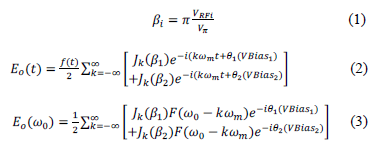
<body><![CDATA[<p><font size="2" face="Verdana, Arial, Helvetica, sans-serif">Among the techniques  used to generate multiple optical carriers from one single source are: The  spectral slicing broadband light source &#91;12&#93;, the FWM (Four Wave Mixing)  technique &#91;13,14&#93;, the ultrashort pulses generation technique &#91;15&#93; and the MZMs  &#91;16&#93;. These techniques intend to reduce both the use of several optical sources  in the telecommunication networks and reduce costs by using a single laser. The  OFCG-MZM is attractive because it offers several characteristics described  previously such as high coherence, stability, and simple operation. However,  the characterization of the wavelength conversion of modulated optical signals  based on MZMs has not been either proved or tested.</font></p>     <p><font size="2" face="Verdana, Arial, Helvetica, sans-serif">The OFCG with MZM, implemented according to <a href="#fig02">Fig. 2a</a>, obeys an electro-optic phase modulation with  a RF tones, as can be seen in the equation 2. The expressions 1 and 2 show that  the modulation index <font face="Symbol">b</font>i is adjusted if the amplitude of the RF signals  (VRFi) are modified, and if the Vbiasi applied to the arms of the MZM is  altered, the phase of each side band can be varied &#91;17&#93;. On the end side of the  MZM, the spectrum of each arm is superposed and every side band is added  constructively or destructively in certain quantity, depending on the phase of  each side band. In this way, the spectral flatness can be improved if different  amplitude and bias are applied to each arm of the MZM.</font></p>     <p><img src="/img/revistas/dyna/v82n194/v82n194a10eq0103.gif"></p>     <p><font size="2" face="Verdana, Arial, Helvetica, sans-serif">Where:</font></p>     <blockquote>       <p><font size="2" face="Verdana, Arial, Helvetica, sans-serif">f(t): Input modulated     optical signal with center frequency <font face="Symbol">w</font><sub>c</sub>.    <br>   </font><font size="2" face="Verdana, Arial, Helvetica, sans-serif">V<sub><font face="Symbol">p</font></sub>: Induced voltage in which the     phase of the optical electric field in the MZM reaches 180°.    <br>     </font><font size="2" face="Verdana, Arial, Helvetica, sans-serif"><font face="Symbol">w</font><sub>m</sub>:     Angular frequency of the RF tone.    <br>     </font><font size="2" face="Verdana, Arial, Helvetica, sans-serif"><font face="Symbol">q</font><sub>1</sub>:     Phase induced by the polarization on arm 1.    <br>     </font><font size="2" face="Verdana, Arial, Helvetica, sans-serif"><font face="Symbol">q</font><sub>2</sub>:     Phase induced by the polarization on arm 2.    ]]></body>
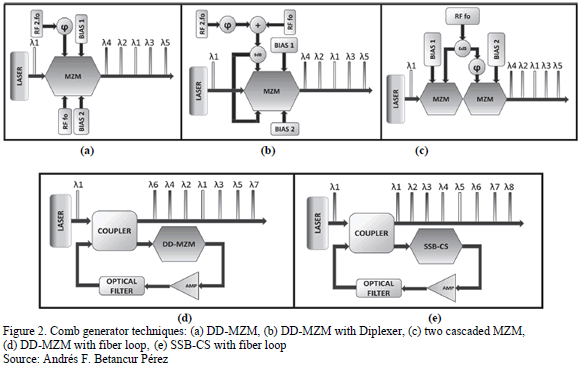
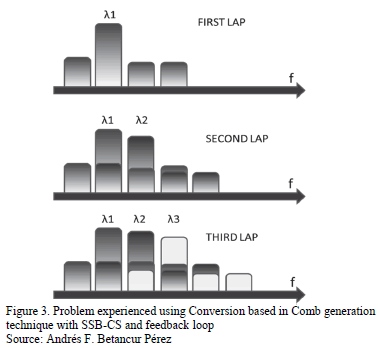
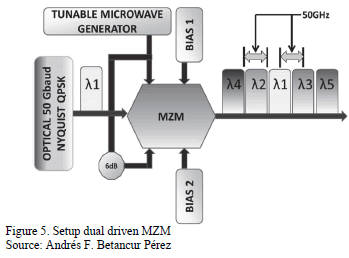
<body><![CDATA[<br>     </font><font size="2" face="Verdana, Arial, Helvetica, sans-serif"><font face="Symbol">b</font><sub>1</sub>:     Modulation Index related to RF tone amplitude on arm 1.    <br>     </font><font size="2" face="Verdana, Arial, Helvetica, sans-serif"><font face="Symbol">b</font><sub>2</sub>:     Modulation Index related to RF tone amplitude on arm 2.    <br>     </font><font size="2" face="Verdana, Arial, Helvetica, sans-serif">F(<font face="Symbol">w</font>): The Fourier     transform of f(t).    <br>     </font><font size="2" face="Verdana, Arial, Helvetica, sans-serif">k: Order of Bessel     function</font></p> </blockquote>     <p align="center"><font size="2" face="Verdana, Arial, Helvetica, sans-serif"><a name="fig02"></a></font><img src="/img/revistas/dyna/v82n194/v82n194a10fig02.gif"></p>     <p><font size="2" face="Verdana, Arial, Helvetica, sans-serif">The Fourier transform in equation 2 can be appreciated in  expression 3 where <font face="Symbol">w</font><sub>0</sub>=<font face="Symbol">w</font>-<font face="Symbol">w</font><sub>c</sub>. This equation  shows that countless side bands are created according to the Bessel functions;  however, the power decreases as the frequencies of the side bands go away from  the central frequency.</font></p>     <p><font size="2" face="Verdana, Arial, Helvetica, sans-serif">There are several OFCG-MZM techniques with or without  feedback, as can be seen in the <a href="#fig02">Fig. 2</a> &#91;17&#93;. <a href="#fig02">Fig. 2(a)</a>, <a href="#fig02">2(b)</a>, and <a href="#fig02">2(c)</a> show  some examples of open loop OFCG-MZM. In <a href="#fig02">Fig. 2(a)</a> a dual driven Comb generator  (<i>DD-MZM</i>) is described and two Radio  Frequency (RF) signals are used, the frequency of one being double that of the  other. The phase and amplitude of the RF signals are different as is the bias  of each arm of the MZM. In the <a href="#fig02">Fig. 2(b)</a>, one similar configuration is  appreciated with the difference being that each arm of the MZM is operated with  two combined RF sinusoidal signals with frequencies of f<sub>o</sub> and 2f<sub>o</sub>.  This method adds the diplexer device to generate the comb. In <a href="#fig03">Fig. 2(c)</a> the  setup of two cascaded MZMs can be visualized. In this method, the operation of  each MZM is carried out with the same RF frequency; however, each one is  separately biased. The amplitude and the phase of the RF signals that are used  to operate each MZM are different. </font></p>     <p><font size="2" face="Verdana, Arial, Helvetica, sans-serif">Moreover, there are techniques to generate combs with MZMs  using fiber loops. One of them uses the same DD-MZM setup and a fiber loop with  an optical amplifier (<a href="#fig02">Fig. 2(d)</a>), and the other technique (<a href="#fig02">Fig. 2(e)</a>) uses the  same optical loop and two parallel MZMs configured to make SSB-CS modulation (<i>Single Side Band Modulation with Carrier  Suppression</i>). These methods add more complexity but can create more optical  carriers by taking the generated components to the MZMs' input and repeating  the process. The new spectral components create more optical carriers, and in  every lap the new components interfere with each other adding or subtracting  the amplitude, depending on each spectral component phase &#91;18,19&#93;.</font></p>     <p><font size="2" face="Verdana, Arial, Helvetica, sans-serif">An implementation based on feedback loop techniques presents  impairments as interference among channels is caused by the fiber loop. This is  because, in every lap, the signals have conversions that also generate new  ones, due to the interference between the incoming signals and the previous  ones. The interference is possible because the RF tone produces the same  channel spacing between each spectral component, increasing the symbol error  rate with the number of laps. Even if the SSB-SC is used, the same problem  still exists as there is no total side band suppression or carrier suppression.  Hence, side bands remain with enough power spectral density to be a  considerable noise, just as is illustrated in <a href="#fig03">Fig. 3</a>. </font></p>     <p align="center"><font size="2" face="Verdana, Arial, Helvetica, sans-serif"><a name="fig03"></a></font><img src="/img/revistas/dyna/v82n194/v82n194a10fig03.gif"></p>     ]]></body>
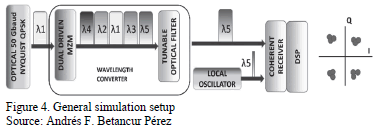
<body><![CDATA[<p><font size="2" face="Verdana, Arial, Helvetica, sans-serif">The OFCG scheme used is the configuration that can be seen  in <a href="#fig02">Fig. 2a</a>. It is used because of its simple operation, low complexity, and its  cost effectiveness. The other configurations add more complexity and generate  just one or two more subcarriers, which result in a non-reliable cost-benefit  ratio.</font></p>     <p><font size="2" face="Verdana, Arial, Helvetica, sans-serif">In order to generate  new wavelength conversions to cover most of the C band, it is desirable to  generate high RF tone frequencies up until 400 GHz in order to create the same  channel spacing value between conversions. According to the state of the art  for electronics there is no shown capacity shown to generate such frequencies;  consequently, another approach should be taken into account in order to  overcome this limitation. The proposed model to generate frequencies higher  than 100 GHz is based on the schemes used in radio over fiber (<i>RoF</i>) systems &#91;20&#93; to generate millimeter  wave signals using two optical sources in which one of them is tunable and the  other has a fixed frequency. With the quadratic characteristic of the  photodetector we could generate RF tones with a frequency equal to the  difference of the two optical source frequencies. In the next section, we  demonstrate our technique to generate RF tones in the range of 10 GHz to 400  GHz.</font></p>     <p>&nbsp;</p>     <p><font size="3" face="Verdana, Arial, Helvetica, sans-serif"><b>3. AOWC model  setup</b></font></p>     <p><font size="2" face="Verdana, Arial, Helvetica, sans-serif">In <a href="#fig04">Fig. 4</a>, the general scheme of the back-to-back  implementation carried out using VPI simulation software can be seen. It can be  divided in three stages: The DD-MZM, the tunable optical filter and the  coherent receiver.</font></p>     <p align="center"><font size="2" face="Verdana, Arial, Helvetica, sans-serif"><a name="fig04"></a></font><img src="/img/revistas/dyna/v82n194/v82n194a10fig04.gif"></p>     <p><font size="2" face="Verdana, Arial, Helvetica, sans-serif"><b><i>3.1. DD-MZM based  converter</i></b></font></p>     <p><font size="2" face="Verdana, Arial, Helvetica, sans-serif">The proposed system is based on the MZM setup in dual  drive operation that is shown in <a href="#fig05">Fig. 5</a>. It has equal RF operation frequencies  in both arms and different amplitudes (0.5V and 1V) on each arm, the modulation  indexes of which are different because each arm is biased in different  operating points.</font></p>     <p align="center"><font size="2" face="Verdana, Arial, Helvetica, sans-serif"><a name="fig05"></a></font><img src="/img/revistas/dyna/v82n194/v82n194a10fig05.gif"></p>     <p><font size="2" face="Verdana, Arial, Helvetica, sans-serif">The optical source is a  193.1THz optical carrier, with 20mW of power that is modulated externally by  Nyquist. Its pulses are generated with a raised cosine filter with a roll off  factor equal to 1, it has a QPSK format and a 100 Gbps bit rate (50GBaud/s).  The MZM has values of V<font face="Symbol">p</font> y V<sub>RF</sub> equal to 1V &#91;21&#93; and an  extinction ratio of 25dB. One arm of the MZM is operated with a RF tone with an  amplitude equal to 0.5V and biased to 0.4V. The other arm is operated with an  RF tone amplitude of 1V and biased with 0V. The RF tones are generated with a  tunable microwave generator (TMWG). </font></p>     ]]></body>
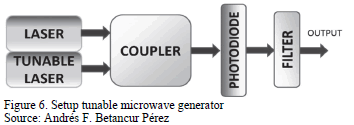
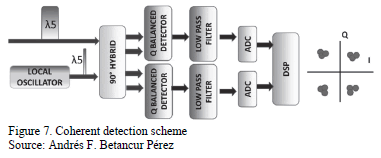
<body><![CDATA[<p><font size="2" face="Verdana, Arial, Helvetica, sans-serif">The TMWG setup was  configured according to the scheme illustrated in <a href="#fig06">Fig. 6</a>. The fixed Laser has a  frequency of 193.1THz. Both lasers have linewidth of 1 KHz and a power of 20 mW  to get a RF sine wave as pure as possible at the output of the TMWG. The  optical carriers are injected to a coupler and the mixed wavelengths are  detected by a photodiode APD with a 1A/W responsivity, 2nA dark current, 100  multiplicative factor, 1 ionization coefficient and a 10<sup>-12</sup> A/Hz thermal  noise of. The quadratic characteristic of the photodiode generates an electric  current at a frequency equal to the difference between the frequencies of the  optical sources. The detected electrical signal is filtered by a bandpass  filter to reduce the noise, and it is then applied to the MZM. This method has  great benefits such as: high integration (the AOWC can be made on a single  chip), and it can be easily controlled by other systems with electric signals  that can be useful in adaptive optical networks.</font></p>     <p align="center"><font size="2" face="Verdana, Arial, Helvetica, sans-serif"><a name="fig06"></a></font><img src="/img/revistas/dyna/v82n194/v82n194a10fig06.gif"></p>     <p><font size="2" face="Verdana, Arial, Helvetica, sans-serif">The MZM output signal is  a set of channels where eight of them possess a low BER degradation and channel  spacing equal to the generated frequency on the TMWG, as can be seen in the  scheme illustrated in <a href="#fig05">Fig. 5</a>. Every channel has the same information as the  original input signal. </font></p>     <p><font size="2" face="Verdana, Arial, Helvetica, sans-serif"><b><i>3.2. Tunable  Optical Filter</i></b></font></p>     <p><font size="2" face="Verdana, Arial, Helvetica, sans-serif">The optical signal is then filtered by a tunable bandpass  Gaussian optical filter, the central frequency of which is tuned to the central  frequency of each generated channel, allowing the wavelength conversion  process. In our tests, the filter was tuned every 50 GHz and 400 GHz around the  original channel (193.1THz) depending on the frequency spacing caused by the  wavelength conversion process. The bandwidth of the filter is 0.9 fold the  baudrate and it has a Gaussian order equal to 9 in order to obtain the desired  channel. Nowadays, an optical filter that has tunable bandwidth and central  frequency without deformation of its frequency response at speeds in the order  of microseconds functions as the liquid crystal filter. At this rate, the  wavelength conversion process is limited to offline applications.</font></p>     <p><font size="2" face="Verdana, Arial, Helvetica, sans-serif"><b><i>3.3. Coherent  Receiver</i></b></font></p>     <p><font size="2" face="Verdana, Arial, Helvetica, sans-serif">In <a href="#fig07">Fig. 7</a>, the scheme of the coherent receiver is  illustrated. The signal is detected with a coherent receiver with a local  oscillator tuned to the central frequency of each detected channel and with a  power equal to 1mW. The photodetectors in the balanced detectors are PIN with a  responsivity of 1A/W and thermal noise equal to 10<sup>-11</sup> A/Hz. The  lowpass electrical filter of the receiver has a Bessel transfer function of  order 4, with a bandwidth of 0.75 fold the baudrate (37.5GHz). In the DSP (<i>Digital Signal Processor</i>) a BER  estimation is performed assuming a Gaussian probability density function with a  mean and variance equal to that of the signal samples. For such purpose, the  logical channels are used to obtain the bit sequence sent by the transmitter.</font></p>     <p align="center"><font size="2" face="Verdana, Arial, Helvetica, sans-serif"><a name="fig07"></a></font><img src="/img/revistas/dyna/v82n194/v82n194a10fig07.gif"></p>     <p>&nbsp;</p>     <p><font size="3" face="Verdana, Arial, Helvetica, sans-serif"><b>4. Analysis of   results</b></font></p>     ]]></body>
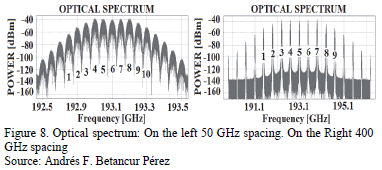
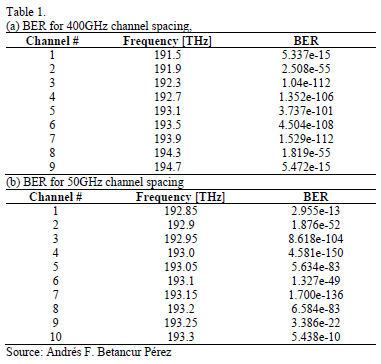
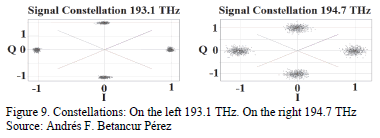
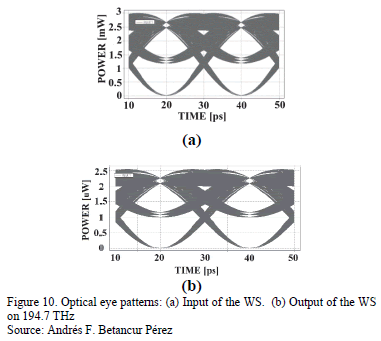
<body><![CDATA[<p><font size="2" face="Verdana, Arial, Helvetica, sans-serif">The spectrum obtained at the output of the AOWC is  illustrated in <a href="#fig07">Fig. 8</a>. The tunable microwave generator was tuned to get a RF  tone with frequencies of 50 GHz and 400 GHz in order to obtain the respective  channel spacing. In this way, the location of the converted channels, according  to the variable channel spacing suggested by the elastic optical networks  (channel spacing, multiples of 12.5GHz), can be configured.</font></p>     <p align="center"><font size="2" face="Verdana, Arial, Helvetica, sans-serif"><a name="fig08"></a></font><img src="/img/revistas/dyna/v82n194/v82n194a10fig08.gif"></p>     <p><font size="2" face="Verdana, Arial, Helvetica, sans-serif">The minimum obtained BER (see <a href="#tab01">Table 1</a>) was in the order of  10<sup>-150</sup> for the channel located on 193 THz. This corresponded to  channel 4 for a 50GHz channel spacing; however, the BER was related to the  variable power among the channels, the more power the converted signal, the less</font> <font size="2" face="Verdana, Arial, Helvetica, sans-serif">the  BER. This is due to the optical signal power decreasing when the digital signal  is phase modulated and because the power of each channel follows the pattern  imposed by the Bessel functions inducing intensity variations compared with the  original signal. The power variations on every converted channel must be  equalized and amplified in order to level all the Superchannels at the output.  The advantage of the Nyquist pulse format is its reduced spectrum compared to  the pulses with NRZ (Non Return to Zero) format &#91;22&#93;. Moreover, Nyquist pulses  belong to the Superchannel systems because it is desired that every subcarrier  is tightly separated with a minimum channel spacing equal to the bit rate. In  each spectrum, the peak power reduction of each channel with respect to the  average input power (20dBm) can be seen; this effect is caused by the power  distribution of the main optical channel among the generated side bands. This  is a product of the OFCG modulation process, which gives multiple converted  frequency options. <a href="#tab01">Table 1</a> contains a summary of the BER for every converted  channel option of the AOWC that was implemented. The BER of the channel 10 for  50GHz channel spacing is the biggest, but it may be recovered with FEC  techniques after propagation through optical fiber in an adaptive optical  network. </font></p>     <p align="center"><font size="2" face="Verdana, Arial, Helvetica, sans-serif"><a name="tab01"></a></font><img src="/img/revistas/dyna/v82n194/v82n194a10tab01.gif"></p>     <p><font size="2" face="Verdana, Arial, Helvetica, sans-serif">The calculated  constellation diagrams in the coherent receiver output can be seen in <a href="#fig09">Fig. 9</a>.  How the acquired points deviate around the original decision point is shown on  the left. The standard deviation is greater in 194.7THz than in the original  operation frequency (i.e. 193.1THz) because the OSNR (Optical Signal to Noise  Ratio) is reduced in this channel.</font></p>     <p align="center"><font size="2" face="Verdana, Arial, Helvetica, sans-serif"><a name="fig09"></a></font><img src="/img/revistas/dyna/v82n194/v82n194a10fig09.gif"></p>     <p><font size="2" face="Verdana, Arial, Helvetica, sans-serif">To visualize the  wavelength conversion effect over the QPSK signal, <a href="#fig10">Fig. 10</a> illustrates the  optical eye diagram of the AOWC input signal and the optical eye diagram of  channel 9 (194.7THz) when a 400 GHz RF tone is used. The result when there is a  wavelength conversion by means MZM is reduced power on each channel compared to  the input signal. This effect impacts the eye pattern, closing it. However, the  information on the phase transitions can still be detected as the wavelength  converter is transparent to this modulation format. </font></p>     <p align="center"><font size="2" face="Verdana, Arial, Helvetica, sans-serif"><a name="fig10"></a></font><img src="/img/revistas/dyna/v82n194/v82n194a10fig10.gif"></p>     <p>&nbsp;</p>     <p><font size="3" face="Verdana, Arial, Helvetica, sans-serif"><b>5. Conclusions</b></font></p>     ]]></body>
<body><![CDATA[<p><font size="2" face="Verdana, Arial, Helvetica, sans-serif">A method for  wavelength conversion without OEO transformations that is based on the MZM comb  generation scheme without feedback was presented. Eight copies or subchannels  were generated and spaced according to the tunable microwave tone generator,  with the same as the original modulated optical signal as a central frequency  value. The BER was reduced as low as 10<sup>-150</sup> (error free), and this  is due to the low noise present in the simulated back-to-back system. However,  to evade a link that is limited by transmission power or attenuation, the  processed optical signal in the wavelength converter must be amplified and  equalized to get enough power and a flat spectrum in order to launch the  optical subcarriers over the optical link or lightpath.</font></p>     <p><font size="2" face="Verdana, Arial, Helvetica, sans-serif">A satisfactory demodulation scheme for each one of the  converted optical signals in the spectrum was presented, demonstrating a good  performance of the proposed converter. Covering almost the entire C band of the  standard single mode fiber was possible thanks to the tunable microwave  generator that can generate RF tones until 400GHz. This functional block has  the advantage of being integrated in a single photonic chip. This conversion  has the characteristic of being transparent to the Nyquist QPSK modulation format.  The method for wavelength conversion of modulated optical signals opens doors  to photonic routing research for future elastic networks.</font></p>     <p>&nbsp;</p>     <p><font size="3" face="Verdana, Arial, Helvetica, sans-serif"><b>Acknowledgments</b></font></p>     <p><font size="2" face="Verdana, Arial, Helvetica, sans-serif">We would like to  thank to Antioquia University, and specifically, the CODI (Comite para el Desarrollo  de la Investigaci&oacute;n), which supported us in our research project with code MDC  11-1-04. Sostenibilidad 2014 Project.</font></p>     <p>&nbsp;</p>     <p><font size="3" face="Verdana, Arial, Helvetica, sans-serif"><b>References</b></font></p>     <!-- ref --><p><font size="2" face="Verdana, Arial, Helvetica, sans-serif"><b>&#91;1&#93;</b> Klekamp,  A., Dischler, R. and Buchali, F., Limits of spectral efficiency and  transmission reach of optical-OFDM superchannels for adaptive networks. IEEE Photonics Technology Letters, 23(20),  pp. 1526-1528, 2011. DOI: 10.1109/LPT.2011.2161979</font>&nbsp;&nbsp;&nbsp;&nbsp;&nbsp;&nbsp;&nbsp;&nbsp;[&#160;<a href="javascript:void(0);" onclick="javascript: window.open('/scielo.php?script=sci_nlinks&ref=000090&pid=S0012-7353201500060001000001&lng=','','width=640,height=500,resizable=yes,scrollbars=1,menubar=yes,');">Links</a>&#160;]<!-- end-ref --><!-- ref --><p><font size="2" face="Verdana, Arial, Helvetica, sans-serif"><b>&#91;2&#93;</b> Bosco,  G., Curri, V., Carena, A., Poggiolini, P. and Forghieri, F., On the performance  of nyquist-WDM terabit superchannels based on PM-BPSK, PM-QPSK, PM-8QAM or  PM-16QAM subcarriers. Journal of  Lightwave Technology, 29(1), pp. 53-61, 2011. DOI: 10.1109/JLT.2010.2091254</font>&nbsp;&nbsp;&nbsp;&nbsp;&nbsp;&nbsp;&nbsp;&nbsp;[&#160;<a href="javascript:void(0);" onclick="javascript: window.open('/scielo.php?script=sci_nlinks&ref=000091&pid=S0012-7353201500060001000002&lng=','','width=640,height=500,resizable=yes,scrollbars=1,menubar=yes,');">Links</a>&#160;]<!-- end-ref --><!-- ref --><p><font size="2" face="Verdana, Arial, Helvetica, sans-serif"><b>&#91;3&#93;</b> INFINERA.  Super-Channels DWDM transmission beyond 100Gb/s. White paper, &#91;Online&#93;. 2011.  Available at: <a href="http://www.infinera.com/ pdfs/whitepapers" target="_blank">http://www.infinera.com/ pdfs/whitepapers</a></font>&nbsp;&nbsp;&nbsp;&nbsp;&nbsp;&nbsp;&nbsp;&nbsp;[&#160;<a href="javascript:void(0);" onclick="javascript: window.open('/scielo.php?script=sci_nlinks&ref=000092&pid=S0012-7353201500060001000003&lng=','','width=640,height=500,resizable=yes,scrollbars=1,menubar=yes,');">Links</a>&#160;]<!-- end-ref --><!-- ref --><p><font size="2" face="Verdana, Arial, Helvetica, sans-serif"><b>&#91;4&#93;</b> Dischler,  R., Buchali, F., Klekamp, A., Idler, W., Lach, E., Schippel, A., Schneiders, M.,  Vorbeck, S. and Braun, R.-P., Terabit transmission of high capacity multiband  OFDM superchannels on field deployed single mode fiber, ECOC, pp. 1-3, 2010.  DOI: 10.1109/ECOC.2010.5621258</font>&nbsp;&nbsp;&nbsp;&nbsp;&nbsp;&nbsp;&nbsp;&nbsp;[&#160;<a href="javascript:void(0);" onclick="javascript: window.open('/scielo.php?script=sci_nlinks&ref=000093&pid=S0012-7353201500060001000004&lng=','','width=640,height=500,resizable=yes,scrollbars=1,menubar=yes,');">Links</a>&#160;]<!-- end-ref --><!-- ref --><p><font size="2" face="Verdana, Arial, Helvetica, sans-serif"><b>&#91;5&#93;</b> Tomkos,  I., Palkopoulou, E. and Angelou, M., A survey of recent developments on  flexible/elastic optical networking, 14<sup>th</sup> International Conference  on Transparent Optical Networks (ICTON), 2012, pp. 1-6. DOI: 10.1109/ICTON.2012.6254409</font>&nbsp;&nbsp;&nbsp;&nbsp;&nbsp;&nbsp;&nbsp;&nbsp;[&#160;<a href="javascript:void(0);" onclick="javascript: window.open('/scielo.php?script=sci_nlinks&ref=000094&pid=S0012-7353201500060001000005&lng=','','width=640,height=500,resizable=yes,scrollbars=1,menubar=yes,');">Links</a>&#160;]<!-- end-ref --><!-- ref --><p><font size="2" face="Verdana, Arial, Helvetica, sans-serif"><b>&#91;6&#93;</b> Colavolpe,  G., Foggi, T., Forestieri, E. and Prati, G., Robust multilevel coherent optical  systems with linear processing at the receiver. Journal of Lightwave Technology, 27(13), pp. 2357-2369, 2009. DOI: 10.1109/JLT.2008.2008821</font>&nbsp;&nbsp;&nbsp;&nbsp;&nbsp;&nbsp;&nbsp;&nbsp;[&#160;<a href="javascript:void(0);" onclick="javascript: window.open('/scielo.php?script=sci_nlinks&ref=000095&pid=S0012-7353201500060001000006&lng=','','width=640,height=500,resizable=yes,scrollbars=1,menubar=yes,');">Links</a>&#160;]<!-- end-ref --><!-- ref --><p><font size="2" face="Verdana, Arial, Helvetica, sans-serif"><b>&#91;7&#93;</b> Van  den Borne, D., Alfiad, M., Jansen, S.L. and Wuth, T., 40G/100G long-haul optical transmission system  design using digital coherent receivers, 14<sup>th</sup> OptoElectronics  and Communications Conference OECC, 2009, pp.1-2. DOI: 10.1109/OECC.2009.5214277</font>&nbsp;&nbsp;&nbsp;&nbsp;&nbsp;&nbsp;&nbsp;&nbsp;[&#160;<a href="javascript:void(0);" onclick="javascript: window.open('/scielo.php?script=sci_nlinks&ref=000096&pid=S0012-7353201500060001000007&lng=','','width=640,height=500,resizable=yes,scrollbars=1,menubar=yes,');">Links</a>&#160;]<!-- end-ref --><!-- ref --><p><font size="2" face="Verdana, Arial, Helvetica, sans-serif"><b>&#91;8&#93;</b> Gerstel,  O., Jinno, M., Lord, A. and Yoo, S.JB., Elastic optical networking: A new dawn  for the optical layer?. Communications Magazine, IEEE, 50(2), pp. s12-s20,  2012. DOI: 10.1109/MCOM.2012.6146481</font>&nbsp;&nbsp;&nbsp;&nbsp;&nbsp;&nbsp;&nbsp;&nbsp;[&#160;<a href="javascript:void(0);" onclick="javascript: window.open('/scielo.php?script=sci_nlinks&ref=000097&pid=S0012-7353201500060001000008&lng=','','width=640,height=500,resizable=yes,scrollbars=1,menubar=yes,');">Links</a>&#160;]<!-- end-ref --><!-- ref --><p><font size="2" face="Verdana, Arial, Helvetica, sans-serif"><b>&#91;9&#93;</b> Cao,  B., Shea, D.P. and Mitchell, J.E., Wavelength converting optical access network  for 10Gbit/s PON, 15<sup>th</sup> International Conference on Optical Network Design and Modeling (ONDM),  2011, pp. 1-6.    &nbsp;&nbsp;&nbsp;&nbsp;&nbsp;&nbsp;&nbsp;&nbsp;[&#160;<a href="javascript:void(0);" onclick="javascript: window.open('/scielo.php?script=sci_nlinks&ref=000098&pid=S0012-7353201500060001000009&lng=','','width=640,height=500,resizable=yes,scrollbars=1,menubar=yes,');">Links</a>&#160;]<!-- end-ref --></font></p>     <!-- ref --><p><font size="2" face="Verdana, Arial, Helvetica, sans-serif"><b>&#91;10&#93;</b> Nguyen,  A., Porzi, C., Pinna, S., Contestabile, G. and Bogoni, A., 40Gb/s all-optical  selective wavelength shifter, Conference  on Lasers and Electro-Optic (CLEO), 2011, pp. 1-2.    &nbsp;&nbsp;&nbsp;&nbsp;&nbsp;&nbsp;&nbsp;&nbsp;[&#160;<a href="javascript:void(0);" onclick="javascript: window.open('/scielo.php?script=sci_nlinks&ref=000100&pid=S0012-7353201500060001000010&lng=','','width=640,height=500,resizable=yes,scrollbars=1,menubar=yes,');">Links</a>&#160;]<!-- end-ref --></font></p>     <!-- ref --><p><font size="2" face="Verdana, Arial, Helvetica, sans-serif"><b>&#91;11&#93;</b> Apex  Technologies. Ultra high resolution OSA/OCSA for characterizing and evaluating  optical frequency comb sources. White paper &#91;Online&#93;. 2013. Available at: <a href="http://www.apex-t.com/optical-frequency-comb/" target="_blank">http://www.apex-t.com/optical-frequency-comb/</a></font>&nbsp;&nbsp;&nbsp;&nbsp;&nbsp;&nbsp;&nbsp;&nbsp;[&#160;<a href="javascript:void(0);" onclick="javascript: window.open('/scielo.php?script=sci_nlinks&ref=000102&pid=S0012-7353201500060001000011&lng=','','width=640,height=500,resizable=yes,scrollbars=1,menubar=yes,');">Links</a>&#160;]<!-- end-ref --><!-- ref --><p><font size="2" face="Verdana, Arial, Helvetica, sans-serif"><b>&#91;12&#93;</b> Pendock,  G.J. and Sampson, D.D., Transmission performance of high bit rate  spectrum-sliced WDM systems. Journal  of Lightwave Technology, 14(10), pp. 2141-2148, 1996. DOI: 10.1109/50.541201</font>&nbsp;&nbsp;&nbsp;&nbsp;&nbsp;&nbsp;&nbsp;&nbsp;[&#160;<a href="javascript:void(0);" onclick="javascript: window.open('/scielo.php?script=sci_nlinks&ref=000103&pid=S0012-7353201500060001000012&lng=','','width=640,height=500,resizable=yes,scrollbars=1,menubar=yes,');">Links</a>&#160;]<!-- end-ref --><!-- ref --><p><font size="2" face="Verdana, Arial, Helvetica, sans-serif"><b>&#91;13&#93;</b> Sefler,  G.A. and Kitayama, K.-I., Frequency comb generation by four-wave mixing and the  role of fiber dispersion. Journal of  Lightwave Technology, 16(9), pp. 1596-1605, 1998. DOI: 10.1109/50.712242</font>&nbsp;&nbsp;&nbsp;&nbsp;&nbsp;&nbsp;&nbsp;&nbsp;[&#160;<a href="javascript:void(0);" onclick="javascript: window.open('/scielo.php?script=sci_nlinks&ref=000104&pid=S0012-7353201500060001000013&lng=','','width=640,height=500,resizable=yes,scrollbars=1,menubar=yes,');">Links</a>&#160;]<!-- end-ref --><!-- ref --><p><font size="2" face="Verdana, Arial, Helvetica, sans-serif"><b>&#91;14&#93;</b> Takahashi,  M., Hiroishi, J., Tadakuma, M. and Yagi, T., FWM wavelength conversion with  over 60nm of 0dB conversion bandwidth by SBS-suppressed HNLF, Optical Fiber  Communication Conference, 2009, pp. 1-3.    &nbsp;&nbsp;&nbsp;&nbsp;&nbsp;&nbsp;&nbsp;&nbsp;[&#160;<a href="javascript:void(0);" onclick="javascript: window.open('/scielo.php?script=sci_nlinks&ref=000105&pid=S0012-7353201500060001000014&lng=','','width=640,height=500,resizable=yes,scrollbars=1,menubar=yes,');">Links</a>&#160;]<!-- end-ref --> </font></p>     <!-- ref --><p><font size="2" face="Verdana, Arial, Helvetica, sans-serif"><b>&#91;15&#93;</b> Avrutin,  E.A., Ryvkin, B.S., Kostamovaara, J. and Portnoi, E.L., Analysis of symmetric  and asymmetric broadened-mode laser structures for short and ultrashort optical  pulse generation, ICTON<i>, </i>2010, pp. 1-4. DOI: 10.1109/ICTON.2010.5549074</font>&nbsp;&nbsp;&nbsp;&nbsp;&nbsp;&nbsp;&nbsp;&nbsp;[&#160;<a href="javascript:void(0);" onclick="javascript: window.open('/scielo.php?script=sci_nlinks&ref=000107&pid=S0012-7353201500060001000015&lng=','','width=640,height=500,resizable=yes,scrollbars=1,menubar=yes,');">Links</a>&#160;]<!-- end-ref --><!-- ref --><p><font size="2" face="Verdana, Arial, Helvetica, sans-serif"><b>&#91;16&#93;</b> Mishra,  A.K., Nellas, I., Tomkos, I., Koos, C., Freud, W. and Leuthold, J., Comb  generator for 100Gbit/s OFDM and low-loss comb-line combiner using the optical  inverse Fourier Transform (IFFT). ICTON, 2011, pp. 1-5. DOI: 10.1109/ ICTON.2011.5971034</font>&nbsp;&nbsp;&nbsp;&nbsp;&nbsp;&nbsp;&nbsp;&nbsp;[&#160;<a href="javascript:void(0);" onclick="javascript: window.open('/scielo.php?script=sci_nlinks&ref=000108&pid=S0012-7353201500060001000016&lng=','','width=640,height=500,resizable=yes,scrollbars=1,menubar=yes,');">Links</a>&#160;]<!-- end-ref --><!-- ref --><p><font size="2" face="Verdana, Arial, Helvetica, sans-serif"><b>&#91;17&#93;</b> Puerto-Leguizam&oacute;n,  G.A., Suarez-Fajardo, C.A., Analytical model of signal generation for radio  over fiber systems, DYNA, 81(188), pp. 26-33, 2014.    &nbsp;&nbsp;&nbsp;&nbsp;&nbsp;&nbsp;&nbsp;&nbsp;[&#160;<a href="javascript:void(0);" onclick="javascript: window.open('/scielo.php?script=sci_nlinks&ref=000109&pid=S0012-7353201500060001000017&lng=','','width=640,height=500,resizable=yes,scrollbars=1,menubar=yes,');">Links</a>&#160;]<!-- end-ref --></font></p>     <!-- ref --><p><font size="2" face="Verdana, Arial, Helvetica, sans-serif"><b>&#91;18&#93;</b> Kawanishi,  T., Sakamoto, T., Shinada, S. and Izutsu, M., Optical frequency comb generator  using optical fiber loops with single-sideband modulation. IEICE Electronics  Express, 1(8), pp. 217-221. DOI: 10.1587/elex.1.217</font>&nbsp;&nbsp;&nbsp;&nbsp;&nbsp;&nbsp;&nbsp;&nbsp;[&#160;<a href="javascript:void(0);" onclick="javascript: window.open('/scielo.php?script=sci_nlinks&ref=000111&pid=S0012-7353201500060001000018&lng=','','width=640,height=500,resizable=yes,scrollbars=1,menubar=yes,');">Links</a>&#160;]<!-- end-ref --><!-- ref --><p><font size="2" face="Verdana, Arial, Helvetica, sans-serif"><b>&#91;19&#93;</b> Morohashi,  I., Sakamoto, T., Yamamoto, N., Kawanishi, T., Hosako, I. and Sotobayashi, H., Broadening  of comb bandwidth by multiple modulation using feedback loop in  Mach-Zehnder-Modulator-Based flat comb generator, Microwave Photonics MWP IEEE  Topical Meeting, 2010, pp. 220-223. DOI: 10.1109/MWP.2010.5664165</font>&nbsp;&nbsp;&nbsp;&nbsp;&nbsp;&nbsp;&nbsp;&nbsp;[&#160;<a href="javascript:void(0);" onclick="javascript: window.open('/scielo.php?script=sci_nlinks&ref=000112&pid=S0012-7353201500060001000019&lng=','','width=640,height=500,resizable=yes,scrollbars=1,menubar=yes,');">Links</a>&#160;]<!-- end-ref --><!-- ref --><p><font size="2" face="Verdana, Arial, Helvetica, sans-serif"><b>&#91;20&#93;</b> Zhang,  W. and Yao, J., Photonic generation of milimeter-wave signals with tunable  phase shift. IEEE Photonics Journal, 4(3), pp. 889-894, 2012. DOI: 10.1109/MWP.2012.6474049</font>&nbsp;&nbsp;&nbsp;&nbsp;&nbsp;&nbsp;&nbsp;&nbsp;[&#160;<a href="javascript:void(0);" onclick="javascript: window.open('/scielo.php?script=sci_nlinks&ref=000113&pid=S0012-7353201500060001000020&lng=','','width=640,height=500,resizable=yes,scrollbars=1,menubar=yes,');">Links</a>&#160;]<!-- end-ref --><!-- ref --><p><font size="2" face="Verdana, Arial, Helvetica, sans-serif"><b>&#91;21&#93;</b> Ding,  J., Chen, H., Yang, L., Zhang, L., Ruiqiang, J., Tian, Y., Zhu, W., Lu, Y.,  Zhou, P. and Min, R., Low-voltage, high-extinction-ratio, Mach-Zehnder silicon  optical modulator for CMOS-compatible integration. Optics Express, 20(3), pp.  3209-3218, 2012. DOI: 10.1364/OE.20.003209</font>&nbsp;&nbsp;&nbsp;&nbsp;&nbsp;&nbsp;&nbsp;&nbsp;[&#160;<a href="javascript:void(0);" onclick="javascript: window.open('/scielo.php?script=sci_nlinks&ref=000114&pid=S0012-7353201500060001000021&lng=','','width=640,height=500,resizable=yes,scrollbars=1,menubar=yes,');">Links</a>&#160;]<!-- end-ref --><!-- ref --><p><font size="2" face="Verdana, Arial, Helvetica, sans-serif"><b>&#91;22&#93;</b> Torres-Nova,  J. M. y Paz-Penagos, H., Estudio  y comparaci&oacute;n en eficiencia espectral y probabilidad de error de los esquemas  de modulaci&oacute;n GMSK y DBPSK, Ingenier&iacute;a e Investigaci&oacute;n, 28(3), pp. 75-80, 2008.    &nbsp;&nbsp;&nbsp;&nbsp;&nbsp;&nbsp;&nbsp;&nbsp;[&#160;<a href="javascript:void(0);" onclick="javascript: window.open('/scielo.php?script=sci_nlinks&ref=000115&pid=S0012-7353201500060001000022&lng=','','width=640,height=500,resizable=yes,scrollbars=1,menubar=yes,');">Links</a>&#160;]<!-- end-ref --></font></p>     <p>&nbsp;</p>     <p><font size="2" face="Verdana, Arial, Helvetica, sans-serif"><b>A.F.  Betancur-P&eacute;rez,</b> is Electronic Engineer from the Universidad de Antioquia,  Colombia. He received his MSc in Telecommunications Engineering in 2014from the  Universidad de Antioquia, Colombia. Currently, he is professor of  telecommunications engineering and gives courses such as digital signal  processing and optical communications, and is an associated researcher in the  Instituto Tecnol&oacute;gico Metropolitano - ITM, Medell&iacute;n, Colombia. ORCID: 0000-0002-4738-8052</font></p>     <p><font size="2" face="Verdana, Arial, Helvetica, sans-serif"><b>A.M. C&aacute;rdenas-Soto,</b> obtained her PhD. in 2003 from the Universidad Polit&eacute;cnica de Valencia, Spain. She  worked in planning and design of telecommunication infrastructure in 1994-2005,  at Empresas P&uacute;blicas de Medell&iacute;n - EPM, Medell&iacute;n; Colombia, and as a professor in  2005-2009, at the Universidad Pontificia Bolivariana, Medell&iacute;n, Colombia. She  currently works at the Universidad de Antioquia, Medell&iacute;n, Colombia. Her  research interests are optical elastic networks and optical spectrum  engineering. ORCID: 0000-0001-9152-8246</font></p>     <p><font size="2" face="Verdana, Arial, Helvetica, sans-serif"><b>N. Guerrero-Gonzalez</b>,  is a postdoctoral researcher, has a BSc. Electronic Engineer degree in 2005 and  a MSc. in industrial automation in 2007, both from the Universidad Nacional de  Colombia, Medell&iacute;n, Colombia. He completed his PhD. degree in Photonics  Engineering in 2011, from the Technical University of Denmark (DTU). During  March and August 2011, Neil was associated as a postdoctoral researcher to DTU  - Fotonik under the FP7 European framework project CHRON. He has been also  associated with Huawei Technologies (Munich, Germany) in 2012 as an optical  engineer and with CPqD (Campinas, Brazil) between 2013 and 2014 as manager of  the division of optical communication systems. Currently he is associated as a  postdoctoral researcher to the Photonic Systems Group at Tyndall National  Institute. His research interests include coherent optical communication,  digital signal processing and hybrid fiber-wireless communication systems. ORCID: 0000-0002-8053-6280. ResearchID: E-7356-2015</font></p>      ]]></body><back>
<ref-list>
<ref id="B1">
<label>1</label><nlm-citation citation-type="journal">
<person-group person-group-type="author">
<name>
<surname><![CDATA[Klekamp]]></surname>
<given-names><![CDATA[A.]]></given-names>
</name>
<name>
<surname><![CDATA[Dischler]]></surname>
<given-names><![CDATA[R.]]></given-names>
</name>
<name>
<surname><![CDATA[Buchali]]></surname>
<given-names><![CDATA[F.]]></given-names>
</name>
</person-group>
<article-title xml:lang="en"><![CDATA[Limits of spectral efficiency and transmission reach of optical-OFDM superchannels for adaptive networks.]]></article-title>
<source><![CDATA[IEEE Photonics Technology Letters]]></source>
<year>2011</year>
<volume>23</volume>
<numero>20</numero>
<issue>20</issue>
<page-range>1526-1528</page-range></nlm-citation>
</ref>
<ref id="B2">
<label>2</label><nlm-citation citation-type="journal">
<person-group person-group-type="author">
<name>
<surname><![CDATA[Bosco]]></surname>
<given-names><![CDATA[G.]]></given-names>
</name>
<name>
<surname><![CDATA[Curri]]></surname>
<given-names><![CDATA[V.]]></given-names>
</name>
<name>
<surname><![CDATA[Carena]]></surname>
<given-names><![CDATA[A.]]></given-names>
</name>
<name>
<surname><![CDATA[Poggiolini]]></surname>
<given-names><![CDATA[P.]]></given-names>
</name>
<name>
<surname><![CDATA[Forghieri]]></surname>
<given-names><![CDATA[F.]]></given-names>
</name>
</person-group>
<article-title xml:lang="en"><![CDATA[On the performance of nyquist-WDM terabit superchannels based on PM-BPSK, PM-QPSK, PM-8QAM or PM-16QAM subcarriers]]></article-title>
<source><![CDATA[Journal of Lightwave Technology]]></source>
<year>2011</year>
<volume>29</volume>
<numero>1</numero>
<issue>1</issue>
<page-range>53-61</page-range></nlm-citation>
</ref>
<ref id="B3">
<label>3</label><nlm-citation citation-type="">
<collab>INFINERA</collab>
<source><![CDATA[Super-Channels DWDM transmission beyond 100Gb/s.: White paper]]></source>
<year>2011</year>
</nlm-citation>
</ref>
<ref id="B4">
<label>4</label><nlm-citation citation-type="">
<person-group person-group-type="author">
<name>
<surname><![CDATA[Dischler]]></surname>
<given-names><![CDATA[R.]]></given-names>
</name>
<name>
<surname><![CDATA[Buchali]]></surname>
<given-names><![CDATA[F.]]></given-names>
</name>
<name>
<surname><![CDATA[Klekamp]]></surname>
<given-names><![CDATA[A.]]></given-names>
</name>
<name>
<surname><![CDATA[Idler]]></surname>
<given-names><![CDATA[W.]]></given-names>
</name>
<name>
<surname><![CDATA[Lach]]></surname>
<given-names><![CDATA[E.]]></given-names>
</name>
<name>
<surname><![CDATA[Schippel]]></surname>
<given-names><![CDATA[A.]]></given-names>
</name>
<name>
<surname><![CDATA[Schneiders]]></surname>
<given-names><![CDATA[M.]]></given-names>
</name>
<name>
<surname><![CDATA[Vorbeck]]></surname>
<given-names><![CDATA[S.]]></given-names>
</name>
<name>
<surname><![CDATA[Braun]]></surname>
<given-names><![CDATA[R.-P.]]></given-names>
</name>
</person-group>
<source><![CDATA[Terabit transmission of high capacity multiband OFDM superchannels on field deployed single mode fiber, ECOC]]></source>
<year>2010</year>
<page-range>1-3</page-range></nlm-citation>
</ref>
<ref id="B5">
<label>5</label><nlm-citation citation-type="confpro">
<person-group person-group-type="author">
<name>
<surname><![CDATA[Tomkos]]></surname>
<given-names><![CDATA[I.]]></given-names>
</name>
<name>
<surname><![CDATA[Palkopoulou]]></surname>
<given-names><![CDATA[E.]]></given-names>
</name>
<name>
<surname><![CDATA[Angelou]]></surname>
<given-names><![CDATA[M.]]></given-names>
</name>
</person-group>
<article-title xml:lang="en"><![CDATA[A survey of recent developments on flexible/elastic optical networking]]></article-title>
<source><![CDATA[]]></source>
<year></year>
<conf-name><![CDATA[14th International Conference on Transparent Optical Networks (ICTON)]]></conf-name>
<conf-date>2012</conf-date>
<conf-loc> </conf-loc>
<page-range>1-6</page-range></nlm-citation>
</ref>
<ref id="B6">
<label>6</label><nlm-citation citation-type="journal">
<person-group person-group-type="author">
<name>
<surname><![CDATA[Colavolpe]]></surname>
<given-names><![CDATA[G.]]></given-names>
</name>
<name>
<surname><![CDATA[Foggi]]></surname>
<given-names><![CDATA[T.]]></given-names>
</name>
<name>
<surname><![CDATA[Forestieri]]></surname>
<given-names><![CDATA[E.]]></given-names>
</name>
<name>
<surname><![CDATA[Prati]]></surname>
<given-names><![CDATA[G.]]></given-names>
</name>
</person-group>
<article-title xml:lang="en"><![CDATA[Robust multilevel coherent optical systems with linear processing at the receiver]]></article-title>
<source><![CDATA[Journal of Lightwave Technology]]></source>
<year>2009</year>
<volume>27</volume>
<numero>13</numero>
<issue>13</issue>
<page-range>2357-2369</page-range></nlm-citation>
</ref>
<ref id="B7">
<label>7</label><nlm-citation citation-type="confpro">
<person-group person-group-type="author">
<name>
<surname><![CDATA[Van den Borne]]></surname>
<given-names><![CDATA[D.]]></given-names>
</name>
<name>
<surname><![CDATA[Alfiad]]></surname>
<given-names><![CDATA[M.]]></given-names>
</name>
<name>
<surname><![CDATA[Jansen]]></surname>
<given-names><![CDATA[S.L.]]></given-names>
</name>
<name>
<surname><![CDATA[Wuth]]></surname>
<given-names><![CDATA[T.]]></given-names>
</name>
</person-group>
<article-title xml:lang="en"><![CDATA[40G/100G long-haul optical transmission system design using digital coherent receivers]]></article-title>
<source><![CDATA[]]></source>
<year></year>
<conf-name><![CDATA[14th OptoElectronics and Communications Conference OECC]]></conf-name>
<conf-date>2009</conf-date>
<conf-loc> </conf-loc>
<page-range>1-2</page-range></nlm-citation>
</ref>
<ref id="B8">
<label>8</label><nlm-citation citation-type="journal">
<person-group person-group-type="author">
<name>
<surname><![CDATA[Gerstel]]></surname>
<given-names><![CDATA[O.]]></given-names>
</name>
<name>
<surname><![CDATA[Jinno]]></surname>
<given-names><![CDATA[M.]]></given-names>
</name>
<name>
<surname><![CDATA[Lord]]></surname>
<given-names><![CDATA[A.]]></given-names>
</name>
<name>
<surname><![CDATA[Yoo]]></surname>
<given-names><![CDATA[S.JB.]]></given-names>
</name>
</person-group>
<article-title xml:lang="en"><![CDATA[Elastic optical networking: A new dawn for the optical layer?]]></article-title>
<source><![CDATA[Communications Magazine]]></source>
<year>2012</year>
<volume>50</volume>
<numero>2</numero>
<issue>2</issue>
<page-range>s12-s20</page-range><publisher-name><![CDATA[IEEE]]></publisher-name>
</nlm-citation>
</ref>
<ref id="B9">
<label>9</label><nlm-citation citation-type="confpro">
<person-group person-group-type="author">
<name>
<surname><![CDATA[Cao]]></surname>
<given-names><![CDATA[B.]]></given-names>
</name>
<name>
<surname><![CDATA[Shea]]></surname>
<given-names><![CDATA[D.P.]]></given-names>
</name>
<name>
<surname><![CDATA[Mitchell]]></surname>
<given-names><![CDATA[J.E.]]></given-names>
</name>
</person-group>
<article-title xml:lang="en"><![CDATA[Wavelength converting optical access network for 10Gbit/s PON]]></article-title>
<source><![CDATA[]]></source>
<year></year>
<conf-name><![CDATA[15th International Conference on Optical Network Design and Modeling (ONDM)]]></conf-name>
<conf-date>2011</conf-date>
<conf-loc> </conf-loc>
</nlm-citation>
</ref>
<ref id="B10">
<label>10</label><nlm-citation citation-type="confpro">
<person-group person-group-type="author">
<name>
<surname><![CDATA[Nguyen]]></surname>
<given-names><![CDATA[A.]]></given-names>
</name>
<name>
<surname><![CDATA[Porzi]]></surname>
<given-names><![CDATA[C.]]></given-names>
</name>
<name>
<surname><![CDATA[Pinna]]></surname>
<given-names><![CDATA[S.]]></given-names>
</name>
<name>
<surname><![CDATA[Contestabile]]></surname>
<given-names><![CDATA[G.]]></given-names>
</name>
<name>
<surname><![CDATA[Bogoni]]></surname>
<given-names><![CDATA[A.]]></given-names>
</name>
</person-group>
<article-title xml:lang="en"><![CDATA[40Gb/s all-optical selective wavelength shifter]]></article-title>
<source><![CDATA[]]></source>
<year></year>
<conf-name><![CDATA[ Conference on Lasers and Electro-Optic (CLEO)]]></conf-name>
<conf-date>2011</conf-date>
<conf-loc> </conf-loc>
<page-range>1-2</page-range></nlm-citation>
</ref>
<ref id="B11">
<label>11</label><nlm-citation citation-type="">
<collab>Apex Technologies</collab>
<source><![CDATA[Ultra high resolution OSA/OCSA for characterizing and evaluating optical frequency comb sources: White paper]]></source>
<year>2013</year>
</nlm-citation>
</ref>
<ref id="B12">
<label>12</label><nlm-citation citation-type="journal">
<person-group person-group-type="author">
<name>
<surname><![CDATA[Pendock]]></surname>
<given-names><![CDATA[G.J.]]></given-names>
</name>
<name>
<surname><![CDATA[Sampson]]></surname>
<given-names><![CDATA[D.D.]]></given-names>
</name>
</person-group>
<article-title xml:lang="en"><![CDATA[Transmission performance of high bit rate spectrum-sliced WDM systems]]></article-title>
<source><![CDATA[Journal of Lightwave Technology]]></source>
<year>1996</year>
<volume>14</volume>
<numero>10</numero>
<issue>10</issue>
<page-range>2141-2148</page-range></nlm-citation>
</ref>
<ref id="B13">
<label>13</label><nlm-citation citation-type="journal">
<person-group person-group-type="author">
<name>
<surname><![CDATA[Sefler]]></surname>
<given-names><![CDATA[G.A.]]></given-names>
</name>
<name>
<surname><![CDATA[Kitayama]]></surname>
<given-names><![CDATA[K.-I.]]></given-names>
</name>
</person-group>
<article-title xml:lang="en"><![CDATA[Frequency comb generation by four-wave mixing and the role of fiber dispersion]]></article-title>
<source><![CDATA[Journal of Lightwave Technology]]></source>
<year>1998</year>
<volume>16</volume>
<numero>9</numero>
<issue>9</issue>
<page-range>1596-1605</page-range></nlm-citation>
</ref>
<ref id="B14">
<label>14</label><nlm-citation citation-type="confpro">
<person-group person-group-type="author">
<name>
<surname><![CDATA[Takahashi]]></surname>
<given-names><![CDATA[M.]]></given-names>
</name>
<name>
<surname><![CDATA[Hiroishi]]></surname>
<given-names><![CDATA[J.]]></given-names>
</name>
<name>
<surname><![CDATA[Tadakuma]]></surname>
<given-names><![CDATA[M.]]></given-names>
</name>
<name>
<surname><![CDATA[Yagi]]></surname>
<given-names><![CDATA[T.]]></given-names>
</name>
</person-group>
<article-title xml:lang="en"><![CDATA[FWM wavelength conversion with over 60nm of 0dB conversion bandwidth by SBS-suppressed HNLF]]></article-title>
<source><![CDATA[]]></source>
<year></year>
<conf-name><![CDATA[ Optical Fiber Communication Conference]]></conf-name>
<conf-date>2009</conf-date>
<conf-loc> </conf-loc>
<page-range>1-3</page-range></nlm-citation>
</ref>
<ref id="B15">
<label>15</label><nlm-citation citation-type="journal">
<person-group person-group-type="author">
<name>
<surname><![CDATA[Avrutin]]></surname>
<given-names><![CDATA[E.A.]]></given-names>
</name>
<name>
<surname><![CDATA[Ryvkin]]></surname>
<given-names><![CDATA[B.S.]]></given-names>
</name>
<name>
<surname><![CDATA[Kostamovaara]]></surname>
<given-names><![CDATA[J.]]></given-names>
</name>
<name>
<surname><![CDATA[Portnoi]]></surname>
<given-names><![CDATA[E.L.]]></given-names>
</name>
</person-group>
<article-title xml:lang="en"><![CDATA[Analysis of symmetric and asymmetric broadened-mode laser structures for short and ultrashort optical pulse generation]]></article-title>
<source><![CDATA[ICTON]]></source>
<year>2010</year>
<page-range>1-4</page-range></nlm-citation>
</ref>
<ref id="B16">
<label>16</label><nlm-citation citation-type="journal">
<person-group person-group-type="author">
<name>
<surname><![CDATA[Mishra]]></surname>
<given-names><![CDATA[A.K.]]></given-names>
</name>
<name>
<surname><![CDATA[Nellas]]></surname>
<given-names><![CDATA[I.]]></given-names>
</name>
<name>
<surname><![CDATA[Tomkos]]></surname>
<given-names><![CDATA[I.]]></given-names>
</name>
<name>
<surname><![CDATA[Koos]]></surname>
<given-names><![CDATA[C.]]></given-names>
</name>
<name>
<surname><![CDATA[Freud]]></surname>
<given-names><![CDATA[W.]]></given-names>
</name>
<name>
<surname><![CDATA[Leuthold]]></surname>
<given-names><![CDATA[J.]]></given-names>
</name>
</person-group>
<article-title xml:lang="en"><![CDATA[Comb generator for 100Gbit/s OFDM and low-loss comb-line combiner using the optical inverse Fourier Transform (IFFT)]]></article-title>
<source><![CDATA[ICTON]]></source>
<year>2011</year>
<page-range>1-5</page-range></nlm-citation>
</ref>
<ref id="B17">
<label>17</label><nlm-citation citation-type="journal">
<person-group person-group-type="author">
<name>
<surname><![CDATA[Puerto-Leguizamón]]></surname>
<given-names><![CDATA[G.A.]]></given-names>
</name>
<name>
<surname><![CDATA[Suarez-Fajardo]]></surname>
<given-names><![CDATA[C.A.]]></given-names>
</name>
</person-group>
<article-title xml:lang="en"><![CDATA[Analytical model of signal generation for radio over fiber systems]]></article-title>
<source><![CDATA[DYNA]]></source>
<year>2014</year>
<volume>81</volume>
<numero>188</numero>
<issue>188</issue>
<page-range>26-33</page-range></nlm-citation>
</ref>
<ref id="B18">
<label>18</label><nlm-citation citation-type="journal">
<person-group person-group-type="author">
<name>
<surname><![CDATA[Kawanishi]]></surname>
<given-names><![CDATA[T.]]></given-names>
</name>
<name>
<surname><![CDATA[Sakamoto]]></surname>
<given-names><![CDATA[T.]]></given-names>
</name>
<name>
<surname><![CDATA[Shinada]]></surname>
<given-names><![CDATA[S.]]></given-names>
</name>
<name>
<surname><![CDATA[Izutsu]]></surname>
<given-names><![CDATA[M.]]></given-names>
</name>
</person-group>
<article-title xml:lang="en"><![CDATA[Optical frequency comb generator using optical fiber loops with single-sideband modulation]]></article-title>
<source><![CDATA[IEICE Electronics Express]]></source>
<year></year>
<volume>1</volume>
<numero>8</numero>
<issue>8</issue>
<page-range>217-221</page-range></nlm-citation>
</ref>
<ref id="B19">
<label>19</label><nlm-citation citation-type="confpro">
<person-group person-group-type="author">
<name>
<surname><![CDATA[Morohashi]]></surname>
<given-names><![CDATA[I.]]></given-names>
</name>
<name>
<surname><![CDATA[Sakamoto]]></surname>
<given-names><![CDATA[T.]]></given-names>
</name>
<name>
<surname><![CDATA[Yamamoto]]></surname>
<given-names><![CDATA[N.]]></given-names>
</name>
<name>
<surname><![CDATA[Kawanishi]]></surname>
<given-names><![CDATA[T.]]></given-names>
</name>
<name>
<surname><![CDATA[Hosako]]></surname>
<given-names><![CDATA[I.]]></given-names>
</name>
<name>
<surname><![CDATA[Sotobayashi]]></surname>
<given-names><![CDATA[H.]]></given-names>
</name>
</person-group>
<article-title xml:lang="en"><![CDATA[Broadening of comb bandwidth by multiple modulation using feedback loop in Mach-Zehnder-Modulator-Based flat comb generator]]></article-title>
<source><![CDATA[]]></source>
<year></year>
<conf-name><![CDATA[ Microwave Photonics MWP IEEE Topical Meeting]]></conf-name>
<conf-date>2010</conf-date>
<conf-loc> </conf-loc>
<page-range>220-223</page-range></nlm-citation>
</ref>
<ref id="B20">
<label>20</label><nlm-citation citation-type="journal">
<person-group person-group-type="author">
<name>
<surname><![CDATA[Zhang]]></surname>
<given-names><![CDATA[W.]]></given-names>
</name>
<name>
<surname><![CDATA[Yao]]></surname>
<given-names><![CDATA[J.]]></given-names>
</name>
</person-group>
<article-title xml:lang="en"><![CDATA[Photonic generation of milimeter-wave signals with tunable phase shift.]]></article-title>
<source><![CDATA[IEEE Photonics Journal]]></source>
<year>2012</year>
<volume>4</volume>
<numero>3</numero>
<issue>3</issue>
<page-range>889-894</page-range></nlm-citation>
</ref>
<ref id="B21">
<label>21</label><nlm-citation citation-type="journal">
<person-group person-group-type="author">
<name>
<surname><![CDATA[Ding]]></surname>
<given-names><![CDATA[J.]]></given-names>
</name>
<name>
<surname><![CDATA[Chen]]></surname>
<given-names><![CDATA[H.]]></given-names>
</name>
<name>
<surname><![CDATA[Yang]]></surname>
<given-names><![CDATA[L.]]></given-names>
</name>
<name>
<surname><![CDATA[Zhang]]></surname>
<given-names><![CDATA[L.]]></given-names>
</name>
<name>
<surname><![CDATA[Ruiqiang]]></surname>
<given-names><![CDATA[J.]]></given-names>
</name>
<name>
<surname><![CDATA[Tian]]></surname>
<given-names><![CDATA[Y.]]></given-names>
</name>
<name>
<surname><![CDATA[Zhu]]></surname>
<given-names><![CDATA[W.]]></given-names>
</name>
<name>
<surname><![CDATA[Lu]]></surname>
<given-names><![CDATA[Y.]]></given-names>
</name>
<name>
<surname><![CDATA[Zhou]]></surname>
<given-names><![CDATA[P.]]></given-names>
</name>
<name>
<surname><![CDATA[Min]]></surname>
<given-names><![CDATA[R.]]></given-names>
</name>
</person-group>
<article-title xml:lang="en"><![CDATA[Low-voltage, high-extinction-ratio, Mach-Zehnder silicon optical modulator for CMOS-compatible integration.]]></article-title>
<source><![CDATA[Optics Express]]></source>
<year>2012</year>
<volume>20</volume>
<numero>3</numero>
<issue>3</issue>
<page-range>3209-3218</page-range></nlm-citation>
</ref>
<ref id="B22">
<label>22</label><nlm-citation citation-type="journal">
<person-group person-group-type="author">
<name>
<surname><![CDATA[Torres-Nova]]></surname>
<given-names><![CDATA[J. M.]]></given-names>
</name>
<name>
<surname><![CDATA[Paz-Penagos]]></surname>
<given-names><![CDATA[H.]]></given-names>
</name>
</person-group>
<article-title xml:lang="es"><![CDATA[Estudio y comparación en eficiencia espectral y probabilidad de error de los esquemas de modulación GMSK y DBPSK]]></article-title>
<source><![CDATA[Ingeniería e Investigación]]></source>
<year>2008</year>
<volume>28</volume>
<numero>3</numero>
<issue>3</issue>
<page-range>75-80</page-range></nlm-citation>
</ref>
</ref-list>
</back>
</article>