<?xml version="1.0" encoding="ISO-8859-1"?><article xmlns:mml="http://www.w3.org/1998/Math/MathML" xmlns:xlink="http://www.w3.org/1999/xlink" xmlns:xsi="http://www.w3.org/2001/XMLSchema-instance">
<front>
<journal-meta>
<journal-id>0012-7353</journal-id>
<journal-title><![CDATA[DYNA]]></journal-title>
<abbrev-journal-title><![CDATA[Dyna rev.fac.nac.minas]]></abbrev-journal-title>
<issn>0012-7353</issn>
<publisher>
<publisher-name><![CDATA[Universidad Nacional de Colombia]]></publisher-name>
</publisher>
</journal-meta>
<article-meta>
<article-id>S0012-73532015000600023</article-id>
<article-id pub-id-type="doi">10.15446/dyna.v82n194.49279</article-id>
<title-group>
<article-title xml:lang="en"><![CDATA[Multi-level pedagogical model for the personalization of pedagogical strategies in intelligent tutoring systems]]></article-title>
<article-title xml:lang="es"><![CDATA[Modelo pedagógico multinivel para la personalización de estrategias pedagógicas en sistemas tutoriales inteligentes]]></article-title>
</title-group>
<contrib-group>
<contrib contrib-type="author">
<name>
<surname><![CDATA[Caro]]></surname>
<given-names><![CDATA[Manuel F.]]></given-names>
</name>
<xref ref-type="aff" rid="A01"/>
</contrib>
<contrib contrib-type="author">
<name>
<surname><![CDATA[Josyula]]></surname>
<given-names><![CDATA[Darsana P.]]></given-names>
</name>
<xref ref-type="aff" rid="A02"/>
</contrib>
<contrib contrib-type="author">
<name>
<surname><![CDATA[Jiménez]]></surname>
<given-names><![CDATA[Jovani A.]]></given-names>
</name>
<xref ref-type="aff" rid="A03"/>
</contrib>
</contrib-group>
<aff id="A01">
<institution><![CDATA[,Universidad de Córdoba Facultad de Educación y Ciencias Humana ]]></institution>
<addr-line><![CDATA[Montería ]]></addr-line>
<country>Colombia</country>
</aff>
<aff id="A02">
<institution><![CDATA[,Bowie State University Department of Computer Science ]]></institution>
<addr-line><![CDATA[Bowie ]]></addr-line>
<country>USA</country>
</aff>
<aff id="A03">
<institution><![CDATA[,Universidad Nacional de Colombia Facultad de Minas ]]></institution>
<addr-line><![CDATA[Medellín ]]></addr-line>
<country>Colombia</country>
</aff>
<pub-date pub-type="pub">
<day>00</day>
<month>12</month>
<year>2015</year>
</pub-date>
<pub-date pub-type="epub">
<day>00</day>
<month>12</month>
<year>2015</year>
</pub-date>
<volume>82</volume>
<numero>194</numero>
<fpage>185</fpage>
<lpage>193</lpage>
<copyright-statement/>
<copyright-year/>
<self-uri xlink:href="http://www.scielo.org.co/scielo.php?script=sci_arttext&amp;pid=S0012-73532015000600023&amp;lng=en&amp;nrm=iso"></self-uri><self-uri xlink:href="http://www.scielo.org.co/scielo.php?script=sci_abstract&amp;pid=S0012-73532015000600023&amp;lng=en&amp;nrm=iso"></self-uri><self-uri xlink:href="http://www.scielo.org.co/scielo.php?script=sci_pdf&amp;pid=S0012-73532015000600023&amp;lng=en&amp;nrm=iso"></self-uri><abstract abstract-type="short" xml:lang="en"><p><![CDATA[Pedagogic strategies are action plans designed to manage issues related to sequencing and content organization, specifying learning activities, and deciding how to deliver content and activities in teaching processes. In this paper, we present an approach to personalization of pedagogical strategies in Intelligent Tutoring Systems using pedagogical knowledge rules in a Web environment. The adaptation of pedagogical strategies is made based on a multilevel pedagogical model. An Intelligent Tutoring Systems called FUNPRO was developed to validate the multilevel pedagogical model. The results of empirical tests show that the multilevel pedagogical model enables FUNPRO to improve the process of personalization of pedagogical strategies, due to the reduction of inappropriate recommendations.]]></p></abstract>
<abstract abstract-type="short" xml:lang="es"><p><![CDATA[Las estrategias pedagógicas son los planes de acción encaminados a gestionar los aspectos relacionados con la secuenciación y organización de los contenidos, especificación de las actividades de aprendizaje, y decidir cómo entregar el contenido y las actividades en los procesos de enseñanza. En este artículo se presenta un enfoque para la personalización de las estrategias pedagógicas en Sistemas Tutoriales Inteligentes utilizando reglas de conocimientos pedagógicos en un entorno Web. La adaptación de las estrategias pedagógicas que se hace con base en un modelo pedagógico multinivel. Un Sistemas Tutorial Inteligente llamado FUNPRO fue desarrollado para la validación del modelo pedagógico multinivel. Los resultados de las pruebas empíricas muestran que el modelo pedagógico multinivel permite a FUNPRO mejorar el proceso de personalización de estrategias pedagógicas debido a la reducción de las recomendaciones inapropiadas..]]></p></abstract>
<kwd-group>
<kwd lng="en"><![CDATA[Pedagogical strategy]]></kwd>
<kwd lng="en"><![CDATA[Intelligent Tutoring System]]></kwd>
<kwd lng="en"><![CDATA[multi-level pedagogical model]]></kwd>
<kwd lng="en"><![CDATA[knowledge rules]]></kwd>
<kwd lng="es"><![CDATA[estrategia pedagógica]]></kwd>
<kwd lng="es"><![CDATA[Sistema Tutor Inteligente]]></kwd>
<kwd lng="es"><![CDATA[modelo pedagógico multinivel]]></kwd>
<kwd lng="es"><![CDATA[reglas de conocimiento]]></kwd>
</kwd-group>
</article-meta>
</front><body><![CDATA[ <p><font size="1" face="Verdana, Arial, Helvetica, sans-serif"><b>DOI:</b> <a href="http://dx.doi.org/10.15446/dyna.v82n194.49279" target="_blank">http://dx.doi.org/10.15446/dyna.v82n194.49279</a></font></p>    <p align="center"><i><font size="4" face="Verdana, Arial, Helvetica, sans-serif"><b>Multi-level pedagogical model for the  personalization of pedagogical strategies in intelligent tutoring systems</b></font></i></p>     <p align="center"><i><b><font size="3" face="Verdana, Arial, Helvetica, sans-serif">Modelo pedag&oacute;gico multinivel para la personalizaci&oacute;n de estrategias pedag&oacute;gicas en sistemas tutoriales inteligentes</font></b></i></p>     <p align="center">&nbsp;</p>     <p align="center"><font size="2" face="Verdana, Arial, Helvetica, sans-serif"><b>Manuel F. Caro <i><sup>a</sup>,</i> Darsana P. Josyula <i><sup>b</sup> &amp; </i>Jovani A. Jim&eacute;nez <i><sup>c</sup></i></b></font></p>     <p align="center">&nbsp;</p>     <p align="center"><font size="2" face="Verdana, Arial, Helvetica, sans-serif"><sup><i>a </i></sup><i>Facultad de Educaci&oacute;n y Ciencias Humana, Universidad de C&oacute;rdoba, Monter&iacute;a,   Colombia. <a href="mailto:mfcarop@unal.edu.co">mfcarop@unal.edu.co</a>    <br>   <sup>b </sup>Department of Computer Science, Bowie State  University, Bowie, USA. <a href="mailto:darsana@cs.umd.edu">darsana@cs.umd.edu</a>    <br>  <sup>c </sup>Facultad de Minas, Universidad Nacional de Colombia, Medell&iacute;n, Colombia.  <a href="mailto:jajimen1@unal.edu.co">jajimen1@unal.edu.co</a></i></font></p>     <p align="center">&nbsp;</p>     ]]></body>
<body><![CDATA[<p align="center"><font size="2" face="Verdana, Arial, Helvetica, sans-serif"><b>Received: February 20<sup>th</sup>, 2015. Received in   revised form: May 8<sup>th</sup>, 2015. Accepted: October 21<sup>th</sup>,   2015.</b></font></p>     <p align="center">&nbsp;</p>     <p align="center"><font size="1" face="Verdana, Arial, Helvetica, sans-seriff"><b>This work is licensed under a</b> <a rel="license" href="http://creativecommons.org/licenses/by-nc-nd/4.0/">Creative Commons Attribution-NonCommercial-NoDerivatives 4.0 International License</a>.</font><br /><a rel="license" href="http://creativecommons.org/licenses/by-nc-nd/4.0/"><img style="border-width:0" src="https://i.creativecommons.org/l/by-nc-nd/4.0/88x31.png" /></a></p><hr>     <p><font size="2" face="Verdana, Arial, Helvetica, sans-serif"><b>Abstract    <br> </b></font><font size="2" face="Verdana, Arial, Helvetica, sans-serif">Pedagogic strategies are  action plans designed to manage issues related to sequencing and content  organization, specifying learning activities, and deciding how to deliver  content and activities in teaching processes. In this paper, we present an  approach to personalization of pedagogical strategies in Intelligent Tutoring  Systems using pedagogical knowledge rules in a Web environment. The adaptation  of pedagogical strategies is made based on a multilevel pedagogical model. An Intelligent Tutoring Systems called FUNPRO  was developed to validate the multilevel pedagogical model. The results of  empirical tests show that the multilevel pedagogical model enables FUNPRO to  improve the process of personalization of pedagogical strategies, due to the reduction of inappropriate recommendations.</font></p>     <p><font size="2" face="Verdana, Arial, Helvetica, sans-serif"><i>Keywords</i>: Pedagogical strategy; Intelligent Tutoring System;  multi-level pedagogical model; knowledge rules.</font></p>     <p><font size="2" face="Verdana, Arial, Helvetica, sans-serif"><b>Resumen    <br> </b></font><font size="2" face="Verdana, Arial, Helvetica, sans-serif">Las estrategias pedag&oacute;gicas son los planes de  acci&oacute;n encaminados a gestionar los aspectos relacionados con la secuenciaci&oacute;n y  organizaci&oacute;n de los contenidos, especificaci&oacute;n de las actividades de  aprendizaje, y decidir c&oacute;mo entregar el contenido y las actividades en los  procesos de ense&ntilde;anza. En este art&iacute;culo se presenta un enfoque para la  personalizaci&oacute;n de las estrategias pedag&oacute;gicas en Sistemas Tutoriales Inteligentes  utilizando reglas de conocimientos pedag&oacute;gicos en un entorno Web. La adaptaci&oacute;n  de las estrategias pedag&oacute;gicas que se hace con base en un modelo pedag&oacute;gico multinivel.  Un Sistemas Tutorial Inteligente llamado FUNPRO fue desarrollado para la  validaci&oacute;n del modelo pedag&oacute;gico multinivel. Los resultados de las pruebas  emp&iacute;ricas muestran que el modelo pedag&oacute;gico multinivel permite a FUNPRO mejorar  el proceso de personalizaci&oacute;n de estrategias pedag&oacute;gicas debido a la reducci&oacute;n de las recomendaciones inapropiadas..</font></p>     <p><font size="2" face="Verdana, Arial, Helvetica, sans-serif"><i>Palabras clave</i>: estrategia pedag&oacute;gica; Sistema  Tutor Inteligente; modelo pedag&oacute;gico multinivel; reglas de conocimiento.</font></p> <hr>     <p>&nbsp;</p>     ]]></body>
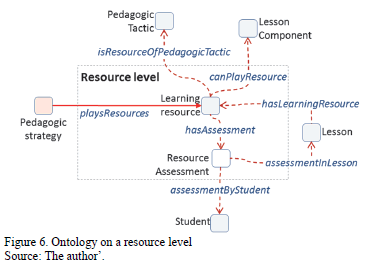
<body><![CDATA[<p><font size="3" face="Verdana, Arial, Helvetica, sans-serif"><b>1. Introduction</b></font></p>     <p><font size="2" face="Verdana, Arial, Helvetica, sans-serif">An Intelligent  Tutoring System (ITS) is an intelligent system that provides individualized  instructions to students &#91;1,2&#93;. One of the main components in an ITS is the  tutor module. The pedagogical model contained in the tutor module is  responsible for determining the learning objectives and the selecting  pedagogical strategies that are most appropriate to guide a particular  student's learning process &#91;3,4&#93;. The pedagogical strategies are the set of  actions performed to facilitate the instruction and learning of students. </font></p>     <p><font size="2" face="Verdana, Arial, Helvetica, sans-serif">Various approaches are discussed in the literature to  develop individualized instructions in an ITS. The experts developed  pedagogical strategies into static plans in the early versions of ITS &#91;5&#93;. The  next step in the evolution of personalized instructions is the implementation  of algorithms for the production of instructional plans &#91;6-9&#93;; however, these  plans have been difficult to develop, maintain and modify.</font></p>     <p><font size="2" face="Verdana, Arial, Helvetica, sans-serif">Several approaches and proposals have been presented by  various authors in order to improve the personalization of student instructions  in ITS &#91;10-12&#93;. Karampiperis and Sampson &#91;12&#93; proposed an adaptive  instructional plans model, based on the use of ontologies. Although the  instructional plan model can replan on its own when a student has trouble  achieving his or her learning objectives, replanning takes place in terms of  resources used and not in terms of pedagogical strategies.</font></p>     <p><font size="2" face="Verdana, Arial, Helvetica, sans-serif">Arias, Jim&eacute;nez, and Ovalle proposed a model of  instructional planning using Case-Based Reasoning (CBR) &#91;13&#93;. This model allows  instructions to be adapted in order to meet the specific needs of each student.  A major limitation of this model is that the activity plans that are generated  can be incomplete if the case characteristics do not adequately cover the entire  solution space. </font></p>     <p><font size="2" face="Verdana, Arial, Helvetica, sans-serif">More recently, personalization approaches have focused on  the pedagogical model of the tutor module of the ITS. Barros &#91;3&#93; presented a  pedagogical model designed using an ontology called pedagogical ontology.  However, the model does not have mechanisms to auto adjust the strategies  established by the ontology.</font></p>     <p><font size="2" face="Verdana, Arial, Helvetica, sans-serif">None of the studies reviewed to date has been designed  with all three learning theories elements, teaching methods, and teaching  tactics used in each stage of the lesson, within the same model.</font></p>     <p><font size="2" face="Verdana, Arial, Helvetica, sans-serif">The design of mechanisms for the formulation of  pedagogical strategies in Intelligent Tutoring Systems is a complex task due to  the number of variables involved. In particular, the selection of the methods  or pedagogic tactics to be used for the development of a certain lesson  requires the ITS to hold an extensive repertoire of pedagogical knowledge. In  many cases, the ITS generates recommendations that are inappropriate for the  student in terms of their profile or preferences. Inappropriate recommendations  affect student performance in the lesson due to inconsistencies in the  presentation of resources and an inadequate level of content or strategy to  address the lesson.</font></p>     <p><font size="2" face="Verdana, Arial, Helvetica, sans-serif">In this context, the aim of this paper is to present a new  approach to a pedagogical model for the personalization of pedagogical  strategies in ITS. The proposed pedagogical model allows the ITS to personalize  pedagogical strategies into five levels: learning resources, activity level,  pedagogical tactics level, teaching methods, and educational theories level.  Personalization can be based on student profile, dynamicity of student  interaction, or be experience-based. The model allows the ITS a higher level of  personalization of the pedagogical strategy in order to reduce the number of  inappropriate recommendations for the student.</font></p>     <p><font size="2" face="Verdana, Arial, Helvetica, sans-serif">An ITS called FUNPRO was developed to validate the  multilevel pedagogical model. The reasoning performed by the system is based on  rules and pedagogical knowledge that is represented in the form of ontologies.  The empirical tests results showed the high adaptive capacities that the  multilayer model provides to FUNPRO. </font></p>     ]]></body>
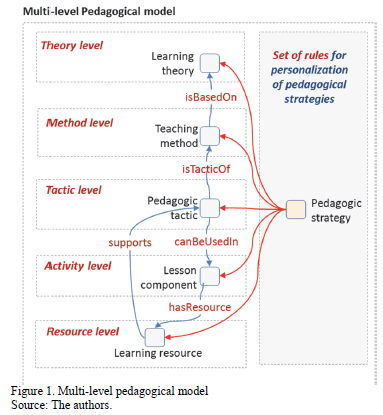
<body><![CDATA[<p><font size="2" face="Verdana, Arial, Helvetica, sans-serif">The primary objective of the ITS is to provide  personalized instruction &#91;1,2&#93;. Therefore, the main module of an ITS is the  tutor module &#91;14&#93;. The tutor module is also known in the literature as the  Instructional Planner &#91;5,13,15&#93;.</font></p>     <p><font size="2" face="Verdana, Arial, Helvetica, sans-serif">The pedagogic model inside the tutor module has  educational functions. It is responsible for guiding the teaching-learning  process and deciding what pedagogical actions are undertaken, how, and when &#91;1,13&#93;.  In ITS, the pedagogical model contained in the tutor module is responsible for  determining the learning objectives and selecting pedagogical strategies that  are most appropriate to guide the learning process of a particular student  &#91;3,4,16,17&#93;.</font></p>     <p><font size="2" face="Verdana, Arial, Helvetica, sans-serif">The instructional plan configures the pedagogic strategy  used for each student. The purpose of the pedagogic strategies is to facilitate  student instruction and learning &#91;18&#93;. Pedagogic strategies, in general, refer  to abstract teaching methods &#91;19&#93;. Pedagogic strategies are oriented towards  configuring activities and interfaces between the student and the imparting of learning  process. In educational environments, the pedagogic strategies are action plans  designed to manage issues related to sequencing and organizing instructional  content &#91;8&#93;, specifying learning activities, deciding how to deliver the  content &#91;19&#93;, and employing pedagogic tactics &#91;4&#93;.</font></p>     <p><font size="2" face="Verdana, Arial, Helvetica, sans-serif">The main contribution of this work is the incorporation of  levels of personalization in pedagogical strategies. Levels allow for a greater  number of customization aspects in the pedagogical strategy. Each level of the  model represents a component of the pedagogical strategy; at each level, the  ITS collects data, undertakes reasoning and, if inappropriate, reconfigures  recommendations that are generated. </font></p>     <p><font size="2" face="Verdana, Arial, Helvetica, sans-serif">This paper is organized as follows, Section 2 presents the  architecture proposed for a pedagogic model in Intelligent Tutoring Systems,  and the personalization rules implemented in this work are explained. Section 3  presents the methodology used to validate the pedagogical model. Section 4  presents an analysis of empirical data that was collected from the validation  test. Finally, Section 5 discusses the main conclusions and future work</font></p>     <p>&nbsp;</p>     <p><font size="3" face="Verdana, Arial, Helvetica, sans-serif"><b>2. The multi-level   pedagogical model</b></font></p>     <p><font size="2" face="Verdana, Arial, Helvetica, sans-serif">The pedagogical model is multilevel in order to enrich the  possibilities for personalization of pedagogical strategies. The pedagogical  strategy is personalized at each level according to each student's characteristics.  The following five abstraction levels compose the proposed pedagogic model:  Theory level, Method level, Tactic level, Activity level, and Resource level,  see <a href="#fig01">Fig. 1</a>. </font></p>     <p align="center"><font size="2" face="Verdana, Arial, Helvetica, sans-serif"><a name="fig01"></a></font><img src="/img/revistas/dyna/v82n194/v82n194a23fig01.gif"></p>     <p><font size="2" face="Verdana, Arial, Helvetica, sans-serif">Each level of the  pedagogical model is represented by ontologies. For the definition of  educational domain terminology and for pre-selection of the teaching methods  and pedagogical tactics, a literature review was carried out. Then, several  meetings were held with a group of experts from the Department of Educational  Psychology at the Universidad de C&oacute;rdoba (COL). In these sessions, terminology  was validated and the pedagogical tactics to be implemented were selected. In  this way, elements of the pedagogical model's structure, described below, were  defined.</font></p>     ]]></body>
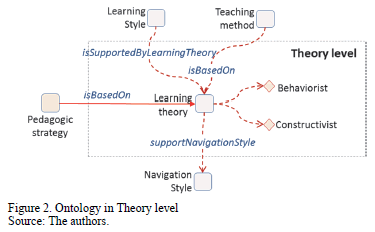
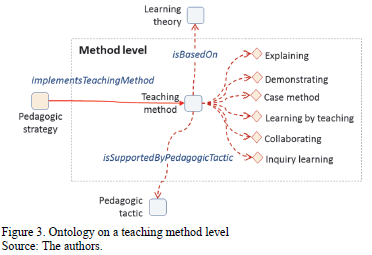
<body><![CDATA[<p><font size="2" face="Verdana, Arial, Helvetica, sans-serif"><b><i>2.1. Theory level</i></b></font></p>     <p><font size="2" face="Verdana, Arial, Helvetica, sans-serif">Learning  theories are composed of a diverse set of theoretical frameworks, which try to  explain how individuals access knowledge. Many features of pedagogical theories  can be partially modeled by computer. In this paper, we have only included  those characteristics that can be modeled computationally: the type</font> <font size="2" face="Verdana, Arial, Helvetica, sans-serif">of content sequencing, the  type of assistance provided to students, and the type of evaluation, see model  in <a href="#fig02">Fig. 2</a>.</font></p>     <p align="center"><font size="2" face="Verdana, Arial, Helvetica, sans-serif"><a name="fig02"></a></font><img src="/img/revistas/dyna/v82n194/v82n194a23fig02.gif"></p>     <p><font size="2" face="Verdana, Arial, Helvetica, sans-serif">The proposed model  supports two types of educational theories: behaviorism and constructivism. The  characteristics of the behaviorism theory that are supported by the multilevel  model are: linear navigation between contents, immediate reinforcement, and  organization of content for levels with prerequisites. </font></p>     <p><font size="2" face="Verdana, Arial, Helvetica, sans-serif">Moreover, constructivist features supported by the  multilevel model are: free navigation between content, content organization  with minimal and necessary prerequisites, formative assessment, and activities  for active student participation.</font></p>     <p><font size="2" face="Verdana, Arial, Helvetica, sans-serif"><b><i>2.2. Method level</i></b></font></p>     <p><font size="2" face="Verdana, Arial, Helvetica, sans-serif">A  teaching method is comprised by the principles that include an orderly logical  arrangement of the tactics and activities  that are used in course lessons. The teaching methods are based on pedagogical  theories; each method may contain all or part of the pedagogical principles in  the theories, see <a href="#fig03">Fig. 3</a>. </font></p>     <p align="center"><font size="2" face="Verdana, Arial, Helvetica, sans-serif"><a name="fig03"></a></font><img src="/img/revistas/dyna/v82n194/v82n194a23fig03.gif"></p>     <p><font size="2" face="Verdana, Arial, Helvetica, sans-serif">The isBasedOn  relationship determines the learning theory, which is based on a teaching  method and establishes the content's organization. The is Supported By Pedagogical  Tactic relationship, however, allows the association of the pedagogical tactics  that will be used in the teaching method. </font></p>     <p><font size="2" face="Verdana, Arial, Helvetica, sans-serif"><b><i>2.3. Tactic level</i></b></font></p>     ]]></body>
<body><![CDATA[<p><font size="2" face="Verdana, Arial, Helvetica, sans-serif">Tutor Module provides  the learning objectives based on student characteristics. In addition, Tutor  Module offers a range of pedagogic tactics for the student to achieve the  learning objectives that have been established for him. Pedagogic Tactics are  composed of actions and resources that are used in the interaction with the  student &#91;4&#93; in order to provide a personalized teaching experience. The  selection criteria used to include a pedagogic tactic in the Tutor Module was  that such tactic can be modeled computationally &#91;18,20&#93;. In this work 19  pedagogic tactics were implemented (see <a href="#fig04">Fig. 4</a>).</font></p>     <p align="center"><font size="2" face="Verdana, Arial, Helvetica, sans-serif"><a name="fig04"></a></font><img src="/img/revistas/dyna/v82n194/v82n194a23fig04.gif"></p>     <p><font size="2" face="Verdana, Arial, Helvetica, sans-serif">The canPlaysPedagogicalTactic relationship allows the  pedagogical strategy to be associated with one or more lesson components. When  a new learning resource is added, a new isResourceOfPedagogicalTactic  relationship is created. </font></p>     <p><font size="2" face="Verdana, Arial, Helvetica, sans-serif"><b><i>2.4. Activity  level</i></b></font></p>     <p><font size="2" face="Verdana, Arial, Helvetica, sans-serif">The components of the lesson are the sections in which the  lesson activities are organized. <a href="#fig05">Fig. 5</a> shows the model of activity level.</font></p>     <p align="center"><font size="2" face="Verdana, Arial, Helvetica, sans-serif"><a name="fig05"></a></font><img src="/img/revistas/dyna/v82n194/v82n194a23fig05.gif"></p>     <p><font size="2" face="Verdana, Arial, Helvetica, sans-serif">The division of the lesson into sections has been widely  used in the teaching practice &#91;5,21,22&#93;. Specifically, our proposal for lesson  components is based on &#91;22&#93;; however, we make some modifications to adjust it  to an education context in our university. Our proposed model suggests that there  are six sections in the structure of a lesson: introduction, definition,  explanation, example, activity, and evaluation.</font></p>     <p><font size="2" face="Verdana, Arial, Helvetica, sans-serif">In the Introduction section the objectives and information  about the context of the lesson are presented. In the Description, the  definitions and concepts related to the lesson are displayed. The Explanation  section delves into concepts and issues relevant to the lesson. In the Example  section, examples and demonstrations are provided that are related to the lesson's  themes. In the Activity section, active pedagogical tactics, such as  experiments, simulations, and exercises are employed. Finally, in the  Evaluation section questionnaires and various types of tests to measure student  achievement in the lessons are presented. </font></p>     <p><font size="2" face="Verdana, Arial, Helvetica, sans-serif"><b><i>2.5. Resource  level</i></b></font></p>     <p><font size="2" face="Verdana, Arial, Helvetica, sans-serif">Learning resources are digital objects such as images,  animations, simulations, web pages, and more. Learning resources are the  content carriers in the lesson and have different formats. <a href="#fig06">Fig. 6</a> shows the  relationship between the resource level and other of the model's components.</font></p>     ]]></body>
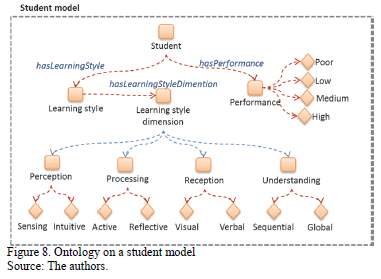
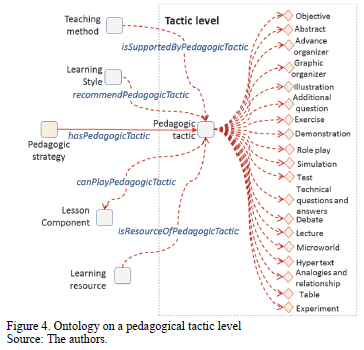
<body><![CDATA[<p align="center"><font size="2" face="Verdana, Arial, Helvetica, sans-serif"><a name="fig06"></a></font><img src="/img/revistas/dyna/v82n194/v82n194a23fig06.gif"></p>     <p><font size="2" face="Verdana, Arial, Helvetica, sans-serif">Students have the opportunity to assess the learning  resources that the instructional planner recommends for each component of the  lesson. The assessment is based on a scale of 1-5 as follows: (1) The resource  was of no use in learning the lesson's subject, (2) the resource made little  contribution to learning the lesson's topic, (3) the resource partially  contributed in learning the lesson, (4) the resource was useful for the lesson,  and (5) the resource was very useful for learning the lesson's topic.</font></p>     <p><font size="2" face="Verdana, Arial, Helvetica, sans-serif"><b><i>2.6. Personalization  of pedagogical strategies </i></b></font></p>     <p><font size="2" face="Verdana, Arial, Helvetica, sans-serif">The pedagogical strategy has an internal representation  consisting of three sections: context, recommendation, and performance, see <a href="#fig07">Fig.  7</a>.</font></p>     <p align="center"><font size="2" face="Verdana, Arial, Helvetica, sans-serif"><a name="fig07"></a></font><img src="/img/revistas/dyna/v82n194/v82n194a23fig07.gif"></p>     <p><font size="2" face="Verdana, Arial, Helvetica, sans-serif">The context section  contains the input data used to configure the pedagogical strategy, which are:  student information, course, and lesson. The recommendation section contains  the settings for the pedagogical strategy, which are adapted to the student. This  section consists of the navigation style, pedagogical theory, the teaching  method, the components of the lesson that are enabled to students, and  pedagogical tactics for each component. The performance section stores the  result of the recommendation for a particular student's strategy. The performance of the strategy depends on  the performance of the student in the lesson and has a scale of low, medium,  and high. </font></p>     <p><font size="2" face="Verdana, Arial, Helvetica, sans-serif">Following the personalization process, the pedagogical  strategy at each level of the model is described. Applying the rules of  reasoning that comprise the pedagogical knowledge element of the model makes  the personalization. </font></p>     <p><font size="2" face="Verdana, Arial, Helvetica, sans-serif"><b><i>2.7. Personalization  in learning theory's recommendations </i></b></font></p>     <p><font size="2" face="Verdana, Arial, Helvetica, sans-serif">The pedagogical strategies are implemented using learning  theories criteria; otherwise, they would be limited to sequence of activities  and tasks that do not have a clear educational purpose &#91;23&#93;. </font></p>     <p><font size="2" face="Verdana, Arial, Helvetica, sans-serif">When a new student is registered, a profile is created  immediately. The student fills out a form to generate his learning style  profiles. When a registered student enters into the ITS, the pedagogical model  activates the corresponding student model to adapt the teaching session. Preferences  and indicators related to the student's level and learning style are obtained  from the student model, see <a href="#fig08">Fig. 8</a>.</font></p>     ]]></body>
<body><![CDATA[<p align="center"><font size="2" face="Verdana, Arial, Helvetica, sans-serif"><a name="fig08"></a></font><img src="/img/revistas/dyna/v82n194/v82n194a23fig08.gif"></p>     <p><font size="2" face="Verdana, Arial, Helvetica, sans-serif">The approach used in this work to model the student  learning style was based on the model developed by Felder &#91;24&#93;. Then, the  following processes perform the personalization of pedagogical strategies on a  learning theory level: </font></p>     <p><font size="2" face="Verdana, Arial, Helvetica, sans-serif">Profile-based adaptation: The adaptation takes the  student's learning style into account as input parameters, including the  dimension of understanding. For example, if the student has a predisposition that  favors the sequential development of content, then the system will recommend a  pedagogical strategy based on behaviorism. Otherwise, it will recommend a  teaching strategy based on constructivism.</font></p>     <p><font size="2" face="Verdana, Arial, Helvetica, sans-serif">Rule 1:</font></p>     <blockquote>       <p><font size="2" face="Verdana, Arial, Helvetica, sans-serif">Student (?s) &#094; hasLearningStyle (?s, sequential) &#094;    <br> </font><font size="2" face="Verdana, Arial, Helvetica, sans-serif">HaslearningStyleDimension (?ls, understanding)    <br> </font><font size="2" face="Verdana, Arial, Helvetica, sans-serif">&rarr; playsLearningTheory (?s, behaviorism) (1)</font></p> </blockquote>     <p><font size="2" face="Verdana, Arial, Helvetica, sans-serif">Dynamic adaptation occurs when the recommended tactic for  teaching a lesson is changed for a new one. If the new pedagogical tactic is  based on a different pedagogical theory, the pedagogical strategy and student  profile are updated.</font></p>     <p><font size="2" face="Verdana, Arial, Helvetica, sans-serif">Rule 2:</font></p>     ]]></body>
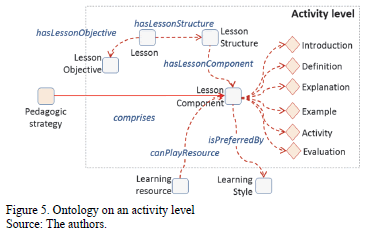
<body><![CDATA[<blockquote>       <p><font size="2" face="Verdana, Arial, Helvetica, sans-serif">TeachingMethod (?tm) &#094; TeachingMethod (?new_tm) &#094;    <br> </font><font size="2" face="Verdana, Arial, Helvetica, sans-serif">isbasedOnLearningTheory (?tm , ?lt) &#094;    <br>   </font><font size="2" face="Verdana, Arial, Helvetica, sans-serif">isbasedOnLearningTheory (?new_tm, ?lt') &#094;    <br>     </font><font size="2" face="Verdana, Arial, Helvetica, sans-serif">¬( LearningTheory (?lt) = LearningTheory (?lt') )    <br>     </font><font size="2" face="Verdana, Arial, Helvetica, sans-serif">&rarr; playsLearningTheory (?s, ?lt') (2)</font></p> </blockquote>     <p><font size="2" face="Verdana, Arial, Helvetica, sans-serif"><b><i>2.8. Personalization in the teaching method  recommendation </i></b></font></p>     <p><font size="2" face="Verdana, Arial, Helvetica, sans-serif">The adaptation at method level is performed in the  following ways: </font></p>     <p><font size="2" face="Verdana, Arial, Helvetica, sans-serif">Adaptation is based on the theory of learning. Each  teaching method is influenced by one or more learning theories. Thus, if it is  recommended that the student use the constructivist theory of learning then this  recommendation will be based on constructivist methods.</font></p>     <p><font size="2" face="Verdana, Arial, Helvetica, sans-serif">Rule 3:</font></p>     ]]></body>
<body><![CDATA[<blockquote>       <p><font size="2" face="Verdana, Arial, Helvetica, sans-serif">Student (?s) &#094; hasLearningStyle (?s, ?ls) &#094;     LearningStyle(?ls) &#094;    <br> </font><font size="2" face="Verdana, Arial, Helvetica, sans-serif">isSupportedByLearningTheory (?ls, ?lt) &#094;   LearningTheory (?lt) &#094;    <br>   </font><font size="2" face="Verdana, Arial, Helvetica, sans-serif">isBasedOnLearningTheory(?ls, ?tm) &#094; TeachingMethod     (?tm)    <br>   </font><font size="2" face="Verdana, Arial, Helvetica, sans-serif">&rarr; implementsTeachingMethod (?s, ?tm) (3)</font></p> </blockquote>     <p><font size="2" face="Verdana, Arial, Helvetica, sans-serif">Dynamic adaptation occurs when the recommended tactic for  teaching a lesson is changed for a new one. If the new pedagogical tactic is  based on a different teaching method, the pedagogical strategy and student  profile are updated.</font></p>     <p><font size="2" face="Verdana, Arial, Helvetica, sans-serif">Rule 4:</font></p>     <blockquote>       <p><font size="2" face="Verdana, Arial, Helvetica, sans-serif">PedagogicTactic (?pt) &#094;    <br> </font><font size="2" face="Verdana, Arial, Helvetica, sans-serif">PedagogicTactic (?new_pt) &#094;    ]]></body>
<body><![CDATA[<br>   </font><font size="2" face="Verdana, Arial, Helvetica, sans-serif">isSupportedByTeachingMethod (?pt , ?tm) &#094;    <br>     </font><font size="2" face="Verdana, Arial, Helvetica, sans-serif">isSupportedByTeachingMethod (?new_pt, ?tm') &#094;    <br>     </font><font size="2" face="Verdana, Arial, Helvetica, sans-serif">¬( TeachingMethod (?tm) = TeachingMethod (?tm') )    <br>     </font><font size="2" face="Verdana, Arial, Helvetica, sans-serif">&rarr; implementsTeachingMethod (?s, ?tm')(4)</font></p> </blockquote>     <p><font size="2" face="Verdana, Arial, Helvetica, sans-serif"><b><i>2.9. Personalization in the pedagogic tactic's recommendation </i></b></font></p>     <p><font size="2" face="Verdana, Arial, Helvetica, sans-serif">The personalization of pedagogical strategies on a  pedagogical tactics level is performed in the following ways: </font></p>     <p><font size="2" face="Verdana, Arial, Helvetica, sans-serif">Profile-based adaptation: The pedagogical tactics  recommendation of is carried out based on the student profile.</font></p>     <p><font size="2" face="Verdana, Arial, Helvetica, sans-serif">Rule 5:</font></p>     <blockquote>       <p><font size="2" face="Verdana, Arial, Helvetica, sans-serif">Student (?s) &#094; hasLearningStyle (?s, ?ls) &#094;     LearningStyle(?ls) &#094;    ]]></body>
<body><![CDATA[<br> </font><font size="2" face="Verdana, Arial, Helvetica, sans-serif">implementsTeachingMethod(?s, ?tm) &#094;   TeachingMethod(?tm) &#094;    <br>   </font><font size="2" face="Verdana, Arial, Helvetica, sans-serif">givesSupportToPedagogicTactic(?tm, ?pt) &#094;    <br>     </font><font size="2" face="Verdana, Arial, Helvetica, sans-serif">isSupportedByPedagogicTactic (?ls, ?pt) &#094; PedagogicTactic (?pt) &#094;    <br>     </font><font size="2" face="Verdana, Arial, Helvetica, sans-serif">canPlayInLessonComponent (?pt, ?lc)    <br>     </font><font size="2" face="Verdana, Arial, Helvetica, sans-serif">&rarr; playsPedagogicTactic (?lc, ?pt) (5)</font></p> </blockquote>     <p><font size="2" face="Verdana, Arial, Helvetica, sans-serif">In this study, 19 pedagogic tactics were implemented, see <a href="#fig03">Fig.  3</a>. The selection of the pedagogical tactics was based on &#91;4,18,20&#93;. </font></p>     <p><font size="2" face="Verdana, Arial, Helvetica, sans-serif">Dynamic Adaptation: This type of adaptation occurs when a  student changes a recommended resource for a lesson with a new one. In this  case, if the new resource supports a different kind of pedagogical tactic, the  system reconfigures the recommendation preferences for the student and states  that the tag recommendation is inappropriate.</font></p>     <p><font size="2" face="Verdana, Arial, Helvetica, sans-serif">Rule 6:</font></p>     <blockquote>       <p><font size="2" face="Verdana, Arial, Helvetica, sans-serif">LearningResource (?current_lr) &#094; LearningResource     (?new_lr) &#094;    ]]></body>
<body><![CDATA[<br> </font><font size="2" face="Verdana, Arial, Helvetica, sans-serif">isResourceOfLessonComponent (?new_lr , ?lc) &#094;    <br>   </font><font size="2" face="Verdana, Arial, Helvetica, sans-serif">isResourceOfPedagogicTactic (?new_lr, ?pt') &#094;    <br>       </font><font size="2" face="Verdana, Arial, Helvetica, sans-serif">isResourceOfPedagogicTactic (?lr , ?pt) &#094;    <br>        </font><font size="2" face="Verdana, Arial, Helvetica, sans-serif">¬( PedagogicTactic (?pt) = PedagogicTactic (?pt') )    <br>         </font><font size="2" face="Verdana, Arial, Helvetica, sans-serif">&rarr; playsPedagogicTactic           (?lc, ?pt') (6)</font></p> </blockquote>     <p><font size="2" face="Verdana, Arial, Helvetica, sans-serif"><b><i>2.10. Personalization in the learning resources  recommendation </i></b></font></p>     <p><font size="2" face="Verdana, Arial, Helvetica, sans-serif">Adapting pedagogical strategies on a resource level occurs  in the following cases: </font></p>     <p><font size="2" face="Verdana, Arial, Helvetica, sans-serif">Profile-based adaptation: Consists of the recommendation  of resources according to the characteristics of the student profile. </font></p>     <p><font size="2" face="Verdana, Arial, Helvetica, sans-serif">Rule 7:</font></p>     <blockquote>       ]]></body>
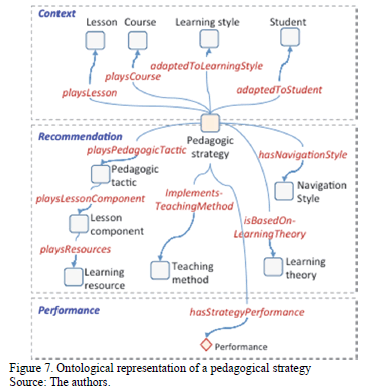
<body><![CDATA[<p><font size="2" face="Verdana, Arial, Helvetica, sans-serif">Student (?s) &#094; hasLearningStyle (?s, ?ls) &#094;     LearningStyle(?ls) &#094;    <br> </font><font size="2" face="Verdana, Arial, Helvetica, sans-serif">canUseTeachingMethod(?s, ?tm) &#094; TeachingMethod(?tm) &#094;    <br>   </font><font size="2" face="Verdana, Arial, Helvetica, sans-serif">givesSupportToPedagogicTactic(?tm, ?pt) &#094; PedagogicTactic     (?pt) &#094; isSupportedByPedagogicTactic (?ls, ?pt) &#094; canPlayInLessonComponent (?pt, ?lc) &#094; LearningResource (?lr) &#094;    <br>       </font><font size="2" face="Verdana, Arial, Helvetica, sans-serif">isResourceOfLessonComponent (?lr , ?lc) &#094;    <br>        </font><font size="2" face="Verdana, Arial, Helvetica, sans-serif">isResourceOfPedagogicTactic (?lr , ?pt)    <br>      </font><font size="2" face="Verdana, Arial, Helvetica, sans-serif">&rarr; playsLearningResource (?pt, ?lr) (7)</font></p> </blockquote>     <p><font size="2" face="Verdana, Arial, Helvetica, sans-serif">Rule 7 is conditioned by the context of the pedagogical  strategy and the result of the student evaluation for the learning resource  after its use during the lesson. The resources are sorted from highest to  lowest evaluation result. The model selects the resource with the highest  performance.</font></p>     <p><font size="2" face="Verdana, Arial, Helvetica, sans-serif">Adaptation by preference: This type of recommendation  occurs when a student changes the recommended learning resource to a different  resource. In this case, the system  updates the student's preferences according to the characteristics of the newly  selected resource, and the new profile will be used to give new  recommendations.</font></p>     <p><font size="2" face="Verdana, Arial, Helvetica, sans-serif">Rule 8:</font></p>     <blockquote>       ]]></body>
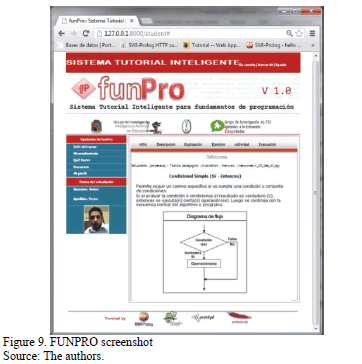
<body><![CDATA[<p><font size="2" face="Verdana, Arial, Helvetica, sans-serif">LearningResource (?current_lr) &#094; LearningResource     (?new_lr) &#094; isResourceOfLessonComponent (?new_lr , ?lc) &#094;    <br>   </font><font size="2" face="Verdana, Arial, Helvetica, sans-serif">isResourceOfPedagogicTactic (?new_lr, ?pt) &#094;    <br>   </font><font size="2" face="Verdana, Arial, Helvetica, sans-serif">isResourceOfPedagogicTactic (?lr , ?pt') &#094;    <br>   </font><font size="2" face="Verdana, Arial, Helvetica, sans-serif">PedagogicTactic (?pt) = PedagogicTactic (?pt')    <br>   </font><font size="2" face="Verdana, Arial, Helvetica, sans-serif">&rarr; playsLearningResource (?pt, ?new_lr) (8)</font></p> </blockquote>     <p>&nbsp;</p>     <p><font size="3" face="Verdana, Arial, Helvetica, sans-serif"><b>3. Methodology</b></font></p>     <p><font size="2" face="Verdana, Arial, Helvetica, sans-serif">An ITS, to be used to learn Programming Fundamentals  (FUNPRO) was developed using a MODESEC &#91;25&#93; methodology, and it is based on  introspective learning &#91;26&#93;. FUNPRO was used to validate the multi-level  pedagogic model and was developed entirely in SWI-Prolog. To edit the graphical  interface, Notepad + + was used, see screenshot in <a href="#fig09">Fig. 9</a>.</font></p>     <p align="center"><font size="2" face="Verdana, Arial, Helvetica, sans-serif"><a name="fig09"></a></font><img src="/img/revistas/dyna/v82n194/v82n194a23fig09.gif"></p>     <p><font size="2" face="Verdana, Arial, Helvetica, sans-serif"><b><i>3.1. Configuration  of the experiment</i></b></font></p>     ]]></body>
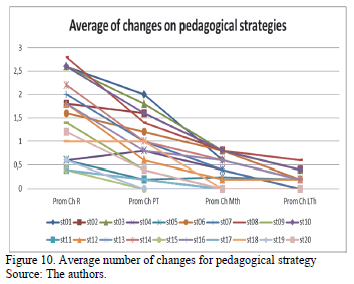
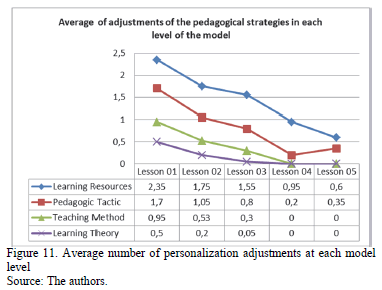
<body><![CDATA[<p><font size="2" face="Verdana, Arial, Helvetica, sans-serif">A practical experiment  was conducted in order to verify the personalization level of pedagogical  strategies with respect to the preferences and profiles of students using  FUNPRO. The experiment was conducted with 20 students undertaking an  introductory course in programming. The course consisted of five lessons and  had a basic level of complexity. </font></p>     <p><font size="2" face="Verdana, Arial, Helvetica, sans-serif">The performance metric  used to measure the personalization level of pedagogical strategies was the  average of changes made to the pedagogical strategies recommended at each model  level. Changes in pedagogical strategies can be </font><font size="2" face="Verdana, Arial, Helvetica, sans-serif">made directly by the student (e.g.  when the student changes a learning resource) or dynamically (e.g., when the  ITS detects a change in the student's learning preferences). </font></p>     <p><font size="2" face="Verdana, Arial, Helvetica, sans-serif">Changes made to the  teaching strategy components, recommended for each student, will be interpreted  as inappropriate recommendations. In this sense, if the amount of changes  needed to adjust the pedagogical strategy according to the student's profile is  high, and then the level of personalization of the teaching strategy will be  low. Thus, the aims of the experiment were to see whether the multi-layer  pedagogical model could increase the level of personalization of pedagogical  strategies by reducing changes to the recommended strategy for each student in  each lesson of the course, and also to observe if the reduction of  inappropriate recommendations had a positive effect on student performance  during the lesson.</font></p>     <p>&nbsp;</p>     <p><font size="3" face="Verdana, Arial, Helvetica, sans-serif"><b>4. Results</b></font></p>     <p><font size="2" face="Verdana, Arial, Helvetica, sans-serif">Data from the experiment will be described with respect to  i) personalization of pedagogical strategies to the student profile at each  level of the model and, ii) the relationship observed between the evaluation  made by students in terms of learning resources and the changes made system to  the pedagogical strategy.</font></p>     <p><font size="2" face="Verdana, Arial, Helvetica, sans-serif">i) Personalization of pedagogical  strategies </font></p>     <p><font size="2" face="Verdana, Arial, Helvetica, sans-serif">In the data obtained  from the experiment, with respect to the behavior of the adaptation of the  pedagogical strategy to the student profile at each level of the model, the  average number of adaptations per student observed at level of learning  resources was 1.44. The average number of pedagogic tactic level adaptations  was 0.82, the average number of adaptations at teaching method level was 0.35,  and the average number of adaptations at learning theory level was 0.15.</font></p>     <p><font size="2" face="Verdana, Arial, Helvetica, sans-serif"><a href="#fig10">Fig. 10</a> shows that the model level with the most number of  adaptations was learning resource, and the level where there were fewer  adjustments was learning theory.</font></p>     <p align="center"><font size="2" face="Verdana, Arial, Helvetica, sans-serif"><a name="fig10"></a></font><img src="/img/revistas/dyna/v82n194/v82n194a23fig10.gif"></p>     ]]></body>
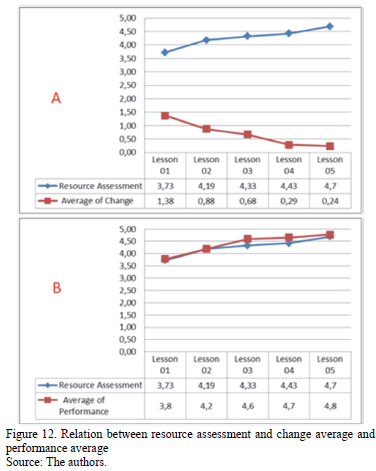
<body><![CDATA[<p><font size="2" face="Verdana, Arial, Helvetica, sans-serif">With respect to the occurrence of adaptation generated by  the relationship between the levels, it can be said that 56.9% of resource  changes made by the student generated changes in pedagogical tactics by applying  rule (7). 42.7% of pedagogical tactic changes generated teaching method changes  by applying rule (4), and 42.9% of teaching method changes generated Learning  Theory changes for pedagogical strategy as a result of rule (2).</font></p>     <p><font size="2" face="Verdana, Arial, Helvetica, sans-serif"><a href="#fig11">Fig. 11</a> shows the data on the average number of  adaptations to the pedagogical strategy in each model level for each lesson in  the course. With respect to the average of changes made to the pedagogical  strategy recommended, a reduction of adaptations in each component of the  strategy, while the student progresses in the course, is observed.</font></p>     <p align="center"><font size="2" face="Verdana, Arial, Helvetica, sans-serif"><a name="fig11"></a></font><img src="/img/revistas/dyna/v82n194/v82n194a23fig11.gif"></p>     <p><font size="2" face="Verdana, Arial, Helvetica, sans-serif">The results show that while the student's progress in the  course, the system adapts its pedagogical strategy. Thus, for each new lesson  the amount of required adjustments are minimal. Decreasing the number or  adjustments indicates that as the student uses the system, the multilevel model  improves recommendations for each component of the pedagogical strategy.</font></p>     <p><font size="2" face="Verdana, Arial, Helvetica, sans-serif">ii) Relationship between the  resource evaluation and the changes made to the pedagogical strategy</font></p>     <p><font size="2" face="Verdana, Arial, Helvetica, sans-serif">Section (A) <a href="#fig12">Fig. 12</a> shows the inverse relationship found  between the average number of resources assessments made by student and the  changes to the pedagogical strategy. </font></p>     <p align="center"><font size="2" face="Verdana, Arial, Helvetica, sans-serif"><a name="fig12"></a></font><img src="/img/revistas/dyna/v82n194/v82n194a23fig12.gif"></p>     <p><font size="2" face="Verdana, Arial, Helvetica, sans-serif">Students evaluate by giving the best score to which they  prefer: the learning resources included in the teaching strategy in a new  lesson or those learning resources that were recommended in a previous lesson. As the student evaluation of learning  resources improves, there is a decrease in the percentage of adaptations  required to personalize the pedagogical strategy. This is because the system  learns with each adaptation to the pedagogical strategy, in turn producing  better recommendations at each model level.</font></p>     <p><font size="2" face="Verdana, Arial, Helvetica, sans-serif">Section (B) of <a href="#fig12">Fig. 12</a> shows the relationship between  evaluations of learning resources and student performance in each lesson. When  recommendations at each level of the pedagogical strategy are adapted to the  profile of the student, an improvement in the student performance in the next  lesson is observed. </font></p>     <p>&nbsp;</p>     ]]></body>
<body><![CDATA[<p><font size="3" face="Verdana, Arial, Helvetica, sans-serif"><b>5. Conclusions</b></font></p>     <p><font size="2" face="Verdana, Arial, Helvetica, sans-serif">In this paper, we have presented a multi-level pedagogical  model-based on ontologies for the personalization of pedagogical strategies in  ITS. Personalization of pedagogical strategies is made using rule-based  reasoning. In this way, the structure of a pedagogical model for ITS, the main  elements of which are the theories of learning, pedagogic strategies, and  pedagogic tactics was defined. </font></p>     <p><font size="2" face="Verdana, Arial, Helvetica, sans-serif">The pedagogical tactics, teaching methods, and learning  theories supported by the model, were determined by experts in Educational  Psychology and supported by a literature review.</font></p>     <p><font size="2" face="Verdana, Arial, Helvetica, sans-serif">An ITS was used to learn about an introduction to  programming (FUNPRO) by using MODESEC methodology. This was developed to validate  the multi-level pedagogical model. Rules that create FUNPRO pedagogical  knowledge were developed entirely in SWI-Prolog. </font></p>     <p><font size="2" face="Verdana, Arial, Helvetica, sans-serif">The results show that when the students' progress in the  course the amount of required adjustments are minor. Decreasing the number of  adjustments indicates that the multilevel model improves recommendations on  each component of the pedagogical strategy as a result of rule (2, 4 and 7). The  evidence found in the data produced in the experiment shows that the proposed  multi-level model allows dynamic adaptation of the pedagogical strategy to each  student's profile . Adaptations to each model level influence the improvement  of student performance in the lessons that follow.</font></p>     <p>&nbsp;</p>     <p><font size="3" face="Verdana, Arial, Helvetica, sans-serif"><b>Acknowledgments</b></font></p>     <p><font size="2" face="Verdana, Arial, Helvetica, sans-serif">The authors thank the Department of Educational Psychology  of the Universidad de C&oacute;rdoba for the support and advice given throughout this  work. The scholarship commission of doctoral studies from the University of  C&oacute;rdoba funded this research.</font></p>     <p>&nbsp;</p>     <p><font size="3" face="Verdana, Arial, Helvetica, sans-serif"><b>References</b></font></p>     ]]></body>
<body><![CDATA[<!-- ref --><p><font size="2" face="Verdana, Arial, Helvetica, sans-serif"><b>&#91;1&#93;</b> Rongmei, Z. and Lingling, L., Research on  internet intelligent tutoring system based on MAS and CBR, Conference:  International Forum on Information Technology and Applications, IFITA 2009,  Chengdu, China, pp. 15-17, May 2009. DOI: 10.1109/IFITA.2009.511.    &nbsp;&nbsp;&nbsp;&nbsp;&nbsp;&nbsp;&nbsp;&nbsp;[&#160;<a href="javascript:void(0);" onclick="javascript: window.open('/scielo.php?script=sci_nlinks&ref=000183&pid=S0012-7353201500060002300001&lng=','','width=640,height=500,resizable=yes,scrollbars=1,menubar=yes,');">Links</a>&#160;]<!-- end-ref --></font></p>     <!-- ref --><p><font size="2" face="Verdana, Arial, Helvetica, sans-serif"><b>&#91;2&#93;</b> Wang, Z., Design and  implementation of an intelligent tutoring system for English instruction  Xuejing Gu 1,2 Jie Hel Siyi Zhengl Wei Wangl 2., Intell. Comput. Intell. Syst.  (ICIS), 2010 IEEE Int. Conf., (29-31) Oct, pp. 166-169, 2010.    &nbsp;&nbsp;&nbsp;&nbsp;&nbsp;&nbsp;&nbsp;&nbsp;[&#160;<a href="javascript:void(0);" onclick="javascript: window.open('/scielo.php?script=sci_nlinks&ref=000185&pid=S0012-7353201500060002300002&lng=','','width=640,height=500,resizable=yes,scrollbars=1,menubar=yes,');">Links</a>&#160;]<!-- end-ref --></font></p>     <!-- ref --><p><font size="2" face="Verdana, Arial, Helvetica, sans-serif"><b>&#91;3&#93;</b> H. Barros, A. Silva, E. Costa,  B. Ig, O. Holanda, and L. Sales, &quot;Steps , techniques , and technologies for the  development of intelligent applications based on Semantic Web Services:  A case study in e-learning systems,&quot; Eng. Appl. Artif. Intell., vol. 24, no. 8,  pp. 1355-1367, 2011. DOI: 10.1016/j.engappai.2011.05.007</font>&nbsp;&nbsp;&nbsp;&nbsp;&nbsp;&nbsp;&nbsp;&nbsp;[&#160;<a href="javascript:void(0);" onclick="javascript: window.open('/scielo.php?script=sci_nlinks&ref=000187&pid=S0012-7353201500060002300003&lng=','','width=640,height=500,resizable=yes,scrollbars=1,menubar=yes,');">Links</a>&#160;]<!-- end-ref --><!-- ref --><p><font size="2" face="Verdana, Arial, Helvetica, sans-serif"><b>&#91;4&#93;</b> Bezerra-da Silva, C.,  Pedagogical model based on semantic web rule language, 12th Int. Conf. Comput.  Sci. Its Appl., pp. 125-129, Jun. 2012.    &nbsp;&nbsp;&nbsp;&nbsp;&nbsp;&nbsp;&nbsp;&nbsp;[&#160;<a href="javascript:void(0);" onclick="javascript: window.open('/scielo.php?script=sci_nlinks&ref=000188&pid=S0012-7353201500060002300004&lng=','','width=640,height=500,resizable=yes,scrollbars=1,menubar=yes,');">Links</a>&#160;]<!-- end-ref --></font></p>     <!-- ref --><p><font size="2" face="Verdana, Arial, Helvetica, sans-serif"><b>&#91;5&#93;</b> Viccari, R.M. and Jim&eacute;nez, J.A.,  ALLEGRO: Teaching / Learning multi-agent environment using instructional  planning and cases- based reasoning (CBR ), CLEI Electron. Journal, 10(1), pp.  1-20, 2007.    &nbsp;&nbsp;&nbsp;&nbsp;&nbsp;&nbsp;&nbsp;&nbsp;[&#160;<a href="javascript:void(0);" onclick="javascript: window.open('/scielo.php?script=sci_nlinks&ref=000190&pid=S0012-7353201500060002300005&lng=','','width=640,height=500,resizable=yes,scrollbars=1,menubar=yes,');">Links</a>&#160;]<!-- end-ref --></font></p>     <!-- ref --><p><font size="2" face="Verdana, Arial, Helvetica, sans-serif"><b>&#91;6&#93;</b> Jones, J.A. Intelligent tutoring  systems: the first component of integrated information systems, Proceedings  IEEE Int. Conf. Syst. Man, Cybern., pp. 531-536, 1992. DOI: 10.1109/icsmc.1992.271719</font>&nbsp;&nbsp;&nbsp;&nbsp;&nbsp;&nbsp;&nbsp;&nbsp;[&#160;<a href="javascript:void(0);" onclick="javascript: window.open('/scielo.php?script=sci_nlinks&ref=000192&pid=S0012-7353201500060002300006&lng=','','width=640,height=500,resizable=yes,scrollbars=1,menubar=yes,');">Links</a>&#160;]<!-- end-ref --><!-- ref --><p><font size="2" face="Verdana, Arial, Helvetica, sans-serif"><b>&#91;7&#93;</b> Liu, J., The use of fuzzy  reasoning in intelligent computer aided instructional systems, in  Multiple-Valued Logic, 1988., Proceedings of the Eighteenth International  Symposium on, 1988.    &nbsp;&nbsp;&nbsp;&nbsp;&nbsp;&nbsp;&nbsp;&nbsp;[&#160;<a href="javascript:void(0);" onclick="javascript: window.open('/scielo.php?script=sci_nlinks&ref=000193&pid=S0012-7353201500060002300007&lng=','','width=640,height=500,resizable=yes,scrollbars=1,menubar=yes,');">Links</a>&#160;]<!-- end-ref --></font></p>     <!-- ref --><p><font size="2" face="Verdana, Arial, Helvetica, sans-serif"><b>&#91;8&#93;</b> Woo, C.W., Evens, M., Michael,  J. and Rovick, A., Dynamic instructional planning for an intelligent physiology  tutoring system, Comput. Med. Syst. - Proc. Fourth Annu. IEEE Symp., pp.  226-233, 1991.    &nbsp;&nbsp;&nbsp;&nbsp;&nbsp;&nbsp;&nbsp;&nbsp;[&#160;<a href="javascript:void(0);" onclick="javascript: window.open('/scielo.php?script=sci_nlinks&ref=000195&pid=S0012-7353201500060002300008&lng=','','width=640,height=500,resizable=yes,scrollbars=1,menubar=yes,');">Links</a>&#160;]<!-- end-ref --></font></p>     <!-- ref --><p><font size="2" face="Verdana, Arial, Helvetica, sans-serif"><b>&#91;9&#93;</b> Specht, M. and Augustin, D.-S.,  ATS-adaptive teaching system a WWW-based ITS, Web-Based Knowl. Servers (Digest  No. 1998/307), IEE Colloq., 1998.    &nbsp;&nbsp;&nbsp;&nbsp;&nbsp;&nbsp;&nbsp;&nbsp;[&#160;<a href="javascript:void(0);" onclick="javascript: window.open('/scielo.php?script=sci_nlinks&ref=000197&pid=S0012-7353201500060002300009&lng=','','width=640,height=500,resizable=yes,scrollbars=1,menubar=yes,');">Links</a>&#160;]<!-- end-ref --></font></p>     <!-- ref --><p><font size="2" face="Verdana, Arial, Helvetica, sans-serif"><b>&#91;10&#93;</b> Espinosa, M.L., S&aacute;nchez, N.M.,  Valdivia, Z.G. and P&eacute;rez, R.B., Concept maps combined with case-based reasoning  to elaborate intelligent teaching-learning systems, Computer (Long. Beach.  Calif)., pp. 205-210, 2007. DOI: 10.1109/isda.2007.33</font>&nbsp;&nbsp;&nbsp;&nbsp;&nbsp;&nbsp;&nbsp;&nbsp;[&#160;<a href="javascript:void(0);" onclick="javascript: window.open('/scielo.php?script=sci_nlinks&ref=000199&pid=S0012-7353201500060002300010&lng=','','width=640,height=500,resizable=yes,scrollbars=1,menubar=yes,');">Links</a>&#160;]<!-- end-ref --><!-- ref --><p><font size="2" face="Verdana, Arial, Helvetica, sans-serif"><b>&#91;11&#93;</b> Graham, C.R., Theoretical  considerations for understanding technological pedagogical content knowledge  (TPACK), Comput. Educ., 57(3), pp. 1953-1960, 2011. DOI: 10.1016/j.compedu.2011.04.010</font>&nbsp;&nbsp;&nbsp;&nbsp;&nbsp;&nbsp;&nbsp;&nbsp;[&#160;<a href="javascript:void(0);" onclick="javascript: window.open('/scielo.php?script=sci_nlinks&ref=000200&pid=S0012-7353201500060002300011&lng=','','width=640,height=500,resizable=yes,scrollbars=1,menubar=yes,');">Links</a>&#160;]<!-- end-ref --><!-- ref --><p><font size="2" face="Verdana, Arial, Helvetica, sans-serif"><b>&#91;12&#93;</b> Karampiperis, P. and Sampson,  D., Adaptive Instructional Planning using Ontologies, Proc. IEEE, 2004.    &nbsp;&nbsp;&nbsp;&nbsp;&nbsp;&nbsp;&nbsp;&nbsp;[&#160;<a href="javascript:void(0);" onclick="javascript: window.open('/scielo.php?script=sci_nlinks&ref=000201&pid=S0012-7353201500060002300012&lng=','','width=640,height=500,resizable=yes,scrollbars=1,menubar=yes,');">Links</a>&#160;]<!-- end-ref --></font></p>     ]]></body>
<body><![CDATA[<!-- ref --><p><font size="2" face="Verdana, Arial, Helvetica, sans-serif"><b>&#91;13&#93;</b> Arias,  F., Jim&eacute;nez, J. and Ovalle, D., Arias, F., Jim&eacute;nez, J. y Ovalle, D., Modelo de  planificaci&oacute;n instruccional en sistemas tutoriales inteligentes, Rev. Avances  en Sistemas e Inform&aacute;tica, 6(1), pp. 155-164, 2009.    &nbsp;&nbsp;&nbsp;&nbsp;&nbsp;&nbsp;&nbsp;&nbsp;[&#160;<a href="javascript:void(0);" onclick="javascript: window.open('/scielo.php?script=sci_nlinks&ref=000203&pid=S0012-7353201500060002300013&lng=','','width=640,height=500,resizable=yes,scrollbars=1,menubar=yes,');">Links</a>&#160;]<!-- end-ref --></font></p>     <!-- ref --><p><font size="2" face="Verdana, Arial, Helvetica, sans-serif"><b>&#91;14&#93;</b> Soh, L. and Blank, T.,  Integrating case-based reasoning and meta-learning for a self-improving  intelligent tutoring system, Int. J. Artif. Intell. Educ., 18(1), pp. 27-58,  2008.    &nbsp;&nbsp;&nbsp;&nbsp;&nbsp;&nbsp;&nbsp;&nbsp;[&#160;<a href="javascript:void(0);" onclick="javascript: window.open('/scielo.php?script=sci_nlinks&ref=000205&pid=S0012-7353201500060002300014&lng=','','width=640,height=500,resizable=yes,scrollbars=1,menubar=yes,');">Links</a>&#160;]<!-- end-ref --></font></p>     <!-- ref --><p><font size="2" face="Verdana, Arial, Helvetica, sans-serif"><b>&#91;15&#93;</b> Aguilar, R., Mu&ntilde;oz, V.,  Gonz&aacute;lez, E.J., Noda, M., Bruno, A. and Moreno, L., Fuzzy and multiagent  instructional planner for an intelligent tutorial system, Appl. Soft Comput.,  11(2), pp. 2142-2150, 2011. DOI: 10.1016/j.asoc.2010.07.013</font>&nbsp;&nbsp;&nbsp;&nbsp;&nbsp;&nbsp;&nbsp;&nbsp;[&#160;<a href="javascript:void(0);" onclick="javascript: window.open('/scielo.php?script=sci_nlinks&ref=000207&pid=S0012-7353201500060002300015&lng=','','width=640,height=500,resizable=yes,scrollbars=1,menubar=yes,');">Links</a>&#160;]<!-- end-ref --><!-- ref --><p><font size="2" face="Verdana, Arial, Helvetica, sans-serif"><b>&#91;16&#93;</b> Seridi, H., Sari, T., Khadir, T.  and Sellami, M., Adaptive instructional planning in intelligent learning  systems, Sixth IEEE Int. Conf. Adv. Learn. Technol., pp. 133-135, 2006.    &nbsp;&nbsp;&nbsp;&nbsp;&nbsp;&nbsp;&nbsp;&nbsp;[&#160;<a href="javascript:void(0);" onclick="javascript: window.open('/scielo.php?script=sci_nlinks&ref=000208&pid=S0012-7353201500060002300016&lng=','','width=640,height=500,resizable=yes,scrollbars=1,menubar=yes,');">Links</a>&#160;]<!-- end-ref --></font></p>     <!-- ref --><p><font size="2" face="Verdana, Arial, Helvetica, sans-serif"><b>&#91;17&#93;</b> Cheung, K.S., Lam, J., Lau, N.  and Shim, C., Instructional design practices for blended learning, Int. Conf.  Comput. Intell. Softw. Eng., pp. 1-4, Dec. 2010. DOI: 10.1109/cise.2010.5676762</font>&nbsp;&nbsp;&nbsp;&nbsp;&nbsp;&nbsp;&nbsp;&nbsp;[&#160;<a href="javascript:void(0);" onclick="javascript: window.open('/scielo.php?script=sci_nlinks&ref=000210&pid=S0012-7353201500060002300017&lng=','','width=640,height=500,resizable=yes,scrollbars=1,menubar=yes,');">Links</a>&#160;]<!-- end-ref --><!-- ref --><p><font size="2" face="Verdana, Arial, Helvetica, sans-serif"><b>&#91;18&#93;</b> Woo, C.W., Evens, M.W.,  Freedman, R., Glass, M., Shim, L.S., Zhang, Y., Zhou, Y. and Michael, J., An  intelligent tutoring system that generates a natural language dialogue using  dynamic multi-level planning., Artif. Intell. Med., 38(1), pp. 25-46,  2006. DOI: 10.1016/j.artmed.2005.10.004</font>&nbsp;&nbsp;&nbsp;&nbsp;&nbsp;&nbsp;&nbsp;&nbsp;[&#160;<a href="javascript:void(0);" onclick="javascript: window.open('/scielo.php?script=sci_nlinks&ref=000211&pid=S0012-7353201500060002300018&lng=','','width=640,height=500,resizable=yes,scrollbars=1,menubar=yes,');">Links</a>&#160;]<!-- end-ref --><!-- ref --><p><font size="2" face="Verdana, Arial, Helvetica, sans-serif"><b>&#91;19&#93;</b> Mizoguchi, R., Hayashi, Y. and  Bourdeau, J., Ontology-based formal modeling of the pedagogical world:  Tutor modeling, Adv. Intell. Tutoring Syst. 308, pp. 229-247, 2010. DOI: 10.1007/978-3-642-14363-2_11</font>&nbsp;&nbsp;&nbsp;&nbsp;&nbsp;&nbsp;&nbsp;&nbsp;[&#160;<a href="javascript:void(0);" onclick="javascript: window.open('/scielo.php?script=sci_nlinks&ref=000212&pid=S0012-7353201500060002300019&lng=','','width=640,height=500,resizable=yes,scrollbars=1,menubar=yes,');">Links</a>&#160;]<!-- end-ref --><!-- ref --><p><font size="2" face="Verdana, Arial, Helvetica, sans-serif"><b>&#91;20&#93;</b> Pe&ntilde;a,  C.I., Marzo, J., Llu&iacute;s, J., Rosa, D. y Fabregat, R., Un sistema de tutor&iacute;a  inteligente adaptativo considerando estilos de aprendizaje, First Galecia  Work., 2002.    &nbsp;&nbsp;&nbsp;&nbsp;&nbsp;&nbsp;&nbsp;&nbsp;[&#160;<a href="javascript:void(0);" onclick="javascript: window.open('/scielo.php?script=sci_nlinks&ref=000213&pid=S0012-7353201500060002300020&lng=','','width=640,height=500,resizable=yes,scrollbars=1,menubar=yes,');">Links</a>&#160;]<!-- end-ref --></font></p>     <!-- ref --><p><font size="2" face="Verdana, Arial, Helvetica, sans-serif"><b>&#91;21&#93;</b> Amorim, R.R., Lama, M., S&aacute;nchez,  E., Riera, A. and Vila, X.A., A learning design ontology based on the IMS  specification the need for a learning design ontology. 9, pp. 38-57, 2006.    &nbsp;&nbsp;&nbsp;&nbsp;&nbsp;&nbsp;&nbsp;&nbsp;[&#160;<a href="javascript:void(0);" onclick="javascript: window.open('/scielo.php?script=sci_nlinks&ref=000215&pid=S0012-7353201500060002300021&lng=','','width=640,height=500,resizable=yes,scrollbars=1,menubar=yes,');">Links</a>&#160;]<!-- end-ref --></font></p>     <!-- ref --><p><font size="2" face="Verdana, Arial, Helvetica, sans-serif"><b>&#91;22&#93;</b> Vesin, B., Ivanovi&#263;, M.,  Klašnja-Mili&#263;evi&#263;, A. and Budimac, Z., Protus 2.0: Ontology-based  semantic recommendation in programming tutoring system, Expert Syst. Appl.,  39(15), pp. 12229-12246, 2012. DOI: 10.1016/j.eswa.2012.04.052</font>&nbsp;&nbsp;&nbsp;&nbsp;&nbsp;&nbsp;&nbsp;&nbsp;[&#160;<a href="javascript:void(0);" onclick="javascript: window.open('/scielo.php?script=sci_nlinks&ref=000217&pid=S0012-7353201500060002300022&lng=','','width=640,height=500,resizable=yes,scrollbars=1,menubar=yes,');">Links</a>&#160;]<!-- end-ref --><!-- ref --><p><font size="2" face="Verdana, Arial, Helvetica, sans-serif"><b>&#91;23&#93;</b> Ozdamli, F., Pedagogical  framework of m-learning, Procedia - Soc. Behav. Sci., 31, pp. 927-931,  2012. 10.1016/j.sbspro.2011.12.171</font>&nbsp;&nbsp;&nbsp;&nbsp;&nbsp;&nbsp;&nbsp;&nbsp;[&#160;<a href="javascript:void(0);" onclick="javascript: window.open('/scielo.php?script=sci_nlinks&ref=000218&pid=S0012-7353201500060002300023&lng=','','width=640,height=500,resizable=yes,scrollbars=1,menubar=yes,');">Links</a>&#160;]<!-- end-ref --><!-- ref --><p><font size="2" face="Verdana, Arial, Helvetica, sans-serif"><b>&#91;24&#93;</b> Felder, R.M. and Henriques,  E.R., Learning and teaching styles in foreign and second language education,  Foreign Lang. Ann., 28(1), pp. 21-31, 1995. 10.1111/j.1944-9720.1995.tb00767.x</font>&nbsp;&nbsp;&nbsp;&nbsp;&nbsp;&nbsp;&nbsp;&nbsp;[&#160;<a href="javascript:void(0);" onclick="javascript: window.open('/scielo.php?script=sci_nlinks&ref=000219&pid=S0012-7353201500060002300024&lng=','','width=640,height=500,resizable=yes,scrollbars=1,menubar=yes,');">Links</a>&#160;]<!-- end-ref --><!-- ref --><p><font size="2" face="Verdana, Arial, Helvetica, sans-serif"><b>&#91;25&#93;</b> Caro,  M.F., Toscano, R.E., Herm&aacute;ndez, F. y David, M.E., Dise&ntilde;o de software educativo  basado en competencias, Cienc. e Ing. Neogranadina, 19(1), pp. 71-98, 2009.    &nbsp;&nbsp;&nbsp;&nbsp;&nbsp;&nbsp;&nbsp;&nbsp;[&#160;<a href="javascript:void(0);" onclick="javascript: window.open('/scielo.php?script=sci_nlinks&ref=000220&pid=S0012-7353201500060002300025&lng=','','width=640,height=500,resizable=yes,scrollbars=1,menubar=yes,');">Links</a>&#160;]<!-- end-ref --> </font></p>     <!-- ref --><p><font size="2" face="Verdana, Arial, Helvetica, sans-serif"><b>&#91;26&#93;</b> Caro, M.F. and Jim&eacute;nez, J.A.,  Analysis of models and metacognitive architectures in intelligent systems.  DYNA, 80(180), pp. 50-59, 2013</font>&nbsp;&nbsp;&nbsp;&nbsp;&nbsp;&nbsp;&nbsp;&nbsp;[&#160;<a href="javascript:void(0);" onclick="javascript: window.open('/scielo.php?script=sci_nlinks&ref=000222&pid=S0012-7353201500060002300026&lng=','','width=640,height=500,resizable=yes,scrollbars=1,menubar=yes,');">Links</a>&#160;]<!-- end-ref --><p>&nbsp;</p>     <p><font size="2" face="Verdana, Arial, Helvetica, sans-serif"><b>M.F. Caro-Pi&ntilde;eres,</b> is professor at the Department of Educational Informatics at the Universidad de  C&oacute;rdoba, Colombia. Coordinator of the Research Group on Cognitive Informatics  and Cognitive Computing - Universidad de C&oacute;rdoba - Colombia. His areas of  interest: cognitive informatics, cognitive computing, metacognition in  computation, design of educational software. ORCID: 0000-0001-6594-2187</font></p>     <p><font size="2" face="Verdana, Arial, Helvetica, sans-serif"><b>D.P. Josyula,</b> is associate professor at  the Department of Computer Science, in Bowie State University Bowie, USS. MSc.  PhD. in Computer Science from the University of Maryland, College Park, USA.  Her areas of interest: commonsense reasoning, philosophy of the mind, cognitive  modeling, human-computer interaction, and dialog management. ORCID: 0000-0001-7042-1028</font></p>     <p><font size="2" face="Verdana, Arial, Helvetica, sans-serif"><b>J.A. Jim&eacute;nez-Builes,</b> he was born in  Medellin and received his first BSc. degree in Computer Science and Informatics  from the University of Medellin, Colombia. He then received his MSc. in  Computer Science in 2001 and PhD. in Computer Science, in 2006, all of them  from the Universidad Nacional de Colombia; Medell&iacute;n, Colombia. He has been full  time professor of the Faculty of Mines at the Universidad Nacional de Colombia,  Medell&iacute;n, Colombia, since 2005. Additionally, he is the director of the  Artificial Intelligence for Education research group, based at the Universidad  Nacional de Colombia. ORCID: 0000-0001-7598-7696</font></p>      ]]></body><back>
<ref-list>
<ref id="B1">
<label>1</label><nlm-citation citation-type="confpro">
<person-group person-group-type="author">
<name>
<surname><![CDATA[Rongmei]]></surname>
<given-names><![CDATA[Z.]]></given-names>
</name>
<name>
<surname><![CDATA[Lingling]]></surname>
<given-names><![CDATA[L.]]></given-names>
</name>
</person-group>
<article-title xml:lang="en"><![CDATA[Research on internet intelligent tutoring system based on MAS and CBR]]></article-title>
<source><![CDATA[]]></source>
<year>May </year>
<month>20</month>
<day>09</day>
<conf-name><![CDATA[ Conference: International Forum on Information Technology and Applications, IFITA]]></conf-name>
<conf-date>2009</conf-date>
<conf-loc>Chengdu </conf-loc>
<page-range>15-17</page-range></nlm-citation>
</ref>
<ref id="B2">
<label>2</label><nlm-citation citation-type="confpro">
<person-group person-group-type="author">
<name>
<surname><![CDATA[Wang]]></surname>
<given-names><![CDATA[Z.]]></given-names>
</name>
</person-group>
<article-title xml:lang="en"><![CDATA[Design and implementation of an intelligent tutoring system for English instruction Xuejing Gu 1,2 Jie Hel Siyi Zhengl Wei Wangl 2]]></article-title>
<source><![CDATA[]]></source>
<year>2010</year>
<conf-name><![CDATA[ Intell. Comput. Intell. Syst. (ICIS)]]></conf-name>
<conf-date>2010</conf-date>
<conf-loc> </conf-loc>
<page-range>166-169</page-range></nlm-citation>
</ref>
<ref id="B3">
<label>3</label><nlm-citation citation-type="journal">
<person-group person-group-type="author">
<name>
<surname><![CDATA[Barros]]></surname>
<given-names><![CDATA[H.]]></given-names>
</name>
<name>
<surname><![CDATA[Silva]]></surname>
<given-names><![CDATA[A.]]></given-names>
</name>
<name>
<surname><![CDATA[Costa]]></surname>
<given-names><![CDATA[E.]]></given-names>
</name>
<name>
<surname><![CDATA[Ig]]></surname>
<given-names><![CDATA[B.]]></given-names>
</name>
<name>
<surname><![CDATA[Holanda]]></surname>
<given-names><![CDATA[O.]]></given-names>
</name>
<name>
<surname><![CDATA[Sales]]></surname>
<given-names><![CDATA[L.]]></given-names>
</name>
</person-group>
<article-title xml:lang="en"><![CDATA[Steps , techniques , and technologies for the development of intelligent applications based on Semantic Web Services: A case study in e-learning systems]]></article-title>
<source><![CDATA[Eng. Appl. Artif. Intell.]]></source>
<year>2011</year>
<volume>24</volume>
<numero>8</numero>
<issue>8</issue>
<page-range>1355-1367</page-range></nlm-citation>
</ref>
<ref id="B4">
<label>4</label><nlm-citation citation-type="confpro">
<person-group person-group-type="author">
<name>
<surname><![CDATA[Bezerra-da Silva]]></surname>
<given-names><![CDATA[C.]]></given-names>
</name>
</person-group>
<article-title xml:lang="en"><![CDATA[Pedagogical model based on semantic web rule language]]></article-title>
<source><![CDATA[]]></source>
<year>Jun.</year>
<month> 2</month>
<day>01</day>
<conf-name><![CDATA[12th Int. Conf. Comput. Sci. Its Appl.]]></conf-name>
<conf-loc> </conf-loc>
<page-range>125-129</page-range></nlm-citation>
</ref>
<ref id="B5">
<label>5</label><nlm-citation citation-type="journal">
<person-group person-group-type="author">
<name>
<surname><![CDATA[Viccari]]></surname>
<given-names><![CDATA[R.M.]]></given-names>
</name>
<name>
<surname><![CDATA[Jiménez]]></surname>
<given-names><![CDATA[J.A.]]></given-names>
</name>
</person-group>
<article-title xml:lang="en"><![CDATA[ALLEGRO: Teaching / Learning multi-agent environment using instructional planning and cases- based reasoning (CBR )]]></article-title>
<source><![CDATA[CLEI Electron. Journal]]></source>
<year>2007</year>
<volume>10</volume>
<numero>1</numero>
<issue>1</issue>
<page-range>1-20</page-range></nlm-citation>
</ref>
<ref id="B6">
<label>6</label><nlm-citation citation-type="">
<person-group person-group-type="author">
<name>
<surname><![CDATA[Jones]]></surname>
<given-names><![CDATA[J.A.]]></given-names>
</name>
</person-group>
<article-title xml:lang="en"><![CDATA[Intelligent tutoring systems: the first component of integrated information systems]]></article-title>
<source><![CDATA[]]></source>
<year></year>
</nlm-citation>
</ref>
<ref id="B7">
<label>7</label><nlm-citation citation-type="confpro">
<person-group person-group-type="author">
<name>
<surname><![CDATA[Liu]]></surname>
<given-names><![CDATA[J.]]></given-names>
</name>
</person-group>
<article-title xml:lang="en"><![CDATA[The use of fuzzy reasoning in intelligent computer aided instructional systems, in Multiple-Valued Logic]]></article-title>
<source><![CDATA[]]></source>
<year>1988</year>
<conf-name><![CDATA[Eighteenth International Symposium]]></conf-name>
<conf-date>1988</conf-date>
<conf-loc> </conf-loc>
</nlm-citation>
</ref>
<ref id="B8">
<label>8</label><nlm-citation citation-type="confpro">
<person-group person-group-type="author">
<name>
<surname><![CDATA[Woo]]></surname>
<given-names><![CDATA[C.W.]]></given-names>
</name>
<name>
<surname><![CDATA[Evens]]></surname>
<given-names><![CDATA[M.]]></given-names>
</name>
<name>
<surname><![CDATA[Michael]]></surname>
<given-names><![CDATA[J.]]></given-names>
</name>
<name>
<surname><![CDATA[Rovick]]></surname>
<given-names><![CDATA[A.]]></given-names>
</name>
</person-group>
<article-title xml:lang="en"><![CDATA[Dynamic instructional planning for an intelligent physiology tutoring system]]></article-title>
<source><![CDATA[]]></source>
<year>1991</year>
<conf-name><![CDATA[Fourth Comput. Med. Syst.]]></conf-name>
<conf-loc> </conf-loc>
<page-range>226-233</page-range></nlm-citation>
</ref>
<ref id="B9">
<label>9</label><nlm-citation citation-type="">
<person-group person-group-type="author">
<name>
<surname><![CDATA[Specht]]></surname>
<given-names><![CDATA[M.]]></given-names>
</name>
<name>
<surname><![CDATA[Augustin]]></surname>
<given-names><![CDATA[D.-S.]]></given-names>
</name>
</person-group>
<source><![CDATA[ATS-adaptive teaching system a WWW-based ITS: Web-Based Knowl. Servers (Digest No. 1998/307)]]></source>
<year>1998</year>
</nlm-citation>
</ref>
<ref id="B10">
<label>10</label><nlm-citation citation-type="journal">
<person-group person-group-type="author">
<name>
<surname><![CDATA[Espinosa]]></surname>
<given-names><![CDATA[M.L.]]></given-names>
</name>
<name>
<surname><![CDATA[Sánchez]]></surname>
<given-names><![CDATA[N.M.]]></given-names>
</name>
<name>
<surname><![CDATA[Valdivia]]></surname>
<given-names><![CDATA[Z.G.]]></given-names>
</name>
<name>
<surname><![CDATA[Pérez]]></surname>
<given-names><![CDATA[R.B.]]></given-names>
</name>
</person-group>
<article-title xml:lang="en"><![CDATA[Concept maps combined with case-based reasoning to elaborate intelligent teaching-learning systems]]></article-title>
<source><![CDATA[Computer]]></source>
<year>2007</year>
<page-range>205-210</page-range><publisher-loc><![CDATA[Long. Beach. ]]></publisher-loc>
</nlm-citation>
</ref>
<ref id="B11">
<label>11</label><nlm-citation citation-type="journal">
<person-group person-group-type="author">
<name>
<surname><![CDATA[Graham]]></surname>
<given-names><![CDATA[C.R.]]></given-names>
</name>
</person-group>
<article-title xml:lang="en"><![CDATA[Theoretical considerations for understanding technological pedagogical content knowledge (TPACK)]]></article-title>
<source><![CDATA[Comput. Educ.]]></source>
<year>2011</year>
<volume>57</volume>
<numero>3</numero>
<issue>3</issue>
<page-range>1953-1960</page-range></nlm-citation>
</ref>
<ref id="B12">
<label>12</label><nlm-citation citation-type="">
<person-group person-group-type="author">
<name>
<surname><![CDATA[Karampiperis]]></surname>
<given-names><![CDATA[P.]]></given-names>
</name>
<name>
<surname><![CDATA[Sampson]]></surname>
<given-names><![CDATA[D.]]></given-names>
</name>
</person-group>
<article-title xml:lang="en"><![CDATA[Adaptive Instructional Planning using Ontologies]]></article-title>
<source><![CDATA[]]></source>
<year>2004</year>
</nlm-citation>
</ref>
<ref id="B13">
<label>13</label><nlm-citation citation-type="journal">
<person-group person-group-type="author">
<name>
<surname><![CDATA[Arias]]></surname>
<given-names><![CDATA[F.]]></given-names>
</name>
<name>
<surname><![CDATA[Jiménez]]></surname>
<given-names><![CDATA[J.]]></given-names>
</name>
<name>
<surname><![CDATA[Ovalle]]></surname>
<given-names><![CDATA[D.]]></given-names>
</name>
<name>
<surname><![CDATA[Arias]]></surname>
<given-names><![CDATA[F.]]></given-names>
</name>
<name>
<surname><![CDATA[Jiménez]]></surname>
<given-names><![CDATA[J.]]></given-names>
</name>
<name>
<surname><![CDATA[Ovalle]]></surname>
<given-names><![CDATA[D.]]></given-names>
</name>
</person-group>
<article-title xml:lang="es"><![CDATA[Modelo de planificación instruccional en sistemas tutoriales inteligentes]]></article-title>
<source><![CDATA[Rev. Avances en Sistemas e Informática]]></source>
<year>2009</year>
<volume>6</volume>
<numero>1</numero>
<issue>1</issue>
<page-range>155-164</page-range></nlm-citation>
</ref>
<ref id="B14">
<label>14</label><nlm-citation citation-type="journal">
<person-group person-group-type="author">
<name>
<surname><![CDATA[Soh]]></surname>
<given-names><![CDATA[L.]]></given-names>
</name>
<name>
<surname><![CDATA[Blank]]></surname>
<given-names><![CDATA[T.]]></given-names>
</name>
</person-group>
<article-title xml:lang="en"><![CDATA[Integrating case-based reasoning and meta-learning for a self-improving intelligent tutoring system]]></article-title>
<source><![CDATA[Int. J. Artif. Intell. Educ.]]></source>
<year>2008</year>
<volume>18</volume>
<numero>1</numero>
<issue>1</issue>
<page-range>27-58</page-range></nlm-citation>
</ref>
<ref id="B15">
<label>15</label><nlm-citation citation-type="journal">
<person-group person-group-type="author">
<name>
<surname><![CDATA[Aguilar]]></surname>
<given-names><![CDATA[R.]]></given-names>
</name>
<name>
<surname><![CDATA[Muñoz]]></surname>
<given-names><![CDATA[V.]]></given-names>
</name>
<name>
<surname><![CDATA[González]]></surname>
<given-names><![CDATA[E.J.]]></given-names>
</name>
<name>
<surname><![CDATA[Noda]]></surname>
<given-names><![CDATA[M.]]></given-names>
</name>
<name>
<surname><![CDATA[Bruno]]></surname>
<given-names><![CDATA[A.]]></given-names>
</name>
<name>
<surname><![CDATA[Moreno]]></surname>
<given-names><![CDATA[L.]]></given-names>
</name>
</person-group>
<article-title xml:lang="en"><![CDATA[Fuzzy and multiagent instructional planner for an intelligent tutorial system]]></article-title>
<source><![CDATA[Appl. Soft Comput.]]></source>
<year>2011</year>
<volume>11</volume>
<numero>2</numero>
<issue>2</issue>
<page-range>2142-2150</page-range></nlm-citation>
</ref>
<ref id="B16">
<label>16</label><nlm-citation citation-type="confpro">
<person-group person-group-type="author">
<name>
<surname><![CDATA[Seridi]]></surname>
<given-names><![CDATA[H.]]></given-names>
</name>
<name>
<surname><![CDATA[Sari]]></surname>
<given-names><![CDATA[T.]]></given-names>
</name>
<name>
<surname><![CDATA[Khadir]]></surname>
<given-names><![CDATA[T.]]></given-names>
</name>
<name>
<surname><![CDATA[Sellami]]></surname>
<given-names><![CDATA[M.]]></given-names>
</name>
</person-group>
<article-title xml:lang="en"><![CDATA[Adaptive instructional planning in intelligent learning systems]]></article-title>
<source><![CDATA[]]></source>
<year>2006</year>
<conf-name><![CDATA[Sixth IEEE Int. Conf. Adv. Learn. Technol.]]></conf-name>
<conf-loc> </conf-loc>
<page-range>133-135</page-range></nlm-citation>
</ref>
<ref id="B17">
<label>17</label><nlm-citation citation-type="confpro">
<person-group person-group-type="author">
<name>
<surname><![CDATA[Cheung]]></surname>
<given-names><![CDATA[K.S.]]></given-names>
</name>
<name>
<surname><![CDATA[Lam]]></surname>
<given-names><![CDATA[J.]]></given-names>
</name>
<name>
<surname><![CDATA[Lau]]></surname>
<given-names><![CDATA[N.]]></given-names>
</name>
<name>
<surname><![CDATA[Shim]]></surname>
<given-names><![CDATA[C.]]></given-names>
</name>
</person-group>
<article-title xml:lang="en"><![CDATA[Instructional design practices for blended learning]]></article-title>
<source><![CDATA[]]></source>
<year>Dec.</year>
<month> 2</month>
<day>01</day>
<conf-name><![CDATA[ Int. Conf. Comput. Intell. Softw. Eng.]]></conf-name>
<conf-loc> </conf-loc>
<page-range>1-4</page-range></nlm-citation>
</ref>
<ref id="B18">
<label>18</label><nlm-citation citation-type="journal">
<person-group person-group-type="author">
<name>
<surname><![CDATA[Woo]]></surname>
<given-names><![CDATA[C.W.]]></given-names>
</name>
<name>
<surname><![CDATA[Evens]]></surname>
<given-names><![CDATA[M.W.]]></given-names>
</name>
<name>
<surname><![CDATA[Freedman]]></surname>
<given-names><![CDATA[R.]]></given-names>
</name>
<name>
<surname><![CDATA[Glass]]></surname>
<given-names><![CDATA[M.]]></given-names>
</name>
<name>
<surname><![CDATA[Shim]]></surname>
<given-names><![CDATA[L.S.]]></given-names>
</name>
<name>
<surname><![CDATA[Zhang]]></surname>
<given-names><![CDATA[Y.]]></given-names>
</name>
<name>
<surname><![CDATA[Zhou]]></surname>
<given-names><![CDATA[Y.]]></given-names>
</name>
<name>
<surname><![CDATA[Michael]]></surname>
<given-names><![CDATA[J.]]></given-names>
</name>
</person-group>
<article-title xml:lang="en"><![CDATA[An intelligent tutoring system that generates a natural language dialogue using dynamic multi-level planning]]></article-title>
<source><![CDATA[Artif. Intell. Med.]]></source>
<year>2006</year>
<volume>38</volume>
<numero>1</numero>
<issue>1</issue>
<page-range>25-46</page-range></nlm-citation>
</ref>
<ref id="B19">
<label>19</label><nlm-citation citation-type="">
<person-group person-group-type="author">
<name>
<surname><![CDATA[Mizoguchi]]></surname>
<given-names><![CDATA[R.]]></given-names>
</name>
<name>
<surname><![CDATA[Hayashi]]></surname>
<given-names><![CDATA[Y.]]></given-names>
</name>
<name>
<surname><![CDATA[Bourdeau]]></surname>
<given-names><![CDATA[J.]]></given-names>
</name>
</person-group>
<article-title xml:lang="en"><![CDATA[Ontology-based formal modeling of the pedagogical world: Tutor modeling]]></article-title>
<source><![CDATA[]]></source>
<year></year>
</nlm-citation>
</ref>
<ref id="B20">
<label>20</label><nlm-citation citation-type="">
<person-group person-group-type="author">
<name>
<surname><![CDATA[Peña]]></surname>
<given-names><![CDATA[C.I.]]></given-names>
</name>
<name>
<surname><![CDATA[Marzo]]></surname>
<given-names><![CDATA[J.]]></given-names>
</name>
<name>
<surname><![CDATA[Lluís]]></surname>
<given-names><![CDATA[J.]]></given-names>
</name>
<name>
<surname><![CDATA[Rosa]]></surname>
<given-names><![CDATA[D.]]></given-names>
</name>
<name>
<surname><![CDATA[Fabregat]]></surname>
<given-names><![CDATA[R.]]></given-names>
</name>
</person-group>
<article-title xml:lang="es"><![CDATA[Un sistema de tutoría inteligente adaptativo considerando estilos de aprendizaje]]></article-title>
<source><![CDATA[]]></source>
<year>2002</year>
</nlm-citation>
</ref>
<ref id="B21">
<label>21</label><nlm-citation citation-type="">
<person-group person-group-type="author">
<name>
<surname><![CDATA[Amorim]]></surname>
<given-names><![CDATA[R.R.]]></given-names>
</name>
<name>
<surname><![CDATA[Lama]]></surname>
<given-names><![CDATA[M.]]></given-names>
</name>
<name>
<surname><![CDATA[Sánchez]]></surname>
<given-names><![CDATA[E.]]></given-names>
</name>
<name>
<surname><![CDATA[Riera]]></surname>
<given-names><![CDATA[A.]]></given-names>
</name>
<name>
<surname><![CDATA[Vila]]></surname>
<given-names><![CDATA[X.A.]]></given-names>
</name>
</person-group>
<article-title xml:lang="en"><![CDATA[A learning design ontology based on the IMS specification the need for a learning design ontology]]></article-title>
<source><![CDATA[]]></source>
<year>2006</year>
<page-range>38-57</page-range></nlm-citation>
</ref>
<ref id="B22">
<label>22</label><nlm-citation citation-type="journal">
<person-group person-group-type="author">
<name>
<surname><![CDATA[Vesin]]></surname>
<given-names><![CDATA[B.]]></given-names>
</name>
<name>
<surname><![CDATA[Ivanovi&#263;]]></surname>
<given-names><![CDATA[M.]]></given-names>
</name>
<name>
<surname><![CDATA[Klašnja-Mili&#263;evi&#263;]]></surname>
<given-names><![CDATA[A.]]></given-names>
</name>
<name>
<surname><![CDATA[Budimac]]></surname>
<given-names><![CDATA[Z.]]></given-names>
</name>
</person-group>
<article-title xml:lang="en"><![CDATA[Protus 2.0: Ontology-based semantic recommendation in programming tutoring system]]></article-title>
<source><![CDATA[Expert Syst. Appl.]]></source>
<year>2012</year>
<volume>39</volume>
<numero>15</numero>
<issue>15</issue>
<page-range>12229-12246</page-range></nlm-citation>
</ref>
<ref id="B23">
<label>23</label><nlm-citation citation-type="journal">
<person-group person-group-type="author">
<name>
<surname><![CDATA[Ozdamli]]></surname>
<given-names><![CDATA[F.]]></given-names>
</name>
</person-group>
<article-title xml:lang="en"><![CDATA[Pedagogical framework of m-learning]]></article-title>
<source><![CDATA[Procedia - Soc. Behav. Sci.]]></source>
<year>2012</year>
<numero>31</numero>
<issue>31</issue>
<page-range>927-931</page-range></nlm-citation>
</ref>
<ref id="B24">
<label>24</label><nlm-citation citation-type="journal">
<person-group person-group-type="author">
<name>
<surname><![CDATA[Felder]]></surname>
<given-names><![CDATA[R.M.]]></given-names>
</name>
<name>
<surname><![CDATA[Henriques]]></surname>
<given-names><![CDATA[E.R.]]></given-names>
</name>
</person-group>
<article-title xml:lang="en"><![CDATA[Learning and teaching styles in foreign and second language education]]></article-title>
<source><![CDATA[Foreign Lang. Ann.]]></source>
<year>1995</year>
<volume>28</volume>
<numero>1</numero>
<issue>1</issue>
<page-range>21-31</page-range></nlm-citation>
</ref>
<ref id="B25">
<label>25</label><nlm-citation citation-type="journal">
<person-group person-group-type="author">
<name>
<surname><![CDATA[Caro]]></surname>
<given-names><![CDATA[M.F.]]></given-names>
</name>
<name>
<surname><![CDATA[Toscano]]></surname>
<given-names><![CDATA[R.E.]]></given-names>
</name>
<name>
<surname><![CDATA[Hermández]]></surname>
<given-names><![CDATA[F.]]></given-names>
</name>
<name>
<surname><![CDATA[David]]></surname>
<given-names><![CDATA[M.E.]]></given-names>
</name>
</person-group>
<article-title xml:lang="es"><![CDATA[Diseño de software educativo basado en competencias]]></article-title>
<source><![CDATA[Cienc. e Ing. Neogranadina]]></source>
<year>2009</year>
<volume>19</volume>
<numero>1</numero>
<issue>1</issue>
<page-range>71-98</page-range></nlm-citation>
</ref>
<ref id="B26">
<label>26</label><nlm-citation citation-type="journal">
<person-group person-group-type="author">
<name>
<surname><![CDATA[Caro]]></surname>
<given-names><![CDATA[M.F.]]></given-names>
</name>
<name>
<surname><![CDATA[Jiménez]]></surname>
<given-names><![CDATA[J.A.]]></given-names>
</name>
</person-group>
<article-title xml:lang="en"><![CDATA[Analysis of models and metacognitive architectures in intelligent systems]]></article-title>
<source><![CDATA[DYNA]]></source>
<year>2013</year>
<volume>80</volume>
<numero>180</numero>
<issue>180</issue>
<page-range>50-59</page-range></nlm-citation>
</ref>
</ref-list>
</back>
</article>