<?xml version="1.0" encoding="ISO-8859-1"?><article xmlns:mml="http://www.w3.org/1998/Math/MathML" xmlns:xlink="http://www.w3.org/1999/xlink" xmlns:xsi="http://www.w3.org/2001/XMLSchema-instance">
<front>
<journal-meta>
<journal-id>0012-7353</journal-id>
<journal-title><![CDATA[DYNA]]></journal-title>
<abbrev-journal-title><![CDATA[Dyna rev.fac.nac.minas]]></abbrev-journal-title>
<issn>0012-7353</issn>
<publisher>
<publisher-name><![CDATA[Universidad Nacional de Colombia]]></publisher-name>
</publisher>
</journal-meta>
<article-meta>
<article-id>S0012-73532016000100002</article-id>
<article-id pub-id-type="doi">10.15446/dyna.v83n195.47114</article-id>
<title-group>
<article-title xml:lang="en"><![CDATA[Kinetic aspects of a dried thin layer carrot in a heat pump dryer]]></article-title>
<article-title xml:lang="es"><![CDATA[Aspectos cinéticos del secado de capa delgada de zanahoria en un secador de bomba de calor]]></article-title>
</title-group>
<contrib-group>
<contrib contrib-type="author">
<name>
<surname><![CDATA[Gómez-Daza]]></surname>
<given-names><![CDATA[Juan Carlos]]></given-names>
</name>
<xref ref-type="aff" rid="A01"/>
</contrib>
<contrib contrib-type="author">
<name>
<surname><![CDATA[Ochoa-Martínez]]></surname>
<given-names><![CDATA[Claudia Isabel]]></given-names>
</name>
<xref ref-type="aff" rid="A02"/>
</contrib>
</contrib-group>
<aff id="A01">
<institution><![CDATA[,Universidad del Valle Escuela de Ingeniería de Alimentos ]]></institution>
<addr-line><![CDATA[Cali ]]></addr-line>
<country>Colombia</country>
</aff>
<aff id="A02">
<institution><![CDATA[,Universidad del Valle Escuela de Ingeniería de Alimentos ]]></institution>
<addr-line><![CDATA[ ]]></addr-line>
<country>Colombia</country>
</aff>
<pub-date pub-type="pub">
<day>00</day>
<month>02</month>
<year>2016</year>
</pub-date>
<pub-date pub-type="epub">
<day>00</day>
<month>02</month>
<year>2016</year>
</pub-date>
<volume>83</volume>
<numero>195</numero>
<fpage>16</fpage>
<lpage>20</lpage>
<copyright-statement/>
<copyright-year/>
<self-uri xlink:href="http://www.scielo.org.co/scielo.php?script=sci_arttext&amp;pid=S0012-73532016000100002&amp;lng=en&amp;nrm=iso"></self-uri><self-uri xlink:href="http://www.scielo.org.co/scielo.php?script=sci_abstract&amp;pid=S0012-73532016000100002&amp;lng=en&amp;nrm=iso"></self-uri><self-uri xlink:href="http://www.scielo.org.co/scielo.php?script=sci_pdf&amp;pid=S0012-73532016000100002&amp;lng=en&amp;nrm=iso"></self-uri><abstract abstract-type="short" xml:lang="en"><p><![CDATA[This article presents a mathematical model for drying thin layer carrot slices (Daucus carota) using a heat pump dryer (HPD). To select the equation that best describes the drying curve, 10 semi-theoretical and/or empirical models were evaluated. The parameters were determined using the Sigma-Plot® program, and their goodness of fit was compared using the correlation coefficient, R²; Chi-squared, chi²; standard error of the estimate (SEE) and root mean square error (RMSE). Additionally, the effect of the relative moisture, sample thickness and air velocity on the effective diffusivity of the process was evaluated using a response surface tool. Although all the models correctly fit the experimental data, based on the statistical tests, the Wang-Singh model was selected as the best.]]></p></abstract>
<abstract abstract-type="short" xml:lang="es"><p><![CDATA[Este artículo presenta un modelo matemático de capa delgada para secado de rodajas de zanahoria (Daucus carota) usando un secador de bomba de calor (HPD). Para seleccionar la mejor ecuación que describe la curva de secado, se evaluaron 10 modelos semi-teóricos y/o empíricos. Los parámetros se determinaron usando el programa Sigma-Plot® y la bondad de su ajuste se comparó usando el coeficiente de correlación R²; Chi-cuadrado, ji²; error estándar del estimado (SEE) y raíz del error cuadrado medio (RMSE). Adicionalmente, se evaluó el efecto de la humedad relativa, el espesor de la muestra y la velocidad del aire sobre la difusividad efectiva del proceso usando la herramienta de superficie de respuesta. Aunque todos los modelos ajustaron correctamente los datos experimentales, se seleccionó el modelo de Wang-Singh como el mejor, basado en las pruebas estadísticas.]]></p></abstract>
<kwd-group>
<kwd lng="en"><![CDATA[drying]]></kwd>
<kwd lng="en"><![CDATA[thin layer]]></kwd>
<kwd lng="en"><![CDATA[modeling]]></kwd>
<kwd lng="en"><![CDATA[diffusivity]]></kwd>
<kwd lng="es"><![CDATA[secado]]></kwd>
<kwd lng="es"><![CDATA[capa delgada]]></kwd>
<kwd lng="es"><![CDATA[modelación]]></kwd>
<kwd lng="es"><![CDATA[difusividad]]></kwd>
</kwd-group>
</article-meta>
</front><body><![CDATA[ <p><font size="1" face="Verdana, Arial, Helvetica, sans-serif"><b>DOI:</b> <a href="http://dx.doi.org/10.15446/dyna.v83n195.47114" target="_blank">http://dx.doi.org/10.15446/dyna.v83n195.47114</a></font></p>     <p align="center"><font size="4" face="Verdana, Arial, Helvetica, sans-serif"><b>Kinetic aspects of a dried thin   layer carrot in a heat pump dryer</b></font></p>     <p align="center"><font size="3"><b><font face="Verdana, Arial, Helvetica, sans-serif"><i>Aspectos cin&eacute;ticos del secado de   capa delgada de zanahoria en un secador de bomba de calor</i></font></b></font></p>     <p align="center">&nbsp;</p>     <p align="center"><font size="2" face="Verdana, Arial, Helvetica, sans-serif"><b>Juan Carlos G&oacute;mez-Daza <i><sup>a</sup></i> &amp; Claudia Isabel Ochoa-Mart&iacute;nez <i><sup>b</sup></i></b></font></p>     <p align="center">&nbsp;</p>     <p align="center"><font size="2" face="Verdana, Arial, Helvetica, sans-serif"><sup><i>a</i></sup><i> Escuela de Ingenier&iacute;a de Alimentos, Universidad del Valle, Cali,   Colombia. <a href="mailto:juan.gomez.d@correounivalle.edu.co">juan.gomez.d@correounivalle.edu.co</a>    <br>   <sup>b</sup> Escuela de Ingenier&iacute;a de Alimentos, Universidad del Valle,   Colombia, <a href="mailto:claudia.ochoa@correounivalle.edu.co">claudia.ochoa@correounivalle.edu.co</a></i></font></p>     <p align="center">&nbsp;</p>     <p align="center"><font size="2" face="Verdana, Arial, Helvetica, sans-serif"><b>Received: November 6<sup>th</sup>, 2014.   Received in revised form: August 20<sup>th</sup>, 2015. Accepted: December 18<sup>th</sup>,   2015</b></font></p>     ]]></body>
<body><![CDATA[<p>&nbsp;</p>     <p align="center"><font size="1" face="Verdana, Arial, Helvetica, sans-seriff"><b>This work is licensed under a</b> <a rel="license" href="http://creativecommons.org/licenses/by-nc-nd/4.0/">Creative Commons Attribution-NonCommercial-NoDerivatives 4.0 International License</a>.</font><br />   <a rel="license" href="http://creativecommons.org/licenses/by-nc-nd/4.0/"><img style="border-width:0" src="https://i.creativecommons.org/l/by-nc-nd/4.0/88x31.png" /></a></p> <hr>     <p><font size="2" face="Verdana, Arial, Helvetica, sans-serif"><b>Abstract    <br>   </b></font><font size="2" face="Verdana, Arial, Helvetica, sans-serif">This article presents a mathematical   model for drying thin layer carrot slices (<i>Daucus   carota</i>) using a heat pump dryer (HPD). To select the equation that best   describes the drying curve, 10 semi-theoretical and/or empirical models were   evaluated. The parameters were determined using the Sigma-Plot<sup>®</sup> program, and their goodness of fit was compared using the correlation   coefficient, <i>R<sup>2</sup></i>;   Chi-squared, <i><font face="Symbol">c</font><sup>2</sup></i>;   standard error of the estimate (<i>SEE)</i> and root mean square error (<i>RMSE)</i>.   Additionally, the effect of the relative moisture, sample thickness and air   velocity on the effective diffusivity of the process was evaluated using a   response surface tool. Although all the models correctly fit the experimental   data, based on the statistical tests, the Wang-Singh model was selected as the   best.</font></p>     <p><font size="2" face="Verdana, Arial, Helvetica, sans-serif"><i>Keywords</i>: drying; thin layer; modeling; diffusivity.</font></p>     <p><font size="2" face="Verdana, Arial, Helvetica, sans-serif"><b>Resumen    <br>   </b></font><font size="2" face="Verdana, Arial, Helvetica, sans-serif">Este art&iacute;culo presenta un modelo   matem&aacute;tico de capa delgada para secado de rodajas de zanahoria (<i>Daucus carota</i>) usando un secador de   bomba de calor (HPD). Para seleccionar la mejor ecuaci&oacute;n que describe la curva   de secado, se evaluaron 10 modelos semi-te&oacute;ricos y/o emp&iacute;ricos. Los par&aacute;metros   se determinaron usando el programa Sigma-Plot® y la bondad de su ajuste se   compar&oacute; usando el coeficiente de correlaci&oacute;n <i>R<sup>2</sup></i>; Chi-cuadrado, <i><font face="Symbol">c</font><sup>2</sup></i>;   error est&aacute;ndar del estimado (<i>SEE)</i> y   ra&iacute;z del error cuadrado medio (<i>RMSE)</i>.   Adicionalmente, se evalu&oacute; el efecto de la humedad relativa, el espesor de la   muestra y la velocidad del aire sobre la difusividad efectiva del proceso   usando la herramienta de superficie de respuesta. Aunque todos los modelos   ajustaron correctamente los datos experimentales, se seleccion&oacute; el modelo de   Wang-Singh como el mejor, basado en las pruebas estad&iacute;sticas.</font></p>     <p><font size="2" face="Verdana, Arial, Helvetica, sans-serif"><i>Palabras   clave</i>: secado; capa delgada; modelaci&oacute;n;   difusividad.</font></p> <hr>     <p>&nbsp;</p>     <p><font size="3" face="Verdana, Arial, Helvetica, sans-serif"><b>1. Introduction</b></font></p>     ]]></body>
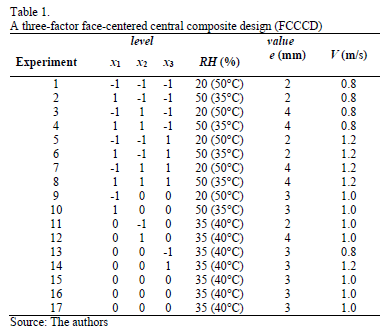
<body><![CDATA[<p><font size="2" face="Verdana, Arial, Helvetica, sans-serif">Regarding   the drying process, the term &quot;thin-layer&quot; applies to either a particle   suspended freely in the drying air, or one layer of particle or a polylayer of   many particles' thicknesses; the temperature and relative moisture of the   drying air can be considered to be in the same thermodynamic state during the   drying period &#91;1&#93;. Using this definition, any mathematical model for a particle   also models the particles drying in a thin layer using any drying method, and   the thin layer thickness may change with the velocity, temperature and relative   moisture of the drying air.</font></p>     <p><font size="2" face="Verdana, Arial, Helvetica, sans-serif">The   thickness of a thin layer increases if the drying air speed increases and when   the thermodynamic state of the drying air reaches equilibrium with dry   particles in the layer &#91;1&#93;. Due to the thin sample structure, a uniform   temperature distribution can be assumed and may be modeled using lumped   parameters &#91;2&#93;. </font></p>     <p><font size="2" face="Verdana, Arial, Helvetica, sans-serif">The   thin layer equations can be theoretical, semi-theoretical or empirical. The   first only accounts for internal resistance to the moisture transfer between   the product and air, while the others only consider external resistances to   this moisture transfer. Theoretical models explain the product's behavior   during drying and can be used for all process conditions despite including many   assumptions that cause considerable error. The most widely used theoretical   models are derived from Fick's second law of diffusion. Similarly,   semi-theoretical models are generally derived from Fick's second law and   modified to a simplified form. However, using experimental data requires making   assumptions, and these theories are only valid within the applied process   conditions. Empirical models have similar features to semi-theoretical models   that strongly depend on the experimental conditions and provide limited information   on the product behavior during drying &#91;2&#93;. The carrot   is frequently used in studies of different preservation techniques due to its   physical characteristics and available modeling and simulation data &#91;3-12&#93;.</font></p>     <p><font size="2" face="Verdana, Arial, Helvetica, sans-serif">This article evaluates the experimental data   fit for 10 thin layer models and explores the effect that relative moisture,   sample thickness and air speed have on the kinetic behavior of dried carrot   slices. The kinetic expression was established from analyzing the response   surfaces and kinetic parameters controlling the heat pump drying process.   Additionally, we determined the effective moisture diffusivity for each   experiment and the activation energy of the processes.</font></p>     <p>&nbsp;</p>     <p><font size="3" face="Verdana, Arial, Helvetica, sans-serif"><b>2. Materials and methods</b></font></p>     <p><font size="2" face="Verdana, Arial, Helvetica, sans-serif">Nantes carrots (<i>Daucus carota L.</i>)   were washed and cut into slices 3 cm in diameter and with a thickness of 2, 3   and 4 mm, according to the experimental design. The average initial moisture   content of a fresh carrot was 0.8935 ± 0.024 (bh). The heat pump dryer (HPD)   (D&aacute;rtico brand) consisted of a cooling circuit containing a condenser,   evaporator, compressor and expansion valve. The drying chamber contained 5   trays (0.36 × 0.36 m). The relative humidity (<i>RH</i>) and air velocity in the HPD were fixed. The drying temperature   was directly linked to the <i>RH</i> (<a href="#tab01">Table 1</a>).   A three-factor face-centered central composite design (FCCCD) was used with   three repetitions at the central point, as shown in <a href="#tab01">Table 1</a>. The total weight   (trays plus samples) was recorded for 5 hours with 2 min intervals for the   first 10 minutes, 5 min intervals for half an hour, 10 min intervals for an   hour and a half and 30 minute intervals for the last two hours.</font></p>     <p align="center"><font size="2" face="Verdana, Arial, Helvetica, sans-serif"><a name="tab01"></a></font><img src="/img/revistas/dyna/v83n195/v83n195a02tab01.gif"></p>     <p><font size="2" face="Verdana, Arial, Helvetica, sans-serif"><a href="#tab02">Table 2</a> shows the semi-theoretical models   evaluated during the kinetic study &#91;13&#93;. The parameters for each model were   estimated using Sigma-Plot<sup>®</sup> software. The moisture ratio (<i>MR</i>) value was determined according to   the external conditions. If the relative humidity of the drying air is constant   during the process, the equilibrium moisture content is also constant. The <i>MR</i> value was calculated using eq. (1). </font></p>     <p><img src="/img/revistas/dyna/v83n195/v83n195a02eq01.gif"></p>     ]]></body>
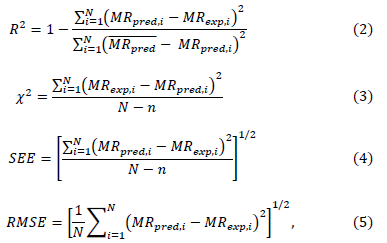
<body><![CDATA[<p><font size="2" face="Verdana, Arial, Helvetica, sans-serif">where <i>Mi</i> is the initial moisture content (dry basis) obtained by drying in a vacuum oven   at a constant weight and at 60ºC, <i>M<sub>t</sub></i> is the moisture content (dry basis) at time <i>t</i> based on the recorded weight, and <i>M<sub>e</sub></i> is the equilibrium moisture content obtained from the carrot sorption isotherms   (dry basis) &#91;14, 15&#93;: 0.055 &#91;20% <i>RH</i>;   50 &deg;C&#93;, 0.070 &#91;35% <i>RH</i>; 40 &deg;C&#93; and   0.080 &#91;50% <i>RH</i>; 35 &deg;C&#93;.</font></p>     <p align="center"><font size="2" face="Verdana, Arial, Helvetica, sans-serif"><a name="tab02"></a></font><img src="/img/revistas/dyna/v83n195/v83n195a02tab02.gif"></p>     <p><font size="2" face="Verdana, Arial, Helvetica, sans-serif">The   model validities were checked using statistical parameters: correlation   coefficient (<i>R<sup>2</sup></i>), reduced   Chi-squared test (<i><font face="Symbol">c</font><sup>2</sup></i>),   standard error of the estimate (<i>SEE</i>)   and root mean square error (<i>RMSE</i>).   The highest <i>R<sup>2</sup></i> and lowest <i><font face="Symbol">c</font><sup>2</sup></i>, <i>SEE</i> and <i>RMSE</i> values   determined the goodness of fit. The aforementioned criteria were calculated   using eq. (2) - (5) &#91;2,16&#93;.</font></p>     <p><img src="/img/revistas/dyna/v83n195/v83n195a02eq0205.gif"></p>     <p><font size="2" face="Verdana, Arial, Helvetica, sans-serif">where <i>N</i> is the number of observations, <i>n</i> is   the number of constants, <i>MR<sub>pred,I</sub></i> is the <i>i</i>th predicted moisture ratio   and <i>MR<sub>exp,I</sub></i> is the <i>i</i>th experimental moisture ratio. </font></p>     <p><font size="2" face="Verdana, Arial, Helvetica, sans-serif">The Root Mean Squared Error has the   advantage that it retains the units of the forecast variable and is thus more   easily interpretable as a typical error magnitude. The Chi-squared Test is easy   to implement (with multivariable data for example) &#91;17&#93; and also quite   flexible..</font></p>     <p><font size="2" face="Verdana, Arial, Helvetica, sans-serif">The Henderson-Pabis model was rearranged   to determine the diffusivity coefficient based on eq. (6) &#91;2&#93;: </font></p>     <p><img src="/img/revistas/dyna/v83n195/v83n195a02eq06.gif"></p>     <p><font size="2" face="Verdana, Arial, Helvetica, sans-serif">where <i>a</i> is a shape index and, <i>k</i> is the drying   constant defined by eq. (7): </font></p>     <p><img src="/img/revistas/dyna/v83n195/v83n195a02eq07.gif"></p>     ]]></body>

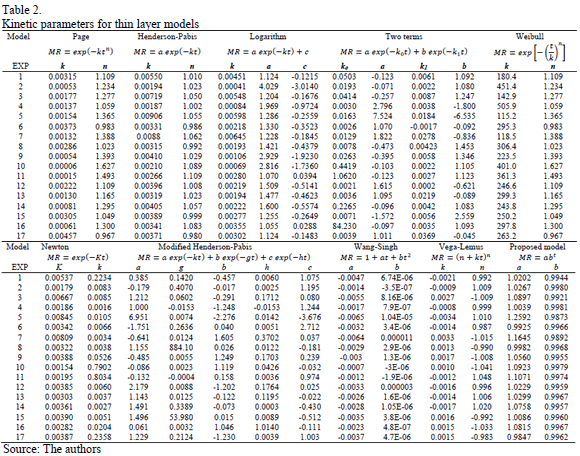
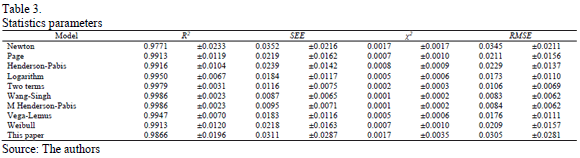
<body><![CDATA[<p><font size="2" face="Verdana, Arial, Helvetica, sans-serif">where <i>A<sub>2</sub></i> is a geometric constant (4<i>e<sup>2</sup></i> for infinite slices), and <i>e</i> is half   the slice thickness if drying occurs on both sides and the full thickness if   drying occurs on only one side. Eq. (6) indicates <i>ln(MR)</i> varies linearly with <i>t</i> and the slope is equal to <i>k</i>. </font></p>     <p><font size="2" face="Verdana, Arial, Helvetica, sans-serif">Eq. (8) was used to calculate the   activation energy (<i>E<sub>a</sub></i>):</font></p>     <p><img src="/img/revistas/dyna/v83n195/v83n195a02eq08.gif"></p>     <p><font size="2" face="Verdana, Arial, Helvetica, sans-serif">where <i>D</i><sub>0</sub> (m<sup>2</sup>/s) is the Arrhenius factor that is generally defined as the   reference diffusion coefficient at an infinitely high temperature, <i>E<sub>a</sub></i> (kJ/mol) is the diffusion   activation energy, and <i>R</i> (kJ/kmolK)   is the universal gas constant. Eq. (8) is linear and allows <i>E<sub>a</sub></i> to be calculated from the   slope.</font></p>     <p>&nbsp;</p>     <p><font size="3" face="Verdana, Arial, Helvetica, sans-serif"><b>3. Results and discussion</b></font></p>     <p><font size="2" face="Verdana, Arial, Helvetica, sans-serif"><a href="#tab02">Table 2</a> shows the parameters for each   model that fit the experimental data and <a href="#tab03">Table 3</a> shows the fit for each model   using the statistical parameters from each experiment. In general, all models had   high correlation coefficients and low values for the other statistics. The   Wang-Singh and modified Henderson-Pabis models exhibited the best values;   however, the Wang-Singh model has fewer adjustable parameters. A statistical   discrimination study based on nonlinear regression ensures the Wang-Singh   equation best fits the data &#91;18&#93;. </font></p>     <p align="center"><font size="2" face="Verdana, Arial, Helvetica, sans-serif"><a name="tab03"></a></font><img src="/img/revistas/dyna/v83n195/v83n195a02tab03.gif"></p>     <p><font size="2" face="Verdana, Arial, Helvetica, sans-serif">Thin layer equations may be theoretical,   semi-theoretical, and empirical models. Semi-theoretical models are generally   derived from Fick's second law of diffusion and are modifications of its   simplified forms &#91;2&#93;. </font></p>     <p><font size="2" face="Verdana, Arial, Helvetica, sans-serif">Empirical models used are: The Lewis   (Newton) model, which is analogous with Newton's law of cooling. The Page model   modifies the Newton model to get a more accurate model by adding a   dimensionless empirical constant (<i>n</i>)   &#91;2&#93;.</font></p>     ]]></body>
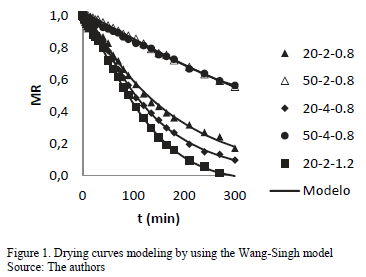
<body><![CDATA[<p><font size="2" face="Verdana, Arial, Helvetica, sans-serif">The models derived from Fick's second law   of diffusion are: the Henderson-Pabis model, and the Logarithmic model, which   is formed by adding an empirical term. The Two-Term model uses the first two   terms of the general series solution of Fick's second law of diffusion to   correct the shortcomings of the Henderson-Pabis model. The Modified Henderson-Pabis   model improves previous models by adding the third term of the general solution   from Fick's second law of diffusion &#91;2&#93;. </font></p>     <p><font size="2" face="Verdana, Arial, Helvetica, sans-serif">The Weibull, Wang-Singh, Vega-Lemus and   Proposed models, are all empirical models.</font></p>     <p><font size="2" face="Verdana, Arial, Helvetica, sans-serif"><a href="#fig01">Fig. 1</a> shows the drying curves and their   fit to the Wang-Singh model for 5 of the 17 experiments. The first number in   the code corresponds to the relative humidity (20 and 50%), the second is the thickness   (2 and 4 mm), and the last is the air velocity (0.8 and 1.2 m/s).</font></p>     <p align="center"><font size="2" face="Verdana, Arial, Helvetica, sans-serif"><a name="fig01"></a></font><img src="/img/revistas/dyna/v83n195/v83n195a02fig01.gif"></p>     <p><font size="2" face="Verdana, Arial, Helvetica, sans-serif">The relative   humidity and air velocity affect the drying time; a lower relative humidity and   higher velocity provide faster drying times regardless of the sample thickness.   Krokida &#91;3&#93; found temperature to be the most important factor in the drying   rate, while the velocity and humidity have lesser effects. In that study, the   evaluated temperatures were higher (65, 75 and 85 &deg;C).</font></p>     <p><font size="2" face="Verdana, Arial, Helvetica, sans-serif">The   effective diffusivity (<i>D<sub>eff</sub></i>)   was determined using eq. (6) - (7) and the least squares analysis for each   experiment. <a href="#fig02">Fig. 2</a> shows the response surfaces for the effective diffusivity, <i>D<sub>eff</sub></i>. Larger effective   diffusivities were obtained at lower relative humidities, higher material   thicknesses and high air velocities. The desirability function confirms these   results. The <i>D<sub>eff</sub></i> values   were between 2.01E-10 and 4.38E-9 m<sup>2</sup>/s. Doymaz &#91;19&#93; determined the   effective diffusivity values for the convective drying of carrots ranged from   7.76E-10 to 9.34E-10 m<sup>2</sup>/s and argues that this variable increases   when air flow and temperature are increased ; these are similar to this study's   observations (<a href="#fig02">Fig. 2</a>), which account for the decreased <i>RH</i> at an increased temperature (<a href="#tab01">Table 1</a>). Kaya et al. &#91;14&#93; also   found that decreasing the <i>RH</i> (temperature increase for a closed system) increased the effective diffusivity   values. However, Phoungchandang et al. &#91;20&#93; determined that the effective   diffusivity values ranged from 8.34E-11 to 2.77E-10 m<sup>2</sup>/s for dried   carrots in a heat pump dryer at 40, 50 and 60 &deg;C with an air velocity of 0.5   m/s. Panagiotou et al. &#91;21&#93; reported <i>D<sub>eff</sub></i>values (m<sup>2</sup>/s) ranging from 2.20E-12 to 7.46E-9 for moisture   contents between 0.10 and 15.0 on a dry basis and temperatures between 20 and   100 &deg;C. Torres et al. &#91;22&#93; also obtained similar results working with yam in a   convective drier.</font></p>     <p align="center"><font size="2" face="Verdana, Arial, Helvetica, sans-serif"><a name="fig02"></a></font><img src="/img/revistas/dyna/v83n195/v83n195a02fig02.gif"></p>     <p><font size="2" face="Verdana, Arial, Helvetica, sans-serif">The <i>p</i> value obtained from the ANOVA for the effective diffusivity, <i>D<sub>eff</sub></i>, was less than 0.05 for   the regression term. This means that there is a statistically significant   relationship between the variables on a 95% confidence level, specifically   between the quadratic and interaction terms. The linear terms can be omitted   from the model because they would have no significance at this confidence   level. This is corroborated by the <i>p</i>-values   for the regression coefficients in which only the </font><font size="2" face="Verdana, Arial, Helvetica, sans-serif">second order term   (<i>RH</i> * <i>e</i>) was significant and is effectively an interaction. The <i>p</i> value is the specific probability that   the observed value of the test statistic, together with all other possible   values of the test statistic that are at least as unfavorable as the null   hypothesis, will occur &#91;17&#93;.</font></p>     <p><font size="2" face="Verdana, Arial, Helvetica, sans-serif">Validation   of the model via a residual analysis only happens when the probability curve   that shows normal error behavior is observed. Residuals are not far from the   line; the variance is homogeneous, and the largest deviation occurred in   experiment 9.</font></p>     <p><font size="2" face="Verdana, Arial, Helvetica, sans-serif">The activation energy obtained was 35.50   kJ/mol, and the literature reports activation energies for carrot drying using   different equipment and different processing conditions. </font></p>     ]]></body>
<body><![CDATA[<p><font size="2" face="Verdana, Arial, Helvetica, sans-serif">According to the energy levels involved   and collision theory for reactive molecules, enough energy must be generated to   provide the required activation energy and facilitate the reaction. The   activation energy itself does not provide information on the reactivity of a   given system, only on the temperature dependence of the reaction. Activation Energy   activation is also related to the moisture content. The diffusion activation   energy increased at lower moisture contents because the interaction between the   moisture and solid is generally stronger at lower moisture contents &#91;23&#93;.</font></p>     <p>&nbsp;</p>     <p><font size="3" face="Verdana, Arial, Helvetica, sans-serif"><b>4. Conclusions</b></font></p>     <p><font size="2" face="Verdana, Arial, Helvetica, sans-serif">All of the   thin layer models evaluated could fit the experimental data. The Wang-Singh   model exhibited the best fit for the experimental data, based on the criteria   of having the highest correlation coefficient (<i>R<sup>2</sup></i>) and lowest Chi-squared statistic (<i><font face="Symbol">c</font><sup>2</sup></i>), standard error of   the estimate (<i>SEE</i>) and root mean   square error (<i>RMSE</i>) values. A   significant effect from the <i>HR*e</i> interaction was found during the ANOVA for effective diffusivity. The   conditions that provide the best evaluated parameters (low <i>MR</i> and high <i>D<sub>eff</sub></i>)   are: 20% <i>HR</i>, 4 mm thickness and 1.2   m/s air velocity.</font></p>     <p>&nbsp;</p>     <p><font size="3" face="Verdana, Arial, Helvetica, sans-serif"><b>References</b></font></p>     <!-- ref --><p><font size="2" face="Verdana, Arial, Helvetica, sans-serif"><b>&#91;1&#93;</b> Ayas,   D.S., Cenkowski, S., Pabis, S. and Muir, W.E., Review of thin-layer drying and   wetting equations. Drying Technology, 9(3), pp. 551-588, 1991.    &nbsp;&nbsp;&nbsp;&nbsp;&nbsp;&nbsp;&nbsp;&nbsp;[&#160;<a href="javascript:void(0);" onclick="javascript: window.open('/scielo.php?script=sci_nlinks&ref=1142981&pid=S0012-7353201600010000200001&lng=','','width=640,height=500,resizable=yes,scrollbars=1,menubar=yes,');">Links</a>&#160;]<!-- end-ref --></font></p>     <!-- ref --><p><font size="2" face="Verdana, Arial, Helvetica, sans-serif"><b>&#91;2&#93;</b> Erbay,   Z. and Icier, F., A review of thin layer drying of foods: Theory, modeling, and   experimental results. Critical Review in Food Science and Nutrition, 50(5), pp.   441-464, 2010. DOI: 10.1080/10408390802437063</font>&nbsp;&nbsp;&nbsp;&nbsp;&nbsp;&nbsp;&nbsp;&nbsp;[&#160;<a href="javascript:void(0);" onclick="javascript: window.open('/scielo.php?script=sci_nlinks&ref=1142983&pid=S0012-7353201600010000200002&lng=','','width=640,height=500,resizable=yes,scrollbars=1,menubar=yes,');">Links</a>&#160;]<!-- end-ref --><!-- ref --><p><font size="2" face="Verdana, Arial, Helvetica, sans-serif"><b>&#91;3&#93;</b> Krokida,   M.K., Karathanos, V.T., Maroulis, Z.B. and Marinos-Kouris, D., Drying kinetics   of some vegetables. Journal of Food Engineering, 59, pp. 391-403, 2003. DOI:   10.1016/S0260-8774(02)00498-3</font>&nbsp;&nbsp;&nbsp;&nbsp;&nbsp;&nbsp;&nbsp;&nbsp;[&#160;<a href="javascript:void(0);" onclick="javascript: window.open('/scielo.php?script=sci_nlinks&ref=1142984&pid=S0012-7353201600010000200003&lng=','','width=640,height=500,resizable=yes,scrollbars=1,menubar=yes,');">Links</a>&#160;]<!-- end-ref --><!-- ref --><p><font size="2" face="Verdana, Arial, Helvetica, sans-serif"><b>&#91;4&#93;</b> Srikiatden,   J. and Roberts, J.S., Measuring moisture diffusivity of potato and carrot (core   and cortex) during convective hot air and isothermal drying. Journal of Food   Engineering, 74(1), pp. 143-152, 2006. DOI: 10.1016/j.jfoodeng.2005.02.026</font>&nbsp;&nbsp;&nbsp;&nbsp;&nbsp;&nbsp;&nbsp;&nbsp;[&#160;<a href="javascript:void(0);" onclick="javascript: window.open('/scielo.php?script=sci_nlinks&ref=1142985&pid=S0012-7353201600010000200004&lng=','','width=640,height=500,resizable=yes,scrollbars=1,menubar=yes,');">Links</a>&#160;]<!-- end-ref --><!-- ref --><p><font size="2" face="Verdana, Arial, Helvetica, sans-serif"><b>&#91;5&#93;</b> Togrul,   H., Suitable drying model for infrared drying of carrot. Journal of Food   Engineering, 77(3), pp. 610-619, 2006. DOI: 10.1016/j.jfoodeng.2005.07.020</font>&nbsp;&nbsp;&nbsp;&nbsp;&nbsp;&nbsp;&nbsp;&nbsp;[&#160;<a href="javascript:void(0);" onclick="javascript: window.open('/scielo.php?script=sci_nlinks&ref=1142986&pid=S0012-7353201600010000200005&lng=','','width=640,height=500,resizable=yes,scrollbars=1,menubar=yes,');">Links</a>&#160;]<!-- end-ref --><!-- ref --><p><font size="2" face="Verdana, Arial, Helvetica, sans-serif"><b>&#91;6&#93;</b> Erenturk,   S. and Erenturk, K., Comparison of genetic algorithm and neural network   approaches for the drying process of carrot. Journal of Food Engineering,   78(3), pp. 905-912, 2007. DOI: 10.1016/j.jfoodeng.2005.11.031</font>&nbsp;&nbsp;&nbsp;&nbsp;&nbsp;&nbsp;&nbsp;&nbsp;[&#160;<a href="javascript:void(0);" onclick="javascript: window.open('/scielo.php?script=sci_nlinks&ref=1142987&pid=S0012-7353201600010000200006&lng=','','width=640,height=500,resizable=yes,scrollbars=1,menubar=yes,');">Links</a>&#160;]<!-- end-ref --><!-- ref --><p><font size="2" face="Verdana, Arial, Helvetica, sans-serif"><b>&#91;7&#93;</b> Singh,   B. and Gupta, A.K., Mass transfer kinetics and determination of effective   diffusivity during convective dehydration of pre-osmosed carrot cubes. Journal   of Food Engineering, 79(2), pp. 459-470, 2007. DOI:   10.1016/j.jfoodeng.2006.01.073</font>&nbsp;&nbsp;&nbsp;&nbsp;&nbsp;&nbsp;&nbsp;&nbsp;[&#160;<a href="javascript:void(0);" onclick="javascript: window.open('/scielo.php?script=sci_nlinks&ref=1142988&pid=S0012-7353201600010000200007&lng=','','width=640,height=500,resizable=yes,scrollbars=1,menubar=yes,');">Links</a>&#160;]<!-- end-ref --><!-- ref --><p><font size="2" face="Verdana, Arial, Helvetica, sans-serif"><b>&#91;8&#93;</b> Mihoubi,   D., Timoumi, S. and Zagrouba, F., Modelling of convective drying of carrot   slices with IR heat source. Chemical Engineering and Processing: Process   Intensification, 48(3), pp. 808-815, 2009. DOI: 10.1016/j.cep.2008.10.004</font>&nbsp;&nbsp;&nbsp;&nbsp;&nbsp;&nbsp;&nbsp;&nbsp;[&#160;<a href="javascript:void(0);" onclick="javascript: window.open('/scielo.php?script=sci_nlinks&ref=1142989&pid=S0012-7353201600010000200008&lng=','','width=640,height=500,resizable=yes,scrollbars=1,menubar=yes,');">Links</a>&#160;]<!-- end-ref --><!-- ref --><p><font size="2" face="Verdana, Arial, Helvetica, sans-serif"><b>&#91;9&#93;</b> Phongsomboon,   P. and Intipunya, P., Comparative study on drying of osmotic treated carrot   slices. Asian Journal of Food and Agro-Industry, 2(04), pp. 448-456, 2009.    &nbsp;&nbsp;&nbsp;&nbsp;&nbsp;&nbsp;&nbsp;&nbsp;[&#160;<a href="javascript:void(0);" onclick="javascript: window.open('/scielo.php?script=sci_nlinks&ref=1142990&pid=S0012-7353201600010000200009&lng=','','width=640,height=500,resizable=yes,scrollbars=1,menubar=yes,');">Links</a>&#160;]<!-- end-ref --></font></p>     <!-- ref --><p><font size="2" face="Verdana, Arial, Helvetica, sans-serif"><b>&#91;10&#93;</b> Hiranvarachat,   B., Devahastin, S. and Chiewchan, N., Effects of acid pretreatments on some   physicochemical properties of carrot undergoing hot air drying. Food and   Bioproducts Processing, 89(2), pp. 116-127, 2011. DOI:   10.1016/j.fbp.2010.03.010</font>&nbsp;&nbsp;&nbsp;&nbsp;&nbsp;&nbsp;&nbsp;&nbsp;[&#160;<a href="javascript:void(0);" onclick="javascript: window.open('/scielo.php?script=sci_nlinks&ref=1142992&pid=S0012-7353201600010000200010&lng=','','width=640,height=500,resizable=yes,scrollbars=1,menubar=yes,');">Links</a>&#160;]<!-- end-ref --><!-- ref --><p><font size="2" face="Verdana, Arial, Helvetica, sans-serif"><b>&#91;11&#93;</b> Zielinska,   M. and Markowski, M., Air drying characteristics and moisture diffusivity of carrot.   Chemical Engineering and Processing: Process Intensification, 49(2), pp.   212-218, 2010. DOI: 10.1016/j.cep.2009.12.005</font>&nbsp;&nbsp;&nbsp;&nbsp;&nbsp;&nbsp;&nbsp;&nbsp;[&#160;<a href="javascript:void(0);" onclick="javascript: window.open('/scielo.php?script=sci_nlinks&ref=1142993&pid=S0012-7353201600010000200011&lng=','','width=640,height=500,resizable=yes,scrollbars=1,menubar=yes,');">Links</a>&#160;]<!-- end-ref --><!-- ref --><p><font size="2" face="Verdana, Arial, Helvetica, sans-serif"><b>&#91;12&#93;</b> Nazghelichi,   T., Kianmehr, M.H. and Aghbashlo, M., Thermodynamic analysis of fluidized bed   drying of carrot cubes. Energy, 35(12), pp. 4679-4684, 2010. DOI:   10.1016/j.energy.2010.09.036</font>&nbsp;&nbsp;&nbsp;&nbsp;&nbsp;&nbsp;&nbsp;&nbsp;[&#160;<a href="javascript:void(0);" onclick="javascript: window.open('/scielo.php?script=sci_nlinks&ref=1142994&pid=S0012-7353201600010000200012&lng=','','width=640,height=500,resizable=yes,scrollbars=1,menubar=yes,');">Links</a>&#160;]<!-- end-ref --><!-- ref --><p><font size="2" face="Verdana, Arial, Helvetica, sans-serif"><b>&#91;13&#93;</b> Xanthopoulos,   G., Oikonomou, N. and Lambrinos, G., Applicability of a single-layer drying   model to predict the drying rate of whole figs. Journal of Food Engineering,   81(3), pp. 553-559, 2007. DOI: 10.1016/j.jfoodeng.2006.11.033</font>&nbsp;&nbsp;&nbsp;&nbsp;&nbsp;&nbsp;&nbsp;&nbsp;[&#160;<a href="javascript:void(0);" onclick="javascript: window.open('/scielo.php?script=sci_nlinks&ref=1142995&pid=S0012-7353201600010000200013&lng=','','width=640,height=500,resizable=yes,scrollbars=1,menubar=yes,');">Links</a>&#160;]<!-- end-ref --><!-- ref --><p><font size="2" face="Verdana, Arial, Helvetica, sans-serif"><b>&#91;14&#93;</b> Kaya,   A., Aydin, O. and Demirtas, C., Experimental and theoretical analysis of drying   carrots. Desalination, 237(1-3), pp. 285-295, 2009. DOI:   10.1016/j.desal.2008.01.022</font>&nbsp;&nbsp;&nbsp;&nbsp;&nbsp;&nbsp;&nbsp;&nbsp;[&#160;<a href="javascript:void(0);" onclick="javascript: window.open('/scielo.php?script=sci_nlinks&ref=1142996&pid=S0012-7353201600010000200014&lng=','','width=640,height=500,resizable=yes,scrollbars=1,menubar=yes,');">Links</a>&#160;]<!-- end-ref --><!-- ref --><p><font size="2" face="Verdana, Arial, Helvetica, sans-serif"><b>&#91;15&#93;</b> Eim,   V.S., Rosell&oacute;, C., Femenia, A. and Simal, S., Moisture sorption isotherms and   thermodynamic properties of carrot. International Journal of Food Engineering,   7(3), Article 13, pp. 1-16, 2011. DOI: 10.2202/1556-3758.1804</font>&nbsp;&nbsp;&nbsp;&nbsp;&nbsp;&nbsp;&nbsp;&nbsp;[&#160;<a href="javascript:void(0);" onclick="javascript: window.open('/scielo.php?script=sci_nlinks&ref=1142997&pid=S0012-7353201600010000200015&lng=','','width=640,height=500,resizable=yes,scrollbars=1,menubar=yes,');">Links</a>&#160;]<!-- end-ref --><!-- ref --><p><font size="2" face="Verdana, Arial, Helvetica, sans-serif"><b>&#91;16&#93;</b> Vega-G&aacute;lvez,   A., Andr&eacute;s, A., Gonzalez, E., Notte-Cuello, E., Chacana, M. and Lemus-Moncada,   R., Mathematical modeling on the drying process of yellow squat lobster   (Cervimunida jhoni) fishery waste for animal feed. Animal Feed Science and   Technology, 151(3-4), pp. 268-279, 2009. DOI: 10.1016/j.anifeedsci.2009.01.003</font>&nbsp;&nbsp;&nbsp;&nbsp;&nbsp;&nbsp;&nbsp;&nbsp;[&#160;<a href="javascript:void(0);" onclick="javascript: window.open('/scielo.php?script=sci_nlinks&ref=1142998&pid=S0012-7353201600010000200016&lng=','','width=640,height=500,resizable=yes,scrollbars=1,menubar=yes,');">Links</a>&#160;]<!-- end-ref --><!-- ref --><p><font size="2" face="Verdana, Arial, Helvetica, sans-serif"><b>&#91;17&#93;</b> Wilks,   D.S., Statistical methods in the atmospheric sciences. Second Edition.   Amsterdam: Academic Press, 2006.    &nbsp;&nbsp;&nbsp;&nbsp;&nbsp;&nbsp;&nbsp;&nbsp;[&#160;<a href="javascript:void(0);" onclick="javascript: window.open('/scielo.php?script=sci_nlinks&ref=1142999&pid=S0012-7353201600010000200017&lng=','','width=640,height=500,resizable=yes,scrollbars=1,menubar=yes,');">Links</a>&#160;]<!-- end-ref --></font></p>     <!-- ref --><p><font size="2" face="Verdana, Arial, Helvetica, sans-serif"><b>&#91;18&#93;</b> Barrozo,   M.A.S., Sartori, D.J.M. and Freire, J.T., A study of the statistical   discrimination of the drying kinetics equations. Food and Bioproducts   Processing, 82(C3), pp. 219-225, 2004. DOI: 10.1205/fbio.82.3.219.44176</font>&nbsp;&nbsp;&nbsp;&nbsp;&nbsp;&nbsp;&nbsp;&nbsp;[&#160;<a href="javascript:void(0);" onclick="javascript: window.open('/scielo.php?script=sci_nlinks&ref=1143001&pid=S0012-7353201600010000200018&lng=','','width=640,height=500,resizable=yes,scrollbars=1,menubar=yes,');">Links</a>&#160;]<!-- end-ref --><!-- ref --><p><font size="2" face="Verdana, Arial, Helvetica, sans-serif"><b>&#91;19&#93;</b> Doymaz,   I., Convective air drying characteristics of thin layer carrots. Journal of   Food Engineering, 61(3), pp. 359-364, 2004. DOI: 10.1016/S0260-8774(03)00142-0</font>&nbsp;&nbsp;&nbsp;&nbsp;&nbsp;&nbsp;&nbsp;&nbsp;[&#160;<a href="javascript:void(0);" onclick="javascript: window.open('/scielo.php?script=sci_nlinks&ref=1143002&pid=S0012-7353201600010000200019&lng=','','width=640,height=500,resizable=yes,scrollbars=1,menubar=yes,');">Links</a>&#160;]<!-- end-ref --><!-- ref --><p><font size="2" face="Verdana, Arial, Helvetica, sans-serif"><b>&#91;20&#93;</b> Phoungchandang,   S. and Wongwatanyoo, J., Desorption isotherms and drying characteristics of   carrot using tray and heat pump-assisted dehumidified drying. KKU Research   Journal, 15(3), pp. 171-186, 2010.    &nbsp;&nbsp;&nbsp;&nbsp;&nbsp;&nbsp;&nbsp;&nbsp;[&#160;<a href="javascript:void(0);" onclick="javascript: window.open('/scielo.php?script=sci_nlinks&ref=1143003&pid=S0012-7353201600010000200020&lng=','','width=640,height=500,resizable=yes,scrollbars=1,menubar=yes,');">Links</a>&#160;]<!-- end-ref --></font></p>     ]]></body>
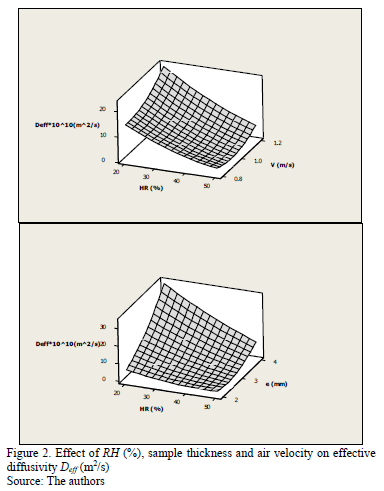
<body><![CDATA[<!-- ref --><p><font size="2" face="Verdana, Arial, Helvetica, sans-serif"><b>&#91;21&#93;</b> Panagiotou,   N.M., Krokida, M.K., Maroulis, Z.B. and Saravacos, G.D., Moisture diffusivity:   Literature data compilation for foodstuffs. International Journal of Food   Properties, 7(2), pp. 273-299, 2004. DOI: 10.1081/JFP-120030038</font>&nbsp;&nbsp;&nbsp;&nbsp;&nbsp;&nbsp;&nbsp;&nbsp;[&#160;<a href="javascript:void(0);" onclick="javascript: window.open('/scielo.php?script=sci_nlinks&ref=1143005&pid=S0012-7353201600010000200021&lng=','','width=640,height=500,resizable=yes,scrollbars=1,menubar=yes,');">Links</a>&#160;]<!-- end-ref --><!-- ref --><p><font size="2" face="Verdana, Arial, Helvetica, sans-serif"><b>&#91;22&#93;</b> Torres,   R., Montes, E.J., Andrade, R.D., Perez, O.A. and Toscano, H., Drying kinetics   of two yam (Dioscorea alata) varieties. DYNA, 79(171), pp. 175-182, 2012.    &nbsp;&nbsp;&nbsp;&nbsp;&nbsp;&nbsp;&nbsp;&nbsp;[&#160;<a href="javascript:void(0);" onclick="javascript: window.open('/scielo.php?script=sci_nlinks&ref=1143006&pid=S0012-7353201600010000200022&lng=','','width=640,height=500,resizable=yes,scrollbars=1,menubar=yes,');">Links</a>&#160;]<!-- end-ref --></font></p>     <!-- ref --><p><font size="2" face="Verdana, Arial, Helvetica, sans-serif"><b>&#91;23&#93;</b> Kahveci,   K. and Cihan, A., Drying of food materials: Transport Phenomena. New York: Nova   Science Publishers, Inc., 2008.    &nbsp;&nbsp;&nbsp;&nbsp;&nbsp;&nbsp;&nbsp;&nbsp;[&#160;<a href="javascript:void(0);" onclick="javascript: window.open('/scielo.php?script=sci_nlinks&ref=1143008&pid=S0012-7353201600010000200023&lng=','','width=640,height=500,resizable=yes,scrollbars=1,menubar=yes,');">Links</a>&#160;]<!-- end-ref --></font></p>     <p>&nbsp;</p>     <p><font size="2" face="Verdana, Arial, Helvetica, sans-serif"><b>J.C. G&oacute;mez-Daza,</b> received his BSc. in Chemical   Engineering in 1996, his MSc. in Chemical Engineering in 1999, and his PhD in   Engineering in 2014, all from the Universidad del Valle, Cali, Colombia. From   1987 to 1991, he worked for the Industria de Licores del Valle and Lloreda   Grasas and since 2000 he has worked at the Universidad del Valle. Currently, he   is a full professor in the Food Engineering School, Facultad de Ingenier&iacute;a, at   the Universidad del Valle. He works as an occasional lecturer at the   Universidad Nacional de Colombia, in Palmira, in the areas of process dynamic   physicochemical and biological, mathematical and numeric methods and drying.   His research interests include: modeling, simulation and drying; process   engineering; process dynamics. ORCID: 0000-0001-7464-0519</font></p>     <p><font size="2" face="Verdana, Arial, Helvetica, sans-serif"><b>C.I. Ochoa-Mart&iacute;nez,</b> received his BSc. Chemical Engineering   in 1989, his MSc. in Chemical Engineering in 2001, and his PhD in Engineering   in 2006. She has worked in programs and projects in the food area since 2006 at   the Universidad del Valle. She is currently a full professor in the Food   Engineering School, Facultad de Ingenier&iacute;a, Universidad del Valle. Her research   interests include: modeling, simulation and drying; process engineering. She   has several publications in scientific journals and is currently coordinator of   the post-graduate program at the Food Engineering School. ORCID:0000-0002-2666-1726</font></p>      ]]></body><back>
<ref-list>
<ref id="B1">
<label>1</label><nlm-citation citation-type="journal">
<person-group person-group-type="author">
<name>
<surname><![CDATA[Ayas]]></surname>
<given-names><![CDATA[D.S.]]></given-names>
</name>
<name>
<surname><![CDATA[Cenkowski]]></surname>
<given-names><![CDATA[S.]]></given-names>
</name>
<name>
<surname><![CDATA[Pabis]]></surname>
<given-names><![CDATA[S.]]></given-names>
</name>
<name>
<surname><![CDATA[Muir]]></surname>
<given-names><![CDATA[W.E.]]></given-names>
</name>
</person-group>
<article-title xml:lang="en"><![CDATA[Review of thin-layer drying and wetting equations]]></article-title>
<source><![CDATA[Drying Technology]]></source>
<year>1991</year>
<volume>9</volume>
<numero>3</numero>
<issue>3</issue>
<page-range>551-588</page-range></nlm-citation>
</ref>
<ref id="B2">
<label>2</label><nlm-citation citation-type="journal">
<person-group person-group-type="author">
<name>
<surname><![CDATA[Erbay]]></surname>
<given-names><![CDATA[Z.]]></given-names>
</name>
<name>
<surname><![CDATA[Icier]]></surname>
<given-names><![CDATA[F.]]></given-names>
</name>
</person-group>
<article-title xml:lang="en"><![CDATA[A review of thin layer drying of foods: Theory, modeling, and experimental results.]]></article-title>
<source><![CDATA[Critical Review in Food Science and Nutrition]]></source>
<year>2010</year>
<volume>50</volume>
<numero>5</numero>
<issue>5</issue>
<page-range>441-464</page-range></nlm-citation>
</ref>
<ref id="B3">
<label>3</label><nlm-citation citation-type="journal">
<person-group person-group-type="author">
<name>
<surname><![CDATA[Krokida]]></surname>
<given-names><![CDATA[M.K.]]></given-names>
</name>
<name>
<surname><![CDATA[Karathanos]]></surname>
<given-names><![CDATA[V.T.]]></given-names>
</name>
<name>
<surname><![CDATA[Maroulis]]></surname>
<given-names><![CDATA[Z.B.]]></given-names>
</name>
<name>
<surname><![CDATA[Marinos-Kouris]]></surname>
<given-names><![CDATA[D.]]></given-names>
</name>
</person-group>
<article-title xml:lang="en"><![CDATA[Drying kinetics of some vegetables.]]></article-title>
<source><![CDATA[Journal of Food Engineering]]></source>
<year>2003</year>
<numero>59</numero>
<issue>59</issue>
<page-range>391-403</page-range></nlm-citation>
</ref>
<ref id="B4">
<label>4</label><nlm-citation citation-type="journal">
<person-group person-group-type="author">
<name>
<surname><![CDATA[Srikiatden]]></surname>
<given-names><![CDATA[J.]]></given-names>
</name>
<name>
<surname><![CDATA[Roberts]]></surname>
<given-names><![CDATA[J.S.]]></given-names>
</name>
</person-group>
<article-title xml:lang="en"><![CDATA[Measuring moisture diffusivity of potato and carrot (core and cortex) during convective hot air and isothermal drying]]></article-title>
<source><![CDATA[Journal of Food Engineering]]></source>
<year>2006</year>
<volume>74</volume>
<numero>1</numero>
<issue>1</issue>
<page-range>143-152</page-range></nlm-citation>
</ref>
<ref id="B5">
<label>5</label><nlm-citation citation-type="journal">
<person-group person-group-type="author">
<name>
<surname><![CDATA[Togrul]]></surname>
<given-names><![CDATA[H.]]></given-names>
</name>
</person-group>
<article-title xml:lang="en"><![CDATA[Suitable drying model for infrared drying of carrot]]></article-title>
<source><![CDATA[Journal of Food Engineering]]></source>
<year>2006</year>
<volume>77</volume>
<numero>3</numero>
<issue>3</issue>
<page-range>610-619</page-range></nlm-citation>
</ref>
<ref id="B6">
<label>6</label><nlm-citation citation-type="journal">
<person-group person-group-type="author">
<name>
<surname><![CDATA[Erenturk]]></surname>
<given-names><![CDATA[S.]]></given-names>
</name>
<name>
<surname><![CDATA[Erenturk]]></surname>
<given-names><![CDATA[K.]]></given-names>
</name>
</person-group>
<article-title xml:lang="en"><![CDATA[Comparison of genetic algorithm and neural network approaches for the drying process of carrot.]]></article-title>
<source><![CDATA[Journal of Food Engineering]]></source>
<year>2007</year>
<volume>78</volume>
<numero>3</numero>
<issue>3</issue>
<page-range>905-912</page-range></nlm-citation>
</ref>
<ref id="B7">
<label>7</label><nlm-citation citation-type="journal">
<person-group person-group-type="author">
<name>
<surname><![CDATA[Singh]]></surname>
<given-names><![CDATA[B.]]></given-names>
</name>
<name>
<surname><![CDATA[Gupta]]></surname>
<given-names><![CDATA[A.K.]]></given-names>
</name>
</person-group>
<article-title xml:lang="en"><![CDATA[Mass transfer kinetics and determination of effective diffusivity during convective dehydration of pre-osmosed carrot cubes]]></article-title>
<source><![CDATA[Journal of Food Engineering]]></source>
<year>2007</year>
<volume>79</volume>
<numero>2</numero>
<issue>2</issue>
<page-range>459-470</page-range></nlm-citation>
</ref>
<ref id="B8">
<label>8</label><nlm-citation citation-type="journal">
<person-group person-group-type="author">
<name>
<surname><![CDATA[Mihoubi]]></surname>
<given-names><![CDATA[D.]]></given-names>
</name>
<name>
<surname><![CDATA[Timoumi]]></surname>
<given-names><![CDATA[S.]]></given-names>
</name>
<name>
<surname><![CDATA[Zagrouba]]></surname>
<given-names><![CDATA[F.]]></given-names>
</name>
</person-group>
<article-title xml:lang="en"><![CDATA[Modelling of convective drying of carrot slices with IR heat source]]></article-title>
<source><![CDATA[Chemical Engineering and Processing: Process Intensification]]></source>
<year>2009</year>
<volume>48</volume>
<numero>3</numero>
<issue>3</issue>
<page-range>808-815</page-range></nlm-citation>
</ref>
<ref id="B9">
<label>9</label><nlm-citation citation-type="journal">
<person-group person-group-type="author">
<name>
<surname><![CDATA[Phongsomboon]]></surname>
<given-names><![CDATA[P.]]></given-names>
</name>
<name>
<surname><![CDATA[Intipunya]]></surname>
<given-names><![CDATA[P.]]></given-names>
</name>
</person-group>
<article-title xml:lang="en"><![CDATA[Comparative study on drying of osmotic treated carrot slices]]></article-title>
<source><![CDATA[Asian Journal of Food and Agro-Industry]]></source>
<year>2009</year>
<volume>2</volume>
<numero>04</numero>
<issue>04</issue>
<page-range>448-456</page-range></nlm-citation>
</ref>
<ref id="B10">
<label>10</label><nlm-citation citation-type="journal">
<person-group person-group-type="author">
<name>
<surname><![CDATA[Hiranvarachat]]></surname>
<given-names><![CDATA[B.]]></given-names>
</name>
<name>
<surname><![CDATA[Devahastin]]></surname>
<given-names><![CDATA[S.]]></given-names>
</name>
<name>
<surname><![CDATA[Chiewchan]]></surname>
<given-names><![CDATA[N.]]></given-names>
</name>
</person-group>
<article-title xml:lang="en"><![CDATA[Effects of acid pretreatments on some physicochemical properties of carrot undergoing hot air drying.]]></article-title>
<source><![CDATA[Food and Bioproducts Processing]]></source>
<year>2011</year>
<volume>89</volume>
<numero>2</numero>
<issue>2</issue>
<page-range>116-127</page-range></nlm-citation>
</ref>
<ref id="B11">
<label>11</label><nlm-citation citation-type="journal">
<person-group person-group-type="author">
<name>
<surname><![CDATA[Zielinska]]></surname>
<given-names><![CDATA[M.]]></given-names>
</name>
<name>
<surname><![CDATA[Markowski]]></surname>
<given-names><![CDATA[M.]]></given-names>
</name>
</person-group>
<article-title xml:lang="en"><![CDATA[Air drying characteristics and moisture diffusivity of carrot.]]></article-title>
<source><![CDATA[Chemical Engineering and Processing: Process Intensification]]></source>
<year>2010</year>
<volume>49</volume>
<numero>2</numero>
<issue>2</issue>
<page-range>212-218</page-range></nlm-citation>
</ref>
<ref id="B12">
<label>12</label><nlm-citation citation-type="journal">
<person-group person-group-type="author">
<name>
<surname><![CDATA[Nazghelichi]]></surname>
<given-names><![CDATA[T.]]></given-names>
</name>
<name>
<surname><![CDATA[Kianmehr]]></surname>
<given-names><![CDATA[M.H.]]></given-names>
</name>
<name>
<surname><![CDATA[Aghbashlo]]></surname>
<given-names><![CDATA[M.]]></given-names>
</name>
</person-group>
<article-title xml:lang="en"><![CDATA[Thermodynamic analysis of fluidized bed drying of carrot cubes.]]></article-title>
<source><![CDATA[Energy]]></source>
<year>2010</year>
<volume>35</volume>
<numero>12</numero>
<issue>12</issue>
<page-range>4679-4684</page-range></nlm-citation>
</ref>
<ref id="B13">
<label>13</label><nlm-citation citation-type="journal">
<person-group person-group-type="author">
<name>
<surname><![CDATA[Xanthopoulos]]></surname>
<given-names><![CDATA[G.]]></given-names>
</name>
<name>
<surname><![CDATA[Oikonomou]]></surname>
<given-names><![CDATA[N.]]></given-names>
</name>
<name>
<surname><![CDATA[Lambrinos]]></surname>
<given-names><![CDATA[G.]]></given-names>
</name>
</person-group>
<article-title xml:lang="en"><![CDATA[Applicability of a single-layer drying model to predict the drying rate of whole figs.]]></article-title>
<source><![CDATA[Journal of Food Engineering]]></source>
<year>2007</year>
<volume>81</volume>
<numero>3</numero>
<issue>3</issue>
<page-range>553-559</page-range></nlm-citation>
</ref>
<ref id="B14">
<label>14</label><nlm-citation citation-type="journal">
<person-group person-group-type="author">
<name>
<surname><![CDATA[Kaya]]></surname>
<given-names><![CDATA[A.]]></given-names>
</name>
<name>
<surname><![CDATA[Aydin]]></surname>
<given-names><![CDATA[O.]]></given-names>
</name>
<name>
<surname><![CDATA[Demirtas]]></surname>
<given-names><![CDATA[C.]]></given-names>
</name>
</person-group>
<article-title xml:lang="en"><![CDATA[Experimental and theoretical analysis of drying carrots]]></article-title>
<source><![CDATA[Desalination]]></source>
<year>2009</year>
<volume>237</volume>
<numero>1-3</numero>
<issue>1-3</issue>
<page-range>285-295</page-range></nlm-citation>
</ref>
<ref id="B15">
<label>15</label><nlm-citation citation-type="journal">
<person-group person-group-type="author">
<name>
<surname><![CDATA[Eim]]></surname>
<given-names><![CDATA[V.S.]]></given-names>
</name>
<name>
<surname><![CDATA[Roselló]]></surname>
<given-names><![CDATA[C.]]></given-names>
</name>
<name>
<surname><![CDATA[Femenia]]></surname>
<given-names><![CDATA[A.]]></given-names>
</name>
<name>
<surname><![CDATA[Simal]]></surname>
<given-names><![CDATA[S.]]></given-names>
</name>
</person-group>
<article-title xml:lang="en"><![CDATA[Moisture sorption isotherms and thermodynamic properties of carrot.]]></article-title>
<source><![CDATA[Journal of Food Engineering]]></source>
<year>2011</year>
<volume>7</volume>
<numero>3</numero>
<issue>3</issue>
<page-range>1-16</page-range></nlm-citation>
</ref>
<ref id="B16">
<label>16</label><nlm-citation citation-type="journal">
<person-group person-group-type="author">
<name>
<surname><![CDATA[Vega-Gálvez]]></surname>
<given-names><![CDATA[A.]]></given-names>
</name>
<name>
<surname><![CDATA[Andrés]]></surname>
<given-names><![CDATA[A.]]></given-names>
</name>
<name>
<surname><![CDATA[Gonzalez]]></surname>
<given-names><![CDATA[E.]]></given-names>
</name>
<name>
<surname><![CDATA[Notte-Cuello]]></surname>
<given-names><![CDATA[E.]]></given-names>
</name>
<name>
<surname><![CDATA[Chacana]]></surname>
<given-names><![CDATA[M.]]></given-names>
</name>
<name>
<surname><![CDATA[Lemus-Moncada]]></surname>
<given-names><![CDATA[R.]]></given-names>
</name>
</person-group>
<article-title xml:lang="en"><![CDATA[Mathematical modeling on the drying process of yellow squat lobster (Cervimunida jhoni) fishery waste for animal feed.]]></article-title>
<source><![CDATA[Animal Feed Science and Technology]]></source>
<year>2009</year>
<volume>151</volume>
<numero>3-4</numero>
<issue>3-4</issue>
<page-range>268-279</page-range></nlm-citation>
</ref>
<ref id="B17">
<label>17</label><nlm-citation citation-type="book">
<person-group person-group-type="author">
<name>
<surname><![CDATA[Wilks]]></surname>
<given-names><![CDATA[D.S.]]></given-names>
</name>
</person-group>
<source><![CDATA[Statistical methods in the atmospheric sciences.]]></source>
<year>2006</year>
<edition>Second</edition>
<publisher-loc><![CDATA[Amsterdam ]]></publisher-loc>
<publisher-name><![CDATA[Academic Press]]></publisher-name>
</nlm-citation>
</ref>
<ref id="B18">
<label>18</label><nlm-citation citation-type="journal">
<person-group person-group-type="author">
<name>
<surname><![CDATA[Barrozo]]></surname>
<given-names><![CDATA[M.A.S.]]></given-names>
</name>
<name>
<surname><![CDATA[Sartori]]></surname>
<given-names><![CDATA[D.J.M.]]></given-names>
</name>
<name>
<surname><![CDATA[Freire]]></surname>
<given-names><![CDATA[J.T.]]></given-names>
</name>
</person-group>
<article-title xml:lang="en"><![CDATA[A study of the statistical discrimination of the drying kinetics equations.]]></article-title>
<source><![CDATA[Food and Bioproducts Processing]]></source>
<year>2004</year>
<volume>82</volume>
<numero>C3</numero>
<issue>C3</issue>
<page-range>219-225</page-range></nlm-citation>
</ref>
<ref id="B19">
<label>19</label><nlm-citation citation-type="journal">
<person-group person-group-type="author">
<name>
<surname><![CDATA[Doymaz]]></surname>
<given-names><![CDATA[I.]]></given-names>
</name>
</person-group>
<article-title xml:lang="en"><![CDATA[Convective air drying characteristics of thin layer carrots]]></article-title>
<source><![CDATA[Journal of Food Engineering]]></source>
<year>2004</year>
<volume>61</volume>
<numero>3</numero>
<issue>3</issue>
<page-range>359-364</page-range></nlm-citation>
</ref>
<ref id="B20">
<label>20</label><nlm-citation citation-type="journal">
<person-group person-group-type="author">
<name>
<surname><![CDATA[Phoungchandang]]></surname>
<given-names><![CDATA[S.]]></given-names>
</name>
<name>
<surname><![CDATA[Wongwatanyoo]]></surname>
<given-names><![CDATA[J.]]></given-names>
</name>
</person-group>
<article-title xml:lang="en"><![CDATA[Desorption isotherms and drying characteristics of carrot using tray and heat pump-assisted dehumidified drying.]]></article-title>
<source><![CDATA[KKU Research Journal]]></source>
<year>2010</year>
<volume>15</volume>
<numero>3</numero>
<issue>3</issue>
<page-range>171-186</page-range></nlm-citation>
</ref>
<ref id="B21">
<label>21</label><nlm-citation citation-type="journal">
<person-group person-group-type="author">
<name>
<surname><![CDATA[Panagiotou]]></surname>
<given-names><![CDATA[N.M.]]></given-names>
</name>
<name>
<surname><![CDATA[Krokida]]></surname>
<given-names><![CDATA[M.K.]]></given-names>
</name>
<name>
<surname><![CDATA[Maroulis]]></surname>
<given-names><![CDATA[Z.B.]]></given-names>
</name>
<name>
<surname><![CDATA[Saravacos]]></surname>
<given-names><![CDATA[G.D.]]></given-names>
</name>
</person-group>
<article-title xml:lang="en"><![CDATA[Moisture diffusivity: Literature data compilation for foodstuffs]]></article-title>
<source><![CDATA[International Journal of Food Properties]]></source>
<year>2004</year>
<volume>7</volume>
<numero>2</numero>
<issue>2</issue>
<page-range>273-299</page-range></nlm-citation>
</ref>
<ref id="B22">
<label>22</label><nlm-citation citation-type="journal">
<person-group person-group-type="author">
<name>
<surname><![CDATA[Torres]]></surname>
<given-names><![CDATA[R.]]></given-names>
</name>
<name>
<surname><![CDATA[Montes]]></surname>
<given-names><![CDATA[E.J.]]></given-names>
</name>
<name>
<surname><![CDATA[Andrade]]></surname>
<given-names><![CDATA[R.D.]]></given-names>
</name>
<name>
<surname><![CDATA[Perez]]></surname>
<given-names><![CDATA[O.A.]]></given-names>
</name>
<name>
<surname><![CDATA[Toscano]]></surname>
<given-names><![CDATA[H.]]></given-names>
</name>
</person-group>
<article-title xml:lang="en"><![CDATA[Drying kinetics of two yam (Dioscorea alata) varieties.]]></article-title>
<source><![CDATA[DYNA]]></source>
<year>2012</year>
<volume>79</volume>
<numero>171</numero>
<issue>171</issue>
<page-range>175-182</page-range></nlm-citation>
</ref>
<ref id="B23">
<label>23</label><nlm-citation citation-type="book">
<person-group person-group-type="author">
<name>
<surname><![CDATA[Kahveci]]></surname>
<given-names><![CDATA[K.]]></given-names>
</name>
<name>
<surname><![CDATA[Cihan]]></surname>
<given-names><![CDATA[A.]]></given-names>
</name>
</person-group>
<source><![CDATA[Drying of food materials: Transport Phenomena.]]></source>
<year>2008</year>
<publisher-loc><![CDATA[New York ]]></publisher-loc>
<publisher-name><![CDATA[Nova Science Publishers, Inc.]]></publisher-name>
</nlm-citation>
</ref>
</ref-list>
</back>
</article>