<?xml version="1.0" encoding="ISO-8859-1"?><article xmlns:mml="http://www.w3.org/1998/Math/MathML" xmlns:xlink="http://www.w3.org/1999/xlink" xmlns:xsi="http://www.w3.org/2001/XMLSchema-instance">
<front>
<journal-meta>
<journal-id>0012-7353</journal-id>
<journal-title><![CDATA[DYNA]]></journal-title>
<abbrev-journal-title><![CDATA[Dyna rev.fac.nac.minas]]></abbrev-journal-title>
<issn>0012-7353</issn>
<publisher>
<publisher-name><![CDATA[Universidad Nacional de Colombia]]></publisher-name>
</publisher>
</journal-meta>
<article-meta>
<article-id>S0012-73532016000100003</article-id>
<article-id pub-id-type="doi">10.15446/dyna.v83n195.47229</article-id>
<title-group>
<article-title xml:lang="en"><![CDATA[Factors influencing the occurrence of traffic accidents in urban roads: A combined GIS-Empirical Bayesian approach]]></article-title>
<article-title xml:lang="es"><![CDATA[Factores que influyen en la ocurrencia de accidentes de tránsito en vías urbanas: Un enfoque combinado GIS-Bayesiano empírico]]></article-title>
</title-group>
<contrib-group>
<contrib contrib-type="author">
<name>
<surname><![CDATA[Cantillo]]></surname>
<given-names><![CDATA[Víctor]]></given-names>
</name>
<xref ref-type="aff" rid="A01"/>
</contrib>
<contrib contrib-type="author">
<name>
<surname><![CDATA[Garcés]]></surname>
<given-names><![CDATA[Patricia]]></given-names>
</name>
<xref ref-type="aff" rid="A02"/>
</contrib>
<contrib contrib-type="author">
<name>
<surname><![CDATA[Márquez]]></surname>
<given-names><![CDATA[Luis]]></given-names>
</name>
<xref ref-type="aff" rid="A03"/>
</contrib>
</contrib-group>
<aff id="A01">
<institution><![CDATA[,Universidad del Norte Departamento de Ingeniería Civil y Ambiental ]]></institution>
<addr-line><![CDATA[Barranquilla ]]></addr-line>
<country>Colombia</country>
</aff>
<aff id="A02">
<institution><![CDATA[,Universidad de Cartagena Facultad de Ingeniería ]]></institution>
<addr-line><![CDATA[Cartagena ]]></addr-line>
<country>Colombia</country>
</aff>
<aff id="A03">
<institution><![CDATA[,Universidad Pedagógica y Tecnológica de Colombia  ]]></institution>
<addr-line><![CDATA[Tunja ]]></addr-line>
<country>Colombia</country>
</aff>
<pub-date pub-type="pub">
<day>00</day>
<month>02</month>
<year>2016</year>
</pub-date>
<pub-date pub-type="epub">
<day>00</day>
<month>02</month>
<year>2016</year>
</pub-date>
<volume>83</volume>
<numero>195</numero>
<fpage>21</fpage>
<lpage>28</lpage>
<copyright-statement/>
<copyright-year/>
<self-uri xlink:href="http://www.scielo.org.co/scielo.php?script=sci_arttext&amp;pid=S0012-73532016000100003&amp;lng=en&amp;nrm=iso"></self-uri><self-uri xlink:href="http://www.scielo.org.co/scielo.php?script=sci_abstract&amp;pid=S0012-73532016000100003&amp;lng=en&amp;nrm=iso"></self-uri><self-uri xlink:href="http://www.scielo.org.co/scielo.php?script=sci_pdf&amp;pid=S0012-73532016000100003&amp;lng=en&amp;nrm=iso"></self-uri><abstract abstract-type="short" xml:lang="en"><p><![CDATA[The problem of urban road accidents in Colombia is remarkable and has a significant magnitude. For this reason, a technical study of this important public health scourge is important. The quantitative techniques employed are usually highly aggregated and will not correctly identify the determinant variables of the problem. This paper examines the relationship between urban road accidents and variables related to road infrastructure, environment, traffic volumes and traffic control. Some accident-prone sections in the city of Cartagena (Colombia) are specifically identified by the empirical Bayesian method based on GIS. A total of 69 accident-prone sections were identified in the city. It was evident that the marginal effect on the accident rate for motorcycles is well above that for cars and buses. Empirical evidence also showed that the sections located in commercial areas tend to have higher frequency of accidents due to the high presence of pedestrians.]]></p></abstract>
<abstract abstract-type="short" xml:lang="es"><p><![CDATA[La magnitud del problema de la accidental vial urbana en Colombia es notable y por tal razón interesa estudiar técnicamente este importante flagelo de salud pública. Normalmente las técnicas cuantitativas empleadas son muy agregadas y no permiten identificar correctamente las variables determinantes del problema. El presente artículo estudia la relación existente entre la accidentalidad vial urbana y variables de la vía, el entorno, el tránsito y el control. Específicamente son identificados sectores críticos de accidentalidad en la ciudad de Cartagena (Colombia) mediante el método bayesiano empírico basado en SIG. Se encontró un total de 69 tramos críticos de accidentalidad en la ciudad y se evidenció que el efecto marginal sobre la accidentalidad de las motocicletas es muy superior al de autos y buses. También se encontró evidencia empírica que los tramos ubicados en zonas comerciales tienden a presentar mayor frecuencia de accidentes debido a la alta presencia de peatones.]]></p></abstract>
<kwd-group>
<kwd lng="en"><![CDATA[urban road accident]]></kwd>
<kwd lng="en"><![CDATA[accident-prone sections]]></kwd>
<kwd lng="en"><![CDATA[empirical Bayesian approach]]></kwd>
<kwd lng="en"><![CDATA[Geographic Information System]]></kwd>
<kwd lng="es"><![CDATA[accidentalidad vial urbana]]></kwd>
<kwd lng="es"><![CDATA[tramos críticos de accidentalidad]]></kwd>
<kwd lng="es"><![CDATA[enfoque bayesiano empírico]]></kwd>
<kwd lng="es"><![CDATA[Sistema de Información Geográfico]]></kwd>
</kwd-group>
</article-meta>
</front><body><![CDATA[ <p><font size="1" face="Verdana, Arial, Helvetica, sans-serif"><b>DOI:</b> <a href="http://dx.doi.org/10.15446/dyna.v83n195.47229" target="_blank">http://dx.doi.org/10.15446/dyna.v83n195.47229</a></font></p>     <p align="center"><font size="4" face="Verdana, Arial, Helvetica, sans-serif"><b>Factors influencing the   occurrence of traffic accidents in urban roads: A combined GIS-Empirical   Bayesian approach</b></font></p>     <p align="center"><i><font size="3"><b><font face="Verdana, Arial, Helvetica, sans-serif">Factores que influyen en la   ocurrencia de accidentes de tr&aacute;nsito en v&iacute;as urbanas: Un enfoque combinado   GIS-Bayesiano emp&iacute;rico</font></b></font></i></p>     <p align="center">&nbsp;</p>     <p align="center"><font size="2" face="Verdana, Arial, Helvetica, sans-serif"><b>V&iacute;ctor Cantillo <i><sup>a</sup></i>, Patricia Garc&eacute;s <i><sup>b</sup></i> &amp; Luis M&aacute;rquez <i><sup>c</sup></i></b></font></p>     <p align="center">&nbsp;</p>     <p align="center"><font size="2" face="Verdana, Arial, Helvetica, sans-serif"><sup><i>a</i></sup><i> Departamento de Ingenier&iacute;a Civil y Ambiental, Universidad del   Norte, Barranquilla, Colombia. <a href="mailto:vcantill@uninorte.edu.co">vcantill@uninorte.edu.co</a>    <br>   <sup>b </sup>Facultad de Ingenier&iacute;a, Programa de Ingenier&iacute;a Civil, Universidad   de Cartagena, Cartagena, Colombia. <a href="mailto:pgarcesd@unicartagena.edu.co">pgarcesd@unicartagena.edu.co</a>    <br>   <sup>c </sup>Programa de Ingenier&iacute;a de Transporte y V&iacute;as,   Universidad Pedag&oacute;gica y Tecnol&oacute;gica de Colombia, Tunja, Colombia. <a href="mailto:luis.marquez@uptc.edu.co">luis.marquez@uptc.edu.co</a></i></font></p>     <p align="center">&nbsp;</p>     ]]></body>
<body><![CDATA[<p align="center"><font size="2" face="Verdana, Arial, Helvetica, sans-serif"><b>Received: November 14<sup>th</sup>, 2014.   Received in revised form: August 26<sup>th</sup>, 2015. Accepted: December 5<sup>th</sup>,   2015.</b></font></p>     <p>&nbsp;</p>     <p align="center"><font size="1" face="Verdana, Arial, Helvetica, sans-seriff"><b>This work is licensed under a</b> <a rel="license" href="http://creativecommons.org/licenses/by-nc-nd/4.0/">Creative Commons Attribution-NonCommercial-NoDerivatives 4.0 International License</a>.</font><br />   <a rel="license" href="http://creativecommons.org/licenses/by-nc-nd/4.0/"><img style="border-width:0" src="https://i.creativecommons.org/l/by-nc-nd/4.0/88x31.png" /></a></p> <hr>     <p><font size="2" face="Verdana, Arial, Helvetica, sans-serif"><b>Abstract    <br>   </b></font><font size="2" face="Verdana, Arial, Helvetica, sans-serif">The problem of urban road accidents in   Colombia is remarkable and has a significant magnitude. For this reason, a   technical study of this important public health scourge is important. The   quantitative techniques employed are usually highly aggregated and will not   correctly identify the determinant variables of the problem. This paper   examines the relationship between urban road accidents and variables related to   road infrastructure, environment, traffic volumes and traffic control. Some   accident-prone sections in the city of Cartagena (Colombia) are specifically   identified by the empirical Bayesian method based on GIS. A total of 69   accident-prone sections were identified in the city. It was evident that the   marginal effect on the accident rate for motorcycles is well above that for   cars and buses. Empirical evidence also showed that the sections located in   commercial areas tend to have higher frequency of accidents due to the high   presence of pedestrians.</font></p>     <p><font size="2" face="Verdana, Arial, Helvetica, sans-serif"><i>Keywords</i>: urban road accident; accident-prone sections; empirical Bayesian   approach; Geographic Information System.</font></p>     <p><font size="2" face="Verdana, Arial, Helvetica, sans-serif"><b>Resumen    <br>   </b></font><font size="2" face="Verdana, Arial, Helvetica, sans-serif">La   magnitud del problema de la accidental vial urbana en Colombia es notable y por   tal raz&oacute;n interesa estudiar t&eacute;cnicamente este importante flagelo de salud   p&uacute;blica. Normalmente las t&eacute;cnicas cuantitativas empleadas son muy agregadas y   no permiten identificar correctamente las variables determinantes del problema.   El presente art&iacute;culo estudia la relaci&oacute;n existente entre la accidentalidad vial   urbana y variables de la v&iacute;a, el entorno, el tr&aacute;nsito y el control.   Espec&iacute;ficamente son identificados sectores cr&iacute;ticos de accidentalidad en la   ciudad de Cartagena (Colombia) mediante el m&eacute;todo bayesiano emp&iacute;rico basado en   SIG. Se encontr&oacute; un total de 69 tramos cr&iacute;ticos de accidentalidad en la ciudad   y se evidenci&oacute; que el efecto marginal sobre la accidentalidad de las   motocicletas es muy superior al de autos y buses. Tambi&eacute;n se encontr&oacute; evidencia   emp&iacute;rica que los tramos ubicados en zonas comerciales tienden a presentar mayor   frecuencia de accidentes debido a la alta presencia de peatones.</font></p>     <p><font size="2" face="Verdana, Arial, Helvetica, sans-serif"><i>Palabras   clave:</i> accidentalidad vial urbana; tramos cr&iacute;ticos   de accidentalidad; enfoque bayesiano emp&iacute;rico; Sistema de Informaci&oacute;n   Geogr&aacute;fico.</font></p> <hr>     <p>&nbsp;</p>     ]]></body>
<body><![CDATA[<p><font size="3" face="Verdana, Arial, Helvetica, sans-serif"><b>1. Rationale</b></font></p>     <p><font size="2" face="Verdana, Arial, Helvetica, sans-serif">Knowing the exact number of people who   are affected by traffic accidents is virtually impossible because minor   injuries usually do not count as part of the official statistics. The same   applies to the case of deaths caused by traffic accidents, as some countries   are not governed by the international convention of counting those deaths that   occurred up to 30 days after the event &#91;1&#93;.</font></p>     <p><font size="2" face="Verdana, Arial, Helvetica, sans-serif">However,   some estimates from the World Health Organization indicate that approximately   1.2 million deaths and between 20 and 50 million injuries result from traffic   accidents on a global scale &#91;2&#93;. In examining the relationship of deaths and   injuries per cause, traffic accidents rank first, causing seven times more   deaths than wars and two times more than other forms of violence &#91;2&#93;.</font></p>     <p><font size="2" face="Verdana, Arial, Helvetica, sans-serif">In Colombia   the problem of road accidents is also of a great magnitude. Records indicate   that during the period 2002-2012 accidents in the country resulted in   approximately 62,000 deaths and over 443,000 injuries. Traffic accidents in the   country have become the second leading cause of violent death and the leading   cause of death among young Colombians less than 30 years of age &#91;3&#93;. </font></p>     <p><font size="2" face="Verdana, Arial, Helvetica, sans-serif">According   to official data from the sector, during 2012 there were a total of 45,592 road   traffic injuries (13.5% fatal) in Colombia. Historically it can be observed   that the number of deaths from traffic accidents has peaked over the last   decade and has exceeded the 9.39% average for the previous nine years, which   was 5,625 &#91;4&#93;.</font></p>     <p><font size="2" face="Verdana, Arial, Helvetica, sans-serif">The impact   of road accidents highlights the need to technically study this scourge of   global public health problems that negatively impact the national panorama &#91;5&#93;.   Sometimes analyses of traffic accidents are performed using quantitative   statistical techniques, which place great importance on the evolution of   accidents &#91;6&#93;. When the problem is approached in this way, the commonly used   indicators such as morbidity or mortality appear to be highly aggregated and   for that reason conceal the problem's determinant variables.</font></p>     <p><font size="2" face="Verdana, Arial, Helvetica, sans-serif">Worldwide,   several studies have been developed that seek to explain the occurrence of   traffic accidents from different perspectives. The analyses have addressed   legal and judiciary perspectives, technical attributes of vehicles and   infrastructure as well as the psychological, behavioral and socio-economic   components of the road system users &#91;7&#93;. Recently, some analysis techniques   based on the use of Geographic Information Systems (GIS) have been used, which   allow the generation of maps, models and risk estimates from a spatial perspective.</font></p>     <p><font size="2" face="Verdana, Arial, Helvetica, sans-serif">Theoretically   it is possible to reduce the number of accidents through specific actions at   the highest accident sites; however, it is possible that the complexity of the   problem requires a more elaborate analysis that considers the relationship   between the variables involved &#91;8&#93;.</font></p>     <p><font size="2" face="Verdana, Arial, Helvetica, sans-serif">Studies   such as those in references &#91;9-11&#93; have shown that conventional linear   regression models are sometimes inadequate to model the frequency of traffic   accidents, as they may provide erroneous inferences. As such, recent research   on the road accidents has based their methodologies on the use of Poisson and   Negative Binomial regression models &#91;12&#93;.</font></p>     <p><font size="2" face="Verdana, Arial, Helvetica, sans-serif">Currently,   some researchers have conducted spatial analyses of accidents in order to   establish relationships between the occurrence of accidents and the factors   that contribute to their generation, using Poisson regression models &#91;13,14&#93;.   Studies undertaken in the field have developed prediction models for high   accident rates or potentially risky areas by using analysis techniques that can   be grouped into four general categories: multivariate analysis, fuzzy logic,   neural networks and empirical Bayes &#91;15&#93;, which is an approach widely used in   transport engineering &#91;16&#93;.</font></p>     ]]></body>
<body><![CDATA[<p><font size="2" face="Verdana, Arial, Helvetica, sans-serif">The   positive benefit of using GIS systems in safety analysis is evident. For   example, a spatial data validation system based on GIS has been used to check   the accuracy of the crash records &#91;17&#93;. This approach has also been used to   explore different spatial and temporal visualization technologies to reveal   patterns and significant factors relating to vehicle crashes, &#91;18&#93; or as a   management system for accident analysis and the determination of hot spots   &#91;19&#93;. Along similar lines to the present work, &#91;20&#93; shows that accidents can be   related to infrastructure characteristics, while &#91;21&#93; relates accidents to   socioeconomic properties such as income level, presence of children and crime   rates.</font></p>     <p><font size="2" face="Verdana, Arial, Helvetica, sans-serif">In this   context, using modeling techniques, this paper aims to establish the   relationship between urban road accidents and the road, environment, traffic   and control variables. Specifically, the model is applied to the city of   Cartagena, identifying accident-prone locations using the empirical Bayesian   method supported by GIS.</font></p>     <p>&nbsp;</p>     <p><font size="3" face="Verdana, Arial, Helvetica, sans-serif"><b>2. Theoretical framework</b></font></p>     <p><b><font size="2" face="Verdana, Arial, Helvetica, sans-serif"><i>2.1. Statistical analysis procedure</i></font></b></p>     <p><font size="2" face="Verdana, Arial, Helvetica, sans-serif">The method   of statistical accident analysis can be performed in four stages: building the   model, calculation of the posterior distribution, the posterior distribution   analysis, and inference and obtaining of final conclusions on the problem being   considered.</font></p>     <p><font size="2" face="Verdana, Arial, Helvetica, sans-serif">In Poisson   regression models the likelihood that <img src="/img/revistas/dyna/v83n195/v83n195a03eq002.gif"> accidents occur in the <img src="/img/revistas/dyna/v83n195/v83n195a03eq004.gif"> road section during <img src="/img/revistas/dyna/v83n195/v83n195a03eq006.gif"> period is given by the following expression:</font></p>     <p><img src="/img/revistas/dyna/v83n195/v83n195a03eq01.gif"></p>     <p><font size="2" face="Verdana, Arial, Helvetica, sans-serif">In turn, <img src="/img/revistas/dyna/v83n195/v83n195a03eq010.gif"> is the expected value of <img src="/img/revistas/dyna/v83n195/v83n195a03eq012.gif">, which can be expressed in terms of a   vector of relevant variables describing the geometry of the road, the   environment and other characteristics that affect the frequency of accidents in   the sections studied. An exposure variable <img src="/img/revistas/dyna/v83n195/v83n195a03eq014.gif"> is added to this set of variables, which   relates to the traffic volume of the particular road section or to the vehicle-kilometers   travelled. The expected value of the number of accidents can be estimated as   follows:</font></p>     <p><img src="/img/revistas/dyna/v83n195/v83n195a03eq02.gif"></p>     ]]></body>
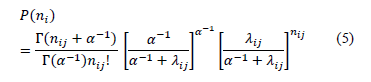
<body><![CDATA[<p><font size="2" face="Verdana, Arial, Helvetica, sans-serif">One of the   main problems that models based on the Poisson regression can have is the   over-dispersion of residuals, i.e., the model underestimates the degree of   dispersion of the result because the Poisson distribution assumes that the   counts variability of a covariant group is equal to the average. Failure to   observe this relationship might result in the estimated coefficients being   biased and inefficient, so a Negative Binomial distribution based on a Gamma   distributed error term should be used. In this case, the expected value for the   number of accidents is rewritten:</font></p>     <p><img src="/img/revistas/dyna/v83n195/v83n195a03eq03.gif"></p>     <p><font size="2" face="Verdana, Arial, Helvetica, sans-serif">Where <img src="/img/revistas/dyna/v83n195/v83n195a03eq020.gif"> is an error term that distributes Gamma and   allows the variance of the mean to be differentiated as follows:</font></p>     <p><img src="/img/revistas/dyna/v83n195/v83n195a03eq04.gif"></p>     <p><font size="2" face="Verdana, Arial, Helvetica, sans-serif">In this   case, <img src="/img/revistas/dyna/v83n195/v83n195a03eq024.gif"> is known as an over-dispersion parameter,   noting that when <img src="/img/revistas/dyna/v83n195/v83n195a03eq026.gif"> the Poisson distribution is obtained, for   which the Negative Binomial probability is represented by the following   mathematical expression:</font></p>     <p><img src="/img/revistas/dyna/v83n195/v83n195a03eq05.gif"></p>     <p><font size="2" face="Verdana, Arial, Helvetica, sans-serif">Where <img src="/img/revistas/dyna/v83n195/v83n195a03eq030.gif"> and <img src="/img/revistas/dyna/v83n195/v83n195a03eq032.gif">. This widely used model can be   estimated by maximum likelihood &#91;22-25&#93;.</font></p>     <p><font size="2" face="Verdana, Arial, Helvetica, sans-serif"><b><i>2.2. Identification of critical areas using the empirical Bayes method</i></b></font></p>     <p><font size="2" face="Verdana, Arial, Helvetica, sans-serif">The empirical   Bayesian approach for the analysis of road safety has gradually developed over   the last thirty years and today it is a widely recommended method for the estimation   of traffic accidents &#91;26,27&#93;.</font></p>     <p><font size="2" face="Verdana, Arial, Helvetica, sans-serif">The   empirical Bayesian method was originally developed to control the effect called   &quot;regression to the mean&quot; in road safety studies &quot;before and after&quot;. It is now   also used to identify accident-prone locations in road safety analysis &#91;28-32&#93;.   This method assumes that <img src="/img/revistas/dyna/v83n195/v83n195a03eq034.gif"> varies among different analysed sections and   that the exact value for any of these is an unknown variable with a Gamma   probability function density, expressed as follows:</font></p>     ]]></body>
<body><![CDATA[<p><img src="/img/revistas/dyna/v83n195/v83n195a03eq06.gif"></p>     <p><font size="2" face="Verdana, Arial, Helvetica, sans-serif">In these   equations <img src="/img/revistas/dyna/v83n195/v83n195a03eq024.gif"> is the shape parameter and <img src="/img/revistas/dyna/v83n195/v83n195a03eq038.gif"> is the scale parameter of the Gamma function,   with mean and variance given by eq. (7) and (8):</font></p>     <p><img src="/img/revistas/dyna/v83n195/v83n195a03eq0708.gif"></p>     <p><font size="2" face="Verdana, Arial, Helvetica, sans-serif">The   function parameters are determined from the data available about accidents in   the reference group, and are expressed as follows:</font></p>     <p><img src="/img/revistas/dyna/v83n195/v83n195a03eq0910.gif"></p>     <p><font size="2" face="Verdana, Arial, Helvetica, sans-serif">Where <img src="/img/revistas/dyna/v83n195/v83n195a03eq048.gif"> is the number of accidents in a given section.   The parameters of the posterior distribution, which is also of Gamma type, will   be given by:</font></p>     <p><img src="/img/revistas/dyna/v83n195/v83n195a03eq1112.gif"></p>     <p><font size="2" face="Verdana, Arial, Helvetica, sans-serif">Where the   expected value and the variance will be given by:</font></p>     <p><img src="/img/revistas/dyna/v83n195/v83n195a03eq13.gif">    <br>   <img src="/img/revistas/dyna/v83n195/v83n195a03eq14.gif"></p>     ]]></body>
<body><![CDATA[<p><font size="2" face="Verdana, Arial, Helvetica, sans-serif">To identify   the potentially critical sites, the probability that <img src="/img/revistas/dyna/v83n195/v83n195a03eq058.gif"> exceeds <img src="/img/revistas/dyna/v83n195/v83n195a03eq060.gif"> is:</font></p>     <p><img src="/img/revistas/dyna/v83n195/v83n195a03eq15.gif"></p>     <p><font size="2" face="Verdana, Arial, Helvetica, sans-serif">Where:</font></p>     <blockquote>       <p><font size="2" face="Verdana, Arial, Helvetica, sans-serif"><img src="/img/revistas/dyna/v83n195/v83n195a03eq060.gif">: Expected number of accidents for the     reference group during the study period.    <br>     </font><font size="2" face="Verdana, Arial, Helvetica, sans-serif"><img src="/img/revistas/dyna/v83n195/v83n195a03eq058.gif">: Expected number of accidents     adjusted by the empirical Bayesian method for a section of the reference group     in the same study period.</font></p> </blockquote>     <p><font size="2" face="Verdana, Arial, Helvetica, sans-serif">Then, if   the previously calculated probability exceeds threshold <img src="/img/revistas/dyna/v83n195/v83n195a03eq064.gif">, which defines the confidence level   chosen, the section is considered critical.</font></p>     <p><font size="2" face="Verdana, Arial, Helvetica, sans-serif">The   determination of the parameters was done through maximum likelihood and, the   statistical analysis was done using tests such as the t-student test.</font></p>     <p>&nbsp;</p>     <p><font size="3" face="Verdana, Arial, Helvetica, sans-serif"><b>3. Settings</b></font></p>     ]]></body>
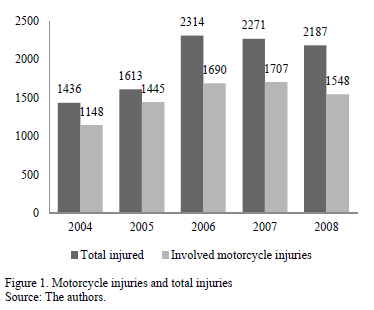
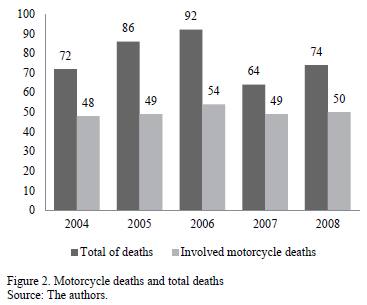
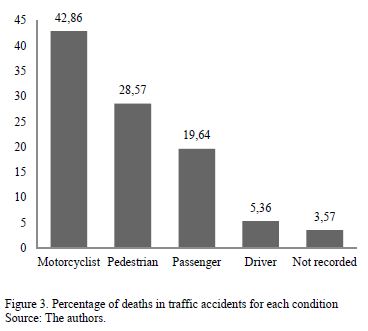
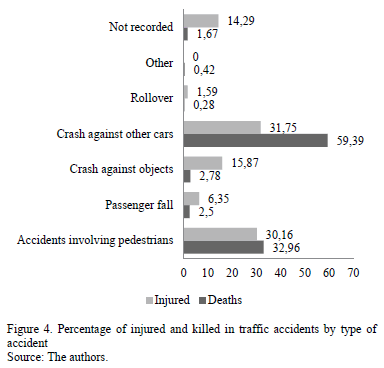
<body><![CDATA[<p><font size="2" face="Verdana, Arial, Helvetica, sans-serif">The study   was conducted in Cartagena, Colombia, which has a population of 923,219   inhabitants in an area of 616 km<sup>2</sup>. The city has an urban road   network of 656 km and its main economic activities are: tourism, petrochemicals   and port industries.</font></p>     <p><font size="2" face="Verdana, Arial, Helvetica, sans-serif">The data   used in this study corresponds to the information on accidents that was   gathered in Cartagena during 2007 by the Administrative Department of Traffic   and Transportation. The accidents classified as &quot;only property damage&quot; were not   included in the study, so the analysis was focused on accidents involving   deaths and injuries. Although we had more up-to-date information, we preferred   to work with the data from 2007 considering that the other available data was   affected by the construction of Cartagena's BRT system.</font></p>     <p><font size="2" face="Verdana, Arial, Helvetica, sans-serif">Local   statistics from recent years show a significant increase in the number of   fatalities and injuries and, a close relationship with the volumes of   motorcycles circulating in the city, as shown in <a href="#fig01">Fig. 1</a>, <a href="#fig02">2</a>.</font></p>     <p align="center"><font size="2" face="Verdana, Arial, Helvetica, sans-serif"><a name="fig01"></a></font><img src="/img/revistas/dyna/v83n195/v83n195a03fig01.gif"></p>     <p align="center"><font size="2" face="Verdana, Arial, Helvetica, sans-serif"><a name="fig02"></a></font><img src="/img/revistas/dyna/v83n195/v83n195a03fig02.gif"></p>     <p><font size="2" face="Verdana, Arial, Helvetica, sans-serif">It is possible   that the phenomenon known as &quot;mototaxismo&quot; has a correlation with the number of   road accidents in Cartagena. In this regard, the report on the status of road   safety in the Americas region established that over the last ten years   motorcycle-related deaths have dramatically increased &#91;33&#93;.</font></p>     <p><font size="2" face="Verdana, Arial, Helvetica, sans-serif">One of the   details that intrigued this study was the fact that Colombia is ranked as the   country with the highest mortality rate for motorcyclists in Latin America,   with 3.6 deaths per 100,000, followed by Brazil with 2.9, Paraguay 2.5 and   Suriname 2.2 &#91;33&#93;. <a href="#fig01">Fig. 1</a>, <a href="#fig02">2</a> confirm that the percentage of accidents is high   with some degree of severity in Cartagena when there is at least one motorcycle   involved.</font></p>     <p><font size="2" face="Verdana, Arial, Helvetica, sans-serif"><a href="#fig03">Fig. 3</a> shows that about 43% of those killed in traffic accidents correspond to   motorcyclists, followed by pedestrians with 29%. This is consistent with what   is shown in <a href="#fig04">Fig. 4</a>, which indicates that the type of accident with the most   severe consequences is when a motorcycle collides with another vehicle.</font></p>     <p align="center"><a name="fig03"></a><img src="/img/revistas/dyna/v83n195/v83n195a03fig03.gif"></p>     <p align="center"><font size="2" face="Verdana, Arial, Helvetica, sans-serif"><a name="fig04"></a></font><img src="/img/revistas/dyna/v83n195/v83n195a03fig04.gif"></p>     ]]></body>
<body><![CDATA[<p><font size="2" face="Verdana, Arial, Helvetica, sans-serif">Taking into consideration these   behavioral patterns, we decided to include vehicular composition as one of the   variables to be studied, in order to compare not only the effect of the   motorcycle accident frequency, but also that of buses and cars. This is in   response to referents that specifically demonstrate the impact of buses on   accidents, both directly and indirectly &#91;34-39&#93;</font></p>     <p><font size="2" face="Verdana, Arial, Helvetica, sans-serif">4. Methodology</font></p>     <p><font size="2" face="Verdana, Arial, Helvetica, sans-serif">Exploratory and quantitative research was   conducted, involving the processing of statistical data related to road   accidents in the city of Cartagena in 2007.</font></p>     <p><font size="2" face="Verdana, Arial, Helvetica, sans-serif">The accident analysis considered the two   usual classifications: accidents by severity and type. In terms of severity,   accidents with injuries and deaths were considered, and only accidents with   damage were excluded from the analysis. The second classification took into   account if the accident happened as a result of a crash, if it was an accident   involving pedestrians, a rollover, if an occupant fell, or any other type. </font></p>     <p><font size="2" face="Verdana, Arial, Helvetica, sans-serif">Each   accident was classified by severity and type, and other aspects were analyzed   such as its location on the road network of the city as well as the type and   model of the vehicles involved. With respect to the individual attributes, age   and gender were also considered, and the victim's status was specified as a:   driver, passenger, driver's passenger or pedestrian. Additionally, some road   geometric characteristics, road conditions and traffic flows were observed.</font></p>     <p><font size="2" face="Verdana, Arial, Helvetica, sans-serif"> The methods used in the investigation primarily considered the   Transport Research Laboratory's methodology (TRL), used in Great Britain,   Sweden and other members of the European Road Assessment Programme (EuroRAP)   and, secondarily, the Institute of   Highways and Transportation's methodology (IHT) &#91;40&#93;.</font></p> <font size="2" face="Verdana, Arial, Helvetica, sans-serif">The TRL methodology does not  take into account the possible causes of accidents, and the random component  thereof; the statistical analysis simply determines the level of risk through  the assessment of accidents and their severity. A risk index is calculated,  which is defined as the number of fatal and serious accidents for 1,000 million  vehicles per kilometer. Conversely, the IHT methodology proposes a clear and  detailed procedure for the identification, diagnosis and selection of the sites  to be studied. In this paper, combining both methods, the steps described below  were developed.</font>     <p></p>     <p><font size="2" face="Verdana, Arial, Helvetica, sans-serif"><b><i>4.1. Collection and processing of relevant information</i></b></font></p>     <p><font size="2" face="Verdana, Arial, Helvetica, sans-serif">Initially, we used the information   contained in the accident reports of the Administrative Department of Traffic   and Transport of Cartagena in 2007. The information was organized and digitized   so that site of the event, date and time, age of people involved, type of   vehicles involved and other important attributes could be identified.</font></p>     <p><font size="2" face="Verdana, Arial, Helvetica, sans-serif">In Colombia, as in other countries, the   use of accident data from police reports has certain disadvantages &#91;41, 42&#93;,   also not all traffic accidents with victims are reported by the police &#91;43&#93;.   For this reason, we compared the available information provided by the Road   Prevention Fund (FPV) for the same period. The results from this verification   were consolidated into a database of 1,367 traffic accidents with injuries or   deaths.</font></p>     ]]></body>
<body><![CDATA[<p><font size="2" face="Verdana, Arial, Helvetica, sans-serif">Complementary, topographic surveys were   conducted to define the geometric characteristic of each case study, such as   road widths and turning radii. Additionally, vehicle volumes and vehicle   composition studies were also applied, and were supplemented with information   from previous studies conducted by the city agents. We also had cartographic   information from various sources, which was used to quantitatively identify   possible factors involved in the occurrence of accidents.</font></p>     <p><font size="2" face="Verdana, Arial, Helvetica, sans-serif"><b><i>4.2. Spatial analysis</i></b></font></p>     <p><font size="2" face="Verdana, Arial, Helvetica, sans-serif">From the spatial distribution of   accidents, a database to classify the road network in areas with similar   characteristics in terms of traffic, land use, occupation of public space, and   geometry was built. This classification allowed 241 sections of the road   network to be identified and, for each of them, the number of accidents was   recorded.</font></p>     <p><font size="2" face="Verdana, Arial, Helvetica, sans-serif">The spatial analysis also accessed maps   by using kernel density tools and calculated magnitudes per area unit based on   the entities of interest, in this case the location of accidents. This type of   analysis has been used to analyze accidents in various urban settings, located   in different countries such as Canada &#91;44&#93;, India &#91;45&#93; and Turkey &#91;19&#93;.</font></p>     <p><font size="2" face="Verdana, Arial, Helvetica, sans-serif"><b><i>4.3. Generation of statistical models</i></b></font></p>     <p><font size="2" face="Verdana, Arial, Helvetica, sans-serif">The identification of explanatory   variables was performed by Principal Component Analysis (PCA), which is widely   used in the analysis of data that are not dimensionally homogeneous or when the   order of magnitude of the random variables measured is not the same as with the   data studied.</font></p>     <p><font size="2" face="Verdana, Arial, Helvetica, sans-serif">The PCA identified the following   variables that explain the frequency of accident occurrence: land use (1:   Commercial, 0: otherwise), number of intersections, road width, section length,   traffic directions (1: Two-way circulation, 0: otherwise) and average daily   traffic.</font></p>     <p><font size="2" face="Verdana, Arial, Helvetica, sans-serif">Poisson and Negative Binomial regression   models were estimated to describe the variation of the observed frequency of   accidents on the section <img src="/img/revistas/dyna/v83n195/v83n195a03eq004.gif"> during period <img src="/img/revistas/dyna/v83n195/v83n195a03eq006.gif">. Then, using an empirical Bayesian analysis, the identification of   accident-prone locations was undertaken.</font></p>     <p>&nbsp;</p>     <p><font size="3" face="Verdana, Arial, Helvetica, sans-serif"><b>5. Results</b></font></p>     ]]></body>
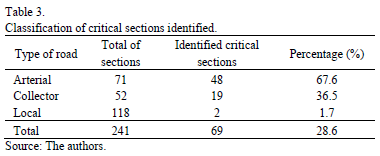
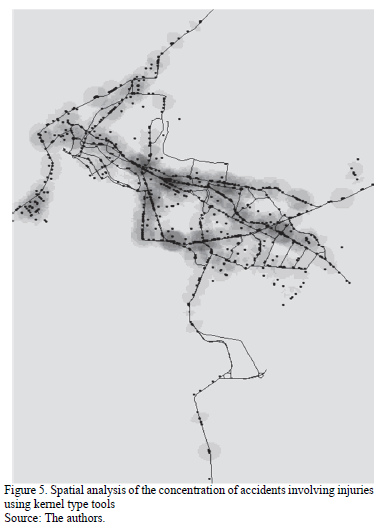
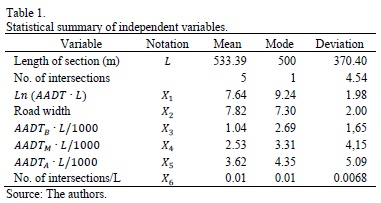
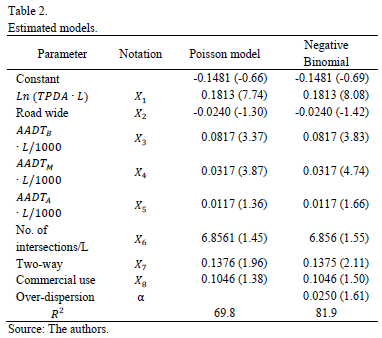
<body><![CDATA[<p><font size="2" face="Verdana, Arial, Helvetica, sans-serif">Accident   spatial analysis based on GIS allowed, besides the identification of   homogeneous sections, the existing relationship between infrastructure, land   use and accidents to be established, in order to consolidate the database that   was to be used in the model generation phase. <a href="#fig05">Fig. 5</a>, which contains the   spatial analysis of the concentration of accidents resulting in injuries using   kernel type tools, clearly illustrates the relationship between road   infrastructure and accidents. Other GIS data layers, such as layer urban land   use for the city of Cartagena, was used for the spatial analysis prior to model   calibration.</font></p>     <p align="center"><font size="2" face="Verdana, Arial, Helvetica, sans-serif"><a name="fig05"></a></font><img src="/img/revistas/dyna/v83n195/v83n195a03fig05.gif"></p>     <p><font size="2" face="Verdana, Arial, Helvetica, sans-serif">The statistical summary of the considered   explanatory variables is shown in <a href="#tab01">Table 1</a>, where <img src="/img/revistas/dyna/v83n195/v83n195a03eq076.gif">, <img src="/img/revistas/dyna/v83n195/v83n195a03eq078.gif"> and <img src="/img/revistas/dyna/v83n195/v83n195a03eq080.gif">, represent the average daily transit for buses, motorcycles and   cars, respectively.</font></p>     <p align="center"><font size="2" face="Verdana, Arial, Helvetica, sans-serif"><a name="tab01"></a></font><img src="/img/revistas/dyna/v83n195/v83n195a03tab01.gif"></p>     <p><font size="2" face="Verdana, Arial, Helvetica, sans-serif">Although the model calibration was   undertaken with and without constant, a better fit in those cases where the   constant was specified was always found. This behavior was introduced in the   Poisson model as well as in the negative binomial type models.</font></p>     <p><font size="2" face="Verdana, Arial, Helvetica, sans-serif">The results are presented in <a href="#tab02">Table 2</a>.   This contains estimates and the statistical t-student that are in parentheses,   which allows significance to be measured. It may be noted that the   over-dispersion parameter is small and statistically insignificant, so the   estimates of the obtained parameters for the two proposed models do not differ   substantially.</font></p>     <p align="center"><font size="2" face="Verdana, Arial, Helvetica, sans-serif"><a name="tab02"></a></font><img src="/img/revistas/dyna/v83n195/v83n195a03tab02.gif"></p>     <p><font size="2" face="Verdana, Arial, Helvetica, sans-serif">All   parameters have the expected signs and the important effect of the AADTM and   AADTB is highlighted. This is much smaller than the effect of cars. It can be   seen that the marginal effect of a motorcycle on the frequency of accidents   with deaths and injuries is 2.5 times greater than the effect of an additional   bus and 6 times larger than that of an automobile. </font></p>     <p><font size="2" face="Verdana, Arial, Helvetica, sans-serif">Moreover, <i>ceteris paribus</i> roads with two-way traffic have higher accident   frequency. The same analysis is true for the sections located in areas with   commercial land use, characterized by the strong presence of pedestrians.   Intersection density, i.e. the number of intersections divided by the length of   the section, is also a factor that tends to increase the occurrence of   accidents, but the statistical significance of this variable is not high.</font></p>     <p><font size="2" face="Verdana, Arial, Helvetica, sans-serif">Following the methodology proposed to   implement the empirical Bayesian approach, the following parameters were   calculated for the analyzed group of sections: <img src="/img/revistas/dyna/v83n195/v83n195a03eq116.gif">=31.23, <img src="/img/revistas/dyna/v83n195/v83n195a03eq118.gif">=0.441 and <img src="/img/revistas/dyna/v83n195/v83n195a03eq120.gif">=2.424. As shown in <a href="#tab03">Table 3</a> there were a total of69 critical   sections, corresponding to 28.6% of sections analyzed, identified.</font></p>     ]]></body>
<body><![CDATA[<p align="center"><font size="2" face="Verdana, Arial, Helvetica, sans-serif"><a name="tab03"></a></font><img src="/img/revistas/dyna/v83n195/v83n195a03tab03.gif"></p>     <p><font size="2" face="Verdana, Arial, Helvetica, sans-serif">It is important to note that the largest   number of accident-prone locations was located on arterials, on which 67.6% of   the sections were considered critical. We also found the same to be true on the   collector roads to a lesser degree. Local roads with just 1.7% of   accident-prone locations were also identified. <a href="#fig06">Fig. 6</a> illustrates this by   showing the density of accidents resulting in injuries or deaths for the city   of Cartagena, which identifies the accident-prone locations studied.</font></p>     <p align="center"><font size="2" face="Verdana, Arial, Helvetica, sans-serif"><a name="fig06"></a></font><img src="/img/revistas/dyna/v83n195/v83n195a03fig06.gif"></p>     <p>&nbsp;</p>     <p><font size="3" face="Verdana, Arial, Helvetica, sans-serif"><b>6. Conclusions</b></font></p>     <p><font size="2" face="Verdana, Arial, Helvetica, sans-serif">In an urban context, such as in the city   of Cartagena, we have found empirical evidence demonstrating the relationship   between the frequency of accidents and variables as well as traffic density,   road width, density of intersections per segment, flow direction and land use   environment.</font></p>     <p><font size="2" face="Verdana, Arial, Helvetica, sans-serif">The results found are representative of   cities located in less developed countries, with low amount of traffic, which   have a high occupancy of public space and important use of public transport and   motorcycles in the cities. The latter are even sometimes used as an informal   mode of public transport. This analysis enabled us to, from a systemic   approach; identify the most potentially accident-prone areas with the help of   the empirical Bayesian method.</font></p>     <p><font size="2" face="Verdana, Arial, Helvetica, sans-serif">The study was able to successfully   involve spatial analysis of accidents through the use of a GIS to identify   homogeneous sections in Cartagena, that were then established by modeling the   impact of vehicular volumes of motorcycles, buses and cars on the expected   number of traffic accidents for each sector. This showed that the marginal   effect on the accident rate for motorcycles is significantly higher than for   that of buses and, it is much higher than for that of cars.</font></p>     <p><font size="2" face="Verdana, Arial, Helvetica, sans-serif">Regarding road infrastructure variables,   we found that there are more accidents in the sections with two-way traffic   than in the single ones. The level of risk also decreases with the width of the   road. This is a very important discovery to be taken into consideration when   embarking on plans for the operational management of the road network in the   city, as well as well as when the urban road sections for planning are defined.   Likewise, the sections located in commercial areas, which normally have high   presence of pedestrians, tend to have a higher frequency of the occurrence of   accidents with serious consequences. It is in these places where authorities   should maintain a greater presence to mitigate problems resulting from   accidents.</font></p>     <p><font size="2" face="Verdana, Arial, Helvetica, sans-serif">By using the empirical Bayesian approach   it was possible to statistically identify critical areas for accidents, which   will allow local authorities to focus the efforts of mitigating the problems   caused by the accidents. The method employed showed the importance of the   spatial location of the accident and the formation of reference groups for data   analysis, which were initially assessed on the basis of their similar   characteristics, regardless of the frequency or severity of the accidents.</font></p>     ]]></body>
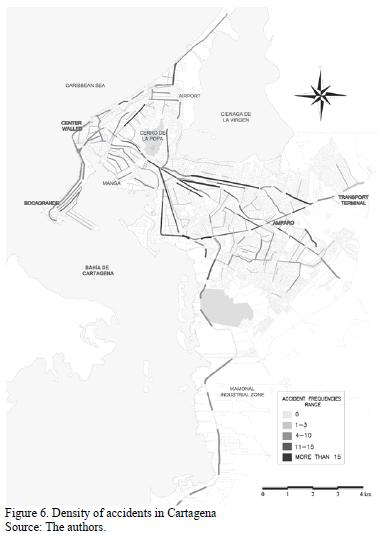
<body><![CDATA[<p><font size="2" face="Verdana, Arial, Helvetica, sans-serif">Among a total of 241 sections   established, it was found that nearly 30% are identified as high-risk accident   sections. This percentage is consistent with the findings of &#91;15&#93; who found   that most accidents occurred on curves, which represent 29.7% of the total   length of the studied motorway. These findings can also be found in &#91;7&#93; who   reported that in the case of regional roads, 26% of basic spatial units   (hectometer of road) have at least 1 accident.</font></p>     <p><font size="2" face="Verdana, Arial, Helvetica, sans-serif">The estimation of predictive Poisson type   and negative binomial models for the frequency of accidents resulting in either   injuries or deaths allows causal relationships to be established between the   frequency of accidents and the explanatory variables. In this sense, this   research provides some initial insights into directions for actions that the   Administrative Department of Traffic and Transportation could take in order to   reduce the likelihood of high impact accidents in urban environments.</font></p>     <p><font size="2" face="Verdana, Arial, Helvetica, sans-serif">First, measures should be focused on   arterials as they are the areas with the highest number of critical sections,   especially those located in areas with commercial land use that are   characterized by a heavy pedestrian presence.</font></p>     <p><font size="2" face="Verdana, Arial, Helvetica, sans-serif">Future research can use similar methods   to those presented in this paper for &quot;before and after&quot; studies that continue   the application of the empirical Bayesian approach in response to the arrival   of Cartagena's BRT system.</font></p>     <p>&nbsp;</p>     <p><font size="3" face="Verdana, Arial, Helvetica, sans-serif"><b>Acknowledgements</b></font></p>     <p><font size="2" face="Verdana, Arial, Helvetica, sans-serif">We would like to thank the Administrative   Department of Science, Technology and Innovation (COLCIENCIAS) for having   partially financed this work through contracts RC No 0791-2013 (Cod.   121562238496) and 470-2014 (Cod. 1215-675-47211).</font></p>     <p>&nbsp;</p>     <p><font size="3" face="Verdana, Arial, Helvetica, sans-serif"><b>References</b></font></p>     <!-- ref --><p><font size="2" face="Verdana, Arial, Helvetica, sans-serif"><b>&#91;1&#93;</b> Johansson, R., Vision Zero -   Implementing a policy for traffic safety. Safety Science, 47, pp. 826-831,   2009. DOI: 10.1016/j.ssci.2008.10.023</font>&nbsp;&nbsp;&nbsp;&nbsp;&nbsp;&nbsp;&nbsp;&nbsp;[&#160;<a href="javascript:void(0);" onclick="javascript: window.open('/scielo.php?script=sci_nlinks&ref=1131125&pid=S0012-7353201600010000300001&lng=','','width=640,height=500,resizable=yes,scrollbars=1,menubar=yes,');">Links</a>&#160;]<!-- end-ref --><!-- ref --><p><font size="2" face="Verdana, Arial, Helvetica, sans-serif"><b>&#91;2&#93;</b> Organizaci&oacute;n Mundial de la Salud   (OMS)., Informe sobre la situaci&oacute;n mundial de la seguridad vial 2013. &#91;Online&#93;.   Washigton: OMS, Bloomberg Philanthropies. &#91;date of reference July 25th of   2014&#93;. Available at: <a href="http://apps.who.int/iris/bitstream/10665/83798/1/WHO_NMH_VIP_13.01_spa.pdf" target="_blank">http://apps.who.int/iris/bitstream/10665/83798/1/WHO_NMH_VIP_13.01_spa.pdf</a></font>&nbsp;&nbsp;&nbsp;&nbsp;&nbsp;&nbsp;&nbsp;&nbsp;[&#160;<a href="javascript:void(0);" onclick="javascript: window.open('/scielo.php?script=sci_nlinks&ref=1131126&pid=S0012-7353201600010000300002&lng=','','width=640,height=500,resizable=yes,scrollbars=1,menubar=yes,');">Links</a>&#160;]<!-- end-ref --><!-- ref --><p><font size="2" face="Verdana, Arial, Helvetica, sans-serif"><b>&#91;3&#93;</b> Contralor&iacute;a General de la Naci&oacute;n.,   Seguimiento a los resultados de la pol&iacute;tica p&uacute;blica de Seguridad Vial en   Colombia. Bogot&aacute;: Contralor&iacute;a General de la Rep&uacute;blica, &#91;Online&#93;. 2012. &#91;date of   reference July 25th of 2014&#93;. Available at: <a href="http://www.contraloria.gov.co/documents/155638087/171673939/Informe_Seguridad_Vial_15.pdf/6b90bdad-2fec-4c20-8a81-6a65a8a5a2ac?version=1.1" target="_blank">http://www.contraloria.gov.co/documents/155638087/171673939/Informe_Seguridad_Vial_15.pdf/6b90bdad-2fec-4c20-8a81-6a65a8a5a2ac?version=1.1</a></font>&nbsp;&nbsp;&nbsp;&nbsp;&nbsp;&nbsp;&nbsp;&nbsp;[&#160;<a href="javascript:void(0);" onclick="javascript: window.open('/scielo.php?script=sci_nlinks&ref=1131127&pid=S0012-7353201600010000300003&lng=','','width=640,height=500,resizable=yes,scrollbars=1,menubar=yes,');">Links</a>&#160;]<!-- end-ref --><!-- ref --><p><font size="2" face="Verdana, Arial, Helvetica, sans-serif"><b>&#91;4&#93;</b> Moreno, S.L., Muertes y lesiones por   accidentes de transporte, Colombia, 2012. Grupo Centro de Referencia Nacional   sobre Violencia, Instituto Nacional de Medicina Legal y Ciencias Forenses,   Bogot&aacute;, &#91;Online&#93;. 2012. &#91;date of reference July 25th of 2014&#93;. Available at: <a href="http://www.medicinalegal.gov.co/documents/10180/34861/7+transporte+forensis+2012.pdf/2fbb18b6-2ae7-4f58-8c25-220cb4d3be37" target="_blank">http://www.medicinalegal.gov.co/documents/10180/34861/7+transporte+forensis+2012.pdf/2fbb18b6-2ae7-4f58-8c25-220cb4d3be37</a></font>&nbsp;&nbsp;&nbsp;&nbsp;&nbsp;&nbsp;&nbsp;&nbsp;[&#160;<a href="javascript:void(0);" onclick="javascript: window.open('/scielo.php?script=sci_nlinks&ref=1131128&pid=S0012-7353201600010000300004&lng=','','width=640,height=500,resizable=yes,scrollbars=1,menubar=yes,');">Links</a>&#160;]<!-- end-ref --><!-- ref --><p><font size="2" face="Verdana, Arial, Helvetica, sans-serif"><b>&#91;5&#93;</b> Ministerio de Transporte. Plan Nacional   de Seguridad Vial Colombia 2013 - 2021. PNSV 2013 - 2021, Bogot&aacute;, &#91;Online&#93;.   2014. &#91;date of reference July 25th of 2014&#93;. Available at: <a href="https://www.mintransporte.gov.co/descargar.php?idFile=11576" target="_blank">https://www.mintransporte.gov.co/descargar.php?idFile=11576</a></font>&nbsp;&nbsp;&nbsp;&nbsp;&nbsp;&nbsp;&nbsp;&nbsp;[&#160;<a href="javascript:void(0);" onclick="javascript: window.open('/scielo.php?script=sci_nlinks&ref=1131129&pid=S0012-7353201600010000300005&lng=','','width=640,height=500,resizable=yes,scrollbars=1,menubar=yes,');">Links</a>&#160;]<!-- end-ref --><!-- ref --><p><font size="2" face="Verdana, Arial, Helvetica, sans-serif"><b>&#91;6&#93;</b> Observatorio de movilidad urbana de   Bogot&aacute;. L&iacute;neas de investigaci&oacute;n del observatorio de movilidad enmarcado en la   seguridad vial. An&aacute;lisis 1994-2000, 2001.    &nbsp;&nbsp;&nbsp;&nbsp;&nbsp;&nbsp;&nbsp;&nbsp;[&#160;<a href="javascript:void(0);" onclick="javascript: window.open('/scielo.php?script=sci_nlinks&ref=1131130&pid=S0012-7353201600010000300006&lng=','','width=640,height=500,resizable=yes,scrollbars=1,menubar=yes,');">Links</a>&#160;]<!-- end-ref --></font></p>     <!-- ref --><p><font size="2" face="Verdana, Arial, Helvetica, sans-serif"><b>&#91;7&#93;</b> Flahaut, B., Impact of infrastructure   and local environment on road unsafety: Logistic modeling with spatial   autocorrelation. Accident Analysis &amp; Prevention, 36, pp. 1055-1066, 2004.   DOI: 10.1016/j.aap.2003.12.003</font>&nbsp;&nbsp;&nbsp;&nbsp;&nbsp;&nbsp;&nbsp;&nbsp;[&#160;<a href="javascript:void(0);" onclick="javascript: window.open('/scielo.php?script=sci_nlinks&ref=1131132&pid=S0012-7353201600010000300007&lng=','','width=640,height=500,resizable=yes,scrollbars=1,menubar=yes,');">Links</a>&#160;]<!-- end-ref --><!-- ref --><p><font size="2" face="Verdana, Arial, Helvetica, sans-serif"><b>&#91;8&#93;</b> Muhlrad, N. and Lassarre, S., Systems   approach to injury control. En: Tiwari, G., Mohan, D. and Muhlrad, N., The way   forward: Transportation planning and road safety. Nueva Delhi, McMillan India   Ltd., pp. 52-73, 2005.    &nbsp;&nbsp;&nbsp;&nbsp;&nbsp;&nbsp;&nbsp;&nbsp;[&#160;<a href="javascript:void(0);" onclick="javascript: window.open('/scielo.php?script=sci_nlinks&ref=1131133&pid=S0012-7353201600010000300008&lng=','','width=640,height=500,resizable=yes,scrollbars=1,menubar=yes,');">Links</a>&#160;]<!-- end-ref --></font></p>     <!-- ref --><p><font size="2" face="Verdana, Arial, Helvetica, sans-serif"><b>&#91;9&#93;</b> Jovanis, P. and Chang, H.L., Modeling   the relationship of accidents to miles traveled. Transportation Research Record   1068, pp. 42-51, 1986.    &nbsp;&nbsp;&nbsp;&nbsp;&nbsp;&nbsp;&nbsp;&nbsp;[&#160;<a href="javascript:void(0);" onclick="javascript: window.open('/scielo.php?script=sci_nlinks&ref=1131135&pid=S0012-7353201600010000300009&lng=','','width=640,height=500,resizable=yes,scrollbars=1,menubar=yes,');">Links</a>&#160;]<!-- end-ref --> </font></p>     <!-- ref --><p><font size="2" face="Verdana, Arial, Helvetica, sans-serif"><b>&#91;10&#93;</b> Joshua, S. and Garber, N., Estimating   truck accident rate and involvements using linear and poisson regression   models. Transportation Planning and Technology, 15, pp. 41-58, 1990. DOI:   10.1080/03081069008717439</font>&nbsp;&nbsp;&nbsp;&nbsp;&nbsp;&nbsp;&nbsp;&nbsp;[&#160;<a href="javascript:void(0);" onclick="javascript: window.open('/scielo.php?script=sci_nlinks&ref=1131137&pid=S0012-7353201600010000300010&lng=','','width=640,height=500,resizable=yes,scrollbars=1,menubar=yes,');">Links</a>&#160;]<!-- end-ref --><!-- ref --><p><font size="2" face="Verdana, Arial, Helvetica, sans-serif"><b>&#91;11&#93;</b> Miaou, S.P. and Lum, H., Modeling   vehicle accidents and highway geometric design relationships. Accident Analysis   &amp; Prevention, 25(6), pp. 689-709, 1993. DOI: 10.1016/0001-4575(93)90034-T</font>&nbsp;&nbsp;&nbsp;&nbsp;&nbsp;&nbsp;&nbsp;&nbsp;[&#160;<a href="javascript:void(0);" onclick="javascript: window.open('/scielo.php?script=sci_nlinks&ref=1131138&pid=S0012-7353201600010000300011&lng=','','width=640,height=500,resizable=yes,scrollbars=1,menubar=yes,');">Links</a>&#160;]<!-- end-ref --><!-- ref --><p><font size="2" face="Verdana, Arial, Helvetica, sans-serif"><b>&#91;12&#93;</b> Lee, J. and Mannering, F., Impact of   roadside features on the frequency and severity of run-off-roadway accidents:   an empirical analysis. Accident Analysis &amp; Prevention, 34(1), pp. 149-161,   2002. DOI: 10.1016/S0001-4575(01)00009-4</font>&nbsp;&nbsp;&nbsp;&nbsp;&nbsp;&nbsp;&nbsp;&nbsp;[&#160;<a href="javascript:void(0);" onclick="javascript: window.open('/scielo.php?script=sci_nlinks&ref=1131139&pid=S0012-7353201600010000300012&lng=','','width=640,height=500,resizable=yes,scrollbars=1,menubar=yes,');">Links</a>&#160;]<!-- end-ref --><!-- ref --><p><font size="2" face="Verdana, Arial, Helvetica, sans-serif"><b>&#91;13&#93;</b> Lord, D. and Miranda-Moreno, L.,   Effects of low sample mean values and small sample size on the estimation of   the fixed dispersion parameter of Poisson-gamma models for modeling motor   vehicle crashes: A Bayesian perspective. Safety Science, 46(5), pp. 751-770.   2008. DOI: 10.1016/j.ssci.2007.03.005</font>&nbsp;&nbsp;&nbsp;&nbsp;&nbsp;&nbsp;&nbsp;&nbsp;[&#160;<a href="javascript:void(0);" onclick="javascript: window.open('/scielo.php?script=sci_nlinks&ref=1131140&pid=S0012-7353201600010000300013&lng=','','width=640,height=500,resizable=yes,scrollbars=1,menubar=yes,');">Links</a>&#160;]<!-- end-ref --><!-- ref --><p><font size="2" face="Verdana, Arial, Helvetica, sans-serif"><b>&#91;14&#93;</b> Agüero-Valverde, J. and Jovanis, P.,   Spatial analysis of fatal and injury crashes in Pennsylvania. Accident Analysis   &amp; Prevention, 38(3), pp. 618-625, 2008. DOI: 10.1016/j.aap.2005.12.006</font>&nbsp;&nbsp;&nbsp;&nbsp;&nbsp;&nbsp;&nbsp;&nbsp;[&#160;<a href="javascript:void(0);" onclick="javascript: window.open('/scielo.php?script=sci_nlinks&ref=1131141&pid=S0012-7353201600010000300014&lng=','','width=640,height=500,resizable=yes,scrollbars=1,menubar=yes,');">Links</a>&#160;]<!-- end-ref --><!-- ref --><p><font size="2" face="Verdana, Arial, Helvetica, sans-serif"><b>&#91;15&#93;</b> Caliendo, C., Guida, M. and Parisi, A.,   A crash-prediction model for multilane roads. Accident Analysis &amp;   Prevention, 39, pp. 657-670, 2007. DOI: 10.1016/j.aap.2006.10.012</font>&nbsp;&nbsp;&nbsp;&nbsp;&nbsp;&nbsp;&nbsp;&nbsp;[&#160;<a href="javascript:void(0);" onclick="javascript: window.open('/scielo.php?script=sci_nlinks&ref=1131142&pid=S0012-7353201600010000300015&lng=','','width=640,height=500,resizable=yes,scrollbars=1,menubar=yes,');">Links</a>&#160;]<!-- end-ref --><!-- ref --><p><font size="2" face="Verdana, Arial, Helvetica, sans-serif"><b>&#91;16&#93;</b> Gutierrez, M. and Cantillo, V., Classic   and bayesian estimation of Subjective Value of Time. DYNA 81(187), pp. 158-166,   2014. DOI: 10.15446/dyna.v81n187.40863</font>&nbsp;&nbsp;&nbsp;&nbsp;&nbsp;&nbsp;&nbsp;&nbsp;[&#160;<a href="javascript:void(0);" onclick="javascript: window.open('/scielo.php?script=sci_nlinks&ref=1131143&pid=S0012-7353201600010000300016&lng=','','width=640,height=500,resizable=yes,scrollbars=1,menubar=yes,');">Links</a>&#160;]<!-- end-ref --><!-- ref --><p><font size="2" face="Verdana, Arial, Helvetica, sans-serif"><b>&#91;17&#93;</b> Loo, B.P.Y., Validating crash locations   for quantitative spatial analysis: A GIS-based approach, Accident Analysis   &amp; Prevention, 38(5), pp. 879-886, 2006. DOI: 10.1016/j.aap.2006.02.012</font>&nbsp;&nbsp;&nbsp;&nbsp;&nbsp;&nbsp;&nbsp;&nbsp;[&#160;<a href="javascript:void(0);" onclick="javascript: window.open('/scielo.php?script=sci_nlinks&ref=1131144&pid=S0012-7353201600010000300017&lng=','','width=640,height=500,resizable=yes,scrollbars=1,menubar=yes,');">Links</a>&#160;]<!-- end-ref --><!-- ref --><p><font size="2" face="Verdana, Arial, Helvetica, sans-serif"><b>&#91;18&#93;</b> Plug, C., Xia, J. and Caulfield, C.,   Spatial and temporal visualisation techniques for crash analysis. Accident   Analysis &amp; Prevention, 43(6), pp. 1937-1946, 2011. DOI:   10.1016/j.aap.2011.05.007</font>&nbsp;&nbsp;&nbsp;&nbsp;&nbsp;&nbsp;&nbsp;&nbsp;[&#160;<a href="javascript:void(0);" onclick="javascript: window.open('/scielo.php?script=sci_nlinks&ref=1131145&pid=S0012-7353201600010000300018&lng=','','width=640,height=500,resizable=yes,scrollbars=1,menubar=yes,');">Links</a>&#160;]<!-- end-ref --><!-- ref --><p><font size="2" face="Verdana, Arial, Helvetica, sans-serif"><b>&#91;19&#93;</b> Erdogan, S., Yilmaz, I., Baybura, T.   and Gullu, M., Geographical information systems aided traffic accident analysis   system case study: City of Afyonkarahisar. Accident Analysis &amp; Prevention,   40(1), pp. 174-181, 2008. DOI: 10.1016/j.aap.2007.05.004</font>&nbsp;&nbsp;&nbsp;&nbsp;&nbsp;&nbsp;&nbsp;&nbsp;[&#160;<a href="javascript:void(0);" onclick="javascript: window.open('/scielo.php?script=sci_nlinks&ref=1131146&pid=S0012-7353201600010000300019&lng=','','width=640,height=500,resizable=yes,scrollbars=1,menubar=yes,');">Links</a>&#160;]<!-- end-ref --><!-- ref --><p><font size="2" face="Verdana, Arial, Helvetica, sans-serif"><b>&#91;20&#93;</b> Vieira, S., The influence of the infrastructure   characteristics in urban road accidents occurrence. Accident Analysis &amp;   Prevention, 60, pp. 289-297, 2013. DOI: 10.1016/j.aap.2013.02.042</font>&nbsp;&nbsp;&nbsp;&nbsp;&nbsp;&nbsp;&nbsp;&nbsp;[&#160;<a href="javascript:void(0);" onclick="javascript: window.open('/scielo.php?script=sci_nlinks&ref=1131147&pid=S0012-7353201600010000300020&lng=','','width=640,height=500,resizable=yes,scrollbars=1,menubar=yes,');">Links</a>&#160;]<!-- end-ref --><!-- ref --><p><font size="2" face="Verdana, Arial, Helvetica, sans-serif"><b>&#91;21&#93;</b> Cottrill, C.D. and Thakuriah, P.,   Evaluating pedestrian crashes in areas with high low-income or minority populations.   Accident Analysis &amp; Prevention, 42(6), pp. 1718-1728, 2010. DOI:   10.1016/j.aap.2010.04.012</font>&nbsp;&nbsp;&nbsp;&nbsp;&nbsp;&nbsp;&nbsp;&nbsp;[&#160;<a href="javascript:void(0);" onclick="javascript: window.open('/scielo.php?script=sci_nlinks&ref=1131148&pid=S0012-7353201600010000300021&lng=','','width=640,height=500,resizable=yes,scrollbars=1,menubar=yes,');">Links</a>&#160;]<!-- end-ref --><!-- ref --><p><font size="2" face="Verdana, Arial, Helvetica, sans-serif"><b>&#91;22&#93;</b> Miaou, S.P., The relationship between   truck accidents and geometric design of road sections: Poisson versus negative   binomial regressions. Accident Analysis &amp; Prevention, 26(4), pp. 471-482,   1994. DOI: 10.1016/0001-4575(94)90038-8</font>&nbsp;&nbsp;&nbsp;&nbsp;&nbsp;&nbsp;&nbsp;&nbsp;[&#160;<a href="javascript:void(0);" onclick="javascript: window.open('/scielo.php?script=sci_nlinks&ref=1131149&pid=S0012-7353201600010000300022&lng=','','width=640,height=500,resizable=yes,scrollbars=1,menubar=yes,');">Links</a>&#160;]<!-- end-ref --><!-- ref --><p><font size="2" face="Verdana, Arial, Helvetica, sans-serif"><b>&#91;23&#93;</b> Shankar, V.N., Mannering, F. and   Barfield, W., Effect of roadway geometrics and environmental factors on rural   freeway accident frequencies. Accident Analysis &amp; Prevention, 27(3), pp.   371-389, 1995. DOI: 10.1016/0001-4575(94)00078-Z</font>&nbsp;&nbsp;&nbsp;&nbsp;&nbsp;&nbsp;&nbsp;&nbsp;[&#160;<a href="javascript:void(0);" onclick="javascript: window.open('/scielo.php?script=sci_nlinks&ref=1131150&pid=S0012-7353201600010000300023&lng=','','width=640,height=500,resizable=yes,scrollbars=1,menubar=yes,');">Links</a>&#160;]<!-- end-ref --><!-- ref --><p><font size="2" face="Verdana, Arial, Helvetica, sans-serif"><b>&#91;24&#93;</b> Shankar, V.N., Mannering, F. and   Barfield, W., Statistical analysis of accident severity on rural freeways.   Accident Analysis &amp; Prevention, 28(3), pp. 391-401, 1996. DOI:   10.1016/0001-4575(96)00009-7</font>&nbsp;&nbsp;&nbsp;&nbsp;&nbsp;&nbsp;&nbsp;&nbsp;[&#160;<a href="javascript:void(0);" onclick="javascript: window.open('/scielo.php?script=sci_nlinks&ref=1131151&pid=S0012-7353201600010000300024&lng=','','width=640,height=500,resizable=yes,scrollbars=1,menubar=yes,');">Links</a>&#160;]<!-- end-ref --><!-- ref --><p><font size="2" face="Verdana, Arial, Helvetica, sans-serif"><b>&#91;25&#93;</b> Carson, J. and Mannering, F., The   effect of ice warning signs on ice accident frequency and severity. Accident   Analysis &amp; Prevention, 33(1), pp. 99-109, 2001. <a href="http://dx.doi.org/10.1016/S0001-4575(00)00020-8" target="_blank">http://dx.doi.org/10.1016/S0001-4575(00)00020-8</a></font>&nbsp;&nbsp;&nbsp;&nbsp;&nbsp;&nbsp;&nbsp;&nbsp;[&#160;<a href="javascript:void(0);" onclick="javascript: window.open('/scielo.php?script=sci_nlinks&ref=1131152&pid=S0012-7353201600010000300025&lng=','','width=640,height=500,resizable=yes,scrollbars=1,menubar=yes,');">Links</a>&#160;]<!-- end-ref --><!-- ref --><p><font size="2" face="Verdana, Arial, Helvetica, sans-serif"><b>&#91;26&#93;</b> Hauer, E., Harwood, D.W., Council, F.M.   and Griffith, M.S., Estimating safety by the empirical Bayes method. A   tutorial. Transportation Research Record, 1784, pp. 126-131, 2002. DOI:   10.3141/1784-16</font>&nbsp;&nbsp;&nbsp;&nbsp;&nbsp;&nbsp;&nbsp;&nbsp;[&#160;<a href="javascript:void(0);" onclick="javascript: window.open('/scielo.php?script=sci_nlinks&ref=1131153&pid=S0012-7353201600010000300026&lng=','','width=640,height=500,resizable=yes,scrollbars=1,menubar=yes,');">Links</a>&#160;]<!-- end-ref --><!-- ref --><p><font size="2" face="Verdana, Arial, Helvetica, sans-serif"><b>&#91;27&#93;</b> Guerrero-Barbosa, T. and Amar&iacute;s-Castro,   G., Application of Bayesian techniques for the identification of accident-prone   road sections. DYNA 81(187), pp. 209-214, 2014. DOI:   10.15446/dyna.v81n187.41333</font>&nbsp;&nbsp;&nbsp;&nbsp;&nbsp;&nbsp;&nbsp;&nbsp;[&#160;<a href="javascript:void(0);" onclick="javascript: window.open('/scielo.php?script=sci_nlinks&ref=1131154&pid=S0012-7353201600010000300027&lng=','','width=640,height=500,resizable=yes,scrollbars=1,menubar=yes,');">Links</a>&#160;]<!-- end-ref --><!-- ref --><p><font size="2" face="Verdana, Arial, Helvetica, sans-serif"><b>&#91;28&#93;</b> Persaud, B., Lyon, C. and Nguyen, T.,   Empirical Bayes procedure for ranking sites for safety investigation by   potential for improvement. Transportation Research Record, 1665, pp. 7-12,   1999.    &nbsp;&nbsp;&nbsp;&nbsp;&nbsp;&nbsp;&nbsp;&nbsp;[&#160;<a href="javascript:void(0);" onclick="javascript: window.open('/scielo.php?script=sci_nlinks&ref=1131155&pid=S0012-7353201600010000300028&lng=','','width=640,height=500,resizable=yes,scrollbars=1,menubar=yes,');">Links</a>&#160;]<!-- end-ref --></font></p>     <!-- ref --><p><font size="2" face="Verdana, Arial, Helvetica, sans-serif"><b>&#91;29&#93;</b> Harwood, D.W., Torbic, D.J., Bauer,   K.M., Persaud, B.N., Lyon, C.A. and Hauer, E., Safety analyst: Software tools   for safety management of specific highway sites. Federal Highway   Administration, Washington, D.C., 2002.    &nbsp;&nbsp;&nbsp;&nbsp;&nbsp;&nbsp;&nbsp;&nbsp;[&#160;<a href="javascript:void(0);" onclick="javascript: window.open('/scielo.php?script=sci_nlinks&ref=1131157&pid=S0012-7353201600010000300029&lng=','','width=640,height=500,resizable=yes,scrollbars=1,menubar=yes,');">Links</a>&#160;]<!-- end-ref --></font></p>     <!-- ref --><p><font size="2" face="Verdana, Arial, Helvetica, sans-serif"><b>&#91;30&#93;</b> Lord, D., Modeling motor vehicle   crashes using Poisson-gamma models: Examining the effects of low sample mean   values and small sample size on the estimation of the fixed dispersion   parameter. Accident Analysis &amp; Prevention, 38, pp. 751-766, 2006. DOI:   10.1016/j.aap.2006.02.001</font>&nbsp;&nbsp;&nbsp;&nbsp;&nbsp;&nbsp;&nbsp;&nbsp;[&#160;<a href="javascript:void(0);" onclick="javascript: window.open('/scielo.php?script=sci_nlinks&ref=1131159&pid=S0012-7353201600010000300030&lng=','','width=640,height=500,resizable=yes,scrollbars=1,menubar=yes,');">Links</a>&#160;]<!-- end-ref --><!-- ref --><p><font size="2" face="Verdana, Arial, Helvetica, sans-serif"><b>&#91;31&#93;</b> Miaou, S.P. and Lord, D., Modeling   traffic crash-flow relationships for intersections: Dispersion parameter,   functional form, and Bayes versus Empirical Bayes. Transportation Research   Record, 1840, pp. 31-40, 2003.    &nbsp;&nbsp;&nbsp;&nbsp;&nbsp;&nbsp;&nbsp;&nbsp;[&#160;<a href="javascript:void(0);" onclick="javascript: window.open('/scielo.php?script=sci_nlinks&ref=1131160&pid=S0012-7353201600010000300031&lng=','','width=640,height=500,resizable=yes,scrollbars=1,menubar=yes,');">Links</a>&#160;]<!-- end-ref --></font></p>     <!-- ref --><p><font size="2" face="Verdana, Arial, Helvetica, sans-serif"><b>&#91;32&#93;</b> Cheng,W. and Washington, S.P.,   Experimental evaluation of hotspot identification methods. Accident Analysis   &amp; Prevention, 37, pp. 870-881, 2005. DOI: 10.1016/j.aap.2005.04.015</font>&nbsp;&nbsp;&nbsp;&nbsp;&nbsp;&nbsp;&nbsp;&nbsp;[&#160;<a href="javascript:void(0);" onclick="javascript: window.open('/scielo.php?script=sci_nlinks&ref=1131162&pid=S0012-7353201600010000300032&lng=','','width=640,height=500,resizable=yes,scrollbars=1,menubar=yes,');">Links</a>&#160;]<!-- end-ref --><!-- ref --><p><font size="2" face="Verdana, Arial, Helvetica, sans-serif"><b>&#91;33&#93;</b> Organizaci&oacute;n Panamericana de la Salud.,   Informe sobre el estado de la seguridad vial en la regi&oacute;n de las Am&eacute;ricas.   Washington, D.C. &#91;Online&#93;. 2009. &#91;date of reference July 25th of 2014&#93;.   Available at: <a href="http://www.who.int/violence_injury_prevention/road_safety_status/2009/gsrrs_paho.pdf" target="_blank">http://www.who.int/violence_injury_prevention/road_safety_status/2009/gsrrs_paho.pdf</a></font>&nbsp;&nbsp;&nbsp;&nbsp;&nbsp;&nbsp;&nbsp;&nbsp;[&#160;<a href="javascript:void(0);" onclick="javascript: window.open('/scielo.php?script=sci_nlinks&ref=1131163&pid=S0012-7353201600010000300033&lng=','','width=640,height=500,resizable=yes,scrollbars=1,menubar=yes,');">Links</a>&#160;]<!-- end-ref --><!-- ref --><p><font size="2" face="Verdana, Arial, Helvetica, sans-serif"><b>&#91;34&#93;</b> Cameron, I.C., Harris, N.J. and Kehoe,   N.J.S., Tram-related injury in Sheffield. Injury International Journal of the   Care of the Injured, 32, pp. 275-277, 2001.    &nbsp;&nbsp;&nbsp;&nbsp;&nbsp;&nbsp;&nbsp;&nbsp;[&#160;<a href="javascript:void(0);" onclick="javascript: window.open('/scielo.php?script=sci_nlinks&ref=1131164&pid=S0012-7353201600010000300034&lng=','','width=640,height=500,resizable=yes,scrollbars=1,menubar=yes,');">Links</a>&#160;]<!-- end-ref --></font></p>     ]]></body>
<body><![CDATA[<!-- ref --><p><font size="2" face="Verdana, Arial, Helvetica, sans-serif"><b>&#91;35&#93;</b> Hedelin, A., Bunketorp, O. and   Björnstig, U., Public transport in metropolitan areas - A danger for   unprotected road users. Safety Science, 40, pp. 467-477, 2002. DOI: 10.1016/S0925-7535(01)00014-5</font>&nbsp;&nbsp;&nbsp;&nbsp;&nbsp;&nbsp;&nbsp;&nbsp;[&#160;<a href="javascript:void(0);" onclick="javascript: window.open('/scielo.php?script=sci_nlinks&ref=1131166&pid=S0012-7353201600010000300035&lng=','','width=640,height=500,resizable=yes,scrollbars=1,menubar=yes,');">Links</a>&#160;]<!-- end-ref --><!-- ref --><p><font size="2" face="Verdana, Arial, Helvetica, sans-serif"><b>&#91;36&#93;</b> Hamed, M.M., Jaradat, A.S. and Easa,   S.M., Analysis of commercial mini-bus accidents. Accident Analysis &amp;   Prevention, 30, pp. 555-567, 1998. DOI: 10.1016/S0001-4575(98)00021-9</font>&nbsp;&nbsp;&nbsp;&nbsp;&nbsp;&nbsp;&nbsp;&nbsp;[&#160;<a href="javascript:void(0);" onclick="javascript: window.open('/scielo.php?script=sci_nlinks&ref=1131167&pid=S0012-7353201600010000300036&lng=','','width=640,height=500,resizable=yes,scrollbars=1,menubar=yes,');">Links</a>&#160;]<!-- end-ref --><!-- ref --><p><font size="2" face="Verdana, Arial, Helvetica, sans-serif"><b>&#91;37&#93;</b> Vayre, P., The risk of accident for a   parisian pedestrian. Comptes-rendus de l'acad&eacute;mie des sciences, series III,   Sciences de la Vie, &#91;Online&#93;. 324, pp. 1175-1179, 2001. Available at: <a href="http://tra2014.traconference.eu/papers/pdfs/TRA2014_Fpaper_17521.pdf" target="_blank">http://tra2014.traconference.eu/papers/pdfs/TRA2014_Fpaper_17521.pdf</a></font>&nbsp;&nbsp;&nbsp;&nbsp;&nbsp;&nbsp;&nbsp;&nbsp;[&#160;<a href="javascript:void(0);" onclick="javascript: window.open('/scielo.php?script=sci_nlinks&ref=1131168&pid=S0012-7353201600010000300037&lng=','','width=640,height=500,resizable=yes,scrollbars=1,menubar=yes,');">Links</a>&#160;]<!-- end-ref --><!-- ref --><p><font size="2" face="Verdana, Arial, Helvetica, sans-serif"><b>&#91;38&#93;</b> af Wåhlberg, A.E., Characteristics of   low speed accidents with buses in public transport: Part II. Accident Analysis   &amp; Prevention, 36, pp. 63-7, 2004. DOI: 10.1016/S0001-4575(02)00128-8</font>&nbsp;&nbsp;&nbsp;&nbsp;&nbsp;&nbsp;&nbsp;&nbsp;[&#160;<a href="javascript:void(0);" onclick="javascript: window.open('/scielo.php?script=sci_nlinks&ref=1131169&pid=S0012-7353201600010000300038&lng=','','width=640,height=500,resizable=yes,scrollbars=1,menubar=yes,');">Links</a>&#160;]<!-- end-ref --><!-- ref --><p><font size="2" face="Verdana, Arial, Helvetica, sans-serif"><b>&#91;39&#93;</b> Brenac, T. and Clabaux, N., The   indirect involvement of buses in traffic accident processes. Safety Science,   43, pp. 835-843, 2005. DOI: 10.1016/j.ssci.2005.04.003</font>&nbsp;&nbsp;&nbsp;&nbsp;&nbsp;&nbsp;&nbsp;&nbsp;[&#160;<a href="javascript:void(0);" onclick="javascript: window.open('/scielo.php?script=sci_nlinks&ref=1131170&pid=S0012-7353201600010000300039&lng=','','width=640,height=500,resizable=yes,scrollbars=1,menubar=yes,');">Links</a>&#160;]<!-- end-ref --><!-- ref --><p><font size="2" face="Verdana, Arial, Helvetica, sans-serif"><b>&#91;40&#93;</b> IHT Institution of highways and   transportation., Guidelines for Urban Safety Management, London, 1990.    &nbsp;&nbsp;&nbsp;&nbsp;&nbsp;&nbsp;&nbsp;&nbsp;[&#160;<a href="javascript:void(0);" onclick="javascript: window.open('/scielo.php?script=sci_nlinks&ref=1131171&pid=S0012-7353201600010000300040&lng=','','width=640,height=500,resizable=yes,scrollbars=1,menubar=yes,');">Links</a>&#160;]<!-- end-ref --></font></p>     <!-- ref --><p><font size="2" face="Verdana, Arial, Helvetica, sans-serif"><b>&#91;41&#93;</b> Alsop, J. and Langley J.,   Under-reporting of motor vehicle traffic crash victims in New Zealand. Accident   Analysis &amp; Prevention, 33, pp. 353-359, 2001. DOI:   10.1016/S0001-4575(00)00049-X</font>&nbsp;&nbsp;&nbsp;&nbsp;&nbsp;&nbsp;&nbsp;&nbsp;[&#160;<a href="javascript:void(0);" onclick="javascript: window.open('/scielo.php?script=sci_nlinks&ref=1131173&pid=S0012-7353201600010000300041&lng=','','width=640,height=500,resizable=yes,scrollbars=1,menubar=yes,');">Links</a>&#160;]<!-- end-ref --><!-- ref --><p><font size="2" face="Verdana, Arial, Helvetica, sans-serif"><b>&#91;42&#93;</b> Austin, K., The identification of   mistakes in road accident records: Part 2, casualty variables. Accident   Analysis &amp; Prevention, 27, pp. 277-282, 1995. DOI:   10.1016/0001-4575(94)00066-U</font>&nbsp;&nbsp;&nbsp;&nbsp;&nbsp;&nbsp;&nbsp;&nbsp;[&#160;<a href="javascript:void(0);" onclick="javascript: window.open('/scielo.php?script=sci_nlinks&ref=1131174&pid=S0012-7353201600010000300042&lng=','','width=640,height=500,resizable=yes,scrollbars=1,menubar=yes,');">Links</a>&#160;]<!-- end-ref --><!-- ref --><p><font size="2" face="Verdana, Arial, Helvetica, sans-serif"><b>&#91;43&#93;</b> Laumon, B. and Martin, J.L., Analyse   des biais dans la connaissance &eacute;pid&eacute;miologique des accidents de la route en   France. Revue d'Epid&eacute;miologie et de Sant&eacute; Publique, 50(3), pp. 277-285, 2002.    &nbsp;&nbsp;&nbsp;&nbsp;&nbsp;&nbsp;&nbsp;&nbsp;[&#160;<a href="javascript:void(0);" onclick="javascript: window.open('/scielo.php?script=sci_nlinks&ref=1131175&pid=S0012-7353201600010000300043&lng=','','width=640,height=500,resizable=yes,scrollbars=1,menubar=yes,');">Links</a>&#160;]<!-- end-ref --></font></p>     <!-- ref --><p><font size="2" face="Verdana, Arial, Helvetica, sans-serif"><b>&#91;44&#93;</b> Young, J. and Park, P.Y., Hotzone   identification with GIS-based post-network screening analysis. Journal of   Transport Geography, 34, pp. 106-120, 2014. DOI: 10.1016/j.jtrangeo.2013.11.007</font>&nbsp;&nbsp;&nbsp;&nbsp;&nbsp;&nbsp;&nbsp;&nbsp;[&#160;<a href="javascript:void(0);" onclick="javascript: window.open('/scielo.php?script=sci_nlinks&ref=1131177&pid=S0012-7353201600010000300044&lng=','','width=640,height=500,resizable=yes,scrollbars=1,menubar=yes,');">Links</a>&#160;]<!-- end-ref --><!-- ref --><p><font size="2" face="Verdana, Arial, Helvetica, sans-serif"><b>&#91;45&#93;</b> Prasannakumar, V., Vijith, H.,   Charutha, R. and Geetha, N., Spatio-temporal clustering of road accidents: GIS   Based analysis and assessment. Procedia Social and Behavorial Sciences, 21, pp.   317-325, 2011. DOI: 10.1016/j.sbspro.2011.07.020</font>&nbsp;&nbsp;&nbsp;&nbsp;&nbsp;&nbsp;&nbsp;&nbsp;[&#160;<a href="javascript:void(0);" onclick="javascript: window.open('/scielo.php?script=sci_nlinks&ref=1131178&pid=S0012-7353201600010000300045&lng=','','width=640,height=500,resizable=yes,scrollbars=1,menubar=yes,');">Links</a>&#160;]<!-- end-ref --><p>&nbsp;</p>     <p><font size="2" face="Verdana, Arial, Helvetica, sans-serif"><b>V. Cantillo,</b> received his BSc. Eng. in Civil Engineering in 1987, from the   Universidad del Norte, Colombia; his MSc. in Traffic and Transport Engineering   in 1990, from the Universidad del Cauca, Colombia and his PhD. in Engineering   Sciences (Transport), in 2004, from the Pontificia Universidad Cat&oacute;lica de   Chile, Chile. He has been a professor at the Universidad del Norte, Barranquilla,   Colombia since 1990. He is the head of the Transport Research Group - TRANVIA.   His research interests include: transport planning, transport economics,   transport modeling and logistics. He has also been working in other topics such   as education in engineering, econometrics and construction materials. ORCID: 0000-0003-1184-2580</font></p>     <p><font size="2" face="Verdana, Arial, Helvetica, sans-serif"><b>P. Garc&eacute;s,</b> received her BSc. Eng. in   Civil Engineering in 1997, from the Universidad de Cartagena, Colombia and her   MSc. in Civil Engineering in 2010, from the Universidad del Norte, Barranquilla,   Colombia. She has been a professor at the Universidad de Cartagena, Cartagena, Colombia,   since 2004. ORCID: 0000-0001-7561-8049</font></p>     <p><font size="2" face="Verdana, Arial, Helvetica, sans-serif"><b>L. M&aacute;rquez,</b> received his BSc. Eng. in   Transportation and Highways Engineering in 1993 and his MSc. in Transportation   Engineering, in 2009, both from Universidad Pedag&oacute;gica y Tecnol&oacute;gica de   Colombia, Tunja, Colombia. Currently he is undertaking a PhD in Civil   Engineering Sciences, from the Universidad del Norte, Barranqilla, Colombia. He   has been an associate professor at the Universidad Pedag&oacute;gica y Tecnol&oacute;gica de   Colombia, Tunja, Colombia since 2004. His research interests include: transport   planning, transport economics, transport modeling and logistics. ORCID: 0000-0002-5052-1694</font></p>      ]]></body><back>
<ref-list>
<ref id="B1">
<label>1</label><nlm-citation citation-type="journal">
<person-group person-group-type="author">
<name>
<surname><![CDATA[Johansson]]></surname>
<given-names><![CDATA[R.]]></given-names>
</name>
</person-group>
<article-title xml:lang="en"><![CDATA[Vision Zero: Implementing a policy for traffic safety]]></article-title>
<source><![CDATA[Safety Science]]></source>
<year>2009</year>
<numero>47</numero>
<issue>47</issue>
<page-range>826-831</page-range></nlm-citation>
</ref>
<ref id="B2">
<label>2</label><nlm-citation citation-type="book">
<collab>Organización Mundial de la Salud</collab>
<source><![CDATA[Informe sobre la situación mundial de la seguridad vial 2013]]></source>
<year></year>
<publisher-loc><![CDATA[Washigton ]]></publisher-loc>
<publisher-name><![CDATA[OMS, Bloomberg Philanthropies]]></publisher-name>
</nlm-citation>
</ref>
<ref id="B3">
<label>3</label><nlm-citation citation-type="book">
<collab>Contraloría General de la Nación</collab>
<source><![CDATA[Seguimiento a los resultados de la política pública de Seguridad Vial en Colombia]]></source>
<year>2012</year>
<publisher-loc><![CDATA[Bogotá ]]></publisher-loc>
<publisher-name><![CDATA[Contraloría General de la República]]></publisher-name>
</nlm-citation>
</ref>
<ref id="B4">
<label>4</label><nlm-citation citation-type="">
<person-group person-group-type="author">
<name>
<surname><![CDATA[Moreno]]></surname>
<given-names><![CDATA[S.L.]]></given-names>
</name>
</person-group>
<collab>Instituto Nacional de Medicina Legal y Ciencias Forenses^dGrupo Centro de Referencia Nacional sobre Violencia</collab>
<source><![CDATA[Muertes y lesiones por accidentes de transporte]]></source>
<year>2012</year>
<month>20</month>
<day>12</day>
<publisher-loc><![CDATA[Bogotá ]]></publisher-loc>
</nlm-citation>
</ref>
<ref id="B5">
<label>5</label><nlm-citation citation-type="">
<collab>Ministerio de Transporte</collab>
<source><![CDATA[Plan Nacional de Seguridad Vial Colombia 2013 - 2021]]></source>
<year>2014</year>
<publisher-loc><![CDATA[Bogotá ]]></publisher-loc>
</nlm-citation>
</ref>
<ref id="B6">
<label>6</label><nlm-citation citation-type="">
<collab>Observatorio de movilidad urbana de Bogotá</collab>
<source><![CDATA[Líneas de investigación del observatorio de movilidad enmarcado en la seguridad vial: Análisis 1994-2000]]></source>
<year>2001</year>
</nlm-citation>
</ref>
<ref id="B7">
<label>7</label><nlm-citation citation-type="journal">
<person-group person-group-type="author">
<name>
<surname><![CDATA[Flahaut]]></surname>
<given-names><![CDATA[B.]]></given-names>
</name>
</person-group>
<article-title xml:lang="en"><![CDATA[Impact of infrastructure and local environment on road unsafety: Logistic modeling with spatial autocorrelation]]></article-title>
<source><![CDATA[Accident Analysis & Prevention]]></source>
<year>2004</year>
<numero>36</numero>
<issue>36</issue>
<page-range>1055-1066</page-range></nlm-citation>
</ref>
<ref id="B8">
<label>8</label><nlm-citation citation-type="book">
<person-group person-group-type="author">
<name>
<surname><![CDATA[Muhlrad]]></surname>
<given-names><![CDATA[N.]]></given-names>
</name>
<name>
<surname><![CDATA[Lassarre]]></surname>
<given-names><![CDATA[S.]]></given-names>
</name>
</person-group>
<article-title xml:lang="en"><![CDATA[Systems approach to injury control.]]></article-title>
<person-group person-group-type="editor">
<name>
<surname><![CDATA[Tiwari]]></surname>
<given-names><![CDATA[G.]]></given-names>
</name>
<name>
<surname><![CDATA[Mohan]]></surname>
<given-names><![CDATA[D.]]></given-names>
</name>
<name>
<surname><![CDATA[Muhlrad]]></surname>
<given-names><![CDATA[N.]]></given-names>
</name>
</person-group>
<source><![CDATA[The way forward: Transportation planning and road safety]]></source>
<year>2005</year>
<page-range>52-73</page-range><publisher-loc><![CDATA[Nueva Delhi ]]></publisher-loc>
<publisher-name><![CDATA[McMillan India Ltd.]]></publisher-name>
</nlm-citation>
</ref>
<ref id="B9">
<label>9</label><nlm-citation citation-type="journal">
<person-group person-group-type="author">
<name>
<surname><![CDATA[Jovanis]]></surname>
<given-names><![CDATA[P.]]></given-names>
</name>
<name>
<surname><![CDATA[Chang]]></surname>
<given-names><![CDATA[H.L.]]></given-names>
</name>
</person-group>
<article-title xml:lang="en"><![CDATA[Modeling the relationship of accidents to miles traveled]]></article-title>
<source><![CDATA[Transportation Research Record]]></source>
<year>1986</year>
<numero>1068</numero>
<issue>1068</issue>
<page-range>42-51</page-range></nlm-citation>
</ref>
<ref id="B10">
<label>10</label><nlm-citation citation-type="journal">
<person-group person-group-type="author">
<name>
<surname><![CDATA[Joshua]]></surname>
<given-names><![CDATA[S.]]></given-names>
</name>
<name>
<surname><![CDATA[Garber]]></surname>
<given-names><![CDATA[N.]]></given-names>
</name>
</person-group>
<article-title xml:lang="en"><![CDATA[Estimating truck accident rate and involvements using linear and poisson regression models]]></article-title>
<source><![CDATA[Transportation Planning and Technology]]></source>
<year>1990</year>
<numero>15</numero>
<issue>15</issue>
<page-range>41-58</page-range></nlm-citation>
</ref>
<ref id="B11">
<label>11</label><nlm-citation citation-type="journal">
<person-group person-group-type="author">
<name>
<surname><![CDATA[Miaou]]></surname>
<given-names><![CDATA[S.P.]]></given-names>
</name>
<name>
<surname><![CDATA[Lum]]></surname>
<given-names><![CDATA[H.]]></given-names>
</name>
</person-group>
<article-title xml:lang="en"><![CDATA[Modeling vehicle accidents and highway geometric design relationships]]></article-title>
<source><![CDATA[Accident Analysis & Prevention]]></source>
<year>1993</year>
<volume>25</volume>
<numero>6</numero>
<issue>6</issue>
<page-range>689-709</page-range></nlm-citation>
</ref>
<ref id="B12">
<label>12</label><nlm-citation citation-type="journal">
<person-group person-group-type="author">
<name>
<surname><![CDATA[Lee]]></surname>
<given-names><![CDATA[J.]]></given-names>
</name>
<name>
<surname><![CDATA[Mannering]]></surname>
<given-names><![CDATA[F.]]></given-names>
</name>
</person-group>
<article-title xml:lang="en"><![CDATA[Impact of roadside features on the frequency and severity of run-off-roadway accidents: an empirical analysis]]></article-title>
<source><![CDATA[Accident Analysis & Prevention]]></source>
<year>2002</year>
<volume>34</volume>
<numero>1</numero>
<issue>1</issue>
<page-range>149-161</page-range></nlm-citation>
</ref>
<ref id="B13">
<label>13</label><nlm-citation citation-type="journal">
<person-group person-group-type="author">
<name>
<surname><![CDATA[Lord]]></surname>
<given-names><![CDATA[D.]]></given-names>
</name>
<name>
<surname><![CDATA[Miranda-Moreno]]></surname>
<given-names><![CDATA[L.]]></given-names>
</name>
</person-group>
<article-title xml:lang="en"><![CDATA[Effects of low sample mean values and small sample size on the estimation of the fixed dispersion parameter of Poisson-gamma models for modeling motor vehicle crashes: A Bayesian perspective]]></article-title>
<source><![CDATA[Safety Science]]></source>
<year>2008</year>
<volume>46</volume>
<numero>5</numero>
<issue>5</issue>
<page-range>751-770</page-range></nlm-citation>
</ref>
<ref id="B14">
<label>14</label><nlm-citation citation-type="journal">
<person-group person-group-type="author">
<name>
<surname><![CDATA[Agüero-Valverde]]></surname>
<given-names><![CDATA[J.]]></given-names>
</name>
<name>
<surname><![CDATA[Jovanis]]></surname>
<given-names><![CDATA[P.]]></given-names>
</name>
</person-group>
<article-title xml:lang="en"><![CDATA[Spatial analysis of fatal and injury crashes in Pennsylvania]]></article-title>
<source><![CDATA[Accident Analysis & Prevention]]></source>
<year>2008</year>
<volume>38</volume>
<numero>3</numero>
<issue>3</issue>
<page-range>618-625</page-range></nlm-citation>
</ref>
<ref id="B15">
<label>15</label><nlm-citation citation-type="journal">
<person-group person-group-type="author">
<name>
<surname><![CDATA[Caliendo]]></surname>
<given-names><![CDATA[C.]]></given-names>
</name>
<name>
<surname><![CDATA[Guida]]></surname>
<given-names><![CDATA[M.]]></given-names>
</name>
<name>
<surname><![CDATA[Parisi]]></surname>
<given-names><![CDATA[A.]]></given-names>
</name>
</person-group>
<article-title xml:lang="en"><![CDATA[A crash-prediction model for multilane roads]]></article-title>
<source><![CDATA[Accident Analysis & Prevention]]></source>
<year>2007</year>
<numero>39</numero>
<issue>39</issue>
<page-range>657-670</page-range></nlm-citation>
</ref>
<ref id="B16">
<label>16</label><nlm-citation citation-type="journal">
<person-group person-group-type="author">
<name>
<surname><![CDATA[Gutierrez]]></surname>
<given-names><![CDATA[M.]]></given-names>
</name>
<name>
<surname><![CDATA[Cantillo]]></surname>
<given-names><![CDATA[V.]]></given-names>
</name>
</person-group>
<article-title xml:lang="en"><![CDATA[Classic and bayesian estimation of Subjective Value of Time]]></article-title>
<source><![CDATA[DYNA]]></source>
<year>2014</year>
<volume>81</volume>
<numero>187</numero>
<issue>187</issue>
<page-range>158-166</page-range></nlm-citation>
</ref>
<ref id="B17">
<label>17</label><nlm-citation citation-type="journal">
<person-group person-group-type="author">
<name>
<surname><![CDATA[Loo]]></surname>
<given-names><![CDATA[B.P.Y.]]></given-names>
</name>
</person-group>
<article-title xml:lang="en"><![CDATA[Validating crash locations for quantitative spatial analysis: A GIS-based approach]]></article-title>
<source><![CDATA[Accident Analysis & Prevention]]></source>
<year>2006</year>
<volume>38</volume>
<numero>5</numero>
<issue>5</issue>
<page-range>879-886</page-range></nlm-citation>
</ref>
<ref id="B18">
<label>18</label><nlm-citation citation-type="journal">
<person-group person-group-type="author">
<name>
<surname><![CDATA[Plug]]></surname>
<given-names><![CDATA[C.]]></given-names>
</name>
<name>
<surname><![CDATA[Xia]]></surname>
<given-names><![CDATA[J.]]></given-names>
</name>
<name>
<surname><![CDATA[Caulfield]]></surname>
<given-names><![CDATA[C.]]></given-names>
</name>
</person-group>
<article-title xml:lang="en"><![CDATA[Spatial and temporal visualisation techniques for crash analysis]]></article-title>
<source><![CDATA[Accident Analysis & Prevention]]></source>
<year>2011</year>
<volume>43</volume>
<numero>6</numero>
<issue>6</issue>
<page-range>1937-1946</page-range></nlm-citation>
</ref>
<ref id="B19">
<label>19</label><nlm-citation citation-type="journal">
<person-group person-group-type="author">
<name>
<surname><![CDATA[Erdogan]]></surname>
<given-names><![CDATA[S.]]></given-names>
</name>
<name>
<surname><![CDATA[Yilmaz]]></surname>
<given-names><![CDATA[I.]]></given-names>
</name>
<name>
<surname><![CDATA[Baybura]]></surname>
<given-names><![CDATA[T.]]></given-names>
</name>
<name>
<surname><![CDATA[Gullu]]></surname>
<given-names><![CDATA[M.]]></given-names>
</name>
</person-group>
<article-title xml:lang="en"><![CDATA[Geographical information systems aided traffic accident analysis system case study: City of Afyonkarahisar]]></article-title>
<source><![CDATA[Accident Analysis & Prevention]]></source>
<year>2008</year>
<volume>40</volume>
<numero>1</numero>
<issue>1</issue>
<page-range>174-181</page-range></nlm-citation>
</ref>
<ref id="B20">
<label>20</label><nlm-citation citation-type="journal">
<person-group person-group-type="author">
<name>
<surname><![CDATA[Vieira]]></surname>
<given-names><![CDATA[S.]]></given-names>
</name>
</person-group>
<article-title xml:lang="en"><![CDATA[The influence of the infrastructure characteristics in urban road accidents occurrence]]></article-title>
<source><![CDATA[Accident Analysis & Prevention]]></source>
<year>2013</year>
<numero>60</numero>
<issue>60</issue>
<page-range>289-297</page-range></nlm-citation>
</ref>
<ref id="B21">
<label>21</label><nlm-citation citation-type="journal">
<person-group person-group-type="author">
<name>
<surname><![CDATA[Cottrill]]></surname>
<given-names><![CDATA[C.D.]]></given-names>
</name>
<name>
<surname><![CDATA[Thakuriah]]></surname>
<given-names><![CDATA[P.]]></given-names>
</name>
</person-group>
<article-title xml:lang="en"><![CDATA[Evaluating pedestrian crashes in areas with high low-income or minority populations.]]></article-title>
<source><![CDATA[Accident Analysis & Prevention]]></source>
<year>2010</year>
<volume>42</volume>
<numero>6</numero>
<issue>6</issue>
<page-range>1718-1728</page-range></nlm-citation>
</ref>
<ref id="B22">
<label>22</label><nlm-citation citation-type="journal">
<person-group person-group-type="author">
<name>
<surname><![CDATA[Miaou]]></surname>
<given-names><![CDATA[S.P.]]></given-names>
</name>
</person-group>
<article-title xml:lang="en"><![CDATA[The relationship between truck accidents and geometric design of road sections: Poisson versus negative binomial regressions]]></article-title>
<source><![CDATA[Accident Analysis & Prevention]]></source>
<year>1994</year>
<volume>26</volume>
<numero>4</numero>
<issue>4</issue>
<page-range>471-482</page-range></nlm-citation>
</ref>
<ref id="B23">
<label>23</label><nlm-citation citation-type="journal">
<person-group person-group-type="author">
<name>
<surname><![CDATA[Shankar]]></surname>
<given-names><![CDATA[V.N.]]></given-names>
</name>
<name>
<surname><![CDATA[Mannering]]></surname>
<given-names><![CDATA[F.]]></given-names>
</name>
<name>
<surname><![CDATA[Barfield]]></surname>
<given-names><![CDATA[W.]]></given-names>
</name>
</person-group>
<article-title xml:lang="en"><![CDATA[Effect of roadway geometrics and environmental factors on rural freeway accident frequencies]]></article-title>
<source><![CDATA[Accident Analysis & Prevention]]></source>
<year>1995</year>
<volume>27</volume>
<numero>3</numero>
<issue>3</issue>
<page-range>371-389</page-range></nlm-citation>
</ref>
<ref id="B24">
<label>24</label><nlm-citation citation-type="journal">
<person-group person-group-type="author">
<name>
<surname><![CDATA[Shankar]]></surname>
<given-names><![CDATA[V.N.]]></given-names>
</name>
<name>
<surname><![CDATA[Mannering]]></surname>
<given-names><![CDATA[F.]]></given-names>
</name>
<name>
<surname><![CDATA[Barfield]]></surname>
<given-names><![CDATA[W.]]></given-names>
</name>
</person-group>
<article-title xml:lang="en"><![CDATA[Statistical analysis of accident severity on rural freeways.]]></article-title>
<source><![CDATA[Accident Analysis & Prevention]]></source>
<year>1996</year>
<volume>28</volume>
<numero>3</numero>
<issue>3</issue>
<page-range>391-401</page-range></nlm-citation>
</ref>
<ref id="B25">
<label>25</label><nlm-citation citation-type="journal">
<person-group person-group-type="author">
<name>
<surname><![CDATA[Carson]]></surname>
<given-names><![CDATA[J.]]></given-names>
</name>
<name>
<surname><![CDATA[Mannering]]></surname>
<given-names><![CDATA[F.]]></given-names>
</name>
</person-group>
<article-title xml:lang="en"><![CDATA[The effect of ice warning signs on ice accident frequency and severity]]></article-title>
<source><![CDATA[Accident Analysis & Prevention]]></source>
<year>2001</year>
<volume>33</volume>
<numero>1</numero>
<issue>1</issue>
<page-range>99-109</page-range></nlm-citation>
</ref>
<ref id="B26">
<label>26</label><nlm-citation citation-type="journal">
<person-group person-group-type="author">
<name>
<surname><![CDATA[Hauer]]></surname>
<given-names><![CDATA[E.]]></given-names>
</name>
<name>
<surname><![CDATA[Harwood]]></surname>
<given-names><![CDATA[D.W.]]></given-names>
</name>
<name>
<surname><![CDATA[Council]]></surname>
<given-names><![CDATA[F.M.]]></given-names>
</name>
<name>
<surname><![CDATA[Griffith]]></surname>
<given-names><![CDATA[M.S.]]></given-names>
</name>
</person-group>
<article-title xml:lang="en"><![CDATA[Estimating safety by the empirical Bayes method.: A tutorial.]]></article-title>
<source><![CDATA[Transportation Research Record]]></source>
<year>2002</year>
<numero>1784</numero>
<issue>1784</issue>
<page-range>126-131</page-range></nlm-citation>
</ref>
<ref id="B27">
<label>27</label><nlm-citation citation-type="journal">
<person-group person-group-type="author">
<name>
<surname><![CDATA[Guerrero-Barbosa]]></surname>
<given-names><![CDATA[T.]]></given-names>
</name>
<name>
<surname><![CDATA[Amarís-Castro]]></surname>
<given-names><![CDATA[G.]]></given-names>
</name>
</person-group>
<article-title xml:lang="en"><![CDATA[Application of Bayesian techniques for the identification of accident-prone road sections]]></article-title>
<source><![CDATA[DYNA]]></source>
<year>2014</year>
<volume>81</volume>
<numero>187</numero>
<issue>187</issue>
<page-range>209-214</page-range></nlm-citation>
</ref>
<ref id="B28">
<label>28</label><nlm-citation citation-type="journal">
<person-group person-group-type="author">
<name>
<surname><![CDATA[Persaud]]></surname>
<given-names><![CDATA[B.]]></given-names>
</name>
<name>
<surname><![CDATA[Lyon]]></surname>
<given-names><![CDATA[C.]]></given-names>
</name>
<name>
<surname><![CDATA[Nguyen]]></surname>
<given-names><![CDATA[T.]]></given-names>
</name>
</person-group>
<article-title xml:lang="en"><![CDATA[Empirical Bayes procedure for ranking sites for safety investigation by potential for improvement.]]></article-title>
<source><![CDATA[Transportation Research Record]]></source>
<year>1999</year>
<numero>1665</numero>
<issue>1665</issue>
<page-range>7-12</page-range></nlm-citation>
</ref>
<ref id="B29">
<label>29</label><nlm-citation citation-type="book">
<person-group person-group-type="author">
<name>
<surname><![CDATA[Harwood]]></surname>
<given-names><![CDATA[D.W.]]></given-names>
</name>
<name>
<surname><![CDATA[Torbic]]></surname>
<given-names><![CDATA[D.J.]]></given-names>
</name>
<name>
<surname><![CDATA[Bauer]]></surname>
<given-names><![CDATA[K.M.]]></given-names>
</name>
<name>
<surname><![CDATA[Persaud]]></surname>
<given-names><![CDATA[B.N.]]></given-names>
</name>
<name>
<surname><![CDATA[Lyon]]></surname>
<given-names><![CDATA[C.A.]]></given-names>
</name>
<name>
<surname><![CDATA[Hauer]]></surname>
<given-names><![CDATA[E.]]></given-names>
</name>
</person-group>
<source><![CDATA[Safety analyst: Software tools for safety management of specific highway sites]]></source>
<year>2002</year>
<publisher-loc><![CDATA[Washington ]]></publisher-loc>
<publisher-name><![CDATA[Federal Highway Administration]]></publisher-name>
</nlm-citation>
</ref>
<ref id="B30">
<label>30</label><nlm-citation citation-type="journal">
<person-group person-group-type="author">
<name>
<surname><![CDATA[Lord]]></surname>
<given-names><![CDATA[D.]]></given-names>
</name>
</person-group>
<article-title xml:lang="en"><![CDATA[Modeling motor vehicle crashes using Poisson-gamma models: Examining the effects of low sample mean values and small sample size on the estimation of the fixed dispersion parameter]]></article-title>
<source><![CDATA[Accident Analysis & Prevention]]></source>
<year>2006</year>
<numero>38</numero>
<issue>38</issue>
<page-range>751-766</page-range></nlm-citation>
</ref>
<ref id="B31">
<label>31</label><nlm-citation citation-type="journal">
<person-group person-group-type="author">
<name>
<surname><![CDATA[Miaou]]></surname>
<given-names><![CDATA[S.P.]]></given-names>
</name>
<name>
<surname><![CDATA[Lord]]></surname>
<given-names><![CDATA[D.]]></given-names>
</name>
</person-group>
<article-title xml:lang="en"><![CDATA[Modeling traffic crash-flow relationships for intersections: Dispersion parameter, functional form, and Bayes versus Empirical Bayes]]></article-title>
<source><![CDATA[Transportation Research Record]]></source>
<year>2003</year>
<numero>1840</numero>
<issue>1840</issue>
<page-range>31-40</page-range></nlm-citation>
</ref>
<ref id="B32">
<label>32</label><nlm-citation citation-type="journal">
<person-group person-group-type="author">
<name>
<surname><![CDATA[Cheng]]></surname>
<given-names><![CDATA[W.]]></given-names>
</name>
<name>
<surname><![CDATA[Washington]]></surname>
<given-names><![CDATA[S.P.]]></given-names>
</name>
</person-group>
<article-title xml:lang="en"><![CDATA[Experimental evaluation of hotspot identification methods]]></article-title>
<source><![CDATA[Accident Analysis & Prevention]]></source>
<year>2005</year>
<numero>37</numero>
<issue>37</issue>
<page-range>870-881</page-range></nlm-citation>
</ref>
<ref id="B33">
<label>33</label><nlm-citation citation-type="">
<collab>Organización Panamericana de la Salud</collab>
<source><![CDATA[Informe sobre el estado de la seguridad vial en la región de las Américas]]></source>
<year>2009</year>
<publisher-loc><![CDATA[Washington, D.C. ]]></publisher-loc>
</nlm-citation>
</ref>
<ref id="B34">
<label>34</label><nlm-citation citation-type="journal">
<person-group person-group-type="author">
<name>
<surname><![CDATA[Cameron]]></surname>
<given-names><![CDATA[I.C.]]></given-names>
</name>
<name>
<surname><![CDATA[Harris]]></surname>
<given-names><![CDATA[N.J.]]></given-names>
</name>
<name>
<surname><![CDATA[Kehoe]]></surname>
<given-names><![CDATA[N.J.S.]]></given-names>
</name>
</person-group>
<article-title xml:lang="en"><![CDATA[Tram-related injury in Sheffield.]]></article-title>
<source><![CDATA[Injury International Journal of the Care of the Injured]]></source>
<year>2001</year>
<numero>32</numero>
<issue>32</issue>
<page-range>275-277</page-range></nlm-citation>
</ref>
<ref id="B35">
<label>35</label><nlm-citation citation-type="journal">
<person-group person-group-type="author">
<name>
<surname><![CDATA[Hedelin]]></surname>
<given-names><![CDATA[A.]]></given-names>
</name>
<name>
<surname><![CDATA[Bunketorp]]></surname>
<given-names><![CDATA[O.]]></given-names>
</name>
<name>
<surname><![CDATA[Björnstig]]></surname>
<given-names><![CDATA[U.]]></given-names>
</name>
</person-group>
<article-title xml:lang="en"><![CDATA[Public transport in metropolitan areas: A danger for unprotected road users]]></article-title>
<source><![CDATA[Safety Science]]></source>
<year>2002</year>
<numero>40</numero>
<issue>40</issue>
<page-range>467-477</page-range></nlm-citation>
</ref>
<ref id="B36">
<label>36</label><nlm-citation citation-type="journal">
<person-group person-group-type="author">
<name>
<surname><![CDATA[Hamed]]></surname>
<given-names><![CDATA[M.M.]]></given-names>
</name>
<name>
<surname><![CDATA[Jaradat]]></surname>
<given-names><![CDATA[A.S.]]></given-names>
</name>
<name>
<surname><![CDATA[Easa]]></surname>
<given-names><![CDATA[S.M.]]></given-names>
</name>
</person-group>
<article-title xml:lang="en"><![CDATA[Analysis of commercial mini-bus accidents]]></article-title>
<source><![CDATA[Accident Analysis & Prevention]]></source>
<year>1998</year>
<numero>30</numero>
<issue>30</issue>
<page-range>555-567</page-range></nlm-citation>
</ref>
<ref id="B37">
<label>37</label><nlm-citation citation-type="">
<person-group person-group-type="author">
<name>
<surname><![CDATA[Vayre]]></surname>
<given-names><![CDATA[P.]]></given-names>
</name>
</person-group>
<source><![CDATA[The risk of accident for a parisian pedestrian]]></source>
<year>2001</year>
<page-range>1175-1179</page-range></nlm-citation>
</ref>
<ref id="B38">
<label>38</label><nlm-citation citation-type="journal">
<person-group person-group-type="author">
<name>
<surname><![CDATA[af Wåhlberg]]></surname>
<given-names><![CDATA[A.E.]]></given-names>
</name>
</person-group>
<article-title xml:lang="en"><![CDATA[Characteristics of low speed accidents with buses in public transport: Part II]]></article-title>
<source><![CDATA[Accident Analysis & Prevention]]></source>
<year>2004</year>
<numero>36</numero>
<issue>36</issue>
<page-range>63-7</page-range></nlm-citation>
</ref>
<ref id="B39">
<label>39</label><nlm-citation citation-type="journal">
<person-group person-group-type="author">
<name>
<surname><![CDATA[Brenac]]></surname>
<given-names><![CDATA[T.]]></given-names>
</name>
<name>
<surname><![CDATA[Clabaux]]></surname>
<given-names><![CDATA[N.]]></given-names>
</name>
</person-group>
<article-title xml:lang="en"><![CDATA[The indirect involvement of buses in traffic accident processes]]></article-title>
<source><![CDATA[Safety Science]]></source>
<year>2005</year>
<numero>43</numero>
<issue>43</issue>
<page-range>835-843</page-range></nlm-citation>
</ref>
<ref id="B40">
<label>40</label><nlm-citation citation-type="">
<collab>IHT Institution of highways and transportation</collab>
<source><![CDATA[Guidelines for Urban Safety Management]]></source>
<year>1990</year>
<publisher-loc><![CDATA[London ]]></publisher-loc>
</nlm-citation>
</ref>
<ref id="B41">
<label>41</label><nlm-citation citation-type="journal">
<person-group person-group-type="author">
<name>
<surname><![CDATA[Alsop]]></surname>
<given-names><![CDATA[J.]]></given-names>
</name>
<name>
<surname><![CDATA[Langley]]></surname>
<given-names><![CDATA[J.]]></given-names>
</name>
</person-group>
<article-title xml:lang="en"><![CDATA[Under-reporting of motor vehicle traffic crash victims in New Zealand]]></article-title>
<source><![CDATA[Accident Analysis & Prevention]]></source>
<year>2001</year>
<numero>33</numero>
<issue>33</issue>
<page-range>353-359</page-range></nlm-citation>
</ref>
<ref id="B42">
<label>42</label><nlm-citation citation-type="journal">
<person-group person-group-type="author">
<name>
<surname><![CDATA[Austin]]></surname>
<given-names><![CDATA[K.]]></given-names>
</name>
</person-group>
<article-title xml:lang="en"><![CDATA[The identification of mistakes in road accident records: Part 2, casualty variables]]></article-title>
<source><![CDATA[Accident Analysis & Prevention]]></source>
<year>1995</year>
<numero>27</numero>
<issue>27</issue>
<page-range>277-282</page-range></nlm-citation>
</ref>
<ref id="B43">
<label>43</label><nlm-citation citation-type="journal">
<person-group person-group-type="author">
<name>
<surname><![CDATA[Laumon]]></surname>
<given-names><![CDATA[B.]]></given-names>
</name>
<name>
<surname><![CDATA[Martin]]></surname>
<given-names><![CDATA[J.L.]]></given-names>
</name>
</person-group>
<article-title xml:lang="fr"><![CDATA[Analyse des biais dans la connaissance épidémiologique des accidents de la route en France]]></article-title>
<source><![CDATA[Revue d'Epidémiologie et de Santé Publique]]></source>
<year>2002</year>
<volume>50</volume>
<numero>3</numero>
<issue>3</issue>
<page-range>277-285</page-range></nlm-citation>
</ref>
<ref id="B44">
<label>44</label><nlm-citation citation-type="journal">
<person-group person-group-type="author">
<name>
<surname><![CDATA[Young]]></surname>
<given-names><![CDATA[J.]]></given-names>
</name>
<name>
<surname><![CDATA[Park]]></surname>
<given-names><![CDATA[P.Y.]]></given-names>
</name>
</person-group>
<article-title xml:lang="en"><![CDATA[Hotzone identification with GIS-based post-network screening analysis]]></article-title>
<source><![CDATA[Journal of Transport Geography]]></source>
<year>2014</year>
<numero>34</numero>
<issue>34</issue>
<page-range>106-120</page-range></nlm-citation>
</ref>
<ref id="B45">
<label>45</label><nlm-citation citation-type="journal">
<person-group person-group-type="author">
<name>
<surname><![CDATA[Prasannakumar]]></surname>
<given-names><![CDATA[V.]]></given-names>
</name>
<name>
<surname><![CDATA[Vijith]]></surname>
<given-names><![CDATA[H.]]></given-names>
</name>
<name>
<surname><![CDATA[Charutha]]></surname>
<given-names><![CDATA[R.]]></given-names>
</name>
<name>
<surname><![CDATA[Geetha]]></surname>
<given-names><![CDATA[N.]]></given-names>
</name>
</person-group>
<article-title xml:lang="en"><![CDATA[Spatio-temporal clustering of road accidents: GIS Based analysis and assessment]]></article-title>
<source><![CDATA[Procedia Social and Behavorial Sciences]]></source>
<year>2011</year>
<numero>21</numero>
<issue>21</issue>
<page-range>317-325</page-range></nlm-citation>
</ref>
</ref-list>
</back>
</article>