<?xml version="1.0" encoding="ISO-8859-1"?><article xmlns:mml="http://www.w3.org/1998/Math/MathML" xmlns:xlink="http://www.w3.org/1999/xlink" xmlns:xsi="http://www.w3.org/2001/XMLSchema-instance">
<front>
<journal-meta>
<journal-id>0012-7353</journal-id>
<journal-title><![CDATA[DYNA]]></journal-title>
<abbrev-journal-title><![CDATA[Dyna rev.fac.nac.minas]]></abbrev-journal-title>
<issn>0012-7353</issn>
<publisher>
<publisher-name><![CDATA[Universidad Nacional de Colombia]]></publisher-name>
</publisher>
</journal-meta>
<article-meta>
<article-id>S0012-73532016000100004</article-id>
<article-id pub-id-type="doi">10.15446/dyna.v83n195.47532</article-id>
<title-group>
<article-title xml:lang="en"><![CDATA[Crack growth in pyrographite under the conditions of radiation]]></article-title>
<article-title xml:lang="es"><![CDATA[Crecimiento de grietas en pirografito bajo condiciones de radiación]]></article-title>
</title-group>
<contrib-group>
<contrib contrib-type="author">
<name>
<surname><![CDATA[Tamayo-Meza]]></surname>
<given-names><![CDATA[Pedro Alejandro]]></given-names>
</name>
<xref ref-type="aff" rid="A01"/>
</contrib>
<contrib contrib-type="author">
<name>
<surname><![CDATA[Yermishkin]]></surname>
<given-names><![CDATA[Viacheslav Alexandrovich]]></given-names>
</name>
<xref ref-type="aff" rid="A02"/>
</contrib>
<contrib contrib-type="author">
<name>
<surname><![CDATA[Silva-Rivera]]></surname>
<given-names><![CDATA[Usiel Sandino]]></given-names>
</name>
<xref ref-type="aff" rid="A03"/>
</contrib>
<contrib contrib-type="author">
<name>
<surname><![CDATA[Leyva-Díaz]]></surname>
<given-names><![CDATA[Alejandro]]></given-names>
</name>
<xref ref-type="aff" rid="A04"/>
</contrib>
<contrib contrib-type="author">
<name>
<surname><![CDATA[Trejo-Escandón]]></surname>
<given-names><![CDATA[Josué Osmar]]></given-names>
</name>
<xref ref-type="aff" rid="A05"/>
</contrib>
<contrib contrib-type="author">
<name>
<surname><![CDATA[Sandoval-Pineda]]></surname>
<given-names><![CDATA[Juan Manuel]]></given-names>
</name>
<xref ref-type="aff" rid="A06"/>
</contrib>
<contrib contrib-type="author">
<name>
<surname><![CDATA[Flores-Herrera]]></surname>
<given-names><![CDATA[Luis]]></given-names>
</name>
<xref ref-type="aff" rid="A07"/>
</contrib>
</contrib-group>
<aff id="A01">
<institution><![CDATA[,Instituto Politécnico Nacional Escuela Superior de Ingeniería Mecánica y Eléctrica ]]></institution>
<addr-line><![CDATA[Ciudad de México ]]></addr-line>
<country>México</country>
</aff>
<aff id="A02">
<institution><![CDATA[,Russian Academy of Science Institute of Metallurgy ]]></institution>
<addr-line><![CDATA[Moscow ]]></addr-line>
<country>Russian Federation</country>
</aff>
<aff id="A03">
<institution><![CDATA[,Instituto Politécnico Nacional Escuela Superior de Ingeniería Mecánica y Eléctrica ]]></institution>
<addr-line><![CDATA[Ciudad de México ]]></addr-line>
<country>México</country>
</aff>
<aff id="A04">
<institution><![CDATA[,Instituto Politécnico Nacional Escuela Superior de Ingeniería Mecánica y Eléctrica ]]></institution>
<addr-line><![CDATA[Ciudad de México ]]></addr-line>
<country>México</country>
</aff>
<aff id="A05">
<institution><![CDATA[,Instituto Politécnico Nacional Escuela Superior de Ingeniería Mecánica y Eléctrica ]]></institution>
<addr-line><![CDATA[Ciudad de México ]]></addr-line>
<country>México</country>
</aff>
<aff id="A06">
<institution><![CDATA[,Instituto Politécnico Nacional Escuela Superior de Ingeniería Mecánica y Eléctrica ]]></institution>
<addr-line><![CDATA[Ciudad de México ]]></addr-line>
<country>México</country>
</aff>
<aff id="A07">
<institution><![CDATA[,Instituto Politécnico Nacional Escuela Superior de Ingeniería Mecánica y Eléctrica ]]></institution>
<addr-line><![CDATA[Ciudad de México ]]></addr-line>
<country>México</country>
</aff>
<pub-date pub-type="pub">
<day>00</day>
<month>02</month>
<year>2016</year>
</pub-date>
<pub-date pub-type="epub">
<day>00</day>
<month>02</month>
<year>2016</year>
</pub-date>
<volume>83</volume>
<numero>195</numero>
<fpage>29</fpage>
<lpage>33</lpage>
<copyright-statement/>
<copyright-year/>
<self-uri xlink:href="http://www.scielo.org.co/scielo.php?script=sci_arttext&amp;pid=S0012-73532016000100004&amp;lng=en&amp;nrm=iso"></self-uri><self-uri xlink:href="http://www.scielo.org.co/scielo.php?script=sci_abstract&amp;pid=S0012-73532016000100004&amp;lng=en&amp;nrm=iso"></self-uri><self-uri xlink:href="http://www.scielo.org.co/scielo.php?script=sci_pdf&amp;pid=S0012-73532016000100004&amp;lng=en&amp;nrm=iso"></self-uri><abstract abstract-type="short" xml:lang="en"><p><![CDATA[The damage induced by radiation in the pyrographite is accompanied by significant plastic deformation. Microcracks arise in the edges of the radiated areas that develop radially in the direction of the unaffected matrix. The peculiarities in the formation of the tension state of the radiated area and adjacent unaffected areas are analyzed in order to explain the reasons behind the growth of cracks. The analysis is carried out on graphite disks with constant thicknesses that are exposed to radiation with high-energy electrons in an HVTEM-JEOL 1000. A differential equation for specific load conditions is obtained from the analysis of equilibrium conditions of a disc-shaped element.]]></p></abstract>
<abstract abstract-type="short" xml:lang="es"><p><![CDATA[El daño inducido por radiación en el pirografito va acompañado por una significativa deformación plástica. En los bordes de la zona radiada surgen microgrietas que se desarrollan de manera radial en dirección de la matriz no afectada. Se analizan las particularidades en la formación del estado de tensión de la zona radiada, y en los campos adyacentes no afectados por la radiación para explicar las razones que originan el crecimiento de grietas. El análisis se lleva a cabo sobre discos de grafito con espesor constante, expuestos a radiación con electrones de altas energías dentro de un HVTEM-JEOL 1000. Del análisis de las condiciones de equilibrio de un elemento en forma de disco, se obtiene una ecuación diferencial para condiciones específicas de carga.]]></p></abstract>
<kwd-group>
<kwd lng="en"><![CDATA[Pyrographite]]></kwd>
<kwd lng="en"><![CDATA[crack]]></kwd>
<kwd lng="en"><![CDATA[irradiation]]></kwd>
<kwd lng="en"><![CDATA[HVTEM]]></kwd>
<kwd lng="en"><![CDATA[stress state]]></kwd>
<kwd lng="es"><![CDATA[Pirografito]]></kwd>
<kwd lng="es"><![CDATA[grieta]]></kwd>
<kwd lng="es"><![CDATA[irradiación]]></kwd>
<kwd lng="es"><![CDATA[HVTEM]]></kwd>
<kwd lng="es"><![CDATA[estado de esfuerzos]]></kwd>
</kwd-group>
</article-meta>
</front><body><![CDATA[ <p><font size="1" face="Verdana, Arial, Helvetica, sans-serif"><b>DOI:</b> <a href="http://dx.doi.org/10.15446/dyna.v83n195.47532" target="_blank">http://dx.doi.org/10.15446/dyna.v83n195.47532</a></font></p>     <p align="center"><font size="4" face="Verdana, Arial, Helvetica, sans-serif"><b>Crack growth in pyrographite   under the conditions of radiation</b></font></p>     <p align="center"><font size="3"><b><font face="Verdana, Arial, Helvetica, sans-serif"><i>Crecimiento de grietas en   pirografito bajo condiciones de radiaci&oacute;n</i></font></b></font></p>     <p align="center">&nbsp;</p>     <p align="center"><font size="2" face="Verdana, Arial, Helvetica, sans-serif"><b>Pedro Alejandro   Tamayo-Meza <sup>a</sup>, Viacheslav   Alexandrovich Yermishkin <sup>b</sup>,   Usiel Sandino Silva-Rivera <sup>c</sup>,   Alejandro Leyva-D&iacute;az <sup>d</sup>,   Josu&eacute; Osmar Trejo-Escand&oacute;n <sup>e</sup>,   Juan Manuel Sandoval-Pineda <sup>f</sup> &amp; Luis Flores-Herrera <sup>g</sup></b></font></p>     <p align="center">&nbsp;</p>     <p align="center"><font size="2" face="Verdana, Arial, Helvetica, sans-serif"><sup><i>a </i></sup><i>Escuela Superior de Ingenier&iacute;a Mec&aacute;nica y El&eacute;ctrica, Instituto   Polit&eacute;cnico Nacional, Ciudad de M&eacute;xico, M&eacute;xico. <a href="mailto:ptamayom@ipn.mx">ptamayom@ipn.mx</a>    <br>   <sup>b </sup>Institute of Metallurgy, Russian Academy of Science, Moscow,   Russian Federation.    <br>   <sup>c </sup>Escuela Superior de Ingenier&iacute;a Mec&aacute;nica y El&eacute;ctrica, Instituto   Polit&eacute;cnico Nacional, Ciudad de M&eacute;xico, M&eacute;xico. <a href="mailto:usiel31@yahoo.com.mx">usiel31@yahoo.com.mx</a>    <br>   <sup>d </sup>Escuela Superior de Ingenier&iacute;a Mec&aacute;nica y El&eacute;ctrica, Instituto   Polit&eacute;cnico Nacional, Ciudad de M&eacute;xico, M&eacute;xico. <a href="mailto:a.leyvad&iacute;az@gmail.com">a.leyvad&iacute;az@gmail.com</a>    ]]></body>
<body><![CDATA[<br>   <sup>e </sup>Escuela Superior de Ingenier&iacute;a Mec&aacute;nica y El&eacute;ctrica, Instituto   Polit&eacute;cnico Nacional, Ciudad de M&eacute;xico, M&eacute;xico. <a href="mailto:jtescandon@hotmail.com">jtescandon@hotmail.com</a>    <br>   <sup>f </sup>Escuela Superior de Ingenier&iacute;a Mec&aacute;nica y El&eacute;ctrica, Instituto   Polit&eacute;cnico Nacional, Ciudad de M&eacute;xico, M&eacute;xico. <a href="mailto:jsandovalp@ipn.mx">jsandovalp@ipn.mx</a>    <br>   <sup>g </sup>Escuela Superior de Ingenier&iacute;a Mec&aacute;nica y El&eacute;ctrica, Instituto   Polit&eacute;cnico Nacional, Ciudad de M&eacute;xico, M&eacute;xico. <a href="mailto:lafloresh@ipn.mx">lafloresh@ipn.mx</a></i></font></p>     <p align="center">&nbsp;</p>     <p align="center"><font size="2" face="Verdana, Arial, Helvetica, sans-serif"><b>Received: November 27<sup>th</sup>, 2014.   Received in revised form: April 12<sup>th</sup>, 2015. Accepted: December 10<sup>th</sup>,   2015.</b></font></p>     <p align="center">&nbsp;</p>     <p align="center"><font size="1" face="Verdana, Arial, Helvetica, sans-seriff"><b>This work is licensed under a</b> <a rel="license" href="http://creativecommons.org/licenses/by-nc-nd/4.0/">Creative Commons Attribution-NonCommercial-NoDerivatives 4.0 International License</a>.</font><br />   <a rel="license" href="http://creativecommons.org/licenses/by-nc-nd/4.0/"><img style="border-width:0" src="https://i.creativecommons.org/l/by-nc-nd/4.0/88x31.png" /></a></p> <hr>     <p><font size="2" face="Verdana, Arial, Helvetica, sans-serif"><b>Abstract    <br>   </b></font><font size="2" face="Verdana, Arial, Helvetica, sans-serif">The damage   induced by radiation in the pyrographite is accompanied by significant plastic   deformation. Microcracks arise in the edges of the radiated areas that develop   radially in the direction of the unaffected matrix. The peculiarities in the   formation of the tension state of the radiated area and adjacent unaffected   areas are analyzed in order to explain the reasons behind the growth of cracks.   The analysis is carried out on graphite disks with constant thicknesses that   are exposed to radiation with high-energy electrons in an HVTEM-JEOL 1000. A   differential equation for specific load conditions is obtained from the   analysis of equilibrium conditions of a disc-shaped element. </font></p>     <p><font size="2" face="Verdana, Arial, Helvetica, sans-serif"><i>Keywords</i>: Pyrographite, crack, irradiation, HVTEM, stress state.</font></p>     ]]></body>
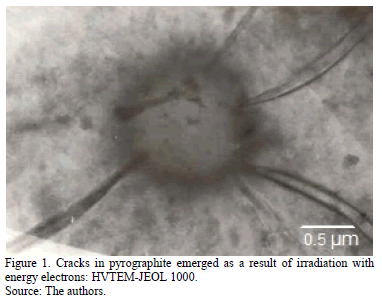
<body><![CDATA[<p><font size="2" face="Verdana, Arial, Helvetica, sans-serif"><b>Resumen    <br>   </b></font><font size="2" face="Verdana, Arial, Helvetica, sans-serif">El da&ntilde;o inducido por radiaci&oacute;n en el   pirografito va acompa&ntilde;ado por una significativa deformaci&oacute;n pl&aacute;stica. En los   bordes de la zona radiada surgen microgrietas que se desarrollan de manera   radial en direcci&oacute;n de la matriz no afectada. Se analizan las particularidades   en la formaci&oacute;n del estado de tensi&oacute;n de la zona radiada, y en los campos   adyacentes no afectados por la radiaci&oacute;n para explicar las razones que originan   el crecimiento de grietas. El an&aacute;lisis se lleva a cabo sobre discos de grafito   con espesor constante, expuestos a radiaci&oacute;n con electrones de altas energ&iacute;as   dentro de un HVTEM-JEOL 1000. Del an&aacute;lisis de las condiciones de equilibrio de   un elemento en forma de disco, se obtiene una ecuaci&oacute;n diferencial para   condiciones espec&iacute;ficas de carga.</font></p>     <p><font size="2" face="Verdana, Arial, Helvetica, sans-serif"><i>Palabras   clave</i>: Pirografito, grieta, irradiaci&oacute;n, HVTEM,   estado de esfuerzos.</font></p> <hr>     <p>&nbsp;</p>     <p><font size="3" face="Verdana, Arial, Helvetica, sans-serif"><b>1. Introduction</b></font></p>     <p><font size="2" face="Verdana, Arial, Helvetica, sans-serif">Exposure of   pyrographite to radiation with high-energy electrons causes a type K &rarr; A   phase transition, accompanied by considerable plastic deformation. It was   established that microcracks emerge at the edges of the irradiated zone, these   microcracks then grow unceasingly in the radial direction within the irradiated   matrix, <a href="#fig01">Fig. 1</a>.</font></p>     <p align="center"><font size="2" face="Verdana, Arial, Helvetica, sans-serif"><a name="fig01"></a></font><img src="/img/revistas/dyna/v83n195/v83n195a04fig01.gif"></p>     <p><font size="2" face="Verdana, Arial, Helvetica, sans-serif">To clarify   the possible causes of the incubation and growth of cracks, it is necessary to   examine the peculiarities in the formation of a stress state in the irradiated   zone as well as in the conjugated matrix zone that is not affected by the   radiation. This cannot be caused by the change of the temperature field in the   irradiated zone, since the heating magnitude in the HVTEM column by means of   the electron beam does not exceed 40ºC &#91;1,2&#93;. Besides, prolonged radiation   experiments undoubtedly favor the balance of the temperature field gradients in   both the sample thickness and the radial direction within the irradiated zone   limits.</font></p>     <p>&nbsp;</p>     <p><font size="3" face="Verdana, Arial, Helvetica, sans-serif"><b>2. Theoretical approach</b></font></p>     ]]></body>
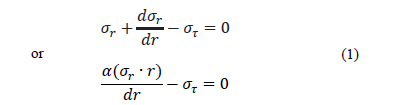
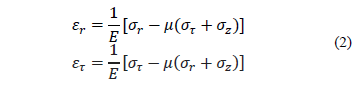
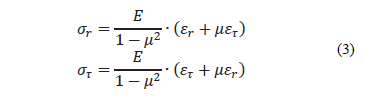
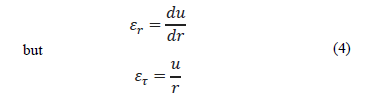
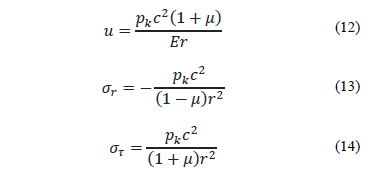
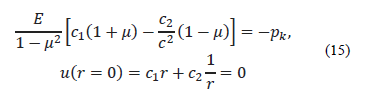
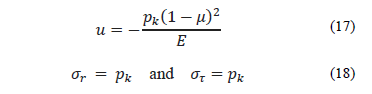
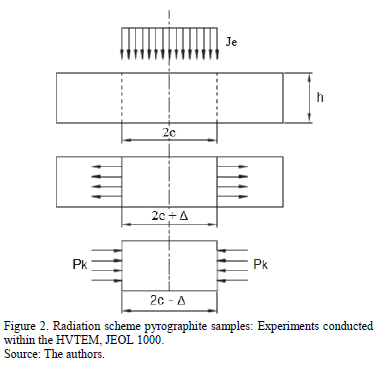
<body><![CDATA[<p><font size="2" face="Verdana, Arial, Helvetica, sans-serif">The   radiation scheme of pyrographite samples in the form of flat disks performed   within the HVTEM is shown in <a href="#fig02">Fig. 2</a>.</font></p>     <p align="center"><font size="2" face="Verdana, Arial, Helvetica, sans-serif"><a name="fig02"></a></font><img src="/img/revistas/dyna/v83n195/v83n195a04fig02.gif"></p>     <p><font size="2" face="Verdana, Arial, Helvetica, sans-serif">As a result of a prolonged high energy   electron bombing, the amorphization is developed in the pirografites, which   leads to a decrease in the material specific volume in the irradiated zone &#91;3&#93;.   Considering that the irradiated zone is surrounded by a matrix that is not   affected by radiation, a forced interaction consequently arises between it and   the loosened of the irradiated zone's material &#91;4&#93;.</font></p>     <p><font size="2" face="Verdana, Arial, Helvetica, sans-serif">From the   equilibrium conditions of a circular sheet element of constant thickness   analysis, it is possible to obtain a differential equation for a determined   loading scheme. Following the plate theory methods &#91;5,6&#93;, we obtain the   equilibrium equation for the plate and solve it for the initial and boundary   conditions that are derived from the supposed scheme of interaction between an   irradiated zone wrapped by a sample matrix. The differential equation is   obtained as follows:</font></p>     <p><img src="/img/revistas/dyna/v83n195/v83n195a04eq01.gif"></p>     <p><font size="2" face="Verdana, Arial, Helvetica, sans-serif">where <img src="/img/revistas/dyna/v83n195/v83n195a04eq010.gif"> is the radial stress, and <img src="/img/revistas/dyna/v83n195/v83n195a04eq012.gif"> is the tangential stress.</font></p>     <p><font size="2" face="Verdana, Arial, Helvetica, sans-serif">The link between the components of the   stress tensor <img src="/img/revistas/dyna/v83n195/v83n195a04eq010.gif">, <img src="/img/revistas/dyna/v83n195/v83n195a04eq012.gif">, <img src="/img/revistas/dyna/v83n195/v83n195a04eq014.gif"> and the deformations <img src="/img/revistas/dyna/v83n195/v83n195a04eq016.gif">, <img src="/img/revistas/dyna/v83n195/v83n195a04eq018.gif"> can be expressed in terms of   the Generalized Hook's Law:</font></p>     <p><img src="/img/revistas/dyna/v83n195/v83n195a04eq02.gif"></p>     <p><font size="2" face="Verdana, Arial, Helvetica, sans-serif">where E is the Young modulus, <img src="/img/revistas/dyna/v83n195/v83n195a04eq024.gif">is the Poisson modulus.</font></p>     <p><font size="2" face="Verdana, Arial, Helvetica, sans-serif">Supposing that in the conditions of our   problem <img src="/img/revistas/dyna/v83n195/v83n195a04eq026.gif">, it is possible to obtain the expressions for <img src="/img/revistas/dyna/v83n195/v83n195a04eq028.gif">and <img src="/img/revistas/dyna/v83n195/v83n195a04eq012.gif"> from the eq. (2) as follows:</font></p>     ]]></body>
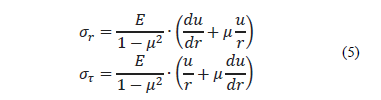
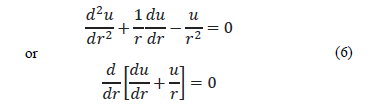
<body><![CDATA[<p><img src="/img/revistas/dyna/v83n195/v83n195a04eq03.gif"></p>     <p><font size="2" face="Verdana, Arial, Helvetica, sans-serif">It is not difficult to prove that </font></p>     <p><img src="/img/revistas/dyna/v83n195/v83n195a04eq04.gif"></p>     <p><font size="2" face="Verdana, Arial, Helvetica, sans-serif">where <img src="/img/revistas/dyna/v83n195/v83n195a04eq016.gif"> is the radial deformation, <img src="/img/revistas/dyna/v83n195/v83n195a04eq018.gif"> is the tangential   deformation, <i>u </i>is the radial   displacement.</font></p>     <p><font size="2" face="Verdana, Arial, Helvetica, sans-serif">After substituting eq. (4) in the eq. (3)   we obtain:</font></p>     <p><img src="/img/revistas/dyna/v83n195/v83n195a04eq05.gif"></p>     <p><font size="2" face="Verdana, Arial, Helvetica, sans-serif">After substituting eq. (5) in the   equilibrium differential equation (1), the latter can be expressed as:</font></p>     <p><img src="/img/revistas/dyna/v83n195/v83n195a04eq06.gif"></p>     <p><font size="2" face="Verdana, Arial, Helvetica, sans-serif">Finally, it can be presented in the   following form:</font></p>     <p><img src="/img/revistas/dyna/v83n195/v83n195a04eq07.gif"></p>     ]]></body>
<body><![CDATA[<p><font size="2" face="Verdana, Arial, Helvetica, sans-serif">Observations of the zone irradiated by   HVTEM show an absolute absence of extinction contours, even in the very moment   when microcracks start to form. This circumstance reveals the absence of   bending during the interaction of forces in the irradiated zone and the   surrounding matrix, i.e., the latter has compression characteristics at the   edges of the zone. The integration of eq. (6) provides a general solution for   radial displacements in the zone affected by radiation:</font></p>     <p><img src="/img/revistas/dyna/v83n195/v83n195a04eq08.gif"></p>     <p><font size="2" face="Verdana, Arial, Helvetica, sans-serif">where <img src="/img/revistas/dyna/v83n195/v83n195a04eq050.gif"> and <img src="/img/revistas/dyna/v83n195/v83n195a04eq052.gif"> are integration constants,   the values of which come from the contour conditions. </font></p>     <p><font size="2" face="Verdana, Arial, Helvetica, sans-serif">In our problem, these can be expressed as <i>r = c</i>; <img src="/img/revistas/dyna/v83n195/v83n195a04eq054.gif">; <i>r=&infin;</i>; <img src="/img/revistas/dyna/v83n195/v83n195a04eq056.gif"> for the matrix outside the   zone of radiation, and <i>r = c</i>; <img src="/img/revistas/dyna/v83n195/v83n195a04eq058.gif">; <i>r = 0</i>; <i>u = 0 </i>for the irradiated zone.</font></p>     <p><font size="2" face="Verdana, Arial, Helvetica, sans-serif">To determine the integration constants in   solution (8), we inserted them in eq. (5) and consequently obtain:</font></p>     <p><img src="/img/revistas/dyna/v83n195/v83n195a04eq09.gif"></p>     <p><font size="2" face="Verdana, Arial, Helvetica, sans-serif">Considering   the contour conditions, eq. (9) for the plate placed outside the irradiated   zone obtained the following form:</font></p>     <p><img src="/img/revistas/dyna/v83n195/v83n195a04eq10.gif"></p>     <p><font size="2" face="Verdana, Arial, Helvetica, sans-serif">from which the expression for the   integration constants c<sub>1</sub> y c<sub>2 </sub>can be presented as</font></p>     <p><img src="/img/revistas/dyna/v83n195/v83n195a04eq11.gif"></p>     ]]></body>
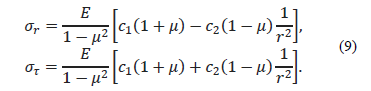
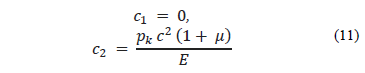
<body><![CDATA[<p><font size="2" face="Verdana, Arial, Helvetica, sans-serif">Substituting expression (10) in eq. (8)   and (9), we obtain </font></p>     <p><img src="/img/revistas/dyna/v83n195/v83n195a04eq1214.gif"></p>     <p><font size="2" face="Verdana, Arial, Helvetica, sans-serif">Similarly, for the irradiated zone, the   substitution of the corresponding boundary conditions leads to the following   expressions:</font></p>     <p><img src="/img/revistas/dyna/v83n195/v83n195a04eq15.gif"></p>     <p><font size="2" face="Verdana, Arial, Helvetica, sans-serif">From which we deduce:</font></p>     <p><img src="/img/revistas/dyna/v83n195/v83n195a04eq16.gif"></p>     <p><font size="2" face="Verdana, Arial, Helvetica, sans-serif">After substituting the values of <img src="/img/revistas/dyna/v83n195/v83n195a04eq050.gif"> and <img src="/img/revistas/dyna/v83n195/v83n195a04eq052.gif">in eq. (8) and (9) we obtain:</font></p>     <p><img src="/img/revistas/dyna/v83n195/v83n195a04eq1718.gif"></p>     <p>&nbsp;</p>     <p><font size="3" face="Verdana, Arial, Helvetica, sans-serif"><b>3. Discussion of the results</b></font></p>     ]]></body>
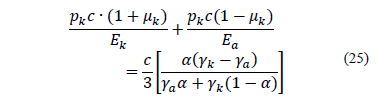
<body><![CDATA[<p><font size="2" face="Verdana, Arial, Helvetica, sans-serif">The   material in the irradiated area has been under the effect of a biaxial stress   state in compression, the magnitude of which can be determined by the degree of   amorphization process development. The surrounding matrix is also in a state of   biaxial stress. However, the compression forces decrease in the radial   direction that is inversely proportional to the square of the radius measured   from the center spot of radiation, but the stress forces, which are equal by   modulus to compression forces, act in the tangential direction,. A physical   approach to the problem is to determine the magnitudes of the contact pressures <img src="/img/revistas/dyna/v83n195/v83n195a04eq090.gif">, which act in the limits of the   irradiated area. To find the value of this pressure, we use the solution   proposed by Lame &#91;5&#93;, which describes the emergence of a contact pressure when   a cylindrical piece joins a sheet having a central perforation with a certain   tightening <font face="Symbol">D</font><i>c</i>:</font></p>     <p><img src="/img/revistas/dyna/v83n195/v83n195a04eq19.gif"></p>     <p><font size="2" face="Verdana, Arial, Helvetica, sans-serif">where <img src="/img/revistas/dyna/v83n195/v83n195a04eq094.gif"> is the sheet displacement in   the borders of the irradiated zone described by eq. (12), <img src="/img/revistas/dyna/v83n195/v83n195a04eq096.gif"> is the zone of displacement   in the boundary described by eq. (17), <img src="/img/revistas/dyna/v83n195/v83n195a04eq098.gif"> is the tightening intensity.</font></p>     <p><font size="2" face="Verdana, Arial, Helvetica, sans-serif">In this case the tightening is a result   of the swelling of the irradiated zone due to amorphization development   stimulated by radiation. We determined its size from the conditions of   substance mass conservation in the irradiated zone during the radiation process   applied to it:</font></p>     <p><img src="/img/revistas/dyna/v83n195/v83n195a04eq20.gif"></p>     <p><font size="2" face="Verdana, Arial, Helvetica, sans-serif">where <img src="/img/revistas/dyna/v83n195/v83n195a04eq102.gif"> is the initial crystalline pyrographite   density, <img src="/img/revistas/dyna/v83n195/v83n195a04eq104.gif"> is the present value of the material density   in the irradiated zone, <i>h </i>is the   sample thickness, <i>and c </i>is the   irradiated zone radius.</font></p>     <p><font size="2" face="Verdana, Arial, Helvetica, sans-serif">After certain transformations, eq. (20)   can be represented in the following form:</font></p>     <p><img src="/img/revistas/dyna/v83n195/v83n195a04eq21.gif"></p>     <p><font size="2" face="Verdana, Arial, Helvetica, sans-serif">Recognizing that during the pyrographite   amorphization process the deformation develops isotropically, i.e., <img src="/img/revistas/dyna/v83n195/v83n195a04eq108.gif">, and <img src="/img/revistas/dyna/v83n195/v83n195a04eq104.gif"> is the density of totally   amorphized pyrographite <img src="/img/revistas/dyna/v83n195/v83n195a04eq110.gif">, and the crystalline pyrographite is expressed as <img src="/img/revistas/dyna/v83n195/v83n195a04eq102.gif">, then according to the mixture law:</font></p>     <p><img src="/img/revistas/dyna/v83n195/v83n195a04eq22.gif"></p>     ]]></body>
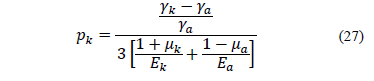
<body><![CDATA[<p><font size="2" face="Verdana, Arial, Helvetica, sans-serif">where <img src="/img/revistas/dyna/v83n195/v83n195a04eq114.gif">is the amorphization degree.</font></p>     <p><font size="2" face="Verdana, Arial, Helvetica, sans-serif">Eq. (21) can be expressed in the following   form:</font></p>     <p><img src="/img/revistas/dyna/v83n195/v83n195a04eq23.gif"></p>     <p><font size="2" face="Verdana, Arial, Helvetica, sans-serif">Solving eq. (23) with respect to <i>c </i>and substituting eq. (22) in it we   obtain</font></p>     <p><img src="/img/revistas/dyna/v83n195/v83n195a04eq24.gif"></p>     <p><font size="2" face="Verdana, Arial, Helvetica, sans-serif">Substituting eq. (24) in eq. (19), we   have that for <i>r = c</i></font></p>     <p><img src="/img/revistas/dyna/v83n195/v83n195a04eq25.gif"></p>     <p><font size="2" face="Verdana, Arial, Helvetica, sans-serif">where eq. (26) is for the contact   pressure:</font></p>     <p><img src="/img/revistas/dyna/v83n195/v83n195a04eq26.gif"></p>     <p><font size="2" face="Verdana, Arial, Helvetica, sans-serif">where <img src="/img/revistas/dyna/v83n195/v83n195a04eq124.gif"> and <img src="/img/revistas/dyna/v83n195/v83n195a04eq126.gif"> are Poisson coefficients for   the crystalline and amorphous pyrographite, respectively; and <img src="/img/revistas/dyna/v83n195/v83n195a04eq128.gif"> are Young moduli for the   crystalline and amorphous pyrographite, respectively.</font></p>     ]]></body>
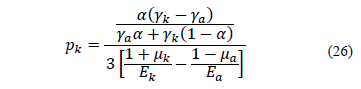
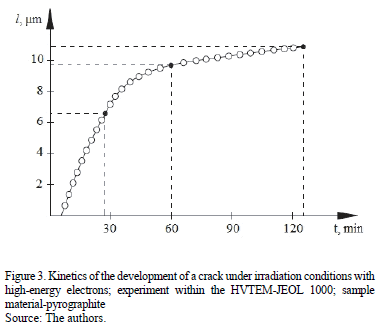
<body><![CDATA[<p><font size="2" face="Verdana, Arial, Helvetica, sans-serif">As there is no   data on the physical properties of pyrographite in the amorphous state, eq.   (26) can only be used to estimate the tendency in the change of the localized   stress state to the degree of amorphization development. From this it is   observed that in the initial state, when <img src="/img/revistas/dyna/v83n195/v83n195a04eq130.gif">, the tightening <img src="/img/revistas/dyna/v83n195/v83n195a04eq132.gif">. The maximum value of <img src="/img/revistas/dyna/v83n195/v83n195a04eq134.gif"> is reached when pyrographite   is amorphized totally in the irradiated zone. At this moment the contact   pressure reaches the value of</font></p>     <p><img src="/img/revistas/dyna/v83n195/v83n195a04eq27.gif"></p>     <p><font size="2" face="Verdana, Arial, Helvetica, sans-serif">When the character of stress distribution   in the matrix zone not exposed to radiation described by formula 11 is   analyzed, the reasons for the emergence of cracks at the border of the   irradiated area and their propagation in the radial direction become clear.</font></p>     <p><font size="2" face="Verdana, Arial, Helvetica, sans-serif">For <i>r = c</i>, the stress forces in the   tangential direction reach their maximum value. The resistance under these   forces is much weaker in pyrographite compared with the effects of compression   forces &#91;7&#93;. The fact that the cracks propagate along the crystallographic   directions <img src="/img/revistas/dyna/v83n195/v83n195a04eq140.gif"> indicates that the fracture anisotropy resulting   from the crystallographic structure of pyrographite expresses itself, and the   characteristics of the deformation and stress state in an anisotropic   approximation can be considered to be approximations. In <a href="#fig03">Fig. 3</a>, the kinetics   of crack development in a matrix of pyrographite unaffected by the radiation is   observed. It can be seen that the curve consists of two sections:</font></p>     <p align="center"><font size="2" face="Verdana, Arial, Helvetica, sans-serif"><a name="fig03"></a></font><img src="/img/revistas/dyna/v83n195/v83n195a04fig03.gif"></p>     <p><font size="2" face="Verdana, Arial, Helvetica, sans-serif">I. A section in which the crack   grows at a rate of 1.10<sup>-5</sup> cm/sec, and    <br>   </font><font size="2" face="Verdana, Arial, Helvetica, sans-serif">II. A section in which the crack develops at a rate of 1.1 x 10<sup>-7</sup> cm/sec.</font></p>     <p>&nbsp;</p>     <p><font size="3" face="Verdana, Arial, Helvetica, sans-serif"><b>4. Conclusions</b></font></p>     <p><font size="2" face="Verdana, Arial, Helvetica, sans-serif">1. We   established that when a stream of high-energy electrons impacts pyrographite,   amorphization is stimulated in it, which can be described as a transformation   of the crystalline phase into the amorphous state. We studied the influence of   the radiation parameters on the amorphization kinetics.</font></p>     ]]></body>

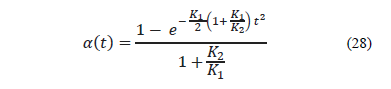
<body><![CDATA[<p><font size="2" face="Verdana, Arial, Helvetica, sans-serif">2. We   proposed a phenomenological model of amorphization by radiation, which   considers a possibility of a direct phase transformation of the type K &rarr;   A, as well as the inverse transformation A &rarr; K. Based on this, we   obtained a formula that describes the kinetics of amorphization by radiation in   the following form:</font></p>     <p><img src="/img/revistas/dyna/v83n195/v83n195a04eq28.gif"></p>     <p><font size="2" face="Verdana, Arial, Helvetica, sans-serif">3. We detected the effect of pyrographite   amorphization under the influence of a high-energy electron stream inside an   HVTEM. We proposed a phenomenological model that describes the kinetics of   amorphization in pyrographite due to radiation using reference points put in   the material surface. This was performed by means of the implantation of   ionized copper atoms.</font></p>     <p><font size="2" face="Verdana, Arial, Helvetica, sans-serif">We studied the deformation and stress   state of pyrographite, both in the zone irradiated by electrons as well as in   the zones adjacent to the matrix unaffected by radiation.</font></p>     <p><font size="2" face="Verdana, Arial, Helvetica, sans-serif">We proposed a method to determine the   energy threshold of radiation damage in pyrographite using data from the   kinetics analysis of its amorphization under conditions of radiation by high-energy   electrons performed inside the HVTEM column under various stress acceleration   values.</font></p>     <p>&nbsp;</p>     <p><font size="3" face="Verdana, Arial, Helvetica, sans-serif"><b>Acknowledgment</b></font></p>     <p><font size="2" face="Verdana, Arial, Helvetica, sans-serif">The authors express their gratitude to   all the staff at the Laboratory 20, Baikov Institute of Metallurgy, Russian   Academy of Sciences, for their support. We also thank the Secretary of Research   of the National Polytechnic Institute of Mexico, SIP, for their support for   Project 20131380, 20141031.</font></p>     <p>&nbsp;</p>     <p><font size="3" face="Verdana, Arial, Helvetica, sans-serif"><b>References</b></font></p>     ]]></body>
<body><![CDATA[<!-- ref --><p><font size="2" face="Verdana, Arial, Helvetica, sans-serif"><b>&#91;1&#93;</b> Snykers, M. and Janssens, C.,   The use of the JEM-1250 HVTEM of the University of Antwerpen as an instrument   for void swelling simulation experiment. BLG.521, 18 P., 1978.    &nbsp;&nbsp;&nbsp;&nbsp;&nbsp;&nbsp;&nbsp;&nbsp;[&#160;<a href="javascript:void(0);" onclick="javascript: window.open('/scielo.php?script=sci_nlinks&ref=1130005&pid=S0012-7353201600010000400001&lng=','','width=640,height=500,resizable=yes,scrollbars=1,menubar=yes,');">Links</a>&#160;]<!-- end-ref --></font></p>     <!-- ref --><p><font size="2" face="Verdana, Arial, Helvetica, sans-serif"><b>&#91;2&#93;</b> Timofeev, V.N., Izmereniye   temperatury nagreva obraztsa puchkom elektronov v prosvechivayushem elektronom   mikroskope s pomoshiyu lorentsevoy elektronnoy mikroskopii. Teplofizika   kondensirovannyj sred. Selected Papers. M: Nauka, pp. 74-78, 1985.    &nbsp;&nbsp;&nbsp;&nbsp;&nbsp;&nbsp;&nbsp;&nbsp;[&#160;<a href="javascript:void(0);" onclick="javascript: window.open('/scielo.php?script=sci_nlinks&ref=1130007&pid=S0012-7353201600010000400002&lng=','','width=640,height=500,resizable=yes,scrollbars=1,menubar=yes,');">Links</a>&#160;]<!-- end-ref --></font></p>     <!-- ref --><p><font size="2" face="Verdana, Arial, Helvetica, sans-serif"><b>&#91;3&#93;</b> Abe, H., Naramoto, H. and Kinoshita, C., Amorphization of   graphite under ion or electron irradiation. Mater. Res. Soc Proc., pp.373-383,   2011.    &nbsp;&nbsp;&nbsp;&nbsp;&nbsp;&nbsp;&nbsp;&nbsp;[&#160;<a href="javascript:void(0);" onclick="javascript: window.open('/scielo.php?script=sci_nlinks&ref=1130009&pid=S0012-7353201600010000400003&lng=','','width=640,height=500,resizable=yes,scrollbars=1,menubar=yes,');">Links</a>&#160;]<!-- end-ref --></font></p>     <!-- ref --><p><font size="2" face="Verdana, Arial, Helvetica, sans-serif"><b>&#91;4&#93;</b> Panyukov, S.V., Subbotin, A.V. and Arzhakov, M.V., Irradiation induced   dimensional changes in bulk graphite: The theory. Journal of Nuclear Materials,   439, pp. 72-83, 2013. DOI: 10.1016/j.jnucmat.2013.03.070</font>&nbsp;&nbsp;&nbsp;&nbsp;&nbsp;&nbsp;&nbsp;&nbsp;[&#160;<a href="javascript:void(0);" onclick="javascript: window.open('/scielo.php?script=sci_nlinks&ref=1130011&pid=S0012-7353201600010000400004&lng=','','width=640,height=500,resizable=yes,scrollbars=1,menubar=yes,');">Links</a>&#160;]<!-- end-ref --><!-- ref --><p><font size="2" face="Verdana, Arial, Helvetica, sans-serif"><b>&#91;5&#93;</b> Ponomariov, S.D., Biderman, V.L. and Lijariov, K.K., Razshety na   prochnost v mashinostroyenii. M: MASHGIZ, 974 P., 1958.    &nbsp;&nbsp;&nbsp;&nbsp;&nbsp;&nbsp;&nbsp;&nbsp;[&#160;<a href="javascript:void(0);" onclick="javascript: window.open('/scielo.php?script=sci_nlinks&ref=1130012&pid=S0012-7353201600010000400005&lng=','','width=640,height=500,resizable=yes,scrollbars=1,menubar=yes,');">Links</a>&#160;]<!-- end-ref --></font></p>     <!-- ref --><p><font size="2" face="Verdana, Arial, Helvetica, sans-serif"><b>&#91;6&#93;</b> Timoschenko, S.P. and Voynovski-Criger, S. Plastin, I.,   Obolochki, M., FITMAZGIZ, 576 P., 1963.    &nbsp;&nbsp;&nbsp;&nbsp;&nbsp;&nbsp;&nbsp;&nbsp;[&#160;<a href="javascript:void(0);" onclick="javascript: window.open('/scielo.php?script=sci_nlinks&ref=1130014&pid=S0012-7353201600010000400006&lng=','','width=640,height=500,resizable=yes,scrollbars=1,menubar=yes,');">Links</a>&#160;]<!-- end-ref --></font></p>     <!-- ref --><p><font size="2" face="Verdana, Arial, Helvetica, sans-serif"><b>&#91;7&#93;</b> Birgiliev, Y.S., Makarchenko,   V.G. and Chirilov, Y.S.,   Sootnosheniya mezhdu prochnostnymi jarakteristikami v obluchennom grafite.   Problemy Prochnosti, 1. pp. 95-100, 1977.    &nbsp;&nbsp;&nbsp;&nbsp;&nbsp;&nbsp;&nbsp;&nbsp;[&#160;<a href="javascript:void(0);" onclick="javascript: window.open('/scielo.php?script=sci_nlinks&ref=1130016&pid=S0012-7353201600010000400007&lng=','','width=640,height=500,resizable=yes,scrollbars=1,menubar=yes,');">Links</a>&#160;]<!-- end-ref --></font></p>     <p>&nbsp;</p>     <p><font size="2" face="Verdana, Arial, Helvetica, sans-serif"><b>P.A. Tamayo-Meza,</b> is a Dr. of Technology   and Metallurgy. He holds a PhD. in Engineering from the Academy of Sciences of   the USSR, Moscow, Russia, and an MSc. in Mechanical Engineering from the   Faculty of Engineering, University of Moscow, Russia. His professional experience   in research includes the development of fiber reinforced materials, mechanics   of materials characterization by quasi-relaxation, transmission electron   microscopy, scanning, and atomic force; the study of corrosion phenomena, solid   state physics, physics, and fracture mechanics; creep and fatigue, physical   mechanics of materials, and theory of heat treatment; and mechanical cryogenic   treatment. ORCID: 0000-0001-8026-8928</font></p>     <p><font size="2" face="Verdana, Arial, Helvetica, sans-serif"><b>V.A. Yermishkin, </b>obtained his Dr. in   Physical Sciences and Mathematics in Lomonosov State University. He works as   chief of Laboratory of High-Voltage Electron Microscopy in the Institute of   Metallurgy and Materials Science at the Russian Academy of Sciences. His   professional experience in research includes physics, fracture mechanic, creep and   fatigue, transmission electron microscopy, scanning and atomic force and   development of fiber reinforced materials. He has published more than 132   works. ORCID: 0000-0001-7280-4516</font></p>     <p><font size="2" face="Verdana, Arial, Helvetica, sans-serif"><b>U.S. Silva-Rivera, </b>obtained his Dr. of Science in Mechanical Engineering,   specializing in Mechanical Design (2015) and his MSc. degree in   Manufacturing Engineering (2011) from the School of Mechanical and Electrical Engineering in the National   Polytechnic Institute of Mexico, and   his BSc. degree in Military   Industrial Engineering, specializing in Chemical Engineering (2003), from   Military Engineering School in the University of the Army and Air Force.   His research interests are experimental ballistics, computational fluid   dynamics, materials and mechanical design; he has a knowledge of production   processes and quality control of small arms ammunition, as well as in design,   development and production of assault rifles. ORCID: 0000-0001-5597-1638</font></p>     <p><font size="2" face="Verdana, Arial, Helvetica, sans-serif"><b>A. Leyva-D&iacute;az, </b>obtained his BSc. degree   from the Technological Institute of Tuxtla Gutierrez in 2011, and his MSc. in   Manufacturing Engineering from the School   of Mechanical and Electrical Engineering in the National Polytechnic   Institute of Mexico in 2014. He has a knowledge of mechanical design, static   and dynamic analysis in 3D models through finite element method software. His   research interests are Mechanical Design, Finite Element Analysis, and the   development and characterization of new materials. ORCID: 0000-0002-7478-9441</font></p>     <p><font size="2" face="Verdana, Arial, Helvetica, sans-serif"><b>J.O. Trejo-Escand&oacute;n</b> received his BSc. in   Mechanical Engineering in 2012, from the Technological Institute of Tuxtla   Gutierrez, Mexico and a MSc. in Manufacturing Engineering in 2015, from the   National Polytechnic Institute - IPN, Mexico. He currently works at the   Development &amp; Innovation Center in Schneider-Electric in Monterrey, Mexico,   where he works as a Structural Simulation Specialist. His areas of research   interest focus on Mechanical Design, Finite Element analysis and development   and characterization of new materials. ORCID: 0000-0002-5076-7045</font></p>     <p><font size="2" face="Verdana, Arial, Helvetica, sans-serif"><b>J.M. Sandoval-Pineda, </b>is a professor in   the National Polytechnic Institute of M&eacute;xico. He obtained his Dr. of Science in   Mechanical Engineering with honors in 2008 and his MSc. in Mechanical   Engineering in 2004, from the National Polytechnic Institute, Mexico. His   professional experience in research includes physics, fracture mechanic, creep   and fatigue, and transmission electron microscopy. ORCID: 0000-0002-6529-7920</font></p>     ]]></body>
<body><![CDATA[<p><font size="2" face="Verdana, Arial, Helvetica, sans-serif"><b>L.A. Flores-Herrera, </b>is a professor in   the National Polytechnic Institute of M&eacute;xico. He obtained his Dr. of Science in   Mechanical Engineering with honors in 2007 and his MSc. in Mechanical   Engineering in 2003 from the National Polytechnic Institute, Mexico. Hi is a   specialist in Finite Element Analysis and his research area focuses on   Microelectromechanical systems (MEMS). ORCID: 0000-0003-1081-5193</font></p>      ]]></body><back>
<ref-list>
<ref id="B1">
<label>1</label><nlm-citation citation-type="">
<person-group person-group-type="author">
<name>
<surname><![CDATA[Snykers]]></surname>
<given-names><![CDATA[M.]]></given-names>
</name>
<name>
<surname><![CDATA[Janssens]]></surname>
<given-names><![CDATA[C.]]></given-names>
</name>
</person-group>
<source><![CDATA[The use of the JEM-1250 HVTEM of the University of Antwerpen as an instrument for void swelling simulation experiment.]]></source>
<year>1978</year>
</nlm-citation>
</ref>
<ref id="B2">
<label>2</label><nlm-citation citation-type="">
<person-group person-group-type="author">
<name>
<surname><![CDATA[Timofeev]]></surname>
<given-names><![CDATA[V.N.]]></given-names>
</name>
</person-group>
<article-title xml:lang="ru"><![CDATA[Izmereniye temperatury nagreva obraztsa puchkom elektronov v prosvechivayushem elektronom mikroskope s pomoshiyu lorentsevoy elektronnoy mikroskopii.]]></article-title>
<source><![CDATA[]]></source>
<year>1985</year>
<page-range>74-78</page-range></nlm-citation>
</ref>
<ref id="B3">
<label>3</label><nlm-citation citation-type="journal">
<person-group person-group-type="author">
<name>
<surname><![CDATA[Abe]]></surname>
<given-names><![CDATA[H.]]></given-names>
</name>
<name>
<surname><![CDATA[Naramoto]]></surname>
<given-names><![CDATA[H.]]></given-names>
</name>
<name>
<surname><![CDATA[Kinoshita]]></surname>
<given-names><![CDATA[C.]]></given-names>
</name>
</person-group>
<article-title xml:lang="en"><![CDATA[Amorphization of graphite under ion or electron irradiation.]]></article-title>
<source><![CDATA[Mater. Res. Soc Proc.]]></source>
<year>2011</year>
<page-range>373-383</page-range></nlm-citation>
</ref>
<ref id="B4">
<label>4</label><nlm-citation citation-type="journal">
<person-group person-group-type="author">
<name>
<surname><![CDATA[Panyukov]]></surname>
<given-names><![CDATA[S.V.]]></given-names>
</name>
<name>
<surname><![CDATA[Subbotin]]></surname>
<given-names><![CDATA[A.V.]]></given-names>
</name>
<name>
<surname><![CDATA[Arzhakov]]></surname>
<given-names><![CDATA[M.V.]]></given-names>
</name>
</person-group>
<article-title xml:lang="en"><![CDATA[Irradiation induced dimensional changes in bulk graphite: The theory]]></article-title>
<source><![CDATA[Journal of Nuclear Materials]]></source>
<year>2013</year>
<numero>439</numero>
<issue>439</issue>
<page-range>72-83</page-range></nlm-citation>
</ref>
<ref id="B5">
<label>5</label><nlm-citation citation-type="">
<person-group person-group-type="author">
<name>
<surname><![CDATA[Ponomariov]]></surname>
<given-names><![CDATA[S.D.]]></given-names>
</name>
<name>
<surname><![CDATA[Biderman]]></surname>
<given-names><![CDATA[V.L.]]></given-names>
</name>
<name>
<surname><![CDATA[Lijariov]]></surname>
<given-names><![CDATA[K.K.]]></given-names>
</name>
</person-group>
<source><![CDATA[Razshety na prochnost v mashinostroyenii.]]></source>
<year>1958</year>
</nlm-citation>
</ref>
<ref id="B6">
<label>6</label><nlm-citation citation-type="">
<person-group person-group-type="author">
<name>
<surname><![CDATA[Timoschenko]]></surname>
<given-names><![CDATA[S.P.]]></given-names>
</name>
<name>
<surname><![CDATA[Voynovski-Criger]]></surname>
<given-names><![CDATA[S.]]></given-names>
</name>
<name>
<surname><![CDATA[Plastin]]></surname>
<given-names><![CDATA[I.]]></given-names>
</name>
<name>
<surname><![CDATA[Obolochki]]></surname>
<given-names><![CDATA[M.]]></given-names>
</name>
</person-group>
<source><![CDATA[FITMAZGIZ]]></source>
<year>1963</year>
</nlm-citation>
</ref>
<ref id="B7">
<label>7</label><nlm-citation citation-type="journal">
<person-group person-group-type="author">
<name>
<surname><![CDATA[Birgiliev]]></surname>
<given-names><![CDATA[Y.S.]]></given-names>
</name>
<name>
<surname><![CDATA[Makarchenko]]></surname>
<given-names><![CDATA[V.G.]]></given-names>
</name>
<name>
<surname><![CDATA[Chirilov]]></surname>
<given-names><![CDATA[Y.S.]]></given-names>
</name>
</person-group>
<article-title xml:lang="ru"><![CDATA[Sootnosheniya mezhdu prochnostnymi jarakteristikami v obluchennom grafite.]]></article-title>
<source><![CDATA[Problemy Prochnosti]]></source>
<year>1977</year>
<numero>1</numero>
<issue>1</issue>
<page-range>95-100</page-range></nlm-citation>
</ref>
</ref-list>
</back>
</article>