<?xml version="1.0" encoding="ISO-8859-1"?><article xmlns:mml="http://www.w3.org/1998/Math/MathML" xmlns:xlink="http://www.w3.org/1999/xlink" xmlns:xsi="http://www.w3.org/2001/XMLSchema-instance">
<front>
<journal-meta>
<journal-id>0012-7353</journal-id>
<journal-title><![CDATA[DYNA]]></journal-title>
<abbrev-journal-title><![CDATA[Dyna rev.fac.nac.minas]]></abbrev-journal-title>
<issn>0012-7353</issn>
<publisher>
<publisher-name><![CDATA[Universidad Nacional de Colombia]]></publisher-name>
</publisher>
</journal-meta>
<article-meta>
<article-id>S0012-73532016000100005</article-id>
<title-group>
<article-title xml:lang="en"><![CDATA[In vitro behavior of the dentin and enamel calcium hydroxyapatite in human premolars subjected to high temperatures]]></article-title>
<article-title xml:lang="es"><![CDATA[Comportamiento in vitro de la hidroxiapatita de calcio de la dentina y del esmalte en premolares humanos sometidos a altas temperaturas]]></article-title>
</title-group>
<contrib-group>
<contrib contrib-type="author">
<name>
<surname><![CDATA[Medina]]></surname>
<given-names><![CDATA[Sebastián]]></given-names>
</name>
<xref ref-type="aff" rid="A01"/>
</contrib>
<contrib contrib-type="author">
<name>
<surname><![CDATA[Salazar]]></surname>
<given-names><![CDATA[Liliana]]></given-names>
</name>
<xref ref-type="aff" rid="A02"/>
</contrib>
<contrib contrib-type="author">
<name>
<surname><![CDATA[Mejía]]></surname>
<given-names><![CDATA[Carlos]]></given-names>
</name>
<xref ref-type="aff" rid="A03"/>
</contrib>
<contrib contrib-type="author">
<name>
<surname><![CDATA[Moreno]]></surname>
<given-names><![CDATA[Freddy]]></given-names>
</name>
<xref ref-type="aff" rid="A04"/>
</contrib>
</contrib-group>
<aff id="A01">
<institution><![CDATA[,Universidad del Valle School of Basic Sciences ]]></institution>
<addr-line><![CDATA[Cali ]]></addr-line>
<country>Colombia</country>
</aff>
<aff id="A02">
<institution><![CDATA[,Universidad del Valle School of Basic Sciences ]]></institution>
<addr-line><![CDATA[Cali ]]></addr-line>
<country>Colombia</country>
</aff>
<aff id="A03">
<institution><![CDATA[,Universidad del Valle School of Dentistry ]]></institution>
<addr-line><![CDATA[Cali ]]></addr-line>
<country>Colombia</country>
</aff>
<aff id="A04">
<institution><![CDATA[,Pontificia Universidad Javeriana Faculty of Health of Sciences ]]></institution>
<addr-line><![CDATA[Cali ]]></addr-line>
<country>Colombia</country>
</aff>
<pub-date pub-type="pub">
<day>00</day>
<month>02</month>
<year>2016</year>
</pub-date>
<pub-date pub-type="epub">
<day>00</day>
<month>02</month>
<year>2016</year>
</pub-date>
<volume>83</volume>
<numero>195</numero>
<fpage>34</fpage>
<lpage>41</lpage>
<copyright-statement/>
<copyright-year/>
<self-uri xlink:href="http://www.scielo.org.co/scielo.php?script=sci_arttext&amp;pid=S0012-73532016000100005&amp;lng=en&amp;nrm=iso"></self-uri><self-uri xlink:href="http://www.scielo.org.co/scielo.php?script=sci_abstract&amp;pid=S0012-73532016000100005&amp;lng=en&amp;nrm=iso"></self-uri><self-uri xlink:href="http://www.scielo.org.co/scielo.php?script=sci_pdf&amp;pid=S0012-73532016000100005&amp;lng=en&amp;nrm=iso"></self-uri><abstract abstract-type="short" xml:lang="en"><p><![CDATA[This paper details a cross-sectional, descriptive observational in vitro study of a pseudo-experimental nature that analyzes Electron Microscopy (SEM) by scanning the physical behavior of enamel and dentin calcium hydroxyapatite. The purpose is to describe the separation of these two mineralized dental tissues at the dentin-enamel junction (DEJ) when the teeth are subjected to high temperatures. This study provides scientific evidence that may broaden the discussion on the use of separation of the dentin-enamel junction as a constant and repetitive reliable marker for forensic use (use in forensic sciences) that can contribute to the dental identification process and documentation in a legal medical autopsy, given a situation in which bodies or human remains have been burned, carbonizated or incinerated.]]></p></abstract>
<abstract abstract-type="short" xml:lang="es"><p><![CDATA[Estudio observacional descriptivo de corte transversal y de naturaleza pseudo-experimental in Vitro que analiza, a través de microscopía electrónica de barrido (MEB), el comportamiento físico de la hidroxiapatita de calcio del esmalte y la dentina; con el propósito de describir la separación de estos dos tejidos mineralizados dentales a nivel de la unión amelo-dentinaria cuando los dientes son sometidos a altas temperaturas. Con ello, se proporciona evidencia científica que amplía la discusión sobre el empleo de la separación de la interfase esmalte-dentina como un marcador fehaciente constante y repetitivo de uso forense, el cual puede contribuir con los procesos de identificación odontológica y documentación de la necropsia médico legal para el caso de cadáveres o restos humanos que resulten quemados, carbonizados o incinerados.]]></p></abstract>
<kwd-group>
<kwd lng="en"><![CDATA[Calcium hydroxyapatite]]></kwd>
<kwd lng="en"><![CDATA[enamel]]></kwd>
<kwd lng="en"><![CDATA[dentin]]></kwd>
<kwd lng="en"><![CDATA[dentin-enamel junction]]></kwd>
<kwd lng="en"><![CDATA[high temperatures]]></kwd>
<kwd lng="en"><![CDATA[odontological identification]]></kwd>
<kwd lng="en"><![CDATA[forensic dentistry]]></kwd>
<kwd lng="es"><![CDATA[Hidroxiapatita de calcio]]></kwd>
<kwd lng="es"><![CDATA[esmalte]]></kwd>
<kwd lng="es"><![CDATA[dentina]]></kwd>
<kwd lng="es"><![CDATA[unión amelo-dentinaria]]></kwd>
<kwd lng="es"><![CDATA[odontología forense]]></kwd>
<kwd lng="es"><![CDATA[identificación odontológica]]></kwd>
</kwd-group>
</article-meta>
</front><body><![CDATA[ <p><font size="1" face="Verdana, Arial, Helvetica, sans-serif"><b>DOI:</b> <a href="http://dx.doi.org/10.15446/dyna.v83n195.42732" target="_blank">http://dx.doi.org/10.15446/dyna.v83n195.42732</a></font></p>     <p align="center"><font size="4" face="Verdana, Arial, Helvetica, sans-serif"><i><b>In vitro</b></i><b> behavior of the dentin and   enamel calcium hydroxyapatite in human premolars subjected to high temperatures </b></font></p>     <p align="center"><i><font size="3"><b><font face="Verdana, Arial, Helvetica, sans-serif">Comportamiento in vitro de la hidroxiapatita de calcio   de la dentina y del esmalte en premolares humanos sometidos a altas   temperaturas</font></b></font></i></p>     <p align="center">&nbsp;</p>     <p align="center"><font size="2" face="Verdana, Arial, Helvetica, sans-serif"><b>Sebasti&aacute;n Medina <i><sup>a</sup></i>,   Liliana Salazar <i><sup>b</sup></i>, Carlos   Mej&iacute;a <i><sup>c</sup></i> &amp; Freddy Moreno <i><sup>d</sup></i></b></font></p>     <p align="center">&nbsp;</p>     <p align="center"><font size="2" face="Verdana, Arial, Helvetica, sans-serif"><sup><i>a </i></sup><i>School of Basic Sciences at Universidad del Valle, Cali, Colombia. <a href="mailto:sebastianmedina.c@gmail.com">sebastianmedina.c@gmail.com</a>    <br>   <sup>b </sup>School of Basic Sciences at Universidad del Valle, Cali, Colombia. <a href="mailto:liliana.salazar@correounivalle.edu.co">liliana.salazar@correounivalle.edu.co</a>    <br>   <sup>c</sup> School of Dentistry at Universidad del Valle, Cali, Colombia. <a href="mailto:camejia@emcali.net">camejia@emcali.net</a>    <br>   <sup>d</sup> Faculty of Health of Sciences at Pontificia Universidad Javeriana,   Cali, Colombia. <a href="mailto:fmorenog@javerianacali.edu.co">fmorenog@javerianacali.edu.co</a></i></font></p>     ]]></body>
<body><![CDATA[<p align="center">&nbsp;</p>     <p align="center"><font size="2" face="Verdana, Arial, Helvetica, sans-serif"><b>Received: March 21<sup>th</sup>, 2014.   Received in revised form: May 20<sup>th</sup>, 2015. Accepted: December 10<sup>th</sup>,   2015.</b></font></p>     <p align="center">&nbsp;</p>     <p align="center"><font size="1" face="Verdana, Arial, Helvetica, sans-seriff"><b>This work is licensed under a</b> <a rel="license" href="http://creativecommons.org/licenses/by-nc-nd/4.0/">Creative Commons Attribution-NonCommercial-NoDerivatives 4.0 International License</a>.</font><br />   <a rel="license" href="http://creativecommons.org/licenses/by-nc-nd/4.0/"><img style="border-width:0" src="https://i.creativecommons.org/l/by-nc-nd/4.0/88x31.png" /></a></p> <hr>     <p><font size="2" face="Verdana, Arial, Helvetica, sans-serif"><b>Abstract    <br>   </b></font><font size="2" face="Verdana, Arial, Helvetica, sans-serif">This paper   details a cross-sectional, descriptive observational in vitro study of a   pseudo-experimental nature that analyzes Electron Microscopy (SEM) by scanning   the physical behavior of enamel and dentin calcium hydroxyapatite. The purpose   is to describe the separation of these two mineralized dental tissues at the   dentin-enamel junction (DEJ) when the teeth are subjected to high temperatures.   This study provides scientific evidence that may broaden the discussion on the   use of separation of the dentin-enamel junction as a constant and repetitive   reliable marker for forensic use (use in forensic sciences) that can contribute   to the dental identification process and documentation in a legal medical   autopsy, given a situation in which bodies or human remains have been burned,   carbonizated or incinerated.</font></p>     <p><font size="2" face="Verdana, Arial, Helvetica, sans-serif"><i>Keywords</i>: Calcium hydroxyapatite, enamel, dentin, dentin-enamel junction,   high temperatures, odontological identification, forensic dentistry.</font></p>     <p><font size="2" face="Verdana, Arial, Helvetica, sans-serif"><b>Resumen    <br>   </b></font><font size="2" face="Verdana, Arial, Helvetica, sans-serif">Estudio   observacional descriptivo de corte transversal y de naturaleza   pseudo-experimental in Vitro que analiza, a trav&eacute;s de microscop&iacute;a electr&oacute;nica   de barrido (MEB), el comportamiento f&iacute;sico de la hidroxiapatita de calcio del   esmalte y la dentina; con el prop&oacute;sito de describir la separaci&oacute;n de estos dos   tejidos mineralizados dentales a nivel de la uni&oacute;n amelo-dentinaria cuando los   dientes son sometidos a altas temperaturas. Con ello, se proporciona evidencia   cient&iacute;fica que ampl&iacute;a la discusi&oacute;n sobre el empleo de la separaci&oacute;n de la   interfase esmalte-dentina como un marcador fehaciente constante y repetitivo de   uso forense, el cual puede contribuir con los procesos de identificaci&oacute;n   odontol&oacute;gica y documentaci&oacute;n de la necropsia m&eacute;dico legal para el caso de   cad&aacute;veres o restos humanos que resulten quemados, carbonizados o incinerados.</font></p>     <p><font size="2" face="Verdana, Arial, Helvetica, sans-serif"><i>Palabras clave</i>: Hidroxiapatita de calcio,   esmalte, dentina, uni&oacute;n amelo-dentinaria, odontolog&iacute;a forense, identificaci&oacute;n   odontol&oacute;gica.</font></p> <hr>     ]]></body>
<body><![CDATA[<p>&nbsp;</p>     <p><font size="3" face="Verdana, Arial, Helvetica, sans-serif"><b>1. Introduction</b></font></p>     <p><font size="2" face="Verdana, Arial, Helvetica, sans-serif">In Colombia, deaths involving the burning,   carbonization and incineration of human body &#91;1,2&#93; have increased throughout   the first decade of the twenty-first century. This state hinders identification   procedures that are commonly employed methods in forensic sciences &#91;3&#93;,   including technically and scientifically supported procedures by forensic   dentistry such as restorative dental treatments &#91;4&#93;, or electronic devices   implanted in teeth. These require a knowledge of the biological behavior of   interfaces between dental tissues and different biomaterials &#91;5&#93;. </font></p>     <p><font size="2" face="Verdana, Arial, Helvetica, sans-serif">Teeth are the best preserved organs in   extreme conditions (including temperatures) &#91;6&#93;. However, there is little   research on the changes that occur in dental tissues when they are subjected to   high temperatures. Early in vitro studies focused mainly on the macroscopic   description of the structural changes, but did not develop markers with   sufficient macroscopic and microscopic scientific support that would allow the   application of the results to procedures that help identify a human corpse or   human burned, carbonized or incinerated remains &#91;7&#93;.</font></p>     <p><font size="2" face="Verdana, Arial, Helvetica, sans-serif">Several studies &#91;8,10,11&#93; have reported   that as temperature increases, enamel is detached from dentin at the   dental-enamel junction (DEJ). This has been associated with the burning of organic   matrix components (non-fibrillar component -glycoproteins, glycosaminoglycans   and proteoglycans- and fibrillar component -collagen-), and the physicochemical   changes of the inorganic component (calcium hydroxyapatite crystals) of these   mineralized dental tissues. It results in decreased tissue volume and loss of DEJ   continuity; therefore, the purpose of this study is to describe in vitro   behavior of dentin and enamel calcium hydroxyapatite in human premolars that   are subjected to high temperatures and, more specifically, to determine whether   there is a causal relationship between high temperatures and the separation of   the DEJ phenomenon.</font></p>     <p>&nbsp;</p>     <p><font size="3" face="Verdana, Arial, Helvetica, sans-serif"><b>2. Dentin</b></font></p>     <p><font size="2" face="Verdana, Arial, Helvetica, sans-serif">Dentin is a   mineralized biological tissue that is composed of 70% inorganic material   (hydroxyapatite crystals and trace elements), 18% organic material (type I   collagen fiber and proteins such as osteonectin, osteopontin, Osteoclastin-like   dentin Gla protein, dentin phosphorine, dentin matrix protein and dentin   sialoprotein), and 12% water. Moreover, this tissue has dentinal tubules mainly   occupied by odontoblastic processes, and cell specializations extending from   pulp odontoblasts, which is why the dentin-pulp complex is described as an   integrated structural unit formed by the body of the odontoblast (pulp) and the   odontoblast process (dentin) &#91;12-14&#93;. </font></p>     <p>&nbsp;</p>     <p><font size="3" face="Verdana, Arial, Helvetica, sans-serif"><b>3. Enamel</b></font></p>     ]]></body>
<body><![CDATA[<p><font size="2" face="Verdana, Arial, Helvetica, sans-serif">Enamel is a highly mineralized acellular   biological tissue lining like a cap, which is the outer surface of mammals' teeth.   Given that this is the hardest and most resistant tissue in the body, the   function of enamel is to protect the dentin-pulp complex. It is constituted of   95% inorganic material (calcium hydroxyapatite crystals), 2% organic material   (proteins such as amelogenin, enamelin, ameloblastin and tuftelin, among   others), and 3% water. As a mineralized tissue, enamel has a functional unit   called a &quot;prism&quot;, &quot;cane&quot; or &quot;enamel rod&quot;, which corresponds to a number of   calcium hydroxyapatite crystals parallel to the longitudinal axis of the prism.   These are packaged in an organizational pattern, cylindrical in shape and   arranged in rows of horizontal alignment. This arrangement occupies the entire   thickness of the enamel, except the part located near the dentin, which is not   in aprismatic &#91;12-14&#93;.</font></p>     <p>&nbsp;</p>     <p><font size="3" face="Verdana, Arial, Helvetica, sans-serif"><b>4. Dentin-enamel junction</b></font></p>     <p><font size="2" face="Verdana, Arial, Helvetica, sans-serif">From when they develop, dentin and enamel   are linked by an interface called dentin-enamel junction (DEJ), which is a   common starting point for both tissues. This guarantees that dentin and enamel   calcium hydroxyapatite crystals never come into contact, as the junction is   constituted by amorphous regions the extracellular matrix of which were not   completely mineralized: these are respectively called the mantle dentin and aprismatic   enamel &#91;15,16&#93;. </font></p>     <p><font size="2" face="Verdana, Arial, Helvetica, sans-serif">As described above, the progressive and   opposite mineralization of both DEJ tissues begins with the deposition of   calcium and phosphate ions on the extracellular matrix. Thus, the DEJ's solution   of continuity is due to the hydroxyapatite crystal growth, which results from   the synthesis of the organic extracellular matrix and its subsequent   mineralization in both tissues, first of the dentin and the enamel immediately   after. Therefore, the DEJ corresponds to a transition zone with a scalloped or   corrugated appearance between the enamel and the dentin &#91;17,18&#93;. The scallop   pattern is represented on the surface of the dentine by a series of peaks that   rise towards the enamel, creating a series of concave tunnels with a &quot;honeycomb&quot;   aspect that correspond to convexities on the surface of the enamel that belong   to groups of enamel prisms &#91;18,19&#93;. The DEJ is therefore a complex mechanism of   attachment, the primary function of which involves the formation of an activity   surface for the odontoblasts and the ameloblasts to secrete dentin and enamel   respectively. Once the tooth is completely formed it contributes to the   biomechanical integrity of the structure of which these two tissues are composed   &#91;20-22&#93;. </font></p>     <p>&nbsp;</p>     <p><font size="3" face="Verdana, Arial, Helvetica, sans-serif"><b>5. Calcium hydroxyapatite</b></font></p>     <p><font size="2" face="Verdana, Arial, Helvetica, sans-serif">Robinson et al &#91;23&#93;, expressed in their   study undertaken with atomic force microscopy that the development of the   ultrastructure of mineralized dental tissue encompasses a series of spherical   subunits with a diameter that is similar to a hydroxyapatite crystal (300 and   500 nm). As such, each nanosphere forms an enucleation center that is made of   amorphous calcium phosphate and stabilized by the protein components of the   extracellular matrix. The longitudinal fusion of nanospheres constitutes a   typical hydroxyapatite crystal.</font></p>     <p><font size="2" face="Verdana, Arial, Helvetica, sans-serif">Calcium hydroxyapatite crystal (CHC)   corresponds to a biomineral formed by crystalline calcium phosphate that is   stored in mineralized tissues, and represents 99% of calcium deposit and 80% of   total phosphorus in the body. These calcium phosphates are spherical beads of   octacalcium phosphate, arranged in three-dimensional calcium hydroxyapatite crystals,   which eventually form enamel prisms &#91;12-14&#93;. Thus, octacalcium phosphate has   been recognized as the precursor of hydroxyapatite &#91;24&#93; as it contributes to   the formation of the initial mineral phase of the extracellular matrix during   biomineralization, and to the subsequent formation of calcium hydroxyapatite   &#91;2&#93; by crystallization.</font></p>     <p>&nbsp;</p>     ]]></body>
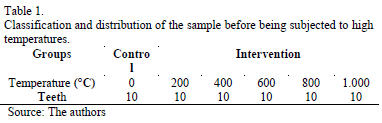
<body><![CDATA[<p><font size="3" face="Verdana, Arial, Helvetica, sans-serif"><b>6. Dental tissue mineralization</b></font></p>     <p><font size="2" face="Verdana, Arial, Helvetica, sans-serif">Biomineralization is the process by which   specialized mineralized connective tissues (bone, cartilage, enamel, dentin and   cementum) are built by the deposition of a mineral or inorganic phase on the   organic extracellular matrix. Regarding the mineralized tissues in teeth, the   biomineralization occurs by deposition of calcium hydroxyapatite crystals on   the extracellular matrix during the process of amelogenesis (enamel),   dentinogenesis (dentin), cementogenesis (cement) and osteogenesis (alveolar   bone) mediated by ameloblasts, odontoblasts, and cementoblast and osteoblasts   respectively. It is genetically regulated by a group of extracellular matrix   mineralization proteins recognized as SCPP (Secretory Calcium-binding   Phosphoprotein) &#91;26-28&#93;.</font></p>     <p><font size="2" face="Verdana, Arial, Helvetica, sans-serif">During amelogenesis, which is mineralization   of the extracellular matrix of enamel, there is a six-step biological crystal formation   process from substitutes: 1. Delimitation (ameloblasts are stimulated and begin   the secretion of the extracellular matrix from their Tomes's processes); 2.   Existence of a preformed organic matrix (built as a structural frame of   proteins secreted by the ameloblasts that put themselves together as   nanospheres of amelogenin); 3. Oversaturation of the extracellular matrix   (creation of a saturated solution of calcium and phosphate ions secreted by   ameloblasts); 4. Control of the crystal cores formation (enucleation or crystal   self-assembly to set crystal cores controlled by enamelin, tuftelin,   amelogenins, ameloblastins and dentin sialophosphoprotein); 5. Control of   growth, morphology and orientation of crystals by the extracellular matrix; and   6. Control of the completion of crystal growth (ripening of CHC and proteolytic   degradation of excess organic content in the extracellular matrix). This sequential,   longitudinal and progressive growth process, starts at the DEJ and ends at the   enamel surface &#91;29-31&#93;.</font></p>     <p><font size="2" face="Verdana, Arial, Helvetica, sans-serif">With Regards to dentinogenesis, the   dentin mineralization mechanism differs considerably from enamel   mineralization. Odontoblasts initiate the biomineralization process, which   consists of seven consecutive steps: 1. Fibrillar extracellular matrix   synthesis (collagen frame); 2. Capture and storage of intracellular calcium; 3.   Local concentration of calcium and phosphate ions; 4. Formation of matrix   vesicles for its calcification; 5. Release of vesicles from the odontoblast to   the extracellular matrix (within these vesicles, amorphous calcium phosphate   dots merge together to form CHC); 6.Vesicles rupture and CHC release; and 7.   Orientation of CHC in relation to the collagen fibers &#91;29, 32&#93;.</font></p>     <p>&nbsp;</p>     <p><font size="3" face="Verdana, Arial, Helvetica, sans-serif"><b>7. Materials and methods</b></font></p>     <p><font size="2" face="Verdana, Arial, Helvetica, sans-serif">This is a cross-sectional (descriptive   observational) in vitro study of a pseudo-experimental nature in which the   exposure of the sample was undertaken by convenience. Through scanning electron   microscopy (SEM) this paper describes the behavior of calcium hydroxyapatite in   dentin and enamel human premolars in order to determine whether there is a   causal relationship in the detachment phenomenon that occurs between the dentin   and enamel at the DEJ when teeth are subjected to high temperatures.</font></p>     <p><font size="2" face="Verdana, Arial, Helvetica, sans-serif"><b><i>7.1. Sample collection</i></b></font></p>     <p><font size="2" face="Verdana, Arial, Helvetica, sans-serif">Upon obtaining endorsement from the Human   Ethics Committee of the Health Faculty at the Universidad del Valle, we   proceeded to collect a sample of 60 premolar teeth, healthy under clinical   observation (no cavities or fractures). </font></p>     <p><font size="2" face="Verdana, Arial, Helvetica, sans-serif">They had no dental treatment and were   obtained from patients who attended the Oral Surgery Clinic in the Dental   School at the Universidad del Valle, who required premolar extraction for   orthodontic reasons and had previously signed an informed consent.</font></p>     ]]></body>
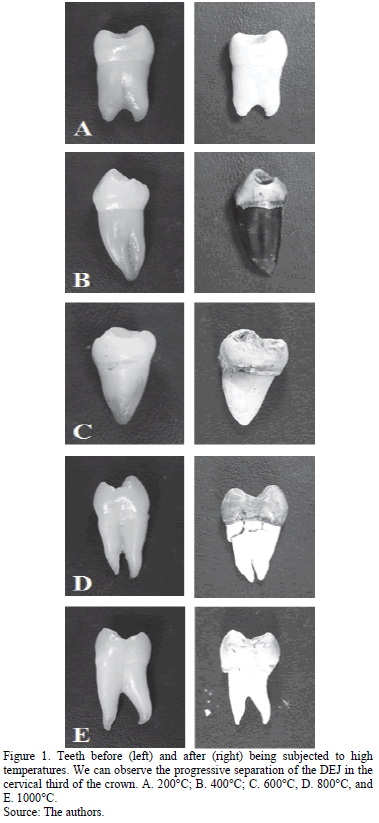
<body><![CDATA[<p><font size="2" face="Verdana, Arial, Helvetica, sans-serif"><b><i>7.2. Handling and preservation of the sample</i></b></font></p>     <p><font size="2" face="Verdana, Arial, Helvetica, sans-serif">Once the teeth were extracted, we   proceeded to wash them profusely with tap water to eliminate traces of blood   and tissue, and placed them in a dark, tightly sealed container with a Chloramine   T fixative solution at 5%. The teeth remained in Chloramine T for a week and   were then placed in saline solution at room temperature according to what is stipulated   in ISO/DIS 11405:2003 &#91;35&#93;.</font></p>     <p><font size="2" face="Verdana, Arial, Helvetica, sans-serif"><b><i>7.3. Sample distribution</i></b></font></p>     <p><font size="2" face="Verdana, Arial, Helvetica, sans-serif">Teeth were Classified and randomized   according to the temperature to which they were subjected. A control group of   ten teeth, which were not subjected to high temperatures, was established in   order to have a control (<a href="#tab01">Table 1</a>).</font></p>     <p align="center"><font size="2" face="Verdana, Arial, Helvetica, sans-serif"><a name="tab01"></a></font><img src="/img/revistas/dyna/v83n195/v83n195a05tab01.gif"></p>     <p><font size="2" face="Verdana, Arial, Helvetica, sans-serif"><b><i>7.4. Application of high temperatures</i></b></font></p>     <p><font size="2" face="Verdana, Arial, Helvetica, sans-serif">Once the sample was collected the intervention   groups of teeth were individually placed in small trays made of investment   material (Whip mix Serafina®), designed under the protocol established by the   Dental Materials Unit of the University of Pavia &#91;8&#93;. We then proceeded to   place them in a muffle furnace (Thomas Benchtop 1256®) in groups of 10,   starting with 30&deg;C for each temperature range (200&deg;C, 400&deg;C, 600&deg;C, 800&deg;C and   1000&deg;C). For example, ten teeth in the 200&deg;C group were put in the furnace,   each one in its corresponding tray, at a temperature range of 30&deg;C to 200&deg;C.   The furnace was allowed to cool back to room temperature before we took the   trays with the teeth out. The same procedure was repeated for the groups of   teeth subjected to 400&deg;C, 600&deg;C, 800&deg;C and 1000&deg;C temperatures. This protocol is   a standardized practice at the School of Dentistry, University of Valle &#91;11&#93;.</font></p>     <p><font size="2" face="Verdana, Arial, Helvetica, sans-serif"><b><i>7.5. Management of the teeth after application of high temperatures</i></b></font></p>     <p><font size="2" face="Verdana, Arial, Helvetica, sans-serif">An acrylic self-curing resin base (New   Stetic®) was made for the control group and for the intervention group that was   subjected to 200ºC and 400ºC. These teeth were mounted on a universal testing   machine (Tinius Olsen® H50KS®) in a Physical and Mechanical testing Laboratory   at the School of Materials Engineering (EIMAT) in the Universidad del Valle,   which has a 50 Kilo-Newton capacity. A constant vertical, compressive force was   applied to them at a crosshead speed of 1 millimeter per minute with a rounded,   hardened steel tip with a 3 mm diameter located between the buccal and palatal   or lingual cusps until the software machine (Tinius Olsen Horizon®) detected a   fracture and the crown was fragmented. This process was undertaken with the   objective of provoking adhesive failure, which separates enamel from dentin by   unevenly distributed tensional forces. For the teeth in the intervention group that   were subjected to 600&deg;C, 800&deg;C and 1000&deg;C, the tissues were separated with a   scalpel (Brad Parker® No. 15) and a carver (Lecron Medix®), as these work well   with the DEJ's structural weakness and   natural spontaneous fracture after having been exposed to high temperatures. From   this we gained samples of enamel and dentin.</font></p>     <p><font size="2" face="Verdana, Arial, Helvetica, sans-serif"><b><i>7.6. Observation of samples of enamel and dentin</i></b></font></p>     ]]></body>
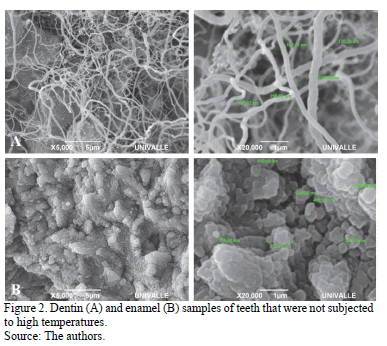
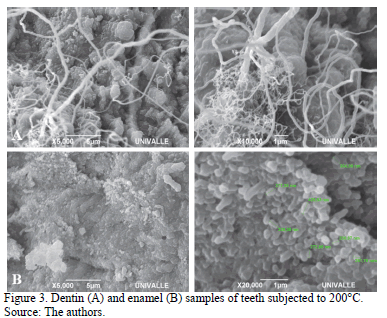
<body><![CDATA[<p><font size="2" face="Verdana, Arial, Helvetica, sans-serif">Fragments of enamel and dentin that corresponded   to each other were set on a glass slide with cyanoacrylate, coated with a gold   film, and observed and photographed through a SEM using a JEOL® JSM 6490 LV®   from the School of Engineering Materials (EIMAT) at the Universidad del Valle   Engineering School. They had a voltage acceleration range of 0.3 KV to 30 KV   from a 3nm vacuum source of electrons at a high voltage acceleration.</font></p>     <p>&nbsp;</p>     <p><font size="3" face="Verdana, Arial, Helvetica, sans-serif"><b>8. Results</b></font></p>     <p><font size="2" face="Verdana, Arial, Helvetica, sans-serif">When a tooth is exposed to high   temperatures, structural changes that depend on the maximum temperature reached   may occur. Consequently, it can stay intact (at 200&deg;C), or it can be burned -   change color and fissures and cracks may form (at 400&deg;C)-, it may be carbonized   -reduced to charcoal by incomplete combustion (at 600&deg;C)-, be incinerated -   reduced to ashes (at between 800&deg;C - 1000&deg;C)-, or burst -radicular and coronal   outbreak (at 1200&deg;C)-. Based on what has been previously stated the results of   this study and the subsequent discussion section will be affirmed by describing   the changes mentioned and we will focus on the changes that took place in the   DEJ region.</font></p>     <p><font size="2" face="Verdana, Arial, Helvetica, sans-serif"><b><i>8.1. Macroscopic detachment of enamel and dentin at   the DEJ</i></b></font></p>     <p><font size="2" face="Verdana, Arial, Helvetica, sans-serif">At 200&deg;C there are no macro-structural   changes that affect the DEJ beyond the loss of brightness (opacity of the   enamel), which is associated with dehydration and cement (<a href="#fig01">Fig. 1A</a>). This was   observed when the teeth were compared before and after being subjected to high   temperatures. At 400&deg;C, the enamel became opaque and brown (coronal dentin and showed   signs of combustion of the organic extracellular matrix); in the cervical   region loss of continuity of the enamel was observed by longitudinal and   transverse fractures, as well as dentin detachment, indicating loss of DEJ   continuity (<a href="#fig01">Fig. 1B</a>). At 600&deg;C, white chalk-colored enamel was found due to   incineration and coronal dentin adopted a grayish appearance by a from the carbonization   phase to the incineration phase. In the cervical region fragmentation of enamel   was observed due to deepening of surface cracks and crevices; this revealed an   absolute loss of DEJ continuity (<a href="#fig01">Fig. 1C</a>). At 800&deg;C incinerated enamel adopted   a grayish color, and a greater detachment of the enamel dentine and loss of DEJ   continuity (<a href="#fig01">Fig. 1D</a>) was observed in the cervical region. Finally, at 1000&deg;C   the crown of the teeth turned white because of the burning of enamel and dentin.   In the cervical region the DEJ separation was much more evident due to incineration and removal of enamel in addition to   the decreased volume of the root with respect to the crown (<a href="#fig01">Fig. 1E</a>).</font></p>     <p align="center"><font size="2" face="Verdana, Arial, Helvetica, sans-serif"><a name="fig01"></a></font><img src="/img/revistas/dyna/v83n195/v83n195a05fig01.gif"></p>     <p><font size="2" face="Verdana, Arial, Helvetica, sans-serif"><b><i>8.2. CHC of enamel and   dentin</i></b></font></p>     <p><font size="2" face="Verdana, Arial, Helvetica, sans-serif">SEM was used to observe the microscopic   behavior of the inorganic component (mineral phase) of aprismatic enamel and   mantle dentin (respective surfaces of the DEJ) represented in the CHC.</font></p>     <p><font size="2" face="Verdana, Arial, Helvetica, sans-serif">In the teeth samples that were not   subjected to any change of temperature there was a regular pattern of calcium   hydroxyapatite nanospheres comprising octacalcium phosphate, and a homogenous   size distribution within enamel was observed. The presence of the pattern was   seen in the collagen fiber network (<a href="#fig02">Fig. 2A</a> and <a href="#fig02">2B</a>) in the dentine.</font></p>     ]]></body>
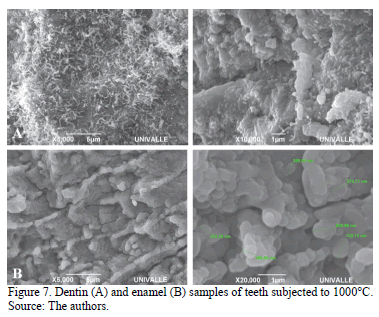
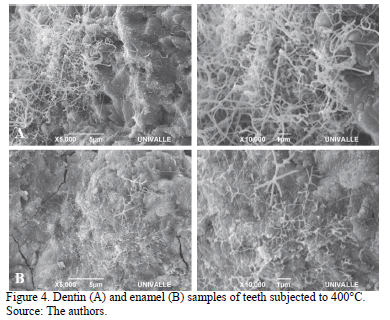
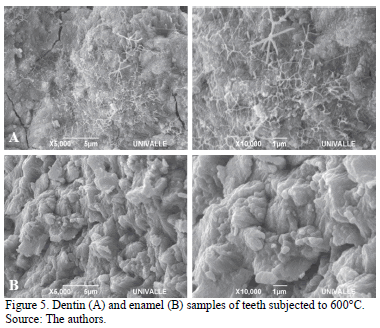
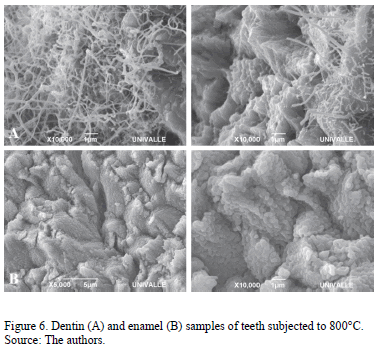
<body><![CDATA[<p align="center"><font size="2" face="Verdana, Arial, Helvetica, sans-serif"><a name="fig02"></a></font><img src="/img/revistas/dyna/v83n195/v83n195a05fig02.gif"></p>     <p><font size="2" face="Verdana, Arial, Helvetica, sans-serif">At 200&deg;C, a more compact pattern of   calcium hydroxyapatite and dehydration associated with the start of combustion   of the low organic component was observed in the enamel. In the dentin, calcium   hydroxyapatite began the process of compaction (<a href="#fig03">Fig. 3A</a> and <a href="#fig03">3B</a>).</font></p>     <p align="center"><font size="2" face="Verdana, Arial, Helvetica, sans-serif"><a name="fig03"></a></font><img src="/img/revistas/dyna/v83n195/v83n195a05fig03.gif"></p>     <p><font size="2" face="Verdana, Arial, Helvetica, sans-serif">At 400&deg;C   the fusion of calcium hydroxyapatite associated with the coalescence of   octacalcium phosphate nanospheres that were virtually merged was observed in   the enamel. In dentin, compact calcium hydroxyapatite was noticed (<a href="#fig04">Fig. 4A</a> and <a href="#fig04">4B</a>).</font></p>     <p align="center"><font size="2" face="Verdana, Arial, Helvetica, sans-serif"><a name="fig04"></a></font><img src="/img/revistas/dyna/v83n195/v83n195a05fig04.gif"></p>     <p><font size="2" face="Verdana, Arial, Helvetica, sans-serif">At 600&deg;C, complete melting of the octacalcium   phosphate and calcium hydroxyapatite nanospheres was observed in the enamel. In   the dentin, a fully fused inorganic component was found and some isolated   octacalcium phosphate nanospheres were seen (<a href="#fig05">Fig. 5A</a> and <a href="#fig05">5B</a>).</font></p>     <p align="center"><font size="2" face="Verdana, Arial, Helvetica, sans-serif"><a name="fig05"></a></font><img src="/img/revistas/dyna/v83n195/v83n195a05fig05.gif"></p>     <p><font size="2" face="Verdana, Arial, Helvetica, sans-serif">At 800&deg;C the loss of enamel   micro-morphology and the enlarged size of the octacalcium phosphate nanospheres   were observed. In the dentin a homogeneous melting pattern of hydroxyapatite   (<a href="#fig06">Fig. 6A</a> and <a href="#fig06">6B</a>) was observed.</font></p>     <p align="center"><font size="2" face="Verdana, Arial, Helvetica, sans-serif"><a name="fig06"></a></font><img src="/img/revistas/dyna/v83n195/v83n195a05fig06.gif"></p>     <p><font size="2" face="Verdana, Arial, Helvetica, sans-serif">Finally at   1000&deg;C, the integration of octacalcium phosphate nanospheres in separate and   larger clusters was noticed in the enamel. Molten dentin continued to have a   homogeneous pattern of calcium hydroxyapatite (<a href="#fig07">Fig. 7A</a> and <a href="#fig07">7B</a>).</font></p>     ]]></body>
<body><![CDATA[<p align="center"><font size="2" face="Verdana, Arial, Helvetica, sans-serif"> <a name="fig07"></a></font><img src="/img/revistas/dyna/v83n195/v83n195a05fig07.gif"></p>     <p>&nbsp;</p>     <p><font size="3" face="Verdana, Arial, Helvetica, sans-serif"><b>9. Discussion</b></font></p>     <p><font size="2" face="Verdana, Arial, Helvetica, sans-serif"><b><i>9.1. Dentin and enamel detachment at the DEJ</i></b></font></p>     <p><font size="2" face="Verdana, Arial, Helvetica, sans-serif">Merlati et al &#91;7&#93; described DEJ   detachment beginning at 400&deg;C. Moreno et al &#91;36&#93;, discussed that DEJ detachment   begins at 200&deg;C, and that it becomes more evident at 400&deg;C when an outbreak of   cervical enamel occurs. At 600&deg;C and at 800&deg;C, full enamel-dentin detachment at   the cervical and the middle thirds is observed. When the temperature reaches   1000&deg;C enamel is fragmented and separated from dentin just like the way that a   cap is removed. These authors ascribe the detachment phenomenon to the chemical   composition of enamel and dentin.</font></p>     <p><font size="2" face="Verdana, Arial, Helvetica, sans-serif">Because enamel has a high   inorganic content, which is represented by octacalcium phosphate as CHC, and a   low organic content and water (undergoing combustion and evaporation,   respectively), the temperature increase alters the organization of such   crystals, augmenting their cohesion (thermal contraction). The latter generates   the initial appearance of fissures and cracks, which provide a cracked aspect,   and ultimately, lead to their fracture.</font></p>     <p><font size="2" face="Verdana, Arial, Helvetica, sans-serif">Also, a   higher water and organic content means that dentin takes longer to dehydrate   and, because it is protected by enamel itself, in comparison with enamel, it   provides a certain spectrum of thermal contraction. This phenomenon is more   evident in the cervical third, where the scalloped pattern is reduced.</font></p>     <p><font size="2" face="Verdana, Arial, Helvetica, sans-serif">In the gross examination of the samples that   were subjected to temperatures of 200&deg;C, no visible change was observed in the   cervical region of the coronal third, as stated by Merlati et al &#91;7&#93; and Moreno   et al. &#91;36&#93; At 400&deg;C and at 600&deg;C, enamel and dentin began their process of   carbonization. Aprismatic enamel with less inorganic substance quickly lost its   low water content and protein, and underwent coalescence of octacalcium   phosphate nanospheres, which gradually increased in size and fused together, conforming   the CHC. Exactly the opposite happened to the mantle dentin, which has a much   higher organic content, which is the reason why that when water was lost and   the protein component was denatured, the mantle dentin lost more volume. This   caused a burst of enamel by dimensional shrinkage of the dentin at a DEJ level,   first at the cervical third and then gradually, up until the middle third. At   800&deg;C and 1000&deg;C, enamel was fully compacted and dentin had gradually begun the   process of incineration of the organic component. Thus, the shrinkage   phenomenon became much more obvious, which is the reason why the enamel was   completely separated from the coronal dentin (in the manner of a cap), as was described   by Moreno et al &#91;36&#93;.</font></p>     <p><font size="2" face="Verdana, Arial, Helvetica, sans-serif">This   spontaneous separation of enamel and dentin was a gradual process that started   between 200&deg;C and 400&deg;C and became more evident as the temperature increased up   until its total separation that occurred at 1000&deg;C. The explanation of this   macroscopic change can be found in the scalloped pattern of the DEJ, which   according to Gallagher et al &#91;16&#93;, Marshall et al &#91;18&#93;, Habelitz et al &#91;20&#93;,   Imbeni et al &#91;21&#93; and Radlanski and Renzen &#91;22&#93;, is very marked in the cusps   zone of the DEJ and gradually fades until it disappears in the cervical region.   Hence, the latter is the region of least resistance to thermal shock between   enamel and dentin, and is the site at which the DEJ initially loses its   continuity solution, even at the lowest temperature.</font></p>     <p><font size="2" face="Verdana, Arial, Helvetica, sans-serif"><b><i>9.2. Behavior of enamel and dentin CHC </i></b></font></p>     ]]></body>
<body><![CDATA[<p><font size="2" face="Verdana, Arial, Helvetica, sans-serif">Regarding the organization of CHC, no   report in the literature has explained in detail their behavior, both in enamel   and dentin when subjected to high temperatures.</font></p>     <p><font size="2" face="Verdana, Arial, Helvetica, sans-serif">Holden et al &#91;37&#93; tackled the subject,   but studied bone tissue through SEM analysis. They subjected fragments of has   disintegrated in such way that the collagen framework is fully exposed.   Similarly, the hydroxyapatite crystals are found to be in a spherical shape. Between   800&deg;C and 1000&deg;C incinerated bone looks like white chalk, morphology of   concentric lamellae is lost and CHC may present two different morphologies:   hexagonal and spherical. Finally from 1000&deg;C to 1600&deg;C, CHCs are fused   together; this finding is associated with the sintering process (coalescence at   high temperatures) that is much more evident in the inside of the osteon, which   is completely disorganized. This is the reason why the classic pattern of the   concentric lamellae around the Havers duct cannot not observed. </font></p>     <p><font size="2" face="Verdana, Arial, Helvetica, sans-serif">Subsequently, Holden et al &#91;38&#93;,   subjected bone fragments to high temperature and analyzed them by X-ray   diffraction. They found that the number of CHCs increase as the temperature rises,   beginning at 600&deg;C (termed by the authors as re- crystallization). Above   1000&deg;C, CHCs are broken down to calcium oxide, above 1200&deg;C to calcium   triphosphate and above 1400&deg;C to phosphate calcium oxide.</font></p>     <p><font size="2" face="Verdana, Arial, Helvetica, sans-serif">Venkatesan   and Kim &#91;39&#93; conducted a study in which fish tuna vertebrae were subjected to   high temperatures (from 200&deg;C to 1200&deg;C) in order to characterize the behavior   of the hydroxyapatite by infra-red spectroscopy, X-ray, TEM and SEM. The   authors concluded that as the temperature increases CHCs become agglomerated,   beginning at 600&deg;C: temperature at which the micro-crystals grow in size (from   80 to 300nm). In this study, the behavior of bone tissue in terms of color   changes determines carbonization signs from 200&deg;C, complete carbonization by   burning of the organic matrix (water and protein components) at 600&deg;C and   incineration from 800&deg;C. This is similar to what occurs to dentin.</font></p>     <p><font size="2" face="Verdana, Arial, Helvetica, sans-serif">In this   study, it was evident that CHC aprismatic enamel and mantle dentin, which   constitute the enamel-dentine junction, underwent the same changes that were   described in bone tissue. Enamel and dentin start their combustion of   extracellular organic matrix at 200&deg;C. At 400&deg;C carbonization starts, which   leads to incineration between 600&deg;C and 1000&deg;C. With increasing temperature,   the CHC adopts a rounded appearance. This process is most evident in aprismatic   enamel given its high inorganic content, whereas in dentin, given its high   organic content, changes in calcium hydroxyapatite can only be seen starting   from a temperature of 800&deg;C.</font></p>     <p>&nbsp;</p>     <p><font size="3" face="Verdana, Arial, Helvetica, sans-serif"><b>10. Conclusions</b></font></p>     <p><font size="2" face="Verdana, Arial, Helvetica, sans-serif">Microstructural changes (fusion of CHC   and sintering of octacalcium phosphate nanospheres) in enamel and dentin, when they   are subjected to high temperatures, explain the specific macrostructural   changes (DEJ separation) in each temperature range: these being constant and   repetitive.</font></p>     <p><font size="2" face="Verdana, Arial, Helvetica, sans-serif">Separation   of enamel and dentin at the DEJ can be a reliable medicolegal marker to be able   to approximate the temperature to which teeth were subjected. This can be   undertaken during the forensic dental identification and documentation of the   forensic autopsy process, if there is enough scientific support, in burned,   carbonized and incinerated individuals.</font></p>     <p><font size="2" face="Verdana, Arial, Helvetica, sans-serif">It is recommended that the analysis of   the behavior of CHC at high temperatures be extended in other mineralized   dental tissues (cement, alveolar compact bone and spongy bone), both in   interfaces and free surfaces. In order to do this we suggest the design of an animal   model in which domestic pig teeth that are articulated on their own socket (not   isolated) are subjected to high temperatures for the purpose of being closer to   the in vivo conditions.</font></p>     ]]></body>
<body><![CDATA[<p>&nbsp;</p>     <p><font size="3" face="Verdana, Arial, Helvetica, sans-serif"><b>Acknowledgments</b></font></p>     <p><font size="2" face="Verdana, Arial, Helvetica, sans-serif">This research was funded by the   COLCIENCIAS 2012 Young Researchers internship grant (Programa de J&oacute;venes   Investigadores e Innovadores &quot;Virginia Gutierrez de Pineda&quot; COLCIENCIAS), and   by the Vice-President of Research at the Universidad del Valle.</font></p>     <p>&nbsp;</p>     <p><font size="3" face="Verdana, Arial, Helvetica, sans-serif"><b>References</b></font></p>     <!-- ref --><p><font size="2" face="Verdana, Arial, Helvetica, sans-serif"><b>&#91;1&#93;</b> Ram&iacute;rez I.A., Casta&ntilde;o A.,   Gonz&aacute;lez J.O. y Hern&aacute;ndez H.W., Homicidios Colombia 2005, en Instituto Nacional   de Medicina Legal y Ciencias Forenses. Forensis 2005, datos para la vida. Santa   Fe de Bogot&aacute;, Imprelibros, 2006. pp. 27-75.    &nbsp;&nbsp;&nbsp;&nbsp;&nbsp;&nbsp;&nbsp;&nbsp;[&#160;<a href="javascript:void(0);" onclick="javascript: window.open('/scielo.php?script=sci_nlinks&ref=1130142&pid=S0012-7353201600010000500001&lng=','','width=640,height=500,resizable=yes,scrollbars=1,menubar=yes,');">Links</a>&#160;]<!-- end-ref --></font></p>     <!-- ref --><p><font size="2" face="Verdana, Arial, Helvetica, sans-serif"><b>&#91;2&#93;</b> Gonz&aacute;lez J.O. y Hern&aacute;ndez H.W., Muertes accidentales Colombia 2005. En   Instituto Nacional de Medicina Legal y Ciencias Forenses. Forensis 2005, datos   para la vida. Santa Fe de Bogot&aacute;,   Imprelibros, 2006. pp. 254-315.    &nbsp;&nbsp;&nbsp;&nbsp;&nbsp;&nbsp;&nbsp;&nbsp;[&#160;<a href="javascript:void(0);" onclick="javascript: window.open('/scielo.php?script=sci_nlinks&ref=1130144&pid=S0012-7353201600010000500002&lng=','','width=640,height=500,resizable=yes,scrollbars=1,menubar=yes,');">Links</a>&#160;]<!-- end-ref --></font></p>     <!-- ref --><p><font size="2" face="Verdana, Arial, Helvetica, sans-serif"><b>&#91;3&#93;</b> Pretty, I.A. and Sweet, D., A look at forensic   dentistry. Part 1: The role of teeth in the determination of human identity, Br   Dental J, 190, pp. 359-366, 1995. DOI: 10.1038/sj.bdj.4800972.    &nbsp;&nbsp;&nbsp;&nbsp;&nbsp;&nbsp;&nbsp;&nbsp;[&#160;<a href="javascript:void(0);" onclick="javascript: window.open('/scielo.php?script=sci_nlinks&ref=1130146&pid=S0012-7353201600010000500003&lng=','','width=640,height=500,resizable=yes,scrollbars=1,menubar=yes,');">Links</a>&#160;]<!-- end-ref --></font></p>     <!-- ref --><p><font size="2" face="Verdana, Arial, Helvetica, sans-serif"><b>&#91;4&#93;</b> Bowers, C.M. and Bell, G.L., Manual of forensic   odontology. 3<sup>rd</sup> edition. Colorado Springs: American Society of   Forensic Odontology, 1997.    &nbsp;&nbsp;&nbsp;&nbsp;&nbsp;&nbsp;&nbsp;&nbsp;[&#160;<a href="javascript:void(0);" onclick="javascript: window.open('/scielo.php?script=sci_nlinks&ref=1130148&pid=S0012-7353201600010000500004&lng=','','width=640,height=500,resizable=yes,scrollbars=1,menubar=yes,');">Links</a>&#160;]<!-- end-ref --></font></p>     <!-- ref --><p><font size="2" face="Verdana, Arial, Helvetica, sans-serif"><b>&#91;5&#93;</b> Arag&oacute;n, N., Moreno, F. and Salazar, L., In vitro   behavior of interfaces in human molars with an implanted passive RFID microchip   and subjected to compression forces, DYNA, 80(178), pp. 5-10, 2013.    &nbsp;&nbsp;&nbsp;&nbsp;&nbsp;&nbsp;&nbsp;&nbsp;[&#160;<a href="javascript:void(0);" onclick="javascript: window.open('/scielo.php?script=sci_nlinks&ref=1130150&pid=S0012-7353201600010000500005&lng=','','width=640,height=500,resizable=yes,scrollbars=1,menubar=yes,');">Links</a>&#160;]<!-- end-ref --></font></p>     <!-- ref --><p><font size="2" face="Verdana, Arial, Helvetica, sans-serif"><b>&#91;6&#93;</b> Delattre, V.F., Burned beyond recognition: Systematic   approach to the dental identification of charred human remains, J Forensic Sci,   45, pp. 589-596, 2000.    &nbsp;&nbsp;&nbsp;&nbsp;&nbsp;&nbsp;&nbsp;&nbsp;[&#160;<a href="javascript:void(0);" onclick="javascript: window.open('/scielo.php?script=sci_nlinks&ref=1130152&pid=S0012-7353201600010000500006&lng=','','width=640,height=500,resizable=yes,scrollbars=1,menubar=yes,');">Links</a>&#160;]<!-- end-ref --></font></p>     <!-- ref --><p><font size="2" face="Verdana, Arial, Helvetica, sans-serif"><b>&#91;7&#93;</b> Merlati, G., Danesino, P., Savio, C., Fassina, G.,   Osculati, A., Menghini, P., Observations of dental prostheses and restorations   subjected to high temperatures: experimental studies to aid identification   processes, J Forensic Odontostomatol , 20(2), pp.17-24, 2002.    &nbsp;&nbsp;&nbsp;&nbsp;&nbsp;&nbsp;&nbsp;&nbsp;[&#160;<a href="javascript:void(0);" onclick="javascript: window.open('/scielo.php?script=sci_nlinks&ref=1130154&pid=S0012-7353201600010000500007&lng=','','width=640,height=500,resizable=yes,scrollbars=1,menubar=yes,');">Links</a>&#160;]<!-- end-ref --></font></p>     <!-- ref --><p><font size="2" face="Verdana, Arial, Helvetica, sans-serif"><b>&#91;8&#93;</b> Merlati, G., Savio, C., Danesino, P., Fassina, G.,   Menghini, P. Further Study of restored and unrestored teeth subjected to high   temperatures, J Forensic Odontostomatol, 22, pp.17-24, 2004.    &nbsp;&nbsp;&nbsp;&nbsp;&nbsp;&nbsp;&nbsp;&nbsp;[&#160;<a href="javascript:void(0);" onclick="javascript: window.open('/scielo.php?script=sci_nlinks&ref=1130156&pid=S0012-7353201600010000500008&lng=','','width=640,height=500,resizable=yes,scrollbars=1,menubar=yes,');">Links</a>&#160;]<!-- end-ref --></font></p>     <!-- ref --><p><font size="2" face="Verdana, Arial, Helvetica, sans-serif"><b>&#91;9&#93;</b> Rötzscher, K., Grundmann, C., Benthaus, S., The   effects of high temperatures on human teeth and dentures, Int Poster J Dent Oral   Med, 6, Poster 213, 2004.    &nbsp;&nbsp;&nbsp;&nbsp;&nbsp;&nbsp;&nbsp;&nbsp;[&#160;<a href="javascript:void(0);" onclick="javascript: window.open('/scielo.php?script=sci_nlinks&ref=1130158&pid=S0012-7353201600010000500009&lng=','','width=640,height=500,resizable=yes,scrollbars=1,menubar=yes,');">Links</a>&#160;]<!-- end-ref --></font></p>     <!-- ref --><p><font size="2" face="Verdana, Arial, Helvetica, sans-serif"><b>&#91;10&#93;</b> Ferreira, J.L., Espina-de Ferreira, A. and Ortega,   A.I., Methods for the analysis of hard dental tissues exposed to high   temperatures, Forensic Sci Int, 178, pp. 119-124, 2008. DOI:   10.1016/j.forsciint.2007.12.009.    &nbsp;&nbsp;&nbsp;&nbsp;&nbsp;&nbsp;&nbsp;&nbsp;[&#160;<a href="javascript:void(0);" onclick="javascript: window.open('/scielo.php?script=sci_nlinks&ref=1130160&pid=S0012-7353201600010000500010&lng=','','width=640,height=500,resizable=yes,scrollbars=1,menubar=yes,');">Links</a>&#160;]<!-- end-ref --></font></p>     <!-- ref --><p><font size="2" face="Verdana, Arial, Helvetica, sans-serif"><b>&#91;11&#93;</b> Moreno, S.,   Merlati, G., Mar&iacute;n, l., Savio, C. and Moreno, F., Effects of high temperatures   on different dental restorative systems: Experimental study to aid   identification processes, J Forensic Dent Sci, 1(1), pp. 17-23, 2009. DOI: 10.4103/0974-2948.50883.    &nbsp;&nbsp;&nbsp;&nbsp;&nbsp;&nbsp;&nbsp;&nbsp;[&#160;<a href="javascript:void(0);" onclick="javascript: window.open('/scielo.php?script=sci_nlinks&ref=1130162&pid=S0012-7353201600010000500011&lng=','','width=640,height=500,resizable=yes,scrollbars=1,menubar=yes,');">Links</a>&#160;]<!-- end-ref --></font></p>     <!-- ref --><p><font size="2" face="Verdana, Arial, Helvetica, sans-serif"><b>&#91;12&#93;</b> G&oacute;mez-de Ferrais, M.E. y   Campos, A., Histolog&iacute;a y embriolog&iacute;a bucodental. Segunda edici&oacute;n. Buenos Aires:   Panamericana, 2002.    &nbsp;&nbsp;&nbsp;&nbsp;&nbsp;&nbsp;&nbsp;&nbsp;[&#160;<a href="javascript:void(0);" onclick="javascript: window.open('/scielo.php?script=sci_nlinks&ref=1130164&pid=S0012-7353201600010000500012&lng=','','width=640,height=500,resizable=yes,scrollbars=1,menubar=yes,');">Links</a>&#160;]<!-- end-ref --></font></p>     <!-- ref --><p><font size="2" face="Verdana, Arial, Helvetica, sans-serif"><b>&#91;13&#93;</b> Garant, P.R., Oral cells and tissues. Chicago: Quintessence Books; 2003.    &nbsp;&nbsp;&nbsp;&nbsp;&nbsp;&nbsp;&nbsp;&nbsp;[&#160;<a href="javascript:void(0);" onclick="javascript: window.open('/scielo.php?script=sci_nlinks&ref=1130166&pid=S0012-7353201600010000500013&lng=','','width=640,height=500,resizable=yes,scrollbars=1,menubar=yes,');">Links</a>&#160;]<!-- end-ref --></font></p>     <!-- ref --><p><font size="2" face="Verdana, Arial, Helvetica, sans-serif"><b>&#91;14&#93;</b> Nanci, A., Ten Cate's Oral Histology: Development,   Structure, and Function. 8<sup>th</sup> ed. St. Louis: Elsevier Mosby, 2008.    &nbsp;&nbsp;&nbsp;&nbsp;&nbsp;&nbsp;&nbsp;&nbsp;[&#160;<a href="javascript:void(0);" onclick="javascript: window.open('/scielo.php?script=sci_nlinks&ref=1130168&pid=S0012-7353201600010000500014&lng=','','width=640,height=500,resizable=yes,scrollbars=1,menubar=yes,');">Links</a>&#160;]<!-- end-ref --> </font></p>     <!-- ref --><p><font size="2" face="Verdana, Arial, Helvetica, sans-serif"><b>&#91;15&#93;</b> Whittaker, D.A., The enamel-dentine junction of human   and Macaca irus teeth: A light and electron microscopic study, J Anat, 125(2),   pp. 323-335, 1978.    &nbsp;&nbsp;&nbsp;&nbsp;&nbsp;&nbsp;&nbsp;&nbsp;[&#160;<a href="javascript:void(0);" onclick="javascript: window.open('/scielo.php?script=sci_nlinks&ref=1130170&pid=S0012-7353201600010000500015&lng=','','width=640,height=500,resizable=yes,scrollbars=1,menubar=yes,');">Links</a>&#160;]<!-- end-ref --></font></p>     <!-- ref --><p><font size="2" face="Verdana, Arial, Helvetica, sans-serif"><b>&#91;16&#93;</b> Gallagher, R.R, Demos, S.G., Balooch, M., Marshall, G.W.   and Marshall, S.J., Optical spectroscopy and imaging of the dentin-enamel   junction in human third molars, J Biomed Mater Res, 64A, pp. 372-377, 2003.   DOI: 10.1002/jbm.a.10436.    &nbsp;&nbsp;&nbsp;&nbsp;&nbsp;&nbsp;&nbsp;&nbsp;[&#160;<a href="javascript:void(0);" onclick="javascript: window.open('/scielo.php?script=sci_nlinks&ref=1130172&pid=S0012-7353201600010000500016&lng=','','width=640,height=500,resizable=yes,scrollbars=1,menubar=yes,');">Links</a>&#160;]<!-- end-ref --></font></p>     <!-- ref --><p><font size="2" face="Verdana, Arial, Helvetica, sans-serif"><b>&#91;17&#93;</b> Chan, Y.L., Ngan, A.H. and King, N.M., Nano-scale   structure and mechanical properties of the human dentine-enamel junction, J   Mech Behav Biomed Mater, 4(5), pp. 785-795, 2011. DOI:   10.1016/j.jmbbm.2010.09.003.    &nbsp;&nbsp;&nbsp;&nbsp;&nbsp;&nbsp;&nbsp;&nbsp;[&#160;<a href="javascript:void(0);" onclick="javascript: window.open('/scielo.php?script=sci_nlinks&ref=1130174&pid=S0012-7353201600010000500017&lng=','','width=640,height=500,resizable=yes,scrollbars=1,menubar=yes,');">Links</a>&#160;]<!-- end-ref --></font></p>     <!-- ref --><p><font size="2" face="Verdana, Arial, Helvetica, sans-serif"><b>&#91;18&#93;</b> Marshall, S.J., Balooch, M., Habelitz, S., Balooch,   G., Gallagher, G. and Marshall, W., The dentin-enamel junction. A natural   multilevel interface, J Eur Ceramic Soc, 23, pp. 2897-2904, 2003. DOI:   10.1016/S0955-2219(03)00301-7</font>&nbsp;&nbsp;&nbsp;&nbsp;&nbsp;&nbsp;&nbsp;&nbsp;[&#160;<a href="javascript:void(0);" onclick="javascript: window.open('/scielo.php?script=sci_nlinks&ref=1130176&pid=S0012-7353201600010000500018&lng=','','width=640,height=500,resizable=yes,scrollbars=1,menubar=yes,');">Links</a>&#160;]<!-- end-ref --><!-- ref --><p><font size="2" face="Verdana, Arial, Helvetica, sans-serif"><b>&#91;19&#93;</b> Smith, T.M., Olejniczak, A.J., Reid, D.J., Ferrell,   R.J. and Hublin, J.J., Modern human molar enamel thickness and enamel-dentine   junction shape, Arch Oral Biol, 51, pp. 974-995, 2006. DOI:   10.1016/j.archoralbio.2006.04.012.    &nbsp;&nbsp;&nbsp;&nbsp;&nbsp;&nbsp;&nbsp;&nbsp;[&#160;<a href="javascript:void(0);" onclick="javascript: window.open('/scielo.php?script=sci_nlinks&ref=1130177&pid=S0012-7353201600010000500019&lng=','','width=640,height=500,resizable=yes,scrollbars=1,menubar=yes,');">Links</a>&#160;]<!-- end-ref --></font></p>     <!-- ref --><p><font size="2" face="Verdana, Arial, Helvetica, sans-serif"><b>&#91;20&#93;</b> Habelitz, S., Marshall, S.J, Marshall, G.W.and   Balooch, M., The functional width of the dentino-enamel junction determined by   AFM-based nanoscratching, J Struct Biol, 135, pp. 294-301, 2011. DOI:   10.1006/jsbi.2001.4409.    &nbsp;&nbsp;&nbsp;&nbsp;&nbsp;&nbsp;&nbsp;&nbsp;[&#160;<a href="javascript:void(0);" onclick="javascript: window.open('/scielo.php?script=sci_nlinks&ref=1130179&pid=S0012-7353201600010000500020&lng=','','width=640,height=500,resizable=yes,scrollbars=1,menubar=yes,');">Links</a>&#160;]<!-- end-ref --></font></p>     <!-- ref --><p><font size="2" face="Verdana, Arial, Helvetica, sans-serif"><b>&#91;21&#93;</b> Imbeni, V., Kruzic, J.J., Marshal, G.W., Marshal, S.J.   and Ritchie, R.O., The dentin-enamel junction and the fracture of human teeth,   Nature Mater, 4, pp. 229-232, 2005. DOI: 10.1038/nmat1323.    &nbsp;&nbsp;&nbsp;&nbsp;&nbsp;&nbsp;&nbsp;&nbsp;[&#160;<a href="javascript:void(0);" onclick="javascript: window.open('/scielo.php?script=sci_nlinks&ref=1130181&pid=S0012-7353201600010000500021&lng=','','width=640,height=500,resizable=yes,scrollbars=1,menubar=yes,');">Links</a>&#160;]<!-- end-ref --></font></p>     <!-- ref --><p><font size="2" face="Verdana, Arial, Helvetica, sans-serif"><b>&#91;22&#93;</b> Radlanski, R.J. and Renz, H., Insular dentin formation   pattern in human odontogenesis in relation to the scalloped dentino-enamel   junction, Ann Anat, 189, pp. 243-250, 2007. DOI: 10.1016/j.aanat.2006.11.007.    &nbsp;&nbsp;&nbsp;&nbsp;&nbsp;&nbsp;&nbsp;&nbsp;[&#160;<a href="javascript:void(0);" onclick="javascript: window.open('/scielo.php?script=sci_nlinks&ref=1130183&pid=S0012-7353201600010000500022&lng=','','width=640,height=500,resizable=yes,scrollbars=1,menubar=yes,');">Links</a>&#160;]<!-- end-ref --></font></p>     <!-- ref --><p><font size="2" face="Verdana, Arial, Helvetica, sans-serif"><b>&#91;23&#93;</b> Robinson, C., Fuchs, P. and Weatherell, J.A., The   appearance of developing rat incisor enamel using a freeze fracturing   technique, J Cryst Growth, 53, pp. 160-165, 1981. DOI:   10.1016/0022-0248(81)90062-2.    &nbsp;&nbsp;&nbsp;&nbsp;&nbsp;&nbsp;&nbsp;&nbsp;[&#160;<a href="javascript:void(0);" onclick="javascript: window.open('/scielo.php?script=sci_nlinks&ref=1130185&pid=S0012-7353201600010000500023&lng=','','width=640,height=500,resizable=yes,scrollbars=1,menubar=yes,');">Links</a>&#160;]<!-- end-ref --> </font></p>     ]]></body>
<body><![CDATA[<!-- ref --><p><font size="2" face="Verdana, Arial, Helvetica, sans-serif"><b>&#91;24&#93;</b> Ijima, K.H., Wakamatsu, N., Goto, T., Doi, Y. and   Moriwaki, Y., Effects of ca addition on the formation of octa-calcium phosphate   and apatite in solution at ph 7.4 and at 37&deg;C, J Cryst Growth, 193(1), pp.   182-188, 1998. DOI: 10.1016/S0022-0248(98)00455-2.    &nbsp;&nbsp;&nbsp;&nbsp;&nbsp;&nbsp;&nbsp;&nbsp;[&#160;<a href="javascript:void(0);" onclick="javascript: window.open('/scielo.php?script=sci_nlinks&ref=1130187&pid=S0012-7353201600010000500024&lng=','','width=640,height=500,resizable=yes,scrollbars=1,menubar=yes,');">Links</a>&#160;]<!-- end-ref --></font></p>     <!-- ref --><p><font size="2" face="Verdana, Arial, Helvetica, sans-serif"><b>&#91;25&#93;</b> Ijima, M. and Moriwaki, Y., Effects of ionic inflow   and organic matrix on crystal growth of octacalcium phosphate; relevant to   tooth enamel formation, J Cryst Growth, 198/199, pp. 670-676, 1999. DOI:   10.1016/S0022-0248(98)00986-5.    &nbsp;&nbsp;&nbsp;&nbsp;&nbsp;&nbsp;&nbsp;&nbsp;[&#160;<a href="javascript:void(0);" onclick="javascript: window.open('/scielo.php?script=sci_nlinks&ref=1130189&pid=S0012-7353201600010000500025&lng=','','width=640,height=500,resizable=yes,scrollbars=1,menubar=yes,');">Links</a>&#160;]<!-- end-ref --></font></p>     <!-- ref --><p><font size="2" face="Verdana, Arial, Helvetica, sans-serif"><b>&#91;26&#93;</b> Veis, A., Mineralization in organic matrix frameworks,   Rev Mineral Geochem, 54, pp. 249-289, 2003.    &nbsp;&nbsp;&nbsp;&nbsp;&nbsp;&nbsp;&nbsp;&nbsp;[&#160;<a href="javascript:void(0);" onclick="javascript: window.open('/scielo.php?script=sci_nlinks&ref=1130191&pid=S0012-7353201600010000500026&lng=','','width=640,height=500,resizable=yes,scrollbars=1,menubar=yes,');">Links</a>&#160;]<!-- end-ref --></font></p>     <!-- ref --><p><font size="2" face="Verdana, Arial, Helvetica, sans-serif"><b>&#91;27&#93;</b> Kawasaki, K., Suzuki, T. and Weiss, K.M., Genetic   basis for the evolution of vertebrate mineralized tissue, PNAS, 101(31), pp.   11356-11361, 2004. DOI: 10.1073/pnas.0404279101.    &nbsp;&nbsp;&nbsp;&nbsp;&nbsp;&nbsp;&nbsp;&nbsp;[&#160;<a href="javascript:void(0);" onclick="javascript: window.open('/scielo.php?script=sci_nlinks&ref=1130193&pid=S0012-7353201600010000500027&lng=','','width=640,height=500,resizable=yes,scrollbars=1,menubar=yes,');">Links</a>&#160;]<!-- end-ref --></font></p>     <!-- ref --><p><font size="2" face="Verdana, Arial, Helvetica, sans-serif"><b>&#91;28&#93;</b> Wilt, F.H., Developmental biology meets materials   science: Morphogenesis of biomineralized structures, Dev Biol, 280, pp. 15-25,   2005. DOI: 10.1016/j.ydbio.2005.01.019.    &nbsp;&nbsp;&nbsp;&nbsp;&nbsp;&nbsp;&nbsp;&nbsp;[&#160;<a href="javascript:void(0);" onclick="javascript: window.open('/scielo.php?script=sci_nlinks&ref=1130195&pid=S0012-7353201600010000500028&lng=','','width=640,height=500,resizable=yes,scrollbars=1,menubar=yes,');">Links</a>&#160;]<!-- end-ref --></font></p>     ]]></body>
<body><![CDATA[<!-- ref --><p><font size="2" face="Verdana, Arial, Helvetica, sans-serif"><b>&#91;29&#93;</b> Thesleff, I. and Nieminent, P., Tooth morphogenesis   and cell differentiation, Curr Op Cell Biol, 8, pp. 844-850, 1996. DOI:   10.1016/S0955-0674(96)80086-X.    &nbsp;&nbsp;&nbsp;&nbsp;&nbsp;&nbsp;&nbsp;&nbsp;[&#160;<a href="javascript:void(0);" onclick="javascript: window.open('/scielo.php?script=sci_nlinks&ref=1130197&pid=S0012-7353201600010000500029&lng=','','width=640,height=500,resizable=yes,scrollbars=1,menubar=yes,');">Links</a>&#160;]<!-- end-ref --></font></p>     <!-- ref --><p><font size="2" face="Verdana, Arial, Helvetica, sans-serif"><b>&#91;30&#93;</b> Fincham, A.G, Moradian-Oldak, J. and Simmer, J.P., The   structural biology of the developing dental enamel matrix, J Struct Biol,   126(3), pp. 270-299, 1999. DOI: 10.1006/jsbi.1999.4130.    &nbsp;&nbsp;&nbsp;&nbsp;&nbsp;&nbsp;&nbsp;&nbsp;[&#160;<a href="javascript:void(0);" onclick="javascript: window.open('/scielo.php?script=sci_nlinks&ref=1130199&pid=S0012-7353201600010000500030&lng=','','width=640,height=500,resizable=yes,scrollbars=1,menubar=yes,');">Links</a>&#160;]<!-- end-ref --></font></p>     <!-- ref --><p><font size="2" face="Verdana, Arial, Helvetica, sans-serif"><b>&#91;31&#93;</b> Simmer, J.P. and Fincham, A.G., Molecular mechanisms   of dental enamel formation, Crit Rev Oral Biol, 6(2), pp. 84-108, 1995. DOI:   10.1177/10454411950060020701.    &nbsp;&nbsp;&nbsp;&nbsp;&nbsp;&nbsp;&nbsp;&nbsp;[&#160;<a href="javascript:void(0);" onclick="javascript: window.open('/scielo.php?script=sci_nlinks&ref=1130201&pid=S0012-7353201600010000500031&lng=','','width=640,height=500,resizable=yes,scrollbars=1,menubar=yes,');">Links</a>&#160;]<!-- end-ref --></font></p>     <!-- ref --><p><font size="2" face="Verdana, Arial, Helvetica, sans-serif"><b>&#91;32&#93;</b> Ruch, J.V., Lesot, H. and Begue-Kin, C., Odontoblast   differentiation, Int J Dev Biol, 39, pp. 51-68, 1995.    &nbsp;&nbsp;&nbsp;&nbsp;&nbsp;&nbsp;&nbsp;&nbsp;[&#160;<a href="javascript:void(0);" onclick="javascript: window.open('/scielo.php?script=sci_nlinks&ref=1130203&pid=S0012-7353201600010000500032&lng=','','width=640,height=500,resizable=yes,scrollbars=1,menubar=yes,');">Links</a>&#160;]<!-- end-ref --></font></p>     <!-- ref --><p><font size="2" face="Verdana, Arial, Helvetica, sans-serif"><b>&#91;33&#93;</b> MINISTERIO DE LA PROTECCI&Oacute;N   SOCIAL., Resoluci&oacute;n por la cual se establecen las normas cient&iacute;ficas, t&eacute;cnicas   y administrativas para la investigaci&oacute;n en salud. &#91;Online&#93;. Resoluci&oacute;n   008430/1993 de 4 de Octubre &#91;Date of reference: January 2014&#93;. Available at: <a href="http://www.minproteccionsocial.gov.co/vbecontent/library/documents/DocNewsNo267711.pdf" target="_blank">http://www.minproteccionsocial.gov.co/vbecontent/library/documents/DocNewsNo267711.pdf</a> </font>&nbsp;&nbsp;&nbsp;&nbsp;&nbsp;&nbsp;&nbsp;&nbsp;[&#160;<a href="javascript:void(0);" onclick="javascript: window.open('/scielo.php?script=sci_nlinks&ref=1130205&pid=S0012-7353201600010000500033&lng=','','width=640,height=500,resizable=yes,scrollbars=1,menubar=yes,');">Links</a>&#160;]<!-- end-ref --><!-- ref --><p><font size="2" face="Verdana, Arial, Helvetica, sans-serif"><b>&#91;34&#93;</b> ASOCIACI&Oacute;N M&Eacute;DICA MUNDIAL., Principios &eacute;ticos para las investigaciones   m&eacute;dicas en seres humanos, Declaraci&oacute;n de Helsinki. &#91;Online&#93;. Finlandia, junio 1964. &#91;Date   of reference: January 2014&#93;. Available at: <a href="http://www.wma.net/s/policy/b3.htm" target="_blank">http://www.wma.net/s/policy/b3.htm</a> </font>&nbsp;&nbsp;&nbsp;&nbsp;&nbsp;&nbsp;&nbsp;&nbsp;[&#160;<a href="javascript:void(0);" onclick="javascript: window.open('/scielo.php?script=sci_nlinks&ref=1130206&pid=S0012-7353201600010000500034&lng=','','width=640,height=500,resizable=yes,scrollbars=1,menubar=yes,');">Links</a>&#160;]<!-- end-ref --><!-- ref --><p><font size="2" face="Verdana, Arial, Helvetica, sans-serif"><b>&#91;35&#93;</b> ISO 11405.,   Dental materials: Testing of adhesion to tooth structure. International Organization for Standardization, 2003.    &nbsp;&nbsp;&nbsp;&nbsp;&nbsp;&nbsp;&nbsp;&nbsp;[&#160;<a href="javascript:void(0);" onclick="javascript: window.open('/scielo.php?script=sci_nlinks&ref=1130207&pid=S0012-7353201600010000500035&lng=','','width=640,height=500,resizable=yes,scrollbars=1,menubar=yes,');">Links</a>&#160;]<!-- end-ref --></font></p>     <!-- ref --><p><font size="2" face="Verdana, Arial, Helvetica, sans-serif"><b>&#91;36&#93;</b> Moreno, S., Le&oacute;n, M.E., Mar&iacute;n,   L.y Moreno, F., Comportamiento de los tejidos dentales y de algunos materiales   de obturaci&oacute;n dental sometidos a altas temperaturas con fines forenses, Colomb   Med, 39(1), pp. 28-46, 2008.    &nbsp;&nbsp;&nbsp;&nbsp;&nbsp;&nbsp;&nbsp;&nbsp;[&#160;<a href="javascript:void(0);" onclick="javascript: window.open('/scielo.php?script=sci_nlinks&ref=1130209&pid=S0012-7353201600010000500036&lng=','','width=640,height=500,resizable=yes,scrollbars=1,menubar=yes,');">Links</a>&#160;]<!-- end-ref --></font></p>     <!-- ref --><p><font size="2" face="Verdana, Arial, Helvetica, sans-serif"><b>&#91;37&#93;</b> Holden, J.L., Phakey, P.P. and Clement, J.G., Scanning   electron microscope observations of heat-treated human bone, Forensic Sci Int,   74, pp. 29-45, 1995. DOI: 10.1016/0379-0738(95)01735-2.    &nbsp;&nbsp;&nbsp;&nbsp;&nbsp;&nbsp;&nbsp;&nbsp;[&#160;<a href="javascript:void(0);" onclick="javascript: window.open('/scielo.php?script=sci_nlinks&ref=1130211&pid=S0012-7353201600010000500037&lng=','','width=640,height=500,resizable=yes,scrollbars=1,menubar=yes,');">Links</a>&#160;]<!-- end-ref --></font></p>     <!-- ref --><p><font size="2" face="Verdana, Arial, Helvetica, sans-serif"><b>&#91;38&#93;</b> Holden, J.L., Clement, J.G. and Phakey, P.P., Age and   temperature related changes to the ultrastructure and composition of human bone   mineral, J Bone Miner Res, 10(9), pp. 1400-1409, 1995. DOI:      10.1002/jbmr.5650100918.    &nbsp;&nbsp;&nbsp;&nbsp;&nbsp;&nbsp;&nbsp;&nbsp;[&#160;<a href="javascript:void(0);" onclick="javascript: window.open('/scielo.php?script=sci_nlinks&ref=1130213&pid=S0012-7353201600010000500038&lng=','','width=640,height=500,resizable=yes,scrollbars=1,menubar=yes,');">Links</a>&#160;]<!-- end-ref --></font></p>     <!-- ref --><p><font size="2" face="Verdana, Arial, Helvetica, sans-serif"><b>&#91;39&#93;</b> Venkatesan, J. and Kim, S-K., Effect of temperature on   isolation and characterization of hydroxyapatite from tuna (Thunnus obesus)   bone, Materials, 3(10), pp. 4761-4772, 2010. DOI: 10.3390/ma3104761.    &nbsp;&nbsp;&nbsp;&nbsp;&nbsp;&nbsp;&nbsp;&nbsp;[&#160;<a href="javascript:void(0);" onclick="javascript: window.open('/scielo.php?script=sci_nlinks&ref=1130215&pid=S0012-7353201600010000500039&lng=','','width=640,height=500,resizable=yes,scrollbars=1,menubar=yes,');">Links</a>&#160;]<!-- end-ref --></font></p>     ]]></body>
<body><![CDATA[<p>&nbsp;</p>     <p><font size="2" face="Verdana, Arial, Helvetica, sans-serif"><b>S.   Medina,</b> is a D.D.S. in the School of Dentistry at the Universidad   del Valle (Cali, Colombia) and a Young Researcher - COLCIENCIAS 2012. Currently   he is a Master's student in the School of Basic Sciences at the Universidad del   Valle (Cali, Colombia) and a member of the Soft Tissue and Mineralized Research   Group at the Universidad del Valle. His research interests include soft and   mineralized biological tissues applied to health sciences. ORCID: <a href="http://orcid.org/0000-0002-7000-3499" target="_blank">http://orcid.org/0000-0002-7000-3499</a></font></p>     <p><font size="2" face="Verdana, Arial, Helvetica, sans-serif"><b>L.   Salazar,</b> has an MSc. in Basic Sciences from the   Universidad del Valle, Cali, Colombia. She currently teaches in the School of   Basic Sciences at the Universidad del Valle, Cali, Colombia and she is a   director of the Soft Tissue and Mineralized Research Group at the Universidad   del Valle. She has worked in programs and on projects regarding soft and   mineralized biological tissues applied to health sciences. ORCID: 0000-0002-3087-8493</font></p>     <p><font size="2" face="Verdana, Arial, Helvetica, sans-serif"><b>C.   Mej&iacute;a,</b> has an MSc. in Basic Sciences from the   Universidad del Valle, Cali, Colombia. He currently teaches in the School of   Dentistry at the Universidad del Valle (Cali, Colombia) and is a member of the   Soft Tissue and Mineralized Research Group at the Universidad del Valle. His   research interests include soft and mineralized biological tissues applied to   health sciences. ORCID: 0000-0003-2176-5435</font></p>     <p><font size="2" face="Verdana, Arial, Helvetica, sans-serif"><b>F.   Moreno,</b> has an MSc. in biomedical basic sciences from   the Universidad del Valle, Cali, Colombia. He currently teaches at the Basic   Health Sciences Department in the Faculty of Health Sciences at the Pontificia   Universidad Javeriana, Cali, Colombia and the School of Dentistry in the   Universidad del Valle, Cali, Colombia. His research interests include soft and   mineralized biological tissues applied to forensic sciences. ORCID: 0000-0003-0394-9417</font></p>      ]]></body><back>
<ref-list>
<ref id="B1">
<label>1</label><nlm-citation citation-type="book">
<person-group person-group-type="author">
<name>
<surname><![CDATA[Ramírez]]></surname>
<given-names><![CDATA[I.A.]]></given-names>
</name>
<name>
<surname><![CDATA[Castaño]]></surname>
<given-names><![CDATA[A.]]></given-names>
</name>
<name>
<surname><![CDATA[González]]></surname>
<given-names><![CDATA[J.O.]]></given-names>
</name>
<name>
<surname><![CDATA[Hernández]]></surname>
<given-names><![CDATA[H.W.]]></given-names>
</name>
</person-group>
<article-title xml:lang="es"><![CDATA[Homicidios Colombia 2005]]></article-title>
<collab>Instituto Nacional de Medicina Legal y Ciencias Forenses</collab>
<source><![CDATA[Forensis 2005, datos para la vida]]></source>
<year>2006</year>
<page-range>27-75</page-range><publisher-loc><![CDATA[Santa Fe de Bogotá ]]></publisher-loc>
<publisher-name><![CDATA[Imprelibros]]></publisher-name>
</nlm-citation>
</ref>
<ref id="B2">
<label>2</label><nlm-citation citation-type="book">
<person-group person-group-type="author">
<name>
<surname><![CDATA[González]]></surname>
<given-names><![CDATA[J.O.]]></given-names>
</name>
<name>
<surname><![CDATA[Hernández]]></surname>
<given-names><![CDATA[H.W.]]></given-names>
</name>
</person-group>
<article-title xml:lang="es"><![CDATA[Muertes accidentales Colombia 20]]></article-title>
<collab>Instituto Nacional de Medicina Legal y Ciencias Forenses</collab>
<source><![CDATA[Forensis 2005, datos para la vida]]></source>
<year>2006</year>
<page-range>254-315</page-range><publisher-loc><![CDATA[Santa Fe de Bogotá ]]></publisher-loc>
<publisher-name><![CDATA[Imprelibros]]></publisher-name>
</nlm-citation>
</ref>
<ref id="B3">
<label>3</label><nlm-citation citation-type="journal">
<person-group person-group-type="author">
<name>
<surname><![CDATA[Pretty]]></surname>
<given-names><![CDATA[I.A.]]></given-names>
</name>
<name>
<surname><![CDATA[Sweet]]></surname>
<given-names><![CDATA[D.]]></given-names>
</name>
</person-group>
<article-title xml:lang="es"><![CDATA[A look at forensic dentistry.: Part 1: The role of teeth in the determination of human identity]]></article-title>
<source><![CDATA[Br Dental J]]></source>
<year>1995</year>
<numero>190</numero>
<issue>190</issue>
<page-range>359-366</page-range></nlm-citation>
</ref>
<ref id="B4">
<label>4</label><nlm-citation citation-type="book">
<person-group person-group-type="author">
<name>
<surname><![CDATA[Bowers]]></surname>
<given-names><![CDATA[C.M.]]></given-names>
</name>
<name>
<surname><![CDATA[Bell]]></surname>
<given-names><![CDATA[G.L.]]></given-names>
</name>
</person-group>
<source><![CDATA[Manual of forensic odontology]]></source>
<year>1997</year>
<edition>3rd</edition>
<publisher-name><![CDATA[Colorado SpringsAmerican Society of Forensic Odontology]]></publisher-name>
</nlm-citation>
</ref>
<ref id="B5">
<label>5</label><nlm-citation citation-type="journal">
<person-group person-group-type="author">
<name>
<surname><![CDATA[Aragón]]></surname>
<given-names><![CDATA[N.]]></given-names>
</name>
<name>
<surname><![CDATA[Moreno]]></surname>
<given-names><![CDATA[F.]]></given-names>
</name>
<name>
<surname><![CDATA[Salazar]]></surname>
<given-names><![CDATA[L.]]></given-names>
</name>
</person-group>
<article-title xml:lang="en"><![CDATA[In vitro behavior of interfaces in human molars with an implanted passive RFID microchip and subjected to compression forces]]></article-title>
<source><![CDATA[DYNA]]></source>
<year>2013</year>
<volume>80</volume>
<numero>178</numero>
<issue>178</issue>
<page-range>5-10</page-range></nlm-citation>
</ref>
<ref id="B6">
<label>6</label><nlm-citation citation-type="journal">
<person-group person-group-type="author">
<name>
<surname><![CDATA[Delattre]]></surname>
<given-names><![CDATA[V.F.]]></given-names>
</name>
</person-group>
<article-title xml:lang="en"><![CDATA[Burned beyond recognition: Systematic approach to the dental identification of charred human remains]]></article-title>
<source><![CDATA[J Forensic Sci]]></source>
<year>2000</year>
<numero>45</numero>
<issue>45</issue>
<page-range>589-596</page-range></nlm-citation>
</ref>
<ref id="B7">
<label>7</label><nlm-citation citation-type="journal">
<person-group person-group-type="author">
<name>
<surname><![CDATA[Merlati]]></surname>
<given-names><![CDATA[G.]]></given-names>
</name>
<name>
<surname><![CDATA[Danesino]]></surname>
<given-names><![CDATA[P.]]></given-names>
</name>
<name>
<surname><![CDATA[Savio]]></surname>
<given-names><![CDATA[C.]]></given-names>
</name>
<name>
<surname><![CDATA[Fassina]]></surname>
<given-names><![CDATA[G.]]></given-names>
</name>
<name>
<surname><![CDATA[Osculati]]></surname>
<given-names><![CDATA[A.]]></given-names>
</name>
<name>
<surname><![CDATA[Menghini]]></surname>
<given-names><![CDATA[P.]]></given-names>
</name>
</person-group>
<article-title xml:lang="en"><![CDATA[Observations of dental prostheses and restorations subjected to high temperatures: experimental studies to aid identification processes]]></article-title>
<source><![CDATA[J Forensic Odontostomatol]]></source>
<year>2002</year>
<volume>20</volume>
<numero>2</numero>
<issue>2</issue>
<page-range>17-24</page-range></nlm-citation>
</ref>
<ref id="B8">
<label>8</label><nlm-citation citation-type="journal">
<person-group person-group-type="author">
<name>
<surname><![CDATA[Merlati]]></surname>
<given-names><![CDATA[G.]]></given-names>
</name>
<name>
<surname><![CDATA[Savio]]></surname>
<given-names><![CDATA[C.]]></given-names>
</name>
<name>
<surname><![CDATA[Danesino]]></surname>
<given-names><![CDATA[P.]]></given-names>
</name>
<name>
<surname><![CDATA[Fassina]]></surname>
<given-names><![CDATA[G.]]></given-names>
</name>
<name>
<surname><![CDATA[Menghini]]></surname>
<given-names><![CDATA[P.]]></given-names>
</name>
</person-group>
<article-title xml:lang="en"><![CDATA[Further Study of restored and unrestored teeth subjected to high temperatures]]></article-title>
<source><![CDATA[J Forensic Odontostomatol]]></source>
<year>2004</year>
<numero>22</numero>
<issue>22</issue>
<page-range>17-24</page-range></nlm-citation>
</ref>
<ref id="B9">
<label>9</label><nlm-citation citation-type="journal">
<person-group person-group-type="author">
<name>
<surname><![CDATA[Rötzscher]]></surname>
<given-names><![CDATA[K.]]></given-names>
</name>
<name>
<surname><![CDATA[Grundmann]]></surname>
<given-names><![CDATA[C.]]></given-names>
</name>
<name>
<surname><![CDATA[Benthaus]]></surname>
<given-names><![CDATA[S.]]></given-names>
</name>
</person-group>
<article-title xml:lang="en"><![CDATA[The effects of high temperatures on human teeth and dentures]]></article-title>
<source><![CDATA[Int Poster J Dent Oral Med]]></source>
<year>2004</year>
<numero>6</numero>
<issue>6</issue>
</nlm-citation>
</ref>
<ref id="B10">
<label>10</label><nlm-citation citation-type="journal">
<person-group person-group-type="author">
<name>
<surname><![CDATA[Ferreira]]></surname>
<given-names><![CDATA[J.L.]]></given-names>
</name>
<name>
<surname><![CDATA[Espina-de Ferreira]]></surname>
<given-names><![CDATA[A.]]></given-names>
</name>
<name>
<surname><![CDATA[Ortega]]></surname>
<given-names><![CDATA[A.I.]]></given-names>
</name>
</person-group>
<article-title xml:lang="en"><![CDATA[Methods for the analysis of hard dental tissues exposed to high temperatures]]></article-title>
<source><![CDATA[Forensic Sci Int]]></source>
<year>2008</year>
<numero>178</numero>
<issue>178</issue>
<page-range>119-124</page-range></nlm-citation>
</ref>
<ref id="B11">
<label>11</label><nlm-citation citation-type="journal">
<person-group person-group-type="author">
<name>
<surname><![CDATA[Moreno]]></surname>
<given-names><![CDATA[S.]]></given-names>
</name>
<name>
<surname><![CDATA[Merlati]]></surname>
<given-names><![CDATA[G.]]></given-names>
</name>
<name>
<surname><![CDATA[Savio]]></surname>
<given-names><![CDATA[C.]]></given-names>
</name>
<name>
<surname><![CDATA[Moreno]]></surname>
<given-names><![CDATA[F.]]></given-names>
</name>
</person-group>
<article-title xml:lang="en"><![CDATA[Effects of high temperatures on different dental restorative systems: Experimental study to aid identification processes]]></article-title>
<source><![CDATA[J Forensic Dent Sci]]></source>
<year>2009</year>
<volume>1</volume>
<numero>1</numero>
<issue>1</issue>
<page-range>17-23</page-range></nlm-citation>
</ref>
<ref id="B12">
<label>12</label><nlm-citation citation-type="book">
<person-group person-group-type="author">
<name>
<surname><![CDATA[Gómez-de Ferrais]]></surname>
<given-names><![CDATA[M.E.]]></given-names>
</name>
<name>
<surname><![CDATA[Campos]]></surname>
<given-names><![CDATA[A.]]></given-names>
</name>
</person-group>
<source><![CDATA[Histología y embriología bucodental]]></source>
<year>2002</year>
<edition>Segunda</edition>
<publisher-loc><![CDATA[Buenos Aires ]]></publisher-loc>
<publisher-name><![CDATA[Panamericana]]></publisher-name>
</nlm-citation>
</ref>
<ref id="B13">
<label>13</label><nlm-citation citation-type="book">
<person-group person-group-type="author">
<name>
<surname><![CDATA[Garant]]></surname>
<given-names><![CDATA[P.R.]]></given-names>
</name>
</person-group>
<source><![CDATA[Oral cells and tissues.]]></source>
<year>2003</year>
<publisher-loc><![CDATA[Chicago ]]></publisher-loc>
<publisher-name><![CDATA[Quintessence Books]]></publisher-name>
</nlm-citation>
</ref>
<ref id="B14">
<label>14</label><nlm-citation citation-type="book">
<person-group person-group-type="author">
<name>
<surname><![CDATA[Nanci]]></surname>
<given-names><![CDATA[A.]]></given-names>
</name>
</person-group>
<source><![CDATA[Ten Cate's Oral Histology: Development, Structure, and Function]]></source>
<year>2008</year>
<edition>8th</edition>
<publisher-loc><![CDATA[St. Louis ]]></publisher-loc>
<publisher-name><![CDATA[Elsevier Mosby]]></publisher-name>
</nlm-citation>
</ref>
<ref id="B15">
<label>15</label><nlm-citation citation-type="journal">
<person-group person-group-type="author">
<name>
<surname><![CDATA[Whittaker]]></surname>
<given-names><![CDATA[D.A.]]></given-names>
</name>
</person-group>
<article-title xml:lang="en"><![CDATA[The enamel-dentine junction of human and Macaca irus teeth: A light and electron microscopic study]]></article-title>
<source><![CDATA[J Anat]]></source>
<year>1978</year>
<volume>125</volume>
<numero>2</numero>
<issue>2</issue>
<page-range>323-335</page-range></nlm-citation>
</ref>
<ref id="B16">
<label>16</label><nlm-citation citation-type="journal">
<person-group person-group-type="author">
<name>
<surname><![CDATA[Gallagher]]></surname>
<given-names><![CDATA[R.R]]></given-names>
</name>
<name>
<surname><![CDATA[Demos]]></surname>
<given-names><![CDATA[S.G.]]></given-names>
</name>
<name>
<surname><![CDATA[Balooch]]></surname>
<given-names><![CDATA[M.]]></given-names>
</name>
<name>
<surname><![CDATA[Marshall]]></surname>
<given-names><![CDATA[G.W.]]></given-names>
</name>
<name>
<surname><![CDATA[Marshall]]></surname>
<given-names><![CDATA[S.J.]]></given-names>
</name>
</person-group>
<article-title xml:lang="en"><![CDATA[Optical spectroscopy and imaging of the dentin-enamel junction in human third molars]]></article-title>
<source><![CDATA[J Biomed Mater Res]]></source>
<year>2003</year>
<numero>64A</numero>
<issue>64A</issue>
<page-range>372-377</page-range></nlm-citation>
</ref>
<ref id="B17">
<label>17</label><nlm-citation citation-type="journal">
<person-group person-group-type="author">
<name>
<surname><![CDATA[Chan]]></surname>
<given-names><![CDATA[Y.L.]]></given-names>
</name>
<name>
<surname><![CDATA[Ngan]]></surname>
<given-names><![CDATA[A.H.]]></given-names>
</name>
<name>
<surname><![CDATA[King]]></surname>
<given-names><![CDATA[N.M.]]></given-names>
</name>
</person-group>
<article-title xml:lang="en"><![CDATA[Nano-scale structure and mechanical properties of the human dentine-enamel junction]]></article-title>
<source><![CDATA[J Mech Behav Biomed Mater]]></source>
<year>2011</year>
<volume>4</volume>
<numero>5</numero>
<issue>5</issue>
<page-range>785-795</page-range></nlm-citation>
</ref>
<ref id="B18">
<label>18</label><nlm-citation citation-type="journal">
<person-group person-group-type="author">
<name>
<surname><![CDATA[Marshall]]></surname>
<given-names><![CDATA[S.J.]]></given-names>
</name>
<name>
<surname><![CDATA[Balooch]]></surname>
<given-names><![CDATA[M.]]></given-names>
</name>
<name>
<surname><![CDATA[Habelitz]]></surname>
<given-names><![CDATA[S.]]></given-names>
</name>
<name>
<surname><![CDATA[Balooch]]></surname>
<given-names><![CDATA[G.]]></given-names>
</name>
<name>
<surname><![CDATA[Gallagher]]></surname>
<given-names><![CDATA[G.]]></given-names>
</name>
<name>
<surname><![CDATA[Marshall]]></surname>
<given-names><![CDATA[W.]]></given-names>
</name>
</person-group>
<article-title xml:lang="en"><![CDATA[The dentin-enamel junction.: A natural multilevel interface]]></article-title>
<source><![CDATA[J Eur Ceramic Soc]]></source>
<year>2003</year>
<numero>23</numero>
<issue>23</issue>
<page-range>2897-2904</page-range></nlm-citation>
</ref>
<ref id="B19">
<label>19</label><nlm-citation citation-type="journal">
<person-group person-group-type="author">
<name>
<surname><![CDATA[Smith]]></surname>
<given-names><![CDATA[T.M.]]></given-names>
</name>
<name>
<surname><![CDATA[Olejniczak]]></surname>
<given-names><![CDATA[A.J.]]></given-names>
</name>
<name>
<surname><![CDATA[Reid]]></surname>
<given-names><![CDATA[D.J.]]></given-names>
</name>
<name>
<surname><![CDATA[Ferrell]]></surname>
<given-names><![CDATA[R.J.]]></given-names>
</name>
<name>
<surname><![CDATA[Hublin]]></surname>
<given-names><![CDATA[J.J.]]></given-names>
</name>
</person-group>
<article-title xml:lang="en"><![CDATA[Modern human molar enamel thickness and enamel-dentine junction shape]]></article-title>
<source><![CDATA[Arch Oral Biol]]></source>
<year>2006</year>
<numero>51</numero>
<issue>51</issue>
<page-range>974-995</page-range></nlm-citation>
</ref>
<ref id="B20">
<label>20</label><nlm-citation citation-type="journal">
<person-group person-group-type="author">
<name>
<surname><![CDATA[Habelitz]]></surname>
<given-names><![CDATA[S.]]></given-names>
</name>
<name>
<surname><![CDATA[Marshall]]></surname>
<given-names><![CDATA[G.W.]]></given-names>
</name>
<name>
<surname><![CDATA[Balooch]]></surname>
<given-names><![CDATA[M.]]></given-names>
</name>
</person-group>
<article-title xml:lang="en"><![CDATA[The functional width of the dentino-enamel junction determined by AFM-based nanoscratching]]></article-title>
<source><![CDATA[J Struct Biol]]></source>
<year>2011</year>
<numero>135</numero>
<issue>135</issue>
<page-range>294-301</page-range></nlm-citation>
</ref>
<ref id="B21">
<label>21</label><nlm-citation citation-type="journal">
<person-group person-group-type="author">
<name>
<surname><![CDATA[Imbeni]]></surname>
<given-names><![CDATA[V.]]></given-names>
</name>
<name>
<surname><![CDATA[Kruzic]]></surname>
<given-names><![CDATA[J.J.]]></given-names>
</name>
<name>
<surname><![CDATA[Marshal]]></surname>
<given-names><![CDATA[G.W.]]></given-names>
</name>
<name>
<surname><![CDATA[Marshal]]></surname>
<given-names><![CDATA[S.J.]]></given-names>
</name>
<name>
<surname><![CDATA[Ritchie]]></surname>
<given-names><![CDATA[R.O.]]></given-names>
</name>
</person-group>
<article-title xml:lang="en"><![CDATA[The dentin-enamel junction and the fracture of human teeth]]></article-title>
<source><![CDATA[Nature Mater]]></source>
<year>2005</year>
<numero>4</numero>
<issue>4</issue>
<page-range>229-232</page-range></nlm-citation>
</ref>
<ref id="B22">
<label>22</label><nlm-citation citation-type="journal">
<person-group person-group-type="author">
<name>
<surname><![CDATA[Radlanski]]></surname>
<given-names><![CDATA[R.J.]]></given-names>
</name>
<name>
<surname><![CDATA[Renz]]></surname>
<given-names><![CDATA[H.]]></given-names>
</name>
</person-group>
<article-title xml:lang="en"><![CDATA[Insular dentin formation pattern in human odontogenesis in relation to the scalloped dentino-enamel junction]]></article-title>
<source><![CDATA[Ann Anat]]></source>
<year>2007</year>
<numero>189</numero>
<issue>189</issue>
<page-range>243-250</page-range></nlm-citation>
</ref>
<ref id="B23">
<label>23</label><nlm-citation citation-type="journal">
<person-group person-group-type="author">
<name>
<surname><![CDATA[Robinson]]></surname>
<given-names><![CDATA[C.]]></given-names>
</name>
<name>
<surname><![CDATA[Fuchs]]></surname>
<given-names><![CDATA[P.]]></given-names>
</name>
<name>
<surname><![CDATA[Weatherell]]></surname>
<given-names><![CDATA[J.A.]]></given-names>
</name>
</person-group>
<article-title xml:lang="en"><![CDATA[The appearance of developing rat incisor enamel using a freeze fracturing technique]]></article-title>
<source><![CDATA[J Cryst Growth]]></source>
<year>1981</year>
<numero>53</numero>
<issue>53</issue>
<page-range>160-165</page-range></nlm-citation>
</ref>
<ref id="B24">
<label>24</label><nlm-citation citation-type="journal">
<person-group person-group-type="author">
<name>
<surname><![CDATA[Ijima]]></surname>
<given-names><![CDATA[K.H.]]></given-names>
</name>
<name>
<surname><![CDATA[Wakamatsu]]></surname>
<given-names><![CDATA[N.]]></given-names>
</name>
<name>
<surname><![CDATA[Goto]]></surname>
<given-names><![CDATA[T.]]></given-names>
</name>
<name>
<surname><![CDATA[Doi]]></surname>
<given-names><![CDATA[Y.]]></given-names>
</name>
<name>
<surname><![CDATA[Moriwaki]]></surname>
<given-names><![CDATA[Y.]]></given-names>
</name>
</person-group>
<article-title xml:lang="en"><![CDATA[Effects of ca addition on the formation of octa-calcium phosphate and apatite in solution at ph 7.4 and at 37°C]]></article-title>
<source><![CDATA[J Cryst Growth]]></source>
<year>1998</year>
<volume>193</volume>
<numero>1</numero>
<issue>1</issue>
<page-range>182-188</page-range></nlm-citation>
</ref>
<ref id="B25">
<label>25</label><nlm-citation citation-type="journal">
<person-group person-group-type="author">
<name>
<surname><![CDATA[Ijima]]></surname>
<given-names><![CDATA[M.]]></given-names>
</name>
<name>
<surname><![CDATA[Moriwaki]]></surname>
<given-names><![CDATA[Y.]]></given-names>
</name>
</person-group>
<article-title xml:lang="en"><![CDATA[Effects of ionic inflow and organic matrix on crystal growth of octacalcium phosphate; relevant to tooth enamel formation]]></article-title>
<source><![CDATA[J Cryst Growth]]></source>
<year>1999</year>
<numero>198/199</numero>
<issue>198/199</issue>
<page-range>670-676</page-range></nlm-citation>
</ref>
<ref id="B26">
<label>26</label><nlm-citation citation-type="journal">
<person-group person-group-type="author">
<name>
<surname><![CDATA[Veis]]></surname>
<given-names><![CDATA[A.]]></given-names>
</name>
</person-group>
<article-title xml:lang="en"><![CDATA[Mineralization in organic matrix frameworks]]></article-title>
<source><![CDATA[Rev Mineral Geochem]]></source>
<year>2003</year>
<numero>54</numero>
<issue>54</issue>
<page-range>249-289</page-range></nlm-citation>
</ref>
<ref id="B27">
<label>27</label><nlm-citation citation-type="journal">
<person-group person-group-type="author">
<name>
<surname><![CDATA[Kawasaki]]></surname>
<given-names><![CDATA[K.]]></given-names>
</name>
<name>
<surname><![CDATA[Suzuki]]></surname>
<given-names><![CDATA[T.]]></given-names>
</name>
<name>
<surname><![CDATA[Weiss]]></surname>
<given-names><![CDATA[K.M.]]></given-names>
</name>
</person-group>
<article-title xml:lang="en"><![CDATA[Genetic basis for the evolution of vertebrate mineralized tissue]]></article-title>
<source><![CDATA[PNAS]]></source>
<year>2004</year>
<volume>101</volume>
<numero>31</numero>
<issue>31</issue>
<page-range>11356-11361</page-range></nlm-citation>
</ref>
<ref id="B28">
<label>28</label><nlm-citation citation-type="journal">
<person-group person-group-type="author">
<name>
<surname><![CDATA[Wilt]]></surname>
<given-names><![CDATA[F.H.]]></given-names>
</name>
</person-group>
<article-title xml:lang="en"><![CDATA[Developmental biology meets materials science: Morphogenesis of biomineralized structures]]></article-title>
<source><![CDATA[Dev Biol]]></source>
<year>2005</year>
<numero>280</numero>
<issue>280</issue>
<page-range>15-25</page-range></nlm-citation>
</ref>
<ref id="B29">
<label>29</label><nlm-citation citation-type="journal">
<person-group person-group-type="author">
<name>
<surname><![CDATA[Thesleff]]></surname>
<given-names><![CDATA[I.]]></given-names>
</name>
<name>
<surname><![CDATA[Nieminent]]></surname>
<given-names><![CDATA[P.]]></given-names>
</name>
</person-group>
<article-title xml:lang="en"><![CDATA[Tooth morphogenesis and cell differentiation]]></article-title>
<source><![CDATA[Curr Op Cell Biol]]></source>
<year>1996</year>
<numero>8</numero>
<issue>8</issue>
<page-range>844-850</page-range></nlm-citation>
</ref>
<ref id="B30">
<label>30</label><nlm-citation citation-type="journal">
<person-group person-group-type="author">
<name>
<surname><![CDATA[Fincham]]></surname>
<given-names><![CDATA[A.G]]></given-names>
</name>
<name>
<surname><![CDATA[Moradian-Oldak]]></surname>
<given-names><![CDATA[J.]]></given-names>
</name>
<name>
<surname><![CDATA[Simmer]]></surname>
<given-names><![CDATA[J.P.]]></given-names>
</name>
</person-group>
<article-title xml:lang="en"><![CDATA[The structural biology of the developing dental enamel matrix]]></article-title>
<source><![CDATA[J Struct Biol]]></source>
<year>1999</year>
<volume>126</volume>
<numero>3</numero>
<issue>3</issue>
<page-range>270-299</page-range></nlm-citation>
</ref>
<ref id="B31">
<label>31</label><nlm-citation citation-type="journal">
<person-group person-group-type="author">
<name>
<surname><![CDATA[Simmer]]></surname>
<given-names><![CDATA[J.P.]]></given-names>
</name>
<name>
<surname><![CDATA[Fincham]]></surname>
<given-names><![CDATA[A.G]]></given-names>
</name>
</person-group>
<article-title xml:lang="en"><![CDATA[Molecular mechanisms of dental enamel formation]]></article-title>
<source><![CDATA[Crit Rev Oral Biol]]></source>
<year>1995</year>
<volume>6</volume>
<numero>2</numero>
<issue>2</issue>
<page-range>84-108</page-range></nlm-citation>
</ref>
<ref id="B32">
<label>32</label><nlm-citation citation-type="journal">
<person-group person-group-type="author">
<name>
<surname><![CDATA[Ruch]]></surname>
<given-names><![CDATA[J.V.]]></given-names>
</name>
<name>
<surname><![CDATA[Lesot]]></surname>
<given-names><![CDATA[H.]]></given-names>
</name>
<name>
<surname><![CDATA[Begue-Kin]]></surname>
<given-names><![CDATA[C.]]></given-names>
</name>
</person-group>
<article-title xml:lang="en"><![CDATA[Odontoblast differentiation]]></article-title>
<source><![CDATA[Int J Dev Biol]]></source>
<year>1995</year>
<numero>39</numero>
<issue>39</issue>
<page-range>51-68</page-range></nlm-citation>
</ref>
<ref id="B33">
<label>33</label><nlm-citation citation-type="">
<collab>MINISTERIO DE LA PROTECCIÓN SOCIAL</collab>
<source><![CDATA[Resolución por la cual se establecen las normas científicas, técnicas y administrativas para la investigación en salud: Resolución 008430/1993 de 4 de Octubre]]></source>
<year></year>
</nlm-citation>
</ref>
<ref id="B34">
<label>34</label><nlm-citation citation-type="">
<collab>ASOCIACIÓN MÉDICA MUNDIAL</collab>
<source><![CDATA[Principios éticos para las investigaciones médicas en seres humanos: Declaración de Helsinki.]]></source>
<year></year>
</nlm-citation>
</ref>
<ref id="B35">
<label>35</label><nlm-citation citation-type="book">
<source><![CDATA[ISO 11405., Dental materials: Testing of adhesion to tooth structure]]></source>
<year>2003</year>
<publisher-name><![CDATA[International Organization for Standardization]]></publisher-name>
</nlm-citation>
</ref>
<ref id="B36">
<label>36</label><nlm-citation citation-type="journal">
<person-group person-group-type="author">
<name>
<surname><![CDATA[Moreno]]></surname>
<given-names><![CDATA[S.]]></given-names>
</name>
<name>
<surname><![CDATA[León]]></surname>
<given-names><![CDATA[M.E.]]></given-names>
</name>
<name>
<surname><![CDATA[Marín]]></surname>
<given-names><![CDATA[L]]></given-names>
</name>
<name>
<surname><![CDATA[Moreno]]></surname>
<given-names><![CDATA[F.]]></given-names>
</name>
</person-group>
<article-title xml:lang="es"><![CDATA[Comportamiento de los tejidos dentales y de algunos materiales de obturación dental sometidos a altas temperaturas con fines forenses]]></article-title>
<source><![CDATA[Colomb Med]]></source>
<year>2008</year>
<volume>39</volume>
<numero>1</numero>
<issue>1</issue>
<page-range>28-46</page-range></nlm-citation>
</ref>
<ref id="B37">
<label>37</label><nlm-citation citation-type="journal">
<person-group person-group-type="author">
<name>
<surname><![CDATA[Holden]]></surname>
<given-names><![CDATA[J.L.]]></given-names>
</name>
<name>
<surname><![CDATA[Phakey]]></surname>
<given-names><![CDATA[P.P.]]></given-names>
</name>
<name>
<surname><![CDATA[Clement]]></surname>
<given-names><![CDATA[J.G.]]></given-names>
</name>
</person-group>
<article-title xml:lang="en"><![CDATA[Scanning electron microscope observations of heat-treated human bone]]></article-title>
<source><![CDATA[Forensic Sci Int]]></source>
<year>1995</year>
<numero>74</numero>
<issue>74</issue>
<page-range>29-45</page-range></nlm-citation>
</ref>
<ref id="B38">
<label>38</label><nlm-citation citation-type="journal">
<person-group person-group-type="author">
<name>
<surname><![CDATA[Holden]]></surname>
<given-names><![CDATA[J.L.]]></given-names>
</name>
<name>
<surname><![CDATA[Clement]]></surname>
<given-names><![CDATA[J.G.]]></given-names>
</name>
<name>
<surname><![CDATA[Phakey]]></surname>
<given-names><![CDATA[P.P.]]></given-names>
</name>
</person-group>
<article-title xml:lang="en"><![CDATA[Age and temperature related changes to the ultrastructure and composition of human bone mineral]]></article-title>
<source><![CDATA[J Bone Miner Res]]></source>
<year>1995</year>
<volume>10</volume>
<numero>9</numero>
<issue>9</issue>
<page-range>1400-1409</page-range></nlm-citation>
</ref>
<ref id="B39">
<label>39</label><nlm-citation citation-type="journal">
<person-group person-group-type="author">
<name>
<surname><![CDATA[Venkatesan]]></surname>
<given-names><![CDATA[J.]]></given-names>
</name>
<name>
<surname><![CDATA[Kim]]></surname>
<given-names><![CDATA[S-K.]]></given-names>
</name>
</person-group>
<article-title xml:lang="en"><![CDATA[Effect of temperature on isolation and characterization of hydroxyapatite from tuna (Thunnus obesus) bone]]></article-title>
<source><![CDATA[Materials]]></source>
<year>2010</year>
<volume>3</volume>
<numero>10</numero>
<issue>10</issue>
<page-range>4761-4772</page-range></nlm-citation>
</ref>
</ref-list>
</back>
</article>