<?xml version="1.0" encoding="ISO-8859-1"?><article xmlns:mml="http://www.w3.org/1998/Math/MathML" xmlns:xlink="http://www.w3.org/1999/xlink" xmlns:xsi="http://www.w3.org/2001/XMLSchema-instance">
<front>
<journal-meta>
<journal-id>0012-7353</journal-id>
<journal-title><![CDATA[DYNA]]></journal-title>
<abbrev-journal-title><![CDATA[Dyna rev.fac.nac.minas]]></abbrev-journal-title>
<issn>0012-7353</issn>
<publisher>
<publisher-name><![CDATA[Universidad Nacional de Colombia]]></publisher-name>
</publisher>
</journal-meta>
<article-meta>
<article-id>S0012-73532016000100009</article-id>
<article-id pub-id-type="doi">10.15446/dyna.v83n195.44519</article-id>
<title-group>
<article-title xml:lang="en"><![CDATA[Implementation of a non-conventional method to characterize voltage sags and swells]]></article-title>
<article-title xml:lang="es"><![CDATA[Implementación de un método no convencional para caracterizar hundimientos y elevaciones de tensión]]></article-title>
</title-group>
<contrib-group>
<contrib contrib-type="author">
<name>
<surname><![CDATA[Celis-Montero]]></surname>
<given-names><![CDATA[Jorge Enrique]]></given-names>
</name>
<xref ref-type="aff" rid="A01"/>
</contrib>
<contrib contrib-type="author">
<name>
<surname><![CDATA[Fernando-Navas]]></surname>
<given-names><![CDATA[Diego]]></given-names>
</name>
<xref ref-type="aff" rid="A02"/>
</contrib>
<contrib contrib-type="author">
<name>
<surname><![CDATA[Castro-Aranda]]></surname>
<given-names><![CDATA[Ferley]]></given-names>
</name>
<xref ref-type="aff" rid="A03"/>
</contrib>
</contrib-group>
<aff id="A01">
<institution><![CDATA[,Universidad del Valle Facultad de Ingeniería ]]></institution>
<addr-line><![CDATA[Cali ]]></addr-line>
<country>Colombia</country>
</aff>
<aff id="A02">
<institution><![CDATA[,Universidad del Valle Facultad de Ingeniería ]]></institution>
<addr-line><![CDATA[Cali ]]></addr-line>
<country>Colombia</country>
</aff>
<aff id="A03">
<institution><![CDATA[,Universidad del Valle Facultad de Ingeniería ]]></institution>
<addr-line><![CDATA[Cali ]]></addr-line>
<country>Colombia</country>
</aff>
<pub-date pub-type="pub">
<day>00</day>
<month>02</month>
<year>2016</year>
</pub-date>
<pub-date pub-type="epub">
<day>00</day>
<month>02</month>
<year>2016</year>
</pub-date>
<volume>83</volume>
<numero>195</numero>
<fpage>69</fpage>
<lpage>76</lpage>
<copyright-statement/>
<copyright-year/>
<self-uri xlink:href="http://www.scielo.org.co/scielo.php?script=sci_arttext&amp;pid=S0012-73532016000100009&amp;lng=en&amp;nrm=iso"></self-uri><self-uri xlink:href="http://www.scielo.org.co/scielo.php?script=sci_abstract&amp;pid=S0012-73532016000100009&amp;lng=en&amp;nrm=iso"></self-uri><self-uri xlink:href="http://www.scielo.org.co/scielo.php?script=sci_pdf&amp;pid=S0012-73532016000100009&amp;lng=en&amp;nrm=iso"></self-uri><abstract abstract-type="short" xml:lang="en"><p><![CDATA[Voltage sags and swells are among the power quality disturbances that represent the biggest economic losses for affected users. It is therefore necessary to undertake a suitable characterization of those events to conduct studies that permit the causes and possible mitigation techniques to be identified. This work describes the development of monitoring modules to characterize voltage sags and swells that could be used in Electromagnetic Transients Programs - EMTP (for example the ATP - Alternative Transients Program). The implemented module uses a novel method to characterize these disturbances. The results of the implementation show that the voltage sags and swells are appropriately characterized; furthermore, less sampled data is required from a voltage signal with respect to the conventional RMS voltage method. This could optimize the capture and analysis process of information in power quality monitoring.]]></p></abstract>
<abstract abstract-type="short" xml:lang="es"><p><![CDATA[Dentro de los problemas de calidad de potencia que acarrean mayores pérdidas económicas sobre los usuarios afectados se encuentran los hundimientos y elevaciones de tensión. Debido a ello, se hace necesario caracterizarlos adecuadamente para emprender estudios que permitan identificar sus causas y posible formas de mitigación. En el presente trabajo se describe el desarrollo de un módulo de monitoreo para caracterizar hundimientos y elevaciones de tensión, el cual se puede usar en el Programa de Transitorios Electromagnéticos - EMTP (como ATP - Programa Alternativo de Transitorios). El módulo implementado usa un novedoso método para la caracterización de estos disturbios. Los resultados de la implementación muestran que los hundimientos y elevaciones son caracterizados adecuadamente, además, que el método requiere menos muestras de la señal de tensión respecto al método convencional de tensión RMS, lo cual podría optimizar el proceso de captura y análisis de la información durante el monitoreo de calidad de potencia.]]></p></abstract>
<kwd-group>
<kwd lng="en"><![CDATA[Electromagnetic transient analysis]]></kwd>
<kwd lng="en"><![CDATA[parameter estimation]]></kwd>
<kwd lng="en"><![CDATA[power distribution faults]]></kwd>
<kwd lng="en"><![CDATA[power quality]]></kwd>
<kwd lng="en"><![CDATA[power system modeling]]></kwd>
<kwd lng="en"><![CDATA[simulation]]></kwd>
<kwd lng="en"><![CDATA[simulation software]]></kwd>
<kwd lng="en"><![CDATA[time-domain analysis]]></kwd>
<kwd lng="es"><![CDATA[Análisis de transitorios electromagnéticos]]></kwd>
<kwd lng="es"><![CDATA[análisis en el dominio del tiempo]]></kwd>
<kwd lng="es"><![CDATA[calidad de potencia]]></kwd>
<kwd lng="es"><![CDATA[estimación de parámetros]]></kwd>
<kwd lng="es"><![CDATA[fallas en sistemas de distribución]]></kwd>
<kwd lng="es"><![CDATA[modelado de sistema de potencia]]></kwd>
<kwd lng="es"><![CDATA[simulaciones]]></kwd>
<kwd lng="es"><![CDATA[software de simulación]]></kwd>
</kwd-group>
</article-meta>
</front><body><![CDATA[ <p><font size="1" face="Verdana, Arial, Helvetica, sans-serif"><b>DOI:</b> <a href="http://dx.doi.org/10.15446/dyna.v83n195.44519" target="_blank">http://dx.doi.org/10.15446/dyna.v83n195.44519</a></font></p>     <p align="center"><font size="4" face="Verdana, Arial, Helvetica, sans-serif"><b>Implementation of a   non-conventional method to characterize voltage sags and swells</b></font></p>     <p align="center"><i><font size="3"><b><font face="Verdana, Arial, Helvetica, sans-serif">Implementaci&oacute;n   de un m&eacute;todo no convencional para caracterizar hundimientos y elevaciones de   tensi&oacute;n</font></b></font></i></p>     <p align="center">&nbsp;</p>     <p align="center"><font size="2" face="Verdana, Arial, Helvetica, sans-serif"><b>Jorge Enrique Celis-Montero <i><sup>a</sup></i>, Diego Fernando-Navas <i><sup>b</sup></i> &amp; Ferley Castro-Aranda <i><sup>c</sup></i></b></font></p>     <p align="center">&nbsp;</p>     <p align="center"><font size="2" face="Verdana, Arial, Helvetica, sans-serif"><sup><i>a </i></sup><i>Facultad de Ingenier&iacute;a, EIEE, GRALTA, Universidad del Valle, Cali,   Colombia. <a href="mailto:jorge.celis@correounivalle.edu.co">jorge.celis@correounivalle.edu.co</a>    <br>   <sup>b </sup>Facultad de Ingenier&iacute;a, EIEE, GRALTA, Universidad del Valle, Cali,   Colombia. <a href="mailto:diego.navas@correounivalle.edu.co">diego.navas@correounivalle.edu.co</a>    <br>   <sup>c </sup>Facultad de Ingenier&iacute;a, EIEE, GRALTA, Universidad del Valle, Cali,   Colombia. <a href="mailto:ferley.castro@correounivalle.edu.co">ferley.castro@correounivalle.edu.co</a></i></font></p>     <p align="center">&nbsp;</p>     ]]></body>
<body><![CDATA[<p align="center"><font size="2" face="Verdana, Arial, Helvetica, sans-serif"><b>Received: July 21<sup>th</sup>, 2014.   Received in revised form: March 14<sup>th</sup>, 2015. Accepted: December 15<sup>th</sup>,   2015.</b></font></p>     <p>&nbsp;</p>     <p align="center"><font size="1" face="Verdana, Arial, Helvetica, sans-seriff"><b>This work is licensed under a</b> <a rel="license" href="http://creativecommons.org/licenses/by-nc-nd/4.0/">Creative Commons Attribution-NonCommercial-NoDerivatives 4.0 International License</a>.</font><br />   <a rel="license" href="http://creativecommons.org/licenses/by-nc-nd/4.0/"><img style="border-width:0" src="https://i.creativecommons.org/l/by-nc-nd/4.0/88x31.png" /></a></p> <hr>     <p><font size="2" face="Verdana, Arial, Helvetica, sans-serif"><b>Abstract    <br>   </b></font><font size="2" face="Verdana, Arial, Helvetica, sans-serif">Voltage sags and swells are among the   power quality disturbances that represent the biggest economic losses for   affected users. It is therefore necessary to undertake a suitable   characterization of those events to conduct studies that permit the causes and   possible mitigation techniques to be identified. This work describes the   development of monitoring modules to characterize voltage sags and swells that   could be used in Electromagnetic Transients Programs - EMTP (for example the ATP   - Alternative Transients Program). The implemented module uses a novel method   to characterize these disturbances. The results of the implementation show that   the voltage sags and swells are appropriately characterized; furthermore, less   sampled data is required from a voltage signal with respect to the conventional   RMS voltage method. This could optimize the capture and analysis process of   information in power quality monitoring.</font></p>     <p><font size="2" face="Verdana, Arial, Helvetica, sans-serif"><i>Keywords</i>: Electromagnetic transient analysis, parameter estimation, power   distribution faults, power quality, power system modeling, simulation,   simulation software, time-domain analysis.</font></p>     <p><font size="2" face="Verdana, Arial, Helvetica, sans-serif"><b>Resumen    <br>   </b></font><font size="2" face="Verdana, Arial, Helvetica, sans-serif">Dentro   de los problemas de calidad de potencia que acarrean mayores p&eacute;rdidas   econ&oacute;micas sobre los usuarios afectados se encuentran los hundimientos y   elevaciones de tensi&oacute;n. Debido a ello, se hace necesario caracterizarlos   adecuadamente para emprender estudios que permitan identificar sus causas y   posible formas de mitigaci&oacute;n. En el presente trabajo se describe el desarrollo   de un m&oacute;dulo de monitoreo para caracterizar hundimientos y elevaciones de   tensi&oacute;n, el cual se puede usar en el Programa de Transitorios Electromagn&eacute;ticos   - EMTP (como ATP - Programa Alternativo de Transitorios). El m&oacute;dulo   implementado usa un novedoso m&eacute;todo para la caracterizaci&oacute;n de estos   disturbios. Los resultados de la implementaci&oacute;n muestran que los hundimientos y   elevaciones son caracterizados adecuadamente, adem&aacute;s, que el m&eacute;todo requiere   menos muestras de la se&ntilde;al de tensi&oacute;n respecto al m&eacute;todo convencional de   tensi&oacute;n RMS, lo cual podr&iacute;a optimizar el proceso de captura y an&aacute;lisis de la   informaci&oacute;n durante el monitoreo de calidad de potencia.</font></p>     <p><font size="2" face="Verdana, Arial, Helvetica, sans-serif"><i>Palabras clave</i>: An&aacute;lisis de transitorios electromagn&eacute;ticos,   an&aacute;lisis en el dominio del tiempo, calidad de potencia, estimaci&oacute;n de   par&aacute;metros, fallas en sistemas de distribuci&oacute;n, modelado de sistema de   potencia, simulaciones, software de simulaci&oacute;n.</font></p> <hr>     <p>&nbsp;</p>     ]]></body>
<body><![CDATA[<p><font size="3" face="Verdana, Arial, Helvetica, sans-serif"><b>1. Introduction</b></font></p>     <p><font size="2" face="Verdana, Arial, Helvetica, sans-serif">For the   development of smart grids, efficiency in detecting events of power quality is   an important task in monitoring the power system.</font></p>     <p><font size="2" face="Verdana, Arial, Helvetica, sans-serif">The power   quality disturbances that currently cause the greatest damage to industrial and   commercial users are voltage sags &#91;1-3&#93;. A voltage sag is the sudden reduction   of voltage at a particular point in an electricity supply system below a   specified threshold, followed by its recovery after a brief interval between   half cycle and 1 min &#91;3&#93;.</font></p>     <p><font size="2" face="Verdana, Arial, Helvetica, sans-serif">When these disturbances are manifested,   many industrial processes are halted because of inadequate operation of   electronic equipment &#91;4&#93; like programmable logic controllers (PLC), computers   and variable speed drives &#91;6&#93;, as well electric induction motors &#91;7&#93;. Furthermore,   controlled bridge rectifiers, generally used in DC motor speed controls, as   well as in HVDC links, are also affected by voltage sags &#91;8&#93;.</font></p>     <p><font size="2" face="Verdana, Arial, Helvetica, sans-serif">Sags are usually accompanied by voltage   swells, which are sudden voltage increases above a threshold, between 110% and   180% of nominal voltage &#91;3&#93;. Both are caused by faults in electrical supply   lines and are produced either by short circuits or by insulation faults due to   lightning strokes &#91;9&#93;, the starting up of large induction motors &#91;10&#93;,   operation of arc furnaces, or the load transfer between power supplies &#91;11&#93;.</font></p>     <p><font size="2" face="Verdana, Arial, Helvetica, sans-serif">Current standards of power quality are   quite precise in defining the necessary parameters to characterize voltage sags   and swells &#91;12&#93;. The IEC 61000-4-30 standard &#91;13&#93; defines magnitude and   duration as the sole parameters to characterize these disturbances.</font></p>     <p><font size="2" face="Verdana, Arial, Helvetica, sans-serif">Nevertheless, magnitude and duration are   not the only parameters of voltage sags and/or swells that influence equipment   behavior. The imbalance of sag and/or swell based on the type of fault   (single-phase, phase-to-phase, or three-phase), the missing voltage, phase   angle or point-on-wave, and phase shift are other parameters that also differentiate   one event from another and that have a distinct impact on susceptible equipment   &#91;13,14&#93;.</font></p>     <p><font size="2" face="Verdana, Arial, Helvetica, sans-serif">Therefore, there is a needed to employ   additional methods that characterize non-standard parameters of voltage sags   and swells in order to evaluate other effects. There are other non-conventional   methods that have been used to characterize some voltage sags and swells   parameters.</font></p>     <p><font size="2" face="Verdana, Arial, Helvetica, sans-serif">The fundamental voltage component uses   the Sliding Discrete Fourier Transform (SDFT) method to analyze non-stationary   signals including voltage sags and swells &#91;15,16&#93;.</font></p>     <p><font size="2" face="Verdana, Arial, Helvetica, sans-serif">The DQ transformation, also known as   Park's transformation, is commonly used when modeling synchronous and induction   motors. This transform has been used to study several power quality   disturbances &#91;17,18&#93;..It is possible given that the three-phase AC voltages can   be represented as DC voltages when applying the DQ transformation through which   any disturbance in AC voltage is reflected as a disturbance in DQ values.</font></p>     ]]></body>
<body><![CDATA[<p><font size="2" face="Verdana, Arial, Helvetica, sans-serif">The Waveform Envelope method &#91;19&#93;, is an   approximate alternative that seeks to determine the initial and final times of   a voltage sag, as of the waveform of the instantaneous voltage. However, other   characteristics such as magnitude or phase shift cannot be obtained by this   method.</font></p>     <p><font size="2" face="Verdana, Arial, Helvetica, sans-serif">The Kalman Filter is a method based on   models that has been used in power systems to trace harmonics in real time   &#91;20&#93;, to estimate voltage and current parameters in protection systems and to estimate   transient parameters &#91;21&#93;. There are at least two models to analyze voltage   sags and swells with this method &#91;22&#93;: the linear model, which considers the   magnitudes and angles of each harmonic component as state variables, and the   extended model, which considers the frequency and the state variables of the   linear model as its state variables.</font></p>     <p><font size="2" face="Verdana, Arial, Helvetica, sans-serif">The Wavelet Transform (WT) is a useful   mathematical tool to analyze non-stationary signals &#91;23&#93;. It has been used to   analyze electrical signals in power systems &#91;24&#93;. To study the voltage sags and   swells, the multi-resolution analysis (MRA) is quite useful. The detail   components provide information about the beginning and end of the said   disturbances while the magnitude can be determined by two methods: the Discrete   Wavelet Transform (DWT) coefficients method and the phasor method &#91;22&#93;.</font></p>     <p><font size="2" face="Verdana, Arial, Helvetica, sans-serif">The Numerical Matrix method is generally   used as a voltage sag detection technique for a Dynamic Voltage Restorer (DVR)   &#91;25&#93;; however, the method is so adaptable and easy to apply that it could be   used to characterize voltage sags and swells parameters.</font></p>     <p><font size="2" face="Verdana, Arial, Helvetica, sans-serif">This paper presents the implementation of Numerical Matrix method to   characterize voltage sags and swells in EMTP.</font></p>     <p><font size="2" face="Verdana, Arial, Helvetica, sans-serif">This document is organized as follows. In   Section II, the Numerical Matrix method is explained. In Section III, standard   voltage sag signals are used to compare the performance of some   characterization methods, including the Numerical Matrix method. Section IV   describes the method implementation in EMTP and its performance in analyzing   some events that were simulated in the IEEE 13-node test feeder. Finally,   Section V presents this paper's conclusions.</font></p>     <p>&nbsp;</p>     <p><font size="3" face="Verdana, Arial, Helvetica, sans-serif"><b>2. Numerical Matrix </b></font></p>     <p><font size="2" face="Verdana, Arial, Helvetica, sans-serif">This method   has been used as part of the DVR's control system &#91;25&#93;. It has small response   times and yields results that can be directly interpreted. As such, the method   is applied to each phase independently and it, monitors the start and end of   the voltage sag, the remaining voltage and the phase shift.</font></p>     <p><font size="2" face="Verdana, Arial, Helvetica, sans-serif">The method   involves sampling the voltage signal and storing it in matrix format. Whenever   the dominant frequency components from the source are known, the following   equations may be used:</font></p>     ]]></body>
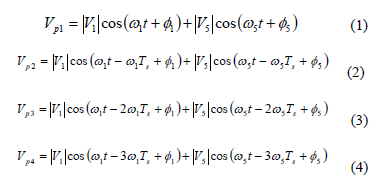
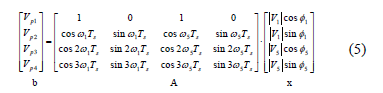
<body><![CDATA[<p><img src="/img/revistas/dyna/v83n195/v83n195a09eq0104.gif"></p>     <p><font size="2" face="Verdana, Arial, Helvetica, sans-serif">where V<sub>p1</sub> is the current sample of the voltage; V<sub>p2</sub>, V<sub>p3</sub>, and V<sub>p4</sub> are the samples of the voltage in prior sampling periods, |V<sub>1</sub>| and   |V<sub>5</sub>| are the magnitudes of the fundamental and 5th harmonic, <font face="Symbol">F</font>1   and <font face="Symbol">F</font>5 are the corresponding phase angles, <font face="Symbol">w</font>1 and <font face="Symbol">w</font>5 are the   angular frequencies of the fundamental and 5th harmonic, and Ts is the signal's   sampling period.</font></p>     <p><font size="2" face="Verdana, Arial, Helvetica, sans-serif">Depending   on the number of harmonics detected in the voltage signal, the number of   equations to be solved can decrease or increase so that the number of   simultaneous equations required to find a solution is always double the total   number of frequencies considered.</font></p>     <p><font size="2" face="Verdana, Arial, Helvetica, sans-serif">If the   dominant harmonics are not included in the equations, or if they are unknown,   the solution can contain errors. This denotes the sensitivity of the matrix,   which is related to the size of the error &#91;25&#93;. This is how the sensitivity of   the matrix increases with the order of the unknown harmonics. It has also been   found that the sensitivity increases if the sampling period (T<sub>s</sub>) is   very small.</font></p>     <p><font size="2" face="Verdana, Arial, Helvetica, sans-serif">If we   reorganize (1), (2), (3) and (4) in matrix format, we obtain:</font></p>     <p><img src="/img/revistas/dyna/v83n195/v83n195a09eq05.gif"></p>     <p><font size="2" face="Verdana, Arial, Helvetica, sans-serif">Knowing the voltage data (V<sub>p1-4</sub>)   and the relation matrix &quot;A&quot;, it is possible to determine the magnitudes and   phases of the frequency components considered in the model.</font></p>     <p><font size="2" face="Verdana, Arial, Helvetica, sans-serif">The response time to detect changes in   the magnitude and phase of the fundamental component depend on the sampling   period and on the number of dominant harmonic components that are present in   the voltage signal.</font></p>     <p><font size="2" face="Verdana, Arial, Helvetica, sans-serif">Finally, this method is useful to   characterize voltage sags and swells, given that it delivers magnitude and   phase shift directly. Also, it requires less samples of the voltage in respect   to the standard RMS voltage method, which could be an advantage for the time sequence   of events.</font></p>     <p>&nbsp;</p>     ]]></body>
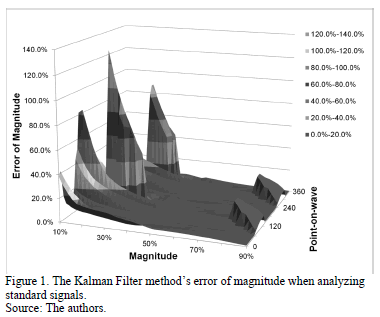
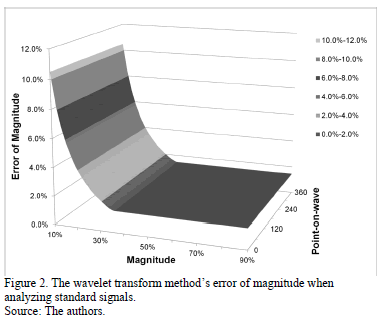
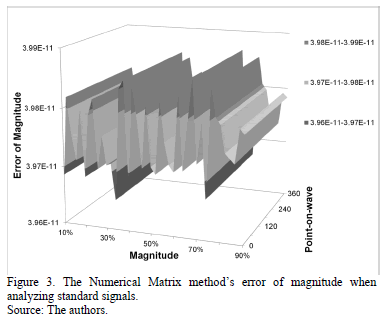
<body><![CDATA[<p><font size="3" face="Verdana, Arial, Helvetica, sans-serif"><b>3. Comparison of characterization methods</b></font></p>     <p><font size="2" face="Verdana, Arial, Helvetica, sans-serif">The fundamental voltage component   (employing SDFT), Kalman filter, Wavelet Transform, and Numerical Matrix are   methods that could determine magnitude, duration and phase shift of voltage   sags and swells. The standard RMS voltage method &#91;13&#93; only characterizes   magnitude and duration of those events; however, it is the most commonly used   &#91;26&#93;. The aforementioned methods can be compared to determine which one that   delivers these parameters (magnitude and duration) with the least error. We   must note that due to the lack of a standard procedure to measure the phase   shift, only magnitude and duration were compared for the methods analyzed.</font></p>     <p><font size="2" face="Verdana, Arial, Helvetica, sans-serif">To conduct the comparison, a basic   implementation of the selected methods was carried out: we used a sliding   window of a half cycle for the RMS voltage method; for the Kalman filter   method, we used the extended model &#91;22&#93;; for the Wavelet transform method, we used   Daubechies 6 as &quot;mother wavelet&quot; for first level MRA analysis &#91;27&#93;, and we used   the phasor method to determine the magnitude of voltage; for the Numerical   matrix method, we assumed fundamental component and 5th harmonic.</font></p>     <p><font size="2" face="Verdana, Arial, Helvetica, sans-serif">With the   basic implementation of the methods described above, we were able to analyze   standard signals of known magnitudes and durations. The standard signal was a   60-Hz pure sinusoidal wave, 1 per unit of nominal voltage, and a sampling   period of 65.1 <font face="Symbol">m</font>s (256 samples per cycle). Waves of different magnitudes   were superimposed on this signal (from 10 to 90% in 10 steps), and different   points on the wave (from 0&deg; to 360º in steps of 10&deg;) for each magnitude were   superimposed. The phase angle was always conserved, which is equivalent to   simulating different voltage sags without phase shift.</font></p>     <p><font size="2" face="Verdana, Arial, Helvetica, sans-serif">The relative error of magnitude was calculated   from the magnitude of the known standard signal and the magnitude estimated   through each method by considering the detection methodology described in the   IEC 61000-4-30 standard &#91;13&#93;.</font></p>     <p><font size="2" face="Verdana, Arial, Helvetica, sans-serif">According to the results, the relative   errors of magnitude for the RMS voltage and the fundamental component (SDFT)   methods were negligible. The error in estimating the magnitude with the Kalman   filter method can be observed in <a href="#fig01">Fig. 1</a>, and the error of magnitude obtained   with the wavelet transform method is shown in <a href="#fig02">Fig. 2</a>.</font></p>     <p align="center"><font size="2" face="Verdana, Arial, Helvetica, sans-serif"><a name="fig01"></a></font><img src="/img/revistas/dyna/v83n195/v83n195a09fig01.gif"></p>     <p align="center"><font size="2" face="Verdana, Arial, Helvetica, sans-serif"><a name="fig02"></a></font><img src="/img/revistas/dyna/v83n195/v83n195a09fig02.gif"></p>     <p><font size="2" face="Verdana, Arial, Helvetica, sans-serif"><a href="#fig03">Fig. 3</a> shows the error of magnitude estimated with the numerical matrix method.   According to the figure, the error obtained with this method can be considered   negligible.</font></p>     <p align="center"><font size="2" face="Verdana, Arial, Helvetica, sans-serif"><a name="fig03"></a></font><img src="/img/revistas/dyna/v83n195/v83n195a09fig03.gif"></p>     ]]></body>
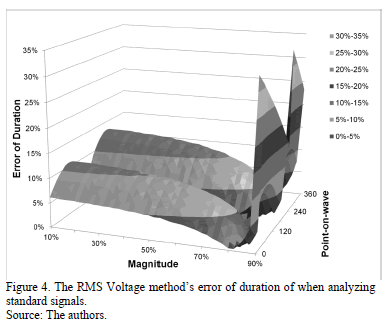
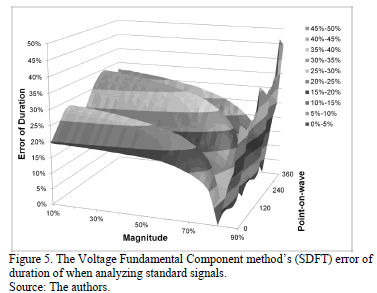
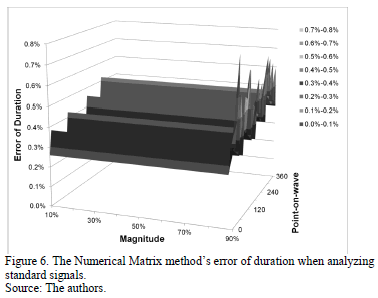
<body><![CDATA[<p><font size="2" face="Verdana, Arial, Helvetica, sans-serif"><a href="#fig04">Fig. 4</a> shows the relative error of duration obtained with the RMS voltage method. It was   calculated using the standard signal's known data of duration , as in the case   of error of magnitude. Only those methods that yielded the lowest error in   estimating the duration were compared.</font></p>     <p align="center"><font size="2" face="Verdana, Arial, Helvetica, sans-serif"><a name="fig04"></a></font><img src="/img/revistas/dyna/v83n195/v83n195a09fig04.gif"></p>     <p><font size="2" face="Verdana, Arial, Helvetica, sans-serif">The relative error of duration obtained   with the fundamental voltage component method (SDFT) is shown in <a href="#fig05">Fig. 5</a>. It can   be seen that the error is higher than with the RMS voltage method; this is   because the SDFT needs to analyze a whole period of the signal to deliver a   result.</font></p>     <p align="center"><font size="2" face="Verdana, Arial, Helvetica, sans-serif"><a name="fig05"></a></font><img src="/img/revistas/dyna/v83n195/v83n195a09fig05.gif"></p>     <p><font size="2" face="Verdana, Arial, Helvetica, sans-serif">Finally, <a href="#fig06">Fig. 6</a> shows the lowest error in estimating duration, which is obtained with   the Numerical Matrix method.</font></p>     <p align="center"><font size="2" face="Verdana, Arial, Helvetica, sans-serif"><a name="fig06"></a></font><img src="/img/revistas/dyna/v83n195/v83n195a09fig06.gif"></p>     <p><font size="2" face="Verdana, Arial, Helvetica, sans-serif">When   comparing results the Numerical Matrix method is suitable to characterize   voltage sags and swells because it has the lowest error in estimating magnitude   and duration of these disturbances. As such, this method has been selected to   be used in the electromagnetic transient analysis software EMTP.</font></p>     <p>&nbsp;</p> <font size="3" face="Verdana, Arial, Helvetica, sans-serif"><b>4 Implementation of numerical matrix method in EMTP </b></font>     <p><font size="2" face="Verdana, Arial, Helvetica, sans-serif">By comparing the results yielded by   existing voltage sag and swell characterization methods, it was possible to   determine that the Numerical Matrix method delivers the least errors in estimating the magnitude and duration of these disturbances. Therefore, this method will be adapted to create a monitoring module to characterize voltage sags and swells.</font></p>     <p><font size="2" face="Verdana, Arial, Helvetica, sans-serif">The monitoring module must be able to   analyze a sinusoidal-type signal, of any magnitude, frequency, and phase angle;   a signal that must be delivered by the simulation tool employed. The results   obtained by this module must be the sum of events occurring during the time of   signal analysis indicating the type of disturbance, the magnitude and duration,   the graphic of the magnitude of the fundamental component and additionally, the   graphic of the phase shift during the period analyzed.</font></p> <font size="2" face="Verdana, Arial, Helvetica, sans-serif">     ]]></body>
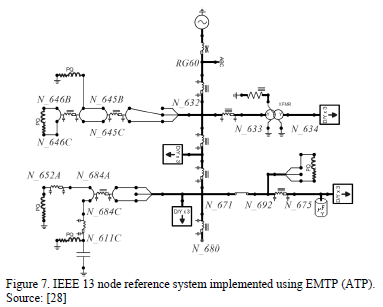
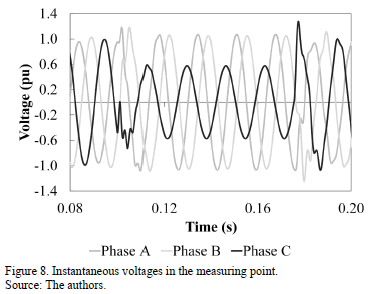
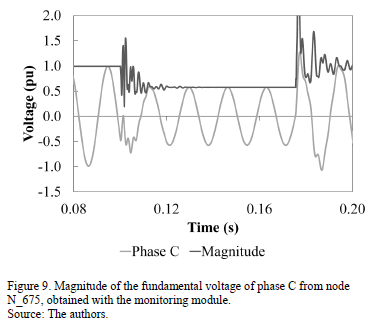
<body><![CDATA[<p>The algorithm developed for the monitoring module must include the   execution of the Numerical Matrix method over simulation time. As was   previously explained, this method delivers the magnitude of the fundamental   voltage of the signal analyzed. Thereafter, the algorithm must carry out, in   each simulation step, the comparison of the voltage magnitude with the   detection threshold; it must register the instants during which that threshold   is surpassed and, thus, determine the duration of the disturbance. Finally, the algorithm must deliver the record of the events found along with the characteristics of magnitude and duration.</p>     <p>The monitoring module was developed using   the transient analysis tool EMTP (ATP), and the programming of the algorithm   was carried out using FORTRAN.</p>     <p>For the corresponding test of the   monitoring module that was implemented, we modeled the IEEE 13-node test feeder   &#91;28&#93;. However, the voltage regulator was omitted and all loads were modeled as   constant impedances (<a href="#fig07">Fig. 7</a>).</p> </font>     <p align="center"><font size="2" face="Verdana, Arial, Helvetica, sans-serif"><a name="fig07"></a></font><img src="/img/revistas/dyna/v83n195/v83n195a09fig07.gif"></p> <font size="2" face="Verdana, Arial, Helvetica, sans-serif">     <p>The N_675 node was chosen as the   measuring node on the reference system while the failures were generated on   N_632 node.</p>     <p>With a sampling time of 1.302E-4 s (128   samples per cycle at 60-Hz), the voltage signals in the measuring node were   recorded when a single-phase-to-ground fault of 0.6<font face="Symbol">W</font>-impedance and 74   milliseconds in duration was generated in N_632 node. <a href="#fig08">Fig. 8</a> shows the   resulting signals and it is evident that there is a voltage sag on phase C   along with a slight increase in the maximum voltage in other phases.</p> </font>     <p align="center"><font size="2" face="Verdana, Arial, Helvetica, sans-serif"><a name="fig08"></a></font><img src="/img/revistas/dyna/v83n195/v83n195a09fig08.gif"></p> <font size="2" face="Verdana, Arial, Helvetica, sans-serif">     <p>The monitoring module was localized in   the measuring node for characterizing the voltage sags and swells.</p>     <p><a href="#fig09">Fig. 9</a> shows   the comparison of the voltage input signal of phase C with the magnitude of the   fundamental voltage given by the monitoring module. As seen in the figure,   there are oscillations of fundamental voltage magnitude at the beginning and   end of the voltage sag. These are related to the low-frequency oscillatory   transients that the voltage signal presents in those instants.</p> </font>     <p align="center"><font size="2" face="Verdana, Arial, Helvetica, sans-serif"><a name="fig09"></a></font><img src="/img/revistas/dyna/v83n195/v83n195a09fig09.gif"></p> <font size="2" face="Verdana, Arial, Helvetica, sans-serif">     ]]></body>
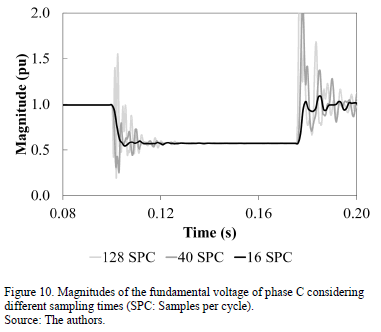
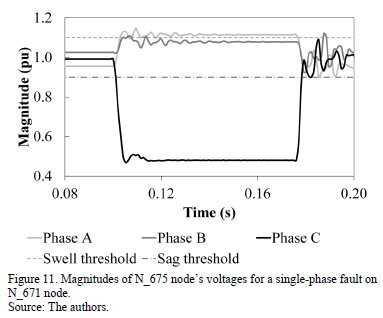
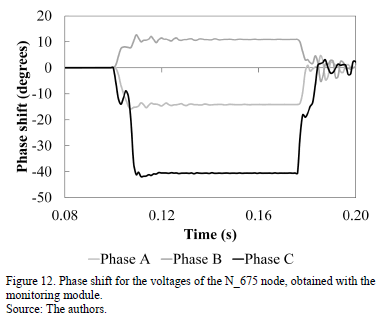
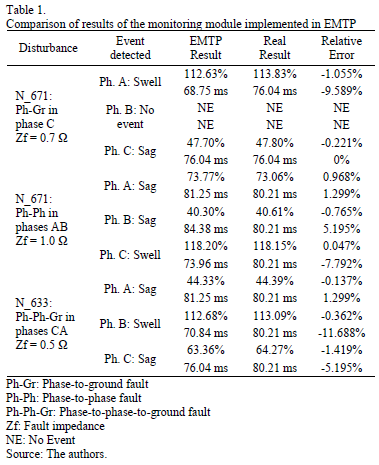
<body><![CDATA[<p>As the   sensitivity of the matrix in the numerical matrix method depends on the amount   of harmonics in the model and the sampling period, the monitoring module was   adjusted to include four harmonic components in the model (fundamental, 5th,   7th and 11th harmonics), and the sampling times were varied to reduce the error   in the results.</p>     <p><a href="#fig10">Fig. 10</a> shows   the magnitudes of fundamental voltages obtained for the stated case while   considering different sampling times. As can be verified, as the sampling times   increase, the oscillations in the magnitude are reduced.</p> </font>     <p align="center"><font size="2" face="Verdana, Arial, Helvetica, sans-serif"><a name="fig10"></a></font><img src="/img/revistas/dyna/v83n195/v83n195a09fig10.gif"></p> <font size="2" face="Verdana, Arial, Helvetica, sans-serif">     <p>Accordingly, we chose a 1.04167E-3 s   sampling time (16 samples per cycle) to analyze the various types of faults in   the reference system. <a href="#fig11">Fig. 11</a> shows the magnitudes of the three-phase voltages   in the measuring node when a single-phase fault exists on phase C of the N_671   node with a fault impedance of 0.7 <font face="Symbol">W</font>. In this case, a voltage sag in   phase C and a voltage swell in phase A were observed.</p> </font>     <p align="center"><font size="2" face="Verdana, Arial, Helvetica, sans-serif"><a name="fig11"></a></font><img src="/img/revistas/dyna/v83n195/v83n195a09fig11.gif"></p> <font size="2" face="Verdana, Arial, Helvetica, sans-serif">     <p><a href="#fig12">Fig. 12</a> shows the phase shift of each   phase given by the monitoring module. This parameter was calculated independently   with respect to the angle of each signal.</p> </font>     <p align="center"><font size="2" face="Verdana, Arial, Helvetica, sans-serif"><a name="fig12"></a></font><img src="/img/revistas/dyna/v83n195/v83n195a09fig12.gif"></p> <font size="2" face="Verdana, Arial, Helvetica, sans-serif">     <p>To determine if the results obtained by   the monitoring module were accurate, the relative error percentage was found,   which was calculated from &quot;real values&quot;. To establish the real duration of each   event, the time difference between the beginning and end of the fault current   was determined, while the result given by the RMS voltage method according to   IEC 61000-4-30 &#91;13&#93; was used for the magnitude.</p>     <p><a href="#tab01">Table 1</a> shows the results given by the   monitoring module for various simulated cases.</p>     <p align="center"><a name="tab01"></a><img src="/img/revistas/dyna/v83n195/v83n195a09tab01.gif"></p> </font>     ]]></body>
<body><![CDATA[<p><font size="2" face="Verdana, Arial, Helvetica, sans-serif">From   the results shown in this table, it can be stated that the monitoring module   implemented in EMTP furnishes results with very low errors; hence, it is quite   effective in characterizing these disturbances.</font></p>     <p>&nbsp;</p>     <p><font size="3" face="Verdana, Arial, Helvetica, sans-serif"><b>5. Conclusions</b></font></p>     <p><font size="2" face="Verdana, Arial, Helvetica, sans-serif">It is necessary to study other   characteristics of voltage sags and swells, which will be useful to develop an analysis   of the causes and the impacts they have. Phase shift may be considered to be another   characteristic that could be studied. However, no standard procedure exists to   determine the phase shift presented by voltage when it is affected by sag or   swell. In terms of future work, a methodology must be established to measure   this characteristic, as well as the identification of the correlation between   phase shift and fault cause.</font></p>     <p><font size="2" face="Verdana, Arial, Helvetica, sans-serif">The monitoring module that was developed   to characterize voltage sags and swells showed good results for the analysis of   simulated signals. However, the accuracy of the results depends on the presence   of noise in the signals that were analyzed. Therefore, if we want to implement   it in a real system we must consider additional possibilities in real time   signal processing, such as applying low pass filters, establishing the   predominant harmonics of voltage signals at the start of the measurements, and setting   the sampling time according to the noise signal present, etc.</font></p>     <p><font size="2" face="Verdana, Arial, Helvetica, sans-serif">The advantage of using the Numerical   Matrix method to characterize voltage sags and swells is that it requires less   data from voltage signals in comparison to the RMS voltage conventional method.   This means that the process of capture, analysis and storage of information in   power quality monitoring can be accelerated.</font></p>     <p><font size="2" face="Verdana, Arial, Helvetica, sans-serif">In terms of future work, the monitoring   module could be complemented by analyzing real signals, and the results compared   with those obtained by conventional measurement equipment.</font></p>     <p>&nbsp;</p>     <p><font size="3" face="Verdana, Arial, Helvetica, sans-serif"><b>References</b></font></p>     <!-- ref --><p><font size="2" face="Verdana, Arial, Helvetica, sans-serif"><b>&#91;1&#93;</b> Waskito, F. and Banmongkol, C.,   Simulation of the voltage sag effects on an induction motor, International   Conference on Consumer Electronics,   Communications and Networks (CECNet), pp. 731-734, 2011. DOI: 10.1109/CECNET.2011.5768900.    &nbsp;&nbsp;&nbsp;&nbsp;&nbsp;&nbsp;&nbsp;&nbsp;[&#160;<a href="javascript:void(0);" onclick="javascript: window.open('/scielo.php?script=sci_nlinks&ref=1132300&pid=S0012-7353201600010000900001&lng=','','width=640,height=500,resizable=yes,scrollbars=1,menubar=yes,');">Links</a>&#160;]<!-- end-ref --></font></p>     <!-- ref --><p><font size="2" face="Verdana, Arial, Helvetica, sans-serif"><b>&#91;2&#93;</b> Villate-Martinez,   J. y Garcia-Tejedor, J., La calidad del suministro el&eacute;ctrico y su mejora   mediante convertidores de potencia. Revista DYNA,   79(3), pp. 30-34, 2004.    &nbsp;&nbsp;&nbsp;&nbsp;&nbsp;&nbsp;&nbsp;&nbsp;[&#160;<a href="javascript:void(0);" onclick="javascript: window.open('/scielo.php?script=sci_nlinks&ref=1132302&pid=S0012-7353201600010000900002&lng=','','width=640,height=500,resizable=yes,scrollbars=1,menubar=yes,');">Links</a>&#160;]<!-- end-ref --></font></p>     <!-- ref --><p><font size="2" face="Verdana, Arial, Helvetica, sans-serif"><b>&#91;3&#93;</b> Yamamoto, K., Ikeda, K.,   Tsurusaki, Y. and Ikeda, M., Characteristics of voltage Sag/Swell compensator   utilizing single-phase matrix converter, International Conference on Electrical   Machines and Systems, pp. 1863-1868, 2013. DOI: 10.1109/ICEMS.2013.6713300.    &nbsp;&nbsp;&nbsp;&nbsp;&nbsp;&nbsp;&nbsp;&nbsp;[&#160;<a href="javascript:void(0);" onclick="javascript: window.open('/scielo.php?script=sci_nlinks&ref=1132304&pid=S0012-7353201600010000900003&lng=','','width=640,height=500,resizable=yes,scrollbars=1,menubar=yes,');">Links</a>&#160;]<!-- end-ref --></font></p>     <!-- ref --><p><font size="2" face="Verdana, Arial, Helvetica, sans-serif"><b>&#91;4&#93;</b> IEC. Electromagnetic   compatibility (EMC). Environment. Voltage dips and short interruptions on   public electric power supply systems with statistical measurement results. PD IEC/TR 61000-2-8, 1, Geneva: IEC, 2002.    &nbsp;&nbsp;&nbsp;&nbsp;&nbsp;&nbsp;&nbsp;&nbsp;[&#160;<a href="javascript:void(0);" onclick="javascript: window.open('/scielo.php?script=sci_nlinks&ref=1132306&pid=S0012-7353201600010000900004&lng=','','width=640,height=500,resizable=yes,scrollbars=1,menubar=yes,');">Links</a>&#160;]<!-- end-ref --></font></p>     <!-- ref --><p><font size="2" face="Verdana, Arial, Helvetica, sans-serif"><b>&#91;5&#93;</b> Gil-Montoya,   F., Manzano-Agugliaro, F., G&oacute;mez-Lopez, J. y S&aacute;nchez-Alguacil, P., T&eacute;cnicas de   investigaci&oacute;n en calidad el&eacute;ctrica: Ventajas e inconvenientes. Revista DYNA, 79(173), pp. 66-74, 2012.    &nbsp;&nbsp;&nbsp;&nbsp;&nbsp;&nbsp;&nbsp;&nbsp;[&#160;<a href="javascript:void(0);" onclick="javascript: window.open('/scielo.php?script=sci_nlinks&ref=1132308&pid=S0012-7353201600010000900005&lng=','','width=640,height=500,resizable=yes,scrollbars=1,menubar=yes,');">Links</a>&#160;]<!-- end-ref --></font></p>     <!-- ref --><p><font size="2" face="Verdana, Arial, Helvetica, sans-serif"><b>&#91;6&#93;</b> Almeida, C. and Kagan, N.,   Using genetic algorithms and Fuzzy programming to monitor voltage sags and   swells. IEEE Intelligent Systems &#91;online&#93;. 26(2), 2011. &#91;date of reference July   3<sup>th</sup> 2014&#93;. Available at: <a href="http://ieeexplore.ieee.org/stamp/stamp.jsp?tp=&arnumber=5696715" target="_blank">http://ieeexplore.ieee.org/stamp/stamp.jsp?tp=&amp;arnumber=5696715</a>.   DOI: 10.1109/MIS.2011.2.    &nbsp;&nbsp;&nbsp;&nbsp;&nbsp;&nbsp;&nbsp;&nbsp;[&#160;<a href="javascript:void(0);" onclick="javascript: window.open('/scielo.php?script=sci_nlinks&ref=1132310&pid=S0012-7353201600010000900006&lng=','','width=640,height=500,resizable=yes,scrollbars=1,menubar=yes,');">Links</a>&#160;]<!-- end-ref --></font></p>     <!-- ref --><p><font size="2" face="Verdana, Arial, Helvetica, sans-serif"><b>&#91;7&#93;</b> Gon&ccedil;alves, J., Baptista, J.,   Neves, L. and Tadeu-Oliveira. F., Simulation of the effect of voltage   transients on an induction motor with ATP / EMTP, International Conference on   Renewable Energies and Power Quality (ICREPQ), pp. 63-69, 2009.    &nbsp;&nbsp;&nbsp;&nbsp;&nbsp;&nbsp;&nbsp;&nbsp;[&#160;<a href="javascript:void(0);" onclick="javascript: window.open('/scielo.php?script=sci_nlinks&ref=1132312&pid=S0012-7353201600010000900007&lng=','','width=640,height=500,resizable=yes,scrollbars=1,menubar=yes,');">Links</a>&#160;]<!-- end-ref --></font></p>     <!-- ref --><p><font size="2" face="Verdana, Arial, Helvetica, sans-serif"><b>&#91;8&#93;</b> Dofnas, L., A novel method to   mitigate commutation failures in HVDC systems, International Conference on   Power System Technology (PowerCon), pp. 51-56, 2002. DOI:   10.1109/ICPST.2002.1053503.    &nbsp;&nbsp;&nbsp;&nbsp;&nbsp;&nbsp;&nbsp;&nbsp;[&#160;<a href="javascript:void(0);" onclick="javascript: window.open('/scielo.php?script=sci_nlinks&ref=1132314&pid=S0012-7353201600010000900008&lng=','','width=640,height=500,resizable=yes,scrollbars=1,menubar=yes,');">Links</a>&#160;]<!-- end-ref --></font></p>     <!-- ref --><p><font size="2" face="Verdana, Arial, Helvetica, sans-serif"><b>&#91;9&#93;</b> Bollen, M.H.J., Voltage sags   characterisation. Understanding power quality problems: Voltage sags and   interruptions, 1<sup>st</sup> ed. New York, USA, Wiley, 2000, pp. 139-168.    &nbsp;&nbsp;&nbsp;&nbsp;&nbsp;&nbsp;&nbsp;&nbsp;[&#160;<a href="javascript:void(0);" onclick="javascript: window.open('/scielo.php?script=sci_nlinks&ref=1132316&pid=S0012-7353201600010000900009&lng=','','width=640,height=500,resizable=yes,scrollbars=1,menubar=yes,');">Links</a>&#160;]<!-- end-ref --></font></p>     <!-- ref --><p><font size="2" face="Verdana, Arial, Helvetica, sans-serif"><b>&#91;10&#93;</b> Gomez, J.C, Reineri, C.,   Campetelli, G. and Morcos, M.M., A study of voltage sags generated by induction   motor starting, Electric. Power Components and Systems, 32(6), pp. 645-653,   2010. DOI: 10.1080/15325000490228423.    &nbsp;&nbsp;&nbsp;&nbsp;&nbsp;&nbsp;&nbsp;&nbsp;[&#160;<a href="javascript:void(0);" onclick="javascript: window.open('/scielo.php?script=sci_nlinks&ref=1132318&pid=S0012-7353201600010000900010&lng=','','width=640,height=500,resizable=yes,scrollbars=1,menubar=yes,');">Links</a>&#160;]<!-- end-ref --></font></p>     <!-- ref --><p><font size="2" face="Verdana, Arial, Helvetica, sans-serif"><b>&#91;11&#93;</b> Chen, C., Wang, H. and Chin, Y.,   A simple rule-based approach for detection and classification of voltage sag,   swell, and interruption in power systems, International Conference on Power   Electronics and Drive Systems, (IEEE PEDS), pp. 5-8, 2011. DOI:   10.1109/PEDS.2011.6147338.    &nbsp;&nbsp;&nbsp;&nbsp;&nbsp;&nbsp;&nbsp;&nbsp;[&#160;<a href="javascript:void(0);" onclick="javascript: window.open('/scielo.php?script=sci_nlinks&ref=1132320&pid=S0012-7353201600010000900011&lng=','','width=640,height=500,resizable=yes,scrollbars=1,menubar=yes,');">Links</a>&#160;]<!-- end-ref --> </font></p>     <!-- ref --><p><font size="2" face="Verdana, Arial, Helvetica, sans-serif"><b>&#91;12&#93;</b> IEEE. Recommended practice for   monitoring electric power quality. IEEE Std 1159, 2009.    &nbsp;&nbsp;&nbsp;&nbsp;&nbsp;&nbsp;&nbsp;&nbsp;[&#160;<a href="javascript:void(0);" onclick="javascript: window.open('/scielo.php?script=sci_nlinks&ref=1132322&pid=S0012-7353201600010000900012&lng=','','width=640,height=500,resizable=yes,scrollbars=1,menubar=yes,');">Links</a>&#160;]<!-- end-ref --></font></p>     <!-- ref --><p><font size="2" face="Verdana, Arial, Helvetica, sans-serif"><b>&#91;13&#93;</b> IEC. Electromagnetic   compatibility (EMC) Part 4-30: Testing and measurement techniques - Power   quality measurement methods, IEC 61000-4-30, 2008.    &nbsp;&nbsp;&nbsp;&nbsp;&nbsp;&nbsp;&nbsp;&nbsp;[&#160;<a href="javascript:void(0);" onclick="javascript: window.open('/scielo.php?script=sci_nlinks&ref=1132324&pid=S0012-7353201600010000900013&lng=','','width=640,height=500,resizable=yes,scrollbars=1,menubar=yes,');">Links</a>&#160;]<!-- end-ref --></font></p>     <!-- ref --><p><font size="2" face="Verdana, Arial, Helvetica, sans-serif"><b>&#91;14&#93;</b> IEEE. Recommended practice for   the design of reliable industrial and commercial power systems, IEEE Std 493,   2007.    &nbsp;&nbsp;&nbsp;&nbsp;&nbsp;&nbsp;&nbsp;&nbsp;[&#160;<a href="javascript:void(0);" onclick="javascript: window.open('/scielo.php?script=sci_nlinks&ref=1132326&pid=S0012-7353201600010000900014&lng=','','width=640,height=500,resizable=yes,scrollbars=1,menubar=yes,');">Links</a>&#160;]<!-- end-ref --></font></p>     <!-- ref --><p><font size="2" face="Verdana, Arial, Helvetica, sans-serif"><b>&#91;15&#93;</b> Bollen, M. and Gu, I.,   Processing os stationary signals, signal processing of power quality   disturbances, 1<sup>st</sup> ed. New York, USA, Wiley, 2006, pp. 222-226.    &nbsp;&nbsp;&nbsp;&nbsp;&nbsp;&nbsp;&nbsp;&nbsp;[&#160;<a href="javascript:void(0);" onclick="javascript: window.open('/scielo.php?script=sci_nlinks&ref=1132328&pid=S0012-7353201600010000900015&lng=','','width=640,height=500,resizable=yes,scrollbars=1,menubar=yes,');">Links</a>&#160;]<!-- end-ref --></font></p>     <!-- ref --><p><font size="2" face="Verdana, Arial, Helvetica, sans-serif"><b>&#91;16&#93;</b> Jacobsen, E. and Lyons, R., The   sliding DFT, IEEE Signal Processing Magazine. &#91;online&#93;. 20(2), 2003. &#91;date of   reference July 3<sup>th</sup> 2014&#93;. Available at: <a href="http://ieeexplore.ieee.org/stamp/stamp.jsp?arnumber=01184347" target="_blank">http://ieeexplore.ieee.org/stamp/stamp.jsp?arnumber=01184347</a>.   DOI: 10.1109/MSP.2003.1184347.    &nbsp;&nbsp;&nbsp;&nbsp;&nbsp;&nbsp;&nbsp;&nbsp;[&#160;<a href="javascript:void(0);" onclick="javascript: window.open('/scielo.php?script=sci_nlinks&ref=1132330&pid=S0012-7353201600010000900016&lng=','','width=640,height=500,resizable=yes,scrollbars=1,menubar=yes,');">Links</a>&#160;]<!-- end-ref --></font></p>     <!-- ref --><p><font size="2" face="Verdana, Arial, Helvetica, sans-serif"><b>&#91;17&#93;</b> Montero-Hernandez, O.C. and Enjeti,   P.N., A Detection algorithm suitable for mitigation of numerous power quality   disturbances. IEEE Transactions on   Industry Applications &#91;online&#93;. 41(6), 2005. &#91;date of reference July 3<sup>th</sup> of 2014&#93;. Available at: <a href="http://ieeexplore.ieee.org/stamp/stamp.jsp?tp=&arnumber=1542324" target="_blank">http://ieeexplore.ieee.org/stamp/stamp.jsp?tp=&amp;arnumber=1542324</a>.   DOI: 10.1109/IAS.2001.955994.    &nbsp;&nbsp;&nbsp;&nbsp;&nbsp;&nbsp;&nbsp;&nbsp;[&#160;<a href="javascript:void(0);" onclick="javascript: window.open('/scielo.php?script=sci_nlinks&ref=1132332&pid=S0012-7353201600010000900017&lng=','','width=640,height=500,resizable=yes,scrollbars=1,menubar=yes,');">Links</a>&#160;]<!-- end-ref --></font></p>     <!-- ref --><p><font size="2" face="Verdana, Arial, Helvetica, sans-serif"><b>&#91;18&#93;</b> Zhao, Y., Yonghai, X.,   Xiangning, X., Yongqiang, Z. and Chunlin, G., Power quality disturbances   identification based on DQ conversion, Wavelet Transform and FFT, Asia-Pacific   Power and Energy Engineering Conference (APPEEC), pp. 1-4, 2010. DOI:   10.1109/APPEEC.2010.5448526.    &nbsp;&nbsp;&nbsp;&nbsp;&nbsp;&nbsp;&nbsp;&nbsp;[&#160;<a href="javascript:void(0);" onclick="javascript: window.open('/scielo.php?script=sci_nlinks&ref=1132334&pid=S0012-7353201600010000900018&lng=','','width=640,height=500,resizable=yes,scrollbars=1,menubar=yes,');">Links</a>&#160;]<!-- end-ref --></font></p>     <!-- ref --><p><font size="2" face="Verdana, Arial, Helvetica, sans-serif"><b>&#91;19&#93;</b> Djokic, S.Z., Milanovic, J.V.   and Rowland, S.M., Advanced voltage sag characterisation II: Point on wave. IET   Generation, Transmission &amp; Distribution &#91;online&#93;. 1(1), 2007 &#91;date of   reference July 3<sup>th</sup> of 2014&#93;. Available at: <a href="http://ieeexplore.ieee.org/stamp/stamp.jsp?arnumber=04082380" target="_blank">http://ieeexplore.ieee.org/stamp/stamp.jsp?arnumber=04082380</a>.   DOI: 10.1049/iet-gtd:20050434.    &nbsp;&nbsp;&nbsp;&nbsp;&nbsp;&nbsp;&nbsp;&nbsp;[&#160;<a href="javascript:void(0);" onclick="javascript: window.open('/scielo.php?script=sci_nlinks&ref=1132336&pid=S0012-7353201600010000900019&lng=','','width=640,height=500,resizable=yes,scrollbars=1,menubar=yes,');">Links</a>&#160;]<!-- end-ref --></font></p>     <!-- ref --><p><font size="2" face="Verdana, Arial, Helvetica, sans-serif"><b>&#91;20&#93;</b> Mostafa, M.A., Kalman filtering   algorithm for electric power quality analysis: Harmonics and voltage sags   problems, Large Engineering Systems Conference Power Engineering, pp. 159-165,   2007. DOI: 10.1109/LESCPE.2007.4437371.    &nbsp;&nbsp;&nbsp;&nbsp;&nbsp;&nbsp;&nbsp;&nbsp;[&#160;<a href="javascript:void(0);" onclick="javascript: window.open('/scielo.php?script=sci_nlinks&ref=1132338&pid=S0012-7353201600010000900020&lng=','','width=640,height=500,resizable=yes,scrollbars=1,menubar=yes,');">Links</a>&#160;]<!-- end-ref --></font></p>     <!-- ref --><p><font size="2" face="Verdana, Arial, Helvetica, sans-serif"><b>&#91;21&#93;</b> Gonz&aacute;lez, M. and Cardenas, V.,   The kalman filter in power quality - theory and applications, Kalman Filter. 1<sup>st</sup> ed. USA, InTecch, 2010, pp.   101-125. DOI: 10.5772/9582.    &nbsp;&nbsp;&nbsp;&nbsp;&nbsp;&nbsp;&nbsp;&nbsp;[&#160;<a href="javascript:void(0);" onclick="javascript: window.open('/scielo.php?script=sci_nlinks&ref=1132340&pid=S0012-7353201600010000900021&lng=','','width=640,height=500,resizable=yes,scrollbars=1,menubar=yes,');">Links</a>&#160;]<!-- end-ref --></font></p>     <!-- ref --><p><font size="2" face="Verdana, Arial, Helvetica, sans-serif"><b>&#91;22&#93;</b> Perez-Fernandez,   E., Nuevo m&eacute;todo de detecci&oacute;n y an&aacute;lisis en tiempo real de eventos en la   tensi&oacute;n de suministro de energ&iacute;a el&eacute;ctrica empleando un modelo combinado   wavelets-filtro de Kalman extendido, Tesis Doctorado en Ingenier&iacute;a,   Departamento de Ingenier&iacute;a Inform&aacute;tica y Electr&oacute;nica, Universidad de Cantabria,   Santander, Espa&ntilde;a, 2006.    &nbsp;&nbsp;&nbsp;&nbsp;&nbsp;&nbsp;&nbsp;&nbsp;[&#160;<a href="javascript:void(0);" onclick="javascript: window.open('/scielo.php?script=sci_nlinks&ref=1132342&pid=S0012-7353201600010000900022&lng=','','width=640,height=500,resizable=yes,scrollbars=1,menubar=yes,');">Links</a>&#160;]<!-- end-ref --></font></p>     <!-- ref --><p><font size="2" face="Verdana, Arial, Helvetica, sans-serif"><b>&#91;23&#93;</b> Christy, X., Vedamani, J., and   Karthikeyan, S., Wavelet based detection of power quality disturbance - A case   study, International Conference on Signal Processing, Communication., Computing   and Networking Technologies (ICSCCN), pp. 157-162, 2011. DOI: 10.1109/ICSCCN.2011.6024534.    &nbsp;&nbsp;&nbsp;&nbsp;&nbsp;&nbsp;&nbsp;&nbsp;[&#160;<a href="javascript:void(0);" onclick="javascript: window.open('/scielo.php?script=sci_nlinks&ref=1132344&pid=S0012-7353201600010000900023&lng=','','width=640,height=500,resizable=yes,scrollbars=1,menubar=yes,');">Links</a>&#160;]<!-- end-ref --></font></p>     <!-- ref --><p><font size="2" face="Verdana, Arial, Helvetica, sans-serif"><b>&#91;24&#93;</b> Gallego-Tejada,   J and Castro-Aranda, F., An&aacute;lisis de se&ntilde;ales por transformada Wavelet. La   Transformada Wavelet aplicada a los sistemas el&eacute;ctricos de potencia: Estado del   Arte. 1<sup>st</sup> ed. Alemania, Editorial Acad&eacute;mica   Espa&ntilde;ola, 2011, pp. 40-63.    &nbsp;&nbsp;&nbsp;&nbsp;&nbsp;&nbsp;&nbsp;&nbsp;[&#160;<a href="javascript:void(0);" onclick="javascript: window.open('/scielo.php?script=sci_nlinks&ref=1132346&pid=S0012-7353201600010000900024&lng=','','width=640,height=500,resizable=yes,scrollbars=1,menubar=yes,');">Links</a>&#160;]<!-- end-ref --></font></p>     <!-- ref --><p><font size="2" face="Verdana, Arial, Helvetica, sans-serif"><b>&#91;25&#93;</b> Fitzer, C., Barnes, M. and   Green, P., Voltage sag detection technique for a dynamic voltage restorer. IEEE   Transactions on Industry Applications &#91;online&#93;. 40(1), 2004. &#91;date of reference   July 3<sup>st</sup> of 2014&#93;. Available   at: <a href="http://ieeexplore.ieee.org/stamp/stamp.jsp?tp=&arnumber=1268198" target="_blank">http://ieeexplore.ieee.org/stamp/stamp.jsp?tp=&amp;arnumber=1268198</a>. DOI:   10.1109/TIA.2003.821801.    &nbsp;&nbsp;&nbsp;&nbsp;&nbsp;&nbsp;&nbsp;&nbsp;[&#160;<a href="javascript:void(0);" onclick="javascript: window.open('/scielo.php?script=sci_nlinks&ref=1132348&pid=S0012-7353201600010000900025&lng=','','width=640,height=500,resizable=yes,scrollbars=1,menubar=yes,');">Links</a>&#160;]<!-- end-ref --></font></p>     <!-- ref --><p><font size="2" face="Verdana, Arial, Helvetica, sans-serif"><b>&#91;26&#93;</b> Flores-Arias, J,   Bellido-Outeiri&ntilde;o, J. y Moreno-Mu&ntilde;oz, A., A fast RMS meter for detecting sag   events in household environments, International Conference on Consumer   Electronics (ICCE), pp. 321-322, 2014. DOI: 10.1109/ICCE.2014.6776024.    &nbsp;&nbsp;&nbsp;&nbsp;&nbsp;&nbsp;&nbsp;&nbsp;[&#160;<a href="javascript:void(0);" onclick="javascript: window.open('/scielo.php?script=sci_nlinks&ref=1132350&pid=S0012-7353201600010000900026&lng=','','width=640,height=500,resizable=yes,scrollbars=1,menubar=yes,');">Links</a>&#160;]<!-- end-ref --></font></p>     <!-- ref --><p><font size="2" face="Verdana, Arial, Helvetica, sans-serif"><b>&#91;27&#93;</b> Parsons, A.C, Grady, W.M. and   Powers, E.J., A wavelet-based procedure for automatically determining the   beginning and end of transmission system voltage sags, IEEE Power Engineering   Society, pp. 1310-1315, 1999. DOI: 10.1109/PESW.1999.747406.    &nbsp;&nbsp;&nbsp;&nbsp;&nbsp;&nbsp;&nbsp;&nbsp;[&#160;<a href="javascript:void(0);" onclick="javascript: window.open('/scielo.php?script=sci_nlinks&ref=1132352&pid=S0012-7353201600010000900027&lng=','','width=640,height=500,resizable=yes,scrollbars=1,menubar=yes,');">Links</a>&#160;]<!-- end-ref --></font></p>     <!-- ref --><p><font size="2" face="Verdana, Arial, Helvetica, sans-serif"><b>&#91;28&#93;</b> Distribution test feeders   working group, 13-Bus Test Feeder &#91;online&#93;. Available at: <a href="http://ewh.ieee.org/soc/pes/dsacom/testfeeders/" target="_blank">http://ewh.ieee.org/soc/pes/dsacom/testfeeders/</a>.    &nbsp;&nbsp;&nbsp;&nbsp;&nbsp;&nbsp;&nbsp;&nbsp;[&#160;<a href="javascript:void(0);" onclick="javascript: window.open('/scielo.php?script=sci_nlinks&ref=1132354&pid=S0012-7353201600010000900028&lng=','','width=640,height=500,resizable=yes,scrollbars=1,menubar=yes,');">Links</a>&#160;]<!-- end-ref --></font></p>     <p>&nbsp;</p>     <p><font size="2" face="Verdana, Arial, Helvetica, sans-serif"><b>J.E. Celis-Montero,</b> received his BSc. in   Electrical Engineering in 2009, from the Universidad del Valle, Santiago de   Cali, Colombia. He is currently undertaking his PhD. in Electrical and   Electronic Engineering at the Universidad del Valle, Cali, Colombia. He has   worked as a researcher at the High Voltage Research Group - GRALTA, Universidad   del Valle, Cali, Colombia. His research interests focus on power quality,   modeling and the simulation of power system transients, transformers,   ferroresonance and smart grids. ORCID: 0000-0003-2488-8238</font></p>     <p><font size="2" face="Verdana, Arial, Helvetica, sans-serif"><b>D. Fernando-Navas, </b>received his BSc. in   Electronic Technology in 2002, from the Universidad del Valle, Palmira,   Colombia and his BSc. and MSc. in Electrical Engineering in 2009 and 2012   respectively, from the Universidad del Valle, Santiago de Cali, Colombia. He   has worked as a researcher at the Grupo de Investigaci&oacute;n en Alta Tensi&oacute;n -   GRALTA and has been an active part of the Laboratorio de Alta Tensi&oacute;n at the   Universidad del Valle, Cali, Colombia. He is currently an assistant professor in   the Faculty of Engineering of the Electric and Electronic Engineering School at   the Universidad del Valle (EIEE). His areas of interest are electricity   markets, transformers, electrical equipment testing and vegetable oils. He is a   member of the Committee 130 - Transformers ICONTEC Colombia. ORCID: 0000-0002-7316-7368</font></p>     <p><font size="2" face="Verdana, Arial, Helvetica, sans-serif"><b>F. Castro-Aranda,</b> received his BSc. and   MSc. in 1992 and 1995 respectively, in Electrical Engineering from the Universidad   del Valle, Santiago de Cali, Colombia and his PhD. in 2005 from the Universitat   Politècnica de Catalunya, Spain. He is an associate professor at the Electric   and Electronic Engineering School at the Universidad del Valle - EIEE (Santiago   de Cali, Colombia). His research interests are focused on the areas of   insulation coordination and systems modeling for transient analysis using EMTP.   He is President of the Committee 130 - Transformers ICONTEC Colombia, and   Director of the High Voltage Lab at the Universidad del Valle. ORCID: 0000-0002-4858-0222 </font></p>      ]]></body><back>
<ref-list>
<ref id="B1">
<label>1</label><nlm-citation citation-type="journal">
<person-group person-group-type="author">
<name>
<surname><![CDATA[Waskito]]></surname>
<given-names><![CDATA[F.]]></given-names>
</name>
<name>
<surname><![CDATA[Banmongkol]]></surname>
<given-names><![CDATA[C.]]></given-names>
</name>
</person-group>
<article-title xml:lang="en"><![CDATA[Simulation of the voltage sag effects on an induction motor, International Conference on Consumer Electronics]]></article-title>
<source><![CDATA[Communications and Networks]]></source>
<year>2011</year>
<page-range>731-734</page-range></nlm-citation>
</ref>
<ref id="B2">
<label>2</label><nlm-citation citation-type="journal">
<person-group person-group-type="author">
<name>
<surname><![CDATA[Villate-Martinez]]></surname>
<given-names><![CDATA[J.]]></given-names>
</name>
<name>
<surname><![CDATA[Garcia-Tejedor]]></surname>
<given-names><![CDATA[J.]]></given-names>
</name>
</person-group>
<article-title xml:lang="en"><![CDATA[La calidad del suministro eléctrico y su mejora mediante convertidores de potencia]]></article-title>
<source><![CDATA[Revista DYNA]]></source>
<year>2004</year>
<volume>79</volume>
<numero>3</numero>
<issue>3</issue>
<page-range>30-34</page-range></nlm-citation>
</ref>
<ref id="B3">
<label>3</label><nlm-citation citation-type="journal">
<person-group person-group-type="author">
<name>
<surname><![CDATA[Yamamoto]]></surname>
<given-names><![CDATA[K.]]></given-names>
</name>
<name>
<surname><![CDATA[Ikeda]]></surname>
<given-names><![CDATA[K.]]></given-names>
</name>
<name>
<surname><![CDATA[Tsurusaki]]></surname>
<given-names><![CDATA[Y.]]></given-names>
</name>
<name>
<surname><![CDATA[Ikeda]]></surname>
<given-names><![CDATA[M.]]></given-names>
</name>
</person-group>
<article-title xml:lang="en"><![CDATA[Characteristics of voltage Sag/Swell compensator utilizing single-phase matrix converter]]></article-title>
<source><![CDATA[International Conference on Electrical Machines and Systems]]></source>
<year>2013</year>
<page-range>1863-1868</page-range></nlm-citation>
</ref>
<ref id="B4">
<label>4</label><nlm-citation citation-type="book">
<collab>IEC</collab>
<source><![CDATA[Electromagnetic compatibility (EMC): Environment. Voltage dips and short interruptions on public electric power supply systems with statistical measurement results.]]></source>
<year>2002</year>
<volume>1</volume>
<publisher-loc><![CDATA[Geneva ]]></publisher-loc>
<publisher-name><![CDATA[IEC]]></publisher-name>
</nlm-citation>
</ref>
<ref id="B5">
<label>5</label><nlm-citation citation-type="journal">
<person-group person-group-type="author">
<name>
<surname><![CDATA[Gil-Montoya]]></surname>
<given-names><![CDATA[F.]]></given-names>
</name>
<name>
<surname><![CDATA[Manzano-Agugliaro]]></surname>
<given-names><![CDATA[F.]]></given-names>
</name>
<name>
<surname><![CDATA[Gómez-Lopez]]></surname>
<given-names><![CDATA[J.]]></given-names>
</name>
<name>
<surname><![CDATA[Sánchez-Alguacil]]></surname>
<given-names><![CDATA[P.]]></given-names>
</name>
</person-group>
<article-title xml:lang="es"><![CDATA[Técnicas de investigación en calidad eléctrica: Ventajas e inconvenientes]]></article-title>
<source><![CDATA[Revista DYNA]]></source>
<year>2012</year>
<volume>79</volume>
<numero>^s173</numero>
<issue>^s173</issue>
<supplement>173</supplement>
<page-range>66-74</page-range></nlm-citation>
</ref>
<ref id="B6">
<label>6</label><nlm-citation citation-type="journal">
<person-group person-group-type="author">
<name>
<surname><![CDATA[Almeida]]></surname>
<given-names><![CDATA[C.]]></given-names>
</name>
<name>
<surname><![CDATA[Kagan]]></surname>
<given-names><![CDATA[N.]]></given-names>
</name>
</person-group>
<article-title xml:lang="en"><![CDATA[Using genetic algorithms and Fuzzy programming to monitor voltage sags and swells]]></article-title>
<source><![CDATA[IEEE Intelligent Systems]]></source>
<year>2011</year>
<volume>26</volume>
<numero>2</numero>
<issue>2</issue>
</nlm-citation>
</ref>
<ref id="B7">
<label>7</label><nlm-citation citation-type="confpro">
<person-group person-group-type="author">
<name>
<surname><![CDATA[Gonçalves]]></surname>
<given-names><![CDATA[J.]]></given-names>
</name>
<name>
<surname><![CDATA[Baptista]]></surname>
<given-names><![CDATA[J.]]></given-names>
</name>
<name>
<surname><![CDATA[Neves]]></surname>
<given-names><![CDATA[L.]]></given-names>
</name>
<name>
<surname><![CDATA[Tadeu-Oliveira.]]></surname>
<given-names><![CDATA[F.]]></given-names>
</name>
</person-group>
<article-title xml:lang="en"><![CDATA[Simulation of the effect of voltage transients on an induction motor with ATP / EMTP]]></article-title>
<source><![CDATA[]]></source>
<year></year>
<conf-name><![CDATA[ International Conference on Renewable Energies and Power Quality (ICREPQ)]]></conf-name>
<conf-date>2009</conf-date>
<conf-loc> </conf-loc>
</nlm-citation>
</ref>
<ref id="B8">
<label>8</label><nlm-citation citation-type="confpro">
<person-group person-group-type="author">
<name>
<surname><![CDATA[Dofnas]]></surname>
<given-names><![CDATA[L.]]></given-names>
</name>
</person-group>
<article-title xml:lang="en"><![CDATA[A novel method to mitigate commutation failures in HVDC systems]]></article-title>
<source><![CDATA[]]></source>
<year>2002</year>
<conf-name><![CDATA[ International Conference on Power System Technology (PowerCon)]]></conf-name>
<conf-loc> </conf-loc>
<page-range>51-56</page-range></nlm-citation>
</ref>
<ref id="B9">
<label>9</label><nlm-citation citation-type="book">
<person-group person-group-type="author">
<name>
<surname><![CDATA[Bollen]]></surname>
<given-names><![CDATA[M.H.J.]]></given-names>
</name>
</person-group>
<article-title xml:lang="en"><![CDATA[Voltage sags characterisation.]]></article-title>
<source><![CDATA[Understanding power quality problems: Voltage sags and interruptions]]></source>
<year>2000</year>
<edition>1st</edition>
<page-range>139-168</page-range><publisher-loc><![CDATA[New York ]]></publisher-loc>
<publisher-name><![CDATA[Wiley]]></publisher-name>
</nlm-citation>
</ref>
<ref id="B10">
<label>10</label><nlm-citation citation-type="journal">
<person-group person-group-type="author">
<name>
<surname><![CDATA[Gomez]]></surname>
<given-names><![CDATA[J.C]]></given-names>
</name>
<name>
<surname><![CDATA[Reineri]]></surname>
<given-names><![CDATA[C.]]></given-names>
</name>
<name>
<surname><![CDATA[Campetelli]]></surname>
<given-names><![CDATA[G.]]></given-names>
</name>
<name>
<surname><![CDATA[Morcos]]></surname>
<given-names><![CDATA[M.M.]]></given-names>
</name>
</person-group>
<article-title xml:lang="en"><![CDATA[A study of voltage sags generated by induction motor starting, Electric]]></article-title>
<source><![CDATA[Power Components and Systems]]></source>
<year>2010</year>
<volume>32</volume>
<numero>6</numero>
<issue>6</issue>
<page-range>645-653</page-range></nlm-citation>
</ref>
<ref id="B11">
<label>11</label><nlm-citation citation-type="confpro">
<person-group person-group-type="author">
<name>
<surname><![CDATA[Chen]]></surname>
<given-names><![CDATA[C.]]></given-names>
</name>
<name>
<surname><![CDATA[Wang]]></surname>
<given-names><![CDATA[H.]]></given-names>
</name>
<name>
<surname><![CDATA[Chin]]></surname>
<given-names><![CDATA[Y.]]></given-names>
</name>
</person-group>
<article-title xml:lang="en"><![CDATA[A simple rule-based approach for detection and classification of voltage sag, swell, and interruption in power systems]]></article-title>
<source><![CDATA[]]></source>
<year>2011</year>
<conf-name><![CDATA[ International Conference on Power Electronics and Drive Systems, (IEEE PEDS)]]></conf-name>
<conf-loc> </conf-loc>
<page-range>5-8</page-range></nlm-citation>
</ref>
<ref id="B12">
<label>12</label><nlm-citation citation-type="">
<collab>IEEE</collab>
<source><![CDATA[Recommended practice for monitoring electric power quality: IEEE Std 1159]]></source>
<year>2009</year>
</nlm-citation>
</ref>
<ref id="B13">
<label>13</label><nlm-citation citation-type="">
<collab>IEC</collab>
<source><![CDATA[Electromagnetic compatibility (EMC) Part 4-30: Testing and measurement techniques - Power quality measurement methods]]></source>
<year>2008</year>
</nlm-citation>
</ref>
<ref id="B14">
<label>14</label><nlm-citation citation-type="">
<collab>IEEE</collab>
<source><![CDATA[Recommended practice for the design of reliable industrial and commercial power systems: IEEE Std 493]]></source>
<year>2007</year>
</nlm-citation>
</ref>
<ref id="B15">
<label>15</label><nlm-citation citation-type="book">
<person-group person-group-type="author">
<name>
<surname><![CDATA[Bollen]]></surname>
<given-names><![CDATA[M.]]></given-names>
</name>
<name>
<surname><![CDATA[Gu]]></surname>
<given-names><![CDATA[I.]]></given-names>
</name>
</person-group>
<source><![CDATA[Processing os stationary signals, signal processing of power quality disturbances]]></source>
<year>2006</year>
<edition>1st</edition>
<page-range>222-226</page-range><publisher-loc><![CDATA[New York ]]></publisher-loc>
<publisher-name><![CDATA[Wiley]]></publisher-name>
</nlm-citation>
</ref>
<ref id="B16">
<label>16</label><nlm-citation citation-type="journal">
<person-group person-group-type="author">
<name>
<surname><![CDATA[Jacobsen]]></surname>
<given-names><![CDATA[E.]]></given-names>
</name>
<name>
<surname><![CDATA[Lyons]]></surname>
<given-names><![CDATA[R.]]></given-names>
</name>
</person-group>
<article-title xml:lang="en"><![CDATA[The sliding DFT]]></article-title>
<source><![CDATA[IEEE Signal Processing Magazine.]]></source>
<year>2003</year>
<volume>20</volume>
<numero>2</numero>
<issue>2</issue>
</nlm-citation>
</ref>
<ref id="B17">
<label>17</label><nlm-citation citation-type="journal">
<person-group person-group-type="author">
<name>
<surname><![CDATA[Montero-Hernandez]]></surname>
<given-names><![CDATA[O.C.]]></given-names>
</name>
<name>
<surname><![CDATA[Enjeti]]></surname>
<given-names><![CDATA[P.N.]]></given-names>
</name>
</person-group>
<article-title xml:lang="en"><![CDATA[A Detection algorithm suitable for mitigation of numerous power quality disturbances]]></article-title>
<source><![CDATA[IEEE Transactions on Industry Applications]]></source>
<year>2005</year>
<volume>41</volume>
<numero>6</numero>
<issue>6</issue>
</nlm-citation>
</ref>
<ref id="B18">
<label>18</label><nlm-citation citation-type="confpro">
<person-group person-group-type="author">
<name>
<surname><![CDATA[Zhao]]></surname>
<given-names><![CDATA[Y.]]></given-names>
</name>
<name>
<surname><![CDATA[Yonghai]]></surname>
<given-names><![CDATA[X.]]></given-names>
</name>
<name>
<surname><![CDATA[Xiangning]]></surname>
<given-names><![CDATA[X.]]></given-names>
</name>
<name>
<surname><![CDATA[Yongqiang]]></surname>
<given-names><![CDATA[Z.]]></given-names>
</name>
<name>
<surname><![CDATA[Chunlin]]></surname>
<given-names><![CDATA[G.]]></given-names>
</name>
</person-group>
<article-title xml:lang="en"><![CDATA[Power quality disturbances identification based on DQ conversion, Wavelet Transform and FFT]]></article-title>
<source><![CDATA[]]></source>
<year>2010</year>
<conf-name><![CDATA[ Asia-Pacific Power and Energy Engineering Conference (APPEEC)]]></conf-name>
<conf-loc> </conf-loc>
<page-range>1-4</page-range></nlm-citation>
</ref>
<ref id="B19">
<label>19</label><nlm-citation citation-type="journal">
<person-group person-group-type="author">
<name>
<surname><![CDATA[Djokic]]></surname>
<given-names><![CDATA[S.Z.]]></given-names>
</name>
<name>
<surname><![CDATA[Milanovic]]></surname>
<given-names><![CDATA[J.V.]]></given-names>
</name>
<name>
<surname><![CDATA[Rowland]]></surname>
<given-names><![CDATA[S.M.]]></given-names>
</name>
</person-group>
<article-title xml:lang="en"><![CDATA[Advanced voltage sag characterisation II: Point on wave]]></article-title>
<source><![CDATA[IET Generation, Transmission & Distribution]]></source>
<year></year>
<volume>1</volume>
<numero>1</numero>
<issue>1</issue>
<page-range>2007</page-range></nlm-citation>
</ref>
<ref id="B20">
<label>20</label><nlm-citation citation-type="confpro">
<person-group person-group-type="author">
<name>
<surname><![CDATA[Mostafa]]></surname>
<given-names><![CDATA[M.A.]]></given-names>
</name>
</person-group>
<article-title xml:lang="en"><![CDATA[Kalman filtering algorithm for electric power quality analysis: Harmonics and voltage sags problems]]></article-title>
<source><![CDATA[]]></source>
<year>2007</year>
<conf-name><![CDATA[ Large Engineering Systems Conference Power Engineering]]></conf-name>
<conf-loc> </conf-loc>
<page-range>159-165</page-range></nlm-citation>
</ref>
<ref id="B21">
<label>21</label><nlm-citation citation-type="book">
<person-group person-group-type="author">
<name>
<surname><![CDATA[González]]></surname>
<given-names><![CDATA[M.]]></given-names>
</name>
<name>
<surname><![CDATA[Cardenas]]></surname>
<given-names><![CDATA[V.]]></given-names>
</name>
</person-group>
<source><![CDATA[The kalman filter in power quality: theory and applications, Kalman Filter]]></source>
<year>2010</year>
<edition>1st</edition>
<page-range>101-125</page-range><publisher-name><![CDATA[InTecch]]></publisher-name>
</nlm-citation>
</ref>
<ref id="B22">
<label>22</label><nlm-citation citation-type="">
<person-group person-group-type="author">
<name>
<surname><![CDATA[Perez-Fernandez]]></surname>
<given-names><![CDATA[E.]]></given-names>
</name>
</person-group>
<source><![CDATA[Nuevo método de detección y análisis en tiempo real de eventos en la tensión de suministro de energía eléctrica empleando un modelo combinado wavelets-filtro de Kalman extendido]]></source>
<year></year>
</nlm-citation>
</ref>
<ref id="B23">
<label>23</label><nlm-citation citation-type="confpro">
<person-group person-group-type="author">
<name>
<surname><![CDATA[Christy]]></surname>
<given-names><![CDATA[X.]]></given-names>
</name>
<name>
<surname><![CDATA[Vedamani]]></surname>
<given-names><![CDATA[J.]]></given-names>
</name>
<name>
<surname><![CDATA[Karthikeyan]]></surname>
<given-names><![CDATA[S.]]></given-names>
</name>
</person-group>
<article-title xml:lang="en"><![CDATA[Wavelet based detection of power quality disturbance: A case study]]></article-title>
<source><![CDATA[]]></source>
<year>2011</year>
<conf-name><![CDATA[ International Conference on Signal Processing, Communication., Computing and Networking Technologies (ICSCCN)]]></conf-name>
<conf-loc> </conf-loc>
<page-range>157-162</page-range></nlm-citation>
</ref>
<ref id="B24">
<label>24</label><nlm-citation citation-type="book">
<person-group person-group-type="author">
<name>
<surname><![CDATA[Gallego-Tejada]]></surname>
<given-names><![CDATA[J]]></given-names>
</name>
<name>
<surname><![CDATA[Castro-Aranda]]></surname>
<given-names><![CDATA[F.]]></given-names>
</name>
</person-group>
<article-title xml:lang="es"><![CDATA[Análisis de señales por transformada Wavelet.]]></article-title>
<source><![CDATA[La Transformada Wavelet aplicada a los sistemas eléctricos de potencia: Estado del Arte]]></source>
<year>2011</year>
<edition>1st</edition>
<page-range>40-63</page-range><publisher-name><![CDATA[Editorial Académica Española]]></publisher-name>
</nlm-citation>
</ref>
<ref id="B25">
<label>25</label><nlm-citation citation-type="journal">
<person-group person-group-type="author">
<name>
<surname><![CDATA[Fitzer]]></surname>
<given-names><![CDATA[C.]]></given-names>
</name>
<name>
<surname><![CDATA[Barnes]]></surname>
<given-names><![CDATA[M.]]></given-names>
</name>
<name>
<surname><![CDATA[Green]]></surname>
<given-names><![CDATA[P.]]></given-names>
</name>
</person-group>
<article-title xml:lang="en"><![CDATA[Voltage sag detection technique for a dynamic voltage restorer]]></article-title>
<source><![CDATA[IEEE Transactions on Industry Applications]]></source>
<year>2004</year>
<volume>40</volume>
<numero>1</numero>
<issue>1</issue>
</nlm-citation>
</ref>
<ref id="B26">
<label>26</label><nlm-citation citation-type="journal">
<person-group person-group-type="author">
<name>
<surname><![CDATA[Flores-Arias]]></surname>
<given-names><![CDATA[J]]></given-names>
</name>
<name>
<surname><![CDATA[Bellido-Outeiriño]]></surname>
<given-names><![CDATA[J.]]></given-names>
</name>
<name>
<surname><![CDATA[Moreno-Muñoz]]></surname>
<given-names><![CDATA[A.]]></given-names>
</name>
</person-group>
<article-title xml:lang="en"><![CDATA[A fast RMS meter for detecting sag events in household environments]]></article-title>
<source><![CDATA[International Conference on Consumer Electronics (ICCE)]]></source>
<year>2014</year>
<page-range>321-322</page-range></nlm-citation>
</ref>
<ref id="B27">
<label>27</label><nlm-citation citation-type="journal">
<person-group person-group-type="author">
<name>
<surname><![CDATA[Parsons]]></surname>
<given-names><![CDATA[A.C]]></given-names>
</name>
<name>
<surname><![CDATA[Grady]]></surname>
<given-names><![CDATA[W.M.]]></given-names>
</name>
<name>
<surname><![CDATA[Powers]]></surname>
<given-names><![CDATA[E.J.]]></given-names>
</name>
</person-group>
<article-title xml:lang="en"><![CDATA[A wavelet-based procedure for automatically determining the beginning and end of transmission system voltage sags]]></article-title>
<source><![CDATA[IEEE Power Engineering Society]]></source>
<year>1999</year>
<page-range>1310-1315</page-range></nlm-citation>
</ref>
<ref id="B28">
<label>28</label><nlm-citation citation-type="">
<collab>Distribution test feeders working group</collab>
<source><![CDATA[13-Bus Test Feeder]]></source>
<year></year>
</nlm-citation>
</ref>
</ref-list>
</back>
</article>