<?xml version="1.0" encoding="ISO-8859-1"?><article xmlns:mml="http://www.w3.org/1998/Math/MathML" xmlns:xlink="http://www.w3.org/1999/xlink" xmlns:xsi="http://www.w3.org/2001/XMLSchema-instance">
<front>
<journal-meta>
<journal-id>0012-7353</journal-id>
<journal-title><![CDATA[DYNA]]></journal-title>
<abbrev-journal-title><![CDATA[Dyna rev.fac.nac.minas]]></abbrev-journal-title>
<issn>0012-7353</issn>
<publisher>
<publisher-name><![CDATA[Universidad Nacional de Colombia]]></publisher-name>
</publisher>
</journal-meta>
<article-meta>
<article-id>S0012-73532016000100010</article-id>
<article-id pub-id-type="doi">10.15446/dyna.v83n195.44926</article-id>
<title-group>
<article-title xml:lang="en"><![CDATA[Influence of strain rate and heat treatments on tensile and creep properties of Zn-0.15Cu-0.07Ti alloys]]></article-title>
<article-title xml:lang="es"><![CDATA[Influencia de la velocidad de deformación y tratamientos térmicos en las propiedades de tensión y fluencia del Zn-0.15Cu-0.07Ti]]></article-title>
</title-group>
<contrib-group>
<contrib contrib-type="author">
<name>
<surname><![CDATA[Quintana]]></surname>
<given-names><![CDATA[María José]]></given-names>
</name>
<xref ref-type="aff" rid="A01"/>
</contrib>
<contrib contrib-type="author">
<name>
<surname><![CDATA[García]]></surname>
<given-names><![CDATA[José Ovidio]]></given-names>
</name>
<xref ref-type="aff" rid="A02"/>
</contrib>
<contrib contrib-type="author">
<name>
<surname><![CDATA[González]]></surname>
<given-names><![CDATA[Roberto]]></given-names>
</name>
<xref ref-type="aff" rid="A03"/>
</contrib>
<contrib contrib-type="author">
<name>
<surname><![CDATA[Verdeja]]></surname>
<given-names><![CDATA[José Ignacio]]></given-names>
</name>
<xref ref-type="aff" rid="A04"/>
</contrib>
</contrib-group>
<aff id="A01">
<institution><![CDATA[,Universidad Panamericana Facultad de Ingeniería ]]></institution>
<addr-line><![CDATA[ ]]></addr-line>
</aff>
<aff id="A02">
<institution><![CDATA[,Universidad de Oviedo Escuela de Ingeniería de Minas, Energía y Materiales de Oviedo ]]></institution>
<addr-line><![CDATA[ ]]></addr-line>
</aff>
<aff id="A03">
<institution><![CDATA[,Universidad Panamericana Facultad de Ingeniería ]]></institution>
<addr-line><![CDATA[ ]]></addr-line>
</aff>
<aff id="A04">
<institution><![CDATA[,Universidad de Oviedo Escuela de Ingeniería de Minas, Energía y Materiales de Oviedo ]]></institution>
<addr-line><![CDATA[ ]]></addr-line>
</aff>
<pub-date pub-type="pub">
<day>00</day>
<month>02</month>
<year>2016</year>
</pub-date>
<pub-date pub-type="epub">
<day>00</day>
<month>02</month>
<year>2016</year>
</pub-date>
<volume>83</volume>
<numero>195</numero>
<fpage>77</fpage>
<lpage>83</lpage>
<copyright-statement/>
<copyright-year/>
<self-uri xlink:href="http://www.scielo.org.co/scielo.php?script=sci_arttext&amp;pid=S0012-73532016000100010&amp;lng=en&amp;nrm=iso"></self-uri><self-uri xlink:href="http://www.scielo.org.co/scielo.php?script=sci_abstract&amp;pid=S0012-73532016000100010&amp;lng=en&amp;nrm=iso"></self-uri><self-uri xlink:href="http://www.scielo.org.co/scielo.php?script=sci_pdf&amp;pid=S0012-73532016000100010&amp;lng=en&amp;nrm=iso"></self-uri><abstract abstract-type="short" xml:lang="en"><p><![CDATA[The use of Cu and Ti in Zn alloys improves mechanical properties as solid solution and dispersoid particles (grain refiners) may harden the material and reduce creep deformation. This is one of the main design problems for parts made with Zn alloys, even at room temperature. In this work the mechanical behavior of a Zn-Cu-Ti low alloy is presented using tensile tests at different strain rates, as well as creep tests at different loads to obtain the value of the strain rate coefficient m in samples parallel and perpendicular to the rolling direction of the Zn strip. The microstructure of the alloy in its raw state, as well as heat treated at 250°C, is also analyzed, as the banded structure produced by rolling influences the strengthening mechanisms that can be achieved through the treatment parameters.]]></p></abstract>
<abstract abstract-type="short" xml:lang="es"><p><![CDATA[El uso de Cu y Ti como aleantes del Zn mejora las propiedades mecánicas a través de solución sólida y partículas dispersas (promoviendo el afino de grano), resultando en materiales duros y resistentes al creep, lo que es, incluso a temperatura ambiente, uno de los principales problemas al diseñar piezas con aleaciones de Zn. El trabajo presenta el comportamiento mecánico de una aleación Zn-Cu-Ti a través de pruebas de tensión a diferentes velocidades de deformación, así como ensayos de fluencia a diferentes cargas para obtener el valor del coeficiente m de velocidad de deformación tanto en muestras paralelas a la dirección de laminación del material como en muestras perpendiculares. También se analizó la microestructura de la aleación en su estado de laminación, así como muestras tratadas a 250°C, ya que la estructura bandeada producto del rolado influye en los mecanismos de endurecimiento que se pueden alcanzar a través del tratamiento térmico.]]></p></abstract>
<kwd-group>
<kwd lng="en"><![CDATA[Zn alloys]]></kwd>
<kwd lng="en"><![CDATA[creep]]></kwd>
<kwd lng="en"><![CDATA[strain rate coefficient]]></kwd>
<kwd lng="en"><![CDATA[solid solution hardening]]></kwd>
<kwd lng="en"><![CDATA[texture]]></kwd>
<kwd lng="es"><![CDATA[aleaciones de Zn]]></kwd>
<kwd lng="es"><![CDATA[fluencia]]></kwd>
<kwd lng="es"><![CDATA[coeficiente de velocidad de deformación]]></kwd>
<kwd lng="es"><![CDATA[endurecimiento por solución sólida]]></kwd>
<kwd lng="es"><![CDATA[textura]]></kwd>
</kwd-group>
</article-meta>
</front><body><![CDATA[ <p><font size="1" face="Verdana, Arial, Helvetica, sans-serif"><b>DOI:</b> <a href="http://dx.doi.org/10.15446/dyna.v83n195.44926" target="_blank">http://dx.doi.org/10.15446/dyna.v83n195.44926</a></font></p>     <p align="center"><font size="4" face="Verdana, Arial, Helvetica, sans-serif"><b>Influence of strain rate and heat   treatments on tensile and creep properties of Zn-0.15Cu-0.07Ti alloys</b></font></p>     <p align="center"><i><font size="3"><b><font face="Verdana, Arial, Helvetica, sans-serif">Influencia de la velocidad de   deformaci&oacute;n y tratamientos t&eacute;rmicos en las propiedades de tensi&oacute;n y fluencia   del Zn-0.15Cu-0.07Ti</font></b></font></i></p>     <p align="center">&nbsp;</p>     <p align="center"><b><font size="2" face="Verdana, Arial, Helvetica, sans-serif">Mar&iacute;a Jos&eacute; Quintana <i><sup>a</sup></i>,   Jos&eacute; Ovidio Garc&iacute;a <i><sup>b</sup></i>,   Roberto Gonz&aacute;lez <i><sup>c</sup></i> &amp;   Jos&eacute; Ignacio Verdeja <i><sup>d</sup></i></font></b><font size="2" face="Verdana, Arial, Helvetica, sans-serif"><i><sup></sup></i></font></p>     <p align="center">&nbsp;</p>     <p align="center"><font size="2" face="Verdana, Arial, Helvetica, sans-serif"><sup><i>a </i></sup><i>Facultad de Ingenier&iacute;a, Universidad Panamericana, M&eacute;xico, D.F.,   M&eacute;xico. <a href="mailto:mquintana@up.edu.mx">mquintana@up.edu.mx</a>    <br>   <sup>b </sup>Escuela   de Ingenier&iacute;a de Minas, Energ&iacute;a y Materiales de Oviedo, Universidad de Oviedo,   Oviedo, Espa&ntilde;a. <a href="mailto:jovidio@uniovi.es">jovidio@uniovi.es</a>    <br>   <sup>c </sup>Facultad de Ingenier&iacute;a, Universidad Panamericana, M&eacute;xico, D.F.,   M&eacute;xico. <a href="mailto:robglez@up.edu.mx">robglez@up.edu.mx</a>    <br>   <sup>d </sup>Escuela   de Ingenier&iacute;a de Minas, Energ&iacute;a y Materiales de Oviedo, Universidad de Oviedo,   Oviedo, Espa&ntilde;a. <a href="mailto:metalotecnia@etsimo.uniovi.es">metalotecnia@etsimo.uniovi.es</a></i></font><a href="mailto:metalotecnia@etsimo.uniovi.es"></a></p>     ]]></body>
<body><![CDATA[<p align="center">&nbsp;</p>     <p align="center"><font size="2" face="Verdana, Arial, Helvetica, sans-serif"><b>Received: August 14<sup>th</sup>, 2014.   Received in revised form: December 10<sup>th</sup>, 2015. Accepted: January 10<sup>th</sup>,   2016.</b></font></p>     <p align="center">&nbsp;</p>     <p align="center"><font size="1" face="Verdana, Arial, Helvetica, sans-seriff"><b>This work is licensed under a</b> <a rel="license" href="http://creativecommons.org/licenses/by-nc-nd/4.0/">Creative Commons Attribution-NonCommercial-NoDerivatives 4.0 International License</a>.</font><br />   <a rel="license" href="http://creativecommons.org/licenses/by-nc-nd/4.0/"><img style="border-width:0" src="https://i.creativecommons.org/l/by-nc-nd/4.0/88x31.png" /></a></p> <hr>     <p><font size="2" face="Verdana, Arial, Helvetica, sans-serif"><b>Abstract    <br>   </b></font><font size="2" face="Verdana, Arial, Helvetica, sans-serif">The use of Cu and Ti in Zn alloys   improves mechanical properties as solid solution and dispersoid particles   (grain refiners) may harden the material and reduce creep deformation. This is   one of the main design problems for parts made with Zn alloys, even at room   temperature. In this work the mechanical behavior of a Zn-Cu-Ti low alloy is   presented using tensile tests at different strain rates, as well as creep tests   at different loads to obtain the value of the strain rate coefficient <i>m</i> in samples parallel and perpendicular   to the rolling direction of the Zn strip. The microstructure of the alloy in   its raw state, as well as heat treated at 250&deg;C, is also analyzed, as the   banded structure produced by rolling influences the strengthening mechanisms that   can be achieved through the treatment parameters.</font></p>     <p><font size="2" face="Verdana, Arial, Helvetica, sans-serif"><i>Keywords</i>: Zn alloys; creep; strain rate coefficient; solid solution   hardening; texture.</font></p>     <p><font size="2" face="Verdana, Arial, Helvetica, sans-serif"><b>Resumen    <br>   </b></font><font size="2" face="Verdana, Arial, Helvetica, sans-serif">El uso de Cu y Ti como aleantes del Zn   mejora las propiedades mec&aacute;nicas a trav&eacute;s de soluci&oacute;n s&oacute;lida y part&iacute;culas   dispersas (promoviendo el afino de grano), resultando en materiales duros y   resistentes al creep, lo que es, incluso a temperatura ambiente, uno de los   principales problemas al dise&ntilde;ar piezas con aleaciones de Zn. El trabajo   presenta el comportamiento mec&aacute;nico de una aleaci&oacute;n Zn-Cu-Ti a trav&eacute;s de   pruebas de tensi&oacute;n a diferentes velocidades de deformaci&oacute;n, as&iacute; como ensayos de   fluencia a diferentes cargas para obtener el valor del coeficiente <i>m</i> de velocidad de deformaci&oacute;n tanto en   muestras paralelas a la direcci&oacute;n de laminaci&oacute;n del material como en muestras   perpendiculares. Tambi&eacute;n se analiz&oacute; la microestructura de la aleaci&oacute;n en su   estado de laminaci&oacute;n, as&iacute; como muestras tratadas a 250&deg;C, ya que la estructura   bandeada producto del rolado influye en los mecanismos de endurecimiento que se   pueden alcanzar a trav&eacute;s del tratamiento t&eacute;rmico.</font></p>     <p><font size="2" face="Verdana, Arial, Helvetica, sans-serif"><i>Palabras   clave</i>: aleaciones de Zn; fluencia; coeficiente de   velocidad de deformaci&oacute;n; endurecimiento por soluci&oacute;n s&oacute;lida; textura.</font></p> <hr>     ]]></body>
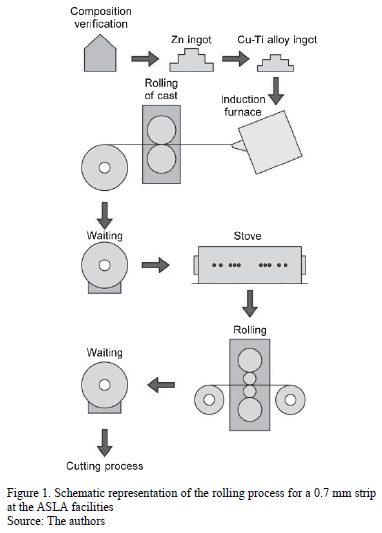
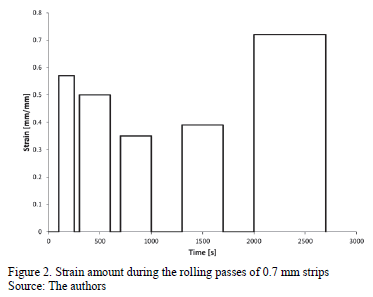
<body><![CDATA[<p>&nbsp;</p>     <p><font size="3" face="Verdana, Arial, Helvetica, sans-serif"><b>1. Introduction</b></font></p>     <p><font size="2" face="Verdana, Arial, Helvetica, sans-serif">Zn alloys microalloyed with Cu and Ti are   mainly used by the construction industry in roofing, gutters and drains &#91;1&#93;.   The material is usually supplied as strips that, after solidification, have   undergone hot rolling (between 250 and 100 &deg;C). In some cases, room temperature   rolling is also performed. Concepts of hot and cold rolling must be carefully   considered because at 300 K (27 &deg;C) Zn alloys have a temperature equivalent to   0.43 T<sub>M</sub> (the melting temperature is 649 K), which makes them behave like   metals deformed at high temperatures (dynamic restoration, creep, static   recrystallization after straining, etc.) &#91;2&#93;.</font></p>     <p><font size="2" face="Verdana, Arial, Helvetica, sans-serif">A specific requirement for this   material is its creep strength &#91;3&#93; when loaded at room temperature. For   example, with stresses higher than 90 MPa, stationary strain rate must not   reach or exceed <img src="/img/revistas/dyna/v83n195/v83n195a10eq002.gif"> in   both parallel and perpendicular</font> <font size="2" face="Verdana, Arial, Helvetica, sans-serif">directions compared to   the rolling axis (in strips with thickness of 0.7 mm). Adding the microalloying   elements Cu and Ti improves hot deformation strength by solid solution of Cu in   Zn or by grain refining of the dispersoid Zn<sub>16</sub>Ti, which is formed   during solidification &#91;4-6&#93;. The tensile and creep properties of this alloy are   the product of hardening by grain refinement due to Zn<sub>16</sub>Ti &#91;7-9&#93;,   solid solution hardening by Cu in Zn &#91;10-12&#93; and also the increase in   resistance in the direction perpendicular to the rolling axis caused by texture   hardening &#91;13-17&#93;.</font></p>     <p><font size="2" face="Verdana, Arial, Helvetica, sans-serif">The material analyzed in this work was   manufactured by &quot;Asturiana de Laminados (ASLA)&quot; in facilities located at   Asturias, Spain, using continuous casting equipment of the &quot;Twin roll casting&quot;   type, which produces 8 mm thick slabs in the form of coils (<a href="#fig01">Fig. 1</a>).</font></p>     <p align="center"><font size="2" face="Verdana, Arial, Helvetica, sans-serif"><a name="fig01"></a></font><img src="/img/revistas/dyna/v83n195/v83n195a10fig01.gif"></p>     <p><font size="2" face="Verdana, Arial, Helvetica, sans-serif">After a 10-hour homogenization treatment   at 250&deg;C, hot rolling is undertaken in a reversible &quot;Steckel&quot; train at   temperatures between 250 and 100&deg;C in 5 phases. A final thickness of 0.7 mm is   obtained (<a href="#fig02">Fig. 2</a>).</font></p>     <p align="center"><font size="2" face="Verdana, Arial, Helvetica, sans-serif"><a name="fig02"></a></font><img src="/img/revistas/dyna/v83n195/v83n195a10fig02.gif"></p>     <p><font size="2" face="Verdana, Arial, Helvetica, sans-serif">As   the industrial application of parts manufactured with Zn alloys is conditioned   by room temperature creep, this work analyzes the behavior of a Zn - Cu - Ti   alloy that has been deformed at room temperature in tensile tests (different   strain rates) or applied with a constant load (creep tests) in both the raw   state and heat treated conditions. The anisotropy of the rolled strip is also   considered. </font></p>     <p>&nbsp;</p>     ]]></body>
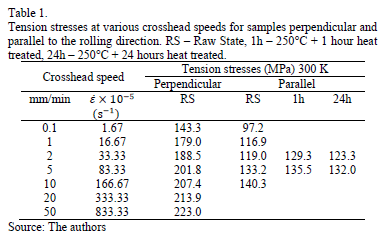
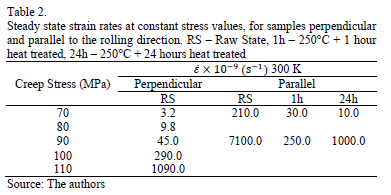
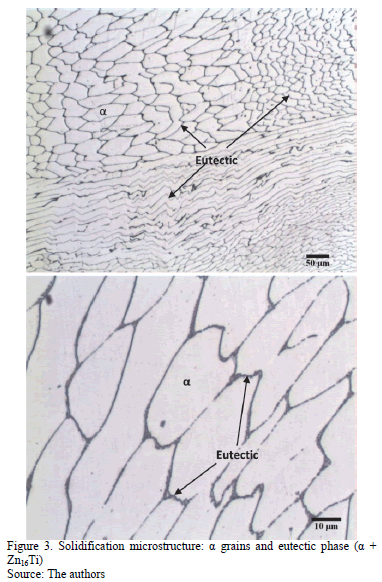
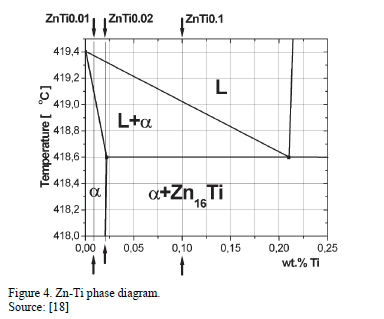
<body><![CDATA[<p><font size="3" face="Verdana, Arial, Helvetica, sans-serif"><b>2. Experimental procedure</b></font></p>     <p><font size="2" face="Verdana, Arial, Helvetica, sans-serif">The   strip produced by ASLA that is 0.7 mm thick is a Zn-0.15% Cu- 0.07% Ti used in   industrial applications. Samples for mechanical testing were obtained from the   Zn strip in both parallel and perpendicular directions relative to the rolling   axis and were then machined as tension test samples with a calibrated gage   length of <img src="/img/revistas/dyna/v83n195/v83n195a10eq008.gif"> =   100 mm (ASTM E8-04). The   samples were tested using an Instron 5583 standard universal machine, while   varying crosshead speeds (<a href="#tab01">Table 1</a>) until total fracture of the specimens. Also,   creep tests were performed in samples with the same geometries by applying a   constant load until steady strain rate behavior was observed for a considerable   period of time (<a href="#tab02">Table 2</a>).</font></p>     <p align="center"><font size="2" face="Verdana, Arial, Helvetica, sans-serif"><a name="tab01"></a></font><img src="/img/revistas/dyna/v83n195/v83n195a10tab01.gif"></p>     <p align="center"><font size="2" face="Verdana, Arial, Helvetica, sans-serif"><a name="tab02"></a></font><img src="/img/revistas/dyna/v83n195/v83n195a10tab02.gif"></p>     <p><font size="2" face="Verdana, Arial, Helvetica, sans-serif">Furthermore,   tension tests changing the crosshead speed (from 0.1 mm/min to 1 mm/min) every   2 or 3 mm were undertaken in order to calculate the strain rate equation   coefficient. To compare the behavior of the raw state rolled material with that   of the samples modified by heat treatments, tension test specimens were heat   treated at 250&deg;C for periods of 1 and 24 hours.</font></p>     <p><font size="2" face="Verdana, Arial, Helvetica, sans-serif">Microstructural   characterization of the samples was undertaken using a metallographic cutter to observe   longitudinal sections of the thin slab casting as well as the parallel   direction of the thin strip. Traditional grinding and polishing techniques were   used to obtain a mirror finish, as well as etching using Palmerton reactive.   Metallographic characterization was performed through optical microscopy with   Nikon Epiphot equipment and the quantitative analysis of the grain sizes of the <font face="Symbol">a</font>-Zn grains was undertaken using a Buehler Omnimet image analyzer   connected to the optic microscope. This allowed for automatic grain   identification and ASTM grain size measurement to be used, although in the case   of the heat treated samples manual counting techniques were employed.</font></p>     <p>&nbsp;</p>     <p><font size="3" face="Verdana, Arial, Helvetica, sans-serif"><b>3. Results</b></font></p>     <p><font size="2" face="Verdana, Arial, Helvetica, sans-serif">The microstructure of the thin slab   casting is shown in <a href="#fig03">Fig. 3</a>. Columnar grains of <font face="Symbol">a</font>-Zn (disperse constituent)   are surrounded by an eutectic matrix (<font face="Symbol">a</font>+Zn<sub>16</sub>Ti), just as is expected   from the phase diagram (<a href="#fig04">Fig. 4</a>) &#91;18&#93;:</font></p>     <p><img src="/img/revistas/dyna/v83n195/v83n195a10eq01.gif"></p>     ]]></body>
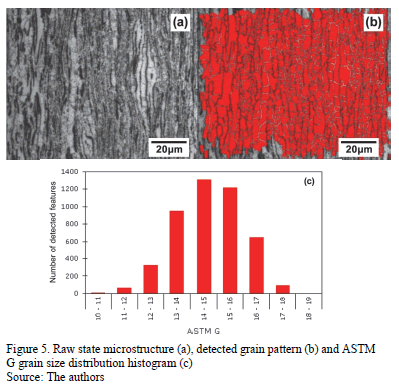
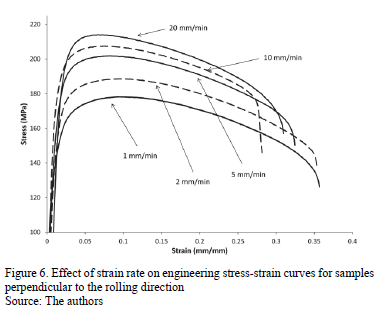
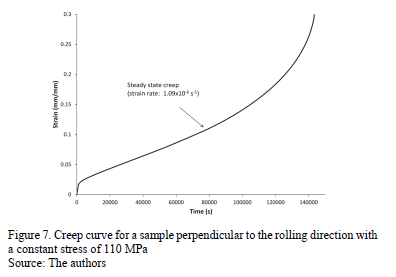
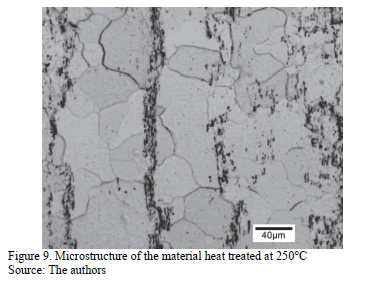
<body><![CDATA[<p><font size="2" face="Verdana, Arial, Helvetica, sans-serif">The phase diagram indicates a 74%   presence of proeutectic phase and 26% of eutectic, which results in   approximately 1.1% of Zn<sub>16</sub>Ti. It is, therefore, an abundant   dispersoid capable of grain refinement and a barrier to the restoration and   recrystallization processes during hot deformation.</font></p>     <p align="center"><font size="2" face="Verdana, Arial, Helvetica, sans-serif"><a name="fig03"></a></font><img src="/img/revistas/dyna/v83n195/v83n195a10fig03.gif"></p>     <p align="center"><font size="2" face="Verdana, Arial, Helvetica, sans-serif"><a name="fig04"></a></font><img src="/img/revistas/dyna/v83n195/v83n195a10fig04.gif"></p>     <p><font size="2" face="Verdana, Arial, Helvetica, sans-serif">Moreover, the microstructure   of the raw hot rolled state strips (0.7 mm in thickness) observed in a section   parallel to the rolling direction (<a href="#fig05">Fig. 5a</a>) is that of a restored material,   partially recrystallized, and with bands in the rolling direction. Just as Kurz   &#91;19&#93; observes, lighter zones are <font face="Symbol">a</font>-Zn grains and darker ones are <font face="Symbol">a</font>+Zn<sub>16</sub>Ti   eutectics which were not separated nor spheroidized after the homogenization   and hot deformation treatments. The optical microscopy does not show Zn<sub>16</sub>Ti,   neither at the boundaries nor at the interior of the <font face="Symbol">a</font>-Zn grains. Also,   the size of the <font face="Symbol">a</font>-Zn grains where the eutectic is deformed is smaller than   at the bands where the eutectic is not present. The quantitative measurements (<a href="#fig05">Fig.s   5b-c</a>) indicate a very small grain size with a mean length of <font face="Symbol">a</font>-Zn, close   to 2 µm (14.5 ASTM).</font></p>     <p align="center"><font size="2" face="Verdana, Arial, Helvetica, sans-serif"><a name="fig05"></a></font><img src="/img/revistas/dyna/v83n195/v83n195a10fig05.gif"></p>     <p><font size="2" face="Verdana, Arial, Helvetica, sans-serif">In order to   evaluate the response of this material to strain rate, tensile tests were made   at different crosshead speeds in samples both parallel and perpendicular to the   rolling direction, as indicated by <a href="#tab01">Table 1</a>. As expected, the higher the strain   rate the higher maximum stress the material may withstand, as shown in the   engineering stress-strain curves for perpendicular samples (<a href="#fig06">Fig. 6</a>). Though the   sample tested at 10 mm/min may have fractured due to defects produced during   machining, the rest of the samples have a tendency to deform by larger amounts   (values as high as 37%) when low strain rates are used.</font></p>     <p align="center"><font size="2" face="Verdana, Arial, Helvetica, sans-serif"><a name="fig06"></a></font><img src="/img/revistas/dyna/v83n195/v83n195a10fig06.gif"></p>     <p><font size="2" face="Verdana, Arial, Helvetica, sans-serif">On the   other hand, samples parallel to the rolling direction present lower maximum   stresses (<a href="#tab01">Table 1</a>), although deformations between 50 and 55% are reached in all   samples. This confirms the effect of the banded structure and crystallographic   texture in the anisotropic mechanical behavior.</font></p>     <p><font size="2" face="Verdana, Arial, Helvetica, sans-serif">As the resistance of the material under   constant load is very important in Zn alloys, creep tests were performed in   order to determine the strain rate (steady state creep) &#91;16,20,21&#93; for the   material (<a href="#tab02">Table 2</a>). Although samples with stresses above 90MPa were tested   until they completely deformed and fractured, showing the typical creep curve   &#91;22&#93; of strain vs. time (<a href="#fig07">Fig. 7</a>), lower stress levels showed very low strain   values. These tests were only carried out until the steady state strain rate was   evident.</font></p>     <p align="center"><font size="2" face="Verdana, Arial, Helvetica, sans-serif"><a name="fig07"></a></font><img src="/img/revistas/dyna/v83n195/v83n195a10fig07.gif"></p>     ]]></body>
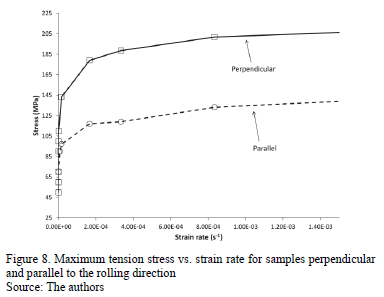
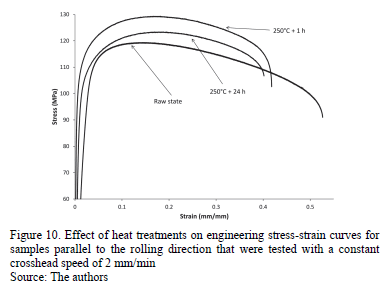
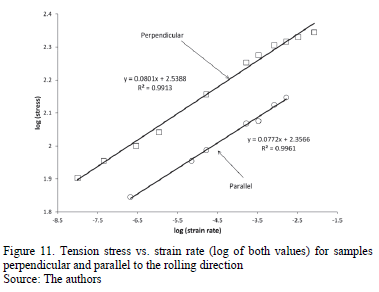
<body><![CDATA[<p><font size="2" face="Verdana, Arial, Helvetica, sans-serif">If the values of stress (maximum stress for tensile   tests and constant stress for creep) vs. strain rate are plotted for all the   samples tested, it becomes evident that parallel and perpendicular samples have   a similar profile: as strain rate is higher, stress reaches a plateau of   approximately 190 MPa for the perpendicular samples and 125 MPa for the   parallel ones (<a href="#fig08">Fig. 8</a>).</font></p>     <p align="center"><font size="2" face="Verdana, Arial, Helvetica, sans-serif"><a name="fig08"></a></font><img src="/img/revistas/dyna/v83n195/v83n195a10fig08.gif"></p>     <p><font size="2" face="Verdana, Arial, Helvetica, sans-serif">Furthermore,   in order to analyze the possibility of improving creep behavior of parallel   samples through the modification of microstructural features &#91;23&#93;, heat   treatments at 250&deg;C were undertaken for periods of 1 and 24 hours. <a href="#fig09">Fig. 9</a> shows   evident microstructural changes due to the activation of diffusional processes   &#91;17&#93;: the strip has recrystallized, grain size has grown (13 µm or 9 ASTM for 1   h and 15 µm or 8.5 ASTM for 24 h) and is more homogeneous, and the eutectic   phase has fragmented which results in bands diminishing. Nevertheless, Zn<sub>16</sub>Ti   are still not observed at either boundaries or at the interior of <font face="Symbol">a</font>-Zn   grains.</font></p>     <p align="center"><font size="2" face="Verdana, Arial, Helvetica, sans-serif"><a name="fig09"></a></font><img src="/img/revistas/dyna/v83n195/v83n195a10fig09.gif"></p>     <p><font size="2" face="Verdana, Arial, Helvetica, sans-serif">If tensile tests are compared in the case of   samples parallel to the rolling direction (<a href="#fig10">Fig. 10</a>), the one hour treatment   seems to increase mechanical properties (also indicated in <a href="#tab01">Table 1</a>) caused by   the disappearance of the continuous eutectic bands. The 24 hour treatment can   only slightly improve mechanical resistance (or even decrease it) depending on   the strain rate (<a href="#fig09">Fig. 9</a> and <a href="#tab01">Table 1</a>): grain growth and Zn<sub>16</sub>Ti   coarsening during recrystallization softens the material &#91;3&#93; and the disappearance of   continuous bands results in a continuous <font face="Symbol">a</font>-Zn deforming phase.</font></p>     <p align="center"><font size="2" face="Verdana, Arial, Helvetica, sans-serif"><a name="fig10"></a></font><img src="/img/revistas/dyna/v83n195/v83n195a10fig10.gif"></p>     <p>&nbsp;</p>     <p><font size="3" face="Verdana, Arial, Helvetica, sans-serif"><b>4. Discussion</b></font></p>     <p><font size="2" face="Verdana, Arial, Helvetica, sans-serif">If   the data for maximum stress (in the case of tensile tests) or constant stress   (in the case of creep tests) is plotted vs. strain rate (strain rate of the   tensile tests or steady state creep rate of the creep tests), using logarithm   of both variables, a linear behavior is observed in the parallel and   perpendicular directions (<a href="#fig11">Fig. 11</a>), especially above 90 MPa. </font></p>     <p align="center"><font size="2" face="Verdana, Arial, Helvetica, sans-serif"><a name="fig11"></a></font><img src="/img/revistas/dyna/v83n195/v83n195a10fig11.gif"></p>     ]]></body>
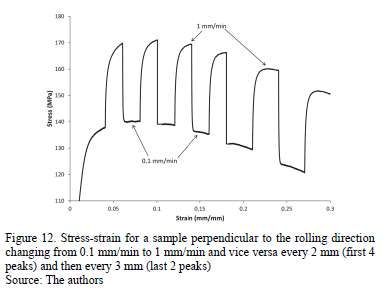
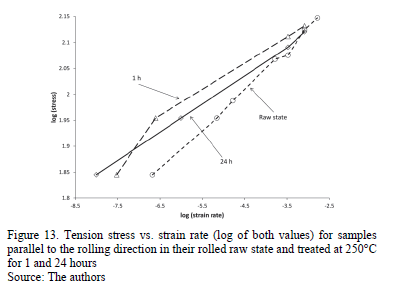
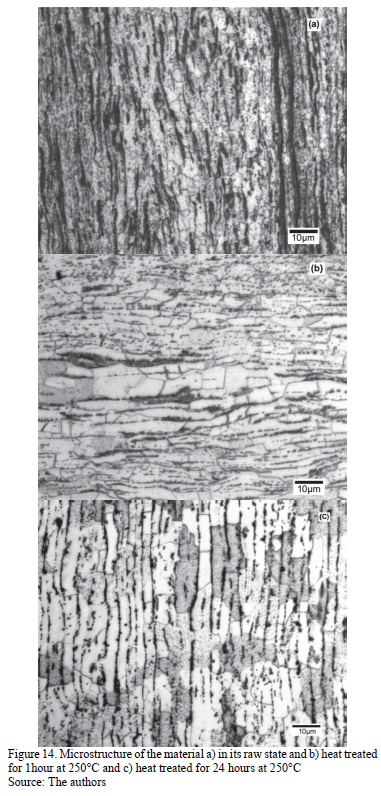
<body><![CDATA[<p><font size="2" face="Verdana, Arial, Helvetica, sans-serif">In order to confirm that the value of the <img src="/img/revistas/dyna/v83n195/v83n195a10eq036.gif"> coefficient (<img src="/img/revistas/dyna/v83n195/v83n195a10eq038.gif">) is actually the one indicated by the data in <a href="#fig11">Fig. 11</a> (slopes), a   tensile test varying strain rate every 2 or 3 mm from 0.1 to 1 mm/min (<a href="#fig12">Fig. 12</a>)   was undertaken. Consider the following equation:</font></p>     <p><img src="/img/revistas/dyna/v83n195/v83n195a10eq02.gif"></p>     <p><font size="2" face="Verdana, Arial, Helvetica, sans-serif">where the <img src="/img/revistas/dyna/v83n195/v83n195a10eq042.gif"> ratio in this test is 10, <img src="/img/revistas/dyna/v83n195/v83n195a10eq044.gif"> is the peak value of each   step at the 1 mm/min curve sections and <img src="/img/revistas/dyna/v83n195/v83n195a10eq046.gif"> is the last value of the 0.1   mm/min curve section before the crosshead speed changes. The <img src="/img/revistas/dyna/v83n195/v83n195a10eq036.gif"> coefficient was   calculated: for the samples in the parallel direction <img src="/img/revistas/dyna/v83n195/v83n195a10eq048.gif">, while for the perpendicular direction <img src="/img/revistas/dyna/v83n195/v83n195a10eq050.gif">. Both values are very similar to the ones observed in <a href="#fig11">Fig. 11</a>, and   much lower (0.13~0.33) than the ones reported by   Reed-Hill &#91;24&#93;.</font></p>     <p align="center"><font size="2" face="Verdana, Arial, Helvetica, sans-serif"><a name="fig12"></a></font><img src="/img/revistas/dyna/v83n195/v83n195a10fig12.gif"></p>     <p><font size="2" face="Verdana, Arial, Helvetica, sans-serif">In <a href="#fig13">Fig. 13</a> Stress vs. Strain rate of   samples heat treated for 1 and 24 hours at 250&deg;C and the data of the material   in its raw state is presented. Although at low strain rates the heat treated   samples show higher strength and higher creep resistance than the raw state   material, at high strain rates the values converge. This may be an indication   that plastic mechanisms activated at low strain rates are different to the ones   at high strain rates: at 300 K, creep in these type of alloys is characterized   by intergranular sliding, thus the increase in grain size by the 250&deg;C   treatments will slow the effect of this mechanism &#91;9&#93;.</font></p>     <p align="center"><font size="2" face="Verdana, Arial, Helvetica, sans-serif"><a name="fig13"></a></font><img src="/img/revistas/dyna/v83n195/v83n195a10fig13.gif"></p>     <p><font size="2" face="Verdana, Arial, Helvetica, sans-serif">A comparison of microstructures in a raw   state and after both heat treatments (250&deg;C) for 1 and 24 hours is presented in <a href="#fig14">Fig. 14</a>. The increase in resistance for the one hour sample may be explained by   the appearance of small, more homogeneously   distributed dispersoids (precipitation hardening); however the 24 hour sample   no longer presents the fine precipitates. Instead, there are coarser ones   (overaging), which explains the decrease in mechanical properties. Furthermore,   evidence of twinning is observed in the heat treated samples, which also   explains the higher mechanical properties compared to the raw state ones   &#91;25-28&#93;.</font></p>     <p align="center"><font size="2" face="Verdana, Arial, Helvetica, sans-serif"><a name="fig14"></a></font><img src="/img/revistas/dyna/v83n195/v83n195a10fig14.gif"></p>     <p>&nbsp;</p>     <p><font size="3" face="Verdana, Arial, Helvetica, sans-serif"><b>5. Conclusions</b></font></p>     ]]></body>
<body><![CDATA[<p><font size="2" face="Verdana, Arial, Helvetica, sans-serif">Although the mechanical resistance of   this alloy in the direction perpendicular to the rolling axis is higher than   the parallel one, the strain rate coefficient <img src="/img/revistas/dyna/v83n195/v83n195a10eq036.gif"> in both directions is very   similar (0.07~0.08). Moreover, heat treatments at   250&deg;C may increase mechanical properties (tensile and creep resistance),   especially at low strain rates. Deformation mechanisms at high strain rates are   very similar for raw state and heat treated samples.</font></p>     <p><font size="2" face="Verdana, Arial, Helvetica, sans-serif">The strengthening of heat treated samples   deformed at low strain rates may be explained by the combination of the   disappearance of continuous bands, twinning of the <font face="Symbol">a</font>-Zn grains and the   appearance of homogeneously distributed precipitates.</font></p>     <p>&nbsp;</p>     <p><font size="3" face="Verdana, Arial, Helvetica, sans-serif"><b>Acknowledgments</b></font></p>     <p><font size="2" face="Verdana, Arial, Helvetica, sans-serif">The authors wish to thank the technical   staff at the Asturiana de Laminados - ASLA (www.elzinc.es)   for providing the material used for this research and detailed information of   the rolling process for the Zn-Cu-Ti alloys. </font></p>     <p>&nbsp;</p>     <p><font size="3" face="Verdana, Arial, Helvetica, sans-serif"><b>References</b></font></p>     <!-- ref --><p><font size="2" face="Verdana, Arial, Helvetica, sans-serif"><b>&#91;1&#93;</b> Barnhurst, R.J., Zinc and Zinc   alloys, in Metals Handbook Vol. 2, 10<sup>th</sup> ed., USA, ASM, 1990. pp.   527-542.    &nbsp;&nbsp;&nbsp;&nbsp;&nbsp;&nbsp;&nbsp;&nbsp;[&#160;<a href="javascript:void(0);" onclick="javascript: window.open('/scielo.php?script=sci_nlinks&ref=1140692&pid=S0012-7353201600010001000001&lng=','','width=640,height=500,resizable=yes,scrollbars=1,menubar=yes,');">Links</a>&#160;]<!-- end-ref --></font></p>     <!-- ref --><p><font size="2" face="Verdana, Arial, Helvetica, sans-serif"><b>&#91;2&#93;</b> Jonas, J.J. and Mc-Queen,   H.J., Recovery and recrystallization during high temperature deformation, in   Mise en Forme des M&eacute;taux et Alliages, Paris, Editions de CNRS, 1976, pp.   99-143.    &nbsp;&nbsp;&nbsp;&nbsp;&nbsp;&nbsp;&nbsp;&nbsp;[&#160;<a href="javascript:void(0);" onclick="javascript: window.open('/scielo.php?script=sci_nlinks&ref=1140694&pid=S0012-7353201600010001000002&lng=','','width=640,height=500,resizable=yes,scrollbars=1,menubar=yes,');">Links</a>&#160;]<!-- end-ref --></font></p>     <!-- ref --><p><font size="2" face="Verdana, Arial, Helvetica, sans-serif"><b>&#91;3&#93;</b> Matsunaga, T., Kameyama, T.,   Takahashi, K. and Sato,   E., Constitutive relation for ambient-temperature creep in hexagonal   close-packed metals. Materials Transactions, 50(12), pp. 2858-2864, 2009. DOI: 10.2320/matertrans.M2009223</font>&nbsp;&nbsp;&nbsp;&nbsp;&nbsp;&nbsp;&nbsp;&nbsp;[&#160;<a href="javascript:void(0);" onclick="javascript: window.open('/scielo.php?script=sci_nlinks&ref=1140696&pid=S0012-7353201600010001000003&lng=','','width=640,height=500,resizable=yes,scrollbars=1,menubar=yes,');">Links</a>&#160;]<!-- end-ref --><!-- ref --><p><font size="2" face="Verdana, Arial, Helvetica, sans-serif"><b>&#91;4&#93;</b> Valadez, S., Zanatta, A.,   Robles, S. and Valdez, S.,   Microstructural analysis of Al-Mg-Si-Zn Alloy. DYNA, 77(163), pp. 9-12, 2010.    &nbsp;&nbsp;&nbsp;&nbsp;&nbsp;&nbsp;&nbsp;&nbsp;[&#160;<a href="javascript:void(0);" onclick="javascript: window.open('/scielo.php?script=sci_nlinks&ref=1140697&pid=S0012-7353201600010001000004&lng=','','width=640,height=500,resizable=yes,scrollbars=1,menubar=yes,');">Links</a>&#160;]<!-- end-ref --></font></p>     <!-- ref --><p><font size="2" face="Verdana, Arial, Helvetica, sans-serif"><b>&#91;5&#93;</b> Boczkal, G., Second phase   morphology in the Zn-Ti0.1-Cu0.1 single crystals obtained at different growth   rates. Archives of Metallurgy and Materials, 57(2), pp. 479-484, 2012.    &nbsp;&nbsp;&nbsp;&nbsp;&nbsp;&nbsp;&nbsp;&nbsp;[&#160;<a href="javascript:void(0);" onclick="javascript: window.open('/scielo.php?script=sci_nlinks&ref=1140699&pid=S0012-7353201600010001000005&lng=','','width=640,height=500,resizable=yes,scrollbars=1,menubar=yes,');">Links</a>&#160;]<!-- end-ref --></font></p>     <!-- ref --><p><font size="2" face="Verdana, Arial, Helvetica, sans-serif"><b>&#91;6&#93;</b> Faur M. and Cosmeleata G., Effects of hot and cold   rolling on the microstructure of low alloy Zn-Cu and Zn-Cu-Ti zinc alloy with   improved corrosion resistance. U.P.B Scientific Bulletin Series B, 68(1), pp.   67-74, 2006.    &nbsp;&nbsp;&nbsp;&nbsp;&nbsp;&nbsp;&nbsp;&nbsp;[&#160;<a href="javascript:void(0);" onclick="javascript: window.open('/scielo.php?script=sci_nlinks&ref=1140701&pid=S0012-7353201600010001000006&lng=','','width=640,height=500,resizable=yes,scrollbars=1,menubar=yes,');">Links</a>&#160;]<!-- end-ref --></font></p>     <!-- ref --><p><font size="2" face="Verdana, Arial, Helvetica, sans-serif"><b>&#91;7&#93;</b> Jaoul, B.,   Etude de la plasticit&eacute; et application aux metaux. Paris: Dunod, 1965, pp. 362-400,   481-511.    &nbsp;&nbsp;&nbsp;&nbsp;&nbsp;&nbsp;&nbsp;&nbsp;[&#160;<a href="javascript:void(0);" onclick="javascript: window.open('/scielo.php?script=sci_nlinks&ref=1140703&pid=S0012-7353201600010001000007&lng=','','width=640,height=500,resizable=yes,scrollbars=1,menubar=yes,');">Links</a>&#160;]<!-- end-ref --></font></p>     ]]></body>
<body><![CDATA[<!-- ref --><p><font size="2" face="Verdana, Arial, Helvetica, sans-serif"><b>&#91;8&#93;</b> Das, S.K., Kang, D.H. and Jung, I.H., Experimental   and diffusion simulation for the homogenization of As-cast Mg-Al, Mg-Zn and   Mg-Al-Zn alloys. Metallurgical and Materials Transactions A, 45A(11), pp.   5212-5225, 2014. DOI: 10.1007/s11661-014-2443-6</font>&nbsp;&nbsp;&nbsp;&nbsp;&nbsp;&nbsp;&nbsp;&nbsp;[&#160;<a href="javascript:void(0);" onclick="javascript: window.open('/scielo.php?script=sci_nlinks&ref=1140705&pid=S0012-7353201600010001000008&lng=','','width=640,height=500,resizable=yes,scrollbars=1,menubar=yes,');">Links</a>&#160;]<!-- end-ref --><!-- ref --><p><font size="2" face="Verdana, Arial, Helvetica, sans-serif"><b>&#91;9&#93;</b> Xiao, L.R., Zhang, X.M., Wang,   Y., Li, W., Sun, Q.S. and Geng,   Z.J., High temperature creep behavior of Zn-1.0Cu-0.2Ti Alloy. Advanced   Materials Research, 287-290(7), pp. 769-776, 2011. DOI: 10.4028/www.scientific.net/AMR.287-290.769</font>&nbsp;&nbsp;&nbsp;&nbsp;&nbsp;&nbsp;&nbsp;&nbsp;[&#160;<a href="javascript:void(0);" onclick="javascript: window.open('/scielo.php?script=sci_nlinks&ref=1140706&pid=S0012-7353201600010001000009&lng=','','width=640,height=500,resizable=yes,scrollbars=1,menubar=yes,');">Links</a>&#160;]<!-- end-ref --><!-- ref --><p><font size="2" face="Verdana, Arial, Helvetica, sans-serif"><b>&#91;10&#93;</b> Hirth, J.P. and Lothe, J.,   Theory of dislocations. New York: Wiley, 1968. pp. 637-753.    &nbsp;&nbsp;&nbsp;&nbsp;&nbsp;&nbsp;&nbsp;&nbsp;[&#160;<a href="javascript:void(0);" onclick="javascript: window.open('/scielo.php?script=sci_nlinks&ref=1140707&pid=S0012-7353201600010001000010&lng=','','width=640,height=500,resizable=yes,scrollbars=1,menubar=yes,');">Links</a>&#160;]<!-- end-ref --></font></p>     <!-- ref --><p><font size="2" face="Verdana, Arial, Helvetica, sans-serif"><b>&#91;11&#93;</b> Dieter, G.E., Mechanical   metallurgy. UK: McGraw-Hill, 1988. pp. 185-240.    &nbsp;&nbsp;&nbsp;&nbsp;&nbsp;&nbsp;&nbsp;&nbsp;[&#160;<a href="javascript:void(0);" onclick="javascript: window.open('/scielo.php?script=sci_nlinks&ref=1140709&pid=S0012-7353201600010001000011&lng=','','width=640,height=500,resizable=yes,scrollbars=1,menubar=yes,');">Links</a>&#160;]<!-- end-ref --></font></p>     <!-- ref --><p><font size="2" face="Verdana, Arial, Helvetica, sans-serif"><b>&#91;12&#93;</b> Pero-Sanz,   J.A., Ciencia e Ingenier&iacute;a de Materiales. Madrid: Cie Dossat, 5<sup>th</sup> ed., 2006. pp. 393-446.    &nbsp;&nbsp;&nbsp;&nbsp;&nbsp;&nbsp;&nbsp;&nbsp;[&#160;<a href="javascript:void(0);" onclick="javascript: window.open('/scielo.php?script=sci_nlinks&ref=1140711&pid=S0012-7353201600010001000012&lng=','','width=640,height=500,resizable=yes,scrollbars=1,menubar=yes,');">Links</a>&#160;]<!-- end-ref --></font></p>     <!-- ref --><p><font size="2" face="Verdana, Arial, Helvetica, sans-serif"><b>&#91;13&#93;</b> Cosse P., D'Heeyer, R.,   Coutsouradis, D. et Habrajen, L., Le comportement à l'emboutissage du Zinc et   d'alliages de Zinc. M&eacute;moires Scientifiques Revue de M&eacute;tallurgie, pp. 517-528,   1978.    &nbsp;&nbsp;&nbsp;&nbsp;&nbsp;&nbsp;&nbsp;&nbsp;[&#160;<a href="javascript:void(0);" onclick="javascript: window.open('/scielo.php?script=sci_nlinks&ref=1140713&pid=S0012-7353201600010001000013&lng=','','width=640,height=500,resizable=yes,scrollbars=1,menubar=yes,');">Links</a>&#160;]<!-- end-ref --></font></p>     ]]></body>
<body><![CDATA[<!-- ref --><p><font size="2" face="Verdana, Arial, Helvetica, sans-serif"><b>&#91;14&#93;</b> Penelle, R.,   Influence de l'anisotropie sur la limite d'&eacute;lasticit&eacute; et la loi de   comportement, in Mise en Forme des M&eacute;taux et Alliages, Paris, Editions de CNRS,   1976, pp. 75-85.    &nbsp;&nbsp;&nbsp;&nbsp;&nbsp;&nbsp;&nbsp;&nbsp;[&#160;<a href="javascript:void(0);" onclick="javascript: window.open('/scielo.php?script=sci_nlinks&ref=1140715&pid=S0012-7353201600010001000014&lng=','','width=640,height=500,resizable=yes,scrollbars=1,menubar=yes,');">Links</a>&#160;]<!-- end-ref --></font></p>     <!-- ref --><p><font size="2" face="Verdana, Arial, Helvetica, sans-serif"><b>&#91;15&#93;</b> Barrett, C.S., Structure   des M&eacute;taux. Paris: Dunod, 1957, pp. 417-478.    &nbsp;&nbsp;&nbsp;&nbsp;&nbsp;&nbsp;&nbsp;&nbsp;[&#160;<a href="javascript:void(0);" onclick="javascript: window.open('/scielo.php?script=sci_nlinks&ref=1140717&pid=S0012-7353201600010001000015&lng=','','width=640,height=500,resizable=yes,scrollbars=1,menubar=yes,');">Links</a>&#160;]<!-- end-ref --></font></p>     <!-- ref --><p><font size="2" face="Verdana, Arial, Helvetica, sans-serif"><b>&#91;16&#93;</b> Deka, D., Joseph, D., Ghosh, S. and Mills, M., Crystal   plasticity modeling of deformation and creep in polycrystalline Ti-6242.   Metallurgical and Materials Transactions A, 37A(5), pp. 1371-1388, 2006. DOI:   10.1007/s11661-006-0082-2</font>&nbsp;&nbsp;&nbsp;&nbsp;&nbsp;&nbsp;&nbsp;&nbsp;[&#160;<a href="javascript:void(0);" onclick="javascript: window.open('/scielo.php?script=sci_nlinks&ref=1140719&pid=S0012-7353201600010001000016&lng=','','width=640,height=500,resizable=yes,scrollbars=1,menubar=yes,');">Links</a>&#160;]<!-- end-ref --><!-- ref --><p><font size="2" face="Verdana, Arial, Helvetica, sans-serif"><b>&#91;17&#93;</b> Doiphode, R.L., Narayana Murty,   S.V.S., Prabhu, N. and Kashyap,   B.P., High-temperature tensile flow behavior of caliber-rolled Mg-3Al-1Zn   Alloy, Metallurgical and Materials Transactions A, 46A(7), pp. 3028-3042, 2015.   DOI: 10.1007/s11661-015-2883-7</font>&nbsp;&nbsp;&nbsp;&nbsp;&nbsp;&nbsp;&nbsp;&nbsp;[&#160;<a href="javascript:void(0);" onclick="javascript: window.open('/scielo.php?script=sci_nlinks&ref=1140720&pid=S0012-7353201600010001000017&lng=','','width=640,height=500,resizable=yes,scrollbars=1,menubar=yes,');">Links</a>&#160;]<!-- end-ref --><!-- ref --><p><font size="2" face="Verdana, Arial, Helvetica, sans-serif"><b>&#91;18&#93;</b> Mikulowski, B. and Boczkal,   G., Zn-Ti single crystals deformed along the basal slip system. Archives of   Metallurgy and Materials, 54(1), pp. 197-203, 2009.    &nbsp;&nbsp;&nbsp;&nbsp;&nbsp;&nbsp;&nbsp;&nbsp;[&#160;<a href="javascript:void(0);" onclick="javascript: window.open('/scielo.php?script=sci_nlinks&ref=1140721&pid=S0012-7353201600010001000018&lng=','','width=640,height=500,resizable=yes,scrollbars=1,menubar=yes,');">Links</a>&#160;]<!-- end-ref --></font></p>     <!-- ref --><p><font size="2" face="Verdana, Arial, Helvetica, sans-serif"><b>&#91;19&#93;</b> Kurz, W. and Trivedi, R.,   Banded solidification microstructures. Metallurgical and Materials Transactions   A, 27A(3), pp. 625-634, 1996. DOI: 10.1007/BF02648951</font>&nbsp;&nbsp;&nbsp;&nbsp;&nbsp;&nbsp;&nbsp;&nbsp;[&#160;<a href="javascript:void(0);" onclick="javascript: window.open('/scielo.php?script=sci_nlinks&ref=1140723&pid=S0012-7353201600010001000019&lng=','','width=640,height=500,resizable=yes,scrollbars=1,menubar=yes,');">Links</a>&#160;]<!-- end-ref --><!-- ref --><p><font size="2" face="Verdana, Arial, Helvetica, sans-serif"><b>&#91;20&#93;</b> Blum, W., Eisenlohr, P. and   Breutinger, F., Understanding Creep - A review. Metallurgical and Materials   Transactions A, 33A(2), pp. 291-303, 2002. DOI: 10.1007/s11661-002-0090-9</font>&nbsp;&nbsp;&nbsp;&nbsp;&nbsp;&nbsp;&nbsp;&nbsp;[&#160;<a href="javascript:void(0);" onclick="javascript: window.open('/scielo.php?script=sci_nlinks&ref=1140724&pid=S0012-7353201600010001000020&lng=','','width=640,height=500,resizable=yes,scrollbars=1,menubar=yes,');">Links</a>&#160;]<!-- end-ref --><!-- ref --><p><font size="2" face="Verdana, Arial, Helvetica, sans-serif"><b>&#91;21&#93;</b> Peschanskaya, N.N., Shpeizman,   V.V., Sinani, A.B. and Smirnov, B.I., Micrometer-Scale deformation jumps at different stages of creep   in solids. Physics of the Solid State, 45(11), pp. 2058-2062, 2004. DOI:   10.1134/1.1825549</font>&nbsp;&nbsp;&nbsp;&nbsp;&nbsp;&nbsp;&nbsp;&nbsp;[&#160;<a href="javascript:void(0);" onclick="javascript: window.open('/scielo.php?script=sci_nlinks&ref=1140725&pid=S0012-7353201600010001000021&lng=','','width=640,height=500,resizable=yes,scrollbars=1,menubar=yes,');">Links</a>&#160;]<!-- end-ref --><!-- ref --><p><font size="2" face="Verdana, Arial, Helvetica, sans-serif"><b>&#91;22&#93;</b> Winter, R., EZAC - High   strength, creep resistant, Zinc die casting alloy. Die Casting Engineer, (3),   pp. 32-35, 2011.    &nbsp;&nbsp;&nbsp;&nbsp;&nbsp;&nbsp;&nbsp;&nbsp;[&#160;<a href="javascript:void(0);" onclick="javascript: window.open('/scielo.php?script=sci_nlinks&ref=1140726&pid=S0012-7353201600010001000022&lng=','','width=640,height=500,resizable=yes,scrollbars=1,menubar=yes,');">Links</a>&#160;]<!-- end-ref --></font></p>     <!-- ref --><p><font size="2" face="Verdana, Arial, Helvetica, sans-serif"><b>&#91;23&#93;</b> Mahmoud, S.A., Semary, M.A.,   Farid, Z.M. and El-Naquib, N., On two types of creep behaviour of Cu-Zn solid solution.   Materials Science and Engineering A, 118(10), pp. 107-111, 1989. DOI:   10.1016/0921-5093(89)90062-2</font>&nbsp;&nbsp;&nbsp;&nbsp;&nbsp;&nbsp;&nbsp;&nbsp;[&#160;<a href="javascript:void(0);" onclick="javascript: window.open('/scielo.php?script=sci_nlinks&ref=1140728&pid=S0012-7353201600010001000023&lng=','','width=640,height=500,resizable=yes,scrollbars=1,menubar=yes,');">Links</a>&#160;]<!-- end-ref --><!-- ref --><p><font size="2" face="Verdana, Arial, Helvetica, sans-serif"><b>&#91;24&#93;</b> Reed-Hill, R.E., Physical   metallurgy principles. Second Edition, University Series in Basic Engineering,   1994, pp. 827-887.    &nbsp;&nbsp;&nbsp;&nbsp;&nbsp;&nbsp;&nbsp;&nbsp;[&#160;<a href="javascript:void(0);" onclick="javascript: window.open('/scielo.php?script=sci_nlinks&ref=1140729&pid=S0012-7353201600010001000024&lng=','','width=640,height=500,resizable=yes,scrollbars=1,menubar=yes,');">Links</a>&#160;]<!-- end-ref --></font></p>     <!-- ref --><p><font size="2" face="Verdana, Arial, Helvetica, sans-serif"><b>&#91;25&#93;</b> Zhu, Y.T., Liao, X.Z., Wu, X.L., Narayan, J., Grain size effect on   deformation twinning and detwinning. Jounal of Materials Science, 48, pp. 4467-4475, 2013. DOI: 10.1007/s10853-013-7140-0</font>&nbsp;&nbsp;&nbsp;&nbsp;&nbsp;&nbsp;&nbsp;&nbsp;[&#160;<a href="javascript:void(0);" onclick="javascript: window.open('/scielo.php?script=sci_nlinks&ref=1140731&pid=S0012-7353201600010001000025&lng=','','width=640,height=500,resizable=yes,scrollbars=1,menubar=yes,');">Links</a>&#160;]<!-- end-ref --><!-- ref --><p><font size="2" face="Verdana, Arial, Helvetica, sans-serif"><b>&#91;26&#93;</b> Jenei, P., Gubicza, J., Dirras,   G., L&aacute;b&aacute;r, J.L. and Tingaud, D., Indentation creep study on ultrafine-grained Zn processed by   powder metallurgy. Materials Science &amp; Engineering A. 596, pp. 170-175,   2014. DOI:10.1016/j.msea.2013.12.050</font>&nbsp;&nbsp;&nbsp;&nbsp;&nbsp;&nbsp;&nbsp;&nbsp;[&#160;<a href="javascript:void(0);" onclick="javascript: window.open('/scielo.php?script=sci_nlinks&ref=1140732&pid=S0012-7353201600010001000026&lng=','','width=640,height=500,resizable=yes,scrollbars=1,menubar=yes,');">Links</a>&#160;]<!-- end-ref --><!-- ref --><p><font size="2" face="Verdana, Arial, Helvetica, sans-serif"><b>&#91;27&#93;</b> Boczkal, G., Mikulowski, B.,   Oertel, C.G. and Skrotzki, W., Work-hardening characteristics of Zn-Ti alloy single crystals.   Crystal Research and Technology, 45(2), pp. 111-114, 2010. DOI:   10.1002/crat.200900537</font>&nbsp;&nbsp;&nbsp;&nbsp;&nbsp;&nbsp;&nbsp;&nbsp;[&#160;<a href="javascript:void(0);" onclick="javascript: window.open('/scielo.php?script=sci_nlinks&ref=1140733&pid=S0012-7353201600010001000027&lng=','','width=640,height=500,resizable=yes,scrollbars=1,menubar=yes,');">Links</a>&#160;]<!-- end-ref --><!-- ref --><p><font size="2" face="Verdana, Arial, Helvetica, sans-serif"><b>&#91;28&#93;</b> Garc&iacute;a-Bernal,   M.A., Hernandez-Silva, D. and Sauce-Rangel, V., Superplastic behavior of coarse-grained Al-Mg-Zn alloys.   Journal of Material Science, 42, pp. 3958-3963, 2007. DOI:   10.1007/s10853-006-0368-1</font>&nbsp;&nbsp;&nbsp;&nbsp;&nbsp;&nbsp;&nbsp;&nbsp;[&#160;<a href="javascript:void(0);" onclick="javascript: window.open('/scielo.php?script=sci_nlinks&ref=1140734&pid=S0012-7353201600010001000028&lng=','','width=640,height=500,resizable=yes,scrollbars=1,menubar=yes,');">Links</a>&#160;]<!-- end-ref --><p>&nbsp;</p>     <p><font size="2" face="Verdana, Arial, Helvetica, sans-serif"><b>M.J. Quintana,</b> received her BSc. Eng in Mechatronics   Engineering in 2006, her Sp. degree in Advanced Manufacturing Systems in 2007,   her MSc. degree in Engineering in 2010, all of them from the Universidad   Panamericana, Mexico City, Mexico. She was awarded her PhD in Science and   Technology of Materials in 2013 from the Universidad de Oviedo. Oviedo, Spain. She   has worked since 2007 in the Faculty of Engineering at the Universidad   Panamericana, first as an invited professor, and since 2011 as an associate professor   and researcher. Her research interests include: finite element simulation,   material testing and characterization, selection of materials for engineering   applications. ORCID: 0000-0002-1926-9910</font></p>     <p><font size="2" face="Verdana, Arial, Helvetica, sans-serif"><b>J.O. Garc&iacute;a, </b>received his Adv.   Technician degree in 1975, from the Polytechnic School of Oviedo, Spain. Has   worked in the Universidad de Oviedo since 1982 as a lab teacher in the   Materials Department, and now also works as an associate professor on the   Science and Engineering course. His research interests include: optical and   electronical microscopy, mechanical testing, thermal treatments and alumino-thermal   welding. ORCID: 0000-0002-9156-7349</font></p>     <p><font size="2" face="Verdana, Arial, Helvetica, sans-serif"><b>R. Gonz&aacute;lez,</b> received his BSc. Eng in Mechanical   and Electrical Engineering in 1991 from the Universidad Panamericana, Mexico   City, Mexico and his PhD in Mechanical Properties and Structure of Materials in   1996 from CEIT - Universidad de Navarra, San Sebasti&aacute;n, Spain. Since 1996 he   has worked in the Faculty of Engineering at the Universidad Panamericana as   associate professor and researcher and is currently Dean of the Mechatronics   and Mechanic Engineering programs. His research interests include: finite   element simulation, material testing and characterization, tribology, design   theory. ORCID: 0000-0003-2319-1631</font></p>     <p><font size="2" face="Verdana, Arial, Helvetica, sans-serif"><b>J.I. Verdeja,</b> received his Mining Eng.   degree from the Adv. Tech. School of Mining Eng. in Madrid in 1968, his Nuclear   Eng. degree from the Nuclear Energy Board in 1969, his PhD in Mining from the   Adv. Tech. School of Mining Eng. of Oviedo in 1974, and a PhD form the   University of Paris in 1978. He began to work in the Adv. Tech. School of   Mining Eng. of Oviedo in 1974 as an invited and associate professor and then as   an associate chairman in 1983. His research interests include: steels, castings   and metallic alloys in general. ORCID: 0000-0002-4446-6457</font></p>      ]]></body><back>
<ref-list>
<ref id="B1">
<label>1</label><nlm-citation citation-type="book">
<person-group person-group-type="author">
<name>
<surname><![CDATA[Barnhurst]]></surname>
<given-names><![CDATA[R.J.]]></given-names>
</name>
</person-group>
<article-title xml:lang="en"><![CDATA[Zinc and Zinc alloys]]></article-title>
<source><![CDATA[Metals Handbook]]></source>
<year>1990</year>
<volume>2</volume>
<edition>10th</edition>
<page-range>527-542</page-range><publisher-name><![CDATA[ASM]]></publisher-name>
</nlm-citation>
</ref>
<ref id="B2">
<label>2</label><nlm-citation citation-type="book">
<person-group person-group-type="author">
<name>
<surname><![CDATA[Jonas]]></surname>
<given-names><![CDATA[J.J.]]></given-names>
</name>
<name>
<surname><![CDATA[Mc-Queen]]></surname>
<given-names><![CDATA[H.J.]]></given-names>
</name>
</person-group>
<article-title xml:lang="en"><![CDATA[Recovery and recrystallization during high temperature deformation]]></article-title>
<source><![CDATA[Mise en Forme des Métaux et Alliages]]></source>
<year>1976</year>
<page-range>99-143</page-range><publisher-loc><![CDATA[Paris ]]></publisher-loc>
<publisher-name><![CDATA[Editions de CNRS]]></publisher-name>
</nlm-citation>
</ref>
<ref id="B3">
<label>3</label><nlm-citation citation-type="journal">
<person-group person-group-type="author">
<name>
<surname><![CDATA[Matsunaga]]></surname>
<given-names><![CDATA[T.]]></given-names>
</name>
<name>
<surname><![CDATA[Kameyama]]></surname>
<given-names><![CDATA[T.]]></given-names>
</name>
<name>
<surname><![CDATA[Takahashi]]></surname>
<given-names><![CDATA[K.]]></given-names>
</name>
<name>
<surname><![CDATA[Sato]]></surname>
<given-names><![CDATA[E.]]></given-names>
</name>
</person-group>
<article-title xml:lang="en"><![CDATA[Constitutive relation for ambient-temperature creep in hexagonal close-packed metals]]></article-title>
<source><![CDATA[Materials Transactions]]></source>
<year>2009</year>
<volume>50</volume>
<numero>12</numero>
<issue>12</issue>
<page-range>2858-2864</page-range></nlm-citation>
</ref>
<ref id="B4">
<label>4</label><nlm-citation citation-type="journal">
<person-group person-group-type="author">
<name>
<surname><![CDATA[Valadez]]></surname>
<given-names><![CDATA[S.]]></given-names>
</name>
<name>
<surname><![CDATA[Zanatta]]></surname>
<given-names><![CDATA[A.]]></given-names>
</name>
<name>
<surname><![CDATA[Robles]]></surname>
<given-names><![CDATA[S.]]></given-names>
</name>
<name>
<surname><![CDATA[Valdez]]></surname>
<given-names><![CDATA[S.]]></given-names>
</name>
</person-group>
<article-title xml:lang="en"><![CDATA[Microstructural analysis of Al-Mg-Si-Zn Alloy]]></article-title>
<source><![CDATA[DYNA]]></source>
<year>2010</year>
<volume>77</volume>
<numero>163</numero>
<issue>163</issue>
<page-range>9-12</page-range></nlm-citation>
</ref>
<ref id="B5">
<label>5</label><nlm-citation citation-type="journal">
<person-group person-group-type="author">
<name>
<surname><![CDATA[Boczkal]]></surname>
<given-names><![CDATA[G.]]></given-names>
</name>
</person-group>
<article-title xml:lang="en"><![CDATA[Second phase morphology in the Zn-Ti0.1-Cu0.1 single crystals obtained at different growth rates]]></article-title>
<source><![CDATA[Archives of Metallurgy and Materials]]></source>
<year>2012</year>
<volume>57</volume>
<numero>2</numero>
<issue>2</issue>
<page-range>479-484</page-range></nlm-citation>
</ref>
<ref id="B6">
<label>6</label><nlm-citation citation-type="journal">
<person-group person-group-type="author">
<name>
<surname><![CDATA[Faur]]></surname>
<given-names><![CDATA[M.]]></given-names>
</name>
<name>
<surname><![CDATA[Cosmeleata]]></surname>
<given-names><![CDATA[G.]]></given-names>
</name>
</person-group>
<article-title xml:lang="en"><![CDATA[Effects of hot and cold rolling on the microstructure of low alloy Zn-Cu and Zn-Cu-Ti zinc alloy with improved corrosion resistance.]]></article-title>
<source><![CDATA[U.P.B Scientific Bulletin Series B]]></source>
<year>2006</year>
<volume>68</volume>
<numero>1</numero>
<issue>1</issue>
<page-range>67-74</page-range></nlm-citation>
</ref>
<ref id="B7">
<label>7</label><nlm-citation citation-type="">
<person-group person-group-type="author">
<name>
<surname><![CDATA[Jaoul]]></surname>
<given-names><![CDATA[B.]]></given-names>
</name>
</person-group>
<source><![CDATA[Etude de la plasticité et application aux metaux]]></source>
<year>1965</year>
<page-range>362-400</page-range><page-range>481-511</page-range></nlm-citation>
</ref>
<ref id="B8">
<label>8</label><nlm-citation citation-type="journal">
<person-group person-group-type="author">
<name>
<surname><![CDATA[Das]]></surname>
<given-names><![CDATA[S.K.]]></given-names>
</name>
<name>
<surname><![CDATA[Kang]]></surname>
<given-names><![CDATA[D.H.]]></given-names>
</name>
<name>
<surname><![CDATA[Jung]]></surname>
<given-names><![CDATA[I.H.]]></given-names>
</name>
</person-group>
<article-title xml:lang="en"><![CDATA[Experimental and diffusion simulation for the homogenization of As-cast Mg-Al, Mg-Zn and Mg-Al-Zn alloys]]></article-title>
<source><![CDATA[Materials TransactionsA]]></source>
<year>2014</year>
<volume>45A</volume>
<numero>11</numero>
<issue>11</issue>
<page-range>5212-5225</page-range></nlm-citation>
</ref>
<ref id="B9">
<label>9</label><nlm-citation citation-type="journal">
<person-group person-group-type="author">
<name>
<surname><![CDATA[Xiao]]></surname>
<given-names><![CDATA[L.R.]]></given-names>
</name>
<name>
<surname><![CDATA[Zhang]]></surname>
<given-names><![CDATA[X.M.]]></given-names>
</name>
<name>
<surname><![CDATA[Wang]]></surname>
<given-names><![CDATA[Y.]]></given-names>
</name>
<name>
<surname><![CDATA[Li]]></surname>
<given-names><![CDATA[W.]]></given-names>
</name>
<name>
<surname><![CDATA[Sun]]></surname>
<given-names><![CDATA[Q.S.]]></given-names>
</name>
<name>
<surname><![CDATA[Geng]]></surname>
<given-names><![CDATA[Z.J.]]></given-names>
</name>
</person-group>
<article-title xml:lang="en"><![CDATA[High temperature creep behavior of Zn-1.0Cu-0.2Ti Alloy]]></article-title>
<source><![CDATA[Advanced Materials Research]]></source>
<year>2011</year>
<volume>287-290</volume>
<numero>7</numero>
<issue>7</issue>
<page-range>769-776</page-range></nlm-citation>
</ref>
<ref id="B10">
<label>10</label><nlm-citation citation-type="book">
<person-group person-group-type="author">
<name>
<surname><![CDATA[Hirth]]></surname>
<given-names><![CDATA[J.P.]]></given-names>
</name>
<name>
<surname><![CDATA[Lothe]]></surname>
<given-names><![CDATA[J.]]></given-names>
</name>
</person-group>
<source><![CDATA[Theory of dislocations]]></source>
<year>1968</year>
<page-range>637-753</page-range><publisher-loc><![CDATA[New York ]]></publisher-loc>
<publisher-name><![CDATA[Wiley]]></publisher-name>
</nlm-citation>
</ref>
<ref id="B11">
<label>11</label><nlm-citation citation-type="book">
<person-group person-group-type="author">
<name>
<surname><![CDATA[Dieter]]></surname>
<given-names><![CDATA[G.E.]]></given-names>
</name>
</person-group>
<source><![CDATA[Mechanical metallurgy.]]></source>
<year>1988</year>
<page-range>185-240</page-range><publisher-name><![CDATA[McGraw-Hill]]></publisher-name>
</nlm-citation>
</ref>
<ref id="B12">
<label>12</label><nlm-citation citation-type="book">
<person-group person-group-type="author">
<name>
<surname><![CDATA[Pero-Sanz]]></surname>
<given-names><![CDATA[J.A.]]></given-names>
</name>
</person-group>
<source><![CDATA[Ciencia e Ingeniería de Materiales.]]></source>
<year>2006</year>
<edition>5th</edition>
<page-range>393-446</page-range><publisher-loc><![CDATA[Madrid ]]></publisher-loc>
<publisher-name><![CDATA[Cie Dossat]]></publisher-name>
</nlm-citation>
</ref>
<ref id="B13">
<label>13</label><nlm-citation citation-type="confpro">
<person-group person-group-type="author">
<name>
<surname><![CDATA[Cosse]]></surname>
<given-names><![CDATA[P.]]></given-names>
</name>
<name>
<surname><![CDATA[D'Heeyer]]></surname>
<given-names><![CDATA[R.]]></given-names>
</name>
<name>
<surname><![CDATA[Coutsouradis]]></surname>
<given-names><![CDATA[D.]]></given-names>
</name>
<name>
<surname><![CDATA[et Habrajen]]></surname>
<given-names><![CDATA[L.]]></given-names>
</name>
</person-group>
<article-title xml:lang="fr"><![CDATA[Le comportement à l'emboutissage du Zinc et d'alliages de Zinc.]]></article-title>
<source><![CDATA[]]></source>
<year>1978</year>
<conf-name><![CDATA[ Mémoires Scientifiques Revue de Métallurgie]]></conf-name>
<conf-loc> </conf-loc>
<page-range>517-528</page-range></nlm-citation>
</ref>
<ref id="B14">
<label>14</label><nlm-citation citation-type="book">
<person-group person-group-type="author">
<name>
<surname><![CDATA[Penelle]]></surname>
<given-names><![CDATA[R.]]></given-names>
</name>
</person-group>
<article-title xml:lang="en"><![CDATA[Influence de l'anisotropie sur la limite d'élasticité et la loi de comportement]]></article-title>
<person-group person-group-type="editor">
<name>
<surname><![CDATA[Alliages]]></surname>
<given-names><![CDATA[Mise en Forme des Métaux et]]></given-names>
</name>
</person-group>
<source><![CDATA[]]></source>
<year>1976</year>
<page-range>75-85</page-range><publisher-loc><![CDATA[Paris ]]></publisher-loc>
<publisher-name><![CDATA[Editions de CNRS]]></publisher-name>
</nlm-citation>
</ref>
<ref id="B15">
<label>15</label><nlm-citation citation-type="book">
<person-group person-group-type="author">
<name>
<surname><![CDATA[Barrett]]></surname>
<given-names><![CDATA[C.S.]]></given-names>
</name>
</person-group>
<source><![CDATA[Structure des Métaux.]]></source>
<year>1957</year>
<page-range>417-478</page-range><publisher-loc><![CDATA[Paris ]]></publisher-loc>
<publisher-name><![CDATA[Dunod]]></publisher-name>
</nlm-citation>
</ref>
<ref id="B16">
<label>16</label><nlm-citation citation-type="journal">
<person-group person-group-type="author">
<name>
<surname><![CDATA[Deka]]></surname>
<given-names><![CDATA[D.]]></given-names>
</name>
<name>
<surname><![CDATA[Joseph]]></surname>
<given-names><![CDATA[D.]]></given-names>
</name>
<name>
<surname><![CDATA[Ghosh]]></surname>
<given-names><![CDATA[S.]]></given-names>
</name>
<name>
<surname><![CDATA[Mills]]></surname>
<given-names><![CDATA[M.]]></given-names>
</name>
</person-group>
<article-title xml:lang="en"><![CDATA[Crystal plasticity modeling of deformation and creep in polycrystalline Ti-6242]]></article-title>
<source><![CDATA[Metallurgical and Materials Transactions]]></source>
<year>2006</year>
<volume>37A</volume>
<numero>5</numero>
<issue>5</issue>
<page-range>1371-1388</page-range></nlm-citation>
</ref>
<ref id="B17">
<label>17</label><nlm-citation citation-type="journal">
<person-group person-group-type="author">
<name>
<surname><![CDATA[Doiphode]]></surname>
<given-names><![CDATA[R.L.]]></given-names>
</name>
<name>
<surname><![CDATA[Narayana Murty]]></surname>
<given-names><![CDATA[S.V.S.]]></given-names>
</name>
<name>
<surname><![CDATA[Prabhu]]></surname>
<given-names><![CDATA[N.]]></given-names>
</name>
<name>
<surname><![CDATA[Kashyap]]></surname>
<given-names><![CDATA[B.P.]]></given-names>
</name>
</person-group>
<article-title xml:lang="en"><![CDATA[High-temperature tensile flow behavior of caliber-rolled Mg-3Al-1Zn Alloy]]></article-title>
<source><![CDATA[Metallurgical and Materials Transactions A]]></source>
<year>2015</year>
<volume>46A</volume>
<numero>7</numero>
<issue>7</issue>
<page-range>3028-3042</page-range></nlm-citation>
</ref>
<ref id="B18">
<label>18</label><nlm-citation citation-type="journal">
<person-group person-group-type="author">
<name>
<surname><![CDATA[Mikulowski]]></surname>
<given-names><![CDATA[B.]]></given-names>
</name>
<name>
<surname><![CDATA[Boczkal]]></surname>
<given-names><![CDATA[G.]]></given-names>
</name>
</person-group>
<article-title xml:lang="en"><![CDATA[Zn-Ti single crystals deformed along the basal slip system]]></article-title>
<source><![CDATA[Archives of Metallurgy and Materials]]></source>
<year>2009</year>
<volume>54</volume>
<numero>1</numero>
<issue>1</issue>
<page-range>197-203</page-range></nlm-citation>
</ref>
<ref id="B19">
<label>19</label><nlm-citation citation-type="journal">
<person-group person-group-type="author">
<name>
<surname><![CDATA[Kurz]]></surname>
<given-names><![CDATA[W.]]></given-names>
</name>
<name>
<surname><![CDATA[Trivedi]]></surname>
<given-names><![CDATA[R.]]></given-names>
</name>
</person-group>
<article-title xml:lang="en"><![CDATA[Banded solidification microstructures]]></article-title>
<source><![CDATA[Metallurgical and Materials Transactions A]]></source>
<year>1996</year>
<volume>27A</volume>
<numero>3</numero>
<issue>3</issue>
<page-range>625-634</page-range></nlm-citation>
</ref>
<ref id="B20">
<label>20</label><nlm-citation citation-type="journal">
<person-group person-group-type="author">
<name>
<surname><![CDATA[Blum]]></surname>
<given-names><![CDATA[W.]]></given-names>
</name>
<name>
<surname><![CDATA[Eisenlohr]]></surname>
<given-names><![CDATA[P.]]></given-names>
</name>
<name>
<surname><![CDATA[Breutinger]]></surname>
<given-names><![CDATA[F.]]></given-names>
</name>
</person-group>
<article-title xml:lang="en"><![CDATA[Understanding Creep: A review]]></article-title>
<source><![CDATA[Metallurgical and Materials Transactions A]]></source>
<year>2002</year>
<volume>33A</volume>
<numero>2</numero>
<issue>2</issue>
<page-range>291-303</page-range></nlm-citation>
</ref>
<ref id="B21">
<label>21</label><nlm-citation citation-type="journal">
<person-group person-group-type="author">
<name>
<surname><![CDATA[Peschanskaya]]></surname>
<given-names><![CDATA[N.N.]]></given-names>
</name>
<name>
<surname><![CDATA[Shpeizman]]></surname>
<given-names><![CDATA[V.V.]]></given-names>
</name>
<name>
<surname><![CDATA[Sinani]]></surname>
<given-names><![CDATA[A.B.]]></given-names>
</name>
<name>
<surname><![CDATA[Smirnov]]></surname>
<given-names><![CDATA[B.I.]]></given-names>
</name>
</person-group>
<article-title xml:lang="en"><![CDATA[Micrometer-Scale deformation jumps at different stages of creep in solids.]]></article-title>
<source><![CDATA[Physics of the Solid State]]></source>
<year>2004</year>
<volume>45</volume>
<numero>11</numero>
<issue>11</issue>
<page-range>2058-2062</page-range></nlm-citation>
</ref>
<ref id="B22">
<label>22</label><nlm-citation citation-type="journal">
<person-group person-group-type="author">
<name>
<surname><![CDATA[Winter]]></surname>
<given-names><![CDATA[R.]]></given-names>
</name>
</person-group>
<article-title xml:lang="en"><![CDATA[EZAC - High strength, creep resistant, Zinc die casting alloy]]></article-title>
<source><![CDATA[Die Casting Engineer]]></source>
<year>2011</year>
<numero>3</numero>
<issue>3</issue>
<page-range>32-35</page-range></nlm-citation>
</ref>
<ref id="B23">
<label>23</label><nlm-citation citation-type="journal">
<person-group person-group-type="author">
<name>
<surname><![CDATA[Mahmoud]]></surname>
<given-names><![CDATA[S.A.]]></given-names>
</name>
<name>
<surname><![CDATA[Semary]]></surname>
<given-names><![CDATA[M.A.]]></given-names>
</name>
<name>
<surname><![CDATA[Farid]]></surname>
<given-names><![CDATA[Z.M.]]></given-names>
</name>
<name>
<surname><![CDATA[El-Naquib]]></surname>
<given-names><![CDATA[N.]]></given-names>
</name>
</person-group>
<article-title xml:lang="en"><![CDATA[On two types of creep behaviour of Cu-Zn solid solution]]></article-title>
<source><![CDATA[Materials Science and Engineering A]]></source>
<year>1989</year>
<volume>118</volume>
<numero>10</numero>
<issue>10</issue>
<page-range>107-111</page-range></nlm-citation>
</ref>
<ref id="B24">
<label>24</label><nlm-citation citation-type="book">
<person-group person-group-type="author">
<name>
<surname><![CDATA[Reed-Hill]]></surname>
<given-names><![CDATA[R.E.]]></given-names>
</name>
</person-group>
<source><![CDATA[Physical metallurgy principles.]]></source>
<year>1994</year>
<edition>Second</edition>
<page-range>827-887</page-range><publisher-name><![CDATA[University Series in Basic Engineering]]></publisher-name>
</nlm-citation>
</ref>
<ref id="B25">
<label>25</label><nlm-citation citation-type="journal">
<person-group person-group-type="author">
<name>
<surname><![CDATA[Zhu]]></surname>
<given-names><![CDATA[Y.T.]]></given-names>
</name>
<name>
<surname><![CDATA[Liao]]></surname>
<given-names><![CDATA[X.Z.]]></given-names>
</name>
<name>
<surname><![CDATA[Wu]]></surname>
<given-names><![CDATA[X.L.]]></given-names>
</name>
<name>
<surname><![CDATA[Narayan]]></surname>
<given-names><![CDATA[J.]]></given-names>
</name>
</person-group>
<article-title xml:lang="en"><![CDATA[Grain size effect on deformation twinning and detwinning]]></article-title>
<source><![CDATA[Jounal of Materials Science]]></source>
<year>2013</year>
<numero>48</numero>
<issue>48</issue>
<page-range>4467-4475</page-range></nlm-citation>
</ref>
<ref id="B26">
<label>26</label><nlm-citation citation-type="">
<source><![CDATA[]]></source>
<year></year>
</nlm-citation>
</ref>
<ref id="B27">
<nlm-citation citation-type="journal">
<person-group person-group-type="author">
<name>
<surname><![CDATA[Boczkal]]></surname>
<given-names><![CDATA[G.]]></given-names>
</name>
<name>
<surname><![CDATA[Mikulowski]]></surname>
<given-names><![CDATA[B.]]></given-names>
</name>
<name>
<surname><![CDATA[Oertel]]></surname>
<given-names><![CDATA[C.G.]]></given-names>
</name>
<name>
<surname><![CDATA[Skrotzki]]></surname>
<given-names><![CDATA[W.]]></given-names>
</name>
</person-group>
<article-title xml:lang="en"><![CDATA[Work-hardening characteristics of Zn-Ti alloy single crystals]]></article-title>
<source><![CDATA[Crystal Research and Technology]]></source>
<year>2010</year>
<volume>45</volume>
<numero>2</numero>
<issue>2</issue>
<page-range>111-114</page-range></nlm-citation>
</ref>
<ref id="B28">
<label>28</label><nlm-citation citation-type="journal">
<person-group person-group-type="author">
<name>
<surname><![CDATA[García-Bernal]]></surname>
<given-names><![CDATA[M.A.]]></given-names>
</name>
<name>
<surname><![CDATA[Hernandez-Silva]]></surname>
<given-names><![CDATA[D.]]></given-names>
</name>
<name>
<surname><![CDATA[Sauce-Rangel]]></surname>
<given-names><![CDATA[V.]]></given-names>
</name>
</person-group>
<article-title xml:lang="en"><![CDATA[Superplastic behavior of coarse-grained Al-Mg-Zn alloys]]></article-title>
<source><![CDATA[Journal of Material Science]]></source>
<year>2007</year>
<numero>42</numero>
<issue>42</issue>
<page-range>3958-3963</page-range></nlm-citation>
</ref>
</ref-list>
</back>
</article>