<?xml version="1.0" encoding="ISO-8859-1"?><article xmlns:mml="http://www.w3.org/1998/Math/MathML" xmlns:xlink="http://www.w3.org/1999/xlink" xmlns:xsi="http://www.w3.org/2001/XMLSchema-instance">
<front>
<journal-meta>
<journal-id>0012-7353</journal-id>
<journal-title><![CDATA[DYNA]]></journal-title>
<abbrev-journal-title><![CDATA[Dyna rev.fac.nac.minas]]></abbrev-journal-title>
<issn>0012-7353</issn>
<publisher>
<publisher-name><![CDATA[Universidad Nacional de Colombia]]></publisher-name>
</publisher>
</journal-meta>
<article-meta>
<article-id>S0012-73532016000100011</article-id>
<article-id pub-id-type="doi">10.15446/dyna.v83n195.46360</article-id>
<title-group>
<article-title xml:lang="en"><![CDATA[Non-destructive in situ analysis of garnet by combining scanning electron microscopy and X-ray diffraction techniques]]></article-title>
<article-title xml:lang="es"><![CDATA[Análisis no destructivos in situ de granate, combinando las técnicas de microscopía electrónica de barrido y difracción de rayos-X]]></article-title>
</title-group>
<contrib-group>
<contrib contrib-type="author">
<name>
<surname><![CDATA[Bonilla-Jaimes]]></surname>
<given-names><![CDATA[John Deiver]]></given-names>
</name>
<xref ref-type="aff" rid="A01"/>
</contrib>
<contrib contrib-type="author">
<name>
<surname><![CDATA[Henao-Martínez]]></surname>
<given-names><![CDATA[Jose Antonio]]></given-names>
</name>
<xref ref-type="aff" rid="A02"/>
</contrib>
<contrib contrib-type="author">
<name>
<surname><![CDATA[Mendoza-Luna]]></surname>
<given-names><![CDATA[Carolina]]></given-names>
</name>
<xref ref-type="aff" rid="A02"/>
</contrib>
<contrib contrib-type="author">
<name>
<surname><![CDATA[Castellanos-Alarcón]]></surname>
<given-names><![CDATA[Oscar Mauricio]]></given-names>
</name>
<xref ref-type="aff" rid="A03"/>
</contrib>
<contrib contrib-type="author">
<name>
<surname><![CDATA[Ríos-Reyes]]></surname>
<given-names><![CDATA[Carlos Alberto]]></given-names>
</name>
<xref ref-type="aff" rid="A04"/>
</contrib>
</contrib-group>
<aff id="A01">
<institution><![CDATA[,Universidad Industrial de Santander Escuela de Química ]]></institution>
<addr-line><![CDATA[Bucaramanga ]]></addr-line>
<country>Colombia</country>
</aff>
<aff id="A">
<institution><![CDATA[,jahenao@uis.edu.co  ]]></institution>
<addr-line><![CDATA[ ]]></addr-line>
</aff>
<aff id="A02">
<institution><![CDATA[,Universidad Industrial de Santander Escuela de Física ]]></institution>
<addr-line><![CDATA[Bucaramanga ]]></addr-line>
<country>Colombia</country>
</aff>
<aff id="A03">
<institution><![CDATA[,Universidad de Pamplona  ]]></institution>
<addr-line><![CDATA[Pamplona ]]></addr-line>
<country>Colombia</country>
</aff>
<aff id="A04">
<institution><![CDATA[,Universidad Industrial de Santander Escuela de Geología ]]></institution>
<addr-line><![CDATA[Bucaramanga ]]></addr-line>
<country>Colombia</country>
</aff>
<pub-date pub-type="pub">
<day>00</day>
<month>02</month>
<year>2016</year>
</pub-date>
<pub-date pub-type="epub">
<day>00</day>
<month>02</month>
<year>2016</year>
</pub-date>
<volume>83</volume>
<numero>195</numero>
<fpage>84</fpage>
<lpage>92</lpage>
<copyright-statement/>
<copyright-year/>
<self-uri xlink:href="http://www.scielo.org.co/scielo.php?script=sci_arttext&amp;pid=S0012-73532016000100011&amp;lng=en&amp;nrm=iso"></self-uri><self-uri xlink:href="http://www.scielo.org.co/scielo.php?script=sci_abstract&amp;pid=S0012-73532016000100011&amp;lng=en&amp;nrm=iso"></self-uri><self-uri xlink:href="http://www.scielo.org.co/scielo.php?script=sci_pdf&amp;pid=S0012-73532016000100011&amp;lng=en&amp;nrm=iso"></self-uri><abstract abstract-type="short" xml:lang="en"><p><![CDATA[By using the X-ray powder diffraction (XRPD) micro X-rays diffraction (muXRD) and scanning electron microscopy, the structural characterization of minerals is far more reliable and accurate. The identification and elemental and compositional quantification of minerals by these non-destructive techniques improve the quality of the results and allow a full analysis of the material. The data obtained by these techniques revealed the presence of garnet-type spessartine, in addition to trace elements and compounds that form the overall material. The structural refinement of spessartine was performed using the Rietveld method from data obtained by conventional diffraction and by using the MDI RIQAS analysis software. With the data acquired by muXRD using an area detector, a shorter exposure time (compared to that required by the 0L and 1D detectors) was achieved, and there was no need for particle size reduction of the mineral. It was also possible to identify the spessartine and other compounds in smaller concentrations (in situ measurements). By combining scanning electron microscopy and X-ray diffraction techniques, both worked from a characterization point of view. The examination by micro X-ray diffraction did not require physical separation of the sample. Using this information and the above advanced analytical techniques, the identification of garnet can be undertaken much more reliably.]]></p></abstract>
<abstract abstract-type="short" xml:lang="es"><p><![CDATA[Mediante el uso de la difracción de rayos-X de polvo (DRXP), microdifracción de rayos-X (myDXR) y microscopía electrónica de barrido, la caracterización estructural de minerales resulta ser mucho más fiable y precisa. La identificación y cuantificación elemental y composicional de los minerales mediante estas técnicas no destructivas, mejoran la calidad de los resultados y permiten realizar un análisis completo del material. Los datos obtenidos mediante estas técnicas revelaron la presencia de granate tipo espesartina, además de los elementos y compuestos trazas que conforman el material en general. El refinamiento estructural de la espesartina fue realizado mediante el método Rietveld a partir de los datos obtenidos por difracción convencional y con ayuda del software de análisis MDI RIQAS. Con los datos adquiridos por myDXR usando un detector de área, un menor tiempo de exposición (comparado con el requerido en detectores 0D y 1D) y sin la necesidad de la disminución del tamaño de partícula del mineral, fue posible la identificación de la espesartina y otros compuestos en menor concentración (mediciones "in situ"). Mediante la combinación de las técnicas de microscopía electrónica de barrido y microdifracción de rayos X, tanto de trabajo desde un punto de vista de la caracterización. El examen por difracción de micro-rayos X no requiere la separación física de la muestra. Usando esta información y las técnicas analíticas avanzadas anteriores, la identificación de granate puede ser mucho más fiable.]]></p></abstract>
<kwd-group>
<kwd lng="en"><![CDATA[scanning electron microscopy]]></kwd>
<kwd lng="en"><![CDATA[micro X-ray diffraction]]></kwd>
<kwd lng="en"><![CDATA[analytical techniques]]></kwd>
<kwd lng="en"><![CDATA[mineral]]></kwd>
<kwd lng="en"><![CDATA[garnet]]></kwd>
<kwd lng="es"><![CDATA[microscopía electrónica de barrido]]></kwd>
<kwd lng="es"><![CDATA[micro difracción de rayos-X]]></kwd>
<kwd lng="es"><![CDATA[técnicas analíticas]]></kwd>
<kwd lng="es"><![CDATA[mineral]]></kwd>
<kwd lng="es"><![CDATA[granate]]></kwd>
</kwd-group>
</article-meta>
</front><body><![CDATA[ <p><font size="1" face="Verdana, Arial, Helvetica, sans-serif"><b>DOI:</b> <a href="http://dx.doi.org/10.15446/dyna.v83n195.46360" target="_blank">http://dx.doi.org/10.15446/dyna.v83n195.46360</a></font></p>     <p align="center"><font size="4" face="Verdana, Arial, Helvetica, sans-serif"><b>Non-destructive <i>in situ</i> analysis of garnet by combining   scanning electron microscopy and X-ray diffraction techniques</b></font></p>     <p align="center"><i><font size="3"><b><font face="Verdana, Arial, Helvetica, sans-serif">An&aacute;lisis no destructivos in situ de granate, combinando las   t&eacute;cnicas de microscop&iacute;a electr&oacute;nica de barrido y difracci&oacute;n de rayos-X</font></b></font></i></p>     <p align="center">&nbsp;</p>     <p align="center"><b><font size="2" face="Verdana, Arial, Helvetica, sans-serif">John Deiver Bonilla-Jaimes <i><sup>a</sup></i>, Jose Antonio Henao-Mart&iacute;nez <i><sup>a</sup></i>, Carolina Mendoza-Luna <i><sup>b</sup></i>, Oscar Mauricio Castellanos-Alarc&oacute;n <i><sup>c</sup></i> &amp; Carlos Alberto R&iacute;os-Reyes <i><sup>d</sup></i></font></b></p>     <p align="center">&nbsp;</p>     <p align="center"><font size="2" face="Verdana, Arial, Helvetica, sans-serif"><sup><i>a </i></sup><i>Escuela de Qu&iacute;mica, Universidad Industrial de Santander,   Bucaramanga, Colombia, <a href="mailto:johnrayosx@gmail.com">johnrayosx@gmail.com</a>    <br>   <sup>a </sup>Escuela de Qu&iacute;mica, Universidad Industrial de Santander,   Bucaramanga, Colombia, <a href="mailto:jahenao@uis.edu.co">jahenao@uis.edu.co</a>    <br>   <sup>b </sup>Escuela de F&iacute;sica, Universidad Industrial de Santander,   Bucaramanga, Colombia, <a href="mailto:caroluna8007@gmail.com">caroluna8007@gmail.com</a>    <br>   <sup>c </sup>Programa de Geolog&iacute;a, Universidad de Pamplona, Pamplona, Colombia, <a href="mailto:oscarmca@yahoo.es">oscarmca@yahoo.es</a>    ]]></body>
<body><![CDATA[<br>   <sup>d </sup>Escuela de Geolog&iacute;a, Universidad Industrial de Santander,   Bucaramanga, Colombia, <a href="mailto:carios@uis.edu.co">carios@uis.edu.co</a></i></font></p>     <p align="center">&nbsp;</p>     <p align="center"><font size="2" face="Verdana, Arial, Helvetica, sans-serif"><b>Received: October 19<sup>th</sup>, 2014.Received   in revised form: August 11<sup>th</sup>, 2015. Accepted: January 21<sup>th</sup>,   2016.</b></font></p>     <p align="center">&nbsp;</p>     <p align="center"><font size="1" face="Verdana, Arial, Helvetica, sans-seriff"><b>This work is licensed under a</b> <a rel="license" href="http://creativecommons.org/licenses/by-nc-nd/4.0/">Creative Commons Attribution-NonCommercial-NoDerivatives 4.0 International License</a>.</font><br />   <a rel="license" href="http://creativecommons.org/licenses/by-nc-nd/4.0/"><img style="border-width:0" src="https://i.creativecommons.org/l/by-nc-nd/4.0/88x31.png" /></a></p> <hr>     <p><font size="2" face="Verdana, Arial, Helvetica, sans-serif"><b>Abstract    <br>   </b></font><font size="2" face="Verdana, Arial, Helvetica, sans-serif">By using   the X-ray powder diffraction (XRPD) micro X-rays diffraction (<font face="Symbol">m</font>XRD) and   scanning electron microscopy, the structural characterization of minerals is   far more reliable and accurate. The identification and elemental and   compositional quantification of minerals by these non-destructive techniques   improve the quality of the results and allow a full analysis of the material.   The data obtained by these techniques revealed the presence of garnet-type   spessartine, in addition to trace elements and compounds that form the overall   material. The structural refinement of spessartine was performed using the   Rietveld method from data obtained by conventional diffraction and by using the   MDI RIQAS analysis software. With the data acquired by <font face="Symbol">m</font>XRD using an area   detector, a shorter exposure time (compared to that required by the 0L and 1D   detectors) was achieved, and there was no need for particle size reduction of   the mineral. It was also possible to identify the spessartine and other   compounds in smaller concentrations (in situ measurements). By combining   scanning electron microscopy and X-ray diffraction techniques, both worked from   a characterization point of view. The examination by micro X-ray diffraction   did not require physical separation of the sample. Using this information and   the above advanced analytical techniques, the identification of garnet can be   undertaken much more reliably. </font></p>     <p><font size="2" face="Verdana, Arial, Helvetica, sans-serif"><i>Keywords</i>: scanning electron microscopy; micro X-ray   diffraction; analytical techniques; mineral; garnet.</font></p>     <p><font size="2" face="Verdana, Arial, Helvetica, sans-serif"><b>Resumen    <br>   </b></font><font size="2" face="Verdana, Arial, Helvetica, sans-serif">Mediante   el uso de la difracci&oacute;n de rayos-X de polvo (DRXP), microdifracci&oacute;n de rayos-X   (<font face="Symbol">m</font>DXR) y microscop&iacute;a electr&oacute;nica de barrido, la caracterizaci&oacute;n   estructural de minerales resulta ser mucho m&aacute;s fiable y precisa. La   identificaci&oacute;n y cuantificaci&oacute;n elemental y composicional de los minerales   mediante estas t&eacute;cnicas no destructivas, mejoran la calidad de los resultados y   permiten realizar un an&aacute;lisis completo del material. Los datos obtenidos   mediante estas t&eacute;cnicas revelaron la presencia de granate tipo espesartina,   adem&aacute;s de los elementos y compuestos trazas que conforman el material en   general. El refinamiento estructural de la espesartina fue realizado mediante   el m&eacute;todo Rietveld a partir de los datos obtenidos por difracci&oacute;n convencional   y con ayuda del software de an&aacute;lisis MDI RIQAS. Con los datos adquiridos por <font face="Symbol">m</font>DXR usando un detector de &aacute;rea, un menor tiempo de exposici&oacute;n (comparado   con el requerido en detectores 0D y 1D) y sin la necesidad de la disminuci&oacute;n   del tama&ntilde;o de part&iacute;cula del mineral, fue posible la identificaci&oacute;n de la   espesartina y otros compuestos en menor concentraci&oacute;n (mediciones &quot;in situ&quot;).   Mediante la combinaci&oacute;n de las t&eacute;cnicas de microscop&iacute;a electr&oacute;nica de barrido y   microdifracci&oacute;n de rayos X, tanto de trabajo desde un punto de vista de la   caracterizaci&oacute;n. El examen por difracci&oacute;n de micro-rayos X no requiere la   separaci&oacute;n f&iacute;sica de la muestra. Usando esta informaci&oacute;n y las t&eacute;cnicas   anal&iacute;ticas avanzadas anteriores, la identificaci&oacute;n de granate puede ser mucho   m&aacute;s fiable.</font></p>     ]]></body>
<body><![CDATA[<p><font size="2" face="Verdana, Arial, Helvetica, sans-serif"><i>Palabras   claves</i>: microscop&iacute;a electr&oacute;nica de barrido; micro   difracci&oacute;n de rayos-X; t&eacute;cnicas anal&iacute;ticas; mineral; granate.</font></p> <hr>     <p>&nbsp;</p>     <p><font size="3" face="Verdana, Arial, Helvetica, sans-serif"><b>1. Introduction</b></font></p>     <p><font size="2" face="Verdana, Arial, Helvetica, sans-serif">The destructive character of many   analytical techniques has restricted studies in mineral characterization, since   the conservation of mineral properties has been prioritized above any   information that may be obtained. However, the continuous improvements in   scientific instruments has made it possible to study minerals in a   non-destructive way, without any degradation or alteration in their appearance.   The scanning electron microscopy (SEM) and X-ray diffraction (XRD and µXRD)   techniques enable the mineral characterization in a non-destructive way. The µXRD   is a structural analysis technique that allows very small sample areas to be   examined to obtain information about the structure of crystalline materials.   Recent developments in specialized laboratories have extended the application   of µXRD to the examination of geomaterials, which have a broad spectrum of   applications &#91;1&#93; in the fields of mineralogy &#91;2&#93;, petrology &#91;3&#93;, material   sciences, environmental sciences &#91;4&#93;, and Earth and planetary sciences &#91;5-8&#93;.   The SEM is a powerful tool for the microstructural analysis of geomaterials.   The µXRD is a versatile technique that uses a two-dimensional (2D) general area   detector diffraction system (GADDS), which acquires textural and crystallinity   information and easily discriminates between multiple phases, providing mineral   identification using crystal structural parameters &#91;5&#93;. Moreover, in situ µXRD   of minerals preserves spatial relationships, enabling the study of   orientational phenomena, such as strain-related mosaicity (giving &quot;streaked&quot;   diffraction lines). The objective of this study is to carry out the analysis of   garnet by combining SEM and µXRD techniques.</font></p>     <p>&nbsp;</p>     <p><font size="3" face="Verdana, Arial, Helvetica, sans-serif"><b>2. Analytical techniques</b></font></p>     <p><font size="2" face="Verdana, Arial, Helvetica, sans-serif"><b><i>2.1. Materials</i></b></font></p>     <p><font size="2" face="Verdana, Arial, Helvetica, sans-serif">The sample that was analyzed is from a   garnet amphibolite from the Arqu&iacute;a Complex, cropping out on the southern Pijao   (Quind&iacute;o). Several studies &#91;9-12&#93; report the occurrence of this type   of rock in the Arqu&iacute;a   Complex, which represents a tectonic mixture of blocks of different origins   (e.g., oceanic crust, subduction zone, marine sedimentary rocks, etc.) that   were created by the shearing zone between the Caribbean-Colombian Cretaceous   Igneous Province and the Colombian western margin during the Cretaceous period   &#91;13&#93;. According to Kerr et al. &#91;14&#93;, these processes result in the formation of   ophiolitic complexes, metamorphic belts and the amalgamation and strong   interaction of several tectonic terranes. </font></p>     <p><font size="2" face="Verdana, Arial, Helvetica, sans-serif"><b><i>2.2. Analysis </i></b></font></p>     <p><font size="2" face="Verdana, Arial, Helvetica, sans-serif"><b>2.2.1. Petrographic analysis</b></font></p>     ]]></body>
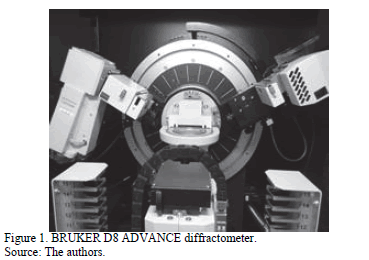
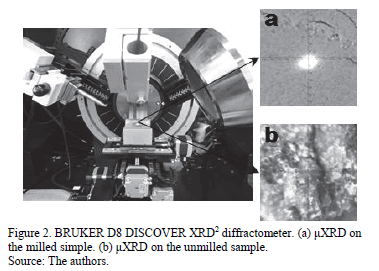
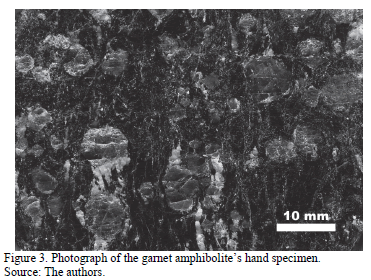
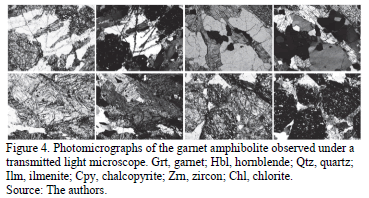
<body><![CDATA[<p><font size="2" face="Verdana, Arial, Helvetica, sans-serif">The garnet   amphibolite samples were first analyzed by transmitted light microscopy, by using a Nikon trinocular microscope (model Labophot2-POL) in order to capture   photomicrographs with the 5x   objective of the optical properties</font> <font size="2" face="Verdana, Arial, Helvetica, sans-serif">of garnet, as   well as its textural relationships with other mineral phases. The Kretz &#91;14&#93;   system of mineral abbreviations is used. </font></p>     <p><font size="2" face="Verdana, Arial, Helvetica, sans-serif"><b>2.2.2. Scanning electron microscopy (SEM)</b></font></p>     <p><font size="2" face="Verdana, Arial, Helvetica, sans-serif">Backscatter electron (BSE) imaging and   EDS analysis of garnet were carried out using a FEI QUANTA FEG 650   environmental scanning electron microscope (ESEM), under the following   analytical conditions: magnification = 100-20000x, WD = 9.0-11.0 mm, HV = 20 kV,   signal = BSE in Z CONT mode, detector = BSED, EDS Detector EDAX   APOLO X with resolution of 126.1 eV (in. Mn K<font face="Symbol">a</font>).</font></p>     <p><font size="2" face="Verdana, Arial, Helvetica, sans-serif"><b>2.2.3. X-ray powder diffraction (XRPD)</b></font></p>     <p><font size="2" face="Verdana, Arial, Helvetica, sans-serif">The sample was milled in an agate mortar   and then mounted on a sample holder of polymethylmethacrylate (PMMA) using the   filling front technique . The XRPD pattern of garnet was recorded by X-ray   diffraction using a BRUKER D8 ADVANCE diffractometer (<a href="#fig01">Fig. 1</a>) operating in Da   Vinci geometry and equipped with an X-ray tube (Cu-K<font face="Symbol">a</font>1 radiation: <font face="Symbol">l</font> =   1.5406 Å, 40 kV and 30 mA), a 1-dimensional LynxEye detector (with aperture   angle of 2.93<sup>o</sup>), a divergent slit of 0.6 mm, two soller axials   (primary and secondary) of 2.5º and a nickel filter. Data collection was   carried out in the 2<font face="Symbol">q</font> range of 12-80&deg;, with a step size of 0.01526&deg; (2<i><font face="Symbol">q</font></i>) and counting time of 1 s/step.   Phase identification was performed using the crystallographic database Powder   Diffraction File (PDF-2) from the International Centre for Diffraction Data   (ICDD) and the Crystallographica Search-Match program. The unit-cell constants,   atomic positions, factors of peak broadening and phase concentrations were   refined and calculated by using the MDI RIQAS program based on Rietveld method.</font></p>     <p align="center"><font size="2" face="Verdana, Arial, Helvetica, sans-serif"><a name="fig01"></a></font><img src="/img/revistas/dyna/v83n195/v83n195a11fig01.gif"></p>     <p><font size="2" face="Verdana, Arial, Helvetica, sans-serif"><b>2.2.4. Micro X-Ray Diffraction (µXRD)</b></font></p>     <p><font size="2" face="Verdana, Arial, Helvetica, sans-serif">For a powder sample   measurement, an agate mortar was first milled and then mounted on a   polymethylmethacrylate (PMMA)sample holder using the filling front technique.   Finally, the measurement was adjusted in the Eulerian cradle. </font></p>     <p><font size="2" face="Verdana, Arial, Helvetica, sans-serif">To measure an unmilled sample, the XYZ coordinate system of the   quarter-circle Eulerian cradle was adjusted directly. µXRD   data on powder and unmilled samples were collected with the BRUKER D8 DISCOVER diffractometer, equipped with the   2D GADDS (<a href="#fig02">Fig. 2</a>), operated in Da Vinci geometry with   CuK<font face="Symbol">a</font>1 radiation (<font face="Symbol">l</font> = 1.5406 Å) at 40 kV and 30 mA; equipped with a   Optics Göebel Mirror, a circular divergent slit of 1 mm, a collimator of 1 mm,   and a 2-dimensional detector VÅNTEC-500 (with an angular aperture of 42º in the   2<font face="Symbol">q</font> range and a work distance of 150 mm). Data   collection was carried out in the 2<font face="Symbol">q</font> range of 25-45&deg; in two intervals,   with an increase per interval of 20&deg; (2<font face="Symbol">q</font>), a step scan, and a pixel size   of 2048 x 2048. The two dimensional (2D) image GADDS were obtained in   the spherical coordinate system of the   Debye-Scherrer rings by using the DIFFRACT PILOT program. The diffraction   patterns were obtained from the integration of several sections of the   Debye-Scherrer rings by using a 0.01º (2<font face="Symbol">q</font>)   step. Phase identification was performed using the   crystallographic database Powder Diffraction File (PDF-2) from the   International Centre for Diffraction Data (ICDD) and the Crystallographica Search-Match   software.</font></p>     <p align="center"><font size="2" face="Verdana, Arial, Helvetica, sans-serif"><a name="fig02"></a></font><img src="/img/revistas/dyna/v83n195/v83n195a11fig02.gif"></p>     ]]></body>
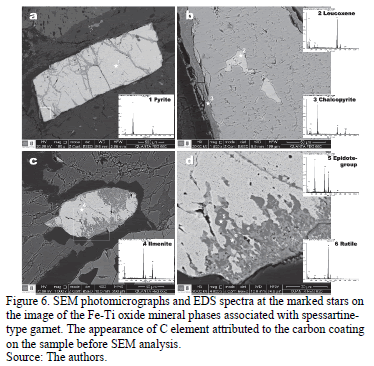
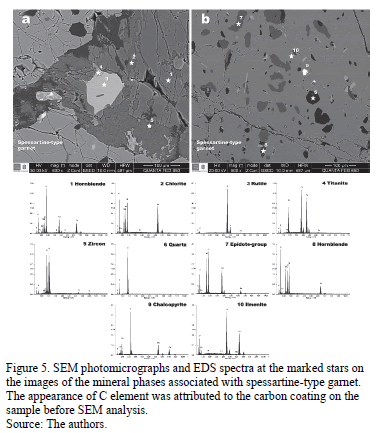
<body><![CDATA[<p>&nbsp;</p>     <p><font size="3" face="Verdana, Arial, Helvetica, sans-serif"><b>3. Results</b></font></p>     <p><font size="2" face="Verdana, Arial, Helvetica, sans-serif"><b><i>3.1. Petrographic analysis</i></b></font></p>     <p><font size="2" face="Verdana, Arial, Helvetica, sans-serif"><a href="#fig03">Fig. 3</a> shows a photograph of the garnet   amphibolite of interest in the present study's hand specimen, with the garnet   being typically dark reddish brown in color with a vitreous luster and xenoblastic   character. It develops large porphyroblasts in a dark green nematoblastic   matrix and is mainly composed of hornblende. </font></p>     <p align="center"><font size="2" face="Verdana, Arial, Helvetica, sans-serif"><a name="fig03"></a></font><img src="/img/revistas/dyna/v83n195/v83n195a11fig03.gif"></p>     <p><font size="2" face="Verdana, Arial, Helvetica, sans-serif"><a href="#fig04">Fig. 4</a> illustrates the corresponding   photomicrographs with large xenoblastic garnet porphyroblasts in a matrix   mainly composed of hornblende. </font></p>     <p align="center"><font size="2" face="Verdana, Arial, Helvetica, sans-serif"><a name="fig04"></a></font><img src="/img/revistas/dyna/v83n195/v83n195a11fig04.gif"></p>     <p><font size="2" face="Verdana, Arial, Helvetica, sans-serif"><b><i>3.2. Scanning electron microscopy (SEM)</i></b></font></p>     <p><font size="2" face="Verdana, Arial, Helvetica, sans-serif">The backscatter electron (BSE) images <a href="#fig05">Figs.   5</a>-<a href="#fig06">6</a> show the textural relationships observed between spessartine-type garnet and associated mineral phases with   semiquantitative energy dispersive spectrum (EDS)   analysis at different points. This allowed particular elements and their   relative proportions in the mineral phases that constitute the   garnet-amphibolite sample of interest in this study to be identified. EDS analysis reveals that the main   mineral phases in the analyzed rocks correspond to spessartine-type garnet and   hornblende. The main accessory mineral phases are quartz, zoisite   (epidote-group mineral), rutile, ilmenite, pyrite, chalcopyrite and zircon.   Chlorite is recognized as a replacement product of hornblende.</font></p>     <p align="center"><font size="2" face="Verdana, Arial, Helvetica, sans-serif"><a name="fig05"></a></font><img src="/img/revistas/dyna/v83n195/v83n195a11fig05.gif"></p>     ]]></body>
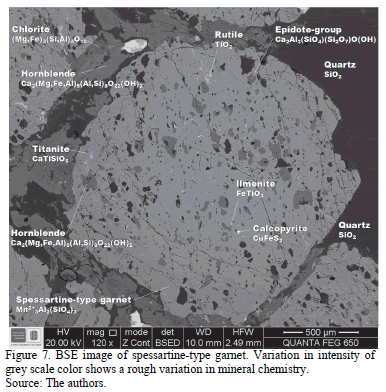
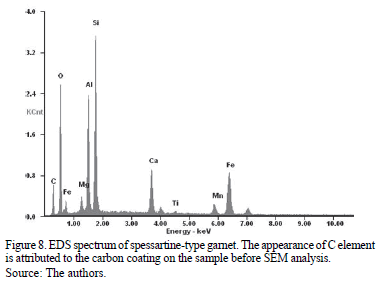
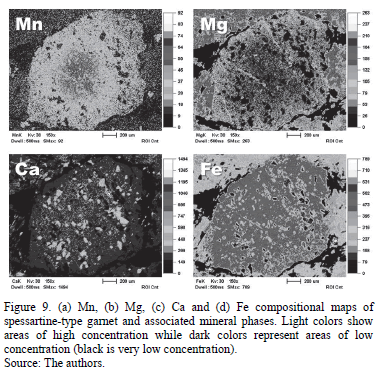
<body><![CDATA[<p align="center"><font size="2" face="Verdana, Arial, Helvetica, sans-serif"><a name="fig06"></a></font><img src="/img/revistas/dyna/v83n195/v83n195a11fig06.gif"></p>     <p><font size="2" face="Verdana, Arial, Helvetica, sans-serif"><a href="#fig05">Fig. 5a</a> illustrates examples of the matrix mineral phases, with   hornblende (1) as the main associated mineral phase, which is commonly replaced   by chlorite (2). Rutile (3) developing reaction rims of titanite (4) occurs as   the main accessory mineral phase. Very fine-grained zircon (5) crystals are   scarcely distributed in the study samples. EDS analysis reveals the following mass ratios:   Si:Al:O:Fe:Ca:Mg:Na:K:Ti for hornblende   (23.64:6.98:26.91:11.44:6.90:6.73:1.59:0.29:0.29), Si:Al:O:Fe:Mgfor chlorite   (14.11:10.91:31.58:19.18:9.91), Ti:O for rutile (64.40:26.49), Si:Al:O:Ca:Ti:Fe   for titanite (15.91:0.51:22.39:22.10:28.68:0.33), and Si:O:Zr for zircon   (15.62:18.38:45.25). <a href="#fig05">Fig. 5b</a> displays the   occurrence of numerous randomly distributed mineral inclusions, such as quartz   (6), zoisite (7), hornblende (8), chalcopyrite (9) and ilmenite (10), in spessartine-type   garnet. EDS analysis reveals the following mass ratios: Si:O for quartz   (47.34:35.62), Si:Al:O:Ca:Fe for zoisite (19.86:15.3726.96:17.11:6.38),   Si:Al:O:Mg:Fe for hornblende (13.36:11.11:33.09:11.14:16.00), Fe:Cu:S for   chalcopyrite (24.91:28.72:27.65), and Ti:Fe:O for ilmenite (30.93:37.65:20.75). </font></p>     <p><font size="2" face="Verdana, Arial, Helvetica, sans-serif"><a href="#fig06">Figs. 6a</a> and <a href="#fig06">6b</a> illustrate the occurrence   of pyrite (1) in the matrix, which contains chalcopyrite (2) inclusions and is   partially replaced by leucoxene (3). <a href="#fig06">Figs. 6c</a> and <a href="#fig06">6d</a> illustrate the occurrence   of ilmenite (4) in the matrix, which contains zoisite (5) inclusions and is   partially replaced by rutile (6). EDS analysis reveals the following mass   ratios: Fe:S for pyrite (38.38:41.25), Fe:Cu:S for chalcopyrite   (24.91:28.72:27.65), Fe:O for leucoxene (66.22:19.87), Ti:Fe:O for   ilmenite (30.93:37.65:20.75),Si:Al:O:Ca:Ti:Fe for zoisite   (16.92:0.44:23.90:21.36:25.47:0.93), and Ti:O for rutile (64.40:26.49).</font></p>     <p><font size="2" face="Verdana, Arial, Helvetica, sans-serif">The backscatter electron (BSE) image <a href="#fig07">Fig. 7</a> shows the textural relationships observed between spessartine-type garnet and associated mineral phases. Note the   high-density Fe-Ti oxide (on the upper and lower parts), the randomly oriented   inclusion-rich spessartine-type garnet and associated mineral phases, and the   reaction textures from the BSE image contrast. </font></p>     <p align="center"><font size="2" face="Verdana, Arial, Helvetica, sans-serif"><a name="fig07"></a></font><img src="/img/revistas/dyna/v83n195/v83n195a11fig07.gif"></p>     <p><font size="2" face="Verdana, Arial, Helvetica, sans-serif">EDS analysis reveals that the mass ratios   (Si:Al:O:Fe:Ca:Mn:Mg) of the spessartine-type garnet are   18.96:11.63:25.49:18.50:6.32:3.67:1.56. The EDS spectrum of spessartine-type   garnet (<a href="#fig08">Fig. 8</a>) reveals that it mainly consists of Si, Al, O, Fe and Ca, with a   minor amount of Mn and Mg. </font></p>     <p align="center"><font size="2" face="Verdana, Arial, Helvetica, sans-serif"><a name="fig08"></a></font><img src="/img/revistas/dyna/v83n195/v83n195a11fig08.gif"></p>     <p><font size="2" face="Verdana, Arial, Helvetica, sans-serif">X-rays generated by scanning the electron   beam across the sample can be used to produce EDS mapping, which provides an   image of a meaningful picture of the elemental distribution of a mineral phase,   in addition to the BSE. In <a href="#fig09">Fig. 9</a>, the different phases shown on the BSE image   (<a href="#fig09">Fig. 9a</a>) can be identified by elemental mapping (<a href="#fig09">Figs. 9b</a>-<a href="#fig09">9d</a>); however, this   will only give a qualitative image of the distribution of elements. The   elemental mapping shows an oscillatory pattern with respect to Mn (<a href="#fig09">Fig. 9b</a>, X<sub>sps</sub>),   which has a decrease of X<sub>sps</sub>. However, this cannot be attributed to   the abundant epidote-group inclusions, because there is no relationship between   zoning and the distribution pattern of inclusions. No chemical zoning can be   identified from the core to the rim with regards to Mg (<a href="#fig09">Fig. 9c</a>, X<sub>grs</sub>)   and Ca (<a href="#fig09">Fig. 9d</a>, X<sub>grs</sub>). </font></p>     <p align="center"><font size="2" face="Verdana, Arial, Helvetica, sans-serif"><a name="fig09"></a></font><img src="/img/revistas/dyna/v83n195/v83n195a11fig09.gif"></p>     <p><font size="2" face="Verdana, Arial, Helvetica, sans-serif">Elemental maps provide valuable   information even without µXRD. It is very important to highlight that a high Mn   content is mirrored by a low Mg content. Note the high content of Ca, representing   zoisite (a Ca-rich mineral phase) inclusions in the spessartine-type garnet. Fe   content is very uniform in spessartine-type garnet; however, the low Fe content   of the mineral inclusions should be noted.</font></p>     ]]></body>
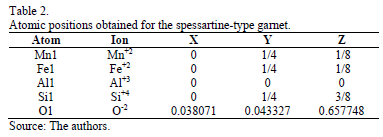
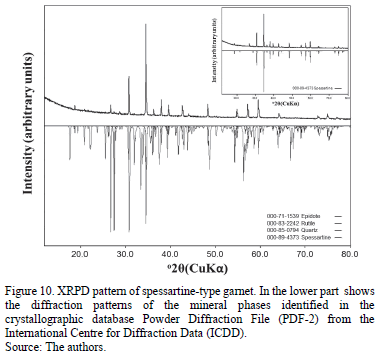
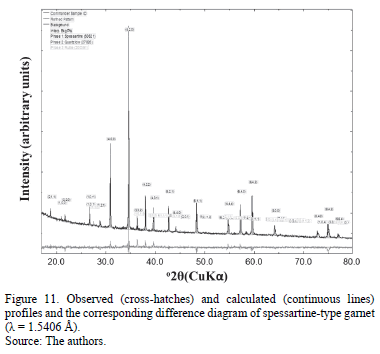
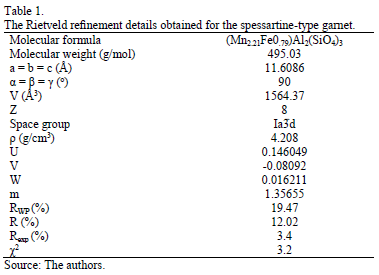
<body><![CDATA[<p><font size="2" face="Verdana, Arial, Helvetica, sans-serif"><b><i>3.3. X-ray powder diffraction (XRPD)</i></b></font></p>     <p><font size="2" face="Verdana, Arial, Helvetica, sans-serif"><a href="#fig11">Fig. 10</a> shows the XRPD pattern of the   spessartine-type garnet, in which the high intensity reflections correspond to   spessartine-type garnet (PDF No. 000-89-4373), and the low intensity   reflections reveal the presence of quartz (PDF No. 000-89-0794), rutile (PDF   No. 000-83-2242), and epidote (PDF No. 000-71-1539).</font></p>     <p align="center"><font size="2" face="Verdana, Arial, Helvetica, sans-serif"><a name="fig10"></a></font><img src="/img/revistas/dyna/v83n195/v83n195a11fig10.gif"></p>     <p><font size="2" face="Verdana, Arial, Helvetica, sans-serif">The   Rietveld refinement of the XRPD pattern allows the percentage of the   rock-forming minerals to be determined. <a href="#fig11">Fig. 11</a> illustrates the observed,   calculated and difference profiles for the XRPD garnet data after refinement. The crystalline phase of   interest in this study corresponds to a spessartine-type garnet structure, although   a few extra lines reveal the occurrence of other mineral phases that are   described above. The difference between the observed and calculated profiles   shows a good fit for the refined parameters (cell-unit   constants, atomic positions, factors of peak broadening and phase   concentrations).</font></p>     <p align="center"><font size="2" face="Verdana, Arial, Helvetica, sans-serif"><a name="fig11"></a></font><img src="/img/revistas/dyna/v83n195/v83n195a11fig11.gif"></p>     <p><font size="2" face="Verdana, Arial, Helvetica, sans-serif">The Rietveld refinement details (including the parameters of profile broadening U, V, W, m), obtained for the   spessartine-type garnet, are presented in <a href="#tab01">Table 1</a>. The refinement of the XRPD   data reveals a small preferential orientation in the reflection (400) for the   spessartine-type garnet framework, which crystallized in the cubic space</font> <font size="2" face="Verdana, Arial, Helvetica, sans-serif">group Ia<img src="/img/revistas/dyna/v83n195/v83n195a11eq025.gif">d (n<sup>o</sup> 230), and has unit cell parameters a = b = c =   11.6086 &Aring;; <font face="Symbol">a</font> = <font face="Symbol">b</font> = <font face="Symbol">g</font> = 90&ordm;, V = 1564.37 &Aring;<sup>3</sup>, Z = 8 and <img src="/img/revistas/dyna/v83n195/v83n195a11eq027.gif">4.208 g/cm<sup>3</sup>. ICSD = 50621 was the number used to refine   the spessartine-type garnet. These results fully agree with those obtained by   Sawada &#91;15&#93;.</font></p>     <p align="center"><font size="2" face="Verdana, Arial, Helvetica, sans-serif"><a name="tab01"></a></font><img src="/img/revistas/dyna/v83n195/v83n195a11tab01.gif"></p>     <p><font size="2" face="Verdana, Arial, Helvetica, sans-serif">The concentrations of the refined phases   and their corresponding (standard deviation) obtained were: spessartine-type   garnet (Mn<sub>2.21</sub>Fe<sub>0.79</sub>)Al<sub>2</sub>(SiO<sub>4</sub>)<sub>3</sub> = 94.0% (0.3), quartz (SiO<sub>2</sub>) = 4.9% (0.1), rutile (TiO<sub>2</sub>)   = 1.1% (0.1). The concentration and corresponding standard deviation of the epidote cannot be quantified due   to its low concentration. </font></p>     <p><font size="2" face="Verdana, Arial, Helvetica, sans-serif">The final agreement values for the   refinement are R<sub>wp</sub> = 19.47%, R = 12.02%, R<sub>exp</sub> = 3.40%,   and <font face="Symbol">c</font><sup>2</sup> = 3.2.</font></p>     <p><font size="2" face="Verdana, Arial, Helvetica, sans-serif">In the refinement model used in this   study, only the atomic coordinates for oxygen were refined with a standard   deviation in the three crystallographic axes that was lower than 10% with   respect to the values reported in the database. The other elements show fixed   positions and, therefore, they were not refined. The atomic coordinates for the   spessartine-type garnet are depicted in <a href="#tab02">Table 2</a>.</font></p>     ]]></body>
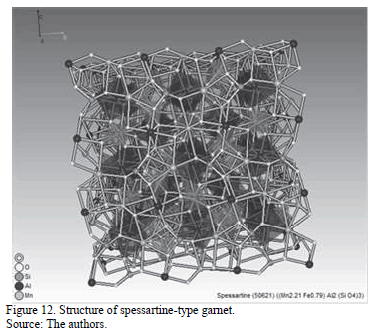
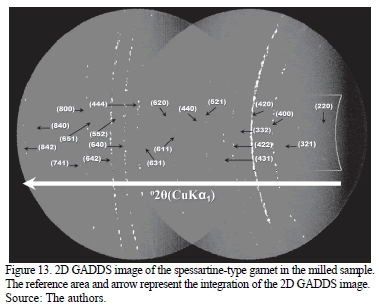
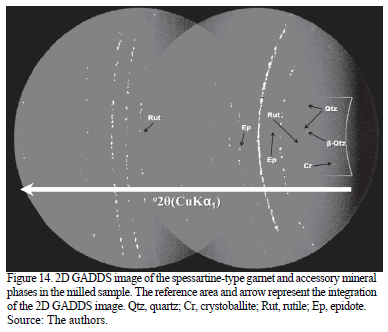
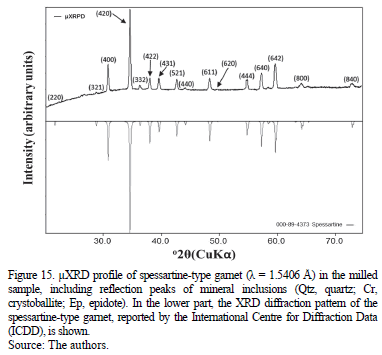
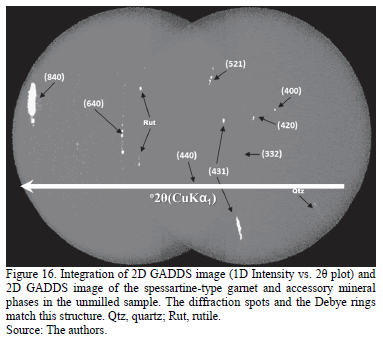
<body><![CDATA[<p align="center"><font size="2" face="Verdana, Arial, Helvetica, sans-serif"><a name="tab02"></a></font><img src="/img/revistas/dyna/v83n195/v83n195a11tab02.gif"></p>     <p><font size="2" face="Verdana, Arial, Helvetica, sans-serif"><a href="#fig12">Fig.12</a> shows the spessartine-type garnet   structure obtained with the software MDI RIQAS5. </font></p>     <p align="center"><font size="2" face="Verdana, Arial, Helvetica, sans-serif"><a name="fig12"></a></font><img src="/img/revistas/dyna/v83n195/v83n195a11fig12.gif"></p>     <p><font size="2" face="Verdana, Arial, Helvetica, sans-serif"><b><i>3.4. Micro X-Ray Diffraction (µXRD)</i></b></font></p>     <p><font size="2" face="Verdana, Arial, Helvetica, sans-serif">The two   dimensional image (2<font face="Symbol">q</font>,g) from the GADDS detector shows how the   spessartine-type garnet appears as homogeneous Debye rings (<a href="#fig13">Fig. 13</a>) of   constant intensity, displaying 21 diffraction cones of 21 different planes in   its crystalline structure. The diffraction spots and the Debye rings match this   structure. The continuous and irregular rings reveal that the sample is   polycrystalline, however, its particle size is very coarse. </font></p>     <p align="center"><font size="2" face="Verdana, Arial, Helvetica, sans-serif"><a name="fig13"></a></font><img src="/img/revistas/dyna/v83n195/v83n195a11fig13.gif"></p>     <p><font size="2" face="Verdana, Arial, Helvetica, sans-serif">The   crystalline accessory minerals appear as a lower pixel diffraction cone of the   quartz crystalline plane (011), and small crystalline spots correspond to   rutile and epidote, which are shown in the 2D GADDS image of <a href="#fig14">Fig. 14</a>. The   internal rings are characterized by the presence of rutile and epidote. This   provides useful information on the scarce number of crystallites in these   phases and their low concentration. Microcrystalline quartz appears to produce   very thin lines, mostly appearing as a series of tiny connected dots, with some   larger point reflections.</font></p>     <p align="center"><font size="2" face="Verdana, Arial, Helvetica, sans-serif"><a name="fig14"></a></font><img src="/img/revistas/dyna/v83n195/v83n195a11fig14.gif"></p>     <p><font size="2" face="Verdana, Arial, Helvetica, sans-serif">On each one   of the Debye rings, the structure planes diffracted by the spessartine-type   garnet are indicated and the reference area and arrow represent the place where   the 1D integration diffraction pattern (Intensity vs. 2<font face="Symbol">q</font>) was obtained (<a href="#fig15">Fig. 15</a>). The identification of the spessartine-type garnet (PDF   No. 000-89-4373) was performed by comparing the observed diffraction pattern   with the PDF-2 data base patterns.</font></p>     <p align="center"><font size="2" face="Verdana, Arial, Helvetica, sans-serif"><a name="fig15"></a></font><img src="/img/revistas/dyna/v83n195/v83n195a11fig15.gif"></p>     ]]></body>
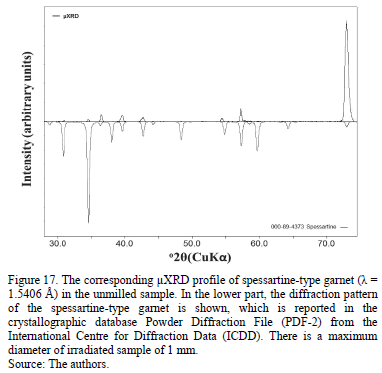
<body><![CDATA[<p><font size="2" face="Verdana, Arial, Helvetica, sans-serif">µXRD on the unmilled simple reveals the   occurrence of spots and discontinue diffraction rings (<a href="#fig16">Fig. 16</a>), which reveals   that there is a mixture of crystallites with several sizes and some strong   orientations (reflection (840)). The hkl planes observed correspond to the   characteristic reflections of the spessartine-type garnet.</font></p>     <p align="center"><font size="2" face="Verdana, Arial, Helvetica, sans-serif"><a name="fig16"></a></font><img src="/img/revistas/dyna/v83n195/v83n195a11fig16.gif"></p>     <p><font size="2" face="Verdana, Arial, Helvetica, sans-serif">In order to observe numerous reflections,   it is necessary to rotate the sample at different angles; however, in our case   with the eight (8) reflections that were observed, the identification of   mineral phases (<a href="#fig17">Fig. 17</a>) was easy.</font></p>     <p align="center"><font size="2" face="Verdana, Arial, Helvetica, sans-serif"><a name="fig17"></a></font><img src="/img/revistas/dyna/v83n195/v83n195a11fig17.gif"></p>     <p>&nbsp;</p>     <p><font size="3" face="Verdana, Arial, Helvetica, sans-serif"><b>4. Conclusions</b></font></p>     <p><font size="2" face="Verdana, Arial, Helvetica, sans-serif">Both scanning electron microscopy and   X-ray diffraction techniques are very useful for mineral characterization.   Novel analytical methods such as the µXRD technique provide</font> <font size="2" face="Verdana, Arial, Helvetica, sans-serif">the possibility   of non-destructive in situ characterization of geological materials with micro   spatial resolution. The results in this paper demonstrated the importance of   combining such advanced techniques to accurately characterize the distribution   of key elements and rock-forming minerals. In this case, analyses were made   using (1) petrographic analysis, (2) SEM/EDS analysis, (3) 2-D <font face="Symbol">m</font>XRD (GADDS)   representation (4) 1-D <font face="Symbol">m</font>XRD representation. To the best of our knowledge, this   is the first study that analyzes garnet in such a way, and the results should   prove valuable in the characterization of metamorphic rocks; in particular, to   distinguish the accessory crystalline mineral phases present in garnet.</font></p>     <p>&nbsp;</p>     <p><font size="3" face="Verdana, Arial, Helvetica, sans-serif"><b>Acknowledgments</b></font></p>     <p><font size="2" face="Verdana, Arial, Helvetica, sans-serif">We gratefully   acknowledge the Vicerrector&iacute;a de Investigaci&oacute;n y Extensi&oacute;n of the Universidad   Industrial de Santander for the use of their research facilities (scanning electron microscopy and X-ray diffraction). We also thank   the Microscopy and X-Rays laboratories at the Universidad Industrial de   Santander - Guatiguar&aacute; Technology Park, and their staff for the analytical   service provided for data acquisition. The authors would also like to   acknowledge the anonymous referees for their critical and insightful reading of   the manuscript and are most grateful to the above-named people and institutions   for support.</font></p>     ]]></body>
<body><![CDATA[<p>&nbsp;</p>     <p><font size="3" face="Verdana, Arial, Helvetica, sans-serif"><b>References</b></font></p>     <!-- ref --><p><font size="2" face="Verdana, Arial, Helvetica, sans-serif"><b>&#91;1&#93;</b> Tissot, R.G., Microdiffraction   applications utilizing a two-dimensional proportional detector. Powder   Diffraction, 18(2), pp 86-90, 2003. DOI: 10.1154/1.1577354</font>&nbsp;&nbsp;&nbsp;&nbsp;&nbsp;&nbsp;&nbsp;&nbsp;[&#160;<a href="javascript:void(0);" onclick="javascript: window.open('/scielo.php?script=sci_nlinks&ref=1131270&pid=S0012-7353201600010001100001&lng=','','width=640,height=500,resizable=yes,scrollbars=1,menubar=yes,');">Links</a>&#160;]<!-- end-ref --><!-- ref --><p><font size="2" face="Verdana, Arial, Helvetica, sans-serif"><b>&#91;2&#93;</b> Flemming, R.L., Salzsauler, K.A.,   Sherriff, B. L. and Sidenko, N.V., Identification of scorodite in fine-grained,   high-sulfide, arsenopyrite mine-waste using micro X-ray diffraction (<font face="Symbol">m</font>XRD).   The Canadian Mineralogist, 43, pp. 1243-1254, 2005. DOI:   10.2113/gscanmin.43.4.1243</font>&nbsp;&nbsp;&nbsp;&nbsp;&nbsp;&nbsp;&nbsp;&nbsp;[&#160;<a href="javascript:void(0);" onclick="javascript: window.open('/scielo.php?script=sci_nlinks&ref=1131271&pid=S0012-7353201600010001100002&lng=','','width=640,height=500,resizable=yes,scrollbars=1,menubar=yes,');">Links</a>&#160;]<!-- end-ref --><!-- ref --><p><font size="2" face="Verdana, Arial, Helvetica, sans-serif"><b>&#91;3&#93;</b> Harwood, B.P., Flemming, R.L. and   Stachel, T., Mapping a mantle xenolith using micro X-ray diffraction. Abstract   #MA73B-09, American Geophysical Union, Spring Meeting, 2009.    &nbsp;&nbsp;&nbsp;&nbsp;&nbsp;&nbsp;&nbsp;&nbsp;[&#160;<a href="javascript:void(0);" onclick="javascript: window.open('/scielo.php?script=sci_nlinks&ref=1131272&pid=S0012-7353201600010001100003&lng=','','width=640,height=500,resizable=yes,scrollbars=1,menubar=yes,');">Links</a>&#160;]<!-- end-ref --></font></p>     <!-- ref --><p><font size="2" face="Verdana, Arial, Helvetica, sans-serif"><b>&#91;4&#93;</b> Catalano, J.G., Heald, S.M., Zachara,   J.M. and Brown, Jr., G.E., X-ray microdiffraction study of Uranium speciation   in contaminated vadose zone sediments from the Hanford Site, Washington. US   Department of Energy Publications, &#91;Online&#93;. Paper 226, 2004. Available at <a href="http://digitalcommons.unl.edu/usdoepub/226" target="_blank">http://digitalcommons.unl.edu/usdoepub/226</a></font>&nbsp;&nbsp;&nbsp;&nbsp;&nbsp;&nbsp;&nbsp;&nbsp;[&#160;<a href="javascript:void(0);" onclick="javascript: window.open('/scielo.php?script=sci_nlinks&ref=1131274&pid=S0012-7353201600010001100004&lng=','','width=640,height=500,resizable=yes,scrollbars=1,menubar=yes,');">Links</a>&#160;]<!-- end-ref --><!-- ref --><p><font size="2" face="Verdana, Arial, Helvetica, sans-serif"><b>&#91;5&#93;</b> Flemming, R.L., Micro X-ray diffraction   (µXRD): A versatile technique for characterization of Earth and planetary   materials. Canadian Journal of Earth Sciences, 44(9), pp. 1333-1346, 2007. DOI:   10.1139/E07-020</font>&nbsp;&nbsp;&nbsp;&nbsp;&nbsp;&nbsp;&nbsp;&nbsp;[&#160;<a href="javascript:void(0);" onclick="javascript: window.open('/scielo.php?script=sci_nlinks&ref=1131275&pid=S0012-7353201600010001100005&lng=','','width=640,height=500,resizable=yes,scrollbars=1,menubar=yes,');">Links</a>&#160;]<!-- end-ref --><!-- ref --><p><font size="2" face="Verdana, Arial, Helvetica, sans-serif"><b>&#91;6&#93;</b> Flemming, R.L., McCausland, P.J.A.,   Izawa, M.R. and Jacques, N., Reconnaissance micro-XRD studies of meteorites:   Rapid in situ mineral identification and textural information. Abstract #2363,   38<sup>th</sup> Lunar and Planetary Science Conference, Houston, TX, 2007.    &nbsp;&nbsp;&nbsp;&nbsp;&nbsp;&nbsp;&nbsp;&nbsp;[&#160;<a href="javascript:void(0);" onclick="javascript: window.open('/scielo.php?script=sci_nlinks&ref=1131276&pid=S0012-7353201600010001100006&lng=','','width=640,height=500,resizable=yes,scrollbars=1,menubar=yes,');">Links</a>&#160;]<!-- end-ref --></font></p>     ]]></body>
<body><![CDATA[<!-- ref --><p><font size="2" face="Verdana, Arial, Helvetica, sans-serif"><b>&#91;7&#93;</b> Izawa, M.R.M., Flemming, R.L.,   Banerjee, N.R. and McCausland, P.J.A., Micro X-ray diffraction (µXRD)   assessment of shock stage in enstatite chondrites. Meteoritics and Planetary   Science, 46, pp 638-651, 2011. DOI: 10.1111/j.1945-5100.2011.01180.x</font>&nbsp;&nbsp;&nbsp;&nbsp;&nbsp;&nbsp;&nbsp;&nbsp;[&#160;<a href="javascript:void(0);" onclick="javascript: window.open('/scielo.php?script=sci_nlinks&ref=1131278&pid=S0012-7353201600010001100007&lng=','','width=640,height=500,resizable=yes,scrollbars=1,menubar=yes,');">Links</a>&#160;]<!-- end-ref --><!-- ref --><p><font size="2" face="Verdana, Arial, Helvetica, sans-serif"><b>&#91;8&#93;</b> Dähn, R., Popov, D., Schaub, Ph.,   Pattison, P., Grolimund, D., Mäder, U., Jenni, A. and Wieland, E., X-ray   micro-diffraction studies of heterogeneous interfaces between cementitious   materials and geological formations. Physics and Chemistry of the Earth, Parts   A/B/C, 70-71, pp. 96-103, 2014. DOI: 10.1016/j.pce.2013.10.010</font>&nbsp;&nbsp;&nbsp;&nbsp;&nbsp;&nbsp;&nbsp;&nbsp;[&#160;<a href="javascript:void(0);" onclick="javascript: window.open('/scielo.php?script=sci_nlinks&ref=1131279&pid=S0012-7353201600010001100008&lng=','','width=640,height=500,resizable=yes,scrollbars=1,menubar=yes,');">Links</a>&#160;]<!-- end-ref --><!-- ref --><p><font size="2" face="Verdana, Arial, Helvetica, sans-serif"><b>&#91;9&#93;</b> Pereira, E., Ort&iacute;z, F. and Prichard, H., Contribuci&oacute;n   al conocimiento de las anfibolitas y dunitas de Medell&iacute;n (Complejo Ofiol&iacute;tico   de Aburr&aacute;). DYNA, 73(149), pp. 17-30, 2006.    &nbsp;&nbsp;&nbsp;&nbsp;&nbsp;&nbsp;&nbsp;&nbsp;[&#160;<a href="javascript:void(0);" onclick="javascript: window.open('/scielo.php?script=sci_nlinks&ref=1131280&pid=S0012-7353201600010001100009&lng=','','width=640,height=500,resizable=yes,scrollbars=1,menubar=yes,');">Links</a>&#160;]<!-- end-ref --></font></p>     <!-- ref --><p><font size="2" face="Verdana, Arial, Helvetica, sans-serif"><b>&#91;10&#93;</b> R&iacute;os, C.A., Castellanos, O.M., R&iacute;os, V. y G&oacute;mez, C., Una contribuci&oacute;n al   estudio de la evoluci&oacute;n tectono-metam&oacute;rfica de las rocas de alta presi&oacute;n del   Complejo Arqu&iacute;a, Cordillera Central, Andes Colombianos. Geolog&iacute;a Colombiana,   33, pp. 3-22, 2008.    &nbsp;&nbsp;&nbsp;&nbsp;&nbsp;&nbsp;&nbsp;&nbsp;[&#160;<a href="javascript:void(0);" onclick="javascript: window.open('/scielo.php?script=sci_nlinks&ref=1131282&pid=S0012-7353201600010001100010&lng=','','width=640,height=500,resizable=yes,scrollbars=1,menubar=yes,');">Links</a>&#160;]<!-- end-ref --></font></p>     <!-- ref --><p><font size="2" face="Verdana, Arial, Helvetica, sans-serif"><b>&#91;11&#93;</b> Ru&iacute;z-Jim&eacute;nez, E.C., Blanco-Quintero, I.F., Toro, L.M., Moreno-S&aacute;nchez,   M., Vinasco, C.J., Garc&iacute;a-Casco, A., Morota, D. and G&oacute;mez-Cruz, A.,   Geochemistry and petrology of metabasites of the Arqu&iacute;a Complex (Santa Fe de   Antoquia and Arqu&iacute;a River, Colombia): Geodynamic implications. Bolet&iacute;n de   Ciencias de la Tierra, 32, pp. 65-80, 2012.    &nbsp;&nbsp;&nbsp;&nbsp;&nbsp;&nbsp;&nbsp;&nbsp;[&#160;<a href="javascript:void(0);" onclick="javascript: window.open('/scielo.php?script=sci_nlinks&ref=1131284&pid=S0012-7353201600010001100011&lng=','','width=640,height=500,resizable=yes,scrollbars=1,menubar=yes,');">Links</a>&#160;]<!-- end-ref --></font></p>     <!-- ref --><p><font size="2" face="Verdana, Arial, Helvetica, sans-serif"><b>&#91;12&#93;</b> Valencia-Morales, Y.T., Toro-Toro, L.M., Ruiz-Jim&eacute;nez,   E.C. and Moreno-S&aacute;nchez, M., Pressure-Temperature path of Arqu&iacute;a Group rocks   (NW Colombia): A petrographic analysis from mineral assemblages. Earth Science   Research Journal, 17(2), pp. 141-149, 2013. DOI: 10.1127/0077-7749/2013/0338</font>&nbsp;&nbsp;&nbsp;&nbsp;&nbsp;&nbsp;&nbsp;&nbsp;[&#160;<a href="javascript:void(0);" onclick="javascript: window.open('/scielo.php?script=sci_nlinks&ref=1131286&pid=S0012-7353201600010001100012&lng=','','width=640,height=500,resizable=yes,scrollbars=1,menubar=yes,');">Links</a>&#160;]<!-- end-ref --><!-- ref --><p><font size="2" face="Verdana, Arial, Helvetica, sans-serif"><b>&#91;13&#93;</b> Pardo-Trujillo, A. y Moreno-S&aacute;nchez, M., Estratigraf&iacute;a del occidente   colombiano y su relaci&oacute;n con la evoluci&oacute;n de la provincia &iacute;gnea Cret&aacute;cea del   Caribe Colombiano, VIII Congreso Colombiano de Geolog&iacute;a, Manizales, Colombia,   Agosto, 2001.    &nbsp;&nbsp;&nbsp;&nbsp;&nbsp;&nbsp;&nbsp;&nbsp;[&#160;<a href="javascript:void(0);" onclick="javascript: window.open('/scielo.php?script=sci_nlinks&ref=1131287&pid=S0012-7353201600010001100013&lng=','','width=640,height=500,resizable=yes,scrollbars=1,menubar=yes,');">Links</a>&#160;]<!-- end-ref --></font></p>     <!-- ref --><p><font size="2" face="Verdana, Arial, Helvetica, sans-serif"><b>&#91;14&#93;</b> Kerr, A., Marriner, G., Tarney, J., Nivia, A., Saunders, A., Thirlwall,   M. and Sinton, C., Cretaceous basaltic terranes in Western Colombia: Elemental,   chronological and Sr-Nd isotopic constraints on petrogenesis. Journal of   Petrology, 38, pp. 677-702, 1997. DOI: 10.1093/petrology/38.6.677</font>&nbsp;&nbsp;&nbsp;&nbsp;&nbsp;&nbsp;&nbsp;&nbsp;[&#160;<a href="javascript:void(0);" onclick="javascript: window.open('/scielo.php?script=sci_nlinks&ref=1131289&pid=S0012-7353201600010001100014&lng=','','width=640,height=500,resizable=yes,scrollbars=1,menubar=yes,');">Links</a>&#160;]<!-- end-ref --><!-- ref --><p><font size="2" face="Verdana, Arial, Helvetica, sans-serif"><b>&#91;15&#93;</b> Kretz, R., Symbols for   rock-forming minerals. American Mineralogist, 68, pp. 277-279, 1983. DOI: 10.2138/am.2010.3371</font>&nbsp;&nbsp;&nbsp;&nbsp;&nbsp;&nbsp;&nbsp;&nbsp;[&#160;<a href="javascript:void(0);" onclick="javascript: window.open('/scielo.php?script=sci_nlinks&ref=1131290&pid=S0012-7353201600010001100015&lng=','','width=640,height=500,resizable=yes,scrollbars=1,menubar=yes,');">Links</a>&#160;]<!-- end-ref --><!-- ref --><p><font size="2" face="Verdana, Arial, Helvetica, sans-serif"><b>&#91;16&#93;</b> Sawada, H., Electron density study of      garnets: Z<sub>3</sub>Al<sub>2</sub>Si<sub>3</sub>O<sub>12</sub> (Z = Mg, Fe,   Mn, Ca) and Ca<sub>3</sub>Fe<sub>2</sub>Si<sub>3</sub>O<sub>12</sub>. Journal   of Solid State Chemistry, 142(2), pp. 273-278, 1999. DOI:   10.1006/jssc.1998.7983</font>&nbsp;&nbsp;&nbsp;&nbsp;&nbsp;&nbsp;&nbsp;&nbsp;[&#160;<a href="javascript:void(0);" onclick="javascript: window.open('/scielo.php?script=sci_nlinks&ref=1131291&pid=S0012-7353201600010001100016&lng=','','width=640,height=500,resizable=yes,scrollbars=1,menubar=yes,');">Links</a>&#160;]<!-- end-ref --><p>&nbsp;</p>     <p><font size="2" face="Verdana, Arial, Helvetica, sans-serif"><b>J.D. Bonilla-Jaimes,</b> received his BSc. in Chemistry in 2010   from the Universidad Industrial de Santander, Bucaramanga, Colombia. He has   been working in the X-Ray Laboratory at the Guatiguar&aacute; Technological Park since   2012. He is member of the Research Group in Structural Chemistry at the School   of Chemistry of the Universidad Industrial de Santander, Colombia and is a   specialist in X-ray fluorescence and X-ray diffraction techniques and has   extensive research experience in characterization of materials. ORCID:   0000-0002-2079-8043</font></p>     <p><font size="2" face="Verdana, Arial, Helvetica, sans-serif"><b>J.A. Henao-Mart&iacute;nez, </b>received his BSc. in Chemistry in 1982   and MSc. in Chemistry in 1990 from the Universidad Industrial de Santander,   Bucaramanga, Colombia. The Universidad de Los Andes, M&eacute;rida, Venezuela, awarded   him a PhD. in Applied Chemistry in 1996. He has been working as a full-time   Lecturer at the School of Geology in the Universidad Industrial de Santander,   Colombia, since 1991 where he developed his university teaching over the past   23 years in the field of crystallochemistry. He undertook postdoctoral research   at the Instituto Zuliano de Investigaciones (Venezuela) in 2006. He is   currently the director of the Research Group in Structural Chemistry at the   School of Chemistry of the Universidad Industrial de Santander and the director   of the X-Ray Laboratory of the Guatiguar&aacute; Technological Park. He is a   specialist in material characterization in several X-ray diffraction techniques   and has extensive research experience in the characterization of materials. ORCID:   0000-0002-2887-1532</font></p>     <p><font size="2" face="Verdana, Arial, Helvetica, sans-serif"><b>C. Mendoza-Luna, </b>received her BSc. in Physics in 2012   from the Universidad Industrial de Santander, Bucaramanga, Colombia. She is   currently undertaking a MSc. in Physics. She has been working in the Microscopy   Laboratory at the Guatiguar&aacute; Technological Park since 2012. She is member of   the Research Group in Optics and Signal Processing at the School of Physics at   the Universidad Industrial de Santander, and is a specialist in scanning   electron microscopy and atomic force microscopy techniques. Her research areas   of interest include nanometrology, nanolithography and optoelectronics. ORCID:   0000-0002-7461-3585</font></p>     <p><font size="2" face="Verdana, Arial, Helvetica, sans-serif"><b>O.M. Castellanos-Alarc&oacute;n,</b> received his BSc. in Geology in 1999   from the Universidad Industrial de Santander, Bucaramanga, Colombia. He was   awarded an MSc. in Geology from the Shimane University, Matsue, Japan, in 2001.   He has been working as a full-time Lecturer on the Geology Program (Universidad   de Pamplona) since 2003, where he has developed his professional university   teaching over the past 11 years in the field of Mineralogy, Metamorphic   Petrology and fieldwork on crystalline basement complexes in different areas of   Colombia. He is member of the Research Group on Basic and Applied Geology at   the School of Geology, Universidad Industrial de Santander. He is specialist in   mineralogy, experimental geology, petrology and the geochemistry of metamorphic   rocks, and has extensive research experience in geological mapping,   experimental and environmental mineralogy and metamorphic petrology. ORCID:   0000-0003-0620-0540</font></p>     <p><font size="2" face="Verdana, Arial, Helvetica, sans-serif"><b>C.A. R&iacute;os-Reyes,</b> received his BSc. in Geology in 1989   and his Post-graduate Diploma in University Teaching in 1995 from the   Universidad Industrial de Santander, Bucaramanga, Colombia. He was awarded an   MSc. in Geology from the Shimane University, Matsue, Japan, in 1999. He was   awarded a PhD. in Applied Sciences from the University of Wolverhampton,   Wolverhampton, England, in 2008. He has been working as a full-time Lecturer of   the School of Geology (Universidad Industrial de Santander) since 1992, and has   been teaching in the fields of Mineralogy, Metamorphic Petrology and fieldwork   on crystalline basement complexes in different areas of Colombia for the past   22 years. He is currently the director of the Research Group in Basic and   Applied Geology at the School of Geology of the Universidad Industrial de   Santander and the director of the Microscopy Laboratory of the Guatiguar&aacute;   Technological Park. He is specialist in mineralogy, experimental geology,   petrology and geochemistry of metamorphic rocks and has extensive research   experience in geological mapping, experimental and environmental mineralogy and   metamorphic petrology. ORCID:   0000-0002-3508-0771</font></p>     ]]></body>
<body><![CDATA[ ]]></body><back>
<ref-list>
<ref id="B1">
<label>1</label><nlm-citation citation-type="journal">
<person-group person-group-type="author">
<name>
<surname><![CDATA[Tissot]]></surname>
<given-names><![CDATA[R.G.]]></given-names>
</name>
</person-group>
<article-title xml:lang="en"><![CDATA[Microdiffraction applications utilizing a two-dimensional proportional detector.]]></article-title>
<source><![CDATA[Powder Diffraction]]></source>
<year>2003</year>
<volume>18</volume>
<numero>2</numero>
<issue>2</issue>
<page-range>86-90</page-range></nlm-citation>
</ref>
<ref id="B2">
<label>2</label><nlm-citation citation-type="journal">
<person-group person-group-type="author">
<name>
<surname><![CDATA[Flemming]]></surname>
<given-names><![CDATA[R.L.]]></given-names>
</name>
<name>
<surname><![CDATA[Salzsauler]]></surname>
<given-names><![CDATA[K.A.]]></given-names>
</name>
<name>
<surname><![CDATA[Sherriff]]></surname>
<given-names><![CDATA[B. L.]]></given-names>
</name>
<name>
<surname><![CDATA[Sidenko]]></surname>
<given-names><![CDATA[N.V.]]></given-names>
</name>
</person-group>
<article-title xml:lang="en"><![CDATA[Identification of scorodite in fine-grained, high-sulfide, arsenopyrite mine-waste using micro X-ray diffraction (muXRD).]]></article-title>
<source><![CDATA[The Canadian Mineralogist]]></source>
<year>2005</year>
<numero>43</numero>
<issue>43</issue>
<page-range>1243-1254</page-range></nlm-citation>
</ref>
<ref id="B3">
<label>3</label><nlm-citation citation-type="confpro">
<person-group person-group-type="author">
<name>
<surname><![CDATA[Harwood]]></surname>
<given-names><![CDATA[B.P.]]></given-names>
</name>
<name>
<surname><![CDATA[Flemming]]></surname>
<given-names><![CDATA[R.L.]]></given-names>
</name>
<name>
<surname><![CDATA[Stachel]]></surname>
<given-names><![CDATA[T.]]></given-names>
</name>
</person-group>
<article-title xml:lang="en"><![CDATA[Mapping a mantle xenolith using micro X-ray diffraction.]]></article-title>
<source><![CDATA[]]></source>
<year></year>
<conf-name><![CDATA[ American Geophysical Union]]></conf-name>
<conf-date>2009</conf-date>
<conf-loc> </conf-loc>
</nlm-citation>
</ref>
<ref id="B4">
<label>4</label><nlm-citation citation-type="book">
<person-group person-group-type="author">
<name>
<surname><![CDATA[Catalano]]></surname>
<given-names><![CDATA[J.G.]]></given-names>
</name>
<name>
<surname><![CDATA[Heald]]></surname>
<given-names><![CDATA[S.M.]]></given-names>
</name>
<name>
<surname><![CDATA[Zachara]]></surname>
<given-names><![CDATA[J.M.]]></given-names>
</name>
<name>
<surname><![CDATA[Brown, Jr.]]></surname>
<given-names><![CDATA[G.E.]]></given-names>
</name>
</person-group>
<source><![CDATA[X-ray microdiffraction study of Uranium speciation in contaminated vadose zone sediments from the Hanford Site]]></source>
<year>2004</year>
<publisher-loc><![CDATA[Washington ]]></publisher-loc>
<publisher-name><![CDATA[US Department of Energy Publications]]></publisher-name>
</nlm-citation>
</ref>
<ref id="B5">
<label>5</label><nlm-citation citation-type="journal">
<person-group person-group-type="author">
<name>
<surname><![CDATA[Flemming]]></surname>
<given-names><![CDATA[R.L.]]></given-names>
</name>
</person-group>
<article-title xml:lang="en"><![CDATA[Micro X-ray diffraction (µXRD): A versatile technique for characterization of Earth and planetary materials]]></article-title>
<source><![CDATA[Canadian Journal of Earth Sciences]]></source>
<year>2007</year>
<volume>44</volume>
<numero>9</numero>
<issue>9</issue>
<page-range>1333-1346</page-range></nlm-citation>
</ref>
<ref id="B6">
<label>6</label><nlm-citation citation-type="confpro">
<person-group person-group-type="author">
<name>
<surname><![CDATA[Flemming]]></surname>
<given-names><![CDATA[R.L.]]></given-names>
</name>
<name>
<surname><![CDATA[McCausland]]></surname>
<given-names><![CDATA[P.J.A.]]></given-names>
</name>
<name>
<surname><![CDATA[Izawa]]></surname>
<given-names><![CDATA[M.R.]]></given-names>
</name>
<name>
<surname><![CDATA[Jacques]]></surname>
<given-names><![CDATA[N.]]></given-names>
</name>
</person-group>
<article-title xml:lang="en"><![CDATA[Reconnaissance micro-XRD studies of meteorites: Rapid in situ mineral identification and textural information]]></article-title>
<source><![CDATA[]]></source>
<year></year>
<conf-name><![CDATA[38th Lunar and Planetary Science Conference]]></conf-name>
<conf-date>2007</conf-date>
<conf-loc>Houston TX</conf-loc>
</nlm-citation>
</ref>
<ref id="B7">
<label>7</label><nlm-citation citation-type="journal">
<person-group person-group-type="author">
<name>
<surname><![CDATA[Izawa]]></surname>
<given-names><![CDATA[M.R.M.]]></given-names>
</name>
<name>
<surname><![CDATA[Flemming]]></surname>
<given-names><![CDATA[R.L.]]></given-names>
</name>
<name>
<surname><![CDATA[Banerjee]]></surname>
<given-names><![CDATA[N.R.]]></given-names>
</name>
<name>
<surname><![CDATA[McCausland]]></surname>
<given-names><![CDATA[P.J.A.]]></given-names>
</name>
</person-group>
<article-title xml:lang="en"><![CDATA[Micro X-ray diffraction (µXRD) assessment of shock stage in enstatite chondrites]]></article-title>
<source><![CDATA[Meteoritics and Planetary Science]]></source>
<year>2011</year>
<numero>46</numero>
<issue>46</issue>
<page-range>638-651</page-range></nlm-citation>
</ref>
<ref id="B8">
<label>8</label><nlm-citation citation-type="journal">
<person-group person-group-type="author">
<name>
<surname><![CDATA[Dähn]]></surname>
<given-names><![CDATA[R.]]></given-names>
</name>
<name>
<surname><![CDATA[Popov]]></surname>
<given-names><![CDATA[D.]]></given-names>
</name>
<name>
<surname><![CDATA[Schaub]]></surname>
<given-names><![CDATA[Ph.]]></given-names>
</name>
<name>
<surname><![CDATA[Pattison]]></surname>
<given-names><![CDATA[P.]]></given-names>
</name>
<name>
<surname><![CDATA[Grolimund]]></surname>
<given-names><![CDATA[D.]]></given-names>
</name>
<name>
<surname><![CDATA[Mäder]]></surname>
<given-names><![CDATA[U.]]></given-names>
</name>
<name>
<surname><![CDATA[Jenni]]></surname>
<given-names><![CDATA[A.]]></given-names>
</name>
<name>
<surname><![CDATA[Wieland]]></surname>
<given-names><![CDATA[E.]]></given-names>
</name>
</person-group>
<article-title xml:lang="en"><![CDATA[X-ray micro-diffraction studies of heterogeneous interfaces between cementitious materials and geological formations.]]></article-title>
<source><![CDATA[Physics and Chemistry of the Earth, Parts A/B/C]]></source>
<year>2014</year>
<page-range>70-71</page-range><page-range>96-103</page-range></nlm-citation>
</ref>
<ref id="B9">
<label>9</label><nlm-citation citation-type="journal">
<person-group person-group-type="author">
<name>
<surname><![CDATA[Pereira]]></surname>
<given-names><![CDATA[E.]]></given-names>
</name>
<name>
<surname><![CDATA[Ortíz]]></surname>
<given-names><![CDATA[F.]]></given-names>
</name>
<name>
<surname><![CDATA[Prichard]]></surname>
<given-names><![CDATA[H.]]></given-names>
</name>
</person-group>
<article-title xml:lang="es"><![CDATA[Contribución al conocimiento de las anfibolitas y dunitas de Medellín (Complejo Ofiolítico de Aburrá)]]></article-title>
<source><![CDATA[DYNA]]></source>
<year>2006</year>
<volume>73</volume>
<numero>149</numero>
<issue>149</issue>
<page-range>17-30</page-range></nlm-citation>
</ref>
<ref id="B10">
<label>10</label><nlm-citation citation-type="journal">
<person-group person-group-type="author">
<name>
<surname><![CDATA[Ríos]]></surname>
<given-names><![CDATA[C.A.]]></given-names>
</name>
<name>
<surname><![CDATA[Castellanos]]></surname>
<given-names><![CDATA[O.M.]]></given-names>
</name>
<name>
<surname><![CDATA[Ríos]]></surname>
<given-names><![CDATA[V.]]></given-names>
</name>
<name>
<surname><![CDATA[Gómez]]></surname>
<given-names><![CDATA[C.]]></given-names>
</name>
</person-group>
<article-title xml:lang="es"><![CDATA[Una contribución al estudio de la evolución tectono-metamórfica de las rocas de alta presión del Complejo Arquía, Cordillera Central, Andes Colombianos]]></article-title>
<source><![CDATA[Geología Colombiana]]></source>
<year>2008</year>
<numero>33</numero>
<issue>33</issue>
<page-range>3-22</page-range></nlm-citation>
</ref>
<ref id="B11">
<label>11</label><nlm-citation citation-type="journal">
<person-group person-group-type="author">
<name>
<surname><![CDATA[Ruíz-Jiménez]]></surname>
<given-names><![CDATA[E.C.]]></given-names>
</name>
<name>
<surname><![CDATA[Blanco-Quintero]]></surname>
<given-names><![CDATA[I.F.]]></given-names>
</name>
<name>
<surname><![CDATA[Toro]]></surname>
<given-names><![CDATA[L.M.]]></given-names>
</name>
<name>
<surname><![CDATA[Moreno-Sánchez]]></surname>
<given-names><![CDATA[M.]]></given-names>
</name>
<name>
<surname><![CDATA[Vinasco]]></surname>
<given-names><![CDATA[C.J.]]></given-names>
</name>
<name>
<surname><![CDATA[García-Casco]]></surname>
<given-names><![CDATA[A.]]></given-names>
</name>
<name>
<surname><![CDATA[Morota]]></surname>
<given-names><![CDATA[D.]]></given-names>
</name>
<name>
<surname><![CDATA[Gómez-Cruz]]></surname>
<given-names><![CDATA[A.]]></given-names>
</name>
</person-group>
<article-title xml:lang="en"><![CDATA[Geochemistry and petrology of metabasites of the Arquía Complex (Santa Fe de Antoquia and Arquía River, Colombia): Geodynamic implications]]></article-title>
<source><![CDATA[Boletín de Ciencias de la Tierra]]></source>
<year>2012</year>
<numero>32</numero>
<issue>32</issue>
<page-range>65-80</page-range></nlm-citation>
</ref>
<ref id="B12">
<label>12</label><nlm-citation citation-type="journal">
<person-group person-group-type="author">
<name>
<surname><![CDATA[Valencia-Morales]]></surname>
<given-names><![CDATA[Y.T.]]></given-names>
</name>
<name>
<surname><![CDATA[Toro-Toro]]></surname>
<given-names><![CDATA[L.M.]]></given-names>
</name>
<name>
<surname><![CDATA[Ruiz-Jiménez]]></surname>
<given-names><![CDATA[E.C.]]></given-names>
</name>
<name>
<surname><![CDATA[Moreno-Sánchez]]></surname>
<given-names><![CDATA[M.]]></given-names>
</name>
</person-group>
<article-title xml:lang="en"><![CDATA[Pressure-Temperature path of Arquía Group rocks (NW Colombia): A petrographic analysis from mineral assemblages]]></article-title>
<source><![CDATA[Earth Science Research Journal]]></source>
<year>2013</year>
<volume>17</volume>
<numero>2</numero>
<issue>2</issue>
<page-range>141-149</page-range></nlm-citation>
</ref>
<ref id="B13">
<label>13</label><nlm-citation citation-type="confpro">
<person-group person-group-type="author">
<name>
<surname><![CDATA[Pardo-Trujillo]]></surname>
<given-names><![CDATA[A.]]></given-names>
</name>
<name>
<surname><![CDATA[Moreno-Sánchez]]></surname>
<given-names><![CDATA[M.]]></given-names>
</name>
</person-group>
<article-title xml:lang="es"><![CDATA[Estratigrafía del occidente colombiano y su relación con la evolución de la provincia ígnea Cretácea del Caribe Colombiano]]></article-title>
<source><![CDATA[]]></source>
<year></year>
<conf-name><![CDATA[VIII Congreso Colombiano de Geología]]></conf-name>
<conf-date>Agosto, 2001</conf-date>
<conf-loc>Manizales </conf-loc>
</nlm-citation>
</ref>
<ref id="B14">
<label>14</label><nlm-citation citation-type="journal">
<person-group person-group-type="author">
<name>
<surname><![CDATA[Kerr]]></surname>
<given-names><![CDATA[A.]]></given-names>
</name>
<name>
<surname><![CDATA[Marriner]]></surname>
<given-names><![CDATA[G.]]></given-names>
</name>
<name>
<surname><![CDATA[Tarney]]></surname>
<given-names><![CDATA[J.]]></given-names>
</name>
<name>
<surname><![CDATA[Nivia]]></surname>
<given-names><![CDATA[A.]]></given-names>
</name>
<name>
<surname><![CDATA[Saunders]]></surname>
<given-names><![CDATA[A.]]></given-names>
</name>
<name>
<surname><![CDATA[Thirlwall]]></surname>
<given-names><![CDATA[M.]]></given-names>
</name>
<name>
<surname><![CDATA[Sinton]]></surname>
<given-names><![CDATA[C.]]></given-names>
</name>
</person-group>
<article-title xml:lang="en"><![CDATA[Cretaceous basaltic terranes in Western Colombia: Elemental, chronological and Sr-Nd isotopic constraints on petrogenesis]]></article-title>
<source><![CDATA[Journal of Petrology]]></source>
<year>1997</year>
<numero>38</numero>
<issue>38</issue>
<page-range>677-702</page-range></nlm-citation>
</ref>
<ref id="B15">
<label>15</label><nlm-citation citation-type="journal">
<person-group person-group-type="author">
<name>
<surname><![CDATA[Kretz]]></surname>
<given-names><![CDATA[R.]]></given-names>
</name>
</person-group>
<article-title xml:lang="en"><![CDATA[Symbols for rock-forming minerals.]]></article-title>
<source><![CDATA[American Mineralogist]]></source>
<year>1983</year>
<numero>68</numero>
<issue>68</issue>
<page-range>277-279</page-range></nlm-citation>
</ref>
<ref id="B16">
<label>16</label><nlm-citation citation-type="journal">
<person-group person-group-type="author">
<name>
<surname><![CDATA[Sawada]]></surname>
<given-names><![CDATA[H.]]></given-names>
</name>
</person-group>
<article-title xml:lang="en"><![CDATA[Electron density study of garnets: Z3Al2Si3O12 (Z = Mg, Fe, Mn, Ca) and Ca3Fe2Si3O12]]></article-title>
<source><![CDATA[Journal of Solid State Chemistry]]></source>
<year>1999</year>
<volume>142</volume>
<numero>2</numero>
<issue>2</issue>
<page-range>273-278</page-range></nlm-citation>
</ref>
</ref-list>
</back>
</article>