<?xml version="1.0" encoding="ISO-8859-1"?><article xmlns:mml="http://www.w3.org/1998/Math/MathML" xmlns:xlink="http://www.w3.org/1999/xlink" xmlns:xsi="http://www.w3.org/2001/XMLSchema-instance">
<front>
<journal-meta>
<journal-id>0012-7353</journal-id>
<journal-title><![CDATA[DYNA]]></journal-title>
<abbrev-journal-title><![CDATA[Dyna rev.fac.nac.minas]]></abbrev-journal-title>
<issn>0012-7353</issn>
<publisher>
<publisher-name><![CDATA[Universidad Nacional de Colombia]]></publisher-name>
</publisher>
</journal-meta>
<article-meta>
<article-id>S0012-73532016000100012</article-id>
<article-id pub-id-type="doi">10.15446/dyna.v83n195.46652</article-id>
<title-group>
<article-title xml:lang="en"><![CDATA[Simultaneous dual true random numbers generator]]></article-title>
<article-title xml:lang="es"><![CDATA[Generador dual simultáneo de números verdaderamente aleatorios]]></article-title>
</title-group>
<contrib-group>
<contrib contrib-type="author">
<name>
<surname><![CDATA[López-Leyva]]></surname>
<given-names><![CDATA[Josué Aarón]]></given-names>
</name>
<xref ref-type="aff" rid="A01"/>
</contrib>
<contrib contrib-type="author">
<name>
<surname><![CDATA[Arvizu-Mondragón]]></surname>
<given-names><![CDATA[Arturo]]></given-names>
</name>
<xref ref-type="aff" rid="A02"/>
</contrib>
</contrib-group>
<aff id="A01">
<institution><![CDATA[,CETYS Universidad México Departamento de Ingeniería ]]></institution>
<addr-line><![CDATA[Ensenada ]]></addr-line>
<country>México</country>
</aff>
<aff id="A02">
<institution><![CDATA[,Centro de Investigación Científica y de Educación Superior de Ensenada División de física aplicada ]]></institution>
<addr-line><![CDATA[Ensenada Baja California]]></addr-line>
<country>México</country>
</aff>
<pub-date pub-type="pub">
<day>00</day>
<month>02</month>
<year>2016</year>
</pub-date>
<pub-date pub-type="epub">
<day>00</day>
<month>02</month>
<year>2016</year>
</pub-date>
<volume>83</volume>
<numero>195</numero>
<fpage>93</fpage>
<lpage>98</lpage>
<copyright-statement/>
<copyright-year/>
<self-uri xlink:href="http://www.scielo.org.co/scielo.php?script=sci_arttext&amp;pid=S0012-73532016000100012&amp;lng=en&amp;nrm=iso"></self-uri><self-uri xlink:href="http://www.scielo.org.co/scielo.php?script=sci_abstract&amp;pid=S0012-73532016000100012&amp;lng=en&amp;nrm=iso"></self-uri><self-uri xlink:href="http://www.scielo.org.co/scielo.php?script=sci_pdf&amp;pid=S0012-73532016000100012&amp;lng=en&amp;nrm=iso"></self-uri><abstract abstract-type="short" xml:lang="en"><p><![CDATA[This paper details the design and implementation of a simultaneous dual true random numbers generator using only one laser and a digital signal processing system with a DE0 Nano FPGA. We implemented the random generator in such a way that a vacuum optical field will exist in our system. Taking advantage of the inherently random nature of the field, simultaneously quadrature components are measured in order to generate a truly random voltage signal. Also, we used a dynamical system of statistical analysis to eliminate any residual component of direct current on output voltage signal due to an (unavoidable) optical power imbalance in the optical system that was implemented. Finally, were measured the parameters of the auto-correlation and bias probability with values of 0.00010, 0002, respectively, which means that our system can be considered as a true random sequence generator capable of producing two sequences in an independent manner with a bit rate of up to 25 MHz.]]></p></abstract>
<abstract abstract-type="short" xml:lang="es"><p><![CDATA[Se presenta el diseño e implementación de un generador dual simultáneo de números verdaderamente aleatorios usando solamente un láser y un sistema de procesamiento digital de señales con FPGA Nano DE0. Implementamos el generador aleatorio de manera que exista un campo óptico de vacío en el sistema; aprovechando la naturaleza inherentemente aleatoria del campo, se miden simultáneamente sus componentes en cuadratura para generar una señal de voltaje verdaderamente aleatoria. Usamos un sistema dinámico de análisis estadístico cuyo objetivo es eliminar cualquier componente residual de corriente continua en la señal de voltaje, ocasionado por un (inevitable) desequilibrio de potencia óptica en el sistema óptico implementado. Se obtuvieron valores de los parámetros de la auto-correlación y el offset de probabilidad de 0,0001 y 0,0002, respectivamente, concluyendo que el sistema puede ser considerado como un verdadero generador de dos secuencias independientes aleatorias a una velocidad de transmisión de hasta 25 MHz.]]></p></abstract>
<kwd-group>
<kwd lng="en"><![CDATA[random sequences]]></kwd>
<kwd lng="en"><![CDATA[vacuum states]]></kwd>
<kwd lng="en"><![CDATA[quantum noise]]></kwd>
<kwd lng="es"><![CDATA[secuencias aleatorias]]></kwd>
<kwd lng="es"><![CDATA[estados del vacío]]></kwd>
<kwd lng="es"><![CDATA[ruido cuántico]]></kwd>
</kwd-group>
</article-meta>
</front><body><![CDATA[ <p><font size="1" face="Verdana, Arial, Helvetica, sans-serif"><b>DOI:</b> <a href="http://dx.doi.org/10.15446/dyna.v83n195.46652" target="_blank">http://dx.doi.org/10.15446/dyna.v83n195.46652</a></font></p>     <p align="center"><font size="4" face="Verdana, Arial, Helvetica, sans-serif"><b>Simultaneous dual true random   numbers generator</b></font></p>     <p align="center"><i><font size="3"><b><font face="Verdana, Arial, Helvetica, sans-serif">Generador dual simult&aacute;neo de   n&uacute;meros verdaderamente aleatorios</font></b></font></i></p>     <p align="center">&nbsp;</p>     <p align="center"><b><font size="2" face="Verdana, Arial, Helvetica, sans-serif">Josu&eacute; Aar&oacute;n   L&oacute;pez-Leyva <i><sup>a</sup></i> &amp; Arturo   Arvizu-Mondrag&oacute;n <i><sup>b</sup></i></font></b></p>     <p align="center">&nbsp;</p>     <p align="center"><font size="2" face="Verdana, Arial, Helvetica, sans-serif"><sup><i>a </i></sup><i>Departamento de   Ingenier&iacute;a, CETYS Universidad M&eacute;xico, Ciudad de Ensenada, M&eacute;xico. <a href="mailto:josue.lopez@cetys.mx">josue.lopez@cetys.mx</a>    <br>   <sup>b </sup>Divisi&oacute;n de f&iacute;sica aplicada, Centro   de Investigaci&oacute;n Cient&iacute;fica y de Educaci&oacute;n Superior de Ensenada (CICESE)   Ensenada, Baja California, M&eacute;xico. <a href="mailto:arvizu@cicese.mx">arvizu@cicese.mx</a></i></font></p>     <p align="center">&nbsp;</p>     <p align="center"><font size="2" face="Verdana, Arial, Helvetica, sans-serif"><b>Received: October 21<sup>th</sup>, 2014.   Received in revised form: March 13<sup>th</sup>, 2015. Accepted: December 10<sup>th</sup>,   2015.</b></font></p>     ]]></body>
<body><![CDATA[<p align="center">&nbsp;</p>     <p align="center"><font size="1" face="Verdana, Arial, Helvetica, sans-seriff"><b>This work is licensed under a</b> <a rel="license" href="http://creativecommons.org/licenses/by-nc-nd/4.0/">Creative Commons Attribution-NonCommercial-NoDerivatives 4.0 International License</a>.</font><br />   <a rel="license" href="http://creativecommons.org/licenses/by-nc-nd/4.0/"><img style="border-width:0" src="https://i.creativecommons.org/l/by-nc-nd/4.0/88x31.png" /></a></p> <hr>     <p><font size="2" face="Verdana, Arial, Helvetica, sans-serif"><b>Abstract    <br>   </b></font><font size="2" face="Verdana, Arial, Helvetica, sans-serif">This paper details the design and   implementation of a simultaneous dual true random numbers generator using only   one laser and a digital signal processing system with a DE0 Nano FPGA. We   implemented the random generator in such a way that a vacuum optical field will   exist in our system. Taking advantage of the inherently random nature of the   field, simultaneously quadrature components are measured in order to generate a   truly random voltage signal. Also, we used a dynamical system of statistical   analysis to eliminate any residual component of direct current on output   voltage signal due to an (unavoidable) optical power imbalance in the optical   system that was implemented. Finally, were measured the parameters of the   auto-correlation and bias probability with values of 0.00010, 0002,   respectively, which means that our system can be considered as a true random   sequence generator capable of producing two sequences in an independent manner   with a bit rate of up to 25 MHz.</font></p>     <p><font size="2" face="Verdana, Arial, Helvetica, sans-serif"><i>Keywords:</i> random sequences; vacuum states; quantum noise.</font></p>     <p><font size="2" face="Verdana, Arial, Helvetica, sans-serif"><b>Resumen    <br>   </b></font><font size="2" face="Verdana, Arial, Helvetica, sans-serif">Se   presenta el dise&ntilde;o e implementaci&oacute;n de un generador dual simult&aacute;neo de n&uacute;meros   verdaderamente aleatorios usando solamente un l&aacute;ser y un sistema de   procesamiento digital de se&ntilde;ales con FPGA Nano DE0. Implementamos el generador   aleatorio de manera que exista un campo &oacute;ptico de vac&iacute;o en el sistema;   aprovechando la naturaleza inherentemente aleatoria del campo, se miden   simult&aacute;neamente sus componentes en cuadratura para generar una se&ntilde;al de voltaje   verdaderamente aleatoria. Usamos un sistema din&aacute;mico de an&aacute;lisis estad&iacute;stico   cuyo objetivo es eliminar cualquier componente residual de corriente continua   en la se&ntilde;al de voltaje, ocasionado por un (inevitable) desequilibrio de   potencia &oacute;ptica en el sistema &oacute;ptico implementado. Se obtuvieron valores de los   par&aacute;metros de la auto-correlaci&oacute;n y el offset de probabilidad de 0,0001 y   0,0002, respectivamente, concluyendo que el sistema puede ser considerado como   un verdadero generador de dos secuencias independientes aleatorias a una   velocidad de transmisi&oacute;n de hasta 25 MHz.</font></p>     <p><font size="2" face="Verdana, Arial, Helvetica, sans-serif"><i>Palabras   clave</i>: secuencias aleatorias; estados del vac&iacute;o;   ruido cu&aacute;ntico.</font></p> <hr>     <p>&nbsp;</p>     <p><font size="3" face="Verdana, Arial, Helvetica, sans-serif"><b>1. Introduction</b></font></p>     ]]></body>
<body><![CDATA[<p><font size="2" face="Verdana, Arial, Helvetica, sans-serif">Currently, it is very useful to have   systems capable of generating random signals and random numbers for diverse   fields of knowledge. There are numerous applications that require a Random   Number Generator (RNG), such as cryptographic systems, wireless communication   simulations, sweepstakes, statistical simulations, etc. Usually, the RNG   systems require the configuration of a computer system (or digital control   systems) to generate a final &quot;random&quot; digital sequence based on a complex   mathematical function &#91;1-4&#93;, like those used in various programming languages   such as Java, PHP, Matlab, etc. Formally, these kinds of generators are called   Pseudo Random Number Generators (PRNG) because they do not produce completely   random sequences. Other generators are called True Random Number Generators   (TRNG), also known as Hardware Random Number Generators (HRNG), which use a   natural noisy signal that exists on the same system or may come from other   systems as the noise is obtained from a particular electronic device (hardware)   such as resistor, Zener diode, avalanche diode, etc. These generators use   various noises present in the systems in order to obtain random sequences and   random numbers. Another version of the same RNG systems is called Free Running   Oscillator Random Number Generator (FRO-RNG), in which a random oscillatory   signal serves as a source of truly random continuous values from which a final   random binary signal will be obtained. Furthermore, there are also systems that   generate truly random numbers by means of quantum noise and/or using the phase   measurement of an optical signal; these systems fall into the following   categories TRNG, PRNG- RNG and FRO-RNG &#91;5&#93;. However, there are some important   considerations that must be taken into account in the generators mentioned   above, for example the systems that use the Johnson noise as an excitation   source are affected by temperature changes; different temperature values   produce noisy signals with different amplitudes, therefore an accurate   temperature control is required. In the case of the optical systems used to   generate random sequences and signals, a control system for the optical   intensity (i.e. the number of photons per observation time) is required as this   information will be used in the photoreceiver stage &#91;6-9&#93;. If the optical   intensity is not controlled it would be required to design and implement other   schemes on the photoreceiver side in order to be able to work with a different   number of photons. Furthermore, commonly in the TRNG systems only one sequence   is generated; therefore, if two or more different random sequences are   required, it is necessary to choose one or more of the following options:</font></p> <ol type="a">       <li><font size="2" face="Verdana, Arial, Helvetica, sans-serif"> The more obvious alternative (and maybe the more expensive one) is     to use two or more (as required) independent TRNG systems.</font></li>       <li><font size="2" face="Verdana, Arial, Helvetica, sans-serif"> Use an electronic demultiplexer (DEMUX) in combination with one TRNG     system to generate as many sequences as desired; however, there is a trade-off     between the rate and the number of sequences to be generated. </font></li>       <li><font size="2" face="Verdana, Arial, Helvetica, sans-serif"> Obtain the data from a randomized single input stream and store them     in a large memory. After this a digital system should be used, such as a high     speed FPGA (Field Programmable Gate Array), in order to generate as many     independent random sequences, which are required through the different     available ports on the FPGA. Obviously, the number of possible sequences     generated will depend on the number of available ports and on the processing     speed on the FPGA.</font></li>     </ol>     <p><font size="2" face="Verdana, Arial, Helvetica, sans-serif">When optical   systems are used in order to generate random sequences by means of their   respective optical noises (such as the phase noise, the amplitude noise and/or   the quantum noise), in combination with the optical coherent detection   (specifically, the Balanced Homodyne Detection (BHD)), the optical power   balance on the different paths of the BHD system is very important (although   usually hard to get). This is because an inappropriate optical power balance   may produce a saturation of its output signal. It is also necessary to control   the DC component of the output voltage signal. In some cases, such control is   undertaken by means of a capacitor, although this technique may produce a   slight distortion over the output signal &#91;10&#93;. It is important to mention that   the obvious way of detecting quantum noise is to directly input the light in a   single photodetector and then to analyze the resulting photocurrent using an   electronic spectrum analyzer. However, there are limitations such as electronic   noise, AC response, efficiencies, power saturation, and saturation of the   amplifiers etc. &#91;11&#93;. Because of this we have chosen an alternative: a   simultaneous dual true random numbers generator based on the use of the   simultaneous detection of the optical vacuum state quadratures that uses   balanced homodyne detection. This technique takes advantage of the random   nature of the vacuum fluctuations, and at the same time avoids and/or reduces   the limitations previously mentioned. The complete system that is described in   this paper has a dynamic statistical analysis system implemented in a FPGA DE0   Nano in order to control the DC component that appears because of a (hard to   avoid in the practice) inadequate optical power balance. It should be noted   that some preliminary results of this hybrid technique in the context of quantum   cryptography systems with continuous variables (CV-QKD) has been previously reported   on &#91;15&#93;; however, in the present paper we additionally present a detailed   mathematical description of its operation as well as more general and   conclusive results.</font></p>     <p>&nbsp;</p>     <p><font size="3" face="Verdana, Arial, Helvetica, sans-serif"><b>2. Generator implemented</b></font></p>     <p><font size="2" face="Verdana, Arial, Helvetica, sans-serif">The generator that was used consists of   two fundamental stages: the optical subsystem and the digital signal processing   subsystem that will be described below in more detail. </font></p>     <p><font size="2" face="Verdana, Arial, Helvetica, sans-serif"><b><i>2.1. Optical subsystem</i></b></font></p>     ]]></body>
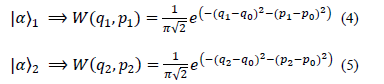
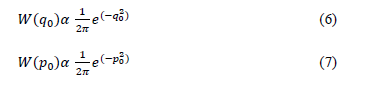
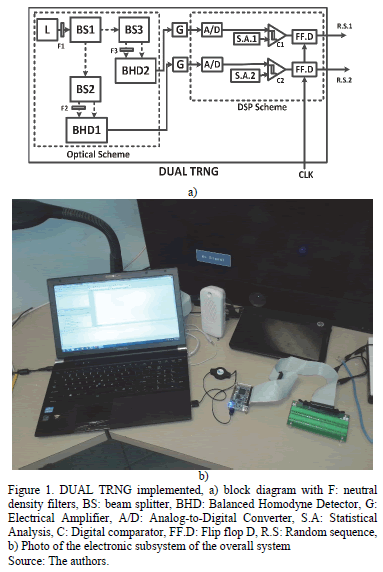
<body><![CDATA[<p><font size="2" face="Verdana, Arial, Helvetica, sans-serif">The generator that was used is shown in <a href="#fig01">Fig. 1a)</a> and <a href="#fig01">1b)</a>. It consists of a laser source and neutral density filters   (F1) to adjust the variance of the detected quantum noise using shot noise   units (because these units give us information about the quantum noise of the   optical state) and to work in an optical power range acceptable for the BHDs.   The laser produces an optical coherent state <img src="/img/revistas/dyna/v83n195/v83n195a12eq002.gif"> that is described by the following   equation:</font></p>     <p><img src="/img/revistas/dyna/v83n195/v83n195a12eq01.gif"></p>     <p><font size="2" face="Verdana, Arial, Helvetica, sans-serif">where <img src="/img/revistas/dyna/v83n195/v83n195a12eq006.gif"> represents the vacuum state   and <img src="/img/revistas/dyna/v83n195/v83n195a12eq008.gif"> the displacement operator in   order to generate the coherent state from the vacuum state. Roughly speaking,   the vacuum state has a probability function that is described by the equation:</font></p>     <p><img src="/img/revistas/dyna/v83n195/v83n195a12eq02.gif"></p>     <p><font size="2" face="Verdana, Arial, Helvetica, sans-serif">where <img src="/img/revistas/dyna/v83n195/v83n195a12eq012.gif"> represents the Wigner   function of the vacuum state in both quadrature components <img src="/img/revistas/dyna/v83n195/v83n195a12eq014.gif"> and <img src="/img/revistas/dyna/v83n195/v83n195a12eq016.gif">. Therefore, the probability function of the coherent state is: </font></p>     <p><img src="/img/revistas/dyna/v83n195/v83n195a12eq03.gif"></p>     <p><font size="2" face="Verdana, Arial, Helvetica, sans-serif">where <img src="/img/revistas/dyna/v83n195/v83n195a12eq020.gif"> and <img src="/img/revistas/dyna/v83n195/v83n195a12eq022.gif"> gives the average value of the number of   photons. <img src="/img/revistas/dyna/v83n195/v83n195a12eq024.gif"> The optical power beam splitter 50/50 (BS1) is   then used to produce the two signals (4) and (5) from which the two truly   independent random binary sequences are generated.</font></p>     <p><img src="/img/revistas/dyna/v83n195/v83n195a12eq0405.gif"></p>     <p align="center"><font size="2" face="Verdana, Arial, Helvetica, sans-serif"><a name="fig01"></a></font><img src="/img/revistas/dyna/v83n195/v83n195a12fig01.gif"></p>     <p><font size="2" face="Verdana, Arial, Helvetica, sans-serif">Then the   beam splitters (BS2 50/50) and (BS3 50/50) produce two optical signals   &quot;balanced&quot;, due to the different optical path (fiber length) and   optical devices; by adjusting a variable attenuator in one of the optical paths   improves optical balance. In this way   the marginal distribution functions (6) and (7) are obtained in each quadrature   component:</font></p>     ]]></body>

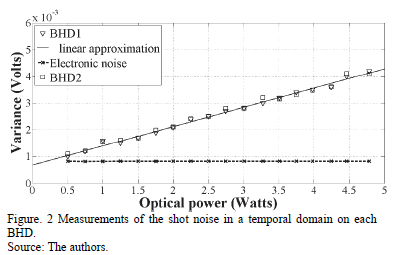
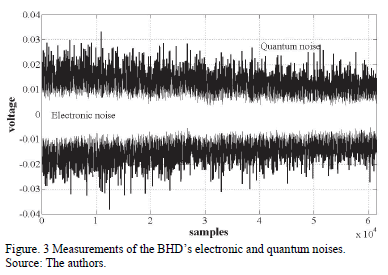
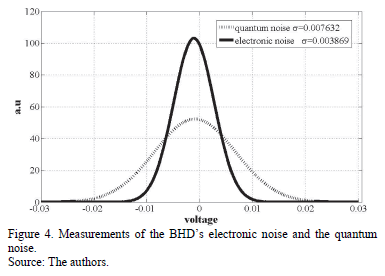
<body><![CDATA[<p><img src="/img/revistas/dyna/v83n195/v83n195a12eq0607.gif"></p>     <p><font size="2" face="Verdana, Arial, Helvetica, sans-serif">Thus, the BHD1 and BHD2 generate two   electrical output signals (8) and (9) that represent the quantum noise of the   vacuum state in both quadrature components due to the unused port of the beam   splitters according to the <img src="/img/revistas/dyna/v83n195/v83n195a12eq034.gif"> function of the optical   quantum state &#91;12&#93;.</font></p>     <p><img src="/img/revistas/dyna/v83n195/v83n195a12eq08.gif"></p>     <p><img src="/img/revistas/dyna/v83n195/v83n195a12eq09.gif"></p>     <p><font size="2" face="Verdana, Arial, Helvetica, sans-serif">These electrical fluctuations are truly   random and its bandwidth is determined by the BHDs bandwidth (5MHz for the BHDs   used). Therefore, by using the quantum noise, two truly random signals are   obtained.</font></p>     <p><font size="2" face="Verdana, Arial, Helvetica, sans-serif">In order   to know if the measured noise is really of a quantum nature (which is truly   random), we must first determine if the implemented scheme is operating within   the standard quantum limit (SQL, Standard Quantum Limit). One way of being sure   of this is checking that the variance of the error signal holds a linear   relation with the optical power of the laser; additionally it should be above   the other noises. If the system is not working in the SQL, the BHDs measure   other noises that are not necessarily of a random nature &#91;5&#93;. <a href="#fig02">Fig. 2</a> shows the   measures of the electronics and quantum noises in a time domain, where is   possible determinate if the variance of the quantum noise is greater than the   electronic noise. <a href="#fig03">Fig. 3</a> shows the different variances of the quantum noise for   different optical power.</font></p>     <p align="center"><font size="2" face="Verdana, Arial, Helvetica, sans-serif"><a name="fig02"></a></font><img src="/img/revistas/dyna/v83n195/v83n195a12fig02.gif"></p>     <p align="center"><font size="2" face="Verdana, Arial, Helvetica, sans-serif"><a name="fig03"></a></font><img src="/img/revistas/dyna/v83n195/v83n195a12fig03.gif"></p>     <p><font size="2" face="Verdana, Arial, Helvetica, sans-serif">These signals are amplified   (in our case, each BHD has a maximum gain of 30,000 V / V), and with this gain   the noise values shown in <a href="#fig03">Fig 3</a> and <a href="#fig04">4</a> were measured.</font></p>     <p align="center"><font size="2" face="Verdana, Arial, Helvetica, sans-serif"><a name="fig04"></a></font><img src="/img/revistas/dyna/v83n195/v83n195a12fig04.gif"></p>     ]]></body>
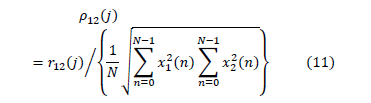
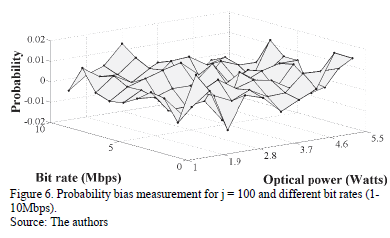
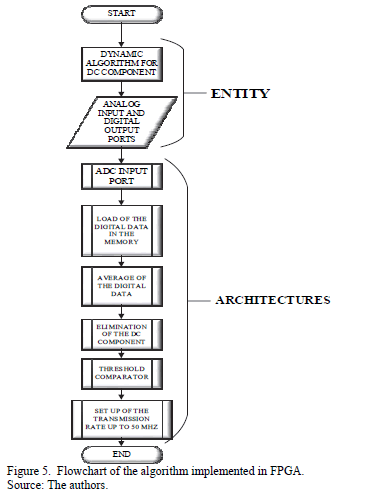
<body><![CDATA[<p><font size="2" face="Verdana, Arial, Helvetica, sans-serif"><b><i>2.2. DSP subsystem</i></b></font></p>     <p><font size="2" face="Verdana, Arial, Helvetica, sans-serif">A Digital Signal Processing (DSP)   subsystem based on the use of a DE0 Nano FPGA is used in order to digitize the   electrical signal by means of an analog-to-digital 8-bits converter (ADC). An   algorithm for dynamic statistical analysis that determines the average value of   the analog random signal (due to a slight and hard to avoid optical imbalance)   was implemented in VHDL. By using this analysis the reference signal (the   threshold decision) is determined and used in order to generate a true random   binary sequence. Furthermore a flip-flop D block (in VHDL) is used in order to   vary the bit rate of the final binary sequence from 1 to 10 Mbps. This bit rate   is determined by the FPGA clock (up to 50 MHz in our case). The algorithm   flowchart is shown in <a href="#fig05">Fig. 5</a>. First, the programs set all the inputs and   outputs variables in the <i>entity</i> of   the VHDL. Next, many <i>architectures </i>are   used in the same program to perform different tasks such as: a) <i>ADC input ports</i> (this stage converts the analog data into digital   data for the next digital signal processing), b)<i> Digital data load in the memory</i>, (here the converted data are   loaded in the internal memory of the FPGA), c) <i>Digital data average, </i>(in order to obtain the average value of the   digital data that corresponds to the DC component), d) <i>Threshold comparator,</i> (in order to generate the final random binary   sequence), and e) <i>Setting of the   transmission rate,</i> (in order to change the bit rate of the final random   binary sequence). Roughly speaking, a VHDL program was designed for a frequency   divider in order to obtain a different transmission rate for the final   sequence.</font></p>     <p align="center"><font size="2" face="Verdana, Arial, Helvetica, sans-serif"><a name="fig05"></a></font><img src="/img/revistas/dyna/v83n195/v83n195a12fig05.gif"></p>     <p>&nbsp;</p>     <p><font size="3" face="Verdana, Arial, Helvetica, sans-serif"><b>3. Test and measurement of the performance </b></font></p>     <p><font size="2" face="Verdana, Arial, Helvetica, sans-serif">As mentioned above for an adequate performance of our scheme, the   measurement of the quantum noise is very important. One way to measure the   quantum noise in such systems is through the variance of the photoelectric   signal in the BHDs. The BS2 and BS3 send   classical noise onto both BHD detectors and, thus, the photocurrents are   correlated to each other. For quantum noise the effect of the beam splitter is   different, i.e. the two resulting photocurrents are not </font><font size="2" face="Verdana, Arial, Helvetica, sans-serif">correlated &#91;11-13&#93;. <a href="#fig03">Fig. 3</a> presents the electronic noise measurements   (white trace) and quantum noise (black trace) in the temporal domain in which   is possible to distinguish the different variance values between them. However,   because the setting of an adequate optical power is required, it will be   necessary to change the optical power; the variance of the quantum noise also   must also be modified. The probability function of the noises measured was   shown in the <a href="#fig04">Fig. 4</a>. As can be seen in the figure, the variance (or standard   deviation) of the quantum noise is greater than the variance of the electronic   noise, which ensures that the experiment is working in the Standard Quantum   Limit. In <a href="#fig02">Fig. 2</a> we present the measurements for the quantum noise variance for   different optical powers, and as expected, there is a linear dependence of the   latter with the optical power. In this case, we used a laser with an average   optical power of 5 mW. Thus, it was determined that the experiment was working   at the standard quantum limit 18 dB above of the electronic noise. Measurements   of quantum noise variance were performed by means of an oscilloscope with   50,000 samples at 4x10<sup>9</sup> samples/sec. The above behavior may be   modeled using the following function, <img src="/img/revistas/dyna/v83n195/v83n195a12eq052.gif">, where <img src="/img/revistas/dyna/v83n195/v83n195a12eq054.gif"> is the total noise in Volts (V), <img src="/img/revistas/dyna/v83n195/v83n195a12eq056.gif"> is the optical power of the local oscillator   in watts (W), <img src="/img/revistas/dyna/v83n195/v83n195a12eq058.gif"> is a factor associated with the conversion   factor of the photodetectors (in our case <img src="/img/revistas/dyna/v83n195/v83n195a12eq058.gif"> =0.66 V/mW), <img src="/img/revistas/dyna/v83n195/v83n195a12eq060.gif"> =0.8 mV is related to the electrical noise   present in Volts. Thus, for an optical   power of the local oscillator of 5 mW the r.m.s voltage is 4.35 mV. It is   important to mention that the r.m.s voltage in a Gaussian density function with   zero expected mean is equal to its variance. Therefore, an optical power of 5   mW in the local oscillator corresponds to a variance of 4.35 mV. </font></p>     <p><font size="2" face="Verdana, Arial, Helvetica, sans-serif">Regarding the performance of the system,   there are fundamentally two parameters: the probability bias (<img src="/img/revistas/dyna/v83n195/v83n195a12eq062.gif">) and the auto-correlation of the binary sequences generated.   Sometimes, due to imperfections in measurement and hardware, the bits generated   by an RNG system will contain a non-zero value of auto-correlation and   probability bias, which may be minimized using the Von Neumann method &#91;14&#93;.   Thus, the probability bias (<img src="/img/revistas/dyna/v83n195/v83n195a12eq062.gif">) is defined as <img src="/img/revistas/dyna/v83n195/v83n195a12eq064.gif"> where <img src="/img/revistas/dyna/v83n195/v83n195a12eq066.gif"> and <img src="/img/revistas/dyna/v83n195/v83n195a12eq068.gif"> represent the probability of   the binary values, 1 and 0, respectively, after having stored a large amount of   bits. The best value would be <i>bp</i>=0 which means that the binary values   are equiprobable; however, we must be sure that the value of autocorrelation is   close to zero to ensure randomness &#91;8&#93;. The results obtained with our scheme   show a value of <img src="/img/revistas/dyna/v83n195/v83n195a12eq062.gif">=0.0002. The <a href="#fig06">Fig 6</a> shows the performance of <img src="/img/revistas/dyna/v83n195/v83n195a12eq062.gif"> in a considerable observation   time. As mentioned above, this value may be improved using the von Neumann method;   however, in this case we considered that because we have obtained a very low   value, an improvement was not required. Regarding the measurement of the   discrete-time autocorrelation <img src="/img/revistas/dyna/v83n195/v83n195a12eq070.gif"> of the binary sequence, we   used the equation (10) in which <img src="/img/revistas/dyna/v83n195/v83n195a12eq072.gif"> is the lag between the   sequences <img src="/img/revistas/dyna/v83n195/v83n195a12eq074.gif"> and <img src="/img/revistas/dyna/v83n195/v83n195a12eq076.gif"> that are analyzed with a   length<img src="/img/revistas/dyna/v83n195/v83n195a12eq078.gif">. Thus <img src="/img/revistas/dyna/v83n195/v83n195a12eq070.gif"> is defined as:</font></p>     <p><img src="/img/revistas/dyna/v83n195/v83n195a12eq10.gif"></p>     <p><font size="2" face="Verdana, Arial, Helvetica, sans-serif">Then, the equation (10) is normalized and   we obtain the equation:</font></p>     <p><img src="/img/revistas/dyna/v83n195/v83n195a12eq11.gif"></p>     ]]></body>
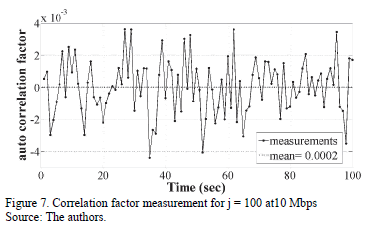
<body><![CDATA[<p align="center"><font size="2" face="Verdana, Arial, Helvetica, sans-serif"><a name="fig06"></a></font><img src="/img/revistas/dyna/v83n195/v83n195a12fig06.gif"></p>     <p><font size="2" face="Verdana, Arial, Helvetica, sans-serif">The overall system performance may be obtained through the   probability bias and autocorrelation values. In order to do this we performed   measurements of up to 10 Mbps with different optical powers. By varying the optical power it is possible to   show that the system of statistical analysis is capable of working adequately   even if the variance of the quantum noise has variations. The <a href="#fig06">Figs. 6</a> and <a href="#fig07">7</a> show that the values of probability bias and autocorrelation are 0.0002 and   0.0001 respectively to measure ranges from 1 to 5 mW and from 1 to 10 Mbps.</font></p>     <p align="center"><font size="2" face="Verdana, Arial, Helvetica, sans-serif"><a name="fig07"></a></font><img src="/img/revistas/dyna/v83n195/v83n195a12fig07.gif"></p>     <p>&nbsp;</p>     <p><font size="3" face="Verdana, Arial, Helvetica, sans-serif"><b>3. Conclusions</b></font></p>     <p><font size="2" face="Verdana, Arial, Helvetica, sans-serif">This work   presents a mathematical description, and the design and implementation of a   True Random Numbers Generator based on a system that simultaneously measures   both quadrature components of an optical field (the vacuum state) and also uses   a dynamic statistical analysis. As mentioned above, some preliminary results of   this hybrid technique in the context of quantum cryptography systems with   continuous variables (CV-QKD) have previously been reported on &#91;15&#93;. However,   in this paper we have presented more general and conclusive results in terms of   the mathematical model and the development of a generator suitable to be used   in different applications such as cryptographic systems (already mentioned),   simulations, sweepstakes, etc., using the concepts of modern photonics &#91;16&#93;. In   the system developed, the transmission rate of the final sequences may be   independently configured for different simultaneous applications. In our   experimental set-up we were able to get adequate values (to assure the   randomness of the signals generated) of probability bias (0.0002) and   autocorrelation (0.0001) for a bit rate of up to 10 Mbps. The bit rate obtained   depends on the bandwidth of the BHDs and DSP subsystem used. Therefore,   implementing a system with a higher rate is possible by means of changing such   subsystems ( there are currently BHDs capable of operating on the order of the   GHz as well as FPGAs and DSPs that have very high processing speeds).</font></p>     <p>&nbsp;</p>     <p><font size="3" face="Verdana, Arial, Helvetica, sans-serif"><b>Acknowledgments</b></font></p>     <p><font size="2" face="Verdana, Arial, Helvetica, sans-serif">The authors wish to thank the support they   were given from CETYS University and CICESE Research Center. This work was   supported by a CONACYT Basic Science Grant.</font></p>     <p>&nbsp;</p>     ]]></body>
<body><![CDATA[<p><font size="3" face="Verdana, Arial, Helvetica, sans-serif"><b>References</b></font></p>     <!-- ref --><p><font size="2" face="Verdana, Arial, Helvetica, sans-serif"><b>&#91;1&#93;</b> Blaner, B., Abali, B. Bass,   B.M., Chari, S., Kalla, R., Kunkel, S., Lauricella, K., Leavens, R., Reilly,   J.J. and Sandon, P.A., IBM POWER7+ processor on-chip accelerators for   cryptography and active memory expansion, IBM Journal of Research and   Development, 57(6), pp.1-16, 2013. DOI: 10.1147/JRD.2013.2280090</font>&nbsp;&nbsp;&nbsp;&nbsp;&nbsp;&nbsp;&nbsp;&nbsp;[&#160;<a href="javascript:void(0);" onclick="javascript: window.open('/scielo.php?script=sci_nlinks&ref=1140729&pid=S0012-7353201600010001200001&lng=','','width=640,height=500,resizable=yes,scrollbars=1,menubar=yes,');">Links</a>&#160;]<!-- end-ref --><!-- ref --><p><font size="2" face="Verdana, Arial, Helvetica, sans-serif"><b>&#91;2&#93;</b> Francillon,   A. and Castelluccia, C., TinyRNG. A cryptographic random number generator for wireless sensors network   nodes. 5<sup>th</sup> International Symposium on Modeling and Optimization in   Mobile, Ad Hoc and Wireless Networks and Workshops, &#91;Online&#93;. pp. 1-7.   Limassol. 2007. Available at: DOI: 10.1109/WIOPT.2007.4480051</font>&nbsp;&nbsp;&nbsp;&nbsp;&nbsp;&nbsp;&nbsp;&nbsp;[&#160;<a href="javascript:void(0);" onclick="javascript: window.open('/scielo.php?script=sci_nlinks&ref=1140730&pid=S0012-7353201600010001200002&lng=','','width=640,height=500,resizable=yes,scrollbars=1,menubar=yes,');">Links</a>&#160;]<!-- end-ref --><!-- ref --><p><font size="2" face="Verdana, Arial, Helvetica, sans-serif"><b>&#91;3&#93;</b> Yang M., Guo, Q. and Wang, Z.,   A random number generator based software channel simulator for land mobile   satellite channel. International Conference on Wireless Communications,   Networking and Mobile Computing. pp. 1095-1098 Shanghai. 2007. DOI: 10.1109/WICOM.2007.280</font>&nbsp;&nbsp;&nbsp;&nbsp;&nbsp;&nbsp;&nbsp;&nbsp;[&#160;<a href="javascript:void(0);" onclick="javascript: window.open('/scielo.php?script=sci_nlinks&ref=1140731&pid=S0012-7353201600010001200003&lng=','','width=640,height=500,resizable=yes,scrollbars=1,menubar=yes,');">Links</a>&#160;]<!-- end-ref --><!-- ref --><p><font size="2" face="Verdana, Arial, Helvetica, sans-serif"><b>&#91;4&#93;</b> Chen, I,-T., Tsai, J.-M. and Tzeng,   J., Audio random number generator and its application. International Conference   on Machine Learning and Cybernetics (ICMLC), pp.1678-1683. Guilin. 2011. DOI: 10.1109/ICMLC.2011.6017002</font>&nbsp;&nbsp;&nbsp;&nbsp;&nbsp;&nbsp;&nbsp;&nbsp;[&#160;<a href="javascript:void(0);" onclick="javascript: window.open('/scielo.php?script=sci_nlinks&ref=1140732&pid=S0012-7353201600010001200004&lng=','','width=640,height=500,resizable=yes,scrollbars=1,menubar=yes,');">Links</a>&#160;]<!-- end-ref --><!-- ref --><p><font size="2" face="Verdana, Arial, Helvetica, sans-serif"><b>&#91;5&#93;</b> Stipcevic, M., Quantum random   number generators and their use in cryptography, MIPRO Proceedings of the 34<sup>th</sup> International Convention, &#91;Online&#93;. pp. 1474-1479, 2011. Available at: <a href="http://proceedings.spiedigitallibrary.org/proceeding.aspx?articleid=1354136" target="_blank">http://proceedings.spiedigitallibrary.org/proceeding.aspx?articleid=1354136</a></font>&nbsp;&nbsp;&nbsp;&nbsp;&nbsp;&nbsp;&nbsp;&nbsp;[&#160;<a href="javascript:void(0);" onclick="javascript: window.open('/scielo.php?script=sci_nlinks&ref=1140733&pid=S0012-7353201600010001200005&lng=','','width=640,height=500,resizable=yes,scrollbars=1,menubar=yes,');">Links</a>&#160;]<!-- end-ref --><!-- ref --><p><font size="2" face="Verdana, Arial, Helvetica, sans-serif"><b>&#91;6&#93;</b> Zhu, Y., He, G. and Zeng, G,.   Unbiased quantum random generator based on squeezed vacuum state. Int. J.   Quantum Inform., &#91;Online&#93;. 10(1), pp. 1-13, 2012. Available at: <a href="http://www.worldscientific.com/doi/abs/10.1142/S0219749912500128" target="_blank">http://www.worldscientific.com/doi/abs/10.1142/S0219749912500128</a></font>&nbsp;&nbsp;&nbsp;&nbsp;&nbsp;&nbsp;&nbsp;&nbsp;[&#160;<a href="javascript:void(0);" onclick="javascript: window.open('/scielo.php?script=sci_nlinks&ref=1140734&pid=S0012-7353201600010001200006&lng=','','width=640,height=500,resizable=yes,scrollbars=1,menubar=yes,');">Links</a>&#160;]<!-- end-ref --><!-- ref --><p><font size="2" face="Verdana, Arial, Helvetica, sans-serif"><b>&#91;7&#93;</b> Stip&#269;evi&#263;a, M. and Medved-Rogina,   B., Quantum random number generator based on photonic emission in   semiconductors, Review of scientific instrument, &#91;Online&#93;. 78, pp. 1-7, 2007.   Available at: <a href="http://scitation.aip.org/content/aip/journal/rsi/78/4/10.1063/1.2720728" target="_blank">http://scitation.aip.org/content/aip/journal/rsi/78/4/10.1063/1.2720728</a></font>&nbsp;&nbsp;&nbsp;&nbsp;&nbsp;&nbsp;&nbsp;&nbsp;[&#160;<a href="javascript:void(0);" onclick="javascript: window.open('/scielo.php?script=sci_nlinks&ref=1140735&pid=S0012-7353201600010001200007&lng=','','width=640,height=500,resizable=yes,scrollbars=1,menubar=yes,');">Links</a>&#160;]<!-- end-ref --><!-- ref --><p><font size="2" face="Verdana, Arial, Helvetica, sans-serif"><b>&#91;8&#93;</b> Fürst, H., Weier, H., Nauerth,   S., Marangon, D.G., Kurtsiefer, C. and Weinfurter, H., High speed optical   quantum random number generation, Optics Express. 18(12), pp. 13029-13037.   2010. DOI: 10.1364/OE.18.013029</font>&nbsp;&nbsp;&nbsp;&nbsp;&nbsp;&nbsp;&nbsp;&nbsp;[&#160;<a href="javascript:void(0);" onclick="javascript: window.open('/scielo.php?script=sci_nlinks&ref=1140736&pid=S0012-7353201600010001200008&lng=','','width=640,height=500,resizable=yes,scrollbars=1,menubar=yes,');">Links</a>&#160;]<!-- end-ref --><!-- ref --><p><font size="2" face="Verdana, Arial, Helvetica, sans-serif"><b>&#91;9&#93;</b> Wayne, M.A. and Kwiat, P.G.,   Low-bias high-speed quantum random number generator via shaped optical pulses,   Optics Express, 18(8), pp. 9351-9357, 2010. DOI: 10.1364/OE.18.009351</font>&nbsp;&nbsp;&nbsp;&nbsp;&nbsp;&nbsp;&nbsp;&nbsp;[&#160;<a href="javascript:void(0);" onclick="javascript: window.open('/scielo.php?script=sci_nlinks&ref=1140737&pid=S0012-7353201600010001200009&lng=','','width=640,height=500,resizable=yes,scrollbars=1,menubar=yes,');">Links</a>&#160;]<!-- end-ref --><!-- ref --><p><font size="2" face="Verdana, Arial, Helvetica, sans-serif"><b>&#91;10&#93;</b> Sanford-Williams C.R.,   Optoelectronic experiments on random bit generators and coupled dynamical   systems. PhD thesis. Department of Physics, University of Maryland, USA, 2013.    &nbsp;&nbsp;&nbsp;&nbsp;&nbsp;&nbsp;&nbsp;&nbsp;[&#160;<a href="javascript:void(0);" onclick="javascript: window.open('/scielo.php?script=sci_nlinks&ref=1140738&pid=S0012-7353201600010001200010&lng=','','width=640,height=500,resizable=yes,scrollbars=1,menubar=yes,');">Links</a>&#160;]<!-- end-ref --></font></p>     <!-- ref --><p><font size="2" face="Verdana, Arial, Helvetica, sans-serif"><b>&#91;11&#93;</b> Bachor, H.A. and Ralph, T.C., A   guide to experiments in quantum optics. Wiley VCH., &#91;Online&#93;</b> Chapter 8, 2004. Available   at: <a href="http://onlinelibrary.wiley.com/book/10.1002/9783527619238" target="_blank">http://onlinelibrary.wiley.com/book/10.1002/9783527619238</a></font>&nbsp;&nbsp;&nbsp;&nbsp;&nbsp;&nbsp;&nbsp;&nbsp;[&#160;<a href="javascript:void(0);" onclick="javascript: window.open('/scielo.php?script=sci_nlinks&ref=1140740&pid=S0012-7353201600010001200011&lng=','','width=640,height=500,resizable=yes,scrollbars=1,menubar=yes,');">Links</a>&#160;]<!-- end-ref --><!-- ref --><p><font size="2" face="Verdana, Arial, Helvetica, sans-serif"><b>&#91;12&#93;</b> E. Ip, et al., Coherent   detection in optical fiber systems, Optics Express, 16(2), pp. 753-791, 2008. DOI:   10.1364/OE.16.000753</font>&nbsp;&nbsp;&nbsp;&nbsp;&nbsp;&nbsp;&nbsp;&nbsp;[&#160;<a href="javascript:void(0);" onclick="javascript: window.open('/scielo.php?script=sci_nlinks&ref=1140741&pid=S0012-7353201600010001200012&lng=','','width=640,height=500,resizable=yes,scrollbars=1,menubar=yes,');">Links</a>&#160;]<!-- end-ref --><!-- ref --><p><font size="2" face="Verdana, Arial, Helvetica, sans-serif"><b>&#91;13&#93;</b> Yuen, H.P. and Chan, V.W.S.,   Noise in homodyne and heterodyne detection. Optics letters. 8(3), pp.177-179,   1983. DOI: 10.1364/OL.8.000177</font>&nbsp;&nbsp;&nbsp;&nbsp;&nbsp;&nbsp;&nbsp;&nbsp;[&#160;<a href="javascript:void(0);" onclick="javascript: window.open('/scielo.php?script=sci_nlinks&ref=1140742&pid=S0012-7353201600010001200013&lng=','','width=640,height=500,resizable=yes,scrollbars=1,menubar=yes,');">Links</a>&#160;]<!-- end-ref --><!-- ref --><p><font size="2" face="Verdana, Arial, Helvetica, sans-serif"><b>&#91;14&#93;</b> Abbott, A.A. and Calude, C.S.,   Von Neumann normalisation of a quantum random number generator, Journal of   Computability, &#91;Online&#93;. 1(1), pp. 59-83, 2012. Available at: <a href="http://content.iospress.com/articles/computability/com001" target="_blank">http://content.iospress.com/articles/computability/com001</a> </font>&nbsp;&nbsp;&nbsp;&nbsp;&nbsp;&nbsp;&nbsp;&nbsp;[&#160;<a href="javascript:void(0);" onclick="javascript: window.open('/scielo.php?script=sci_nlinks&ref=1140743&pid=S0012-7353201600010001200014&lng=','','width=640,height=500,resizable=yes,scrollbars=1,menubar=yes,');">Links</a>&#160;]<!-- end-ref --><!-- ref --><p><font size="2" face="Verdana, Arial, Helvetica, sans-serif"><b>&#91;15&#93;</b> Lopez, J.A., Dual quantum   random number generator using a FPGA for QKD-CV systems: Preliminary results.   International Journal of Emerging Research in Management &amp;Technology, &#91;Online&#93;.   3(6), pp. 6-8.2014. Available at: <a href="http://www.ermt.net/docs/papers/Volume_3/6_June2014/V3N6-138.pdf" target="_blank">http://www.ermt.net/docs/papers/Volume_3/6_June2014/V3N6-138.pdf</a></font>&nbsp;&nbsp;&nbsp;&nbsp;&nbsp;&nbsp;&nbsp;&nbsp;[&#160;<a href="javascript:void(0);" onclick="javascript: window.open('/scielo.php?script=sci_nlinks&ref=1140744&pid=S0012-7353201600010001200015&lng=','','width=640,height=500,resizable=yes,scrollbars=1,menubar=yes,');">Links</a>&#160;]<!-- end-ref --><!-- ref --><p><font size="2" face="Verdana, Arial, Helvetica, sans-serif"><b>&#91;16&#93;</b> Martin-Pereda, J.A., La fot&oacute;nica:   Ayer y ma&ntilde;ana. Revista Dyna Ingenier&iacute;a e Industria, 89, pp.501-503. 2015. DOI: 10.6036/7116</font>&nbsp;&nbsp;&nbsp;&nbsp;&nbsp;&nbsp;&nbsp;&nbsp;[&#160;<a href="javascript:void(0);" onclick="javascript: window.open('/scielo.php?script=sci_nlinks&ref=1140745&pid=S0012-7353201600010001200016&lng=','','width=640,height=500,resizable=yes,scrollbars=1,menubar=yes,');">Links</a>&#160;]<!-- end-ref --><p>&nbsp;</p>     <p><font size="2" face="Verdana, Arial, Helvetica, sans-serif"><b>J.A. Lopez-Leyva,</b> obtained his BSc.   degree with an emphasis on Telecommunications from the Superior Technology   Institute of Cajeme (ITESCA) in Sonora Mexico. From 2006 to 2008 he worked on   Networking and Telephony projects. Finally, he obtained his PhD. in quantum   communication using satellites and quantum cryptography at the CICESE Research   Center in Baja California, Mexico. His current research interests include free   space optical communications, Coherent optical communications, optical   networks, statistical signal processing and quantum cryptography systems. ORCID-ID: 0000-0002-3004-5686</font></p>     ]]></body>
<body><![CDATA[<p><font size="2" face="Verdana, Arial, Helvetica, sans-serif"><b>Arturo Arvizu-Mondrag&oacute;n,</b> received his BSc.   and MSc. degrees in Electronics in 1985 and 1990, respectively, from the   Universidad Nacional Aut&oacute;noma de M&eacute;xico, Mexico and his PhD. in   Telecommunications in 2000, from the CICESE Research Center, Ensenada, BC,   Mexico. In 1987 he joined the Institute of Electrical Research, Cuernavaca,   Morelos, M&eacute;xico, working on projects relating to the optical and   optoelectronics communications systems that are applied in power generation   systems, and laboratories to test, measure and characterize electrical systems.   In 1992 he joined the CICESE Research Center where he currently works in the   fields of quantum communications, optical fiber and optical wireless   communications with coherent detection. In 2000 and 2001 worked in a post-doctoral   position in the telecommunications department at the &Eacute;cole nationale sup&eacute;rieure   des t&eacute;l&eacute;communications, Paris, France. ORCID-ID: 0000-0001-6926-2197</font></p>      ]]></body><back>
<ref-list>
<ref id="B1">
<label>1</label><nlm-citation citation-type="journal">
<person-group person-group-type="author">
<name>
<surname><![CDATA[Blaner]]></surname>
<given-names><![CDATA[B.]]></given-names>
</name>
<name>
<surname><![CDATA[Abali]]></surname>
<given-names><![CDATA[B.]]></given-names>
</name>
<name>
<surname><![CDATA[Bass]]></surname>
<given-names><![CDATA[B.M.]]></given-names>
</name>
<name>
<surname><![CDATA[Chari]]></surname>
<given-names><![CDATA[S.]]></given-names>
</name>
<name>
<surname><![CDATA[Kalla]]></surname>
<given-names><![CDATA[R.]]></given-names>
</name>
<name>
<surname><![CDATA[Kunkel]]></surname>
<given-names><![CDATA[S.]]></given-names>
</name>
<name>
<surname><![CDATA[Lauricella]]></surname>
<given-names><![CDATA[K.]]></given-names>
</name>
<name>
<surname><![CDATA[Leavens]]></surname>
<given-names><![CDATA[R.]]></given-names>
</name>
<name>
<surname><![CDATA[Reilly]]></surname>
<given-names><![CDATA[J.J.]]></given-names>
</name>
<name>
<surname><![CDATA[Sandon]]></surname>
<given-names><![CDATA[P.A.]]></given-names>
</name>
</person-group>
<article-title xml:lang="en"><![CDATA[IBM POWER7+ processor on-chip accelerators for cryptography and active memory expansion]]></article-title>
<source><![CDATA[IBM Journal of Research and Development]]></source>
<year>2013</year>
<volume>57</volume>
<numero>6</numero>
<issue>6</issue>
<page-range>1-16</page-range></nlm-citation>
</ref>
<ref id="B2">
<label>2</label><nlm-citation citation-type="confpro">
<person-group person-group-type="author">
<name>
<surname><![CDATA[Francillon]]></surname>
<given-names><![CDATA[A.]]></given-names>
</name>
<name>
<surname><![CDATA[Castelluccia]]></surname>
<given-names><![CDATA[C.]]></given-names>
</name>
</person-group>
<article-title xml:lang="en"><![CDATA[TinyRNG. A cryptographic random number generator for wireless sensors network nodes.]]></article-title>
<source><![CDATA[]]></source>
<year>2007</year>
<conf-name><![CDATA[5th International Symposium on Modeling and Optimization in Mobile, Ad Hoc and Wireless Networks and Workshops]]></conf-name>
<conf-loc> </conf-loc>
<page-range>1-7</page-range><publisher-name><![CDATA[Limassol]]></publisher-name>
</nlm-citation>
</ref>
<ref id="B3">
<label>3</label><nlm-citation citation-type="confpro">
<person-group person-group-type="author">
<name>
<surname><![CDATA[Yang]]></surname>
<given-names><![CDATA[M.]]></given-names>
</name>
<name>
<surname><![CDATA[Guo]]></surname>
<given-names><![CDATA[Q.]]></given-names>
</name>
<name>
<surname><![CDATA[Wang]]></surname>
<given-names><![CDATA[Z.]]></given-names>
</name>
</person-group>
<article-title xml:lang="en"><![CDATA[A random number generator based software channel simulator for land mobile satellite channel.]]></article-title>
<source><![CDATA[]]></source>
<year>2007</year>
<conf-name><![CDATA[ International Conference on Wireless Communications, Networking and Mobile Computing]]></conf-name>
<conf-loc> </conf-loc>
<page-range>1095-1098</page-range><publisher-loc><![CDATA[Shanghai ]]></publisher-loc>
</nlm-citation>
</ref>
<ref id="B4">
<label>4</label><nlm-citation citation-type="confpro">
<person-group person-group-type="author">
<name>
<surname><![CDATA[Chen]]></surname>
<given-names><![CDATA[I,-T.]]></given-names>
</name>
<name>
<surname><![CDATA[Tsai]]></surname>
<given-names><![CDATA[J.-M.]]></given-names>
</name>
<name>
<surname><![CDATA[Tzeng]]></surname>
<given-names><![CDATA[J.]]></given-names>
</name>
</person-group>
<article-title xml:lang="en"><![CDATA[Audio random number generator and its application]]></article-title>
<source><![CDATA[]]></source>
<year>2011</year>
<conf-name><![CDATA[ International Conference on Machine Learning and Cybernetics]]></conf-name>
<conf-loc> </conf-loc>
<page-range>1678-1683</page-range><publisher-loc><![CDATA[Guilin ]]></publisher-loc>
</nlm-citation>
</ref>
<ref id="B5">
<label>5</label><nlm-citation citation-type="confpro">
<person-group person-group-type="author">
<name>
<surname><![CDATA[Stipcevic]]></surname>
<given-names><![CDATA[M.]]></given-names>
</name>
</person-group>
<article-title xml:lang="en"><![CDATA[Quantum random number generators and their use in cryptography]]></article-title>
<source><![CDATA[]]></source>
<year>2011</year>
<conf-name><![CDATA[34th International Convention]]></conf-name>
<conf-loc> </conf-loc>
<page-range>1474-1479</page-range></nlm-citation>
</ref>
<ref id="B6">
<label>6</label><nlm-citation citation-type="journal">
<person-group person-group-type="author">
<name>
<surname><![CDATA[Zhu]]></surname>
<given-names><![CDATA[Y.]]></given-names>
</name>
<name>
<surname><![CDATA[He]]></surname>
<given-names><![CDATA[G.]]></given-names>
</name>
<name>
<surname><![CDATA[Zeng]]></surname>
<given-names><![CDATA[G]]></given-names>
</name>
</person-group>
<article-title xml:lang="en"><![CDATA[Unbiased quantum random generator based on squeezed vacuum state]]></article-title>
<source><![CDATA[Int. J. Quantum Inform.]]></source>
<year>2012</year>
<volume>10</volume>
<numero>1</numero>
<issue>1</issue>
<page-range>1-13</page-range></nlm-citation>
</ref>
<ref id="B7">
<label>7</label><nlm-citation citation-type="journal">
<person-group person-group-type="author">
<name>
<surname><![CDATA[Stip&#269;evi&#263;a]]></surname>
<given-names><![CDATA[M.]]></given-names>
</name>
<name>
<surname><![CDATA[Medved-Rogina]]></surname>
<given-names><![CDATA[B.]]></given-names>
</name>
</person-group>
<article-title xml:lang="en"><![CDATA[Quantum random number generator based on photonic emission in semiconductors]]></article-title>
<source><![CDATA[Review of scientific instrument]]></source>
<year>2007</year>
<numero>78</numero>
<issue>78</issue>
<page-range>1-7</page-range></nlm-citation>
</ref>
<ref id="B8">
<label>8</label><nlm-citation citation-type="journal">
<person-group person-group-type="author">
<name>
<surname><![CDATA[Fürst]]></surname>
<given-names><![CDATA[H.]]></given-names>
</name>
<name>
<surname><![CDATA[Weier]]></surname>
<given-names><![CDATA[H.]]></given-names>
</name>
<name>
<surname><![CDATA[Nauerth]]></surname>
<given-names><![CDATA[S.]]></given-names>
</name>
<name>
<surname><![CDATA[Marangon]]></surname>
<given-names><![CDATA[D.G.]]></given-names>
</name>
<name>
<surname><![CDATA[Kurtsiefer]]></surname>
<given-names><![CDATA[C.]]></given-names>
</name>
<name>
<surname><![CDATA[Weinfurter]]></surname>
<given-names><![CDATA[H.]]></given-names>
</name>
</person-group>
<article-title xml:lang="en"><![CDATA[High speed optical quantum random number generation]]></article-title>
<source><![CDATA[Optics Express.]]></source>
<year>1820</year>
<month>10</month>
<volume>12</volume>
<page-range>13029-13037</page-range></nlm-citation>
</ref>
<ref id="B9">
<label>9</label><nlm-citation citation-type="journal">
<person-group person-group-type="author">
<name>
<surname><![CDATA[Wayne]]></surname>
<given-names><![CDATA[M.A.]]></given-names>
</name>
<name>
<surname><![CDATA[Kwiat]]></surname>
<given-names><![CDATA[P.G.]]></given-names>
</name>
</person-group>
<article-title xml:lang="en"><![CDATA[Low-bias high-speed quantum random number generator via shaped optical pulses]]></article-title>
<source><![CDATA[Optics Express]]></source>
<year>2010</year>
<volume>18</volume>
<numero>8</numero>
<issue>8</issue>
<page-range>9351-9357</page-range></nlm-citation>
</ref>
<ref id="B10">
<label>10</label><nlm-citation citation-type="">
<person-group person-group-type="author">
<name>
<surname><![CDATA[Sanford-Williams]]></surname>
<given-names><![CDATA[C.R.]]></given-names>
</name>
</person-group>
<source><![CDATA[Optoelectronic experiments on random bit generators and coupled dynamical systems.]]></source>
<year></year>
</nlm-citation>
</ref>
<ref id="B11">
<label>11</label><nlm-citation citation-type="book">
<person-group person-group-type="author">
<name>
<surname><![CDATA[Bachor]]></surname>
<given-names><![CDATA[H.A.]]></given-names>
</name>
<name>
<surname><![CDATA[Ralph]]></surname>
<given-names><![CDATA[T.C.]]></given-names>
</name>
</person-group>
<source><![CDATA[A guide to experiments in quantum optics.]]></source>
<year>2004</year>
<publisher-name><![CDATA[Wiley VCH.]]></publisher-name>
</nlm-citation>
</ref>
<ref id="B12">
<label>12</label><nlm-citation citation-type="journal">
<person-group person-group-type="author">
<name>
<surname><![CDATA[Ip]]></surname>
<given-names><![CDATA[E.]]></given-names>
</name>
</person-group>
<article-title xml:lang="en"><![CDATA[Coherent detection in optical fiber systems]]></article-title>
<source><![CDATA[Optics Express]]></source>
<year>2008</year>
<volume>16</volume>
<numero>2</numero>
<issue>2</issue>
<page-range>753-791</page-range></nlm-citation>
</ref>
<ref id="B13">
<label>13</label><nlm-citation citation-type="journal">
<person-group person-group-type="author">
<name>
<surname><![CDATA[Yuen]]></surname>
<given-names><![CDATA[H.P.]]></given-names>
</name>
<name>
<surname><![CDATA[Chan]]></surname>
<given-names><![CDATA[V.W.S.]]></given-names>
</name>
</person-group>
<article-title xml:lang="en"><![CDATA[Noise in homodyne and heterodyne detection.]]></article-title>
<source><![CDATA[Optics letters.]]></source>
<year>1983</year>
<volume>8</volume>
<numero>3</numero>
<issue>3</issue>
<page-range>177-179</page-range></nlm-citation>
</ref>
<ref id="B14">
<label>14</label><nlm-citation citation-type="journal">
<person-group person-group-type="author">
<name>
<surname><![CDATA[Abbott]]></surname>
<given-names><![CDATA[A.A.]]></given-names>
</name>
<name>
<surname><![CDATA[Calude]]></surname>
<given-names><![CDATA[C.S.]]></given-names>
</name>
</person-group>
<article-title xml:lang="en"><![CDATA[Von Neumann normalisation of a quantum random number generato]]></article-title>
<source><![CDATA[Journal of Computability]]></source>
<year>2012</year>
<volume>1</volume>
<numero>1</numero>
<issue>1</issue>
<page-range>59-83</page-range></nlm-citation>
</ref>
<ref id="B15">
<label>15</label><nlm-citation citation-type="journal">
<person-group person-group-type="author">
<name>
<surname><![CDATA[Lopez]]></surname>
<given-names><![CDATA[J.A.]]></given-names>
</name>
</person-group>
<article-title xml:lang="en"><![CDATA[Dual quantum random number generator using a FPGA for QKD-CV systems: Preliminary results]]></article-title>
<source><![CDATA[International Journal of Emerging Research in Management & Technology]]></source>
<year>2014</year>
<volume>3</volume>
<numero>6</numero>
<issue>6</issue>
<page-range>6-8</page-range></nlm-citation>
</ref>
<ref id="B16">
<label>16</label><nlm-citation citation-type="journal">
<person-group person-group-type="author">
<name>
<surname><![CDATA[Martin-Pereda]]></surname>
<given-names><![CDATA[J.A.]]></given-names>
</name>
</person-group>
<article-title xml:lang="es"><![CDATA[La fotónica: Ayer y mañana]]></article-title>
<source><![CDATA[Revista Dyna Ingeniería e Industria]]></source>
<year>2015</year>
<numero>89</numero>
<issue>89</issue>
<page-range>501-503</page-range></nlm-citation>
</ref>
</ref-list>
</back>
</article>