<?xml version="1.0" encoding="ISO-8859-1"?><article xmlns:mml="http://www.w3.org/1998/Math/MathML" xmlns:xlink="http://www.w3.org/1999/xlink" xmlns:xsi="http://www.w3.org/2001/XMLSchema-instance">
<front>
<journal-meta>
<journal-id>0012-7353</journal-id>
<journal-title><![CDATA[DYNA]]></journal-title>
<abbrev-journal-title><![CDATA[Dyna rev.fac.nac.minas]]></abbrev-journal-title>
<issn>0012-7353</issn>
<publisher>
<publisher-name><![CDATA[Universidad Nacional de Colombia]]></publisher-name>
</publisher>
</journal-meta>
<article-meta>
<article-id>S0012-73532016000100016</article-id>
<article-id pub-id-type="doi">10.15446/dyna.v83n195.44293</article-id>
<title-group>
<article-title xml:lang="en"><![CDATA[Optimal estimating the project completion time and diagnosing the fault in the project]]></article-title>
<article-title xml:lang="es"><![CDATA[Estimación optima de terminación el tiempo del proyecto y diagnóstico de la falla en el proyecto]]></article-title>
</title-group>
<contrib-group>
<contrib contrib-type="author">
<name>
<surname><![CDATA[Hajali-Mohamad]]></surname>
<given-names><![CDATA[M. T.]]></given-names>
</name>
<xref ref-type="aff" rid="A01"/>
</contrib>
<contrib contrib-type="author">
<name>
<surname><![CDATA[Mosavi]]></surname>
<given-names><![CDATA[M. R.]]></given-names>
</name>
<xref ref-type="aff" rid="A02"/>
</contrib>
<contrib contrib-type="author">
<name>
<surname><![CDATA[Shahanaghi]]></surname>
<given-names><![CDATA[K.]]></given-names>
</name>
<xref ref-type="aff" rid="A03"/>
</contrib>
</contrib-group>
<aff id="A01">
<institution><![CDATA[,Irán Universidad de Ciencia y Tecnología Facultad de Ingeniería Industerial ]]></institution>
<addr-line><![CDATA[ ]]></addr-line>
<country>Irán</country>
</aff>
<aff id="A02">
<institution><![CDATA[,Irán Universidad de Ciencia y Tecnología Facultad de Ingeniería Eléctrica ]]></institution>
<addr-line><![CDATA[ ]]></addr-line>
<country>Irán</country>
</aff>
<aff id="A03">
<institution><![CDATA[,Irán Universidad de Ciencia y Tecnología Facultad de Ingeniería Industerial ]]></institution>
<addr-line><![CDATA[ ]]></addr-line>
<country>Irán</country>
</aff>
<pub-date pub-type="pub">
<day>00</day>
<month>02</month>
<year>2016</year>
</pub-date>
<pub-date pub-type="epub">
<day>00</day>
<month>02</month>
<year>2016</year>
</pub-date>
<volume>83</volume>
<numero>195</numero>
<fpage>121</fpage>
<lpage>127</lpage>
<copyright-statement/>
<copyright-year/>
<self-uri xlink:href="http://www.scielo.org.co/scielo.php?script=sci_arttext&amp;pid=S0012-73532016000100016&amp;lng=en&amp;nrm=iso"></self-uri><self-uri xlink:href="http://www.scielo.org.co/scielo.php?script=sci_abstract&amp;pid=S0012-73532016000100016&amp;lng=en&amp;nrm=iso"></self-uri><self-uri xlink:href="http://www.scielo.org.co/scielo.php?script=sci_pdf&amp;pid=S0012-73532016000100016&amp;lng=en&amp;nrm=iso"></self-uri><abstract abstract-type="short" xml:lang="en"><p><![CDATA[The main objective of the project management team is to implement the project taking into consideration the Budget, schedule and constraints. In addition, project accomplishment, especially with large projects, requires the project to be correctly envisaged. Earned value (EV) management is a valuable technique for analyzing and controlling the performance of the project and predicting the total cost before its completion. Thus, fuzzy systems such as Adaptive Network based on the Fuzzy Inference System (ANFIS) and Parallel Structure based on the Fuzzy System (PSFS) are used to predict the project completion time. In this paper, the plan value diagram is used to predict the earn value diagram using three methods. These three methods are based on the PSFS and Neural Networks (NNs), which help with the implementation of the projects in organizations. The results of these three methods decreased the prediction error of the EV diagram by up to 2%.]]></p></abstract>
<abstract abstract-type="short" xml:lang="es"><p><![CDATA[El objetivo principal del equipo de gestión del proyecto es poner en práctica el proyecto con respecto al presupuesto, horario y cubrir las limitaciones del proyecto. Además, la realización del proyecto (especialmente los grandes proyectos,) requiere la predicción adecuada del proyecto. Gestión del valor ganado es una técnica valiosa para el análisis y control de la ejecución del proyecto y predice el costo total del proyecto antes de la finalización del proyecto. Por lo tanto, Fuzzy sistemas tales como la Red de adaptación basada en Fuzzy sistema de inferencia (ANFIS) y Estructura paralela basada en el Fuzzy Sistema (PSFS) se utilizan para predecir el tiempo de finalización del proyecto. En éste artículo, el diagrama de valor del plan se utiliza para predecir el diagrama valor en tres métodos. Estos tres métodos se basan en los PSFS y Redes Neuronales que son capaces de ser poner en práctica los proyectos en las organizaciones. Los resultados de estos tres métodos disminuyeron el error de predicción del valor obtenido diagrama de hasta 2%.]]></p></abstract>
<kwd-group>
<kwd lng="en"><![CDATA[Earned Value]]></kwd>
<kwd lng="en"><![CDATA[Plan Value]]></kwd>
<kwd lng="en"><![CDATA[ANFIS]]></kwd>
<kwd lng="en"><![CDATA[PSFS]]></kwd>
<kwd lng="en"><![CDATA[Neural Network]]></kwd>
<kwd lng="es"><![CDATA[Valor Ganado]]></kwd>
<kwd lng="es"><![CDATA[Valor del Plan]]></kwd>
<kwd lng="es"><![CDATA[ANFIS]]></kwd>
<kwd lng="es"><![CDATA[PSFS]]></kwd>
<kwd lng="es"><![CDATA[NN]]></kwd>
</kwd-group>
</article-meta>
</front><body><![CDATA[ <p><font size="1" face="Verdana, Arial, Helvetica, sans-serif"><b>DOI:</b> <a href="http://dx.doi.org/10.15446/dyna.v83n195.44293" target="_blank">http://dx.doi.org/10.15446/dyna.v83n195.44293</a></font></p>     <p align="center"><font size="4" face="Verdana, Arial, Helvetica, sans-serif"><b>Optimal estimating the project   completion time and diagnosing the fault in the project</b></font></p>     <p align="center"><i><b><font size="3" face="Verdana, Arial, Helvetica, sans-serif">Estimaci&oacute;n optima de terminaci&oacute;n   el tiempo del proyecto y diagn&oacute;stico de la falla en el proyecto</font></b></i></p>     <p align="center">&nbsp;</p>     <p align="center"><b><font size="2" face="Verdana, Arial, Helvetica, sans-serif">M. T. Hajali-Mohamad <i><sup>a</sup></i>, M. R. Mosavi<i><sup> b</sup></i> &amp; K. Shahanaghi <i><sup>c</sup></i></font></b></p>     <p align="center">&nbsp;</p>     <p align="center"><font size="2" face="Verdana, Arial, Helvetica, sans-serif"><sup><i>a </i></sup><i>Facultad de Ingenier&iacute;a Industerial, Ir&aacute;n Universidad de Ciencia y   Tecnolog&iacute;a, Ir&aacute;n. <a href="mailto:hajialinajar@iust.ac.ir">hajialinajar@iust.ac.ir</a>.    <br>   <sup>b</sup> Facultad de Ingenier&iacute;a El&eacute;ctrica, Ir&aacute;n Universidad de Ciencia y   Tecnolog&iacute;a, Ir&aacute;n. <a href="mailto:m_mosavi@iust.ac.ir">m_mosavi@iust.ac.ir</a>    <br>   <sup>c </sup>Facultad de Ingenier&iacute;a Industerial, Ir&aacute;n Universidad de Ciencia y   Tecnolog&iacute;a, Ir&aacute;n. <a href="mailto:shahanaghi@iust.ac.ir">shahanaghi@iust.ac.ir</a>. </i></font></p>     <p align="center">&nbsp;</p>     ]]></body>
<body><![CDATA[<p align="center"><font size="2" face="Verdana, Arial, Helvetica, sans-serif"><b>Received: July 5<sup>th</sup>, 2014.   Received in revised form: December 10<sup>th</sup>, 2015. Accepted: January 10<sup>th</sup>,   2016</b></font></p>     <p align="center">&nbsp;</p>     <p align="center"><font size="1" face="Verdana, Arial, Helvetica, sans-seriff"><b>This work is licensed under a</b> <a rel="license" href="http://creativecommons.org/licenses/by-nc-nd/4.0/">Creative Commons Attribution-NonCommercial-NoDerivatives 4.0 International License</a>.</font><br />   <a rel="license" href="http://creativecommons.org/licenses/by-nc-nd/4.0/"><img style="border-width:0" src="https://i.creativecommons.org/l/by-nc-nd/4.0/88x31.png" /></a></p> <hr>     <p><font size="2" face="Verdana, Arial, Helvetica, sans-serif"><b>Abstract    <br>   </b></font><font size="2" face="Verdana, Arial, Helvetica, sans-serif">The main objective of the project management team is to implement the   project taking into consideration the Budget, schedule and constraints. In   addition, project accomplishment, especially with large projects, requires the   project to be correctly envisaged. Earned value (EV) management is a valuable   technique for analyzing and controlling the performance of the project and   predicting the total cost before its completion. Thus, fuzzy systems such as Adaptive Network based on the Fuzzy Inference System (ANFIS) and Parallel Structure based on the   Fuzzy System (PSFS) are used to predict the project completion time. In this   paper, the plan value diagram is used to predict the earn value diagram using   three methods. These three methods are based on the PSFS and Neural Networks   (NNs), which help with the implementation of the projects in organizations. The   results of these three methods decreased the prediction error of the EV diagram   by up to 2%.</font></p>     <p><font size="2" face="Verdana, Arial, Helvetica, sans-serif"><i>Keywords</i>: Earned Value, Plan Value, ANFIS, PSFS, Neural   Network.</font></p>     <p><font size="2" face="Verdana, Arial, Helvetica, sans-serif"><b>Resumen    <br>   </b></font><font size="2" face="Verdana, Arial, Helvetica, sans-serif">El objetivo principal del equipo de gesti&oacute;n del   proyecto es poner en pr&aacute;ctica el proyecto con respecto al   presupuesto, horario y cubrir las limitaciones   del proyecto. Adem&aacute;s, la realizaci&oacute;n del proyecto (especialmente   los grandes proyectos,) requiere la predicci&oacute;n adecuada del proyecto. Gesti&oacute;n del valor ganado es una t&eacute;cnica valiosa para el an&aacute;lisis y control de la ejecuci&oacute;n del   proyecto y predice el costo total del proyecto antes de la finalizaci&oacute;n del   proyecto. Por lo tanto, Fuzzy sistemas tales como la Red de adaptaci&oacute;n basada en Fuzzy sistema de   inferencia (ANFIS) y Estructura paralela basada en el Fuzzy Sistema (PSFS) se utilizan para predecir el tiempo de finalizaci&oacute;n del   proyecto. En &eacute;ste art&iacute;culo, el diagrama de valor del plan se utiliza para   predecir el diagrama valor en tres m&eacute;todos. Estos tres m&eacute;todos se basan en los PSFS y Redes Neuronales que son capaces de ser poner en pr&aacute;ctica los proyectos en las   organizaciones. Los resultados de estos tres m&eacute;todos disminuyeron el error de   predicci&oacute;n del valor obtenido diagrama de hasta 2%. </font></p>     <p><font size="2" face="Verdana, Arial, Helvetica, sans-serif"><i>Palabras   clave</i>: Valor Ganado, Valor del Plan, ANFIS, PSFS, NN.</font></p> <hr>     <p>&nbsp;</p>     ]]></body>
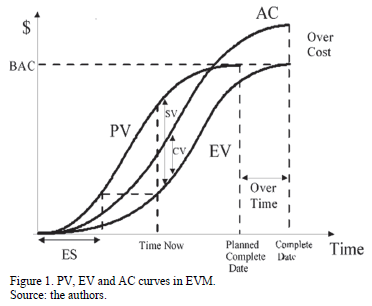
<body><![CDATA[<p><font size="3" face="Verdana, Arial, Helvetica, sans-serif"><b>1. Introduction</b></font></p>     <p><font size="2" face="Verdana, Arial, Helvetica, sans-serif">Earned Value Management (EVM) is a   project management technique used to measure project progress in an objective   manner. It is a technique used to control and manage projects by combining   dynamic project data and expressing it usefully, highlighting risks and   measuring the project &#91;1&#93;. The EVM method provides early indications of project   performance to highlight the need for eventual corrective actions &#91;2&#93;. Nowadays,   implementing Earned Value (EV) techniques has many benefits and would enhance   the project's cost and scheduled performances. However, the research on the EV   is very restricted. <a href="#fig01">Fig. 1</a> shows Plan Value (PV), EV and   AC curves in EVM.</font></p>     <p align="center"><font size="2" face="Verdana, Arial, Helvetica, sans-serif"><a name="fig01"></a></font><img src="/img/revistas/dyna/v83n195/v83n195a16fig01.gif"></p>     <p><font size="2" face="Verdana, Arial, Helvetica, sans-serif">There are two basic approaches in the   literature: model-based and statistical methods to solve the EVM problem. The </font><font size="2" face="Verdana, Arial, Helvetica, sans-serif">model-based   approach is based on the assumption that there is enough prior information to   build an accurate model. </font></p>     <p><font size="2" face="Verdana, Arial, Helvetica, sans-serif">Naeni et al. developed a new fuzzy EV model which had the advantage of developing   and analyzing the EV indices, as well as the time and the cost estimates when there   is uncertainty &#91;3&#93;. The developed model is very useful in evaluating the   progress of a project where uncertainty arises. Vandevoorde and Vanhoucke   concluded that the most reliable method for estimating time at completion is   the Earned Schedule (ES) method &#91;4&#93;.</font></p>     <p><font size="2" face="Verdana, Arial, Helvetica, sans-serif">They were the first authors who   widely compared the three time prediction methods and tested them with a simple   one activity project and a real life data set. A reliable forecasting method of   the final cost and duration is proposed by Lipke et al. to improve the   capability of project managers for making informed decisions. They use data   from 12 real life projects to improve the capability of project managers to be   able to make informed decisions by providing a reliable forecasting method of   the final cost and duration. Hunter et al. focused on the implementation of   EVMS on the Radiation Belt Storm Probes (RBSP) project, explained EV processes   and the implementation's cost and analyzed the benefits of EVMS to provide   insight into cost/benefit considerations for other projects regarding EVMS   implementation &#91;5&#93;. Acebes et al. proposed an innovative and simple graphical   framework for project control and monitoring in order to integrate the   dimensions of project cost and schedule with risk management, thus extending   the EV methodology &#91;6&#93;. They build a graphical methodology to know when a   project remains &quot;out of control&quot; or &quot;within expected variability&quot; during the   project lifecycle. With this aim, they defined and represented new control   indexes and new cumulative buffers. Cioffi presented a new notation for the EV   analysis to make EV mathematics more transparent and flexible &#91;7&#93;.</font></p>     <p><font size="2" face="Verdana, Arial, Helvetica, sans-serif">Plaza and Turetken present a   spreadsheet-based decision support tool that automates the calculations and   analyses in EVM/LC &#91;8&#93;. Von Wangenheim presents an educational board game to   reinforce and teach the application of EVM concepts in the context of   undergraduate computing programs, complementing expository lessons on EVM   basics &#91;9&#93;. The game has been developed based on project management   fundamentals and teaching experience in this area. The results point out a very   positive effect of the game on social interaction, engagement, immersion,   attention and relevance to the course objectives. The objective of Elshaer's   paper is twofold: the first being to study the impact of the activities'   sensitivity information on the forecasting accuracy of the ESM method &#91;10&#93;. The   second is to test the claim that in normal conditions the project performance   indicator provided by ESM at higher work breakdown structure is reliable.   Vanhoucke presents two project tracking methods to address project problems   &#91;11&#93;. In this paper, a bottom-up and a top-down project tracking approach   within a corrective action framework is applied to a large and diverse set of   fictitious projects which are subject to Monte-Carlo simulations to   simulate fictitious project progress under uncertainty. Maravas and   Pantouvakis proposed a new method to calculate project cash flows, in which the   cost and duration of each activity are understood as fuzzy numbers &#91;12&#93;. Yao et   al. present a fuzzy, stochastic, single-period model for cash management to   provide financial decision makers with more insight into real cash management   problems &#91;13&#93;. Mortaji et al. developed an efficient approach to calculate Estimate   At Completion (EAC) &#91;14&#93;. Artificial Intelligence (AI) methods are used in   different fields and have attracted much attention &#91;15-17&#93;. Cheng et al. employed   AI approaches including fuzzy logic, K-means clustering, a genetic algorithm,   and Neural Networks (NNs) to gain strategic control over project cash flows   &#91;18&#93;. The evolutionary fuzzy support vector machine inference model for time   series data as an alternative approach is presented by Cheng and Roy to predict   cash flow &#91;19&#93;. Warburton proposes a formal method to include time dependence   into EV management &#91;20&#93;. The model requires three parameters: the reject rate   of activities, the cost overrun parameter, and the time to repair the rejected   activities. The model is built on the well-established Putnam-Norden-Rayleigh   (PNR) labor rate profile, which is a useful representation for large software   projects. </font></p>     <p><font size="2" face="Verdana, Arial, Helvetica, sans-serif">Statistical approaches try to analyze   series of observations that are obtained by the system and then they predict   the future behavior. Many recent prediction theories have been developed based   on statistical approaches due to the complexity of building an accurate model. However,   intelligent systems such as NNs and fuzzy or a hybrid methods like Adaptive   Network based on Fuzzy Inference System (ANFIS)   have relatively large errors and cannot be applied to real projects &#91;21,22&#93;.   The fuzzy systems can easily address uncertainties that exist in the complex   physical systems behavior. Adaptive learning algorithms can generate fuzzy   rules to predict chaotic time series when knowledge about the system and the   input-output format of the numeric data is available &#91;23&#93;. Time series   estimating based on Parallel Structure based on Fuzzy System (PSFS) is one of   the methods used for this purpose &#91;24&#93;. PSFS consists of a number of parallel   fuzzy systems. Each fuzzy system estimates the future value of the signal based   on older signals with different time samples. PSFS considers the final   estimation value based on the average output of each fuzzy system, except the   minimum and maximum values &#91;25&#93;. </font></p>     <p><font size="2" face="Verdana, Arial, Helvetica, sans-serif">A continuous increase in the complexity, efficiency, and reliability of   modern industrial systems necessitates continuous development in the control   and fault diagnosis theory and practice. This is associated with the increasing   demands for higher system performance and product quality on one side and more   cost efficiency on the other. The complexity and the automation degree of technical   processes are also continuously growing. This development calls for more system   safety and reliability. Today, one of the most critical issues surrounding the design of   automatic systems is system reliability and dependability &#91;26&#93;. A traditional   way to improve the system reliability and dependability is to enhance the   quality, reliability and robustness of individual system components like   sensors, actuators, controllers and computers. Even so, a fault-free system   operation cannot be guaranteed. Process monitoring and fault diagnosis are   therefore becoming an essential ingredient in a modern automatic control system   &#91;27&#93;. The overall concept of fault diagnosis consists of the following three   essential tasks: <b>Fault detection</b>: detection of the occurrence of faults   in the functional units of the process. These lead to undesired or intolerable   behavior of the whole system. <b>Fault isolation</b>: fault diagnosis system   outputs are also alarm signals that indicate the occurrence of the faults or   classified alarm signals that show which fault has occurred. The additionally   provide information about the type or magnitude of the fault that has occurred   &#91;26,27&#93;.</font></p>     <p><font size="2" face="Verdana, Arial, Helvetica, sans-serif">In this paper, the plan value diagram is   used to predict the earn value diagram using three methods. These three methods   are based on the PSFS and NNs, which implement projects in organizations. The   results of these three methods decreased the predicted error of the EV diagram by   up to 2%. </font></p>     ]]></body>
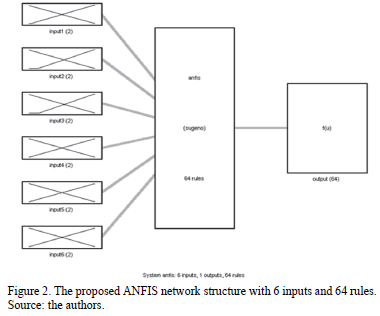
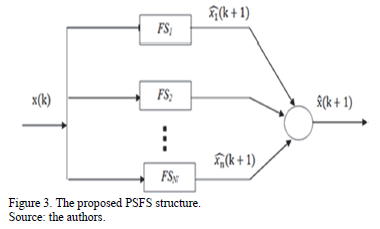
<body><![CDATA[<p><font size="2" face="Verdana, Arial, Helvetica, sans-serif">This paper   is organized as follows: In section 2, the structure of the new PSFS is   presented. Section 3 shows the simulation. The NNs models are illustrated in   section 4. A comparison of these techniques will be expressed and presented in   section 5. Finally, in section 6, conclusions are made.</font></p>     <p>&nbsp;</p>     <p><font size="3" face="Verdana, Arial, Helvetica, sans-serif"><b>2. Proposed parallel structure based on fuzzy systems</b></font></p>     <p><font size="2" face="Verdana, Arial, Helvetica, sans-serif">PSFS is made by some fuzzy systems that   have parallel connection and it is used for predicting time series. As shown in <a href="#fig02">Fig. 2</a>, the fuzzy system used in PSFS is ANFIS network, which includes 6   inputs, 1 output and 64 rules.</font></p>     <p align="center"><font size="2" face="Verdana, Arial, Helvetica, sans-serif"><a name="fig02"></a></font><img src="/img/revistas/dyna/v83n195/v83n195a16fig02.gif"></p>     <p><font size="2" face="Verdana, Arial, Helvetica, sans-serif">PSFS wants to predict the <sub><img src="/img/revistas/dyna/v83n195/v83n195a16eq004.gif">, </sub>this is the data value in time step (k+r). P-th fuzzy system has an output <sub><img src="/img/revistas/dyna/v83n195/v83n195a16eq006.gif"></sub> that is based on previous data <sub><img src="/img/revistas/dyna/v83n195/v83n195a16eq008.gif"></sub>, …,<sub><img src="/img/revistas/dyna/v83n195/v83n195a16eq010.gif"></sub>. PSFS can   calculate the value of <sub><img src="/img/revistas/dyna/v83n195/v83n195a16eq012.gif"></sub> based on different outputs of   fuzzy systems<i><sub><img src="/img/revistas/dyna/v83n195/v83n195a16eq014.gif"></sub>,</i><sub><img src="/img/revistas/dyna/v83n195/v83n195a16eq016.gif"></sub>, …,<sub><img src="/img/revistas/dyna/v83n195/v83n195a16eq018.gif"></sub>. PSFS calculated   the final value of <sub><img src="/img/revistas/dyna/v83n195/v83n195a16eq020.gif"></sub>by averaging the measurements between all fuzzy system outputs except maximum and minimum values. This   value is shown in eq. (1).</font></p>     <p><img src="/img/revistas/dyna/v83n195/v83n195a16eq01.gif"></p>     <p><font size="2" face="Verdana, Arial, Helvetica, sans-serif">The proposed PSFS is composed of multiple parallel fuzzy subsystems, which are used for time series &#91;28&#93;. <a href="#fig03">Fig. 3</a> </font></p>     <p align="center"><font size="2" face="Verdana, Arial, Helvetica, sans-serif"><a name="fig03"></a></font><img src="/img/revistas/dyna/v83n195/v83n195a16fig03.gif"></p>     <p><font size="2" face="Verdana, Arial, Helvetica, sans-serif">shows the proposed PSFS. The PSFS consists of the N parallel fuzzy   subsystems FS1, FS2... FSN. Each fuzzy system for a specific time with index   k+1 predicts a value for the time series. The PSFS consequence predicts the end   value <img src="/img/revistas/dyna/v83n195/v83n195a16eq028.gif">, in terms of the particular decision making. </font></p>     ]]></body>
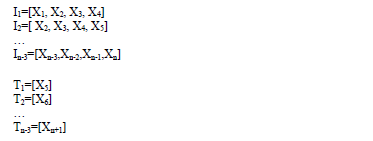
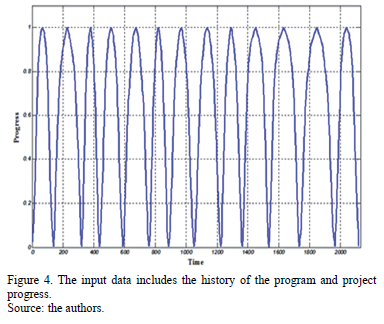
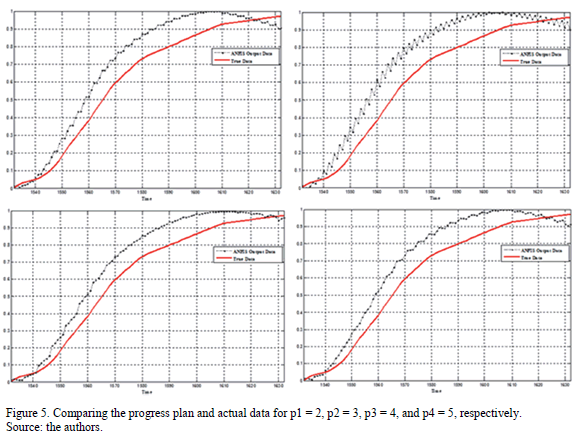
<body><![CDATA[<p><font size="2" face="Verdana, Arial, Helvetica, sans-serif">In the previous PSFS structures, the average   outputs of the fuzzy networks are considered as outputs that eliminate the   maximum and minimum in each algorithm. Eliminating values will lead to missing   information when the outputs of fuzzy networks are close to each other. By   comparing the network output variance, the decision will be made to eliminate,   or not, the extreme values in the proposed algorithm. </font></p>     <p><font size="2" face="Verdana, Arial, Helvetica, sans-serif">Firstly, the new algorithm is calculated based on output variance   of a fuzzy network <i><sub><img src="/img/revistas/dyna/v83n195/v83n195a16eq030.gif"></sub></i> , and also the standard deviation represented by <font face="Symbol">s</font>;<i><sub>T</sub></i>. After that maximum output   is calculated <i><sub><img src="/img/revistas/dyna/v83n195/v83n195a16eq032.gif"></sub></i>, then it is removed from the list of   data. The new variance is calculated by N-1 of the remaining samples and   represented by <i>s<sub>max</sub></i>. If <i>s<sub>T</sub>&gt;Ks<sub>max</sub></i><sub>, </sub>then data is sparse, so maximum a value   must be removed by the previous algorithm; otherwise, the maximum   value is set to zero. This process is also applied to minimum output. In the simulation   step the K value is set to three. </font></p>     <p>&nbsp;</p>     <p><font size="3" face="Verdana, Arial, Helvetica, sans-serif"><b>3. Simulation</b></font></p>     <p><font size="2" face="Verdana, Arial, Helvetica, sans-serif">To facilitate network   training and to prevent its divergence (discontinuity points), this paper undertakes an innovation. The   input data includes the plan history and the project operation, as shown in <a href="#fig04">Fig. 4</a>. In this figure, the first half of the bell is considered as the plan,   and the second half shows the activity operation. </font></p>     <p align="center"><font size="2" face="Verdana, Arial, Helvetica, sans-serif"><a name="fig04"></a></font><img src="/img/revistas/dyna/v83n195/v83n195a16fig04.gif"></p>     <p><font size="2" face="Verdana, Arial, Helvetica, sans-serif">1400 pieces of data are used to train the ANFIS network. Using these   data, four ANFIS networks are trained with   steps <i>P<sub>1</sub>=2, P<sub>2</sub>=3, P<sub>3</sub>=4,and   P<sub>4</sub>=5</i>. Then, to test the trained networks with 200 further pieces of data, <i>(3*P+1)</i> of the train data   are used to generate the PSFS outputs. Finally, the generated data is compared   to the original signal. The dataset (j303_10) that was generated by ProGen for   RCPSP Kolisch and Hartmann is used in this paper &#91;29&#93;. A developed program was   used in &#91;30&#93; by using VBA-MSP tools in Microsoft Project in order to generate periodical   data.</font></p>     <p><font size="2" face="Verdana, Arial, Helvetica, sans-serif">It can be assumed that the   operation plan is implemented until time 30 in order for a fault to be detected.   To diagnose the fault, the absolute value of the error curve of the PSFS   network should be measured with the curve output of the   plan value at time E1. Also, the absolute value of the project output curve should be calculated by the plan value curve at time E2. By   comparing these two values an error in the system can be addressed. <a href="#fig05">Fig. 5</a> shows the progress plan and actual data for p1 = 2, p2 = 3,   p3 = 4 and p4 = 5, respectively.</font></p>     <p align="center"><font size="2" face="Verdana, Arial, Helvetica, sans-serif"><a name="fig05"></a></font><img src="/img/revistas/dyna/v83n195/v83n195a16fig05.gif"></p>     <p>&nbsp;</p>     ]]></body>

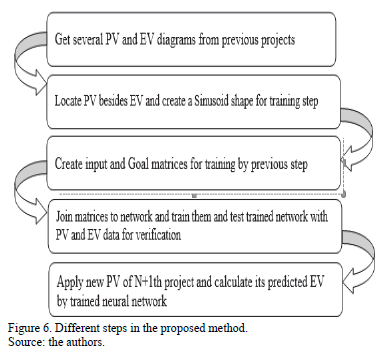
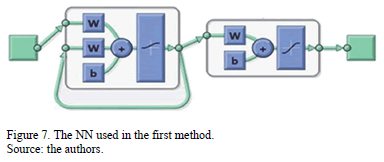
<body><![CDATA[<p><font size="3" face="Verdana, Arial, Helvetica, sans-serif"><b>4. Neural network-based method</b></font></p>     <p><font size="2" face="Verdana, Arial, Helvetica, sans-serif">The NN has   many applications, estimation being one of them. By using the NN in estimation,   the subsequent data will be estimated, and a set of data with a good accuracy   will be used &#91;31&#93;. Assume that <i>N</i> projects have been undertaken by a   company, and the PV and EV diagrams of these projects are available. The purpose is now to estimate the EV diagram   of the project <i>N+1<sup>th</sup></i>using its PV diagram. There are two   methods of doing this: the future state method, and by using previous data. </font></p>     <p><font size="2" face="Verdana, Arial, Helvetica, sans-serif">In the prediction problems with NNs, the   future state prediction of a system is based   on its previous state &#91;31&#93;. Since high precision and speed have a priority, different methods exist to   implement networks that are similar to each other. <a href="#fig06">Fig. 6</a> shows the proposed   structure:</font></p>     <p align="center"><font size="2" face="Verdana, Arial, Helvetica, sans-serif"><a name="fig06"></a></font><img src="/img/revistas/dyna/v83n195/v83n195a16fig06.gif"></p>     <p><font size="2" face="Verdana, Arial, Helvetica, sans-serif"><b><i>4.1. The first method simulation</i></b></font></p>     <p><font size="2" face="Verdana, Arial, Helvetica, sans-serif">The NN used in this   project to predict the next state of the recurrent network is a two-layer NN structure   that is shown in <a href="#fig07">Fig. 7</a>.</font></p>     <p align="center"><font size="2" face="Verdana, Arial, Helvetica, sans-serif"><a name="fig07"></a></font><img src="/img/revistas/dyna/v83n195/v83n195a16fig07.gif"></p>     <p><font size="2" face="Verdana, Arial, Helvetica, sans-serif">Also, the input data and the objective functions in the network can be selected below, if X   indicates data:</font></p>     <p><img src="/img/revistas/dyna/v83n195/v83n195a16eq011.gif"></p>     <p><font size="2" face="Verdana, Arial, Helvetica, sans-serif">When using previous data, the main issue is to train   the NN with available historical data that it needs to use for new data. In   this method, the PV graphs appear sequentially and are defined as NN inputs. Also, this is what happened for EV</font> <font size="2" face="Verdana, Arial, Helvetica, sans-serif">graphs, and they   were defined as objective NN functions. There are two sine graphs in <a href="#fig04">Fig. 4</a>;   one of is the input and the other (EV graph) is the objective function.</font></p>     ]]></body>
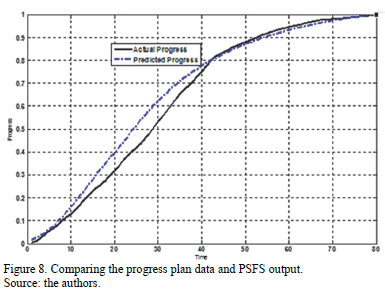
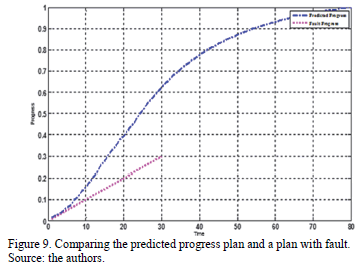
<body><![CDATA[<p><font size="2" face="Verdana, Arial, Helvetica, sans-serif"><b><i>4.2. The second method simulation</i></b></font></p>     <p><font size="2" face="Verdana, Arial, Helvetica, sans-serif">In this method, the network   is trained with 1400 pieces of data from PV and EV graphs and is then tested   with another 800 pieces of data from them. The various NNs are used to train   data; the best of them is chosen based on the error calculation measurements,   (Root Mean Square (RMS) or Mean Squared Error (MSE)). It should be noted that the number of hidden layers and neurons in each   of the networks is the same. According to the measurements taken and the   relative uniformity of data, Radial Basis Function Neural Network (RBF NN) is   the best network for aforesaid data.</font></p>     <p>&nbsp;</p>     <p><font size="3" face="Verdana, Arial, Helvetica, sans-serif"><b>5. Results</b></font></p>     <p><font size="2" face="Verdana, Arial, Helvetica, sans-serif">After collecting the required information from the organization and implementing the algorithm, the   following results in three strategies' different sub-sections have been   obtained.</font></p>     <p><font size="2" face="Verdana, Arial, Helvetica, sans-serif"><b><i>5.1. PSFS results</i></b></font></p>     <p><font size="2" face="Verdana, Arial, Helvetica, sans-serif"><a href="#fig08">Fig. 8</a> is drawn for the P = 5 step and ANFIS   network. The actual and estimated EV is also   shown in this figure. </font></p>     <p align="center"><font size="2" face="Verdana, Arial, Helvetica, sans-serif"><a name="fig08"></a></font><img src="/img/revistas/dyna/v83n195/v83n195a16fig08.gif"></p>     <p><font size="2" face="Verdana, Arial, Helvetica, sans-serif">Using the network described in section 2,   the PSFS system is built. The E1=1.6373 and E2 = 2.6978 are obtained in <a href="#fig09">Fig. 9</a>.   It can be demonstrated that an error has   occurred in the system due to the fact that E2&gt; E1.</font></p>     <p align="center"><font size="2" face="Verdana, Arial, Helvetica, sans-serif"><a name="fig09"></a></font><img src="/img/revistas/dyna/v83n195/v83n195a16fig09.gif"></p>     ]]></body>
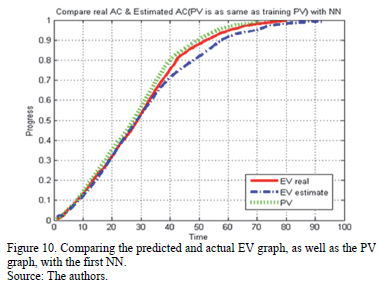
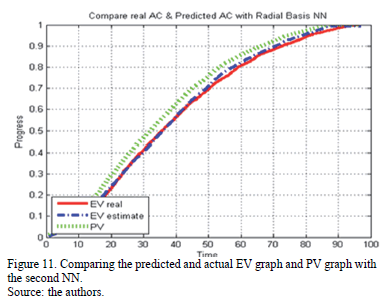
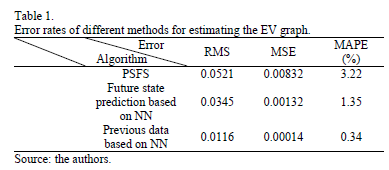
<body><![CDATA[<p><font size="2" face="Verdana, Arial, Helvetica, sans-serif"><b><i>5.2. Results of the future state prediction based   on neural network</i></b></font></p>     <p><font size="2" face="Verdana, Arial, Helvetica, sans-serif">The recurrent NNs were applied to the data listed in section 4.1 and the result is shown in <a href="#fig10">Fig. 10</a>. </font></p>     <p align="center"><font size="2" face="Verdana, Arial, Helvetica, sans-serif"><a name="fig10"></a></font><img src="/img/revistas/dyna/v83n195/v83n195a16fig10.gif"></p>     <p><font size="2" face="Verdana, Arial, Helvetica, sans-serif"><b><i>5.3. Results of the previous data based on neural   network</i></b></font></p>     <p><font size="2" face="Verdana, Arial, Helvetica, sans-serif">The RBF NN was applied to the data listed   in section 4.2 and the result is shown in <a href="#fig11">Fig. 11</a>.</font></p>     <p align="center"><font size="2" face="Verdana, Arial, Helvetica, sans-serif"><a name="fig11"></a></font><img src="/img/revistas/dyna/v83n195/v83n195a16fig11.gif"></p>     <p><font size="2" face="Verdana, Arial, Helvetica, sans-serif">The fault detection in the NNs, in its best state (ANN   Method II) is E1=0.02, whereas E2=2.69. This means that the second NN method is   more accurate in detecting faults. The results are summarized in <a href="#tab01">Table 1</a>. </font></p>     <p align="center"><font size="2" face="Verdana, Arial, Helvetica, sans-serif"><a name="tab01"></a></font><img src="/img/revistas/dyna/v83n195/v83n195a16tab01.gif"></p>     <p>&nbsp;</p>     <p><font size="3" face="Verdana, Arial, Helvetica, sans-serif"><b>6. Conclusion</b></font></p>     ]]></body>
<body><![CDATA[<p><font size="2" face="Verdana, Arial, Helvetica, sans-serif">As is clear from the above results, the   proposed algorithms are able to reduce the estimation error by up to 2 </font><font size="2" face="Verdana, Arial, Helvetica, sans-serif">percent. However,   in many cases, the maximum amount of the estimation error reduction is   equivalent to 42 percent. In this paper, we developed new algorithms to   estimate the EV graphs based on PSFS and NN. Also, the proposed algorithms   effectively estimate the EV graphs and diagnose the fault with high accuracy.   It must be mentioned that the first NN was introduced for the real data   (non-uniform) because of its good performance. </font></p>     <p>&nbsp;</p>     <p><font size="3" face="Verdana, Arial, Helvetica, sans-serif"><b>References</b></font></p>     <!-- ref --><p><font size="2" face="Verdana, Arial, Helvetica, sans-serif"><b>&#91;1&#93;</b> Kerzner, H., Project management   case studies, Wiley, 2012.    &nbsp;&nbsp;&nbsp;&nbsp;&nbsp;&nbsp;&nbsp;&nbsp;[&#160;<a href="javascript:void(0);" onclick="javascript: window.open('/scielo.php?script=sci_nlinks&ref=1141592&pid=S0012-7353201600010001600001&lng=','','width=640,height=500,resizable=yes,scrollbars=1,menubar=yes,');">Links</a>&#160;]<!-- end-ref --></font></p>     <!-- ref --><p><font size="2" face="Verdana, Arial, Helvetica, sans-serif"><b>&#91;2&#93;</b> Fleming, Q.W. and Koppelman, J.M.,   Earned value project management, Project Management Institute, 2010.    &nbsp;&nbsp;&nbsp;&nbsp;&nbsp;&nbsp;&nbsp;&nbsp;[&#160;<a href="javascript:void(0);" onclick="javascript: window.open('/scielo.php?script=sci_nlinks&ref=1141594&pid=S0012-7353201600010001600002&lng=','','width=640,height=500,resizable=yes,scrollbars=1,menubar=yes,');">Links</a>&#160;]<!-- end-ref --></font></p>     <!-- ref --><p><font size="2" face="Verdana, Arial, Helvetica, sans-serif"><b>&#91;3&#93;</b> Naeni, L.M., Shadrokh, S. and   Salehipour, A., A fuzzy approach for the earned value management. International   Journal of Project Management, 29(6), pp. 764-772, 2011. DOI: 10.1016/j.ijproman.2010.07.012.    &nbsp;&nbsp;&nbsp;&nbsp;&nbsp;&nbsp;&nbsp;&nbsp;[&#160;<a href="javascript:void(0);" onclick="javascript: window.open('/scielo.php?script=sci_nlinks&ref=1141596&pid=S0012-7353201600010001600003&lng=','','width=640,height=500,resizable=yes,scrollbars=1,menubar=yes,');">Links</a>&#160;]<!-- end-ref --></font></p>     <!-- ref --><p><font size="2" face="Verdana, Arial, Helvetica, sans-serif"><b>&#91;4&#93;</b> Vandevoorde, S. and Vanhoucke, M.,   A comparison of different project duration forecasting methods using earned   value metrics. International Journal of Project Management, 24(4), pp. 289-302,   2006. DOI: 10.1016/j.ijproman.2005.10.004.    &nbsp;&nbsp;&nbsp;&nbsp;&nbsp;&nbsp;&nbsp;&nbsp;[&#160;<a href="javascript:void(0);" onclick="javascript: window.open('/scielo.php?script=sci_nlinks&ref=1141598&pid=S0012-7353201600010001600004&lng=','','width=640,height=500,resizable=yes,scrollbars=1,menubar=yes,');">Links</a>&#160;]<!-- end-ref --></font></p>     <!-- ref --><p><font size="2" face="Verdana, Arial, Helvetica, sans-serif"><b>&#91;5&#93;</b> Lipke, W., Zwikael, O.,   Henderson, K. and Anbari, F., Prediction of project outcome: the application of   statistical methods to earned value management and earned schedule performance   indexes. International Journal of Project Management, 27(4), pp. 400-407, 2009.   DOI: 10.1016/j.ijproman.2008.02.009.    &nbsp;&nbsp;&nbsp;&nbsp;&nbsp;&nbsp;&nbsp;&nbsp;[&#160;<a href="javascript:void(0);" onclick="javascript: window.open('/scielo.php?script=sci_nlinks&ref=1141600&pid=S0012-7353201600010001600005&lng=','','width=640,height=500,resizable=yes,scrollbars=1,menubar=yes,');">Links</a>&#160;]<!-- end-ref --></font></p>     <!-- ref --><p><font size="2" face="Verdana, Arial, Helvetica, sans-serif"><b>&#91;6&#93;</b> Acebes, F., Pajares, J., Gal&aacute;n,   J.M. and L&oacute;pez-Paredes, A., Beyond earned value management: A graphical   framework for integrated cost, schedule and risk monitoring. Procedia-Social   and Behavioral Sciences, 74, pp. 231-239, 2013. DOI: 10.1016/J.SBSPRO.2013.03.027.    &nbsp;&nbsp;&nbsp;&nbsp;&nbsp;&nbsp;&nbsp;&nbsp;[&#160;<a href="javascript:void(0);" onclick="javascript: window.open('/scielo.php?script=sci_nlinks&ref=1141602&pid=S0012-7353201600010001600006&lng=','','width=640,height=500,resizable=yes,scrollbars=1,menubar=yes,');">Links</a>&#160;]<!-- end-ref --></font></p>     <!-- ref --><p><font size="2" face="Verdana, Arial, Helvetica, sans-serif"><b>&#91;7&#93;</b> Cioffi, D.F., Designing project   management: A scientific notation and an improved formalism for earned value   calculations. International Journal of Project Management, 24(2), pp. 136-144,   2006. DOI: 10.1016/j.ijproman.2005.07.003.    &nbsp;&nbsp;&nbsp;&nbsp;&nbsp;&nbsp;&nbsp;&nbsp;[&#160;<a href="javascript:void(0);" onclick="javascript: window.open('/scielo.php?script=sci_nlinks&ref=1141604&pid=S0012-7353201600010001600007&lng=','','width=640,height=500,resizable=yes,scrollbars=1,menubar=yes,');">Links</a>&#160;]<!-- end-ref --></font></p>     <!-- ref --><p><font size="2" face="Verdana, Arial, Helvetica, sans-serif"><b>&#91;8&#93;</b> Plaza, M. and Turetken, O., A   model-based DSS for integrating the impact of learning in project control.   Decision Support Systems, 47(4), pp. 488-499, 2009. DOI: 10.1016/j.dss.2009.04.010.    &nbsp;&nbsp;&nbsp;&nbsp;&nbsp;&nbsp;&nbsp;&nbsp;[&#160;<a href="javascript:void(0);" onclick="javascript: window.open('/scielo.php?script=sci_nlinks&ref=1141606&pid=S0012-7353201600010001600008&lng=','','width=640,height=500,resizable=yes,scrollbars=1,menubar=yes,');">Links</a>&#160;]<!-- end-ref --></font></p>     <!-- ref --><p><font size="2" face="Verdana, Arial, Helvetica, sans-serif"><b>&#91;9&#93;</b> Von Wangenheim, C.G., Savi, R.   and Borgatto, A.F., DELIVER! - An educational game for teaching earned value   management in computing courses. Information and Software Technology, 54(3),   pp. 286-298, 2012. DOI: 10.1016/j.infsof.2011.10.005.    &nbsp;&nbsp;&nbsp;&nbsp;&nbsp;&nbsp;&nbsp;&nbsp;[&#160;<a href="javascript:void(0);" onclick="javascript: window.open('/scielo.php?script=sci_nlinks&ref=1141608&pid=S0012-7353201600010001600009&lng=','','width=640,height=500,resizable=yes,scrollbars=1,menubar=yes,');">Links</a>&#160;]<!-- end-ref --></font></p>     <!-- ref --><p><font size="2" face="Verdana, Arial, Helvetica, sans-serif"><b>&#91;10&#93;</b> Elshaer, R., Impact of   sensitivity information on the prediction of project's duration using earned   schedule method. International Journal of Project Management, 31(4), pp.   579-588, 2013. DOI: 10.1016/j.ijproman.2012.10.006.    &nbsp;&nbsp;&nbsp;&nbsp;&nbsp;&nbsp;&nbsp;&nbsp;[&#160;<a href="javascript:void(0);" onclick="javascript: window.open('/scielo.php?script=sci_nlinks&ref=1141610&pid=S0012-7353201600010001600010&lng=','','width=640,height=500,resizable=yes,scrollbars=1,menubar=yes,');">Links</a>&#160;]<!-- end-ref --></font></p>     <!-- ref --><p><font size="2" face="Verdana, Arial, Helvetica, sans-serif"><b>&#91;11&#93;</b> Vanhoucke, M., On the dynamic   use of project performance and schedule risk information during   projecttracking. Omega, 39(4), pp. 416-426, 2011. DOI: 10.1016/j.omega.2010.09.006.    &nbsp;&nbsp;&nbsp;&nbsp;&nbsp;&nbsp;&nbsp;&nbsp;[&#160;<a href="javascript:void(0);" onclick="javascript: window.open('/scielo.php?script=sci_nlinks&ref=1141612&pid=S0012-7353201600010001600011&lng=','','width=640,height=500,resizable=yes,scrollbars=1,menubar=yes,');">Links</a>&#160;]<!-- end-ref --></font></p>     <!-- ref --><p><font size="2" face="Verdana, Arial, Helvetica, sans-serif"><b>&#91;12&#93;</b> Maravas, A. and Pantouvakis, J.-P.,   Project cash flow analysis in the presence of uncertainty in activity duration   and cost. International Journal of Project Management, 30(3), pp. 374-384,   2012. DOI: 10.1016/j.ijproman.2011.08.005.    &nbsp;&nbsp;&nbsp;&nbsp;&nbsp;&nbsp;&nbsp;&nbsp;[&#160;<a href="javascript:void(0);" onclick="javascript: window.open('/scielo.php?script=sci_nlinks&ref=1141614&pid=S0012-7353201600010001600012&lng=','','width=640,height=500,resizable=yes,scrollbars=1,menubar=yes,');">Links</a>&#160;]<!-- end-ref --></font></p>     <!-- ref --><p><font size="2" face="Verdana, Arial, Helvetica, sans-serif"><b>&#91;13&#93;</b> Yao, J.-S., Chen, M.-S. and Lu,   H.-F., A fuzzy stochastic single-period model for cash management. European   Journal of Operational Research, 170(1), pp. 72-90, 2006. DOI: 10.1016/j.ejor.2004.06.017.    &nbsp;&nbsp;&nbsp;&nbsp;&nbsp;&nbsp;&nbsp;&nbsp;[&#160;<a href="javascript:void(0);" onclick="javascript: window.open('/scielo.php?script=sci_nlinks&ref=1141616&pid=S0012-7353201600010001600013&lng=','','width=640,height=500,resizable=yes,scrollbars=1,menubar=yes,');">Links</a>&#160;]<!-- end-ref --> </font></p>     <!-- ref --><p><font size="2" face="Verdana, Arial, Helvetica, sans-serif"><b>&#91;14&#93;</b> Mortaji, S.T.H., Bagherpour, M.   and Noori, S., Fuzzy earned value management using L-R fuzzy numbers. Journal   of Intelligent and Fuzzy Systems, 24(2), pp. 323-332, 2013. DOI: 10.3233/IFS-2012-0556.    &nbsp;&nbsp;&nbsp;&nbsp;&nbsp;&nbsp;&nbsp;&nbsp;[&#160;<a href="javascript:void(0);" onclick="javascript: window.open('/scielo.php?script=sci_nlinks&ref=1141618&pid=S0012-7353201600010001600014&lng=','','width=640,height=500,resizable=yes,scrollbars=1,menubar=yes,');">Links</a>&#160;]<!-- end-ref --></font></p>     <!-- ref --><p><font size="2" face="Verdana, Arial, Helvetica, sans-serif"><b>&#91;15&#93;</b> Quiroga, J., Cartes, D. and Edrington,   C., Neural network based system identification of a PMSM under load   fluctuation. DYNA, 76(160), pp. 273-282, 2009.    &nbsp;&nbsp;&nbsp;&nbsp;&nbsp;&nbsp;&nbsp;&nbsp;[&#160;<a href="javascript:void(0);" onclick="javascript: window.open('/scielo.php?script=sci_nlinks&ref=1141620&pid=S0012-7353201600010001600015&lng=','','width=640,height=500,resizable=yes,scrollbars=1,menubar=yes,');">Links</a>&#160;]<!-- end-ref --></font></p>     <!-- ref --><p><font size="2" face="Verdana, Arial, Helvetica, sans-serif"><b>&#91;16&#93;</b> P&eacute;rez-Salazar, M.D.R.,   Mateo-D&iacute;az, N.F., Garc&iacute;a-Rodr&iacute;guez, R., Mar-Orozco, C.E. and Cruz-Rivero, L., A   genetic algorithm to solve a three-echelon capacitated location problem for a   distribution center within a solid waste management system in the northern   region of Veracruz, Mexico. DYNA, 82(191), pp. 51-57, 2015. DOI: 10.15446/dyna.v82n191.51146.    &nbsp;&nbsp;&nbsp;&nbsp;&nbsp;&nbsp;&nbsp;&nbsp;[&#160;<a href="javascript:void(0);" onclick="javascript: window.open('/scielo.php?script=sci_nlinks&ref=1141622&pid=S0012-7353201600010001600016&lng=','','width=640,height=500,resizable=yes,scrollbars=1,menubar=yes,');">Links</a>&#160;]<!-- end-ref --></font></p>     <!-- ref --><p><font size="2" face="Verdana, Arial, Helvetica, sans-serif"><b>&#91;17&#93;</b> Agudelo, L., L&oacute;pez-Lezama, J.M.   and Galeano, N.M., Vulnerability assessment of power systems to intentional   attacks using a specialized genetic algorithm. DYNA, 82(192), pp. 78-84, 2015. DOI: 10.15446/DYNA.V82N192.48578.    &nbsp;&nbsp;&nbsp;&nbsp;&nbsp;&nbsp;&nbsp;&nbsp;[&#160;<a href="javascript:void(0);" onclick="javascript: window.open('/scielo.php?script=sci_nlinks&ref=1141624&pid=S0012-7353201600010001600017&lng=','','width=640,height=500,resizable=yes,scrollbars=1,menubar=yes,');">Links</a>&#160;]<!-- end-ref --></font></p>     <!-- ref --><p><font size="2" face="Verdana, Arial, Helvetica, sans-serif"><b>&#91;18&#93;</b> Cheng, M.-Y., Tsai, H.-C. and Liu,   C.-L., Artificial intelligence approaches to achieve strategic control over   project cash flows. Automation in Construction, 18(4): pp. 386-393, 2009. DOI: 10.1016/j.autcon.2008.10.005.    &nbsp;&nbsp;&nbsp;&nbsp;&nbsp;&nbsp;&nbsp;&nbsp;[&#160;<a href="javascript:void(0);" onclick="javascript: window.open('/scielo.php?script=sci_nlinks&ref=1141626&pid=S0012-7353201600010001600018&lng=','','width=640,height=500,resizable=yes,scrollbars=1,menubar=yes,');">Links</a>&#160;]<!-- end-ref --></font></p>     <!-- ref --><p><font size="2" face="Verdana, Arial, Helvetica, sans-serif"><b>&#91;19&#93;</b> Cheng, M.-Y. and Roy, A.F.,   Evolutionary fuzzy decision model for cash flow prediction using time-dependent   support vector machines. International Journal of Project Management, 29(1),   pp. 56-65, 2011. DOI: 10.1016/j.ijproman.2010.01.004.    &nbsp;&nbsp;&nbsp;&nbsp;&nbsp;&nbsp;&nbsp;&nbsp;[&#160;<a href="javascript:void(0);" onclick="javascript: window.open('/scielo.php?script=sci_nlinks&ref=1141628&pid=S0012-7353201600010001600019&lng=','','width=640,height=500,resizable=yes,scrollbars=1,menubar=yes,');">Links</a>&#160;]<!-- end-ref --></font></p>     <!-- ref --><p><font size="2" face="Verdana, Arial, Helvetica, sans-serif"><b>&#91;20&#93;</b> Warburton, R.D., A   time-dependent earned value model for software projects. International Journal   of Project Management, 29(8), pp. 1082-1090, 2011. DOI: 10.1016/j.ijproman.2011.02.008.    &nbsp;&nbsp;&nbsp;&nbsp;&nbsp;&nbsp;&nbsp;&nbsp;[&#160;<a href="javascript:void(0);" onclick="javascript: window.open('/scielo.php?script=sci_nlinks&ref=1141630&pid=S0012-7353201600010001600020&lng=','','width=640,height=500,resizable=yes,scrollbars=1,menubar=yes,');">Links</a>&#160;]<!-- end-ref --></font></p>     <!-- ref --><p><font size="2" face="Verdana, Arial, Helvetica, sans-serif"><b>&#91;21&#93;</b> Jang, J.-S., ANFIS:   Adaptive-network-based fuzzy inference system. IEEE Transactions on Systems,   Man and Cybernetics, 23(3), pp. 665-685, 1993. DOI: 10.1109/21.256541.    &nbsp;&nbsp;&nbsp;&nbsp;&nbsp;&nbsp;&nbsp;&nbsp;[&#160;<a href="javascript:void(0);" onclick="javascript: window.open('/scielo.php?script=sci_nlinks&ref=1141632&pid=S0012-7353201600010001600021&lng=','','width=640,height=500,resizable=yes,scrollbars=1,menubar=yes,');">Links</a>&#160;]<!-- end-ref --></font></p>     <!-- ref --><p><font size="2" face="Verdana, Arial, Helvetica, sans-serif"><b>&#91;22&#93;</b> Iranmanesh, S.H., Mirseraji, G.H.   and Shahmiri, S., An emotional learning based fuzzy inference system for   improvement of the completion time of projects estimation Computers &amp;   Industrial Engineering, 2009. CIE 2009. International Conference on, pp.   470-475, 2009. DOI: 10.1109/ICCIE.2009.5223748</font>&nbsp;&nbsp;&nbsp;&nbsp;&nbsp;&nbsp;&nbsp;&nbsp;[&#160;<a href="javascript:void(0);" onclick="javascript: window.open('/scielo.php?script=sci_nlinks&ref=1141634&pid=S0012-7353201600010001600022&lng=','','width=640,height=500,resizable=yes,scrollbars=1,menubar=yes,');">Links</a>&#160;]<!-- end-ref --><!-- ref --><p><font size="2" face="Verdana, Arial, Helvetica, sans-serif"><b>&#91;23&#93;</b> Abarbanel, H.D., Brown, R.,   Sidorowich, J.J. and Tsimring, L.S., The analysis of observed chaotic data in   physical systems. Reviews of Modern Physics, 65(4), pp. 1331, 1993. DOI: 10.1103/REVMODPHYS.65.1331.    &nbsp;&nbsp;&nbsp;&nbsp;&nbsp;&nbsp;&nbsp;&nbsp;[&#160;<a href="javascript:void(0);" onclick="javascript: window.open('/scielo.php?script=sci_nlinks&ref=1141635&pid=S0012-7353201600010001600023&lng=','','width=640,height=500,resizable=yes,scrollbars=1,menubar=yes,');">Links</a>&#160;]<!-- end-ref --></font></p>     <!-- ref --><p><font size="2" face="Verdana, Arial, Helvetica, sans-serif"><b>&#91;24&#93;</b> Jiang, J., Chen, J. and Qu, L.,   The application of correlation dimension in gearbox condition monitoring.   Journal of Sound and Vibration, 223(4), pp. 529-541, 1999. DOI: 10.1006/jsvi.1998.2161.    &nbsp;&nbsp;&nbsp;&nbsp;&nbsp;&nbsp;&nbsp;&nbsp;[&#160;<a href="javascript:void(0);" onclick="javascript: window.open('/scielo.php?script=sci_nlinks&ref=1141637&pid=S0012-7353201600010001600024&lng=','','width=640,height=500,resizable=yes,scrollbars=1,menubar=yes,');">Links</a>&#160;]<!-- end-ref --></font></p>     ]]></body>
<body><![CDATA[<!-- ref --><p><font size="2" face="Verdana, Arial, Helvetica, sans-serif"><b>&#91;25&#93;</b> Kim, M.S. and Kong, S.G., Time   series prediction using the parallel-structure fuzzy system. In Fuzzy Systems   Conference Proceedings, 1999. FUZZ-IEEE'99, 1999. pp. 934-938.    &nbsp;&nbsp;&nbsp;&nbsp;&nbsp;&nbsp;&nbsp;&nbsp;[&#160;<a href="javascript:void(0);" onclick="javascript: window.open('/scielo.php?script=sci_nlinks&ref=1141639&pid=S0012-7353201600010001600025&lng=','','width=640,height=500,resizable=yes,scrollbars=1,menubar=yes,');">Links</a>&#160;]<!-- end-ref --> </font></p>     <!-- ref --><p><font size="2" face="Verdana, Arial, Helvetica, sans-serif"><b>&#91;26&#93;</b> Ding, S., Model-based fault   diagnosis techniques: Design schemes, algorithms and tools, Springer, 2013. DOI:   10.1007/978-1-4471-4799-2.    &nbsp;&nbsp;&nbsp;&nbsp;&nbsp;&nbsp;&nbsp;&nbsp;[&#160;<a href="javascript:void(0);" onclick="javascript: window.open('/scielo.php?script=sci_nlinks&ref=1141641&pid=S0012-7353201600010001600026&lng=','','width=640,height=500,resizable=yes,scrollbars=1,menubar=yes,');">Links</a>&#160;]<!-- end-ref --></font></p>     <!-- ref --><p><font size="2" face="Verdana, Arial, Helvetica, sans-serif"><b>&#91;27&#93;</b> Witczak, M., Modelling and   estimation strategies for fault diagnosis of non-linear systems: from analytical   to soft computing approaches, Springer, 2007.    &nbsp;&nbsp;&nbsp;&nbsp;&nbsp;&nbsp;&nbsp;&nbsp;[&#160;<a href="javascript:void(0);" onclick="javascript: window.open('/scielo.php?script=sci_nlinks&ref=1141643&pid=S0012-7353201600010001600027&lng=','','width=640,height=500,resizable=yes,scrollbars=1,menubar=yes,');">Links</a>&#160;]<!-- end-ref --></font></p>     <!-- ref --><p><font size="2" face="Verdana, Arial, Helvetica, sans-serif"><b>&#91;28&#93;</b> Kim, M., Lee, H., You, C. and   Chung, C., Chaotic time series prediction using PSFS2. Proceedings of the 41<sup>st</sup> SICE Annual Conference, 2002. pp. 2358-2363.    &nbsp;&nbsp;&nbsp;&nbsp;&nbsp;&nbsp;&nbsp;&nbsp;[&#160;<a href="javascript:void(0);" onclick="javascript: window.open('/scielo.php?script=sci_nlinks&ref=1141645&pid=S0012-7353201600010001600028&lng=','','width=640,height=500,resizable=yes,scrollbars=1,menubar=yes,');">Links</a>&#160;]<!-- end-ref --></font></p>     <!-- ref --><p><font size="2" face="Verdana, Arial, Helvetica, sans-serif"><b>&#91;29&#93;</b> Kolisch, R. and Hartmann, S.,   Experimental investigation of heuristics for resource-constrained project   scheduling: An update. European Journal of Operational Research, 174(1), pp.   23-37, 2006. DOI: 10.1016/j.ejor.2005.01.065.    &nbsp;&nbsp;&nbsp;&nbsp;&nbsp;&nbsp;&nbsp;&nbsp;[&#160;<a href="javascript:void(0);" onclick="javascript: window.open('/scielo.php?script=sci_nlinks&ref=1141647&pid=S0012-7353201600010001600029&lng=','','width=640,height=500,resizable=yes,scrollbars=1,menubar=yes,');">Links</a>&#160;]<!-- end-ref --></font></p>     ]]></body>
<body><![CDATA[<!-- ref --><p><font size="2" face="Verdana, Arial, Helvetica, sans-serif"><b>&#91;30&#93;</b> Iranmanesh, H., Mojir, N. and Kimiagari,   S., A new formula to estimate at completion of a project's time to improve   earned value management system. IEEE Conference on Industrial Engineering and   Engineering Management, 2007. pp. 1014-1017.    &nbsp;&nbsp;&nbsp;&nbsp;&nbsp;&nbsp;&nbsp;&nbsp;[&#160;<a href="javascript:void(0);" onclick="javascript: window.open('/scielo.php?script=sci_nlinks&ref=1141649&pid=S0012-7353201600010001600030&lng=','','width=640,height=500,resizable=yes,scrollbars=1,menubar=yes,');">Links</a>&#160;]<!-- end-ref --></font></p>     <!-- ref --><p><font size="2" face="Verdana, Arial, Helvetica, sans-serif"><b>&#91;31&#93;</b> Mosavi, M.R., Comparing DGPS   corrections prediction using neural network, fuzzy neural network and Kalman   filter. Journal of GPS Solutions, 10(2), pp. 97-107, 2006. DOI: 10.1007/s10291-005-0011-7.    &nbsp;&nbsp;&nbsp;&nbsp;&nbsp;&nbsp;&nbsp;&nbsp;[&#160;<a href="javascript:void(0);" onclick="javascript: window.open('/scielo.php?script=sci_nlinks&ref=1141651&pid=S0012-7353201600010001600031&lng=','','width=640,height=500,resizable=yes,scrollbars=1,menubar=yes,');">Links</a>&#160;]<!-- end-ref --></font></p>     <p>&nbsp;</p>     <p><font size="2" face="Verdana, Arial, Helvetica, sans-serif"><b>M.T. Hajali-Mohamad,</b> received his BSc.   and MSc. in Industrial Engineering at K. N. Toosi University of Technology,   Tehran, Iran. He received his PhD. in Industrial Engineering in 2013, from the   Iran University of Science and Technology (IUST), Tehran, Iran. His research   interests include operations research, system dynamics, and EVM. ORCID: org/0000-0003-1054-6982</font></p>     <p><font size="2" face="Verdana, Arial, Helvetica, sans-serif"><b>M.R. Mosavi,</b> received his BSc., MSc. and   PhD. degrees in Electrical Engineering in 1997, 1998, and 2004, respectively   from Iran University of Technology (IUST), Tehran, Iran. He is currently a   faculty member (full professor) of the Department of Electrical Engineering of   IUST. He is the author of 230 scientific publications in journals and   international conferences. His research interests include circuits and systems   design. ORCID: org/0000-0002-2389-644x </font></p>     <p><font size="2" face="Verdana, Arial, Helvetica, sans-serif"><b>K. Shahanaghi,</b> is Assistant Professor   (since 2004) at the school of Industrial Engineering, Iran University of   Technology (IUST) where he lectures Simulation, Engineering Economy, and   Uncertain Programming courses for Industrial Engineering postgraduate students.   He received his BSc., MSc. and PhD. in Electrical Engineering at (IUST),   Tehran, Iran in 2000. He has many papers in international journals and   conferences. His research interests include Operations Research, Engineering   Economy, Simulation, and Multicriteria Decision Making. ORCID: org/0000-0003-0947-0773</font></p>      ]]></body><back>
<ref-list>
<ref id="B1">
<label>1</label><nlm-citation citation-type="book">
<person-group person-group-type="author">
<name>
<surname><![CDATA[Kerzner]]></surname>
<given-names><![CDATA[H.]]></given-names>
</name>
</person-group>
<source><![CDATA[Project management case studies]]></source>
<year>2012</year>
<publisher-name><![CDATA[Wiley]]></publisher-name>
</nlm-citation>
</ref>
<ref id="B2">
<label>2</label><nlm-citation citation-type="book">
<person-group person-group-type="author">
<name>
<surname><![CDATA[Fleming]]></surname>
<given-names><![CDATA[Q.W.]]></given-names>
</name>
<name>
<surname><![CDATA[Koppelman]]></surname>
<given-names><![CDATA[J.M.]]></given-names>
</name>
</person-group>
<source><![CDATA[Earned value project management]]></source>
<year>2010</year>
<publisher-name><![CDATA[Project Management Institute]]></publisher-name>
</nlm-citation>
</ref>
<ref id="B3">
<label>3</label><nlm-citation citation-type="journal">
<person-group person-group-type="author">
<name>
<surname><![CDATA[Naeni]]></surname>
<given-names><![CDATA[L.M.]]></given-names>
</name>
<name>
<surname><![CDATA[Shadrokh]]></surname>
<given-names><![CDATA[S.]]></given-names>
</name>
<name>
<surname><![CDATA[Salehipour]]></surname>
<given-names><![CDATA[A.]]></given-names>
</name>
</person-group>
<article-title xml:lang="en"><![CDATA[A fuzzy approach for the earned value management]]></article-title>
<source><![CDATA[International Journal of Project Management]]></source>
<year>2011</year>
<volume>29</volume>
<numero>6</numero>
<issue>6</issue>
<page-range>764-772</page-range></nlm-citation>
</ref>
<ref id="B4">
<label>4</label><nlm-citation citation-type="journal">
<person-group person-group-type="author">
<name>
<surname><![CDATA[Vandevoorde]]></surname>
<given-names><![CDATA[S.]]></given-names>
</name>
<name>
<surname><![CDATA[Vanhoucke]]></surname>
<given-names><![CDATA[M.]]></given-names>
</name>
</person-group>
<article-title xml:lang="en"><![CDATA[A comparison of different project duration forecasting methods using earned value metrics]]></article-title>
<source><![CDATA[International Journal of Project Management]]></source>
<year>2006</year>
<volume>24</volume>
<numero>4</numero>
<issue>4</issue>
<page-range>289-302</page-range></nlm-citation>
</ref>
<ref id="B5">
<label>5</label><nlm-citation citation-type="journal">
<person-group person-group-type="author">
<name>
<surname><![CDATA[Lipke]]></surname>
<given-names><![CDATA[W.]]></given-names>
</name>
<name>
<surname><![CDATA[Zwikael]]></surname>
<given-names><![CDATA[O.]]></given-names>
</name>
<name>
<surname><![CDATA[Henderson]]></surname>
<given-names><![CDATA[K.]]></given-names>
</name>
<name>
<surname><![CDATA[Anbari]]></surname>
<given-names><![CDATA[F.]]></given-names>
</name>
</person-group>
<article-title xml:lang="en"><![CDATA[Prediction of project outcome: the application of statistical methods to earned value management and earned schedule performance indexes]]></article-title>
<source><![CDATA[International Journal of Project Management]]></source>
<year>2009</year>
<volume>27</volume>
<numero>4</numero>
<issue>4</issue>
<page-range>400-407</page-range></nlm-citation>
</ref>
<ref id="B6">
<label>6</label><nlm-citation citation-type="journal">
<person-group person-group-type="author">
<name>
<surname><![CDATA[Acebes]]></surname>
<given-names><![CDATA[F.]]></given-names>
</name>
<name>
<surname><![CDATA[Pajares]]></surname>
<given-names><![CDATA[J.]]></given-names>
</name>
<name>
<surname><![CDATA[Galán]]></surname>
<given-names><![CDATA[J.M.]]></given-names>
</name>
<name>
<surname><![CDATA[López-Paredes]]></surname>
<given-names><![CDATA[A.]]></given-names>
</name>
</person-group>
<article-title xml:lang="en"><![CDATA[Beyond earned value management: A graphical framework for integrated cost, schedule and risk monitoring]]></article-title>
<source><![CDATA[Procedia-Social and Behavioral Sciences]]></source>
<year>2013</year>
<numero>74</numero>
<issue>74</issue>
<page-range>231-239</page-range></nlm-citation>
</ref>
<ref id="B7">
<label>7</label><nlm-citation citation-type="journal">
<person-group person-group-type="author">
<name>
<surname><![CDATA[Cioffi]]></surname>
<given-names><![CDATA[D.F.]]></given-names>
</name>
</person-group>
<article-title xml:lang="en"><![CDATA[Designing project management: A scientific notation and an improved formalism for earned value calculations]]></article-title>
<source><![CDATA[International Journal of Project Management]]></source>
<year>2006</year>
<volume>24</volume>
<numero>2</numero>
<issue>2</issue>
<page-range>136-144</page-range></nlm-citation>
</ref>
<ref id="B8">
<label>8</label><nlm-citation citation-type="journal">
<person-group person-group-type="author">
<name>
<surname><![CDATA[Plaza]]></surname>
<given-names><![CDATA[M.]]></given-names>
</name>
<name>
<surname><![CDATA[Turetken]]></surname>
<given-names><![CDATA[O.]]></given-names>
</name>
</person-group>
<article-title xml:lang="en"><![CDATA[A model-based DSS for integrating the impact of learning in project control]]></article-title>
<source><![CDATA[Decision Support Systems]]></source>
<year>2009</year>
<volume>47</volume>
<numero>4</numero>
<issue>4</issue>
<page-range>488-499</page-range></nlm-citation>
</ref>
<ref id="B9">
<label>9</label><nlm-citation citation-type="journal">
<person-group person-group-type="author">
<name>
<surname><![CDATA[Von Wangenheim]]></surname>
<given-names><![CDATA[C.G.]]></given-names>
</name>
<name>
<surname><![CDATA[Savi]]></surname>
<given-names><![CDATA[R.]]></given-names>
</name>
<name>
<surname><![CDATA[Borgatto]]></surname>
<given-names><![CDATA[A.F.]]></given-names>
</name>
</person-group>
<article-title xml:lang="en"><![CDATA[DELIVER!: An educational game for teaching earned value management in computing courses]]></article-title>
<source><![CDATA[Information and Software Technology]]></source>
<year>2012</year>
<volume>54</volume>
<numero>3</numero>
<issue>3</issue>
<page-range>286-298</page-range></nlm-citation>
</ref>
<ref id="B10">
<label>10</label><nlm-citation citation-type="journal">
<person-group person-group-type="author">
<name>
<surname><![CDATA[Elshaer]]></surname>
<given-names><![CDATA[R.]]></given-names>
</name>
</person-group>
<article-title xml:lang="en"><![CDATA[Impact of sensitivity information on the prediction of project's duration using earned schedule method]]></article-title>
<source><![CDATA[International Journal of Project Management]]></source>
<year>2013</year>
<volume>31</volume>
<numero>4</numero>
<issue>4</issue>
<page-range>579-588</page-range></nlm-citation>
</ref>
<ref id="B11">
<label>11</label><nlm-citation citation-type="journal">
<person-group person-group-type="author">
<name>
<surname><![CDATA[Vanhoucke]]></surname>
<given-names><![CDATA[M.]]></given-names>
</name>
</person-group>
<article-title xml:lang="en"><![CDATA[On the dynamic use of project performance and schedule risk information during projecttracking]]></article-title>
<source><![CDATA[Omega]]></source>
<year>2011</year>
<volume>39</volume>
<numero>4</numero>
<issue>4</issue>
<page-range>416-426</page-range></nlm-citation>
</ref>
<ref id="B12">
<label>12</label><nlm-citation citation-type="journal">
<person-group person-group-type="author">
<name>
<surname><![CDATA[Maravas]]></surname>
<given-names><![CDATA[A.]]></given-names>
</name>
<name>
<surname><![CDATA[Pantouvakis]]></surname>
<given-names><![CDATA[J.-P.]]></given-names>
</name>
</person-group>
<article-title xml:lang="en"><![CDATA[Project cash flow analysis in the presence of uncertainty in activity duration and cost]]></article-title>
<source><![CDATA[International Journal of Project Management]]></source>
<year>2012</year>
<volume>30</volume>
<numero>3</numero>
<issue>3</issue>
<page-range>374-384</page-range></nlm-citation>
</ref>
<ref id="B13">
<label>13</label><nlm-citation citation-type="journal">
<person-group person-group-type="author">
<name>
<surname><![CDATA[Yao]]></surname>
<given-names><![CDATA[J.-S.]]></given-names>
</name>
<name>
<surname><![CDATA[Chen]]></surname>
<given-names><![CDATA[M.-S.]]></given-names>
</name>
<name>
<surname><![CDATA[Lu]]></surname>
<given-names><![CDATA[H.-F.]]></given-names>
</name>
</person-group>
<article-title xml:lang="en"><![CDATA[A fuzzy stochastic single-period model for cash management]]></article-title>
<source><![CDATA[European Journal of Operational Research]]></source>
<year>2006</year>
<volume>170</volume>
<numero>1</numero>
<issue>1</issue>
<page-range>72-90</page-range></nlm-citation>
</ref>
<ref id="B14">
<label>14</label><nlm-citation citation-type="journal">
<person-group person-group-type="author">
<name>
<surname><![CDATA[Mortaji]]></surname>
<given-names><![CDATA[S.T.H.]]></given-names>
</name>
<name>
<surname><![CDATA[Bagherpour]]></surname>
<given-names><![CDATA[M.]]></given-names>
</name>
<name>
<surname><![CDATA[Noori]]></surname>
<given-names><![CDATA[S.]]></given-names>
</name>
</person-group>
<article-title xml:lang="en"><![CDATA[Fuzzy earned value management using L-R fuzzy numbers]]></article-title>
<source><![CDATA[Journal of Intelligent and Fuzzy Systems]]></source>
<year>2013</year>
<volume>24</volume>
<numero>2</numero>
<issue>2</issue>
<page-range>323-332</page-range></nlm-citation>
</ref>
<ref id="B15">
<label>15</label><nlm-citation citation-type="journal">
<person-group person-group-type="author">
<name>
<surname><![CDATA[Quiroga]]></surname>
<given-names><![CDATA[J.]]></given-names>
</name>
<name>
<surname><![CDATA[Cartes]]></surname>
<given-names><![CDATA[D.]]></given-names>
</name>
<name>
<surname><![CDATA[Edrington]]></surname>
<given-names><![CDATA[C.]]></given-names>
</name>
</person-group>
<article-title xml:lang="en"><![CDATA[Neural network based system identification of a PMSM under load fluctuation]]></article-title>
<source><![CDATA[DYNA]]></source>
<year>2009</year>
<volume>76</volume>
<numero>160</numero>
<issue>160</issue>
<page-range>273-282</page-range></nlm-citation>
</ref>
<ref id="B16">
<label>16</label><nlm-citation citation-type="journal">
<person-group person-group-type="author">
<name>
<surname><![CDATA[Pérez-Salazar]]></surname>
<given-names><![CDATA[M.D.R.]]></given-names>
</name>
<name>
<surname><![CDATA[Mateo-Díaz]]></surname>
<given-names><![CDATA[N.F.]]></given-names>
</name>
<name>
<surname><![CDATA[García-Rodríguez]]></surname>
<given-names><![CDATA[R.]]></given-names>
</name>
<name>
<surname><![CDATA[Mar-Orozco]]></surname>
<given-names><![CDATA[C.E.]]></given-names>
</name>
<name>
<surname><![CDATA[Cruz-Rivero]]></surname>
<given-names><![CDATA[L.]]></given-names>
</name>
</person-group>
<article-title xml:lang="en"><![CDATA[A genetic algorithm to solve a three-echelon capacitated location problem for a distribution center within a solid waste management system in the northern region of Veracruz, Mexico]]></article-title>
<source><![CDATA[DYNA]]></source>
<year>2015</year>
<volume>82</volume>
<numero>191</numero>
<issue>191</issue>
<page-range>51-57</page-range></nlm-citation>
</ref>
<ref id="B17">
<label>17</label><nlm-citation citation-type="journal">
<person-group person-group-type="author">
<name>
<surname><![CDATA[Agudelo]]></surname>
<given-names><![CDATA[L.]]></given-names>
</name>
<name>
<surname><![CDATA[López-Lezama]]></surname>
<given-names><![CDATA[J.M.]]></given-names>
</name>
<name>
<surname><![CDATA[Galeano]]></surname>
<given-names><![CDATA[N.M.]]></given-names>
</name>
</person-group>
<article-title xml:lang="en"><![CDATA[Vulnerability assessment of power systems to intentional attacks using a specialized genetic algorithm]]></article-title>
<source><![CDATA[DYNA]]></source>
<year>2015</year>
<volume>82</volume>
<numero>192</numero>
<issue>192</issue>
<page-range>78-84</page-range></nlm-citation>
</ref>
<ref id="B18">
<label>18</label><nlm-citation citation-type="journal">
<person-group person-group-type="author">
<name>
<surname><![CDATA[Cheng]]></surname>
<given-names><![CDATA[M.-Y.]]></given-names>
</name>
<name>
<surname><![CDATA[Tsai]]></surname>
<given-names><![CDATA[H.-C.]]></given-names>
</name>
<name>
<surname><![CDATA[Liu]]></surname>
<given-names><![CDATA[C.-L.]]></given-names>
</name>
</person-group>
<article-title xml:lang="en"><![CDATA[Artificial intelligence approaches to achieve strategic control over project cash flows]]></article-title>
<source><![CDATA[Automation in Construction]]></source>
<year>2009</year>
<volume>18</volume>
<numero>4</numero>
<issue>4</issue>
<page-range>386-393</page-range></nlm-citation>
</ref>
<ref id="B19">
<label>19</label><nlm-citation citation-type="journal">
<person-group person-group-type="author">
<name>
<surname><![CDATA[Cheng]]></surname>
<given-names><![CDATA[M.-Y.]]></given-names>
</name>
<name>
<surname><![CDATA[Roy]]></surname>
<given-names><![CDATA[A.F.]]></given-names>
</name>
</person-group>
<article-title xml:lang="en"><![CDATA[Evolutionary fuzzy decision model for cash flow prediction using time-dependent support vector machines]]></article-title>
<source><![CDATA[International Journal of Project Management]]></source>
<year>2011</year>
<volume>29</volume>
<numero>1</numero>
<issue>1</issue>
<page-range>56-65</page-range></nlm-citation>
</ref>
<ref id="B20">
<label>20</label><nlm-citation citation-type="journal">
<person-group person-group-type="author">
<name>
<surname><![CDATA[Warburton]]></surname>
<given-names><![CDATA[R.D.]]></given-names>
</name>
</person-group>
<article-title xml:lang="en"><![CDATA[A time-dependent earned value model for software projects]]></article-title>
<source><![CDATA[International Journal of Project Management]]></source>
<year>2011</year>
<volume>29</volume>
<numero>8</numero>
<issue>8</issue>
<page-range>1082-1090</page-range></nlm-citation>
</ref>
<ref id="B21">
<label>21</label><nlm-citation citation-type="journal">
<person-group person-group-type="author">
<name>
<surname><![CDATA[Jang]]></surname>
<given-names><![CDATA[J.-S.]]></given-names>
</name>
</person-group>
<article-title xml:lang="en"><![CDATA[ANFIS: Adaptive-network-based fuzzy inference system]]></article-title>
<source><![CDATA[IEEE Transactions on Systems, Man and Cybernetics]]></source>
<year>1993</year>
<volume>23</volume>
<numero>3</numero>
<issue>3</issue>
<page-range>665-685</page-range></nlm-citation>
</ref>
<ref id="B22">
<label>22</label><nlm-citation citation-type="confpro">
<person-group person-group-type="author">
<name>
<surname><![CDATA[Iranmanesh]]></surname>
<given-names><![CDATA[S.H.]]></given-names>
</name>
<name>
<surname><![CDATA[Mirseraji]]></surname>
<given-names><![CDATA[G.H.]]></given-names>
</name>
<name>
<surname><![CDATA[Shahmiri]]></surname>
<given-names><![CDATA[S.]]></given-names>
</name>
</person-group>
<article-title xml:lang="en"><![CDATA[An emotional learning based fuzzy inference system for improvement of the completion time of projects estimation]]></article-title>
<source><![CDATA[]]></source>
<year>2009</year>
<conf-name><![CDATA[ Computers & Industrial Engineering]]></conf-name>
<conf-date>2009</conf-date>
<conf-loc> </conf-loc>
<page-range>470-475</page-range></nlm-citation>
</ref>
<ref id="B23">
<label>23</label><nlm-citation citation-type="journal">
<person-group person-group-type="author">
<name>
<surname><![CDATA[Abarbanel]]></surname>
<given-names><![CDATA[H.D.]]></given-names>
</name>
<name>
<surname><![CDATA[Brown]]></surname>
<given-names><![CDATA[R.]]></given-names>
</name>
<name>
<surname><![CDATA[Sidorowich]]></surname>
<given-names><![CDATA[J.J.]]></given-names>
</name>
<name>
<surname><![CDATA[Tsimring]]></surname>
<given-names><![CDATA[L.S.]]></given-names>
</name>
</person-group>
<article-title xml:lang="en"><![CDATA[The analysis of observed chaotic data in physical systems]]></article-title>
<source><![CDATA[Reviews of Modern Physics]]></source>
<year>1993</year>
<volume>65</volume>
<numero>4</numero>
<issue>4</issue>
<page-range>1331</page-range></nlm-citation>
</ref>
<ref id="B24">
<label>24</label><nlm-citation citation-type="journal">
<person-group person-group-type="author">
<name>
<surname><![CDATA[Jiang]]></surname>
<given-names><![CDATA[J.]]></given-names>
</name>
<name>
<surname><![CDATA[Chen]]></surname>
<given-names><![CDATA[J.]]></given-names>
</name>
<name>
<surname><![CDATA[Qu]]></surname>
<given-names><![CDATA[L.]]></given-names>
</name>
</person-group>
<article-title xml:lang="en"><![CDATA[The application of correlation dimension in gearbox condition monitoring]]></article-title>
<source><![CDATA[Journal of Sound and Vibration]]></source>
<year>1999</year>
<volume>223</volume>
<numero>4</numero>
<issue>4</issue>
<page-range>529-541</page-range></nlm-citation>
</ref>
<ref id="B25">
<label>25</label><nlm-citation citation-type="confpro">
<person-group person-group-type="author">
<name>
<surname><![CDATA[Kim]]></surname>
<given-names><![CDATA[M.S.]]></given-names>
</name>
<name>
<surname><![CDATA[Kong]]></surname>
<given-names><![CDATA[S.G.]]></given-names>
</name>
</person-group>
<article-title xml:lang="en"><![CDATA[Time series prediction using the parallel-structure fuzzy system]]></article-title>
<source><![CDATA[]]></source>
<year></year>
<conf-name><![CDATA[ Fuzzy Systems Conference Proceedings]]></conf-name>
<conf-date>1999</conf-date>
<conf-loc> </conf-loc>
<page-range>934-938</page-range></nlm-citation>
</ref>
<ref id="B26">
<label>26</label><nlm-citation citation-type="book">
<person-group person-group-type="author">
<name>
<surname><![CDATA[Ding]]></surname>
<given-names><![CDATA[S.]]></given-names>
</name>
</person-group>
<source><![CDATA[Model-based fault diagnosis techniques: Design schemes, algorithms and tools]]></source>
<year>2013</year>
<publisher-name><![CDATA[Springer]]></publisher-name>
</nlm-citation>
</ref>
<ref id="B27">
<label>27</label><nlm-citation citation-type="book">
<person-group person-group-type="author">
<name>
<surname><![CDATA[Witczak]]></surname>
<given-names><![CDATA[M.]]></given-names>
</name>
</person-group>
<source><![CDATA[Modelling and estimation strategies for fault diagnosis of non-linear systems: from analytical to soft computing approaches]]></source>
<year>2007</year>
<publisher-name><![CDATA[Springer]]></publisher-name>
</nlm-citation>
</ref>
<ref id="B28">
<label>28</label><nlm-citation citation-type="confpro">
<person-group person-group-type="author">
<name>
<surname><![CDATA[Kim]]></surname>
<given-names><![CDATA[M.]]></given-names>
</name>
<name>
<surname><![CDATA[Lee]]></surname>
<given-names><![CDATA[H.]]></given-names>
</name>
<name>
<surname><![CDATA[You]]></surname>
<given-names><![CDATA[C.]]></given-names>
</name>
<name>
<surname><![CDATA[Chung]]></surname>
<given-names><![CDATA[C.]]></given-names>
</name>
</person-group>
<article-title xml:lang="en"><![CDATA[Chaotic time series prediction using PSFS2]]></article-title>
<source><![CDATA[]]></source>
<year></year>
<conf-name><![CDATA[41st SICE Annual Conference]]></conf-name>
<conf-date>2002</conf-date>
<conf-loc> </conf-loc>
<page-range>2358-2363</page-range></nlm-citation>
</ref>
<ref id="B29">
<label>29</label><nlm-citation citation-type="journal">
<person-group person-group-type="author">
<name>
<surname><![CDATA[Kolisch]]></surname>
<given-names><![CDATA[R.]]></given-names>
</name>
<name>
<surname><![CDATA[Hartmann]]></surname>
<given-names><![CDATA[S.]]></given-names>
</name>
</person-group>
<article-title xml:lang="en"><![CDATA[Experimental investigation of heuristics for resource-constrained project scheduling: An update]]></article-title>
<source><![CDATA[European Journal of Operational Research]]></source>
<year>2006</year>
<volume>174</volume>
<numero>1</numero>
<issue>1</issue>
<page-range>23-37</page-range></nlm-citation>
</ref>
<ref id="B30">
<label>30</label><nlm-citation citation-type="confpro">
<person-group person-group-type="author">
<name>
<surname><![CDATA[Iranmanesh]]></surname>
<given-names><![CDATA[H.]]></given-names>
</name>
<name>
<surname><![CDATA[Mojir]]></surname>
<given-names><![CDATA[N.]]></given-names>
</name>
<name>
<surname><![CDATA[Kimiagari]]></surname>
<given-names><![CDATA[S.]]></given-names>
</name>
</person-group>
<article-title xml:lang="en"><![CDATA[A new formula to estimate at completion of a project's time to improve earned value management system]]></article-title>
<source><![CDATA[]]></source>
<year></year>
<conf-name><![CDATA[ IEEE Conference on Industrial Engineering and Engineering Management]]></conf-name>
<conf-date>2007</conf-date>
<conf-loc> </conf-loc>
<page-range>1014-1017</page-range></nlm-citation>
</ref>
<ref id="B31">
<label>31</label><nlm-citation citation-type="journal">
<person-group person-group-type="author">
<name>
<surname><![CDATA[Mosavi]]></surname>
<given-names><![CDATA[M.R.]]></given-names>
</name>
</person-group>
<article-title xml:lang="en"><![CDATA[Comparing DGPS corrections prediction using neural network, fuzzy neural network and Kalman filter.]]></article-title>
<source><![CDATA[Journal of GPS Solutions]]></source>
<year>2006</year>
<volume>10</volume>
<numero>2</numero>
<issue>2</issue>
<page-range>97-107</page-range></nlm-citation>
</ref>
</ref-list>
</back>
</article>