<?xml version="1.0" encoding="ISO-8859-1"?><article xmlns:mml="http://www.w3.org/1998/Math/MathML" xmlns:xlink="http://www.w3.org/1999/xlink" xmlns:xsi="http://www.w3.org/2001/XMLSchema-instance">
<front>
<journal-meta>
<journal-id>0012-7353</journal-id>
<journal-title><![CDATA[DYNA]]></journal-title>
<abbrev-journal-title><![CDATA[Dyna rev.fac.nac.minas]]></abbrev-journal-title>
<issn>0012-7353</issn>
<publisher>
<publisher-name><![CDATA[Universidad Nacional de Colombia]]></publisher-name>
</publisher>
</journal-meta>
<article-meta>
<article-id>S0012-73532016000100017</article-id>
<article-id pub-id-type="doi">10.15446/dyna.v83n195.46323</article-id>
<title-group>
<article-title xml:lang="en"><![CDATA[Fingerprint verification using computational geometry]]></article-title>
<article-title xml:lang="es"><![CDATA[Verificación de huella dactilar utilizando geometría computacional]]></article-title>
</title-group>
<contrib-group>
<contrib contrib-type="author">
<name>
<surname><![CDATA[Ramírez-Flores]]></surname>
<given-names><![CDATA[Manuel]]></given-names>
</name>
<xref ref-type="aff" rid="A01"/>
</contrib>
<contrib contrib-type="author">
<name>
<surname><![CDATA[Aguilar-Torres]]></surname>
<given-names><![CDATA[Gualberto]]></given-names>
</name>
<xref ref-type="aff" rid="A02"/>
</contrib>
<contrib contrib-type="author">
<name>
<surname><![CDATA[Gallegos-García]]></surname>
<given-names><![CDATA[Gina]]></given-names>
</name>
<xref ref-type="aff" rid="A03"/>
</contrib>
</contrib-group>
<aff id="A01">
<institution><![CDATA[,Instituto Politécnico Nacional  ]]></institution>
<addr-line><![CDATA[ ]]></addr-line>
<country>México</country>
</aff>
<aff id="A02">
<institution><![CDATA[,Comisión Nacional de Seguridad  ]]></institution>
<addr-line><![CDATA[México D.F. ]]></addr-line>
<country>México</country>
</aff>
<aff id="A03">
<institution><![CDATA[,Instituto Politécnico Nacional  ]]></institution>
<addr-line><![CDATA[ ]]></addr-line>
<country>México</country>
</aff>
<pub-date pub-type="pub">
<day>00</day>
<month>02</month>
<year>2016</year>
</pub-date>
<pub-date pub-type="epub">
<day>00</day>
<month>02</month>
<year>2016</year>
</pub-date>
<volume>83</volume>
<numero>195</numero>
<fpage>128</fpage>
<lpage>137</lpage>
<copyright-statement/>
<copyright-year/>
<self-uri xlink:href="http://www.scielo.org.co/scielo.php?script=sci_arttext&amp;pid=S0012-73532016000100017&amp;lng=en&amp;nrm=iso"></self-uri><self-uri xlink:href="http://www.scielo.org.co/scielo.php?script=sci_abstract&amp;pid=S0012-73532016000100017&amp;lng=en&amp;nrm=iso"></self-uri><self-uri xlink:href="http://www.scielo.org.co/scielo.php?script=sci_pdf&amp;pid=S0012-73532016000100017&amp;lng=en&amp;nrm=iso"></self-uri><abstract abstract-type="short" xml:lang="en"><p><![CDATA[This paper presents a robust minutiae based method for fingerprint verification. The proposed method uses Delaunay Triangulation to represent minutiae as nodes of a connected graph composed of triangles. The minimum angle over all triangulations is maximized, which gives local stability to the constructed structures against rotation and translation variations. Geometric thresholds and minutiae data were used to characterize the triangulations created from input and template fingerprint images. The effectiveness of the proposed method is confirmed through calculations of false acceptance rate (FAR), false rejected rate (FRR) and equal error rate (EER) over FVC2002 databases compared to the results of other approaches.]]></p></abstract>
<abstract abstract-type="short" xml:lang="es"><p><![CDATA[Este trabajo presenta un método robusto con base en minucias para la verificación de huellas dactilares. El método propuesto utiliza Triangulaciones de Delaunay para representar a las minucias como nodos de un grafo compuesto por triángulos. El ángulo mínimo sobre todas las triangulaciones es maximizado, lo cual proporciona estabilidad local a las estructuras construidas contra variaciones de rotación y traslación. Umbrales geométricos y datos sobre minucias fueron utilizados para caracterizar las triangulaciones creadas con las imágenes de huellas dactilares de entrada y plantilla. La efectividad del método propuesto es confirmada con cálculos de la tasa de falsa aceptación (FAR), tasa de falso rechazo (FRR) y la tasa de igualdad de error (EER) sobre las bases de datos FVC2002, en comparación con los resultados de otras propuestas.]]></p></abstract>
<kwd-group>
<kwd lng="en"><![CDATA[Angle of orientation]]></kwd>
<kwd lng="en"><![CDATA[Delaunay Triangulation]]></kwd>
<kwd lng="en"><![CDATA[Equal Error Rate]]></kwd>
<kwd lng="en"><![CDATA[Fingerprint]]></kwd>
<kwd lng="en"><![CDATA[Geometric Thresholds]]></kwd>
<kwd lng="es"><![CDATA[Ángulo de orientación]]></kwd>
<kwd lng="es"><![CDATA[Triangulaciones de Delaunay]]></kwd>
<kwd lng="es"><![CDATA[Tasa de Igualdad de Error]]></kwd>
<kwd lng="es"><![CDATA[Huella Dactilar]]></kwd>
<kwd lng="es"><![CDATA[Umbrales Geométricos]]></kwd>
</kwd-group>
</article-meta>
</front><body><![CDATA[ <p><font size="1" face="Verdana, Arial, Helvetica, sans-serif"><b>DOI:</b> <a href="http://dx.doi.org/10.15446/dyna.v83n195.46323" target="_blank">http://dx.doi.org/10.15446/dyna.v83n195.46323</a></font></p>     <p align="center"><font size="4" face="Verdana, Arial, Helvetica, sans-serif"><b>Fingerprint verification using   computational geometry</b></font></p>     <p align="center"><i><b><font size="3" face="Verdana, Arial, Helvetica, sans-serif">Verificaci&oacute;n de huella dactilar   utilizando geometr&iacute;a computacional</font></b></i></p>     <p align="center">&nbsp;</p>     <p align="center"><b><font size="2" face="Verdana, Arial, Helvetica, sans-serif">Manuel   Ram&iacute;rez-Flores <i><sup>a</sup>,</i> Gualberto Aguilar-Torres <i><sup>b</sup></i> &amp; Gina Gallegos-Garc&iacute;a <i><sup>c</sup></i></font></b><font size="2" face="Verdana, Arial, Helvetica, sans-serif"></font></p>     <p align="center">&nbsp;</p>     <p align="center"><font size="2" face="Verdana, Arial, Helvetica, sans-serif"><sup><i>a </i></sup><i>Secci&oacute;n de   Estudios de Posgrado e Investigaci&oacute;n, Instituto Polit&eacute;cnico Nacional, Unidad   Culhuac&aacute;n, M&eacute;xico. <a href="mailto:manuel300688@gmail.com">manuel300688@gmail.com</a>    <br>   <sup>b</sup> Comisi&oacute;n Nacional de Seguridad, M&eacute;xico D.F., M&eacute;xico, <a href="mailto:autg79y@yahoo.com">autg79y@yahoo.com</a>    <br>   <sup>c</sup> Secci&oacute;n de Estudios de Posgrado e Investigaci&oacute;n, Instituto   Polit&eacute;cnico Nacional, Unidad Culhuac&aacute;n, M&eacute;xico. <a href="mailto:ggallegosg@ipn.mx">ggallegosg@ipn.mx</a></i></font></p>     <p align="center">&nbsp;</p>     ]]></body>
<body><![CDATA[<p align="center"><font size="2" face="Verdana, Arial, Helvetica, sans-serif"><b>Received: October 17<sup>th</sup>, 2014.   Received in revised form: August 12<sup>th</sup>, 2015. Accepted: January 10<sup>th</sup>,   2016.</b></font></p>     <p align="center">&nbsp;</p>     <p align="center"><font size="1" face="Verdana, Arial, Helvetica, sans-seriff"><b>This work is licensed under a</b> <a rel="license" href="http://creativecommons.org/licenses/by-nc-nd/4.0/">Creative Commons Attribution-NonCommercial-NoDerivatives 4.0 International License</a>.</font><br />   <a rel="license" href="http://creativecommons.org/licenses/by-nc-nd/4.0/"><img style="border-width:0" src="https://i.creativecommons.org/l/by-nc-nd/4.0/88x31.png" /></a></p> <hr>     <p><font size="2" face="Verdana, Arial, Helvetica, sans-serif"><b>Abstract    <br>   </b></font><font size="2" face="Verdana, Arial, Helvetica, sans-serif">This paper presents a robust minutiae   based method for fingerprint verification. The proposed method uses Delaunay Triangulation   to represent minutiae as nodes of a connected graph composed of triangles. The   minimum angle over all triangulations is maximized, which gives local stability   to the constructed structures against rotation and translation variations.   Geometric thresholds and minutiae data were used to characterize the   triangulations created from input and template fingerprint images. The   effectiveness of the proposed method is confirmed through calculations of false   acceptance rate (FAR), false rejected rate (FRR) and equal error rate (EER)   over FVC2002 databases compared to the results of other approaches.</font></p>     <p><font size="2" face="Verdana, Arial, Helvetica, sans-serif"><i>Keywords</i>: Angle of orientation, Delaunay Triangulation, Equal Error Rate,   Fingerprint, Geometric Thresholds.</font></p>     <p><font size="2" face="Verdana, Arial, Helvetica, sans-serif"><b>Resumen    <br>   </b></font><font size="2" face="Verdana, Arial, Helvetica, sans-serif">Este trabajo presenta un m&eacute;todo robusto   con base en minucias para la verificaci&oacute;n de huellas dactilares. El m&eacute;todo   propuesto utiliza Triangulaciones de Delaunay para representar a las minucias   como nodos de un grafo compuesto por tri&aacute;ngulos. El &aacute;ngulo m&iacute;nimo sobre todas   las triangulaciones es maximizado, lo cual proporciona estabilidad local a las   estructuras construidas contra variaciones de rotaci&oacute;n y traslaci&oacute;n. Umbrales   geom&eacute;tricos y datos sobre minucias fueron utilizados para caracterizar las   triangulaciones creadas con las im&aacute;genes de huellas dactilares de entrada y   plantilla. La efectividad del m&eacute;todo propuesto es confirmada con c&aacute;lculos de la   tasa de falsa aceptaci&oacute;n (FAR), tasa de falso rechazo (FRR) y la tasa de igualdad   de error (EER) sobre las bases de datos FVC2002, en comparaci&oacute;n con los   resultados de otras propuestas.</font></p>     <p><font size="2" face="Verdana, Arial, Helvetica, sans-serif"><i>Palabras   clave:</i> &Aacute;ngulo de orientaci&oacute;n, Triangulaciones de   Delaunay, Tasa de Igualdad de Error, Huella Dactilar, Umbrales Geom&eacute;tricos.</font></p> <hr>     <p>&nbsp;</p>     ]]></body>
<body><![CDATA[<p><font size="3" face="Verdana, Arial, Helvetica, sans-serif"><b>1. Introduction</b></font></p>     <p><font size="2" face="Verdana, Arial, Helvetica, sans-serif">Biometric technologies use some physical   or psychological trait such as: fingerprint, face, iris, voice, etc. to verify   or identify individuals and therefore restrict unauthorized access to   computational systems. These traits are unique and inherent in individuals,   making it difficult to falsify their I.D.; however, often they are noisy by   nature &#91;1&#93;.</font></p>     <p><font size="2" face="Verdana, Arial, Helvetica, sans-serif">Three types of degradations normally   affect the quality of the fingerprint image: appearance of gaps between ridges,   parallel ridges intercepts and natural effects such as cuts, wrinkles and   injuries. Image enhancement processes are in charge of improving the contrast   between ridges and valleys, and reducing the noise in the image &#91;2&#93;. Sometimes   methods similar to medical image processing are also used, for example, via   spatial domain filtering &#91;3&#93;.</font></p>     <p><font size="2" face="Verdana, Arial, Helvetica, sans-serif">After enhancing the fingerprint image,   comes the process of extracting and matching fingerprint features, which can be   classified in three categories: based on minutiae &#91;4-6&#93;, based on image &#91;7-9&#93;   and hybrid &#91;2,10,11&#93;. Those based on minutiae, use a feature vector extracted   from fingerprints as a set of points in a multi-dimensional plane. Some of the   characteristics that the feature vector represents are: type of minutiae,   position, and orientation, among others. After the extraction process,   fingerprint matching becomes a non-rigid point-matching problem with unknown   correspondence and differences in the number of points belonging to two sets   (query and template). Moreover, skin elasticity changes the relative position   of the minutiae at each acquisition &#91;6&#93; and can cause genuine minutiae to get   lost or pseudo minutiae to appear. &#91;5&#93;</font></p>     <p><font size="2" face="Verdana, Arial, Helvetica, sans-serif">The use of computational geometry can   help to address image-processing problems that are difficult to understand and   implement, such as distortion, rotation variations, and some others. One   particular geometric structure that can resolve most of the shortcomings in the   minutiae based methods for fingerprint verification processes is a Delaunay   Triangulation.</font></p>     <p><font size="2" face="Verdana, Arial, Helvetica, sans-serif">For   fingerprint verification processes, Delaunay Triangulation can be formed if the   minutiae locations are taken as the set of points P. The advantages of this proposed method are   that every minutia keeps the same neighboring structure even in the presence of   distortion. Insertion of new points in the triangulations because of noise   affects only locally. The same happens with missing or spurious minutiae. Thus, using geometrical thresholds, each   triangle in the Delaunay Triangulation can be characterized uniquely. Because   of this, each fingerprint can be classified and when a second sample of the   same fingerprint requires to be verified, a quantitative comparison can be   made. An Equal Error Rate of less than 1% can be obtained using these   techniques, demonstrating the accuracy of the method under these thresholds.</font></p>     <p><font size="2" face="Verdana, Arial, Helvetica, sans-serif"><b><i>1.2. Our contribution</i></b></font></p>     <p><font size="2" face="Verdana, Arial, Helvetica, sans-serif">The novelty   of our contribution with respect to other approaches is in the full analysis of   the Delaunay Triangulations to compare minutiae structures between   fingerprints. Most minutia based approaches that use Delaunay Triangulations   start their analysis by studying the edges that form Delaunay triangles instead   of analyzing these triangles as a basic structure &#91;4-6&#93;. In some cases, even a   threshold is established to decide whether to use Delaunay Triangulations or   whether to process all possible combinations of minutiae forming an edge &#91;4&#93;.   This kind of analysis involves a greater computational load because of the   number of combinations to analyze and the operations required for each   comparison. </font></p>     <p><font size="2" face="Verdana, Arial, Helvetica, sans-serif">On the other hand, if Delaunay   Triangulations are used, most of the approaches presented until now perform a   fingerprint alignment based on one reference triangle. To find this reference   triangle an analysis of the triangle's edges is undertaken by using specific   thresholds. Then, after the alignment, other thresholds have to be established   to define a neighborhood where aligned minutiae should be. With this, several   alignments and comparisons have to be made in order to count the matching   aligned minutiae, calculate a matching score and find the best alignment &#91;5,6&#93;. </font></p>     <p><font size="2" face="Verdana, Arial, Helvetica, sans-serif">In our proposal, from the beginning,   every Delaunay triangle extracted from the query fingerprint is compared   against every triangle extracted from the template fingerprint. In this   comparison, the analysis of the three edges of the triangle and the three   vertices of the triangle are performed. To avoid fingerprint alignment operations,   a measurement and a comparison of the orientation of the triangles is   performed. By establishing a specific threshold, the possible variation of   fingerprint rotation is considered. </font></p>     ]]></body>
<body><![CDATA[<p><font size="2" face="Verdana, Arial, Helvetica, sans-serif">In the case of spatial displacement of   the fingerprints, the structure of the Delaunay Triangulation is tolerant   because if a general spatial displacement takes place, then all the minutiae   move by the same proportion and the triangles extracted remain the same. If   only some minutiae were displaced, then the length of the sides of some   triangles changes, and the threshold for the comparison of the length of   triangles covers that distortion. Finally, the matching score for the   comparison of two fingerprints is pretty straightforward. The matching score is   calculated as the rate of coincident triangles over the average of the total   number of triangles between both fingerprints.</font></p>     <p><font size="2" face="Verdana, Arial, Helvetica, sans-serif">This paper is organized as following:   Section 2 describes related work around the problem of fingerprint   verification. Section 3 explains the mathematical and computational theory   behind Delaunay Triangulations and the measurements calculated from this to   characterize a fingerprint. Section 4 details our proposed solution and how our   scheme was implemented, pointing out the tools used for the extraction of the   fingerprint feature vector and the thresholds used in the matching process.   Section 5 shows the results obtained after applying the proposed solution to 4   FVC2002 databases. Then a discussion of these results is presented. Finally,   Section 6 contains the conclusions of this work in terms of the results   obtained and the future work to improve the performance of the scheme proposed.</font></p>     <p>&nbsp;</p>     <p><font size="3" face="Verdana, Arial, Helvetica, sans-serif"><b>2. Related work</b></font></p>     <p><font size="2" face="Verdana, Arial, Helvetica, sans-serif"><b><i>2.1. Image based approaches</i></b></font></p>     <p><font size="2" face="Verdana, Arial, Helvetica, sans-serif">Many studies   have been undertaken to deal with the problem of fingerprint matching and many   algorithms and schemes with different approaches have been proposed. Among   image-based methods for fingerprint verification, there is a proposal based on   features extracted from Wavelet and Fourier-Melling Transform (WFMT). Wavelet   transform is used to preserve the local edges and reduce noise in the low   frequency domain after image decomposition, which makes the fingerprint image   less sensitive to shape distortion. Then Fourier-Melling transformation (FMT)   served to produce a translation, rotation and scale invariant feature. The   results obtained in &#91;7&#93;, show that verification accuracy is 5.66 and EER is of   1.01%.</font></p>     <p><font size="2" face="Verdana, Arial, Helvetica, sans-serif">A second proposal in the category of   image-based algorithms is the use of tessellated invariant moment features for   fingerprint verification. In this scheme, a reference point is proposed to   allow more accurate and quicker performance. In the scheme, all the intrinsic   properties of the fingerprints are estimated, such as foreground region mask,   local ridge orientation and local ridge frequency, to enhance fingerprint   image. By using different complex   filtering methods, a reference point is established. Then its orientation is   calculated using the least mean square orientation algorithm. A Region of   Interest (ROI) is centered on the reference point and tessellated in a   predefined number of square cells. Seven invariant moments are extracted from   the cells and these represent the fingerprint information of the local   structure. The verification is based on measurements similar to the   eigenvalue-weighted cosine (EWC) distance to match two corresponding feature   vectors. The experiments carried out over the FVC2002 4 databases show an   average Equal Error Rate (EER) of 3.57% using the EWC distance &#91;8&#93;.</font></p> <font size="2" face="Verdana, Arial, Helvetica, sans-serif"><b><i>2.2. Hybrid approaches</i></b></font>     <p><font size="2" face="Verdana, Arial, Helvetica, sans-serif">One solution for hybrid fingerprint   extraction and matching processes was proposed in &#91;10&#93; and uses both minutiae   and ridge flow information. To capture the ridge strength at equal space   orientations, a set of 8 Gabor filters in the spatial frequencies that correspond   to the average inter-ridge spacing in fingerprints is used. Then an   eight-dimensional ridge feature map is constructed with square tessellation of   the filtered images. This map and the minutiae set of a fingerprint are used   for matching purposes. For this scheme, the calculated EER is about 4%.</font></p>     <p><font size="2" face="Verdana, Arial, Helvetica, sans-serif"><b><i>2.3. Minutiae based approaches</i></b></font></p>     <p><font size="2" face="Verdana, Arial, Helvetica, sans-serif">Thus, regarding the proposals in the   minutiae based category for fingerprint matching, there are few researches that   utilize Delaunay Triangulations as a structure to compare a query and a   template fingerprint image. In 2004,   Parziale and Niel, proposed to establish the dependency among minutiae by   applying Delaunay Triangulation over the point set representing them. In that   structure, each minutia was used as a triangle's vertex. Then measures of   distance between minutiae pairs, angular difference between orientations of   minutiae pairs, and angles between the orientation of each minutia and the   segment connecting them with another minutia, were calculated.</font></p>     ]]></body>
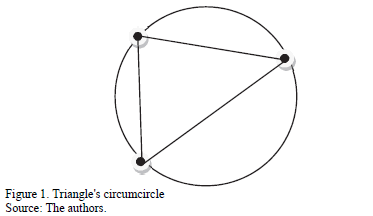
<body><![CDATA[<p><font size="2" face="Verdana, Arial, Helvetica, sans-serif">After applying three geometric filters,   some triangulations in the query set were selected as candidates for matching   with the triangles of the template set. For that, an alignment procedure was   undertaken with the triangulations in the query set in terms of spatial coordinates   and angles of orientation. If a minutia in the transformed query set is close   enough to a minutia in the template set, it is counted and used later to   calculate a matching score. &#91;6&#93;</font></p>     <p><font size="2" face="Verdana, Arial, Helvetica, sans-serif">In 2005, Liu, Yin, and Zhang, proposed a   very similar fingerprint matching algorithm based on Delaunay Triangulations to   find reference minutiae pairs known as RMPs. The analysis using Delaunay   Triangulations begins with similar edge pairs formed from query and template   sets of minutiae. Measurements of Euclidian distance, minutia orientation and   edge orientation are then compared. If a   pair of edges is very similar, then the triangles to which they belong become   candidates for the next analysis phase. In the second phase, the distance of   triangle's sides and internal angles are compared. If a coincidence between   triangles exists, for each triangle, an alignment of the query set with the   template set is carried out, using geometrical equations. Finally, for each   alignment of points, these are counted and a matching score is calculated. &#91;5&#93;</font></p>     <p><font size="2" face="Verdana, Arial, Helvetica, sans-serif">The last   proposal related to the use of Delaunay Triangulations, was made by Deng and   Huo in 2005. Instead of finding the best-matching minutiae pairs, the objective   was to find the best-matching edge pairs. Other important changes were:   minutiae orientation was mapped to a range from 0 to 2<font face="Symbol">P</font> instead of using   the original from 0 to <font face="Symbol">P</font>. The ridge count between minutiae was also used   as data in the matching process. </font></p>     <p><font size="2" face="Verdana, Arial, Helvetica, sans-serif">The process of fingerprint matching starts by checking the number of   minutiae in the fingerprint image, if it is below a threshold, Delaunay Triangulations are not calculated and</font><font size="2" face="Verdana, Arial, Helvetica, sans-serif"> instead all the possible edges connecting two minutiae are considered.   Then, several geometric filters are applied to the edge pairs, like Euclidean   distance, minutiae orientation difference, among others. Only the minutiae of   the edges that satisfy those filters are used in the next phase. The remaining   minutiae are sorted in ascending order and form all the possible triangles with   the closest neighboring minutiae. Again, geometric comparisons between   triangles are performed. If their characteristics satisfy the thresholds   established, a matching score is calculated for each triangle. At the end,   another matching score between the query and template image is calculated   considering the triangle matching scores previously calculated. &#91;4&#93;</font></p>     <p><font size="2" face="Verdana, Arial, Helvetica, sans-serif">In later sections of this paper, some of   these different schemes will be looked at again in a comparison against our   proposed minutiae-based solution. Following that, we present a discussion about   the obtained results in terms of the EER, FAR and FRR thresholds.</font></p>     <p>&nbsp;</p>     <p><font size="3" face="Verdana, Arial, Helvetica, sans-serif"><b>3. Background</b></font></p>     <p><font size="2" face="Verdana, Arial, Helvetica, sans-serif">A Triangulation can be defined, as the   maximal planar subdivision whose vertex set is P, where P denotes a finite set   of points in a plane. A maximal planar subdivision is a subdivision in which no   edge connecting two vertices can be added to it without destroying its   planarity (any edge that is not in the subdivision intersects one of the existing   edges).</font></p>     <p><font size="2" face="Verdana, Arial, Helvetica, sans-serif">&quot;Let P be a set of points in the   plane, and let T be a triangulation of P. Then T is a Delaunay triangulation of   P if and only if the circumcircle of any triangle of T does not contain a point   of P in its interior.&quot;&#91;12&#93;</font></p>     <p><font size="2" face="Verdana, Arial, Helvetica, sans-serif">So any Delaunay Triangulation T maximizes   the minimum angle over all triangles that compose it. What is stated in the   above quote can be appreciated in <a href="#fig01">Fig. 1</a>.</font></p>     ]]></body>
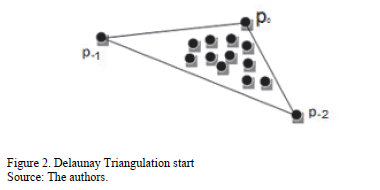
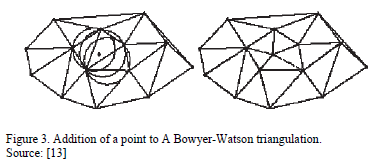
<body><![CDATA[<p align="center"><font size="2" face="Verdana, Arial, Helvetica, sans-serif"><a name="fig01"></a></font><img src="/img/revistas/dyna/v83n195/v83n195a17fig01.gif"></p>     <p><font size="2" face="Verdana, Arial, Helvetica, sans-serif">To start building a Delaunay   Triangulation with only the set of points P as initial data, an initial   repository has to be created. From a geometrical point of view, the repository   is the first triangle in the Delaunay Triangulation and it is large enough to   contain the whole set of points P. The vertices of the first triangle are:   three extra points, p0, p-1 and p-2. <a href="#fig02">Fig. 2</a> represents this statement.</font></p>     <p align="center"><font size="2" face="Verdana, Arial, Helvetica, sans-serif"><a name="fig02" id="fig02"></a></font><img src="/img/revistas/dyna/v83n195/v83n195a17fig02.gif"></p>     <p><font size="2" face="Verdana, Arial, Helvetica, sans-serif">It is important to choose <i>p<sub>0</sub>, p<sub>-1</sub></i> and <i>p<sub>-2</sub></i> far enough away, so they   do not destroy any triangles in the Delaunay triangulation of <i>P</i>. Later <i>p<sub>0</sub></i>, <i>p<sub>-1</sub></i> and <i>p<sub>-2</sub></i> can be discarded   together with all their incident edges.</font></p>     <p><font size="2" face="Verdana, Arial, Helvetica, sans-serif">There are basically two types of existing   algorithms, which can be used to implement a Delaunay Triangulation: The first type   is a static algorithm where the triangulation is valid after every single point   is processed. Some examples are: The recursive split algorithm, the divide and   conquer algorithm, the step-by-step algorithm, the modified hierarchical   algorithm, among others.</font></p>     <p><font size="2" face="Verdana, Arial, Helvetica, sans-serif">The second type of algorithms is the   dynamic triangulation where the triangulation is valid during processing. This   makes it possible to view the contribution of one point to the triangulated   irregular network (TIN). Some algorithms to implement this are called   incremental as the Bowyer and Watson algorithm.</font></p>     <p><font size="2" face="Verdana, Arial, Helvetica, sans-serif">Bowyer and Watson algorithm is known as   an incremental delete and build algorithm because it adds points sequentially   into an existing Delaunay triangulation &#91;13&#93;. The process follows the steps below:</font></p>     <blockquote>       <p><font size="2" face="Verdana, Arial, Helvetica, sans-serif">For each point in set P:</font></p>       <blockquote>         ]]></body>
<body><![CDATA[<p><font size="2" face="Verdana, Arial, Helvetica, sans-serif">1. Insert       point p &isin; P into triangulation    <br>       </font><font size="2" face="Verdana, Arial, Helvetica, sans-serif">2. Find       all existing triangles whose circumscribing circle       contains the point p.    <br>       </font><font size="2" face="Verdana, Arial, Helvetica, sans-serif">3. All       triangles found in step 2 are deleted and a convex       cavity is created.    <br>       </font><font size="2" face="Verdana, Arial, Helvetica, sans-serif">4. The       point p is joined with all the vertices on the boundary       of the cavity formed in 3 (re- triangulation). </font></p>   </blockquote>       <p><font size="2" face="Verdana, Arial, Helvetica, sans-serif">Remove initial triangle.</font></p> </blockquote>     <p><font size="2" face="Verdana, Arial, Helvetica, sans-serif">An example of the beginning and the end   steps of the process is shown in <a href="#fig03">Fig. 3</a>.</font></p>     <p align="center"><font size="2" face="Verdana, Arial, Helvetica, sans-serif"><a name="fig03"></a></font><img src="/img/revistas/dyna/v83n195/v83n195a17fig03.gif"></p>     <p><font size="2" face="Verdana, Arial, Helvetica, sans-serif">Finally the   implementation of the Bowyer-Watson algorithm requires computational data   structures such as: point based data structure for the vertices of the   triangle, a triangle based data structure for the elements that compose the   Delaunay Triangulation and finally a directed acyclic graph that represents the   Triangulation with the edges of each triangle and the neighbors that share   them.</font></p>     <p><font size="2" face="Verdana, Arial, Helvetica, sans-serif">For the implementation of Delaunay   Triangulations in our scheme, the Bowyer and Watson algorithm was used because   it provides the same theoretical optimum algorithmic complexity as other   methods, which is <font face="Symbol">Q</font>(<i>N </i>log<sub>2</sub> <i>N</i>), but with an easier procedure. </font></p>     <p><font size="2" face="Verdana, Arial, Helvetica, sans-serif">Although   Delaunay Triangulations allow the creation of a rotation and distortion   tolerant structure, the characterization, identification and comparison between   two different triangulations must be undertaken manually. Therefore, the second   part of our proposal consists in a set of measures and geometric thresholds   that allow to distinguish each triangle and its vertices in the Delaunay   triangulations formed.</font></p>     ]]></body>
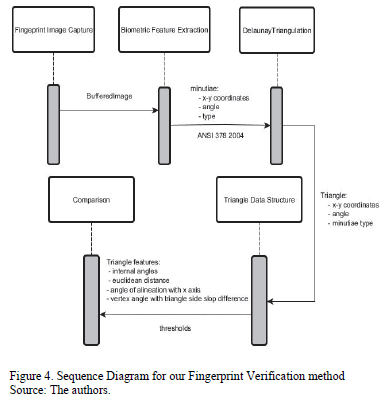
<body><![CDATA[<p>&nbsp;</p>     <p><font size="3" face="Verdana, Arial, Helvetica, sans-serif"><b>4. Proposed method</b></font></p>     <p><font size="2" face="Verdana, Arial, Helvetica, sans-serif">The   proposed scheme is a minutia based fingerprint verification system that uses   Delaunay Triangulations with geometrical measures and thresholds to validate   the similarity between two different fingerprints. The complete proposed scheme   is shown in <a href="#fig04">Fig. 4</a>., and explained right after.</font></p>     <p align="center"><font size="2" face="Verdana, Arial, Helvetica, sans-serif"><a name="fig04"></a></font><img src="/img/revistas/dyna/v83n195/v83n195a17fig04.gif"></p>     <p><font size="2" face="Verdana, Arial, Helvetica, sans-serif">Stage 1: Fingerprint image capture.</font></p>     <blockquote>       <p><font size="2" face="Verdana, Arial, Helvetica, sans-serif"> a. Use of Griaule     Biometrics Fingerprint SDK 2009</font></p> </blockquote>     <p><font size="2" face="Verdana, Arial, Helvetica, sans-serif">Stage 2: Minutiae features extraction.</font></p>     <blockquote>       <p>a. <font size="2" face="Verdana, Arial, Helvetica, sans-serif"> Creation of feature     extraction vector in ANSI 278-2004 format.</font></p> </blockquote>     ]]></body>
<body><![CDATA[<p><font size="2" face="Verdana, Arial, Helvetica, sans-serif">Stage 3: Delaunay Triangulation creation.</font></p>     <blockquote>       <p><font size="2" face="Verdana, Arial, Helvetica, sans-serif"> a. Creation of     reference triangle.    <br>     </font><font size="2" face="Verdana, Arial, Helvetica, sans-serif">b. Insertion of a new     point.    <br>     </font><font size="2" face="Verdana, Arial, Helvetica, sans-serif">c. Search of the     triangle containing the new point inserted.</font></p>       <blockquote>         <p><font size="2" face="Verdana, Arial, Helvetica, sans-serif">c.3 Check whether point is already inserted.    <br>       </font><font size="2" face="Verdana, Arial, Helvetica, sans-serif">c.4 Cross product calculation between vertices of triangle       and point inserted.</font></p>   </blockquote>       <p><font size="2" face="Verdana, Arial, Helvetica, sans-serif">d. Determine the     Cavity produced by the new point in the     Delaunay Triangulation.</font></p>       <blockquote>         ]]></body>
<body><![CDATA[<p><font size="2" face="Verdana, Arial, Helvetica, sans-serif">d.1 Verify       whether the new point is inside, on, or outside the Triangle's circumcircle and       its neighbors' circumcircles.</font>     <br>       <font size="2" face="Verdana, Arial, Helvetica, sans-serif">d.2 If the new point is inside a circumcircle of some       triangle, add it to cavity list.</font></p>   </blockquote>       <p><font size="2" face="Verdana, Arial, Helvetica, sans-serif">e. Update Delaunay     Triangulation</font></p>       <blockquote>         <p><font size="2" face="Verdana, Arial, Helvetica, sans-serif">e.1 Remove triangles contained in the cavity calculated       from Delaunay Triangulation.    <br>       </font><font size="2" face="Verdana, Arial, Helvetica, sans-serif">e.2 Create of new triangles with remaining vertices around       the old cavity and the new point.    <br>       </font><font size="2" face="Verdana, Arial, Helvetica, sans-serif">e.3 Add new Triangles to Delaunay Triangulation.    <br>       </font><font size="2" face="Verdana, Arial, Helvetica, sans-serif">e.4 Update each link between adjacent triangles.</font></p>   </blockquote> </blockquote>     <p><font size="2" face="Verdana, Arial, Helvetica, sans-serif">Stage 4: Triangle Data Structure   creation.</font></p>     <blockquote>       ]]></body>
<body><![CDATA[<p><font size="2" face="Verdana, Arial, Helvetica, sans-serif">a. Triangle's internal     angles calculation.    <br>     </font><font size="2" face="Verdana, Arial, Helvetica, sans-serif">b. Euclidean distance     between triangle's vertices calculation.    <br>     </font><font size="2" face="Verdana, Arial, Helvetica, sans-serif">c. Triangle's angle of     alienation with x-axis.    <br>     </font><font size="2" face="Verdana, Arial, Helvetica, sans-serif">d. Difference between     each pair of vertex's angle and triangle side slope.</font></p> </blockquote>     <p><font size="2" face="Verdana, Arial, Helvetica, sans-serif">Stage 5: Triangle features comparison</font></p>     <blockquote>       <p><font size="2" face="Verdana, Arial, Helvetica, sans-serif">a. Alignment of     triangles based on internal angles.    <br>     </font><font size="2" face="Verdana, Arial, Helvetica, sans-serif">b. Arithmetic     comparison of triangle's vertices based on minutiae type *    <br>     </font><font size="2" face="Verdana, Arial, Helvetica, sans-serif">c. Arithmetic     comparison between the length of the sides of the triangles *    <br>     </font><font size="2" face="Verdana, Arial, Helvetica, sans-serif">d. Arithmetic     comparison of differences between each pair of vertex angle and slope of a     triangle side*    ]]></body>
<body><![CDATA[<br>     </font><font size="2" face="Verdana, Arial, Helvetica, sans-serif">e. Arithmetic     comparison between angles of alignment with x axis. *    <br>     </font><font size="2" face="Verdana, Arial, Helvetica, sans-serif">f. Authentication or     rejection of fingerprint.</font></p> </blockquote>     <p><font size="2" face="Verdana, Arial, Helvetica, sans-serif">*In each comparison, the corresponding   threshold for error tolerance is added.</font></p>     <p><font size="2" face="Verdana, Arial, Helvetica, sans-serif">In Stage 2, the feature vector extracted   using the Griaule Biometrics software   for each minutia, contains the following biometric data:</font></p>     <p><img src="/img/revistas/dyna/v83n195/v83n195a17eq01.gif"></p>     <p><font size="2" face="Verdana, Arial, Helvetica, sans-serif">where:</font></p> <ul>       <li><font size="2" face="Verdana, Arial, Helvetica, sans-serif"> m<sub>i</sub> = ith minutia </font></li>       <li><font size="2" face="Verdana, Arial, Helvetica, sans-serif"> x     = value of the spatial coordinate in the x-axis</font></li>       <li><font size="2" face="Verdana, Arial, Helvetica, sans-serif"> y     = value of the spatial coordinate in the y-axis.</font></li>       <li><font size="2" face="Verdana, Arial, Helvetica, sans-serif"><font face="Symbol">q</font> = minutia orientation &#91;0,180&deg;&#93;</font></li>       ]]></body>
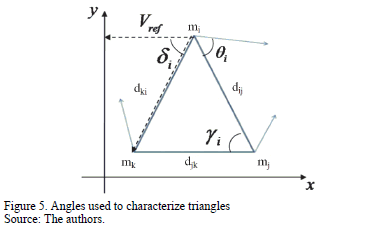
<body><![CDATA[<li><font size="2" face="Verdana, Arial, Helvetica, sans-serif"><font face="Symbol">t</font> = type of minutia &#91;end of ridge, ridge bifurcation, other&#93;</font></li>     </ul>     <p><font size="2" face="Verdana, Arial, Helvetica, sans-serif">For stage 4, different measures are   calculated in order to uniquely characterize each triangle. An image   interpretation of those calculations can be observed in <a href="#fig05">Fig. 5</a>.</font></p>     <p align="center"><font size="2" face="Verdana, Arial, Helvetica, sans-serif"><a name="fig05"></a></font><img src="/img/revistas/dyna/v83n195/v83n195a17fig05.gif"></p>     <p><font size="2" face="Verdana, Arial, Helvetica, sans-serif">The first measure, related to alignment   of triangles can be resumed in Equation (2), which comes from the cosine law   for triangles.</font></p>     <p><img src="/img/revistas/dyna/v83n195/v83n195a17eq02.gif"></p>     <p><font size="2" face="Verdana, Arial, Helvetica, sans-serif">where:</font></p> <ul>       <li><font size="2" face="Verdana, Arial, Helvetica, sans-serif"><font face="Symbol">g</font><sub>i </sub>= triangle's     internal angle</font></li>       <li><font size="2" face="Verdana, Arial, Helvetica, sans-serif"> d<sub>ij</sub>, d<sub>jk</sub>, d<sub>ki</sub> = length of triangle's side</font></li>     </ul>     ]]></body>
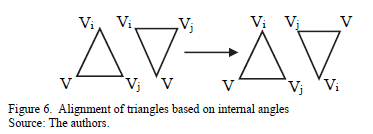
<body><![CDATA[<p><font size="2" face="Verdana, Arial, Helvetica, sans-serif">An alignment of triangles is needed to   ensure that the order in which the vertices of two triangles in different   Delaunay triangulations are described is correct. Otherwise, any further   calculation will be meaningless because the vertices of the triangles could be   swapped. To achieve this, the internal angles of a pair of triangles are paired   so that the difference between them is a small as possible. </font></p>     <p><font size="2" face="Verdana, Arial, Helvetica, sans-serif">When a pair of angles has the smallest   difference, the vertex of the triangle containing one of the angles is renamed   so that it matches with the vertex's name in the other triangle. The process is   repeated until the three vertices are matched with the best option in the   second triangle. An example is shown in <a href="#fig06">Fig. 6</a>.</font></p>     <p align="center"><font size="2" face="Verdana, Arial, Helvetica, sans-serif"><a name="fig06"></a></font><img src="/img/revistas/dyna/v83n195/v83n195a17fig06.gif"></p>     <p><font size="2" face="Verdana, Arial, Helvetica, sans-serif">Once a pair of triangles is aligned, a   process of comparison between the pair of triangles takes place. The first test   checks the type of minutiae in the vertices with the same name in the different   triangles. The main types of minutiae are classified as: termination and   bifurcation.</font></p>     <p><font size="2" face="Verdana, Arial, Helvetica, sans-serif">If the first test is passed, the   difference of one triangle's vertex angle (minutia orientation) and the angle   of the segment connecting that vertex with another one is calculated, for each   of the vertices of a triangle. Equation (3) describes how to calculate this measure.   A threshold expressed in grades is established to allow a tolerance limit in   the rotation that a triangle can have over another.</font></p>     <p><img src="/img/revistas/dyna/v83n195/v83n195a17eq03.gif"></p>     <p><font size="2" face="Verdana, Arial, Helvetica, sans-serif">where:</font></p> <ul>       <li><font size="2" face="Verdana, Arial, Helvetica, sans-serif"> a<sub>ij </sub>= angle     difference between triangle's side slope     expressed as an angle and minutia orientation. </font></li>       <li><font size="2" face="Verdana, Arial, Helvetica, sans-serif"> y<sub>i, </sub>y<sub>j</sub> =     y-spatial coordinate of minutiae <i>i</i> and <i>j</i> respectively.</font></li>       <li><font size="2" face="Verdana, Arial, Helvetica, sans-serif"> x<sub>i</sub>, x<sub>j</sub> =     x-spatial coordinate of minutiae <i>i</i> and <i>j</i> respectively.</font></li>       ]]></body>
<body><![CDATA[<li><font size="2" face="Verdana, Arial, Helvetica, sans-serif"><font face="Symbol">q</font><sub>i</sub> = i's     minutia orientation</font></li>     </ul>     <p><font size="2" face="Verdana, Arial, Helvetica, sans-serif">The next   comparison is undertaken using the Euclidean distance equation (4), between the   vertices of a triangle. Again a threshold is established, this time in pixels,   to tolerate a certain degree of distortion in the shape of the triangle because   of the different spatial allocation of the vertices.</font></p>     <p><img src="/img/revistas/dyna/v83n195/v83n195a17eq04.gif"></p>     <p><font size="2" face="Verdana, Arial, Helvetica, sans-serif">where:</font></p> <ul>       <li><font size="2" face="Verdana, Arial, Helvetica, sans-serif"> d<i><sub>ij</sub></i>= Euclidean distance between minutiae <i>i </i>and <i>j</i></font></li>       <li><font size="2" face="Verdana, Arial, Helvetica, sans-serif"> x<sub>i</sub>, x<sub>j</sub> = x-spatial coordinate of minutia <i>i </i>and <i>j</i></font></li>       <li><font size="2" face="Verdana, Arial, Helvetica, sans-serif"> y<sub>i</sub>,y<sub>j</sub> =     y-spatial coordinate of minutia <i>i</i> and <i>j</i></font></li>     </ul>     <p><font size="2" face="Verdana, Arial, Helvetica, sans-serif">The final filter is related to Equation   (5), which evaluates the angle between the first vertex of a triangle and the   x-axis. A threshold expressed in pixels allows a tolerance degree of rotation   for the triangle being evaluated in case the fingerprints captured are rotated.   It is important to point out that this measure quantifies the degree of   rotation that a local area of the fingerprint has in terms of triangles that   belong to a Delaunay Triangulation. </font></p>     ]]></body>
<body><![CDATA[<p><font size="2" face="Verdana, Arial, Helvetica, sans-serif">With this,   an alignment of all minutiae in the fingerprint is no longer needed, given that   if there is a rotation of the fingerprint, every minutia and every triangle   composed of them will present the variation and it will fit in the threshold   established. </font></p>     <p><img src="/img/revistas/dyna/v83n195/v83n195a17eq05.gif"></p>     <p><font size="2" face="Verdana, Arial, Helvetica, sans-serif">where:</font></p> <ul>       <li><font size="2" face="Verdana, Arial, Helvetica, sans-serif"><font face="Symbol">d</font>i = angle between one     triangle's side ij and Vref which is a     vector parallel to x-axis</font></li>       <li><font size="2" face="Verdana, Arial, Helvetica, sans-serif"> Vref = vector from triangle's     minutia mi to y-axis, which is parallel     to x-axis</font></li>       <li><font size="2" face="Verdana, Arial, Helvetica, sans-serif"> dki = euclidean distance     between minutiae k and i</font></li>     </ul>     <p><font size="2" face="Verdana, Arial, Helvetica, sans-serif">In the end, if each of the previously   mentioned tests are passed successfully then the system recognizes both   triangles as the same one and increases the count of equal elements between   both of the fingerprint's Delaunay Triangulations. </font></p>     <p><font size="2" face="Verdana, Arial, Helvetica, sans-serif">Equal Error Rates below 1% can be   obtained when using these techniques, which is a very good indicator for   biometric verification systems.</font></p>     <p>&nbsp;</p>     ]]></body>

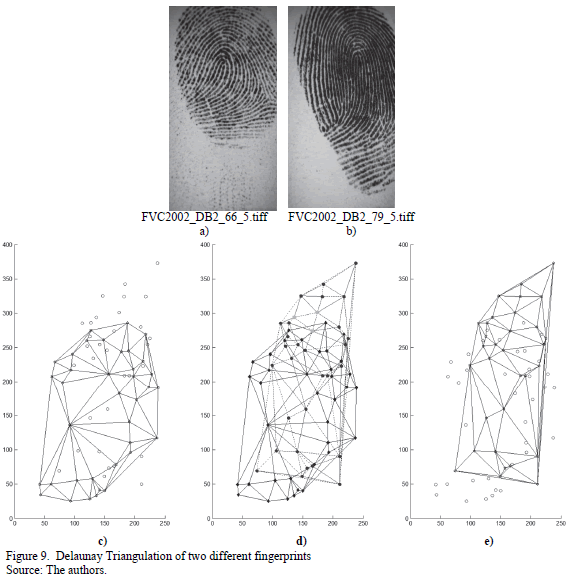
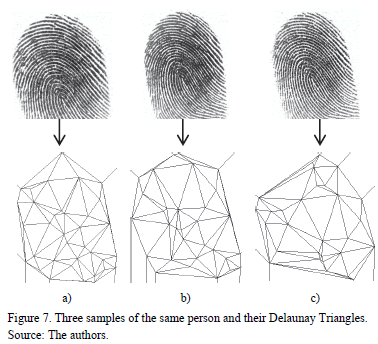
<body><![CDATA[<p><font size="3" face="Verdana, Arial, Helvetica, sans-serif"><b>5. Experiment</b></font></p>     <p><font size="2" face="Verdana, Arial, Helvetica, sans-serif">Before the experimental section, we must   take into account that the fingerprint image obtained always changes due the   pressure, angle and the tilt on capture device. For this reason, even if it is   the same person, it is almost impossible for the same minutiae to appear in   each one of the samples captured. This is one of the factors that mean that   fingerprint recognition may present a high percentage of false rejection.</font></p>     <p><font size="2" face="Verdana, Arial, Helvetica, sans-serif">Because of the above, Delaunay   Triangulations of the same fingerprint are also different each time a sample is   captured, as shown in the <a href="#fig07">Fig. 7</a>.</font></p>     <p align="center"><font size="2" face="Verdana, Arial, Helvetica, sans-serif"><a name="fig07"></a></font><img src="/img/revistas/dyna/v83n195/v83n195a17fig07.gif"></p>     <p><font size="2" face="Verdana, Arial, Helvetica, sans-serif">During the experimental section,   different tests were performed and it was found that it is almost impossible to   have many similar Delaunay Triangulations in samples of two different   fingerprints; however, in two samples of the same fingerprint, we found many   similar Delaunay Triangulations. On average, when we have two samples of   different fingerprints, we have found a maximum of two Delaunay Triangulations,   but when we have two samples of the same fingerprint, we have found more than   ten Delaunay Triangulations on average.</font></p>     <p><font size="2" face="Verdana, Arial, Helvetica, sans-serif">An image proof that describes how   Delaunay Triangulations act as an effective filter for fingerprint images can   be seen in the following 2 scenarios, represented with different graphs. </font></p>     <p><font size="2" face="Verdana, Arial, Helvetica, sans-serif">The first scenario shows two samples from   the same fingerprint, whereby a change in pressure levels and a small rotation   were registered. A group of images with the Delaunay Triangulations was   processed. The results are presented in <a href="#fig08">Fig. 8</a>.</font></p>     <p align="center"><a name="fig08"></a><img src="/img/revistas/dyna/v83n195/v83n195a17fig08.gif"></p>     <p><font size="2" face="Verdana, Arial, Helvetica, sans-serif">In <a href="#fig08">Fig. 8</a>, we can see that Delaunay Triangulations differ   from one another but also that there are specific areas in the Triangulations   that contain some triangles with the same characteristics in both image c) and   e). In image d) some of the vertices that appear in both triangulations are   marked in a softer color. This proves that Delaunay Triangulations can   characterize fingerprints even if they differ because of displacement, distorsion, rotations, changes   of pressure or other types of alterations.</font></p>     <p><font size="2" face="Verdana, Arial, Helvetica, sans-serif">The second scenario shows two samples of two different   fingerprints. Because of this, it is expected that no triangle in both Delaunay   Triangulations calculated would be classified as equal. This is the most difficult   task, because small triangles tend to be very similar in dimensions and angles with respect to others. <a href="#fig09">Fig. 9</a> shows this.</font></p>     ]]></body>
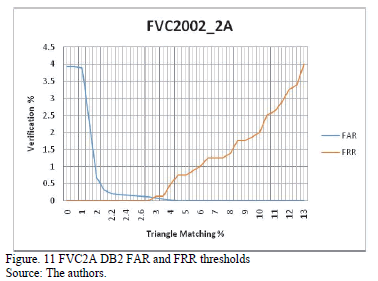
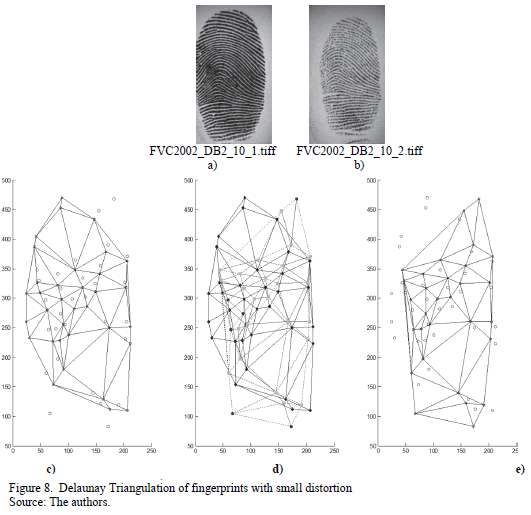
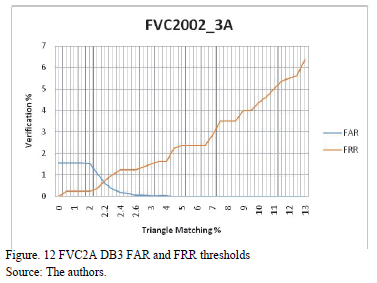
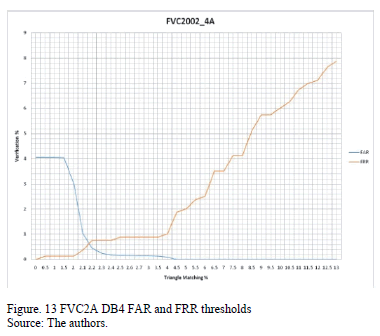
<body><![CDATA[<p align="center"><font size="2" face="Verdana, Arial, Helvetica, sans-serif"><a name="fig09"></a></font><img src="/img/revistas/dyna/v83n195/v83n195a17fig09.gif"></p>     <p><font size="2" face="Verdana, Arial, Helvetica, sans-serif">From the images in <a href="#fig09">Fig. 9</a> it can be seen that the calculated   Delaunay Triangulations are totally different. Because of this, only one   triangle is common between both triangulations. It is not easy to find the small triangle marked in a   softer color in image d). in the other two images. But it is clear that the   triangle marked as equal is very small and easy to classify wrongly.</font></p>     <p><font size="2" face="Verdana, Arial, Helvetica, sans-serif">It is very important to point out that for the experiments   shown above, the different geometric thresholds to filter all the triangles in   the Delaunay Triangulations had already been taken into account. Otherwise, if   only a check up of the triangles present were carried out, almost none of the   triangles would be equal to any other in the second triangulation. That can be   seen easily in the images.</font></p>     <p><font size="2" face="Verdana, Arial, Helvetica, sans-serif">After testing the advantages of using our proposed scheme   with some real fingerprint images and effectively characterize their minutiae,   we amplified the number of tests in order to get the FAR and FRR thresholds to   compare our scheme with other proposals. To obtain such thresholds, we   considered 4 fingerprint databases from FVC2002 set A, which are summarized in <a href="#tab01">Table 1</a>.</font></p>     <p align="center"><font size="2" face="Verdana, Arial, Helvetica, sans-serif"><a name="tab01"></a></font><img src="/img/revistas/dyna/v83n195/v83n195a17tab01.gif"></p>     <p><font size="2" face="Verdana, Arial, Helvetica, sans-serif">The threshold depending fraction of the   falsely accepted patterns divided by the number of all impostor patterns is   called False Acceptance Rate (FAR). Its value is one, if all impostor patterns   are falsely accepted and zero, if none of the impostor patterns are accepted.   The fraction of the number of rejected client patterns divided by the total   number of client patterns is called False Rejection Rate (FRR).</font></p>     <p><font size="2" face="Verdana, Arial, Helvetica, sans-serif">Note that if the score distributions   overlap, the FAR and FRR intersect at a certain point. The value of the FAR and   the FRR at this point, which is of course the same for both of them, is called   the Equal Error Rate (EER).</font></p>     <p><font size="2" face="Verdana, Arial, Helvetica, sans-serif">The EER of a   system can be used to give a threshold independent performance measure. The   lower the EER, the better the system's performance, as the total error rate   which is the sum of the FAR and the FRR at the point of the EER decreases &#91;15&#93;.</font></p>     <p><font size="2" face="Verdana, Arial, Helvetica, sans-serif">For each fingerprint, 6 random images out   of 8 were taken for training, and the remaining 2 were used for verification   test purposes. This means that in each database, there were 600 training images   and 200 test images. The selection was repeated 4 times with different test   images each time. Then, FAR and FRR thresholds for each database were plotted   in an image of &quot;verification percentage vs. triangle matching   percentage.&quot; <a href="#fig10">Figs. 10</a> to <a href="#fig13">13</a> show each of these images. </font></p>     <p align="center"><font size="2" face="Verdana, Arial, Helvetica, sans-serif"><a name="fig10"></a></font><img src="/img/revistas/dyna/v83n195/v83n195a17fig10.gif"></p>     ]]></body>
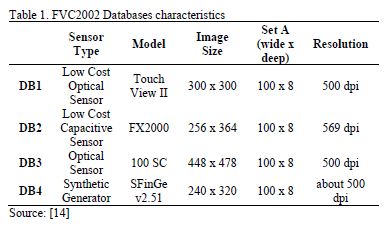
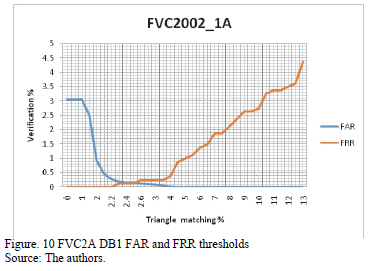
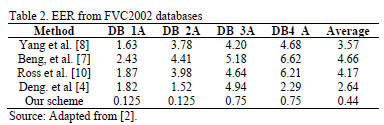
<body><![CDATA[<p align="center"><font size="2" face="Verdana, Arial, Helvetica, sans-serif"><a name="fig11"></a></font><img src="/img/revistas/dyna/v83n195/v83n195a17fig11.gif"></p>     <p align="center"><font size="2" face="Verdana, Arial, Helvetica, sans-serif"><a name="fig12"></a></font><img src="/img/revistas/dyna/v83n195/v83n195a17fig12.gif"></p>     <p align="center"><font size="2" face="Verdana, Arial, Helvetica, sans-serif"><a name="fig13"></a></font><img src="/img/revistas/dyna/v83n195/v83n195a17fig13.gif"></p>     <p><font size="3" face="Verdana, Arial, Helvetica, sans-serif"><b>6. Results</b></font></p>     <p><font size="2" face="Verdana, Arial, Helvetica, sans-serif">After analyzing the images presented, the   ERR was calculated and compared to another 3 proposed schemes. <a href="#tab02">Table 2</a> shows   the summary of the comparison.</font></p>     <p align="center"><font size="2" face="Verdana, Arial, Helvetica, sans-serif"><a name="tab02"></a></font><img src="/img/revistas/dyna/v83n195/v83n195a17tab02.gif"></p>     <p><font size="2" face="Verdana, Arial, Helvetica, sans-serif">As can be seen, the performance of the   proposed method exceeds that of those presented in the related work of this   article. The difference between the average percentages is about 7 times   smaller in our proposal. The main reasons for this happening are related to the   type of post processing stage in which our scheme takes place. </font></p>     <p><font size="2" face="Verdana, Arial, Helvetica, sans-serif">Instead of having a dispersion of points   in an Cartesian plane, the analysis of minutiae takes place over a polygonal   network that minimizes distortion and displacement of the vertices that compose   them after image preprocessing and enhancement have been carried out. Also, the   criteria established to decide whether a minutia in a fingerprint corresponds   to another minutiae in a second fingerprint, strongly depends on a second set   of measures from that polygonal network.</font></p>     <p><font size="2" face="Verdana, Arial, Helvetica, sans-serif">Other variables that play an important   role in the identity verification results are the geometric thresholds, used to   calibrate the training in the verification process. Depending on how strict the   verification is required to be and the fingerprint images characteristics (size   and resolution), the thresholds can be reduced to allow minimum or maximum   variation among the polygonal networks. For the tests presented in this paper,   a tolerance of 10 pixels in distance and 10 grades in angles were established.</font></p>     <p><font size="2" face="Verdana, Arial, Helvetica, sans-serif">If there   were no alterations because of noise in the media and if the fingerprints do   not suffer from erosion or aging, then they</font> <font size="2" face="Verdana, Arial, Helvetica, sans-serif">must remain equal. But because this is not possible, those thresholds   were established based on the premise that different acquisitions from the same   fingerprint even on a noisy media have the same degree of alteration in each of   its minutiae such as the same degree of rotation, displacement, among others.</font></p>     ]]></body>
<body><![CDATA[<p>&nbsp;</p>     <p><font size="3" face="Verdana, Arial, Helvetica, sans-serif"><b>7. Conclusions</b></font></p>     <p><font size="2" face="Verdana, Arial, Helvetica, sans-serif">In this   paper, a minutiae based fingerprint verification method was proposed. The   innovation of this method relies on the use of Delaunay Triangulations and   geometric thresholds to align fingerprint minutiae even in the presence of   noise in the environment. Measures of distance, angles of orientation and   angles of rotation make it possible to characterize geometric figures with its   vertices composed of minutiae avoiding processes of minutiae alignment and   matching score calculations. In this way, rotation and displacement tolerance   is achieved within the verification process.</font></p>     <p><font size="2" face="Verdana, Arial, Helvetica, sans-serif">It is important to emphasize that a   calibration of geometric thresholds must be carried out depending on the   characteristics of the fingerprint images, such as size, resolution, etc. With   all these conditions achieved, a better EER can be obtained in the tests   realized. </font></p>     <p><font size="2" face="Verdana, Arial, Helvetica, sans-serif">Finally, the numerical values and graphs   obtained in the tests, confirm that using Delaunay triangulation allows a   strict discrimination of minutiae in a fingerprint. However, because the   fingerprint images obtained always changes due to pressure, angle and the tilt   on capture device, we need to store multiple biometric samples with different   conditions to improve the scores. For example, for this paper, 6 images were   necessary for each fingerprint..</font></p>     <p>&nbsp;</p>     <p><font size="3" face="Verdana, Arial, Helvetica, sans-serif"><b>Acknowledgements</b></font></p>     <p><font size="2" face="Verdana, Arial, Helvetica, sans-serif">This paper was supported by the CONACyT   and the IPN.</font></p>     <p>&nbsp;</p>     <p><font size="3" face="Verdana, Arial, Helvetica, sans-serif"><b>References</b></font></p>     ]]></body>
<body><![CDATA[<!-- ref --><p><font size="2" face="Verdana, Arial, Helvetica, sans-serif"><b>&#91;1&#93;</b> Wencheng, Y., Jiankun, H. and Wang,   S., A delaunay triangle-based fuzzy extractor for fingerprint authentication,   Trust, Security and Privacy in Computing and Communications (TrustCom), 2012   IEEE 11<sup>th</sup> International Conference on, 66(70), pp. 25-27, 2012. DOI:   10.1109/TrustCom.2012.23 </font>&nbsp;&nbsp;&nbsp;&nbsp;&nbsp;&nbsp;&nbsp;&nbsp;[&#160;<a href="javascript:void(0);" onclick="javascript: window.open('/scielo.php?script=sci_nlinks&ref=1143169&pid=S0012-7353201600010001700001&lng=','','width=640,height=500,resizable=yes,scrollbars=1,menubar=yes,');">Links</a>&#160;]<!-- end-ref --><!-- ref --><p><font size="2" face="Verdana, Arial, Helvetica, sans-serif"><b>&#91;2&#93;</b> Khalil, M., Mohamad, D., Khurram,   K. and Al-Nuzaili, Q., Fingerprint verification using statistical descriptors,   Digital Signal Processing 20. ElSevier.Inc. pp.1264-1273, 2009.   DOI: 10.1016/j.dsp.2009.12.002</font>&nbsp;&nbsp;&nbsp;&nbsp;&nbsp;&nbsp;&nbsp;&nbsp;[&#160;<a href="javascript:void(0);" onclick="javascript: window.open('/scielo.php?script=sci_nlinks&ref=1143170&pid=S0012-7353201600010001700002&lng=','','width=640,height=500,resizable=yes,scrollbars=1,menubar=yes,');">Links</a>&#160;]<!-- end-ref --><!-- ref --><p><font size="2" face="Verdana, Arial, Helvetica, sans-serif"><b>&#91;3&#93;</b> Vianney, J., Rosales, A., Gallegos,   F. and Arellano, A., Computer-aided diagnosis of brain tumors using image   enhancement and fuzzy logic, DYNA, 81(183), pp 148-157, 2014. DOI:   10.15446/dyna.v81n183.36838</font>&nbsp;&nbsp;&nbsp;&nbsp;&nbsp;&nbsp;&nbsp;&nbsp;[&#160;<a href="javascript:void(0);" onclick="javascript: window.open('/scielo.php?script=sci_nlinks&ref=1143171&pid=S0012-7353201600010001700003&lng=','','width=640,height=500,resizable=yes,scrollbars=1,menubar=yes,');">Links</a>&#160;]<!-- end-ref --><!-- ref --><p><font size="2" face="Verdana, Arial, Helvetica, sans-serif"><b>&#91;4&#93;</b> Deng, H. and Huo, Q., Minutiae   matching based fingerprint verification using delaunay triangulation and   aligned-edge-guided triangle matching. Audio and Video Based Biometric Person   Authentication. AVBPA, pp. 270-278, 2005. DOI: 10.1007/11527923_28</font>&nbsp;&nbsp;&nbsp;&nbsp;&nbsp;&nbsp;&nbsp;&nbsp;[&#160;<a href="javascript:void(0);" onclick="javascript: window.open('/scielo.php?script=sci_nlinks&ref=1143172&pid=S0012-7353201600010001700004&lng=','','width=640,height=500,resizable=yes,scrollbars=1,menubar=yes,');">Links</a>&#160;]<!-- end-ref --><!-- ref --><p><font size="2" face="Verdana, Arial, Helvetica, sans-serif"><b>&#91;5&#93;</b> Liu, N., Yin, Y. and Zhang, H., A   fingerprint matching algorithm based on delaunay triangulation net,   Proceedings, International Conference on Computer and Information Technology,   CIT05. pp. 591, 595, 2005. DOI: 10.1109/CIT.2005.9</font>&nbsp;&nbsp;&nbsp;&nbsp;&nbsp;&nbsp;&nbsp;&nbsp;[&#160;<a href="javascript:void(0);" onclick="javascript: window.open('/scielo.php?script=sci_nlinks&ref=1143173&pid=S0012-7353201600010001700005&lng=','','width=640,height=500,resizable=yes,scrollbars=1,menubar=yes,');">Links</a>&#160;]<!-- end-ref --><!-- ref --><p><font size="2" face="Verdana, Arial, Helvetica, sans-serif"><b>&#91;6&#93;</b> Parziale, G. and Niel, A., A   fingerprint matching using minutiae triangulation. ICBA2004, LNCS3072,   Springer-Verlag Berlin Heidelberg. pp.241-248, 2004. DOI:   10.1007/978-3-540-25948-0_34</font>&nbsp;&nbsp;&nbsp;&nbsp;&nbsp;&nbsp;&nbsp;&nbsp;[&#160;<a href="javascript:void(0);" onclick="javascript: window.open('/scielo.php?script=sci_nlinks&ref=1143174&pid=S0012-7353201600010001700006&lng=','','width=640,height=500,resizable=yes,scrollbars=1,menubar=yes,');">Links</a>&#160;]<!-- end-ref --><!-- ref --><p><font size="2" face="Verdana, Arial, Helvetica, sans-serif"><b>&#91;7&#93;</b> Beng, J., Chek-Ling, D. and Song,   O., An efficient fingerprint verification system using integrated wavelet and   Fourier-Melling invariant transform, Image and Vision Computing. ElSevier, 22,   pp. 503-513, 2003. DOI: 10.1016/j.imavis.2003.12.002</font>&nbsp;&nbsp;&nbsp;&nbsp;&nbsp;&nbsp;&nbsp;&nbsp;[&#160;<a href="javascript:void(0);" onclick="javascript: window.open('/scielo.php?script=sci_nlinks&ref=1143175&pid=S0012-7353201600010001700007&lng=','','width=640,height=500,resizable=yes,scrollbars=1,menubar=yes,');">Links</a>&#160;]<!-- end-ref --><!-- ref --><p><font size="2" face="Verdana, Arial, Helvetica, sans-serif"><b>&#91;8&#93;</b> Yang, J. and Park D., A fingerprint   verification algorithm using tessellated invariant moment features,   Neurocomputing. ElSevier, 7, pp. 1264-1273, 2008. DOI:   10.1016/j.neucom.2007.12.034</font>&nbsp;&nbsp;&nbsp;&nbsp;&nbsp;&nbsp;&nbsp;&nbsp;[&#160;<a href="javascript:void(0);" onclick="javascript: window.open('/scielo.php?script=sci_nlinks&ref=1143176&pid=S0012-7353201600010001700008&lng=','','width=640,height=500,resizable=yes,scrollbars=1,menubar=yes,');">Links</a>&#160;]<!-- end-ref --><!-- ref --><p><font size="2" face="Verdana, Arial, Helvetica, sans-serif"><b>&#91;9&#93;</b> Imamverdiyev, Y., Beng, A. and Kim,   J., Biometric cryptosystem based on discretized fingerprint texture   descriptors, Expert Systems with Applications. 40, pp. 1888-1901, 2012. DOI:   10.1016/j.eswa.2012.10.009</font>&nbsp;&nbsp;&nbsp;&nbsp;&nbsp;&nbsp;&nbsp;&nbsp;[&#160;<a href="javascript:void(0);" onclick="javascript: window.open('/scielo.php?script=sci_nlinks&ref=1143177&pid=S0012-7353201600010001700009&lng=','','width=640,height=500,resizable=yes,scrollbars=1,menubar=yes,');">Links</a>&#160;]<!-- end-ref --><!-- ref --><p><font size="2" face="Verdana, Arial, Helvetica, sans-serif"><b>&#91;10&#93;</b> Ross, A., Jain, A. and Reisman, J.,   A hybrid fingerprint matcher, Pattern Recognition. The Journal of the Pattern   Recognition Society. 36, pp. 1661-1673, 2003. DOI:   10.1016/S0031-3203(02)00349-7</font>&nbsp;&nbsp;&nbsp;&nbsp;&nbsp;&nbsp;&nbsp;&nbsp;[&#160;<a href="javascript:void(0);" onclick="javascript: window.open('/scielo.php?script=sci_nlinks&ref=1143178&pid=S0012-7353201600010001700010&lng=','','width=640,height=500,resizable=yes,scrollbars=1,menubar=yes,');">Links</a>&#160;]<!-- end-ref --><!-- ref --><p><font size="2" face="Verdana, Arial, Helvetica, sans-serif"><b>&#91;11&#93;</b> Abraham, J., Kwan, P. and Gao, J..   Fingerprint matching using a hybrid shape and orientation descriptor, In: Yang   J. (Ed.), State of the art in Biometrics INTECH, ISBN: 978-953-307-489-4, 2011,   pp. 25-56, DOI: 10.5772/19105</font>&nbsp;&nbsp;&nbsp;&nbsp;&nbsp;&nbsp;&nbsp;&nbsp;[&#160;<a href="javascript:void(0);" onclick="javascript: window.open('/scielo.php?script=sci_nlinks&ref=1143179&pid=S0012-7353201600010001700011&lng=','','width=640,height=500,resizable=yes,scrollbars=1,menubar=yes,');">Links</a>&#160;]<!-- end-ref --><!-- ref --><p><font size="2" face="Verdana, Arial, Helvetica, sans-serif"><b>&#91;12&#93;</b> Berg, M., Cheong, O., van Kreveld,   M. and Overmars, M., Computational geometry. Algorithms and applications,   Berlin: Springer, 2008. DOI: 10.1007/978-3-540-77974-2</font>&nbsp;&nbsp;&nbsp;&nbsp;&nbsp;&nbsp;&nbsp;&nbsp;[&#160;<a href="javascript:void(0);" onclick="javascript: window.open('/scielo.php?script=sci_nlinks&ref=1143180&pid=S0012-7353201600010001700012&lng=','','width=640,height=500,resizable=yes,scrollbars=1,menubar=yes,');">Links</a>&#160;]<!-- end-ref --><!-- ref --><p><font size="2" face="Verdana, Arial, Helvetica, sans-serif"><b>&#91;13&#93;</b> Arens, C., The Bowyer-Watson   algorithm. An efficient implementation in a database environment, Thesis,   Faculty of Civil Engineering and Geosciences, Delft University of Technology, Delft,   Holand, 2002, pp 5-9.    &nbsp;&nbsp;&nbsp;&nbsp;&nbsp;&nbsp;&nbsp;&nbsp;[&#160;<a href="javascript:void(0);" onclick="javascript: window.open('/scielo.php?script=sci_nlinks&ref=1143181&pid=S0012-7353201600010001700013&lng=','','width=640,height=500,resizable=yes,scrollbars=1,menubar=yes,');">Links</a>&#160;]<!-- end-ref --></font></p>     <!-- ref --><p><font size="2" face="Verdana, Arial, Helvetica, sans-serif"><b>&#91;14&#93;</b> Cappelli, R., Maio, D., Maltoni,   D., Wayman, J.L. and Jain, A.K., Performance evaluation of fingerprint   verification systems, IEEE Trans. Pattern Analysis and Machine Intelligence.   28(1), pp. 3-18, 2006. DOI: 10.1109/TPAMI.2006.20</font>&nbsp;&nbsp;&nbsp;&nbsp;&nbsp;&nbsp;&nbsp;&nbsp;[&#160;<a href="javascript:void(0);" onclick="javascript: window.open('/scielo.php?script=sci_nlinks&ref=1143183&pid=S0012-7353201600010001700014&lng=','','width=640,height=500,resizable=yes,scrollbars=1,menubar=yes,');">Links</a>&#160;]<!-- end-ref --><!-- ref --><p><font size="2" face="Verdana, Arial, Helvetica, sans-serif"><b>&#91;15&#93;</b> Technical Document About FAR, FRR   and EER, Version 1.0, SYRIS Rechnology Corp., 2004, pp 1-4.    &nbsp;&nbsp;&nbsp;&nbsp;&nbsp;&nbsp;&nbsp;&nbsp;[&#160;<a href="javascript:void(0);" onclick="javascript: window.open('/scielo.php?script=sci_nlinks&ref=1143184&pid=S0012-7353201600010001700015&lng=','','width=640,height=500,resizable=yes,scrollbars=1,menubar=yes,');">Links</a>&#160;]<!-- end-ref --></font></p>     <p>&nbsp;</p>     <p><font size="2" face="Verdana, Arial, Helvetica, sans-serif"><b>M. Ram&iacute;rez-Flores</b>, received the BSc. in   Engineer in Telecommunications and Electronic Systems in 2010, with honorific   mention from the Instituto Tecnol&oacute;gico y de Estudios Superiores de Monterrey,   Campus Ciudad de M&eacute;xico, Mexico. His areas of knowledge are: electronic voting   process, secure cryptoimage applications and biometry. ORCID: 0000-0001-5085-9604</font></p>     <p><font size="2" face="Verdana, Arial, Helvetica, sans-serif"><b>G. Aguilar-Torres</b>, has a PhD. in   Communications and Electronics. His areas of knowledge are: signal processing,   pattern recognition, neural networks and biometry. ORCID: 0000-0002-1808-3962</font></p>     ]]></body>
<body><![CDATA[<p><font size="2" face="Verdana, Arial, Helvetica, sans-serif"><b>G.Gallegos-Garc&iacute;a</b>, has a PhD. in   Communications and Electronics. Her areas of knowledge are: e-voting, design of   secure cryptoimage applications, information systems and cryptography. ORCID: 0000-0002-5212-350X</font></p>      ]]></body><back>
<ref-list>
<ref id="B1">
<label>1</label><nlm-citation citation-type="confpro">
<person-group person-group-type="author">
<name>
<surname><![CDATA[Wencheng]]></surname>
<given-names><![CDATA[Y.]]></given-names>
</name>
<name>
<surname><![CDATA[Jiankun]]></surname>
<given-names><![CDATA[H.]]></given-names>
</name>
<name>
<surname><![CDATA[Wang]]></surname>
<given-names><![CDATA[S.]]></given-names>
</name>
</person-group>
<article-title xml:lang="en"><![CDATA[A delaunay triangle-based fuzzy extractor for fingerprint authentication]]></article-title>
<source><![CDATA[]]></source>
<year>2012</year>
<volume>66</volume>
<conf-name><![CDATA[ Trust, Security and Privacy in Computing and Communications (TrustCom)]]></conf-name>
<conf-date>2012</conf-date>
<conf-loc> </conf-loc>
<page-range>25-27</page-range></nlm-citation>
</ref>
<ref id="B2">
<label>2</label><nlm-citation citation-type="book">
<person-group person-group-type="author">
<name>
<surname><![CDATA[Khalil]]></surname>
<given-names><![CDATA[M.]]></given-names>
</name>
<name>
<surname><![CDATA[Mohamad]]></surname>
<given-names><![CDATA[D.]]></given-names>
</name>
<name>
<surname><![CDATA[Khurram]]></surname>
<given-names><![CDATA[K.]]></given-names>
</name>
<name>
<surname><![CDATA[Al-Nuzaili]]></surname>
<given-names><![CDATA[Q.]]></given-names>
</name>
</person-group>
<article-title xml:lang="en"><![CDATA[Fingerprint verification using statistical descriptors]]></article-title>
<source><![CDATA[Digital Signal Processing]]></source>
<year>2009</year>
<volume>20</volume>
<page-range>1264-1273</page-range><publisher-name><![CDATA[ElSevier.Inc.]]></publisher-name>
</nlm-citation>
</ref>
<ref id="B3">
<label>3</label><nlm-citation citation-type="journal">
<person-group person-group-type="author">
<name>
<surname><![CDATA[Vianney]]></surname>
<given-names><![CDATA[J.]]></given-names>
</name>
<name>
<surname><![CDATA[Rosales]]></surname>
<given-names><![CDATA[A.]]></given-names>
</name>
<name>
<surname><![CDATA[Gallegos]]></surname>
<given-names><![CDATA[F.]]></given-names>
</name>
<name>
<surname><![CDATA[Arellano]]></surname>
<given-names><![CDATA[A.]]></given-names>
</name>
</person-group>
<article-title xml:lang="en"><![CDATA[Computer-aided diagnosis of brain tumors using image enhancement and fuzzy logic]]></article-title>
<source><![CDATA[DYNA]]></source>
<year>2014</year>
<volume>81</volume>
<numero>183</numero>
<issue>183</issue>
<page-range>148-157</page-range></nlm-citation>
</ref>
<ref id="B4">
<label>4</label><nlm-citation citation-type="">
<person-group person-group-type="author">
<name>
<surname><![CDATA[Deng]]></surname>
<given-names><![CDATA[H.]]></given-names>
</name>
<name>
<surname><![CDATA[Huo]]></surname>
<given-names><![CDATA[Q.]]></given-names>
</name>
</person-group>
<article-title xml:lang="en"><![CDATA[Minutiae matching based fingerprint verification using delaunay triangulation and aligned-edge-guided triangle matching.]]></article-title>
<source><![CDATA[Audio and Video Based Biometric Person Authentication]]></source>
<year>2005</year>
<page-range>270-278</page-range></nlm-citation>
</ref>
<ref id="B5">
<label>5</label><nlm-citation citation-type="confpro">
<person-group person-group-type="author">
<name>
<surname><![CDATA[Liu]]></surname>
<given-names><![CDATA[N.]]></given-names>
</name>
<name>
<surname><![CDATA[Yin]]></surname>
<given-names><![CDATA[Y.]]></given-names>
</name>
<name>
<surname><![CDATA[Zhang]]></surname>
<given-names><![CDATA[H.]]></given-names>
</name>
</person-group>
<article-title xml:lang="en"><![CDATA[A fingerprint matching algorithm based on delaunay triangulation net]]></article-title>
<source><![CDATA[]]></source>
<year>2005</year>
<conf-name><![CDATA[ International Conference on Computer and Information Technology, CIT05]]></conf-name>
<conf-loc> </conf-loc>
<page-range>591, 595</page-range></nlm-citation>
</ref>
<ref id="B6">
<label>6</label><nlm-citation citation-type="book">
<person-group person-group-type="author">
<name>
<surname><![CDATA[Parziale]]></surname>
<given-names><![CDATA[G.]]></given-names>
</name>
<name>
<surname><![CDATA[Niel]]></surname>
<given-names><![CDATA[A.]]></given-names>
</name>
</person-group>
<article-title xml:lang="en"><![CDATA[A fingerprint matching using minutiae triangulation]]></article-title>
<source><![CDATA[]]></source>
<year>2004</year>
<page-range>241-248</page-range><publisher-loc><![CDATA[Berlin ]]></publisher-loc>
<publisher-name><![CDATA[Springer-Verlag]]></publisher-name>
</nlm-citation>
</ref>
<ref id="B7">
<label>7</label><nlm-citation citation-type="book">
<person-group person-group-type="author">
<name>
<surname><![CDATA[Beng]]></surname>
<given-names><![CDATA[J.]]></given-names>
</name>
<name>
<surname><![CDATA[Chek-Ling]]></surname>
<given-names><![CDATA[D.]]></given-names>
</name>
<name>
<surname><![CDATA[Song]]></surname>
<given-names><![CDATA[O.]]></given-names>
</name>
</person-group>
<article-title xml:lang="en"><![CDATA[An efficient fingerprint verification system using integrated wavelet and Fourier-Melling invariant transform]]></article-title>
<source><![CDATA[Image and Vision Computing]]></source>
<year>2003</year>
<volume>22</volume>
<page-range>503-513</page-range><publisher-name><![CDATA[ElSevier]]></publisher-name>
</nlm-citation>
</ref>
<ref id="B8">
<label>8</label><nlm-citation citation-type="book">
<person-group person-group-type="author">
<name>
<surname><![CDATA[Yang]]></surname>
<given-names><![CDATA[J.]]></given-names>
</name>
<name>
<surname><![CDATA[Park]]></surname>
<given-names><![CDATA[D.]]></given-names>
</name>
</person-group>
<article-title xml:lang="en"><![CDATA[A fingerprint verification algorithm using tessellated invariant moment features]]></article-title>
<source><![CDATA[Neurocomputing]]></source>
<year>2008</year>
<volume>7</volume>
<page-range>1264-1273</page-range><publisher-name><![CDATA[ElSevier]]></publisher-name>
</nlm-citation>
</ref>
<ref id="B9">
<label>9</label><nlm-citation citation-type="journal">
<person-group person-group-type="author">
<name>
<surname><![CDATA[Imamverdiyev]]></surname>
<given-names><![CDATA[Y.]]></given-names>
</name>
<name>
<surname><![CDATA[Beng]]></surname>
<given-names><![CDATA[A.]]></given-names>
</name>
<name>
<surname><![CDATA[Kim]]></surname>
<given-names><![CDATA[J.]]></given-names>
</name>
</person-group>
<article-title xml:lang="en"><![CDATA[Biometric cryptosystem based on discretized fingerprint texture descriptors]]></article-title>
<source><![CDATA[Expert Systems with Applications]]></source>
<year>2012</year>
<numero>40</numero>
<issue>40</issue>
<page-range>1888-1901</page-range></nlm-citation>
</ref>
<ref id="B10">
<label>10</label><nlm-citation citation-type="journal">
<person-group person-group-type="author">
<name>
<surname><![CDATA[Ross]]></surname>
<given-names><![CDATA[A.]]></given-names>
</name>
<name>
<surname><![CDATA[Jain]]></surname>
<given-names><![CDATA[A.]]></given-names>
</name>
<name>
<surname><![CDATA[Reisman]]></surname>
<given-names><![CDATA[J.]]></given-names>
</name>
</person-group>
<article-title xml:lang="en"><![CDATA[A hybrid fingerprint matcher, Pattern Recognition]]></article-title>
<source><![CDATA[The Journal of the Pattern Recognition Society]]></source>
<year>2003</year>
<numero>36</numero>
<issue>36</issue>
<page-range>1661-1673</page-range></nlm-citation>
</ref>
<ref id="B11">
<label>11</label><nlm-citation citation-type="">
<person-group person-group-type="author">
<name>
<surname><![CDATA[Abraham]]></surname>
<given-names><![CDATA[J.]]></given-names>
</name>
<name>
<surname><![CDATA[Kwan]]></surname>
<given-names><![CDATA[P.]]></given-names>
</name>
<name>
<surname><![CDATA[Gao]]></surname>
<given-names><![CDATA[J.]]></given-names>
</name>
</person-group>
<article-title xml:lang="en"><![CDATA[Fingerprint matching using a hybrid shape and orientation descriptor]]></article-title>
<person-group person-group-type="editor">
<name>
<surname><![CDATA[Yang]]></surname>
<given-names><![CDATA[J.]]></given-names>
</name>
</person-group>
<source><![CDATA[State of the art in Biometrics INTECH]]></source>
<year>2011</year>
<page-range>25-56</page-range></nlm-citation>
</ref>
<ref id="B12">
<label>12</label><nlm-citation citation-type="journal">
<person-group person-group-type="author">
<name>
<surname><![CDATA[Berg]]></surname>
<given-names><![CDATA[M.]]></given-names>
</name>
<name>
<surname><![CDATA[Cheong]]></surname>
<given-names><![CDATA[O.]]></given-names>
</name>
<name>
<surname><![CDATA[van Kreveld]]></surname>
<given-names><![CDATA[M.]]></given-names>
</name>
<name>
<surname><![CDATA[Overmars]]></surname>
<given-names><![CDATA[M.]]></given-names>
</name>
</person-group>
<article-title xml:lang="en"><![CDATA[Computational geometry]]></article-title>
<source><![CDATA[Algorithms and applications]]></source>
<year>2008</year>
<publisher-loc><![CDATA[Berlin ]]></publisher-loc>
<publisher-name><![CDATA[Springer]]></publisher-name>
</nlm-citation>
</ref>
<ref id="B13">
<label>13</label><nlm-citation citation-type="">
<person-group person-group-type="author">
<name>
<surname><![CDATA[Arens]]></surname>
<given-names><![CDATA[C.]]></given-names>
</name>
</person-group>
<source><![CDATA[The Bowyer-Watson algorithm.: An efficient implementation in a database environment]]></source>
<year></year>
<page-range>5-9</page-range></nlm-citation>
</ref>
<ref id="B14">
<label>14</label><nlm-citation citation-type="journal">
<person-group person-group-type="author">
<name>
<surname><![CDATA[Cappelli]]></surname>
<given-names><![CDATA[R.]]></given-names>
</name>
<name>
<surname><![CDATA[Maio]]></surname>
<given-names><![CDATA[D.]]></given-names>
</name>
<name>
<surname><![CDATA[Maltoni]]></surname>
<given-names><![CDATA[D.]]></given-names>
</name>
<name>
<surname><![CDATA[Wayman]]></surname>
<given-names><![CDATA[J.L.]]></given-names>
</name>
<name>
<surname><![CDATA[Jain]]></surname>
<given-names><![CDATA[A.K.]]></given-names>
</name>
</person-group>
<article-title xml:lang="en"><![CDATA[Performance evaluation of fingerprint verification systems]]></article-title>
<source><![CDATA[IEEE Trans. Pattern Analysis and Machine Intelligence]]></source>
<year>2006</year>
<volume>28</volume>
<numero>1</numero>
<issue>1</issue>
<page-range>3-18</page-range></nlm-citation>
</ref>
<ref id="B15">
<label>15</label><nlm-citation citation-type="book">
<source><![CDATA[Technical Document About FAR, FRR and EER: Version 1.0]]></source>
<year>2004</year>
<page-range>1-4</page-range><publisher-name><![CDATA[SYRIS Rechnology Corp.]]></publisher-name>
</nlm-citation>
</ref>
</ref-list>
</back>
</article>