<?xml version="1.0" encoding="ISO-8859-1"?><article xmlns:mml="http://www.w3.org/1998/Math/MathML" xmlns:xlink="http://www.w3.org/1999/xlink" xmlns:xsi="http://www.w3.org/2001/XMLSchema-instance">
<front>
<journal-meta>
<journal-id>0012-7353</journal-id>
<journal-title><![CDATA[DYNA]]></journal-title>
<abbrev-journal-title><![CDATA[Dyna rev.fac.nac.minas]]></abbrev-journal-title>
<issn>0012-7353</issn>
<publisher>
<publisher-name><![CDATA[Universidad Nacional de Colombia]]></publisher-name>
</publisher>
</journal-meta>
<article-meta>
<article-id>S0012-73532016000100018</article-id>
<article-id pub-id-type="doi">10.15446/dyna.v83n195.49296</article-id>
<title-group>
<article-title xml:lang="en"><![CDATA[Managing relationships and communications in higher education efficiently through digital social networks: The importance of the relational coordination model]]></article-title>
<article-title xml:lang="es"><![CDATA[Cómo gestionar las relaciones y comunicaciones de manera eficiente a través de las redes sociales digitales en instituciones de educación superior: Una propuesta desde el modelo de coordinación relacional]]></article-title>
</title-group>
<contrib-group>
<contrib contrib-type="author">
<name>
<surname><![CDATA[Lacayo-Mendoza]]></surname>
<given-names><![CDATA[Alexander]]></given-names>
</name>
<xref ref-type="aff" rid="A01"/>
</contrib>
<contrib contrib-type="author">
<name>
<surname><![CDATA[Pablos-Heredero]]></surname>
<given-names><![CDATA[Carmen de]]></given-names>
</name>
<xref ref-type="aff" rid="A02"/>
</contrib>
</contrib-group>
<aff id="A01">
<institution><![CDATA[,Universidad Rey Juan Carlos  ]]></institution>
<addr-line><![CDATA[Madrid ]]></addr-line>
<country>España</country>
</aff>
<aff id="A02">
<institution><![CDATA[,Universidad Rey Juan Carlos  ]]></institution>
<addr-line><![CDATA[Madrid ]]></addr-line>
<country>España</country>
</aff>
<pub-date pub-type="pub">
<day>00</day>
<month>02</month>
<year>2016</year>
</pub-date>
<pub-date pub-type="epub">
<day>00</day>
<month>02</month>
<year>2016</year>
</pub-date>
<volume>83</volume>
<numero>195</numero>
<fpage>138</fpage>
<lpage>146</lpage>
<copyright-statement/>
<copyright-year/>
<self-uri xlink:href="http://www.scielo.org.co/scielo.php?script=sci_arttext&amp;pid=S0012-73532016000100018&amp;lng=en&amp;nrm=iso"></self-uri><self-uri xlink:href="http://www.scielo.org.co/scielo.php?script=sci_abstract&amp;pid=S0012-73532016000100018&amp;lng=en&amp;nrm=iso"></self-uri><self-uri xlink:href="http://www.scielo.org.co/scielo.php?script=sci_pdf&amp;pid=S0012-73532016000100018&amp;lng=en&amp;nrm=iso"></self-uri><abstract abstract-type="short" xml:lang="en"><p><![CDATA[Digital social networks have proven to be of great support for organizations that are increasingly using new forms of social communication every day, seeking to improve their productivity and competitiveness. The main objective of this study is to explain how organizations, particularly Institutions of Higher Education, can improve their competitive position through the use of digital social networks from the perspective of relationship management and management of communications, in order to achieve better results in terms of teamwork satisfaction, relationship marketing and educational excellence. For this objective, the application of a relational coordination model, based on the sharing of objectives, optimal knowledge management, mutual respect and efficient communication mechanisms, is suggested.]]></p></abstract>
<abstract abstract-type="short" xml:lang="es"><p><![CDATA[Las redes sociales digitales han demostrado ser un gran apoyo para las organizaciones, que cada día las utilizan más en las nuevas formas de comunicación social en busca de mejorar su productividad y competitividad. Como objetivo principal de este estudio, se busca explicar cómo a través de la utilización de redes sociales digitales se puede mejorar la posición competitiva de las organizaciones, y en particular de las Instituciones de Educación Superior, desde la perspectiva de gestión de las relaciones y gestión de las comunicaciones, para conseguir mejores resultados en términos de satisfacción de los equipos, de marketing relacional y excelencia educativa. Para esto, se ha sugerido la aplicación del modelo de coordinación relacional que tiene sus bases en la compartición de objetivos, la óptima gestión del conocimiento, y el respeto mutuo unido a mecanismos eficientes de comunicación.]]></p></abstract>
<kwd-group>
<kwd lng="en"><![CDATA[relational coordination]]></kwd>
<kwd lng="en"><![CDATA[organizational practices]]></kwd>
<kwd lng="en"><![CDATA[organizational results]]></kwd>
<kwd lng="en"><![CDATA[university education]]></kwd>
<kwd lng="en"><![CDATA[digital social networks]]></kwd>
<kwd lng="es"><![CDATA[coordinación relacional]]></kwd>
<kwd lng="es"><![CDATA[prácticas organizativas]]></kwd>
<kwd lng="es"><![CDATA[resultados organizacionales]]></kwd>
<kwd lng="es"><![CDATA[educación universitaria]]></kwd>
<kwd lng="es"><![CDATA[redes sociales digitales]]></kwd>
</kwd-group>
</article-meta>
</front><body><![CDATA[ <p><font size="1" face="Verdana, Arial, Helvetica, sans-serif"><b>DOI:</b> <a href="http://dx.doi.org/10.15446/dyna.v83n195.49296" target="_blank">http://dx.doi.org/10.15446/dyna.v83n195.49296</a></font></p>     <p align="center"><font size="4" face="Verdana, Arial, Helvetica, sans-serif"><b>Managing relationships and   communications in higher education efficiently through digital social networks:   The importance of the relational coordination model</b></font></p>     <p align="center"><font size="3"><b><font face="Verdana, Arial, Helvetica, sans-serif"><i>C&oacute;mo gestionar las relaciones y   comunicaciones de manera eficiente a trav&eacute;s de las redes sociales digitales en   instituciones de educaci&oacute;n superior: Una propuesta desde el modelo de coordinaci&oacute;n   relacional</i></font></b></font></p>     <p align="center">&nbsp;</p>     <p align="center"><font size="2" face="Verdana, Arial, Helvetica, sans-serif"><b>Alexander Lacayo-Mendoza <i><sup>a</sup></i> &amp; Carmen de Pablos-Heredero <i><sup>b</sup></i></b></font></p>     <p align="center">&nbsp;</p>     <p align="center"><font size="2" face="Verdana, Arial, Helvetica, sans-serif"><sup><i>a </i></sup><i>Universidad Rey Juan Carlos (URJC), Madrid, Espa&ntilde;a. <a href="mailto:alexanderlacayo@yahoo.com">alexanderlacayo@yahoo.com</a>    <br>   <sup>b</sup> Universidad Rey Juan Carlos (URJC), Madrid, Espa&ntilde;a, <a href="mailto:carmen.depablos@urjc.es">carmen.depablos@urjc.es</a></i></font></p>     <p align="center">&nbsp;</p>     <p align="center"><font size="2" face="Verdana, Arial, Helvetica, sans-serif"><b>Received: Febrero 22<sup>th</sup>, 2015.   Received in revised form: November 12<sup>th</sup>, 2015. Accepted: January 10<sup>th</sup>,   2016.</b></font></p>     ]]></body>
<body><![CDATA[<p align="center">&nbsp;</p>     <p align="center"><font size="1" face="Verdana, Arial, Helvetica, sans-seriff"><b>This work is licensed under a</b> <a rel="license" href="http://creativecommons.org/licenses/by-nc-nd/4.0/">Creative Commons Attribution-NonCommercial-NoDerivatives 4.0 International License</a>.</font><br />   <a rel="license" href="http://creativecommons.org/licenses/by-nc-nd/4.0/"><img style="border-width:0" src="https://i.creativecommons.org/l/by-nc-nd/4.0/88x31.png" /></a></p> <hr>     <p><font size="2" face="Verdana, Arial, Helvetica, sans-serif"><b>Abstract    <br>   </b></font><font size="2" face="Verdana, Arial, Helvetica, sans-serif">Digital social networks have proven to   be of great support for organizations that are increasingly using new forms of   social communication every day, seeking to improve their productivity and   competitiveness. The main objective of this study is to explain how   organizations, particularly Institutions of Higher Education, can improve their   competitive position through the use of digital social networks from the   perspective of relationship management and management of communications, in   order to achieve better results in terms of teamwork satisfaction, relationship   marketing and educational excellence. For this objective, the application of a relational   coordination model, based on the sharing of objectives, optimal knowledge   management, mutual respect and efficient communication mechanisms, is suggested.</font></p>     <p><font size="2" face="Verdana, Arial, Helvetica, sans-serif"><i>Keywords</i>: relational coordination, organizational practices, organizational   results, university education, digital social networks.</font></p>     <p><font size="2" face="Verdana, Arial, Helvetica, sans-serif"><b>Resumen    <br>   </b></font><font size="2" face="Verdana, Arial, Helvetica, sans-serif">Las redes sociales digitales han   demostrado ser un gran apoyo para las organizaciones, que cada d&iacute;a las utilizan   m&aacute;s en las nuevas formas de comunicaci&oacute;n social en busca de mejorar su   productividad y competitividad. Como objetivo principal de este estudio, se   busca explicar c&oacute;mo a trav&eacute;s de la utilizaci&oacute;n de redes sociales digitales se   puede mejorar la posici&oacute;n competitiva de las organizaciones, y en particular de   las Instituciones de Educaci&oacute;n Superior, desde la perspectiva de gesti&oacute;n de las   relaciones y gesti&oacute;n de las comunicaciones, para conseguir mejores resultados   en t&eacute;rminos de satisfacci&oacute;n de los equipos, de marketing relacional y   excelencia educativa. Para esto, se ha sugerido la aplicaci&oacute;n del modelo de   coordinaci&oacute;n relacional que tiene sus bases en la compartici&oacute;n de objetivos, la   &oacute;ptima gesti&oacute;n del conocimiento, y el respeto mutuo unido a mecanismos   eficientes de comunicaci&oacute;n. </font></p>     <p><font size="2" face="Verdana, Arial, Helvetica, sans-serif"><i>Palabras   clave</i>: coordinaci&oacute;n relacional, pr&aacute;cticas   organizativas, resultados organizacionales, educaci&oacute;n universitaria, redes   sociales digitales.</font></p> <hr>     <p>&nbsp;</p>     <p><font size="3" face="Verdana, Arial, Helvetica, sans-serif"><b>1. Introduction</b></font></p>     ]]></body>
<body><![CDATA[<p><font size="2" face="Verdana, Arial, Helvetica, sans-serif">In today's   globalized world, production, coding and dissemination of information and   knowledge have become the main pillars for technological innovation and   economic growth. Simultaneously, the worldwide dissemination of information and   communications technology (ICT) has launched a process of connectivity,   unprecedented in human history, which has increased the possibility of   generating and socializing information and knowledge by progressively removing   barriers of time and space. Perhaps the most outstanding phenomenon of these   changes is the Internet, a network of networks that has had a substantial   impact on economic processes, culture and the generation of new forms of   interaction, communication and exchange of experiences between different   actors, institutions and social movements   &#91;1&#93; . </font></p>     <p><font size="2" face="Verdana, Arial, Helvetica, sans-serif">The way companies interact has changed   due to the emergence of information and communication technologies (ICTs).   Since the first implementation of ICTs as marketing strategies in companies,   the evolution and development of these trends in different fields have been   remarkable. Everyday people tend to be more connected in order to perform most   of their online activities and spend more time surfing the Internet, which   shows the exponential growth in the use of ICT   &#91;2&#93; . </font></p>     <p><font size="2" face="Verdana, Arial, Helvetica, sans-serif">Currently, most organizations provide   strong support to the development of information and communication technology.   ICTs are fundamental not only for their instrumental character in meeting   information needs for decision making, but also because they have become a   vehicle for generating distinctive capabilities, which, when combined with   other valuable resources, can result in a constitutive source of competitive   advantage   &#91;3&#93;   . Therefore, the   application of ICT must be aligned with organizational strategic planning, and   as such becomes a strategic factor behind the growth of the organization   &#91;4&#93; . </font></p>     <p><font size="2" face="Verdana, Arial, Helvetica, sans-serif">With the emergence of the Internet,   society has radically changed the way people communicate, their leisure habits,   and their ways of meeting and relating to each other. Thanks to the   technologies derived from the second Internet generation, known as Web 2.0, the   consumer has become the main figure of the network. The label 2.0 represents a   more collaborative Web that allows users to access and participate in the creation   of unlimited knowledge, and as a result of this interaction, new business   opportunities are created for businesses   &#91;5&#93; . </font></p>     <p><font size="2" face="Verdana, Arial, Helvetica, sans-serif">Digital social networks are configured to   be the best tools of Web 2.0 for business strategies focusing on customer   orientation, and on customizing the message, interaction with the recipient and   maintenance of two-way communication with the client in order to achieve their   loyalty   &#91;6&#93; . </font></p>     <p><font size="2" face="Verdana, Arial, Helvetica, sans-serif">Through   digital social networks, company employees may get to know each other,   fostering a better relationship. Connecting people creates a greater degree of   trust and responsibility between them   &#91;7&#93; .   Therefore, digital social networks are a means of communication, with the   distinctive feature of enabling direct and quick relationships to be formed   amongst a community of a few or millions of users and where each person can   also make a contribution. Digital social networks are a powerful tool that, if   properly used, can allow us to highlight our strengths, hide our faults and, in   both cases, offer us a better understanding of our environment that allows us   improve relationships at higher levels of exchange value &#91;8&#93; .</font></p>     <p><font size="2" face="Verdana, Arial, Helvetica, sans-serif">The growth of digital social networks   coupled with the ability to target consumers, making strategic use of   demographic information such as gender, ethnicity, education and political or   religious affiliations, which have been provided by participants through their   profiles, make this tool really attractive for companies   &#91;9&#93; . </font></p>     <p><font size="2" face="Verdana, Arial, Helvetica, sans-serif">While users of digital social networks   seek to connect with friends, organizations have taken the opportunity to   communicate through specific demographics. Digital social networks offer   organizations several key advantages over regular Web sites, because they   facilitate communication with users based on location, age and marital status   using the information provided in their profiles. Organizations can also   communicate with potential customers through different social networks   &#91;10&#93; . </font></p>     <p><font size="2" face="Verdana, Arial, Helvetica, sans-serif">Digital social networks are often managed   from the area of marketing, facilitating communication and the exchange of   information with clients, customers, prospects, suppliers, investors,   candidates for vacant posts, competitors and any other relevant actors in the   life of the company. Therefore they become useful tools for business and   professionals; by enabling practices such as the use of phone, email or a   corporate website. However, social networks add an extra feature in comparison   with the rest of these media: &quot;<i>the   ability to create community</i>&quot;<i> &#91;8&#93;</i>.</font></p>     <p><font size="2" face="Verdana, Arial, Helvetica, sans-serif">In order to improve their online   presence, higher education institutions have increased the use of digital   social networks as a marketing strategy that will help them achieve better   positioning and organizational growth   &#91;11&#93;. A topic of interest in the field of educational organizations,   since 2011, has been the use of digital social networks in order to analyze   performance and as a way of building relationships and ensuring student loyalty   and participation   &#91;12&#93;.</font></p>     ]]></body>
<body><![CDATA[<p><font size="2" face="Verdana, Arial, Helvetica, sans-serif">For effective communication with   students, professionals in higher education must adopt new technologies and   more importantly, explore opportunities to implement a social media marketing   plan, which should be reevaluated to adjust to shifting trends and be adapted   to the changing needs of students. Facebook, Twitter and YouTube are the   preferred media for socializing and networking   &#91;13&#93; . </font></p>     <p><font size="2" face="Verdana, Arial, Helvetica, sans-serif">The quality of   communication is a key factor in achieving effective organizational   relationships by building relationships that enable higher education   organizations fulfill their corporate mission   &#91;14&#93; . </font></p>     <p><font size="2" face="Verdana, Arial, Helvetica, sans-serif">However, communication is not the only   factor to measure teamwork quality. This can be measured by many different   factors, such as those raised in the relational coordination model proposed by   Gittell   &#91;15&#93; , which has been   applied in this research as a framework for analyzing the use of digital social   networks as tools for achieving better results in the field of relational   marketing, in terms of teams' satisfaction and educational excellence. </font></p>     <p><font size="2" face="Verdana, Arial, Helvetica, sans-serif">This model   has been applied to different types of organizations, with promising results,   and it explains that relational coordination occurs through relationships of   shared objectives; shared knowledge; mutual respect; and frequent, timely,   accurate and solution focused communication. Thus it is achieved by managing   relationships in an efficient manner and ensuring the achievement of   organizational goals &#91;15,16&#93;.</font></p>     <p><font size="2" face="Verdana, Arial, Helvetica, sans-serif">The main objective of this paper is to   describe how the use of digital social networks from a model-based approach of   relational coordination can be applied to better explain educational   excellence.</font></p>     <p>&nbsp;</p>     <p><font size="3" face="Verdana, Arial, Helvetica, sans-serif"><b>2. Using digital social networks in the education   sector</b></font></p>     <p><font size="2" face="Verdana, Arial, Helvetica, sans-serif">It is increasingly evident that digital   social networks are being used in different sectors to achieve their marketing   goals and the education sector is no exception. Institutions of higher   education make use of this tool to meet their marketing goals but also for   recruitment, admissions, interacting with students and stakeholders,   fundraising, student-teacher relationships, and primarily to improve their   competitiveness in the sector   &#91;17&#93; . </font></p>     <p><font size="2" face="Verdana, Arial, Helvetica, sans-serif">Digital social networks can be useful   tools in recruiting efforts and very beneficial to improve the competitiveness   of higher education institutions   &#91;18&#93;   , disseminating humanizing   stories of students and graduates, which promote student retention and help   achieve marketing goals   &#91;19&#93; . </font></p>     <p><font size="2" face="Verdana, Arial, Helvetica, sans-serif">The president of Southwestern College recognizes   that digital social networks have become fundamental and strategic tools for   institutions of higher education for the purpose of recruitment, development, and   public relations, to build relationships with students and graduates, and finally   to improve their competitiveness, moving these institutions into a leadership   position   &#91;20&#93; . </font></p>     ]]></body>
<body><![CDATA[<p><font size="2" face="Verdana, Arial, Helvetica, sans-serif">According to the American company Digital   ZOG   &#91;21&#93; , dedicated to research   on social media and new technologies, one of the benefits of the evolution of   digital social networks is the ability to reach a lot of people. Educational   institutions can reach not only potential students but also current students,   alumni, colleagues in the industry and the community in general; position   achieving a good reputation of the institution through the integration of   digital social networks within their strategic planning. As previously mentioned,   the use of digital social networks contributes to improving the competitiveness   of higher education institutions. </font></p>     <p><font size="2" face="Verdana, Arial, Helvetica, sans-serif">According to Kaplan and Haenlein   &#91;22&#93; , although many   colleges still only make use of traditional media, a noticeable growth in the   number of institutions that are integrating technological tools and strategies,   including digital social networks, to communicate and build relationships with   students and other stakeholders is evident. </font></p>     <p><font size="2" face="Verdana, Arial, Helvetica, sans-serif">Thanks to the popularity of digital social   networks among students, institutions of higher education have begun to   implement strategies to attract prospective students, communicate with current   students and maintain their relationships with alumni &#91;23-25&#93;.</font></p>     <p><font size="2" face="Verdana, Arial, Helvetica, sans-serif">94% of institutions of higher education   in the United States use Facebook to connect with their stakeholders. Other   social media such as Twitter, Linkedin and YouTube, are also used for relationship   marketing strategies, although at a slower rate. In addition, almost 60% of   institutions have placed their different social media accounts on their   institutional websites, confirming the importance of these platforms and the   institutionalization of digital social networks   &#91;25&#93; . </font></p>     <p><font size="2" face="Verdana, Arial, Helvetica, sans-serif">According to research conducted by   Pearson   &#91;26&#93; thatsurveyed approximately   8,000 schools from a variety of disciplines and institutions of higher   education in the United States on the use of social media, 78.9% of respondents   considered that the use of digital social networks increased the level of   communication with an institution's students and stakeholders. Similarly, respondents   felt that sharing information through these means helped in creating better   learning environments. </font></p>     <p><font size="2" face="Verdana, Arial, Helvetica, sans-serif">Digital social networks are popular as an   information search tool, where comments and content can be shared and   communicated, and are also used for other activities. Therefore, they represent   a great opportunity for higher education institutions to interact, discuss and   listen to different stakeholders, in a context of globalized higher education   but are also a challenge   &#91;27&#93; . </font></p>     <p><font size="2" face="Verdana, Arial, Helvetica, sans-serif">Currently, the fact that young people   make frequent use of the Internet and, particularly digital social networks, should   not be considered as a waste of their time, because they are acquiring   technological and communication skills useful in the modern world. The potential   to use digital social networks as communication channels, as well as a source   of information and entertainment, is great for higher education institutions.   This is confirmed by the favorable attitude of students in relation to the   academic use of this type of media.</font></p>     <p><font size="2" face="Verdana, Arial, Helvetica, sans-serif">Digital social networks promote firstly,   self-learning; secondly, teamwork through information sharing; thirdly, access   to other information sources that facilitate collaborative learning, and   finally, communication amongst students, between students and teachers and also   between students and administrative staff. All these advantages enable higher   education institutions practice an interactive approach and promote a more   dynamic learning environment, ensuring a better quality education.</font></p>     <p>&nbsp;</p>     <p><font size="3" face="Verdana, Arial, Helvetica, sans-serif"><b>3. Importance of the relational coordination in institutions of higher education</b></font></p>     ]]></body>
<body><![CDATA[<p><font size="2" face="Verdana, Arial, Helvetica, sans-serif">Gittell   &#91;28&#93; defines the   relational coordination model as a &quot;mutually reinforcing process of interaction   between communication and relationships carried out for the purpose of task   integration&quot;. </font></p>     <p><font size="2" face="Verdana, Arial, Helvetica, sans-serif">Gittell   &#91;16&#93; explains how this   model differs from other ones, due to the fact that the proposal is based on   three specific dimensions of relationship that are required for effective   coordination. While other theories stress the importance of shared knowledge,   the relational coordination model explains that although this is required, it   is not a sufficient condition. According to this model, to achieve effective   coordination, the agents that take part in the process must also be connected   via shared objectives and a relationship of mutual respect. </font></p>     <p><font size="2" face="Verdana, Arial, Helvetica, sans-serif">The relational coordination model focusses   on the relationships that emerge from the various roles that shape a process,   more than on the relationship that some individuals maintain with each other   during work   &#91;29&#93; . </font></p>     <p><font size="2" face="Verdana, Arial, Helvetica, sans-serif">The model is structured upon two kinds of   relationships: relationship ties and communication ties.</font></p>     <p><font size="2" face="Verdana, Arial, Helvetica, sans-serif">Some of the relational dimensions that   can be mentioned are shared goals, shared knowledge and mutual respect.</font></p>     <p><font size="2" face="Verdana, Arial, Helvetica, sans-serif"><b><i>3.1. Shared objectives</i></b></font></p>     <p><font size="2" face="Verdana, Arial, Helvetica, sans-serif">In order to ensure teamwork quality it is   important that each member shares his/her knowledge and experience of relevant   tasks with the team   &#91;30&#93;   . Whenever different   members of a team share the same objectives and values, inter-personal   relationships are reinforced   &#91;31&#93; . </font></p>     <p><font size="2" face="Verdana, Arial, Helvetica, sans-serif">At a team level, establishing a set of   objectives is considered to be the main factor in guaranteeing the completion   of tasks   &#91;32&#93;   . The quality and the   degree of acceptance of the ideas generated by the members of the team   increases whenever the members cooperate   &#91;33&#93;   . Therefore, sharing   objectives is important to achieve quality teamwork and it is necessary if team   objectives are to be met. The greater the support provided to the members of a   team, the more effective the final results will be, and team moral can be   improved too   &#91;34&#93; . </font></p>     <p><font size="2" face="Verdana, Arial, Helvetica, sans-serif">Shared objectives become an essential   element for teamwork quality. Competition between members of a team can have a   positive influence on their motivation and on returns derived from individual   tasks, however, cooperation or support amongst team members is more important   &#91;35&#93; . </font></p>     <p><font size="2" face="Verdana, Arial, Helvetica, sans-serif">In a team, having shared objectives,   instead of promoting competition between members, improves productivity amongst   them when undertaking different tasks. Besides, when members share the same   mission or vision, it increases the probability of being able to prioritize team   tasks and of sharing a similar interpretation of work rules   &#91;36&#93; . </font></p>     ]]></body>
<body><![CDATA[<p><font size="2" face="Verdana, Arial, Helvetica, sans-serif">According to Gittell   &#91;16&#93; , thanks to the   existence of a set of shared objectives in their work, stakeholders are able to   develop ties that allow them to reach conclusions that are compatible with the   different ways of thinking and acting, as new information is made available. </font></p>     <p><font size="2" face="Verdana, Arial, Helvetica, sans-serif"><b><i>3.2. Shared knowledge</i></b></font></p>     <p><font size="2" face="Verdana, Arial, Helvetica, sans-serif">The knowledge found in work teams is   considered to be shared knowledge or team knowledge &#91;37-39&#93;. The concept of shared knowledge consists in the fact that   team members have compatible or similar knowledge that leads them to share   expectations for team tasks &#91;40,41&#93;;   these expectations allow the team to coordinate and forecast the behavior and   needs of team members   &#91;37&#93; . </font></p>     <p><font size="2" face="Verdana, Arial, Helvetica, sans-serif">The   generation of knowledge can appear at individual or team level, and it is the   result of a communication process at an individual and team level, it is often   the result of a bi-directional communication process in which information is   shared with other people &#91;42-44,36&#93;. This   process of communication serves to develop the spirit of work too   &#91;43&#93; . </font></p>     <p><font size="2" face="Verdana, Arial, Helvetica, sans-serif">The interchange of knowledge in teamwork   is important to generate trust and improve teamwork effectiveness. Storck   &#91;45&#93;   and Herbsleb and   Moitra   &#91;46&#93; reinforce this   observation, by affirming that with a lack of effective information   interchange, projects can suffer from coordination problems that drive them to   fail. Team interaction is more productive when information shared is relevant,   accurate and useful &#91;36&#93;.</font></p>     <p><font size="2" face="Verdana, Arial, Helvetica, sans-serif">Knowledge exchange is required in order   to integrate the different disciplines represented on a team along with the ideas,   knowledge and information held by team members as well as to ensure frequent   communication &#91;37,47,48&#93;. When knowledge   is not integrated, the process will be slower and more complex   &#91;49&#93; . </font></p>     <p><font size="2" face="Verdana, Arial, Helvetica, sans-serif">Shared knowledge refers to the provision   of information and <i>know-how</i> that is   required to help others to better undertake their work and fulfill obligations &#91;50,51&#93;. It can be offered by means of written   or verbal communication, through the creation of networks with other experts or   by documenting, organizing and obtaining knowledge from others &#91;50,51&#93;.</font></p>     <p><font size="2" face="Verdana, Arial, Helvetica, sans-serif">Shared knowledge becomes the main way in   which employees in a company can contribute to the application of knowledge,   innovation and competitive advantage   &#91;52&#93; . </font></p>     <p><font size="2" face="Verdana, Arial, Helvetica, sans-serif">Gittell   &#91;16&#93; shows that when the   different members of the work group know how their objectives are related to the   rest of the objectives of the group taking part in the same process, a dynamic is   created in which everyone knows the implications that each change will have   over any other task or role. </font></p>     <p><font size="2" face="Verdana, Arial, Helvetica, sans-serif"><b><i>3.3. Mutual respect</i></b></font></p>     ]]></body>
<body><![CDATA[<p><font size="2" face="Verdana, Arial, Helvetica, sans-serif">A key aspect of teamwork quality is that   team members openly share information &#91;53,54&#93;.   Lack of respect amongst the members of a team becomes a barrier to teamwork   that is the integration of a team's knowledge and experience in common tasks. </font></p>     <p><font size="2" face="Verdana, Arial, Helvetica, sans-serif">The members of a team that work towards a   common objective must show each other mutual respect and help each other to   develop the ideas and contributions of other team members whenever it is   required, instead of fighting each other   &#91;36&#93; . </font></p>     <p><font size="2" face="Verdana, Arial, Helvetica, sans-serif">Mutual respect is &quot;key to maintain a   healthy labor climate&quot;   &#91;55&#93;   . Therefore, an   essential factor for teamwork quality is that contributions are made based on   respect   &#91;36&#93; . </font></p>     <p><font size="2" face="Verdana, Arial, Helvetica, sans-serif">A leader must not treat any other member   badly. In teamwork there are different levels and positions, but the   contribution of skills and values to the team by all members is equally   important   &#91;55&#93; . </font></p>     <p><font size="2" face="Verdana, Arial, Helvetica, sans-serif">Work teams based on mutual respect   amongst members are more productive and maintain a positive work climate   &#91;55&#93;   . Productive   interactions require mutual respect, a shared language and a willingness to   participate in the teamwork necessary to resolve conflicts   &#91;56&#93; . </font></p>     <p><font size="2" face="Verdana, Arial, Helvetica, sans-serif">Mutual respect between people ensures   that all the members of the team can express their ideas. In this way, the team   will benefit from each other's talent   &#91;57&#93; . The respect for another   member's ability, implied in the process, establishes a powerful link that is   applied holistically to the whole process, resulting in an effective   coordination between team members   &#91;16&#93; . </font></p>     <p><font size="2" face="Verdana, Arial, Helvetica, sans-serif">Gittell's model includes several communication   dimensions, some of these are: frequent communication, timely communication,   accurate communication and problem solving communication. </font></p>     <p><font size="2" face="Verdana, Arial, Helvetica, sans-serif"><b><i>3.4. Frequent communication </i></b></font></p>     <p><font size="2" face="Verdana, Arial, Helvetica, sans-serif">Teamwork members need to be connected   continually, by making frequent and solid communication channels possible so as   to increase feedback, and allow for the correction of errors, the generation of   ideas and problem solving &#91;58,59&#93;. This frequent interaction would   produce more and new ideas and improves the decision making process &#91;31,35,60&#93;.</font></p>     <p><font size="2" face="Verdana, Arial, Helvetica, sans-serif">According to the theory of information   processing, frequent communication is required to decrease the levels of uncertainty   often found in complex processes   &#91;61&#93; . </font></p>     ]]></body>
<body><![CDATA[<p><font size="2" face="Verdana, Arial, Helvetica, sans-serif">Additionally, frequent communication lays   the foundation for other factors that then determine the outcomes of teamwork.   For example, communication is needed to coordinate the efforts of team members   and knowledge   &#91;62&#93;   ; so as to understand   the collective mission of the team   &#91;63&#93;   , to be sure that the   team shares the same mental model over time   &#91;44&#93;   , and to facilitate   trust in the team   &#91;64&#93; o. Team performance can be defined as the extent to   which the team is able to deliver on quality, costs and the established   objectives on time   &#91;65&#93; . </font></p>     <p><font size="2" face="Verdana, Arial, Helvetica, sans-serif">Frequent communication is needed (a   process where participants create and share information amongst themselves to   reach a mutual understanding) and the team leader must coordinate and   facilitate this communication   &#91;66&#93;   , to help establish   the relationships amongst different roles through the proximity generated as a   consequence of repeated interaction   &#91;16&#93; . </font></p>     <p><font size="2" face="Verdana, Arial, Helvetica, sans-serif"><b><i>3.5. Timely communication</i></b></font></p>     <p><font size="2" face="Verdana, Arial, Helvetica, sans-serif">Delays in communication can have negative   implications on final organizational goals. Therefore it is important to have   communication in the precise moment that it is required to have success in the   organizational goals   &#91;67&#93; . </font></p>     <p><font size="2" face="Verdana, Arial, Helvetica, sans-serif">Communication is a key factor to achieve   quality teamwork. It offers a means to exchange information, share ideas   amongst the members of the team, coordinate efforts and offer feedback   &#91;54&#93; . Today, information   exchange is not only important but ensuring that the right information is   offered to the right person at the right moment is very much desired &#91;54,68,69&#93; Communication refers to the capacity   of team members to understand information, network exchange, and the use of   these networks to improve the interchange of information   &#91;70&#93;   . Communication   serves as a mechanism for the interaction of the members of a team.   &#91;71&#93; . </font></p>     <p><font size="2" face="Verdana, Arial, Helvetica, sans-serif">The   communication style of an organization is related to its business growth, so a   style based on open and accurate communication increases the interest and trust   of employees   &#91;72&#93; . </font></p>     <p><font size="2" face="Verdana, Arial, Helvetica, sans-serif"><b><i>3.6. Accurate communication</i></b></font></p>     <p><font size="2" face="Verdana, Arial, Helvetica, sans-serif">There is great evidence that the   different aspects of an effective communication, such as frequency and   precision over policies and organizational routines are positively related with   an employee's productivity &#91;73-76&#93;.</font></p>     <p><font size="2" face="Verdana, Arial, Helvetica, sans-serif">Accurate communication in terms of the   relevant information plays a critical role in the effectiveness of group work   performance   &#91;74&#93; . </font></p>     <p><font size="2" face="Verdana, Arial, Helvetica, sans-serif">It is important for team members to   communicate directly to each other, since the interchange of information by   means of intermediaries demands more time, and runs the risk of errors   appearing in the message when it is sent &#91;30,54&#93;.   To achieve this, it is extremely important that members of a team are open to   the other members and avoid hiding important information, since it can damage   the integration of knowledge and experience of the team members, this being the   main function of teamwork   &#91;36&#93; . </font></p>     ]]></body>
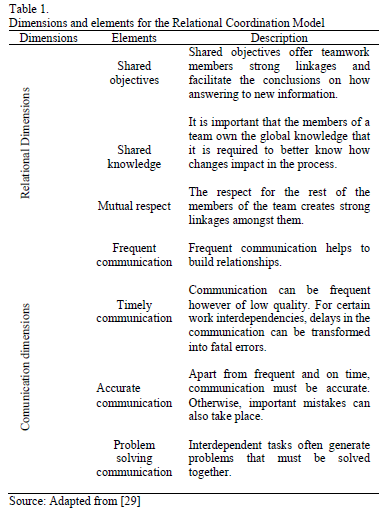
<body><![CDATA[<p><font size="2" face="Verdana, Arial, Helvetica, sans-serif">The effective application of   organizational strategies and human resources policies depend on the accuracy   of information exchange amongst team members   &#91;77&#93;   . The lack of precise   communication between managers can create strategic misalignment   &#91;78&#93; . </font></p>     <p><i><font size="2" face="Verdana, Arial, Helvetica, sans-serif"><b>3.7. Problem solving communication</b></font></i></p>     <p><font size="2" face="Verdana, Arial, Helvetica, sans-serif">Effective communication requires   commitment from the stakeholders that take part in the task to a communication   policy oriented at solving problems that appear in groups characterized by high   interdependence. Blaming other workers or avoiding one's own responsibilities can   lead to negative consequences that have an impact on the final results   &#91;79&#93; . </font></p>     <p><font size="2" face="Verdana, Arial, Helvetica, sans-serif">Communication is a required component for   coordination and teams perceive communication problems as a result of   experiencing problems with coordination processes   &#91;71&#93;   . Communication is a   required component to the collaborative solution of problems and teams will   find it much more difficult to resolve an issue without it   &#91;80&#93; . </font></p>     <p><font size="2" face="Verdana, Arial, Helvetica, sans-serif">Often, some problems dealing with team   work appear when the actions of one or more team members are non compatible   with the rest of the team members   &#91;81&#93;   , and they increase   when the members feel that their different objectives cannot be reached at the   same time as the rest of the members   &#91;82&#93; . </font></p>     <p><font size="2" face="Verdana, Arial, Helvetica, sans-serif">Problem solving communication allows team   members to adapt in a more flexible way to unforeseen and negative   circumstances that may appear. Therefore, this represents an important aspect   of teamwork quality   &#91;83&#93; . </font></p>     <p><font size="2" face="Verdana, Arial, Helvetica, sans-serif">Quality relationships allow team members to   coordinate an effective work process, based on frequent, accurate and timely   communication oriented at the solution of problems   &#91;83&#93; . </font></p>     <p><font size="2" face="Verdana, Arial, Helvetica, sans-serif">A brief description of each of the   dimensions is shown in <a href="#tab01">Table 1</a>.</font></p>     <p align="center"><font size="2" face="Verdana, Arial, Helvetica, sans-serif"><a name="tab01"></a></font><img src="/img/revistas/dyna/v83n195/v83n195a18tab01.gif"></p>     <p><font size="2" face="Verdana, Arial, Helvetica, sans-serif">The   relational coordination model proposed by Gittell   &#91;28&#93; can improve results   for organizations   or organizational processes where high levels of task   interdependence   &#91;84&#93;   , uncertainty   &#91;85&#93;   , time restrictions   &#91;86&#93;and tacit knowledge   &#91;87&#93; exist. </font></p>     ]]></body>
<body><![CDATA[<p><font size="2" face="Verdana, Arial, Helvetica, sans-serif">The application of coordination   mechanisms in upper educational institutions can improve their level of academic   quality. </font></p>     <p><font size="2" face="Verdana, Arial, Helvetica, sans-serif">Effectiveness in teaching and learning   processes depends on the ability to coordinate different agents properly in the exchange of   ideas, knowledge, and objectives and by demonstrating mutual respect between   all the stakeholders.   &#91;29&#93; . This is how   different relationships are managed efficiently,, by allowing organizational   objectives to be reached and ensuring team satisfaction &#91;15,16&#93;.</font></p>     <p><font size="2" face="Verdana, Arial, Helvetica, sans-serif">The relational coordination model has   been applied to different industries such as, health &#91;15,16&#93;, and it has been applied to different medical units in   hospitals. Those medical units that presented high degrees in terms of   relational coordination were the ones that achieved better final results; L&oacute;pez   et al.   &#91;88&#93; , and De Pablos y   L&oacute;pez   &#91;3&#93;   , have applied the   model to show the organizational excellence of the Spanish Organ Transplant   System; Haider   &#91;89&#93;   and de Pablos and   Haider   &#91;90&#93;   have measured   teamwork quality by making use of the relational coordination model and their   research has been applied to the process of accurate myocardial infarction. De   Pablos et al.   &#91;90&#93;   have applied this   model to show best results in cloud computing practices and in education. De   Pablos et al.   &#91;3&#93;   &#91;90&#93; have demonstrated   how higher degrees of relational coordination in upper education institutions lead   to higher degrees of satisfaction in lecturers and students. </font></p>     <p><font size="2" face="Verdana, Arial, Helvetica, sans-serif">The need for coordinating is a prerequisite   to achieving better results in companies   &#91;90&#93;   . Thompson   &#91;84&#93;   describes the   importance of effective coordination amongst high interdependent tasks. De   Pablos and Haider   &#91;90&#93; observe how mutual   adjustment improves coordination mechanisms at organizations, such as for   example, routines, timetables, previous planning and task normalization. </font></p>     <p><font size="2" face="Verdana, Arial, Helvetica, sans-serif">Coordination is the integration of work   in conditions of task interdependencies   &#91;91&#93;   . Lawrence and Lorsch   &#91;92&#93;   , and De Pablos et   al.   &#91;90&#93; , have studied the   relationship between work coordination and final results in organizations, they   have found that coordination is positively related with final competitive   outcomes in organizations. </font></p>     <p><font size="2" face="Verdana, Arial, Helvetica, sans-serif">The relational coordination model focuses   on understanding the importance of coordinating relationships and the dynamics   of communication in organizations to achieve best results.   &#91;16&#93; . This model has been   applied to different kinds of organizations with promising results so far &#91;3,88&#93;.</font></p>     <p><font size="2" face="Verdana, Arial, Helvetica, sans-serif">From the model it can be confirmed that   relational coordination is produced by means of frequent high quality   communication with the support of shared objectives and knowledge and mutual   respect. </font></p>     <p><font size="2" face="Verdana, Arial, Helvetica, sans-serif">According to Gittell   &#91;16&#93; , relational   coordination allows firms to obtain better levels of quality and   effectiveness. It has to do with the   sharing of objectives, values and the existence</font> <font size="2" face="Verdana, Arial, Helvetica, sans-serif">of efficient   communication mechanisms amongst workers in a firm. According to this model,   the existence of high levels of relational coordination imply higher levels of   excellence and competitiveness for upper educational institutions   &#91;90&#93; . </font></p>     <p><font size="2" face="Verdana, Arial, Helvetica, sans-serif">Although communication mechanisms are not   a serious problem in educational ecosystems, the lack of shared objectives and   mutual respect can become barriers when the search for excellence is a must   &#91;93&#93; . </font></p>     <p><font size="2" face="Verdana, Arial, Helvetica, sans-serif">A quality upper education system is key   to creating value and it has become a priority for policy makers worldwide &#91;94,95&#93;. Therefore, the improvement of quality   in education must also be oriented towards the increase in the degree of   coordination between lecturers, the internal organization and the learning   objectives. In this respect, Marengo and Dosi   &#91;96&#93;   and Brunner   &#91;97&#93; indicate that the   organizational systems and the government structures of upper education systems   determine the success and the achievement of objectives in terms of upper   education. </font></p>     ]]></body>
<body><![CDATA[<p>&nbsp;</p>     <p><font size="3" face="Verdana, Arial, Helvetica, sans-serif"><b>4. Application of relational coordination model   in higher education institutions to optimize the use of digital social networks</b></font></p>     <p><font size="2" face="Verdana, Arial, Helvetica, sans-serif">In previous sections the literature   review on the suitability of higher education institutions (HEI) using social   media (HEIs) was discussed. The importance of relational coordination in these   institutions in order to achieve organizational goals and interpret higher   levels of academic quality has also been described. This section will explain   how the model of Relational Coordination can be applied to optimize the use of   digital social networks in HEIs.</font></p>     <p><font size="2" face="Verdana, Arial, Helvetica, sans-serif">Digital social networks are now fully established   in our society. They have completely and quickly changed the way people relate on   a personal and professional level   &#91;98&#93; . The implementation   and use of social networks must be a part of the strategic planning of HEIs. However,   how can HEIs apply the Relational Coordination model to optimize the use of   online social networks? </font></p>     <p><font size="2" face="Verdana, Arial, Helvetica, sans-serif">The   relational coordination model, as has been explained, provides an   organizational framework that can help HEIs optimize the use of social media in   their internal and external relationships. Digital social networks have   radically changed the way in which internal relationships are managed in HEIs,   substantially improving the quality of the institutions. Rather than   understanding them as a substitute for personal relationships, social media   should be seen as an extension of these, allowing for an enrichment of human   experience and making it possible to maintain daily contact with a wider circle   of agents than would be physically possible using traditional methods   &#91;99&#93; , as well as becoming   a new channel through which institutions can share strategies with employees. </font></p>     <p><font size="2" face="Verdana, Arial, Helvetica, sans-serif">The option to record sound and share   videos via Vine or Instagram generates a climate of trust in teams, allowing   members to exchange information with the entire community and also transmit how   culture is lived in the institution   &#91;100&#93;   . For HEIs that have   multiple branches located in different geographical areas where communication   is difficult, digital social networks will be useful, becoming increasingly the   main source of information for people and providing solutions to their problems   through direct communication without geographical barriers   &#91;101&#93; . Also, creating a   corporate group on Linkedin or Facebook where employees share their knowledge,   create debates, etc. will promote a sense of belonging and also helps position   the HEI network. </font></p>     <p><font size="2" face="Verdana, Arial, Helvetica, sans-serif">Internal   relations are central to achieving the goals set by the HEI, to building a   positive corporate culture and to improving the morale and productivity of   employees &#91;102&#93;and digital   social networks can be a great ally for management, when managed correctly and   applied to the relationships between the different roles that shape the   processes, as posed by the Relational Coordination model   &#91;15&#93; . </font></p>     <p><font size="2" face="Verdana, Arial, Helvetica, sans-serif">Digital social   networks can also be useful tools in recruitment efforts and can improve the   competitiveness of a HEI, allowing it to establish relationships not only with   potential students, but also with current students, alumni and the community in   general   &#91;17&#93; . To do this, it is   necessary to have a marketing plan on social media that contains strategies and   action plans that are aligned with the objectives of the institution, but also   with the individual goals of each department, study area or faculty. To   implement the plan, coordination mechanisms between team members are needed.   The team would consist of different profiles, one important one being the   Community Manager, who would be the person in charge of building, managing and moderating   communities around a brand, product or service on the Internet, in this case   the HEI. </font></p>     <p><font size="2" face="Verdana, Arial, Helvetica, sans-serif">The HEI should have several Community Managers that help optimize the   institutional use of digital social networks to strengthen relations and   communications with users creating an active and participatory community   &#91;103&#93; . One Community   Manager should be responsible for communicating the institution's identity and   should focus on general objectives, and there should also be one for each   department, faculty or study area who is responsible for managing relationships   with stakeholders, but also focuses on the general objectives of the   institution. The scope of the general objectives of the HEI can be reduced if   there is not proper coordination between the members that are part of this   process. It is here that the application of the Relational Coordination model   is useful to optimize the use of digital social networks, because, as mentioned   earlier, the HEI have general goals and these will be shared by the different   Community Managers, who in turn will have to exchange information frequently.   Therefore we can say that the Relational Coordination model allows team members   to work together in achieving the individual and overall objectives of the HEI. </font></p>     <p>&nbsp;</p>     ]]></body>
<body><![CDATA[<p><font size="3" face="Verdana, Arial, Helvetica, sans-serif"><b>5. Conclusions</b></font></p>     <p><font size="2" face="Verdana, Arial, Helvetica, sans-serif">The use of social   media by Higher Education Institutions (HEIs) as a tool to enhance   communications and relationships with its stakeholders provides multiple   opportunities to understand the quality of education. </font></p>     <p><font size="2" face="Verdana, Arial, Helvetica, sans-serif">The main   goals that HEIs wish to achieve with their digital social networks strategies   are: to establish trusting relationships with their students and target   audience, to strengthen corporate image, to achieve greater recognition, to   promote the brand and to improve competitiveness in the sector.</font></p>     <p><font size="2" face="Verdana, Arial, Helvetica, sans-serif">The literature   review suggests that HEIs can achieve all of these goals, but that while the   use of ICT and particularly digital social networks provides organizational   benefits, it is not enough to just create an institutional account in all   social media. HEIs should have a plan to optimize their use and develop mechanisms   to address them, joining forces to share knowledge and objectives, promoting   respect for the work of each team member, and also promoting effective   communication mechanisms. </font></p>     <p><font size="2" face="Verdana, Arial, Helvetica, sans-serif">In conclusion,   the usefulness of digital social networks in HEI cannot be questioned, it is a   natural evolution in which institutions should be involved, as clear evidence exists   of how it can improve key relationships and aspects of communication that   directly enrich the competitiveness and reputation of the institution.</font></p>     <p><font size="2" face="Verdana, Arial, Helvetica, sans-serif">Additionally,   the use of digital social networks in higher education institutions are very   important not only in the formative stage, but also in their professional   future, because companies now make use of these as a marketing and internal   communication tool.</font></p>     <p><font size="2" face="Verdana, Arial, Helvetica, sans-serif">Finally, although the use of digital social networks provides a number   of advantages to institutions of higher education, these are only tools, hence,   success depends on the way in which these tools are used, which presents a big   challenge to HEIs, who may use the relational coordination model to manage   relationships and communications efficiently.</font></p>     <p>&nbsp;</p>     <p><font size="3" face="Verdana, Arial, Helvetica, sans-serif"><b>References</b></font></p>     <!-- ref --><p><font size="2" face="Verdana, Arial, Helvetica, sans-serif"><b>&#91;1&#93;</b> Y&aacute;&ntilde;ez,   M. y Villatoro, P., Las nuevas tecnolog&iacute;as de la   informaci&oacute;n y de la comunicaci&oacute;n (TIC) y la institucionalidad social. Hacia una   gesti&oacute;n basada en el conocimiento. Publicaci&oacute;n de las naciones unidas, Chile:   Publicaci&oacute;n de las Naciones Unidas, 2005.    &nbsp;&nbsp;&nbsp;&nbsp;&nbsp;&nbsp;&nbsp;&nbsp;[&#160;<a href="javascript:void(0);" onclick="javascript: window.open('/scielo.php?script=sci_nlinks&ref=1140367&pid=S0012-7353201600010001800001&lng=','','width=640,height=500,resizable=yes,scrollbars=1,menubar=yes,');">Links</a>&#160;]<!-- end-ref --></font></p>     <!-- ref --><p><font size="2" face="Verdana, Arial, Helvetica, sans-serif"><b>&#91;2&#93;</b> Grandi,   C., Gonz&aacute;les, F. y Segarra, M., ¿C&oacute;mo potenciar   el uso de las redes sociales como estrategia de marketing en empresas del   sector hostelero?, Tec. Empresarial, 2014.    &nbsp;&nbsp;&nbsp;&nbsp;&nbsp;&nbsp;&nbsp;&nbsp;[&#160;<a href="javascript:void(0);" onclick="javascript: window.open('/scielo.php?script=sci_nlinks&ref=1140369&pid=S0012-7353201600010001800002&lng=','','width=640,height=500,resizable=yes,scrollbars=1,menubar=yes,');">Links</a>&#160;]<!-- end-ref --></font></p>     <!-- ref --><p><font size="2" face="Verdana, Arial, Helvetica, sans-serif"><b>&#91;3&#93;</b> De   Pablos, C., L&oacute;pez, J., Romo, S. y Medina, S,   Organizaci&oacute;n y transformaci&oacute;n de los sistemas de informaci&oacute;n en la empresa,   Espa&ntilde;a: Editorial ESIC, 2012.    &nbsp;&nbsp;&nbsp;&nbsp;&nbsp;&nbsp;&nbsp;&nbsp;[&#160;<a href="javascript:void(0);" onclick="javascript: window.open('/scielo.php?script=sci_nlinks&ref=1140371&pid=S0012-7353201600010001800003&lng=','','width=640,height=500,resizable=yes,scrollbars=1,menubar=yes,');">Links</a>&#160;]<!-- end-ref --></font></p>     <!-- ref --><p><font size="2" face="Verdana, Arial, Helvetica, sans-serif"><b>&#91;4&#93;</b> Arango,   M., Branch, J. y Londo&ntilde;o,   J, Arquitectura empresarial como instrumento   para gestionar la complejidad operativa en las organizaciones, Revista DYNA, 81(185), pp. 219-226,   2014.    &nbsp;&nbsp;&nbsp;&nbsp;&nbsp;&nbsp;&nbsp;&nbsp;[&#160;<a href="javascript:void(0);" onclick="javascript: window.open('/scielo.php?script=sci_nlinks&ref=1140373&pid=S0012-7353201600010001800004&lng=','','width=640,height=500,resizable=yes,scrollbars=1,menubar=yes,');">Links</a>&#160;]<!-- end-ref --></font></p>     <!-- ref --><p><font size="2" face="Verdana, Arial, Helvetica, sans-serif"><b>&#91;5&#93;</b> Celaya,   J., La empresa en la web 2.0., Espa&ntilde;a: Gesti&oacute;n   2000, 2011.    &nbsp;&nbsp;&nbsp;&nbsp;&nbsp;&nbsp;&nbsp;&nbsp;[&#160;<a href="javascript:void(0);" onclick="javascript: window.open('/scielo.php?script=sci_nlinks&ref=1140375&pid=S0012-7353201600010001800005&lng=','','width=640,height=500,resizable=yes,scrollbars=1,menubar=yes,');">Links</a>&#160;]<!-- end-ref --></font></p>     <!-- ref --><p><font size="2" face="Verdana, Arial, Helvetica, sans-serif"><b>&#91;6&#93;</b> Castell&oacute;,   A., Estrategias empresariales en la web 2.0. Las   redes sociales online, Espa&ntilde;a: Editorial Club Universitario, 2010.    &nbsp;&nbsp;&nbsp;&nbsp;&nbsp;&nbsp;&nbsp;&nbsp;[&#160;<a href="javascript:void(0);" onclick="javascript: window.open('/scielo.php?script=sci_nlinks&ref=1140377&pid=S0012-7353201600010001800006&lng=','','width=640,height=500,resizable=yes,scrollbars=1,menubar=yes,');">Links</a>&#160;]<!-- end-ref --></font></p>     <!-- ref --><p><font size="2" face="Verdana, Arial, Helvetica, sans-serif"><b>&#91;7&#93;</b> Keyes,   J., Enterprise 2.0. Social networking tools to   transform your organization, USA: Taylor &amp; Francis group, 2013.    &nbsp;&nbsp;&nbsp;&nbsp;&nbsp;&nbsp;&nbsp;&nbsp;[&#160;<a href="javascript:void(0);" onclick="javascript: window.open('/scielo.php?script=sci_nlinks&ref=1140379&pid=S0012-7353201600010001800007&lng=','','width=640,height=500,resizable=yes,scrollbars=1,menubar=yes,');">Links</a>&#160;]<!-- end-ref --></font></p>     <!-- ref --><p><font size="2" face="Verdana, Arial, Helvetica, sans-serif"><b>&#91;8&#93;</b> Carballar,   J., Social media, marketing personal y   profesional. Inform&aacute;tica y comunicaciones en la empresa, Espa&ntilde;a: RC Libros,   2012.    &nbsp;&nbsp;&nbsp;&nbsp;&nbsp;&nbsp;&nbsp;&nbsp;[&#160;<a href="javascript:void(0);" onclick="javascript: window.open('/scielo.php?script=sci_nlinks&ref=1140381&pid=S0012-7353201600010001800008&lng=','','width=640,height=500,resizable=yes,scrollbars=1,menubar=yes,');">Links</a>&#160;]<!-- end-ref --></font></p>     <!-- ref --><p><font size="2" face="Verdana, Arial, Helvetica, sans-serif"><b>&#91;9&#93;</b> Steel,   E. and Fowler, G.A., Big brands like Facebook,   but they don't like to pay, The Wall   Street Journal, 2011.    &nbsp;&nbsp;&nbsp;&nbsp;&nbsp;&nbsp;&nbsp;&nbsp;[&#160;<a href="javascript:void(0);" onclick="javascript: window.open('/scielo.php?script=sci_nlinks&ref=1140383&pid=S0012-7353201600010001800009&lng=','','width=640,height=500,resizable=yes,scrollbars=1,menubar=yes,');">Links</a>&#160;]<!-- end-ref --></font></p>     <!-- ref --><p><font size="2" face="Verdana, Arial, Helvetica, sans-serif"><b>&#91;10&#93;</b> Warren,   C., Time spent on social networks has tripled,   2009.    &nbsp;&nbsp;&nbsp;&nbsp;&nbsp;&nbsp;&nbsp;&nbsp;[&#160;<a href="javascript:void(0);" onclick="javascript: window.open('/scielo.php?script=sci_nlinks&ref=1140385&pid=S0012-7353201600010001800010&lng=','','width=640,height=500,resizable=yes,scrollbars=1,menubar=yes,');">Links</a>&#160;]<!-- end-ref --></font></p>     <!-- ref --><p><font size="2" face="Verdana, Arial, Helvetica, sans-serif"><b>&#91;11&#93;</b> Griffith, S. and Liyanage, L., An introduction to   the potential of social networking sites in education. Emerging technologies   conference, 2008. &#91;Online&#93;. Available at: <a href="http://ro.uow.edu.au/cgi/viewcontent.cgi?article=1008&context=etc08" target="_blank">http://ro.uow.edu.au/cgi/viewcontent.cgi?article=1008&amp;context=etc08</a>.    &nbsp;&nbsp;&nbsp;&nbsp;&nbsp;&nbsp;&nbsp;&nbsp;[&#160;<a href="javascript:void(0);" onclick="javascript: window.open('/scielo.php?script=sci_nlinks&ref=1140387&pid=S0012-7353201600010001800011&lng=','','width=640,height=500,resizable=yes,scrollbars=1,menubar=yes,');">Links</a>&#160;]<!-- end-ref --></font></p>     <!-- ref --><p><font size="2" face="Verdana, Arial, Helvetica, sans-serif"><b>&#91;12&#93;</b> Stoller,   E., Using social media to enhance engagement,   yield, and retention. Inside higher education, &#91;Online&#93;. 2011. Available at: <a href="http://www.insidehighered.com/blogs/student_affairs_and_technology/using_social_media_to_enhance_engagement_yield_and_retention" target="_blank">http://www.insidehighered.com/blogs/student_affairs_and_technology/using_social_media_to_enhance_engagement_yield_and_retention</a>.    &nbsp;&nbsp;&nbsp;&nbsp;&nbsp;&nbsp;&nbsp;&nbsp;[&#160;<a href="javascript:void(0);" onclick="javascript: window.open('/scielo.php?script=sci_nlinks&ref=1140389&pid=S0012-7353201600010001800012&lng=','','width=640,height=500,resizable=yes,scrollbars=1,menubar=yes,');">Links</a>&#160;]<!-- end-ref --></font></p>     <!-- ref --><p><font size="2" face="Verdana, Arial, Helvetica, sans-serif"><b>&#91;13&#93;</b> Ratliff,   A., The journal of technology in students affairs.   University of Alabama, 2011.    &nbsp;&nbsp;&nbsp;&nbsp;&nbsp;&nbsp;&nbsp;&nbsp;[&#160;<a href="javascript:void(0);" onclick="javascript: window.open('/scielo.php?script=sci_nlinks&ref=1140391&pid=S0012-7353201600010001800013&lng=','','width=640,height=500,resizable=yes,scrollbars=1,menubar=yes,');">Links</a>&#160;]<!-- end-ref --></font></p>     <!-- ref --><p><font size="2" face="Verdana, Arial, Helvetica, sans-serif"><b>&#91;14&#93;</b> Scott,   C., Allen, C. and Glen, B., Manual de relaciones   p&uacute;blicas eficaces, Barcelona, Espa&ntilde;a: Ediciones Gesti&oacute;n 2000, 2006.    &nbsp;&nbsp;&nbsp;&nbsp;&nbsp;&nbsp;&nbsp;&nbsp;[&#160;<a href="javascript:void(0);" onclick="javascript: window.open('/scielo.php?script=sci_nlinks&ref=1140393&pid=S0012-7353201600010001800014&lng=','','width=640,height=500,resizable=yes,scrollbars=1,menubar=yes,');">Links</a>&#160;]<!-- end-ref --></font></p>     <!-- ref --><p><font size="2" face="Verdana, Arial, Helvetica, sans-serif"><b>&#91;15&#93;</b> Gittell,   J., High performance healthcare: Using the power   of relationships to achieve quality, efficiency and resilience, Nueva York,   USA: Mc Graw-Hill, 2009.    &nbsp;&nbsp;&nbsp;&nbsp;&nbsp;&nbsp;&nbsp;&nbsp;[&#160;<a href="javascript:void(0);" onclick="javascript: window.open('/scielo.php?script=sci_nlinks&ref=1140395&pid=S0012-7353201600010001800015&lng=','','width=640,height=500,resizable=yes,scrollbars=1,menubar=yes,');">Links</a>&#160;]<!-- end-ref --></font></p>     <!-- ref --><p><font size="2" face="Verdana, Arial, Helvetica, sans-serif"><b>&#91;16&#93;</b> Gittell,   J., Relational coordination: Guidelines for   theory, measurement and analysis, &#91;Online&#93;. 2010. Available at: <a href="http://www.jodyhoffergittell.info/content/rc.htm" target="_blank">www.jodyhoffergittell.info/content/rc.htm</a>l.    &nbsp;&nbsp;&nbsp;&nbsp;&nbsp;&nbsp;&nbsp;&nbsp;[&#160;<a href="javascript:void(0);" onclick="javascript: window.open('/scielo.php?script=sci_nlinks&ref=1140397&pid=S0012-7353201600010001800016&lng=','','width=640,height=500,resizable=yes,scrollbars=1,menubar=yes,');">Links</a>&#160;]<!-- end-ref --></font></p>     <!-- ref --><p><font size="2" face="Verdana, Arial, Helvetica, sans-serif"><b>&#91;17&#93;</b> Wilson,   C., Making connections: Higher educations meets   social media, Change: The magazine of   higher learning, 2013.    &nbsp;&nbsp;&nbsp;&nbsp;&nbsp;&nbsp;&nbsp;&nbsp;[&#160;<a href="javascript:void(0);" onclick="javascript: window.open('/scielo.php?script=sci_nlinks&ref=1140399&pid=S0012-7353201600010001800017&lng=','','width=640,height=500,resizable=yes,scrollbars=1,menubar=yes,');">Links</a>&#160;]<!-- end-ref --></font></p>     <!-- ref --><p><font size="2" face="Verdana, Arial, Helvetica, sans-serif"><b>&#91;18&#93;</b> Noel-Levitz,   I., e-Expectations class of 2007 report: Building an e-recruitment network:   7, 2007.    &nbsp;&nbsp;&nbsp;&nbsp;&nbsp;&nbsp;&nbsp;&nbsp;[&#160;<a href="javascript:void(0);" onclick="javascript: window.open('/scielo.php?script=sci_nlinks&ref=1140401&pid=S0012-7353201600010001800018&lng=','','width=640,height=500,resizable=yes,scrollbars=1,menubar=yes,');">Links</a>&#160;]<!-- end-ref --></font></p>     <!-- ref --><p><font size="2" face="Verdana, Arial, Helvetica, sans-serif"><b>&#91;19&#93;</b> Solis,   B., Customer service: The art of listening and   engagement through social media, 32, 2008.    &nbsp;&nbsp;&nbsp;&nbsp;&nbsp;&nbsp;&nbsp;&nbsp;[&#160;<a href="javascript:void(0);" onclick="javascript: window.open('/scielo.php?script=sci_nlinks&ref=1140403&pid=S0012-7353201600010001800019&lng=','','width=640,height=500,resizable=yes,scrollbars=1,menubar=yes,');">Links</a>&#160;]<!-- end-ref --></font></p>     <!-- ref --><p><font size="2" face="Verdana, Arial, Helvetica, sans-serif"><b>&#91;20&#93;</b> Nolan,   J., Social media in the business of higher   education, 2012. &#91;Online&#93;. Available at: <a href="http://www.huffingtonpost.com/dr-james-michael-nolan/social-media-in-the-busin_b_1607245.html" target="_blank">http://www.huffingtonpost.com/dr-james-michael-nolan/social-media-in-the-busin_b_1607245.html</a>.    &nbsp;&nbsp;&nbsp;&nbsp;&nbsp;&nbsp;&nbsp;&nbsp;[&#160;<a href="javascript:void(0);" onclick="javascript: window.open('/scielo.php?script=sci_nlinks&ref=1140405&pid=S0012-7353201600010001800020&lng=','','width=640,height=500,resizable=yes,scrollbars=1,menubar=yes,');">Links</a>&#160;]<!-- end-ref --></font></p>     <!-- ref --><p><font size="2" face="Verdana, Arial, Helvetica, sans-serif"><b>&#91;21&#93;</b> Zog   Digital., The benefits of social media for   higher education, &#91;Online&#93;. 2013. Available at: <a href="http://www.business2community.com/social-media/the-benefits-of-social-media-for-higher-education-0445218#!byaijd" target="_blank">http://www.business2community.com/social-media/the-benefits-of-social-media-for-higher-education-0445218#!byaijd</a>.    &nbsp;&nbsp;&nbsp;&nbsp;&nbsp;&nbsp;&nbsp;&nbsp;[&#160;<a href="javascript:void(0);" onclick="javascript: window.open('/scielo.php?script=sci_nlinks&ref=1140407&pid=S0012-7353201600010001800021&lng=','','width=640,height=500,resizable=yes,scrollbars=1,menubar=yes,');">Links</a>&#160;]<!-- end-ref --></font></p>     <!-- ref --><p><font size="2" face="Verdana, Arial, Helvetica, sans-serif"><b>&#91;22&#93;</b> Kaplan, A. and Haenlein, M., Users of the world, unite! The   challenges and opportunities of social media, business horizons, 53(1), pp.   59-68, 2010.    &nbsp;&nbsp;&nbsp;&nbsp;&nbsp;&nbsp;&nbsp;&nbsp;[&#160;<a href="javascript:void(0);" onclick="javascript: window.open('/scielo.php?script=sci_nlinks&ref=1140409&pid=S0012-7353201600010001800022&lng=','','width=640,height=500,resizable=yes,scrollbars=1,menubar=yes,');">Links</a>&#160;]<!-- end-ref --></font></p>     <!-- ref --><p><font size="2" face="Verdana, Arial, Helvetica, sans-serif"><b>&#91;23&#93;</b> Education   Insider., Admissions offices turn to social   media to connect with prospective students, 2010.    &nbsp;&nbsp;&nbsp;&nbsp;&nbsp;&nbsp;&nbsp;&nbsp;[&#160;<a href="javascript:void(0);" onclick="javascript: window.open('/scielo.php?script=sci_nlinks&ref=1140411&pid=S0012-7353201600010001800023&lng=','','width=640,height=500,resizable=yes,scrollbars=1,menubar=yes,');">Links</a>&#160;]<!-- end-ref --> </font></p>     <!-- ref --><p><font size="2" face="Verdana, Arial, Helvetica, sans-serif"><b>&#91;24&#93;</b> Pearson., Social media in higher education, &#91;Online&#93;. 2011.   Available at: <a href="http://www.pearsonlearningsolutions.com/higher-education/social-media-survey.php" target="_blank">http://www.pearsonlearningsolutions.com/higher-education/social-media-survey.php</a>.    &nbsp;&nbsp;&nbsp;&nbsp;&nbsp;&nbsp;&nbsp;&nbsp;[&#160;<a href="javascript:void(0);" onclick="javascript: window.open('/scielo.php?script=sci_nlinks&ref=1140413&pid=S0012-7353201600010001800024&lng=','','width=640,height=500,resizable=yes,scrollbars=1,menubar=yes,');">Links</a>&#160;]<!-- end-ref --></font></p>     <!-- ref --><p><font size="2" face="Verdana, Arial, Helvetica, sans-serif"><b>&#91;25&#93;</b> Slover-Linett, C. and Stoner, M., Succeeding with social   media: Lessons from the first survey of social media in advancement, 2011.    &nbsp;&nbsp;&nbsp;&nbsp;&nbsp;&nbsp;&nbsp;&nbsp;[&#160;<a href="javascript:void(0);" onclick="javascript: window.open('/scielo.php?script=sci_nlinks&ref=1140415&pid=S0012-7353201600010001800025&lng=','','width=640,height=500,resizable=yes,scrollbars=1,menubar=yes,');">Links</a>&#160;]<!-- end-ref --></font></p>     <!-- ref --><p><font size="2" face="Verdana, Arial, Helvetica, sans-serif"><b>&#91;26&#93;</b> Pearson., Social media for teaching and learning. Annual   survey of social media use by higher education faculty, 2013.    &nbsp;&nbsp;&nbsp;&nbsp;&nbsp;&nbsp;&nbsp;&nbsp;[&#160;<a href="javascript:void(0);" onclick="javascript: window.open('/scielo.php?script=sci_nlinks&ref=1140417&pid=S0012-7353201600010001800026&lng=','','width=640,height=500,resizable=yes,scrollbars=1,menubar=yes,');">Links</a>&#160;]<!-- end-ref --> </font></p>     <!-- ref --><p><font size="2" face="Verdana, Arial, Helvetica, sans-serif"><b>&#91;27&#93;</b> Smith, A., Rainie, L. and Zickuhr., College students and   technology. Pew internet &amp; american life project, 2011. &#91;Online&#93;. Available   at: <a href="http://www.pewinternet.org/2011/07/19/college-students-and-technology/" target="_blank">http://www.pewinternet.org/2011/07/19/college-students-and-technology/</a></font>&nbsp;&nbsp;&nbsp;&nbsp;&nbsp;&nbsp;&nbsp;&nbsp;[&#160;<a href="javascript:void(0);" onclick="javascript: window.open('/scielo.php?script=sci_nlinks&ref=1140419&pid=S0012-7353201600010001800027&lng=','','width=640,height=500,resizable=yes,scrollbars=1,menubar=yes,');">Links</a>&#160;]<!-- end-ref --><!-- ref --><p><font size="2" face="Verdana, Arial, Helvetica, sans-serif"><b>&#91;28&#93;</b> Gittell,   J., Coordinating mechanisms in care provider   groups: Relational coordination as a mediator and input uncertainty as a   moderator of performance effects. Manag. Sci. 48, pp. 1408-1426, 2002. DOI: 10.1287/mnsc.48.11.1408.268</font>&nbsp;&nbsp;&nbsp;&nbsp;&nbsp;&nbsp;&nbsp;&nbsp;[&#160;<a href="javascript:void(0);" onclick="javascript: window.open('/scielo.php?script=sci_nlinks&ref=1140420&pid=S0012-7353201600010001800028&lng=','','width=640,height=500,resizable=yes,scrollbars=1,menubar=yes,');">Links</a>&#160;]<!-- end-ref --><!-- ref --><p><font size="2" face="Verdana, Arial, Helvetica, sans-serif"><b>&#91;29&#93;</b> Smith, A., Rainie, L. and Zickuhr., College students and   technology. Pew internet &amp; american life project, 2011. &#91;Online&#93;. Available   at: <a href="http://www.pewinternet.org/2011/07/19/college-students-and-technology/" target="_blank">http://www.pewinternet.org/2011/07/19/college-students-and-technology/</a></font>&nbsp;&nbsp;&nbsp;&nbsp;&nbsp;&nbsp;&nbsp;&nbsp;[&#160;<a href="javascript:void(0);" onclick="javascript: window.open('/scielo.php?script=sci_nlinks&ref=1140421&pid=S0012-7353201600010001800029&lng=','','width=640,height=500,resizable=yes,scrollbars=1,menubar=yes,');">Links</a>&#160;]<!-- end-ref --><!-- ref --><p><font size="2" face="Verdana, Arial, Helvetica, sans-serif"><b>&#91;30&#93;</b> Hackman, J., The design of work teams. In: Lorsch, J.W. ed.   Handbook of organizational behavior, Prentice-Hall, Englewood Cliffs, NY, 1987.   pp. 67-102.    &nbsp;&nbsp;&nbsp;&nbsp;&nbsp;&nbsp;&nbsp;&nbsp;[&#160;<a href="javascript:void(0);" onclick="javascript: window.open('/scielo.php?script=sci_nlinks&ref=1140422&pid=S0012-7353201600010001800030&lng=','','width=640,height=500,resizable=yes,scrollbars=1,menubar=yes,');">Links</a>&#160;]<!-- end-ref --></font></p>     <!-- ref --><p><font size="2" face="Verdana, Arial, Helvetica, sans-serif"><b>&#91;31&#93;</b> Hackman, J., Groups that work (and those that don't), San   Francisco, 1990.    &nbsp;&nbsp;&nbsp;&nbsp;&nbsp;&nbsp;&nbsp;&nbsp;[&#160;<a href="javascript:void(0);" onclick="javascript: window.open('/scielo.php?script=sci_nlinks&ref=1140424&pid=S0012-7353201600010001800031&lng=','','width=640,height=500,resizable=yes,scrollbars=1,menubar=yes,');">Links</a>&#160;]<!-- end-ref --></font></p>     <!-- ref --><p><font size="2" face="Verdana, Arial, Helvetica, sans-serif"><b>&#91;32&#93;</b> Vinagre, J., Del Llano, J., De Pablos, C. and Nuitjen, M.,   Relational coordination and healthcare management in lung cancer. World Journal   of Clinical Cases, 2(12), pp. 757-768, 2014. DOI: 10.12998/wjcc.v2.i12.757</font>&nbsp;&nbsp;&nbsp;&nbsp;&nbsp;&nbsp;&nbsp;&nbsp;[&#160;<a href="javascript:void(0);" onclick="javascript: window.open('/scielo.php?script=sci_nlinks&ref=1140426&pid=S0012-7353201600010001800032&lng=','','width=640,height=500,resizable=yes,scrollbars=1,menubar=yes,');">Links</a>&#160;]<!-- end-ref --><!-- ref --><p><font size="2" face="Verdana, Arial, Helvetica, sans-serif"><b>&#91;33&#93;</b> Cooke, R. and   Szumal, J., The impact of group interaction styles on problem-solving   effectiveness, Journal of applied behavioral science, 30(4), pp. 415-437, 1994. DOI: 10.1177/0021886394304005</font>&nbsp;&nbsp;&nbsp;&nbsp;&nbsp;&nbsp;&nbsp;&nbsp;[&#160;<a href="javascript:void(0);" onclick="javascript: window.open('/scielo.php?script=sci_nlinks&ref=1140427&pid=S0012-7353201600010001800033&lng=','','width=640,height=500,resizable=yes,scrollbars=1,menubar=yes,');">Links</a>&#160;]<!-- end-ref --><!-- ref --><p><font size="2" face="Verdana, Arial, Helvetica, sans-serif"><b>&#91;34&#93;</b> Heaney, C., Price, R. y Rafferty,   J., Increasing coping resources at work: a field experiment to increase social   support, improve work team functioning, and enhance employee mental health,   Journal of organizational behavior, 16(4), pp. 335-352, 1995. DOI: 10.1002/job.4030160405</font>&nbsp;&nbsp;&nbsp;&nbsp;&nbsp;&nbsp;&nbsp;&nbsp;[&#160;<a href="javascript:void(0);" onclick="javascript: window.open('/scielo.php?script=sci_nlinks&ref=1140428&pid=S0012-7353201600010001800034&lng=','','width=640,height=500,resizable=yes,scrollbars=1,menubar=yes,');">Links</a>&#160;]<!-- end-ref --><!-- ref --><p><font size="2" face="Verdana, Arial, Helvetica, sans-serif"><b>&#91;35&#93;</b> Tjosvold, D., Cooperation theory, constructive controversy,   and effectiveness: Learning from crisis. In: Guzzo, R.A., Salas, E. and   Associates Eds., Team effectiveness and decision making in organizations, San   Fransisco, 1995, pp. 79-112.    &nbsp;&nbsp;&nbsp;&nbsp;&nbsp;&nbsp;&nbsp;&nbsp;[&#160;<a href="javascript:void(0);" onclick="javascript: window.open('/scielo.php?script=sci_nlinks&ref=1140429&pid=S0012-7353201600010001800035&lng=','','width=640,height=500,resizable=yes,scrollbars=1,menubar=yes,');">Links</a>&#160;]<!-- end-ref --></font></p>     <!-- ref --><p><font size="2" face="Verdana, Arial, Helvetica, sans-serif"><b>&#91;36&#93;</b> Hoegl, M. and Gemuenden, H., Teamwork quality and the success   of innovative projects: Theoretical concept and empirical evidence organization   science, 12(4), pp. 435-499, 2001.    &nbsp;&nbsp;&nbsp;&nbsp;&nbsp;&nbsp;&nbsp;&nbsp;[&#160;<a href="javascript:void(0);" onclick="javascript: window.open('/scielo.php?script=sci_nlinks&ref=1140431&pid=S0012-7353201600010001800036&lng=','','width=640,height=500,resizable=yes,scrollbars=1,menubar=yes,');">Links</a>&#160;]<!-- end-ref --></font></p>     <!-- ref --><p><font size="2" face="Verdana, Arial, Helvetica, sans-serif"><b>&#91;37&#93;</b> Cooke, N., Cannon-Bowers, J. and Stout, R., Measuring team   knowledge, Human Factors, 42, pp. 151-173, 2000. DOI: 10.1518/001872000779656561</font>&nbsp;&nbsp;&nbsp;&nbsp;&nbsp;&nbsp;&nbsp;&nbsp;[&#160;<a href="javascript:void(0);" onclick="javascript: window.open('/scielo.php?script=sci_nlinks&ref=1140433&pid=S0012-7353201600010001800037&lng=','','width=640,height=500,resizable=yes,scrollbars=1,menubar=yes,');">Links</a>&#160;]<!-- end-ref --><!-- ref --><p><font size="2" face="Verdana, Arial, Helvetica, sans-serif"><b>&#91;38&#93;</b> Ensley, M. and Pearce, C., Shared cognition in top management   teams: Implications for new venture performance, Journal of Organizational   Behavior, 22(2), pp. 145-160, 2001. DOI: 10.1002/job.83</font>&nbsp;&nbsp;&nbsp;&nbsp;&nbsp;&nbsp;&nbsp;&nbsp;[&#160;<a href="javascript:void(0);" onclick="javascript: window.open('/scielo.php?script=sci_nlinks&ref=1140434&pid=S0012-7353201600010001800038&lng=','','width=640,height=500,resizable=yes,scrollbars=1,menubar=yes,');">Links</a>&#160;]<!-- end-ref --><!-- ref --><p><font size="2" face="Verdana, Arial, Helvetica, sans-serif"><b>&#91;39&#93;</b> Rentsch, J. and Klimoski, R., Why do 'great minds' think   alike?: Antecedents of team member schema agreement, Journal of Organizational Behavior, 22, pp. 107-120, 2001. DOI: 10.1002/job.81</font>&nbsp;&nbsp;&nbsp;&nbsp;&nbsp;&nbsp;&nbsp;&nbsp;[&#160;<a href="javascript:void(0);" onclick="javascript: window.open('/scielo.php?script=sci_nlinks&ref=1140435&pid=S0012-7353201600010001800039&lng=','','width=640,height=500,resizable=yes,scrollbars=1,menubar=yes,');">Links</a>&#160;]<!-- end-ref --><!-- ref --><p><font size="2" face="Verdana, Arial, Helvetica, sans-serif"><b>&#91;40&#93;</b> Cannon-Bowers, J., Salas, E. and Converse, S., Shared mental   models in expert team decision making. In: Castellan, N.J., Jr. (Ed.),   Individual and group decision making: Current issues, England: Lawrence Erlbaum   Associates, 1990, pp. 221-246.    &nbsp;&nbsp;&nbsp;&nbsp;&nbsp;&nbsp;&nbsp;&nbsp;[&#160;<a href="javascript:void(0);" onclick="javascript: window.open('/scielo.php?script=sci_nlinks&ref=1140436&pid=S0012-7353201600010001800040&lng=','','width=640,height=500,resizable=yes,scrollbars=1,menubar=yes,');">Links</a>&#160;]<!-- end-ref --></font></p>     ]]></body>
<body><![CDATA[<!-- ref --><p><font size="2" face="Verdana, Arial, Helvetica, sans-serif"><b>&#91;41&#93;</b> Kozlowski, S. and Ilgen, D., Enhancing the effectiveness of   work groups and teams. Psychological Science in the Public Interes, 7, pp.   77-124, 2006. DOI: 10.1111/j.1529-1006.2006.00030.x</font>&nbsp;&nbsp;&nbsp;&nbsp;&nbsp;&nbsp;&nbsp;&nbsp;[&#160;<a href="javascript:void(0);" onclick="javascript: window.open('/scielo.php?script=sci_nlinks&ref=1140438&pid=S0012-7353201600010001800041&lng=','','width=640,height=500,resizable=yes,scrollbars=1,menubar=yes,');">Links</a>&#160;]<!-- end-ref --><!-- ref --><p><font size="2" face="Verdana, Arial, Helvetica, sans-serif"><b>&#91;42&#93;</b> Saf&oacute;n-Cano, V., Creaci&oacute;n y desarrollo del conocimiento en la   organizaci&oacute;n, Revista Europea de Direcci&oacute;n y Econom&iacute;a de la Empresa, 6(2), pp.   115-126, 1997.    &nbsp;&nbsp;&nbsp;&nbsp;&nbsp;&nbsp;&nbsp;&nbsp;[&#160;<a href="javascript:void(0);" onclick="javascript: window.open('/scielo.php?script=sci_nlinks&ref=1140439&pid=S0012-7353201600010001800042&lng=','','width=640,height=500,resizable=yes,scrollbars=1,menubar=yes,');">Links</a>&#160;]<!-- end-ref --></font></p>     <!-- ref --><p><font size="2" face="Verdana, Arial, Helvetica, sans-serif"><b>&#91;43&#93;</b> Mickan, S. and Rodger, S., Characteristics of effective   teams, Australian Health Review, 23(3), pp. 201-207, 2000. DOI: 10.1071/AH000201</font>&nbsp;&nbsp;&nbsp;&nbsp;&nbsp;&nbsp;&nbsp;&nbsp;[&#160;<a href="javascript:void(0);" onclick="javascript: window.open('/scielo.php?script=sci_nlinks&ref=1140441&pid=S0012-7353201600010001800043&lng=','','width=640,height=500,resizable=yes,scrollbars=1,menubar=yes,');">Links</a>&#160;]<!-- end-ref --><!-- ref --><p><font size="2" face="Verdana, Arial, Helvetica, sans-serif"><b>&#91;44&#93;</b> Salas, E., Burke, C. and Cannon-Bowers, J., Teamwork: Emerging   principles, International Journal of Management Reviews, 2(4), pp. 339-356,   2000. DOI: 10.1111/1468-2370.00046</font>&nbsp;&nbsp;&nbsp;&nbsp;&nbsp;&nbsp;&nbsp;&nbsp;[&#160;<a href="javascript:void(0);" onclick="javascript: window.open('/scielo.php?script=sci_nlinks&ref=1140442&pid=S0012-7353201600010001800044&lng=','','width=640,height=500,resizable=yes,scrollbars=1,menubar=yes,');">Links</a>&#160;]<!-- end-ref --><!-- ref --><p><font size="2" face="Verdana, Arial, Helvetica, sans-serif"><b>&#91;45&#93;</b> Storck, P. and Lettenmaier, D., Trees, snow and flooding: an   investigation of forest canopy effects on snow accumulation and melt at the   plot and watershed scales in the pacific northwest, water resources series,   technical report 161, university of Washing, 2000.    &nbsp;&nbsp;&nbsp;&nbsp;&nbsp;&nbsp;&nbsp;&nbsp;[&#160;<a href="javascript:void(0);" onclick="javascript: window.open('/scielo.php?script=sci_nlinks&ref=1140443&pid=S0012-7353201600010001800045&lng=','','width=640,height=500,resizable=yes,scrollbars=1,menubar=yes,');">Links</a>&#160;]<!-- end-ref --></font></p>     <!-- ref --><p><font size="2" face="Verdana, Arial, Helvetica, sans-serif"><b>&#91;46&#93;</b> Herbsleb, J. and Moitra, D., Global software development. IEEE   Software, 2001. DOI: 10.1109/52.914732</font>&nbsp;&nbsp;&nbsp;&nbsp;&nbsp;&nbsp;&nbsp;&nbsp;[&#160;<a href="javascript:void(0);" onclick="javascript: window.open('/scielo.php?script=sci_nlinks&ref=1140445&pid=S0012-7353201600010001800046&lng=','','width=640,height=500,resizable=yes,scrollbars=1,menubar=yes,');">Links</a>&#160;]<!-- end-ref --><!-- ref --><p><font size="2" face="Verdana, Arial, Helvetica, sans-serif"><b>&#91;47&#93;</b> Edmondson, A. and Nembhard, I., Product development and   learning in project teams: The challenges are the benefits. Journal of   product innovation management, 26(2), pp. 123-138, 2009. DOI: 10.1111/j.1540-5885.2009.00341.x</font>&nbsp;&nbsp;&nbsp;&nbsp;&nbsp;&nbsp;&nbsp;&nbsp;[&#160;<a href="javascript:void(0);" onclick="javascript: window.open('/scielo.php?script=sci_nlinks&ref=1140446&pid=S0012-7353201600010001800047&lng=','','width=640,height=500,resizable=yes,scrollbars=1,menubar=yes,');">Links</a>&#160;]<!-- end-ref --><!-- ref --><p><font size="2" face="Verdana, Arial, Helvetica, sans-serif"><b>&#91;48&#93;</b> Ratcheva, V., Integrating diverse knowledge through boundary   spanning processes - The case of multidisciplinary project teams, International   Journal of Project Management, 27(3), pp. 206-215, 2009. DOI: 0.1016/j.ijproman.2008.02.008</font>&nbsp;&nbsp;&nbsp;&nbsp;&nbsp;&nbsp;&nbsp;&nbsp;[&#160;<a href="javascript:void(0);" onclick="javascript: window.open('/scielo.php?script=sci_nlinks&ref=1140447&pid=S0012-7353201600010001800048&lng=','','width=640,height=500,resizable=yes,scrollbars=1,menubar=yes,');">Links</a>&#160;]<!-- end-ref --><!-- ref --><p><font size="2" face="Verdana, Arial, Helvetica, sans-serif"><b>&#91;49&#93;</b> Sapsed, J., Bessant, J., Partington, D., Tranfield, D. and   Young, M., Teamworking and knowledge management: A review of converging themes,   International Journal of Management Reviews, 4(1), pp. 71-85, 2002. DOI: 10.1111/1468-2370.00077</font>&nbsp;&nbsp;&nbsp;&nbsp;&nbsp;&nbsp;&nbsp;&nbsp;[&#160;<a href="javascript:void(0);" onclick="javascript: window.open('/scielo.php?script=sci_nlinks&ref=1140448&pid=S0012-7353201600010001800049&lng=','','width=640,height=500,resizable=yes,scrollbars=1,menubar=yes,');">Links</a>&#160;]<!-- end-ref --><!-- ref --><p><font size="2" face="Verdana, Arial, Helvetica, sans-serif"><b>&#91;50&#93;</b> Pulakos, E., Dorsey, D. and Borman, W., Hiring for   knowledge-based competition. In: Jackson, S.E., Hitt, M.A. and Denisi, A.S.   (Eds.), Managing knowledge for sustained competitive advantage: Designing   strategies for effective human resource management, 2003, 155 P.    &nbsp;&nbsp;&nbsp;&nbsp;&nbsp;&nbsp;&nbsp;&nbsp;[&#160;<a href="javascript:void(0);" onclick="javascript: window.open('/scielo.php?script=sci_nlinks&ref=1140449&pid=S0012-7353201600010001800050&lng=','','width=640,height=500,resizable=yes,scrollbars=1,menubar=yes,');">Links</a>&#160;]<!-- end-ref --></font></p>     <!-- ref --><p><font size="2" face="Verdana, Arial, Helvetica, sans-serif"><b>&#91;51&#93;</b> Cummings, J., Work groups, structural diversity and knowledge   sharing in a global organization, Management Science, 50(3), pp. 352-364, 2004.   DOI: 10.1287/mnsc.1030.0134</font>&nbsp;&nbsp;&nbsp;&nbsp;&nbsp;&nbsp;&nbsp;&nbsp;[&#160;<a href="javascript:void(0);" onclick="javascript: window.open('/scielo.php?script=sci_nlinks&ref=1140451&pid=S0012-7353201600010001800051&lng=','','width=640,height=500,resizable=yes,scrollbars=1,menubar=yes,');">Links</a>&#160;]<!-- end-ref --><!-- ref --><p><font size="2" face="Verdana, Arial, Helvetica, sans-serif"><b>&#91;52&#93;</b> Jackson, S., Chuang, C., Harden, E., Jiang. and Joseph, J.,   Toward developing human resource management systems for knowledge-intensive   teamwork. In: Joseph, J.M. (Ed.), Research in personnel and human resources   management, 25, pp. 27-70, 2006.    &nbsp;&nbsp;&nbsp;&nbsp;&nbsp;&nbsp;&nbsp;&nbsp;[&#160;<a href="javascript:void(0);" onclick="javascript: window.open('/scielo.php?script=sci_nlinks&ref=1140452&pid=S0012-7353201600010001800052&lng=','','width=640,height=500,resizable=yes,scrollbars=1,menubar=yes,');">Links</a>&#160;]<!-- end-ref --></font></p>     <!-- ref --><p><font size="2" face="Verdana, Arial, Helvetica, sans-serif"><b>&#91;53&#93;</b> Gladstein, D., Groups in context: A model of task group   effectiveness. Administrative Science Quarterly, 29(4), pp. 499-517, 1984. DOI: 10.2307/2392936</font>&nbsp;&nbsp;&nbsp;&nbsp;&nbsp;&nbsp;&nbsp;&nbsp;[&#160;<a href="javascript:void(0);" onclick="javascript: window.open('/scielo.php?script=sci_nlinks&ref=1140454&pid=S0012-7353201600010001800053&lng=','','width=640,height=500,resizable=yes,scrollbars=1,menubar=yes,');">Links</a>&#160;]<!-- end-ref --><!-- ref --><p><font size="2" face="Verdana, Arial, Helvetica, sans-serif"><b>&#91;54&#93;</b> Pinto, M. and Pinto, J., Project team communication and   cross-functional cooperation in new program development, Journal of Product   Innovation Management, 7(3), pp. 200-212, 1990. DOI: 10.1016/0737-6782(90)90004-X</font>&nbsp;&nbsp;&nbsp;&nbsp;&nbsp;&nbsp;&nbsp;&nbsp;[&#160;<a href="javascript:void(0);" onclick="javascript: window.open('/scielo.php?script=sci_nlinks&ref=1140455&pid=S0012-7353201600010001800054&lng=','','width=640,height=500,resizable=yes,scrollbars=1,menubar=yes,');">Links</a>&#160;]<!-- end-ref --><!-- ref --><p><font size="2" face="Verdana, Arial, Helvetica, sans-serif"><b>&#91;55&#93;</b> Weinbach, R., The social worker as manager: A practical guide   to success, Boston: Pearson Education, inc, 2003.    &nbsp;&nbsp;&nbsp;&nbsp;&nbsp;&nbsp;&nbsp;&nbsp;[&#160;<a href="javascript:void(0);" onclick="javascript: window.open('/scielo.php?script=sci_nlinks&ref=1140456&pid=S0012-7353201600010001800055&lng=','','width=640,height=500,resizable=yes,scrollbars=1,menubar=yes,');">Links</a>&#160;]<!-- end-ref --></font></p>     ]]></body>
<body><![CDATA[<!-- ref --><p><font size="2" face="Verdana, Arial, Helvetica, sans-serif"><b>&#91;56&#93;</b> Palinkas, L., Aarons, G., Chorpita, B., Hoagwooh, K.,   Landsverk, J. and Weisz, J., Cultural exchange and the implementation of   evidence-based practices: two case studies, Research on social work practice,   2009. DOI: 10.1177/1049731509335529</font>&nbsp;&nbsp;&nbsp;&nbsp;&nbsp;&nbsp;&nbsp;&nbsp;[&#160;<a href="javascript:void(0);" onclick="javascript: window.open('/scielo.php?script=sci_nlinks&ref=1140458&pid=S0012-7353201600010001800056&lng=','','width=640,height=500,resizable=yes,scrollbars=1,menubar=yes,');">Links</a>&#160;]<!-- end-ref --><!-- ref --><p><font size="2" face="Verdana, Arial, Helvetica, sans-serif"><b>&#91;57&#93;</b> Ferguson., Teamwork skills. Third edition, USA, 2009.    &nbsp;&nbsp;&nbsp;&nbsp;&nbsp;&nbsp;&nbsp;&nbsp;[&#160;<a href="javascript:void(0);" onclick="javascript: window.open('/scielo.php?script=sci_nlinks&ref=1140459&pid=S0012-7353201600010001800057&lng=','','width=640,height=500,resizable=yes,scrollbars=1,menubar=yes,');">Links</a>&#160;]<!-- end-ref --></font></p>     <!-- ref --><p><font size="2" face="Verdana, Arial, Helvetica, sans-serif"><b>&#91;58&#93;</b> Tushman, M. and Nadler, D., Information processing as an integrating   concept in organizational design, Academy of Management Review, 3, pp. 613-624, 1978. DOI: 10.2307/257550</font>&nbsp;&nbsp;&nbsp;&nbsp;&nbsp;&nbsp;&nbsp;&nbsp;[&#160;<a href="javascript:void(0);" onclick="javascript: window.open('/scielo.php?script=sci_nlinks&ref=1140461&pid=S0012-7353201600010001800058&lng=','','width=640,height=500,resizable=yes,scrollbars=1,menubar=yes,');">Links</a>&#160;]<!-- end-ref --><!-- ref --><p><font size="2" face="Verdana, Arial, Helvetica, sans-serif"><b>&#91;59&#93;</b> Katz, R. and Tushman, M., Communication patterns, project   performance, and task characteristics: An empirical evaluation and integration   in an R&amp;D setting. Organizational Behavior and Human Performance, 23(2),   pp. 139-162, 1979. DOI: 10.1016/0030-5073(79)90053-9</font>&nbsp;&nbsp;&nbsp;&nbsp;&nbsp;&nbsp;&nbsp;&nbsp;[&#160;<a href="javascript:void(0);" onclick="javascript: window.open('/scielo.php?script=sci_nlinks&ref=1140462&pid=S0012-7353201600010001800059&lng=','','width=640,height=500,resizable=yes,scrollbars=1,menubar=yes,');">Links</a>&#160;]<!-- end-ref --><!-- ref --><p><font size="2" face="Verdana, Arial, Helvetica, sans-serif"><b>&#91;60&#93;</b> Moye, N. and Langfred, C., Effects of task autonomy on   performance: An extended model considering motivational, informational and   structural mechanisms, Journal of Applied Psychology, 89(6), pp. 934-945, 2004.   DOI: 10.1037/0021-9010.89.6.934</font>&nbsp;&nbsp;&nbsp;&nbsp;&nbsp;&nbsp;&nbsp;&nbsp;[&#160;<a href="javascript:void(0);" onclick="javascript: window.open('/scielo.php?script=sci_nlinks&ref=1140463&pid=S0012-7353201600010001800060&lng=','','width=640,height=500,resizable=yes,scrollbars=1,menubar=yes,');">Links</a>&#160;]<!-- end-ref --><!-- ref --><p><font size="2" face="Verdana, Arial, Helvetica, sans-serif"><b>&#91;61&#93;</b> Souder, W. and Moenaert, R., Integrating marketing and   R&amp;D project personnel within innovation projects: An information   uncertainty model, Journal of Management Studies, 29(4), pp. 485-512, 1992.   DOI: 10.1111/j.1467-6486.1992.tb00675.x</font>&nbsp;&nbsp;&nbsp;&nbsp;&nbsp;&nbsp;&nbsp;&nbsp;[&#160;<a href="javascript:void(0);" onclick="javascript: window.open('/scielo.php?script=sci_nlinks&ref=1140464&pid=S0012-7353201600010001800061&lng=','','width=640,height=500,resizable=yes,scrollbars=1,menubar=yes,');">Links</a>&#160;]<!-- end-ref --><!-- ref --><p><font size="2" face="Verdana, Arial, Helvetica, sans-serif"><b>&#91;62&#93;</b> Hans, H., Lee, J. and Seo, Y., Analyzing the impact of a   firm's capability on outsourcing success: A process perspective. Information   &amp; Management, 45(1), pp. 31-42, 2008. DOI: 10.1016/j.im.2007.09.004</font>&nbsp;&nbsp;&nbsp;&nbsp;&nbsp;&nbsp;&nbsp;&nbsp;[&#160;<a href="javascript:void(0);" onclick="javascript: window.open('/scielo.php?script=sci_nlinks&ref=1140465&pid=S0012-7353201600010001800062&lng=','','width=640,height=500,resizable=yes,scrollbars=1,menubar=yes,');">Links</a>&#160;]<!-- end-ref --><!-- ref --><p><font size="2" face="Verdana, Arial, Helvetica, sans-serif"><b>&#91;63&#93;</b> O'Connor, M., The human capital era: Reconceptualizing   corporate law facilitate labor-management cooperation, Cornell Law Review,   78(5), pp. 899-965, 1993.    &nbsp;&nbsp;&nbsp;&nbsp;&nbsp;&nbsp;&nbsp;&nbsp;[&#160;<a href="javascript:void(0);" onclick="javascript: window.open('/scielo.php?script=sci_nlinks&ref=1140466&pid=S0012-7353201600010001800063&lng=','','width=640,height=500,resizable=yes,scrollbars=1,menubar=yes,');">Links</a>&#160;]<!-- end-ref --></font></p>     ]]></body>
<body><![CDATA[<!-- ref --><p><font size="2" face="Verdana, Arial, Helvetica, sans-serif"><b>&#91;64&#93;</b> Jarvenpaa, S.L. and Leidner, D.E., Communication and trust in   global virtual teams, Journal of Computer-Mediated Communication, vol. 3(4),   2006. DOI: 10.1111/j.1083-6101.1998.tb00080.x</font>&nbsp;&nbsp;&nbsp;&nbsp;&nbsp;&nbsp;&nbsp;&nbsp;[&#160;<a href="javascript:void(0);" onclick="javascript: window.open('/scielo.php?script=sci_nlinks&ref=1140468&pid=S0012-7353201600010001800064&lng=','','width=640,height=500,resizable=yes,scrollbars=1,menubar=yes,');">Links</a>&#160;]<!-- end-ref --><!-- ref --><p><font size="2" face="Verdana, Arial, Helvetica, sans-serif"><b>&#91;65&#93;</b> Schrader, S. and Goepfert, J., Structuring manufacturer-supplier interaction in new product   development teams: An empirical analysis, Institut für Innovationsforschung und   Technologiemanagement, Universität München, 1996.    &nbsp;&nbsp;&nbsp;&nbsp;&nbsp;&nbsp;&nbsp;&nbsp;[&#160;<a href="javascript:void(0);" onclick="javascript: window.open('/scielo.php?script=sci_nlinks&ref=1140469&pid=S0012-7353201600010001800065&lng=','','width=640,height=500,resizable=yes,scrollbars=1,menubar=yes,');">Links</a>&#160;]<!-- end-ref --></font></p>     <!-- ref --><p><font size="2" face="Verdana, Arial, Helvetica, sans-serif"><b>&#91;66&#93;</b> Rogers, E. and Kincaid, D., Communication networks: Toward a   new paradigm for research. New York: Free Press, 1981.    &nbsp;&nbsp;&nbsp;&nbsp;&nbsp;&nbsp;&nbsp;&nbsp;[&#160;<a href="javascript:void(0);" onclick="javascript: window.open('/scielo.php?script=sci_nlinks&ref=1140471&pid=S0012-7353201600010001800066&lng=','','width=640,height=500,resizable=yes,scrollbars=1,menubar=yes,');">Links</a>&#160;]<!-- end-ref --></font></p>     <!-- ref --><p><font size="2" face="Verdana, Arial, Helvetica, sans-serif"><b>&#91;67&#93;</b> Waller, M., The timing of adaptative group responses to   non-routine events. Acad. Manag. J., 42, pp. 127-137, 1999. DOI: 10.2307/257088</font>&nbsp;&nbsp;&nbsp;&nbsp;&nbsp;&nbsp;&nbsp;&nbsp;[&#160;<a href="javascript:void(0);" onclick="javascript: window.open('/scielo.php?script=sci_nlinks&ref=1140473&pid=S0012-7353201600010001800067&lng=','','width=640,height=500,resizable=yes,scrollbars=1,menubar=yes,');">Links</a>&#160;]<!-- end-ref --><!-- ref --><p><font size="2" face="Verdana, Arial, Helvetica, sans-serif"><b>&#91;68&#93;</b> Brodbeck, F., Communication and performance in software   development projects, European Journal of Work and Organizational Psychology,   10(1), pp. 73-94, 2001. DOI: 10.1080/13594320042000043</font>&nbsp;&nbsp;&nbsp;&nbsp;&nbsp;&nbsp;&nbsp;&nbsp;[&#160;<a href="javascript:void(0);" onclick="javascript: window.open('/scielo.php?script=sci_nlinks&ref=1140474&pid=S0012-7353201600010001800068&lng=','','width=640,height=500,resizable=yes,scrollbars=1,menubar=yes,');">Links</a>&#160;]<!-- end-ref --><!-- ref --><p><font size="2" face="Verdana, Arial, Helvetica, sans-serif"><b>&#91;69&#93;</b> He, J., Butler, B. and King, W., Team cognition: Development   and evolution in software project teams, Journal of Management Information   Systems, 24(2), pp. 261-292, 2007. DOI: 10.2753/MIS0742-1222240210</font>&nbsp;&nbsp;&nbsp;&nbsp;&nbsp;&nbsp;&nbsp;&nbsp;[&#160;<a href="javascript:void(0);" onclick="javascript: window.open('/scielo.php?script=sci_nlinks&ref=1140475&pid=S0012-7353201600010001800069&lng=','','width=640,height=500,resizable=yes,scrollbars=1,menubar=yes,');">Links</a>&#160;]<!-- end-ref --><!-- ref --><p><font size="2" face="Verdana, Arial, Helvetica, sans-serif"><b>&#91;70&#93;</b> Stevens, M. and Campion, M., The knowledge, skill, and   ability requirements for teamwork: Implications for human resource management,   Journal of Management , 20, pp. 503-530, 1994. DOI: 10.1177/014920639402000210</font>&nbsp;&nbsp;&nbsp;&nbsp;&nbsp;&nbsp;&nbsp;&nbsp;[&#160;<a href="javascript:void(0);" onclick="javascript: window.open('/scielo.php?script=sci_nlinks&ref=1140476&pid=S0012-7353201600010001800070&lng=','','width=640,height=500,resizable=yes,scrollbars=1,menubar=yes,');">Links</a>&#160;]<!-- end-ref --><!-- ref --><p><font size="2" face="Verdana, Arial, Helvetica, sans-serif"><b>&#91;71&#93;</b> Marks, M., Mathieu, J. and Zaccaro, S., A temporally based   framework and taxonomy of team processes, The Academy of Management Review, 26,   pp. 356-376, 2001. DOI: 10.2307/259182</font>&nbsp;&nbsp;&nbsp;&nbsp;&nbsp;&nbsp;&nbsp;&nbsp;[&#160;<a href="javascript:void(0);" onclick="javascript: window.open('/scielo.php?script=sci_nlinks&ref=1140477&pid=S0012-7353201600010001800071&lng=','','width=640,height=500,resizable=yes,scrollbars=1,menubar=yes,');">Links</a>&#160;]<!-- end-ref --><!-- ref --><p><font size="2" face="Verdana, Arial, Helvetica, sans-serif"><b>&#91;72&#93;</b> Nelson, C., Communication styles and business growth, Journal of Financial Planning, third   quarter, pp. 8-11, 2010.    &nbsp;&nbsp;&nbsp;&nbsp;&nbsp;&nbsp;&nbsp;&nbsp;[&#160;<a href="javascript:void(0);" onclick="javascript: window.open('/scielo.php?script=sci_nlinks&ref=1140478&pid=S0012-7353201600010001800072&lng=','','width=640,height=500,resizable=yes,scrollbars=1,menubar=yes,');">Links</a>&#160;]<!-- end-ref --></font></p>     <!-- ref --><p><font size="2" face="Verdana, Arial, Helvetica, sans-serif"><b>&#91;73&#93;</b> O' Reilly, C., Superiors and peers as information sources,   work group supportiveness, and individual decision-makmg performance, Journal   of Applied Psychology, 62, pp. 632-635, 1977. DOI: 10.1037/0021-9010.62.5.632</font>&nbsp;&nbsp;&nbsp;&nbsp;&nbsp;&nbsp;&nbsp;&nbsp;[&#160;<a href="javascript:void(0);" onclick="javascript: window.open('/scielo.php?script=sci_nlinks&ref=1140480&pid=S0012-7353201600010001800073&lng=','','width=640,height=500,resizable=yes,scrollbars=1,menubar=yes,');">Links</a>&#160;]<!-- end-ref --><!-- ref --><p><font size="2" face="Verdana, Arial, Helvetica, sans-serif"><b>&#91;74&#93;</b> Roberts, K. and O' Reilly, C., Some correlates of   communication roles in organizations, Academy of Management Journal, 22, pp.   42-57, 1979. DOI: 10.2307/255477</font>&nbsp;&nbsp;&nbsp;&nbsp;&nbsp;&nbsp;&nbsp;&nbsp;[&#160;<a href="javascript:void(0);" onclick="javascript: window.open('/scielo.php?script=sci_nlinks&ref=1140481&pid=S0012-7353201600010001800074&lng=','','width=640,height=500,resizable=yes,scrollbars=1,menubar=yes,');">Links</a>&#160;]<!-- end-ref --><!-- ref --><p><font size="2" face="Verdana, Arial, Helvetica, sans-serif"><b>&#91;75&#93;</b> Snyder, R. and Morris, J., Organizational communication and   performance, Journal of Applied Psychology, 69, pp. 461-465, 1984. DOI: 10.1037/0021-9010.69.3.461</font>&nbsp;&nbsp;&nbsp;&nbsp;&nbsp;&nbsp;&nbsp;&nbsp;[&#160;<a href="javascript:void(0);" onclick="javascript: window.open('/scielo.php?script=sci_nlinks&ref=1140482&pid=S0012-7353201600010001800075&lng=','','width=640,height=500,resizable=yes,scrollbars=1,menubar=yes,');">Links</a>&#160;]<!-- end-ref --><!-- ref --><p><font size="2" face="Verdana, Arial, Helvetica, sans-serif"><b>&#91;76&#93;</b> Kacmar, K., Witt, L. and Gully, S., The interactive effect of   leadermember exchange and communication frequency on performance ratings,   Journal of Applied Psychology, 88, pp. 764-772, 2003. DOI: 10.1037/0021-9010.88.4.764</font>&nbsp;&nbsp;&nbsp;&nbsp;&nbsp;&nbsp;&nbsp;&nbsp;[&#160;<a href="javascript:void(0);" onclick="javascript: window.open('/scielo.php?script=sci_nlinks&ref=1140483&pid=S0012-7353201600010001800076&lng=','','width=640,height=500,resizable=yes,scrollbars=1,menubar=yes,');">Links</a>&#160;]<!-- end-ref --><!-- ref --><p><font size="2" face="Verdana, Arial, Helvetica, sans-serif"><b>&#91;77&#93;</b> Goggin, M., Bowman, A., Lester, J. and O'Toole, L.,   Implementation theory and practice: Toward a third generation. Glenview, II:   Scott, Foresman/little, Brown Higher Education, 1990.    &nbsp;&nbsp;&nbsp;&nbsp;&nbsp;&nbsp;&nbsp;&nbsp;[&#160;<a href="javascript:void(0);" onclick="javascript: window.open('/scielo.php?script=sci_nlinks&ref=1140484&pid=S0012-7353201600010001800077&lng=','','width=640,height=500,resizable=yes,scrollbars=1,menubar=yes,');">Links</a>&#160;]<!-- end-ref --></font></p>     <!-- ref --><p><font size="2" face="Verdana, Arial, Helvetica, sans-serif"><b>&#91;78&#93;</b> Tourish, D., Critical upward communication: Ten commandments   for improving strategy and decision making. Long Range Planning, 38(5), pp.   485-503, 2005. DOI: 10.1016/j.lrp.2005.05.001</font>&nbsp;&nbsp;&nbsp;&nbsp;&nbsp;&nbsp;&nbsp;&nbsp;[&#160;<a href="javascript:void(0);" onclick="javascript: window.open('/scielo.php?script=sci_nlinks&ref=1140486&pid=S0012-7353201600010001800078&lng=','','width=640,height=500,resizable=yes,scrollbars=1,menubar=yes,');">Links</a>&#160;]<!-- end-ref --><!-- ref --><p><font size="2" face="Verdana, Arial, Helvetica, sans-serif"><b>&#91;79&#93;</b> Deming, W., Out of the crisis. Mit press, 1986. 507 P.    &nbsp;&nbsp;&nbsp;&nbsp;&nbsp;&nbsp;&nbsp;&nbsp;[&#160;<a href="javascript:void(0);" onclick="javascript: window.open('/scielo.php?script=sci_nlinks&ref=1140487&pid=S0012-7353201600010001800079&lng=','','width=640,height=500,resizable=yes,scrollbars=1,menubar=yes,');">Links</a>&#160;]<!-- end-ref --></font></p>     <!-- ref --><p><font size="2" face="Verdana, Arial, Helvetica, sans-serif"><b>&#91;80&#93;</b> Laughlin, P., Collective induction: Group performance, social   combination processes, and mutual majority and minority influence, Journal of   Personality and Social Psychology, 54, pp. 254-267, 1988. DOI: 10.1037/0022-3514.54.2.254</font>&nbsp;&nbsp;&nbsp;&nbsp;&nbsp;&nbsp;&nbsp;&nbsp;[&#160;<a href="javascript:void(0);" onclick="javascript: window.open('/scielo.php?script=sci_nlinks&ref=1140489&pid=S0012-7353201600010001800080&lng=','','width=640,height=500,resizable=yes,scrollbars=1,menubar=yes,');">Links</a>&#160;]<!-- end-ref --><!-- ref --><p><font size="2" face="Verdana, Arial, Helvetica, sans-serif"><b>&#91;81&#93;</b> Forsyth D., Group Dynamics, 2<sup>nd</sup> ed. Pacific Grove,   CA: Brooks/Cole, 1990.    &nbsp;&nbsp;&nbsp;&nbsp;&nbsp;&nbsp;&nbsp;&nbsp;[&#160;<a href="javascript:void(0);" onclick="javascript: window.open('/scielo.php?script=sci_nlinks&ref=1140490&pid=S0012-7353201600010001800081&lng=','','width=640,height=500,resizable=yes,scrollbars=1,menubar=yes,');">Links</a>&#160;]<!-- end-ref --></font></p>     <!-- ref --><p><font size="2" face="Verdana, Arial, Helvetica, sans-serif"><b>&#91;82&#93;</b> Levine, J. and Moreland, R., Progress in small group   research. Annual review of psychology, 41, pp. 586-634, 1990. DOI: 10.1146/annurev.ps.41.020190.003101</font>&nbsp;&nbsp;&nbsp;&nbsp;&nbsp;&nbsp;&nbsp;&nbsp;[&#160;<a href="javascript:void(0);" onclick="javascript: window.open('/scielo.php?script=sci_nlinks&ref=1140492&pid=S0012-7353201600010001800082&lng=','','width=640,height=500,resizable=yes,scrollbars=1,menubar=yes,');">Links</a>&#160;]<!-- end-ref --><!-- ref --><p><font size="2" face="Verdana, Arial, Helvetica, sans-serif"><b>&#91;83&#93;</b> Kyriakidou, O. and Özbilgin, M., Relational perspectives in organizational   studies: A research companion. Edward Elgar Publishing, 2006. DOI: 10.4337/9781781950548</font>&nbsp;&nbsp;&nbsp;&nbsp;&nbsp;&nbsp;&nbsp;&nbsp;[&#160;<a href="javascript:void(0);" onclick="javascript: window.open('/scielo.php?script=sci_nlinks&ref=1140493&pid=S0012-7353201600010001800083&lng=','','width=640,height=500,resizable=yes,scrollbars=1,menubar=yes,');">Links</a>&#160;]<!-- end-ref --><!-- ref --><p><font size="2" face="Verdana, Arial, Helvetica, sans-serif"><b>&#91;84&#93;</b> Thompson, J., Organizations in Action, New York: McGraw-Hill,   1967.    &nbsp;&nbsp;&nbsp;&nbsp;&nbsp;&nbsp;&nbsp;&nbsp;[&#160;<a href="javascript:void(0);" onclick="javascript: window.open('/scielo.php?script=sci_nlinks&ref=1140494&pid=S0012-7353201600010001800084&lng=','','width=640,height=500,resizable=yes,scrollbars=1,menubar=yes,');">Links</a>&#160;]<!-- end-ref --></font></p>     <!-- ref --><p><font size="2" face="Verdana, Arial, Helvetica, sans-serif"><b>&#91;85&#93;</b> Argote, L., Input uncertainty and organizational coordination   in hospital emergency units, Administrative Science Quarterly, 27, pp. 183-197,   1982. DOI: 10.2307/2392320</font>&nbsp;&nbsp;&nbsp;&nbsp;&nbsp;&nbsp;&nbsp;&nbsp;[&#160;<a href="javascript:void(0);" onclick="javascript: window.open('/scielo.php?script=sci_nlinks&ref=1140496&pid=S0012-7353201600010001800085&lng=','','width=640,height=500,resizable=yes,scrollbars=1,menubar=yes,');">Links</a>&#160;]<!-- end-ref --><!-- ref --><p><font size="2" face="Verdana, Arial, Helvetica, sans-serif"><b>&#91;86&#93;</b> Adler, C., Malhotra, A., Elman, I., Goldberg, T., Egan, M.,   Pickar, D., and Breier, A., Comparison of ketamine-induced thought disorder in   healthy volunteers and thought disorder in schizophrenia, Am J Psychiatry   156(10), pp. :1646-1649, 1999.    &nbsp;&nbsp;&nbsp;&nbsp;&nbsp;&nbsp;&nbsp;&nbsp;[&#160;<a href="javascript:void(0);" onclick="javascript: window.open('/scielo.php?script=sci_nlinks&ref=1140497&pid=S0012-7353201600010001800086&lng=','','width=640,height=500,resizable=yes,scrollbars=1,menubar=yes,');">Links</a>&#160;]<!-- end-ref --></font></p>     <!-- ref --><p><font size="2" face="Verdana, Arial, Helvetica, sans-serif"><b>&#91;87&#93;</b> Nokata, I. and Takeuchi, H., The knowledge-creating company:   How japanese companies create the dynamics of innovation, Publisher: Oxford   University Press, 1995, 304 P.    &nbsp;&nbsp;&nbsp;&nbsp;&nbsp;&nbsp;&nbsp;&nbsp;[&#160;<a href="javascript:void(0);" onclick="javascript: window.open('/scielo.php?script=sci_nlinks&ref=1140499&pid=S0012-7353201600010001800087&lng=','','width=640,height=500,resizable=yes,scrollbars=1,menubar=yes,');">Links</a>&#160;]<!-- end-ref --></font></p>     <!-- ref --><p><font size="2" face="Verdana, Arial, Helvetica, sans-serif"><b>&#91;88&#93;</b> L&oacute;pez, D., De Pablos, C., De La Puerta, E. and Fern&aacute;ndez, C.,   Productivity in service systems: Towards a managerial framework, Service   Science, 3(3), pp. 223-238, 2011. DOI: 10.1287/serv.3.3.223</font>&nbsp;&nbsp;&nbsp;&nbsp;&nbsp;&nbsp;&nbsp;&nbsp;[&#160;<a href="javascript:void(0);" onclick="javascript: window.open('/scielo.php?script=sci_nlinks&ref=1140501&pid=S0012-7353201600010001800088&lng=','','width=640,height=500,resizable=yes,scrollbars=1,menubar=yes,');">Links</a>&#160;]<!-- end-ref --><!-- ref --><p><font size="2" face="Verdana, Arial, Helvetica, sans-serif"><b>&#91;89&#93;</b> Haider, S., An organizational framework for the   implementation of evidence based practices to reduce door to balloon time in   patients undergoing primary angioplasty, Tesis. Universidad Rey Juan Carlos.   Spain, 2013, 183 P.    &nbsp;&nbsp;&nbsp;&nbsp;&nbsp;&nbsp;&nbsp;&nbsp;[&#160;<a href="javascript:void(0);" onclick="javascript: window.open('/scielo.php?script=sci_nlinks&ref=1140502&pid=S0012-7353201600010001800089&lng=','','width=640,height=500,resizable=yes,scrollbars=1,menubar=yes,');">Links</a>&#160;]<!-- end-ref --></font></p>     <!-- ref --><p><font size="2" face="Verdana, Arial, Helvetica, sans-serif"><b>&#91;90&#93;</b> De Pablos, C., Haider, S. and Garcia, A., Relational   coordination as an indicator of teamwork quality: Potencial application to the   sucess of e-learning at Universities. International Journal of Emerging   Technologies in e-Learning, 10(2), pp. 4-8, 2015.    &nbsp;&nbsp;&nbsp;&nbsp;&nbsp;&nbsp;&nbsp;&nbsp;[&#160;<a href="javascript:void(0);" onclick="javascript: window.open('/scielo.php?script=sci_nlinks&ref=1140504&pid=S0012-7353201600010001800090&lng=','','width=640,height=500,resizable=yes,scrollbars=1,menubar=yes,');">Links</a>&#160;]<!-- end-ref --></font></p>     <!-- ref --><p><font size="2" face="Verdana, Arial, Helvetica, sans-serif"><b>&#91;91&#93;</b> Faraj, S. and Xiao, Y., Coordination in fast response   organizations, Management Science ,52(8), pp.1155-1169, 2006. DOI: 10.1287/mnsc.1060.0526</font>&nbsp;&nbsp;&nbsp;&nbsp;&nbsp;&nbsp;&nbsp;&nbsp;[&#160;<a href="javascript:void(0);" onclick="javascript: window.open('/scielo.php?script=sci_nlinks&ref=1140506&pid=S0012-7353201600010001800091&lng=','','width=640,height=500,resizable=yes,scrollbars=1,menubar=yes,');">Links</a>&#160;]<!-- end-ref --><!-- ref --><p><font size="2" face="Verdana, Arial, Helvetica, sans-serif"><b>&#91;92&#93;</b> Lawrence, R. and Lorsch, P., Organization and environment:   Managing differentiation and integration. Boston: Harvard Business School.,   1967.    &nbsp;&nbsp;&nbsp;&nbsp;&nbsp;&nbsp;&nbsp;&nbsp;[&#160;<a href="javascript:void(0);" onclick="javascript: window.open('/scielo.php?script=sci_nlinks&ref=1140507&pid=S0012-7353201600010001800092&lng=','','width=640,height=500,resizable=yes,scrollbars=1,menubar=yes,');">Links</a>&#160;]<!-- end-ref --></font></p>     <!-- ref --><p><font size="2" face="Verdana, Arial, Helvetica, sans-serif"><b>&#91;93&#93;</b> Torres, D., Moreno, J., Robinson, N., Delgado, E. and Herrera,   F., ISI rankings of Spanish universities according to fields and scientific   disciplines, Revista Profesional de la Informacion, 20(6), pp. 701-709, 2011.    &nbsp;&nbsp;&nbsp;&nbsp;&nbsp;&nbsp;&nbsp;&nbsp;[&#160;<a href="javascript:void(0);" onclick="javascript: window.open('/scielo.php?script=sci_nlinks&ref=1140509&pid=S0012-7353201600010001800093&lng=','','width=640,height=500,resizable=yes,scrollbars=1,menubar=yes,');">Links</a>&#160;]<!-- end-ref --></font></p>     <!-- ref --><p><font size="2" face="Verdana, Arial, Helvetica, sans-serif"><b>&#91;94&#93;</b> Brown, L., Securing a sustainable future for higher education   in England, Report, 2010.    &nbsp;&nbsp;&nbsp;&nbsp;&nbsp;&nbsp;&nbsp;&nbsp;[&#160;<a href="javascript:void(0);" onclick="javascript: window.open('/scielo.php?script=sci_nlinks&ref=1140511&pid=S0012-7353201600010001800094&lng=','','width=640,height=500,resizable=yes,scrollbars=1,menubar=yes,');">Links</a>&#160;]<!-- end-ref --></font></p>     <!-- ref --><p><font size="2" face="Verdana, Arial, Helvetica, sans-serif"><b>&#91;95&#93;</b> Horizon, The new media consortium, UE, Report, 2012.    &nbsp;&nbsp;&nbsp;&nbsp;&nbsp;&nbsp;&nbsp;&nbsp;[&#160;<a href="javascript:void(0);" onclick="javascript: window.open('/scielo.php?script=sci_nlinks&ref=1140513&pid=S0012-7353201600010001800095&lng=','','width=640,height=500,resizable=yes,scrollbars=1,menubar=yes,');">Links</a>&#160;]<!-- end-ref --></font></p>     <!-- ref --><p><font size="2" face="Verdana, Arial, Helvetica, sans-serif"><b>&#91;96&#93;</b> Marengo, L. and Dosi, G., Division of labor, organizational   coordination and market mechanisms in collective problem-solving, Journal of   Economic Behavior &amp; Organization, 58, pp. 303-326, 2005. DOI: 10.1016/j.jebo.2004.03.020</font>&nbsp;&nbsp;&nbsp;&nbsp;&nbsp;&nbsp;&nbsp;&nbsp;[&#160;<a href="javascript:void(0);" onclick="javascript: window.open('/scielo.php?script=sci_nlinks&ref=1140515&pid=S0012-7353201600010001800096&lng=','','width=640,height=500,resizable=yes,scrollbars=1,menubar=yes,');">Links</a>&#160;]<!-- end-ref --><!-- ref --><p><font size="2" face="Verdana, Arial, Helvetica, sans-serif"><b>&#91;97&#93;</b> Brunner, J., University governance: Typology, dynamics and   trend., Revista de Educaci&oacute;n, 355, pp. 137-159, 2011.    &nbsp;&nbsp;&nbsp;&nbsp;&nbsp;&nbsp;&nbsp;&nbsp;[&#160;<a href="javascript:void(0);" onclick="javascript: window.open('/scielo.php?script=sci_nlinks&ref=1140516&pid=S0012-7353201600010001800097&lng=','','width=640,height=500,resizable=yes,scrollbars=1,menubar=yes,');">Links</a>&#160;]<!-- end-ref --></font></p>     ]]></body>
<body><![CDATA[<!-- ref --><p><font size="2" face="Verdana, Arial, Helvetica, sans-serif"><b>&#91;98&#93;</b> Safko, L., The social media bible. Tactics, tolos &amp;   strategies for business success, Innovative   Thinking, 2010.    &nbsp;&nbsp;&nbsp;&nbsp;&nbsp;&nbsp;&nbsp;&nbsp;[&#160;<a href="javascript:void(0);" onclick="javascript: window.open('/scielo.php?script=sci_nlinks&ref=1140518&pid=S0012-7353201600010001800098&lng=','','width=640,height=500,resizable=yes,scrollbars=1,menubar=yes,');">Links</a>&#160;]<!-- end-ref --></font></p>     <!-- ref --><p><font size="2" face="Verdana, Arial, Helvetica, sans-serif"><b>&#91;99&#93;</b> Mainar, H., Tu empresa en la Web 2.0 aumenta tus beneficios   gracias a Facebook, Twitter y otras redes sociales, Bubok Publishing S.L., 2011.    &nbsp;&nbsp;&nbsp;&nbsp;&nbsp;&nbsp;&nbsp;&nbsp;[&#160;<a href="javascript:void(0);" onclick="javascript: window.open('/scielo.php?script=sci_nlinks&ref=1140520&pid=S0012-7353201600010001800099&lng=','','width=640,height=500,resizable=yes,scrollbars=1,menubar=yes,');">Links</a>&#160;]<!-- end-ref --></font></p>     <!-- ref --><p><font size="2" face="Verdana, Arial, Helvetica, sans-serif"><b>&#91;100&#93;</b> Noor, H. and Allen, J., Social media and strategic   communications, USA: Editorial Matter, 2013. DOI: 10.1057/9781137287052</font>&nbsp;&nbsp;&nbsp;&nbsp;&nbsp;&nbsp;&nbsp;&nbsp;[&#160;<a href="javascript:void(0);" onclick="javascript: window.open('/scielo.php?script=sci_nlinks&ref=1140522&pid=S0012-7353201600010001800100&lng=','','width=640,height=500,resizable=yes,scrollbars=1,menubar=yes,');">Links</a>&#160;]<!-- end-ref --><!-- ref --><p><font size="2" face="Verdana, Arial, Helvetica, sans-serif"><b>&#91;101&#93;</b> Schroeder, J.,   Snapshot aesthetics and the strategic imagination, in visible culture, 2013.    &nbsp;&nbsp;&nbsp;&nbsp;&nbsp;&nbsp;&nbsp;&nbsp;[&#160;<a href="javascript:void(0);" onclick="javascript: window.open('/scielo.php?script=sci_nlinks&ref=1140523&pid=S0012-7353201600010001800101&lng=','','width=640,height=500,resizable=yes,scrollbars=1,menubar=yes,');">Links</a>&#160;]<!-- end-ref --></font></p>     <!-- ref --><p><font size="2" face="Verdana, Arial, Helvetica, sans-serif"><b>&#91;102&#93;</b> Brown, D., Internal   communications should be of vital importance to any business, The Business Review, 2002.    &nbsp;&nbsp;&nbsp;&nbsp;&nbsp;&nbsp;&nbsp;&nbsp;[&#160;<a href="javascript:void(0);" onclick="javascript: window.open('/scielo.php?script=sci_nlinks&ref=1140525&pid=S0012-7353201600010001800102&lng=','','width=640,height=500,resizable=yes,scrollbars=1,menubar=yes,');">Links</a>&#160;]<!-- end-ref --></font></p>     <!-- ref --><p><font size="2" face="Verdana, Arial, Helvetica, sans-serif"><b>&#91;103&#93;</b> Guzm&aacute;n, A., Del Moral,   M., Gonz&aacute;les, F. y Gil, H., Contribuci&oacute;n de Twitter a la mejora de la   comunicaci&oacute;n estrat&eacute;gica de las universidades latinoamericanas, Revista de   Universidad y Sociedad del Conocimiento (RUSC), 10(2), pp. 236-251, 2013.    &nbsp;&nbsp;&nbsp;&nbsp;&nbsp;&nbsp;&nbsp;&nbsp;[&#160;<a href="javascript:void(0);" onclick="javascript: window.open('/scielo.php?script=sci_nlinks&ref=1140527&pid=S0012-7353201600010001800103&lng=','','width=640,height=500,resizable=yes,scrollbars=1,menubar=yes,');">Links</a>&#160;]<!-- end-ref --></font></p>     <p>&nbsp;</p>     <p><font size="2" face="Verdana, Arial, Helvetica, sans-serif"><b>Lacayo-Mendoza</b>, received a BSc. in   Systems Engineering in 2005 from Universidad Polit&eacute;cnico Gran Colombiano de   Colombia, an MSc. degree in International Business Management in 2011, from the   Universidad Rey Juan Carlos de Espa&ntilde;a, Madrid, Spain and is enrolled on a PhD   program in Business Organization at Universidad Rey Juan Carlos de Espa&ntilde;a. He   works as a digital marketing consultant, and as a lecturer. ORCID: 0000-0002-6629-5601</font></p>     <p><font size="2" face="Verdana, Arial, Helvetica, sans-serif"><b>C. De Pablos-Heredero</b>, holds a PhD in   Economics and Business Studies from Universidad Complutense de Madrid, Madird,   Spain. She is Director of the Master in Business Organization and co - director   of the Master of Entrepreneurship and the Master in SAP ERP Logistics Project Management   at Universidad Rey Juan Carlos, Spain. She has published books and articles in indexed   journals as: El Profesional de la Informaci&oacute;n, Revista Mejicana de Ciencias   Agropecuarias, Archivos de Zootecnia, Italian Journal of Animal Science, CEDE,   Universia, Interciencia, TIBE, Intangible Capital, Service Science, Journal of   Entrepreneurship Management, International Journal of Marketing Research,   Revista de Ciencias Sociales, Revista de Econom&iacute;a Mundial, Dyna, Pens&eacute;e,   Medical Economics, REIS, etc. ORCID: 0000-0003-0457-3730</font></p>      ]]></body><back>
<ref-list>
<ref id="B1">
<label>1</label><nlm-citation citation-type="">
<person-group person-group-type="author">
<name>
<surname><![CDATA[Yáñez]]></surname>
<given-names><![CDATA[M.]]></given-names>
</name>
<name>
<surname><![CDATA[Villatoro]]></surname>
<given-names><![CDATA[P.]]></given-names>
</name>
</person-group>
<source><![CDATA[Las nuevas tecnologías de la información y de la comunicación (TIC) y la institucionalidad social.: Hacia una gestión basada en el conocimiento]]></source>
<year>2005</year>
</nlm-citation>
</ref>
<ref id="B2">
<label>2</label><nlm-citation citation-type="journal">
<person-group person-group-type="author">
<name>
<surname><![CDATA[Grandi]]></surname>
<given-names><![CDATA[C.]]></given-names>
</name>
<name>
<surname><![CDATA[Gonzáles]]></surname>
<given-names><![CDATA[F.]]></given-names>
</name>
<name>
<surname><![CDATA[Segarra]]></surname>
<given-names><![CDATA[M.]]></given-names>
</name>
</person-group>
<article-title xml:lang="es"><![CDATA[¿Cómo potenciar el uso de las redes sociales como estrategia de marketing en empresas del sector hostelero?]]></article-title>
<source><![CDATA[Tec. Empresarial]]></source>
<year>2014</year>
</nlm-citation>
</ref>
<ref id="B3">
<label>3</label><nlm-citation citation-type="book">
<person-group person-group-type="author">
<name>
<surname><![CDATA[De Pablos]]></surname>
<given-names><![CDATA[C.]]></given-names>
</name>
<name>
<surname><![CDATA[López]]></surname>
<given-names><![CDATA[J.]]></given-names>
</name>
<name>
<surname><![CDATA[Romo]]></surname>
<given-names><![CDATA[S.]]></given-names>
</name>
<name>
<surname><![CDATA[Medina]]></surname>
<given-names><![CDATA[S]]></given-names>
</name>
</person-group>
<source><![CDATA[Organización y transformación de los sistemas de información en la empresa]]></source>
<year>2012</year>
<publisher-name><![CDATA[Editorial ESIC]]></publisher-name>
</nlm-citation>
</ref>
<ref id="B4">
<label>4</label><nlm-citation citation-type="journal">
<person-group person-group-type="author">
<name>
<surname><![CDATA[Arango]]></surname>
<given-names><![CDATA[M.]]></given-names>
</name>
<name>
<surname><![CDATA[Branch]]></surname>
<given-names><![CDATA[J.]]></given-names>
</name>
<name>
<surname><![CDATA[Londoño]]></surname>
<given-names><![CDATA[J]]></given-names>
</name>
</person-group>
<article-title xml:lang="es"><![CDATA[Arquitectura empresarial como instrumento para gestionar la complejidad operativa en las organizaciones]]></article-title>
<source><![CDATA[Revista DYNA]]></source>
<year>2014</year>
<volume>81</volume>
<numero>185</numero>
<issue>185</issue>
<page-range>219-226</page-range></nlm-citation>
</ref>
<ref id="B5">
<label>5</label><nlm-citation citation-type="">
<person-group person-group-type="author">
<name>
<surname><![CDATA[Celaya]]></surname>
<given-names><![CDATA[J.]]></given-names>
</name>
</person-group>
<source><![CDATA[La empresa en la web 2.0.]]></source>
<year>2011</year>
</nlm-citation>
</ref>
<ref id="B6">
<label>6</label><nlm-citation citation-type="book">
<person-group person-group-type="author">
<name>
<surname><![CDATA[Castelló]]></surname>
<given-names><![CDATA[A.]]></given-names>
</name>
</person-group>
<source><![CDATA[Estrategias empresariales en la web 2.0.: Las redes sociales online]]></source>
<year>2010</year>
<publisher-name><![CDATA[Editorial Club Universitario]]></publisher-name>
</nlm-citation>
</ref>
<ref id="B7">
<label>7</label><nlm-citation citation-type="book">
<person-group person-group-type="author">
<name>
<surname><![CDATA[Keyes]]></surname>
<given-names><![CDATA[J.]]></given-names>
</name>
</person-group>
<source><![CDATA[Enterprise 2.0.: Social networking tools to transform your organization]]></source>
<year>2013</year>
<publisher-name><![CDATA[Taylor & Francis group]]></publisher-name>
</nlm-citation>
</ref>
<ref id="B8">
<label>8</label><nlm-citation citation-type="book">
<person-group person-group-type="author">
<name>
<surname><![CDATA[Carballar]]></surname>
<given-names><![CDATA[J.]]></given-names>
</name>
</person-group>
<source><![CDATA[Social media, marketing personal y profesional: Informática y comunicaciones en la empresa]]></source>
<year>2012</year>
<publisher-name><![CDATA[RC Libros]]></publisher-name>
</nlm-citation>
</ref>
<ref id="B9">
<label>9</label><nlm-citation citation-type="journal">
<person-group person-group-type="author">
<name>
<surname><![CDATA[Steel]]></surname>
<given-names><![CDATA[E.]]></given-names>
</name>
<name>
<surname><![CDATA[Fowler]]></surname>
<given-names><![CDATA[G.A.]]></given-names>
</name>
</person-group>
<article-title xml:lang="en"><![CDATA[Big brands like Facebook, but they don't like to pay]]></article-title>
<source><![CDATA[The Wall Street Journal]]></source>
<year>2011</year>
</nlm-citation>
</ref>
<ref id="B10">
<label>10</label><nlm-citation citation-type="">
<person-group person-group-type="author">
<name>
<surname><![CDATA[Warren]]></surname>
<given-names><![CDATA[C.]]></given-names>
</name>
</person-group>
<source><![CDATA[Time spent on social networks has tripled]]></source>
<year>2009</year>
</nlm-citation>
</ref>
<ref id="B11">
<label>11</label><nlm-citation citation-type="confpro">
<person-group person-group-type="author">
<name>
<surname><![CDATA[Griffith]]></surname>
<given-names><![CDATA[S.]]></given-names>
</name>
<name>
<surname><![CDATA[Liyanage]]></surname>
<given-names><![CDATA[L.]]></given-names>
</name>
</person-group>
<article-title xml:lang="en"><![CDATA[An introduction to the potential of social networking sites in education]]></article-title>
<source><![CDATA[]]></source>
<year></year>
<conf-name><![CDATA[ Emerging technologies conference]]></conf-name>
<conf-date>2008</conf-date>
<conf-loc> </conf-loc>
</nlm-citation>
</ref>
<ref id="B12">
<label>12</label><nlm-citation citation-type="book">
<person-group person-group-type="author">
<name>
<surname><![CDATA[Stoller]]></surname>
<given-names><![CDATA[E.]]></given-names>
</name>
</person-group>
<source><![CDATA[Using social media to enhance engagement, yield, and retention]]></source>
<year>2011</year>
<publisher-name><![CDATA[Inside higher education]]></publisher-name>
</nlm-citation>
</ref>
<ref id="B13">
<label>13</label><nlm-citation citation-type="book">
<person-group person-group-type="author">
<name>
<surname><![CDATA[Ratliff]]></surname>
<given-names><![CDATA[A.]]></given-names>
</name>
</person-group>
<source><![CDATA[The journal of technology in students affairs]]></source>
<year>2011</year>
<publisher-name><![CDATA[University of Alabama]]></publisher-name>
</nlm-citation>
</ref>
<ref id="B14">
<label>14</label><nlm-citation citation-type="book">
<person-group person-group-type="author">
<name>
<surname><![CDATA[Scott]]></surname>
<given-names><![CDATA[C.]]></given-names>
</name>
<name>
<surname><![CDATA[Allen]]></surname>
<given-names><![CDATA[C.]]></given-names>
</name>
<name>
<surname><![CDATA[Glen]]></surname>
<given-names><![CDATA[B.]]></given-names>
</name>
</person-group>
<source><![CDATA[Manual de relaciones públicas eficaces]]></source>
<year>2006</year>
<publisher-loc><![CDATA[Barcelona ]]></publisher-loc>
<publisher-name><![CDATA[Ediciones Gestión 2000]]></publisher-name>
</nlm-citation>
</ref>
<ref id="B15">
<label>15</label><nlm-citation citation-type="book">
<person-group person-group-type="author">
<name>
<surname><![CDATA[Gittell]]></surname>
<given-names><![CDATA[J.]]></given-names>
</name>
</person-group>
<source><![CDATA[High performance healthcare: Using the power of relationships to achieve quality, efficiency and resilience]]></source>
<year>2009</year>
<publisher-loc><![CDATA[Nueva York ]]></publisher-loc>
<publisher-name><![CDATA[Mc Graw-Hill]]></publisher-name>
</nlm-citation>
</ref>
<ref id="B16">
<label>16</label><nlm-citation citation-type="">
<person-group person-group-type="author">
<name>
<surname><![CDATA[Gittell]]></surname>
<given-names><![CDATA[J.]]></given-names>
</name>
</person-group>
<source><![CDATA[Relational coordination: Guidelines for theory, measurement and analysis]]></source>
<year>2010</year>
</nlm-citation>
</ref>
<ref id="B17">
<label>17</label><nlm-citation citation-type="journal">
<person-group person-group-type="author">
<name>
<surname><![CDATA[Wilson]]></surname>
<given-names><![CDATA[C.]]></given-names>
</name>
</person-group>
<article-title xml:lang="en"><![CDATA[Making connections: Higher educations meets social media]]></article-title>
<source><![CDATA[Change: The magazine of higher learning]]></source>
<year>2013</year>
</nlm-citation>
</ref>
<ref id="B18">
<label>18</label><nlm-citation citation-type="journal">
<person-group person-group-type="author">
<name>
<surname><![CDATA[Noel-Levitz]]></surname>
<given-names><![CDATA[I.]]></given-names>
</name>
</person-group>
<article-title xml:lang="en"><![CDATA[e-Expectations class of 2007]]></article-title>
<source><![CDATA[Building an e-recruitment network]]></source>
<year>2007</year>
<numero>7</numero>
<issue>7</issue>
</nlm-citation>
</ref>
<ref id="B19">
<label>19</label><nlm-citation citation-type="">
<person-group person-group-type="author">
<name>
<surname><![CDATA[Solis]]></surname>
<given-names><![CDATA[B.]]></given-names>
</name>
</person-group>
<source><![CDATA[Customer service: The art of listening and engagement through social media]]></source>
<year>2008</year>
</nlm-citation>
</ref>
<ref id="B20">
<label>20</label><nlm-citation citation-type="">
<person-group person-group-type="author">
<name>
<surname><![CDATA[Nolan]]></surname>
<given-names><![CDATA[J.]]></given-names>
</name>
</person-group>
<source><![CDATA[Social media in the business of higher education]]></source>
<year>2012</year>
</nlm-citation>
</ref>
<ref id="B21">
<label>21</label><nlm-citation citation-type="">
<collab>Zog Digital</collab>
<source><![CDATA[The benefits of social media for higher education]]></source>
<year>2013</year>
</nlm-citation>
</ref>
<ref id="B22">
<label>22</label><nlm-citation citation-type="journal">
<person-group person-group-type="author">
<name>
<surname><![CDATA[Kaplan]]></surname>
<given-names><![CDATA[A.]]></given-names>
</name>
<name>
<surname><![CDATA[Haenlein]]></surname>
<given-names><![CDATA[M.]]></given-names>
</name>
</person-group>
<article-title xml:lang="en"><![CDATA[Users of the world, unite!: The challenges and opportunities of social media]]></article-title>
<source><![CDATA[business horizons]]></source>
<year>2010</year>
<volume>53</volume>
<numero>1</numero>
<issue>1</issue>
<page-range>59-68</page-range></nlm-citation>
</ref>
<ref id="B23">
<label>23</label><nlm-citation citation-type="">
<collab>Education Insider</collab>
<article-title xml:lang="en"><![CDATA[Admissions offices turn to social media to connect with prospective students]]></article-title>
<source><![CDATA[]]></source>
<year>2010</year>
</nlm-citation>
</ref>
<ref id="B24">
<label>24</label><nlm-citation citation-type="">
<collab>Pearson</collab>
<source><![CDATA[Social media in higher education]]></source>
<year>2011</year>
</nlm-citation>
</ref>
<ref id="B25">
<label>25</label><nlm-citation citation-type="">
<person-group person-group-type="author">
<name>
<surname><![CDATA[Slover-Linett]]></surname>
<given-names><![CDATA[C.]]></given-names>
</name>
<name>
<surname><![CDATA[Stoner]]></surname>
<given-names><![CDATA[M.]]></given-names>
</name>
</person-group>
<article-title xml:lang="en"><![CDATA[Succeeding with social media: Lessons from the first survey of social media in advancement]]></article-title>
<source><![CDATA[]]></source>
<year>2011</year>
</nlm-citation>
</ref>
<ref id="B26">
<label>26</label><nlm-citation citation-type="">
<collab>Pearson</collab>
<source><![CDATA[Social media for teaching and learning]]></source>
<year>2013</year>
</nlm-citation>
</ref>
<ref id="B27">
<label>27</label><nlm-citation citation-type="">
<person-group person-group-type="author">
<name>
<surname><![CDATA[Smith]]></surname>
<given-names><![CDATA[A.]]></given-names>
</name>
<name>
<surname><![CDATA[Rainie]]></surname>
<given-names><![CDATA[L.]]></given-names>
</name>
<name>
<surname><![CDATA[Zickuhr]]></surname>
</name>
</person-group>
<source><![CDATA[College students and technology: Pew internet & american life project]]></source>
<year>2011</year>
</nlm-citation>
</ref>
<ref id="B28">
<label>28</label><nlm-citation citation-type="journal">
<person-group person-group-type="author">
<name>
<surname><![CDATA[Gittell]]></surname>
<given-names><![CDATA[J.]]></given-names>
</name>
</person-group>
<article-title xml:lang="en"><![CDATA[Coordinating mechanisms in care provider groups: Relational coordination as a mediator and input uncertainty as a moderator of performance effects]]></article-title>
<source><![CDATA[Manag. Sci.]]></source>
<year>2002</year>
<numero>48</numero>
<issue>48</issue>
<page-range>1408-1426</page-range></nlm-citation>
</ref>
<ref id="B29">
<label>29</label><nlm-citation citation-type="">
<person-group person-group-type="author">
<name>
<surname><![CDATA[Smith]]></surname>
<given-names><![CDATA[A.]]></given-names>
</name>
<name>
<surname><![CDATA[Rainie]]></surname>
<given-names><![CDATA[L.]]></given-names>
</name>
<name>
<surname><![CDATA[Zickuhr]]></surname>
</name>
</person-group>
<source><![CDATA[College students and technology.: Pew internet & american life project]]></source>
<year>2011</year>
</nlm-citation>
</ref>
<ref id="B30">
<label>30</label><nlm-citation citation-type="book">
<person-group person-group-type="author">
<name>
<surname><![CDATA[Hackman]]></surname>
<given-names><![CDATA[J.]]></given-names>
</name>
</person-group>
<article-title xml:lang="en"><![CDATA[The design of work teams]]></article-title>
<person-group person-group-type="editor">
<name>
<surname><![CDATA[Lorsch]]></surname>
<given-names><![CDATA[J.W.]]></given-names>
</name>
</person-group>
<source><![CDATA[Handbook of organizational behavior]]></source>
<year>1987</year>
<page-range>67-102</page-range><publisher-loc><![CDATA[NY ]]></publisher-loc>
<publisher-name><![CDATA[Prentice-Hall]]></publisher-name>
</nlm-citation>
</ref>
<ref id="B31">
<label>31</label><nlm-citation citation-type="">
<person-group person-group-type="author">
<name>
<surname><![CDATA[Hackman]]></surname>
<given-names><![CDATA[J.]]></given-names>
</name>
</person-group>
<source><![CDATA[Groups that work (and those that don't)]]></source>
<year>1990</year>
<publisher-loc><![CDATA[San Francisco ]]></publisher-loc>
</nlm-citation>
</ref>
<ref id="B32">
<label>32</label><nlm-citation citation-type="journal">
<person-group person-group-type="author">
<name>
<surname><![CDATA[Vinagre]]></surname>
<given-names><![CDATA[J.]]></given-names>
</name>
<name>
<surname><![CDATA[Del Llano]]></surname>
<given-names><![CDATA[J.]]></given-names>
</name>
<name>
<surname><![CDATA[De Pablos]]></surname>
<given-names><![CDATA[C.]]></given-names>
</name>
<name>
<surname><![CDATA[Nuitjen]]></surname>
<given-names><![CDATA[M.]]></given-names>
</name>
</person-group>
<article-title xml:lang="en"><![CDATA[Relational coordination and healthcare management in lung cancer]]></article-title>
<source><![CDATA[World Journal of Clinical Cases]]></source>
<year>2014</year>
<volume>2</volume>
<numero>12</numero>
<issue>12</issue>
<page-range>757-768</page-range></nlm-citation>
</ref>
<ref id="B33">
<label>33</label><nlm-citation citation-type="journal">
<person-group person-group-type="author">
<name>
<surname><![CDATA[Cooke]]></surname>
<given-names><![CDATA[R.]]></given-names>
</name>
<name>
<surname><![CDATA[Szumal]]></surname>
<given-names><![CDATA[J.]]></given-names>
</name>
</person-group>
<article-title xml:lang="en"><![CDATA[The impact of group interaction styles on problem-solving effectiveness]]></article-title>
<source><![CDATA[Journal of applied behavioral science]]></source>
<year>1994</year>
<volume>30</volume>
<numero>4</numero>
<issue>4</issue>
<page-range>415-437</page-range></nlm-citation>
</ref>
<ref id="B34">
<label>34</label><nlm-citation citation-type="journal">
<person-group person-group-type="author">
<name>
<surname><![CDATA[Heaney]]></surname>
<given-names><![CDATA[C.]]></given-names>
</name>
<name>
<surname><![CDATA[Price]]></surname>
<given-names><![CDATA[R.]]></given-names>
</name>
<name>
<surname><![CDATA[Rafferty]]></surname>
<given-names><![CDATA[J.]]></given-names>
</name>
</person-group>
<article-title xml:lang="en"><![CDATA[Increasing coping resources at work: a field experiment to increase social support, improve work team functioning, and enhance employee mental health]]></article-title>
<source><![CDATA[Journal of organizational behavior]]></source>
<year>1995</year>
<volume>16</volume>
<numero>4</numero>
<issue>4</issue>
<page-range>335-352</page-range></nlm-citation>
</ref>
<ref id="B35">
<label>35</label><nlm-citation citation-type="">
<person-group person-group-type="author">
<name>
<surname><![CDATA[Tjosvold]]></surname>
<given-names><![CDATA[D.]]></given-names>
</name>
</person-group>
<article-title xml:lang="en"><![CDATA[Cooperation theory, constructive controversy, and effectiveness: Learning from crisis]]></article-title>
<person-group person-group-type="editor">
<name>
<surname><![CDATA[Guzzo]]></surname>
<given-names><![CDATA[R.A.]]></given-names>
</name>
<name>
<surname><![CDATA[Salas]]></surname>
<given-names><![CDATA[E.]]></given-names>
</name>
</person-group>
<source><![CDATA[Team effectiveness and decision making in organizations]]></source>
<year>1995</year>
<page-range>79-112</page-range><publisher-loc><![CDATA[San Fransisco ]]></publisher-loc>
</nlm-citation>
</ref>
<ref id="B36">
<label>36</label><nlm-citation citation-type="journal">
<person-group person-group-type="author">
<name>
<surname><![CDATA[Hoegl]]></surname>
<given-names><![CDATA[M.]]></given-names>
</name>
<name>
<surname><![CDATA[Gemuenden]]></surname>
<given-names><![CDATA[H.]]></given-names>
</name>
</person-group>
<article-title xml:lang="en"><![CDATA[Teamwork quality and the success of innovative projects: Theoretical concept and empirical evidence]]></article-title>
<source><![CDATA[organization science]]></source>
<year>2001</year>
<volume>12</volume>
<numero>4</numero>
<issue>4</issue>
<page-range>435-499</page-range></nlm-citation>
</ref>
<ref id="B37">
<label>37</label><nlm-citation citation-type="journal">
<person-group person-group-type="author">
<name>
<surname><![CDATA[Cooke]]></surname>
<given-names><![CDATA[N.]]></given-names>
</name>
<name>
<surname><![CDATA[Cannon-Bowers]]></surname>
<given-names><![CDATA[J.]]></given-names>
</name>
<name>
<surname><![CDATA[Stout]]></surname>
<given-names><![CDATA[R.]]></given-names>
</name>
</person-group>
<article-title xml:lang="en"><![CDATA[Measuring team knowledge]]></article-title>
<source><![CDATA[Human Factors]]></source>
<year>2000</year>
<numero>42</numero>
<issue>42</issue>
<page-range>151-173</page-range></nlm-citation>
</ref>
<ref id="B38">
<label>38</label><nlm-citation citation-type="journal">
<person-group person-group-type="author">
<name>
<surname><![CDATA[Ensley]]></surname>
<given-names><![CDATA[M.]]></given-names>
</name>
<name>
<surname><![CDATA[Pearce]]></surname>
<given-names><![CDATA[C.]]></given-names>
</name>
</person-group>
<article-title xml:lang="en"><![CDATA[Shared cognition in top management teams: Implications for new venture performance]]></article-title>
<source><![CDATA[Journal of Organizational Behavior]]></source>
<year>2001</year>
<volume>22</volume>
<numero>2</numero>
<issue>2</issue>
<page-range>145-160</page-range></nlm-citation>
</ref>
<ref id="B39">
<label>39</label><nlm-citation citation-type="journal">
<person-group person-group-type="author">
<name>
<surname><![CDATA[Rentsch]]></surname>
<given-names><![CDATA[J.]]></given-names>
</name>
<name>
<surname><![CDATA[Klimoski]]></surname>
<given-names><![CDATA[R.]]></given-names>
</name>
</person-group>
<article-title xml:lang="en"><![CDATA[Why do 'great minds' think alike?: Antecedents of team member schema agreement]]></article-title>
<source><![CDATA[Journal of Organizational Behavior]]></source>
<year>2001</year>
<numero>22</numero>
<issue>22</issue>
<page-range>107-120</page-range></nlm-citation>
</ref>
<ref id="B40">
<label>40</label><nlm-citation citation-type="book">
<person-group person-group-type="author">
<name>
<surname><![CDATA[Cannon-Bowers]]></surname>
<given-names><![CDATA[J.]]></given-names>
</name>
<name>
<surname><![CDATA[Salas]]></surname>
<given-names><![CDATA[E.]]></given-names>
</name>
<name>
<surname><![CDATA[Converse]]></surname>
<given-names><![CDATA[S.]]></given-names>
</name>
</person-group>
<article-title xml:lang="en"><![CDATA[Shared mental models in expert team decision making]]></article-title>
<person-group person-group-type="editor">
<name>
<surname><![CDATA[Castellan]]></surname>
<given-names><![CDATA[N.J.]]></given-names>
</name>
</person-group>
<source><![CDATA[Individual and group decision making: Current issues]]></source>
<year>1990</year>
<page-range>221-246</page-range><publisher-name><![CDATA[Lawrence Erlbaum Associates]]></publisher-name>
</nlm-citation>
</ref>
<ref id="B41">
<label>41</label><nlm-citation citation-type="journal">
<person-group person-group-type="author">
<name>
<surname><![CDATA[Kozlowski]]></surname>
<given-names><![CDATA[S.]]></given-names>
</name>
<name>
<surname><![CDATA[Ilgen]]></surname>
<given-names><![CDATA[D.]]></given-names>
</name>
</person-group>
<article-title xml:lang="en"><![CDATA[Enhancing the effectiveness of work groups and teams]]></article-title>
<source><![CDATA[Psychological Science in the Public Interes]]></source>
<year>2006</year>
<numero>7</numero>
<issue>7</issue>
<page-range>77-124</page-range></nlm-citation>
</ref>
<ref id="B42">
<label>42</label><nlm-citation citation-type="journal">
<person-group person-group-type="author">
<name>
<surname><![CDATA[Safón-Cano]]></surname>
<given-names><![CDATA[V.]]></given-names>
</name>
</person-group>
<article-title xml:lang="es"><![CDATA[Creación y desarrollo del conocimiento en la organización]]></article-title>
<source><![CDATA[Revista Europea de Dirección y Economía de la Empresa]]></source>
<year>1997</year>
<volume>6</volume>
<numero>2</numero>
<issue>2</issue>
<page-range>115-126</page-range></nlm-citation>
</ref>
<ref id="B43">
<label>43</label><nlm-citation citation-type="journal">
<person-group person-group-type="author">
<name>
<surname><![CDATA[Mickan]]></surname>
<given-names><![CDATA[S.]]></given-names>
</name>
<name>
<surname><![CDATA[Rodger]]></surname>
<given-names><![CDATA[S.]]></given-names>
</name>
</person-group>
<article-title xml:lang="en"><![CDATA[Characteristics of effective teams]]></article-title>
<source><![CDATA[Australian Health Review]]></source>
<year>2000</year>
<volume>23</volume>
<numero>3</numero>
<issue>3</issue>
<page-range>201-207</page-range></nlm-citation>
</ref>
<ref id="B44">
<label>44</label><nlm-citation citation-type="journal">
<person-group person-group-type="author">
<name>
<surname><![CDATA[Salas]]></surname>
<given-names><![CDATA[E.]]></given-names>
</name>
<name>
<surname><![CDATA[Burke]]></surname>
<given-names><![CDATA[C.]]></given-names>
</name>
<name>
<surname><![CDATA[Cannon-Bowers]]></surname>
<given-names><![CDATA[J.]]></given-names>
</name>
</person-group>
<article-title xml:lang="en"><![CDATA[Teamwork: Emerging principles]]></article-title>
<source><![CDATA[International Journal of Management Reviews]]></source>
<year>2000</year>
<volume>2</volume>
<numero>4</numero>
<issue>4</issue>
<page-range>339-356</page-range></nlm-citation>
</ref>
<ref id="B45">
<label>45</label><nlm-citation citation-type="book">
<person-group person-group-type="author">
<name>
<surname><![CDATA[Storck]]></surname>
<given-names><![CDATA[P.]]></given-names>
</name>
<name>
<surname><![CDATA[Lettenmaier]]></surname>
<given-names><![CDATA[D.]]></given-names>
</name>
</person-group>
<source><![CDATA[Trees, snow and flooding: an investigation of forest canopy effects on snow accumulation and melt at the plot and watershed scales in the pacific northwest]]></source>
<year>2000</year>
<publisher-name><![CDATA[university of Washing]]></publisher-name>
</nlm-citation>
</ref>
<ref id="B46">
<label>46</label><nlm-citation citation-type="journal">
<person-group person-group-type="author">
<name>
<surname><![CDATA[Herbsleb]]></surname>
<given-names><![CDATA[J.]]></given-names>
</name>
<name>
<surname><![CDATA[Moitra]]></surname>
<given-names><![CDATA[D.]]></given-names>
</name>
</person-group>
<article-title xml:lang="en"><![CDATA[Global software development]]></article-title>
<source><![CDATA[IEEE Software]]></source>
<year>2001</year>
</nlm-citation>
</ref>
<ref id="B47">
<label>47</label><nlm-citation citation-type="journal">
<person-group person-group-type="author">
<name>
<surname><![CDATA[Edmondson]]></surname>
<given-names><![CDATA[A.]]></given-names>
</name>
<name>
<surname><![CDATA[Nembhard]]></surname>
<given-names><![CDATA[I.]]></given-names>
</name>
</person-group>
<article-title xml:lang="en"><![CDATA[Product development and learning in project teams: The challenges are the benefits]]></article-title>
<source><![CDATA[Journal of product innovation management]]></source>
<year>2009</year>
<volume>26</volume>
<numero>2</numero>
<issue>2</issue>
<page-range>123-138</page-range></nlm-citation>
</ref>
<ref id="B48">
<label>48</label><nlm-citation citation-type="journal">
<person-group person-group-type="author">
<name>
<surname><![CDATA[Ratcheva]]></surname>
<given-names><![CDATA[V.]]></given-names>
</name>
</person-group>
<article-title xml:lang="en"><![CDATA[Integrating diverse knowledge through boundary spanning processes: The case of multidisciplinary project teams]]></article-title>
<source><![CDATA[International Journal of Project Management]]></source>
<year>2009</year>
<volume>27</volume>
<numero>3</numero>
<issue>3</issue>
<page-range>206-215</page-range></nlm-citation>
</ref>
<ref id="B49">
<label>49</label><nlm-citation citation-type="journal">
<person-group person-group-type="author">
<name>
<surname><![CDATA[Sapsed]]></surname>
<given-names><![CDATA[J.]]></given-names>
</name>
<name>
<surname><![CDATA[Bessant]]></surname>
<given-names><![CDATA[J.]]></given-names>
</name>
<name>
<surname><![CDATA[Partington]]></surname>
<given-names><![CDATA[D.]]></given-names>
</name>
<name>
<surname><![CDATA[Tranfield]]></surname>
<given-names><![CDATA[D.]]></given-names>
</name>
<name>
<surname><![CDATA[Young]]></surname>
<given-names><![CDATA[M.]]></given-names>
</name>
</person-group>
<article-title xml:lang="en"><![CDATA[Teamworking and knowledge management: A review of converging themes]]></article-title>
<source><![CDATA[International Journal of Management Reviews]]></source>
<year>2002</year>
<volume>4</volume>
<numero>1</numero>
<issue>1</issue>
<page-range>71-85</page-range></nlm-citation>
</ref>
<ref id="B50">
<label>50</label><nlm-citation citation-type="">
<person-group person-group-type="author">
<name>
<surname><![CDATA[Pulakos]]></surname>
<given-names><![CDATA[E.]]></given-names>
</name>
<name>
<surname><![CDATA[Dorsey]]></surname>
<given-names><![CDATA[D.]]></given-names>
</name>
<name>
<surname><![CDATA[Borman]]></surname>
<given-names><![CDATA[W.]]></given-names>
</name>
</person-group>
<article-title xml:lang="en"><![CDATA[Hiring for knowledge-based competition]]></article-title>
<person-group person-group-type="editor">
<name>
<surname><![CDATA[Jackson]]></surname>
<given-names><![CDATA[S.E.]]></given-names>
</name>
<name>
<surname><![CDATA[Hitt]]></surname>
<given-names><![CDATA[M.A.]]></given-names>
</name>
<name>
<surname><![CDATA[Denisi]]></surname>
<given-names><![CDATA[A.S.]]></given-names>
</name>
</person-group>
<source><![CDATA[Managing knowledge for sustained competitive advantage: Designing strategies for effective human resource management]]></source>
<year>2003</year>
</nlm-citation>
</ref>
<ref id="B51">
<label>51</label><nlm-citation citation-type="journal">
<person-group person-group-type="author">
<name>
<surname><![CDATA[Cummings]]></surname>
<given-names><![CDATA[J.]]></given-names>
</name>
</person-group>
<article-title xml:lang="en"><![CDATA[Work groups, structural diversity and knowledge sharing in a global organization]]></article-title>
<source><![CDATA[Management Science]]></source>
<year>2004</year>
<volume>50</volume>
<numero>3</numero>
<issue>3</issue>
<page-range>352-364</page-range></nlm-citation>
</ref>
<ref id="B52">
<label>52</label><nlm-citation citation-type="">
<person-group person-group-type="author">
<name>
<surname><![CDATA[Jackson]]></surname>
<given-names><![CDATA[S.]]></given-names>
</name>
<name>
<surname><![CDATA[Chuang]]></surname>
<given-names><![CDATA[C.]]></given-names>
</name>
<name>
<surname><![CDATA[Harden]]></surname>
<given-names><![CDATA[E.]]></given-names>
</name>
<name>
<surname><![CDATA[Jiang]]></surname>
</name>
<name>
<surname><![CDATA[Joseph]]></surname>
<given-names><![CDATA[J.]]></given-names>
</name>
</person-group>
<article-title xml:lang="en"><![CDATA[Toward developing human resource management systems for knowledge-intensive teamwork.]]></article-title>
<person-group person-group-type="editor">
<name>
<surname><![CDATA[Joseph]]></surname>
<given-names><![CDATA[J.M.]]></given-names>
</name>
</person-group>
<source><![CDATA[Research in personnel and human resources management]]></source>
<year>2006</year>
<volume>25</volume>
<page-range>27-70</page-range></nlm-citation>
</ref>
<ref id="B53">
<label>53</label><nlm-citation citation-type="journal">
<person-group person-group-type="author">
<name>
<surname><![CDATA[Gladstein]]></surname>
<given-names><![CDATA[D.]]></given-names>
</name>
</person-group>
<article-title xml:lang="en"><![CDATA[Groups in context: A model of task group effectiveness]]></article-title>
<source><![CDATA[Administrative Science Quarterly]]></source>
<year>1984</year>
<volume>29</volume>
<numero>4</numero>
<issue>4</issue>
<page-range>499-517</page-range></nlm-citation>
</ref>
<ref id="B54">
<label>54</label><nlm-citation citation-type="journal">
<person-group person-group-type="author">
<name>
<surname><![CDATA[Pinto]]></surname>
<given-names><![CDATA[M.]]></given-names>
</name>
<name>
<surname><![CDATA[Pinto]]></surname>
<given-names><![CDATA[J.]]></given-names>
</name>
</person-group>
<article-title xml:lang="en"><![CDATA[Project team communication and cross-functional cooperation in new program development]]></article-title>
<source><![CDATA[Journal of Product Innovation Management]]></source>
<year>1990</year>
<volume>7</volume>
<numero>3</numero>
<issue>3</issue>
<page-range>200-212</page-range></nlm-citation>
</ref>
<ref id="B55">
<label>55</label><nlm-citation citation-type="book">
<person-group person-group-type="author">
<name>
<surname><![CDATA[Weinbach]]></surname>
<given-names><![CDATA[R.]]></given-names>
</name>
</person-group>
<source><![CDATA[The social worker as managerA practical guide to success]]></source>
<year>2003</year>
<publisher-loc><![CDATA[Boston ]]></publisher-loc>
<publisher-name><![CDATA[Pearson Education, inc]]></publisher-name>
</nlm-citation>
</ref>
<ref id="B56">
<label>56</label><nlm-citation citation-type="journal">
<person-group person-group-type="author">
<name>
<surname><![CDATA[Palinkas]]></surname>
<given-names><![CDATA[L.]]></given-names>
</name>
<name>
<surname><![CDATA[Aarons]]></surname>
<given-names><![CDATA[G.]]></given-names>
</name>
<name>
<surname><![CDATA[Chorpita]]></surname>
<given-names><![CDATA[B.]]></given-names>
</name>
<name>
<surname><![CDATA[Hoagwooh]]></surname>
<given-names><![CDATA[K.]]></given-names>
</name>
<name>
<surname><![CDATA[Landsverk]]></surname>
<given-names><![CDATA[J.]]></given-names>
</name>
<name>
<surname><![CDATA[Weisz]]></surname>
<given-names><![CDATA[J.]]></given-names>
</name>
</person-group>
<article-title xml:lang="en"><![CDATA[Cultural exchange and the implementation of evidence-based practices: two case studies]]></article-title>
<source><![CDATA[Research on social work practice]]></source>
<year>2009</year>
</nlm-citation>
</ref>
<ref id="B57">
<label>57</label><nlm-citation citation-type="">
<collab>Ferguson</collab>
<source><![CDATA[Teamwork skills]]></source>
<year>2009</year>
<edition>Third</edition>
</nlm-citation>
</ref>
<ref id="B58">
<label>58</label><nlm-citation citation-type="journal">
<person-group person-group-type="author">
<name>
<surname><![CDATA[Tushman]]></surname>
<given-names><![CDATA[M.]]></given-names>
</name>
<name>
<surname><![CDATA[Nadler]]></surname>
<given-names><![CDATA[D.]]></given-names>
</name>
</person-group>
<article-title xml:lang="en"><![CDATA[Information processing as an integrating concept in organizational design]]></article-title>
<source><![CDATA[Academy of Management Review]]></source>
<year>1978</year>
<numero>3</numero>
<issue>3</issue>
<page-range>613-624</page-range></nlm-citation>
</ref>
<ref id="B59">
<label>59</label><nlm-citation citation-type="journal">
<person-group person-group-type="author">
<name>
<surname><![CDATA[Katz]]></surname>
<given-names><![CDATA[R.]]></given-names>
</name>
<name>
<surname><![CDATA[Tushman]]></surname>
<given-names><![CDATA[M.]]></given-names>
</name>
</person-group>
<article-title xml:lang="en"><![CDATA[Communication patterns, project performance, and task characteristics: An empirical evaluation and integration in an R&D setting]]></article-title>
<source><![CDATA[Organizational Behavior and Human Performance]]></source>
<year>1979</year>
<volume>23</volume>
<numero>2</numero>
<issue>2</issue>
<page-range>139-162</page-range></nlm-citation>
</ref>
<ref id="B60">
<label>60</label><nlm-citation citation-type="journal">
<person-group person-group-type="author">
<name>
<surname><![CDATA[Moye]]></surname>
<given-names><![CDATA[N.]]></given-names>
</name>
<name>
<surname><![CDATA[Langfred]]></surname>
<given-names><![CDATA[C.]]></given-names>
</name>
</person-group>
<article-title xml:lang="en"><![CDATA[Effects of task autonomy on performance: An extended model considering motivational, informational and structural mechanisms]]></article-title>
<source><![CDATA[Journal of Applied Psychology]]></source>
<year>2004</year>
<volume>89</volume>
<numero>6</numero>
<issue>6</issue>
<page-range>934-945</page-range></nlm-citation>
</ref>
<ref id="B61">
<label>61</label><nlm-citation citation-type="journal">
<person-group person-group-type="author">
<name>
<surname><![CDATA[Souder]]></surname>
<given-names><![CDATA[W.]]></given-names>
</name>
<name>
<surname><![CDATA[Moenaert]]></surname>
<given-names><![CDATA[R.]]></given-names>
</name>
</person-group>
<article-title xml:lang="en"><![CDATA[Integrating marketing and R&D project personnel within innovation projects: An information uncertainty model]]></article-title>
<source><![CDATA[Journal of Management Studies]]></source>
<year>1992</year>
<volume>29</volume>
<numero>4</numero>
<issue>4</issue>
<page-range>485-512</page-range></nlm-citation>
</ref>
<ref id="B62">
<nlm-citation citation-type="journal">
<person-group person-group-type="author">
<name>
<surname><![CDATA[Hans]]></surname>
<given-names><![CDATA[H.]]></given-names>
</name>
<name>
<surname><![CDATA[Lee]]></surname>
<given-names><![CDATA[J.]]></given-names>
</name>
<name>
<surname><![CDATA[Seo]]></surname>
<given-names><![CDATA[Y.]]></given-names>
</name>
</person-group>
<article-title xml:lang="en"><![CDATA[Analyzing the impact of a firm's capability on outsourcing success: A process perspective]]></article-title>
<source><![CDATA[Information & Management]]></source>
<year>2008</year>
<volume>45</volume>
<numero>1</numero>
<issue>1</issue>
<page-range>31-42</page-range></nlm-citation>
</ref>
<ref id="B63">
<label>63</label><nlm-citation citation-type="journal">
<person-group person-group-type="author">
<name>
<surname><![CDATA[O'Connor]]></surname>
<given-names><![CDATA[M.]]></given-names>
</name>
</person-group>
<article-title xml:lang="en"><![CDATA[The human capital era: Reconceptualizing corporate law facilitate labor-management cooperation]]></article-title>
<source><![CDATA[Cornell Law Review]]></source>
<year>1993</year>
<volume>78</volume>
<numero>5</numero>
<issue>5</issue>
<page-range>899-965</page-range></nlm-citation>
</ref>
<ref id="B64">
<label>64</label><nlm-citation citation-type="journal">
<person-group person-group-type="author">
<name>
<surname><![CDATA[Jarvenpaa]]></surname>
<given-names><![CDATA[S.L.]]></given-names>
</name>
<name>
<surname><![CDATA[Leidner]]></surname>
<given-names><![CDATA[D.E.]]></given-names>
</name>
</person-group>
<article-title xml:lang="en"><![CDATA[Communication and trust in global virtual teams]]></article-title>
<source><![CDATA[Journal of Computer-Mediated Communication]]></source>
<year>2006</year>
<volume>3</volume>
<numero>4</numero>
<issue>4</issue>
</nlm-citation>
</ref>
<ref id="B65">
<label>65</label><nlm-citation citation-type="">
<person-group person-group-type="author">
<name>
<surname><![CDATA[Schrader]]></surname>
<given-names><![CDATA[S.]]></given-names>
</name>
<name>
<surname><![CDATA[Goepfert]]></surname>
<given-names><![CDATA[J.]]></given-names>
</name>
</person-group>
<collab>Universität München^dInstitut für Innovationsforschung und Technologiemanagement</collab>
<source><![CDATA[Structuring manufacturer-supplier interaction in new product development teams: An empirical analysis]]></source>
<year>1996</year>
</nlm-citation>
</ref>
<ref id="B66">
<label>66</label><nlm-citation citation-type="book">
<person-group person-group-type="author">
<name>
<surname><![CDATA[Rogers]]></surname>
<given-names><![CDATA[E.]]></given-names>
</name>
<name>
<surname><![CDATA[Kincaid]]></surname>
<given-names><![CDATA[D.]]></given-names>
</name>
</person-group>
<source><![CDATA[Communication networks: Toward a new paradigm for research]]></source>
<year>1981</year>
<publisher-loc><![CDATA[New York ]]></publisher-loc>
<publisher-name><![CDATA[Free Press]]></publisher-name>
</nlm-citation>
</ref>
<ref id="B67">
<label>67</label><nlm-citation citation-type="journal">
<person-group person-group-type="author">
<name>
<surname><![CDATA[Waller]]></surname>
<given-names><![CDATA[M.]]></given-names>
</name>
</person-group>
<article-title xml:lang="en"><![CDATA[The timing of adaptative group responses to non-routine events]]></article-title>
<source><![CDATA[Acad. Manag. J.]]></source>
<year>1999</year>
<numero>42</numero>
<issue>42</issue>
<page-range>127-137</page-range></nlm-citation>
</ref>
<ref id="B68">
<label>68</label><nlm-citation citation-type="journal">
<person-group person-group-type="author">
<name>
<surname><![CDATA[Brodbeck]]></surname>
<given-names><![CDATA[F.]]></given-names>
</name>
</person-group>
<article-title xml:lang="en"><![CDATA[Communication and performance in software development projects]]></article-title>
<source><![CDATA[European Journal of Work and Organizational Psychology]]></source>
<year>2001</year>
<volume>10</volume>
<numero>1</numero>
<issue>1</issue>
<page-range>73-94</page-range></nlm-citation>
</ref>
<ref id="B69">
<label>69</label><nlm-citation citation-type="journal">
<person-group person-group-type="author">
<name>
<surname><![CDATA[He]]></surname>
<given-names><![CDATA[J.]]></given-names>
</name>
<name>
<surname><![CDATA[Butler]]></surname>
<given-names><![CDATA[B.]]></given-names>
</name>
<name>
<surname><![CDATA[King]]></surname>
<given-names><![CDATA[W.]]></given-names>
</name>
</person-group>
<article-title xml:lang="en"><![CDATA[Team cognition: Development and evolution in software project teams]]></article-title>
<source><![CDATA[Journal of Management Information Systems]]></source>
<year>2007</year>
<volume>24</volume>
<numero>2</numero>
<issue>2</issue>
<page-range>261-292</page-range></nlm-citation>
</ref>
<ref id="B70">
<label>70</label><nlm-citation citation-type="journal">
<person-group person-group-type="author">
<name>
<surname><![CDATA[Stevens]]></surname>
<given-names><![CDATA[M.]]></given-names>
</name>
<name>
<surname><![CDATA[Campion]]></surname>
<given-names><![CDATA[M.]]></given-names>
</name>
</person-group>
<article-title xml:lang="en"><![CDATA[The knowledge, skill, and ability requirements for teamwork: Implications for human resource management]]></article-title>
<source><![CDATA[Journal of Management]]></source>
<year>1994</year>
<numero>20</numero>
<issue>20</issue>
<page-range>503-530</page-range></nlm-citation>
</ref>
<ref id="B71">
<label>71</label><nlm-citation citation-type="journal">
<person-group person-group-type="author">
<name>
<surname><![CDATA[Marks]]></surname>
<given-names><![CDATA[M.]]></given-names>
</name>
<name>
<surname><![CDATA[Mathieu]]></surname>
<given-names><![CDATA[J.]]></given-names>
</name>
<name>
<surname><![CDATA[Zaccaro]]></surname>
<given-names><![CDATA[S.]]></given-names>
</name>
</person-group>
<article-title xml:lang="en"><![CDATA[A temporally based framework and taxonomy of team processes]]></article-title>
<source><![CDATA[Academy of Management Review]]></source>
<year>2001</year>
<numero>26</numero>
<issue>26</issue>
<page-range>356-376</page-range></nlm-citation>
</ref>
<ref id="B72">
<label>72</label><nlm-citation citation-type="journal">
<person-group person-group-type="author">
<name>
<surname><![CDATA[Nelson]]></surname>
<given-names><![CDATA[C.]]></given-names>
</name>
</person-group>
<article-title xml:lang="en"><![CDATA[Communication styles and business growth]]></article-title>
<source><![CDATA[Journal of Financial Planning]]></source>
<year>2010</year>
<page-range>8-11</page-range></nlm-citation>
</ref>
<ref id="B73">
<label>73</label><nlm-citation citation-type="journal">
<person-group person-group-type="author">
<name>
<surname><![CDATA[O' Reilly]]></surname>
<given-names><![CDATA[C.]]></given-names>
</name>
</person-group>
<article-title xml:lang="en"><![CDATA[Superiors and peers as information sources, work group supportiveness, and individual decision-makmg performance]]></article-title>
<source><![CDATA[Journal of Applied Psychology]]></source>
<year>1977</year>
<numero>62</numero>
<issue>62</issue>
<page-range>632-635</page-range></nlm-citation>
</ref>
<ref id="B74">
<label>74</label><nlm-citation citation-type="journal">
<person-group person-group-type="author">
<name>
<surname><![CDATA[Roberts]]></surname>
<given-names><![CDATA[K.]]></given-names>
</name>
<name>
<surname><![CDATA[O' Reilly]]></surname>
<given-names><![CDATA[C.]]></given-names>
</name>
</person-group>
<article-title xml:lang="en"><![CDATA[Some correlates of communication roles in organizations]]></article-title>
<source><![CDATA[Academy of Management Journal]]></source>
<year>1979</year>
<numero>22</numero>
<issue>22</issue>
<page-range>42-57</page-range></nlm-citation>
</ref>
<ref id="B75">
<label>75</label><nlm-citation citation-type="journal">
<person-group person-group-type="author">
<name>
<surname><![CDATA[Snyder]]></surname>
<given-names><![CDATA[R.]]></given-names>
</name>
<name>
<surname><![CDATA[Morris]]></surname>
<given-names><![CDATA[J.]]></given-names>
</name>
</person-group>
<article-title xml:lang="en"><![CDATA[Organizational communication and performance]]></article-title>
<source><![CDATA[Journal of Applied Psychology]]></source>
<year>1984</year>
<numero>69</numero>
<issue>69</issue>
<page-range>461-465</page-range></nlm-citation>
</ref>
<ref id="B76">
<label>76</label><nlm-citation citation-type="journal">
<person-group person-group-type="author">
<name>
<surname><![CDATA[Kacmar]]></surname>
<given-names><![CDATA[K.]]></given-names>
</name>
<name>
<surname><![CDATA[Witt]]></surname>
<given-names><![CDATA[L.]]></given-names>
</name>
<name>
<surname><![CDATA[Gully]]></surname>
<given-names><![CDATA[S.]]></given-names>
</name>
</person-group>
<article-title xml:lang="en"><![CDATA[The interactive effect of leadermember exchange and communication frequency on performance ratings]]></article-title>
<source><![CDATA[Journal of Applied Psychology]]></source>
<year>2003</year>
<numero>88</numero>
<issue>88</issue>
<page-range>764-772</page-range></nlm-citation>
</ref>
<ref id="B77">
<label>77</label><nlm-citation citation-type="book">
<person-group person-group-type="author">
<name>
<surname><![CDATA[Goggin]]></surname>
<given-names><![CDATA[M.]]></given-names>
</name>
<name>
<surname><![CDATA[Bowman]]></surname>
<given-names><![CDATA[A.]]></given-names>
</name>
<name>
<surname><![CDATA[Lester]]></surname>
<given-names><![CDATA[J.]]></given-names>
</name>
<name>
<surname><![CDATA[O'Toole]]></surname>
<given-names><![CDATA[L.]]></given-names>
</name>
</person-group>
<source><![CDATA[Implementation theory and practice: Toward a third generation]]></source>
<year>1990</year>
<publisher-loc><![CDATA[Glenview ]]></publisher-loc>
<publisher-name><![CDATA[Brown Higher Education]]></publisher-name>
</nlm-citation>
</ref>
<ref id="B78">
<label>78</label><nlm-citation citation-type="journal">
<person-group person-group-type="author">
<name>
<surname><![CDATA[Tourish]]></surname>
<given-names><![CDATA[D.]]></given-names>
</name>
</person-group>
<article-title xml:lang="en"><![CDATA[Critical upward communication: Ten commandments for improving strategy and decision making]]></article-title>
<source><![CDATA[Long Range Planning]]></source>
<year>2005</year>
<volume>38</volume>
<numero>5</numero>
<issue>5</issue>
<page-range>485-503</page-range></nlm-citation>
</ref>
<ref id="B79">
<label>79</label><nlm-citation citation-type="book">
<person-group person-group-type="author">
<name>
<surname><![CDATA[Deming]]></surname>
<given-names><![CDATA[W.]]></given-names>
</name>
</person-group>
<source><![CDATA[]]></source>
<year>Out </year>
<month>of</month>
<day> t</day>
<publisher-name><![CDATA[Mit press]]></publisher-name>
</nlm-citation>
</ref>
<ref id="B80">
<label>80</label><nlm-citation citation-type="journal">
<person-group person-group-type="author">
<name>
<surname><![CDATA[Laughlin]]></surname>
<given-names><![CDATA[P.]]></given-names>
</name>
</person-group>
<article-title xml:lang="en"><![CDATA[Collective induction: Group performance, social combination processes, and mutual majority and minority influence]]></article-title>
<source><![CDATA[Journal of Personality and Social Psychology]]></source>
<year>1988</year>
<numero>54</numero>
<issue>54</issue>
<page-range>254-267</page-range></nlm-citation>
</ref>
<ref id="B81">
<label>81</label><nlm-citation citation-type="book">
<person-group person-group-type="author">
<name>
<surname><![CDATA[Forsyth]]></surname>
<given-names><![CDATA[D.]]></given-names>
</name>
</person-group>
<source><![CDATA[Group Dynamics]]></source>
<year>1990</year>
<edition>2nd</edition>
<publisher-loc><![CDATA[Pacific Grove^eCA CA]]></publisher-loc>
<publisher-name><![CDATA[Brooks/Cole]]></publisher-name>
</nlm-citation>
</ref>
<ref id="B82">
<label>82</label><nlm-citation citation-type="journal">
<person-group person-group-type="author">
<name>
<surname><![CDATA[Levine]]></surname>
<given-names><![CDATA[J.]]></given-names>
</name>
<name>
<surname><![CDATA[Moreland]]></surname>
<given-names><![CDATA[R.]]></given-names>
</name>
</person-group>
<article-title xml:lang="en"><![CDATA[Progress in small group research]]></article-title>
<source><![CDATA[Annual review of psychology]]></source>
<year>1990</year>
<numero>41</numero>
<issue>41</issue>
<page-range>586-634</page-range></nlm-citation>
</ref>
<ref id="B83">
<label>83</label><nlm-citation citation-type="book">
<person-group person-group-type="author">
<name>
<surname><![CDATA[Kyriakidou]]></surname>
<given-names><![CDATA[O.]]></given-names>
</name>
<name>
<surname><![CDATA[Özbilgin]]></surname>
<given-names><![CDATA[M.]]></given-names>
</name>
</person-group>
<source><![CDATA[Relational perspectives in organizational studies: A research companion]]></source>
<year>2006</year>
<publisher-name><![CDATA[Edward Elgar Publishing]]></publisher-name>
</nlm-citation>
</ref>
<ref id="B84">
<label>84</label><nlm-citation citation-type="book">
<person-group person-group-type="author">
<name>
<surname><![CDATA[Thompson]]></surname>
<given-names><![CDATA[J.]]></given-names>
</name>
</person-group>
<source><![CDATA[Organizations in Action]]></source>
<year>1967</year>
<publisher-loc><![CDATA[New York ]]></publisher-loc>
<publisher-name><![CDATA[McGraw-Hill]]></publisher-name>
</nlm-citation>
</ref>
<ref id="B85">
<label>85</label><nlm-citation citation-type="journal">
<person-group person-group-type="author">
<name>
<surname><![CDATA[Argote]]></surname>
<given-names><![CDATA[L.]]></given-names>
</name>
</person-group>
<article-title xml:lang="en"><![CDATA[Input uncertainty and organizational coordination in hospital emergency units]]></article-title>
<source><![CDATA[Administrative Science Quarterly]]></source>
<year>1982</year>
<numero>27</numero>
<issue>27</issue>
<page-range>183-197</page-range></nlm-citation>
</ref>
<ref id="B86">
<label>86</label><nlm-citation citation-type="journal">
<person-group person-group-type="author">
<name>
<surname><![CDATA[Adler]]></surname>
<given-names><![CDATA[C.]]></given-names>
</name>
<name>
<surname><![CDATA[Malhotra]]></surname>
<given-names><![CDATA[A.]]></given-names>
</name>
<name>
<surname><![CDATA[Elman]]></surname>
<given-names><![CDATA[I.]]></given-names>
</name>
<name>
<surname><![CDATA[Goldberg]]></surname>
<given-names><![CDATA[T.]]></given-names>
</name>
<name>
<surname><![CDATA[Egan]]></surname>
<given-names><![CDATA[M.]]></given-names>
</name>
<name>
<surname><![CDATA[Pickar]]></surname>
<given-names><![CDATA[D.]]></given-names>
</name>
<name>
<surname><![CDATA[Breier]]></surname>
<given-names><![CDATA[A.]]></given-names>
</name>
</person-group>
<article-title xml:lang="en"><![CDATA[Comparison of ketamine-induced thought disorder in healthy volunteers and thought disorder in schizophrenia]]></article-title>
<source><![CDATA[Am J Psychiatry]]></source>
<year>1999</year>
<volume>156</volume>
<numero>10</numero>
<issue>10</issue>
<page-range>1646-1649</page-range></nlm-citation>
</ref>
<ref id="B87">
<label>87</label><nlm-citation citation-type="book">
<person-group person-group-type="author">
<name>
<surname><![CDATA[Nokata]]></surname>
<given-names><![CDATA[I.]]></given-names>
</name>
<name>
<surname><![CDATA[Takeuchi]]></surname>
<given-names><![CDATA[H.]]></given-names>
</name>
</person-group>
<source><![CDATA[The knowledge-creating company: How japanese companies create the dynamics of innovation]]></source>
<year>1995</year>
<publisher-name><![CDATA[Oxford University Press]]></publisher-name>
</nlm-citation>
</ref>
<ref id="B88">
<label>88</label><nlm-citation citation-type="journal">
<person-group person-group-type="author">
<name>
<surname><![CDATA[López]]></surname>
<given-names><![CDATA[D.]]></given-names>
</name>
<name>
<surname><![CDATA[De Pablos]]></surname>
<given-names><![CDATA[C.]]></given-names>
</name>
<name>
<surname><![CDATA[De La Puerta]]></surname>
<given-names><![CDATA[E.]]></given-names>
</name>
<name>
<surname><![CDATA[Fernández]]></surname>
<given-names><![CDATA[C.]]></given-names>
</name>
</person-group>
<article-title xml:lang="en"><![CDATA[Productivity in service systems: Towards a managerial framework]]></article-title>
<source><![CDATA[Service Science]]></source>
<year>2011</year>
<volume>3</volume>
<numero>3</numero>
<issue>3</issue>
<page-range>223-238</page-range></nlm-citation>
</ref>
<ref id="B89">
<label>89</label><nlm-citation citation-type="">
<person-group person-group-type="author">
<name>
<surname><![CDATA[Haider]]></surname>
<given-names><![CDATA[S.]]></given-names>
</name>
</person-group>
<source><![CDATA[An organizational framework for the implementation of evidence based practices to reduce door to balloon time in patients undergoing primary angioplasty]]></source>
<year></year>
</nlm-citation>
</ref>
<ref id="B90">
<label>90</label><nlm-citation citation-type="journal">
<person-group person-group-type="author">
<name>
<surname><![CDATA[De Pablos]]></surname>
<given-names><![CDATA[C.]]></given-names>
</name>
<name>
<surname><![CDATA[Haider]]></surname>
<given-names><![CDATA[S.]]></given-names>
</name>
<name>
<surname><![CDATA[Garcia]]></surname>
<given-names><![CDATA[A.]]></given-names>
</name>
</person-group>
<article-title xml:lang="en"><![CDATA[Relational coordination as an indicator of teamwork quality: Potencial application to the sucess of e-learning at Universities]]></article-title>
<source><![CDATA[International Journal of Emerging Technologies in e-Learning]]></source>
<year>2015</year>
<volume>10</volume>
<numero>2</numero>
<issue>2</issue>
<page-range>4-8</page-range></nlm-citation>
</ref>
<ref id="B91">
<label>91</label><nlm-citation citation-type="journal">
<person-group person-group-type="author">
<name>
<surname><![CDATA[Faraj]]></surname>
<given-names><![CDATA[S.]]></given-names>
</name>
<name>
<surname><![CDATA[Xiao]]></surname>
<given-names><![CDATA[Y.]]></given-names>
</name>
</person-group>
<article-title xml:lang="en"><![CDATA[Coordination in fast response organizations]]></article-title>
<source><![CDATA[Management Science]]></source>
<year>2006</year>
<volume>52</volume>
<numero>8</numero>
<issue>8</issue>
<page-range>1155-1169</page-range></nlm-citation>
</ref>
<ref id="B92">
<label>92</label><nlm-citation citation-type="book">
<person-group person-group-type="author">
<name>
<surname><![CDATA[Lawrence]]></surname>
<given-names><![CDATA[R.]]></given-names>
</name>
<name>
<surname><![CDATA[Lorsch]]></surname>
<given-names><![CDATA[P.]]></given-names>
</name>
</person-group>
<source><![CDATA[Organization and environment: Managing differentiation and integration]]></source>
<year>1967</year>
<publisher-loc><![CDATA[Boston ]]></publisher-loc>
<publisher-name><![CDATA[Harvard Business School]]></publisher-name>
</nlm-citation>
</ref>
<ref id="B93">
<label>93</label><nlm-citation citation-type="journal">
<person-group person-group-type="author">
<name>
<surname><![CDATA[Torres]]></surname>
<given-names><![CDATA[D.]]></given-names>
</name>
<name>
<surname><![CDATA[Moreno]]></surname>
<given-names><![CDATA[J.]]></given-names>
</name>
<name>
<surname><![CDATA[Robinson]]></surname>
<given-names><![CDATA[N.]]></given-names>
</name>
<name>
<surname><![CDATA[Delgado]]></surname>
<given-names><![CDATA[E.]]></given-names>
</name>
<name>
<surname><![CDATA[Herrera]]></surname>
<given-names><![CDATA[F.]]></given-names>
</name>
</person-group>
<article-title xml:lang="en"><![CDATA[ISI rankings of Spanish universities according to fields and scientific disciplines]]></article-title>
<source><![CDATA[Revista Profesional de la Informacion]]></source>
<year>2011</year>
<volume>20</volume>
<numero>6</numero>
<issue>6</issue>
<page-range>701-709</page-range></nlm-citation>
</ref>
<ref id="B94">
<label>94</label><nlm-citation citation-type="">
<person-group person-group-type="author">
<name>
<surname><![CDATA[Brown]]></surname>
<given-names><![CDATA[L.]]></given-names>
</name>
</person-group>
<source><![CDATA[Securing a sustainable future for higher education in England]]></source>
<year>2010</year>
</nlm-citation>
</ref>
<ref id="B95">
<label>95</label><nlm-citation citation-type="">
<collab>Horizon</collab>
<source><![CDATA[The new media consortium]]></source>
<year>2012</year>
</nlm-citation>
</ref>
<ref id="B96">
<label>96</label><nlm-citation citation-type="journal">
<person-group person-group-type="author">
<name>
<surname><![CDATA[Marengo]]></surname>
<given-names><![CDATA[L.]]></given-names>
</name>
<name>
<surname><![CDATA[Dosi]]></surname>
<given-names><![CDATA[G.]]></given-names>
</name>
</person-group>
<article-title xml:lang="en"><![CDATA[Division of labor, organizational coordination and market mechanisms in collective problem-solving]]></article-title>
<source><![CDATA[Journal of Economic Behavior & Organization]]></source>
<year>2005</year>
<numero>58</numero>
<issue>58</issue>
<page-range>303-326</page-range></nlm-citation>
</ref>
<ref id="B97">
<label>97</label><nlm-citation citation-type="journal">
<person-group person-group-type="author">
<name>
<surname><![CDATA[Brunner]]></surname>
<given-names><![CDATA[J.]]></given-names>
</name>
</person-group>
<article-title xml:lang="en"><![CDATA[University governance: Typology, dynamics and trend]]></article-title>
<source><![CDATA[Revista de Educación]]></source>
<year>2011</year>
<numero>355</numero>
<issue>355</issue>
<page-range>137-159</page-range></nlm-citation>
</ref>
<ref id="B98">
<label>98</label><nlm-citation citation-type="book">
<person-group person-group-type="author">
<name>
<surname><![CDATA[Safko]]></surname>
<given-names><![CDATA[L.]]></given-names>
</name>
</person-group>
<source><![CDATA[The social media bible: Tactics, tolos & strategies for business success]]></source>
<year>2010</year>
<publisher-name><![CDATA[Innovative Thinking]]></publisher-name>
</nlm-citation>
</ref>
<ref id="B99">
<label>99</label><nlm-citation citation-type="book">
<person-group person-group-type="author">
<name>
<surname><![CDATA[Mainar]]></surname>
<given-names><![CDATA[H.]]></given-names>
</name>
</person-group>
<source><![CDATA[Tu empresa en la Web 2.0 aumenta tus beneficios gracias a Facebook, Twitter y otras redes sociales]]></source>
<year>2011</year>
<publisher-name><![CDATA[Bubok Publishing S.L.]]></publisher-name>
</nlm-citation>
</ref>
<ref id="B100">
<label>100</label><nlm-citation citation-type="book">
<person-group person-group-type="author">
<name>
<surname><![CDATA[Noor]]></surname>
<given-names><![CDATA[H.]]></given-names>
</name>
<name>
<surname><![CDATA[Allen]]></surname>
<given-names><![CDATA[J.]]></given-names>
</name>
</person-group>
<source><![CDATA[Social media and strategic communications]]></source>
<year>2013</year>
<publisher-name><![CDATA[Editorial Matter]]></publisher-name>
</nlm-citation>
</ref>
<ref id="B101">
<label>101</label><nlm-citation citation-type="">
<person-group person-group-type="author">
<name>
<surname><![CDATA[Schroeder]]></surname>
<given-names><![CDATA[J.]]></given-names>
</name>
</person-group>
<source><![CDATA[Snapshot aesthetics and the strategic imagination, in visible culture]]></source>
<year>2013</year>
</nlm-citation>
</ref>
<ref id="B102">
<label>102</label><nlm-citation citation-type="journal">
<person-group person-group-type="author">
<name>
<surname><![CDATA[Brown]]></surname>
<given-names><![CDATA[D.]]></given-names>
</name>
</person-group>
<article-title xml:lang="en"><![CDATA[Internal communications should be of vital importance to any business]]></article-title>
<source><![CDATA[The Business Review]]></source>
<year>2002</year>
</nlm-citation>
</ref>
<ref id="B103">
<label>103</label><nlm-citation citation-type="journal">
<person-group person-group-type="author">
<name>
<surname><![CDATA[Guzmán]]></surname>
<given-names><![CDATA[A.]]></given-names>
</name>
<name>
<surname><![CDATA[Del Moral]]></surname>
<given-names><![CDATA[M.]]></given-names>
</name>
<name>
<surname><![CDATA[Gonzáles]]></surname>
<given-names><![CDATA[F.]]></given-names>
</name>
<name>
<surname><![CDATA[Gil]]></surname>
<given-names><![CDATA[H.]]></given-names>
</name>
</person-group>
<article-title xml:lang="es"><![CDATA[Contribución de Twitter a la mejora de la comunicación estratégica de las universidades latinoamericanas]]></article-title>
<source><![CDATA[Revista de Universidad y Sociedad del Conocimiento]]></source>
<year>2013</year>
<volume>10</volume>
<numero>2</numero>
<issue>2</issue>
<page-range>236-251</page-range></nlm-citation>
</ref>
</ref-list>
</back>
</article>