<?xml version="1.0" encoding="ISO-8859-1"?><article xmlns:mml="http://www.w3.org/1998/Math/MathML" xmlns:xlink="http://www.w3.org/1999/xlink" xmlns:xsi="http://www.w3.org/2001/XMLSchema-instance">
<front>
<journal-meta>
<journal-id>0012-7353</journal-id>
<journal-title><![CDATA[DYNA]]></journal-title>
<abbrev-journal-title><![CDATA[Dyna rev.fac.nac.minas]]></abbrev-journal-title>
<issn>0012-7353</issn>
<publisher>
<publisher-name><![CDATA[Universidad Nacional de Colombia]]></publisher-name>
</publisher>
</journal-meta>
<article-meta>
<article-id>S0012-73532016000100022</article-id>
<article-id pub-id-type="doi">10.15446/dyna.v83n195.49490</article-id>
<title-group>
<article-title xml:lang="en"><![CDATA[A mixed-integer linear programming model for harvesting, loading and transporting sugarcane.: A case study in Peru]]></article-title>
<article-title xml:lang="es"><![CDATA[Modelo de programación lineal entera mixta para el corte, carga y transporte de caña de azúcar.: Un caso de estudio en Perú]]></article-title>
</title-group>
<contrib-group>
<contrib contrib-type="author">
<name>
<surname><![CDATA[Morales-Chávez]]></surname>
<given-names><![CDATA[Marcela María]]></given-names>
</name>
<xref ref-type="aff" rid="A01"/>
</contrib>
<contrib contrib-type="author">
<name>
<surname><![CDATA[Soto-Mejía]]></surname>
<given-names><![CDATA[José A.]]></given-names>
</name>
<xref ref-type="aff" rid="A02"/>
</contrib>
<contrib contrib-type="author">
<name>
<surname><![CDATA[Sarache]]></surname>
<given-names><![CDATA[William]]></given-names>
</name>
<xref ref-type="aff" rid="A03"/>
</contrib>
</contrib-group>
<aff id="A01">
<institution><![CDATA[,Universidad Libre Seccional Pereira  ]]></institution>
<addr-line><![CDATA[ ]]></addr-line>
</aff>
<aff id="A02">
<institution><![CDATA[,Universidad Tecnológica de Pereira Facultad de Ingeniería Industrial ]]></institution>
<addr-line><![CDATA[ ]]></addr-line>
</aff>
<aff id="A03">
<institution><![CDATA[,Universidad Nacional de Colombia Facultad de Ingeniería y Arquitectura ]]></institution>
<addr-line><![CDATA[ ]]></addr-line>
</aff>
<pub-date pub-type="pub">
<day>00</day>
<month>02</month>
<year>2016</year>
</pub-date>
<pub-date pub-type="epub">
<day>00</day>
<month>02</month>
<year>2016</year>
</pub-date>
<volume>83</volume>
<numero>195</numero>
<fpage>173</fpage>
<lpage>179</lpage>
<copyright-statement/>
<copyright-year/>
<self-uri xlink:href="http://www.scielo.org.co/scielo.php?script=sci_arttext&amp;pid=S0012-73532016000100022&amp;lng=en&amp;nrm=iso"></self-uri><self-uri xlink:href="http://www.scielo.org.co/scielo.php?script=sci_abstract&amp;pid=S0012-73532016000100022&amp;lng=en&amp;nrm=iso"></self-uri><self-uri xlink:href="http://www.scielo.org.co/scielo.php?script=sci_pdf&amp;pid=S0012-73532016000100022&amp;lng=en&amp;nrm=iso"></self-uri><abstract abstract-type="short" xml:lang="en"><p><![CDATA[Due to opportunities for economic and social development in the biofuels market, improvement to the supply chain has become a relevant matter. In agro-industrial supply chains, procurement costs are highly relevant. Since sugarcane is a high performance raw material for ethanol production, this paper proposes a Mixed-Integer Linear Programming Model for cost optimization for harvesting, loading and transportation operations. The model determines the quantity of machines and workers to meet the biofuel plant requirements. Costs of resources for harvesting and loading as well as transportation costs from the land parcel to the production plant are minimized. Also, the model calculates the cost of penalties for shortages (unmet demand) and the cost of equipment idle time. The implementation of the model in a Peruvian biofuels company, showed a cost reduction of around 11 % when compared to the current costs.]]></p></abstract>
<abstract abstract-type="short" xml:lang="es"><p><![CDATA[Debido a las oportunidades de desarrollo económico y social del mercado de los biocombustibles, el mejoramiento de su cadena de suministro se ha convertido en un tema altamente relevante. Dado que la caña de azúcar es una de las materias primas de mayor rendimiento para la producción de etanol, el presente artículo propone un modelo de Programación Lineal Entera Mixta para optimizar los costos en las operaciones de corte, cargue y transporte. El modelo determina la cantidad de máquinas y trabajadores para satisfacer los requerimientos de la planta de biocombustible. Se minimizan los costos de asignación de equipos, costos de transporte y adicionalmente se consideran los costos de penalización por demanda no satisfecha y por ociosidad de los equipos disponibles. La aplicación de este modelo en una empresa Peruana, presentó un porcentaje promedio de disminución de costos del 11 % al ser comparados con los costos actuales de la empresa.]]></p></abstract>
<kwd-group>
<kwd lng="en"><![CDATA[mixed-integer lineal programming]]></kwd>
<kwd lng="en"><![CDATA[supply chain planning]]></kwd>
<kwd lng="en"><![CDATA[sugarcane]]></kwd>
<kwd lng="en"><![CDATA[biofuels]]></kwd>
<kwd lng="es"><![CDATA[programación lineal entera mixta]]></kwd>
<kwd lng="es"><![CDATA[planeación de cadenas de abastecimiento]]></kwd>
<kwd lng="es"><![CDATA[caña de azúcar]]></kwd>
<kwd lng="es"><![CDATA[biocombustibles]]></kwd>
</kwd-group>
</article-meta>
</front><body><![CDATA[ <p><font size="1" face="Verdana, Arial, Helvetica, sans-serif"><b>DOI:</b> <a href="http://dx.doi.org/10.15446/dyna.v83n195.49490" target="_blank">http://dx.doi.org/10.15446/dyna.v83n195.49490</a></font></p>     <p align="center"><font size="4" face="Verdana, Arial, Helvetica, sans-serif"><b>A mixed-integer linear   programming model for harvesting, loading and transporting sugarcane. A case   study in Peru</b></font></p>     <p align="center"><i><font size="3"><b><font face="Verdana, Arial, Helvetica, sans-serif">Modelo de programaci&oacute;n lineal   entera mixta para el corte, carga y transporte de ca&ntilde;a de az&uacute;car. Un caso de   estudio en Per&uacute;</font></b></font></i></p>     <p align="center">&nbsp;</p>     <p align="center"><font size="2" face="Verdana, Arial, Helvetica, sans-serif"><b>Marcela Mar&iacute;a   Morales-Ch&aacute;vez <i><sup>a</sup></i>, Jos&eacute; A.   Soto-Mej&iacute;a <i><sup>b</sup></i> &amp; William   Sarache <i><sup>c</sup></i></b></font></p>     <p align="center">&nbsp;</p>     <p align="center"><font size="2" face="Verdana, Arial, Helvetica, sans-serif"><sup><i>a </i></sup><i>Programa de Ingenier&iacute;a Comercial, Universidad Libre Seccional   Pereira, Pereira, Colombia. <a href="mailto:mmorales@unilibrepereira.edu.co">mmorales@unilibrepereira.edu.co</a>    <br>   <sup>b </sup>Facultad de Ingenier&iacute;a Industrial, Universidad Tecnol&oacute;gica de   Pereira, Pereira, Colombia. <a href="mailto:jomejia@utp.edu.co">jomejia@utp.edu.co</a>    <br>   <sup>c </sup>Facultad de Ingenier&iacute;a y Arquitectura, Universidad Nacional de   Colombia, Manizales, Colombia. <a href="mailto:wasarachec@unal.edu.co">wasarachec@unal.edu.co</a></i></font></p>     <p align="center">&nbsp;</p>     ]]></body>
<body><![CDATA[<p align="center"><font size="2" face="Verdana, Arial, Helvetica, sans-serif"><b>Received: March 4<sup>th</sup>, de 2015. Received   in revised form: August 12<sup>th</sup>, 2015. Accepted: August 28<sup>th</sup>,   2015</b></font></p>     <p align="center">&nbsp;</p>     <p align="center"><font size="1" face="Verdana, Arial, Helvetica, sans-seriff"><b>This work is licensed under a</b> <a rel="license" href="http://creativecommons.org/licenses/by-nc-nd/4.0/">Creative Commons Attribution-NonCommercial-NoDerivatives 4.0 International License</a>.</font><br />   <a rel="license" href="http://creativecommons.org/licenses/by-nc-nd/4.0/"><img style="border-width:0" src="https://i.creativecommons.org/l/by-nc-nd/4.0/88x31.png" /></a></p> <hr>     <p><font size="2" face="Verdana, Arial, Helvetica, sans-serif"><b>Abstract    <br>   </b></font><font size="2" face="Verdana, Arial, Helvetica, sans-serif">Due to opportunities for economic and social   development in the biofuels market, improvement to the supply chain has become   a relevant matter. In agro-industrial supply chains, procurement costs are   highly relevant. Since sugarcane is a high performance raw material for ethanol   production, this paper proposes a Mixed-Integer Linear Programming Model for   cost optimization for harvesting, loading and transportation operations. The   model determines the quantity of machines and workers to meet the biofuel plant   requirements. Costs of resources for harvesting and loading as well as   transportation costs from the land parcel to the production plant are   minimized. Also, the model calculates the cost of penalties for shortages   (unmet demand) and the cost of equipment idle time. The implementation of the model   in a Peruvian biofuels company, showed a cost reduction of around 11 % when   compared to the current costs.</font></p>     <p><font size="2" face="Verdana, Arial, Helvetica, sans-serif"><i>Keywords</i>: mixed-integer lineal programming; supply chain planning;   sugarcane; biofuels.</font></p>     <p><font size="2" face="Verdana, Arial, Helvetica, sans-serif"><b>Resumen    <br>   </b></font><font size="2" face="Verdana, Arial, Helvetica, sans-serif">Debido   a las oportunidades de desarrollo econ&oacute;mico y social del mercado de los   biocombustibles, el mejoramiento de su cadena de suministro se ha convertido   en un tema altamente relevante. Dado que   la ca&ntilde;a de az&uacute;car es una de las materias primas de mayor rendimiento para la   producci&oacute;n de etanol, el presente art&iacute;culo propone un modelo de Programaci&oacute;n   Lineal Entera Mixta para optimizar los costos en las operaciones de corte, cargue y transporte. El modelo   determina la cantidad de m&aacute;quinas y trabajadores para satisfacer los requerimientos de la planta de   biocombustible. Se minimizan los costos de asignaci&oacute;n de equipos, costos de   transporte y adicionalmente se consideran los costos de penalizaci&oacute;n por   demanda no satisfecha y por ociosidad de los equipos disponibles. La aplicaci&oacute;n   de este modelo en una empresa Peruana, present&oacute; un porcentaje promedio de   disminuci&oacute;n de costos del 11 % al ser comparados con los costos actuales de la   empresa.</font></p>     <p><font size="2" face="Verdana, Arial, Helvetica, sans-serif"><i>Palabras clave</i>: programaci&oacute;n lineal entera mixta;   planeaci&oacute;n de cadenas de abastecimiento; ca&ntilde;a de az&uacute;car; biocombustibles.</font></p> <hr>     <p>&nbsp;</p>     ]]></body>
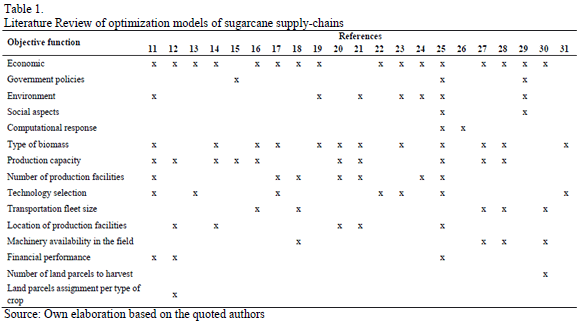
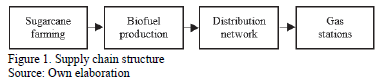
<body><![CDATA[<p><font size="3" face="Verdana, Arial, Helvetica, sans-serif"><b>1. Introduction</b></font></p>     <p><font size="2" face="Verdana, Arial, Helvetica, sans-serif">Biofuel supply chains have been   identified as a strategic sector for Latin America &#91;1&#93;. Some countries are   stimulating biofuel production to reduce fossil fuel dependency and, in this   way, guarantee their energy security at lower prices &#91;2-4&#93;. Although several   investigations on biofuel production have focused on identifying a more   efficient feedstock, sugarcane is considered to be a high yield biomass in the   production process &#91;5&#93;.</font></p>     <p><font size="2" face="Verdana, Arial, Helvetica, sans-serif">In Peru, biofuel production is considered   to be one of the seven most important sectors &#91;6&#93;; therefore, ethanol   production from sugarcane is highly relevant for economic growth projections.   The supply chain is made up of a group of companies involved in the flow of   materials, information and capital, starting with the unprocessed raw materials   and finishing with the end consumer &#91;7-9&#93;. <a href="#fig01">Fig. 1</a> shows the general structure   of the biofuel supply chain from sugarcane.</font></p>     <p align="center"><font size="2" face="Verdana, Arial, Helvetica, sans-serif"><a name="fig01"></a></font><img src="/img/revistas/dyna/v83n195/v83n195a22fig01.gif"></p>     <p><font size="2" face="Verdana, Arial, Helvetica, sans-serif">Bearing in mind that between 47% and 58%   of ethanol production costs depend on the sugarcane crop &#91;10&#93;, this stage   becomes an important target to reduce costs in the entire supply chain. Some operations related to harvesting and   loading cane are relevant. Also, given the complex nature of agro-industrial   processes &#91;9&#93;, it is important to consider the penalties derived from unmet   demand and idle machines. In addition, harvesting, loading and transporting   sugarcane are operations commonly affected by several constraints, such as land   conditions, grinding requirements, availability and resource capacity   (machinery and manpower) and production scheduling. Therefore, identifying the   optimal resource allocation to reduce costs without affecting delivery goals is   a decision of great complexity and economic relevance in supply chain planning.</font></p>     <p><font size="2" face="Verdana, Arial, Helvetica, sans-serif">In this sense, this paper shows a   Mixed-Integer Linear Programming Model (MILP), for operations planning for the   harvesting, loading and transportation of sugarcane to supply a biofuel   production plant. The model takes into account optimization of four types of   costs: allocation of machinery and workforce, transportation from the farm to   the biofuel production plant, penalties for unfulfilled orders and idle   machinery. Also, in the case of the mechanical harvesting method, land   conditions for machinery selection are considered. The model was implemented in a case study in   Peru, resulting in a cost reduction of around 11 % when compared to the current   costs.</font></p>     <p><font size="2" face="Verdana, Arial, Helvetica, sans-serif">In order to explain the model, this paper   has been structured as follows: First, a literature review is presented in   Section 2. Several papers that discuss the improvement of a biofuel supply   chain in the upstream stage are examined. Second, in Section 3, the structure   of the proposed optimization model is explained in two phases: in the first,   the general procedure is described by identifying its purpose, as well as the   resources and costs that must be taken into account; in the second, the   structure and some details of the mathematical model are explained. Third, in   Section 4, a case study is solved using a well-known computational tool. Finally, in Section 5, the conclusions and   some suggestions for future model applications are outlined.</font></p>     <p>&nbsp;</p>     <p><font size="3" face="Verdana, Arial, Helvetica, sans-serif"><b>2. Literature review</b></font></p>     <p><font size="2" face="Verdana, Arial, Helvetica, sans-serif">Biofuel supply chain improvement has been   a matter of great interest in recent years. A systematic literature review was   carried out using the ISI - Web of Science and SCOPUS databases. The search was   confined to identifying papers that were concerned with the specific objective   of the research presented in this paper. About 43 papers associated with the   selected key words were found; however only 21 of these were considered to be   relevant. According to the results, an important increase in contributions on   this topic, especially over the last five years (73.9%), was detected. Most of   these studies have been carried out in the United States (28%), Italy (12%),   France and Cuba (8%). Papers on this subject in relation to Peru were not   found. <a href="#tab01">Table 1</a> summarizes a brief comparison of the 21 analyzed papers based on   the scope of the objective function and the set of decision variables.</font></p>     ]]></body>
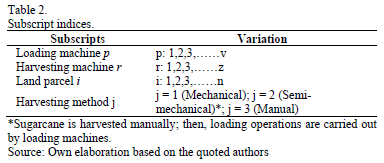
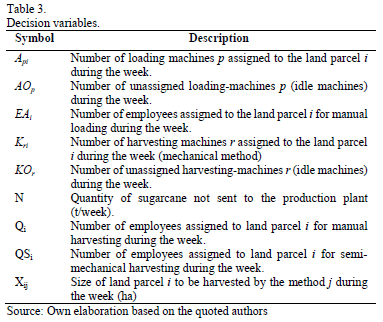
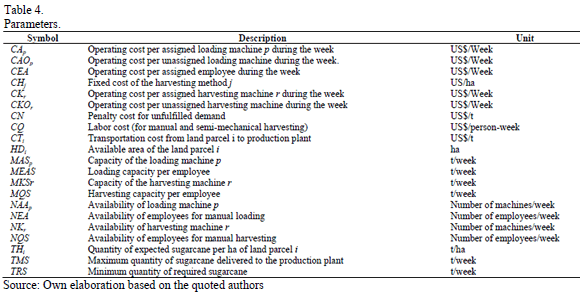
<body><![CDATA[<p align="center"><font size="2" face="Verdana, Arial, Helvetica, sans-serif"><a name="tab01"></a></font><img src="/img/revistas/dyna/v83n195/v83n195a22tab01.gif"></p>     <p><font size="2" face="Verdana, Arial, Helvetica, sans-serif">According   to <a href="#tab01">Table 1</a>, the focus of a significant part of the studies is on supply chain   design that included biomass type, technology selection, capacity allocation   and the facilities required for the production stage. In other words, few   contributions on supply chain planning were found. Regarding the first echelon   of the supply chain (upstream), few studies examined the characteristics of the   typical logistics operations for sugarcane, such as harvesting, loading and   transportation from the land parcel to the production plant. It is important to   emphasize that 91.3% of the articles examine operations where the crop is an   input parameter, which reinforces the originality of this article where land   parcel selection for sugarcane cultivation is a decision variable. </font></p>     <p><font size="2" face="Verdana, Arial, Helvetica, sans-serif">Additionally, the economic criterion is   the most common objective function defined for sugarcane supply-chain   optimization, although some of the articles take into account economic factors   and environmental impact simultaneously. From the economic point of view,   21.41% of the studies aim to maximize expected net revenues and the rest are   focused on cost minimization, emphasizing transportation, harvesting and   warehousing operations. Likewise, only two researchers addressed opportunity   cost analysis taking into account sugarcane maturity and crop investment.</font></p>     <p><font size="2" face="Verdana, Arial, Helvetica, sans-serif">Finally, models considering cost of   equipment downtimes and cost of penalties for unmet demand were not identified   in the literature review. Models focused on resource allocation (machinery and   labor) to land parcels based on terrain constraints were not detected.</font></p>     <p>&nbsp;</p>     <p><font size="3" face="Verdana, Arial, Helvetica, sans-serif"><b>3. Structure of the model</b></font></p>     <p><font size="2" face="Verdana, Arial, Helvetica, sans-serif">The purpose   of the mathematical model is to select the quantity of hectares to be collected   per land parcel. It also allows for the selection of the type of harvesting   method from three alternatives: mechanical, semi-mechanical and manual. In   addition, the model selects the type of equipment for harvesting and loading   operations, as well as the workforce required for a semi-mechanical or manual   method. <a href="#tab02">Table 2</a> shows the subscript indices used in the model; in turn, <a href="#tab03">Tables   3</a> and <a href="#tab04">4</a> summarize the decision variables and the parameters respectively.</font></p>     <p align="center"><font size="2" face="Verdana, Arial, Helvetica, sans-serif"><a name="tab02"></a></font><img src="/img/revistas/dyna/v83n195/v83n195a22tab02.gif"></p>     <p align="center"><font size="2" face="Verdana, Arial, Helvetica, sans-serif"><a name="tab03"></a></font><img src="/img/revistas/dyna/v83n195/v83n195a22tab03.gif"></p>     <p align="center"><font size="2" face="Verdana, Arial, Helvetica, sans-serif"><a name="tab04"></a></font><img src="/img/revistas/dyna/v83n195/v83n195a22tab04.gif"></p>     ]]></body>
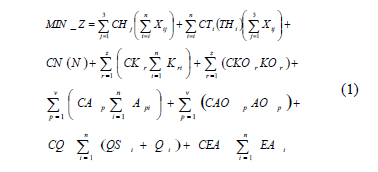
<body><![CDATA[<p><font size="2" face="Verdana, Arial, Helvetica, sans-serif"><b><i>3.1. Objective function</i></b></font></p>     <p><font size="2" face="Verdana, Arial, Helvetica, sans-serif">The cost parameters in the objective function were grouped as follows:</font></p> <ul>       <li><font size="2" face="Verdana, Arial, Helvetica, sans-serif">Machinery costs (harvesting and     loading machines). This includes the operation costs and the cost of equipment     idle time. The latter is obtained based on the fixed cost of unassigned     machinery.</font></li>       <li><font size="2" face="Verdana, Arial, Helvetica, sans-serif">Workforce costs for cut and loading     operations. </font></li>       <li><font size="2" face="Verdana, Arial, Helvetica, sans-serif">Costs related to harvesting method.     This includes maintenance personnel costs, staff and other inputs. </font></li>       <li><font size="2" face="Verdana, Arial, Helvetica, sans-serif">Penalty costs for unfulfilled demand. This cost is agreed in the supply contract.</font></li>       <li><font size="2" face="Verdana, Arial, Helvetica, sans-serif">Transportation costs. </font></li>     </ul>     <p><font size="2" face="Verdana, Arial, Helvetica, sans-serif">The main purpose of the model   is the minimization of the total costs, which is determined by:</font></p>     <p><font size="2" face="Verdana, Arial, Helvetica, sans-serif">Min (Costs) = Operation cost per   harvesting method + Transportation cost for sugarcane delivered from each land   parcel to the production plant + Penalty cost for unfulfilled demand + Cost per   assigned harvesting machine + Cost per idle harvesting machine + Cost per   assigned loading machine + Cost per idle loading machines + Cost of assigned   workforce for manual harvesting + Cost of assigned workforce for manual   loading.</font></p>     ]]></body>
<body><![CDATA[<p><img src="/img/revistas/dyna/v83n195/v83n195a22eq01.gif"></p>     <p><font size="2" face="Verdana, Arial, Helvetica, sans-serif"><b><i>3.1. Model constraints</i></b></font></p>     <p><font size="2" face="Verdana, Arial, Helvetica, sans-serif">Model constraints are represented by   equations 2 to 14. The set of constraints includes land availability,   production plant demand, equipment capacity, workforce availability and land conditions. </font></p>     <p><font size="2" face="Verdana, Arial, Helvetica, sans-serif">The system of equations is as   follows: </font></p>     <p><font size="2" face="Verdana, Arial, Helvetica, sans-serif"><b>Land: </b></font></p>     <p><font size="2" face="Verdana, Arial, Helvetica, sans-serif">Available area per land parcel (ha)</font></p>     <p><img src="/img/revistas/dyna/v83n195/v83n195a22eq02.gif"></p>     <p><font size="2" face="Verdana, Arial, Helvetica, sans-serif"><b>Demand: </b></font></p> <ul>       <li><font size="2" face="Verdana, Arial, Helvetica, sans-serif">Minimum amount of sugarcane required     (t/week)</font></li>     </ul>     ]]></body>
<body><![CDATA[<p><img src="/img/revistas/dyna/v83n195/v83n195a22eq03.gif"></p> <ul>       <li><font size="2" face="Verdana, Arial, Helvetica, sans-serif">Maximum amount of sugarcane to be     sent to the production plant (t/week)</font></li>     </ul>     <p><img src="/img/revistas/dyna/v83n195/v83n195a22eq04.gif"></p>     <p><font size="2" face="Verdana, Arial, Helvetica, sans-serif"><b>Equipment availability:</b></font></p> <ul>       <li><font size="2" face="Verdana, Arial, Helvetica, sans-serif">Harvesting machines availability     (quantity/week)</font></li>     </ul>     <p><img src="/img/revistas/dyna/v83n195/v83n195a22eq05.gif"></p> <ul>       <li><font size="2" face="Verdana, Arial, Helvetica, sans-serif">Loading machines availability     (quantity/week)</font></li>     </ul>     ]]></body>
<body><![CDATA[<p><img src="/img/revistas/dyna/v83n195/v83n195a22eq06.gif"></p>     <p><font size="2" face="Verdana, Arial, Helvetica, sans-serif"><b>Workforce availability:</b></font></p> <ul>       <li><font size="2" face="Verdana, Arial, Helvetica, sans-serif">Workers' availability for harvesting     (quantity/week): workers are divided into two groups; first one of them takes     part in the semi-mechanical method; the second one is assigned to the manual     method.</font></li>     </ul>     <p><img src="/img/revistas/dyna/v83n195/v83n195a22eq07.gif"></p> <ul>       <li><font size="2" face="Verdana, Arial, Helvetica, sans-serif">Workers' availability for manual     loading (quantity/week)</font></li>     </ul>     <p><img src="/img/revistas/dyna/v83n195/v83n195a22eq08.gif"></p>     <p><font size="2" face="Verdana, Arial, Helvetica, sans-serif"><b>Equipment capacity: </b></font></p>     <p><font size="2" face="Verdana, Arial, Helvetica, sans-serif">The equal   symbol in the capacity constraints is required to achieve maximum equipment   exploitation when assigned to every land parcel (uptime - maintenance time).   The uptime for loading machines depends on the maximum time that sugarcane can   wait to be processed after being cut without affecting its yield.</font></p> <ul>       ]]></body>
<body><![CDATA[<li><font size="2" face="Verdana, Arial, Helvetica, sans-serif">Harvesting machines capacity per land     parcel (t/week)</font></li>     </ul>     <p><img src="/img/revistas/dyna/v83n195/v83n195a22eq09.gif"></p> <ul>       <li><font size="2" face="Verdana, Arial, Helvetica, sans-serif">Loading machines capacity per land     parcel (t/week)</font></li>     </ul>     <p><img src="/img/revistas/dyna/v83n195/v83n195a22eq10.gif"></p>     <p><font size="2" face="Verdana, Arial, Helvetica, sans-serif"><b>Workforce capacity:</b></font></p>     <p><font size="2" face="Verdana, Arial, Helvetica, sans-serif">There are   two groups of workers for harvesting operations: group 1 is assigned to   semi-mechanical harvesting and group 2 is assigned to manual harvesting. The   constraints are:</font></p> <ul>       <li><font size="2" face="Verdana, Arial, Helvetica, sans-serif">Workers' capacity for semi-mechanical     harvesting in every land parcel (t/week)</font></li>     </ul>     ]]></body>
<body><![CDATA[<p><img src="/img/revistas/dyna/v83n195/v83n195a22eq11.gif"></p> <ul>       <li><font size="2" face="Verdana, Arial, Helvetica, sans-serif">Workers' capacity for manual     harvesting in every land parcel (t/week)</font></li>     </ul>     <p><img src="/img/revistas/dyna/v83n195/v83n195a22eq12.gif"></p> <ul>       <li><font size="2" face="Verdana, Arial, Helvetica, sans-serif">Workers' capacity for manual loading     in every land parcel (t/week) </font></li>     </ul>     <p><img src="/img/revistas/dyna/v83n195/v83n195a22eq13.gif"></p>     <p>&nbsp;</p>     <p><font size="2" face="Verdana, Arial, Helvetica, sans-serif"><b>Land conditions:</b></font></p>     <p><font size="2" face="Verdana, Arial, Helvetica, sans-serif">The proper operation of harvesting   machines (powered by a caterpillar engine or wheel-mounted) depends on the land   parcel characteristics; for example, wheel-mounted machines encounter   difficulties when assigned to wetlands. Therefore, depending on the foreman   assessment of each type of land, the following constraint will come in to play:</font></p> <ul>       ]]></body>
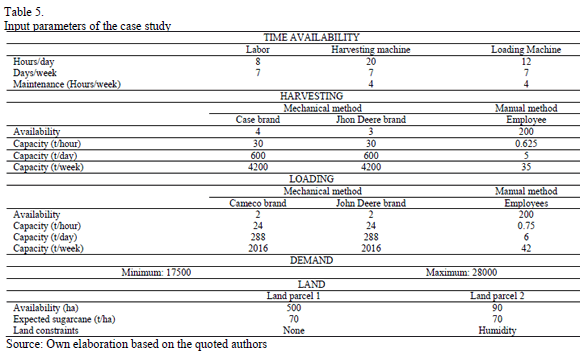
<body><![CDATA[<li><font size="2" face="Verdana, Arial, Helvetica, sans-serif">Harvesting machines t unassigned to     the land parcel i due to land conditions. </font></li>     </ul>     <p><img src="/img/revistas/dyna/v83n195/v83n195a22eq14.gif"></p>     <p><font size="2" face="Verdana, Arial, Helvetica, sans-serif"><b>Non- negativity condition and   integer variables:</b></font></p>     <p><font size="2" face="Verdana, Arial, Helvetica, sans-serif">All variables are constrained to values   greater than or equal to zero. Furthermore, the following variables are constrained   to integer values.</font></p>     <p><img src="/img/revistas/dyna/v83n195/v83n195a22eq141.gif"></p>     <p>&nbsp;</p>     <p><font size="3" face="Verdana, Arial, Helvetica, sans-serif"><b>4. Case study</b></font></p>     <p><font size="2" face="Verdana, Arial, Helvetica, sans-serif">This model was implemented in a Peruvian   ethanol production company. The supply chain was comprised of sugarcane   harvesting and loading operations, raw material transportation, the ethanol   production process and finally, transportation to the international market.   Although the company had several land parcels planted with sugarcane, the model   was applied to support the operations programming of harvesting, loading and   transportation for only two of these. This decision was made because, when the   study was conducted, the generated raw material (41,300 t) exceeded the ethanol   plant requirement (28,000 t). However, the model can be adjusted insofar as   ethanol demand increases. <a href="#tab05">Table 5</a> shows the input parameters given by the   company; however, information about costs was omitted due to confidentiality   agreements with the company.</font></p>     <p align="center"><font size="2" face="Verdana, Arial, Helvetica, sans-serif"><a name="tab05"></a></font><img src="/img/revistas/dyna/v83n195/v83n195a22tab05.gif"></p>     ]]></body>
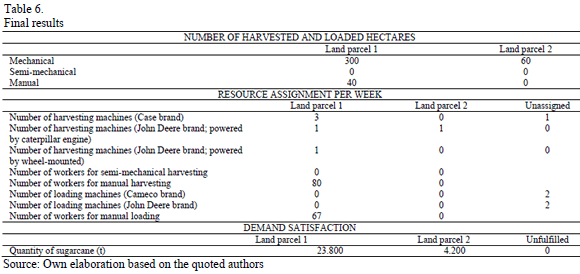
<body><![CDATA[<p><font size="2" face="Verdana, Arial, Helvetica, sans-serif">By using   GAMS (General Algebraic Modeling System) professional software, the model was   solved. The model was run on a microcomputer provided with 1.66 GHz Intel   processor and 4.6 GB of memory RAM. The problem was solved efficiently since   the computational time was of a thousandth of second.</font></p>     <p><font size="2" face="Verdana, Arial, Helvetica, sans-serif">According   to the results, 300 ha of land parcel 1 should be harvested using the   mechanical method, assigning five machines for this operation (three Case   brand, one John Deere brand powered by caterpillar engine and one John Deere   brand powered by wheel-mounted). This outcome highlights another advantage of   the proposed model, which allows for programming of different types of machines   for this operation. Also, 40 ha of land parcel 1 must be processed using the   manual method, which implies the assignment of 147 workers to harvesting and   loading operations. Regarding land parcel 2, the model chose the mechanical   method to collect 60 ha; however, due to terrain conditions, the harvesting   machine powered by the caterpillar engine was assigned instead of the   wheel-mounted machine. Based on this resource allocation, 28,000 tons of   sugarcane (23,800 from land parcel 1 and 4,200 from land parcel 2) can be   processed, satisfying 100% of the ethanol plant requirements.</font></p>     <p><font size="2" face="Verdana, Arial, Helvetica, sans-serif">Although   the model penalizes equipment idle time, the semi-mechanical method was not   included in the final solution, even though four loading machines and one   harvesting machine are unnecessary. This decision shows the existing   overcapacity in the agricultural echelon of the supply chain. As a consequence,   the company must increase its marketing efforts. From another point of view,   the company can take advantage of idle machines to implement preventive   maintenance activities. The obtained total cost was approximately 11% less than   the current costs, showing significant savings for the company. <a href="#tab06">Table 6</a> summarizes the obtained solution.</font></p>     <p align="center"><font size="2" face="Verdana, Arial, Helvetica, sans-serif"><a name="tab06"></a></font><img src="/img/revistas/dyna/v83n195/v83n195a22tab06.gif"></p>     <p>&nbsp;</p>     <p><font size="3" face="Verdana, Arial, Helvetica, sans-serif"><b>5. Conclusions</b></font></p>     <p><font size="2" face="Verdana, Arial, Helvetica, sans-serif">Biofuel supply chain improvement has been   a matter of great interest in recent years. Although the literature review   shows an important number of papers on this topic, most of them are aimed at   supporting decisions regarding supply chain design. The analysis showed that a   significant part of the studies oriented to supply chain design, considered the   biomass type, technology selection, capacity allocation and facilities as the   most important decision variables; however few papers on optimization models   for supply chain planning were found, specifically those oriented toward   analyses of the particularities of the first echelon (upstream) of the   sugarcane supply chain.</font></p>     <p><font size="2" face="Verdana, Arial, Helvetica, sans-serif">For instance, few studies examined the   characteristics of the typical logistics operations for sugarcane, such as   harvesting, loading and transportation from the land parcel to the production   plant. Also, models that took into account the cost of equipment downtime and   the cost of penalties for unmet demand were not identified in the literature   review. Models oriented to resource allocation (machinery and labor) to the   land parcels based on the terrain constraints were not detected.</font></p>     <p><font size="2" face="Verdana, Arial, Helvetica, sans-serif">In contrast, the proposed model shows   several advantages that can be summarized as follows: 1) it analyzes operations   programming related to harvesting, loading and transporting sugarcane, using   land parcel selection as a decision variable; 2) the model considers the   optimization of four types of costs: allocation of machinery and workforce,   transportation from the farm to the biofuel production plant, penalties for   unmet orders and idle machinery; 3) in the case of the mechanical harvesting   method, terrain constraints for machinery selection were taken into account.</font></p>     <p><font size="2" face="Verdana, Arial, Helvetica, sans-serif">According to the results obtained in the   case study, the current cost of the company was reduced by approximately 11%.   By analyzing three alternatives for harvesting and loading operations   (mechanical, semi-mechanical and manual), 300 ha with the mechanical method and   96 ha with the manual method were assigned. Because the model did not take into   account the use of the semi-mechanical alternative, four loading machines and   one harvesting machine were not used affecting the idle time cost. In general,   the model established the required resources to support the operations   programming in the first echelon of the supply chain; thus, the results show   the number of machines, work force and staff necessary to meet the raw material   requirements of the production plant. </font></p>     ]]></body>
<body><![CDATA[<p><font size="2" face="Verdana, Arial, Helvetica, sans-serif">Due to the level of complexity of the   present model in relation to the number of land parcels analyzed, computer time   was not a problem; nevertheless the effect on the set of variables and   constraints must be checked for a greater amount of land parcels. The model   shows some disadvantages that suggest some future research lines. For example,   it is necessary to analyze other features related to operations such as   internal transportation, yield for several sugarcane varieties and other soil   constraints. Other variables such as demand uncertainty and multi-period and   environmental conditions could be analyzed in order to provide a better tool to   support decision-making.</font></p>     <p>&nbsp;</p>     <p><font size="3" face="Verdana, Arial, Helvetica, sans-serif"><b>Acknowledgments</b></font></p>     <p><font size="2" face="Verdana, Arial, Helvetica, sans-serif">The authors wish to thank the Universidad   Tecnol&oacute;gica de Pereira for its academic and financial support through the   research project assigned code number 1110-622-38514 (Colciencias). </font></p>     <p>&nbsp;</p>     <p><font size="3" face="Verdana, Arial, Helvetica, sans-serif"><b>References</b></font></p>     <!-- ref --><p><font size="2" face="Verdana, Arial, Helvetica, sans-serif"><b>&#91;1&#93;</b> Pareja, P.C.,   Sevilla, S. y Coello, J., Estudio sobre la situaci&oacute;n de los biocombustibles en   el Per&uacute;, Lima, &#91;Online&#93;</b> 2008, 68 P. Available at: <a href="http://www.cedecap.org.pe/uploads/biblioteca/48bib_arch.pdf" target="_blank">http://www.cedecap.org.pe/uploads/biblioteca/48bib_arch.pdf</a></font>&nbsp;&nbsp;&nbsp;&nbsp;&nbsp;&nbsp;&nbsp;&nbsp;[&#160;<a href="javascript:void(0);" onclick="javascript: window.open('/scielo.php?script=sci_nlinks&ref=1139457&pid=S0012-7353201600010002200001&lng=','','width=640,height=500,resizable=yes,scrollbars=1,menubar=yes,');">Links</a>&#160;]<!-- end-ref --><!-- ref --><p><font size="2" face="Verdana, Arial, Helvetica, sans-serif"><b>&#91;2&#93;</b> Franco, C.J., Fl&oacute;rez,   A.M. y Ochoa, M.C., An&aacute;lisis de la cadena de suministro de biocombustibles en   Colombia<i>.</i> Revista de Din&aacute;mica de   Sistemas, 4(2), pp. 109-133, 2008.    &nbsp;&nbsp;&nbsp;&nbsp;&nbsp;&nbsp;&nbsp;&nbsp;[&#160;<a href="javascript:void(0);" onclick="javascript: window.open('/scielo.php?script=sci_nlinks&ref=1139458&pid=S0012-7353201600010002200002&lng=','','width=640,height=500,resizable=yes,scrollbars=1,menubar=yes,');">Links</a>&#160;]<!-- end-ref --></font></p>     <!-- ref --><p><font size="2" face="Verdana, Arial, Helvetica, sans-serif"><b>&#91;3&#93;</b> Duarte, A., Sarache, W.A.and Cardona,   C., Cost analysis of the location of Colombian biofuels plants. DYNA, 79(176),   pp. 71-80, 2012.    &nbsp;&nbsp;&nbsp;&nbsp;&nbsp;&nbsp;&nbsp;&nbsp;[&#160;<a href="javascript:void(0);" onclick="javascript: window.open('/scielo.php?script=sci_nlinks&ref=1139460&pid=S0012-7353201600010002200003&lng=','','width=640,height=500,resizable=yes,scrollbars=1,menubar=yes,');">Links</a>&#160;]<!-- end-ref --></font></p>     <!-- ref --><p><font size="2" face="Verdana, Arial, Helvetica, sans-serif"><b>&#91;4&#93;</b> Cort&eacute;s-Mar&iacute;n, E., Suarez-Mahecha, H.   and Pardo-Carrasco, S., Biocombustibles y autosuficiencia energ&eacute;tica. DYNA, &#91;Online&#93;</b> 76(158), pp. 101-110. 2009 Available   at: <a href="http://www.scopus.com/inward/record.url?eid=2-s2.0-75249097474&partnerID=tZOtx3y1" target="_blank">http://www.scopus.com/inward/record.url?eid=2-s2.0-75249097474&amp;partnerID=tZOtx3y1</a></font>&nbsp;&nbsp;&nbsp;&nbsp;&nbsp;&nbsp;&nbsp;&nbsp;[&#160;<a href="javascript:void(0);" onclick="javascript: window.open('/scielo.php?script=sci_nlinks&ref=1139462&pid=S0012-7353201600010002200004&lng=','','width=640,height=500,resizable=yes,scrollbars=1,menubar=yes,');">Links</a>&#160;]<!-- end-ref --><!-- ref --><p><font size="2" face="Verdana, Arial, Helvetica, sans-serif"><b>&#91;5&#93;</b> Moncada, J.,   El-Halwagi, M.M. and Cardona, C.A., Techno-economic analysis for a sugarcane   biorefinery: Colombian case. Bioresource Technology, 135, pp. 533-543, 2013.   DOI: 10.1016/j.biortech.2012.08.137.    &nbsp;&nbsp;&nbsp;&nbsp;&nbsp;&nbsp;&nbsp;&nbsp;[&#160;<a href="javascript:void(0);" onclick="javascript: window.open('/scielo.php?script=sci_nlinks&ref=1139463&pid=S0012-7353201600010002200005&lng=','','width=640,height=500,resizable=yes,scrollbars=1,menubar=yes,');">Links</a>&#160;]<!-- end-ref --></font></p>     <!-- ref --><p><font size="2" face="Verdana, Arial, Helvetica, sans-serif"><b>&#91;6&#93;</b> Ministerio de   Educaci&oacute;n del Per&uacute;. Plan nacional estrat&eacute;gico de ciencia, tecnolog&iacute;a e   innovaci&oacute;n para la competitividad y el desarrollo humano PNCTI 2006-2021, Lima,   &#91;Online&#93;. 2014. Available at: <a href="http://www.minedu.gob.pe/normatividad/reglamentos/PlanNacionalCTI-CDH2006-2021.php" target="_blank">http://www.minedu.gob.pe/normatividad/reglamentos/PlanNacionalCTI-CDH2006-2021.php</a>.    &nbsp;&nbsp;&nbsp;&nbsp;&nbsp;&nbsp;&nbsp;&nbsp;[&#160;<a href="javascript:void(0);" onclick="javascript: window.open('/scielo.php?script=sci_nlinks&ref=1139465&pid=S0012-7353201600010002200006&lng=','','width=640,height=500,resizable=yes,scrollbars=1,menubar=yes,');">Links</a>&#160;]<!-- end-ref --></font></p>     <!-- ref --><p><font size="2" face="Verdana, Arial, Helvetica, sans-serif"><b>&#91;7&#93;</b> Council of Supply   Chain Management Professionals. Supply Chain Management, &#91;Online&#93;. 2013.   Available at: <a href="https://cscmp.org/about-us/supply-chain-management-definitions" target="_blank">https://cscmp.org/about-us/supply-chain-management-definitions</a>.    &nbsp;&nbsp;&nbsp;&nbsp;&nbsp;&nbsp;&nbsp;&nbsp;[&#160;<a href="javascript:void(0);" onclick="javascript: window.open('/scielo.php?script=sci_nlinks&ref=1139467&pid=S0012-7353201600010002200007&lng=','','width=640,height=500,resizable=yes,scrollbars=1,menubar=yes,');">Links</a>&#160;]<!-- end-ref --></font></p>     <!-- ref --><p><font size="2" face="Verdana, Arial, Helvetica, sans-serif"><b>&#91;8&#93;</b> Sarache, W.A., Costa, Y. and Martinez,   J., Environmental performance evaluation under a green supply chain approach.   DYNA, 82(189), pp. 207-215, 2015. DOI: 10.15446/dyna.v82n189.48550.    &nbsp;&nbsp;&nbsp;&nbsp;&nbsp;&nbsp;&nbsp;&nbsp;[&#160;<a href="javascript:void(0);" onclick="javascript: window.open('/scielo.php?script=sci_nlinks&ref=1139469&pid=S0012-7353201600010002200008&lng=','','width=640,height=500,resizable=yes,scrollbars=1,menubar=yes,');">Links</a>&#160;]<!-- end-ref --></font></p>     ]]></body>
<body><![CDATA[<!-- ref --><p><font size="2" face="Verdana, Arial, Helvetica, sans-serif"><b>&#91;9&#93;</b> Duarte, A., Sarache, W.A. and Costa,   Y., A facility-location model for biofuel plants: Applications in the Colombian   context. Energy, 72, pp. 476-483, 2014. DOI: 10.1016/j.energy.2014.05.069.    &nbsp;&nbsp;&nbsp;&nbsp;&nbsp;&nbsp;&nbsp;&nbsp;[&#160;<a href="javascript:void(0);" onclick="javascript: window.open('/scielo.php?script=sci_nlinks&ref=1139471&pid=S0012-7353201600010002200009&lng=','','width=640,height=500,resizable=yes,scrollbars=1,menubar=yes,');">Links</a>&#160;]<!-- end-ref --></font></p>     <!-- ref --><p><font size="2" face="Verdana, Arial, Helvetica, sans-serif"><b>&#91;10&#93;</b> Consejo Nacional de Pol&iacute;tica Econ&oacute;mica   y Social. Conpes 3510. Lineamientos de pol&iacute;tica   para promover la producci&oacute;n sostenible de biocombustibles en Colombia,   Bogot&aacute;,&#91;Online&#93;. 2008, 44 P. Available at: <a href="http://www.minminas.gov.co/minminas/downloads/UserFiles/File/Conpes3510.pdf" target="_blank">http://www.minminas.gov.co/minminas/downloads/UserFiles/File/Conpes3510.pdf</a></font>&nbsp;&nbsp;&nbsp;&nbsp;&nbsp;&nbsp;&nbsp;&nbsp;[&#160;<a href="javascript:void(0);" onclick="javascript: window.open('/scielo.php?script=sci_nlinks&ref=1139473&pid=S0012-7353201600010002200010&lng=','','width=640,height=500,resizable=yes,scrollbars=1,menubar=yes,');">Links</a>&#160;]<!-- end-ref --><!-- ref --><p><font size="2" face="Verdana, Arial, Helvetica, sans-serif"><b>&#91;11&#93;</b> Marvin, W.A.,   Schmidt, L.D., Benjaafar, S., Tiffany, D.G. and Daoutidis, P., Economic   optimization of a lignocellulosic biomass-to-ethanol supply chain. Chemical   Engineering Science, 67(1), pp. 68-79, 2012. DOI: 10.1016/j.ces.2011.05.055</font>&nbsp;&nbsp;&nbsp;&nbsp;&nbsp;&nbsp;&nbsp;&nbsp;[&#160;<a href="javascript:void(0);" onclick="javascript: window.open('/scielo.php?script=sci_nlinks&ref=1139474&pid=S0012-7353201600010002200011&lng=','','width=640,height=500,resizable=yes,scrollbars=1,menubar=yes,');">Links</a>&#160;]<!-- end-ref --><!-- ref --><p><font size="2" face="Verdana, Arial, Helvetica, sans-serif"><b>&#91;12&#93;</b> Giarola, S., Bezzo,   F. and Shah, N., A risk management approach to the economic and environmental   strategic design of ethanol supply chains. Biomass and Bioenergy, 58, pp.   31-51, 2013. DOI: 10.1016/j.biombioe.2013.08.005</font>&nbsp;&nbsp;&nbsp;&nbsp;&nbsp;&nbsp;&nbsp;&nbsp;[&#160;<a href="javascript:void(0);" onclick="javascript: window.open('/scielo.php?script=sci_nlinks&ref=1139475&pid=S0012-7353201600010002200012&lng=','','width=640,height=500,resizable=yes,scrollbars=1,menubar=yes,');">Links</a>&#160;]<!-- end-ref --><!-- ref --><p><font size="2" face="Verdana, Arial, Helvetica, sans-serif"><b>&#91;13&#93;</b> Osmani, A. and Zhang,   J., Stochastic optimization of a multi-feedstock lignocellulosic-based   bioethanol supply chain under multiple uncertainties. Energy, 59, pp. 157-172,   2013. DOI: 10.1016/j.energy.2013.07.043</font>&nbsp;&nbsp;&nbsp;&nbsp;&nbsp;&nbsp;&nbsp;&nbsp;[&#160;<a href="javascript:void(0);" onclick="javascript: window.open('/scielo.php?script=sci_nlinks&ref=1139476&pid=S0012-7353201600010002200013&lng=','','width=640,height=500,resizable=yes,scrollbars=1,menubar=yes,');">Links</a>&#160;]<!-- end-ref --><!-- ref --><p><font size="2" face="Verdana, Arial, Helvetica, sans-serif"><b>&#91;14&#93;</b> Ortiz-Gutierrez,   R.A., Giarola, S. and Bezzo, F., Optimal design of ethanol supply chains   considering carbon trading effects and multiple technologies for side-product   exploitation. Environmental Technology, 34(13-14,SI), pp. 2189-2199, 2013. DOI:   10.1080/09593330.2013.829111</font>&nbsp;&nbsp;&nbsp;&nbsp;&nbsp;&nbsp;&nbsp;&nbsp;[&#160;<a href="javascript:void(0);" onclick="javascript: window.open('/scielo.php?script=sci_nlinks&ref=1139477&pid=S0012-7353201600010002200014&lng=','','width=640,height=500,resizable=yes,scrollbars=1,menubar=yes,');">Links</a>&#160;]<!-- end-ref --><!-- ref --><p><font size="2" face="Verdana, Arial, Helvetica, sans-serif"><b>&#91;15&#93;</b> Sparks, G.D.,   Ortmann, G.F. and Lagrange, L., An economic evaluation of soybean-based   biodiesel production on commercial farms in Kwazulu-natal, South Africa.   Agrekon, 50(3), pp. 68-89, 2011. DOI: 10.1080/03031853.2011.617862</font>&nbsp;&nbsp;&nbsp;&nbsp;&nbsp;&nbsp;&nbsp;&nbsp;[&#160;<a href="javascript:void(0);" onclick="javascript: window.open('/scielo.php?script=sci_nlinks&ref=1139478&pid=S0012-7353201600010002200015&lng=','','width=640,height=500,resizable=yes,scrollbars=1,menubar=yes,');">Links</a>&#160;]<!-- end-ref --><!-- ref --><p><font size="2" face="Verdana, Arial, Helvetica, sans-serif"><b>&#91;16&#93;</b> Shastri, Y., Hansen,   A., Rodr&iacute;guez, L. and Ting, K.C., Development and application of biofeed model   for optimization of herbaceous biomass feedstock production. Biomass and   Bioenergy, 35(7), pp. 2961-2974, 2011. DOI: 10.1016/j.biombioe.2011.03.035</font>&nbsp;&nbsp;&nbsp;&nbsp;&nbsp;&nbsp;&nbsp;&nbsp;[&#160;<a href="javascript:void(0);" onclick="javascript: window.open('/scielo.php?script=sci_nlinks&ref=1139479&pid=S0012-7353201600010002200016&lng=','','width=640,height=500,resizable=yes,scrollbars=1,menubar=yes,');">Links</a>&#160;]<!-- end-ref --><!-- ref --><p><font size="2" face="Verdana, Arial, Helvetica, sans-serif"><b>&#91;17&#93;</b> Giarola, S., Patel,   M. and Shah, N., Biomass supply chain optimisation for Organosolv-based   biorefineries. Bioresource Technology, 159, pp. 387-396. 2014. DOI:   10.1016/j.biortech.2014.02.109</font>&nbsp;&nbsp;&nbsp;&nbsp;&nbsp;&nbsp;&nbsp;&nbsp;[&#160;<a href="javascript:void(0);" onclick="javascript: window.open('/scielo.php?script=sci_nlinks&ref=1139480&pid=S0012-7353201600010002200017&lng=','','width=640,height=500,resizable=yes,scrollbars=1,menubar=yes,');">Links</a>&#160;]<!-- end-ref --><!-- ref --><p><font size="2" face="Verdana, Arial, Helvetica, sans-serif"><b>&#91;18&#93;</b> Lin, T., Rodr&iacute;guez,   L.F., Shastri, Y.N., Hansen, A.C. and Ting, K.C., Integrated strategic and   tactical biomass-biofuel supply chain optimization. Bioresource Technology,   156, pp. 256-66, 2014. DOI: 10.1016/j.biortech.2013.12.121</font>&nbsp;&nbsp;&nbsp;&nbsp;&nbsp;&nbsp;&nbsp;&nbsp;[&#160;<a href="javascript:void(0);" onclick="javascript: window.open('/scielo.php?script=sci_nlinks&ref=1139481&pid=S0012-7353201600010002200018&lng=','','width=640,height=500,resizable=yes,scrollbars=1,menubar=yes,');">Links</a>&#160;]<!-- end-ref --><!-- ref --><p><font size="2" face="Verdana, Arial, Helvetica, sans-serif"><b>&#91;19&#93;</b> Balaman, &#350;.Y.   and Selim, H., Multiobjective optimization of biomass to energy supply chains   in an uncertain environment. Computer Aided Chemical Engineering, 33, pp.   1267-1272, 2014. DOI: 10.1016/B978-0-444-63455-9.50046-5</font>&nbsp;&nbsp;&nbsp;&nbsp;&nbsp;&nbsp;&nbsp;&nbsp;[&#160;<a href="javascript:void(0);" onclick="javascript: window.open('/scielo.php?script=sci_nlinks&ref=1139482&pid=S0012-7353201600010002200019&lng=','','width=640,height=500,resizable=yes,scrollbars=1,menubar=yes,');">Links</a>&#160;]<!-- end-ref --><!-- ref --><p><font size="2" face="Verdana, Arial, Helvetica, sans-serif"><b>&#91;20&#93;</b> Yoda, K.,   Furubayashi, T. and Nakata, T., Design of automotive bioethanol supply chain   using mixed integer programming. Nihon Enerugi Gakkaishi/Journal of the Japan   Institute of Energy, 92(11), pp. 1173-1186, 2013. DOI: 10.3775/jie.92.1173</font>&nbsp;&nbsp;&nbsp;&nbsp;&nbsp;&nbsp;&nbsp;&nbsp;[&#160;<a href="javascript:void(0);" onclick="javascript: window.open('/scielo.php?script=sci_nlinks&ref=1139483&pid=S0012-7353201600010002200020&lng=','','width=640,height=500,resizable=yes,scrollbars=1,menubar=yes,');">Links</a>&#160;]<!-- end-ref --><!-- ref --><p><font size="2" face="Verdana, Arial, Helvetica, sans-serif"><b>&#91;21&#93;</b> Ivanov, B.B.,   Dimitrova, B. and Dobrudzhaliev, D., Optimal location of biodiesel refineries:   The Bulgarian scale. Journal of Chemical Technology and Metallurgy, 48(5), pp.   513-523, 2013.    &nbsp;&nbsp;&nbsp;&nbsp;&nbsp;&nbsp;&nbsp;&nbsp;[&#160;<a href="javascript:void(0);" onclick="javascript: window.open('/scielo.php?script=sci_nlinks&ref=1139484&pid=S0012-7353201600010002200021&lng=','','width=640,height=500,resizable=yes,scrollbars=1,menubar=yes,');">Links</a>&#160;]<!-- end-ref --></font></p>     <!-- ref --><p><font size="2" face="Verdana, Arial, Helvetica, sans-serif"><b>&#91;22&#93;</b> Ortiz-Guti&eacute;rrez, R.,   Penazzi, S., Bernardi, A.L., Giarola, S. and Bezzo, F., A spatially-explicit   approach to the design of ethanol supply chains considering multiple   technologies and carbon trading effects. Computer Aided Chemical Engineering,   32, pp. 643-648, 2013. DOI: 10.1016/B978-0-444-63234-0.50108-1</font>&nbsp;&nbsp;&nbsp;&nbsp;&nbsp;&nbsp;&nbsp;&nbsp;[&#160;<a href="javascript:void(0);" onclick="javascript: window.open('/scielo.php?script=sci_nlinks&ref=1139486&pid=S0012-7353201600010002200022&lng=','','width=640,height=500,resizable=yes,scrollbars=1,menubar=yes,');">Links</a>&#160;]<!-- end-ref --><!-- ref --><p><font size="2" face="Verdana, Arial, Helvetica, sans-serif"><b>&#91;23&#93;</b> &#268;u&#269;ek, L.,   Mart&iacute;n, M.J.P., Grossmann, I.E. and Kravanja, Z., Multi-objective optimization   of a biorefinery's supply network. AIChE Annual Meeting, Pittsburgh, 2012.    &nbsp;&nbsp;&nbsp;&nbsp;&nbsp;&nbsp;&nbsp;&nbsp;[&#160;<a href="javascript:void(0);" onclick="javascript: window.open('/scielo.php?script=sci_nlinks&ref=1139487&pid=S0012-7353201600010002200023&lng=','','width=640,height=500,resizable=yes,scrollbars=1,menubar=yes,');">Links</a>&#160;]<!-- end-ref --></font></p>     <!-- ref --><p><font size="2" face="Verdana, Arial, Helvetica, sans-serif"><b>&#91;24&#93;</b> Song, H., Dotzauer,   E., Thorin, E., Guziana, B., Huopana, T. and Yan, J., A dynamic model to   optimize a regional energy system with waste and crops as energy resources for   greenhouse gases mitigation. Energy, 46(1), pp. 522-532, 2012. DOI:   10.1016/j.energy.2012.07.060</font>&nbsp;&nbsp;&nbsp;&nbsp;&nbsp;&nbsp;&nbsp;&nbsp;[&#160;<a href="javascript:void(0);" onclick="javascript: window.open('/scielo.php?script=sci_nlinks&ref=1139489&pid=S0012-7353201600010002200024&lng=','','width=640,height=500,resizable=yes,scrollbars=1,menubar=yes,');">Links</a>&#160;]<!-- end-ref --><!-- ref --><p><font size="2" face="Verdana, Arial, Helvetica, sans-serif"><b>&#91;25&#93;</b> You, F. and Wang, B.,   Optimal design and operations of cellulosic biofuel supply chains under   uncertainty. AIChE Annual Meeting, Minneapolis, 2011.    &nbsp;&nbsp;&nbsp;&nbsp;&nbsp;&nbsp;&nbsp;&nbsp;[&#160;<a href="javascript:void(0);" onclick="javascript: window.open('/scielo.php?script=sci_nlinks&ref=1139490&pid=S0012-7353201600010002200025&lng=','','width=640,height=500,resizable=yes,scrollbars=1,menubar=yes,');">Links</a>&#160;]<!-- end-ref --></font></p>     <!-- ref --><p><font size="2" face="Verdana, Arial, Helvetica, sans-serif"><b>&#91;26&#93;</b> Shastri, Y.N., Hansen,   A.C., Rodr&iacute;guez, L.F. and Ting, K.C., A novel computational approach to solve   complex optimization problems involving multiple stakeholders in biomass   feedstock production. American Society of Agricultural and Biological Engineers   Annual International Meeting, Pittsburgh, 2010, pp. 542-555.    &nbsp;&nbsp;&nbsp;&nbsp;&nbsp;&nbsp;&nbsp;&nbsp;[&#160;<a href="javascript:void(0);" onclick="javascript: window.open('/scielo.php?script=sci_nlinks&ref=1139492&pid=S0012-7353201600010002200026&lng=','','width=640,height=500,resizable=yes,scrollbars=1,menubar=yes,');">Links</a>&#160;]<!-- end-ref --></font></p>     <!-- ref --><p><font size="2" face="Verdana, Arial, Helvetica, sans-serif"><b>&#91;27&#93;</b> Shastri, Y.N.,   Hansen, A.C., Rodr&iacute;guez, L.F. and Ting, K.C., Biomass feedstock production and   provision: A system level optimization approach. AIChE Annual Meeting,   Nashville, 2009.    &nbsp;&nbsp;&nbsp;&nbsp;&nbsp;&nbsp;&nbsp;&nbsp;[&#160;<a href="javascript:void(0);" onclick="javascript: window.open('/scielo.php?script=sci_nlinks&ref=1139494&pid=S0012-7353201600010002200027&lng=','','width=640,height=500,resizable=yes,scrollbars=1,menubar=yes,');">Links</a>&#160;]<!-- end-ref --></font></p>     <!-- ref --><p><font size="2" face="Verdana, Arial, Helvetica, sans-serif"><b>&#91;28&#93;</b> Shastri, Y.N.,   Domdouzis, K., Hu, M., Hansen, A.C., Rodr&iacute;guez, L.F. and Ting, K.C., System   level analysis of biomass feedstock production for bioenergy sector. American   Society of Agricultural and Biological Engineers, Annual International Meeting,   Reno, 2009, pp. 2203-2222.    &nbsp;&nbsp;&nbsp;&nbsp;&nbsp;&nbsp;&nbsp;&nbsp;[&#160;<a href="javascript:void(0);" onclick="javascript: window.open('/scielo.php?script=sci_nlinks&ref=1139496&pid=S0012-7353201600010002200028&lng=','','width=640,height=500,resizable=yes,scrollbars=1,menubar=yes,');">Links</a>&#160;]<!-- end-ref --></font></p>     <!-- ref --><p><font size="2" face="Verdana, Arial, Helvetica, sans-serif"><b>&#91;29&#93;</b> Rozakis, S., Sourie,   J. and Vanderpooten, D., Integrated micro-economic modelling and multi-criteria   methodology to support public decision-making: The case of liquid   bio-fuels in France. Biomass and Bioenergy, 20, pp. 385-398, 2001. DOI:   10.1016/S0961-9534(01)00004-6</font>&nbsp;&nbsp;&nbsp;&nbsp;&nbsp;&nbsp;&nbsp;&nbsp;[&#160;<a href="javascript:void(0);" onclick="javascript: window.open('/scielo.php?script=sci_nlinks&ref=1139498&pid=S0012-7353201600010002200029&lng=','','width=640,height=500,resizable=yes,scrollbars=1,menubar=yes,');">Links</a>&#160;]<!-- end-ref --><!-- ref --><p><font size="2" face="Verdana, Arial, Helvetica, sans-serif"><b>&#91;30&#93;</b> Malik, S.B.,   Satsangi, P.S., Tripathy, S.C. and Balasubramanian, R., Mathematical model for   energy planning of rural India. International Journal of Energy Research,   18(4), 469-482, 1994.    &nbsp;&nbsp;&nbsp;&nbsp;&nbsp;&nbsp;&nbsp;&nbsp;[&#160;<a href="javascript:void(0);" onclick="javascript: window.open('/scielo.php?script=sci_nlinks&ref=1139499&pid=S0012-7353201600010002200030&lng=','','width=640,height=500,resizable=yes,scrollbars=1,menubar=yes,');">Links</a>&#160;]<!-- end-ref --> </font></p>     ]]></body>
<body><![CDATA[<!-- ref --><p><font size="2" face="Verdana, Arial, Helvetica, sans-serif"><b>&#91;31&#93;</b> Tripathy, S. C.,   Satsangi, P. S., Balasubramanian, R. and Malik, S. B. Artificial neural network   application to energy system planning. International Journal of Engineering   Intelligent Systems for Electrical Engineering and Communications, 7(3), pp.   121-126, 1999.    &nbsp;&nbsp;&nbsp;&nbsp;&nbsp;&nbsp;&nbsp;&nbsp;[&#160;<a href="javascript:void(0);" onclick="javascript: window.open('/scielo.php?script=sci_nlinks&ref=1139501&pid=S0012-7353201600010002200031&lng=','','width=640,height=500,resizable=yes,scrollbars=1,menubar=yes,');">Links</a>&#160;]<!-- end-ref --></font></p>     <p>&nbsp;</p>     <p><font size="2" face="Verdana, Arial, Helvetica, sans-serif"><b>M.M. Morales-Ch&aacute;vez,</b> received a BSc.an Industrial Engineering   in 2006 and the MSc. in Operations Research in 2011 both from the Universidad   Tecnologica de Pereira, Colombia; she is currently enrolled in the PhD program   in Engineering at Universidad Nacional de Colombia, Sede Manizales, Colombia.   From 2006 until today, she has been working as a consultant in several   companies. Currently, she is professor in the Comercial Engineering Program,   Universidad Libre-Seccional Pereira. Her research interests include:   operational research, supply chain optimization, business logistic and   operations management. ORCID:   0000-0002-7384-8745</font></p>     <p><font size="2" face="Verdana, Arial, Helvetica, sans-serif"><b>J.A. Soto-Mej&iacute;a,</b> received a BSc. Sciences in Physics in 1980 and an MSc. in   physics in 1982, both from the Kharkov Maximo Gorki University, Russia. In 2002 he received a PhD in Computational   Engineering from the Universidade   Estadual De Campinas, Brasil. From 1991 he has worked as full professor at   Universidad Tecnol&oacute;gica de Pereira, Colombia. His research interests include: operational research, multivariate analysis, simulation and supply   chain optimization. ORCID: 0000-0002-0205-6863</font></p>     <p><font size="2" face="Verdana, Arial, Helvetica, sans-serif"><b>W. Sarache,</b> received a BSc. in Industrial   Engineering in 1993 from Universidad de Ibagu&eacute;, Ibagu&eacute; Colombia; thereafter he received an MSc. in Industrial Engineering   in 1998 and a PhD in 2003 both from the Universidad Central de Las Villas,   Cuba. From 1992 to 1999 he worked as operations manager in manufacturing   companies. From 2000 until today he has been professor at Universidad Nacional   de Colombia. His research   interests include: operations management, supply chain management and business   logistic. ORCID: 0000-0003-3543-4151.</font></p>      ]]></body><back>
<ref-list>
<ref id="B1">
<label>1</label><nlm-citation citation-type="">
<person-group person-group-type="author">
<name>
<surname><![CDATA[Pareja]]></surname>
<given-names><![CDATA[P.C.]]></given-names>
</name>
<name>
<surname><![CDATA[Sevilla]]></surname>
<given-names><![CDATA[S.]]></given-names>
</name>
<name>
<surname><![CDATA[Coello]]></surname>
<given-names><![CDATA[J.]]></given-names>
</name>
</person-group>
<source><![CDATA[Estudio sobre la situación de los biocombustibles en el Perú, Lima]]></source>
<year>2008</year>
</nlm-citation>
</ref>
<ref id="B2">
<label>2</label><nlm-citation citation-type="journal">
<person-group person-group-type="author">
<name>
<surname><![CDATA[Franco]]></surname>
<given-names><![CDATA[C.J.]]></given-names>
</name>
<name>
<surname><![CDATA[Flórez]]></surname>
<given-names><![CDATA[A.M.]]></given-names>
</name>
<name>
<surname><![CDATA[Ochoa]]></surname>
<given-names><![CDATA[M.C.]]></given-names>
</name>
</person-group>
<article-title xml:lang="es"><![CDATA[Análisis de la cadena de suministro de biocombustibles en Colombia]]></article-title>
<source><![CDATA[Revista de Dinámica de Sistemas]]></source>
<year>2008</year>
<volume>4</volume>
<numero>2</numero>
<issue>2</issue>
<page-range>109-133</page-range></nlm-citation>
</ref>
<ref id="B3">
<label>3</label><nlm-citation citation-type="journal">
<person-group person-group-type="author">
<name>
<surname><![CDATA[Duarte]]></surname>
<given-names><![CDATA[A.]]></given-names>
</name>
<name>
<surname><![CDATA[Sarache]]></surname>
<given-names><![CDATA[W.A.]]></given-names>
</name>
<name>
<surname><![CDATA[Cardona]]></surname>
<given-names><![CDATA[C.]]></given-names>
</name>
</person-group>
<article-title xml:lang="en"><![CDATA[Cost analysis of the location of Colombian biofuels plants]]></article-title>
<source><![CDATA[DYNA]]></source>
<year>2012</year>
<volume>79</volume>
<numero>176</numero>
<issue>176</issue>
<page-range>71-80</page-range></nlm-citation>
</ref>
<ref id="B4">
<label>4</label><nlm-citation citation-type="journal">
<person-group person-group-type="author">
<name>
<surname><![CDATA[Cortés-Marín]]></surname>
<given-names><![CDATA[E.]]></given-names>
</name>
<name>
<surname><![CDATA[Suarez-Mahecha]]></surname>
<given-names><![CDATA[H.]]></given-names>
</name>
<name>
<surname><![CDATA[Pardo-Carrasco]]></surname>
<given-names><![CDATA[S.]]></given-names>
</name>
</person-group>
<article-title xml:lang="es"><![CDATA[Biocombustibles y autosuficiencia energética.]]></article-title>
<source><![CDATA[DYNA]]></source>
<year>2009</year>
<volume>76</volume>
<numero>158</numero>
<issue>158</issue>
<page-range>101-110</page-range></nlm-citation>
</ref>
<ref id="B5">
<label>5</label><nlm-citation citation-type="journal">
<person-group person-group-type="author">
<name>
<surname><![CDATA[Moncada]]></surname>
<given-names><![CDATA[J.]]></given-names>
</name>
<name>
<surname><![CDATA[El-Halwagi]]></surname>
<given-names><![CDATA[M.M.]]></given-names>
</name>
<name>
<surname><![CDATA[Cardona]]></surname>
<given-names><![CDATA[C.A.]]></given-names>
</name>
</person-group>
<article-title xml:lang="es"><![CDATA[Techno-economic analysis for a sugarcane biorefinery: Colombian case]]></article-title>
<source><![CDATA[Bioresource Technology]]></source>
<year>2013</year>
<numero>135</numero>
<issue>135</issue>
<page-range>533-543</page-range></nlm-citation>
</ref>
<ref id="B6">
<label>6</label><nlm-citation citation-type="">
<collab>Ministerio de Educación del Perú.</collab>
<source><![CDATA[Plan nacional estratégico de ciencia, tecnología e innovación para la competitividad y el desarrollo humano PNCTI 2006-2021]]></source>
<year>2014</year>
<publisher-loc><![CDATA[Lima ]]></publisher-loc>
</nlm-citation>
</ref>
<ref id="B7">
<label>7</label><nlm-citation citation-type="">
<collab>Council of Supply Chain Management Professionals</collab>
<source><![CDATA[Supply Chain Management]]></source>
<year>2013</year>
</nlm-citation>
</ref>
<ref id="B8">
<label>8</label><nlm-citation citation-type="journal">
<person-group person-group-type="author">
<name>
<surname><![CDATA[Sarache]]></surname>
<given-names><![CDATA[W.A.]]></given-names>
</name>
<name>
<surname><![CDATA[Costa]]></surname>
<given-names><![CDATA[Y.]]></given-names>
</name>
<name>
<surname><![CDATA[Martinez]]></surname>
<given-names><![CDATA[J.]]></given-names>
</name>
</person-group>
<article-title xml:lang="en"><![CDATA[Environmental performance evaluation under a green supply chain approach]]></article-title>
<source><![CDATA[DYNA]]></source>
<year>2015</year>
<volume>82</volume>
<numero>189</numero>
<issue>189</issue>
<page-range>207-215</page-range></nlm-citation>
</ref>
<ref id="B9">
<label>9</label><nlm-citation citation-type="journal">
<person-group person-group-type="author">
<name>
<surname><![CDATA[Duarte]]></surname>
<given-names><![CDATA[A.]]></given-names>
</name>
<name>
<surname><![CDATA[Sarache]]></surname>
<given-names><![CDATA[W.A.]]></given-names>
</name>
<name>
<surname><![CDATA[Costa]]></surname>
<given-names><![CDATA[Y.]]></given-names>
</name>
</person-group>
<article-title xml:lang="en"><![CDATA[A facility-location model for biofuel plants: Applications in the Colombian context]]></article-title>
<source><![CDATA[Energy]]></source>
<year>2014</year>
<numero>72</numero>
<issue>72</issue>
<page-range>476-483</page-range></nlm-citation>
</ref>
<ref id="B10">
<label>10</label><nlm-citation citation-type="">
<collab>Consejo Nacional de Política Económica y Social</collab>
<source><![CDATA[Conpes 3510: Lineamientos de política para promover la producción sostenible de biocombustibles en Colombia]]></source>
<year>2008</year>
<publisher-loc><![CDATA[Bogotá ]]></publisher-loc>
</nlm-citation>
</ref>
<ref id="B11">
<label>11</label><nlm-citation citation-type="journal">
<person-group person-group-type="author">
<name>
<surname><![CDATA[Marvin]]></surname>
<given-names><![CDATA[W.A.]]></given-names>
</name>
<name>
<surname><![CDATA[Schmidt]]></surname>
<given-names><![CDATA[L.D.]]></given-names>
</name>
<name>
<surname><![CDATA[Benjaafar]]></surname>
<given-names><![CDATA[S.]]></given-names>
</name>
<name>
<surname><![CDATA[Tiffany]]></surname>
<given-names><![CDATA[D.G.]]></given-names>
</name>
<name>
<surname><![CDATA[Daoutidis]]></surname>
<given-names><![CDATA[P.]]></given-names>
</name>
</person-group>
<article-title xml:lang="en"><![CDATA[Economic optimization of a lignocellulosic biomass-to-ethanol supply chain]]></article-title>
<source><![CDATA[Chemical Engineering Science]]></source>
<year>2012</year>
<volume>67</volume>
<numero>1</numero>
<issue>1</issue>
<page-range>68-79</page-range></nlm-citation>
</ref>
<ref id="B12">
<label>12</label><nlm-citation citation-type="journal">
<person-group person-group-type="author">
<name>
<surname><![CDATA[Giarola]]></surname>
<given-names><![CDATA[S.]]></given-names>
</name>
<name>
<surname><![CDATA[Bezzo]]></surname>
<given-names><![CDATA[F.]]></given-names>
</name>
<name>
<surname><![CDATA[Shah]]></surname>
<given-names><![CDATA[N.]]></given-names>
</name>
</person-group>
<article-title xml:lang="en"><![CDATA[A risk management approach to the economic and environmental strategic design of ethanol supply chains]]></article-title>
<source><![CDATA[Biomass and Bioenergy]]></source>
<year>2013</year>
<numero>58</numero>
<issue>58</issue>
<page-range>31-51</page-range></nlm-citation>
</ref>
<ref id="B13">
<label>13</label><nlm-citation citation-type="journal">
<person-group person-group-type="author">
<name>
<surname><![CDATA[Osmani]]></surname>
<given-names><![CDATA[A.]]></given-names>
</name>
<name>
<surname><![CDATA[Zhang]]></surname>
<given-names><![CDATA[J.]]></given-names>
</name>
</person-group>
<article-title xml:lang="en"><![CDATA[Stochastic optimization of a multi-feedstock lignocellulosic-based bioethanol supply chain under multiple uncertainties]]></article-title>
<source><![CDATA[Energy]]></source>
<year>2013</year>
<numero>59</numero>
<issue>59</issue>
<page-range>157-172</page-range></nlm-citation>
</ref>
<ref id="B14">
<label>14</label><nlm-citation citation-type="journal">
<person-group person-group-type="author">
<name>
<surname><![CDATA[Ortiz-Gutierrez]]></surname>
<given-names><![CDATA[R.A.]]></given-names>
</name>
<name>
<surname><![CDATA[Giarola]]></surname>
<given-names><![CDATA[S.]]></given-names>
</name>
<name>
<surname><![CDATA[Bezzo]]></surname>
<given-names><![CDATA[F.]]></given-names>
</name>
</person-group>
<article-title xml:lang="en"><![CDATA[Optimal design of ethanol supply chains considering carbon trading effects and multiple technologies for side-product exploitation]]></article-title>
<source><![CDATA[Environmental Technology]]></source>
<year>2013</year>
<volume>34</volume>
<numero>13-14,SI</numero>
<issue>13-14,SI</issue>
<page-range>2189-2199</page-range></nlm-citation>
</ref>
<ref id="B15">
<label>15</label><nlm-citation citation-type="journal">
<person-group person-group-type="author">
<name>
<surname><![CDATA[Sparks]]></surname>
<given-names><![CDATA[G.D.]]></given-names>
</name>
<name>
<surname><![CDATA[Ortmann]]></surname>
<given-names><![CDATA[G.F.]]></given-names>
</name>
<name>
<surname><![CDATA[Lagrange]]></surname>
<given-names><![CDATA[L.]]></given-names>
</name>
</person-group>
<article-title xml:lang="en"><![CDATA[An economic evaluation of soybean-based biodiesel production on commercial farms in Kwazulu-natal, South Africa]]></article-title>
<source><![CDATA[Agrekon]]></source>
<year>2011</year>
<volume>50</volume>
<numero>3</numero>
<issue>3</issue>
<page-range>68-89</page-range></nlm-citation>
</ref>
<ref id="B16">
<label>16</label><nlm-citation citation-type="journal">
<person-group person-group-type="author">
<name>
<surname><![CDATA[Shastri]]></surname>
<given-names><![CDATA[Y.]]></given-names>
</name>
<name>
<surname><![CDATA[Hansen]]></surname>
<given-names><![CDATA[A.]]></given-names>
</name>
<name>
<surname><![CDATA[Rodríguez]]></surname>
<given-names><![CDATA[L.]]></given-names>
</name>
<name>
<surname><![CDATA[Ting]]></surname>
<given-names><![CDATA[K.C.]]></given-names>
</name>
</person-group>
<article-title xml:lang="en"><![CDATA[Development and application of biofeed model for optimization of herbaceous biomass feedstock production]]></article-title>
<source><![CDATA[Biomass and Bioenergy]]></source>
<year>2011</year>
<volume>35</volume>
<numero>7</numero>
<issue>7</issue>
<page-range>2961-2974</page-range></nlm-citation>
</ref>
<ref id="B17">
<label>17</label><nlm-citation citation-type="journal">
<person-group person-group-type="author">
<name>
<surname><![CDATA[Giarola]]></surname>
<given-names><![CDATA[S.]]></given-names>
</name>
<name>
<surname><![CDATA[Patel]]></surname>
<given-names><![CDATA[M.]]></given-names>
</name>
<name>
<surname><![CDATA[Shah]]></surname>
<given-names><![CDATA[N.]]></given-names>
</name>
</person-group>
<source><![CDATA[Bioresource Technology]]></source>
<year>2014</year>
<numero>159</numero>
<issue>159</issue>
<page-range>387-396</page-range></nlm-citation>
</ref>
<ref id="B18">
<label>18</label><nlm-citation citation-type="journal">
<person-group person-group-type="author">
<name>
<surname><![CDATA[Lin]]></surname>
<given-names><![CDATA[T.]]></given-names>
</name>
<name>
<surname><![CDATA[Rodríguez]]></surname>
<given-names><![CDATA[L.F.]]></given-names>
</name>
<name>
<surname><![CDATA[Shastri]]></surname>
<given-names><![CDATA[Y.N.]]></given-names>
</name>
<name>
<surname><![CDATA[Hansen]]></surname>
<given-names><![CDATA[A.C.]]></given-names>
</name>
<name>
<surname><![CDATA[Ting]]></surname>
<given-names><![CDATA[K.C.]]></given-names>
</name>
</person-group>
<article-title xml:lang="en"><![CDATA[Integrated strategic and tactical biomass-biofuel supply chain optimization.]]></article-title>
<source><![CDATA[Bioresource Technology]]></source>
<year>2014</year>
<numero>156</numero>
<issue>156</issue>
<page-range>256-66</page-range></nlm-citation>
</ref>
<ref id="B19">
<label>19</label><nlm-citation citation-type="journal">
<person-group person-group-type="author">
<name>
<surname><![CDATA[Balaman]]></surname>
<given-names><![CDATA[&#350;.Y.]]></given-names>
</name>
<name>
<surname><![CDATA[Selim]]></surname>
<given-names><![CDATA[H.]]></given-names>
</name>
</person-group>
<article-title xml:lang="en"><![CDATA[Multiobjective optimization of biomass to energy supply chains in an uncertain environment.]]></article-title>
<source><![CDATA[Computer Aided Chemical Engineering]]></source>
<year>2014</year>
<numero>33</numero>
<issue>33</issue>
<page-range>1267-1272</page-range></nlm-citation>
</ref>
<ref id="B20">
<label>20</label><nlm-citation citation-type="journal">
<person-group person-group-type="author">
<name>
<surname><![CDATA[Yoda]]></surname>
<given-names><![CDATA[K.]]></given-names>
</name>
<name>
<surname><![CDATA[Furubayashi]]></surname>
<given-names><![CDATA[T.]]></given-names>
</name>
<name>
<surname><![CDATA[Nakata]]></surname>
<given-names><![CDATA[T.]]></given-names>
</name>
</person-group>
<article-title xml:lang="en"><![CDATA[Design of automotive bioethanol supply chain using mixed integer programming]]></article-title>
<source><![CDATA[Nihon Enerugi Gakkaishi/Journal of the Japan Institute of Energy]]></source>
<year>2013</year>
<volume>92</volume>
<numero>11</numero>
<issue>11</issue>
<page-range>1173-1186</page-range></nlm-citation>
</ref>
<ref id="B21">
<label>21</label><nlm-citation citation-type="journal">
<person-group person-group-type="author">
<name>
<surname><![CDATA[Ivanov]]></surname>
<given-names><![CDATA[B.B.]]></given-names>
</name>
<name>
<surname><![CDATA[Dimitrova]]></surname>
<given-names><![CDATA[B.]]></given-names>
</name>
<name>
<surname><![CDATA[Dobrudzhaliev]]></surname>
<given-names><![CDATA[D.]]></given-names>
</name>
</person-group>
<article-title xml:lang="en"><![CDATA[Optimal location of biodiesel refineries: The Bulgarian scale]]></article-title>
<source><![CDATA[Journal of Chemical Technology and Metallurgy]]></source>
<year>2013</year>
<volume>48</volume>
<numero>5</numero>
<issue>5</issue>
<page-range>513-523</page-range></nlm-citation>
</ref>
<ref id="B22">
<label>22</label><nlm-citation citation-type="journal">
<person-group person-group-type="author">
<name>
<surname><![CDATA[Ortiz-Gutiérrez]]></surname>
<given-names><![CDATA[R.]]></given-names>
</name>
<name>
<surname><![CDATA[Penazzi]]></surname>
<given-names><![CDATA[S.]]></given-names>
</name>
<name>
<surname><![CDATA[Bernardi]]></surname>
<given-names><![CDATA[A.L.]]></given-names>
</name>
<name>
<surname><![CDATA[Giarola]]></surname>
<given-names><![CDATA[S.]]></given-names>
</name>
<name>
<surname><![CDATA[Bezzo]]></surname>
<given-names><![CDATA[F.]]></given-names>
</name>
</person-group>
<article-title xml:lang="en"><![CDATA[A spatially-explicit approach to the design of ethanol supply chains considering multiple technologies and carbon trading effects]]></article-title>
<source><![CDATA[Computer Aided Chemical Engineering]]></source>
<year>2013</year>
<numero>32</numero>
<issue>32</issue>
<page-range>643-648</page-range></nlm-citation>
</ref>
<ref id="B23">
<label>23</label><nlm-citation citation-type="confpro">
<person-group person-group-type="author">
<name>
<surname><![CDATA[&#268;u&#269;ek]]></surname>
<given-names><![CDATA[L.]]></given-names>
</name>
<name>
<surname><![CDATA[Martín]]></surname>
<given-names><![CDATA[M.J.P.]]></given-names>
</name>
<name>
<surname><![CDATA[Grossmann]]></surname>
<given-names><![CDATA[I.E.]]></given-names>
</name>
<name>
<surname><![CDATA[Kravanja]]></surname>
<given-names><![CDATA[Z.]]></given-names>
</name>
</person-group>
<article-title xml:lang="en"><![CDATA[Multi-objective optimization of a biorefinery's supply network]]></article-title>
<source><![CDATA[]]></source>
<year></year>
<conf-name><![CDATA[ AIChE Annual Meeting]]></conf-name>
<conf-date>2012</conf-date>
<conf-loc>Pittsburgh </conf-loc>
</nlm-citation>
</ref>
<ref id="B24">
<label>24</label><nlm-citation citation-type="journal">
<person-group person-group-type="author">
<name>
<surname><![CDATA[Song]]></surname>
<given-names><![CDATA[H.]]></given-names>
</name>
<name>
<surname><![CDATA[Dotzauer]]></surname>
<given-names><![CDATA[E.]]></given-names>
</name>
<name>
<surname><![CDATA[Thorin]]></surname>
<given-names><![CDATA[E.]]></given-names>
</name>
<name>
<surname><![CDATA[Guziana]]></surname>
<given-names><![CDATA[B.]]></given-names>
</name>
<name>
<surname><![CDATA[Huopana]]></surname>
<given-names><![CDATA[T.]]></given-names>
</name>
<name>
<surname><![CDATA[Yan]]></surname>
<given-names><![CDATA[J.]]></given-names>
</name>
</person-group>
<article-title xml:lang="en"><![CDATA[A dynamic model to optimize a regional energy system with waste and crops as energy resources for greenhouse gases mitigation]]></article-title>
<source><![CDATA[Energy]]></source>
<year>2012</year>
<volume>46</volume>
<numero>1</numero>
<issue>1</issue>
<page-range>522-532</page-range></nlm-citation>
</ref>
<ref id="B25">
<label>25</label><nlm-citation citation-type="confpro">
<person-group person-group-type="author">
<name>
<surname><![CDATA[You]]></surname>
<given-names><![CDATA[F.]]></given-names>
</name>
<name>
<surname><![CDATA[Wang]]></surname>
<given-names><![CDATA[B.]]></given-names>
</name>
</person-group>
<article-title xml:lang="en"><![CDATA[Optimal design and operations of cellulosic biofuel supply chains under uncertainty]]></article-title>
<source><![CDATA[]]></source>
<year></year>
<conf-name><![CDATA[ AIChE Annual Meeting]]></conf-name>
<conf-date>2011</conf-date>
<conf-loc>Minneapolis </conf-loc>
</nlm-citation>
</ref>
<ref id="B26">
<label>26</label><nlm-citation citation-type="confpro">
<person-group person-group-type="author">
<name>
<surname><![CDATA[Shastri]]></surname>
<given-names><![CDATA[Y.]]></given-names>
</name>
<name>
<surname><![CDATA[Hansen]]></surname>
<given-names><![CDATA[A.C.]]></given-names>
</name>
<name>
<surname><![CDATA[Rodríguez]]></surname>
<given-names><![CDATA[L.]]></given-names>
</name>
<name>
<surname><![CDATA[Ting]]></surname>
<given-names><![CDATA[K.C.]]></given-names>
</name>
</person-group>
<article-title xml:lang="en"><![CDATA[A novel computational approach to solve complex optimization problems involving multiple stakeholders in biomass feedstock production]]></article-title>
<source><![CDATA[]]></source>
<year></year>
<conf-name><![CDATA[ American Society of Agricultural and Biological Engineers Annual International Meeting]]></conf-name>
<conf-date>2010</conf-date>
<conf-loc>Pittsburgh </conf-loc>
</nlm-citation>
</ref>
<ref id="B27">
<label>27</label><nlm-citation citation-type="confpro">
<person-group person-group-type="author">
<name>
<surname><![CDATA[Shastri]]></surname>
<given-names><![CDATA[Y.N.]]></given-names>
</name>
<name>
<surname><![CDATA[Hansen]]></surname>
<given-names><![CDATA[A.C.]]></given-names>
</name>
<name>
<surname><![CDATA[Rodríguez]]></surname>
<given-names><![CDATA[L.F.]]></given-names>
</name>
<name>
<surname><![CDATA[Ting]]></surname>
<given-names><![CDATA[K.C.]]></given-names>
</name>
</person-group>
<article-title xml:lang="en"><![CDATA[Biomass feedstock production and provision: A system level optimization approach]]></article-title>
<source><![CDATA[]]></source>
<year></year>
<conf-name><![CDATA[ AIChE Annual Meeting]]></conf-name>
<conf-date>2009</conf-date>
<conf-loc>Nashville </conf-loc>
</nlm-citation>
</ref>
<ref id="B28">
<label>28</label><nlm-citation citation-type="confpro">
<person-group person-group-type="author">
<name>
<surname><![CDATA[Shastri]]></surname>
<given-names><![CDATA[Y.N.]]></given-names>
</name>
<name>
<surname><![CDATA[Domdouzis]]></surname>
<given-names><![CDATA[K.]]></given-names>
</name>
<name>
<surname><![CDATA[Hu]]></surname>
<given-names><![CDATA[M.]]></given-names>
</name>
<name>
<surname><![CDATA[Hansen]]></surname>
<given-names><![CDATA[A.C.]]></given-names>
</name>
<name>
<surname><![CDATA[Rodríguez]]></surname>
<given-names><![CDATA[L.F.]]></given-names>
</name>
<name>
<surname><![CDATA[Ting]]></surname>
<given-names><![CDATA[K.C.]]></given-names>
</name>
</person-group>
<article-title xml:lang="en"><![CDATA[System level analysis of biomass feedstock production for bioenergy sector]]></article-title>
<source><![CDATA[]]></source>
<year></year>
<conf-name><![CDATA[ American Society of Agricultural and Biological Engineers, Annual International Meeting]]></conf-name>
<conf-date>2009</conf-date>
<conf-loc>Reno </conf-loc>
</nlm-citation>
</ref>
<ref id="B29">
<label>29</label><nlm-citation citation-type="journal">
<person-group person-group-type="author">
<name>
<surname><![CDATA[Rozakis]]></surname>
<given-names><![CDATA[S.]]></given-names>
</name>
<name>
<surname><![CDATA[Sourie]]></surname>
<given-names><![CDATA[J.]]></given-names>
</name>
<name>
<surname><![CDATA[Vanderpooten]]></surname>
<given-names><![CDATA[D.]]></given-names>
</name>
</person-group>
<article-title xml:lang="en"><![CDATA[Integrated micro-economic modelling and multi-criteria methodology to support public decision-making: The case of liquid bio-fuels in France]]></article-title>
<source><![CDATA[Biomass and Bioenergy]]></source>
<year>2001</year>
<numero>20</numero>
<issue>20</issue>
<page-range>385-398</page-range></nlm-citation>
</ref>
<ref id="B30">
<label>30</label><nlm-citation citation-type="journal">
<person-group person-group-type="author">
<name>
<surname><![CDATA[Malik]]></surname>
<given-names><![CDATA[S.B.]]></given-names>
</name>
<name>
<surname><![CDATA[Satsangi]]></surname>
<given-names><![CDATA[P.S.]]></given-names>
</name>
<name>
<surname><![CDATA[Tripathy]]></surname>
<given-names><![CDATA[S.C.]]></given-names>
</name>
<name>
<surname><![CDATA[Balasubramanian]]></surname>
<given-names><![CDATA[R.]]></given-names>
</name>
</person-group>
<article-title xml:lang="en"><![CDATA[Mathematical model for energy planning of rural India]]></article-title>
<source><![CDATA[International Journal of Energy Research]]></source>
<year>1994</year>
<volume>18</volume>
<numero>4</numero>
<issue>4</issue>
<page-range>469-482</page-range></nlm-citation>
</ref>
<ref id="B31">
<label>31</label><nlm-citation citation-type="journal">
<person-group person-group-type="author">
<name>
<surname><![CDATA[Tripathy]]></surname>
<given-names><![CDATA[S. C.]]></given-names>
</name>
<name>
<surname><![CDATA[Satsangi]]></surname>
<given-names><![CDATA[P. S.]]></given-names>
</name>
<name>
<surname><![CDATA[Balasubramanian]]></surname>
<given-names><![CDATA[R.]]></given-names>
</name>
<name>
<surname><![CDATA[Malik]]></surname>
<given-names><![CDATA[S. B.]]></given-names>
</name>
</person-group>
<article-title xml:lang="en"><![CDATA[Artificial neural network application to energy system planning]]></article-title>
<source><![CDATA[International Journal of Engineering Intelligent Systems for Electrical Engineering and Communications]]></source>
<year>1999</year>
<volume>7</volume>
<numero>3</numero>
<issue>3</issue>
<page-range>121-126</page-range></nlm-citation>
</ref>
</ref-list>
</back>
</article>