<?xml version="1.0" encoding="ISO-8859-1"?><article xmlns:mml="http://www.w3.org/1998/Math/MathML" xmlns:xlink="http://www.w3.org/1999/xlink" xmlns:xsi="http://www.w3.org/2001/XMLSchema-instance">
<front>
<journal-meta>
<journal-id>0012-7353</journal-id>
<journal-title><![CDATA[DYNA]]></journal-title>
<abbrev-journal-title><![CDATA[Dyna rev.fac.nac.minas]]></abbrev-journal-title>
<issn>0012-7353</issn>
<publisher>
<publisher-name><![CDATA[Universidad Nacional de Colombia]]></publisher-name>
</publisher>
</journal-meta>
<article-meta>
<article-id>S0012-73532016000100025</article-id>
<article-id pub-id-type="doi">10.15446/dyna.v83n195.49828</article-id>
<title-group>
<article-title xml:lang="en"><![CDATA[Design of an open source-based control platform for an underwater remotely operated vehicle]]></article-title>
<article-title xml:lang="es"><![CDATA[Diseño de una plataforma de control basada en fuente abierta para un vehículo subacuático operado remotamente]]></article-title>
</title-group>
<contrib-group>
<contrib contrib-type="author">
<name>
<surname><![CDATA[Aristizábal]]></surname>
<given-names><![CDATA[Luis M.]]></given-names>
</name>
<xref ref-type="aff" rid="A01"/>
</contrib>
<contrib contrib-type="author">
<name>
<surname><![CDATA[Rúa]]></surname>
<given-names><![CDATA[Santiago]]></given-names>
</name>
<xref ref-type="aff" rid="A01"/>
</contrib>
<contrib contrib-type="author">
<name>
<surname><![CDATA[Gaviria]]></surname>
<given-names><![CDATA[Carlos E.]]></given-names>
</name>
<xref ref-type="aff" rid="A01"/>
</contrib>
<contrib contrib-type="author">
<name>
<surname><![CDATA[Osorio]]></surname>
<given-names><![CDATA[Sandra P.]]></given-names>
</name>
<xref ref-type="aff" rid="A01"/>
</contrib>
<contrib contrib-type="author">
<name>
<surname><![CDATA[Zuluaga]]></surname>
<given-names><![CDATA[Carlos A.]]></given-names>
</name>
<xref ref-type="aff" rid="A01"/>
</contrib>
<contrib contrib-type="author">
<name>
<surname><![CDATA[Posada]]></surname>
<given-names><![CDATA[Norha L.]]></given-names>
</name>
<xref ref-type="aff" rid="A01"/>
</contrib>
<contrib contrib-type="author">
<name>
<surname><![CDATA[Vásquez]]></surname>
<given-names><![CDATA[Rafael E.]]></given-names>
</name>
<xref ref-type="aff" rid="A01"/>
</contrib>
</contrib-group>
<aff id="A01">
<institution><![CDATA[,Universidad Pontificia Bolivariana Escuela de Ingenierías ]]></institution>
<addr-line><![CDATA[Medellín ]]></addr-line>
<country>Colombia</country>
</aff>
<aff id="A">
<institution><![CDATA[,santiago.ruape@upb.edu.co  ]]></institution>
<addr-line><![CDATA[ ]]></addr-line>
</aff>
<aff id="A">
<institution><![CDATA[,cgaviriacelis@gmail.com  ]]></institution>
<addr-line><![CDATA[ ]]></addr-line>
</aff>
<aff id="A">
<institution><![CDATA[,sandrapatricia.osoriog@gmail.com  ]]></institution>
<addr-line><![CDATA[ ]]></addr-line>
</aff>
<aff id="A">
<institution><![CDATA[,carlos.zuluaga@upb.edu.co  ]]></institution>
<addr-line><![CDATA[ ]]></addr-line>
</aff>
<aff id="A">
<institution><![CDATA[,norha.posada@upb.edu.co  ]]></institution>
<addr-line><![CDATA[ ]]></addr-line>
</aff>
<aff id="A">
<institution><![CDATA[,rafael.vasquez@upb.edu.co  ]]></institution>
<addr-line><![CDATA[ ]]></addr-line>
</aff>
<pub-date pub-type="pub">
<day>00</day>
<month>02</month>
<year>2016</year>
</pub-date>
<pub-date pub-type="epub">
<day>00</day>
<month>02</month>
<year>2016</year>
</pub-date>
<volume>83</volume>
<numero>195</numero>
<fpage>198</fpage>
<lpage>205</lpage>
<copyright-statement/>
<copyright-year/>
<self-uri xlink:href="http://www.scielo.org.co/scielo.php?script=sci_arttext&amp;pid=S0012-73532016000100025&amp;lng=en&amp;nrm=iso"></self-uri><self-uri xlink:href="http://www.scielo.org.co/scielo.php?script=sci_abstract&amp;pid=S0012-73532016000100025&amp;lng=en&amp;nrm=iso"></self-uri><self-uri xlink:href="http://www.scielo.org.co/scielo.php?script=sci_pdf&amp;pid=S0012-73532016000100025&amp;lng=en&amp;nrm=iso"></self-uri><abstract abstract-type="short" xml:lang="en"><p><![CDATA[This paper reports on the design of an open source-based control platform for the underwater remotely operated vehicle (ROV) Visor3. The vehicle's original closed source-based control platform is first described. Due to the limitations of the previous infrastructure, modularity and flexibility are identified as the main guidelines for the proposed design. This new design includes hardware, firmware, software, and control architectures. Open-source hardware and software platforms are used for the development of the new system's architecture, with support from the literature and the extensive experience acquired with the development of robotic exploration systems. This modular approach results in several frameworks that facilitate the functional expansion of the whole solution, the simplification of fault diagnosis and repair processes, and the reduction of development time, to mention a few.]]></p></abstract>
<abstract abstract-type="short" xml:lang="es"><p><![CDATA[Este artículo presenta el diseño de una plataforma de control basada en fuente abierta para el vehículo subacuático operado remotamente (ROV) Visor3. Primero se describe la plataforma de control original del vehículo con arquitecturas cerradas de hardware y software. La modularidad y la flexibilidad se establecen como guías para el diseño propuesto, dadas las limitaciones de la infraestructura previa. El nuevo diseño incluye las arquitecturas de hardware, software, firmware y control. Se usan plataformas abiertas de hardware y software para el desarrollo de la nueva arquitectura del sistema, con soporte en la literatura y la extensa experiencia adquirida en el desarrollo de sistemas robóticos de exploración. Esta aproximación modular arroja varias plataformas que facilitan, entre otros: la expansión funcional de la solución completa, la simplificación de los procesos de diagnóstico y reparación de fallos, y la reducción del tiempo de desarrollo.]]></p></abstract>
<kwd-group>
<kwd lng="en"><![CDATA[open-source hardware]]></kwd>
<kwd lng="en"><![CDATA[ROV control platforms]]></kwd>
<kwd lng="en"><![CDATA[underwater exploration]]></kwd>
<kwd lng="es"><![CDATA[hardware de fuente abierta]]></kwd>
<kwd lng="es"><![CDATA[plataformas de control de ROVs]]></kwd>
<kwd lng="es"><![CDATA[exploración subacuática]]></kwd>
</kwd-group>
</article-meta>
</front><body><![CDATA[ <p><font size="1" face="Verdana, Arial, Helvetica, sans-serif"><b>DOI:</b> <a href="http://dx.doi.org/10.15446/dyna.v83n195.49828" target="_blank">http://dx.doi.org/10.15446/dyna.v83n195.49828</a></font></p>     <p align="center"><font size="4" face="Verdana, Arial, Helvetica, sans-serif"><b>Design of an open source-based   control platform for an underwater remotely operated vehicle</b></font></p>     <p align="center"><i><b><font size="3" face="Verdana, Arial, Helvetica, sans-serif">Dise&ntilde;o de una plataforma de   control basada en fuente abierta para un veh&iacute;culo subacu&aacute;tico operado   remotamente</font></b></i></p>     <p align="center">&nbsp;</p>     <p align="center"><b><font size="2" face="Verdana, Arial, Helvetica, sans-serif">Luis M.   Aristiz&aacute;bal <i><sup>a</sup></i>, Santiago   R&uacute;a <i><sup>b</sup></i>, Carlos E. Gaviria <i><sup>c</sup></i>, Sandra P. Osorio <i><sup>d</sup></i>, Carlos A. Zuluaga <i><sup>e</sup></i>, Norha L. Posada <i><sup>f</sup></i> &amp; Rafael E. V&aacute;squez <i><sup>g</sup></i></font></b></p>     <p align="center">&nbsp;</p>     <p align="center"><font size="2" face="Verdana, Arial, Helvetica, sans-serif"><i>Escuela de Ingenier&iacute;as, Universidad   Pontificia Bolivariana, Medell&iacute;n Colombia.    <br>   <sup>a</sup> <a href="mailto:luismi911@gmail.com">luismi911@gmail.com</a>, <sup>b</sup> <a href="mailto:santiago.ruape@upb.edu.co">santiago.ruape@upb.edu.co</a>, <sup>c</sup> <a href="mailto:cgaviriacelis@gmail.com">cgaviriacelis@gmail.com</a>, <sup>d</sup> <a href="mailto:sandrapatricia.osoriog@gmail.com">sandrapatricia.osoriog@gmail.com</a>, <sup>e</sup> <a href="mailto:carlos.zuluaga@upb.edu.co">carlos.zuluaga@upb.edu.co</a>, <sup>f</sup> <a href="mailto:norha.posada@upb.edu.co">norha.posada@upb.edu.co</a>, <sup> g</sup> <a href="mailto:rafael.vasquez@upb.edu.co">rafael.vasquez@upb.edu.co</a></i></font></p>     <p align="center">&nbsp;</p>     <p align="center"><font size="2" face="Verdana, Arial, Helvetica, sans-serif"><b>Received: March 25<sup>th</sup>, de 2015. Received   in revised form: August 31<sup>th</sup>, 2015. Accepted: September 9<sup>th</sup>,   2015</b></font></p>     ]]></body>
<body><![CDATA[<p align="center">&nbsp;</p>     <p align="center"><font size="1" face="Verdana, Arial, Helvetica, sans-seriff"><b>This work is licensed under a</b> <a rel="license" href="http://creativecommons.org/licenses/by-nc-nd/4.0/">Creative Commons Attribution-NonCommercial-NoDerivatives 4.0 International License</a>.</font><br />   <a rel="license" href="http://creativecommons.org/licenses/by-nc-nd/4.0/"><img style="border-width:0" src="https://i.creativecommons.org/l/by-nc-nd/4.0/88x31.png" /></a></p> <hr>     <p><font size="2" face="Verdana, Arial, Helvetica, sans-serif"><b>Abstract    <br>   </b></font><font size="2" face="Verdana, Arial, Helvetica, sans-serif">This paper reports on the design of an   open source-based control platform for the underwater remotely operated vehicle   (ROV) Visor3. The vehicle's original closed source-based control platform is   first described. Due to the limitations of the previous infrastructure,   modularity and flexibility are identified as the main guidelines for the   proposed design. This new design includes hardware, firmware, software, and   control architectures. Open-source hardware and software platforms are used for   the development of the new system's architecture, with support from the literature   and the extensive experience acquired with the development of robotic   exploration systems. This modular   approach results in several frameworks that facilitate the functional expansion   of the whole solution, the simplification of fault diagnosis and repair   processes, and the reduction of development time, to mention a few.</font></p>     <p><font size="2" face="Verdana, Arial, Helvetica, sans-serif"><i>Keywords</i>: open-source hardware; ROV control platforms; underwater   exploration.</font></p>     <p><font size="2" face="Verdana, Arial, Helvetica, sans-serif"><b>Resumen    <br>   </b></font><font size="2" face="Verdana, Arial, Helvetica, sans-serif">Este   art&iacute;culo presenta el dise&ntilde;o de una plataforma de control basada en fuente   abierta para el veh&iacute;culo subacu&aacute;tico operado remotamente (ROV) Visor3. Primero   se describe la plataforma de control original del veh&iacute;culo con arquitecturas   cerradas de hardware y software. La modularidad y la flexibilidad se establecen   como gu&iacute;as para el dise&ntilde;o propuesto, dadas las limitaciones de la   infraestructura previa. El nuevo dise&ntilde;o incluye las arquitecturas de hardware,   software, firmware y control. Se usan plataformas abiertas de hardware y   software para el desarrollo de la nueva arquitectura del sistema, con soporte   en la literatura y la extensa experiencia adquirida en el desarrollo de   sistemas rob&oacute;ticos de exploraci&oacute;n. Esta aproximaci&oacute;n modular arroja varias   plataformas que facilitan, entre otros: la expansi&oacute;n funcional de la soluci&oacute;n   completa, la simplificaci&oacute;n de los procesos de diagn&oacute;stico y reparaci&oacute;n de   fallos, y la reducci&oacute;n del tiempo de desarrollo.</font></p>     <p><font size="2" face="Verdana, Arial, Helvetica, sans-serif"><i>Palabras clave</i>: hardware de fuente abierta; plataformas de   control de ROVs; exploraci&oacute;n subacu&aacute;tica.</font></p> <hr>     <p>&nbsp;</p>     <p><font size="3" face="Verdana, Arial, Helvetica, sans-serif"><b>1. Introduction</b></font></p>     ]]></body>
<body><![CDATA[<p><font size="2" face="Verdana, Arial, Helvetica, sans-serif">Several underwater operations in   aquaculture, port security, archeology, marine biology, offshore industry, to   name but a few, are performed nowadays using underwater remotely operated   vehicles (ROVs) &#91;1&#93;. The NORSOK U-102 standard &#91;2&#93; classifies such vehicles as   follows:</font></p> <ul>       <li><font size="2" face="Verdana, Arial, Helvetica, sans-serif">Class I - Pure observation</font></li>       <li><font size="2" face="Verdana, Arial, Helvetica, sans-serif">Class II - Observation with payload     option</font></li>       <li><font size="2" face="Verdana, Arial, Helvetica, sans-serif">Class III - Work class vehicles</font></li>       <li><font size="2" face="Verdana, Arial, Helvetica, sans-serif">Class IV - Seabed-working     vehicles</font></li>       <li><font size="2" face="Verdana, Arial, Helvetica, sans-serif">Class V - Prototype or     development vehicles</font></li>     </ul>     <p><font size="2" face="Verdana, Arial, Helvetica, sans-serif">A typical ROV system is comprised of an   underwater vehicle, connected by a tether cable to a surface station where   different tasks are specified through a mission control software interface.</font></p>     <p><font size="2" face="Verdana, Arial, Helvetica, sans-serif">Correa et al. &#91;3&#93; described the   architecture for the conceptual design of underwater exploration vehicles; they   state that several mechanical and hardware components are required for the   appropriate operation of the system. The hardware subsystem constitutes the   ROV's nucleus since it concentrates information provided by propulsion   elements, a vision system, instrumentation, a power supply, a control system,   among others &#91;4&#93;.</font></p>     <p><font size="2" face="Verdana, Arial, Helvetica, sans-serif">The brain of the ROV is the on-board   processor since it executes navigation, guidance, and control algorithms, and   manages information exchange with the surface station using fiber optic   communications, etc. &#91;5&#93;. Requirements such as robustness, reliability,   processing speed, memory space, and flexibility are commonly specified during   the control platform's design process &#91;6&#93;.</font></p>     ]]></body>
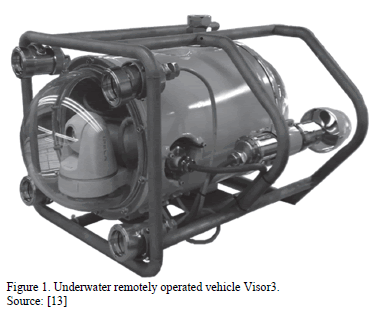
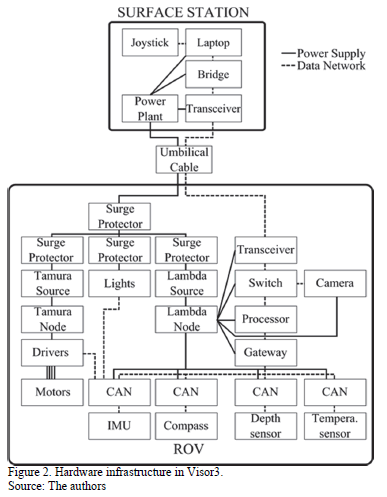
<body><![CDATA[<p><font size="2" face="Verdana, Arial, Helvetica, sans-serif">Deep-water ROV operations demand   navigation systems with high performance computation requirements since they   use, for instance, Kalman filter-based algorithms to estimate the position,   orientation, and velocity of the vehicle from measurements provided by   different sensors (IMU, magnetometer, depth meter, DVL, USBL, among others)   &#91;7-12&#93;. Such computation requirements are commonly met by using high-cost embedded   processors with real-time operating systems such as the ones presented in   &#91;13,14&#93;.</font></p>     <p><font size="2" face="Verdana, Arial, Helvetica, sans-serif">Nowadays, several underwater vehicles and   robotic platforms have been developed with low cost components &#91;15-19&#93;, for   instance, control platforms that use Arduino®-based hardware &#91;20-25&#93;. These   open-hardware platforms can be used in ROVs that are intended for inspection   tasks which are performed at low depths, and that do not require high   performance real-time computations. Typically, Arduino®-based hardware is used to   perform low-level tasks, such as data acquisition and communication with   sensors and actuators, while the implementation of control algorithms and   surface communication systems is done with open-source single-board computers   such as Beaglebone® or Rasperry PI® &#91;26&#93;. Arduino platforms simplify the process of developing firmware by using a   high level programming language, which implies a trade-off when trying to   optimize code.</font></p>     <p><font size="2" face="Verdana, Arial, Helvetica, sans-serif">The use of low-cost open-hardware robotic   platforms can be useful to motivate learning activities in people with no   previous high-tech education; hence, they can be used for teaching tasks in   programs related to science, technology, engineering, mathematics (STEM), ocean   engineering, and marine sciences &#91;27,28&#93;. An interesting example is the MIT Sea   Grant college program, developed with help from the Office of Naval Research   (ONR) in the United States, and within that the Sea Perch ROV &#91;29&#93;. This ROV is   comprised of low-cost equipment in order to easily teach students how to build   an underwater vehicle &#91;30&#93;.</font></p>     <p><font size="2" face="Verdana, Arial, Helvetica, sans-serif">This work addresses the design of an   open-source control platform for the underwater remotely operated vehicle   Visor3 &#91;13&#93;, which has been used as a test platform for the development of   robotic technology for the underwater exploration of Colombian seas. In this   work, expansion capability and modularity of hardware, firmware, and software   are established as general guidelines for the design process, since they are   fundamental for open-source solutions. </font></p>     <p><font size="2" face="Verdana, Arial, Helvetica, sans-serif">Section two of the paper describes the   ROV Visor3 and details its original control platform and associated problems.   The third section describes the approach followed to develop the new   open-hardware architecture. Section four addresses software architecture   development for each stage of the vehicle; including firmware, vehicle   software, and surface station software. The fifth section describes the   vehicle's control architecture and its relation with the hardware architecture   elements. Finally, some conclusions are provided.</font></p>     <p>&nbsp;</p>     <p><font size="3" face="Verdana, Arial, Helvetica, sans-serif"><b>2. Remotely operated vehicle Visor3</b></font></p>     <p><font size="2" face="Verdana, Arial, Helvetica, sans-serif">Visor3, <a href="#fig01">Fig. 1</a>, is a Class I ROV that was   designed to acquire visual information for the surveillance and maintenance of   ships hulls and underwater structures in port facilities, and oceanographic   research tasks &#91;13&#93;. The original hardware architecture of this ROV system was   divided into two main parts: the surface control station that is comprised of   an industrial joystick as command input, and a computer used as a Human-Machine   Interface (HMI), connected to the vehicle using a fiber optic link; and the   vehicle which is comprised of an IP camera, fiber optic communications devices,   an embedded processor, multiple sensors (inertial measurement unit, thermometer,   compass, etc.), thrusters, drivers, and DC power units &#91;31&#93;, <a href="#fig02">Fig. 2</a>.</font></p>     <p align="center"><font size="2" face="Verdana, Arial, Helvetica, sans-serif"><a name="fig01"></a></font><img src="/img/revistas/dyna/v83n195/v83n195a25fig01.gif"></p>     <p align="center"><font size="2" face="Verdana, Arial, Helvetica, sans-serif"><a name="fig02"></a></font><img src="/img/revistas/dyna/v83n195/v83n195a25fig02.gif"></p>     ]]></body>
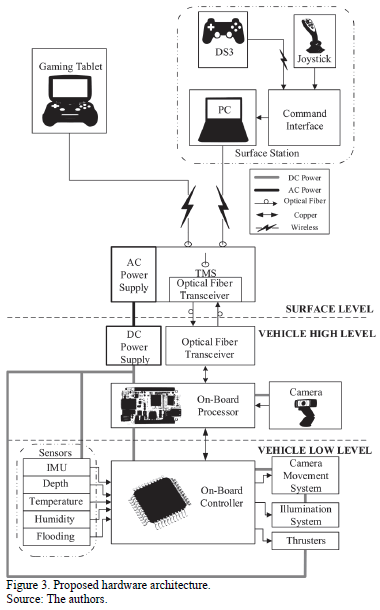
<body><![CDATA[<p><font size="2" face="Verdana, Arial, Helvetica, sans-serif"><b><i>2.1. Original control platform </i></b></font></p>     <p><font size="2" face="Verdana, Arial, Helvetica, sans-serif">Visor3's original control platform was   conceived, within a general framework for the control of unmanned vehicles   &#91;32&#93;. This infrastructure relies on a central PC/104 form factor embedded   processor that would allow one to use a real-time operating system (RTOS) in   order to guarantee execution times for critical tasks, commonly present in   systems such as in some unmanned vehicles with fast dynamics.</font></p>     <p><font size="2" face="Verdana, Arial, Helvetica, sans-serif">As is shown in <a href="#fig02">Fig. 2</a>, a CAN network was   used to connect sensors, actuators, and other devices inside the vehicle. The   network was designed as a modular tower board platform, with six independent boards used to   integrate sensors and actuator signals. Such general control architecture   resulted in a complex bulky system with a lack of reliability; a negative   characteristic for an underwater exploration system intended to be used in   maintenance activities and oceanographic research.</font></p>     <p><font size="2" face="Verdana, Arial, Helvetica, sans-serif">After several deployments and operations   on both laboratory and field environments with Visor3, the failure rate for   both hardware and software increased. Additionally, due to the complexity of   the control architecture, diagnostics and repair processes were delayed.   Furthermore, the availability of technical information for several devices,   e.g. the embedded processor, and the proprietary nature of software and   hardware, restricted the implementation of improvements in order to increase   the system's reliability.</font></p>     <p>&nbsp;</p>     <p><font size="3" face="Verdana, Arial, Helvetica, sans-serif"><b>3. New hardware architecture</b></font></p>     <p><font size="2" face="Verdana, Arial, Helvetica, sans-serif">The new open source-based hardware   architecture has been designed by taking Visor3's original requirements and the   experience acquired with its previous implementation into consideration.   Additional considerations were taken into account, for instance, the use of low   cost, highly available components, and preferably with a wide support   community.</font></p>     <p><font size="2" face="Verdana, Arial, Helvetica, sans-serif">The hardware architecture is based on a   hierarchical structure, with three defined levels. A higher, or surface level,   that has all the components that are located outside the vehicle, i.e., in the   surface control station, and includes the tether, power   supply, and optical fiber communication devices. Middle and lower levels are   located inside the ROV, so they can be identified as a vehicle's high and   low-level respectively, as seen in <a href="#fig03">Fig. 3</a>.</font></p>     <p align="center"><font size="2" face="Verdana, Arial, Helvetica, sans-serif"><a name="fig03"></a></font><img src="/img/revistas/dyna/v83n195/v83n195a25fig03.gif"></p>     <p><font size="2" face="Verdana, Arial, Helvetica, sans-serif"><b><i>3.1. Surface level</i></b></font></p>     ]]></body>
<body><![CDATA[<p><font size="2" face="Verdana, Arial, Helvetica, sans-serif">From a functional perspective, the   surface level is comprised of two elements: a Tether Management System (TMS)   and an operator interface. TMS is in charge of ensuring the ROV's power demand,   and communication with the operator's interface, which includes a set of tools   used by the pilot to command and drive the ROV. </font></p>     <p><font size="2" face="Verdana, Arial, Helvetica, sans-serif">Communication   between the TMS and the operator interface is made through a wireless high   speed WiFi link, thus allowing one to use a variety of open-source software   enabled devices to control the ROV, e.g., personal computers (PC) equipped with   joysticks and buttons, gaming tablets based on Android Operating Systems (OS)   &#91;33,34&#93;, and so on.</font></p>     <p><font size="2" face="Verdana, Arial, Helvetica, sans-serif">For this ROV, two operator devices are   used. The first one is the surface station, and is comprised of the following   devices: a computer for processing data coming from the vehicle, including   video streaming and visualization; a command interface, i.e., a device that integrates   control elements, such as joysticks, buttons, indicators and a Global   Positioning System (GPS), that gathers information and sends it to the   computer; and an auxiliary wireless gamepad (DualShock3® or DS3) that can be   connected through the command interface, and offers a portable alternative for   the main control elements. The second device is wholly based on a commercial   gaming tablet computer running Android OS, in which a Human-Machine Interface   (HMI) can be implemented, allowing one to integrate video stream visualization,   touch screen capabilities, analog joysticks, digital buttons and directional   pads in a small, handheld device. The latter option was chosen mainly because   Android OS based systems have been increasingly used in automation and remote   control of vehicles &#91;33&#93;, but it is not within the scope of this work.</font></p>     <p><font size="2" face="Verdana, Arial, Helvetica, sans-serif"><b><i>3.2. Vehicle level</i></b></font></p>     <p><font size="2" face="Verdana, Arial, Helvetica, sans-serif">Regarding   the on-board hardware system, it was devised as a two-layer structure, with   each layer being a centralized subsystem controlled by a processing unit. The   upper layer's central unit is an on-board open source embedded computer that is   responsible for data reception from the surface station, video acquisition from   a high-definition USB web camera, processing and streaming acquired images over   a TCP/IP network, along with the vehicle status data, and, in short, every high   level processing task that must be executed on-board. The lower layer's   processing unit is an Arduino-compatible, 32-bit Micro Controller Unit (MCU)   running at 84 MHz bus clock which has direct access to the ROV's devices, such   as motor drivers and thrusters, lights, camera movement, and sensors, which   include fault detection sensors (internal temperature and flooding are measured   within the vehicle) and navigation sensors (Inertial Measurement Unit IMU and a   depth meter). A communication link has been established between both layers to   integrate all the ROV devices; this link allows one to treat the hardware   system as a single unit. The integration of physical devices is made through a   custom-made circuit board, designed to be compatible with additional components   that allow the ROV extend its functionality.</font></p>     <p><font size="2" face="Verdana, Arial, Helvetica, sans-serif">Additional efforts are being made in   order to maintain the architecture's flexibility to consider future growth and   expansion; specifically on the ROV instrumentation, e.g., installing underwater   positioning devices: an Ultra-Short Base Line (USBL) for positioning, a Doppler   Velocity Log (DVL) for speed measurements, among others. The designed data   acquisition system is equipped with appropriate hardware for reading additional   sensor measurements, including standard connections used for instrumentation;   for example, 4-20 mA signals or RS-232 serial communication. Moreover, an   Arduino shield socket has been included in the system for the fast integration   of Arduino shield-type expansion cards.</font></p>     <p>&nbsp;</p>     <p><font size="3" face="Verdana, Arial, Helvetica, sans-serif"><b>4. Software architecture</b></font></p>     <p><font size="2" face="Verdana, Arial, Helvetica, sans-serif">To define the appropriate software   architecture for an ROV, some requirements must be taken into account.   Standards matching and portability are important aspects that need to be   considered; in addition, the complexity of such applications requires   modularity, reusability, and ease of integration between every element &#91;35&#93;.   Hence, modularity is the main aspect that defines the guidelines for the final   design of this software architecture.</font></p>     <p><font size="2" face="Verdana, Arial, Helvetica, sans-serif">A modular architecture confers a   significant advantage over other approaches, as it supports massive reuse of   existing code through different solutions; this allows one to reduce the   development time of new applications, as has been demonstrated by several   software platforms used for robotic devices and unmanned vehicles &#91;36-39&#93;.   Although these software implementations are usually aimed at high level   processing platforms, the designed architecture covers both high and low-level   platforms making use of object-oriented programming, which has been recently   enabled and optimized for microcontroller systems &#91;40&#93;.</font></p>     ]]></body>
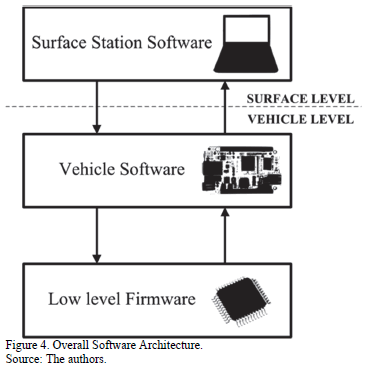
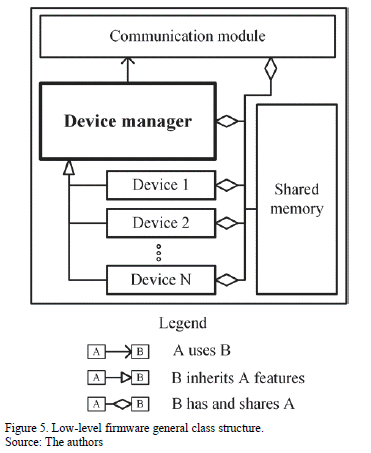
<body><![CDATA[<p><font size="2" face="Verdana, Arial, Helvetica, sans-serif">The general software architecture, as   shown in <a href="#fig04">Fig. 4</a>, is composed of three layers. The bottom layer is   firmware-based, and is in charge of low-level control of most devices in the   ROV. The middle layer runs on the embedded on-board processor, and acts as   middleware between the surface station and the low level controllers; it is in   charge of communicating both layers and integrating a video signal. Finally,   the upper level implements the user interface, including command devices, and   every program and routine that cannot be executed on-board due to processing   power limitations. </font></p>     <p align="center"><font size="2" face="Verdana, Arial, Helvetica, sans-serif"><a name="fig04"></a></font><img src="/img/revistas/dyna/v83n195/v83n195a25fig04.gif"></p>     <p><font size="2" face="Verdana, Arial, Helvetica, sans-serif"><b><i>4.1. Low level firmware</i></b></font></p>     <p><font size="2" face="Verdana, Arial, Helvetica, sans-serif">Following the established guidelines of   modularity, and making use of an available open-source Object-Oriented   Programming environment for microcontrollers, a firmware class structure was   defined using C++ language, see <a href="#fig05">Fig. 5</a>. It is based on modules that can be   added or removed without significant modifications to the program. For this   implementation, modules are treated as devices, mainly because of their   specific functions related to the vehicle. </font></p>     <p align="center"><font size="2" face="Verdana, Arial, Helvetica, sans-serif"><a name="fig05"></a></font><img src="/img/revistas/dyna/v83n195/v83n195a25fig05.gif"></p>     <p><font size="2" face="Verdana, Arial, Helvetica, sans-serif">Every device depends on a group of core   modules that cover basic functions, such as coordination and communication,   between devices and with upper level elements of the architecture.</font></p>     <p><font size="2" face="Verdana, Arial, Helvetica, sans-serif"><i>Device   manager</i>. This is the main core module of the   firmware, designed as a general abstract base class that serves as a template   for other devices. Every new device is a derivation of the device manager,   allowing one to take advantage of polymorphism, and greatly simplifying the   process of incorporating devices to the main program's workflow by providing a   single method for executing every device's routine, regardless of the number of   devices. Nevertheless, the maximum number of devices is limited, due to   physical factors, e.g., memory or processing capacity, by the target   implementation device.</font></p>     <p><font size="2" face="Verdana, Arial, Helvetica, sans-serif"><i>Shared memory</i>. In this particular application, communication   between devices is a requirement due to functionality and safety of the   vehicle; for instance, the fault detection module that depends on information   from sensors, or the motor controller that needs information about energy   consumption levels. For this reason, a shared memory module serves this   purpose, allowing devices to share data seamlessly.</font></p>     <p><font size="2" face="Verdana, Arial, Helvetica, sans-serif"><i>Communications module</i>. This module handles communications with upper   layers of the architecture, collecting data from devices, encapsulating them,   and sending messages periodically according to the message's priority. The   communication module is also in charge of receiving, parsing, and storing   incoming data from higher level devices, making it   available for the recipient device.</font></p>     <p><font size="2" face="Verdana, Arial, Helvetica, sans-serif">In the program flow, each device's   routine is executed sequentially, each of their instances have been declared in   the same order. Timer-based loops are defined for ensuring the time execution   requirements of each device, e.g., a 10-millisecond loop must be used for   acquiring IMU samples, and an additional 1000-millisecond loop is used for   reading slower sensors, such as temperature, pressure, and flooding.</font></p>     ]]></body>
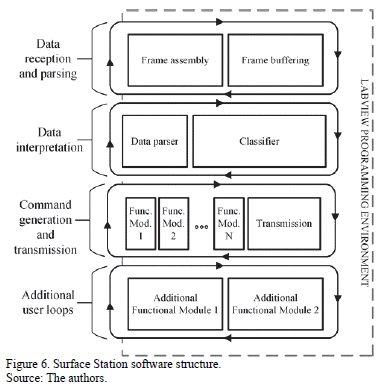
<body><![CDATA[<p><font size="2" face="Verdana, Arial, Helvetica, sans-serif"><b><i>4.2. Vehicle's software</i></b></font></p>     <p><font size="2" face="Verdana, Arial, Helvetica, sans-serif">The   vehicle's software is implemented in a Beaglebone embedded computer. This   processor runs an Ångström operating system which is a Linux distribution used   in embedded devices with built-in components. From the point of view of   functionality, the vehicle's onboard processor is responsible for executing two   main processes: the first one is focused on running a video streaming server   that deals with camera operation, receives frames, compresses and sends them to   the surface station; and the second process handles communication between the   surface station and the vehicle, i.e., it allows data to be exchanged between   the surface level and the vehicle level.</font></p>     <p><font size="2" face="Verdana, Arial, Helvetica, sans-serif">For communication with sensors, according   to the proposed hardware architecture, the BeagleBone uses a serial link with   the microcontroller that handles low-level processes. Then, the processor is   responsible for sending all data acquired from sensors to the surface station,   via UDP protocol. Both communication tasks are performed by a routine developed   on a programming environment based on JavaScript called Node.js, which allows   one to create highly scalable network programs such as web servers (streaming   video, TCP / UDP, etc.). This framework enables the development of modular   software to import and export modules developed by third parties, implementing   several middleware utilities to be used in web applications, such as express   frameworks &#91;41&#93;.</font></p>     <p><font size="2" face="Verdana, Arial, Helvetica, sans-serif">Further Node.js comes with an API   covering low-level networking, basic HTTP server functionality, file system   operations, compression and many other common tasks. These libraries are used   to adjust the communication protocol and send data frames to the surface   station via Ethernet on UDP protocol &#91;42&#93;.</font></p>     <p><font size="2" face="Verdana, Arial, Helvetica, sans-serif"><b><i>4.3. Surface station's software</i></b></font></p>     <p><font size="2" face="Verdana, Arial, Helvetica, sans-serif">A similar approach to the one used in the   firmware architecture was applied on the surface station, i.e., easy   integration of specific functions in the form of modules, through a framework   that handles essential tasks to ensure cohesion between all parts of the   solution. The main difference between software and firmware is the target   hardware platform; firmware runs on a device with limited processing resources   compared to a personal computer, enabling the latter to be used with higher   level developing environments. </font></p>     <p><font size="2" face="Verdana, Arial, Helvetica, sans-serif">To take advantage of the capabilities of   the surface hardware platform, which in this case is a personal computer (PC)   running Windows® OS, National Instruments&trade; LabVIEW® graphical dataflow   programming environment was selected in order to allow one use parallel   execution code through processor multithreading &#91;43&#93;.</font></p>     <p><font size="2" face="Verdana, Arial, Helvetica, sans-serif">The proposed software structure uses   parallel execution with three loops designed to run simultaneously; each loop   takes care of a group of tasks, as shown in <a href="#fig06">Fig. 6</a>. The first loop, top down,   is in charge of receiving and assembling incoming data from the vehicle and the   command interface (see <a href="#fig03">Fig. 3</a>); then, it stores each message in a buffer for   further reading and processing. The middle loop takes assembled frames as they   become available and extracts, classifies, and stores data, making them   available to other modules in the program. The bottom loop is responsible for   collecting command data and transmitting them to the ROV; this is the   designated space for adding functional modules to the program. This loop allows   one to add and remove functional modules, as long as their time requirements   meet the designated loop time characteristics; they are executed sequentially.   For example, if the navigation algorithm's execution time is at least 100 ms,   and the transmission loop time is defined to 50 ms, a delay will occur in the   data exchange with the ROV. To solve this issue, additional loops with specific   timings, different from the existing loops can be created, allowing one to add   functional modules with longer or shorter execution times.</font></p>     <p align="center"><font size="2" face="Verdana, Arial, Helvetica, sans-serif"><a name="fig06"></a></font><img src="/img/revistas/dyna/v83n195/v83n195a25fig06.gif"></p>     <p><font size="2" face="Verdana, Arial, Helvetica, sans-serif">Caution measures must be taken when   designing functional modules regarding execution time, due to limitations on   the processing power of the host machine, so undesired delays can be avoided.</font></p>     ]]></body>
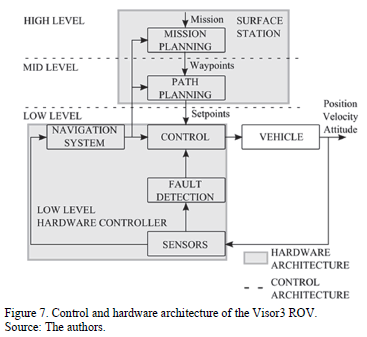
<body><![CDATA[<p>&nbsp;</p>     <p><font size="3" face="Verdana, Arial, Helvetica, sans-serif"><b>5. Open-source control platform</b></font></p>     <p><font size="2" face="Verdana, Arial, Helvetica, sans-serif">The   navigation, guidance and control (NGC) system for an underwater vehicle can   have different degrees of sophistication, depending on the type of operation   that is to be performed, and the autonomy levels that need to be achieved &#91;44,   45&#93;. </font></p>     <p><font size="2" face="Verdana, Arial, Helvetica, sans-serif">One of the   important vehicle design parameters is the number of degrees of freedom needed   to perform the planned operations, because they represent the number of   independent movements that   the vehicle can achieve in the three-dimensional space. Additionally, the tasks   that are to be performed determine the instrumentation (sensors, actuators,   complementary systems, among others) required to control the vehicle. <a href="#fig07">Fig. 7</a> shows a three-level hierarchical NGC structure for an underwater vehicle; this   kind of structure is useful to control and stabilize the vehicle. Additionally,   each element of the control architecture is related to a specific group of   hardware that executes the corresponding tasks.</font></p>     <p align="center"><font size="2" face="Verdana, Arial, Helvetica, sans-serif"><a name="fig07"></a></font><img src="/img/revistas/dyna/v83n195/v83n195a25fig07.gif"></p>     <p><font size="2" face="Verdana, Arial, Helvetica, sans-serif">The high and middle levels in   the control structure are executed in the surface station. The objective is to   allow the operator define the vehicle's mission using a high level language and   translate it into commands to the low-level control system. Through the use of   the PC, joystick and buttons, the operator is capable of moving the ROV in   accordance with the independent movements that the vehicle can make. The   joystick's three degrees-of-freedom are used to move in surge, sway, and yaw   directions; heave motions are commanded by using 2 buttons, with increments and   decrements of the speed in this direction (up/down). The graphical user   interface (GUI) allows the operator to follow the mission's progress and the   position of the vehicle.</font></p>     <p><font size="2" face="Verdana, Arial, Helvetica, sans-serif">The low-level control   structure is executed in the ROV's hardware. The navigation system, with   information provided by all sensors, allows one to estimate the position, velocity,   and attitude of the vehicle with respect to an inertial frame located in the   surface station. The control component contains the algorithms that stabilize   the state of the vehicle, in order to follow the commands given by the   operator. The Beaglebone embedded computer executes different algorithms in   order to achieve the desired movements. </font></p>     <p>&nbsp;</p>     <p><font size="3" face="Verdana, Arial, Helvetica, sans-serif"><b>6. Conclusions</b></font></p>     <p><font size="2" face="Verdana, Arial, Helvetica, sans-serif">This paper addressed the design of an   open source-based control platform for an underwater exploration ROV. Previous   experiences obtained through the development and deployment of the ROV Visor3   have been compiled and analyzed, and shortcomings of using closed-source   elements have been identified. </font></p>     ]]></body>
<body><![CDATA[<p><font size="2" face="Verdana, Arial, Helvetica, sans-serif">A major part of the selected hardware and   software elements are distinguished by their open-source features; the main   benefits are the high availability of information and extended support   communities, differentiating them from closed-source solutions with limited   information and, in some cases, poor support. </font></p>     <p><font size="2" face="Verdana, Arial, Helvetica, sans-serif">A modular approach for developing   software architectures for robotic platforms has been presented. The results   show that several frameworks facilitate, among others: functional expansion,   simplification of fault diagnosis and repair processes, and reduction of   development time. The software platforms selected and used in the design have   comprehensive, available information and extensive support communities, factors   that are key for a rapid and successful development. Furthermore, programming   languages such as C++, JavaScript and LabVIEW® have proved to be adequate tools   for developing modular software frameworks for robotic devices. Additionally,   software development has been undertaken using Python, a high-level programming   language that allows one to implement control algorithms that require complicated   matrix computations</font></p>     <p><font size="2" face="Verdana, Arial, Helvetica, sans-serif">Finally, it has been shown how each   component of the hardware architecture has a role in the control platform. The   use of a compact hardware architecture can help one to increase reliability,   maintenance and durability, without compromising the controllability of the   vehicle. </font></p>     <p><font size="2" face="Verdana, Arial, Helvetica, sans-serif">Even   though, there are observation-class ROVs with high-technology equipment such as   the VideoRay such ROVs are not manufactured with open-source philosophies,   therefore, they are difficult to repair or improve with changing operation   requirements. In comparison with the OpenROV, which is another open source   underwater vehicle solution; Visor3 has better instrumentation and the   appropriate robustness to accomplish observation tasks in harsher environments.</font></p>     <p>&nbsp;</p>     <p><font size="3" face="Verdana, Arial, Helvetica, sans-serif"><b>Acknowledgements</b></font></p>     <p><font size="2" face="Verdana, Arial, Helvetica, sans-serif">This work   was developed with the funding from the Fondo Nacional de Financiamiento para   la Ciencia, la Tecnolog&iacute;a y la Innovaci&oacute;n, Francisco Jos&eacute; de Caldas; the   Colombian petroleum company, ECOPETROL; the Universidad Pontificia Bolivariana -   Sede Medell&iacute;n, UPB; the Universidad Nacional de Colombia - Sede Medell&iacute;n,   UNALMED; through the Strategic Program for the Development of Robotic   Technology for Offshore Exploration of the Colombian Seabed, project   1210-531-30550, contract 0265 - 2013.</font></p>     <p>&nbsp;</p>     <p><font size="3" face="Verdana, Arial, Helvetica, sans-serif"><b>References</b></font></p>     <!-- ref --><p><font size="2" face="Verdana, Arial, Helvetica, sans-serif"><b>&#91;1&#93;</b> Christ, R. and Wernli, R., The ROV   Manual. A User guide for remotely operated vehicles, 2nd Ed. Elsevier, 2013.   DOI: 10.1016/B978-0-08-098288-5.00033-6 </font>&nbsp;&nbsp;&nbsp;&nbsp;&nbsp;&nbsp;&nbsp;&nbsp;[&#160;<a href="javascript:void(0);" onclick="javascript: window.open('/scielo.php?script=sci_nlinks&ref=1145041&pid=S0012-7353201600010002500001&lng=','','width=640,height=500,resizable=yes,scrollbars=1,menubar=yes,');">Links</a>&#160;]<!-- end-ref --><!-- ref --><p><font size="2" face="Verdana, Arial, Helvetica, sans-serif"><b>&#91;2&#93;</b> NORSOK, NORSOK STANDARD U-102,   Norwegian Technology Centre Std., 2nd Ed., &#91;Online&#93;. 2012 &#91;Date of reference:   January 20 of 2015&#93;. Available at: <a href="http://www.standard.no/petroleum" target="_blank">http://www.standard.no/petroleum</a></font>&nbsp;&nbsp;&nbsp;&nbsp;&nbsp;&nbsp;&nbsp;&nbsp;[&#160;<a href="javascript:void(0);" onclick="javascript: window.open('/scielo.php?script=sci_nlinks&ref=1145042&pid=S0012-7353201600010002500002&lng=','','width=640,height=500,resizable=yes,scrollbars=1,menubar=yes,');">Links</a>&#160;]<!-- end-ref --><!-- ref --><p><font size="2" face="Verdana, Arial, Helvetica, sans-serif"><b>&#91;3&#93;</b> Correa, J.C., V&aacute;squez,   R.E., Ram&iacute;rez-Mac&iacute;as, J.A., Taborda, E.A., Zuluaga, C.A., Posada, N.L. and   Londo&ntilde;o, J.M., Una arquitectura para el dise&ntilde;o conceptual de veh&iacute;culos para   exploraci&oacute;n subacu&aacute;tica Ingenier&iacute;a y Ciencia, 11(21), pp. 73-97, 2015. DOI: 10.17230/ingciencia.11.21.4</font>&nbsp;&nbsp;&nbsp;&nbsp;&nbsp;&nbsp;&nbsp;&nbsp;[&#160;<a href="javascript:void(0);" onclick="javascript: window.open('/scielo.php?script=sci_nlinks&ref=1145043&pid=S0012-7353201600010002500003&lng=','','width=640,height=500,resizable=yes,scrollbars=1,menubar=yes,');">Links</a>&#160;]<!-- end-ref --><!-- ref --><p><font size="2" face="Verdana, Arial, Helvetica, sans-serif"><b>&#91;4&#93;</b> Bai, Y. and Bai, Q., Subsea   engineering handbook, in Subsea Engineering Handbook, Eds. Boston: Gulf   Professional Publishing, 2010, pp. 3-25. DOI:   10.1016/B978-1-85617-689-7.10001-9</font>&nbsp;&nbsp;&nbsp;&nbsp;&nbsp;&nbsp;&nbsp;&nbsp;[&#160;<a href="javascript:void(0);" onclick="javascript: window.open('/scielo.php?script=sci_nlinks&ref=1145044&pid=S0012-7353201600010002500004&lng=','','width=640,height=500,resizable=yes,scrollbars=1,menubar=yes,');">Links</a>&#160;]<!-- end-ref --><!-- ref --><p><font size="2" face="Verdana, Arial, Helvetica, sans-serif"><b>&#91;5&#93;</b> Kim, T. and Yuh, J., Development of a   real-time control architecture for a semi-autonomous underwater vehicle for   intervention missions, Control Enginering Practice, 12(12), pp. 1521-1530, 2004.   DOI: 10.1016/j.conengprac.2003.12.015</font>&nbsp;&nbsp;&nbsp;&nbsp;&nbsp;&nbsp;&nbsp;&nbsp;[&#160;<a href="javascript:void(0);" onclick="javascript: window.open('/scielo.php?script=sci_nlinks&ref=1145045&pid=S0012-7353201600010002500005&lng=','','width=640,height=500,resizable=yes,scrollbars=1,menubar=yes,');">Links</a>&#160;]<!-- end-ref --><!-- ref --><p><font size="2" face="Verdana, Arial, Helvetica, sans-serif"><b>&#91;6&#93;</b> Yoshida, H., Underwater Vehicles. In   Tech, no. 29, ch. Fundamentals of Underwater Vehicle Hardware and Their   Applications, 2009, pp. 557-582. DOI: 10.5772/6721</font>&nbsp;&nbsp;&nbsp;&nbsp;&nbsp;&nbsp;&nbsp;&nbsp;[&#160;<a href="javascript:void(0);" onclick="javascript: window.open('/scielo.php?script=sci_nlinks&ref=1145046&pid=S0012-7353201600010002500006&lng=','','width=640,height=500,resizable=yes,scrollbars=1,menubar=yes,');">Links</a>&#160;]<!-- end-ref --><!-- ref --><p><font size="2" face="Verdana, Arial, Helvetica, sans-serif"><b>&#91;7&#93;</b> Caccia, M., Casalino, G., Cristi, R.   and Veruggio, G., Acoustic motion estimation and control for an unmanned   underwater vehicle in a structured environment. Control Engineering Practice,   6(5), pp. 661-670, 1998. DOI: 10.1016/S0967-0661(98)00057-4.    &nbsp;&nbsp;&nbsp;&nbsp;&nbsp;&nbsp;&nbsp;&nbsp;[&#160;<a href="javascript:void(0);" onclick="javascript: window.open('/scielo.php?script=sci_nlinks&ref=1145047&pid=S0012-7353201600010002500007&lng=','','width=640,height=500,resizable=yes,scrollbars=1,menubar=yes,');">Links</a>&#160;]<!-- end-ref --> </font></p>     <!-- ref --><p><font size="2" face="Verdana, Arial, Helvetica, sans-serif"><b>&#91;8&#93;</b> Caccia, M. and Veruggio, G., Guidance   and control of a reconfigurable unmanned underwater vehicle. Control   Engineering Practice, 8(1), pp. 21-37, 2000. DOI:   10.1016/S0967-0661(99)00125-2.    &nbsp;&nbsp;&nbsp;&nbsp;&nbsp;&nbsp;&nbsp;&nbsp;[&#160;<a href="javascript:void(0);" onclick="javascript: window.open('/scielo.php?script=sci_nlinks&ref=1145049&pid=S0012-7353201600010002500008&lng=','','width=640,height=500,resizable=yes,scrollbars=1,menubar=yes,');">Links</a>&#160;]<!-- end-ref --> </font></p>     <!-- ref --><p><font size="2" face="Verdana, Arial, Helvetica, sans-serif"><b>&#91;9&#93;</b> Blain, M., Lemieux, S. and Houde, R.,   Implementation of a ROV navigation system using acoustic/Doppler sensors and   Kalman ltering. In Proceedings of the OCEANS 2003, pp. 1255-1260, 2003. DOI:   10.1109/OCEANS.2003.178033.    &nbsp;&nbsp;&nbsp;&nbsp;&nbsp;&nbsp;&nbsp;&nbsp;[&#160;<a href="javascript:void(0);" onclick="javascript: window.open('/scielo.php?script=sci_nlinks&ref=1145051&pid=S0012-7353201600010002500009&lng=','','width=640,height=500,resizable=yes,scrollbars=1,menubar=yes,');">Links</a>&#160;]<!-- end-ref --> </font></p>     <!-- ref --><p><font size="2" face="Verdana, Arial, Helvetica, sans-serif"><b>&#91;10&#93;</b> Loebis, D., Sutton, R., Chudley, J.   and Naeem, W., Adaptive tuning of a Kalman lter via fuzzy logic for an   intelligent AUV navigation system. Control Engineering Practice, 12(12), pp.   1531-1539, 2004. DOI: 10.1016/j.conengprac.2003.11.008.    &nbsp;&nbsp;&nbsp;&nbsp;&nbsp;&nbsp;&nbsp;&nbsp;[&#160;<a href="javascript:void(0);" onclick="javascript: window.open('/scielo.php?script=sci_nlinks&ref=1145053&pid=S0012-7353201600010002500010&lng=','','width=640,height=500,resizable=yes,scrollbars=1,menubar=yes,');">Links</a>&#160;]<!-- end-ref --> </font></p>     <!-- ref --><p><font size="2" face="Verdana, Arial, Helvetica, sans-serif"><b>&#91;11&#93;</b> Lee, P.M. and Jun, B.H., Pseudo long   base line navigation algorithm for underwater vehicles with inertial sensors   and two acoustic range measurements. Ocean Engineering, 34(3-4), pp. 416-425,   2007. DOI: 10.1016/j.oceaneng.2006.03.011.    &nbsp;&nbsp;&nbsp;&nbsp;&nbsp;&nbsp;&nbsp;&nbsp;[&#160;<a href="javascript:void(0);" onclick="javascript: window.open('/scielo.php?script=sci_nlinks&ref=1145055&pid=S0012-7353201600010002500011&lng=','','width=640,height=500,resizable=yes,scrollbars=1,menubar=yes,');">Links</a>&#160;]<!-- end-ref --> </font></p>     <!-- ref --><p><font size="2" face="Verdana, Arial, Helvetica, sans-serif"><b>&#91;12&#93;</b> Geng, Y. and Sousa, J., Hybrid   derivative-free EKF for USBL/INS tightly-coupled integration in AUV. In   Proceedings of the 2010 International Conference on Autonomous and Intelligent   Systems (AIS), pp. 1-6, 2010. DOI: 10.1109/AIS.2010.5547035.    &nbsp;&nbsp;&nbsp;&nbsp;&nbsp;&nbsp;&nbsp;&nbsp;[&#160;<a href="javascript:void(0);" onclick="javascript: window.open('/scielo.php?script=sci_nlinks&ref=1145057&pid=S0012-7353201600010002500012&lng=','','width=640,height=500,resizable=yes,scrollbars=1,menubar=yes,');">Links</a>&#160;]<!-- end-ref --> </font></p>     <!-- ref --><p><font size="2" face="Verdana, Arial, Helvetica, sans-serif"><b>&#91;13&#93;</b> Guti&eacute;rrez, L.B., Zuluaga, C.A.,   Ram&iacute;rez, J.A., V&aacute;squez, R.E., Fl&oacute;rez, D.A., Taborda, E.A. and Valencia, R.A.,   Development of an underwater remotely operated vehicle (ROV) for surveillance   and inspection of port facilities, in Proceedings of the ASME IMECE2010, 2010.   DOI: 10.1115/IMECE2010-38217</font>&nbsp;&nbsp;&nbsp;&nbsp;&nbsp;&nbsp;&nbsp;&nbsp;[&#160;<a href="javascript:void(0);" onclick="javascript: window.open('/scielo.php?script=sci_nlinks&ref=1145059&pid=S0012-7353201600010002500013&lng=','','width=640,height=500,resizable=yes,scrollbars=1,menubar=yes,');">Links</a>&#160;]<!-- end-ref --><!-- ref --><p><font size="2" face="Verdana, Arial, Helvetica, sans-serif"><b>&#91;14&#93;</b> Huang, H., Wan, L., Pang, Y. and Qin,   Z., Control architecture of SY-II ship inspection remote operated vehicle, in   Computer Science Service System (CSSS), 2012 International Conference on, pp.   2322-2325, 2012. DOI: 10.1109/CSSS.2012.576</font>&nbsp;&nbsp;&nbsp;&nbsp;&nbsp;&nbsp;&nbsp;&nbsp;[&#160;<a href="javascript:void(0);" onclick="javascript: window.open('/scielo.php?script=sci_nlinks&ref=1145060&pid=S0012-7353201600010002500014&lng=','','width=640,height=500,resizable=yes,scrollbars=1,menubar=yes,');">Links</a>&#160;]<!-- end-ref --><!-- ref --><p><font size="2" face="Verdana, Arial, Helvetica, sans-serif"><b>&#91;15&#93;</b> Wang, B., Wu, C. and Ge, T., A low   cost compact control system for the Hippo ROV, Applied Mechanics and Materials,   190-191, pp. 627-633, 2012. DOI: 10.4028/www.scientific.net/AMM.190-191.627 </font>&nbsp;&nbsp;&nbsp;&nbsp;&nbsp;&nbsp;&nbsp;&nbsp;[&#160;<a href="javascript:void(0);" onclick="javascript: window.open('/scielo.php?script=sci_nlinks&ref=1145061&pid=S0012-7353201600010002500015&lng=','','width=640,height=500,resizable=yes,scrollbars=1,menubar=yes,');">Links</a>&#160;]<!-- end-ref --><!-- ref --><p><font size="2" face="Verdana, Arial, Helvetica, sans-serif"><b>&#91;16&#93;</b> Wang, B., Wu, C. and Ge, T.,   Development of a remotely operated vehicle test-bed, Sensors &amp; Transducers,   &#91;Online&#93;. 153, pp. 45-52, 2013. Available at: <a href="http://www.sensorsportal.com/HTML/DIGEST/P_1218.htm" target="_blank">http://www.sensorsportal.com/HTML/DIGEST/P_1218.htm</a></font>&nbsp;&nbsp;&nbsp;&nbsp;&nbsp;&nbsp;&nbsp;&nbsp;[&#160;<a href="javascript:void(0);" onclick="javascript: window.open('/scielo.php?script=sci_nlinks&ref=1145062&pid=S0012-7353201600010002500016&lng=','','width=640,height=500,resizable=yes,scrollbars=1,menubar=yes,');">Links</a>&#160;]<!-- end-ref --><!-- ref --><p><font size="2" face="Verdana, Arial, Helvetica, sans-serif"><b>&#91;17&#93;</b> Bonarini, A.,   Matteucci, M., Migliavacca, M. and Rizzi, D., R2P: An open source hardware and software modular   approach to robot prototyping, Robotics and Autonomous Systems, 62(7), pp.   1073-1084, 2014. DOI: 10.1016/j.robot.2013.08.009 </font>&nbsp;&nbsp;&nbsp;&nbsp;&nbsp;&nbsp;&nbsp;&nbsp;[&#160;<a href="javascript:void(0);" onclick="javascript: window.open('/scielo.php?script=sci_nlinks&ref=1145063&pid=S0012-7353201600010002500017&lng=','','width=640,height=500,resizable=yes,scrollbars=1,menubar=yes,');">Links</a>&#160;]<!-- end-ref --><!-- ref --><p><font size="2" face="Verdana, Arial, Helvetica, sans-serif"><b>&#91;18&#93;</b> Ahmed, Y., Yaakob, L. and Bong, S., Design of a new low cost ROV vehicle,   Jurnal Teknologi 69(7), pp. 1-11, 2014. DOI: 10.11113/jt.v69.3262</font>&nbsp;&nbsp;&nbsp;&nbsp;&nbsp;&nbsp;&nbsp;&nbsp;[&#160;<a href="javascript:void(0);" onclick="javascript: window.open('/scielo.php?script=sci_nlinks&ref=1145064&pid=S0012-7353201600010002500018&lng=','','width=640,height=500,resizable=yes,scrollbars=1,menubar=yes,');">Links</a>&#160;]<!-- end-ref --><!-- ref --><p><font size="2" face="Verdana, Arial, Helvetica, sans-serif"><b>&#91;19&#93;</b> Sinha, P., Stiehl, K.R., Huo, E.S.,   Oyebode, O.A., Dokov, R.P., Chin, S.J., Price, R.E. and Larson, R.W., Design of   a modular, compact, multi-role remotely operated vehicle for sheltered water   operations, in IEEE OCEANS 2007, pp. 1-7, 2007. DOI:   10.1109/OCEANS.2007.4449392</font>&nbsp;&nbsp;&nbsp;&nbsp;&nbsp;&nbsp;&nbsp;&nbsp;[&#160;<a href="javascript:void(0);" onclick="javascript: window.open('/scielo.php?script=sci_nlinks&ref=1145065&pid=S0012-7353201600010002500019&lng=','','width=640,height=500,resizable=yes,scrollbars=1,menubar=yes,');">Links</a>&#160;]<!-- end-ref --><!-- ref --><p><font size="2" face="Verdana, Arial, Helvetica, sans-serif"><b>&#91;20&#93;</b> Busquets, J., Busquets, J.V., Tudela, D., Perez, F.,   Busquets-Carbonell, J., Barbera, A., Rodriguez, C., Garcia, A.J. and Gilabert,   J., Low-cost AUV based on Arduino open source microcontroller board for   oceanographic research applications in a collaborative long term deployment   missions and suitable for combining with an USV as autonomous automatic   recharging platform, in Autonomous Underwater Vehicles (AUV), 2012 IEEE/OES,   pp. 1-10, 2012. DOI: 10.1109/AUV.2012.6380720</font>&nbsp;&nbsp;&nbsp;&nbsp;&nbsp;&nbsp;&nbsp;&nbsp;[&#160;<a href="javascript:void(0);" onclick="javascript: window.open('/scielo.php?script=sci_nlinks&ref=1145066&pid=S0012-7353201600010002500020&lng=','','width=640,height=500,resizable=yes,scrollbars=1,menubar=yes,');">Links</a>&#160;]<!-- end-ref --><!-- ref --><p><font size="2" face="Verdana, Arial, Helvetica, sans-serif"><b>&#91;21&#93;</b> Johansson, P. and Bernhard, J.,   Advanced control of a remotely operated underwater vehicle, Department of   Electrical Engineering, Linköpings universitet, Sweden, Tech. Rep., &#91;Online&#93;.   2012. Available at: <a href="http://urn.kb.se/resolve?urn=urn:nbn:se:liu:diva-79364" target="_blank">http://urn.kb.se/resolve?urn=urn:nbn:se:liu:diva-79364</a></font>&nbsp;&nbsp;&nbsp;&nbsp;&nbsp;&nbsp;&nbsp;&nbsp;[&#160;<a href="javascript:void(0);" onclick="javascript: window.open('/scielo.php?script=sci_nlinks&ref=1145067&pid=S0012-7353201600010002500021&lng=','','width=640,height=500,resizable=yes,scrollbars=1,menubar=yes,');">Links</a>&#160;]<!-- end-ref --><!-- ref --><p><font size="2" face="Verdana, Arial, Helvetica, sans-serif"><b>&#91;22&#93;</b> Fittery, A., Mazumdar, A., Lozano, M.   and Asada, H., Omni-Egg: A smooth, spheroidal, appendage free underwater robot   capable of 5 dof motions, in IEEE OCEANS 2012, pp. 1-5, 2012. DOI:   10.1109/OCEANS.2012.6404986</font>&nbsp;&nbsp;&nbsp;&nbsp;&nbsp;&nbsp;&nbsp;&nbsp;[&#160;<a href="javascript:void(0);" onclick="javascript: window.open('/scielo.php?script=sci_nlinks&ref=1145068&pid=S0012-7353201600010002500022&lng=','','width=640,height=500,resizable=yes,scrollbars=1,menubar=yes,');">Links</a>&#160;]<!-- end-ref --><!-- ref --><p><font size="2" face="Verdana, Arial, Helvetica, sans-serif"><b>&#91;23&#93;</b> Hassan, O.I.H., Black-box   identification and control for autonomous underwater vehicles, PhD.   Dissertation, School of Engineering and Information Technology, The University   of New South Wales, Australian Defence Force Academy, &#91;Online&#93;. 2013. Available   at: <a href="http://handle.unsw.edu.au/1959.4/52888" target="_blank">http://handle.unsw.edu.au/1959.4/52888</a> </font>&nbsp;&nbsp;&nbsp;&nbsp;&nbsp;&nbsp;&nbsp;&nbsp;[&#160;<a href="javascript:void(0);" onclick="javascript: window.open('/scielo.php?script=sci_nlinks&ref=1145069&pid=S0012-7353201600010002500023&lng=','','width=640,height=500,resizable=yes,scrollbars=1,menubar=yes,');">Links</a>&#160;]<!-- end-ref --><!-- ref --><p><font size="2" face="Verdana, Arial, Helvetica, sans-serif"><b>&#91;24&#93;</b> Portugal, D. and Rocha, R.P.,   Distributed multi-robot patrol: A scalable and fault-tolerant framework,   Robotics and Autonomous Systems, 61(12), pp. 1572-1587, 2013. DOI:   0.1016/j.robot.2013.06.011</font>&nbsp;&nbsp;&nbsp;&nbsp;&nbsp;&nbsp;&nbsp;&nbsp;[&#160;<a href="javascript:void(0);" onclick="javascript: window.open('/scielo.php?script=sci_nlinks&ref=1145070&pid=S0012-7353201600010002500024&lng=','','width=640,height=500,resizable=yes,scrollbars=1,menubar=yes,');">Links</a>&#160;]<!-- end-ref --><!-- ref --><p><font size="2" face="Verdana, Arial, Helvetica, sans-serif"><b>&#91;25&#93;</b> Faugel, H. and Bobkov, V., Open source   hard- and software: Using Arduino boards to keep old hardware running, Fusion   Engineering and Design, 88(6-8), pp. 1276-1279, 2013. DOI:   10.1016/j.fusengdes.2012.12.005 </font>&nbsp;&nbsp;&nbsp;&nbsp;&nbsp;&nbsp;&nbsp;&nbsp;[&#160;<a href="javascript:void(0);" onclick="javascript: window.open('/scielo.php?script=sci_nlinks&ref=1145071&pid=S0012-7353201600010002500025&lng=','','width=640,height=500,resizable=yes,scrollbars=1,menubar=yes,');">Links</a>&#160;]<!-- end-ref --><!-- ref --><p><font size="2" face="Verdana, Arial, Helvetica, sans-serif"><b>&#91;26&#93;</b> Grimmett, R., Mastering beagle bone   robotics. Packt   Publishing, 2014 </font>&nbsp;&nbsp;&nbsp;&nbsp;&nbsp;&nbsp;&nbsp;&nbsp;[&#160;<a href="javascript:void(0);" onclick="javascript: window.open('/scielo.php?script=sci_nlinks&ref=1145072&pid=S0012-7353201600010002500026&lng=','','width=640,height=500,resizable=yes,scrollbars=1,menubar=yes,');">Links</a>&#160;]<!-- end-ref --><!-- ref --><p><font size="2" face="Verdana, Arial, Helvetica, sans-serif"><b>&#91;27&#93;</b> Quinti&aacute;n, H., Calvo, J.L.   and Fontenla, O., Aplicaci&oacute;n de un robot comercial de bajo coste en tareas de   seguimiento de objetos. DYNA,   79(175), pp. 24-33, 2012. ISSN 2346-2183.    &nbsp;&nbsp;&nbsp;&nbsp;&nbsp;&nbsp;&nbsp;&nbsp;[&#160;<a href="javascript:void(0);" onclick="javascript: window.open('/scielo.php?script=sci_nlinks&ref=1145073&pid=S0012-7353201600010002500027&lng=','','width=640,height=500,resizable=yes,scrollbars=1,menubar=yes,');">Links</a>&#160;]<!-- end-ref --></font></p>     <!-- ref --><p><font size="2" face="Verdana, Arial, Helvetica, sans-serif"><b>&#91;28&#93;</b> &Aacute;lvarez-Chavarr&iacute;a, J.S.,   Jim&eacute;nez-Builes, J.A. and Ram&iacute;rez-Pati&ntilde;o, J.F., Design cycle of a robot for   learning and the development of creativity in engineering. DYNA, 78(170), pp. 51-58,   2011.    &nbsp;&nbsp;&nbsp;&nbsp;&nbsp;&nbsp;&nbsp;&nbsp;[&#160;<a href="javascript:void(0);" onclick="javascript: window.open('/scielo.php?script=sci_nlinks&ref=1145075&pid=S0012-7353201600010002500028&lng=','','width=640,height=500,resizable=yes,scrollbars=1,menubar=yes,');">Links</a>&#160;]<!-- end-ref --></font></p>     <!-- ref --><p><font size="2" face="Verdana, Arial, Helvetica, sans-serif"><b>&#91;29&#93;</b> VanCott, R., Wilbur, B.M.,   Chryssostomidis, C., Soroka, M. and Shroyer, K., STEM education through open   hardware at MIT sea grant, Open Hardware Journal, &#91;Online&#93;. 1, pp. 9-15, 2011.   Available at: <a href="https://archive.org/details/OpenHardwareJournal" target="_blank">https://archive.org/details/OpenHardwareJournal</a></font>&nbsp;&nbsp;&nbsp;&nbsp;&nbsp;&nbsp;&nbsp;&nbsp;[&#160;<a href="javascript:void(0);" onclick="javascript: window.open('/scielo.php?script=sci_nlinks&ref=1145077&pid=S0012-7353201600010002500029&lng=','','width=640,height=500,resizable=yes,scrollbars=1,menubar=yes,');">Links</a>&#160;]<!-- end-ref --><!-- ref --><p><font size="2" face="Verdana, Arial, Helvetica, sans-serif"><b>&#91;30&#93;</b> Schneider, D., Build your own robosub   &#91;Hands On&#93;, IEEE Spectrum, 48(9), pp. 24-26, 2011. DOI:   0.1109/MSPEC.2011.5995890 </font>&nbsp;&nbsp;&nbsp;&nbsp;&nbsp;&nbsp;&nbsp;&nbsp;[&#160;<a href="javascript:void(0);" onclick="javascript: window.open('/scielo.php?script=sci_nlinks&ref=1145078&pid=S0012-7353201600010002500030&lng=','','width=640,height=500,resizable=yes,scrollbars=1,menubar=yes,');">Links</a>&#160;]<!-- end-ref --><!-- ref --><p><font size="2" face="Verdana, Arial, Helvetica, sans-serif"><b>&#91;31&#93;</b> Tirado, D., Asistencia a   la investigaci&oacute;n en la educaci&oacute;n e implementaci&oacute;n del hardware (joystick, IMU,   profund&iacute;metro, interfaz con actuadores), para el proyecto ROV. Trabajo de   grado, Facultad de Ingenier&iacute;a El&eacute;ctrica/Electr&oacute;nica, Universidad Pontificia   Bolivariana, Medell&iacute;n, Colombia, 2008.    &nbsp;&nbsp;&nbsp;&nbsp;&nbsp;&nbsp;&nbsp;&nbsp;[&#160;<a href="javascript:void(0);" onclick="javascript: window.open('/scielo.php?script=sci_nlinks&ref=1145079&pid=S0012-7353201600010002500031&lng=','','width=640,height=500,resizable=yes,scrollbars=1,menubar=yes,');">Links</a>&#160;]<!-- end-ref --></font></p>     <!-- ref --><p><font size="2" face="Verdana, Arial, Helvetica, sans-serif"><b>&#91;32&#93;</b> Franco, J., Frameworks   para sistemas de control embebidos de tiempo real. Trabajo de grado,   Especializaci&oacute;n en Autom&aacute;tica, Universidad Pontificia Bolivariana, Medell&iacute;n,   Colombia, 2007.    &nbsp;&nbsp;&nbsp;&nbsp;&nbsp;&nbsp;&nbsp;&nbsp;[&#160;<a href="javascript:void(0);" onclick="javascript: window.open('/scielo.php?script=sci_nlinks&ref=1145081&pid=S0012-7353201600010002500032&lng=','','width=640,height=500,resizable=yes,scrollbars=1,menubar=yes,');">Links</a>&#160;]<!-- end-ref --></font></p>     <!-- ref --><p><font size="2" face="Verdana, Arial, Helvetica, sans-serif"><b>&#91;33&#93;</b> Nadvornik, J. and Smutny, P., Remote control robot using android mobile   device, in Control Conference (ICCC), 15<sup>th</sup> International Carpathian,   pp. 373-378, 2014. DOI: 10.1109/CarpathianCC.2014.6843630</font>&nbsp;&nbsp;&nbsp;&nbsp;&nbsp;&nbsp;&nbsp;&nbsp;[&#160;<a href="javascript:void(0);" onclick="javascript: window.open('/scielo.php?script=sci_nlinks&ref=1145083&pid=S0012-7353201600010002500033&lng=','','width=640,height=500,resizable=yes,scrollbars=1,menubar=yes,');">Links</a>&#160;]<!-- end-ref --><!-- ref --><p><font size="2" face="Verdana, Arial, Helvetica, sans-serif"><b>&#91;34&#93;</b> Speers,   A., Forooshani, P.M., Dicke, M. and Jenkin, M., Lightweight tablet devices for   command and control of ROS-enabled robots, in Advanced Robotics (ICAR), 16<sup>th</sup> International Conference on, 2013. DOI: 10.1109/ICAR.2013.6766481</font>&nbsp;&nbsp;&nbsp;&nbsp;&nbsp;&nbsp;&nbsp;&nbsp;[&#160;<a href="javascript:void(0);" onclick="javascript: window.open('/scielo.php?script=sci_nlinks&ref=1145084&pid=S0012-7353201600010002500034&lng=','','width=640,height=500,resizable=yes,scrollbars=1,menubar=yes,');">Links</a>&#160;]<!-- end-ref --><!-- ref --><p><font size="2" face="Verdana, Arial, Helvetica, sans-serif"><b>&#91;35&#93;</b> Bertolotti,   I.C. and Hu, T., Modular design of an open-source, networked embedded system,   in Computer Standards &amp; Interfaces, 37, pp. 41-52,2015. DOI:   10.1016/j.csi.2014.05.004.    &nbsp;&nbsp;&nbsp;&nbsp;&nbsp;&nbsp;&nbsp;&nbsp;[&#160;<a href="javascript:void(0);" onclick="javascript: window.open('/scielo.php?script=sci_nlinks&ref=1145085&pid=S0012-7353201600010002500035&lng=','','width=640,height=500,resizable=yes,scrollbars=1,menubar=yes,');">Links</a>&#160;]<!-- end-ref --></font></p>     <!-- ref --><p><font size="2" face="Verdana, Arial, Helvetica, sans-serif"><b>&#91;36&#93;</b> Gerkey, B.P., Vaughan, R.T. and Howard, A., The   player/stage project: Tools for multi-robot and distributed sensor systems, in:   Proceedings of the 11<sup>th </sup>International Conference on Advanced   Robotics, 2003, pp. 317-323.    &nbsp;&nbsp;&nbsp;&nbsp;&nbsp;&nbsp;&nbsp;&nbsp;[&#160;<a href="javascript:void(0);" onclick="javascript: window.open('/scielo.php?script=sci_nlinks&ref=1145087&pid=S0012-7353201600010002500036&lng=','','width=640,height=500,resizable=yes,scrollbars=1,menubar=yes,');">Links</a>&#160;]<!-- end-ref --></font></p>     <!-- ref --><p><font size="2" face="Verdana, Arial, Helvetica, sans-serif"><b>&#91;37&#93;</b> Bruyninckx, H., Open robot control software: The OROCOS   project, Robotics and Automation, 2001. Proceedings 2001 ICRA. IEEE   International Conference on, 3, pp.2523-2528 2001. DOI: 10.1109/ROBOT.2001.933002 </font>&nbsp;&nbsp;&nbsp;&nbsp;&nbsp;&nbsp;&nbsp;&nbsp;[&#160;<a href="javascript:void(0);" onclick="javascript: window.open('/scielo.php?script=sci_nlinks&ref=1145089&pid=S0012-7353201600010002500037&lng=','','width=640,height=500,resizable=yes,scrollbars=1,menubar=yes,');">Links</a>&#160;]<!-- end-ref --><!-- ref --><p><font size="2" face="Verdana, Arial, Helvetica, sans-serif"><b>&#91;38&#93;</b> Quigley, M., Conley, K., Gerkey, B.P., Faust, J., Foote,   T., Leibs, J., Wheeler, R. and Ng, A.Y., ROS: An open-source robot operating   system, in: ICRA Workshop on Open Source Software, 2009.    &nbsp;&nbsp;&nbsp;&nbsp;&nbsp;&nbsp;&nbsp;&nbsp;[&#160;<a href="javascript:void(0);" onclick="javascript: window.open('/scielo.php?script=sci_nlinks&ref=1145090&pid=S0012-7353201600010002500038&lng=','','width=640,height=500,resizable=yes,scrollbars=1,menubar=yes,');">Links</a>&#160;]<!-- end-ref --></font></p>     ]]></body>
<body><![CDATA[<!-- ref --><p><font size="2" face="Verdana, Arial, Helvetica, sans-serif"><b>&#91;39&#93;</b> Huang, A.,   Olson, E. and Moore, D., LCM: Lightweight communications and marshalling, in:   IEEE/RSJ International Conference on Intelligent Robots and Systems (IROS),   2010, pp. 4057-4062. DOI: 10.1109/IROS.2010.5649358</font>&nbsp;&nbsp;&nbsp;&nbsp;&nbsp;&nbsp;&nbsp;&nbsp;[&#160;<a href="javascript:void(0);" onclick="javascript: window.open('/scielo.php?script=sci_nlinks&ref=1145092&pid=S0012-7353201600010002500039&lng=','','width=640,height=500,resizable=yes,scrollbars=1,menubar=yes,');">Links</a>&#160;]<!-- end-ref --><!-- ref --><p><font size="2" face="Verdana, Arial, Helvetica, sans-serif"><b>&#91;40&#93;</b> Becker, L.B., Gergeleit, M. and Nett, E., Approach for   implementing object-oriented real-time models on top of embedded targets, in   OMER-2 - Workshop on O-O Modeling of Embedded RT Systems, 2001.    &nbsp;&nbsp;&nbsp;&nbsp;&nbsp;&nbsp;&nbsp;&nbsp;[&#160;<a href="javascript:void(0);" onclick="javascript: window.open('/scielo.php?script=sci_nlinks&ref=1145093&pid=S0012-7353201600010002500040&lng=','','width=640,height=500,resizable=yes,scrollbars=1,menubar=yes,');">Links</a>&#160;]<!-- end-ref --></font></p>     <!-- ref --><p><font size="2" face="Verdana, Arial, Helvetica, sans-serif"><b>&#91;41&#93;</b> Tilkov, S. and Vinoski, S., Node.JS:   Using JavaScript to build high-performance network programs, internet   computing, IEEE, 14(6), pp. 80-83, 2010. DOI: 10.1109/MIC.2010.145 </font>&nbsp;&nbsp;&nbsp;&nbsp;&nbsp;&nbsp;&nbsp;&nbsp;[&#160;<a href="javascript:void(0);" onclick="javascript: window.open('/scielo.php?script=sci_nlinks&ref=1145095&pid=S0012-7353201600010002500041&lng=','','width=640,height=500,resizable=yes,scrollbars=1,menubar=yes,');">Links</a>&#160;]<!-- end-ref --><!-- ref --><p><font size="2" face="Verdana, Arial, Helvetica, sans-serif"><b>&#91;42&#93;</b> Ojamaa, A. and Duuna, K., Assessing   the security of Node.JS platform, 2012 International Conference for Internet   Technology and Secured Transactions, IEEE, pp. 348-355, 2012.    &nbsp;&nbsp;&nbsp;&nbsp;&nbsp;&nbsp;&nbsp;&nbsp;[&#160;<a href="javascript:void(0);" onclick="javascript: window.open('/scielo.php?script=sci_nlinks&ref=1145096&pid=S0012-7353201600010002500042&lng=','','width=640,height=500,resizable=yes,scrollbars=1,menubar=yes,');">Links</a>&#160;]<!-- end-ref --></font></p>     <!-- ref --><p><font size="2" face="Verdana, Arial, Helvetica, sans-serif"><b>&#91;43&#93;</b> National   Instruments&trade;, Benefits of Programming Graphically in NI LabVIEW, &#91;Online&#93;.   2013. Available at: <a href="http://www.ni.com/white-paper/14556/en/pdf" target="_blank">http://www.ni.com/white-paper/14556/en/pdf</a>.    &nbsp;&nbsp;&nbsp;&nbsp;&nbsp;&nbsp;&nbsp;&nbsp;[&#160;<a href="javascript:void(0);" onclick="javascript: window.open('/scielo.php?script=sci_nlinks&ref=1145098&pid=S0012-7353201600010002500043&lng=','','width=640,height=500,resizable=yes,scrollbars=1,menubar=yes,');">Links</a>&#160;]<!-- end-ref --></font></p>     <!-- ref --><p><font size="2" face="Verdana, Arial, Helvetica, sans-serif"><b>&#91;44&#93;</b> Roberts., G.N., Trends in marine   control systems, Annual Reviews in Control, 32(2), pp. 263-269, 2008. DOI:   10.1016/j.arcontrol.2008.08.002</font>&nbsp;&nbsp;&nbsp;&nbsp;&nbsp;&nbsp;&nbsp;&nbsp;[&#160;<a href="javascript:void(0);" onclick="javascript: window.open('/scielo.php?script=sci_nlinks&ref=1145100&pid=S0012-7353201600010002500044&lng=','','width=640,height=500,resizable=yes,scrollbars=1,menubar=yes,');">Links</a>&#160;]<!-- end-ref --><!-- ref --><p><font size="2" face="Verdana, Arial, Helvetica, sans-serif"><b>&#91;45&#93;</b> Chyba, M., Haberkorn, R.S., and Choi,   S., Design and implementation of time efficient trajectories for autonomous   underwater vehicles. Ocean Engineering, 35(1), pp. 63-76, 2008. DOI:   10.1016/j.oceaneng.2007.07.007</font>&nbsp;&nbsp;&nbsp;&nbsp;&nbsp;&nbsp;&nbsp;&nbsp;[&#160;<a href="javascript:void(0);" onclick="javascript: window.open('/scielo.php?script=sci_nlinks&ref=1145101&pid=S0012-7353201600010002500045&lng=','','width=640,height=500,resizable=yes,scrollbars=1,menubar=yes,');">Links</a>&#160;]<!-- end-ref --><p>&nbsp;</p>     <p><font size="2" face="Verdana, Arial, Helvetica, sans-serif"><b>L.M. Aristiz&aacute;bal, </b>IEO, received a BSc.   in Electronic Engineering in 2013 from the Universidad Pontificia Bolivariana   (UPB), Medell&iacute;n, Colombia. He is currently studying for a Master's degree in   the field of Engineering with emphasis in Automation at the UPB. His research   interests are hardware and software architectures, robotics, and automation   systems. ORCID: 0000-0003-0607-9613</font></p>     <p><font size="2" face="Verdana, Arial, Helvetica, sans-serif"><b>S. R&uacute;a, </b>MSc., received a BSc. in   Electronic Engineering in 2013, and an MSc. in Engineering with emphasis in   Automation in 2015, both from the Universidad Pontificia Bolivariana (UPB),   Medellin, Colombia. He is currently a PhD student in Engineering at the UPB, in   the area of control and navigation systems. His research interests are control   of dynamic systems, navigation systems, machine learning, and embedded systems. ORCID: 0000-0003-0067-8316</font></p>     <p><font size="2" face="Verdana, Arial, Helvetica, sans-serif"><b>C.E. Gaviria, </b>IEO, received a BSc. in   Electronic Engineering in 2011 from the Universidad de Antioquia, Medellin,   Colombia. He is currently an MSc. student in Engineering at the UPB, in the   area of control and automation systems. ORCID: 0000-0003-2038-581X</font></p>     <p><font size="2" face="Verdana, Arial, Helvetica, sans-serif"><b>S.P. Osorio, </b>IEO, received a BSc. in   Electronic Engineering in 2014 from the Universidad Pontificia Bolivariana   (UPB), Medell&iacute;n, Colombia. She is currently studying for a Master's degree in   the field of Engineering with emphasis in Automation at the UPB. ORCID: 0000-0003-1985-499X</font></p>     <p><font size="2" face="Verdana, Arial, Helvetica, sans-serif"><b>C.A. Zuluaga, </b>MSc., received a BSc. in   Electronic Engineering in 1999, and an MSc. in Engineering with emphasis in   Automation in 2006, both from the Universidad Pontificia Bolivariana (UPB),   Medellin, Colombia. He is currently professor in the Department of Electrical   Engineering at the UPB. He currently coordinates the graduate programs in   automation and participates in several research projects related to control   engineering. For several years his research work has been related to autonomous   underwater vehicle control (AUV) and remotely operated vehicles (ROV). ORCID: 0000-0002-1773-767X</font></p>     <p><font size="2" face="Verdana, Arial, Helvetica, sans-serif"><b>N.L. Posada, </b>MSc., received a BSc. Eng   in Instrumentation and Control Engineering in 2000 from the Politecnico Colombiano   Jaime Isaza Cadavid, and an MSc. in Engineering with emphasis in Automation in   2010 from the Universidad Pontificia Bolivariana (UPB), Medell&iacute;n, Colombia.   Norha is currently professor in the Department of Mechanical Engineering at the   UPB, in the area of systems and control. Her research interests are   instrumentation, process automation, and state observer design. ORCID: 0000-0002-7607-0756</font></p>     <p><font size="2" face="Verdana, Arial, Helvetica, sans-serif"><b>R.E. V&aacute;squez, </b>PhD., received a BSc. in   Mechanical Engineering in 2002, and an MSc. in Engineering with emphasis in   Automation in 2007, both from the Universidad Pontificia Bolivariana (UPB),   Medellin, Colombia. He received his PhD. in Mechanical Engineering from the   University of Florida, USA in 2011. Rafael is currently professor in the   Department of Mechanical Engineering at the UPB, in the area of dynamics,   systems and control. His research interests are theory of mechanisms; robotics;   design, analysis, and control of dynamic systems; tensegrity systems; new   technologies for energy harvesting; and engineering education. He is a member   of the American Society of Mechanical Engineers (ASME) since 2005. ORCID: 0000-0003-4871-8823</font></p>      ]]></body><back>
<ref-list>
<ref id="B1">
<label>1</label><nlm-citation citation-type="book">
<person-group person-group-type="author">
<name>
<surname><![CDATA[Christ]]></surname>
<given-names><![CDATA[R.]]></given-names>
</name>
<name>
<surname><![CDATA[Wernli]]></surname>
<given-names><![CDATA[R.]]></given-names>
</name>
</person-group>
<source><![CDATA[The ROV Manual.: A User guide for remotely operated vehicles]]></source>
<year>2013</year>
<edition>2nd</edition>
<publisher-name><![CDATA[Elsevier]]></publisher-name>
</nlm-citation>
</ref>
<ref id="B2">
<label>2</label><nlm-citation citation-type="">
<collab>NORSOK</collab>
<source><![CDATA[NORSOK STANDARD U-102: Norwegian Technology Centre Std.]]></source>
<year>2012</year>
<edition>2nd</edition>
</nlm-citation>
</ref>
<ref id="B3">
<label>3</label><nlm-citation citation-type="journal">
<person-group person-group-type="author">
<name>
<surname><![CDATA[Correa]]></surname>
<given-names><![CDATA[J.C.]]></given-names>
</name>
<name>
<surname><![CDATA[Vásquez]]></surname>
<given-names><![CDATA[R.E.]]></given-names>
</name>
<name>
<surname><![CDATA[Ramírez-Macías]]></surname>
<given-names><![CDATA[J.A.]]></given-names>
</name>
<name>
<surname><![CDATA[Taborda]]></surname>
<given-names><![CDATA[E.A.]]></given-names>
</name>
<name>
<surname><![CDATA[Zuluaga]]></surname>
<given-names><![CDATA[C.A.]]></given-names>
</name>
<name>
<surname><![CDATA[Posada]]></surname>
<given-names><![CDATA[N.L.]]></given-names>
</name>
<name>
<surname><![CDATA[Londoño]]></surname>
<given-names><![CDATA[J.M.]]></given-names>
</name>
</person-group>
<article-title xml:lang="es"><![CDATA[Una arquitectura para el diseño conceptual de vehículos para exploración subacuática]]></article-title>
<source><![CDATA[Ingeniería y Ciencia]]></source>
<year>2015</year>
<volume>11</volume>
<numero>21</numero>
<issue>21</issue>
<page-range>73-97</page-range></nlm-citation>
</ref>
<ref id="B4">
<label>4</label><nlm-citation citation-type="book">
<person-group person-group-type="author">
<name>
<surname><![CDATA[Bai]]></surname>
<given-names><![CDATA[Y.]]></given-names>
</name>
<name>
<surname><![CDATA[Bai]]></surname>
<given-names><![CDATA[Q.]]></given-names>
</name>
</person-group>
<article-title xml:lang="en"><![CDATA[Subsea engineering handbook]]></article-title>
<source><![CDATA[Subsea Engineering Handbook]]></source>
<year>2010</year>
<page-range>3-25</page-range><publisher-name><![CDATA[Gulf Professional Publishing]]></publisher-name>
</nlm-citation>
</ref>
<ref id="B5">
<label>5</label><nlm-citation citation-type="journal">
<person-group person-group-type="author">
<name>
<surname><![CDATA[Kim]]></surname>
<given-names><![CDATA[T.]]></given-names>
</name>
<name>
<surname><![CDATA[Yuh]]></surname>
<given-names><![CDATA[J.]]></given-names>
</name>
</person-group>
<article-title xml:lang="en"><![CDATA[Development of a real-time control architecture for a semi-autonomous underwater vehicle for intervention missions]]></article-title>
<source><![CDATA[Control Enginering Practice]]></source>
<year>2004</year>
<volume>12</volume>
<numero>^s12</numero>
<issue>^s12</issue>
<supplement>12</supplement>
<page-range>1521-1530</page-range></nlm-citation>
</ref>
<ref id="B6">
<label>6</label><nlm-citation citation-type="journal">
<person-group person-group-type="author">
<name>
<surname><![CDATA[Yoshida]]></surname>
<given-names><![CDATA[H.]]></given-names>
</name>
</person-group>
<article-title xml:lang="en"><![CDATA[Underwater Vehicles]]></article-title>
<source><![CDATA[Tech]]></source>
<year>2009</year>
<numero>29</numero>
<issue>29</issue>
<page-range>557-582</page-range></nlm-citation>
</ref>
<ref id="B7">
<label>7</label><nlm-citation citation-type="journal">
<person-group person-group-type="author">
<name>
<surname><![CDATA[Caccia]]></surname>
<given-names><![CDATA[M.]]></given-names>
</name>
<name>
<surname><![CDATA[Casalino]]></surname>
<given-names><![CDATA[G.]]></given-names>
</name>
<name>
<surname><![CDATA[Cristi]]></surname>
<given-names><![CDATA[R.]]></given-names>
</name>
<name>
<surname><![CDATA[Veruggio]]></surname>
<given-names><![CDATA[G.]]></given-names>
</name>
</person-group>
<article-title xml:lang="en"><![CDATA[Acoustic motion estimation and control for an unmanned underwater vehicle in a structured environment]]></article-title>
<source><![CDATA[Control Engineering Practice]]></source>
<year>1998</year>
<volume>6</volume>
<numero>5</numero>
<issue>5</issue>
<page-range>661-670</page-range></nlm-citation>
</ref>
<ref id="B8">
<label>8</label><nlm-citation citation-type="journal">
<person-group person-group-type="author">
<name>
<surname><![CDATA[Caccia]]></surname>
<given-names><![CDATA[M.]]></given-names>
</name>
<name>
<surname><![CDATA[Veruggio]]></surname>
<given-names><![CDATA[G.]]></given-names>
</name>
</person-group>
<article-title xml:lang="en"><![CDATA[Guidance and control of a reconfigurable unmanned underwater vehicle]]></article-title>
<source><![CDATA[Control Engineering Practice]]></source>
<year>2000</year>
<volume>8</volume>
<numero>1</numero>
<issue>1</issue>
<page-range>21-37</page-range></nlm-citation>
</ref>
<ref id="B9">
<label>9</label><nlm-citation citation-type="journal">
<person-group person-group-type="author">
<name>
<surname><![CDATA[Blain]]></surname>
<given-names><![CDATA[M.]]></given-names>
</name>
<name>
<surname><![CDATA[Lemieux]]></surname>
<given-names><![CDATA[S.]]></given-names>
</name>
<name>
<surname><![CDATA[Houde]]></surname>
<given-names><![CDATA[R.]]></given-names>
</name>
</person-group>
<article-title xml:lang="en"><![CDATA[Implementation of a ROV navigation system using acoustic/Doppler sensors and Kalman ltering]]></article-title>
<source><![CDATA[Proceedings of the OCEANS]]></source>
<year>2003</year>
<page-range>1255-1260</page-range></nlm-citation>
</ref>
<ref id="B10">
<label>10</label><nlm-citation citation-type="journal">
<person-group person-group-type="author">
<name>
<surname><![CDATA[Loebis]]></surname>
<given-names><![CDATA[D.]]></given-names>
</name>
<name>
<surname><![CDATA[Sutton]]></surname>
<given-names><![CDATA[R.]]></given-names>
</name>
<name>
<surname><![CDATA[Chudley]]></surname>
<given-names><![CDATA[J.]]></given-names>
</name>
<name>
<surname><![CDATA[Naeem]]></surname>
<given-names><![CDATA[W.]]></given-names>
</name>
</person-group>
<article-title xml:lang="en"><![CDATA[Adaptive tuning of a Kalman lter via fuzzy logic for an intelligent AUV navigation system]]></article-title>
<source><![CDATA[Control Engineering Practice]]></source>
<year>2004</year>
<volume>12</volume>
<numero>12</numero>
<issue>12</issue>
<page-range>1531-1539</page-range></nlm-citation>
</ref>
<ref id="B11">
<label>11</label><nlm-citation citation-type="journal">
<person-group person-group-type="author">
<name>
<surname><![CDATA[Lee]]></surname>
<given-names><![CDATA[P.M.]]></given-names>
</name>
<name>
<surname><![CDATA[Jun]]></surname>
<given-names><![CDATA[B.H.]]></given-names>
</name>
</person-group>
<article-title xml:lang="en"><![CDATA[Pseudo long base line navigation algorithm for underwater vehicles with inertial sensors and two acoustic range measurements.]]></article-title>
<source><![CDATA[Ocean Engineering]]></source>
<year>2007</year>
<volume>34</volume>
<numero>3-4</numero>
<issue>3-4</issue>
<page-range>416-425</page-range></nlm-citation>
</ref>
<ref id="B12">
<label>12</label><nlm-citation citation-type="confpro">
<person-group person-group-type="author">
<name>
<surname><![CDATA[Geng]]></surname>
<given-names><![CDATA[Y.]]></given-names>
</name>
<name>
<surname><![CDATA[Sousa]]></surname>
<given-names><![CDATA[J.]]></given-names>
</name>
</person-group>
<article-title xml:lang="en"><![CDATA[Hybrid derivative-free EKF for USBL/INS tightly-coupled integration in AUV]]></article-title>
<source><![CDATA[]]></source>
<year>2010</year>
<conf-name><![CDATA[ International Conference on Autonomous and Intelligent Systems (AIS)]]></conf-name>
<conf-date>2010</conf-date>
<conf-loc> </conf-loc>
<page-range>1-6</page-range></nlm-citation>
</ref>
<ref id="B13">
<label>13</label><nlm-citation citation-type="confpro">
<person-group person-group-type="author">
<name>
<surname><![CDATA[Gutiérrez]]></surname>
<given-names><![CDATA[L.B.]]></given-names>
</name>
<name>
<surname><![CDATA[Zuluaga]]></surname>
<given-names><![CDATA[C.A.]]></given-names>
</name>
<name>
<surname><![CDATA[Ramírez]]></surname>
<given-names><![CDATA[J.A.]]></given-names>
</name>
<name>
<surname><![CDATA[Vásquez]]></surname>
<given-names><![CDATA[R.E.]]></given-names>
</name>
<name>
<surname><![CDATA[Flórez]]></surname>
<given-names><![CDATA[D.A.]]></given-names>
</name>
<name>
<surname><![CDATA[Taborda]]></surname>
<given-names><![CDATA[E.A.]]></given-names>
</name>
<name>
<surname><![CDATA[Valencia]]></surname>
<given-names><![CDATA[R.A.]]></given-names>
</name>
</person-group>
<article-title xml:lang="en"><![CDATA[Development of an underwater remotely operated vehicle (ROV) for surveillance and inspection of port facilities]]></article-title>
<source><![CDATA[]]></source>
<year></year>
<conf-name><![CDATA[ ASME IMECE2010]]></conf-name>
<conf-date>2010</conf-date>
<conf-loc> </conf-loc>
</nlm-citation>
</ref>
<ref id="B14">
<label>14</label><nlm-citation citation-type="confpro">
<person-group person-group-type="author">
<name>
<surname><![CDATA[Huang]]></surname>
<given-names><![CDATA[H.]]></given-names>
</name>
<name>
<surname><![CDATA[Wan]]></surname>
<given-names><![CDATA[L.]]></given-names>
</name>
<name>
<surname><![CDATA[Pang]]></surname>
<given-names><![CDATA[Y.]]></given-names>
</name>
<name>
<surname><![CDATA[Qin]]></surname>
<given-names><![CDATA[Z.]]></given-names>
</name>
</person-group>
<article-title xml:lang="en"><![CDATA[Control architecture of SY-II ship inspection remote operated vehicle]]></article-title>
<source><![CDATA[]]></source>
<year>2012</year>
<conf-name><![CDATA[ Computer Science Service System (CSSS)]]></conf-name>
<conf-date>2012</conf-date>
<conf-loc> </conf-loc>
<page-range>2322-2325</page-range></nlm-citation>
</ref>
<ref id="B15">
<label>15</label><nlm-citation citation-type="journal">
<person-group person-group-type="author">
<name>
<surname><![CDATA[Wang]]></surname>
<given-names><![CDATA[B.]]></given-names>
</name>
<name>
<surname><![CDATA[Wu]]></surname>
<given-names><![CDATA[C.]]></given-names>
</name>
<name>
<surname><![CDATA[Ge]]></surname>
<given-names><![CDATA[T.]]></given-names>
</name>
</person-group>
<article-title xml:lang="en"><![CDATA[A low cost compact control system for the Hippo ROV]]></article-title>
<source><![CDATA[Applied Mechanics and Materials]]></source>
<year>2012</year>
<numero>190-191</numero>
<issue>190-191</issue>
<page-range>627-633</page-range></nlm-citation>
</ref>
<ref id="B16">
<label>16</label><nlm-citation citation-type="journal">
<person-group person-group-type="author">
<name>
<surname><![CDATA[Wang]]></surname>
<given-names><![CDATA[B.]]></given-names>
</name>
<name>
<surname><![CDATA[Wu]]></surname>
<given-names><![CDATA[C.]]></given-names>
</name>
<name>
<surname><![CDATA[Ge]]></surname>
<given-names><![CDATA[T.]]></given-names>
</name>
</person-group>
<article-title xml:lang="en"><![CDATA[Development of a remotely operated vehicle test-bed]]></article-title>
<source><![CDATA[Sensors & Transducers]]></source>
<year>2013</year>
<numero>153</numero>
<issue>153</issue>
<page-range>45-52</page-range></nlm-citation>
</ref>
<ref id="B17">
<label>17</label><nlm-citation citation-type="journal">
<person-group person-group-type="author">
<name>
<surname><![CDATA[Bonarini]]></surname>
<given-names><![CDATA[A.]]></given-names>
</name>
<name>
<surname><![CDATA[Matteucci]]></surname>
<given-names><![CDATA[M.]]></given-names>
</name>
<name>
<surname><![CDATA[Migliavacca]]></surname>
<given-names><![CDATA[M.]]></given-names>
</name>
<name>
<surname><![CDATA[Rizzi]]></surname>
<given-names><![CDATA[D.]]></given-names>
</name>
</person-group>
<article-title xml:lang="en"><![CDATA[R2P: An open source hardware and software modular approach to robot prototyping]]></article-title>
<source><![CDATA[Robotics and Autonomous Systems]]></source>
<year>2014</year>
<volume>62</volume>
<numero>7</numero>
<issue>7</issue>
<page-range>1073-1084</page-range></nlm-citation>
</ref>
<ref id="B18">
<label>18</label><nlm-citation citation-type="journal">
<person-group person-group-type="author">
<name>
<surname><![CDATA[Ahmed]]></surname>
<given-names><![CDATA[Y.]]></given-names>
</name>
<name>
<surname><![CDATA[Yaakob]]></surname>
<given-names><![CDATA[L.]]></given-names>
</name>
<name>
<surname><![CDATA[Bong]]></surname>
<given-names><![CDATA[S.]]></given-names>
</name>
</person-group>
<article-title xml:lang="en"><![CDATA[Design of a new low cost ROV vehicle]]></article-title>
<source><![CDATA[Jurnal Teknologi]]></source>
<year>2014</year>
<volume>69</volume>
<numero>7</numero>
<issue>7</issue>
<page-range>1-11</page-range></nlm-citation>
</ref>
<ref id="B19">
<label>19</label><nlm-citation citation-type="confpro">
<person-group person-group-type="author">
<name>
<surname><![CDATA[Sinha]]></surname>
<given-names><![CDATA[P.]]></given-names>
</name>
<name>
<surname><![CDATA[Stiehl]]></surname>
<given-names><![CDATA[K.R.]]></given-names>
</name>
<name>
<surname><![CDATA[Huo]]></surname>
<given-names><![CDATA[E.S.]]></given-names>
</name>
<name>
<surname><![CDATA[Oyebode]]></surname>
<given-names><![CDATA[O.A.]]></given-names>
</name>
<name>
<surname><![CDATA[Dokov]]></surname>
<given-names><![CDATA[R.P.]]></given-names>
</name>
<name>
<surname><![CDATA[Chin]]></surname>
<given-names><![CDATA[S.J.]]></given-names>
</name>
<name>
<surname><![CDATA[Price]]></surname>
<given-names><![CDATA[R.E.]]></given-names>
</name>
<name>
<surname><![CDATA[Larson]]></surname>
<given-names><![CDATA[R.W.]]></given-names>
</name>
</person-group>
<article-title xml:lang="en"><![CDATA[Design of a modular, compact, multi-role remotely operated vehicle for sheltered water operations]]></article-title>
<source><![CDATA[]]></source>
<year>2007</year>
<conf-name><![CDATA[ IEEE OCEANS]]></conf-name>
<conf-date>2007</conf-date>
<conf-loc> </conf-loc>
<page-range>1-7</page-range></nlm-citation>
</ref>
<ref id="B20">
<label>20</label><nlm-citation citation-type="journal">
<person-group person-group-type="author">
<name>
<surname><![CDATA[Busquets]]></surname>
<given-names><![CDATA[J.]]></given-names>
</name>
<name>
<surname><![CDATA[Busquets]]></surname>
<given-names><![CDATA[J.V.]]></given-names>
</name>
<name>
<surname><![CDATA[Tudela]]></surname>
<given-names><![CDATA[D.]]></given-names>
</name>
<name>
<surname><![CDATA[Perez]]></surname>
<given-names><![CDATA[F.]]></given-names>
</name>
<name>
<surname><![CDATA[Busquets-Carbonell]]></surname>
<given-names><![CDATA[J.]]></given-names>
</name>
<name>
<surname><![CDATA[Barbera]]></surname>
<given-names><![CDATA[A.]]></given-names>
</name>
<name>
<surname><![CDATA[Rodriguez]]></surname>
<given-names><![CDATA[C.]]></given-names>
</name>
<name>
<surname><![CDATA[Garcia]]></surname>
<given-names><![CDATA[A.J.]]></given-names>
</name>
<name>
<surname><![CDATA[Gilabert]]></surname>
<given-names><![CDATA[J.]]></given-names>
</name>
</person-group>
<article-title xml:lang="en"><![CDATA[Low-cost AUV based on Arduino open source microcontroller board for oceanographic research applications in a collaborative long term deployment missions and suitable for combining with an USV as autonomous automatic recharging platform]]></article-title>
<source><![CDATA[Autonomous Underwater Vehicles]]></source>
<year>2012</year>
<month>20</month>
<day>12</day>
<page-range>1-10</page-range><publisher-name><![CDATA[IEEE/OES]]></publisher-name>
</nlm-citation>
</ref>
<ref id="B21">
<label>21</label><nlm-citation citation-type="journal">
<person-group person-group-type="author">
<name>
<surname><![CDATA[Johansson]]></surname>
<given-names><![CDATA[P.]]></given-names>
</name>
<name>
<surname><![CDATA[Bernhard]]></surname>
<given-names><![CDATA[J.]]></given-names>
</name>
</person-group>
<article-title xml:lang="en"><![CDATA[Advanced control of a remotely operated underwater vehicle]]></article-title>
<source><![CDATA[Tech Rep.]]></source>
<year>2012</year>
</nlm-citation>
</ref>
<ref id="B22">
<label>22</label><nlm-citation citation-type="journal">
<person-group person-group-type="author">
<name>
<surname><![CDATA[Fittery]]></surname>
<given-names><![CDATA[A.]]></given-names>
</name>
<name>
<surname><![CDATA[Mazumdar]]></surname>
<given-names><![CDATA[A.]]></given-names>
</name>
<name>
<surname><![CDATA[Lozano]]></surname>
<given-names><![CDATA[M.]]></given-names>
</name>
<name>
<surname><![CDATA[Asada]]></surname>
<given-names><![CDATA[H.]]></given-names>
</name>
</person-group>
<article-title xml:lang="en"><![CDATA[Omni-Egg: A smooth, spheroidal, appendage free underwater robot capable of 5 dof motions]]></article-title>
<source><![CDATA[IEEE OCEANS]]></source>
<year>2012</year>
<page-range>1-5</page-range></nlm-citation>
</ref>
<ref id="B23">
<label>23</label><nlm-citation citation-type="">
<person-group person-group-type="author">
<name>
<surname><![CDATA[Hassan]]></surname>
<given-names><![CDATA[O.I.H.]]></given-names>
</name>
</person-group>
<source><![CDATA[Black-box identification and control for autonomous underwater vehicles]]></source>
<year>2013</year>
</nlm-citation>
</ref>
<ref id="B24">
<label>24</label><nlm-citation citation-type="journal">
<person-group person-group-type="author">
<name>
<surname><![CDATA[Portugal]]></surname>
<given-names><![CDATA[D.]]></given-names>
</name>
<name>
<surname><![CDATA[Rocha]]></surname>
<given-names><![CDATA[R.P.]]></given-names>
</name>
</person-group>
<article-title xml:lang="en"><![CDATA[Distributed multi-robot patrol: A scalable and fault-tolerant framework]]></article-title>
<source><![CDATA[Robotics and Autonomous Systems]]></source>
<year>2013</year>
<volume>61</volume>
<numero>12</numero>
<issue>12</issue>
<page-range>1572-1587</page-range></nlm-citation>
</ref>
<ref id="B25">
<label>25</label><nlm-citation citation-type="journal">
<person-group person-group-type="author">
<name>
<surname><![CDATA[Faugel]]></surname>
<given-names><![CDATA[H.]]></given-names>
</name>
<name>
<surname><![CDATA[Bobkov]]></surname>
<given-names><![CDATA[V.]]></given-names>
</name>
</person-group>
<article-title xml:lang="en"><![CDATA[Open source hard- and software: Using Arduino boards to keep old hardware running]]></article-title>
<source><![CDATA[Fusion Engineering and Design]]></source>
<year>2013</year>
<volume>88</volume>
<numero>6-8</numero>
<issue>6-8</issue>
<page-range>1276-1279</page-range></nlm-citation>
</ref>
<ref id="B26">
<label>26</label><nlm-citation citation-type="book">
<person-group person-group-type="author">
<name>
<surname><![CDATA[Grimmett]]></surname>
<given-names><![CDATA[R.]]></given-names>
</name>
</person-group>
<source><![CDATA[Mastering beagle bone robotics.]]></source>
<year>2014</year>
<publisher-name><![CDATA[Packt Publishing]]></publisher-name>
</nlm-citation>
</ref>
<ref id="B27">
<label>27</label><nlm-citation citation-type="journal">
<person-group person-group-type="author">
<name>
<surname><![CDATA[Quintián]]></surname>
<given-names><![CDATA[H.]]></given-names>
</name>
<name>
<surname><![CDATA[Calvo]]></surname>
<given-names><![CDATA[J.L.]]></given-names>
</name>
<name>
<surname><![CDATA[Fontenla]]></surname>
<given-names><![CDATA[O.]]></given-names>
</name>
</person-group>
<article-title xml:lang="es"><![CDATA[Aplicación de un robot comercial de bajo coste en tareas de seguimiento de objetos]]></article-title>
<source><![CDATA[DYNA]]></source>
<year>2012</year>
<volume>79</volume>
<numero>175</numero>
<issue>175</issue>
<page-range>24-33</page-range></nlm-citation>
</ref>
<ref id="B28">
<label>28</label><nlm-citation citation-type="journal">
<person-group person-group-type="author">
<name>
<surname><![CDATA[Álvarez-Chavarría]]></surname>
<given-names><![CDATA[J.S.]]></given-names>
</name>
<name>
<surname><![CDATA[Jiménez-Builes]]></surname>
<given-names><![CDATA[J.A.]]></given-names>
</name>
<name>
<surname><![CDATA[Ramírez-Patiño]]></surname>
<given-names><![CDATA[J.F.]]></given-names>
</name>
</person-group>
<article-title xml:lang="en"><![CDATA[Design cycle of a robot for learning and the development of creativity in engineering]]></article-title>
<source><![CDATA[DYNA]]></source>
<year>2011</year>
<volume>78</volume>
<numero>170</numero>
<issue>170</issue>
<page-range>51-58</page-range></nlm-citation>
</ref>
<ref id="B29">
<label>29</label><nlm-citation citation-type="journal">
<person-group person-group-type="author">
<name>
<surname><![CDATA[VanCott]]></surname>
<given-names><![CDATA[R.]]></given-names>
</name>
<name>
<surname><![CDATA[Wilbur]]></surname>
<given-names><![CDATA[B.M.]]></given-names>
</name>
<name>
<surname><![CDATA[Chryssostomidis]]></surname>
<given-names><![CDATA[C.]]></given-names>
</name>
<name>
<surname><![CDATA[Soroka]]></surname>
<given-names><![CDATA[M.]]></given-names>
</name>
<name>
<surname><![CDATA[Shroyer]]></surname>
<given-names><![CDATA[K.]]></given-names>
</name>
</person-group>
<article-title xml:lang="en"><![CDATA[STEM education through open hardware at MIT sea grant]]></article-title>
<source><![CDATA[Open Hardware Journal]]></source>
<year>2011</year>
<numero>1</numero>
<issue>1</issue>
<page-range>9-15</page-range></nlm-citation>
</ref>
<ref id="B30">
<label>30</label><nlm-citation citation-type="journal">
<person-group person-group-type="author">
<name>
<surname><![CDATA[Schneider]]></surname>
<given-names><![CDATA[D.]]></given-names>
</name>
</person-group>
<article-title xml:lang="en"><![CDATA[Build your own robosub]]></article-title>
<source><![CDATA[IEEE Spectrum]]></source>
<year>2011</year>
<volume>48</volume>
<numero>9</numero>
<issue>9</issue>
<page-range>24-26</page-range></nlm-citation>
</ref>
<ref id="B31">
<label>31</label><nlm-citation citation-type="">
<person-group person-group-type="author">
<name>
<surname><![CDATA[Tirado]]></surname>
<given-names><![CDATA[D.]]></given-names>
</name>
</person-group>
<source><![CDATA[Asistencia a la investigación en la educación e implementación del hardware (joystick, IMU, profundímetro, interfaz con actuadores), para el proyecto ROV]]></source>
<year></year>
</nlm-citation>
</ref>
<ref id="B32">
<label>32</label><nlm-citation citation-type="">
<person-group person-group-type="author">
<name>
<surname><![CDATA[Franco]]></surname>
<given-names><![CDATA[J.]]></given-names>
</name>
</person-group>
<source><![CDATA[Frameworks para sistemas de control embebidos de tiempo real.]]></source>
<year></year>
</nlm-citation>
</ref>
<ref id="B33">
<label>33</label><nlm-citation citation-type="confpro">
<person-group person-group-type="author">
<name>
<surname><![CDATA[Nadvornik]]></surname>
<given-names><![CDATA[J.]]></given-names>
</name>
<name>
<surname><![CDATA[Smutny]]></surname>
<given-names><![CDATA[P.]]></given-names>
</name>
</person-group>
<article-title xml:lang="en"><![CDATA[Remote control robot using android mobile device]]></article-title>
<source><![CDATA[]]></source>
<year>2014</year>
<conf-name><![CDATA[15th Control Conference (ICCC)]]></conf-name>
<conf-loc> </conf-loc>
<page-range>373-378</page-range></nlm-citation>
</ref>
<ref id="B34">
<label>34</label><nlm-citation citation-type="">
<person-group person-group-type="author">
<name>
<surname><![CDATA[Speers]]></surname>
<given-names><![CDATA[A.]]></given-names>
</name>
<name>
<surname><![CDATA[Forooshani]]></surname>
<given-names><![CDATA[P.M.]]></given-names>
</name>
<name>
<surname><![CDATA[Dicke]]></surname>
<given-names><![CDATA[M.]]></given-names>
</name>
<name>
<surname><![CDATA[Jenkin]]></surname>
<given-names><![CDATA[M.]]></given-names>
</name>
</person-group>
<article-title xml:lang="en"><![CDATA[Lightweight tablet devices for command and control of ROS-enabled robots]]></article-title>
<source><![CDATA[]]></source>
<year></year>
</nlm-citation>
</ref>
<ref id="B35">
<label>35</label><nlm-citation citation-type="journal">
<person-group person-group-type="author">
<name>
<surname><![CDATA[Bertolotti]]></surname>
<given-names><![CDATA[I.C.]]></given-names>
</name>
<name>
<surname><![CDATA[Hu]]></surname>
<given-names><![CDATA[T.]]></given-names>
</name>
</person-group>
<article-title xml:lang="en"><![CDATA[Modular design of an open-source, networked embedded system]]></article-title>
<source><![CDATA[Computer Standards & Interfaces]]></source>
<year>2015</year>
<numero>37</numero>
<issue>37</issue>
<page-range>41-52</page-range></nlm-citation>
</ref>
<ref id="B36">
<label>36</label><nlm-citation citation-type="confpro">
<person-group person-group-type="author">
<name>
<surname><![CDATA[Gerkey]]></surname>
<given-names><![CDATA[B.P.]]></given-names>
</name>
<name>
<surname><![CDATA[Vaughan]]></surname>
<given-names><![CDATA[R.T.]]></given-names>
</name>
<name>
<surname><![CDATA[Howard]]></surname>
<given-names><![CDATA[A.]]></given-names>
</name>
</person-group>
<article-title xml:lang="en"><![CDATA[The player/stage project: Tools for multi-robot and distributed sensor systems]]></article-title>
<source><![CDATA[]]></source>
<year>2003</year>
<conf-name><![CDATA[11th International Conference on Advanced Robotics]]></conf-name>
<conf-loc> </conf-loc>
<page-range>317-323</page-range></nlm-citation>
</ref>
<ref id="B37">
<label>37</label><nlm-citation citation-type="confpro">
<person-group person-group-type="author">
<name>
<surname><![CDATA[Bruyninckx]]></surname>
<given-names><![CDATA[H.]]></given-names>
</name>
</person-group>
<article-title xml:lang="en"><![CDATA[Open robot control software: The OROCOS project, Robotics and Automation]]></article-title>
<source><![CDATA[]]></source>
<year>2001</year>
<month>20</month>
<day>01</day>
<edition>3</edition>
<conf-name><![CDATA[ ICRA. IEEE International Conference]]></conf-name>
<conf-date>2001</conf-date>
<conf-loc> </conf-loc>
<page-range>2523-2528</page-range></nlm-citation>
</ref>
<ref id="B38">
<label>38</label><nlm-citation citation-type="confpro">
<person-group person-group-type="author">
<name>
<surname><![CDATA[Quigley]]></surname>
<given-names><![CDATA[M.]]></given-names>
</name>
<name>
<surname><![CDATA[Conley]]></surname>
<given-names><![CDATA[K.]]></given-names>
</name>
<name>
<surname><![CDATA[Gerkey]]></surname>
<given-names><![CDATA[B.P.]]></given-names>
</name>
<name>
<surname><![CDATA[Faust]]></surname>
<given-names><![CDATA[J.]]></given-names>
</name>
<name>
<surname><![CDATA[Foote]]></surname>
<given-names><![CDATA[T.]]></given-names>
</name>
<name>
<surname><![CDATA[Leibs]]></surname>
<given-names><![CDATA[J.]]></given-names>
</name>
<name>
<surname><![CDATA[Wheeler]]></surname>
<given-names><![CDATA[R.]]></given-names>
</name>
<name>
<surname><![CDATA[Ng]]></surname>
<given-names><![CDATA[A.Y.]]></given-names>
</name>
</person-group>
<article-title xml:lang="en"><![CDATA[ROS: An open-source robot operating system]]></article-title>
<source><![CDATA[]]></source>
<year></year>
<conf-name><![CDATA[ ICRA Workshop on Open Source Software]]></conf-name>
<conf-date>2009</conf-date>
<conf-loc> </conf-loc>
</nlm-citation>
</ref>
<ref id="B39">
<label>39</label><nlm-citation citation-type="confpro">
<person-group person-group-type="author">
<name>
<surname><![CDATA[Huang]]></surname>
<given-names><![CDATA[A.]]></given-names>
</name>
<name>
<surname><![CDATA[Olson]]></surname>
<given-names><![CDATA[E.]]></given-names>
</name>
<name>
<surname><![CDATA[Moore]]></surname>
<given-names><![CDATA[D.]]></given-names>
</name>
</person-group>
<article-title xml:lang="en"><![CDATA[LCM: Lightweight communications and marshalling]]></article-title>
<source><![CDATA[]]></source>
<year></year>
<conf-name><![CDATA[ IEEE/RSJ International Conference on Intelligent Robots and Systems (IROS)]]></conf-name>
<conf-date>2010</conf-date>
<conf-loc> </conf-loc>
<page-range>4057-4062</page-range></nlm-citation>
</ref>
<ref id="B40">
<label>40</label><nlm-citation citation-type="confpro">
<person-group person-group-type="author">
<name>
<surname><![CDATA[Becker]]></surname>
<given-names><![CDATA[L.B.]]></given-names>
</name>
<name>
<surname><![CDATA[Gergeleit]]></surname>
<given-names><![CDATA[M.]]></given-names>
</name>
<name>
<surname><![CDATA[Nett]]></surname>
<given-names><![CDATA[E.]]></given-names>
</name>
</person-group>
<article-title xml:lang="en"><![CDATA[Approach for implementing object-oriented real-time models on top of embedded targets]]></article-title>
<source><![CDATA[]]></source>
<year></year>
<conf-name><![CDATA[ OMER-2 - Workshop on O-O Modeling of Embedded RT Systems]]></conf-name>
<conf-date>2001</conf-date>
<conf-loc> </conf-loc>
</nlm-citation>
</ref>
<ref id="B41">
<label>41</label><nlm-citation citation-type="journal">
<person-group person-group-type="author">
<name>
<surname><![CDATA[Tilkov]]></surname>
<given-names><![CDATA[S.]]></given-names>
</name>
<name>
<surname><![CDATA[Vinoski]]></surname>
<given-names><![CDATA[S.]]></given-names>
</name>
</person-group>
<article-title xml:lang="en"><![CDATA[Node.JS: Using JavaScript to build high-performance network programs]]></article-title>
<source><![CDATA[internet computing, IEEE]]></source>
<year>2010</year>
<volume>14</volume>
<numero>6</numero>
<issue>6</issue>
<page-range>80-83</page-range></nlm-citation>
</ref>
<ref id="B42">
<label>42</label><nlm-citation citation-type="confpro">
<person-group person-group-type="author">
<name>
<surname><![CDATA[Ojamaa]]></surname>
<given-names><![CDATA[A.]]></given-names>
</name>
<name>
<surname><![CDATA[Duuna]]></surname>
<given-names><![CDATA[K.]]></given-names>
</name>
</person-group>
<article-title xml:lang="en"><![CDATA[Assessing the security of Node.JS platform]]></article-title>
<source><![CDATA[]]></source>
<year>2012</year>
<conf-name><![CDATA[ International Conference for Internet Technology and Secured Transactions]]></conf-name>
<conf-date>2012</conf-date>
<conf-loc> </conf-loc>
<page-range>348-355</page-range></nlm-citation>
</ref>
<ref id="B43">
<label>43</label><nlm-citation citation-type="">
<collab>National Instruments™</collab>
<source><![CDATA[Benefits of Programming Graphically in NI LabVIEW]]></source>
<year>2013</year>
</nlm-citation>
</ref>
<ref id="B44">
<label>44</label><nlm-citation citation-type="journal">
<person-group person-group-type="author">
<name>
<surname><![CDATA[Roberts.]]></surname>
<given-names><![CDATA[G.N.]]></given-names>
</name>
</person-group>
<article-title xml:lang="en"><![CDATA[Trends in marine control systems]]></article-title>
<source><![CDATA[Annual Reviews in Control]]></source>
<year>2008</year>
<volume>32</volume>
<numero>2</numero>
<issue>2</issue>
<page-range>263-269</page-range></nlm-citation>
</ref>
<ref id="B45">
<label>45</label><nlm-citation citation-type="journal">
<person-group person-group-type="author">
<name>
<surname><![CDATA[Chyba]]></surname>
<given-names><![CDATA[M.]]></given-names>
</name>
<name>
<surname><![CDATA[Haberkorn]]></surname>
<given-names><![CDATA[R.S.]]></given-names>
</name>
<name>
<surname><![CDATA[Choi]]></surname>
<given-names><![CDATA[S.]]></given-names>
</name>
</person-group>
<article-title xml:lang="en"><![CDATA[Design and implementation of time efficient trajectories for autonomous underwater vehicles]]></article-title>
<source><![CDATA[Ocean Engineering]]></source>
<year>2008</year>
<volume>35</volume>
<numero>1</numero>
<issue>1</issue>
<page-range>63-76</page-range></nlm-citation>
</ref>
</ref-list>
</back>
</article>