<?xml version="1.0" encoding="ISO-8859-1"?><article xmlns:mml="http://www.w3.org/1998/Math/MathML" xmlns:xlink="http://www.w3.org/1999/xlink" xmlns:xsi="http://www.w3.org/2001/XMLSchema-instance">
<front>
<journal-meta>
<journal-id>0012-7353</journal-id>
<journal-title><![CDATA[DYNA]]></journal-title>
<abbrev-journal-title><![CDATA[Dyna rev.fac.nac.minas]]></abbrev-journal-title>
<issn>0012-7353</issn>
<publisher>
<publisher-name><![CDATA[Universidad Nacional de Colombia]]></publisher-name>
</publisher>
</journal-meta>
<article-meta>
<article-id>S0012-73532016000100028</article-id>
<article-id pub-id-type="doi">10.15446/dyna.v83n195.50833</article-id>
<title-group>
<article-title xml:lang="en"><![CDATA[Sol-gel synthesis of zinc oxide nanoparticle at three different temperatures and its characterization via XRD, IR and EPR]]></article-title>
<article-title xml:lang="es"><![CDATA[Síntesis sol-gel de nanopartículas de óxido de zinc a tres termperaturas diferentes y su caracterización vía XRD, IR y EPR]]></article-title>
</title-group>
<contrib-group>
<contrib contrib-type="author">
<name>
<surname><![CDATA[Acosta-Humánez]]></surname>
<given-names><![CDATA[Manuel]]></given-names>
</name>
<xref ref-type="aff" rid="A01"/>
</contrib>
<contrib contrib-type="author">
<name>
<surname><![CDATA[Montes-Vides]]></surname>
<given-names><![CDATA[Luis]]></given-names>
</name>
<xref ref-type="aff" rid="A02"/>
</contrib>
<contrib contrib-type="author">
<name>
<surname><![CDATA[Almanza-Montero]]></surname>
<given-names><![CDATA[Ovidio]]></given-names>
</name>
<xref ref-type="aff" rid="A03"/>
</contrib>
</contrib-group>
<aff id="A01">
<institution><![CDATA[,Universidad Nacional de Colombia Departamento de Física ]]></institution>
<addr-line><![CDATA[Bogotá ]]></addr-line>
<country>Colombia</country>
</aff>
<aff id="A02">
<institution><![CDATA[,Universidad Nacional de Colombia Departamento de Geociencias ]]></institution>
<addr-line><![CDATA[Bogotá ]]></addr-line>
<country>Colombia</country>
</aff>
<aff id="A03">
<institution><![CDATA[,Universidad Nacional de Colombia Departamento de Física ]]></institution>
<addr-line><![CDATA[Bogotá ]]></addr-line>
<country>Colombia</country>
</aff>
<pub-date pub-type="pub">
<day>00</day>
<month>02</month>
<year>2016</year>
</pub-date>
<pub-date pub-type="epub">
<day>00</day>
<month>02</month>
<year>2016</year>
</pub-date>
<volume>83</volume>
<numero>195</numero>
<fpage>224</fpage>
<lpage>228</lpage>
<copyright-statement/>
<copyright-year/>
<self-uri xlink:href="http://www.scielo.org.co/scielo.php?script=sci_arttext&amp;pid=S0012-73532016000100028&amp;lng=en&amp;nrm=iso"></self-uri><self-uri xlink:href="http://www.scielo.org.co/scielo.php?script=sci_abstract&amp;pid=S0012-73532016000100028&amp;lng=en&amp;nrm=iso"></self-uri><self-uri xlink:href="http://www.scielo.org.co/scielo.php?script=sci_pdf&amp;pid=S0012-73532016000100028&amp;lng=en&amp;nrm=iso"></self-uri><abstract abstract-type="short" xml:lang="en"><p><![CDATA[In this work, nanoparticles of zinc oxide were synthesized; they were formed using the sol-gel method (citrate route) at calcination temperatures (Tc) of 500, 550 and 600 °C. For all samples studied, IR spectroscopy showed the presence of the bands associated with water molecules present in the zinc oxide and carbon dioxide adsorbed on its surface. The formation of zinc oxide phase was confirmed by XRD, which showed that from 500 ºC it had this type of Wurtzite structure. However, samples calcinated at 600 ºC have higher crystallinity. Crystallite size was calculated using the Scherrer equation. The Rietveld method was used to obtain lattice parameters a and c for Wurtzite cell types as well as cell volume and the ratio c/a of each sample. These parameters do not show significant changes when they are compared with values obtained from samples with different calcination temperatures. Electron paramagnetic resonance showed the presence of defects in the zinc oxide. Three signals with g values of 1.96, 2.00 and 2.04 were associated with oxygen and zinc vacancies. Defects in the structure disappear when the calcination temperature is increased. The sample that was highlighted with the highest concentration of vacancies has a mean crystallite size greater than 30 nm, and this may also be responsible for this feature.]]></p></abstract>
<abstract abstract-type="short" xml:lang="es"><p><![CDATA[Se sinterizaron nanopartículas de óxido de zinc (ZnO) mediante el método sol-gel (ruta citrato) a las temperaturas de calcinación (Tc) de 500, 550 y 600 °C.Se mostró por espectroscopía IR la presencia de las bandas asociadas a moléculas de agua presentes en el óxido de zinc así como de dióxido de carbono adsorbido en su superficie, para todas las muestras estudiadas. La tenencia de una estructura tipo wurtzita, propia del ZnO, incluso para las muestras calcinadas a 500 ºC, fue confirmada por XRD, Las muestras preparadas a Tc de 600 ºC tienen mayor cristalinidad que las muestras calcinadas a 500 ºC. El tamaño de cristal fue evaluado por la ecuación de Scherrer. El método Rietveld fue usado para obtener los parámetros de red a y c para la celda tipo wurtzita, así como el volumen de celda y la relación c/a de cada muestra. Estos parámetros no muestran desviaciones significativas cuando ellos son comparados entre valores obtenidos para muestras con distintas temperaturas de calcinación. Por resonancia paramagnética electrónica se mostró la presencia de defectos en el óxido de zinc. Tres señales, con valores de g = 1.96, 2.00 y 2.04 fueron asociados a vacancia de oxígenos y vacancias de Zinc respectivamente. Los defectos en la estructura desaparecen a medida que se incrementa la temperatura de calcinación. La muestra con la mayor concentración de vacancias tiene un tamaño medio de cristalito mayor de 30 nm y esto último puede ser el responsable de esta característica.]]></p></abstract>
<kwd-group>
<kwd lng="en"><![CDATA[X-Ray diffraction]]></kwd>
<kwd lng="en"><![CDATA[IR spectroscopy]]></kwd>
<kwd lng="en"><![CDATA[sol-gel method]]></kwd>
<kwd lng="en"><![CDATA[electron paramagnetic resonance]]></kwd>
<kwd lng="en"><![CDATA[zinc oxide]]></kwd>
<kwd lng="es"><![CDATA[Difracción de rayos X]]></kwd>
<kwd lng="es"><![CDATA[espectroscopía IR]]></kwd>
<kwd lng="es"><![CDATA[método sol-gel]]></kwd>
<kwd lng="es"><![CDATA[resonancia paramagnética electrónica]]></kwd>
<kwd lng="es"><![CDATA[ZnO]]></kwd>
</kwd-group>
</article-meta>
</front><body><![CDATA[ <p><font size="1" face="Verdana, Arial, Helvetica, sans-serif"><b>DOI:</b> <a href="http://dx.doi.org/10.15446/dyna.v83n195.50833" target="_blank">http://dx.doi.org/10.15446/dyna.v83n195.50833</a></font></p>     <p align="center"><font size="4" face="Verdana, Arial, Helvetica, sans-serif"><b>Sol-gel synthesis of zinc oxide   nanoparticle at three different temperatures and its characterization via XRD,   IR and EPR</b></font></p>     <p align="center"><i><b><font size="3" face="Verdana, Arial, Helvetica, sans-serif">S&iacute;ntesis sol-gel de   nanopart&iacute;culas de &oacute;xido de zinc a tres termperaturas diferentes y su   caracterizaci&oacute;n v&iacute;a XRD, IR y EPR</font></b></i></p>     <p align="center">&nbsp;</p>     <p align="center"><b><font size="2" face="Verdana, Arial, Helvetica, sans-serif">Manuel Acosta-Hum&aacute;nez <i><sup>a</sup></i>,   Luis Montes-Vides <i><sup>b</sup></i> &amp;   Ovidio Almanza-Montero <i><sup>c*</sup></i></font></b></p>     <p align="center">&nbsp;</p>     <p align="center"><font size="2" face="Verdana, Arial, Helvetica, sans-serif"><sup><i>a </i></sup><i>Departamento de F&iacute;sica. Universidad Nacional de Colombia. Bogot&aacute;.   Colombia. <a href="mailto:mafacostahu@unal.edu.co">mafacostahu@unal.edu.co</a>    <br>   </i></font><i><font size="2" face="Verdana, Arial, Helvetica, sans-serif"><sup>b </sup>Departamento de Geociencias. Universidad Nacional de Colombia.   Bogot&aacute;. Colombia. <a href="mailto:lamontesv@unal.edu.co">lamontesv@unal.edu.co</a>    <br>   </font></i><i><font size="2" face="Verdana, Arial, Helvetica, sans-serif"><sup>c</sup> Departamento de F&iacute;sica. Universidad Nacional de Colombia. Bogot&aacute;.   Colombia. <a href="mailto:oaalmanzam@unal.edu.co">oaalmanzam@unal.edu.co</a></font></i></p>     <p align="center">&nbsp;</p>     ]]></body>
<body><![CDATA[<p align="center"><font size="2" face="Verdana, Arial, Helvetica, sans-serif"><b>Received: May 25<sup>th</sup>, 2015. Received   in revised form: September 11<sup>th</sup>, 2015. Accepted: September 21<sup>th</sup>,   2015.</b></font></p>     <p align="center">&nbsp;</p>     <p align="center"><font size="1" face="Verdana, Arial, Helvetica, sans-seriff"><b>This work is licensed under a</b> <a rel="license" href="http://creativecommons.org/licenses/by-nc-nd/4.0/">Creative Commons Attribution-NonCommercial-NoDerivatives 4.0 International License</a>.</font><br />   <a rel="license" href="http://creativecommons.org/licenses/by-nc-nd/4.0/"><img style="border-width:0" src="https://i.creativecommons.org/l/by-nc-nd/4.0/88x31.png" /></a></p> <hr>     <p><font size="2" face="Verdana, Arial, Helvetica, sans-serif"><b>Abstract    <br>   </b></font><font size="2" face="Verdana, Arial, Helvetica, sans-serif">In this work, nanoparticles of zinc   oxide were synthesized; they were formed using the sol-gel method (citrate   route) at calcination temperatures (Tc) of 500, 550 and 600 &deg;C. For all samples   studied, IR spectroscopy showed the presence of the bands associated with water   molecules present in the zinc oxide and carbon dioxide adsorbed on its surface.   The formation of zinc oxide phase was confirmed by XRD, which showed that from   500 ºC it had this type of Wurtzite structure. However, samples calcinated at   600 ºC have higher crystallinity. Crystallite size was calculated using the Scherrer   equation. The Rietveld method was used   to obtain lattice parameters a and c for Wurtzite cell types as well as cell   volume and the ratio c/a of each sample. These parameters do not show   significant changes when they are compared with values obtained from samples   with different calcination temperatures. Electron paramagnetic resonance showed   the presence of defects in the zinc oxide. Three signals with g values of 1.96,   2.00 and 2.04 were associated with oxygen and zinc vacancies. Defects in the   structure disappear when the calcination temperature is increased. The sample   that was highlighted with the highest concentration of vacancies has a mean   crystallite size greater than 30 nm, and this may also be responsible for this   feature.</font></p>     <p><font size="2" face="Verdana, Arial, Helvetica, sans-serif"><i>Keywords</i>: X-Ray diffraction, IR spectroscopy, sol-gel method, electron   paramagnetic resonance, zinc oxide.</font></p>     <p><font size="2" face="Verdana, Arial, Helvetica, sans-serif"><b>Resumen    <br>   </b></font><font size="2" face="Verdana, Arial, Helvetica, sans-serif">Se   sinterizaron nanopart&iacute;culas de &oacute;xido de zinc (ZnO) mediante el m&eacute;todo sol-gel   (ruta citrato) a las temperaturas de calcinaci&oacute;n (Tc) de 500, 550 y 600 &deg;C.Se   mostr&oacute; por espectroscop&iacute;a IR la presencia de las bandas asociadas a mol&eacute;culas   de agua presentes en el &oacute;xido de zinc as&iacute; como de di&oacute;xido de carbono adsorbido   en su superficie, para todas las muestras estudiadas. La tenencia de una   estructura tipo wurtzita, propia del ZnO, incluso para las muestras calcinadas   a 500 ºC, fue confirmada por XRD, Las muestras preparadas a Tc de 600 ºC tienen   mayor cristalinidad que las muestras calcinadas a 500 ºC. El tama&ntilde;o de cristal   fue evaluado por la ecuaci&oacute;n de Scherrer. El m&eacute;todo Rietveld fue usado para   obtener los par&aacute;metros de red a y c para la celda tipo wurtzita, as&iacute; como el   volumen de celda y la relaci&oacute;n c/a de cada muestra. Estos par&aacute;metros no   muestran desviaciones significativas cuando ellos son comparados entre valores   obtenidos para muestras con distintas temperaturas de calcinaci&oacute;n. Por   resonancia paramagn&eacute;tica electr&oacute;nica se mostr&oacute; la presencia de defectos en el   &oacute;xido de zinc. Tres se&ntilde;ales, con valores de g = 1.96, 2.00 y 2.04 fueron   asociados a vacancia de ox&iacute;genos y vacancias de Zinc respectivamente. Los   defectos en la estructura desaparecen a medida que se incrementa la temperatura   de calcinaci&oacute;n. La muestra con la mayor concentraci&oacute;n de vacancias tiene un   tama&ntilde;o medio de cristalito mayor de 30 nm y esto &uacute;ltimo puede ser el   responsable de esta caracter&iacute;stica.</font></p>     <p><font size="2" face="Verdana, Arial, Helvetica, sans-serif"><i>Palabras clave</i>: Difracci&oacute;n de rayos X, espectroscop&iacute;a IR, m&eacute;todo   sol-gel, resonancia paramagn&eacute;tica electr&oacute;nica, ZnO.</font></p> <hr>     <p>&nbsp;</p>     ]]></body>
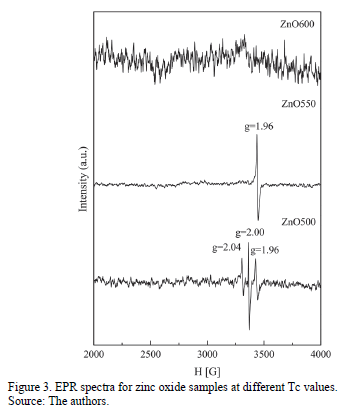
<body><![CDATA[<p><font size="3" face="Verdana, Arial, Helvetica, sans-serif"><b>1. Introduction</b></font></p>     <p><font size="2" face="Verdana, Arial, Helvetica, sans-serif">Zinc oxide   (ZnO) is a type II-VI semiconductor with a direct band gap of 3.37 eV and   stable Wurtzite type structure with lattice parameters a = 3.25 Å and c = 5.21   Å &#91;1&#93;. It is an important semiconductor material due to its applications, which   include transparent conductive oxides (TCO) &#91;2,3&#93;, ultraviolet (UV) blockers,   and photocatalysts, among others. As photocatalysts, the reduction of organic   pollutant compounds and the remediation of organic contaminants, mainly azo   type (compounds that interact with visible light), can be mentioned as being   the most important in terms of usefulness. The presence of free radicals or   vacancies in them are responsible for these applications and some authors have   established that the amount of them is dependent on the crystal size, given   that the ratio surface / volume increases as the size of the material decreases   to a nanometer range &#91;4,5&#93;. ZnO is a relatively open structure with a   hexagonal-close-packed lattice where Zn atoms occupy half of the tetrahedral   sites, while all octahedral sites are empty &#91;6&#93;. The open structure also   influences the nature of defects and the diffusion mechanism. The identity,   quantity, and stability of these radicals or vacancies are features to consider   when this material is required in a particular application. Applications for   these types of materials depend on their electrical and magnetic properties and   these depend on the method by which they were prepared &#91;1-5&#93;. </font></p>     <p><font size="2" face="Verdana, Arial, Helvetica, sans-serif">Many methods for the production of ZnO   nanostructures have been described in the literature such as laser ablation   &#91;7&#93;, hydrothermal methods &#91;8&#93;, electrochemical depositions &#91;9&#93;, chemical vapor   deposition &#91;10&#93;, thermal decomposition &#91;11&#93;, the combustion method &#91;12&#93; and the   co-precipitation method &#91;13,14&#93;, resulting in zinc oxide nanoparticles with a   nanometric size. The sol-gel method allows the mixture of the initial reagent on   an atomic level, which, while there is control of chemical composition and   there are quite homogeneous materials in its composition, reduces the   possibility of having impurities that are difficult to detect and has good   reproducibility. Materials of high surface area can be prepared at a low cost   and the experimental procedure can be easily undertaken &#91;15,16&#93;. In this work,   pure zinc oxide was synthesized using the sol-gel method (citrate route) at   various calcination temperatures. Structural properties and the mean crystal   size were determined by XRD, and its purity was assessed by infrared   spectroscopy. The presence of free radicals, vacancies or defects was observed   by electron paramagnetic resonance, which could be associated to potential uses   of these materials as reductors of organic pollutant compounds. </font></p>     <p>&nbsp;</p>     <p><font size="3" face="Verdana, Arial, Helvetica, sans-serif"><b>2. Materials and methods</b></font></p>     <p><font size="2" face="Verdana, Arial, Helvetica, sans-serif">Nanoparticles of Zinc oxide were prepared   by the sol-gel (citrate route) method using Zinc Nitrate, Zn(NO<sub>3</sub>)<sub>2</sub>•6H<sub>2</sub>O   (Panreac) as the starting materials. Citric acid C<sub>6</sub>H<sub>8</sub>O<sub>7</sub>•H<sub>2</sub>O   (Panreac) was used as a complexing agent. A stoichiometric weight of metallic   cation was homogeneously mixed in deionized water using magnetic stirring at 70   &deg;C. Then, Citric acid was also dissolved in deionized water for 30 minutes. The   Citrate/Nitrate ratio used was 1. The solution of Zinc Nitrate in the solution   of Citric acid was added slowly. The reaction mixture was heated at 70 &deg;C with   continuous stirring until gel formation. The product obtained was dried at 130   &deg;C for 12 hours and pulverized for 30 minutes using an agate mortar. The   precursor materials were calcined at the calcination temperature (Tc) of 500,   550 and 600 &deg;C for 12 hours &#91;4&#93;. These samples were denominated in ZnOTc form. The reaction of zinc   oxide formation can be written as described in equation (1):</font></p>     <p><img src="/img/revistas/dyna/v83n195/v83n195a28eq01.gif"></p>     <p><font size="2" face="Verdana, Arial, Helvetica, sans-serif">Infrared spectra were carried out in a   Fourier transform spectrophotometer Shimadzu IRAffinity-1 in the range of   wavenumber 4000-600 cm<sup>-1</sup>. X-ray diffraction measurements were   performed on a diffractometer Panalytical Pro MPD using polycrystalline silicon   as a calibration standard in 2<font face="Symbol">q</font> range of 10-90, and using CuK<font face="Symbol">a</font>1   radiation and a step size (2<font face="Symbol">q</font>) of 0.0260. Sweep time was 18.6860 s. The   EPR spectra were carried out on a Bruker X-band spectrometer ESP-300 at   different temperatures. A frequency of 9.45 GHz and a modulation amplitude of   10.496 G were also used in this procedure.</font></p>     <p>&nbsp;</p>     <p><font size="3" face="Verdana, Arial, Helvetica, sans-serif"><b>3. Results and discussion</b></font></p>     ]]></body>
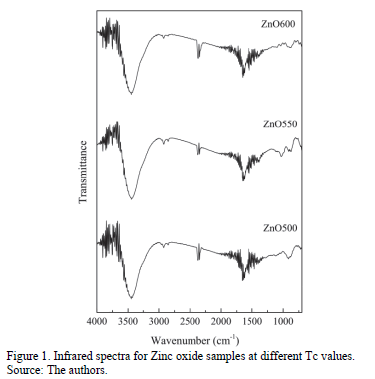
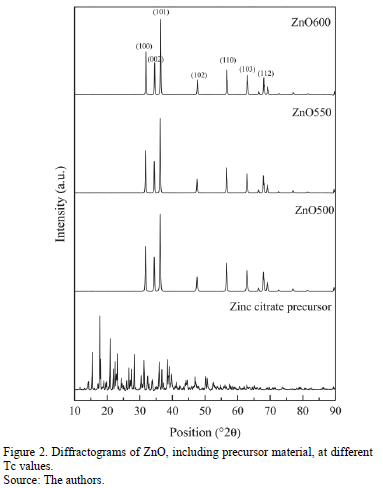
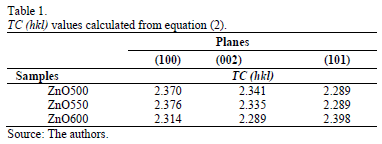
<body><![CDATA[<p><font size="2" face="Verdana, Arial, Helvetica, sans-serif">The purity and molecular structure of the   samples were determined by infrared spectroscopy. <a href="#fig01">Fig. 1</a> shows the FTIR spectra   of the nanocrystalline powders of zinc oxide. The two peaks at ~3428 and 1590   cm<sup>-1</sup> are attributed to the stretching vibrations of the -OH group   and the deformation of H-O-H bond, which are associated with small amounts of   water existing in the zinc oxide &#91;1&#93;. The band corresponding to ~ 2400 cm<sup>-1</sup> is associated   with CO<sub>2</sub> molecules that are adsorbed on the surface of ZnO &#91;17,18&#93;. The bands that are near to 1000 cm<sup>-1</sup> are associated with metal-Oxygen tension and bending, in this case, Zn-O. An   increase of the temperature in this band is associated with high Zn-O bonding   due to thermal evolution of samples &#91;18&#93;. Two small bands are observed at 2920 and 2850 cm<sup>-1</sup>,   possibly due to -CH<sub>2</sub> groups belonging to the metal-organic chain   formed during synthesis &#91;18&#93;; these are small residues and the bands are not intense. All these   results were independent of calcination temperature (Tc). </font></p>     <p align="center"><font size="2" face="Verdana, Arial, Helvetica, sans-serif"><a name="fig01"></a></font><img src="/img/revistas/dyna/v83n195/v83n195a28fig01.gif"></p>     <p><font size="2" face="Verdana, Arial, Helvetica, sans-serif"><a href="#fig02">Fig. 2</a> shows   diffractograms for ZnO samples as well as the precursor material studied at   different calcinations temperatures. At this point, the evolution of the   precursor material is displayed, which is an organometallic compound (zinc   citrate), and its evolution towards zinc oxide can be appreciated when   calcination temperature is higher than 500 ºC. For all samples studied, all   diffraction peaks were associated with Zinc oxide according to the PDF-Card   36-1451 (2004 PDF2 database) and the structure was a wurtzite type. There were   no observed peaks corresponding to some of the reagent precursors or other   secondary phases, and all samples have good crystallinity, which increases at   the same time as the calcination temperature Tc. The Wurtzite structure for ZnO, is therefore   observed from Tc = 500 ºC and this calcination temperature could be enough to   obtain samples that are going to be used as a photocatalyst, that in turn   decreasing production costs. </font></p>     <p align="center"><font size="2" face="Verdana, Arial, Helvetica, sans-serif"><a name="fig02"></a></font><img src="/img/revistas/dyna/v83n195/v83n195a28fig02.gif"></p>     <p><font size="2" face="Verdana, Arial, Helvetica, sans-serif">It is worthwhile mentioning that the   diffraction peak associated with the plane (101) is the most intense one, and   this may be due to the synthesis method used since it has been reported that   for thin films the most intense level corresponds to the (002) reflection &#91;19-21&#93;. The preferred orientation of growth,   determined using a texture coefficient TC (hkl) was calculated using equation   (2) &#91;19&#93; and showed that for all samples   calcinated, the preferred growth plane was (100) except ZnO calcinated at 600 &deg;C, which grew preferentially in   the plane direction (101).</font></p>     <p><img src="/img/revistas/dyna/v83n195/v83n195a28eq02.gif"></p>     <p><font size="2" face="Verdana, Arial, Helvetica, sans-serif">In this equation, <i>I (hkl)</i> is the measured relative intensity of the plane <i>(hkl), I<sub>0</sub> (hkl) </i>is the relative   intensity of the standard plane <i>(hkl)</i> taken from the JCPDS database, N is the number of reflections in the   diffractogram, 7 being the most intense (<a href="#fig02">Fig. 2</a>), and <i>n</i> is the number of used diffraction peaks, which in our case was 3   associated with the planes (100), (002) and (101). For a sample that has   randomly oriented crystallites, the value of <i>TC(hkl)</i> is equal to 1, whereas if this value increases, it means   that the greater abundance of crystals is oriented in one particular direction <i>(hkl)</i> &#91;20&#93; . <i>TC(hkl)</i> data for the three main diffraction peaks (100), (002) and (101) are shown in <a href="#tab01">Table 1</a>. </font></p>     <p align="center"><font size="2" face="Verdana, Arial, Helvetica, sans-serif"><a name="tab01"></a></font><img src="/img/revistas/dyna/v83n195/v83n195a28tab01.gif"></p>     <p><font size="2" face="Verdana, Arial, Helvetica, sans-serif">Mean crystallite size was estimated from   the Scherrer equation, with a gaussian fit,</font></p>     <p><img src="/img/revistas/dyna/v83n195/v83n195a28eq03.gif"></p>     ]]></body>
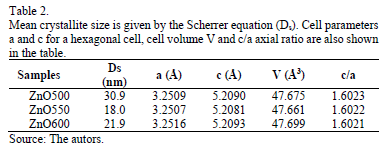
<body><![CDATA[<p><font size="2" face="Verdana, Arial, Helvetica, sans-serif">where <i>b</i> is integral breadth (in radians), <i>l</i> is the wavelength of X rays (<i>CuK<sub>a</sub></i> radiation, 0.1540598 <i>nm</i>), <i>K </i>is Scherrer's constant that depends   on the directions of the crystal lattice and crystal morphology &#91;21&#93;; its value   is 0.94 and <i>q</i> is Bragg's angle. Integral   breadths of diffraction peaks for all samples were calculated using the   following equation: </font></p>     <p><img src="/img/revistas/dyna/v83n195/v83n195a28eq04.gif"></p>     <p><font size="2" face="Verdana, Arial, Helvetica, sans-serif">Where <i>b<sub>instr</sub></i> is the integral breadth for   a calibration standard, and <i>b<sub>m</sub></i> the integral breadth for   diffraction peaks of synthesized samples. The results for <i>D<sub>s</sub></i>are shown in <a href="#tab02">Table 2</a>, and <i>D<sub>s</sub></i> values are nanometric. The lowest <i>D<sub>s</sub></i> is obtained when   calcination temperature is 550 &deg;C; ZnO calcinated at 500 &deg;C has an average   crystallite size above 30 nm. Differences in crystal sizes (Ds) are determined   by the Scherrer equation, and this is true for all samples as they have   different integral breadth values as consequence of the fact they were   calcinated at different temperature Tc.</font></p>     <p align="center"><font size="2" face="Verdana, Arial, Helvetica, sans-serif"><a name="tab02"></a></font><img src="/img/revistas/dyna/v83n195/v83n195a28tab02.gif"></p>     <p><font size="2" face="Verdana, Arial, Helvetica, sans-serif">The   lattice parameters a and c as well as cell volume (V) were calculated by the   Rietveld method, using the Fullprof program &#91;22&#93;. <a href="#tab02">Table 2</a> shows the calculated values. a and c do not change   significantly with calcination temperature. The ratio c/a shows the deviation   that crystalline structure of the samples presented with respect to the   theoretical network hcp (hexagonal compact packing, the value of which is   1.633). The deviations regarding the theoretical value may be products of   microstrains and the concentration of defects in the crystal. </font></p>     <p><font size="2" face="Verdana, Arial, Helvetica, sans-serif"><a href="#fig03">Fig. 3</a> shows the EPR spectra for the Zinc   oxide samples that are calcinated at three different temperatures. At T<sub>c</sub> = 500 &deg; C three signals are observed having g values of 1.96, 2.00 and 2.04.   Some authors have associated these lines to defects in Zinc oxide &#91;4&#93;. The signal localized at the g = 1.96   line was attributed to Oxygen vacancies &#91;4,23,24&#93;. The other two lines are associated   with Zinc vacancies &#91;25&#93;. Stehr <i>et al.</i> attributed these lines to shallow donors, which show a   slight anisotropy because of the Wurtzite type crystal structure of zinc oxide &#91;26&#93;. The sample calcinated at 550 &deg;C   showed a small concentration of defects associated with Oxygen vacancies, while   the sample calcinated at 600 &deg; C showed no vacancies, at least in the order of   determination of these defects by EPR. It means that pure ZnO calcinated at 550   ºC could be used as a photocatalyst if the oxidation/reduction activity were   caused by the presence of defects or vacancies. The sample is highlighted with   the highest concentration of vacancies that has a mean crystallite size greater   than 30 nm, and this may also be responsible for this feature.</font></p>     <p align="center"><font size="2" face="Verdana, Arial, Helvetica, sans-serif"><a name="fig03"></a></font><img src="/img/revistas/dyna/v83n195/v83n195a28fig03.gif"></p>     <p>&nbsp;</p>     <p><font size="3" face="Verdana, Arial, Helvetica, sans-serif"><b>4. Conclusion</b></font></p>     <p><font size="2" face="Verdana, Arial, Helvetica, sans-serif">Zinc oxide nanoparticles were synthesized at calcination   temperatures of 500, 550 and 600 &deg;C. For all samples, the </font><font size="2" face="Verdana, Arial, Helvetica, sans-serif">formation of   wurtzite-type structures of zinc oxide was observed. The crystal size indicates   that samples contain nanosized crystals, and that there are also small   microstrains associated with small variations in the hexagonal lattice of zinc   oxide. Lattice parameters showed no significant variations in the unit cell due   to variation of the calcination temperature. The presence of water and Carbon   dioxide molecules on the surface of zinc oxide was evidenced by infrared   spectroscopy. Zinc vacancies and oxygen were shown by electron paramagnetic   resonance, a process in which their disappearance is shown as long as the   calcination temperature increases. The presence of vacancies in samples   calcined at Tc = 500 &deg;C, which reacts with a mean crystallite size above 30 nm   should be the best catalyst performance or oxidizing/reducing agent.</font></p>     ]]></body>
<body><![CDATA[<p>&nbsp;</p>     <p><font size="3" face="Verdana, Arial, Helvetica, sans-serif"><b>Acknowledgment</b></font></p>     <p><font size="2" face="Verdana, Arial, Helvetica, sans-serif">We would like to give thanks to the DIB   of the National University of Colombia for their financial support through   project 15848. Additionally, we thank professor Mario Barrera for facilitating   our use of the equipment and laboratories for the material synthesis.</font></p>     <p>&nbsp;</p>     <p><b><font size="3" face="Verdana, Arial, Helvetica, sans-serif">References</font></b></p>     <!-- ref --><p><font size="2" face="Verdana, Arial, Helvetica, sans-serif"><b>&#91;1&#93;</b> Jagannatha-Reddy, A., Kokila, M.K,   Nagabhushana, H., Chakradhar, R.P.S, Shivakumara, C., Rao J.L. and   Nagabhushana, B.M., Structural, optical and EPR studies on ZnO:Cu nanopowders   prepared via low temperature solution combustion synthesis. J. Alloys. Compd.   509(17), pp. 5349-5355, 2001. DOI:   10.1016/j.jallcom.2011.02.043</font>&nbsp;&nbsp;&nbsp;&nbsp;&nbsp;&nbsp;&nbsp;&nbsp;[&#160;<a href="javascript:void(0);" onclick="javascript: window.open('/scielo.php?script=sci_nlinks&ref=1140043&pid=S0012-7353201600010002800001&lng=','','width=640,height=500,resizable=yes,scrollbars=1,menubar=yes,');">Links</a>&#160;]<!-- end-ref --><!-- ref --><p><font size="2" face="Verdana, Arial, Helvetica, sans-serif"><b>&#91;2&#93;</b> Hisono, H., Recent progress in   transparent oxide semiconductors: Materials and device application. Thin Solid   Films. 515(5), pp. 6000-6014, 2007. DOI: 10.1016/j.tsf.2006.12.125</font>&nbsp;&nbsp;&nbsp;&nbsp;&nbsp;&nbsp;&nbsp;&nbsp;[&#160;<a href="javascript:void(0);" onclick="javascript: window.open('/scielo.php?script=sci_nlinks&ref=1140044&pid=S0012-7353201600010002800002&lng=','','width=640,height=500,resizable=yes,scrollbars=1,menubar=yes,');">Links</a>&#160;]<!-- end-ref --><!-- ref --><p><font size="2" face="Verdana, Arial, Helvetica, sans-serif"><b>&#91;3&#93;</b> Becheri, A., Durr, M., Lo Nostro, P.   and Baglioni, P., Synthesis and characterization of zinc oxide nanoparticles:   Application to textiles as UV absorbers. J. Nanopart. Res. 10, pp. 679-689,   2008. DOI: 10.1007/s11051-007-9318-3</font>&nbsp;&nbsp;&nbsp;&nbsp;&nbsp;&nbsp;&nbsp;&nbsp;[&#160;<a href="javascript:void(0);" onclick="javascript: window.open('/scielo.php?script=sci_nlinks&ref=1140045&pid=S0012-7353201600010002800003&lng=','','width=640,height=500,resizable=yes,scrollbars=1,menubar=yes,');">Links</a>&#160;]<!-- end-ref --><!-- ref --><p><font size="2" face="Verdana, Arial, Helvetica, sans-serif"><b>&#91;4&#93;</b> Acosta-Hum&aacute;nez, F., Cogollo-Pital&uacute;a,   R. and Almanza, O., Electron paramagnetic resonance in Zn<sub>1-x</sub>Co<sub>x</sub>O.   J. Magn. Magn. Mater. 329, pp. 39-42, 2013. DOI:   10.1016/j.jmmm.2012.10.026 </font>&nbsp;&nbsp;&nbsp;&nbsp;&nbsp;&nbsp;&nbsp;&nbsp;[&#160;<a href="javascript:void(0);" onclick="javascript: window.open('/scielo.php?script=sci_nlinks&ref=1140046&pid=S0012-7353201600010002800004&lng=','','width=640,height=500,resizable=yes,scrollbars=1,menubar=yes,');">Links</a>&#160;]<!-- end-ref --><!-- ref --><p><font size="2" face="Verdana, Arial, Helvetica, sans-serif"><b>&#91;5&#93;</b> Wu, C., Shen, L., Shang, Y.C. and   Huang, Q., Solvothermal synthesis of Cr-doped ZnO nanowires with visible   light-driven photocatalytic activity. Mat. Lett. 65(12), pp. 1794-1796, 2011. DOI: 10.1016/j.matlet.2011.03.070</font>&nbsp;&nbsp;&nbsp;&nbsp;&nbsp;&nbsp;&nbsp;&nbsp;[&#160;<a href="javascript:void(0);" onclick="javascript: window.open('/scielo.php?script=sci_nlinks&ref=1140047&pid=S0012-7353201600010002800005&lng=','','width=640,height=500,resizable=yes,scrollbars=1,menubar=yes,');">Links</a>&#160;]<!-- end-ref --><!-- ref --><p><font size="2" face="Verdana, Arial, Helvetica, sans-serif"><b>&#91;6&#93;</b> Cao, B., Gong, H., Zeng, H. and Cai,   W.P. Photoluminiscence / Fluorescence spectroscopic technique for nanomaterials   characterization, in Nanomaterials: Processing and characterization with   lasers, Weinheim, Wiley, 2012, pp. 597-616.    &nbsp;&nbsp;&nbsp;&nbsp;&nbsp;&nbsp;&nbsp;&nbsp;[&#160;<a href="javascript:void(0);" onclick="javascript: window.open('/scielo.php?script=sci_nlinks&ref=1140048&pid=S0012-7353201600010002800006&lng=','','width=640,height=500,resizable=yes,scrollbars=1,menubar=yes,');">Links</a>&#160;]<!-- end-ref --></font></p>     <!-- ref --><p><font size="2" face="Verdana, Arial, Helvetica, sans-serif"><b>&#91;7&#93;</b> Scarisoreanu, N., Metai, D.G.,   Dinescu, G, Epurescu, G, Ghica, C, Nistor, L.C. and Dinescu, M., Properties of   ZnO thin films prepared by radio-frequency plasma beam assisted laser ablation.   Appl. Surf. Sci. 247, pp.518-525, 2005. DOI: 10.1016/j.apsusc.2005.01.140 </font>&nbsp;&nbsp;&nbsp;&nbsp;&nbsp;&nbsp;&nbsp;&nbsp;[&#160;<a href="javascript:void(0);" onclick="javascript: window.open('/scielo.php?script=sci_nlinks&ref=1140050&pid=S0012-7353201600010002800007&lng=','','width=640,height=500,resizable=yes,scrollbars=1,menubar=yes,');">Links</a>&#160;]<!-- end-ref --><!-- ref --><p><font size="2" face="Verdana, Arial, Helvetica, sans-serif"><b>&#91;8&#93;</b> Ni, Y.H., Wei, X.W., Hong, J.M. and   Ye, Y., Hydrothermal synthesis and optical properties of ZnO nanorods. Mater.   Sci. Eng., B, 121, pp. 42-47, 2005. DOI: 10.1016/j.mseb.2005.02.065</font>&nbsp;&nbsp;&nbsp;&nbsp;&nbsp;&nbsp;&nbsp;&nbsp;[&#160;<a href="javascript:void(0);" onclick="javascript: window.open('/scielo.php?script=sci_nlinks&ref=1140051&pid=S0012-7353201600010002800008&lng=','','width=640,height=500,resizable=yes,scrollbars=1,menubar=yes,');">Links</a>&#160;]<!-- end-ref --><!-- ref --><p><font size="2" face="Verdana, Arial, Helvetica, sans-serif"><b>&#91;9&#93;</b> Chang, S., Yoon, S.O., Park, H.J. and   Sakai, A., Luminescence properties of Zn nanowires prepared by electrochemical   etching. Mater. Lett. 53, pp. 432-436, 2002. DOI: 10.1016/S0167-577X(01)00521-3</font>&nbsp;&nbsp;&nbsp;&nbsp;&nbsp;&nbsp;&nbsp;&nbsp;[&#160;<a href="javascript:void(0);" onclick="javascript: window.open('/scielo.php?script=sci_nlinks&ref=1140052&pid=S0012-7353201600010002800009&lng=','','width=640,height=500,resizable=yes,scrollbars=1,menubar=yes,');">Links</a>&#160;]<!-- end-ref --><!-- ref --><p><font size="2" face="Verdana, Arial, Helvetica, sans-serif"><b>&#91;10&#93;</b> Wu, J.J. and Liu, S.C.,   Low-temperature growth of well-aligned ZnO nanorods by chemical vapor   deposition. Adv. Mater. 14, pp. 215-218, 2002. DOI:   10.1002/1521-4095(20020205)14:3&lt;215::AID-ADMA215&gt;3.0.CO;2-J</font>&nbsp;&nbsp;&nbsp;&nbsp;&nbsp;&nbsp;&nbsp;&nbsp;[&#160;<a href="javascript:void(0);" onclick="javascript: window.open('/scielo.php?script=sci_nlinks&ref=1140053&pid=S0012-7353201600010002800010&lng=','','width=640,height=500,resizable=yes,scrollbars=1,menubar=yes,');">Links</a>&#160;]<!-- end-ref --><!-- ref --><p><font size="2" face="Verdana, Arial, Helvetica, sans-serif"><b>&#91;11&#93;</b> Wang, R.C. and Tsai, C.C., Efficient   synthesis of ZnO nanoparticles, nanowalls, and nanowires by thermal   decomposition of zinc acetate at a low temperature. Appl. Phys. A. 94, pp.   241-245, 2009. DOI 10.1007/s00339-008-4755-0</font>&nbsp;&nbsp;&nbsp;&nbsp;&nbsp;&nbsp;&nbsp;&nbsp;[&#160;<a href="javascript:void(0);" onclick="javascript: window.open('/scielo.php?script=sci_nlinks&ref=1140054&pid=S0012-7353201600010002800011&lng=','','width=640,height=500,resizable=yes,scrollbars=1,menubar=yes,');">Links</a>&#160;]<!-- end-ref --><!-- ref --><p><font size="2" face="Verdana, Arial, Helvetica, sans-serif"><b>&#91;12&#93;</b> Lamas, D.G., Lascalea, G.E. and   Walsoc, N.E., Synthesis and characterization of nanocrystalline powders for   partially stabilized zirconia ceramics. J. Eur. Ceram. Soc. 18, pp. 1217-1221,   1998. DOI: 10.1016/S0955-2219(98)00045-4</font>&nbsp;&nbsp;&nbsp;&nbsp;&nbsp;&nbsp;&nbsp;&nbsp;[&#160;<a href="javascript:void(0);" onclick="javascript: window.open('/scielo.php?script=sci_nlinks&ref=1140055&pid=S0012-7353201600010002800012&lng=','','width=640,height=500,resizable=yes,scrollbars=1,menubar=yes,');">Links</a>&#160;]<!-- end-ref --><!-- ref --><p><font size="2" face="Verdana, Arial, Helvetica, sans-serif"><b>&#91;13&#93;</b> Kumar, S.S., Venkateswarlu, P., Rao,   V.R. and Rao, V.R., Synthesis, characterization and optical properties of zinc   oxide nanoparticles. Int. Nano Lett &#91;Online&#93;. 30(3), pp. 2-6, 2013. &#91;Date of   reference 11<sup>th</sup> October of 2015&#93;. Available at: <a href="http://www.inl-journal.com/content/pdf/2228-5326-3-30.pdf" target="_blank">http://www.inl-journal.com/content/pdf/2228-5326-3-30.pdf</a></font>&nbsp;&nbsp;&nbsp;&nbsp;&nbsp;&nbsp;&nbsp;&nbsp;[&#160;<a href="javascript:void(0);" onclick="javascript: window.open('/scielo.php?script=sci_nlinks&ref=1140056&pid=S0012-7353201600010002800013&lng=','','width=640,height=500,resizable=yes,scrollbars=1,menubar=yes,');">Links</a>&#160;]<!-- end-ref --><!-- ref --><p><font size="2" face="Verdana, Arial, Helvetica, sans-serif"><b>&#91;14&#93;</b> Ruiz,   C.V. and Rodr&iacute;guez-P&aacute;ez, J.E., Aluminatos de sodio obtenidos del sistema Al(NO<sub>3</sub>)<sub>3</sub>×9H<sub>2</sub>O a trav&eacute;s del m&eacute;todo de   precipitaci&oacute;n controlada. Ingenier&iacute;a e Investigaci&oacute;n &#91;Online&#93;. 30(2), pp.   16-24, 2010. &#91;Date of reference 13<sup>th</sup> October of 2015&#93;. Available at: <a href="http://www.revistas.unal.edu.co/index.php/ingeinv/article/view/15726/34068" target="_blank">http://www.revistas.unal.edu.co/index.php/ingeinv/article/view/15726/34068</a></font>&nbsp;&nbsp;&nbsp;&nbsp;&nbsp;&nbsp;&nbsp;&nbsp;[&#160;<a href="javascript:void(0);" onclick="javascript: window.open('/scielo.php?script=sci_nlinks&ref=1140057&pid=S0012-7353201600010002800014&lng=','','width=640,height=500,resizable=yes,scrollbars=1,menubar=yes,');">Links</a>&#160;]<!-- end-ref --><!-- ref --><p><font size="2" face="Verdana, Arial, Helvetica, sans-serif"><b>&#91;15&#93;</b> Jokela, S.J. and McCluskey, M.D.,   Structure and stability of O-H donors in ZnO from high-pressure and infrared   spectroscopy. Phys. Rev. B. 72(11), pp. 113201(1-4), 2005. DOI:   10.1103/PhysRevB.72.113201</font>&nbsp;&nbsp;&nbsp;&nbsp;&nbsp;&nbsp;&nbsp;&nbsp;[&#160;<a href="javascript:void(0);" onclick="javascript: window.open('/scielo.php?script=sci_nlinks&ref=1140058&pid=S0012-7353201600010002800015&lng=','','width=640,height=500,resizable=yes,scrollbars=1,menubar=yes,');">Links</a>&#160;]<!-- end-ref --><!-- ref --><p><font size="2" face="Verdana, Arial, Helvetica, sans-serif"><b>&#91;16&#93;</b> Montenegro-Hern&aacute;ndez,   A. y Rodr&iacute;guez-P&aacute;ez,   J.E., S&iacute;ntesis &oacute;xido de esta&ntilde;o   altamente reactivo utilizando como precursor etilhexanoato de esta&ntilde;o.   Ingenier&iacute;a e Investigaci&oacute;n &#91;Online&#93;. 29(1), pp. 47-52, 2009 &#91;Date of reference   13<sup>th</sup> October of 2015&#93;</b> Available at: <a href="http://www.revistas.unal.edu.co/index.php/ingeinv/article/view/15142/34413" target="_blank">http://www.revistas.unal.edu.co/index.php/ingeinv/article/view/15142/34413</a>.    &nbsp;&nbsp;&nbsp;&nbsp;&nbsp;&nbsp;&nbsp;&nbsp;[&#160;<a href="javascript:void(0);" onclick="javascript: window.open('/scielo.php?script=sci_nlinks&ref=1140059&pid=S0012-7353201600010002800016&lng=','','width=640,height=500,resizable=yes,scrollbars=1,menubar=yes,');">Links</a>&#160;]<!-- end-ref --></font></p>     <!-- ref --><p><font size="2" face="Verdana, Arial, Helvetica, sans-serif"><b>&#91;17&#93;</b> Nejati, K., Rezvani, Z. and   Pakizevand, R., Synthesis of ZnO nanoparticles and investigation of the ionic   template effect on their size and shape. Int. Nano Lett. &#91;Online&#93;. 1, pp.   75-81, 2011 &#91;date of reference December 15<sup>th</sup> of 2014&#93;. Available at: <a href="http://inljournal.com/?_action=article&vol=1&issue=4&_is=Volume+1%2C+Number+2+%28July+2011%29" target="_blank">http://inljournal.com/?_action=article&amp;vol=1&amp;issue=4&amp;_is=Volume+1%2C+Number+2+%28July+2011%29</a></font>&nbsp;&nbsp;&nbsp;&nbsp;&nbsp;&nbsp;&nbsp;&nbsp;[&#160;<a href="javascript:void(0);" onclick="javascript: window.open('/scielo.php?script=sci_nlinks&ref=1140061&pid=S0012-7353201600010002800017&lng=','','width=640,height=500,resizable=yes,scrollbars=1,menubar=yes,');">Links</a>&#160;]<!-- end-ref --><!-- ref --><p><font size="2" face="Verdana, Arial, Helvetica, sans-serif"><b>&#91;18&#93;</b> Nakamoto, K., Infrared and raman   spectra of inorganic and coordination compounds, Applications in coordination,   organometallic, and bioinorganic chemistry. Wiley, New York, 2009.    &nbsp;&nbsp;&nbsp;&nbsp;&nbsp;&nbsp;&nbsp;&nbsp;[&#160;<a href="javascript:void(0);" onclick="javascript: window.open('/scielo.php?script=sci_nlinks&ref=1140062&pid=S0012-7353201600010002800018&lng=','','width=640,height=500,resizable=yes,scrollbars=1,menubar=yes,');">Links</a>&#160;]<!-- end-ref --></font></p>     <!-- ref --><p><font size="2" face="Verdana, Arial, Helvetica, sans-serif"><b>&#91;19&#93;</b> Caglar, Y., Sol-gel derived   nanostructure undoped and cobalt doped ZnO: Structural, optical and electrical   studies J. Alloys Compd. 560, pp. 181-188, 2013. DOI: 10.1016/j.jallcom.2013.01.080</font>&nbsp;&nbsp;&nbsp;&nbsp;&nbsp;&nbsp;&nbsp;&nbsp;[&#160;<a href="javascript:void(0);" onclick="javascript: window.open('/scielo.php?script=sci_nlinks&ref=1140064&pid=S0012-7353201600010002800019&lng=','','width=640,height=500,resizable=yes,scrollbars=1,menubar=yes,');">Links</a>&#160;]<!-- end-ref --><!-- ref --><p><font size="2" face="Verdana, Arial, Helvetica, sans-serif"><b>&#91;20&#93;</b> Xu, C., Cao, L., Su, G., Liu, W., Qu,   X. and Yu, Y., Preparation, characterization and photocatalytic activity of   Co-doped ZnO powders. J. Alloys Compd. 497(1-2), pp. 373-376, 2010. DOI: 10.1016/j.jallcom.2010.03.076 </font>&nbsp;&nbsp;&nbsp;&nbsp;&nbsp;&nbsp;&nbsp;&nbsp;[&#160;<a href="javascript:void(0);" onclick="javascript: window.open('/scielo.php?script=sci_nlinks&ref=1140065&pid=S0012-7353201600010002800020&lng=','','width=640,height=500,resizable=yes,scrollbars=1,menubar=yes,');">Links</a>&#160;]<!-- end-ref --><!-- ref --><p><font size="2" face="Verdana, Arial, Helvetica, sans-serif"><b>&#91;21&#93;</b> Yang, J.H, Zhao, L.Y., Ding, X., Yang,   L.L., Zhang, Y.J., Wang, Y. X. and Liu, H.L., Magnetic properties of Co-doped   ZnO prepared by sol-gel method. Materials Science and Engineering B., 162(3),   pp. 143-146, 2009. DOI: 10.1016/j.mseb.2009.03.020</font>&nbsp;&nbsp;&nbsp;&nbsp;&nbsp;&nbsp;&nbsp;&nbsp;[&#160;<a href="javascript:void(0);" onclick="javascript: window.open('/scielo.php?script=sci_nlinks&ref=1140066&pid=S0012-7353201600010002800021&lng=','','width=640,height=500,resizable=yes,scrollbars=1,menubar=yes,');">Links</a>&#160;]<!-- end-ref --><!-- ref --><p><font size="2" face="Verdana, Arial, Helvetica, sans-serif"><b>&#91;22&#93;</b> Rodr&iacute;guez-Carvajal, J., Fullprof suite   software: Crystallographic tools for rietveld, profile matching and integrated   intensity refinements for X-ray and/or neutron data. Version 5.30. Laboratorie   Leon, Brillounin, Gifsuryvette, France, 2012.    &nbsp;&nbsp;&nbsp;&nbsp;&nbsp;&nbsp;&nbsp;&nbsp;[&#160;<a href="javascript:void(0);" onclick="javascript: window.open('/scielo.php?script=sci_nlinks&ref=1140067&pid=S0012-7353201600010002800022&lng=','','width=640,height=500,resizable=yes,scrollbars=1,menubar=yes,');">Links</a>&#160;]<!-- end-ref --></font></p>     <!-- ref --><p><font size="2" face="Verdana, Arial, Helvetica, sans-serif"><b>&#91;23&#93;</b> Vlasenko, L.S., Magnetic resonance   studies of intrinsic defects in ZnO: Oxygen vacancy. Appl Magn Reson. 39(1),   pp. 103-111, 2010. DOI: 10.1007/s00723-010-0140-1</font>&nbsp;&nbsp;&nbsp;&nbsp;&nbsp;&nbsp;&nbsp;&nbsp;[&#160;<a href="javascript:void(0);" onclick="javascript: window.open('/scielo.php?script=sci_nlinks&ref=1140069&pid=S0012-7353201600010002800023&lng=','','width=640,height=500,resizable=yes,scrollbars=1,menubar=yes,');">Links</a>&#160;]<!-- end-ref --><!-- ref --><p><font size="2" face="Verdana, Arial, Helvetica, sans-serif"><b>&#91;24&#93;</b> Janotti, A. and Van de Walle, C.G.,   Native point defects in ZnO. Phys. Rev. B. 76(16), pp. 165202(22), 2007. DOI:   10.1103/PhysRevB.76.165202</font>&nbsp;&nbsp;&nbsp;&nbsp;&nbsp;&nbsp;&nbsp;&nbsp;[&#160;<a href="javascript:void(0);" onclick="javascript: window.open('/scielo.php?script=sci_nlinks&ref=1140070&pid=S0012-7353201600010002800024&lng=','','width=640,height=500,resizable=yes,scrollbars=1,menubar=yes,');">Links</a>&#160;]<!-- end-ref --><!-- ref --><p><font size="2" face="Verdana, Arial, Helvetica, sans-serif"><b>&#91;25&#93;</b> Vlasenko, L.S. and Watkins, G.D.,   Optical detection of electron paramagnetic resonance for intrinsic defects   produced in ZnO by 2.5-MeV electron irradiation in situ at 4.2 K. Phys. Rev. B.   72(3), pp. 035203(12), 2005. DOI: 10.1103/PhysRevB.72.035203</font>&nbsp;&nbsp;&nbsp;&nbsp;&nbsp;&nbsp;&nbsp;&nbsp;[&#160;<a href="javascript:void(0);" onclick="javascript: window.open('/scielo.php?script=sci_nlinks&ref=1140071&pid=S0012-7353201600010002800025&lng=','','width=640,height=500,resizable=yes,scrollbars=1,menubar=yes,');">Links</a>&#160;]<!-- end-ref --><!-- ref --><p><font size="2" face="Verdana, Arial, Helvetica, sans-serif"><b>&#91;26&#93;</b> Stehr, J.E., Meyer, B.K. and Hofmann,   D.M., Magnetic resonance of impurities, intrinsic defects and dopants in ZnO.   Appl Magn Reson. 39(1), pp. 137-150, 2010. DOI: 10.1007/s00723-010-0142-z</font>&nbsp;&nbsp;&nbsp;&nbsp;&nbsp;&nbsp;&nbsp;&nbsp;[&#160;<a href="javascript:void(0);" onclick="javascript: window.open('/scielo.php?script=sci_nlinks&ref=1140072&pid=S0012-7353201600010002800026&lng=','','width=640,height=500,resizable=yes,scrollbars=1,menubar=yes,');">Links</a>&#160;]<!-- end-ref --><p>&nbsp;</p>     <p><font size="2" face="Verdana, Arial, Helvetica, sans-serif"><b>M. Acosta-Hum&aacute;nez,</b> received his BSc. in   Chemistry in 2009 from the Universidad de C&oacute;rdoba, Monter&iacute;a, Colombia. In 2015   he received and MSc. Eng. Degree in Materials and Processes from the   Universidad Nacional de Colombia, Bogot&aacute;, Colombia. His research interests   include: Chemical synthesis process of inorganic materials (oxides),   characterization techniques (XRD, EPR, IR, UV-vis) as well as electrochemical   methods for materials synthesis and characterization. ORCID: 0000-0003-0610-4831.</font></p>     <p><font size="2" face="Verdana, Arial, Helvetica, sans-serif"><b>L. Montes-Vides,</b> received his BSc. in Physicist   - graduated from the Universidad Nacional de Colombia, MSc. in Engineering in   1987, from the Universidad Nacional de Colombia, and Dr. in Science -   Geophysics in 1998. from the Universidade Federal do Par&aacute;, Brazil. He has   worked at the Universidad Nacional de Colombia in Bogot&aacute; since 1990 as a   lecturer on the following programs: undergraduate program in Geology, graduate   programs in MSc. Geophysics and Doctorate program in Geosciences, all from the   Faculty of Sciences. His research areas focus on Seismic prospecting, seismic   inversion, seismic modeling and applied computing mathematics. He is a reviewer   of the following scientific journals: ESRJ, Revista da SBGf, J.Appl. Geophysics   and CT&amp;F. ORCID: 0000-0002-7470-9202</font></p>     <p><font size="2" face="Verdana, Arial, Helvetica, sans-serif"><b>O. Almanza-Montero</b>, received his PhD. in   Physics in 2000, from the Universidad de Valladolid, Spain, and his MSc. in   Physics from the Universidad Nacional de Colombia. He is currently a professor   in this University and has worked there since 1996. His research is focused on   Materials science such as semiconductor and antioxidant activity of Colombian   fruits. He is author of more than 50 papers published in different journals. He   regularly uses the following characterization techniques: (XRD, EPR, IR,   UV-vis). ORCID: 0000-0002-5141-6079</font></p>      ]]></body><back>
<ref-list>
<ref id="B1">
<label>1</label><nlm-citation citation-type="journal">
<person-group person-group-type="author">
<name>
<surname><![CDATA[Jagannatha-Reddy]]></surname>
<given-names><![CDATA[A.]]></given-names>
</name>
<name>
<surname><![CDATA[Kokila]]></surname>
<given-names><![CDATA[M.K]]></given-names>
</name>
<name>
<surname><![CDATA[Nagabhushana]]></surname>
<given-names><![CDATA[H.]]></given-names>
</name>
<name>
<surname><![CDATA[Chakradhar]]></surname>
<given-names><![CDATA[R.P.S]]></given-names>
</name>
<name>
<surname><![CDATA[Shivakumara]]></surname>
<given-names><![CDATA[C.]]></given-names>
</name>
<name>
<surname><![CDATA[Rao]]></surname>
<given-names><![CDATA[J.L.]]></given-names>
</name>
<name>
<surname><![CDATA[Nagabhushana]]></surname>
<given-names><![CDATA[B.M.]]></given-names>
</name>
</person-group>
<article-title xml:lang="en"><![CDATA[Structural, optical and EPR studies on ZnO: Cu nanopowders prepared via low temperature solution combustion synthesis]]></article-title>
<source><![CDATA[J. Alloys. Compd.]]></source>
<year>2001</year>
<volume>509</volume>
<numero>17</numero>
<issue>17</issue>
<page-range>5349-5355</page-range></nlm-citation>
</ref>
<ref id="B2">
<label>2</label><nlm-citation citation-type="journal">
<person-group person-group-type="author">
<name>
<surname><![CDATA[Hisono]]></surname>
<given-names><![CDATA[H.]]></given-names>
</name>
</person-group>
<article-title xml:lang="en"><![CDATA[Recent progress in transparent oxide semiconductors: Materials and device application.]]></article-title>
<source><![CDATA[Thin Solid Films]]></source>
<year>2007</year>
<volume>515</volume>
<numero>5</numero>
<issue>5</issue>
<page-range>6000-6014</page-range></nlm-citation>
</ref>
<ref id="B3">
<label>3</label><nlm-citation citation-type="journal">
<person-group person-group-type="author">
<name>
<surname><![CDATA[Becheri]]></surname>
<given-names><![CDATA[A.]]></given-names>
</name>
<name>
<surname><![CDATA[Durr]]></surname>
<given-names><![CDATA[M.]]></given-names>
</name>
<name>
<surname><![CDATA[Lo Nostro]]></surname>
<given-names><![CDATA[P.]]></given-names>
</name>
<name>
<surname><![CDATA[Baglioni]]></surname>
<given-names><![CDATA[P.]]></given-names>
</name>
</person-group>
<article-title xml:lang="en"><![CDATA[Synthesis and characterization of zinc oxide nanoparticles]]></article-title>
<source><![CDATA[J. Nanopart. Res.]]></source>
<year>2008</year>
<numero>10</numero>
<issue>10</issue>
<page-range>679-689</page-range></nlm-citation>
</ref>
<ref id="B4">
<label>4</label><nlm-citation citation-type="journal">
<person-group person-group-type="author">
<name>
<surname><![CDATA[Acosta-Humánez]]></surname>
<given-names><![CDATA[F.]]></given-names>
</name>
<name>
<surname><![CDATA[Cogollo-Pitalúa]]></surname>
<given-names><![CDATA[R.]]></given-names>
</name>
<name>
<surname><![CDATA[Almanza]]></surname>
<given-names><![CDATA[O.]]></given-names>
</name>
</person-group>
<article-title xml:lang="en"><![CDATA[Electron paramagnetic resonance in Zn1-xCo xO.]]></article-title>
<source><![CDATA[J. Magn. Magn. Mater.]]></source>
<year>2013</year>
<numero>329</numero>
<issue>329</issue>
<page-range>39-42</page-range></nlm-citation>
</ref>
<ref id="B5">
<label>5</label><nlm-citation citation-type="journal">
<person-group person-group-type="author">
<name>
<surname><![CDATA[Wu]]></surname>
<given-names><![CDATA[C.]]></given-names>
</name>
<name>
<surname><![CDATA[Shen]]></surname>
<given-names><![CDATA[L.]]></given-names>
</name>
<name>
<surname><![CDATA[Shang]]></surname>
<given-names><![CDATA[Y.C.]]></given-names>
</name>
<name>
<surname><![CDATA[Huang]]></surname>
<given-names><![CDATA[Q.]]></given-names>
</name>
</person-group>
<article-title xml:lang="en"><![CDATA[Solvothermal synthesis of Cr-doped ZnO nanowires with visible light-driven photocatalytic activity]]></article-title>
<source><![CDATA[Mat. Lett.]]></source>
<year>2011</year>
<volume>65</volume>
<numero>12</numero>
<issue>12</issue>
<page-range>1794-1796</page-range></nlm-citation>
</ref>
<ref id="B6">
<label>6</label><nlm-citation citation-type="book">
<person-group person-group-type="author">
<name>
<surname><![CDATA[Cao]]></surname>
<given-names><![CDATA[B.]]></given-names>
</name>
<name>
<surname><![CDATA[Gong]]></surname>
<given-names><![CDATA[H.]]></given-names>
</name>
<name>
<surname><![CDATA[Zeng]]></surname>
<given-names><![CDATA[H.]]></given-names>
</name>
<name>
<surname><![CDATA[Cai]]></surname>
<given-names><![CDATA[W.P.]]></given-names>
</name>
</person-group>
<article-title xml:lang="en"><![CDATA[Photoluminiscence / Fluorescence spectroscopic technique for nanomaterials characterization]]></article-title>
<source><![CDATA[Nanomaterials: Processing and characterization with lasers]]></source>
<year>2012</year>
<page-range>597-616</page-range><publisher-loc><![CDATA[Weinheim ]]></publisher-loc>
<publisher-name><![CDATA[Wiley]]></publisher-name>
</nlm-citation>
</ref>
<ref id="B7">
<label>7</label><nlm-citation citation-type="journal">
<person-group person-group-type="author">
<name>
<surname><![CDATA[Scarisoreanu]]></surname>
<given-names><![CDATA[N.]]></given-names>
</name>
<name>
<surname><![CDATA[Metai]]></surname>
<given-names><![CDATA[D.G.]]></given-names>
</name>
<name>
<surname><![CDATA[Dinescu]]></surname>
<given-names><![CDATA[G]]></given-names>
</name>
<name>
<surname><![CDATA[Epurescu]]></surname>
<given-names><![CDATA[G]]></given-names>
</name>
<name>
<surname><![CDATA[Ghica]]></surname>
<given-names><![CDATA[C]]></given-names>
</name>
<name>
<surname><![CDATA[Nistor]]></surname>
<given-names><![CDATA[L.C.]]></given-names>
</name>
<name>
<surname><![CDATA[Dinescu]]></surname>
<given-names><![CDATA[M.]]></given-names>
</name>
</person-group>
<article-title xml:lang="en"><![CDATA[Properties of ZnO thin films prepared by radio-frequency plasma beam assisted laser ablation]]></article-title>
<source><![CDATA[Appl. Surf. Sci.]]></source>
<year>2005</year>
<numero>247</numero>
<issue>247</issue>
<page-range>518-525</page-range></nlm-citation>
</ref>
<ref id="B8">
<label>8</label><nlm-citation citation-type="journal">
<person-group person-group-type="author">
<name>
<surname><![CDATA[Ni]]></surname>
<given-names><![CDATA[Y.H.]]></given-names>
</name>
<name>
<surname><![CDATA[Wei]]></surname>
<given-names><![CDATA[X.W.]]></given-names>
</name>
<name>
<surname><![CDATA[Hong]]></surname>
<given-names><![CDATA[J.M.]]></given-names>
</name>
<name>
<surname><![CDATA[Ye]]></surname>
<given-names><![CDATA[Y.]]></given-names>
</name>
</person-group>
<article-title xml:lang="en"><![CDATA[Hydrothermal synthesis and optical properties of ZnO nanorods]]></article-title>
<source><![CDATA[Mater. Sci. Eng., B]]></source>
<year>2005</year>
<numero>121</numero>
<issue>121</issue>
<page-range>42-47</page-range></nlm-citation>
</ref>
<ref id="B9">
<label>9</label><nlm-citation citation-type="journal">
<person-group person-group-type="author">
<name>
<surname><![CDATA[Chang]]></surname>
<given-names><![CDATA[S.]]></given-names>
</name>
<name>
<surname><![CDATA[Yoon]]></surname>
<given-names><![CDATA[S.O.]]></given-names>
</name>
<name>
<surname><![CDATA[Park]]></surname>
<given-names><![CDATA[H.J.]]></given-names>
</name>
<name>
<surname><![CDATA[Sakai]]></surname>
<given-names><![CDATA[A.]]></given-names>
</name>
</person-group>
<article-title xml:lang="en"><![CDATA[Luminescence properties of Zn nanowires prepared by electrochemical etching]]></article-title>
<source><![CDATA[Mater. Lett.]]></source>
<year>2002</year>
<numero>53</numero>
<issue>53</issue>
<page-range>432-436</page-range></nlm-citation>
</ref>
<ref id="B10">
<label>10</label><nlm-citation citation-type="journal">
<person-group person-group-type="author">
<name>
<surname><![CDATA[Wu]]></surname>
<given-names><![CDATA[J.J.]]></given-names>
</name>
<name>
<surname><![CDATA[Liu]]></surname>
<given-names><![CDATA[S.C.]]></given-names>
</name>
</person-group>
<article-title xml:lang="en"><![CDATA[Low-temperature growth of well-aligned ZnO nanorods by chemical vapor deposition.]]></article-title>
<source><![CDATA[Adv. Mater.]]></source>
<year>2002</year>
<numero>14</numero>
<issue>14</issue>
<page-range>215-218</page-range></nlm-citation>
</ref>
<ref id="B11">
<label>11</label><nlm-citation citation-type="journal">
<person-group person-group-type="author">
<name>
<surname><![CDATA[Wang]]></surname>
<given-names><![CDATA[R.C.]]></given-names>
</name>
<name>
<surname><![CDATA[Tsai]]></surname>
<given-names><![CDATA[C.C.]]></given-names>
</name>
</person-group>
<article-title xml:lang="en"><![CDATA[Efficient synthesis of ZnO nanoparticles, nanowalls, and nanowires by thermal decomposition of zinc acetate at a low temperature]]></article-title>
<source><![CDATA[Appl. Phys. A.]]></source>
<year>2009</year>
<numero>94</numero>
<issue>94</issue>
<page-range>241-245</page-range></nlm-citation>
</ref>
<ref id="B12">
<label>12</label><nlm-citation citation-type="journal">
<person-group person-group-type="author">
<name>
<surname><![CDATA[Lamas]]></surname>
<given-names><![CDATA[D.G.]]></given-names>
</name>
<name>
<surname><![CDATA[Lascalea]]></surname>
<given-names><![CDATA[G.E.]]></given-names>
</name>
<name>
<surname><![CDATA[Walsoc]]></surname>
<given-names><![CDATA[N.E.]]></given-names>
</name>
</person-group>
<article-title xml:lang="en"><![CDATA[Synthesis and characterization of nanocrystalline powders for partially stabilized zirconia ceramics]]></article-title>
<source><![CDATA[J. Eur. Ceram. Soc.]]></source>
<year>1998</year>
<numero>18</numero>
<issue>18</issue>
<page-range>1217-1221</page-range></nlm-citation>
</ref>
<ref id="B13">
<label>13</label><nlm-citation citation-type="journal">
<person-group person-group-type="author">
<name>
<surname><![CDATA[Kumar]]></surname>
<given-names><![CDATA[S.S.]]></given-names>
</name>
<name>
<surname><![CDATA[Venkateswarlu]]></surname>
<given-names><![CDATA[P.]]></given-names>
</name>
<name>
<surname><![CDATA[Rao]]></surname>
<given-names><![CDATA[V.R.]]></given-names>
</name>
<name>
<surname><![CDATA[Rao]]></surname>
<given-names><![CDATA[V.R.]]></given-names>
</name>
</person-group>
<article-title xml:lang="en"><![CDATA[Synthesis, characterization and optical properties of zinc oxide nanoparticles]]></article-title>
<source><![CDATA[Int. Nano Lett]]></source>
<year>2013</year>
<volume>30</volume>
<numero>3</numero>
<issue>3</issue>
<page-range>2-6</page-range></nlm-citation>
</ref>
<ref id="B14">
<label>14</label><nlm-citation citation-type="journal">
<person-group person-group-type="author">
<name>
<surname><![CDATA[Ruiz]]></surname>
<given-names><![CDATA[C.V.]]></given-names>
</name>
<name>
<surname><![CDATA[Rodríguez-Páez]]></surname>
<given-names><![CDATA[J.E.]]></given-names>
</name>
</person-group>
<article-title xml:lang="es"><![CDATA[Aluminatos de sodio obtenidos del sistema Al(NO3)3×9H2O a través del método de precipitación controlada]]></article-title>
<source><![CDATA[Ingeniería e Investigación]]></source>
<year>2010</year>
<volume>30</volume>
<numero>2</numero>
<issue>2</issue>
<page-range>16-24</page-range></nlm-citation>
</ref>
<ref id="B15">
<label>15</label><nlm-citation citation-type="journal">
<person-group person-group-type="author">
<name>
<surname><![CDATA[Jokela]]></surname>
<given-names><![CDATA[S.J.]]></given-names>
</name>
<name>
<surname><![CDATA[McCluskey]]></surname>
<given-names><![CDATA[M.D.]]></given-names>
</name>
</person-group>
<article-title xml:lang="en"><![CDATA[Structure and stability of O-H donors in ZnO from high-pressure and infrared spectroscopy]]></article-title>
<source><![CDATA[Phys. Rev. B.]]></source>
<year>2005</year>
<volume>72</volume>
<numero>11</numero>
<issue>11</issue>
</nlm-citation>
</ref>
<ref id="B16">
<label>16</label><nlm-citation citation-type="journal">
<person-group person-group-type="author">
<name>
<surname><![CDATA[Montenegro-Hernández]]></surname>
<given-names><![CDATA[A.]]></given-names>
</name>
<name>
<surname><![CDATA[Rodríguez-Páez]]></surname>
<given-names><![CDATA[J.E.]]></given-names>
</name>
</person-group>
<article-title xml:lang="es"><![CDATA[Síntesis óxido de estaño altamente reactivo utilizando como precursor etilhexanoato de estaño]]></article-title>
<source><![CDATA[Ingeniería e Investigación]]></source>
<year>2009</year>
<volume>29</volume>
<numero>1</numero>
<issue>1</issue>
<page-range>47-52</page-range></nlm-citation>
</ref>
<ref id="B17">
<label>17</label><nlm-citation citation-type="journal">
<person-group person-group-type="author">
<name>
<surname><![CDATA[Nejati]]></surname>
<given-names><![CDATA[K]]></given-names>
</name>
<name>
<surname><![CDATA[Rezvani]]></surname>
<given-names><![CDATA[Z.]]></given-names>
</name>
<name>
<surname><![CDATA[Pakizevand]]></surname>
<given-names><![CDATA[R.]]></given-names>
</name>
</person-group>
<article-title xml:lang="en"><![CDATA[Synthesis of ZnO nanoparticles and investigation of the ionic template effect on their size and shape]]></article-title>
<source><![CDATA[Int. Nano Lett]]></source>
<year>2011</year>
<numero>1</numero>
<issue>1</issue>
<page-range>75-81</page-range></nlm-citation>
</ref>
<ref id="B18">
<label>18</label><nlm-citation citation-type="book">
<person-group person-group-type="author">
<name>
<surname><![CDATA[Nakamoto]]></surname>
<given-names><![CDATA[K.]]></given-names>
</name>
</person-group>
<article-title xml:lang="en"><![CDATA[Infrared and raman spectra of inorganic and coordination compounds]]></article-title>
<source><![CDATA[Applications in coordination, organometallic, and bioinorganic chemistry]]></source>
<year>2009</year>
<publisher-loc><![CDATA[New York ]]></publisher-loc>
<publisher-name><![CDATA[Wiley]]></publisher-name>
</nlm-citation>
</ref>
<ref id="B19">
<label>19</label><nlm-citation citation-type="journal">
<person-group person-group-type="author">
<name>
<surname><![CDATA[Caglar]]></surname>
<given-names><![CDATA[Y.]]></given-names>
</name>
</person-group>
<article-title xml:lang="en"><![CDATA[Sol-gel derived nanostructure undoped and cobalt doped ZnO: Structural, optical and electrical studies]]></article-title>
<source><![CDATA[J. Alloys Compd.]]></source>
<year>2013</year>
<numero>560</numero>
<issue>560</issue>
<page-range>181-188</page-range></nlm-citation>
</ref>
<ref id="B20">
<label>20</label><nlm-citation citation-type="journal">
<person-group person-group-type="author">
<name>
<surname><![CDATA[Xu]]></surname>
<given-names><![CDATA[C.]]></given-names>
</name>
<name>
<surname><![CDATA[Cao]]></surname>
<given-names><![CDATA[L.]]></given-names>
</name>
<name>
<surname><![CDATA[Su]]></surname>
<given-names><![CDATA[G.]]></given-names>
</name>
<name>
<surname><![CDATA[Liu]]></surname>
<given-names><![CDATA[W.]]></given-names>
</name>
<name>
<surname><![CDATA[Qu]]></surname>
<given-names><![CDATA[X.]]></given-names>
</name>
<name>
<surname><![CDATA[Yu]]></surname>
<given-names><![CDATA[Y.]]></given-names>
</name>
</person-group>
<article-title xml:lang="en"><![CDATA[Preparation, characterization and photocatalytic activity of Co-doped ZnO powders.]]></article-title>
<source><![CDATA[J. Alloys Compd.]]></source>
<year>2010</year>
<volume>497</volume>
<numero>1-2</numero>
<issue>1-2</issue>
<page-range>373-376</page-range></nlm-citation>
</ref>
<ref id="B21">
<label>21</label><nlm-citation citation-type="journal">
<person-group person-group-type="author">
<name>
<surname><![CDATA[Yang]]></surname>
<given-names><![CDATA[J.H]]></given-names>
</name>
<name>
<surname><![CDATA[Zhao]]></surname>
<given-names><![CDATA[L.Y.]]></given-names>
</name>
<name>
<surname><![CDATA[Ding]]></surname>
<given-names><![CDATA[X.]]></given-names>
</name>
<name>
<surname><![CDATA[Yang]]></surname>
<given-names><![CDATA[L.L.]]></given-names>
</name>
<name>
<surname><![CDATA[Zhang]]></surname>
<given-names><![CDATA[Y.J.]]></given-names>
</name>
<name>
<surname><![CDATA[Wang]]></surname>
<given-names><![CDATA[Y. X.]]></given-names>
</name>
<name>
<surname><![CDATA[Liu]]></surname>
<given-names><![CDATA[H.L.]]></given-names>
</name>
</person-group>
<article-title xml:lang="en"><![CDATA[Magnetic properties of Co-doped ZnO prepared by sol-gel method]]></article-title>
<source><![CDATA[Materials Science and Engineering B.]]></source>
<year>2009</year>
<volume>162</volume>
<numero>3</numero>
<issue>3</issue>
<page-range>143-146</page-range></nlm-citation>
</ref>
<ref id="B22">
<label>22</label><nlm-citation citation-type="book">
<person-group person-group-type="author">
<name>
<surname><![CDATA[Rodríguez-Carvajal]]></surname>
<given-names><![CDATA[J.]]></given-names>
</name>
</person-group>
<source><![CDATA[Fullprof suite software: Crystallographic tools for rietveld, profile matching and integrated intensity refinements for X-ray and/or neutron data]]></source>
<year>2012</year>
<publisher-loc><![CDATA[Brillounin^eGifsuryvette Gifsuryvette]]></publisher-loc>
<publisher-name><![CDATA[Laboratorie Leon]]></publisher-name>
</nlm-citation>
</ref>
<ref id="B23">
<label>23</label><nlm-citation citation-type="journal">
<person-group person-group-type="author">
<name>
<surname><![CDATA[Vlasenko]]></surname>
<given-names><![CDATA[L.S.]]></given-names>
</name>
</person-group>
<article-title xml:lang="en"><![CDATA[Magnetic resonance studies of intrinsic defects in ZnO: Oxygen vacancy]]></article-title>
<source><![CDATA[Appl Magn Reson.]]></source>
<year>2010</year>
<volume>39</volume>
<numero>1</numero>
<issue>1</issue>
<page-range>103-111</page-range></nlm-citation>
</ref>
<ref id="B24">
<label>24</label><nlm-citation citation-type="journal">
<person-group person-group-type="author">
<name>
<surname><![CDATA[Janotti]]></surname>
<given-names><![CDATA[A.]]></given-names>
</name>
<name>
<surname><![CDATA[Van de Walle]]></surname>
<given-names><![CDATA[C.G.]]></given-names>
</name>
</person-group>
<article-title xml:lang="en"><![CDATA[Native point defects in ZnO]]></article-title>
<source><![CDATA[Phys. Rev. B.]]></source>
<year>2007</year>
<volume>76</volume>
<numero>16</numero>
<issue>16</issue>
</nlm-citation>
</ref>
<ref id="B25">
<label>25</label><nlm-citation citation-type="journal">
<person-group person-group-type="author">
<name>
<surname><![CDATA[Vlasenko]]></surname>
<given-names><![CDATA[L.S.]]></given-names>
</name>
<name>
<surname><![CDATA[Watkins]]></surname>
<given-names><![CDATA[G.D.]]></given-names>
</name>
</person-group>
<article-title xml:lang="en"><![CDATA[Optical detection of electron paramagnetic resonance for intrinsic defects produced in ZnO by 2.5-MeV electron irradiation in situ at 4.2 K.]]></article-title>
<source><![CDATA[Phys. Rev. B.]]></source>
<year>2005</year>
<volume>72</volume>
<numero>3</numero>
<issue>3</issue>
</nlm-citation>
</ref>
<ref id="B26">
<label>26</label><nlm-citation citation-type="journal">
<person-group person-group-type="author">
<name>
<surname><![CDATA[Stehr]]></surname>
<given-names><![CDATA[J.E.]]></given-names>
</name>
<name>
<surname><![CDATA[Meyer]]></surname>
<given-names><![CDATA[B.K.]]></given-names>
</name>
<name>
<surname><![CDATA[Hofmann]]></surname>
<given-names><![CDATA[D.M.]]></given-names>
</name>
</person-group>
<article-title xml:lang="en"><![CDATA[Magnetic resonance of impurities, intrinsic defects and dopants in ZnO]]></article-title>
<source><![CDATA[Appl Magn Reson.]]></source>
<year>2010</year>
<volume>39</volume>
<numero>1</numero>
<issue>1</issue>
<page-range>137-150</page-range></nlm-citation>
</ref>
</ref-list>
</back>
</article>