<?xml version="1.0" encoding="ISO-8859-1"?><article xmlns:mml="http://www.w3.org/1998/Math/MathML" xmlns:xlink="http://www.w3.org/1999/xlink" xmlns:xsi="http://www.w3.org/2001/XMLSchema-instance">
<front>
<journal-meta>
<journal-id>0012-7353</journal-id>
<journal-title><![CDATA[DYNA]]></journal-title>
<abbrev-journal-title><![CDATA[Dyna rev.fac.nac.minas]]></abbrev-journal-title>
<issn>0012-7353</issn>
<publisher>
<publisher-name><![CDATA[Universidad Nacional de Colombia]]></publisher-name>
</publisher>
</journal-meta>
<article-meta>
<article-id>S0012-73532016000200001</article-id>
<article-id pub-id-type="doi">10.15446/dyna.v83n196.56602</article-id>
<title-group>
<article-title xml:lang="en"><![CDATA[Variation in risk category in methods of calculation of the modified fire load density]]></article-title>
<article-title xml:lang="es"><![CDATA[Variación de la categoría de riesgo en los métodos de cálculo de la densidad de carga de fuego ponderada]]></article-title>
</title-group>
<contrib-group>
<contrib contrib-type="author">
<name>
<surname><![CDATA[Cadete-Pires]]></surname>
<given-names><![CDATA[Cristina Maria Paulo]]></given-names>
</name>
<xref ref-type="aff" rid="A01"/>
</contrib>
<contrib contrib-type="author">
<name>
<surname><![CDATA[Carvalho-Veiga]]></surname>
<given-names><![CDATA[Rui António de]]></given-names>
</name>
<xref ref-type="aff" rid="A02"/>
</contrib>
<contrib contrib-type="author">
<name>
<surname><![CDATA[Simões-Miguel]]></surname>
<given-names><![CDATA[Maria Isabel]]></given-names>
</name>
<xref ref-type="aff" rid="A03"/>
</contrib>
</contrib-group>
<aff id="A01">
<institution><![CDATA[,ISLA  ]]></institution>
<addr-line><![CDATA[Santarém ]]></addr-line>
<country>Portugal</country>
</aff>
<aff id="A02">
<institution><![CDATA[,ISLA  ]]></institution>
<addr-line><![CDATA[Santarém ]]></addr-line>
<country>Portugal</country>
</aff>
<aff id="A03">
<institution><![CDATA[,ISLA  ]]></institution>
<addr-line><![CDATA[Santarém ]]></addr-line>
<country>Portugal</country>
</aff>
<pub-date pub-type="pub">
<day>00</day>
<month>04</month>
<year>2016</year>
</pub-date>
<pub-date pub-type="epub">
<day>00</day>
<month>04</month>
<year>2016</year>
</pub-date>
<volume>83</volume>
<numero>196</numero>
<fpage>9</fpage>
<lpage>13</lpage>
<copyright-statement/>
<copyright-year/>
<self-uri xlink:href="http://www.scielo.org.co/scielo.php?script=sci_arttext&amp;pid=S0012-73532016000200001&amp;lng=en&amp;nrm=iso"></self-uri><self-uri xlink:href="http://www.scielo.org.co/scielo.php?script=sci_abstract&amp;pid=S0012-73532016000200001&amp;lng=en&amp;nrm=iso"></self-uri><self-uri xlink:href="http://www.scielo.org.co/scielo.php?script=sci_pdf&amp;pid=S0012-73532016000200001&amp;lng=en&amp;nrm=iso"></self-uri><abstract abstract-type="short" xml:lang="en"><p><![CDATA[The management of fire safety in buildings is conducted in accordance with the type of use-risk category (Building occupancy code). For Building type XI "libraries and archives" and XII "industrial, workshops and warehouses", the determination of the risk category involves the calculation of the modified fire load density, which can be done by two methods used interchangeably by the technician: deterministic and probabilistic. This study aims to investigate variation results obtained with the calculation of the modified fire load density using two methods and the classification of the Building occupancy code. The performed calculations referred to real buildings of type XII, with defined and distinct materials and activities. The different results determine a variation in the risk category, which consequently, will define the technical criteria to be applied to the Building occupancy code in the implementation for Building Fire Safety measures.]]></p></abstract>
<abstract abstract-type="short" xml:lang="es"><p><![CDATA[La gestión de seguridad contra incendios en los edificios se efectúa de acuerdo a la categoría de riesgo dependiendo del tipo de utilización (TU). Para el TU XI «bibliotecas y archivos» y XII «industrias, talleres y almacenes», la determinación de la categoría de riesgo implica el cálculo de la densidad de la carga modificada del incendio, que puede ser efectuada mediante dos métodos, utilizados de forma indistinta por el técnico: determinístico y probabilístico. Este estudio, tiene como objetivo investigar la variación de los resultados obtenidos del cálculo de la densidad de la carga modificada del incendio por dos métodos y la clasificación TU. Los cálculos efectuados hacen referencia a dos TU XII reales con distintos materiales y actividades definidas. La diferencia de los resultados obtenidos por los métodos determina la variación de la categoría de riesgo, que consecuentemente, va a definir cuáles son los criterios técnicos a aplicar sobre la TU en la implementación de medidas de SCIE.]]></p></abstract>
<kwd-group>
<kwd lng="en"><![CDATA[Fire Safety in Buildings]]></kwd>
<kwd lng="en"><![CDATA[fire load]]></kwd>
<kwd lng="en"><![CDATA[deterministic]]></kwd>
<kwd lng="en"><![CDATA[probabilistic]]></kwd>
<kwd lng="es"><![CDATA[Riesgo de incendio]]></kwd>
<kwd lng="es"><![CDATA[densidad de carga de fuego.]]></kwd>
</kwd-group>
</article-meta>
</front><body><![CDATA[ <p><font size="1" face="Verdana, Arial, Helvetica, sans-serif"><b>DOI:</b> <a href="http://dx.doi.org/10.15446/dyna.v83n196.56602" target="_blank">http://dx.doi.org/10.15446/dyna.v83n196.56602</a></font></p>     <p align="center"><font size="4" face="Verdana, Arial, Helvetica, sans-serif"><b>Variation in risk category in   methods of calculation of the modified fire load density</b></font></p>     <p align="center"><i><font size="3"><b><font face="Verdana, Arial, Helvetica, sans-serif">Variaci&oacute;n de la categor&iacute;a de riesgo en los m&eacute;todos   de c&aacute;lculo de la densidad de carga de fuego ponderada</font></b></font></i></p>     <p align="center">&nbsp;</p>     <p align="center"><font size="2" face="Verdana, Arial, Helvetica, sans-serif"><b>Cristina Maria Paulo   Cadete-Pires <i><sup>a</sup></i>, Rui   Ant&oacute;nio de Carvalho-Veiga <i><sup>b </sup></i>&amp;   Maria Isabel Simões-Miguel <sup>c</sup></b></font></p>     <p align="center">&nbsp;</p>     <p align="center"><font size="2" face="Verdana, Arial, Helvetica, sans-serif"><sup><i>a </i></sup><i>Graduate in Occupational Safety Engineering- ISLA,   Santar&eacute;m - Portugal. <a href="mailto:cadete.pires@gmail.com">cadete.pires@gmail.com</a>    <br>   <sup>b </sup>Specialist   Teacher in Safety and Health at work - ISLA, Santar&eacute;m - Portugal. <a href="mailto:rveiga.sht@gmail.com">rveiga.sht@gmail.com</a>    <br>   <sup>c</sup> Assistant professor of Human Resources Management - ISLA Santar&eacute;m -   Portugal. <a href="mailto:isabel.miguel@unisla.pt">isabel.miguel@unisla.pt</a></i></font></p>     <p align="center">&nbsp;</p>     ]]></body>
<body><![CDATA[<p align="center"><font size="2" face="Verdana, Arial, Helvetica, sans-serif"><b>Received: December 7<sup>th</sup>, 2015.   Received in revised form: February 20<sup>th</sup>, 2016. Accepted: March 07<sup>th</sup>,   2016.</b></font></p>     <p align="center">&nbsp;</p>     <p align="center"><font size="1" face="Verdana, Arial, Helvetica, sans-seriff"><b>This work is licensed under a</b> <a rel="license" href="http://creativecommons.org/licenses/by-nc-nd/4.0/">Creative Commons Attribution-NonCommercial-NoDerivatives 4.0 International License</a>.</font><br />   <a rel="license" href="http://creativecommons.org/licenses/by-nc-nd/4.0/"><img style="border-width:0" src="https://i.creativecommons.org/l/by-nc-nd/4.0/88x31.png" /></a></p> <hr>     <p><font size="2" face="Verdana, Arial, Helvetica, sans-serif"><b>Abstract    <br>   </b></font><font size="2" face="Verdana, Arial, Helvetica, sans-serif">The management of fire safety in buildings is   conducted in accordance with the type of use-risk category (Building occupancy   code). For Building type XI &quot;libraries and archives&quot; and XII &quot;industrial,   workshops and warehouses&quot;, the determination of the risk category involves   the calculation of the modified fire load density, which can be done by two   methods used interchangeably by the technician: deterministic and   probabilistic. This study aims to   investigate variation results obtained with the calculation of the modified   fire load density using two methods and the classification of the Building   occupancy code. The performed calculations referred to real buildings of   type XII, with defined and distinct materials and activities. The different results determine a variation   in the risk category, which consequently, will define the technical criteria to   be applied to the Building occupancy code in the implementation for Building   Fire Safety measures.</font></p>     <p><font size="2" face="Verdana, Arial, Helvetica, sans-serif"><i>Keywords</i>: Fire Safety in Buildings; fire load; deterministic; probabilistic.</font></p>     <p><font size="2" face="Verdana, Arial, Helvetica, sans-serif"><b>Resumen    <br>   </b></font><font size="2" face="Verdana, Arial, Helvetica, sans-serif">La gesti&oacute;n de seguridad   contra incendios en los edificios se efect&uacute;a de acuerdo a la categor&iacute;a de   riesgo dependiendo del tipo de utilizaci&oacute;n (TU). Para el TU XI «bibliotecas y   archivos» y XII «industrias, talleres y   almacenes», la determinaci&oacute;n de la categor&iacute;a de riesgo implica el c&aacute;lculo de la   densidad de la carga modificada del incendio, que puede ser efectuada mediante   dos m&eacute;todos, utilizados de forma indistinta por el t&eacute;cnico: determin&iacute;stico y   probabil&iacute;stico. Este estudio, tiene como   objetivo investigar la variaci&oacute;n de los resultados obtenidos del c&aacute;lculo de la   densidad de la carga modificada del incendio por dos m&eacute;todos y la clasificaci&oacute;n   TU. Los c&aacute;lculos efectuados hacen referencia a dos TU XII reales con distintos   materiales y actividades definidas. La   diferencia de los resultados obtenidos por los m&eacute;todos determina la variaci&oacute;n   de la categor&iacute;a de riesgo, que consecuentemente, va a definir cu&aacute;les son los   criterios t&eacute;cnicos a aplicar sobre la TU en la implementaci&oacute;n de medidas de   SCIE.</font></p>     <p><font size="2" face="Verdana, Arial, Helvetica, sans-serif"><i>Palabras clave: </i>Riesgo de incendio, densidad de carga de fuego.</font></p> <hr>     <p>&nbsp;</p>     ]]></body>
<body><![CDATA[<p><font size="3" face="Verdana, Arial, Helvetica, sans-serif"><b>1. Introduction</b></font></p>     <p><font size="2" face="Verdana, Arial, Helvetica, sans-serif">The main objective of fire safety   regulations developed and implemented in most countries is the protection of   workers and the reduction of losses in organizations &#91;10&#93;.</font></p>     <p><font size="2" face="Verdana, Arial, Helvetica, sans-serif">Buildings' fire safety, in Portugal,   walks hand in hand it with the technical and technological changes that   accompany the construction process of buildings making it possible to evolve   and adapt during construction. Increasingly, the concern with fire safety is   left is not only to protect but nowadays, and increasingly, also to prevent   &#91;8&#93;.</font></p>     <p><font size="2" face="Verdana, Arial, Helvetica, sans-serif">With the implementation of the current   legal regime for Fire Safety in Buildings, any project or self-protection   measure necessarily implies the classification of buildings according to their   uses (Building occupancy code). The determination of the classification of risk   categories applicable to Building type XI &quot;libraries and archives&quot; and XII   &quot;industrial, workshops and warehouses&quot; implies the calculation of the modified   fire load density &#91;1&#93;. The Legal Portuguese Regime of Fire Safety in Buildings   refers to the concept of fire load and modified fire load density for measuring   those calculations &#91;2&#93;.</font></p>     <p><font size="2" face="Verdana, Arial, Helvetica, sans-serif">The fire load corresponds to the probable   volume of heat to be released by the complete combustion of all elements in a   space, including the lining of walls, partitions, floors and ceilings. The   modified fire load density is the fire load density affected by coefficients   referred to the degree of danger and the fuel activation rate as mentioned in   article 2 of Decree-Law 220/2008 of 12th November-Portugal &#91;2&#93;.</font></p>     <p><font size="2" face="Verdana, Arial, Helvetica, sans-serif">The   technical criteria for determining the modified fire load density is defined in   the legal technical regulation Nr. 2074/2009, of 15th January-Portugal &#91;3&#93;.   This Law Decree, points out two calculation methods that can be used   interchangeably. The deterministic method, based on prior knowledge of the   quantity and quality of existing materials in the studied section, and the   probabilistic method based on statistical results of the type of activity in   the studied section &#91;3&#93;. </font></p>     <p><font size="2" face="Verdana, Arial, Helvetica, sans-serif">The calculations were made using any of   the methods for determination of the modified fire load density of a site or group   of sites belonging to the same fire compartment, i.e. the part of a building,   comprising one or more spaces, rooms or floors enclosed by the building   elements with suitable resistance to fire for a certain period of time to   ensure the protection of the building or to prevent the spread of fire to the   rest of the building, or even the fire load to fractionate &#91;4&#93;. </font></p>     <p><font size="2" face="Verdana, Arial, Helvetica, sans-serif">Although the calculations are simple, it   is important to have adequate knowledge to be able to apply the presented   formulas and obtain real consistent values. The complexity of the legislation   requires that only skilled technicians can prepare projects and measures of   self-protection &#91;5&#93;.</font></p>     <p><font size="2" face="Verdana, Arial, Helvetica, sans-serif"><b><i>1.1. Objectives</i></b></font></p>     <p><font size="2" face="Verdana, Arial, Helvetica, sans-serif">To conduct studies in the field of fire safety in buildings based on the   results of the calculation of the fire load density modified by two different   methods and the risk category classification. The following precise objectives   were established:</font></p>     ]]></body>
<body><![CDATA[<p><font size="2" face="Verdana, Arial, Helvetica, sans-serif">1<sup>st</sup> - Determine if it is   indifferent to method selection of calculation of the modified fire load density   to classify risk category of Buildings type XI and XII; </font></p>     <p><font size="2" face="Verdana, Arial, Helvetica, sans-serif">2<sup>nd </sup>- Analyse if a definition   of criteria is required when a method is selected in order to standardize   procedures in the implementation of the measures of Portuguese Fire Safety in   Buildings.</font></p>     <p>&nbsp;</p>     <p><font size="3" face="Verdana, Arial, Helvetica, sans-serif"><b>2. Materials and methods</b></font></p>     <p><font size="2" face="Verdana, Arial, Helvetica, sans-serif">In the study, two real Building types are described with defined materials and activities, modified fire   load density is calculated using two methods and the Buildings are classified in risk category based on the obtained results. </font></p>     <p><font size="2" face="Verdana, Arial, Helvetica, sans-serif">The   facilities of the first Building have no fireguard, despite being divided into pavilions, it is   considered in terms of foreclosure as a single building, and the calculations   were made for the covered space and outdoors. Later, the same calculations were   made considering the subdivided building with fireguard.</font></p>     <p><font size="2" face="Verdana, Arial, Helvetica, sans-serif">The second Building has fireguard and all areas are   covered. </font></p>     <p><font size="2" face="Verdana, Arial, Helvetica, sans-serif">The modified   fire load density (qs) corresponds to the heat energy that can be released in   case of fire, presented in megajoules per square meter (MJ/m2) and can be   determined from the presented formulas in the legal technical regulation Nr. 2074/2009 15<sup>th</sup> January-Portugal &#91;3,7&#93;And also referred to the NTP 766 - Technical Notes of   Prevention &#91;9&#93;: Deterministic calculation eq. (1)</font></p>     <p><img src="/img/revistas/dyna/v83n196/v83n196a01eq01.gif"></p>     <p><font size="2" face="Verdana, Arial, Helvetica, sans-serif">Where:</font></p>     ]]></body>
<body><![CDATA[<blockquote>       <p><font size="2" face="Verdana, Arial, Helvetica, sans-serif"><img src="/img/revistas/dyna/v83n196/v83n196a01eq004.gif"> = Mass in kg, of fuel     constituent (i);    <br>     </font><font size="2" face="Verdana, Arial, Helvetica, sans-serif"><img src="/img/revistas/dyna/v83n196/v83n196a01eq006.gif"> = Lower heating value in<img src="/img/revistas/dyna/v83n196/v83n196a01eq008.gif">, of fuel constituent (i);    <br>     </font><font size="2" face="Verdana, Arial, Helvetica, sans-serif"><img src="/img/revistas/dyna/v83n196/v83n196a01eq010.gif"> = Dimensionless coefficient     of combustibility of fuel constituent (i);    <br>     </font><font size="2" face="Verdana, Arial, Helvetica, sans-serif"><img src="/img/revistas/dyna/v83n196/v83n196a01eq012.gif"> = Dimensionless coefficient     of activation of fuel constituent (i);    <br>     </font><font size="2" face="Verdana, Arial, Helvetica, sans-serif">S = Useful area of fireguard compartment     in m<sup>2</sup>.</font></p> </blockquote>     <p><font size="2" face="Verdana, Arial, Helvetica, sans-serif">Probabilistic   calculation: manufacturing eq.(2), storage eq.(3) and total Building eq (4)</font></p>     <p><img src="/img/revistas/dyna/v83n196/v83n196a01eq02.gif"></p>     <p><font size="2" face="Verdana, Arial, Helvetica, sans-serif">Where:</font></p>     <blockquote>       ]]></body>
<body><![CDATA[<p><font size="2" face="Verdana, Arial, Helvetica, sans-serif"><img src="/img/revistas/dyna/v83n196/v83n196a01eq016.gif"> = Fire load density for the     type of activity (i) em <img src="/img/revistas/dyna/v83n196/v83n196a01eq018.gif">;    <br>     </font><font size="2" face="Verdana, Arial, Helvetica, sans-serif"><img src="/img/revistas/dyna/v83n196/v83n196a01eq020.gif"> = Activity zone area (i) in <img src="/img/revistas/dyna/v83n196/v83n196a01eq022.gif">;    <br>     </font><font size="2" face="Verdana, Arial, Helvetica, sans-serif"><img src="/img/revistas/dyna/v83n196/v83n196a01eq010.gif"> = Dimensionless coefficient     fuel constituent of combustibility with higher risk of combustibility present     in the activity zone (i);    <br>     </font><font size="2" face="Verdana, Arial, Helvetica, sans-serif"><img src="/img/revistas/dyna/v83n196/v83n196a01eq024.gif"> = Number of distinct     activities areas.</font></p> </blockquote>     <p><img src="/img/revistas/dyna/v83n196/v83n196a01eq03.gif"></p>     <p><font size="2" face="Verdana, Arial, Helvetica, sans-serif">Considering the parameters of the   previous equation (1 and 2) except for the following:</font></p>     <blockquote>       <p><font size="2" face="Verdana, Arial, Helvetica, sans-serif"><img src="/img/revistas/dyna/v83n196/v83n196a01eq028.gif"> = Fire load density per unit     volume on the storage area (i) in <img src="/img/revistas/dyna/v83n196/v83n196a01eq030.gif">;    <br>     </font><font size="2" face="Verdana, Arial, Helvetica, sans-serif"><img src="/img/revistas/dyna/v83n196/v83n196a01eq032.gif"> = Storage height of the     storage area (i) in <img src="/img/revistas/dyna/v83n196/v83n196a01eq034.gif">;    <br>     </font><font size="2" face="Verdana, Arial, Helvetica, sans-serif"><img src="/img/revistas/dyna/v83n196/v83n196a01eq036.gif"> = Number of distinct storage     areas.</font></p> </blockquote>     ]]></body>
<body><![CDATA[<p><img src="/img/revistas/dyna/v83n196/v83n196a01eq04.gif"></p>     <p><font size="2" face="Verdana, Arial, Helvetica, sans-serif">Where:</font></p>     <blockquote>       <p><font size="2" face="Verdana, Arial, Helvetica, sans-serif"><img src="/img/revistas/dyna/v83n196/v83n196a01eq040.gif">= Modified fire load Density, in <img src="/img/revistas/dyna/v83n196/v83n196a01eq018.gif">, each compartment fireguard (k);    <br>     </font><font size="2" face="Verdana, Arial, Helvetica, sans-serif"><img src="/img/revistas/dyna/v83n196/v83n196a01eq042.gif"> = Useful area of each     compartment fireguard (k) in<img src="/img/revistas/dyna/v83n196/v83n196a01eq022.gif">;    <br>     </font><font size="2" face="Verdana, Arial, Helvetica, sans-serif"><img src="/img/revistas/dyna/v83n196/v83n196a01eq044.gif">= Number of fireguard sections.</font></p> </blockquote>     <p><font size="2" face="Verdana, Arial, Helvetica, sans-serif">In the legal technical regulation Nr. 2074/2009 of 15<sup>th</sup> January-Portugal &#91;3&#93; are the specifications for featured formulas and in its   annex are published tables with the coefficients needed for the calculations.</font></p>     <p><font size="2" face="Verdana, Arial, Helvetica, sans-serif"><b><i>2.1. Deterministic method</i></b></font></p>     <p><font size="2" face="Verdana, Arial, Helvetica, sans-serif">It requires knowledge of the quantity and   quality of materials, so an inventory was made of all products and their   respective quantities (kg) of the studied Buildings.</font></p>     <p><font size="2" face="Verdana, Arial, Helvetica, sans-serif"><b><i>2.2. Probabilistic method</i></b></font></p>     ]]></body>
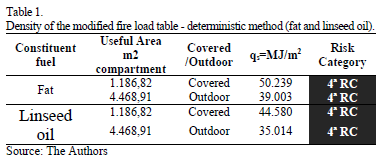
<body><![CDATA[<p><font size="2" face="Verdana, Arial, Helvetica, sans-serif">This is based on statistical results for   the type of activity in the mentioned fireguard compartments.</font></p>     <p><font size="2" face="Verdana, Arial, Helvetica, sans-serif"><b><i>2.2. Classification of Risk   Category</i></b></font></p>     <p><font size="2" face="Verdana, Arial, Helvetica, sans-serif">After the   calculation of the modified fire load in the Building under study it was determined as a type XII risk category according to the X framework of Annex   III of Decree Nr. 220/2008 of 12<sup>th</sup> November-Portugal &#91;2&#93;.</font></p>     <p>&nbsp;</p>     <p><b><font size="3" face="Verdana, Arial, Helvetica, sans-serif">3. Study Case</font></b></p>     <p><font size="2" face="Verdana, Arial, Helvetica, sans-serif">This study was based in two type XII Buildings with   distinct activities, manufacture and storage and they were designated as Building 1   and Building 2.</font></p>     <p><font size="2" face="Verdana, Arial, Helvetica, sans-serif">Building 1 has storage and does refining of oils, and all products are   manufactured and stored in tanks with the maximum capacity of 80% tank volume.</font></p>     <p><font size="2" face="Verdana, Arial, Helvetica, sans-serif">The stored   products and subjected to refining are mainly made from cooking oil. Referring   to <a href="#tab01">Table 1</a> of the legal Technical   Regulation Nr. 2074 / 2009 January 15<sup>th</sup> &#91;3&#93; it is stated that   in order to calculate the calorific fuel power (Hi), the material that has   similar characteristics may be Flaxseed Oil (Hi = 37.2 MJ/kg) and fat (Hi =   42MJ/kg). In order to demonstrate if this choice influenced the value of the   modified fire load, calculations were made using the two values.</font></p>     <p align="center"><font size="2" face="Verdana, Arial, Helvetica, sans-serif"><a name="tab01"></a></font><img src="/img/revistas/dyna/v83n196/v83n196a01tab01.gif"></p>     <p><font size="2" face="Verdana, Arial, Helvetica, sans-serif">Building 2 is dedicated to drying, storage and processing of grain. All   products are stored in silos, verifying the maximum capacity of 100%.</font></p>     ]]></body>
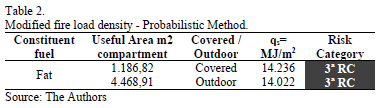
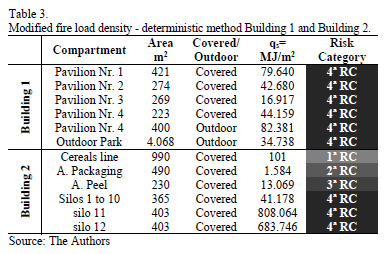
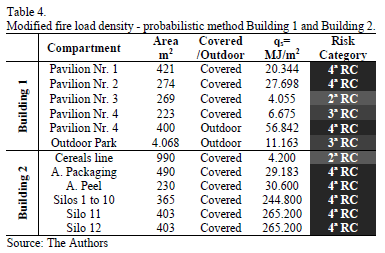
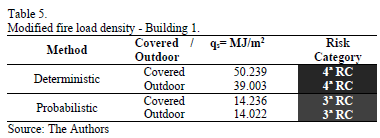
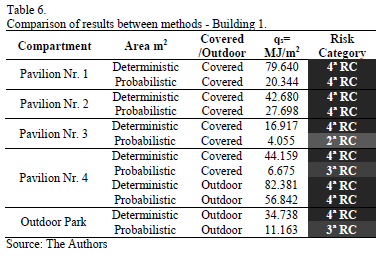
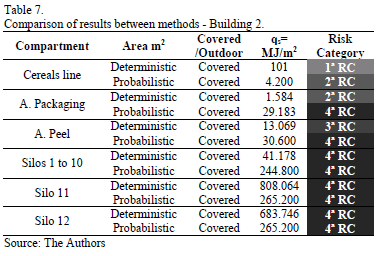
<body><![CDATA[<p>&nbsp;</p>     <p><font size="3" face="Verdana, Arial, Helvetica, sans-serif"><b>4. Results</b></font></p>     <p><font size="2" face="Verdana, Arial, Helvetica, sans-serif">In the first phase of the study it was   verified that calculation results of Building 1 differed significantly, if they were   based on constituent fuel fat or linseed oil. The calculations performed by the   deterministic method revealed the results   represented in <a href="#tab01">Table 1</a>.</font></p>     <p><font size="2" face="Verdana, Arial, Helvetica, sans-serif">Once   verified that there is no significant difference in the results, the remaining   calculations were made with fat component.</font></p>     <p><font size="2" face="Verdana, Arial, Helvetica, sans-serif">First, and   because, according to the organization, this is what corresponds to the stored   and manufactured products and secondly because it has higher H<sub>i</sub>,   thus being the most prudent calculation &#91;6&#93;.</font></p>     <p><font size="2" face="Verdana, Arial, Helvetica, sans-serif">In the second phase we calculated the   density of the modified fire load by the probabilistic method (<a href="#tab02">Table 2</a>).</font></p>     <p align="center"><font size="2" face="Verdana, Arial, Helvetica, sans-serif"><a name="tab02"></a></font><img src="/img/revistas/dyna/v83n196/v83n196a01tab02.gif"></p>     <p><font size="2" face="Verdana, Arial, Helvetica, sans-serif">In the third phase, we proceeded equally,   the calculation of the fire load density per shed by deterministic and   probabilistic method to determine whether there were significant differences,   if the spaces of the building had fireguard and we extended our study to Building 2   that had a fireguard (<a href="#tab03">Table 3</a> and <a href="#tab04">Table 4</a>).</font></p>     <p align="center"><font size="2" face="Verdana, Arial, Helvetica, sans-serif"><a name="tab03"></a></font><img src="/img/revistas/dyna/v83n196/v83n196a01tab03.gif"></p>     <p align="center"><font size="2" face="Verdana, Arial, Helvetica, sans-serif"><a name="tab04"></a></font><img src="/img/revistas/dyna/v83n196/v83n196a01tab04.gif"></p>     ]]></body>
<body><![CDATA[<p><font size="2" face="Verdana, Arial, Helvetica, sans-serif">During the fourth phase, summary tables   were elaborated to facilitate the comparison of results and classification of   risk categories between methods (<a href="#tab05">Table 5</a>).</font></p>     <p align="center"><font size="2" face="Verdana, Arial, Helvetica, sans-serif"><a name="tab05"></a></font><img src="/img/revistas/dyna/v83n196/v83n196a01tab05.gif"></p>     <p><font size="2" face="Verdana, Arial, Helvetica, sans-serif">Finally the obtained results were   compared using two methods of calculation for the Building 1 and Building 2   with fireguard (<a href="#tab06">Table 6</a> and <a href="#tab07">Table 7</a>).</font></p>     <p align="center"><font size="2" face="Verdana, Arial, Helvetica, sans-serif"><a name="tab06"></a></font><img src="/img/revistas/dyna/v83n196/v83n196a01tab06.gif"></p>     <p align="center"><font size="2" face="Verdana, Arial, Helvetica, sans-serif"><a name="tab07"></a></font><img src="/img/revistas/dyna/v83n196/v83n196a01tab07.gif"></p>     <p>&nbsp;</p>     <p><font size="3" face="Verdana, Arial, Helvetica, sans-serif"><b>5. Discussion </b></font></p>     <p><font size="2" face="Verdana, Arial, Helvetica, sans-serif">In Building 1, the use of distinct fuel constituents   in the calculation resulted in no significant change in the results (<a href="#tab01">Table 1</a>).   However, we consider that further studies should broaden the base of the study   sample and validate the now obtained conclusion.</font></p>     <p><font size="2" face="Verdana, Arial, Helvetica, sans-serif">The comparative analysis made between the   two methods for Building 1 (<a href="#tab05">Table 5</a>) provided a value of the modified fire load   density (qs) different between the deterministic and the probabilistic method.   The difference in the results is significant, causing changes in the Building occupancy risk category (<a href="#tab01">Table 1</a> and <a href="#tab02">Table 2</a>).</font></p>     <p><font size="2" face="Verdana, Arial, Helvetica, sans-serif">When we considered Building 1   with fireguard and we extended our study to Building 2, it was   possible to perceive significant differences in the modified fire load density   of the respective compartments (<a href="#tab03">Table 3</a> and <a href="#tab04">Table 4</a>).</font></p>     ]]></body>
<body><![CDATA[<p><font size="2" face="Verdana, Arial, Helvetica, sans-serif">In the comparative analysis made between   the two methods for Building 1 and Building 2 (<a href="#tab06">Table 6</a> and <a href="#tab07">Table 7</a>), the differences   found changed the risk category. </font></p>     <p><font size="2" face="Verdana, Arial, Helvetica, sans-serif">When we studied Building 1, we noticed   that the deterministic method always presented higher values. However, with Building 2,   the deterministic method only showed higher values when the constituent fuel   occupied the entire fireguard compartment (<a href="#tab07">Table 7</a> - Silos 11 and 12).</font></p>     <p><font size="2" face="Verdana, Arial, Helvetica, sans-serif">This study considers Building 1   with fireguard compartment. When we extended the study to Building 2,   it presented greater disparity in values between the deterministic and   probabilistic methods.</font></p>     <p><font size="2" face="Verdana, Arial, Helvetica, sans-serif">For Building type XI, &quot;libraries and archives&quot;, and XII, &quot;industrial, workshops and warehouses&quot;, the   value of the modified fire load density is an important factor in determining   the risk category. This will later define the technical requirements that   should be adopted according to the Legal Regime of Portuguese Fire Safety in   Buildings. This difference between building types will change the technical and   specific conditions required by the regulation for the building's occupancy code.</font></p>     <p><font size="2" face="Verdana, Arial, Helvetica, sans-serif">A range of results were obtained by the   modified method of the deterministic fire load density of 16 917 MJ/m2 and 82   381 MJ/m2 for the Building 1 and 41 178 MJ/m2 and 808 064 MJ/m2 for the Building 2.   We questioned the value shown in Table X, of the Law Decree Nr. 220/2008 of 12<sup>th</sup> November &#91;2&#93; for the 4<sup>th</sup> RC&gt; 15,000 MJ/m2 (integrated in   buildings) and&gt; 30,000 MJ/m2 (outdoor) is not adjusted, and should be   changed a superior limit. </font></p>     <p><font size="2" face="Verdana, Arial, Helvetica, sans-serif">The Law Decree values were based on the   work undertaken by Engineer Max Gretener in the 60s, and the activities and   storage made at that time does not reflect the current reality &#91;4&#93;. </font></p>     <p><font size="2" face="Verdana, Arial, Helvetica, sans-serif">Compared to 2009, in 2015 the   organizations already have IT tools allowing the calculation of fire load   density that best reflects the reality of the organization - deterministic   method.</font></p>     <p>&nbsp;</p>     <p><font size="3" face="Verdana, Arial, Helvetica, sans-serif"><b>6. Conclusions</b></font></p>     <p><font size="2" face="Verdana, Arial, Helvetica, sans-serif">In this study, we conclude that the   calculation method used for the classification of type XII Building risk   category makes a difference. The legislator does not define which method to use   and therefore leaves it up to each technician to select and determine the building occupancy risk category. Thus the goal as stated in the Legal Regime of   Portuguese Fire Safety in Buildings, which is to standardize the level of   demand in the implementation of Fire Safety in Buildings measures cannot be   achieved. It is also necessary to define criteria for method selection, in   order to standardize the level of demand in the implementation of Fire Safety   measures for Buildings.</font></p>     ]]></body>
<body><![CDATA[<p><font size="2" face="Verdana, Arial, Helvetica, sans-serif">In later studies, we intend to   investigate the criteria to be used in the method selection, which will   standardize the risk classification results, regardless of the used calculation   method.</font></p>     <p>&nbsp;</p>     <p><font size="3" face="Verdana, Arial, Helvetica, sans-serif"><b>References</b></font></p>     <!-- ref --><p><font size="2" face="Verdana, Arial, Helvetica, sans-serif"><b>&#91;1&#93;</b> Castro, C.F. e Abrantes, J.B., Manual de Segurança contra Incêndio em   Edif&iacute;cios, Vol. I, 2ª   ed., E.N. Bombeiros, Sintra, Portugal, 2009, 46 P.    &nbsp;&nbsp;&nbsp;&nbsp;&nbsp;&nbsp;&nbsp;&nbsp;[&#160;<a href="javascript:void(0);" onclick="javascript: window.open('/scielo.php?script=sci_nlinks&ref=1155982&pid=S0012-7353201600020000100001&lng=','','width=640,height=500,resizable=yes,scrollbars=1,menubar=yes,');">Links</a>&#160;]<!-- end-ref --></font></p>     <!-- ref --><p><font size="2" face="Verdana, Arial, Helvetica, sans-serif"><b>&#91;2&#93;</b> Decreto-Lei n.º 220/2008, 12   de Novembro de 2008, alterado pelo Decreto-Lei nº 224/2015, 9 de Outubro de   2015, Regime Jur&iacute;dico da Segurança   Contra Incêndios em Edif&iacute;cios, Di&aacute;rio da Rep&uacute;blica, Portugal.    &nbsp;&nbsp;&nbsp;&nbsp;&nbsp;&nbsp;&nbsp;&nbsp;[&#160;<a href="javascript:void(0);" onclick="javascript: window.open('/scielo.php?script=sci_nlinks&ref=1155984&pid=S0012-7353201600020000100002&lng=','','width=640,height=500,resizable=yes,scrollbars=1,menubar=yes,');">Links</a>&#160;]<!-- end-ref --></font></p>     <!-- ref --><p><font size="2" face="Verdana, Arial, Helvetica, sans-serif"><b>&#91;3&#93;</b> Despacho nº 2074/2009, 15 de   Janeiro de 2009, Crit&eacute;rios t&eacute;cnicos   para determinação da densidade de carga de incêndio modificada, Di&aacute;rio da   Rep&uacute;blica, 2ª S&eacute;rie nº 10.    &nbsp;&nbsp;&nbsp;&nbsp;&nbsp;&nbsp;&nbsp;&nbsp;[&#160;<a href="javascript:void(0);" onclick="javascript: window.open('/scielo.php?script=sci_nlinks&ref=1155986&pid=S0012-7353201600020000100003&lng=','','width=640,height=500,resizable=yes,scrollbars=1,menubar=yes,');">Links</a>&#160;]<!-- end-ref --></font></p>     <!-- ref --><p><font size="2" face="Verdana, Arial, Helvetica, sans-serif"><b>&#91;4&#93;</b> Miguel, M. e Silvano, P., Regulamento de segurança em tabelas, f&aacute;brica   das letras, Lisboa, Portugal, 2009, pp. 337-338.    &nbsp;&nbsp;&nbsp;&nbsp;&nbsp;&nbsp;&nbsp;&nbsp;[&#160;<a href="javascript:void(0);" onclick="javascript: window.open('/scielo.php?script=sci_nlinks&ref=1155988&pid=S0012-7353201600020000100004&lng=','','width=640,height=500,resizable=yes,scrollbars=1,menubar=yes,');">Links</a>&#160;]<!-- end-ref --></font></p>     <!-- ref --><p><font size="2" face="Verdana, Arial, Helvetica, sans-serif"><b>&#91;5&#93;</b> Almeida, J.E., Segurança   contra incêndios em armaz&eacute;ns. &#91;Online&#93;. &#91;Consulta, 2 de Agosto de 2014&#93;,   Dispon&iacute;vel em: <a href="http://www.avantec.net/artigos/APAT73_armazens.pdf" target="_blank">http://www.avantec.net/artigos/APAT73_armazens.pdf</a>.    &nbsp;&nbsp;&nbsp;&nbsp;&nbsp;&nbsp;&nbsp;&nbsp;[&#160;<a href="javascript:void(0);" onclick="javascript: window.open('/scielo.php?script=sci_nlinks&ref=1155990&pid=S0012-7353201600020000100005&lng=','','width=640,height=500,resizable=yes,scrollbars=1,menubar=yes,');">Links</a>&#160;]<!-- end-ref --></font></p>     <!-- ref --><p><font size="2" face="Verdana, Arial, Helvetica, sans-serif"><b>&#91;6&#93;</b> Arezes, P., Baptista, J.S.,   Barroso, M.P., Carneiro, P., Cordeiro, P., Costa, N., et al., Occupational Safety and Hygiene SHO2015, Sociedade Portuguesa de Segurança e Higiene Ocupacionais (SPOSHO), Guimarâes,   Portugal, 2015, pp. 270-272.    &nbsp;&nbsp;&nbsp;&nbsp;&nbsp;&nbsp;&nbsp;&nbsp;[&#160;<a href="javascript:void(0);" onclick="javascript: window.open('/scielo.php?script=sci_nlinks&ref=1155992&pid=S0012-7353201600020000100006&lng=','','width=640,height=500,resizable=yes,scrollbars=1,menubar=yes,');">Links</a>&#160;]<!-- end-ref --></font></p>     <!-- ref --><p><font size="2" face="Verdana, Arial, Helvetica, sans-serif"><b>&#91;7&#93;</b> GEPRIX. C&aacute;lculo da carga de incêndio modificada. &#91;Online&#93;. &#91;Consulta 1   de Novembro de 2015&#93;, Dispon&iacute;vel em: <a href="http://www.geprix.com/mediateca/c%C3%A1lculo-da-densidade-de-carga-de-inc%C3%AAndio-modificada" target="_blank">http://www.geprix.com/mediateca/c%C3%A1lculo-da-densidade-de-carga-de-inc%C3%AAndio-modificada</a> </font>&nbsp;&nbsp;&nbsp;&nbsp;&nbsp;&nbsp;&nbsp;&nbsp;[&#160;<a href="javascript:void(0);" onclick="javascript: window.open('/scielo.php?script=sci_nlinks&ref=1155994&pid=S0012-7353201600020000100007&lng=','','width=640,height=500,resizable=yes,scrollbars=1,menubar=yes,');">Links</a>&#160;]<!-- end-ref --><!-- ref --><p><font size="2" face="Verdana, Arial, Helvetica, sans-serif"><b>&#91;8&#93;</b> G-Rodrigues, A.D., Comparação das medidas de autoproteção   exig&iacute;veis, face ao enquadramento legal na &aacute;rea de segurança contra incêndio em   edif&iacute;cios, Tese de Mestrado. Obtido de Universidade de Lisboa-Sistema   Integrado de Bibliotecas. &#91;Online&#93;. &#91;Consulta de 30 de Outubro de 2015&#93;.   Dispon&iacute;vel em: <a href="http://hdl.handle.net/10400.5/3889" target="_blank">http://hdl.handle.net/10400.5/3889</a></font>&nbsp;&nbsp;&nbsp;&nbsp;&nbsp;&nbsp;&nbsp;&nbsp;[&#160;<a href="javascript:void(0);" onclick="javascript: window.open('/scielo.php?script=sci_nlinks&ref=1155995&pid=S0012-7353201600020000100008&lng=','','width=640,height=500,resizable=yes,scrollbars=1,menubar=yes,');">Links</a>&#160;]<!-- end-ref --><!-- ref --><p><font size="2" face="Verdana, Arial, Helvetica, sans-serif"><b>&#91;9&#93;</b> Trabajo, I.N., NTP 766 - Notas T&eacute;cnicas de   Prevenci&oacute;n. Carga de fuego ponderada: Par&aacute;metros de c&aacute;lculo, 2007.    &nbsp;&nbsp;&nbsp;&nbsp;&nbsp;&nbsp;&nbsp;&nbsp;[&#160;<a href="javascript:void(0);" onclick="javascript: window.open('/scielo.php?script=sci_nlinks&ref=1155996&pid=S0012-7353201600020000100009&lng=','','width=640,height=500,resizable=yes,scrollbars=1,menubar=yes,');">Links</a>&#160;]<!-- end-ref --></font></p>     <!-- ref --><p><font size="2" face="Verdana, Arial, Helvetica, sans-serif"><b>&#91;10&#93;</b> NFPA 557: Standard for Determination   of Fire Loads for Use in Structural Fire Protection design. National Fire   Protection Association, 2010.    &nbsp;&nbsp;&nbsp;&nbsp;&nbsp;&nbsp;&nbsp;&nbsp;[&#160;<a href="javascript:void(0);" onclick="javascript: window.open('/scielo.php?script=sci_nlinks&ref=1155998&pid=S0012-7353201600020000100010&lng=','','width=640,height=500,resizable=yes,scrollbars=1,menubar=yes,');">Links</a>&#160;]<!-- end-ref --></font></p>     <p>&nbsp;</p>     <p><font size="2" face="Verdana, Arial, Helvetica, sans-serif"><b>C.M. Cadete-Pires,</b> has a graduation in Engineering in Safety, Quality and Environmental   Management from the Instituto Superior de L&iacute;nguas e Administração - ISLA   Santar&eacute;m, Portugal. She currently works as a trainer and consultant in Hygiene   and Safety at Work and Quality, Environment and Safety. ORCID ID: 0000-0001-5244-6002</font></p>     <p><font size="2" face="Verdana, Arial, Helvetica, sans-serif"><b>R.A.   Carvalho-Veiga,</b> has an academic   education in Hygiene and Safety at work, Human Resource Management and Social   Policy from the University of Leon, Espa&ntilde;a, the Instituto   Superior de L&iacute;nguas e Administração - ISLA Santar&eacute;m, Protugal and Social Service   Institute of Lisbon, Portugal. He is a teacher at ISLA and at the European   University. He works also as a trainer and consultant in the area of hygiene   and safety at work. He is a co-author and coordinator of several publications   of Hygiene and Safety at Work and author of multiple articles. ORCID ID: 0000-0001-9515-9978</font></p>     <p><font size="2" face="Verdana, Arial, Helvetica, sans-serif"><b>M.I.   Simões-Miguel,</b> is PhD student in Business Management at the   University of Coimbra, Portugal. She has a MSc. in Human Resource Management. She   is certified in School Libraries Management and E-Learning system, and has an   English Language Teacher Certification from the University of Cambridge and a   Degree in Modern Languages and Literature from the University of Lisbon. She is Assistant Professor and Trainer at ISLA   Santar&eacute;m, Portugal and co-author of multiple articles in the area of knowledge   management and consultancy. ORCID ID: 0000-0003-4233-225X</font></p>      ]]></body><back>
<ref-list>
<ref id="B1">
<label>1</label><nlm-citation citation-type="book">
<person-group person-group-type="author">
<name>
<surname><![CDATA[Castro]]></surname>
<given-names><![CDATA[C.F.]]></given-names>
</name>
<name>
<surname><![CDATA[Abrantes]]></surname>
<given-names><![CDATA[J.B.]]></given-names>
</name>
</person-group>
<source><![CDATA[Manual de Segurança contra Incêndio em Edifícios]]></source>
<year>2009</year>
<volume>I</volume>
<edition>2ª</edition>
<publisher-loc><![CDATA[Sintra ]]></publisher-loc>
<publisher-name><![CDATA[E.N. Bombeiros]]></publisher-name>
</nlm-citation>
</ref>
<ref id="B2">
<label>2</label><nlm-citation citation-type="book">
<source><![CDATA[Decreto-Lei n.º 220/2008, 12 de Novembro de 2008: alterado pelo Decreto-Lei nº 224/2015, 9 de Outubro de 2015]]></source>
<year></year>
<publisher-name><![CDATA[Diário da República]]></publisher-name>
</nlm-citation>
</ref>
<ref id="B3">
<label>3</label><nlm-citation citation-type="book">
<source><![CDATA[Despacho nº 2074/2009, 15 de Janeiro de 2009: Critérios técnicos para determinação da densidade de carga de incêndio modificada]]></source>
<year></year>
<edition>2ª</edition>
<publisher-name><![CDATA[Diário da República]]></publisher-name>
</nlm-citation>
</ref>
<ref id="B4">
<label>4</label><nlm-citation citation-type="">
<person-group person-group-type="author">
<name>
<surname><![CDATA[Miguel]]></surname>
<given-names><![CDATA[M.]]></given-names>
</name>
<name>
<surname><![CDATA[Silvano]]></surname>
<given-names><![CDATA[P.]]></given-names>
</name>
</person-group>
<source><![CDATA[Regulamento de segurança em tabelas, fábrica das letras]]></source>
<year>2009</year>
<page-range>337-338</page-range><publisher-loc><![CDATA[Lisboa ]]></publisher-loc>
</nlm-citation>
</ref>
<ref id="B5">
<label>5</label><nlm-citation citation-type="">
<person-group person-group-type="author">
<name>
<surname><![CDATA[Almeida]]></surname>
<given-names><![CDATA[J.E.]]></given-names>
</name>
</person-group>
<source><![CDATA[Segurança contra incêndios em armazéns.]]></source>
<year></year>
</nlm-citation>
</ref>
<ref id="B6">
<label>6</label><nlm-citation citation-type="book">
<person-group person-group-type="author">
<name>
<surname><![CDATA[Arezes]]></surname>
<given-names><![CDATA[P.]]></given-names>
</name>
<name>
<surname><![CDATA[Baptista]]></surname>
<given-names><![CDATA[J.S.]]></given-names>
</name>
<name>
<surname><![CDATA[Barroso]]></surname>
<given-names><![CDATA[M.P.]]></given-names>
</name>
<name>
<surname><![CDATA[Carneiro]]></surname>
<given-names><![CDATA[P.]]></given-names>
</name>
<name>
<surname><![CDATA[Cordeiro]]></surname>
<given-names><![CDATA[P.]]></given-names>
</name>
<name>
<surname><![CDATA[Costa]]></surname>
<given-names><![CDATA[N.]]></given-names>
</name>
</person-group>
<source><![CDATA[Occupational Safety and Hygiene SHO2015]]></source>
<year>2015</year>
<page-range>270-272</page-range><publisher-loc><![CDATA[Guimarâes ]]></publisher-loc>
<publisher-name><![CDATA[Sociedade Portuguesa de Segurança e Higiene Ocupacionais]]></publisher-name>
</nlm-citation>
</ref>
<ref id="B7">
<label>7</label><nlm-citation citation-type="">
<collab>GEPRIX</collab>
<source><![CDATA[Cálculo da carga de incêndio modificada]]></source>
<year></year>
</nlm-citation>
</ref>
<ref id="B8">
<label>8</label><nlm-citation citation-type="">
<person-group person-group-type="author">
<name>
<surname><![CDATA[G-Rodrigues]]></surname>
<given-names><![CDATA[A.D.]]></given-names>
</name>
</person-group>
<source><![CDATA[Comparação das medidas de autoproteção exigíveis, face ao enquadramento legal na área de segurança contra incêndio em edifícios]]></source>
<year></year>
</nlm-citation>
</ref>
<ref id="B9">
<label>9</label><nlm-citation citation-type="">
<person-group person-group-type="author">
<name>
<surname><![CDATA[Trabajo]]></surname>
<given-names><![CDATA[I.N.]]></given-names>
</name>
</person-group>
<source><![CDATA[NTP 766 - Notas Técnicas de Prevención.: Carga de fuego ponderada: Parámetros de cálculo]]></source>
<year>2007</year>
</nlm-citation>
</ref>
<ref id="B10">
<label>10</label><nlm-citation citation-type="book">
<source><![CDATA[NFPA 557: Standard for Determination of Fire Loads for Use in Structural Fire Protection design.]]></source>
<year>2010</year>
<publisher-name><![CDATA[National Fire Protection Association]]></publisher-name>
</nlm-citation>
</ref>
</ref-list>
</back>
</article>