<?xml version="1.0" encoding="ISO-8859-1"?><article xmlns:mml="http://www.w3.org/1998/Math/MathML" xmlns:xlink="http://www.w3.org/1999/xlink" xmlns:xsi="http://www.w3.org/2001/XMLSchema-instance">
<front>
<journal-meta>
<journal-id>0012-7353</journal-id>
<journal-title><![CDATA[DYNA]]></journal-title>
<abbrev-journal-title><![CDATA[Dyna rev.fac.nac.minas]]></abbrev-journal-title>
<issn>0012-7353</issn>
<publisher>
<publisher-name><![CDATA[Universidad Nacional de Colombia]]></publisher-name>
</publisher>
</journal-meta>
<article-meta>
<article-id>S0012-73532016000200002</article-id>
<article-id pub-id-type="doi">10.15446/dyna.v83n196.56603</article-id>
<title-group>
<article-title xml:lang="en"><![CDATA[Application of the Delphi Method for the inclusion of externalities in occupational safety and health analysis]]></article-title>
<article-title xml:lang="es"><![CDATA[Aplicación del método Delphi para la inclusión de las externalidades en análisis de seguridad y de salud laboral]]></article-title>
</title-group>
<contrib-group>
<contrib contrib-type="author">
<name>
<surname><![CDATA[Ramos]]></surname>
<given-names><![CDATA[Delfina]]></given-names>
</name>
<xref ref-type="aff" rid="A01"/>
</contrib>
<contrib contrib-type="author">
<name>
<surname><![CDATA[Arezes]]></surname>
<given-names><![CDATA[Pedro]]></given-names>
</name>
<xref ref-type="aff" rid="A02"/>
</contrib>
<contrib contrib-type="author">
<name>
<surname><![CDATA[Afonso]]></surname>
<given-names><![CDATA[Paulo]]></given-names>
</name>
<xref ref-type="aff" rid="A02"/>
</contrib>
</contrib-group>
<aff id="A01">
<institution><![CDATA[,Polytechnic Institute of Cávado and Ave Technology School ]]></institution>
<addr-line><![CDATA[Barcelos ]]></addr-line>
<country>Portugal</country>
</aff>
<aff id="A02">
<institution><![CDATA[,University of Minho Center Algoritmi ]]></institution>
<addr-line><![CDATA[Guimarães ]]></addr-line>
<country>Portugal</country>
</aff>
<aff id="A">
<institution><![CDATA[,psafonso@dps.uminho.pt  ]]></institution>
<addr-line><![CDATA[ ]]></addr-line>
</aff>
<pub-date pub-type="pub">
<day>00</day>
<month>04</month>
<year>2016</year>
</pub-date>
<pub-date pub-type="epub">
<day>00</day>
<month>04</month>
<year>2016</year>
</pub-date>
<volume>83</volume>
<numero>196</numero>
<fpage>14</fpage>
<lpage>20</lpage>
<copyright-statement/>
<copyright-year/>
<self-uri xlink:href="http://www.scielo.org.co/scielo.php?script=sci_arttext&amp;pid=S0012-73532016000200002&amp;lng=en&amp;nrm=iso"></self-uri><self-uri xlink:href="http://www.scielo.org.co/scielo.php?script=sci_abstract&amp;pid=S0012-73532016000200002&amp;lng=en&amp;nrm=iso"></self-uri><self-uri xlink:href="http://www.scielo.org.co/scielo.php?script=sci_pdf&amp;pid=S0012-73532016000200002&amp;lng=en&amp;nrm=iso"></self-uri><abstract abstract-type="short" xml:lang="en"><p><![CDATA[Organizations should regularly conduct an assessment of their occupational hazards in order to design and implement preventive measures that are necessary and sufficient to deal with the level of risk, the costs of prevention and the safety at levels considered acceptable by the organization. Furthermore, the selection of measures to be implemented in an organization should take into account both internal and external costs. Externalities are of great importance in terms of the costs of accidents at work; nevertheless, they are not often properly addressed by the organizations. In this paper we describe an application of the Delphi method to understand how externalities can be included in Occupational Safety and Health.]]></p></abstract>
<abstract abstract-type="short" xml:lang="es"><p><![CDATA[Las organizaciones deben realizar periódicamente una evaluación de sus riesgos laborales con el fin de diseñar y poner en práctica medidas preventivas que sean necesarias y suficientes para mantener e l nivel de riesgo, los costos de la prevención y la seguridad en los niveles considerados aceptables por la organización. Por otra parte, la selección de las medidas a aplicar en una organización debe tener en cuenta tanto los costes internos como externos. Las externalidades son de gran importancia en términos de los costos de los accidentes de trabajo; sin embargo, a menudo no se tratan adecuadamente por las organizaciones. En este artículo se describe una aplicación del método Delphi para entender cómo los factores externos pueden ser incluidos en la Seguridad y Salud Laboral.]]></p></abstract>
<kwd-group>
<kwd lng="en"><![CDATA[Occupational Safety and Health]]></kwd>
<kwd lng="en"><![CDATA[Externalities]]></kwd>
<kwd lng="en"><![CDATA[Economic perspective]]></kwd>
<kwd lng="en"><![CDATA[Delphi Method]]></kwd>
<kwd lng="es"><![CDATA[Seguridad y Salud Ocupacional]]></kwd>
<kwd lng="es"><![CDATA[Externalidades]]></kwd>
<kwd lng="es"><![CDATA[Economía]]></kwd>
<kwd lng="es"><![CDATA[Método Delphi]]></kwd>
</kwd-group>
</article-meta>
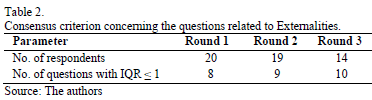
</front><body><![CDATA[ <p><font size="1" face="Verdana, Arial, Helvetica, sans-serif"><b>DOI:</b> <a href="http://dx.doi.org/10.15446/dyna.v83n196.56603" target="_blank">http://dx.doi.org/10.15446/dyna.v83n196.56603</a></font></p>     <p align="center"><font size="4" face="Verdana, Arial, Helvetica, sans-serif"><b>Application of the Delphi Method   for the inclusion of externalities in occupational safety and health analysis</b></font></p>     <p align="center"><i><font size="3"><b><font face="Verdana, Arial, Helvetica, sans-serif">Aplicaci&oacute;n   del m&eacute;todo Delphi para la inclusi&oacute;n de las externalidades en an&aacute;lisis de   seguridad y de salud laboral</font></b></font></i></p>     <p align="center">&nbsp;</p>     <p align="center"><b><font size="2" face="Verdana, Arial, Helvetica, sans-serif">Delfina Ramos <i><sup>ab</sup></i>,   Pedro Arezes <i><sup>b</sup></i> &amp; Paulo   Afonso <i><sup>b</sup></i></font></b></p>     <p align="center">&nbsp;</p>     <p align="center"><font size="2" face="Verdana, Arial, Helvetica, sans-serif"><sup><i>a </i></sup><i>Technology   School, Polytechnic Institute of C&aacute;vado and Ave, Barcelos, Portugal <a href="mailto:gramos@ipca.pt">gramos@ipca.pt</a>    <br>   <sup>b</sup> Center Algoritmi, University of Minho,   Guimarães, Portugal. <a href="mailto:parezes@dps.uminho.pt">parezes@dps.uminho.pt</a>; <a href="mailto:psafonso@dps.uminho.pt">psafonso@dps.uminho.pt</a></i></font></p>     <p align="center">&nbsp;</p>     <p align="center"><font size="2" face="Verdana, Arial, Helvetica, sans-serif"><b>Received: November 30<sup>th</sup>, 2015.   Received in revised form: February 29<sup>th</sup>, 2016. Accepted: March 07<sup>th</sup>,   2016.</b></font></p>     ]]></body>
<body><![CDATA[<p align="center">&nbsp;</p>     <p align="center"><font size="1" face="Verdana, Arial, Helvetica, sans-seriff"><b>This work is licensed under a</b> <a rel="license" href="http://creativecommons.org/licenses/by-nc-nd/4.0/">Creative Commons Attribution-NonCommercial-NoDerivatives 4.0 International License</a>.</font><br />   <a rel="license" href="http://creativecommons.org/licenses/by-nc-nd/4.0/"><img style="border-width:0" src="https://i.creativecommons.org/l/by-nc-nd/4.0/88x31.png" /></a></p> <hr>     <p><font size="2" face="Verdana, Arial, Helvetica, sans-serif"><b>Abstract    <br>   </b></font><font size="2" face="Verdana, Arial, Helvetica, sans-serif">Organizations should regularly conduct   an assessment of their occupational hazards in order to design and implement   preventive measures that are necessary and sufficient to deal with the level of   risk, the costs of prevention and the safety at levels considered acceptable by   the organization. Furthermore, the selection of measures to be implemented in   an organization should take into account both internal and external costs.   Externalities are of great importance in terms of the costs of accidents at   work; nevertheless, they are not often properly addressed by the organizations.   In this paper we describe an application of the Delphi method to understand how   externalities can be included in Occupational Safety and Health.</font></p>     <p><font size="2" face="Verdana, Arial, Helvetica, sans-serif"><i>Keywords</i>: Occupational Safety and Health; Externalities, Economic   perspective, Delphi Method.</font></p>     <p><font size="2" face="Verdana, Arial, Helvetica, sans-serif"><b>Resumen    <br>   </b></font><font size="2" face="Verdana, Arial, Helvetica, sans-serif">Las organizaciones   deben realizar peri&oacute;dicamente una evaluaci&oacute;n de sus riesgos laborales con el   fin de dise&ntilde;ar y poner en pr&aacute;ctica medidas preventivas que sean necesarias y   suficientes para mantener e l nivel de riesgo, los costos de la prevenci&oacute;n y la   seguridad en los niveles considerados aceptables por la organizaci&oacute;n. Por otra   parte, la selecci&oacute;n de las medidas a aplicar en una organizaci&oacute;n debe tener en   cuenta tanto los costes internos como externos. Las externalidades son de gran   importancia en t&eacute;rminos de los costos de los accidentes de trabajo; sin embargo, a menudo no se tratan adecuadamente   por las organizaciones. En este art&iacute;culo se describe una aplicaci&oacute;n del m&eacute;todo Delphi para   entender c&oacute;mo los factores externos pueden ser incluidos en la Seguridad y Salud Laboral.</font></p>     <p><font size="2" face="Verdana, Arial, Helvetica, sans-serif"><i>Palabras clave:</i> Seguridad y Salud Ocupacional; Externalidades,   Econom&iacute;a, M&eacute;todo Delphi.</font></p> <hr>     <p>&nbsp;</p>     <p><font size="3" face="Verdana, Arial, Helvetica, sans-serif"><b>1. Introduction</b></font></p>     ]]></body>
<body><![CDATA[<p><font size="2" face="Verdana, Arial, Helvetica, sans-serif">Economists tend to emphasize the costs   and economic benefits of additional safety, which is in contrast to safety   experts, who generally have a particular focus on safe working conditions and   in designing safe products &#91;1&#93;. Certainly, the organization's financial costs and   benefits involved in Occupational Safety and Health (OSH) are an important   aspect of economic analysis; however, society-at-large's perspective is far   more important. This perspective includes workers, their families and their   communities as well as enterprises, and it recognizes that not all the effects   of ill-health show up in monetary transactions.</font></p>     <p><font size="2" face="Verdana, Arial, Helvetica, sans-serif">Both individuals and society lose   emotionally and financially from injuries and accidents. Individuals can be   understood to make their own best safety decisions if they have good   information and the correct incentives. In this context, society may subsidize   risk taking in many ways, thereby discouraging safety. Thus, regulation is   required to deal with such externalities &#91;2&#93;.</font></p>     <p><font size="2" face="Verdana, Arial, Helvetica, sans-serif">According   to Ag&eacute;nor and Dinh &#91;3&#93;, as defined by Putnam in 1993, there is a &quot;social   capital&quot; that consists of &quot;those features of social organization, such as   networks of individuals or households, and the associated norms and values that   create externalities for the community as a whole&quot;. Although a number of   economists initially questioned the validity of classifying social interactions   as a form of capital, an increasing number of them now acknowledge that social   capital shares at least some similarities with physical and human capital in   its inter-temporal dimension and its ability to generate external effects and   future benefits. These externalities include information sharing among   individuals and firms; and the matching of people to economic opportunities,   mutual aid and insurance, which may affect expectations and individual   behavior, as well as effective collective action. Social capital also enables   agents to cope with market imperfections or imperfect institutions.</font></p>     <p><font size="2" face="Verdana, Arial, Helvetica, sans-serif">According to Varian &#91;4&#93;, the definition   of externality is that the action of an agent affects the living conditions of   another agent not involved in that action. Externalities can also be defined   as: &quot;the uncompensated impact of actions of one person over the welfare of a   spectator&quot; &#91;5&#93;. The focus on human welfare, primarily used as a synonym for   human utility, is due to the traditional utilitarianism of economics.</font></p>     <p><font size="2" face="Verdana, Arial, Helvetica, sans-serif">Samuelson and Nordhaus &#91;6&#93; state that   externalities occur when companies or individuals impose costs or benefits on   others who are not involved in the market. In the same way, Van Beukering et   al. &#91;7&#93; consider that an externality occurs when an economic decision has an   impact on the welfare of another economic agent not directly involved in the   process. This results from the fact that the possibility of impact has not been   properly addressed or has been disregarded. In general, an externality is   present when the welfare function (Y) of some economic agent (utility or   profit) includes real variables whose values are chosen directly by others (X),   without special attention paid to the effect on the welfare of agent Y.   Usually, externalities generated are only taken into consideration when a   project needs or deserves an evaluation by a public entity. According to Cullis   and Jones &#91;8&#93;, externalities consist of social costs or benefits that manifest   themselves beyond the realm of the project and influence the welfare of third   parties without any monetary compensation.</font></p>     <p><font size="2" face="Verdana, Arial, Helvetica, sans-serif">The evaluation of projects of a private   nature does not consider the effects on third parties arising from associated   externalities. Indeed, the externalities generated by projects are in many   cases difficult to quantify. This is the case, for example, with calculations   that relate to the &quot;value&quot; of human life.</font></p>     <p><font size="2" face="Verdana, Arial, Helvetica, sans-serif">For Rebitzer et al. &#91;9&#93;, externalities   can be divided into the internalized externalities and the non-internalized   externalities. According to Mann and Wüstemann &#91;10&#93;, there are economic   textbooks that suggest that externalities must be internalized in order to   achieve a situation that is Pareto optimum.</font></p>     <p><font size="2" face="Verdana, Arial, Helvetica, sans-serif">Externalities are also important in the   domain of OHS for both public and private organizations. Indeed, governments   are usually concerned about the effect of negative externalities, not only in   relation to the environment, which is the most typical external impact, but   also to the area of occupational safety.</font></p>     <p><font size="2" face="Verdana, Arial, Helvetica, sans-serif">According to Dorman &#91;1&#93;, broadly speaking,   there are three general ways in which economics can be useful for OSH. Firstly,   identifying and measuring the economic costs of occupational injury and disease   can motivate governments to take these problems more seriously. This is true at   all levels; the enterprise may be only dimly aware of the toll that worker   ill-health takes on its performance, and national governments may not realize   the impact of OSH problems on economic growth and development. Secondly,   understanding the connections between the way firms and markets function and   the types of OSH problems that arise are crucial for the success of public   policies. Finally, the author considers that the protection of worker health   and wellbeing is not the only objective of OHS in a modern society. Economic   analysis can help to show when safeguarding working conditions are also   complementary to other social goals, and it can enlighten any trade-offs, if   indeed there are any.</font></p>     <p><font size="2" face="Verdana, Arial, Helvetica, sans-serif">Furthermore, when an organization   performs a risk analysis that is integrated into the assessment of its OSH   management system, several steps are suggested in order to solve the problems   that are identified. Usually, the organization makes a detailed analysis of the   monetary impact (positive or negative) for the organization in terms of each of   the considered measures. However, it is also important to perform an analysis   of the impact that those measures have on society, i.e., to measure the   associated externalities. Indeed, as was previously explained, the measures   taken by an organization in risk prevention may have an indirect positive   effect (positive externality) on society, while no action, due to the costs for   the organization, may have significant negative effect for society (negative   externality). It follows that these effects should be duly considered in the   decision-making process &#91;11&#93;.</font></p>     ]]></body>
<body><![CDATA[<p><font size="2" face="Verdana, Arial, Helvetica, sans-serif">Externalities are, in fact, of great   importance in terms of costs of work accidents &#91;12&#93;. Therefore, it is important   to consider them when performing a cost-benefit analysis in OSH. Nevertheless,   there are very few studies that allow the externalities related to workplace   accidents to be estimated &#91;13&#93;.</font></p>     <p><font size="2" face="Verdana, Arial, Helvetica, sans-serif">Furthermore, the quest for economic   sustainability of OSH is acquiring greater visibility and strategic weight in   corporate management. Thus, the process of calculating or estimating the   economic value of OSH is a very relevant topic that needs to be analyzed in   greater depth, as confirmed by Cagno et al. &#91;14&#93;.</font></p>     <p><font size="2" face="Verdana, Arial, Helvetica, sans-serif">It is clear that different approaches,   strategies and policies must be made according to the different consequences of   accidents as well as which perspective is considered. It can also be concluded   that the role of the workers in the prevention of accidents is essential,   especially for the accidents that involve major injuries or death.</font></p>     <p><font size="2" face="Verdana, Arial, Helvetica, sans-serif">Thus, for all of these goals, a central   issue is that of costs. On the one side, we have the costs of improving working   conditions in order to reduce the incidence of injury and disease. On the   other, we have the costs of not reducing the level of accidents; these are both   tangible and intangible costs. For example, suppose, as a result of a   catastrophic industrial accident, a firm loses half of its market share. This   constitutes an enormous private cost to the firm. However, if sales are t still   made by other firms, not all this private cost will be translated in a social   cost. If the firm suffering the accident were more efficient than its   competitors then the increase in the cost to society of supplying the goods   would qualify as social. Second, not all social costs appear as private costs.   For instance, a significant portion of the medical cost of occupational injury   and disease in industrialized countries is indemnified by social insurance   systems &#91;1&#93;.</font></p>     <p><font size="2" face="Verdana, Arial, Helvetica, sans-serif">One of the   priorities for research related to OSH in Europe during the period 2013-2020,   undertaken by the European Agency for Safety and Health at Work &#91;15&#93;, is to   strengthen the research on the economic dimension of OSH, including estimating   the socioeconomic costs of the consequences of poor or no OSH, and an analysis   of costs and benefits of OSH prevention in order to support evidence-based   policies and decision-making on society and enterprise levels.</font></p>     <p><font size="2" face="Verdana, Arial, Helvetica, sans-serif">The purpose of this paper is to   contribute to the economic analysis that should be made in order to increase   our understanding and management of OSH, with special emphasis on externalities   resulting from work accidents. </font></p>     <p>&nbsp;</p>     <p><font size="3" face="Verdana, Arial, Helvetica, sans-serif"><b>2. Materials and methods</b></font></p>     <p><font size="2" face="Verdana, Arial, Helvetica, sans-serif"><b><i>2.1. Delphi Methodology</i></b></font></p>     <p><font size="2" face="Verdana, Arial, Helvetica, sans-serif">The Delphi method is a particularly   suitable research technique when there is an incomplete understanding of the   subject under consideration: as is the case for externalities in occupational   safety &#91;16,17&#93;. The method was developed by &#91;18&#93; of RAND Corporation in 1950   for a project sponsored by the U.S. Army. It was created as part of a post-war   movement concerned with the prediction of possible effects of technological   development in economic and social regeneration. The objective of the original   study was to &quot;obtain the most reliable consensus of opinion by a group of   experts using a series of intensive questionnaires interspersed with controlled   opinion feedback&quot; &#91;19&#93;.</font></p>     ]]></body>
<body><![CDATA[<p><font size="2" face="Verdana, Arial, Helvetica, sans-serif">The Delphi method may be characterized as   a method for structuring a group communication process so that the process is   effective in allowing a group of individuals, as a whole, to deal with a   complex problem &#91;19&#93;.</font></p>     <p><font size="2" face="Verdana, Arial, Helvetica, sans-serif">This method is defined as a structured,   interactive group communication and judgmental forecasting process which has   the purpose of facilitating a systematic exchange of informed opinions among a   panel of experts in order to develop a consensual understanding on a topic   &#91;19,20&#93;. This is particularly the case in situations that are characterized by   uncertainty, i.e., when objective, fact-based quantitative information is   scarce or not reliable. It this context the Delphi method has proven to be   effective &#91;19&#93;.</font></p>     <p><font size="2" face="Verdana, Arial, Helvetica, sans-serif">Thus, the Delphi methodology is an   exploratory study that allows the views of a panel of experts -which is called   the Delphi panel- to be gathered. This process is carried out by conducting a   series of questionnaires in, typically two or three rounds, on the subject   under study &#91;17&#93;. In this research method, the results depend strongly on the   quality of the questionnaire and the selection of experts &#91;21&#93;.</font></p>     <p><font size="2" face="Verdana, Arial, Helvetica, sans-serif">The   dimensions of heterogeneity for the purposes of a Delphi survey are manifold.   For instance, individuals can differ in their age, gender, cultural and   educational background, knowledge base, profession, values, attitudes, or   tenure &#91;22&#93;. Furthermore, the Delphi methodology is characterized by the   anonymity of the participants, the statistical representation of the   distribution of results and the use of the feedback from the group to review   the answers in a later round.</font></p>     <p><font size="2" face="Verdana, Arial, Helvetica, sans-serif">In this research method, the results   depend strongly on the quality of the questionnaire and the selection of   experts &#91;16&#93;.</font></p>     <p><font size="2" face="Verdana, Arial, Helvetica, sans-serif">Although the method foresees several   successive rounds of questionnaires, it can often be limited to two rounds   without affecting the quality of the results, as has already been demonstrated   in many studies &#91;23,24&#93;.</font></p>     <p><font size="2" face="Verdana, Arial, Helvetica, sans-serif">According to Geist &#91;25&#93;, the Delphi   method can be used to determine important issues and also be used as a   precursor or a first approach to the development of research. </font></p>     <p><font size="2" face="Verdana, Arial, Helvetica, sans-serif">Nevertheless,   it is also important to be aware of its limitations, namely it is a laborious and   time-consuming technique and it may be characterized by poor internal   consistency and reliability of opinions among experts. This can lead to low   reproducibility of forecasts based on the results obtained. Sensible results   are obtained with respect to the ambiguity and reactivity of respondents;   however, it is difficult to assess the participating experts' degree of   knowledge.</font></p>     <p><font size="2" face="Verdana, Arial, Helvetica, sans-serif"><b><i>2.2. Delphi Panel</i></b></font></p>     <p><font size="2" face="Verdana, Arial, Helvetica, sans-serif">For this study, a panel of experts   specialized in the area of OSH has been chosen. Initially, 29 experts, including   13 academic experts, 8 technical/professional experts and 8 experts in   consulting/audit have been contacted.</font></p>     ]]></body>
<body><![CDATA[<p><font size="2" face="Verdana, Arial, Helvetica, sans-serif">The 29 potential participants were   contacted and formally invited by email to participate in research. Of these 29   experts, 20 have shown interest in participating, and thus these experts will   constitute the panel: 8 academic experts, 8 technical/professional experts and   4 experts in consulting/auditing.</font></p>     <p><font size="2" face="Verdana, Arial, Helvetica, sans-serif">The questionnaire has been developed for   the purpose of being applied to a panel of experts with different backgrounds.   It was expected that with three rounds it would be possible to obtain important   conclusions and to have a better understanding of the importance of the   externalities in occupational safety &#91;17&#93;.</font></p>     <p><font size="2" face="Verdana, Arial, Helvetica, sans-serif"><b><i>2.3. Delphi Questionnaire</i></b></font></p>     <p><font size="2" face="Verdana, Arial, Helvetica, sans-serif">The questionnaire has a total of 11   questions related to externalities. For each question, the expert was asked to   choose the answer on a scale of between 1 and 5 (1=very low, 2=low, 3=medium,   4=high, 5=very high); the possibility of having &quot;no opinion&quot; was also   permitted. The variables studied are discrete, categorical and qualitative of   ordinal type. The detailed structure of the questionnaire was presented in a   previous publication &#91;17&#93;. The questionnaire was previously validated with   three experts before being sent to all members of the expert panel. The   questions are presented in <a href="#fig01">Table 1</a> (section Results and Discussion).</font></p>     <p align="center"><font size="2" face="Verdana, Arial, Helvetica, sans-serif"><a name="tab01"></a></font><img src="/img/revistas/dyna/v83n196/v83n196a02tab01.gif"></p>     <p><font size="2" face="Verdana, Arial, Helvetica, sans-serif">The questionnaire was prepared as a PDF   file in Adobe Acrobat and was then sent by email to each expert. After filling   in the questionnaire, the expert just had to click on the &quot;Submit Form&quot; button   and then the questionnaire was immediately transmitted electronically. This   platform is user-friendly and allows the direct uploading of the answers in an   Excel file for statistical analysis.</font></p>     <p><font size="2" face="Verdana, Arial, Helvetica, sans-serif"><b><i>2.4. Methodology for the analysis of the answers</i></b></font></p>     <p><font size="2" face="Verdana, Arial, Helvetica, sans-serif">The questionnaires were used to reduce   the &quot;interquartile interval&quot; (IQR), a measure of the deviation of the opinion   of an expert from the opinion of the whole panel (median). The aim of the first   questionnaire was then to calculate this deviation. If one or more rounds are   performed, a higher consensus is to be expected on each issue &#91;16,22,23&#93;.   According to Skulmoski et al. &#91;26&#93;, the process can be considered as being   concluded when the answers are near the consensus, according to appropriate   statistical methods.</font></p>     <p><font size="2" face="Verdana, Arial, Helvetica, sans-serif">Quantifying   the degree of consensus among Delphi panelists is an important component of   Delphi data analysis and interpretation &#91;27&#93;, but reaching consensus (as   measured by a certain pre-defined threshold value) is not the general aim of a   Delphi survey &#91;28,29&#93;. Among others, the IQR is often used as a measure for   consensus in Delphi literature due to its robustness as a statistical measure   &#91;29,30&#93;. The IQR is the range in which the middle 50% of the provided   evaluations are located &#91;31&#93;. The inter-quartile range is the difference   between the 3rd and 1st quartile in which 50% of core values lie. The IQR and   the presentation of the quartiles allow an assessment of the degree of   convergence of the answers. The quartiles can be used to help measuring the   variability or dispersion of the observed data. The first quartile is a   variable value such that the number of observations for lower values is 25% and   upper 75%, i.e., the first inter-quartile (Q1) refers to 25% agreement between   the experts, and the third quartile (Q3) refers to 75% agreement &#91;32,33&#93;.   According to Bryman and Cramer &#91;34&#93;, this measurement is more robust and less   sensitive to isolated cases. It is also applicable in the case of ordinal   variables, which are contained in the applied questionnaire.</font></p>     <p><font size="2" face="Verdana, Arial, Helvetica, sans-serif">There are many criteria to establish the   moment the experts reached a consensus &#91;35&#93;. Indeed, depending on the scales   used, different thresholds for the IQR can be defined to indicate that consensus   among the experts has been achieved &#91;28,32&#93;. In the current study, the adopted   criterion of consensus was when an IQR&le;1 was achieved.</font></p>     ]]></body>
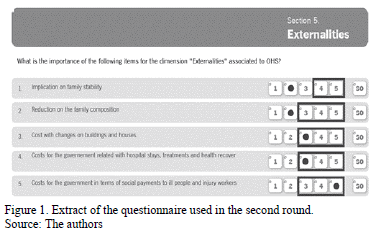
<body><![CDATA[<p><font size="2" face="Verdana, Arial, Helvetica, sans-serif">Thus, in this research, an IQR less than   1 means that more than 50% of all opinions fall on a certain point on the scale;   this shows that they have reached consensus &#91;32&#93;. An IQR of zero indicates a   perfect consensus among panel members: the higher the IQR, the greater the   dispersion of the data.</font></p>     <p><font size="2" face="Verdana, Arial, Helvetica, sans-serif">For all the 11 questions, the following   statistical parameters have been calculated: mean, median, standard deviation   and inter-quartile range.</font></p>     <p><font size="2" face="Verdana, Arial, Helvetica, sans-serif">The median is a better measure of the   degree of group support for each factor; if it is high, we can conclude that   there is a high level of support from the group. The standard deviation permits   us to see the dispersion of results, which is directly related to the IQR.</font></p>     <p><font size="2" face="Verdana, Arial, Helvetica, sans-serif">The   questionnaire sent to the experts for the second Delphi round included the   treated results from the first round. In this second round, the &quot;zone of   agreement&quot; was indicated with a red rectangle (see <a href="#fig01">Fig. 1</a>), considering the   median value of the responses of the panel with a deviation of plus or minus   one level. The answer given by the corresponding expert in the previous round   has also been presented by using a red dot (see <a href="#fig01">Fig. 1</a>).</font></p>     <p align="center"><font size="2" face="Verdana, Arial, Helvetica, sans-serif"><a name="fig01"></a></font><img src="/img/revistas/dyna/v83n196/v83n196a02fig01.gif"></p>     <p><font size="2" face="Verdana, Arial, Helvetica, sans-serif"><a href="#fig01">Fig. 1</a> shows an example of an extract   from a second round questionnaire sent to the experts.</font></p>     <p><font size="2" face="Verdana, Arial, Helvetica, sans-serif">The experts have been invited to indicate   their agreement or disagreement with respect to the median answer. The   following alternatives were possible for each expert:</font></p> <ol type="a">       <li><font size="2" face="Verdana, Arial, Helvetica, sans-serif"> keep     the original answer,</font></li>       <li><font size="2" face="Verdana, Arial, Helvetica, sans-serif">re-evaluate     the initial answer and change it.</font></li>     </ol>     ]]></body>
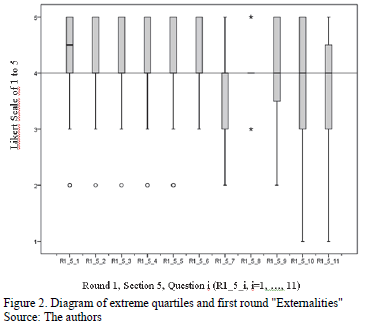
<body><![CDATA[<p><font size="2" face="Verdana, Arial, Helvetica, sans-serif">In case the final answer of the expert   was outside the range of consensus, he/she was requested to briefly indicate   the main reason(s) that led him/her to keep the same response. They should do   this by using the text box that was available for this purpose at the end of   the questionnaire.</font></p>     <p><font size="2" face="Verdana, Arial, Helvetica, sans-serif">In the third round questionnaire, the experts'   comments have also been included in order to help respondents to eventually   re-evaluate the previous answer and change it. This helps to improve the level   of consensus.</font></p>     <p><font size="2" face="Verdana, Arial, Helvetica, sans-serif">The statistical analysis of diagrams of   extremes and quartiles in the first and third round was undertaken by using the   statistical software IBM SPSS v.20.</font></p>     <p>&nbsp;</p>     <p><font size="3" face="Verdana, Arial, Helvetica, sans-serif"><b>3. Results and Discussion</b></font></p>     <p><font size="2" face="Verdana, Arial, Helvetica, sans-serif"><b><i>3.1. Results of the first Delphi round</i></b></font></p>     <p><font size="2" face="Verdana, Arial, Helvetica, sans-serif">In the first round, we had the effective   participation of a total of 20 experts from the 29 contacted. The results   showed a good agreement (IQR&le;1) in 8 of the 11 questions.</font></p>     <p><font size="2" face="Verdana, Arial, Helvetica, sans-serif"><a href="#fig02">Fig. 2</a> presents the diagram of extreme   quartiles and first round &quot;Externalities&quot;.</font></p>     <p align="center"><font size="2" face="Verdana, Arial, Helvetica, sans-serif"><a name="fig02"></a></font><img src="/img/revistas/dyna/v83n196/v83n196a02fig02.gif"></p>     <p><font size="2" face="Verdana, Arial, Helvetica, sans-serif">The circle and the asterisk in <a href="#fig02">Fig. 2</a> represent   extreme cases. The circle represents the situation in which the minimum</font> <font size="2" face="Verdana, Arial, Helvetica, sans-serif">or maximum value is lower or higher than 1.5   IQR but less than 3 IQR (case considered as &quot;moderate outlier&quot;). The   asterisk represents the extreme cases, which are significantly higher than 3   IQR (called &quot;faroutlier&quot; or &quot;extreme outlier&quot;). This   notation follows the standard set in SPSS, as well as other conventional   statistics programs (Statistica, SAS, R, etc.).</font></p>     ]]></body>
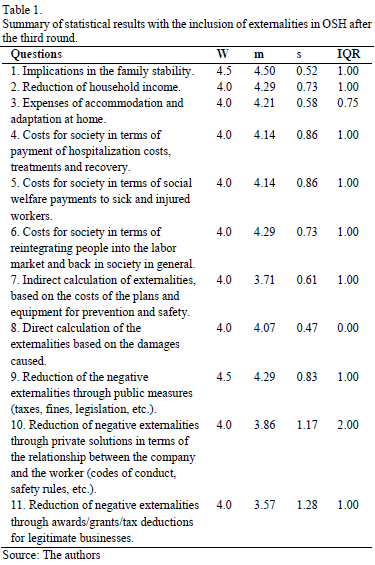
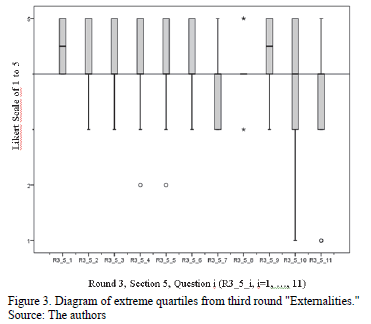
<body><![CDATA[<p><font size="2" face="Verdana, Arial, Helvetica, sans-serif"><b><i>3.2. Results from the second Delphi round</i></b></font></p>     <p><font size="2" face="Verdana, Arial, Helvetica, sans-serif">The second Delphi round was carried out   in order to increase the consensus. In this round, there were 9 questions with   IQR&le;1 (including one with IQR = 0). The diagram of extremes and quartiles   is very similar to the first round.</font></p>     <p><font size="2" face="Verdana, Arial, Helvetica, sans-serif"><b><i>3.3. Results from the third Delphi round</i></b></font></p>     <p><font size="2" face="Verdana, Arial, Helvetica, sans-serif">In the third round, the experts were   asked to reassess their responses, taking into account the results and also the   comments made in the second round. In this round, the number of issues with   IQR&le;1 increased to 10.</font></p>     <p><font size="2" face="Verdana, Arial, Helvetica, sans-serif">The answers obtained from the panel in   the third round are shown in <a href="#fig03">Fig. 3</a>. All the questions obtained a median of at   least 4.0 (full line of <a href="#fig03">Fig. 3</a>).</font></p>     <p align="center"><font size="2" face="Verdana, Arial, Helvetica, sans-serif"><a name="fig03"></a></font><img src="/img/revistas/dyna/v83n196/v83n196a02fig03.gif"></p>     <p><font size="2" face="Verdana, Arial, Helvetica, sans-serif"><a href="#tab01">Table 1</a> presents the statistical   treatment of the results from the third (and final) round. For each question   the following statistical parameters are presented:</font></p> <ul>       <li><font size="2" face="Verdana, Arial, Helvetica, sans-serif"> W: median. Positional     statistical parameter: central value of those observed:</font></li>       <li><font size="2" face="Verdana, Arial, Helvetica, sans-serif"> m: mean. Positional statistical     parameter: the sum of data values divided by the number of observations;</font></li>       <li><font size="2" face="Verdana, Arial, Helvetica, sans-serif"> s: standard deviation.     Dispersion parameter: square root of the mean of the squares of deviations with     respect to its median;</font></li>       ]]></body>
<body><![CDATA[<li><font size="2" face="Verdana, Arial, Helvetica, sans-serif"> IQR: interquartile interval.     Dispersion parameter: difference between third and first quartiles.</font></li>     </ul>     <p><font size="2" face="Verdana, Arial, Helvetica, sans-serif"><b><i>3.4. Global discussion of the results </i></b></font></p>     <p><font size="2" face="Verdana, Arial, Helvetica, sans-serif"><a href="#tab02">Table 2</a> presents the evolution of the   panel's opinion throughout the three rounds.</font></p>     <p align="center"><font size="2" face="Verdana, Arial, Helvetica, sans-serif"><a name="tab02"></a></font><img src="/img/revistas/dyna/v83n196/v83n196a02tab02.gif"></p>     <p><font size="2" face="Verdana, Arial, Helvetica, sans-serif">The number of experts has reduced as the   rounds, have gone on, which is normal in Delphi studies and does not invalidate   the results. In fact, according to Okoli &amp; Pawlowski &#91;16&#93;, 14 is a good   number of experts in Delphi studies; these authors suggest between 10 and 18   experts.</font></p>     <p><font size="2" face="Verdana, Arial, Helvetica, sans-serif">After round 3, the expert panel found   that questions 1 and 9 in <a href="#tab01">Table 1</a> were extremely important (median equals to   4.5 or 5) with IQR=1. Question 8 obtained the highest consensus (IQR = 0), with   a median of 4.0. </font></p>     <p><font size="2" face="Verdana, Arial, Helvetica, sans-serif">The expert panel recognized the relevance   of the implications for family stability, the direct calculation of the   externalities based on the damages caused and the reduction of negative   externalities through public solutions (taxes, fines, legislation, etc.). There   was no consensus among the panel of experts on reducing negative externalities   through private solutions in terms of the relationship between the company and   the worker.</font></p>     <p><font size="2" face="Verdana, Arial, Helvetica, sans-serif">Translating risks and prevention measures   in terms of the costs for companies employees' and for society may be used to   support the reduction of negative externalities through public measures such as   taxes, fines, legislation, etc. Responses showed a high consensus on the direct   calculation of the externalities based on the damages caused.</font></p>     <p>&nbsp;</p>     ]]></body>
<body><![CDATA[<p><font size="3" face="Verdana, Arial, Helvetica, sans-serif"><b>4. Conclusions</b></font></p>     <p><font size="2" face="Verdana, Arial, Helvetica, sans-serif">The Delphi method is a suitable research   technique when there is an incomplete or vague knowledge of the subject under   consideration, as is the case of externalities in OSH.</font></p>     <p><font size="2" face="Verdana, Arial, Helvetica, sans-serif">This methodology allowed the assessment   of selected experts to be collected through a questionnaire specifically   designed for this purpose. It was then developed in three rounds, in order to   increase consensus among the group of experts.</font></p>     <p><font size="2" face="Verdana, Arial, Helvetica, sans-serif">According to the issues highlighted by   the expert panel, the externalities can be used to promote, support or to   legislate on measures of preventing occupational hazards. Indeed, the   incorporation of the effects of risks and preventive measures in terms of cost   to the company for the employees and society may be used to support the   reduction of negative externalities through public measures such as taxes,   penalties and more restrictive laws.</font></p>     <p><font size="2" face="Verdana, Arial, Helvetica, sans-serif">The Delphi Method can be viewed as an   important tool to gain a better understanding of the inclusion of externalities   in occupational safety and health analysis, highlighting the more relevant   aspects to be considered in economic studies in this particular field.</font></p>     <p>&nbsp;</p>     <p><font size="3" face="Verdana, Arial, Helvetica, sans-serif"><b>5. Acknowledgments</b></font></p>     <p><font size="2" face="Verdana, Arial, Helvetica, sans-serif">The authors would like to acknowledge all   the experts who have participated in the Delphi panel. The authors also   acknowledge the anonymous reviewers who helped to improve the overall quality   of the current manuscript. This study was financially supported by FCT-Fundação   para a Ciência e Tecnologia of Portugal, under the project ID/CEC/00319/2013.</font></p>     <p>&nbsp;</p>     <p><font size="3" face="Verdana, Arial, Helvetica, sans-serif"><b>References</b></font></p>     ]]></body>
<body><![CDATA[<!-- ref --><p><font size="2" face="Verdana, Arial, Helvetica, sans-serif"><b>&#91;1&#93;</b> Dorman, P., The Economics of   safety, health, and well-being at work: An overview. In Focus Program on   SafeWork, International Labour Organisation. The Evergreen State   CollegeTechnol, &#91;On line&#93;. 2000 &#91;consulted February 2015&#93;. Available at: <a href="http://www.oit.org/wcmsp5/groups/public/---ed_protect/---protrav/---safework/documents/publication/wcms_110382.pdf" target="_blank">http://www.oit.org/wcmsp5/groups/public/---ed_protect/---protrav/---safework/documents/publication/wcms_110382.pdf</a>.    &nbsp;&nbsp;&nbsp;&nbsp;&nbsp;&nbsp;&nbsp;&nbsp;[&#160;<a href="javascript:void(0);" onclick="javascript: window.open('/scielo.php?script=sci_nlinks&ref=1150652&pid=S0012-7353201600020000200001&lng=','','width=640,height=500,resizable=yes,scrollbars=1,menubar=yes,');">Links</a>&#160;]<!-- end-ref --></font></p>     <!-- ref --><p><font size="2" face="Verdana, Arial, Helvetica, sans-serif"><b>&#91;2&#93;</b> Lave, L.B., Injury as   externality: An economic perspective of trauma. Accident Analysis &amp;   Prevention,19 (1), pp 29-37, 1987. DOI: 10.1016/0001-4575(87)90015-7</font>&nbsp;&nbsp;&nbsp;&nbsp;&nbsp;&nbsp;&nbsp;&nbsp;[&#160;<a href="javascript:void(0);" onclick="javascript: window.open('/scielo.php?script=sci_nlinks&ref=1150654&pid=S0012-7353201600020000200002&lng=','','width=640,height=500,resizable=yes,scrollbars=1,menubar=yes,');">Links</a>&#160;]<!-- end-ref --><!-- ref --><p><font size="2" face="Verdana, Arial, Helvetica, sans-serif"><b>&#91;3&#93;</b> Ag&eacute;nor, P-R. and Dinh, H. T.   Social capital, product imitation and growth with learning externalities.   Journal of Development Economics 114, pp. 41-54, 2015. DOI: 10.1016/j.jdeveco.2014.11.008</font>&nbsp;&nbsp;&nbsp;&nbsp;&nbsp;&nbsp;&nbsp;&nbsp;[&#160;<a href="javascript:void(0);" onclick="javascript: window.open('/scielo.php?script=sci_nlinks&ref=1150655&pid=S0012-7353201600020000200003&lng=','','width=640,height=500,resizable=yes,scrollbars=1,menubar=yes,');">Links</a>&#160;]<!-- end-ref --><!-- ref --><p><font size="2" face="Verdana, Arial, Helvetica, sans-serif"><b>&#91;4&#93;</b> Varian, H.R., Microeconomic   Analysis. W.W. Norton &amp; Company, Inc. 3rd Edition, 1992.    &nbsp;&nbsp;&nbsp;&nbsp;&nbsp;&nbsp;&nbsp;&nbsp;[&#160;<a href="javascript:void(0);" onclick="javascript: window.open('/scielo.php?script=sci_nlinks&ref=1150656&pid=S0012-7353201600020000200004&lng=','','width=640,height=500,resizable=yes,scrollbars=1,menubar=yes,');">Links</a>&#160;]<!-- end-ref --></font></p>     <!-- ref --><p><font size="2" face="Verdana, Arial, Helvetica, sans-serif"><b>&#91;5&#93;</b> Mann, S. and Wüstemann, H.,   Multifunctionality and a new focus on externalities. The Journal of Socio-Economics,   37, pp. 293-307, 2008. DOI: 10.1016/j.socec.2006.12.031</font>&nbsp;&nbsp;&nbsp;&nbsp;&nbsp;&nbsp;&nbsp;&nbsp;[&#160;<a href="javascript:void(0);" onclick="javascript: window.open('/scielo.php?script=sci_nlinks&ref=1150658&pid=S0012-7353201600020000200005&lng=','','width=640,height=500,resizable=yes,scrollbars=1,menubar=yes,');">Links</a>&#160;]<!-- end-ref --><!-- ref --><p><font size="2" face="Verdana, Arial, Helvetica, sans-serif"><b>&#91;6&#93;</b> Samuelson, P.A. and Nordhaus,   W.D., Economics. McGraw Hill, 10th Edition, 1999.    &nbsp;&nbsp;&nbsp;&nbsp;&nbsp;&nbsp;&nbsp;&nbsp;[&#160;<a href="javascript:void(0);" onclick="javascript: window.open('/scielo.php?script=sci_nlinks&ref=1150659&pid=S0012-7353201600020000200006&lng=','','width=640,height=500,resizable=yes,scrollbars=1,menubar=yes,');">Links</a>&#160;]<!-- end-ref --></font></p>     <!-- ref --><p><font size="2" face="Verdana, Arial, Helvetica, sans-serif"><b>&#91;7&#93;</b> van Beukering, P. van Drunen,   M., Dornland, K. and Jansen, H., External economic benefits and costs in water   and solid waste investments - Methodology, guidelines and case studies. Report   number R98/11. IVM/EFTEC. ISBN 90-5383-632-2, 1998.    &nbsp;&nbsp;&nbsp;&nbsp;&nbsp;&nbsp;&nbsp;&nbsp;[&#160;<a href="javascript:void(0);" onclick="javascript: window.open('/scielo.php?script=sci_nlinks&ref=1150661&pid=S0012-7353201600020000200007&lng=','','width=640,height=500,resizable=yes,scrollbars=1,menubar=yes,');">Links</a>&#160;]<!-- end-ref --></font></p>     <!-- ref --><p><font size="2" face="Verdana, Arial, Helvetica, sans-serif"><b>&#91;8&#93;</b> Cullis, J. and Jones, P.,   Public finance &amp; Public choice: Analytical perspectives. Third edition.   Oxford University Press. Oxford. UK, 2009.    &nbsp;&nbsp;&nbsp;&nbsp;&nbsp;&nbsp;&nbsp;&nbsp;[&#160;<a href="javascript:void(0);" onclick="javascript: window.open('/scielo.php?script=sci_nlinks&ref=1150663&pid=S0012-7353201600020000200008&lng=','','width=640,height=500,resizable=yes,scrollbars=1,menubar=yes,');">Links</a>&#160;]<!-- end-ref --></font></p>     <!-- ref --><p><font size="2" face="Verdana, Arial, Helvetica, sans-serif"><b>&#91;9&#93;</b> Rebitzer, G., Ekvall, T.,   Frischknecht, R., Hunkeler, D., Norris, G., Rydberg, T., Schmidt, W.P. Suhh,   S., Weidemai, B.P. and Pennington, D.W., Life Cycle Assessment - Part 1:   Framework, Goal &amp; Scope Definition, Inventory Analysis, and Applications.   Environment International, 30(5), pp. 701-720, 2004. DOI: 10.1016/j.envint.2003.11.005</font>&nbsp;&nbsp;&nbsp;&nbsp;&nbsp;&nbsp;&nbsp;&nbsp;[&#160;<a href="javascript:void(0);" onclick="javascript: window.open('/scielo.php?script=sci_nlinks&ref=1150665&pid=S0012-7353201600020000200009&lng=','','width=640,height=500,resizable=yes,scrollbars=1,menubar=yes,');">Links</a>&#160;]<!-- end-ref --><!-- ref --><p><font size="2" face="Verdana, Arial, Helvetica, sans-serif"><b>&#91;10&#93;</b> Mann, S. and Wüstemann, H.,   Multifunctionality and a new focus on externalities. The Journal of   Socio-Economics 37, pp. 293-307, 2008. DOI: 10.1016/j.socec.2006.12.031</font>&nbsp;&nbsp;&nbsp;&nbsp;&nbsp;&nbsp;&nbsp;&nbsp;[&#160;<a href="javascript:void(0);" onclick="javascript: window.open('/scielo.php?script=sci_nlinks&ref=1150666&pid=S0012-7353201600020000200010&lng=','','width=640,height=500,resizable=yes,scrollbars=1,menubar=yes,');">Links</a>&#160;]<!-- end-ref --><!-- ref --><p><font size="2" face="Verdana, Arial, Helvetica, sans-serif"><b>&#91;11&#93;</b> Ramos, D., Arezes, P. and   Afonso, P., The role of costs, benefits and social impact of injuries and   prevention measures on the design of occupational safety programs. In: Arezes   et al. (eds), Occupational Safety and Hygiene, Taylor &amp; Francis Group,   London, 2013, ISBN 978-1-138-00047-6, pp. 153-157. DOI: 10.1201/b14391-32</font>&nbsp;&nbsp;&nbsp;&nbsp;&nbsp;&nbsp;&nbsp;&nbsp;[&#160;<a href="javascript:void(0);" onclick="javascript: window.open('/scielo.php?script=sci_nlinks&ref=1150667&pid=S0012-7353201600020000200011&lng=','','width=640,height=500,resizable=yes,scrollbars=1,menubar=yes,');">Links</a>&#160;]<!-- end-ref --><!-- ref --><p><font size="2" face="Verdana, Arial, Helvetica, sans-serif"><b>&#91;12&#93;</b> HSE - Health and safety   executive. Costs to Britain of workplace injuries and work-related ill health:   2010/11 update. HSE Books, UK, 2012.    &nbsp;&nbsp;&nbsp;&nbsp;&nbsp;&nbsp;&nbsp;&nbsp;[&#160;<a href="javascript:void(0);" onclick="javascript: window.open('/scielo.php?script=sci_nlinks&ref=1150668&pid=S0012-7353201600020000200012&lng=','','width=640,height=500,resizable=yes,scrollbars=1,menubar=yes,');">Links</a>&#160;]<!-- end-ref --></font></p>     <!-- ref --><p><font size="2" face="Verdana, Arial, Helvetica, sans-serif"><b>&#91;13&#93;</b> ILO - International labour   organization. Estimating the economic costs of occupational injuries and   illnesses in developing countries: Essential Information for Decision-Makers.   ISBN 978-92-2-127015-7. Geneva, 2012.    &nbsp;&nbsp;&nbsp;&nbsp;&nbsp;&nbsp;&nbsp;&nbsp;[&#160;<a href="javascript:void(0);" onclick="javascript: window.open('/scielo.php?script=sci_nlinks&ref=1150670&pid=S0012-7353201600020000200013&lng=','','width=640,height=500,resizable=yes,scrollbars=1,menubar=yes,');">Links</a>&#160;]<!-- end-ref --></font></p>     ]]></body>
<body><![CDATA[<!-- ref --><p><font size="2" face="Verdana, Arial, Helvetica, sans-serif"><b>&#91;14&#93;</b> Cagno, E., Micheli, G., Masi,   D. and Jacinto, C., Economic evaluation of OSH and its way to SMEs: A   constructive review. Safety Science 53, pp. 134-152, 2013. DOI: 10.1016/j.ssci.2012.08.016</font>&nbsp;&nbsp;&nbsp;&nbsp;&nbsp;&nbsp;&nbsp;&nbsp;[&#160;<a href="javascript:void(0);" onclick="javascript: window.open('/scielo.php?script=sci_nlinks&ref=1150672&pid=S0012-7353201600020000200014&lng=','','width=640,height=500,resizable=yes,scrollbars=1,menubar=yes,');">Links</a>&#160;]<!-- end-ref --><!-- ref --><p><font size="2" face="Verdana, Arial, Helvetica, sans-serif"><b>&#91;15&#93;</b> European Agency for Safety and   Health at Work (EU-OSHA)., Priorities for occupational safety and health   research in Europe: 2013-2020. Summary report. ISBN 978-92-9240-316-4,   Luxembourg, 2014.    &nbsp;&nbsp;&nbsp;&nbsp;&nbsp;&nbsp;&nbsp;&nbsp;[&#160;<a href="javascript:void(0);" onclick="javascript: window.open('/scielo.php?script=sci_nlinks&ref=1150673&pid=S0012-7353201600020000200015&lng=','','width=640,height=500,resizable=yes,scrollbars=1,menubar=yes,');">Links</a>&#160;]<!-- end-ref --></font></p>     <!-- ref --><p><font size="2" face="Verdana, Arial, Helvetica, sans-serif"><b>&#91;16&#93;</b> Okoli, C. and Pawlowski, S.D.,   The Delphi method as a research tool: An example, design considerations and   applications. Information &amp; Management 42, pp. 15-29, 2004. DOI: 10.1016/j.im.2003.11.002</font>&nbsp;&nbsp;&nbsp;&nbsp;&nbsp;&nbsp;&nbsp;&nbsp;[&#160;<a href="javascript:void(0);" onclick="javascript: window.open('/scielo.php?script=sci_nlinks&ref=1150675&pid=S0012-7353201600020000200016&lng=','','width=640,height=500,resizable=yes,scrollbars=1,menubar=yes,');">Links</a>&#160;]<!-- end-ref --><!-- ref --><p><font size="2" face="Verdana, Arial, Helvetica, sans-serif"><b>&#91;17&#93;</b> Ramos, D., Arezes, P. and   Afonso, P., Cost-benefit analysis in occupational health and safety: A proposal   model. 11th International Probabilistic Safety Assessment and Management   Conference and the Annual European Safety and Reliability Conference, PSAM11   ESREL 2012, 2, pp. 1273-1282.    &nbsp;&nbsp;&nbsp;&nbsp;&nbsp;&nbsp;&nbsp;&nbsp;[&#160;<a href="javascript:void(0);" onclick="javascript: window.open('/scielo.php?script=sci_nlinks&ref=1150676&pid=S0012-7353201600020000200017&lng=','','width=640,height=500,resizable=yes,scrollbars=1,menubar=yes,');">Links</a>&#160;]<!-- end-ref --></font></p>     <!-- ref --><p><font size="2" face="Verdana, Arial, Helvetica, sans-serif"><b>&#91;18&#93;</b> Dalkey, N.C. and Helmer, O., An   experimental application of the Delphi Method to the use of experts. Management   Science, 9(3), pp. 458-468, 1963. DOI: 10.1287/mnsc.9.3.458</font>&nbsp;&nbsp;&nbsp;&nbsp;&nbsp;&nbsp;&nbsp;&nbsp;[&#160;<a href="javascript:void(0);" onclick="javascript: window.open('/scielo.php?script=sci_nlinks&ref=1150678&pid=S0012-7353201600020000200018&lng=','','width=640,height=500,resizable=yes,scrollbars=1,menubar=yes,');">Links</a>&#160;]<!-- end-ref --><!-- ref --><p><font size="2" face="Verdana, Arial, Helvetica, sans-serif"><b>&#91;19&#93;</b> Linstone, H. and Turrof, M.,   The Delphi method, techniques and applications. Addison Wesley Publishing,   1975.    &nbsp;&nbsp;&nbsp;&nbsp;&nbsp;&nbsp;&nbsp;&nbsp;[&#160;<a href="javascript:void(0);" onclick="javascript: window.open('/scielo.php?script=sci_nlinks&ref=1150679&pid=S0012-7353201600020000200019&lng=','','width=640,height=500,resizable=yes,scrollbars=1,menubar=yes,');">Links</a>&#160;]<!-- end-ref --></font></p>     <!-- ref --><p><font size="2" face="Verdana, Arial, Helvetica, sans-serif"><b>&#91;20&#93;</b> Donohoe, H.M. and Needham,   R.D., Moving best practice forward: Delphi characteristics, advantages,   potential problems, and solutions. International Journal of Tourism Research,   11(5), pp. 415-437, 2009. DOI: 10.1002/jtr.709</font>&nbsp;&nbsp;&nbsp;&nbsp;&nbsp;&nbsp;&nbsp;&nbsp;[&#160;<a href="javascript:void(0);" onclick="javascript: window.open('/scielo.php?script=sci_nlinks&ref=1150681&pid=S0012-7353201600020000200020&lng=','','width=640,height=500,resizable=yes,scrollbars=1,menubar=yes,');">Links</a>&#160;]<!-- end-ref --><!-- ref --><p><font size="2" face="Verdana, Arial, Helvetica, sans-serif"><b>&#91;21&#93;</b> Förster, B. and von der Gracht,   H., Assessing Delphi panel composition for strategic foresight - A comparison   of panels based on company-internal and external participants. Technological Forecasting   &amp; Social Change 84, pp. 215-229, 2014. DOI: 10.1016/j.techfore.2013.07.012</font>&nbsp;&nbsp;&nbsp;&nbsp;&nbsp;&nbsp;&nbsp;&nbsp;[&#160;<a href="javascript:void(0);" onclick="javascript: window.open('/scielo.php?script=sci_nlinks&ref=1150682&pid=S0012-7353201600020000200021&lng=','','width=640,height=500,resizable=yes,scrollbars=1,menubar=yes,');">Links</a>&#160;]<!-- end-ref --><!-- ref --><p><font size="2" face="Verdana, Arial, Helvetica, sans-serif"><b>&#91;22&#93;</b> Godet, M.   Manual de Prospetiva Estrat&eacute;gica. Lisboa: Publicações   Dom Quixote, 1993.    &nbsp;&nbsp;&nbsp;&nbsp;&nbsp;&nbsp;&nbsp;&nbsp;[&#160;<a href="javascript:void(0);" onclick="javascript: window.open('/scielo.php?script=sci_nlinks&ref=1150683&pid=S0012-7353201600020000200022&lng=','','width=640,height=500,resizable=yes,scrollbars=1,menubar=yes,');">Links</a>&#160;]<!-- end-ref --></font></p>     <!-- ref --><p><font size="2" face="Verdana, Arial, Helvetica, sans-serif"><b>&#91;23&#93;</b> Landeta,   J., El m&eacute;todo Delphi. Barcelona: Ariel, 1999.    &nbsp;&nbsp;&nbsp;&nbsp;&nbsp;&nbsp;&nbsp;&nbsp;[&#160;<a href="javascript:void(0);" onclick="javascript: window.open('/scielo.php?script=sci_nlinks&ref=1150685&pid=S0012-7353201600020000200023&lng=','','width=640,height=500,resizable=yes,scrollbars=1,menubar=yes,');">Links</a>&#160;]<!-- end-ref --></font></p>     <!-- ref --><p><font size="2" face="Verdana, Arial, Helvetica, sans-serif"><b>&#91;24&#93;</b> Vergara,   S., M&eacute;todos de pesquisa em administração. São Paulo.   Editora Atlas, 2005.    &nbsp;&nbsp;&nbsp;&nbsp;&nbsp;&nbsp;&nbsp;&nbsp;[&#160;<a href="javascript:void(0);" onclick="javascript: window.open('/scielo.php?script=sci_nlinks&ref=1150687&pid=S0012-7353201600020000200024&lng=','','width=640,height=500,resizable=yes,scrollbars=1,menubar=yes,');">Links</a>&#160;]<!-- end-ref --></font></p>     <!-- ref --><p><font size="2" face="Verdana, Arial, Helvetica, sans-serif"><b>&#91;25&#93;</b> Geist, M.R., Using the Delphi   method to engage stakeholders: A comparison of two studies. Evaluation and   Program Planning 33, pp. 147-154. 2010. DOI: 10.1016/j.evalprogplan.2009.06.006</font>&nbsp;&nbsp;&nbsp;&nbsp;&nbsp;&nbsp;&nbsp;&nbsp;[&#160;<a href="javascript:void(0);" onclick="javascript: window.open('/scielo.php?script=sci_nlinks&ref=1150689&pid=S0012-7353201600020000200025&lng=','','width=640,height=500,resizable=yes,scrollbars=1,menubar=yes,');">Links</a>&#160;]<!-- end-ref --><!-- ref --><p><font size="2" face="Verdana, Arial, Helvetica, sans-serif"><b>&#91;26&#93;</b> Skulmoski, J.G., Hartman, T.F.   and Krahn, J., The Delphi method for graduate research. Journal of Information   Technology Education, 6, pp. 1-21, 2007.    &nbsp;&nbsp;&nbsp;&nbsp;&nbsp;&nbsp;&nbsp;&nbsp;[&#160;<a href="javascript:void(0);" onclick="javascript: window.open('/scielo.php?script=sci_nlinks&ref=1150690&pid=S0012-7353201600020000200026&lng=','','width=640,height=500,resizable=yes,scrollbars=1,menubar=yes,');">Links</a>&#160;]<!-- end-ref --></font></p>     ]]></body>
<body><![CDATA[<!-- ref --><p><font size="2" face="Verdana, Arial, Helvetica, sans-serif"><b>&#91;27&#93;</b> von der Gracht, H.A., Consensus   measurement in Delphi studies: Review and implications for future quality   assurance, Technol. Forecast. Soc. Chang. 79, pp. 1525-1536, 2012. DOI: 10.1016/j.techfore.2012.04.013</font>&nbsp;&nbsp;&nbsp;&nbsp;&nbsp;&nbsp;&nbsp;&nbsp;[&#160;<a href="javascript:void(0);" onclick="javascript: window.open('/scielo.php?script=sci_nlinks&ref=1150692&pid=S0012-7353201600020000200027&lng=','','width=640,height=500,resizable=yes,scrollbars=1,menubar=yes,');">Links</a>&#160;]<!-- end-ref --><!-- ref --><p><font size="2" face="Verdana, Arial, Helvetica, sans-serif"><b>&#91;28&#93;</b> Linstone, H.A. and Turoff, M.,   Delphi: A brief look backward and forward, Technol. Forecast. Soc. Chang. 78,   pp. 1712-1719, 2011. DOI: 10.1016/j.techfore.2010.09.011</font>&nbsp;&nbsp;&nbsp;&nbsp;&nbsp;&nbsp;&nbsp;&nbsp;[&#160;<a href="javascript:void(0);" onclick="javascript: window.open('/scielo.php?script=sci_nlinks&ref=1150693&pid=S0012-7353201600020000200028&lng=','','width=640,height=500,resizable=yes,scrollbars=1,menubar=yes,');">Links</a>&#160;]<!-- end-ref --><!-- ref --><p><font size="2" face="Verdana, Arial, Helvetica, sans-serif"><b>&#91;29&#93;</b> Warth, J., von der Gracht, H.A.   and Darkow, I.-L., A dissent-based approach for multi-stakeholder scenario   development - the future of electric drive vehicles, Technol. Forecast. Soc.   Chang. 80, pp. 566-583, 2013. DOI: 10.1016/j.techfore.2012.04.005</font>&nbsp;&nbsp;&nbsp;&nbsp;&nbsp;&nbsp;&nbsp;&nbsp;[&#160;<a href="javascript:void(0);" onclick="javascript: window.open('/scielo.php?script=sci_nlinks&ref=1150694&pid=S0012-7353201600020000200029&lng=','','width=640,height=500,resizable=yes,scrollbars=1,menubar=yes,');">Links</a>&#160;]<!-- end-ref --><!-- ref --><p><font size="2" face="Verdana, Arial, Helvetica, sans-serif"><b>&#91;30&#93;</b> Ray, P.K. and Sahu, S.,   Productivity management in India: A Delphi study, Int. J. Oper. Prod. Manag.   10, pp. 25-51, 1990. DOI: 10.1108/01443579010005245</font>&nbsp;&nbsp;&nbsp;&nbsp;&nbsp;&nbsp;&nbsp;&nbsp;[&#160;<a href="javascript:void(0);" onclick="javascript: window.open('/scielo.php?script=sci_nlinks&ref=1150695&pid=S0012-7353201600020000200030&lng=','','width=640,height=500,resizable=yes,scrollbars=1,menubar=yes,');">Links</a>&#160;]<!-- end-ref --><!-- ref --><p><font size="2" face="Verdana, Arial, Helvetica, sans-serif"><b>&#91;31&#93;</b> De Vet, E., Brug, J., De   Nooijer, J., Dijkstra, A. and De Vries, N.K., Determinants of forward stage   transitions: A Delphi study, Health Educ. Res. 20, pp. 195-205, 2005. DOI: 10.1093/her/cyg111</font>&nbsp;&nbsp;&nbsp;&nbsp;&nbsp;&nbsp;&nbsp;&nbsp;[&#160;<a href="javascript:void(0);" onclick="javascript: window.open('/scielo.php?script=sci_nlinks&ref=1150696&pid=S0012-7353201600020000200031&lng=','','width=640,height=500,resizable=yes,scrollbars=1,menubar=yes,');">Links</a>&#160;]<!-- end-ref --><!-- ref --><p><font size="2" face="Verdana, Arial, Helvetica, sans-serif"><b>&#91;32&#93;</b> von der Gracht, H.A. and   Darkow, I.-L., Scenarios for the logistics services industry: A Delphi-based analysis   for 2025. International Journal of Production Economics 127, pp. 46-59,   2010. DOI: 10.1016/j.ijpe.2010.04.013</font>&nbsp;&nbsp;&nbsp;&nbsp;&nbsp;&nbsp;&nbsp;&nbsp;[&#160;<a href="javascript:void(0);" onclick="javascript: window.open('/scielo.php?script=sci_nlinks&ref=1150697&pid=S0012-7353201600020000200032&lng=','','width=640,height=500,resizable=yes,scrollbars=1,menubar=yes,');">Links</a>&#160;]<!-- end-ref --><!-- ref --><p><font size="2" face="Verdana, Arial, Helvetica, sans-serif"><b>&#91;33&#93;</b> Astigarraga,   E., El m&eacute;todo Delphi. Universidad de Deusto, Facultad de CC.EE. y   Empresariales. ESTE, &#91;On line&#93;. 2005, Available at: <a href="http://www.echalemojo.org/uploadsarchivos/metodo_delphi.pdf" target="_blank">http://www.echalemojo.org/uploadsarchivos/metodo_delphi.pdf</a>.    &nbsp;&nbsp;&nbsp;&nbsp;&nbsp;&nbsp;&nbsp;&nbsp;[&#160;<a href="javascript:void(0);" onclick="javascript: window.open('/scielo.php?script=sci_nlinks&ref=1150698&pid=S0012-7353201600020000200033&lng=','','width=640,height=500,resizable=yes,scrollbars=1,menubar=yes,');">Links</a>&#160;]<!-- end-ref --></font></p>     <!-- ref --><p><font size="2" face="Verdana, Arial, Helvetica, sans-serif"><b>&#91;34&#93;</b> Bryman, A.   e Cramer, D., An&aacute;lise de dados em ciências sociais - Introdução às t&eacute;cnicas   utilizando o SPSS. Celta Editora. Oeiras, 1993.    &nbsp;&nbsp;&nbsp;&nbsp;&nbsp;&nbsp;&nbsp;&nbsp;[&#160;<a href="javascript:void(0);" onclick="javascript: window.open('/scielo.php?script=sci_nlinks&ref=1150700&pid=S0012-7353201600020000200034&lng=','','width=640,height=500,resizable=yes,scrollbars=1,menubar=yes,');">Links</a>&#160;]<!-- end-ref --></font></p>     ]]></body>
<body><![CDATA[<!-- ref --><p><font size="2" face="Verdana, Arial, Helvetica, sans-serif"><b>&#91;35&#93;</b> Fink, A., Kosecoff, J.,   Chassin, M. and Brook RH., Consensus methods: Characteristics and guidelines   for use. Am J Public Health, 74(9), pp. 979-83, 1984. DOI: 10.2105/AJPH.74.9.979</font>&nbsp;&nbsp;&nbsp;&nbsp;&nbsp;&nbsp;&nbsp;&nbsp;[&#160;<a href="javascript:void(0);" onclick="javascript: window.open('/scielo.php?script=sci_nlinks&ref=1150702&pid=S0012-7353201600020000200035&lng=','','width=640,height=500,resizable=yes,scrollbars=1,menubar=yes,');">Links</a>&#160;]<!-- end-ref --><p>&nbsp;</p>     <p><font size="2" face="Verdana, Arial, Helvetica, sans-serif"><b>D. Ramos,</b> has a PhD in Industrial and   Systems Engineering from the University of Minho, Portugal. She is also   Professor Honoris Causa of University of Tourism and Management in Skopje.   Professor at Polytechnic Institute of Management and Technology (ISLA) and   Polytechnic Institute of C&aacute;vado and Ave (IPCA). Member of Human Engineering   research group - HErg - University of Minho. Member of the Research Center   ALGORITMI, at the School of Engineering - University of Minho. Member of group   of auditors of SGS Certification Body/ICS - General Society of Superintendence,   SA. Health and Safety (OHSAS 18001) and (ISO 9001) area. ORCID:   0000-0003-2862-2883</font></p>     <p><font size="2" face="Verdana, Arial, Helvetica, sans-serif"><b>P. Arezes,</b> has a PhD. in Industrial and   Systems Engineering from U.Minho, in Portugal, and is currently a full   professor of Ergonomics and Human Factors at the same university. He is also a   visiting fellow at MIT's AgeLab in the USA. He leads the Human Engineering   research group and he is also the coordinator of Engineering Design and   Advanced Manufacturing (EDAM) for the MIT Portugal Program at UMinhoand the   chair of the steering board of the PhD program &quot;Leaders for Technical   Industries (LTI)&quot; at UMinho. ORCID: 0000-0001-9421-9123</font></p>     <p><font size="2" face="Verdana, Arial, Helvetica, sans-serif"><b>P. Afonso,</b> holds a Diploma in Economics   from the ISEG (Economics and Business School) - Technical University of Lisbon   (UTL), a MSc. in Industrial Engineering from University of Minho, Portugal and   a PhD. in Accounting and Finance from University of Manchester (UK). He is   currently an auxiliary professor in the Production and Systems Department at   University of Minho (Portugal) and author or co-author of more than 70 articles   in international peer-reviewed conferences, books and journals. He is a   researcher in Center Algoritmi (CAlg). He has also been a visiting scholar in   several universities. ORCID: 0000-0003-3882-2491</font></p>      ]]></body><back>
<ref-list>
<ref id="B1">
<label>1</label><nlm-citation citation-type="book">
<person-group person-group-type="author">
<name>
<surname><![CDATA[Dorman]]></surname>
<given-names><![CDATA[P.]]></given-names>
</name>
</person-group>
<article-title xml:lang="en"><![CDATA[The Economics of safety, health, and well-being at work: An overview]]></article-title>
<source><![CDATA[Focus Program on SafeWork]]></source>
<year></year>
<publisher-name><![CDATA[International Labour Organisation.]]></publisher-name>
</nlm-citation>
</ref>
<ref id="B2">
<label>2</label><nlm-citation citation-type="journal">
<person-group person-group-type="author">
<name>
<surname><![CDATA[Lave]]></surname>
<given-names><![CDATA[L.B.]]></given-names>
</name>
</person-group>
<article-title xml:lang="en"><![CDATA[Injury as externality: An economic perspective of trauma.]]></article-title>
<source><![CDATA[Accident Analysis & Prevention]]></source>
<year>1987</year>
<volume>19</volume>
<numero>1</numero>
<issue>1</issue>
<page-range>29-37</page-range></nlm-citation>
</ref>
<ref id="B3">
<label>3</label><nlm-citation citation-type="journal">
<person-group person-group-type="author">
<name>
<surname><![CDATA[Agénor]]></surname>
<given-names><![CDATA[P-R.]]></given-names>
</name>
<name>
<surname><![CDATA[Dinh]]></surname>
<given-names><![CDATA[H. T.]]></given-names>
</name>
</person-group>
<article-title xml:lang="en"><![CDATA[Social capital, product imitation and growth with learning externalities.]]></article-title>
<source><![CDATA[Journal of Development Economics]]></source>
<year>2015</year>
<numero>114</numero>
<issue>114</issue>
<page-range>41-54</page-range></nlm-citation>
</ref>
<ref id="B4">
<label>4</label><nlm-citation citation-type="book">
<person-group person-group-type="author">
<name>
<surname><![CDATA[Varian]]></surname>
<given-names><![CDATA[H.R.]]></given-names>
</name>
</person-group>
<source><![CDATA[Microeconomic Analysis.]]></source>
<year>1992</year>
<edition>3rd</edition>
<publisher-name><![CDATA[W.W. Norton & Company, Inc.]]></publisher-name>
</nlm-citation>
</ref>
<ref id="B5">
<label>5</label><nlm-citation citation-type="journal">
<person-group person-group-type="author">
<name>
<surname><![CDATA[Mann]]></surname>
<given-names><![CDATA[S.]]></given-names>
</name>
<name>
<surname><![CDATA[Wüstemann]]></surname>
<given-names><![CDATA[H.]]></given-names>
</name>
</person-group>
<article-title xml:lang="en"><![CDATA[Multifunctionality and a new focus on externalities.]]></article-title>
<source><![CDATA[The Journal of Socio-Economics]]></source>
<year>2008</year>
<numero>37</numero>
<issue>37</issue>
<page-range>293-307</page-range></nlm-citation>
</ref>
<ref id="B6">
<label>6</label><nlm-citation citation-type="book">
<person-group person-group-type="author">
<name>
<surname><![CDATA[Samuelson]]></surname>
<given-names><![CDATA[P.A.]]></given-names>
</name>
<name>
<surname><![CDATA[Nordhaus]]></surname>
<given-names><![CDATA[W.D.]]></given-names>
</name>
</person-group>
<source><![CDATA[Economics]]></source>
<year>1999</year>
<edition>10th</edition>
<publisher-name><![CDATA[McGraw Hill]]></publisher-name>
</nlm-citation>
</ref>
<ref id="B7">
<label>7</label><nlm-citation citation-type="">
<person-group person-group-type="author">
<name>
<surname><![CDATA[van Beukering]]></surname>
<given-names><![CDATA[P.]]></given-names>
</name>
<name>
<surname><![CDATA[van Drunen]]></surname>
<given-names><![CDATA[M.]]></given-names>
</name>
<name>
<surname><![CDATA[Dornland]]></surname>
<given-names><![CDATA[K.]]></given-names>
</name>
<name>
<surname><![CDATA[Jansen]]></surname>
<given-names><![CDATA[H.]]></given-names>
</name>
</person-group>
<source><![CDATA[External economic benefits and costs in water and solid waste investments: Methodology, guidelines and case studies.]]></source>
<year>1998</year>
</nlm-citation>
</ref>
<ref id="B8">
<label>8</label><nlm-citation citation-type="book">
<person-group person-group-type="author">
<name>
<surname><![CDATA[Cullis]]></surname>
<given-names><![CDATA[J.]]></given-names>
</name>
<name>
<surname><![CDATA[Jones]]></surname>
<given-names><![CDATA[P.]]></given-names>
</name>
</person-group>
<source><![CDATA[Public finance & Public choice: Analytical perspectives.]]></source>
<year>2009</year>
<edition>Third</edition>
<publisher-loc><![CDATA[Oxford ]]></publisher-loc>
<publisher-name><![CDATA[Oxford University Press]]></publisher-name>
</nlm-citation>
</ref>
<ref id="B9">
<label>9</label><nlm-citation citation-type="journal">
<person-group person-group-type="author">
<name>
<surname><![CDATA[Rebitzer]]></surname>
<given-names><![CDATA[G.]]></given-names>
</name>
<name>
<surname><![CDATA[Ekvall]]></surname>
<given-names><![CDATA[T.]]></given-names>
</name>
<name>
<surname><![CDATA[Frischknecht]]></surname>
<given-names><![CDATA[R.]]></given-names>
</name>
<name>
<surname><![CDATA[Hunkeler]]></surname>
<given-names><![CDATA[D.]]></given-names>
</name>
<name>
<surname><![CDATA[Norris]]></surname>
<given-names><![CDATA[G.]]></given-names>
</name>
<name>
<surname><![CDATA[Rydberg]]></surname>
<given-names><![CDATA[T.]]></given-names>
</name>
<name>
<surname><![CDATA[Schmidt]]></surname>
<given-names><![CDATA[W.P.]]></given-names>
</name>
<name>
<surname><![CDATA[Suhh]]></surname>
<given-names><![CDATA[S.]]></given-names>
</name>
<name>
<surname><![CDATA[Weidemai]]></surname>
<given-names><![CDATA[B.P.]]></given-names>
</name>
<name>
<surname><![CDATA[Pennington]]></surname>
<given-names><![CDATA[D.W.]]></given-names>
</name>
</person-group>
<article-title xml:lang="en"><![CDATA[Life Cycle Assessment - Part 1: Framework, Goal & Scope Definition, Inventory Analysis, and Applications.]]></article-title>
<source><![CDATA[Environment International]]></source>
<year>2004</year>
<volume>30</volume>
<numero>5</numero>
<issue>5</issue>
<page-range>701-720</page-range></nlm-citation>
</ref>
<ref id="B10">
<label>10</label><nlm-citation citation-type="journal">
<person-group person-group-type="author">
<name>
<surname><![CDATA[Mann]]></surname>
<given-names><![CDATA[S.]]></given-names>
</name>
<name>
<surname><![CDATA[Wüstemann]]></surname>
<given-names><![CDATA[H.]]></given-names>
</name>
</person-group>
<article-title xml:lang="en"><![CDATA[Multifunctionality and a new focus on externalities.]]></article-title>
<source><![CDATA[The Journal of Socio-Economics]]></source>
<year>2008</year>
<numero>37</numero>
<issue>37</issue>
<page-range>293-307</page-range></nlm-citation>
</ref>
<ref id="B11">
<label>11</label><nlm-citation citation-type="book">
<person-group person-group-type="author">
<name>
<surname><![CDATA[Ramos]]></surname>
<given-names><![CDATA[D.]]></given-names>
</name>
<name>
<surname><![CDATA[Arezes]]></surname>
<given-names><![CDATA[P.]]></given-names>
</name>
<name>
<surname><![CDATA[Afonso]]></surname>
<given-names><![CDATA[P.]]></given-names>
</name>
</person-group>
<article-title xml:lang="en"><![CDATA[The role of costs, benefits and social impact of injuries and prevention measures on the design of occupational safety programs.]]></article-title>
<person-group person-group-type="editor">
<name>
<surname><![CDATA[Arezes]]></surname>
</name>
</person-group>
<source><![CDATA[Occupational Safety and Hygiene]]></source>
<year>2013</year>
<page-range>153-157</page-range><publisher-loc><![CDATA[London ]]></publisher-loc>
<publisher-name><![CDATA[Taylor & Francis Group]]></publisher-name>
</nlm-citation>
</ref>
<ref id="B12">
<label>12</label><nlm-citation citation-type="book">
<collab>Health and safety executive</collab>
<source><![CDATA[Costs to Britain of workplace injuries and work-related ill health: 2010/11 update]]></source>
<year>2012</year>
<publisher-name><![CDATA[HSE Books]]></publisher-name>
</nlm-citation>
</ref>
<ref id="B13">
<label>13</label><nlm-citation citation-type="">
<collab>International labour organization</collab>
<source><![CDATA[Estimating the economic costs of occupational injuries and illnesses in developing countries: Essential Information for Decision-Makers]]></source>
<year>2012</year>
<publisher-loc><![CDATA[Geneva ]]></publisher-loc>
</nlm-citation>
</ref>
<ref id="B14">
<label>14</label><nlm-citation citation-type="journal">
<person-group person-group-type="author">
<name>
<surname><![CDATA[Cagno]]></surname>
<given-names><![CDATA[E.]]></given-names>
</name>
<name>
<surname><![CDATA[Micheli]]></surname>
<given-names><![CDATA[G.]]></given-names>
</name>
<name>
<surname><![CDATA[Masi]]></surname>
<given-names><![CDATA[D.]]></given-names>
</name>
<name>
<surname><![CDATA[Jacinto]]></surname>
<given-names><![CDATA[C.]]></given-names>
</name>
</person-group>
<article-title xml:lang="en"><![CDATA[Economic evaluation of OSH and its way to SMEs: A constructive review]]></article-title>
<source><![CDATA[Safety Science]]></source>
<year>2013</year>
<numero>53</numero>
<issue>53</issue>
<page-range>134-152</page-range></nlm-citation>
</ref>
<ref id="B15">
<label>15</label><nlm-citation citation-type="">
<collab>European Agency for Safety and Health at Work</collab>
<source><![CDATA[Priorities for occupational safety and health research in Europe: 2013-2020: Summary report]]></source>
<year>2014</year>
<publisher-loc><![CDATA[Luxembourg ]]></publisher-loc>
</nlm-citation>
</ref>
<ref id="B16">
<label>16</label><nlm-citation citation-type="journal">
<person-group person-group-type="author">
<name>
<surname><![CDATA[Okoli]]></surname>
<given-names><![CDATA[C.]]></given-names>
</name>
<name>
<surname><![CDATA[Pawlowski]]></surname>
<given-names><![CDATA[S.D.]]></given-names>
</name>
</person-group>
<article-title xml:lang="en"><![CDATA[The Delphi method as a research tool: An example, design considerations and applications.]]></article-title>
<source><![CDATA[Information & Management]]></source>
<year>2004</year>
<numero>42</numero>
<issue>42</issue>
<page-range>15-29</page-range></nlm-citation>
</ref>
<ref id="B17">
<label>17</label><nlm-citation citation-type="confpro">
<person-group person-group-type="author">
<name>
<surname><![CDATA[Ramos]]></surname>
<given-names><![CDATA[D.]]></given-names>
</name>
<name>
<surname><![CDATA[Arezes]]></surname>
<given-names><![CDATA[P.]]></given-names>
</name>
<name>
<surname><![CDATA[Afonso]]></surname>
<given-names><![CDATA[P.]]></given-names>
</name>
</person-group>
<article-title xml:lang="en"><![CDATA[Cost-benefit analysis in occupational health and safety: A proposal model.]]></article-title>
<source><![CDATA[]]></source>
<year></year>
<volume>2</volume>
<conf-name><![CDATA[11th International Probabilistic Safety Assessment and Management Conference and the Annual European Safety and Reliability Conference]]></conf-name>
<conf-date>2012</conf-date>
<conf-loc> </conf-loc>
<page-range>1273-1282</page-range></nlm-citation>
</ref>
<ref id="B18">
<label>18</label><nlm-citation citation-type="journal">
<person-group person-group-type="author">
<name>
<surname><![CDATA[Dalkey]]></surname>
<given-names><![CDATA[N.C.]]></given-names>
</name>
<name>
<surname><![CDATA[Helmer]]></surname>
<given-names><![CDATA[O.]]></given-names>
</name>
</person-group>
<article-title xml:lang="en"><![CDATA[An experimental application of the Delphi Method to the use of experts.]]></article-title>
<source><![CDATA[Management Science]]></source>
<year>1963</year>
<volume>9</volume>
<numero>^s3</numero>
<issue>^s3</issue>
<supplement>3</supplement>
<page-range>458-468</page-range></nlm-citation>
</ref>
<ref id="B19">
<label>19</label><nlm-citation citation-type="book">
<person-group person-group-type="author">
<name>
<surname><![CDATA[Linstone]]></surname>
<given-names><![CDATA[H.]]></given-names>
</name>
<name>
<surname><![CDATA[Turrof]]></surname>
<given-names><![CDATA[M.]]></given-names>
</name>
</person-group>
<source><![CDATA[The Delphi method, techniques and applications.]]></source>
<year>1975</year>
<publisher-name><![CDATA[Addison Wesley Publishing]]></publisher-name>
</nlm-citation>
</ref>
<ref id="B20">
<label>20</label><nlm-citation citation-type="journal">
<person-group person-group-type="author">
<name>
<surname><![CDATA[Donohoe]]></surname>
<given-names><![CDATA[H.M.]]></given-names>
</name>
<name>
<surname><![CDATA[Needham]]></surname>
<given-names><![CDATA[R.D.]]></given-names>
</name>
</person-group>
<article-title xml:lang="en"><![CDATA[Moving best practice forward: Delphi characteristics, advantages, potential problems, and solutions.]]></article-title>
<source><![CDATA[International Journal of Tourism Research]]></source>
<year>2009</year>
<volume>11</volume>
<numero>5</numero>
<issue>5</issue>
<page-range>415-437</page-range></nlm-citation>
</ref>
<ref id="B21">
<label>21</label><nlm-citation citation-type="journal">
<person-group person-group-type="author">
<name>
<surname><![CDATA[Förster]]></surname>
<given-names><![CDATA[B.]]></given-names>
</name>
<name>
<surname><![CDATA[von der Gracht]]></surname>
<given-names><![CDATA[H.]]></given-names>
</name>
</person-group>
<article-title xml:lang="en"><![CDATA[Assessing Delphi panel composition for strategic foresight: A comparison of panels based on company-internal and external participants.]]></article-title>
<source><![CDATA[Technological Forecasting & Social Change]]></source>
<year>2014</year>
<numero>84</numero>
<issue>84</issue>
<page-range>215-229</page-range></nlm-citation>
</ref>
<ref id="B22">
<label>22</label><nlm-citation citation-type="book">
<person-group person-group-type="author">
<name>
<surname><![CDATA[Godet]]></surname>
<given-names><![CDATA[M.]]></given-names>
</name>
</person-group>
<source><![CDATA[Manual de Prospetiva Estratégica.]]></source>
<year>1993</year>
<publisher-loc><![CDATA[Lisboa ]]></publisher-loc>
<publisher-name><![CDATA[Publicações Dom Quixote]]></publisher-name>
</nlm-citation>
</ref>
<ref id="B23">
<label>23</label><nlm-citation citation-type="book">
<person-group person-group-type="author">
<name>
<surname><![CDATA[Landeta]]></surname>
<given-names><![CDATA[J.]]></given-names>
</name>
</person-group>
<source><![CDATA[El método Delphi]]></source>
<year>1999</year>
<publisher-loc><![CDATA[Barcelona ]]></publisher-loc>
<publisher-name><![CDATA[Ariel]]></publisher-name>
</nlm-citation>
</ref>
<ref id="B24">
<label>24</label><nlm-citation citation-type="book">
<person-group person-group-type="author">
<name>
<surname><![CDATA[Vergara]]></surname>
<given-names><![CDATA[S.]]></given-names>
</name>
</person-group>
<source><![CDATA[Métodos de pesquisa em administração.]]></source>
<year>2005</year>
<publisher-loc><![CDATA[São Paulo ]]></publisher-loc>
<publisher-name><![CDATA[Editora Atlas]]></publisher-name>
</nlm-citation>
</ref>
<ref id="B25">
<label>25</label><nlm-citation citation-type="journal">
<person-group person-group-type="author">
<name>
<surname><![CDATA[Geist]]></surname>
<given-names><![CDATA[M.R.]]></given-names>
</name>
</person-group>
<article-title xml:lang="en"><![CDATA[Using the Delphi method to engage stakeholders: A comparison of two studies.]]></article-title>
<source><![CDATA[Evaluation and Program Planning]]></source>
<year>2010</year>
<numero>33</numero>
<issue>33</issue>
<page-range>147-154</page-range></nlm-citation>
</ref>
<ref id="B26">
<label>26</label><nlm-citation citation-type="journal">
<person-group person-group-type="author">
<name>
<surname><![CDATA[Skulmoski]]></surname>
<given-names><![CDATA[J.G.]]></given-names>
</name>
<name>
<surname><![CDATA[Hartman]]></surname>
<given-names><![CDATA[T.F.]]></given-names>
</name>
<name>
<surname><![CDATA[Krahn]]></surname>
<given-names><![CDATA[J.]]></given-names>
</name>
</person-group>
<article-title xml:lang="en"><![CDATA[The Delphi method for graduate research.]]></article-title>
<source><![CDATA[Journal of Information Technology Education]]></source>
<year>2007</year>
<numero>6</numero>
<issue>6</issue>
<page-range>1-21</page-range></nlm-citation>
</ref>
<ref id="B27">
<label>27</label><nlm-citation citation-type="journal">
<person-group person-group-type="author">
<name>
<surname><![CDATA[von der Gracht]]></surname>
<given-names><![CDATA[H.A.]]></given-names>
</name>
</person-group>
<article-title xml:lang="en"><![CDATA[Consensus measurement in Delphi studies: Review and implications for future quality assurance]]></article-title>
<source><![CDATA[Technol. Forecast. Soc. Chang.]]></source>
<year>2012</year>
<numero>79</numero>
<issue>79</issue>
<page-range>1525-1536</page-range></nlm-citation>
</ref>
<ref id="B28">
<label>28</label><nlm-citation citation-type="journal">
<person-group person-group-type="author">
<name>
<surname><![CDATA[Linstone]]></surname>
<given-names><![CDATA[H.A.]]></given-names>
</name>
<name>
<surname><![CDATA[Turoff]]></surname>
<given-names><![CDATA[M.]]></given-names>
</name>
</person-group>
<article-title xml:lang="en"><![CDATA[Delphi: A brief look backward and forward]]></article-title>
<source><![CDATA[Technol. Forecast. Soc. Chang.]]></source>
<year>2011</year>
<numero>78</numero>
<issue>78</issue>
<page-range>1712-1719</page-range></nlm-citation>
</ref>
<ref id="B29">
<label>29</label><nlm-citation citation-type="journal">
<person-group person-group-type="author">
<name>
<surname><![CDATA[Warth]]></surname>
<given-names><![CDATA[J.]]></given-names>
</name>
<name>
<surname><![CDATA[von der Gracht]]></surname>
<given-names><![CDATA[H.A.]]></given-names>
</name>
<name>
<surname><![CDATA[Darkow]]></surname>
<given-names><![CDATA[I.-L.]]></given-names>
</name>
</person-group>
<article-title xml:lang="en"><![CDATA[A dissent-based approach for multi-stakeholder scenario development: the future of electric drive vehicles]]></article-title>
<source><![CDATA[Technol. Forecast. Soc. Chang.]]></source>
<year>2013</year>
<numero>80</numero>
<issue>80</issue>
<page-range>566-583</page-range></nlm-citation>
</ref>
<ref id="B30">
<label>30</label><nlm-citation citation-type="journal">
<person-group person-group-type="author">
<name>
<surname><![CDATA[Ray]]></surname>
<given-names><![CDATA[P.K.]]></given-names>
</name>
<name>
<surname><![CDATA[Sahu]]></surname>
<given-names><![CDATA[S.]]></given-names>
</name>
</person-group>
<article-title xml:lang="en"><![CDATA[Productivity management in India: A Delphi study]]></article-title>
<source><![CDATA[Int. J. Oper. Prod. Manag.]]></source>
<year>1990</year>
<numero>10</numero>
<issue>10</issue>
<page-range>25-51</page-range></nlm-citation>
</ref>
<ref id="B31">
<label>31</label><nlm-citation citation-type="journal">
<person-group person-group-type="author">
<name>
<surname><![CDATA[De Vet]]></surname>
<given-names><![CDATA[E.]]></given-names>
</name>
<name>
<surname><![CDATA[Brug]]></surname>
<given-names><![CDATA[J.]]></given-names>
</name>
<name>
<surname><![CDATA[De Nooijer]]></surname>
<given-names><![CDATA[J.]]></given-names>
</name>
<name>
<surname><![CDATA[Dijkstra]]></surname>
<given-names><![CDATA[A.]]></given-names>
</name>
<name>
<surname><![CDATA[De Vries]]></surname>
<given-names><![CDATA[N.K.]]></given-names>
</name>
</person-group>
<article-title xml:lang="en"><![CDATA[Determinants of forward stage transitions: A Delphi study]]></article-title>
<source><![CDATA[Health Educ. Res.]]></source>
<year>2005</year>
<numero>20</numero>
<issue>20</issue>
<page-range>195-205</page-range></nlm-citation>
</ref>
<ref id="B32">
<label>32</label><nlm-citation citation-type="journal">
<person-group person-group-type="author">
<name>
<surname><![CDATA[von der Gracht]]></surname>
<given-names><![CDATA[H.A.]]></given-names>
</name>
<name>
<surname><![CDATA[Darkow]]></surname>
<given-names><![CDATA[I.-L.]]></given-names>
</name>
</person-group>
<article-title xml:lang="en"><![CDATA[Scenarios for the logistics services industry: A Delphi-based analysis for 2025]]></article-title>
<source><![CDATA[International Journal of Production Economics]]></source>
<year>2010</year>
<numero>127</numero>
<issue>127</issue>
<page-range>46-59</page-range></nlm-citation>
</ref>
<ref id="B33">
<label>33</label><nlm-citation citation-type="">
<person-group person-group-type="author">
<name>
<surname><![CDATA[Astigarraga]]></surname>
<given-names><![CDATA[E.]]></given-names>
</name>
</person-group>
<collab>Universidad de Deusto^dFacultad de CC.EE. y Empresariales</collab>
<source><![CDATA[El método Delphi]]></source>
<year>2005</year>
</nlm-citation>
</ref>
<ref id="B34">
<label>34</label><nlm-citation citation-type="book">
<person-group person-group-type="author">
<name>
<surname><![CDATA[Bryman]]></surname>
<given-names><![CDATA[A.]]></given-names>
</name>
<name>
<surname><![CDATA[Cramer]]></surname>
<given-names><![CDATA[D.]]></given-names>
</name>
</person-group>
<source><![CDATA[Análise de dados em ciências sociais: Introdução às técnicas utilizando o SPSS]]></source>
<year>1993</year>
<publisher-loc><![CDATA[Oeiras ]]></publisher-loc>
<publisher-name><![CDATA[Celta Editora]]></publisher-name>
</nlm-citation>
</ref>
<ref id="B35">
<label>35</label><nlm-citation citation-type="journal">
<person-group person-group-type="author">
<name>
<surname><![CDATA[Fink]]></surname>
<given-names><![CDATA[A.]]></given-names>
</name>
<name>
<surname><![CDATA[Kosecoff]]></surname>
<given-names><![CDATA[J.]]></given-names>
</name>
<name>
<surname><![CDATA[Chassin]]></surname>
<given-names><![CDATA[M.]]></given-names>
</name>
<name>
<surname><![CDATA[Brook]]></surname>
<given-names><![CDATA[RH.]]></given-names>
</name>
</person-group>
<article-title xml:lang="en"><![CDATA[Consensus methods: Characteristics and guidelines for use.]]></article-title>
<source><![CDATA[Am J Public Health]]></source>
<year>1984</year>
<volume>74</volume>
<numero>9</numero>
<issue>9</issue>
<page-range>979-83</page-range></nlm-citation>
</ref>
</ref-list>
</back>
</article>