<?xml version="1.0" encoding="ISO-8859-1"?><article xmlns:mml="http://www.w3.org/1998/Math/MathML" xmlns:xlink="http://www.w3.org/1999/xlink" xmlns:xsi="http://www.w3.org/2001/XMLSchema-instance">
<front>
<journal-meta>
<journal-id>0012-7353</journal-id>
<journal-title><![CDATA[DYNA]]></journal-title>
<abbrev-journal-title><![CDATA[Dyna rev.fac.nac.minas]]></abbrev-journal-title>
<issn>0012-7353</issn>
<publisher>
<publisher-name><![CDATA[Universidad Nacional de Colombia]]></publisher-name>
</publisher>
</journal-meta>
<article-meta>
<article-id>S0012-73532016000200003</article-id>
<article-id pub-id-type="doi">10.15446/dyna.v83n196.56604</article-id>
<title-group>
<article-title xml:lang="en"><![CDATA[Occupational risk assessment at Olive Oil Mills: Limitations and new perspectives]]></article-title>
<article-title xml:lang="es"><![CDATA[Evaluación de riesgos laborales en Almazaras: Limitaciones y nuevas perspectivas]]></article-title>
</title-group>
<contrib-group>
<contrib contrib-type="author">
<name>
<surname><![CDATA[Rodrigues]]></surname>
<given-names><![CDATA[Matilde A.]]></given-names>
</name>
<xref ref-type="aff" rid="A01"/>
</contrib>
<contrib contrib-type="author">
<name>
<surname><![CDATA[Rubio-Romero]]></surname>
<given-names><![CDATA[Juan C.]]></given-names>
</name>
<xref ref-type="aff" rid="A03"/>
</contrib>
<contrib contrib-type="author">
<name>
<surname><![CDATA[Arezes]]></surname>
<given-names><![CDATA[Pedro]]></given-names>
</name>
<xref ref-type="aff" rid="A02"/>
</contrib>
<contrib contrib-type="author">
<name>
<surname><![CDATA[Soriano-Serrano]]></surname>
<given-names><![CDATA[Manuel]]></given-names>
</name>
<xref ref-type="aff" rid="A04"/>
</contrib>
</contrib-group>
<aff id="A01">
<institution><![CDATA[,Sciences School of the Polytechnic Institute of Porto Department of Environmental Health ]]></institution>
<addr-line><![CDATA[Porto ]]></addr-line>
<country>Portugal</country>
</aff>
<aff id="A02">
<institution><![CDATA[,University of Minho Engineering School Department of Production and Systems]]></institution>
<addr-line><![CDATA[Guimarães ]]></addr-line>
<country>Portugal</country>
</aff>
<aff id="A03">
<institution><![CDATA[,University of Málaga School of Industrial Engineering ]]></institution>
<addr-line><![CDATA[ ]]></addr-line>
</aff>
<aff id="A04">
<institution><![CDATA[,Government of Andalucía The Centre of Occupational Risk Prevention of Jaén ]]></institution>
<addr-line><![CDATA[Jaén ]]></addr-line>
<country>Spain</country>
</aff>
<pub-date pub-type="pub">
<day>00</day>
<month>04</month>
<year>2016</year>
</pub-date>
<pub-date pub-type="epub">
<day>00</day>
<month>04</month>
<year>2016</year>
</pub-date>
<volume>83</volume>
<numero>196</numero>
<fpage>21</fpage>
<lpage>26</lpage>
<copyright-statement/>
<copyright-year/>
<self-uri xlink:href="http://www.scielo.org.co/scielo.php?script=sci_arttext&amp;pid=S0012-73532016000200003&amp;lng=en&amp;nrm=iso"></self-uri><self-uri xlink:href="http://www.scielo.org.co/scielo.php?script=sci_abstract&amp;pid=S0012-73532016000200003&amp;lng=en&amp;nrm=iso"></self-uri><self-uri xlink:href="http://www.scielo.org.co/scielo.php?script=sci_pdf&amp;pid=S0012-73532016000200003&amp;lng=en&amp;nrm=iso"></self-uri><abstract abstract-type="short" xml:lang="en"><p><![CDATA[Risk assessment is an essential tool to support risk decisions. However, this process may not always be applied effectively, and this can limit the quality of the preventative action. This is particularly critical in sectors that have a lot of micro and small companies, such as Olive Oil Mills (OOMs). To better understand how to improve the quality of the risk assessment at OOMs, this study aims to analyze the views of Occupational Safety and Health (OSH) practitioners on the key difficulties/limitations in this process and identify some improvements to current practices. This analysis was based on a questionnaire that was developed and given to 13 OSH practitioners working for OOMs. The results showed that the time available to perform the risk assessment is the major limitation. The need for a specific tool for risk assessment in the OOM sector was identified, and the use of accident reports from the entire sector was indicated as an alternative to the absence of data at company level.]]></p></abstract>
<abstract abstract-type="short" xml:lang="es"><p><![CDATA[La evaluación de riesgos es una herramienta esencial para apoyar las decisiones acerca del riesgo. No obstante, este proceso puede no siempre aplicarse con eficacia, y esto puede limitar la calidad de la acción preventiva. Esto es particularmente crítico en sectores que incluyen una gran cantidad de micro y pequeñas empresas, como las Almazaras. Para comprender cómo mejorar la calidad de la evaluación de riesgos en las Almazaras, este estudio tiene como objetivo analizar los puntos de vista de los profesionales de la Prevención de Riesgos Laborales (PRL) acerca de las principales dificultades/limitaciones en este proceso e identificar algunas mejoras en las prácticas actuales. Para este análisis fue desarrollado un cuestionario que fue aplicado a 13 profesionales de la PRL con experiencia en las Almazaras. Los resultados mostraron que el tiempo disponible para el desarrollo de la evaluación del riesgos es la principal limitación. Esta investigación identificó la necesidad de una herramienta específica para la evaluación de riesgos en las Almazaras, siendo identificado el uso de informes de accidentes de todo el sector como una alternativa a la falta de datos a nivel de la empresa.]]></p></abstract>
<kwd-group>
<kwd lng="en"><![CDATA[occupational accidents]]></kwd>
<kwd lng="en"><![CDATA[Olive Oil Mills]]></kwd>
<kwd lng="en"><![CDATA[prevention]]></kwd>
<kwd lng="en"><![CDATA[risk assessment quality]]></kwd>
<kwd lng="en"><![CDATA[risk assessment]]></kwd>
<kwd lng="es"><![CDATA[accidentes del trabajo]]></kwd>
<kwd lng="es"><![CDATA[almazaras]]></kwd>
<kwd lng="es"><![CDATA[calidad de la evaluación de riesgos]]></kwd>
<kwd lng="es"><![CDATA[evaluación de riesgos]]></kwd>
<kwd lng="es"><![CDATA[prevención]]></kwd>
</kwd-group>
</article-meta>
</front><body><![CDATA[ <p><font size="1" face="Verdana, Arial, Helvetica, sans-serif"><b>DOI:</b> <a href="http://dx.doi.org/10.15446/dyna.v83n196.56604" target="_blank">http://dx.doi.org/10.15446/dyna.v83n196.56604</a></font></p>     <p align="center"><font size="4" face="Verdana, Arial, Helvetica, sans-serif"><b>Occupational   risk assessment at Olive Oil Mills: Limitations and new perspectives</b></font></p>     <p align="center"><i><font size="3"><b><font face="Verdana, Arial, Helvetica, sans-serif">Evaluaci&oacute;n   de riesgos laborales en Almazaras: Limitaciones y nuevas perspectivas</font></b></font></i></p>     <p align="center">&nbsp;</p>     <p align="center"><b><font size="2" face="Verdana, Arial, Helvetica, sans-serif">Matilde A. Rodrigues <i><sup>a,b</sup>,</i> Juan C. Rubio-Romero <i><sup>c</sup>, </i>Pedro   Arezes <i><sup>b </sup></i>&amp; Manuel   Soriano-Serrano <i><sup>d</sup></i></font></b></p>     <p align="center">&nbsp;</p>     <p align="center"><font size="2" face="Verdana, Arial, Helvetica, sans-serif"><sup><i>a</i></sup><i> Department of Environmental Health,   Sciences School of the Polytechnic Institute of Porto, Porto, Portugal. <a href="mailto:mar@estsp.ipp.pt">mar@estsp.ipp.pt</a>    <br>   <sup>b</sup> Centre Algoritmi, Department of   Production and Systems, Engineering School, University of Minho, Guimarães,   Portugal. <a href="mailto:parezes@dps.uminho.pt">parezes@dps.uminho.pt</a>    <br>   <sup>c</sup> School of Industrial Engineering,   University of M&aacute;laga, M&aacute;laga, Spain. <a href="mailto:juro@uma.es">juro@uma.es</a>    <br>   <sup>d</sup> The Centre of Occupational Risk   Prevention of Ja&eacute;n, Government of Andaluc&iacute;a, Ja&eacute;n, Spain. <a href="mailto:msoriano@ujaen.es">msoriano@ujaen.es</a></i></font></p>     ]]></body>
<body><![CDATA[<p align="center">&nbsp;</p>     <p align="center"><font size="2" face="Verdana, Arial, Helvetica, sans-serif"><b>Received: December 09<sup>th</sup>, 2015.   Received in revised form: February 29<sup>th</sup>, 2016. Accepted: March 02<sup>nd</sup>,   2016.</b></font></p>     <p align="center">&nbsp;</p>     <p align="center"><font size="1" face="Verdana, Arial, Helvetica, sans-seriff"><b>This work is licensed under a</b> <a rel="license" href="http://creativecommons.org/licenses/by-nc-nd/4.0/">Creative Commons Attribution-NonCommercial-NoDerivatives 4.0 International License</a>.</font><br />   <a rel="license" href="http://creativecommons.org/licenses/by-nc-nd/4.0/"><img style="border-width:0" src="https://i.creativecommons.org/l/by-nc-nd/4.0/88x31.png" /></a></p> <hr>     <p><font size="2" face="Verdana, Arial, Helvetica, sans-serif"><b>Abstract    <br>   </b></font><font size="2" face="Verdana, Arial, Helvetica, sans-serif">Risk assessment is an essential tool to   support risk decisions. However, this process may not always be applied   effectively, and this can limit the quality of the preventative action. This is   particularly critical in sectors that have a lot of micro and small companies,   such as Olive Oil Mills (OOMs). To better understand how to improve the quality   of the risk assessment at OOMs, this study aims to analyze the views of Occupational   Safety and Health (OSH) practitioners on the key difficulties/limitations in   this process and identify some improvements to current practices. This analysis   was based on a questionnaire that was developed and given to 13 OSH   practitioners working for OOMs. The results showed that the time available to   perform the risk assessment is the major limitation. The need for a specific   tool for risk assessment in the OOM sector was identified, and the use of   accident reports from the entire sector was indicated as an alternative to the   absence of data at company level.</font></p>     <p><font size="2" face="Verdana, Arial, Helvetica, sans-serif"><i>Keywords</i>: occupational accidents; Olive Oil   Mills; prevention; risk assessment quality; risk assessment.</font></p>     <p><font size="2" face="Verdana, Arial, Helvetica, sans-serif"><b>Resumen    <br>   </b></font><font size="2" face="Verdana, Arial, Helvetica, sans-serif">La   evaluaci&oacute;n de riesgos es una herramienta esencial para apoyar las decisiones   acerca del riesgo. No obstante, este proceso puede no siempre aplicarse con   eficacia, y esto puede limitar la calidad de la acci&oacute;n preventiva. Esto es   particularmente cr&iacute;tico en sectores que incluyen una gran cantidad de micro y   peque&ntilde;as empresas, como las Almazaras. Para comprender c&oacute;mo mejorar la calidad   de la evaluaci&oacute;n de riesgos en las Almazaras, este estudio tiene como objetivo   analizar los puntos de vista de los profesionales de la Prevenci&oacute;n de Riesgos   Laborales (PRL) acerca de las principales dificultades/limitaciones en este   proceso e identificar algunas mejoras en las pr&aacute;cticas actuales. Para este   an&aacute;lisis fue desarrollado un cuestionario que fue aplicado a 13 profesionales   de la PRL con experiencia en las Almazaras. Los resultados mostraron que el   tiempo disponible para el desarrollo de la evaluaci&oacute;n del riesgos es la   principal limitaci&oacute;n. Esta investigaci&oacute;n identific&oacute; la necesidad de una   herramienta espec&iacute;fica para la evaluaci&oacute;n de riesgos en las Almazaras, siendo   identificado el uso de informes de accidentes de todo el sector como una   alternativa a la falta de datos a nivel de la empresa.</font></p>     <p><font size="2" face="Verdana, Arial, Helvetica, sans-serif"><i>Palabras clave:</i> accidentes del trabajo; almazaras; calidad de   la evaluaci&oacute;n de riesgos; evaluaci&oacute;n de riesgos; prevenci&oacute;n.</font></p> <hr>     ]]></body>
<body><![CDATA[<p>&nbsp;</p>     <p><font size="3" face="Verdana, Arial, Helvetica, sans-serif"><b>1. Introduction</b></font></p>     <p><font size="2" face="Verdana, Arial, Helvetica, sans-serif">Risk assessment is an essential and   systematic process to assess the impact, occurrence and consequences of   specific activities in safety and health &#91;1,2&#93;. Quite understandably, it is a   critical phase in the overall process of risk management in any organization as   it is important to help decision-makers make informed choices and prioritize   actions &#91;3&#93;.</font></p>     <p><font size="2" face="Verdana, Arial, Helvetica, sans-serif">Despite the   importance of risk assessment, it must be understood that it is not a simple   process. The obvious problem is that there is no simple, unique method and   strategy to undertake the process. There are many ways to perform a risk   assessment as different strategies and tools can be selected. Each OSH practitioner   can do this differently by selecting and applying different approaches. The   degree of depth with which some of the steps of risk assessment are analyzed   can change depending on the practitioner who is carrying out the process &#91;4&#93;.   Moreover, it is important to bear in mind that each sector of activity has   particular features that need to be considered when making decisions about how   risk should be assessed. This will provide reliable results to support   decision-making when risk reduction measures are being undertaken. In fact,   selecting which approach will be used is a critical issue in the risk   assessment process, since the results will vary significantly as a result of   this decision &#91;4&#93;. In view of this, it is essential to use adequate risk assessment   strategies and tools that, on the one hand, make it possible to consider   limitations in the situation being analyzed and, on the other hand, are capable   of providing risk judgment based on complete and transparent risk evaluation   &#91;1&#93;.</font></p>     <p><font size="2" face="Verdana, Arial, Helvetica, sans-serif">To select a strategy that makes it   possible to achieve quality risk assessment, it is essential to be aware of the   limitations/problems in the process. Over the years, several problems related   to the reliability of the risk assessment process have been identified. Cox &#91;5&#93;   indicated five: inaccuracy; incompleteness; difficulty of checking final   results; inadequate criteria to evaluate the results; and complexity and   laboriousness of the method. Backlund &amp; Hannu &#91;4&#93; pointed out three key   problems in the risk assessment process: a vague requirement specification;   lack of systematic preliminary hazard analysis; and incomplete documentation of   the analysis performed. Specifically, for occupational risks, the lack of   reliable data &#91;6-8&#93;, time available, quality of the applied methods &#91;9&#93; and the   criteria used to support decisions about risk acceptance &#91;10,11&#93; are some of   the key problems that determine the reliability of this process. In fact, a   lack of sufficient data to apply objective approaches in these settings and the   limited time available to spend on this process limit the methodologies that   can be applied; this may affect the quality of the results. For example,   Carvalho e Melo &#91;12&#93; found that when the risk assessment methodologies usually   used to assess occupational risks are applied, different OSH practitioners make   different decisions. Furthermore, the use of inappropriate acceptance criteria   may result in poor and divergent decisions about risk control and mitigation   &#91;11&#93;. Due to these limitations/problems, Pinto et al. &#91;13&#93; suggested that many   companies only undertake a superficial analysis of their hazards, just to   comply with legal requirements. </font></p>     <p><font size="2" face="Verdana, Arial, Helvetica, sans-serif">Based on this context, it is necessary to   understand how the quality of the risk assessment process can be improved in order   to provide a reliable basis for decision-making according to the specific   characteristics of the sector. This understanding is maybe more important for   sectors composed of micro and small companies, as in the case of Olive Oil   Mills (OOMs). These types of companies mostly have less resources, and accident   prevention management is not a priority. Furthermore, they lack sufficient   accident data to support more objective approaches to risk assessment.</font></p>     <p><font size="2" face="Verdana, Arial, Helvetica, sans-serif">The OOM industry is one of the most   important sectors in Spain, particularly in the region of Andalusia, which is   responsible for 74% of the overall national production &#91;14&#93;. In fact, Spain   remains the world's leading producer of olive oil. Close to 23% of olive groves   are located in Spain, which is responsible for about 47% of the global olive   oil production &#91;15&#93;.</font></p>     <p><font size="2" face="Verdana, Arial, Helvetica, sans-serif">The risk management process at OOMs is   not straightforward. These industries have particularities that make this   process more difficult to carry out. Most of the companies are small and micro   companies and the number of workers varies throughout the year &#91;16&#93;. In   addition, at most of the companies, the health and safety management system is   undertaken by an external prevention service, which does not always cover all   the critical areas, such as ergonomics &#91;16&#93;. This can be a critical issue in a   sector where most occupational accidents are related to excessive physical   effort &#91;17&#93;.</font></p>     <p><font size="2" face="Verdana, Arial, Helvetica, sans-serif">Although most of the accidents that occur   in this sector are considered to be &quot;basic&quot; risks, such as excessive physical   effort and fall-related injuries &#91;17&#93;, correct risk assessment needs to be made   in order to provide supporting information for the companies' managers and to   better define intervention priorities that promote an effective use of   resources. In view of this, this study aims to analyze the views of   Occupational Safety &amp; Health (OSH) practitioners regarding the risk   assessment process in OOMs. The key difficulties/limitations inherent to the   risk assessment process at these companies will be identified, as well as some   improvements to current practices.</font></p>     <p>&nbsp;</p>     ]]></body>
<body><![CDATA[<p><font size="3" face="Verdana, Arial, Helvetica, sans-serif"><b>2. Materials and Method</b></font></p>     <p><font size="2" face="Verdana, Arial, Helvetica, sans-serif"><b><i>2.1. Sample</i></b></font></p>     <p><font size="2" face="Verdana, Arial, Helvetica, sans-serif">A total of 13 OSH practitioners working   in the Andalusia region who engaged with OOMs were surveyed. They had, on average,   12.4 years' (SD=5.3) experience undertaking OSH duties and had worked with OOMs   for an average of 9.9 years (SD=5.5). </font></p>     <p><font size="2" face="Verdana, Arial, Helvetica, sans-serif"><b><i>2.2. Analysis of OSH practitioners' views about the   risk assessment process at OOMs</i></b></font></p>     <p><font size="2" face="Verdana, Arial, Helvetica, sans-serif">An analysis was undertaken of OSH   practitioners' views that dealt with OOMs about the current limitations to the   risk assessment process; improvements that could be made to this process were   also identified. This process was important in order to better understand the   most important features to bear in mind during the risk assessment process and,   additionally, when developing new risk assessment methodologies. Thus, a   questionnaire was developed and applied.</font></p>     <p><font size="2" face="Verdana, Arial, Helvetica, sans-serif">The questionnaire was divided into two   parts. The first part referred to professional characterization, and the OSH   practitioners were asked about their qualifications, academic background, years   of experience and number of years working with OOMs. The second part was comprised   of three questions. In the first question, the OSH practitioners surveyed were   asked to classify whether the four factors presented were seen as a limitation   to the risk assessment process at OOMs: (1) Accident data available at the   companies; (2) Risk acceptance criteria included in the risk assessment   methodologies; (3) Risk assessment methods available; (4) Time available for   the risk assessment process. Finally, they were asked to comment on their   choices. The issues included in this question have been frequently mentioned in   previous studies as important limitations to the risk assessment of   occupational accidents at SMEs &#91;6, 9&#93;. Despite the fact that the limitations   identified may be linked to the risk assessment process, the quality of the   process must be guaranteed and some factors need to be considered in order to   do so. Pinto et al. &#91;13&#93;, for example, have identified some important factors   for the quality of the risk assessment process in the construction sector. Some   of the factors identified were included in this study, according to their   applicability to OOM risk assessment. Therefore, in the second question, OSH   practitioners were asked about the importance of several factors to ensure the   quality of the risk assessment process: (1) Accident reports; (2) Risk   assessment methods adjusted to the needs of the OOM; (3) Risk assessment tools   based on a quantitative approach; (4) Structured processes for hazard   identification; (5) Identification of the relationship between cause and   effect; (6) Identification of safety barriers; and (7) Support for risk   decisions based on acceptance criteria that is defined specifically for OOMs. The   last question in the survey enquired as to OSH practitioners' perspectives on   the applicability of different ways to carry out the risk assessment process at   OOMs in order to gain important insights into the development of a new   methodology: (1) The use of accident reports from the sector; (2) Severity being   assessed as number of days missed as a result of injury; (3) Severity assessed   as a qualitative scale; (4) Probability derived from accident frequency; (5)   Probability assessed as a qualitative scale; (6) The use of diagrams to   establish the relationship between hazard, event, and consequence. </font></p>     <p><font size="2" face="Verdana, Arial, Helvetica, sans-serif">The preliminary version of the   questionnaire was given to four OSH practitioners, who examined the questionnaire   in terms of the clarity of the meaning of the questions and the linguistic   terms, the applicability of the questions, and the scales used to check that   the order of the survey questions did not affect the answers. Some improvements   related to the language used were suggested and taken into consideration in the   final version. </font></p>     <p><font size="2" face="Verdana, Arial, Helvetica, sans-serif"><b><i>2.3. Data analysis</i></b></font></p>     <p><font size="2" face="Verdana, Arial, Helvetica, sans-serif">All statistical analyses were conducted   using the IBM SPSS Statistics version 20. statistical software package. To   determine differences between the ways of carrying out the risk assessment   process at OOMs, the Kruskal-Wallis test was utilized. A p &lt; 0.05 significance   level was used. </font></p>     <p>&nbsp;</p>     ]]></body>
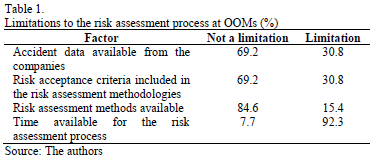
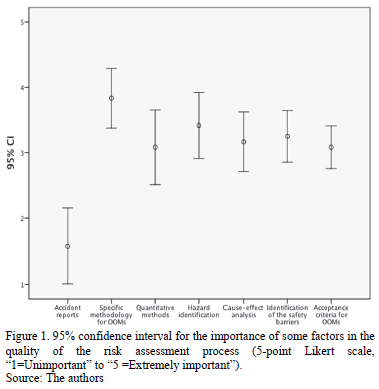
<body><![CDATA[<p><font size="3" face="Verdana, Arial, Helvetica, sans-serif"><b>3. Results</b></font></p>     <p><font size="2" face="Verdana, Arial, Helvetica, sans-serif"><a href="#tab01">Table 1</a> presents the views of OSH   practitioners about the limitations to the risk assessment process at OOMs due   to several different factors. The results showed that the main limitation   identified was the time available to perform the risk assessment (92.3%),   followed by the criteria included in the risk assessment methodologies (30.8%)   and then the data of the companies available to support objective risk   assessment (30.8%). The risk assessment methods available were not seen as a   problematic issue in the risk assessment process in the OOM sector, as only   15.4% of the respondents identified it as a limitation. </font></p>     <p align="center"><font size="2" face="Verdana, Arial, Helvetica, sans-serif"><a name="tab01"></a></font><img src="/img/revistas/dyna/v83n196/v83n196a03tab01.gif"></p>     <p><font size="2" face="Verdana, Arial, Helvetica, sans-serif">The importance of   some specific factors in terms of the quality of the risk assessment process   was also analyzed and the results are   presented in <a href="#fig01">Fig. 1</a>. This information is relevant to be able to better   understand how the quality of the risk assessment methodology in this specific   sector can be improved in order to provide reliable results.</font></p>     <p align="center"><font size="2" face="Verdana, Arial, Helvetica, sans-serif"><a name="fig01"></a></font><img src="/img/revistas/dyna/v83n196/v83n196a03fig01.gif"></p>     <p><font size="2" face="Verdana, Arial, Helvetica, sans-serif">According to   the results obtained, most of OSH practitioners consider that the use of   statistical accident reports to support a more objective risk assessment   process is not an important issue (61.5% of respondents indicate this   information as &quot;unimportant&quot;). However, greater importance was attributed to a   specific risk assessment methodology for the OOM sector (79.9% of respondents   consider this factor to be &quot;highly important&quot;). Respondents assessed the other   factors analyzed as &quot;important&quot;.</font></p>     <p><font size="2" face="Verdana, Arial, Helvetica, sans-serif">The   applicability of different ways of carrying out the risk assessment was also   analyzed in order to obtain insights into a new possible strategy to be applied   in the sector. Respondents were asked about the use of workdays lost as a   measure for severity or whether the use of a qualitative classification was   more appropriate. Although no significant differences were found (p&gt;0.05),   most respondents assessed the use of qualitative measures as being either   &quot;applicable&quot; (23.1%) or &quot;highly applicable&quot; (69.2%). The possibility of using   accident frequency as a measure for probability was also compared with a   qualitative assessment. Significant differences were not found (p&gt;0.05);   however, most respondents considered the use of accident frequency to be either   &quot;applicable&quot; (30.8%) or &quot;highly applicable&quot; (69.2%). Results also show that   sector data could be a good solution for supporting risk decisions as most of   the OSH practitioners surveyed assessed this possibility to be highly   applicable (30.8% &quot;applicable&quot; and 69.2% &quot;highly applicable&quot;). The use of   diagrams to establish the relationship between hazard, event, and consequence   was also seen as applicable to the risk assessment process at OOMs (38.5%   &quot;applicable&quot; and 53.8% &quot;highly applicable&quot;).</font></p>     <p>&nbsp;</p>     <p><font size="3" face="Verdana, Arial, Helvetica, sans-serif"><b>4. Discussion</b></font></p>     <p><font size="2" face="Verdana, Arial, Helvetica, sans-serif">According to   the results obtained, the time available to carry out the risk assessment at   OOM companies is the main limitation for OSH practitioners. The organization of   health and safety management at these companies may explain this result. Most   OOM companies outsource OSH services to external consultants and only sign comprehensive   contracts covering limited prevention actions &#91;16&#93;. Obviously, faced with this   scenario, and bearing in mind that all the OSH practitioners surveyed are   external consultants in the OOM sector, they do not have much time to spend on   the risk assessment process. This can be a major limitation to the quality of   risk assessment in this sector. Without sufficient time, a superficial analysis   of hazards and risk assessments based on insufficient information may be   performed, the only goal being the provision of prevention services to ensure   that the companies comply with legal requirements &#91;13,16&#93;. Furthermore, as   there is not very much time, it is expected that the approaches used and the   results obtained are not presented in the most effective way to the companies'   managers. Without due care, the approaches employed and results obtained from   risk assessments cannot be easily understood, and, as such, important risk   reduction measures may not be implemented &#91;4&#93;.</font></p>     ]]></body>
<body><![CDATA[<p><font size="2" face="Verdana, Arial, Helvetica, sans-serif">Moreover, most of the OSH practitioners   surveyed did not identify the risk assessment methods available as a   limitation. To better understand this point of view, we should emphasize   several issues. In Spain, the National Institute for Safety and Health at Work   (INSHT) (www.insht.es) recommends that a qualitative method be used in small   and medium-sized enterprises (SMEs). This method is based on a risk matrix, in   which the likelihood of accidents and their expected severity are presented as   categorical variables. Based on this idea, and considering the small amount of   time available and the lack of statistical accident data, it is expected that   most OSH practitioners will apply this method and perform the assessment of   occupational risks qualitatively &#91;8&#93;. In fact, qualitative methods have the   advantage of requiring less information, time and effort &#91;17&#93;. Therefore, they   can be seen as a good approach for companies with little information about past   accidents and when the time for performing the risk assessment is limited.</font></p>     <p><font size="2" face="Verdana, Arial, Helvetica, sans-serif">As   qualitative methodologies may be used in this sector, it is understandable that   OSH practitioners do not see companies' accident reports as a critical   limitation to the risk assessment process. However, it is important to bear in   mind that, in these conditions, decisions about risk will be based on the   knowledge, perception and experience of the decision-makers &#91;18&#93;. This can be a   limitation to the quality of risk assessment in the sector. This is   particularly critical when only one person performs most of the process. In   other industrial sectors, a team of 3 to 5 people is recommended in order to   cover all areas of expertise &#91;13&#93;. However, it is important to highlight that   some respondents considered the absence of accident data from the companies as   a limitation to the risk assessment process. In fact, by using this   information, the subjectivity inherent to this process can be reduced and   additional important information can be provided &#91;8&#93;.</font></p>     <p><font size="2" face="Verdana, Arial, Helvetica, sans-serif">The results also showed that the criteria   included in the risk assessment methodologies were seen as a limitation by some   respondents. Although most consider the methodologies used to be adequate in   the OOM sector, the criteria included may not be the most appropriate in all   circumstances. Rodrigues et al. &#91;11&#93; discussed this issue, emphasizing the need   to adjust the acceptance criteria included in the risk assessment methodologies   to the companies' circumstances. In these cases, when acceptance criteria are   not properly adapted, the OSH practitioners may take the initiative to adjust   them, and, without guidelines, this process may be based on their own judgment   about risk acceptance. In fact, this is a regular practice in several countries   such as Portugal. Rodrigues et al. &#91;10&#93;, in a study of Portuguese OSH   practitioners, found that a significant number adjust the acceptance criteria   included in the methodologies, particularly when risk matrices are used.</font></p>     <p><font size="2" face="Verdana, Arial, Helvetica, sans-serif">It is   interesting to note that all the respondents agreed that a specific risk   assessment methodology in the OOM sector is important. In fact, the features   specific to this sector in terms of organization, the particularities of the   activities performed at these companies, differences at the worksite, the   varying number of workers throughout the year (as most are seasonal),   operations in more than one shift, and external staff &#91;16&#93; are all a   significant constraint to the risk assessment process. It may be difficult for   the OSH practitioner to identify all the hazards and to analyze all the   accident mechanisms when they are faced with this type of work organization.   This situation is exacerbated by the limited time available to perform the risk   assessment and the lack of data about accidents.</font></p>     <p><font size="2" face="Verdana, Arial, Helvetica, sans-serif">The results also indicated that the OSH   practitioners surveyed believe that it is important to perform hazard   identification in a structured manner, following a systematic process. This   process makes it possible to ensure that all the sources of risks have been   identified. Furthermore, the analysis of cause and effect, i.e., the analysis   of the relationship between hazard, event, and consequence, and the analysis of   the safety barriers to prevent or provide protection from risks are also seen   as important. These results are in accordance with other studies in other   sectors &#91;13&#93;.</font></p>     <p><font size="2" face="Verdana, Arial, Helvetica, sans-serif">This study also analyzed how OSH practitioners   view the applicability of different ways of carrying out the risk assessment   process at OOMs. The results show that respondents see the use of accident   reports from the sector as a good alternative to support the risk assessment   process. This kind of approach is not new in Spain; Carrillo-Castrillo et al.   &#91;8&#93; had already proposed this a method based on the use of sectorial accident   reports to support an initial risk assessment of maintenance activities.   Furthermore, the OSH practitioners surveyed believe that the use of   quantitative measures for probability, such as accident frequency, would also   be useful, although they seemed to prefer assessing severity in a qualitatively.   The use of diagrams to establish the relationship between hazard, event, and   consequence is also considered to be useful in this sector. In fact, they   indicated the importance of the cause and effect analysis to improve the   quality of risk assessment. Diagrams can enable the relevant accident's causal   pathways and their consequences to be identified, while at the same time   identifying the existing or necessary safety barriers &#91;6&#93;.</font></p>     <p><font size="2" face="Verdana, Arial, Helvetica, sans-serif">Despite this study's results, it is   important to bear in mind that if the questionnaire was applied in other   sectors, the results could be different, e.g. in other sectors the lack of   accident data on a company level may not be deemed to be an important   limitation.</font></p>     <p>&nbsp;</p>     <p><font size="3" face="Verdana, Arial, Helvetica, sans-serif"><b>5. Conclusions</b></font></p>     <p><font size="2" face="Verdana, Arial, Helvetica, sans-serif">The results of the current study provided   evidence about the key difficulties/limitations inherent to the risk assessment   process at OOMs, and identify some improvements that could be made to current   practices. This research is an extension of a previous paper &#91;19&#93;, in which a more   in-depth analysis of the issue was undertaken. </font></p>     ]]></body>
<body><![CDATA[<p><font size="2" face="Verdana, Arial, Helvetica, sans-serif">In general,   throughout the study, a need for a new strategy for risk assessment at OOMs was   emphasized. This strategy needs to be directed towards the quality of the risk   assessment process in order to provide useful and beneficial information for   the companies. When the results of the risk assessment are effective, risk   reduction measures can be implemented more easily, achieving a suitable level   of accomplishment to improve work conditions and, more importantly, to allow   the companies go beyond legal requirements. Furthermore, this type of approach   can make the companies' managers more risk-conscious and committed to OSH,   promoting new models for risk management such as a culture based on people   &#91;20&#93;. In this way, companies can change their prevention policy, providing   better conditions for OSH practitioners to perform a more quality risk   assessment. The companies' managers can hire other types of services that allow   for a deeper analysis of hazardous situations, thereby giving more time to OSH   practitioners to perform their actions.</font></p>     <p><font size="2" face="Verdana, Arial, Helvetica, sans-serif">The study   highlighted the need for a specific tool for risk assessment in the OOM sector.   That tool needs to include acceptance criteria adjusted to the OOMs'   circumstances and to use risk metrics based on the frequency of accidents as   measures to assess accident probability. The use of accident reports from the   entire sector was deemed to be a good approach to reduce the subjectivity of   the risk assessment process and to help OSH practitioners to focus on the most   important circumstances of accidents. Furthermore, a structured process for   hazard identification, the identification of the relationship between cause and   effect, and the identification of the safety barriers were also considered to   be important issues in order to improve the quality of risk assessment in OOMs.</font></p>     <p>&nbsp;</p>     <p><font size="3" face="Verdana, Arial, Helvetica, sans-serif"><b>References</b></font></p>     <!-- ref --><p><font size="2" face="Verdana, Arial, Helvetica, sans-serif"><b>&#91;1&#93;</b> van Duijne, F.H., van Aken, D. and van   Schouten, E.G., Considerations in developing complete and quantified methods   for risk assessment. Safety Science, 46(2), pp. 245-254, 2008.    &nbsp;&nbsp;&nbsp;&nbsp;&nbsp;&nbsp;&nbsp;&nbsp;[&#160;<a href="javascript:void(0);" onclick="javascript: window.open('/scielo.php?script=sci_nlinks&ref=1153444&pid=S0012-7353201600020000300001&lng=','','width=640,height=500,resizable=yes,scrollbars=1,menubar=yes,');">Links</a>&#160;]<!-- end-ref --> </font></p>     <!-- ref --><p><font size="2" face="Verdana, Arial, Helvetica, sans-serif"><b>&#91;2&#93;</b> Hajakbari, M.S. and Minaei-Bidgoli, B.,   A new scoring system for assessing the risk of occupational accidents: A case   study using data mining techniques with Iran's Ministry of Labor data. Journal   of Loss Prevention in the Process Industries, 32, pp. 443-453, 2014.    &nbsp;&nbsp;&nbsp;&nbsp;&nbsp;&nbsp;&nbsp;&nbsp;[&#160;<a href="javascript:void(0);" onclick="javascript: window.open('/scielo.php?script=sci_nlinks&ref=1153446&pid=S0012-7353201600020000300002&lng=','','width=640,height=500,resizable=yes,scrollbars=1,menubar=yes,');">Links</a>&#160;]<!-- end-ref --></font></p>     <!-- ref --><p><font size="2" face="Verdana, Arial, Helvetica, sans-serif"><b>&#91;3&#93;</b> ISO 31000: 2009., Risk management-   Principles and guidelines. International Organization for Standardization,   2009.    &nbsp;&nbsp;&nbsp;&nbsp;&nbsp;&nbsp;&nbsp;&nbsp;[&#160;<a href="javascript:void(0);" onclick="javascript: window.open('/scielo.php?script=sci_nlinks&ref=1153448&pid=S0012-7353201600020000300003&lng=','','width=640,height=500,resizable=yes,scrollbars=1,menubar=yes,');">Links</a>&#160;]<!-- end-ref --></font></p>     ]]></body>
<body><![CDATA[<!-- ref --><p><font size="2" face="Verdana, Arial, Helvetica, sans-serif"><b>&#91;4&#93;</b> Backlund, F. and Hannu, J., Can we make   maintenance decisions on risk analysis results? Journal of Quality in   Maintenance Engineering, 8(1), pp. 77-91, 2002.    &nbsp;&nbsp;&nbsp;&nbsp;&nbsp;&nbsp;&nbsp;&nbsp;[&#160;<a href="javascript:void(0);" onclick="javascript: window.open('/scielo.php?script=sci_nlinks&ref=1153450&pid=S0012-7353201600020000300004&lng=','','width=640,height=500,resizable=yes,scrollbars=1,menubar=yes,');">Links</a>&#160;]<!-- end-ref --></font></p>     <!-- ref --><p><font size="2" face="Verdana, Arial, Helvetica, sans-serif"><b>&#91;5&#93;</b> Cox, R.A., Improving risk assessment   methods for process plant. Journal Of Hazardous Materials, 6, pp. 249-260,   1982.    &nbsp;&nbsp;&nbsp;&nbsp;&nbsp;&nbsp;&nbsp;&nbsp;[&#160;<a href="javascript:void(0);" onclick="javascript: window.open('/scielo.php?script=sci_nlinks&ref=1153452&pid=S0012-7353201600020000300005&lng=','','width=640,height=500,resizable=yes,scrollbars=1,menubar=yes,');">Links</a>&#160;]<!-- end-ref --></font></p>     <!-- ref --><p><font size="2" face="Verdana, Arial, Helvetica, sans-serif"><b>&#91;6&#93;</b> Jacinto, C. and Silva, C., A   semi-quantitative assessment of occupational risks using bow-tie   representation. Safety Science, 48(8), pp. 973-979, 2010.    &nbsp;&nbsp;&nbsp;&nbsp;&nbsp;&nbsp;&nbsp;&nbsp;[&#160;<a href="javascript:void(0);" onclick="javascript: window.open('/scielo.php?script=sci_nlinks&ref=1153454&pid=S0012-7353201600020000300006&lng=','','width=640,height=500,resizable=yes,scrollbars=1,menubar=yes,');">Links</a>&#160;]<!-- end-ref --></font></p>     <!-- ref --><p><font size="2" face="Verdana, Arial, Helvetica, sans-serif"><b>&#91;7&#93;</b> Pinto, A., Ribeiro, R.A. and Nunes,   I.L., Fuzzy approach for reducing subjectivity in estimating occupational   accident severity. Accident Analysis &amp; Prevention, 45, pp. 281-290, 2012.    &nbsp;&nbsp;&nbsp;&nbsp;&nbsp;&nbsp;&nbsp;&nbsp;[&#160;<a href="javascript:void(0);" onclick="javascript: window.open('/scielo.php?script=sci_nlinks&ref=1153456&pid=S0012-7353201600020000300007&lng=','','width=640,height=500,resizable=yes,scrollbars=1,menubar=yes,');">Links</a>&#160;]<!-- end-ref --></font></p>     <!-- ref --><p><font size="2" face="Verdana, Arial, Helvetica, sans-serif"><b>&#91;8&#93;</b> Carrillo-Castrillo, J.A., Rubio-Romero,   J.C., Guadix, J. and Onievac, L., Risk assessment of maintenance operations:   The analysis of performing task and accident mechanism. International Journal   of Injury Control and Safety Promotion, 22(3), pp. 267-77, 2015.    &nbsp;&nbsp;&nbsp;&nbsp;&nbsp;&nbsp;&nbsp;&nbsp;[&#160;<a href="javascript:void(0);" onclick="javascript: window.open('/scielo.php?script=sci_nlinks&ref=1153458&pid=S0012-7353201600020000300008&lng=','','width=640,height=500,resizable=yes,scrollbars=1,menubar=yes,');">Links</a>&#160;]<!-- end-ref --> </font></p>     ]]></body>
<body><![CDATA[<!-- ref --><p><font size="2" face="Verdana, Arial, Helvetica, sans-serif"><b>&#91;9&#93;</b> Khanzode, V.V., Maiti, J. and Ray,   P.K., Occupational injury and accident research: A comprehensive review. Safety   Science, 50(5), pp. 1355-1367, 2012.    &nbsp;&nbsp;&nbsp;&nbsp;&nbsp;&nbsp;&nbsp;&nbsp;[&#160;<a href="javascript:void(0);" onclick="javascript: window.open('/scielo.php?script=sci_nlinks&ref=1153460&pid=S0012-7353201600020000300009&lng=','','width=640,height=500,resizable=yes,scrollbars=1,menubar=yes,');">Links</a>&#160;]<!-- end-ref --></font></p>     <!-- ref --><p><font size="2" face="Verdana, Arial, Helvetica, sans-serif"><b>&#91;10&#93;</b> Rodrigues, M.A., Arezes, P.M. and Leão,   C.P., Risk decision in occupational environments: The Portuguese reality,   Proceedings of 11th International Probabilistic Safety Assessment and   Management Conference and the Annual European Safety and Reliability Conference   2012, PSAM11 ESREL 2012, 2, pp. 1366-1375, 2012.    &nbsp;&nbsp;&nbsp;&nbsp;&nbsp;&nbsp;&nbsp;&nbsp;[&#160;<a href="javascript:void(0);" onclick="javascript: window.open('/scielo.php?script=sci_nlinks&ref=1153462&pid=S0012-7353201600020000300010&lng=','','width=640,height=500,resizable=yes,scrollbars=1,menubar=yes,');">Links</a>&#160;]<!-- end-ref --></font></p>     <!-- ref --><p><font size="2" face="Verdana, Arial, Helvetica, sans-serif"><b>&#91;11&#93;</b> Rodrigues, M.A., Arezes, P. and Leão,   C.P., Defining risk acceptance criteria in occupational settings: A case study   in the furniture industrial sector. Safety Science, 80, pp. 288-295, 2015.    &nbsp;&nbsp;&nbsp;&nbsp;&nbsp;&nbsp;&nbsp;&nbsp;[&#160;<a href="javascript:void(0);" onclick="javascript: window.open('/scielo.php?script=sci_nlinks&ref=1153464&pid=S0012-7353201600020000300011&lng=','','width=640,height=500,resizable=yes,scrollbars=1,menubar=yes,');">Links</a>&#160;]<!-- end-ref --></font></p>     <!-- ref --><p><font size="2" face="Verdana, Arial, Helvetica, sans-serif"><b>&#91;12&#93;</b> Carvalho, F. and Melo, R., Stability   and reproducibility of semi-quantitative risk assessment methods within the   occupational health and safety scope. Work, 51(3), pp. 591-600, 2015.    &nbsp;&nbsp;&nbsp;&nbsp;&nbsp;&nbsp;&nbsp;&nbsp;[&#160;<a href="javascript:void(0);" onclick="javascript: window.open('/scielo.php?script=sci_nlinks&ref=1153466&pid=S0012-7353201600020000300012&lng=','','width=640,height=500,resizable=yes,scrollbars=1,menubar=yes,');">Links</a>&#160;]<!-- end-ref --></font></p>     <!-- ref --><p><font size="2" face="Verdana, Arial, Helvetica, sans-serif"><b>&#91;13&#93;</b> Pinto, A., Ribeiro, R.A. and Nunes,   I.L., Ensuring the quality of occupational safety risk assessment. Risk   Analysis, 33(3), pp. 409-419, 2013.    &nbsp;&nbsp;&nbsp;&nbsp;&nbsp;&nbsp;&nbsp;&nbsp;[&#160;<a href="javascript:void(0);" onclick="javascript: window.open('/scielo.php?script=sci_nlinks&ref=1153468&pid=S0012-7353201600020000300013&lng=','','width=640,height=500,resizable=yes,scrollbars=1,menubar=yes,');">Links</a>&#160;]<!-- end-ref --></font></p>     ]]></body>
<body><![CDATA[<!-- ref --><p><font size="2" face="Verdana, Arial, Helvetica, sans-serif"><b>&#91;14&#93;</b> Agencia de Informaci&oacute;n y   Control Alimentarios., Informe de gesti&oacute;n de la campa&ntilde;a 2012-2013   del aceite de oliva y de la aceituna de mesa, Madrid, Minist&eacute;rio de   Agricultura, Alimentaci&oacute;n y Medio Ambiente, 2014.    &nbsp;&nbsp;&nbsp;&nbsp;&nbsp;&nbsp;&nbsp;&nbsp;[&#160;<a href="javascript:void(0);" onclick="javascript: window.open('/scielo.php?script=sci_nlinks&ref=1153470&pid=S0012-7353201600020000300014&lng=','','width=640,height=500,resizable=yes,scrollbars=1,menubar=yes,');">Links</a>&#160;]<!-- end-ref --></font></p>     <!-- ref --><p><font size="2" face="Verdana, Arial, Helvetica, sans-serif"><b>&#91;15&#93;</b> Consejeria de Agricultura,   Pesca y Medio Ambiente., Estrategia Andaluza para la investigaci&oacute;n de la   calidad del aceite de oliva, Andaluzia, Junta de Andaluzia, 2013.    &nbsp;&nbsp;&nbsp;&nbsp;&nbsp;&nbsp;&nbsp;&nbsp;[&#160;<a href="javascript:void(0);" onclick="javascript: window.open('/scielo.php?script=sci_nlinks&ref=1153472&pid=S0012-7353201600020000300015&lng=','','width=640,height=500,resizable=yes,scrollbars=1,menubar=yes,');">Links</a>&#160;]<!-- end-ref --></font></p>     <!-- ref --><p><font size="2" face="Verdana, Arial, Helvetica, sans-serif"><b>&#91;16&#93;</b> Parejo-Moscoso, J.M., Rubio-Romero,   J.C., P&eacute;rez-Canto, S. and Soriano-Serrano, M., Health and safety   management in olive oil mills in Spain. Safety Science, 51, pp. 101-108, 2013.    &nbsp;&nbsp;&nbsp;&nbsp;&nbsp;&nbsp;&nbsp;&nbsp;[&#160;<a href="javascript:void(0);" onclick="javascript: window.open('/scielo.php?script=sci_nlinks&ref=1153474&pid=S0012-7353201600020000300016&lng=','','width=640,height=500,resizable=yes,scrollbars=1,menubar=yes,');">Links</a>&#160;]<!-- end-ref --></font></p>     <!-- ref --><p><font size="2" face="Verdana, Arial, Helvetica, sans-serif"><b>&#91;17&#93;</b> Lee, H.-S., Kim, H., Park, M., Teo,   E.A.L. and Lee, K.-P., Construction risk assessment using site influence   factors. Journal of Computing in Civil Engineering, 26, pp. 319-330, 2012.    &nbsp;&nbsp;&nbsp;&nbsp;&nbsp;&nbsp;&nbsp;&nbsp;[&#160;<a href="javascript:void(0);" onclick="javascript: window.open('/scielo.php?script=sci_nlinks&ref=1153476&pid=S0012-7353201600020000300017&lng=','','width=640,height=500,resizable=yes,scrollbars=1,menubar=yes,');">Links</a>&#160;]<!-- end-ref --></font></p>     <!-- ref --><p><font size="2" face="Verdana, Arial, Helvetica, sans-serif"><b>&#91;18&#93;</b> Parejo-Moscoso, J.M., Rubio-Romero,   J.C. and P&eacute;rez-Canto, S., Occupational accident rate in olive oil mills.   Safety Science, 50, pp. 285-293, 2012.    &nbsp;&nbsp;&nbsp;&nbsp;&nbsp;&nbsp;&nbsp;&nbsp;[&#160;<a href="javascript:void(0);" onclick="javascript: window.open('/scielo.php?script=sci_nlinks&ref=1153478&pid=S0012-7353201600020000300018&lng=','','width=640,height=500,resizable=yes,scrollbars=1,menubar=yes,');">Links</a>&#160;]<!-- end-ref --></font></p>     ]]></body>
<body><![CDATA[<!-- ref --><p><font size="2" face="Verdana, Arial, Helvetica, sans-serif"><b>&#91;19&#93;</b> Hughes, P. and Ferrett, E.,   Introduction to health and safety at work. 1st ed. UK: Elsevier, 2007.    &nbsp;&nbsp;&nbsp;&nbsp;&nbsp;&nbsp;&nbsp;&nbsp;[&#160;<a href="javascript:void(0);" onclick="javascript: window.open('/scielo.php?script=sci_nlinks&ref=1153480&pid=S0012-7353201600020000300019&lng=','','width=640,height=500,resizable=yes,scrollbars=1,menubar=yes,');">Links</a>&#160;]<!-- end-ref --></font></p>     <!-- ref --><p><font size="2" face="Verdana, Arial, Helvetica, sans-serif"><b>&#91;20&#93;</b> Rodrigues, M., Romero, J., Arezes, P.,   and Soriano-Serrano, M., Limitations and improvements to the risk assessment   process in olive oil mills: The views of OSH practitioners, Proceedings of   Occupational Safety Hygiene SHO2015, pp. 309-311, 2015.    &nbsp;&nbsp;&nbsp;&nbsp;&nbsp;&nbsp;&nbsp;&nbsp;[&#160;<a href="javascript:void(0);" onclick="javascript: window.open('/scielo.php?script=sci_nlinks&ref=1153482&pid=S0012-7353201600020000300020&lng=','','width=640,height=500,resizable=yes,scrollbars=1,menubar=yes,');">Links</a>&#160;]<!-- end-ref --></font></p>     <!-- ref --><p><font size="2" face="Verdana, Arial, Helvetica, sans-serif"><b>&#91;21&#93;</b> Formoso, J.A.F., Couce, L.C.,   Rodriguez, G.I. and Carricoba, M.S., The path to excellence: A management   strategy based on people. DYNA, 80(182), pp. 7-14, 2013.    &nbsp;&nbsp;&nbsp;&nbsp;&nbsp;&nbsp;&nbsp;&nbsp;[&#160;<a href="javascript:void(0);" onclick="javascript: window.open('/scielo.php?script=sci_nlinks&ref=1153484&pid=S0012-7353201600020000300021&lng=','','width=640,height=500,resizable=yes,scrollbars=1,menubar=yes,');">Links</a>&#160;]<!-- end-ref --></font></p>     <p>&nbsp;</p>     <p><font size="2" face="Verdana, Arial, Helvetica, sans-serif"><b>M.A. Rodrigues,</b> is a lecturer in the   Department of Environmental Health at the Allied Health Sciences School at the   Polytechnic Institute of Porto; Portugal. She received her BSc. in   Environmental Health in 2007 from the Polytechnic Institute of Porto; Portugal.   She received her MSc. from the University of Minho; Portugal in Human   Engineering in 2009 and her PhD in Industrial Engineering and Systems in 2014.   Her research interests focus on occupational, safety and health in different   domains, particularly risk management, industrial hygiene, risk perception,   safety culture and ergonomics. She is particularly interested in the   decision-making process behind occupational accidents. ORCID: 0000-0001-6175-6934</font></p>     <p><font size="2" face="Verdana, Arial, Helvetica, sans-serif"><b>J.C. Rubio-Romero,</b> is PhD, MSc. and   Industrial Engineer and an associate professor of &quot;Safety at Work&quot; in the School   of Industrial Engineering of the University of Malaga, Spain. He obtained his   PhD in 2000 in occupational health and safety in the industry, and is currently   the Chair of Prevention and Social Corporate Responsibility at the University   of Malaga as well as the director of the research group, &quot;Operations and   Sustainability: Quality, ICT and Risk Prevention at Work&quot;. Dr. Rubio has spent   over 18 years researching workplace health and safety and has published a wide   range of textbooks, reports, and papers, especially on management of workplace   health and safety in the manufacturing industry and at construction sites. ORCID: 0000-0002-5122-7526</font></p>     <p><font size="2" face="Verdana, Arial, Helvetica, sans-serif"><b>P.M. Arezes</b>, received his PhD. in   Industrial and Systems Engineering from UMinho, in Portugal. He is a full   professor of ergonomics and human factors at the School of Engineering -   University of Minho. He is also a visiting fellow at MIT's AgeLab in the USA.   He leads the human engineering research group and he is also the UMinho   coordinator of the Engineering Design and Advanced Manufacturing (EDAM) area of   the MIT Portugal Program, and he is the chair of the steering board on the   &quot;Leaders for Technical Industries (LTI)&quot; PhD program at UMinho. He is the   (co)author of more than 60 papers published in peer-reviewed international   journals, as well as a member of the editorial board of more than 15   international scientific journals. ORCID: 0000-0001-9421-9123</font></p>     ]]></body>
<body><![CDATA[<p><font size="2" face="Verdana, Arial, Helvetica, sans-serif"><b>M. Soriano-Serrano,</b> is a Lawyer, the   Director of the Centre of Occupational Risk Prevention in the Government of   Andaluc&iacute;a, and a lecturer at the University of Ja&eacute;n, Spain.</font></p>      ]]></body><back>
<ref-list>
<ref id="B1">
<label>1</label><nlm-citation citation-type="journal">
<person-group person-group-type="author">
<name>
<surname><![CDATA[van Duijne]]></surname>
<given-names><![CDATA[F.H.]]></given-names>
</name>
<name>
<surname><![CDATA[van Aken]]></surname>
<given-names><![CDATA[D.]]></given-names>
</name>
<name>
<surname><![CDATA[van Schouten]]></surname>
<given-names><![CDATA[E.G.]]></given-names>
</name>
</person-group>
<article-title xml:lang="en"><![CDATA[Considerations in developing complete and quantified methods for risk assessment.]]></article-title>
<source><![CDATA[Safety Science]]></source>
<year>2008</year>
<volume>46</volume>
<numero>2</numero>
<issue>2</issue>
<page-range>245-254</page-range></nlm-citation>
</ref>
<ref id="B2">
<label>2</label><nlm-citation citation-type="journal">
<person-group person-group-type="author">
<name>
<surname><![CDATA[Hajakbari]]></surname>
<given-names><![CDATA[M.S.]]></given-names>
</name>
<name>
<surname><![CDATA[Minaei-Bidgoli]]></surname>
<given-names><![CDATA[B.]]></given-names>
</name>
</person-group>
<article-title xml:lang="en"><![CDATA[A new scoring system for assessing the risk of occupational accidents: A case study using data mining techniques with Iran's Ministry of Labor data.]]></article-title>
<source><![CDATA[Journal of Loss Prevention in the Process Industries]]></source>
<year>2014</year>
<numero>32</numero>
<issue>32</issue>
<page-range>443-453</page-range></nlm-citation>
</ref>
<ref id="B3">
<label>3</label><nlm-citation citation-type="book">
<source><![CDATA[ISO 31000: 2009: Risk management- Principles and guidelines.]]></source>
<year>2009</year>
<publisher-name><![CDATA[International Organization for Standardization]]></publisher-name>
</nlm-citation>
</ref>
<ref id="B4">
<label>4</label><nlm-citation citation-type="journal">
<person-group person-group-type="author">
<name>
<surname><![CDATA[Backlund]]></surname>
<given-names><![CDATA[F.]]></given-names>
</name>
<name>
<surname><![CDATA[Hannu]]></surname>
<given-names><![CDATA[J.]]></given-names>
</name>
</person-group>
<article-title xml:lang="en"><![CDATA[Can we make maintenance decisions on risk analysis results?]]></article-title>
<source><![CDATA[Journal of Quality in Maintenance Engineering]]></source>
<year>2002</year>
<volume>8</volume>
<numero>1</numero>
<issue>1</issue>
<page-range>77-91</page-range></nlm-citation>
</ref>
<ref id="B5">
<label>5</label><nlm-citation citation-type="journal">
<person-group person-group-type="author">
<name>
<surname><![CDATA[Cox]]></surname>
<given-names><![CDATA[R.A.]]></given-names>
</name>
</person-group>
<article-title xml:lang="en"><![CDATA[Improving risk assessment methods for process plant.]]></article-title>
<source><![CDATA[Journal Of Hazardous Materials]]></source>
<year>1982</year>
<numero>6</numero>
<issue>6</issue>
<page-range>249-260</page-range></nlm-citation>
</ref>
<ref id="B6">
<label>6</label><nlm-citation citation-type="journal">
<person-group person-group-type="author">
<name>
<surname><![CDATA[Jacinto]]></surname>
<given-names><![CDATA[C.]]></given-names>
</name>
<name>
<surname><![CDATA[Silva]]></surname>
<given-names><![CDATA[C.]]></given-names>
</name>
</person-group>
<article-title xml:lang="en"><![CDATA[A semi-quantitative assessment of occupational risks using bow-tie representation.]]></article-title>
<source><![CDATA[Safety Science]]></source>
<year>2010</year>
<volume>48</volume>
<numero>8</numero>
<issue>8</issue>
<page-range>973-979</page-range></nlm-citation>
</ref>
<ref id="B7">
<label>7</label><nlm-citation citation-type="journal">
<person-group person-group-type="author">
<name>
<surname><![CDATA[Pinto]]></surname>
<given-names><![CDATA[A.]]></given-names>
</name>
<name>
<surname><![CDATA[Ribeiro]]></surname>
<given-names><![CDATA[R.A.]]></given-names>
</name>
<name>
<surname><![CDATA[Nunes]]></surname>
<given-names><![CDATA[I.L.]]></given-names>
</name>
</person-group>
<article-title xml:lang="en"><![CDATA[Fuzzy approach for reducing subjectivity in estimating occupational accident severity.]]></article-title>
<source><![CDATA[Accident Analysis & Prevention]]></source>
<year>2012</year>
<numero>45</numero>
<issue>45</issue>
<page-range>281-290</page-range></nlm-citation>
</ref>
<ref id="B8">
<label>8</label><nlm-citation citation-type="journal">
<person-group person-group-type="author">
<name>
<surname><![CDATA[Carrillo-Castrillo]]></surname>
<given-names><![CDATA[J.A.]]></given-names>
</name>
<name>
<surname><![CDATA[Rubio-Romero]]></surname>
<given-names><![CDATA[J.C.]]></given-names>
</name>
<name>
<surname><![CDATA[Guadix]]></surname>
<given-names><![CDATA[J.]]></given-names>
</name>
<name>
<surname><![CDATA[Onievac]]></surname>
<given-names><![CDATA[L.]]></given-names>
</name>
</person-group>
<article-title xml:lang="en"><![CDATA[Risk assessment of maintenance operations: The analysis of performing task and accident mechanism]]></article-title>
<source><![CDATA[International Journal of Injury Control and Safety Promotion]]></source>
<year>2015</year>
<volume>22</volume>
<numero>3</numero>
<issue>3</issue>
<page-range>267-77</page-range></nlm-citation>
</ref>
<ref id="B9">
<label>9</label><nlm-citation citation-type="journal">
<person-group person-group-type="author">
<name>
<surname><![CDATA[Khanzode]]></surname>
<given-names><![CDATA[V.V.]]></given-names>
</name>
<name>
<surname><![CDATA[Maiti]]></surname>
<given-names><![CDATA[J.]]></given-names>
</name>
<name>
<surname><![CDATA[Ray]]></surname>
<given-names><![CDATA[P.K.]]></given-names>
</name>
</person-group>
<article-title xml:lang="en"><![CDATA[Occupational injury and accident research: A comprehensive review]]></article-title>
<source><![CDATA[Safety Science]]></source>
<year>2012</year>
<volume>50</volume>
<numero>5</numero>
<issue>5</issue>
<page-range>1355-1367</page-range></nlm-citation>
</ref>
<ref id="B10">
<label>10</label><nlm-citation citation-type="confpro">
<person-group person-group-type="author">
<name>
<surname><![CDATA[Rodrigues]]></surname>
<given-names><![CDATA[M.A.]]></given-names>
</name>
<name>
<surname><![CDATA[Arezes]]></surname>
<given-names><![CDATA[P.M.]]></given-names>
</name>
<name>
<surname><![CDATA[Leão]]></surname>
<given-names><![CDATA[C.P.]]></given-names>
</name>
</person-group>
<article-title xml:lang="en"><![CDATA[Risk decision in occupational environments: The Portuguese reality]]></article-title>
<source><![CDATA[]]></source>
<year>2012</year>
<volume>2</volume>
<conf-name><![CDATA[11th International Probabilistic Safety Assessment and Management Conference and the Annual European Safety and Reliability Conference]]></conf-name>
<conf-date>2012</conf-date>
<conf-loc> </conf-loc>
<page-range>1366-1375</page-range></nlm-citation>
</ref>
<ref id="B11">
<label>11</label><nlm-citation citation-type="journal">
<person-group person-group-type="author">
<name>
<surname><![CDATA[Rodrigues]]></surname>
<given-names><![CDATA[M.A.]]></given-names>
</name>
<name>
<surname><![CDATA[Arezes]]></surname>
<given-names><![CDATA[P.]]></given-names>
</name>
<name>
<surname><![CDATA[Leão]]></surname>
<given-names><![CDATA[C.P.]]></given-names>
</name>
</person-group>
<article-title xml:lang="en"><![CDATA[Defining risk acceptance criteria in occupational settings: A case study in the furniture industrial sector]]></article-title>
<source><![CDATA[Safety Science]]></source>
<year>2015</year>
<numero>80</numero>
<issue>80</issue>
<page-range>288-295</page-range></nlm-citation>
</ref>
<ref id="B12">
<label>12</label><nlm-citation citation-type="journal">
<person-group person-group-type="author">
<name>
<surname><![CDATA[Carvalho]]></surname>
<given-names><![CDATA[F.]]></given-names>
</name>
<name>
<surname><![CDATA[Melo]]></surname>
<given-names><![CDATA[R.]]></given-names>
</name>
</person-group>
<article-title xml:lang="en"><![CDATA[Stability and reproducibility of semi-quantitative risk assessment methods within the occupational health and safety scope.]]></article-title>
<source><![CDATA[Work]]></source>
<year>2015</year>
<volume>51</volume>
<numero>3</numero>
<issue>3</issue>
<page-range>591-600</page-range></nlm-citation>
</ref>
<ref id="B13">
<label>13</label><nlm-citation citation-type="journal">
<person-group person-group-type="author">
<name>
<surname><![CDATA[Pinto]]></surname>
<given-names><![CDATA[A.]]></given-names>
</name>
<name>
<surname><![CDATA[Ribeiro]]></surname>
<given-names><![CDATA[R.A.]]></given-names>
</name>
<name>
<surname><![CDATA[Nunes]]></surname>
<given-names><![CDATA[I.L.]]></given-names>
</name>
</person-group>
<article-title xml:lang="en"><![CDATA[Ensuring the quality of occupational safety risk assessment]]></article-title>
<source><![CDATA[Risk Analysis]]></source>
<year>2013</year>
<volume>33</volume>
<numero>3</numero>
<issue>3</issue>
<page-range>409-419</page-range></nlm-citation>
</ref>
<ref id="B14">
<label>14</label><nlm-citation citation-type="book">
<collab>Agencia de Información y Control Alimentarios</collab>
<source><![CDATA[Informe de gestión de la campaña 2012-2013 del aceite de oliva y de la aceituna de mesa]]></source>
<year>2014</year>
<publisher-loc><![CDATA[Madrid ]]></publisher-loc>
<publisher-name><![CDATA[Ministério de Agricultura, Alimentación y Medio Ambiente]]></publisher-name>
</nlm-citation>
</ref>
<ref id="B15">
<label>15</label><nlm-citation citation-type="book">
<collab>Consejeria de Agricultura, Pesca y Medio Ambiente</collab>
<source><![CDATA[Estrategia Andaluza para la investigación de la calidad del aceite de oliva]]></source>
<year>2013</year>
<publisher-loc><![CDATA[Andaluzia ]]></publisher-loc>
<publisher-name><![CDATA[Junta de Andaluzia]]></publisher-name>
</nlm-citation>
</ref>
<ref id="B16">
<label>16</label><nlm-citation citation-type="journal">
<person-group person-group-type="author">
<name>
<surname><![CDATA[Parejo-Moscoso]]></surname>
<given-names><![CDATA[J.M.]]></given-names>
</name>
<name>
<surname><![CDATA[Rubio-Romero]]></surname>
<given-names><![CDATA[J.C.]]></given-names>
</name>
<name>
<surname><![CDATA[Pérez-Canto]]></surname>
<given-names><![CDATA[S.]]></given-names>
</name>
<name>
<surname><![CDATA[Soriano-Serrano]]></surname>
<given-names><![CDATA[M.]]></given-names>
</name>
</person-group>
<article-title xml:lang="en"><![CDATA[Health and safety management in olive oil mills in Spain.]]></article-title>
<source><![CDATA[Safety Science]]></source>
<year>2013</year>
<numero>51</numero>
<issue>51</issue>
<page-range>101-108</page-range></nlm-citation>
</ref>
<ref id="B17">
<label>17</label><nlm-citation citation-type="journal">
<person-group person-group-type="author">
<name>
<surname><![CDATA[Lee]]></surname>
<given-names><![CDATA[H.-S.]]></given-names>
</name>
<name>
<surname><![CDATA[Kim]]></surname>
<given-names><![CDATA[H.]]></given-names>
</name>
<name>
<surname><![CDATA[Park]]></surname>
<given-names><![CDATA[M.]]></given-names>
</name>
<name>
<surname><![CDATA[Teo]]></surname>
<given-names><![CDATA[E.A.L.]]></given-names>
</name>
<name>
<surname><![CDATA[Lee]]></surname>
<given-names><![CDATA[K.-P.]]></given-names>
</name>
</person-group>
<article-title xml:lang="en"><![CDATA[Construction risk assessment using site influence factors.]]></article-title>
<source><![CDATA[Journal of Computing in Civil Engineering]]></source>
<year>2012</year>
<numero>26</numero>
<issue>26</issue>
<page-range>319-330</page-range></nlm-citation>
</ref>
<ref id="B18">
<label>18</label><nlm-citation citation-type="journal">
<person-group person-group-type="author">
<name>
<surname><![CDATA[Parejo-Moscoso]]></surname>
<given-names><![CDATA[J.M.]]></given-names>
</name>
<name>
<surname><![CDATA[Rubio-Romero]]></surname>
<given-names><![CDATA[J.C.]]></given-names>
</name>
<name>
<surname><![CDATA[Pérez-Canto]]></surname>
<given-names><![CDATA[S.]]></given-names>
</name>
</person-group>
<article-title xml:lang="en"><![CDATA[Occupational accident rate in olive oil mills]]></article-title>
<source><![CDATA[Safety Science]]></source>
<year>2012</year>
<numero>50</numero>
<issue>50</issue>
<page-range>285-293</page-range></nlm-citation>
</ref>
<ref id="B19">
<label>19</label><nlm-citation citation-type="book">
<person-group person-group-type="author">
<name>
<surname><![CDATA[Hughes]]></surname>
<given-names><![CDATA[P.]]></given-names>
</name>
<name>
<surname><![CDATA[Ferrett]]></surname>
<given-names><![CDATA[E.]]></given-names>
</name>
</person-group>
<source><![CDATA[Introduction to health and safety at work.]]></source>
<year>2007</year>
<edition>1st</edition>
<publisher-name><![CDATA[Elsevier]]></publisher-name>
</nlm-citation>
</ref>
<ref id="B20">
<label>20</label><nlm-citation citation-type="confpro">
<person-group person-group-type="author">
<name>
<surname><![CDATA[Rodrigues]]></surname>
<given-names><![CDATA[M.]]></given-names>
</name>
<name>
<surname><![CDATA[Romero]]></surname>
<given-names><![CDATA[J.]]></given-names>
</name>
<name>
<surname><![CDATA[Arezes]]></surname>
<given-names><![CDATA[P.]]></given-names>
</name>
<name>
<surname><![CDATA[Soriano-Serrano]]></surname>
<given-names><![CDATA[M.]]></given-names>
</name>
</person-group>
<article-title xml:lang="en"><![CDATA[Limitations and improvements to the risk assessment process in olive oil mills: The views of OSH practitioners]]></article-title>
<source><![CDATA[]]></source>
<year>2015</year>
<conf-name><![CDATA[ Occupational Safety Hygiene SHO2015]]></conf-name>
<conf-loc> </conf-loc>
<page-range>309-311</page-range></nlm-citation>
</ref>
<ref id="B21">
<label>21</label><nlm-citation citation-type="journal">
<person-group person-group-type="author">
<name>
<surname><![CDATA[Formoso]]></surname>
<given-names><![CDATA[J.A.F.]]></given-names>
</name>
<name>
<surname><![CDATA[Couce]]></surname>
<given-names><![CDATA[L.C.]]></given-names>
</name>
<name>
<surname><![CDATA[Rodriguez]]></surname>
<given-names><![CDATA[G.I.]]></given-names>
</name>
<name>
<surname><![CDATA[Carricoba]]></surname>
<given-names><![CDATA[M.S.]]></given-names>
</name>
</person-group>
<article-title xml:lang="en"><![CDATA[The path to excellence: A management strategy based on people.]]></article-title>
<source><![CDATA[DYNA]]></source>
<year>2013</year>
<volume>80</volume>
<numero>182</numero>
<issue>182</issue>
<page-range>7-14</page-range></nlm-citation>
</ref>
</ref-list>
</back>
</article>