<?xml version="1.0" encoding="ISO-8859-1"?><article xmlns:mml="http://www.w3.org/1998/Math/MathML" xmlns:xlink="http://www.w3.org/1999/xlink" xmlns:xsi="http://www.w3.org/2001/XMLSchema-instance">
<front>
<journal-meta>
<journal-id>0012-7353</journal-id>
<journal-title><![CDATA[DYNA]]></journal-title>
<abbrev-journal-title><![CDATA[Dyna rev.fac.nac.minas]]></abbrev-journal-title>
<issn>0012-7353</issn>
<publisher>
<publisher-name><![CDATA[Universidad Nacional de Colombia]]></publisher-name>
</publisher>
</journal-meta>
<article-meta>
<article-id>S0012-73532016000200008</article-id>
<article-id pub-id-type="doi">10.15446/dyna.v83n196.56609</article-id>
<title-group>
<article-title xml:lang="en"><![CDATA[Differences in muscular activity between obese and non-obese workers during manual lifting]]></article-title>
<article-title xml:lang="es"><![CDATA[Diferencias en la actividad muscular entre trabajadores obesos y no obesos durante la elevación manual de cargas]]></article-title>
</title-group>
<contrib-group>
<contrib contrib-type="author">
<name>
<surname><![CDATA[Colim]]></surname>
<given-names><![CDATA[Ana]]></given-names>
</name>
<xref ref-type="aff" rid="A01"/>
</contrib>
<contrib contrib-type="author">
<name>
<surname><![CDATA[Arezes]]></surname>
<given-names><![CDATA[Pedro]]></given-names>
</name>
<xref ref-type="aff" rid="A02"/>
</contrib>
<contrib contrib-type="author">
<name>
<surname><![CDATA[Flores]]></surname>
<given-names><![CDATA[Paulo]]></given-names>
</name>
<xref ref-type="aff" rid="A03"/>
</contrib>
<contrib contrib-type="author">
<name>
<surname><![CDATA[Braga]]></surname>
<given-names><![CDATA[Ana Cristina]]></given-names>
</name>
<xref ref-type="aff" rid="A04"/>
</contrib>
</contrib-group>
<aff id="A01">
<institution><![CDATA[,University of Minho Production and Systems Department ]]></institution>
<addr-line><![CDATA[Guimarães ]]></addr-line>
<country>Portugal</country>
</aff>
<aff id="A02">
<institution><![CDATA[,University of Minho Production and Systems Department ]]></institution>
<addr-line><![CDATA[Guimarães ]]></addr-line>
<country>Portugal</country>
</aff>
<aff id="A03">
<institution><![CDATA[,University of Minho Mechanical Engineering Department ]]></institution>
<addr-line><![CDATA[Guimarães ]]></addr-line>
<country>Portugal</country>
</aff>
<aff id="A04">
<institution><![CDATA[,University of Minho Production and Systems Department ]]></institution>
<addr-line><![CDATA[Guimarães ]]></addr-line>
<country>Portugal</country>
</aff>
<pub-date pub-type="pub">
<day>00</day>
<month>04</month>
<year>2016</year>
</pub-date>
<pub-date pub-type="epub">
<day>00</day>
<month>04</month>
<year>2016</year>
</pub-date>
<volume>83</volume>
<numero>196</numero>
<fpage>55</fpage>
<lpage>62</lpage>
<copyright-statement/>
<copyright-year/>
<self-uri xlink:href="http://www.scielo.org.co/scielo.php?script=sci_arttext&amp;pid=S0012-73532016000200008&amp;lng=en&amp;nrm=iso"></self-uri><self-uri xlink:href="http://www.scielo.org.co/scielo.php?script=sci_abstract&amp;pid=S0012-73532016000200008&amp;lng=en&amp;nrm=iso"></self-uri><self-uri xlink:href="http://www.scielo.org.co/scielo.php?script=sci_pdf&amp;pid=S0012-73532016000200008&amp;lng=en&amp;nrm=iso"></self-uri><abstract abstract-type="short" xml:lang="en"><p><![CDATA[The prevalence of obesity is increasing throughout the workforce. Manual lifting tasks are common and can produce significant muscle loading. This study compared muscular activity between obese and non-obese subjects, using surface Electromyography (EMG), during manual lifting. Six different lifting tasks (with 5, 10 and 15 kg loads in free and constrained styles) were performed by 14 participants with different obesity levels. EMG data normalization was based on the percentage of Maximum Contraction during each Task (MCT). Muscle Activation Times (AT) before each task were also evaluated. The study suggests that obesity can increase MCT and delay muscle AT. These findings reinforce the need to develop further studies focused on obesity as a risk factor for the development of musculoskeletal disorders.]]></p></abstract>
<abstract abstract-type="short" xml:lang="es"><p><![CDATA[La prevalencia de la obesidad está aumentando también entre los trabajadores. Las tareas de elevación manual son comunes y pueden producir una significativa carga muscular. El actual estudio comparó la actividad muscular entre sujetos obesos y no obesos, mediante la aplicación de electromiografía de superficie (EMG) durante la elevación manual de cargas. Seis tareas de elevación muy diversas (con cargas de 5, 10 y 15 kg y con estilos de elevación libre y restringido) fueran solicitadas a los 14 sujetos con diferentes niveles de obesidad. La normalización de los datos de EMG fue basada en el porcentaje de la contracción máxima (MCT) durante cada tarea. También se ha evaluado el tiempo de la activación (AT) del músculo antes de cada tarea. El estudio sugiere que la obesidad puede aumentar el MCT y retrasar el AT del músculo. Estos resultados refuerzan la necesidad de desarrollar nuevos estudios, los cuales se deben centrar en la obesidad como un factor de riesgo para la aparición de síntomas y trastornos musculoesqueléticos.]]></p></abstract>
<kwd-group>
<kwd lng="en"><![CDATA[obesity]]></kwd>
<kwd lng="en"><![CDATA[manual lifting]]></kwd>
<kwd lng="en"><![CDATA[surface electromyography]]></kwd>
<kwd lng="en"><![CDATA[maximum contraction during task]]></kwd>
<kwd lng="en"><![CDATA[muscle activation time]]></kwd>
<kwd lng="es"><![CDATA[obesidad]]></kwd>
<kwd lng="es"><![CDATA[elevación manual]]></kwd>
<kwd lng="es"><![CDATA[electromiografía de superficie]]></kwd>
<kwd lng="es"><![CDATA[contracción máxima durante la tarea]]></kwd>
<kwd lng="es"><![CDATA[tiempo de activación muscular]]></kwd>
</kwd-group>
</article-meta>
</front><body><![CDATA[ <p><font size="1" face="Verdana, Arial, Helvetica, sans-serif"><b>DOI:</b> <a href="http://dx.doi.org/10.15446/dyna.v83n196.56609" target="_blank">http://dx.doi.org/10.15446/dyna.v83n196.56609</a></font></p>     <p align="center"><font size="4" face="Verdana, Arial, Helvetica, sans-serif"><b>Differences in muscular activity   between obese and non-obese workers during manual lifting</b></font></p>     <p align="center"><font size="3"><b><font face="Verdana, Arial, Helvetica, sans-serif"><i>Diferencias   en la actividad muscular entre trabajadores obesos y no obesos durante la   elevaci&oacute;n manual de cargas</i></font></b></font></p>     <p align="center">&nbsp;</p>     <p align="center"><font size="2" face="Verdana, Arial, Helvetica, sans-serif"><b>Ana Colim <i><sup>a</sup></i>,   Pedro Arezes <i><sup>b</sup></i>, Paulo   Flores <i><sup>c</sup></i> &amp; Ana   Cristina Braga <i><sup>d</sup></i></b></font></p>     <p align="center">&nbsp;</p>     <p align="center"><font size="2" face="Verdana, Arial, Helvetica, sans-serif"><sup><i>a </i></sup><i>Production and   Systems Department, University of Minho, Guimarães, Portugal. <a href="mailto:ana.colim@dps.uminho.pt">ana.colim@dps.uminho.pt</a>    <br>   <sup>b </sup>Production and   Systems Department, University of Minho, Guimarães, Portugal. <a href="mailto:parezes@dps.uminho.pt">parezes@dps.uminho.pt</a>    <br>   <sup>c </sup>Mechanical   Engineering Department, University of Minho, Guimarães, Portugal. <a href="mailto:pflores@dem.uminho.pt">pflores@dem.uminho.pt</a>    <br>   <sup>d </sup>Production and   Systems Department, University of Minho, Guimarães, Portugal. <a href="mailto:acb@dps.uminho.pt">acb@dps.uminho.pt</a></i></font></p>     ]]></body>
<body><![CDATA[<p align="center">&nbsp;</p>     <p align="center"><font size="2" face="Verdana, Arial, Helvetica, sans-serif"><b>Received: December 01<sup>rd</sup>, 2015.   Received in revised form: February 02<sup>nd</sup>, 2016. Accepted: March 09<sup>th</sup>,   2016.</b></font></p>     <p align="center">&nbsp;</p>     <p align="center"><font size="1" face="Verdana, Arial, Helvetica, sans-seriff"><b>This work is licensed under a</b> <a rel="license" href="http://creativecommons.org/licenses/by-nc-nd/4.0/">Creative Commons Attribution-NonCommercial-NoDerivatives 4.0 International License</a>.</font><br />   <a rel="license" href="http://creativecommons.org/licenses/by-nc-nd/4.0/"><img style="border-width:0" src="https://i.creativecommons.org/l/by-nc-nd/4.0/88x31.png" /></a></p> <hr>     <p><font size="2" face="Verdana, Arial, Helvetica, sans-serif"><b>Abstract    <br>   </b></font><font size="2" face="Verdana, Arial, Helvetica, sans-serif">The   prevalence of obesity is increasing throughout the workforce. Manual lifting   tasks are common and can produce significant muscle loading. This study   compared muscular activity between obese and non-obese subjects, using surface   Electromyography (EMG), during manual lifting. Six different lifting tasks (with 5, 10 and 15 kg loads in free and   constrained styles) were performed by 14 participants with different obesity   levels. EMG data normalization was based on the percentage of Maximum   Contraction during each Task (MCT). Muscle Activation Times (AT) before each   task were also evaluated. The study suggests that obesity can increase MCT and   delay muscle AT. These findings reinforce the need to develop further studies   focused on obesity as a risk factor for the development of musculoskeletal   disorders.</font></p>     <p><font size="2" face="Verdana, Arial, Helvetica, sans-serif"><i>Keywords</i>: obesity; manual lifting; surface electromyography; maximum   contraction during task; muscle activation time.</font></p>     <p><font size="2" face="Verdana, Arial, Helvetica, sans-serif"><b>Resumen    <br>   </b></font><font size="2" face="Verdana, Arial, Helvetica, sans-serif">La   prevalencia de la obesidad est&aacute; aumentando tambi&eacute;n entre los trabajadores. Las   tareas de elevaci&oacute;n manual son comunes y pueden producir una significativa   carga muscular. El actual estudio compar&oacute; la actividad muscular entre sujetos   obesos y no obesos, mediante la aplicaci&oacute;n de electromiograf&iacute;a de superficie   (EMG) durante la elevaci&oacute;n manual de cargas. Seis tareas de elevaci&oacute;n muy   diversas (con cargas de 5, 10 y 15 kg y con estilos de elevaci&oacute;n libre y   restringido) fueran solicitadas a los 14 sujetos con diferentes niveles de   obesidad. La normalizaci&oacute;n de los datos de EMG fue basada en el porcentaje de   la contracci&oacute;n m&aacute;xima (MCT) durante cada tarea. Tambi&eacute;n se ha evaluado el   tiempo de la activaci&oacute;n (AT) del m&uacute;sculo antes de cada tarea. El estudio   sugiere que la obesidad puede aumentar el MCT y retrasar el AT del m&uacute;sculo.   Estos resultados refuerzan la necesidad de desarrollar nuevos estudios, los   cuales se deben centrar en la obesidad como un factor de riesgo para la   aparici&oacute;n de s&iacute;ntomas y trastornos musculoesquel&eacute;ticos.</font></p>     <p><font size="2" face="Verdana, Arial, Helvetica, sans-serif"><i>Palabras-clave:</i> obesidad; elevaci&oacute;n   manual; electromiograf&iacute;a de superficie; contracci&oacute;n m&aacute;xima durante la tarea;   tiempo de activaci&oacute;n muscular.</font></p> <hr>     ]]></body>
<body><![CDATA[<p>&nbsp;</p>     <p><font size="3" face="Verdana, Arial, Helvetica, sans-serif"><b>1. Introduction</b></font></p>     <p><font size="2" face="Verdana, Arial, Helvetica, sans-serif"><b><i>1.1. Effects of obesity on work   performance</i></b></font></p>     <p><font size="2" face="Verdana, Arial, Helvetica, sans-serif">Improved social conditions among the   population have led to an increase in the incidence of obesity in several   countries, principally in the industrialized world. Global statistics confirm   that obesity has more than doubled since 1980 and that, currently, more than   1.4 billion adults are overweight &#91;1&#93;. Obese subjects therefore represent a   growing fraction of the workforce &#91;2&#93;. </font></p>     <p><font size="2" face="Verdana, Arial, Helvetica, sans-serif">Obesity can be associated with   psychological, social and physical problems, including Work-related   Musculoskeletal Disorders (WRMSDs), which can negatively affect productivity   &#91;3,4&#93;. Additionally, overweight subjects are absent from work due to illness   more frequently and for longer periods than the non-obese &#91;5&#93;. This absenteeism   is frequently related to WRMSDs &#91;6&#93;. </font></p>     <p><font size="2" face="Verdana, Arial, Helvetica, sans-serif">Specific studies have analyzed different   activities of daily life, comparing obese with non-obese subjects.   Biomechanical studies of human walking have demonstrated that body fat mass   (BFM) affects this activity &#91;7&#93;. For example, obese subjects reveal higher   ground reaction forces &#91;8&#93;, altered knee joint kinematics &#91;9&#93; and higher metabolic   rates, even though the explanation for this last aspect has not been clearly   established &#91;10&#93;. </font></p>     <p><font size="2" face="Verdana, Arial, Helvetica, sans-serif">Additionally,   stressful working postures are known to be related to the risk of WRMSDs. These   postures can be affected by excessive BFM. However, the effects of obesity on   posture maintenance during occupational tasks are rarely investigated &#91;11&#93;.   Postural analysis tools, frequently used in workplace ergonomic interventions,   seem to consider only people with normal weight. Based on this assumption, Park   et al. &#91;12&#93; carried out psychophysical research with obese and non-obese   subjects who were asked to perform static box-holding tasks in different   working postures. In this study, the obese group reported higher perceived   overload in all the postures considered, demonstrating that obesity increases   postural stress. The findings of another study &#91;13&#93;, also showed that the trunk   posture of obese subjects was more flexed and that they experienced increased   hip joint moment and greater hip-to-bench distance during a simulated standing   work task. </font></p>     <p><font size="2" face="Verdana, Arial, Helvetica, sans-serif">Furthermore, it has also been   demonstrated that obese subjects have more problems with work-restricting   musculoskeletal pain than subjects of normal weight &#91;14&#93;. From the biomechanical point of   view, excessive body mass can negatively affect the behavior of muscles and   spine during the performance of physical activities. Different   studies have correlated obesity with impairments to muscle activity, such as   decreased muscle strength &#91;7,15,16&#93;, as well as with lower back pain &#91;17,18&#93;, although the epidemiological research literature   has still not demonstrated a clear link between obesity and the latter   phenomenon &#91;19&#93;.</font></p>     <p><font size="2" face="Verdana, Arial, Helvetica, sans-serif">It is   important to emphasize that lower back pain and its associated disorders   continue to be the most common musculoskeletal problem in the workplace. It is   associated with high costs to industry and can negatively influence the quality   of life of workers. Several findings have shown that workers who perform manual   materials handling, including lifting tasks, are exposed to a greater risk of   back pain and/or WRMSDs than others whose jobs do not require this type of task   &#91;20,21&#93;. However, such activities are very common in a wide variety of   industrial workplaces &#91;22&#93;; they can have a range of additional occupational and   individual WRMSD risk factors associated with them too. One of these individual   risk factors is individual body composition, including excessive BFM &#91;20&#93;.</font></p>     <p><font size="2" face="Verdana, Arial, Helvetica, sans-serif">In this context, Singh et al. &#91;23&#93; used a   psychophysical approach and showed that obesity does not seem to reduce the   maximum acceptable weight during manual lifting. However, these authors pointed out that this   area requires further study, using other kinds of data, such as biomechanical   information. Consequently, Xu et al. &#91;24&#93; analyzed   lifting kinematics and kinetics in subjects with different body compositions,   testing the hypothesis that heavier people lift more slowly, in order to   minimize musculoskeletal load. However, obese subjects in fact registered   higher values for kinematic trunk variables than their normal weight counterparts. </font></p>     ]]></body>
<body><![CDATA[<p><font size="2" face="Verdana, Arial, Helvetica, sans-serif">As   mentioned above, although obesity has been intensively studied in recent years,   research findings remain somewhat controversial. For example, the effect of   excessive BFM on the function of the locomotor system is not yet well   understood &#91;7&#93;. In addition, ergonomic studies are required to provide a more   complete understanding of the effects of obesity on work performance &#91;25&#93;,   including during manual lifting tasks. </font></p>     <p><font size="2" face="Verdana, Arial, Helvetica, sans-serif"><b><i>1.2. Assessment of obesity</i></b></font></p>     <p><font size="2" face="Verdana, Arial, Helvetica, sans-serif">Currently, obesity is assessed using   different techniques, but each has several potential limitations and they   should therefore be applied with caution. Among other available techniques, which   include the body mass index (BMI), percentage of BFM, waist circumference (WC),   WC/height ratio and WC/hip ratio, have been widely used in the assessment of   obesity and to quantify the risk of obesity-related disorders &#91;26&#93;. </font></p>     <p><font size="2" face="Verdana, Arial, Helvetica, sans-serif">It should be noted that in previous   research into the effects of obesity on work performance, BMI has been the principal   indicator used for obesity assessment. BMI is only based on a subject's weight   and height; it does not distinguish fat-free body mass and fat mass, as it does   not characterize body fat mass distribution &#91;27&#93;. BMI is an anthropometric   measure commonly applied in epidemiological studies. However its specificity   and predictive ability in identification of health problems associated with   obesity have been questioned. BMI is considered to be a fallible measure for a   detailed assessment of body composition and, therefore, should not be used to   classify the individual level of obesity &#91;28&#93;, implying the need to use more   appropriate and comprehensive obesity assessment techniques. </font></p>     <p><font size="2" face="Verdana, Arial, Helvetica, sans-serif">For these   reasons, in this study obesity levels were categorized according to subjects'   BFM, determined by bioelectrical impedance analysis (BIA). This body   composition assessment technique is easy to apply, non-invasive, relatively   inexpensive and portable &#91;29&#93;. BIA allows for the quantification of body   impedance by connecting electrodes to different areas of the body in order to   create a circuit through which a current can pass. As the different human   tissues exhibit different resistances to the passage of electric current, BIA   devices determine the amount of lean body mass and body water as well as fat.   Thus, the BFM can be obtained by calculating the difference between weight and   lean body mass in individuals &#91;28&#93;. These results are obtained by way of   predictive analytical expressions adjusted to individual factors such as gender,   age, height and level of physical activity. These equations (which vary   according to the equipment used) must be validated for the population in   question, including obese individuals &#91;30&#93;.</font></p>     <p><font size="2" face="Verdana, Arial, Helvetica, sans-serif"><b><i>1.3. Muscular activity analysis   during manual lifting</i></b></font></p>     <p><font size="2" face="Verdana, Arial, Helvetica, sans-serif">Obesity has   been associated with impaired muscle function and reduced muscle strength   &#91;7,15,16&#93;. These alterations to muscle activity can increase an individual's   predisposition to WRMSDs &#91;31&#93;. Concerning occupational contexts, one of the key   elements in WRMSD prevention is understanding the muscular demands of commonly   performed tasks &#91;32&#93;, such as manual lifting. In this field, surface EMG has   been widely used in ergonomic studies focused on various risk factors for MSDs,   in an effort to optimize lifting tasks and so reduce the risk of such disorders   developing &#91;32-34&#93;. In order to analyze muscular activity for each obesity   level, surface EMG data was collected, as the principal role of the technique   is the objective evaluation of muscle activity associated with particular   manual work tasks &#91;35&#93;.</font></p>     <p><font size="2" face="Verdana, Arial, Helvetica, sans-serif">The main   purpose of the current study was to examine possible differences between the   muscular contraction and activation times of obese and non-obese subjects   during manual lifting. The intention was also to study some task conditions   (different load weights and postural restraints) that might produce variations   in muscular responses for the obese subjects. </font></p>     <p>&nbsp;</p>     <p><font size="3" face="Verdana, Arial, Helvetica, sans-serif"><b>2. Materials and Method</b></font></p>     ]]></body>
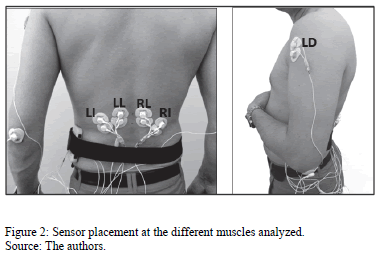
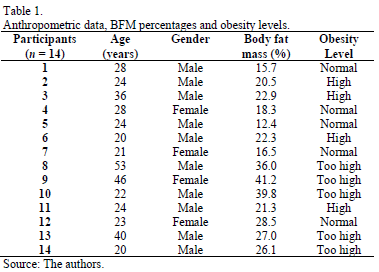
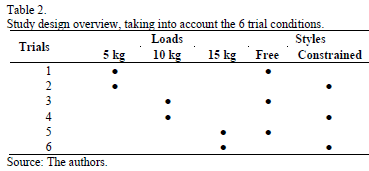
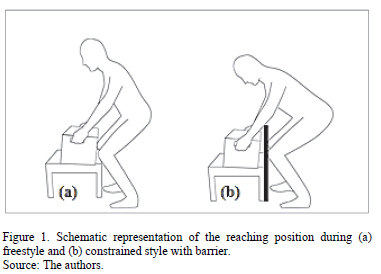
<body><![CDATA[<p><font size="2" face="Verdana, Arial, Helvetica, sans-serif"><b><i>2.1. Subjects and experimental   trials</i></b></font></p>     <p><font size="2" face="Verdana, Arial, Helvetica, sans-serif">Ten healthy males and four women, with no history of musculoskeletal   disorders, volunteered to participate in the study. After signing an informed   consent form, different anthropometric measures (weight, stature, shoulder   height, WC) were collected. An OMRON BF306 Body Fat Monitor was used to   determine the individuals' obesity levels (5 were &quot;Normal&quot;, 4 were &quot;High&quot; and 5   were &quot;Too high&quot;). This equipment measures the BFM percentage based on electric   resistance (determined by BIA) and also integrates personal data, such as the   height, weight, age and gender of participants, in order to accurately define individual obesity levels   &#91;36&#93;. The personal data used in the obesity level definition are   presented in <a href="#tab01">Table </a>1.</font></p>     <p align="center"><font size="2" face="Verdana, Arial, Helvetica, sans-serif"><a name="tab01"></a></font><img src="/img/revistas/dyna/v83n196/v83n196a08tab01.gif"></p>     <p><font size="2" face="Verdana, Arial, Helvetica, sans-serif">In the sagittal plane, 6 symmetrical   trials (3 loads x 2 styles) of lifting and replacing a test box with goods   handles, and with loads of 5 kg, 10 kg and 15 kg respectively, were performed   in constrained and in free conditions (<a href="#tab02">Table 2</a>). During constrained lifting,   the box was placed behind a 60 cm high barrier simulating one side of an   industrial bin. The high barrier was constructed to measure 120% of average   male and female knee heights &#91;34&#93;. The box loads complied with the recommended   limits defined by Portuguese national legislation &#91;37&#93; and in some of the   guidelines published by the National Institute Occupational Safety and Health   (NIOSH) &#91;38&#93;. </font></p>     <p align="center"><font size="2" face="Verdana, Arial, Helvetica, sans-serif"><a name="tab02"></a></font><img src="/img/revistas/dyna/v83n196/v83n196a08tab02.gif"></p>     <p><font size="2" face="Verdana, Arial, Helvetica, sans-serif">During the   trials, participants stood in front of a height platform adjusted to each   subject's standing knee height. They used both hands to lift the box vertically   up to shoulder height and to return it to its original position in a single   slow movement. In order to simulate a realistic working situation, no specific   foot-placing instructions were given. The movement was subdivided into 4   phases: standing up (rest position), reaching (represented in <a href="#fig01">Fig. 1</a>), lifting,   and replacing the box. However, the data analyzed in this paper relates only to   the lifting phase.</font></p>     <p align="center"><font size="2" face="Verdana, Arial, Helvetica, sans-serif"><a name="fig01"></a></font><img src="/img/revistas/dyna/v83n196/v83n196a08fig01.gif"></p>     <p><font size="2" face="Verdana, Arial, Helvetica, sans-serif"><b><i>2.2. EMG data collection</i></b></font></p>     <p><font size="2" face="Verdana, Arial, Helvetica, sans-serif">A portable   EMG system (PLUX wireless biosignals®) was used to collect EMG data while the   subjects performed the manual lifting tasks. EMG activity was collected using   bipolar surface electrodes with 1 cm diameter and an inter-electrode distance   of 2 cm. The EMG electrodes were affixed to the subject's body using standard   placement procedures for Surface Electromyography for the Non-Invasive   Assessment of Muscles &#91;39&#93; The zones of electrode placement were shaved,   abraded and cleansed with rubbing alcohol absorbed into cotton rounds to lower   the skin's electrical impedance &#91;35&#93;.</font></p>     <p><font size="2" face="Verdana, Arial, Helvetica, sans-serif">The electrodes were located at 3 muscles   recruited during this type of task: the right and left <i>Erector spinae</i> (<i>iliocostalis</i>)   at L2 (RI, LI), the right and left <i>Erector   spinae</i> (<i>longissimus</i>) at L1 (RL,   LL) and the right and left <i>Deltoideus   Anterior</i> (RD, LD) (<a href="#fig02">Fig. 2</a>). </font></p>     ]]></body>
<body><![CDATA[<p align="center"><font size="2" face="Verdana, Arial, Helvetica, sans-serif"><a name="fig02"></a></font><img src="/img/revistas/dyna/v83n196/v83n196a08fig02.gif"></p>     <p><font size="2" face="Verdana, Arial, Helvetica, sans-serif">Muscle selection was based on their   functionality during this type of task. The <i>Erector   spinae</i> muscles are spine extensors, significantly recruited during vertical   handling tasks &#91;34&#93;. The <i>Deltoideus   Anterior </i>muscle acts during arm abduction, assists arm flexion, extension   and rotation, and is also responsible for shoulder joint stability &#91;40&#93;. In addition,   it was observed that fat mass accumulation was not high in these zones of the   selected muscles, which, had it been, might have compromised EMG signal   acquisition. At least one neutral reference (ground)   electrode was fixed on the elbow per subject. </font></p>     <p><font size="2" face="Verdana, Arial, Helvetica, sans-serif"><b><i>2.3. EMG signal processing </i></b></font></p>     <p><font size="2" face="Verdana, Arial, Helvetica, sans-serif">AcqKnowledge 3.9.0 software was used to   process the EMG data. The raw EMG signals were amplified, high-pass filtered at   20 Hz and low-pass filtered at 500 Hz, rectified, and smoothed. The digital   smoothing algorithm used was the root mean square (RMS), which reflects the   mean power of the EMG signal &#91;35&#93; for each muscle and for each phase of the   experimental trials. EMG data were normalized to peak value during each lifting   trial, according to the following expression (1).</font></p>     <p><img src="/img/revistas/dyna/v83n196/v83n196a08eq01.gif"></p>     <p><font size="2" face="Verdana, Arial, Helvetica, sans-serif">This normalization procedure has been   utilized in other EMG studies with subjects presenting restrictions in their   ability to perform maximum voluntary contractions, such as sufferers of   musculoskeletal pathologies or obesity &#91;41&#93;. In addition, before each lifting   trial, muscle AT was evaluated. This muscle onset quantification was based on a   threshold defined by multiple SD of EMG-baseline noise &#91;35&#93;. In this   experimental design, the independent variables were the different box loads,   lifting style and obesity level. The dependent variables consisted of the MCT   percentage and muscle AT.</font></p>     <p><font size="2" face="Verdana, Arial, Helvetica, sans-serif"><b><i>2.4. Statistical analysis</i></b></font></p>     <p><font size="2" face="Verdana, Arial, Helvetica, sans-serif">A   statistical analysis was conducted using the <i>IBM</i><sup>®</sup> <i>SPSS</i><sup>®</sup> <i>Statistics 22.0</i> software. For each task   condition, the mean MCT percentages were compared across the subjects belonging   to different obesity levels, in order to test the following hypothesis: greater mean MCT   percentages are observed in individuals with higher BFM percentages.   Accordingly, outcomes were compared using Pearson correlation tests, because   the variables were found to behave normally (<i>p</i>&gt;0.05 in the Shapiro-Wilk test).</font></p>     <p><font size="2" face="Verdana, Arial, Helvetica, sans-serif">Each   muscle was then tested to see whether the task conditions (loads and barrier)   produced significant effects on the mean MCT percentages in obese subjects. For   this purpose a repeated measures ANOVA was applied. The assumption of normality   was verified using the Shapiro-Wilk test, and the sphericity of the data was   rejected by the Mauchly test (<i>p</i> &lt;0.05). As the <i>epsilon</i> estimated   value is greater than 0.75, the Huynh-Feldt correction was used to interpret   the results for intra-subject effects.</font></p>     <p><font size="2" face="Verdana, Arial, Helvetica, sans-serif">Additionally,   for each muscle considered, the following null hypothesis was also tested: i.e.,   that the distribution of AT is the same across different levels of obesity. To   assess the normality of the AT values, the Kolmogorov test with Lilliefors   correction was performed but, for most of the variables studied, this condition   was not verified. Thus, the non-parametric Wilcoxon Mann-Whitney   test was also applied. To reject the hypothesis, the decision rule was used to   detect statistically significant evidence if <i>p</i>&lt;0.05.</font></p>     ]]></body>
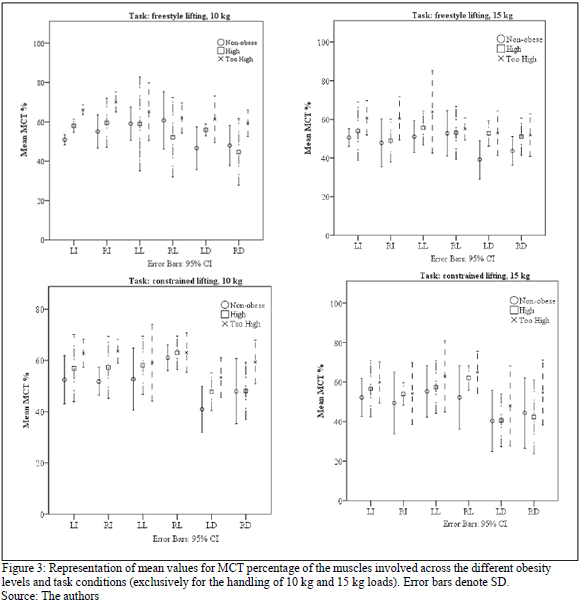
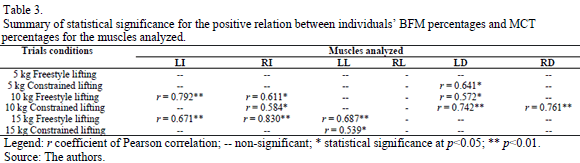
<body><![CDATA[<p>&nbsp;</p>     <p><font size="3" face="Verdana, Arial, Helvetica, sans-serif"><b>3. Results and Discussion</b></font></p>     <p><font size="2" face="Verdana, Arial, Helvetica, sans-serif"><b><i>3.1. MCT percentages across   obesity levels</i></b></font></p>     <p><font size="2" face="Verdana, Arial, Helvetica, sans-serif">Relative to the mean MCT percentage, a   comparison of the values associated with different obesity levels showed that   this variable presents higher values in the groups of &quot;High&quot; and &quot;Too high&quot;   obesity. This difference was more evident in the lifting tasks involving the   handling of the heavier loads, in this case, 10 and 15 kg (<a href="#fig03">Fig. 3</a>).</font></p>     <p align="center"><font size="2" face="Verdana, Arial, Helvetica, sans-serif"><a name="fig03"></a></font><img src="/img/revistas/dyna/v83n196/v83n196a08fig03.gif"></p>     <p><font size="2" face="Verdana, Arial, Helvetica, sans-serif">The Pearson correlation test demonstrated   a significant linear statistical association, in that increased BFM was related   to increases in MCT. This positive relation was established for the different   muscles analyzed in different task conditions, as shown in <a href="#tab03">Table 3</a>.</font></p>     <p align="center"><font size="2" face="Verdana, Arial, Helvetica, sans-serif"><a name="tab03"></a></font><img src="/img/revistas/dyna/v83n196/v83n196a08tab03.gif"></p>     <p><font size="2" face="Verdana, Arial, Helvetica, sans-serif">It should be noted that the extensor   muscle forces associated with these EMG values are the dominant contributor to   compressive loading on the lumbar intervertebral joints &#91;42&#93;, increasing the   risk of back disorders. However, obesity is an individual risk factor commonly   not included in WRMSD risk assessment. Therefore, obesity should be studied as   a WRMSD risk factor during lifting.</font></p>     <p><font size="2" face="Verdana, Arial, Helvetica, sans-serif"><b><i>3.2. MCT percentages of obese subjects   across task conditions</i></b></font></p>     <p><font size="2" face="Verdana, Arial, Helvetica, sans-serif">During lifting tasks, the different   conditions and associated risk factors do not work separately but in conjunction   &#91;43&#93;. Accordingly, the effects of load weight and lifting style on MCT   percentages of obese subjects were investigated. The summary of statistical   significance for these interactions is presented in <a href="#tab04">Table 4</a>.</font></p>     ]]></body>
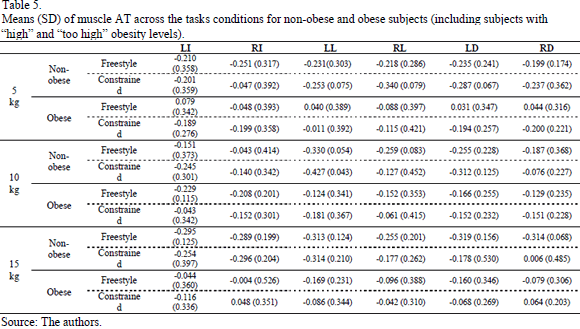
<body><![CDATA[<p align="center"><font size="2" face="Verdana, Arial, Helvetica, sans-serif"><a name="tab04"></a></font><img src="/img/revistas/dyna/v83n196/v83n196a08tab04.gif"></p>     <p><font size="2" face="Verdana, Arial, Helvetica, sans-serif">Significant differences mean MCT   percentages of the following muscles exist for the different loads, as follows:   LI &#91;F(2; 96)= 4.863&#93;; RL &#91;F(2; 96)= 4.726&#93; and LD &#91;F(2; 96)= 3.949&#93;. That is,   significant variation exists across the different loads, in the sense that MCT   values increase between 5 and 10 kg and decrease between 10 and 15 kg (being   higher with 15 kg than with 5 kg loads). In these situations, the mean MCT   percentages are higher in obese subjects, compared to their normal   counterparts.</font></p>     <p><font size="2" face="Verdana, Arial, Helvetica, sans-serif">With   increased load weight, muscle activity of the trunk extensors and the   upper-extremity increases too &#91;43&#93;. These results from existing research are   consistent with the observations of the present study, which found that MCT values   increased during the lifting of 10 kg loads. However, handling of the heaviest   loads can result in a load transfer to the lower body &#91;44&#93;, which might explain   the variation observed for loads of 15 kg.</font></p>     <p><font size="2" face="Verdana, Arial, Helvetica, sans-serif">In this context, many lifting tasks   require workers to lift from industrial bins. The barriers formed by their   sides can constrain knee flexion and increase trunk flexion during such tasks &#91;34&#93;. During   symmetrical lifting, the trunk muscles are activated to create an extension   moment, the risk of WRMSDs being broadly dependent on the resulting lumbar   curvature &#91;45&#93;. Therefore, at the beginning of the   current study, the authors predicted that excess BFM could negatively affect   the posture adopted during these tasks, with the result that the constrained situation   should contribute to increasing the muscular effort required at that point of   the lifts. However, in obese subjects mean MCT percentages did not differ   significantly under conditions of constraint caused by the high barrier, for   any lifting cases. </font></p>     <p><font size="2" face="Verdana, Arial, Helvetica, sans-serif">A previous study &#91;34&#93; reported that in   freestyle lifts the muscle activation levels were significantly lower than   those for constrained situations. In the current study, this difference is not   evident, perhaps because the location of muscles studied was different.</font></p>     <p><font size="2" face="Verdana, Arial, Helvetica, sans-serif"><b><i>3.2. Muscle AT in obese and   non-obese subjects </i></b></font></p>     <p><font size="2" face="Verdana, Arial, Helvetica, sans-serif">Concerning muscle AT, a descriptive   statistical summary of these values across tasks conditions for non-obese and   obese subjects is provided in <a href="#tab05">Table 5</a>.</font></p>     <p align="center"><font size="2" face="Verdana, Arial, Helvetica, sans-serif"><a name="tab05"></a></font><img src="/img/revistas/dyna/v83n196/v83n196a08tab05.gif"></p>     <p><font size="2" face="Verdana, Arial, Helvetica, sans-serif">Concerning the effect of obesity on the distribution of AT, the null hypothesis tested was rejected in the following task   conditions: 10 kg constrained lifting in LL muscle (<i>p</i>=0.029) and 15 kg constrained lifting in RI muscle (<i>p</i>=0.042). Therefore, these statistically   significant differences in the distribution of AT suggest that obese   individuals have higher values when compared with the non-obese. These greater   delays in AT registered for obese subjects suggest that increased BFM can   reduce the ability of skeletal muscle to activate rapidly before starting a   movement, as also occurs in other groups with locomotor difficulties, such as   the elderly or individuals with musculoskeletal disorders &#91;31&#93;. </font></p>     <p><font size="2" face="Verdana, Arial, Helvetica, sans-serif">This poor correlation between muscle AT   and increased BFM may be attributable to deficiencies in the AT quantifier   currently being used.</font></p>     ]]></body>
<body><![CDATA[<p><font size="2" face="Verdana, Arial, Helvetica, sans-serif"><b><i>3.3. Limitations and future work</i></b></font></p>     <p><font size="2" face="Verdana, Arial, Helvetica, sans-serif">There are several limitations that should   be discussed with respect to this study. First of all, most lifting tasks in   workplaces are not scaled. It is also likely that differences may exist for all   obesity levels between tasks with different constraints and loads. The study   was limited to the extent that only a few muscles were monitored with EMG. However,   the selection of which muscles to monitor was influenced by body position, and   trying to avoid regions with more accumulated adipose mass. </font></p>     <p><font size="2" face="Verdana, Arial, Helvetica, sans-serif">It is important to clarify that, since this   is a pilot study in the field, the sample examined was made up of only fourteen   participants. This constitutes a significant limitation. Increasing the sample size   might be an important objective for future investigation.</font></p>     <p><font size="2" face="Verdana, Arial, Helvetica, sans-serif">The results   of this research appear to demonstrate that increased BFM can produce some   changes in muscle activity during lifting. In general, the outcomes are in line   with the existing literature and emphasize the need to explore this research   topic further. Excessive BFM can lead to an overreaction of the recruited   muscles, causing increases in spine compressive loading and a subsequent risk   of back injury. However, in order to examine this relation, further tests must   be performed. Consequently, this area requires further research, which should be   oriented to considering other type of data, such as information on kinematics.</font></p>     <p>&nbsp;</p>     <p><font size="4" face="Verdana, Arial, Helvetica, sans-serif"><b>4. Conclusions</b></font></p>     <p><font size="2" face="Verdana, Arial, Helvetica, sans-serif">The prevalence of obesity is increasing   among the workforce. This research suggests that obese individuals can present   changes in their muscle activity during lifting, compared to non-obese   individuals. Obesity is an individual risk factor, which is very often   neglected when assessing the risk of WRMSDs. Further studies are required to   examine obesity as a WRMSD risk factor during lifting. Future work will involve   a kinematics study, which will be carried out soon, and which it is hoped will improve   our understanding of the effects of obesity on individual lifting capability. </font></p>     <p>&nbsp;</p>     <p><font size="3" face="Verdana, Arial, Helvetica, sans-serif"><b>Acknowledgments</b></font></p>     <p><font size="2" face="Verdana, Arial, Helvetica, sans-serif">This study was supported financially by   the Portuguese Foundation for Science and Technology, under projects   ID/CEC/00319/2013 and UID/EEA/04436/2013.</font></p>     ]]></body>
<body><![CDATA[<p><font size="2" face="Verdana, Arial, Helvetica, sans-serif">The authors wish also to acknowledge   the commitment of the subjects who participated in this experimental   study on a voluntary basis. </font></p>     <p>&nbsp;</p>     <p><font size="3" face="Verdana, Arial, Helvetica, sans-serif"><b>References </b></font></p>     <!-- ref --><p><font size="2" face="Verdana, Arial, Helvetica, sans-serif"><b>&#91;1&#93;</b> World   Health Organization - WHO. Obesity and overweight. Fact sheet, &#91;Online&#93;. 311,   2012. &#91;Accessed: January 12<sup>th</sup> of 2012&#93;. Available at: <a href="http://www.who.int/mediacentre/factsheets/fs311/en/index.html" target="_blank">http://www.who.int/mediacentre/factsheets/fs311/en/index.html</a> </font>&nbsp;&nbsp;&nbsp;&nbsp;&nbsp;&nbsp;&nbsp;&nbsp;[&#160;<a href="javascript:void(0);" onclick="javascript: window.open('/scielo.php?script=sci_nlinks&ref=1147761&pid=S0012-7353201600020000800001&lng=','','width=640,height=500,resizable=yes,scrollbars=1,menubar=yes,');">Links</a>&#160;]<!-- end-ref --><!-- ref --><p><font size="2" face="Verdana, Arial, Helvetica, sans-serif"><b>&#91;2&#93;</b> Flegal,   K., Carroll, M., Ogden, C. and Johnson, C., Prevalence and trends in obesity   among US adults, 1999-2000. JAMA, 288(14), pp. 1723-1727, 2002. DOI: 10.1001/jama.288.14.1723</font>&nbsp;&nbsp;&nbsp;&nbsp;&nbsp;&nbsp;&nbsp;&nbsp;[&#160;<a href="javascript:void(0);" onclick="javascript: window.open('/scielo.php?script=sci_nlinks&ref=1147762&pid=S0012-7353201600020000800002&lng=','','width=640,height=500,resizable=yes,scrollbars=1,menubar=yes,');">Links</a>&#160;]<!-- end-ref --><!-- ref --><p><font size="2" face="Verdana, Arial, Helvetica, sans-serif"><b>&#91;3&#93;</b> Lidstone,   J., Ells, L., Finn, P., Whittaker, V., Wilkinson, J. and Summerbell, C.,   Independent associations between weight status and disability in adults:   Results from the health survey for England. Public Health, 120, pp. 412-417,   2006. DOI: 10.1016/j.puhe.2005.12.003</font>&nbsp;&nbsp;&nbsp;&nbsp;&nbsp;&nbsp;&nbsp;&nbsp;[&#160;<a href="javascript:void(0);" onclick="javascript: window.open('/scielo.php?script=sci_nlinks&ref=1147763&pid=S0012-7353201600020000800003&lng=','','width=640,height=500,resizable=yes,scrollbars=1,menubar=yes,');">Links</a>&#160;]<!-- end-ref --><!-- ref --><p><font size="2" face="Verdana, Arial, Helvetica, sans-serif"><b>&#91;4&#93;</b> Morris,   S., The impact of obesity on employment. Labour Economics. 14, pp. 413-433,   2007. DOI: 10.1016/j.labeco.2006.02.008</font>&nbsp;&nbsp;&nbsp;&nbsp;&nbsp;&nbsp;&nbsp;&nbsp;[&#160;<a href="javascript:void(0);" onclick="javascript: window.open('/scielo.php?script=sci_nlinks&ref=1147764&pid=S0012-7353201600020000800004&lng=','','width=640,height=500,resizable=yes,scrollbars=1,menubar=yes,');">Links</a>&#160;]<!-- end-ref --><!-- ref --><p><font size="2" face="Verdana, Arial, Helvetica, sans-serif"><b>&#91;5&#93;</b> Tsai,   S., Ahmed, F., Wendt, J. Bhojani, F. and Donnelly, R., The impact of obesity on   illness absence and productivity in an industrial population of petrochemical   workers. AEP, 18(1), pp. 8-14, 2008. DOI: 10.1016/j.annepidem.2007.07.091</font>&nbsp;&nbsp;&nbsp;&nbsp;&nbsp;&nbsp;&nbsp;&nbsp;[&#160;<a href="javascript:void(0);" onclick="javascript: window.open('/scielo.php?script=sci_nlinks&ref=1147765&pid=S0012-7353201600020000800005&lng=','','width=640,height=500,resizable=yes,scrollbars=1,menubar=yes,');">Links</a>&#160;]<!-- end-ref --><!-- ref --><p><font size="2" face="Verdana, Arial, Helvetica, sans-serif"><b>&#91;6&#93;</b> Lier,   H., Biringer, E., Eriksen, H. and Tangen, T., Subjective health complaints in a   sample with morbid obesity and the complaints' relation with work ability.   European Psychiatry. 24(S1), pp. 750, 2009. DOI: 10.1016/S0924-9338(09)70983-6</font>&nbsp;&nbsp;&nbsp;&nbsp;&nbsp;&nbsp;&nbsp;&nbsp;[&#160;<a href="javascript:void(0);" onclick="javascript: window.open('/scielo.php?script=sci_nlinks&ref=1147766&pid=S0012-7353201600020000800006&lng=','','width=640,height=500,resizable=yes,scrollbars=1,menubar=yes,');">Links</a>&#160;]<!-- end-ref --><!-- ref --><p><font size="2" face="Verdana, Arial, Helvetica, sans-serif"><b>&#91;7&#93;</b> Wearing,   S., Henning, E., Byrne, N., Steele, J. and Hills, A., The biomechanics of restricted   movement in adult obesity. Obesity Reviews, 7(1), pp. 13-24, 2006. DOI: 10.1111/j.1467-789X.2006.00215.x</font>&nbsp;&nbsp;&nbsp;&nbsp;&nbsp;&nbsp;&nbsp;&nbsp;[&#160;<a href="javascript:void(0);" onclick="javascript: window.open('/scielo.php?script=sci_nlinks&ref=1147767&pid=S0012-7353201600020000800007&lng=','','width=640,height=500,resizable=yes,scrollbars=1,menubar=yes,');">Links</a>&#160;]<!-- end-ref --><!-- ref --><p><font size="2" face="Verdana, Arial, Helvetica, sans-serif"><b>&#91;8&#93;</b> Browning,   R. and Kram, R., Effects of obesity on the biomechanics of walking at different   speeds. Medicine and Science in Sports and Exercise, 39(9), pp. 1632-1641,   2007. DOI: 10.1249/mss.0b013e318076b54b</font>&nbsp;&nbsp;&nbsp;&nbsp;&nbsp;&nbsp;&nbsp;&nbsp;[&#160;<a href="javascript:void(0);" onclick="javascript: window.open('/scielo.php?script=sci_nlinks&ref=1147768&pid=S0012-7353201600020000800008&lng=','','width=640,height=500,resizable=yes,scrollbars=1,menubar=yes,');">Links</a>&#160;]<!-- end-ref --><!-- ref --><p><font size="2" face="Verdana, Arial, Helvetica, sans-serif"><b>&#91;9&#93;</b> Lerner,   F., Board, W. and Browning, R., Effects of obesity on lower extremity muscle   function during walking at two speeds. Gait &amp; Posture, 39, pp. 978-984,   2014. DOI: 10.1016/j.gaitpost.2013.12.020</font>&nbsp;&nbsp;&nbsp;&nbsp;&nbsp;&nbsp;&nbsp;&nbsp;[&#160;<a href="javascript:void(0);" onclick="javascript: window.open('/scielo.php?script=sci_nlinks&ref=1147769&pid=S0012-7353201600020000800009&lng=','','width=640,height=500,resizable=yes,scrollbars=1,menubar=yes,');">Links</a>&#160;]<!-- end-ref --><!-- ref --><p><font size="2" face="Verdana, Arial, Helvetica, sans-serif"><b>&#91;10&#93;</b> Browning, R., McGowan, C. and Kram,   R., Obesity does not increase external mechanical work per kilogram body mass   during walking. Journal of Biomechanics. 42, pp. 2273-2278, 2009. DOI: 10.1016/j.jbiomech.2009.06.046</font>&nbsp;&nbsp;&nbsp;&nbsp;&nbsp;&nbsp;&nbsp;&nbsp;[&#160;<a href="javascript:void(0);" onclick="javascript: window.open('/scielo.php?script=sci_nlinks&ref=1147770&pid=S0012-7353201600020000800010&lng=','','width=640,height=500,resizable=yes,scrollbars=1,menubar=yes,');">Links</a>&#160;]<!-- end-ref --><!-- ref --><p><font size="2" face="Verdana, Arial, Helvetica, sans-serif"><b>&#91;11&#93;</b> Blaszczyk, J., Cieslinka-Swider, J.,   Plewa, M., Zahorska-Markiewicz, B. and Markiewicz, A., Effects of excessive   body weight on postural control<i>. </i>Journal   of Biomechanics, 42, pp. 1295-1300, 2009. DOI: 10.1016/j.jbiomech.2009.03.006</font>&nbsp;&nbsp;&nbsp;&nbsp;&nbsp;&nbsp;&nbsp;&nbsp;[&#160;<a href="javascript:void(0);" onclick="javascript: window.open('/scielo.php?script=sci_nlinks&ref=1147771&pid=S0012-7353201600020000800011&lng=','','width=640,height=500,resizable=yes,scrollbars=1,menubar=yes,');">Links</a>&#160;]<!-- end-ref --><!-- ref --><p><font size="2" face="Verdana, Arial, Helvetica, sans-serif"><b>&#91;12&#93;</b> Park, W., Singh, D., Levy, M. and   Jung, E., Obesity effect on perceived postural stress during static posture   maintenance tasks. Ergonomics, iFirstarticle, pp. 1-14, 2009.    &nbsp;&nbsp;&nbsp;&nbsp;&nbsp;&nbsp;&nbsp;&nbsp;[&#160;<a href="javascript:void(0);" onclick="javascript: window.open('/scielo.php?script=sci_nlinks&ref=1147772&pid=S0012-7353201600020000800012&lng=','','width=640,height=500,resizable=yes,scrollbars=1,menubar=yes,');">Links</a>&#160;]<!-- end-ref --></font></p>     <!-- ref --><p><font size="2" face="Verdana, Arial, Helvetica, sans-serif"><b>&#91;13&#93;</b> Gilleard, W. and Smith, T., Effect of   obesity on posture and hip joint moments during a standing task, and trunk   forward flexion motion. International Journal of Obesity, 31(2), pp. 267-271,   2007. DOI: 10.1038/sj.ijo.0803430</font>&nbsp;&nbsp;&nbsp;&nbsp;&nbsp;&nbsp;&nbsp;&nbsp;[&#160;<a href="javascript:void(0);" onclick="javascript: window.open('/scielo.php?script=sci_nlinks&ref=1147774&pid=S0012-7353201600020000800013&lng=','','width=640,height=500,resizable=yes,scrollbars=1,menubar=yes,');">Links</a>&#160;]<!-- end-ref --><!-- ref --><p><font size="2" face="Verdana, Arial, Helvetica, sans-serif"><b>&#91;14&#93;</b> Peltonen, M., Lindroos, A. and   Torgerson, J., Musculoskeletal pain in the obese: A comparison with a general   population and long-term changes after conventional and surgical obesity   treatment. Pain, 104, pp. 549-557, 2008. DOI: 10.1016/S0304-3959(03)00091-5</font>&nbsp;&nbsp;&nbsp;&nbsp;&nbsp;&nbsp;&nbsp;&nbsp;[&#160;<a href="javascript:void(0);" onclick="javascript: window.open('/scielo.php?script=sci_nlinks&ref=1147775&pid=S0012-7353201600020000800014&lng=','','width=640,height=500,resizable=yes,scrollbars=1,menubar=yes,');">Links</a>&#160;]<!-- end-ref --><!-- ref --><p><font size="2" face="Verdana, Arial, Helvetica, sans-serif"><b>&#91;15&#93;</b> Hulens, M., Vansant, R., Lysens, R.,   Claessens, A., Muls, E. and Brumagne, S., Study of differences in peripheral   muscle strength of lean versus obese women: An allometric approach.   International Journal of Obesity and Related Metabolic Disorders, 25(5), pp.   676-678, 2001. DOI: 10.1038/sj.ijo.0801560</font>&nbsp;&nbsp;&nbsp;&nbsp;&nbsp;&nbsp;&nbsp;&nbsp;[&#160;<a href="javascript:void(0);" onclick="javascript: window.open('/scielo.php?script=sci_nlinks&ref=1147776&pid=S0012-7353201600020000800015&lng=','','width=640,height=500,resizable=yes,scrollbars=1,menubar=yes,');">Links</a>&#160;]<!-- end-ref --><!-- ref --><p><font size="2" face="Verdana, Arial, Helvetica, sans-serif"><b>&#91;16&#93;</b> Maffiuletti, N., Jubeau, M, Munzinger,   U., Bizzini, M, Agosti, F., De Col, A.,   Lafortuna, C. and Sartorio, A., Differences in quadriceps muscle strength and   fatigue between lean and obese subjects. European Journal Appl. Physiol., 101,   pp. 51-59, 2007. DOI: 10.1007/s00421-007-0471-2</font>&nbsp;&nbsp;&nbsp;&nbsp;&nbsp;&nbsp;&nbsp;&nbsp;[&#160;<a href="javascript:void(0);" onclick="javascript: window.open('/scielo.php?script=sci_nlinks&ref=1147777&pid=S0012-7353201600020000800016&lng=','','width=640,height=500,resizable=yes,scrollbars=1,menubar=yes,');">Links</a>&#160;]<!-- end-ref --><!-- ref --><p><font size="2" face="Verdana, Arial, Helvetica, sans-serif"><b>&#91;17&#93;</b> Bayramoglu, M., Akman, M., Kilinc, S.,   Cetin, N., Yavuz, N. and Ozker, R., Isokinetic measurement of trunk muscle   strength in women with chronic low-back pain. American Journal of Physical   Medicine &amp; Rehabilitation, 80(9), pp. 650-655, 2001. DOI: 10.1097/00002060-200109000-00004</font>&nbsp;&nbsp;&nbsp;&nbsp;&nbsp;&nbsp;&nbsp;&nbsp;[&#160;<a href="javascript:void(0);" onclick="javascript: window.open('/scielo.php?script=sci_nlinks&ref=1147778&pid=S0012-7353201600020000800017&lng=','','width=640,height=500,resizable=yes,scrollbars=1,menubar=yes,');">Links</a>&#160;]<!-- end-ref --><!-- ref --><p><font size="2" face="Verdana, Arial, Helvetica, sans-serif"><b>&#91;18&#93;</b> Kostova, V. and Koleva, M., Back   disorders (lower back pain, cervicobrachial and lumbosacral radicular   syndromes) and some related risk factors. Journal Neurol. Science, 192, pp.   17-25, 2001. DOI: 10.1016/S0022-510X(01)00585-8</font>&nbsp;&nbsp;&nbsp;&nbsp;&nbsp;&nbsp;&nbsp;&nbsp;[&#160;<a href="javascript:void(0);" onclick="javascript: window.open('/scielo.php?script=sci_nlinks&ref=1147779&pid=S0012-7353201600020000800018&lng=','','width=640,height=500,resizable=yes,scrollbars=1,menubar=yes,');">Links</a>&#160;]<!-- end-ref --><!-- ref --><p><font size="2" face="Verdana, Arial, Helvetica, sans-serif"><b>&#91;19&#93;</b> Leboeuf-Y de, C., Body weight and low   back pain: A systematic literature review of 56 journal articles reporting on   65 epidemiologic studies. Spine, 25(2), pp. 226-237, 2000. DOI: 10.1097/00007632-200001150-00015</font>&nbsp;&nbsp;&nbsp;&nbsp;&nbsp;&nbsp;&nbsp;&nbsp;[&#160;<a href="javascript:void(0);" onclick="javascript: window.open('/scielo.php?script=sci_nlinks&ref=1147780&pid=S0012-7353201600020000800019&lng=','','width=640,height=500,resizable=yes,scrollbars=1,menubar=yes,');">Links</a>&#160;]<!-- end-ref --><!-- ref --><p><font size="2" face="Verdana, Arial, Helvetica, sans-serif"><b>&#91;20&#93;</b> Marras, W., Occupational low back   disorder causation and control. Ergonomics, 43(7), pp. 880-902, 2000. DOI: 10.1080/001401300409080</font>&nbsp;&nbsp;&nbsp;&nbsp;&nbsp;&nbsp;&nbsp;&nbsp;[&#160;<a href="javascript:void(0);" onclick="javascript: window.open('/scielo.php?script=sci_nlinks&ref=1147781&pid=S0012-7353201600020000800020&lng=','','width=640,height=500,resizable=yes,scrollbars=1,menubar=yes,');">Links</a>&#160;]<!-- end-ref --><!-- ref --><p><font size="2" face="Verdana, Arial, Helvetica, sans-serif"><b>&#91;21&#93;</b> Yeung, S., Genaidy, A., Huston, R.,   and Karwowski, W., An expert cognitive approach to evaluate physical effort and   injury risk in manual lifting - A brief report of a pilot study. Human Factors   and Ergonomics in Manufacturing, 12(2), pp. 227-234, 2002. DOI: 10.1002/hfm.10010</font>&nbsp;&nbsp;&nbsp;&nbsp;&nbsp;&nbsp;&nbsp;&nbsp;[&#160;<a href="javascript:void(0);" onclick="javascript: window.open('/scielo.php?script=sci_nlinks&ref=1147782&pid=S0012-7353201600020000800021&lng=','','width=640,height=500,resizable=yes,scrollbars=1,menubar=yes,');">Links</a>&#160;]<!-- end-ref --><!-- ref --><p><font size="2" face="Verdana, Arial, Helvetica, sans-serif"><b>&#91;22&#93;</b> Arezes, P., Miguel,   S. and Colim, A., Manual   materials handling: Knowledge and practices among portuguese health and safety   practitioners. Work: A Journal of Prevention, 39(3), 2011.    &nbsp;&nbsp;&nbsp;&nbsp;&nbsp;&nbsp;&nbsp;&nbsp;[&#160;<a href="javascript:void(0);" onclick="javascript: window.open('/scielo.php?script=sci_nlinks&ref=1147783&pid=S0012-7353201600020000800022&lng=','','width=640,height=500,resizable=yes,scrollbars=1,menubar=yes,');">Links</a>&#160;]<!-- end-ref --></font></p>     <!-- ref --><p><font size="2" face="Verdana, Arial, Helvetica, sans-serif"><b>&#91;23&#93;</b> Singh, D., Park, W. and Levy, M.,   Obesity does not reduce maximum acceptable weights of lift. Applied Ergonomics,   40(1), pp. 1-7, 2009. DOI: 10.1016/j.apergo.2008.04.007</font>&nbsp;&nbsp;&nbsp;&nbsp;&nbsp;&nbsp;&nbsp;&nbsp;[&#160;<a href="javascript:void(0);" onclick="javascript: window.open('/scielo.php?script=sci_nlinks&ref=1147785&pid=S0012-7353201600020000800023&lng=','','width=640,height=500,resizable=yes,scrollbars=1,menubar=yes,');">Links</a>&#160;]<!-- end-ref --><!-- ref --><p><font size="2" face="Verdana, Arial, Helvetica, sans-serif"><b>&#91;24&#93;</b> Xu, X., Mirka, G. and Hsiang, S., The   effects of obesity on lifting performance. Applied Ergonomics, 39, pp. 93-98,   2008. DOI: 10.1016/j.apergo.2007.02.001</font>&nbsp;&nbsp;&nbsp;&nbsp;&nbsp;&nbsp;&nbsp;&nbsp;[&#160;<a href="javascript:void(0);" onclick="javascript: window.open('/scielo.php?script=sci_nlinks&ref=1147786&pid=S0012-7353201600020000800024&lng=','','width=640,height=500,resizable=yes,scrollbars=1,menubar=yes,');">Links</a>&#160;]<!-- end-ref --><!-- ref --><p><font size="2" face="Verdana, Arial, Helvetica, sans-serif"><b>&#91;25&#93;</b> Williams, N. and Forde, M., Ergonomics   and obesity. Applied Ergonomics. 40, pp. 148-149, 2009. DOI: 10.1016/j.apergo.2008.01.009</font>&nbsp;&nbsp;&nbsp;&nbsp;&nbsp;&nbsp;&nbsp;&nbsp;[&#160;<a href="javascript:void(0);" onclick="javascript: window.open('/scielo.php?script=sci_nlinks&ref=1147787&pid=S0012-7353201600020000800025&lng=','','width=640,height=500,resizable=yes,scrollbars=1,menubar=yes,');">Links</a>&#160;]<!-- end-ref --><!-- ref --><p><font size="2" face="Verdana, Arial, Helvetica, sans-serif"><b>&#91;26&#93;</b> Paniagua, L., Lohsoonthorn, V.,   Lertmaharit, S., Jiamjarasrangsi, W. and Williams, M., Comparison of waist   circumference, body mass index, percent body fat and other measure of adiposity   in identifying cardiovascular disease risks among Thai adults. Obesity Research   &amp; Clinical Practice, 2, pp. 215-223, 2008. DOI: 10.1016/j.orcp.2008.05.003</font>&nbsp;&nbsp;&nbsp;&nbsp;&nbsp;&nbsp;&nbsp;&nbsp;[&#160;<a href="javascript:void(0);" onclick="javascript: window.open('/scielo.php?script=sci_nlinks&ref=1147788&pid=S0012-7353201600020000800026&lng=','','width=640,height=500,resizable=yes,scrollbars=1,menubar=yes,');">Links</a>&#160;]<!-- end-ref --><!-- ref --><p><font size="2" face="Verdana, Arial, Helvetica, sans-serif"><b>&#91;27&#93;</b> Akpinar, E., Bashan, I., Bozdemir, N.   and Saatci, E., Which is the best anthropometric technique to identify obesity:   body mass index, waist circumference or waist-hip ratio?. Coll. Antropol., 31,   pp. 387-393, 2007.    &nbsp;&nbsp;&nbsp;&nbsp;&nbsp;&nbsp;&nbsp;&nbsp;[&#160;<a href="javascript:void(0);" onclick="javascript: window.open('/scielo.php?script=sci_nlinks&ref=1147789&pid=S0012-7353201600020000800027&lng=','','width=640,height=500,resizable=yes,scrollbars=1,menubar=yes,');">Links</a>&#160;]<!-- end-ref --></font></p>     <!-- ref --><p><font size="2" face="Verdana, Arial, Helvetica, sans-serif"><b>&#91;28&#93;</b> Beechy, L., Galpern, J., Petrone, A.   and Krupa-Das, S., Assessment tools in obesity - Psychological measures, diet,   activity, and body composition. Physiology &amp; Behavior, 107, pp. 154-171,   2012. DOI: 10.1016/j.physbeh.2012.04.013</font>&nbsp;&nbsp;&nbsp;&nbsp;&nbsp;&nbsp;&nbsp;&nbsp;[&#160;<a href="javascript:void(0);" onclick="javascript: window.open('/scielo.php?script=sci_nlinks&ref=1147791&pid=S0012-7353201600020000800028&lng=','','width=640,height=500,resizable=yes,scrollbars=1,menubar=yes,');">Links</a>&#160;]<!-- end-ref --><!-- ref --><p><font size="2" face="Verdana, Arial, Helvetica, sans-serif"><b>&#91;29&#93;</b> Kyle, U., Bosaeu, I., Lorenzo, A.,   Deurenberg, P., Elia, M., G&oacute;mez, J., Heitmann, B., Kent-Smith, L., Melchior,   J., Pirlich, M., Scharfetter, H., Schols, A. and Pichard, C., Bioelectrical   impedance analysis-part II: Utilization in clinical practice. Clinical   Nutrition, 23, pp. 1430-1453, 2004. DOI: 10.1016/j.clnu.2004.09.012</font>&nbsp;&nbsp;&nbsp;&nbsp;&nbsp;&nbsp;&nbsp;&nbsp;[&#160;<a href="javascript:void(0);" onclick="javascript: window.open('/scielo.php?script=sci_nlinks&ref=1147792&pid=S0012-7353201600020000800029&lng=','','width=640,height=500,resizable=yes,scrollbars=1,menubar=yes,');">Links</a>&#160;]<!-- end-ref --><!-- ref --><p><font size="2" face="Verdana, Arial, Helvetica, sans-serif"><b>&#91;30&#93;</b> Horie, L., Barbosa-Silva, M.,   Torrinhas, R., de Mello, M., Cecconello, I. and Waitzberg, D., New body fat   prediction equations for severely obese patients. Clin. Nutr., 27, pp. 350-356,   2008. DOI: 10.1016/j.clnu.2008.03.011</font>&nbsp;&nbsp;&nbsp;&nbsp;&nbsp;&nbsp;&nbsp;&nbsp;[&#160;<a href="javascript:void(0);" onclick="javascript: window.open('/scielo.php?script=sci_nlinks&ref=1147793&pid=S0012-7353201600020000800030&lng=','','width=640,height=500,resizable=yes,scrollbars=1,menubar=yes,');">Links</a>&#160;]<!-- end-ref --><!-- ref --><p><font size="2" face="Verdana, Arial, Helvetica, sans-serif"><b>&#91;31&#93;</b> Lewek, M., Rudolph, K. and   Snyder-Mackler, L., Quadriceps femoris muscle weakness and activation failure   in patients with symptomatic knee osteoarthritis. J. Orthop. Res., 22, pp.   110-115, 2004. DOI: 10.1016/S0736-0266(03)00154-2</font>&nbsp;&nbsp;&nbsp;&nbsp;&nbsp;&nbsp;&nbsp;&nbsp;[&#160;<a href="javascript:void(0);" onclick="javascript: window.open('/scielo.php?script=sci_nlinks&ref=1147794&pid=S0012-7353201600020000800031&lng=','','width=640,height=500,resizable=yes,scrollbars=1,menubar=yes,');">Links</a>&#160;]<!-- end-ref --><!-- ref --><p><font size="2" face="Verdana, Arial, Helvetica, sans-serif"><b>&#91;32&#93;</b> Butler, H., Hubley-Kozey, C. and   Kozey, J., Electromyographic assessment of trunk muscle activation amplitudes   during a simulated lifting task using pattern recognition techniques. Journal   of Electromyography and Kinesiology, 19, pp. e505-e512, 2009. DOI: 10.1016/j.jelekin.2008.09.010</font>&nbsp;&nbsp;&nbsp;&nbsp;&nbsp;&nbsp;&nbsp;&nbsp;[&#160;<a href="javascript:void(0);" onclick="javascript: window.open('/scielo.php?script=sci_nlinks&ref=1147795&pid=S0012-7353201600020000800032&lng=','','width=640,height=500,resizable=yes,scrollbars=1,menubar=yes,');">Links</a>&#160;]<!-- end-ref --><!-- ref --><p><font size="2" face="Verdana, Arial, Helvetica, sans-serif"><b>&#91;33&#93;</b> Splittstoesser, R., Yang, G., Knapik,   G., Trippany, D., Hoyle, J., Korkmaz, S., Sommerich, C., Lavender, S. and   Marras, W., Spinal loading during manual materials handling in a kneeling   posture. Journal of Electromyography and Kinesiology, 17, pp. 25-34, 2007. DOI: 10.1016/j.jelekin.2005.12.003</font>&nbsp;&nbsp;&nbsp;&nbsp;&nbsp;&nbsp;&nbsp;&nbsp;[&#160;<a href="javascript:void(0);" onclick="javascript: window.open('/scielo.php?script=sci_nlinks&ref=1147796&pid=S0012-7353201600020000800033&lng=','','width=640,height=500,resizable=yes,scrollbars=1,menubar=yes,');">Links</a>&#160;]<!-- end-ref --><!-- ref --><p><font size="2" face="Verdana, Arial, Helvetica, sans-serif"><b>&#91;34&#93;</b> McKean, C. and Potvin, J., Effects of   a simulated industrial bin on lifting and lowering posture and trunk extensor   muscle activity. International Journal of Industrial Ergonomics, 28, pp. 1-15,   2001. DOI: 10.1016/S0169-8141(00)00060-3</font>&nbsp;&nbsp;&nbsp;&nbsp;&nbsp;&nbsp;&nbsp;&nbsp;[&#160;<a href="javascript:void(0);" onclick="javascript: window.open('/scielo.php?script=sci_nlinks&ref=1147797&pid=S0012-7353201600020000800034&lng=','','width=640,height=500,resizable=yes,scrollbars=1,menubar=yes,');">Links</a>&#160;]<!-- end-ref --><!-- ref --><p><font size="2" face="Verdana, Arial, Helvetica, sans-serif"><b>&#91;35&#93;</b> Konrad, P., The ABC of EMG. USA:   Noraxon INC, 2005.    &nbsp;&nbsp;&nbsp;&nbsp;&nbsp;&nbsp;&nbsp;&nbsp;[&#160;<a href="javascript:void(0);" onclick="javascript: window.open('/scielo.php?script=sci_nlinks&ref=1147798&pid=S0012-7353201600020000800035&lng=','','width=640,height=500,resizable=yes,scrollbars=1,menubar=yes,');">Links</a>&#160;]<!-- end-ref --></font></p>     <!-- ref --><p><font size="2" face="Verdana, Arial, Helvetica, sans-serif"><b>&#91;36&#93;</b> Deurenberg, P., Yap, M. and van   Staveren, W., Body mass index and percent body fat: A meta-analysis among   different ethnic groups. International Journal of Obesity, 22, pp. 1164-1171, 1998.   DOI: 10.1038/sj.ijo.0800741</font>&nbsp;&nbsp;&nbsp;&nbsp;&nbsp;&nbsp;&nbsp;&nbsp;[&#160;<a href="javascript:void(0);" onclick="javascript: window.open('/scielo.php?script=sci_nlinks&ref=1147800&pid=S0012-7353201600020000800036&lng=','','width=640,height=500,resizable=yes,scrollbars=1,menubar=yes,');">Links</a>&#160;]<!-- end-ref --><!-- ref --><p><font size="2" face="Verdana, Arial, Helvetica, sans-serif"><b>&#91;37&#93;</b> Estado Português.   Decreto-Lei nº 330/93 - Prescrições m&iacute;nimas de segurança e de sa&uacute;de   respeitantes à movimentação manual de cargas. Di&aacute;rio da Rep&uacute;blica, Di&aacute;rio da   Rep&uacute;blica nº 226 S&eacute;rie I Parte A de 25/09/1993.    &nbsp;&nbsp;&nbsp;&nbsp;&nbsp;&nbsp;&nbsp;&nbsp;[&#160;<a href="javascript:void(0);" onclick="javascript: window.open('/scielo.php?script=sci_nlinks&ref=1147801&pid=S0012-7353201600020000800037&lng=','','width=640,height=500,resizable=yes,scrollbars=1,menubar=yes,');">Links</a>&#160;]<!-- end-ref --> </font></p>     <!-- ref --><p><font size="2" face="Verdana, Arial, Helvetica, sans-serif"><b>&#91;38&#93;</b> Waters, T., Putz-Anderson, V., Garg,   A. and Fine, L., Revised NIOSH equation for the design and evaluation of manual   lifting tasks. Ergonomics, 36(7), pp. 749-776, 1993. DOI: 10.1080/00140139308967940</font>&nbsp;&nbsp;&nbsp;&nbsp;&nbsp;&nbsp;&nbsp;&nbsp;[&#160;<a href="javascript:void(0);" onclick="javascript: window.open('/scielo.php?script=sci_nlinks&ref=1147803&pid=S0012-7353201600020000800038&lng=','','width=640,height=500,resizable=yes,scrollbars=1,menubar=yes,');">Links</a>&#160;]<!-- end-ref --><!-- ref --><p><font size="2" face="Verdana, Arial, Helvetica, sans-serif"><b>&#91;39&#93;</b> SENIAM, Surface Electromyography for   the Non-Invasive Assessment of Muscles. &#91;Online&#93;. &#91;Accessed: November 25<sup>th</sup> of 2012&#93;. Available at: <a href="http://www.seniam.org" target="_blank">www.seniam.org</a></font>&nbsp;&nbsp;&nbsp;&nbsp;&nbsp;&nbsp;&nbsp;&nbsp;[&#160;<a href="javascript:void(0);" onclick="javascript: window.open('/scielo.php?script=sci_nlinks&ref=1147804&pid=S0012-7353201600020000800039&lng=','','width=640,height=500,resizable=yes,scrollbars=1,menubar=yes,');">Links</a>&#160;]<!-- end-ref --><!-- ref --><p><font size="2" face="Verdana, Arial, Helvetica, sans-serif"><b>&#91;40&#93;</b> Kothiyal, K. and Kayis, B., Workplace   layout for seated manual handling tasks: An electromyography study.   International Journal of Industrial Ergonomics, 27, pp. 19-32, 2001. DOI: 10.1016/S0169-8141(00)00039-1</font>&nbsp;&nbsp;&nbsp;&nbsp;&nbsp;&nbsp;&nbsp;&nbsp;[&#160;<a href="javascript:void(0);" onclick="javascript: window.open('/scielo.php?script=sci_nlinks&ref=1147805&pid=S0012-7353201600020000800040&lng=','','width=640,height=500,resizable=yes,scrollbars=1,menubar=yes,');">Links</a>&#160;]<!-- end-ref --><!-- ref --><p><font size="2" face="Verdana, Arial, Helvetica, sans-serif"><b>&#91;41&#93;</b> De Luca, C., The use of surface   electromyography in biomechanics. Journal of Applied Biomechanics, 13, pp.   135-163, 1997.    &nbsp;&nbsp;&nbsp;&nbsp;&nbsp;&nbsp;&nbsp;&nbsp;[&#160;<a href="javascript:void(0);" onclick="javascript: window.open('/scielo.php?script=sci_nlinks&ref=1147806&pid=S0012-7353201600020000800041&lng=','','width=640,height=500,resizable=yes,scrollbars=1,menubar=yes,');">Links</a>&#160;]<!-- end-ref --></font></p>     ]]></body>
<body><![CDATA[<!-- ref --><p><font size="2" face="Verdana, Arial, Helvetica, sans-serif"><b>&#91;42&#93;</b> Potvin, J., McGill, S. and Norman, R.,   Trunk muscle and lumbar ligament contributions to dynamic lifts with varying   degrees of trunk flexion. Spine, 10, pp. 1099-1107, 1991. DOI: 10.1097/00007632-199109000-00015</font>&nbsp;&nbsp;&nbsp;&nbsp;&nbsp;&nbsp;&nbsp;&nbsp;[&#160;<a href="javascript:void(0);" onclick="javascript: window.open('/scielo.php?script=sci_nlinks&ref=1147808&pid=S0012-7353201600020000800042&lng=','','width=640,height=500,resizable=yes,scrollbars=1,menubar=yes,');">Links</a>&#160;]<!-- end-ref --><!-- ref --><p><font size="2" face="Verdana, Arial, Helvetica, sans-serif"><b>&#91;43&#93;</b> Maiti, R. and Bagchi, T., Effect of   different multipliers and their interactions during manual lifting operations.   International Journal of Industrial Ergonomics, 36, pp. 991-1004, 2006. DOI: 10.1016/j.ergon.2006.08.004</font>&nbsp;&nbsp;&nbsp;&nbsp;&nbsp;&nbsp;&nbsp;&nbsp;[&#160;<a href="javascript:void(0);" onclick="javascript: window.open('/scielo.php?script=sci_nlinks&ref=1147809&pid=S0012-7353201600020000800043&lng=','','width=640,height=500,resizable=yes,scrollbars=1,menubar=yes,');">Links</a>&#160;]<!-- end-ref --><!-- ref --><p><font size="2" face="Verdana, Arial, Helvetica, sans-serif"><b>&#91;44&#93;</b> Frost, D., Abdoli-E, M. and Stevenson,   J., PLAD (personal lift assistive device) stiffness affects the lumbar   flexion/extension moment and the posterior chain EMG during symmetrical lifting   tasks. Journal of Electromyography and Kinesiology, 19, pp. e403-e412, 2009.   DOI: 10.1016/j.jelekin.2008.12.002</font>&nbsp;&nbsp;&nbsp;&nbsp;&nbsp;&nbsp;&nbsp;&nbsp;[&#160;<a href="javascript:void(0);" onclick="javascript: window.open('/scielo.php?script=sci_nlinks&ref=1147810&pid=S0012-7353201600020000800044&lng=','','width=640,height=500,resizable=yes,scrollbars=1,menubar=yes,');">Links</a>&#160;]<!-- end-ref --><!-- ref --><p><font size="2" face="Verdana, Arial, Helvetica, sans-serif"><b>&#91;45&#93;</b> McGill, S., Hughson, R. and Parks, K.,   Changes in lumbar lordosis modify the role of the extensor muscles. Clinical   Biomechanics, 12(3), pp. 190-194, 2000. DOI: 10.1016/S0268-0033(97)00063-6</font>&nbsp;&nbsp;&nbsp;&nbsp;&nbsp;&nbsp;&nbsp;&nbsp;[&#160;<a href="javascript:void(0);" onclick="javascript: window.open('/scielo.php?script=sci_nlinks&ref=1147811&pid=S0012-7353201600020000800045&lng=','','width=640,height=500,resizable=yes,scrollbars=1,menubar=yes,');">Links</a>&#160;]<!-- end-ref --><p>&nbsp;</p>     <p><font size="2" face="Verdana, Arial, Helvetica, sans-serif"><b>A. Colim</b>, is a PhD. student in   Industrial and Systems Engineering at the University of Minho, Portugal, where   she is also an invited teaching assistant on Ergonomics and Human Factors. She   holss a MSc in Human Engineering from University of Minho. ORCID:   orcid.org/0000-0003-1138-1534</font></p>     <p><font size="2" face="Verdana, Arial, Helvetica, sans-serif"><b>P. Arezes</b>, was awarded a PhD. in Industrial and Systems   Engineering by the University of Minho, Portugal, where he is currently a Full   Professor of Ergonomics and Human Factors. He is also a visiting fellow at   MIT's AgeLab in the USA. He leads the Human Engineering research group and is   Coordinator of the Engineering Design and Advanced Manufacturing (EDAM) area of   the MIT Portugal Program at the University of Minho. ORCID:   orcid.org/0000-0001-9421-9123</font></p>     <p><font size="2" face="Verdana, Arial, Helvetica, sans-serif"><b>P.   Flores</b> is a Full Professor in the Mechanical Engineering   Department at the University of Minho, Portugal. He received his BSc. in   Mechanical Engineering from the University of Minho in July 1997 and was   awarded a PhD in Mechanical Engineering by the same university in February   2005. He completed Post-Doctoral studies at the ETH-Zurich, in February 2009,   completing them at the University of Arizona, in August 2012. In March 2011 he   concluded his professional qualification in Mechanical Engineering at the   University of Minho. His current interests are: Biomechanics, Multibody   Dynamics, Contact-Impact Dynamics, Engineering Education, Kinematics and the   Dynamics of Mechanisms, Medical Devices and Tribology. He has published more   than two hundred refereed journal and conference papers in these areas. ORCID:   orcid.org/0000-0002-7013-4202</font></p>     <p><font size="2" face="Verdana, Arial, Helvetica, sans-serif"><b>A.C. Braga</b> is a Chemical Engineer with an MSc. in   Probability and Statistics and a PhD. in Applied Statistics. She is currently   Assistant Professor at the Department of Production and Systems, School of   Engineering, University of Minho, Portugal. She is responsible for curricular units in the first and 2nd cycles of   studies in the area of Applied Statistics and for Quantitative and Qualitative   Methods in Engineering in PhD. programs in Engineering. From 2004 to 2011 she was visiting professor   in several Masters programs in Dental Medicine. She currently pursues her   scientific research in Applied Statistics at the Algoritmi Centre at the   University of Minho. Her area of scientific interest are: Applied Statistics in   Engineering and Biostatistics. ORCID:   orcid.org/0000-0002-1991-9418</font></p>      ]]></body><back>
<ref-list>
<ref id="B1">
<label>1</label><nlm-citation citation-type="">
<collab>World Health Organization</collab>
<source><![CDATA[Obesity and overweight: Fact sheet]]></source>
<year>2012</year>
</nlm-citation>
</ref>
<ref id="B2">
<label>2</label><nlm-citation citation-type="journal">
<person-group person-group-type="author">
<name>
<surname><![CDATA[Flegal]]></surname>
<given-names><![CDATA[K.]]></given-names>
</name>
<name>
<surname><![CDATA[Carroll]]></surname>
<given-names><![CDATA[M.]]></given-names>
</name>
<name>
<surname><![CDATA[Ogden]]></surname>
<given-names><![CDATA[C.]]></given-names>
</name>
<name>
<surname><![CDATA[Johnson]]></surname>
<given-names><![CDATA[C.]]></given-names>
</name>
</person-group>
<article-title xml:lang="en"><![CDATA[Prevalence and trends in obesity among US adults, 1999-2000]]></article-title>
<source><![CDATA[JAMA]]></source>
<year>2002</year>
<volume>288</volume>
<numero>14</numero>
<issue>14</issue>
<page-range>1723-1727</page-range></nlm-citation>
</ref>
<ref id="B3">
<label>3</label><nlm-citation citation-type="">
<person-group person-group-type="author">
<name>
<surname><![CDATA[Lidstone]]></surname>
<given-names><![CDATA[J.]]></given-names>
</name>
<name>
<surname><![CDATA[Ells]]></surname>
<given-names><![CDATA[L.]]></given-names>
</name>
<name>
<surname><![CDATA[Finn]]></surname>
<given-names><![CDATA[P.]]></given-names>
</name>
<name>
<surname><![CDATA[Whittaker]]></surname>
<given-names><![CDATA[V.]]></given-names>
</name>
<name>
<surname><![CDATA[Wilkinson]]></surname>
<given-names><![CDATA[J.]]></given-names>
</name>
<name>
<surname><![CDATA[Summerbell]]></surname>
<given-names><![CDATA[C.]]></given-names>
</name>
</person-group>
<article-title xml:lang="en"><![CDATA[Independent associations between weight status and disability in adults: Results from the health survey for England.]]></article-title>
<source><![CDATA[]]></source>
<year></year>
</nlm-citation>
</ref>
<ref id="B4">
<label>4</label><nlm-citation citation-type="journal">
<person-group person-group-type="author">
<name>
<surname><![CDATA[Morris]]></surname>
<given-names><![CDATA[S.]]></given-names>
</name>
</person-group>
<article-title xml:lang="en"><![CDATA[The impact of obesity on employment]]></article-title>
<source><![CDATA[Labour Economics.]]></source>
<year>2007</year>
<numero>14</numero>
<issue>14</issue>
<page-range>413-433</page-range></nlm-citation>
</ref>
<ref id="B5">
<label>5</label><nlm-citation citation-type="journal">
<person-group person-group-type="author">
<name>
<surname><![CDATA[Tsai]]></surname>
<given-names><![CDATA[S.]]></given-names>
</name>
<name>
<surname><![CDATA[Ahmed]]></surname>
<given-names><![CDATA[F.]]></given-names>
</name>
<name>
<surname><![CDATA[Wendt]]></surname>
<given-names><![CDATA[J.]]></given-names>
</name>
<name>
<surname><![CDATA[Bhojani]]></surname>
<given-names><![CDATA[F.]]></given-names>
</name>
<name>
<surname><![CDATA[Donnelly]]></surname>
<given-names><![CDATA[R.]]></given-names>
</name>
</person-group>
<article-title xml:lang="en"><![CDATA[The impact of obesity on illness absence and productivity in an industrial population of petrochemical workers.]]></article-title>
<source><![CDATA[AEP]]></source>
<year>2008</year>
<volume>18</volume>
<numero>1</numero>
<issue>1</issue>
<page-range>8-14</page-range></nlm-citation>
</ref>
<ref id="B6">
<label>6</label><nlm-citation citation-type="journal">
<person-group person-group-type="author">
<name>
<surname><![CDATA[Lier]]></surname>
<given-names><![CDATA[H.]]></given-names>
</name>
<name>
<surname><![CDATA[Biringer]]></surname>
<given-names><![CDATA[E.]]></given-names>
</name>
<name>
<surname><![CDATA[Eriksen]]></surname>
<given-names><![CDATA[H.]]></given-names>
</name>
<name>
<surname><![CDATA[Tangen]]></surname>
<given-names><![CDATA[T.]]></given-names>
</name>
</person-group>
<article-title xml:lang="en"><![CDATA[Subjective health complaints in a sample with morbid obesity and the complaints' relation with work ability.]]></article-title>
<source><![CDATA[European Psychiatry]]></source>
<year>2009</year>
<volume>24</volume>
<numero>S1</numero>
<issue>S1</issue>
</nlm-citation>
</ref>
<ref id="B7">
<label>7</label><nlm-citation citation-type="journal">
<person-group person-group-type="author">
<name>
<surname><![CDATA[Wearing]]></surname>
<given-names><![CDATA[S.]]></given-names>
</name>
<name>
<surname><![CDATA[Henning]]></surname>
<given-names><![CDATA[E.]]></given-names>
</name>
<name>
<surname><![CDATA[Byrne]]></surname>
<given-names><![CDATA[N.]]></given-names>
</name>
<name>
<surname><![CDATA[Steele]]></surname>
<given-names><![CDATA[J.]]></given-names>
</name>
<name>
<surname><![CDATA[Hills]]></surname>
<given-names><![CDATA[A.]]></given-names>
</name>
</person-group>
<article-title xml:lang="en"><![CDATA[The biomechanics of restricted movement in adult obesity]]></article-title>
<source><![CDATA[Obesity Reviews]]></source>
<year>2006</year>
<volume>7</volume>
<numero>1</numero>
<issue>1</issue>
<page-range>13-24</page-range></nlm-citation>
</ref>
<ref id="B8">
<label>8</label><nlm-citation citation-type="journal">
<person-group person-group-type="author">
<name>
<surname><![CDATA[Browning]]></surname>
<given-names><![CDATA[R.]]></given-names>
</name>
<name>
<surname><![CDATA[Kram]]></surname>
<given-names><![CDATA[R.]]></given-names>
</name>
</person-group>
<article-title xml:lang="en"><![CDATA[Effects of obesity on the biomechanics of walking at different speeds.]]></article-title>
<source><![CDATA[Medicine and Science in Sports and Exercise]]></source>
<year>2007</year>
<volume>39</volume>
<numero>9</numero>
<issue>9</issue>
<page-range>1632-1641</page-range></nlm-citation>
</ref>
<ref id="B9">
<label>9</label><nlm-citation citation-type="journal">
<person-group person-group-type="author">
<name>
<surname><![CDATA[Lerner]]></surname>
<given-names><![CDATA[F.]]></given-names>
</name>
<name>
<surname><![CDATA[Board]]></surname>
<given-names><![CDATA[W.]]></given-names>
</name>
<name>
<surname><![CDATA[Browning]]></surname>
<given-names><![CDATA[R.]]></given-names>
</name>
</person-group>
<article-title xml:lang="en"><![CDATA[Effects of obesity on lower extremity muscle function during walking at two speeds]]></article-title>
<source><![CDATA[Gait & Posture]]></source>
<year>2014</year>
<numero>39</numero>
<issue>39</issue>
<page-range>978-984</page-range></nlm-citation>
</ref>
<ref id="B10">
<label>10</label><nlm-citation citation-type="journal">
<person-group person-group-type="author">
<name>
<surname><![CDATA[Browning]]></surname>
<given-names><![CDATA[R.]]></given-names>
</name>
<name>
<surname><![CDATA[McGowan]]></surname>
<given-names><![CDATA[C.]]></given-names>
</name>
<name>
<surname><![CDATA[Kram]]></surname>
<given-names><![CDATA[R.]]></given-names>
</name>
</person-group>
<article-title xml:lang="en"><![CDATA[Obesity does not increase external mechanical work per kilogram body mass during walking]]></article-title>
<source><![CDATA[Journal of Biomechanics.]]></source>
<year>2009</year>
<numero>42</numero>
<issue>42</issue>
<page-range>2273-2278</page-range></nlm-citation>
</ref>
<ref id="B11">
<label>11</label><nlm-citation citation-type="journal">
<person-group person-group-type="author">
<name>
<surname><![CDATA[Blaszczyk]]></surname>
<given-names><![CDATA[J.]]></given-names>
</name>
<name>
<surname><![CDATA[Cieslinka-Swider]]></surname>
<given-names><![CDATA[J.]]></given-names>
</name>
<name>
<surname><![CDATA[Plewa]]></surname>
<given-names><![CDATA[M.]]></given-names>
</name>
<name>
<surname><![CDATA[Zahorska-Markiewicz]]></surname>
<given-names><![CDATA[B.]]></given-names>
</name>
<name>
<surname><![CDATA[Markiewicz]]></surname>
<given-names><![CDATA[A.]]></given-names>
</name>
</person-group>
<article-title xml:lang="en"><![CDATA[Effects of excessive body weight on postural control]]></article-title>
<source><![CDATA[Journal of Biomechanics]]></source>
<year>2009</year>
<volume>42</volume>
<page-range>1295-1300</page-range></nlm-citation>
</ref>
<ref id="B12">
<label>12</label><nlm-citation citation-type="journal">
<person-group person-group-type="author">
<name>
<surname><![CDATA[Park]]></surname>
<given-names><![CDATA[W.]]></given-names>
</name>
<name>
<surname><![CDATA[Singh]]></surname>
<given-names><![CDATA[D.]]></given-names>
</name>
<name>
<surname><![CDATA[Levy]]></surname>
<given-names><![CDATA[M.]]></given-names>
</name>
<name>
<surname><![CDATA[Jung]]></surname>
<given-names><![CDATA[E.]]></given-names>
</name>
</person-group>
<article-title xml:lang="en"><![CDATA[Obesity effect on perceived postural stress during static posture maintenance tasks.]]></article-title>
<source><![CDATA[Ergonomics]]></source>
<year>2009</year>
<page-range>1-14</page-range></nlm-citation>
</ref>
<ref id="B13">
<label>13</label><nlm-citation citation-type="journal">
<person-group person-group-type="author">
<name>
<surname><![CDATA[Gilleard]]></surname>
<given-names><![CDATA[W.]]></given-names>
</name>
<name>
<surname><![CDATA[Smith]]></surname>
<given-names><![CDATA[T.]]></given-names>
</name>
</person-group>
<article-title xml:lang="en"><![CDATA[Effect of obesity on posture and hip joint moments during a standing task, and trunk forward flexion motion]]></article-title>
<source><![CDATA[International Journal of Obesity]]></source>
<year>2007</year>
<volume>31</volume>
<numero>2</numero>
<issue>2</issue>
<page-range>267-271</page-range></nlm-citation>
</ref>
<ref id="B14">
<label>14</label><nlm-citation citation-type="journal">
<person-group person-group-type="author">
<name>
<surname><![CDATA[Peltonen]]></surname>
<given-names><![CDATA[M.]]></given-names>
</name>
<name>
<surname><![CDATA[Lindroos]]></surname>
<given-names><![CDATA[A.]]></given-names>
</name>
<name>
<surname><![CDATA[Torgerson]]></surname>
<given-names><![CDATA[J.]]></given-names>
</name>
</person-group>
<article-title xml:lang="en"><![CDATA[Musculoskeletal pain in the obese: A comparison with a general population and long-term changes after conventional and surgical obesity treatment.]]></article-title>
<source><![CDATA[Pain]]></source>
<year>2008</year>
<numero>104</numero>
<issue>104</issue>
<page-range>549-557</page-range></nlm-citation>
</ref>
<ref id="B15">
<label>15</label><nlm-citation citation-type="journal">
<person-group person-group-type="author">
<name>
<surname><![CDATA[Hulens]]></surname>
<given-names><![CDATA[M.]]></given-names>
</name>
<name>
<surname><![CDATA[Vansant]]></surname>
<given-names><![CDATA[R.]]></given-names>
</name>
<name>
<surname><![CDATA[Lysens]]></surname>
<given-names><![CDATA[R.]]></given-names>
</name>
<name>
<surname><![CDATA[Claessens]]></surname>
<given-names><![CDATA[A.]]></given-names>
</name>
<name>
<surname><![CDATA[Muls]]></surname>
<given-names><![CDATA[E.]]></given-names>
</name>
<name>
<surname><![CDATA[Brumagne]]></surname>
<given-names><![CDATA[S.]]></given-names>
</name>
</person-group>
<article-title xml:lang="en"><![CDATA[Study of differences in peripheral muscle strength of lean versus obese women: An allometric approach]]></article-title>
<source><![CDATA[International Journal of Obesity and Related Metabolic Disorders]]></source>
<year>2001</year>
<volume>25</volume>
<numero>5</numero>
<issue>5</issue>
<page-range>676-678</page-range></nlm-citation>
</ref>
<ref id="B16">
<label>16</label><nlm-citation citation-type="journal">
<person-group person-group-type="author">
<name>
<surname><![CDATA[Maffiuletti]]></surname>
<given-names><![CDATA[N.]]></given-names>
</name>
<name>
<surname><![CDATA[Jubeau]]></surname>
<given-names><![CDATA[M]]></given-names>
</name>
<name>
<surname><![CDATA[Munzinger]]></surname>
<given-names><![CDATA[U.]]></given-names>
</name>
<name>
<surname><![CDATA[Bizzini]]></surname>
<given-names><![CDATA[M]]></given-names>
</name>
<name>
<surname><![CDATA[Agosti]]></surname>
<given-names><![CDATA[F.]]></given-names>
</name>
<name>
<surname><![CDATA[De Col]]></surname>
<given-names><![CDATA[A.]]></given-names>
</name>
<name>
<surname><![CDATA[Lafortuna]]></surname>
<given-names><![CDATA[C.]]></given-names>
</name>
<name>
<surname><![CDATA[Sartorio]]></surname>
<given-names><![CDATA[A.]]></given-names>
</name>
</person-group>
<article-title xml:lang="en"><![CDATA[Differences in quadriceps muscle strength and fatigue between lean and obese subjects.]]></article-title>
<source><![CDATA[European Journal Appl. Physiol.]]></source>
<year>2007</year>
<numero>101</numero>
<issue>101</issue>
<page-range>51-59</page-range></nlm-citation>
</ref>
<ref id="B17">
<label>17</label><nlm-citation citation-type="journal">
<person-group person-group-type="author">
<name>
<surname><![CDATA[Bayramoglu]]></surname>
<given-names><![CDATA[M.]]></given-names>
</name>
<name>
<surname><![CDATA[Akman]]></surname>
<given-names><![CDATA[M.]]></given-names>
</name>
<name>
<surname><![CDATA[Kilinc]]></surname>
<given-names><![CDATA[S.]]></given-names>
</name>
<name>
<surname><![CDATA[Cetin]]></surname>
<given-names><![CDATA[N.]]></given-names>
</name>
<name>
<surname><![CDATA[Yavuz]]></surname>
<given-names><![CDATA[N.]]></given-names>
</name>
<name>
<surname><![CDATA[Ozker]]></surname>
<given-names><![CDATA[R.]]></given-names>
</name>
</person-group>
<article-title xml:lang="en"><![CDATA[Isokinetic measurement of trunk muscle strength in women with chronic low-back pain]]></article-title>
<source><![CDATA[American Journal of Physical Medicine & Rehabilitation]]></source>
<year>2001</year>
<volume>80</volume>
<numero>9</numero>
<issue>9</issue>
<page-range>650-655</page-range></nlm-citation>
</ref>
<ref id="B18">
<label>18</label><nlm-citation citation-type="journal">
<person-group person-group-type="author">
<name>
<surname><![CDATA[Kostova]]></surname>
<given-names><![CDATA[V.]]></given-names>
</name>
<name>
<surname><![CDATA[Koleva]]></surname>
<given-names><![CDATA[M.]]></given-names>
</name>
</person-group>
<article-title xml:lang="en"><![CDATA[Back disorders (lower back pain, cervicobrachial and lumbosacral radicular syndromes) and some related risk factors.]]></article-title>
<source><![CDATA[Journal Neurol. Science]]></source>
<year>2001</year>
<numero>192</numero>
<issue>192</issue>
<page-range>17-25</page-range></nlm-citation>
</ref>
<ref id="B19">
<label>19</label><nlm-citation citation-type="journal">
<person-group person-group-type="author">
<name>
<surname><![CDATA[Leboeuf-Y de]]></surname>
<given-names><![CDATA[C.]]></given-names>
</name>
</person-group>
<article-title xml:lang="en"><![CDATA[Body weight and low back pain: A systematic literature review of 56 journal articles reporting on 65 epidemiologic studies]]></article-title>
<source><![CDATA[Spine]]></source>
<year>2000</year>
<volume>25</volume>
<numero>2</numero>
<issue>2</issue>
<page-range>226-237</page-range></nlm-citation>
</ref>
<ref id="B20">
<label>20</label><nlm-citation citation-type="journal">
<person-group person-group-type="author">
<name>
<surname><![CDATA[Marras]]></surname>
<given-names><![CDATA[W.]]></given-names>
</name>
</person-group>
<article-title xml:lang="en"><![CDATA[Occupational low back disorder causation and control.]]></article-title>
<source><![CDATA[Ergonomics]]></source>
<year>2000</year>
<volume>43</volume>
<numero>7</numero>
<issue>7</issue>
<page-range>880-902</page-range></nlm-citation>
</ref>
<ref id="B21">
<label>21</label><nlm-citation citation-type="journal">
<person-group person-group-type="author">
<name>
<surname><![CDATA[Yeung]]></surname>
<given-names><![CDATA[S.]]></given-names>
</name>
<name>
<surname><![CDATA[Genaidy]]></surname>
<given-names><![CDATA[A.]]></given-names>
</name>
<name>
<surname><![CDATA[Huston]]></surname>
<given-names><![CDATA[R.]]></given-names>
</name>
<name>
<surname><![CDATA[Karwowski]]></surname>
<given-names><![CDATA[W.]]></given-names>
</name>
</person-group>
<article-title xml:lang="en"><![CDATA[An expert cognitive approach to evaluate physical effort and injury risk in manual lifting: A brief report of a pilot study]]></article-title>
<source><![CDATA[Human Factors and Ergonomics in Manufacturing]]></source>
<year>2002</year>
<volume>12</volume>
<numero>2</numero>
<issue>2</issue>
<page-range>227-234</page-range></nlm-citation>
</ref>
<ref id="B22">
<label>22</label><nlm-citation citation-type="journal">
<person-group person-group-type="author">
<name>
<surname><![CDATA[Arezes]]></surname>
<given-names><![CDATA[P.]]></given-names>
</name>
<name>
<surname><![CDATA[Miguel]]></surname>
<given-names><![CDATA[S.]]></given-names>
</name>
<name>
<surname><![CDATA[Colim]]></surname>
<given-names><![CDATA[A.]]></given-names>
</name>
</person-group>
<article-title xml:lang="en"><![CDATA[Manual materials handling: Knowledge and practices among portuguese health and safety practitioners]]></article-title>
<source><![CDATA[Work: A Journal of Prevention]]></source>
<year>2011</year>
<volume>39</volume>
<numero>3</numero>
<issue>3</issue>
</nlm-citation>
</ref>
<ref id="B23">
<label>23</label><nlm-citation citation-type="journal">
<person-group person-group-type="author">
<name>
<surname><![CDATA[Singh]]></surname>
<given-names><![CDATA[D.]]></given-names>
</name>
<name>
<surname><![CDATA[Park]]></surname>
<given-names><![CDATA[W.]]></given-names>
</name>
<name>
<surname><![CDATA[Levy]]></surname>
<given-names><![CDATA[M.]]></given-names>
</name>
</person-group>
<article-title xml:lang="en"><![CDATA[Obesity does not reduce maximum acceptable weights of lift]]></article-title>
<source><![CDATA[Applied Ergonomics]]></source>
<year>2009</year>
<volume>40</volume>
<numero>1</numero>
<issue>1</issue>
<page-range>1-7</page-range></nlm-citation>
</ref>
<ref id="B24">
<label>24</label><nlm-citation citation-type="journal">
<person-group person-group-type="author">
<name>
<surname><![CDATA[Xu]]></surname>
<given-names><![CDATA[X.]]></given-names>
</name>
<name>
<surname><![CDATA[Mirka]]></surname>
<given-names><![CDATA[G.]]></given-names>
</name>
<name>
<surname><![CDATA[Hsiang]]></surname>
<given-names><![CDATA[S.]]></given-names>
</name>
</person-group>
<article-title xml:lang="en"><![CDATA[The effects of obesity on lifting performance.]]></article-title>
<source><![CDATA[Applied Ergonomics]]></source>
<year>2008</year>
<numero>39</numero>
<issue>39</issue>
<page-range>93-98</page-range></nlm-citation>
</ref>
<ref id="B25">
<label>25</label><nlm-citation citation-type="journal">
<person-group person-group-type="author">
<name>
<surname><![CDATA[Williams]]></surname>
<given-names><![CDATA[N.]]></given-names>
</name>
<name>
<surname><![CDATA[Forde]]></surname>
<given-names><![CDATA[M.]]></given-names>
</name>
</person-group>
<article-title xml:lang="en"><![CDATA[Ergonomics and obesity]]></article-title>
<source><![CDATA[Applied Ergonomics]]></source>
<year>2009</year>
<numero>40</numero>
<issue>40</issue>
<page-range>148-149</page-range></nlm-citation>
</ref>
<ref id="B26">
<label>26</label><nlm-citation citation-type="journal">
<person-group person-group-type="author">
<name>
<surname><![CDATA[Paniagua]]></surname>
<given-names><![CDATA[L.]]></given-names>
</name>
<name>
<surname><![CDATA[Lohsoonthorn]]></surname>
<given-names><![CDATA[V.]]></given-names>
</name>
<name>
<surname><![CDATA[Lertmaharit]]></surname>
<given-names><![CDATA[S.]]></given-names>
</name>
<name>
<surname><![CDATA[Jiamjarasrangsi]]></surname>
<given-names><![CDATA[W.]]></given-names>
</name>
<name>
<surname><![CDATA[Williams]]></surname>
<given-names><![CDATA[M.]]></given-names>
</name>
</person-group>
<article-title xml:lang="en"><![CDATA[Comparison of waist circumference, body mass index, percent body fat and other measure of adiposity in identifying cardiovascular disease risks among Thai adults.]]></article-title>
<source><![CDATA[Obesity Research & Clinical Practice]]></source>
<year>2008</year>
<numero>2</numero>
<issue>2</issue>
<page-range>215-223</page-range></nlm-citation>
</ref>
<ref id="B27">
<label>27</label><nlm-citation citation-type="journal">
<person-group person-group-type="author">
<name>
<surname><![CDATA[Akpinar]]></surname>
<given-names><![CDATA[E.]]></given-names>
</name>
<name>
<surname><![CDATA[Bashan]]></surname>
<given-names><![CDATA[I.]]></given-names>
</name>
<name>
<surname><![CDATA[Bozdemir]]></surname>
<given-names><![CDATA[N.]]></given-names>
</name>
<name>
<surname><![CDATA[Saatci]]></surname>
<given-names><![CDATA[E.]]></given-names>
</name>
</person-group>
<article-title xml:lang="en"><![CDATA[Which is the best anthropometric technique to identify obesity: body mass index, waist circumference or waist-hip ratio?]]></article-title>
<source><![CDATA[Coll. Antropol.]]></source>
<year>2007</year>
<numero>31</numero>
<issue>31</issue>
<page-range>387-393</page-range></nlm-citation>
</ref>
<ref id="B28">
<label>28</label><nlm-citation citation-type="journal">
<person-group person-group-type="author">
<name>
<surname><![CDATA[Beechy]]></surname>
<given-names><![CDATA[L.]]></given-names>
</name>
<name>
<surname><![CDATA[Galpern]]></surname>
<given-names><![CDATA[J.]]></given-names>
</name>
<name>
<surname><![CDATA[Petrone]]></surname>
<given-names><![CDATA[A.]]></given-names>
</name>
<name>
<surname><![CDATA[Krupa-Das]]></surname>
<given-names><![CDATA[S.]]></given-names>
</name>
</person-group>
<article-title xml:lang="en"><![CDATA[Assessment tools in obesity: Psychological measures, diet, activity, and body composition]]></article-title>
<source><![CDATA[Physiology & Behavior]]></source>
<year>2012</year>
<numero>107</numero>
<issue>107</issue>
<page-range>154-171</page-range></nlm-citation>
</ref>
<ref id="B29">
<label>29</label><nlm-citation citation-type="journal">
<person-group person-group-type="author">
<name>
<surname><![CDATA[Kyle]]></surname>
<given-names><![CDATA[U.]]></given-names>
</name>
<name>
<surname><![CDATA[Bosaeu]]></surname>
<given-names><![CDATA[I.]]></given-names>
</name>
<name>
<surname><![CDATA[Lorenzo]]></surname>
<given-names><![CDATA[A.]]></given-names>
</name>
<name>
<surname><![CDATA[Deurenberg]]></surname>
<given-names><![CDATA[P.]]></given-names>
</name>
<name>
<surname><![CDATA[Elia]]></surname>
<given-names><![CDATA[M.]]></given-names>
</name>
<name>
<surname><![CDATA[Gómez]]></surname>
<given-names><![CDATA[J.]]></given-names>
</name>
<name>
<surname><![CDATA[Heitmann]]></surname>
<given-names><![CDATA[B.]]></given-names>
</name>
<name>
<surname><![CDATA[Kent-Smith]]></surname>
<given-names><![CDATA[L.]]></given-names>
</name>
<name>
<surname><![CDATA[Melchior]]></surname>
<given-names><![CDATA[J.]]></given-names>
</name>
<name>
<surname><![CDATA[Pirlich]]></surname>
<given-names><![CDATA[M.]]></given-names>
</name>
<name>
<surname><![CDATA[Scharfetter]]></surname>
<given-names><![CDATA[H.]]></given-names>
</name>
<name>
<surname><![CDATA[Schols]]></surname>
<given-names><![CDATA[A.]]></given-names>
</name>
<name>
<surname><![CDATA[Pichard]]></surname>
<given-names><![CDATA[C.]]></given-names>
</name>
</person-group>
<article-title xml:lang="en"><![CDATA[Bioelectrical impedance analysis-part II: Utilization in clinical practice]]></article-title>
<source><![CDATA[Clinical Nutrition]]></source>
<year>2004</year>
<numero>23</numero>
<issue>23</issue>
<page-range>1430-1453</page-range></nlm-citation>
</ref>
<ref id="B30">
<label>30</label><nlm-citation citation-type="journal">
<person-group person-group-type="author">
<name>
<surname><![CDATA[Horie]]></surname>
<given-names><![CDATA[L.]]></given-names>
</name>
<name>
<surname><![CDATA[Barbosa-Silva]]></surname>
<given-names><![CDATA[M.]]></given-names>
</name>
<name>
<surname><![CDATA[Torrinhas]]></surname>
<given-names><![CDATA[R.]]></given-names>
</name>
<name>
<surname><![CDATA[de Mello]]></surname>
<given-names><![CDATA[M.]]></given-names>
</name>
<name>
<surname><![CDATA[Cecconello]]></surname>
<given-names><![CDATA[I.]]></given-names>
</name>
<name>
<surname><![CDATA[Waitzberg]]></surname>
<given-names><![CDATA[D.]]></given-names>
</name>
</person-group>
<article-title xml:lang="en"><![CDATA[New body fat prediction equations for severely obese patients.]]></article-title>
<source><![CDATA[Clin. Nutr.]]></source>
<year>2008</year>
<numero>27</numero>
<issue>27</issue>
<page-range>350-356</page-range></nlm-citation>
</ref>
<ref id="B31">
<label>31</label><nlm-citation citation-type="journal">
<person-group person-group-type="author">
<name>
<surname><![CDATA[Lewek]]></surname>
<given-names><![CDATA[M.]]></given-names>
</name>
<name>
<surname><![CDATA[Rudolph]]></surname>
<given-names><![CDATA[K.]]></given-names>
</name>
<name>
<surname><![CDATA[Snyder-Mackler]]></surname>
<given-names><![CDATA[L.]]></given-names>
</name>
</person-group>
<article-title xml:lang="en"><![CDATA[Quadriceps femoris muscle weakness and activation failure in patients with symptomatic knee osteoarthritis.]]></article-title>
<source><![CDATA[J. Orthop. Res.]]></source>
<year>2004</year>
<numero>22</numero>
<issue>22</issue>
<page-range>110-115</page-range></nlm-citation>
</ref>
<ref id="B32">
<label>32</label><nlm-citation citation-type="journal">
<person-group person-group-type="author">
<name>
<surname><![CDATA[Butler]]></surname>
<given-names><![CDATA[H.]]></given-names>
</name>
<name>
<surname><![CDATA[Hubley-Kozey]]></surname>
<given-names><![CDATA[C.]]></given-names>
</name>
<name>
<surname><![CDATA[Kozey]]></surname>
<given-names><![CDATA[J.]]></given-names>
</name>
</person-group>
<article-title xml:lang="en"><![CDATA[Electromyographic assessment of trunk muscle activation amplitudes during a simulated lifting task using pattern recognition techniques.]]></article-title>
<source><![CDATA[Journal of Electromyography and Kinesiology]]></source>
<year>2009</year>
<numero>19</numero>
<issue>19</issue>
<page-range>e505-e512</page-range></nlm-citation>
</ref>
<ref id="B33">
<label>33</label><nlm-citation citation-type="journal">
<person-group person-group-type="author">
<name>
<surname><![CDATA[Splittstoesser]]></surname>
<given-names><![CDATA[R.]]></given-names>
</name>
<name>
<surname><![CDATA[Yang]]></surname>
<given-names><![CDATA[G.]]></given-names>
</name>
<name>
<surname><![CDATA[Knapik]]></surname>
<given-names><![CDATA[G.]]></given-names>
</name>
<name>
<surname><![CDATA[Trippany]]></surname>
<given-names><![CDATA[D.]]></given-names>
</name>
<name>
<surname><![CDATA[Hoyle]]></surname>
<given-names><![CDATA[J.]]></given-names>
</name>
<name>
<surname><![CDATA[Korkmaz]]></surname>
<given-names><![CDATA[S.]]></given-names>
</name>
<name>
<surname><![CDATA[Sommerich]]></surname>
<given-names><![CDATA[C.]]></given-names>
</name>
<name>
<surname><![CDATA[Lavender]]></surname>
<given-names><![CDATA[S.]]></given-names>
</name>
<name>
<surname><![CDATA[Marras]]></surname>
<given-names><![CDATA[W.]]></given-names>
</name>
</person-group>
<article-title xml:lang="en"><![CDATA[Spinal loading during manual materials handling in a kneeling posture]]></article-title>
<source><![CDATA[Journal of Electromyography and Kinesiology]]></source>
<year>2007</year>
<numero>17</numero>
<issue>17</issue>
<page-range>25-34</page-range></nlm-citation>
</ref>
<ref id="B34">
<label>34</label><nlm-citation citation-type="journal">
<person-group person-group-type="author">
<name>
<surname><![CDATA[McKean]]></surname>
<given-names><![CDATA[C.]]></given-names>
</name>
<name>
<surname><![CDATA[Potvin]]></surname>
<given-names><![CDATA[J.]]></given-names>
</name>
</person-group>
<article-title xml:lang="en"><![CDATA[Effects of a simulated industrial bin on lifting and lowering posture and trunk extensor muscle activity.]]></article-title>
<source><![CDATA[International Journal of Industrial Ergonomics]]></source>
<year>2001</year>
<numero>28</numero>
<issue>28</issue>
<page-range>1-15</page-range></nlm-citation>
</ref>
<ref id="B35">
<label>35</label><nlm-citation citation-type="book">
<person-group person-group-type="author">
<name>
<surname><![CDATA[Konrad]]></surname>
<given-names><![CDATA[P.]]></given-names>
</name>
</person-group>
<source><![CDATA[The ABC of EMG.]]></source>
<year>2005</year>
<publisher-name><![CDATA[Noraxon INC]]></publisher-name>
</nlm-citation>
</ref>
<ref id="B36">
<label>36</label><nlm-citation citation-type="journal">
<person-group person-group-type="author">
<name>
<surname><![CDATA[Deurenberg]]></surname>
<given-names><![CDATA[P.]]></given-names>
</name>
<name>
<surname><![CDATA[Yap]]></surname>
<given-names><![CDATA[M.]]></given-names>
</name>
<name>
<surname><![CDATA[van Staveren]]></surname>
<given-names><![CDATA[W.]]></given-names>
</name>
</person-group>
<article-title xml:lang="en"><![CDATA[Body mass index and percent body fat: A meta-analysis among different ethnic groups]]></article-title>
<source><![CDATA[International Journal of Obesity]]></source>
<year>1998</year>
<numero>22</numero>
<issue>22</issue>
<page-range>1164-1171</page-range></nlm-citation>
</ref>
<ref id="B37">
<label>37</label><nlm-citation citation-type="book">
<collab>Estado Português</collab>
<source><![CDATA[Decreto-Lei nº 330/93: Prescrições mínimas de segurança e de saúde respeitantes à movimentação manual de cargas.]]></source>
<year>25/0</year>
<month>9/</month>
<day>19</day>
<publisher-name><![CDATA[Diário da República]]></publisher-name>
</nlm-citation>
</ref>
<ref id="B38">
<label>38</label><nlm-citation citation-type="journal">
<person-group person-group-type="author">
<name>
<surname><![CDATA[Waters]]></surname>
<given-names><![CDATA[T.]]></given-names>
</name>
<name>
<surname><![CDATA[Putz-Anderson]]></surname>
<given-names><![CDATA[V.]]></given-names>
</name>
<name>
<surname><![CDATA[Garg]]></surname>
<given-names><![CDATA[A.]]></given-names>
</name>
<name>
<surname><![CDATA[Fine]]></surname>
<given-names><![CDATA[L.]]></given-names>
</name>
</person-group>
<article-title xml:lang="en"><![CDATA[Revised NIOSH equation for the design and evaluation of manual lifting tasks]]></article-title>
<source><![CDATA[Ergonomics]]></source>
<year>1993</year>
<volume>36</volume>
<numero>7</numero>
<issue>7</issue>
<page-range>749-776</page-range></nlm-citation>
</ref>
<ref id="B39">
<label>39</label><nlm-citation citation-type="">
<collab>SENIAM</collab>
<source><![CDATA[Surface Electromyography for the Non-Invasive Assessment of Muscles]]></source>
<year></year>
</nlm-citation>
</ref>
<ref id="B40">
<label>40</label><nlm-citation citation-type="journal">
<person-group person-group-type="author">
<name>
<surname><![CDATA[Kothiyal]]></surname>
<given-names><![CDATA[K.]]></given-names>
</name>
<name>
<surname><![CDATA[Kayis]]></surname>
<given-names><![CDATA[B.]]></given-names>
</name>
</person-group>
<article-title xml:lang="en"><![CDATA[Workplace layout for seated manual handling tasks: An electromyography study]]></article-title>
<source><![CDATA[International Journal of Industrial Ergonomics]]></source>
<year>2001</year>
<numero>27</numero>
<issue>27</issue>
<page-range>19-32</page-range></nlm-citation>
</ref>
<ref id="B41">
<label>41</label><nlm-citation citation-type="journal">
<person-group person-group-type="author">
<name>
<surname><![CDATA[De Luca]]></surname>
<given-names><![CDATA[C.]]></given-names>
</name>
</person-group>
<article-title xml:lang="en"><![CDATA[The use of surface electromyography in biomechanics.]]></article-title>
<source><![CDATA[Journal of Applied Biomechanics]]></source>
<year>1997</year>
<numero>13</numero>
<issue>13</issue>
<page-range>135-163</page-range></nlm-citation>
</ref>
<ref id="B42">
<label>42</label><nlm-citation citation-type="journal">
<person-group person-group-type="author">
<name>
<surname><![CDATA[Potvin]]></surname>
<given-names><![CDATA[J.]]></given-names>
</name>
<name>
<surname><![CDATA[McGill]]></surname>
<given-names><![CDATA[S.]]></given-names>
</name>
<name>
<surname><![CDATA[Norman]]></surname>
<given-names><![CDATA[R.]]></given-names>
</name>
</person-group>
<article-title xml:lang="en"><![CDATA[Trunk muscle and lumbar ligament contributions to dynamic lifts with varying degrees of trunk flexion]]></article-title>
<source><![CDATA[Spine]]></source>
<year>1991</year>
<numero>10</numero>
<issue>10</issue>
<page-range>1099-1107</page-range></nlm-citation>
</ref>
<ref id="B43">
<label>43</label><nlm-citation citation-type="journal">
<person-group person-group-type="author">
<name>
<surname><![CDATA[Maiti]]></surname>
<given-names><![CDATA[R.]]></given-names>
</name>
<name>
<surname><![CDATA[Bagchi]]></surname>
<given-names><![CDATA[T.]]></given-names>
</name>
</person-group>
<article-title xml:lang="en"><![CDATA[Effect of different multipliers and their interactions during manual lifting operations]]></article-title>
<source><![CDATA[International Journal of Industrial Ergonomics]]></source>
<year>2006</year>
<numero>36</numero>
<issue>36</issue>
<page-range>991-1004</page-range></nlm-citation>
</ref>
<ref id="B44">
<label>44</label><nlm-citation citation-type="journal">
<person-group person-group-type="author">
<name>
<surname><![CDATA[Frost]]></surname>
<given-names><![CDATA[D.]]></given-names>
</name>
<name>
<surname><![CDATA[Abdoli-E]]></surname>
<given-names><![CDATA[M.]]></given-names>
</name>
<name>
<surname><![CDATA[Stevenson]]></surname>
<given-names><![CDATA[J.]]></given-names>
</name>
</person-group>
<article-title xml:lang="en"><![CDATA[PLAD (personal lift assistive device) stiffness affects the lumbar flexion/extension moment and the posterior chain EMG during symmetrical lifting tasks.]]></article-title>
<source><![CDATA[Journal of Electromyography and Kinesiology]]></source>
<year>2009</year>
<numero>19</numero>
<issue>19</issue>
<page-range>e403-e412</page-range></nlm-citation>
</ref>
<ref id="B45">
<label>45</label><nlm-citation citation-type="journal">
<person-group person-group-type="author">
<name>
<surname><![CDATA[McGill]]></surname>
<given-names><![CDATA[S.]]></given-names>
</name>
<name>
<surname><![CDATA[Hughson]]></surname>
<given-names><![CDATA[R.]]></given-names>
</name>
<name>
<surname><![CDATA[Parks]]></surname>
<given-names><![CDATA[K.]]></given-names>
</name>
</person-group>
<article-title xml:lang="en"><![CDATA[Changes in lumbar lordosis modify the role of the extensor muscles]]></article-title>
<source><![CDATA[Clinical Biomechanics]]></source>
<year>2000</year>
<volume>12</volume>
<numero>3</numero>
<issue>3</issue>
<page-range>190-194</page-range></nlm-citation>
</ref>
</ref-list>
</back>
</article>