<?xml version="1.0" encoding="ISO-8859-1"?><article xmlns:mml="http://www.w3.org/1998/Math/MathML" xmlns:xlink="http://www.w3.org/1999/xlink" xmlns:xsi="http://www.w3.org/2001/XMLSchema-instance">
<front>
<journal-meta>
<journal-id>0012-7353</journal-id>
<journal-title><![CDATA[DYNA]]></journal-title>
<abbrev-journal-title><![CDATA[Dyna rev.fac.nac.minas]]></abbrev-journal-title>
<issn>0012-7353</issn>
<publisher>
<publisher-name><![CDATA[Universidad Nacional de Colombia]]></publisher-name>
</publisher>
</journal-meta>
<article-meta>
<article-id>S0012-73532016000200009</article-id>
<article-id pub-id-type="doi">10.15446/dyna.v83n196.56611</article-id>
<title-group>
<article-title xml:lang="en"><![CDATA[Impact of a workplace exercise program on neck and shoulder segments in office workers]]></article-title>
<article-title xml:lang="es"><![CDATA[Impacto de un programa de ejercicio en el trabajo en los segmentos de cuello y hombros en los trabajadores de oficina]]></article-title>
</title-group>
<contrib-group>
<contrib contrib-type="author">
<name>
<surname><![CDATA[Machado-Matos]]></surname>
<given-names><![CDATA[Mariana]]></given-names>
</name>
<xref ref-type="aff" rid="A01"/>
</contrib>
<contrib contrib-type="author">
<name>
<surname><![CDATA[Arezes]]></surname>
<given-names><![CDATA[Pedro Miguel]]></given-names>
</name>
<xref ref-type="aff" rid="A02"/>
</contrib>
</contrib-group>
<aff id="A01">
<institution><![CDATA[,Healthy Generation  ]]></institution>
<addr-line><![CDATA[Lisboa ]]></addr-line>
<country>Portugal</country>
</aff>
<aff id="A02">
<institution><![CDATA[,Universidad de Minho Centro Algoritmi ]]></institution>
<addr-line><![CDATA[Guimarães ]]></addr-line>
<country>Portugal</country>
</aff>
<pub-date pub-type="pub">
<day>00</day>
<month>04</month>
<year>2016</year>
</pub-date>
<pub-date pub-type="epub">
<day>00</day>
<month>04</month>
<year>2016</year>
</pub-date>
<volume>83</volume>
<numero>196</numero>
<fpage>63</fpage>
<lpage>68</lpage>
<copyright-statement/>
<copyright-year/>
<self-uri xlink:href="http://www.scielo.org.co/scielo.php?script=sci_arttext&amp;pid=S0012-73532016000200009&amp;lng=en&amp;nrm=iso"></self-uri><self-uri xlink:href="http://www.scielo.org.co/scielo.php?script=sci_abstract&amp;pid=S0012-73532016000200009&amp;lng=en&amp;nrm=iso"></self-uri><self-uri xlink:href="http://www.scielo.org.co/scielo.php?script=sci_pdf&amp;pid=S0012-73532016000200009&amp;lng=en&amp;nrm=iso"></self-uri><abstract abstract-type="short" xml:lang="en"><p><![CDATA[Work-related musculoskeletal disorders are a common problem among office workers. The purpose of this study is to evaluate the impact of a workplace exercise program on neck and shoulder pain and flexibility in office workers. The workstation assessment was performed using Rapid Office Strain Assessment. Workers were assessed for pain pre- and post-implementation of the workplace exercise program using the Nordic Questionnaire for Musculoskeletal Symptoms, and for flexibility. The program lasted 3 months and entailed twice weekly sessions. The sample consisted of an intervention group (n = 30) and a control group (n = 8). The results suggest improvements in pain reduction and increased flexibility. The workers had less musculoskeletal pain at the end of the evaluation. The increase in flexibility between the evaluations was significant in the intervention group, though there were slight improvements there too.]]></p></abstract>
<abstract abstract-type="short" xml:lang="es"><p><![CDATA[Trastornos musculoesqueléticos relacionados con el trabajo son un problema común entre los trabajadores de oficina. El propósito de este estudio es evaluar el impacto de un programa de gimnasia laboral en la dolor de cuello y hombro, y la flexibilidad en los trabajadores de oficina. La evaluación del puesto de trabajo se realizó a través de Rapid Office Strain Assessment. Los trabajadores fueron evaluados para el dolor pre y post-ejecución del programa de gimnasia utilizando el Nordic Questionnaire for Musculoskeletal Symptoms, y por la flexibilidad. El programa tuvo una duración de 3 meses y supuso sesiones dos veces por semana. La muestra está formada por un grupo de intervención (n = 30) y un grupo control (n = 8). Los resultados sugieren mejoras en la reducción del dolor y aumento de la flexibilidad. Los trabajadores tuvieron menos dolor musculoesquelético al final de la evaluación. El aumento de flexibilidad entre dos puntos de tiempo de la evaluación fue significativo en el grupo de intervención, aunque hubo una ligera mejora allí también.]]></p></abstract>
<kwd-group>
<kwd lng="en"><![CDATA[work-related musculoskeletal disorders]]></kwd>
<kwd lng="en"><![CDATA[workplace exercise]]></kwd>
<kwd lng="en"><![CDATA[shoulder]]></kwd>
<kwd lng="en"><![CDATA[neck]]></kwd>
<kwd lng="en"><![CDATA[pain]]></kwd>
<kwd lng="en"><![CDATA[flexibility]]></kwd>
<kwd lng="es"><![CDATA[trastornos musculoesqueléticos relacionados con el trabajo]]></kwd>
<kwd lng="es"><![CDATA[programa de gimnasia laboral]]></kwd>
<kwd lng="es"><![CDATA[hombro]]></kwd>
<kwd lng="es"><![CDATA[cuello]]></kwd>
<kwd lng="es"><![CDATA[dolor]]></kwd>
<kwd lng="es"><![CDATA[flexibilidad]]></kwd>
</kwd-group>
</article-meta>
</front><body><![CDATA[ <p><font size="1" face="Verdana, Arial, Helvetica, sans-serif"><b>DOI:</b> <a href="http://dx.doi.org/10.15446/dyna.v83n196.56611" target="_blank">http://dx.doi.org/10.15446/dyna.v83n196.56611</a></font></p>     <p align="center"><font size="4" face="Verdana, Arial, Helvetica, sans-serif"><b>Impact of a workplace exercise   program on neck and shoulder segments in office workers</b></font></p>     <p align="center"><i><font size="3"><b><font face="Verdana, Arial, Helvetica, sans-serif">Impacto   de un programa de ejercicio en el trabajo en los segmentos de cuello y hombros   en los trabajadores de oficina</font></b></font></i></p>     <p align="center">&nbsp;</p>     <p align="center"><font size="2" face="Verdana, Arial, Helvetica, sans-serif"><b>Mariana Machado-Matos <i><sup>a</sup></i> &amp; Pedro Miguel Arezes <i><sup>b</sup></i></b></font></p>     <p align="center">&nbsp;</p>     <p align="center"><font size="2" face="Verdana, Arial, Helvetica, sans-serif"><sup><i>a </i></sup><i>Healthy Generation, Lisboa, Portugal. <a href="mailto:mariana.machado.matos@gmail.com">mariana.machado.matos@gmail.com</a>    <br>   <sup>b</sup> Centro Algoritmi, Universidad de Minho,   Guimarães, Portugal. <a href="mailto:Parezes@dps.uminho.pt">Parezes@dps.uminho.pt</a></i></font></p>     <p align="center">&nbsp;</p>     <p align="center"><font size="2" face="Verdana, Arial, Helvetica, sans-serif"><b>Received: November 30<sup>th</sup>, 2015.   Received in revised form: March 07<sup>th</sup>, 2016. Accepted: March 11<sup>th</sup>,   2016.</b></font></p>     ]]></body>
<body><![CDATA[<p align="center">&nbsp;</p>     <p align="center"><font size="1" face="Verdana, Arial, Helvetica, sans-seriff"><b>This work is licensed under a</b> <a rel="license" href="http://creativecommons.org/licenses/by-nc-nd/4.0/">Creative Commons Attribution-NonCommercial-NoDerivatives 4.0 International License</a>.</font><br />   <a rel="license" href="http://creativecommons.org/licenses/by-nc-nd/4.0/"><img style="border-width:0" src="https://i.creativecommons.org/l/by-nc-nd/4.0/88x31.png" /></a></p> <hr>     <p><font size="2" face="Verdana, Arial, Helvetica, sans-serif"><b>Abstract    <br>   </b></font><font size="2" face="Verdana, Arial, Helvetica, sans-serif">Work-related   musculoskeletal disorders are a common problem among office workers. The   purpose of this study is to evaluate the impact of a workplace exercise program   on neck and shoulder pain and flexibility in office workers. The workstation   assessment was performed using Rapid Office Strain Assessment. Workers were   assessed for pain pre- and post-implementation of the workplace exercise   program using the Nordic Questionnaire for Musculoskeletal Symptoms, and for   flexibility. The program lasted 3 months and entailed twice weekly sessions.   The sample consisted of an intervention group (n = 30) and a control group (n =   8). The results suggest improvements in pain reduction and increased   flexibility. The workers had less musculoskeletal pain at the end of the   evaluation. The increase in flexibility between the evaluations was significant   in the intervention group, though there were slight improvements there too.</font></p>     <p><font size="2" face="Verdana, Arial, Helvetica, sans-serif"><i>Keywords</i>: work-related   musculoskeletal disorders; workplace exercise; shoulder; neck; pain;   flexibility.</font></p>     <p><font size="2" face="Verdana, Arial, Helvetica, sans-serif"><b>Resumen    <br>   </b></font><font size="2" face="Verdana, Arial, Helvetica, sans-serif">Trastornos musculoesquel&eacute;ticos relacionados con el trabajo son un   problema com&uacute;n entre los trabajadores de oficina. El prop&oacute;sito de este estudio   es evaluar el impacto de un programa de gimnasia laboral en la dolor de cuello   y hombro, y la flexibilidad en los trabajadores de oficina. La evaluaci&oacute;n del   puesto de trabajo se realiz&oacute; a trav&eacute;s de <i>Rapid   Office Strain Assessment</i>. Los trabajadores fueron evaluados para el dolor   pre y post-ejecuci&oacute;n del programa de gimnasia utilizando el <i>Nordic Questionnaire for Musculoskeletal   Symptoms</i>, y por la flexibilidad. El programa tuvo una duraci&oacute;n de 3 meses y   supuso sesiones dos veces por semana. La muestra est&aacute; formada por un grupo de   intervenci&oacute;n (n = 30) y un grupo control (n = 8). Los resultados sugieren   mejoras en la reducci&oacute;n del dolor y aumento de la flexibilidad. Los   trabajadores tuvieron menos dolor musculoesquel&eacute;tico al final de la evaluaci&oacute;n.   El aumento de flexibilidad entre dos puntos de tiempo de la evaluaci&oacute;n fue   significativo en el grupo de intervenci&oacute;n, aunque hubo una ligera mejora all&iacute; tambi&eacute;n.</font></p>     <p><font size="2" face="Verdana, Arial, Helvetica, sans-serif"><i>Palabras  Clave:</i> trastornos musculoesquel&eacute;ticos relacionados   con el trabajo; programa de gimnasia laboral; hombro; cuello; dolor;   flexibilidad</font></p> <hr>     <p>&nbsp;</p>     <p><font size="3" face="Verdana, Arial, Helvetica, sans-serif"><b>1. Introduction</b></font></p>     ]]></body>
<body><![CDATA[<p><font size="2" face="Verdana, Arial, Helvetica, sans-serif">Work-related musculoskeletal disorders   (WRMSD) have increased among office workers in recent years, principally as a   result of prolonged computer use &#91;1,2&#93;. Excessive use of computers has also been identified as the main   reason for the increase in neck and upper limb problems &#91;3&#93;. About 45.5% to 63% of office workers surveyed have experienced   neck pain during the previous 12 months &#91;4,5&#93;. Risk factors associated with computer use include prolonged   sitting, fast and repetitive movements, lack of support for the upper limbs,   non-neutral body position, inactivity, short or inexistent rest breaks, poor   workstation ergonomics, mechanical stress concentrations (direct pressure on   hard surfaces or sharp edges on soft tissues), static muscle loading, poor   physical and mental condition, and others &#91;6,7&#93;. </font></p>     <p><font size="2" face="Verdana, Arial, Helvetica, sans-serif">The   relationship between sitting posture and cervical spine and shoulder changes   have been extensively studied. Although it seems that there are no studies able   to attest a clear relationship between posture, muscle motor activity and WRMSD &#91;2&#93;, some authors have shown that a   sustained static posture for long periods of time is related to persistent   muscular activity of the spine and shoulder stabilizers &#91;8&#93;. Others report that this muscle   activity is higher in symptomatic workers compared to asymptomatic controls &#91;9,10&#93;. The development of upper extremity   musculoskeletal disorders is associated with sustained muscle activity even at   low loads&#91;11&#93;.</font></p>     <p><font size="2" face="Verdana, Arial, Helvetica, sans-serif">Some authors   suggest that there is a positive association between maintaining a sitting   position for more than 95% of working time and neck pain &#91;12&#93;. Working in this position for long   periods means the upper body must be kept in a static posture in which,   anatomically, the neck supports the head, which accounts for nearly one-seventh   of total body weight. In order to maintain a static posture, the muscles of the   neck and shoulder overwork and become injured &#91;13&#93;. This condition produces a continuous   static load on the neck and shoulder muscles, causing muscle tension that, in   the long term, produces neck and shoulder pain and a restricted range of motion   (RoM) &#91;12&#93;. The most frequently reported   discomfort and pain among office workers is at the upper trapezius muscle &#91;14&#93;, a problem caused by muscle tension;   this pain usually radiates to the shoulder and involves muscle stiffness.</font></p>     <p><font size="2" face="Verdana, Arial, Helvetica, sans-serif">The   shoulder is a complex joint that allows synchronized movement of the scapula   and the humerus &#91;15&#93;. Simple movements such as shoulder   flexion associate coordinated actions of many muscles in the neck, shoulder and   trunk. Some authors have evaluated shoulder biomechanics in subjects with or   without shoulder joint dysfunction &#91;16,17&#93;. These studies have shown that   individuals with shoulder dysfunction display less tipping and upward rotation   and more anterior tipping and elevation of the scapula during functional arm   tasks, as well as greater activity of the upper trapezius muscle, which is   associated with shoulder dysfunctions &#91;15,17&#93;. Studies of the interaction between   posture and neck-shoulder dysfunctions also suggest that spinal misalignment   allows them to occur &#91;9,10&#93;. Other authors have suggested that   thoracic posture can affect scapula kinematics &#91;18&#93; because increased thoracic kyphosis,   while a forward head posture can induce anterior tilt and protraction of the   scapula, restricting the sub acromial space and shoulder RoM. Thus, it has been   suggested that changes in shoulder biomechanics may be the cause of pain and of   restricted RoM. Abnormal shoulder posture also leads to muscle imbalance and   weakness, emphasizing the importance of strategies aimed at providing muscular   training &#91;19,20&#93;. </font></p>     <p><font size="2" face="Verdana, Arial, Helvetica, sans-serif">WRMSDs are a significant problem for   companies in Europe, because they are a primary cause of work-related   disability and loss of productivity. </font></p>     <p><font size="2" face="Verdana, Arial, Helvetica, sans-serif">In recent decades, exercise-oriented   intervention has been widely used as a prevention strategy to reduce the impact   of WRMSDs. Some studies have examined the benefits of exercise on work-related   upper extremity disorders, but these have been based on limited evidence &#91;21&#93;. Certain authors have found exercise to have beneficial effects on   musculoskeletal pain symptoms in several regions of the upper body, as well   decreasing the number of additional pain regions, specifically in the neck.   They have also concluded that neck pain is related to pain in other locations &#91;22&#93;. </font></p>     <p><font size="2" face="Verdana, Arial, Helvetica, sans-serif">Most   studies use strength exercise protocols to prevent WRMSDs &#91;22,23&#93;. These appear to be effective in the   management of neck and shoulder pain. However, exercise with heavy loads in the   presence of pain and/or of WRMSDs might be contraindicated, because overloading   the neck and shoulder structures can lead to a risk of inflammation or   increased pain &#91;24&#93;. </font></p>     <p><font size="2" face="Verdana, Arial, Helvetica, sans-serif">The aim of this study was to evaluate the   impact of a personalized workplace exercise program on neck and shoulder pain   and flexibility in office workers.</font></p>     <p>&nbsp;</p>     <p><font size="3" face="Verdana, Arial, Helvetica, sans-serif"><b>2. Methods</b></font></p>     ]]></body>
<body><![CDATA[<p><font size="2" face="Verdana, Arial, Helvetica, sans-serif"><b><i>2.1. Study sample</i></b></font></p>     <p><font size="2" face="Verdana, Arial, Helvetica, sans-serif">The study was conducted at the offices of   an insurance brokers in Oporto, Portugal, between September and December 2013. </font></p>     <p><font size="2" face="Verdana, Arial, Helvetica, sans-serif">All workers generally perform their   functions in a sitting posture and work with a range of office equipment such   as computers (monitor, keyboard and mouse), telephones and documents.</font></p>     <p><font size="2" face="Verdana, Arial, Helvetica, sans-serif">The sample was intentionally composed of   office workers who did and who did not participate in the workplace exercise   (WEG) sessions. Participation was on a voluntary basis. There were 38 workers   in the final sample, divided into two groups: the intervention group (IG) of   30, who participated in the WEG sessions, and a control group (CG) of 8   individuals who did not. The CG included workers who had undergone the entire   evaluation process but who did not join the WEG sessions. An informed consent   form, which briefly explained the study, its goals and the methods to be used,   was distributed to all participants.</font></p>     <p><font size="2" face="Verdana, Arial, Helvetica, sans-serif"><b><i>2.2. Study design</i></b></font></p>     <p><font size="2" face="Verdana, Arial, Helvetica, sans-serif">The   evaluation of the workstations was carried out using Rapid Office Strain Assessment   (ROSA) &#91;25&#93; with the goal of identifying risk   factors related to discomfort at office workstations. This method allows the   posture of workers and their interactions with their workstations to be   examined in order to define the most appropriate exercises to be carried out   during the WEG program. The method was designed to provide a rapid   quantification of the risks associated with office work and was based on a set   of scoring chart diagrams that included the subsections &quot;Chair&quot;,   &quot;Monitor and Telephone&quot; and &quot;Keyboard and Mouse&quot;. The goal   was to determine overall ROSA scores and the corresponding action level, in   order to make changes to the workstations and to understand the interactions   workers had with them. The workstations were not evaluated according to the   group (IG or CG) to which each subject belonged, because the objective was   simply to evaluate the risk associated with each workplace and not to compare   the scores obtained by the two groups.</font></p>     <p><font size="2" face="Verdana, Arial, Helvetica, sans-serif">The   evaluation of the workers' musculoskeletal pain symptoms was performed using an   adaptation of the Portuguese version of the Nordic Questionnaire &#91;26&#93;. The segments evaluated were the neck   and the right and left shoulders over the previous 12 months and within the   previous 7 days. Each question was accompanied by a body diagram.</font></p>     <p><font size="2" face="Verdana, Arial, Helvetica, sans-serif">The measuring instrument used to gauge   flexibility was the universal goniometer, model MSD EA-8161. All evaluations   were carried out by the same evaluator, with the objective of improving the   reliability of the measurements by eliminating inter-measurer variability. The   tests were performed in a sitting posture, as described by Clarkson &#91;27&#93;. The   movements evaluated were lateral flexion of the neck and flexion, abduction and   external rotation of the shoulder, all performed for both sides of the body.   Workers were asked to bring lightweight clothing to work. </font></p>     <p><font size="2" face="Verdana, Arial, Helvetica, sans-serif"><b><i>2.3. Intervention</i></b></font></p>     <p><font size="2" face="Verdana, Arial, Helvetica, sans-serif">The program   lasted for 3 months, with 2 sessions per week with a duration of 15 minutes   each. All the WEG sessions took place in the afternoon, with the intention of   preventing fatigue, working unsolicited muscles and relaxing muscles that had   been solicited for many hours at the computer.</font></p>     ]]></body>
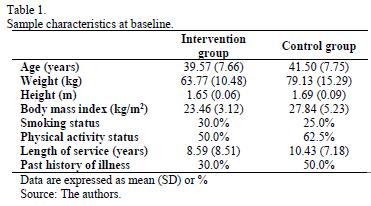
<body><![CDATA[<p><font size="2" face="Verdana, Arial, Helvetica, sans-serif">The program was led by a physiotherapist   specialized in WEG and took place in an open space near all the workers'   workstations to ensure them quick access. The workers could use their normal   work clothes during the sessions. The exercises performed were designed to   mobilize and stretch several parts of the body, with an emphasis on the   vertebral column and upper limbs, though some exercises were included for the   legs because of the long hours worked in a sitting position. Sometimes,   strength exercises were performed using low weights. Some sessions included   playful and recreational activities such as massage, self-massage and games.   The sessions were carried out with or without equipment (balloons, balls,   sticks, paper) and were performed on an individual basis, as well as in pairs   and in groups. All the sessions included background music to encourage   wellbeing, joy and motivation. The WEG program was publicized using posters and   emails sent by the Human Resources Department and which explained its   objectives and raised awareness of the importance of participating.</font></p>     <p><font size="2" face="Verdana, Arial, Helvetica, sans-serif"><b><i>2.4. Measurement</i></b></font></p>     <p><font size="2" face="Verdana, Arial, Helvetica, sans-serif">All participants underwent an evaluation   of musculoskeletal pain symptoms and flexibility at the start of the program   (M1), in order to establish a baseline, and again at the end, three months   later (M2).</font></p>     <p><font size="2" face="Verdana, Arial, Helvetica, sans-serif"><b><i>2.5. Statistical analysis</i></b></font></p>     <p><font size="2" face="Verdana, Arial, Helvetica, sans-serif">Data was analyzed using descriptive   statistics (mean, standard deviation -SD- and percentages). </font></p>     <p><font size="2" face="Verdana, Arial, Helvetica, sans-serif">The McNemar test was used to compare   differences in musculoskeletal pain symptoms between M1 and M2, while the   Wilcoxon test was used to compare flexibility. The significance level was 0.05.   The statistical data analysis was carried out using the SPSS program (version   22).</font></p>     <p>&nbsp;</p>     <p><font size="3" face="Verdana, Arial, Helvetica, sans-serif"><b>3. Results</b></font></p>     <p><font size="2" face="Verdana, Arial, Helvetica, sans-serif"><b><i>3.1. Sample characterization </i></b></font></p>     <p><font size="2" face="Verdana, Arial, Helvetica, sans-serif">The study   was conducted on 38 participants divided into two groups - the IG and the CG.   The IG was 83.3% female and 16.7% male while the CG was 62.5% female and 37.5%   male. <a href="#tab01">Table 1</a> describes the characteristics of the sample at baseline (M1).</font></p>     ]]></body>
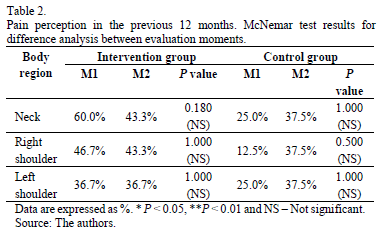
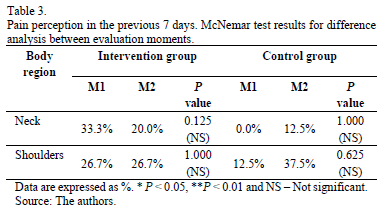
<body><![CDATA[<p align="center"><font size="2" face="Verdana, Arial, Helvetica, sans-serif"><a name="tab01"></a></font><img src="/img/revistas/dyna/v83n196/v83n196a09tab01.gif"></p>     <p><font size="2" face="Verdana, Arial, Helvetica, sans-serif"><b><i>3.2. Workstation evaluation</i></b></font></p>     <p><font size="2" face="Verdana, Arial, Helvetica, sans-serif">Most of the workers are seated in an open   plan office environment. Their normal tasks are computer work, call answering,   document-reading, writing, copy-making, and others. Of these, computer work and   call answering occupy most time. The workstations are equipped with a desk, a   chair, a computer (monitor, keyboard and mouse) and a telephone.</font></p>     <p><font size="2" face="Verdana, Arial, Helvetica, sans-serif">The mean final ROSA score for the 38   workstations was 3.61 (0.64) while the mean (SD) section scores were 3.45   (0.55), for the Chair, 3.11 (0.61) for the Monitor and Telephone and 2.11   (0.31) for the Mouse and Keyboard.</font></p>     <p><font size="2" face="Verdana, Arial, Helvetica, sans-serif"><b><i>3.3. Musculoskeletal symptoms analysis</i></b></font></p>     <p><font size="2" face="Verdana, Arial, Helvetica, sans-serif">The workers in both groups experienced   pain during their working hours. <a href="#tab02">Table 2</a> shows worker perceptions of neck and   shoulder pain, pre- and post the WEG program for the IG and for the CG during   the previous 12 months.</font></p>     <p align="center"><font size="2" face="Verdana, Arial, Helvetica, sans-serif"><a name="tab02"></a></font><img src="/img/revistas/dyna/v83n196/v83n196a09tab02.gif"></p>     <p><font size="2" face="Verdana, Arial, Helvetica, sans-serif">As shown in <a href="#tab02">Table 2</a>, members of the IG   experienced reduced musculoskeletal pain at M2 compared with M1, except for the   left shoulder. For the CG, it was found that musculoskeletal pain increased for   all body segments evaluated. However, the values of these differences are not   significant.</font></p>     <p><font size="2" face="Verdana, Arial, Helvetica, sans-serif"><a href="#tab03">Table 3</a> presents data on worker   perceptions of neck and shoulder pain, pre- and post the WEG program for the IG   and for the CG for the previous 7 days.</font></p>     <p align="center"><font size="2" face="Verdana, Arial, Helvetica, sans-serif"><a name="tab03"></a></font><img src="/img/revistas/dyna/v83n196/v83n196a09tab03.gif"></p>     ]]></body>
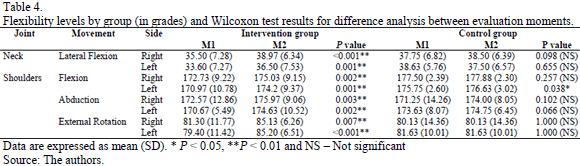
<body><![CDATA[<p><font size="2" face="Verdana, Arial, Helvetica, sans-serif">During the previous 7 days, members of   the IG perceived a reduction in musculoskeletal pain in the neck while there   was no change for the shoulders. However, in the CG, pain perception increased   in both segments. However, the values of these differences are not significant.</font></p>     <p><font size="2" face="Verdana, Arial, Helvetica, sans-serif"><b><i>3.4 Analysis of Flexibility Levels</i></b></font></p>     <p><font size="2" face="Verdana, Arial, Helvetica, sans-serif">The results for flexibility levels are   set out in <a href="#tab04">Table 4</a>. In terms of the movements analyzed,   it may be observed that the RoM averages increased for the IG between the two   evaluation moments. According to Table 4 these differences are significant. </font></p>     <p align="center"><font size="2" face="Verdana, Arial, Helvetica, sans-serif"><a name="tab04"></a></font><img src="/img/revistas/dyna/v83n196/v83n196a09tab04.gif"></p>     <p><font size="2" face="Verdana, Arial, Helvetica, sans-serif">The values remained relatively constant   for the CG, while there was a slight increase in right lateral flexion of the neck and flexion   and abduction of the shoulder on both sides, along with decreased left lateral   flexion of the neck. Only left flexion of the shoulder presents a significant   difference between the moments of evaluation.</font></p>     <p>&nbsp;</p>     <p><font size="3" face="Verdana, Arial, Helvetica, sans-serif"><b>4. Discussion</b></font></p>     <p><font size="2" face="Verdana, Arial, Helvetica, sans-serif">This study was intended to evaluate the   effectiveness of a workplace exercise program in reducing musculoskeletal pain   and improving the levels of flexibility in the neck and shoulders. </font></p>     <p><font size="2" face="Verdana, Arial, Helvetica, sans-serif">The workstation evaluation using the ROSA   method found that workstations themselves can cause discomfort. Further   investigation and modifications might be required here. The sitting posture   adopted by workers using computers throughout the working day, as well as   interactions with other elements in the workplace, can cause muscle tension in   the neck and shoulder segments. Unilateral postures continue to occur too, as   when workers hold their phones between the head and shoulder, causing muscle   fatigue and decreased flexibility as a result of tension, which stops the muscles   working at peak. The workplace exercise program was therefore planned to   prioritize exercises designed to relax the musculature of the cervical spine   and shoulders and decrease fatigue, reducing pain and increasing flexibility.</font></p>     <p><font size="2" face="Verdana, Arial, Helvetica, sans-serif">The first   improvement observed in the IG was related to a reduction in the prevalence of   worker perceptions of musculoskeletal pain at 12 months and at 7 days, although   the differences between these self-evaluations were not significant. These data   may indicate that the WEG program influence this change in symptoms in the neck   and right shoulder. However, the fact that there was less effect on the left   shoulder may indicate that a longer intervention period would be necessary in   order to obtain more significant results. Although the current study took place   over a period of more than 10 weeks, other authors found that this period of   workplace group gymnastics had no clear effects on pain &#91;28&#93;. A previous study that analyzed pain   perception before and after a workplace fitness program obtained different   results, finding that pain reduction was not significant for the CG but was for   the IG &#91;29&#93;. Other studies that evaluated pain   perception found that it is potentially possible to reduce subjective   sensations of pain in office workers &#91;23, 30&#93;. On the other hand, another set of studies, in this case   analyzing perceptions of musculoskeletal pain in cases where workers undertook   an hour of exercise a week for a year, obtained similar results to those   obtained here &#91;22&#93;. Waling et al. compared three   different protocols, focused on strength, endurance and coordination exercises   for a period of ten weeks, each session lasting one hour, and achieving similar   results for pain reduction to those of the current study &#91;31&#93;. However, it was difficult to compare   the current research with these earlier studies because the duration of the   sessions was very different and -furthermore- in Waling et al. the sample was   exclusively female. This is an important difference, as it is known that women   have a higher risk of WRMSD than males &#91;32&#93;, a difference that can be explained by   the physical and functional differences between the sexes &#91;33&#93;. Thus, a WEG program could have   beneficial effects, decreasing muscle fatigue and, consequently, reduce the   perception of pain.</font></p>     ]]></body>
<body><![CDATA[<p><font size="2" face="Verdana, Arial, Helvetica, sans-serif">The results were similar for flexibility:   neck and shoulder RoM in the movements evaluated improved in the IG following   the WEG program. It is known that a lack of exercise influences the levels of   flexibility and that sedentary people tend to be less flexible than their   active counterparts. Thus, it can be said that exercise improves flexibility &#91;34&#93;.   Other studies focused on office workers found similar results, with   improvements in the flexibility levels of the shoulder in flexion, abduction   and external rotation, though the results were non-significant &#91;35&#93;. On   the other hand, a study of metalworkers registered an increase in flexibility   levels in shoulder movements &#91;36&#93;.   Restricted RoM can also be affected by factors such as postural misalignment   and muscle imbalance. The literature suggests that there is some evidence that   exercise may improve posture in the upper thoracic area, helping improve   mobilization of the shoulder muscles, and consequently leading to an increase   in RoM &#91;20&#93;. An   appropriate posture at the workstation, either sitting or standing, allowed   subjects to reduce muscle stress and tension, as the muscles are able to work   in balance and, therefore, more efficiently. The decrease in trapezius muscle   tension may have influenced the increased RoM in the assessed tasks (especially   in lateral neck flexion) as well as a decrease in fatigue levels in the   shoulder muscles, leading, in turn, to increased external rotation RoM of the   shoulder &#91;15&#93;. On   the other hand, the exercises performed during the program were accompanied by   stimuli administered by the physiotherapist with the aim of raising awareness   of the importance of maintaining correct posture of the neck and upper limbs,   not just during the sessions but at all times. This might be one explanation of   the significant improvements in the flexibility levels in this study as   compared to others, in which the workers were responsible for their own   exercise routines &#91;37&#93;.</font></p>     <p><font size="2" face="Verdana, Arial, Helvetica, sans-serif">The improvements observed in the CG may   have been the result of recommendations to perform specific exercises designed   for specific body parts that were formulated during assessments. These   improvements may be associated with the impossibility of evaluating the IG and   the CG separately. WEG sessions were held in an open space, in full view of   other workers. This may have influenced CG members to engage in some of the   proposed exercises.</font></p>     <p><font size="2" face="Verdana, Arial, Helvetica, sans-serif"><b><i>4.1. Limitations of the study </i></b></font></p>     <p><font size="2" face="Verdana, Arial, Helvetica, sans-serif">The first recognized limitation of this   study is the reduced sample size, both for the IG and the CG. Increased sample   size would have permitted some sample stratification, for instance by gender,   allowing analysis and comparison by group. It would also have been beneficial   to have been able to exert more control over some variables, such as subject   lifestyle routines, clinical history and others, in order to obtain more   accurate results. </font></p>     <p>&nbsp;</p>     <p><font size="3" face="Verdana, Arial, Helvetica, sans-serif"><b>5. Conclusions</b></font></p>     <p><font size="2" face="Verdana, Arial, Helvetica, sans-serif">This study was designed to evaluate the   effectiveness of a workplace exercise program, with the intention of reducing   musculoskeletal pain and improving the levels of flexibility in neck and   shoulders. The results obtained show that IG members experienced reduced   musculoskeletal pain in the neck and shoulders, although the results were not   statistically significant. They also demonstrated improved RoM in lateral   flexion of the neck and flexion, abduction and external rotation of the   shoulder, for both sides of the body. According to these results, then, the   implementation of a WEG program could be beneficial to office workers.</font></p>     <p>&nbsp;</p>     <p><font size="3" face="Verdana, Arial, Helvetica, sans-serif"><b>Acknowledgments</b></font></p>     <p><font size="2" face="Verdana, Arial, Helvetica, sans-serif">This study received financial support   from the Portuguese Foundation for Science and Technology, under project   ID/CEC/00319/2013.</font></p>     ]]></body>
<body><![CDATA[<p>&nbsp;</p>     <p><font size="3" face="Verdana, Arial, Helvetica, sans-serif"><b>References</b></font></p>     <!-- ref --><p><font size="2" face="Verdana, Arial, Helvetica, sans-serif"><b>&#91;1&#93;</b> Buckle, P. and Devereux, J., The nature of   work-related neck and upper limb musculoskeletal disorders. Applied Ergonomics,   33, pp. 207-217, 2002. DOI: 10.1016/S0003-6870(02)00014-5</font>&nbsp;&nbsp;&nbsp;&nbsp;&nbsp;&nbsp;&nbsp;&nbsp;[&#160;<a href="javascript:void(0);" onclick="javascript: window.open('/scielo.php?script=sci_nlinks&ref=1149139&pid=S0012-7353201600020000900001&lng=','','width=640,height=500,resizable=yes,scrollbars=1,menubar=yes,');">Links</a>&#160;]<!-- end-ref --><!-- ref --><p><font size="2" face="Verdana, Arial, Helvetica, sans-serif"><b>&#91;2&#93;</b> Tittiranonda, P., Burastero, S., and   Rempel, D., Risk factors for musculoskeletal disorders amog computer users.   Occupational Medicine, 14, pp. 17-38, 1999.    &nbsp;&nbsp;&nbsp;&nbsp;&nbsp;&nbsp;&nbsp;&nbsp;[&#160;<a href="javascript:void(0);" onclick="javascript: window.open('/scielo.php?script=sci_nlinks&ref=1149140&pid=S0012-7353201600020000900002&lng=','','width=640,height=500,resizable=yes,scrollbars=1,menubar=yes,');">Links</a>&#160;]<!-- end-ref --></font></p>     <!-- ref --><p><font size="2" face="Verdana, Arial, Helvetica, sans-serif"><b>&#91;3&#93;</b> Punnett, L. and Wegman, D.H., Work-related   musculoskeletal disorders: The epidemiologic evidence and the debate, in: J   Electromyogr Kinesiol, University of Massachusetts Lowell, USA. 2004, pp.   13-23. DOI: 10.1016/j.jelekin.2003.09.015</font>&nbsp;&nbsp;&nbsp;&nbsp;&nbsp;&nbsp;&nbsp;&nbsp;[&#160;<a href="javascript:void(0);" onclick="javascript: window.open('/scielo.php?script=sci_nlinks&ref=1149142&pid=S0012-7353201600020000900003&lng=','','width=640,height=500,resizable=yes,scrollbars=1,menubar=yes,');">Links</a>&#160;]<!-- end-ref --><!-- ref --><p><font size="2" face="Verdana, Arial, Helvetica, sans-serif"><b>&#91;4&#93;</b> Sillanpää, J., Huikko, S., Nyberg, M., Kivi,   P., Laippala, P., and Uitti, J., Effect of work with visual display units on   musculo-skeletal disorders in the office   environment. Occupational Medicine, 53, pp. 443-451, 2003. DOI: 10.1093/occmed/kqg120</font>&nbsp;&nbsp;&nbsp;&nbsp;&nbsp;&nbsp;&nbsp;&nbsp;[&#160;<a href="javascript:void(0);" onclick="javascript: window.open('/scielo.php?script=sci_nlinks&ref=1149143&pid=S0012-7353201600020000900004&lng=','','width=640,height=500,resizable=yes,scrollbars=1,menubar=yes,');">Links</a>&#160;]<!-- end-ref --><!-- ref --><p><font size="2" face="Verdana, Arial, Helvetica, sans-serif"><b>&#91;5&#93;</b> Cagnie, B., Danneels, L., Van Tiggelen, D.,   De Loose, V., and Cambier, D., Individual and work related risk factors for   neck pain among office workers: a cross sectional study. European Spine   Journal, 16, pp. 679-686, 2007. DOI: 10.1007/s00586-006-0269-7</font>&nbsp;&nbsp;&nbsp;&nbsp;&nbsp;&nbsp;&nbsp;&nbsp;[&#160;<a href="javascript:void(0);" onclick="javascript: window.open('/scielo.php?script=sci_nlinks&ref=1149144&pid=S0012-7353201600020000900005&lng=','','width=640,height=500,resizable=yes,scrollbars=1,menubar=yes,');">Links</a>&#160;]<!-- end-ref --><!-- ref --><p><font size="2" face="Verdana, Arial, Helvetica, sans-serif"><b>&#91;6&#93;</b> Ming, Z., Närhi, M., and Siivola, J., Neck   and shoulder pain related to computer use. Pathophysiology: The Official   Journal of the International Society for Pathophysiology / ISP, 11, pp. 51-56,   2004.    &nbsp;&nbsp;&nbsp;&nbsp;&nbsp;&nbsp;&nbsp;&nbsp;[&#160;<a href="javascript:void(0);" onclick="javascript: window.open('/scielo.php?script=sci_nlinks&ref=1149145&pid=S0012-7353201600020000900006&lng=','','width=640,height=500,resizable=yes,scrollbars=1,menubar=yes,');">Links</a>&#160;]<!-- end-ref --></font></p>     ]]></body>
<body><![CDATA[<!-- ref --><p><font size="2" face="Verdana, Arial, Helvetica, sans-serif"><b>&#91;7&#93;</b> Punnett, L. and Bergqvist, U., Visual   display unit work and upper extremity musculoskeletal disorders. A Review of   Epidemiological Findings. National Institute for Working Life, 16, 1997.    &nbsp;&nbsp;&nbsp;&nbsp;&nbsp;&nbsp;&nbsp;&nbsp;[&#160;<a href="javascript:void(0);" onclick="javascript: window.open('/scielo.php?script=sci_nlinks&ref=1149147&pid=S0012-7353201600020000900007&lng=','','width=640,height=500,resizable=yes,scrollbars=1,menubar=yes,');">Links</a>&#160;]<!-- end-ref --></font></p>     <!-- ref --><p><font size="2" face="Verdana, Arial, Helvetica, sans-serif"><b>&#91;8&#93;</b> Hägg, G.M. and Aström, A., Load pattern and   pressure pain threshold in the upper trapezius muscle and psychosocial factors   in medical secretaries with and without shoulder/neck disorders. International   Archives of Occupational and Environmental Health, 69, pp. 423-32, 1997. DOI: 10.1007/s004200050170</font>&nbsp;&nbsp;&nbsp;&nbsp;&nbsp;&nbsp;&nbsp;&nbsp;[&#160;<a href="javascript:void(0);" onclick="javascript: window.open('/scielo.php?script=sci_nlinks&ref=1149149&pid=S0012-7353201600020000900008&lng=','','width=640,height=500,resizable=yes,scrollbars=1,menubar=yes,');">Links</a>&#160;]<!-- end-ref --><!-- ref --><p><font size="2" face="Verdana, Arial, Helvetica, sans-serif"><b>&#91;9&#93;</b> Szeto, G., Straker, L. and O'Sullivan, P.,   A comparison of symptomatic and asymptomatic office workers performing   monotonous keyboard work-2: Neck and shoulder kinematics. Manual Therapy, 10,   pp. 281-291, 2005. DOI: 10.1016/j.math.2005.01.004 DOI: 10.1016/j.math.2005.01.005</font>&nbsp;&nbsp;&nbsp;&nbsp;&nbsp;&nbsp;&nbsp;&nbsp;[&#160;<a href="javascript:void(0);" onclick="javascript: window.open('/scielo.php?script=sci_nlinks&ref=1149150&pid=S0012-7353201600020000900009&lng=','','width=640,height=500,resizable=yes,scrollbars=1,menubar=yes,');">Links</a>&#160;]<!-- end-ref --><!-- ref --><p><font size="2" face="Verdana, Arial, Helvetica, sans-serif"><b>&#91;10&#93;</b> Szeto, G., Straker, L., and O'Sullivan, P.,   A comparison of symptomatic and asymptomatic office workers performing   monotonous keyboard work-1: Neck and shoulder muscle recruitment patterns.   Manual Therapy, 10, pp. 270-280, 2005. DOI: 10.1016/j.math.2005.01.004 DOI: 10.1016/j.math.2005.01.005</font>&nbsp;&nbsp;&nbsp;&nbsp;&nbsp;&nbsp;&nbsp;&nbsp;[&#160;<a href="javascript:void(0);" onclick="javascript: window.open('/scielo.php?script=sci_nlinks&ref=1149151&pid=S0012-7353201600020000900010&lng=','','width=640,height=500,resizable=yes,scrollbars=1,menubar=yes,');">Links</a>&#160;]<!-- end-ref --><!-- ref --><p><font size="2" face="Verdana, Arial, Helvetica, sans-serif"><b>&#91;11&#93;</b> Visser, B. and Van Dieën, J.H.,   Pathophysiology of upper extremity muscle disorders. Journal of   Electromyography and Kinesiology, 16, pp. 1-16, 2006. DOI: 10.1016/j.jelekin.2005.06.005</font>&nbsp;&nbsp;&nbsp;&nbsp;&nbsp;&nbsp;&nbsp;&nbsp;[&#160;<a href="javascript:void(0);" onclick="javascript: window.open('/scielo.php?script=sci_nlinks&ref=1149152&pid=S0012-7353201600020000900011&lng=','','width=640,height=500,resizable=yes,scrollbars=1,menubar=yes,');">Links</a>&#160;]<!-- end-ref --><!-- ref --><p><font size="2" face="Verdana, Arial, Helvetica, sans-serif"><b>&#91;12&#93;</b> Ariëns, G., Bongers, P., Douwes, M.,   Miedema, M., Hoogendoorn, W., van der Wal, G., et al., Are neck flexion, neck   rotation, and sitting at work risk factors for neck pain? Results of a   prospective cohort study. Occupational and Environmental Medicine, 58, pp.   200-207, 2001. DOI: 10.1136/oem.58.3.200</font>&nbsp;&nbsp;&nbsp;&nbsp;&nbsp;&nbsp;&nbsp;&nbsp;[&#160;<a href="javascript:void(0);" onclick="javascript: window.open('/scielo.php?script=sci_nlinks&ref=1149153&pid=S0012-7353201600020000900012&lng=','','width=640,height=500,resizable=yes,scrollbars=1,menubar=yes,');">Links</a>&#160;]<!-- end-ref --><!-- ref --><p><font size="2" face="Verdana, Arial, Helvetica, sans-serif"><b>&#91;13&#93;</b> Ming, Z. and Zaproudina, N., Computer use   related upper limb musculoskeletal (ComRULM) disorders. Pathophysiology, 9, pp.   155-160, 2003. DOI: 10.1016/S0928-4680(03)00004-X</font>&nbsp;&nbsp;&nbsp;&nbsp;&nbsp;&nbsp;&nbsp;&nbsp;[&#160;<a href="javascript:void(0);" onclick="javascript: window.open('/scielo.php?script=sci_nlinks&ref=1149154&pid=S0012-7353201600020000900013&lng=','','width=640,height=500,resizable=yes,scrollbars=1,menubar=yes,');">Links</a>&#160;]<!-- end-ref --><!-- ref --><p><font size="2" face="Verdana, Arial, Helvetica, sans-serif"><b>&#91;14&#93;</b> Jensen, C., Finsen, L., Hansen, K., and   Christensen, H., Upper trapezius muscle activity patterns during repetitive   manual material handling and work with a computer mouse. Journal of   Electromyography and Kinesiology: Official Journal of the International   Society of Electrophysiological Kinesiology, 9, pp. 317-325, 1999. DOI: 10.1016/S1050-6411(99)00007-3</font>&nbsp;&nbsp;&nbsp;&nbsp;&nbsp;&nbsp;&nbsp;&nbsp;[&#160;<a href="javascript:void(0);" onclick="javascript: window.open('/scielo.php?script=sci_nlinks&ref=1149155&pid=S0012-7353201600020000900014&lng=','','width=640,height=500,resizable=yes,scrollbars=1,menubar=yes,');">Links</a>&#160;]<!-- end-ref --><!-- ref --><p><font size="2" face="Verdana, Arial, Helvetica, sans-serif"><b>&#91;15&#93;</b> Ebaugh, D.D., McClure, P.W. and Karduna, A.R.,   Effects of shoulder muscle fatigue caused by repetitive overhead activities on   scapulothoracic and glenohumeral kinematics. Journal of Electromyography and   Kinesiology: Official Journal of the International Society of   Electrophysiological Kinesiology, 16, pp. 224-235, 2006. DOI: 10.1016/j.jelekin.2005.06.015</font>&nbsp;&nbsp;&nbsp;&nbsp;&nbsp;&nbsp;&nbsp;&nbsp;[&#160;<a href="javascript:void(0);" onclick="javascript: window.open('/scielo.php?script=sci_nlinks&ref=1149156&pid=S0012-7353201600020000900015&lng=','','width=640,height=500,resizable=yes,scrollbars=1,menubar=yes,');">Links</a>&#160;]<!-- end-ref --><!-- ref --><p><font size="2" face="Verdana, Arial, Helvetica, sans-serif"><b>&#91;16&#93;</b> Klopcar, N. and Lenarcic, J., Bilateral and   unilateral shoulder girdle kinematics during humeral elevation. Clinical Biomechanics   Bristol, Avon, 21(Suppl 1), pp. S20-S26, 2006. DOI: 10.1016/j.clinbiomech.2005.09.009</font>&nbsp;&nbsp;&nbsp;&nbsp;&nbsp;&nbsp;&nbsp;&nbsp;[&#160;<a href="javascript:void(0);" onclick="javascript: window.open('/scielo.php?script=sci_nlinks&ref=1149157&pid=S0012-7353201600020000900016&lng=','','width=640,height=500,resizable=yes,scrollbars=1,menubar=yes,');">Links</a>&#160;]<!-- end-ref --><!-- ref --><p><font size="2" face="Verdana, Arial, Helvetica, sans-serif"><b>&#91;17&#93;</b> Lin, J., Hanten, W.P., Olson, S.L., Roddey,   T.S., Soto-quijano, D.A, Lim, H.K., et al., Functional activity characteristics   of individuals with shoulder dysfunctions. Journal of Electromyography and   Kinesiology, Official Journal of the International Society of   Electrophysiological Kinesiology, 15, pp. 576-586, 2005. DOI: 10.1016/j.jelekin.2005.01.006</font>&nbsp;&nbsp;&nbsp;&nbsp;&nbsp;&nbsp;&nbsp;&nbsp;[&#160;<a href="javascript:void(0);" onclick="javascript: window.open('/scielo.php?script=sci_nlinks&ref=1149158&pid=S0012-7353201600020000900017&lng=','','width=640,height=500,resizable=yes,scrollbars=1,menubar=yes,');">Links</a>&#160;]<!-- end-ref --><!-- ref --><p><font size="2" face="Verdana, Arial, Helvetica, sans-serif"><b>&#91;18&#93;</b> Finley, M.A. and Lee, R.Y., Effect of   sitting posture on 3-dimensional scapular kinematics measured by skin-mounted   electromagnetic tracking sensors. Archives of Physical Medicine and   Rehabilitation, 84, pp. 563-568, 2003. DOI: 10.1053/apmr.2003.50087</font>&nbsp;&nbsp;&nbsp;&nbsp;&nbsp;&nbsp;&nbsp;&nbsp;[&#160;<a href="javascript:void(0);" onclick="javascript: window.open('/scielo.php?script=sci_nlinks&ref=1149159&pid=S0012-7353201600020000900018&lng=','','width=640,height=500,resizable=yes,scrollbars=1,menubar=yes,');">Links</a>&#160;]<!-- end-ref --><!-- ref --><p><font size="2" face="Verdana, Arial, Helvetica, sans-serif"><b>&#91;19&#93;</b> Kebaetse, M., McClure, P., and Pratt, N.A.,   Thoracic position effect on shoulder range of motion, strength, and   three-dimensional scapular kinematics. Archives of Physical Medicine and   Rehabilitation, 80, pp. 945-950, 1999. DOI: 10.1016/S0003-9993(99)90088-6</font>&nbsp;&nbsp;&nbsp;&nbsp;&nbsp;&nbsp;&nbsp;&nbsp;[&#160;<a href="javascript:void(0);" onclick="javascript: window.open('/scielo.php?script=sci_nlinks&ref=1149160&pid=S0012-7353201600020000900019&lng=','','width=640,height=500,resizable=yes,scrollbars=1,menubar=yes,');">Links</a>&#160;]<!-- end-ref --><!-- ref --><p><font size="2" face="Verdana, Arial, Helvetica, sans-serif"><b>&#91;20&#93;</b> Wang, C., Mcclure, P., Pratt, N.E. and   Nobilini, R., Stretching and strengthening exercises: Their effect on   three-dimensional scapular kinematics. Arch Phys Med Rehabil, 80, pp. 923-929,   1999. DOI: 10.1016/S0003-9993(99)90084-9 </font>&nbsp;&nbsp;&nbsp;&nbsp;&nbsp;&nbsp;&nbsp;&nbsp;[&#160;<a href="javascript:void(0);" onclick="javascript: window.open('/scielo.php?script=sci_nlinks&ref=1149161&pid=S0012-7353201600020000900020&lng=','','width=640,height=500,resizable=yes,scrollbars=1,menubar=yes,');">Links</a>&#160;]<!-- end-ref --><!-- ref --><p><font size="2" face="Verdana, Arial, Helvetica, sans-serif"><b>&#91;21&#93;</b> Staal, J.B., de Bie, R.A. and Hendriks,   E.J.M., Aetiology and management of work-related upper extremity disorders.   Best Practice and Research: Clinical Rheumatology, 21, pp. 123-133, 2007. DOI: 10.1016/j.berh.2006.09.001</font>&nbsp;&nbsp;&nbsp;&nbsp;&nbsp;&nbsp;&nbsp;&nbsp;[&#160;<a href="javascript:void(0);" onclick="javascript: window.open('/scielo.php?script=sci_nlinks&ref=1149162&pid=S0012-7353201600020000900021&lng=','','width=640,height=500,resizable=yes,scrollbars=1,menubar=yes,');">Links</a>&#160;]<!-- end-ref --><!-- ref --><p><font size="2" face="Verdana, Arial, Helvetica, sans-serif"><b>&#91;22&#93;</b> Andersen, L.L., Christensen, K.B.,   Holtermann, A., Poulsen, O.M., Sjøgaard, G., Pedersen, M.T., et al., Effect of   physical exercise interventions on musculoskeletal pain in all body regions   among office workers: A one-year randomized controlled trial. Manual Therapy,   15, pp. 100-104, 2010. DOI: 10.1016/j.math.2009.08.004</font>&nbsp;&nbsp;&nbsp;&nbsp;&nbsp;&nbsp;&nbsp;&nbsp;[&#160;<a href="javascript:void(0);" onclick="javascript: window.open('/scielo.php?script=sci_nlinks&ref=1149163&pid=S0012-7353201600020000900022&lng=','','width=640,height=500,resizable=yes,scrollbars=1,menubar=yes,');">Links</a>&#160;]<!-- end-ref --><!-- ref --><p><font size="2" face="Verdana, Arial, Helvetica, sans-serif"><b>&#91;23&#93;</b> Sjögren, T., Nissinen, K.J., Järvenpää,   S.K., Ojanen, M.T., Vanharanta, H. and Mälkiä, E.A., Effects of a workplace   physical exercise intervention on the intensity of headache and neck and   shoulder symptoms and upper extremity muscular strength of office workers: A   cluster randomized controlled cross-over trial. Pain, 116, pp. 119-128, 2005.   DOI: 10.1016/j.pain.2005.03.031</font>&nbsp;&nbsp;&nbsp;&nbsp;&nbsp;&nbsp;&nbsp;&nbsp;[&#160;<a href="javascript:void(0);" onclick="javascript: window.open('/scielo.php?script=sci_nlinks&ref=1149164&pid=S0012-7353201600020000900023&lng=','','width=640,height=500,resizable=yes,scrollbars=1,menubar=yes,');">Links</a>&#160;]<!-- end-ref --><!-- ref --><p><font size="2" face="Verdana, Arial, Helvetica, sans-serif"><b>&#91;24&#93;</b> Kisner, C. and Colby, L.A., Therapeutic   exercise: Foundations and techniques, 5th ed., F.A. Davis Company,   Philadelphia, PA, 2007.    &nbsp;&nbsp;&nbsp;&nbsp;&nbsp;&nbsp;&nbsp;&nbsp;[&#160;<a href="javascript:void(0);" onclick="javascript: window.open('/scielo.php?script=sci_nlinks&ref=1149165&pid=S0012-7353201600020000900024&lng=','','width=640,height=500,resizable=yes,scrollbars=1,menubar=yes,');">Links</a>&#160;]<!-- end-ref --></font></p>     ]]></body>
<body><![CDATA[<!-- ref --><p><font size="2" face="Verdana, Arial, Helvetica, sans-serif"><b>&#91;25&#93;</b> Sonne, M., Villalta, D.L. and Andrews,   D.M., Development and evaluation of an office ergonomic risk checklist:   ROSA-rapid office strain assessment. Appl Ergon, 43, pp. 98-108, 2012. DOI: 10.1016/j.apergo.2011.03.008</font>&nbsp;&nbsp;&nbsp;&nbsp;&nbsp;&nbsp;&nbsp;&nbsp;[&#160;<a href="javascript:void(0);" onclick="javascript: window.open('/scielo.php?script=sci_nlinks&ref=1149167&pid=S0012-7353201600020000900025&lng=','','width=640,height=500,resizable=yes,scrollbars=1,menubar=yes,');">Links</a>&#160;]<!-- end-ref --><!-- ref --><p><font size="2" face="Verdana, Arial, Helvetica, sans-serif"><b>&#91;26&#93;</b> Kuorinka, I., Jonsson, B., Kilbom, A.,   Vinterberg, H., Biering-Sorensen, F., Andersson, G., et al., Standardised   Nordic questionnaires for the analysis of musculoskeletal symptoms, in: Appl   Erg., Institute of Occupational Health, Department of Physiology, Helsinki,   Finland., 1987: pp. 233-237. DOI: 10.1016/0003-6870(87)90010-x</font>&nbsp;&nbsp;&nbsp;&nbsp;&nbsp;&nbsp;&nbsp;&nbsp;[&#160;<a href="javascript:void(0);" onclick="javascript: window.open('/scielo.php?script=sci_nlinks&ref=1149168&pid=S0012-7353201600020000900026&lng=','','width=640,height=500,resizable=yes,scrollbars=1,menubar=yes,');">Links</a>&#160;]<!-- end-ref --><!-- ref --><p><font size="2" face="Verdana, Arial, Helvetica, sans-serif"><b>&#91;27&#93;</b> Clarkson, H., Musculoskeletal assessment.   Joint motion and muscle testing., 3rd Ed., Lippincott Williams &amp; Wilkins,   Philadelphia, PA, 2013.    &nbsp;&nbsp;&nbsp;&nbsp;&nbsp;&nbsp;&nbsp;&nbsp;[&#160;<a href="javascript:void(0);" onclick="javascript: window.open('/scielo.php?script=sci_nlinks&ref=1149169&pid=S0012-7353201600020000900027&lng=','','width=640,height=500,resizable=yes,scrollbars=1,menubar=yes,');">Links</a>&#160;]<!-- end-ref --></font></p>     <!-- ref --><p><font size="2" face="Verdana, Arial, Helvetica, sans-serif"><b>&#91;28&#93;</b> Takala, E.P., Viikari-Juntura, E. and   Tynkkynen, E.-M., Does group gymnastics at the workplace help in neck pain?   Scand J Rehab Med, 26, pp. 17-20, 1994.    &nbsp;&nbsp;&nbsp;&nbsp;&nbsp;&nbsp;&nbsp;&nbsp;[&#160;<a href="javascript:void(0);" onclick="javascript: window.open('/scielo.php?script=sci_nlinks&ref=1149171&pid=S0012-7353201600020000900028&lng=','','width=640,height=500,resizable=yes,scrollbars=1,menubar=yes,');">Links</a>&#160;]<!-- end-ref --></font></p>     <!-- ref --><p><font size="2" face="Verdana, Arial, Helvetica, sans-serif"><b>&#91;29&#93;</b> Macedo, A., Trindade, C., Brito, A. and   Socorro-Dantas, M., On the effects of a workplace fitness program upon pain   perception: A case study encompassing office workers in a portuguese context.   Journal of Occupational Rehabilitation, 21, pp. 228-233, 2011. DOI: 10.1007/s10926-010-9264-2</font>&nbsp;&nbsp;&nbsp;&nbsp;&nbsp;&nbsp;&nbsp;&nbsp;[&#160;<a href="javascript:void(0);" onclick="javascript: window.open('/scielo.php?script=sci_nlinks&ref=1149173&pid=S0012-7353201600020000900029&lng=','','width=640,height=500,resizable=yes,scrollbars=1,menubar=yes,');">Links</a>&#160;]<!-- end-ref --><!-- ref --><p><font size="2" face="Verdana, Arial, Helvetica, sans-serif"><b>&#91;30&#93;</b> Garganta, R., Prufer, C., Guerreiro, F.,   Soares, P. and Pereira, H., Effect of an exercise program in work environment   on musculoskeletal disorders. Report of an experience in administrative   workers., In: Proc. Int. Symp. Occup. Saf. Hyg. - SHO2012, Portuguese society   of occupational safety and hygiene, Guimarães, 2012: pp. 266-267.    &nbsp;&nbsp;&nbsp;&nbsp;&nbsp;&nbsp;&nbsp;&nbsp;[&#160;<a href="javascript:void(0);" onclick="javascript: window.open('/scielo.php?script=sci_nlinks&ref=1149174&pid=S0012-7353201600020000900030&lng=','','width=640,height=500,resizable=yes,scrollbars=1,menubar=yes,');">Links</a>&#160;]<!-- end-ref --></font></p>     <!-- ref --><p><font size="2" face="Verdana, Arial, Helvetica, sans-serif"><b>&#91;31&#93;</b> Waling, K., Sundelin, G., Ahlgren, C. and   Järvholm, B., Perceived pain before and after three exercise programs - A   controlled clinical trial of women with work-related trapezius myalgia. Pain,   85, pp. 201-207, 2000. DOI: 10.1016/S0304-3959(99)00265-1</font>&nbsp;&nbsp;&nbsp;&nbsp;&nbsp;&nbsp;&nbsp;&nbsp;[&#160;<a href="javascript:void(0);" onclick="javascript: window.open('/scielo.php?script=sci_nlinks&ref=1149176&pid=S0012-7353201600020000900031&lng=','','width=640,height=500,resizable=yes,scrollbars=1,menubar=yes,');">Links</a>&#160;]<!-- end-ref --><!-- ref --><p><font size="2" face="Verdana, Arial, Helvetica, sans-serif"><b>&#91;32&#93;</b> Larsson, B., Søgaard, K. and Rosendal, L.,   Work related neck-shoulder pain: a review on magnitude, risk factors,   biochemical characteristics, clinical picture and preventive interventions.   Best Practice &amp; Research. Clinical Rheumatology, 21, pp. 447-463, 2007.   DOI: 10.1016/j.berh.2007.02.015</font>&nbsp;&nbsp;&nbsp;&nbsp;&nbsp;&nbsp;&nbsp;&nbsp;[&#160;<a href="javascript:void(0);" onclick="javascript: window.open('/scielo.php?script=sci_nlinks&ref=1149177&pid=S0012-7353201600020000900032&lng=','','width=640,height=500,resizable=yes,scrollbars=1,menubar=yes,');">Links</a>&#160;]<!-- end-ref --><!-- ref --><p><font size="2" face="Verdana, Arial, Helvetica, sans-serif"><b>&#91;33&#93;</b> Côt&eacute;, J.N., A critical review on physical   factors and functional characteristics that may explain a sex/gender difference   in work-related neck/shoulder disorders. Ergonomics, 55, pp. 173-182, 2012.   DOI: 10.1080/00140139.2011.586061</font>&nbsp;&nbsp;&nbsp;&nbsp;&nbsp;&nbsp;&nbsp;&nbsp;[&#160;<a href="javascript:void(0);" onclick="javascript: window.open('/scielo.php?script=sci_nlinks&ref=1149178&pid=S0012-7353201600020000900033&lng=','','width=640,height=500,resizable=yes,scrollbars=1,menubar=yes,');">Links</a>&#160;]<!-- end-ref --><!-- ref --><p><font size="2" face="Verdana, Arial, Helvetica, sans-serif"><b>&#91;34&#93;</b> Matos, M. and Arezes, P.M., Impact of an   occupational gym program on flexibility in office workers, In: Occup. Saf. Hyg.   SHO2015, Portuguese society of occupational safety and hygiene, Guimarães,   2015.    &nbsp;&nbsp;&nbsp;&nbsp;&nbsp;&nbsp;&nbsp;&nbsp;[&#160;<a href="javascript:void(0);" onclick="javascript: window.open('/scielo.php?script=sci_nlinks&ref=1149179&pid=S0012-7353201600020000900034&lng=','','width=640,height=500,resizable=yes,scrollbars=1,menubar=yes,');">Links</a>&#160;]<!-- end-ref --></font></p>     <!-- ref --><p><font size="2" face="Verdana, Arial, Helvetica, sans-serif"><b>&#91;35&#93;</b> Silveira, M., Effects of the workplace   exercises in the morphologic, functional, lifestyle and absenteeism variables   in workers of the pharmaceutical industry of Montes Claros - MG. Fitness &amp;   Performance Journal, 6, pp. 295-301, 2007. DOI: 10.3900/fpj.6.5.295.e</font>&nbsp;&nbsp;&nbsp;&nbsp;&nbsp;&nbsp;&nbsp;&nbsp;[&#160;<a href="javascript:void(0);" onclick="javascript: window.open('/scielo.php?script=sci_nlinks&ref=1149181&pid=S0012-7353201600020000900035&lng=','','width=640,height=500,resizable=yes,scrollbars=1,menubar=yes,');">Links</a>&#160;]<!-- end-ref --><!-- ref --><p><font size="2" face="Verdana, Arial, Helvetica, sans-serif"><b>&#91;36&#93;</b> Rasotto, C., Bergamin, M., Simonetti, A.,   Maso, S., Bartolucci, G.B., Ermolao, A., et al., Tailored exercise program   reduces symptoms of upper limb work-related musculoskeletal disorders in a   group of metalworkers: A randomized controlled trial. Manual Therapy, 20, pp.   56-62, 2015. DOI: 10.1016/j.math.2014.06.007</font>&nbsp;&nbsp;&nbsp;&nbsp;&nbsp;&nbsp;&nbsp;&nbsp;[&#160;<a href="javascript:void(0);" onclick="javascript: window.open('/scielo.php?script=sci_nlinks&ref=1149182&pid=S0012-7353201600020000900036&lng=','','width=640,height=500,resizable=yes,scrollbars=1,menubar=yes,');">Links</a>&#160;]<!-- end-ref --><!-- ref --><p><font size="2" face="Verdana, Arial, Helvetica, sans-serif"><b>&#91;37&#93;</b> Tsauo, J.-Y., Lee, H.-Y., Hsu, J.-H., Chen,   C.-Y. and Chen, C.-J., Physical exercise and health education for neck and   shoulder complaints among sedentary workers. Journal of Rehabilitation   Medicine, 36, pp. 253-257, 2004. DOI: 10.1080/16501970410029807</font>&nbsp;&nbsp;&nbsp;&nbsp;&nbsp;&nbsp;&nbsp;&nbsp;[&#160;<a href="javascript:void(0);" onclick="javascript: window.open('/scielo.php?script=sci_nlinks&ref=1149183&pid=S0012-7353201600020000900037&lng=','','width=640,height=500,resizable=yes,scrollbars=1,menubar=yes,');">Links</a>&#160;]<!-- end-ref --><p>&nbsp;</p>     <p><font size="2" face="Verdana, Arial, Helvetica, sans-serif"><b>M. Machado-Matos,</b> received her BSc. in   Physiotherapy in 2011 from the University Fernando Pessoa, Oporto, Portugal,   and her MSc. in Human Engineering, in 2014, from the University of Minho,   Portugal. She began her professional activity in 2011 in the organization   Healthy Generation, since when she has been responsible, among other   responsibilities, for the implementation of workplace gym programs, chair   massage sessions, ergonomic evaluation and training on posture in the   workplace. ORCID: orcid.org/0000-0001-7444-9570</font></p>     <p><font size="2" face="Verdana, Arial, Helvetica, sans-serif"><b>P.M. Arezes,</b> was awarded in 2002 a PhD.   in Industrial and Systems Engineering from the University of Minho, Portugal.   He is currently a full professor of Ergonomics and Human Factors at the same   university. He is a visiting fellow at MIT's AgeLab in the USA. He leads the   Human Engineering Research Group at the University of Minho where he is also   Director of the Engineering Design and Advanced Manufacturing (EDAM) area of   the MIT Portugal Program, and Chair of the steering board of the PhD. program   “Leaders for Technical Industries (LTI)” at the University of Minho. ORCID: orcid.org/0000-0001-9421-9123</font></p>     ]]></body>
<body><![CDATA[ ]]></body><back>
<ref-list>
<ref id="B1">
<label>1</label><nlm-citation citation-type="journal">
<person-group person-group-type="author">
<name>
<surname><![CDATA[Buckle]]></surname>
<given-names><![CDATA[P.]]></given-names>
</name>
<name>
<surname><![CDATA[Devereux]]></surname>
<given-names><![CDATA[J.]]></given-names>
</name>
</person-group>
<article-title xml:lang="en"><![CDATA[The nature of work-related neck and upper limb musculoskeletal disorders.]]></article-title>
<source><![CDATA[Applied Ergonomics]]></source>
<year>2002</year>
<numero>33</numero>
<issue>33</issue>
<page-range>207-217</page-range></nlm-citation>
</ref>
<ref id="B2">
<label>2</label><nlm-citation citation-type="journal">
<person-group person-group-type="author">
<name>
<surname><![CDATA[Tittiranonda]]></surname>
<given-names><![CDATA[P.]]></given-names>
</name>
<name>
<surname><![CDATA[Burastero]]></surname>
<given-names><![CDATA[S.]]></given-names>
</name>
<name>
<surname><![CDATA[Rempel]]></surname>
<given-names><![CDATA[D.]]></given-names>
</name>
</person-group>
<article-title xml:lang="es"><![CDATA[Risk factors for musculoskeletal disorders amog computer users.]]></article-title>
<source><![CDATA[Occupational Medicine]]></source>
<year>1999</year>
<numero>14</numero>
<issue>14</issue>
<page-range>17-38</page-range></nlm-citation>
</ref>
<ref id="B3">
<label>3</label><nlm-citation citation-type="journal">
<person-group person-group-type="author">
<name>
<surname><![CDATA[Punnett]]></surname>
<given-names><![CDATA[L.]]></given-names>
</name>
<name>
<surname><![CDATA[Wegman]]></surname>
<given-names><![CDATA[D.H.]]></given-names>
</name>
</person-group>
<article-title xml:lang="en"><![CDATA[Work-related musculoskeletal disorders: The epidemiologic evidence and the debate]]></article-title>
<source><![CDATA[J Electromyogr Kinesiol]]></source>
<year>2004</year>
<page-range>13-23</page-range><publisher-name><![CDATA[University of Massachusetts Lowell]]></publisher-name>
</nlm-citation>
</ref>
<ref id="B4">
<label>4</label><nlm-citation citation-type="journal">
<person-group person-group-type="author">
<name>
<surname><![CDATA[Sillanpää]]></surname>
<given-names><![CDATA[J.]]></given-names>
</name>
<name>
<surname><![CDATA[Huikko]]></surname>
<given-names><![CDATA[S.]]></given-names>
</name>
<name>
<surname><![CDATA[Nyberg]]></surname>
<given-names><![CDATA[M.]]></given-names>
</name>
<name>
<surname><![CDATA[Kivi]]></surname>
<given-names><![CDATA[P.]]></given-names>
</name>
<name>
<surname><![CDATA[Laippala]]></surname>
<given-names><![CDATA[P.]]></given-names>
</name>
<name>
<surname><![CDATA[Uitti]]></surname>
<given-names><![CDATA[J.]]></given-names>
</name>
</person-group>
<article-title xml:lang="en"><![CDATA[Effect of work with visual display units on musculo-skeletal disorders in the office environment.]]></article-title>
<source><![CDATA[Occupational Medicine]]></source>
<year>2003</year>
<numero>53</numero>
<issue>53</issue>
<page-range>443-451</page-range></nlm-citation>
</ref>
<ref id="B5">
<label>5</label><nlm-citation citation-type="journal">
<person-group person-group-type="author">
<name>
<surname><![CDATA[Cagnie]]></surname>
<given-names><![CDATA[B.]]></given-names>
</name>
<name>
<surname><![CDATA[Danneels]]></surname>
<given-names><![CDATA[L.]]></given-names>
</name>
<name>
<surname><![CDATA[Van Tiggelen]]></surname>
<given-names><![CDATA[D.]]></given-names>
</name>
<name>
<surname><![CDATA[De Loose]]></surname>
<given-names><![CDATA[V.]]></given-names>
</name>
<name>
<surname><![CDATA[Cambier]]></surname>
<given-names><![CDATA[D.]]></given-names>
</name>
</person-group>
<article-title xml:lang="en"><![CDATA[Individual and work related risk factors for neck pain among office workers: a cross sectional study]]></article-title>
<source><![CDATA[European Spine Journal]]></source>
<year>2007</year>
<numero>16</numero>
<issue>16</issue>
<page-range>679-686</page-range></nlm-citation>
</ref>
<ref id="B6">
<label>6</label><nlm-citation citation-type="journal">
<person-group person-group-type="author">
<name>
<surname><![CDATA[Ming]]></surname>
<given-names><![CDATA[Z.]]></given-names>
</name>
<name>
<surname><![CDATA[Närhi]]></surname>
<given-names><![CDATA[M.]]></given-names>
</name>
<name>
<surname><![CDATA[Siivola]]></surname>
<given-names><![CDATA[J.]]></given-names>
</name>
</person-group>
<article-title xml:lang="en"><![CDATA[Neck and shoulder pain related to computer use.]]></article-title>
<source><![CDATA[Pathophysiology: The Official Journal of the International Society for Pathophysiology / ISP]]></source>
<year>2004</year>
<numero>11</numero>
<issue>11</issue>
<page-range>51-56</page-range></nlm-citation>
</ref>
<ref id="B7">
<label>7</label><nlm-citation citation-type="book">
<person-group person-group-type="author">
<name>
<surname><![CDATA[Punnett]]></surname>
<given-names><![CDATA[L.]]></given-names>
</name>
<name>
<surname><![CDATA[Bergqvist]]></surname>
<given-names><![CDATA[U.]]></given-names>
</name>
</person-group>
<source><![CDATA[Visual display unit work and upper extremity musculoskeletal disorders.: A Review of Epidemiological Findings.]]></source>
<year>1997</year>
<volume>16</volume>
<publisher-name><![CDATA[National Institute for Working Life]]></publisher-name>
</nlm-citation>
</ref>
<ref id="B8">
<label>8</label><nlm-citation citation-type="journal">
<person-group person-group-type="author">
<name>
<surname><![CDATA[Hägg]]></surname>
<given-names><![CDATA[G.M.]]></given-names>
</name>
<name>
<surname><![CDATA[Aström]]></surname>
<given-names><![CDATA[A.]]></given-names>
</name>
</person-group>
<article-title xml:lang="en"><![CDATA[Load pattern and pressure pain threshold in the upper trapezius muscle and psychosocial factors in medical secretaries with and without shoulder/neck disorders]]></article-title>
<source><![CDATA[International Archives of Occupational and Environmental Health]]></source>
<year>1997</year>
<numero>69</numero>
<issue>69</issue>
<page-range>423-32</page-range></nlm-citation>
</ref>
<ref id="B9">
<label>9</label><nlm-citation citation-type="journal">
<person-group person-group-type="author">
<name>
<surname><![CDATA[Szeto]]></surname>
<given-names><![CDATA[G.]]></given-names>
</name>
<name>
<surname><![CDATA[Straker]]></surname>
<given-names><![CDATA[L.]]></given-names>
</name>
<name>
<surname><![CDATA[O'Sullivan]]></surname>
<given-names><![CDATA[P.]]></given-names>
</name>
</person-group>
<article-title xml:lang="en"><![CDATA[A comparison of symptomatic and asymptomatic office workers performing monotonous keyboard work-2: Neck and shoulder kinematics]]></article-title>
<source><![CDATA[Manual Therapy]]></source>
<year>2005</year>
<numero>10</numero>
<issue>10</issue>
<page-range>281-291</page-range></nlm-citation>
</ref>
<ref id="B10">
<label>10</label><nlm-citation citation-type="journal">
<person-group person-group-type="author">
<name>
<surname><![CDATA[Szeto]]></surname>
<given-names><![CDATA[G.]]></given-names>
</name>
<name>
<surname><![CDATA[Straker]]></surname>
<given-names><![CDATA[L.]]></given-names>
</name>
<name>
<surname><![CDATA[O'Sullivan]]></surname>
<given-names><![CDATA[P.]]></given-names>
</name>
</person-group>
<article-title xml:lang="en"><![CDATA[A comparison of symptomatic and asymptomatic office workers performing monotonous keyboard work-1: Neck and shoulder muscle recruitment patterns]]></article-title>
<source><![CDATA[Manual Therapy]]></source>
<year>2005</year>
<numero>10</numero>
<issue>10</issue>
<page-range>270-280</page-range></nlm-citation>
</ref>
<ref id="B11">
<label>11</label><nlm-citation citation-type="journal">
<person-group person-group-type="author">
<name>
<surname><![CDATA[Visser]]></surname>
<given-names><![CDATA[B.]]></given-names>
</name>
<name>
<surname><![CDATA[Van Dieën]]></surname>
<given-names><![CDATA[J.H.]]></given-names>
</name>
</person-group>
<article-title xml:lang="en"><![CDATA[Pathophysiology of upper extremity muscle disorders.]]></article-title>
<source><![CDATA[Journal of Electromyography and Kinesiology]]></source>
<year>2006</year>
<numero>16</numero>
<issue>16</issue>
<page-range>1-16</page-range></nlm-citation>
</ref>
<ref id="B12">
<label>12</label><nlm-citation citation-type="journal">
<person-group person-group-type="author">
<name>
<surname><![CDATA[Ariëns]]></surname>
<given-names><![CDATA[G.]]></given-names>
</name>
<name>
<surname><![CDATA[Bongers]]></surname>
<given-names><![CDATA[P.]]></given-names>
</name>
<name>
<surname><![CDATA[Douwes]]></surname>
<given-names><![CDATA[M.]]></given-names>
</name>
<name>
<surname><![CDATA[Miedema]]></surname>
<given-names><![CDATA[M.]]></given-names>
</name>
<name>
<surname><![CDATA[Hoogendoorn]]></surname>
<given-names><![CDATA[W.]]></given-names>
</name>
<name>
<surname><![CDATA[van der Wal]]></surname>
<given-names><![CDATA[G.]]></given-names>
</name>
</person-group>
<article-title xml:lang="en"><![CDATA[Are neck flexion, neck rotation, and sitting at work risk factors for neck pain?: Results of a prospective cohort study.]]></article-title>
<source><![CDATA[Occupational and Environmental Medicine]]></source>
<year>2001</year>
<numero>58</numero>
<issue>58</issue>
<page-range>200-207</page-range></nlm-citation>
</ref>
<ref id="B13">
<label>13</label><nlm-citation citation-type="journal">
<person-group person-group-type="author">
<name>
<surname><![CDATA[Ming]]></surname>
<given-names><![CDATA[Z.]]></given-names>
</name>
<name>
<surname><![CDATA[Zaproudina]]></surname>
<given-names><![CDATA[N.]]></given-names>
</name>
</person-group>
<article-title xml:lang="en"><![CDATA[Computer use related upper limb musculoskeletal (ComRULM) disorders.]]></article-title>
<source><![CDATA[Pathophysiology]]></source>
<year>2003</year>
<numero>9</numero>
<issue>9</issue>
<page-range>155-160</page-range></nlm-citation>
</ref>
<ref id="B14">
<label>14</label><nlm-citation citation-type="journal">
<person-group person-group-type="author">
<name>
<surname><![CDATA[Jensen]]></surname>
<given-names><![CDATA[C.]]></given-names>
</name>
<name>
<surname><![CDATA[Finsen]]></surname>
<given-names><![CDATA[L.]]></given-names>
</name>
<name>
<surname><![CDATA[Hansen]]></surname>
<given-names><![CDATA[K.]]></given-names>
</name>
<name>
<surname><![CDATA[Christensen]]></surname>
<given-names><![CDATA[H.]]></given-names>
</name>
</person-group>
<article-title xml:lang="en"><![CDATA[Upper trapezius muscle activity patterns during repetitive manual material handling and work with a computer mouse.]]></article-title>
<source><![CDATA[Journal of Electromyography and Kinesiology]]></source>
<year>1999</year>
<numero>9</numero>
<issue>9</issue>
<page-range>317-325</page-range></nlm-citation>
</ref>
<ref id="B15">
<label>15</label><nlm-citation citation-type="journal">
<person-group person-group-type="author">
<name>
<surname><![CDATA[Ebaugh]]></surname>
<given-names><![CDATA[D.D.]]></given-names>
</name>
<name>
<surname><![CDATA[McClure]]></surname>
<given-names><![CDATA[P.W.]]></given-names>
</name>
<name>
<surname><![CDATA[Karduna]]></surname>
<given-names><![CDATA[A.R.]]></given-names>
</name>
</person-group>
<article-title xml:lang="en"><![CDATA[Effects of shoulder muscle fatigue caused by repetitive overhead activities on scapulothoracic and glenohumeral kinematics.]]></article-title>
<source><![CDATA[Journal of Electromyography and Kinesiology]]></source>
<year>2006</year>
<numero>16</numero>
<issue>16</issue>
<page-range>224-235</page-range></nlm-citation>
</ref>
<ref id="B16">
<label>16</label><nlm-citation citation-type="journal">
<person-group person-group-type="author">
<name>
<surname><![CDATA[Klopcar]]></surname>
<given-names><![CDATA[N.]]></given-names>
</name>
<name>
<surname><![CDATA[Lenarcic]]></surname>
<given-names><![CDATA[J.]]></given-names>
</name>
</person-group>
<article-title xml:lang="en"><![CDATA[Bilateral and unilateral shoulder girdle kinematics during humeral elevation.]]></article-title>
<source><![CDATA[Clinical Biomechanics Bristol]]></source>
<year>2006</year>
<volume>21</volume>
<numero>^s1</numero>
<issue>^s1</issue>
<supplement>1</supplement>
<page-range>S20-S26</page-range></nlm-citation>
</ref>
<ref id="B17">
<label>17</label><nlm-citation citation-type="journal">
<person-group person-group-type="author">
<name>
<surname><![CDATA[Lin]]></surname>
<given-names><![CDATA[J.]]></given-names>
</name>
<name>
<surname><![CDATA[Hanten]]></surname>
<given-names><![CDATA[W.P.]]></given-names>
</name>
<name>
<surname><![CDATA[Olson]]></surname>
<given-names><![CDATA[S.L.]]></given-names>
</name>
<name>
<surname><![CDATA[Roddey]]></surname>
<given-names><![CDATA[T.S.]]></given-names>
</name>
<name>
<surname><![CDATA[Soto-quijano]]></surname>
<given-names><![CDATA[D.A]]></given-names>
</name>
<name>
<surname><![CDATA[Lim]]></surname>
<given-names><![CDATA[H.K.]]></given-names>
</name>
</person-group>
<article-title xml:lang="en"><![CDATA[Functional activity characteristics of individuals with shoulder dysfunctions.]]></article-title>
<source><![CDATA[Journal of Electromyography and Kinesiology]]></source>
<year>2005</year>
<numero>15</numero>
<issue>15</issue>
<page-range>576-586</page-range></nlm-citation>
</ref>
<ref id="B18">
<label>18</label><nlm-citation citation-type="journal">
<person-group person-group-type="author">
<name>
<surname><![CDATA[Finley]]></surname>
<given-names><![CDATA[M.A.]]></given-names>
</name>
<name>
<surname><![CDATA[Lee]]></surname>
<given-names><![CDATA[R.Y.]]></given-names>
</name>
</person-group>
<article-title xml:lang="en"><![CDATA[Effect of sitting posture on 3-dimensional scapular kinematics measured by skin-mounted electromagnetic tracking sensors.]]></article-title>
<source><![CDATA[Archives of Physical Medicine and Rehabilitation]]></source>
<year>2003</year>
<numero>84</numero>
<issue>84</issue>
<page-range>563-568</page-range></nlm-citation>
</ref>
<ref id="B19">
<label>19</label><nlm-citation citation-type="journal">
<person-group person-group-type="author">
<name>
<surname><![CDATA[Kebaetse]]></surname>
<given-names><![CDATA[M.]]></given-names>
</name>
<name>
<surname><![CDATA[McClure]]></surname>
<given-names><![CDATA[P.]]></given-names>
</name>
<name>
<surname><![CDATA[Pratt]]></surname>
<given-names><![CDATA[N.A.]]></given-names>
</name>
</person-group>
<article-title xml:lang="en"><![CDATA[Thoracic position effect on shoulder range of motion, strength, and three-dimensional scapular kinematics.]]></article-title>
<source><![CDATA[Archives of Physical Medicine and Rehabilitation]]></source>
<year>1999</year>
<numero>80</numero>
<issue>80</issue>
<page-range>945-950</page-range></nlm-citation>
</ref>
<ref id="B20">
<label>20</label><nlm-citation citation-type="journal">
<person-group person-group-type="author">
<name>
<surname><![CDATA[Wang]]></surname>
<given-names><![CDATA[C.]]></given-names>
</name>
<name>
<surname><![CDATA[Mcclure]]></surname>
<given-names><![CDATA[P.]]></given-names>
</name>
<name>
<surname><![CDATA[Pratt]]></surname>
<given-names><![CDATA[N.E.]]></given-names>
</name>
<name>
<surname><![CDATA[Nobilini]]></surname>
<given-names><![CDATA[R.]]></given-names>
</name>
</person-group>
<article-title xml:lang="en"><![CDATA[Stretching and strengthening exercises: Their effect on three-dimensional scapular kinematics]]></article-title>
<source><![CDATA[Arch Phys Med Rehabil]]></source>
<year>1999</year>
<numero>80</numero>
<issue>80</issue>
<page-range>923-929</page-range></nlm-citation>
</ref>
<ref id="B21">
<label>21</label><nlm-citation citation-type="journal">
<person-group person-group-type="author">
<name>
<surname><![CDATA[Staal]]></surname>
<given-names><![CDATA[J.B.]]></given-names>
</name>
<name>
<surname><![CDATA[de Bie]]></surname>
<given-names><![CDATA[R.A.]]></given-names>
</name>
<name>
<surname><![CDATA[Hendriks]]></surname>
<given-names><![CDATA[E.J.M.]]></given-names>
</name>
</person-group>
<article-title xml:lang="en"><![CDATA[Aetiology and management of work-related upper extremity disorders]]></article-title>
<source><![CDATA[Best Practice and Research: Clinical Rheumatology]]></source>
<year>2007</year>
<numero>21</numero>
<issue>21</issue>
<page-range>123-133</page-range></nlm-citation>
</ref>
<ref id="B22">
<label>22</label><nlm-citation citation-type="journal">
<person-group person-group-type="author">
<name>
<surname><![CDATA[Andersen]]></surname>
<given-names><![CDATA[L.L.]]></given-names>
</name>
<name>
<surname><![CDATA[Christensen]]></surname>
<given-names><![CDATA[K.B.]]></given-names>
</name>
<name>
<surname><![CDATA[Holtermann]]></surname>
<given-names><![CDATA[A.]]></given-names>
</name>
<name>
<surname><![CDATA[Poulsen]]></surname>
<given-names><![CDATA[O.M.]]></given-names>
</name>
<name>
<surname><![CDATA[Sjøgaard]]></surname>
<given-names><![CDATA[G.]]></given-names>
</name>
<name>
<surname><![CDATA[Pedersen]]></surname>
<given-names><![CDATA[M.T.]]></given-names>
</name>
</person-group>
<article-title xml:lang="en"><![CDATA[Effect of physical exercise interventions on musculoskeletal pain in all body regions among office workers: A one-year randomized controlled trial.]]></article-title>
<source><![CDATA[Manual Therapy]]></source>
<year>2010</year>
<numero>15</numero>
<issue>15</issue>
<page-range>100-104</page-range></nlm-citation>
</ref>
<ref id="B23">
<label>23</label><nlm-citation citation-type="journal">
<person-group person-group-type="author">
<name>
<surname><![CDATA[Sjögren]]></surname>
<given-names><![CDATA[T.]]></given-names>
</name>
<name>
<surname><![CDATA[Nissinen]]></surname>
<given-names><![CDATA[K.J.]]></given-names>
</name>
<name>
<surname><![CDATA[Järvenpää]]></surname>
<given-names><![CDATA[S.K.]]></given-names>
</name>
<name>
<surname><![CDATA[Ojanen]]></surname>
<given-names><![CDATA[M.T.]]></given-names>
</name>
<name>
<surname><![CDATA[Vanharanta]]></surname>
<given-names><![CDATA[H.]]></given-names>
</name>
<name>
<surname><![CDATA[Mälkiä]]></surname>
<given-names><![CDATA[E.A.]]></given-names>
</name>
</person-group>
<article-title xml:lang="en"><![CDATA[Effects of a workplace physical exercise intervention on the intensity of headache and neck and shoulder symptoms and upper extremity muscular strength of office workers: A cluster randomized controlled cross-over trial]]></article-title>
<source><![CDATA[Pain]]></source>
<year>2005</year>
<numero>116</numero>
<issue>116</issue>
<page-range>119-128</page-range></nlm-citation>
</ref>
<ref id="B24">
<label>24</label><nlm-citation citation-type="book">
<person-group person-group-type="author">
<name>
<surname><![CDATA[Kisner]]></surname>
<given-names><![CDATA[C.]]></given-names>
</name>
<name>
<surname><![CDATA[Colby]]></surname>
<given-names><![CDATA[L.A.]]></given-names>
</name>
</person-group>
<source><![CDATA[Therapeutic exercise: Foundations and techniques]]></source>
<year>2007</year>
<edition>5th</edition>
<publisher-loc><![CDATA[Philadelphia^ePA PA]]></publisher-loc>
<publisher-name><![CDATA[F.A. Davis Company]]></publisher-name>
</nlm-citation>
</ref>
<ref id="B25">
<label>25</label><nlm-citation citation-type="journal">
<person-group person-group-type="author">
<name>
<surname><![CDATA[Sonne]]></surname>
<given-names><![CDATA[M.]]></given-names>
</name>
<name>
<surname><![CDATA[Villalta]]></surname>
<given-names><![CDATA[D.L.]]></given-names>
</name>
<name>
<surname><![CDATA[Andrews]]></surname>
<given-names><![CDATA[D.M.]]></given-names>
</name>
</person-group>
<article-title xml:lang="en"><![CDATA[Development and evaluation of an office ergonomic risk checklist: ROSA-rapid office strain assessment]]></article-title>
<source><![CDATA[Appl Ergon]]></source>
<year>2012</year>
<numero>43</numero>
<issue>43</issue>
<page-range>98-108</page-range></nlm-citation>
</ref>
<ref id="B26">
<label>26</label><nlm-citation citation-type="journal">
<person-group person-group-type="author">
<name>
<surname><![CDATA[Kuorinka]]></surname>
<given-names><![CDATA[I.]]></given-names>
</name>
<name>
<surname><![CDATA[Jonsson]]></surname>
<given-names><![CDATA[B.]]></given-names>
</name>
<name>
<surname><![CDATA[Kilbom]]></surname>
<given-names><![CDATA[A.]]></given-names>
</name>
<name>
<surname><![CDATA[Vinterberg]]></surname>
<given-names><![CDATA[H.]]></given-names>
</name>
<name>
<surname><![CDATA[Biering-Sorensen]]></surname>
<given-names><![CDATA[F.]]></given-names>
</name>
<name>
<surname><![CDATA[Andersson]]></surname>
<given-names><![CDATA[G.]]></given-names>
</name>
</person-group>
<article-title xml:lang="en"><![CDATA[Standardised Nordic questionnaires for the analysis of musculoskeletal symptoms]]></article-title>
<source><![CDATA[Appl Erg.]]></source>
<year>1987</year>
<page-range>233-237</page-range><publisher-loc><![CDATA[Helsinki ]]></publisher-loc>
<publisher-name><![CDATA[Institute of Occupational Health]]></publisher-name>
</nlm-citation>
</ref>
<ref id="B27">
<label>27</label><nlm-citation citation-type="book">
<person-group person-group-type="author">
<name>
<surname><![CDATA[Clarkson]]></surname>
<given-names><![CDATA[H.]]></given-names>
</name>
</person-group>
<source><![CDATA[Musculoskeletal assessment.: Joint motion and muscle testing.]]></source>
<year>2013</year>
<edition>3rd</edition>
<publisher-loc><![CDATA[Philadelphia^ePA PA]]></publisher-loc>
<publisher-name><![CDATA[Lippincott Williams & Wilkins]]></publisher-name>
</nlm-citation>
</ref>
<ref id="B28">
<label>28</label><nlm-citation citation-type="journal">
<person-group person-group-type="author">
<name>
<surname><![CDATA[Takala]]></surname>
<given-names><![CDATA[E.P.]]></given-names>
</name>
<name>
<surname><![CDATA[Viikari-Juntura]]></surname>
<given-names><![CDATA[E.]]></given-names>
</name>
<name>
<surname><![CDATA[Tynkkynen]]></surname>
<given-names><![CDATA[E.-M.]]></given-names>
</name>
</person-group>
<article-title xml:lang="en"><![CDATA[Does group gymnastics at the workplace help in neck pain?]]></article-title>
<source><![CDATA[Scand J Rehab Med]]></source>
<year>1994</year>
<numero>26</numero>
<issue>26</issue>
<page-range>17-20</page-range></nlm-citation>
</ref>
<ref id="B29">
<label>29</label><nlm-citation citation-type="journal">
<person-group person-group-type="author">
<name>
<surname><![CDATA[Macedo]]></surname>
<given-names><![CDATA[A.]]></given-names>
</name>
<name>
<surname><![CDATA[Trindade]]></surname>
<given-names><![CDATA[C.]]></given-names>
</name>
<name>
<surname><![CDATA[Brito]]></surname>
<given-names><![CDATA[A.]]></given-names>
</name>
<name>
<surname><![CDATA[Socorro-Dantas]]></surname>
<given-names><![CDATA[M.]]></given-names>
</name>
</person-group>
<article-title xml:lang="en"><![CDATA[On the effects of a workplace fitness program upon pain perception: A case study encompassing office workers in a portuguese context]]></article-title>
<source><![CDATA[Journal of Occupational Rehabilitation]]></source>
<year>2011</year>
<numero>21</numero>
<issue>21</issue>
<page-range>228-233</page-range></nlm-citation>
</ref>
<ref id="B30">
<label>30</label><nlm-citation citation-type="confpro">
<person-group person-group-type="author">
<name>
<surname><![CDATA[Garganta]]></surname>
<given-names><![CDATA[R.]]></given-names>
</name>
<name>
<surname><![CDATA[Prufer]]></surname>
<given-names><![CDATA[C.]]></given-names>
</name>
<name>
<surname><![CDATA[Guerreiro]]></surname>
<given-names><![CDATA[F.]]></given-names>
</name>
<name>
<surname><![CDATA[Soares]]></surname>
<given-names><![CDATA[P.]]></given-names>
</name>
<name>
<surname><![CDATA[Pereira]]></surname>
<given-names><![CDATA[H.]]></given-names>
</name>
</person-group>
<article-title xml:lang="en"><![CDATA[Effect of an exercise program in work environment on musculoskeletal disorders: Report of an experience in administrative workers]]></article-title>
<source><![CDATA[]]></source>
<year>2012</year>
<conf-name><![CDATA[ Proc. Int. Symp. Occup. Saf. Hyg.]]></conf-name>
<conf-loc>Guimarães </conf-loc>
<page-range>266-267</page-range></nlm-citation>
</ref>
<ref id="B31">
<label>31</label><nlm-citation citation-type="journal">
<person-group person-group-type="author">
<name>
<surname><![CDATA[Waling]]></surname>
<given-names><![CDATA[K.]]></given-names>
</name>
<name>
<surname><![CDATA[Sundelin]]></surname>
<given-names><![CDATA[G.]]></given-names>
</name>
<name>
<surname><![CDATA[Ahlgren]]></surname>
<given-names><![CDATA[C.]]></given-names>
</name>
<name>
<surname><![CDATA[Järvholm]]></surname>
<given-names><![CDATA[B.]]></given-names>
</name>
</person-group>
<article-title xml:lang="en"><![CDATA[Perceived pain before and after three exercise programs: A controlled clinical trial of women with work-related trapezius myalgia]]></article-title>
<source><![CDATA[Pain]]></source>
<year>2000</year>
<numero>85</numero>
<issue>85</issue>
<page-range>201-207</page-range></nlm-citation>
</ref>
<ref id="B32">
<label>32</label><nlm-citation citation-type="journal">
<person-group person-group-type="author">
<name>
<surname><![CDATA[Larsson]]></surname>
<given-names><![CDATA[B.]]></given-names>
</name>
<name>
<surname><![CDATA[Søgaard]]></surname>
<given-names><![CDATA[K.]]></given-names>
</name>
<name>
<surname><![CDATA[Rosendal]]></surname>
<given-names><![CDATA[L.]]></given-names>
</name>
</person-group>
<article-title xml:lang="en"><![CDATA[Work related neck-shoulder pain: a review on magnitude, risk factors, biochemical characteristics, clinical picture and preventive interventions. Best Practice & Research.]]></article-title>
<source><![CDATA[Clinical Rheumatology]]></source>
<year>2007</year>
<numero>21</numero>
<issue>21</issue>
<page-range>447-463</page-range></nlm-citation>
</ref>
<ref id="B33">
<label>33</label><nlm-citation citation-type="journal">
<person-group person-group-type="author">
<name>
<surname><![CDATA[Côté]]></surname>
<given-names><![CDATA[J.N.]]></given-names>
</name>
</person-group>
<article-title xml:lang="en"><![CDATA[A critical review on physical factors and functional characteristics that may explain a sex/gender difference in work-related neck/shoulder disorders]]></article-title>
<source><![CDATA[Ergonomics]]></source>
<year>2012</year>
<numero>55</numero>
<issue>55</issue>
<page-range>173-182</page-range></nlm-citation>
</ref>
<ref id="B34">
<label>34</label><nlm-citation citation-type="confpro">
<person-group person-group-type="author">
<name>
<surname><![CDATA[Matos]]></surname>
<given-names><![CDATA[M.]]></given-names>
</name>
<name>
<surname><![CDATA[Arezes]]></surname>
<given-names><![CDATA[P.M.]]></given-names>
</name>
</person-group>
<article-title xml:lang="en"><![CDATA[Impact of an occupational gym program on flexibility in office workers]]></article-title>
<source><![CDATA[]]></source>
<year></year>
<conf-name><![CDATA[ Occup. Saf. Hyg. SHO2015]]></conf-name>
<conf-date>2015</conf-date>
<conf-loc>Guimarães </conf-loc>
</nlm-citation>
</ref>
<ref id="B35">
<label>35</label><nlm-citation citation-type="journal">
<person-group person-group-type="author">
<name>
<surname><![CDATA[Silveira]]></surname>
<given-names><![CDATA[M.]]></given-names>
</name>
</person-group>
<article-title xml:lang="en"><![CDATA[Effects of the workplace exercises in the morphologic, functional, lifestyle and absenteeism variables in workers of the pharmaceutical industry of Montes Claros]]></article-title>
<source><![CDATA[MG. Fitness & Performance Journal]]></source>
<year>2007</year>
<numero>6</numero>
<issue>6</issue>
<page-range>295-301</page-range></nlm-citation>
</ref>
<ref id="B36">
<label>36</label><nlm-citation citation-type="journal">
<person-group person-group-type="author">
<name>
<surname><![CDATA[Rasotto]]></surname>
<given-names><![CDATA[C.]]></given-names>
</name>
<name>
<surname><![CDATA[Bergamin]]></surname>
<given-names><![CDATA[M.]]></given-names>
</name>
<name>
<surname><![CDATA[Simonetti]]></surname>
<given-names><![CDATA[A.]]></given-names>
</name>
<name>
<surname><![CDATA[Maso]]></surname>
<given-names><![CDATA[S.]]></given-names>
</name>
<name>
<surname><![CDATA[Bartolucci]]></surname>
<given-names><![CDATA[G.B.]]></given-names>
</name>
<name>
<surname><![CDATA[Ermolao]]></surname>
<given-names><![CDATA[A.]]></given-names>
</name>
</person-group>
<article-title xml:lang="en"><![CDATA[Tailored exercise program reduces symptoms of upper limb work-related musculoskeletal disorders in a group of metalworkers: A randomized controlled trial]]></article-title>
<source><![CDATA[Manual Therapy]]></source>
<year>2015</year>
<numero>20</numero>
<issue>20</issue>
<page-range>56-62</page-range></nlm-citation>
</ref>
<ref id="B37">
<label>37</label><nlm-citation citation-type="journal">
<person-group person-group-type="author">
<name>
<surname><![CDATA[Tsauo]]></surname>
<given-names><![CDATA[J.-Y.]]></given-names>
</name>
<name>
<surname><![CDATA[Lee]]></surname>
<given-names><![CDATA[H.-Y.]]></given-names>
</name>
<name>
<surname><![CDATA[Hsu]]></surname>
<given-names><![CDATA[J.-H.]]></given-names>
</name>
<name>
<surname><![CDATA[Chen]]></surname>
<given-names><![CDATA[C.-Y.]]></given-names>
</name>
<name>
<surname><![CDATA[Chen]]></surname>
<given-names><![CDATA[C.-J.]]></given-names>
</name>
</person-group>
<article-title xml:lang="en"><![CDATA[Physical exercise and health education for neck and shoulder complaints among sedentary workers.]]></article-title>
<source><![CDATA[Journal of Rehabilitation Medicine]]></source>
<year>2004</year>
<numero>36</numero>
<issue>36</issue>
<page-range>253-257</page-range></nlm-citation>
</ref>
</ref-list>
</back>
</article>