<?xml version="1.0" encoding="ISO-8859-1"?><article xmlns:mml="http://www.w3.org/1998/Math/MathML" xmlns:xlink="http://www.w3.org/1999/xlink" xmlns:xsi="http://www.w3.org/2001/XMLSchema-instance">
<front>
<journal-meta>
<journal-id>0012-7353</journal-id>
<journal-title><![CDATA[DYNA]]></journal-title>
<abbrev-journal-title><![CDATA[Dyna rev.fac.nac.minas]]></abbrev-journal-title>
<issn>0012-7353</issn>
<publisher>
<publisher-name><![CDATA[Universidad Nacional de Colombia]]></publisher-name>
</publisher>
</journal-meta>
<article-meta>
<article-id>S0012-73532016000200010</article-id>
<article-id pub-id-type="doi">10.15446/dyna.v83n196.45409</article-id>
<title-group>
<article-title xml:lang="en"><![CDATA[Occurrence of a skarn-type mineralogy found in Ciénaga Marbles, located in the NW foothills of the Santa Marta Massif (Colombia)]]></article-title>
<article-title xml:lang="es"><![CDATA[Ocurrencia de una mineralogía tipo skarn reconocida en los Mármoles de Ciénaga, estribaciones NW del Macizo de Santa Marta (Colombia)]]></article-title>
</title-group>
<contrib-group>
<contrib contrib-type="author">
<name>
<surname><![CDATA[Castellanos-Alarcón]]></surname>
<given-names><![CDATA[Oscar Mauricio]]></given-names>
</name>
<xref ref-type="aff" rid="A01"/>
</contrib>
<contrib contrib-type="author">
<name>
<surname><![CDATA[Ríos-Reyes]]></surname>
<given-names><![CDATA[Carlos Alberto]]></given-names>
</name>
<xref ref-type="aff" rid="A02"/>
</contrib>
<contrib contrib-type="author">
<name>
<surname><![CDATA[Mantilla-Figueroa]]></surname>
<given-names><![CDATA[Luis Carlos]]></given-names>
</name>
<xref ref-type="aff" rid="A03"/>
</contrib>
</contrib-group>
<aff id="A01">
<institution><![CDATA[,Universidad de Pamplona  ]]></institution>
<addr-line><![CDATA[Pamplona ]]></addr-line>
<country>Colombia</country>
</aff>
<aff id="A02">
<institution><![CDATA[,Universidad Industrial de Santander Escuela de Geología ]]></institution>
<addr-line><![CDATA[Bucaramanga ]]></addr-line>
<country>Colombia</country>
</aff>
<aff id="A03">
<institution><![CDATA[,Universidad Industrial de Santander Escuela de Geología ]]></institution>
<addr-line><![CDATA[Bucaramanga ]]></addr-line>
<country>Colombia</country>
</aff>
<pub-date pub-type="pub">
<day>00</day>
<month>04</month>
<year>2016</year>
</pub-date>
<pub-date pub-type="epub">
<day>00</day>
<month>04</month>
<year>2016</year>
</pub-date>
<volume>83</volume>
<numero>196</numero>
<fpage>69</fpage>
<lpage>79</lpage>
<copyright-statement/>
<copyright-year/>
<self-uri xlink:href="http://www.scielo.org.co/scielo.php?script=sci_arttext&amp;pid=S0012-73532016000200010&amp;lng=en&amp;nrm=iso"></self-uri><self-uri xlink:href="http://www.scielo.org.co/scielo.php?script=sci_abstract&amp;pid=S0012-73532016000200010&amp;lng=en&amp;nrm=iso"></self-uri><self-uri xlink:href="http://www.scielo.org.co/scielo.php?script=sci_pdf&amp;pid=S0012-73532016000200010&amp;lng=en&amp;nrm=iso"></self-uri><abstract abstract-type="short" xml:lang="en"><p><![CDATA[The early Cretaceous Ciénaga Marbles that crop out in the NW foothills of the Santa Marta Massif (Colombian Caribbean region) present an epigenetic mineral assemblage (skarn-type), overprinting the metamorphic mineral assemblage previously developed along the regional metamorphic history that affected this unit. The skarn-type mineralogy allows at least three paragenetic contexts to be distinguished, which are represented by the following neoformed minerals: (a) garnet, forsterite, diopside, titanite, wollastonite and calcite (early anhydrous metamorphic stage), (b) actinolite, tremolite, allanite and clinohumite (metasomatic or hydrated stage), and (c) chlorite, serpentine, sepiolite and quartz (late low temperature retrograde stage, probably due to infiltration of descending meteoric waters). The skarn-type mineralogy is observed as alteration halos developed around porphyritic granodiorites emplaced as sills between anisotropy planes related to metamorphic regional foliation of rock that are considered to be the causative bodies of the skarn-type mineralogy. Zircon U-Pb ages obtained from granodioritic bodies yielded an age of 55.5±0.7 Ma (Ypresian, Early Eocene). The formation of the skarn-type mineralogy in the Ciénaga Marbles is temporarily related to the formation and emplacement of hydrated silicate masses that were generated at the beginning of the subduction polarity change (i.e. when the Caribbean oceanic plate began to subduct beneath South American continental plate).]]></p></abstract>
<abstract abstract-type="short" xml:lang="es"><p><![CDATA[Los Mármoles de Ciénaga del Cretácico Temprano que afloran en las estribaciones NW del Macizo de Santa Martha (región del Caribe Colombiano) presentan una asociación mineral epigenética de tipo skarn, sobreimpuesta a la asociación mineral formada previamente durante la historia de metamorfismo regional que afectó a esta unidad. La mineralogía tipo skarn permitió diferenciar al menos tres contextos paragenéticos, representados por los siguientes minerales: (a) granate, forsterita, diópsido, titanita, wollastonita y calcita (etapa metamórfica anhidra temprana), (b) actinolita, tremolita, clinonohimita y allanita (etapa metasomática o hidratada), y (c) clorita, serpentina, sepiolita y cuarzo (etapa retrógrada de baja temperatura tardía probablemente debido a infiltración descendente de aguas meteóricas). La mineralogía tipo skarn suele desarrollarse a manera de halos de alteración entorno a granodioritas porfiríticas emplazadas como sills entre los planos de la foliación regional de las rocas metamórficas, los cuales se consideran como los cuerpos causativos de la mineralogía tipo skarn. Dataciones U-Pb en circones de éstos cuerpos granodioríticos produjeron una edad de 55.5±0.7 Ma (Ypresiano, Eoceno Temprano). La formación de la mineralogía tipo skarn en los Mármoles de Ciénaga se relaciona temporalmente con la formación y el emplazamiento de masas silicatadas hidratadas, generadas al inicio del cambio en la polaridad de la subducción (es decir, cuando la placa oceánica del Caribe comenzó a subducir por debajo de la placa continental sudamericana).]]></p></abstract>
<kwd-group>
<kwd lng="en"><![CDATA[Ciénaga Marbles]]></kwd>
<kwd lng="en"><![CDATA[Santa Marta massif]]></kwd>
<kwd lng="en"><![CDATA[skarn-type mineralogy]]></kwd>
<kwd lng="en"><![CDATA[zircon U-Pb geochronology]]></kwd>
<kwd lng="en"><![CDATA[Caribbean Plate]]></kwd>
<kwd lng="es"><![CDATA[Mármoles de Ciénaga]]></kwd>
<kwd lng="es"><![CDATA[Macizo de Santa Marta]]></kwd>
<kwd lng="es"><![CDATA[Mineralogía tipo Skarn]]></kwd>
<kwd lng="es"><![CDATA[Geocronología U-Pb en circones]]></kwd>
<kwd lng="es"><![CDATA[Placa Caribe]]></kwd>
</kwd-group>
</article-meta>
</front><body><![CDATA[ <p><font size="1" face="Verdana, Arial, Helvetica, sans-serif"><b>DOI:</b> <a href="http://dx.doi.org/10.15446/dyna.v83n196.45409" target="_blank">http://dx.doi.org/10.15446/dyna.v83n196.45409</a></font></p>     <p align="center"><font size="4" face="Verdana, Arial, Helvetica, sans-serif"><b>Occurrence of a skarn-type   mineralogy found in Ci&eacute;naga Marbles, located in the NW foothills of the Santa   Marta Massif (Colombia)</b></font></p>     <p align="center"><i><font size="3"><b><font face="Verdana, Arial, Helvetica, sans-serif">Ocurrencia de una mineralog&iacute;a tipo skarn reconocida en los M&aacute;rmoles de   Ci&eacute;naga, estribaciones NW del Macizo de Santa Marta (Colombia)</font></b></font></i></p>     <p align="center">&nbsp;</p>     <p align="center"><font size="2" face="Verdana, Arial, Helvetica, sans-serif"><b>Oscar Mauricio Castellanos-Alarc&oacute;n <i><sup>a</sup></i>, Carlos Alberto R&iacute;os-Reyes <i><sup>b</sup></i> &amp; Luis Carlos Mantilla-Figueroa <i><sup>b</sup></i></b></font></p>     <p align="center">&nbsp;</p>     <p align="center"><font size="2" face="Verdana, Arial, Helvetica, sans-serif"><sup><i>a </i></sup><i>Programa de Geolog&iacute;a, Universidad de Pamplona, Pamplona, Colombia, <a href="mailto:oscarmca@yahoo.es">oscarmca@yahoo.es</a>    <br>   <sup>b </sup>Escuela de Geolog&iacute;a, Universidad Industrial de Santander,   Bucaramanga, Colombia, <a href="mailto:carios@uis.edu.co">carios@uis.edu.co</a>    <br>   <sup>b </sup>Escuela de Geolog&iacute;a, Universidad Industrial de Santander,   Bucaramanga, Colombia, <a href="mailto:lcmantil@uis.edu.co">lcmantil@uis.edu.co</a></i></font></p>     <p align="center">&nbsp;</p>     ]]></body>
<body><![CDATA[<p align="center">&nbsp;</p>     <p align="center"><font size="2" face="Verdana, Arial, Helvetica, sans-serif"><b>Received:   September 3<sup>rd</sup>, 2014.Received in revised form: August 4<sup>th</sup>,   2015.Accepted: September 20<sup>th</sup>, 2015.</b></font></p>     <p align="center">&nbsp;</p>     <p align="center"><font size="1" face="Verdana, Arial, Helvetica, sans-seriff"><b>This work is licensed under a</b> <a rel="license" href="http://creativecommons.org/licenses/by-nc-nd/4.0/">Creative Commons Attribution-NonCommercial-NoDerivatives 4.0 International License</a>.</font><br />   <a rel="license" href="http://creativecommons.org/licenses/by-nc-nd/4.0/"><img style="border-width:0" src="https://i.creativecommons.org/l/by-nc-nd/4.0/88x31.png" /></a></p> <hr>     <p><font size="2" face="Verdana, Arial, Helvetica, sans-serif"><b>Abstract    <br>   </b></font><font size="2" face="Verdana, Arial, Helvetica, sans-serif">The early   Cretaceous Ci&eacute;naga Marbles that crop out in the NW foothills of the Santa Marta   Massif (Colombian Caribbean region) present an epigenetic mineral assemblage   (skarn-type), overprinting the metamorphic mineral assemblage previously   developed along the regional metamorphic history that affected this unit. The   skarn-type mineralogy allows at least three paragenetic contexts to be   distinguished, which are represented by the following neoformed minerals: (a)   garnet, forsterite, diopside, titanite, wollastonite and calcite (early   anhydrous metamorphic stage), (b) actinolite, tremolite, allanite and   clinohumite (metasomatic or hydrated stage), and (c) chlorite, serpentine,   sepiolite and quartz (late low temperature retrograde stage, probably due to   infiltration of descending meteoric waters). The skarn-type mineralogy is   observed as alteration halos developed around porphyritic granodiorites   emplaced as sills between anisotropy planes related to metamorphic regional   foliation of rock that are considered to be the causative bodies of the   skarn-type mineralogy. Zircon U-Pb ages obtained from granodioritic bodies   yielded an age of 55.5±0.7 Ma (Ypresian, Early Eocene). The formation of the   skarn-type mineralogy in the Ci&eacute;naga Marbles is temporarily related to the   formation and emplacement of hydrated silicate masses that were generated at   the beginning of the subduction polarity change (<i>i.e</i>. when the Caribbean oceanic plate began to subduct beneath   South American continental plate).</font></p>     <p><font size="2" face="Verdana, Arial, Helvetica, sans-serif"><i>Keywords</i>: Ci&eacute;naga Marbles; Santa Marta massif; skarn-type mineralogy; zircon   U-Pb geochronology; Caribbean Plate.</font></p>     <p><font size="2" face="Verdana, Arial, Helvetica, sans-serif"><b>Resumen    <br>   </b></font><font size="2" face="Verdana, Arial, Helvetica, sans-serif">Los M&aacute;rmoles de   Ci&eacute;naga del Cret&aacute;cico Temprano que afloran en las estribaciones NW del Macizo   de Santa Martha (regi&oacute;n del Caribe Colombiano) presentan una asociaci&oacute;n mineral   epigen&eacute;tica de tipo skarn, sobreimpuesta a la asociaci&oacute;n mineral formada   previamente durante la historia de metamorfismo regional que afect&oacute; a esta   unidad. La mineralog&iacute;a tipo skarn permiti&oacute; diferenciar al menos tres contextos   paragen&eacute;ticos, representados por los siguientes minerales: (a) granate,   forsterita, di&oacute;psido, titanita, wollastonita y calcita (etapa metam&oacute;rfica   anhidra temprana), (b) actinolita, tremolita, clinonohimita y allanita (etapa   metasom&aacute;tica o hidratada), y (c) clorita, serpentina, sepiolita y cuarzo (etapa   retr&oacute;grada de baja temperatura tard&iacute;a probablemente debido a infiltraci&oacute;n   descendente de aguas mete&oacute;ricas). La mineralog&iacute;a tipo skarn suele desarrollarse   a manera de halos de alteraci&oacute;n entorno a granodioritas porfir&iacute;ticas emplazadas   como <i>sills</i> entre los planos de la   foliaci&oacute;n regional de las rocas metam&oacute;rficas, los cuales se consideran como los   cuerpos causativos de la mineralog&iacute;a tipo skarn. Dataciones U-Pb en circones de   &eacute;stos cuerpos granodior&iacute;ticos produjeron una edad de 55.5±0.7 Ma (Ypresiano, Eoceno   Temprano). La formaci&oacute;n de la mineralog&iacute;a tipo skarn en los M&aacute;rmoles de Ci&eacute;naga   se relaciona temporalmente con la formaci&oacute;n y el emplazamiento de masas   silicatadas hidratadas, generadas al inicio del cambio en la polaridad de la   subducci&oacute;n (es decir, cuando la placa oce&aacute;nica del Caribe comenz&oacute; a subducir   por debajo de la placa continental sudamericana).</font></p>     <p><font size="2" face="Verdana, Arial, Helvetica, sans-serif"><i>Palabras clave</i>: M&aacute;rmoles   de Ci&eacute;naga; Macizo de Santa Marta; Mineralog&iacute;a tipo Skarn; Geocronolog&iacute;a U-Pb   en circones; Placa Caribe.</font></p> <hr>     ]]></body>
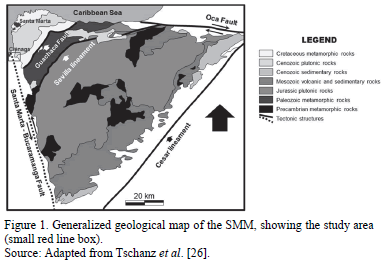
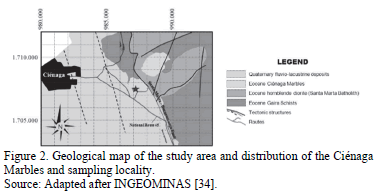
<body><![CDATA[<p>&nbsp;</p>     <p><font size="3" face="Verdana, Arial, Helvetica, sans-serif"><b>1. Introduction</b></font></p>     <p><font size="2" face="Verdana, Arial, Helvetica, sans-serif">A skarn-type mineralogy may be formed   during regional or contact metamorphism and from a variety of metasomatic   processes involving a great variety of fluids (magmatic, metamorphic, meteoric,   and/or marine in origin). This mineral assemblage is characterized by the   presence of calc-silicate minerals (e.g. garnet and pyroxene), among others   minerals &#91;1-3&#93;. The recognition of a skarn-type mineralogy is very relevant in   terms of mineral exploration because of its relationship with mineral deposits   formation &#91;4-15&#93;. The major part of skarn-type mineralogy can be related to   causative igneous rocks emplaced at various tectonic settings &#91;3&#93;. The most   economic skarn deposits are related to metasomatic processes that affect the   country rocks (e.g. marbles) that are used to host hydrated silicate masses   forming igneous rocks bodies. Many studies have pointed out the relationship   between the skarn-type minerals (as well as the composition of the causative   igneous bodies), and the mineral deposits skarn-related &#91;10,16&#93;. It is very   useful for mineral exploration to determine a cause-effect relationship between   the causative igneous bodies and the skarn-type mineralogy, and establish the   mineral chemistry of garnet and pyroxene, which is very important to postulate   a specific type of skarn deposit according to the skarn-type mineralogy. The   aim of this paper is to report the occurrence of the skarn-type mineralogy   recognized in the Ci&eacute;naga Marbles. Based on the mineralogical characteristics   observed in the skarn-type mineral assemblage, we also discuss its origin,   which can be associated with the magmatic-hydrothermal event forming this   skarn-type epigenetic mineral assemblage. Finally, based on previous regional   geology studies and zircon U-Pb geochronology data, we report some   considerations to propose a link between the Caribbean oceanic plate evolution   and the magmatic hydrothermal system related to the skarn-type mineralogy   formation.</font></p>     <p>&nbsp;</p>     <p><font size="3" face="Verdana, Arial, Helvetica, sans-serif"><b>2. Geological background</b></font></p>     <p><font size="2" face="Verdana, Arial, Helvetica, sans-serif">The study area belongs to the Santa Marta   Massif (SMM), which constitutes an isolated triangular-shaped range on the   northern Colombian Caribbean region and represents an uplifted region (with   altitudes of ca. 5800 m), located along the diffuse southern Caribbean plate   boundary (<a href="#fig01">Fig. 1</a>). This was the result of an oblique convergence between the   Caribbean plate and northwestern South America &#91;17-18&#93;. The Oca fault &#91;19&#93;, the   Santa Marta-Bucaramanga fault &#91;20&#93;, the Cerrej&oacute;n thrust sheet &#91;21&#93; and the   Romeral suture are the major structures bounding the SMM. It is composed mainly   by crystalline rocks and can be divided into three belts (Sierra Nevada,   Sevilla and Santa Marta), and has a defined outboard younging pattern from east   to west. The southeastern and oldest Sierra Nevada belt includes ca. 1.0-1.2 Ga   high grade metamorphic rocks represented by granulites, gneisses and   amphibolites that were affected during the Grenvillian orogenic event &#91;22-24&#93;.   Jurassic plutons and volcanites intrude and cover these metamorphic rocks.   Minor Carboniferous and Late Mesozoic sedimentary sequences rest in   unconformity towards the southeast &#91;25-26&#93;. The intermediate Seville belt   represents a polymetamorphic complex that includes Paleozoic gneisses and   schists with Permian millonitized peraluminous granitoids &#91;25,27-28&#93;. The   northwestern and youngest Santa Marta belt comprises an inner sub-belt of   Cretaceous imbricated metamorphic rocks (greenschists and amphibolites) and an   outer sub-belt of Mesozoic amphibolites, greenschists and phyllites separated   by the lower to middle Cenozoic Santa Marta Batholith (SMB) &#91;26,29-30&#93;. The   Cesar-Rancheria basin, exposed in the southeastern flank of the SMM, represents   a sedimentary record that evolved from a Cretaceous passive margin to Maastrichian-Paleogene   orogenic deposits linked to an accretionay and subduction event of the   Caribbean plate &#91;31&#93;. Several quarries exploiting the Ci&eacute;naga Marbles (Santa   Marta Geotectonic Province) are situated to the east of Ci&eacute;naga (Magdalena) at   11°00' North, 74°15' West, which are easily accessible from Ci&eacute;naga. Access is   via the Caribbean Transverse (National Route 90) that connects with the   Magdalena Trunk (National Route 45), and then turning left and continuing for   0.35 km on an unpaved road. </font></p>     <p align="center"><font size="2" face="Verdana, Arial, Helvetica, sans-serif"><a name="fig01"></a></font><img src="/img/revistas/dyna/v83n196/v83n196a10fig01.gif"></p>     <p><font size="2" face="Verdana, Arial, Helvetica, sans-serif">Metamorphic   rocks from the Gaira Schists and Ci&eacute;naga Marbles, and igneous rocks are grouped   into the SMB and recent deposits occur in the study area (<a href="#fig02">Fig. 2)</a>. The Ci&eacute;naga Marbles host a skarn-type mineralogy, which can be   associated with a magnesian-type skarn, genetically related to granitic igneous   activity from the Eocene age SMB. The Gaira Schists crop out towards the northwest of the SMB. They   are the result of a Middle Eocene (58.4±4.3 Ma) regional low- to middle-grade   metamorphism under the greenschist and amphibolite facies &#91;24&#93;, which have undergone retrograde metamorphism and metasomatism with abundant dykes of   pegmatite, aplite and dacite &#91;24&#93;. The   Ci&eacute;naga Marbles (early Cretaceous in age) and its surroundings are part of the   Santa Marta Geotectonic Province in the SMM - a polymetamorphic complex that   includes gneisses and schists of Paleozoic age with Permian mylonitic   granitoids &#91;27&#93;. In general, they are coarse-grained white and bright marbles   with granoblastic texture and sutured contacts, although they can be   fine-grained dark gray marbles with a banded structure. Their spatial   distribution and geometry is not very well established and their stratigraphic   relationships with the surrounding rocks are difficult to establish due to   numerous faults surrounding the bodies. </font></p>     <p align="center"><font size="2" face="Verdana, Arial, Helvetica, sans-serif"><a name="fig02"></a></font><img src="/img/revistas/dyna/v83n196/v83n196a10fig02.gif"></p>     <p><font size="2" face="Verdana, Arial, Helvetica, sans-serif">The relationships between marbles and   schists are uncertain and not determined in the field. The Ci&eacute;naga Marbles   overlies the Gaira Schists (metamorphosed to amphibolite facies before the   intrusion of the SMB). They are divided into two members: (1) relatively pure   and low magnesium marbles and (2) impure, in part dolomitic, sandy marbles,   calcareous metasediments, metamudstones and quartzites. The SMB &#91;25&#93; emerges as a NE trending   belt located between metamorphic rocks and is composed of </font> <font size="2" face="Verdana, Arial, Helvetica, sans-serif">granodiorite to monzogranite with transitional   variations and tonalite. It can show magmatic foliation similar to that   reported by Gonzalez &#91;35&#93;. Mafic enclaves commonly   occur throughout the body, with fewer pegmatitic hornblendites (cumulates of   hornblende), indicating a complex magmatic history with recirculation and the   mixing of materials from the lower parts of the magma chamber &#91;36&#93;.</font></p>     ]]></body>
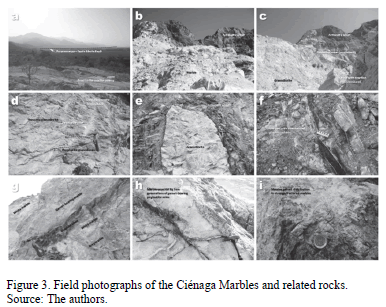
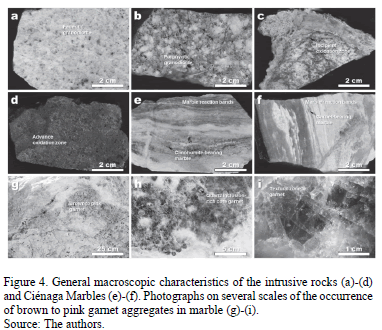
<body><![CDATA[<p>&nbsp;</p>     <p><font size="3" face="Verdana, Arial, Helvetica, sans-serif"><b>3. Field sampling and analytical methods</b></font></p>     <p><font size="2" face="Verdana, Arial, Helvetica, sans-serif">Marbles and associated rocks were   collected from the mining area, taking into account their field relationships,   texture and mineralogy. The petrographic analysis was performed on a trinocular   NIKON LABOPHOT2-POL microscope. Mineral abbreviations are after Kretz &#91;32&#93;.   SEM/EDS analysis was carried out by environmental scanning   electron microscopy (FEI Quanta 650 FEG ESEM) under the following analytical   conditions: magnification = 160-750x, HFW = 199 µm - 1.86 mm, HV = 20-30 kV, spot = 3.0, signal = SE,   detector = LFD. Fractions of heavy mineral concentrates   (&lt;350 µm) were separated using traditional techniques at ZirChron LLC in   Washington State University. LA-ICPMS U-Pb analyses were conducted at the   GeoAnalytical Lab at the Department of Geology in Washington State University   using a New Wave Nd:YAG UV 213-nm laser coupled to a ThermoFinnigan Element 2   single collector, double-focusing, and magnetic sector ICPMS. Operating   procedures and parameters are discussed by Mantilla <i>et al</i>. &#91;33&#93;.</font></p>     <p>&nbsp;</p>     <p><font size="3" face="Verdana, Arial, Helvetica, sans-serif"><b>4. Field relationships</b></font></p>     <p><font size="2" face="Verdana, Arial, Helvetica, sans-serif">White   greyish, medium- to coarse-grained marbles of variable morphology (with sharp   contacts) and thickness (from centimeter to meter scale) show a transition into   carbonate-silicate rocks, which, in turn, pass into calc-silicate and   carbonate-bearing silicate rocks. Finally, when carbonate tends to disappear,   they are cut by porphyritic granodiorites (<a href="#fig03">Fig. 3</a>). They show a weak to strong   banding (alternation of carbonate-rich and calc-silicate layers). <a href="#fig03">Fig. 3a</a> shows   an excellent overview of the Bucaramanga - Santa Marta Fault. <a href="#fig03">Fig. 3b</a> shows a   view of the El Futuro quarry; the actinolitic schist is at the top; and the   marble is at the bottom. An intrusive contact zone between the actinolitic   schist and the granodiorite is shown in <a href="#fig03">Fig. 3c</a>. Note the occurrence of part of   the endoskarn (oxidation zones) and exoskarn (marble with reaction bands). <a href="#fig03">Fig.   3d</a> shows the occurrence of granodiorite with faneritic   and</font> <font size="2" face="Verdana, Arial, Helvetica, sans-serif">porphyritic   textures, cross cut by a pegmatite, which have been affected by dextro-lateral faults; the oxidation zones (endoskarn) can be seen in the upper right part. <a href="#fig03">Fig. 3e</a> shows a well-defined intrusive contact between the granodiorite and the   actinolitic schist. Note the characteristic tabular geometry of marbles   interbedded with graphite schists in <a href="#fig03">Fig. 3f.</a> In <a href="#fig03">Fig. 3g</a> several marble types   and interbedded graphite schists can be observed. Marble is commonly cross cut   by two generations of garnet-bearing pegmatites (<a href="#fig03">Fig. 3h</a>). <a href="#fig03">Fig. 3i</a> shows the   occurrence of massive brown to pink garnet in strongly fractured marbles.</font></p>     <p align="center"><font size="2" face="Verdana, Arial, Helvetica, sans-serif"><a name="fig03"></a></font><img src="/img/revistas/dyna/v83n196/v83n196a10fig03.gif"></p>     <p><font size="2" face="Verdana, Arial, Helvetica, sans-serif">General macroscopic   characteristics of the Ci&eacute;naga Marbles and associated rocks are shown in <a href="#fig04">Fig.   4</a>. A granodiorite body cutting metamorphic rocks (actinolitic schists and   marbles) shows a phaneritic and porphyritic texture (<a href="#fig04">Figs. 4a</a>-<a href="#fig04">4b</a>). In the   endoskarn zone, incipient (<a href="#fig04">Fig. 4c</a>) to advanced (<a href="#fig04">Fig. 4d</a>) oxidation zones are   developed. <a href="#fig04">Figs. 4e</a>-<a href="#fig04">4f</a> illustrates marble reaction bands. Massive brown to pink   garnet aggregates commonly occur in marbles (<a href="#fig04">Figs. 4g</a>-<a href="#fig04">4i</a>).</font></p>     <p align="center"><font size="2" face="Verdana, Arial, Helvetica, sans-serif"><a name="fig04"></a></font><img src="/img/revistas/dyna/v83n196/v83n196a10fig04.gif"></p>     <p><font size="3" face="Verdana, Arial, Helvetica, sans-serif"><b>5. Mineralogy and petrography</b></font></p>     ]]></body>
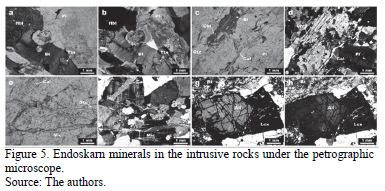
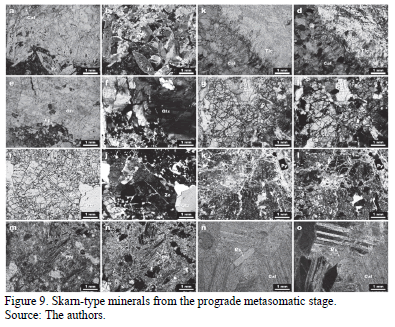
<body><![CDATA[<p><font size="2" face="Verdana, Arial, Helvetica, sans-serif"><b><i>5.1. Causative rock</i></b></font></p>     <p><font size="2" face="Verdana, Arial, Helvetica, sans-serif">The   emplacement of intrusive rocks belonging to the SMB (<a href="#fig05">Fig. 5</a>) affected marbles   developed a skarn-type mineralogy. The main petrographic facies corresponds to   a granodioritic intrusive (<a href="#fig05">Figs 5a</a>-<a href="#fig05">5d</a>), exhibits holocrystalline equigranular   texture; and is mostly composed of plagioclase (well-developed albite twinning,   characteristic sieve texture and alteration to sericite), quartz, biotite and   hornblende, with minor zircon, titanite and apatite and chlorite as a   retrograde phase. Locally, small garnet-bearing pegmatites cross cut the   granodiorite (<a href="#fig05">Fig. 5e</a>-<a href="#fig05">5f</a>) and are mainly composed of quartz, plagioclase and   microcline (tartan twinning), with minor epidote and muscovite, magnetite and   zircon as accessory minerals, and chlorite and sericite as secondary minerals.   Biotite represents a supergene mineral phase cross cut by calcite veinlets. The   endoskarn zone presents a sulphide (pyrite) and oxidation (magnetite) zones,   the latter with large crystals of allanite (typical textural oscillatory zoning   and reaction rims of leucoxene, monacite and barite). Leucoxene can be cross   cut by barite veinlets (<a href="#fig05">Fig. 5g</a>-<a href="#fig05">5h</a>). The original crystalline marbles were   locally affected by a causative body (granodiorite), which gives rise to thin   calc-silicate reaction bands with spotty garnet and diopside crystals near the   boundary with the exoskarn zone. </font></p>     <p align="center"><font size="2" face="Verdana, Arial, Helvetica, sans-serif"><a name="fig05"></a></font><img src="/img/revistas/dyna/v83n196/v83n196a10fig05.gif"></p>     <p><font size="2" face="Verdana, Arial, Helvetica, sans-serif"><b><i>5.2. Host rocks</i></b></font></p>     <p><font size="2" face="Verdana, Arial, Helvetica, sans-serif"><b>5.2.1. Regional metamorphism (pre-skarn stage)</b></font></p>     <p><font size="2" face="Verdana, Arial, Helvetica, sans-serif">The regional metamorphic stage is   represented by white, medium-grained, pure marbles that display a granoblastic   fabric (<a href="#fig06">Fig. 6</a>). They are mostly composed of medium-grained recrystallized   calcite and dolomite, and show characteristic rhombohedral cleavage and   polysynthetic twinning. The associated minor minerals are quartz, muscovite and   graphite. Very fine-grained zircon of high relief and extreme birrefringence   occurs as inclusions in carbonates. The mineralogy of the pre-skarn stage is   associated to regional metamorphism involving the recrystallization of calcite   and dolomite to marbles.</font></p>     <p align="center"><font size="2" face="Verdana, Arial, Helvetica, sans-serif"><a name="fig06"></a></font><img src="/img/revistas/dyna/v83n196/v83n196a10fig06.gif"></p>     <p><font size="2" face="Verdana, Arial, Helvetica, sans-serif"><b>5.2.2. Skarn stages</b></font></p>     <p><font size="2" face="Verdana, Arial, Helvetica, sans-serif">Impure marbles of the skarn stages are represented by carbonate   rocks with a foliated structure and granoblastic </font><font size="2" face="Verdana, Arial, Helvetica, sans-serif">texture. They are mainly composed by recrystallized magnesian calcite and   dolomite as the dominant minerals, as well   as a variety of minerals in the following petrographic classes: wollastonite-,   forsterite-, diopside-, garnet-, clinohumite- and vesubianite-bearing marbles.   Common minerals are graphite, quartz, diopside, garnet, wollastonite,   clinohumite and forsterite. Minor minerals are tremolite, epidote-group   minerals, clinochlore and muscovite. Accessory minerals are rutile, titanite,   fluorapatite and pyrite. Secondary minerals are calcite and sepiolite.</font></p>     <p><font size="2" face="Verdana, Arial, Helvetica, sans-serif">Isochemical   metamorphism involves recrystallization of sedimentary calcite and dolomite to   coarse-grained impure marbles and changes in mineral stability without   significant mass transfer. There is, thus, no injection or leaching out of new   elements by magma or volatile fluids &#91;3,37-38&#93; involved. Previous studies of metamorphic phenomena emphasized the isochemical   mineralogical changes due to metamorphic re-equilibration under differing PT   regimes, although the metasomatic mass-transfer of chemical components is also   recognized as an important process accompanying regional metamorphism &#91;39-42&#93;.   Metamorphic recrystallization of carbonate and quartz and mineralogical changes   affect the carbonate-bearing protolith, and circulating of high-T fluids   promotes the formation of anhydrous calc-silicate minerals such as diopside,   garnet (at ~400-700 °C), and probably titanite. Metasomatic metamorphism is a   metamorphic process by which the chemical composition of a rock is altered in a   pervasive manner and involves the introduction and/or removal of chemical   components as a result of the interaction of the rock with aqueous fluids &#91;43&#93;.   This is essentially a multistage metasomatism process, in which magma   crystallizes and releases a fluid phase, producing a metasomatic skarn. </font></p>     ]]></body>
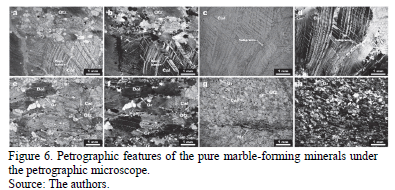
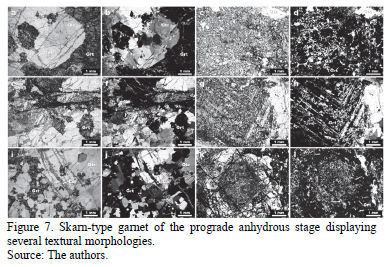
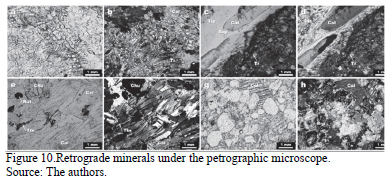
<body><![CDATA[<p><font size="2" face="Verdana, Arial, Helvetica, sans-serif">Prograde   anhydrous stage. Garnet in the marble and barren skarn zones appear to show the   anomalous anisotropy (which can be attributed to the presence of H<sub>2</sub>O   molecules in its chemical structure) more frequently than those in the   mineralized skarn zone &#91;44&#93;. <a href="#fig07">Fig. 7</a> shows the different textural morphologies   of garnet under the petrographic microscope: garnet developing embayment (<a href="#fig07">Figs.   7a</a>-<a href="#fig07">7b</a>), disseminated aggregates of garnet (<a href="#fig07">Figs. 7c</a>-<a href="#fig07">7d</a>), highly tectonized garnet   (<a href="#fig07">Figs. 7e</a>-<a href="#fig07">7f</a>), textural zoned garnet (<a href="#fig07">Figs. 7g</a>-<a href="#fig07">7h</a>), skeletal and idioblastic   garnet (<a href="#fig07">Figs. 7i</a>-<a href="#fig07">7j</a>), garnet displaying a quartz rich inclusion-core and a   poor-inclusion rim (<a href="#fig07">Figs. 7k</a>-<a href="#fig07">7l</a>).</font></p>     <p align="center"><font size="2" face="Verdana, Arial, Helvetica, sans-serif"><a name="fig07"></a></font><img src="/img/revistas/dyna/v83n196/v83n196a10fig07.gif"></p>     <p><font size="2" face="Verdana, Arial, Helvetica, sans-serif">The main   petrographic aspects of the skarn-type minerals of this stage are shown in <a href="#fig08">Fig.   8</a>. Magnesian calcite occurs as very fine- to medium-grained recrystallized   crystals of characteristic rhombohedral cleavage and polysynthetic twinning and   is locally accompanied by dolomite. Diopside is the most abundant mineral   occurring as a fine-grained granoblastic intergrowth with calcite. It has a   typical short prismatic crystal or well-formed equant cross-sections, is clear   to light green in color, has a high relief, near 90<sup>o</sup> cleavage angle,   and interference colors that range (from blue to violet) up to mid second order   (views that show two cleavages tend to be lower), and a large extinction angle.   At the granodiorite-marble contact, a zone of diopside was observed. It could   have been formed due to the diffusion of Ca, Mg and Si as suggested by Kenneth   &#91;45&#93;. Occurrences of forsterite could represent the main mineral phase along   with calcite and dolomite and minor phlogopite. Forsterite is largely replaced   by serpentine (typical mesh texture) and comprises rounded crystals of up to   4.5 mm in size that are cut by serpentine veins. Alternating poor-wollastonite   and rich-wollastonite zones can be recognized. Wollastonite is formed by the   infiltration of H<sub>2</sub>O-rich fluids close to the peak of regional   metamorphism, although it can also be formed by the calcite + quartz =   wollastonite + CO<sub>2</sub> &#91;46&#93; reaction. Clinohumite shows typical   pleochroism from pale yellow to red-yellow and is locally intergrown with   forsterite. Vesubianite occurs as scarce pleochroic (yellow to orange) crystals   dispersed in the matrix. Rutile is spatially associated with dolomite marble   and occurs as large grains or aggregates mimicking the occurrence of Fe-Ti   oxides in the protolith. Titanite occurs in the matrix as very fine-grained   aggregates with the characteristic brown color and high relief. It is in   contact with calcite and diopside. Fluorapatite occurs as scattered small   grains. </font></p>     <p align="center"><font size="2" face="Verdana, Arial, Helvetica, sans-serif"><a name="fig08"></a></font><img src="/img/revistas/dyna/v83n196/v83n196a10fig08.gif"></p>     <p><font size="2" face="Verdana, Arial, Helvetica, sans-serif">Prograde   metasomatic stage. <a href="#fig09">Fig. 9</a> shows the main minerals in this stage. Tremolite   occurs as colorless crystals of high relief and third order interference   colors, which are in contact with calcite. Very fine-grained epidote shows the   typical slight pleochroism. It occurs as inclusions in calcite. Clinozoisite is   colorless and shows high relief and fractures filled by quartz and calcite.   Zoisite occurs as fine-grained, colorless and very high relief crystals that   shows anomalous interference colors. Platy bronze brown to pale orange   phlogopite shows weak pleochroism, perfect cleavage on (001) and straight   extinction. Muscovite occurs as individuals of straight and serrated   boundaries.</font></p>     <p align="center"><font size="2" face="Verdana, Arial, Helvetica, sans-serif"><a name="fig09"></a></font><img src="/img/revistas/dyna/v83n196/v83n196a10fig09.gif"></p>     <p><font size="2" face="Verdana, Arial, Helvetica, sans-serif">Retrograde meteoric stage. It is   structurally controlled and overprints the prograde zonation sequence such as   garnet and diopside. The retrograde skarn-type minerals can show vein   structure. <a href="#fig10">Fig. 10</a> shows the main minerals of the retrograde meteoric stage,   which is represented by the occurrence of calcite, quartz, chlorite, serpentine,   sepiolite and pyrite. Veins of quartz-calcite, which are cutting massive   garnet, can be related to retrograde skarnization. In the later stage of   alteration, chlorite occurs as fibrous aggregates locally replacing phlogopite.   Abundant quartz occurs as fine-grained inclusions in garnet or as a matrix   constituent. Coarse-grained quartz associated to skeletal garnet is cut by   calcite veinlets. It sometimes occurs in complex veins, showing elongated   aggregates growing over a carbonate matrix with bubbles extensions that   penetrate veinlets of fibrous sepiolite aggregates. Serpentine occurs after   forsterite, which implies that H<sub>2</sub>O must have remained the dominant   fluid during retrograde calc-silicate formation &#91;47&#93;, </font><font size="2" face="Verdana, Arial, Helvetica, sans-serif">and must be   related to a low-T hydrothermal/metasomatic process &#91;48&#93;. It also can be formed   after replacement of clinohumite and diopside. Pyrite occurs as small crystals   with edges showing a bronze color and is related to calcite veinlets.</font></p>     <p align="center"><font size="2" face="Verdana, Arial, Helvetica, sans-serif"><a name="fig10"></a></font><img src="/img/revistas/dyna/v83n196/v83n196a10fig10.gif"></p>     <p><font size="2" face="Verdana, Arial, Helvetica, sans-serif"><b>5.2.3. Supergene alteration stage</b></font></p>     <p><font size="2" face="Verdana, Arial, Helvetica, sans-serif">This stage is represented in the   endoskarn zone and is characterized by the local occurrence of pyrite and   magnetite. Moreover, in the oxidation zone, large crystals of textural zoned   allanite display a strong replacement by leucoxene, although, they is also   rimmed by monacite and leucoxene. Barite, occurring as a precipitated phase,   rims allanite or develops veinlets cross cutting leucoxene.</font></p>     ]]></body>
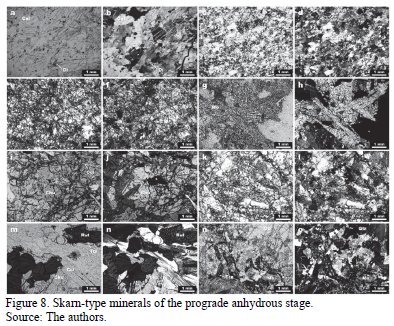
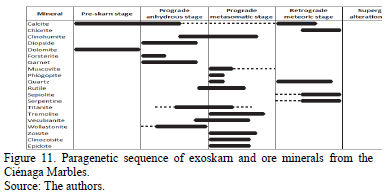
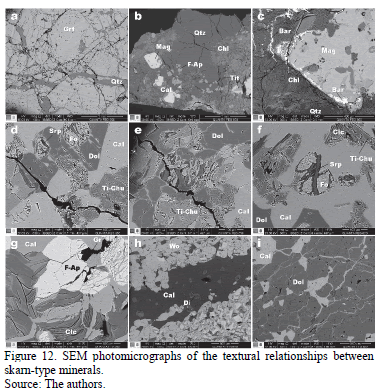
<body><![CDATA[<p><font size="2" face="Verdana, Arial, Helvetica, sans-serif">Petrographic analysis of the Ci&eacute;naga   Marbles, located in proximity to granitic dikes and stocks of the SMB, reveals   the paragenetic sequence described above, which is shown in <a href="#fig11">Fig. 11</a>. The   inexistence of ore skarn can be associated to erosion.</font></p>     <p align="center"><font size="2" face="Verdana, Arial, Helvetica, sans-serif"><a name="fig11"></a></font><img src="/img/revistas/dyna/v83n196/v83n196a10fig11.gif"></p>     <p>&nbsp;</p>     <p><font size="3" face="Verdana, Arial, Helvetica, sans-serif"><b>6. Mineral chemistry</b></font></p>     <p><font size="2" face="Verdana, Arial, Helvetica, sans-serif"><a href="#fig12">Fig.12</a> shows the   textural relationships observed in the skarn minerals. <a href="#fig12">Figs. 12a</a>-<a href="#fig12">12c</a> illustrate   mineral relationships in the endoskarn zone. <a href="#fig12">Fig. 12a</a> shows a large garnet   cross cut by quartz microveins. <a href="#fig12">Fig. 12b</a> shows a subhedral   magnetite in a matrix mainly composed of quartz and chlorite with minor calcite   and titanite and fluorapatite as the main accessory minerals. A large subhedral   magnetite rimmed and cross cut by barite microveins can be observed in <a href="#fig12">Fig.   12c</a>. The association magnesian calcite +   dolomite + clinohumite + forsterite (replaced by serpentine) is shown in <a href="#fig12">Fig.   12d</a>. <a href="#fig12">Fig. 12e</a> shows the occurrence of clinohumite along with dolomite +   magnesian calcite. A replacement of forsterite by serpentine is observed in <a href="#fig12">Fig. 12f</a>; the presence of clinohumite, dolomite, magnesian calcite and   clinochlore can also be noted. <a href="#fig12">Fig. 12g</a> shows fluorapatite along with magnesian   calcite and clinochlore; numerous veins of magnesian calcite cross cut   fluorapatite. The wollastonite + diopside + calcite association is shown in <a href="#fig12">Fig. 12h</a>. <a href="#fig12">Fig. 12i</a> shows abundant dolomite and scarce magnesian calcite that occur   as matrix phases or as secondary veins cross cutting dolomite. </font></p>     <p align="center"><font size="2" face="Verdana, Arial, Helvetica, sans-serif"><a name="fig12"></a></font><img src="/img/revistas/dyna/v83n196/v83n196a10fig12.gif"></p>     <p><font size="2" face="Verdana, Arial, Helvetica, sans-serif">The retrograde stage can be documented   by the occurrence of fibrous sepiolite and veinlets of barite. Similar fibrous   clays have been reported by Zaaboub <i>et al</i>.   &#91;49&#93;. According to the previous sepiolite would have precipitated directly in   hydrothermal environments under alkaline conditions, high Si and Mg and low Al   activity. Veinlets of barite (barium sulfate) reveals that the presence of   other minerals in the precursor hydrothermal solution affected the kinetics of   crystal growth of barium sulphate as has beeb reported in several studies   &#91;50-51&#93;. In general, magnesian skarns form at temperatures 450-750 <sup>o</sup>C   and pressures of 0.5-10 kbar, they contain forsterite, diopside, clinohumite   and phlogopite at the contacts between magmatic and calc-magnesian or magnesian   carbonate rocks, typically host ores, and may develop in both the magmatic   (prograde, in contact with magmatic fluids) and postmagmatic (retrograde)   stages &#91;42&#93;. We suggest that the magnesian skarn-type mineralogy hosted in the   Ci&eacute;naga Marbles is related to the magmatic stage of the SMB and is   characterized by the occurrence of magnesian calcite and/or dolomite,   forsterite and pyroxene, with the last of these occurring only due to low   chemical activity of CaO. However, it can be also related to the postmagmatic   stage of the SMB. A very complex skarn-type mineralogy zonation can be   observed. According to Pertsev &#91;52&#93;, magnesian skarns of both stages are   commonly replaced in varying degrees by postmagmatic calc-skarns under moderate   P-T conditions due to increasing CaO chemical</font> <font size="2" face="Verdana, Arial, Helvetica, sans-serif">activity with   decreasing temperature and a corresponding decrease of CO<sub>2</sub> concentration in fluids. Therefore, low-T post-skarn alteration leads to the   replacement of skarn minerals by serpentine and carbonates. Ore mineralisations   accompanying the formation of magnesian skarns are magnetite and borates   (ludwigite, suanite and kotoite), with a wide variety of ore mineralizations   (e.g., Cu, Mo, W, Be, Sn, Pb, Zn, Au, B) that can be overprinted by low-T   hydrothermal processes &#91;42&#93;. This the case reported in this study.</font></p>     <p>&nbsp;</p>     <p><font size="3" face="Verdana, Arial, Helvetica, sans-serif"><b>7. Skarn and ore minerals</b></font></p>     <p><font size="2" face="Verdana, Arial, Helvetica, sans-serif">Skarns are defined by their mineralogy,   which includes a wide variety of calcium-bearing silicates and associated   minerals, but is usually dominated by garnet and pyroxene &#91;3&#93;. Skarns can be   subdivided according to several criteria. However, skarns are broken down into   two broad subcategories &#91;3,53&#93;: exoskarns and endoskarns. In the study area,   the skarn is divided into exoskarn, with subordinate endoskarn (centimeter-wide   altered plutonic rocks in contact with the skarn) and skarn veins. An exoskarn   can be recognized in the marbles close to the thermal source (magma or   hydrothermal fluids). An endoskarn developed within the granodiorite intrusion   is represented by highly sulphidation (pyrite) and oxidation (magnetite) zones,   the last of these has the appearance of zoned allanite, which is rimed by   monacite and cross cut by barite. Skarns may or may not host economic reserves   of metals. If they do they are called skarn deposits, which are often described   according to the dominant economic metal or mineral present, whether it is Cu,   Fe, W, Zn-Pb, Mo, Au, etc. However, the majority of the world's economic skarn   deposits occur in calcic exoskarns. The Ci&eacute;naga skarn is a magnesian type,   which can explain why there is no ore zone. It can be considered as a reaction   of magnesian skarn that is formed by isochemical metamorphism of thinly   interlayered shales and limestones where the metasomatic transfer of components   between adjacent lithologies may occur on a small scale, as suggested by some   authors &#91;2&#93;. The previously mentioned lithological and mineralogical features   (magnesian skarn-type mineralogy) may suggest a potential environment for the   formation for Fe, Sn (W), Be, B, and REE deposits.</font></p>     ]]></body>
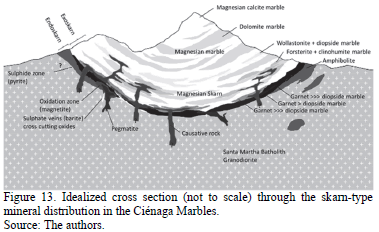
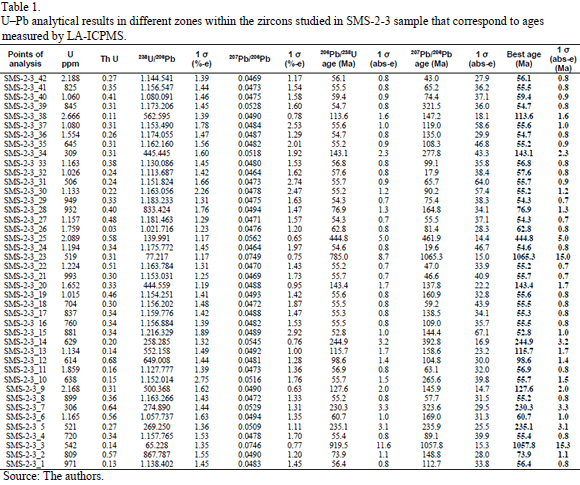
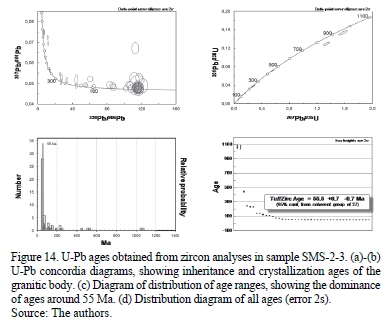
<body><![CDATA[<p>&nbsp;</p>     <p><font size="3" face="Verdana, Arial, Helvetica, sans-serif"><b>8. Skarn-type mineralogy zonation in the Ci&eacute;naga   Marbles</b></font></p>     <p><font size="2" face="Verdana, Arial, Helvetica, sans-serif">Most skarns show a general zonation pattern of proximal garnet,   distal pyroxene and vesubianite at the contact between skarn and marble. Skarn   minerals may display systematic color or compositional variations within the   larger zonation pattern &#91;42&#93;. Atkinson and Einaudi &#91;4&#93; describe it, with   proximal garnet being commonly dark red-brown, becoming lighter brown and   finally pale yellow-green near the marble front. A granodiorite of the SMB intruded into the Ci&eacute;naga Marbles. Metamorphism and metasomatism produced   millimeter to centimeter scale reaction zones near the contact. The contact   zone shows evidence of assimilation of the marbles by granodioritic magma. Most   major skarn deposits are directly related to igneous activity and broad </font><font size="2" face="Verdana, Arial, Helvetica, sans-serif">correlations between igneous composition and skarn type have been   previously described &#91;1,5&#93;. We suggest a zonation   pattern for the skarn-type mineralogy, which does not extend on a large area,   although it can provide important evidence as exploration guides. We suggest   that skarn-type minerals were formed at different stages and P-T conditions,   not coexisting each other based on the general idea of chemical equilibrium. <a href="#fig13">Fig. 13</a> shows an idealized cross section through the skarn-type mineral   distribution in the Ci&eacute;naga Marbles. The following zones and mineral   assemblages were identified (in order of decreasing grade): The endoskarn is   developed within the granodiorite intrusion and is represented by very small   sulphidation (pyrite) and oxidation (magnetite) zones; the last of them with   the occurrence of zoned allanite, rimed by monacite and leucoxene and cross   cutting by barite veinlets. The exoskarn is represented by the following zones: Garnet zone (next to   the contact) consists of grossularite garnet, diopside, and minor calcite and   quartz. We have no evidence on the occurrence of pale   green garnet, then, we suggest that a proximal red-brown to brown garnet can be   close to the marble. The change in pyroxene color is less pronounced but   typically reflects a progressive increase in Fe and/or Mn towards the marble   front &#91;54&#93;, which has not been confirmed yet in the study area. Diopside zone mainly composed of   diopside and calcite, and minor garnet. Monticellite zone contains magnesian   calcite, dolomite, clinohumite, forsterite, phlogopite, with serpentine as the   main retrograde mineral phase. Taking into account that   these minerals are absent in most other types of skarn &#91;42&#93;, this reveals a magnesian skarn-type mineralogy. Idocrase (vesubianite) zone consists of   vesubianite in association with calcite, diopside, wollastonite and phlogopite.   Inner zone consists of magnesian calcite and dolomite marble, showing little   metasomatism.</font></p>     <p align="center"><font size="2" face="Verdana, Arial, Helvetica, sans-serif"><a name="fig13"></a></font><img src="/img/revistas/dyna/v83n196/v83n196a10fig13.gif"></p>     <p>&nbsp;</p>     <p>&nbsp;</p>     <p><font size="3" face="Verdana, Arial, Helvetica, sans-serif"><b>9. U-Pb Geochronology</b></font></p>     <p><font size="2" face="Verdana, Arial, Helvetica, sans-serif">Sample SMS-2-3 (granodiorite cutting the   Cienaga Marbles) was dated by U/Pb (<a href="#tab01">Table 1</a>). It was collected and dated due to   its close relationship to the skarn-type mineralogy developed around its   borders. Analytical data and U-Pb isotope ratios indicate the presence of at   least two ages: the first one is made up of 27 of the 42 performed analysis   (~64% of all analyzes, with ages ranging from 60.7 to 54.3±0.7 Ma; and the   second one is made up of 15 of the 42 performed analysis (~ 36% of all   analyzes), with ages ranging from 1065.3±15 to 62.8±0.8 Ma. After considering   the analytical and systematic error (<a href="#fig14">Fig. 14</a>), the first group of ages can be   clearly related to the crystallization of a granitoid at 55.5±0.7 Ma. Taking into account that the skarn-type   mineralogy is the result of magmatic-hydrothermal processes and is developed   around granitic rocks, we suggest that the formation of the skarn-type   mineralogy occurred at the same time as the granitoid crystallized. This   absolute age coincides with when the onset of magmatism developed: the start of the change in polarity of the   subduction of the Caribbean plate beneath of the South American plate. This is   in accordance with the model proposed by Cardona <i>et al</i>. &#91;27&#93;, and is part of a more regional scale model proposed by   others &#91;55-56&#93;. Similar ages for this magmatism were reported by Mej&iacute;a <i>et al</i>. &#91;28&#93;. We assume these magmas   correspond to molten silicate enriched in hydrothermal fluids and, therefore,   they should be considered to be of high interest for mineral exploration due to   their ability to form magmatic-hydrothermal systems. The second group of ages   led to the following subgroups being differentiated: (1) with 3 ages ranging   from 62.8±0.8 to 79.9±1.3 Ma, (2) with 6 ages ranging from 98.6±1.4 to   143.4±1.7 Ma, (3) with 2 ages ranging from 230.3±3.3 to 235.1±3.1 Ma, (4) with   1 age of 444.8±5.0 Ma, and (5) with 2 ages ranging from 1057.8±15.3 to   1065.3±15 Ma. The SMS-2-3-14 analysis (244.9±3.2 Ma) is excluded from the above   groups because it is projected to some distance from the concordia curve (<a href="#fig14">Fig.   14a</a>). It is possible to suggest that the ages ranging from 62.8±0.8 to 79.9±1.3   Ma (Late Cretaceous - Early Paleocene) may be legacies that represent mainly   derived zircons of oldest igneous rocks, such as those reported by Cardona <i>et al</i>. &#91;27&#93;. They can also be been   formed in tectonic environments of intra-oceanic magmatic arcs and in   environments own of a late collisional stage.</font></p>     <p align="center"><font size="2" face="Verdana, Arial, Helvetica, sans-serif"><a name="tab01"></a></font><img src="/img/revistas/dyna/v83n196/v83n196a10tab01.gif"></p>     <p align="center"><font size="2" face="Verdana, Arial, Helvetica, sans-serif"><a name="fig14"></a></font><img src="/img/revistas/dyna/v83n196/v83n196a10fig14.gif"></p>     ]]></body>
<body><![CDATA[<p><font size="2" face="Verdana, Arial, Helvetica, sans-serif">The latter is considered to be the cause   of the terminal magmatism, developed prior to the change in polarity of   subduction. We also consider that some of these values represent mixed ages   obtained at intermediate possible areas zoned zircons. Therefore, ages ranging   from 98.6±1.4 to 143.4±1.7 Ma should be considered. However, considering that   they represent older magmatic events (mainly Early Cretaceous), and not a mix   of ages, these data could be very important as they may be indicating older   magmatic events probably related to the geological evolution of the Caribbean's   earliest stages. Ages between 230.3±3.3 and 235.1±3.1 Ma (Triassic) may be   related to inherited zircons from rocks associated to the Triassic-Jurassic   magmatic period documented in several studies &#91;22,24-27,30,58&#93;. They may also   represent a mix of ages obtained at intermediate areas of zoned zircons. The   age of 444.8±5.0 Ma (Ordovician Late) may be related to inherited zircons from   rocks associated with the Paleozoic Early magmatic period &#91;58&#93;. Ages from 1057.8±15.3   to 1065.3±15 Ma can be attributed to inherited zircons from Grevillian   metamorphic rocks reported in the Northern Andes, particularly in the SMM. </font></p>     <p>&nbsp;</p>     <p><font size="3" face="Verdana, Arial, Helvetica, sans-serif"><b>10. Conclusions</b></font></p>     <p><font size="2" face="Verdana, Arial, Helvetica, sans-serif">The Ci&eacute;naga Marbles that formed in a   magmatic arc tectonic environment (emplacement of the lower to middle Cenozoic   SMB), developed in a continental crust. The skarn-type mineralogy is hosted in   lower Cretaceous marbles, and it is related to small granitic dikes and stocks. The Ci&eacute;naga skarn-type mineralogy is regarded to have formed by the reactions of the lower Cretaceous carbonate sedimentary sequence with the SMB, although it cannot be   considered as a skarn deposit. The main general features of the skarn-type mineralogy are summarized as follows: (1) A typical   exoskarn with a magnesian skarn-type mineralogy can be recognized; however, we   cannot rule the existence of a calcium skarn-type mineralogy. (2) The exoskarn is composed mainly   of garnet and diopside. (3) A late stage is composed of hydrous minerals such   as sepiolite, chlorite and serpentine. (4) The   occurrence of clinohumite confirms the occurrence of a magnesian skarn-type   mineralogy at the Ci&eacute;naga Marbles. The presence of clinohumite, serpentine and   Mg-chlorite would represent minerals of the retrograde stage. We also consider   that the presence of forsterite, pyroxene and garnet belong to the prograde or   isochemical metamorphism stage. (5) A skarn-type mineralogy was recognized and its   precursor mineralogy is mainly represented by dolomitic marbles to explain the   development of a magnesian skarn. (6) Taking into account that this term should   be applied to a mixture of calcic and magnesian marbles, we suggest that this   is not a calcic-magnesian system. (7) The obtained zircon U-Pb ages (from   granodioritic bodies) yielded an age of 55.5±0.7 Ma (Ypresian, Early Eocene),   which is also assumed to be the age of the formation of the skarn-type   mineralogy in the Ci&eacute;naga Marbles and coincides with the beginning of the   subduction polarity change (<i>i.e.</i> when   the Caribbean oceanic plate began to subduct beneath South American continental   plate). </font></p>     <p>&nbsp;</p>     <p><font size="3" face="Verdana, Arial, Helvetica, sans-serif"><b>Acknowledgments</b></font></p>     <p><font size="2" face="Verdana, Arial, Helvetica, sans-serif">We are grateful to geologist H. Cotes for   the support on our visits to the marble quarry. Thanks to the Universidad   Industrial de Santander and Universidad de Pamplona for providing us research   facilities. Thanks to the Microscopy Laboratory in the Guatiguar&aacute; Technological   Park and its professional staff for assistance with SEM data acquisition. The   manuscript was greatly improved based on the critical and helpful reviews and   comments by anonymous reviewers. We are most grateful to the previously   mentioned people and institutions for their support. </font></p>     <p>&nbsp;</p>     <p><font size="3" face="Verdana, Arial, Helvetica, sans-serif"><b>References</b></font></p>     <!-- ref --><p><font size="2" face="Verdana, Arial, Helvetica, sans-serif"><b>&#91;1&#93;</b> Zharikov, V.A., Skarns.   International Geology Review, 12(5-6), pp. 541-559, pp. 619-647, 1970. DOI:   10.1080/00206817009475262.    &nbsp;&nbsp;&nbsp;&nbsp;&nbsp;&nbsp;&nbsp;&nbsp;[&#160;<a href="javascript:void(0);" onclick="javascript: window.open('/scielo.php?script=sci_nlinks&ref=1148126&pid=S0012-7353201600020001000001&lng=','','width=640,height=500,resizable=yes,scrollbars=1,menubar=yes,');">Links</a>&#160;]<!-- end-ref --> </font></p>     <!-- ref --><p><font size="2" face="Verdana, Arial, Helvetica, sans-serif"><b>&#91;2&#93;</b> Zarayskiy, G.P., Zharikov,   V.A., Stoyanovskaya, F.M. and Balashov, V.N., The experimental study of   bimetasomatic skarn formation. International Geology Review, 29(6), pp.   761-858, 1987. DOI: 10.1080/00206818709466181.    &nbsp;&nbsp;&nbsp;&nbsp;&nbsp;&nbsp;&nbsp;&nbsp;[&#160;<a href="javascript:void(0);" onclick="javascript: window.open('/scielo.php?script=sci_nlinks&ref=1148128&pid=S0012-7353201600020001000002&lng=','','width=640,height=500,resizable=yes,scrollbars=1,menubar=yes,');">Links</a>&#160;]<!-- end-ref --></font></p>     <!-- ref --><p><font size="2" face="Verdana, Arial, Helvetica, sans-serif"><b>&#91;3&#93;</b> Meinert, L.D., Dipple, G.M. and   Nicolescue, S., World skarn deposits. In: Hedenquist. J.W., Thompson.   J.F.H., Goldfarb. R.J., Richards. J.P., Editors, Economic   Geology 100th Anniversary Volume, Society of   Economic Geologists, Inc. Littleton, Colorado pp.   299-336, 2005. DOI: 10.2113/gsecongeo.77.4.745.    &nbsp;&nbsp;&nbsp;&nbsp;&nbsp;&nbsp;&nbsp;&nbsp;[&#160;<a href="javascript:void(0);" onclick="javascript: window.open('/scielo.php?script=sci_nlinks&ref=1148130&pid=S0012-7353201600020001000003&lng=','','width=640,height=500,resizable=yes,scrollbars=1,menubar=yes,');">Links</a>&#160;]<!-- end-ref --> </font></p>     <!-- ref --><p><font size="2" face="Verdana, Arial, Helvetica, sans-serif"><b>&#91;4&#93;</b> Atkinson, W.W.,Jr. and Einaudi,   M.T., Skarn formation and mineralization in the Contact Aureole at Carr Fork,   Bingham, Utah. Economic Geology, 73(7), pp. 1326-1365, 1978. DOI:   10.2113/gsecongeo.73.7.1326.    &nbsp;&nbsp;&nbsp;&nbsp;&nbsp;&nbsp;&nbsp;&nbsp;[&#160;<a href="javascript:void(0);" onclick="javascript: window.open('/scielo.php?script=sci_nlinks&ref=1148132&pid=S0012-7353201600020001000004&lng=','','width=640,height=500,resizable=yes,scrollbars=1,menubar=yes,');">Links</a>&#160;]<!-- end-ref --></font></p>     <!-- ref --><p><font size="2" face="Verdana, Arial, Helvetica, sans-serif"><b>&#91;5&#93;</b> Einaudi, M.T., Meinert, L.D. and Newberry, R.J., Skarn deposits. Economic   Geology, 75, pp. 317-391, 1981.    &nbsp;&nbsp;&nbsp;&nbsp;&nbsp;&nbsp;&nbsp;&nbsp;[&#160;<a href="javascript:void(0);" onclick="javascript: window.open('/scielo.php?script=sci_nlinks&ref=1148134&pid=S0012-7353201600020001000005&lng=','','width=640,height=500,resizable=yes,scrollbars=1,menubar=yes,');">Links</a>&#160;]<!-- end-ref --></font></p>     <!-- ref --><p><font size="2" face="Verdana, Arial, Helvetica, sans-serif"><b>&#91;6&#93;</b> Newberry, R.J. and Einaudi,   M.T,. Tectonic and geochemical setting of tungsten skarn mineralization in the   Cordillera. Arizona   Geological Society Digest, 14, pp. 99-112, 1981.    &nbsp;&nbsp;&nbsp;&nbsp;&nbsp;&nbsp;&nbsp;&nbsp;[&#160;<a href="javascript:void(0);" onclick="javascript: window.open('/scielo.php?script=sci_nlinks&ref=1148136&pid=S0012-7353201600020001000006&lng=','','width=640,height=500,resizable=yes,scrollbars=1,menubar=yes,');">Links</a>&#160;]<!-- end-ref --></font></p>     <!-- ref --><p><font size="2" face="Verdana, Arial, Helvetica, sans-serif"><b>&#91;7&#93;</b> Einaudi, M.T. and Burt, D.M.,   Introduction - terminology, classification, and composition of skarn deposits.   Economic Geology, 77, pp. 745-754, 1982. DOI:   10.2113/gsecongeo.77.4.745</font>&nbsp;&nbsp;&nbsp;&nbsp;&nbsp;&nbsp;&nbsp;&nbsp;[&#160;<a href="javascript:void(0);" onclick="javascript: window.open('/scielo.php?script=sci_nlinks&ref=1148138&pid=S0012-7353201600020001000007&lng=','','width=640,height=500,resizable=yes,scrollbars=1,menubar=yes,');">Links</a>&#160;]<!-- end-ref --><!-- ref --><p><font size="2" face="Verdana, Arial, Helvetica, sans-serif"><b>&#91;8&#93;</b> Burt, D.M., Skarn deposits -   Historical bibliography through 1970. Economic Geology, 77, pp. 755-763, 1982. DOI:   10.2113/gsecongeo.77.4.745.    &nbsp;&nbsp;&nbsp;&nbsp;&nbsp;&nbsp;&nbsp;&nbsp;[&#160;<a href="javascript:void(0);" onclick="javascript: window.open('/scielo.php?script=sci_nlinks&ref=1148139&pid=S0012-7353201600020001000008&lng=','','width=640,height=500,resizable=yes,scrollbars=1,menubar=yes,');">Links</a>&#160;]<!-- end-ref --></font></p>     <!-- ref --><p><font size="2" face="Verdana, Arial, Helvetica, sans-serif"><b>&#91;9&#93;</b> Meinert, L.D., Gold skarn   deposits - Geology and exploration criteria. Economic Geology, 6, pp. 537-552,   1989. DOI: 10.    &nbsp;&nbsp;&nbsp;&nbsp;&nbsp;&nbsp;&nbsp;&nbsp;[&#160;<a href="javascript:void(0);" onclick="javascript: window.open('/scielo.php?script=sci_nlinks&ref=1148141&pid=S0012-7353201600020001000009&lng=','','width=640,height=500,resizable=yes,scrollbars=1,menubar=yes,');">Links</a>&#160;]<!-- end-ref -->2113/gsecongeo.101.1.199.</font></p>     <!-- ref --><p><font size="2" face="Verdana, Arial, Helvetica, sans-serif"><b>&#91;10&#93;</b> Meinert, L.D., Skarns and skarn deposits. Geoscience Canada, 19, pp. 145-162, 1992. DOI:   10.2113/gsecongeo.95.6.1183.    &nbsp;&nbsp;&nbsp;&nbsp;&nbsp;&nbsp;&nbsp;&nbsp;[&#160;<a href="javascript:void(0);" onclick="javascript: window.open('/scielo.php?script=sci_nlinks&ref=1148143&pid=S0012-7353201600020001000010&lng=','','width=640,height=500,resizable=yes,scrollbars=1,menubar=yes,');">Links</a>&#160;]<!-- end-ref --></font></p>     <!-- ref --><p><font size="2" face="Verdana, Arial, Helvetica, sans-serif"><b>&#91;11&#93;</b> Meinert, L.D., Compositional   variation of igneous rocks associated with skarn deposits - Chemical evidence   for a genetic connection between petrogenesis and mineralization: In Thompson,   J.F.H., Eds., Magmas, fluids, and ore deposits, Mineralogical Association of   Canada Short Course Series, 23, pp. 401-418, 1995. DOI:   10.1016/j.oregeorev.2015.08.004.    &nbsp;&nbsp;&nbsp;&nbsp;&nbsp;&nbsp;&nbsp;&nbsp;[&#160;<a href="javascript:void(0);" onclick="javascript: window.open('/scielo.php?script=sci_nlinks&ref=1148145&pid=S0012-7353201600020001000011&lng=','','width=640,height=500,resizable=yes,scrollbars=1,menubar=yes,');">Links</a>&#160;]<!-- end-ref --></font></p>     ]]></body>
<body><![CDATA[<!-- ref --><p><font size="2" face="Verdana, Arial, Helvetica, sans-serif"><b>&#91;12&#93;</b> Meinert, L.D., Application of   skarn deposit zonation models to mineral exploration. Exploration and Mining   Geology, 6, pp. 185-208, 1997.    &nbsp;&nbsp;&nbsp;&nbsp;&nbsp;&nbsp;&nbsp;&nbsp;[&#160;<a href="javascript:void(0);" onclick="javascript: window.open('/scielo.php?script=sci_nlinks&ref=1148147&pid=S0012-7353201600020001000012&lng=','','width=640,height=500,resizable=yes,scrollbars=1,menubar=yes,');">Links</a>&#160;]<!-- end-ref --></font></p>     <!-- ref --><p><font size="2" face="Verdana, Arial, Helvetica, sans-serif"><b>&#91;13&#93;</b> Meinert, L.D., A review of   skarns that contain gold. Mineralized Intrusion - Related Skarn systems:   Mineralogical Association of Canada Short Course, 26, pp. 359-414, 1998.    &nbsp;&nbsp;&nbsp;&nbsp;&nbsp;&nbsp;&nbsp;&nbsp;[&#160;<a href="javascript:void(0);" onclick="javascript: window.open('/scielo.php?script=sci_nlinks&ref=1148149&pid=S0012-7353201600020001000013&lng=','','width=640,height=500,resizable=yes,scrollbars=1,menubar=yes,');">Links</a>&#160;]<!-- end-ref --></font></p>     <!-- ref --><p><font size="2" face="Verdana, Arial, Helvetica, sans-serif"><b>&#91;14&#93;</b> Newberry, R.J., W. and Sn-Skarn   deposits: A 1998 Status Report. Mineralized Intrusion - Related Skarn Systems:   Mineralogical Association of Canada Short Course, 26, pp. 289-335, 1998.    &nbsp;&nbsp;&nbsp;&nbsp;&nbsp;&nbsp;&nbsp;&nbsp;[&#160;<a href="javascript:void(0);" onclick="javascript: window.open('/scielo.php?script=sci_nlinks&ref=1148151&pid=S0012-7353201600020001000014&lng=','','width=640,height=500,resizable=yes,scrollbars=1,menubar=yes,');">Links</a>&#160;]<!-- end-ref --></font></p>     <!-- ref --><p><font size="2" face="Verdana, Arial, Helvetica, sans-serif"><b>&#91;15&#93;</b> Meinert, L.D., Lentz, D.R. and   Newberry, R.J., Introduction to a Special Issue Devoted to Skarn Deposits.   Economic Geology, 95, pp. 1183-1184, 2000. DOI: 10.2113/95.6.1183.    &nbsp;&nbsp;&nbsp;&nbsp;&nbsp;&nbsp;&nbsp;&nbsp;[&#160;<a href="javascript:void(0);" onclick="javascript: window.open('/scielo.php?script=sci_nlinks&ref=1148153&pid=S0012-7353201600020001000015&lng=','','width=640,height=500,resizable=yes,scrollbars=1,menubar=yes,');">Links</a>&#160;]<!-- end-ref --></font></p>     <!-- ref --><p><font size="2" face="Verdana, Arial, Helvetica, sans-serif"><b>&#91;16&#93;</b> Swanson, S.E., Newberry, R.J., Coulter, G.A.   and Dyehouse, T.M., Mineralogical variation as a guide to the petrogenesis of   the tin granites and related skarns, Seward Peninsula, Alaska. Geological   Society of America Special Paper, 246, pp. 143-160, 1990. DOI:   10.1130/SPE246-p143.    &nbsp;&nbsp;&nbsp;&nbsp;&nbsp;&nbsp;&nbsp;&nbsp;[&#160;<a href="javascript:void(0);" onclick="javascript: window.open('/scielo.php?script=sci_nlinks&ref=1148155&pid=S0012-7353201600020001000016&lng=','','width=640,height=500,resizable=yes,scrollbars=1,menubar=yes,');">Links</a>&#160;]<!-- end-ref --></font></p>     ]]></body>
<body><![CDATA[<!-- ref --><p><font size="2" face="Verdana, Arial, Helvetica, sans-serif"><b>&#91;17&#93;</b> Pindell, J.L., Higgs, R. and   Dewey, J.F., Cenozoic palinspastic reconstruction, paleogeographic evolution   and hydrocarbon setting of the northern margin of South America. In: Pindell,   J.L. and Drake, C.L., Eds., Paleogeographic evolution and non-glacial eustasy,   northern South America. Society of Economic and Petroleum Mineralogists Special   Publication, 58, pp. 45-85, 1998.    &nbsp;&nbsp;&nbsp;&nbsp;&nbsp;&nbsp;&nbsp;&nbsp;[&#160;<a href="javascript:void(0);" onclick="javascript: window.open('/scielo.php?script=sci_nlinks&ref=1148157&pid=S0012-7353201600020001000017&lng=','','width=640,height=500,resizable=yes,scrollbars=1,menubar=yes,');">Links</a>&#160;]<!-- end-ref --></font></p>     <!-- ref --><p><font size="2" face="Verdana, Arial, Helvetica, sans-serif"><b>&#91;18&#93;</b> Moreno-S&aacute;nchez, M. and Pardo-Trujillo,   A., Stratigraphical and sedimentological constraints on western Colombia:   Implications on the evolution of the Caribbean plate. In: Bartolini, C.,   Buffler, R.T., Blickwede, J., Eds., The Circum-Gulf of Mexico and the   Caribbean: Hydro-carbon habitats, basin formation and plate tectonics. AAPG   Memoir, 79, pp. 891-892, 2003.    &nbsp;&nbsp;&nbsp;&nbsp;&nbsp;&nbsp;&nbsp;&nbsp;[&#160;<a href="javascript:void(0);" onclick="javascript: window.open('/scielo.php?script=sci_nlinks&ref=1148159&pid=S0012-7353201600020001000018&lng=','','width=640,height=500,resizable=yes,scrollbars=1,menubar=yes,');">Links</a>&#160;]<!-- end-ref --></font></p>     <!-- ref --><p><font size="2" face="Verdana, Arial, Helvetica, sans-serif"><b>&#91;19&#93;</b> Irving, E.M., Structural   evolution of the northernmost Andes, Colombia. USGS Professional Paper 846,   Washington DC, 27 P., 1971. DOI: 10.1017/S0016756800050780.    &nbsp;&nbsp;&nbsp;&nbsp;&nbsp;&nbsp;&nbsp;&nbsp;[&#160;<a href="javascript:void(0);" onclick="javascript: window.open('/scielo.php?script=sci_nlinks&ref=1148161&pid=S0012-7353201600020001000019&lng=','','width=640,height=500,resizable=yes,scrollbars=1,menubar=yes,');">Links</a>&#160;]<!-- end-ref --></font></p>     <!-- ref --><p><font size="2" face="Verdana, Arial, Helvetica, sans-serif"><b>&#91;20&#93;</b> Campbell, C.J., The Santa Marta   wrench fault of Colombia and its regional setting. In: Saunders, J.B., Ed.,   Transactions of the Fourth Caribbean Geological Conference. Port-of-Spain, pp.   247-262, 1965.    &nbsp;&nbsp;&nbsp;&nbsp;&nbsp;&nbsp;&nbsp;&nbsp;[&#160;<a href="javascript:void(0);" onclick="javascript: window.open('/scielo.php?script=sci_nlinks&ref=1148163&pid=S0012-7353201600020001000020&lng=','','width=640,height=500,resizable=yes,scrollbars=1,menubar=yes,');">Links</a>&#160;]<!-- end-ref --></font></p>     <!-- ref --><p><font size="2" face="Verdana, Arial, Helvetica, sans-serif"><b>&#91;21&#93;</b> Kellogg, J., Cenozoic and   tectonic history of the Sierra de Perij&aacute;, Venezuela-Colombia, and adjacent   basins. GSA Memoir, 162, pp. 239-261, 1984. DOI: 10.1130/MEM162-p239.    &nbsp;&nbsp;&nbsp;&nbsp;&nbsp;&nbsp;&nbsp;&nbsp;[&#160;<a href="javascript:void(0);" onclick="javascript: window.open('/scielo.php?script=sci_nlinks&ref=1148165&pid=S0012-7353201600020001000021&lng=','','width=640,height=500,resizable=yes,scrollbars=1,menubar=yes,');">Links</a>&#160;]<!-- end-ref --></font></p>     ]]></body>
<body><![CDATA[<!-- ref --><p><font size="2" face="Verdana, Arial, Helvetica, sans-serif"><b>&#91;22&#93;</b> Restrepo-Pace, P.A., Ruiz, J., Gehrels, G. and Cosca, M., Geochronology and   Nd isotopic data of Grenville-age rocks in the Colombian Andes: New constraints   for late Proterozoic - early Paleozoic paleocontinental reconstructions of the   Americas. Earth and Planetary Science Letters, 150, pp. 427-441, 1997. DOI:   10.1016/S0012-821X(97)00091-5.    &nbsp;&nbsp;&nbsp;&nbsp;&nbsp;&nbsp;&nbsp;&nbsp;[&#160;<a href="javascript:void(0);" onclick="javascript: window.open('/scielo.php?script=sci_nlinks&ref=1148167&pid=S0012-7353201600020001000022&lng=','','width=640,height=500,resizable=yes,scrollbars=1,menubar=yes,');">Links</a>&#160;]<!-- end-ref --></font></p>     <!-- ref --><p><font size="2" face="Verdana, Arial, Helvetica, sans-serif"><b>&#91;23&#93;</b> Ord&oacute;&ntilde;ez-Cardona,   O., Pimentel, M.M. y De Moraes, R., Granulitas de Los Mangos: Un fragmento   grenviliano en la parte SE de la Sierra Nevada de Santa Marta. Revista Academia Colombina de Ciencias, 26, pp. 169-179, 2002.    &nbsp;&nbsp;&nbsp;&nbsp;&nbsp;&nbsp;&nbsp;&nbsp;[&#160;<a href="javascript:void(0);" onclick="javascript: window.open('/scielo.php?script=sci_nlinks&ref=1148169&pid=S0012-7353201600020001000023&lng=','','width=640,height=500,resizable=yes,scrollbars=1,menubar=yes,');">Links</a>&#160;]<!-- end-ref --></font></p>     <!-- ref --><p><font size="2" face="Verdana, Arial, Helvetica, sans-serif"><b>&#91;24&#93;</b> Cordani, U., Cardona, A.,   Jim&eacute;nez, D., Liu, D. and Nutman, A., Geochronology of Proterozoic basement   inliers in Colombian Andes: Tectonic history of remnants of a fragmented   Greenville belt. In: Vaughan, A., Leat, P., Pankhurst, R., Eds., Terrane   processes at margins of Gondwana. Geological Society, London, Special   Publications, 246, pp. 329-346, 2005.    &nbsp;&nbsp;&nbsp;&nbsp;&nbsp;&nbsp;&nbsp;&nbsp;[&#160;<a href="javascript:void(0);" onclick="javascript: window.open('/scielo.php?script=sci_nlinks&ref=1148171&pid=S0012-7353201600020001000024&lng=','','width=640,height=500,resizable=yes,scrollbars=1,menubar=yes,');">Links</a>&#160;]<!-- end-ref --></font></p>     <!-- ref --><p><font size="2" face="Verdana, Arial, Helvetica, sans-serif"><b>&#91;25&#93;</b> Tschanz, C.M., Marvin,   R.F. and Cruz, B., Geology of the Sierra Nevada de Santa Marta (Colombia) -   Informe 1829. INGEOMINAS, Bogot&aacute;, 1969.    &nbsp;&nbsp;&nbsp;&nbsp;&nbsp;&nbsp;&nbsp;&nbsp;[&#160;<a href="javascript:void(0);" onclick="javascript: window.open('/scielo.php?script=sci_nlinks&ref=1148173&pid=S0012-7353201600020001000025&lng=','','width=640,height=500,resizable=yes,scrollbars=1,menubar=yes,');">Links</a>&#160;]<!-- end-ref --></font></p>     <!-- ref --><p><font size="2" face="Verdana, Arial, Helvetica, sans-serif"><b>&#91;26&#93;</b> Tschanz, C., Marvin, R., Cruz,   J., Mehnert, H. and Cebula, E., Geologic evolution of the Sierra Nevada de   Santa Marta. Geological Society of America Bulletin, 85, pp. 269-276, 1974. DOI:   10.1130/0016-7606(1974)85&lt;273:GEOTSN&gt;2.0.CO;2.    &nbsp;&nbsp;&nbsp;&nbsp;&nbsp;&nbsp;&nbsp;&nbsp;[&#160;<a href="javascript:void(0);" onclick="javascript: window.open('/scielo.php?script=sci_nlinks&ref=1148175&pid=S0012-7353201600020001000026&lng=','','width=640,height=500,resizable=yes,scrollbars=1,menubar=yes,');">Links</a>&#160;]<!-- end-ref --></font></p>     ]]></body>
<body><![CDATA[<!-- ref --><p><font size="2" face="Verdana, Arial, Helvetica, sans-serif"><b>&#91;27&#93;</b> Cardona, A., Valencia, V.,   Bustamante, C., Garc&iacute;a-Casco, A.,   Ojeda, G., Ruiz, J., Saldarriaga, M. and Weber, M., Tectono-magmatic setting   and provenance of the Santa Marta Schists, northern Colombia: Insights on the   growth and approach of Cretaceous Caribbean oceanic terranes to the South   American continent. Journal of South American Earth Sciences, 29, pp. 784-804,   2010. DOI: 10.1016/j.jsames.2009.08.012.    &nbsp;&nbsp;&nbsp;&nbsp;&nbsp;&nbsp;&nbsp;&nbsp;[&#160;<a href="javascript:void(0);" onclick="javascript: window.open('/scielo.php?script=sci_nlinks&ref=1148177&pid=S0012-7353201600020001000027&lng=','','width=640,height=500,resizable=yes,scrollbars=1,menubar=yes,');">Links</a>&#160;]<!-- end-ref --></font></p>     <!-- ref --><p><font size="2" face="Verdana, Arial, Helvetica, sans-serif"><b>&#91;28&#93;</b> Mej&iacute;a,   H.P., Santa, E.M., Ord&oacute;&ntilde;ez-Cardona, O. y Pimentel, M., Consideraciones   petrogr&aacute;ficas, geoqu&iacute;micas y geocronol&oacute;g&iacute;cas de la parte occidental del   batolito de Santa Marta. DYNA, 75(155), pp. 223-236,   2008.    &nbsp;&nbsp;&nbsp;&nbsp;&nbsp;&nbsp;&nbsp;&nbsp;[&#160;<a href="javascript:void(0);" onclick="javascript: window.open('/scielo.php?script=sci_nlinks&ref=1148179&pid=S0012-7353201600020001000028&lng=','','width=640,height=500,resizable=yes,scrollbars=1,menubar=yes,');">Links</a>&#160;]<!-- end-ref --></font></p>     <!-- ref --><p><font size="2" face="Verdana, Arial, Helvetica, sans-serif"><b>&#91;29&#93;</b> Doolan, B.L., The structure and   metamorphism of the Santa Marta area Colombia, South America. PhD Thesis, New   York State University, New York, USA 1970, 200 P.    &nbsp;&nbsp;&nbsp;&nbsp;&nbsp;&nbsp;&nbsp;&nbsp;[&#160;<a href="javascript:void(0);" onclick="javascript: window.open('/scielo.php?script=sci_nlinks&ref=1148181&pid=S0012-7353201600020001000029&lng=','','width=640,height=500,resizable=yes,scrollbars=1,menubar=yes,');">Links</a>&#160;]<!-- end-ref --></font></p>     <!-- ref --><p><font size="2" face="Verdana, Arial, Helvetica, sans-serif"><b>&#91;30&#93;</b> MacDonald, W.D., Doolan, B.L.   and Cordani, U.G. Cretaceous - Early Tertiary metamorphic K-Ar age values from   the South Caribbean. Geological Society of America Bulletin, 82, pp. 1381-1388,   1971. DOI: 10.1130/0016-7606(1971)82&#91;1381:CTMKAV&#93;2.0.CO;2.    &nbsp;&nbsp;&nbsp;&nbsp;&nbsp;&nbsp;&nbsp;&nbsp;[&#160;<a href="javascript:void(0);" onclick="javascript: window.open('/scielo.php?script=sci_nlinks&ref=1148183&pid=S0012-7353201600020001000030&lng=','','width=640,height=500,resizable=yes,scrollbars=1,menubar=yes,');">Links</a>&#160;]<!-- end-ref --></font></p>     <!-- ref --><p><font size="2" face="Verdana, Arial, Helvetica, sans-serif"><b>&#91;31&#93;</b> Bayona,   G., Lamus-Ochoa, F., Cardona, A., Jaramillo, C., Montes, C. y Tchegliakova, N.,   Procesos orog&eacute;nicos del Paleoceno para la Cuenca Rancher&iacute;a (Guajira, Colombia)   y &aacute;reas adyacentes definidos por an&aacute;lisis de procedencia. Geolog&iacute;a Colombiana, 32, pp. 21-46, 2007.    &nbsp;&nbsp;&nbsp;&nbsp;&nbsp;&nbsp;&nbsp;&nbsp;[&#160;<a href="javascript:void(0);" onclick="javascript: window.open('/scielo.php?script=sci_nlinks&ref=1148185&pid=S0012-7353201600020001000031&lng=','','width=640,height=500,resizable=yes,scrollbars=1,menubar=yes,');">Links</a>&#160;]<!-- end-ref --> </font></p>     ]]></body>
<body><![CDATA[<!-- ref --><p><font size="2" face="Verdana, Arial, Helvetica, sans-serif"><b>&#91;32&#93;</b> Kretz, R., Symbols for   rock-forming minerals. American Mineralogist, 68, pp. 277-279, 1983. DOI:   10.2138/am.2010.3371.    &nbsp;&nbsp;&nbsp;&nbsp;&nbsp;&nbsp;&nbsp;&nbsp;[&#160;<a href="javascript:void(0);" onclick="javascript: window.open('/scielo.php?script=sci_nlinks&ref=1148187&pid=S0012-7353201600020001000032&lng=','','width=640,height=500,resizable=yes,scrollbars=1,menubar=yes,');">Links</a>&#160;]<!-- end-ref --> </font></p>     <!-- ref --><p><font size="2" face="Verdana, Arial, Helvetica, sans-serif"><b>&#91;33&#93;</b> Mantilla-Figueroa, L.C.,   Bissig, T., Valencia, V. and Craig, H., The magmatic history of the Vetas-California mining district, Santander Massif, Eastern Cordillera,   Colombia. Journal of South American Earth Sciences, 45, pp. 235-249, 2013. DOI: 10.1016/j.jsames.2013.03.006.    &nbsp;&nbsp;&nbsp;&nbsp;&nbsp;&nbsp;&nbsp;&nbsp;[&#160;<a href="javascript:void(0);" onclick="javascript: window.open('/scielo.php?script=sci_nlinks&ref=1148189&pid=S0012-7353201600020001000033&lng=','','width=640,height=500,resizable=yes,scrollbars=1,menubar=yes,');">Links</a>&#160;]<!-- end-ref --> </font></p>     <!-- ref --><p><font size="2" face="Verdana, Arial, Helvetica, sans-serif"><b>&#91;34&#93;</b> INGEOMINAS.   Geolog&iacute;a de la Plancha 18. Escala 1:100000, 2007.    &nbsp;&nbsp;&nbsp;&nbsp;&nbsp;&nbsp;&nbsp;&nbsp;[&#160;<a href="javascript:void(0);" onclick="javascript: window.open('/scielo.php?script=sci_nlinks&ref=1148191&pid=S0012-7353201600020001000034&lng=','','width=640,height=500,resizable=yes,scrollbars=1,menubar=yes,');">Links</a>&#160;]<!-- end-ref --></font></p>     <!-- ref --><p><font size="2" face="Verdana, Arial, Helvetica, sans-serif"><b>&#91;35&#93;</b> Gonz&aacute;lez,   G., Mecanismo y profundidad de emplazamiento del Plut&oacute;n de Cerro Cristales,   Cordillera de la Costa, Antofagasta, Chile. Revista Geol&oacute;gica de Chile, 26, pp.   43-66, 1999. DOI: 0.4067/S0716-02081999000100003.    &nbsp;&nbsp;&nbsp;&nbsp;&nbsp;&nbsp;&nbsp;&nbsp;[&#160;<a href="javascript:void(0);" onclick="javascript: window.open('/scielo.php?script=sci_nlinks&ref=1148193&pid=S0012-7353201600020001000035&lng=','','width=640,height=500,resizable=yes,scrollbars=1,menubar=yes,');">Links</a>&#160;]<!-- end-ref --> </font></p>     <!-- ref --><p><font size="2" face="Verdana, Arial, Helvetica, sans-serif"><b>&#91;36&#93;</b> Duque,   J.F., Orozco, T., Cardona, A., Ferrari, L., Ruiz, J. y Valencia, V., El   Batolito de Santa Marta, Colombia. Registro de la instalacion de una zona de subduccion   Paleogena de la Placa Caribe bajo la Placa Samericana. Geos., 28(2). Sesi&oacute;n   Regular: Geoqu&iacute;mica y Petrolog&iacute;a. GEOQP-15 CARTEL, 2008.    &nbsp;&nbsp;&nbsp;&nbsp;&nbsp;&nbsp;&nbsp;&nbsp;[&#160;<a href="javascript:void(0);" onclick="javascript: window.open('/scielo.php?script=sci_nlinks&ref=1148195&pid=S0012-7353201600020001000036&lng=','','width=640,height=500,resizable=yes,scrollbars=1,menubar=yes,');">Links</a>&#160;]<!-- end-ref --></font></p>     ]]></body>
<body><![CDATA[<!-- ref --><p><font size="2" face="Verdana, Arial, Helvetica, sans-serif"><b>&#91;37&#93;</b> Bucher, K. and Frey, M.,   Petrogenesis of metamorphic rocks. 6<sup>a</sup> ed., Complete revision of   Winkler's textbook, Berlin Heidelberg, Springer-Verlag, 1994, 318 P.    &nbsp;&nbsp;&nbsp;&nbsp;&nbsp;&nbsp;&nbsp;&nbsp;[&#160;<a href="javascript:void(0);" onclick="javascript: window.open('/scielo.php?script=sci_nlinks&ref=1148197&pid=S0012-7353201600020001000037&lng=','','width=640,height=500,resizable=yes,scrollbars=1,menubar=yes,');">Links</a>&#160;]<!-- end-ref --></font></p>     <!-- ref --><p><font size="2" face="Verdana, Arial, Helvetica, sans-serif"><b>&#91;38&#93;</b> Bucher, K. and Grapes, R.,   Petrogenesis of Metamorphic Rocks. 8<sup>a</sup> ed., Berlin Heidelberg,   Springer-Verlag, 2002, 341P.    &nbsp;&nbsp;&nbsp;&nbsp;&nbsp;&nbsp;&nbsp;&nbsp;[&#160;<a href="javascript:void(0);" onclick="javascript: window.open('/scielo.php?script=sci_nlinks&ref=1148199&pid=S0012-7353201600020001000038&lng=','','width=640,height=500,resizable=yes,scrollbars=1,menubar=yes,');">Links</a>&#160;]<!-- end-ref --></font></p>     <!-- ref --><p><font size="2" face="Verdana, Arial, Helvetica, sans-serif"><b>&#91;39&#93;</b> Yardley, B.W.D. and Baltatzis,   E., Retrogression of staurolite schists and the sources of infiltrating fluids   during metamorphism. Contributions to Mineralogy and Petrology, 89, pp. 59-68,   1985. DOI: 10.1007/BF01177591.    &nbsp;&nbsp;&nbsp;&nbsp;&nbsp;&nbsp;&nbsp;&nbsp;[&#160;<a href="javascript:void(0);" onclick="javascript: window.open('/scielo.php?script=sci_nlinks&ref=1148201&pid=S0012-7353201600020001000039&lng=','','width=640,height=500,resizable=yes,scrollbars=1,menubar=yes,');">Links</a>&#160;]<!-- end-ref --> </font></p>     <!-- ref --><p><font size="2" face="Verdana, Arial, Helvetica, sans-serif"><b>&#91;40&#93;</b> Ferry, J.M., Regional   metamorphism of the Waits River formation, eastern Vermont: Delineation of a   new type of giant hydrothermal system. Journal of Petrology, 33, pp. 45-94,   1992. DOI: 10.1093/petrology/33.1.45.    &nbsp;&nbsp;&nbsp;&nbsp;&nbsp;&nbsp;&nbsp;&nbsp;[&#160;<a href="javascript:void(0);" onclick="javascript: window.open('/scielo.php?script=sci_nlinks&ref=1148203&pid=S0012-7353201600020001000040&lng=','','width=640,height=500,resizable=yes,scrollbars=1,menubar=yes,');">Links</a>&#160;]<!-- end-ref --> </font></p>     <!-- ref --><p><font size="2" face="Verdana, Arial, Helvetica, sans-serif"><b>&#91;41&#93;</b> Ague, J.J., Crustal mass   transfer and index mineral growth in Barrow's garnet zone, northeast Scotland.   Geology 25, pp. 73-76, 1997. DOI: 10.1130/0091-7613(1997)025&lt;0073:CMTAIM&gt;2.3.    &nbsp;&nbsp;&nbsp;&nbsp;&nbsp;&nbsp;&nbsp;&nbsp;[&#160;<a href="javascript:void(0);" onclick="javascript: window.open('/scielo.php?script=sci_nlinks&ref=1148205&pid=S0012-7353201600020001000041&lng=','','width=640,height=500,resizable=yes,scrollbars=1,menubar=yes,');">Links</a>&#160;]<!-- end-ref --> </font></p>     ]]></body>
<body><![CDATA[<!-- ref --><p><font size="2" face="Verdana, Arial, Helvetica, sans-serif"><b>&#91;42&#93;</b> Oliver, N.H.S., Rubenach, M.J.   and Valenta, R.K., Precambrian metamorphism, fluid flow, and metallogeny of   Australia AGSO. Journal of Australian Geology &amp; Geophysics, 17(4), pp.   31-53, 1998. DOI: 10.1016/S0024-4937(00)00021-9.    &nbsp;&nbsp;&nbsp;&nbsp;&nbsp;&nbsp;&nbsp;&nbsp;[&#160;<a href="javascript:void(0);" onclick="javascript: window.open('/scielo.php?script=sci_nlinks&ref=1148207&pid=S0012-7353201600020001000042&lng=','','width=640,height=500,resizable=yes,scrollbars=1,menubar=yes,');">Links</a>&#160;]<!-- end-ref --></font></p>     <!-- ref --><p><font size="2" face="Verdana, Arial, Helvetica, sans-serif"><b>&#91;43&#93;</b> Zharikov, V.A., Pertsev, N.N.,   Rusinov, V.L., Callegari, E. and Fettes, D.J., A systematic nomenclature for   metamorphic rocks: 9. Metasomatic rocks. Recommendations by the IUGS   Subcommission on the Systematics of Metamorphic Rocks. Recommendations, web version of 01.02.2007,   2007.    &nbsp;&nbsp;&nbsp;&nbsp;&nbsp;&nbsp;&nbsp;&nbsp;[&#160;<a href="javascript:void(0);" onclick="javascript: window.open('/scielo.php?script=sci_nlinks&ref=1148209&pid=S0012-7353201600020001000043&lng=','','width=640,height=500,resizable=yes,scrollbars=1,menubar=yes,');">Links</a>&#160;]<!-- end-ref --></font></p>     <!-- ref --><p><font size="2" face="Verdana, Arial, Helvetica, sans-serif"><b>&#91;44&#93;</b> Ardila,   R., Carrascal, E.R. y Oyarz&uacute;n, J., Proposici&oacute;n de un modelo gen&eacute;tico para los   yacimientos cupr&iacute;feros tipo skarn de San Antonio y Panulcillo, Regi&oacute;n de   Coquimbo, Chile. En: VI Congreso Geol&oacute;gico Chileno, 1,   pp. 256-260, 1991.    &nbsp;&nbsp;&nbsp;&nbsp;&nbsp;&nbsp;&nbsp;&nbsp;[&#160;<a href="javascript:void(0);" onclick="javascript: window.open('/scielo.php?script=sci_nlinks&ref=1148211&pid=S0012-7353201600020001000044&lng=','','width=640,height=500,resizable=yes,scrollbars=1,menubar=yes,');">Links</a>&#160;]<!-- end-ref --></font></p>     <!-- ref --><p><font size="2" face="Verdana, Arial, Helvetica, sans-serif"><b>&#91;45&#93;</b> Kenneth, Sh,. Mineralogical   zoning in a Scapolite-Bearing Skarn body on San Gorgonio Mountain, California.   American Mineralogist, 60, pp. 785-797, 1975.    &nbsp;&nbsp;&nbsp;&nbsp;&nbsp;&nbsp;&nbsp;&nbsp;[&#160;<a href="javascript:void(0);" onclick="javascript: window.open('/scielo.php?script=sci_nlinks&ref=1148213&pid=S0012-7353201600020001000045&lng=','','width=640,height=500,resizable=yes,scrollbars=1,menubar=yes,');">Links</a>&#160;]<!-- end-ref --></font></p>     <!-- ref --><p><font size="2" face="Verdana, Arial, Helvetica, sans-serif"><b>&#91;46&#93;</b> Cartwright, I. and Buick, I.S.,   Formation of wollastonite-bearing marbles during late regional metamorphic   channelled fluid flow in the upper calcsilicate unit of the Reynolds Range   group, central Australia. Journal of Metamorphic Geology, 13(3), pp. 397-417,   1995. DOI: 10.1111/j.1525-1314.1995.tb00228.x.    &nbsp;&nbsp;&nbsp;&nbsp;&nbsp;&nbsp;&nbsp;&nbsp;[&#160;<a href="javascript:void(0);" onclick="javascript: window.open('/scielo.php?script=sci_nlinks&ref=1148215&pid=S0012-7353201600020001000046&lng=','','width=640,height=500,resizable=yes,scrollbars=1,menubar=yes,');">Links</a>&#160;]<!-- end-ref --> </font></p>     ]]></body>
<body><![CDATA[<!-- ref --><p><font size="2" face="Verdana, Arial, Helvetica, sans-serif"><b>&#91;47&#93;</b> Damman, A.H. and Kieft, C.,   W-Mo polymetallic mineralization and associated calcsilicate assemblages in the   Gasborn area, West Bergslagen, Central Sweden. Canadian Mineralogist, 28, pp.   17-36, 1990.    &nbsp;&nbsp;&nbsp;&nbsp;&nbsp;&nbsp;&nbsp;&nbsp;[&#160;<a href="javascript:void(0);" onclick="javascript: window.open('/scielo.php?script=sci_nlinks&ref=1148217&pid=S0012-7353201600020001000047&lng=','','width=640,height=500,resizable=yes,scrollbars=1,menubar=yes,');">Links</a>&#160;]<!-- end-ref --></font></p>     <!-- ref --><p><font size="2" face="Verdana, Arial, Helvetica, sans-serif"><b>&#91;48&#93;</b> Del Lama, E.A., Candia, M.A.F.   and Szab&oacute;, G.A.J., Petrography and metamorphism of the metasedimentary   country-rocks of the Jacurici Valley Chromitite-Hosting mafic-ultramafic   complexes, Bahia, Northeastern Brazil. Geologia USP. S&eacute;rie Cient&iacute;fica, 1(1),   pp. 1-15, 2001.    &nbsp;&nbsp;&nbsp;&nbsp;&nbsp;&nbsp;&nbsp;&nbsp;[&#160;<a href="javascript:void(0);" onclick="javascript: window.open('/scielo.php?script=sci_nlinks&ref=1148219&pid=S0012-7353201600020001000048&lng=','','width=640,height=500,resizable=yes,scrollbars=1,menubar=yes,');">Links</a>&#160;]<!-- end-ref --></font></p>     <!-- ref --><p><font size="2" face="Verdana, Arial, Helvetica, sans-serif"><b>&#91;49&#93;</b> Zaaboub, N., Abdeljaouad, S.   and L&oacute;pez-Galindo, A., Origin of fibrous clays in Tunisian Paleogene continental   deposits. Journal of African Earth Sciences, 43(5), pp. 491-504, 2005. DOI:   10.1016/j.jafrearsci.2005.08.013.    &nbsp;&nbsp;&nbsp;&nbsp;&nbsp;&nbsp;&nbsp;&nbsp;[&#160;<a href="javascript:void(0);" onclick="javascript: window.open('/scielo.php?script=sci_nlinks&ref=1148221&pid=S0012-7353201600020001000049&lng=','','width=640,height=500,resizable=yes,scrollbars=1,menubar=yes,');">Links</a>&#160;]<!-- end-ref --> </font></p>     <!-- ref --><p><font size="2" face="Verdana, Arial, Helvetica, sans-serif"><b>&#91;50&#93;</b> Merdhah, A.B.B. and Yassin,   A.A.M., Laboratory Study on precipitation of Barium Sulphate in Malaysia   sandstone cores. The Open Petroleum Engineering Journal, 2, pp. 1-11, 2009.   DOI: 10.2174/1874834101002010001.    &nbsp;&nbsp;&nbsp;&nbsp;&nbsp;&nbsp;&nbsp;&nbsp;[&#160;<a href="javascript:void(0);" onclick="javascript: window.open('/scielo.php?script=sci_nlinks&ref=1148223&pid=S0012-7353201600020001000050&lng=','','width=640,height=500,resizable=yes,scrollbars=1,menubar=yes,');">Links</a>&#160;]<!-- end-ref --></font></p>     <!-- ref --><p><font size="2" face="Verdana, Arial, Helvetica, sans-serif"><b>&#91;51&#93;</b> Merdhah, A.B.B., Yassin, A.A.M. and   Muherei, M.A., Laboratory and prediction of barium sulfate scaling at   high-barium formation water. Journal of Petroleum Science and Engineering, 70,   pp. 79-88, 2010. DOI: 10.1016/j.petrol.2009.10.001.    &nbsp;&nbsp;&nbsp;&nbsp;&nbsp;&nbsp;&nbsp;&nbsp;[&#160;<a href="javascript:void(0);" onclick="javascript: window.open('/scielo.php?script=sci_nlinks&ref=1148225&pid=S0012-7353201600020001000051&lng=','','width=640,height=500,resizable=yes,scrollbars=1,menubar=yes,');">Links</a>&#160;]<!-- end-ref --> </font></p>     ]]></body>
<body><![CDATA[<!-- ref --><p><font size="2" face="Verdana, Arial, Helvetica, sans-serif"><b>&#91;52&#93;</b> Pertsev N.N., High temperature   metamorphism and metasomatism of carbonate rocks. Nauka Publishing, Moscow,   1977.    &nbsp;&nbsp;&nbsp;&nbsp;&nbsp;&nbsp;&nbsp;&nbsp;[&#160;<a href="javascript:void(0);" onclick="javascript: window.open('/scielo.php?script=sci_nlinks&ref=1148227&pid=S0012-7353201600020001000052&lng=','','width=640,height=500,resizable=yes,scrollbars=1,menubar=yes,');">Links</a>&#160;]<!-- end-ref --></font></p>     <!-- ref --><p><font size="2" face="Verdana, Arial, Helvetica, sans-serif"><b>&#91;53&#93;</b> Grammatikopoulos, T.A. and   Clarkb, A.H., A comparative study of wollastonite skarn genesis in the Central   Metasedimentary Belt, southeastern Ontario, Canada. Ore Geology Reviews, 29(2),   pp. 146-161, 2006. DOI: 10.1016/j.oregeorev.2005.11.007.    &nbsp;&nbsp;&nbsp;&nbsp;&nbsp;&nbsp;&nbsp;&nbsp;[&#160;<a href="javascript:void(0);" onclick="javascript: window.open('/scielo.php?script=sci_nlinks&ref=1148229&pid=S0012-7353201600020001000053&lng=','','width=640,height=500,resizable=yes,scrollbars=1,menubar=yes,');">Links</a>&#160;]<!-- end-ref --> </font></p>     <!-- ref --><p><font size="2" face="Verdana, Arial, Helvetica, sans-serif"><b>&#91;54&#93;</b> Harris,   N.B. and Einaudi, M.T., Skarn deposits in the Yerington district, Nevada:   Metasomatic skarn evolution near Ludwig. Economic Geology, 77, pp. 877-898,   1982. DOI: 10.2113/gsecongeo.77.4.877.    &nbsp;&nbsp;&nbsp;&nbsp;&nbsp;&nbsp;&nbsp;&nbsp;[&#160;<a href="javascript:void(0);" onclick="javascript: window.open('/scielo.php?script=sci_nlinks&ref=1148231&pid=S0012-7353201600020001000054&lng=','','width=640,height=500,resizable=yes,scrollbars=1,menubar=yes,');">Links</a>&#160;]<!-- end-ref --> </font></p>     <!-- ref --><p><font size="2" face="Verdana, Arial, Helvetica, sans-serif"><b>&#91;55&#93;</b> Pindell, J.L. and Barrett,   S.F., Geological evolution of the Caribbean region: A plate-tectonic perspective. In: Dengo, G. and Case, J.E., Eds., The   Caribbean region, The Geology of North America, H, Geological Society of   America, 1990, pp. 405-432.    &nbsp;&nbsp;&nbsp;&nbsp;&nbsp;&nbsp;&nbsp;&nbsp;[&#160;<a href="javascript:void(0);" onclick="javascript: window.open('/scielo.php?script=sci_nlinks&ref=1148233&pid=S0012-7353201600020001000055&lng=','','width=640,height=500,resizable=yes,scrollbars=1,menubar=yes,');">Links</a>&#160;]<!-- end-ref --></font></p>     <!-- ref --><p><font size="2" face="Verdana, Arial, Helvetica, sans-serif"><b>&#91;56&#93;</b> Pindell, J.L., Regional   synopsis of Gulf of Mexico and Caribbean evolution: Gulf coast section, Society   for Sedimentary Geology, 13th Annual Research Conference Proceedings, 1993, pp.   251-274.    &nbsp;&nbsp;&nbsp;&nbsp;&nbsp;&nbsp;&nbsp;&nbsp;[&#160;<a href="javascript:void(0);" onclick="javascript: window.open('/scielo.php?script=sci_nlinks&ref=1148235&pid=S0012-7353201600020001000056&lng=','','width=640,height=500,resizable=yes,scrollbars=1,menubar=yes,');">Links</a>&#160;]<!-- end-ref --></font></p>     ]]></body>
<body><![CDATA[<!-- ref --><p><font size="2" face="Verdana, Arial, Helvetica, sans-serif"><b>&#91;57&#93;</b> Vinasco, C., Cordani, U.,   Gonz&aacute;lez, H., Weber, M. and Pel&aacute;ez, C., Geochronological, isotopic and   geochemical data from Permo-Triassic granitic gneisses and granitoids of the   Colombian Central Andes. Journal of South American Earth Sciences, 21, pp.   355-371, 2006. DOI: 10.1016/j.jsames.2006.07.007.    &nbsp;&nbsp;&nbsp;&nbsp;&nbsp;&nbsp;&nbsp;&nbsp;[&#160;<a href="javascript:void(0);" onclick="javascript: window.open('/scielo.php?script=sci_nlinks&ref=1148237&pid=S0012-7353201600020001000057&lng=','','width=640,height=500,resizable=yes,scrollbars=1,menubar=yes,');">Links</a>&#160;]<!-- end-ref --> </font></p>     <!-- ref --><p><font size="2" face="Verdana, Arial, Helvetica, sans-serif"><b>&#91;58&#93;</b> Ayala, R.C., Bayona, G.,   Cardona, A., Ojeda, C., Montenegro, O.C., Montes, C., Valencia, V. and   Jaramillo, C., The paleogene synorogenic succession in the northwestern   Maracaibo block: Tracking intraplate uplifts and changes in sediment delivery   systems. Journal of South American Earth Sciences, 39, pp. 93-111, 2012. DOI: 10.1016/j.jsames.2012.04.005.    &nbsp;&nbsp;&nbsp;&nbsp;&nbsp;&nbsp;&nbsp;&nbsp;[&#160;<a href="javascript:void(0);" onclick="javascript: window.open('/scielo.php?script=sci_nlinks&ref=1148239&pid=S0012-7353201600020001000058&lng=','','width=640,height=500,resizable=yes,scrollbars=1,menubar=yes,');">Links</a>&#160;]<!-- end-ref --></font></p>     <p>&nbsp;</p>     <p><font size="2" face="Verdana, Arial, Helvetica, sans-serif"><b>O.M. Castellanos-Alarc&oacute;n,</b> received his   BSc in Geology in 1999 from the Universidad Industrial de Santander, Colombia.   He was awarded an MSc in Geology in 2001 from the Shimane University, Japan. He   has been working as a full-time Lecturer on the Geology Program, Universidad de   Pamplona, Colombia, since 2003. He is specialist in mineralogy, experimental   mineralogy, petrology and geochemistry of metamorphic rocks. ORCID: 0000-0003-0620-0540.</font></p>     <p><font size="2" face="Verdana, Arial, Helvetica, sans-serif"><b>C.A. R&iacute;os-Reyes,</b> received his BSc in   Geology in 1989 and his Post-graduate Diploma in University Teaching in 1995   from the Universidad Industrial de Santander, Colombia. He was awarded an MSc   in Geology from the Shimane University, Japan, in 1999. He was awarded a PhD in   Applied Sciences from the University of Wolverhampton, England, in 2008. He has   been working as a full-time Lecturer of the School of Geology, Universidad   Industrial de Santander, Colombia, since 1992, He is a specialist in   mineralogy, experimental and environmental mineralogy, petrology and   geochemistry of metamorphic rocks. ORCID: 0000-0002-3508-0771. </font></p>     <p><font size="2" face="Verdana, Arial, Helvetica, sans-serif"><b>L.C. Mantilla-Figueroa,</b> received his BSc   in Geology in 1987 and his MSc in Mineralogical Sciences in 1989 from the   Moscow Geological Prospecting Sergo Odzhinikidze Institute, Russia. He was awarded his PhD in Petrology and Geochemistry   in 1999 from the Universidad Complutense de Madrid, Spain. Recently, he has   undertaken a postdoctoral research in Metallogeny at the University of British   Columbia, Canada. He has been working as a full-time Lecturer in the School of   Geology, Universidad Industrial de Santander, Colombia, since 1993. He is a   specialist in the petrology and geochemistry of igneous and metamorphic rocks,   regional geology, process fluid-rock interaction, and exploration of mineral   deposits. ORCID: 0000-0002-2112-8041.</font></p>      ]]></body><back>
<ref-list>
<ref id="B1">
<label>1</label><nlm-citation citation-type="journal">
<person-group person-group-type="author">
<name>
<surname><![CDATA[Zharikov]]></surname>
<given-names><![CDATA[V.A.]]></given-names>
</name>
</person-group>
<article-title xml:lang="en"><![CDATA[Skarns]]></article-title>
<source><![CDATA[International Geology Review]]></source>
<year>1970</year>
<volume>12</volume>
<numero>5-6</numero>
<issue>5-6</issue>
<page-range>541-559</page-range><page-range>619-647</page-range></nlm-citation>
</ref>
<ref id="B2">
<label>2</label><nlm-citation citation-type="journal">
<person-group person-group-type="author">
<name>
<surname><![CDATA[Zarayskiy]]></surname>
<given-names><![CDATA[G.P.]]></given-names>
</name>
<name>
<surname><![CDATA[Zharikov]]></surname>
<given-names><![CDATA[V.A.]]></given-names>
</name>
<name>
<surname><![CDATA[Stoyanovskaya]]></surname>
<given-names><![CDATA[F.M.]]></given-names>
</name>
<name>
<surname><![CDATA[Balashov]]></surname>
<given-names><![CDATA[V.N.]]></given-names>
</name>
</person-group>
<article-title xml:lang="en"><![CDATA[The experimental study of bimetasomatic skarn formation.]]></article-title>
<source><![CDATA[International Geology Review]]></source>
<year>1987</year>
<volume>29</volume>
<numero>6</numero>
<issue>6</issue>
<page-range>761-858</page-range></nlm-citation>
</ref>
<ref id="B3">
<label>3</label><nlm-citation citation-type="book">
<person-group person-group-type="author">
<name>
<surname><![CDATA[Meinert]]></surname>
<given-names><![CDATA[L.D.]]></given-names>
</name>
<name>
<surname><![CDATA[Dipple]]></surname>
<given-names><![CDATA[G.M.]]></given-names>
</name>
<name>
<surname><![CDATA[Nicolescue]]></surname>
<given-names><![CDATA[S.]]></given-names>
</name>
</person-group>
<article-title xml:lang="en"><![CDATA[World skarn deposits.]]></article-title>
<person-group person-group-type="editor">
<name>
<surname><![CDATA[Hedenquist.]]></surname>
<given-names><![CDATA[J.W.]]></given-names>
</name>
<name>
<surname><![CDATA[Thompson.]]></surname>
<given-names><![CDATA[J.F.H.]]></given-names>
</name>
<name>
<surname><![CDATA[Goldfarb.]]></surname>
<given-names><![CDATA[R.J.]]></given-names>
</name>
<name>
<surname><![CDATA[Richards.]]></surname>
<given-names><![CDATA[J.P.]]></given-names>
</name>
</person-group>
<collab>Society of Economic Geologists</collab>
<source><![CDATA[Economic Geology 100th Anniversary Volume]]></source>
<year>Colo</year>
<month>ra</month>
<day>do</day>
<page-range>299-336</page-range><publisher-name><![CDATA[Inc. Littleton]]></publisher-name>
</nlm-citation>
</ref>
<ref id="B4">
<label>4</label><nlm-citation citation-type="journal">
<person-group person-group-type="author">
<name>
<surname><![CDATA[Atkinson]]></surname>
<given-names><![CDATA[W.W.,Jr.]]></given-names>
</name>
<name>
<surname><![CDATA[Einaudi]]></surname>
<given-names><![CDATA[M.T.]]></given-names>
</name>
</person-group>
<article-title xml:lang="en"><![CDATA[Skarn formation and mineralization in the Contact Aureole at Carr Fork, Bingham, Utah.]]></article-title>
<source><![CDATA[Economic Geology]]></source>
<year>1978</year>
<volume>73</volume>
<numero>7</numero>
<issue>7</issue>
<page-range>1326-1365</page-range></nlm-citation>
</ref>
<ref id="B5">
<label>5</label><nlm-citation citation-type="journal">
<person-group person-group-type="author">
<name>
<surname><![CDATA[Einaudi]]></surname>
<given-names><![CDATA[M.T.]]></given-names>
</name>
<name>
<surname><![CDATA[Meinert]]></surname>
<given-names><![CDATA[L.D.]]></given-names>
</name>
<name>
<surname><![CDATA[Newberry]]></surname>
<given-names><![CDATA[R.J.]]></given-names>
</name>
</person-group>
<article-title xml:lang="en"><![CDATA[Skarn deposits.]]></article-title>
<source><![CDATA[Economic Geology]]></source>
<year>1981</year>
<numero>75</numero>
<issue>75</issue>
<page-range>317-391</page-range></nlm-citation>
</ref>
<ref id="B6">
<label>6</label><nlm-citation citation-type="journal">
<person-group person-group-type="author">
<name>
<surname><![CDATA[Newberry]]></surname>
<given-names><![CDATA[R.J.]]></given-names>
</name>
<name>
<surname><![CDATA[Einaudi]]></surname>
<given-names><![CDATA[M.T]]></given-names>
</name>
</person-group>
<article-title xml:lang="en"><![CDATA[Tectonic and geochemical setting of tungsten skarn mineralization in the Cordillera.]]></article-title>
<source><![CDATA[Arizona Geological Society Digest]]></source>
<year>1981</year>
<numero>14</numero>
<issue>14</issue>
<page-range>99-112</page-range></nlm-citation>
</ref>
<ref id="B7">
<label>7</label><nlm-citation citation-type="journal">
<person-group person-group-type="author">
<name>
<surname><![CDATA[Einaudi]]></surname>
<given-names><![CDATA[M.T.]]></given-names>
</name>
<name>
<surname><![CDATA[Burt]]></surname>
<given-names><![CDATA[D.M.]]></given-names>
</name>
</person-group>
<article-title xml:lang="en"><![CDATA[Introduction - terminology, classification, and composition of skarn deposits]]></article-title>
<source><![CDATA[Economic Geology]]></source>
<year>1982</year>
<numero>77</numero>
<issue>77</issue>
<page-range>745-754</page-range></nlm-citation>
</ref>
<ref id="B8">
<label>8</label><nlm-citation citation-type="journal">
<person-group person-group-type="author">
<name>
<surname><![CDATA[Burt]]></surname>
<given-names><![CDATA[D.M.]]></given-names>
</name>
</person-group>
<article-title xml:lang="en"><![CDATA[Skarn deposits: Historical bibliography through 1970]]></article-title>
<source><![CDATA[Economic Geology]]></source>
<year>1982</year>
<numero>77</numero>
<issue>77</issue>
<page-range>755-763</page-range></nlm-citation>
</ref>
<ref id="B9">
<label>9</label><nlm-citation citation-type="journal">
<person-group person-group-type="author">
<name>
<surname><![CDATA[Meinert]]></surname>
<given-names><![CDATA[L.D.]]></given-names>
</name>
</person-group>
<article-title xml:lang="en"><![CDATA[Gold skarn deposits: Geology and exploration criteria]]></article-title>
<source><![CDATA[Economic Geology]]></source>
<year>1989</year>
<numero>6</numero>
<issue>6</issue>
<page-range>537-552</page-range></nlm-citation>
</ref>
<ref id="B10">
<label>10</label><nlm-citation citation-type="journal">
<person-group person-group-type="author">
<name>
<surname><![CDATA[Meinert]]></surname>
<given-names><![CDATA[L.D.]]></given-names>
</name>
</person-group>
<article-title xml:lang="en"><![CDATA[Skarns and skarn deposits]]></article-title>
<source><![CDATA[Geoscience Canada]]></source>
<year>1992</year>
<numero>19</numero>
<issue>19</issue>
<page-range>145-162</page-range></nlm-citation>
</ref>
<ref id="B11">
<label>11</label><nlm-citation citation-type="">
<person-group person-group-type="author">
<name>
<surname><![CDATA[Meinert]]></surname>
<given-names><![CDATA[L.D.]]></given-names>
</name>
</person-group>
<article-title xml:lang="en"><![CDATA[Compositional variation of igneous rocks associated with skarn deposits: Chemical evidence for a genetic connection between petrogenesis and mineralization]]></article-title>
<person-group person-group-type="editor">
<name>
<surname><![CDATA[Thompson]]></surname>
<given-names><![CDATA[J.F.H.]]></given-names>
</name>
</person-group>
<source><![CDATA[Magmas, fluids, and ore deposits]]></source>
<year>1995</year>
<volume>23</volume>
<page-range>401-418</page-range></nlm-citation>
</ref>
<ref id="B12">
<label>12</label><nlm-citation citation-type="journal">
<person-group person-group-type="author">
<name>
<surname><![CDATA[Meinert]]></surname>
<given-names><![CDATA[L.D.]]></given-names>
</name>
</person-group>
<article-title xml:lang="en"><![CDATA[Application of skarn deposit zonation models to mineral exploration]]></article-title>
<source><![CDATA[Exploration and Mining Geology]]></source>
<year>1997</year>
<numero>6</numero>
<issue>6</issue>
<page-range>185-208</page-range></nlm-citation>
</ref>
<ref id="B13">
<label>13</label><nlm-citation citation-type="">
<person-group person-group-type="author">
<name>
<surname><![CDATA[Meinert]]></surname>
<given-names><![CDATA[L.D.]]></given-names>
</name>
</person-group>
<article-title xml:lang="en"><![CDATA[A review of skarns that contain gold]]></article-title>
<source><![CDATA[Mineralized Intrusion: Related Skarn systems]]></source>
<year>1998</year>
<volume>26</volume>
<page-range>359-414</page-range></nlm-citation>
</ref>
<ref id="B14">
<label>14</label><nlm-citation citation-type="">
<person-group person-group-type="author">
<name>
<surname><![CDATA[Newberry]]></surname>
<given-names><![CDATA[R.J.W.]]></given-names>
</name>
</person-group>
<article-title xml:lang="en"><![CDATA[and Sn-Skarn deposits: A 1998 Status Report]]></article-title>
<source><![CDATA[Mineralized Intrusion: Related Skarn Systems]]></source>
<year>1998</year>
<volume>26</volume>
<page-range>289-335</page-range></nlm-citation>
</ref>
<ref id="B15">
<label>15</label><nlm-citation citation-type="journal">
<person-group person-group-type="author">
<name>
<surname><![CDATA[Meinert]]></surname>
<given-names><![CDATA[L.D.]]></given-names>
</name>
<name>
<surname><![CDATA[Lentz]]></surname>
<given-names><![CDATA[D.R.]]></given-names>
</name>
<name>
<surname><![CDATA[Newberry]]></surname>
<given-names><![CDATA[R.J.]]></given-names>
</name>
</person-group>
<article-title xml:lang="en"><![CDATA[Introduction to a Special Issue Devoted to Skarn Deposits]]></article-title>
<source><![CDATA[Economic Geology]]></source>
<year>2000</year>
<numero>95</numero>
<issue>95</issue>
<page-range>1183-1184</page-range></nlm-citation>
</ref>
<ref id="B16">
<label>16</label><nlm-citation citation-type="journal">
<person-group person-group-type="author">
<name>
<surname><![CDATA[Swanson]]></surname>
<given-names><![CDATA[S.E.]]></given-names>
</name>
<name>
<surname><![CDATA[Newberry]]></surname>
<given-names><![CDATA[R.J.]]></given-names>
</name>
<name>
<surname><![CDATA[Coulter]]></surname>
<given-names><![CDATA[G.A.]]></given-names>
</name>
<name>
<surname><![CDATA[Dyehouse]]></surname>
<given-names><![CDATA[T.M.]]></given-names>
</name>
</person-group>
<article-title xml:lang="en"><![CDATA[Mineralogical variation as a guide to the petrogenesis of the tin granites and related skarns, Seward Peninsula, Alaska.]]></article-title>
<source><![CDATA[Geological Society of America Special Paper]]></source>
<year>1990</year>
<numero>246</numero>
<issue>246</issue>
<page-range>143-160</page-range></nlm-citation>
</ref>
<ref id="B17">
<label>17</label><nlm-citation citation-type="book">
<person-group person-group-type="author">
<name>
<surname><![CDATA[Pindell]]></surname>
<given-names><![CDATA[J.L.]]></given-names>
</name>
<name>
<surname><![CDATA[Higgs]]></surname>
<given-names><![CDATA[R.]]></given-names>
</name>
<name>
<surname><![CDATA[Dewey]]></surname>
<given-names><![CDATA[J.F.]]></given-names>
</name>
</person-group>
<article-title xml:lang="en"><![CDATA[Cenozoic palinspastic reconstruction, paleogeographic evolution and hydrocarbon setting of the northern margin of South America.]]></article-title>
<person-group person-group-type="editor">
<name>
<surname><![CDATA[Pindell]]></surname>
<given-names><![CDATA[J.L.]]></given-names>
</name>
<name>
<surname><![CDATA[Drake]]></surname>
<given-names><![CDATA[C.L.]]></given-names>
</name>
</person-group>
<source><![CDATA[Paleogeographic evolution and non-glacial eustasy, northern South America]]></source>
<year>1998</year>
<volume>58</volume>
<page-range>45-85</page-range><publisher-name><![CDATA[Society of Economic and Petroleum Mineralogists Special Publication]]></publisher-name>
</nlm-citation>
</ref>
<ref id="B18">
<label>18</label><nlm-citation citation-type="">
<person-group person-group-type="author">
<name>
<surname><![CDATA[Moreno-Sánchez]]></surname>
<given-names><![CDATA[M.]]></given-names>
</name>
<name>
<surname><![CDATA[Pardo-Trujillo]]></surname>
<given-names><![CDATA[A.]]></given-names>
</name>
</person-group>
<article-title xml:lang="en"><![CDATA[Stratigraphical and sedimentological constraints on western Colombia: Implications on the evolution of the Caribbean plate.]]></article-title>
<person-group person-group-type="editor">
<name>
<surname><![CDATA[Bartolini]]></surname>
<given-names><![CDATA[C.]]></given-names>
</name>
<name>
<surname><![CDATA[Buffler]]></surname>
<given-names><![CDATA[R.T.]]></given-names>
</name>
<name>
<surname><![CDATA[Blickwede]]></surname>
<given-names><![CDATA[J.]]></given-names>
</name>
</person-group>
<source><![CDATA[The Circum-Gulf of Mexico and the Caribbean: Hydro-carbon habitats, basin formation and plate tectonics.]]></source>
<year>2003</year>
<volume>79</volume>
<page-range>891-892</page-range></nlm-citation>
</ref>
<ref id="B19">
<label>19</label><nlm-citation citation-type="">
<person-group person-group-type="author">
<name>
<surname><![CDATA[Irving]]></surname>
<given-names><![CDATA[E.M.]]></given-names>
</name>
</person-group>
<source><![CDATA[Structural evolution of the northernmost Andes, Colombia]]></source>
<year>1971</year>
<publisher-loc><![CDATA[Washington DC ]]></publisher-loc>
</nlm-citation>
</ref>
<ref id="B20">
<label>20</label><nlm-citation citation-type="confpro">
<person-group person-group-type="author">
<name>
<surname><![CDATA[Campbell]]></surname>
<given-names><![CDATA[C.J.]]></given-names>
</name>
</person-group>
<article-title xml:lang="en"><![CDATA[The Santa Marta wrench fault of Colombia and its regional setting.]]></article-title>
<person-group person-group-type="editor">
<name>
<surname><![CDATA[Saunders]]></surname>
<given-names><![CDATA[J.B.]]></given-names>
</name>
</person-group>
<source><![CDATA[]]></source>
<year>1965</year>
<conf-name><![CDATA[ Transactions of the Fourth Caribbean Geological Conference]]></conf-name>
<conf-loc>Port-of-Spain </conf-loc>
<page-range>247-262</page-range></nlm-citation>
</ref>
<ref id="B21">
<label>21</label><nlm-citation citation-type="journal">
<person-group person-group-type="author">
<name>
<surname><![CDATA[Kellogg]]></surname>
<given-names><![CDATA[J.]]></given-names>
</name>
</person-group>
<article-title xml:lang="en"><![CDATA[Cenozoic and tectonic history of the Sierra de Perijá, Venezuela-Colombia, and adjacent basins.]]></article-title>
<source><![CDATA[GSA Memoir]]></source>
<year>1984</year>
<numero>162</numero>
<issue>162</issue>
<page-range>239-261</page-range></nlm-citation>
</ref>
<ref id="B22">
<label>22</label><nlm-citation citation-type="journal">
<person-group person-group-type="author">
<name>
<surname><![CDATA[Restrepo-Pace]]></surname>
<given-names><![CDATA[P.A.]]></given-names>
</name>
<name>
<surname><![CDATA[Ruiz]]></surname>
<given-names><![CDATA[J.]]></given-names>
</name>
<name>
<surname><![CDATA[Gehrels]]></surname>
<given-names><![CDATA[G.]]></given-names>
</name>
<name>
<surname><![CDATA[Cosca]]></surname>
<given-names><![CDATA[M.]]></given-names>
</name>
</person-group>
<article-title xml:lang="en"><![CDATA[Geochronology and Nd isotopic data of Grenville-age rocks in the Colombian Andes: New constraints for late Proterozoic – early Paleozoic paleocontinental reconstructions of the Americas]]></article-title>
<source><![CDATA[Earth and Planetary Science Letters]]></source>
<year>1997</year>
<numero>150</numero>
<issue>150</issue>
<page-range>427-441</page-range></nlm-citation>
</ref>
<ref id="B23">
<label>23</label><nlm-citation citation-type="journal">
<person-group person-group-type="author">
<name>
<surname><![CDATA[Ordóñez-Cardona]]></surname>
<given-names><![CDATA[O.]]></given-names>
</name>
<name>
<surname><![CDATA[Pimentel]]></surname>
<given-names><![CDATA[M.M.]]></given-names>
</name>
<name>
<surname><![CDATA[De Moraes]]></surname>
<given-names><![CDATA[R.]]></given-names>
</name>
</person-group>
<article-title xml:lang="es"><![CDATA[Granulitas de Los Mangos: Un fragmento grenviliano en la parte SE de la Sierra Nevada de Santa Marta.]]></article-title>
<source><![CDATA[Revista Academia Colombina de Ciencias]]></source>
<year>2002</year>
<numero>26</numero>
<issue>26</issue>
<page-range>169-179</page-range></nlm-citation>
</ref>
<ref id="B24">
<label>24</label><nlm-citation citation-type="book">
<person-group person-group-type="author">
<name>
<surname><![CDATA[Cordani]]></surname>
<given-names><![CDATA[U.]]></given-names>
</name>
<name>
<surname><![CDATA[Cardona]]></surname>
<given-names><![CDATA[A.]]></given-names>
</name>
<name>
<surname><![CDATA[Jiménez]]></surname>
<given-names><![CDATA[D.]]></given-names>
</name>
<name>
<surname><![CDATA[Liu]]></surname>
<given-names><![CDATA[D.]]></given-names>
</name>
<name>
<surname><![CDATA[Nutman]]></surname>
<given-names><![CDATA[A.]]></given-names>
</name>
</person-group>
<article-title xml:lang="en"><![CDATA[Geochronology of Proterozoic basement inliers in Colombian Andes: Tectonic history of remnants of a fragmented Greenville belt.]]></article-title>
<person-group person-group-type="editor">
<name>
<surname><![CDATA[Vaughan]]></surname>
<given-names><![CDATA[A.]]></given-names>
</name>
<name>
<surname><![CDATA[Leat]]></surname>
<given-names><![CDATA[P.]]></given-names>
</name>
<name>
<surname><![CDATA[Pankhurst]]></surname>
<given-names><![CDATA[R.]]></given-names>
</name>
</person-group>
<source><![CDATA[Terrane processes at margins of Gondwana.]]></source>
<year>2005</year>
<volume>246</volume>
<page-range>329-346</page-range><publisher-loc><![CDATA[London ]]></publisher-loc>
<publisher-name><![CDATA[Geological Society]]></publisher-name>
</nlm-citation>
</ref>
<ref id="B25">
<label>25</label><nlm-citation citation-type="book">
<person-group person-group-type="author">
<name>
<surname><![CDATA[Tschanz]]></surname>
<given-names><![CDATA[C.M.]]></given-names>
</name>
<name>
<surname><![CDATA[Marvin]]></surname>
<given-names><![CDATA[R.F.]]></given-names>
</name>
<name>
<surname><![CDATA[Cruz]]></surname>
<given-names><![CDATA[B.]]></given-names>
</name>
</person-group>
<source><![CDATA[Geology of the Sierra Nevada de Santa Marta (Colombia): Informe 1829]]></source>
<year>1969</year>
<publisher-loc><![CDATA[Bogotá ]]></publisher-loc>
<publisher-name><![CDATA[INGEOMINAS]]></publisher-name>
</nlm-citation>
</ref>
<ref id="B26">
<label>26</label><nlm-citation citation-type="journal">
<person-group person-group-type="author">
<name>
<surname><![CDATA[Tschanz]]></surname>
<given-names><![CDATA[C.]]></given-names>
</name>
<name>
<surname><![CDATA[Marvin]]></surname>
<given-names><![CDATA[R.]]></given-names>
</name>
<name>
<surname><![CDATA[Cruz]]></surname>
<given-names><![CDATA[J.]]></given-names>
</name>
<name>
<surname><![CDATA[Mehnert]]></surname>
<given-names><![CDATA[H.]]></given-names>
</name>
<name>
<surname><![CDATA[Cebula]]></surname>
<given-names><![CDATA[E.]]></given-names>
</name>
</person-group>
<article-title xml:lang="en"><![CDATA[Geologic evolution of the Sierra Nevada de Santa Marta.]]></article-title>
<source><![CDATA[Geological Society of America Bulletin]]></source>
<year>1974</year>
<numero>85</numero>
<issue>85</issue>
<page-range>269-276</page-range></nlm-citation>
</ref>
<ref id="B27">
<label>27</label><nlm-citation citation-type="journal">
<person-group person-group-type="author">
<name>
<surname><![CDATA[Cardona]]></surname>
<given-names><![CDATA[A.]]></given-names>
</name>
<name>
<surname><![CDATA[Valencia]]></surname>
<given-names><![CDATA[V.]]></given-names>
</name>
<name>
<surname><![CDATA[Bustamante]]></surname>
<given-names><![CDATA[C.]]></given-names>
</name>
<name>
<surname><![CDATA[García-Casco]]></surname>
<given-names><![CDATA[A.]]></given-names>
</name>
<name>
<surname><![CDATA[Ojeda]]></surname>
<given-names><![CDATA[G.]]></given-names>
</name>
<name>
<surname><![CDATA[Ruiz]]></surname>
<given-names><![CDATA[J.]]></given-names>
</name>
<name>
<surname><![CDATA[Saldarriaga]]></surname>
<given-names><![CDATA[M.]]></given-names>
</name>
<name>
<surname><![CDATA[Weber]]></surname>
<given-names><![CDATA[M.]]></given-names>
</name>
</person-group>
<article-title xml:lang="en"><![CDATA[Tectono-magmatic setting and provenance of the Santa Marta Schists, northern Colombia: Insights on the growth and approach of Cretaceous Caribbean oceanic terranes to the South American continent.]]></article-title>
<source><![CDATA[Journal of South American Earth Sciences]]></source>
<year>2010</year>
<numero>29</numero>
<issue>29</issue>
<page-range>784-804</page-range></nlm-citation>
</ref>
<ref id="B28">
<label>28</label><nlm-citation citation-type="journal">
<person-group person-group-type="author">
<name>
<surname><![CDATA[Mejía]]></surname>
<given-names><![CDATA[H.P.]]></given-names>
</name>
<name>
<surname><![CDATA[Santa]]></surname>
<given-names><![CDATA[E.M.]]></given-names>
</name>
<name>
<surname><![CDATA[Ordóñez-Cardona]]></surname>
<given-names><![CDATA[O.]]></given-names>
</name>
<name>
<surname><![CDATA[Pimentel]]></surname>
<given-names><![CDATA[M.]]></given-names>
</name>
</person-group>
<article-title xml:lang="es"><![CDATA[Consideraciones petrográficas, geoquímicas y geocronológícas de la parte occidental del batolito de Santa Marta.]]></article-title>
<source><![CDATA[DYNA]]></source>
<year>2008</year>
<volume>75</volume>
<numero>155</numero>
<issue>155</issue>
<page-range>223-236</page-range></nlm-citation>
</ref>
<ref id="B29">
<label>29</label><nlm-citation citation-type="">
<person-group person-group-type="author">
<name>
<surname><![CDATA[Doolan]]></surname>
<given-names><![CDATA[B.L.]]></given-names>
</name>
</person-group>
<source><![CDATA[The structure and metamorphism of the Santa Marta area Colombia, South America.]]></source>
<year>1970</year>
</nlm-citation>
</ref>
<ref id="B30">
<label>30</label><nlm-citation citation-type="journal">
<person-group person-group-type="author">
<name>
<surname><![CDATA[MacDonald]]></surname>
<given-names><![CDATA[W.D.]]></given-names>
</name>
<name>
<surname><![CDATA[Doolan]]></surname>
<given-names><![CDATA[B.L.]]></given-names>
</name>
<name>
<surname><![CDATA[Cordani]]></surname>
<given-names><![CDATA[U.G.]]></given-names>
</name>
</person-group>
<article-title xml:lang="en"><![CDATA[Cretaceous – Early Tertiary metamorphic K–Ar age values from the South Caribbean]]></article-title>
<source><![CDATA[Geological Society of America Bulletin]]></source>
<year>1971</year>
<volume>82</volume>
<page-range>1381-1388</page-range></nlm-citation>
</ref>
<ref id="B31">
<label>31</label><nlm-citation citation-type="journal">
<person-group person-group-type="author">
<name>
<surname><![CDATA[Bayona]]></surname>
<given-names><![CDATA[G.]]></given-names>
</name>
<name>
<surname><![CDATA[Lamus-Ochoa]]></surname>
<given-names><![CDATA[F.]]></given-names>
</name>
<name>
<surname><![CDATA[Cardona]]></surname>
<given-names><![CDATA[A.]]></given-names>
</name>
<name>
<surname><![CDATA[Jaramillo]]></surname>
<given-names><![CDATA[C.]]></given-names>
</name>
<name>
<surname><![CDATA[Montes]]></surname>
<given-names><![CDATA[C.]]></given-names>
</name>
<name>
<surname><![CDATA[Tchegliakova]]></surname>
<given-names><![CDATA[N.]]></given-names>
</name>
</person-group>
<article-title xml:lang="es"><![CDATA[Procesos orogénicos del Paleoceno para la Cuenca Ranchería (Guajira, Colombia) y áreas adyacentes definidos por análisis de procedencia.]]></article-title>
<source><![CDATA[Geología Colombiana]]></source>
<year>2007</year>
<numero>32</numero>
<issue>32</issue>
<page-range>21-46</page-range></nlm-citation>
</ref>
<ref id="B32">
<label>32</label><nlm-citation citation-type="journal">
<person-group person-group-type="author">
<name>
<surname><![CDATA[Kretz]]></surname>
<given-names><![CDATA[R.]]></given-names>
</name>
</person-group>
<article-title xml:lang="en"><![CDATA[Symbols for rock-forming minerals.]]></article-title>
<source><![CDATA[American Mineralogist]]></source>
<year>1983</year>
<numero>68</numero>
<issue>68</issue>
<page-range>277-279</page-range></nlm-citation>
</ref>
<ref id="B33">
<label>33</label><nlm-citation citation-type="journal">
<person-group person-group-type="author">
<name>
<surname><![CDATA[Mantilla-Figueroa]]></surname>
<given-names><![CDATA[L.C.]]></given-names>
</name>
<name>
<surname><![CDATA[Bissig]]></surname>
<given-names><![CDATA[T.]]></given-names>
</name>
<name>
<surname><![CDATA[Valencia]]></surname>
<given-names><![CDATA[V.]]></given-names>
</name>
<name>
<surname><![CDATA[Craig]]></surname>
<given-names><![CDATA[H.]]></given-names>
</name>
</person-group>
<article-title xml:lang="en"><![CDATA[The magmatic history of the Vetas-California mining district, Santander Massif, Eastern Cordillera, Colombia.]]></article-title>
<source><![CDATA[Journal of South American Earth Sciences]]></source>
<year>2013</year>
<numero>45</numero>
<issue>45</issue>
<page-range>235-249</page-range></nlm-citation>
</ref>
<ref id="B34">
<label>34</label><nlm-citation citation-type="">
<collab>INGEOMINAS</collab>
<source><![CDATA[Geología de la Plancha 18.: Escala 1:100000]]></source>
<year>2007</year>
</nlm-citation>
</ref>
<ref id="B35">
<label>35</label><nlm-citation citation-type="journal">
<person-group person-group-type="author">
<name>
<surname><![CDATA[González]]></surname>
<given-names><![CDATA[G.]]></given-names>
</name>
</person-group>
<article-title xml:lang="es"><![CDATA[Mecanismo y profundidad de emplazamiento del Plutón de Cerro Cristales, Cordillera de la Costa, Antofagasta, Chile]]></article-title>
<source><![CDATA[Revista Geológica de Chile]]></source>
<year>1999</year>
<numero>26</numero>
<issue>26</issue>
<page-range>43-66</page-range></nlm-citation>
</ref>
<ref id="B36">
<label>36</label><nlm-citation citation-type="journal">
<person-group person-group-type="author">
<name>
<surname><![CDATA[Duque]]></surname>
<given-names><![CDATA[J.F.]]></given-names>
</name>
<name>
<surname><![CDATA[Orozco]]></surname>
<given-names><![CDATA[T.]]></given-names>
</name>
<name>
<surname><![CDATA[Cardona]]></surname>
<given-names><![CDATA[A.]]></given-names>
</name>
<name>
<surname><![CDATA[Ferrari]]></surname>
<given-names><![CDATA[L.]]></given-names>
</name>
<name>
<surname><![CDATA[Ruiz]]></surname>
<given-names><![CDATA[J.]]></given-names>
</name>
<name>
<surname><![CDATA[Valencia]]></surname>
<given-names><![CDATA[V.]]></given-names>
</name>
</person-group>
<article-title xml:lang="es"><![CDATA[El Batolito de Santa Marta, Colombia.: Registro de la instalacion de una zona de subduccion Paleogena de la Placa Caribe bajo la Placa Samericana.]]></article-title>
<source><![CDATA[Geos.]]></source>
<year>2008</year>
<volume>28</volume>
<numero>2</numero>
<issue>2</issue>
</nlm-citation>
</ref>
<ref id="B37">
<label>37</label><nlm-citation citation-type="book">
<person-group person-group-type="author">
<name>
<surname><![CDATA[Bucher]]></surname>
<given-names><![CDATA[K.]]></given-names>
</name>
<name>
<surname><![CDATA[Frey]]></surname>
<given-names><![CDATA[M.]]></given-names>
</name>
</person-group>
<source><![CDATA[Petrogenesis of metamorphic rocks]]></source>
<year>1994</year>
<edition>6ª</edition>
<publisher-loc><![CDATA[Berlin Heidelberg ]]></publisher-loc>
<publisher-name><![CDATA[Springer-Verlag]]></publisher-name>
</nlm-citation>
</ref>
<ref id="B38">
<label>38</label><nlm-citation citation-type="book">
<person-group person-group-type="author">
<name>
<surname><![CDATA[Bucher]]></surname>
<given-names><![CDATA[K.]]></given-names>
</name>
<name>
<surname><![CDATA[Grapes]]></surname>
<given-names><![CDATA[R.]]></given-names>
</name>
</person-group>
<source><![CDATA[Petrogenesis of Metamorphic Rocks.]]></source>
<year>2002</year>
<edition>8ª</edition>
<publisher-loc><![CDATA[Berlin Heidelberg ]]></publisher-loc>
<publisher-name><![CDATA[Springer-Verlag]]></publisher-name>
</nlm-citation>
</ref>
<ref id="B39">
<label>39</label><nlm-citation citation-type="journal">
<person-group person-group-type="author">
<name>
<surname><![CDATA[Yardley]]></surname>
<given-names><![CDATA[B.W.D.]]></given-names>
</name>
<name>
<surname><![CDATA[Baltatzis]]></surname>
<given-names><![CDATA[E.]]></given-names>
</name>
</person-group>
<article-title xml:lang="en"><![CDATA[Retrogression of staurolite schists and the sources of infiltrating fluids during metamorphism.]]></article-title>
<source><![CDATA[Contributions to Mineralogy and Petrology]]></source>
<year>1985</year>
<numero>89</numero>
<issue>89</issue>
<page-range>59-68</page-range></nlm-citation>
</ref>
<ref id="B40">
<label>40</label><nlm-citation citation-type="journal">
<person-group person-group-type="author">
<name>
<surname><![CDATA[Ferry]]></surname>
<given-names><![CDATA[J.M.]]></given-names>
</name>
</person-group>
<article-title xml:lang="en"><![CDATA[Regional metamorphism of the Waits River formation, eastern Vermont: Delineation of a new type of giant hydrothermal system]]></article-title>
<source><![CDATA[Journal of Petrology]]></source>
<year>1992</year>
<numero>33</numero>
<issue>33</issue>
<page-range>45-94</page-range></nlm-citation>
</ref>
<ref id="B41">
<label>41</label><nlm-citation citation-type="journal">
<person-group person-group-type="author">
<name>
<surname><![CDATA[Ague]]></surname>
<given-names><![CDATA[J.J.]]></given-names>
</name>
</person-group>
<article-title xml:lang="en"><![CDATA[Crustal mass transfer and index mineral growth in Barrow's garnet zone, northeast Scotland.]]></article-title>
<source><![CDATA[Geology]]></source>
<year>1997</year>
<numero>25</numero>
<issue>25</issue>
<page-range>73-76</page-range></nlm-citation>
</ref>
<ref id="B42">
<label>42</label><nlm-citation citation-type="journal">
<person-group person-group-type="author">
<name>
<surname><![CDATA[Oliver]]></surname>
<given-names><![CDATA[N.H.S.]]></given-names>
</name>
<name>
<surname><![CDATA[Rubenach]]></surname>
<given-names><![CDATA[M.J.]]></given-names>
</name>
<name>
<surname><![CDATA[Valenta]]></surname>
<given-names><![CDATA[R.K.]]></given-names>
</name>
</person-group>
<article-title xml:lang="en"><![CDATA[Precambrian metamorphism, fluid flow, and metallogeny of Australia AGSO.]]></article-title>
<source><![CDATA[Journal of Australian Geology & Geophysics]]></source>
<year>1998</year>
<volume>17</volume>
<numero>4</numero>
<issue>4</issue>
<page-range>31-53</page-range></nlm-citation>
</ref>
<ref id="B43">
<label>43</label><nlm-citation citation-type="">
<person-group person-group-type="author">
<name>
<surname><![CDATA[Zharikov]]></surname>
<given-names><![CDATA[V.A.]]></given-names>
</name>
<name>
<surname><![CDATA[Pertsev]]></surname>
<given-names><![CDATA[N.N.]]></given-names>
</name>
<name>
<surname><![CDATA[Rusinov]]></surname>
<given-names><![CDATA[V.L.]]></given-names>
</name>
<name>
<surname><![CDATA[Callegari]]></surname>
<given-names><![CDATA[E.]]></given-names>
</name>
<name>
<surname><![CDATA[Fettes]]></surname>
<given-names><![CDATA[D.J.]]></given-names>
</name>
</person-group>
<article-title xml:lang="en"><![CDATA[A systematic nomenclature for metamorphic rocks: 9. Metasomatic rocks]]></article-title>
<source><![CDATA[Recommendations by the IUGS Subcommission on the Systematics of Metamorphic Rocks.]]></source>
<year>2007</year>
</nlm-citation>
</ref>
<ref id="B44">
<label>44</label><nlm-citation citation-type="confpro">
<person-group person-group-type="author">
<name>
<surname><![CDATA[Ardila]]></surname>
<given-names><![CDATA[R.]]></given-names>
</name>
<name>
<surname><![CDATA[Carrascal]]></surname>
<given-names><![CDATA[E.R.]]></given-names>
</name>
<name>
<surname><![CDATA[Oyarzún]]></surname>
<given-names><![CDATA[J.]]></given-names>
</name>
</person-group>
<article-title xml:lang="es"><![CDATA[Proposición de un modelo genético para los yacimientos cupríferos tipo skarn de San Antonio y Panulcillo, Región de Coquimbo, Chile]]></article-title>
<source><![CDATA[]]></source>
<year>1991</year>
<volume>1</volume>
<conf-name><![CDATA[VI Congreso Geológico Chileno]]></conf-name>
<conf-loc> </conf-loc>
<page-range>256-260</page-range></nlm-citation>
</ref>
<ref id="B45">
<label>45</label><nlm-citation citation-type="journal">
<person-group person-group-type="author">
<name>
<surname><![CDATA[Kenneth]]></surname>
<given-names><![CDATA[Sh]]></given-names>
</name>
</person-group>
<article-title xml:lang="en"><![CDATA[Mineralogical zoning in a Scapolite-Bearing Skarn body on San Gorgonio Mountain, California]]></article-title>
<source><![CDATA[American Mineralogist]]></source>
<year>1975</year>
<numero>60</numero>
<issue>60</issue>
<page-range>785-797</page-range></nlm-citation>
</ref>
<ref id="B46">
<label>46</label><nlm-citation citation-type="journal">
<person-group person-group-type="author">
<name>
<surname><![CDATA[Cartwright]]></surname>
<given-names><![CDATA[I.]]></given-names>
</name>
<name>
<surname><![CDATA[Buick]]></surname>
<given-names><![CDATA[I.S.]]></given-names>
</name>
</person-group>
<article-title xml:lang="en"><![CDATA[Formation of wollastonite-bearing marbles during late regional metamorphic channelled fluid flow in the upper calcsilicate unit of the Reynolds Range group, central Australia.]]></article-title>
<source><![CDATA[Journal of Metamorphic, Geology]]></source>
<year>1995</year>
<volume>13</volume>
<numero>3</numero>
<issue>3</issue>
<page-range>397-417</page-range></nlm-citation>
</ref>
<ref id="B47">
<label>47</label><nlm-citation citation-type="journal">
<person-group person-group-type="author">
<name>
<surname><![CDATA[Damman]]></surname>
<given-names><![CDATA[A.H.]]></given-names>
</name>
<name>
<surname><![CDATA[Kieft]]></surname>
<given-names><![CDATA[C.]]></given-names>
</name>
</person-group>
<article-title xml:lang="en"><![CDATA[W-Mo polymetallic mineralization and associated calcsilicate assemblages in the Gasborn area, West Bergslagen, Central Sweden.]]></article-title>
<source><![CDATA[Canadian Mineralogist]]></source>
<year>1990</year>
<numero>28</numero>
<issue>28</issue>
<page-range>17-36</page-range></nlm-citation>
</ref>
<ref id="B48">
<label>48</label><nlm-citation citation-type="journal">
<person-group person-group-type="author">
<name>
<surname><![CDATA[Del Lama]]></surname>
<given-names><![CDATA[E.A.]]></given-names>
</name>
<name>
<surname><![CDATA[Candia]]></surname>
<given-names><![CDATA[M.A.F.]]></given-names>
</name>
<name>
<surname><![CDATA[Szabó]]></surname>
<given-names><![CDATA[G.A.J.]]></given-names>
</name>
</person-group>
<article-title xml:lang="en"><![CDATA[Petrography and metamorphism of the metasedimentary country-rocks of the Jacurici Valley Chromitite-Hosting mafic-ultramafic complexes, Bahia, Northeastern Brazil.]]></article-title>
<source><![CDATA[Geologia USP.]]></source>
<year>2001</year>
<volume>1</volume>
<numero>1</numero>
<issue>1</issue>
<page-range>1-15</page-range></nlm-citation>
</ref>
<ref id="B49">
<label>49</label><nlm-citation citation-type="journal">
<person-group person-group-type="author">
<name>
<surname><![CDATA[Zaaboub]]></surname>
<given-names><![CDATA[N.]]></given-names>
</name>
<name>
<surname><![CDATA[Abdeljaouad]]></surname>
<given-names><![CDATA[S.]]></given-names>
</name>
<name>
<surname><![CDATA[López-Galindo]]></surname>
<given-names><![CDATA[A.]]></given-names>
</name>
</person-group>
<article-title xml:lang="en"><![CDATA[Origin of fibrous clays in Tunisian Paleogene continental deposits.]]></article-title>
<source><![CDATA[Journal of African Earth Sciences]]></source>
<year>2005</year>
<volume>43</volume>
<numero>5</numero>
<issue>5</issue>
<page-range>491-504</page-range></nlm-citation>
</ref>
<ref id="B50">
<label>50</label><nlm-citation citation-type="journal">
<person-group person-group-type="author">
<name>
<surname><![CDATA[Merdhah]]></surname>
<given-names><![CDATA[A.B.B.]]></given-names>
</name>
<name>
<surname><![CDATA[Yassin]]></surname>
<given-names><![CDATA[A.A.M.]]></given-names>
</name>
</person-group>
<article-title xml:lang="en"><![CDATA[Laboratory Study on precipitation of Barium Sulphate in Malaysia sandstone cores.]]></article-title>
<source><![CDATA[The Open Petroleum Engineering Journal]]></source>
<year>2009</year>
<numero>2</numero>
<issue>2</issue>
<page-range>1-11</page-range></nlm-citation>
</ref>
<ref id="B51">
<label>51</label><nlm-citation citation-type="journal">
<person-group person-group-type="author">
<name>
<surname><![CDATA[Merdhah]]></surname>
<given-names><![CDATA[A.B.B.]]></given-names>
</name>
<name>
<surname><![CDATA[Yassin]]></surname>
<given-names><![CDATA[A.A.M.]]></given-names>
</name>
<name>
<surname><![CDATA[Muherei]]></surname>
<given-names><![CDATA[M.A.]]></given-names>
</name>
</person-group>
<article-title xml:lang="en"><![CDATA[Laboratory and prediction of barium sulfate scaling at high-barium formation water.]]></article-title>
<source><![CDATA[Journal of Petroleum Science and Engineering]]></source>
<year>2010</year>
<numero>70</numero>
<issue>70</issue>
<page-range>79-88</page-range></nlm-citation>
</ref>
<ref id="B52">
<label>52</label><nlm-citation citation-type="book">
<person-group person-group-type="author">
<name>
<surname><![CDATA[Pertsev]]></surname>
<given-names><![CDATA[N.N.]]></given-names>
</name>
</person-group>
<source><![CDATA[High temperature metamorphism and metasomatism of carbonate rocks.]]></source>
<year>1977</year>
<publisher-loc><![CDATA[Moscow ]]></publisher-loc>
<publisher-name><![CDATA[Nauka Publishing]]></publisher-name>
</nlm-citation>
</ref>
<ref id="B53">
<label>53</label><nlm-citation citation-type="journal">
<person-group person-group-type="author">
<name>
<surname><![CDATA[Grammatikopoulos]]></surname>
<given-names><![CDATA[T.A.]]></given-names>
</name>
<name>
<surname><![CDATA[Clarkb]]></surname>
<given-names><![CDATA[A.H.]]></given-names>
</name>
</person-group>
<article-title xml:lang="en"><![CDATA[A comparative study of wollastonite skarn genesis in the Central Metasedimentary Belt, southeastern Ontario, Canada.]]></article-title>
<source><![CDATA[Ore Geology Reviews]]></source>
<year>2006</year>
<volume>29</volume>
<numero>2</numero>
<issue>2</issue>
<page-range>146-161</page-range></nlm-citation>
</ref>
<ref id="B54">
<label>54</label><nlm-citation citation-type="journal">
<person-group person-group-type="author">
<name>
<surname><![CDATA[Harris]]></surname>
<given-names><![CDATA[N.B.]]></given-names>
</name>
<name>
<surname><![CDATA[Einaudi]]></surname>
<given-names><![CDATA[M.T.]]></given-names>
</name>
</person-group>
<article-title xml:lang="en"><![CDATA[Skarn deposits in the Yerington district: Nevada: Metasomatic skarn evolution near Ludwig]]></article-title>
<source><![CDATA[Economic Geology]]></source>
<year>1982</year>
<numero>77</numero>
<issue>77</issue>
<page-range>877-898</page-range></nlm-citation>
</ref>
<ref id="B55">
<label>55</label><nlm-citation citation-type="book">
<person-group person-group-type="author">
<name>
<surname><![CDATA[Pindell]]></surname>
<given-names><![CDATA[J.L.]]></given-names>
</name>
<name>
<surname><![CDATA[Barrett]]></surname>
<given-names><![CDATA[S.F.]]></given-names>
</name>
</person-group>
<article-title xml:lang="en"><![CDATA[Geological evolution of the Caribbean region: A plate-tectonic perspective.]]></article-title>
<person-group person-group-type="editor">
<name>
<surname><![CDATA[Dengo]]></surname>
<given-names><![CDATA[G.]]></given-names>
</name>
<name>
<surname><![CDATA[Case]]></surname>
<given-names><![CDATA[J.E.]]></given-names>
</name>
</person-group>
<source><![CDATA[The Caribbean region, The Geologyof North America]]></source>
<year>1990</year>
<page-range>405-432</page-range><publisher-name><![CDATA[Geological Society of America]]></publisher-name>
</nlm-citation>
</ref>
<ref id="B56">
<label>56</label><nlm-citation citation-type="confpro">
<person-group person-group-type="author">
<name>
<surname><![CDATA[Pindell]]></surname>
<given-names><![CDATA[J.L.]]></given-names>
</name>
</person-group>
<article-title xml:lang="en"><![CDATA[Regional synopsis of Gulf of Mexico and Caribbean evolution: Gulf coast section]]></article-title>
<source><![CDATA[]]></source>
<year></year>
<conf-name><![CDATA[13th Annual Research Conference Proceedings]]></conf-name>
<conf-date>1993</conf-date>
<conf-loc> </conf-loc>
<page-range>251-274</page-range></nlm-citation>
</ref>
<ref id="B57">
<label>57</label><nlm-citation citation-type="journal">
<person-group person-group-type="author">
<name>
<surname><![CDATA[Vinasco]]></surname>
<given-names><![CDATA[C.]]></given-names>
</name>
<name>
<surname><![CDATA[Cordani]]></surname>
<given-names><![CDATA[U.]]></given-names>
</name>
<name>
<surname><![CDATA[González]]></surname>
<given-names><![CDATA[H.]]></given-names>
</name>
<name>
<surname><![CDATA[Weber]]></surname>
<given-names><![CDATA[M.]]></given-names>
</name>
<name>
<surname><![CDATA[Peláez]]></surname>
<given-names><![CDATA[C.]]></given-names>
</name>
</person-group>
<article-title xml:lang="en"><![CDATA[Geochronological, isotopic and geochemical data from Permo-Triassic granitic gneisses and granitoids of the Colombian Central Andes.]]></article-title>
<source><![CDATA[Journal of South American Earth Sciences]]></source>
<year>2006</year>
<numero>21</numero>
<issue>21</issue>
<page-range>355-371</page-range></nlm-citation>
</ref>
<ref id="B58">
<label>58</label><nlm-citation citation-type="journal">
<person-group person-group-type="author">
<name>
<surname><![CDATA[Ayala]]></surname>
<given-names><![CDATA[R.C.]]></given-names>
</name>
<name>
<surname><![CDATA[Bayona]]></surname>
<given-names><![CDATA[G.]]></given-names>
</name>
<name>
<surname><![CDATA[Cardona]]></surname>
<given-names><![CDATA[A.]]></given-names>
</name>
<name>
<surname><![CDATA[Ojeda]]></surname>
<given-names><![CDATA[C.]]></given-names>
</name>
<name>
<surname><![CDATA[Montenegro]]></surname>
<given-names><![CDATA[O.C.]]></given-names>
</name>
<name>
<surname><![CDATA[Montes]]></surname>
<given-names><![CDATA[C.]]></given-names>
</name>
<name>
<surname><![CDATA[Valencia]]></surname>
<given-names><![CDATA[V.]]></given-names>
</name>
<name>
<surname><![CDATA[Jaramillo]]></surname>
<given-names><![CDATA[C.]]></given-names>
</name>
</person-group>
<article-title xml:lang="en"><![CDATA[The paleogene synorogenic succession in the northwestern Maracaibo block: Tracking intraplate uplifts and changes in sediment delivery systems]]></article-title>
<source><![CDATA[Journal of South American Earth Sciences]]></source>
<year>2012</year>
<numero>39</numero>
<issue>39</issue>
<page-range>93-111</page-range></nlm-citation>
</ref>
</ref-list>
</back>
</article>