<?xml version="1.0" encoding="ISO-8859-1"?><article xmlns:mml="http://www.w3.org/1998/Math/MathML" xmlns:xlink="http://www.w3.org/1999/xlink" xmlns:xsi="http://www.w3.org/2001/XMLSchema-instance">
<front>
<journal-meta>
<journal-id>0012-7353</journal-id>
<journal-title><![CDATA[DYNA]]></journal-title>
<abbrev-journal-title><![CDATA[Dyna rev.fac.nac.minas]]></abbrev-journal-title>
<issn>0012-7353</issn>
<publisher>
<publisher-name><![CDATA[Universidad Nacional de Colombia]]></publisher-name>
</publisher>
</journal-meta>
<article-meta>
<article-id>S0012-73532016000200015</article-id>
<article-id pub-id-type="doi">10.15446/dyna.v83n196.49783</article-id>
<title-group>
<article-title xml:lang="en"><![CDATA[The influence of design methodology on a designer's emotional parameters and on design results]]></article-title>
<article-title xml:lang="es"><![CDATA[Influencia de la metodología de diseño en los parámetros emocionales del diseñador y en los resultados del diseño]]></article-title>
</title-group>
<contrib-group>
<contrib contrib-type="author">
<name>
<surname><![CDATA[Chulvi]]></surname>
<given-names><![CDATA[Vicente]]></given-names>
</name>
<xref ref-type="aff" rid="A01"/>
</contrib>
<contrib contrib-type="author">
<name>
<surname><![CDATA[González-Cruz]]></surname>
<given-names><![CDATA[Mª Carmen]]></given-names>
</name>
<xref ref-type="aff" rid="A02"/>
</contrib>
</contrib-group>
<aff id="A01">
<institution><![CDATA[,Universitat Jaume I. Departamento de Ingeniería Mecánica y Construcción ]]></institution>
<addr-line><![CDATA[Castellón ]]></addr-line>
<country>Spain</country>
</aff>
<aff id="A02">
<institution><![CDATA[,Universitat Politècnica de València Dep. de Projectes d'Enginyeria ]]></institution>
<addr-line><![CDATA[Valencia ]]></addr-line>
<country>Spain</country>
</aff>
<pub-date pub-type="pub">
<day>00</day>
<month>04</month>
<year>2016</year>
</pub-date>
<pub-date pub-type="epub">
<day>00</day>
<month>04</month>
<year>2016</year>
</pub-date>
<volume>83</volume>
<numero>196</numero>
<fpage>106</fpage>
<lpage>112</lpage>
<copyright-statement/>
<copyright-year/>
<self-uri xlink:href="http://www.scielo.org.co/scielo.php?script=sci_arttext&amp;pid=S0012-73532016000200015&amp;lng=en&amp;nrm=iso"></self-uri><self-uri xlink:href="http://www.scielo.org.co/scielo.php?script=sci_abstract&amp;pid=S0012-73532016000200015&amp;lng=en&amp;nrm=iso"></self-uri><self-uri xlink:href="http://www.scielo.org.co/scielo.php?script=sci_pdf&amp;pid=S0012-73532016000200015&amp;lng=en&amp;nrm=iso"></self-uri><abstract abstract-type="short" xml:lang="en"><p><![CDATA[This paper presents the results of an experiment carried out on 21 subjects, all of whom had an engineering background, with the aim of determining the influence of the designer's attitude on the design process and on the finished design. The participants were asked to solve a range of design problems by employing different methods while their emotional response parameters were being registered by a non-invasive neuroheadset. The recorded data was used firstly to compare the different reactions of the subjects when using different design methods. A second analysis was carried out to determine whether the variations in the emotional parameters bore any direct relation to the creativity of the outcomes. The results obtained indicate a relation between emotional parameters, individuals and the design method used. However, there does not appear to be any direct association between emotional parameters and the creativity of the results.]]></p></abstract>
<abstract abstract-type="short" xml:lang="es"><p><![CDATA[El presente artículo presenta el resultado de un experimento llevado a cabo sobre 21 individuos, todos ellos con perfil de ingeniería, con el objeto de determinar la influencia de la actitud del diseñador sobre el proceso de diseño y sobre los resultados finales. A los participantes se les pidió que resolvieran una serie de problemas de diseño utilizando diferentes métodos, mientras que su respuesta emocional fue registrada a través de un casco encefalográfico no invasivo. Los datos registrados fueron utilizados, en primer lugar, para comparar las diferentes reacciones de los individuos al utilizar diferentes metodologías de diseño. Un segundo análisis se he llevado a cabo para determinar si las variaciones en los parámetros emocionales tienen una relación directa con los resultados de creatividad. Los resultados obtenidos apuntan a una relación entreindividuo, parámetros emocionales y método de diseño utilizado. Sin embargo, no parece apreciarse una asociación directa entre parámetros emocionales y creatividad de los resultados.]]></p></abstract>
<kwd-group>
<kwd lng="en"><![CDATA[Conceptual design]]></kwd>
<kwd lng="en"><![CDATA[creativity]]></kwd>
<kwd lng="en"><![CDATA[emotional response]]></kwd>
<kwd lng="en"><![CDATA[design methodology]]></kwd>
<kwd lng="es"><![CDATA[Diseño conceptual]]></kwd>
<kwd lng="es"><![CDATA[creatividad]]></kwd>
<kwd lng="es"><![CDATA[respuesta emocional]]></kwd>
<kwd lng="es"><![CDATA[metodología de diseño]]></kwd>
</kwd-group>
</article-meta>
</front><body><![CDATA[ <p><font size="1" face="Verdana, Arial, Helvetica, sans-serif"><b>DOI:</b> <a href="http://dx.doi.org/10.15446/dyna.v83n196.49783" target="_blank">http://dx.doi.org/10.15446/dyna.v83n196.49783</a></font></p>     <p align="center"><font size="4" face="Verdana, Arial, Helvetica, sans-serif"><b>The influence of design   methodology on a designer's emotional parameters and on design results</b></font></p>     <p align="center"><i><b><font size="3" face="Verdana, Arial, Helvetica, sans-serif">Influencia   de la metodolog&iacute;a de dise&ntilde;o en los par&aacute;metros emocionales del dise&ntilde;ador y en   los resultados del dise&ntilde;o</font></b></i></p>     <p align="center">&nbsp;</p>     <p align="center"><b><font size="2" face="Verdana, Arial, Helvetica, sans-serif">Vicente Chulvi <i><sup>a</sup></i> &amp; Mª Carmen Gonz&aacute;lez-Cruz <i><sup>b</sup></i></font></b></p>     <p align="center">&nbsp;</p>     <p align="center"><font size="2" face="Verdana, Arial, Helvetica, sans-serif"><sup><i>a </i></sup><i>Departamento de Ingenier&iacute;a Mec&aacute;nica y Construcci&oacute;n, Universitat   Jaume I., Castell&oacute;n, Spain. <a href="mailto:chulvi@emc.uji.es">chulvi@emc.uji.es</a>    <br>   <sup>b </sup>Dep. de Projectes d'Enginyeria, Universitat   Politècnica de València, Valencia, Spain. <a href="mailto:mcgonzal@dpi.upv.es">mcgonzal@dpi.upv.es</a></i></font></p>     <p align="center">&nbsp;</p>     <p align="center"><font size="2" face="Verdana, Arial, Helvetica, sans-serif"><b>Received: March 24<sup>th</sup>, 2015. Received   in revised form: August 15<sup>th</sup>, 2015. Accepted: January 15<sup>th</sup>,   2016.</b></font></p>     ]]></body>
<body><![CDATA[<p align="center">&nbsp;</p>     <p align="center"><font size="1" face="Verdana, Arial, Helvetica, sans-seriff"><b>This work is licensed under a</b> <a rel="license" href="http://creativecommons.org/licenses/by-nc-nd/4.0/">Creative Commons Attribution-NonCommercial-NoDerivatives 4.0 International License</a>.</font><br />   <a rel="license" href="http://creativecommons.org/licenses/by-nc-nd/4.0/"><img style="border-width:0" src="https://i.creativecommons.org/l/by-nc-nd/4.0/88x31.png" /></a></p> <hr>     <p><font size="2" face="Verdana, Arial, Helvetica, sans-serif"><b>Abstract    <br>   </b></font><font size="2" face="Verdana, Arial, Helvetica, sans-serif">This   paper presents the results of an experiment carried out on 21 subjects, all of   whom had an engineering background, with the aim of determining the influence   of the designer's attitude on the design process and on the finished design.   The participants were asked to solve a range of design problems by employing different   methods while their emotional response parameters were being registered by a   non-invasive neuroheadset. The recorded data was used firstly to compare the   different reactions of the subjects when using different design methods. A   second analysis was carried out to determine whether the variations in the   emotional parameters bore any direct relation to the creativity of the   outcomes. The results obtained indicate a relation between emotional   parameters, individuals and the design method used. However, there does not   appear to be any direct association between emotional parameters and the   creativity of the results.</font></p>     <p><font size="2" face="Verdana, Arial, Helvetica, sans-serif"><i>Keywords</i>: Conceptual   design; creativity; emotional response; design methodology.</font></p>     <p><font size="2" face="Verdana, Arial, Helvetica, sans-serif"><b>Resumen    <br>   </b></font><font size="2" face="Verdana, Arial, Helvetica, sans-serif">El presente   art&iacute;culo presenta el resultado de un experimento llevado a cabo sobre 21   individuos, todos ellos con perfil de ingenier&iacute;a, con el objeto de determinar   la influencia de la actitud del dise&ntilde;ador sobre el proceso de dise&ntilde;o y sobre   los resultados finales. A los participantes se les pidi&oacute; que resolvieran una   serie de problemas de dise&ntilde;o utilizando diferentes m&eacute;todos, mientras que su   respuesta emocional fue registrada a trav&eacute;s de un casco encefalogr&aacute;fico no   invasivo. Los datos registrados fueron utilizados, en primer lugar, para   comparar las diferentes reacciones de los individuos al utilizar diferentes   metodolog&iacute;as de dise&ntilde;o. Un segundo an&aacute;lisis se he llevado a cabo para   determinar si las variaciones en los par&aacute;metros emocionales tienen una relaci&oacute;n   directa con los resultados de creatividad. Los resultados obtenidos apuntan a   una relaci&oacute;n entreindividuo, par&aacute;metros emocionales y m&eacute;todo de dise&ntilde;o   utilizado. Sin embargo, no parece apreciarse una asociaci&oacute;n directa entre   par&aacute;metros emocionales y creatividad de los resultados.</font></p>     <p><font size="2" face="Verdana, Arial, Helvetica, sans-serif"><i>Palabras clave</i>: Dise&ntilde;o conceptual; creatividad; respuesta emocional; metodolog&iacute;a de dise&ntilde;o.</font></p> <hr>     <p>&nbsp;</p>     <p><font size="3" face="Verdana, Arial, Helvetica, sans-serif"><b>1. Introduction</b></font></p>     ]]></body>
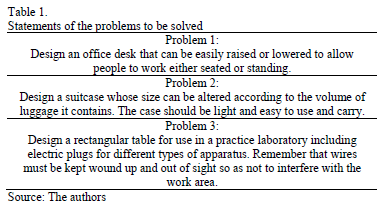
<body><![CDATA[<p><font size="2" face="Verdana, Arial, Helvetica, sans-serif">Designers are directly influenced by many   different factors, all of which affect the designs they produce &#91;1&#93;; these   include: the environment &#91;2, 3&#93;, level of education &#91;4- 6&#93;, age &#91;7&#93;, personal   and cultural values &#91;8&#93;, perceptions &#91;9&#93; and even the emotions experienced   during the design phase &#91;10&#93; and the way in which these emotions, also known as   emotional intelligence &#91;11&#93;, are dealt with. It can therefore be inferred that   all these variables imply that designers experience different mental processes   and have different emotional responses to each design problem, which can affect   individual designs. </font></p>     <p><font size="2" face="Verdana, Arial, Helvetica, sans-serif">Creativity is one of the most sought-after   results when designing products. Many different definitions of creativity exist   in the literature and many of these share common elements &#91;12-15&#93;. One of the   most generally accepted definitions maintains that: “Creativity happens through   a process by which a subject uses his skills to generate ideas, solutions and   products that turn out to be novel and useful”. This implies that the   creativity of a product is closely tied to the individual and to the design   process.</font></p>     <p><font size="2" face="Verdana, Arial, Helvetica, sans-serif">Therefore, on the one hand we can find a   large number of studies that focus on defining the individual's creative   potential, or creative intelligence, such as those found in &#91;16-20&#93;, among   others. On the other hand, many authors focus on developing techniques, tools   or methods aimed at increasing creativity and innovation in the design process   itself &#91;21-23&#93;. Lastly, there are those who prefer to evaluate creativity by   its outcomes &#91;15,24,25&#93;.</font></p>     <p><font size="2" face="Verdana, Arial, Helvetica, sans-serif">In spite of the fact that responsibility   for the results has been divided up between the individual and the process   employed, it is not difficult to envisage that a number of individuals will   achieve very different results while using the same process or design method,   as has been found in previous studies &#91;26,27&#93;. This leads us to accept that   different individuals will react in different ways to the stimuli produced by a   certain design method. In fact, there are studies that defend different styles   of thinking and different reactions during the design process, such as   classifying thinking into convergent or divergent, as in &#91;28&#93;, or grouping   individuals as adaptive or innovative, as in &#91;29&#93;, among others.</font></p>     <p><font size="2" face="Verdana, Arial, Helvetica, sans-serif">This paper presents the results of an   experiment carried out on 21 individuals who had been asked to find a solution   to a variety of design problems by employing different methods while their   emotional response parameters were recorded by a non-invasive neuroheadset. The   data thus obtained was then used to compare the different individual reactions   when using different design methods. A second analysis was also carried out to   determine whether the variations in the emotional parameters had a direct   relationship with the creativity of the solutions. The aim of the study is to   find out if the method used to design affects emotions in the designer, and if   the emotions of the designer in his work affect the creativity of the results.   As a result, the methods that are more conducive to developing creative   solutions could be identified.</font></p>     <p>&nbsp;</p>     <p><font size="3" face="Verdana, Arial, Helvetica, sans-serif"><b>2. Tools and Methods </b></font></p>     <p><font size="2" face="Verdana, Arial, Helvetica, sans-serif"><b><i>2.1. Methodology </i></b></font></p>     <p><font size="2" face="Verdana, Arial, Helvetica, sans-serif">Twenty-one students taking a master's   degree in different branches of engineering took part in the experiment. A   preliminary session was held to brief them collectively on the design methods   they would be asked to use in the tests. Each of the participants was then   asked individually to find a creative solution to three design problems, one   from each of the design methods used in the tests (<a href="#tab01">Table 1</a>). The third problem   was specially selected for its limitations as regards its potential for   innovation. This was done in order to determine whether the fact of facing a   difficult problem with hidden challenges would also cause variations in the   subjects' emotional parameters. The problems, methods and work order were   varied to include all the possible combinations (as will be shown in <a href="#tab04">Table 4</a>). </font></p>     <p align="center"><font size="2" face="Verdana, Arial, Helvetica, sans-serif"><a name="tab01"></a></font><img src="/img/revistas/dyna/v83n196/v83n196a15tab01.gif"></p>     ]]></body>
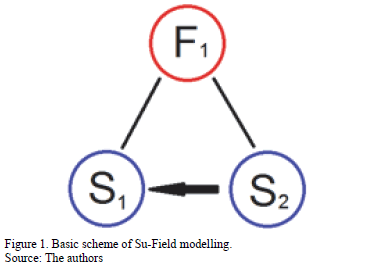
<body><![CDATA[<p><font size="2" face="Verdana, Arial, Helvetica, sans-serif">During the entire problem-solving process   the subjects wore an EmotivEpoc headset that recorded their emotional   parameters. They were allowed 30 minutes to solve each of the problems, after   which they were advised that they had to hand in their solution in the form of   a sketch, scheme or notes, for which they were allowed an additional 5 minutes.</font></p>     <p><font size="2" face="Verdana, Arial, Helvetica, sans-serif"><b>2.2. Design methods</b></font></p>     <p><font size="2" face="Verdana, Arial, Helvetica, sans-serif">Three different types of method were   chosen for use in solving the design problems, in accordance with the   classification proposed in Shah et al. &#91;13&#93;: one was logical, one intuitive and   in one they were given carte blanche. The Su-Fields tool from TRIZ &#91;30&#93; was   selected for use in the logical method, and SCAMPER &#91;31&#93; for the intuitive   method. In one of the exercises the subjects were not given any instructions   and were allowed to solve the problem any way they chose.</font></p>     <p><font size="2" face="Verdana, Arial, Helvetica, sans-serif"><b>2.2.1. TRIZ (Su-Fields)</b></font></p>     <p><font size="2" face="Verdana, Arial, Helvetica, sans-serif">This tool consists of a functional   analysis of the problem, which is schematized into substances (physical   elements) and fields (function-executing modes), as shown in <a href="#fig01">Fig. 1</a>. The idea   is to find all the aspects that can be improved and then act on each aspect   individually. Five rules are proposed which are to be applied to each problem:</font></p>     <p align="center"><font size="2" face="Verdana, Arial, Helvetica, sans-serif"><a name="fig01"></a></font><img src="/img/revistas/dyna/v83n196/v83n196a15fig01.gif"></p>     <p><font size="2" face="Verdana, Arial, Helvetica, sans-serif">S2 being a substance that acts on S1 via   field F1: </font></p>     <blockquote>       <p><font size="2" face="Verdana, Arial, Helvetica, sans-serif">Rule 1 says that substance S2 must be     replaced by a new substance S3, which generates a new field F2 over S1. </font></p>       <p><font size="2" face="Verdana, Arial, Helvetica, sans-serif">Rule 2 says that a new substance S3 must     be added to act over S2 via a new field F2. </font></p>       ]]></body>
<body><![CDATA[<p><font size="2" face="Verdana, Arial, Helvetica, sans-serif">Rule 3 says that that a new substance S3     must be added to act over S1 via a new field F2. </font></p>       <p><font size="2" face="Verdana, Arial, Helvetica, sans-serif">Rule 4 says that that a new substance S3,     between S1 and S2, must be added to act over S1 and S2 via a new field F2. </font></p>       <p><font size="2" face="Verdana, Arial, Helvetica, sans-serif">Rule 5 says that that a substance S3, not     related to S1 and S2, must be added in such a way that the newly generated     field F2 acts over S1 and S2.</font></p> </blockquote>     <p><font size="2" face="Verdana, Arial, Helvetica, sans-serif"><b>2.2.2. SCAMPER</b></font></p>     <p><font size="2" face="Verdana, Arial, Helvetica, sans-serif">This method consists of applying the   following questions to the design problem:</font></p> <ul>       <li><font size="2" face="Verdana, Arial, Helvetica, sans-serif"> What can I Substitute?</font></li>       <li><font size="2" face="Verdana, Arial, Helvetica, sans-serif"> What can I Combine?</font></li>       <li><font size="2" face="Verdana, Arial, Helvetica, sans-serif"> What can I Adapt?</font></li>       <li><font size="2" face="Verdana, Arial, Helvetica, sans-serif"> What can I Magnify?</font></li>       <li><font size="2" face="Verdana, Arial, Helvetica, sans-serif"> Can     I Propose other uses?</font></li>       ]]></body>
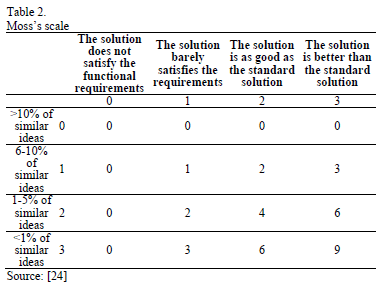
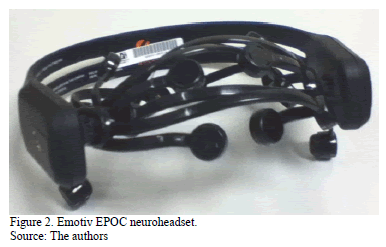
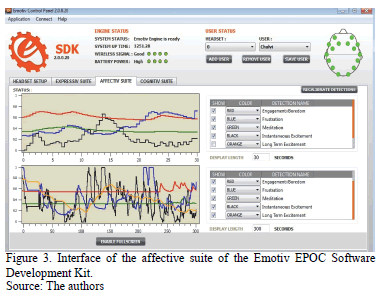
<body><![CDATA[<li><font size="2" face="Verdana, Arial, Helvetica, sans-serif"> What can I Eliminate?</font></li>       <li><font size="2" face="Verdana, Arial, Helvetica, sans-serif"> Can     I Reorder or invert any part?</font></li>     </ul>     <p><font size="2" face="Verdana, Arial, Helvetica, sans-serif"><b><i>2.3. Emotive Epoc</i></b></font></p>     <p><font size="2" face="Verdana, Arial, Helvetica, sans-serif">Throughout the tests, participants wore   the Emotiv Epoc non-invasive neuroheadset (<a href="#fig02">Fig.2</a>), which can measure cerebral   electrical activity through the scalp. Four emotional variables were directly   recorded by the software provided by the manufacturer, consisting of:   frustration, meditation, interest and excitement (<a href="#fig03">Fig.3)</a>.</font></p>     <p align="center"><font size="2" face="Verdana, Arial, Helvetica, sans-serif"><a name="fig02"></a></font><img src="/img/revistas/dyna/v83n196/v83n196a15fig02.gif"></p>     <p align="center"><font size="2" face="Verdana, Arial, Helvetica, sans-serif"><a name="fig03"></a></font><img src="/img/revistas/dyna/v83n196/v83n196a15fig03.gif"></p>     <p><font size="2" face="Verdana, Arial, Helvetica, sans-serif"><b><i>2.4. Creativity assessment</i></b></font></p>     <p><font size="2" face="Verdana, Arial, Helvetica, sans-serif">Creativity was assessed by a consensus of   two specialists in the field (the authors of this work) using the metric   developed by J. Moss &#91;24&#93;, which estimates creativity by a combination of two   parameters: a product's usefulness and unusualness. The former is determined by   assessing the degree to which the product satisfies the requirements of a good   standard (or teacher's) solution. Creativity is assessed on a scale of zero to   three; zero being a design that does not achieve the set requirements, and   three being considered better than the teacher's solution</font></p>     <p><font size="2" face="Verdana, Arial, Helvetica, sans-serif">The degree of unusualness is determined   by the inverse probability of the idea arising within a homogeneous group of   solutions, i.e. by comparing the product with the other products created as   solutions to the same problem. This parameter is also assessed on a scale of   zero to three; zero for a commonplace solution and three for showing   exceptional originality. The overall creativity of the product is then scored by   multiplying the above two parameters. The application of Moss's metric can be   seen in <a href="#tab02">Table 2</a>.</font></p>     ]]></body>
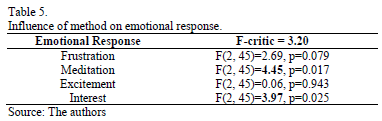
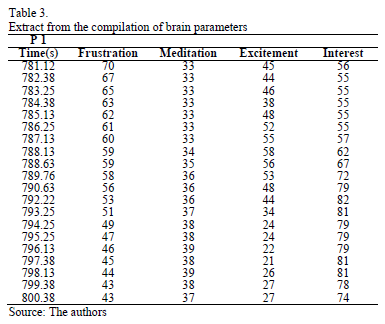
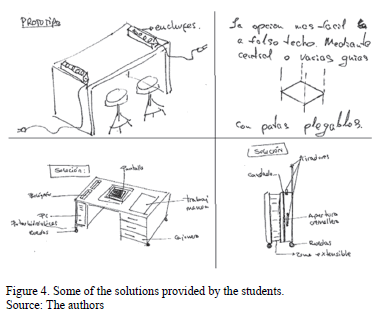
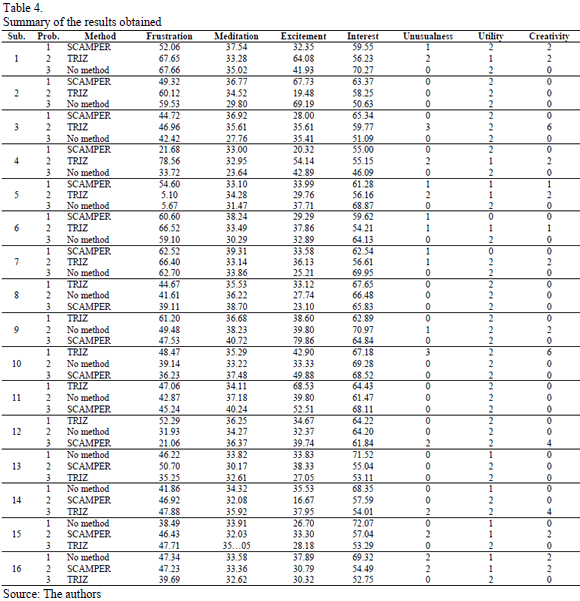
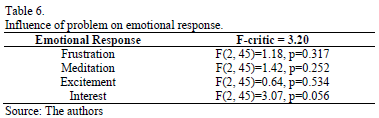
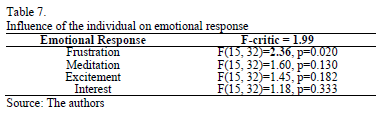
<body><![CDATA[<p align="center"><font size="2" face="Verdana, Arial, Helvetica, sans-serif"><a name="tab02"></a></font><img src="/img/revistas/dyna/v83n196/v83n196a15tab02.gif"></p>     <p>&nbsp;</p>     <p><font size="3" face="Verdana, Arial, Helvetica, sans-serif"><b>3. Results</b></font></p>     <p><font size="2" face="Verdana, Arial, Helvetica, sans-serif">A total of   21 solutions were obtained for each of the three design problems. Some examples   are given in <a href="#fig04">Fig. 4</a> together with data on the brain parameters of the   participants. <a href="#tab03">Table 3</a> contains an extract of the parameters of one of the   subjects, where frustration, meditation, excitement and interest are judged on   a scale of 1-100 where 100 is the max level of an emotion. Unfortunately, data   on the parameters from five participants had to be left out of the analysis due   to defective contacts and interference. The results and the analysis given below   were therefore carried out on the valid data from 16 participants. As it can be observed in <a href="#tab03">Table 3</a>, the   values of the parameters show a variation over time tracked. Statistical means   are used for data analysis in order to compare the design methods.</font></p>     <p align="center"><font size="2" face="Verdana, Arial, Helvetica, sans-serif"><a name="tab03"></a></font><img src="/img/revistas/dyna/v83n196/v83n196a15tab03.gif"></p>     <p align="center"><font size="2" face="Verdana, Arial, Helvetica, sans-serif"><a name="fig04"></a></font><img src="/img/revistas/dyna/v83n196/v83n196a15fig04.gif"></p>     <p><font size="2" face="Verdana, Arial, Helvetica, sans-serif">As has been described in Section 2.4, the   designs were judged by consensus between two specialists using Moss's metric   (1966) to obtain values for usefulness, unusualness and creativity. <a href="#tab04">Table 4</a> gives a summary of the results obtained, the emotion averages over time   obtained by direct measurement during the tests, and the values awarded by the   judges for usefulness, unusualness and creativity.</font></p>     <p align="center"><font size="2" face="Verdana, Arial, Helvetica, sans-serif"><a name="tab04"></a></font><img src="/img/revistas/dyna/v83n196/v83n196a15tab04.gif"></p>     <p><font size="2" face="Verdana, Arial, Helvetica, sans-serif"><b><i>3.1. Influence of design method on the emotive response </i></b></font></p>     <p><font size="2" face="Verdana, Arial, Helvetica, sans-serif">ANOVA was   utilized in the first analysis to discover whether the emotional variables   (frustration, meditation, excitement and interest) were influenced by the   method used and the problem to be solved, or whether the variations in these   variables could be attributed to individual subjects, regardless of the problem   to be solved or the method employed to solve it. The results of this analysis   are given in <a href="#tab05">Tables 5</a>, <a href="#tab06">6</a> and <a href="#tab07">7</a>. In <a href="#tab05">Table 5</a> it can be seen that method appears   to have an influence on meditation and interest, while the variations in   frustration and excitement are non-significant. <a href="#tab06">Table 6</a> shows that the type of   problem to be solved does not affect any of the emotional parameters and in <a href="#tab07">Table 7</a> it can be seen that the individual seems to bear a certain relationship   with frustration, but has no significant effect on the other variables. </font></p>     ]]></body>
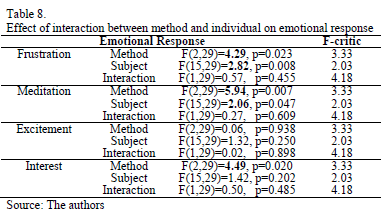
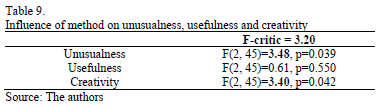
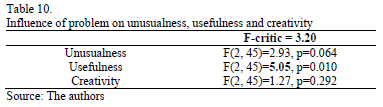
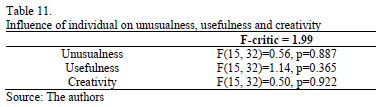
<body><![CDATA[<p align="center"><font size="2" face="Verdana, Arial, Helvetica, sans-serif"><a name="tab05"></a></font><img src="/img/revistas/dyna/v83n196/v83n196a15tab05.gif"></p>     <p align="center"><font size="2" face="Verdana, Arial, Helvetica, sans-serif"><a name="tab06"></a></font><img src="/img/revistas/dyna/v83n196/v83n196a15tab06.gif"></p>     <p align="center"><font size="2" face="Verdana, Arial, Helvetica, sans-serif"><a name="tab07"></a></font><img src="/img/revistas/dyna/v83n196/v83n196a15tab07.gif"></p>     <p><font size="2" face="Verdana, Arial, Helvetica, sans-serif">However, as both method and individual do seem to   influence the emotional response, a joint statistical analysis was performed   using Tukey's proof &#91;32&#93; to find out whether there was any interaction between   these elements. The results are given in <a href="#tab08">Table 8</a>, where it can be seen that   there does not appear to be a significant difference between method and   subject. However, after eliminating the   noise that a significant factor can cause on another, certain aspects showed a   significance that was not previously apparent. In this case, method was seen to   significantly affect the emotional responses of frustration, meditation and interest,   while the individual had an effect on frustration and meditation.</font></p>     <p align="center"><font size="2" face="Verdana, Arial, Helvetica, sans-serif"><a name="tab08"></a></font><img src="/img/revistas/dyna/v83n196/v83n196a15tab08.gif"></p>     <p><font size="2" face="Verdana, Arial, Helvetica, sans-serif"><b><i>3.2. Influence of emotive response on the   creativity of the outcomes</i></b></font></p>     <p><font size="2" face="Verdana, Arial, Helvetica, sans-serif">As seen in <a href="#tab04">Table 4</a>, we now had the values of unusualness, usefulness and creativity for   each of the designs obtained. As in the preceding section, here it was   advisable to check whether the method used, the problem to be solved or the   individual subjects had influenced these results. <a href="#tab09">Tables 9</a>, <a href="#tab10">10</a> and <a href="#tab11">11</a> present   the results of the ANOVA analysis of these three factors on the unusualness,   usefulness and creativity of the solutions. From these tables it can be seen   that the method used to solve the problem does have an influence on unusualness   and creativity, that the problem to be solved influences usefulness, and that   the individual has no influence on any of these three aspects. </font></p>     <p align="center"><font size="2" face="Verdana, Arial, Helvetica, sans-serif"><a name="tab09"></a></font><img src="/img/revistas/dyna/v83n196/v83n196a15tab09.gif"></p>     <p align="center"><font size="2" face="Verdana, Arial, Helvetica, sans-serif"><a name="tab10"></a></font><img src="/img/revistas/dyna/v83n196/v83n196a15tab10.gif"></p>     <p align="center"><font size="2" face="Verdana, Arial, Helvetica, sans-serif"><a name="tab11"></a></font><img src="/img/revistas/dyna/v83n196/v83n196a15tab11.gif"></p>     ]]></body>
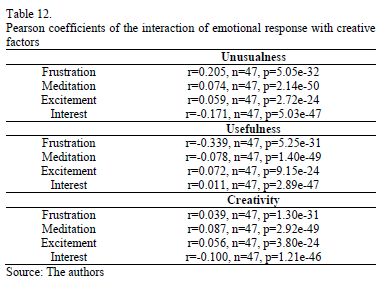
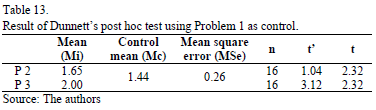
<body><![CDATA[<p><font size="2" face="Verdana, Arial, Helvetica, sans-serif">Pearson's correlation coefficient was   used to determine whether emotional response had any influence on the   creativity of the results. The values of the coefficients thus obtained are   given in <a href="#tab12">Table 12</a>, in which it can be seen that all the values are quite low,   except in the case of frustration, which only showed low values for unusualness   and usefulness. This would seem to indicate that a direct correlation cannot be   established between the designer's emotional response during the design process   and the creativity of the results obtained.</font></p>     <p align="center"><font size="2" face="Verdana, Arial, Helvetica, sans-serif"><a name="tab12"></a></font><img src="/img/revistas/dyna/v83n196/v83n196a15tab12.gif"></p>     <p>&nbsp;</p>     <p><font size="3" face="Verdana, Arial, Helvetica, sans-serif"><b>4. Discussion </b></font></p>     <p><font size="2" face="Verdana, Arial, Helvetica, sans-serif">This paper deals primarily with an   analysis of aspects of the design process that could somehow influence the   subject's emotional response. One of the aspects considered was the problem to   be solved, which was found to be non-significant (see <a href="#tab06">Table 6</a>) in spite of the   fact that a purposely difficult design problem with little room for innovation   was included in the experimental design.</font></p>     <p><font size="2" face="Verdana, Arial, Helvetica, sans-serif">Another aspect considered was the method   used by the subjects to develop their designs; in this case, significant   variations were found in the emotional parameters meditation and interest (see <a href="#tab05">Table 5</a>). In other words, the method selected affects the way in which the   designer approaches the problem and, according to its difficulty, requires   varying amounts of interest and meditation, or concentration.</font></p>     <p><font size="2" face="Verdana, Arial, Helvetica, sans-serif">The third factor considered was the   individual subject (as regards level of education, culture and personal   characteristics) and his special reaction to the design process. Here we found   that the subject causes significant variations as regards frustration level   (<a href="#tab07">Table 7</a>). This means his ability to find the right solution while working   under pressure will largely depend on his personal characteristics and not on   the method used or the problem to be solved. </font></p>     <p><font size="2" face="Verdana, Arial, Helvetica, sans-serif">None of the factors considered in the   study was found to significantly affect the emotional parameter   excitement. </font></p>     <p><font size="2" face="Verdana, Arial, Helvetica, sans-serif">We also   studied whether the subject's emotional variables during the design process had   any influence on the creativity of the results. First, we looked at the effect   of the three factors mentioned above on creativity. As expected, we found   method to be significant, in agreement with previous studies in this field that   have shown that the design method affects creativity and its associated   parameters &#91;26, 27, 33&#93;. However, we were somewhat surprised to find that the   problem had a significant effect on the usefulness parameter; this may possibly   have been due to including Problem 3 (which gave little room for innovation) in   the tests, forcing the subjects to resort to standard, well proven solutions.   As can be seen in <a href="#tab04">Table 4</a>, all the solutions to Problem 3 were given a   usefulness score of 2 by the judges.   Dunnett's post hoc analysis subsequently revealed that Problem 3 showed significant   deviation (see <a href="#tab13">Table 13</a>).</font></p>     <p align="center"><font size="2" face="Verdana, Arial, Helvetica, sans-serif"><a name="tab13"></a></font><img src="/img/revistas/dyna/v83n196/v83n196a15tab13.gif"></p>     ]]></body>
<body><![CDATA[<p><font size="2" face="Verdana, Arial, Helvetica, sans-serif">As regards   the relationship between emotional parameters and the creativity of the design,   the Pearson's coefficients obtained were low enough to rule out this   possibility. The only one of these parameters that proved to be a little higher   than the rest was frustration in relation to unusualness and usefulness, with   coefficients of 0.205 and -0.339, which, even though comparatively low, still   indicate that the frustration level during design may have a slight positive   influence on unusualness and a slight negative influence on usefulness.</font></p>     <p>&nbsp;</p>     <p><font size="3" face="Verdana, Arial, Helvetica, sans-serif"><b>5. Conclusions</b></font></p>     <p><font size="2" face="Verdana, Arial, Helvetica, sans-serif">From the   results of the tests carried out in the course of this work it can be concluded   firstly, that both the individual and the method used have a significant effect   on emotional response during the design phase. However, both these factors   affect the emotional response in different ways; or, in other words, they each   affect different emotional parameters. Firstly, the subject's individual   personality appears to influence his frustration level, regardless of the   problem to be solved or method used. Secondly, method appears to significantly   influence meditation and interest. Also, even though no significant   relationship was found between the individual subject and method, the joint   analysis of these factors shows that the individual also affects the meditation   and frustration levels, and that method seems to affect frustration, meditation   and interest.</font></p>     <p><font size="2" face="Verdana, Arial, Helvetica, sans-serif">Therefore, even though the analysis   showed no direct relationship between individual and method as regards emotional   response, a rather more complex underlying reality can be perceived that will   require further studies on a larger scale   and on a greater number of emotional and personal variables in order to   identify the factors to be considered when analysing the relationship between   individual and method.</font></p>     <p><font size="2" face="Verdana, Arial, Helvetica, sans-serif">Since it has   been shown that the design method does have an effect on the designer's   emotional response, the next step will be to</font><font size="2" face="Verdana, Arial, Helvetica, sans-serif"> determine the methods that positively and negatively affect this   response, the design process and its outcomes. One of these outcomes, the   creativity of the solutions, was analyzed in the present study and its   conclusions indicate that the subject's emotional response during the design   phase has no effect on the creative aspect of the results. This has important   implications for design methods that promote creativity, since it helps to   confirm their validity and utility regardless of whoever uses them. However,   our intention is not to isolate the designer from the final results, as there   are additional factors that impinge on creativity, including: creative   intelligence, training, experience, tools available, surroundings, and a long   list of other factors currently under in-depth study or scheduled for future   studies &#91;2-10, 19, 34, 35&#93;.</font></p>     <p><font size="2" face="Verdana, Arial, Helvetica, sans-serif">Future work will examine the whole range of   variables that influence creativity in design, with the aim of optimizing all   possible aspects of the design process and to rule out the factors that play no   part in the outcome of the creative process.</font></p>     <p>&nbsp;</p>     <p><font size="3" face="Verdana, Arial, Helvetica, sans-serif"><b>References</b></font></p>     <!-- ref --><p><font size="2" face="Verdana, Arial, Helvetica, sans-serif"><b>&#91;1&#93;</b> Lidwell,   W., Holden, K. and Butler, J., Universal principles of design: 125 ways to   enhance usability, influence perception, increase appeal, make better design   decisions, and teach through design. Rockport Pub, 2010.    &nbsp;&nbsp;&nbsp;&nbsp;&nbsp;&nbsp;&nbsp;&nbsp;[&#160;<a href="javascript:void(0);" onclick="javascript: window.open('/scielo.php?script=sci_nlinks&ref=1154423&pid=S0012-7353201600020001500001&lng=','','width=640,height=500,resizable=yes,scrollbars=1,menubar=yes,');">Links</a>&#160;]<!-- end-ref --></font></p>     <!-- ref --><p><font size="2" face="Verdana, Arial, Helvetica, sans-serif"><b>&#91;2&#93;</b> Gerard,   R.M., Differential effects of colored lights on psychophysiological functions,   PhD Thesis. University of California, USA, 1958.    &nbsp;&nbsp;&nbsp;&nbsp;&nbsp;&nbsp;&nbsp;&nbsp;[&#160;<a href="javascript:void(0);" onclick="javascript: window.open('/scielo.php?script=sci_nlinks&ref=1154425&pid=S0012-7353201600020001500002&lng=','','width=640,height=500,resizable=yes,scrollbars=1,menubar=yes,');">Links</a>&#160;]<!-- end-ref --></font></p>     <!-- ref --><p><font size="2" face="Verdana, Arial, Helvetica, sans-serif"><b>&#91;3&#93;</b> Soler,   L.C.T., Creativity in computer systems. Ingenier&iacute;a e Investigaci&oacute;n, 23(2), pp. 25-30,   2003. DOI: 25-30 2248-8723 0120-5609</font>&nbsp;&nbsp;&nbsp;&nbsp;&nbsp;&nbsp;&nbsp;&nbsp;[&#160;<a href="javascript:void(0);" onclick="javascript: window.open('/scielo.php?script=sci_nlinks&ref=1154427&pid=S0012-7353201600020001500003&lng=','','width=640,height=500,resizable=yes,scrollbars=1,menubar=yes,');">Links</a>&#160;]<!-- end-ref --><!-- ref --><p><font size="2" face="Verdana, Arial, Helvetica, sans-serif"><b>&#91;4&#93;</b> Sheppard,   S. and Jenison, R., Examples of freshman design education. International   Journal of Engineering Education.13(4), pp. 248-261, 1997.    &nbsp;&nbsp;&nbsp;&nbsp;&nbsp;&nbsp;&nbsp;&nbsp;[&#160;<a href="javascript:void(0);" onclick="javascript: window.open('/scielo.php?script=sci_nlinks&ref=1154428&pid=S0012-7353201600020001500004&lng=','','width=640,height=500,resizable=yes,scrollbars=1,menubar=yes,');">Links</a>&#160;]<!-- end-ref --></font></p>     <!-- ref --><p><font size="2" face="Verdana, Arial, Helvetica, sans-serif"><b>&#91;5&#93;</b> Chulvi,   V., Rivera, J. and Vidal, R., Creative experience in engineering design: The   island exercise. DYNA, 81(185), pp. 86-93, 2014. DOI:   10.15446/dyna.v81n185.36570</font>&nbsp;&nbsp;&nbsp;&nbsp;&nbsp;&nbsp;&nbsp;&nbsp;[&#160;<a href="javascript:void(0);" onclick="javascript: window.open('/scielo.php?script=sci_nlinks&ref=1154430&pid=S0012-7353201600020001500005&lng=','','width=640,height=500,resizable=yes,scrollbars=1,menubar=yes,');">Links</a>&#160;]<!-- end-ref --><!-- ref --><p><font size="2" face="Verdana, Arial, Helvetica, sans-serif"><b>&#91;6&#93;</b> Aizpun,   M., Sandino, D. and Merideno, I., Developing students' aptitudes through   University-Industry collaboration. Ingenier&iacute;a e Investigaci&oacute;n, 35(3), pp.   121-128, 2015. DOI: 10.15446/ing.investig.v35n3.48188</font>&nbsp;&nbsp;&nbsp;&nbsp;&nbsp;&nbsp;&nbsp;&nbsp;[&#160;<a href="javascript:void(0);" onclick="javascript: window.open('/scielo.php?script=sci_nlinks&ref=1154431&pid=S0012-7353201600020001500006&lng=','','width=640,height=500,resizable=yes,scrollbars=1,menubar=yes,');">Links</a>&#160;]<!-- end-ref --><!-- ref --><p><font size="2" face="Verdana, Arial, Helvetica, sans-serif"><b>&#91;7&#93;</b> Atman,   C.-J., Cardella, M.-E. and Turns, J., Comparing freshman and senior engineering   design processes: An in-depth follow-up study. Design Studies 26(4), pp.   325-357, 2005. DOI: 10.1016/j.destud.2004.09.005</font>&nbsp;&nbsp;&nbsp;&nbsp;&nbsp;&nbsp;&nbsp;&nbsp;[&#160;<a href="javascript:void(0);" onclick="javascript: window.open('/scielo.php?script=sci_nlinks&ref=1154432&pid=S0012-7353201600020001500007&lng=','','width=640,height=500,resizable=yes,scrollbars=1,menubar=yes,');">Links</a>&#160;]<!-- end-ref --><!-- ref --><p><font size="2" face="Verdana, Arial, Helvetica, sans-serif"><b>&#91;8&#93;</b> Kumar.   K. and Bjorn-Andersen, N., A cross-cultural comparison of is designer values.   Communications of the ACM. 33(5), pp. 528-538, 1990. DOI: 10.1145/78607.78613</font>&nbsp;&nbsp;&nbsp;&nbsp;&nbsp;&nbsp;&nbsp;&nbsp;[&#160;<a href="javascript:void(0);" onclick="javascript: window.open('/scielo.php?script=sci_nlinks&ref=1154433&pid=S0012-7353201600020001500008&lng=','','width=640,height=500,resizable=yes,scrollbars=1,menubar=yes,');">Links</a>&#160;]<!-- end-ref --><!-- ref --><p><font size="2" face="Verdana, Arial, Helvetica, sans-serif"><b>&#91;9&#93;</b> Manchado-P&eacute;rez, E. and Berges-Muro, L., Sistemas de   ret&iacute;culas: Un m&eacute;todo para dise&ntilde;ar nuevos conceptos de producto hacia el   usuario. DYNA 80(181),   pp. 16-24, 2013.    &nbsp;&nbsp;&nbsp;&nbsp;&nbsp;&nbsp;&nbsp;&nbsp;[&#160;<a href="javascript:void(0);" onclick="javascript: window.open('/scielo.php?script=sci_nlinks&ref=1154434&pid=S0012-7353201600020001500009&lng=','','width=640,height=500,resizable=yes,scrollbars=1,menubar=yes,');">Links</a>&#160;]<!-- end-ref --> </font></p>     <!-- ref --><p><font size="2" face="Verdana, Arial, Helvetica, sans-serif"><b>&#91;10&#93;</b> Norman, D., Emotion &amp; Design:   Attractive things work better. Interactions. 9(4), pp. 36-42, 2002. DOI:   10.1145/543434.543435</font>&nbsp;&nbsp;&nbsp;&nbsp;&nbsp;&nbsp;&nbsp;&nbsp;[&#160;<a href="javascript:void(0);" onclick="javascript: window.open('/scielo.php?script=sci_nlinks&ref=1154436&pid=S0012-7353201600020001500010&lng=','','width=640,height=500,resizable=yes,scrollbars=1,menubar=yes,');">Links</a>&#160;]<!-- end-ref --><!-- ref --><p><font size="2" face="Verdana, Arial, Helvetica, sans-serif"><b>&#91;11&#93;</b> Salovey, PP. and Mayer, J.-D.,   Emotional intelligence. Imagination, Cognition and Personality. 9(3), pp.   185-211, 1989. DOI: 10.2190/DUGG-P24E-52WK-6CDG</font>&nbsp;&nbsp;&nbsp;&nbsp;&nbsp;&nbsp;&nbsp;&nbsp;[&#160;<a href="javascript:void(0);" onclick="javascript: window.open('/scielo.php?script=sci_nlinks&ref=1154437&pid=S0012-7353201600020001500011&lng=','','width=640,height=500,resizable=yes,scrollbars=1,menubar=yes,');">Links</a>&#160;]<!-- end-ref --><!-- ref --><p><font size="2" face="Verdana, Arial, Helvetica, sans-serif"><b>&#91;12&#93;</b> Sternberg, R.-J. and Lubart, T.-I.,   The concept of creativity: Prospects and paradigms. Handbook of Creativity. 1,   pp. 3-15, 1999.    &nbsp;&nbsp;&nbsp;&nbsp;&nbsp;&nbsp;&nbsp;&nbsp;[&#160;<a href="javascript:void(0);" onclick="javascript: window.open('/scielo.php?script=sci_nlinks&ref=1154438&pid=S0012-7353201600020001500012&lng=','','width=640,height=500,resizable=yes,scrollbars=1,menubar=yes,');">Links</a>&#160;]<!-- end-ref --></font></p>     <!-- ref --><p><font size="2" face="Verdana, Arial, Helvetica, sans-serif"><b>&#91;13&#93;</b> Shah, J.-J., Smith, S.-M. and   Vargas-Hernandez, N., Metrics for measuring ideation effectiveness. Design   Studies. 24(2), pp. 111-134, 2003. DOI: 10.1016/S0142-694X(02)00034-0</font>&nbsp;&nbsp;&nbsp;&nbsp;&nbsp;&nbsp;&nbsp;&nbsp;[&#160;<a href="javascript:void(0);" onclick="javascript: window.open('/scielo.php?script=sci_nlinks&ref=1154440&pid=S0012-7353201600020001500013&lng=','','width=640,height=500,resizable=yes,scrollbars=1,menubar=yes,');">Links</a>&#160;]<!-- end-ref --><!-- ref --><p><font size="2" face="Verdana, Arial, Helvetica, sans-serif"><b>&#91;14&#93;</b> Sarkar, PP. and Chakrabarti, A.,   Development of a method for assessing design creativity. International   conference on engineering design, ICED'07 28 - 31 august 2007, cite des   sciences et de l'industrie, Paris, France 2007.    &nbsp;&nbsp;&nbsp;&nbsp;&nbsp;&nbsp;&nbsp;&nbsp;[&#160;<a href="javascript:void(0);" onclick="javascript: window.open('/scielo.php?script=sci_nlinks&ref=1154441&pid=S0012-7353201600020001500014&lng=','','width=640,height=500,resizable=yes,scrollbars=1,menubar=yes,');">Links</a>&#160;]<!-- end-ref --></font></p>     <!-- ref --><p><font size="2" face="Verdana, Arial, Helvetica, sans-serif"><b>&#91;15&#93;</b> Sarkar, PP. and Chakrabarti, A.,   Studying engineering design creativity-developing a common definition and   associated measures. In: Gero J., (Ed.). Invited paper in the Proceedings of   the NSF Workshop on Studying Design Creativity. 2008.    &nbsp;&nbsp;&nbsp;&nbsp;&nbsp;&nbsp;&nbsp;&nbsp;[&#160;<a href="javascript:void(0);" onclick="javascript: window.open('/scielo.php?script=sci_nlinks&ref=1154443&pid=S0012-7353201600020001500015&lng=','','width=640,height=500,resizable=yes,scrollbars=1,menubar=yes,');">Links</a>&#160;]<!-- end-ref --></font></p>     <!-- ref --><p><font size="2" face="Verdana, Arial, Helvetica, sans-serif"><b>&#91;16&#93;</b> Hocevar, D. and Bachelor, PP.,   Handbook of Creativity. Springer, 1989, pp. 53-75.    &nbsp;&nbsp;&nbsp;&nbsp;&nbsp;&nbsp;&nbsp;&nbsp;[&#160;<a href="javascript:void(0);" onclick="javascript: window.open('/scielo.php?script=sci_nlinks&ref=1154445&pid=S0012-7353201600020001500016&lng=','','width=640,height=500,resizable=yes,scrollbars=1,menubar=yes,');">Links</a>&#160;]<!-- end-ref --></font></p>     <!-- ref --><p><font size="2" face="Verdana, Arial, Helvetica, sans-serif"><b>&#91;17&#93;</b> Corbal&aacute;n, F.,   Mart&iacute;nez, F. and Donolo, D., CREA. Inteligencia Creativa. Una medida cognitiva   de la creatividad. Madrid:   TEA eds, 2003.    &nbsp;&nbsp;&nbsp;&nbsp;&nbsp;&nbsp;&nbsp;&nbsp;[&#160;<a href="javascript:void(0);" onclick="javascript: window.open('/scielo.php?script=sci_nlinks&ref=1154447&pid=S0012-7353201600020001500017&lng=','','width=640,height=500,resizable=yes,scrollbars=1,menubar=yes,');">Links</a>&#160;]<!-- end-ref --></font></p>     <!-- ref --><p><font size="2" face="Verdana, Arial, Helvetica, sans-serif"><b>&#91;18&#93;</b> Guilford, J., Personality.   McGraw-Hill, New York, 1959.    &nbsp;&nbsp;&nbsp;&nbsp;&nbsp;&nbsp;&nbsp;&nbsp;[&#160;<a href="javascript:void(0);" onclick="javascript: window.open('/scielo.php?script=sci_nlinks&ref=1154449&pid=S0012-7353201600020001500018&lng=','','width=640,height=500,resizable=yes,scrollbars=1,menubar=yes,');">Links</a>&#160;]<!-- end-ref --></font></p>     <!-- ref --><p><font size="2" face="Verdana, Arial, Helvetica, sans-serif"><b>&#91;19&#93;</b> Torrance, E.-P., Reynolds, C.-R. and   Riegel, T., Your style of learning and thinking, forms A and B preliminary   norms, Abbreviated technical notes, scoring keys, and selected references.   Gifted Child Quarterly. 21(4), pp. 563-573, 1977.    &nbsp;&nbsp;&nbsp;&nbsp;&nbsp;&nbsp;&nbsp;&nbsp;[&#160;<a href="javascript:void(0);" onclick="javascript: window.open('/scielo.php?script=sci_nlinks&ref=1154451&pid=S0012-7353201600020001500019&lng=','','width=640,height=500,resizable=yes,scrollbars=1,menubar=yes,');">Links</a>&#160;]<!-- end-ref --></font></p>     <!-- ref --><p><font size="2" face="Verdana, Arial, Helvetica, sans-serif"><b>&#91;20&#93;</b> Otis, A., Otis-Lennon School ability   test-(OLSAT 8). The Psychological Corporation, San Antonio, TX, USA, 2006.    &nbsp;&nbsp;&nbsp;&nbsp;&nbsp;&nbsp;&nbsp;&nbsp;[&#160;<a href="javascript:void(0);" onclick="javascript: window.open('/scielo.php?script=sci_nlinks&ref=1154453&pid=S0012-7353201600020001500020&lng=','','width=640,height=500,resizable=yes,scrollbars=1,menubar=yes,');">Links</a>&#160;]<!-- end-ref --></font></p>     <!-- ref --><p><font size="2" face="Verdana, Arial, Helvetica, sans-serif"><b>&#91;21&#93;</b> Altshuller, G., Creativity as an exact   science: The theory of the solution of inventive problems. Gordon and Breach   Science Publishers, 1984.    &nbsp;&nbsp;&nbsp;&nbsp;&nbsp;&nbsp;&nbsp;&nbsp;[&#160;<a href="javascript:void(0);" onclick="javascript: window.open('/scielo.php?script=sci_nlinks&ref=1154455&pid=S0012-7353201600020001500021&lng=','','width=640,height=500,resizable=yes,scrollbars=1,menubar=yes,');">Links</a>&#160;]<!-- end-ref --></font></p>     <!-- ref --><p><font size="2" face="Verdana, Arial, Helvetica, sans-serif"><b>&#91;22&#93;</b> Kwak, Y.-H. and Anbari, F.-T.,   Benefits, obstacles, and future of six sigma approach. Technovation, 26(5-6),   pp. 708-715, 2006. DOI: 10.1016/j.technovation.2004.10.003</font>&nbsp;&nbsp;&nbsp;&nbsp;&nbsp;&nbsp;&nbsp;&nbsp;[&#160;<a href="javascript:void(0);" onclick="javascript: window.open('/scielo.php?script=sci_nlinks&ref=1154457&pid=S0012-7353201600020001500022&lng=','','width=640,height=500,resizable=yes,scrollbars=1,menubar=yes,');">Links</a>&#160;]<!-- end-ref --><!-- ref --><p><font size="2" face="Verdana, Arial, Helvetica, sans-serif"><b>&#91;23&#93;</b> Thompson, G. and Lordan, M., A review   of creativity principles applied to engineering design. Proceedings of the   Institution of Mechanical Engineers, Part E: Journal of Process Mechanical   Engineering. 213(1), pp. 17-31, 1999. DOI: 10.1243/0954408991529960</font>&nbsp;&nbsp;&nbsp;&nbsp;&nbsp;&nbsp;&nbsp;&nbsp;[&#160;<a href="javascript:void(0);" onclick="javascript: window.open('/scielo.php?script=sci_nlinks&ref=1154458&pid=S0012-7353201600020001500023&lng=','','width=640,height=500,resizable=yes,scrollbars=1,menubar=yes,');">Links</a>&#160;]<!-- end-ref --><!-- ref --><p><font size="2" face="Verdana, Arial, Helvetica, sans-serif"><b>&#91;24&#93;</b> Moss, J., Measuring creative abilities   in junior high school industrial arts. American Council on Industrial Arts   Teacher Education, 1966.    &nbsp;&nbsp;&nbsp;&nbsp;&nbsp;&nbsp;&nbsp;&nbsp;[&#160;<a href="javascript:void(0);" onclick="javascript: window.open('/scielo.php?script=sci_nlinks&ref=1154459&pid=S0012-7353201600020001500024&lng=','','width=640,height=500,resizable=yes,scrollbars=1,menubar=yes,');">Links</a>&#160;]<!-- end-ref --></font></p>     <!-- ref --><p><font size="2" face="Verdana, Arial, Helvetica, sans-serif"><b>&#91;25&#93;</b> O'Quin, K. and Besemer, S.-PP., The   development, reliability, and validity of the revised creative product semantic   scale. Creativity Research Journal. 2(4), pp. 267-278, 1989. DOI:   10.1080/10400418909534323</font>&nbsp;&nbsp;&nbsp;&nbsp;&nbsp;&nbsp;&nbsp;&nbsp;[&#160;<a href="javascript:void(0);" onclick="javascript: window.open('/scielo.php?script=sci_nlinks&ref=1154461&pid=S0012-7353201600020001500025&lng=','','width=640,height=500,resizable=yes,scrollbars=1,menubar=yes,');">Links</a>&#160;]<!-- end-ref --><!-- ref --><p><font size="2" face="Verdana, Arial, Helvetica, sans-serif"><b>&#91;26&#93;</b> Chulvi, V., Gonz&aacute;lez-Cruz, M. and   Mulet, E., Influence of the type of idea-generation method on the creativity of   solutions. Research in Engineering Design. 24(1), pp. 33-41, 2013. DOI:   10.1007/s00163-012-0134-0</font>&nbsp;&nbsp;&nbsp;&nbsp;&nbsp;&nbsp;&nbsp;&nbsp;[&#160;<a href="javascript:void(0);" onclick="javascript: window.open('/scielo.php?script=sci_nlinks&ref=1154462&pid=S0012-7353201600020001500026&lng=','','width=640,height=500,resizable=yes,scrollbars=1,menubar=yes,');">Links</a>&#160;]<!-- end-ref --><!-- ref --><p><font size="2" face="Verdana, Arial, Helvetica, sans-serif"><b>&#91;27&#93;</b> Chulvi, V., Mulet, E. and Chakrabarti,   A., Comparison of the degree of creativity in the design outcomes using   different design methods. Journal of Engineering Design. 23(4), pp. 241-269,   2012. DOI: 10.1080/09544828.2011.624501</font>&nbsp;&nbsp;&nbsp;&nbsp;&nbsp;&nbsp;&nbsp;&nbsp;[&#160;<a href="javascript:void(0);" onclick="javascript: window.open('/scielo.php?script=sci_nlinks&ref=1154463&pid=S0012-7353201600020001500027&lng=','','width=640,height=500,resizable=yes,scrollbars=1,menubar=yes,');">Links</a>&#160;]<!-- end-ref --><!-- ref --><p><font size="2" face="Verdana, Arial, Helvetica, sans-serif"><b>&#91;28&#93;</b> Guilford, J., Cognitive styles: What   are they? Educational and Psychological Measurement. 40(3), pp. 715-735, 1980.   DOI: 10.1177/001316448004000315</font>&nbsp;&nbsp;&nbsp;&nbsp;&nbsp;&nbsp;&nbsp;&nbsp;[&#160;<a href="javascript:void(0);" onclick="javascript: window.open('/scielo.php?script=sci_nlinks&ref=1154464&pid=S0012-7353201600020001500028&lng=','','width=640,height=500,resizable=yes,scrollbars=1,menubar=yes,');">Links</a>&#160;]<!-- end-ref --><!-- ref --><p><font size="2" face="Verdana, Arial, Helvetica, sans-serif"><b>&#91;29&#93;</b> Kirton, M., Adaptors and innovators: A   description and measure. Journal of Applied Psychology. 61(5), pp. 622-629,   1976. DOI: 10.1037/0021-9010.61.5.622</font>&nbsp;&nbsp;&nbsp;&nbsp;&nbsp;&nbsp;&nbsp;&nbsp;[&#160;<a href="javascript:void(0);" onclick="javascript: window.open('/scielo.php?script=sci_nlinks&ref=1154465&pid=S0012-7353201600020001500029&lng=','','width=640,height=500,resizable=yes,scrollbars=1,menubar=yes,');">Links</a>&#160;]<!-- end-ref --><!-- ref --><p><font size="2" face="Verdana, Arial, Helvetica, sans-serif"><b>&#91;30&#93;</b> Belski, I., Improve your thinking:   substance-field analysis. TRIZ4U, 2007.    &nbsp;&nbsp;&nbsp;&nbsp;&nbsp;&nbsp;&nbsp;&nbsp;[&#160;<a href="javascript:void(0);" onclick="javascript: window.open('/scielo.php?script=sci_nlinks&ref=1154466&pid=S0012-7353201600020001500030&lng=','','width=640,height=500,resizable=yes,scrollbars=1,menubar=yes,');">Links</a>&#160;]<!-- end-ref --></font></p>     <!-- ref --><p><font size="2" face="Verdana, Arial, Helvetica, sans-serif"><b>&#91;31&#93;</b> Eberle, B., Scamper on: More creative   games and activities for imagination development. Prufrock Pr, 1996.    &nbsp;&nbsp;&nbsp;&nbsp;&nbsp;&nbsp;&nbsp;&nbsp;[&#160;<a href="javascript:void(0);" onclick="javascript: window.open('/scielo.php?script=sci_nlinks&ref=1154468&pid=S0012-7353201600020001500031&lng=','','width=640,height=500,resizable=yes,scrollbars=1,menubar=yes,');">Links</a>&#160;]<!-- end-ref --></font></p>     <!-- ref --><p><font size="2" face="Verdana, Arial, Helvetica, sans-serif"><b>&#91;32&#93;</b> Tukey, J.-W., One degree of freedom   for non-additivity. Biometrics. 5(3), pp. 232-242, 1949. DOI: 10.2307/3001938</font>&nbsp;&nbsp;&nbsp;&nbsp;&nbsp;&nbsp;&nbsp;&nbsp;[&#160;<a href="javascript:void(0);" onclick="javascript: window.open('/scielo.php?script=sci_nlinks&ref=1154470&pid=S0012-7353201600020001500032&lng=','','width=640,height=500,resizable=yes,scrollbars=1,menubar=yes,');">Links</a>&#160;]<!-- end-ref --><!-- ref --><p><font size="2" face="Verdana, Arial, Helvetica, sans-serif"><b>&#91;33&#93;</b> Chulvi, V., Sonseca, &Aacute;. and Mulet, E.,   Assessment of the relationships among design methods, design activities, and   creativity. Journal of Mechanical Design. 134(11), pp. 111004-111004.11, 2012.   DOI: 10.1115/1.4007362</font>&nbsp;&nbsp;&nbsp;&nbsp;&nbsp;&nbsp;&nbsp;&nbsp;[&#160;<a href="javascript:void(0);" onclick="javascript: window.open('/scielo.php?script=sci_nlinks&ref=1154471&pid=S0012-7353201600020001500033&lng=','','width=640,height=500,resizable=yes,scrollbars=1,menubar=yes,');">Links</a>&#160;]<!-- end-ref --><!-- ref --><p><font size="2" face="Verdana, Arial, Helvetica, sans-serif"><b>&#91;34&#93;</b> Kim, M., Kim, Y. and Lee, H., An   underlying cognitive aspect of design creativity: Limited commitment mode   control strategy. Design Studies. 28(6), pp. 585-604, 2007. DOI:   10.1016/j.destud.2007.04.006</font>&nbsp;&nbsp;&nbsp;&nbsp;&nbsp;&nbsp;&nbsp;&nbsp;[&#160;<a href="javascript:void(0);" onclick="javascript: window.open('/scielo.php?script=sci_nlinks&ref=1154472&pid=S0012-7353201600020001500034&lng=','','width=640,height=500,resizable=yes,scrollbars=1,menubar=yes,');">Links</a>&#160;]<!-- end-ref --><!-- ref --><p><font size="2" face="Verdana, Arial, Helvetica, sans-serif"><b>&#91;35&#93;</b> Artola-Gonz&aacute;lez, T., PIC-A: Prueba de imaginaci&oacute;n   creativa para adultos. Manual.   Madrid, 2012.    &nbsp;&nbsp;&nbsp;&nbsp;&nbsp;&nbsp;&nbsp;&nbsp;[&#160;<a href="javascript:void(0);" onclick="javascript: window.open('/scielo.php?script=sci_nlinks&ref=1154473&pid=S0012-7353201600020001500035&lng=','','width=640,height=500,resizable=yes,scrollbars=1,menubar=yes,');">Links</a>&#160;]<!-- end-ref --></font></p>     <p>&nbsp;</p>     <p><font size="2" face="Verdana, Arial, Helvetica, sans-serif"><b>V. Chulvi,</b> is professor at the Department of Mechanical   Engineering and Construction at the Universitat Jaume I of Castell&oacute;n, Spain.   Chulvi earned a BSc in Mechanical Engineering (2001), an MSc in Mechanical   Engineering (2007) and a PhD in Engineering (2010). His main research focuses   on design and creativity within the research group DACTIC of the Universitat   Jaume I of Castell&oacute;n, Spain. ORCID: orcid.org/0000-0002-0708-3852</font></p>     <p><font size="2" face="Verdana, Arial, Helvetica, sans-serif"><b>M.C. Gonz&aacute;lez-Cruz,</b> holds a PhD in   Industrial Engineering from the Universitat Politècnica de València, Spain.   After working in several engineering companies, she now works as an associate   professor/senior lecturer in Project Engineering (undergraduate), and Project   Management (graduate). She is currently the Head of the Department of Project   Engineering and she is also in charge of the MSc in Project Management at   Universitat Politècnica de València, Spain. She has conducted research on the   use of design methodology in industry, creativity and innovation management,   and currently, she works in analysis and development of forecasting and bid   models on procurement. ORCID: orcid.org/0000-0002-6987-5732</font></p>      ]]></body><back>
<ref-list>
<ref id="B1">
<label>1</label><nlm-citation citation-type="book">
<person-group person-group-type="author">
<name>
<surname><![CDATA[Lidwell]]></surname>
<given-names><![CDATA[W.]]></given-names>
</name>
<name>
<surname><![CDATA[Holden]]></surname>
<given-names><![CDATA[K.]]></given-names>
</name>
<name>
<surname><![CDATA[Butler]]></surname>
<given-names><![CDATA[J.]]></given-names>
</name>
</person-group>
<source><![CDATA[Universal principles of design: 125 ways to enhance usability, influence perception, increase appeal, make better design decisions, and teach through design.]]></source>
<year>2010</year>
<publisher-name><![CDATA[Rockport Pub]]></publisher-name>
</nlm-citation>
</ref>
<ref id="B2">
<label>2</label><nlm-citation citation-type="">
<person-group person-group-type="author">
<name>
<surname><![CDATA[Gerard]]></surname>
<given-names><![CDATA[R.M.]]></given-names>
</name>
</person-group>
<source><![CDATA[Differential effects of colored lights on psychophysiological functions]]></source>
<year></year>
</nlm-citation>
</ref>
<ref id="B3">
<label>3</label><nlm-citation citation-type="journal">
<person-group person-group-type="author">
<name>
<surname><![CDATA[Soler]]></surname>
<given-names><![CDATA[L.C.T.]]></given-names>
</name>
</person-group>
<article-title xml:lang="en"><![CDATA[Creativity in computer systems.]]></article-title>
<source><![CDATA[Ingeniería e Investigación]]></source>
<year>2003</year>
<volume>23</volume>
<numero>2</numero>
<issue>2</issue>
<page-range>25-30</page-range></nlm-citation>
</ref>
<ref id="B4">
<label>4</label><nlm-citation citation-type="journal">
<person-group person-group-type="author">
<name>
<surname><![CDATA[Sheppard]]></surname>
<given-names><![CDATA[S.]]></given-names>
</name>
<name>
<surname><![CDATA[Jenison]]></surname>
<given-names><![CDATA[R.]]></given-names>
</name>
</person-group>
<article-title xml:lang="en"><![CDATA[Examples of freshman design education.]]></article-title>
<source><![CDATA[International Journal of Engineering Education]]></source>
<year>1997</year>
<volume>13</volume>
<numero>4</numero>
<issue>4</issue>
<page-range>248-261</page-range></nlm-citation>
</ref>
<ref id="B5">
<label>5</label><nlm-citation citation-type="journal">
<person-group person-group-type="author">
<name>
<surname><![CDATA[Chulvi]]></surname>
<given-names><![CDATA[V.]]></given-names>
</name>
<name>
<surname><![CDATA[Rivera]]></surname>
<given-names><![CDATA[J.]]></given-names>
</name>
<name>
<surname><![CDATA[Vidal]]></surname>
<given-names><![CDATA[R.]]></given-names>
</name>
</person-group>
<article-title xml:lang="en"><![CDATA[Creative experience in engineering design: The island exercise]]></article-title>
<source><![CDATA[DYNA]]></source>
<year>2014</year>
<volume>81</volume>
<numero>185</numero>
<issue>185</issue>
<page-range>86-93</page-range></nlm-citation>
</ref>
<ref id="B6">
<label>6</label><nlm-citation citation-type="journal">
<person-group person-group-type="author">
<name>
<surname><![CDATA[Aizpun]]></surname>
<given-names><![CDATA[M.]]></given-names>
</name>
<name>
<surname><![CDATA[Sandino]]></surname>
<given-names><![CDATA[D.]]></given-names>
</name>
<name>
<surname><![CDATA[Merideno]]></surname>
<given-names><![CDATA[I.]]></given-names>
</name>
</person-group>
<article-title xml:lang="en"><![CDATA[Developing students' aptitudes through University-Industry collaboration.]]></article-title>
<source><![CDATA[Ingeniería e Investigación]]></source>
<year>2015</year>
<volume>35</volume>
<numero>3</numero>
<issue>3</issue>
<page-range>121-128</page-range></nlm-citation>
</ref>
<ref id="B7">
<label>7</label><nlm-citation citation-type="journal">
<person-group person-group-type="author">
<name>
<surname><![CDATA[Atman]]></surname>
<given-names><![CDATA[C.-J.]]></given-names>
</name>
<name>
<surname><![CDATA[Cardella]]></surname>
<given-names><![CDATA[M.-E.]]></given-names>
</name>
<name>
<surname><![CDATA[Turns]]></surname>
<given-names><![CDATA[J.]]></given-names>
</name>
</person-group>
<article-title xml:lang="en"><![CDATA[Comparing freshman and senior engineering design processes: An in-depth follow-up study.]]></article-title>
<source><![CDATA[Design Studies]]></source>
<year>2005</year>
<volume>26</volume>
<numero>4</numero>
<issue>4</issue>
<page-range>325-357</page-range></nlm-citation>
</ref>
<ref id="B8">
<label>8</label><nlm-citation citation-type="journal">
<person-group person-group-type="author">
<name>
<surname><![CDATA[Kumar.]]></surname>
<given-names><![CDATA[K.]]></given-names>
</name>
<name>
<surname><![CDATA[Bjorn-Andersen]]></surname>
<given-names><![CDATA[N.]]></given-names>
</name>
</person-group>
<article-title xml:lang="en"><![CDATA[A cross-cultural comparison of is designer values.]]></article-title>
<source><![CDATA[Communications of the ACM.]]></source>
<year>1990</year>
<volume>33</volume>
<numero>5</numero>
<issue>5</issue>
<page-range>528-538</page-range></nlm-citation>
</ref>
<ref id="B9">
<label>9</label><nlm-citation citation-type="journal">
<person-group person-group-type="author">
<name>
<surname><![CDATA[Manchado-Pérez]]></surname>
<given-names><![CDATA[E.]]></given-names>
</name>
<name>
<surname><![CDATA[Berges-Muro]]></surname>
<given-names><![CDATA[L.]]></given-names>
</name>
</person-group>
<article-title xml:lang="en"><![CDATA[Sistemas de retículas: Un método para diseñar nuevos conceptos de producto hacia el usuario]]></article-title>
<source><![CDATA[DYNA]]></source>
<year>2013</year>
<volume>80</volume>
<numero>181</numero>
<issue>181</issue>
<page-range>16-24</page-range></nlm-citation>
</ref>
<ref id="B10">
<label>10</label><nlm-citation citation-type="journal">
<person-group person-group-type="author">
<name>
<surname><![CDATA[Norman]]></surname>
<given-names><![CDATA[D.]]></given-names>
</name>
</person-group>
<article-title xml:lang="en"><![CDATA[Emotion & Design: Attractive things work better.]]></article-title>
<source><![CDATA[Interactions]]></source>
<year>2002</year>
<volume>9</volume>
<numero>4</numero>
<issue>4</issue>
<page-range>36-42</page-range></nlm-citation>
</ref>
<ref id="B11">
<label>11</label><nlm-citation citation-type="journal">
<person-group person-group-type="author">
<name>
<surname><![CDATA[Salovey]]></surname>
<given-names><![CDATA[PP.]]></given-names>
</name>
<name>
<surname><![CDATA[Mayer]]></surname>
<given-names><![CDATA[J.-D.]]></given-names>
</name>
</person-group>
<article-title xml:lang="en"><![CDATA[Emotional intelligence.]]></article-title>
<source><![CDATA[Imagination, Cognition and Personality]]></source>
<year>1989</year>
<volume>9</volume>
<numero>3</numero>
<issue>3</issue>
<page-range>185-211</page-range></nlm-citation>
</ref>
<ref id="B12">
<label>12</label><nlm-citation citation-type="journal">
<person-group person-group-type="author">
<name>
<surname><![CDATA[Sternberg]]></surname>
<given-names><![CDATA[R.-J.]]></given-names>
</name>
<name>
<surname><![CDATA[Lubart]]></surname>
<given-names><![CDATA[T.-I.]]></given-names>
</name>
</person-group>
<article-title xml:lang="en"><![CDATA[The concept of creativity: Prospects and paradigms.]]></article-title>
<source><![CDATA[Handbook of Creativity]]></source>
<year>1999</year>
<numero>1</numero>
<issue>1</issue>
<page-range>3-15</page-range></nlm-citation>
</ref>
<ref id="B13">
<label>13</label><nlm-citation citation-type="journal">
<person-group person-group-type="author">
<name>
<surname><![CDATA[Shah]]></surname>
<given-names><![CDATA[J.-J.]]></given-names>
</name>
<name>
<surname><![CDATA[Smith]]></surname>
<given-names><![CDATA[S.-M.]]></given-names>
</name>
<name>
<surname><![CDATA[Vargas-Hernandez]]></surname>
<given-names><![CDATA[N.]]></given-names>
</name>
</person-group>
<article-title xml:lang="en"><![CDATA[Metrics for measuring ideation effectiveness.]]></article-title>
<source><![CDATA[Design Studies]]></source>
<year>2003</year>
<volume>24</volume>
<numero>2</numero>
<issue>2</issue>
<page-range>111-134</page-range></nlm-citation>
</ref>
<ref id="B14">
<label>14</label><nlm-citation citation-type="confpro">
<person-group person-group-type="author">
<name>
<surname><![CDATA[Sarkar]]></surname>
<given-names><![CDATA[PP.]]></given-names>
</name>
<name>
<surname><![CDATA[Chakrabarti]]></surname>
<given-names><![CDATA[A.]]></given-names>
</name>
</person-group>
<article-title xml:lang="en"><![CDATA[Development of a method for assessing design creativity.]]></article-title>
<source><![CDATA[]]></source>
<year></year>
<conf-name><![CDATA[ International conference on engineering design, ICED'07]]></conf-name>
<conf-date>28 - 31 august 2007</conf-date>
<conf-loc>Paris </conf-loc>
</nlm-citation>
</ref>
<ref id="B15">
<label>15</label><nlm-citation citation-type="">
<person-group person-group-type="author">
<name>
<surname><![CDATA[Sarkar]]></surname>
<given-names><![CDATA[PP.]]></given-names>
</name>
<name>
<surname><![CDATA[Chakrabarti]]></surname>
<given-names><![CDATA[A.]]></given-names>
</name>
</person-group>
<article-title xml:lang="en"><![CDATA[Studying engineering design creativity-developing a common definition and associated measures.]]></article-title>
<person-group person-group-type="editor">
<name>
<surname><![CDATA[Gero]]></surname>
<given-names><![CDATA[J.]]></given-names>
</name>
</person-group>
<source><![CDATA[NSF Workshop on Studying Design Creativity]]></source>
<year>2008</year>
</nlm-citation>
</ref>
<ref id="B16">
<label>16</label><nlm-citation citation-type="book">
<person-group person-group-type="author">
<name>
<surname><![CDATA[Hocevar]]></surname>
<given-names><![CDATA[D.]]></given-names>
</name>
<name>
<surname><![CDATA[Bachelor]]></surname>
<given-names><![CDATA[PP.]]></given-names>
</name>
</person-group>
<source><![CDATA[Handbook of Creativity]]></source>
<year>1989</year>
<page-range>53-75</page-range><publisher-name><![CDATA[Springer]]></publisher-name>
</nlm-citation>
</ref>
<ref id="B17">
<label>17</label><nlm-citation citation-type="book">
<person-group person-group-type="author">
<name>
<surname><![CDATA[Corbalán]]></surname>
<given-names><![CDATA[F.]]></given-names>
</name>
<name>
<surname><![CDATA[Martínez]]></surname>
<given-names><![CDATA[F.]]></given-names>
</name>
<name>
<surname><![CDATA[Donolo]]></surname>
<given-names><![CDATA[D.]]></given-names>
</name>
</person-group>
<collab>Inteligencia Creativa</collab>
<source><![CDATA[Una medida cognitiva de la creatividad]]></source>
<year>2003</year>
<publisher-loc><![CDATA[Madrid ]]></publisher-loc>
<publisher-name><![CDATA[TEA]]></publisher-name>
</nlm-citation>
</ref>
<ref id="B18">
<label>18</label><nlm-citation citation-type="book">
<person-group person-group-type="author">
<name>
<surname><![CDATA[Guilford]]></surname>
<given-names><![CDATA[J.]]></given-names>
</name>
</person-group>
<source><![CDATA[Personality]]></source>
<year>1959</year>
<publisher-loc><![CDATA[New York ]]></publisher-loc>
<publisher-name><![CDATA[McGraw-Hill]]></publisher-name>
</nlm-citation>
</ref>
<ref id="B19">
<label>19</label><nlm-citation citation-type="journal">
<person-group person-group-type="author">
<name>
<surname><![CDATA[Torrance]]></surname>
<given-names><![CDATA[E.-P.]]></given-names>
</name>
<name>
<surname><![CDATA[Reynolds]]></surname>
<given-names><![CDATA[C.-R.]]></given-names>
</name>
<name>
<surname><![CDATA[Riegel]]></surname>
<given-names><![CDATA[T.]]></given-names>
</name>
</person-group>
<article-title xml:lang="en"><![CDATA[Your style of learning and thinking, forms A and B preliminary norms: Abbreviated technical notes, scoring keys, and selected references]]></article-title>
<source><![CDATA[Gifted Child Quarterly]]></source>
<year>1977</year>
<volume>21</volume>
<numero>4</numero>
<issue>4</issue>
<page-range>563-573</page-range></nlm-citation>
</ref>
<ref id="B20">
<label>20</label><nlm-citation citation-type="">
<person-group person-group-type="author">
<name>
<surname><![CDATA[Otis]]></surname>
<given-names><![CDATA[A.]]></given-names>
</name>
</person-group>
<collab>The Psychological Corporation</collab>
<source><![CDATA[Otis-Lennon School ability test-(OLSAT 8)]]></source>
<year>2006</year>
<publisher-loc><![CDATA[San Antonio^eTX TX]]></publisher-loc>
</nlm-citation>
</ref>
<ref id="B21">
<label>21</label><nlm-citation citation-type="book">
<person-group person-group-type="author">
<name>
<surname><![CDATA[Altshuller]]></surname>
<given-names><![CDATA[G.]]></given-names>
</name>
</person-group>
<source><![CDATA[Creativity as an exact science: The theory of the solution of inventive problems.]]></source>
<year>1984</year>
<publisher-name><![CDATA[Gordon and Breach Science Publishers]]></publisher-name>
</nlm-citation>
</ref>
<ref id="B22">
<label>22</label><nlm-citation citation-type="journal">
<person-group person-group-type="author">
<name>
<surname><![CDATA[Kwak]]></surname>
<given-names><![CDATA[Y.-H.]]></given-names>
</name>
<name>
<surname><![CDATA[Anbari]]></surname>
<given-names><![CDATA[F.-T.]]></given-names>
</name>
</person-group>
<article-title xml:lang="en"><![CDATA[Benefits, obstacles, and future of six sigma approach.]]></article-title>
<source><![CDATA[Technovation]]></source>
<year>2006</year>
<volume>26</volume>
<numero>5-6</numero>
<issue>5-6</issue>
<page-range>708-715</page-range></nlm-citation>
</ref>
<ref id="B23">
<label>23</label><nlm-citation citation-type="journal">
<person-group person-group-type="author">
<name>
<surname><![CDATA[Thompson]]></surname>
<given-names><![CDATA[G.]]></given-names>
</name>
<name>
<surname><![CDATA[Lordan]]></surname>
<given-names><![CDATA[M.]]></given-names>
</name>
</person-group>
<article-title xml:lang="en"><![CDATA[A review of creativity principles applied to engineering design.]]></article-title>
<source><![CDATA[Proceedings of the Institution of Mechanical Engineers, Part E: Journal of Process Mechanical Engineering.]]></source>
<year>1999</year>
<volume>213</volume>
<numero>1</numero>
<issue>1</issue>
<page-range>17-31</page-range></nlm-citation>
</ref>
<ref id="B24">
<label>24</label><nlm-citation citation-type="book">
<person-group person-group-type="author">
<name>
<surname><![CDATA[Moss]]></surname>
<given-names><![CDATA[J.]]></given-names>
</name>
</person-group>
<source><![CDATA[Measuring creative abilities in junior high school industrial arts.]]></source>
<year>1966</year>
<publisher-name><![CDATA[American Council on Industrial Arts Teacher Education]]></publisher-name>
</nlm-citation>
</ref>
<ref id="B25">
<label>25</label><nlm-citation citation-type="journal">
<person-group person-group-type="author">
<name>
<surname><![CDATA[O'Quin]]></surname>
<given-names><![CDATA[K.]]></given-names>
</name>
<name>
<surname><![CDATA[Besemer]]></surname>
<given-names><![CDATA[S.-PP.]]></given-names>
</name>
</person-group>
<article-title xml:lang="en"><![CDATA[The development, reliability, and validity of the revised creative product semantic scale.]]></article-title>
<source><![CDATA[Creativity Research Journal.]]></source>
<year>1989</year>
<volume>2</volume>
<numero>4</numero>
<issue>4</issue>
<page-range>267-278</page-range></nlm-citation>
</ref>
<ref id="B26">
<label>26</label><nlm-citation citation-type="journal">
<person-group person-group-type="author">
<name>
<surname><![CDATA[Chulvi]]></surname>
<given-names><![CDATA[V.]]></given-names>
</name>
<name>
<surname><![CDATA[González-Cruz]]></surname>
<given-names><![CDATA[M.]]></given-names>
</name>
<name>
<surname><![CDATA[Mulet]]></surname>
<given-names><![CDATA[E.]]></given-names>
</name>
</person-group>
<article-title xml:lang="en"><![CDATA[Influence of the type of idea-generation method on the creativity of solutions.]]></article-title>
<source><![CDATA[Research in Engineering Design.]]></source>
<year>2013</year>
<volume>24</volume>
<numero>1</numero>
<issue>1</issue>
<page-range>33-41</page-range></nlm-citation>
</ref>
<ref id="B27">
<label>27</label><nlm-citation citation-type="journal">
<person-group person-group-type="author">
<name>
<surname><![CDATA[Chulvi]]></surname>
<given-names><![CDATA[V.]]></given-names>
</name>
<name>
<surname><![CDATA[Mulet]]></surname>
<given-names><![CDATA[E.]]></given-names>
</name>
<name>
<surname><![CDATA[Chakrabarti]]></surname>
<given-names><![CDATA[A.]]></given-names>
</name>
</person-group>
<article-title xml:lang="en"><![CDATA[Comparison of the degree of creativity in the design outcomes using different design methods.]]></article-title>
<source><![CDATA[Journal of Engineering Design.]]></source>
<year>2012</year>
<volume>23</volume>
<numero>4</numero>
<issue>4</issue>
<page-range>241-269</page-range></nlm-citation>
</ref>
<ref id="B28">
<label>28</label><nlm-citation citation-type="journal">
<person-group person-group-type="author">
<name>
<surname><![CDATA[Guilford]]></surname>
<given-names><![CDATA[J.]]></given-names>
</name>
</person-group>
<article-title xml:lang="en"><![CDATA[Cognitive styles: What are they?]]></article-title>
<source><![CDATA[Educational and Psychological Measurement]]></source>
<year>1980</year>
<volume>40</volume>
<numero>3</numero>
<issue>3</issue>
<page-range>715-735</page-range></nlm-citation>
</ref>
<ref id="B29">
<label>29</label><nlm-citation citation-type="journal">
<person-group person-group-type="author">
<name>
<surname><![CDATA[Kirton]]></surname>
<given-names><![CDATA[M.]]></given-names>
</name>
</person-group>
<article-title xml:lang="en"><![CDATA[Adaptors and innovators: A description and measure.]]></article-title>
<source><![CDATA[Journal of Applied Psychology.]]></source>
<year>1976</year>
<volume>61</volume>
<numero>5</numero>
<issue>5</issue>
<page-range>622-629</page-range></nlm-citation>
</ref>
<ref id="B30">
<label>30</label><nlm-citation citation-type="book">
<person-group person-group-type="author">
<name>
<surname><![CDATA[Belski]]></surname>
<given-names><![CDATA[I.]]></given-names>
</name>
</person-group>
<source><![CDATA[Improve your thinking: substance-field analysis]]></source>
<year>2007</year>
<publisher-name><![CDATA[TRIZ4U]]></publisher-name>
</nlm-citation>
</ref>
<ref id="B31">
<label>31</label><nlm-citation citation-type="book">
<person-group person-group-type="author">
<name>
<surname><![CDATA[Eberle]]></surname>
<given-names><![CDATA[B.]]></given-names>
</name>
</person-group>
<source><![CDATA[Scamper on: More creative games and activities for imagination development.]]></source>
<year>1996</year>
<publisher-name><![CDATA[Prufrock Pr]]></publisher-name>
</nlm-citation>
</ref>
<ref id="B32">
<label>32</label><nlm-citation citation-type="journal">
<person-group person-group-type="author">
<name>
<surname><![CDATA[Tukey]]></surname>
<given-names><![CDATA[J.-W.]]></given-names>
</name>
</person-group>
<article-title xml:lang="en"><![CDATA[One degree of freedom for non-additivity.]]></article-title>
<source><![CDATA[Biometrics]]></source>
<year>1949</year>
<volume>5</volume>
<numero>3</numero>
<issue>3</issue>
<page-range>232-242</page-range></nlm-citation>
</ref>
<ref id="B33">
<label>33</label><nlm-citation citation-type="journal">
<person-group person-group-type="author">
<name>
<surname><![CDATA[Chulvi]]></surname>
<given-names><![CDATA[V.]]></given-names>
</name>
<name>
<surname><![CDATA[Mulet]]></surname>
<given-names><![CDATA[E.]]></given-names>
</name>
</person-group>
<article-title xml:lang="en"><![CDATA[Assessment of the relationships among design methods, design activities, and creativity.]]></article-title>
<source><![CDATA[Journal of Mechanical Design.]]></source>
<year>2012</year>
<volume>134</volume>
<numero>11</numero>
<issue>11</issue>
<page-range>111004-111004.11</page-range></nlm-citation>
</ref>
<ref id="B34">
<label>34</label><nlm-citation citation-type="journal">
<person-group person-group-type="author">
<name>
<surname><![CDATA[Kim]]></surname>
<given-names><![CDATA[M.]]></given-names>
</name>
<name>
<surname><![CDATA[Kim]]></surname>
<given-names><![CDATA[Y.]]></given-names>
</name>
<name>
<surname><![CDATA[Lee]]></surname>
<given-names><![CDATA[H.]]></given-names>
</name>
</person-group>
<article-title xml:lang="en"><![CDATA[An underlying cognitive aspect of design creativity: Limited commitment mode control strategy.]]></article-title>
<source><![CDATA[Design Studies]]></source>
<year>2007</year>
<volume>28</volume>
<numero>6</numero>
<issue>6</issue>
<page-range>585-604</page-range></nlm-citation>
</ref>
<ref id="B35">
<label>35</label><nlm-citation citation-type="">
<person-group person-group-type="author">
<name>
<surname><![CDATA[Artola-González]]></surname>
<given-names><![CDATA[T.]]></given-names>
</name>
</person-group>
<source><![CDATA[PIC-A: Prueba de imaginación creativa para adultos]]></source>
<year>2012</year>
<publisher-loc><![CDATA[Madrid ]]></publisher-loc>
</nlm-citation>
</ref>
</ref-list>
</back>
</article>