<?xml version="1.0" encoding="ISO-8859-1"?><article xmlns:mml="http://www.w3.org/1998/Math/MathML" xmlns:xlink="http://www.w3.org/1999/xlink" xmlns:xsi="http://www.w3.org/2001/XMLSchema-instance">
<front>
<journal-meta>
<journal-id>0012-7353</journal-id>
<journal-title><![CDATA[DYNA]]></journal-title>
<abbrev-journal-title><![CDATA[Dyna rev.fac.nac.minas]]></abbrev-journal-title>
<issn>0012-7353</issn>
<publisher>
<publisher-name><![CDATA[Universidad Nacional de Colombia]]></publisher-name>
</publisher>
</journal-meta>
<article-meta>
<article-id>S0012-73532016000200017</article-id>
<article-id pub-id-type="doi">10.15446/dyna.v83n196.50402</article-id>
<title-group>
<article-title xml:lang="en"><![CDATA[Viscoelastic behavior of yellow pitahaya treated with 1-MCP]]></article-title>
<article-title xml:lang="es"><![CDATA[Comportamiento viscoelástico de pitahaya amarilla tratada con 1-MCP]]></article-title>
</title-group>
<contrib-group>
<contrib contrib-type="author">
<name>
<surname><![CDATA[Torres-Valenzuela]]></surname>
<given-names><![CDATA[Laura Sofía]]></given-names>
</name>
<xref ref-type="aff" rid="A01"/>
</contrib>
<contrib contrib-type="author">
<name>
<surname><![CDATA[Ayala-Aponte]]></surname>
<given-names><![CDATA[Alfredo Adolfo]]></given-names>
</name>
<xref ref-type="aff" rid="A02"/>
</contrib>
<contrib contrib-type="author">
<name>
<surname><![CDATA[Serna-Cock]]></surname>
<given-names><![CDATA[Liliana]]></given-names>
</name>
<xref ref-type="aff" rid="A03"/>
</contrib>
</contrib-group>
<aff id="A01">
<institution><![CDATA[,Universidad La Gran Colombia Seccional Armenia Facultad de Ingeniería]]></institution>
<addr-line><![CDATA[Armenia ]]></addr-line>
<country>Colombia</country>
</aff>
<aff id="A02">
<institution><![CDATA[,Universidad del Valle Escuela de Ingeniería de Alimentos ]]></institution>
<addr-line><![CDATA[Cali ]]></addr-line>
<country>Colombia</country>
</aff>
<aff id="A03">
<institution><![CDATA[,Universidad Nacional de Colombia Facultad de Ingeniería y Administración ]]></institution>
<addr-line><![CDATA[Palmira ]]></addr-line>
<country>Colombia</country>
</aff>
<pub-date pub-type="pub">
<day>00</day>
<month>04</month>
<year>2016</year>
</pub-date>
<pub-date pub-type="epub">
<day>00</day>
<month>04</month>
<year>2016</year>
</pub-date>
<volume>83</volume>
<numero>196</numero>
<fpage>119</fpage>
<lpage>123</lpage>
<copyright-statement/>
<copyright-year/>
<self-uri xlink:href="http://www.scielo.org.co/scielo.php?script=sci_arttext&amp;pid=S0012-73532016000200017&amp;lng=en&amp;nrm=iso"></self-uri><self-uri xlink:href="http://www.scielo.org.co/scielo.php?script=sci_abstract&amp;pid=S0012-73532016000200017&amp;lng=en&amp;nrm=iso"></self-uri><self-uri xlink:href="http://www.scielo.org.co/scielo.php?script=sci_pdf&amp;pid=S0012-73532016000200017&amp;lng=en&amp;nrm=iso"></self-uri><abstract abstract-type="short" xml:lang="en"><p><![CDATA[Foods may have both solid and liquid properties, and are described as viscoelastic products. Knowledge on such viscoelastic features is very useful for quality control and/or food stability. The purpose of this work was to evaluate the effect of the application of 1-MCP on the viscoelastic properties of minimally processed yellow pitahaya during refrigeration storage, by using a stress relaxation test. Viscoelastic parameters were determined through Generalized Maxwell and Peleg's rheologic models. Both rheological models proved suitable to predict viscoelastic behavior; however, Peleg's model better described this behavior. Samples of treated and non-treated pitahaya with 1-MCP decreased their elastic behavior (firmness decrease) during storage. Fruit treated with 1-MCP showed a greater elastic component than non-treated samples during storage. These two rheological models were suitable for predicting the viscoelastic behavior, however]]></p></abstract>
<abstract abstract-type="short" xml:lang="es"><p><![CDATA[Los alimentos pueden exhibir características de sólido y de líquido y se describen como productos viscoelásticos. El conocimiento de las propiedades viscoelasticas es muy útil para el control de la calidad y/o estabilidad de los alimentos. El objetivo de este trabajo fue evaluar el efecto de la aplicación de 1-MCP sobre propiedades viscoelásticas de muestras de pitahaya amarilla mínimamente procesada durante el almacenamiento en refrigeración, empleando la prueba de esfuerzo de relajación. Los parámetros viscoelásticos se determinaron mediante los modelos reológicos de Maxwell Generalizado y Peleg. Estos dos modelos reológicos fueron apropiados para predecir el comportamiento viscoelástico, sin embargo, el modelo de Peleg describió mejor este comportamiento. Las muestras de pitahaya tratada y no tratadas con 1-MCP disminuyeron su comportamiento elástico (disminución de firmeza) durante el almacenamiento. La fruta tratada con 1-MCP presentó mayor componente elástico que las muestras no tratadas durante el almacenamiento.]]></p></abstract>
<kwd-group>
<kwd lng="en"><![CDATA[Stress relaxation]]></kwd>
<kwd lng="en"><![CDATA[Generalized Maxwell]]></kwd>
<kwd lng="en"><![CDATA[Peleg]]></kwd>
<kwd lng="en"><![CDATA[Selenicereus megalanthus]]></kwd>
<kwd lng="es"><![CDATA[Esfuerzo de relajación]]></kwd>
<kwd lng="es"><![CDATA[Maxwell generalizado]]></kwd>
<kwd lng="es"><![CDATA[Peleg]]></kwd>
<kwd lng="es"><![CDATA[Selenicereus megalanthus]]></kwd>
</kwd-group>
</article-meta>
</front><body><![CDATA[ <p><font size="1" face="Verdana, Arial, Helvetica, sans-serif"><b>DOI:</b> <a href="http://dx.doi.org/10.15446/dyna.v83n196.50402" target="_blank">http://dx.doi.org/10.15446/dyna.v83n196.50402</a></font></p>     <p align="center"><font size="4" face="Verdana, Arial, Helvetica, sans-serif"><b>Viscoelastic   behavior of yellow pitahaya treated with 1-MCP</b></font></p>     <p align="center"><i><font size="3"><b><font face="Verdana, Arial, Helvetica, sans-serif">Comportamiento viscoel&aacute;stico de pitahaya amarilla tratada con 1-MCP</font></b></font></i></p>     <p align="center">&nbsp;</p>     <p align="center"><font size="2" face="Verdana, Arial, Helvetica, sans-serif"><b>Laura Sof&iacute;a Torres-Valenzuela <i><sup>a</sup></i>,   Alfredo Adolfo Ayala-Aponte <i><sup>b</sup></i> &amp; Liliana Serna-Cock <i><sup>c</sup></i></b></font></p>     <p align="center">&nbsp;</p>     <p align="center"><font size="2" face="Verdana, Arial, Helvetica, sans-serif"><sup><i>a </i></sup><i>Facultad de Ingenier&iacute;a, Universidad La Gran Colombia Seccional   Armenia, Armenia, Colombia. <a href="mailto:torresvallaura@miugca.edu.co">torresvallaura@miugca.edu.co</a>    <br>   <sup>b </sup>Escuela de Ingenier&iacute;a de Alimentos, Universidad   del Valle, Cali, Colombia. <a href="mailto:alfredo.ayala@correounivalle.edu.co">alfredo.ayala@correounivalle.edu.co</a>    <br>   <sup>c</sup> Facultad de Ingenier&iacute;a y Administraci&oacute;n. Universidad Nacional de   Colombia. Palmira, Colombia. <a href="mailto:lserna@unal.edu.co">lserna@unal.edu.co</a></i></font></p>     <p align="center">&nbsp;</p>     ]]></body>
<body><![CDATA[<p align="center"><font size="2" face="Verdana, Arial, Helvetica, sans-serif"><b>Received: May 4<sup>th</sup>, 2015.   Received in revised form: November 1<sup>rd</sup>, 2015. Accepted: January 18<sup>th</sup>,   2016.</b></font></p>     <p align="center">&nbsp;</p>     <p align="center"><font size="1" face="Verdana, Arial, Helvetica, sans-seriff"><b>This work is licensed under a</b> <a rel="license" href="http://creativecommons.org/licenses/by-nc-nd/4.0/">Creative Commons Attribution-NonCommercial-NoDerivatives 4.0 International License</a>.</font><br />   <a rel="license" href="http://creativecommons.org/licenses/by-nc-nd/4.0/"><img style="border-width:0" src="https://i.creativecommons.org/l/by-nc-nd/4.0/88x31.png" /></a></p> <hr>     <p><font size="2" face="Verdana, Arial, Helvetica, sans-serif"><b>Abstract    <br>   </b></font><font size="2" face="Verdana, Arial, Helvetica, sans-serif">Foods may have   both solid and liquid properties, and are described as viscoelastic products.   Knowledge on such viscoelastic features is very useful for quality control   and/or food stability. The purpose of this work was to evaluate the effect of the   application of 1-MCP on the viscoelastic properties of minimally processed   yellow pitahaya during refrigeration storage, by using a stress relaxation   test. Viscoelastic parameters were determined through Generalized Maxwell and   Peleg's rheologic models. Both rheological models proved suitable to predict   viscoelastic behavior; however, Peleg's model better described this behavior.   Samples of treated and non-treated pitahaya with 1-MCP decreased their elastic   behavior (firmness decrease) during storage. Fruit treated with 1-MCP showed a greater elastic component than   non-treated samples during storage. These   two rheological models were suitable for predicting the viscoelastic behavior,   however</font></p>     <p><font size="2" face="Verdana, Arial, Helvetica, sans-serif"><i>Keywords: </i>Stress relaxation; Generalized   Maxwell; Peleg; <i>Selenicereus   megalanthus.</i></font></p>     <p><font size="2" face="Verdana, Arial, Helvetica, sans-serif"><b>Resumen    <br>   </b></font><font size="2" face="Verdana, Arial, Helvetica, sans-serif">Los alimentos   pueden exhibir caracter&iacute;sticas de s&oacute;lido y de l&iacute;quido y se describen como   productos viscoel&aacute;sticos. El conocimiento de las propiedades viscoelasticas es   muy &uacute;til para el control de la calidad y/o estabilidad de los alimentos. El   objetivo de este trabajo fue evaluar el efecto de la aplicaci&oacute;n de 1-MCP sobre   propiedades viscoel&aacute;sticas de muestras de pitahaya amarilla m&iacute;nimamente   procesada durante el almacenamiento en refrigeraci&oacute;n, empleando la prueba de   esfuerzo de relajaci&oacute;n. Los par&aacute;metros viscoel&aacute;sticos se determinaron mediante   los modelos reol&oacute;gicos de Maxwell Generalizado y Peleg. Estos dos modelos   reol&oacute;gicos fueron apropiados para predecir el comportamiento viscoel&aacute;stico, sin   embargo, el modelo de Peleg describi&oacute; mejor este comportamiento. Las muestras   de pitahaya tratada y no tratadas con 1-MCP disminuyeron su comportamiento   el&aacute;stico (disminuci&oacute;n de firmeza) durante el almacenamiento. La fruta tratada   con 1-MCP present&oacute; mayor componente el&aacute;stico que las muestras no tratadas   durante el almacenamiento.</font></p>     <p><font size="2" face="Verdana, Arial, Helvetica, sans-serif"><i>Palabras clave</i>: Esfuerzo de relajaci&oacute;n; Maxwell generalizado;   Peleg, <i>Selenicereus megalanthus</i>.</font></p> <hr>     <p>&nbsp;</p>     ]]></body>
<body><![CDATA[<p><font size="3" face="Verdana, Arial, Helvetica, sans-serif"><b>1. Introduction</b></font></p>     <p><font size="2" face="Verdana, Arial, Helvetica, sans-serif">Yellow   pitahaya is a cactus from tropical and sub-tropical America, that belongs to   the group of promising fruit for plantation &#91;1&#93;. It is included in the ten most promising   fruits for exportation from Colombia &#91;2,3&#93;. </font></p>     <p><font size="2" face="Verdana, Arial, Helvetica, sans-serif">Before   1989, Japan was the main destination of yellow pitahaya; exports were suspended   due to the presence of Mediterranean fruit fly (<i>Ceratitis capitata</i>) larva, resulting in a reduction in production &#91;4&#93;. In order to mitigate the impact of this suspension, Protocol T106 was signed   in January 2008, this protocol allows for the importation of minimally processed   pitahaya into the United States, taking into account that this process removes   the risk of the presence of Mediterranean fruit fly in the fruit. </font></p>     <p><font size="2" face="Verdana, Arial, Helvetica, sans-serif">Minimally processed   products are one of the fastest growing areas in the food industry. However,   cutting fruit results in a decrease in shelf life &#91;5&#93;, changes to texture and a reduced   firmness of the cell wall&#91;6,7&#93;. These changes set limits to storage time resulting in a shorter shelf   life &#91;8&#93;.</font></p>     <p><font size="2" face="Verdana, Arial, Helvetica, sans-serif">The mechanical   and / or textural properties of foods are important for quality control and   consumer acceptance &#91;9-11&#93;; these properties are one of the four   main quality features of foods &#91;12&#93;. Foods, which   exhibit both liquid and solid properties, are described as viscoelastic products &#91;13&#93;. Most foods behave as a viscoelastic material under given levels of applied stress   and within certain time scales &#91;14&#93;. In order to study the viscoelastic behavior of foods it is important to learn about   rheological properties, which study the science of flow and deformation of   matter &#91;15&#93;. Various rheologic models are used to   represent materials and predict their viscoelastic behavior &#91;16&#93;. Such models include various   combinations of Hookean solid elements (springs), and elements of Newtonian   flow (dashpot) &#91;17&#93;. One of the tests used to establish a   foods viscoelastic behavior is stress relaxation &#91;16,18&#93;. This test consists of subjecting a piece   of food to a constant load for a determined period of time, in which such stress   significantly decreases &#91;19,20&#93;. In addition, it allows for the definition of parameters such as   relaxation time, elasticity and viscosity modules &#91;21&#93;. Results of stress relaxation   analysis are important because they provide information on firmness,   acceptation and processing of fruit &#91;12&#93;, and predict changes of material during manipulation &#91;16&#93;. This test is widely used to   establish foods viscoelastic properties, and their experimental values are mainly adjusted by   Maxwell and Peleg's models &#91;13,16,20&#93;.</font></p>     <p><font size="2" face="Verdana, Arial, Helvetica, sans-serif">1-Methylcyclopropene   (1-MCP) is a compound that inhibits ethylene action both on whole fruit and cut   fruit; it has been demonstrated to have the potential to reduce the softening   of minimally processed products such as pineapple &#91;22&#93;, melon 'Galia' &#91;23&#93;, kiwi fruit &#91;24,25&#93;, mango 'Kent' and   'Keitt', marmalade fruit 'Fuyu' &#91;24&#93;, and pear 'Blanquilla' &#91;25&#93;. Application of 1-MCP on   minimally-processed yellow pitahaya, may represent an alternative to reduce   changes to texture during storage &#91;25&#93;.</font></p>     <p><font size="2" face="Verdana, Arial, Helvetica, sans-serif">The purpose   of this work is to evaluate the effect of applying 200 µgL-1 of 1-MCP on the viscoelastic   properties of minimally-processed yellow pitahaya samples during refrigerated   storage, by using a stress relaxation test.</font></p>     <p>&nbsp;</p>     <p><font size="3" face="Verdana, Arial, Helvetica, sans-serif"><b>2. Methodology</b></font></p>     <p><b><font size="2" face="Verdana, Arial, Helvetica, sans-serif"><i>2.1. Raw Material</i></font></b></p>     ]]></body>
<body><![CDATA[<p><font size="2" face="Verdana, Arial, Helvetica, sans-serif">Yellow pitahaya at ripeness stage 3 &#91;26&#93;, from the municipality of   Roldanillo, Valle del Cauca, Colombia was used. Harvested fruit pieces were   classified, washed with current water, hygenized with chlorated water (200 µgL<sup>-1</sup>),   washed with distillate water and dried at room air. </font></p>     <p><font size="2" face="Verdana, Arial, Helvetica, sans-serif"><b><i>2.2. Preparation and application of 1-MCP</i></b></font></p>     <p><font size="2" face="Verdana, Arial, Helvetica, sans-serif">A powder formulation of 1-MCP (3.8% w /   w) supplied by Rohm and Haas Chemical Ltd. (Philadelphia, Pennsylvania) was   used. Solutions of 40 L of 1-MCP at a concentration of 200 µgL<sup>-1</sup> were prepared using distillate water. Selected fruit pieces were submerged for   10 min into the solution, then they were washed in distillate water for 5 min   (to remove excess of 1-MCP), and dried at room air.</font></p>     <p><font size="2" face="Verdana, Arial, Helvetica, sans-serif"><b><i>2.3. Minimal processing, packaging and storage</i></b></font></p>     <p><font size="2" face="Verdana, Arial, Helvetica, sans-serif">Previously 1-MCP treated and non-treated   (control) fruit pieces were transversely cut at a thickness of 1.0 ± 0.1 and a diameter of 6   cm, using a mechanical cutting machine Javar (model GE 250, Cali, Colombia).   They were vacuum packed, in a low density polyamide and polyethylene coextruded   flexible packaging, 70-micra thick and permeability at O<sub>2</sub> 39 cm<sup>3</sup> m-<sup>2</sup> day-1 Atm-1   at 23°C permeability at CO2 of 107 cm3 m-2 day-<sup>1</sup> Atm-<sup>1</sup> at   23°C and permeability at water vapor of 10.2 g cm<sup>3</sup> m-<sup>2</sup> day-<sup>1</sup> Atm-<sup>1</sup> at 38°C. Bags were sealed using a sealing   strength of 1.5 Kg cm<sup>-1</sup> at 160°C per 3 s. The packed fruits   were stored for 16 days in an environmental chamber (1000 L Dies, Colombia) at   10 ± 1°C and 85% relative humidity. </font></p>     <p><font size="2" face="Verdana, Arial, Helvetica, sans-serif">2.4. Stress relaxation</font></p>     <p><font size="2" face="Verdana, Arial, Helvetica, sans-serif">At each storage period of time, samples   were removed from the climate chamber. Disks 4 cm in diameter were then cut out   from the slices by using a cork borer. Such slices were tested for stress-relaxation by using a texturemeter   (EZ-Test, Shimadzu, USA), adapted to a 6-cm cylindrical plate. The samples were   placed on an aluminum base lubricated with liquid paraffin to prevent effects   from friction&#91;20&#93;, and compressed at 0.8 mm (8% initial height), at a compression   velocity of 10 mm/min. This stress compression was kept constant for 600 s.</font></p>     <p><font size="2" face="Verdana, Arial, Helvetica, sans-serif"><b><i>2.5. Relaxation modeling</i></b></font></p>     <p><font size="2" face="Verdana, Arial, Helvetica, sans-serif">Stress-relaxation experimental values   (stress-time) were adjusted to generalized Maxwell (Ec. 1) and Peleg (Ec.2)   models. For Ec. 1 three elements were used, where <img src="/img/revistas/dyna/v83n196/v83n196a17eq002.gif"> is the elastic module of   element i, <img src="/img/revistas/dyna/v83n196/v83n196a17eq004.gif"> is the time relaxation of   element i and s(t) is the stress for one time t.</font></p>     <p><img src="/img/revistas/dyna/v83n196/v83n196a17eq01.gif"></p>     ]]></body>
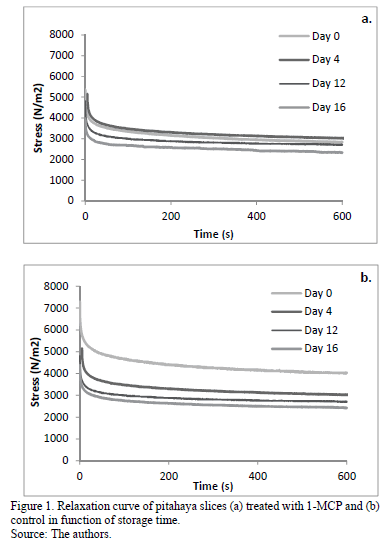
<body><![CDATA[<p><font size="2" face="Verdana, Arial, Helvetica, sans-serif">The model is composed of two Maxwell   elements and a spring in parallel. Each Maxwell element consists of a Newtonian   dashpot in series with a Hookean spring &#91;13&#93;. Constants of a generalized Maxwell model were obtained by   non-linear regression (Levenberg-Marquard), using an SPSS 11.5 program for   Windows (SPSS Inc, Chicago, 2002).</font></p>     <p><font size="2" face="Verdana, Arial, Helvetica, sans-serif">Peleg and   Normand proposed Ec 2, which may be adjusted through linear regression, were s<sub>0</sub> is the initial stress, s the stress   of each time t during relaxation process, k1 is the reciprocal of initial   decrease of velocity and k2 is an hypothetic value of normalized asymptotic   force &#91;15&#93; &#91;16&#93;. </font></p>     <p><img src="/img/revistas/dyna/v83n196/v83n196a17eq02.gif"></p>     <p><font size="2" face="Verdana, Arial, Helvetica, sans-serif">These non-dimension constants are related   to the elasticity of material subject to stress relaxation, and were obtained   through linear regression with Microsoft® Office Excel 2007.</font></p>     <p><font size="2" face="Verdana, Arial, Helvetica, sans-serif"><b><i>2.6. Experimental design</i></b></font></p>     <p><font size="2" face="Verdana, Arial, Helvetica, sans-serif">A completely randomized factorial design   2x4 was used, with two factors: Concentration of 1-MCP solution with two   levels: 0 and 200 µgL<sup>-1</sup>, where 0 is the control treatment (without   1-MCP application), and storage time with 4 levels 0, 4, 12, and 16 days. The effect of 1-MCP concentration and storage   time was determined by analyzing the variance (ANOVA) at 5% probability using   the Statgraphics software version Demo (Minitab Inc., State College, PA, 2007).   All determinations were performed in triplicate.</font></p>     <p>&nbsp;</p>     <p><font size="3" face="Verdana, Arial, Helvetica, sans-serif"><b>3. Results</b></font></p>     <p><font size="2" face="Verdana, Arial, Helvetica, sans-serif"><b><i>3.1. Analysis of relaxation</i></b></font></p>     <p><font size="2" face="Verdana, Arial, Helvetica, sans-serif"><a href="#fig01">Fig. 1</a> shows typical curves of stress   relaxation of pitahaya samples at various days of storage. In all treatments   the relaxation curve decreased in function of storage time.</font></p>     ]]></body>
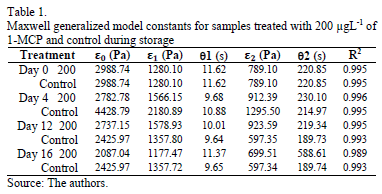
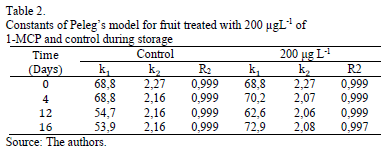
<body><![CDATA[<p align="center"><font size="2" face="Verdana, Arial, Helvetica, sans-serif"><a name="fig01"></a></font><img src="/img/revistas/dyna/v83n196/v83n196a17fig01.gif"></p>     <p><font size="2" face="Verdana, Arial, Helvetica, sans-serif"><b><i>3.2. Relaxation modeling</i></b></font></p>     <p><font size="2" face="Verdana, Arial, Helvetica, sans-serif">Maxwell model constants for treated and   non-treated samples during storage are shown in <a href="#tab01">Table 1</a>.</font></p>     <p align="center"><font size="2" face="Verdana, Arial, Helvetica, sans-serif"><a name="tab01"></a></font><img src="/img/revistas/dyna/v83n196/v83n196a17tab01.gif"></p>     <p><font size="2" face="Verdana, Arial, Helvetica, sans-serif">A   good adjustment of experimental values is seen, showing an R<sup>2</sup> variation between 0.989 and 0.996, which shows that the Maxwell model is   suitable for predicting experimental results. Elasticity constants of module e<sub>o</sub>, e1 and e<sub>2</sub> associated to the 3 springs of Maxwell, did not show any pattern of trend in the   viscoelastic analysis of pitahaya samples during storage. On day 4 treated   samples showed lower values in elastic models compared to the control,   indicating minor elastic behavior, or minor firmness, but on day 12 it was   inverse showing more elastic component than the control. On day 16 only the elastic module <img src="/img/revistas/dyna/v83n196/v83n196a17eq010.gif"> showed a higher value in   samples treated with 1-MCP. Significant   differences between the control and 200 mg.L<sup>-1</sup> 1-MCP application were observed in all the elastic module (<img src="/img/revistas/dyna/v83n196/v83n196a17eq002.gif">) and the first time relaxation (<img src="/img/revistas/dyna/v83n196/v83n196a17eq012.gif">) (p &lt; 0.05); the   second time relaxation was not affected (p   &gt; 0.05).</font></p>     <p><font size="2" face="Verdana, Arial, Helvetica, sans-serif">In terms of relaxation time constants, (q<sub>1</sub> and q<sub>2</sub>), associated to viscous behavior or   liquid phase of foods &#91;13&#93;, it was observed that control treatment showed minor values (except   for q1 on day 4). This fact means that at   less relaxation time, the material dissipates faster due to the imposed load, indicating a behavior more   similar to liquid (less firmness) than to solid &#91;27&#93;. Therefore, according to   these relaxation times, samples treated with 1-MCP showed higher values of   solidity, perhaps due to minor degradation of pectins and hemicellulose by the   effect of decreasing enzymatic activity &#91;28&#93;. </font></p>     <p><font size="2" face="Verdana, Arial, Helvetica, sans-serif">This behavior is the same as behavior   reported in uniaxial compression tests of yellow pitahaya treated with 200 µgL<sup>-1</sup> of 1-MCP during storage &#91;29,30&#93;.</font></p>     <p><font size="2" face="Verdana, Arial, Helvetica, sans-serif">According to the above results relaxation   time parameter is more suitable than elasticity modules eo, e1 and e2 to describe viscoelastic behavior of   pitahaya samples treated and non-treated with 1-MCP during storage. <a href="#tab02">Table 2</a> shows rheological constants (k1 and k2) of Peleg's model. Correlation   coefficients (R<sub>2</sub>) for control samples varied between 0,9987 and   0,9993 and for treated samples between 0,9984 and 0,9993. These values show   that Peleg´s model fits the experimental values better than Maxwell´s model.</font></p>     <p align="center"><font size="2" face="Verdana, Arial, Helvetica, sans-serif"><a name="tab02"></a></font><img src="/img/revistas/dyna/v83n196/v83n196a17tab02.gif"></p>     <p><font size="2" face="Verdana, Arial, Helvetica, sans-serif">It can be seen that k1 parameter   decreases in control treatment from 68.8 to 53.9 during storage, while in the   samples treated with 1-MCP no trend is seen. The reciprocal of K1 constant of   Peleg's model depicts the initial decay rate during relaxation time &#91;13&#93;; therefore a decrease of this   parameter is an indication of stress relaxation decline, associated with minor   firmness. This table shows that the application of   1-MCP </font><font size="2" face="Verdana, Arial, Helvetica, sans-serif">increased k1   values compared to the control during storage (p&lt;0.05), which means that the   application of 1-MCP decreased stress relaxation reduction, associated with a   more elastic or solid material. This   behavior may be attributed to the fact that 1-MCP impacted enzymatic activity   decrease, and consequently a lower degradation of fruit pectins and   hemicelluloses is achieved &#91;28&#93;.</font></p>     ]]></body>
<body><![CDATA[<p><font size="2" face="Verdana, Arial, Helvetica, sans-serif">Parameter k2 represents material solidity   degree when <img src="/img/revistas/dyna/v83n196/v83n196a17eq028.gif"> is considered an ideal   elastic solid &#91;16&#93;. A slight decrease of this parameter during storage may be seen in   both treatments, associated with a mild loss of solidity or firm,ess of   samples. This result may be due to a low weight loss because of dehydration of   the fruit &#91;31&#93;.   However, the ANOVA did not show any significant difference (p&gt;0.05). No   significant difference was observed, (p&gt;0.05) when comparing control   treatment and samples with an application of 1-MCP, with values relatively   close varying between 2.06 and 2.27. This result indicates that parameter k2   was not suitable to describe fruit viscoelastic properties.</font></p>     <p><font size="2" face="Verdana, Arial, Helvetica, sans-serif">The results demonstrate that during   storage of slices of yellow pitahaya, the viscoelastic properties were more   sensitive to the viscous component (relaxation times and K1), than to the   elastic component (elastic modules and K2). This behavior may be explained by   using minimally processed fruit with the characteristics of fresh fruit,   therefore its viscous component was predominant. </font></p>     <p>&nbsp;</p>     <p><font size="3" face="Verdana, Arial, Helvetica, sans-serif"><b>4. Conclusion</b></font></p>     <p><font size="2" face="Verdana, Arial, Helvetica, sans-serif">Yellow pitahaya samples treated and   non-treated by applying 200 µgL-1 of 1-MCP decreased their elastic behavior   (firmness decrease), due to the effect of storage time in refrigeration,   perhaps due to natural and irreversible degradation of pectins and   hemicelluloses. The application of </font></p>     <p><font size="2" face="Verdana, Arial, Helvetica, sans-serif">200 µgL-1 of 1-MCP positively impacted   fruit elastic behavior, showing more elasticity or solidity than non-treated   samples (control) during storage, in relation to increasing relaxation time in   the Maxwell model, and higher k1 values in the Peleg model. It was shown that   Maxwell's and Peleg's rheologic models are suitable to predict the viscoelastic   behavior of minimally processed yellow pitahaya samples; however, Peleg's model   showed the best adjustments of experimental values. The stress relaxation test   may become a useful tool to evaluate the viscoelastic behavior of yellow   pitahaya samples during storage in refrigeration. </font></p>     <p>&nbsp;</p>     <p><font size="3" face="Verdana, Arial, Helvetica, sans-serif"><b>Acknowledgments</b></font></p>     <p><font size="2" face="Verdana, Arial, Helvetica, sans-serif">The authors of this work wish to thank   the Ministerio de Agricultura y Desarrollo Rural de Colombia, and the Asociaci&oacute;n   de productores de pitahaya amarilla - Asoppitaya for funding this project.</font></p>     <p>&nbsp;</p>     ]]></body>
<body><![CDATA[<p><font size="3" face="Verdana, Arial, Helvetica, sans-serif"><b>References</b></font></p>     <!-- ref --><p><font size="2" face="Verdana, Arial, Helvetica, sans-serif"><b>&#91;1&#93;</b> Braga-Marques,   V., Amato-Moreira, R., Ramos, J.D., Arcanjo-de Araujo, N. and Reis-Silva,   F.O.D., Fenologia reprodutiva de pitaia vermelha no munic&iacute;pio de Lavras, MG,   Ciência Rural, 41(6), pp. 984-7, 2011.    &nbsp;&nbsp;&nbsp;&nbsp;&nbsp;&nbsp;&nbsp;&nbsp;[&#160;<a href="javascript:void(0);" onclick="javascript: window.open('/scielo.php?script=sci_nlinks&ref=1154061&pid=S0012-7353201600020001700001&lng=','','width=640,height=500,resizable=yes,scrollbars=1,menubar=yes,');">Links</a>&#160;]<!-- end-ref --></font></p>     <!-- ref --><p><font size="2" face="Verdana, Arial, Helvetica, sans-serif"><b>&#91;2&#93;</b> Ayala-Aponte, A.A.,   Giraldo-Cuartas, C.J. y Serna-Cock, L., Cin&eacute;ticas de deshidraci&oacute;n osm&oacute;tica de   pitahaya amarilla (<i>Selenicereus   megalanthus</i>), Interciencia, 35(7), pp. 539-544, 2010.    &nbsp;&nbsp;&nbsp;&nbsp;&nbsp;&nbsp;&nbsp;&nbsp;[&#160;<a href="javascript:void(0);" onclick="javascript: window.open('/scielo.php?script=sci_nlinks&ref=1154063&pid=S0012-7353201600020001700002&lng=','','width=640,height=500,resizable=yes,scrollbars=1,menubar=yes,');">Links</a>&#160;]<!-- end-ref --> </font></p>     <!-- ref --><p><font size="2" face="Verdana, Arial, Helvetica, sans-serif"><b>&#91;3&#93;</b> Ayala-Aponte, A.A.,   Serna-Cock, L. y Giraldo-Cuartas, C.J., Efecto de la agitaci&oacute;n sobre la   deshidrataci&oacute;n osm&oacute;tica de pitahaya amarilla (<i>Selenicereus megalanthus s.</i>) empleando soluciones de sacarosa,   Interciencia, 34(7), pp. 492-496, 2009.    &nbsp;&nbsp;&nbsp;&nbsp;&nbsp;&nbsp;&nbsp;&nbsp;[&#160;<a href="javascript:void(0);" onclick="javascript: window.open('/scielo.php?script=sci_nlinks&ref=1154065&pid=S0012-7353201600020001700003&lng=','','width=640,height=500,resizable=yes,scrollbars=1,menubar=yes,');">Links</a>&#160;]<!-- end-ref --></font></p>     <!-- ref --><p><font size="2" face="Verdana, Arial, Helvetica, sans-serif"><b>&#91;4&#93;</b> Ortiz, X., Acevedo, X. and   Mart&iacute;nez, H., Caracter&iacute;sticas y estructura de los frutales de exportaci&oacute;n en   Colombia. En: Agrocadenas O, Ed. Ministerio de Agricultura y Desarrollo Rural,   Bogot&aacute;, 2002.    &nbsp;&nbsp;&nbsp;&nbsp;&nbsp;&nbsp;&nbsp;&nbsp;[&#160;<a href="javascript:void(0);" onclick="javascript: window.open('/scielo.php?script=sci_nlinks&ref=1154067&pid=S0012-7353201600020001700004&lng=','','width=640,height=500,resizable=yes,scrollbars=1,menubar=yes,');">Links</a>&#160;]<!-- end-ref --></font></p>     <!-- ref --><p><font size="2" face="Verdana, Arial, Helvetica, sans-serif"><b>&#91;5&#93;</b> Soliva-Fortuny, R.C. and   Mart&iacute;n-Belloso, O., New advances in extending the shelf-life of   fresh-cut fruits: A review, Trends in Food Science &amp; Technology, 14(9), pp.   341-53, 2003. DOI: 10.1016/s0924-2244(03)00054-2</font>&nbsp;&nbsp;&nbsp;&nbsp;&nbsp;&nbsp;&nbsp;&nbsp;[&#160;<a href="javascript:void(0);" onclick="javascript: window.open('/scielo.php?script=sci_nlinks&ref=1154069&pid=S0012-7353201600020001700005&lng=','','width=640,height=500,resizable=yes,scrollbars=1,menubar=yes,');">Links</a>&#160;]<!-- end-ref --><!-- ref --><p><font size="2" face="Verdana, Arial, Helvetica, sans-serif"><b>&#91;6&#93;</b> Rico, D., Mart&iacute;n-Diana, A.B., Barat, J.M. and   Barry-Ryan, C., Extending and measuring the quality of fresh-cut fruit and   vegetables: A review, Trends in Food Science &amp; Technology, 18(7), pp. 373-386,   2007. DOI: 10.1016/j.tifs.2007.03.011</font>&nbsp;&nbsp;&nbsp;&nbsp;&nbsp;&nbsp;&nbsp;&nbsp;[&#160;<a href="javascript:void(0);" onclick="javascript: window.open('/scielo.php?script=sci_nlinks&ref=1154070&pid=S0012-7353201600020001700006&lng=','','width=640,height=500,resizable=yes,scrollbars=1,menubar=yes,');">Links</a>&#160;]<!-- end-ref --><!-- ref --><p><font size="2" face="Verdana, Arial, Helvetica, sans-serif"><b>&#91;7&#93;</b> Salvador, A., Varela, P. and Fiszman, S.M.,   Consumer acceptability and shelf life of &quot;Flor de invierno&quot; pears (<i>Pyrus communis L.</i>) under different   storage conditions, Journal of Sensory Studies, 22, pp. 243-255, 2007.    &nbsp;&nbsp;&nbsp;&nbsp;&nbsp;&nbsp;&nbsp;&nbsp;[&#160;<a href="javascript:void(0);" onclick="javascript: window.open('/scielo.php?script=sci_nlinks&ref=1154071&pid=S0012-7353201600020001700007&lng=','','width=640,height=500,resizable=yes,scrollbars=1,menubar=yes,');">Links</a>&#160;]<!-- end-ref --> </font></p>     <!-- ref --><p><font size="2" face="Verdana, Arial, Helvetica, sans-serif"><b>&#91;8&#93;</b> Taherian, A.R. and Ramaswamy, H.S., Kinetic   considerations of texture softening in heat treated root vegetables,   International Journal of Food Properties, 12(1), pp. 114-128, 2008. DOI: 10.1080/10942910802312207</font>&nbsp;&nbsp;&nbsp;&nbsp;&nbsp;&nbsp;&nbsp;&nbsp;[&#160;<a href="javascript:void(0);" onclick="javascript: window.open('/scielo.php?script=sci_nlinks&ref=1154073&pid=S0012-7353201600020001700008&lng=','','width=640,height=500,resizable=yes,scrollbars=1,menubar=yes,');">Links</a>&#160;]<!-- end-ref --><!-- ref --><p><font size="2" face="Verdana, Arial, Helvetica, sans-serif"><b>&#91;9&#93;</b> Mayor, L., Cunha, R. and Sereno, A.,   Relation between mechanical properties and structural changes during osmotic   dehydration of pumpkin, Food Research International, 40(4), pp. 448-460, 2007. DOI: 10.1016/j.foodres.2007.02.004</font>&nbsp;&nbsp;&nbsp;&nbsp;&nbsp;&nbsp;&nbsp;&nbsp;[&#160;<a href="javascript:void(0);" onclick="javascript: window.open('/scielo.php?script=sci_nlinks&ref=1154074&pid=S0012-7353201600020001700009&lng=','','width=640,height=500,resizable=yes,scrollbars=1,menubar=yes,');">Links</a>&#160;]<!-- end-ref --><!-- ref --><p><font size="2" face="Verdana, Arial, Helvetica, sans-serif"><b>&#91;10&#93;</b> Sauvant, P., Cansell, M., Hadj-Sassi, A. and   Atgi&eacute;, C., Vitamin A enrichment: Caution with encapsulation strategies used for   food applications, Food Research International, 46(2), pp. 469-479, 2012. DOI: 10.1016/j.foodres.2011.09.025</font>&nbsp;&nbsp;&nbsp;&nbsp;&nbsp;&nbsp;&nbsp;&nbsp;[&#160;<a href="javascript:void(0);" onclick="javascript: window.open('/scielo.php?script=sci_nlinks&ref=1154075&pid=S0012-7353201600020001700010&lng=','','width=640,height=500,resizable=yes,scrollbars=1,menubar=yes,');">Links</a>&#160;]<!-- end-ref --><!-- ref --><p><font size="2" face="Verdana, Arial, Helvetica, sans-serif"><b>&#91;11&#93;</b> Muliawan, E.B. and Hatzikiriakos, S.G., The   effect of refrigerated storage on the rheological properties of three   commercial mozzarella cheeses, International Journal of Food Engineering, 4(4),   pp. 1-19, 2008.    &nbsp;&nbsp;&nbsp;&nbsp;&nbsp;&nbsp;&nbsp;&nbsp;[&#160;<a href="javascript:void(0);" onclick="javascript: window.open('/scielo.php?script=sci_nlinks&ref=1154076&pid=S0012-7353201600020001700011&lng=','','width=640,height=500,resizable=yes,scrollbars=1,menubar=yes,');">Links</a>&#160;]<!-- end-ref --> </font></p>     <!-- ref --><p><font size="2" face="Verdana, Arial, Helvetica, sans-serif"><b>&#91;12&#93;</b> Bourne, M., Food texture and viscosity   concept and measurement. California, USA: Academic Press an Elsevier Science   Imprint, 2002.    &nbsp;&nbsp;&nbsp;&nbsp;&nbsp;&nbsp;&nbsp;&nbsp;[&#160;<a href="javascript:void(0);" onclick="javascript: window.open('/scielo.php?script=sci_nlinks&ref=1154078&pid=S0012-7353201600020001700012&lng=','','width=640,height=500,resizable=yes,scrollbars=1,menubar=yes,');">Links</a>&#160;]<!-- end-ref --></font></p>     ]]></body>
<body><![CDATA[<!-- ref --><p><font size="2" face="Verdana, Arial, Helvetica, sans-serif"><b>&#91;13&#93;</b> Hassan, B., Alhamdan, A.M. and Elansari, A.M.,   Stress relaxation of dates at khalal and rutab stages of madurity, Journal of   Food Engineering, 66, pp. 439-445, 2005.    &nbsp;&nbsp;&nbsp;&nbsp;&nbsp;&nbsp;&nbsp;&nbsp;[&#160;<a href="javascript:void(0);" onclick="javascript: window.open('/scielo.php?script=sci_nlinks&ref=1154080&pid=S0012-7353201600020001700013&lng=','','width=640,height=500,resizable=yes,scrollbars=1,menubar=yes,');">Links</a>&#160;]<!-- end-ref --> </font></p>     <!-- ref --><p><font size="2" face="Verdana, Arial, Helvetica, sans-serif"><b>&#91;14&#93;</b> Pereira, P.A.P., de Souza, V.R., Teixeira,   T.R., Queiroz, F., Borges, S. V. and Carneiro, J.d.D.S., Rheological behavior   of functional sugar-free guava preserves: Effect of the addition of salts, Food   Hydrocolloids, 31(2), pp. 404-412, 2013. DOI: 10.1016/j.foodhyd.2012.11.014</font>&nbsp;&nbsp;&nbsp;&nbsp;&nbsp;&nbsp;&nbsp;&nbsp;[&#160;<a href="javascript:void(0);" onclick="javascript: window.open('/scielo.php?script=sci_nlinks&ref=1154082&pid=S0012-7353201600020001700014&lng=','','width=640,height=500,resizable=yes,scrollbars=1,menubar=yes,');">Links</a>&#160;]<!-- end-ref --><!-- ref --><p><font size="2" face="Verdana, Arial, Helvetica, sans-serif"><b>&#91;15&#93;</b> Steffe, J.F., Rheological methods in food   process engineering. Segunda ed: East Lansing, MI: Freeman Press, East Lansing,   USA, 1996.    &nbsp;&nbsp;&nbsp;&nbsp;&nbsp;&nbsp;&nbsp;&nbsp;[&#160;<a href="javascript:void(0);" onclick="javascript: window.open('/scielo.php?script=sci_nlinks&ref=1154083&pid=S0012-7353201600020001700015&lng=','','width=640,height=500,resizable=yes,scrollbars=1,menubar=yes,');">Links</a>&#160;]<!-- end-ref --></font></p>     <!-- ref --><p><font size="2" face="Verdana, Arial, Helvetica, sans-serif"><b>&#91;16&#93;</b> Moghimi, A., Saiedirad, M.H. and Moghadam,   E.G., Interpretation of viscoelastic behaviour of sweet cherries using rheological   models, International Journal of Food Science &amp; Technology, 46(4), pp. 855-861,   2011. DOI: 10.1111/j.1365-2621.2011.02563.x</font>&nbsp;&nbsp;&nbsp;&nbsp;&nbsp;&nbsp;&nbsp;&nbsp;[&#160;<a href="javascript:void(0);" onclick="javascript: window.open('/scielo.php?script=sci_nlinks&ref=1154085&pid=S0012-7353201600020001700016&lng=','','width=640,height=500,resizable=yes,scrollbars=1,menubar=yes,');">Links</a>&#160;]<!-- end-ref --><!-- ref --><p><font size="2" face="Verdana, Arial, Helvetica, sans-serif"><b>&#91;17&#93;</b> Sahin, S. and Gülüm-Sumnu, S., Physical   properties of foods. Springer Science+Businessm Media, Ankara, Turkey, 2006.    &nbsp;&nbsp;&nbsp;&nbsp;&nbsp;&nbsp;&nbsp;&nbsp;[&#160;<a href="javascript:void(0);" onclick="javascript: window.open('/scielo.php?script=sci_nlinks&ref=1154086&pid=S0012-7353201600020001700017&lng=','','width=640,height=500,resizable=yes,scrollbars=1,menubar=yes,');">Links</a>&#160;]<!-- end-ref --></font></p>     <!-- ref --><p><font size="2" face="Verdana, Arial, Helvetica, sans-serif"><b>&#91;18&#93;</b> Peleg, M., Characterization of the stress   relaxation curves of solid foods, Journal of Food Science, 44(1), pp. 277-281,   1979.    &nbsp;&nbsp;&nbsp;&nbsp;&nbsp;&nbsp;&nbsp;&nbsp;[&#160;<a href="javascript:void(0);" onclick="javascript: window.open('/scielo.php?script=sci_nlinks&ref=1154088&pid=S0012-7353201600020001700018&lng=','','width=640,height=500,resizable=yes,scrollbars=1,menubar=yes,');">Links</a>&#160;]<!-- end-ref --> </font></p>     ]]></body>
<body><![CDATA[<!-- ref --><p><font size="2" face="Verdana, Arial, Helvetica, sans-serif"><b>&#91;19&#93;</b> Rodrigues, A.C.C., Cunha, R.L. and   Hubinger, M.r.D., Rheological properties and colour evaluation of papaya during   osmotic dehydration processing, Journal of Food Engineering, 59(2-3), pp. 129-135,   2003. DOI: 10.1016/s0260-8774(02)00442-9</font>&nbsp;&nbsp;&nbsp;&nbsp;&nbsp;&nbsp;&nbsp;&nbsp;[&#160;<a href="javascript:void(0);" onclick="javascript: window.open('/scielo.php?script=sci_nlinks&ref=1154090&pid=S0012-7353201600020001700019&lng=','','width=640,height=500,resizable=yes,scrollbars=1,menubar=yes,');">Links</a>&#160;]<!-- end-ref --><!-- ref --><p><font size="2" face="Verdana, Arial, Helvetica, sans-serif"><b>&#91;20&#93;</b> Rodr&iacute;guez-Sandoval, E., Fern&aacute;ndez-Quintero,   A. and Cuvelier, G., Stress relaxation of reconstituted cassava dough, LWT - Food   Science and Technology, 42(1), pp. 202-206, 2009. DOI: 10.1016/j.lwt.2008.03.007</font>&nbsp;&nbsp;&nbsp;&nbsp;&nbsp;&nbsp;&nbsp;&nbsp;[&#160;<a href="javascript:void(0);" onclick="javascript: window.open('/scielo.php?script=sci_nlinks&ref=1154091&pid=S0012-7353201600020001700020&lng=','','width=640,height=500,resizable=yes,scrollbars=1,menubar=yes,');">Links</a>&#160;]<!-- end-ref --><!-- ref --><p><font size="2" face="Verdana, Arial, Helvetica, sans-serif"><b>&#91;21&#93;</b> Danalache, F., Beirão-da-Costa, S., Mata,   P., Alves, V.D. and Moldão-Martins, M., Texture, microstructure and consumer   preference of mango bars jellified with gellan gum, LWT - Food Science and   Technology, 62(1), pp. 584-591, 2015. DOI: 10.1016/j.lwt.2014.12.040</font>&nbsp;&nbsp;&nbsp;&nbsp;&nbsp;&nbsp;&nbsp;&nbsp;[&#160;<a href="javascript:void(0);" onclick="javascript: window.open('/scielo.php?script=sci_nlinks&ref=1154092&pid=S0012-7353201600020001700021&lng=','','width=640,height=500,resizable=yes,scrollbars=1,menubar=yes,');">Links</a>&#160;]<!-- end-ref --><!-- ref --><p><font size="2" face="Verdana, Arial, Helvetica, sans-serif"><b>&#91;22&#93;</b> Rocculi, P., Cocci, E., Romani, S.,   Sacchetti, G. and Rosa, M., Effect of 1-MCP treatment and N2O MAP on   physiological and quality changes of fresh-cut pineapple, Postharvest Biology   and Technology, 51(3), pp. 371-377, 2009. DOI: 10.1016/j.postharvbio.2008.07.010</font>&nbsp;&nbsp;&nbsp;&nbsp;&nbsp;&nbsp;&nbsp;&nbsp;[&#160;<a href="javascript:void(0);" onclick="javascript: window.open('/scielo.php?script=sci_nlinks&ref=1154093&pid=S0012-7353201600020001700022&lng=','','width=640,height=500,resizable=yes,scrollbars=1,menubar=yes,');">Links</a>&#160;]<!-- end-ref --><!-- ref --><p><font size="2" face="Verdana, Arial, Helvetica, sans-serif"><b>&#91;23&#93;</b> Ergun, M., Jeong, J., Huber, D.J. and   Cantliffe, D.J., Physiology of fresh-cut 'Galia' (<i>Cucumis melo var. reticulatus</i>) from ripe fruit treated with   1-methylcyclopropene, Postharvest Biology and Technology, 44(3), pp. 286-292,   2007. DOI: 10.1016/j.postharvbio.2006.08.019</font>&nbsp;&nbsp;&nbsp;&nbsp;&nbsp;&nbsp;&nbsp;&nbsp;[&#160;<a href="javascript:void(0);" onclick="javascript: window.open('/scielo.php?script=sci_nlinks&ref=1154094&pid=S0012-7353201600020001700023&lng=','','width=640,height=500,resizable=yes,scrollbars=1,menubar=yes,');">Links</a>&#160;]<!-- end-ref --><!-- ref --><p><font size="2" face="Verdana, Arial, Helvetica, sans-serif"><b>&#91;24&#93;</b> Vilasboas, E. and Kader, A., Effect of   1-methylcyclopropene (1-MCP) on softening of fresh-cut kiwifruit, mango and   persimmon slices, Postharvest Biology and Technology, 43(2), pp. 238-244, 2007. DOI: 10.1016/j.postharvbio.2006.09.010</font>&nbsp;&nbsp;&nbsp;&nbsp;&nbsp;&nbsp;&nbsp;&nbsp;[&#160;<a href="javascript:void(0);" onclick="javascript: window.open('/scielo.php?script=sci_nlinks&ref=1154095&pid=S0012-7353201600020001700024&lng=','','width=640,height=500,resizable=yes,scrollbars=1,menubar=yes,');">Links</a>&#160;]<!-- end-ref --><!-- ref --><p><font size="2" face="Verdana, Arial, Helvetica, sans-serif"><b>&#91;25&#93;</b> Arias, E., L&oacute;pez-Buesa, P. and Oria, R.,   Extension of fresh-cut &quot;Blanquilla&quot; pear (<i>Pyrus   communis L.</i>) shelf-life by 1-MCP treatment after harvest, Postharvest   Biology and Technology, 54(1), pp. 53-58, 2009. DOI: 10.1016/j.postharvbio.2009.04.009</font>&nbsp;&nbsp;&nbsp;&nbsp;&nbsp;&nbsp;&nbsp;&nbsp;[&#160;<a href="javascript:void(0);" onclick="javascript: window.open('/scielo.php?script=sci_nlinks&ref=1154096&pid=S0012-7353201600020001700025&lng=','','width=640,height=500,resizable=yes,scrollbars=1,menubar=yes,');">Links</a>&#160;]<!-- end-ref --><!-- ref --><p><font size="2" face="Verdana, Arial, Helvetica, sans-serif"><b>&#91;26&#93;</b> ICONTEC. NTC 3554. Frutas   frescas: Pitahaya. Colombia: Federaci&oacute;n Nacional de Cafeteros de Colombia,   1996.    &nbsp;&nbsp;&nbsp;&nbsp;&nbsp;&nbsp;&nbsp;&nbsp;[&#160;<a href="javascript:void(0);" onclick="javascript: window.open('/scielo.php?script=sci_nlinks&ref=1154097&pid=S0012-7353201600020001700026&lng=','','width=640,height=500,resizable=yes,scrollbars=1,menubar=yes,');">Links</a>&#160;]<!-- end-ref --></font></p>     <!-- ref --><p><font size="2" face="Verdana, Arial, Helvetica, sans-serif"><b>&#91;27&#93;</b> Supavititpatana, T. and Apichartsrangkoon,   A., Combination effects of ultra-high pressure and temperature on the physical   and thermal properties of ostrich meat sausage (yor), Meat Science, 76(3), pp.   555-560, 2007. DOI: 10.1016/j.meatsci.2007.01.007</font>&nbsp;&nbsp;&nbsp;&nbsp;&nbsp;&nbsp;&nbsp;&nbsp;[&#160;<a href="javascript:void(0);" onclick="javascript: window.open('/scielo.php?script=sci_nlinks&ref=1154099&pid=S0012-7353201600020001700027&lng=','','width=640,height=500,resizable=yes,scrollbars=1,menubar=yes,');">Links</a>&#160;]<!-- end-ref --><!-- ref --><p><font size="2" face="Verdana, Arial, Helvetica, sans-serif"><b>&#91;28&#93;</b> Blankenship, S.M. and Dole, J.M.,   1-Methylcyclopropene: A review, Postharvest Biology and Technology, 28(1), pp.   1-25, 2003. DOI: 10.1016/s0925-5214(02)00246-6</font>&nbsp;&nbsp;&nbsp;&nbsp;&nbsp;&nbsp;&nbsp;&nbsp;[&#160;<a href="javascript:void(0);" onclick="javascript: window.open('/scielo.php?script=sci_nlinks&ref=1154100&pid=S0012-7353201600020001700028&lng=','','width=640,height=500,resizable=yes,scrollbars=1,menubar=yes,');">Links</a>&#160;]<!-- end-ref --><!-- ref --><p><font size="2" face="Verdana, Arial, Helvetica, sans-serif"><b>&#91;29&#93;</b> Serna, L., Torres, L.S. and Ayala, A.A.,   Effect of pre- and postharvest application of 1-methylcyclopropene on the   maturation of yellow pitahaya (<i>Selenicerus   megalanthus Haw</i>), Vitae, 19, pp. 49-59, 2012.    &nbsp;&nbsp;&nbsp;&nbsp;&nbsp;&nbsp;&nbsp;&nbsp;[&#160;<a href="javascript:void(0);" onclick="javascript: window.open('/scielo.php?script=sci_nlinks&ref=1154101&pid=S0012-7353201600020001700029&lng=','','width=640,height=500,resizable=yes,scrollbars=1,menubar=yes,');">Links</a>&#160;]<!-- end-ref --> </font></p>     <!-- ref --><p><font size="2" face="Verdana, Arial, Helvetica, sans-serif"><b>&#91;30&#93;</b> Serna-Cock, L., Torres-Valenzuela, L.S. and   Ayala-Aponte, A., Changes in mechanical properties of minimally-processed   yellow pitahaya treated with 1-MCP, DYNA, 79(174), pp. 71-78, 2012.    &nbsp;&nbsp;&nbsp;&nbsp;&nbsp;&nbsp;&nbsp;&nbsp;[&#160;<a href="javascript:void(0);" onclick="javascript: window.open('/scielo.php?script=sci_nlinks&ref=1154103&pid=S0012-7353201600020001700030&lng=','','width=640,height=500,resizable=yes,scrollbars=1,menubar=yes,');">Links</a>&#160;]<!-- end-ref --> </font></p>     <!-- ref --><p><font size="2" face="Verdana, Arial, Helvetica, sans-serif"><b>&#91;31&#93;</b> Manganaris, G., Crisosto, C., Bremer, V. and   Holcroft, D., Novel 1-methylcyclopropene immersion formulation extends shelf   life of advanced maturity 'Joanna Red' plums (Prunus salicina Lindell), Postharvest   Biology and Technology, 47(3), pp. 429-433, 2008. DOI: 10.1016/j.postharvbio.2007.07.006</font>&nbsp;&nbsp;&nbsp;&nbsp;&nbsp;&nbsp;&nbsp;&nbsp;[&#160;<a href="javascript:void(0);" onclick="javascript: window.open('/scielo.php?script=sci_nlinks&ref=1154105&pid=S0012-7353201600020001700031&lng=','','width=640,height=500,resizable=yes,scrollbars=1,menubar=yes,');">Links</a>&#160;]<!-- end-ref --><p>&nbsp;</p>     <p><font size="2" face="Verdana, Arial, Helvetica, sans-serif"><b>L.S. Torres-Valenzuela,</b> received a BSc. in Agricultural Engineering in 2007 from the Universidad del   Valle, Cali, Colombia, and an MSc. degree in Food Engineering from the   Universidad del Valle, Cali, Colombia. She is a professor in the area of   Biotechnology and Food Technology in the Universidad La Gran Colombia, Armenia,   Colombia. Her research interests include: preservation, food processing and   biotechnology. ORCID: 0000-0001-8032-1901</font></p>     <p><font size="2" face="Verdana, Arial, Helvetica, sans-serif"><b>A.A.   Ayala-Aponte,</b> received a BSc. in Agricultural Engineering in   1993 from the Universidad del Valle, Cali, Colombia and a PhD. degree in   Science and Food Technology in 2011 from the Universidad Polit&eacute;cnica de   Valencia, Spain. He is a professor in the area of Food Technology and   Engineering, in the Universidad del Valle, Cali, Colombia. His research   interests include: preservation and food processing. ORCID: 0000-0003-0310-3577</font></p>     <p><font size="2" face="Verdana, Arial, Helvetica, sans-serif"><b>L.   Serna-Cock,</b> received a BSc. in Bacteriology from the Universidad   Cat&oacute;lica de Manizales, Colombia in 1987, and a PhD degree in Food Engineering   from the Universidad del Valle, Cali, Colombia. She is a professor in the area   of Biotechnology in the Universidad Nacional de Colombia, Palmira, Colombia.   Her research interests include: preservation, food processing and   biotechnology. ORCID: 0000-0003-2911-0871</font></p>     ]]></body>
<body><![CDATA[ ]]></body><back>
<ref-list>
<ref id="B1">
<label>1</label><nlm-citation citation-type="journal">
<person-group person-group-type="author">
<name>
<surname><![CDATA[Braga-Marques]]></surname>
<given-names><![CDATA[V.]]></given-names>
</name>
<name>
<surname><![CDATA[Amato-Moreira]]></surname>
<given-names><![CDATA[R.]]></given-names>
</name>
<name>
<surname><![CDATA[Ramos]]></surname>
<given-names><![CDATA[J.D.]]></given-names>
</name>
<name>
<surname><![CDATA[Arcanjo-de Araujo]]></surname>
<given-names><![CDATA[N.]]></given-names>
</name>
<name>
<surname><![CDATA[Reis-Silva]]></surname>
<given-names><![CDATA[F.O.D.]]></given-names>
</name>
</person-group>
<article-title xml:lang="pt"><![CDATA[Fenologia reprodutiva de pitaia vermelha no município de Lavras, MG]]></article-title>
<source><![CDATA[Ciência Rural]]></source>
<year>2011</year>
<volume>41</volume>
<numero>6</numero>
<issue>6</issue>
<page-range>984-7</page-range></nlm-citation>
</ref>
<ref id="B2">
<label>2</label><nlm-citation citation-type="journal">
<person-group person-group-type="author">
<name>
<surname><![CDATA[Ayala-Aponte]]></surname>
<given-names><![CDATA[A.A.]]></given-names>
</name>
<name>
<surname><![CDATA[Giraldo-Cuartas]]></surname>
<given-names><![CDATA[C.J.]]></given-names>
</name>
<name>
<surname><![CDATA[Serna-Cock]]></surname>
<given-names><![CDATA[L.]]></given-names>
</name>
</person-group>
<article-title xml:lang="es"><![CDATA[Cinéticas de deshidración osmótica de pitahaya amarilla (Selenicereus megalanthus)]]></article-title>
<source><![CDATA[Interciencia]]></source>
<year>2010</year>
<volume>35</volume>
<numero>7</numero>
<issue>7</issue>
<page-range>539-544</page-range></nlm-citation>
</ref>
<ref id="B3">
<label>3</label><nlm-citation citation-type="journal">
<person-group person-group-type="author">
<name>
<surname><![CDATA[Ayala-Aponte]]></surname>
<given-names><![CDATA[A.A.]]></given-names>
</name>
<name>
<surname><![CDATA[Serna-Cock]]></surname>
<given-names><![CDATA[L.]]></given-names>
</name>
<name>
<surname><![CDATA[Giraldo-Cuartas]]></surname>
<given-names><![CDATA[C.J.]]></given-names>
</name>
</person-group>
<article-title xml:lang="es"><![CDATA[Efecto de la agitación sobre la deshidratación osmótica de pitahaya amarilla (Selenicereus megalanthus s.) empleando soluciones de sacarosa]]></article-title>
<source><![CDATA[Interciencia]]></source>
<year>2009</year>
<volume>34</volume>
<numero>7</numero>
<issue>7</issue>
<page-range>492-496</page-range></nlm-citation>
</ref>
<ref id="B4">
<label>4</label><nlm-citation citation-type="book">
<person-group person-group-type="author">
<name>
<surname><![CDATA[Ortiz]]></surname>
<given-names><![CDATA[X.]]></given-names>
</name>
<name>
<surname><![CDATA[Acevedo]]></surname>
<given-names><![CDATA[X.]]></given-names>
</name>
<name>
<surname><![CDATA[Martínez]]></surname>
<given-names><![CDATA[H.]]></given-names>
</name>
</person-group>
<article-title xml:lang="es"><![CDATA[Características y estructura de los frutales de exportación en Colombia.]]></article-title>
<source><![CDATA[Agrocadenas O]]></source>
<year>2002</year>
<publisher-loc><![CDATA[Bogotá ]]></publisher-loc>
<publisher-name><![CDATA[Ministerio de Agricultura y Desarrollo Rural]]></publisher-name>
</nlm-citation>
</ref>
<ref id="B5">
<label>5</label><nlm-citation citation-type="journal">
<person-group person-group-type="author">
<name>
<surname><![CDATA[Soliva-Fortuny]]></surname>
<given-names><![CDATA[R.C.]]></given-names>
</name>
<name>
<surname><![CDATA[Martín-Belloso]]></surname>
<given-names><![CDATA[O.]]></given-names>
</name>
</person-group>
<article-title xml:lang="en"><![CDATA[New advances in extending the shelf-life of fresh-cut fruits: A review]]></article-title>
<source><![CDATA[Trends in Food Science & Technology]]></source>
<year>2003</year>
<volume>14</volume>
<numero>9</numero>
<issue>9</issue>
<page-range>341-53</page-range></nlm-citation>
</ref>
<ref id="B6">
<label>6</label><nlm-citation citation-type="journal">
<person-group person-group-type="author">
<name>
<surname><![CDATA[Rico]]></surname>
<given-names><![CDATA[D.]]></given-names>
</name>
<name>
<surname><![CDATA[Martín-Diana]]></surname>
<given-names><![CDATA[A.B.]]></given-names>
</name>
<name>
<surname><![CDATA[Barat]]></surname>
<given-names><![CDATA[J.M.]]></given-names>
</name>
<name>
<surname><![CDATA[Barry-Ryan]]></surname>
<given-names><![CDATA[C.]]></given-names>
</name>
</person-group>
<article-title xml:lang="en"><![CDATA[Extending and measuring the quality of fresh-cut fruit and vegetables: A review]]></article-title>
<source><![CDATA[Trends in Food Science & Technology]]></source>
<year>2007</year>
<volume>18</volume>
<numero>7</numero>
<issue>7</issue>
<page-range>373-386</page-range></nlm-citation>
</ref>
<ref id="B7">
<label>7</label><nlm-citation citation-type="journal">
<person-group person-group-type="author">
<name>
<surname><![CDATA[Salvador]]></surname>
<given-names><![CDATA[A.]]></given-names>
</name>
<name>
<surname><![CDATA[Varela]]></surname>
<given-names><![CDATA[P.]]></given-names>
</name>
<name>
<surname><![CDATA[Fiszman]]></surname>
<given-names><![CDATA[S.M.]]></given-names>
</name>
</person-group>
<article-title xml:lang="en"><![CDATA[Consumer acceptability and shelf life of "Flor de invierno" pears (Pyrus communis L.) under different storage conditions]]></article-title>
<source><![CDATA[Journal of Sensory Studies]]></source>
<year>2007</year>
<numero>22</numero>
<issue>22</issue>
<page-range>243-255</page-range></nlm-citation>
</ref>
<ref id="B8">
<label>8</label><nlm-citation citation-type="journal">
<person-group person-group-type="author">
<name>
<surname><![CDATA[Taherian]]></surname>
<given-names><![CDATA[A.R.]]></given-names>
</name>
<name>
<surname><![CDATA[Ramaswamy]]></surname>
<given-names><![CDATA[H.S.]]></given-names>
</name>
</person-group>
<article-title xml:lang="en"><![CDATA[Kinetic considerations of texture softening in heat treated root vegetables]]></article-title>
<source><![CDATA[International Journal of Food Properties]]></source>
<year>2008</year>
<volume>12</volume>
<numero>1</numero>
<issue>1</issue>
<page-range>114-128</page-range></nlm-citation>
</ref>
<ref id="B9">
<label>9</label><nlm-citation citation-type="journal">
<person-group person-group-type="author">
<name>
<surname><![CDATA[Mayor]]></surname>
<given-names><![CDATA[L.]]></given-names>
</name>
<name>
<surname><![CDATA[Cunha]]></surname>
<given-names><![CDATA[R.]]></given-names>
</name>
<name>
<surname><![CDATA[Sereno]]></surname>
<given-names><![CDATA[A.]]></given-names>
</name>
</person-group>
<article-title xml:lang="en"><![CDATA[Relation between mechanical properties and structural changes during osmotic dehydration of pumpkin]]></article-title>
<source><![CDATA[Food Research International]]></source>
<year>2007</year>
<volume>40</volume>
<numero>4</numero>
<issue>4</issue>
<page-range>448-460</page-range></nlm-citation>
</ref>
<ref id="B10">
<label>10</label><nlm-citation citation-type="journal">
<person-group person-group-type="author">
<name>
<surname><![CDATA[Sauvant]]></surname>
<given-names><![CDATA[P.]]></given-names>
</name>
<name>
<surname><![CDATA[Cansell]]></surname>
<given-names><![CDATA[M.]]></given-names>
</name>
<name>
<surname><![CDATA[Hadj-Sassi]]></surname>
<given-names><![CDATA[A.]]></given-names>
</name>
<name>
<surname><![CDATA[Atgié]]></surname>
<given-names><![CDATA[C.]]></given-names>
</name>
</person-group>
<article-title xml:lang="en"><![CDATA[Vitamin A enrichment: Caution with encapsulation strategies used for food applications]]></article-title>
<source><![CDATA[Food Research International]]></source>
<year>2012</year>
<volume>46</volume>
<numero>2</numero>
<issue>2</issue>
<page-range>469-479</page-range></nlm-citation>
</ref>
<ref id="B11">
<label>11</label><nlm-citation citation-type="journal">
<person-group person-group-type="author">
<name>
<surname><![CDATA[Muliawan]]></surname>
<given-names><![CDATA[E.B.]]></given-names>
</name>
<name>
<surname><![CDATA[Hatzikiriakos]]></surname>
<given-names><![CDATA[S.G.]]></given-names>
</name>
</person-group>
<article-title xml:lang="en"><![CDATA[The effect of refrigerated storage on the rheological properties of three commercial mozzarella cheeses]]></article-title>
<source><![CDATA[International Journal of Food Engineering]]></source>
<year>2008</year>
<volume>4</volume>
<numero>4</numero>
<issue>4</issue>
<page-range>1-19</page-range></nlm-citation>
</ref>
<ref id="B12">
<label>12</label><nlm-citation citation-type="book">
<person-group person-group-type="author">
<name>
<surname><![CDATA[Bourne]]></surname>
<given-names><![CDATA[M.]]></given-names>
</name>
</person-group>
<source><![CDATA[Food texture and viscosity concept and measurement.]]></source>
<year>2002</year>
<publisher-loc><![CDATA[California ]]></publisher-loc>
<publisher-name><![CDATA[Academic Press an Elsevier Science Imprint]]></publisher-name>
</nlm-citation>
</ref>
<ref id="B13">
<label>13</label><nlm-citation citation-type="journal">
<person-group person-group-type="author">
<name>
<surname><![CDATA[Hassan]]></surname>
<given-names><![CDATA[B.]]></given-names>
</name>
<name>
<surname><![CDATA[Alhamdan]]></surname>
<given-names><![CDATA[A.M.]]></given-names>
</name>
<name>
<surname><![CDATA[Elansari]]></surname>
<given-names><![CDATA[A.M.]]></given-names>
</name>
</person-group>
<article-title xml:lang="en"><![CDATA[Stress relaxation of dates at khalal and rutab stages of madurity]]></article-title>
<source><![CDATA[Journal of Food Engineering]]></source>
<year>2005</year>
<numero>66</numero>
<issue>66</issue>
<page-range>439-445</page-range></nlm-citation>
</ref>
<ref id="B14">
<label>14</label><nlm-citation citation-type="journal">
<person-group person-group-type="author">
<name>
<surname><![CDATA[Pereira]]></surname>
<given-names><![CDATA[P.A.P.]]></given-names>
</name>
<name>
<surname><![CDATA[de Souza]]></surname>
<given-names><![CDATA[V.R.]]></given-names>
</name>
<name>
<surname><![CDATA[Teixeira]]></surname>
<given-names><![CDATA[T.R.]]></given-names>
</name>
<name>
<surname><![CDATA[Queiroz]]></surname>
<given-names><![CDATA[F.]]></given-names>
</name>
<name>
<surname><![CDATA[Borges]]></surname>
<given-names><![CDATA[S. V.]]></given-names>
</name>
<name>
<surname><![CDATA[Carneiro]]></surname>
<given-names><![CDATA[J.d.D.S.]]></given-names>
</name>
</person-group>
<article-title xml:lang="en"><![CDATA[Rheological behavior of functional sugar-free guava preserves: Effect of the addition of salts]]></article-title>
<source><![CDATA[Food Hydrocolloids]]></source>
<year>2013</year>
<volume>31</volume>
<numero>2</numero>
<issue>2</issue>
<page-range>404-412</page-range></nlm-citation>
</ref>
<ref id="B15">
<label>15</label><nlm-citation citation-type="book">
<person-group person-group-type="author">
<name>
<surname><![CDATA[Steffe]]></surname>
<given-names><![CDATA[J.F.]]></given-names>
</name>
</person-group>
<source><![CDATA[Rheological methods in food process engineering.]]></source>
<year>1996</year>
<edition>Segunda</edition>
<publisher-loc><![CDATA[East Lansing^eMI MI]]></publisher-loc>
<publisher-name><![CDATA[Freeman]]></publisher-name>
</nlm-citation>
</ref>
<ref id="B16">
<label>16</label><nlm-citation citation-type="journal">
<person-group person-group-type="author">
<name>
<surname><![CDATA[Moghimi]]></surname>
<given-names><![CDATA[A.]]></given-names>
</name>
<name>
<surname><![CDATA[Saiedirad]]></surname>
<given-names><![CDATA[M.H.]]></given-names>
</name>
<name>
<surname><![CDATA[Moghadam]]></surname>
<given-names><![CDATA[E.G.]]></given-names>
</name>
</person-group>
<article-title xml:lang="en"><![CDATA[Interpretation of viscoelastic behaviour of sweet cherries using rheological models]]></article-title>
<source><![CDATA[International Journal of Food Science & Technology]]></source>
<year>2011</year>
<volume>46</volume>
<numero>4</numero>
<issue>4</issue>
<page-range>855-861</page-range></nlm-citation>
</ref>
<ref id="B17">
<label>17</label><nlm-citation citation-type="book">
<person-group person-group-type="author">
<name>
<surname><![CDATA[Sahin]]></surname>
<given-names><![CDATA[S.]]></given-names>
</name>
<name>
<surname><![CDATA[Gülüm-Sumnu]]></surname>
<given-names><![CDATA[S.]]></given-names>
</name>
</person-group>
<source><![CDATA[Physical properties of foods.]]></source>
<year>2006</year>
<publisher-loc><![CDATA[Ankara ]]></publisher-loc>
<publisher-name><![CDATA[Springer Science+Businessm Media]]></publisher-name>
</nlm-citation>
</ref>
<ref id="B18">
<label>18</label><nlm-citation citation-type="journal">
<person-group person-group-type="author">
<name>
<surname><![CDATA[Peleg]]></surname>
<given-names><![CDATA[M.]]></given-names>
</name>
</person-group>
<article-title xml:lang="en"><![CDATA[Characterization of the stress relaxation curves of solid foods]]></article-title>
<source><![CDATA[Journal of Food Science]]></source>
<year>1979</year>
<volume>44</volume>
<numero>1</numero>
<issue>1</issue>
<page-range>277-281</page-range></nlm-citation>
</ref>
<ref id="B19">
<label>19</label><nlm-citation citation-type="journal">
<person-group person-group-type="author">
<name>
<surname><![CDATA[Rodrigues]]></surname>
<given-names><![CDATA[A.C.C.]]></given-names>
</name>
<name>
<surname><![CDATA[Cunha]]></surname>
<given-names><![CDATA[R.L.]]></given-names>
</name>
<name>
<surname><![CDATA[Hubinger]]></surname>
<given-names><![CDATA[M.r.D.]]></given-names>
</name>
</person-group>
<article-title xml:lang="en"><![CDATA[Rheological properties and colour evaluation of papaya during osmotic dehydration processing]]></article-title>
<source><![CDATA[Journal of Food Engineering]]></source>
<year>2003</year>
<volume>59</volume>
<numero>2-3</numero>
<issue>2-3</issue>
<page-range>129-135</page-range></nlm-citation>
</ref>
<ref id="B20">
<label>20</label><nlm-citation citation-type="journal">
<person-group person-group-type="author">
<name>
<surname><![CDATA[Rodríguez-Sandoval]]></surname>
<given-names><![CDATA[E.]]></given-names>
</name>
<name>
<surname><![CDATA[Fernández-Quintero]]></surname>
<given-names><![CDATA[A.]]></given-names>
</name>
<name>
<surname><![CDATA[Cuvelier]]></surname>
<given-names><![CDATA[G.]]></given-names>
</name>
</person-group>
<article-title xml:lang="en"><![CDATA[Stress relaxation of reconstituted cassava dough]]></article-title>
<source><![CDATA[LWT - Food Science and Technology]]></source>
<year>2009</year>
<volume>42</volume>
<numero>1</numero>
<issue>1</issue>
<page-range>202-206</page-range></nlm-citation>
</ref>
<ref id="B21">
<label>21</label><nlm-citation citation-type="journal">
<person-group person-group-type="author">
<name>
<surname><![CDATA[Danalache]]></surname>
<given-names><![CDATA[F.]]></given-names>
</name>
<name>
<surname><![CDATA[Beirão-da-Costa]]></surname>
<given-names><![CDATA[S.]]></given-names>
</name>
<name>
<surname><![CDATA[Mata]]></surname>
<given-names><![CDATA[P.]]></given-names>
</name>
<name>
<surname><![CDATA[Alves]]></surname>
<given-names><![CDATA[V.D.]]></given-names>
</name>
<name>
<surname><![CDATA[Moldão-Martins]]></surname>
<given-names><![CDATA[M.]]></given-names>
</name>
</person-group>
<article-title xml:lang="en"><![CDATA[Texture, microstructure and consumer preference of mango bars jellified with gellan gum]]></article-title>
<source><![CDATA[LWT - Food Science and Technology]]></source>
<year>2015</year>
<volume>62</volume>
<numero>1</numero>
<issue>1</issue>
<page-range>584-591</page-range></nlm-citation>
</ref>
<ref id="B22">
<label>22</label><nlm-citation citation-type="journal">
<person-group person-group-type="author">
<name>
<surname><![CDATA[Rocculi]]></surname>
<given-names><![CDATA[P.]]></given-names>
</name>
<name>
<surname><![CDATA[Cocci]]></surname>
<given-names><![CDATA[E.]]></given-names>
</name>
<name>
<surname><![CDATA[Romani]]></surname>
<given-names><![CDATA[S.]]></given-names>
</name>
<name>
<surname><![CDATA[Sacchetti]]></surname>
<given-names><![CDATA[G.]]></given-names>
</name>
<name>
<surname><![CDATA[Rosa]]></surname>
<given-names><![CDATA[M.]]></given-names>
</name>
</person-group>
<article-title xml:lang="en"><![CDATA[Effect of 1-MCP treatment and N2O MAP on physiological and quality changes of fresh-cut pineapple]]></article-title>
<source><![CDATA[Postharvest Biology and Technology]]></source>
<year>2009</year>
<volume>51</volume>
<numero>3</numero>
<issue>3</issue>
<page-range>371-377</page-range></nlm-citation>
</ref>
<ref id="B23">
<label>23</label><nlm-citation citation-type="journal">
<person-group person-group-type="author">
<name>
<surname><![CDATA[Ergun]]></surname>
<given-names><![CDATA[M.]]></given-names>
</name>
<name>
<surname><![CDATA[Jeong]]></surname>
<given-names><![CDATA[J.]]></given-names>
</name>
<name>
<surname><![CDATA[Huber]]></surname>
<given-names><![CDATA[D.J.]]></given-names>
</name>
<name>
<surname><![CDATA[Cantliffe]]></surname>
<given-names><![CDATA[D.J.]]></given-names>
</name>
</person-group>
<article-title xml:lang="en"><![CDATA[Physiology of fresh-cut 'Galia' (Cucumis melo var. reticulatus) from ripe fruit treated with 1-methylcyclopropene]]></article-title>
<source><![CDATA[Postharvest Biology and Technology]]></source>
<year>2007</year>
<volume>44</volume>
<numero>3</numero>
<issue>3</issue>
<page-range>286-292</page-range></nlm-citation>
</ref>
<ref id="B24">
<label>24</label><nlm-citation citation-type="journal">
<person-group person-group-type="author">
<name>
<surname><![CDATA[Vilasboas]]></surname>
<given-names><![CDATA[E.]]></given-names>
</name>
<name>
<surname><![CDATA[Kader]]></surname>
<given-names><![CDATA[A.]]></given-names>
</name>
</person-group>
<article-title xml:lang="en"><![CDATA[Effect of 1-methylcyclopropene (1-MCP) on softening of fresh-cut kiwifruit, mango and persimmon slices]]></article-title>
<source><![CDATA[Postharvest Biology and Technology]]></source>
<year>2007</year>
<volume>43</volume>
<numero>2</numero>
<issue>2</issue>
<page-range>238-244</page-range></nlm-citation>
</ref>
<ref id="B25">
<label>25</label><nlm-citation citation-type="journal">
<person-group person-group-type="author">
<name>
<surname><![CDATA[Arias]]></surname>
<given-names><![CDATA[E.]]></given-names>
</name>
<name>
<surname><![CDATA[López-Buesa]]></surname>
<given-names><![CDATA[P.]]></given-names>
</name>
<name>
<surname><![CDATA[Oria]]></surname>
<given-names><![CDATA[R.]]></given-names>
</name>
</person-group>
<article-title xml:lang="en"><![CDATA[Extension of fresh-cut "Blanquilla" pear (Pyrus communis L.) shelf-life by 1-MCP treatment after harvest]]></article-title>
<source><![CDATA[Postharvest Biology and Technology]]></source>
<year>2009</year>
<volume>54</volume>
<numero>1</numero>
<issue>1</issue>
<page-range>53-58</page-range></nlm-citation>
</ref>
<ref id="B26">
<label>26</label><nlm-citation citation-type="book">
<collab>ICONTEC</collab>
<source><![CDATA[NTC 3554. Frutas frescas: Pitahaya]]></source>
<year>1996</year>
<publisher-name><![CDATA[Federación Nacional de Cafeteros de Colombia]]></publisher-name>
</nlm-citation>
</ref>
<ref id="B27">
<label>27</label><nlm-citation citation-type="journal">
<person-group person-group-type="author">
<name>
<surname><![CDATA[Supavititpatana]]></surname>
<given-names><![CDATA[T.]]></given-names>
</name>
<name>
<surname><![CDATA[Apichartsrangkoon]]></surname>
<given-names><![CDATA[A.]]></given-names>
</name>
</person-group>
<article-title xml:lang="en"><![CDATA[Combination effects of ultra-high pressure and temperature on the physical and thermal properties of ostrich meat sausage (yor)]]></article-title>
<source><![CDATA[Meat Science]]></source>
<year>2007</year>
<volume>76</volume>
<numero>3</numero>
<issue>3</issue>
<page-range>555-560</page-range></nlm-citation>
</ref>
<ref id="B28">
<label>28</label><nlm-citation citation-type="journal">
<person-group person-group-type="author">
<name>
<surname><![CDATA[Blankenship]]></surname>
<given-names><![CDATA[S.M.]]></given-names>
</name>
<name>
<surname><![CDATA[Dole]]></surname>
<given-names><![CDATA[J.M.]]></given-names>
</name>
</person-group>
<article-title xml:lang="en"><![CDATA[1-Methylcyclopropene: A review]]></article-title>
<source><![CDATA[Postharvest Biology and Technology]]></source>
<year>2003</year>
<volume>28</volume>
<numero>1</numero>
<issue>1</issue>
<page-range>1-25</page-range></nlm-citation>
</ref>
<ref id="B29">
<label>29</label><nlm-citation citation-type="journal">
<person-group person-group-type="author">
<name>
<surname><![CDATA[Serna]]></surname>
<given-names><![CDATA[L.]]></given-names>
</name>
<name>
<surname><![CDATA[Torres]]></surname>
<given-names><![CDATA[L.S.]]></given-names>
</name>
<name>
<surname><![CDATA[Ayala]]></surname>
<given-names><![CDATA[A.A.]]></given-names>
</name>
</person-group>
<article-title xml:lang="en"><![CDATA[Effect of pre- and postharvest application of 1-methylcyclopropene on the maturation of yellow pitahaya (Selenicerus megalanthus Haw)]]></article-title>
<source><![CDATA[Vitae]]></source>
<year>2012</year>
<numero>19</numero>
<issue>19</issue>
<page-range>49-59</page-range></nlm-citation>
</ref>
<ref id="B30">
<label>30</label><nlm-citation citation-type="journal">
<person-group person-group-type="author">
<name>
<surname><![CDATA[Serna-Cock]]></surname>
<given-names><![CDATA[L.]]></given-names>
</name>
<name>
<surname><![CDATA[Torres-Valenzuela]]></surname>
<given-names><![CDATA[L.S.]]></given-names>
</name>
<name>
<surname><![CDATA[Ayala-Aponte]]></surname>
<given-names><![CDATA[A.]]></given-names>
</name>
</person-group>
<article-title xml:lang="en"><![CDATA[Changes in mechanical properties of minimally-processed yellow pitahaya treated with 1-MCP]]></article-title>
<source><![CDATA[DYNA]]></source>
<year>2012</year>
<volume>79</volume>
<numero>174</numero>
<issue>174</issue>
<page-range>71-78</page-range></nlm-citation>
</ref>
<ref id="B31">
<label>31</label><nlm-citation citation-type="journal">
<person-group person-group-type="author">
<name>
<surname><![CDATA[Manganaris]]></surname>
<given-names><![CDATA[G.]]></given-names>
</name>
<name>
<surname><![CDATA[Crisosto]]></surname>
<given-names><![CDATA[C.]]></given-names>
</name>
<name>
<surname><![CDATA[Bremer]]></surname>
<given-names><![CDATA[V.]]></given-names>
</name>
<name>
<surname><![CDATA[Holcroft]]></surname>
<given-names><![CDATA[D.]]></given-names>
</name>
</person-group>
<article-title xml:lang="en"><![CDATA[Novel 1-methylcyclopropene immersion formulation extends shelf life of advanced maturity 'Joanna Red' plums (Prunus salicina Lindell)]]></article-title>
<source><![CDATA[Postharvest Biology and Technology]]></source>
<year>2008</year>
<volume>47</volume>
<numero>3</numero>
<issue>3</issue>
<page-range>429-433</page-range></nlm-citation>
</ref>
</ref-list>
</back>
</article>