<?xml version="1.0" encoding="ISO-8859-1"?><article xmlns:mml="http://www.w3.org/1998/Math/MathML" xmlns:xlink="http://www.w3.org/1999/xlink" xmlns:xsi="http://www.w3.org/2001/XMLSchema-instance">
<front>
<journal-meta>
<journal-id>0012-7353</journal-id>
<journal-title><![CDATA[DYNA]]></journal-title>
<abbrev-journal-title><![CDATA[Dyna rev.fac.nac.minas]]></abbrev-journal-title>
<issn>0012-7353</issn>
<publisher>
<publisher-name><![CDATA[Universidad Nacional de Colombia]]></publisher-name>
</publisher>
</journal-meta>
<article-meta>
<article-id>S0012-73532016000200019</article-id>
<article-id pub-id-type="doi">10.15446/dyna.v83n196.48031</article-id>
<title-group>
<article-title xml:lang="en"><![CDATA[Numerical experimentation for the optimal design of reinforced rectangular concrete beams for singly reinforced sections]]></article-title>
<article-title xml:lang="es"><![CDATA[Experimentación numérica para el diseño óptimo de vigas rectangulares de concreto reforzado para secciones simplemente reforzadas]]></article-title>
</title-group>
<contrib-group>
<contrib contrib-type="author">
<name>
<surname><![CDATA[Luevanos-Rojas]]></surname>
<given-names><![CDATA[Arnulfo]]></given-names>
</name>
<xref ref-type="aff" rid="A01"/>
</contrib>
</contrib-group>
<aff id="A01">
<institution><![CDATA[,Juarez University of the State of Durango  ]]></institution>
<addr-line><![CDATA[Durango ]]></addr-line>
<country>Mexico</country>
</aff>
<pub-date pub-type="pub">
<day>00</day>
<month>04</month>
<year>2016</year>
</pub-date>
<pub-date pub-type="epub">
<day>00</day>
<month>04</month>
<year>2016</year>
</pub-date>
<volume>83</volume>
<numero>196</numero>
<fpage>134</fpage>
<lpage>142</lpage>
<copyright-statement/>
<copyright-year/>
<self-uri xlink:href="http://www.scielo.org.co/scielo.php?script=sci_arttext&amp;pid=S0012-73532016000200019&amp;lng=en&amp;nrm=iso"></self-uri><self-uri xlink:href="http://www.scielo.org.co/scielo.php?script=sci_abstract&amp;pid=S0012-73532016000200019&amp;lng=en&amp;nrm=iso"></self-uri><self-uri xlink:href="http://www.scielo.org.co/scielo.php?script=sci_pdf&amp;pid=S0012-73532016000200019&amp;lng=en&amp;nrm=iso"></self-uri><abstract abstract-type="short" xml:lang="en"><p><![CDATA[This paper presents a model for the optimal design of reinforced rectangular concrete beams for singly reinforced sections. It develops an analytical approach to the problem, based on a criterion of minimum cost and minimum weight design with a reduced number of design variables. Representative examples are presented to illustrate the applicability of the formulation in accordance with building code requirements for structural concrete (ACI 318S-13), including the comments on the standards. A comparison is made between the optimal design solution and current design practice for reinforced rectangular concrete beams. The optimal solution for the design of reinforced rectangular concrete beams shows clearly that significant savings can be made in the costs of the construction materials used - i.e. reinforcement steel and concrete. In addition, the problem formulation can be applied using a nonlinear mathematical programming format.]]></p></abstract>
<abstract abstract-type="short" xml:lang="es"><p><![CDATA[En este trabajo se presenta un modelo para el diseño óptimo de vigas rectangulares de concreto armado para secciones simplemente reforzadas. Un enfoque analítico del problema basado en un criterio de diseño de costo mínimo y diseño de peso mínimo con un número reducido de variables de diseño se desarrollan. Ejemplos típicos se presentan para ilustrar la aplicabilidad de la formulación de acuerdo con los códigos de construcción de concreto estructural (ACI 318S-13) y los comentarios. Una comparación se hace entre la solución del diseño óptimo y la práctica del diseño actual de vigas rectangulares de concreto armado. La solución óptima para el diseño de vigas rectangulares de concreto armado muestra claramente que los ahorros significativos se pueden hacer en los costos de los materiales de construcción utilizados para la fabricación de vigas como son el acero de refuerzo y concreto. Además, la formulación del problema se puede aplicar en un formato de programación matemática no lineal.]]></p></abstract>
<kwd-group>
<kwd lng="en"><![CDATA[optimal design]]></kwd>
<kwd lng="en"><![CDATA[minimum cost design]]></kwd>
<kwd lng="en"><![CDATA[minimum weight design]]></kwd>
<kwd lng="en"><![CDATA[reinforced rectangular concrete beams]]></kwd>
<kwd lng="en"><![CDATA[singly reinforced sections]]></kwd>
<kwd lng="es"><![CDATA[diseño optimo]]></kwd>
<kwd lng="es"><![CDATA[diseño de costo mínimo]]></kwd>
<kwd lng="es"><![CDATA[diseño de peso mínimo]]></kwd>
<kwd lng="es"><![CDATA[vigas rectangulares de concreto reforzado]]></kwd>
<kwd lng="es"><![CDATA[secciones simplemente reforzadas.]]></kwd>
</kwd-group>
</article-meta>
</front><body><![CDATA[ <p><font size="1" face="Verdana, Arial, Helvetica, sans-serif"><b>DOI:</b> <a href="http://dx.doi.org/10.15446/dyna.v83n196.48031" target="_blank">http://dx.doi.org/10.15446/dyna.v83n196.48031</a></font></p>     <p align="center"><font size="4" face="Verdana, Arial, Helvetica, sans-serif"><b>Numerical experimentation for the   optimal design of reinforced rectangular concrete beams for singly reinforced   sections</b></font></p>     <p align="center"><i><b><font size="3" face="Verdana, Arial, Helvetica, sans-serif">Experimentaci&oacute;n num&eacute;rica para el dise&ntilde;o &oacute;ptimo de vigas   rectangulares de concreto reforzado para secciones simplemente reforzadas</font></b></i></p>     <p align="center">&nbsp;</p>     <p align="center"><b><font size="2" face="Verdana, Arial, Helvetica, sans-serif">Arnulfo Luevanos-Rojas</font></b></p>     <p align="center">&nbsp;</p>     <p align="center"><font size="2" face="Verdana, Arial, Helvetica, sans-serif"><i>Juarez University of the State of   Durango, G&oacute;mez Palacio,   Durango, Mexico. <a href="mailto:arnulfol_2007@hotmail.com">arnulfol_2007@hotmail.com</a></i></font></p>     <p align="center">&nbsp;</p>     <p align="center"><font size="2" face="Verdana, Arial, Helvetica, sans-serif"><b>Received: December 26<sup>th</sup>, 2014.   Received in revised form: August 1<sup>rd</sup>, 2015. Accepted: March 10<sup>th</sup>,   2016.</b></font></p>     <p>&nbsp;</p>     ]]></body>
<body><![CDATA[<p align="center"><font size="1" face="Verdana, Arial, Helvetica, sans-seriff"><b>This work is licensed under a</b> <a rel="license" href="http://creativecommons.org/licenses/by-nc-nd/4.0/">Creative Commons Attribution-NonCommercial-NoDerivatives 4.0 International License</a>.</font><br />   <a rel="license" href="http://creativecommons.org/licenses/by-nc-nd/4.0/"><img style="border-width:0" src="https://i.creativecommons.org/l/by-nc-nd/4.0/88x31.png" /></a></p> <hr>     <p><font size="2" face="Verdana, Arial, Helvetica, sans-serif"><b>Abstract    <br>   </b></font><font size="2" face="Verdana, Arial, Helvetica, sans-serif">This paper presents a model for the optimal   design of reinforced rectangular concrete beams for singly reinforced sections. It develops an analytical approach   to the problem, based on a criterion of minimum cost and minimum weight design   with a reduced number of design variables. Representative examples are   presented to illustrate the applicability of the formulation in accordance with   building code requirements for structural concrete (ACI 318S-13), including the   comments on the standards. A comparison is made between the optimal design   solution and current design practice for reinforced rectangular concrete beams.   The optimal solution for the design of reinforced rectangular concrete beams   shows clearly that significant savings can be made in the costs of the   construction materials used - i.e. reinforcement steel and concrete. In   addition, the problem formulation can be applied using a nonlinear mathematical   programming format.</font></p>     <p><font size="2" face="Verdana, Arial, Helvetica, sans-serif"><i>Keywords</i>: optimal design; minimum   cost design; minimum weight design; reinforced rectangular concrete beams; singly   reinforced sections.</font></p>     <p><font size="2" face="Verdana, Arial, Helvetica, sans-serif"><b>Resumen    <br>   </b></font><font size="2" face="Verdana, Arial, Helvetica, sans-serif">En este trabajo se presenta un modelo para el dise&ntilde;o &oacute;ptimo de vigas   rectangulares de concreto armado para secciones simplemente reforzadas. Un   enfoque anal&iacute;tico del problema basado en un criterio de dise&ntilde;o de costo m&iacute;nimo   y dise&ntilde;o de peso m&iacute;nimo con un n&uacute;mero reducido de variables de dise&ntilde;o se   desarrollan. Ejemplos t&iacute;picos se presentan para ilustrar la aplicabilidad de la   formulaci&oacute;n de acuerdo con los c&oacute;digos de construcci&oacute;n de concreto estructural   (ACI 318S-13) y los comentarios. Una comparaci&oacute;n se hace entre la soluci&oacute;n del   dise&ntilde;o &oacute;ptimo y la pr&aacute;ctica del dise&ntilde;o actual de vigas rectangulares de concreto   armado. La soluci&oacute;n &oacute;ptima para el dise&ntilde;o de vigas rectangulares de concreto   armado muestra claramente que los ahorros significativos se pueden hacer en los   costos de los materiales de construcci&oacute;n utilizados para la fabricaci&oacute;n de   vigas como son el acero de refuerzo y concreto. Adem&aacute;s, la formulaci&oacute;n del   problema se puede aplicar en un formato de programaci&oacute;n matem&aacute;tica no lineal.</font></p>     <p><font size="2" face="Verdana, Arial, Helvetica, sans-serif"><i>Palabras clave</i>: dise&ntilde;o optimo; dise&ntilde;o de costo m&iacute;nimo; dise&ntilde;o de peso m&iacute;nimo; vigas   rectangulares de concreto reforzado; secciones simplemente reforzadas.</font></p> <hr>     <p>&nbsp;</p>     <p><font size="3" face="Verdana, Arial, Helvetica, sans-serif"><b>1. Introduction</b></font></p>     <p><font size="2" face="Verdana, Arial, Helvetica, sans-serif">Structural   design requires judgment, intuition and experience, in addition to the ability   to design structures that are safe, serviceable and economical. Design codes do   not necessarily produce designs that satisfy all of these conditions &#91;1&#93;.</font></p>     ]]></body>
<body><![CDATA[<p><font size="2" face="Verdana, Arial, Helvetica, sans-serif">Structural   design is an iterative process. The initial design is the first step in the process.   Though the various aspects of structural design are controlled by many codes   and regulations, structural engineers must exercise caution and use their   judgment, as well as getting their calculations right, if they are to interpret   the various provisions of the code in a manner that produces efficient and   economically rational designs &#91;2&#93;. </font></p>     <p><font size="2" face="Verdana, Arial, Helvetica, sans-serif">The optimum design of structures has been   the topic of a large number of studies in the field of structural design. A   designer's goal is to develop an &quot;optimal solution&quot; for the structural design   under consideration. This normally implies the most economic structure that   does not impair the functional purposes the structure is intended to satisfy   &#91;3&#93;.</font></p>     <p align="center"><img src="/img/revistas/dyna/v83n196/v83n196a19tab00.gif"></p>     <p><font size="2" face="Verdana, Arial, Helvetica, sans-serif">An optimum design is generally considered   to be the one design that best satisfies the criteria for the project.   Typically there is some kind of objective function that can be computed from   the variables that define a design. The value of the objective function is used   to compare feasible designs and to determine the &quot;best&quot; or &quot;optimum&quot; design   &#91;4&#93;.</font></p>     <p><font size="2" face="Verdana, Arial, Helvetica, sans-serif">In structural engineering, the objective   statement can also be put in the form of an objective function. Some typical   objective statements, and their associated objective functions are:</font></p>     <p><font size="2" face="Verdana, Arial, Helvetica, sans-serif">In structural design, design   constraints are frequently referred to as LIMIT STATES. Limit States are   conditions of potential failure, where failure is defined as any state that   makes the design infeasible (i.e., it will not work for its intended purpose)   &#91;4,5&#93;.</font></p>     <p><font size="2" face="Verdana, Arial, Helvetica, sans-serif">Limit states take the general   form of:</font></p>     <p><font size="2" face="Verdana, Arial, Helvetica, sans-serif">Demand   &lt; Capacity</font></p>     <p><font size="2" face="Verdana, Arial, Helvetica, sans-serif">Structural limit states tend to fall into   two major categories: strength and serviceability &#91;4,5&#93;.</font></p>     <p><font size="2" face="Verdana, Arial, Helvetica, sans-serif">1) Strength Limit States</font></p>     ]]></body>
<body><![CDATA[<p><font size="2" face="Verdana, Arial, Helvetica, sans-serif">Strength-based limit states are potential   modes of structural failure. For steel members, the failure may mean either   yielding (permanent deformation) or rupture (actual fracture). The strength-based   limit state may be written in the general form:</font></p>     <p><font size="2" face="Verdana, Arial, Helvetica, sans-serif">Required   Strength &lt; Nominal Strength</font></p>     <p><font size="2" face="Verdana, Arial, Helvetica, sans-serif">Required strength is the internal force   derived from the analysis of the structure being designed. For example, when   designing a beam, required strength is the maximum moment, <i>M</i>, computed for the beam. Nominal strength is the predicted   capacity of the beam, for example in bending; it is the maximum moment, <i>M<sub>n</sub></i>, that the beam is capable   of supporting (a function of the stress capacity of the material and the section   properties of the member) &#91;4,5&#93;.</font></p>     <p><font size="2" face="Verdana, Arial, Helvetica, sans-serif">Typically, structural design   specifications use the following variables to denote the different strengths:</font></p>     <blockquote>       <p><font size="2" face="Verdana, Arial, Helvetica, sans-serif"><i>P</i> = Axial Force    <br>     </font><font size="2" face="Verdana, Arial, Helvetica, sans-serif"><i>M</i> = Bending Moment    <br>     </font><font size="2" face="Verdana, Arial, Helvetica, sans-serif"><i>V</i> = Shear Force    <br>     </font><font size="2" face="Verdana, Arial, Helvetica, sans-serif"><i>R</i> = Reaction Force</font></p> </blockquote>     <p><font size="2" face="Verdana, Arial, Helvetica, sans-serif">2) Serviceability Limit States</font></p>     ]]></body>
<body><![CDATA[<p><font size="2" face="Verdana, Arial, Helvetica, sans-serif">Serviceability limit states are   conditions that are not strength-based but may still make a structure   unsuitable for its intended use. The most common serviceability limit states in   structural design are deflection, vibration, slenderness and clearance.   Serviceability limit states may be written in the general form:</font></p>     <p><font size="2" face="Verdana, Arial, Helvetica, sans-serif">Actual   Behavior &lt; Allowable Behavior</font></p>     <p><font size="2" face="Verdana, Arial, Helvetica, sans-serif">An example is deflection. A loaded   cantilever beam will display deflection at the free end (actual behavior) that   must be kept lower than allowable deflection (allowable behavior) &#91;4,5&#93;.</font></p>     <p><font size="2" face="Verdana, Arial, Helvetica, sans-serif">Serviceability limit states tend to be   less rigid requirements than strength-based limit states, as the safety of the   structure is not in question. Serviceability limit states don't tend to put   people's lives at risk nor do they risk property damage &#91;4,5&#93;.</font></p>     <p><font size="2" face="Verdana, Arial, Helvetica, sans-serif">It is worth noting that some engineers   find it useful to divide the left side of limit state inequalities by the right,   as follows:</font></p>     <p><font size="2" face="Verdana, Arial, Helvetica, sans-serif">(Required   Strength/Nominal Strength) &lt; 1.00</font></p>     <p><font size="2" face="Verdana, Arial, Helvetica, sans-serif">(Actual   Behavior)/(Allowable Behavior) &lt; 1.00</font></p>     <p><font size="2" face="Verdana, Arial, Helvetica, sans-serif">This is useful for two reasons. It makes   comparison easier (the resulting value must be &lt; 1.00) and the resulting   number provides information on the percentage of capacity used. Knowing the   percentage of capacity makes it easier to decide which limit states are   critical as work progresses on optimizing a complex design problem.</font></p>     <p><font size="2" face="Verdana, Arial, Helvetica, sans-serif">The best solution is the one that returns   the section with the best objective function value &#91;4,5&#93;.</font></p>     <p><font size="2" face="Verdana, Arial, Helvetica, sans-serif">The titles of some papers that discuss   the use of optimization methods are: &quot;Validaci&oacute;n   de soluciones obtenidas para el problema del despacho hidrot&eacute;rmico de m&iacute;nimo   costo empleando la programaci&oacute;n lineal binaria mixta&quot; &#91;6&#93;; &quot;Route optimization   of urban public transportation&quot; &#91;7&#93;;&quot;Methodology for distribution centers location through multicriteria   analysis and optimization&quot; &#91;8&#93;; and &quot;Multiobjective optimization of the   reactive power compensation in electric distribution systems&quot; &#91;9&#93;.</font></p>     ]]></body>
<body><![CDATA[<p><font size="2" face="Verdana, Arial, Helvetica, sans-serif">The optimization of building structures   is a prime goal of designers and has been investigated by many researchers in   the past, in papers such as: &quot;Optimum   Design of Unstiffened Built-up Girders&quot; &#91;10&#93;; &quot;Shape Optimization of RC Flexural Members&quot; &#91;11&#93;; &quot;Sensitivity Analysis and Optimum Design   Curves for the Minimum Cost Design of Singly and Doubly Reinforced Concrete   Beams&quot; &#91;12&#93;; &quot;Optimal Design of   a Welded I-Section Frame Using Four Conceptually Different Optimization   Algorithms&quot; &#91;13&#93;; &quot;New Approach   to Optimization of Reinforced Concrete Beams, Computer and Structures&quot;   &#91;14&#93;; &quot;Cost Optimization of Singly and   Doubly Reinforced Concrete Beams with EC2-2001&quot; &#91;15&#93;; &quot;Cost Optimization of Reinforced Concrete Flat   Slab Buildings&quot; &#91;16&#93;; &quot;Multi   Objective Optimization for Performance-Based Design of Reinforced Concrete   Frames&quot; &#91;17&#93;; &quot;Design of   Optimally Reinforced RC Beam, Column, and Wall Sections&quot; &#91;18&#93;; &quot;Cost Optimization Of Doubly Reinforced   Rectangular Beam Section&quot; &#91;3&#93;.</font></p>     <p><font size="2" face="Verdana, Arial, Helvetica, sans-serif">Artificial Neural Networks (ANNs) have   been used in the field design of concrete structure , the most important   results being achieved in the structural design process and structural analysis.   Relevant papers here are: &quot;Modelling Confinement Efficiency of Reinforced   Concrete Columns with Rectilinear Transverse Steel using Artificial Neural   Network&quot; &#91;19&#93;; &quot;Simulating Size Effect on Shear Strength of RC Beams without   Stirrups using Neural Networks&quot; &#91;20&#93;; &quot;Neural Network Evaluation of Steel Beam   Patch Load Capacity&quot; &#91;21&#93;; &quot;Damage Assessment in Structure From Changes in   Static Parameter using Neural Networks&quot; &#91;22&#93;; &quot;Genetically optimized artificial neural network based optimum design of   singly and doubly reinforced concrete beams&quot; &#91;1&#93;; &quot;Optimum Design of Singly and   Doubly Reinforced Concrete Rectangular Beam Sections: Artificial Neural   Networks Application&quot; &#91;2&#93;. The ANN models built by these researchers   basically establish the structural parameters of the inputs to the ANN model,   such as material properties, boundary conditions and the size of the structure   in question, in order to predict its ability to resist the load for which it is   designed &#91;2,23&#93;. </font></p>     <p><font size="2" face="Verdana, Arial, Helvetica, sans-serif">Optimization is highly linked to the   selection of the most suitable structural system, sized to ensure the least   overall cost. In structural design, many parameters are incremental in nature,   rendering a continuous approach almost impossible to implement in any given   practical optimization exercise &#91;2,24&#93;.</font></p>     <p><font size="2" face="Verdana, Arial, Helvetica, sans-serif">This paper presents a model for achieving   optimal design of reinforced rectangular concrete beams for singly reinforced sections. It develops an analytical approach   to the problem, based on a criterion of minimum cost and minimum weight design   with a reduced number of design variables. Representative examples are   presented to illustrate the applicability of the formulation in according with   building code requirements for structural concrete (ACI 318-13), including the   comments on the standards. A comparison is made between the optimal design   solution and current design practice for reinforced rectangular concrete beams.   The optimal solution for design of reinforced rectangular concrete beams   clearly shows that significant savings can be made in the costs of the   materials used for their fabrication, that is, reinforcement steel and   concrete.</font></p>     <p>&nbsp;</p>     <p><font size="3" face="Verdana, Arial, Helvetica, sans-serif"><b>2. Methodology</b></font></p>     <p><font size="2" face="Verdana, Arial, Helvetica, sans-serif"><b><i>2.1. Optimization technique</i></b></font></p>     <p><font size="2" face="Verdana, Arial, Helvetica, sans-serif">With optimization problems the goal is to   minimize the weight, volume or cost of the structure under certain   deterministic behavioral constraints. The mathematical formulation of a typical   structural optimization problem with respect to the design variables and   objective and constraint functions can be expressed in standard mathematical   terms as a nonlinear programming problem as follows &#91;6-9,25-28&#93;:</font></p>     <p><img src="/img/revistas/dyna/v83n196/v83n196a19eq01.gif"></p>     <p><font size="2" face="Verdana, Arial, Helvetica, sans-serif">subject to</font></p>     ]]></body>
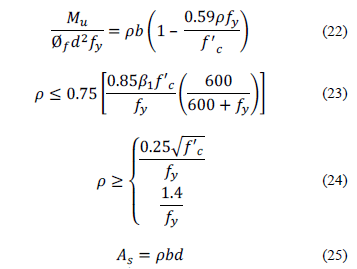
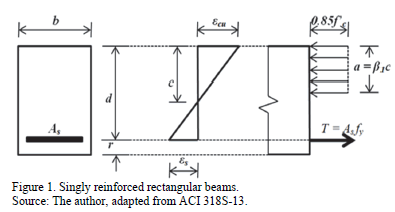
<body><![CDATA[<p><img src="/img/revistas/dyna/v83n196/v83n196a19eq02.gif"></p>     <p><font size="2" face="Verdana, Arial, Helvetica, sans-serif">where: <i>x </i>is the vector of design variables, <i>F(x<sub>1</sub>, x<sub>2</sub>… x<sub>n</sub>) </i>is the objective   function to be minimized,<i> h<sub>j</sub></i>(<i>x</i>) is the behavioral   constraint, and <i>x<sub>i</sub></i><sup>k </sup>and <i>x<sub>i</sub><sup>s</sup></i>are the lower and the upper bounds of typical design variable <i>x<sub>i</sub></i>.</font></p>     <p><font size="2" face="Verdana, Arial, Helvetica, sans-serif"><b><i>2.2. Problem formulation</i></b></font></p>     <p><font size="2" face="Verdana, Arial, Helvetica, sans-serif">The goal of   optimization is to find the best solution amongst a set of candidate solutions,   using efficient quantitative methods. In beam design, the decision variables   represent the quantities to be determined, and a set of decision variable   values constitutes a candidate solution. An objective function, which is either   maximized or minimized, expresses the goal, or performance criterion, in terms   of decision variables. The set of allowable solutions and, hence, the objective   function value, is constrained by factors that govern the beam design.</font></p>     <p><font size="2" face="Verdana, Arial, Helvetica, sans-serif"><a href="#fig01">Fig. 1</a> shows the geometry of a typical   single reinforced rectangular section with a simplified rectangular stress   block, as provided in the ACI Code &#91;29-31&#93;.</font></p>     <p align="center"><font size="2" face="Verdana, Arial, Helvetica, sans-serif"><a name="fig01"></a></font><img src="/img/revistas/dyna/v83n196/v83n196a19fig01.gif"></p>     <p><font size="2" face="Verdana, Arial, Helvetica, sans-serif">The following factors are defined for a   given problem:</font></p>     <p><img src="/img/revistas/dyna/v83n196/v83n196a19eq03.gif"></p>     <p><font size="2" face="Verdana, Arial, Helvetica, sans-serif">where: <i>h</i> is total depth, <i>d</i> is effective depth, and <i>r</i> is   coating.</font></p>     <p><font size="2" face="Verdana, Arial, Helvetica, sans-serif">In eq. (2), <i>h</i> (the geometric property) is a function of the effective depth, <i>d</i> is variable, and the coating <i>r</i> is constant.</font></p>     ]]></body>
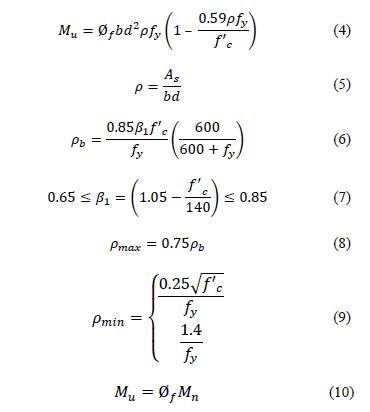
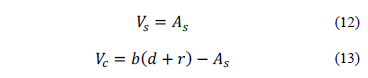
<body><![CDATA[<p><font size="2" face="Verdana, Arial, Helvetica, sans-serif">When a rectangular beam section is   designed, the nominal bending moment <i>M<sub>n</sub></i>,   with a cross section width <i>b</i> or   effective depth <i>d</i>, and material   properties <i>f'<sub>c</sub></i> and <i>f<sub>y</sub></i> are generally given.</font></p>     <p><font size="2" face="Verdana, Arial, Helvetica, sans-serif">The equations given in the ACI Code   &#91;29-31&#93; are:</font></p>     <p><img src="/img/revistas/dyna/v83n196/v83n196a19eq0410.gif"></p>     <p><font size="2" face="Verdana, Arial, Helvetica, sans-serif">where: <i>M<sub>u</sub></i> is the factored maximum moment,<i> Ø<sub>f</sub></i>is   the strength reduction factor by bending, with value 0.90,<i> <font face="Symbol">r</font></i> is ratio   of <i>A<sub>s</sub></i>to <i>bd, <font face="Symbol">b</font><sub>1</sub></i>is the factor relating the depth of the equivalent   rectangular compressive stress block to neutral axis depth,<i> f<sub>y</sub></i> is the specified yield strength of reinforcement of   steel, <i>f'<sub>c</sub></i> is the   specified compressive strength of concrete at 28 days, and <i>M<sub>n</sub></i> is the nominal bending moment.</font></p>     <p><font size="2" face="Verdana, Arial, Helvetica, sans-serif"><b>2.2.1.1. Objective function: cost minimization</b></font></p>     <p><font size="2" face="Verdana, Arial, Helvetica, sans-serif">A cost function is defined as the total   cost <i>C<sub>t</sub></i>, which is equal to   the cost of flexural reinforcement <i>C<sub>s</sub></i>,   plus the cost of concrete, <i>C<sub>c</sub></i>.   These costs involve material and fabrication costs, respectively. The costs   refer to the unit costs of reinforcement steel and concrete for a given unit   volume. The cost of the beam of a unit length is:</font></p>     <p><img src="/img/revistas/dyna/v83n196/v83n196a19eq11.gif"></p>     <p><font size="2" face="Verdana, Arial, Helvetica, sans-serif">where: <i>V<sub>s</sub></i> is volume of reinforcement steel and <i>V<sub>c</sub></i> is volume of concrete per   unit length of beam. These equations are:</font></p>     <p><img src="/img/revistas/dyna/v83n196/v83n196a19eq1213.gif"></p>     <p><font size="2" face="Verdana, Arial, Helvetica, sans-serif">Substituting eq. (12) and (13) into eq.   (11) produces the following equation:</font></p>     ]]></body>
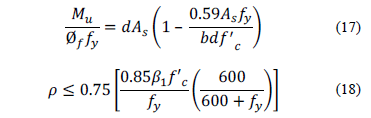
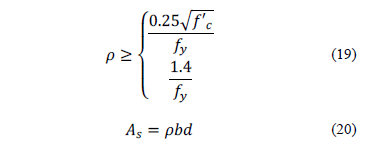
<body><![CDATA[<p><img src="/img/revistas/dyna/v83n196/v83n196a19eq14.gif"></p>     <p><font size="2" face="Verdana, Arial, Helvetica, sans-serif">If we consider <i><font face="Symbol">a</font> = C<sub>s</sub> /C<sub>c</sub></i> and this is substituted into eq. (14) produces   the following equation:</font></p>     <p><img src="/img/revistas/dyna/v83n196/v83n196a19eq15.gif"></p>     <p><font size="2" face="Verdana, Arial, Helvetica, sans-serif"><b>2.2.1. Case 1</b></font></p>     <p><font size="2" face="Verdana, Arial, Helvetica, sans-serif">Assuming   that the constant parameters are:<i> M<sub>u</sub></i>, <i>b</i>, <i>f'<sub>c</sub></i> and <i>f<sub>y</sub></i></font></p>     <p><font size="2" face="Verdana, Arial, Helvetica, sans-serif">then the design variables are: <i><font face="Symbol">r</font>, A<sub>s</sub></i> and <i>d</i>.</font></p>     <p><font size="2" face="Verdana, Arial, Helvetica, sans-serif">The objective function to minimize is:</font></p>     <p><img src="/img/revistas/dyna/v83n196/v83n196a19eq16.gif"></p>     <p><font size="2" face="Verdana, Arial, Helvetica, sans-serif">subject to: </font></p>     <p><img src="/img/revistas/dyna/v83n196/v83n196a19eq1718.gif"></p>     ]]></body>
<body><![CDATA[<p><img src="/img/revistas/dyna/v83n196/v83n196a19eq1920.gif"></p>     <p><font size="2" face="Verdana, Arial, Helvetica, sans-serif"><b>2.2.1.2. Case 2</b></font></p>     <p><font size="2" face="Verdana, Arial, Helvetica, sans-serif">Now assume   that the constant parameters are:<i> M<sub>u</sub></i>, <i>d</i>, <i>f'<sub>c</sub></i> and <i>f<sub>y</sub></i>.</font></p>     <p><font size="2" face="Verdana, Arial, Helvetica, sans-serif">The design variables are: <i><font face="Symbol">r</font>, A<sub>s</sub></i>and <i>b</i>.</font></p>     <p><font size="2" face="Verdana, Arial, Helvetica, sans-serif">The objective function to minimize is:</font></p>     <p><img src="/img/revistas/dyna/v83n196/v83n196a19eq21.gif"></p>     <p><font size="2" face="Verdana, Arial, Helvetica, sans-serif">subject to: </font></p>     <p><img src="/img/revistas/dyna/v83n196/v83n196a19eq2225.gif"></p>     <p><font size="2" face="Verdana, Arial, Helvetica, sans-serif"><b>2.2.2. Objective: function to minimize the weight</b></font></p>     <p><font size="2" face="Verdana, Arial, Helvetica, sans-serif">A weight function is defined as total   weight, <i>W<sub>t</sub></i>, which is equal   to the weight of flexural reinforcement, <i>W<sub>s</sub></i>,   plus the weight of concrete, <i>W<sub>c</sub></i>.   These weights record only the weight of materials; they refer to the unit   weights of reinforcement steel and concrete for a given unit volume. The weight   of the beam of a unit length is:</font></p>     ]]></body>
<body><![CDATA[<p><img src="/img/revistas/dyna/v83n196/v83n196a19eq26.gif"></p>     <p><font size="2" face="Verdana, Arial, Helvetica, sans-serif">Substituting eq. (12) and (13) into eq.   (26) produces:</font></p>     <p><img src="/img/revistas/dyna/v83n196/v83n196a19eq27.gif"></p>     <p><font size="2" face="Verdana, Arial, Helvetica, sans-serif">If we consider <i><font face="Symbol">g</font> = W<sub>s</sub>/W<sub>c</sub></i> and it is substituted into eq. (27) the   result is as follows:</font></p>     <p><img src="/img/revistas/dyna/v83n196/v83n196a19eq28.gif"></p>     <p><font size="2" face="Verdana, Arial, Helvetica, sans-serif"><b>2.2.2.1. Case 3</b></font></p>     <p><font size="2" face="Verdana, Arial, Helvetica, sans-serif">Now assume   that the constant parameters are:<i> M<sub>u</sub>,   b, f'<sub>c</sub></i>and <i>f<sub>y</sub></i>.</font></p>     <p><font size="2" face="Verdana, Arial, Helvetica, sans-serif">The design variables are: <i><font face="Symbol">r</font>,   A<sub>s</sub></i> and <i>d</i>.</font></p>     <p><font size="2" face="Verdana, Arial, Helvetica, sans-serif">The objective function to minimize is: </font></p>     <p><img src="/img/revistas/dyna/v83n196/v83n196a19eq29.gif"></p>     ]]></body>
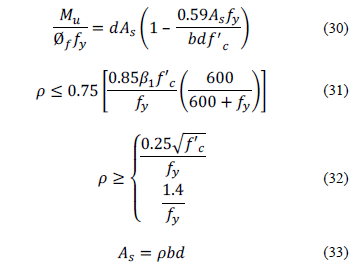
<body><![CDATA[<p><font size="2" face="Verdana, Arial, Helvetica, sans-serif">subject to: </font></p>     <p><img src="/img/revistas/dyna/v83n196/v83n196a19eq3033.gif"></p>     <p><font size="2" face="Verdana, Arial, Helvetica, sans-serif"><b>2.2.2.2. Case 4</b></font></p>     <p><font size="2" face="Verdana, Arial, Helvetica, sans-serif">Now assume   that the constant parameters are:<i> M<sub>u</sub></i>, <i>d</i>, <i>f'<sub>c</sub></i> and <i>f<sub>y</sub></i>.</font></p>     <p><font size="2" face="Verdana, Arial, Helvetica, sans-serif">The design variables are: <i><font face="Symbol">r</font>, A<sub>s</sub></i> and <i>b</i>.</font></p>     <p><font size="2" face="Verdana, Arial, Helvetica, sans-serif">The objective function to minimize is:</font></p>     <p><img src="/img/revistas/dyna/v83n196/v83n196a19eq34.gif"></p>     <p><font size="2" face="Verdana, Arial, Helvetica, sans-serif">subject to: </font></p>     <p><img src="/img/revistas/dyna/v83n196/v83n196a19eq3538.gif"></p>     <p><font size="2" face="Verdana, Arial, Helvetica, sans-serif">MAPLE 14 software, designed to solve the   optimization problem, was used to assess the optimal design with respect to minimum   cost and minimum weight of reinforced rectangular concrete beams for singly   reinforced sections.</font></p>     ]]></body>
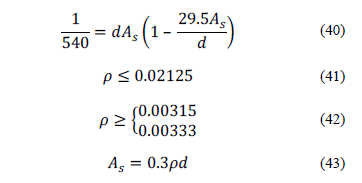
<body><![CDATA[<p>&nbsp;</p>     <p><font size="3" face="Verdana, Arial, Helvetica, sans-serif"><b>3. Numerical Problems</b></font></p>     <p><font size="2" face="Verdana, Arial, Helvetica, sans-serif"><b><i>3.1. Case Example 1</i></b></font></p>     <p><font size="2" face="Verdana, Arial, Helvetica, sans-serif">A   rectangular beam section with <i>b </i>= 30 <i>cm </i>is given. Values must be determined   for the optimum ratio of the reinforcement steel, <i><font face="Symbol">r</font>,</i> its optimum   area, <i>A<sub>s</sub>, </i>and the optimum effective depth, <i>d</i>, for <i>M<sub>u</sub> = </i>700 <i>kN-m</i>, <i>f'<sub>c</sub> = </i>28 <i>MPa </i>and <i>f<sub>y</sub> = </i>420 <i>MPa</i>. It is assumed that <i>r = </i>4 <i>cm</i>, and the ratio of   reinforcement steel cost to concrete cost is:<i> <font face="Symbol">a</font> </i>= 90.</font></p>     <p><font size="2" face="Verdana, Arial, Helvetica, sans-serif">Substituting   the corresponding values into eq. (16) in order to obtain the objective   function, and into eq. (17)-(20) to find the constraints, produces: </font></p>     <p><font size="2" face="Verdana, Arial, Helvetica, sans-serif">Minimize: </font></p>     <p><img src="/img/revistas/dyna/v83n196/v83n196a19eq39.gif"></p>     <p><font size="2" face="Verdana, Arial, Helvetica, sans-serif">subject to:</font></p>     <p><img src="/img/revistas/dyna/v83n196/v83n196a19eq4043.gif"></p>     <p><font size="2" face="Verdana, Arial, Helvetica, sans-serif">The optimal solution is:</font></p>     ]]></body>
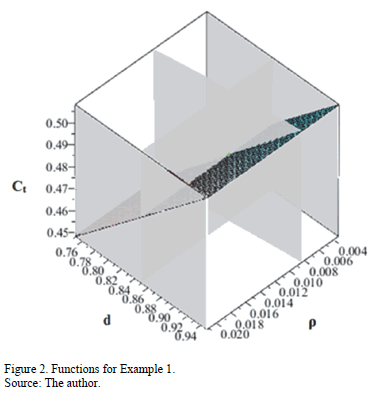
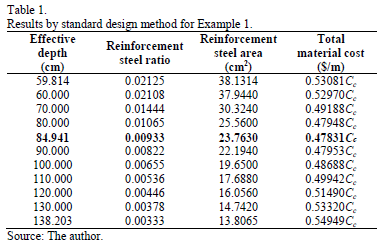
<body><![CDATA[<blockquote>       <p><font size="2" face="Verdana, Arial, Helvetica, sans-serif"><i>C<sub>t</sub> = </i>0.47831<i>C<sub>c    <br>     </sub></i></font><font size="2" face="Verdana, Arial, Helvetica, sans-serif"><i>A<sub>s</sub> = </i>0.0023763<i> m<sup>2</sup> = </i>23.763<i> cm<sup>2    <br>     </sup></i></font><font size="2" face="Verdana, Arial, Helvetica, sans-serif"><i>d = </i>0.84941<i> m = </i>84.941<i> cm    <br>     </i></font><font size="2" face="Verdana, Arial, Helvetica, sans-serif"><i><font face="Symbol">r</font> = </i>0.00933</font></p> </blockquote>     <p><font size="2" face="Verdana, Arial, Helvetica, sans-serif"><a href="#fig02">Fig. 2</a> presents the plot of the objective   function and the constraint functions.</font></p>     <p align="center"><font size="2" face="Verdana, Arial, Helvetica, sans-serif"><a name="fig02"></a></font><img src="/img/revistas/dyna/v83n196/v83n196a19fig02.gif"></p>     <p><font size="2" face="Verdana, Arial, Helvetica, sans-serif">Example 1 is developed by employing the   standard design method, using eq.s (4)-(10). The results are presented in <a href="#tab01">Table   1</a>. It may be seen from this table that the derived optimum design formulae for   singly reinforced sections give an accurate estimate of the minimum material   cost.</font></p>     <p align="center"><font size="2" face="Verdana, Arial, Helvetica, sans-serif"><a name="tab01"></a></font><img src="/img/revistas/dyna/v83n196/v83n196a19tab01.gif"></p>     <p><font size="2" face="Verdana, Arial, Helvetica, sans-serif"><b><i>3.2. Case Example 2</i></b></font></p>     ]]></body>
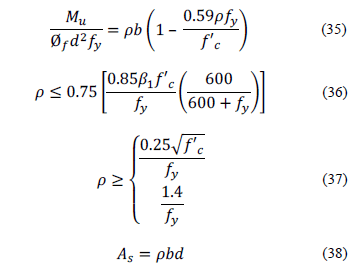
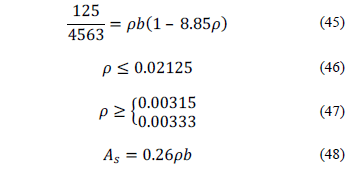
<body><![CDATA[<p><font size="2" face="Verdana, Arial, Helvetica, sans-serif">A rectangular beam section, effective   depth <i>d </i>= 26 <i>cm, </i>giving a total depth of <i>h</i> = 30 <i>cm</i> is given. Values must   be determined for the optimum ratio of reinforcement steel <i><font face="Symbol">r</font>,</i> its optimum area, <i>A<sub>s</sub>, </i>and   its optimum width b, for <i>M<sub>u</sub> = </i>700 <i>kN-m</i>, <i>f'<sub>c</sub> = </i>28 <i>MPa </i>and <i>f<sub>y</sub> = </i>420 <i>MPa</i>. It is assumed   that <i>r = </i>4 <i>cm</i>, and the ratio of reinforcement steel cost to   concrete cost is:<i> <font face="Symbol">a</font> </i>= 90.</font></p>     <p><font size="2" face="Verdana, Arial, Helvetica, sans-serif">Substituting the corresponding values into   eq. (21) in order to obtain the objective function and into eq.s (22)-(25) to   find the constraints results in the following:</font></p>     <p><font size="2" face="Verdana, Arial, Helvetica, sans-serif">Minimize: </font></p>     <p><img src="/img/revistas/dyna/v83n196/v83n196a19eq44.gif"></p>     <p><font size="2" face="Verdana, Arial, Helvetica, sans-serif">subject to:</font></p>     <p><img src="/img/revistas/dyna/v83n196/v83n196a19eq4548.gif"></p>     <p><font size="2" face="Verdana, Arial, Helvetica, sans-serif">The optimal solution is:</font></p>     <blockquote>       <p><font size="2" face="Verdana, Arial, Helvetica, sans-serif">C<sub>t</sub> = 1.25705C<sub>c    <br>     </sub></font><font size="2" face="Verdana, Arial, Helvetica, sans-serif">A<sub>s</sub> = 0.00877 m<sup>2</sup> = 87.7 cm<sup>2    ]]></body>
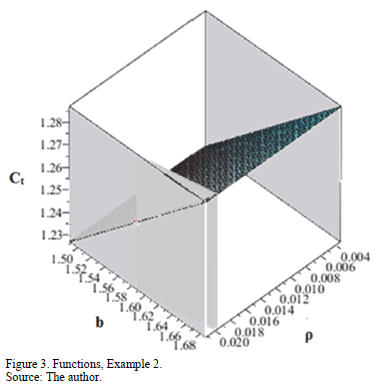
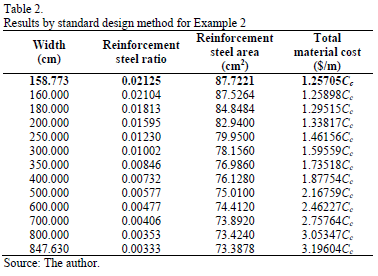
<body><![CDATA[<br>     </sup></font><font size="2" face="Verdana, Arial, Helvetica, sans-serif">b     = 1.58773 m = 158.773 cm    <br>     </font><font size="2" face="Verdana, Arial, Helvetica, sans-serif"><font face="Symbol">r</font> = 0.02125</font></p> </blockquote>     <p><font size="2" face="Verdana, Arial, Helvetica, sans-serif"><a href="#fig03">Fig. 3</a> plots the objective function and   the constraint functions.</font></p>     <p align="center"><font size="2" face="Verdana, Arial, Helvetica, sans-serif"><a name="fig03"></a></font><img src="/img/revistas/dyna/v83n196/v83n196a19fig03.gif"></p>     <p><font size="2" face="Verdana, Arial, Helvetica, sans-serif">Example 2 is developed by employing the   standard design method, using eq. (4)-(10). The results are presented in <a href="#tab02">Table   2</a>. This table also shows the derived optimum design formulae for singly   reinforced sections, giving an accurate estimate of the minimum material cost.</font></p>     <p align="center"><font size="2" face="Verdana, Arial, Helvetica, sans-serif"><a name="tab02"></a></font><img src="/img/revistas/dyna/v83n196/v83n196a19tab02.gif"></p>     <p><font size="2" face="Verdana, Arial, Helvetica, sans-serif"><b><i>3.3. Case Example 3</i></b></font></p>     <p><font size="2" face="Verdana, Arial, Helvetica, sans-serif">A   rectangular beam section with <i>b </i>= 30 <i>cm </i>is given. Values must be   determined for the optimum ratio of reinforcement steel <i><font face="Symbol">r</font>,</i> its   optimum area, <i>A<sub>s</sub></i>, and   the optimum effective depth, <i>d</i>, for <i>M<sub>u</sub> = </i>700 <i>kN-m</i>, <i>f'<sub>c</sub> = </i>28 <i>MPa </i>and <i>f<sub>y</sub> = </i>420 <i>MPa</i>.   It is assumed that <i>r = </i>4 <i>cm</i>,   and the ratio of reinforcement steel   weight to concrete weight is:<i> <font face="Symbol">g</font> </i>= 3.</font></p>     <p><font size="2" face="Verdana, Arial, Helvetica, sans-serif">Substituting   the corresponding values into eq. (29) in order to obtain the objective   function and also into eq.s (30)-(33) to find the constraints results in the   following:</font></p>     <p><font size="2" face="Verdana, Arial, Helvetica, sans-serif">Minimize: </font></p>     ]]></body>
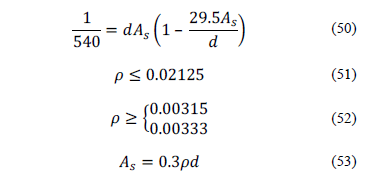
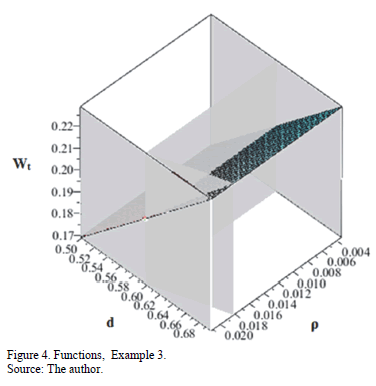
<body><![CDATA[<p><img src="/img/revistas/dyna/v83n196/v83n196a19eq49.gif"></p>     <p><font size="2" face="Verdana, Arial, Helvetica, sans-serif">subject to:</font></p>     <p><img src="/img/revistas/dyna/v83n196/v83n196a19eq5053.gif"></p>     <p><font size="2" face="Verdana, Arial, Helvetica, sans-serif">The optimal solution is:</font></p>     <blockquote>       <p><font size="2" face="Verdana, Arial, Helvetica, sans-serif"><i>W<sub>t</sub> = </i>0.19907<i>W<sub>c    <br>     </sub></i></font><font size="2" face="Verdana, Arial, Helvetica, sans-serif"><i>A<sub>s</sub> = </i>0.00381<i> m<sup>2</sup> = </i>38.1<i> cm<sup>2    <br>     </sup></i></font><font size="2" face="Verdana, Arial, Helvetica, sans-serif"><i>d = </i>0.59814<i> m = </i>59.814<i> cm    <br>     </i></font><font size="2" face="Verdana, Arial, Helvetica, sans-serif"><i><font face="Symbol">r</font> = </i>0.02125</font></p> </blockquote>     <p><font size="2" face="Verdana, Arial, Helvetica, sans-serif"><a href="#fig04">Fig. 4</a> presents the plot of the objective   function and the constraint functions.</font></p>     ]]></body>
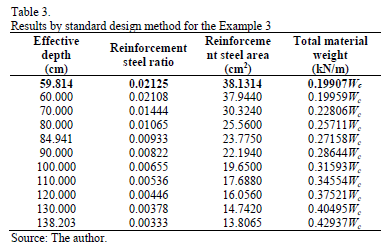
<body><![CDATA[<p align="center"><font size="2" face="Verdana, Arial, Helvetica, sans-serif"><a name="fig04"></a></font><img src="/img/revistas/dyna/v83n196/v83n196a19fig04.gif"></p>     <p><font size="2" face="Verdana, Arial, Helvetica, sans-serif">Example 3 employs the standard design   method using eq.s (4)-(10). The results are presented in <a href="#tab03">Table 3</a>. It is apparent</font> <font size="2" face="Verdana, Arial, Helvetica, sans-serif">from this table   that the derived optimum design formulae for singly reinforced sections give an   accurate estimate of minimum material weight.</font></p>     <p align="center"><font size="2" face="Verdana, Arial, Helvetica, sans-serif"><a name="tab03"></a></font><img src="/img/revistas/dyna/v83n196/v83n196a19tab03.gif"></p>     <p><font size="2" face="Verdana, Arial, Helvetica, sans-serif"><b><i>3.4. Case Example 4</i></b></font></p>     <p><font size="2" face="Verdana, Arial, Helvetica, sans-serif">A rectangular beam section of effective depth <i>d </i>= 26 <i>cm </i>is   given. Values must be determined for the optimum ratio of reinforcement steel <i><font face="Symbol">r</font> </i>and its optimum width b, for <i>M<sub>u</sub> = </i>700 <i>kN-m</i>, <i>f'<sub>c</sub> = </i>28 <i>MPa </i>and <i>f<sub>y</sub> = </i>420 <i>MPa</i>. It is assumed   that <i>r = </i>4 <i>cm</i>, and the ratio of reinforcement steel weight to   concrete weight is:<i> <font face="Symbol">g</font> = 3</i>.</font></p>     <p><font size="2" face="Verdana, Arial, Helvetica, sans-serif">Substituting   the corresponding values into eq. (34) in order to obtain the objective   function and also into eq.s (35)-(38) to find the constraints results in the   following:</font></p>     <p><font size="2" face="Verdana, Arial, Helvetica, sans-serif">Minimize: </font></p>     <p><img src="/img/revistas/dyna/v83n196/v83n196a19eq54.gif"></p>     <p><font size="2" face="Verdana, Arial, Helvetica, sans-serif">subject to:</font></p>     <p><img src="/img/revistas/dyna/v83n196/v83n196a19eq5558.gif"></p>     ]]></body>
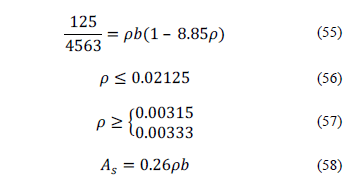
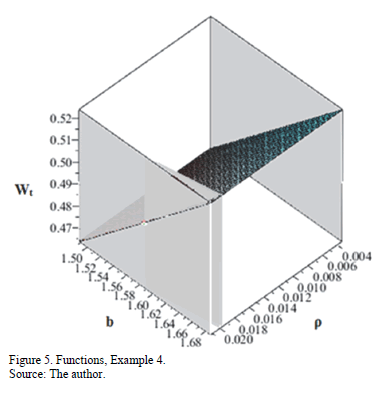
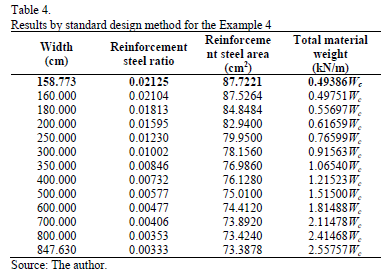
<body><![CDATA[<p><font size="2" face="Verdana, Arial, Helvetica, sans-serif">The optimal solution is:</font></p>     <blockquote>       <p><font size="2" face="Verdana, Arial, Helvetica, sans-serif"><i>W<sub>t</sub> = </i>0.49386<i>W<sub>c    <br>     </sub></i></font><font size="2" face="Verdana, Arial, Helvetica, sans-serif"><i>A<sub>s</sub> = </i>0.00877<i> m<sup>2</sup> = </i>87.7<i> cm<sup>2    <br>     </sup></i></font><font size="2" face="Verdana, Arial, Helvetica, sans-serif"><i>b = </i>1.58773<i> m = </i>158.773<i> cm    <br>     </i></font><font size="2" face="Verdana, Arial, Helvetica, sans-serif"><i><font face="Symbol">r</font> = </i>0.02125</font></p> </blockquote>     <p><font size="2" face="Verdana, Arial, Helvetica, sans-serif"><a href="#fig05">Fig. 5</a> displays the plot of the objective   function and the constraint functions.</font></p>     <p align="center"><font size="2" face="Verdana, Arial, Helvetica, sans-serif"><a name="fig05"></a></font><img src="/img/revistas/dyna/v83n196/v83n196a19fig05.gif"></p>     <p><font size="2" face="Verdana, Arial, Helvetica, sans-serif">Example 4 employs the standard design   method using eq.s (4)-(10). The results are presented in <a href="#tab04">Table 4</a>. It is   apparent from this table that the derived optimum design formulae for singly   reinforced sections give an accurate estimate of minimum material weight.</font></p>     <p align="center"><font size="2" face="Verdana, Arial, Helvetica, sans-serif"><a name="tab04"></a></font><img src="/img/revistas/dyna/v83n196/v83n196a19tab04.gif"></p>     ]]></body>
<body><![CDATA[<p>&nbsp;</p>     <p><font size="3" face="Verdana, Arial, Helvetica, sans-serif"><b>4. Results </b></font></p>     <p><font size="2" face="Verdana, Arial, Helvetica, sans-serif"><a href="#tab01">Table 1</a> presents the results, using the   standard design method for Case Example 1. The constant parameters are:<i> M<sub>u</sub>, b, f'<sub>c</sub></i>and <i>f<sub>y</sub></i>. The design variables are: <i><font face="Symbol">r</font>, A<sub>s</sub></i> and <i>d</i>. The ranges considered vary from the   minimum ratio of reinforcement steel, <i><font face="Symbol">r</font><sub>min</sub></i>,   and the maximum ratio,<i> <font face="Symbol">r</font><sub>max</sub></i>,   allowing the variation of the effective depth, <i>d</i>, reinforcement steel area, <i>A<sub>s</sub></i>, and the total material cost, <i>C<sub>t</sub></i>, to be observed. The   corresponding total material cost, <i>C<sub>t</sub></i>,   of the beam per unit length is then obtained from eq. (39), its minimum value   being 0.47842<i>C<sub>c</sub></i> $/m (in   terms of the concrete cost per unit volume). Consequently, the results obtained   by employing the standard design method and optimal design are equal. </font></p>     <p><font size="2" face="Verdana, Arial, Helvetica, sans-serif"><a href="#tab02">Table 2</a> presents the results using the   standard design method for Case Example 2. The constant parameters are:<i> M<sub>u</sub>, d, f'<sub>c</sub></i>and <i>f<sub>y</sub></i>. The design variables are: <i><font face="Symbol">r</font>, A<sub>s</sub></i> and <i>b</i>. The ranges considered vary between   the minimum ratio of reinforcement steel, <i><font face="Symbol">r</font><sub>min</sub></i>,   and the maximum ratio,<i> <font face="Symbol">r</font><sub>max</sub></i>,   allowing the variation of the effective depth, <i>d</i>, reinforcement steel area, <i>A<sub>s</sub></i>, and the total material cost, <i>C<sub>t</sub></i>, to be observed. The   corresponding total material cost of the beam per unit length, Ct, is then   obtained from eq. (44) and found to be 1.25705<i>C<sub>c</sub></i> $/m as its minimum value (in terms of the concrete   cost per unit volume). This value corresponds to the maximum ratio of reinforcement steel<i> <font face="Symbol">r</font><sub>max</sub></i>. Thus, the results   presented by employing the standard design method and optimal design are equal.</font></p>     <p><font size="2" face="Verdana, Arial, Helvetica, sans-serif"><a href="#tab03">Table 3</a> shows the results using the   standard design method for case Example 3. The constant parameters are:<i> M<sub>u</sub>, b, f'<sub>c</sub></i>and <i>f<sub>y</sub></i>. The design variables are: <i><font face="Symbol">r</font>, A<sub>s</sub></i> and <i>d</i>. The ranges considered vary between   the minimum ratio of reinforcement steel, <i><font face="Symbol">r</font><sub>min</sub></i>,   and the maximum ratio,<i> <font face="Symbol">r</font><sub>max</sub></i>,   allowing the variation of the effective depth, <i>d</i>, reinforcement steel area, <i>A<sub>s</sub></i>, and the total material weight, <i>W<sub>t</sub></i>, to be observed. The   corresponding total material weight <i>W<sub>t</sub></i> of the beam per unit length is then obtained from eq. (49) and found to be   0.19907<i>W<sub>c</sub></i> kN/m as its   minimum value (in terms of the concrete weight per unit volume). This value   corresponds to the maximum ratio of   reinforcement steel<i> <font face="Symbol">r</font><sub>max</sub></i>.   Thus, the results presented by employing the standard design method and optimal   design are equal. </font></p>     <p><font size="2" face="Verdana, Arial, Helvetica, sans-serif"><a href="#tab04">Table 4</a> presents the results using the   standard design method for case Example 4. The constant parameters are:<i> M<sub>u</sub>, d, f'<sub>c</sub></i>and <i>f<sub>y</sub></i>. The design variables are: <i><font face="Symbol">r</font>, A<sub>s</sub></i> and <i>b</i>. The ranges considered vary between   the minimum ratio of reinforcement steel, <i><font face="Symbol">r</font><sub>min</sub></i>,   and the maximum ratio,<i> <font face="Symbol">r</font><sub>max</sub></i>,   allowing the variation of the effective depth, <i>d</i>, reinforcement steel area, <i>A<sub>s</sub></i>, and the total material weight <i>W<sub>t</sub></i>. The corresponding total material weight <i>W<sub>t</sub></i> of the beam per unit   length is then obtained from eq. (54) and found to be 0.49386<i>W<sub>c</sub></i> kN/m as its minimum value   (in terms of the concrete weight per unit volume). This value corresponds to the maximum ratio of reinforcement steel<i> <font face="Symbol">r</font><sub>max</sub></i>. Thus, the results   presented by employing the standard design method and optimal design are equal.</font></p>     <p><font size="2" face="Verdana, Arial, Helvetica, sans-serif">Therefore, the derived optimum design   formulae for singly reinforced sections give a very accurate estimate of the   minimum cost and minimum weight for the four Representative examples.</font></p>     <p>&nbsp;</p>     <p><font size="3" face="Verdana, Arial, Helvetica, sans-serif"><b>5. Conclusions </b></font></p>     <p><font size="2" face="Verdana, Arial, Helvetica, sans-serif">This study dealt with the design of   minimum cost (Cases 1 and 2) and minimum weight (Cases 3 and 4) reinforced   rectangular concrete beams for singly reinforced sections. An analytical   approach to the problem, based on a criterion of minimum cost and minimum   weight design, plus a set of constraints that comply with building code   requirements for structural concrete (ACI 318S-13), including the comments on   the standards, was formulated. Cases 1 and 3 assume that the constant   parameters are:<i> M<sub>u</sub></i>, <i>b</i>, <i>f'<sub>c</sub></i> and <i>f<sub>y</sub></i>, and that the design variables are <i><font face="Symbol">r</font>, A<sub>s</sub></i> and <i>d</i>. Cases 2 and 4 imply that the constant parameters are:<i> M<sub>u</sub></i>, <i>d</i>, <i>f'<sub>c</sub></i> and <i>f<sub>y</sub></i>, and that the design   variables are <i><font face="Symbol">r</font>, A<sub>s</sub></i> and <i>b</i>.</font></p>     ]]></body>
<body><![CDATA[<p><font size="2" face="Verdana, Arial, Helvetica, sans-serif">The standard design method (classical   method) generally uses the maximum ratio of reinforcement steel to obtain the   cross-section of the beam.</font></p>     <p><font size="2" face="Verdana, Arial, Helvetica, sans-serif">The research reported in this paper concludes   as follows:</font></p> <ul>       <li><font size="2" face="Verdana, Arial, Helvetica, sans-serif"> Case     1: The optimum steel ratio is usually smaller than maximum ratio, <i><font face="Symbol">r</font><sub>max</sub></i>, and greater than     minimum ratio, <i><font face="Symbol">r</font><sub>min</sub></i>.</font></li>       <li><font size="2" face="Verdana, Arial, Helvetica, sans-serif"> Cases 2, 3 and 4: The optimum     steel ratio is equal to the maximum ratio <i><font face="Symbol">r</font><sub>max</sub></i>.</font></li>       <li><font size="2" face="Verdana, Arial, Helvetica, sans-serif"> According to Case 1 the optimum     section is very economical compared to other sections that may be obtained using     the standard design method.</font></li>       <li><font size="2" face="Verdana, Arial, Helvetica, sans-serif"> The procedure developed as a     result of this research can serve as the basis for designing reinforced     concrete beams, while a structure designed using the optimum section will not necessarily     provide an optimum design for the entire structure in terms of material costs.</font></li>     </ul>     <p><font size="2" face="Verdana, Arial, Helvetica, sans-serif">Using the optimal design for Case 1, this   paper successfully developed a model to predict the reinforcement steel ratio   and lowest cost of reinforced rectangular concrete beams for singly reinforced   sections</font></p>     <p><font size="2" face="Verdana, Arial, Helvetica, sans-serif">Suggested future research includes: 1)   Optimal design of other types of structural members for reinforced concrete and   structural steel; 2) Optimum design for whole structures.</font></p>     <p>&nbsp;</p>     ]]></body>
<body><![CDATA[<p><font size="3" face="Verdana, Arial, Helvetica, sans-serif"><b>References</b></font></p>     <!-- ref --><p><font size="2" face="Verdana, Arial, Helvetica, sans-serif"><b>&#91;1&#93;</b> Saini, B., Sehgala, V.K. and   Gambhir, M.L., Genetically optimized artificial neural network based optimum   design of singly and doubly reinforced concrete beams, Asian Journal of Civil   Engineering (Building and Housing),   &#91;Online&#93;. 7(6), pp. 603-619, 2006. Available at: <a href="http://citeseerx.ist.psu.edu/viewdoc/download?doi=10.1.1.133.2193&rep=rep1&type=pdf" target="_blank">http://citeseerx.ist.psu.edu/viewdoc/download?doi=10.1.1.133.2193&amp;rep=rep1&amp;type=pdf</a></font>&nbsp;&nbsp;&nbsp;&nbsp;&nbsp;&nbsp;&nbsp;&nbsp;[&#160;<a href="javascript:void(0);" onclick="javascript: window.open('/scielo.php?script=sci_nlinks&ref=1155268&pid=S0012-7353201600020001900001&lng=','','width=640,height=500,resizable=yes,scrollbars=1,menubar=yes,');">Links</a>&#160;]<!-- end-ref --><!-- ref --><p><font size="2" face="Verdana, Arial, Helvetica, sans-serif"><b>&#91;2&#93;</b> Yousif, S.T., ALsaffar, I.S.   and Ahmed, S.M., Optimum design of singly and doubly reinforced concrete   rectangular beam sections: Artificial neural networks application, Iraqi   Journal of Civil Engineering, &#91;Online&#93;. 6(3), pp. 1-19, 2010. Available at: <a href="http://www.iasj.net/iasj?func=fulltext&aId=14126" target="_blank">http://www.iasj.net/iasj?func=fulltext&amp;aId=14126</a></font>&nbsp;&nbsp;&nbsp;&nbsp;&nbsp;&nbsp;&nbsp;&nbsp;[&#160;<a href="javascript:void(0);" onclick="javascript: window.open('/scielo.php?script=sci_nlinks&ref=1155269&pid=S0012-7353201600020001900002&lng=','','width=640,height=500,resizable=yes,scrollbars=1,menubar=yes,');">Links</a>&#160;]<!-- end-ref --><!-- ref --><p><font size="2" face="Verdana, Arial, Helvetica, sans-serif"><b>&#91;3&#93;</b> Bhalchandra, S.A. and Adsul,   P.K., Cost optimization of doubly reinforced rectangular beam section, International   Journal of Modern Engineering Research, &#91;Online&#93;. 2(5), pp. 3939-3942, 2012.   Available at: <a href="http://www.ijmer.com/papers/Vol2_Issue5/FJ2539393942.pdf" target="_blank">http://www.ijmer.com/papers/Vol2_Issue5/FJ2539393942.pdf</a></font>&nbsp;&nbsp;&nbsp;&nbsp;&nbsp;&nbsp;&nbsp;&nbsp;[&#160;<a href="javascript:void(0);" onclick="javascript: window.open('/scielo.php?script=sci_nlinks&ref=1155270&pid=S0012-7353201600020001900003&lng=','','width=640,height=500,resizable=yes,scrollbars=1,menubar=yes,');">Links</a>&#160;]<!-- end-ref --><!-- ref --><p><font size="2" face="Verdana, Arial, Helvetica, sans-serif"><b>&#91;4&#93;</b> Quimby, T.B., A Beginner's   guide to the structural engineering, Quimby &amp; Associates Consulting   Engineers, &#91;Online&#93;. 2012. Available at: <a href="http://www.bgstructuralengineering.com/BGSCM13_Sample.pdf" target="_blank">http://www.bgstructuralengineering.com/BGSCM13_Sample.pdf</a></font>&nbsp;&nbsp;&nbsp;&nbsp;&nbsp;&nbsp;&nbsp;&nbsp;[&#160;<a href="javascript:void(0);" onclick="javascript: window.open('/scielo.php?script=sci_nlinks&ref=1155271&pid=S0012-7353201600020001900004&lng=','','width=640,height=500,resizable=yes,scrollbars=1,menubar=yes,');">Links</a>&#160;]<!-- end-ref --><!-- ref --><p><font size="2" face="Verdana, Arial, Helvetica, sans-serif"><b>&#91;5&#93;</b> Manual of Steel Construction   LRFD (Load Resistance Factor Design), Structural Members Specifications &amp;   Codes, 3<sup>td</sup> Edition, AISC (American Institute Steel Construction),   2009.    &nbsp;&nbsp;&nbsp;&nbsp;&nbsp;&nbsp;&nbsp;&nbsp;[&#160;<a href="javascript:void(0);" onclick="javascript: window.open('/scielo.php?script=sci_nlinks&ref=1155272&pid=S0012-7353201600020001900005&lng=','','width=640,height=500,resizable=yes,scrollbars=1,menubar=yes,');">Links</a>&#160;]<!-- end-ref --></font></p>     <!-- ref --><p><font size="2" face="Verdana, Arial, Helvetica, sans-serif"><b>&#91;6&#93;</b> Ortiz-Pimiento,   N.R. y D&iacute;az-Serna, F.J., Validaci&oacute;n de soluciones obtenidas para el problema   del despacho hidrot&eacute;rmico de m&iacute;nimo costo empleando la programaci&oacute;n lineal   binaria mixta, DYNA, &#91;Online&#93;. 75(156), pp. 43-54, 2008. Available at: <a href="http://www.redalyc.org/articulo.oa?id=49612071005" target="_blank">http://www.redalyc.org/articulo.oa?id=49612071005</a></font>&nbsp;&nbsp;&nbsp;&nbsp;&nbsp;&nbsp;&nbsp;&nbsp;[&#160;<a href="javascript:void(0);" onclick="javascript: window.open('/scielo.php?script=sci_nlinks&ref=1155274&pid=S0012-7353201600020001900006&lng=','','width=640,height=500,resizable=yes,scrollbars=1,menubar=yes,');">Links</a>&#160;]<!-- end-ref --><!-- ref --><p><font size="2" face="Verdana, Arial, Helvetica, sans-serif"><b>&#91;7&#93;</b> Jaramillo-Alvarez, P.,   Gonzalez-Calderon, C.A. and Gonzalez-Calderon, G., Route optimization of urban   public transportation, DYNA, &#91;Online&#93;. 80(180), pp. 41-49, 2013. Available at: <a href="http://www.redalyc.org/articulo.oa?id=49627455007" target="_blank">http://www.redalyc.org/articulo.oa?id=49627455007</a></font>&nbsp;&nbsp;&nbsp;&nbsp;&nbsp;&nbsp;&nbsp;&nbsp;[&#160;<a href="javascript:void(0);" onclick="javascript: window.open('/scielo.php?script=sci_nlinks&ref=1155275&pid=S0012-7353201600020001900007&lng=','','width=640,height=500,resizable=yes,scrollbars=1,menubar=yes,');">Links</a>&#160;]<!-- end-ref --><!-- ref --><p><font size="2" face="Verdana, Arial, Helvetica, sans-serif"><b>&#91;8&#93;</b> Soto-de la Vega, D.,   Vidal-Vieira, J.G. and Vitor-Toso, E.A., Methodology for distribution centers   location through multicriteria analysis and optimization, DYNA, 81(184), pp.   28-35, 2014. DOI: 10.15446/dyna.v81n184.39654</font>&nbsp;&nbsp;&nbsp;&nbsp;&nbsp;&nbsp;&nbsp;&nbsp;[&#160;<a href="javascript:void(0);" onclick="javascript: window.open('/scielo.php?script=sci_nlinks&ref=1155276&pid=S0012-7353201600020001900008&lng=','','width=640,height=500,resizable=yes,scrollbars=1,menubar=yes,');">Links</a>&#160;]<!-- end-ref --><!-- ref --><p><font size="2" face="Verdana, Arial, Helvetica, sans-serif"><b>&#91;9&#93;</b> Santos-Azevedo, M.S.,   P&eacute;rez-Abril, I., Le&oacute;n-Ben&iacute;tez, C., Cabral-Leite, J. and Holanda-Bezerra, U.,   Multiobjective optimization of the reactive power compensation in electric   distribution systems, DYNA, 81(187), pp. 175-183, 2014. DOI: 10.15446/dyna.v81n187.40979</font>&nbsp;&nbsp;&nbsp;&nbsp;&nbsp;&nbsp;&nbsp;&nbsp;[&#160;<a href="javascript:void(0);" onclick="javascript: window.open('/scielo.php?script=sci_nlinks&ref=1155277&pid=S0012-7353201600020001900009&lng=','','width=640,height=500,resizable=yes,scrollbars=1,menubar=yes,');">Links</a>&#160;]<!-- end-ref --><!-- ref --><p><font size="2" face="Verdana, Arial, Helvetica, sans-serif"><b>&#91;10&#93;</b> Ha, T., Optimum design of   unstiffened built-up girders, Journal   of Structural Engineering, 119(9), pp. 2784-2792, 1993. DOI: 10.1061/(ASCE)0733-9445(1993)119:9(2784)</font>&nbsp;&nbsp;&nbsp;&nbsp;&nbsp;&nbsp;&nbsp;&nbsp;[&#160;<a href="javascript:void(0);" onclick="javascript: window.open('/scielo.php?script=sci_nlinks&ref=1155278&pid=S0012-7353201600020001900010&lng=','','width=640,height=500,resizable=yes,scrollbars=1,menubar=yes,');">Links</a>&#160;]<!-- end-ref --><!-- ref --><p><font size="2" face="Verdana, Arial, Helvetica, sans-serif"><b>&#91;11&#93;</b> Rath, D.P., Ahlawat, A.S. and   Ramaswamy, A., Shape optimization of rc flexural members, Journal of Structural   Engineering, 125(2), pp. 1439-1445, 1999. DOI: 10.1061/(ASCE)0733-9445(1999)125:12(1439)</font>&nbsp;&nbsp;&nbsp;&nbsp;&nbsp;&nbsp;&nbsp;&nbsp;[&#160;<a href="javascript:void(0);" onclick="javascript: window.open('/scielo.php?script=sci_nlinks&ref=1155279&pid=S0012-7353201600020001900011&lng=','','width=640,height=500,resizable=yes,scrollbars=1,menubar=yes,');">Links</a>&#160;]<!-- end-ref --><!-- ref --><p><font size="2" face="Verdana, Arial, Helvetica, sans-serif"><b>&#91;12&#93;</b> Ceranic, B. and Fryer, C.,   Sensitivity analysis and optimum design curves for the minimum cost design of   singly and doubly reinforced concrete beams, Structural and Multidisciplinary Optimization, 20, pp. 260- 268,   2000. DOI: 10.1007/s001580050156</font>&nbsp;&nbsp;&nbsp;&nbsp;&nbsp;&nbsp;&nbsp;&nbsp;[&#160;<a href="javascript:void(0);" onclick="javascript: window.open('/scielo.php?script=sci_nlinks&ref=1155280&pid=S0012-7353201600020001900012&lng=','','width=640,height=500,resizable=yes,scrollbars=1,menubar=yes,');">Links</a>&#160;]<!-- end-ref --><!-- ref --><p><font size="2" face="Verdana, Arial, Helvetica, sans-serif"><b>&#91;13&#93;</b> Jarmai, K., Snyman, J.A.,   Farkas, J. and Gondos, G., Optimal design of a welded I-section frame using   four conceptually different optimization algorithms, Structural and Multidisciplinary Optimization, 25, pp. 54- 61,   2003. DOI: 10.1007/s00158-002-0272-5</font>&nbsp;&nbsp;&nbsp;&nbsp;&nbsp;&nbsp;&nbsp;&nbsp;[&#160;<a href="javascript:void(0);" onclick="javascript: window.open('/scielo.php?script=sci_nlinks&ref=1155281&pid=S0012-7353201600020001900013&lng=','','width=640,height=500,resizable=yes,scrollbars=1,menubar=yes,');">Links</a>&#160;]<!-- end-ref --><!-- ref --><p><font size="2" face="Verdana, Arial, Helvetica, sans-serif"><b>&#91;14&#93;</b> Leps, M. and Sejnoha, M., New   approach to optimization of reinforced concrete beams, Computer and Structures,   81, pp. 1957-1966, 2003. DOI: 10.1016/S0045-7949(03)00215-3</font>&nbsp;&nbsp;&nbsp;&nbsp;&nbsp;&nbsp;&nbsp;&nbsp;[&#160;<a href="javascript:void(0);" onclick="javascript: window.open('/scielo.php?script=sci_nlinks&ref=1155282&pid=S0012-7353201600020001900014&lng=','','width=640,height=500,resizable=yes,scrollbars=1,menubar=yes,');">Links</a>&#160;]<!-- end-ref --><!-- ref --><p><font size="2" face="Verdana, Arial, Helvetica, sans-serif"><b>&#91;15&#93;</b> Barros, M.H.F.M., Martins,   R.A.F. and Barros, A.F.M., Cost optimization of singly and doubly reinforced   concrete beams with EC2-2001, Structural   and Multidisciplinary Optimization, 30, pp. 236- 242, 2005. DOI: 10.1007/s00158-005-0516-2</font>&nbsp;&nbsp;&nbsp;&nbsp;&nbsp;&nbsp;&nbsp;&nbsp;[&#160;<a href="javascript:void(0);" onclick="javascript: window.open('/scielo.php?script=sci_nlinks&ref=1155283&pid=S0012-7353201600020001900015&lng=','','width=640,height=500,resizable=yes,scrollbars=1,menubar=yes,');">Links</a>&#160;]<!-- end-ref --><!-- ref --><p><font size="2" face="Verdana, Arial, Helvetica, sans-serif"><b>&#91;16&#93;</b> Sahab, M.G., Ashour, AF. and   Toropov, V.V., Cost optimization of reinforced concrete flat slab buildings,   Engineering Structures, 27, pp. 313-322, 2005. DOI: 10.1016/j.engstruct.2004.10.002</font>&nbsp;&nbsp;&nbsp;&nbsp;&nbsp;&nbsp;&nbsp;&nbsp;[&#160;<a href="javascript:void(0);" onclick="javascript: window.open('/scielo.php?script=sci_nlinks&ref=1155284&pid=S0012-7353201600020001900016&lng=','','width=640,height=500,resizable=yes,scrollbars=1,menubar=yes,');">Links</a>&#160;]<!-- end-ref --><!-- ref --><p><font size="2" face="Verdana, Arial, Helvetica, sans-serif"><b>&#91;17&#93;</b> Zou, X., Chan, C., Li, G. and   Wang, Q., Multi objective optimization for performance-based design of reinforced   concrete frames, Journal of Structural Engineering, 133(10), pp. 1462-1474,   2007. DOI: 10.1061/(ASCE)0733-9445(2007)133:10(1462)</font>&nbsp;&nbsp;&nbsp;&nbsp;&nbsp;&nbsp;&nbsp;&nbsp;[&#160;<a href="javascript:void(0);" onclick="javascript: window.open('/scielo.php?script=sci_nlinks&ref=1155285&pid=S0012-7353201600020001900017&lng=','','width=640,height=500,resizable=yes,scrollbars=1,menubar=yes,');">Links</a>&#160;]<!-- end-ref --><!-- ref --><p><font size="2" face="Verdana, Arial, Helvetica, sans-serif"><b>&#91;18&#93;</b> Aschheim, M., Hern&aacute;ndez-Montes,   E. and Gil-Martin, L., Design of optimally reinforced RC beam, column, and wall   sections, Journal of Structural Engineering, 134(2), pp. 231-239, 2008. DOI: 10.1061/(ASCE)0733-9445(2008)134:2(231)</font>&nbsp;&nbsp;&nbsp;&nbsp;&nbsp;&nbsp;&nbsp;&nbsp;[&#160;<a href="javascript:void(0);" onclick="javascript: window.open('/scielo.php?script=sci_nlinks&ref=1155286&pid=S0012-7353201600020001900018&lng=','','width=640,height=500,resizable=yes,scrollbars=1,menubar=yes,');">Links</a>&#160;]<!-- end-ref --><!-- ref --><p><font size="2" face="Verdana, Arial, Helvetica, sans-serif"><b>&#91;19&#93;</b> Tang, C., Chen, H. and Yen, T.,   Modelling confinement efficiency of reinforced concrete columns with   rectilinear transverse steel using artificial neural network, Journal of   Structural Engineering, 129(6), pp. 775-783, 2003. DOI: 10.1061/(ASCE)0733-9445(2003)129:6(775)</font>&nbsp;&nbsp;&nbsp;&nbsp;&nbsp;&nbsp;&nbsp;&nbsp;[&#160;<a href="javascript:void(0);" onclick="javascript: window.open('/scielo.php?script=sci_nlinks&ref=1155287&pid=S0012-7353201600020001900019&lng=','','width=640,height=500,resizable=yes,scrollbars=1,menubar=yes,');">Links</a>&#160;]<!-- end-ref --><!-- ref --><p><font size="2" face="Verdana, Arial, Helvetica, sans-serif"><b>&#91;20&#93;</b> Oreta, A.W.C., Simulating size   effect on shear strength of RC beams without stirrups using neural networks,   Engineering Structures, 26, pp. 681-691, 2004. DOI: 10.1016/j.engstruct.2004.01.009</font>&nbsp;&nbsp;&nbsp;&nbsp;&nbsp;&nbsp;&nbsp;&nbsp;[&#160;<a href="javascript:void(0);" onclick="javascript: window.open('/scielo.php?script=sci_nlinks&ref=1155288&pid=S0012-7353201600020001900020&lng=','','width=640,height=500,resizable=yes,scrollbars=1,menubar=yes,');">Links</a>&#160;]<!-- end-ref --><!-- ref --><p><font size="2" face="Verdana, Arial, Helvetica, sans-serif"><b>&#91;21&#93;</b> Fonseca, E.T., Vellasco, P.C.G   da, de Andrade, S.L. and Vellasco M.M.B.R., Neural network evaluation of steel   beam patch load capacity, Advanced in   Engineering Software, 34, pp. 763-772, 2003. DOI: 10.1016/S0965-9978(03)00104-2</font>&nbsp;&nbsp;&nbsp;&nbsp;&nbsp;&nbsp;&nbsp;&nbsp;[&#160;<a href="javascript:void(0);" onclick="javascript: window.open('/scielo.php?script=sci_nlinks&ref=1155289&pid=S0012-7353201600020001900021&lng=','','width=640,height=500,resizable=yes,scrollbars=1,menubar=yes,');">Links</a>&#160;]<!-- end-ref --><!-- ref --><p><font size="2" face="Verdana, Arial, Helvetica, sans-serif"><b>&#91;22&#93;</b> Maity, D. and Saha, A., Damage   assessment in structure from changes in static parameter using neural networks,   Sadhana, 29, Part 3, pp. 315-327, 2004. DOI: 10.1007/BF02703781</font>&nbsp;&nbsp;&nbsp;&nbsp;&nbsp;&nbsp;&nbsp;&nbsp;[&#160;<a href="javascript:void(0);" onclick="javascript: window.open('/scielo.php?script=sci_nlinks&ref=1155290&pid=S0012-7353201600020001900022&lng=','','width=640,height=500,resizable=yes,scrollbars=1,menubar=yes,');">Links</a>&#160;]<!-- end-ref --><!-- ref --><p><font size="2" face="Verdana, Arial, Helvetica, sans-serif"><b>&#91;23&#93;</b> Zhou,   G., Deng, P., Xun, X. and Yaqub, R., Innovative ANN technique for predicting   failure / cracking load of masonry wall panel under lateral load, Journal of Computing in Civil Engineering,   24(4), pp. 377-387, 2010. DOI: 10.1061/(ASCE)CP.1943-5487.0000040)</font>&nbsp;&nbsp;&nbsp;&nbsp;&nbsp;&nbsp;&nbsp;&nbsp;[&#160;<a href="javascript:void(0);" onclick="javascript: window.open('/scielo.php?script=sci_nlinks&ref=1155291&pid=S0012-7353201600020001900023&lng=','','width=640,height=500,resizable=yes,scrollbars=1,menubar=yes,');">Links</a>&#160;]<!-- end-ref --><!-- ref --><p><font size="2" face="Verdana, Arial, Helvetica, sans-serif"><b>&#91;24&#93;</b> Al-Assaf, A. and Saffarini,   H.F., Optimization of slabs using object oriented programming, Computers and   Structures, 82(9-10), pp. 741-752, 2004. DOI: 10.1016/j.compstruc.2004.02.009</font>&nbsp;&nbsp;&nbsp;&nbsp;&nbsp;&nbsp;&nbsp;&nbsp;[&#160;<a href="javascript:void(0);" onclick="javascript: window.open('/scielo.php?script=sci_nlinks&ref=1155292&pid=S0012-7353201600020001900024&lng=','','width=640,height=500,resizable=yes,scrollbars=1,menubar=yes,');">Links</a>&#160;]<!-- end-ref --><!-- ref --><p><font size="2" face="Verdana, Arial, Helvetica, sans-serif"><b>&#91;25&#93;</b> The MathWorks, Maple User   Manual, The MathWorks, Inc. United States, 2010.    &nbsp;&nbsp;&nbsp;&nbsp;&nbsp;&nbsp;&nbsp;&nbsp;[&#160;<a href="javascript:void(0);" onclick="javascript: window.open('/scielo.php?script=sci_nlinks&ref=1155293&pid=S0012-7353201600020001900025&lng=','','width=640,height=500,resizable=yes,scrollbars=1,menubar=yes,');">Links</a>&#160;]<!-- end-ref --></font></p>     <!-- ref --><p><font size="2" face="Verdana, Arial, Helvetica, sans-serif"><b>&#91;26&#93;</b> Kalashnikov,   V.V., Some problems of lexicographic minimization, Optimizatsia,   21(38), pp. 109-120, 1978.    &nbsp;&nbsp;&nbsp;&nbsp;&nbsp;&nbsp;&nbsp;&nbsp;[&#160;<a href="javascript:void(0);" onclick="javascript: window.open('/scielo.php?script=sci_nlinks&ref=1155295&pid=S0012-7353201600020001900026&lng=','','width=640,height=500,resizable=yes,scrollbars=1,menubar=yes,');">Links</a>&#160;]<!-- end-ref --> </font></p>     ]]></body>
<body><![CDATA[<!-- ref --><p><font size="2" face="Verdana, Arial, Helvetica, sans-serif"><b>&#91;27&#93;</b> Kalashnikov, V.V., Separate   step method for minimization of Ill-conditioned functions, Optimizatsia, 25(42),   pp. 70-85, 1980.    &nbsp;&nbsp;&nbsp;&nbsp;&nbsp;&nbsp;&nbsp;&nbsp;[&#160;<a href="javascript:void(0);" onclick="javascript: window.open('/scielo.php?script=sci_nlinks&ref=1155297&pid=S0012-7353201600020001900027&lng=','','width=640,height=500,resizable=yes,scrollbars=1,menubar=yes,');">Links</a>&#160;]<!-- end-ref --></font></p>     <!-- ref --><p><font size="2" face="Verdana, Arial, Helvetica, sans-serif"><b>&#91;28&#93;</b> Kalashnikov, V.V., Method for   minimization of Ill-conditioned functions by selecting singular directions,   Optimizatsia, 30(47), pp. 35-49, 1982.    &nbsp;&nbsp;&nbsp;&nbsp;&nbsp;&nbsp;&nbsp;&nbsp;[&#160;<a href="javascript:void(0);" onclick="javascript: window.open('/scielo.php?script=sci_nlinks&ref=1155299&pid=S0012-7353201600020001900028&lng=','','width=640,height=500,resizable=yes,scrollbars=1,menubar=yes,');">Links</a>&#160;]<!-- end-ref --></font></p>     <!-- ref --><p><font size="2" face="Verdana, Arial, Helvetica, sans-serif"><b>&#91;29&#93;</b> ACI 318S-13 (American Concrete   Institute), Building code requirements for structural concrete, including the   comments on the standards, Committee 318, 2013.    &nbsp;&nbsp;&nbsp;&nbsp;&nbsp;&nbsp;&nbsp;&nbsp;[&#160;<a href="javascript:void(0);" onclick="javascript: window.open('/scielo.php?script=sci_nlinks&ref=1155301&pid=S0012-7353201600020001900029&lng=','','width=640,height=500,resizable=yes,scrollbars=1,menubar=yes,');">Links</a>&#160;]<!-- end-ref --></font></p>     <!-- ref --><p><font size="2" face="Verdana, Arial, Helvetica, sans-serif"><b>&#91;30&#93;</b> Gonz&aacute;lez-Cuevas, O.M. y   Robles-Fern&aacute;ndez-Villegas, F., Aspectos fundamentales del concreto reforzado, Limusa,   M&eacute;xico, 2005.    &nbsp;&nbsp;&nbsp;&nbsp;&nbsp;&nbsp;&nbsp;&nbsp;[&#160;<a href="javascript:void(0);" onclick="javascript: window.open('/scielo.php?script=sci_nlinks&ref=1155303&pid=S0012-7353201600020001900030&lng=','','width=640,height=500,resizable=yes,scrollbars=1,menubar=yes,');">Links</a>&#160;]<!-- end-ref --></font></p>     <!-- ref --><p><font size="2" face="Verdana, Arial, Helvetica, sans-serif"><b>&#91;31&#93;</b> McCormac, J.C. and Brown, R.H.,   Design of reinforced concrete, John Wiley &amp; Sons, New York, 2013.    &nbsp;&nbsp;&nbsp;&nbsp;&nbsp;&nbsp;&nbsp;&nbsp;[&#160;<a href="javascript:void(0);" onclick="javascript: window.open('/scielo.php?script=sci_nlinks&ref=1155305&pid=S0012-7353201600020001900031&lng=','','width=640,height=500,resizable=yes,scrollbars=1,menubar=yes,');">Links</a>&#160;]<!-- end-ref --></font></p>     ]]></body>
<body><![CDATA[<p>&nbsp;</p>     <p><font size="2" face="Verdana, Arial, Helvetica, sans-serif"><b>A. Lu&eacute;vanos-Rojas, </b>received a BSc. Eng.   in Civil Engineering in 1981, an MSc. in Planning and Construction in 1996, and   a PhD. Eng. in Planning and Construction in 2009, all from the Faculty of Engineering,   Science and Architecture at the Juarez University of the State of Durango, Mexico. He was awarded an MSc. in Structures by the Higher School of   Engineering and Architecture at the National Polytechnic Institute, Mexico City, in 1983 and an MSc. in Administration by the Faculty of Accounting and Administration   at the Autonomous University of Coahuila, Mexico in 2004. From 1983 to 2009, he   was a full time professor and -from 2009 to 2014- professor and researcher at   the Faculty of Engineering, Science and Architecture at the Juarez University.   His research interests include: mathematical models applied to structures,   methods of structural analysis, design of concrete and steel members, and   analysis of non-prismatic members. In addition, he is an Advisor and   Collaborator of the &quot;Revista de Arquitectura e Ingenier&iacute;a&quot; and Associate Editor   of the journal &quot;ICIC Express Letters Part B: Applications&quot;. He is a member of   the National System of Researchers of Mexico. ORCID: 0000-0002-0198-3614.</font></p>      ]]></body><back>
<ref-list>
<ref id="B1">
<label>1</label><nlm-citation citation-type="journal">
<person-group person-group-type="author">
<name>
<surname><![CDATA[Saini]]></surname>
<given-names><![CDATA[B.]]></given-names>
</name>
<name>
<surname><![CDATA[Sehgala]]></surname>
<given-names><![CDATA[V.K.]]></given-names>
</name>
<name>
<surname><![CDATA[Gambhir]]></surname>
<given-names><![CDATA[M.L.]]></given-names>
</name>
</person-group>
<article-title xml:lang="en"><![CDATA[Genetically optimized artificial neural network based optimum design of singly and doubly reinforced concrete beams]]></article-title>
<source><![CDATA[Asian Journal of Civil Engineering (Building and Housing)]]></source>
<year>2006</year>
<volume>7</volume>
<numero>6</numero>
<issue>6</issue>
<page-range>603-619</page-range></nlm-citation>
</ref>
<ref id="B2">
<label>2</label><nlm-citation citation-type="journal">
<person-group person-group-type="author">
<name>
<surname><![CDATA[Yousif]]></surname>
<given-names><![CDATA[S.T.]]></given-names>
</name>
</person-group>
<source><![CDATA[Iraqi Journal of Civil Engineering]]></source>
<year>2010</year>
<volume>6</volume>
<numero>3</numero>
<issue>3</issue>
<page-range>1-19</page-range></nlm-citation>
</ref>
<ref id="B3">
<label>3</label><nlm-citation citation-type="journal">
<person-group person-group-type="author">
<name>
<surname><![CDATA[Bhalchandra]]></surname>
<given-names><![CDATA[S.A.]]></given-names>
</name>
<name>
<surname><![CDATA[Adsul]]></surname>
<given-names><![CDATA[P.K.]]></given-names>
</name>
</person-group>
<article-title xml:lang="en"><![CDATA[Cost optimization of doubly reinforced rectangular beam section]]></article-title>
<source><![CDATA[International Journal of Modern Engineering Research]]></source>
<year>2012</year>
<volume>2</volume>
<numero>5</numero>
<issue>5</issue>
<page-range>3939-3942</page-range></nlm-citation>
</ref>
<ref id="B4">
<label>4</label><nlm-citation citation-type="book">
<person-group person-group-type="author">
<name>
<surname><![CDATA[Quimby]]></surname>
<given-names><![CDATA[T.B.]]></given-names>
</name>
</person-group>
<source><![CDATA[A Beginner's guide to the structural engineering]]></source>
<year>2012</year>
<publisher-name><![CDATA[Quimby & Associates Consulting Engineers]]></publisher-name>
</nlm-citation>
</ref>
<ref id="B5">
<label>5</label><nlm-citation citation-type="book">
<source><![CDATA[Manual of Steel Construction LRFD]]></source>
<year>2009</year>
<edition>3td</edition>
<publisher-name><![CDATA[American Institute Steel Construction]]></publisher-name>
</nlm-citation>
</ref>
<ref id="B6">
<label>6</label><nlm-citation citation-type="journal">
<person-group person-group-type="author">
<name>
<surname><![CDATA[Ortiz-Pimiento]]></surname>
<given-names><![CDATA[N.R.]]></given-names>
</name>
<name>
<surname><![CDATA[Díaz-Serna]]></surname>
<given-names><![CDATA[F.J.]]></given-names>
</name>
</person-group>
<article-title xml:lang="es"><![CDATA[Validación de soluciones obtenidas para el problema del despacho hidrotérmico de mínimo costo empleando la programación lineal binaria mixta]]></article-title>
<source><![CDATA[DYNA]]></source>
<year>2008</year>
<volume>75</volume>
<numero>156</numero>
<issue>156</issue>
<page-range>43-54</page-range></nlm-citation>
</ref>
<ref id="B7">
<label>7</label><nlm-citation citation-type="journal">
<person-group person-group-type="author">
<name>
<surname><![CDATA[Jaramillo-Alvarez]]></surname>
<given-names><![CDATA[P.]]></given-names>
</name>
<name>
<surname><![CDATA[Gonzalez-Calderon]]></surname>
<given-names><![CDATA[C.A.]]></given-names>
</name>
<name>
<surname><![CDATA[Gonzalez-Calderon]]></surname>
<given-names><![CDATA[G.]]></given-names>
</name>
</person-group>
<article-title xml:lang="en"><![CDATA[Route optimization of urban public transportation]]></article-title>
<source><![CDATA[DYNA]]></source>
<year>2013</year>
<volume>80</volume>
<numero>180</numero>
<issue>180</issue>
<page-range>41-49</page-range></nlm-citation>
</ref>
<ref id="B8">
<label>8</label><nlm-citation citation-type="journal">
<person-group person-group-type="author">
<name>
<surname><![CDATA[Soto-de la Vega]]></surname>
<given-names><![CDATA[D.]]></given-names>
</name>
<name>
<surname><![CDATA[Vidal-Vieira]]></surname>
<given-names><![CDATA[J.G.]]></given-names>
</name>
<name>
<surname><![CDATA[Vitor-Toso]]></surname>
<given-names><![CDATA[E.A.]]></given-names>
</name>
</person-group>
<article-title xml:lang="en"><![CDATA[Methodology for distribution centers location through multicriteria analysis and optimization]]></article-title>
<source><![CDATA[DYNA]]></source>
<year>2014</year>
<volume>81</volume>
<numero>184</numero>
<issue>184</issue>
<page-range>28-35</page-range></nlm-citation>
</ref>
<ref id="B9">
<label>9</label><nlm-citation citation-type="journal">
<person-group person-group-type="author">
<name>
<surname><![CDATA[Santos-Azevedo]]></surname>
<given-names><![CDATA[M.S.]]></given-names>
</name>
<name>
<surname><![CDATA[Pérez-Abril]]></surname>
<given-names><![CDATA[I.]]></given-names>
</name>
<name>
<surname><![CDATA[León-Benítez]]></surname>
<given-names><![CDATA[C.]]></given-names>
</name>
<name>
<surname><![CDATA[Cabral-Leite]]></surname>
<given-names><![CDATA[J.]]></given-names>
</name>
<name>
<surname><![CDATA[Holanda-Bezerra]]></surname>
<given-names><![CDATA[U.]]></given-names>
</name>
</person-group>
<article-title xml:lang="en"><![CDATA[Multiobjective optimization of the reactive power compensation in electric distribution systems]]></article-title>
<source><![CDATA[DYNA]]></source>
<year>2014</year>
<volume>81</volume>
<numero>187</numero>
<issue>187</issue>
<page-range>175-183</page-range></nlm-citation>
</ref>
<ref id="B10">
<label>10</label><nlm-citation citation-type="journal">
<person-group person-group-type="author">
<name>
<surname><![CDATA[Ha]]></surname>
<given-names><![CDATA[T.]]></given-names>
</name>
</person-group>
<article-title xml:lang="en"><![CDATA[Optimum design of unstiffened built-up girders]]></article-title>
<source><![CDATA[Journal of Structural Engineering]]></source>
<year>1993</year>
<volume>119</volume>
<numero>9</numero>
<issue>9</issue>
<page-range>2784-2792</page-range></nlm-citation>
</ref>
<ref id="B11">
<label>11</label><nlm-citation citation-type="journal">
<person-group person-group-type="author">
<name>
<surname><![CDATA[Rath]]></surname>
<given-names><![CDATA[D.P.]]></given-names>
</name>
<name>
<surname><![CDATA[Ahlawat]]></surname>
<given-names><![CDATA[A.S.]]></given-names>
</name>
<name>
<surname><![CDATA[Ramaswamy]]></surname>
<given-names><![CDATA[A.]]></given-names>
</name>
</person-group>
<article-title xml:lang="en"><![CDATA[Shape optimization of rc flexural members]]></article-title>
<source><![CDATA[Journal of Structural Engineering]]></source>
<year>1999</year>
<volume>125</volume>
<numero>2</numero>
<issue>2</issue>
<page-range>1439-1445</page-range></nlm-citation>
</ref>
<ref id="B12">
<label>12</label><nlm-citation citation-type="journal">
<person-group person-group-type="author">
<name>
<surname><![CDATA[Ceranic]]></surname>
<given-names><![CDATA[B.]]></given-names>
</name>
<name>
<surname><![CDATA[Fryer]]></surname>
<given-names><![CDATA[C.]]></given-names>
</name>
</person-group>
<article-title xml:lang="en"><![CDATA[Sensitivity analysis and optimum design curves for the minimum cost design of singly and doubly reinforced concrete beams]]></article-title>
<source><![CDATA[Structural and Multidisciplinary Optimization]]></source>
<year>2000</year>
<volume>20</volume>
<page-range>260- 268</page-range></nlm-citation>
</ref>
<ref id="B13">
<label>13</label><nlm-citation citation-type="journal">
<person-group person-group-type="author">
<name>
<surname><![CDATA[Jarmai]]></surname>
<given-names><![CDATA[K.]]></given-names>
</name>
<name>
<surname><![CDATA[Snyman]]></surname>
<given-names><![CDATA[J.A.]]></given-names>
</name>
<name>
<surname><![CDATA[Farkas]]></surname>
<given-names><![CDATA[J.]]></given-names>
</name>
<name>
<surname><![CDATA[Gondos]]></surname>
<given-names><![CDATA[G.]]></given-names>
</name>
</person-group>
<article-title xml:lang="en"><![CDATA[Optimal design of a welded I-section frame using four conceptually different optimization algorithms]]></article-title>
<source><![CDATA[Structural and Multidisciplinary Optimization]]></source>
<year>2003</year>
<numero>25</numero>
<issue>25</issue>
<page-range>54- 61</page-range></nlm-citation>
</ref>
<ref id="B14">
<label>14</label><nlm-citation citation-type="journal">
<person-group person-group-type="author">
<name>
<surname><![CDATA[Leps]]></surname>
<given-names><![CDATA[M.]]></given-names>
</name>
<name>
<surname><![CDATA[Sejnoha]]></surname>
<given-names><![CDATA[M.]]></given-names>
</name>
</person-group>
<article-title xml:lang="en"><![CDATA[New approach to optimization of reinforced concrete beams]]></article-title>
<source><![CDATA[Computer and Structures]]></source>
<year>2003</year>
<numero>81</numero>
<issue>81</issue>
<page-range>1957-1966</page-range></nlm-citation>
</ref>
<ref id="B15">
<label>15</label><nlm-citation citation-type="journal">
<person-group person-group-type="author">
<name>
<surname><![CDATA[Barros]]></surname>
<given-names><![CDATA[M.H.F.M.]]></given-names>
</name>
<name>
<surname><![CDATA[Martins]]></surname>
<given-names><![CDATA[R.A.F.]]></given-names>
</name>
<name>
<surname><![CDATA[Barros]]></surname>
<given-names><![CDATA[A.F.M.]]></given-names>
</name>
</person-group>
<article-title xml:lang="en"><![CDATA[Cost optimization of singly and doubly reinforced concrete beams with EC2-2001]]></article-title>
<source><![CDATA[Structural and Multidisciplinary Optimization]]></source>
<year>2005</year>
<numero>30</numero>
<issue>30</issue>
<page-range>236- 242</page-range></nlm-citation>
</ref>
<ref id="B16">
<label>16</label><nlm-citation citation-type="journal">
<person-group person-group-type="author">
<name>
<surname><![CDATA[Sahab]]></surname>
<given-names><![CDATA[M.G.]]></given-names>
</name>
<name>
<surname><![CDATA[Ashour]]></surname>
<given-names><![CDATA[AF.]]></given-names>
</name>
<name>
<surname><![CDATA[Toropov]]></surname>
<given-names><![CDATA[V.V.]]></given-names>
</name>
</person-group>
<article-title xml:lang="en"><![CDATA[Cost optimization of reinforced concrete flat slab buildings]]></article-title>
<source><![CDATA[Engineering Structures]]></source>
<year>2005</year>
<numero>27</numero>
<issue>27</issue>
<page-range>313-322</page-range></nlm-citation>
</ref>
<ref id="B17">
<label>17</label><nlm-citation citation-type="journal">
<person-group person-group-type="author">
<name>
<surname><![CDATA[Zou]]></surname>
<given-names><![CDATA[X.]]></given-names>
</name>
<name>
<surname><![CDATA[Chan]]></surname>
<given-names><![CDATA[C.]]></given-names>
</name>
<name>
<surname><![CDATA[Li]]></surname>
<given-names><![CDATA[G.]]></given-names>
</name>
<name>
<surname><![CDATA[Wang]]></surname>
<given-names><![CDATA[Q.]]></given-names>
</name>
</person-group>
<article-title xml:lang="en"><![CDATA[Multi objective optimization for performance-based design of reinforced concrete frames]]></article-title>
<source><![CDATA[Journal of Structural Engineering]]></source>
<year>2007</year>
<volume>133</volume>
<numero>10</numero>
<issue>10</issue>
<page-range>1462-1474</page-range></nlm-citation>
</ref>
<ref id="B18">
<label>18</label><nlm-citation citation-type="journal">
<person-group person-group-type="author">
<name>
<surname><![CDATA[Aschheim]]></surname>
<given-names><![CDATA[M.]]></given-names>
</name>
<name>
<surname><![CDATA[Hernández-Montes]]></surname>
<given-names><![CDATA[E.]]></given-names>
</name>
<name>
<surname><![CDATA[Gil-Martin]]></surname>
<given-names><![CDATA[L.]]></given-names>
</name>
</person-group>
<article-title xml:lang="en"><![CDATA[Design of optimally reinforced RC beam, column, and wall sections]]></article-title>
<source><![CDATA[Journal of Structural Engineering]]></source>
<year>2008</year>
<volume>134</volume>
<numero>2</numero>
<issue>2</issue>
<page-range>231-239</page-range></nlm-citation>
</ref>
<ref id="B19">
<label>19</label><nlm-citation citation-type="journal">
<person-group person-group-type="author">
<name>
<surname><![CDATA[Tang]]></surname>
<given-names><![CDATA[C.]]></given-names>
</name>
<name>
<surname><![CDATA[Chen]]></surname>
<given-names><![CDATA[H.]]></given-names>
</name>
<name>
<surname><![CDATA[Yen]]></surname>
<given-names><![CDATA[T.]]></given-names>
</name>
</person-group>
<article-title xml:lang="en"><![CDATA[Modelling confinement efficiency of reinforced concrete columns with rectilinear transverse steel using artificial neural network]]></article-title>
<source><![CDATA[Journal of Structural Engineering]]></source>
<year>2003</year>
<volume>129</volume>
<numero>6</numero>
<issue>6</issue>
<page-range>775-783</page-range></nlm-citation>
</ref>
<ref id="B20">
<label>20</label><nlm-citation citation-type="journal">
<person-group person-group-type="author">
<name>
<surname><![CDATA[Oreta]]></surname>
<given-names><![CDATA[A.W.C.]]></given-names>
</name>
</person-group>
<article-title xml:lang="en"><![CDATA[Simulating size effect on shear strength of RC beams without stirrups using neural networks]]></article-title>
<source><![CDATA[Engineering Structures]]></source>
<year>2004</year>
<numero>26</numero>
<issue>26</issue>
<page-range>681-691</page-range></nlm-citation>
</ref>
<ref id="B21">
<label>21</label><nlm-citation citation-type="journal">
<person-group person-group-type="author">
<name>
<surname><![CDATA[Fonseca]]></surname>
<given-names><![CDATA[E.T.]]></given-names>
</name>
<name>
<surname><![CDATA[Vellasco]]></surname>
<given-names><![CDATA[P.C.G da]]></given-names>
</name>
<name>
<surname><![CDATA[de Andrade]]></surname>
<given-names><![CDATA[S.L.]]></given-names>
</name>
<name>
<surname><![CDATA[Vellasco]]></surname>
<given-names><![CDATA[M.M.B.R.]]></given-names>
</name>
</person-group>
<article-title xml:lang="en"><![CDATA[Neural network evaluation of steel beam patch load capacity]]></article-title>
<source><![CDATA[Advanced in Engineering Software]]></source>
<year>2003</year>
<volume>34</volume>
<page-range>763-772</page-range></nlm-citation>
</ref>
<ref id="B22">
<label>22</label><nlm-citation citation-type="journal">
<person-group person-group-type="author">
<name>
<surname><![CDATA[Maity]]></surname>
<given-names><![CDATA[D.]]></given-names>
</name>
<name>
<surname><![CDATA[Saha]]></surname>
<given-names><![CDATA[A.]]></given-names>
</name>
</person-group>
<article-title xml:lang="en"><![CDATA[Damage assessment in structure from changes in static parameter using neural networks]]></article-title>
<source><![CDATA[Sadhana]]></source>
<year>2004</year>
<numero>29</numero>
<issue>29</issue>
<page-range>315-327</page-range></nlm-citation>
</ref>
<ref id="B23">
<label>23</label><nlm-citation citation-type="journal">
<person-group person-group-type="author">
<name>
<surname><![CDATA[Zhou]]></surname>
<given-names><![CDATA[G.]]></given-names>
</name>
<name>
<surname><![CDATA[Deng]]></surname>
<given-names><![CDATA[P.]]></given-names>
</name>
<name>
<surname><![CDATA[Xun]]></surname>
<given-names><![CDATA[X.]]></given-names>
</name>
<name>
<surname><![CDATA[Yaqub]]></surname>
<given-names><![CDATA[R.]]></given-names>
</name>
</person-group>
<article-title xml:lang="en"><![CDATA[Innovative ANN technique for predicting failure / cracking load of masonry wall panel under lateral load]]></article-title>
<source><![CDATA[Journal of Computing in Civil Engineering]]></source>
<year>2010</year>
<volume>24</volume>
<numero>4</numero>
<issue>4</issue>
<page-range>377-387</page-range></nlm-citation>
</ref>
<ref id="B24">
<label>24</label><nlm-citation citation-type="journal">
<person-group person-group-type="author">
<name>
<surname><![CDATA[Al-Assaf]]></surname>
<given-names><![CDATA[A.]]></given-names>
</name>
<name>
<surname><![CDATA[Saffarini]]></surname>
<given-names><![CDATA[H.F.]]></given-names>
</name>
</person-group>
<article-title xml:lang="en"><![CDATA[Optimization of slabs using object oriented programming]]></article-title>
<source><![CDATA[Computers and Structures]]></source>
<year>2004</year>
<volume>82</volume>
<numero>9-10</numero>
<issue>9-10</issue>
<page-range>741-752</page-range></nlm-citation>
</ref>
<ref id="B25">
<label>25</label><nlm-citation citation-type="book">
<collab>The MathWorks</collab>
<source><![CDATA[Maple User Manual]]></source>
<year>2010</year>
<publisher-name><![CDATA[The MathWorks, Inc.]]></publisher-name>
</nlm-citation>
</ref>
<ref id="B26">
<label>26</label><nlm-citation citation-type="journal">
<person-group person-group-type="author">
<name>
<surname><![CDATA[Kalashnikov]]></surname>
<given-names><![CDATA[V.V.]]></given-names>
</name>
</person-group>
<article-title xml:lang="en"><![CDATA[Some problems of lexicographic minimization]]></article-title>
<source><![CDATA[Optimizatsia]]></source>
<year>1978</year>
<volume>21</volume>
<numero>38</numero>
<issue>38</issue>
<page-range>109-120</page-range></nlm-citation>
</ref>
<ref id="B27">
<label>27</label><nlm-citation citation-type="journal">
<person-group person-group-type="author">
<name>
<surname><![CDATA[Kalashnikov]]></surname>
<given-names><![CDATA[V.V.]]></given-names>
</name>
</person-group>
<article-title xml:lang="en"><![CDATA[Separate step method for minimization of Ill-conditioned functions]]></article-title>
<source><![CDATA[Optimizatsia]]></source>
<year>1980</year>
<volume>25</volume>
<numero>42</numero>
<issue>42</issue>
<page-range>70-85</page-range></nlm-citation>
</ref>
<ref id="B28">
<label>28</label><nlm-citation citation-type="journal">
<person-group person-group-type="author">
<name>
<surname><![CDATA[Kalashnikov]]></surname>
<given-names><![CDATA[V.V.]]></given-names>
</name>
</person-group>
<article-title xml:lang="en"><![CDATA[Method for minimization of Ill-conditioned functions by selecting singular directions]]></article-title>
<source><![CDATA[Optimizatsia]]></source>
<year>1982</year>
<volume>30</volume>
<numero>47</numero>
<issue>47</issue>
<page-range>35-49</page-range></nlm-citation>
</ref>
<ref id="B29">
<label>29</label><nlm-citation citation-type="">
<source><![CDATA[ACI 318S-13: Building code requirements for structural concrete, including the comments on the standards]]></source>
<year>2013</year>
</nlm-citation>
</ref>
<ref id="B30">
<label>30</label><nlm-citation citation-type="book">
<person-group person-group-type="author">
<name>
<surname><![CDATA[González-Cuevas]]></surname>
<given-names><![CDATA[O.M.]]></given-names>
</name>
<name>
<surname><![CDATA[Robles-Fernández-Villegas]]></surname>
<given-names><![CDATA[F.]]></given-names>
</name>
</person-group>
<source><![CDATA[Aspectos fundamentales del concreto reforzado]]></source>
<year>2005</year>
<publisher-name><![CDATA[Limusa]]></publisher-name>
</nlm-citation>
</ref>
<ref id="B31">
<label>31</label><nlm-citation citation-type="book">
<person-group person-group-type="author">
<name>
<surname><![CDATA[McCormac]]></surname>
<given-names><![CDATA[J.C.]]></given-names>
</name>
<name>
<surname><![CDATA[Brown]]></surname>
<given-names><![CDATA[R.H.]]></given-names>
</name>
</person-group>
<source><![CDATA[Design of reinforced concrete]]></source>
<year>2013</year>
<publisher-loc><![CDATA[New York ]]></publisher-loc>
<publisher-name><![CDATA[John Wiley & Sons]]></publisher-name>
</nlm-citation>
</ref>
</ref-list>
</back>
</article>