<?xml version="1.0" encoding="ISO-8859-1"?><article xmlns:mml="http://www.w3.org/1998/Math/MathML" xmlns:xlink="http://www.w3.org/1999/xlink" xmlns:xsi="http://www.w3.org/2001/XMLSchema-instance">
<front>
<journal-meta>
<journal-id>0012-7353</journal-id>
<journal-title><![CDATA[DYNA]]></journal-title>
<abbrev-journal-title><![CDATA[Dyna rev.fac.nac.minas]]></abbrev-journal-title>
<issn>0012-7353</issn>
<publisher>
<publisher-name><![CDATA[Universidad Nacional de Colombia]]></publisher-name>
</publisher>
</journal-meta>
<article-meta>
<article-id>S0012-73532016000200020</article-id>
<article-id pub-id-type="doi">10.15446/dyna.v83n196.49737</article-id>
<title-group>
<article-title xml:lang="en"><![CDATA[A study of co-movements between U.S. and Latin American stock markets: A cross-bicorrelations perspective]]></article-title>
<article-title xml:lang="es"><![CDATA[Un estudio de comovimientos entre las bolsas de valores de Estados Unidos de Norteamérica y América Latina: Una perspectiva de la bicorrelación cruzada]]></article-title>
</title-group>
<contrib-group>
<contrib contrib-type="author">
<name>
<surname><![CDATA[Coronado]]></surname>
<given-names><![CDATA[Semei]]></given-names>
</name>
<xref ref-type="aff" rid="A01"/>
</contrib>
<contrib contrib-type="author">
<name>
<surname><![CDATA[Rojas]]></surname>
<given-names><![CDATA[Omar]]></given-names>
</name>
<xref ref-type="aff" rid="A02"/>
</contrib>
<contrib contrib-type="author">
<name>
<surname><![CDATA[Romero-Meza]]></surname>
<given-names><![CDATA[Rafael]]></given-names>
</name>
<xref ref-type="aff" rid="A03"/>
</contrib>
<contrib contrib-type="author">
<name>
<surname><![CDATA[Venegas-Martínez]]></surname>
<given-names><![CDATA[Francisco]]></given-names>
</name>
<xref ref-type="aff" rid="A04"/>
</contrib>
</contrib-group>
<aff id="A01">
<institution><![CDATA[,Universidad de Guadalajara Department of Quantitative Methods ]]></institution>
<addr-line><![CDATA[Zapopan ]]></addr-line>
<country>México</country>
</aff>
<aff id="A02">
<institution><![CDATA[,Universidad Panamericana School of Business and Economics ]]></institution>
<addr-line><![CDATA[Guadalajara ]]></addr-line>
<country>México</country>
</aff>
<aff id="A03">
<institution><![CDATA[,Universidad Autónoma de Chile Facultad de Administración y Negocios ]]></institution>
<addr-line><![CDATA[Región Metropolitana ]]></addr-line>
<country>Chile</country>
</aff>
<aff id="A04">
<institution><![CDATA[,Instituto Politécnico Nacional Superior School of Economics ]]></institution>
<addr-line><![CDATA[Ciudad de México ]]></addr-line>
<country>México</country>
</aff>
<pub-date pub-type="pub">
<day>00</day>
<month>04</month>
<year>2016</year>
</pub-date>
<pub-date pub-type="epub">
<day>00</day>
<month>04</month>
<year>2016</year>
</pub-date>
<volume>83</volume>
<numero>196</numero>
<fpage>143</fpage>
<lpage>148</lpage>
<copyright-statement/>
<copyright-year/>
<self-uri xlink:href="http://www.scielo.org.co/scielo.php?script=sci_arttext&amp;pid=S0012-73532016000200020&amp;lng=en&amp;nrm=iso"></self-uri><self-uri xlink:href="http://www.scielo.org.co/scielo.php?script=sci_abstract&amp;pid=S0012-73532016000200020&amp;lng=en&amp;nrm=iso"></self-uri><self-uri xlink:href="http://www.scielo.org.co/scielo.php?script=sci_pdf&amp;pid=S0012-73532016000200020&amp;lng=en&amp;nrm=iso"></self-uri><abstract abstract-type="short" xml:lang="en"><p><![CDATA[This work applies a test that detects dependence between pairs of variables. The kind of dependence is a non-linear one, and the test is known as cross-bicorrelation, which is associated with Brooks and Hinich &#91;1&#93;. We study dependence periods between U.S. Standard and Poor's 500 (SP500), used as a benchmark, and six Latin American stock market indexes: Mexico (BMV), Brazil (BOVESPA), Chile (IPSA), Colombia (COLCAP), Peru (IGBVL) and Argentina (MERVAL). We have found windows of nonlinear dependence and co-movement between the SP500 and the Latin American stock markets, some of which coincide with periods of crisis, leading to an interpretation of a possible contagion or interdependence.]]></p></abstract>
<abstract abstract-type="short" xml:lang="es"><p><![CDATA[Este trabajo aplica una prueba para detectar dependencia entre pares de variables. Este tipo de dependencia es no linear, y la prueba es conocida como bicorrelación cruzada, la cual es asociada a Brooks y Hinich &#91;1&#93;. Estudiamos periodos de dependencia no-lineal entre el índice Standard and Poor's 500 (SP500) de EUA y seis índices de mercados accionarios latinoamericanos: México (BMV), Brasil (BOVESPA), Chile (IPSA), Colombia (COLCAP), Perú (IGBVL) and Argentina (MERVAL). Hemos encontrado ventanas de dependencia no-lineal y de co-movimiento entre el SP500 y los mercados accionarios latinoamericanos, algunas de las cuales coinciden con períodos de crisis, lo cual da paso a posibles interpretaciones de contagio o interdependencia.]]></p></abstract>
<kwd-group>
<kwd lng="en"><![CDATA[Financial crisis]]></kwd>
<kwd lng="en"><![CDATA[cross-bicorrelations]]></kwd>
<kwd lng="en"><![CDATA[nonlinear dependence]]></kwd>
<kwd lng="en"><![CDATA[co-movement]]></kwd>
<kwd lng="en"><![CDATA[financial markets]]></kwd>
<kwd lng="es"><![CDATA[Crisis financiera]]></kwd>
<kwd lng="es"><![CDATA[bicorrelaciones cruzadas]]></kwd>
<kwd lng="es"><![CDATA[dependencia no lineal]]></kwd>
<kwd lng="es"><![CDATA[co-movimiento]]></kwd>
<kwd lng="es"><![CDATA[mercados financieros]]></kwd>
</kwd-group>
</article-meta>
</front><body><![CDATA[ <p><font size="1" face="Verdana, Arial, Helvetica, sans-serif"><b>DOI:</b> <a href="http://dx.doi.org/10.15446/dyna.v83n196.49737" target="_blank">http://dx.doi.org/10.15446/dyna.v83n196.49737</a></font></p>     <p align="center"><font size="4" face="Verdana, Arial, Helvetica, sans-serif"><b>A study of co-movements between   U.S. and Latin American stock markets: A cross-bicorrelations perspective</b></font></p>     <p align="center"><i><b><font size="3" face="Verdana, Arial, Helvetica, sans-serif">Un   estudio de comovimientos entre las bolsas de valores de Estados Unidos de   Norteam&eacute;rica y Am&eacute;rica Latina: Una perspectiva de la bicorrelaci&oacute;n cruzada</font></b></i></p>     <p align="center">&nbsp;</p>     <p align="center"><b><font size="2" face="Verdana, Arial, Helvetica, sans-serif">Semei Coronado <i><sup>a</sup>,</i> Omar Rojas<i><sup> b</sup></i>, Rafael   Romero-Meza<i><sup> c</sup></i> &amp;   Francisco Venegas-Mart&iacute;nez <i><sup>d</sup></i></font></b></p>     <p align="center">&nbsp;</p>     <p align="center"><font size="2" face="Verdana, Arial, Helvetica, sans-serif"><sup><i>a </i></sup><i>Department of Quantitative Methods, Universidad de Guadalajara,   Zapopan, M&eacute;xico, <a href="mailto:semeic@cucea.udg.mx">semeic@cucea.udg.mx</a>    <br>   <sup>b</sup> School of Business and Economics, Universidad Panamericana,   Guadalajara, M&eacute;xico. <a href="mailto:orojas@up.edu.mx">orojas@up.edu.mx</a>    <br>   <sup>c</sup> Facultad de Administraci&oacute;n y Negocios, Universidad Aut&oacute;noma de   Chile, Regi&oacute;n Metropolitana, Chile, <a href="mailto:rafael.romero@uautonoma.cl">rafael.romero@uautonoma.cl</a>    <br>   <sup>d</sup> Superior School of Economics, Instituto Polit&eacute;cnico Nacional,   Ciudad de M&eacute;xico, M&eacute;xico. <a href="mailto:fvenegas1111@yahoo.com.mx">fvenegas1111@yahoo.com.mx</a></i></font></p>     ]]></body>
<body><![CDATA[<p align="center">&nbsp;</p>     <p align="center"><font size="2" face="Verdana, Arial, Helvetica, sans-serif"><b>Received: March 20<sup>th</sup>, 2015. Received   in revised form: November 24<sup>th</sup>, 2015. Accepted: December 10<sup>th</sup>,   2015</b></font></p>     <p align="center">&nbsp;</p>     <p align="center"><font size="1" face="Verdana, Arial, Helvetica, sans-seriff"><b>This work is licensed under a</b> <a rel="license" href="http://creativecommons.org/licenses/by-nc-nd/4.0/">Creative Commons Attribution-NonCommercial-NoDerivatives 4.0 International License</a>.</font><br />   <a rel="license" href="http://creativecommons.org/licenses/by-nc-nd/4.0/"><img style="border-width:0" src="https://i.creativecommons.org/l/by-nc-nd/4.0/88x31.png" /></a></p> <hr>     <p><font size="2" face="Verdana, Arial, Helvetica, sans-serif"><b>Abstract    <br>   </b></font><font size="2" face="Verdana, Arial, Helvetica, sans-serif">This work applies a test that detects   dependence between pairs of variables. The kind of dependence is a non-linear   one, and the test is known as cross-bicorrelation, which is associated with   Brooks and Hinich &#91;1&#93;. We study dependence periods   between U.S. Standard and Poor's 500 (SP500), used as a benchmark, and six   Latin American stock market indexes: Mexico (BMV), Brazil (BOVESPA), Chile   (IPSA), Colombia (COLCAP), Peru (IGBVL) and Argentina (MERVAL). We have found   windows of nonlinear dependence and co-movement between the SP500 and the Latin   American stock markets, some of which coincide with periods of crisis, leading   to an interpretation of a possible contagion or interdependence.</font></p>     <p><font size="2" face="Verdana, Arial, Helvetica, sans-serif"><i>Keywords</i>: Financial   crisis; cross-bicorrelations; nonlinear dependence; co-movement; financial   markets.</font></p>     <p><font size="2" face="Verdana, Arial, Helvetica, sans-serif"><b>Resumen    <br>   </b></font><font size="2" face="Verdana, Arial, Helvetica, sans-serif">Este trabajo aplica   una prueba para detectar dependencia entre pares de variables. Este tipo de   dependencia es no linear, y la prueba es conocida como bicorrelaci&oacute;n cruzada,   la cual es asociada a Brooks y Hinich &#91;1&#93;. Estudiamos periodos   de dependencia no-lineal entre el &iacute;ndice Standard and Poor's 500 (SP500) de EUA   y seis &iacute;ndices de mercados accionarios latinoamericanos: M&eacute;xico (BMV), Brasil   (BOVESPA), Chile (IPSA), Colombia (COLCAP), Per&uacute; (IGBVL) and Argentina (MERVAL).   Hemos encontrado ventanas de dependencia no-lineal y de co-movimiento entre el   SP500 y los mercados accionarios latinoamericanos, algunas de las cuales   coinciden con per&iacute;odos de crisis, lo cual da paso a posibles interpretaciones   de contagio o interdependencia.</font></p>     <p><font size="2" face="Verdana, Arial, Helvetica, sans-serif"><i>Palabras clave</i>: Crisis financiera; bicorrelaciones   cruzadas; dependencia no lineal; co-movimiento; mercados financieros.</font></p> <hr>     ]]></body>
<body><![CDATA[<p>&nbsp;</p>     <p><font size="3" face="Verdana, Arial, Helvetica, sans-serif"><b>1. Introduction</b></font></p>     <p><font size="2" face="Verdana, Arial, Helvetica, sans-serif">The study of   the transmission of shocks from one country to another and the correlations   between several countries and co-movements that cannot be explained by strong   economic arguments has attracted the attention of researchers in economics and   finance, as well as of practitioners. Research on this topic has significant effects, on both asset pricing,   allocation and forecasting, as well as on other elements cf. &#91;2-4&#93;.</font></p>     <p><font size="2" face="Verdana, Arial, Helvetica, sans-serif">Recently, co-movements between financial   markets have been studied, with emphasis on the return on stock market indexes,   through econometric or time series models that allow for a better understanding   of the behavior of markets, especially through periods of crisis. A lot of this   research has studied interdependencies and co-movements from the point of view   of contagion, cf. &#91;5-10&#93;.   Several approaches are adopted to analyze the co-movements between financial   markets, some of which use quantitative tools borrowed mostly from physics and   computational sciences, cf. &#91;11-13&#93;.</font></p>     <p><font size="2" face="Verdana, Arial, Helvetica, sans-serif">According to &#91;6&#93;, if two markets are highly correlated, and the correlation does not   increase in one of the markets after a financial crisis, but on the contrary,   there is a continuous variation in its co-movement, then both markets are   highly interdependent and contagion cannot be considered as the cause of the relationship between the   two markets. Thus, for these authors the privileged dimension is a linear   dependency. However, there is an important line of research that emphasizes the   need for an empirical verification of nonlinear univariate and multivariate   dependencies. Several arguments have been put forward in favor of this route of   investigation, according to &#91;14&#93;. On the one hand, if after running a regression there is an   indication of nonlinear dependence in the error terms of a standard model, the   most common being the linear one, it can be argued that the standard model does   not represent the data sufficiently well. On the other hand, if the evidence of   nonlinear behavior is found in the first moment, the conditional mean, the   formulation of a trading scheme built on this finding would be conceivable.   This would ensure that benefits greater than a passive trading plan are   obtained. </font></p>     <p><font size="2" face="Verdana, Arial, Helvetica, sans-serif">In order to   explore these -less known and less obvious- nonlinear relationships between   financial markets and how they co-move, in this work we use the Brooks and   Hinich &#91;1&#93; nonlinearity test, that uses a measure   of the dependence between pairs of variables called the cross-bicorrelations   between time series, using bivariate autoregressive vectors in high frequency   data. According to &#91;15&#93; these tests can be viewed as natural   multivariate extensions of Hinich's portmanteau bicorrelation and whiteness   statistics, but in this case the test examines nonlinear characteristics for   pairs of variables. The advantage in using the cross-bicorrelation test is that   it addresses the specific window frames in which the nonlinear dependence is   present and also signals the direction of the nonlinear dependence, which is   not provided by the Granger causality test </font></p>     <p><font size="2" face="Verdana, Arial, Helvetica, sans-serif">Both univariate &#91;16-24&#93; and multivariate &#91;25-27&#93; tests have been successfully applied to analyze the nonlinear   behavior of different financial and economic time series. However, to the best   of our knowledge, this is the first time that such a multivariate nonlinear   test is used to uncover how stock markets co-move. </font></p>     <p><font size="2" face="Verdana, Arial, Helvetica, sans-serif">Seminal works analyzing Latin American   stock markets as &#91;24&#93; and &#91;22&#93; use   the univariate test, as is the case of the bicorrelation. In our case, we   implement a bivariate test, the cross-bicorrelation that allows us to study   co-movement between pairs of variables. Thus, the cross-bicorrelation is a   multivariate extension of the bicorrelation, and the cross-bicorrelation can   capture most types of dependence between pairs of series of the third-order   statistics.</font></p>     <p><font size="2" face="Verdana, Arial, Helvetica, sans-serif">In this paper, we use the non-linearity   test proposed by &#91;1&#93; in order to uncover the cross-covariances and cross-correlations   between U.S. Standard and Poor's 500 (SP500), used as a benchmark, and six   Latin American stock market indexes: Mexico (BMV), Brazil (BOVESPA), Chile   (IPSA), Colombia (COLCAP), Peru (IGBVL) and Argentina (MERVAL). We found   windows of nonlinear dependence between the SP500 and the Latin American stock   markets, some of which coincide with periods of crisis, leading to an   interpretation of possible contagion or interdependence. </font></p>     <p><font size="2" face="Verdana, Arial, Helvetica, sans-serif">The organization of the document is the   following: Section 2 presents the information collected. Section 3 describes   the methodology used. Section 4 reports the empirical results. Finally, the   main conclusions are presented in Section 5.</font></p>     ]]></body>
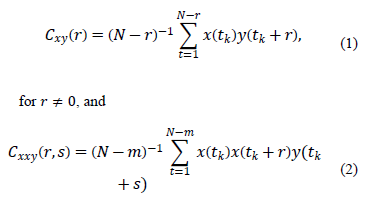
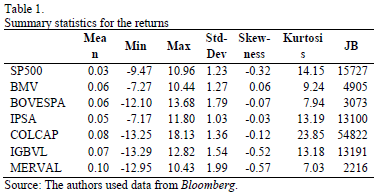
<body><![CDATA[<p>&nbsp;</p>     <p><font size="3" face="Verdana, Arial, Helvetica, sans-serif"><b>2. The data</b></font></p>     <p><font size="2" face="Verdana, Arial, Helvetica, sans-serif">For this study we consider daily returns   of seven stock market indexes, namely the U.S. Standard and Poor's 500 (SP500)   is taken as a baseline market for comparison against six Latin American stock   market indexes: Mexico (BMV), Brazil (BOVESPA), Chile (IPSA), Colombia   (COLCAP), Peru (IGBVL) and Argentina (MERVAL). Daily closing prices from   January 2<sup>nd</sup>, 2003 to January 8<sup>th</sup>, 2015, for a total of   3025 observations of each index were obtained from <i>Bloomberg</i>. The data was sampled for this period of time in order to   capture the effects that the U.S. might have had on the Latin American equity   markets during the sub-prime financial crunch and to have a broad view of other   possible cross-bicorrelation phenomena. Prices   were converted into a continuous rate of returns, taking natural log   differences between consecutive daily closing prices of equity markets. <a href="#tab01">Table 1</a> presents summary statistics for these returns. The statistics are consistent,   as expected, with some of the characteristic particularities of financial   variables &#91;28,29&#93;. In particular, the kurtosis   indicates that return distributions are leptokurtic. Furthermore, the Jarque-Bera statistic (JB) confirms returns not   normally distributed. Although the results of   the KPSS test for seasonality are not listed, it does not reject the null   hypothesis of seasonality or the results of the ADF and PP tests, under the   null hypothesis of a unit root. Both tests with a 5% significance level are   available upon request.</font></p>     <p align="center"><font size="2" face="Verdana, Arial, Helvetica, sans-serif"><a name="tab01"></a></font><img src="/img/revistas/dyna/v83n196/v83n196a20tab01.gif"></p>     <p>&nbsp;</p>     <p><font size="3" face="Verdana, Arial, Helvetica, sans-serif"><b>3. Methodology</b></font></p>     <p><font size="2" face="Verdana, Arial, Helvetica, sans-serif">Brooks and Hinich &#91;1&#93; claim that the cross-bicorrelation test would allow a researcher   identify any existence of nonlinear dependence between two pairs of variables.   The size of the sample series is <i>N</i>,   with two stationary variables<img src="/img/revistas/dyna/v83n196/v83n196a20eq002.gif"> and <img src="/img/revistas/dyna/v83n196/v83n196a20eq004.gif">. As we are working with the first percentual logged differences and   small sub-samples of the total series, to assume stationarity is more than   reasonable. Each series is separated into equal length non-overlapping moving   time windows or frames, where <i>t</i> is an   integer and <i>k</i> represents the <i>k-</i>th window and, both series are jointly   covariance stationary, which have been standardized. The test's null hypotheses   states that the two variables <img src="/img/revistas/dyna/v83n196/v83n196a20eq006.gif"> and <img src="/img/revistas/dyna/v83n196/v83n196a20eq008.gif"> have no dependence and in   fact are pure white noise. The alternative hypothesis states that the series   have cross-covariances, <img src="/img/revistas/dyna/v83n196/v83n196a20eq010.gif"> defined as <img src="/img/revistas/dyna/v83n196/v83n196a20eq012.gif"> or any of the   cross-bicovariances, <img src="/img/revistas/dyna/v83n196/v83n196a20eq014.gif"> defined as <img src="/img/revistas/dyna/v83n196/v83n196a20eq016.gif">, different from zero. </font></p>     <p><font size="2" face="Verdana, Arial, Helvetica, sans-serif">Under the null hypothesis, <img src="/img/revistas/dyna/v83n196/v83n196a20eq010.gif"> and <img src="/img/revistas/dyna/v83n196/v83n196a20eq018.gif"> are zero for every <img src="/img/revistas/dyna/v83n196/v83n196a20eq020.gif"> except when<img src="/img/revistas/dyna/v83n196/v83n196a20eq022.gif">. According to the test, there is dependence between a pair of   variables if <img src="/img/revistas/dyna/v83n196/v83n196a20eq024.gif">or <img src="/img/revistas/dyna/v83n196/v83n196a20eq026.gif">for at least one value of <i>r</i> or a pair of values of <img src="/img/revistas/dyna/v83n196/v83n196a20eq028.gif"> and<img src="/img/revistas/dyna/v83n196/v83n196a20eq030.gif">, respectively. Next, we present the statistics that give the <img src="/img/revistas/dyna/v83n196/v83n196a20eq028.gif"> sample <img src="/img/revistas/dyna/v83n196/v83n196a20eq032.gif"> cross-correlation and the <img src="/img/revistas/dyna/v83n196/v83n196a20eq020.gif"> sample <img src="/img/revistas/dyna/v83n196/v83n196a20eq034.gif"> cross-bicorrelation,   respectively</font></p>     <p><font size="2" face="Verdana, Arial, Helvetica, sans-serif">for <img src="/img/revistas/dyna/v83n196/v83n196a20eq038.gif">, and</font></p>     <p><img src="/img/revistas/dyna/v83n196/v83n196a20eq0102.gif"></p>     ]]></body>
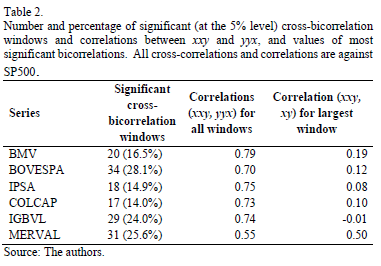
<body><![CDATA[<p><font size="2" face="Verdana, Arial, Helvetica, sans-serif">where <img src="/img/revistas/dyna/v83n196/v83n196a20eq042.gif">.</font></p>     <p><font size="2" face="Verdana, Arial, Helvetica, sans-serif">We can interpret the cross-bicorrelations   as the degree of relation of the value of one variable with the value of the   cross-correlation of the two variables. The second-order test does not include   current elements, and is executed on the errors terms of an <img src="/img/revistas/dyna/v83n196/v83n196a20eq044.gif"> fit to clean out the   univariate autocorrelation arrangement. Thus current correlations will not be   reason for rejecting the null hypothesis. To perform the third-order test, we   apply the test on the errors terms of a <img src="/img/revistas/dyna/v83n196/v83n196a20eq046.gif"> model having a current term   in one of the equations (the order <i>p</i> of the <img src="/img/revistas/dyna/v83n196/v83n196a20eq048.gif"> and <img src="/img/revistas/dyna/v83n196/v83n196a20eq050.gif"> models is chosen to optimize   the Schwartz (BIC) criterion). The pre-whitening step is grounded on the   elimination of any presence of linear correlation or cross-correlation.   Therefore any outstanding dependence between the variables should be classified   as nonlinear. Let <img src="/img/revistas/dyna/v83n196/v83n196a20eq052.gif"> where <img src="/img/revistas/dyna/v83n196/v83n196a20eq054.gif"> (for our case of study we use <img src="/img/revistas/dyna/v83n196/v83n196a20eq056.gif">, and thus we have 121 non-overlapped windows of length 25 days).   The corresponding test statistics for non-zero cross-correlations and   cross-bicorrelations are</font></p>     <p><font size="2" face="Verdana, Arial, Helvetica, sans-serif"><img src="/img/revistas/dyna/v83n196/v83n196a20eq03.gif"></font></p>     <p><font size="2" face="Verdana, Arial, Helvetica, sans-serif">And</font></p>     <p><img src="/img/revistas/dyna/v83n196/v83n196a20eq04.gif"></p>     <p><font size="2" face="Verdana, Arial, Helvetica, sans-serif">for <img src="/img/revistas/dyna/v83n196/v83n196a20eq062.gif">, respectively. In these statistics <img src="/img/revistas/dyna/v83n196/v83n196a20eq064.gif"> is the number of times that   the correlations are verified and <img src="/img/revistas/dyna/v83n196/v83n196a20eq066.gif"> is the number times that the   cross-bicorrelations are probed. Following &#91;15&#93;, we state that <img src="/img/revistas/dyna/v83n196/v83n196a20eq068.gif"> and<img src="/img/revistas/dyna/v83n196/v83n196a20eq070.gif"> are asymptotically <img src="/img/revistas/dyna/v83n196/v83n196a20eq072.gif"> with <img src="/img/revistas/dyna/v83n196/v83n196a20eq064.gif"> and <img src="/img/revistas/dyna/v83n196/v83n196a20eq066.gif"> degrees of freedom,   respectively, as <img src="/img/revistas/dyna/v83n196/v83n196a20eq074.gif"> </font></p>     <p>&nbsp;</p>     <p><font size="3" face="Verdana, Arial, Helvetica, sans-serif"><b>4. Empirical results</b></font></p>     <p><font size="2" face="Verdana, Arial, Helvetica, sans-serif">In <a href="#tab02">Table 2</a>, we report the results for the   cross-bicorrelation test. All tests are run taking SP500 as the benchmark for   comparison, since the effects of the U.S. on Latin America are the ones we   wanted to test. We present the number and percentage of significant (at the 5%   level) cross-bicorrelation windows, correlation for all windows and the   correlation for the largest window. As can be seen, the countries with the most   significant cross-bicorrelation windows are Brazil (BOVESPA), Argentina (MERVAL)   and Peru (IGBVL), with 28.1%, 25.6% and 24.0% of significant windows,   respectively. On the other hand, Colombia (COLCAP), Chile (IPSA) and Mexico   (BMV) are the countries with less significant windows (14.0%, 14.9% and 16.5%,   respectively). As for the correlations for all windows, most countries present   a correlation between 0.70 and 0.79, with the exception of Argentina (0.55).   Furthermore, the country with an episode of largest correlation (0.50) was   Argentina, whereas the one with the lowest correlation for a single episode was   Peru (-0.01). These results shed light on the degree of dependence and   co-movement between economies.</font></p>     <p align="center"><font size="2" face="Verdana, Arial, Helvetica, sans-serif"><a name="tab02"></a></font><img src="/img/revistas/dyna/v83n196/v83n196a20tab02.gif"></p>     ]]></body>
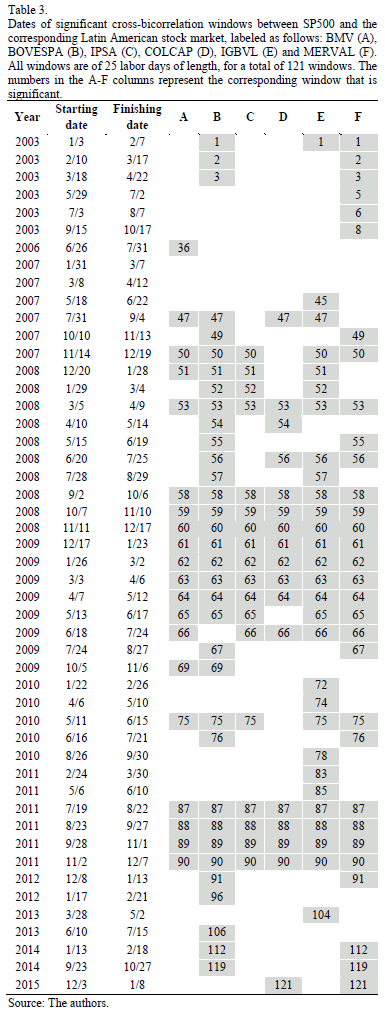
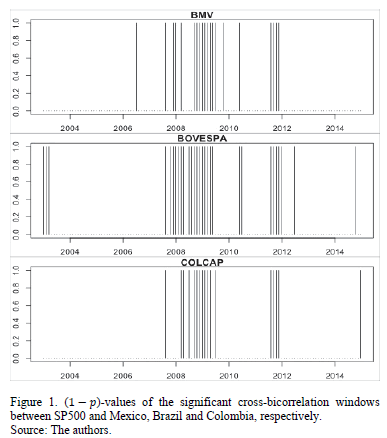
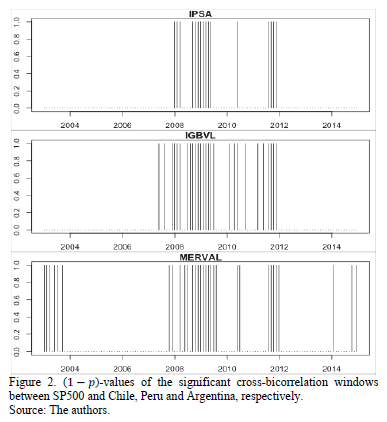
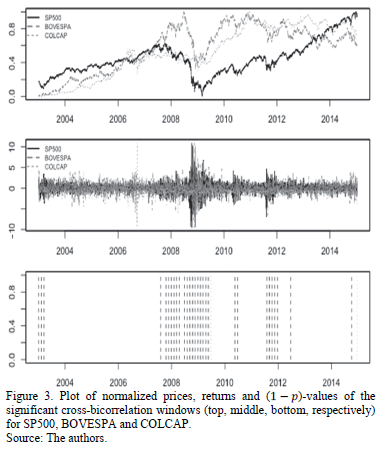
<body><![CDATA[<p><font size="2" face="Verdana, Arial, Helvetica, sans-serif">In <a href="#tab03">Table 3</a> we   present the dates of significant cross-bicorrelation windows between the SP500   benchmark and the six Latin American stock market indexes, labeled in the   following way: BMV (A), BOVESPA (B), IPSA (C), COLCAP (D), IGBVL (E) and MERVAL   (F). All windows are of 25 labor days of length, for a total of 121 windows.   During 2003, Brazil and Argentina showed significant cross-bicorrelation   windows with the U.S. For the years of 2004 to April 2007, the markets do not   co-move, with the exception of a significant window from 6/26 to 7/31 between   SP500 and BMV. In the middle of 2007 the effects of the U.S. are visible on   some Latin American countries: Mexico, Brazil and Peru are affected earlier   than Chile, Colombia and Argentina. However, the effects of the sub-prime   financial crisis were felt on all countries from September 2008 lasting till July   2009 (<a href="#tab03">Table 3</a> (cont.)). From August 2009 to June 2011, there was not much   co-movement, Peru being the exception with significant cross-bicorrelation   windows during these years. Another block of co-movement was visible from July   to December 2011, which might have happened due to the European sovereign debt   crisis and some of the concerns over the U.S.'s slow economic growth and its   credit rating being downgraded. From 2012 to January 2015, the countries that   continued to show significant cross-bicorrelations with the U.S. were Brazil   and Argentina.</font></p>     <p align="center"><font size="2" face="Verdana, Arial, Helvetica, sans-serif"><a name="tab03"></a></font><img src="/img/revistas/dyna/v83n196/v83n196a20tab03.gif"></p>     <p><font size="2" face="Verdana, Arial, Helvetica, sans-serif">In <a href="#fig01">Fig. 1</a> and <a href="#fig02">Fig. 2</a>, we plot the (<img src="/img/revistas/dyna/v83n196/v83n196a20eq076.gif">-values of the significant   cross-bicorrelation windows between SP500 and Mexico, Brazil and Colombia (<a href="#fig01">Fig.   1</a>), and Chile, Peru and Argentina (<a href="#fig01">Fig. 2</a>). These windows correspond to the   ones reported in <a href="#tab02">Table 2</a> and <a href="#tab03">3</a>. It is clear how there are two main periods of   nonlinear dependence between U.S. and Latin American stock markets: 2008-2009   and 2011. Brazil and Argentina showed cross-bicorrelations with the U.S. in   2003.</font></p>     <p align="center"><font size="2" face="Verdana, Arial, Helvetica, sans-serif"><a name="fig01"></a></font><img src="/img/revistas/dyna/v83n196/v83n196a20fig01.gif"></p>     <p align="center"><a name="fig02"></a><img src="/img/revistas/dyna/v83n196/v83n196a20fig02.gif"></p>     <p><font size="2" face="Verdana, Arial, Helvetica, sans-serif">In <a href="#fig03">Fig. 3</a> we   plot the normalized prices for the SP500, BOVESPA and COLCAP indexes. The SP500   is the benchmark and it is compared with BOVESPA that presents the most   significant cross-bicorrelation windows (28.1%) and COLCAP that presents the   least significant percentage of windows (14.0%). We also plot the returns and   the (<img src="/img/revistas/dyna/v83n196/v83n196a20eq076.gif">-values of the significant   cross-bicorrelation windows. As can be seen in the prices and returns plots, it   is clear how for the year 2008 and the year 2011, the SP500 falls in prices and   has a higher volatility before the other indexes.</font></p>     <p align="center"><a name="fig03"></a><img src="/img/revistas/dyna/v83n196/v83n196a20fig03.gif"></p>     <p>&nbsp;</p>     <p><font size="3" face="Verdana, Arial, Helvetica, sans-serif"><b>5. Conclusions</b></font></p>     <p><font size="2" face="Verdana, Arial, Helvetica, sans-serif">In this document we have successfully   applied the Brooks and Hinich &#91;1&#93; cross-bicorrelation test to uncover the cross-covariances and   cross-correlations between U.S. Standard and Poor's 500 (SP500), used as a   benchmark, and six Latin American stock markets indexes: Mexico (BMV), Brazil   (BOVESPA), Chile (IPSA), Colombia (COLCAP), Peru (IGBVL) and Argentina   (MERVAL). We found windows of nonlinear dependence between SP500 and the Latin   American stock markets, some of which coincide with periods of crisis, giving   way to an interpretation of possible contagion or interdependence. Using a   different but related methodology, &#91;23&#93; found   that there are several periods where there were international financial crises   that present strong univariate nonlinearity for several Latin American   financial markets.</font></p>     ]]></body>
<body><![CDATA[<p><font size="2" face="Verdana, Arial, Helvetica, sans-serif">This nonlinearity test presents several   advantages, since it would be capable of detecting any form of nonlinear dependence   of the third-order statistics between two pairs of variables. Furthermore, it   offers a helpful tool for academics to study the functional form of the   nonlinear association between the pairs of variables by defining in which   direction the cross-bicorrelations flow and which of the lags are important.   Given that this test allows the researcher to determine the third-order   nonlinear dependency forms between pairs of series, it can be used as a   supplementary instrument to the Granger causality test.</font></p>     <p><font size="2" face="Verdana, Arial, Helvetica, sans-serif">We have identified some moments of   cross-bicorrelations that might be interesting to explore from a deeper   economic point of view and it is left as a work in progress. Furthermore,   following &#91;23&#93;, it   would be interesting to run a test including overlapped windows in a rolling   scheme. Thus, like &#91;23&#93; it   would be possible to identify the start, the end, the intensity and persistence   of the cross-bicorrelation instead of just the bicorrelation.</font></p>     <p>&nbsp;</p>     <p><font size="3" face="Verdana, Arial, Helvetica, sans-serif"><b>Acknowledgements</b></font></p>     <p><font size="2" face="Verdana, Arial, Helvetica, sans-serif">The authors would like to acknowledge   Jorge Ahumada Garc&iacute;a (MSc in Economics student, ITAM) for his help providing   some of the data used in this paper and Itzel Cano (Universidad Panamericana)   for her help formatting some of the tables. All errors remain the sole   responsibility of the authors.</font></p>     <p><font size="2" face="Verdana, Arial, Helvetica, sans-serif">The authors are grateful for the support   of FONDECYT (Project 1111034).</font></p>     <p>&nbsp;</p>     <p><font size="3" face="Verdana, Arial, Helvetica, sans-serif"><b>References</b></font></p>     <!-- ref --><p><font size="2" face="Verdana, Arial, Helvetica, sans-serif"><b>&#91;1&#93;</b> Brooks, C., and Hinich, M.J.,   Cross-correlations and cross-bicorrelations in sterling exchange rates, Journal of Empirical Finance. 6(4),   pp. 385-404, 1999. DOI: 10.1016/S0927-5398(99)00007-9</font>&nbsp;&nbsp;&nbsp;&nbsp;&nbsp;&nbsp;&nbsp;&nbsp;[&#160;<a href="javascript:void(0);" onclick="javascript: window.open('/scielo.php?script=sci_nlinks&ref=1159452&pid=S0012-7353201600020002000001&lng=','','width=640,height=500,resizable=yes,scrollbars=1,menubar=yes,');">Links</a>&#160;]<!-- end-ref --><!-- ref --><p><font size="2" face="Verdana, Arial, Helvetica, sans-serif"><b>&#91;2&#93;</b> Vel&aacute;squez, J.D., Franco, C.J. and   Camacho, P., Nonlinear time series forecasting using MARS, DYNA. 81(184), pp. 11-19, 2014. DOI;   10.15446/dyna.v81n184.39699</font>&nbsp;&nbsp;&nbsp;&nbsp;&nbsp;&nbsp;&nbsp;&nbsp;[&#160;<a href="javascript:void(0);" onclick="javascript: window.open('/scielo.php?script=sci_nlinks&ref=1159453&pid=S0012-7353201600020002000002&lng=','','width=640,height=500,resizable=yes,scrollbars=1,menubar=yes,');">Links</a>&#160;]<!-- end-ref --><!-- ref --><p><font size="2" face="Verdana, Arial, Helvetica, sans-serif"><b>&#91;3&#93;</b> Vel&aacute;squez, J.D., Zambrano, C. and   Franco, C.J., A comparison of exponential smoothing and neural networks in time   series prediction, DYNA.   &#91;Online&#93;. 80(182), pp. 66-73, 2013. &#91;date of reference December 1rd of 2015&#93;.   Available at: <a href="http://revistas.unal.edu.co/index.php/dyna/article/view/41564/43245" target="_blank">http://revistas.unal.edu.co/index.php/dyna/article/view/41564/43245</a></font>&nbsp;&nbsp;&nbsp;&nbsp;&nbsp;&nbsp;&nbsp;&nbsp;[&#160;<a href="javascript:void(0);" onclick="javascript: window.open('/scielo.php?script=sci_nlinks&ref=1159454&pid=S0012-7353201600020002000003&lng=','','width=640,height=500,resizable=yes,scrollbars=1,menubar=yes,');">Links</a>&#160;]<!-- end-ref --><!-- ref --><p><font size="2" face="Verdana, Arial, Helvetica, sans-serif"><b>&#91;4&#93;</b> Vel&aacute;squez, J.D., Morales, Y.O. and   Franco, C.J., Time series analysis and forecasting in energy markets using the   R language, DYNA. &#91;Online&#93;.   78(165), pp. 287-296, 2011. &#91;date of reference December 1rd of 2015&#93;. Available   at: <a href="http://revistas.unal.edu.co/index.php/dyna/article/view/25670" target="_blank">http://revistas.unal.edu.co/index.php/dyna/article/view/25670</a></font>&nbsp;&nbsp;&nbsp;&nbsp;&nbsp;&nbsp;&nbsp;&nbsp;[&#160;<a href="javascript:void(0);" onclick="javascript: window.open('/scielo.php?script=sci_nlinks&ref=1159455&pid=S0012-7353201600020002000004&lng=','','width=640,height=500,resizable=yes,scrollbars=1,menubar=yes,');">Links</a>&#160;]<!-- end-ref --><!-- ref --><p><font size="2" face="Verdana, Arial, Helvetica, sans-serif"><b>&#91;5&#93;</b> Aloui, R., Ben Aïssa, M.S. and   Nguyen,D.K., Global financial crisis, extreme interdependences, and contagion   effects: The role of economic structure?, Journal of Banking &amp; Finance. 35(1), pp. 130-141, 2011. DOI: 10.1016/j.jbankfin.2010.07.021.    &nbsp;&nbsp;&nbsp;&nbsp;&nbsp;&nbsp;&nbsp;&nbsp;[&#160;<a href="javascript:void(0);" onclick="javascript: window.open('/scielo.php?script=sci_nlinks&ref=1159456&pid=S0012-7353201600020002000005&lng=','','width=640,height=500,resizable=yes,scrollbars=1,menubar=yes,');">Links</a>&#160;]<!-- end-ref --></font></p>     <!-- ref --><p><font size="2" face="Verdana, Arial, Helvetica, sans-serif"><b>&#91;6&#93;</b> Forbes, K.J. and Rigobon, R., No   contagion, only interdependence: measuring stock market comovements, The   Journal of Finance. 57(5), pp. 2223-2261, 2002. DOI: 10.1111/0022-1082.00494.    &nbsp;&nbsp;&nbsp;&nbsp;&nbsp;&nbsp;&nbsp;&nbsp;[&#160;<a href="javascript:void(0);" onclick="javascript: window.open('/scielo.php?script=sci_nlinks&ref=1159458&pid=S0012-7353201600020002000006&lng=','','width=640,height=500,resizable=yes,scrollbars=1,menubar=yes,');">Links</a>&#160;]<!-- end-ref --></font></p>     <!-- ref --><p><font size="2" face="Verdana, Arial, Helvetica, sans-serif"><b>&#91;7&#93;</b> Kenourgios, D., Samitas, A. and   Paltalidis, N., Financial crises and stock market contagion in a multivariate   time-varying asymmetric framework, Journal   of International Financial Markets, Institutions and Money 21(1), pp.   92-106, 2011. DOI: 10.1016/j.intfin.2010.08.005.    &nbsp;&nbsp;&nbsp;&nbsp;&nbsp;&nbsp;&nbsp;&nbsp;[&#160;<a href="javascript:void(0);" onclick="javascript: window.open('/scielo.php?script=sci_nlinks&ref=1159460&pid=S0012-7353201600020002000007&lng=','','width=640,height=500,resizable=yes,scrollbars=1,menubar=yes,');">Links</a>&#160;]<!-- end-ref --></font></p>     <!-- ref --><p><font size="2" face="Verdana, Arial, Helvetica, sans-serif"><b>&#91;8&#93;</b> Caramazza, F., Ricci, L. and Salgado,   R., International financial contagion in currency crises, Journal of International Money and Finance. 23(1), pp. 51-70, 2004. DOI: 10.1016/j.jimonfin.2003.10.001</font>&nbsp;&nbsp;&nbsp;&nbsp;&nbsp;&nbsp;&nbsp;&nbsp;[&#160;<a href="javascript:void(0);" onclick="javascript: window.open('/scielo.php?script=sci_nlinks&ref=1159462&pid=S0012-7353201600020002000008&lng=','','width=640,height=500,resizable=yes,scrollbars=1,menubar=yes,');">Links</a>&#160;]<!-- end-ref --><!-- ref --><p><font size="2" face="Verdana, Arial, Helvetica, sans-serif"><b>&#91;9&#93;</b> Corsetti, G., Pericoli, M. and   Sbracia, M., Some contagion, some interdependence: More pitfalls in tests of   financial contagion, Journal of International Money and Finance. 24(8), pp. 1177-1199, 2005. DOI:   10.1016/j.jimonfin.2005.08.012</font>&nbsp;&nbsp;&nbsp;&nbsp;&nbsp;&nbsp;&nbsp;&nbsp;[&#160;<a href="javascript:void(0);" onclick="javascript: window.open('/scielo.php?script=sci_nlinks&ref=1159463&pid=S0012-7353201600020002000009&lng=','','width=640,height=500,resizable=yes,scrollbars=1,menubar=yes,');">Links</a>&#160;]<!-- end-ref --><!-- ref --><p><font size="2" face="Verdana, Arial, Helvetica, sans-serif"><b>&#91;10&#93;</b> Chiang, T.C., Jeon, B.N. and Li, H.,   Dynamic correlation analysis of financial contagion: Evidence from Asian   markets, Journal of International Money and Finance. 26(7), pp. 1206-1228, 2007. DOI:   10.1016/j.jimonfin.2007.06.005</font>&nbsp;&nbsp;&nbsp;&nbsp;&nbsp;&nbsp;&nbsp;&nbsp;[&#160;<a href="javascript:void(0);" onclick="javascript: window.open('/scielo.php?script=sci_nlinks&ref=1159464&pid=S0012-7353201600020002000010&lng=','','width=640,height=500,resizable=yes,scrollbars=1,menubar=yes,');">Links</a>&#160;]<!-- end-ref --><!-- ref --><p><font size="2" face="Verdana, Arial, Helvetica, sans-serif"><b>&#91;11&#93;</b> Laloux, L., Cizeau, P., Bouchaud,   J.P. and Potters, M., Noise dressing of financial correlation matrices, Physical Review Letters. 83(7) pp.   1467-1470, 1999. DOI: 10.1103/PhysRevLett.83.1467.    &nbsp;&nbsp;&nbsp;&nbsp;&nbsp;&nbsp;&nbsp;&nbsp;[&#160;<a href="javascript:void(0);" onclick="javascript: window.open('/scielo.php?script=sci_nlinks&ref=1159465&pid=S0012-7353201600020002000011&lng=','','width=640,height=500,resizable=yes,scrollbars=1,menubar=yes,');">Links</a>&#160;]<!-- end-ref --></font></p>     <!-- ref --><p><font size="2" face="Verdana, Arial, Helvetica, sans-serif"><b>&#91;12&#93;</b> Plerou, V., Gopikrishnan, P.,   Rosenow, B., Amaral, L.A.N., Guhr, T. and Stanley, H.E., Random matrix approach   to cross correlations in financial data, Phys.   Rev. E. 65(6), pp. 66126-66144, 2002. DOI: 10.1103/PhysRevE.65.066126</font>&nbsp;&nbsp;&nbsp;&nbsp;&nbsp;&nbsp;&nbsp;&nbsp;[&#160;<a href="javascript:void(0);" onclick="javascript: window.open('/scielo.php?script=sci_nlinks&ref=1159467&pid=S0012-7353201600020002000012&lng=','','width=640,height=500,resizable=yes,scrollbars=1,menubar=yes,');">Links</a>&#160;]<!-- end-ref --><!-- ref --><p><font size="2" face="Verdana, Arial, Helvetica, sans-serif"><b>&#91;13&#93;</b> Evans, T. and McMillan, D.G.,   Financial co-movement and correlation: evidence from 33 international stock   market indices, International Journal   of Banking, Accounting and Finance. 1(3), pp. 215-241, 2009. DOI: 10.1504/IJBAAF.2009.022711</font>&nbsp;&nbsp;&nbsp;&nbsp;&nbsp;&nbsp;&nbsp;&nbsp;[&#160;<a href="javascript:void(0);" onclick="javascript: window.open('/scielo.php?script=sci_nlinks&ref=1159468&pid=S0012-7353201600020002000013&lng=','','width=640,height=500,resizable=yes,scrollbars=1,menubar=yes,');">Links</a>&#160;]<!-- end-ref --><!-- ref --><p><font size="2" face="Verdana, Arial, Helvetica, sans-serif"><b>&#91;14&#93;</b> Czamanski, D., Dormaar, P., Hinich,   M.J. and Serletis, A., Episodic nonlinearity and nonstationarity in Alberta's   power and natural gas markets, Energy   Economics. 29(1), pp. 94-104, 2007. DOI:   10.1016/j.eneco.2006.08.002</font>&nbsp;&nbsp;&nbsp;&nbsp;&nbsp;&nbsp;&nbsp;&nbsp;[&#160;<a href="javascript:void(0);" onclick="javascript: window.open('/scielo.php?script=sci_nlinks&ref=1159469&pid=S0012-7353201600020002000014&lng=','','width=640,height=500,resizable=yes,scrollbars=1,menubar=yes,');">Links</a>&#160;]<!-- end-ref --><!-- ref --><p><font size="2" face="Verdana, Arial, Helvetica, sans-serif"><b>&#91;15&#93;</b> Hinich, M.J., Testing for dependence   in the input to a linear time series model, Journal of Nonparametric. Statistics. 6(2-3), pp. 205-221, 1996.   DOI: 10.1080/10485259608832672</font>&nbsp;&nbsp;&nbsp;&nbsp;&nbsp;&nbsp;&nbsp;&nbsp;[&#160;<a href="javascript:void(0);" onclick="javascript: window.open('/scielo.php?script=sci_nlinks&ref=1159470&pid=S0012-7353201600020002000015&lng=','','width=640,height=500,resizable=yes,scrollbars=1,menubar=yes,');">Links</a>&#160;]<!-- end-ref --><!-- ref --><p><font size="2" face="Verdana, Arial, Helvetica, sans-serif"><b>&#91;16&#93;</b> Coronado-Ram&iacute;rez, S.,   Celso-Arellano, P.L.,and Rojas,O., Adaptive market efficiency of agricultural   commodity futures contracts, Contaduria   y Administraci&oacute;n. 60(2), pp. 389-401, 2015. DOI: 10.1016/S0186-1042(15)30006-1</font>&nbsp;&nbsp;&nbsp;&nbsp;&nbsp;&nbsp;&nbsp;&nbsp;[&#160;<a href="javascript:void(0);" onclick="javascript: window.open('/scielo.php?script=sci_nlinks&ref=1159471&pid=S0012-7353201600020002000016&lng=','','width=640,height=500,resizable=yes,scrollbars=1,menubar=yes,');">Links</a>&#160;]<!-- end-ref --><!-- ref --><p><font size="2" face="Verdana, Arial, Helvetica, sans-serif"><b>&#91;17&#93;</b> Romero-Meza, R., Bonilla, C.A. and   Hinich, M.J., Nonlinear event detection in the Chilean stock market, Applied Economics Letters. 14(13),   pp. 987-991, 2007. DOI:10.1080/13504850600706024</font>&nbsp;&nbsp;&nbsp;&nbsp;&nbsp;&nbsp;&nbsp;&nbsp;[&#160;<a href="javascript:void(0);" onclick="javascript: window.open('/scielo.php?script=sci_nlinks&ref=1159472&pid=S0012-7353201600020002000017&lng=','','width=640,height=500,resizable=yes,scrollbars=1,menubar=yes,');">Links</a>&#160;]<!-- end-ref --><!-- ref --><p><font size="2" face="Verdana, Arial, Helvetica, sans-serif"><b>&#91;18&#93;</b> Hinich, M.J. and Serletis, A.,   Episodic nonlinear event detection in the Canadian exchange rate, Journal of the American Statistical   Association. 102(477), pp. 68-74, 2007. DOI: 10.1198/016214506000001004</font>&nbsp;&nbsp;&nbsp;&nbsp;&nbsp;&nbsp;&nbsp;&nbsp;[&#160;<a href="javascript:void(0);" onclick="javascript: window.open('/scielo.php?script=sci_nlinks&ref=1159473&pid=S0012-7353201600020002000018&lng=','','width=640,height=500,resizable=yes,scrollbars=1,menubar=yes,');">Links</a>&#160;]<!-- end-ref --><!-- ref --><p><font size="2" face="Verdana, Arial, Helvetica, sans-serif"><b>&#91;19&#93;</b> Bonilla, C.A., Maquieira, C.P. and   Romero-Meza, R., Nonlinear behaviour of emerging market bonds spreads: The   Latin American case, Applied   Economics. 40(2), pp. 2697-2702, 2008. DOI: 10.1080/00036840600970245</font>&nbsp;&nbsp;&nbsp;&nbsp;&nbsp;&nbsp;&nbsp;&nbsp;[&#160;<a href="javascript:void(0);" onclick="javascript: window.open('/scielo.php?script=sci_nlinks&ref=1159474&pid=S0012-7353201600020002000019&lng=','','width=640,height=500,resizable=yes,scrollbars=1,menubar=yes,');">Links</a>&#160;]<!-- end-ref --><!-- ref --><p><font size="2" face="Verdana, Arial, Helvetica, sans-serif"><b>&#91;20&#93;</b> Lim, K.P.R., Brooks, D. and Hinich,   M.J., Nonlinear serial dependence and the weak-form efficiency of Asian   emerging stock markets, Journal of   International Financial Markets, Institutions and Money. 8(5), pp.   527-544, 2008. DOI: 10.1016/j.intfin.2007.08.001</font>&nbsp;&nbsp;&nbsp;&nbsp;&nbsp;&nbsp;&nbsp;&nbsp;[&#160;<a href="javascript:void(0);" onclick="javascript: window.open('/scielo.php?script=sci_nlinks&ref=1159475&pid=S0012-7353201600020002000020&lng=','','width=640,height=500,resizable=yes,scrollbars=1,menubar=yes,');">Links</a>&#160;]<!-- end-ref --><!-- ref --><p><font size="2" face="Verdana, Arial, Helvetica, sans-serif"><b>&#91;21&#93;</b> Coronado-Ram&iacute;rez, S.,   Ram&iacute;rez-Grajeda, M. and Celso-Arellano, P.L. Inefficiency in the international   coffee market: The case of Colombian arabica, African J. Agric. Res. 9(5), pp. 556-561, 2014. DOI: 10.5897/AJAR11.2228</font>&nbsp;&nbsp;&nbsp;&nbsp;&nbsp;&nbsp;&nbsp;&nbsp;[&#160;<a href="javascript:void(0);" onclick="javascript: window.open('/scielo.php?script=sci_nlinks&ref=1159476&pid=S0012-7353201600020002000021&lng=','','width=640,height=500,resizable=yes,scrollbars=1,menubar=yes,');">Links</a>&#160;]<!-- end-ref --><!-- ref --><p><font size="2" face="Verdana, Arial, Helvetica, sans-serif"><b>&#91;22&#93;</b> Bonilla,   C.A., Romero-Meza, R. and Maquieira, C., Nonlinearities and garch inadequacy   for modeling stock market returns: Empirical evidence from Latin America, Macroeconomics Dynamics. 15(5), pp. 713-724, 2011. DOI: 10.1017/S1365100510000295</font>&nbsp;&nbsp;&nbsp;&nbsp;&nbsp;&nbsp;&nbsp;&nbsp;[&#160;<a href="javascript:void(0);" onclick="javascript: window.open('/scielo.php?script=sci_nlinks&ref=1159477&pid=S0012-7353201600020002000022&lng=','','width=640,height=500,resizable=yes,scrollbars=1,menubar=yes,');">Links</a>&#160;]<!-- end-ref --><!-- ref --><p><font size="2" face="Verdana, Arial, Helvetica, sans-serif"><b>&#91;23&#93;</b> Romero-Meza, R., Bonilla, C.,   Benedetti, H. and Serletis, A., Nonlinearities and financial contagion in Latin   American stock markets. Economic Modelling, 51, pp. 653-656, 2015. DOI: 10.1016/j.econmod.2015.09.012</font>&nbsp;&nbsp;&nbsp;&nbsp;&nbsp;&nbsp;&nbsp;&nbsp;[&#160;<a href="javascript:void(0);" onclick="javascript: window.open('/scielo.php?script=sci_nlinks&ref=1159478&pid=S0012-7353201600020002000023&lng=','','width=640,height=500,resizable=yes,scrollbars=1,menubar=yes,');">Links</a>&#160;]<!-- end-ref --><!-- ref --><p><font size="2" face="Verdana, Arial, Helvetica, sans-serif"><b>&#91;24&#93;</b> Bonilla, C.A., Romero-Meza, R. and   Hinich, M.J., Episodic nonlinearity in Latin American stock market indices.   Applied Economics Letters, 13(3), 195-199, 2006. DOI: 10.1080/13504850500392750</font>&nbsp;&nbsp;&nbsp;&nbsp;&nbsp;&nbsp;&nbsp;&nbsp;[&#160;<a href="javascript:void(0);" onclick="javascript: window.open('/scielo.php?script=sci_nlinks&ref=1159479&pid=S0012-7353201600020002000024&lng=','','width=640,height=500,resizable=yes,scrollbars=1,menubar=yes,');">Links</a>&#160;]<!-- end-ref --><!-- ref --><p><font size="2" face="Verdana, Arial, Helvetica, sans-serif"><b>&#91;25&#93;</b> Brooks, C. and Hinich, M.J.,   Bicorrelations and cross-bicorrelations as non-linearity tests and tools for   exchange rate forecasting, Journal of   Forecasting. 20(3), pp. 181-196, 2001. DOI: 10.1002/1099131X(200104)20:3&lt;181::AIDFOR781&gt;3.0.CO;2-R</font>&nbsp;&nbsp;&nbsp;&nbsp;&nbsp;&nbsp;&nbsp;&nbsp;[&#160;<a href="javascript:void(0);" onclick="javascript: window.open('/scielo.php?script=sci_nlinks&ref=1159480&pid=S0012-7353201600020002000025&lng=','','width=640,height=500,resizable=yes,scrollbars=1,menubar=yes,');">Links</a>&#160;]<!-- end-ref --><!-- ref --><p><font size="2" face="Verdana, Arial, Helvetica, sans-serif"><b>&#91;26&#93;</b> Serletis, A., Malliaris, A.G.,   Hinich, M.J. and Gogas, P., Episodic nonlinearity in leading global currencies, Open Economics. Review. 23(2),   pp. 337-357, 2012. DOI: 10.1007/s11079-010-9194-9</font>&nbsp;&nbsp;&nbsp;&nbsp;&nbsp;&nbsp;&nbsp;&nbsp;[&#160;<a href="javascript:void(0);" onclick="javascript: window.open('/scielo.php?script=sci_nlinks&ref=1159481&pid=S0012-7353201600020002000026&lng=','','width=640,height=500,resizable=yes,scrollbars=1,menubar=yes,');">Links</a>&#160;]<!-- end-ref --><!-- ref --><p><font size="2" face="Verdana, Arial, Helvetica, sans-serif"><b>&#91;27&#93;</b> Romero-Meza, R., Coronado, S. and   Serletis, A., Oil and the economy: A cross bicorrelation perspective, The Journal of Economics Asymmetrics. 11,   pp. 91-95, 2014. DOI: 10.1016/j.jeca.2014.08.003</font>&nbsp;&nbsp;&nbsp;&nbsp;&nbsp;&nbsp;&nbsp;&nbsp;[&#160;<a href="javascript:void(0);" onclick="javascript: window.open('/scielo.php?script=sci_nlinks&ref=1159482&pid=S0012-7353201600020002000027&lng=','','width=640,height=500,resizable=yes,scrollbars=1,menubar=yes,');">Links</a>&#160;]<!-- end-ref --><!-- ref --><p><font size="2" face="Verdana, Arial, Helvetica, sans-serif"><b>&#91;28&#93;</b> Cont, R., Empirical properties of   asset returns: Stylized facts and statistical issues, Quantitative. Finance. 1, pp. 223-236, 2001. DOI: 10.1080/713665670</font>&nbsp;&nbsp;&nbsp;&nbsp;&nbsp;&nbsp;&nbsp;&nbsp;[&#160;<a href="javascript:void(0);" onclick="javascript: window.open('/scielo.php?script=sci_nlinks&ref=1159483&pid=S0012-7353201600020002000028&lng=','','width=640,height=500,resizable=yes,scrollbars=1,menubar=yes,');">Links</a>&#160;]<!-- end-ref --><!-- ref --><p><font size="2" face="Verdana, Arial, Helvetica, sans-serif"><b>&#91;29&#93;</b> Rojas, O. and Trejo-Pech, C.,   Financial time series: Stylized facts for the Mexican stock exchange index   compared to developed markets, in Nonlinear   Time Series and Finance, Coronado-Ram&iacute;rez, S., Celso-Arellano, P.L. and   Trejo-Pech, C., Eds. Universidad de Guadalajara, Mexico, 2014, pp. 228-245.    &nbsp;&nbsp;&nbsp;&nbsp;&nbsp;&nbsp;&nbsp;&nbsp;[&#160;<a href="javascript:void(0);" onclick="javascript: window.open('/scielo.php?script=sci_nlinks&ref=1159484&pid=S0012-7353201600020002000029&lng=','','width=640,height=500,resizable=yes,scrollbars=1,menubar=yes,');">Links</a>&#160;]<!-- end-ref --></font></p>     <p>&nbsp;</p>     <p><font size="2" face="Verdana, Arial, Helvetica, sans-serif"><b>S. Coronado, </b>obtained a PhD. degree in Business and Economics from the University   of Guadalajara, in Guadalajara, Mexico. He is a research professor in the   Department of Quantitative Methods at the University of Guadalajara. He is   currently a member of the Mexican National System of Researchers (Level I,   CONACYT) where his research areas of interest are time series, emerging market   finance and applied statistics. ORCID: 0000-0002-7945-7155</font></p>     <p><font size="2" face="Verdana, Arial, Helvetica, sans-serif"><b>O. Rojas,</b> received his PhD in   Mathematics from La Trobe University, Melbourne, Australia. He is associate   professor and research Director at the School of Business and Economics at   Universidad Panamericana, Guadalajara, Mexico. His research areas of interest   are: nonlinear time series and multivariate statistical methods applied to   business. He is a member of Mexican National System of Researchers (Level C,   CONACYT). ORCID: 0000-0002-0681-3833</font></p>     <p><font size="2" face="Verdana, Arial, Helvetica, sans-serif"><b>R. Romero-Meza,</b> received a Dr. of   Business Administration (DBA) from Boston University. He is research professor at Facultad de   Administraci&oacute;n y Negocios at Universidad Aut&oacute;noma de Chile, and he is also   Director of Global Council of PKF International Finance. Dr. Romero-Meza has   over twenty academic articles in applied economics, applied economics letters,   macroeconomic dynamics, economic modelling, the Journal of Economic Asymmetries   among others. He participates as referee in several journals: Energy Economics,   Economics Letters, INNOVAR, Emerging Markets. His research and teaching   interests are in emerging markets, efficient markets, nonlinear time series,   and corporative finance. ORCID: 0000-0001-5108-2681</font></p>     <p><font size="2" face="Verdana, Arial, Helvetica, sans-serif"><b>F. Venegas-Martinez,</b> was a PhD.   researcher in Finance at Oxford University. He received his PhD in Mathematics   and a second PhD in economics from Washington State University. He is a   professor in Instituto Polit&eacute;cnico Nacional, Mexico. Dr. Vengas-Mart&iacute;nez is a   member of the Mexican National System of Researchers (Level III, CONACYT). He   participates in more than 20 editorial boards and scientific research journals,   in Mexico and internationally. Dr Venegas-Mart&iacute;nez has over a hundred academic   articles in The Brazilian Journal of Probability, Journal of the Inter-American   Statistics and Econometrics, Journal of Economic Dynamics and Control,   International Journal of Theoretical and Applied Finance, Journal of Economic   Modeling, Journal of Development Economics, among others. His research areas of   interest are stochastic process, econometrics, time series, and economic   development. ORCID: 0000-0002-1528-5593</font></p>      ]]></body><back>
<ref-list>
<ref id="B1">
<label>1</label><nlm-citation citation-type="journal">
<person-group person-group-type="author">
<name>
<surname><![CDATA[Brooks]]></surname>
<given-names><![CDATA[C.]]></given-names>
</name>
<name>
<surname><![CDATA[Hinich]]></surname>
<given-names><![CDATA[M.J.]]></given-names>
</name>
</person-group>
<article-title xml:lang="en"><![CDATA[Cross-correlations and cross-bicorrelations in sterling exchange rates]]></article-title>
<source><![CDATA[Journal of Empirical Finance]]></source>
<year>1999</year>
<volume>6</volume>
<numero>4</numero>
<issue>4</issue>
<page-range>385-404</page-range></nlm-citation>
</ref>
<ref id="B2">
<label>2</label><nlm-citation citation-type="journal">
<person-group person-group-type="author">
<name>
<surname><![CDATA[Velásquez]]></surname>
<given-names><![CDATA[J.D.]]></given-names>
</name>
<name>
<surname><![CDATA[Franco]]></surname>
<given-names><![CDATA[C.J.]]></given-names>
</name>
<name>
<surname><![CDATA[Camacho]]></surname>
<given-names><![CDATA[P.]]></given-names>
</name>
</person-group>
<article-title xml:lang="en"><![CDATA[Nonlinear time series forecasting using MARS]]></article-title>
<source><![CDATA[DYNA]]></source>
<year>2014</year>
<volume>81</volume>
<numero>184</numero>
<issue>184</issue>
<page-range>11-19</page-range></nlm-citation>
</ref>
<ref id="B3">
<label>3</label><nlm-citation citation-type="journal">
<person-group person-group-type="author">
<name>
<surname><![CDATA[Velásquez]]></surname>
<given-names><![CDATA[J.D.]]></given-names>
</name>
<name>
<surname><![CDATA[Zambrano]]></surname>
<given-names><![CDATA[C.]]></given-names>
</name>
<name>
<surname><![CDATA[Franco]]></surname>
<given-names><![CDATA[C.J.]]></given-names>
</name>
</person-group>
<article-title xml:lang="en"><![CDATA[A comparison of exponential smoothing and neural networks in time series prediction]]></article-title>
<source><![CDATA[DYNA]]></source>
<year>2013</year>
<volume>80</volume>
<numero>182</numero>
<issue>182</issue>
<page-range>66-73</page-range></nlm-citation>
</ref>
<ref id="B4">
<label>4</label><nlm-citation citation-type="journal">
<person-group person-group-type="author">
<name>
<surname><![CDATA[Velásquez]]></surname>
<given-names><![CDATA[J.D.]]></given-names>
</name>
<name>
<surname><![CDATA[Morales]]></surname>
<given-names><![CDATA[Y.O.]]></given-names>
</name>
<name>
<surname><![CDATA[Franco]]></surname>
<given-names><![CDATA[C.J.]]></given-names>
</name>
</person-group>
<article-title xml:lang="en"><![CDATA[Time series analysis and forecasting in energy markets using the R language]]></article-title>
<source><![CDATA[DYNA]]></source>
<year>2011</year>
<volume>78</volume>
<numero>165</numero>
<issue>165</issue>
<page-range>287-296</page-range></nlm-citation>
</ref>
<ref id="B5">
<label>5</label><nlm-citation citation-type="journal">
<person-group person-group-type="author">
<name>
<surname><![CDATA[Aloui]]></surname>
<given-names><![CDATA[R.]]></given-names>
</name>
<name>
<surname><![CDATA[Ben Aïssa]]></surname>
<given-names><![CDATA[M.S.]]></given-names>
</name>
<name>
<surname><![CDATA[Nguyen]]></surname>
<given-names><![CDATA[D.K.]]></given-names>
</name>
</person-group>
<article-title xml:lang="en"><![CDATA[Global financial crisis, extreme interdependences, and contagion effects: The role of economic structure?]]></article-title>
<source><![CDATA[Journal of Banking & Finance.]]></source>
<year>2011</year>
<volume>35</volume>
<numero>1</numero>
<issue>1</issue>
<page-range>130-141</page-range></nlm-citation>
</ref>
<ref id="B6">
<label>6</label><nlm-citation citation-type="journal">
<person-group person-group-type="author">
<name>
<surname><![CDATA[Forbes]]></surname>
<given-names><![CDATA[K.J.]]></given-names>
</name>
<name>
<surname><![CDATA[Rigobon]]></surname>
<given-names><![CDATA[R.]]></given-names>
</name>
</person-group>
<article-title xml:lang="en"><![CDATA[No contagion, only interdependence: measuring stock market comovements]]></article-title>
<source><![CDATA[The Journal of Finance.]]></source>
<year>2002</year>
<volume>57</volume>
<numero>5</numero>
<issue>5</issue>
<page-range>2223-2261</page-range></nlm-citation>
</ref>
<ref id="B7">
<label>7</label><nlm-citation citation-type="journal">
<person-group person-group-type="author">
<name>
<surname><![CDATA[Kenourgios]]></surname>
<given-names><![CDATA[D.]]></given-names>
</name>
<name>
<surname><![CDATA[Samitas]]></surname>
<given-names><![CDATA[A.]]></given-names>
</name>
<name>
<surname><![CDATA[Paltalidis]]></surname>
<given-names><![CDATA[N.]]></given-names>
</name>
</person-group>
<article-title xml:lang="en"><![CDATA[Financial crises and stock market contagion in a multivariate time-varying asymmetric framework]]></article-title>
<source><![CDATA[Journal of International Financial Markets, Institutions and Money]]></source>
<year>2011</year>
<volume>21</volume>
<numero>1</numero>
<issue>1</issue>
<page-range>92-106</page-range></nlm-citation>
</ref>
<ref id="B8">
<label>8</label><nlm-citation citation-type="journal">
<person-group person-group-type="author">
<name>
<surname><![CDATA[Caramazza]]></surname>
<given-names><![CDATA[F.]]></given-names>
</name>
<name>
<surname><![CDATA[Ricci]]></surname>
<given-names><![CDATA[L.]]></given-names>
</name>
<name>
<surname><![CDATA[Salgado]]></surname>
<given-names><![CDATA[R.]]></given-names>
</name>
</person-group>
<article-title xml:lang="en"><![CDATA[International financial contagion in currency crises]]></article-title>
<source><![CDATA[Journal of International Money and Finance]]></source>
<year>2004</year>
<volume>23</volume>
<numero>1</numero>
<issue>1</issue>
<page-range>51-70</page-range></nlm-citation>
</ref>
<ref id="B9">
<label>9</label><nlm-citation citation-type="journal">
<person-group person-group-type="author">
<name>
<surname><![CDATA[Corsetti]]></surname>
<given-names><![CDATA[G.]]></given-names>
</name>
<name>
<surname><![CDATA[Pericoli]]></surname>
<given-names><![CDATA[M.]]></given-names>
</name>
<name>
<surname><![CDATA[Sbracia]]></surname>
<given-names><![CDATA[M.]]></given-names>
</name>
</person-group>
<article-title xml:lang="en"><![CDATA[Some contagion, some interdependence: More pitfalls in tests of financial contagion]]></article-title>
<source><![CDATA[Journal of International Money and Finance]]></source>
<year>2005</year>
<volume>24</volume>
<numero>8</numero>
<issue>8</issue>
<page-range>1177-1199</page-range></nlm-citation>
</ref>
<ref id="B10">
<label>10</label><nlm-citation citation-type="journal">
<person-group person-group-type="author">
<name>
<surname><![CDATA[Chiang]]></surname>
<given-names><![CDATA[T.C.]]></given-names>
</name>
<name>
<surname><![CDATA[Jeon]]></surname>
<given-names><![CDATA[B.N.]]></given-names>
</name>
<name>
<surname><![CDATA[Li]]></surname>
<given-names><![CDATA[H.]]></given-names>
</name>
</person-group>
<article-title xml:lang="en"><![CDATA[Dynamic correlation analysis of financial contagion: Evidence from Asian markets]]></article-title>
<source><![CDATA[Journal of International Money and Finance]]></source>
<year>2007</year>
<volume>26</volume>
<numero>7</numero>
<issue>7</issue>
<page-range>1206-1228</page-range></nlm-citation>
</ref>
<ref id="B11">
<label>11</label><nlm-citation citation-type="journal">
<person-group person-group-type="author">
<name>
<surname><![CDATA[Laloux]]></surname>
<given-names><![CDATA[L.]]></given-names>
</name>
<name>
<surname><![CDATA[Cizeau]]></surname>
<given-names><![CDATA[P.]]></given-names>
</name>
<name>
<surname><![CDATA[Bouchaud]]></surname>
<given-names><![CDATA[J.P.]]></given-names>
</name>
<name>
<surname><![CDATA[Potters]]></surname>
<given-names><![CDATA[M.]]></given-names>
</name>
</person-group>
<article-title xml:lang="en"><![CDATA[Noise dressing of financial correlation matrices]]></article-title>
<source><![CDATA[Physical Review Letters.]]></source>
<year>1999</year>
<volume>83</volume>
<numero>7</numero>
<issue>7</issue>
<page-range>1467-1470</page-range></nlm-citation>
</ref>
<ref id="B12">
<label>12</label><nlm-citation citation-type="journal">
<person-group person-group-type="author">
<name>
<surname><![CDATA[Plerou]]></surname>
<given-names><![CDATA[V.]]></given-names>
</name>
<name>
<surname><![CDATA[Gopikrishnan]]></surname>
<given-names><![CDATA[P.]]></given-names>
</name>
<name>
<surname><![CDATA[Rosenow]]></surname>
<given-names><![CDATA[B.]]></given-names>
</name>
<name>
<surname><![CDATA[Amaral]]></surname>
<given-names><![CDATA[L.A.N.]]></given-names>
</name>
<name>
<surname><![CDATA[Guhr]]></surname>
<given-names><![CDATA[T.]]></given-names>
</name>
<name>
<surname><![CDATA[Stanley]]></surname>
<given-names><![CDATA[H.E.]]></given-names>
</name>
</person-group>
<article-title xml:lang="en"><![CDATA[Random matrix approach to cross correlations in financial data]]></article-title>
<source><![CDATA[Phys. Rev. E.]]></source>
<year>2002</year>
<volume>65</volume>
<numero>6</numero>
<issue>6</issue>
<page-range>66126-66144</page-range></nlm-citation>
</ref>
<ref id="B13">
<label>13</label><nlm-citation citation-type="journal">
<person-group person-group-type="author">
<name>
<surname><![CDATA[Evans]]></surname>
<given-names><![CDATA[T.]]></given-names>
</name>
<name>
<surname><![CDATA[McMillan]]></surname>
<given-names><![CDATA[D.G.]]></given-names>
</name>
</person-group>
<article-title xml:lang="en"><![CDATA[Financial co-movement and correlation: evidence from 33 international stock market indices]]></article-title>
<source><![CDATA[International Journal of Banking, Accounting and Finance.]]></source>
<year>2009</year>
<volume>1</volume>
<numero>3</numero>
<issue>3</issue>
<page-range>215-241</page-range></nlm-citation>
</ref>
<ref id="B14">
<label>14</label><nlm-citation citation-type="journal">
<person-group person-group-type="author">
<name>
<surname><![CDATA[Czamanski]]></surname>
<given-names><![CDATA[D.]]></given-names>
</name>
<name>
<surname><![CDATA[Dormaar]]></surname>
<given-names><![CDATA[P.]]></given-names>
</name>
<name>
<surname><![CDATA[Hinich]]></surname>
<given-names><![CDATA[M.J.]]></given-names>
</name>
<name>
<surname><![CDATA[Serletis]]></surname>
<given-names><![CDATA[A.]]></given-names>
</name>
</person-group>
<article-title xml:lang="en"><![CDATA[Episodic nonlinearity and nonstationarity in Alberta's power and natural gas markets]]></article-title>
<source><![CDATA[Energy Economics.]]></source>
<year>2007</year>
<volume>29</volume>
<numero>1</numero>
<issue>1</issue>
<page-range>94-104</page-range></nlm-citation>
</ref>
<ref id="B15">
<label>15</label><nlm-citation citation-type="journal">
<person-group person-group-type="author">
<name>
<surname><![CDATA[Hinich]]></surname>
<given-names><![CDATA[M.J.]]></given-names>
</name>
</person-group>
<article-title xml:lang="en"><![CDATA[Testing for dependence in the input to a linear time series model]]></article-title>
<source><![CDATA[Journal of Nonparametric. Statistics.]]></source>
<year>1996</year>
<volume>6</volume>
<numero>2-3</numero>
<issue>2-3</issue>
<page-range>205-221</page-range></nlm-citation>
</ref>
<ref id="B16">
<label>16</label><nlm-citation citation-type="journal">
<person-group person-group-type="author">
<name>
<surname><![CDATA[Coronado-Ramírez]]></surname>
<given-names><![CDATA[S.]]></given-names>
</name>
<name>
<surname><![CDATA[Celso-Arellano]]></surname>
<given-names><![CDATA[P.L.]]></given-names>
</name>
<name>
<surname><![CDATA[Rojas]]></surname>
<given-names><![CDATA[O]]></given-names>
</name>
</person-group>
<article-title xml:lang="en"><![CDATA[Adaptive market efficiency of agricultural commodity futures contracts]]></article-title>
<source><![CDATA[Contaduria y Administración]]></source>
<year>2015</year>
<volume>60</volume>
<numero>2</numero>
<issue>2</issue>
<page-range>389-401</page-range></nlm-citation>
</ref>
<ref id="B17">
<label>17</label><nlm-citation citation-type="journal">
<person-group person-group-type="author">
<name>
<surname><![CDATA[Romero-Meza]]></surname>
<given-names><![CDATA[R.]]></given-names>
</name>
<name>
<surname><![CDATA[Bonilla]]></surname>
<given-names><![CDATA[C.A.]]></given-names>
</name>
<name>
<surname><![CDATA[Hinich]]></surname>
<given-names><![CDATA[M.J.]]></given-names>
</name>
</person-group>
<article-title xml:lang="en"><![CDATA[Nonlinear event detection in the Chilean stock market]]></article-title>
<source><![CDATA[Applied Economics Letters.]]></source>
<year>2007</year>
<volume>14</volume>
<numero>13</numero>
<issue>13</issue>
<page-range>987-991</page-range></nlm-citation>
</ref>
<ref id="B18">
<label>18</label><nlm-citation citation-type="journal">
<person-group person-group-type="author">
<name>
<surname><![CDATA[Hinich]]></surname>
<given-names><![CDATA[M.J.]]></given-names>
</name>
<name>
<surname><![CDATA[Serletis]]></surname>
<given-names><![CDATA[A.]]></given-names>
</name>
</person-group>
<article-title xml:lang="en"><![CDATA[Episodic nonlinear event detection in the Canadian exchange rate]]></article-title>
<source><![CDATA[Journal of the American Statistical Association.]]></source>
<year>2007</year>
<volume>102</volume>
<numero>477</numero>
<issue>477</issue>
<page-range>68-74</page-range></nlm-citation>
</ref>
<ref id="B19">
<label>19</label><nlm-citation citation-type="journal">
<person-group person-group-type="author">
<name>
<surname><![CDATA[Bonilla]]></surname>
<given-names><![CDATA[C.A.]]></given-names>
</name>
<name>
<surname><![CDATA[Maquieira]]></surname>
<given-names><![CDATA[C.P.]]></given-names>
</name>
<name>
<surname><![CDATA[Romero-Meza]]></surname>
<given-names><![CDATA[R.]]></given-names>
</name>
</person-group>
<article-title xml:lang="en"><![CDATA[Nonlinear behaviour of emerging market bonds spreads: The Latin American case]]></article-title>
<source><![CDATA[Applied Economics.]]></source>
<year>2008</year>
<volume>40</volume>
<numero>2</numero>
<issue>2</issue>
<page-range>2697-2702</page-range></nlm-citation>
</ref>
<ref id="B20">
<label>20</label><nlm-citation citation-type="journal">
<person-group person-group-type="author">
<name>
<surname><![CDATA[Lim]]></surname>
<given-names><![CDATA[K.P.R.]]></given-names>
</name>
<name>
<surname><![CDATA[Brooks]]></surname>
<given-names><![CDATA[D.]]></given-names>
</name>
<name>
<surname><![CDATA[Hinich]]></surname>
<given-names><![CDATA[M.J.]]></given-names>
</name>
</person-group>
<article-title xml:lang="en"><![CDATA[Nonlinear serial dependence and the weak-form efficiency of Asian emerging stock markets]]></article-title>
<source><![CDATA[Journal of International Financial Markets, Institutions and Money]]></source>
<year>2008</year>
<volume>8</volume>
<numero>5</numero>
<issue>5</issue>
<page-range>527-544</page-range></nlm-citation>
</ref>
<ref id="B21">
<label>21</label><nlm-citation citation-type="journal">
<person-group person-group-type="author">
<name>
<surname><![CDATA[Coronado-Ramírez]]></surname>
<given-names><![CDATA[S.]]></given-names>
</name>
<name>
<surname><![CDATA[Ramírez-Grajeda]]></surname>
<given-names><![CDATA[M.]]></given-names>
</name>
<name>
<surname><![CDATA[Celso-Arellano]]></surname>
<given-names><![CDATA[P.L.]]></given-names>
</name>
</person-group>
<article-title xml:lang="en"><![CDATA[Inefficiency in the international coffee market: The case of Colombian arabica]]></article-title>
<source><![CDATA[African J. Agric. Res.]]></source>
<year>2014</year>
<volume>9</volume>
<numero>5</numero>
<issue>5</issue>
<page-range>556-561</page-range></nlm-citation>
</ref>
<ref id="B22">
<label>22</label><nlm-citation citation-type="journal">
<person-group person-group-type="author">
<name>
<surname><![CDATA[Bonilla]]></surname>
<given-names><![CDATA[C.A.]]></given-names>
</name>
<name>
<surname><![CDATA[Romero-Meza]]></surname>
<given-names><![CDATA[R.]]></given-names>
</name>
<name>
<surname><![CDATA[Maquieira]]></surname>
<given-names><![CDATA[C.]]></given-names>
</name>
</person-group>
<article-title xml:lang="en"><![CDATA[Nonlinearities and garch inadequacy for modeling stock market returns: Empirical evidence from Latin America]]></article-title>
<source><![CDATA[Macroeconomics Dynamics]]></source>
<year>2011</year>
<volume>15</volume>
<numero>5</numero>
<issue>5</issue>
<page-range>713-724</page-range></nlm-citation>
</ref>
<ref id="B23">
<label>23</label><nlm-citation citation-type="journal">
<person-group person-group-type="author">
<name>
<surname><![CDATA[Romero-Meza]]></surname>
<given-names><![CDATA[R.]]></given-names>
</name>
<name>
<surname><![CDATA[Bonilla]]></surname>
<given-names><![CDATA[C.]]></given-names>
</name>
<name>
<surname><![CDATA[Benedetti]]></surname>
<given-names><![CDATA[H.]]></given-names>
</name>
<name>
<surname><![CDATA[Serletis]]></surname>
<given-names><![CDATA[A.]]></given-names>
</name>
</person-group>
<article-title xml:lang="en"><![CDATA[Nonlinearities and financial contagion in Latin American stock markets]]></article-title>
<source><![CDATA[Economic Modelling]]></source>
<year>2015</year>
<numero>51</numero>
<issue>51</issue>
<page-range>653-656</page-range></nlm-citation>
</ref>
<ref id="B24">
<label>24</label><nlm-citation citation-type="journal">
<person-group person-group-type="author">
<name>
<surname><![CDATA[Bonilla]]></surname>
<given-names><![CDATA[C.A.]]></given-names>
</name>
<name>
<surname><![CDATA[Romero-Meza]]></surname>
<given-names><![CDATA[R.]]></given-names>
</name>
<name>
<surname><![CDATA[Hinich]]></surname>
<given-names><![CDATA[M.J.]]></given-names>
</name>
</person-group>
<article-title xml:lang="en"><![CDATA[Episodic nonlinearity in Latin American stock market indices]]></article-title>
<source><![CDATA[Applied Economics Letters]]></source>
<year>2006</year>
<volume>13</volume>
<numero>3</numero>
<issue>3</issue>
<page-range>195-199</page-range></nlm-citation>
</ref>
<ref id="B25">
<label>25</label><nlm-citation citation-type="journal">
<person-group person-group-type="author">
<name>
<surname><![CDATA[Brooks]]></surname>
<given-names><![CDATA[C.]]></given-names>
</name>
<name>
<surname><![CDATA[Hinich]]></surname>
<given-names><![CDATA[M.J.]]></given-names>
</name>
</person-group>
<article-title xml:lang="en"><![CDATA[Bicorrelations and cross-bicorrelations as non-linearity tests and tools for exchange rate forecasting]]></article-title>
<source><![CDATA[Journal of Forecasting]]></source>
<year>2001</year>
<volume>20</volume>
<numero>3</numero>
<issue>3</issue>
<page-range>181-196</page-range></nlm-citation>
</ref>
<ref id="B26">
<label>26</label><nlm-citation citation-type="journal">
<person-group person-group-type="author">
<name>
<surname><![CDATA[Serletis]]></surname>
<given-names><![CDATA[A.]]></given-names>
</name>
<name>
<surname><![CDATA[Malliaris]]></surname>
<given-names><![CDATA[A.G.]]></given-names>
</name>
<name>
<surname><![CDATA[Hinich]]></surname>
<given-names><![CDATA[M.J.]]></given-names>
</name>
<name>
<surname><![CDATA[Gogas]]></surname>
<given-names><![CDATA[P.]]></given-names>
</name>
</person-group>
<article-title xml:lang="en"><![CDATA[Episodic nonlinearity in leading global currencies]]></article-title>
<source><![CDATA[Open Economics. Review]]></source>
<year>2012</year>
<volume>23</volume>
<numero>2</numero>
<issue>2</issue>
<page-range>337-357</page-range></nlm-citation>
</ref>
<ref id="B27">
<label>27</label><nlm-citation citation-type="journal">
<person-group person-group-type="author">
<name>
<surname><![CDATA[Romero-Meza]]></surname>
<given-names><![CDATA[R.]]></given-names>
</name>
<name>
<surname><![CDATA[Coronado]]></surname>
<given-names><![CDATA[S.]]></given-names>
</name>
<name>
<surname><![CDATA[Serletis]]></surname>
<given-names><![CDATA[A.]]></given-names>
</name>
</person-group>
<article-title xml:lang="en"><![CDATA[Oil and the economy: A cross bicorrelation perspective]]></article-title>
<source><![CDATA[The Journal of Economics Asymmetrics.]]></source>
<year>2014</year>
<numero>11</numero>
<issue>11</issue>
<page-range>91-95</page-range></nlm-citation>
</ref>
<ref id="B28">
<label>28</label><nlm-citation citation-type="journal">
<person-group person-group-type="author">
<name>
<surname><![CDATA[Cont]]></surname>
<given-names><![CDATA[R.]]></given-names>
</name>
</person-group>
<article-title xml:lang="en"><![CDATA[Empirical properties of asset returns: Stylized facts and statistical issues]]></article-title>
<source><![CDATA[Quantitative. Finance]]></source>
<year>2001</year>
<numero>1</numero>
<issue>1</issue>
<page-range>223-236</page-range></nlm-citation>
</ref>
<ref id="B29">
<label>29</label><nlm-citation citation-type="book">
<person-group person-group-type="author">
<name>
<surname><![CDATA[Rojas]]></surname>
<given-names><![CDATA[O.]]></given-names>
</name>
<name>
<surname><![CDATA[Trejo-Pech]]></surname>
<given-names><![CDATA[C.]]></given-names>
</name>
</person-group>
<article-title xml:lang="en"><![CDATA[Financial time series: Stylized facts for the Mexican stock exchange index compared to developed markets]]></article-title>
<person-group person-group-type="editor">
<name>
<surname><![CDATA[Coronado-Ramírez]]></surname>
<given-names><![CDATA[S.]]></given-names>
</name>
<name>
<surname><![CDATA[Celso-Arellano]]></surname>
<given-names><![CDATA[P.L.]]></given-names>
</name>
<name>
<surname><![CDATA[Trejo-Pech]]></surname>
<given-names><![CDATA[C.]]></given-names>
</name>
</person-group>
<source><![CDATA[Nonlinear Time Series and Finance]]></source>
<year>2014</year>
<page-range>228-245</page-range><publisher-name><![CDATA[Universidad de Guadalajara]]></publisher-name>
</nlm-citation>
</ref>
</ref-list>
</back>
</article>