<?xml version="1.0" encoding="ISO-8859-1"?><article xmlns:mml="http://www.w3.org/1998/Math/MathML" xmlns:xlink="http://www.w3.org/1999/xlink" xmlns:xsi="http://www.w3.org/2001/XMLSchema-instance">
<front>
<journal-meta>
<journal-id>0012-7353</journal-id>
<journal-title><![CDATA[DYNA]]></journal-title>
<abbrev-journal-title><![CDATA[Dyna rev.fac.nac.minas]]></abbrev-journal-title>
<issn>0012-7353</issn>
<publisher>
<publisher-name><![CDATA[Universidad Nacional de Colombia]]></publisher-name>
</publisher>
</journal-meta>
<article-meta>
<article-id>S0012-73532016000300003</article-id>
<article-id pub-id-type="doi">10.15446/dyna.v83n197.57586</article-id>
<title-group>
<article-title xml:lang="en"><![CDATA[Current state of the art and enduring issues in anthropometric data collection]]></article-title>
<article-title xml:lang="es"><![CDATA[Estado actual de la técnica y cuestiones perdurables en la recogida de datos antropométricos]]></article-title>
</title-group>
<contrib-group>
<contrib contrib-type="author">
<name>
<surname><![CDATA[Bragança]]></surname>
<given-names><![CDATA[Sara]]></given-names>
</name>
<xref ref-type="aff" rid="A01"/>
</contrib>
<contrib contrib-type="author">
<name>
<surname><![CDATA[Arezes]]></surname>
<given-names><![CDATA[Pedro]]></given-names>
</name>
<xref ref-type="aff" rid="A01"/>
</contrib>
<contrib contrib-type="author">
<name>
<surname><![CDATA[Carvalho]]></surname>
<given-names><![CDATA[Miguel]]></given-names>
</name>
<xref ref-type="aff" rid="A02"/>
</contrib>
<contrib contrib-type="author">
<name>
<surname><![CDATA[Ashdown]]></surname>
<given-names><![CDATA[Susan P.]]></given-names>
</name>
<xref ref-type="aff" rid="A03"/>
</contrib>
</contrib-group>
<aff id="A01">
<institution><![CDATA[,University of Minho Department of Production and Systems ]]></institution>
<addr-line><![CDATA[Guimarães ]]></addr-line>
<country>Portugal</country>
</aff>
<aff id="A">
<institution><![CDATA[,parezes@dps.uminho.pt  ]]></institution>
<addr-line><![CDATA[ ]]></addr-line>
</aff>
<aff id="A02">
<institution><![CDATA[,University of Minho Department of Textile Engineering ]]></institution>
<addr-line><![CDATA[Guimarães ]]></addr-line>
<country>Portugal</country>
</aff>
<aff id="A03">
<institution><![CDATA[,Cornell University Fiber Science & Apparel Design ]]></institution>
<addr-line><![CDATA[Ithaca NY]]></addr-line>
<country>USA</country>
</aff>
<pub-date pub-type="pub">
<day>00</day>
<month>06</month>
<year>2016</year>
</pub-date>
<pub-date pub-type="epub">
<day>00</day>
<month>06</month>
<year>2016</year>
</pub-date>
<volume>83</volume>
<numero>197</numero>
<fpage>22</fpage>
<lpage>30</lpage>
<copyright-statement/>
<copyright-year/>
<self-uri xlink:href="http://www.scielo.org.co/scielo.php?script=sci_arttext&amp;pid=S0012-73532016000300003&amp;lng=en&amp;nrm=iso"></self-uri><self-uri xlink:href="http://www.scielo.org.co/scielo.php?script=sci_abstract&amp;pid=S0012-73532016000300003&amp;lng=en&amp;nrm=iso"></self-uri><self-uri xlink:href="http://www.scielo.org.co/scielo.php?script=sci_pdf&amp;pid=S0012-73532016000300003&amp;lng=en&amp;nrm=iso"></self-uri><abstract abstract-type="short" xml:lang="en"><p><![CDATA[The study of human body size and shape has been a topic of research for a very long time. In the past, anthropometry used traditional measuring techniques to record the dimensions of the human body and reported variance in body dimensions as a function of mean and standard deviation. Nowadays, the study of human body dimensions can be carried out more efficiently using three-dimensional body scanners, which can provide large amounts of anthropometric data more quickly than traditional techniques can. This paper presents a description of the broad range of issues related to the collection of anthropometric data using three-dimensional body scanners, including the different types of technologies available and their implications, the standard scanning process needed for effective data collection, and the possible sources of measurement errors that might affect the reliability and validity of the data collected.]]></p></abstract>
<abstract abstract-type="short" xml:lang="es"><p><![CDATA[El estudio del tamaño y la forma del cuerpo humano ha sido un tema de investigación durante un tiempo muy largo. En el pasado, la antropometría utilizó técnicas de medición tradicionales para registrar las dimensiones del cuerpo humano y reportó la variación en las dimensiones del cuerpo en función de la media y la desviación estándar. Hoy en día, el estudio de las dimensiones del cuerpo humano se puede llevar a cabo utilizando maneras más eficientes, como los escáneres tridimensionales del cuerpo, que pueden proporcionar grandes cantidades de datos antropométricos más rápidamente que las técnicas tradicionales. En este trabajo se presenta una descripción de la amplia gama de temas relacionados con la recogida de datos antropométricos utilizando escáneres tridimensionales del cuerpo, incluyendo los diferentes tipos de tecnologías disponibles y sus implicaciones, el proceso de digitalización estándar necesario para la captura efectiva de datos, y las posibles fuentes de los errores de medición que podrán afectar la fiabilidad y validez de los datos recogidos.]]></p></abstract>
<kwd-group>
<kwd lng="en"><![CDATA[anthropometry]]></kwd>
<kwd lng="en"><![CDATA[body scanners]]></kwd>
<kwd lng="en"><![CDATA[errors]]></kwd>
<kwd lng="en"><![CDATA[reliability]]></kwd>
<kwd lng="es"><![CDATA[la antropometría]]></kwd>
<kwd lng="es"><![CDATA[escáneres corporales]]></kwd>
<kwd lng="es"><![CDATA[errores]]></kwd>
<kwd lng="es"><![CDATA[confiabilidad]]></kwd>
</kwd-group>
</article-meta>
</front><body><![CDATA[ <p><font size="1" face="Verdana, Arial, Helvetica, sans-serif"><b>DOI:</b> <a href="http://dx.doi.org/10.15446/dyna.v83n197.57586" target="_blank">http://dx.doi.org/10.15446/dyna.v83n197.57586</a></font></p>     <p align="center"><font size="4" face="Verdana, Arial, Helvetica, sans-serif"><b>Current  state of the art and enduring issues in anthropometric data collection</b></font></p>     <p align="center"><i><b><font size="3" face="Verdana, Arial, Helvetica, sans-serif">Estado actual de la t&eacute;cnica y cuestiones perdurables en la recogida de datos antropom&eacute;tricos</font></b></i></p>     <p align="center">&nbsp;</p>     <p align="center"><b><font size="2" face="Verdana, Arial, Helvetica, sans-serif">Sara Bragança <i><sup>a</sup></i>, Pedro Arezes <i><sup>a</sup></i>, Miguel Carvalho <i><sup>b</sup></i> &amp; Susan P. Ashdown <i><sup>c</sup></i></font></b><font size="2" face="Verdana, Arial, Helvetica, sans-serif"><i><sup></sup></i></font></p>     <p align="center">&nbsp;</p>     <p align="center"><font size="2" face="Verdana, Arial, Helvetica, sans-serif"><i><sup>a </sup>Department of Production and   Systems, University of Minho, Guimarães, Portugal. <a href="mailto:saraabraganca@gmail.com">saraabraganca@gmail.com</a>,   <a href="mailto:parezes@dps.uminho.pt">parezes@dps.uminho.pt</a>    <br>   <sup>b</sup> Department of Textile Engineering, University     of Minho, Guimarães, Portugal. <a href="mailto:migcar@det.uminho.pt">migcar@det.uminho.pt</a>    <br>     <sup>c</sup> Fiber Science &amp; Apparel Design, Cornell       University, Ithaca, NY, USA. <a href="mailto:spa4@cornell.edu">spa4@cornell.edu</a></i></font></p>     <p align="center">&nbsp;</p>     ]]></body>
<body><![CDATA[<p align="center"><font size="2" face="Verdana, Arial, Helvetica, sans-serif"><b>Received: November   30<sup>th</sup>, 2015. Received in revised form: March 17<sup>th</sup>, 2016.   Accepted: April 12<sup>th</sup>, 2016.</b></font></p>     <p align="center">&nbsp;</p>     <p align="center"><font size="1" face="Verdana, Arial, Helvetica, sans-seriff"><b>This work is licensed under a</b> <a rel="license" href="http://creativecommons.org/licenses/by-nc-nd/4.0/">Creative Commons Attribution-NonCommercial-NoDerivatives 4.0 International License</a>.</font><br /><a rel="license" href="http://creativecommons.org/licenses/by-nc-nd/4.0/"><img style="border-width:0" src="https://i.creativecommons.org/l/by-nc-nd/4.0/88x31.png" /></a></p><hr>     <p><font size="2" face="Verdana, Arial, Helvetica, sans-serif"><b>Abstract    <br> </b></font><font size="2" face="Verdana, Arial, Helvetica, sans-serif">The study of   human body size and shape has been a topic of research for a very   long time. In the past, anthropometry used traditional measuring techniques to record   the dimensions of the human body and reported variance in body dimensions as a function   of mean and standard deviation. Nowadays, the study of human body dimensions   can be carried out more efficiently using three-dimensional body scanners,   which can provide large amounts of anthropometric data more quickly than traditional techniques can. This paper presents a description of the broad range of issues   related to the collection of anthropometric data using three-dimensional body   scanners, including the different types of technologies available and their   implications, the standard scanning process needed for effective data   collection, and the possible sources of measurement errors that might affect the reliability and validity of the data collected.</font></p>     <p><font size="2" face="Verdana, Arial, Helvetica, sans-serif"><i>Keywords</i>: anthropometry;  body scanners; errors; reliability.</font></p>     <p><font size="2" face="Verdana, Arial, Helvetica, sans-serif"><b>Resumen    <br> </b></font><font size="2" face="Verdana, Arial, Helvetica, sans-serif">El estudio del tama&ntilde;o y la forma del cuerpo  humano ha sido un tema de investigaci&oacute;n durante un tiempo muy largo. En el  pasado, la antropometr&iacute;a utiliz&oacute; t&eacute;cnicas de medici&oacute;n tradicionales para  registrar las dimensiones del cuerpo humano y report&oacute; la variaci&oacute;n en las  dimensiones del cuerpo en funci&oacute;n de la media y la desviaci&oacute;n est&aacute;ndar. Hoy en  d&iacute;a, el estudio de las dimensiones del cuerpo humano se puede llevar a cabo  utilizando maneras m&aacute;s eficientes, como los esc&aacute;neres tridimensionales del  cuerpo, que pueden proporcionar grandes cantidades de datos antropom&eacute;tricos m&aacute;s  r&aacute;pidamente que las t&eacute;cnicas tradicionales. En este trabajo se presenta una  descripci&oacute;n de la amplia gama de temas relacionados con la recogida de datos  antropom&eacute;tricos utilizando esc&aacute;neres tridimensionales del cuerpo, incluyendo  los diferentes tipos de tecnolog&iacute;as disponibles y sus implicaciones, el proceso  de digitalizaci&oacute;n est&aacute;ndar necesario para la captura efectiva de datos, y las  posibles fuentes de los errores de medici&oacute;n que podr&aacute;n afectar la fiabilidad y validez de los datos recogidos.</font></p>     <p><font size="2" face="Verdana, Arial, Helvetica, sans-serif"><i>Palabras clave:</i> la antropometr&iacute;a; esc&aacute;neres corporales;  errores; confiabilidad.</font></p> <hr>     <p>&nbsp;</p>     ]]></body>
<body><![CDATA[<p><font size="3" face="Verdana, Arial, Helvetica, sans-serif"><b>1. Introduction</b></font></p>     <p><font size="2" face="Verdana, Arial, Helvetica, sans-serif">In traditional anthropometry the  determination of human body dimensions can be achieved using a range of  devices. Ever since Richer first used calipers in 1890, a standard set of  anthropometric instruments has been used &#91;1&#93;. Simple, quick, relatively  non-invasive tools include scales (to determine weight), measuring tapes (to  measure circumferences and linear body surface dimensions), anthropometers (to  measure height and various transverse widths and depths of the body), spreading  calipers (also to measure widths and depths of the body), sliding compasses (to  measure short distances, e.g., on the nose, ears or hands), and head spanners  (to measure the height of the head) &#91;1&#93;. All of these devices usually require  calibration and the measurements taken are only as accurate as the techniques  used by the person who takes them. Therefore, it is generally necessary to take  multiple measurements and to calculate average values. Additionally, there are  typically differences between measurements taken by different people, although  this can be reduced with consistent training. </font></p>     <p><font size="2" face="Verdana, Arial, Helvetica, sans-serif">With these traditional methods of  collecting anthropometric data, the measuring process is time-consuming,  expensive and error-prone. Moreover, traditional methods require the person  being measured to adopt standardized  postures that are prescribed when measurements are taken (and to maintain them during the measurement process). These  standard measuring postures, defined in ISO 7250 &#91;2&#93;, are based on the studies  of several authors such as Kroemer and Kroemer &#91;3&#93;, who explain the  standard method of measuring a subject in detail. The primary measuring posture  is referred to as the &quot;anatomical position&quot;, in which the participant's body is  placed in a defined, straight, upright posture, with the body segments at either 180, 0, or 90  degrees to each other. Participants are required to stand erect; heels  together; buttocks, shoulder blades, and the back of head touching a vertical  surface; arms vertical, fingers straight. The head is positioned in the  Frankfurt plane; with the pupils on the same horizontal level; the right  tragion and the lowest point of the right orbit are likewise aligned  horizontally. When measurements are taken of a seated subject, the surfaces of  the seat and the foot support must be arranged so that the thighs and feet are  horizontal and the lower legs vertical. The measurements should be taken in the  morning, because the human body tends to decrease in height during the day, and  this practice can help remove one source of variation &#91;4&#93;.</font></p>     <p><font size="2" face="Verdana, Arial, Helvetica, sans-serif">With the  appearance of new ways of acquiring surface data, anthropometry has gained a  new way of performing a deeper investigation of human body size and shape.  These new digital shape analysis tools make it possible to acquire data on  complex geometrical features, such as curvatures or partial volumes. Using  these tools to acquire anthropometric data has the potential to be more  practical, reliable, fast and -in comparison with traditional anthropometry-  less expensive.</font></p>     <p><font size="2" face="Verdana, Arial, Helvetica, sans-serif">The study of the human body as a 3D  object using digital capture tools began in 1973 with a light sectioning  technique proposed by Lovesey &#91;5&#93;. This was labor intensive, as the  interpretation of data was extremely time consuming. That technology evolved into  what is now known as a three-dimensional body scanner.</font></p>     <p><font size="2" face="Verdana, Arial, Helvetica, sans-serif">A whole body scanner is an optical 3D  measuring system that produces a digital copy of the surface geometry of the  human body &#91;6&#93;. In most cases, three-dimensional body scanners capture the  visible surface of the body by using optical techniques, in combination with  light sensitive devices, and do not require physical contact with the body. The  subject being scanned usually wears form-fitting clothing during the process.  Despite the fact that there is no need for the measurer to touch the  participants' body, there are still some privacy issues. On the one hand there  is more privacy because the body is not touched but, on the other, the  recognizable image-capture of the semi-nude body results in sensitive personal  images and data that may be stored in insecure circumstances and can  potentially be made available across the Internet &#91;7&#93;. Nevertheless, with recent  advances in anthropometry and in digital human-shape reconstruction it is  possible to provide a different perspective on the collection of anthropometric  measurements.</font></p>     <p><font size="2" face="Verdana, Arial, Helvetica, sans-serif">This paper presents an overview of how  anthropometric data is collected using three-dimensional body scanners. The  available types of technology are discussed and the standard processes used for  scanning test participants are described. In addition, the main causes of error  are identified, including some discussion of the landmarking issue.</font></p>     <p>&nbsp;</p>     <p><font size="3" face="Verdana, Arial, Helvetica, sans-serif"><b>2. Use of 3D   body scanners for collecting anthropometric data</b></font></p>     <p><font size="2" face="Verdana, Arial, Helvetica, sans-serif">One of the  earliest 3D body scanning systems was the Loughborough Anthropometric Shadow  Scanner (LASS), a shadow scanning method developed by Loughborough University  in the UK &#91;8&#93;. This system was developed and used to digitize the human body,  but the data had to be manipulated before body measurements could be derived  from the scan. The original shadow data collection methods are different from  other conventional structured lighting approaches since they require very  little hardware other than a camera, a desk-lamp, a pencil and a checkerboard.  LASS was an automated, computerized 3D measurement system based on  triangulation, where the subjects stood on a rotating platform that was turned  360º in measured angular increments. Brooke-Wavell et al. &#91;9&#93; compared anthropometric measurements  taken using the LASS with measurements acquired using traditional anthropometry  and concluded that the results were similar. For women, statistical differences  were found between various measurements (neck and chest circumferences, waist  width, depth and height), whilst for men a significant difference was only  found in the case of measurements of waist depth. These variations were  explained as being due to landmarking and to difficulties in making horizontal  measurements with a tape measure.</font></p>     ]]></body>
<body><![CDATA[<p><font size="2" face="Verdana, Arial, Helvetica, sans-serif">Body scanner hardware and software  technologies have developed greatly since the early 1990s. Today, several alternative  body scanning systems are available, using a variety of technologies.</font></p>     <p><font size="2" face="Verdana, Arial, Helvetica, sans-serif"><b><i>2.1. Types of imaging techniques</i></b></font></p>     <p><font size="2" face="Verdana, Arial, Helvetica, sans-serif">Currently, several types of imaging  techniques are used to create full body images. These imaging technologies,  include: (i) 2D silhouette images converted into 3D models, (ii) white light  phase-based image capture, (iii) laser-based image capture, and (iv) radio wave  linear array image capture &#91;10-12&#93;. More  recently, systems have been developed that use infrared light sources.</font></p>     <p><font size="2" face="Verdana, Arial, Helvetica, sans-serif">Body scanning systems normally consist of  one or more light sources, one or more vision or capturing devices, soft-ware,  computer systems and monitor screens to visualize the data capture process &#91;6&#93;.  The major scan technologies in use are those employing laser and non-laser  light. According to Daanen &amp; Ter Haar &#91;13&#93;, in 2013 the various types of  technology used in three-dimensional body scanners were:</font></p> <ul>       <li><font size="2" face="Verdana, Arial, Helvetica, sans-serif"> Laser line systems: A laser     line is projected onto the body from all sides and is viewed by cameras that     are triangulated at a fixed angle. The advantage of a single line is that it is     easily detected by the sensor which can compute how the projected 2D line is     deformed over the 3D surface very accurately. The sequentially captured 3D     lines (generally taken at 1 or 2 mm increments) are then merged to form the     complete 3D image.</font></li>       <li><font size="2" face="Verdana, Arial, Helvetica, sans-serif"> Structured light systems: A     structured light system projects a structured light pattern onto the surface of     the body from the front and from the back, and a full 3D image is calculated     using the deformed pattern. The light pattern may consist of dots, bars, or any     other pattern. The advantage of a structured light scanner is the speed with     which it is capable of capturing data from the whole body. Structured light     scanning is so fast that it can actually be used for 4D scanning: i.e. real     time 3D scanning at 200 Hz. This offers opportunities to couple the     registration of movements with 3D shape analysis.</font></li>       <li><font size="2" face="Verdana, Arial, Helvetica, sans-serif"> Multi-view camera system: A 3D     image is acquired from two or more cameras. A stereo-camera records two images     at the same time from a different viewpoint. From the content of the two images     the depth to the body can be calculated and converted into a dense 3D image in     real-time. The advantage of a stereo-camera system is that no laser line or     light pattern is transmitted, meaninng that environmental light cannot     interfere with the pattern. However, using a laser line or patterns enables a     higher resolution, more accurate, 3D image to be produced.</font></li>       <li><font size="2" face="Verdana, Arial, Helvetica, sans-serif"> Millimeter waves: Both active     and passive millimeter wave scanners are available. Active scanners use the reflection     patterns of millimeter waves projected onto the body. Passive scanners process     the millimeter waves that are emitted by the human skin. Millimeter waves offer     the advantage that they pass through most clothing ensembles but not the skin.     Thus, the shape of the body can be captured without the client being required     to undress. This offers an advantage in terms of time and effort, but may     introduce an ethical problem because the private parts of the subjects can be     seen. Millimeter wave scanners are currently employed at airports for the     detection of metal parts under garments and offer an alternative to low     radiation x-ray scanners.</font></li>     </ul>     <p><font size="2" face="Verdana, Arial, Helvetica, sans-serif">Many studies  are available that compare the various types of existing body scanners. Daanen  et al., Daanen &amp; Ter Haar and Olds &amp; Honey &#91;6,13-15&#93; discuss the use of  3D whole body scanners in anthropometry as a whole, giving a good overview of  the evolution of body scanning technology and the different scanners in use at  the time their articles were written. Olds &amp; Honey affirm that scanners using white light are  generally faster and cheaper than laser scanners, but can produce lower quality  scans, with areas of data missing. Despite concluding that body scanners are  expensive, require technical expertise, and cannot measure skin-folds or  compressed bone lengths, they agree that they offer the ability to collect  greater amounts of data, can extract data when the subjects are no longer  present and are able to use the it directly in computer-aided design software  applications. Mckinnon &amp; Istook &#91;16&#93; compared two scanners available from  the company TC2 at the time they were writing (2001), finding that the newer  design was an improvement on the older version, as it produced data that  replicated information obtained using traditional measurement methods more  closely. They then anticipated that the extraction of fast and accurate  anthropometric data would be possible in the future, as is in fact the case, 15  years later.</font></p>     ]]></body>
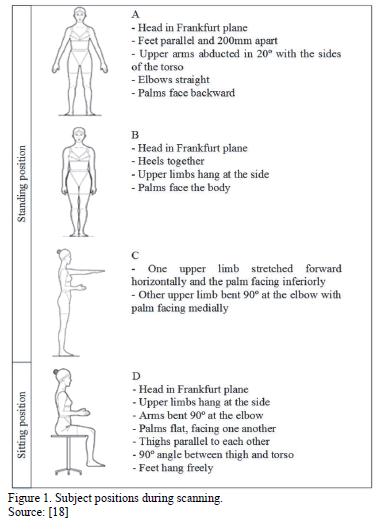
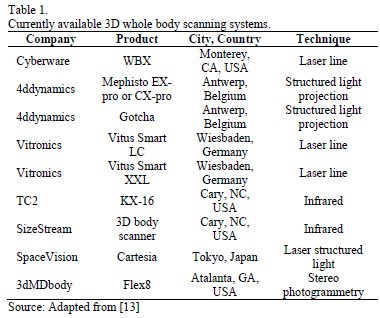
<body><![CDATA[<p><font size="2" face="Verdana, Arial, Helvetica, sans-serif"><b><i>2.2. Scanning process</i></b></font></p>     <p><font size="2" face="Verdana, Arial, Helvetica, sans-serif">3D scanning offers a technique for capturing  body dimensions in a fast and reproducible way. However, the position of the  subject in the scanning volume is important if reliable data that can be used  in an anthropometric database are to be obtained. The postures used for  measurements in traditional anthropometry are not suitable for body scanning because  they occlude large areas at the axillae or the crotch Instead, they require a  scan posture with abducted arms and legs that affords the image capture devices  a view of the inside surfaces of the limbs and torso. Kouchi et al. &#91;17&#93; state  that this change to the basic posture may alter some measurements when compared  to those acquired using standard anthropometric tools. Although occluded areas  are smaller when arms and legs are abducted, these postures can also result in  changes to the shape of the shoulders and to body dimensions around the  shoulders and hips. In this study the authors concluded that the acromial height remains stable as long as the  abduction angle is smaller than 20°, and the biacromial breadth smaller when  the abduction angle is greater, approximately, than 5°.</font></p>     <p><font size="2" face="Verdana, Arial, Helvetica, sans-serif">As scanning systems are different from  one another in the number and placement of image capture devices, the optimal  scanning position may vary from system to system. When the optimal position is  determined, it should be described precisely and used for all subjects. ISO Standard  20685 &#91;18&#93; suggests the four postures identified in <a href="#fig01">Fig. 1</a>. For all postures,  quiet respiration (normal breathing) should be adopted. The shoulders should be  straight without being stiff, and muscles should not be tense.</font></p>     <p align="center"><font size="2" face="Verdana, Arial, Helvetica, sans-serif"><a name="fig01"></a></font><img src="/img/revistas/dyna/v83n197/v83n197a03fig01.gif"></p>     <p><font size="2" face="Verdana, Arial, Helvetica, sans-serif">The positions adopted by subjects during  the scanning process should be adapted to the study being conducted. As such, in  the literature it is possible to find positions that differ from those  indicated in ISO 20685. This is the case presented by Ashdown et al. &#91;19&#93; who  argued (in a case in which a laser scanner with 8 paired cameras was stationed  at four points equally spaced around the body) that the subjects' feet should  be positioned about 30cm apart with the arms abducted from the body. This is a  fundamental aspect of a good scan because other positions often result in holes  or missing data for some portion of the body or obscure another area (such as  under the arms) or for areas where the cameras cannot record data (such as  surfaces parallel to the floor). Additionally, surfaces such as hair and dark-textured  clothing decrease the quality of the scan by scattering the light and  preventing the cameras from capturing a complete set of data points. A study by  Tomkinson &amp; Shaw &#91;20&#93; showed that most direct 3D scan measurements of  standing posture had good repeatability, except the head and neck postures, whose  repeatability was poor, as a result of significant postural errors. In this  case they recommend that researchers aim at reducing postural and technical  errors by strictly adhering to measurement protocols, undergoing extensive  tester training, choosing appropriate test-retest intervals, minimizing diurnal  variability, and taking multiple measurements.</font></p>     <p><font size="2" face="Verdana, Arial, Helvetica, sans-serif"><b><i>2.3. The different body scanners</i></b></font></p>     <p><font size="2" face="Verdana, Arial, Helvetica, sans-serif">There are  two types of body scanners: high-end scanning systems that produce high-quality  scans for sizing surveys and in-shop or in-house inexpensive scanning systems  that produce lower quality scans for retail use &#91;17&#93;. Based on a publication  from 2013 &#91;13&#93;, several 3D whole body scanning systems are currently available  on the market, including those presented in <a href="#tab01">Table 1</a>.</font></p>     <p align="center"><font size="2" face="Verdana, Arial, Helvetica, sans-serif"><a name="tab01"></a></font><img src="/img/revistas/dyna/v83n197/v83n197a03tab01.gif"></p>     <p><font size="2" face="Verdana, Arial, Helvetica, sans-serif">There are also new ways of creating  three-dimensional images using systems that were not initially designed for the  purpose. This is the case of Microsoft Kinect, which can be used for numerous  other applications besides games. The Microsoft Kinect sensor is one of a class  of devices known as depth cameras in the category of structured light systems &#91;21&#93;. Kinect may be considered a 3D markerless motion  capture system because it provides a simplified skeleton in real time, without  the need for special clothes or other equipment. Despite the fact that it  cannot be used for extremely accurate studies &#91;22-24&#93;, it may be deployed when  there is no need for high levels of accuracy, for example in clothing or shoe sizing,  indirect fat measurement, or clinical rehabilitation &#91;25, 26&#93;.</font></p>     <p><font size="2" face="Verdana, Arial, Helvetica, sans-serif"><b><i>2.4. Applications</i></b></font></p>     ]]></body>
<body><![CDATA[<p><font size="2" face="Verdana, Arial, Helvetica, sans-serif">Body scanners are used for a wide variety  of applications. Jones &amp;  Rioux &#91;14&#93; divided their  applications into:</font></p> <ul>       <li><font size="2" face="Verdana, Arial, Helvetica, sans-serif">Medical: body deformity;     glaucoma; orthodontics; orthopedics; surgery; lung function studies; custom     prostheses; breast topography; pediatrics; medical management;</font></li>       <li><font size="2" face="Verdana, Arial, Helvetica, sans-serif">Human systems engineering: work     environment; population anthropology; helmets and face masks; gloves; clothing;     human morphology; human motion analysis; forensic imaging; hearing studies;</font></li>       <li><font size="2" face="Verdana, Arial, Helvetica, sans-serif">Virtual reality and     communications: three-dimensional portraits; computer animation of human     models.</font></li>     </ul>     <p><font size="2" face="Verdana, Arial, Helvetica, sans-serif">More recently, according to Ashdown et  al. &#91;19&#93;, 3D scans have been used to create virtual models of customers for the  apparel industry, which consumers can use to try on clothing virtually.</font></p>     <p><font size="2" face="Verdana, Arial, Helvetica, sans-serif">Another important use of body scanners is  the creation of anthropometric databases. The first large-scale 3D  anthropometry survey project carried out was the Civilian American and European  Surface Anthropometry Resource (CAESAR). The CAESAR database contains  anthropometric variability of men and women, with ages ranging from 18 to 65  years old. Representatives were asked to ensure the database contained samples  for various weights, ethnic groups, gender, geographic regions, and  socio-economic status. The study was conducted between April 1998 and early  2000 and included three scans per person for (i) standing posture, (ii)  full-coverage posture and (iii) relaxed seating posture. The data collection  methods were standardized and documented so that the database may be continually  expanded and updated. High-resolution body scans were made using three-dimensional  body scanners from Cyberware and Vitronics.</font></p>     <p><font size="2" face="Verdana, Arial, Helvetica, sans-serif">In addition to the CAESAR project, many other  studies, such as Size UK, Size USA, Size Spain and Size China, have been  conducted to classify entire populations using data collected with 3D body scanners.</font></p>     <p>&nbsp;</p>     <p><font size="3" face="Verdana, Arial, Helvetica, sans-serif"><b>3. Reliability and validity of anthropometric data</b></font></p>     ]]></body>
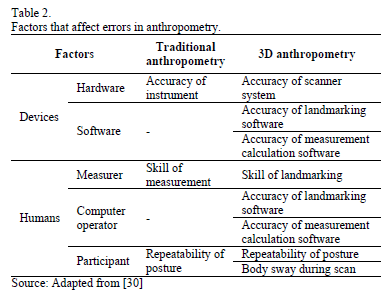
<body><![CDATA[<p><font size="2" face="Verdana, Arial, Helvetica, sans-serif">When using anthropometric data it is  important to test its reliability and validity, as these factors may influence  both the measurements and the interpretation of the results obtained. Appannah  et al. &#91;27&#93; argue that the validity of data is defined by the ability to  achieve the &quot;true value&quot; of a measurement, while Johnson et al. &#91;28&#93; defined  reliability as the ability to repeat, reproduce, or consistently obtain the  same measurement under identical conditions. According to Mueller &amp; Martorell &#91;29&#93;, the reliability of a measurement relies  on precision and dependability, the former being the most important determinant.  Also important is intra-observer reliability, described as the ability of the same  observer to obtain consistent measurement, and inter-observer reliability -  ability of different measurers to obtain similar measurement. Kouchi et al. &#91;17&#93;  stated that for anthropometric data users there are three essential quality  parameters: </font></p> <ul>       <li><font size="2" face="Verdana, Arial, Helvetica, sans-serif">Validity of the data, meaning     that the target population is well defined by the subject population of an     anthropometric survey; </font></li>       <li><font size="2" face="Verdana, Arial, Helvetica, sans-serif">Comparability of measurement     items, implying that the exact same method is used when taking the same one     dimensional measurement;</font></li>       <li><font size="2" face="Verdana, Arial, Helvetica, sans-serif">Accuracy and precision of     measurements, which are affected by factors such as instruments, measurer     skills or, even, the participants themselves.</font></li>     </ul>     <p><font size="2" face="Verdana, Arial, Helvetica, sans-serif"><b><i>3.1. Sources of errors</i></b></font></p>     <p><font size="2" face="Verdana, Arial, Helvetica, sans-serif">Despite the importance of all these  issues (because of their impact on measurement error) they are sometimes  neglected when conducting an investigation. In most studies the error limits  are set prior to data collection, whilst the performance of the measurer is  evaluated during the collection process (comparing it with previously defined standards).</font></p>     <p><font size="2" face="Verdana, Arial, Helvetica, sans-serif">Both in traditional anthropometry methods  and in 3D anthropometry, there are some factors that may affect the incidence  of errors. Kouchi et al. &#91;30&#93; presented a list of some of these factors (<a href="#tab02">Table  2</a>), where they state that the two principal sources of error are related to the  devices used and to the persons involved in the data collection process.</font></p>     <p align="center"><font size="2" face="Verdana, Arial, Helvetica, sans-serif"><a name="tab02"></a></font><img src="/img/revistas/dyna/v83n197/v83n197a03tab02.gif"></p>     <p><font size="2" face="Verdana, Arial, Helvetica, sans-serif">The traditional instruments used when  collecting anthropometric data are usually simple to calibrate and as such,  they are only unreliable if they were poorly designed (e.g., a tape measure  that is made from a material that will stretch). On the other hand the  calibration of a 3D scanning system can be compromised either by the hardware  or software. Most scanning systems have a calibration process that will verify  and correct the calibration of the scanner by measuring a simple geometric  shape of known dimensions.</font></p>     ]]></body>
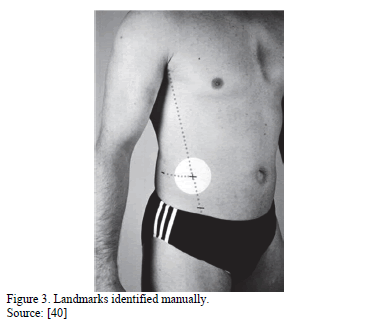
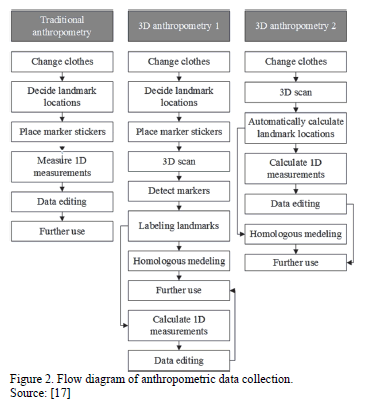
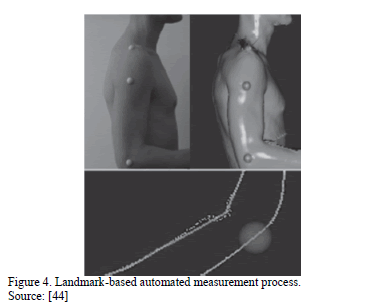
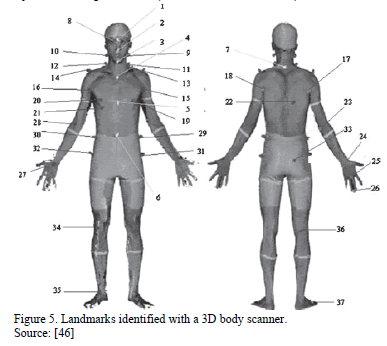
<body><![CDATA[<p><font size="2" face="Verdana, Arial, Helvetica, sans-serif">The skill of  measurement collection processes resides not only in the ability to produce  several consistent measurements, but also in the ability to accurately identify  the locations of the various landmarks. However, these two factors are very  difficult to separate and assess individually as no &quot;true values&quot; are present in  the human body &#91;29&#93;. Despite the fact  that the repeatability of posture is marked as being a factor caused by the  participants, a proper measuring posture and its repeatability are factors that  are also related to the measurer, as they can be controlled if the measurer provides  proper instructions &#91;30&#93;. As such, it may be said that observer error is the  cause of most errors in traditional </font><font size="2" face="Verdana, Arial, Helvetica, sans-serif">anthropometry since it  includes imprecision in landmark location, subject positioning, and instrument  usage &#91;31&#93;. The same authors also  discuss the fact that when multiple observers are involved, this error can be  accentuated, as happens in most large-scale anthropometric surveys, where the  landmarking process is conducted by a single person but the body measurements  are done by several &#91;22&#93;. </font></p>     <p><font size="2" face="Verdana, Arial, Helvetica, sans-serif">Although when traditional methods are  used the steps to achieving actual usable anthropometric data are not very  complex, they are much more complex when a 3D body scanner is employed, as  shown in <a href="#fig02">Fig. 2</a>. This is the reason why 3D anthropometry presents so many more  factors that may influence the existence of errors in measurements.</font></p>     <p align="center"><font size="2" face="Verdana, Arial, Helvetica, sans-serif"><a name="fig02"></a></font><img src="/img/revistas/dyna/v83n197/v83n197a03fig02.gif"></p>     <p><font size="2" face="Verdana, Arial, Helvetica, sans-serif">Ever since 3D body scanners first  appeared there have been authors who have tried to assess the accuracy and  precision of the measurements derived from them. Attempts have been made to  evaluate them in terms of: (i) comparability with measurements from traditional  methods &#91;32-34&#93;; (ii) repeatability of scan-derived measurements &#91;35,36&#93;; (iii)  and repeatability of scan-derived landmark locations obtained from the same  image &#91;35&#93;. However, Kouchi et al. &#91;30&#93; state that the quality parameters of  these studies are not usually consistent, because there is no explicit required  accuracy standard and no widely accepted quality evaluation protocol.</font></p>     <p><font size="2" face="Verdana, Arial, Helvetica, sans-serif">Both <a href="#tab02">Table 2</a> and <a href="#fig02">Fig. 2</a> show that an  important part of the three-dimensional anthropometry is based on landmarking.  Most studies evaluate errors in body measurements rather than errors in  landmark locations. However, Kouchi et al. &#91;30&#93; showed that the assessment of accuracy  using measurement errors underestimates errors in landmark locations. This  happens because when the same image is used, the scan-derived landmark  locations are not always identical, but may vary according to the methodology -  marker stickers indicating landmarks or landmark locations calculated from  surface data - and to the way that markers are identified - by an operator, or  calculated using software.</font></p>     <p><font size="2" face="Verdana, Arial, Helvetica, sans-serif">The following section goes into more  detail about landmarking.</font></p>     <p><font size="2" face="Verdana, Arial, Helvetica, sans-serif"><b><i>3.2. Landmarking</i></b></font></p>     <p><font size="2" face="Verdana, Arial, Helvetica, sans-serif">According to the manual of the International  Society for the Advancement of Kinanthropometry &#91;37&#93;, a landmark is an  identifiable skeletal point which generally lies close to the body's surface  and is the marker that identifies the exact location of a measurement site.  They are found by palpation or measurement and can be used to define anatomical  correspondence between individuals. Most commonly used landmarks are located on  specific bones or are easily identifiable by soft tissue features such as  nipples or the navel &#91;17&#93;. </font></p>     <p><font size="2" face="Verdana, Arial, Helvetica, sans-serif">Wrongly identifying a body landmark is  the main cause of observer error in the collection of anthropometric data &#91;30&#93;.  As such, in any anthropometry-based study it is extremely important to agree on  the body measurements to be recorded and the common points on the body to be  identified.</font></p>     <p><font size="2" face="Verdana, Arial, Helvetica, sans-serif">In anthropometry, the same landmark is  frequently used to measure several body dimensions. The first step in  traditional landmarking is to mark the locations on the body sites that will be  measured on the participants' skin using a non-smearing, skin pencil or  skin-safe, washable, ink that can be easily removed using makeup remover &#91;38,  39&#93;. Anthropometrists usually use a small cross or dot as a marking symbol  (<a href="#fig03">Fig. 3</a>).</font></p>     ]]></body>
<body><![CDATA[<p align="center"><font size="2" face="Verdana, Arial, Helvetica, sans-serif"><a name="fig03"></a></font><img src="/img/revistas/dyna/v83n197/v83n197a03fig03.gif"></p>     <p><font size="2" face="Verdana, Arial, Helvetica, sans-serif">Locating the required body landmarks can be a  very difficult and time-consuming task. This may be especially problematic in  people with more body fat over the bony landmarks &#91;15&#93;, or people in  wheelchairs with whom it can be hard to gain access to the required landmarks  &#91;32&#93;. According to Paquette &#91;41&#93;, in 1988, four hours were required to  physically landmark, measure, and record the data of one individual in an  anthropometric survey of US Army personnel.</font></p>     <p><font size="2" face="Verdana, Arial, Helvetica, sans-serif">The  traditional anthropometric measuring procedure has not changed much since this  study was carried out in the late 1980s.</font></p>     <p><font size="2" face="Verdana, Arial, Helvetica, sans-serif">For the marking of landmark locations it  is fundamental that participants adopt the correct posture for the measurement  or the landmark location might be compromised and the results biased. Kouchi et  al. &#91;17&#93; give the example of landmarking the tip of the spinous process of the  seventh cervical vertebra, which can be easily palpated at the back of the base  of the neck when the participant has the neck bent forward. They state that if  the location were marked in this posture, the mark on the skin would slide away  from it when participants lift their heads for orientation in the Frankfurt  plane, compromising the reliability of the results.</font></p>     <p><font size="2" face="Verdana, Arial, Helvetica, sans-serif">As landmarking is the basis for obtaining  valid results, it is important to quantify the measurement errors caused by  landmarking. Despite the fact that the repeatability of landmarking has been  considered an important factor that, if handled incorrectly, contributes to  errors in anthropometry measurement, there are few studies that quantify the  phenomenon. Kouchi et  al. &#91;30&#93; argued that landmarks with large  intra-observer errors also had large inter-observer errors. Additionally, they  found that the errors in body dimensions were smaller than landmarking errors  in 23 of the 35 measurements analyzed, suggesting that the magnitude of  landmarking errors would likely be underestimated by examining errors in body  dimensions. </font></p>     <p><font size="2" face="Verdana, Arial, Helvetica, sans-serif">When using 3D body scanners, the  landmarking process is also crucial for the correct correspondence of  anatomical locations between subjects and across scans. Moreover, measurements  derived from reliable landmarks can be used for statistical analysis, for  reconstructing variation in human body shape or even for creating homologous  models &#91;42, 43&#93;. As such, the poor identification of landmark locations characteristic  of 3D anthropometry has a significant effect on the derived data that is used  to define participant body dimensions and to effect shape analysis. Landmarks  can be placed manually (with traditional markers, for scanners that can sense color  differentiation, or small hemispherical objects stuck to the skin for scanners  that only capture surface geometry - <a href="#fig04">Fig. 4</a>). Or they may be identified by the scanner's software  system, in which case they are automatically identified from body surface  geometries. <a href="#fig05">Fig. 5</a> shows a set of landmarks automatically derived from a scan  based on surface geometries.</font></p>     <p align="center"><font size="2" face="Verdana, Arial, Helvetica, sans-serif"><a name="fig04"></a></font><img src="/img/revistas/dyna/v83n197/v83n197a03fig04.gif"></p>     <p align="center"><font size="2" face="Verdana, Arial, Helvetica, sans-serif"><a name="fig05"></a></font><img src="/img/revistas/dyna/v83n197/v83n197a03fig05.gif"></p>     <p><font size="2" face="Verdana, Arial, Helvetica, sans-serif">Before starting the scan measurement  process it is necessary to identify some body parts, in order to achieve an  appropriate reconstruction from the captured datapoints a. The human model is  usually divided at armpits and crotch (a process known as segmentation). Five  body parts, including head and torso, both arms, and both legs can be  identified. There are many ways to perform this segmentation, for example, Nurre  et al. &#91;45&#93; proposed a cusp algorithm for segmenting the 3D scanning data of a  human body while Wang et al. &#91;46&#93; applied fuzzy logic concepts to locate the armpits  and crotch, and then to separate the arms and legs from the trunk. </font></p>     <p><font size="2" face="Verdana, Arial, Helvetica, sans-serif">The landmarking process is the most  problematic aspect of 3D anthropometry since the landmarks placed on bony structures  that are found below the skin surface, and palpated by the anthropometrist (in  traditional methods) cannot be </font><font size="2" face="Verdana, Arial, Helvetica, sans-serif">accurately identified  from the surface shape of the scan. As this is a difficult process, and  integral to reliable data collection, some attention has been given to  developing methods to enable correct landmark identification. Some studies  present algorithms for automatically calculating landmark locations &#91;47,48&#93; while  others propose alternatives for automatically detecting and calculating 3D  coordinates of markers positioned by experienced anthropometrists &#91;46&#93;.  However, as creating a good criterion for evaluating the performance of an  algorithm is very difficult, the performance of very experienced  anthropometrists is used as a criterion for evaluating the performance of  algorithms used for calculating scan-derived body dimensions &#91;30&#93;.</font></p>     ]]></body>
<body><![CDATA[<p><font size="2" face="Verdana, Arial, Helvetica, sans-serif">According to Wang et al. &#91;46&#93;, landmark  identification methods may in general terms be classified as: (i) premarking,  (ii) human body mapping, (iii) geometry analysis and (iv) approximate  determination of height location. Often the positions of the landmarks can be  easily identified on the scanning image with the human eye, a process that is  difficult to program into software. By using color information obtained from  the cameras in the scanning heads, manually placed landmarks can also be  identified by analyzing the RGB information in the scanned image &#91;6,46,49&#93;.</font></p>     <p><font size="2" face="Verdana, Arial, Helvetica, sans-serif">However,  the procedure of placing markers on the body surface is time consuming,  relatively invasive, and may involve human error. Kouchi et al. &#91;30&#93; discuss  the fact that the amount of error in identifying landmarks is not well known.  They examined the landmarking of 40 individuals carried out by experienced and  novice markers and compared the differences in measurements taken with  reference to the landmarks identified. Differences in measurements obtained  that were due to intra- and inter- observer error were sufficiently large that  it was suggested that the explicit definition of landmarks in more detail might  reduce landmarking errors. </font></p>     <p><font size="2" face="Verdana, Arial, Helvetica, sans-serif">Therefore, the possibility of developing  marker-free techniques for landmarking becomes an important issue for analyzing  3D whole body scanning data. For the method of automated landmarking, analyzing  the geometry of the human body using techniques such as silhouette analysis is  a logical approach &#91;50&#93;. Douros et al. &#91;51&#93; used the method of reconstructing  curves and surfaces to locate the landmarks. Allen et al. &#91;42&#93; proposed a  method for identifying landmarks efficiently that employed a template mapping  approach, which makes use of information from the existing database of 3D human  models. Lu and Wang &#91;52&#93; used four algorithms (silhouette analysis, minimum  circumference determination, gray-scale detection, and human-body contour  plots) to locate 12 landmarks and 3 characteristic lines automatically, making  it possible to obtain 104 body dimensions.</font></p>     <p><font size="2" face="Verdana, Arial, Helvetica, sans-serif">According to Kouchi et al. &#91;30&#93;, the  identification of the 3D coordinates of landmark locations can be done entirely  manually, entirely automatically, or using a mix of both techniques:</font></p> <ul>       <li><font size="2" face="Verdana, Arial, Helvetica, sans-serif">Deciding landmark locations on     the body: a measurer decides landmark locations manually or a system calculates     them automatically; </font></li>       <li><font size="2" face="Verdana, Arial, Helvetica, sans-serif">Obtaining     3D coordinates of markers: an operator manually picks the centers of marker     stickers or a system recognizes stickers automatically and calculates 3D     coordinates; </font></li>       <li><font size="2" face="Verdana, Arial, Helvetica, sans-serif">Naming landmarks (or labeling):     either an operator or a system automatically names each marker. </font></li>     </ul>     <p><font size="2" face="Verdana, Arial, Helvetica, sans-serif">Although selecting a manual method to  decide landmark locations on the human body and placing a marker is time  consuming, so too is doing it semi-automatically by validating marker centers  and naming markers. If on the one hand, automatic calculations of landmark  locations save time, on the other, they may not always match the landmark  locations identified by experienced anthropometrists. </font></p>     <p>&nbsp;</p>     ]]></body>
<body><![CDATA[<p><font size="3" face="Verdana, Arial, Helvetica, sans-serif"><b>4. Conclusions</b></font></p>     <p><font size="2" face="Verdana, Arial, Helvetica, sans-serif">Creating anthropometric databases  typically requires considerable resources (time, knowledge, funds, equipment  and people). To overcome these limitations, technological developments in  recent years, using three-dimensional digital forms, has made it possible to  advance the study of human size and shape using fewer resources. 3D body  scanners make anthropometric data acquisition more practical, faster, and less  expensive. It also has the potential to produce valid and reliable  measurements. With these advances it is now possible to explore the  possibilities of anthropometric measurement processes and create new  perspectives on its use.</font></p>     <p><font size="2" face="Verdana, Arial, Helvetica, sans-serif">3D scanning systems have evolved over the  last few years. From LASS to Kinect, the technology is always advancing. The  type of technology used differs from scanner to scanner. There are four main  types of technology: - laser line systems, structured light systems, multi-view  camera systems and millimeter wave systems. Currently, there is a significant  range of three-dimensional body scanners available in the market (nine major products  developed in different parts of the globe). </font></p>     <p><font size="2" face="Verdana, Arial, Helvetica, sans-serif">Depending on the technology and product  used, the results and applications are different. Different products may have  different reliability issues, potentially compromising the applicability of the  data. Depending on the desired application -i.e., highly precise anthropometric  data or less accurate data for apparel applications- a variety of body scanners  may be used. For example, the Microsoft Kinect, which is less accurate, may be  used for apparel applications, while the Vitrus Smart LC, because it is more  precise, can be used for compiling an anthropometric database.</font></p>     <p><font size="2" face="Verdana, Arial, Helvetica, sans-serif">The same logic can be applied when  selecting traditional methods versus 3D anthropometry, as which method should  be used will depend on the type of data required (one-dimensional measurements  or three-dimensional surface shapes) and on how it will be applied. </font></p>     <p>&nbsp;</p>     <p><font size="3" face="Verdana, Arial, Helvetica, sans-serif"><b>Acknowledgments</b></font></p>     <p><font size="2" face="Verdana, Arial, Helvetica, sans-serif">This work is financed by FEDER funds  through the Competitive Factors Operational Program (COMPETE) POCI-01-0145-FEDER-007043  and POCI-01-0145-FEDER-007136 and by national funds through FCT - the  Portuguese Foundation for Science and Technology, under the projects  UID/CEC/00319/2013 and UID/CTM/000264 respectively.</font></p>     <p>&nbsp;</p>     <p><font size="3" face="Verdana, Arial, Helvetica, sans-serif"><b>References</b></font></p>     ]]></body>
<body><![CDATA[<!-- ref --><p><font size="2" face="Verdana, Arial, Helvetica, sans-serif"><b>&#91;1&#93;</b> Simmons,  K.P. and Istook, C L., Body measurement techniques: Comparing 3D body-scanning  and anthropometric methods for apparel applications. Journal of Fashion  Marketing and Management: An International Journal, 7(3), pp. 306-332, 2003. DOI: 10.1108/13612020310484852</font>&nbsp;&nbsp;&nbsp;&nbsp;&nbsp;&nbsp;&nbsp;&nbsp;[&#160;<a href="javascript:void(0);" onclick="javascript: window.open('/scielo.php?script=sci_nlinks&ref=1137636&pid=S0012-7353201600030000300001&lng=','','width=640,height=500,resizable=yes,scrollbars=1,menubar=yes,');">Links</a>&#160;]<!-- end-ref --><!-- ref --><p><font size="2" face="Verdana, Arial, Helvetica, sans-serif"><b>&#91;2&#93;</b> ISO-7250., Basic human body measurements for  technological design, 1996.    &nbsp;&nbsp;&nbsp;&nbsp;&nbsp;&nbsp;&nbsp;&nbsp;[&#160;<a href="javascript:void(0);" onclick="javascript: window.open('/scielo.php?script=sci_nlinks&ref=1137637&pid=S0012-7353201600030000300002&lng=','','width=640,height=500,resizable=yes,scrollbars=1,menubar=yes,');">Links</a>&#160;]<!-- end-ref --></font></p>     <!-- ref --><p><font size="2" face="Verdana, Arial, Helvetica, sans-serif"><b>&#91;3&#93;</b> Kroemer, K. and Kroemer, H.J., Engineering physiology:  Bases of human factors/ergonomics. New York: John Wiley &amp; Sons, 1997.    &nbsp;&nbsp;&nbsp;&nbsp;&nbsp;&nbsp;&nbsp;&nbsp;[&#160;<a href="javascript:void(0);" onclick="javascript: window.open('/scielo.php?script=sci_nlinks&ref=1137639&pid=S0012-7353201600030000300003&lng=','','width=640,height=500,resizable=yes,scrollbars=1,menubar=yes,');">Links</a>&#160;]<!-- end-ref --></font></p>     <!-- ref --><p><font size="2" face="Verdana, Arial, Helvetica, sans-serif"><b>&#91;4&#93;</b> Montagu, M.F. and Brožek, J.C., A handbook of  anthropometry. Springfield: Charles C Thomas Publisher, 1960. DOI: 10.1037/12018-000</font>&nbsp;&nbsp;&nbsp;&nbsp;&nbsp;&nbsp;&nbsp;&nbsp;[&#160;<a href="javascript:void(0);" onclick="javascript: window.open('/scielo.php?script=sci_nlinks&ref=1137641&pid=S0012-7353201600030000300004&lng=','','width=640,height=500,resizable=yes,scrollbars=1,menubar=yes,');">Links</a>&#160;]<!-- end-ref --><!-- ref --><p><font size="2" face="Verdana, Arial, Helvetica, sans-serif"><b>&#91;5&#93;</b> Lovesey, E.J., A method for determining facial contours  by shadow projection. Royal Aircraft Establishment Technical Report TR66192,  1966.    &nbsp;&nbsp;&nbsp;&nbsp;&nbsp;&nbsp;&nbsp;&nbsp;[&#160;<a href="javascript:void(0);" onclick="javascript: window.open('/scielo.php?script=sci_nlinks&ref=1137642&pid=S0012-7353201600030000300005&lng=','','width=640,height=500,resizable=yes,scrollbars=1,menubar=yes,');">Links</a>&#160;]<!-- end-ref --></font></p>     <!-- ref --><p><font size="2" face="Verdana, Arial, Helvetica, sans-serif"><b>&#91;6&#93;</b> Daanen, H.A.M. and van de Water, G.J., Whole body  scanners. Displays, 19(3), pp. 111-120, 1998. DOI: 10.1016/S0141-9382(98)00034-1</font>&nbsp;&nbsp;&nbsp;&nbsp;&nbsp;&nbsp;&nbsp;&nbsp;[&#160;<a href="javascript:void(0);" onclick="javascript: window.open('/scielo.php?script=sci_nlinks&ref=1137644&pid=S0012-7353201600030000300006&lng=','','width=640,height=500,resizable=yes,scrollbars=1,menubar=yes,');">Links</a>&#160;]<!-- end-ref --><!-- ref --><p><font size="2" face="Verdana, Arial, Helvetica, sans-serif"><b>&#91;7&#93;</b> Bindahman, S., Zakaria, N. and Zakaria, N., 3D body  scanning technology: Privacy and ethical issues, Proceeding of the  International Conference on Cyber Security, Cyber Warfare and Digital Forensic  (IEEE CyberSec), pp. 150-154, 2012.    &nbsp;&nbsp;&nbsp;&nbsp;&nbsp;&nbsp;&nbsp;&nbsp;[&#160;<a href="javascript:void(0);" onclick="javascript: window.open('/scielo.php?script=sci_nlinks&ref=1137645&pid=S0012-7353201600030000300007&lng=','','width=640,height=500,resizable=yes,scrollbars=1,menubar=yes,');">Links</a>&#160;]<!-- end-ref --></font></p>     <!-- ref --><p><font size="2" face="Verdana, Arial, Helvetica, sans-serif"><b>&#91;8&#93;</b> Jones, P.R.M., West, G.M., Harris, D.H. and Read, J.B.,  The loughborough anthropometric shadow scanner (LASS). Endeavour, 13(4), pp.  162-168, 1989. DOI: 10.1016/S0160-9327(89)80014-6, 10.1016/S0160-9327(89)80004-3</font>&nbsp;&nbsp;&nbsp;&nbsp;&nbsp;&nbsp;&nbsp;&nbsp;[&#160;<a href="javascript:void(0);" onclick="javascript: window.open('/scielo.php?script=sci_nlinks&ref=1137647&pid=S0012-7353201600030000300008&lng=','','width=640,height=500,resizable=yes,scrollbars=1,menubar=yes,');">Links</a>&#160;]<!-- end-ref --><!-- ref --><p><font size="2" face="Verdana, Arial, Helvetica, sans-serif"><b>&#91;9&#93;</b> Brooke-Wavell, K., Jones, P.R.M. and West, G.M.,  Reliability and repeatability of 3-D body scanner (LASS) measurements compared  to anthropometry. Annals of Human Biology, 21(6), pp. 571-577, 1994. DOI: 10.1080/03014469400003572</font>&nbsp;&nbsp;&nbsp;&nbsp;&nbsp;&nbsp;&nbsp;&nbsp;[&#160;<a href="javascript:void(0);" onclick="javascript: window.open('/scielo.php?script=sci_nlinks&ref=1137648&pid=S0012-7353201600030000300009&lng=','','width=640,height=500,resizable=yes,scrollbars=1,menubar=yes,');">Links</a>&#160;]<!-- end-ref --><!-- ref --><p><font size="2" face="Verdana, Arial, Helvetica, sans-serif"><b>&#91;10&#93;</b> Bragança, S.,  Arezes, P. and Carvalho, M., An overview of the current three-dimensional body  scanners for anthropometric data collection, Occupational Safety and Hygiene  III, pp. 149-153, 2015. DOI: 10.1201/b18042-32</font>&nbsp;&nbsp;&nbsp;&nbsp;&nbsp;&nbsp;&nbsp;&nbsp;[&#160;<a href="javascript:void(0);" onclick="javascript: window.open('/scielo.php?script=sci_nlinks&ref=1137649&pid=S0012-7353201600030000300010&lng=','','width=640,height=500,resizable=yes,scrollbars=1,menubar=yes,');">Links</a>&#160;]<!-- end-ref --><!-- ref --><p><font size="2" face="Verdana, Arial, Helvetica, sans-serif"><b>&#91;11&#93;</b> Treleaven, P. and  Wells, J., 3D body scanning and healthcare applications. Computer, 40(7), pp.  28-34, 2007. DOI: 10.1109/MC.2007.225</font>&nbsp;&nbsp;&nbsp;&nbsp;&nbsp;&nbsp;&nbsp;&nbsp;[&#160;<a href="javascript:void(0);" onclick="javascript: window.open('/scielo.php?script=sci_nlinks&ref=1137650&pid=S0012-7353201600030000300011&lng=','','width=640,height=500,resizable=yes,scrollbars=1,menubar=yes,');">Links</a>&#160;]<!-- end-ref --><!-- ref --><p><font size="2" face="Verdana, Arial, Helvetica, sans-serif"><b>&#91;12&#93;</b> Istook, C.L. and  Hwang, S., 3D body scanning systems with application to the apparel industry.  Journal of Fashion Marketing and Management, 5(2), pp. 120-132, 2001. DOI: 10.1108/EUM0000000007283</font>&nbsp;&nbsp;&nbsp;&nbsp;&nbsp;&nbsp;&nbsp;&nbsp;[&#160;<a href="javascript:void(0);" onclick="javascript: window.open('/scielo.php?script=sci_nlinks&ref=1137651&pid=S0012-7353201600030000300012&lng=','','width=640,height=500,resizable=yes,scrollbars=1,menubar=yes,');">Links</a>&#160;]<!-- end-ref --><!-- ref --><p><font size="2" face="Verdana, Arial, Helvetica, sans-serif"><b>&#91;13&#93;</b> Daanen, H.A.M. and  Haar, F.B., 3D whole body scanners revisited. Displays, 34(4), pp. 270-275,  2013. DOI: 10.1016/j.displa.2013.08.011</font>&nbsp;&nbsp;&nbsp;&nbsp;&nbsp;&nbsp;&nbsp;&nbsp;[&#160;<a href="javascript:void(0);" onclick="javascript: window.open('/scielo.php?script=sci_nlinks&ref=1137652&pid=S0012-7353201600030000300013&lng=','','width=640,height=500,resizable=yes,scrollbars=1,menubar=yes,');">Links</a>&#160;]<!-- end-ref --><!-- ref --><p><font size="2" face="Verdana, Arial, Helvetica, sans-serif"><b>&#91;14&#93;</b> Jones, P.R.M. and  Rioux, M., Three-dimensional surface anthropometry: Applications to the human  body. Optics and Lasers in Engineering, 28(1), pp. 89-117, 1997. DOI: 10.1016/S0143-8166(97)00006-7</font>&nbsp;&nbsp;&nbsp;&nbsp;&nbsp;&nbsp;&nbsp;&nbsp;[&#160;<a href="javascript:void(0);" onclick="javascript: window.open('/scielo.php?script=sci_nlinks&ref=1137653&pid=S0012-7353201600030000300014&lng=','','width=640,height=500,resizable=yes,scrollbars=1,menubar=yes,');">Links</a>&#160;]<!-- end-ref --><!-- ref --><p><font size="2" face="Verdana, Arial, Helvetica, sans-serif"><b>&#91;15&#93;</b> Olds, T. and Honey, F., The use of 3D  whole-body scanners in anthropometry. Proceedings of the 9th International  Conference of the International Society for the Advancement of  Kinanthropometry, pp. 1-12, 2006.    &nbsp;&nbsp;&nbsp;&nbsp;&nbsp;&nbsp;&nbsp;&nbsp;[&#160;<a href="javascript:void(0);" onclick="javascript: window.open('/scielo.php?script=sci_nlinks&ref=1137654&pid=S0012-7353201600030000300015&lng=','','width=640,height=500,resizable=yes,scrollbars=1,menubar=yes,');">Links</a>&#160;]<!-- end-ref --></font></p>     ]]></body>
<body><![CDATA[<!-- ref --><p><font size="2" face="Verdana, Arial, Helvetica, sans-serif"><b>&#91;16&#93;</b> Mckinnon, L. and Istook, C.,  Comparative analysis of the image twin system and the 3T6 body scanner. Journal  of Textile and Apparel, Technology and Management, 1(2), pp. 1-7, 2001.    &nbsp;&nbsp;&nbsp;&nbsp;&nbsp;&nbsp;&nbsp;&nbsp;[&#160;<a href="javascript:void(0);" onclick="javascript: window.open('/scielo.php?script=sci_nlinks&ref=1137656&pid=S0012-7353201600030000300016&lng=','','width=640,height=500,resizable=yes,scrollbars=1,menubar=yes,');">Links</a>&#160;]<!-- end-ref --></font></p>     <!-- ref --><p><font size="2" face="Verdana, Arial, Helvetica, sans-serif"><b>&#91;17&#93;</b> Kouchi, M., Gupta, D. and Zakaria, N.,  Anthropometric methods for apparel design: Body measurement devices and  techniques. Anthropometry, Apparel Sizing and Design, pp. 67-94, 2014. DOI: 10.1533/9780857096890.1.67</font>&nbsp;&nbsp;&nbsp;&nbsp;&nbsp;&nbsp;&nbsp;&nbsp;[&#160;<a href="javascript:void(0);" onclick="javascript: window.open('/scielo.php?script=sci_nlinks&ref=1137658&pid=S0012-7353201600030000300017&lng=','','width=640,height=500,resizable=yes,scrollbars=1,menubar=yes,');">Links</a>&#160;]<!-- end-ref --><!-- ref --><p><font size="2" face="Verdana, Arial, Helvetica, sans-serif"><b>&#91;18&#93;</b> ISO-20685., 3-D scanning methodologies  for internationally comptible anthropometric databases, 2010.    &nbsp;&nbsp;&nbsp;&nbsp;&nbsp;&nbsp;&nbsp;&nbsp;[&#160;<a href="javascript:void(0);" onclick="javascript: window.open('/scielo.php?script=sci_nlinks&ref=1137659&pid=S0012-7353201600030000300018&lng=','','width=640,height=500,resizable=yes,scrollbars=1,menubar=yes,');">Links</a>&#160;]<!-- end-ref --> </font></p>     <!-- ref --><p><font size="2" face="Verdana, Arial, Helvetica, sans-serif"><b>&#91;19&#93;</b> Ashdown, S.P., Loker, S.,  Schoenfelder, K. and Lyman-Clarke, L., Using 3D scans for fit analysis. Journal  of Textile and Apparel, Technology and Management, 4(1), pp. 1-12, 2004.    &nbsp;&nbsp;&nbsp;&nbsp;&nbsp;&nbsp;&nbsp;&nbsp;[&#160;<a href="javascript:void(0);" onclick="javascript: window.open('/scielo.php?script=sci_nlinks&ref=1137661&pid=S0012-7353201600030000300019&lng=','','width=640,height=500,resizable=yes,scrollbars=1,menubar=yes,');">Links</a>&#160;]<!-- end-ref --></font></p>     <!-- ref --><p><font size="2" face="Verdana, Arial, Helvetica, sans-serif"><b>&#91;20&#93;</b> Tomkinson, G.R. and Shaw, L.G.,  Quantification of the postural and technical errors in asymptomatic adults  using direct 3D whole body scan measurements of standing posture. Gait and  Posture, 37(2), pp. 172-177, 2013. DOI: 10.1016/j.gaitpost.2012.06.031</font>&nbsp;&nbsp;&nbsp;&nbsp;&nbsp;&nbsp;&nbsp;&nbsp;[&#160;<a href="javascript:void(0);" onclick="javascript: window.open('/scielo.php?script=sci_nlinks&ref=1137663&pid=S0012-7353201600030000300020&lng=','','width=640,height=500,resizable=yes,scrollbars=1,menubar=yes,');">Links</a>&#160;]<!-- end-ref --><!-- ref --><p><font size="2" face="Verdana, Arial, Helvetica, sans-serif"><b>&#91;21&#93;</b> Shotton, J., Fitzgibbon, A., Cook, M.,  Sharp, T., Finocchio, M., Moore, R. and Blake, A., Real-time human pose  recognition in parts from single depth images. Studies in Computational  Intelligence, 411(1), pp. 119-135, 2013. DOI: 10.1007/978-3-642-28661-2_5</font>&nbsp;&nbsp;&nbsp;&nbsp;&nbsp;&nbsp;&nbsp;&nbsp;[&#160;<a href="javascript:void(0);" onclick="javascript: window.open('/scielo.php?script=sci_nlinks&ref=1137664&pid=S0012-7353201600030000300021&lng=','','width=640,height=500,resizable=yes,scrollbars=1,menubar=yes,');">Links</a>&#160;]<!-- end-ref --><!-- ref --><p><font size="2" face="Verdana, Arial, Helvetica, sans-serif"><b>&#91;22&#93;</b> Ye, M., Wang, X., Yang, R., Ren, L.  and Pollefeys, M., Accurate 3D pose estimation from a single depth image. 2011  International Conference on Computer Vision, pp. 731-738, 2011. DOI: 10.1109/ICCV.2011.6126310</font>&nbsp;&nbsp;&nbsp;&nbsp;&nbsp;&nbsp;&nbsp;&nbsp;[&#160;<a href="javascript:void(0);" onclick="javascript: window.open('/scielo.php?script=sci_nlinks&ref=1137665&pid=S0012-7353201600030000300022&lng=','','width=640,height=500,resizable=yes,scrollbars=1,menubar=yes,');">Links</a>&#160;]<!-- end-ref --><!-- ref --><p><font size="2" face="Verdana, Arial, Helvetica, sans-serif"><b>&#91;23&#93;</b> Clark, R.A., Pua, Y.H., Fortin, K.,  Ritchie, C., Webster, K.E., Denehy, L. and Bryant, A.L., Validity of the  Microsoft Kinect for assessment of postural control. Gait and Posture, 36(3),  pp. 372-377, 2012. DOI: 10.1016/j.gaitpost.2012.03.033</font>&nbsp;&nbsp;&nbsp;&nbsp;&nbsp;&nbsp;&nbsp;&nbsp;[&#160;<a href="javascript:void(0);" onclick="javascript: window.open('/scielo.php?script=sci_nlinks&ref=1137666&pid=S0012-7353201600030000300023&lng=','','width=640,height=500,resizable=yes,scrollbars=1,menubar=yes,');">Links</a>&#160;]<!-- end-ref --><!-- ref --><p><font size="2" face="Verdana, Arial, Helvetica, sans-serif"><b>&#91;24&#93;</b> Braganca, S.,  Carvalho, M., Xu, B., Arezes, P. and Ashdown, S., A validation study of a kinect based body imaging  (KBI) device system based on ISO 20685:2010. Proceedings of the 5th  International Conference on 3D Body Scanning Technologies, pp. 372-377, 2014.    &nbsp;&nbsp;&nbsp;&nbsp;&nbsp;&nbsp;&nbsp;&nbsp;[&#160;<a href="javascript:void(0);" onclick="javascript: window.open('/scielo.php?script=sci_nlinks&ref=1137667&pid=S0012-7353201600030000300024&lng=','','width=640,height=500,resizable=yes,scrollbars=1,menubar=yes,');">Links</a>&#160;]<!-- end-ref --></font></p>     <!-- ref --><p><font size="2" face="Verdana, Arial, Helvetica, sans-serif"><b>&#91;25&#93;</b> Fern&aacute;ndez-Baena, A.,  Sus&iacute;n, A. and Lligadas, X., Biomechanical  validation of upper-body and lower-body joint movements of kinect motion  capture data for rehabilitation treatments. Proceedings of the 2012 4th  International Conference on Intelligent Networking and Collaborative Systems,  pp. 656-661, 2012. DOI: 10.1109/iNCoS.2012.66</font>&nbsp;&nbsp;&nbsp;&nbsp;&nbsp;&nbsp;&nbsp;&nbsp;[&#160;<a href="javascript:void(0);" onclick="javascript: window.open('/scielo.php?script=sci_nlinks&ref=1137669&pid=S0012-7353201600030000300025&lng=','','width=640,height=500,resizable=yes,scrollbars=1,menubar=yes,');">Links</a>&#160;]<!-- end-ref --><!-- ref --><p><font size="2" face="Verdana, Arial, Helvetica, sans-serif"><b>&#91;26&#93;</b> Weiss, A., Hirshberg, D. and Black,  M.J., Home 3D body scans from noisy image and range data. Proceedings of the  IEEE International Conference on Computer Vision, pp. 1951-1958, 2011 DOI: 10.1109/iccv.2011.6126465</font>&nbsp;&nbsp;&nbsp;&nbsp;&nbsp;&nbsp;&nbsp;&nbsp;[&#160;<a href="javascript:void(0);" onclick="javascript: window.open('/scielo.php?script=sci_nlinks&ref=1137670&pid=S0012-7353201600030000300026&lng=','','width=640,height=500,resizable=yes,scrollbars=1,menubar=yes,');">Links</a>&#160;]<!-- end-ref --><!-- ref --><p><font size="2" face="Verdana, Arial, Helvetica, sans-serif"><b>&#91;27&#93;</b> Appannah, G., Haniff, J., Mohammad  Nor, N.S., Wong, N.F., Kee, C. C., Zainuddin, A.A. and Yusoff, A.F.,  Reliability, technical error of measurements and validity of instruments for  nutritional status assessment of adults in Malaysia. Malaysian Journal of  Nutrition. Nutrition Society of Malaysia, 2008.    &nbsp;&nbsp;&nbsp;&nbsp;&nbsp;&nbsp;&nbsp;&nbsp;[&#160;<a href="javascript:void(0);" onclick="javascript: window.open('/scielo.php?script=sci_nlinks&ref=1137671&pid=S0012-7353201600030000300027&lng=','','width=640,height=500,resizable=yes,scrollbars=1,menubar=yes,');">Links</a>&#160;]<!-- end-ref --> </font></p>     <!-- ref --><p><font size="2" face="Verdana, Arial, Helvetica, sans-serif"><b>&#91;28&#93;</b> Johnson, T.S., Engstrom, J.L. and  Gelhar, D.K., Intra-and interexaminer reliability of anthropometric  measurements of term infants. Journal of Pediatric Gastroenterology and  Nutrition, 24(5), pp. 497-505, 1997. DOI: 10.1097/00005176-199705000-00001</font>&nbsp;&nbsp;&nbsp;&nbsp;&nbsp;&nbsp;&nbsp;&nbsp;[&#160;<a href="javascript:void(0);" onclick="javascript: window.open('/scielo.php?script=sci_nlinks&ref=1137673&pid=S0012-7353201600030000300028&lng=','','width=640,height=500,resizable=yes,scrollbars=1,menubar=yes,');">Links</a>&#160;]<!-- end-ref --><!-- ref --><p><font size="2" face="Verdana, Arial, Helvetica, sans-serif"><b>&#91;29&#93;</b> Mueller, W.H. and Martorell, R., Reliability and accuracy of  measurement. Anthropometric Standardization Reference Manual, pp. 83-86, 1988.    &nbsp;&nbsp;&nbsp;&nbsp;&nbsp;&nbsp;&nbsp;&nbsp;[&#160;<a href="javascript:void(0);" onclick="javascript: window.open('/scielo.php?script=sci_nlinks&ref=1137674&pid=S0012-7353201600030000300029&lng=','','width=640,height=500,resizable=yes,scrollbars=1,menubar=yes,');">Links</a>&#160;]<!-- end-ref --></font></p>     ]]></body>
<body><![CDATA[<!-- ref --><p><font size="2" face="Verdana, Arial, Helvetica, sans-serif"><b>&#91;30&#93;</b> Kouchi, M. and Mochimaru, M., Errors  in landmarking and the evaluation of the accuracy of traditional and 3D  anthropometry. Applied Ergonomics, 42(3), pp. 518-527, 2011. DOI: 10.1016/j.apergo.2010.09.011</font>&nbsp;&nbsp;&nbsp;&nbsp;&nbsp;&nbsp;&nbsp;&nbsp;[&#160;<a href="javascript:void(0);" onclick="javascript: window.open('/scielo.php?script=sci_nlinks&ref=1137676&pid=S0012-7353201600030000300030&lng=','','width=640,height=500,resizable=yes,scrollbars=1,menubar=yes,');">Links</a>&#160;]<!-- end-ref --><!-- ref --><p><font size="2" face="Verdana, Arial, Helvetica, sans-serif"><b>&#91;31&#93;</b> Bennett, K.A. and Osborne, R.H.,  Interobserver measurement reliability in anthropometry. Human Biology, 58(5),  pp. 751-759, 1986.    &nbsp;&nbsp;&nbsp;&nbsp;&nbsp;&nbsp;&nbsp;&nbsp;[&#160;<a href="javascript:void(0);" onclick="javascript: window.open('/scielo.php?script=sci_nlinks&ref=1137677&pid=S0012-7353201600030000300031&lng=','','width=640,height=500,resizable=yes,scrollbars=1,menubar=yes,');">Links</a>&#160;]<!-- end-ref --></font></p>     <!-- ref --><p><font size="2" face="Verdana, Arial, Helvetica, sans-serif"><b>&#91;32&#93;</b> Sims, R.E., Marshall, R., Gyi, D.E.,  Summerskill, S.J. and Case, K., Collection of anthropometry from older and  physically impaired persons: Traditional methods versus TC 2 3-D body scanner.  International Journal of Industrial Ergonomics, 42(1), pp. 65-72, 2012. DOI: 10.1016/j.ergon.2011.10.002</font>&nbsp;&nbsp;&nbsp;&nbsp;&nbsp;&nbsp;&nbsp;&nbsp;[&#160;<a href="javascript:void(0);" onclick="javascript: window.open('/scielo.php?script=sci_nlinks&ref=1137679&pid=S0012-7353201600030000300032&lng=','','width=640,height=500,resizable=yes,scrollbars=1,menubar=yes,');">Links</a>&#160;]<!-- end-ref --><!-- ref --><p><font size="2" face="Verdana, Arial, Helvetica, sans-serif"><b>&#91;33&#93;</b> Han, H., Nam, Y. and Choi, K.,  Comparative analysis of 3D body scan measurements and manual measurements of  size Korea adult females. International Journal of Industrial Ergonomics,  40(5), pp. 530-540, 2010. DOI: 10.1016/j.ergon.2010.06.002</font>&nbsp;&nbsp;&nbsp;&nbsp;&nbsp;&nbsp;&nbsp;&nbsp;[&#160;<a href="javascript:void(0);" onclick="javascript: window.open('/scielo.php?script=sci_nlinks&ref=1137680&pid=S0012-7353201600030000300033&lng=','','width=640,height=500,resizable=yes,scrollbars=1,menubar=yes,');">Links</a>&#160;]<!-- end-ref --><!-- ref --><p><font size="2" face="Verdana, Arial, Helvetica, sans-serif"><b>&#91;34&#93;</b> Lu, J.M. and Wang, M.J.J., The  evaluation of scan-derived anthropometric measurements. IEEE Transactions on  Instrumentation and Measurement, 59(8), pp. 2048-2054, 2010. DOI: 10.1109/TIM.2009.2031847</font>&nbsp;&nbsp;&nbsp;&nbsp;&nbsp;&nbsp;&nbsp;&nbsp;[&#160;<a href="javascript:void(0);" onclick="javascript: window.open('/scielo.php?script=sci_nlinks&ref=1137681&pid=S0012-7353201600030000300034&lng=','','width=640,height=500,resizable=yes,scrollbars=1,menubar=yes,');">Links</a>&#160;]<!-- end-ref --><!-- ref --><p><font size="2" face="Verdana, Arial, Helvetica, sans-serif"><b>&#91;35&#93;</b> Kouchi, M. and Mochimaru, M.,  Evaluation of Accuracy in Traditional and 3D Anthropometry, 2008.    &nbsp;&nbsp;&nbsp;&nbsp;&nbsp;&nbsp;&nbsp;&nbsp;[&#160;<a href="javascript:void(0);" onclick="javascript: window.open('/scielo.php?script=sci_nlinks&ref=1137682&pid=S0012-7353201600030000300035&lng=','','width=640,height=500,resizable=yes,scrollbars=1,menubar=yes,');">Links</a>&#160;]<!-- end-ref --> </font></p>     <!-- ref --><p><font size="2" face="Verdana, Arial, Helvetica, sans-serif"><b>&#91;36&#93;</b> Robinette, K.M. and Daanen, H.A.M.,  Precision of the CAESAR scan-extracted measurements. Applied Ergonomics,  2006. DOI: 10.1016/j.apergo.2005.07.009</font>&nbsp;&nbsp;&nbsp;&nbsp;&nbsp;&nbsp;&nbsp;&nbsp;[&#160;<a href="javascript:void(0);" onclick="javascript: window.open('/scielo.php?script=sci_nlinks&ref=1137684&pid=S0012-7353201600030000300036&lng=','','width=640,height=500,resizable=yes,scrollbars=1,menubar=yes,');">Links</a>&#160;]<!-- end-ref --><!-- ref --><p><font size="2" face="Verdana, Arial, Helvetica, sans-serif"><b>&#91;37&#93;</b> International Society for the  Advancement of Kinanthropometry, available at <a href="http://www.isakonlinve.com" target="_blank">www.isakonlinve.com</a></font>&nbsp;&nbsp;&nbsp;&nbsp;&nbsp;&nbsp;&nbsp;&nbsp;[&#160;<a href="javascript:void(0);" onclick="javascript: window.open('/scielo.php?script=sci_nlinks&ref=1137685&pid=S0012-7353201600030000300037&lng=','','width=640,height=500,resizable=yes,scrollbars=1,menubar=yes,');">Links</a>&#160;]<!-- end-ref --><!-- ref --><p><font size="2" face="Verdana, Arial, Helvetica, sans-serif"><b>&#91;38&#93;</b> Roebuck, J.A., Kroemer, K.H.E. and  Thomson, W.G., Engineering Anthropometry Methods, 1975.    &nbsp;&nbsp;&nbsp;&nbsp;&nbsp;&nbsp;&nbsp;&nbsp;[&#160;<a href="javascript:void(0);" onclick="javascript: window.open('/scielo.php?script=sci_nlinks&ref=1137686&pid=S0012-7353201600030000300038&lng=','','width=640,height=500,resizable=yes,scrollbars=1,menubar=yes,');">Links</a>&#160;]<!-- end-ref --> </font></p>     <!-- ref --><p><font size="2" face="Verdana, Arial, Helvetica, sans-serif"><b>&#91;39&#93;</b> O'Brien, R. and Shelton, W.C., Women's  Measurements for Garment and Pattern Construction, 1941.    &nbsp;&nbsp;&nbsp;&nbsp;&nbsp;&nbsp;&nbsp;&nbsp;[&#160;<a href="javascript:void(0);" onclick="javascript: window.open('/scielo.php?script=sci_nlinks&ref=1137688&pid=S0012-7353201600030000300039&lng=','','width=640,height=500,resizable=yes,scrollbars=1,menubar=yes,');">Links</a>&#160;]<!-- end-ref --></font></p>     <!-- ref --><p><font size="2" face="Verdana, Arial, Helvetica, sans-serif"><b>&#91;40&#93;</b> Marfell-Jones, T.O.A.S., L.C.M.,  Stewart, A. and Marfell-Jones, M., International Standards for Anthropometric  Assessment, 2006.    &nbsp;&nbsp;&nbsp;&nbsp;&nbsp;&nbsp;&nbsp;&nbsp;[&#160;<a href="javascript:void(0);" onclick="javascript: window.open('/scielo.php?script=sci_nlinks&ref=1137690&pid=S0012-7353201600030000300040&lng=','','width=640,height=500,resizable=yes,scrollbars=1,menubar=yes,');">Links</a>&#160;]<!-- end-ref --></font></p>     <!-- ref --><p><font size="2" face="Verdana, Arial, Helvetica, sans-serif"><b>&#91;41&#93;</b> Paquette, S., 3D scanning in apparel  design and human engineering. IEEE Computer Graphics and Applications, 16(5),  pp. 11-15, 1996. DOI: 10.1109/38.536269</font>&nbsp;&nbsp;&nbsp;&nbsp;&nbsp;&nbsp;&nbsp;&nbsp;[&#160;<a href="javascript:void(0);" onclick="javascript: window.open('/scielo.php?script=sci_nlinks&ref=1137692&pid=S0012-7353201600030000300041&lng=','','width=640,height=500,resizable=yes,scrollbars=1,menubar=yes,');">Links</a>&#160;]<!-- end-ref --><!-- ref --><p><font size="2" face="Verdana, Arial, Helvetica, sans-serif"><b>&#91;42&#93;</b> Allen, B., Curless, B. and  Popovi&#263;, Z., The space of human body shapes. ACM Transactions on Graphics.  ACM, 2003.    &nbsp;&nbsp;&nbsp;&nbsp;&nbsp;&nbsp;&nbsp;&nbsp;[&#160;<a href="javascript:void(0);" onclick="javascript: window.open('/scielo.php?script=sci_nlinks&ref=1137693&pid=S0012-7353201600030000300042&lng=','','width=640,height=500,resizable=yes,scrollbars=1,menubar=yes,');">Links</a>&#160;]<!-- end-ref --> </font></p>     <!-- ref --><p><font size="2" face="Verdana, Arial, Helvetica, sans-serif"><b>&#91;43&#93;</b> Mochimaru, M. and Kouchi, M., Statistics  for 3D human body forms. Proceedings of the Human Factors and Ergonomics  Society Annual Meeting. SAGE Publications, 2000. DOI: 10.4271/2000-01-2149, 10.1177/154193120004403846</font>&nbsp;&nbsp;&nbsp;&nbsp;&nbsp;&nbsp;&nbsp;&nbsp;[&#160;<a href="javascript:void(0);" onclick="javascript: window.open('/scielo.php?script=sci_nlinks&ref=1137695&pid=S0012-7353201600030000300043&lng=','','width=640,height=500,resizable=yes,scrollbars=1,menubar=yes,');">Links</a>&#160;]<!-- end-ref --><!-- ref --><p><font size="2" face="Verdana, Arial, Helvetica, sans-serif"><b>&#91;44&#93;</b> Human Solutions, AnthoScan - Body  Dimensions Acquired Easily, &#91;Online&#93;. Available at:  <a href="http://www.human-solutions.com/download/pdf/ANTHROSCAN_en.pdf" target="_blank">http://www.human-solutions.com/download/pdf/ANTHROSCAN_en.pdf</a></font>&nbsp;&nbsp;&nbsp;&nbsp;&nbsp;&nbsp;&nbsp;&nbsp;[&#160;<a href="javascript:void(0);" onclick="javascript: window.open('/scielo.php?script=sci_nlinks&ref=1137696&pid=S0012-7353201600030000300044&lng=','','width=640,height=500,resizable=yes,scrollbars=1,menubar=yes,');">Links</a>&#160;]<!-- end-ref --><!-- ref --><p><font size="2" face="Verdana, Arial, Helvetica, sans-serif"><b>&#91;45&#93;</b> Nurre, J.H., Connor, J., Lewark, E.A.  and Collier, J.S., On segmenting the three-dimensional scan data of a human  body. IEEE Transactions on Medical Imaging, 19(8), pp. 787-797, 2000. DOI: 10.1109/42.876304</font>&nbsp;&nbsp;&nbsp;&nbsp;&nbsp;&nbsp;&nbsp;&nbsp;[&#160;<a href="javascript:void(0);" onclick="javascript: window.open('/scielo.php?script=sci_nlinks&ref=1137697&pid=S0012-7353201600030000300045&lng=','','width=640,height=500,resizable=yes,scrollbars=1,menubar=yes,');">Links</a>&#160;]<!-- end-ref --><!-- ref --><p><font size="2" face="Verdana, Arial, Helvetica, sans-serif"><b>&#91;46&#93;</b> Wang, M.-J.J., Wu, W.-Y., Lin, K.-C.,  Yang, S.-N. and Lu, J.-M., Automated anthropometric data collection from  three-dimensional digital human models. The International Journal of Advanced  Manufacturing Technology, 2007. DOI: 10.1007/s00170-005-0307-3</font>&nbsp;&nbsp;&nbsp;&nbsp;&nbsp;&nbsp;&nbsp;&nbsp;[&#160;<a href="javascript:void(0);" onclick="javascript: window.open('/scielo.php?script=sci_nlinks&ref=1137698&pid=S0012-7353201600030000300046&lng=','','width=640,height=500,resizable=yes,scrollbars=1,menubar=yes,');">Links</a>&#160;]<!-- end-ref --><!-- ref --><p><font size="2" face="Verdana, Arial, Helvetica, sans-serif"><b>&#91;47&#93;</b> Azouz, B.Z., Shu, C. and Mantel, A.,  Automatic locating of anthropometric landmarks on 3D human models. Proceedings  of the Third International Symposium on 3D Data Processing, Visualization and  Transmission, 2006.    &nbsp;&nbsp;&nbsp;&nbsp;&nbsp;&nbsp;&nbsp;&nbsp;[&#160;<a href="javascript:void(0);" onclick="javascript: window.open('/scielo.php?script=sci_nlinks&ref=1137699&pid=S0012-7353201600030000300047&lng=','','width=640,height=500,resizable=yes,scrollbars=1,menubar=yes,');">Links</a>&#160;]<!-- end-ref --></font></p>     <!-- ref --><p><font size="2" face="Verdana, Arial, Helvetica, sans-serif"><b>&#91;48&#93;</b> Leong, I.F., Fang, J.J. and Tsai,  M.J., Automatic body feature extraction from a marker-less scanned human body.  CAD Computer Aided Design, 39(7), pp. 568-582, 2007. DOI: 10.1016/j.cad.2007.03.003</font>&nbsp;&nbsp;&nbsp;&nbsp;&nbsp;&nbsp;&nbsp;&nbsp;[&#160;<a href="javascript:void(0);" onclick="javascript: window.open('/scielo.php?script=sci_nlinks&ref=1137701&pid=S0012-7353201600030000300048&lng=','','width=640,height=500,resizable=yes,scrollbars=1,menubar=yes,');">Links</a>&#160;]<!-- end-ref --><!-- ref --><p><font size="2" face="Verdana, Arial, Helvetica, sans-serif"><b>&#91;49&#93;</b> Burnsides, D., Boehmer, M. and  Robinette, K., 3-D landmark detection and identification in the CAESAR project.  Proceedings Third International Conference on 3-D Digital Imaging and Modeling,  pp. 393-398, 2001.    &nbsp;&nbsp;&nbsp;&nbsp;&nbsp;&nbsp;&nbsp;&nbsp;[&#160;<a href="javascript:void(0);" onclick="javascript: window.open('/scielo.php?script=sci_nlinks&ref=1137702&pid=S0012-7353201600030000300049&lng=','','width=640,height=500,resizable=yes,scrollbars=1,menubar=yes,');">Links</a>&#160;]<!-- end-ref --> </font></p>     <!-- ref --><p><font size="2" face="Verdana, Arial, Helvetica, sans-serif"><b>&#91;50&#93;</b> Buxton, B., Dekker, L., Douros, I. and  Vassilev, T., Reconstruction and interpretation of 3D whole body surface  images. Scanning, 2000.    &nbsp;&nbsp;&nbsp;&nbsp;&nbsp;&nbsp;&nbsp;&nbsp;[&#160;<a href="javascript:void(0);" onclick="javascript: window.open('/scielo.php?script=sci_nlinks&ref=1137704&pid=S0012-7353201600030000300050&lng=','','width=640,height=500,resizable=yes,scrollbars=1,menubar=yes,');">Links</a>&#160;]<!-- end-ref --></font></p>     ]]></body>
<body><![CDATA[<!-- ref --><p><font size="2" face="Verdana, Arial, Helvetica, sans-serif"><b>&#91;51&#93;</b> Douros, I., Dekker, L. and Buxton, B.,  Reconstruction of the surface of the human body from 3D scanner data using  B-splines. Proceedings of the Electronic Imaging '99, pp. 234-245, 1999. DOI: 10.1117/12.341065</font>&nbsp;&nbsp;&nbsp;&nbsp;&nbsp;&nbsp;&nbsp;&nbsp;[&#160;<a href="javascript:void(0);" onclick="javascript: window.open('/scielo.php?script=sci_nlinks&ref=1137706&pid=S0012-7353201600030000300051&lng=','','width=640,height=500,resizable=yes,scrollbars=1,menubar=yes,');">Links</a>&#160;]<!-- end-ref --><!-- ref --><p><font size="2" face="Verdana, Arial, Helvetica, sans-serif"><b>&#91;52&#93;</b> Lu J. and Wang, M., Automated  anthropometric data collection using 3D whole body scanners. Expert Systems  with Applications, 2008. DOI: 10.1016/j.eswa.2007.07.008</font>&nbsp;&nbsp;&nbsp;&nbsp;&nbsp;&nbsp;&nbsp;&nbsp;[&#160;<a href="javascript:void(0);" onclick="javascript: window.open('/scielo.php?script=sci_nlinks&ref=1137707&pid=S0012-7353201600030000300052&lng=','','width=640,height=500,resizable=yes,scrollbars=1,menubar=yes,');">Links</a>&#160;]<!-- end-ref --><p>&nbsp;</p>     <p><font size="2" face="Verdana, Arial, Helvetica, sans-serif"><b>S. Bragança,</b> is a PhD. student in the  Department of Production and Systems, School of Engineering, University of  Minho, Portugal. She completed her MSc. in Industrial Engineering and  Management in 2012, also at the University of Minho, Portugal. Her MSc Thesis  was in the Implementation of Standard Work and other Lean Production tools. Her  current research focuses on ergonomics and anthropometry.</font> <font size="2" face="Verdana, Arial, Helvetica, sans-serif">ORCID: orcid.org/0000-0002-4765-3856</font></p>     <p><font size="2" face="Verdana, Arial, Helvetica, sans-serif"><b>P. Arezes, </b>has a PhD. in Industrial and  Systems Engineering from the University of Minho, Portugal, where he is  currently a full professor in Ergonomics and Human Factors. He is also a  visiting fellow at MIT's AgeLab in the USA. He leads the Human Engineering  research group and coordinates the Engineering Design and Advanced Manufacturing  (EDAM) area of MIT's Portugal Program at the University of Minho, where he is  also chair of the Steering Board of the PhD program &quot;Leaders for Technical  Industries (LTI)&quot;. ORCID: orcid.org/0000-0001-9421-9123</font></p>     <p><font size="2" face="Verdana, Arial, Helvetica, sans-serif"><b>M. Carvalho,</b> graduated in Textile Engineering;  he has an MSc. in Design and Marketing and a PhD. in Textile Engineering from the  University of Minho, Portugal. Since 1993 he has been a researcher at 2C2T ­  the University of Minho's Center of Science and Textile Technology. He is  involved in the supervision of research projects in the areas of clothing and  textile design; comfort; pattern design; anthropometrics; ergonomics and  development of functional/multi-functional materials and textile products; and  interactive textiles with applications in the health, automobile, sport and  other sectors. ORCID: orcid.org/0000-0001-8010-6478</font></p>     <p><font size="2" face="Verdana, Arial, Helvetica, sans-serif"><b>S. Ashdown, </b>is Helen G. Canoyer  Professor in the Department of Fiber Science &amp; Apparel Design at Cornell  University. Her research group investigates the impact of new technologies on  apparel design, with a focus on sizing and fit, functional apparel design, and  the use of the 3-D full-body scanners as a research tool for apparel designers. ORCID: orcid.org/0000-0002-0276-4122</font></p>      ]]></body><back>
<ref-list>
<ref id="B1">
<label>1</label><nlm-citation citation-type="journal">
<person-group person-group-type="author">
<name>
<surname><![CDATA[Simmons]]></surname>
<given-names><![CDATA[K.P.]]></given-names>
</name>
<name>
<surname><![CDATA[Istook]]></surname>
<given-names><![CDATA[C L.]]></given-names>
</name>
</person-group>
<article-title xml:lang="en"><![CDATA[Body measurement techniques: Comparing 3D body-scanning and anthropometric methods for apparel applications.]]></article-title>
<source><![CDATA[Journal of Fashion Marketing and Management: An International Journal]]></source>
<year>2003</year>
<volume>7</volume>
<numero>3</numero>
<issue>3</issue>
<page-range>306-332</page-range></nlm-citation>
</ref>
<ref id="B2">
<label>2</label><nlm-citation citation-type="">
<source><![CDATA[ISO-7250.: Basic human body measurements for technological design]]></source>
<year>1996</year>
</nlm-citation>
</ref>
<ref id="B3">
<label>3</label><nlm-citation citation-type="book">
<person-group person-group-type="author">
<name>
<surname><![CDATA[Kroemer]]></surname>
<given-names><![CDATA[K.]]></given-names>
</name>
<name>
<surname><![CDATA[Kroemer]]></surname>
<given-names><![CDATA[H.J.]]></given-names>
</name>
</person-group>
<source><![CDATA[Engineering physiology: Bases of human factors/ergonomics.]]></source>
<year>1997</year>
<publisher-loc><![CDATA[New York ]]></publisher-loc>
<publisher-name><![CDATA[John Wiley & Sons]]></publisher-name>
</nlm-citation>
</ref>
<ref id="B4">
<label>4</label><nlm-citation citation-type="book">
<person-group person-group-type="author">
<name>
<surname><![CDATA[Montagu]]></surname>
<given-names><![CDATA[M.F.]]></given-names>
</name>
<name>
<surname><![CDATA[Brožek]]></surname>
<given-names><![CDATA[J.C.]]></given-names>
</name>
</person-group>
<source><![CDATA[A handbook of anthropometry]]></source>
<year>1960</year>
<publisher-loc><![CDATA[Springfield ]]></publisher-loc>
<publisher-name><![CDATA[Charles C Thomas Publisher]]></publisher-name>
</nlm-citation>
</ref>
<ref id="B5">
<label>5</label><nlm-citation citation-type="">
<person-group person-group-type="author">
<name>
<surname><![CDATA[Lovesey]]></surname>
<given-names><![CDATA[E.J.]]></given-names>
</name>
</person-group>
<source><![CDATA[A method for determining facial contours by shadow projection.: Royal Aircraft Establishment Technical Report TR66192]]></source>
<year>1966</year>
</nlm-citation>
</ref>
<ref id="B6">
<label>6</label><nlm-citation citation-type="journal">
<person-group person-group-type="author">
<name>
<surname><![CDATA[Daanen]]></surname>
<given-names><![CDATA[H.A.M.]]></given-names>
</name>
<name>
<surname><![CDATA[van de Water]]></surname>
<given-names><![CDATA[G.J.]]></given-names>
</name>
</person-group>
<article-title xml:lang="en"><![CDATA[Whole body scanners.]]></article-title>
<source><![CDATA[Displays]]></source>
<year>1998</year>
<volume>19</volume>
<numero>3</numero>
<issue>3</issue>
<page-range>111-120</page-range></nlm-citation>
</ref>
<ref id="B7">
<label>7</label><nlm-citation citation-type="confpro">
<person-group person-group-type="author">
<name>
<surname><![CDATA[Bindahman]]></surname>
<given-names><![CDATA[S.]]></given-names>
</name>
<name>
<surname><![CDATA[Zakaria]]></surname>
<given-names><![CDATA[N.]]></given-names>
</name>
<name>
<surname><![CDATA[Zakaria]]></surname>
<given-names><![CDATA[N.]]></given-names>
</name>
</person-group>
<article-title xml:lang="en"><![CDATA[3D body scanning technology: Privacy and ethical issues]]></article-title>
<source><![CDATA[]]></source>
<year>2012</year>
<conf-name><![CDATA[ International Conference on Cyber Security, Cyber Warfare and Digital Forensic (IEEE CyberSec)]]></conf-name>
<conf-loc> </conf-loc>
<page-range>150-154</page-range></nlm-citation>
</ref>
<ref id="B8">
<label>8</label><nlm-citation citation-type="journal">
<person-group person-group-type="author">
<name>
<surname><![CDATA[Jones]]></surname>
<given-names><![CDATA[P.R.M.]]></given-names>
</name>
<name>
<surname><![CDATA[West]]></surname>
<given-names><![CDATA[G.M.]]></given-names>
</name>
<name>
<surname><![CDATA[Harris]]></surname>
<given-names><![CDATA[D.H.]]></given-names>
</name>
<name>
<surname><![CDATA[Read]]></surname>
<given-names><![CDATA[J.B.]]></given-names>
</name>
</person-group>
<article-title xml:lang="en"><![CDATA[The loughborough anthropometric shadow scanner (LASS).]]></article-title>
<source><![CDATA[Endeavour]]></source>
<year>1989</year>
<volume>13</volume>
<numero>4</numero>
<issue>4</issue>
<page-range>162-168</page-range></nlm-citation>
</ref>
<ref id="B9">
<label>9</label><nlm-citation citation-type="journal">
<person-group person-group-type="author">
<name>
<surname><![CDATA[Brooke-Wavell]]></surname>
<given-names><![CDATA[K.]]></given-names>
</name>
<name>
<surname><![CDATA[Jones]]></surname>
<given-names><![CDATA[P.R.M.]]></given-names>
</name>
<name>
<surname><![CDATA[West]]></surname>
<given-names><![CDATA[G.M.]]></given-names>
</name>
</person-group>
<article-title xml:lang="en"><![CDATA[Reliability and repeatability of 3-D body scanner (LASS) measurements compared to anthropometry.]]></article-title>
<source><![CDATA[Annals of Human Biology]]></source>
<year>1994</year>
<volume>21</volume>
<numero>6</numero>
<issue>6</issue>
<page-range>571-577</page-range></nlm-citation>
</ref>
<ref id="B10">
<label>10</label><nlm-citation citation-type="journal">
<person-group person-group-type="author">
<name>
<surname><![CDATA[Bragança]]></surname>
<given-names><![CDATA[S.]]></given-names>
</name>
<name>
<surname><![CDATA[Arezes]]></surname>
<given-names><![CDATA[P.]]></given-names>
</name>
<name>
<surname><![CDATA[Carvalho]]></surname>
<given-names><![CDATA[M.]]></given-names>
</name>
</person-group>
<article-title xml:lang="en"><![CDATA[An overview of the current three-dimensional body scanners for anthropometric data collection]]></article-title>
<source><![CDATA[Occupational Safety and Hygiene]]></source>
<year>2015</year>
<volume>III</volume>
<page-range>149-153</page-range></nlm-citation>
</ref>
<ref id="B11">
<label>11</label><nlm-citation citation-type="journal">
<person-group person-group-type="author">
<name>
<surname><![CDATA[Treleaven]]></surname>
<given-names><![CDATA[P.]]></given-names>
</name>
<name>
<surname><![CDATA[Wells]]></surname>
<given-names><![CDATA[J.]]></given-names>
</name>
</person-group>
<article-title xml:lang="en"><![CDATA[3D body scanning and healthcare applications.]]></article-title>
<source><![CDATA[Computer]]></source>
<year>2007</year>
<volume>40</volume>
<numero>7</numero>
<issue>7</issue>
<page-range>28-34</page-range></nlm-citation>
</ref>
<ref id="B12">
<label>12</label><nlm-citation citation-type="journal">
<person-group person-group-type="author">
<name>
<surname><![CDATA[Istook]]></surname>
<given-names><![CDATA[C.L.]]></given-names>
</name>
<name>
<surname><![CDATA[Hwang]]></surname>
<given-names><![CDATA[S.]]></given-names>
</name>
</person-group>
<article-title xml:lang="en"><![CDATA[3D body scanning systems with application to the apparel industry]]></article-title>
<source><![CDATA[Journal of Fashion Marketing and Management]]></source>
<year>2001</year>
<volume>5</volume>
<numero>2</numero>
<issue>2</issue>
<page-range>120-132</page-range></nlm-citation>
</ref>
<ref id="B13">
<label>13</label><nlm-citation citation-type="journal">
<person-group person-group-type="author">
<name>
<surname><![CDATA[Daanen]]></surname>
<given-names><![CDATA[H.A.M.]]></given-names>
</name>
<name>
<surname><![CDATA[Haar]]></surname>
<given-names><![CDATA[F.B.]]></given-names>
</name>
</person-group>
<article-title xml:lang="en"><![CDATA[3D whole body scanners revisited.]]></article-title>
<source><![CDATA[Displays]]></source>
<year>2013</year>
<volume>34</volume>
<numero>4</numero>
<issue>4</issue>
<page-range>270-275</page-range></nlm-citation>
</ref>
<ref id="B14">
<label>14</label><nlm-citation citation-type="journal">
<person-group person-group-type="author">
<name>
<surname><![CDATA[Jones]]></surname>
<given-names><![CDATA[P.R.M.]]></given-names>
</name>
<name>
<surname><![CDATA[Rioux]]></surname>
<given-names><![CDATA[M.]]></given-names>
</name>
</person-group>
<article-title xml:lang="en"><![CDATA[Three-dimensional surface anthropometry: Applications to the human body]]></article-title>
<source><![CDATA[Optics and Lasers in Engineering]]></source>
<year>1997</year>
<volume>28</volume>
<numero>^s1</numero>
<issue>^s1</issue>
<supplement>1</supplement>
<page-range>89-117</page-range></nlm-citation>
</ref>
<ref id="B15">
<label>15</label><nlm-citation citation-type="confpro">
<person-group person-group-type="author">
<name>
<surname><![CDATA[Olds]]></surname>
<given-names><![CDATA[T.]]></given-names>
</name>
<name>
<surname><![CDATA[Honey]]></surname>
<given-names><![CDATA[F.]]></given-names>
</name>
</person-group>
<article-title xml:lang="en"><![CDATA[The use of 3D whole-body scanners in anthropometry.]]></article-title>
<source><![CDATA[]]></source>
<year>2006</year>
<conf-name><![CDATA[9th International Conference of the International Society for the Advancement of Kinanthropometry]]></conf-name>
<conf-loc> </conf-loc>
<page-range>1-12</page-range></nlm-citation>
</ref>
<ref id="B16">
<label>16</label><nlm-citation citation-type="journal">
<person-group person-group-type="author">
<name>
<surname><![CDATA[Mckinnon]]></surname>
<given-names><![CDATA[L.]]></given-names>
</name>
<name>
<surname><![CDATA[Istook]]></surname>
<given-names><![CDATA[C.]]></given-names>
</name>
</person-group>
<article-title xml:lang="en"><![CDATA[Comparative analysis of the image twin system and the 3T6 body scanner.]]></article-title>
<source><![CDATA[Journal of Textile and Apparel, Technology and Management]]></source>
<year>2001</year>
<volume>1</volume>
<numero>2</numero>
<issue>2</issue>
<page-range>1-7</page-range></nlm-citation>
</ref>
<ref id="B17">
<label>17</label><nlm-citation citation-type="journal">
<person-group person-group-type="author">
<name>
<surname><![CDATA[Kouchi]]></surname>
<given-names><![CDATA[M.]]></given-names>
</name>
<name>
<surname><![CDATA[Gupta]]></surname>
<given-names><![CDATA[D.]]></given-names>
</name>
<name>
<surname><![CDATA[Zakaria]]></surname>
<given-names><![CDATA[N.]]></given-names>
</name>
</person-group>
<article-title xml:lang="en"><![CDATA[Anthropometric methods for apparel design: Body measurement devices and techniques]]></article-title>
<source><![CDATA[Anthropometry, Apparel Sizing and Design]]></source>
<year>2014</year>
<page-range>67-94</page-range></nlm-citation>
</ref>
<ref id="B18">
<label>18</label><nlm-citation citation-type="">
<source><![CDATA[ISO-20685.: 3-D scanning methodologies for internationally comptible anthropometric databases]]></source>
<year>2010</year>
</nlm-citation>
</ref>
<ref id="B19">
<label>19</label><nlm-citation citation-type="journal">
<person-group person-group-type="author">
<name>
<surname><![CDATA[Ashdown]]></surname>
<given-names><![CDATA[S.P.]]></given-names>
</name>
<name>
<surname><![CDATA[Loker]]></surname>
<given-names><![CDATA[S.]]></given-names>
</name>
<name>
<surname><![CDATA[Schoenfelder]]></surname>
<given-names><![CDATA[K.]]></given-names>
</name>
<name>
<surname><![CDATA[Lyman-Clarke]]></surname>
<given-names><![CDATA[L.]]></given-names>
</name>
</person-group>
<article-title xml:lang="en"><![CDATA[Using 3D scans for fit analysis.]]></article-title>
<source><![CDATA[Journal of Textile and Apparel, Technology and Management]]></source>
<year>2004</year>
<volume>4</volume>
<numero>1</numero>
<issue>1</issue>
<page-range>1-12</page-range></nlm-citation>
</ref>
<ref id="B20">
<label>20</label><nlm-citation citation-type="journal">
<person-group person-group-type="author">
<name>
<surname><![CDATA[Tomkinson]]></surname>
<given-names><![CDATA[G.R.]]></given-names>
</name>
<name>
<surname><![CDATA[Shaw]]></surname>
<given-names><![CDATA[L.G.]]></given-names>
</name>
</person-group>
<article-title xml:lang="en"><![CDATA[Quantification of the postural and technical errors in asymptomatic adults using direct 3D whole body scan measurements of standing posture.]]></article-title>
<source><![CDATA[Gait and Posture]]></source>
<year>2013</year>
<volume>37</volume>
<numero>2</numero>
<issue>2</issue>
<page-range>172-177</page-range></nlm-citation>
</ref>
<ref id="B21">
<label>21</label><nlm-citation citation-type="journal">
<person-group person-group-type="author">
<name>
<surname><![CDATA[Shotton]]></surname>
<given-names><![CDATA[J.]]></given-names>
</name>
<name>
<surname><![CDATA[Fitzgibbon]]></surname>
<given-names><![CDATA[A.]]></given-names>
</name>
<name>
<surname><![CDATA[Cook]]></surname>
<given-names><![CDATA[M.]]></given-names>
</name>
<name>
<surname><![CDATA[Sharp]]></surname>
<given-names><![CDATA[T.]]></given-names>
</name>
<name>
<surname><![CDATA[Finocchio]]></surname>
<given-names><![CDATA[M.]]></given-names>
</name>
<name>
<surname><![CDATA[Moore]]></surname>
<given-names><![CDATA[R.]]></given-names>
</name>
<name>
<surname><![CDATA[Blake]]></surname>
<given-names><![CDATA[A.]]></given-names>
</name>
</person-group>
<article-title xml:lang="en"><![CDATA[Real-time human pose recognition in parts from single depth images.]]></article-title>
<source><![CDATA[Studies in Computational Intelligence]]></source>
<year>2013</year>
<volume>411</volume>
<numero>1</numero>
<issue>1</issue>
<page-range>119-135</page-range></nlm-citation>
</ref>
<ref id="B22">
<label>22</label><nlm-citation citation-type="confpro">
<person-group person-group-type="author">
<name>
<surname><![CDATA[Ye]]></surname>
<given-names><![CDATA[M.]]></given-names>
</name>
<name>
<surname><![CDATA[Wang]]></surname>
<given-names><![CDATA[X.]]></given-names>
</name>
<name>
<surname><![CDATA[Yang]]></surname>
<given-names><![CDATA[R.]]></given-names>
</name>
<name>
<surname><![CDATA[Ren]]></surname>
<given-names><![CDATA[L.]]></given-names>
</name>
<name>
<surname><![CDATA[Pollefeys]]></surname>
<given-names><![CDATA[M.]]></given-names>
</name>
</person-group>
<article-title xml:lang="en"><![CDATA[Accurate 3D pose estimation from a single depth image.]]></article-title>
<source><![CDATA[]]></source>
<year>2011</year>
<conf-name><![CDATA[ International Conference on Computer Vision]]></conf-name>
<conf-date>2011</conf-date>
<conf-loc> </conf-loc>
<page-range>731-738</page-range></nlm-citation>
</ref>
<ref id="B23">
<label>23</label><nlm-citation citation-type="journal">
<person-group person-group-type="author">
<name>
<surname><![CDATA[Clark]]></surname>
<given-names><![CDATA[R.A.]]></given-names>
</name>
<name>
<surname><![CDATA[Pua]]></surname>
<given-names><![CDATA[Y.H.]]></given-names>
</name>
<name>
<surname><![CDATA[Fortin]]></surname>
<given-names><![CDATA[K.]]></given-names>
</name>
<name>
<surname><![CDATA[Ritchie]]></surname>
<given-names><![CDATA[C.]]></given-names>
</name>
<name>
<surname><![CDATA[Webster]]></surname>
<given-names><![CDATA[K.E.]]></given-names>
</name>
<name>
<surname><![CDATA[Denehy]]></surname>
<given-names><![CDATA[L.]]></given-names>
</name>
<name>
<surname><![CDATA[Bryant]]></surname>
<given-names><![CDATA[A.L.]]></given-names>
</name>
</person-group>
<article-title xml:lang="en"><![CDATA[Validity of the Microsoft Kinect for assessment of postural control]]></article-title>
<source><![CDATA[Gait and Posture]]></source>
<year>2012</year>
<volume>36</volume>
<numero>3</numero>
<issue>3</issue>
<page-range>372-377</page-range></nlm-citation>
</ref>
<ref id="B24">
<label>24</label><nlm-citation citation-type="confpro">
<person-group person-group-type="author">
<name>
<surname><![CDATA[Braganca]]></surname>
<given-names><![CDATA[S.]]></given-names>
</name>
<name>
<surname><![CDATA[Carvalho]]></surname>
<given-names><![CDATA[M.]]></given-names>
</name>
<name>
<surname><![CDATA[Xu]]></surname>
<given-names><![CDATA[B.]]></given-names>
</name>
<name>
<surname><![CDATA[Arezes]]></surname>
<given-names><![CDATA[P.]]></given-names>
</name>
<name>
<surname><![CDATA[Ashdown]]></surname>
<given-names><![CDATA[S.]]></given-names>
</name>
</person-group>
<article-title xml:lang="en"><![CDATA[A validation study of a kinect based body imaging (KBI) device system based on ISO 20685:2010.]]></article-title>
<source><![CDATA[]]></source>
<year>2014</year>
<conf-name><![CDATA[5th International Conference on 3D Body Scanning Technologies]]></conf-name>
<conf-loc> </conf-loc>
<page-range>372-377</page-range></nlm-citation>
</ref>
<ref id="B25">
<label>25</label><nlm-citation citation-type="confpro">
<person-group person-group-type="author">
<name>
<surname><![CDATA[Fernández-Baena]]></surname>
<given-names><![CDATA[A.]]></given-names>
</name>
<name>
<surname><![CDATA[Susín]]></surname>
<given-names><![CDATA[A.]]></given-names>
</name>
<name>
<surname><![CDATA[Lligadas]]></surname>
<given-names><![CDATA[X.]]></given-names>
</name>
</person-group>
<article-title xml:lang="en"><![CDATA[Biomechanical validation of upper-body and lower-body joint movements of kinect motion capture data for rehabilitation treatments.]]></article-title>
<source><![CDATA[]]></source>
<year>2012</year>
<conf-name><![CDATA[4th International Conference on Intelligent Networking and Collaborative Systems]]></conf-name>
<conf-date>2012</conf-date>
<conf-loc> </conf-loc>
<page-range>656-661</page-range></nlm-citation>
</ref>
<ref id="B26">
<label>26</label><nlm-citation citation-type="confpro">
<person-group person-group-type="author">
<name>
<surname><![CDATA[Weiss]]></surname>
<given-names><![CDATA[A.]]></given-names>
</name>
<name>
<surname><![CDATA[Hirshberg]]></surname>
<given-names><![CDATA[D.]]></given-names>
</name>
<name>
<surname><![CDATA[Black]]></surname>
<given-names><![CDATA[M.J.]]></given-names>
</name>
</person-group>
<article-title xml:lang="en"><![CDATA[Home 3D body scans from noisy image and range data.]]></article-title>
<source><![CDATA[]]></source>
<year>2011</year>
<conf-name><![CDATA[ IEEE International Conference on Computer Vision]]></conf-name>
<conf-loc> </conf-loc>
<page-range>1951-1958</page-range></nlm-citation>
</ref>
<ref id="B27">
<label>27</label><nlm-citation citation-type="journal">
<person-group person-group-type="author">
<name>
<surname><![CDATA[Appannah]]></surname>
<given-names><![CDATA[G.]]></given-names>
</name>
<name>
<surname><![CDATA[Haniff]]></surname>
<given-names><![CDATA[J.]]></given-names>
</name>
<name>
<surname><![CDATA[Mohammad Nor]]></surname>
<given-names><![CDATA[N.S.]]></given-names>
</name>
<name>
<surname><![CDATA[Wong]]></surname>
<given-names><![CDATA[N.F.]]></given-names>
</name>
<name>
<surname><![CDATA[Kee]]></surname>
<given-names><![CDATA[C. C.]]></given-names>
</name>
<name>
<surname><![CDATA[Zainuddin]]></surname>
<given-names><![CDATA[A.A.]]></given-names>
</name>
<name>
<surname><![CDATA[Yusoff]]></surname>
<given-names><![CDATA[A.F.]]></given-names>
</name>
</person-group>
<article-title xml:lang="en"><![CDATA[Reliability, technical error of measurements and validity of instruments for nutritional status assessment of adults in Malaysia.]]></article-title>
<source><![CDATA[Malaysian Journal of Nutrition]]></source>
<year>2008</year>
<publisher-name><![CDATA[Nutrition Society of Malaysia]]></publisher-name>
</nlm-citation>
</ref>
<ref id="B28">
<label>28</label><nlm-citation citation-type="journal">
<person-group person-group-type="author">
<name>
<surname><![CDATA[Johnson]]></surname>
<given-names><![CDATA[T.S.]]></given-names>
</name>
<name>
<surname><![CDATA[Engstrom]]></surname>
<given-names><![CDATA[J.L.]]></given-names>
</name>
<name>
<surname><![CDATA[Gelhar]]></surname>
<given-names><![CDATA[D.K.]]></given-names>
</name>
</person-group>
<article-title xml:lang="en"><![CDATA[Intra-and interexaminer reliability of anthropometric measurements of term infants.]]></article-title>
<source><![CDATA[Journal of Pediatric Gastroenterology and Nutrition]]></source>
<year>1997</year>
<volume>24</volume>
<numero>5</numero>
<issue>5</issue>
<page-range>497-505</page-range></nlm-citation>
</ref>
<ref id="B29">
<label>29</label><nlm-citation citation-type="">
<person-group person-group-type="author">
<name>
<surname><![CDATA[Mueller]]></surname>
<given-names><![CDATA[W.H.]]></given-names>
</name>
<name>
<surname><![CDATA[Martorell]]></surname>
<given-names><![CDATA[R.]]></given-names>
</name>
</person-group>
<source><![CDATA[Reliability and accuracy of measurement.: Anthropometric Standardization Reference Manual]]></source>
<year>1988</year>
<page-range>83-86</page-range></nlm-citation>
</ref>
<ref id="B30">
<label>30</label><nlm-citation citation-type="journal">
<person-group person-group-type="author">
<name>
<surname><![CDATA[Kouchi]]></surname>
<given-names><![CDATA[M.]]></given-names>
</name>
<name>
<surname><![CDATA[Mochimaru]]></surname>
<given-names><![CDATA[M.]]></given-names>
</name>
</person-group>
<article-title xml:lang="en"><![CDATA[Errors in landmarking and the evaluation of the accuracy of traditional and 3D anthropometry.]]></article-title>
<source><![CDATA[Applied Ergonomics]]></source>
<year></year>
<volume>42</volume>
<numero>3</numero>
<issue>3</issue>
<page-range>518-527</page-range><page-range>10.1016/j.apergo.2010.09.011</page-range></nlm-citation>
</ref>
<ref id="B31">
<label>31</label><nlm-citation citation-type="journal">
<person-group person-group-type="author">
<name>
<surname><![CDATA[Bennett]]></surname>
<given-names><![CDATA[K.A.]]></given-names>
</name>
<name>
<surname><![CDATA[Osborne]]></surname>
<given-names><![CDATA[R.H.]]></given-names>
</name>
</person-group>
<article-title xml:lang="en"><![CDATA[Interobserver measurement reliability in anthropometry]]></article-title>
<source><![CDATA[Human Biology]]></source>
<year>1986</year>
<volume>58</volume>
<numero>5</numero>
<issue>5</issue>
<page-range>751-759</page-range></nlm-citation>
</ref>
<ref id="B32">
<label>32</label><nlm-citation citation-type="journal">
<person-group person-group-type="author">
<name>
<surname><![CDATA[Sims]]></surname>
<given-names><![CDATA[R.E.]]></given-names>
</name>
<name>
<surname><![CDATA[Marshall]]></surname>
<given-names><![CDATA[R.]]></given-names>
</name>
<name>
<surname><![CDATA[Gyi]]></surname>
<given-names><![CDATA[D.E.]]></given-names>
</name>
<name>
<surname><![CDATA[Summerskill]]></surname>
<given-names><![CDATA[S.J.]]></given-names>
</name>
<name>
<surname><![CDATA[Case]]></surname>
<given-names><![CDATA[K.]]></given-names>
</name>
</person-group>
<article-title xml:lang="en"><![CDATA[Collection of anthropometry from older and physically impaired persons: Traditional methods versus TC 2 3-D body scanner]]></article-title>
<source><![CDATA[International Journal of Industrial Ergonomics]]></source>
<year>2012</year>
<volume>42</volume>
<numero>1</numero>
<issue>1</issue>
<page-range>65-72</page-range></nlm-citation>
</ref>
<ref id="B33">
<label>33</label><nlm-citation citation-type="journal">
<person-group person-group-type="author">
<name>
<surname><![CDATA[Han]]></surname>
<given-names><![CDATA[H.]]></given-names>
</name>
<name>
<surname><![CDATA[Nam]]></surname>
<given-names><![CDATA[Y.]]></given-names>
</name>
<name>
<surname><![CDATA[Choi]]></surname>
<given-names><![CDATA[K.]]></given-names>
</name>
</person-group>
<article-title xml:lang="en"><![CDATA[Comparative analysis of 3D body scan measurements and manual measurements of size Korea adult females.]]></article-title>
<source><![CDATA[International Journal of Industrial Ergonomics]]></source>
<year>2010</year>
<volume>40</volume>
<numero>5</numero>
<issue>5</issue>
<page-range>530-540</page-range></nlm-citation>
</ref>
<ref id="B34">
<label>34</label><nlm-citation citation-type="journal">
<person-group person-group-type="author">
<name>
<surname><![CDATA[Lu]]></surname>
<given-names><![CDATA[J.M.]]></given-names>
</name>
<name>
<surname><![CDATA[Wang]]></surname>
<given-names><![CDATA[M.J.J.]]></given-names>
</name>
</person-group>
<article-title xml:lang="en"><![CDATA[The evaluation of scan-derived anthropometric measurements.]]></article-title>
<source><![CDATA[IEEE Transactions on Instrumentation and Measurement]]></source>
<year>2010</year>
<volume>59</volume>
<numero>8</numero>
<issue>8</issue>
<page-range>2048-2054</page-range></nlm-citation>
</ref>
<ref id="B35">
<label>35</label><nlm-citation citation-type="">
<person-group person-group-type="author">
<name>
<surname><![CDATA[Kouchi]]></surname>
<given-names><![CDATA[M.]]></given-names>
</name>
<name>
<surname><![CDATA[Mochimaru]]></surname>
<given-names><![CDATA[M.]]></given-names>
</name>
</person-group>
<source><![CDATA[Evaluation of Accuracy in Traditional and 3D Anthropometry]]></source>
<year>2008</year>
</nlm-citation>
</ref>
<ref id="B36">
<label>36</label><nlm-citation citation-type="journal">
<person-group person-group-type="author">
<name>
<surname><![CDATA[Robinette]]></surname>
<given-names><![CDATA[K.M.]]></given-names>
</name>
<name>
<surname><![CDATA[Daanen]]></surname>
<given-names><![CDATA[H.A.M.]]></given-names>
</name>
</person-group>
<article-title xml:lang="en"><![CDATA[Precision of the CAESAR scan-extracted measurements.]]></article-title>
<source><![CDATA[Applied Ergonomics]]></source>
<year>2006</year>
</nlm-citation>
</ref>
<ref id="B37">
<label>37</label><nlm-citation citation-type="">
<collab>International Society for the Advancement of Kinanthropometry</collab>
<source><![CDATA[]]></source>
<year></year>
</nlm-citation>
</ref>
<ref id="B38">
<label>38</label><nlm-citation citation-type="">
<person-group person-group-type="author">
<name>
<surname><![CDATA[Roebuck]]></surname>
<given-names><![CDATA[J.A.]]></given-names>
</name>
<name>
<surname><![CDATA[Kroemer]]></surname>
<given-names><![CDATA[K.H.E.]]></given-names>
</name>
<name>
<surname><![CDATA[Thomson]]></surname>
<given-names><![CDATA[W.G.]]></given-names>
</name>
</person-group>
<source><![CDATA[Engineering Anthropometry Methods]]></source>
<year>1975</year>
</nlm-citation>
</ref>
<ref id="B39">
<label>39</label><nlm-citation citation-type="">
<person-group person-group-type="author">
<name>
<surname><![CDATA[O'Brien]]></surname>
<given-names><![CDATA[R.]]></given-names>
</name>
<name>
<surname><![CDATA[Shelton]]></surname>
<given-names><![CDATA[W.C.]]></given-names>
</name>
</person-group>
<source><![CDATA[Women's Measurements for Garment and Pattern Construction]]></source>
<year>1941</year>
</nlm-citation>
</ref>
<ref id="B40">
<label>40</label><nlm-citation citation-type="">
<person-group person-group-type="author">
<name>
<surname><![CDATA[Marfell-Jones]]></surname>
<given-names><![CDATA[T.O.A.S.]]></given-names>
</name>
<name>
<surname><![CDATA[Stewart]]></surname>
<given-names><![CDATA[A.]]></given-names>
</name>
<name>
<surname><![CDATA[Marfell-Jones]]></surname>
<given-names><![CDATA[M.]]></given-names>
</name>
</person-group>
<source><![CDATA[International Standards for Anthropometric Assessment]]></source>
<year>2006</year>
</nlm-citation>
</ref>
<ref id="B41">
<label>41</label><nlm-citation citation-type="journal">
<person-group person-group-type="author">
<name>
<surname><![CDATA[Paquette]]></surname>
<given-names><![CDATA[S.]]></given-names>
</name>
</person-group>
<article-title xml:lang="en"><![CDATA[3D scanning in apparel design and human engineering]]></article-title>
<source><![CDATA[IEEE Computer Graphics and Applications]]></source>
<year>1996</year>
<volume>16</volume>
<numero>5</numero>
<issue>5</issue>
<page-range>11-15</page-range></nlm-citation>
</ref>
<ref id="B42">
<label>42</label><nlm-citation citation-type="journal">
<person-group person-group-type="author">
<name>
<surname><![CDATA[Allen]]></surname>
<given-names><![CDATA[B.]]></given-names>
</name>
<name>
<surname><![CDATA[Curless]]></surname>
<given-names><![CDATA[B.]]></given-names>
</name>
<name>
<surname><![CDATA[Popovi&#263;]]></surname>
<given-names><![CDATA[Z.]]></given-names>
</name>
</person-group>
<article-title xml:lang="en"><![CDATA[The space of human body shapes.]]></article-title>
<source><![CDATA[ACM Transactions on Graphics]]></source>
<year>2003</year>
<publisher-name><![CDATA[ACM]]></publisher-name>
</nlm-citation>
</ref>
<ref id="B43">
<label>43</label><nlm-citation citation-type="confpro">
<person-group person-group-type="author">
<name>
<surname><![CDATA[Mochimaru]]></surname>
<given-names><![CDATA[M.]]></given-names>
</name>
<name>
<surname><![CDATA[Kouchi]]></surname>
<given-names><![CDATA[M.]]></given-names>
</name>
</person-group>
<article-title xml:lang="en"><![CDATA[Statistics for 3D human body forms.]]></article-title>
<source><![CDATA[]]></source>
<year>2000</year>
<conf-name><![CDATA[ Human Factors and Ergonomics Society Annual Meeting]]></conf-name>
<conf-loc> </conf-loc>
<publisher-name><![CDATA[SAGE Publications]]></publisher-name>
</nlm-citation>
</ref>
<ref id="B44">
<label>44</label><nlm-citation citation-type="">
<collab>Human Solutions</collab>
<source><![CDATA[AnthoScan - Body Dimensions Acquired Easily]]></source>
<year></year>
</nlm-citation>
</ref>
<ref id="B45">
<label>45</label><nlm-citation citation-type="journal">
<person-group person-group-type="author">
<name>
<surname><![CDATA[Nurre]]></surname>
<given-names><![CDATA[J.H.]]></given-names>
</name>
<name>
<surname><![CDATA[Connor]]></surname>
<given-names><![CDATA[J.]]></given-names>
</name>
<name>
<surname><![CDATA[Lewark]]></surname>
<given-names><![CDATA[E.A.]]></given-names>
</name>
<name>
<surname><![CDATA[Collier]]></surname>
<given-names><![CDATA[J.S.]]></given-names>
</name>
</person-group>
<article-title xml:lang="en"><![CDATA[On segmenting the three-dimensional scan data of a human body.]]></article-title>
<source><![CDATA[IEEE Transactions on Medical Imaging]]></source>
<year>2000</year>
<volume>19</volume>
<numero>8</numero>
<issue>8</issue>
<page-range>787-797</page-range></nlm-citation>
</ref>
<ref id="B46">
<label>46</label><nlm-citation citation-type="journal">
<person-group person-group-type="author">
<name>
<surname><![CDATA[Wang]]></surname>
<given-names><![CDATA[M.-J.J.]]></given-names>
</name>
<name>
<surname><![CDATA[Wu]]></surname>
<given-names><![CDATA[W.-Y.]]></given-names>
</name>
<name>
<surname><![CDATA[Lin]]></surname>
<given-names><![CDATA[K.-C.]]></given-names>
</name>
<name>
<surname><![CDATA[Yang]]></surname>
<given-names><![CDATA[S.-N.]]></given-names>
</name>
<name>
<surname><![CDATA[Lu]]></surname>
<given-names><![CDATA[J.-M.]]></given-names>
</name>
</person-group>
<article-title xml:lang="en"><![CDATA[Automated anthropometric data collection from three-dimensional digital human models.]]></article-title>
<source><![CDATA[The International Journal of Advanced Manufacturing Technology]]></source>
<year>2007</year>
</nlm-citation>
</ref>
<ref id="B47">
<label>47</label><nlm-citation citation-type="confpro">
<person-group person-group-type="author">
<name>
<surname><![CDATA[Azouz]]></surname>
<given-names><![CDATA[B.Z.]]></given-names>
</name>
<name>
<surname><![CDATA[Shu]]></surname>
<given-names><![CDATA[C.]]></given-names>
</name>
<name>
<surname><![CDATA[Mantel]]></surname>
<given-names><![CDATA[A.]]></given-names>
</name>
</person-group>
<article-title xml:lang="en"><![CDATA[Automatic locating of anthropometric landmarks on 3D human models.]]></article-title>
<source><![CDATA[]]></source>
<year></year>
<conf-name><![CDATA[Third International Symposium on 3D Data Processing, Visualization and Transmission]]></conf-name>
<conf-date>2006</conf-date>
<conf-loc> </conf-loc>
</nlm-citation>
</ref>
<ref id="B48">
<label>48</label><nlm-citation citation-type="journal">
<person-group person-group-type="author">
<name>
<surname><![CDATA[Leong]]></surname>
<given-names><![CDATA[I.F.]]></given-names>
</name>
<name>
<surname><![CDATA[Fang]]></surname>
<given-names><![CDATA[J.J.]]></given-names>
</name>
<name>
<surname><![CDATA[Tsai]]></surname>
<given-names><![CDATA[M.J.]]></given-names>
</name>
</person-group>
<article-title xml:lang="en"><![CDATA[Automatic body feature extraction from a marker-less scanned human body.]]></article-title>
<source><![CDATA[CAD Computer Aided Design]]></source>
<year>2007</year>
<volume>39</volume>
<numero>7</numero>
<issue>7</issue>
<page-range>568-582</page-range></nlm-citation>
</ref>
<ref id="B49">
<label>49</label><nlm-citation citation-type="confpro">
<person-group person-group-type="author">
<name>
<surname><![CDATA[Burnsides]]></surname>
<given-names><![CDATA[D.]]></given-names>
</name>
<name>
<surname><![CDATA[Boehmer]]></surname>
<given-names><![CDATA[M.]]></given-names>
</name>
<name>
<surname><![CDATA[Robinette]]></surname>
<given-names><![CDATA[K.]]></given-names>
</name>
</person-group>
<article-title xml:lang="en"><![CDATA[3-D landmark detection and identification in the CAESAR project.]]></article-title>
<source><![CDATA[]]></source>
<year>2001</year>
<conf-name><![CDATA[Third International Conference on 3-D Digital Imaging and Modeling]]></conf-name>
<conf-loc> </conf-loc>
<page-range>393-398</page-range></nlm-citation>
</ref>
<ref id="B50">
<label>50</label><nlm-citation citation-type="">
<person-group person-group-type="author">
<name>
<surname><![CDATA[Buxton]]></surname>
<given-names><![CDATA[B.]]></given-names>
</name>
<name>
<surname><![CDATA[Dekker]]></surname>
<given-names><![CDATA[L.]]></given-names>
</name>
<name>
<surname><![CDATA[Douros]]></surname>
<given-names><![CDATA[I.]]></given-names>
</name>
<name>
<surname><![CDATA[Vassilev]]></surname>
<given-names><![CDATA[T.]]></given-names>
</name>
</person-group>
<source><![CDATA[Reconstruction and interpretation of 3D whole body surface images.]]></source>
<year>2000</year>
</nlm-citation>
</ref>
<ref id="B51">
<label>51</label><nlm-citation citation-type="confpro">
<person-group person-group-type="author">
<name>
<surname><![CDATA[Douros]]></surname>
<given-names><![CDATA[I.]]></given-names>
</name>
<name>
<surname><![CDATA[Dekker]]></surname>
<given-names><![CDATA[L.]]></given-names>
</name>
<name>
<surname><![CDATA[Buxton]]></surname>
<given-names><![CDATA[B.]]></given-names>
</name>
</person-group>
<article-title xml:lang="en"><![CDATA[Reconstruction of the surface of the human body from 3D scanner data using B-splines]]></article-title>
<source><![CDATA[]]></source>
<year>1999</year>
<conf-name><![CDATA[ Electronic Imaging '99]]></conf-name>
<conf-loc> </conf-loc>
<page-range>234-245</page-range></nlm-citation>
</ref>
<ref id="B52">
<label>52</label><nlm-citation citation-type="journal">
<person-group person-group-type="author">
<name>
<surname><![CDATA[Lu]]></surname>
<given-names><![CDATA[J.]]></given-names>
</name>
<name>
<surname><![CDATA[Wang]]></surname>
<given-names><![CDATA[M.]]></given-names>
</name>
</person-group>
<article-title xml:lang="en"><![CDATA[Automated anthropometric data collection using 3D whole body scanners.]]></article-title>
<source><![CDATA[Expert Systems with Applications]]></source>
<year>2008</year>
</nlm-citation>
</ref>
</ref-list>
</back>
</article>