<?xml version="1.0" encoding="ISO-8859-1"?><article xmlns:mml="http://www.w3.org/1998/Math/MathML" xmlns:xlink="http://www.w3.org/1999/xlink" xmlns:xsi="http://www.w3.org/2001/XMLSchema-instance">
<front>
<journal-meta>
<journal-id>0012-7353</journal-id>
<journal-title><![CDATA[DYNA]]></journal-title>
<abbrev-journal-title><![CDATA[Dyna rev.fac.nac.minas]]></abbrev-journal-title>
<issn>0012-7353</issn>
<publisher>
<publisher-name><![CDATA[Universidad Nacional de Colombia]]></publisher-name>
</publisher>
</journal-meta>
<article-meta>
<article-id>S0012-73532016000300007</article-id>
<article-id pub-id-type="doi">10.15446/dyna.v83n197.44917</article-id>
<title-group>
<article-title xml:lang="en"><![CDATA[Robust sample size for weibull demonstration test plan]]></article-title>
<article-title xml:lang="es"><![CDATA[Tamaño de muestra robusta para planes de demostración weibull]]></article-title>
</title-group>
<contrib-group>
<contrib contrib-type="author">
<name>
<surname><![CDATA[Piña-Monarrez]]></surname>
<given-names><![CDATA[Manuel R.]]></given-names>
</name>
<xref ref-type="aff" rid="A01"/>
</contrib>
<contrib contrib-type="author">
<name>
<surname><![CDATA[Ramos-López]]></surname>
<given-names><![CDATA[Miriam L.]]></given-names>
</name>
<xref ref-type="aff" rid="A01"/>
</contrib>
<contrib contrib-type="author">
<name>
<surname><![CDATA[Alvarado-Iniesta]]></surname>
<given-names><![CDATA[Alejandro]]></given-names>
</name>
<xref ref-type="aff" rid="A01"/>
</contrib>
<contrib contrib-type="author">
<name>
<surname><![CDATA[Molina-Arredondo]]></surname>
<given-names><![CDATA[Rey D.]]></given-names>
</name>
<xref ref-type="aff" rid="A01"/>
</contrib>
</contrib-group>
<aff id="A01">
<institution><![CDATA[,Universidad Autónoma de Ciudad Juárez Industrial and Manufacturing Dep. of the IIT Institute ]]></institution>
<addr-line><![CDATA[Chihuahua ]]></addr-line>
<country>México</country>
</aff>
<aff id="A">
<institution><![CDATA[,al127816@alumnos.uacj.mx  ]]></institution>
<addr-line><![CDATA[ ]]></addr-line>
</aff>
<aff id="A">
<institution><![CDATA[,alejandro.alvarado@uacj.mx  ]]></institution>
<addr-line><![CDATA[ ]]></addr-line>
</aff>
<aff id="A">
<institution><![CDATA[,rey.molina@uacj.mx  ]]></institution>
<addr-line><![CDATA[ ]]></addr-line>
</aff>
<pub-date pub-type="pub">
<day>00</day>
<month>06</month>
<year>2016</year>
</pub-date>
<pub-date pub-type="epub">
<day>00</day>
<month>06</month>
<year>2016</year>
</pub-date>
<volume>83</volume>
<numero>197</numero>
<fpage>52</fpage>
<lpage>57</lpage>
<copyright-statement/>
<copyright-year/>
<self-uri xlink:href="http://www.scielo.org.co/scielo.php?script=sci_arttext&amp;pid=S0012-73532016000300007&amp;lng=en&amp;nrm=iso"></self-uri><self-uri xlink:href="http://www.scielo.org.co/scielo.php?script=sci_abstract&amp;pid=S0012-73532016000300007&amp;lng=en&amp;nrm=iso"></self-uri><self-uri xlink:href="http://www.scielo.org.co/scielo.php?script=sci_pdf&amp;pid=S0012-73532016000300007&amp;lng=en&amp;nrm=iso"></self-uri><abstract abstract-type="short" xml:lang="en"><p><![CDATA[The efficiency of a Weibull demonstration test plan is completely determined by the total experimental time (Ta), which depends on the unknown sample size (n) and on the Weibull shape parameter (beta). Thus, once beta was selected, Ta depends only on n. Unfortunately, because n was estimated by the parametrical binomial approach, then if the confidence level C was higher than 0.63, n, and as consequence Ta, was overestimated, (For C<0.63, they were underestimated). On the other hand, in this paper, because the intersection between n and beta, for which Ta was unique, was found with n depending only on R(t), then the estimation of Ta was optimal. On the other hand, since once beta was selected, eta was completely determined, then beta and eta were used to incorporate the expected failure times of the operational level in an accelerated life test analysis (ALT). Numerical applications are given.]]></p></abstract>
<abstract abstract-type="short" xml:lang="es"><p><![CDATA[La eficiencia de un plan de demostración Weibull está completamente determinada por el tiempo total de experimentación (Ta) el cual depende del tamaño de muestra desconocido (n) y del parámetro de forma Weibull (beta). De esa forma, una vez que beta fue seleccionada, Ta depende sólo de n. Desafortunadamente, debido a que n es estimada a través del método binomial paramétrico, entonces si el nivel de confianza C es mayor de 0.63, n y como consecuencia Ta, son sobre-estimados (para C<0.63, estos son subestimados). Por otro lado, en este artículo, debido a que la intersección entre n y beta, para la cual Ta es única, se encontró con n dependiendo sólo de R(t), entonces la estimación de Ta es óptima. Por otro lado, dado que una vez que beta fue seleccionada, eta está completamente determinada, entonces beta y eta fueron utilizadas para incorporar los tiempos de falla esperados del nivel operacional en un análisis de prueba de vida acelerada (ALT). Aplicaciones numéricas son dadas.]]></p></abstract>
<kwd-group>
<kwd lng="en"><![CDATA[Weibull demonstration test plan]]></kwd>
<kwd lng="en"><![CDATA[Success run testing]]></kwd>
<kwd lng="en"><![CDATA[Lipson equality]]></kwd>
<kwd lng="en"><![CDATA[Accelerated life testing]]></kwd>
<kwd lng="es"><![CDATA[Planes de demostración Weibull]]></kwd>
<kwd lng="es"><![CDATA[Rachas exitosas]]></kwd>
<kwd lng="es"><![CDATA[Desigualdad de lipson]]></kwd>
<kwd lng="es"><![CDATA[Pruebas de vida acelerada]]></kwd>
</kwd-group>
</article-meta>
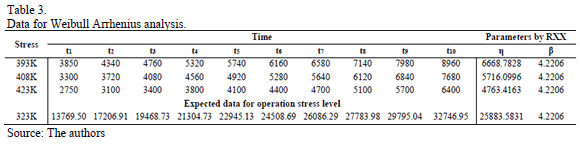
</front><body><![CDATA[ <p><font size="1" face="Verdana, Arial, Helvetica, sans-serif"><b>DOI:</b> <a href="http://dx.doi.org/10.15446/dyna.v83n197." target="_blank">http://dx.doi.org/10.15446/dyna.v83n197.44917</a></font></p>     <p align="center"><font size="4" face="Verdana, Arial, Helvetica, sans-serif"><b>Robust  sample size for weibull demonstration test plan</b></font></p>     <p align="center"><i><font size="3"><b><font face="Verdana, Arial, Helvetica, sans-serif">Tama&ntilde;o de muestra robusta para planes de demostraci&oacute;n weibull</font></b></font></i></p>     <p align="center">&nbsp;</p>     <p align="center"><b><font size="2" face="Verdana, Arial, Helvetica, sans-serif">Manuel R. Pi&ntilde;a-Monarrez <i><sup>a</sup></i>, Miriam L. Ramos-L&oacute;pez<sup> <i>b</i></sup>, Alejandro Alvarado-Iniesta<sup> <i>c</i></sup> &amp; Rey D. Molina-Arredondo<sup> <i>d</i></sup></font></b></p>     <p align="center">&nbsp;</p>     <p align="center"><font size="2" face="Verdana, Arial, Helvetica, sans-serif"><i>Industrial and Manufacturing Dep. of the IIT   Institute, Universidad Aut&oacute;noma de Ciudad Ju&aacute;rez, Chihuahua, M&eacute;xico. <sup>a </sup><a href="mailto:manuel.pina@uacj.mx">manuel.pina@uacj.mx</a>, <sup>b</sup> <a href="mailto:al127816@alumnos.uacj.mx">al127816@alumnos.uacj.mx</a>, <sup>c</sup> <a href="mailto:alejandro.alvarado@uacj.mx">alejandro.alvarado@uacj.mx</a>, <sup>d </sup><a href="mailto:rey.molina@uacj.mx">rey.molina@uacj.mx</a> </i></font></p>     <p align="center">&nbsp;</p>     <p align="center"><font size="2" face="Verdana, Arial, Helvetica, sans-serif"><b>Received: August 13<sup>th</sup>, 2014.   Received in revised form: September 07<sup>th</sup>, 2015. Accepted: March 11<sup>th</sup>,   2016.</b></font></p>     <p align="center">&nbsp;</p>     ]]></body>
<body><![CDATA[<p align="center"><font size="1" face="Verdana, Arial, Helvetica, sans-seriff"><b>This work is licensed under a</b> <a rel="license" href="http://creativecommons.org/licenses/by-nc-nd/4.0/">Creative Commons Attribution-NonCommercial-NoDerivatives 4.0 International License</a>.</font><br /><a rel="license" href="http://creativecommons.org/licenses/by-nc-nd/4.0/"><img style="border-width:0" src="https://i.creativecommons.org/l/by-nc-nd/4.0/88x31.png" /></a></p><hr>     <p><font size="2" face="Verdana, Arial, Helvetica, sans-serif"><b>Abstract    <br> </b></font><font size="2" face="Verdana, Arial, Helvetica, sans-serif">The efficiency of a Weibull demonstration test  plan is completely determined by the total experimental time (<i>T<sub>a</sub></i>), which depends on the  unknown sample size (<i>n</i>) and on the  Weibull shape parameter (<i><font face="Symbol">b</font></i>).  Thus, once <i><font face="Symbol">b</font></i> was selected, <i>T<sub>a</sub></i> depends only on <i>n</i>. Unfortunately, because <i>n</i> was estimated by the parametrical  binomial approach, then if the confidence level <i>C</i> was higher than 0.63, <i>n</i>,  and as consequence <i>T<sub>a</sub></i>, was  overestimated, (For <i>C</i>&lt;0.63, they  were underestimated). On the other hand, in this paper, because the  intersection between <i>n</i> and <i><font face="Symbol">b</font></i>, for which <i>T<sub>a</sub></i> was unique, was found with <i>n</i> depending only on <i>R(t)</i>,  then the estimation of <i>T<sub>a</sub></i> was optimal. On the other hand, since once <i><font face="Symbol">b</font></i> was selected, <i><font face="Symbol">h</font></i> was completely  determined, then <i><font face="Symbol">b</font></i> and <i><font face="Symbol">h</font></i> were used to incorporate the  expected failure times of the operational level in an accelerated life test analysis (ALT). Numerical applications are given.</font></p>     <p><font size="2" face="Verdana, Arial, Helvetica, sans-serif"><i>Keywords:</i> Weibull  demonstration test plan, Success run testing, Lipson equality, Accelerated life  testing.</font></p>     <p><font size="2" face="Verdana, Arial, Helvetica, sans-serif"><b>Resumen    <br> </b></font><font size="2" face="Verdana, Arial, Helvetica, sans-serif">La eficiencia de un plan de demostraci&oacute;n  Weibull est&aacute; completamente determinada por el tiempo total de experimentaci&oacute;n (<i>T<sub>a</sub></i>) el cual depende del tama&ntilde;o de muestra desconocido (<i>n</i>) y del par&aacute;metro de forma Weibull (<i><font face="Symbol">b</font></i>). De esa  forma, una vez que <i><font face="Symbol">b</font></i> fue seleccionada, <i>T<sub>a</sub></i> depende s&oacute;lo  de <i>n</i>. Desafortunadamente, debido a que <i>n</i> es estimada a trav&eacute;s del m&eacute;todo  binomial param&eacute;trico, entonces si el nivel de confianza <i>C</i> es mayor de 0.63, <i>n</i> y  como consecuencia <i>T<sub>a</sub></i>, son sobre-estimados  (para <i>C</i>&lt;0.63, estos son  subestimados). Por otro lado, en este art&iacute;culo, debido a que la intersecci&oacute;n  entre <i>n</i> y <i><font face="Symbol">b</font></i>, para la cual <i>T<sub>a</sub></i> es &uacute;nica, se encontr&oacute;  con n dependiendo s&oacute;lo de <i>R(t)</i>,  entonces la estimaci&oacute;n de <i>T<sub>a</sub></i> es &oacute;ptima. Por otro  lado, dado que una vez que <i><font face="Symbol">b</font></i> fue  seleccionada, <i><font face="Symbol">h</font></i> est&aacute;  completamente determinada, entonces <i><font face="Symbol">b</font></i> y <i><font face="Symbol">h</font></i> fueron utilizadas para  incorporar los tiempos de falla esperados del nivel operacional en un an&aacute;lisis de prueba de vida acelerada (ALT). Aplicaciones num&eacute;ricas son dadas.</font></p>     <p><font size="2" face="Verdana, Arial, Helvetica, sans-serif"><i>Palabras Clave:</i> Planes de demostraci&oacute;n Weibull, Rachas exitosas, Desigualdad de  lipson, Pruebas de vida acelerada.</font></p> <hr>     <p>&nbsp;</p>     <p><font size="3" face="Verdana, Arial, Helvetica, sans-serif"><b>1. Introduction</b></font></p>     <p><font size="2" face="Verdana, Arial, Helvetica, sans-serif">In reliability engineering, because of  its flexibility the Weibull distribution is one of the most commonly used  probability density functions to model the behavior of a product or process  trough the time &#91;6&#93;. Moreover, since the lower reliability index could be seen  as an index of stability (quality through the time), the Weibull demonstration  test plans are performed without failures in order to determine whether the  product fulfills its designed reliability <i>R(t)</i>.  On the other hand, to perform the test plan, we must know; <i>R(t)</i>, the designed life time (<i>t<sub>d</sub></i>),  the operational environmental, the desired confidence level (<i>C</i>) and the Weibull shape parameter <i><font face="Symbol">b</font></i>. Regardless of this knowledge, given  that the test plan is completely determined by the total experimental time <i>T<sub>a</sub></i>, and because for a known <i><font face="Symbol">b</font></i> , <i>T<sub>a</sub></i> depends only on the sample size <i>n</i>, then the efficiency of the test plan depends on the accuracy with  which <i>n</i> is estimated. In practice,  the parametrical binomial approach, considering a constant failure rate <i>p</i> (&#91;2&#93; chapter 9, &#91;5&#93; and section 2.2),  is used to estimate <i>n</i>. Unfortunately,  if <i>C</i> higher than 0.63, <i>n</i> is overestimated, and as a consequence <i>T<sub>a</sub></i> is overestimated too.  To solve this problem, and based on the fact that for constant <i><font face="Symbol">b</font></i>, <i>T<sub>a</sub></i> is directly related to the Weibull scale parameter <i><font face="Symbol">h</font></i>, then based on the addressed  relations among <i><font face="Symbol">h</font></i>, <i>n</i>, <i>R(t)</i> and <i><font face="Symbol">b</font></i>, and on the found intersection  between <i>n</i> and <i><font face="Symbol">b</font></i> for which <i>T<sub>a</sub></i> is unique, in this paper a method to estimate <i>n</i> in closed form, but independent of <i><font face="Symbol">b</font></i>, is given. Moreover, because <i>n</i> was found to be depending only on the  known <i>R(t)</i> index, the estimated <i>T<sub>a</sub></i> is completely  representative of the designed test plan. </font></p>     ]]></body>
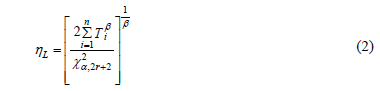
<body><![CDATA[<p><font size="2" face="Verdana, Arial, Helvetica, sans-serif">On the other  hand, in order to show how to proceed under time or lab restrictions, by using  the above estimated <i>n</i>, the Lipson  equality is applied to perform a tradeoff between <i>n</i> and the experimental time <i>T<sub>i</sub></i> for which <i>T<sub>a</sub></i> is constant.  Finally, because <i>n</i> is directly  related with <i>R(t)</i>, in section 5.1, we  show how it could be used in the median rank approach to incorporate the  expected lifetimes of the operational level if an accelerated life test analysis  (ALT) has to be used. The paper structure is as follows. Section 2 addresses  the problem statement. Section 3 presents the proposed method. Section 4 offers  the application and comparison between the proposed method and the binomial  approach. Section 5 outlines the steps to incorporate the failure times of the  operational level into the ALT analysis. Section 6 presents the conclusions.  Finally, the paper ends with the references in section 7.</font></p>     <p>&nbsp;</p>     <p><font size="3" face="Verdana, Arial, Helvetica, sans-serif"><b>2. Problem statement</b></font></p>     <p><font size="2" face="Verdana, Arial, Helvetica, sans-serif">Since a  Weibull demonstration test plan is performed without failures, the Weibull  parameters <i><font face="Symbol">b</font></i> and <i><font face="Symbol">h</font></i> could not be estimated. Thus, the  efficiency of the test plan depends completely on the accuracy on which <i>T<sub>a</sub></i> is estimated. But, because <i>T<sub>a</sub></i> for constant <i><font face="Symbol">b</font></i> depends only on <i>n</i>, then the efficiency of the test plan  now only depends on the accuracy with which <i>n</i> is estimated. Regardless of this, since <i>n</i> is estimated by the parametrical binomial approach considering a constant  failure rate <i>p</i>, and a confidence  interval <i>C</i>, then when <i>C</i> higher than 0.63 is selected, <i>n</i> is overestimated and for <i>C</i> lower than 0.63 <i>n</i> is underestimated. The overestimation (or underestimation) of <i>n</i> directly implies that <i>T<sub>a </sub></i>is overestimated (or  underestimated) also. Observe that this means that the test plan fails to  demonstrate whether the product fulfills its designed <i>R(t)</i> index. On the other hand, although in practice, <i><font face="Symbol">b</font></i> is selected from a historical  data set (or engineering knowledge), because its value depends on the material  characteristics &#91;18&#93;, and on the variability of the manufacturing process &#91;13&#93;,  here the analysis is presented in two parts. The first is conducted to address  the effect that the uncertainty of <i><font face="Symbol">b</font></i> has on <i>T<sub>a</sub></i>, and the second  is conducted to statistically identify the disadvantages that the use of the  binomial approach has on the estimation of <i>n</i>.  To do this, let us first present the <i><font face="Symbol">b</font></i> analysis.</font></p>     <p><font size="2" face="Verdana, Arial, Helvetica, sans-serif"><b><i>2.1. Shape parameter analysis</i></b></font></p>     <p><font size="2" face="Verdana, Arial, Helvetica, sans-serif">Since for non-failures Weibull analysis <i>T<sub>a</sub></i> is cumulated as</font></p>     <p><img src="/img/revistas/dyna/v83n197/v83n197a07eq01.gif"></p>     <p><font size="2" face="Verdana, Arial, Helvetica, sans-serif">Where <i>T<sub>i</sub></i> is the unite experimental  time, which is selected as the designed time (<i>T<sub>i</sub></i> =<i> t<sub>d</sub></i>),  the value of <i><font face="Symbol">b</font></i> has a big impact  on <i>T<sub>a</sub></i>, &#91;see &#91;12&#93; and &#91;15&#93;  sec. 2.3&#93; and because in the Weibull demonstration test plan there is no  failures information to estimate <i><font face="Symbol">b</font></i>,  and due to the fact that its estimation depends on the variability of the  manufacturing process &#91;13&#93;, in practice <i><font face="Symbol">b</font></i> is selected from tabulated data sets. Moreover, because of the Weibull closure  property (<i><font face="Symbol">b</font> has to be constant</i>),  once the <i><font face="Symbol">b</font> </i>value is selected it  has to be considered constant in the analysis &#91;16&#93;. On the other hand,  regardless which value of <i><font face="Symbol">b</font></i> we  had selected, once it was assigned, the efficiency of the test plan depends on  the scale parameter <i><font face="Symbol">h</font></i>. Thus, we  are now interested in how to estimate <i>T<sub>a</sub></i> in function of <i><font face="Symbol">h</font></i>. However,  because there are no failures, the lower expected limit of <sub><img src="/img/revistas/dyna/v83n197/v83n197a07eq004.gif"></sub> has to be used. That  is, that the lower limit of <i><font face="Symbol">h</font></i>,  here called (<i><font face="Symbol">h</font><sub>L</sub></i>), has  to be estimated. According to &#91;10&#93; and &#91;11&#93;, <i><font face="Symbol">h</font><sub>L</sub></i> is given by</font></p>     <p><img src="/img/revistas/dyna/v83n197/v83n197a07eq02.gif"></p>     <p><font size="2" face="Verdana, Arial, Helvetica, sans-serif">Where <font face="Symbol">a</font> is the significant level and <i>r</i> is the number of observed failures.  On the other hand, since equation (2) for zero failures, with <i>C</i> representing the desired confidence  level and <i>T<sub>i</sub></i> equal to <i>t<sub>d</sub></i>, is given by</font></p>     ]]></body>
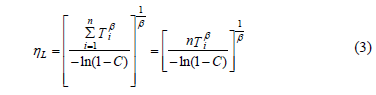
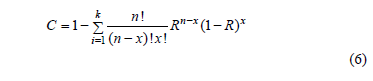
<body><![CDATA[<p><img src="/img/revistas/dyna/v83n197/v83n197a07eq03.gif"></p>     <p><font size="2" face="Verdana, Arial, Helvetica, sans-serif">Then by selecting <sub><img src="/img/revistas/dyna/v83n197/v83n197a07eq010.gif"></sub> in (3), the relation  between <i><font face="Symbol">h</font><sub>L</sub></i> and <i>T<sub>a</sub></i> is given by</font></p>     <p><img src="/img/revistas/dyna/v83n197/v83n197a07eq04.gif"></p>     <p><font size="2" face="Verdana, Arial, Helvetica, sans-serif">Clearly from (4), <i>T<sub>a</sub></i> is in function of <i><font face="Symbol">b</font></i>,  which in practice is selected from a data set (or engineering knowledge). Now,  let us focus on the uncertainty of <i>n</i>.</font></p>     <p><font size="2" face="Verdana, Arial, Helvetica, sans-serif"><b><i>2.2. Binomial approach analysis</i></b></font></p>     <p><font size="2" face="Verdana, Arial, Helvetica, sans-serif">Given that  the Weibull demonstration test plan, the parametric binomial approach used to  determine <i>n</i> (see &#91;2&#93; and &#91;5&#93; chapter  9) is based on the binomial distribution  given by</font></p>     <p><img src="/img/revistas/dyna/v83n197/v83n197a07eq05.gif"></p>     <p><font size="2" face="Verdana, Arial, Helvetica, sans-serif">which, instead of considering the time  and the risk function to determine <i>n</i>,  considers a constant failure rate <i>p</i> and a confidence level <i>C</i> to model the  uncertainty on <i>R(t)</i>, then <i>n</i> is not optimal. Given this, <i>first</i> let us analyze how the estimation  of <i>n</i> is formulated. In doing so, we  can see that because no failures are allowed (<i>x</i>=0), the lower confidence of <i>R(t)</i> has to be used. Thus, <i>C</i> based on the  fact that if <i>n</i> items are tested and <i>k=1,…, n</i> of them fails, <i>C</i> is given by</font></p>     <p><img src="/img/revistas/dyna/v83n197/v83n197a07eq06.gif"></p>     <p><font size="2" face="Verdana, Arial, Helvetica, sans-serif">In (6), <i>R</i> represents the lower confidence of <i>R(t)</i>. In (6), <i>R</i> is used  instead of <i>R(t)</i> because the binomial  approach does not consider the time variable t. Therefore, equation (6) with  zero failures <sub><img src="/img/revistas/dyna/v83n197/v83n197a07eq018.gif"></sub> is given by </font></p>     ]]></body>
<body><![CDATA[<p><img src="/img/revistas/dyna/v83n197/v83n197a07eq07.gif"></p>     <p><font size="2" face="Verdana, Arial, Helvetica, sans-serif">Finally, by rearranging terms, <i>n</i> is given by</font></p>     <p><img src="/img/revistas/dyna/v83n197/v83n197a07eq08.gif"></p>     <p><font size="2" face="Verdana, Arial, Helvetica, sans-serif">Function (8) is known as success run  testing &#91;5&#93;. <i>Second</i>, suppose that our  customers are asking us to demonstrate using <i>C</i>=0.90, if their product fulfills <i>R(t)</i>=0.96 for <i>t<sub>d</sub></i>=1500hrs.  In addition suppose, that from historical data, we know that <i><font face="Symbol">b</font></i>=2.5. Thus, by using (8), we have  to test without failures <i>n</i>=57pcs for  1500hrs each. Thus, observe from (1) that T<sub>a</sub>=57*1500&#094;2.5=4967101142  and from (4) that <i><font face="Symbol">h</font></i>=7558.59718.  With this information, since we now know <i><font face="Symbol">b</font></i> and <i><font face="Symbol">h</font></i>, then by using these  parameters in the Weibull reliability function given by</font></p>     <p><img src="/img/revistas/dyna/v83n197/v83n197a07eq09.gif"></p>     <p><font size="2" face="Verdana, Arial, Helvetica, sans-serif">We note that the demonstrated <i>R(t), </i>for <i>t<sub>d</sub></i>=1500hrs, is <i>R(t)</i>=0.9826,  instead of the planned <i>R(t)</i>=0.96.  Thus, because <i>R(t)</i> and <i><font face="Symbol">b</font></i> are known, we conclude that the <i>C</i> value used in (8) overestimated <i>n</i>, and that, as a consequence, <i>T<sub>a</sub></i> defined in (1) was  overestimated too. </font></p>     <p><font size="2" face="Verdana, Arial, Helvetica, sans-serif">In contrast, observe that for <i>C</i>=0.50, <i>n</i>=17pcs, T<sub>a</sub>=1481416130 and <i><font face="Symbol">h</font></i>=4658.7652, with <i>R(t)</i>=0.9428.  That is to say that for <i>C</i>=0.50, <i>n</i> was underestimated. Thus, a <i>C</i> value between 0.5 and 0.9 for which <i>n</i> is optimal exists. In the next  section, this value is statistically addressed and generalized to any desired <i>R(t)</i> and <i><font face="Symbol">b</font></i> value. </font></p>     <p>&nbsp;</p>     <p><font size="3" face="Verdana, Arial, Helvetica, sans-serif"><b>3. Proposed method </b></font></p>     <p><font size="2" face="Verdana, Arial, Helvetica, sans-serif">Given that the goal of the proposed  method is to remain practical, first let us show how the binomial approach, the  Lipson equality, and the Weibull reliability function are related. In doing so,  we can first see that because <i>T<sub>a</sub></i> completely determines <i>R(t)</i>, the  analysis is based on <i>T<sub>a</sub></i>.  Second, we can see that for constant <i><font face="Symbol">b</font></i>, <i>T<sub>a</sub></i> depends only on <i>n</i>. Finally, note that regardless how <i><font face="Symbol">b</font></i>, and <i>n</i> were estimated, once their values were selected, a tradeoff  between <i>n</i> and <i>T<sub>i</sub></i> for which <i>T<sub>a</sub></i> remains constant could be made by applying the Lipson equality (see &#91;5&#93;) as  follows. The Lipson equality is formulated by replacing <i>R</i> given in (7) with the Weibull reliability function defined in  (9). After the replacement, the equality is given by </font></p>     ]]></body>
<body><![CDATA[<p><img src="/img/revistas/dyna/v83n197/v83n197a07eq10.gif"></p>     <p><font size="2" face="Verdana, Arial, Helvetica, sans-serif">From (10), by taking logarithms and by  rearranging terms, the sample size <i>n</i> in the Lipson equality is given by</font></p>     <p><img src="/img/revistas/dyna/v83n197/v83n197a07eq11.gif"></p>     <p><font size="2" face="Verdana, Arial, Helvetica, sans-serif">In (11), <i>L</i> represents one life of the product <i>L= t<sub>d</sub></i>. Function (11) is known as Lipson equality (or  extended life approach) and it relates the binomial approach and the Weibull  reliability function. Finally, from (11), it is clear that it works regardless of  how <i>n</i> and <i><font face="Symbol">b</font></i> were selected. Thus, in the same way as <i>T<sub>a</sub></i>, its efficiency depends on how <i>n</i> is estimated.</font></p>     <p><font size="2" face="Verdana, Arial, Helvetica, sans-serif">On the other hand, in order to estimate <i>T<sub>a</sub></i> accurately, by  substituting (8) in (2), <i><font face="Symbol">h</font><sub>L</sub></i> is found to be depending only on <i>R(t)</i> and <i><font face="Symbol">b</font></i> as in (12).</font></p>     <p><img src="/img/revistas/dyna/v83n197/v83n197a07eq12.gif"></p>     <p><font size="2" face="Verdana, Arial, Helvetica, sans-serif">Then based on (12), and by selecting <i>n</i> as in (13). </font></p>     <p><img src="/img/revistas/dyna/v83n197/v83n197a07eq13.gif"></p>     <p><font size="2" face="Verdana, Arial, Helvetica, sans-serif">the relation between <i>T<sub>a</sub></i> and <i><font face="Symbol">h</font><sub>L</sub></i> as in (4), is given by</font></p>     <p><img src="/img/revistas/dyna/v83n197/v83n197a07eq14.gif"></p>     ]]></body>
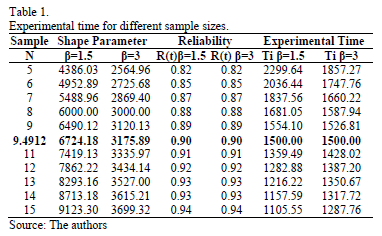
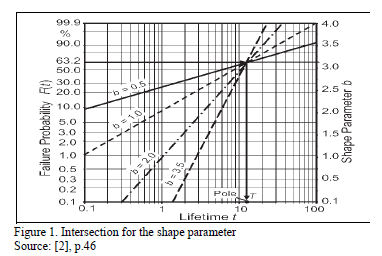
<body><![CDATA[<p><font size="2" face="Verdana, Arial, Helvetica, sans-serif">From (14), Ti is given by</font></p>     <p><img src="/img/revistas/dyna/v83n197/v83n197a07eq15.gif"></p>     <p><font size="2" face="Verdana, Arial, Helvetica, sans-serif">And clearly, since there no failures are allowed,  then we can select <sub><img src="/img/revistas/dyna/v83n197/v83n197a07eq038.gif"></sub>, thus <i><font face="Symbol">h</font></i> is  given by</font></p>     <p><img src="/img/revistas/dyna/v83n197/v83n197a07eq16.gif"></p>     <p><font size="2" face="Verdana, Arial, Helvetica, sans-serif">From (16), since <sub><img src="/img/revistas/dyna/v83n197/v83n197a07eq038.gif"></sub> is known, and <i>n</i> is directly related to <i>R(t)</i> as in (13), <sub><img src="/img/revistas/dyna/v83n197/v83n197a07eq042.gif"></sub> now depends only on  the selected <i><font face="Symbol">b</font></i> value. On the  other hand, observe that <i>n</i> in (13) is  estimated regardless of the value of <i><font face="Symbol">b</font></i>.  Seeing this numerically, suppose we are determining <i><font face="Symbol">h</font><sub>L</sub></i> defined in (12) by a designed time <i>t<sub>d</sub></i>=1500hrs, and suppose we  desire to demonstrate a reliability of <i>R(t)</i>=0.90.  Furthermore, suppose that from historical data (or engineering knowledge), we  know that <i><font face="Symbol">b</font></i> ranges from  1.5&le;<i> <font face="Symbol">b</font></i> &le;3. Then by  testing different <i>n</i> values for <i><font face="Symbol">b</font></i>=1.5 and <i><font face="Symbol">b</font></i>=3, as in <a href="#tab01">Table 1</a>, we found that <i>T<sub>i</sub></i> shifts its behavior from higher to lower, implying that  an intersection for which <i>T<sub>i</sub></i> is equal to both <i><font face="Symbol">b</font></i> values  exists. And because, this intersection corresponds exactly to the <i>n</i> value defined in (13), and it does not  depend on <i><font face="Symbol">b</font></i>, we conclude that by  estimating <i>n</i> using (13), the proposed  method is robust under the uncertainty that <i><font face="Symbol">b</font></i> has over <i>T<sub>a</sub></i>. In  particular, we can see from <a href="#tab01">Table 1</a> and <a href="#fig01">Fig. 1</a> that for <sub><img src="/img/revistas/dyna/v83n197/v83n197a07eq038.gif"></sub> <i>n</i> is as in (13) and <i>R(t) </i>is  as expected for both values of <i><font face="Symbol">b</font></i>,  and that <i><font face="Symbol">h</font><sub>L</sub></i> is as in  (12).</font></p>     <p align="center"><font size="2" face="Verdana, Arial, Helvetica, sans-serif"><a name="tab01"></a></font><img src="/img/revistas/dyna/v83n197/v83n197a07tab01.gif"></p>     <p align="center"><font size="2" face="Verdana, Arial, Helvetica, sans-serif"><a name="fig01"></a></font><img src="/img/revistas/dyna/v83n197/v83n197a07fig01.gif"></p>     <p><font size="2" face="Verdana, Arial, Helvetica, sans-serif">That is, data in this intersection holds  with equations (12) to (16). The steps to apply the proposed method are as  follows.</font></p> <font size="2" face="Verdana, Arial, Helvetica, sans-serif"><b><i>3.1. Steps of  the proposed method </i></b></font>     <p><font size="2" face="Verdana, Arial, Helvetica, sans-serif">In order to demonstrate whether a product  fulfills its designed reliability, the following steps were taken. </font></p> <ol>       <li><font size="2" face="Verdana, Arial, Helvetica, sans-serif"> Determine the reliability level <i>R(t)</i> index to be demonstrated, the operational environmental to be tested and the     design time <i>t<sub>d</sub></i>. </font></li>       ]]></body>
<body><![CDATA[<li><font size="2" face="Verdana, Arial, Helvetica, sans-serif"> Determine the value of <i><font face="Symbol">b</font></i> to be used. A base line product, engineering knowledge or historical data could     be used to select the most suitable <i><font face="Symbol">b</font></i> value.</font></li>       <li><font size="2" face="Verdana, Arial, Helvetica, sans-serif"> By using (13) with the <i>R(t)</i> level of step 1, determine the sample size <i>n</i> to be tested without failures during the <i>t<sub>d</sub></i> lifetime each.</font></li>       <li><font size="2" face="Verdana, Arial, Helvetica, sans-serif"> If there are experimental or time restrictions, perform the desired     tradeoff between <i>n</i> and <i>t<sub>d</sub></i>, using (11) with <i>C</i>=0.63212.</font></li>       <li><font size="2" face="Verdana, Arial, Helvetica, sans-serif"> Test each specimen by <i>t<sub>d</sub></i> lifetime and, if neither of them fails, go to step 6. If one of them fails, go     to step 7.</font></li>       <li><font size="2" face="Verdana, Arial, Helvetica, sans-serif"> By using (12) or (16), estimate the expected <i><font face="Symbol">h</font><sub>L</sub></i> value. And by using <i><font face="Symbol">h</font><sub>L</sub></i>, <i>t<sub>d</sub></i> and the selected <i><font face="Symbol">b</font></i> value in (9),     determines the demonstrated <i>R(t)</i> value, and draw your conclusions.</font></li>       <li><font size="2" face="Verdana, Arial, Helvetica, sans-serif"> Correct and reinforce the design (or process) and go to step 1.</font></li>       <li><font size="2" face="Verdana, Arial, Helvetica, sans-serif"> If you are performing an accelerated life testing, and the normal     operational conditions could not be applied to the experiment, follows the     steps given in section 5.1.</font></li>     </ol>     <p>&nbsp;</p>     <p><font size="3" face="Verdana, Arial, Helvetica, sans-serif"><b>4. An application</b></font></p>     ]]></body>
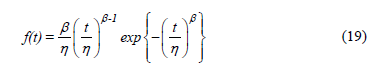
<body><![CDATA[<p><font size="2" face="Verdana, Arial, Helvetica, sans-serif">As an application, first consider the   data in section 2.2, (<i>R(t)</i>=0.96, <i>C</i>=0.90 and <i>C</i>=0.50, <i>t<sub>d</sub></i>=1500hrs   and <i><font face="Symbol">b</font></i>=2.5), With this   information obtained by using (13) in step3, we have to test <i>n</i>=24.49&asymp;25pcs for 1500hrs each.   And by using (1) or (14) with <i><font face="Symbol">b</font></i>=2.5, <i>T<sub>a</sub></i>=2134685635hrs and by   using (12) or (16), <i><font face="Symbol">h</font><sub>L</sub></i>=5391.797. Thus, by applying (9) the demonstrated reliability, is <i>R(t)=</i>0.96 as was planned. </font></p>     <p><font size="2" face="Verdana, Arial, Helvetica, sans-serif">On the other   hand, suppose that because of the lab capacity, we can run each test for no   more than 3000hrs; (<i>L</i>=2lifes), then   by using (11) with <i>C</i>=0.63212, we have   to run n=4.33&asymp;5pcs without failures for 3000hrs each, and from (1) or   from (14) <sub><img src="/img/revistas/dyna/v83n197/v83n197a07eq046.gif"></sub> and from (12) or (16) <i><font face="Symbol">h</font><sub>L</sub></i>=5710.96hrs, and by   using <i><font face="Symbol">h</font><sub>L</sub></i> in (9), the demonstrated reliability, as planned, is <i>R(t)</i>=0.96. </font></p>     <p><font size="2" face="Verdana, Arial, Helvetica, sans-serif">Finally, since <i>n</i> in (13) depends only on <i>R(t)</i>,   and because <i>R(t)</i> is used in the   response variable of the median rank approach, in the next section, <i>n</i> is used to incorporate the expected normal operational lifetimes into an accelerated life time analysis. </font></p>     <p>&nbsp;</p> <font size="3" face="Verdana, Arial, Helvetica, sans-serif"><b>5. Weibull accelerated  life test planning</b></font>     <p><font size="2" face="Verdana, Arial, Helvetica, sans-serif">In Weibull accelerated life test analysis   (ALT) for constant and interval valued variables, the shape parameter <i><font face="Symbol">b</font></i> is considered constant in the   analysis due to the Weibull closure property &#91;16&#93;. Thus, the reliability index <i>R(t)</i> depends only on <i><font face="Symbol">h</font></i> (&#91;4&#93;, &#91;7&#93; and &#91;9&#93;), which in ALT is estimated as a linear   function of the covariates by using a life/stress models <sub><img src="/img/revistas/dyna/v83n197/v83n197a07eq048.gif"></sub> &#91;1&#93;, &#91;3&#93;, &#91;7&#93; and   &#91;10&#93;, as follows</font></p>     <p><img src="/img/revistas/dyna/v83n197/v83n197a07eq17.gif"></p>     <p><font size="2" face="Verdana, Arial, Helvetica, sans-serif">Here, it is important to note that in  (17) for constant over time stress variables <sub><img src="/img/revistas/dyna/v83n197/v83n197a07eq048.gif"></sub> is parametrized as</font></p>     <p><img src="/img/revistas/dyna/v83n197/v83n197a07eq18.gif"></p>     <p><font size="2" face="Verdana, Arial, Helvetica, sans-serif">Where <i><font face="Symbol">b</font></i> is a vector of regression coefficients to be estimated and <i>Z</i> is a vector of the effect of the related stress variable (e.g. in   Arrhenius <i>Z</i>=1/<i>T</i> where <i>T</i> is the   temperature in Kelvin degrees). Thus, by using the Weibull density function  given by</font></p>     <p><img src="/img/revistas/dyna/v83n197/v83n197a07eq19.gif"></p>     ]]></body>

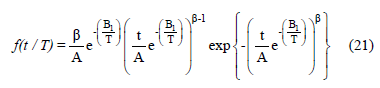
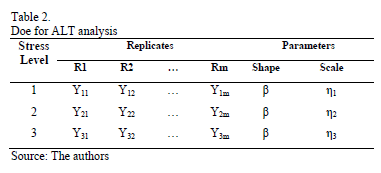
<body><![CDATA[<p><font size="2" face="Verdana, Arial, Helvetica, sans-serif">the Weibull/life/stress parameters are   estimated by substituting <i><font face="Symbol">h</font></i> in   (19) with the corresponding <sub><img src="/img/revistas/dyna/v83n197/v83n197a07eq048.gif"></sub> model defined in (17)   or (18). For example suppose that the stress variable is the temperature, then  the Arrhenius model is used. The Arrhenius model is given by</font></p>     <p><img src="/img/revistas/dyna/v83n197/v83n197a07eq20.gif"></p>     <p><font size="2" face="Verdana, Arial, Helvetica, sans-serif">Thus, the Weibull/Arrhenius model is  given by</font></p>     <p><img src="/img/revistas/dyna/v83n197/v83n197a07eq21.gif"></p>     <p><font size="2" face="Verdana, Arial, Helvetica, sans-serif">in (21) the Weibull/Arrhenius parameters  are estimated in joint form by using the maximum likelihood method.</font></p>     <p><font size="2" face="Verdana, Arial, Helvetica, sans-serif">On the other hand, observe that the  lifetime data is collected by using an experiment design (DOE) (see <a href="#tab02">Table 2</a>),  and that for each replicated level, we estimate its corresponding Weibull  parameters.</font></p>     <p align="center"><font size="2" face="Verdana, Arial, Helvetica, sans-serif"><a name="tab02"></a></font><img src="/img/revistas/dyna/v83n197/v83n197a07tab02.gif"></p>     <p><font size="2" face="Verdana, Arial, Helvetica, sans-serif">Thus, since, as in (16), <i>n</i> in the DOE determines the accuracy with  which <i><font face="Symbol">h</font></i> is estimated, in order  to show how <i>n</i> could be used to  incorporate the expected failure times in an ALT analysis, first note that  because under multiple linear regression, the Weibull parameters of each  replicate level of the DOE are estimated by the median rank, approximation  given by</font></p>     <p><img src="/img/revistas/dyna/v83n197/v83n197a07eq22.gif"></p>     <p><font size="2" face="Verdana, Arial, Helvetica, sans-serif">where, i represents the ordered rank  statistic and <i>F(t)</i> is the empirical estimation  of the cumulative probability function &#91;<i>F(t)</i>=1  - <i>R(t)</i>&#93;, then (22) highly depends on <i>n</i> too. Second, observe that because (22)  was constructed based on an area given by <sub><img src="/img/revistas/dyna/v83n197/v83n197a07eq062.gif"></sub> (for details see &#91;8&#93;),  where <i>b</i> represents the amplitude  (width) of the (<i>n-1</i>) intervals given  by <sub><img src="/img/revistas/dyna/v83n197/v83n197a07eq064.gif"></sub> which for high  percentiles (<i>p</i>&gt;0.85) tends to be <i>R(t)</i> <sub><img src="/img/revistas/dyna/v83n197/v83n197a07eq066.gif"></sub> (e.g. for <sub><img src="/img/revistas/dyna/v83n197/v83n197a07eq068.gif"></sub> <sub><img src="/img/revistas/dyna/v83n197/v83n197a07eq070.gif"></sub>), then because <i>n</i> in (13) depends only on <i>R(t)</i> and  since <i>R(t)</i> is generally higher than  0.85, then the use of (13) in (22) is useful. On the other hand, by taking the  linear form of (9) as</font></p>     ]]></body>
<body><![CDATA[<p><img src="/img/revistas/dyna/v83n197/v83n197a07eq23.gif"></p>     <p><font size="2" face="Verdana, Arial, Helvetica, sans-serif">The expected times of the operational  level can be estimated and incorporated to the ALT analysis as in the next  section. </font></p>     <p><font size="2" face="Verdana, Arial, Helvetica, sans-serif"><b><i>5.1. Application to ALT analysis.</i></b></font></p>     <p><font size="2" face="Verdana, Arial, Helvetica, sans-serif">As an application, let us use data given  in <a href="#tab03">Table 3</a>. Data was published by &#91;17&#93;. Suppose the normal operational  temperature level is 323K and the design time is <i>t<sub>d</sub></i>=15000hrs. The analysis to incorporate the expected  lifetimes of the 323K level into the analysis is as follows.</font></p> <ol>       <li><font size="2" face="Verdana, Arial, Helvetica, sans-serif">For each ALT level, by applying (13) with the desired <i>R</i>(<i>t</i>)     level, determine the number of replicates to be tested. Here <i>R</i>(<i>t</i>)=0.90     was used, thus <i>n</i>=10pcs. </font></li>       <li><font size="2" face="Verdana, Arial, Helvetica, sans-serif">Perform the experiment, and for each replicated level, estimate the     Weibull parameters <i><font face="Symbol">b</font></i> and <i><font face="Symbol">h</font></i> (here <i><font face="Symbol">b</font></i> should be constant). </font></li>       <li><font size="2" face="Verdana, Arial, Helvetica, sans-serif">Using the estimated <i>n</i> and <i><font face="Symbol">b</font></i> value in (16), estimate the     corresponding <i><font face="Symbol">h</font>L</i> value. (here it     is <i><font face="Symbol">h</font>L</i> =101/4.2206     (15000)=25883.58312hrs).</font></li>       <li><font size="2" face="Verdana, Arial, Helvetica, sans-serif">Using (22) with <i>n</i> given by     (13), estimate the expected <i>R</i>(<i>ti</i>) value for each of the order     statistics. Then by using these <i>R</i>(<i>ti</i>) values, the <i><font face="Symbol">b</font></i> and the <i><font face="Symbol">h</font>L</i> values in (23), solve (23) to ln(t) and then determine the expected failure     times of the operational level to each order statistic. (In our case, the     expected failure times appear in the last row of <a href="#tab03">Table 3</a>).</font></li>       <li><font size="2" face="Verdana, Arial, Helvetica, sans-serif">By using the incorporated expected times, and the experimented     accelerated lifetimes, perform the estimation of the Weibull/Life-stress     parameters. Here, the analysis, by using the ALTA routine and (21), yield to <i><font face="Symbol">b</font></i>=4.3779, <i>B</i>=2308.4884 and <i>A</i>=19.8667. </font></li>       <li><font size="2" face="Verdana, Arial, Helvetica, sans-serif">Finally, by using the parameters of step 5, determine the desired     reliability indexes. </font></li>     ]]></body>
<body><![CDATA[</ol>     <p><font size="2" face="Verdana, Arial, Helvetica, sans-serif">To conclude, observe that the data in     <a href="#tab03">Table 3</a>, for <i>t<sub>d</sub></i>=15000, <i>R(t)</i> is of <i>R(t)</i>=0.90 as was expected. In particular, note that  without incorporating the operational times, the estimated <i>R(t)</i> for the operational level is of 323K, instead of the designed <i>R(t)</i>=0.90, would be <i>R(t)=</i>68.33%. </font></p>     <p align="center"><font size="2" face="Verdana, Arial, Helvetica, sans-serif"><a name="tab03"></a></font><img src="/img/revistas/dyna/v83n197/v83n197a07tab03.gif"></p>     <p>&nbsp;</p>     <p><font size="3" face="Verdana, Arial, Helvetica, sans-serif"><b>6. Conclusions</b></font></p>     <p><font size="2" face="Verdana, Arial, Helvetica, sans-serif">In Weibull demonstration test plans, the  binomial approach for confidence levels higher (lower) than 0.63212,  overestimate (sub-estimate) <i>R(t);</i> thus, <i>C</i> should not be selected lower  than 0.63212, and if it is selected higher, it should be selected close to  0.63212, say 0.7. In the proposed method, given that <i>n</i> depends only on <i>R(t)</i> which is always known, the designed and the demonstrated <i>R(t)</i> value always holds. On the other hand, observe that because  data is gathered by using an experiment design where each row represents a  different form to run the process, then the <i><font face="Symbol">b</font></i> parameter does not remain constant and as a consequence, the multivariate approach  using the Taguchi method as in &#91;14&#93;, should be used. Given that in the  estimation process, the value of <i><font face="Symbol">b</font></i> depends on the variance of the logarithm of the failure times, which depends on  the control of environmental factors (see &#91;13&#93; and &#91;14&#93;), its value must be  selected from a data set that covers the variability of the manufacturing  process in its interval. </font></p>     <p><font size="2" face="Verdana, Arial, Helvetica, sans-serif">Although, the proposed method allows  practitioners to incorporate the expected operational times to the ALT  analysis, it is important to note that their efficiency corresponds to the  efficiency of the median rank approach and on the assumption of a constant <i><font face="Symbol">b</font></i>. Finally, it is important to note  that although it may seem that <i>n</i> could be used to incorporate the expected times in the ALT analyses where the  Weibull closure property does not hold (<i><font face="Symbol">b</font></i> is not constant), as is the case of ALT analysis with several variables, more  research is required.</font></p>     <p>&nbsp;</p>     <p><font size="3" face="Verdana, Arial, Helvetica, sans-serif"><b>References</b></font></p>     <!-- ref --><p><font size="2" face="Verdana, Arial, Helvetica, sans-serif"><b>&#91;1&#93;</b> Bagdonavi&#265;ius, V. and  Nikulin, M., Accelerated life models, modeling and statistical analysis, Ed.  Chapman and Hall/CRC, Boca Rat&oacute;n, FL, USA, 2002.    &nbsp;&nbsp;&nbsp;&nbsp;&nbsp;&nbsp;&nbsp;&nbsp;[&#160;<a href="javascript:void(0);" onclick="javascript: window.open('/scielo.php?script=sci_nlinks&ref=1125009&pid=S0012-7353201600030000700001&lng=','','width=640,height=500,resizable=yes,scrollbars=1,menubar=yes,');">Links</a>&#160;]<!-- end-ref --></font></p>     <!-- ref --><p><font size="2" face="Verdana, Arial, Helvetica, sans-serif"><b>&#91;2&#93;</b> Bertsche, B., Reliability and  automotive and mechanical engineering, 1ra. ed., Stuttgart, Springer-Verlag  Berling Heidelber, 2008. DOI: 10.1007/978-3-540-34282-3.    &nbsp;&nbsp;&nbsp;&nbsp;&nbsp;&nbsp;&nbsp;&nbsp;[&#160;<a href="javascript:void(0);" onclick="javascript: window.open('/scielo.php?script=sci_nlinks&ref=1125011&pid=S0012-7353201600030000700002&lng=','','width=640,height=500,resizable=yes,scrollbars=1,menubar=yes,');">Links</a>&#160;]<!-- end-ref --> </font></p>     <!-- ref --><p><font size="2" face="Verdana, Arial, Helvetica, sans-serif"><b>&#91;3&#93;</b> Cox, D.R. and Oakes, D.,  Analysis of survival data, 1st Ed, Chapman and Hall, Boca Rat&oacute;n, FL, USA, 1984.    &nbsp;&nbsp;&nbsp;&nbsp;&nbsp;&nbsp;&nbsp;&nbsp;[&#160;<a href="javascript:void(0);" onclick="javascript: window.open('/scielo.php?script=sci_nlinks&ref=1125013&pid=S0012-7353201600030000700003&lng=','','width=640,height=500,resizable=yes,scrollbars=1,menubar=yes,');">Links</a>&#160;]<!-- end-ref --></font></p>     <!-- ref --><p><font size="2" face="Verdana, Arial, Helvetica, sans-serif"><b>&#91;4&#93;</b> Escobar, L.A. and Meeker, W.Q.,  A Review of accelerated test models. Statistical Science, 21(4), pp. 552-577,  2006. DOI: 10.1214/088342306000000321.    &nbsp;&nbsp;&nbsp;&nbsp;&nbsp;&nbsp;&nbsp;&nbsp;[&#160;<a href="javascript:void(0);" onclick="javascript: window.open('/scielo.php?script=sci_nlinks&ref=1125015&pid=S0012-7353201600030000700004&lng=','','width=640,height=500,resizable=yes,scrollbars=1,menubar=yes,');">Links</a>&#160;]<!-- end-ref --> </font></p>     <!-- ref --><p><font size="2" face="Verdana, Arial, Helvetica, sans-serif"><b>&#91;5&#93;</b> Kleyner, A.V., Reliability  demonstration: Theory and application. Reliability and Maintainability  Symposium (RAMS). Las Vegas, USA, Tutorials CD, 2008.    &nbsp;&nbsp;&nbsp;&nbsp;&nbsp;&nbsp;&nbsp;&nbsp;[&#160;<a href="javascript:void(0);" onclick="javascript: window.open('/scielo.php?script=sci_nlinks&ref=1125017&pid=S0012-7353201600030000700005&lng=','','width=640,height=500,resizable=yes,scrollbars=1,menubar=yes,');">Links</a>&#160;]<!-- end-ref --></font></p>     <!-- ref --><p><font size="2" face="Verdana, Arial, Helvetica, sans-serif"><b>&#91;6&#93;</b> Manotas,  E., Ya&ntilde;ez, S., Lopera, C. y Jaramillo, M., Estudio del efecto de la dependencia  en la estimaci&oacute;n de la confiabilidad de un sistema con dos modos de falla  concurrentes. DYNA. 75(154), pp. 29-38, 2007.    &nbsp;&nbsp;&nbsp;&nbsp;&nbsp;&nbsp;&nbsp;&nbsp;[&#160;<a href="javascript:void(0);" onclick="javascript: window.open('/scielo.php?script=sci_nlinks&ref=1125019&pid=S0012-7353201600030000700006&lng=','','width=640,height=500,resizable=yes,scrollbars=1,menubar=yes,');">Links</a>&#160;]<!-- end-ref --></font></p>     <!-- ref --><p><font size="2" face="Verdana, Arial, Helvetica, sans-serif"><b>&#91;7&#93;</b> Meeker W.Q. and Escobar L.A.,  Statistical methods for reliability data, New York, John Wiley &amp; Sons, USA,  2014.    &nbsp;&nbsp;&nbsp;&nbsp;&nbsp;&nbsp;&nbsp;&nbsp;[&#160;<a href="javascript:void(0);" onclick="javascript: window.open('/scielo.php?script=sci_nlinks&ref=1125021&pid=S0012-7353201600030000700007&lng=','','width=640,height=500,resizable=yes,scrollbars=1,menubar=yes,');">Links</a>&#160;]<!-- end-ref --></font></p>     <!-- ref --><p><font size="2" face="Verdana, Arial, Helvetica, sans-serif"><b>&#91;8&#93;</b> Mischke, C.R., A  distribution-independent plotting rule for ordered failures, Journal of  Mechanical Design, 104(3), pp. 593-597, 1979. DOI: 10.1115/1.3256391.    &nbsp;&nbsp;&nbsp;&nbsp;&nbsp;&nbsp;&nbsp;&nbsp;[&#160;<a href="javascript:void(0);" onclick="javascript: window.open('/scielo.php?script=sci_nlinks&ref=1125023&pid=S0012-7353201600030000700008&lng=','','width=640,height=500,resizable=yes,scrollbars=1,menubar=yes,');">Links</a>&#160;]<!-- end-ref --></font></p>     <!-- ref --><p><font size="2" face="Verdana, Arial, Helvetica, sans-serif"><b>&#91;9&#93;</b> Nelson, W.B., Accelerated  testing statistical models, test plans and data analysis, John Wiley &amp;  Sons, New York, USA, 2004.    &nbsp;&nbsp;&nbsp;&nbsp;&nbsp;&nbsp;&nbsp;&nbsp;[&#160;<a href="javascript:void(0);" onclick="javascript: window.open('/scielo.php?script=sci_nlinks&ref=1125025&pid=S0012-7353201600030000700009&lng=','','width=640,height=500,resizable=yes,scrollbars=1,menubar=yes,');">Links</a>&#160;]<!-- end-ref --></font></p>     <!-- ref --><p><font size="2" face="Verdana, Arial, Helvetica, sans-serif"><b>&#91;10&#93;</b> Nelson, W.B. Applied life data  analysis, John Wiley &amp; Sons, New York, USA, 1985.    &nbsp;&nbsp;&nbsp;&nbsp;&nbsp;&nbsp;&nbsp;&nbsp;[&#160;<a href="javascript:void(0);" onclick="javascript: window.open('/scielo.php?script=sci_nlinks&ref=1125027&pid=S0012-7353201600030000700010&lng=','','width=640,height=500,resizable=yes,scrollbars=1,menubar=yes,');">Links</a>&#160;]<!-- end-ref --></font></p>     <!-- ref --><p><font size="2" face="Verdana, Arial, Helvetica, sans-serif"><b>&#91;11&#93;</b> Nelson, W.B., Weibull analysis of  reliability data with few or no failures, Journal of Quality Technology, 17(3),  pp. 140-146, 1985.    &nbsp;&nbsp;&nbsp;&nbsp;&nbsp;&nbsp;&nbsp;&nbsp;[&#160;<a href="javascript:void(0);" onclick="javascript: window.open('/scielo.php?script=sci_nlinks&ref=1125029&pid=S0012-7353201600030000700011&lng=','','width=640,height=500,resizable=yes,scrollbars=1,menubar=yes,');">Links</a>&#160;]<!-- end-ref --></font></p>     <!-- ref --><p><font size="2" face="Verdana, Arial, Helvetica, sans-serif"><b>&#91;12&#93;</b> Nicholls, D. and Lein, P., Weibayes  testing: What is the impact if assumed beta is incorrect?, Reliability and  Maintainability Symposium (RAMS), Fort Worth, Texas, Tutorials CD, 2009.    &nbsp;&nbsp;&nbsp;&nbsp;&nbsp;&nbsp;&nbsp;&nbsp;[&#160;<a href="javascript:void(0);" onclick="javascript: window.open('/scielo.php?script=sci_nlinks&ref=1125031&pid=S0012-7353201600030000700012&lng=','','width=640,height=500,resizable=yes,scrollbars=1,menubar=yes,');">Links</a>&#160;]<!-- end-ref --> </font></p>     <!-- ref --><p><font size="2" face="Verdana, Arial, Helvetica, sans-serif"><b>&#91;13&#93;</b> Pi&ntilde;a-Monarrez M.R.,  Avila-Chavez C. and Marquez-Luevano C.D., Weibull accelerated life testing analysis  whit several variables using multiple linear regression, DYNA, 82(191), pp.  156-162, 2015. DOI: 10.15446/dyna.v82n191.43533.    &nbsp;&nbsp;&nbsp;&nbsp;&nbsp;&nbsp;&nbsp;&nbsp;[&#160;<a href="javascript:void(0);" onclick="javascript: window.open('/scielo.php?script=sci_nlinks&ref=1125033&pid=S0012-7353201600030000700013&lng=','','width=640,height=500,resizable=yes,scrollbars=1,menubar=yes,');">Links</a>&#160;]<!-- end-ref --></font></p>     <!-- ref --><p><font size="2" face="Verdana, Arial, Helvetica, sans-serif"><b>&#91;14&#93;</b> Pi&ntilde;a-Monarrez, M.R. and  Ortiz-Ya&ntilde;ez J.F., Weibull and lognormal Taguchi analysis using multiple linear  regression. Reliability Engineering and System safety. 144, pp. 244-253, 2015.  DOI: 10.1016/j.ress.2015.08.004 </font>&nbsp;&nbsp;&nbsp;&nbsp;&nbsp;&nbsp;&nbsp;&nbsp;[&#160;<a href="javascript:void(0);" onclick="javascript: window.open('/scielo.php?script=sci_nlinks&ref=1125035&pid=S0012-7353201600030000700014&lng=','','width=640,height=500,resizable=yes,scrollbars=1,menubar=yes,');">Links</a>&#160;]<!-- end-ref --><!-- ref --><p><font size="2" face="Verdana, Arial, Helvetica, sans-serif"><b>&#91;15&#93;</b> Rinne, H., The Weibull  distribution a handbook, CRC press, Boca Rat&oacute;n, FL, USA, 2009.    &nbsp;&nbsp;&nbsp;&nbsp;&nbsp;&nbsp;&nbsp;&nbsp;[&#160;<a href="javascript:void(0);" onclick="javascript: window.open('/scielo.php?script=sci_nlinks&ref=1125036&pid=S0012-7353201600030000700015&lng=','','width=640,height=500,resizable=yes,scrollbars=1,menubar=yes,');">Links</a>&#160;]<!-- end-ref --></font></p>     <!-- ref --><p><font size="2" face="Verdana, Arial, Helvetica, sans-serif"><b>&#91;16&#93;</b> Tobias, P. and Trindade, D., Applied reliability. Chapman and Hall/CRC, Boca Rat&oacute;n, FL, USA, 2012</font>&nbsp;&nbsp;&nbsp;&nbsp;&nbsp;&nbsp;&nbsp;&nbsp;[&#160;<a href="javascript:void(0);" onclick="javascript: window.open('/scielo.php?script=sci_nlinks&ref=1125038&pid=S0012-7353201600030000700016&lng=','','width=640,height=500,resizable=yes,scrollbars=1,menubar=yes,');">Links</a>&#160;]<!-- end-ref --><!-- ref --><p><font size="2" face="Verdana, Arial, Helvetica, sans-serif"><b>&#91;17&#93;</b> Vassiliou, P. and Metas, A.,  Understanding accelerated life-testing analysis, Reliability and  Maintainability Symposium (RAMS), Tutorials CD, Seattle, WA, USA, 2002.    &nbsp;&nbsp;&nbsp;&nbsp;&nbsp;&nbsp;&nbsp;&nbsp;[&#160;<a href="javascript:void(0);" onclick="javascript: window.open('/scielo.php?script=sci_nlinks&ref=1125039&pid=S0012-7353201600030000700017&lng=','','width=640,height=500,resizable=yes,scrollbars=1,menubar=yes,');">Links</a>&#160;]<!-- end-ref --> </font></p>     <!-- ref --><p><font size="2" face="Verdana, Arial, Helvetica, sans-serif"><b>&#91;18&#93;</b> Weibull, W., A statistical  theory of the strength of materials. Stockholm: Generalstabens litografiska  anstalts förlag. 1939.    &nbsp;&nbsp;&nbsp;&nbsp;&nbsp;&nbsp;&nbsp;&nbsp;[&#160;<a href="javascript:void(0);" onclick="javascript: window.open('/scielo.php?script=sci_nlinks&ref=1125041&pid=S0012-7353201600030000700018&lng=','','width=640,height=500,resizable=yes,scrollbars=1,menubar=yes,');">Links</a>&#160;]<!-- end-ref --></font></p>     <p>&nbsp;</p>     <p><font size="2" face="Verdana, Arial, Helvetica, sans-serif"><b>M.R. Pi&ntilde;a-Monarrez,</b> is a  researcher-professor in the  Industrial and Manufacturing Department at the Autonomous University of  Ciudad Juarez, Mexico. He completed his PhD. in Science in Industrial  Engineering in 2006 at the Technological Institute of Ciudad Juarez, Mexico. He  had conducted research on system design methods including robust design, design  of experiments, linear regression, reliability and multivariate process  control. He is member of the National Research System (SNI-1), of the National  Council of Science and Technology (CONACYT) in Mexico. ORCID: 0000-0002-2243-3400.</font></p>     <p><font size="2" face="Verdana, Arial, Helvetica, sans-serif"><b>M.L. Ramos-L&oacute;pez,</b> is a PhD.  student on the doctoral program in science and engineering (DOCI), at the  Autonomous University of Ciudad Juarez, Mexico. She completed her MSc. degree in  Industrial Engineering in 2012 at the  Universidad Aut&oacute;noma de Ciudad Juarez, Mexico. Her research is based on accelerated  life time and weibull analysis. ORCID: 0000-0001-8614-1311.</font></p>     <p><font size="2" face="Verdana, Arial, Helvetica, sans-serif"><b>A. Alvarado-Iniesta</b>, is a researcher professor in the  Industrial and Manufacturing Department at Universidad Aut&oacute;noma de Ciudad  Ju&aacute;rez, Chihuahua, Mexico. He completed his PhD. in Industrial Engineering in  2011 at New Mexico State University, Las Cruces, NM, USA. His research  interests focus on Operations Research. He is member of the National Research  System (SNI-1), of the National Council of Science and Technology (CONACYT) in  Mexico. ORCID: 0000-0002-3349-4823</font></p>     <p><font size="2" face="Verdana, Arial, Helvetica, sans-serif"><b>R.D. Molina-Arredondo,</b> is  a researcher-professor in the  Industrial and Manufacturing Department at the Autonomous University of  Ciudad Juarez, Mexico. He completed his PhD. in Science in Industrial  Engineering in 2009 at the Technological Institute of Ciudad Juarez. He had  conducted research on reliability and robust design. ORCID: 0000-0001-8482-4186.</font></p>      ]]></body><back>
<ref-list>
<ref id="B1">
<label>1</label><nlm-citation citation-type="book">
<person-group person-group-type="author">
<name>
<surname><![CDATA[Bagdonavi&#265;ius]]></surname>
<given-names><![CDATA[V.]]></given-names>
</name>
<name>
<surname><![CDATA[Nikulin]]></surname>
<given-names><![CDATA[M.]]></given-names>
</name>
</person-group>
<source><![CDATA[Accelerated life models, modeling and statistical analysis]]></source>
<year>2002</year>
<publisher-loc><![CDATA[Boca Ratón^eFL FL]]></publisher-loc>
<publisher-name><![CDATA[Ed. Chapman and Hall/CRC]]></publisher-name>
</nlm-citation>
</ref>
<ref id="B2">
<label>2</label><nlm-citation citation-type="book">
<person-group person-group-type="author">
<name>
<surname><![CDATA[Bertsche]]></surname>
<given-names><![CDATA[B.]]></given-names>
</name>
</person-group>
<source><![CDATA[Reliability and automotive and mechanical engineering]]></source>
<year>2008</year>
<edition>1ra</edition>
<publisher-loc><![CDATA[Stuttgart ]]></publisher-loc>
<publisher-name><![CDATA[Springer-Verlag Berling Heidelber]]></publisher-name>
</nlm-citation>
</ref>
<ref id="B3">
<label>3</label><nlm-citation citation-type="book">
<person-group person-group-type="author">
<name>
<surname><![CDATA[Cox]]></surname>
<given-names><![CDATA[D.R.]]></given-names>
</name>
<name>
<surname><![CDATA[Oakes]]></surname>
<given-names><![CDATA[D.]]></given-names>
</name>
</person-group>
<source><![CDATA[Analysis of survival data]]></source>
<year>1984</year>
<edition>1st</edition>
<publisher-loc><![CDATA[Boca Ratón^eFL FL]]></publisher-loc>
<publisher-name><![CDATA[Chapman and Hall]]></publisher-name>
</nlm-citation>
</ref>
<ref id="B4">
<label>4</label><nlm-citation citation-type="journal">
<person-group person-group-type="author">
<name>
<surname><![CDATA[Escobar]]></surname>
<given-names><![CDATA[L.A.]]></given-names>
</name>
<name>
<surname><![CDATA[Meeker]]></surname>
<given-names><![CDATA[W.Q.]]></given-names>
</name>
</person-group>
<article-title xml:lang="en"><![CDATA[A Review of accelerated test models.]]></article-title>
<source><![CDATA[Statistical Science]]></source>
<year>2006</year>
<volume>21</volume>
<numero>4</numero>
<issue>4</issue>
<page-range>552-577</page-range></nlm-citation>
</ref>
<ref id="B5">
<label>5</label><nlm-citation citation-type="confpro">
<person-group person-group-type="author">
<name>
<surname><![CDATA[Kleyner]]></surname>
<given-names><![CDATA[A.V.]]></given-names>
</name>
</person-group>
<source><![CDATA[Reliability demonstration: Theory and application]]></source>
<year>2008</year>
<conf-name><![CDATA[ Reliability and Maintainability Symposium (RAMS)]]></conf-name>
<conf-loc>Las Vegas </conf-loc>
</nlm-citation>
</ref>
<ref id="B6">
<label>6</label><nlm-citation citation-type="journal">
<person-group person-group-type="author">
<name>
<surname><![CDATA[Manotas]]></surname>
<given-names><![CDATA[E.]]></given-names>
</name>
<name>
<surname><![CDATA[Yañez]]></surname>
<given-names><![CDATA[S.]]></given-names>
</name>
<name>
<surname><![CDATA[Lopera]]></surname>
<given-names><![CDATA[C.]]></given-names>
</name>
<name>
<surname><![CDATA[Jaramillo]]></surname>
<given-names><![CDATA[M.]]></given-names>
</name>
</person-group>
<article-title xml:lang="es"><![CDATA[Estudio del efecto de la dependencia en la estimación de la confiabilidad de un sistema con dos modos de falla concurrentes.]]></article-title>
<source><![CDATA[DYNA]]></source>
<year>2007</year>
<volume>75</volume>
<numero>154</numero>
<issue>154</issue>
<page-range>29-38</page-range></nlm-citation>
</ref>
<ref id="B7">
<label>7</label><nlm-citation citation-type="book">
<person-group person-group-type="author">
<name>
<surname><![CDATA[Meeker]]></surname>
<given-names><![CDATA[W.Q.]]></given-names>
</name>
<name>
<surname><![CDATA[Escobar]]></surname>
<given-names><![CDATA[L.A.]]></given-names>
</name>
</person-group>
<source><![CDATA[Statistical methods for reliability data]]></source>
<year>2014</year>
<publisher-loc><![CDATA[New York ]]></publisher-loc>
<publisher-name><![CDATA[John Wiley & Sons]]></publisher-name>
</nlm-citation>
</ref>
<ref id="B8">
<label>8</label><nlm-citation citation-type="journal">
<person-group person-group-type="author">
<name>
<surname><![CDATA[Mischke]]></surname>
<given-names><![CDATA[C.R.]]></given-names>
</name>
</person-group>
<article-title xml:lang="en"><![CDATA[A distribution-independent plotting rule for ordered failures]]></article-title>
<source><![CDATA[Journal of Mechanical Design]]></source>
<year>1979</year>
<volume>104</volume>
<numero>3</numero>
<issue>3</issue>
<page-range>593-597</page-range></nlm-citation>
</ref>
<ref id="B9">
<label>9</label><nlm-citation citation-type="book">
<person-group person-group-type="author">
<name>
<surname><![CDATA[Nelson]]></surname>
<given-names><![CDATA[W.B.]]></given-names>
</name>
</person-group>
<source><![CDATA[Accelerated testing statistical models, test plans and data analysis]]></source>
<year>2004</year>
<publisher-loc><![CDATA[New York ]]></publisher-loc>
<publisher-name><![CDATA[John Wiley & Sons]]></publisher-name>
</nlm-citation>
</ref>
<ref id="B10">
<label>10</label><nlm-citation citation-type="book">
<person-group person-group-type="author">
<name>
<surname><![CDATA[Nelson]]></surname>
<given-names><![CDATA[W.B.]]></given-names>
</name>
</person-group>
<source><![CDATA[Applied life data analysis]]></source>
<year></year>
<publisher-loc><![CDATA[New York ]]></publisher-loc>
<publisher-name><![CDATA[John Wiley & Sons]]></publisher-name>
</nlm-citation>
</ref>
<ref id="B11">
<label>11</label><nlm-citation citation-type="journal">
<person-group person-group-type="author">
<name>
<surname><![CDATA[Nelson]]></surname>
<given-names><![CDATA[W.B.]]></given-names>
</name>
</person-group>
<article-title xml:lang="en"><![CDATA[Weibull analysis of reliability data with few or no failures]]></article-title>
<source><![CDATA[Journal of Quality Technology]]></source>
<year>1985</year>
<volume>17</volume>
<numero>3</numero>
<issue>3</issue>
<page-range>140-146</page-range></nlm-citation>
</ref>
<ref id="B12">
<label>12</label><nlm-citation citation-type="confpro">
<person-group person-group-type="author">
<name>
<surname><![CDATA[Nicholls]]></surname>
<given-names><![CDATA[D.]]></given-names>
</name>
<name>
<surname><![CDATA[Lein]]></surname>
<given-names><![CDATA[P.]]></given-names>
</name>
</person-group>
<source><![CDATA[Weibayes testing: What is the impact if assumed beta is incorrect?]]></source>
<year>2009</year>
<conf-name><![CDATA[ Reliability and Maintainability Symposium (RAMS)]]></conf-name>
<conf-loc>Fort Worth Texas</conf-loc>
</nlm-citation>
</ref>
<ref id="B13">
<label>13</label><nlm-citation citation-type="journal">
<person-group person-group-type="author">
<name>
<surname><![CDATA[Piña-Monarrez]]></surname>
<given-names><![CDATA[M.R.]]></given-names>
</name>
<name>
<surname><![CDATA[Avila-Chavez]]></surname>
<given-names><![CDATA[C.]]></given-names>
</name>
<name>
<surname><![CDATA[Marquez-Luevano]]></surname>
<given-names><![CDATA[C.D.]]></given-names>
</name>
</person-group>
<article-title xml:lang="en"><![CDATA[Weibull accelerated life testing analysis whit several variables using multiple linear regression]]></article-title>
<source><![CDATA[DYNA]]></source>
<year>2015</year>
<volume>82</volume>
<numero>191</numero>
<issue>191</issue>
<page-range>156-162</page-range></nlm-citation>
</ref>
<ref id="B14">
<label>14</label><nlm-citation citation-type="journal">
<person-group person-group-type="author">
<name>
<surname><![CDATA[Piña-Monarrez]]></surname>
<given-names><![CDATA[M.R.]]></given-names>
</name>
<name>
<surname><![CDATA[Ortiz-Yañez]]></surname>
<given-names><![CDATA[J.F.]]></given-names>
</name>
</person-group>
<article-title xml:lang="en"><![CDATA[Weibull and lognormal Taguchi analysis using multiple linear regression]]></article-title>
<source><![CDATA[Reliability Engineering and System safety]]></source>
<year>2015</year>
<numero>144</numero>
<issue>144</issue>
<page-range>244-253</page-range></nlm-citation>
</ref>
<ref id="B15">
<label>15</label><nlm-citation citation-type="book">
<person-group person-group-type="author">
<name>
<surname><![CDATA[Rinne]]></surname>
<given-names><![CDATA[H.]]></given-names>
</name>
</person-group>
<source><![CDATA[The Weibull distribution a handbook]]></source>
<year>2009</year>
<publisher-loc><![CDATA[Boca Ratón^eFL FL]]></publisher-loc>
<publisher-name><![CDATA[CRC press]]></publisher-name>
</nlm-citation>
</ref>
<ref id="B16">
<label>16</label><nlm-citation citation-type="book">
<person-group person-group-type="author">
<name>
<surname><![CDATA[Tobias]]></surname>
<given-names><![CDATA[P.]]></given-names>
</name>
<name>
<surname><![CDATA[Trindade]]></surname>
<given-names><![CDATA[D.]]></given-names>
</name>
</person-group>
<source><![CDATA[Applied reliability]]></source>
<year>2012</year>
<publisher-loc><![CDATA[Boca Ratón^eFL FL]]></publisher-loc>
<publisher-name><![CDATA[Chapman and Hall/CRC]]></publisher-name>
</nlm-citation>
</ref>
<ref id="B17">
<label>17</label><nlm-citation citation-type="confpro">
<person-group person-group-type="author">
<name>
<surname><![CDATA[Vassiliou]]></surname>
<given-names><![CDATA[P.]]></given-names>
</name>
<name>
<surname><![CDATA[Metas]]></surname>
<given-names><![CDATA[A.]]></given-names>
</name>
</person-group>
<source><![CDATA[Understanding accelerated life-testing analysis]]></source>
<year></year>
<conf-name><![CDATA[ Reliability and Maintainability Symposium (RAMS)]]></conf-name>
<conf-date>2002</conf-date>
<conf-loc>Seattle WA</conf-loc>
</nlm-citation>
</ref>
<ref id="B18">
<label>18</label><nlm-citation citation-type="">
<person-group person-group-type="author">
<name>
<surname><![CDATA[Weibull]]></surname>
<given-names><![CDATA[W.]]></given-names>
</name>
</person-group>
<source><![CDATA[A statistical theory of the strength of materials.]]></source>
<year>1939</year>
</nlm-citation>
</ref>
</ref-list>
</back>
</article>