<?xml version="1.0" encoding="ISO-8859-1"?><article xmlns:mml="http://www.w3.org/1998/Math/MathML" xmlns:xlink="http://www.w3.org/1999/xlink" xmlns:xsi="http://www.w3.org/2001/XMLSchema-instance">
<front>
<journal-meta>
<journal-id>0012-7353</journal-id>
<journal-title><![CDATA[DYNA]]></journal-title>
<abbrev-journal-title><![CDATA[Dyna rev.fac.nac.minas]]></abbrev-journal-title>
<issn>0012-7353</issn>
<publisher>
<publisher-name><![CDATA[Universidad Nacional de Colombia]]></publisher-name>
</publisher>
</journal-meta>
<article-meta>
<article-id>S0012-73532016000300008</article-id>
<article-id pub-id-type="doi">10.15446/dyna.v83n197.47010</article-id>
<title-group>
<article-title xml:lang="en"><![CDATA[A new hardening rule to model the effect of density on soil behavior]]></article-title>
<article-title xml:lang="es"><![CDATA[Una nueva regla endurecimiento para modelar el efecto de la densidad en el comportamiento de los suelos]]></article-title>
</title-group>
<contrib-group>
<contrib contrib-type="author">
<name>
<surname><![CDATA[Farias]]></surname>
<given-names><![CDATA[Márcio Muniz de]]></given-names>
</name>
<xref ref-type="aff" rid="A01"/>
</contrib>
<contrib contrib-type="author">
<name>
<surname><![CDATA[Giraldo-Zuluaga]]></surname>
<given-names><![CDATA[Robinson Andrés]]></given-names>
</name>
<xref ref-type="aff" rid="A02"/>
</contrib>
<contrib contrib-type="author">
<name>
<surname><![CDATA[Nakai]]></surname>
<given-names><![CDATA[Teruo]]></given-names>
</name>
<xref ref-type="aff" rid="A03"/>
</contrib>
</contrib-group>
<aff id="A01">
<institution><![CDATA[,University of Brasilia Department of Civil and Environmental Engineering Geotechnical Research Group]]></institution>
<addr-line><![CDATA[Brasilia ]]></addr-line>
<country>Brazil</country>
</aff>
<aff id="A02">
<institution><![CDATA[,University of Brasilia Department of Civil and Environmental Engineering Geotechnical Research Group]]></institution>
<addr-line><![CDATA[Brasilia ]]></addr-line>
<country>Brazil</country>
</aff>
<aff id="A03">
<institution><![CDATA[,Nagoya Institute of Technology  ]]></institution>
<addr-line><![CDATA[Nagoya ]]></addr-line>
<country>Japan</country>
</aff>
<pub-date pub-type="pub">
<day>00</day>
<month>06</month>
<year>2016</year>
</pub-date>
<pub-date pub-type="epub">
<day>00</day>
<month>06</month>
<year>2016</year>
</pub-date>
<volume>83</volume>
<numero>197</numero>
<fpage>58</fpage>
<lpage>67</lpage>
<copyright-statement/>
<copyright-year/>
<self-uri xlink:href="http://www.scielo.org.co/scielo.php?script=sci_arttext&amp;pid=S0012-73532016000300008&amp;lng=en&amp;nrm=iso"></self-uri><self-uri xlink:href="http://www.scielo.org.co/scielo.php?script=sci_abstract&amp;pid=S0012-73532016000300008&amp;lng=en&amp;nrm=iso"></self-uri><self-uri xlink:href="http://www.scielo.org.co/scielo.php?script=sci_pdf&amp;pid=S0012-73532016000300008&amp;lng=en&amp;nrm=iso"></self-uri><abstract abstract-type="short" xml:lang="en"><p><![CDATA[The authors propose a new hardening rule for constitutive models based on the subloading concept. This concept allows a smooth transition between unloading and reloading. Most importantly it characterizes the soil with a single set of parameters regardless of its initial density state. The new rule aims to improve the original model proposed by the last author. The original version included a linear evolution rule for the sake of simplicity, but did not include any empirical evidence for such law. This new version proposes an exponential law that provides a better fit to the experimental data. This law requires only two parameters with a clear physical interpretation. These parameters can be obtained from simple one-dimensional compression tests. The model was based on controlled tests performed with glass spheres, but was applied to real granular and clay soils. The results show that the model can very successfully reproduce the behavior of real soils.]]></p></abstract>
<abstract abstract-type="short" xml:lang="es"><p><![CDATA[Los autores proponen una nueva ley de endurecimiento para modelos constitutivos basados en el concepto subloading. Este concepto permite una transición suave entre la descarga y la recarga. Lo más importante es que caracteriza el suelo con un único grupo de parámetros, independientes de la densidad inicial. La nueva regla busca mejorar el modelo original propuesto por el último autor. La versión inicial incluía una regla de evolución lineal en aras de la simplicidad, sin incluir pruebas empíricas de dicha ley. Esta nueva versión propone una ley exponencial que se ajusta mejor los datos experimentales. Esta ley requiere sólo dos parámetros, con una interpretación física clara, obtenidos a partir de ensayos simples de compresión unidimensional. El modelo se basó en ensayos controlados con esferas de vidrio, sin embargo, fue aplicado a suelos granulares y arcillosos. Los resultados muestran que el modelo puede reproducir muy bien el comportamiento de suelos reales.]]></p></abstract>
<kwd-group>
<kwd lng="en"><![CDATA[yield condition]]></kwd>
<kwd lng="en"><![CDATA[constitutive relations]]></kwd>
<kwd lng="en"><![CDATA[elastic-plastic material]]></kwd>
<kwd lng="en"><![CDATA[laboratory tests]]></kwd>
<kwd lng="es"><![CDATA[condición de plastificación]]></kwd>
<kwd lng="es"><![CDATA[relación constitutiva]]></kwd>
<kwd lng="es"><![CDATA[material elastoplástico]]></kwd>
<kwd lng="es"><![CDATA[ensayos de laboratorio]]></kwd>
</kwd-group>
</article-meta>
</front><body><![CDATA[ <p><font size="1" face="Verdana, Arial, Helvetica, sans-serif"><b>DOI:</b> <a href="http://dx.doi.org/10.15446/dyna.v83n197.47010" target="_blank">http://dx.doi.org/10.15446/dyna.v83n197.47010</a></font></p>     <p align="center"><b><font size="4" face="Verdana, Arial, Helvetica, sans-serif">A new hardening rule to model the  effect of density on soil behavior</font></b></p>     <p align="center"><i><font size="3"><b><font face="Verdana, Arial, Helvetica, sans-serif">Una nueva  regla endurecimiento para modelar el efecto de la densidad en el comportamiento de los suelos</font></b></font></i></p>     <p align="center">&nbsp;</p>     <p align="center"><font size="2" face="Verdana, Arial, Helvetica, sans-serif"><b>M&aacute;rcio Muniz de Farias <i><sup>a</sup></i>, Robinson Andr&eacute;s Giraldo-Zuluaga <i><sup>b</sup></i> &amp; Teruo Nakai <i><sup>c</sup></i></b></font></p>     <p align="center">&nbsp;</p>     <p align="center"><font size="2" face="Verdana, Arial, Helvetica, sans-serif"><sup><i>a </i></sup><i>Geotechnical   Research Group, Department of Civil and Environmental Engineering, University   of Brasilia, Brasilia, Brazil, <a href="mailto:muniz@unb.br">muniz@unb.br</a>    <br>   <sup>b </sup>Geotechnical     Research Group, Department of Civil and Environmental Engineering, University     of Brasilia, Brasilia, Brazil, <a href="mailto:roangizu@unb.br">roangizu@unb.br</a>    <br>     <sup>c </sup>Nagoya Institute       of Technology, Geo-Research Institute, Nagoya, Japan, <a href="mailto:nakai.teruo@nitech.ac.jp">nakai.teruo@nitech.ac.jp</a></i></font></p>     <p align="center">&nbsp;</p>     ]]></body>
<body><![CDATA[<p align="center"><font size="2" face="Verdana, Arial, Helvetica, sans-serif"><b>Received: November 7<sup>th</sup>, 2014.   Received in revised form: September 14<sup>th</sup>, 2015. Accepted: January 20<sup>th</sup>,   2016.</b></font></p>     <p align="center">&nbsp;</p>     <p align="center"><font size="1" face="Verdana, Arial, Helvetica, sans-seriff"><b>This work is licensed under a</b> <a rel="license" href="http://creativecommons.org/licenses/by-nc-nd/4.0/">Creative Commons Attribution-NonCommercial-NoDerivatives 4.0 International License</a>.</font><br /><a rel="license" href="http://creativecommons.org/licenses/by-nc-nd/4.0/"><img style="border-width:0" src="https://i.creativecommons.org/l/by-nc-nd/4.0/88x31.png" /></a></p><hr>     <p><font size="2" face="Verdana, Arial, Helvetica, sans-serif"><b>Abstract    <br> </b></font><font size="2" face="Verdana, Arial, Helvetica, sans-serif">The authors propose a new hardening rule  for constitutive models based on the subloading concept. This concept allows a  smooth transition between unloading and reloading. Most importantly it  characterizes the soil with a single set of parameters regardless of its  initial density state. The new rule aims to improve the original model proposed  by the last author. The original version included a linear evolution rule for  the sake of simplicity, but did not include any empirical evidence for such  law. This new version proposes an exponential law that provides a better fit to  the experimental data. This law requires only two parameters with a clear  physical interpretation. These parameters can be obtained from simple  one-dimensional compression tests. The model was based on controlled tests  performed with glass spheres, but was applied to real granular and clay soils.  The results show that the model can very successfully reproduce the behavior of real soils.</font></p>     <p><font size="2" face="Verdana, Arial, Helvetica, sans-serif"><i>Keywords</i>: yield condition, constitutive relations, elastic-plastic material,  laboratory tests.</font></p>     <p><font size="2" face="Verdana, Arial, Helvetica, sans-serif"><b>Resumen    <br> </b></font><font size="2" face="Verdana, Arial, Helvetica, sans-serif">Los autores proponen una nueva ley de endurecimiento para modelos  constitutivos basados en el concepto <i>subloading</i>.  Este concepto permite una transici&oacute;n suave entre la descarga y la recarga. Lo  m&aacute;s importante es que caracteriza el suelo con un &uacute;nico grupo de par&aacute;metros,  independientes de la densidad inicial. La nueva regla busca mejorar el modelo  original propuesto por el &uacute;ltimo autor. La versi&oacute;n inicial inclu&iacute;a una regla de  evoluci&oacute;n lineal en aras de la simplicidad, sin incluir pruebas emp&iacute;ricas de  dicha ley. Esta nueva versi&oacute;n propone una ley exponencial que se ajusta mejor  los datos experimentales. Esta ley requiere s&oacute;lo dos par&aacute;metros, con una  interpretaci&oacute;n f&iacute;sica clara, obtenidos a partir de ensayos simples de  compresi&oacute;n unidimensional. El modelo se bas&oacute; en ensayos controlados con esferas  de vidrio, sin embargo, fue aplicado a suelos granulares y arcillosos. Los  resultados muestran que el modelo puede reproducir muy bien el comportamiento de suelos reales.</font></p>     <p><font size="2" face="Verdana, Arial, Helvetica, sans-serif"><i>Palabras clave</i>: condici&oacute;n de plastificaci&oacute;n, relaci&oacute;n  constitutiva, material elastopl&aacute;stico, ensayos de laboratorio.</font></p> <hr>     <p>&nbsp;</p>     ]]></body>
<body><![CDATA[<p><font size="3" face="Verdana, Arial, Helvetica, sans-serif"><b>1. Introduction</b></font></p>     <p><font size="2" face="Verdana, Arial, Helvetica, sans-serif">Constitutive  models form a necessary set of equations in order to obtain analytical or  numerical solutions for boundary value problems satisfying certain universal  conservation laws at every point of a dominium, in the context of continuum  mechanics. Contrary to the universal conservation laws, the constitutive models  are dependent on the material type and should reflect its internal constitution  by means of macroscopic parameters. The constitutive laws are, therefore,  mathematical expressions that represent the views of researchers about how  certain materials should behave, rather than the real behavior of the  materials. Hence, the same set of experimental evidence may lead to many  different and sometimes conflicting constitutive models depending on the  general framework adopted (elastoplasticity, hyperelasticity, etc.) and on the  particular views and background of the model proposer.</font></p>     <p><font size="2" face="Verdana, Arial, Helvetica, sans-serif">For the  particular case of geomaterials, such as natural soils, an ever increasing  number of models have been proposed. The development of these models generally  follow two conflicting trends: some favor a more generalist approach trying to  unify most materials and physical conditions under a single model; others  consider that different models for each material and initial state conditions  provide a simpler and more practical approach &#91;1&#93;. This latter view is shared  by many practitioners who argue that the most adequate model should be employed  in each case. This is a good point, but according to the authors of this paper,  it is unfortunately, very common for geotechnical engineers to opt for over  simplistic models that do not adequately represent the behavior of the  materials involved in the analyses.</font></p>     <p><font size="2" face="Verdana, Arial, Helvetica, sans-serif">It is widely reported and accepted that  the mechanical behavior of geomaterials is highly influenced by the initial  conditions to which they are subjected. These initial conditions comprise both  the stress level (confinement) and stress history (over-consolidation), as well  as the initial physical indices (e.g. density) of the soil mass. Whereas the  incorporation of the influence of the confinement level is quite  straightforward in most constitutive models, the same does not happen with  respect to the effect of stress history and most of all, the effects of the  initial density and structure of the soil mass. Most models tend to bypass this  problem by adopting different sets of parameters for different initial  over-consolidation and density states, as if different materials were involved  in the same analyses. </font></p>     <p><font size="2" face="Verdana, Arial, Helvetica, sans-serif">Nakai and Hinokio &#91;2&#93; proposed an  original approach in which it was possible to incorporate the effects of both  confinement and density into a reasonably simple constitutive model for  three-dimensional loading conditions, using a single set of unified material  parameters. Later, Nakai and collaborators working at Nagoya Institute of  Technology proposed a theoretical scheme in which it was possible to take into  consideration many other relevant variables which influence the mechanical and  hydraulic behavior of soils and rocks &#91;3,4&#93;. The model in different stages can  consider the effect of density (over-consolidation), structure (bonding),  strain rate (creep), temperature and water content (suction). </font></p>     <p><font size="2" face="Verdana, Arial, Helvetica, sans-serif">The general framework summarizes years of  research and is initially introduced in a very simple manner using only the  effective stress versus void ratio relation, under one-dimensional compression  condition. Later, the models are generalized for three-dimensional conditions  by introducing the concept of a modified stress tensor called <i>t<sub>ij</sub></i> &#91;5&#93;.</font></p>     <p><font size="2" face="Verdana, Arial, Helvetica, sans-serif">For the sake of simplicity and easy  understanding of the theoretical background, only the one-dimensional condition  is discussed in the present paper. The proposed formulation is compared  initially with the experimental results obtained in laboratory by the authors,  using very uniform glass beads in order to isolate other effects such as  particle shape, structure and cementation. Finally, the model predictions are  compared with experimental results for different types of real soils (cohesive  and granular) published in the literature by other researchers.</font></p>     <p>&nbsp;</p>     <p><font size="3" face="Verdana, Arial, Helvetica, sans-serif"><b>2. Constitutive model</b></font></p>     <p><font size="2" face="Verdana, Arial, Helvetica, sans-serif">The model adopted in this paper uses a  conceptual scheme based on isotropic strain-hardening elastoplasticity with the  implicit introduction of the subloading concept proposed by Hashiguchi &#91;6&#93; and  revised by Nakai and Hinokio &#91;2&#93;. Using this framework it is possible to  account for several important variables that influence soil behavior, such as  density, structure, deformation rate, temperature and suction &#91;3-5,7-10&#93;.</font></p>     ]]></body>
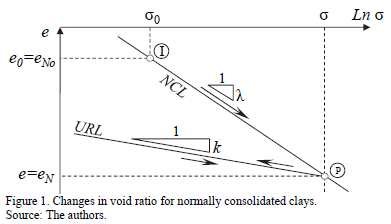
<body><![CDATA[<p><font size="2" face="Verdana, Arial, Helvetica, sans-serif">The modeling conception is divided into  two main sets of variables. The first set accounts for internal variables, such  as density and bonding, which modify the shape of the void ratio versus the  effective stress compressibility curve. The second set includes external  variables (rate of deformation, temperature and water content) whose main effect is to  shift the position of the normal consolidation line (NCL). This paper will  focus only on the influence of density, but a full description of other  variables may be found in the above references.</font></p>     <p><font size="2" face="Verdana, Arial, Helvetica, sans-serif">Nakai <i>et al.</i> &#91;3&#93; initially show how to  formulate models under one-dimensional conditions and later extend the analyses  to full three-dimensional cases &#91;4&#93;. The extension to generalized 3D conditions  is achieved by: (a) introducing a modified stress tensor <i>t<sub>ij</sub></i> &#91;11&#93;; and (b) assuming a decomposition of the  plastic strain increment &#91;12&#93;. These two features, respectively, are  responsible for accounting for the influence of the intermediate principal  stress and the influence of stress path on the behavior. Alternative approaches  using conventional stress invariants <i>p</i>, <i>q</i> and <i>q</i> may be also effective, including applications to unsaturated soils &#91;13&#93;.</font></p>     <p><font size="2" face="Verdana, Arial, Helvetica, sans-serif">Here,  the simpler version will be explained with reference to the well-known void  ratio (<i>e</i>) versus natural logarithm of  the one-dimensional effective stress (<i>s</i>)  illustrated in <a href="#fig01">Fig 1</a>. For a normally consolidated material, the initial state  is represented by point I (<i>e<sub>0</sub>,<font face="Symbol">s</font><sub>0</sub></i>)=(<i>e<sub>N0</sub>,<font face="Symbol">s</font><sub>0</sub></i>). Upon  loading, the point follows a trajectory along the normal consolidation line  (NCL), reaching a final point P (<i>e,  <font face="Symbol">s</font></i>)=(<i>e<sub>N</sub></i>, <i><font face="Symbol">s</font></i>), with <i>e </i>=<i> e<sub>0</sub></i>+<i>d(-e)</i> and <i><font face="Symbol">s</font></i> = <i><font face="Symbol">s</font><sub>0</sub></i>+<i>d<font face="Symbol">s</font></i>. The subscript &quot;<i>N</i>&quot; denotes a point over the NCL. The  inclination of the virgin NCL is denoted by the (one-dimensional) compression  index <i>l</i>, and the slope of the  unloading-reloading line (URL) is given by the swelling index, <i>k</i>. Under these conditions, the  change in plastic void ratio, from simple geometric relations in <a href="#fig01">Fig. 1</a>, is  given by:</font></p>     <p><img src="/img/revistas/dyna/v83n197/v83n197a08eq01.gif"></p>     <p align="center"><font size="2" face="Verdana, Arial, Helvetica, sans-serif"><a name="fig01"></a></font><img src="/img/revistas/dyna/v83n197/v83n197a08fig01.gif"></p>     <p><font size="2" face="Verdana, Arial, Helvetica, sans-serif">For the sake of simplicity, let <i>F</i> and <i>H</i> denote the terms related to (logarithmic) stress change and  plastic void ratio change in Eq. (1), respectively, so that:</font></p>     <p><img src="/img/revistas/dyna/v83n197/v83n197a08eq0203.gif"></p>     <p><font size="2" face="Verdana, Arial, Helvetica, sans-serif">Then the yield function (<i>f</i>) can be written generically as  follows:</font></p>     <p><img src="/img/revistas/dyna/v83n197/v83n197a08eq04.gif"></p>     <p><font size="2" face="Verdana, Arial, Helvetica, sans-serif">The  consistency condition upon loading (<i>df</i>=0)  implies:</font></p>     ]]></body>
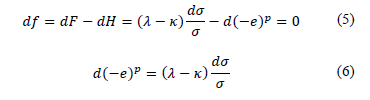
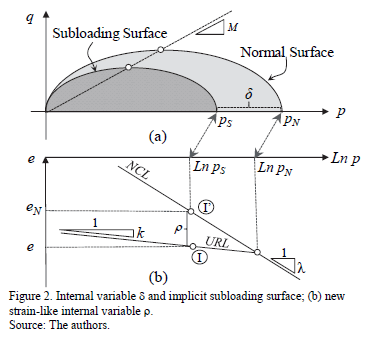
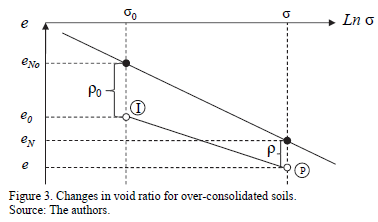
<body><![CDATA[<p><img src="/img/revistas/dyna/v83n197/v83n197a08eq0506.gif"></p>     <p><font size="2" face="Verdana, Arial, Helvetica, sans-serif">Eq. (6) could also be directly obtained  from differentiation of Eq. (1), but all steps were used only to illustrate the  approach adopted in Nakai <i>et al.</i> &#91;3&#93;  and later extended to other internal variables. For normally consolidated  soils, Eq. (6) represents the incremental hardening law which relates changes  of an internal  strain-like hardening variable, represented by the plastic void ratio <i>d</i>(-<i>e</i>)<i><sup>p</sup></i>, with changes of the  internal stress-like hardening variable, given by <i>s<sub>o</sub></i>=<i>s </i>or  the maximum stress previously applied to the soil (pre-consolidation stress).  This is akin to most conventional models based of the critical state theory,  such as the Cam clay model. </font></p>     <p><font size="2" face="Verdana, Arial, Helvetica, sans-serif">Now, a new (strain-like) internal  hardening variable, denoted by <i>r</i>, is  introduced to account for the influence of density or pre-consolidation of the  soil into the model. Referring to <a href="#fig02">Fig. 2-b</a>, this variable simply represents the  deviation between the actual void ratio (<i>e</i>)  in the present over-consolidated state (point I) and the corresponding void  ratio (<i>e<sub>N</sub></i>) on the NCL for  a normally consolidated soil under the same stress level (point I').</font></p>     <p align="center"><font size="2" face="Verdana, Arial, Helvetica, sans-serif"><a name="fig02"></a></font><img src="/img/revistas/dyna/v83n197/v83n197a08fig02.gif"></p>     <p><font size="2" face="Verdana, Arial, Helvetica, sans-serif">This new internal variable <i>r</i> is non-dimensional and represents a change in void ratio with  respect to a reference normally consolidated state. This change may be due to  pre-consolidation (single loading and unloading), but can also incorporate  other effects such as cyclic loading. A null value for variable <i>r</i> means that the soil is normally consolidated and a high value of <i>r</i> denotes a very dense condition (much lower void ratio) with respect  to the soil density if it were normally consolidated. So, variable <i>r</i> represents a densification effect due to pre-consolidation (and  cyclic loading).</font></p>     <p><font size="2" face="Verdana, Arial, Helvetica, sans-serif">The relation between variable <i>r</i> and pre-consolidation can be better visualized using the <i>p-q</i> stress space of the Cam clay model  as depicted in <a href="#fig02">Fig. 2-a</a>. Two yield surfaces are drawn: (i) the outer or &quot;normal&quot;  surface whose &quot;size&quot;, given by its intersection with the average stress axis (<i>p</i>), corresponds to the maximum or  pre-consolidation stress (<i>p<sub>N</sub></i>);  (ii) the inner surface, called &quot;subloading&quot; surface, which always passes  through the present stress state, and its size is denoted by (<i>p<sub>S</sub></i>). The distance (d=<i>p<sub>N</sub></i>-<i>p<sub>S</sub></i>) between the two surfaces is a measure of  pre-consolidation and can be related to the over-consolidation ratio (OCR=<i> p<sub>N</sub></i> <i>/p<sub>S</sub></i>), <i>d<sub>*</sub></i>=<i><sub>*</sub>p<sub>S*</sub></i>(OCR-1). From  <a href="#fig02">Fig. 2</a>, it is possible to establish the following relation between <i>r</i> and OCR &#91;14&#93;:</font></p>     <p><img src="/img/revistas/dyna/v83n197/v83n197a08eq07.gif"></p>     <p><font size="2" face="Verdana, Arial, Helvetica, sans-serif">The use of two surfaces is the essence of  modeling approaches such as subloading surface &#91;6&#93; and bounding surface  &#91;15&#93;, despite some basic differences in these approaches, especially regarding  the influence of the confining pressure. While the inner surface tracks the  present or actual stress state, the outer surface keeps a kind of memory of the  loading history. The distance between the two surfaces can be measured by  stress-like (<i>d</i>) or strain-like (<i>r</i>) internal hardening variables, which are interrelated. In either  case, it is necessary to devise an evolution law for the hardening variable,  giving rise to different models and interpretations. </font></p>     <p><font size="2" face="Verdana, Arial, Helvetica, sans-serif">The authors favor the use of the  strain-like density variable <i>r</i>. It should  be emphasized that the subloading concept was evoked here only for  interpretation purposes and that the modeling approach does not require the  explicit definition of two surfaces.</font></p>     <p><font size="2" face="Verdana, Arial, Helvetica, sans-serif"><a href="#fig03">Fig. 3</a> illustrates the changes in void  ratio for an over-consolidated soil loaded from the initial state at point I (<i>e<sub>o</sub>,s<sub>o</sub></i>) to a final state at point P (<i>e,s</i>), with <i>e</i>=<i>e<sub>o</sub></i>+ <i>D</i>(-<i>e</i>) and <i>s</i>=<i>s<sub>o</sub></i>+<i>Ds</i>. The change of plastic void ratio (-D<i>e</i>)<sup>p</sup> upon loading from <i>s</i><sub>o</sub> to <i>s</i> can be expressed as:</font></p>     ]]></body>
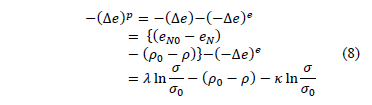
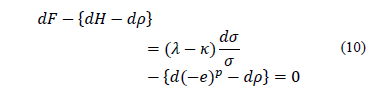
<body><![CDATA[<p><img src="/img/revistas/dyna/v83n197/v83n197a08eq08.gif"></p>     <p align="center"><font size="2" face="Verdana, Arial, Helvetica, sans-serif"><a name="fig03"></a></font><img src="/img/revistas/dyna/v83n197/v83n197a08fig03.gif"></p>     <p><font size="2" face="Verdana, Arial, Helvetica, sans-serif">Hence the yield function can be written  as:</font></p>     <p><img src="/img/revistas/dyna/v83n197/v83n197a08eq09.gif"></p>     <p><font size="2" face="Verdana, Arial, Helvetica, sans-serif">and the consistency condition <sub><img src="/img/revistas/dyna/v83n197/v83n197a08eq024.gif"></sub> applied to Eq. (9), requires  that:</font></p>     <p><img src="/img/revistas/dyna/v83n197/v83n197a08eq10.gif"></p>     <p><font size="2" face="Verdana, Arial, Helvetica, sans-serif">Variable <i>r</i> needs and evolution law (or hardening law). The research group of  NIT suggested that its increment (<i>dr</i>) should be negative and proportional to the change of plastic  void ratio<i><sub><img src="/img/revistas/dyna/v83n197/v83n197a08eq028.gif"></sub></i>, and also dependent on the present value of density <i>r</i> by means of an arbitrary increasing function, <i>G</i>(<i>r</i>). This can be  expressed mathematically as follows:</font></p>     <p><img src="/img/revistas/dyna/v83n197/v83n197a08eq11.gif"></p>     <p><font size="2" face="Verdana, Arial, Helvetica, sans-serif">Substituting the evolution law of Eq.  (11) into Eq. (10), the change in plastic void ratio can be expressed as  follows:</font></p>     <p><img src="/img/revistas/dyna/v83n197/v83n197a08eq12.gif"></p>     ]]></body>
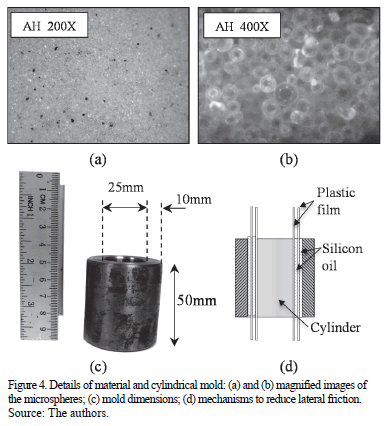
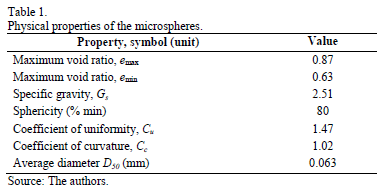
<body><![CDATA[<p><font size="2" face="Verdana, Arial, Helvetica, sans-serif">There are  only two conditions established for function <i>G</i>(<i>r</i>): (i) it must be a monotonically increasing  function of <i>r</i> and (ii) it should satisfy <i>G</i>(0)=0. The first condition assures that the value of variable <i>r</i> degrades faster for higher densities and the second condition assures that the  evolution ceases when <i>r</i> =0, thus forcing the deformability  curve to adhere to the NCL when the soil becomes normally consolidated.  Following these conditions, Nakai <i>et al.</i> &#91;8&#93; suggested that linear (<i>G</i>(<i>r</i>)=<i>ar</i>) or quadratic rules (<i>G</i>(<i>r</i>)=<i>ar</i><sup>2</sup>) could be  adopted. The main argument for the adoption of these functions is their  simplicity and the fact that just one parameter (<i>a</i>) is added to the model. This parameter controls the decay rate  between the pre-consolidated and normally consolidated stress states.</font></p>     <p><font size="2" face="Verdana, Arial, Helvetica, sans-serif">The absolute value of <i>G</i>(<i>r</i>) can be interpreted as an increase in the volumetric plastic  stiffness of the soil compared to the stiffness value that the soil would have  if it were normally consolidated. This  is easily achieved by expressing Eq. (12) in terms of volumetric strains  (dividing by 1+<i>e<sub>o</sub></i>) and  inverting it:</font></p>     <p><img src="/img/revistas/dyna/v83n197/v83n197a08eq13.gif"></p>     <p><font size="2" face="Verdana, Arial, Helvetica, sans-serif">The term between brackets in Eq. (13)  corresponds to the bulk or volumetric plastic stiffness (<i>K<sup>p</sup></i>) and it coincides exactly with the expression  obtained for the Cam clay model when <i>G(r)=0</i> (if the one-dimensional stress <i>s</i> is substituted by the mean stress <i>p</i>), i.e., <i>K<sup>p</sup></i>=<i>p</i>(1+<i>e</i><sub>o</sub>)/(<i>l</i>-<i>k</i>). The factor (1+<i>G</i>(<i>r</i>)) in <i>K<sup>p</sup></i> in Eq.  (13) gives a scalar measure of this stiffness gain when the soil becomes  over-consolidated &#91;16&#93;. This approach can be easily implemented in critical  state based models for simulating geotechnical problems, mainly for  applications where the soil undergoes severe densification, or in cases of  cyclic loadings, including the simpler case of a single unloading-reloading  cycle &#91;17, 18, 19, 20&#93;.</font></p>     <p>&nbsp;</p>     <p><font size="3" face="Verdana, Arial, Helvetica, sans-serif"><b>3. Experimental program</b></font></p>     <p><font size="2" face="Verdana, Arial, Helvetica, sans-serif">The linear and quadratic hypotheses for  the evolution function <i>G</i>(<i>r</i>) were proposed based solely on their simplicity. However, these  proposed shapes for <i>G</i>(<i>r</i>) lack experimental backing, which is what is investigated in this  paper. In order to check their validity, the authors devised a series of  experimental tests with different initial void ratios (hence different initial  values of <i>r</i><sub>o</sub>) and tracked their evolution.</font></p>     <p><font size="2" face="Verdana, Arial, Helvetica, sans-serif">The tests were initially performed with  artificial sand comprised of almost perfect microspheres of glass beads. The  idea was to test a well-behaved material, thus avoiding other interferences  such as particle shape, natural structure and cementation. The particle  diameters (<i>D<sub>p</sub></i>) and sample  diameter (<i>D<sub>s</sub></i>) were chosen  so as to minimize scale effects (<i>D<sub>s</sub>/D<sub>p</sub></i>&gt;100).  Conventional soil characterization tests, such as grain size distribution,  density, minimum and maximum void ratios (<i>e<sub>min</sub></i> and <i>e<sub>max</sub></i>) etc., were performed  with this material. </font></p>     <p><font size="2" face="Verdana, Arial, Helvetica, sans-serif"><a href="#tab01">Table 1</a> summarizes the results of  characterization tests on the glass beads. The package of microspheres can be  classified as fine sand according to the ASTM standards. Photos of the glass  beads amplified by 200x and 400x using an electronic magnifying glass (Digital  USB Microscope) are shown <a href="#fig04">Fig. 4 (a)-(b)</a>. The spherecity and uniformity of the  microspheres can be appreciated in these photos.</font></p>     <p align="center"><font size="2" face="Verdana, Arial, Helvetica, sans-serif"><a name="tab01"></a></font><img src="/img/revistas/dyna/v83n197/v83n197a08tab01.gif"></p>     ]]></body>
<body><![CDATA[<p align="center"><font size="2" face="Verdana, Arial, Helvetica, sans-serif"><a name="fig04"></a></font><img src="/img/revistas/dyna/v83n197/v83n197a08fig04.gif"></p>     <p><font size="2" face="Verdana, Arial, Helvetica, sans-serif">Artificial soil samples were prepared by  pouring the glass microspheres into a metallic cylinder with a diameter of 25  mm and a height of 50 mm (<a href="#fig04">Fig. 4-c</a>). The material was carefully placed in its  loosest state and vibrated until the desired initial void radio was reached by  trial and error. Samples starting with seven initial void ratio states, from <i>e<sub>max</sub></i> down to close to <i>e<sub>min</sub></i>, were prepared: <i>e<sub>o</sub>=</i> 0.87-0.85-0.81-0.79-0.77-0.76-0.72. </font></p>     <p><font size="2" face="Verdana, Arial, Helvetica, sans-serif">The wall of  the metallic mold was 10 mm thick to avoid radial deformation and ensure the  desired one-dimensional strain compression state. In order to minimize wall  friction, the interior of the cylinder was coated with silicon oil and two  layers of plastic film also coated with oil in between them, as illustrated in  <a href="#fig04">Fig. 4-d</a>.</font></p>     <p><font size="2" face="Verdana, Arial, Helvetica, sans-serif">The compressibility curves were  determined under one-dimensional constant strain rate (CSR). The main  advantages of this methodology are related to speed and precision &#91;21&#93;. The  test equipment comprised a load frame with a reaction beam, a moving load  plate, and sensors for load and displacement (LVDT). The strain rate was fixed  at 1 mm/min and the test was carried until a maximum vertical force of 40 kN,  due to limitations of the reaction system. The corresponding maximum vertical  stress, around 80000 kPa, was high enough to observe particle crushing in the  cases of spheres with larger diameters (not reported here).</font></p>     <p><font size="2" face="Verdana, Arial, Helvetica, sans-serif">Besides the  artificial sand prepared with microspheres of glass, the constitutive model was  also verified against the results of CSR one-dimensional tests on real soils  compiled from the literature. The main idea was to test the hypotheses that  void ratio deviation from the NCL, variable <i>r</i>, provides an appropriate measure of  density which controls the soil behavior irrespective of particle shape and  nature (sand or clay). The tests include  two sands and two clays for which CSR one-dimensional test results were  available for different initial densities. A quartz sand was tested by Nakata <i>et al.</i> &#91;22&#93; and Ganga sand was tested by  Rahim &#91;23&#93;. Tests performed with London clay and Cambridge clay were also used  &#91;24&#93;.</font></p>     <p>&nbsp;</p>     <p><font size="3" face="Verdana, Arial, Helvetica, sans-serif"><b>4. Methodology for the calibration of model parameters</b></font></p>     <p><font size="2" face="Verdana, Arial, Helvetica, sans-serif">The compression (<font face="Symbol">l</font>) and swelling (<i>k</i>) indices are quite easy to calibrate  and may be obtained directly from the inclinations of straight lines fitted to  the initial and final sections of the compressibility curve, respectively. The  straight line fitting is best achieved using least square error minimization  for selected ranges of experimental points in the initial and final sections of  the <i>e</i>-ln(<i>s</i>) curve. </font></p>     <p><font size="2" face="Verdana, Arial, Helvetica, sans-serif">In order to find the actual evolution  rule of the internal variable <i>r,</i> it is  necessary to first determine the experimental values of <i>G</i>(<i>r</i>) versus <i>r</i> directly  from the test results. The following methodological steps are proposed:</font></p> <ul>       <li><font size="2" face="Verdana, Arial, Helvetica, sans-serif">Generate an adjusted curve     fitting the experimental <i>e</i>-ln(<i>s</i>) data to obtain an expression for the stress <i>s </i>as a function of the void ratio, <i>s</i>=<i>f</i>(<i>e</i>). This can be achieved with a high order polynomial, a spline     curve, or piecewise linear fittings. This curve is used only as an intermediate     stage in order to recover the data for equally spaced void ratio intervals and     avoid the ragged nature of the experimental data;</font></li>       ]]></body>
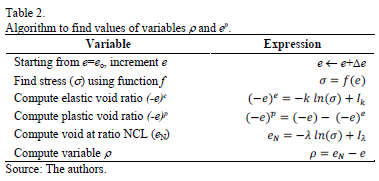
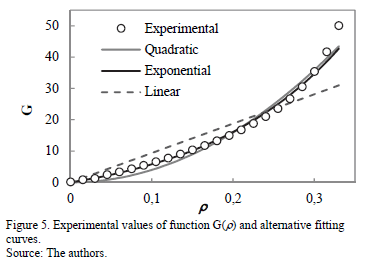
<body><![CDATA[<li><font size="2" face="Verdana, Arial, Helvetica, sans-serif">For equally spaced points (<i>De</i>=constant) in the compressibility     curve, obtain the elastic and plastic void ratios and the internal variable <i>r</i> following the steps of the     algorithm described in <a href="#tab02">Table </a>2;</font></li>     </ul>     <p align="center"><font size="2" face="Verdana, Arial, Helvetica, sans-serif"><a name="tab02"></a></font><img src="/img/revistas/dyna/v83n197/v83n197a08tab02.gif"></p> <ul>       <li><font size="2" face="Verdana, Arial, Helvetica, sans-serif">Compute the changes in variable <i>r</i> and the corresponding changes in plastic     void ratio, <sub><img src="/img/revistas/dyna/v83n197/v83n197a08eq040.gif"></sub> and <sub><img src="/img/revistas/dyna/v83n197/v83n197a08eq042.gif"></sub>, with respect to the previous values.</font></li>       <li><font size="2" face="Verdana, Arial, Helvetica, sans-serif">Following Eq. 11, determine the     value of <i>G</i>(<i>r</i>) for each point of the compressibility curve as the ratio:</font></li>     </ul>     <p><img src="/img/revistas/dyna/v83n197/v83n197a08eq14.gif"></p>     <p><font size="2" face="Verdana, Arial, Helvetica, sans-serif">Following the steps described above, the  authors were able to find the experimental relation for <i>G</i>(<i>r</i>) x <i>r</i>, depicted by the open dots in <a href="#fig05">Fig. 5</a>, for a  particular test with the densest sample (<i>e<sub>o</sub></i>=0.72).  The experimental data, however, do not show the linear nor the quadratic trends  proposed by Nakai <i>et al</i>. &#91;8&#93;. The  same was observed for all tests performed by the authors.</font></p>     <p align="center"><font size="2" face="Verdana, Arial, Helvetica, sans-serif"><a name="fig05"></a></font><img src="/img/revistas/dyna/v83n197/v83n197a08fig05.gif"></p>     <p><font size="2" face="Verdana, Arial, Helvetica, sans-serif">It may be observed that the initial  section of the data in <a href="#fig05">Fig. 5</a> may be fitted with a straight line with a  non-zero inclination, <i>G</i>(<i>r</i>)=<i>ar</i>. However if a straight line is fitted over the whole range of  variable <i>r</i>, it will overestimate <i>G</i>(<i>r</i>) for low values of <i>r</i> and  underestimate the function for high values of <i>r</i>. The initial non-zero inclination of the experimental data cannot  be captured with a simple quadratic curve of the type <i>G</i>(<i>r</i>)=<i>ar</i><sup>2</sup>, because its first derivative at the origin is zero. On the other  hand, the experimental data show that the relation is clearly non-linear over  the range of density tested, and that the inclination increases faster after a  certain point. A hyperbolic function can meet these requirements </font><font size="2" face="Verdana, Arial, Helvetica, sans-serif">&#91;16&#93; or maybe a  quadratic function with two terms (<i>G</i>(<i>r</i>)=<i>ar</i><sup>2</sup>+<i>br</i>), but this behavior can be better simulated with an exponential  function, as follows:</font></p>     ]]></body>
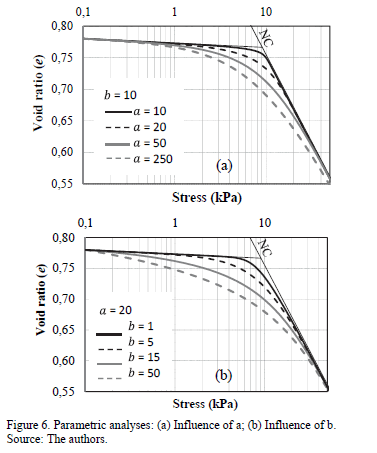
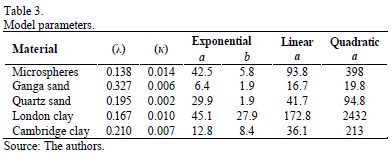
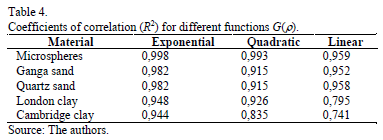
<body><![CDATA[<p><img src="/img/revistas/dyna/v83n197/v83n197a08eq15.gif"></p>     <p><font size="2" face="Verdana, Arial, Helvetica, sans-serif">in which <i>a </i>and <i>b</i> are material  parameters. The derivative of Eq. (15) is <sub><img src="/img/revistas/dyna/v83n197/v83n197a08eq060.gif"></sub>, and the parameter <i>a</i> mathematically represents the inclination when <i>r</i>=0, i.e., <i>a</i>=<i>G'</i>(0), while parameter <i>b</i> gives the rate of increase of this inclination which is  related to the second derivative of <i>G</i>(<i>r</i>).</font></p>     <p><font size="2" face="Verdana, Arial, Helvetica, sans-serif">The proposed  function is monotonically crescent, satisfies <i>G</i>(<i>0</i>)=0, and exhibits the  trends of initial non-zero inclination and fast increase after a certain value.  However, the exponential model requires two parameters (<i>a</i> and <i>b</i>) instead of just  one (<i>a</i>) of the original linear or  quadratic functions. Nevertheless, these parameters are easily calibrated with  a simple procedure which starts by rewriting Eq. (15) as follows:</font></p>     <p><img src="/img/revistas/dyna/v83n197/v83n197a08eq16.gif"></p>     <p><font size="2" face="Verdana, Arial, Helvetica, sans-serif">Eq. (16) represents a linear relation  between an auxiliary variable c and <i>r</i>. The best fitting is  obtained by varying the ratio <i>a/b</i> until a good linear correlation (<i>R<sup>2</sup>@1.0</i>) is obtained through the points (<i>r, </i><img src="/img/revistas/dyna/v83n197/v83n197a08eq064.gif">). The inclination of this straight line is parameter <i>b</i>, and the other parameter <i>a</i> follows directly from the product  between <i>b</i> and the ratio <i>a/b</i>.</font></p>     <p><font size="2" face="Verdana, Arial, Helvetica, sans-serif"><a href="#fig06">Fig. 6</a> shows the results of parametric  analyses to highlight the influences of parameters <i>a</i> and <i>b</i> on the overall  compressibility curve, <i>e</i>-ln(<i>s</i>). In these simulations, the initial void ratio was <i>e</i><sub>o</sub>=0.78 for the stress <i>s</i><sub>o</sub>=0.1 kPa, and the  conventional compressibility indices were <i>l</i>= 0.120 and <i>k </i>=0.03. From  these analyses, it can be observed that parameters <i>a</i> and <i>b</i> control the  adherence between the actual compressibility curve and the straight sections  represented by the normal consolidation line (NCL) and unloading-reloading line  (URL), respectively. </font></p>     <p align="center"><font size="2" face="Verdana, Arial, Helvetica, sans-serif"><a name="fig06"></a></font><img src="/img/revistas/dyna/v83n197/v83n197a08fig06.gif"></p>     <p><font size="2" face="Verdana, Arial, Helvetica, sans-serif">The  influence of parameter <i>a</i> can be  appreciated in <a href="#fig06">Fig. 6-a</a>, in which the value of <i>b</i>=10 was kept constant and the value of <i>a</i> varied between 10 and 250. The parametric analyses show that the  compressibility curve joins the NCL faster (i.e., at higher values of void  ratio, <i>e</i>) for lower values of  parameter <i>a</i>. Parameter <i>b</i>, on the other hand, controls the  adherence between the actual curve and the unloading-reloading line as  illustrated in <a href="#fig06">Fig. 6-b</a>, where the value of <i>a</i>=20  was kept constant and the value of <i>b</i> varied between 1 and 50. Here it can be observed that the compressibility curve  sticks to the URL section for lower values of <i>b</i>. In summary, low values of both <i>a</i> and <i>b</i> simulate a sharp  bilinear transition as in the conventional Cam clay model.</font></p>     <p><font size="2" face="Verdana, Arial, Helvetica, sans-serif">The experimental results obtained by the  authors using microspheres as well as results from tests on real soils  published in the literature were used to calibrate the parameters of the model  (<i>l, k</i>, <i>a</i> and <i>b</i>) following the procedures described in the previous section.  These parameters are summarized in <a href="#tab03">Table 3</a>. </font></p>     <p align="center"><font size="2" face="Verdana, Arial, Helvetica, sans-serif"><a name="tab03"></a></font><img src="/img/revistas/dyna/v83n197/v83n197a08tab03.gif"></p>     ]]></body>
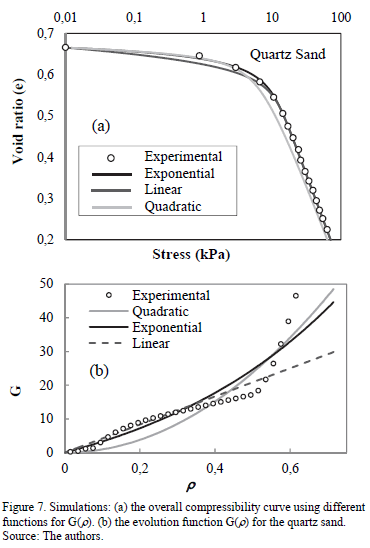
<body><![CDATA[<p><font size="2" face="Verdana, Arial, Helvetica, sans-serif">The first observation during the  calibration process was that the swelling (<sub><img src="/img/revistas/dyna/v83n197/v83n197a08eq066.gif"></sub>) was not exactly constant, but increased slightly for lower values  of initial density of the sample (<sub><img src="/img/revistas/dyna/v83n197/v83n197a08eq066.gif"></sub>= 0.014 to 0.019). This is contrary to the basic assumption of  conventional models, such as the Cam clay. In order to keep the model simple,  this hypothesis was preserved and the values of these parameters were taken as  the average for all the tests on a given material. </font></p>     <p><font size="2" face="Verdana, Arial, Helvetica, sans-serif">The parameters for the evolution function <i>G</i>(<i>r</i>) of the density variable were taken for the material at its densest  state. The values parameters <i>a</i> (or <i>a</i> and <i>b</i>, for the exponential model) represent the best fit obtained by a  least square error minimization process. The computed values of <i>G</i>(<i>r</i>) were compared with the experimental ones and the coefficients of  correlation (<i>R</i><sup>2</sup>) computed.  These values are summarized in <a href="#tab04">Table 4</a>. The exponential model gave the best  correlation for all materials, as expected. Compared with the linear model, the  parabolic model yielded better correlations for natural clays, but slightly  worse correlations for natural sands. </font></p>     <p align="center"><font size="2" face="Verdana, Arial, Helvetica, sans-serif"><a name="tab04"></a></font><img src="/img/revistas/dyna/v83n197/v83n197a08tab04.gif"></p>     <p>&nbsp;</p>     <p><font size="3" face="Verdana, Arial, Helvetica, sans-serif"><b>5. Model predictions and experimental results</b></font></p>     <p><font size="2" face="Verdana, Arial, Helvetica, sans-serif">A good fit  of <i>G</i>(<i>r</i>) is important, but the crucial point  is the correlation between the complete model simulations with the whole  experimental compressibility curve, <i>e</i>-ln(<i>s</i>).  These curves will be shown for all materials in this section, but a single case  for the quartz sand is initially commented in more details. </font></p>     <p><font size="2" face="Verdana, Arial, Helvetica, sans-serif">A comparison  between experimental <i>e</i>-ln(<i>s</i>)  data for the quartz sand and the simulations using three different functions  for <i>G</i>(<i>r</i>) is shown in <a href="#fig07">Fig. 7-a</a>. With the  exponential function for <i>G</i>(<i>r</i>),  the overall simulation fitted the experimental data almost perfectly; while the  linear function best fitted the last section of the curve (the NCL) and the  quadratic function best fitted the initial section of the curve (the URL). </font></p>     <p align="center"><font size="2" face="Verdana, Arial, Helvetica, sans-serif"><a name="fig07"></a></font><img src="/img/revistas/dyna/v83n197/v83n197a08fig07.gif"></p>     <p><font size="2" face="Verdana, Arial, Helvetica, sans-serif">This result is explained when the actual  values of <i>G</i>(<i>r</i>) are compared to their simulations using the linear, quadratic and  exponential models, as shown in <a href="#fig07">Fig. 7-b</a>. For this quartz sand, the  experimental values of <i>G</i>(<i>r</i>) showed a crescent but unexpected curved shape. This curve fitted  reasonably well with a straight line for low values of <i>r</i>, hence the good overall agreement close to the NCL in <a href="#fig07">Fig. 7-a</a> for  the model with a linear function for <i>G</i>(<i>r</i>). The opposite is observed with the quadratic function for <i>G</i>(<i>r</i>), which fits best for higher values of <i>r</i>, hence the good agreement close to the URL in the overall  compressibility curve in <a href="#fig07">Fig. 7-a</a>.</font></p>     <p><font size="2" face="Verdana, Arial, Helvetica, sans-serif">The excellent agreement of the  exponential model is due to its two parameters, one controlling the simulation  in the URL range and the other in the NCL domain, as explained in the  parametric analyses shown in the previous section. Therefore, this model will  be used in all following simulations presented in this paper.</font></p>     ]]></body>
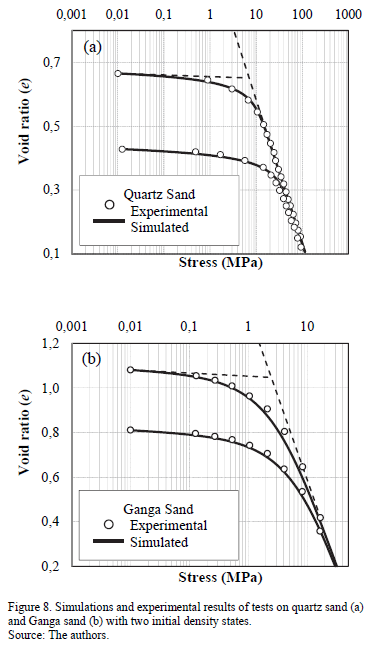
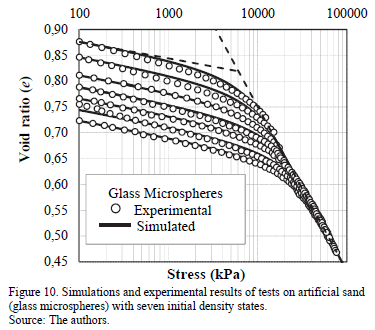
<body><![CDATA[<p><font size="2" face="Verdana, Arial, Helvetica, sans-serif">Next, further results of tests on some  real soils described in the literature and the model simulations are described.  Initially the results for quartz sand are completed by simulations with two  initial densities, as shown in <a href="#fig08">Fig. 8-a</a>. The simulations can very successfully  reproduce the compressibility curves over the whole domain. The same can be  observed for the Ganga sand shown in <a href="#fig08">Fig. 8-b</a>.</font></p>     <p align="center"><font size="2" face="Verdana, Arial, Helvetica, sans-serif"><a name="fig08"></a></font><img src="/img/revistas/dyna/v83n197/v83n197a08fig08.gif"></p>     <p><font size="2" face="Verdana, Arial, Helvetica, sans-serif">The experimental results and  model simulations for London clay and Cambridge clay are shown in <a href="#fig09">Fig. 9-a</a> and  <a href="#fig09">Fig. 9-b</a>, respectively. Three different initial conditions were available for  London clay and two initial states for Cambridge clay. In both cases, the  agreement between model simulations and experimental results was excellent for  the entire range of stresses and densities analyzed.</font></p>     <p align="center"><font size="2" face="Verdana, Arial, Helvetica, sans-serif"><a name="fig09"></a></font><img src="/img/revistas/dyna/v83n197/v83n197a08fig09.gif"></p>     <p><font size="2" face="Verdana, Arial, Helvetica, sans-serif">The results for all tests  using microspheres and the model simulation with exponential function <i>G</i>(<i>r</i>) are shown in <a href="#fig10">Fig.  10</a>. For the average value of <i>l</i>=0.138 in <a href="#tab03">Table 3</a>,  and a reference stress equivalent to the atmospheric pressure (<i>s<sub>o</sub> </i>= <i>s</i><sub>atm</sub>= 100 kPa), the following values for the  initial density variable were computed, <i>r</i><sub>o</sub>=0.51-0.54-0.58-0.60-0.62-0.64-0.66.  These values correspond to the whole range of void ratio values, between <i>e<sub>min</sub></i> and <i>e<sub>max</sub></i> presented previously. It is striking that the  simulations can very successfully reproduce the compressibility curves over the  whole domain for all range of initial density conditions with a single set of  parameters.</font></p>     <p align="center"><font size="2" face="Verdana, Arial, Helvetica, sans-serif"><a name="fig10"></a></font><img src="/img/revistas/dyna/v83n197/v83n197a08fig10.gif"></p>     <p><font size="2" face="Verdana, Arial, Helvetica, sans-serif">In all the tests involving natural soils  (sand and clay) and artificial sand (microspheres) a unique set of parameters  was used for each material, regardless of the initial void ratio. Also, the  reader can observe a smooth transition between the over-consolidated and normally  consolidated states. This contrasts with the discontinuity in compressibility  indices (<i>l</i></font><font size="2" face="Verdana, Arial, Helvetica, sans-serif"> and <i>k</i>) postulated by the bilinear behavior assumed, for instance, in the  Cam clay model. This sharp transition will be observed also in the  simulation of conventional triaxial tests on over-consolidated soils.</font></p>     <p><font size="2" face="Verdana, Arial, Helvetica, sans-serif">The smoothness in  compressibility is simulated by any model which implicitly or explicitly adopts  the subloading concept. This smooth variation comes from the introduction of  the scalar function <i>G</i>(<i>r</i>) which reproduces plastic strains for any loading  condition, irrespective of the previous stress history, i.e., regardless of  whether the soil is normally consolidated or over-consolidated. This can be  easily implemented in many models and all it takes is the addition of a scalar,  related to <i>G</i>(<i>r</i>), into the plastic multiplier of conventional  elastoplastic models (see e.g. Pedroso <i>et  al.</i>&#91;14&#93;).</font></p>     <p>&nbsp;</p>     <p><font size="3" face="Verdana, Arial, Helvetica, sans-serif"><b>6. Conclusions</b></font></p>     ]]></body>
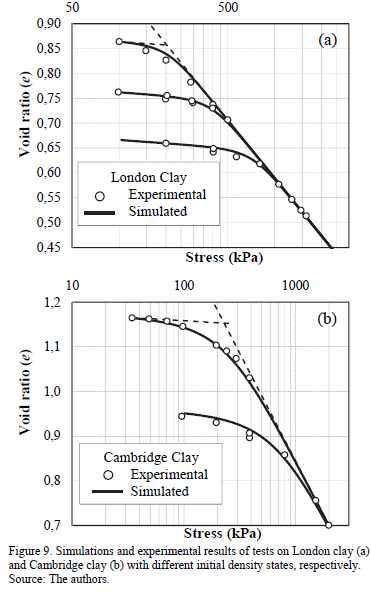
<body><![CDATA[<p><font size="2" face="Verdana, Arial, Helvetica, sans-serif">This paper revises a simple and versatile  model proposed by Nakai <i>et al.</i> &#91;3&#93; to  simulate the stress versus void ratio curve of geomaterials under  one-dimensional compression conditions, as in oedometer tests.</font></p>     <p><font size="2" face="Verdana, Arial, Helvetica, sans-serif">The model implicitly incorporates the  subloading concept which results in a smooth transition between the  over-consolidated and normally consolidated stress states. This is achieved by  means of an internal strain-like hardening variable, <i>r</i>, which is at the same time a measure of the density and  over-consolidation ratio. This variable  needs an evolution rule controlled by a smooth monotonic crescent function <i>G</i>(<i>r</i>), for which the original model proposed a linear or a quadratic  variation. </font></p>     <p><font size="2" face="Verdana, Arial, Helvetica, sans-serif">The above hypothesis was tested using the  results of constant strain tests on artificial sand composed of glass  microspheres and also tests on real soils (sand and clays) published in the  literature. The authors proposed methodological steps to find the experimental  values of <i>G</i>(<i>r</i>) and the results showed that a better description of this function  is given by an exponential relation with two model parameters (<i>a</i> and <i>b</i>).</font></p>     <p><font size="2" face="Verdana, Arial, Helvetica, sans-serif">These two parameters are easily calibrated  from a single one-dimensional compression test and they also have a clear  meaning: parameter <i>a</i> controls the  behavior in the normally consolidated range and parameter <i>b</i> controls the behavior in the over-consolidated domain.</font></p>     <p><font size="2" face="Verdana, Arial, Helvetica, sans-serif">The simpler linear and quadratic  relations, although not as accurate as the exponential, also produce good  simulations of the overall compressibility curve under one-dimensional  conditions. This may be enough for most practical applications and they have  the advantage of using a single parameter (<i>a</i>).  The limited experimental evidence shown in this paper indicates that the linear  model best fits the results obtained with natural sands, while the quadratic  model best reproduces the behavior of natural clays.</font></p>     <p><font size="2" face="Verdana, Arial, Helvetica, sans-serif">Irrespective of the shape of <i>G</i>(<i>r</i>), the results support the use of the internal variable (<i>r</i>) as a powerful variable to incorporate density related effects on  the stress-strain behavior of geomaterials, independently of grain shape or  nature. The simulations could accurately reproduce the behavior of artificial  glass microspheres, natural sands and clays, over a wide range of stress and  void ratio conditions, using a single set of unified parameters.</font></p>     <p><font size="2" face="Verdana, Arial, Helvetica, sans-serif">In spite of presenting the formulation  and experimental validation under one-dimensional compression conditions, the  subloading concept described here can be easily incorporated in any model under  general three-dimensional stress conditions. This has already been carried out  by many others &#91;4&#93;.</font></p>     <p>&nbsp;</p>     <p><font size="3" face="Verdana, Arial, Helvetica, sans-serif"><b>Acknowledments</b></font></p>     <p><font size="2" face="Verdana, Arial, Helvetica, sans-serif">The authors acknowledge the financial  support of the Brazilian National Research Council (CNPq).</font></p>     ]]></body>
<body><![CDATA[<p>&nbsp;</p>     <p><font size="3" face="Verdana, Arial, Helvetica, sans-serif"><b>References</b></font></p>     <!-- ref --><p><font size="2" face="Verdana, Arial, Helvetica, sans-serif"><b>&#91;1&#93;</b> Papamichos, E., Constitutive  laws for geomaterials. Oil Gas Science and Technology, 54(6), pp. 759-771,  1999. DOI: 10.2516/ogst:1999064</font>&nbsp;&nbsp;&nbsp;&nbsp;&nbsp;&nbsp;&nbsp;&nbsp;[&#160;<a href="javascript:void(0);" onclick="javascript: window.open('/scielo.php?script=sci_nlinks&ref=1125202&pid=S0012-7353201600030000800001&lng=','','width=640,height=500,resizable=yes,scrollbars=1,menubar=yes,');">Links</a>&#160;]<!-- end-ref --><!-- ref --><p><font size="2" face="Verdana, Arial, Helvetica, sans-serif"><b>&#91;2&#93;</b> Nakai, T. and Hinokio, M., A  simple elastoplastic model for normally and over consolidated soils with  unified material parameters. Soil and Foundation, 44(2), pp. 53-70, 2004.  DOI: 10.3208/sandf.44.2_53</font>&nbsp;&nbsp;&nbsp;&nbsp;&nbsp;&nbsp;&nbsp;&nbsp;[&#160;<a href="javascript:void(0);" onclick="javascript: window.open('/scielo.php?script=sci_nlinks&ref=1125203&pid=S0012-7353201600030000800002&lng=','','width=640,height=500,resizable=yes,scrollbars=1,menubar=yes,');">Links</a>&#160;]<!-- end-ref --><!-- ref --><p><font size="2" face="Verdana, Arial, Helvetica, sans-serif"><b>&#91;3&#93;</b> Nakai, T., Shahin, H.,  Kikumoto, M., Kyokawa, H., Zhang, F. and Farias, M.M., A simple and unified  one-dimensional model to describe various characteristics of soils. Soil and  Foundation, 51(6), pp. 1129-1148, 2011. DOI: 10.3208/sandf.51.1129</font>&nbsp;&nbsp;&nbsp;&nbsp;&nbsp;&nbsp;&nbsp;&nbsp;[&#160;<a href="javascript:void(0);" onclick="javascript: window.open('/scielo.php?script=sci_nlinks&ref=1125204&pid=S0012-7353201600030000800003&lng=','','width=640,height=500,resizable=yes,scrollbars=1,menubar=yes,');">Links</a>&#160;]<!-- end-ref --><!-- ref --><p><font size="2" face="Verdana, Arial, Helvetica, sans-serif"><b>&#91;4&#93;</b> Nakai, T., Shahin, H.,  Kikumoto, M., Kyokawa, H., Zhang, F. and Farias, M.M., A simple and unified three-dimensional  model to describe various characteristics of soils. Soil and Foundation, 51(6),  pp. 1149-1168, 2011. DOI: 10.3208/sandf.51.1149</font>&nbsp;&nbsp;&nbsp;&nbsp;&nbsp;&nbsp;&nbsp;&nbsp;[&#160;<a href="javascript:void(0);" onclick="javascript: window.open('/scielo.php?script=sci_nlinks&ref=1125205&pid=S0012-7353201600030000800004&lng=','','width=640,height=500,resizable=yes,scrollbars=1,menubar=yes,');">Links</a>&#160;]<!-- end-ref --><!-- ref --><p><font size="2" face="Verdana, Arial, Helvetica, sans-serif"><b>&#91;5&#93;</b> Nakai, T., Shahin, H.M.,  Kikumoto, M., Kyokawa, H. and Zhang F., Simple and unified method for  describing various characteristics of geomaterials. Journal of Applied  Mechanics JSCE, 19, pp. 371-382, 2009. (in Japanese).    &nbsp;&nbsp;&nbsp;&nbsp;&nbsp;&nbsp;&nbsp;&nbsp;[&#160;<a href="javascript:void(0);" onclick="javascript: window.open('/scielo.php?script=sci_nlinks&ref=1125206&pid=S0012-7353201600030000800005&lng=','','width=640,height=500,resizable=yes,scrollbars=1,menubar=yes,');">Links</a>&#160;]<!-- end-ref --></font></p>     <!-- ref --><p><font size="2" face="Verdana, Arial, Helvetica, sans-serif"><b>&#91;6&#93;</b> Hashiguchi, K., Constitutive  equation of elastoplastic materials with elasto-plastic transition. Journal of  Applied Mech. ASME, 102(2), pp. 266-272, 1980. DOI: 10.1115/1.3153653</font>&nbsp;&nbsp;&nbsp;&nbsp;&nbsp;&nbsp;&nbsp;&nbsp;[&#160;<a href="javascript:void(0);" onclick="javascript: window.open('/scielo.php?script=sci_nlinks&ref=1125208&pid=S0012-7353201600030000800006&lng=','','width=640,height=500,resizable=yes,scrollbars=1,menubar=yes,');">Links</a>&#160;]<!-- end-ref --><!-- ref --><p><font size="2" face="Verdana, Arial, Helvetica, sans-serif"><b>&#91;7&#93;</b> Nakai, T., Description of  elastoplastic behavior of soil as a one-dimensional model. Magazine of the  Japanese Geotechnical Society, 56(9), pp. 6-9, 2008 (In Japanese).    &nbsp;&nbsp;&nbsp;&nbsp;&nbsp;&nbsp;&nbsp;&nbsp;[&#160;<a href="javascript:void(0);" onclick="javascript: window.open('/scielo.php?script=sci_nlinks&ref=1125209&pid=S0012-7353201600030000800007&lng=','','width=640,height=500,resizable=yes,scrollbars=1,menubar=yes,');">Links</a>&#160;]<!-- end-ref --></font></p>     <!-- ref --><p><font size="2" face="Verdana, Arial, Helvetica, sans-serif"><b>&#91;8&#93;</b> Nakai, T., Kyokawa, H.,  Kikumoto, M., Shahin, H.M. and Zhang, F., One-dimensional and three-dimensional  descriptions of elastoplastic behavior in structured clays. Proc. of 4th  International Workshop on New Frontiers in Computational Geotechnics,  IWS-Pittsburgh, pp. 3-12, 2004.    &nbsp;&nbsp;&nbsp;&nbsp;&nbsp;&nbsp;&nbsp;&nbsp;[&#160;<a href="javascript:void(0);" onclick="javascript: window.open('/scielo.php?script=sci_nlinks&ref=1125211&pid=S0012-7353201600030000800008&lng=','','width=640,height=500,resizable=yes,scrollbars=1,menubar=yes,');">Links</a>&#160;]<!-- end-ref --></font></p>     <!-- ref --><p><font size="2" face="Verdana, Arial, Helvetica, sans-serif"><b>&#91;9&#93;</b> Shahin, H.M., Nakai, T.,  Kikumoto, M., Kyokawa, H. and Miyahara, Y., Modeling of time dependent behavior  of clay in one-dimensional consolidation. Proc. of the 4th Sino-Japan  Geotechnical Symposium, pp. 54-61, 2010.    &nbsp;&nbsp;&nbsp;&nbsp;&nbsp;&nbsp;&nbsp;&nbsp;[&#160;<a href="javascript:void(0);" onclick="javascript: window.open('/scielo.php?script=sci_nlinks&ref=1125213&pid=S0012-7353201600030000800009&lng=','','width=640,height=500,resizable=yes,scrollbars=1,menubar=yes,');">Links</a>&#160;]<!-- end-ref --></font></p>     <!-- ref --><p><font size="2" face="Verdana, Arial, Helvetica, sans-serif"><b>&#91;10&#93;</b> Kyokawa, H., Kikumoto, M.,  Nakai, T. and Shahin, H.M., Simple modeling of stress-strain relation for  unsaturated soil. GeoShangai - International Conference, China, pp. 17-25,  2010.    &nbsp;&nbsp;&nbsp;&nbsp;&nbsp;&nbsp;&nbsp;&nbsp;[&#160;<a href="javascript:void(0);" onclick="javascript: window.open('/scielo.php?script=sci_nlinks&ref=1125215&pid=S0012-7353201600030000800010&lng=','','width=640,height=500,resizable=yes,scrollbars=1,menubar=yes,');">Links</a>&#160;]<!-- end-ref --></font></p>     <!-- ref --><p><font size="2" face="Verdana, Arial, Helvetica, sans-serif"><b>&#91;11&#93;</b> Nakai, T. and Mihara, Y., A new  mechanical quantity for soils and its application to elastoplastic constitutive  models. Soil and Foundation, 24(2), pp. 82-94, 1984. DOI:  10.3208/sandf1972.24.2_82</font>&nbsp;&nbsp;&nbsp;&nbsp;&nbsp;&nbsp;&nbsp;&nbsp;[&#160;<a href="javascript:void(0);" onclick="javascript: window.open('/scielo.php?script=sci_nlinks&ref=1125217&pid=S0012-7353201600030000800011&lng=','','width=640,height=500,resizable=yes,scrollbars=1,menubar=yes,');">Links</a>&#160;]<!-- end-ref --><!-- ref --><p><font size="2" face="Verdana, Arial, Helvetica, sans-serif"><b>&#91;12&#93;</b> Nakai, T. and Matsuoka, H., A  generalized elastoplastic constitutive model for clay in three-dimensional  stresses. Soil and Foundation, 26(3), pp. 81-98, 1986. DOI:  10.3208/sandf1972.26.3_81</font>&nbsp;&nbsp;&nbsp;&nbsp;&nbsp;&nbsp;&nbsp;&nbsp;[&#160;<a href="javascript:void(0);" onclick="javascript: window.open('/scielo.php?script=sci_nlinks&ref=1125218&pid=S0012-7353201600030000800012&lng=','','width=640,height=500,resizable=yes,scrollbars=1,menubar=yes,');">Links</a>&#160;]<!-- end-ref --><!-- ref --><p><font size="2" face="Verdana, Arial, Helvetica, sans-serif"><b>&#91;13&#93;</b> Pedroso, D.M. and Farias, M.M.,  Extended Barcelona basic model for unsaturated soils under cyclic loadings.  Computers and Geotechnics, 38, pp. 731-740, 2011. DOI:  10.1016/j.compgeo.2011.02.004</font>&nbsp;&nbsp;&nbsp;&nbsp;&nbsp;&nbsp;&nbsp;&nbsp;[&#160;<a href="javascript:void(0);" onclick="javascript: window.open('/scielo.php?script=sci_nlinks&ref=1125219&pid=S0012-7353201600030000800013&lng=','','width=640,height=500,resizable=yes,scrollbars=1,menubar=yes,');">Links</a>&#160;]<!-- end-ref --><!-- ref --><p><font size="2" face="Verdana, Arial, Helvetica, sans-serif"><b>&#91;14&#93;</b> Pedroso, D.M., Farias, M.M. and  Nakai, T., An interpretation of subloading tij model in the context of  conventional elastoplasticity theory. Soil and Foundation, 45(4), pp. 61-77,  2005. DOI: 10.3208/sandf.45.4_61</font>&nbsp;&nbsp;&nbsp;&nbsp;&nbsp;&nbsp;&nbsp;&nbsp;[&#160;<a href="javascript:void(0);" onclick="javascript: window.open('/scielo.php?script=sci_nlinks&ref=1125220&pid=S0012-7353201600030000800014&lng=','','width=640,height=500,resizable=yes,scrollbars=1,menubar=yes,');">Links</a>&#160;]<!-- end-ref --><!-- ref --><p><font size="2" face="Verdana, Arial, Helvetica, sans-serif"><b>&#91;15&#93;</b> Dafalias, Y.F. and Popov, E.P.,  A model of nonlinearly hardening materials for complex loading. Acta Mechanica,  21, pp.173-192, 1975.    &nbsp;&nbsp;&nbsp;&nbsp;&nbsp;&nbsp;&nbsp;&nbsp;[&#160;<a href="javascript:void(0);" onclick="javascript: window.open('/scielo.php?script=sci_nlinks&ref=1125221&pid=S0012-7353201600030000800015&lng=','','width=640,height=500,resizable=yes,scrollbars=1,menubar=yes,');">Links</a>&#160;]<!-- end-ref --></font></p>     <!-- ref --><p><font size="2" face="Verdana, Arial, Helvetica, sans-serif"><b>&#91;16&#93;</b> Zuluaga, R.A.G. and Farias,  M.M., Experimental validation of a simple model for soils. Proc. of VI Infogeo.  Brazilian Symposium on Applications of Informatics to Geotechnics, Brasilia,  V01, pp. 11-20, 2011. (In Portuguese).    &nbsp;&nbsp;&nbsp;&nbsp;&nbsp;&nbsp;&nbsp;&nbsp;[&#160;<a href="javascript:void(0);" onclick="javascript: window.open('/scielo.php?script=sci_nlinks&ref=1125223&pid=S0012-7353201600030000800016&lng=','','width=640,height=500,resizable=yes,scrollbars=1,menubar=yes,');">Links</a>&#160;]<!-- end-ref --></font></p>     <!-- ref --><p><font size="2" face="Verdana, Arial, Helvetica, sans-serif"><b>&#91;17&#93;</b> Farias, M.M., Moraes, A.H. and  Assis, A.P., Displacement control in tunnels excavated by the NATM: 3-D  numerical simulations. Tunnelling and Underground Space Technology, 19, pp.  282-293, 2004. DOI: 10.1016/j.tust.2003.11.006</font>&nbsp;&nbsp;&nbsp;&nbsp;&nbsp;&nbsp;&nbsp;&nbsp;[&#160;<a href="javascript:void(0);" onclick="javascript: window.open('/scielo.php?script=sci_nlinks&ref=1125225&pid=S0012-7353201600030000800017&lng=','','width=640,height=500,resizable=yes,scrollbars=1,menubar=yes,');">Links</a>&#160;]<!-- end-ref --><!-- ref --><p><font size="2" face="Verdana, Arial, Helvetica, sans-serif"><b>&#91;18&#93;</b> Farias, M.M., Nakai. T.,  Shahin. H.M., Pedroso, D.M., Passos, P.G.O., Hinokio, M., Ground densification  due to sand compaction piles. Soil and Foundation; 45(2), pp. 167-180, 2005.  Doi: 10.3208/sandf.45.2_167</font>&nbsp;&nbsp;&nbsp;&nbsp;&nbsp;&nbsp;&nbsp;&nbsp;[&#160;<a href="javascript:void(0);" onclick="javascript: window.open('/scielo.php?script=sci_nlinks&ref=1125226&pid=S0012-7353201600030000800018&lng=','','width=640,height=500,resizable=yes,scrollbars=1,menubar=yes,');">Links</a>&#160;]<!-- end-ref --><!-- ref --><p><font size="2" face="Verdana, Arial, Helvetica, sans-serif"><b>&#91;19&#93;</b> Nakai, T., Farias, M.M.,  Bastos, D. and Sato, Y., Simulation of conventional and inverted braced excavations  using subloading <i>t<sub>ij</sub></i> model. Soil and Foundation; 47(3), pp. 597-612, 2007. DOI: 10.3208/sandf.47.597</font>&nbsp;&nbsp;&nbsp;&nbsp;&nbsp;&nbsp;&nbsp;&nbsp;[&#160;<a href="javascript:void(0);" onclick="javascript: window.open('/scielo.php?script=sci_nlinks&ref=1125227&pid=S0012-7353201600030000800019&lng=','','width=640,height=500,resizable=yes,scrollbars=1,menubar=yes,');">Links</a>&#160;]<!-- end-ref --><!-- ref --><p><font size="2" face="Verdana, Arial, Helvetica, sans-serif"><b>&#91;20&#93;</b> Rebolledo, J.F.R.,  Auvinet-Guichard, G.Y., Mart&iacute;nez-Carvajal, H.E., Settlement analysis of  friction piles in consolidating soft soils, DYNA, 82(192), pp. 211-220, 2015.  DOI: 10.15446/dyna.v82n192.47752</font>&nbsp;&nbsp;&nbsp;&nbsp;&nbsp;&nbsp;&nbsp;&nbsp;[&#160;<a href="javascript:void(0);" onclick="javascript: window.open('/scielo.php?script=sci_nlinks&ref=1125228&pid=S0012-7353201600030000800020&lng=','','width=640,height=500,resizable=yes,scrollbars=1,menubar=yes,');">Links</a>&#160;]<!-- end-ref --><!-- ref --><p><font size="2" face="Verdana, Arial, Helvetica, sans-serif"><b>&#91;21&#93;</b> Wissa, A.E.Z., Christian, J.T.,  Davis, E.H. and Heiburg, S., Consolidation at constant rate of strain. Journal  of Soil Mechanics and Foundations Division, 10, pp. 1393-1409, 1971.    &nbsp;&nbsp;&nbsp;&nbsp;&nbsp;&nbsp;&nbsp;&nbsp;[&#160;<a href="javascript:void(0);" onclick="javascript: window.open('/scielo.php?script=sci_nlinks&ref=1125229&pid=S0012-7353201600030000800021&lng=','','width=640,height=500,resizable=yes,scrollbars=1,menubar=yes,');">Links</a>&#160;]<!-- end-ref --></font></p>     <!-- ref --><p><font size="2" face="Verdana, Arial, Helvetica, sans-serif"><b>&#91;22&#93;</b> Nakata, Y., Hyodo M., Hyde,  A.F.L., Kato, Y. and Murata, H. Microscopic particle crushing of sand subjected  to high pressure one-dimensional compression. Soils and Foundations; 41(1), pp.  69-82, 2001. DOI: 10.3208/sandf.41.69</font>&nbsp;&nbsp;&nbsp;&nbsp;&nbsp;&nbsp;&nbsp;&nbsp;[&#160;<a href="javascript:void(0);" onclick="javascript: window.open('/scielo.php?script=sci_nlinks&ref=1125231&pid=S0012-7353201600030000800022&lng=','','width=640,height=500,resizable=yes,scrollbars=1,menubar=yes,');">Links</a>&#160;]<!-- end-ref --><!-- ref --><p><font size="2" face="Verdana, Arial, Helvetica, sans-serif"><b>&#91;23&#93;</b> Rahim, A., Effect of morphology  and mineralogy on compressibility of sands. PhD thesis, Indian Institute of  Technology Kanpur, Kanpur, India, 1989.    &nbsp;&nbsp;&nbsp;&nbsp;&nbsp;&nbsp;&nbsp;&nbsp;[&#160;<a href="javascript:void(0);" onclick="javascript: window.open('/scielo.php?script=sci_nlinks&ref=1125232&pid=S0012-7353201600030000800023&lng=','','width=640,height=500,resizable=yes,scrollbars=1,menubar=yes,');">Links</a>&#160;]<!-- end-ref --></font></p>     <!-- ref --><p><font size="2" face="Verdana, Arial, Helvetica, sans-serif"><b>&#91;24&#93;</b> Butterfield, R. and Baligh, F.,  A new evaluation of loading cycles in an oedometer. Geotechnique; 46(3), pp.  547-553, 1996. DOI: 10.1680/geot.1996.46.3.547</font>&nbsp;&nbsp;&nbsp;&nbsp;&nbsp;&nbsp;&nbsp;&nbsp;[&#160;<a href="javascript:void(0);" onclick="javascript: window.open('/scielo.php?script=sci_nlinks&ref=1125234&pid=S0012-7353201600030000800024&lng=','','width=640,height=500,resizable=yes,scrollbars=1,menubar=yes,');">Links</a>&#160;]<!-- end-ref --><p>&nbsp;</p>     <p><font size="2" face="Verdana, Arial, Helvetica, sans-serif"><b>M. Muniz de Farias,</b> completed his BSc.  in Civil Engineering in 1983 at the Federal University of Cear&aacute;, Brazil, his  MSc. degree in Geotechnics in 1986, at the Pontifical Catholic University of  Rio de Janeiro, Brazil, and his PhD. degree in Numerical Methods in 1993, at  the University of Wales, Swansea. He spent his post-doctoral sabbatical at  Nagoya Institute of Technology - NIT, Japan in 1998, Japan. He has been working  at the University of Brasilia (UnB) since 1986, and is a researcher for the  Brazilian National Council for Scientific and Technological Development (CNPq).  He has major teaching and research experience in the fields of Geotechnics and  Pavements, and his main research interests include numerical and constitutive  modeling applied to dams, tunnels and mechanistic pavement design. ORCID: 0000-0002-5257-911X</font></p>     <p><font size="2" face="Verdana, Arial, Helvetica, sans-serif"><b>R.A.G. Zuluaga, </b>completed his BSc. in  Civil Engineering in 2008 at the Faculty of Mines of the National University of  Colombia, Medell&iacute;n, Colombia, and his MSc. degree in Geotechnics in 2011, at  the University of Bras&iacute;lia, Brazil. Currently, he is a doctoral student in  Geotechnics at the University of Bras&iacute;lia, Brazil. His research interests include  the behavior of geomaterials, constitutive modeling and micromechanics. ORCID.ORG/0000-0001-6674-1977</font></p>     <p><font size="2" face="Verdana, Arial, Helvetica, sans-serif"><b>T. Nakai,</b> completed his BSc. and MSc.  degrees in Civil Engineering in 1972 and 1974, respectively at Kyoto  University, and the Dr. of Engineering degree in 1981 at Kyoto University,  Japan. He became a professor of civil engineering at the Nagoya Institute of  Technology in 1991. His research interests include, (a) laboratory testing of  geomaterials and their constitutive modeling in general stress systems, (b) the  application of the constitutive model to boundary value problems such as  tunneling, braced excavation, bearing capacity of foundations, reinforced soils  and other soil-structure interaction problems, and the corresponding model  tests. He was awarded the prize for active young researcher in 1982, the prize  for excelling research papers in 1991, and the prize for best papers in 2005,  from the Japanese Geotechnical Society. ORCID: 0000-0002-1346-3560 </font></p>      ]]></body><back>
<ref-list>
<ref id="B1">
<label>1</label><nlm-citation citation-type="journal">
<person-group person-group-type="author">
<name>
<surname><![CDATA[Papamichos]]></surname>
<given-names><![CDATA[E.]]></given-names>
</name>
</person-group>
<article-title xml:lang="en"><![CDATA[Constitutive laws for geomaterials]]></article-title>
<source><![CDATA[Oil Gas Science and Technology]]></source>
<year>1999</year>
<volume>54</volume>
<numero>6</numero>
<issue>6</issue>
<page-range>759-771</page-range></nlm-citation>
</ref>
<ref id="B2">
<label>2</label><nlm-citation citation-type="journal">
<person-group person-group-type="author">
<name>
<surname><![CDATA[Nakai]]></surname>
<given-names><![CDATA[T.]]></given-names>
</name>
<name>
<surname><![CDATA[Hinokio]]></surname>
<given-names><![CDATA[M.]]></given-names>
</name>
</person-group>
<article-title xml:lang="en"><![CDATA[A simple elastoplastic model for normally and over consolidated soils with unified material parameters.]]></article-title>
<source><![CDATA[Soil and Foundation]]></source>
<year>2004</year>
<volume>44</volume>
<numero>2</numero>
<issue>2</issue>
<page-range>53-70</page-range></nlm-citation>
</ref>
<ref id="B3">
<label>3</label><nlm-citation citation-type="journal">
<person-group person-group-type="author">
<name>
<surname><![CDATA[Nakai]]></surname>
<given-names><![CDATA[T.]]></given-names>
</name>
<name>
<surname><![CDATA[Shahin]]></surname>
<given-names><![CDATA[H.]]></given-names>
</name>
<name>
<surname><![CDATA[Kikumoto]]></surname>
<given-names><![CDATA[M.]]></given-names>
</name>
<name>
<surname><![CDATA[Kyokawa]]></surname>
<given-names><![CDATA[H.]]></given-names>
</name>
<name>
<surname><![CDATA[Zhang]]></surname>
<given-names><![CDATA[F.]]></given-names>
</name>
<name>
<surname><![CDATA[Farias]]></surname>
<given-names><![CDATA[M.M.]]></given-names>
</name>
</person-group>
<article-title xml:lang="en"><![CDATA[A simple and unified one-dimensional model to describe various characteristics of soils]]></article-title>
<source><![CDATA[Soil and Foundation]]></source>
<year>2011</year>
<volume>51</volume>
<numero>6</numero>
<issue>6</issue>
<page-range>1129-1148</page-range></nlm-citation>
</ref>
<ref id="B4">
<label>4</label><nlm-citation citation-type="journal">
<person-group person-group-type="author">
<name>
<surname><![CDATA[Nakai]]></surname>
<given-names><![CDATA[T.]]></given-names>
</name>
<name>
<surname><![CDATA[Shahin]]></surname>
<given-names><![CDATA[H.]]></given-names>
</name>
<name>
<surname><![CDATA[Kikumoto]]></surname>
<given-names><![CDATA[M.]]></given-names>
</name>
<name>
<surname><![CDATA[Kyokawa]]></surname>
<given-names><![CDATA[H.]]></given-names>
</name>
<name>
<surname><![CDATA[Zhang]]></surname>
<given-names><![CDATA[F.]]></given-names>
</name>
<name>
<surname><![CDATA[Farias]]></surname>
<given-names><![CDATA[M.M.]]></given-names>
</name>
</person-group>
<article-title xml:lang="en"><![CDATA[A simple and unified three-dimensional model to describe various characteristics of soils]]></article-title>
<source><![CDATA[Soil and Foundation]]></source>
<year>2011</year>
<volume>51</volume>
<numero>6</numero>
<issue>6</issue>
<page-range>1149-1168</page-range></nlm-citation>
</ref>
<ref id="B5">
<label>5</label><nlm-citation citation-type="journal">
<person-group person-group-type="author">
<name>
<surname><![CDATA[Nakai]]></surname>
<given-names><![CDATA[T.]]></given-names>
</name>
<name>
<surname><![CDATA[Shahin]]></surname>
<given-names><![CDATA[H.]]></given-names>
</name>
<name>
<surname><![CDATA[Kikumoto]]></surname>
<given-names><![CDATA[M.]]></given-names>
</name>
<name>
<surname><![CDATA[Kyokawa]]></surname>
<given-names><![CDATA[H.]]></given-names>
</name>
<name>
<surname><![CDATA[Zhang]]></surname>
<given-names><![CDATA[F.]]></given-names>
</name>
</person-group>
<article-title xml:lang="en"><![CDATA[Simple and unified method for describing various characteristics of geomaterials.]]></article-title>
<source><![CDATA[Journal of Applied Mechanics JSCE]]></source>
<year>2009</year>
<numero>19</numero>
<issue>19</issue>
<page-range>371-382</page-range></nlm-citation>
</ref>
<ref id="B6">
<label>6</label><nlm-citation citation-type="journal">
<person-group person-group-type="author">
<name>
<surname><![CDATA[Hashiguchi]]></surname>
<given-names><![CDATA[K.]]></given-names>
</name>
</person-group>
<article-title xml:lang="en"><![CDATA[Constitutive equation of elastoplastic materials with elasto-plastic transition]]></article-title>
<source><![CDATA[Journal of Applied Mech. ASME]]></source>
<year>1980</year>
<volume>102</volume>
<numero>2</numero>
<issue>2</issue>
<page-range>266-272</page-range></nlm-citation>
</ref>
<ref id="B7">
<label>7</label><nlm-citation citation-type="journal">
<person-group person-group-type="author">
<name>
<surname><![CDATA[Nakai]]></surname>
<given-names><![CDATA[T.]]></given-names>
</name>
</person-group>
<article-title xml:lang="en"><![CDATA[Description of elastoplastic behavior of soil as a one-dimensional model]]></article-title>
<source><![CDATA[Magazine of the Japanese Geotechnical Society]]></source>
<year>2008</year>
<volume>56</volume>
<numero>9</numero>
<issue>9</issue>
<page-range>6-9</page-range></nlm-citation>
</ref>
<ref id="B8">
<label>8</label><nlm-citation citation-type="confpro">
<person-group person-group-type="author">
<name>
<surname><![CDATA[Nakai]]></surname>
<given-names><![CDATA[T.]]></given-names>
</name>
<name>
<surname><![CDATA[Kyokawa]]></surname>
<given-names><![CDATA[H.]]></given-names>
</name>
<name>
<surname><![CDATA[Kikumoto]]></surname>
<given-names><![CDATA[M.]]></given-names>
</name>
<name>
<surname><![CDATA[Shahin]]></surname>
<given-names><![CDATA[H.]]></given-names>
</name>
<name>
<surname><![CDATA[Zhang]]></surname>
<given-names><![CDATA[F.]]></given-names>
</name>
</person-group>
<article-title xml:lang="en"><![CDATA[One-dimensional and three-dimensional descriptions of elastoplastic behavior in structured clays.]]></article-title>
<source><![CDATA[]]></source>
<year>2004</year>
<conf-name><![CDATA[4th International Workshop on New Frontiers in Computational Geotechnics]]></conf-name>
<conf-loc>Pittsburgh </conf-loc>
<page-range>3-12</page-range></nlm-citation>
</ref>
<ref id="B9">
<label>9</label><nlm-citation citation-type="confpro">
<person-group person-group-type="author">
<name>
<surname><![CDATA[Shahin]]></surname>
<given-names><![CDATA[H.M.]]></given-names>
</name>
<name>
<surname><![CDATA[Nakai]]></surname>
<given-names><![CDATA[T.]]></given-names>
</name>
<name>
<surname><![CDATA[Kikumoto]]></surname>
<given-names><![CDATA[M.]]></given-names>
</name>
<name>
<surname><![CDATA[Kyokawa]]></surname>
<given-names><![CDATA[H.]]></given-names>
</name>
<name>
<surname><![CDATA[Miyahara]]></surname>
<given-names><![CDATA[Y.]]></given-names>
</name>
</person-group>
<article-title xml:lang="en"><![CDATA[Modeling of time dependent behavior of clay in one-dimensional consolidation.]]></article-title>
<source><![CDATA[]]></source>
<year>2010</year>
<conf-name><![CDATA[4th Sino-Japan Geotechnical Symposium]]></conf-name>
<conf-loc> </conf-loc>
<page-range>54-61</page-range></nlm-citation>
</ref>
<ref id="B10">
<label>10</label><nlm-citation citation-type="confpro">
<person-group person-group-type="author">
<name>
<surname><![CDATA[Kyokawa]]></surname>
<given-names><![CDATA[H.]]></given-names>
</name>
<name>
<surname><![CDATA[Kikumoto]]></surname>
<given-names><![CDATA[M.]]></given-names>
</name>
<name>
<surname><![CDATA[Nakai]]></surname>
<given-names><![CDATA[T.]]></given-names>
</name>
<name>
<surname><![CDATA[Shahin]]></surname>
<given-names><![CDATA[H.M.]]></given-names>
</name>
</person-group>
<article-title xml:lang="en"><![CDATA[Simple modeling of stress-strain relation for unsaturated soil]]></article-title>
<source><![CDATA[]]></source>
<year>2010</year>
<conf-name><![CDATA[ GeoShangai - International Conference]]></conf-name>
<conf-loc> </conf-loc>
<page-range>17-25</page-range></nlm-citation>
</ref>
<ref id="B11">
<label>11</label><nlm-citation citation-type="journal">
<person-group person-group-type="author">
<name>
<surname><![CDATA[Nakai]]></surname>
<given-names><![CDATA[T.]]></given-names>
</name>
<name>
<surname><![CDATA[Mihara]]></surname>
<given-names><![CDATA[Y.]]></given-names>
</name>
</person-group>
<article-title xml:lang="en"><![CDATA[A new mechanical quantity for soils and its application to elastoplastic constitutive models.]]></article-title>
<source><![CDATA[Soil and Foundation]]></source>
<year>1984</year>
<volume>24</volume>
<numero>2</numero>
<issue>2</issue>
<page-range>82-94</page-range></nlm-citation>
</ref>
<ref id="B12">
<label>12</label><nlm-citation citation-type="journal">
<person-group person-group-type="author">
<name>
<surname><![CDATA[Nakai]]></surname>
<given-names><![CDATA[T.]]></given-names>
</name>
<name>
<surname><![CDATA[Matsuoka]]></surname>
<given-names><![CDATA[H.]]></given-names>
</name>
</person-group>
<article-title xml:lang="en"><![CDATA[A generalized elastoplastic constitutive model for clay in three-dimensional stresses.]]></article-title>
<source><![CDATA[Soil and Foundation]]></source>
<year>1986</year>
<volume>26</volume>
<numero>^s3</numero>
<issue>^s3</issue>
<supplement>3</supplement>
<page-range>81-98</page-range></nlm-citation>
</ref>
<ref id="B13">
<label>13</label><nlm-citation citation-type="journal">
<person-group person-group-type="author">
<name>
<surname><![CDATA[Pedroso]]></surname>
<given-names><![CDATA[D.M.]]></given-names>
</name>
<name>
<surname><![CDATA[Farias]]></surname>
<given-names><![CDATA[M.M.]]></given-names>
</name>
</person-group>
<article-title xml:lang="en"><![CDATA[Extended Barcelona basic model for unsaturated soils under cyclic loadings]]></article-title>
<source><![CDATA[Computers and Geotechnics]]></source>
<year>2011</year>
<numero>38</numero>
<issue>38</issue>
<page-range>731-740</page-range></nlm-citation>
</ref>
<ref id="B14">
<label>14</label><nlm-citation citation-type="journal">
<person-group person-group-type="author">
<name>
<surname><![CDATA[Pedroso]]></surname>
<given-names><![CDATA[D.M.]]></given-names>
</name>
<name>
<surname><![CDATA[Farias]]></surname>
<given-names><![CDATA[M.M.]]></given-names>
</name>
<name>
<surname><![CDATA[Nakai]]></surname>
<given-names><![CDATA[T.]]></given-names>
</name>
</person-group>
<article-title xml:lang="en"><![CDATA[An interpretation of subloading tij model in the context of conventional elastoplasticity theory]]></article-title>
<source><![CDATA[Soil and Foundation]]></source>
<year>2005</year>
<volume>45</volume>
<numero>4</numero>
<issue>4</issue>
<page-range>61-77</page-range></nlm-citation>
</ref>
<ref id="B15">
<label>15</label><nlm-citation citation-type="journal">
<person-group person-group-type="author">
<name>
<surname><![CDATA[Dafalias]]></surname>
<given-names><![CDATA[Y.F.]]></given-names>
</name>
<name>
<surname><![CDATA[Popov]]></surname>
<given-names><![CDATA[E.P.]]></given-names>
</name>
</person-group>
<article-title xml:lang="en"><![CDATA[A model of nonlinearly hardening materials for complex loading]]></article-title>
<source><![CDATA[Acta Mechanica]]></source>
<year>1975</year>
<numero>21</numero>
<issue>21</issue>
<page-range>173-192</page-range></nlm-citation>
</ref>
<ref id="B16">
<label>16</label><nlm-citation citation-type="confpro">
<person-group person-group-type="author">
<name>
<surname><![CDATA[Zuluaga]]></surname>
<given-names><![CDATA[R.A.G.]]></given-names>
</name>
<name>
<surname><![CDATA[Farias]]></surname>
<given-names><![CDATA[M.M.]]></given-names>
</name>
</person-group>
<article-title xml:lang="en"><![CDATA[Experimental validation of a simple model for soils.]]></article-title>
<source><![CDATA[]]></source>
<year>2011</year>
<volume>V01</volume>
<conf-name><![CDATA[VI Infogeo. Brazilian Symposium on Applications of Informatics to Geotechnics]]></conf-name>
<conf-loc>Brasilia </conf-loc>
<page-range>11-20</page-range></nlm-citation>
</ref>
<ref id="B17">
<label>17</label><nlm-citation citation-type="journal">
<person-group person-group-type="author">
<name>
<surname><![CDATA[Farias]]></surname>
<given-names><![CDATA[M.M.]]></given-names>
</name>
<name>
<surname><![CDATA[Moraes]]></surname>
<given-names><![CDATA[A.H.]]></given-names>
</name>
<name>
<surname><![CDATA[Assis]]></surname>
<given-names><![CDATA[A.P.]]></given-names>
</name>
</person-group>
<article-title xml:lang="en"><![CDATA[Displacement control in tunnels excavated by the NATM: 3-D numerical simulations]]></article-title>
<source><![CDATA[Tunnelling and Underground Space Technology]]></source>
<year>2004</year>
<numero>19</numero>
<issue>19</issue>
<page-range>282-293</page-range></nlm-citation>
</ref>
<ref id="B18">
<label>18</label><nlm-citation citation-type="journal">
<person-group person-group-type="author">
<name>
<surname><![CDATA[Farias]]></surname>
<given-names><![CDATA[M.M.]]></given-names>
</name>
<name>
<surname><![CDATA[Nakai.]]></surname>
<given-names><![CDATA[T.]]></given-names>
</name>
<name>
<surname><![CDATA[Shahin.]]></surname>
<given-names><![CDATA[H.M.]]></given-names>
</name>
<name>
<surname><![CDATA[Pedroso]]></surname>
<given-names><![CDATA[D.M.]]></given-names>
</name>
<name>
<surname><![CDATA[Passos]]></surname>
<given-names><![CDATA[P.G.O.]]></given-names>
</name>
<name>
<surname><![CDATA[Hinokio]]></surname>
<given-names><![CDATA[M.]]></given-names>
</name>
</person-group>
<article-title xml:lang="en"><![CDATA[Ground densification due to sand compaction piles]]></article-title>
<source><![CDATA[Soil and Foundation]]></source>
<year>2005</year>
<volume>45</volume>
<numero>2</numero>
<issue>2</issue>
<page-range>167-180</page-range></nlm-citation>
</ref>
<ref id="B19">
<label>19</label><nlm-citation citation-type="journal">
<person-group person-group-type="author">
<name>
<surname><![CDATA[Nakai]]></surname>
<given-names><![CDATA[T.]]></given-names>
</name>
<name>
<surname><![CDATA[Farias]]></surname>
<given-names><![CDATA[M.M.]]></given-names>
</name>
<name>
<surname><![CDATA[Bastos]]></surname>
<given-names><![CDATA[D.]]></given-names>
</name>
<name>
<surname><![CDATA[Sato]]></surname>
<given-names><![CDATA[Y.]]></given-names>
</name>
</person-group>
<article-title xml:lang="en"><![CDATA[Simulation of conventional and inverted braced excavations using subloading t ij model.]]></article-title>
<source><![CDATA[Soil and Foundation]]></source>
<year>2007</year>
<volume>47</volume>
<numero>3</numero>
<issue>3</issue>
<page-range>597-612</page-range></nlm-citation>
</ref>
<ref id="B20">
<label>20</label><nlm-citation citation-type="journal">
<person-group person-group-type="author">
<name>
<surname><![CDATA[Rebolledo]]></surname>
<given-names><![CDATA[J.F.R.]]></given-names>
</name>
<name>
<surname><![CDATA[Auvinet-Guichard]]></surname>
<given-names><![CDATA[G.Y.]]></given-names>
</name>
<name>
<surname><![CDATA[Martínez-Carvajal]]></surname>
<given-names><![CDATA[H.E.]]></given-names>
</name>
</person-group>
<article-title xml:lang="en"><![CDATA[Settlement analysis of friction piles in consolidating soft soils]]></article-title>
<source><![CDATA[DYNA]]></source>
<year>2015</year>
<volume>82</volume>
<numero>192</numero>
<issue>192</issue>
<page-range>211-220</page-range></nlm-citation>
</ref>
<ref id="B21">
<label>21</label><nlm-citation citation-type="journal">
<person-group person-group-type="author">
<name>
<surname><![CDATA[Wissa]]></surname>
<given-names><![CDATA[A.E.Z.]]></given-names>
</name>
<name>
<surname><![CDATA[Christian]]></surname>
<given-names><![CDATA[J.T.]]></given-names>
</name>
<name>
<surname><![CDATA[Davis]]></surname>
<given-names><![CDATA[E.H.]]></given-names>
</name>
<name>
<surname><![CDATA[Heiburg]]></surname>
<given-names><![CDATA[S.]]></given-names>
</name>
</person-group>
<article-title xml:lang="en"><![CDATA[Consolidation at constant rate of strain]]></article-title>
<source><![CDATA[Journal of Soil Mechanics and Foundations Division]]></source>
<year>1971</year>
<numero>10</numero>
<issue>10</issue>
<page-range>1393-1409</page-range></nlm-citation>
</ref>
<ref id="B22">
<label>22</label><nlm-citation citation-type="journal">
<person-group person-group-type="author">
<name>
<surname><![CDATA[Nakata]]></surname>
<given-names><![CDATA[Y.]]></given-names>
</name>
<name>
<surname><![CDATA[Hyodo]]></surname>
<given-names><![CDATA[M.]]></given-names>
</name>
<name>
<surname><![CDATA[Hyde]]></surname>
<given-names><![CDATA[A.F.L.]]></given-names>
</name>
<name>
<surname><![CDATA[Kato]]></surname>
<given-names><![CDATA[Y.]]></given-names>
</name>
<name>
<surname><![CDATA[Murata]]></surname>
<given-names><![CDATA[H.]]></given-names>
</name>
</person-group>
<article-title xml:lang="en"><![CDATA[Microscopic particle crushing of sand subjected to high pressure one-dimensional compression]]></article-title>
<source><![CDATA[Soils and Foundations]]></source>
<year>2001</year>
<volume>41</volume>
<numero>1</numero>
<issue>1</issue>
<page-range>69-82</page-range></nlm-citation>
</ref>
<ref id="B23">
<label>23</label><nlm-citation citation-type="">
<person-group person-group-type="author">
<name>
<surname><![CDATA[Rahim]]></surname>
<given-names><![CDATA[A.]]></given-names>
</name>
</person-group>
<source><![CDATA[Effect of morphology and mineralogy on compressibility of sands.]]></source>
<year></year>
</nlm-citation>
</ref>
<ref id="B24">
<label>24</label><nlm-citation citation-type="journal">
<person-group person-group-type="author">
<name>
<surname><![CDATA[Butterfield]]></surname>
<given-names><![CDATA[R.]]></given-names>
</name>
<name>
<surname><![CDATA[Baligh]]></surname>
<given-names><![CDATA[F.]]></given-names>
</name>
</person-group>
<article-title xml:lang="en"><![CDATA[A new evaluation of loading cycles in an oedometer.]]></article-title>
<source><![CDATA[Geotechnique]]></source>
<year>1996</year>
<volume>46</volume>
<numero>3</numero>
<issue>3</issue>
<page-range>547-553</page-range></nlm-citation>
</ref>
</ref-list>
</back>
</article>