<?xml version="1.0" encoding="ISO-8859-1"?><article xmlns:mml="http://www.w3.org/1998/Math/MathML" xmlns:xlink="http://www.w3.org/1999/xlink" xmlns:xsi="http://www.w3.org/2001/XMLSchema-instance">
<front>
<journal-meta>
<journal-id>0012-7353</journal-id>
<journal-title><![CDATA[DYNA]]></journal-title>
<abbrev-journal-title><![CDATA[Dyna rev.fac.nac.minas]]></abbrev-journal-title>
<issn>0012-7353</issn>
<publisher>
<publisher-name><![CDATA[Universidad Nacional de Colombia]]></publisher-name>
</publisher>
</journal-meta>
<article-meta>
<article-id>S0012-73532016000300009</article-id>
<article-id pub-id-type="doi">10.15446/dyna.v83n197.49600</article-id>
<title-group>
<article-title xml:lang="en"><![CDATA[Monitoring and evaluation of energy use in oil treatment facilities]]></article-title>
<article-title xml:lang="es"><![CDATA[Monitoreo y evaluación del uso de la energía en estaciones de tratamiento de crudo]]></article-title>
</title-group>
<contrib-group>
<contrib contrib-type="author">
<name>
<surname><![CDATA[Corredor-Rojas]]></surname>
<given-names><![CDATA[Laura Milena]]></given-names>
</name>
<xref ref-type="aff" rid="A01"/>
</contrib>
<contrib contrib-type="author">
<name>
<surname><![CDATA[Uribe-Rodríguez]]></surname>
<given-names><![CDATA[Ariel]]></given-names>
</name>
<xref ref-type="aff" rid="A01"/>
</contrib>
<contrib contrib-type="author">
<name>
<surname><![CDATA[Cobos-Gómez]]></surname>
<given-names><![CDATA[Juan Carlos]]></given-names>
</name>
<xref ref-type="aff" rid="A01"/>
</contrib>
</contrib-group>
<aff id="A01">
<institution><![CDATA[,Instituto Colombiano del Petróleo  ]]></institution>
<addr-line><![CDATA[ ]]></addr-line>
<country>Colombia</country>
</aff>
<aff id="A">
<institution><![CDATA[,Ariel.uribe@ecopetrol.com.co  ]]></institution>
<addr-line><![CDATA[ ]]></addr-line>
</aff>
<aff id="A">
<institution><![CDATA[,Juan.cobos@ecopetrol.com.co  ]]></institution>
<addr-line><![CDATA[ ]]></addr-line>
</aff>
<pub-date pub-type="pub">
<day>00</day>
<month>06</month>
<year>2016</year>
</pub-date>
<pub-date pub-type="epub">
<day>00</day>
<month>06</month>
<year>2016</year>
</pub-date>
<volume>83</volume>
<numero>197</numero>
<fpage>68</fpage>
<lpage>73</lpage>
<copyright-statement/>
<copyright-year/>
<self-uri xlink:href="http://www.scielo.org.co/scielo.php?script=sci_arttext&amp;pid=S0012-73532016000300009&amp;lng=en&amp;nrm=iso"></self-uri><self-uri xlink:href="http://www.scielo.org.co/scielo.php?script=sci_abstract&amp;pid=S0012-73532016000300009&amp;lng=en&amp;nrm=iso"></self-uri><self-uri xlink:href="http://www.scielo.org.co/scielo.php?script=sci_pdf&amp;pid=S0012-73532016000300009&amp;lng=en&amp;nrm=iso"></self-uri><abstract abstract-type="short" xml:lang="en"><p><![CDATA[The paper presents the steps required to undertake an energy audit in oil treatment facilities and presents key energy performance indicators that can be applied to benchmarking and monitoring of this type of system. The proposed indicators are classified into the five following categories: production, consumption, efficiency, cost and reliability indicators. The paper also presents some general initiatives, short, medium or long term, that are classified according to their maturity and their economic benefits in order to increase energy efficiency.]]></p></abstract>
<abstract abstract-type="short" xml:lang="es"><p><![CDATA[El artículo presenta los pasos a seguir para realizar una auditoría energética en estaciones de tratamiento de crudo y los indicadores claves de desempeño energético que pueden ser aplicados para el monitoreo y el desarrollo de estudios comparativos de éste tipo de sistemas. Los indicadores propuestos se agrupan en 5 categorías que son indicadores de producción, consumo, eficiencia, costo y confiabilidad. También se presentan algunas iniciativas generales orientadas a incrementar la eficiencia energética de las estaciones las cuales se clasifican de acuerdo a su plazo de amortización y a sus beneficios económicos en iniciativas de corto, mediano o largo plazo.]]></p></abstract>
<kwd-group>
<kwd lng="en"><![CDATA[Production facilities]]></kwd>
<kwd lng="en"><![CDATA[Key performance indicators]]></kwd>
<kwd lng="en"><![CDATA[Energy performance]]></kwd>
<kwd lng="es"><![CDATA[Facilidades de producción]]></kwd>
<kwd lng="es"><![CDATA[indicadores energéticos]]></kwd>
<kwd lng="es"><![CDATA[gestión energética]]></kwd>
</kwd-group>
</article-meta>
</front><body><![CDATA[ <p><font size="1" face="Verdana, Arial, Helvetica, sans-serif"><b>DOI:</b> <a href="http://dx.doi.org/10.15446/dyna.v83n197.49600" target="_blank">http://dx.doi.org/10.15446/dyna.v83n197.49600</a></font></p>     <p align="center"><font size="4" face="Verdana, Arial, Helvetica, sans-serif"><b>Monitoring and evaluation of energy use in oil treatment facilities</b></font></p>     <p align="center"><i><b><font size="3" face="Verdana, Arial, Helvetica, sans-serif">Monitoreo y   evaluaci&oacute;n del uso de la energ&iacute;a en estaciones de tratamiento de crudo</font></b></i></p>     <p align="center">&nbsp;</p>     <p align="center"><font size="2" face="Verdana, Arial, Helvetica, sans-serif"><b>Laura Milena Corredor-Rojas <i><sup>a</sup></i>, Ariel Uribe-Rodr&iacute;guez <i><sup>b</sup></i>, Juan Carlos Cobos-G&oacute;mez <i><sup>c</sup></i></b></font></p>     <p align="center">&nbsp;</p>     <p align="center"><font size="2" face="Verdana, Arial, Helvetica, sans-serif"><i>Instituto Colombiano del Petr&oacute;leo, Ecopetrol S.A, Colombia. <sup>a</sup><a href="mailto:Laura.corredor@ecopetrol.com.co">Laura.corredor@ecopetrol.com.co</a>, <sup>b</sup><a href="mailto:Ariel.uribe@ecopetrol.com.co">Ariel.uribe@ecopetrol.com.co</a>, <sup>c</sup><a href="mailto:Juan.cobos@ecopetrol.com.co">Juan.cobos@ecopetrol.com.co</a></i></font></p>     <p align="center">&nbsp;</p>     <p align="center"><font size="2" face="Verdana, Arial, Helvetica, sans-serif"><b>Received: March 11<sup>th</sup>, 2015.   Received in revised form: January 23<sup>th</sup>, 2015. Accepted: May 25<sup>th</sup>,   2016.</b></font></p>     <p align="center">&nbsp;</p>     ]]></body>
<body><![CDATA[<p align="center"><font size="1" face="Verdana, Arial, Helvetica, sans-seriff"><b>This work is licensed under a</b> <a rel="license" href="http://creativecommons.org/licenses/by-nc-nd/4.0/">Creative Commons Attribution-NonCommercial-NoDerivatives 4.0 International License</a>.</font><br /><a rel="license" href="http://creativecommons.org/licenses/by-nc-nd/4.0/"><img style="border-width:0" src="https://i.creativecommons.org/l/by-nc-nd/4.0/88x31.png" /></a></p><hr>     <p><font size="2" face="Verdana, Arial, Helvetica, sans-serif"><b>Abstract    <br> </b></font><font size="2" face="Verdana, Arial, Helvetica, sans-serif">The paper presents the steps required to  undertake an energy audit in oil treatment facilities and presents key energy  performance indicators that can be applied to benchmarking and monitoring of  this type of system. The proposed indicators are classified into the five  following categories: production, consumption,  efficiency, cost and reliability indicators. The paper also presents some  general initiatives, short, medium or long term, that are classified according  to their maturity and their economic benefits in order to increase energy efficiency.</font></p>     <p><font size="2" face="Verdana, Arial, Helvetica, sans-serif"><i>Keywords</i>: Production facilities, Key performance indicators, Energy  performance.</font></p>     <p><font size="2" face="Verdana, Arial, Helvetica, sans-serif"><b>Resumen    <br> </b></font><font size="2" face="Verdana, Arial, Helvetica, sans-serif">El art&iacute;culo  presenta los pasos a seguir para realizar una auditor&iacute;a energ&eacute;tica en  estaciones de tratamiento de crudo y los indicadores claves de desempe&ntilde;o  energ&eacute;tico que pueden ser aplicados para el monitoreo y el desarrollo de  estudios comparativos de &eacute;ste tipo de sistemas. Los indicadores propuestos se  agrupan en 5 categor&iacute;as que son indicadores de producci&oacute;n, consumo, eficiencia,  costo y confiabilidad. Tambi&eacute;n  se presentan algunas iniciativas generales orientadas a incrementar la  eficiencia energ&eacute;tica de las estaciones las cuales se clasifican de acuerdo a  su plazo de amortizaci&oacute;n y a sus beneficios econ&oacute;micos en iniciativas de corto, mediano o largo plazo.</font></p>     <p><font size="2" face="Verdana, Arial, Helvetica, sans-serif"><i>Palabras clave</i>: Facilidades de producci&oacute;n, indicadores  energ&eacute;ticos, gesti&oacute;n energ&eacute;tica.</font></p> <hr>     <p>&nbsp;</p>     <p><b><font size="3" face="Verdana, Arial, Helvetica, sans-serif">1. Introduction</font></b></p>     <p><font size="2" face="Verdana, Arial, Helvetica, sans-serif">Production Facilities include processes,  equipment and required materials to collect, separate, handle, characterize and  measure oil, gas and water from producing wells. Considering that energy use  has a very important role in the process cost, the following general strategies  should be taking in account to optimize energy consumption, starting from the  design phase &#91;1&#93;: </font></p> <ul>       ]]></body>
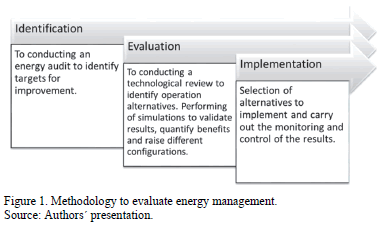
<body><![CDATA[<li><font size="2" face="Verdana, Arial, Helvetica, sans-serif">Evaluation and quantification     of the thermodynamic constraints of treatment processes and the selection of     the processes with minimal energy requirements.</font></li>       <li><font size="2" face="Verdana, Arial, Helvetica, sans-serif">Selection of the process units     with operation conditions similar to the ones used in the reservoir, which     allow the reduction of heat exchange processes.</font></li>       <li><font size="2" face="Verdana, Arial, Helvetica, sans-serif">Avoid     hot fluids transportation to minimize energy losses.</font></li>       <li><font size="2" face="Verdana, Arial, Helvetica, sans-serif">Evaluation of the use of direct     contact heat exchangers instead of indirect heat contact exchangers.</font></li>       <li><font size="2" face="Verdana, Arial, Helvetica, sans-serif">Maximization of fuel efficiency     through heat recovery by steam generation (if cogeneration is required).</font></li>       <li><font size="2" face="Verdana, Arial, Helvetica, sans-serif">Maximization of heat     integration between processes to minimize external heating or cooling.</font></li>       <li><font size="2" face="Verdana, Arial, Helvetica, sans-serif">Selection of equipment such as     heaters and pumps that are highly efficient.</font></li>     </ul>     <p><font size="2" face="Verdana, Arial, Helvetica, sans-serif">When oil treatment facilities are in  operation, energy optimization is performed by applying a methodology to  systematically monitor the processed energy performance and identify  technological alternatives for optimization. The general applied methodology  steps for the evaluation of energy management are shown in <a href="#fig01">Fig. 1</a>.</font></p> <font size="2">     <p align="center"><font face="Verdana, Arial, Helvetica, sans-serif"><a name="fig01"></a></font><img src="/img/revistas/dyna/v83n197/v83n197a09fig01.gif"></p>     ]]></body>
<body><![CDATA[<p><font face="Verdana, Arial, Helvetica, sans-serif">The energy audit is one of the most    important steps in the methodology. The main objective of an audit is to study    the current status of processes, cost analysis, and identification of areas,    equipment or facilities that could be improved and the enumeration of possible    measures that could be applied. In addition, the audit seeks to adapt the    current energy consumption of the plant to nominal energy consumption, ensuring    proper maintenance of the facilities, reducing nominal consumption with new    technologies that increases the efficiency of energy usage and reduces demand    of the processes, optimizing the operation of energy services. The results of    the audits have shown increases in the efficiency of electricity consumption by  12% and savings in fuel consumption between 8 and 15 % per unit of product &#91;2&#93;.</font></p>     <p><font face="Verdana, Arial, Helvetica, sans-serif">The the stateof-the-art presents the    general steps to -conduct energy audits in industrial process. Despite this,,    neither the requirements of each step, in order to apply them in oil treatment    facilities, nor key performance indicators to be used for analysis of energy    use and to monitor the results of the proposed initiatives in the plan obtained    from the energy audit are presented. For this reason, this article will focus    on the steps that must be followed in order to ensure a proper energy audit,    the requirements of each step, and the key performance indicators that may be  applicable to oil treatment facilities.</font></p>     <p>&nbsp;</p> </font>     <p><font size="3" face="Verdana, Arial, Helvetica, sans-serif"><b>2. Energy audit: Types and methodologies</b></font></p> <font size="2">     <p><font face="Verdana, Arial, Helvetica, sans-serif">The type of audit to be performed depends    on several factors: on the industry and its principal function, on the depth of    analysis to be performed, on the potential and the magnitude in cost reductions  desired. There are two types of audits: preliminary and detailed &#91;3&#93;.</font></p>     <p><font face="Verdana, Arial, Helvetica, sans-serif"><b><i>2.1. Preliminary audit</i></b></font></p>     <p><font face="Verdana, Arial, Helvetica, sans-serif">This    is the most economical type of audit and it allows preliminary energy savings    to be identified. By means of a visual inspection, basic information is    collected to identify opportunities for energy savings in operational and    maintenance areas and it draws attention to whether any further analysis is  required. To summarize, this type of audit is performed to &#91;4&#93;:</font></p> </font> <ul>       <li><font size="2"><font face="Verdana, Arial, Helvetica, sans-serif">Set the global energy     consumption of the processes.</font></font></li>       <li><font size="2"><font face="Verdana, Arial, Helvetica, sans-serif">Build the energy consumption     baseline.</font></font></li>       <li><font size="2" face="Verdana, Arial, Helvetica, sans-serif">Identify energy losses that can     be corrected through operative and maintenance actions.</font></li>       ]]></body>
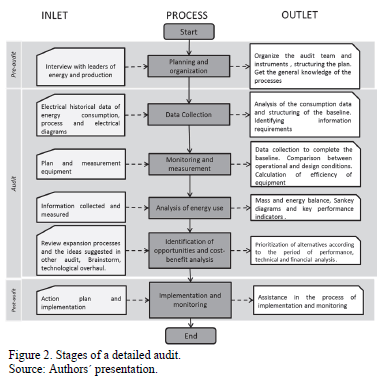
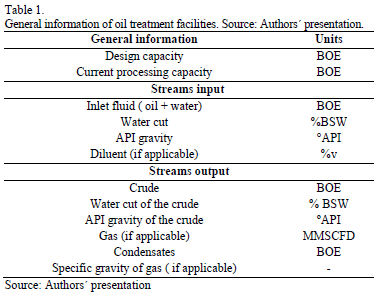
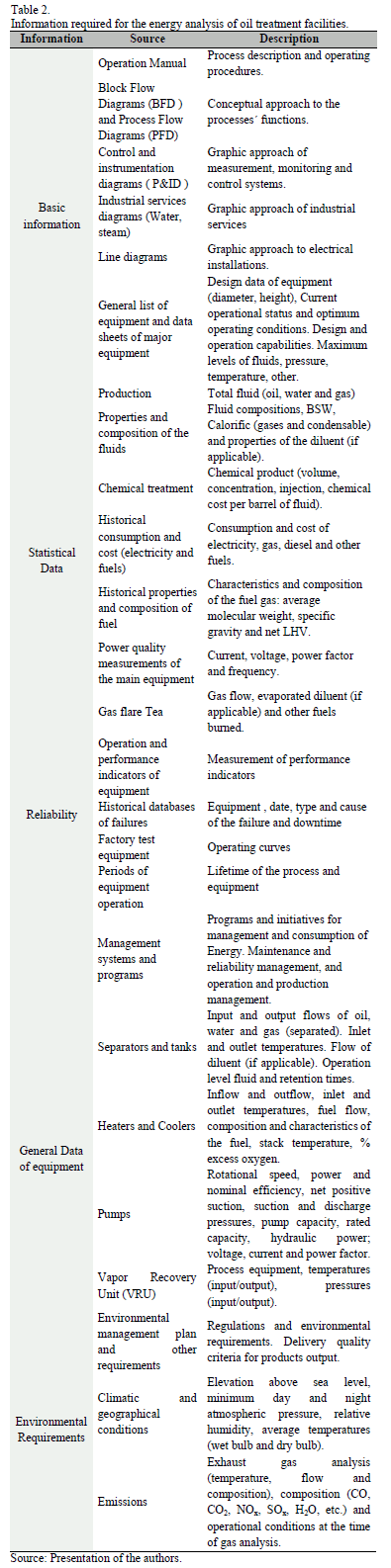
<body><![CDATA[<li><font size="2" face="Verdana, Arial, Helvetica, sans-serif">Estimate the savings</font></li>       <li><font size="2" face="Verdana, Arial, Helvetica, sans-serif">Categorize areas depending on     investments and savings.</font></li>     </ul>     <p><font size="2" face="Verdana, Arial, Helvetica, sans-serif"><b><i>2.2. Detailed audit</i></b></font></p>     <p><font size="2" face="Verdana, Arial, Helvetica, sans-serif">The  detailed audit involves all the components of the preliminary audit, including  tests and measurements to evaluate the energy use and its losses, as well as  evaluating the economy for the proposed changes. It also incorporates the  assessment of how much energy should be used in each process and operative  function by using computer modeling simulations &#91;5&#93;. The detailed audit is  divided into 3 stages which are: pre-audit, audit and post-audit. <a href="#fig02">Fig. 2</a> presents the processes that are to be followed in each stage. Each process will  be later explained for oil treatment facilities &#91;6&#93;.</font></p>     <p align="center"><font size="2" face="Verdana, Arial, Helvetica, sans-serif"><a name="fig02"></a></font><img src="/img/revistas/dyna/v83n197/v83n197a09fig02.gif"></p>     <p><font size="3" face="Verdana, Arial, Helvetica, sans-serif"><b>3. Information required for energy analysis of  oil treatment facilities</b></font></p>     <p><font size="2" face="Verdana, Arial, Helvetica, sans-serif"><a href="#tab01">Tables 1</a> and <a href="#tab02">2</a> present the required  information to perform an energy audit in oil treatment facilities. </font></p>     <p align="center"><font size="2" face="Verdana, Arial, Helvetica, sans-serif"><a name="tab01"></a></font><img src="/img/revistas/dyna/v83n197/v83n197a09tab01.gif"></p>     <p align="center"><font size="2" face="Verdana, Arial, Helvetica, sans-serif"><a name="tab02"></a></font><img src="/img/revistas/dyna/v83n197/v83n197a09tab02.gif"></p>     ]]></body>
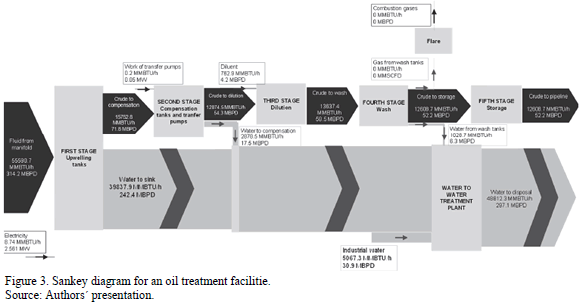
<body><![CDATA[<p><font size="3" face="Verdana, Arial, Helvetica, sans-serif"><b>4. Analysis of energy use</b></font></p>     <p><font size="2" face="Verdana, Arial, Helvetica, sans-serif">Energy use diagrams are presented in <a href="#fig03">Fig. 3</a>. These apply to a  treatment facility without crude heating processes. </font></p>     <p align="center"><font size="2" face="Verdana, Arial, Helvetica, sans-serif"><a name="fig03"></a></font><img src="/img/revistas/dyna/v83n197/v83n197a09fig03.gif"></p>     <p><font size="2" face="Verdana, Arial, Helvetica, sans-serif">The  analysis should include energy consumption per process, calculation of current  and optimal yields of processes, the list of equipment with higher energy  consumption and the key performance indicators' approaches (KPIs).</font></p>     <p><font size="2" face="Verdana, Arial, Helvetica, sans-serif">In  this stage, KPIs play an important role because they are control tools that  allow the planned goals to be monitored. The indicators should provide enough  and relevant information to not bias the analysis, and in addition they should  allow for decision-making and effective processes control. In order to do this,  an indicator must at least comply with features that are internationally  recognized by the acronym SMART (Specific, Measurable, Actionable, Relevance,  Timely). The suggested steps to formulate or adjust the indicators are:</font></p> <ul>       <li><font size="2" face="Verdana, Arial, Helvetica, sans-serif">Set the variables required for     measurement.</font></li>       <li><font size="2" face="Verdana, Arial, Helvetica, sans-serif">Identification of the benchmarks.</font></li>       <li><font size="2" face="Verdana, Arial, Helvetica, sans-serif">Set the target to be measured.</font></li>       <li><font size="2" face="Verdana, Arial, Helvetica, sans-serif">Identification over what     information is required from the target.</font></li>       <li><font size="2" face="Verdana, Arial, Helvetica, sans-serif">Identification of people for     whom this information is useful.</font></li>     ]]></body>
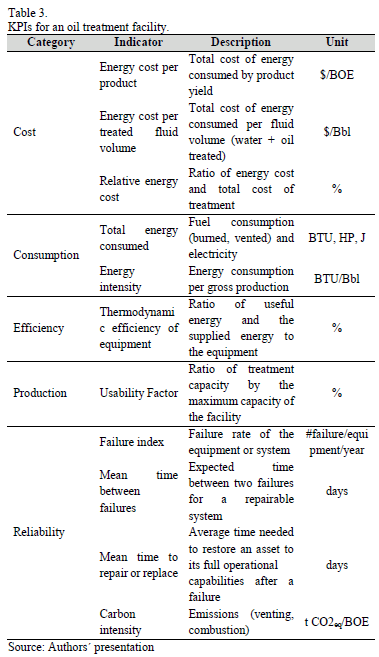
<body><![CDATA[</ul>     <p><font size="2" face="Verdana, Arial, Helvetica, sans-serif">There are two kinds of indicators: management and   results. Management indicators measure how the process is performing in terms   of resource optimization. This kind of indicator is used to detect what is   happening and is used to take appropriate actions to improve the situation.   Results indicators are associated with management goals as well as the   efficiency and effectiveness of their achievement. This kind of indicator is   used to measure situations when they have already occurred and to take   appropriate measures to prevent reoccurrences. The proposed KPIs for oil   treatment facilities are presented in <a href="#tab03">Table 3</a>.</font></p>     <p align="center"><font size="2" face="Verdana, Arial, Helvetica, sans-serif"><a name="tab03"></a></font><img src="/img/revistas/dyna/v83n197/v83n197a09tab03.gif"></p>     <p><font size="2" face="Verdana, Arial, Helvetica, sans-serif">The  analysis of energy consumption can be performed based on both internal and  external benchmarking performance studies. Internal studies include the  analysis of historical data and trends, while external audits are undertaken  based on data or indicators obtained from systems or similar processes.  Comparative factors to be taken into account for external analysis are the  maximum capacity of the station, the technologies used in the processes and the  quality specifications for both raw and treated products. Benchmarking studies  allow:</font></p> <ul>       <li><font size="2" face="Verdana, Arial, Helvetica, sans-serif">Quantification of fixed and     variable energy consumption according to production levels.</font></li>       <li><font size="2" face="Verdana, Arial, Helvetica, sans-serif">Comparison of the usability     factor with other facilities.</font></li>       <li><font size="2" face="Verdana, Arial, Helvetica, sans-serif">Identification of gaps and best     practices.</font></li>       <li><font size="2" face="Verdana, Arial, Helvetica, sans-serif">Establishment     of the basis for monitoring and goal setting.</font></li>       <li><font size="2" face="Verdana, Arial, Helvetica, sans-serif">Quantification of the target     variability margin for consumption and energy cost. </font></li>     </ul>     ]]></body>
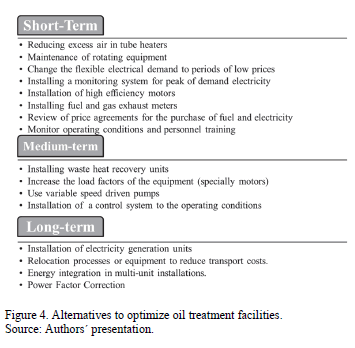
<body><![CDATA[<p><font size="2" face="Verdana, Arial, Helvetica, sans-serif"><b>5. Identifying opportunities for optimization</b></font></p>     <p><font size="2" face="Verdana, Arial, Helvetica, sans-serif">The  last step in the energy auditing process is to recommend an action plan to optimize  the use of energy, the cost of operation and to reduce emissions. The plan  should include the period of implementation for each initiative and the  investments' payback period &#91;7&#93;.</font></p>     <p><font size="2" face="Verdana, Arial, Helvetica, sans-serif">Initiatives  for energy management can be classified as short, medium or long term,  depending on their maturity and their economic benefits. Short-term projects  are those that must be performed quickly to resolve a compliance issue  regarding air quality, or that have a very short payback period (a high rate of  return).</font></p>     <p><font size="2" face="Verdana, Arial, Helvetica, sans-serif">The projects that are to be carried out for environmental  reasons are sometimes to be implemented in the future, but are still classified  as short-term because the work should begin as soon as possible &#91;8&#93;.  Initiatives with high rates of return should be classified according to their  ease of implementation. If little or no capital is required, projects should be  performed immediately. If projects require time and capital but have a high  rate of return, they should be started as soon as possible.</font></p>     <p><font size="2" face="Verdana, Arial, Helvetica, sans-serif">The  medium-term initiatives have periods of economic return that is usually between  one to three years. Because they require capital investment, they should be  retested to make sure they are economically feasible &#91;8&#93;.</font></p>     <p><font size="2" face="Verdana, Arial, Helvetica, sans-serif">The  long-term initiatives are characterized by simple economic returns over three  years. If capital investment is large or the return is small, initiatives are  classified as having a low priority. However, it is important not to dismiss  such initiatives because they may have changes in energy costs, in technologies  and environmental regulations: situations that make their implementation  imperative.</font></p>     <p><font size="2" face="Verdana, Arial, Helvetica, sans-serif">The reduction in energy costs associated  with short-term initiatives is between 10 and 20%, while initiatives with a  repayment period of two years or less offer additional reductions: between 20  and 30% &#91;9&#93;.</font></p>     <p><font size="2" face="Verdana, Arial, Helvetica, sans-serif">Some initiatives to optimize treatment  facilities are presented in <a href="#fig04">Fig. 4.</a> The size of the installation will determine  whether an initiative is short, medium or long term &#91;10-13&#93;.</font></p>     <p align="center"><font size="2" face="Verdana, Arial, Helvetica, sans-serif"><a name="fig04"></a></font><img src="/img/revistas/dyna/v83n197/v83n197a09fig04.gif"></p>     <p>&nbsp;</p>     ]]></body>
<body><![CDATA[<p><font size="3" face="Verdana, Arial, Helvetica, sans-serif"><b>6. Conclusions</b></font></p>     <p><font size="2" face="Verdana, Arial, Helvetica, sans-serif">An energy audit quantifies the  consumption and energy costs of industrial processes, in order to identify gaps  and establish a plan of initiatives to reduce losses, maximize efficiency,  optimize energy supply and costs associated with processes. Energy auditing affects  three key factors: profitability, through the optimization of energy  consumption; productivity through optimization of equipment and processes; and  performance, to use energy rationally.</font></p>     <p><font size="2" face="Verdana, Arial, Helvetica, sans-serif">Structuring an optimization plan is one  of the most important steps in an energy audit. The initiatives proposed in  this article are focused on improving models to contract the purchase of  electricity and fuel, improve power quality, reduce energy loss from processes  and equipment, include and track maintenance plans and improve operating  conditions' control systems. Additionally, they can help to minimize emissions  associated with the processes.</font></p>     <p><font size="2" face="Verdana, Arial, Helvetica, sans-serif">The sustainability of the audit's results  of will be ensured through monitoring and control of key performance  indicators, accompanied by an energy management program. Additionally, these  indicators will allow comparative studies with other treatment facilities that  have similar characteristics (production capacity, used technologies in  processes, crude and products quality). </font></p>     <p>&nbsp;</p>     <p><font size="3" face="Verdana, Arial, Helvetica, sans-serif"><b>References</b></font></p>     <!-- ref --><p><font size="2" face="Verdana, Arial, Helvetica, sans-serif"><b>&#91;1&#93;</b> Nardella, N,D. Improving energy  efficiency in thermal oil recovery surface facilities &#91;On line&#93;. Montreal,  2010. &#91;date of reference November 15<sup>th</sup> of 2014&#93;. Available at:  <a href="http://www.worldenergy.org/documents/congresspapers/201.pdf" target="_blank">http://www.worldenergy.org/documents/congresspapers/201.pdf</a>. World energy congress.    &nbsp;&nbsp;&nbsp;&nbsp;&nbsp;&nbsp;&nbsp;&nbsp;[&#160;<a href="javascript:void(0);" onclick="javascript: window.open('/scielo.php?script=sci_nlinks&ref=1129471&pid=S0012-7353201600030000900001&lng=','','width=640,height=500,resizable=yes,scrollbars=1,menubar=yes,');">Links</a>&#160;]<!-- end-ref --></font></p>     <!-- ref --><p><font size="2" face="Verdana, Arial, Helvetica, sans-serif"><b>&#91;2&#93;</b> Negri, et al., Improving energy  efficiency in upstream facilities. Conference paper. Offshore mediterranean  conference and exhibition, march 23-25, 2011.    &nbsp;&nbsp;&nbsp;&nbsp;&nbsp;&nbsp;&nbsp;&nbsp;[&#160;<a href="javascript:void(0);" onclick="javascript: window.open('/scielo.php?script=sci_nlinks&ref=1129473&pid=S0012-7353201600030000900002&lng=','','width=640,height=500,resizable=yes,scrollbars=1,menubar=yes,');">Links</a>&#160;]<!-- end-ref --> </font></p>     ]]></body>
<body><![CDATA[<!-- ref --><p><font size="2" face="Verdana, Arial, Helvetica, sans-serif"><b>&#91;3&#93;</b> Tyers, B.  and Franklin, N., Monitoreo y seguimiento del uso de la energ&iacute;a. Arpel, 2002.    &nbsp;&nbsp;&nbsp;&nbsp;&nbsp;&nbsp;&nbsp;&nbsp;[&#160;<a href="javascript:void(0);" onclick="javascript: window.open('/scielo.php?script=sci_nlinks&ref=1129475&pid=S0012-7353201600030000900003&lng=','','width=640,height=500,resizable=yes,scrollbars=1,menubar=yes,');">Links</a>&#160;]<!-- end-ref --></font></p>     <!-- ref --><p><font size="2" face="Verdana, Arial, Helvetica, sans-serif"><b>&#91;4&#93;</b> Bureau of Energy Efficiency.  General aspects of energy management and energy audit &#91;On line&#93;. &#91;date of  reference November 15<sup>th</sup> of 2014&#93;. Available at:  <a href="http://www.bsr.org/reports/bsr-energy-management-handbook.pdf" target="_blank">http://www.bsr.org/reports/bsr-energy-management-handbook.pdf</a>. 2005.    &nbsp;&nbsp;&nbsp;&nbsp;&nbsp;&nbsp;&nbsp;&nbsp;[&#160;<a href="javascript:void(0);" onclick="javascript: window.open('/scielo.php?script=sci_nlinks&ref=1129477&pid=S0012-7353201600030000900004&lng=','','width=640,height=500,resizable=yes,scrollbars=1,menubar=yes,');">Links</a>&#160;]<!-- end-ref --></font></p>     <!-- ref --><p><font size="2" face="Verdana, Arial, Helvetica, sans-serif"><b>&#91;5&#93;</b> Turner, W. and Doty, S., Energy  management handbook. Atlanta: The Fairmont press, 2007.    &nbsp;&nbsp;&nbsp;&nbsp;&nbsp;&nbsp;&nbsp;&nbsp;[&#160;<a href="javascript:void(0);" onclick="javascript: window.open('/scielo.php?script=sci_nlinks&ref=1129479&pid=S0012-7353201600030000900005&lng=','','width=640,height=500,resizable=yes,scrollbars=1,menubar=yes,');">Links</a>&#160;]<!-- end-ref --> </font></p>     <!-- ref --><p><font size="2" face="Verdana, Arial, Helvetica, sans-serif"><b>&#91;6&#93;</b> Seai., Energy efficient design  methodology &#91;On line&#93;. 2002. &#91;date of reference November 16<sup>th</sup> of  2014&#93;. Available at: <a href="http://www.seai.ie">www.seai.ie</a></font>&nbsp;&nbsp;&nbsp;&nbsp;&nbsp;&nbsp;&nbsp;&nbsp;[&#160;<a href="javascript:void(0);" onclick="javascript: window.open('/scielo.php?script=sci_nlinks&ref=1129481&pid=S0012-7353201600030000900006&lng=','','width=640,height=500,resizable=yes,scrollbars=1,menubar=yes,');">Links</a>&#160;]<!-- end-ref --><!-- ref --><p><font size="2" face="Verdana, Arial, Helvetica, sans-serif"><b>&#91;7&#93;</b> Thumann, A. and Mehta, D.,  Handbook of energy engineering. The  Fairmont press, 2001.    &nbsp;&nbsp;&nbsp;&nbsp;&nbsp;&nbsp;&nbsp;&nbsp;[&#160;<a href="javascript:void(0);" onclick="javascript: window.open('/scielo.php?script=sci_nlinks&ref=1129482&pid=S0012-7353201600030000900007&lng=','','width=640,height=500,resizable=yes,scrollbars=1,menubar=yes,');">Links</a>&#160;]<!-- end-ref --> </font></p>     <!-- ref --><p><font size="2" face="Verdana, Arial, Helvetica, sans-serif"><b>&#91;8&#93;</b> Tyers, B.  and Franklin, N. Implementaci&oacute;n de programas de gesti&oacute;n de energ&iacute;a en la  industria del petr&oacute;leo y el gas. Arpel, 1999.    &nbsp;&nbsp;&nbsp;&nbsp;&nbsp;&nbsp;&nbsp;&nbsp;[&#160;<a href="javascript:void(0);" onclick="javascript: window.open('/scielo.php?script=sci_nlinks&ref=1129484&pid=S0012-7353201600030000900008&lng=','','width=640,height=500,resizable=yes,scrollbars=1,menubar=yes,');">Links</a>&#160;]<!-- end-ref --></font></p>     <!-- ref --><p><font size="2" face="Verdana, Arial, Helvetica, sans-serif"><b>&#91;9&#93;</b> Kreith, F. and Goswami, D.,  Handbook of energy efficiency and renewable energy. Taylor &amp; Francis group,  London, UK, 2007. DOI: 10.1201/9781420003482</font>&nbsp;&nbsp;&nbsp;&nbsp;&nbsp;&nbsp;&nbsp;&nbsp;[&#160;<a href="javascript:void(0);" onclick="javascript: window.open('/scielo.php?script=sci_nlinks&ref=1129486&pid=S0012-7353201600030000900009&lng=','','width=640,height=500,resizable=yes,scrollbars=1,menubar=yes,');">Links</a>&#160;]<!-- end-ref --><!-- ref --><p><font size="2" face="Verdana, Arial, Helvetica, sans-serif"><b>&#91;10&#93;</b> New Jersey State Department of  Environmental Protection. Establishing an energy management program and  identifying energy savings opportunities. The State University of New Jersey,  New Jersey, USA, 2000.    &nbsp;&nbsp;&nbsp;&nbsp;&nbsp;&nbsp;&nbsp;&nbsp;[&#160;<a href="javascript:void(0);" onclick="javascript: window.open('/scielo.php?script=sci_nlinks&ref=1129487&pid=S0012-7353201600030000900010&lng=','','width=640,height=500,resizable=yes,scrollbars=1,menubar=yes,');">Links</a>&#160;]<!-- end-ref --></font></p>     <!-- ref --><p><font size="2" face="Verdana, Arial, Helvetica, sans-serif"><b>&#91;11&#93;</b> Murray, D  et al., Evaluaci&oacute;n de proyectos relacionados con la energ&iacute;a. Arpel, 1999.    &nbsp;&nbsp;&nbsp;&nbsp;&nbsp;&nbsp;&nbsp;&nbsp;[&#160;<a href="javascript:void(0);" onclick="javascript: window.open('/scielo.php?script=sci_nlinks&ref=1129489&pid=S0012-7353201600030000900011&lng=','','width=640,height=500,resizable=yes,scrollbars=1,menubar=yes,');">Links</a>&#160;]<!-- end-ref --></font></p>     <!-- ref --><p><font size="2" face="Verdana, Arial, Helvetica, sans-serif"><b>&#91;12&#93;</b> Thumann, A. and Woodroof, E.,  Handbook of financing energy projects. Atlanta: The Fairmont press, 2005.    &nbsp;&nbsp;&nbsp;&nbsp;&nbsp;&nbsp;&nbsp;&nbsp;[&#160;<a href="javascript:void(0);" onclick="javascript: window.open('/scielo.php?script=sci_nlinks&ref=1129491&pid=S0012-7353201600030000900012&lng=','','width=640,height=500,resizable=yes,scrollbars=1,menubar=yes,');">Links</a>&#160;]<!-- end-ref --> </font></p>     <!-- ref --><p><font size="2" face="Verdana, Arial, Helvetica, sans-serif"><b>&#91;13&#93;</b> Capehart, B., Turner, W. and  Kennedy, W. Guide to energy management, third edition. The Fairmont press,  Atlanta, USA, 2000.    &nbsp;&nbsp;&nbsp;&nbsp;&nbsp;&nbsp;&nbsp;&nbsp;[&#160;<a href="javascript:void(0);" onclick="javascript: window.open('/scielo.php?script=sci_nlinks&ref=1129493&pid=S0012-7353201600030000900013&lng=','','width=640,height=500,resizable=yes,scrollbars=1,menubar=yes,');">Links</a>&#160;]<!-- end-ref --></font></p>     ]]></body>
<body><![CDATA[<p>&nbsp;</p>     <p><font size="2" face="Verdana, Arial, Helvetica, sans-serif"><b>L.M. Corredor-Rojas,</b> gained her BSc in  Chemical Engineering in 2004 and her MSc. degree in Chemical Engineering in  2008, all from the Industrial University of Santander, Colombia. From 2004 she  worked in the Colombian Petroleum Institute (ICP) in the operational analysis  of non-catalytic processes. Since 2009 she has worked at the same institute but  in the implementation of alternatives to optimize the efficiency and cost of  the processes associated with production and processing of crude oil. ORCID: 0000-0001-7981-1460.</font></p>     <p><font size="2" face="Verdana, Arial, Helvetica, sans-serif"><b>A. Uribe-Rodriguez, </b>gained his BSc in  Chemical Engineering in 2001 and his MSc. degree in Computer Science in 2004,  both from the Universidad Industrial de Santander (UIS), Colombia. Since 2004,  he has been working as a researcher at the Colombian Petroleum Institute (ICP)  on the analysis of refining schemes, and energy planning and optimization of  oil production processes. For the last three years, he focused on optimizing  upstream costs and the possible inclusion of bioenergy as a renewable energy  source for production processes. ORCID: 0000-0001-5950-8923.</font></p>     <p><font size="2" face="Verdana, Arial, Helvetica, sans-serif"><b>J.C. Cobos-G&oacute;mez, </b>gained his BSc in  Chemical Engineering in 1996 from the Universidad Industrial de Santander,  Colombia. He was awarded the qualification of specialist manager in energy  resources from the Autonomous University of Bucaramanga in 2006 and the  qualification of specialist project manager (PFM) in 2010. He has worked on  projects involving the optimization of industrial services, distillation,  catalytic cracking of paraffins at a refinery in Barrancabermeja. He is  currently leading the project &quot;Emerging technologies to improve heavy oil  crudes&quot; at the Colombian Petroleum Institute (ICP). ORCID: 0000-0002-0014-0754.</font></p>      ]]></body><back>
<ref-list>
<ref id="B1">
<label>1</label><nlm-citation citation-type="confpro">
<person-group person-group-type="author">
<name>
<surname><![CDATA[Nardella]]></surname>
<given-names><![CDATA[N,D.]]></given-names>
</name>
</person-group>
<source><![CDATA[Improving energy efficiency in thermal oil recovery surface facilities]]></source>
<year>2010</year>
<conf-name><![CDATA[ World energy congress]]></conf-name>
<conf-loc> </conf-loc>
<publisher-loc><![CDATA[Montreal ]]></publisher-loc>
</nlm-citation>
</ref>
<ref id="B2">
<label>2</label><nlm-citation citation-type="confpro">
<person-group person-group-type="author">
<name>
<surname><![CDATA[Negri]]></surname>
</name>
</person-group>
<article-title xml:lang="en"><![CDATA[Improving energy efficiency in upstream facilities]]></article-title>
<source><![CDATA[]]></source>
<year></year>
<conf-name><![CDATA[ Offshore mediterranean conference and exhibition]]></conf-name>
<conf-date>march 23-25, 2011</conf-date>
<conf-loc> </conf-loc>
</nlm-citation>
</ref>
<ref id="B3">
<label>3</label><nlm-citation citation-type="book">
<person-group person-group-type="author">
<name>
<surname><![CDATA[Tyers]]></surname>
<given-names><![CDATA[B.]]></given-names>
</name>
<name>
<surname><![CDATA[Franklin]]></surname>
<given-names><![CDATA[N.]]></given-names>
</name>
</person-group>
<source><![CDATA[Monitoreo y seguimiento del uso de la energía.]]></source>
<year>2002</year>
<publisher-name><![CDATA[Arpel]]></publisher-name>
</nlm-citation>
</ref>
<ref id="B4">
<label>4</label><nlm-citation citation-type="">
<source><![CDATA[Bureau of Energy Efficiency.: General aspects of energy management and energy audit]]></source>
<year>2005</year>
</nlm-citation>
</ref>
<ref id="B5">
<label>5</label><nlm-citation citation-type="book">
<person-group person-group-type="author">
<name>
<surname><![CDATA[Turner]]></surname>
<given-names><![CDATA[W.]]></given-names>
</name>
<name>
<surname><![CDATA[Doty]]></surname>
<given-names><![CDATA[S.]]></given-names>
</name>
</person-group>
<source><![CDATA[Energy management handbook.]]></source>
<year>2007</year>
<publisher-loc><![CDATA[Atlanta ]]></publisher-loc>
<publisher-name><![CDATA[The Fairmont press]]></publisher-name>
</nlm-citation>
</ref>
<ref id="B6">
<label>6</label><nlm-citation citation-type="">
<collab>Seai</collab>
<source><![CDATA[Energy efficient design methodology]]></source>
<year>2002</year>
</nlm-citation>
</ref>
<ref id="B7">
<label>7</label><nlm-citation citation-type="book">
<person-group person-group-type="author">
<name>
<surname><![CDATA[Thumann]]></surname>
<given-names><![CDATA[A.]]></given-names>
</name>
<name>
<surname><![CDATA[Mehta]]></surname>
<given-names><![CDATA[D.]]></given-names>
</name>
</person-group>
<source><![CDATA[Handbook of energy engineering.]]></source>
<year>2001</year>
<publisher-name><![CDATA[The Fairmont press]]></publisher-name>
</nlm-citation>
</ref>
<ref id="B8">
<label>8</label><nlm-citation citation-type="book">
<person-group person-group-type="author">
<name>
<surname><![CDATA[Tyers]]></surname>
<given-names><![CDATA[B.]]></given-names>
</name>
<name>
<surname><![CDATA[Franklin]]></surname>
<given-names><![CDATA[N.]]></given-names>
</name>
</person-group>
<source><![CDATA[Implementación de programas de gestión de energía en la industria del petróleo y el gas]]></source>
<year>1999</year>
<publisher-name><![CDATA[Arpel]]></publisher-name>
</nlm-citation>
</ref>
<ref id="B9">
<label>9</label><nlm-citation citation-type="book">
<person-group person-group-type="author">
<name>
<surname><![CDATA[Kreith]]></surname>
<given-names><![CDATA[F.]]></given-names>
</name>
<name>
<surname><![CDATA[Goswami]]></surname>
<given-names><![CDATA[D.]]></given-names>
</name>
</person-group>
<source><![CDATA[Handbook of energy efficiency and renewable energy.]]></source>
<year>2007</year>
<publisher-loc><![CDATA[London ]]></publisher-loc>
<publisher-name><![CDATA[Taylor & Francis group]]></publisher-name>
</nlm-citation>
</ref>
<ref id="B10">
<label>10</label><nlm-citation citation-type="book">
<collab>New Jersey State Department of Environmental Protection.</collab>
<source><![CDATA[Establishing an energy management program and identifying energy savings opportunities.]]></source>
<year>2000</year>
<publisher-loc><![CDATA[New Jersey ]]></publisher-loc>
<publisher-name><![CDATA[The State University of New Jersey]]></publisher-name>
</nlm-citation>
</ref>
<ref id="B11">
<label>11</label><nlm-citation citation-type="book">
<person-group person-group-type="author">
<name>
<surname><![CDATA[Murray]]></surname>
<given-names><![CDATA[D]]></given-names>
</name>
</person-group>
<source><![CDATA[Evaluación de proyectos relacionados con la energía.]]></source>
<year>1999</year>
<publisher-name><![CDATA[Arpel]]></publisher-name>
</nlm-citation>
</ref>
<ref id="B12">
<label>12</label><nlm-citation citation-type="book">
<person-group person-group-type="author">
<name>
<surname><![CDATA[Thumann]]></surname>
<given-names><![CDATA[A.]]></given-names>
</name>
<name>
<surname><![CDATA[Woodroof]]></surname>
<given-names><![CDATA[E.]]></given-names>
</name>
</person-group>
<source><![CDATA[Handbook of financing energy projects.]]></source>
<year>2005</year>
<publisher-loc><![CDATA[Atlanta ]]></publisher-loc>
<publisher-name><![CDATA[The Fairmont press]]></publisher-name>
</nlm-citation>
</ref>
<ref id="B13">
<label>13</label><nlm-citation citation-type="book">
<person-group person-group-type="author">
<name>
<surname><![CDATA[Capehart]]></surname>
<given-names><![CDATA[B.]]></given-names>
</name>
<name>
<surname><![CDATA[Turner]]></surname>
<given-names><![CDATA[W.]]></given-names>
</name>
<name>
<surname><![CDATA[Kennedy]]></surname>
<given-names><![CDATA[W.]]></given-names>
</name>
</person-group>
<source><![CDATA[Guide to energy management]]></source>
<year>2000</year>
<edition>third</edition>
<publisher-loc><![CDATA[Atlanta ]]></publisher-loc>
<publisher-name><![CDATA[The Fairmont press]]></publisher-name>
</nlm-citation>
</ref>
</ref-list>
</back>
</article>