<?xml version="1.0" encoding="ISO-8859-1"?><article xmlns:mml="http://www.w3.org/1998/Math/MathML" xmlns:xlink="http://www.w3.org/1999/xlink" xmlns:xsi="http://www.w3.org/2001/XMLSchema-instance">
<front>
<journal-meta>
<journal-id>0012-7353</journal-id>
<journal-title><![CDATA[DYNA]]></journal-title>
<abbrev-journal-title><![CDATA[Dyna rev.fac.nac.minas]]></abbrev-journal-title>
<issn>0012-7353</issn>
<publisher>
<publisher-name><![CDATA[Universidad Nacional de Colombia]]></publisher-name>
</publisher>
</journal-meta>
<article-meta>
<article-id>S0012-73532016000300010</article-id>
<article-id pub-id-type="doi">10.15446/dyna.v83n197.50318</article-id>
<title-group>
<article-title xml:lang="en"><![CDATA[Differences between the use of ferric sulphate and ferric chloride on biodesulfurization of a large coal particle]]></article-title>
<article-title xml:lang="es"><![CDATA[Diferencias entre el uso de sulfato férrico y cloruro férrico en la biodesulfurización de un carbón con tamaño de partícula grueso]]></article-title>
</title-group>
<contrib-group>
<contrib contrib-type="author">
<name>
<surname><![CDATA[Caicedo-Pineda]]></surname>
<given-names><![CDATA[Gerardo Andrés]]></given-names>
</name>
<xref ref-type="aff" rid="A01"/>
</contrib>
<contrib contrib-type="author">
<name>
<surname><![CDATA[Márquez-Godoy]]></surname>
<given-names><![CDATA[Marco Antonio]]></given-names>
</name>
<xref ref-type="aff" rid="A02"/>
</contrib>
</contrib-group>
<aff id="A01">
<institution><![CDATA[,Universidad Nacional de Colombia Facultad de Minas ]]></institution>
<addr-line><![CDATA[Medellín ]]></addr-line>
<country>Colombia</country>
</aff>
<aff id="A02">
<institution><![CDATA[,Universidad Nacional de Colombia Facultad de Minas ]]></institution>
<addr-line><![CDATA[Medellín ]]></addr-line>
<country>Colombia</country>
</aff>
<pub-date pub-type="pub">
<day>00</day>
<month>06</month>
<year>2016</year>
</pub-date>
<pub-date pub-type="epub">
<day>00</day>
<month>06</month>
<year>2016</year>
</pub-date>
<volume>83</volume>
<numero>197</numero>
<fpage>74</fpage>
<lpage>80</lpage>
<copyright-statement/>
<copyright-year/>
<self-uri xlink:href="http://www.scielo.org.co/scielo.php?script=sci_arttext&amp;pid=S0012-73532016000300010&amp;lng=en&amp;nrm=iso"></self-uri><self-uri xlink:href="http://www.scielo.org.co/scielo.php?script=sci_abstract&amp;pid=S0012-73532016000300010&amp;lng=en&amp;nrm=iso"></self-uri><self-uri xlink:href="http://www.scielo.org.co/scielo.php?script=sci_pdf&amp;pid=S0012-73532016000300010&amp;lng=en&amp;nrm=iso"></self-uri><abstract abstract-type="short" xml:lang="en"><p><![CDATA[Three iron sources (FeSO4, Fe2(SO4)3 and FeCl3) at different concentrations (150, 700 and 1250 mg Fe/L) were evaluated on large coal particle biodesulfurization processes at Erlenmeyer level. A consortium of Acidithiobacillus ferrooxidans (ATCC 23270) and Acidithiobacillus thiooxidans (ATCC 15494) was used in all the assays. By using 150 mg Fe2+/L (from FeSO4), pyrite biooxidation was 31.14% after 12 days. When Fe2(SO4)3 replaced FeSO4, oxidation improved by 21.16%. The assays using the highest concentrations of sulphate sources also obtained the same increase. However, Fe2(SO4)3 assays had a better sulphate removal from coal. This suggests that using the smallest concentration of Fe2(SO4)3 is a good alternative to boost the pyrite oxidation rate and avoid the formation of precipitates. Additionally, biooxidation in the FeCl3 assays decreased, indicating, a priori, that the microorganisms were not able to adapt properly to Cl- ions.]]></p></abstract>
<abstract abstract-type="short" xml:lang="es"><p><![CDATA[Se evaluaron tres fuentes de hierro (FeSO4, Fe2(SO4)3 y FeCl3) a diferentes concentraciones (150, 700 y 1250 mg Fe/L) en procesos de biodesulfurización de un carbón con tamaño de partícula grueso, utilizando un consorcio de Acidithiobacillus ferrooxidans (ATCC 23270) and Acidithiobacillus thiooxidans (ATCC 15494). Al usar 150 mg Fe2+/L (FeSO4), luego de 12 días se obtuvo 31.14% de pirita oxidada. Al reemplazar FeSO4 por Fe2(SO4)3, la oxidación mejoró en un 21.16%. Aunque los ensayos con las mayores concentraciones de sulfatos obtuvieron un resultado similar, al utilizar Fe2(SO4)3 permitió mejor remoción de sulfatos del carbón. Lo anterior sugiere que basta con utilizar la menor concentración de Fe2(SO4)3 para mejorar el índice de oxidación de pirita y evitar formación de precipitados. Por otra parte, los ensayos con FeCl3 tuvieron una disminución en la tasa de biooxidación, indicando a priori, que los microorganismos no fueron capaces de adaptarse adecuadamente a los iones Cl-.]]></p></abstract>
<kwd-group>
<kwd lng="en"><![CDATA[coal biodesulfurization]]></kwd>
<kwd lng="en"><![CDATA[pyrite oxidation]]></kwd>
<kwd lng="en"><![CDATA[ferric chloride]]></kwd>
<kwd lng="en"><![CDATA[ferric sulphate]]></kwd>
<kwd lng="en"><![CDATA[Acidithiobacillus ferrooxidans]]></kwd>
<kwd lng="en"><![CDATA[Acidithiobacillus thiooxidans]]></kwd>
<kwd lng="es"><![CDATA[biodesulfurización de carbón]]></kwd>
<kwd lng="es"><![CDATA[oxidación de pirita]]></kwd>
<kwd lng="es"><![CDATA[cloruro férrico]]></kwd>
<kwd lng="es"><![CDATA[sulfato férrico]]></kwd>
<kwd lng="es"><![CDATA[Acidithiobacillus ferrooxidans]]></kwd>
<kwd lng="es"><![CDATA[Acidithiobacillus thiooxidans]]></kwd>
</kwd-group>
</article-meta>
</front><body><![CDATA[ <p><font size="1" face="Verdana, Arial, Helvetica, sans-serif"><b>DOI:</b> <a href="http://dx.doi.org/10.15446/dyna.v83n197.50318" target="_blank">http://dx.doi.org/10.15446/dyna.v83n197.50318</a></font></p>     <p align="center"><font size="4" face="Verdana, Arial, Helvetica, sans-serif"><b>Differences between the use of  ferric sulphate and ferric chloride on biodesulfurization of a large coal  particle</b></font></p>     <p align="center"><i><font size="3"><b><font face="Verdana, Arial, Helvetica, sans-serif">Diferencias  entre el uso de sulfato f&eacute;rrico y cloruro f&eacute;rrico en la biodesulfurizaci&oacute;n de un carb&oacute;n con tama&ntilde;o de part&iacute;cula grueso</font></b></font></i></p>     <p align="center">&nbsp;</p>     <p align="center"><font size="2" face="Verdana, Arial, Helvetica, sans-serif"><b>Gerardo Andr&eacute;s Caicedo-Pineda <i><sup>a</sup></i> &amp; Marco Antonio M&aacute;rquez-Godoy <i><sup>b</sup></i></b></font></p>     <p align="center">&nbsp;</p>     <p align="center"><font size="2" face="Verdana, Arial, Helvetica, sans-serif"><sup><i>a </i></sup><i>Facultad de Minas, Universidad Nacional de Colombia, Medell&iacute;n, Colombia.       <a href="mailto:gacaiced@unal.edu.co">gacaiced@unal.edu.co</a>    <br>   <sup>b</sup> Facultad de Minas, Universidad Nacional de Colombia, Medell&iacute;n,     Colombia. <a href="mailto:mmarquez@unal.edu.co">mmarquez@unal.edu.co</a></i></font></p>     <p align="center">&nbsp;</p>     <p align="center"><font size="2" face="Verdana, Arial, Helvetica, sans-serif"><b>Received: April 29<sup>th</sup>, 2015.   Received in revised form: November 05<sup>th</sup>, 2015. Accepted: February 20<sup>th</sup>,   2016.</b></font></p>     ]]></body>
<body><![CDATA[<p align="center">&nbsp;</p>     <p align="center"><font size="1" face="Verdana, Arial, Helvetica, sans-seriff"><b>This work is licensed under a</b> <a rel="license" href="http://creativecommons.org/licenses/by-nc-nd/4.0/">Creative Commons Attribution-NonCommercial-NoDerivatives 4.0 International License</a>.</font><br /><a rel="license" href="http://creativecommons.org/licenses/by-nc-nd/4.0/"><img style="border-width:0" src="https://i.creativecommons.org/l/by-nc-nd/4.0/88x31.png" /></a></p><hr>     <p><font size="2" face="Verdana, Arial, Helvetica, sans-serif"><b>Abstract    <br> </b></font><font size="2" face="Verdana, Arial, Helvetica, sans-serif">Three iron  sources (FeSO<sub>4</sub>, Fe<sub>2</sub>(SO<sub>4</sub>)<sub>3</sub> and FeCl<sub>3</sub>)  at different concentrations (150, 700 and 1250 mg Fe/L) were evaluated on large  coal particle biodesulfurization processes at Erlenmeyer level. A consortium of <i>Acidithiobacillus ferrooxidans</i> (ATCC  23270) and <i>Acidithiobacillus thiooxidans</i> (ATCC 15494) was used in all the assays. By using 150 mg Fe<sup>2+</sup>/L  (from FeSO<sub>4</sub>), pyrite biooxidation was 31.14% after 12 days. When Fe<sub>2</sub>(SO<sub>4</sub>)<sub>3</sub> replaced FeSO<sub>4</sub>, oxidation improved by 21.16%. The assays using the  highest concentrations of sulphate sources also obtained the same increase.  However, Fe<sub>2</sub>(SO<sub>4</sub>)<sub>3</sub> assays had a better  sulphate removal from coal. This suggests that using the smallest concentration  of Fe<sub>2</sub>(SO<sub>4</sub>)<sub>3</sub> is a good alternative to boost  the pyrite oxidation rate and avoid the formation of precipitates.  Additionally, biooxidation in the FeCl<sub>3 </sub>assays decreased,  indicating, <i>a priori</i>, that the microorganisms were not able to adapt properly to Cl<sup>-</sup> ions. </font></p>     <p><font size="2" face="Verdana, Arial, Helvetica, sans-serif"><i>Keywords</i>: coal biodesulfurization; pyrite  oxidation; ferric chloride, ferric sulphate; <i>Acidithiobacillus ferrooxidans</i>; <i>Acidithiobacillus  thiooxidans.</i></font></p>     <p><font size="2" face="Verdana, Arial, Helvetica, sans-serif"><b>Resumen    <br> </b></font><font size="2" face="Verdana, Arial, Helvetica, sans-serif">Se evaluaron tres fuentes  de hierro (FeSO<sub>4</sub>, Fe<sub>2</sub>(SO4)<sub>3</sub> y FeCl<sub>3</sub>)  a diferentes concentraciones (150, 700 y 1250 mg Fe/L) en procesos de  biodesulfurizaci&oacute;n de un carb&oacute;n con tama&ntilde;o de part&iacute;cula grueso, utilizando un  consorcio de <i>Acidithiobacillus  ferrooxidans</i> (ATCC 23270) and <i>Acidithiobacillus  thiooxidans</i> (ATCC 15494). Al usar 150 mg Fe<sup>2+</sup>/L (FeSO<sub>4</sub>),  luego de 12 d&iacute;as se obtuvo 31.14% de pirita oxidada. Al reemplazar FeSO<sub>4 </sub>por  Fe<sub>2</sub>(SO4)<sub>3</sub>, la oxidaci&oacute;n mejor&oacute; en un 21.16%. Aunque los  ensayos con las mayores concentraciones de sulfatos obtuvieron un resultado  similar, al utilizar Fe<sub>2</sub>(SO4)<sub>3</sub> permiti&oacute; mejor remoci&oacute;n de  sulfatos del carb&oacute;n. Lo anterior sugiere que basta con utilizar la menor  concentraci&oacute;n de Fe<sub>2</sub>(SO4)<sub>3 </sub>para mejorar el &iacute;ndice de  oxidaci&oacute;n de pirita y evitar formaci&oacute;n de precipitados. Por otra parte, los  ensayos con FeCl<sub>3 </sub>tuvieron una disminuci&oacute;n en la tasa de  biooxidaci&oacute;n, indicando <i>a priori</i>, que los microorganismos no fueron capaces de adaptarse adecuadamente a los iones Cl<sup>-</sup>.</font></p>     <p><font size="2" face="Verdana, Arial, Helvetica, sans-serif"><i>Palabras clave</i>: biodesulfurizaci&oacute;n de carb&oacute;n; oxidaci&oacute;n de pirita; cloruro f&eacute;rrico;  sulfato f&eacute;rrico; <i>Acidithiobacillus  ferrooxidans</i>; <i>Acidithiobacillus  thiooxidans.</i></font></p> <hr>     <p>&nbsp;</p>     <p><font size="3" face="Verdana, Arial, Helvetica, sans-serif"><b>1. Introduction</b></font></p>     ]]></body>
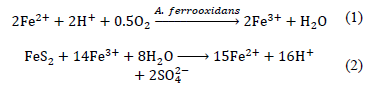
<body><![CDATA[<p><font size="2" face="Verdana, Arial, Helvetica, sans-serif">Among the elements contained in coal, sulphur plays an important role in  almost all systems that use the material, especially combustion processes. The  generation of sulphuric-volatile compounds (SO<sub>2</sub>, SO<sub>3</sub>)  causes atmospheric pollution, contributing to acid rain generation &#91;1&#93;. In order to  limit sulphur oxide emissions, some research proposes precombustion processes  as good methods to reduce sulphur forms from coal. Sulphur on coal is present  in two basic forms: organic, part of the coal structure, and inorganic, formed  basically by sulphides (mainly pyrite) and sulphates &#91;2&#93;. </font></p>     <p><font size="2" face="Verdana, Arial, Helvetica, sans-serif">High-sulphur  coals (S &gt; 3% w) generally present pyrite at a high rate (60-80% of total  sulphur) &#91;3,4&#93;. For this reason, a lot research has  focused on coal depyritization processes. Biological processes have many economic  and environmental advantages in comparison to chemical and physical options &#91;5,6&#93;. Nowadays, the research evaluates  physical, chemical and biological parameters in order to seek alternatives with  possible industrial applications &#91;6&#93;. </font></p>     <p><font size="2" face="Verdana, Arial, Helvetica, sans-serif">Basically, biodepyritization consists of the oxidation of sulphides  catalysed by acidophilic microorganisms, in an aqueous medium, generating  soluble sulphates &#91;1,7,8&#93;. A typical  culture medium contains Fe<sup>2+</sup> from ferrous sulphate. Bacteria like <i>A. ferrooxidans,</i> oxidize Fe<sup>2+</sup> producing Fe<sup>3+</sup> by eq. (1). Then, Fe<sup>3+</sup> attacks the pyrite,  releasing more Fe<sup>2+</sup> ions by eq. (2) which are taken by bacteria,  creating a cycle of Fe<sup>3+</sup> regeneration &#91;8,9&#93;. </font></p>     <p><img src="/img/revistas/dyna/v83n197/v83n197a10eq0102.gif"></p>     <p><font size="2" face="Verdana, Arial, Helvetica, sans-serif">It is known that the use of fine-particle  coal increases the exposed surface area of pyrite, improving its leaching.  However, pyrite oxidation is not the only variable to consider in the design of  the process. Precipitate generation is also important to define the best  parameters for operation. Using fine particles increases the effect of coal  compounds such as alkalinizing agents and carbonates. This induces the  formation of undesirable compounds (i.e. jarosite) which could reprecipitate  over the coal, reducing the efficiency of global desulfurization &#91;4,6&#93;.  Recent studies showed low or null precipitate generation when large-particle  coal is used, although pyrite oxidation decreased &#91;10&#93;. </font></p>     <p><font size="2" face="Verdana, Arial, Helvetica, sans-serif">The use of  large-particle coal also presents important advantages to the process. This  minimizes risks to health, because volatile particles of fine coal could cause  damage to the airways of humans and animals who come into contact with the  material. Additionally, large-particle coal does not require heavy grinding  and/or milling processes and it is easy to transport to regions far from the  source. All of these are important factors when using a low-cost material.  Besides, a wide range of cheap systems can treat coal at this size, from  processes such as packed-bed bioreactors (heaps) &#91;6&#93; and even to stirred tank bioreactors.  Previous research reports on a pilot plant level reactor using -1&quot; Tyler mesh  coal &#91;11&#93;. The low-specific gravity of the  material (around 1.30) allowed it to be maintained in suspension without  requiring a high agitation. </font></p>     <p><font size="2" face="Verdana, Arial, Helvetica, sans-serif">Multistage  processes and/or long residence times would help to improve pyrite oxidation &#91;5,12&#93;. However, these also increase the  costs of treatment. Previous research found that replacing ferrous sulphate by  ferric salts also helps to accelerate pyrite oxidation, because it minimizes  the <i>lag</i> phase, where the bacteria  begin to oxidize ferrous ions &#91;8,13&#93;. This might be an alternative to  boost the pyrite oxidation rate in processes using large-particle coal.  Therefore, the research presented here evaluated how ferric ions from two  different iron sources (sulphate and chloride) interacted with desulfurization  processes of pyrite-rich coal mediated by a consortium of acidophilic bacteria.  Chemical and mineralogical techniques allowed the behaviour of the process to  be evaluated.</font></p>     <p align="center">&nbsp;</p>     <p><font size="3" face="Verdana, Arial, Helvetica, sans-serif"><b>2. Experimental Procedure</b></font></p>     <p><font size="2" face="Verdana, Arial, Helvetica, sans-serif"><b><i>2.1. Coal</i></b></font></p>     ]]></body>
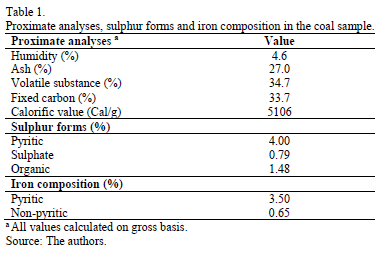
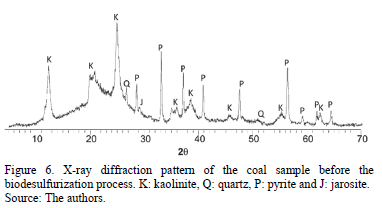
<body><![CDATA[<p><font size="2" face="Verdana, Arial, Helvetica, sans-serif">High-volatile  bituminous coal samples were collected from &quot;La Angostura&quot; mine (Morales,  Cauca, Colombia). The sample was ground to a particle size between -8 +30 Tyler  mesh (2.38 mm &lt; particle size &lt; 0.50 mm). <a href="#tab01">Table 1</a> shows proximate analyses,  sulphur forms and iron composition in coal samples.</font></p>     <p align="center"><font size="2" face="Verdana, Arial, Helvetica, sans-serif"><a name="tab01"></a></font><img src="/img/revistas/dyna/v83n197/v83n197a10tab01.gif"></p>     <p><font size="2" face="Verdana, Arial, Helvetica, sans-serif"><b><i>2.2. Microorganism</i></b></font></p>     <p><font size="2" face="Verdana, Arial, Helvetica, sans-serif">A  consortium of <i>A. thiooxidans</i> (ATCC  15494) and <i>A. ferrooxidans</i> (ATCC  23270) were selected from the collection of Laboratorio de Biomineralog&iacute;a y  Biohidrometalurgia of the Universidad Nacional de Colombia - Sede Medell&iacute;n. The  microorganisms were previously adapted to coal biodesulfurization, according to  an established protocol &#91;3&#93;. Inoculums preparation was carried  out in 350 mL flasks, with a working volume of 150 mL, containing 1g of coal  per 10 mL of solution. The solution was composed of 10% v of inoculum (5x10<sup>8</sup> cells/mL), 150 mg Fe<sup>2+</sup>/L (from FeSO<sub>4</sub>.7H<sub>2</sub>O) and  modified T&amp;K medium &#91;14&#93;, defined as: 0.50 g/L of (NH<sub>4</sub>)<sub>2</sub>SO<sub>4</sub>,  0.50 g/L of MgSO<sub>4</sub>.7H<sub>2</sub>O, 0.50 g/L of KH<sub>2</sub>PO<sub>4</sub> and 1.5 mL/L of H<sub>2</sub>SO<sub>4</sub> 98% . The microorganism was adapted  to ferric sulphate (92% of total iron as Fe<sup>3+</sup> ions) and ferric  chloride, replacing ferrous sulphate. The cultures were incubated in a shaker  for 12 days, at 30 ± 1 ºC, using a mixing rate of 180 ± 2 rpm. The incubation was  repeated several times and no variations of the biodesulfurization ratio among  the three last processes were observed. </font></p>     <p><font size="2" face="Verdana, Arial, Helvetica, sans-serif"><b><i>2.3. Coal biodesulfurization processes</i></b></font></p>     <p><font size="2" face="Verdana, Arial, Helvetica, sans-serif">The assays were prepared in 350 mL flasks, with a working volume of 150  mL, using a coal/culture medium ratio of 1:10 (g of coal: mL solution). The  variables evaluated were: (i) proportion of iron added (mg/L): 150 (C1), 700  (C2) and 1250 (C3) and (ii) iron source: ferrous sulphate (SF(II)), ferric  sulphate - with 8% Fe<sup>2+</sup> ions - (SF(III)) and ferric chloride  (CF(III)). All processes were incubated for 12 days, under similar conditions  to the inoculum preparation and with the respective replica and abiotic  control. </font></p>     <p><font size="2" face="Verdana, Arial, Helvetica, sans-serif">All the  experiments were monitored with measures of pH and redox potential (ORP), using  a pH/ORP-meter SCHOTT Handylab. Total and ferrous iron in solution was  determined in a spectrophotometer Thermo GENESYS UV 10, employing the method E  394-09, according to ASTM standard. At the end of the experiments, sulphur  forms in coal samples were measured by the ASTM D 2492-02 method. </font></p>     <p><font size="2" face="Verdana, Arial, Helvetica, sans-serif">Additionally,  the mineralogical composition of the original and treated samples was  established by XRD (X-ray diffraction). XRD analysis were made to -200 Tyler  mesh coal in a Rigaku Miniflex II X-ray Diffractometer, using a step by step  method, with 5° start angle, 70° stop angle, 0.01°step angle, and counting time  of 1 s. The minerals present on the coal were quantified by XRD using a  Rietveld refinement. All simulations and calculations were carried out  in the program X'Pert HighScore Plus©, using the data base PDF2. </font></p>     <p>&nbsp;</p>     <p><font size="3" face="Verdana, Arial, Helvetica, sans-serif"><b>3. Results</b></font></p>     ]]></body>
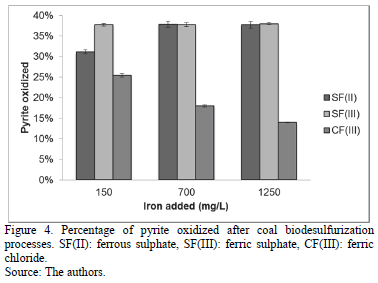
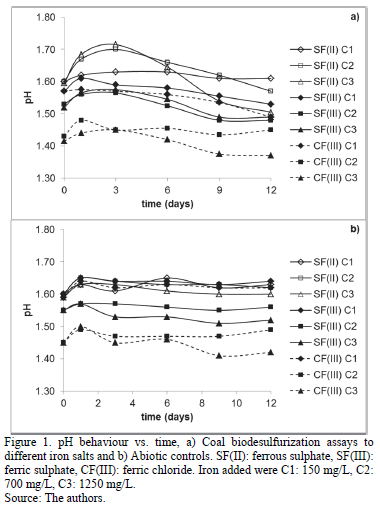
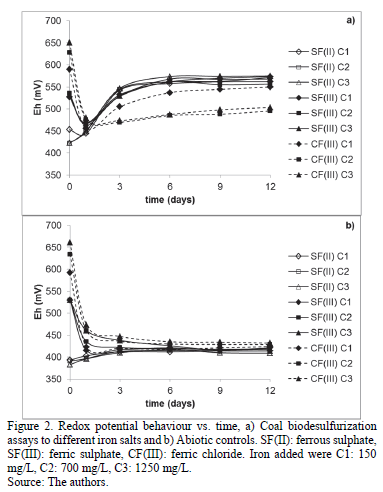
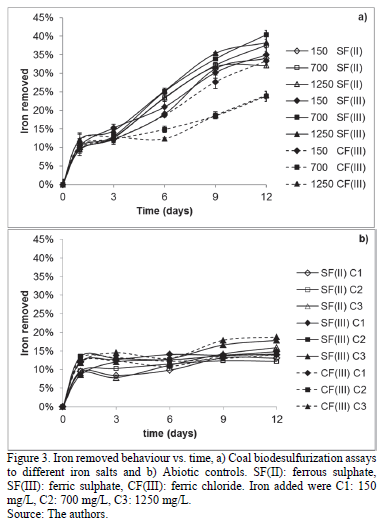
<body><![CDATA[<p><font size="2" face="Verdana, Arial, Helvetica, sans-serif"><b><i>3.1. Biodesulfurization process</i></b></font></p>     <p><font size="2" face="Verdana, Arial, Helvetica, sans-serif"><a href="#fig01">Fig. 1</a> shows pH behaviour along the process. The initial value was the  highest in the ferrous sulphate assays. In contrast, ferric chloride assays  CF(III) C2 and CF(III) C3 started at the lowest pH. In the first days of the  process, ferrous sulphate assays increased in value, where SF(II) C2 and SF(II)  C3 assays reached the maximum (1.71 at day 3). Subsequently, SF(II) C1 assay  did not have significant changes; however, SF(II) C2 and SF(II) C3 assays had a  continuous pH decreasing up to day 12, especially by using 1250 mg Fe<sup>2+</sup>/L  (1.51). </font></p>     <p align="center"><font size="2" face="Verdana, Arial, Helvetica, sans-serif"><a name="fig01"></a></font><img src="/img/revistas/dyna/v83n197/v83n197a10fig01.gif"></p>     <p><font size="2" face="Verdana, Arial, Helvetica, sans-serif">The assays using ferric salts also raised the pH value on the first day,  although it was not as pronounced as the values observed in the ferrous  sulphate assays. Later, all the assays had a pH decreasing, which was dependant  on the iron source and concentration. CF(III) C3 assay showed the lowest value  (1.37).</font></p>     <p><font size="2" face="Verdana, Arial, Helvetica, sans-serif">As regards the abiotic controls, they presented a pH increase on the  first day (<a href="#fig01">Fig. 1b</a>) and then did not evidence significant changes during the  process, except for SF(III) C3 and CF(III) C3 abiotic controls, whose values  decreased after day 1, although they did not reach the same values as their  corresponding bioassays.</font></p>     <p><font size="2" face="Verdana, Arial, Helvetica, sans-serif"><a href="#fig02">Fig. 2</a> presents redox potential (Eh). In the same  way as the pH values, initial Eh depended on iron source and the initial  concentration. Ferrous sulphate assays had the lowest values (below 450 mV). In  contrast, the values were over 530 mV in the assays using ferric salts,  especially by using ferric chloride. Nonetheless, all the assays had a similar behaviour after day 1. Eh of  the assays tended to stabilize between 550-560 mV after day 6 (day 9 for  CF(III) C1 assay), except for CF(III) C2 and CF(III) C3 assays, where the value  did not surpass 500 mV. On the other hand, all the abiotic controls tended to reach  413 mV after day three.</font></p>     <p align="center"><font size="2" face="Verdana, Arial, Helvetica, sans-serif"><a name="fig02"></a></font><img src="/img/revistas/dyna/v83n197/v83n197a10fig02.gif"></p>     <p><font size="2" face="Verdana, Arial, Helvetica, sans-serif">All assays and abiotic controls showed iron dissolution on day 1 (<a href="#fig03">Fig.  3</a>). The quantity removed was around 12% in SF(III) C3, CF(III) C3 assays and  abiotic controls and 10% in the other assays. After day 2, the abiotic controls  of SF(III) C3 and CF(III) C3 assays reached a maximum removal of around 19%,  while the abiotic controls of the other assays were between 12-14% (<a href="#fig03">Fig. 3b</a>).  Moreover, SF(II) C1, SF(III) C1 and CF(III) C1 assays reached a removal between  33-35% at the end of the process (<a href="#fig03">Fig. 3a</a>) and SF(III) C2 and SF(III) C3 assays  a maximum around 40%. In contrast, CF(III) C2 and CF(III) C3 assays had a  removal below 25%. This correlated with the low redox potential observed in  <a href="#fig02">Fig. 2</a>. </font></p>     <p align="center"><font size="2" face="Verdana, Arial, Helvetica, sans-serif"><a name="fig03"></a></font><img src="/img/revistas/dyna/v83n197/v83n197a10fig03.gif"></p>     <p><font size="2" face="Verdana, Arial, Helvetica, sans-serif"><a href="#fig04">Fig. 4</a> presents pyrite oxidized at the end of the process. All the  assays using ferric sulphate and SF(II) C2 and SF(II) C3 assays reached the  maximum of pyrite oxidation (37.80%). In contrast, CF(III) C2 and CF(III) C3  assays obtained the minimum values (18.00% and 14.00%), showing a decreased pattern when the iron concentration  increased (similar to observed in the <a href="#fig02">Fig. 2</a>, <a href="#fig03">3</a>). SF(III) C3 and CF(III) C3  abiotic controls reached a chemical pyrite oxidation of around 9.00%, while the  others did not have a significant value (below 3%). </font></p>     ]]></body>
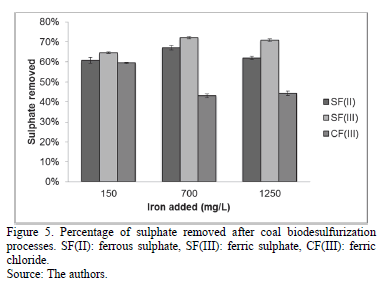
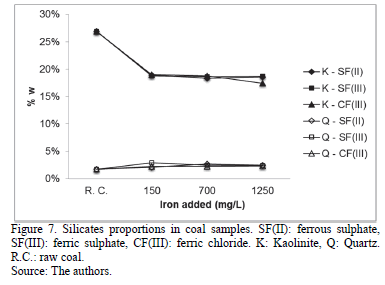
<body><![CDATA[<p align="center"><font size="2" face="Verdana, Arial, Helvetica, sans-serif"><a name="fig04"></a></font><img src="/img/revistas/dyna/v83n197/v83n197a10fig04.gif"></p>     <p><font size="2" face="Verdana, Arial, Helvetica, sans-serif">Although the  assays using the two highest iron concentrations of ferrous and ferric sulphate  reached the maximum of pyrite oxidized, SF(III) C2 and SF(III) C3 assays had  the best sulphate removal of around 70.00% (<a href="#fig05">Fig. 5</a>). On the other hand,  sulphate removed was low in CF(III) C2 and CF(III) C3 assays, similar to that  observed in the parameters shown in <a href="#fig02">Fig. 2</a>, <a href="#fig03">3</a>. </font></p>     <p align="center"><font size="2" face="Verdana, Arial, Helvetica, sans-serif"><a name="fig05"></a></font><img src="/img/revistas/dyna/v83n197/v83n197a10fig05.gif"></p>     <p><font size="2" face="Verdana, Arial, Helvetica, sans-serif"><b><i>3.2. X-ray  diffractogram analyses</i></b></font></p>     <p><font size="2" face="Verdana, Arial, Helvetica, sans-serif">The X-ray  diffractogram of non-treated coal (<a href="#fig06">Fig. 6</a>) showed the presence of pyrite,  kaolinite, quartz and jarosite. The curvature of baseline between 2q=13°-23° corresponds to the amorphous phase of coal &#91;15&#93;. </font></p>     <p align="center"><font size="2" face="Verdana, Arial, Helvetica, sans-serif"><a name="fig06"></a></font><img src="/img/revistas/dyna/v83n197/v83n197a10fig06.gif"></p>     <p><font size="2" face="Verdana, Arial, Helvetica, sans-serif">The Rietveld refinement for the semi-quantification of XRD patterns,  showed 7.5% w of pyrite, 28.86% w of kaolinite, 1.69% w of quartz and not  significant amounts (below 0.5%) of jarosite. A goodness-of-fit below 1.1% and </font><font size="2" face="Verdana, Arial, Helvetica, sans-serif">weighted residual profile below 20% were observed,  considered good to accept this method &#91;16,17&#93;.</font></p>     <p><font size="2" face="Verdana, Arial, Helvetica, sans-serif">Treated coal samples presented a decrease  of kaolinite content (<a href="#fig07">Fig. 7</a>), reporting an average percentage of 18.57% (±  0.45%) between all the assays without a specific correlation with respect to  the evaluated variables. Quartz did not show significant changes. As additional  data, jarosite content was not significant (less than 0.4% w).</font></p>     <p align="center"><font size="2" face="Verdana, Arial, Helvetica, sans-serif"><a name="fig07"></a></font><img src="/img/revistas/dyna/v83n197/v83n197a10fig07.gif"></p>     <p>&nbsp;</p>     ]]></body>
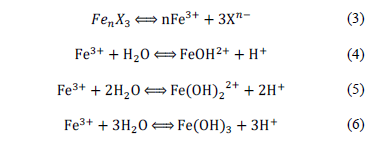
<body><![CDATA[<p><font size="3" face="Verdana, Arial, Helvetica, sans-serif"><b>4. Discussion</b></font></p>     <p><font size="2" face="Verdana, Arial, Helvetica, sans-serif">Ferric  salts influenced pH at the beginning of the process. They ionise to Fe<sup>3+</sup> and the respective anion (X<sup>n-</sup>) in water solution by eq. (3). Then,  Fe<sup>3+</sup> hydrolyses by eq. (4)-(6) and releases H<sup>+</sup> to the  medium &#91;18&#93;. This explains why the assays using  ferric salts started at lower values than assays using ferric sulphate.  Besides, the equilibrium reaction of Cl<sup>-</sup> and H<sup>+</sup> generates  a stronger acid than SO<sub>4</sub><sup>2-</sup> and H<sup>+</sup>, influencing  low pH.</font></p>     <p><img src="/img/revistas/dyna/v83n197/v83n197a10eq0306.gif"></p>     <p><font size="2" face="Verdana, Arial, Helvetica, sans-serif">Additionally,  the initial redox potential values depended on the concentration of Fe<sup>3+</sup> ions, as this parameter is directly related to the Fe<sup>3+</sup>/Fe<sup>2+</sup> ion exchange ratio &#91;4,19-21&#93;. Ferric sulphate assays had a lower Eh than ferric  chloride assays, because the reagent contained 8% of Fe<sup>2+</sup> ions.</font></p>     <p><font size="2" face="Verdana, Arial, Helvetica, sans-serif">The following sections  provide information on how both initial pH and Eh variations affect assays and  abiotic controls during the processes for each iron source.</font></p>     <p><font size="2" face="Verdana, Arial, Helvetica, sans-serif"><b><i>4.1. Sulphate salts effect</i></b></font></p>     <p><font size="2" face="Verdana, Arial, Helvetica, sans-serif">The increment of  pH on day 1 (<a href="#fig01">Fig. 1</a>) indicated H<sup>+</sup> consumption by the <i>A. ferrooxidans </i>to biooxidize Fe<sup>2+</sup>,  as shown in eq. (1). The results obtained agreed with the reaction mechanism,  because the assays using the highest concentrations of Fe<sup>2+ </sup>consumed  more H<sup>+</sup>, which explains why the highest pH values were similar to those  reported by other authors &#91;22&#93;. Moreover, <a href="#fig07">Fig. 7</a> indicates that kaolinite also might have consumed acid in its  dissolution by eq. (7) &#91;23,24&#93;. </font></p>     <p><img src="/img/revistas/dyna/v83n197/v83n197a10eq07.gif"></p>     <p><font size="2" face="Verdana, Arial, Helvetica, sans-serif">The subsequent pH decrease indicated that the acid production came from  pyrite oxidation by eq. (2) and Fe<sup>3+</sup> hydroxylation by eq. (4)-(6) &#91;18&#93;, which produced more H<sup>+</sup> after the <i>lag</i> phase. Therefore, assays using the two highest concentrations  have a better pH decreasing, because they had a higher iron concentration in  the culture medium. Since the coal did not present common alkalinizing  compounds such as carbonates &#91;3,4,10&#93;, it did not have a significant participation on pH changes around the  process. </font></p>     <p><font size="2" face="Verdana, Arial, Helvetica, sans-serif">The replacement of ferrous sulphate by ferric sulphate allowed the onset  of sulphide oxidation to be faster by eq. (2). The extra acidity helped to  avoid pH increase and improved iron and sulphate removal in relation to assays  using ferrous sulphate (<a href="#fig03">Fig. 3</a>, <a href="#fig05">5</a>), proving pH value affects solubility. Additionally, iron  concentration also affected the process. Early research showed that values  above 1200 mg/L induce the generation of precipitates as hydroxisulphates by eq.  (8), compounds poorly insoluble at the conditions used &#91;4,18,25,11&#93;. This explains why SF(II)  C3 and SF(III) C3 assays decreased iron removal after day 9 (<a href="#fig03">Fig. 3</a>). </font></p>     ]]></body>
<body><![CDATA[<p><img src="/img/revistas/dyna/v83n197/v83n197a10eq08.gif"></p>     <p><font size="2" face="Verdana, Arial, Helvetica, sans-serif">Moreover, the  similar pyrite oxidation reached by SF(II) C2, SF(II) C3, SF(III) C2 and  SF(III) C3 (around 38%) indicate that Fe<sup>2+</sup> concentrations above 800  mg/L produced sufficient Fe<sup>3+</sup> to obtain a good Fe<sup>3+</sup>/Fe<sup>2+</sup> ion exchange, regardless of the iron sulphate source. The only advantage of  using high ferric sulphate concentrations was to reduce precipitates formation,  because it did not affect redox potential behaviour after day 3 (<a href="#fig02">Fig. 2</a>).  Ferric sulphate abiotic controls demonstrated that Fe<sup>3+</sup> added  oxidized pyrite on the first days, especially by using the highest  concentration. However, <a href="#fig02">Fig. 2b</a>, <a href="#fig03">3b</a> showed Fe<sup>3+</sup> ions did not  regenerate again due to the absence of the microorganism (stabilization of Eh  to 413 mV and non-significant iron removal after day 3). This suggests that  bacterial activity is the main controller of Fe<sup>3+</sup>/Fe<sup>2+</sup> ratio.</font></p>     <p><font size="2" face="Verdana, Arial, Helvetica, sans-serif">Nevertheless,  the assay SF(III) C1 also obtained the best pyrite oxidation, 20% higher than  the assay SF(II) C1. It indicated that the biodepyritization process (under the  evaluated conditions) might obtain an increase of pyrite oxidized and a  sulphate removal (64.51%) by adding 150 mg Fe<sup>3+</sup>/L.</font></p>     <p><font size="2" face="Verdana, Arial, Helvetica, sans-serif"><b><i>4.2. Chloride salts effect</i></b></font></p>     <p><font size="2" face="Verdana, Arial, Helvetica, sans-serif">Cl<sup>-</sup> ions had a negative impact on bacterial activity. These findings are similar to  previous research which reported that concentrations above 1000 mg/L of Cl<sup>-</sup> inhibited bacterial growth, reducing the regeneration of Fe<sup>3+</sup> ions,  and therefore pyrite biooxidation rate &#91;26,27&#93;. 800 mg/L and 1350 mg/L of Fe<sup>3+</sup> provided 1520 mg/L and 2565 mg/L of Cl<sup>-</sup> respectively. Although this  work evidenced microorganism activity, results showed the adaptation stages  were not sufficient to counterattack all chloride toxicity for these  concentrations. </font></p>     <p><font size="2" face="Verdana, Arial, Helvetica, sans-serif">Furthermore, although ferric chloride assays had the lowest pH values  (<a href="#fig01">Fig. 1</a>), the extra acidification did not help to increase sulphate removed  (actually, it diminished), contrasting with the pH-sulphate solubility relation  observed in ferric sulphate assays. The commercial use of ferric chloride as a  coagulant in water treatment, especially to remove phosphate &#91;28&#93;, is well known,. Ferric  chloride probably attacked KH<sub>2</sub>PO<sub>4</sub> from the culture medium  and K<sup>+</sup> inducted to the formation of precipitates as  hydroxisulphates, reacting with the iron and sulphate product of oxidation of  pyrite. The possible precipitation of ferric ions and some nutrients in the  bacteria (K, P) might have affected sulphate-removed ratio, as observed in <a href="#fig05">Fig.  5</a>.</font></p>     <p>&nbsp;</p>     <p><font size="3" face="Verdana, Arial, Helvetica, sans-serif"><b>5. Conclusions</b></font></p>     <p><font size="2" face="Verdana, Arial, Helvetica, sans-serif">The main contribution to replace ferrous sulphate by ferric sulphate was  to support acidity to the media, which helps to improve sulphate removal. Nonetheless, the present work found that  replacing the common iron source of the culture medium by ferric sulphate in  small quantities (150 mg/L of Fe<sup>3+</sup>) was a good alternative to  increase the pyrite oxidation rate within the same configuration process.  However, this efficiency has to be tested in other scenarios, for example using  high pulp concentration, because initial Fe<sup>3+</sup> ions (from ferric  sulphate) only acted as an accelerant and not as a catalyser.</font></p>     <p><font size="2" face="Verdana, Arial, Helvetica, sans-serif">Furthermore, ferric chloride was not efficient as an iron source of Fe<sup>3+</sup> ions. Although Fe<sup>3+</sup> promoted chemical oxidation of pyrite during the  first days, Cl<sup>-</sup> was toxic to the microorganism and furthermore acted  as an inductor of the sulphate precipitates. Both factors considerably affected  pyrite biooxidation and sulphate removal ratios. </font></p>     ]]></body>
<body><![CDATA[<p><font size="2" face="Verdana, Arial, Helvetica, sans-serif">Moreover, besides pyrite and sulphate removal, all the assays presented  kaolinite dissolution by acid leachate. This improved raw coal, because as  inorganic matter decreases, calorific capacity increases, obtaining a better  quality product. However, this phenomenon only depended on the acidity of the  medium and not on the variables assessed. However, although ferric chloride did  not work, future studies might evaluate other kinds of ferric salts, in order  to determine a positive influence of the anions on pyrite oxidation and  sulphate removal ratios. </font></p>     <p>&nbsp;</p>     <p><font size="3" face="Verdana, Arial, Helvetica, sans-serif"><b>Acknowledges</b></font></p>     <p><font size="2" face="Verdana, Arial, Helvetica, sans-serif">To the Biomineralogy and  Biohydrometallurgy Laboratory (National University of Colombia) where the  investigation was carried out.</font></p>     <p>&nbsp;</p>     <p><font size="3" face="Verdana, Arial, Helvetica, sans-serif"><b>References</b></font></p>     <!-- ref --><p><font size="2" face="Verdana, Arial, Helvetica, sans-serif"><b>&#91;1&#93;</b> Juszczak, A., Domka, F., Kozlowski, M. and Wachowska, H.,  Microbial desulfurization of coal with Thiobacillus ferrooxidans bacteria,  Fuel, 74, pp. 725-728, 1995. DOI: 10.1016/0016-2361(94)00019-N</font>&nbsp;&nbsp;&nbsp;&nbsp;&nbsp;&nbsp;&nbsp;&nbsp;[&#160;<a href="javascript:void(0);" onclick="javascript: window.open('/scielo.php?script=sci_nlinks&ref=1131405&pid=S0012-7353201600030001000001&lng=','','width=640,height=500,resizable=yes,scrollbars=1,menubar=yes,');">Links</a>&#160;]<!-- end-ref --><!-- ref --><p><font size="2" face="Verdana, Arial, Helvetica, sans-serif"><b>&#91;2&#93;</b> Calkins, W.H., The chemical forms of sulfur in coal: A  review, Fuel, 73, pp. 475-84, 1994. DOI: 10.1016/0016-2361(94)90028-0</font>&nbsp;&nbsp;&nbsp;&nbsp;&nbsp;&nbsp;&nbsp;&nbsp;[&#160;<a href="javascript:void(0);" onclick="javascript: window.open('/scielo.php?script=sci_nlinks&ref=1131406&pid=S0012-7353201600030001000002&lng=','','width=640,height=500,resizable=yes,scrollbars=1,menubar=yes,');">Links</a>&#160;]<!-- end-ref --><!-- ref --><p><font size="2" face="Verdana, Arial, Helvetica, sans-serif"><b>&#91;3&#93;</b> Caicedo, G.A. and M&aacute;rquez, M.A., Selection procedures of  consortia bacterial with A. ferrooxidans like bacteria and A. thiooxidans like  bacteria in coal biodesulfurization process. Revista Facultad de Ingenier&iacute;a  Universidad de Antioquia &#91;online&#93;, 52, 2010. &#91;date of reference April 28th of  2015&#93;. Available at: <a href="http://www.scielo.org.co/pdf/rfiua/n52/n52a08.pdf" target="_blank">http://www.scielo.org.co/pdf/rfiua/n52/n52a08.pdf</a></font>&nbsp;&nbsp;&nbsp;&nbsp;&nbsp;&nbsp;&nbsp;&nbsp;[&#160;<a href="javascript:void(0);" onclick="javascript: window.open('/scielo.php?script=sci_nlinks&ref=1131407&pid=S0012-7353201600030001000003&lng=','','width=640,height=500,resizable=yes,scrollbars=1,menubar=yes,');">Links</a>&#160;]<!-- end-ref --><!-- ref --><p><font size="2" face="Verdana, Arial, Helvetica, sans-serif"><b>&#91;4&#93;</b> Cardona, I.C. and M&aacute;rquez, M.A., Biodesulfurization of two  Colombian coals with native microorganisms, Fuel Process Technology, 90, pp.  1099-1106, 2009. DOI: 10.1016/j.fuproc.2009.04.022</font>&nbsp;&nbsp;&nbsp;&nbsp;&nbsp;&nbsp;&nbsp;&nbsp;[&#160;<a href="javascript:void(0);" onclick="javascript: window.open('/scielo.php?script=sci_nlinks&ref=1131408&pid=S0012-7353201600030001000004&lng=','','width=640,height=500,resizable=yes,scrollbars=1,menubar=yes,');">Links</a>&#160;]<!-- end-ref --><!-- ref --><p><font size="2" face="Verdana, Arial, Helvetica, sans-serif"><b>&#91;5&#93;</b> Klein, J., Technological and economic aspects of coal  biodesulfurisation. Biodegradation &#91;online&#93;, 9, 1998. &#91;date of reference April  28th of 2015&#93;. Available at: <a href="http://www.ncbi.nlm.nih.gov/pubmed/10022072" target="_blank">http://www.ncbi.nlm.nih.gov/pubmed/10022072</a></font>&nbsp;&nbsp;&nbsp;&nbsp;&nbsp;&nbsp;&nbsp;&nbsp;[&#160;<a href="javascript:void(0);" onclick="javascript: window.open('/scielo.php?script=sci_nlinks&ref=1131409&pid=S0012-7353201600030001000005&lng=','','width=640,height=500,resizable=yes,scrollbars=1,menubar=yes,');">Links</a>&#160;]<!-- end-ref --><!-- ref --><p><font size="2" face="Verdana, Arial, Helvetica, sans-serif"><b>&#91;6&#93;</b> Cara, J., Vargas, M., Mor&aacute;n, A., G&oacute;mez, E., Mart&iacute;nez, O. and  Garc&iacute;a Frutos, F.J., Biodesulphurization of a coal by packed-column leaching.  Simultaneous thermogravimetric and mass spectrometric analyses, Fuel, 85, pp.  1756-1762, 2006. DOI: 10.1016/j.fuel.2006.02.014</font>&nbsp;&nbsp;&nbsp;&nbsp;&nbsp;&nbsp;&nbsp;&nbsp;[&#160;<a href="javascript:void(0);" onclick="javascript: window.open('/scielo.php?script=sci_nlinks&ref=1131410&pid=S0012-7353201600030001000006&lng=','','width=640,height=500,resizable=yes,scrollbars=1,menubar=yes,');">Links</a>&#160;]<!-- end-ref --><!-- ref --><p><font size="2" face="Verdana, Arial, Helvetica, sans-serif"><b>&#91;7&#93;</b> Kodali, B., Rao, M.B., Narasu, M.L. and Pogaku, R., Effect of  biochemical reactions in enhancement of rate of leaching, Chemical Engineering  Science, 59, pp. 5069-5073, 2004. DOI: 10.1016/j.ces.2004.09.004</font>&nbsp;&nbsp;&nbsp;&nbsp;&nbsp;&nbsp;&nbsp;&nbsp;[&#160;<a href="javascript:void(0);" onclick="javascript: window.open('/scielo.php?script=sci_nlinks&ref=1131411&pid=S0012-7353201600030001000007&lng=','','width=640,height=500,resizable=yes,scrollbars=1,menubar=yes,');">Links</a>&#160;]<!-- end-ref --><!-- ref --><p><font size="2" face="Verdana, Arial, Helvetica, sans-serif"><b>&#91;8&#93;</b> Sand, W., Gehrke, T., Jozsa, P.G. and Schippers, A., (Bio)  chemistry of bacterial leaching-direct vs. indirect bioleaching,  Hydrometallurgy, 59, pp. 159-75, 2001. DOI: 10.1016/S0304-386X(00)00180-8</font>&nbsp;&nbsp;&nbsp;&nbsp;&nbsp;&nbsp;&nbsp;&nbsp;[&#160;<a href="javascript:void(0);" onclick="javascript: window.open('/scielo.php?script=sci_nlinks&ref=1131412&pid=S0012-7353201600030001000008&lng=','','width=640,height=500,resizable=yes,scrollbars=1,menubar=yes,');">Links</a>&#160;]<!-- end-ref --><!-- ref --><p><font size="2" face="Verdana, Arial, Helvetica, sans-serif"><b>&#91;9&#93;</b> Sand, W. and Gehrke, T., Extracellular polymeric substances  mediate bioleaching/biocorrosion via interfacial processes involving iron(III)  ions and acidophilic bacteria, Research in Microbiology, 157, pp. 49-56, 2006.  DOI: 10.1016/j.resmic.2005.07.012</font>&nbsp;&nbsp;&nbsp;&nbsp;&nbsp;&nbsp;&nbsp;&nbsp;[&#160;<a href="javascript:void(0);" onclick="javascript: window.open('/scielo.php?script=sci_nlinks&ref=1131413&pid=S0012-7353201600030001000009&lng=','','width=640,height=500,resizable=yes,scrollbars=1,menubar=yes,');">Links</a>&#160;]<!-- end-ref --><!-- ref --><p><font size="2" face="Verdana, Arial, Helvetica, sans-serif"><b>&#91;10&#93;</b> Caicedo, G.A., M&aacute;rquez, M.A. and  Moreno, C.X., Particle size, iron concentration and pH influence in  biodesulfurization process of coal - laboratory tests. Revista Colombiana de  Biotecnolog&iacute;a &#91;online&#93;, 13, 2011. &#91;date of reference April 28th of 2015&#93;.  Available at: <a href="http://www.scielo.org.co/pdf/biote/v13n2/v13n2a20.pdf" target="_blank">http://www.scielo.org.co/pdf/biote/v13n2/v13n2a20.pdf</a></font>&nbsp;&nbsp;&nbsp;&nbsp;&nbsp;&nbsp;&nbsp;&nbsp;[&#160;<a href="javascript:void(0);" onclick="javascript: window.open('/scielo.php?script=sci_nlinks&ref=1131414&pid=S0012-7353201600030001000010&lng=','','width=640,height=500,resizable=yes,scrollbars=1,menubar=yes,');">Links</a>&#160;]<!-- end-ref --><!-- ref --><p><font size="2" face="Verdana, Arial, Helvetica, sans-serif"><b>&#91;11&#93;</b> Caicedo, G.A., Prada, M., Pel&aacute;ez,  H., Moreno, C.X. and M&aacute;rquez, M.A., Evaluation of a coal biodesulfurization  process (semi-continuous mode) on the pilot plant level. DYNA &#91;online&#93;, 79(174),  2012. &#91;date of reference April 28th of 2015&#93;. Available at: <a href="http://www.scielo.org.co/pdf/dyna/v79n174/v79n174a15.pdf">http://www.scielo.org.co/pdf/dyna/v79n174/v79n174a15.pdf</a></font>&nbsp;&nbsp;&nbsp;&nbsp;&nbsp;&nbsp;&nbsp;&nbsp;[&#160;<a href="javascript:void(0);" onclick="javascript: window.open('/scielo.php?script=sci_nlinks&ref=1131415&pid=S0012-7353201600030001000011&lng=','','width=640,height=500,resizable=yes,scrollbars=1,menubar=yes,');">Links</a>&#160;]<!-- end-ref --><!-- ref --><p><font size="2" face="Verdana, Arial, Helvetica, sans-serif"><b>&#91;12&#93;</b> Loi, G., Mura, A., Trois, P. and  Rossi, G., Bioreactor performance versus solids concentration in coal  biodepyritization, Fuel Processing Technology, 40, pp. 251-260, 1994. DOI: 10.1016/0378-3820(94)90147-3</font>&nbsp;&nbsp;&nbsp;&nbsp;&nbsp;&nbsp;&nbsp;&nbsp;[&#160;<a href="javascript:void(0);" onclick="javascript: window.open('/scielo.php?script=sci_nlinks&ref=1131416&pid=S0012-7353201600030001000012&lng=','','width=640,height=500,resizable=yes,scrollbars=1,menubar=yes,');">Links</a>&#160;]<!-- end-ref --><!-- ref --><p><font size="2" face="Verdana, Arial, Helvetica, sans-serif"><b>&#91;13&#93;</b> Nemati, M., Harrison, S.T.L.,  Hansford, G.S. and Webb, C., Biological oxidation of ferrous sulphate by  Thiobacillus ferrooxidans: A review on the kinetic aspects, Biochemical  Engineering Journal, 1, pp. 171-190, 1998. DOI: 10.1016/S1369-703X(98)00006-0</font>&nbsp;&nbsp;&nbsp;&nbsp;&nbsp;&nbsp;&nbsp;&nbsp;[&#160;<a href="javascript:void(0);" onclick="javascript: window.open('/scielo.php?script=sci_nlinks&ref=1131417&pid=S0012-7353201600030001000013&lng=','','width=640,height=500,resizable=yes,scrollbars=1,menubar=yes,');">Links</a>&#160;]<!-- end-ref --><!-- ref --><p><font size="2" face="Verdana, Arial, Helvetica, sans-serif"><b>&#91;14&#93;</b> Tuovinen, O.H. and Kelly D.P.,  Studies on growth of thiobacillus ferrooxidans. I. Use of menbrane filters and  ferrous iron agar to determine viable numbers, and comparison with <sup>14</sup>CO<sub>2</sub>-fixation  and iron oxidation as measures of growth, Archiv für Mikrobiologie, 88, pp. 285-298,  1973. DOI: 10.1007/BF00409941</font>&nbsp;&nbsp;&nbsp;&nbsp;&nbsp;&nbsp;&nbsp;&nbsp;[&#160;<a href="javascript:void(0);" onclick="javascript: window.open('/scielo.php?script=sci_nlinks&ref=1131418&pid=S0012-7353201600030001000014&lng=','','width=640,height=500,resizable=yes,scrollbars=1,menubar=yes,');">Links</a>&#160;]<!-- end-ref --><!-- ref --><p><font size="2" face="Verdana, Arial, Helvetica, sans-serif"><b>&#91;15&#93;</b> Lu, L., Sahajwalla, V., Kong, C. and  Harris D., Quantitative X-ray diffraction analysis and its application to  various coals, Carbon, 39, pp. 1821-1833, 2001. DOI: 10.1016/S0008-6223(00)00318-3</font>&nbsp;&nbsp;&nbsp;&nbsp;&nbsp;&nbsp;&nbsp;&nbsp;[&#160;<a href="javascript:void(0);" onclick="javascript: window.open('/scielo.php?script=sci_nlinks&ref=1131419&pid=S0012-7353201600030001000015&lng=','','width=640,height=500,resizable=yes,scrollbars=1,menubar=yes,');">Links</a>&#160;]<!-- end-ref --><!-- ref --><p><font size="2" face="Verdana, Arial, Helvetica, sans-serif"><b>&#91;16&#93;</b> McCusker, L.B., Von Dreele, R.B.,  Cox, D.E., Loue, D. and Scardi, P., Rietveld refinement guidelines, Journal of  Applied Crystalography, 32, pp. 36-50, 1999. DOI: 10.1107/S0021889898009856</font>&nbsp;&nbsp;&nbsp;&nbsp;&nbsp;&nbsp;&nbsp;&nbsp;[&#160;<a href="javascript:void(0);" onclick="javascript: window.open('/scielo.php?script=sci_nlinks&ref=1131420&pid=S0012-7353201600030001000016&lng=','','width=640,height=500,resizable=yes,scrollbars=1,menubar=yes,');">Links</a>&#160;]<!-- end-ref --><!-- ref --><p><font size="2" face="Verdana, Arial, Helvetica, sans-serif"><b>&#91;17&#93;</b> Kniess, C.T., Cardoso de Lima, J.  and Prates, P.B., The quantification of crystalline phases in materials:  Applications of rietveld method. in Shatokha, V., Ed. Sintering - Methods and Products &#91;online&#93;, Intech, 2012, pp.  293-316. &#91;date of reference April 28th of 2015&#93;. Available at:  <a href="http://goo.gl/NWoIs4" target="_blank">http://goo.gl/NWoIs4</a></font>&nbsp;&nbsp;&nbsp;&nbsp;&nbsp;&nbsp;&nbsp;&nbsp;[&#160;<a href="javascript:void(0);" onclick="javascript: window.open('/scielo.php?script=sci_nlinks&ref=1131421&pid=S0012-7353201600030001000017&lng=','','width=640,height=500,resizable=yes,scrollbars=1,menubar=yes,');">Links</a>&#160;]<!-- end-ref --><!-- ref --><p><font size="2" face="Verdana, Arial, Helvetica, sans-serif"><b>&#91;18&#93;</b> Daoud, J. and Karamanev, D.,  Formation of jarosite during Fe<sup>2+</sup> oxidation by Acidithiobacillus  ferrooxidans, Minerals Engineering, 19, pp. 960-967, 2006. DOI: 10.1016/j.mineng.2005.10.024</font>&nbsp;&nbsp;&nbsp;&nbsp;&nbsp;&nbsp;&nbsp;&nbsp;[&#160;<a href="javascript:void(0);" onclick="javascript: window.open('/scielo.php?script=sci_nlinks&ref=1131422&pid=S0012-7353201600030001000018&lng=','','width=640,height=500,resizable=yes,scrollbars=1,menubar=yes,');">Links</a>&#160;]<!-- end-ref --><!-- ref --><p><font size="2" face="Verdana, Arial, Helvetica, sans-serif"><b>&#91;19&#93;</b> Bhatnagar, A., Dastidar, M.G. and  Roychoudhury, P.K., Integrated technique for pyritic sulphur reduction in  Indian (ASSAM) coal, Energy Conversion Management, 39, pp. 1121-1126, 1998. DOI:  10.1016/S0196-8904(98)00005-3</font>&nbsp;&nbsp;&nbsp;&nbsp;&nbsp;&nbsp;&nbsp;&nbsp;[&#160;<a href="javascript:void(0);" onclick="javascript: window.open('/scielo.php?script=sci_nlinks&ref=1131423&pid=S0012-7353201600030001000019&lng=','','width=640,height=500,resizable=yes,scrollbars=1,menubar=yes,');">Links</a>&#160;]<!-- end-ref --><!-- ref --><p><font size="2" face="Verdana, Arial, Helvetica, sans-serif"><b>&#91;20&#93;</b> Malik, A., Dastidar, M.G. and  Roychoudhury, P., Biodesulphurization of coal: Effect of pulse feeding and  leachate recycle, Enzyme Microbial Technolology, 28, pp. 49-56, 2001. DOI: 10.1016/S0141-0229(00)00283-0</font>&nbsp;&nbsp;&nbsp;&nbsp;&nbsp;&nbsp;&nbsp;&nbsp;[&#160;<a href="javascript:void(0);" onclick="javascript: window.open('/scielo.php?script=sci_nlinks&ref=1131424&pid=S0012-7353201600030001000020&lng=','','width=640,height=500,resizable=yes,scrollbars=1,menubar=yes,');">Links</a>&#160;]<!-- end-ref --><!-- ref --><p><font size="2" face="Verdana, Arial, Helvetica, sans-serif"><b>&#91;21&#93;</b> Meruane,  G., Oxidaci&oacute;n bacteriana de sulfato ferroso, PhD dissertation Thesis,  Universidad de Chile, Santiago, Chile, 2002.    &nbsp;&nbsp;&nbsp;&nbsp;&nbsp;&nbsp;&nbsp;&nbsp;[&#160;<a href="javascript:void(0);" onclick="javascript: window.open('/scielo.php?script=sci_nlinks&ref=1131425&pid=S0012-7353201600030001000021&lng=','','width=640,height=500,resizable=yes,scrollbars=1,menubar=yes,');">Links</a>&#160;]<!-- end-ref --></font></p>     <!-- ref --><p><font size="2" face="Verdana, Arial, Helvetica, sans-serif"><b>&#91;22&#93;</b> Acharya, C., Kar, R.N. and Sukla,  L.B., Bacterial removal of sulphur from three different coals. Fuel &#91;online&#93;,  80, 2001. &#91;date of reference April 28th of 2015&#93;. Available at:  <a href="http://goo.gl/QmA9TG" target="_blank">http://goo.gl/QmA9TG</a></font>&nbsp;&nbsp;&nbsp;&nbsp;&nbsp;&nbsp;&nbsp;&nbsp;[&#160;<a href="javascript:void(0);" onclick="javascript: window.open('/scielo.php?script=sci_nlinks&ref=1131427&pid=S0012-7353201600030001000022&lng=','','width=640,height=500,resizable=yes,scrollbars=1,menubar=yes,');">Links</a>&#160;]<!-- end-ref --><!-- ref --><p><font size="2" face="Verdana, Arial, Helvetica, sans-serif"><b>&#91;23&#93;</b> Ford, K.J.R., Leaching of fine and pelletised Natal  kaolin using sulphuric acid. Hydrometallurgy &#91;online&#93;, 29, 1992. &#91;date of  reference April 28th of 2015&#93;. Available at:  <a href="http://www.sciencedirect.com/science/article/pii/0304386X9290008N" target="_blank">http://www.sciencedirect.com/science/article/pii/0304386X9290008N</a></font>&nbsp;&nbsp;&nbsp;&nbsp;&nbsp;&nbsp;&nbsp;&nbsp;[&#160;<a href="javascript:void(0);" onclick="javascript: window.open('/scielo.php?script=sci_nlinks&ref=1131428&pid=S0012-7353201600030001000023&lng=','','width=640,height=500,resizable=yes,scrollbars=1,menubar=yes,');">Links</a>&#160;]<!-- end-ref --><!-- ref --><p><font size="2" face="Verdana, Arial, Helvetica, sans-serif"><b>&#91;24&#93;</b> Panda, A.K., Mishra, B.G., Mishra,  D.K. and Singh, R.K., Effect of sulphuric acid treatment on the  physico-chemical characteristics of kaolin clay, Colloids Surfaces A  Physicochemical Engineering Aspects, 363, pp. 98-104, 2010. DOI: 10.1016/j.colsurfa.2010.04.022</font>&nbsp;&nbsp;&nbsp;&nbsp;&nbsp;&nbsp;&nbsp;&nbsp;[&#160;<a href="javascript:void(0);" onclick="javascript: window.open('/scielo.php?script=sci_nlinks&ref=1131429&pid=S0012-7353201600030001000024&lng=','','width=640,height=500,resizable=yes,scrollbars=1,menubar=yes,');">Links</a>&#160;]<!-- end-ref --><!-- ref --><p><font size="2" face="Verdana, Arial, Helvetica, sans-serif"><b>&#91;25&#93;</b> Pel&aacute;ez,  H., Prada, M., Caicedo, G.A., Moreno, C.X. y M&aacute;rquez, M.A., Influencia de la  relaci&oacute;n inicial de Fe<sup>3+</sup>/Fe<sup>2+</sup>, en un proceso de  biodesulfurizaci&oacute;n de carbones en suspensi&oacute;n. Revista Internacional de  Contaminaci&oacute;n Ambiental &#91;online&#93;, 29, 2013. &#91;date of reference April 28th of  2015&#93;. Available at: http://www.journals.unam.mx/index.php/rica/article/view/25160</font>&nbsp;&nbsp;&nbsp;&nbsp;&nbsp;&nbsp;&nbsp;&nbsp;[&#160;<a href="javascript:void(0);" onclick="javascript: window.open('/scielo.php?script=sci_nlinks&ref=1131430&pid=S0012-7353201600030001000025&lng=','','width=640,height=500,resizable=yes,scrollbars=1,menubar=yes,');">Links</a>&#160;]<!-- end-ref --><!-- ref --><p><font size="2" face="Verdana, Arial, Helvetica, sans-serif"><b>&#91;26&#93;</b> Deveci, H., Jordan, M.A., Powell,  N. and Alp, I., Effect of salinity and acidity on bioleaching activity of  mesophilic and extremely thermophilic bacteria, Transactions of Nonferrous  Metals Society of China, 18, pp. 714-721, 2007. DOI: 10.1016/S1003-6326(08)60123-5</font>&nbsp;&nbsp;&nbsp;&nbsp;&nbsp;&nbsp;&nbsp;&nbsp;[&#160;<a href="javascript:void(0);" onclick="javascript: window.open('/scielo.php?script=sci_nlinks&ref=1131431&pid=S0012-7353201600030001000026&lng=','','width=640,height=500,resizable=yes,scrollbars=1,menubar=yes,');">Links</a>&#160;]<!-- end-ref --><!-- ref --><p><font size="2" face="Verdana, Arial, Helvetica, sans-serif"><b>&#91;27&#93;</b> Gahan, C.S., Sundkvist, J.E. and  Sandström A., A study on the toxic effects of chloride on the biooxidation  efficiency of pyrite, Journal of hazardous materials, 172, pp. 1273-1281, 2009.  DOI: 10.1016/j.jhazmat.2009.07.133</font>&nbsp;&nbsp;&nbsp;&nbsp;&nbsp;&nbsp;&nbsp;&nbsp;[&#160;<a href="javascript:void(0);" onclick="javascript: window.open('/scielo.php?script=sci_nlinks&ref=1131432&pid=S0012-7353201600030001000027&lng=','','width=640,height=500,resizable=yes,scrollbars=1,menubar=yes,');">Links</a>&#160;]<!-- end-ref --><!-- ref --><p><font size="2" face="Verdana, Arial, Helvetica, sans-serif"><b>&#91;28&#93;</b> Caravelli, A.H., de Gregorio, C. and  Zaritzky, N.E., Effect of operating conditions on the chemical phosphorus  removal using ferric chloride by evaluating orthophosphate precipitation and  sedimentation of formed precipitates in batch and continuous systems, Chemical  Engineering Journal, 209, pp. 469-477, 2012. DOI: 10.1016/j.cej.2012.08.039</font>&nbsp;&nbsp;&nbsp;&nbsp;&nbsp;&nbsp;&nbsp;&nbsp;[&#160;<a href="javascript:void(0);" onclick="javascript: window.open('/scielo.php?script=sci_nlinks&ref=1131433&pid=S0012-7353201600030001000028&lng=','','width=640,height=500,resizable=yes,scrollbars=1,menubar=yes,');">Links</a>&#160;]<!-- end-ref --><p>&nbsp;</p>     <p><font size="2" face="Verdana, Arial, Helvetica, sans-serif"><b>G.A. Caicedo-Pineda, </b>received his BSc.  Eng. in Chemical Engineering in 2005, his MSc. degree in Biotechnology in 2008,  and his PhD. degree in Engineering - Science and Technology of the Materials in  2015, all of them from the Universidad Nacional de Colombia, Manizales (Bs.  Eng.) and Medellin (MSc. and PhD. degrees). From 2006 to 2010, he worked as a researcher  in the Universidad Nacional de Colombia, Medell&iacute;n. From 2011 to the present, he  has worked as a Process Engineering Researcher in Biofenix S.A.S. and  Inverdesarrollo S.A.S. His research interests include biomining, bioleaching,  nanobiotechnology, bioremediation, biological wastewater treatment, green  technology and raw materials bioimprovement. ORCID: 0000-0003-2320-0980</font></p>     <p><font size="2" face="Verdana, Arial, Helvetica, sans-serif"><b>M.A. M&aacute;rquez-Godoy, </b>received his BSc.  Eng. in Geological Engineering in 1989, his MSc. degree in Geology in 1995, and  his PhD. degree in Geology in 1999. The BSc. Eng. degree was from the  Universidad Nacional de Colombia, Medell&iacute;n and both the MSc. and PhD. degrees  from Fundação Universidade de Bras&iacute;lia, Brazil. From 1990 to 1995, he worked as  a geologist administrator in Ministerio de Minas y Energ&iacute;a. From 1996 to 1997,  he worked as a geologist in Ingeominas. Currently, he works as Full Professor  in the Universidad Nacional de Colombia, Medellin. Additionally, he has worked  as a professor in EAFIT (1984 to 1986) and the Universidad de Antioquia  (2000-2001). His research interests include engineering, microbial  biotechnology, mining engineering, biogeochemistry, geomicrobiology, mineral  processing, ore deposits, and minerals. ORCID: 0000-0002-7462-2430 </font></p>      ]]></body><back>
<ref-list>
<ref id="B1">
<label>1</label><nlm-citation citation-type="journal">
<person-group person-group-type="author">
<name>
<surname><![CDATA[Juszczak]]></surname>
<given-names><![CDATA[A.]]></given-names>
</name>
<name>
<surname><![CDATA[Domka]]></surname>
<given-names><![CDATA[F.]]></given-names>
</name>
<name>
<surname><![CDATA[Kozlowski]]></surname>
<given-names><![CDATA[M.]]></given-names>
</name>
<name>
<surname><![CDATA[Wachowska]]></surname>
<given-names><![CDATA[H.]]></given-names>
</name>
</person-group>
<article-title xml:lang="en"><![CDATA[Microbial desulfurization of coal with Thiobacillus ferrooxidans bacteria]]></article-title>
<source><![CDATA[Fuel]]></source>
<year>1995</year>
<numero>74</numero>
<issue>74</issue>
<page-range>725-728</page-range></nlm-citation>
</ref>
<ref id="B2">
<label>2</label><nlm-citation citation-type="journal">
<person-group person-group-type="author">
<name>
<surname><![CDATA[Calkins]]></surname>
<given-names><![CDATA[W.H.]]></given-names>
</name>
</person-group>
<article-title xml:lang="en"><![CDATA[The chemical forms of sulfur in coal: A review]]></article-title>
<source><![CDATA[Fuel]]></source>
<year>1994</year>
<numero>73</numero>
<issue>73</issue>
<page-range>475-84</page-range></nlm-citation>
</ref>
<ref id="B3">
<label>3</label><nlm-citation citation-type="journal">
<person-group person-group-type="author">
<name>
<surname><![CDATA[Caicedo]]></surname>
<given-names><![CDATA[G.A.]]></given-names>
</name>
<name>
<surname><![CDATA[Márquez]]></surname>
<given-names><![CDATA[M.A.]]></given-names>
</name>
</person-group>
<article-title xml:lang="en"><![CDATA[Selection procedures of consortia bacterial with A. ferrooxidans like bacteria and A. thiooxidans like bacteria in coal biodesulfurization process.]]></article-title>
<source><![CDATA[Revista Facultad de Ingeniería Universidad de Antioquia]]></source>
<year>2010</year>
<numero>52</numero>
<issue>52</issue>
</nlm-citation>
</ref>
<ref id="B4">
<label>4</label><nlm-citation citation-type="journal">
<person-group person-group-type="author">
<name>
<surname><![CDATA[Cardona]]></surname>
<given-names><![CDATA[I.C.]]></given-names>
</name>
<name>
<surname><![CDATA[Márquez]]></surname>
<given-names><![CDATA[M.A.]]></given-names>
</name>
</person-group>
<article-title xml:lang="en"><![CDATA[Biodesulfurization of two Colombian coals with native microorganisms]]></article-title>
<source><![CDATA[Fuel Process Technology]]></source>
<year>2009</year>
<numero>90</numero>
<issue>90</issue>
<page-range>1099-1106</page-range></nlm-citation>
</ref>
<ref id="B5">
<label>5</label><nlm-citation citation-type="journal">
<person-group person-group-type="author">
<name>
<surname><![CDATA[Klein]]></surname>
<given-names><![CDATA[J.]]></given-names>
</name>
</person-group>
<article-title xml:lang="en"><![CDATA[Technological and economic aspects of coal biodesulfurisation.]]></article-title>
<source><![CDATA[Biodegradation]]></source>
<year>1998</year>
<numero>9</numero>
<issue>9</issue>
</nlm-citation>
</ref>
<ref id="B6">
<label>6</label><nlm-citation citation-type="journal">
<person-group person-group-type="author">
<name>
<surname><![CDATA[Cara]]></surname>
<given-names><![CDATA[J.]]></given-names>
</name>
<name>
<surname><![CDATA[Vargas]]></surname>
<given-names><![CDATA[M.]]></given-names>
</name>
<name>
<surname><![CDATA[Morán]]></surname>
<given-names><![CDATA[A.]]></given-names>
</name>
<name>
<surname><![CDATA[Gómez]]></surname>
<given-names><![CDATA[E.]]></given-names>
</name>
<name>
<surname><![CDATA[Martínez]]></surname>
<given-names><![CDATA[O.]]></given-names>
</name>
<name>
<surname><![CDATA[García Frutos]]></surname>
<given-names><![CDATA[F.J.]]></given-names>
</name>
</person-group>
<article-title xml:lang="en"><![CDATA[Biodesulphurization of a coal by packed-column leaching.: Simultaneous thermogravimetric and mass spectrometric analyses]]></article-title>
<source><![CDATA[Fuel]]></source>
<year>2006</year>
<numero>85</numero>
<issue>85</issue>
<page-range>1756-1762</page-range></nlm-citation>
</ref>
<ref id="B7">
<label>7</label><nlm-citation citation-type="journal">
<person-group person-group-type="author">
<name>
<surname><![CDATA[Kodali]]></surname>
<given-names><![CDATA[B.]]></given-names>
</name>
<name>
<surname><![CDATA[Rao]]></surname>
<given-names><![CDATA[M.B.]]></given-names>
</name>
<name>
<surname><![CDATA[Narasu]]></surname>
<given-names><![CDATA[M.L.]]></given-names>
</name>
<name>
<surname><![CDATA[Pogaku]]></surname>
<given-names><![CDATA[R.]]></given-names>
</name>
</person-group>
<article-title xml:lang="en"><![CDATA[Effect of biochemical reactions in enhancement of rate of leaching]]></article-title>
<source><![CDATA[Chemical Engineering Science]]></source>
<year>2004</year>
<numero>59</numero>
<issue>59</issue>
<page-range>5069-5073</page-range></nlm-citation>
</ref>
<ref id="B8">
<label>8</label><nlm-citation citation-type="journal">
<person-group person-group-type="author">
<name>
<surname><![CDATA[Sand]]></surname>
<given-names><![CDATA[W.]]></given-names>
</name>
<name>
<surname><![CDATA[Gehrke]]></surname>
<given-names><![CDATA[T.]]></given-names>
</name>
<name>
<surname><![CDATA[Jozsa]]></surname>
<given-names><![CDATA[P.G.]]></given-names>
</name>
<name>
<surname><![CDATA[Schippers]]></surname>
<given-names><![CDATA[A.]]></given-names>
</name>
</person-group>
<article-title xml:lang="en"><![CDATA[(Bio) chemistry of bacterial leaching-direct vs. indirect bioleaching]]></article-title>
<source><![CDATA[Hydrometallurgy]]></source>
<year>2001</year>
<numero>59</numero>
<issue>59</issue>
<page-range>159-75</page-range></nlm-citation>
</ref>
<ref id="B9">
<label>9</label><nlm-citation citation-type="journal">
<person-group person-group-type="author">
<name>
<surname><![CDATA[Sand]]></surname>
<given-names><![CDATA[W.]]></given-names>
</name>
<name>
<surname><![CDATA[Gehrke]]></surname>
<given-names><![CDATA[T.]]></given-names>
</name>
</person-group>
<article-title xml:lang="en"><![CDATA[Extracellular polymeric substances mediate bioleaching/biocorrosion via interfacial processes involving iron(III) ions and acidophilic bacteria]]></article-title>
<source><![CDATA[Research in Microbiology]]></source>
<year>2006</year>
<numero>157</numero>
<issue>157</issue>
<page-range>49-56</page-range></nlm-citation>
</ref>
<ref id="B10">
<label>10</label><nlm-citation citation-type="journal">
<person-group person-group-type="author">
<name>
<surname><![CDATA[Caicedo]]></surname>
<given-names><![CDATA[G.A.]]></given-names>
</name>
<name>
<surname><![CDATA[Márquez]]></surname>
<given-names><![CDATA[M.A.]]></given-names>
</name>
<name>
<surname><![CDATA[Moreno]]></surname>
<given-names><![CDATA[C.X.]]></given-names>
</name>
</person-group>
<article-title xml:lang="en"><![CDATA[Particle size, iron concentration and pH influence in biodesulfurization process of coal: laboratory tests]]></article-title>
<source><![CDATA[Revista Colombiana de Biotecnología]]></source>
<year>2011</year>
<numero>13</numero>
<issue>13</issue>
</nlm-citation>
</ref>
<ref id="B11">
<label>11</label><nlm-citation citation-type="journal">
<person-group person-group-type="author">
<name>
<surname><![CDATA[Caicedo]]></surname>
<given-names><![CDATA[G.A.]]></given-names>
</name>
<name>
<surname><![CDATA[Prada]]></surname>
<given-names><![CDATA[M.]]></given-names>
</name>
<name>
<surname><![CDATA[Peláez]]></surname>
<given-names><![CDATA[H.]]></given-names>
</name>
<name>
<surname><![CDATA[Moreno]]></surname>
<given-names><![CDATA[C.X.]]></given-names>
</name>
<name>
<surname><![CDATA[Márquez]]></surname>
<given-names><![CDATA[M.A.]]></given-names>
</name>
</person-group>
<article-title xml:lang="en"><![CDATA[Evaluation of a coal biodesulfurization process (semi-continuous mode) on the pilot plant level.]]></article-title>
<source><![CDATA[DYNA]]></source>
<year>2012</year>
<volume>79</volume>
<numero>174</numero>
<issue>174</issue>
</nlm-citation>
</ref>
<ref id="B12">
<label>12</label><nlm-citation citation-type="journal">
<person-group person-group-type="author">
<name>
<surname><![CDATA[Loi]]></surname>
<given-names><![CDATA[G.]]></given-names>
</name>
<name>
<surname><![CDATA[Mura]]></surname>
<given-names><![CDATA[A.]]></given-names>
</name>
<name>
<surname><![CDATA[Trois]]></surname>
<given-names><![CDATA[P.]]></given-names>
</name>
<name>
<surname><![CDATA[Rossi]]></surname>
<given-names><![CDATA[G.]]></given-names>
</name>
</person-group>
<article-title xml:lang="en"><![CDATA[Bioreactor performance versus solids concentration in coal biodepyritization]]></article-title>
<source><![CDATA[Fuel Processing Technology]]></source>
<year>1994</year>
<numero>40</numero>
<issue>40</issue>
<page-range>251-260</page-range></nlm-citation>
</ref>
<ref id="B13">
<label>13</label><nlm-citation citation-type="journal">
<person-group person-group-type="author">
<name>
<surname><![CDATA[Nemati]]></surname>
<given-names><![CDATA[M.]]></given-names>
</name>
<name>
<surname><![CDATA[Harrison]]></surname>
<given-names><![CDATA[S.T.L.]]></given-names>
</name>
<name>
<surname><![CDATA[Hansford]]></surname>
<given-names><![CDATA[G.S.]]></given-names>
</name>
<name>
<surname><![CDATA[Webb]]></surname>
<given-names><![CDATA[C.]]></given-names>
</name>
</person-group>
<article-title xml:lang="en"><![CDATA[Biological oxidation of ferrous sulphate by Thiobacillus ferrooxidans: A review on the kinetic aspects]]></article-title>
<source><![CDATA[Biochemical Engineering Journal]]></source>
<year>1998</year>
<numero>1</numero>
<issue>1</issue>
<page-range>171-190</page-range></nlm-citation>
</ref>
<ref id="B14">
<label>14</label><nlm-citation citation-type="journal">
<person-group person-group-type="author">
<name>
<surname><![CDATA[Tuovinen]]></surname>
<given-names><![CDATA[O.H.]]></given-names>
</name>
<name>
<surname><![CDATA[Kelly]]></surname>
<given-names><![CDATA[D.P.]]></given-names>
</name>
</person-group>
<article-title xml:lang="en"><![CDATA[Studies on growth of thiobacillus ferrooxidans. I.: Use of menbrane filters and ferrous iron agar to determine viable numbers, and comparison with 14CO2-fixation and iron oxidation as measures of growth]]></article-title>
<source><![CDATA[Archiv für Mikrobiologie]]></source>
<year>1973</year>
<numero>88</numero>
<issue>88</issue>
<page-range>285-298</page-range></nlm-citation>
</ref>
<ref id="B15">
<label>15</label><nlm-citation citation-type="journal">
<person-group person-group-type="author">
<name>
<surname><![CDATA[Lu]]></surname>
<given-names><![CDATA[L.]]></given-names>
</name>
<name>
<surname><![CDATA[Sahajwalla]]></surname>
<given-names><![CDATA[V.]]></given-names>
</name>
<name>
<surname><![CDATA[Kong]]></surname>
<given-names><![CDATA[C.]]></given-names>
</name>
<name>
<surname><![CDATA[Harris]]></surname>
<given-names><![CDATA[D.]]></given-names>
</name>
</person-group>
<article-title xml:lang="en"><![CDATA[Quantitative X-ray diffraction analysis and its application to various coals]]></article-title>
<source><![CDATA[Carbon]]></source>
<year>2001</year>
<numero>39</numero>
<issue>39</issue>
<page-range>1821-1833</page-range></nlm-citation>
</ref>
<ref id="B16">
<label>16</label><nlm-citation citation-type="journal">
<person-group person-group-type="author">
<name>
<surname><![CDATA[McCusker]]></surname>
<given-names><![CDATA[L.B.]]></given-names>
</name>
<name>
<surname><![CDATA[Von Dreele]]></surname>
<given-names><![CDATA[R.B.]]></given-names>
</name>
<name>
<surname><![CDATA[Cox]]></surname>
<given-names><![CDATA[D.E.]]></given-names>
</name>
<name>
<surname><![CDATA[Loue]]></surname>
<given-names><![CDATA[D.]]></given-names>
</name>
<name>
<surname><![CDATA[Scardi]]></surname>
<given-names><![CDATA[P.]]></given-names>
</name>
</person-group>
<article-title xml:lang="en"><![CDATA[Rietveld refinement guidelines]]></article-title>
<source><![CDATA[Journal of Applied Crystalography]]></source>
<year>1999</year>
<numero>32</numero>
<issue>32</issue>
<page-range>36-50</page-range></nlm-citation>
</ref>
<ref id="B17">
<label>17</label><nlm-citation citation-type="book">
<person-group person-group-type="author">
<name>
<surname><![CDATA[Kniess]]></surname>
<given-names><![CDATA[C.T.]]></given-names>
</name>
<name>
<surname><![CDATA[Cardoso de Lima]]></surname>
<given-names><![CDATA[J.]]></given-names>
</name>
<name>
<surname><![CDATA[Prates]]></surname>
<given-names><![CDATA[P.B.]]></given-names>
</name>
</person-group>
<article-title xml:lang="en"><![CDATA[The quantification of crystalline phases in materials: Applications of rietveld method]]></article-title>
<person-group person-group-type="editor">
<name>
<surname><![CDATA[Shatokha]]></surname>
<given-names><![CDATA[V.]]></given-names>
</name>
</person-group>
<source><![CDATA[Sintering: Methods and Products]]></source>
<year>2012</year>
<page-range>293-316</page-range><publisher-name><![CDATA[Intech]]></publisher-name>
</nlm-citation>
</ref>
<ref id="B18">
<label>18</label><nlm-citation citation-type="journal">
<person-group person-group-type="author">
<name>
<surname><![CDATA[Daoud]]></surname>
<given-names><![CDATA[J.]]></given-names>
</name>
<name>
<surname><![CDATA[Karamanev]]></surname>
<given-names><![CDATA[D.]]></given-names>
</name>
</person-group>
<article-title xml:lang="en"><![CDATA[Formation of jarosite during Fe2+ oxidation by Acidithiobacillus ferrooxidans]]></article-title>
<source><![CDATA[Minerals Engineering]]></source>
<year>2006</year>
<numero>19</numero>
<issue>19</issue>
<page-range>960-967</page-range></nlm-citation>
</ref>
<ref id="B19">
<label>19</label><nlm-citation citation-type="journal">
<person-group person-group-type="author">
<name>
<surname><![CDATA[Bhatnagar]]></surname>
<given-names><![CDATA[A.]]></given-names>
</name>
<name>
<surname><![CDATA[Dastidar]]></surname>
<given-names><![CDATA[M.G.]]></given-names>
</name>
<name>
<surname><![CDATA[Roychoudhury]]></surname>
<given-names><![CDATA[P.K.]]></given-names>
</name>
</person-group>
<article-title xml:lang="en"><![CDATA[Integrated technique for pyritic sulphur reduction in Indian (ASSAM) coal]]></article-title>
<source><![CDATA[Energy Conversion Management]]></source>
<year>1998</year>
<numero>39</numero>
<issue>39</issue>
<page-range>1121-1126</page-range></nlm-citation>
</ref>
<ref id="B20">
<label>20</label><nlm-citation citation-type="journal">
<person-group person-group-type="author">
<name>
<surname><![CDATA[Malik]]></surname>
<given-names><![CDATA[A.]]></given-names>
</name>
<name>
<surname><![CDATA[Dastidar]]></surname>
<given-names><![CDATA[M.G.]]></given-names>
</name>
<name>
<surname><![CDATA[Roychoudhury]]></surname>
<given-names><![CDATA[P.]]></given-names>
</name>
</person-group>
<article-title xml:lang="en"><![CDATA[Biodesulphurization of coal: Effect of pulse feeding and leachate recycle]]></article-title>
<source><![CDATA[Enzyme Microbial Technolology]]></source>
<year>2001</year>
<numero>28</numero>
<issue>28</issue>
<page-range>49-56</page-range></nlm-citation>
</ref>
<ref id="B21">
<label>21</label><nlm-citation citation-type="">
<person-group person-group-type="author">
<name>
<surname><![CDATA[Meruane]]></surname>
<given-names><![CDATA[G.]]></given-names>
</name>
</person-group>
<source><![CDATA[Oxidación bacteriana de sulfato ferroso]]></source>
<year></year>
</nlm-citation>
</ref>
<ref id="B22">
<label>22</label><nlm-citation citation-type="journal">
<person-group person-group-type="author">
<name>
<surname><![CDATA[Acharya]]></surname>
<given-names><![CDATA[C.]]></given-names>
</name>
<name>
<surname><![CDATA[Kar]]></surname>
<given-names><![CDATA[R.N.]]></given-names>
</name>
<name>
<surname><![CDATA[Sukla]]></surname>
<given-names><![CDATA[L.B.]]></given-names>
</name>
</person-group>
<article-title xml:lang="en"><![CDATA[Bacterial removal of sulphur from three different coals.]]></article-title>
<source><![CDATA[Fuel]]></source>
<year>2001</year>
<numero>80</numero>
<issue>80</issue>
</nlm-citation>
</ref>
<ref id="B23">
<label>23</label><nlm-citation citation-type="journal">
<person-group person-group-type="author">
<name>
<surname><![CDATA[Ford]]></surname>
<given-names><![CDATA[K.J.R.]]></given-names>
</name>
</person-group>
<article-title xml:lang="en"><![CDATA[Leaching of fine and pelletised Natal kaolin using sulphuric acid.]]></article-title>
<source><![CDATA[Hydrometallurgy]]></source>
<year>1992</year>
<numero>29</numero>
<issue>29</issue>
</nlm-citation>
</ref>
<ref id="B24">
<label>24</label><nlm-citation citation-type="journal">
<person-group person-group-type="author">
<name>
<surname><![CDATA[Panda]]></surname>
<given-names><![CDATA[A.K.]]></given-names>
</name>
<name>
<surname><![CDATA[Mishra]]></surname>
<given-names><![CDATA[B.G.]]></given-names>
</name>
<name>
<surname><![CDATA[Mishra]]></surname>
<given-names><![CDATA[D.K.]]></given-names>
</name>
<name>
<surname><![CDATA[Singh]]></surname>
<given-names><![CDATA[R.K.]]></given-names>
</name>
</person-group>
<article-title xml:lang="en"><![CDATA[Effect of sulphuric acid treatment on the physico-chemical characteristics of kaolin clay]]></article-title>
<source><![CDATA[Colloids Surfaces A Physicochemical Engineering Aspects]]></source>
<year>2010</year>
<numero>363</numero>
<issue>363</issue>
<page-range>98-104</page-range></nlm-citation>
</ref>
<ref id="B25">
<label>25</label><nlm-citation citation-type="journal">
<person-group person-group-type="author">
<name>
<surname><![CDATA[Peláez]]></surname>
<given-names><![CDATA[H.]]></given-names>
</name>
<name>
<surname><![CDATA[Prada]]></surname>
<given-names><![CDATA[M.]]></given-names>
</name>
<name>
<surname><![CDATA[Caicedo]]></surname>
<given-names><![CDATA[G.A.]]></given-names>
</name>
<name>
<surname><![CDATA[Moreno]]></surname>
<given-names><![CDATA[C.X.]]></given-names>
</name>
<name>
<surname><![CDATA[Márquez]]></surname>
<given-names><![CDATA[M.A.]]></given-names>
</name>
</person-group>
<article-title xml:lang="es"><![CDATA[Influencia de la relación inicial de Fe3+/Fe2+, en un proceso de biodesulfurización de carbones en suspensión]]></article-title>
<source><![CDATA[Revista Internacional de Contaminación Ambiental]]></source>
<year>2013</year>
<numero>29</numero>
<issue>29</issue>
</nlm-citation>
</ref>
<ref id="B26">
<label>26</label><nlm-citation citation-type="journal">
<person-group person-group-type="author">
<name>
<surname><![CDATA[Deveci]]></surname>
<given-names><![CDATA[H.]]></given-names>
</name>
<name>
<surname><![CDATA[Jordan]]></surname>
<given-names><![CDATA[M.A.]]></given-names>
</name>
<name>
<surname><![CDATA[Powell]]></surname>
<given-names><![CDATA[N.]]></given-names>
</name>
<name>
<surname><![CDATA[Alp]]></surname>
<given-names><![CDATA[I.]]></given-names>
</name>
</person-group>
<article-title xml:lang="en"><![CDATA[Effect of salinity and acidity on bioleaching activity of mesophilic and extremely thermophilic bacteria]]></article-title>
<source><![CDATA[Transactions of Nonferrous Metals Society of China]]></source>
<year>2007</year>
<numero>18</numero>
<issue>18</issue>
<page-range>714-721</page-range></nlm-citation>
</ref>
<ref id="B27">
<label>27</label><nlm-citation citation-type="journal">
<person-group person-group-type="author">
<name>
<surname><![CDATA[Gahan]]></surname>
<given-names><![CDATA[C.S.]]></given-names>
</name>
<name>
<surname><![CDATA[Sundkvist]]></surname>
<given-names><![CDATA[J.E.]]></given-names>
</name>
<name>
<surname><![CDATA[Sandström]]></surname>
<given-names><![CDATA[A.]]></given-names>
</name>
</person-group>
<article-title xml:lang="en"><![CDATA[A study on the toxic effects of chloride on the biooxidation efficiency of pyrite]]></article-title>
<source><![CDATA[Journal of hazardous materials]]></source>
<year>2009</year>
<numero>172</numero>
<issue>172</issue>
<page-range>1273-1281</page-range></nlm-citation>
</ref>
<ref id="B28">
<label>28</label><nlm-citation citation-type="journal">
<person-group person-group-type="author">
<name>
<surname><![CDATA[Caravelli]]></surname>
<given-names><![CDATA[A.H.]]></given-names>
</name>
<name>
<surname><![CDATA[de Gregorio]]></surname>
<given-names><![CDATA[C.]]></given-names>
</name>
<name>
<surname><![CDATA[Zaritzky]]></surname>
<given-names><![CDATA[N.E.]]></given-names>
</name>
</person-group>
<article-title xml:lang="en"><![CDATA[Effect of operating conditions on the chemical phosphorus removal using ferric chloride by evaluating orthophosphate precipitation and sedimentation of formed precipitates in batch and continuous systems]]></article-title>
<source><![CDATA[Chemical Engineering Journal]]></source>
<year>2012</year>
<numero>209</numero>
<issue>209</issue>
<page-range>469-477</page-range></nlm-citation>
</ref>
</ref-list>
</back>
</article>