<?xml version="1.0" encoding="ISO-8859-1"?><article xmlns:mml="http://www.w3.org/1998/Math/MathML" xmlns:xlink="http://www.w3.org/1999/xlink" xmlns:xsi="http://www.w3.org/2001/XMLSchema-instance">
<front>
<journal-meta>
<journal-id>0012-7353</journal-id>
<journal-title><![CDATA[DYNA]]></journal-title>
<abbrev-journal-title><![CDATA[Dyna rev.fac.nac.minas]]></abbrev-journal-title>
<issn>0012-7353</issn>
<publisher>
<publisher-name><![CDATA[Universidad Nacional de Colombia]]></publisher-name>
</publisher>
</journal-meta>
<article-meta>
<article-id>S0012-73532016000300012</article-id>
<article-id pub-id-type="doi">10.15446/dyna.v83n197.57590</article-id>
<title-group>
<article-title xml:lang="en"><![CDATA[Changes in EEG amplitude (Alpha and Beta waves) with Thermal environment]]></article-title>
<article-title xml:lang="es"><![CDATA[Cambios en la amplitud del EEG (ondas Alfa y Beta) con el medio ambiente térmico]]></article-title>
</title-group>
<contrib-group>
<contrib contrib-type="author">
<name>
<surname><![CDATA[Tiago-Costa]]></surname>
<given-names><![CDATA[Emanuel]]></given-names>
</name>
<xref ref-type="aff" rid="A01"/>
</contrib>
<contrib contrib-type="author">
<name>
<surname><![CDATA[Quelhas-Costa]]></surname>
<given-names><![CDATA[Emília]]></given-names>
</name>
<xref ref-type="aff" rid="A01"/>
</contrib>
<contrib contrib-type="author">
<name>
<surname><![CDATA[Santos-Baptista]]></surname>
<given-names><![CDATA[João]]></given-names>
</name>
<xref ref-type="aff" rid="A01"/>
</contrib>
</contrib-group>
<aff id="A01">
<institution><![CDATA[,University of Porto Faculty of Engineering Associated Laboratory for Energy, Transports and Aeronautics]]></institution>
<addr-line><![CDATA[Porto ]]></addr-line>
<country>Portugal</country>
</aff>
<aff id="A">
<institution><![CDATA[,eqc@fe.up.pt  ]]></institution>
<addr-line><![CDATA[ ]]></addr-line>
</aff>
<aff id="A">
<institution><![CDATA[,jsbap@fe.up.pt  ]]></institution>
<addr-line><![CDATA[ ]]></addr-line>
</aff>
<pub-date pub-type="pub">
<day>00</day>
<month>06</month>
<year>2016</year>
</pub-date>
<pub-date pub-type="epub">
<day>00</day>
<month>06</month>
<year>2016</year>
</pub-date>
<volume>83</volume>
<numero>197</numero>
<fpage>87</fpage>
<lpage>93</lpage>
<copyright-statement/>
<copyright-year/>
<self-uri xlink:href="http://www.scielo.org.co/scielo.php?script=sci_arttext&amp;pid=S0012-73532016000300012&amp;lng=en&amp;nrm=iso"></self-uri><self-uri xlink:href="http://www.scielo.org.co/scielo.php?script=sci_abstract&amp;pid=S0012-73532016000300012&amp;lng=en&amp;nrm=iso"></self-uri><self-uri xlink:href="http://www.scielo.org.co/scielo.php?script=sci_pdf&amp;pid=S0012-73532016000300012&amp;lng=en&amp;nrm=iso"></self-uri><abstract abstract-type="short" xml:lang="en"><p><![CDATA[When executing a task, brain activity can be observed through electric waves recorded in different frequency bands. The main ones are the Alpha, Beta, Theta and Delta waves. According to some authors, Alpha and Beta waves are related with cognitive capacity and, their presence and evolution, with an individual' alertness. In this study, the intention was to evaluate how brain activity is directly influenced by temperature and humidity while performing a task. Therefore, a set of laboratory tests were undertaken to simulate sedentary work in two different thermal environments: 18ºC - 40% RH (cold) and 35ºC - 80% RH (hot). In the hot thermal environment, oscillation on Alpha waves amplitude suggests an alternation between periods of tiredness with periods in which concentration increases. Regarding Beta waves in the cold thermal environment, most of the time Beta activity is typically higher than that verified in the hot thermal environment.]]></p></abstract>
<abstract abstract-type="short" xml:lang="es"><p><![CDATA[Cuando se ejecuta una tarea, puede observarse actividad cerebral através de las ondas eléctricas en diversas bandas de frecuencia. Los principales son las ondas Alfa, Beta, Theta y Delta. Según algunos autores, las ondas Beta y Alfa están relacionados con la capacidad cognitiva y, su presencia y evolución, la aparición y evolución, con el estado de alerta de un individuo. En este estudio, la intención fue evaluar cómo actividad cerebral está directamente influenciada por la temperatura y humedad mientras realiza una tarea. Por lo tanto, se llevaron a cabo un conjunto de pruebas de laboratorio para simular trabajo sedentario en dos diferentes ambientes térmicos: 18 ºC - 40% RH (en frío) y 35 ºC - 80% RH (caliente). En el ambiente térmico caliente, la oscilación de amplitud de las ondas alfa sugiere una alternancia entre periodos de cansancio con los períodos en que aumenta la concentración. Con respecto a las ondas Beta en el ambiente térmico frío, la mayoría de la actividad Beta es típicamente mayor que el verificado en el ambiente térmico caliente.]]></p></abstract>
<kwd-group>
<kwd lng="en"><![CDATA[Alpha waves]]></kwd>
<kwd lng="en"><![CDATA[Beta waves]]></kwd>
<kwd lng="en"><![CDATA[thermal environmental]]></kwd>
<kwd lng="en"><![CDATA[cognitive capacity]]></kwd>
<kwd lng="es"><![CDATA[ondas Alfa]]></kwd>
<kwd lng="es"><![CDATA[ondas Beta]]></kwd>
<kwd lng="es"><![CDATA[ambiente térmico]]></kwd>
<kwd lng="es"><![CDATA[capacidad cognitiva]]></kwd>
</kwd-group>
</article-meta>
</front><body><![CDATA[ <p><font size="1" face="Verdana, Arial, Helvetica, sans-serif"><b>DOI:</b> <a href="http://dx.doi.org/10.15446/dyna.v83n197.57590" target="_blank">http://dx.doi.org/10.15446/dyna.v83n197.57590</a></font></p>     <p align="center"><font size="4" face="Verdana, Arial, Helvetica, sans-serif"><b>Changes in EEG amplitude (<i>Alpha</i> and <i>Beta</i> waves) with Thermal environment</b></font></p>     <p align="center"><i><b><font size="3" face="Verdana, Arial, Helvetica, sans-serif">Cambios en la amplitud del EEG (ondas Alfa y Beta) con el medio ambiente t&eacute;rmico</font></b></i></p>     <p align="center">&nbsp;</p>     <p align="center"><font size="2" face="Verdana, Arial, Helvetica, sans-serif"><b>Emanuel Tiago-Costa <i><sup>a</sup></i>,   Em&iacute;lia Quelhas-Costa <i><sup>b</sup></i> &amp; João Santos-Baptista <i><sup>c</sup></i></b></font></p>     <p align="center">&nbsp;</p>     <p align="center"><font size="2" face="Verdana, Arial, Helvetica, sans-serif"><sup><i>a,b,c </i></sup><i>Research   Laboratory on Prevention of Occupational and Environmental Risks (PROA), Porto,   Portugal    <br>   <sup>b,c</sup>Associated Laboratory for Energy,     Transports and Aeronautics (LAETA), Faculty of Engineering, University of     Porto, Porto, Portugal. <sup>a</sup> <a href="mailto:ega08027@fe.up.pt">ega08027@fe.up.pt</a>; <sup>b</sup> <a href="mailto:eqc@fe.up.pt">eqc@fe.up.pt</a>, <sup>c</sup> <a href="mailto:jsbap@fe.up.pt">jsbap@fe.up.pt</a></i></font></p>     <p align="center">&nbsp;</p>     <p align="center"><font size="2" face="Verdana, Arial, Helvetica, sans-serif"><b>Received: November   30<sup>th</sup>, 2015. Received in revised form: March 17<sup>th</sup>, 2016.   Accepted: April 25<sup>th</sup>, 2016.</b></font></p>     ]]></body>
<body><![CDATA[<p align="center">&nbsp;</p>     <p align="center"><font size="1" face="Verdana, Arial, Helvetica, sans-seriff"><b>This work is licensed under a</b> <a rel="license" href="http://creativecommons.org/licenses/by-nc-nd/4.0/">Creative Commons Attribution-NonCommercial-NoDerivatives 4.0 International License</a>.</font><br /><a rel="license" href="http://creativecommons.org/licenses/by-nc-nd/4.0/"><img style="border-width:0" src="https://i.creativecommons.org/l/by-nc-nd/4.0/88x31.png" /></a></p><hr>     <p><font size="2" face="Verdana, Arial, Helvetica, sans-serif"><b>Abstract    <br> </b></font><font size="2" face="Verdana, Arial, Helvetica, sans-serif">When executing a task, brain activity  can be observed through electric waves recorded in different frequency bands.  The main ones are the <i>Alpha</i>, <i>Beta</i>, <i>Theta</i> and <i>Delta</i> waves.  According to some authors, <i>Alpha </i>and <i>Beta</i> waves are related with cognitive  capacity and, their presence and evolution, with an individual' alertness. In  this study, the intention was to evaluate how brain activity is directly  influenced by temperature and humidity while performing a task. Therefore, a  set of laboratory tests were undertaken to simulate sedentary work in two  different thermal environments: 18ºC - 40% RH (cold) and 35ºC - 80% RH (hot). In the  hot thermal environment, oscillation on <i>Alpha</i> waves amplitude suggests an alternation between periods of tiredness with  periods in which concentration increases. Regarding <i>Beta</i> waves in the cold thermal environment, most of the time <i>Beta</i> activity is typically higher than that verified in the hot thermal environment.</font></p>     <p><font size="2" face="Verdana, Arial, Helvetica, sans-serif"><i>Keywords</i>: <i>Alpha</i> waves, <i>Beta</i> waves, thermal environmental,  cognitive capacity.</font></p>     <p><font size="2" face="Verdana, Arial, Helvetica, sans-serif"><b>Resumen    <br> </b></font><font size="2" face="Verdana, Arial, Helvetica, sans-serif">Cuando se  ejecuta una tarea, puede observarse actividad cerebral atrav&eacute;s de las ondas  el&eacute;ctricas en diversas bandas de frecuencia. Los principales son las ondas  Alfa, Beta, Theta y Delta. Seg&uacute;n algunos autores, las ondas Beta y Alfa est&aacute;n  relacionados con la capacidad cognitiva y, su presencia y evoluci&oacute;n, la aparici&oacute;n y evoluci&oacute;n, con el estado de  alerta de un individuo. En este estudio, la intenci&oacute;n fue evaluar c&oacute;mo  actividad cerebral est&aacute; directamente influenciada por la temperatura y  humedad mientras realiza una tarea. Por  lo tanto, se llevaron a cabo un conjunto de pruebas de laboratorio para simular  trabajo sedentario en dos diferentes ambientes t&eacute;rmicos: 18 ºC - 40% RH (en  fr&iacute;o) y 35 ºC - 80% RH (caliente). En el ambiente t&eacute;rmico caliente, la  oscilaci&oacute;n de amplitud de las ondas alfa sugiere una alternancia entre periodos  de cansancio con los per&iacute;odos en que aumenta la concentraci&oacute;n. Con respecto a  las ondas Beta en el ambiente t&eacute;rmico fr&iacute;o, la mayor&iacute;a de la actividad Beta es t&iacute;picamente mayor que el verificado en el ambiente t&eacute;rmico caliente.</font></p>     <p><font size="2" face="Verdana, Arial, Helvetica, sans-serif"><i>Palabras clave: </i>ondas Alfa, ondas Beta, ambiente t&eacute;rmico,  capacidad cognitiva.</font></p> <hr>     <p>&nbsp;</p>     <p><font size="3" face="Verdana, Arial, Helvetica, sans-serif"><b>1. Introduction</b></font></p>     ]]></body>
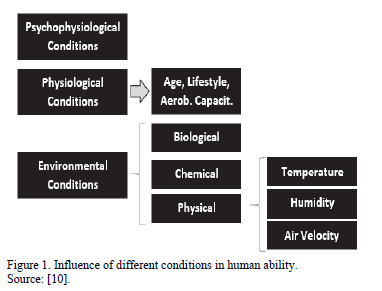
<body><![CDATA[<p><font size="2" face="Verdana, Arial, Helvetica, sans-serif"><b><i>1.1. Occupational risk and thermal  environmental </i></b></font></p>     <p><font size="2" face="Verdana, Arial, Helvetica, sans-serif">The economic and social development that  has taken place throughout the 20th century has been accompanied by a greater  awareness of work safety and health problems and also by the development of  protective measures for workers. The objective has been to minimize risk.  Despite these efforts, there are still working situations that can be very  harmful to workers' safety and health. One of these situations is related to  workers who perform activities in &quot;extreme&quot; thermal environments, even if these  are sedentary activities. </font></p>     <p><font size="2" face="Verdana, Arial, Helvetica, sans-serif">It is pertinent to assess the  relationship between thermal </font><font size="2" face="Verdana, Arial, Helvetica, sans-serif">environment and  cognitive capacity since all human activity is influenced by the surrounding  environment, including working activities. This allows the question of how  thermal environment influences human being's responsiveness to be clarified.  Over the course of undertaking this research, we found several studies on the  subject that have been performed in controlled environments, such as climatic  chambers &#91;1-5&#93;. Furthermore some of the relevant literature &#91;6,7&#93; states that  thermal environment can have a negative impact on performance, particularly  when combined with other variables such as exposition time or task duration.</font></p>     <p><font size="2" face="Verdana, Arial, Helvetica, sans-serif">With increased technological development  the workplace assumes a greater complexity. This increased complexity often  brings additional risks for workers. Increasing technological complexity  requires, from the worker, an increased cognitive performance, which may be  jeopardized due to an inadequate thermal environment.</font></p>     <p><font size="2" face="Verdana, Arial, Helvetica, sans-serif"><b><i>1.2. Influence of environment in human ability</i></b></font></p>     <p><font size="2" face="Verdana, Arial, Helvetica, sans-serif">The way that each individual feels the  surrounding environment is influenced by intrinsic and extrinsic factors from  the individual himself &#91;8,9&#93;. Tolerance to environment depends directly on,  among others factors, age, aerobic capacity, hours of rest, lifestyle and  consumption of medicines. These factors can be classified as shown in <a href="#fig01">Fig. 1</a>. </font></p>     <p align="center"><font size="2" face="Verdana, Arial, Helvetica, sans-serif"> <a name="fig01"></a></font><img src="/img/revistas/dyna/v83n197/v83n197a12fig01.gif"></p>     <p><font size="2" face="Verdana, Arial, Helvetica, sans-serif">All of these strongly influence the  feeling of well-being. The psychophysiological and physiological factors mean  that different individuals in similar environmental conditions feel the  conditions to which they are exposed differently.</font></p>     <p><font size="2" face="Verdana, Arial, Helvetica, sans-serif"><b><i>1.3. Characterization and  interpretation of brain waves</i></b></font></p>     <p><font size="2" face="Verdana, Arial, Helvetica, sans-serif">Monitorization and interpretation of  brain waves can clarify how cognitive capacity is influenced by the thermal  environment. The different types of brain waves / activities are:</font></p> <ul>       ]]></body>
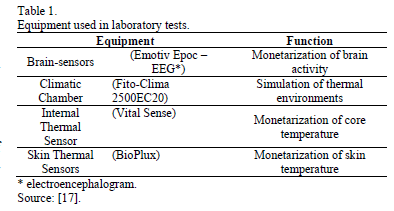
<body><![CDATA[<li><font size="2" face="Verdana, Arial, Helvetica, sans-serif"><i>Delta Activity</i>- is referred to as a     &quot;slow wave&quot;; it is in the frequency range between 0.5 Hz and 4 Hz.     This type of activity is recorded in the transitional phase for sleep and     during sleep &#91;11&#93;.</font></li>       <li><font size="2" face="Verdana, Arial, Helvetica, sans-serif"><i>Teta Frequency</i>- this lies between 4 Hz     and 7 Hz. Itis associated with different psychological states, which include     low levels of alertness and, consequently, is associated with the decrease in     the capacity to process information. Theta frequency can also be considered a     &quot;slow wave&quot; &#91;12&#93;.</font></li>       <li><font size="2" face="Verdana, Arial, Helvetica, sans-serif"><i>Alpha waves</i>- This type is dominant in     adult human brains, and has a frequency of between 8 Hz and 13 Hz. The waves'     presence is common in the occipital cortex, during the period of wakefulness.     Whenever the eyes are closed, the presence of this type of waves is common.     When head wavers due to fatigue occurs, and when trying to be aware, Alpha wave     activity decreases &#91;11&#93;. The presence of these waves during when the individual     is awake and in a state of relaxation, leads to a slow response to stimuli     &#91;13&#93;.</font></li>       <li><font size="2" face="Verdana, Arial, Helvetica, sans-serif"><i>Beta waves</i>- These have a frequency of     between 13 Hz and 30 Hz, which indicates a high propagation speed. Their     presence is associated with a state of arousal/alert. Beta activity can occur     in humans while performing a motor task that requires high reaction time &#91;14&#93;.</font></li>     </ul>     <p><font size="2" face="Verdana, Arial, Helvetica, sans-serif">This study aims to contribute by  establishing a relationship between thermal environment, and the signal  amplitude of brain waves (Alpha and Beta), in particular the cognitive  performance of individuals under uncomfortable environmental conditions.</font></p>     <p>&nbsp;</p>     <p><font size="3" face="Verdana, Arial, Helvetica, sans-serif"><b>2. Materials and Method</b></font></p>     <p><font size="2" face="Verdana, Arial, Helvetica, sans-serif"><b><i>2.1. Main equipment</i></b></font></p>     <p><font size="2" face="Verdana, Arial, Helvetica, sans-serif">Monitoring and data collection was done  using specific equipment. <a href="#tab01">Table 1</a> presents the equipment that was used and its  respective functions. After all the equipment &#91;15&#93; to be used was selected,  each piece was tested and validated under trial protocol &#91;16&#93;.</font></p>     ]]></body>
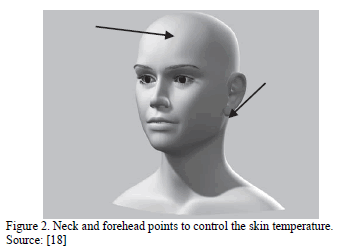
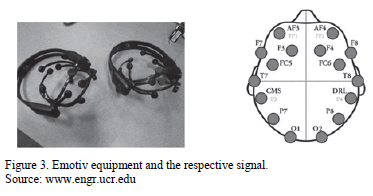
<body><![CDATA[<p align="center"><font size="2" face="Verdana, Arial, Helvetica, sans-serif"><a name="tab01"></a></font><img src="/img/revistas/dyna/v83n197/v83n197a12tab01.gif"></p>     <p><font size="2" face="Verdana, Arial, Helvetica, sans-serif"><b><i>2.2. General trial conditions</i></b></font></p>     <p><font size="2" face="Verdana, Arial, Helvetica, sans-serif">The relationship between cognitive  capacity, thermal environment and brain waves was evaluated by performing  experimental trials with 10 male volunteers. Their ages were between 18 and 36  years old, with an average of 26±6 years.</font></p>     <p><font size="2" face="Verdana, Arial, Helvetica, sans-serif">In these trials, each volunteer performed  two cognitive tests. The first was held at 18ºC - 40% RH, and  the second was done seven days later at 35ºC - 80% RH. All the  trials were performed between 6:00 pm and 8:00 pm. The operating conditions  were simulated within a Climate Chamber with an error of ±1ºC and ±2% RH.</font></p>     <p><font size="2" face="Verdana, Arial, Helvetica, sans-serif">Each volunteer was submitted to each one  of the environmental conditions for 60 minutes after a stabilization period of  20 minutes outside the chamber (in the laboratory) at a temperature between  20ºC and 22ºC and a relative humidity between 55% RH and 65% RH.  After this period, the volunteer who entered the climatic chamber waited for 10  minutes under environmental test conditions before beginning the essay. These  10 minutes were used to install an EEG device on the volunteer's head. The  total time for each experiment was 90 minutes. Control of skin temperature was  undertaken at two points, one on the neck and the other on the forehead of the  volunteer, as shown in <a href="#fig02">Fig. 2</a>. In all the tests, all volunteers were dressed  with 0,7 clo.</font></p>     <p align="center"><font size="2" face="Verdana, Arial, Helvetica, sans-serif"><a name="fig02"></a></font><img src="/img/revistas/dyna/v83n197/v83n197a12fig02.gif"></p>     <p><font size="2" face="Verdana, Arial, Helvetica, sans-serif">For the trials at  35ºC - 80% RH, core temperature was also controlled. In total  were conducted 20 tests. Skin temperature allowed individual stabilization to  be controlled. Core temperature allows signs of thermal stress to be  identified, especially when the organism was exposed to high temperatures  (35ºC - 80% RH) &#91;19&#93;. This monitoring also allows the risks of  excessive exposure to heat to be minimized.</font></p>     <p><font size="2" face="Verdana, Arial, Helvetica, sans-serif">To evaluate brain activity we used a  specific interface (brain computer interface) that allowed Alpha and Beta waves  to be registered. Only brain waves from  the left and right occipital were studied. The occipital lobe is related to the  visual sense and to the ability to process information and understanding its  contents. </font></p>     <p><font size="2" face="Verdana, Arial, Helvetica, sans-serif">All selected volunteers were male. To obtain  a high-quality signal, all electrodes must be connected (in green), as is shown  in <a href="#fig03">Fig. 3</a>.</font></p>     <p align="center"><font size="2" face="Verdana, Arial, Helvetica, sans-serif"><a name="fig03"></a></font><img src="/img/revistas/dyna/v83n197/v83n197a12fig03.gif"></p>     ]]></body>
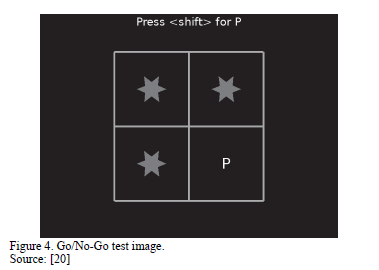
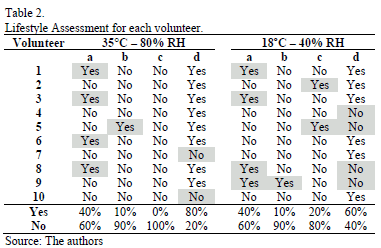
<body><![CDATA[<p><font size="2" face="Verdana, Arial, Helvetica, sans-serif">Volunteers' cognitive capacity was  stimulated by performing a &quot;game/task&quot;. Each individual had to follow  the given  instructions. Each volunteer undertook a one hour task, in this case, the Go /  No-Go test &#91;20&#93; (<a href="#fig04">Fig. 4</a>) and completed it as successfully as possible. Go/No-Go  is a selective attention test that does not have learning effects over the  results as is totally random.</font></p>     <p align="center"><font size="2" face="Verdana, Arial, Helvetica, sans-serif"><a name="fig04"></a></font><img src="/img/revistas/dyna/v83n197/v83n197a12fig04.gif"></p>     <p><font size="2" face="Verdana, Arial, Helvetica, sans-serif">Before starting the test, we explained  what we intended to happen and the risks to the volunteer and an informed  consent was signed. The study was approved by the Ethics Committee of the  University of Porto (nº04 CEUP/2012).</font></p>     <p><font size="2" face="Verdana, Arial, Helvetica, sans-serif"><b><i>2.3. Questionnaires</i></b></font></p>     <p><font size="2" face="Verdana, Arial, Helvetica, sans-serif">Before entering the Climate Chamber the  volunteer answered 4 questions in order to assess their lifestyle, namely: <b>a</b> -Ingested caffeinated drinks in the  last 12 hours?; <b>b</b> -Ingested  alcoholic drinks in the last 12 hours?; <b>c</b> - Any medicine taken?; <b>d</b> - Good  overnight rest? </font></p>     <p><font size="2" face="Verdana, Arial, Helvetica, sans-serif">These questions are relevant as they  allow us to know if the volunteer is tired at the beginning of the test and,  therefore, if task performance could be affected by other factors in addition  to temperature and humidity.</font></p>     <p><font size="2" face="Verdana, Arial, Helvetica, sans-serif">Once the test was completed (1 hour), all  the equipment was turned off, and the volunteer leaves the Climatic Chamber.</font></p>     <p>&nbsp;</p>     <p><font size="3" face="Verdana, Arial, Helvetica, sans-serif"><b>3. Results and discussion</b></font></p>     <p><font size="2" face="Verdana, Arial, Helvetica, sans-serif"><b><i>3.1. Lifestyle</i></b></font></p>     ]]></body>
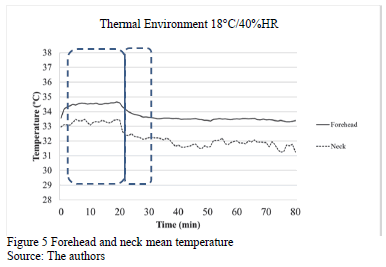
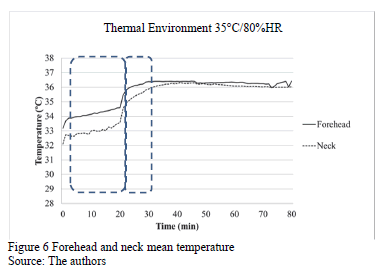
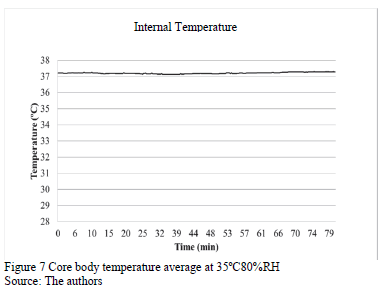
<body><![CDATA[<p><font size="2" face="Verdana, Arial, Helvetica, sans-serif">The answers given by the  volunteers about their lifestyle before starting the tests helped to interpret  the results (<a href="#tab02">Table 2</a>). Lifestyle can interfere with the results, for example,  disguising fatigue (coffee) or reducing concentration power (alcohol). </font></p>     <p align="center"><font size="2" face="Verdana, Arial, Helvetica, sans-serif"><a name="tab02"></a></font><img src="/img/revistas/dyna/v83n197/v83n197a12tab02.gif"></p>     <p><font size="2" face="Verdana, Arial, Helvetica, sans-serif">Although some volunteers had a lifestyle  that may influence the results (gray in <a href="#tab02">Table 2</a>), i.e. inserting biases in the  results, we decided to include them if they are usual consumers of small doses.</font></p>     <p><font size="2" face="Verdana, Arial, Helvetica, sans-serif"><b><i>3.2. Skin and core body  temperature</i></b></font></p>     <p><font size="2" face="Verdana, Arial, Helvetica, sans-serif"><a href="#fig05">Fig. 5</a> shows the evolution of  the skin temperature average in the forehead and neck at  18ºC - 40% RH for the ten volunteers. <a href="#fig06">Fig. 6</a> shows the evolution  of skin temperature average at 35ºC - 80% RH at the same skin points. In both environments,  skin temperature stabilizes. This level is clearer on the forehead and for hot  temperatures. It is also interesting to notice that in hot environments, on  both control points, neck and forehead, the temperature value has almost the  same value after stabilization.</font></p>     <p align="center"><font size="2" face="Verdana, Arial, Helvetica, sans-serif"><a name="fig05"></a></font><img src="/img/revistas/dyna/v83n197/v83n197a12fig05.gif"></p>     <p align="center"><font size="2" face="Verdana, Arial, Helvetica, sans-serif"><a name="fig06"></a></font><img src="/img/revistas/dyna/v83n197/v83n197a12fig06.gif"></p>     <p><font size="2" face="Verdana, Arial, Helvetica, sans-serif">The core body temperature that was  measured only in the hot environment (35ºC - 80% RH) shows a  great stability over time (<a href="#fig07">Fig. 7</a>).</font></p>     <p align="center"><font size="2" face="Verdana, Arial, Helvetica, sans-serif"><a name="fig07"></a></font><img src="/img/revistas/dyna/v83n197/v83n197a12fig07.gif"></p>     <p><font size="2" face="Verdana, Arial, Helvetica, sans-serif"><b><i>3.3. Brain activity </i></b></font></p>     ]]></body>
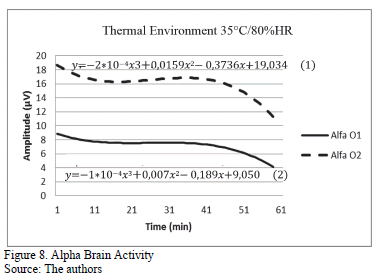
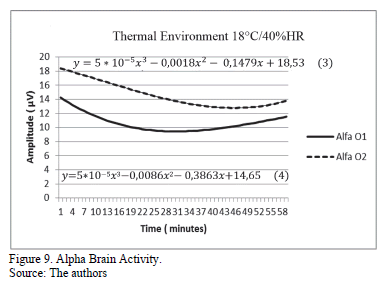
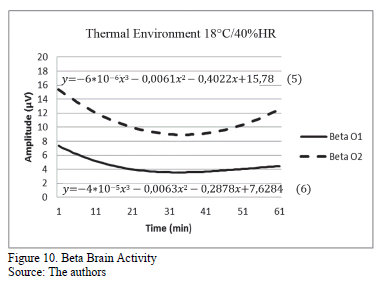
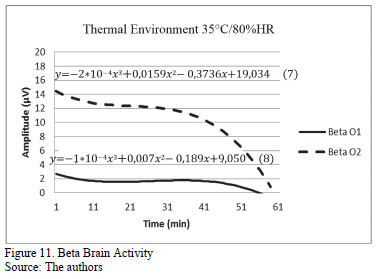
<body><![CDATA[<p><font size="2" face="Verdana, Arial, Helvetica, sans-serif"><a href="#fig08">Figs. 8</a> to 11 represent the average  results for recorded brain activity. When <a href="#fig08">Figs. 8</a> and <a href="#fig09">9</a> are compared with the  <a href="#fig10">Figs. 10</a> and <a href="#fig11">11</a>, it is possible to confirm thermal environmental influence on  brain activity (Alpha and Beta waves' amplitude). For the colder environment  (18ºC - 40% RH) Alpha activity is far superior to that obtained in the hot  environment (35ºC - 80% RH). This excludes the  occasionally-raised hypothesis that the perspiration is the main cause of the  occurrence of high values of the EEG signal for hot environments. </font></p>     <p align="center"><font size="2" face="Verdana, Arial, Helvetica, sans-serif"><a name="fig08"></a></font><img src="/img/revistas/dyna/v83n197/v83n197a12fig08.gif"></p>     <p align="center"><font size="2" face="Verdana, Arial, Helvetica, sans-serif"><a name="fig09"></a></font><img src="/img/revistas/dyna/v83n197/v83n197a12fig09.gif"></p>     <p align="center"><font size="2" face="Verdana, Arial, Helvetica, sans-serif"><a name="fig10"></a></font><img src="/img/revistas/dyna/v83n197/v83n197a12fig10.gif"></p>     <p align="center"><font size="2" face="Verdana, Arial, Helvetica, sans-serif"><a name="fig11"></a></font><img src="/img/revistas/dyna/v83n197/v83n197a12fig11.gif"></p>     <p><font size="2" face="Verdana, Arial, Helvetica, sans-serif">In a state of wakefulness in which the  volunteers are concentrated (eyes open), Alpha activity is usually small. As  individuals become fatigued Alpha, activity is expected to increase. However,  when time goes on, in the case of the trials at 35ºC - 80% RH  (<a href="#fig08">Fig. 8</a>), only a small decrease in Alpha activity can be observed, which does  not verify the expected trend. For the trials at 18ºC and 40% RH (<a href="#fig09">Fig. 9</a>),  there is a decrease in Alpha activity in the first part of the test (20-30 min);  this then increases until Alpha activity maintains values that are close to the  initial values. The increase in Alpha activity suggests an increase of  tiredness/fatigue in the volunteers. </font></p>     <p><font size="2" face="Verdana, Arial, Helvetica, sans-serif">Another relevant fact is the discrepancy  of activity between the right and left brain hemispheres for  hot thermal environments. In the left area of the brain (occipital 1) the range  values activity is between 4-9 µV while in right area (occipital 2) this range  rises to 11-19 µV (<a href="#fig08">Fig. 8</a>). It seems that in a hot thermal environment the  temperature and relative humidity affect the left and right hemispheres differently.</font></p>     <p><font size="2" face="Verdana, Arial, Helvetica, sans-serif">According to several studies &#91;11&#93;, Beta  activity is considered the one that best describes alertness/arousal.</font></p>     <p><font size="2" face="Verdana, Arial, Helvetica, sans-serif">In a cold thermal environment, Beta  activity is typically higher than the activity verified for the hot thermal  environment.</font></p>     <p><font size="2" face="Verdana, Arial, Helvetica, sans-serif">It is usually considered that a decrease  in Beta activity is related to the loss of the ability to concentration  (reduction of surveillance), which was be verified throughout the trial. It is  therefore possible to consider that cold thermal environments (<a href="#fig10">Fig. 10</a>) are  conducive to higher levels of concentration/alertness than hot environments  (<a href="#fig11">Fig. 11</a>).</font></p> <font size="2" face="Verdana, Arial, Helvetica, sans-serif">When comparing the activity between left side and right side  of the brain, the activity in the occipital 1 (left) is lower than the one  verified in occipital 2 (right).</font>     ]]></body>
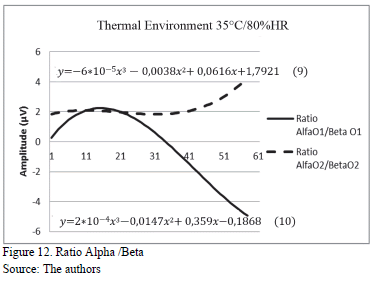
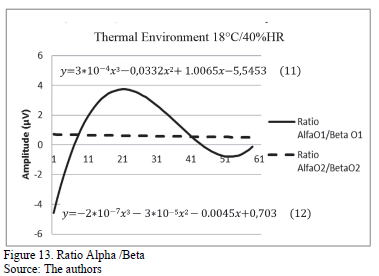
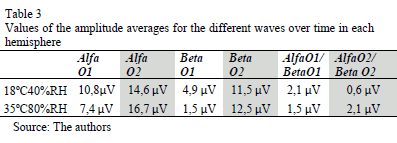
<body><![CDATA[<p><font size="2" face="Verdana, Arial, Helvetica, sans-serif">After analyzing the data of brain  activity for the two frequency bands (<i>Alpha</i> and <i>Beta</i>) it is possible to calculate  the <i>Alpha</i>/<i>Beta</i> ratio. This ratio is developed to relate the two </font><font size="2" face="Verdana, Arial, Helvetica, sans-serif">most relevant  frequencies, which facilitates understanding of the evolution of individual's  cognitive state.</font></p>     <p><font size="2" face="Verdana, Arial, Helvetica, sans-serif">With the  analysis of the Alpha /Beta ratio, it is possible to observe the evolution of  fatigue/tiredness over time. Theoretically an increase in fatigue levels over  the trial time is expected, and the consequent tendency is to increase the  Alpha/Beta values ratio.</font></p>     <p><font size="2" face="Verdana, Arial, Helvetica, sans-serif">However, this expectation was only  applied to the occipital 2 for 35ºC - 80% RH (<a href="#fig12">Fig. 12</a>) and  very dimly at the end of the test in the cold thermal environment in occipital  1 (<a href="#fig13">Fig. 13</a>).</font></p>     <p align="center"><font size="2" face="Verdana, Arial, Helvetica, sans-serif"><a name="fig12"></a></font><img src="/img/revistas/dyna/v83n197/v83n197a12fig12.gif"></p>     <p align="center"><font size="2" face="Verdana, Arial, Helvetica, sans-serif"><a name="fig13"></a></font><img src="/img/revistas/dyna/v83n197/v83n197a12fig13.gif"></p>     <p><font size="2" face="Verdana, Arial, Helvetica, sans-serif">Interpreting <i>Alpha</i> and <i>Beta</i> wave  activity still lacks scientific unanimity. It is commonplace that different studies reveal completely diverse results and  interpretations. Some authors report that Alpha waves show changes at different  temperature &#91;21&#93;, and others report that alpha and beta increase at either 17ºC  or 28ºC &#91;4&#93;.</font></p>     <p><font size="2" face="Verdana, Arial, Helvetica, sans-serif">A comparison of both hemispheres can be  seen in <a href="#tab03">Table 3</a>; when the average amplitude of <i>Alpha</i> waves increases, there is a decrease in the amplitude of <i>Beta</i> waves. This concurs with Eoh et  al.'s results &#91;22&#93;.</font></p>     <p align="center"><font size="2" face="Verdana, Arial, Helvetica, sans-serif"><a name="tab03"></a></font><img src="/img/revistas/dyna/v83n197/v83n197a12tab03.gif"></p>     <p>&nbsp;</p>     <p><font size="3" face="Verdana, Arial, Helvetica, sans-serif"><b>4. Conclusions</b></font></p>     ]]></body>
<body><![CDATA[<p><font size="2" face="Verdana, Arial, Helvetica, sans-serif">In hot thermal environment <i>Alpha</i> activity tends to decrease over  the course of the task/test, for both areas of the occipital lobe. In the cold  thermal environment, <i>Alpha</i> activity  decreases for half the time of the test (30 min) and then rises, showing an  increase for both areas of the occipital lobe. This means that a bigger effort  was made.</font></p>     <p><font size="2" face="Verdana, Arial, Helvetica, sans-serif"><i>Beta</i> activity for the hot thermal environment is quite small on the left  side of the occipital lobe (<a href="#fig10">Fig. 10</a> and <a href="#tab03">Table 3</a>); a downward activity is shown  as the task was being developed. In tests undertaken in a cold thermal  environment, <i>Beta</i> activity decreases  for approximately half of the test time (30 min), and then it tends to increase  at the end of the trials.</font></p>     <p><font size="2" face="Verdana, Arial, Helvetica, sans-serif">The results support the idea that the  different areas of the brain, in this case the left and right occipital lobes,  are affected differently by the same environmental conditions. </font></p>     <p>&nbsp;</p>     <p><font size="3" face="Verdana, Arial, Helvetica, sans-serif"><b>Acknowledgements</b></font></p>     <p><font size="2" face="Verdana, Arial, Helvetica, sans-serif">The authors acknowledge the Master's  program in Occupational Safety and Hygiene Engineering at the Faculty of  Engineering, University of Porto, and the Research Laboratory on Prevention of  Occupational and Environmental Risks (PROA) for their financial support.</font></p>     <p>&nbsp;</p>     <p><font size="3" face="Verdana, Arial, Helvetica, sans-serif"><b>References</b></font></p>     <!-- ref --><p><font size="2" face="Verdana, Arial, Helvetica, sans-serif"><b>&#91;1&#93;</b> Gaoua, N., Racinais, S.,  Grantham, J. and El Massioui, F., Alterations in cognitive performance during  passive hyperthermia are task dependent. International Journal of Hyperthermia,  27(1), pp 1-9. 2011. DOI: 10.3109/02656736.2010.516305</font>&nbsp;&nbsp;&nbsp;&nbsp;&nbsp;&nbsp;&nbsp;&nbsp;[&#160;<a href="javascript:void(0);" onclick="javascript: window.open('/scielo.php?script=sci_nlinks&ref=1130004&pid=S0012-7353201600030001200001&lng=','','width=640,height=500,resizable=yes,scrollbars=1,menubar=yes,');">Links</a>&#160;]<!-- end-ref --><!-- ref --><p><font size="2" face="Verdana, Arial, Helvetica, sans-serif"><b>&#91;2&#93;</b> Hashiguchi, N., Feng, Y., and  Tochihara, Y., Gender differences in thermal comfort and mental performance at  different vertical air temperatures. European Journal of Applied Physiology,  109(1), pp 41-48, 2010. DOI: 10.1007/s00421-009-1158-7</font>&nbsp;&nbsp;&nbsp;&nbsp;&nbsp;&nbsp;&nbsp;&nbsp;[&#160;<a href="javascript:void(0);" onclick="javascript: window.open('/scielo.php?script=sci_nlinks&ref=1130005&pid=S0012-7353201600030001200002&lng=','','width=640,height=500,resizable=yes,scrollbars=1,menubar=yes,');">Links</a>&#160;]<!-- end-ref --><!-- ref --><p><font size="2" face="Verdana, Arial, Helvetica, sans-serif"><b>&#91;3&#93;</b> Lan, L., Lian, Z., Pan, L. and  Ye, Q., Neurobehavioral approach for evaluation of office workers'  productivity: The effects of room temperature. Building and Environment, 44(8),  pp. 1578-1588 2009. DOI: 10.1016/j.buildenv.2008.10.004</font>&nbsp;&nbsp;&nbsp;&nbsp;&nbsp;&nbsp;&nbsp;&nbsp;[&#160;<a href="javascript:void(0);" onclick="javascript: window.open('/scielo.php?script=sci_nlinks&ref=1130006&pid=S0012-7353201600030001200003&lng=','','width=640,height=500,resizable=yes,scrollbars=1,menubar=yes,');">Links</a>&#160;]<!-- end-ref --><!-- ref --><p><font size="2" face="Verdana, Arial, Helvetica, sans-serif"><b>&#91;4&#93;</b> Lan, L., Lian, Z. and Pan, L.,  The effects of air temperature on office workers' wellbeing, workload and  productivity-evaluated with subjective ratings. Appl Ergon, 42(1), pp. 29-36  2010. DOI: 10.1016/j.apergo.2010.04.003</font>&nbsp;&nbsp;&nbsp;&nbsp;&nbsp;&nbsp;&nbsp;&nbsp;[&#160;<a href="javascript:void(0);" onclick="javascript: window.open('/scielo.php?script=sci_nlinks&ref=1130007&pid=S0012-7353201600030001200004&lng=','','width=640,height=500,resizable=yes,scrollbars=1,menubar=yes,');">Links</a>&#160;]<!-- end-ref --><!-- ref --><p><font size="2" face="Verdana, Arial, Helvetica, sans-serif"><b>&#91;5&#93;</b> Racinais, S., Gaoua, N. and  Grantham, J., Hyperthermia impairs short-term memory and peripheral motor drive  transmission. J Physiol, 586, pp. 4751-4762, 2008. DOI: 10.1113/jphysiol.2008.157420</font>&nbsp;&nbsp;&nbsp;&nbsp;&nbsp;&nbsp;&nbsp;&nbsp;[&#160;<a href="javascript:void(0);" onclick="javascript: window.open('/scielo.php?script=sci_nlinks&ref=1130008&pid=S0012-7353201600030001200005&lng=','','width=640,height=500,resizable=yes,scrollbars=1,menubar=yes,');">Links</a>&#160;]<!-- end-ref --><!-- ref --><p><font size="2" face="Verdana, Arial, Helvetica, sans-serif"><b>&#91;6&#93;</b> Pilcher, J.J., Nadler, E. and  Busch, C., Effects of hot and cold temperature exposure on performance: a  meta-analytic review. Ergonomics, 45, pp.682-698, 2002. DOI: 10.1080/00140130210158419</font>&nbsp;&nbsp;&nbsp;&nbsp;&nbsp;&nbsp;&nbsp;&nbsp;[&#160;<a href="javascript:void(0);" onclick="javascript: window.open('/scielo.php?script=sci_nlinks&ref=1130009&pid=S0012-7353201600030001200006&lng=','','width=640,height=500,resizable=yes,scrollbars=1,menubar=yes,');">Links</a>&#160;]<!-- end-ref --><!-- ref --><p><font size="2" face="Verdana, Arial, Helvetica, sans-serif"><b>&#91;7&#93;</b> Gaoua, N., Cognitive function in  hot environments: A question of methodology. Scand J Med Sci Sports, 20, pp.  60-70, 2010. DOI: 10.1111/j.1600-0838.2010.01210.x</font>&nbsp;&nbsp;&nbsp;&nbsp;&nbsp;&nbsp;&nbsp;&nbsp;[&#160;<a href="javascript:void(0);" onclick="javascript: window.open('/scielo.php?script=sci_nlinks&ref=1130010&pid=S0012-7353201600030001200007&lng=','','width=640,height=500,resizable=yes,scrollbars=1,menubar=yes,');">Links</a>&#160;]<!-- end-ref --><!-- ref --><p><font size="2" face="Verdana, Arial, Helvetica, sans-serif"><b>&#91;8&#93;</b> Guedes, J.C., Costa, E.Q. and  Baptista, J.S., EAT 2012 Book of Proceedings - Appendix 1 of Thermology  International pp. 22-23. 2012.    &nbsp;&nbsp;&nbsp;&nbsp;&nbsp;&nbsp;&nbsp;&nbsp;[&#160;<a href="javascript:void(0);" onclick="javascript: window.open('/scielo.php?script=sci_nlinks&ref=1130011&pid=S0012-7353201600030001200008&lng=','','width=640,height=500,resizable=yes,scrollbars=1,menubar=yes,');">Links</a>&#160;]<!-- end-ref --></font></p>     <!-- ref --><p><font size="2" face="Verdana, Arial, Helvetica, sans-serif"><b>&#91;9&#93;</b> Costa, E.Q., Baptista, J.S. and  Tato, M.D., Effects of thermal environment on cognitive response in sedentary  activities. A revision. Faculdade  de Engenharia da Universidade do Porto, Portugal, 2012.    &nbsp;&nbsp;&nbsp;&nbsp;&nbsp;&nbsp;&nbsp;&nbsp;[&#160;<a href="javascript:void(0);" onclick="javascript: window.open('/scielo.php?script=sci_nlinks&ref=1130013&pid=S0012-7353201600030001200009&lng=','','width=640,height=500,resizable=yes,scrollbars=1,menubar=yes,');">Links</a>&#160;]<!-- end-ref --></font></p>     <!-- ref --><p><font size="2" face="Verdana, Arial, Helvetica, sans-serif"><b>&#91;10&#93;</b> Costa, E.,  Correlação entre sinais das ondas cerebrais e a carga cognitiva em ambientes  t&eacute;rmicos extremos controlados, MSc. Thesis, Departamento de Segurança e Higiene  Ocupacionais, Universidade do Porto, Porto, Portugal, 2014.    &nbsp;&nbsp;&nbsp;&nbsp;&nbsp;&nbsp;&nbsp;&nbsp;[&#160;<a href="javascript:void(0);" onclick="javascript: window.open('/scielo.php?script=sci_nlinks&ref=1130015&pid=S0012-7353201600030001200010&lng=','','width=640,height=500,resizable=yes,scrollbars=1,menubar=yes,');">Links</a>&#160;]<!-- end-ref --></font></p>     <!-- ref --><p><font size="2" face="Verdana, Arial, Helvetica, sans-serif"><b>&#91;11&#93;</b> Lal, S.K.L. and Craig, A., A  critical review of the psychophysiology of driver fatigue, Biological  Psychology 55, pp. 173-194, 2001. DOI: 10.1016/S0301-0511(00)00085-5</font>&nbsp;&nbsp;&nbsp;&nbsp;&nbsp;&nbsp;&nbsp;&nbsp;[&#160;<a href="javascript:void(0);" onclick="javascript: window.open('/scielo.php?script=sci_nlinks&ref=1130017&pid=S0012-7353201600030001200011&lng=','','width=640,height=500,resizable=yes,scrollbars=1,menubar=yes,');">Links</a>&#160;]<!-- end-ref --><!-- ref --><p><font size="2" face="Verdana, Arial, Helvetica, sans-serif"><b>&#91;12&#93;</b> Fisch, B.J., Fisch and  Spehlmann's EEG primer: Basic principles of digital and analog EEG. 3rd ed.,  Elsevier, USA, 2000.    &nbsp;&nbsp;&nbsp;&nbsp;&nbsp;&nbsp;&nbsp;&nbsp;[&#160;<a href="javascript:void(0);" onclick="javascript: window.open('/scielo.php?script=sci_nlinks&ref=1130018&pid=S0012-7353201600030001200012&lng=','','width=640,height=500,resizable=yes,scrollbars=1,menubar=yes,');">Links</a>&#160;]<!-- end-ref --> </font></p>     <!-- ref --><p><font size="2" face="Verdana, Arial, Helvetica, sans-serif"><b>&#91;13&#93;</b> Grandjean, E., Fitting the task  to the man. Taylor and Francis, London, UK, 1988.    &nbsp;&nbsp;&nbsp;&nbsp;&nbsp;&nbsp;&nbsp;&nbsp;[&#160;<a href="javascript:void(0);" onclick="javascript: window.open('/scielo.php?script=sci_nlinks&ref=1130020&pid=S0012-7353201600030001200013&lng=','','width=640,height=500,resizable=yes,scrollbars=1,menubar=yes,');">Links</a>&#160;]<!-- end-ref --> </font></p>     <!-- ref --><p><font size="2" face="Verdana, Arial, Helvetica, sans-serif"><b>&#91;14&#93;</b> Sheer, D.E., A working  cognitive model of attention to fit in the brain and in the clinic. Academic  Press, USA, 1988.    &nbsp;&nbsp;&nbsp;&nbsp;&nbsp;&nbsp;&nbsp;&nbsp;[&#160;<a href="javascript:void(0);" onclick="javascript: window.open('/scielo.php?script=sci_nlinks&ref=1130022&pid=S0012-7353201600030001200014&lng=','','width=640,height=500,resizable=yes,scrollbars=1,menubar=yes,');">Links</a>&#160;]<!-- end-ref --></font></p>     <!-- ref --><p><font size="2" face="Verdana, Arial, Helvetica, sans-serif"><b>&#91;15&#93;</b> Costa, E.Q. and Baptista, J.S.,  Thermal environment and cognitive performance: Parameters and equipment,  in: Arezes et al., eds. Occupational  Safety and Hygiene -Taylor &amp; Francis Group, London, UK, 2013. DOI: 0.1201/b14391-55</font>&nbsp;&nbsp;&nbsp;&nbsp;&nbsp;&nbsp;&nbsp;&nbsp;[&#160;<a href="javascript:void(0);" onclick="javascript: window.open('/scielo.php?script=sci_nlinks&ref=1130024&pid=S0012-7353201600030001200015&lng=','','width=640,height=500,resizable=yes,scrollbars=1,menubar=yes,');">Links</a>&#160;]<!-- end-ref --><!-- ref --><p><font size="2" face="Verdana, Arial, Helvetica, sans-serif"><b>&#91;16&#93;</b> Costa, EQ, Santos-Baptista, J.,  Couto1, D., Torres-Costa, J., Diogo, M.T., Almeida, P., Chaves, P., Carvalho,  J. and Ponce L., Test protocol validation for thermal environment and cognitive  performance. IRFMS, 2013.    &nbsp;&nbsp;&nbsp;&nbsp;&nbsp;&nbsp;&nbsp;&nbsp;[&#160;<a href="javascript:void(0);" onclick="javascript: window.open('/scielo.php?script=sci_nlinks&ref=1130025&pid=S0012-7353201600030001200016&lng=','','width=640,height=500,resizable=yes,scrollbars=1,menubar=yes,');">Links</a>&#160;]<!-- end-ref --></font></p>     <!-- ref --><p><font size="2" face="Verdana, Arial, Helvetica, sans-serif"><b>&#91;17&#93;</b> Costa, E.T., Costa, E.Q. and Baptista,  J.S., Changes in the brain waves' sign with thermal environment, in: Arezes et  al., eds., Occupational Safety and Hygiene -Taylor &amp; Francis Group, London,  UK, 2015.    &nbsp;&nbsp;&nbsp;&nbsp;&nbsp;&nbsp;&nbsp;&nbsp;[&#160;<a href="javascript:void(0);" onclick="javascript: window.open('/scielo.php?script=sci_nlinks&ref=1130027&pid=S0012-7353201600030001200017&lng=','','width=640,height=500,resizable=yes,scrollbars=1,menubar=yes,');">Links</a>&#160;]<!-- end-ref --></font></p>     <!-- ref --><p><font size="2" face="Verdana, Arial, Helvetica, sans-serif"><b>&#91;18&#93;</b> <a href="http://www.secondpicture.com/tutorials/3d/3d_modeling_of_a_human_head_3ds_max_01.html" target="_blank">http://www.secondpicture.com/tutorials/3d/3d_modeling_of_a_human_head_3ds_max_01.html</a></font>&nbsp;&nbsp;&nbsp;&nbsp;&nbsp;&nbsp;&nbsp;&nbsp;[&#160;<a href="javascript:void(0);" onclick="javascript: window.open('/scielo.php?script=sci_nlinks&ref=1130029&pid=S0012-7353201600030001200018&lng=','','width=640,height=500,resizable=yes,scrollbars=1,menubar=yes,');">Links</a>&#160;]<!-- end-ref --><!-- ref --><p><font size="2" face="Verdana, Arial, Helvetica, sans-serif"><b>&#91;19&#93;</b> Costa, E.Q. and Baptista J.S.,  Thermal environment and cognitive performance: Parameters and Equipment, n: Occupational  Safety and Hygiene. CRC Press, pp.267-272, 2013.    &nbsp;&nbsp;&nbsp;&nbsp;&nbsp;&nbsp;&nbsp;&nbsp;[&#160;<a href="javascript:void(0);" onclick="javascript: window.open('/scielo.php?script=sci_nlinks&ref=1130030&pid=S0012-7353201600030001200019&lng=','','width=640,height=500,resizable=yes,scrollbars=1,menubar=yes,');">Links</a>&#160;]<!-- end-ref --></font></p>     <!-- ref --><p><font size="2" face="Verdana, Arial, Helvetica, sans-serif"><b>&#91;20&#93;</b> Mueller, S.T., The PEBL Manual  programming and usage guide for the Psychology Experiment Building Language  PEBL Version 0.14. &#91;Online&#93;. ISBN 978-0-557-65817-6. Available at: <a href="http://pebl.sourceforge.net" target="_blank">http://pebl.sourceforge.net</a>.    &nbsp;&nbsp;&nbsp;&nbsp;&nbsp;&nbsp;&nbsp;&nbsp;[&#160;<a href="javascript:void(0);" onclick="javascript: window.open('/scielo.php?script=sci_nlinks&ref=1130032&pid=S0012-7353201600030001200020&lng=','','width=640,height=500,resizable=yes,scrollbars=1,menubar=yes,');">Links</a>&#160;]<!-- end-ref --></font></p>     <!-- ref --><p><font size="2" face="Verdana, Arial, Helvetica, sans-serif"><b>&#91;21&#93;</b> Yao, Y., Lian, Z., Liu, W. and  Shen, Q., Experimental study on physiological responses and thermal comfort  under various ambient temperatures. Physiology &amp; Behavior, 93(1-2), pp.  310-321. 2008. DOI: 10.1016/j.physbeh.2007.09.012</font>&nbsp;&nbsp;&nbsp;&nbsp;&nbsp;&nbsp;&nbsp;&nbsp;[&#160;<a href="javascript:void(0);" onclick="javascript: window.open('/scielo.php?script=sci_nlinks&ref=1130034&pid=S0012-7353201600030001200021&lng=','','width=640,height=500,resizable=yes,scrollbars=1,menubar=yes,');">Links</a>&#160;]<!-- end-ref --><!-- ref --><p><font size="2" face="Verdana, Arial, Helvetica, sans-serif"><b>&#91;22&#93;</b> Eoh, H.J., Chung, M.K. and Kim,  S.-H., Electroencephalographic study of drowsiness in simulated driving with  sleep deprivation. International Journal of Industrial Ergonomics, pp. 35(4),  pp. 307-320, 2005.    &nbsp;&nbsp;&nbsp;&nbsp;&nbsp;&nbsp;&nbsp;&nbsp;[&#160;<a href="javascript:void(0);" onclick="javascript: window.open('/scielo.php?script=sci_nlinks&ref=1130035&pid=S0012-7353201600030001200022&lng=','','width=640,height=500,resizable=yes,scrollbars=1,menubar=yes,');">Links</a>&#160;]<!-- end-ref --></font></p>     <p>&nbsp;</p>     <p><font size="2" face="Verdana, Arial, Helvetica, sans-serif"><b>E. Tiago-Costa,</b> has two MSc. degrees,  one in Environmental Engineering and the other in Occupational Safety and  Hygiene Engineering, both from the Faculty of Engineering at the University of  Porto, Portugal. He is currently a researcher in the Faculty of Engineering of  the University of Porto; Portugal. ORCID: 0000-0002-4996-1668</font></p>     <p><font size="2" face="Verdana, Arial, Helvetica, sans-serif"><b>E. Quelhas-Costa,</b> is a Chemical Engineer  and graduated from the Porto Superior Institute of Engineering. She has a MSc.  in Occupational Safety and Hygiene Engineering from the Faculty of Engineering  at the University of Porto, and a PhD in Occupational Safety and Health from U.  Porto. She is currently a researcher at the Research Laboratory on Prevention  of Occupational and Environmental Risks (PROA). ORCID: 0000-0002-3122-1127</font></p>     <p><font size="2" face="Verdana, Arial, Helvetica, sans-serif"><b>J. Santos-Baptista,</b> has a PhD in Mining  Engineering from U. Porto. He is currently an associate professor and Director  of the MSc. in Occupational Safety and Hygiene Engineering at the Faculty of  Engineering at the University of Porto, and the coordinator of the engineering  PhD program Safety and Health. He also leads the Research Laboratory on  Prevention of Occupational and Environmental Risks (PROA). ORCID: 0000-0002-8524-5503 </font></p>      ]]></body><back>
<ref-list>
<ref id="B1">
<label>1</label><nlm-citation citation-type="journal">
<person-group person-group-type="author">
<name>
<surname><![CDATA[Gaoua]]></surname>
<given-names><![CDATA[N.]]></given-names>
</name>
<name>
<surname><![CDATA[Racinais]]></surname>
<given-names><![CDATA[S.]]></given-names>
</name>
<name>
<surname><![CDATA[Grantham]]></surname>
<given-names><![CDATA[J.]]></given-names>
</name>
<name>
<surname><![CDATA[El Massioui]]></surname>
<given-names><![CDATA[F.]]></given-names>
</name>
</person-group>
<article-title xml:lang="en"><![CDATA[Alterations in cognitive performance during passive hyperthermia are task dependent.]]></article-title>
<source><![CDATA[International Journal of Hyperthermia]]></source>
<year></year>
<volume>27</volume><volume>2011</volume>
<numero>^s1</numero>
<issue>^s1</issue>
<supplement>1</supplement>
<page-range>1-9</page-range></nlm-citation>
</ref>
<ref id="B2">
<label>2</label><nlm-citation citation-type="journal">
<person-group person-group-type="author">
<name>
<surname><![CDATA[Hashiguchi]]></surname>
<given-names><![CDATA[N.]]></given-names>
</name>
<name>
<surname><![CDATA[Feng]]></surname>
<given-names><![CDATA[Y.]]></given-names>
</name>
<name>
<surname><![CDATA[Tochihara]]></surname>
<given-names><![CDATA[Y.]]></given-names>
</name>
</person-group>
<article-title xml:lang="en"><![CDATA[Gender differences in thermal comfort and mental performance at different vertical air temperatures]]></article-title>
<source><![CDATA[European Journal of Applied Physiology]]></source>
<year>2010</year>
<volume>109</volume>
<numero>1</numero>
<issue>1</issue>
<page-range>41-48</page-range></nlm-citation>
</ref>
<ref id="B3">
<label>3</label><nlm-citation citation-type="journal">
<person-group person-group-type="author">
<name>
<surname><![CDATA[Lan]]></surname>
<given-names><![CDATA[L.]]></given-names>
</name>
<name>
<surname><![CDATA[Lian]]></surname>
<given-names><![CDATA[Z.]]></given-names>
</name>
<name>
<surname><![CDATA[Pan]]></surname>
<given-names><![CDATA[L.]]></given-names>
</name>
<name>
<surname><![CDATA[Ye]]></surname>
<given-names><![CDATA[Q.]]></given-names>
</name>
</person-group>
<article-title xml:lang="en"><![CDATA[Neurobehavioral approach for evaluation of office workers' productivity: The effects of room temperature.]]></article-title>
<source><![CDATA[Building and Environment]]></source>
<year>2009</year>
<volume>44</volume>
<numero>8</numero>
<issue>8</issue>
<page-range>1578-1588</page-range></nlm-citation>
</ref>
<ref id="B4">
<label>4</label><nlm-citation citation-type="journal">
<person-group person-group-type="author">
<name>
<surname><![CDATA[Lan]]></surname>
<given-names><![CDATA[L.]]></given-names>
</name>
<name>
<surname><![CDATA[Lian]]></surname>
<given-names><![CDATA[Z.]]></given-names>
</name>
<name>
<surname><![CDATA[Pan]]></surname>
<given-names><![CDATA[L.]]></given-names>
</name>
</person-group>
<article-title xml:lang="en"><![CDATA[The effects of air temperature on office workers' wellbeing, workload and productivity-evaluated with subjective ratings]]></article-title>
<source><![CDATA[Appl Ergon]]></source>
<year>2010</year>
<volume>42</volume>
<numero>1</numero>
<issue>1</issue>
<page-range>29-36</page-range></nlm-citation>
</ref>
<ref id="B5">
<label>5</label><nlm-citation citation-type="journal">
<person-group person-group-type="author">
<name>
<surname><![CDATA[Racinais]]></surname>
<given-names><![CDATA[S.]]></given-names>
</name>
<name>
<surname><![CDATA[Gaoua]]></surname>
<given-names><![CDATA[N.]]></given-names>
</name>
<name>
<surname><![CDATA[Grantham]]></surname>
<given-names><![CDATA[J.]]></given-names>
</name>
</person-group>
<article-title xml:lang="en"><![CDATA[Hyperthermia impairs short-term memory and peripheral motor drive transmission]]></article-title>
<source><![CDATA[J Physiol]]></source>
<year>2008</year>
<numero>586</numero>
<issue>586</issue>
<page-range>4751-4762</page-range></nlm-citation>
</ref>
<ref id="B6">
<label>6</label><nlm-citation citation-type="journal">
<person-group person-group-type="author">
<name>
<surname><![CDATA[Pilcher]]></surname>
<given-names><![CDATA[J.J.]]></given-names>
</name>
<name>
<surname><![CDATA[Nadler]]></surname>
<given-names><![CDATA[E.]]></given-names>
</name>
<name>
<surname><![CDATA[Busch]]></surname>
<given-names><![CDATA[C.]]></given-names>
</name>
</person-group>
<article-title xml:lang="en"><![CDATA[Effects of hot and cold temperature exposure on performance: a meta-analytic review]]></article-title>
<source><![CDATA[Ergonomics]]></source>
<year>2002</year>
<numero>45</numero>
<issue>45</issue>
<page-range>682-698</page-range></nlm-citation>
</ref>
<ref id="B7">
<label>7</label><nlm-citation citation-type="journal">
<person-group person-group-type="author">
<name>
<surname><![CDATA[Gaoua]]></surname>
<given-names><![CDATA[N.]]></given-names>
</name>
</person-group>
<article-title xml:lang="en"><![CDATA[Cognitive function in hot environments: A question of methodology]]></article-title>
<source><![CDATA[Scand J Med Sci Sports]]></source>
<year>2010</year>
<numero>20</numero>
<issue>20</issue>
<page-range>60-70</page-range></nlm-citation>
</ref>
<ref id="B8">
<label>8</label><nlm-citation citation-type="">
<person-group person-group-type="author">
<name>
<surname><![CDATA[Guedes]]></surname>
<given-names><![CDATA[J.C.]]></given-names>
</name>
<name>
<surname><![CDATA[Costa]]></surname>
<given-names><![CDATA[E.Q.]]></given-names>
</name>
<name>
<surname><![CDATA[Baptista]]></surname>
<given-names><![CDATA[J.S.]]></given-names>
</name>
</person-group>
<source><![CDATA[EAT 2012 Book of Proceedings: Appendix 1 of Thermology International]]></source>
<year>2012</year>
<page-range>22-23</page-range></nlm-citation>
</ref>
<ref id="B9">
<label>9</label><nlm-citation citation-type="">
<person-group person-group-type="author">
<name>
<surname><![CDATA[Costa]]></surname>
<given-names><![CDATA[E.Q.]]></given-names>
</name>
<name>
<surname><![CDATA[Baptista]]></surname>
<given-names><![CDATA[J.S.]]></given-names>
</name>
<name>
<surname><![CDATA[Tato]]></surname>
<given-names><![CDATA[M.D.]]></given-names>
</name>
</person-group>
<collab>Universidade do Porto^dFaculdade de Engenharia</collab>
<source><![CDATA[Effects of thermal environment on cognitive response in sedentary activities.: A revision.]]></source>
<year>2012</year>
<publisher-loc><![CDATA[Portugal ]]></publisher-loc>
</nlm-citation>
</ref>
<ref id="B10">
<label>10</label><nlm-citation citation-type="">
<person-group person-group-type="author">
<name>
<surname><![CDATA[Costa]]></surname>
<given-names><![CDATA[E.]]></given-names>
</name>
</person-group>
<source><![CDATA[Correlação entre sinais das ondas cerebrais e a carga cognitiva em ambientes térmicos extremos controlados]]></source>
<year></year>
</nlm-citation>
</ref>
<ref id="B11">
<label>11</label><nlm-citation citation-type="journal">
<person-group person-group-type="author">
<name>
<surname><![CDATA[Lal]]></surname>
<given-names><![CDATA[S.K.L.]]></given-names>
</name>
<name>
<surname><![CDATA[Craig]]></surname>
<given-names><![CDATA[A.]]></given-names>
</name>
</person-group>
<article-title xml:lang="en"><![CDATA[A critical review of the psychophysiology of driver fatigue]]></article-title>
<source><![CDATA[Biological Psychology]]></source>
<year>2001</year>
<numero>55</numero>
<issue>55</issue>
<page-range>173-194</page-range></nlm-citation>
</ref>
<ref id="B12">
<label>12</label><nlm-citation citation-type="book">
<person-group person-group-type="author">
<name>
<surname><![CDATA[Fisch]]></surname>
<given-names><![CDATA[B.J.]]></given-names>
</name>
</person-group>
<source><![CDATA[Fisch and Spehlmann's EEG primer: Basic principles of digital and analog EEG.]]></source>
<year>2000</year>
<edition>3rd</edition>
<publisher-name><![CDATA[Elsevier]]></publisher-name>
</nlm-citation>
</ref>
<ref id="B13">
<label>13</label><nlm-citation citation-type="book">
<person-group person-group-type="author">
<name>
<surname><![CDATA[Grandjean]]></surname>
<given-names><![CDATA[E.]]></given-names>
</name>
</person-group>
<source><![CDATA[Fitting the task to the man.]]></source>
<year>1988</year>
<publisher-loc><![CDATA[London ]]></publisher-loc>
<publisher-name><![CDATA[Taylor and Francis]]></publisher-name>
</nlm-citation>
</ref>
<ref id="B14">
<label>14</label><nlm-citation citation-type="book">
<person-group person-group-type="author">
<name>
<surname><![CDATA[Sheer]]></surname>
<given-names><![CDATA[D.E.]]></given-names>
</name>
</person-group>
<source><![CDATA[A working cognitive model of attention to fit in the brain and in the clinic.]]></source>
<year>1988</year>
<publisher-name><![CDATA[Academic Press]]></publisher-name>
</nlm-citation>
</ref>
<ref id="B15">
<label>15</label><nlm-citation citation-type="book">
<person-group person-group-type="author">
<name>
<surname><![CDATA[Costa]]></surname>
<given-names><![CDATA[E.Q.]]></given-names>
</name>
<name>
<surname><![CDATA[Baptista]]></surname>
<given-names><![CDATA[J.S.]]></given-names>
</name>
</person-group>
<article-title xml:lang="en"><![CDATA[Thermal environment and cognitive performance: Parameters and equipment]]></article-title>
<person-group person-group-type="editor">
<name>
<surname><![CDATA[Arezes]]></surname>
</name>
</person-group>
<source><![CDATA[Occupational Safety and Hygiene]]></source>
<year>2013</year>
<publisher-loc><![CDATA[London ]]></publisher-loc>
<publisher-name><![CDATA[Taylor & Francis Group]]></publisher-name>
</nlm-citation>
</ref>
<ref id="B16">
<label>16</label><nlm-citation citation-type="book">
<person-group person-group-type="author">
<name>
<surname><![CDATA[Costa]]></surname>
<given-names><![CDATA[EQ]]></given-names>
</name>
<name>
<surname><![CDATA[Santos-Baptista]]></surname>
<given-names><![CDATA[J.]]></given-names>
</name>
<name>
<surname><![CDATA[Couto1]]></surname>
<given-names><![CDATA[D.]]></given-names>
</name>
<name>
<surname><![CDATA[Torres-Costa]]></surname>
<given-names><![CDATA[J.]]></given-names>
</name>
<name>
<surname><![CDATA[Diogo]]></surname>
<given-names><![CDATA[M.T.]]></given-names>
</name>
<name>
<surname><![CDATA[Almeida]]></surname>
<given-names><![CDATA[P.]]></given-names>
</name>
<name>
<surname><![CDATA[Chaves]]></surname>
<given-names><![CDATA[P.]]></given-names>
</name>
<name>
<surname><![CDATA[Carvalho]]></surname>
<given-names><![CDATA[J.]]></given-names>
</name>
<name>
<surname><![CDATA[Ponce]]></surname>
<given-names><![CDATA[L.]]></given-names>
</name>
</person-group>
<source><![CDATA[Test protocol validation for thermal environment and cognitive performance]]></source>
<year>2013</year>
<publisher-name><![CDATA[IRFMS]]></publisher-name>
</nlm-citation>
</ref>
<ref id="B17">
<label>17</label><nlm-citation citation-type="book">
<person-group person-group-type="author">
<name>
<surname><![CDATA[Costa]]></surname>
<given-names><![CDATA[E.]]></given-names>
</name>
<name>
<surname><![CDATA[Costa]]></surname>
<given-names><![CDATA[E.Q.]]></given-names>
</name>
<name>
<surname><![CDATA[Baptista]]></surname>
<given-names><![CDATA[J.S.]]></given-names>
</name>
</person-group>
<article-title xml:lang="en"><![CDATA[Changes in the brain waves' sign with thermal environment]]></article-title>
<person-group person-group-type="editor">
<name>
<surname><![CDATA[Arezes]]></surname>
</name>
</person-group>
<source><![CDATA[Occupational Safety and Hygiene]]></source>
<year>2015</year>
<publisher-loc><![CDATA[London ]]></publisher-loc>
<publisher-name><![CDATA[Taylor & Francis Group]]></publisher-name>
</nlm-citation>
</ref>
<ref id="B18">
<label>18</label><nlm-citation citation-type="">
<source><![CDATA[]]></source>
<year></year>
</nlm-citation>
</ref>
<ref id="B19">
<label>19</label><nlm-citation citation-type="book">
<person-group person-group-type="author">
<name>
<surname><![CDATA[Costa]]></surname>
<given-names><![CDATA[E.Q.]]></given-names>
</name>
<name>
<surname><![CDATA[Baptista]]></surname>
<given-names><![CDATA[J.S.]]></given-names>
</name>
</person-group>
<article-title xml:lang="en"><![CDATA[Thermal environment and cognitive performance: Parameters and Equipment]]></article-title>
<source><![CDATA[Occupational Safety and Hygiene]]></source>
<year>2013</year>
<page-range>267-272</page-range><publisher-name><![CDATA[CRC Press]]></publisher-name>
</nlm-citation>
</ref>
<ref id="B20">
<label>20</label><nlm-citation citation-type="">
<person-group person-group-type="author">
<name>
<surname><![CDATA[Mueller]]></surname>
<given-names><![CDATA[S.T.]]></given-names>
</name>
</person-group>
<source><![CDATA[The PEBL Manual programming and usage guide for the Psychology Experiment Building Language PEBL Version 0.14.]]></source>
<year></year>
</nlm-citation>
</ref>
<ref id="B21">
<label>21</label><nlm-citation citation-type="journal">
<person-group person-group-type="author">
<name>
<surname><![CDATA[Yao]]></surname>
<given-names><![CDATA[Y.]]></given-names>
</name>
<name>
<surname><![CDATA[Lian]]></surname>
<given-names><![CDATA[Z.]]></given-names>
</name>
<name>
<surname><![CDATA[Liu]]></surname>
<given-names><![CDATA[W.]]></given-names>
</name>
<name>
<surname><![CDATA[Shen]]></surname>
<given-names><![CDATA[Q.]]></given-names>
</name>
</person-group>
<article-title xml:lang="en"><![CDATA[Experimental study on physiological responses and thermal comfort under various ambient temperatures]]></article-title>
<source><![CDATA[Physiology & Behavior]]></source>
<year>2008</year>
<volume>93</volume>
<numero>1-2</numero>
<issue>1-2</issue>
<page-range>310-321</page-range></nlm-citation>
</ref>
<ref id="B22">
<label>22</label><nlm-citation citation-type="journal">
<person-group person-group-type="author">
<name>
<surname><![CDATA[Eoh]]></surname>
<given-names><![CDATA[H.J.]]></given-names>
</name>
<name>
<surname><![CDATA[Chung]]></surname>
<given-names><![CDATA[M.K.]]></given-names>
</name>
<name>
<surname><![CDATA[Kim]]></surname>
<given-names><![CDATA[S.-H.]]></given-names>
</name>
</person-group>
<article-title xml:lang="en"><![CDATA[Electroencephalographic study of drowsiness in simulated driving with sleep deprivation.]]></article-title>
<source><![CDATA[International Journal of Industrial, Ergonomics]]></source>
<year>2005</year>
<volume>35</volume>
<numero>4</numero>
<issue>4</issue>
<page-range>307-320</page-range></nlm-citation>
</ref>
</ref-list>
</back>
</article>