<?xml version="1.0" encoding="ISO-8859-1"?><article xmlns:mml="http://www.w3.org/1998/Math/MathML" xmlns:xlink="http://www.w3.org/1999/xlink" xmlns:xsi="http://www.w3.org/2001/XMLSchema-instance">
<front>
<journal-meta>
<journal-id>0012-7353</journal-id>
<journal-title><![CDATA[DYNA]]></journal-title>
<abbrev-journal-title><![CDATA[Dyna rev.fac.nac.minas]]></abbrev-journal-title>
<issn>0012-7353</issn>
<publisher>
<publisher-name><![CDATA[Universidad Nacional de Colombia]]></publisher-name>
</publisher>
</journal-meta>
<article-meta>
<article-id>S0012-73532016000300014</article-id>
<article-id pub-id-type="doi">10.15446/dyna.v83n197.48134</article-id>
<title-group>
<article-title xml:lang="en"><![CDATA[Assessing the loss-of-insulation life of power transformers by estimating their historical loads and ambient temperature profiles using ANNs and Monte Carlo simulations]]></article-title>
<article-title xml:lang="es"><![CDATA[Evaluación de la pérdida de vida del aislamiento solido en transformadores de potencia, estimando la historia de carga y los perfiles de temperatura ambiente por medio de redes neuronales artificiales y simulaciones de Monte Carlo]]></article-title>
</title-group>
<contrib-group>
<contrib contrib-type="author">
<name>
<surname><![CDATA[Romero-Quete]]></surname>
<given-names><![CDATA[Andrés Arturo]]></given-names>
</name>
<xref ref-type="aff" rid="A01"/>
</contrib>
<contrib contrib-type="author">
<name>
<surname><![CDATA[Mombello]]></surname>
<given-names><![CDATA[Enrique Esteban]]></given-names>
</name>
<xref ref-type="aff" rid="A01"/>
</contrib>
<contrib contrib-type="author">
<name>
<surname><![CDATA[Rattá]]></surname>
<given-names><![CDATA[Giuseppe]]></given-names>
</name>
<xref ref-type="aff" rid="A01"/>
</contrib>
</contrib-group>
<aff id="A01">
<institution><![CDATA[,Universidad Nacional de San Juan Consejo Nacional de Investigaciones Científicas y Técnicas Instituto de Energía Eléctrica]]></institution>
<addr-line><![CDATA[San Juan ]]></addr-line>
<country>Argentina</country>
</aff>
<aff id="A">
<institution><![CDATA[,mombello@iee.unsj.edu.ar  ]]></institution>
<addr-line><![CDATA[ ]]></addr-line>
</aff>
<aff id="A">
<institution><![CDATA[,ratta@iee.unsj.edu.ar  ]]></institution>
<addr-line><![CDATA[ ]]></addr-line>
</aff>
<pub-date pub-type="pub">
<day>00</day>
<month>06</month>
<year>2016</year>
</pub-date>
<pub-date pub-type="epub">
<day>00</day>
<month>06</month>
<year>2016</year>
</pub-date>
<volume>83</volume>
<numero>197</numero>
<fpage>104</fpage>
<lpage>113</lpage>
<copyright-statement/>
<copyright-year/>
<self-uri xlink:href="http://www.scielo.org.co/scielo.php?script=sci_arttext&amp;pid=S0012-73532016000300014&amp;lng=en&amp;nrm=iso"></self-uri><self-uri xlink:href="http://www.scielo.org.co/scielo.php?script=sci_abstract&amp;pid=S0012-73532016000300014&amp;lng=en&amp;nrm=iso"></self-uri><self-uri xlink:href="http://www.scielo.org.co/scielo.php?script=sci_pdf&amp;pid=S0012-73532016000300014&amp;lng=en&amp;nrm=iso"></self-uri><abstract abstract-type="short" xml:lang="en"><p><![CDATA[A non-invasive method useful for asset management is to estimate the functional age of the insulating paper of the transformer that is caused by thermal aging. For this purpose, the hot-spot temperature profile must be assessed by means of some transformer characteristics, the historical load, ambient temperature profiles and a set of equations. In many in-service unit cases, the available data is incomplete. This paper proposes a method to deal with the lack of data. The method is based on the estimation of the historical load and ambient temperature profiles by using an artificial neural network and Monte Carlo simulations. The probable loss of total life percentage of a 30 MVA power transformer is obtained through the proposed method. Finally, the corresponding results for the assessed transformer, a model validation section and conclusions are presented.]]></p></abstract>
<abstract abstract-type="short" xml:lang="es"><p><![CDATA[La estimación de la pérdida de vida es útil para la gestión de transformadores de potencia. Un método, no invasivo, es estimar la edad funcional del papel aislante del transformador, mediante las guías de carga. Para esto, el perfil de temperatura del punto caliente es calculado a partir de características técnicas del transformador, los perfiles carga y temperatura ambiente y un conjunto de ecuaciones diferenciales. En la práctica, la información disponible para este análisis es incompleta. En este artículo se presenta un método para estimar la carga histórica y los perfiles de temperatura ambiente experimentados por el transformador, cuando existe falta de datos. Para este fin, el método emplea una red neuronal artificial y simulaciones de Monte Carlo. El método es aplicado a un transformador de potencia de 30 MVA. Los resultados obtenidos son analizados en una sección de validación para finalmente dar las conclusiones del trabajo.]]></p></abstract>
<kwd-group>
<kwd lng="en"><![CDATA[aging]]></kwd>
<kwd lng="en"><![CDATA[artificial neural network]]></kwd>
<kwd lng="en"><![CDATA[asset management]]></kwd>
<kwd lng="en"><![CDATA[Monte Carlo methods]]></kwd>
<kwd lng="en"><![CDATA[load profile forecasting]]></kwd>
<kwd lng="es"><![CDATA[envejecimiento]]></kwd>
<kwd lng="es"><![CDATA[red neuronal artificial]]></kwd>
<kwd lng="es"><![CDATA[gestión de activos]]></kwd>
<kwd lng="es"><![CDATA[simulación de Monte Carlo]]></kwd>
<kwd lng="es"><![CDATA[pronóstico del perfil de carga]]></kwd>
</kwd-group>
</article-meta>
</front><body><![CDATA[ <p><font size="1" face="Verdana, Arial, Helvetica, sans-serif"><b>DOI:</b> <a href="http://dx.doi.org/10.15446/dyna.v83n197.48134" target="_blank">http://dx.doi.org/10.15446/dyna.v83n197.48134</a></font></p>     <p align="center"><font size="4" face="Verdana, Arial, Helvetica, sans-serif"><b>Assessing the loss-of-insulation  life of power transformers by estimating their historical loads and ambient  temperature profiles using ANNs and Monte Carlo simulations</b></font></p>     <p align="center"><b><i><font size="3" face="Verdana, Arial, Helvetica, sans-serif">Evaluaci&oacute;n de la p&eacute;rdida de vida del aislamiento solido en transformadores  de potencia, estimando la historia de carga y los perfiles de temperatura  ambiente por medio de redes neuronales artificiales y simulaciones de Monte Carlo</font></i></b></p>     <p align="center">&nbsp;</p>     <p align="center"><font size="2" face="Verdana, Arial, Helvetica, sans-serif"><b>Andr&eacute;s Arturo Romero-Quete,   Enrique Esteban Mombello &amp; Giuseppe Ratt&aacute;</b></font></p>     <p align="center">&nbsp;</p>     <p align="center"><font size="2" face="Verdana, Arial, Helvetica, sans-serif"><i>Instituto de Energ&iacute;a El&eacute;ctrica,   Universidad Nacional de San Juan - Consejo Nacional de Investigaciones   Cient&iacute;ficas y T&eacute;cnicas. San Juan, Argentina. <a href="mailto:aromero@iee.unsj.edu.ar">aromero@iee.unsj.edu.ar</a>, <a href="mailto:mombello@iee.unsj.edu.ar">mombello@iee.unsj.edu.ar</a>,   <a href="mailto:ratta@iee.unsj.edu.ar">ratta@iee.unsj.edu.ar</a></i><a href="mailto:ratta@iee.unsj.edu.ar"></a></font></p>     <p align="center">&nbsp;</p>     <p align="center"><font size="2" face="Verdana, Arial, Helvetica, sans-serif"><b>Received: January 5<sup>th</sup>, 2015.   Received in revised form: October 20<sup>th</sup>, 2015. Accepted: March 30<sup>th</sup>,   2016.</b></font></p>     <p align="center">&nbsp;</p>     ]]></body>
<body><![CDATA[<p align="center"><font size="1" face="Verdana, Arial, Helvetica, sans-seriff"><b>This work is licensed under a</b> <a rel="license" href="http://creativecommons.org/licenses/by-nc-nd/4.0/">Creative Commons Attribution-NonCommercial-NoDerivatives 4.0 International License</a>.</font><br /><a rel="license" href="http://creativecommons.org/licenses/by-nc-nd/4.0/"><img style="border-width:0" src="https://i.creativecommons.org/l/by-nc-nd/4.0/88x31.png" /></a></p><hr>     <p><font size="2" face="Verdana, Arial, Helvetica, sans-serif"><b>Abstract    <br> </b></font><font size="2" face="Verdana, Arial, Helvetica, sans-serif">A non-invasive method useful for asset management  is to estimate the functional age of the insulating paper of the transformer  that is caused by thermal aging. For this purpose, the hot-spot temperature  profile must be assessed by means of some transformer characteristics, the historical  load, ambient temperature profiles and a set of equations. In many in-service  unit cases, the available data is incomplete. This paper proposes a method to  deal with the lack of data. The method is based on the estimation of the  historical load and ambient temperature profiles by using an artificial neural  network and Monte Carlo simulations. The probable loss of total life percentage  of a 30 MVA power transformer is obtained through the proposed method. Finally,  the corresponding results for the assessed transformer, a model validation section and conclusions are presented.</font></p>     <p><font size="2" face="Verdana, Arial, Helvetica, sans-serif"><i>Keywords</i>: aging;  artificial neural network; asset management; Monte Carlo methods; load profile  forecasting.</font></p>     <p><font size="2" face="Verdana, Arial, Helvetica, sans-serif"><b>Resumen    <br> </b></font><font size="2" face="Verdana, Arial, Helvetica, sans-serif">La estimaci&oacute;n de la  p&eacute;rdida de vida es &uacute;til para la gesti&oacute;n de transformadores de potencia. Un  m&eacute;todo, no invasivo, es estimar la edad funcional del papel aislante del  transformador, mediante las gu&iacute;as de carga. Para esto, el perfil de temperatura  del punto caliente es calculado a partir de caracter&iacute;sticas t&eacute;cnicas del  transformador, los perfiles carga y temperatura ambiente y un conjunto de  ecuaciones diferenciales. En la pr&aacute;ctica, la informaci&oacute;n disponible para este  an&aacute;lisis es incompleta. En este art&iacute;culo se presenta un m&eacute;todo para estimar la  carga hist&oacute;rica y los perfiles de temperatura ambiente experimentados por el  transformador, cuando existe falta de datos. Para este fin, el m&eacute;todo emplea  una red neuronal artificial y simulaciones de Monte Carlo. El m&eacute;todo es  aplicado a un transformador de potencia de 30 MVA. Los resultados obtenidos son  analizados en una secci&oacute;n de validaci&oacute;n para finalmente dar las conclusiones del trabajo.</font></p>     <p><font size="2" face="Verdana, Arial, Helvetica, sans-serif"><i>Palabras clave</i>: envejecimiento; red neuronal artificial; gesti&oacute;n de activos,  simulaci&oacute;n de Monte Carlo; pron&oacute;stico del perfil de carga.</font></p> <hr>     <p>&nbsp;</p>     <p><font size="3" face="Verdana, Arial, Helvetica, sans-serif"><b>1. Introduction </b></font></p>     <p><font size="2" face="Verdana, Arial, Helvetica, sans-serif">Power  transformers play a fundamental, strategic role in power systems. In power  transformer management, it is useful to estimate, as closely as possible, the  current condition of the unit. There are several monitoring and diagnostic  techniques that aimed to estimate the transformer condition. One of these  techniques seeks to assess the loss of total life percentage of the unit's  insulating paper, which can be expressed in terms of the functional age  resulting from thermal degradation. It is to be noted that the functional age  is different from the calendar age of the transformer &#91;1,2&#93;.</font></p>     ]]></body>
<body><![CDATA[<p><font size="2" face="Verdana, Arial, Helvetica, sans-serif">A  transformer aging failure is an irreparable failure that is more probable when  the loss of life percentage is approaching 100%. In this regard, this measure  is useful to make appropriate decisions, e.g., the design of a Suitable scheme  of maintenance to prolong unit life.</font></p>     <p><font size="2" face="Verdana, Arial, Helvetica, sans-serif">In a  transformer in service, internal temperatures increase as load and ambient  temperature rise, and vice versa. High internal temperatures reduce the  mechanical strength of the cellulose insulation as time passes &#91;3&#93;. The Hot  Spot Temperature (HST) is a useful measure to estimate the thermal effect of paper-aging.  In fact, after developing a transformer post mortem assessment, it was found  that HST is a critical factor &#91;4&#93;. HST is a function of load, ambient  temperature, and features of the unit. </font></p>     <p><font size="2" face="Verdana, Arial, Helvetica, sans-serif">Consequently,  the functional age of the transformer can be roughly assessed through HST  estimation. If the historical HST profile, i.e., the data of HST values against  time, is available for the whole period of the unit operation, then the thermal  aging of the insulating paper can be estimated as described in the IEEE and the  IEC loading guides, &#91;5,6&#93;. The formula to assess transformer aging is based on  the condition of new paper, and can only be used to calculate the relative  paper deterioration. Since the aging equation is based on the HST, and the HST  calculation on load data, it is then necessary to have access to the complete  loading history of the unit.</font></p>     <p><font size="2" face="Verdana, Arial, Helvetica, sans-serif">However,  transformer loading history is not usually well-known in practice. To overcome  this drawback, this paper proposes a method to deal with the lack of data. The  methodology is founded on the fact that, nowadays, electric networks have  Supervisory Control and Data Acquisition (SCADA) systems that allow for the  online storage of measured values such as load, date and ambient temperature.  Even if a part of this data has not been recorded, e.g., in the period previous  to the SCADA implementation, the available data can be used to estimate the  unrecorded historical load data.</font></p>     <p><font size="2" face="Verdana, Arial, Helvetica, sans-serif">The  estimation of lacking load data relies on the statistical analysis of ambient  temperatures and on the identification of historical load features. An  Artificial Neural Network (ANN) is then trained in order to estimate the  complete loading probable profile. Because the uncertainty in the HST  estimation must be modeled, the next step requires Monte Carlo Simulations  (MCS) to be performed by using both ambient temperature and loading probable  profiles as inputs. Subsequently, the estimated probable HST profiles are used  to assess the frequency of occurrence of the functional age of the insulating  paper and its percentage loss of life.</font></p>     <p><font size="2" face="Verdana, Arial, Helvetica, sans-serif">For the HST  calculation, a recent model that considers oil viscosity in temperature  dependence has been used &#91;7-9&#93;. Finally, the probable functional age of the  insulating paper and therefore, the loss-of-insulation life percentage of a  real power transformer are assessed, the results are discussed, and conclusions  are presented from the case study.</font></p>     <p>&nbsp;</p>     <p><font size="3" face="Verdana, Arial, Helvetica, sans-serif"><b>2. Estimation of functional age and loss-of-life percentage of the   insulation paper</b></font></p>     <p><font size="2" face="Verdana, Arial, Helvetica, sans-serif"><b><i>2.1. Ageing models</i></b></font></p>     <p><font size="2" face="Verdana, Arial, Helvetica, sans-serif">In oil-cooled power transformers, paper  is used as one of the insulating materials due to its outstanding  characteristics, e.g., excellent dielectric and mechanical properties. Paper is  comprised of lignin, hemicellulose and cellulose. The cellulose molecules are  built by long chains of glucose rings. The average length of these chains,  termed Degree of Polymerization (DP), determines the functional characteristics  of the paper, &#91;3&#93;.</font></p>     ]]></body>
<body><![CDATA[<p><font size="2" face="Verdana, Arial, Helvetica, sans-serif">When paper is exposed to water, oxygen,  heat and acids, all of which are aging agents, the long molecular chains are  cleaved by chemical reactions. As a consequence, the DP and the expected  lifespan of the insulating paper decrease. </font></p>     <p><font size="2" face="Verdana, Arial, Helvetica, sans-serif">The aging  agents act simultaneously; consequently, the mathematical modeling of the aging  process is very complex, resulting in a non-linear Arrhenius plot. However, for  practical purposes most of the researchers and organizations assume independent  processes, and as such, the total degradation becomes the sum of degradation  from each process that can be described by an individual equation, &#91;3,5&#93;. Annex  I in &#91;5&#93;, introduces an interesting discussion of the history of loss of  insulation life. It also states that each aging agent will have an effect on  degradation rate, so they must be individually controlled. Moreover, it is  observed that whereas the water and oxygen content of the insulation can be  controlled by the transformer oil preservation system, the transformer  operating personnel is responsible for the control of heat.</font></p>     <p><font size="2" face="Verdana, Arial, Helvetica, sans-serif">This research is mainly focused on the  influence of heat in the aging process. However, it must be recognized that  time variations of the other agents could strongly affect the aging speed. Note  that as concluded in &#91;10,11&#93;, &quot;water is more important than oxygen for  transformer aging; and acids are of central significance for understanding the  aging of paper and for evaluating the effects of oil maintenance.&quot; </font></p>     <p><font size="2" face="Verdana, Arial, Helvetica, sans-serif">This  assumption could relate to the transformer in the case study reported here,  since in the San Juan Province, Argentina, where the unit operates, the average  ambient relative humidity is 48%. Also, as can be observed in references  &#91;12,13&#93;, there is a direct relation between moisture in air, oil, and  insulating paper. The higher the relative air humidity, the higher the moisture  uptake rate of the insulating liquids will be, and consequently, that of the  paper. Consequently, the influence of moisture for this specific case is lower  than that for transformers located in areas with a higher average relative  humidity. Nevertheless, to achieve more general results, additional research  must be conducted in order to model the moisture influence.</font></p>     <p><font size="2" face="Verdana, Arial, Helvetica, sans-serif">Eq. (1), as written in &#91;5&#93;, defines the  aging acceleration factor, <i>F<sub>AA</sub></i>,  as a function of the HST in the windings, <sub><img border=0 src="/img/revistas/dyna/v83n197/v83n197a14eq002.gif"></sub> in ºC. The empirical  constant 15000 is the aging rate constant that is better described in annex I,  contained in &#91;5&#93;. The reference temperature, <sub><img border=0 src="/img/revistas/dyna/v83n197/v83n197a14eq004.gif"></sub>, coincides with the rated HST, which for thermally upgraded  paper is <sub><img border=0 src="/img/revistas/dyna/v83n197/v83n197a14eq004.gif"></sub>=110 °C.</font></p>     <p><img src="/img/revistas/dyna/v83n197/v83n197a14eq01.gif"></p>     <p><font size="2" face="Verdana, Arial, Helvetica, sans-serif">Eq. allows  the functional age of insulating paper to be assessed. This expression is the  summation in a determined period of time of the products obtained by  multiplying intervals of time, <sub><img border=0 src="/img/revistas/dyna/v83n197/v83n197a14eq008.gif"></sub>, (with <i>i=1, 2…,n</i>,  and <i>n</i> as the number of time intervals  for the whole period of time) by its respective computed aging acceleration  factor, <i>F<sub>AA,i</sub></i>, for which  the insulating paper has been exposed to a given <sub><img border=0 src="/img/revistas/dyna/v83n197/v83n197a14eq010.gif"></sub></font></p>     <p><font size="2" face="Verdana, Arial, Helvetica, sans-serif"><img src="/img/revistas/dyna/v83n197/v83n197a14eq02.gif"></font></p>     <p><font size="2" face="Verdana, Arial, Helvetica, sans-serif">In , both <sub><img border=0 src="/img/revistas/dyna/v83n197/v83n197a14eq014.gif"></sub> and <i>n</i> are specified by the load profiles that  will later be described in section 4. The functional age, <i>A<sub>F</sub></i>, is then used to calculate the loss-of-insulation  life percentage as:</font></p>     <p><img src="/img/revistas/dyna/v83n197/v83n197a14eq03.gif"></p>     ]]></body>
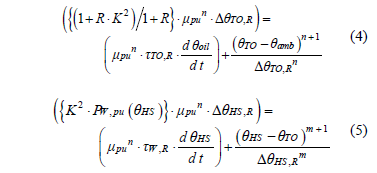
<body><![CDATA[<p><font size="2" face="Verdana, Arial, Helvetica, sans-serif">In , <sub><img border=0 src="/img/revistas/dyna/v83n197/v83n197a14eq018.gif"></sub> is the normal  insulation life at the reference temperature, <sub><img border=0 src="/img/revistas/dyna/v83n197/v83n197a14eq004.gif"></sub>, in hours. The benchmark of normal insulation life for  well-dried, oxygen-free 65 °C average winding temperature rise system is  reported in &#91;4,14&#93;. A 200 retained degree of polymerization in insulation has  been adopted in this article as the normal insulation life criterion, and it corresponds  to 150000 hours for <sub><img border=0 src="/img/revistas/dyna/v83n197/v83n197a14eq004.gif"></sub>=110 °C. </font></p>     <p><font size="2" face="Verdana, Arial, Helvetica, sans-serif"><b><i>2.2. Hot spot temperature estimation</i></b></font></p>     <p><font size="2" face="Verdana, Arial, Helvetica, sans-serif">The functional age, due to thermal aging,  depends on the HST. This is because the winding insulating paper ages faster in  the region in which the hottest temperature is present. When no fiber-optic  sensors are installed inside the transformer, as is the common case in older  units, the HST must be estimated through models based on measured oil  temperatures &#91;15&#93;.</font></p>     <p><font size="2" face="Verdana, Arial, Helvetica, sans-serif">Several HST models, ranging from simple  to very complex, have been proposed in the bibliography, &#91;5-9&#93;. The qualitative  criteria for selecting a HST model for this study were: <i>i)</i> availability of the technical transformer data and parameters  the HST model is based on, <i>ii) </i>performance  simulating transient or varying loads with altering ambient temperature, and, <i>iii) </i>top-oil temperature (TOT) based  model, which exhibits a suitable performance &#91;16&#93;.</font></p>     <p><font size="2" face="Verdana, Arial, Helvetica, sans-serif">A thermal model satisfying most of the  above defined criteria is the HST model presented by Susa in &#91;7-9&#93;. In this  model, HST and TOT differential equations account for oil viscosity changes  with temperature. One advantage of this model is that it is only based on  nameplate data and few heat run test protocol parameters. The differential  equations for the TOT, <sub><img border=0 src="/img/revistas/dyna/v83n197/v83n197a14eq022.gif"></sub>, and the HST, <sub><img border=0 src="/img/revistas/dyna/v83n197/v83n197a14eq002.gif"></sub>, are respectively:</font></p>     <p><img src="/img/revistas/dyna/v83n197/v83n197a14eq0405.gif"></p>     <p><font size="2" face="Verdana, Arial, Helvetica, sans-serif">where, <i>R</i> is the ratio of load losses at rated  current to no-load losses, <i>K</i> is the load factor and quotient of  load over rated load, <sub><img border=0 src="/img/revistas/dyna/v83n197/v83n197a14eq029.gif"></sub>is the per unit oil viscosity given by the ratio of the current oil viscosity over rated oil  viscosity <sub><img border=0 src="/img/revistas/dyna/v83n197/v83n197a14eq031.gif"></sub>, n is an empirical constant dependent on whether the oil  circulation is laminar (n=0.25) or turbulent (n=0.33), m is an empirical  constant related with the shape of the thermal curve, <sub><img border=0 src="/img/revistas/dyna/v83n197/v83n197a14eq033.gif"></sub> is the rated TOT rise  over ambient (measured in °C), <sub><img border=0 src="/img/revistas/dyna/v83n197/v83n197a14eq035.gif"></sub> is the rated HST rise  over TOT (measured in °C), <sub><img border=0 src="/img/revistas/dyna/v83n197/v83n197a14eq037.gif"></sub>is the rated top-oil time constant,<sub><img border=0 src="/img/revistas/dyna/v83n197/v83n197a14eq039.gif"></sub>is the rated winding time constant in minutes, and <sub><img border=0 src="/img/revistas/dyna/v83n197/v83n197a14eq041.gif"></sub> is the ambient  temperature.</font></p>     <p><font size="2" face="Verdana, Arial, Helvetica, sans-serif">Equations to model oil viscosity  variations with temperature are shown in &#91;7-9&#93;. For Oil Natural - Air Natural  (ONAN) cooling mode, the value of constants <i>n </i>and <i>m </i>is 0.25. For the Oil  Natural - Air Force (ONAF) and Oil Force - Air Force OFAF cooling modes, in  power transformers with external cooling these values are <i>n</i>=0.5 and <i>m</i>=0.1.</font></p>     <p><font size="2" face="Verdana, Arial, Helvetica, sans-serif">The winding losses corrected for the HST, <sub><img border=0 src="/img/revistas/dyna/v83n197/v83n197a14eq043.gif"></sub>, are calculated, as per the following:</font></p>     <p><img src="/img/revistas/dyna/v83n197/v83n197a14eq06.gif"></p>     ]]></body>
<body><![CDATA[<p><font size="2" face="Verdana, Arial, Helvetica, sans-serif">where <sub><img border=0 src="/img/revistas/dyna/v83n197/v83n197a14eq047.gif"></sub>is the ratio of DC losses to total winding losses, <sub><img border=0 src="/img/revistas/dyna/v83n197/v83n197a14eq049.gif"></sub>is the ratio of winding eddy losses to total winding losses, <sub><img border=0 src="/img/revistas/dyna/v83n197/v83n197a14eq051.gif"></sub> is the temperature  correction factor, 225 for Al and 235 for Cu, and the total winding losses are <sub><img border=0 src="/img/revistas/dyna/v83n197/v83n197a14eq053.gif"></sub>.</font></p>     <p><font size="2" face="Verdana, Arial, Helvetica, sans-serif">It should be noted that DC losses in are measured by applying a direct current to the windings, whereas  eddy losses in the windings are not separately measurable. Furthermore, DC  losses are not necessarily given on the nameplates. Nevertheless, Jauregui  states in &#91;16&#93; that  for load levels near the transformer rated load, (i.e., in a no-overload  transformer condition) the winding losses correction is unnecessary. Therefore,  if necessary, <sub><img border=0 src="/img/revistas/dyna/v83n197/v83n197a14eq043.gif"></sub>can be omitted in eq. , which will lead to:</font></p>     <p><img src="/img/revistas/dyna/v83n197/v83n197a14eq07.gif"></p>     <p><font size="2" face="Verdana, Arial, Helvetica, sans-serif">Thus, it can be concluded that the Susa  HST model can be simplified for applications where only nameplate data and no  heat-run test protocol are available.</font></p>     <p><font size="2" face="Verdana, Arial, Helvetica, sans-serif"><b><i>2.3. Necessary data to estimate the hot spot temperature</i></b></font></p>     <p><font size="2" face="Verdana, Arial, Helvetica, sans-serif">A listing  of the transformer data necessary to calculate the HST at time <i>i</i> for the mentioned model includes the  following: winding eddy losses, winding resistive losses, DC or I<sup>2</sup>R  losses, load losses, no-load losses, winding-time constant (estimated by means  of weight of windings), oil-time constant (estimated by means of the mass of  oil), rated TOT rise over ambient temperature, rated HST rise over TOT, rated  TOT, rated HST, and both ambient temperature and load at time <i>i</i>. Moreover, selecting appropriate transformer  constants requires knowledge of characteristics such as the cooling stages and  the winding conductor material. Once the HST is  obtained at time <i>i</i>, the procedure  must be repeated for the whole operational period of the unit in order to apply and to estimate <i>A<sub>F</sub></i>.</font></p>     <p>&nbsp;</p>     <p><font size="3" face="Verdana, Arial, Helvetica, sans-serif"><b>3. Problem description and proposed methodology</b></font></p>     <p><font size="2" face="Verdana, Arial, Helvetica, sans-serif"><b><i>3.1. Problem description</i></b></font></p>     <p><font size="2" face="Verdana, Arial, Helvetica, sans-serif">The aim of this paper is to present a  methodology to estimate the functional age, <i>A<sub>F</sub></i>,  of insulating paper of aging power transformers when part of data regarding  load and ambient temperature profiles for the complete operational period of  the assessed transformer is missing.</font></p>     ]]></body>
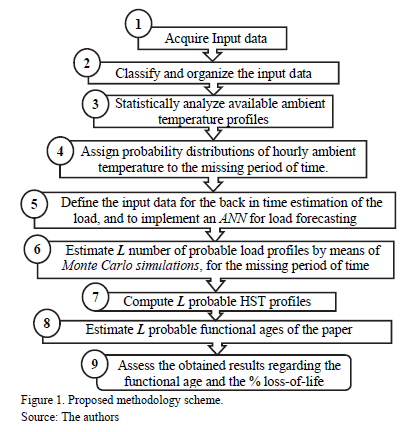
<body><![CDATA[<p><font size="2" face="Verdana, Arial, Helvetica, sans-serif"><b><i>3.2. Scheme of the proposed methodology</i></b></font></p>     <p><font size="2" face="Verdana, Arial, Helvetica, sans-serif">To assess the <i>A<sub>F</sub></i> of the insulating paper, missing historical temperature  and load data must be estimated to be able to then apply the models presented  in section 3. Taking this into consideration, the following general scheme is  proposed as a suitable methodology to address the problem.</font></p>     <p><font size="2" face="Verdana, Arial, Helvetica, sans-serif">In the following section each one of the  steps in <a href="#fig01">Fig. 1</a> will be explained in more detail. </font></p>     <p align="center"><font size="2" face="Verdana, Arial, Helvetica, sans-serif"><a name="fig01"></a></font><img src="/img/revistas/dyna/v83n197/v83n197a14fig01.gif"></p>     <p><font size="2" face="Verdana, Arial, Helvetica, sans-serif"><i>Step   1:</i> Acquire the following input data:</font></p> <ul>       <li><font size="2" face="Verdana, Arial, Helvetica, sans-serif">-Data as described in section 2.3, to     thermally model the transformer under study. </font></li>       <li><font size="2" face="Verdana, Arial, Helvetica, sans-serif">-All     available information regarding power delivered hourly through the transformer,     and the ambient temperature at the power station; e.g., information acquired by     the SCADA.</font></li>       <li><font size="2" face="Verdana, Arial, Helvetica, sans-serif">-All historical information about ambient     temperature and monthly or yearly electric energy consumption in the district     in which the power transformer operates.</font></li>     </ul>     <p><font size="2" face="Verdana, Arial, Helvetica, sans-serif"><i>Step 2:</i> Classify, organize and filter inadequate or atypical data from the   hourly load and ambient temperature profiles, acquired in step 1. This step   must provide typical values to</font></p>     ]]></body>
<body><![CDATA[<p><font size="2" face="Verdana, Arial, Helvetica, sans-serif"><i>Step   3:</i> Analyze the historical ambient temperature   statistically. Once the available ambient temperature profile has been preprocessed,   normalized days are defined.</font></p>     <p><font size="2" face="Verdana, Arial, Helvetica, sans-serif">For this purpose, each month of available   ambient temperature data can be divided into three packages of approximately   ten days, i.e., <i>D &asymp;10</i>. For each   package the hourly mean temperature and the standard deviation, <i>s<sub>h</sub></i>, is calculated as:</font></p>     <p><img src="/img/revistas/dyna/v83n197/v83n197a14eq08.gif"></p>     <p><font size="2" face="Verdana, Arial, Helvetica, sans-serif">where <i>d</i>=1,2,..., <i>D</i>, and <i>q<sub>h</sub></i> is the observed temperature at   hour <i>h</i> for each day<i> d</i>. Moreover, there is a correlation   between adjacent hourly ambient temperatures. To model this dependence, a 24x24   correlation matrix, <b>R</b><i><sub>d</sub></i>, is computed for each   normalized day. Based on this routine, 24 pairs of <sub><img border=0 src="/img/revistas/dyna/v83n197/v83n197a14eq061.gif"></sub> and<i> s<sub>h</sub></i>, with <i>h=1,…24</i>, and one correlation matrix <b>R</b><i><sub>d</sub></i> are obtained for each normalized day. It is noted that the covariance matrix of   the normalized day <b>S</b><i><sub>d</sub></i> can also be computed since   it is a function of the matrix <b>R</b><i><sub>d</sub></i> and the standard deviation   vector of 24 elements<i> s<sub>h,d</sub></i>, &#91;16&#93;.</font></p>     <p><font size="2" face="Verdana, Arial, Helvetica, sans-serif"><i>Step   4:</i> Assign probability distributions of ambient   temperature to the missing period of time. Completing the ambient temperature   curve procedure includes assigning one of the obtained normalized days in the   previous step to each day in the missing period of time. This action can be   performed by comparing features of the normalized days with those known for the   days in the missing period, e.g. the Euclidian distance, <i>d</i>, which is given by:</font></p>     <p><img src="/img/revistas/dyna/v83n197/v83n197a14eq09.gif"></p>     <p><font size="2" face="Verdana, Arial, Helvetica, sans-serif">where <sub><img border=0 src="/img/revistas/dyna/v83n197/v83n197a14eq065.gif"></sub> is a vector containing   a pair of values of the historical maximum and minimum daily temperatures for   unknown days (i.e., whose hourly temperature profile is unknown) and <sub><img border=0 src="/img/revistas/dyna/v83n197/v83n197a14eq067.gif"></sub> is a vector containing   the same values of a normalized day. These can be used to select the normalized   day that exhibits the minimal distance in order to then assign this information   to the missing day.</font></p>     <p><font size="2" face="Verdana, Arial, Helvetica, sans-serif"><i>Step   5:</i> Define the input data for the estimation of the historical   load and implement a suitable ANN for load forecasting. </font></p>     <p><font size="2" face="Verdana, Arial, Helvetica, sans-serif">References to estimate the historical load  were not found; however, load forecasting is a well-known field of work in  electrical engineering. In effect, there are various techniques, which have  been extensively studied and used in time series forecasting, e.g.  Autoregressive Integrated Moving Average (ARIMA) and its variants, Artificial  Neural Networks (ANNs), and hybrid methods such as ANNs/ARIMA &#91;18&#93;.  However, in this paper ANNs have been selected to deal with the described problem  since some researchers have compared and tested this technique, concluding that  ANNs could successfully capture the nonlinear relationship between the load and  the weather &#91;19&#93;. In  effect, ANNs are better suited </font><font size="2" face="Verdana, Arial, Helvetica, sans-serif">in terms of ARIMA  since the first can capture nonlinear patterns between input and output  parameters while the second is limited by the pre-assumed linear form of the  model. It must be noted that hybrid methods which  combine both ARIMA and ANN are being investigated. Future research could be  conducted on this subject to improve the forecasting accuracy; however, this  research lies outside the scope of this paper.</font></p>     <p><font size="2" face="Verdana, Arial, Helvetica, sans-serif">In general, an ANN does non-linear curve  fitting and is able to find a function to subsequently calculate load values  dependent on various input parameters &#91;20&#93;. A  two-layer feed-forward network with sigmoid hidden neurons and linear output  neurons can fit multi-dimensional mapping problems arbitrarily well if provided  with consistent data and enough neurons in its hidden layer &#91;21&#93;. In  this network, the information only moves in one direction, forwards, i.e., data  goes from the input nodes through the hidden nodes and then to the output node. </font></p>     ]]></body>
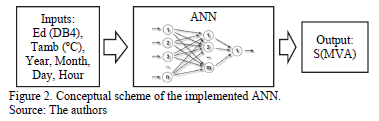
<body><![CDATA[<p><font size="2" face="Verdana, Arial, Helvetica, sans-serif">Therefore, we selected a feed-forward ANN  structure. It basically compares the calculated output value with a desirable  result, the target value. The target values are the load values that are stored  by the SCADA: in effect, the available load profile. Whereas there is one  single output, the load, there are several input parameters. In this approach,  the input parameters are the hourly ambient temperatures (Tamb), year, month,  weekday, hour and the monthly energy demand (Ed). <a href="#fig02">Fig. 2</a> illustrates inputs and  outputs defined for the ANN.</font></p>     <p align="center"><font size="2" face="Verdana, Arial, Helvetica, sans-serif"><a name="fig02"></a></font><img src="/img/revistas/dyna/v83n197/v83n197a14fig02.gif"></p>     <p><font size="2" face="Verdana, Arial, Helvetica, sans-serif"><i>Step 6:</i> Estimate a quantity of <i>L </i>probable ambient temperature and load profiles by means of Monte   Carlo simulations, where <i>L</i> is the   number of simulations, for the missing period of time. For this purpose, the   probability distributions of ambient temperature defined in step 4, and the   input data for the ANN implemented in step 5 are used.</font></p>     <p><font size="2" face="Verdana, Arial, Helvetica, sans-serif"><i>Step 7: </i>Compute <i>L</i> probable HST profiles by using the formulation presented in section 2.2 from   the <i>L </i>probable profiles that was computed   in steps 4 and 6.</font></p>     <p><font size="2" face="Verdana, Arial, Helvetica, sans-serif"><i>Step 8: </i>Estimate <i>L, </i>probable functional ages of the insulating paper by using formulation   presented in section 2.1 from the <i>L </i>HST   profiles computed in step 7.</font></p>     <p><font size="2" face="Verdana, Arial, Helvetica, sans-serif"><i>Step 9: </i>Assess the results obtained regarding the <i>A<sub>F</sub></i> from the <i>L</i> probable values computed in step 8,   and compute a histogram for the % loss-of-insulation life.</font></p>     <p>&nbsp;</p>     <p><font size="3" face="Verdana, Arial, Helvetica, sans-serif"><b>4. Case study</b></font></p>     <p><font size="2" face="Verdana, Arial, Helvetica, sans-serif">In this section, probable HST profiles  and a probability density function for the loss-of-insulation life of a 30 MVA  and 132 +6/-12 x 1 %/ 34.5/13.8 kV rated step-down transformer will be  estimated through the general scheme, shown in <a href="#fig01">Fig. 1</a>. The unit is connected in  YN/yno/d11. The rated cooling is ONAN/ONAF at 70/100 % of load. It should be  observed that the order to start running the assessed unit fans, i.e. to start  the ONAF mode, is given by a commercial temperature monitor. </font></p>     <p><font size="2" face="Verdana, Arial, Helvetica, sans-serif">It is remarkable that there have been no  changes in the configuration of the power station since 1994, the year in which  the unit under study was installed.</font></p>     ]]></body>
<body><![CDATA[<p><font size="2" face="Verdana, Arial, Helvetica, sans-serif"><b><i>4.1. Case study description</i></b></font></p>     <p><font size="2" face="Verdana, Arial, Helvetica, sans-serif">In the case  of the transformer that was being studied, the unit operator began to record  the load and ambient temperature data on 20/01/08. Within this study, the  period that will be covered extends until 31/07/10. Therefore, twenty-four  values of both load and ambient temperature for each of the 924 days listed in  the database are available. However, since the unit was installed in 1994,  there is a lack of load and ambient temperature data for the period between  15/02/94 and 19/01/08. Therefore, to assess the functional age of the  insulating paper, missing temperature and load data must be historically  estimated for the particular period of time.</font></p>     <p><font size="2" face="Verdana, Arial, Helvetica, sans-serif"><b><i>4.2. Applying the proposed methodology to case  study</i></b></font></p>     <p><font size="2" face="Verdana, Arial, Helvetica, sans-serif"><i>1) Step 1. </i>Available data is compiled from several databases that have been  classified as follows:</font></p>     <blockquote>       <p><font size="2" face="Verdana, Arial, Helvetica, sans-serif"><i>i)</i> Database 1: 924 x 24 pairs of values of load and ambient temperature     data for the period 20/01/08 - 31/07/10.</font></p>       <p><font size="2" face="Verdana, Arial, Helvetica, sans-serif"><i>ii)</i> Database 2: archives published by the local meteorological service, which     includes daily minimum and maximum temperatures covering the period 01/01/01 -     31/07/10.</font></p>       <p><font size="2" face="Verdana, Arial, Helvetica, sans-serif"><i>iii)</i> Database 3: archives published by the local meteorological service, which are     comprised of monthly average temperatures for the period from February 1994 to     August 2010.</font></p>       <p><font size="2" face="Verdana, Arial, Helvetica, sans-serif"><i>iv)</i> Database 4: the district's monthly     energy demand -where the unit is located- from February 1994 to August 2010. </font></p>       <p><font size="2" face="Verdana, Arial, Helvetica, sans-serif"><i>v)</i> Database 5: nameplate data of the assessed transformer.</font></p> </blockquote>     ]]></body>
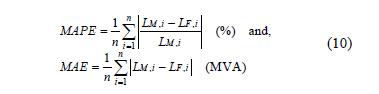
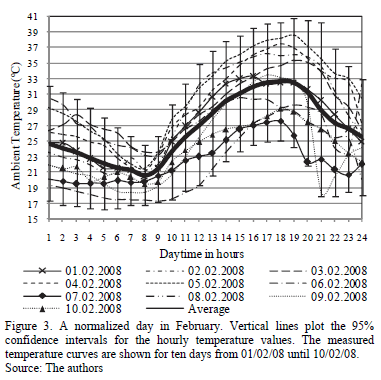
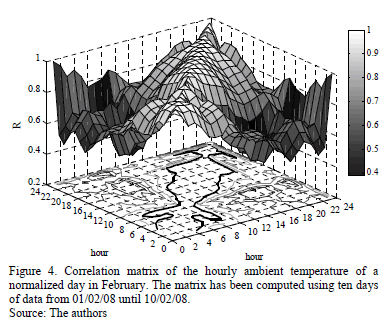
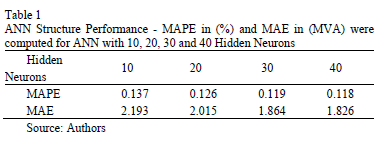
<body><![CDATA[<p><font size="2" face="Verdana, Arial, Helvetica, sans-serif"><i>2) Step 2.</i> In <i>database 1,</i> missing or  erroneous values had to be detected and the associated data (e.g., date) removed.</font></p>     <p><font size="2" face="Verdana, Arial, Helvetica, sans-serif"><i>3) Step 3. </i>To complete the ambient temperature curve, first, normalized days,  based on the filtered measured temperature data reported in <i>database1</i> must be established. </font></p>     <p><font size="2" face="Verdana, Arial, Helvetica, sans-serif">A total of  91 normalized daily ambient temperature profiles were determined by using the  routine presented in section 3.2., Step 3. For this purpose, the time period  covered by <i>database 1</i>, i.e., from  20/01/08 to 31/07/10, was considered. Each one of these 91 normalized days is  representative of a day in a month of the year; i.e., there are 7 normalized  days representing a day in January, 9 normalized days representing a day in  February, 9 for March, …, etc. For example, a normalized ambient temperature  for a day in February, obtained from the population of 10 days from 01/02/08 to  10/02/08, is shown in <a href="#fig03">Fig. 3</a>. The vertical lines indicate the probabilistic  distribution of the normalized hourly temperature. Moreover, the mesh that  represents the correlation matrix for that normalized day is plotted in <a href="#fig04">Fig. 4</a>.  A strong correlation between the hourly ambient temperatures, especially for  those that are adjacent, is observed.</font></p>     <p align="center"><font size="2" face="Verdana, Arial, Helvetica, sans-serif"><a name="fig03"></a></font><img src="/img/revistas/dyna/v83n197/v83n197a14fig03.gif"></p>     <p align="center"><font size="2" face="Verdana, Arial, Helvetica, sans-serif"><a name="fig04"></a></font><img src="/img/revistas/dyna/v83n197/v83n197a14fig04.gif"></p>     <p><font size="2" face="Verdana, Arial, Helvetica, sans-serif"><i>4) Step 4.</i> Ambient temperatures were  then determined for the 01/01/01 - 19/01/08 period. The minimum and maximum  temperature values of the 91 normalized days were employed as features of  typical days. From these features and from the daily minimum and maximum  temperatures that are shown in database 2, the Euclidean distances were  computed by using . In this way, one of the 91  normalized days was assigned to each day between 01/01/01 and 19/01/08.  Subsequently, the corresponding monthly average temperatures were calculated for  this period. The assigned normalized days were scaled by the ratio of the  calculated monthly average temperatures over the real monthly average  temperature given in database 3. As such, the monthly average temperatures,  including assigned normalized days from the 01/01/01 - 19/01/08 period coincide  with the real monthly average values that are given for the same period.</font></p>     <p><font size="2" face="Verdana, Arial, Helvetica, sans-serif"><i>5) Step 5.</i> The lacking load values have to be estimated for the  15/02/94 - 19/01/08 period. ANN  structures, such as those shown in <a href="#fig01">Fig. 1</a>, with 10, 20, 30 and 40 hidden  neurons were tested. The performance of these structures was verified by two  measures: i) the mean absolute percentage error (MAPE), and ii) the mean  absolute error (MAE).</font></p>     <p><img src="/img/revistas/dyna/v83n197/v83n197a14eq10.gif"></p>     <p><font size="2" face="Verdana, Arial, Helvetica, sans-serif">where n is the total number of load  values between 20/01/08 - 31/07/10, LM,i and LF,i are the measured and forecasted hourly load values, in MVA,  respectively. The performance values for each ANN are given in <a href="#tab01">Table 1</a>.</font></p>     <p align="center"><font size="2" face="Verdana, Arial, Helvetica, sans-serif"><a name="tab01"></a></font><img src="/img/revistas/dyna/v83n197/v83n197a14tab01.gif"></p>     ]]></body>
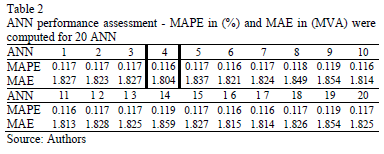
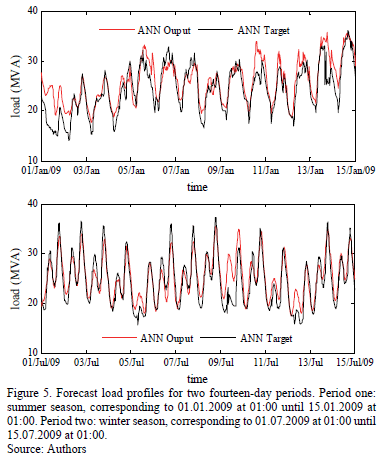
<body><![CDATA[<p><font size="2" face="Verdana, Arial, Helvetica, sans-serif">By increasing the number of hidden  neurons, the performance of the ANN improves. However, there is only a small  improvement for more than 30 hidden neurons. Therefore, a structure of 40  hidden neurons was implemented. Moreover, when training an ANN, the initial  weights and biases of the network are usually randomly generated taking values  between -1 and 1. This initialization has the ability to produce an improved  network. Therefore, twenty two-layer feed-forward networks with 40 hidden  neurons were created and trained for the 20/01/08 - 31/07/10 period. With the  real load values and those estimated through the ANN, the performance of these  20 ANNs was verified again by means of MAPE and MAE. The performance values for  each one of these 20 ANNs are given in <a href="#tab02">Table 2</a>.</font></p>     <p align="center"><font size="2" face="Verdana, Arial, Helvetica, sans-serif"><a name="tab02"></a></font><img src="/img/revistas/dyna/v83n197/v83n197a14tab02.gif"></p>     <p><font size="2" face="Verdana, Arial, Helvetica, sans-serif">Network 4, which showed the best  performance, was chosen for its back-in-time estimation of load. Diagrams in <a href="#fig05">Fig.  5</a> show the forecast loads for two different fourteen-day periods. It can be  observed from the graphical results that the forecast load follows the real  measured values closely.</font></p>     <p align="center"><font size="2" face="Verdana, Arial, Helvetica, sans-serif"><a name="fig05"></a></font><img src="/img/revistas/dyna/v83n197/v83n197a14fig05.gif"></p>     <p><font size="2" face="Verdana, Arial, Helvetica, sans-serif"><i>6) Step 6. </i>Probable ambient temperature profiles were created by  using MCS. A thousand ambient temperature profiles, <i>L</i>=1000, each containing 123168 temperature values included in the  period 15/02/94 - 19/01/08, were generated by multivariate normal random  numbers. These numbers were computed from the hourly normal distributions  characterized by the mean hourly ambient temperature, <sub><img border=0 src="/img/revistas/dyna/v83n197/v83n197a14eq061.gif"></sub>, the corresponding standard deviation, <sub><img border=0 src="/img/revistas/dyna/v83n197/v83n197a14eq078.gif"></sub>, and the daily covariance matrix, <b>S</b><i><sub>d</sub></i> that were  obtained in steps 3 and 4.</font></p>     <p><font size="2" face="Verdana, Arial, Helvetica, sans-serif">Once the probable ambient temperature  profiles were obtained, they were constrained to fit the reported information  given in <i>database 3</i>, e.g., 10  randomly generated ambient temperature profiles for the first 15 days of  January of 2001 are shown in <a href="#fig06">Fig. 6</a>.</font></p>     <p align="center"><font size="2" face="Verdana, Arial, Helvetica, sans-serif"><a name="fig06"></a></font><img src="/img/revistas/dyna/v83n197/v83n197a14fig06.gif"></p>     <p><font size="2" face="Verdana, Arial, Helvetica, sans-serif">The selected ANN network was then used to  estimate 1000 of the transformer's probable load profiles. Each hourly load  profile was estimated from a corresponding probable temperature curve and the  input data from database 4.</font></p>     <p><font size="2" face="Verdana, Arial, Helvetica, sans-serif"><i>7) Step 7. </i>The HST model presented in section 2.2 was  adjusted for the unit characteristics of the case study. Moreover, to deal with  the changes in the cooling modes, ONAN/ONAF, it was necessary to model the  behavior of the temperature monitor that commands the fans. This type of device  uses the following approach to estimate the control HST:</font></p>     <p><img src="/img/revistas/dyna/v83n197/v83n197a14eq11.gif"></p>     ]]></body>
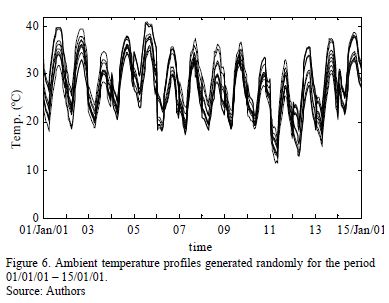
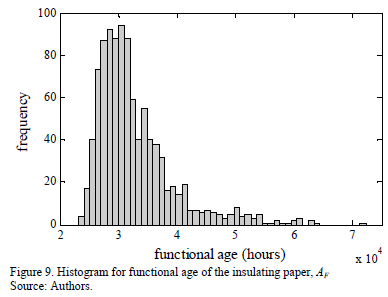
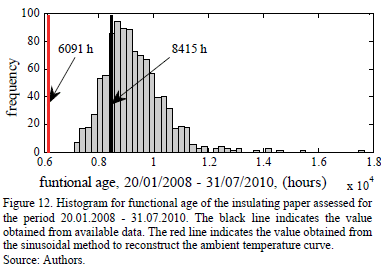
<body><![CDATA[<p><font size="2" face="Verdana, Arial, Helvetica, sans-serif">where, <i>H </i>and <i>y</i> are set values which depend on the transformer characteristics,  in fact, in this case study, <i>H</i>=1.3  and <i>y</i>=1.6. It must be noted that the  control HST (<i>q<sub>HS,c</sub></i>) computed from is an approximation, the only purpose  of which is to command the fans. In fact, fans are turned-on when <i>q<sub>HS,c</sub></i> is higher than 85ºC, and turned-off  when <i>q<sub>HS,c</sub></i> becomes lower than 75ºC so as to avoid repetitive  on-off fan operations. </font></p>     <p><font size="2" face="Verdana, Arial, Helvetica, sans-serif">In the algorithm that was implemented,  when both <i>q<sub>TO</sub></i>, computed from , and <i>K</i> (which depends on  the load) yield <i>q<sub>HS,c</sub></i> values higher than 85ºC; when the temperature is increasing, or  lower than 75ºC; or when the temperature is decreasing, then the empiric  constants <i>n</i> and <i>m</i> in eq. - change and assume their respective values in agreement with the  activated cooling mode.</font></p>     <p><font size="2" face="Verdana, Arial, Helvetica, sans-serif">The HST calculation was divided into two  parts. The first part is the deterministic HST calculation based on the load  profile data covering the period from 20/01/08 to 31/07/10.</font></p>     <p><font size="2" face="Verdana, Arial, Helvetica, sans-serif">The second part is the probabilistic HST  calculation that was made for all 1000 estimated load and ambient temperature  profiles determined for the 02/15/94 to 19/01/08 period. Therefore, 1000 HST  curves were computed. One of these HST-curves is shown in <a href="#fig07">Fig. 7</a>. </font></p>     <p align="center"><font size="2" face="Verdana, Arial, Helvetica, sans-serif"><a name="fig07"></a></font><img src="/img/revistas/dyna/v83n197/v83n197a14fig07.gif"></p>     <p><font size="2" face="Verdana, Arial, Helvetica, sans-serif">Moreover, <a href="#fig08">Fig. 8</a> presents a diagram  showing the average annual loading. This data shows the loading trend of the 30  MVA transformer. A fact it is worthwhile pointing out is the sudden decrease in  the demand that timely coincided with the 2001 political and financial crisis  in Argentina; this is also reflected in the forecasted load.</font></p>     <p align="center"><font size="2" face="Verdana, Arial, Helvetica, sans-serif"><a name="fig08"></a></font><img src="/img/revistas/dyna/v83n197/v83n197a14fig08.gif"></p>     <p><font size="2" face="Verdana, Arial, Helvetica, sans-serif"><i>8) Step 8.</i> After pre-processing the  load profile data, estimating the ambient temperature and the load, and  subsequently determining the 1000 probable HST profiles for the 15/02/94 -  31/07/10 period, the functional age of paper was determined. The first  component functional age is deterministic, and corresponds with the accumulated  age during the period 20/01/08 to 31/07/10. This was computed by using, , the accelerated aging factor for  thermally-upgraded paper, and, , the functional age, AF, of  insulating paper. The resulting functional age for this period was 8415.5  hours. </font></p>     <p><font size="2" face="Verdana, Arial, Helvetica, sans-serif">The second component of AF is probabilistic, and it was estimated  for all the 1000 probable HST profiles, also by means of and . Therefore, L=1000 probable values for the AF of the insulating  paper were estimated for the 15/02/94 to 19/01/08 period. The total AF of the  insulating paper was computed by adding both the deterministic and the  probabilistic components. <a href="#fig09">Fig. 9</a> shows the distribution of the total AF in a  histogram of 50 bins.</font></p>     <p align="center"><font size="2" face="Verdana, Arial, Helvetica, sans-serif"><a name="fig09"></a></font><img src="/img/revistas/dyna/v83n197/v83n197a14fig09.gif"></p>     ]]></body>
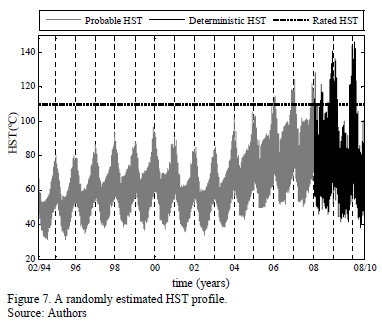
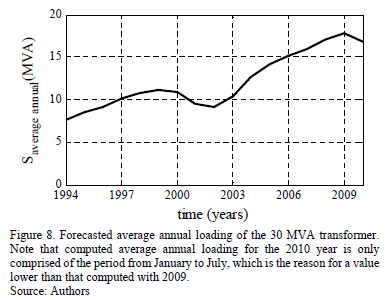
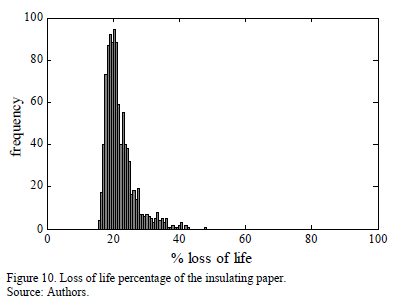
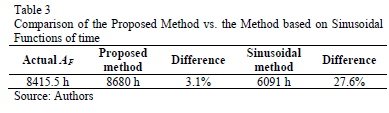
<body><![CDATA[<p><font size="2" face="Verdana, Arial, Helvetica, sans-serif"><i>9) Step 9.</i> It was observed from the results that 90% of computed AF  are less than 41376 hours, and 95% (950) of the simulations yield to AF values  lower than 47739 hours.</font></p>     <p><font size="2" face="Verdana, Arial, Helvetica, sans-serif">Finally, the los-of-insulation life  percentage, due to thermal aging, was computed by using , and the DP=200 end of life criterion. As such we obtained the  histogram shown in <a href="#fig10">Fig. 10</a>, in which it can be observed that the studied power  transformer's insulating paper is still in good condition, from a thermal aging  point of view. In fact, from the histogram, it can be seen that the bin  centered at 21.4% loss of life value reports the highest frequency of  occurrence , i.e. it represents the mode.</font></p>     <p align="center"><font size="2" face="Verdana, Arial, Helvetica, sans-serif"><a name="fig10"></a></font><img src="/img/revistas/dyna/v83n197/v83n197a14fig10.gif"></p>     <p>&nbsp;</p>     <p><font size="3" face="Verdana, Arial, Helvetica, sans-serif"><b>5. Validation</b></font></p>     <p><font size="2" face="Verdana, Arial, Helvetica, sans-serif">In this section the performance of the  proposed methodology is assessed.</font></p>     <p><font size="2" face="Verdana, Arial, Helvetica, sans-serif"><b><i>5.1. Probabilistic method assessment</i></b></font></p>     <p><font size="2" face="Verdana, Arial, Helvetica, sans-serif">The result  obtained in section 4.2, step 8, (<i>A<sub>F </sub></i>= 8415.5 hours for the 20/01/08 to 31/07/10 period), i.e. the period  for which hourly ambient temperature and load profiles are available, is  compared with those obtained by assuming that data was not recorded. For this  purpose, historical daily minimum and maximum temperatures, obtained from 91  normalized daily ambient temperature profiles and trained ANN were used to  assess the probable <i>A<sub>F</sub></i> by means of MSC. The most frequent bin (in effect, that containing 91  simulations) is the one centered in 8680 h, with edge values of 8580 h and 8790  h. Additionally, 950 simulations (95%) yield lower values than 11119 h.</font></p>     <p><font size="2" face="Verdana, Arial, Helvetica, sans-serif"><b><i>5.2. Assessment of ambient temperature reconstruction methods, founded on  sinusoidal functions of time</i></b></font></p>     <p><font size="2" face="Verdana, Arial, Helvetica, sans-serif">References &#91;22&#93; and &#91;23&#93; present deterministic methods to produce hourly temperature data by assuming  that yearly temperature amplitudes and hourly temperatures follow sinusoidal  functions of time. To assess the performance of such proposals, again, a  comparison of the results obtained from the period 20/01/08 to 31/07/10 was undertaken.</font></p>     ]]></body>
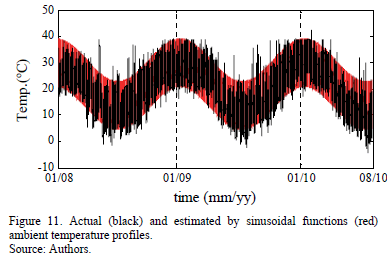
<body><![CDATA[<p><font size="2" face="Verdana, Arial, Helvetica, sans-serif">In <a href="#fig11">Fig. 11</a>, actual and estimated by the  sinusoidal functions of time ambient temperature profiles are plotted. From the  estimated profile, the <i>A<sub>F</sub></i> calculation is performed, obtaining a result of 6091 h.</font></p>     <p align="center"><font size="2" face="Verdana, Arial, Helvetica, sans-serif"><a name="fig11"></a></font><img src="/img/revistas/dyna/v83n197/v83n197a14fig11.gif"></p>     <p><font size="2" face="Verdana, Arial, Helvetica, sans-serif">This result shows that <i>A<sub>F</sub></i> is underestimated when the  sinusoidal functions of time are employed to reconstruct the ambient  temperature. A possible explanation for this result is that hot days are omitted  for periods falling out of the hottest month; this can be observed in <a href="#fig11">Fig. 11</a>. </font></p>     <p><font size="2" face="Verdana, Arial, Helvetica, sans-serif"><b><i>5.3. Discussion</i></b></font></p>     <p><font size="2" face="Verdana, Arial, Helvetica, sans-serif">The results obtained from test in  sections 5.1 and 5.2 are shown in <a href="#fig12">Fig. 12</a>. The deterministic result obtained in  4.2, and the central value of the most frequent bin obtained in 4.1 are  compared with the reference of 8415.5 h in <a href="#tab03">Table 3</a>.</font></p>     <p align="center"><font size="2" face="Verdana, Arial, Helvetica, sans-serif"><a name="fig12"></a></font><img src="/img/revistas/dyna/v83n197/v83n197a14fig12.gif"></p>     <p align="center"><font size="2" face="Verdana, Arial, Helvetica, sans-serif"><a name="tab03"></a></font><img src="/img/revistas/dyna/v83n197/v83n197a14tab03.gif"></p>     <p><font size="2" face="Verdana, Arial, Helvetica, sans-serif">These results show that the probabilistic  method proposed for the reconstruction of ambient temperature curve could lead  to results that do not underestimate the functional age of the insulating  paper. Moreover, the results also highlight that the proposed method is able to  model the uncertainty involved in the problem that is the motivation for this  paper.</font></p>     <p><font size="2" face="Verdana, Arial, Helvetica, sans-serif">To conclude this discussion, there is a  lot of research that needs to be done in order to achieve a higher degree of  accuracy in the predictions about the transformer condition. It is widely  recognized that in this problem there are several sources of uncertainty. For  instance, there is uncertainty in the measurement and posterior diagnostic  model of frequency response analysis when looking for faults in core and coils  &#91;24-26&#93;. The situation is the same for DGA when oil is analyzed (in fact, there  are several methods to infer incipient faults in the transformer through DGA,  but none of these can be considered as the best one). Furan analysis to infer  the DP, is affected by changes in oil, uncertainty about the mass of insulating  paper, the type of paper, etc.</font></p>     <p><font size="2" face="Verdana, Arial, Helvetica, sans-serif">In this context, it is expected that  models to assess the loading history of a transformer may also be affected by  uncertainty. There is uncertainty affecting ; i.e., about the constant <i>B</i>=15000.  There have been different values reported in &#91;5&#93;.  Moreover, as stated in section 2.1, the reference value for end-of-insulation  life and the Arrhenius plot are also affected by the three insulating paper  aging mechanisms, hydrolysis, pyrolysis and oxidation.</font></p>     ]]></body>
<body><![CDATA[<p><font size="2" face="Verdana, Arial, Helvetica, sans-serif">Finally, there is also uncertainty when  one attempts to reconstruct historical load and ambient temperature profiles  (especially in the adopted forecasted models, which undoubtedly can be improved, e.g., by testing other  ANN structures, or employing hybrid methods as ARIMA-ANN). However, it is noted  that one of the major contributions reported in this paper is related to the  capability of the proposed method in modeling uncertainty. Most of the standard  methods are deterministic. Therefore, these do not recognize the uncertain  nature of the analyzed problem.</font></p>     <p>&nbsp;</p>     <p><font size="3" face="Verdana, Arial, Helvetica, sans-serif"><b>6. Conclusions</b></font></p>     <p><font size="2" face="Verdana, Arial, Helvetica, sans-serif">This paper introduces a methodology to  estimate missing load data to be used in order to determine the functional age  of power transformers' insulating paper. The methodology is founded on the statistical  analysis of local ambient temperatures, and on ANNs and MCS to estimate  probable historical HST profiles. Subsequently, through the thermal aging  principles of insulating paper, it is possible to assess the functional age and  loss-of-insulation life percentage due to thermal effects. </font></p>     <p><font size="2" face="Verdana, Arial, Helvetica, sans-serif">Later on in the research, a case study  for a 30 MVA rated transformer with its corresponding database was presented.  Based on this database and on long term temperature measurements from an  external weather station, through MCS, 1000 probable ambient temperature curves  were generated for the whole operational period of the unit. Then, using an ANN  1000, probable load profiles were obtained. With these results, a corresponding  number of HST profiles were then gathered.</font></p>     <p><font size="2" face="Verdana, Arial, Helvetica, sans-serif">Test results were processed to estimate  the frequency of the occurrence of the studied transformer's functional age. The  results obtained show that the insulating paper from the unit under  investigation is still in good condition, in terms of a thermal aging point of  view and from its loading history analysis. Moreover, it was shown that  calculation of functional age is also useful to estimate the loss of life  percentage due to thermal aging. The presented methodology will contribute to  the transformer condition monitoring as a cheap, comparably fast and easily  accessible tool, even for load profiles that do not contain the entire load and  ambient temperature data for the whole period of unit operation.</font></p>     <p><font size="2" face="Verdana, Arial, Helvetica, sans-serif">Further research on this issue must be  conducted in order for several other important aspects to be considered. These  include the following in particular: to include in the model influence of  moisture on the aging speed, to improve the forecasting accuracy by testing  hybrid methods as ARIMA-ANN, and to assess both the functional age and the  loss-of-insulation life percentage in forecasted future load scenarios.  Finally, the proposed method is an applicable tool for a major project research  that is searching for the determination of a transformer risk index.</font></p>     <p>&nbsp;</p>     <p><font size="3" face="Verdana, Arial, Helvetica, sans-serif"><b>References</b></font></p>     <!-- ref --><p><font size="2" face="Verdana, Arial, Helvetica, sans-serif"><b>&#91;1&#93;</b> Li, W., Risk assessment of  power systems, models, methods and applications. IEEE Press Series on Power  Engineering, 2005.    &nbsp;&nbsp;&nbsp;&nbsp;&nbsp;&nbsp;&nbsp;&nbsp;[&#160;<a href="javascript:void(0);" onclick="javascript: window.open('/scielo.php?script=sci_nlinks&ref=1130375&pid=S0012-7353201600030001400001&lng=','','width=640,height=500,resizable=yes,scrollbars=1,menubar=yes,');">Links</a>&#160;]<!-- end-ref --></font></p>     <!-- ref --><p><font size="2" face="Verdana, Arial, Helvetica, sans-serif"><b>&#91;2&#93;</b> Romero, A.A., Mombello, E.E.  and Ratt&aacute;, G., An overview on power transformer management: Individual assets  and fleets, Transmission and Distribution Latin America Conference and  Exposition (T&amp;D-LA), Sixth IEEE/PES, pp. 1-7, 2012. DOI: 10.1109/TDC-LA.2012.6319081</font>&nbsp;&nbsp;&nbsp;&nbsp;&nbsp;&nbsp;&nbsp;&nbsp;[&#160;<a href="javascript:void(0);" onclick="javascript: window.open('/scielo.php?script=sci_nlinks&ref=1130377&pid=S0012-7353201600030001400002&lng=','','width=640,height=500,resizable=yes,scrollbars=1,menubar=yes,');">Links</a>&#160;]<!-- end-ref --><!-- ref --><p><font size="2" face="Verdana, Arial, Helvetica, sans-serif"><b>&#91;3&#93;</b> CIGRE Brochure 323. Aging of  cellulose in mineral-oil insulated transformers. Taskforce D1.01.10, Ed. 2007.    &nbsp;&nbsp;&nbsp;&nbsp;&nbsp;&nbsp;&nbsp;&nbsp;[&#160;<a href="javascript:void(0);" onclick="javascript: window.open('/scielo.php?script=sci_nlinks&ref=1130378&pid=S0012-7353201600030001400003&lng=','','width=640,height=500,resizable=yes,scrollbars=1,menubar=yes,');">Links</a>&#160;]<!-- end-ref --></font></p>     <!-- ref --><p><font size="2" face="Verdana, Arial, Helvetica, sans-serif"><b>&#91;4&#93;</b> Lelekakis, N., Wenyu, G.,  Martin, D., Wijaya, J. and Susa, D., A field study of aging in paper-oil  insulation systems, IEEE Electrical Insulation Magazine, 28(1), pp. 12-19, 2012. DOI: 10.1109/MEI.2012.6130527</font>&nbsp;&nbsp;&nbsp;&nbsp;&nbsp;&nbsp;&nbsp;&nbsp;[&#160;<a href="javascript:void(0);" onclick="javascript: window.open('/scielo.php?script=sci_nlinks&ref=1130380&pid=S0012-7353201600030001400004&lng=','','width=640,height=500,resizable=yes,scrollbars=1,menubar=yes,');">Links</a>&#160;]<!-- end-ref --><!-- ref --><p><font size="2" face="Verdana, Arial, Helvetica, sans-serif"><b>&#91;5&#93;</b> IEEE Guide for loading mineral-oil-immersed  transformers and step-voltage regulators. IEEE Standard C57.91, 2011.    &nbsp;&nbsp;&nbsp;&nbsp;&nbsp;&nbsp;&nbsp;&nbsp;[&#160;<a href="javascript:void(0);" onclick="javascript: window.open('/scielo.php?script=sci_nlinks&ref=1130381&pid=S0012-7353201600030001400005&lng=','','width=640,height=500,resizable=yes,scrollbars=1,menubar=yes,');">Links</a>&#160;]<!-- end-ref --></font></p>     <!-- ref --><p><font size="2" face="Verdana, Arial, Helvetica, sans-serif"><b>&#91;6&#93;</b> IEC Power Transformers, Part 7:  Loading guide for oil-immersed power transformers. IEC 60076-7, 2005.    &nbsp;&nbsp;&nbsp;&nbsp;&nbsp;&nbsp;&nbsp;&nbsp;[&#160;<a href="javascript:void(0);" onclick="javascript: window.open('/scielo.php?script=sci_nlinks&ref=1130383&pid=S0012-7353201600030001400006&lng=','','width=640,height=500,resizable=yes,scrollbars=1,menubar=yes,');">Links</a>&#160;]<!-- end-ref --></font></p>     <!-- ref --><p><font size="2" face="Verdana, Arial, Helvetica, sans-serif"><b>&#91;7&#93;</b> Susa, D. and Nordman, H., A  simple model for calculating transformer hot-spot temperature, IEEE  Transactions on Power Delivery, 24(3), pp. 1257-1265, 2009. DOI: 10.1109/TPWRD.2009.2022670</font>&nbsp;&nbsp;&nbsp;&nbsp;&nbsp;&nbsp;&nbsp;&nbsp;[&#160;<a href="javascript:void(0);" onclick="javascript: window.open('/scielo.php?script=sci_nlinks&ref=1130385&pid=S0012-7353201600030001400007&lng=','','width=640,height=500,resizable=yes,scrollbars=1,menubar=yes,');">Links</a>&#160;]<!-- end-ref --><!-- ref --><p><font size="2" face="Verdana, Arial, Helvetica, sans-serif"><b>&#91;8&#93;</b> Susa, D. and Lehtonen, M.,  Dynamic thermal modeling of power transformers: further Development-part I, IEEE  Transactions on Power Delivery, 21(4), pp. 1961-1970, 2006. DOI: 10.1109/TPWRD.2005.864069</font>&nbsp;&nbsp;&nbsp;&nbsp;&nbsp;&nbsp;&nbsp;&nbsp;[&#160;<a href="javascript:void(0);" onclick="javascript: window.open('/scielo.php?script=sci_nlinks&ref=1130386&pid=S0012-7353201600030001400008&lng=','','width=640,height=500,resizable=yes,scrollbars=1,menubar=yes,');">Links</a>&#160;]<!-- end-ref --><!-- ref --><p><font size="2" face="Verdana, Arial, Helvetica, sans-serif"><b>&#91;9&#93;</b> Susa, D. and Lehtonen, M.,  Dynamic thermal modeling of power transformers: further Development-part II, IEEE  Transactions on Power Delivery, 21(4), pp. 1971-1980, 2006. DOI: 10.1109/TPWRD.2005.864068</font>&nbsp;&nbsp;&nbsp;&nbsp;&nbsp;&nbsp;&nbsp;&nbsp;[&#160;<a href="javascript:void(0);" onclick="javascript: window.open('/scielo.php?script=sci_nlinks&ref=1130387&pid=S0012-7353201600030001400009&lng=','','width=640,height=500,resizable=yes,scrollbars=1,menubar=yes,');">Links</a>&#160;]<!-- end-ref --><!-- ref --><p><font size="2" face="Verdana, Arial, Helvetica, sans-serif"><b>&#91;10&#93;</b> Lundgaard, L.E., Hansen, W.,  Linhjell, D. and Painter, T.J., Aging of oil-impregnated paper in power  transformers, IEEE Transactions on Power Delivery, 19(1), pp. 230-239, 2004. DOI: 10.1109/TPWRD.2003.820175</font>&nbsp;&nbsp;&nbsp;&nbsp;&nbsp;&nbsp;&nbsp;&nbsp;[&#160;<a href="javascript:void(0);" onclick="javascript: window.open('/scielo.php?script=sci_nlinks&ref=1130388&pid=S0012-7353201600030001400010&lng=','','width=640,height=500,resizable=yes,scrollbars=1,menubar=yes,');">Links</a>&#160;]<!-- end-ref --><!-- ref --><p><font size="2" face="Verdana, Arial, Helvetica, sans-serif"><b>&#91;11&#93;</b> CIGRE, Moisture equilibrium and  moisture migration within transformer insulation systems, Vol. A2.30, Ed, 2008</font>&nbsp;&nbsp;&nbsp;&nbsp;&nbsp;&nbsp;&nbsp;&nbsp;[&#160;<a href="javascript:void(0);" onclick="javascript: window.open('/scielo.php?script=sci_nlinks&ref=1130389&pid=S0012-7353201600030001400011&lng=','','width=640,height=500,resizable=yes,scrollbars=1,menubar=yes,');">Links</a>&#160;]<!-- end-ref --><!-- ref --><p><font size="2" face="Verdana, Arial, Helvetica, sans-serif"><b>&#91;12&#93;</b> Du, Y., Zahn, M., Lesieutre,  B.C., Mamishev, A.V. and Lindgren, S.R., Moisture equilibrium in transformer  paper-oil systems, IEEE Electrical Insulation Magazine, 15(1), pp. 11-20, 1999. DOI: 10.1109/57.744585</font>&nbsp;&nbsp;&nbsp;&nbsp;&nbsp;&nbsp;&nbsp;&nbsp;[&#160;<a href="javascript:void(0);" onclick="javascript: window.open('/scielo.php?script=sci_nlinks&ref=1130390&pid=S0012-7353201600030001400012&lng=','','width=640,height=500,resizable=yes,scrollbars=1,menubar=yes,');">Links</a>&#160;]<!-- end-ref --><!-- ref --><p><font size="2" face="Verdana, Arial, Helvetica, sans-serif"><b>&#91;13&#93;</b> Fofana, I., Borsi, H. and  Gockenbach, E., Fundamental investigations on some transformer liquids under  various outdoor conditions, IEEE Transactions on Dielectrics and Electrical  Insulation, 8(6), pp. 1040-1047, 2001. DOI: 10.1109/94.971463</font>&nbsp;&nbsp;&nbsp;&nbsp;&nbsp;&nbsp;&nbsp;&nbsp;[&#160;<a href="javascript:void(0);" onclick="javascript: window.open('/scielo.php?script=sci_nlinks&ref=1130391&pid=S0012-7353201600030001400013&lng=','','width=640,height=500,resizable=yes,scrollbars=1,menubar=yes,');">Links</a>&#160;]<!-- end-ref --><!-- ref --><p><font size="2" face="Verdana, Arial, Helvetica, sans-serif"><b>&#91;14&#93;</b> Oommen, T. and Prevost, T.,  Cellulose insulation in oil-filled power transformers: Part II - Maintaining  insulation integrity and life, IEEE Electrical Insulation Magazine, 22(2), pp. 5-14,  2006. <a href="http://dx.doi.org/10.1109/MEI.2006.1618996" target="_blank">http://dx.doi.org/10.1109/MEI.2006.1618996</a></font>&nbsp;&nbsp;&nbsp;&nbsp;&nbsp;&nbsp;&nbsp;&nbsp;[&#160;<a href="javascript:void(0);" onclick="javascript: window.open('/scielo.php?script=sci_nlinks&ref=1130392&pid=S0012-7353201600030001400014&lng=','','width=640,height=500,resizable=yes,scrollbars=1,menubar=yes,');">Links</a>&#160;]<!-- end-ref --><!-- ref --><p><font size="2" face="Verdana, Arial, Helvetica, sans-serif"><b>&#91;15&#93;</b> Lobo-Ribeiro, A.B., Eira, N.F.,  Sousa, J.M., Guerreiro, P.T. and Salcedo, J.R., Multipoint fiber-optic hot-spot  sensing network integrated into high power transformer for continuous  monitoring, IEEE Sensors Journal, 8(7), pp. 1264-1267, 2008. DOI: 10.1109/JSEN.2008.926926</font>&nbsp;&nbsp;&nbsp;&nbsp;&nbsp;&nbsp;&nbsp;&nbsp;[&#160;<a href="javascript:void(0);" onclick="javascript: window.open('/scielo.php?script=sci_nlinks&ref=1130393&pid=S0012-7353201600030001400015&lng=','','width=640,height=500,resizable=yes,scrollbars=1,menubar=yes,');">Links</a>&#160;]<!-- end-ref --><!-- ref --><p><font size="2" face="Verdana, Arial, Helvetica, sans-serif"><b>&#91;16&#93;</b> Jauregui-Rivera, L. and  Tylavsky, D., Acceptability of four transformer top-oil thermal models - Part  II: Comparing metrics, IEEE Transactions on Power Delivery, 23(2), pp. 868-872, 2008. DOI: 10.1109/TPWRD.2007.905576</font>&nbsp;&nbsp;&nbsp;&nbsp;&nbsp;&nbsp;&nbsp;&nbsp;[&#160;<a href="javascript:void(0);" onclick="javascript: window.open('/scielo.php?script=sci_nlinks&ref=1130394&pid=S0012-7353201600030001400016&lng=','','width=640,height=500,resizable=yes,scrollbars=1,menubar=yes,');">Links</a>&#160;]<!-- end-ref --><!-- ref --><p><font size="2" face="Verdana, Arial, Helvetica, sans-serif"><b>&#91;17&#93;</b> Pe&ntilde;a., D., An&aacute;lisis de datos  multivariantes, Mc Graw Hill, 2002.    &nbsp;&nbsp;&nbsp;&nbsp;&nbsp;&nbsp;&nbsp;&nbsp;[&#160;<a href="javascript:void(0);" onclick="javascript: window.open('/scielo.php?script=sci_nlinks&ref=1130395&pid=S0012-7353201600030001400017&lng=','','width=640,height=500,resizable=yes,scrollbars=1,menubar=yes,');">Links</a>&#160;]<!-- end-ref --></font></p>     <!-- ref --><p><font size="2" face="Verdana, Arial, Helvetica, sans-serif"><b>&#91;18&#93;</b> Zhang, G.P., Time series  forecasting using a hybrid ARIMA and neural network model, Neurocomputing, 50,  pp.159-175, 2003</font>&nbsp;&nbsp;&nbsp;&nbsp;&nbsp;&nbsp;&nbsp;&nbsp;[&#160;<a href="javascript:void(0);" onclick="javascript: window.open('/scielo.php?script=sci_nlinks&ref=1130397&pid=S0012-7353201600030001400018&lng=','','width=640,height=500,resizable=yes,scrollbars=1,menubar=yes,');">Links</a>&#160;]<!-- end-ref --><!-- ref --><p><font size="2" face="Verdana, Arial, Helvetica, sans-serif"><b>&#91;19&#93;</b> El-Desouky, A.A. and Elkateb,  M.M., Hybrid adaptive techniques for electric-load forecast using ANN and  ARIMA, IEE Proceedings Generation, Transmission and Distribution, 147(4),  pp.213-217, 2000. DOI: 10.1049/ip-gtd:20000521</font>&nbsp;&nbsp;&nbsp;&nbsp;&nbsp;&nbsp;&nbsp;&nbsp;[&#160;<a href="javascript:void(0);" onclick="javascript: window.open('/scielo.php?script=sci_nlinks&ref=1130398&pid=S0012-7353201600030001400019&lng=','','width=640,height=500,resizable=yes,scrollbars=1,menubar=yes,');">Links</a>&#160;]<!-- end-ref --><!-- ref --><p><font size="2" face="Verdana, Arial, Helvetica, sans-serif"><b>&#91;20&#93;</b> Feinberg, E. and Genethliou, D.,  Applied mathematics for restructured electric power systems - Chapter 12: Load  Forecasting. Springer, Hamburg, 2005, pp.  269-285.    &nbsp;&nbsp;&nbsp;&nbsp;&nbsp;&nbsp;&nbsp;&nbsp;[&#160;<a href="javascript:void(0);" onclick="javascript: window.open('/scielo.php?script=sci_nlinks&ref=1130399&pid=S0012-7353201600030001400020&lng=','','width=640,height=500,resizable=yes,scrollbars=1,menubar=yes,');">Links</a>&#160;]<!-- end-ref --></font></p>     <!-- ref --><p><font size="2" face="Verdana, Arial, Helvetica, sans-serif"><b>&#91;21&#93;</b> Hornik, K., Stinchcombe, M. and  White, H., Multilayer feedforward networks are universal approximators, Neural  Networks, 2(5), pp. 359-366, 1989.    &nbsp;&nbsp;&nbsp;&nbsp;&nbsp;&nbsp;&nbsp;&nbsp;[&#160;<a href="javascript:void(0);" onclick="javascript: window.open('/scielo.php?script=sci_nlinks&ref=1130401&pid=S0012-7353201600030001400021&lng=','','width=640,height=500,resizable=yes,scrollbars=1,menubar=yes,');">Links</a>&#160;]<!-- end-ref --></font></p>     <!-- ref --><p><font size="2" face="Verdana, Arial, Helvetica, sans-serif"><b>&#91;22&#93;</b> IEC, Loading guide for  oil-immersed power transformers, IEC 60354, Second edition, 1991.    &nbsp;&nbsp;&nbsp;&nbsp;&nbsp;&nbsp;&nbsp;&nbsp;[&#160;<a href="javascript:void(0);" onclick="javascript: window.open('/scielo.php?script=sci_nlinks&ref=1130403&pid=S0012-7353201600030001400022&lng=','','width=640,height=500,resizable=yes,scrollbars=1,menubar=yes,');">Links</a>&#160;]<!-- end-ref --></font></p>     <!-- ref --><p><font size="2" face="Verdana, Arial, Helvetica, sans-serif"><b>&#91;23&#93;</b> Gelegenis, J.J., Estimation of  hourly temperature data from their monthly average values: case study of  Greece, Renewable Energy, 18(1), pp. 49-60, 1999.    &nbsp;&nbsp;&nbsp;&nbsp;&nbsp;&nbsp;&nbsp;&nbsp;[&#160;<a href="javascript:void(0);" onclick="javascript: window.open('/scielo.php?script=sci_nlinks&ref=1130405&pid=S0012-7353201600030001400023&lng=','','width=640,height=500,resizable=yes,scrollbars=1,menubar=yes,');">Links</a>&#160;]<!-- end-ref --></font></p>     <!-- ref --><p><font size="2" face="Verdana, Arial, Helvetica, sans-serif"><b>&#91;24&#93;</b> G&oacute;mez-Luna, E., Fernando-Navas,  D., Aponte-Mayor, G. and Betancourt-Buitrago, L.A., Literature review  methodology for scientific and information management, through its structuring  and systematization, DYNA, 81(184), pp. 158-163., 2014 DOI: 10.15446/dyna.v81n184.37066</font>&nbsp;&nbsp;&nbsp;&nbsp;&nbsp;&nbsp;&nbsp;&nbsp;[&#160;<a href="javascript:void(0);" onclick="javascript: window.open('/scielo.php?script=sci_nlinks&ref=1130407&pid=S0012-7353201600030001400024&lng=','','width=640,height=500,resizable=yes,scrollbars=1,menubar=yes,');">Links</a>&#160;]<!-- end-ref --><!-- ref --><p><font size="2" face="Verdana, Arial, Helvetica, sans-serif"><b>&#91;25&#93;</b> Gomez-Luna, E., Duarte, C.,  Aponte, G., Guerra, J.P. and Goossen, K.W., Experiences with non-intrusive  monitoring of distribution transformers based on the on-line frequency  response, Ingenier&iacute;a e Investigaci&oacute;n, 35(1), pp. 55-59, 2015. DOI: 10.15446/ing.investig.v35n1.47363</font>&nbsp;&nbsp;&nbsp;&nbsp;&nbsp;&nbsp;&nbsp;&nbsp;[&#160;<a href="javascript:void(0);" onclick="javascript: window.open('/scielo.php?script=sci_nlinks&ref=1130408&pid=S0012-7353201600030001400025&lng=','','width=640,height=500,resizable=yes,scrollbars=1,menubar=yes,');">Links</a>&#160;]<!-- end-ref --><!-- ref --><p><font size="2" face="Verdana, Arial, Helvetica, sans-serif"><b>&#91;26&#93;</b> Gomez-Luna, E., Aponte, G.,  Herrera, W. and Pleite, J., Experimentally obtaining on-line FRA in  transformers by injecting controlled pulses, Ingenieria e Investigacion, 33(1),  pp. 43-45, 2013.    &nbsp;&nbsp;&nbsp;&nbsp;&nbsp;&nbsp;&nbsp;&nbsp;[&#160;<a href="javascript:void(0);" onclick="javascript: window.open('/scielo.php?script=sci_nlinks&ref=1130409&pid=S0012-7353201600030001400026&lng=','','width=640,height=500,resizable=yes,scrollbars=1,menubar=yes,');">Links</a>&#160;]<!-- end-ref --></font></p>     <p>&nbsp;</p>     <p><font size="2" face="Verdana, Arial, Helvetica, sans-serif"><b>A.A. Romero-Quete,</b> was born in Colombia  in 1978. He received a degree in Electrical Engineering in 2002, from the  Universidad Nacional de Colombia, and his Ph.D. from the Universidad Nacional  de San Juan (UNSJ) in 2009. He is currently a researcher at the Consejo  Nacional de Investigaciones Cient&iacute;ficas y T&eacute;cnicas, CONICET, at the IEE  UNSJ-CONICET. His research interests are: asset management, power quality, and  high voltage test techniques. ORCID: 0000-0002-6530-852X</font></p>     <p><font size="2" face="Verdana, Arial, Helvetica, sans-serif"><b>E.E.  Mombello, </b>was born in Buenos Aires, Argentina, in  1957. He received a B.S. in electrical engineering and a Ph.D. in electrical  engineering in 1982 and 1998, respectively. He has worked for CONICET, at the  Instituto de Energia Electrica of the University of San Juan (IEE-UNSJ),  Argentina, as a lecturer and researcher since 1982. His main fields of interest  are design, modeling and diagnostics of power transformers, transformer life  management, electromagnetic transients in electric machines and networks,  modeling of equipment, low frequency electromagnetic fields. ORCID: 0000-0003-0425-596X</font></p>     <p><font size="2" face="Verdana, Arial, Helvetica, sans-serif"><b>G. Ratt&aacute;,</b> was born in Italy in 1950. He  received his degree in Electromechanical Engineering from the Universidad  Nacional de Cuyo-Argentina in 1974. Since 1997 he has been director of the  IEE-UNSJ, Argentina. Prof. Ratt&aacute; is currently an Assistant Professor in the  UNSJ. His research interests include transient behavior of power system  components and power quality. Email: ratta@iee.unsj.edu.ar. ORCID: 0000-0003-3663-6310</font></p>      ]]></body><back>
<ref-list>
<ref id="B1">
<label>1</label><nlm-citation citation-type="">
<person-group person-group-type="author">
<name>
<surname><![CDATA[Li]]></surname>
<given-names><![CDATA[W.]]></given-names>
</name>
</person-group>
<source><![CDATA[Risk assessment of power systems, models, methods and applications]]></source>
<year>2005</year>
</nlm-citation>
</ref>
<ref id="B2">
<label>2</label><nlm-citation citation-type="confpro">
<person-group person-group-type="author">
<name>
<surname><![CDATA[Romero]]></surname>
<given-names><![CDATA[A.A.]]></given-names>
</name>
<name>
<surname><![CDATA[Mombello]]></surname>
<given-names><![CDATA[E.E.]]></given-names>
</name>
<name>
<surname><![CDATA[Rattá]]></surname>
<given-names><![CDATA[G.]]></given-names>
</name>
</person-group>
<article-title xml:lang="en"><![CDATA[An overview on power transformer management: Individual assets and fleets]]></article-title>
<source><![CDATA[]]></source>
<year>2012</year>
<conf-name><![CDATA[Sixth Transmission and Distribution Latin America Conference and Exposition (T & D-LA)]]></conf-name>
<conf-loc> </conf-loc>
<page-range>1-7</page-range></nlm-citation>
</ref>
<ref id="B3">
<label>3</label><nlm-citation citation-type="">
<source><![CDATA[CIGRE Brochure 323: Aging of cellulose in mineral-oil insulated transformers]]></source>
<year>2007</year>
</nlm-citation>
</ref>
<ref id="B4">
<label>4</label><nlm-citation citation-type="journal">
<person-group person-group-type="author">
<name>
<surname><![CDATA[Lelekakis]]></surname>
<given-names><![CDATA[N.]]></given-names>
</name>
<name>
<surname><![CDATA[Wenyu]]></surname>
<given-names><![CDATA[G.]]></given-names>
</name>
<name>
<surname><![CDATA[Martin]]></surname>
<given-names><![CDATA[D.]]></given-names>
</name>
<name>
<surname><![CDATA[Wijaya]]></surname>
<given-names><![CDATA[J.]]></given-names>
</name>
<name>
<surname><![CDATA[Susa]]></surname>
<given-names><![CDATA[D.]]></given-names>
</name>
</person-group>
<article-title xml:lang="en"><![CDATA[A field study of aging in paper-oil insulation systems]]></article-title>
<source><![CDATA[IEEE Electrical Insulation Magazine]]></source>
<year>2012</year>
<volume>28</volume>
<numero>1</numero>
<issue>1</issue>
<page-range>12-19</page-range></nlm-citation>
</ref>
<ref id="B5">
<label>5</label><nlm-citation citation-type="">
<source><![CDATA[IEEE Guide for loading mineral-oil-immersed transformers and step-voltage regulators.: IEEE Standard C57.91]]></source>
<year>2011</year>
</nlm-citation>
</ref>
<ref id="B6">
<label>6</label><nlm-citation citation-type="">
<source><![CDATA[IEC Power Transformers, Part 7: Loading guide for oil-immersed power transformers]]></source>
<year>2005</year>
</nlm-citation>
</ref>
<ref id="B7">
<label>7</label><nlm-citation citation-type="journal">
<person-group person-group-type="author">
<name>
<surname><![CDATA[Susa]]></surname>
<given-names><![CDATA[D.]]></given-names>
</name>
<name>
<surname><![CDATA[Nordman]]></surname>
<given-names><![CDATA[H.]]></given-names>
</name>
</person-group>
<article-title xml:lang="en"><![CDATA[A simple model for calculating transformer hot-spot temperature]]></article-title>
<source><![CDATA[IEEE Transactions on Power Delivery]]></source>
<year>2009</year>
<volume>24</volume>
<numero>3</numero>
<issue>3</issue>
<page-range>1257-1265</page-range></nlm-citation>
</ref>
<ref id="B8">
<label>8</label><nlm-citation citation-type="journal">
<person-group person-group-type="author">
<name>
<surname><![CDATA[Susa]]></surname>
<given-names><![CDATA[D.]]></given-names>
</name>
<name>
<surname><![CDATA[Lehtonen]]></surname>
<given-names><![CDATA[M.]]></given-names>
</name>
</person-group>
<article-title xml:lang="en"><![CDATA[Dynamic thermal modeling of power transformers: further Development-part I]]></article-title>
<source><![CDATA[IEEE Transactions on Power Delivery]]></source>
<year>2006</year>
<volume>21</volume>
<numero>4</numero>
<issue>4</issue>
<page-range>1961-1970</page-range></nlm-citation>
</ref>
<ref id="B9">
<label>9</label><nlm-citation citation-type="journal">
<person-group person-group-type="author">
<name>
<surname><![CDATA[Susa]]></surname>
<given-names><![CDATA[D.]]></given-names>
</name>
<name>
<surname><![CDATA[Lehtonen]]></surname>
<given-names><![CDATA[M.]]></given-names>
</name>
</person-group>
<article-title xml:lang="en"><![CDATA[Dynamic thermal modeling of power transformers: further Development-part II]]></article-title>
<source><![CDATA[IEEE Transactions on Power Delivery]]></source>
<year>2006</year>
<volume>21</volume>
<numero>4</numero>
<issue>4</issue>
<page-range>1971-1980</page-range></nlm-citation>
</ref>
<ref id="B10">
<label>10</label><nlm-citation citation-type="journal">
<person-group person-group-type="author">
<name>
<surname><![CDATA[Lundgaard]]></surname>
<given-names><![CDATA[L.E.]]></given-names>
</name>
<name>
<surname><![CDATA[Hansen]]></surname>
<given-names><![CDATA[W.]]></given-names>
</name>
<name>
<surname><![CDATA[Linhjell]]></surname>
<given-names><![CDATA[D.]]></given-names>
</name>
<name>
<surname><![CDATA[Painter]]></surname>
<given-names><![CDATA[T.J.]]></given-names>
</name>
</person-group>
<article-title xml:lang="en"><![CDATA[Aging of oil-impregnated paper in power transformers]]></article-title>
<source><![CDATA[IEEE Transactions on Power Delivery]]></source>
<year>2004</year>
<volume>19</volume>
<numero>1</numero>
<issue>1</issue>
<page-range>230-239</page-range></nlm-citation>
</ref>
<ref id="B11">
<label>11</label><nlm-citation citation-type="">
<collab>CIGRE</collab>
<source><![CDATA[Moisture equilibrium and moisture migration within transformer insulation systems]]></source>
<year>2008</year>
<volume>A2.30</volume>
</nlm-citation>
</ref>
<ref id="B12">
<label>12</label><nlm-citation citation-type="journal">
<person-group person-group-type="author">
<name>
<surname><![CDATA[Du]]></surname>
<given-names><![CDATA[Y.]]></given-names>
</name>
<name>
<surname><![CDATA[Zahn]]></surname>
<given-names><![CDATA[M.]]></given-names>
</name>
<name>
<surname><![CDATA[Lesieutre]]></surname>
<given-names><![CDATA[B.C.]]></given-names>
</name>
<name>
<surname><![CDATA[Mamishev]]></surname>
<given-names><![CDATA[A.V.]]></given-names>
</name>
<name>
<surname><![CDATA[Lindgren]]></surname>
<given-names><![CDATA[S.R.]]></given-names>
</name>
</person-group>
<article-title xml:lang="en"><![CDATA[Moisture equilibrium in transformer paper-oil systems]]></article-title>
<source><![CDATA[IEEE Electrical Insulation Magazine]]></source>
<year>1999</year>
<volume>15</volume>
<numero>1</numero>
<issue>1</issue>
<page-range>11-20</page-range></nlm-citation>
</ref>
<ref id="B13">
<label>13</label><nlm-citation citation-type="journal">
<person-group person-group-type="author">
<name>
<surname><![CDATA[Fofana]]></surname>
<given-names><![CDATA[I.]]></given-names>
</name>
<name>
<surname><![CDATA[Borsi]]></surname>
<given-names><![CDATA[H.]]></given-names>
</name>
<name>
<surname><![CDATA[Gockenbach]]></surname>
<given-names><![CDATA[E.]]></given-names>
</name>
</person-group>
<article-title xml:lang="en"><![CDATA[Fundamental investigations on some transformer liquids under various outdoor conditions]]></article-title>
<source><![CDATA[IEEE Transactions on Dielectrics and Electrical Insulation]]></source>
<year>2001</year>
<volume>8</volume>
<numero>6</numero>
<issue>6</issue>
<page-range>1040-1047</page-range></nlm-citation>
</ref>
<ref id="B14">
<label>14</label><nlm-citation citation-type="journal">
<person-group person-group-type="author">
<name>
<surname><![CDATA[Oommen]]></surname>
<given-names><![CDATA[T.]]></given-names>
</name>
<name>
<surname><![CDATA[Prevost]]></surname>
<given-names><![CDATA[T.]]></given-names>
</name>
</person-group>
<article-title xml:lang="en"><![CDATA[Cellulose insulation in oil-filled power transformers: Part II - Maintaining insulation integrity and life]]></article-title>
<source><![CDATA[IEEE Electrical Insulation Magazine]]></source>
<year>2006</year>
<volume>22</volume>
<numero>2</numero>
<issue>2</issue>
<page-range>5-14</page-range></nlm-citation>
</ref>
<ref id="B15">
<label>15</label><nlm-citation citation-type="journal">
<person-group person-group-type="author">
<name>
<surname><![CDATA[Lobo-Ribeiro]]></surname>
<given-names><![CDATA[A.B.]]></given-names>
</name>
<name>
<surname><![CDATA[Eira]]></surname>
<given-names><![CDATA[N.F.]]></given-names>
</name>
<name>
<surname><![CDATA[Sousa]]></surname>
<given-names><![CDATA[J.M.]]></given-names>
</name>
<name>
<surname><![CDATA[Guerreiro]]></surname>
<given-names><![CDATA[P.T.]]></given-names>
</name>
<name>
<surname><![CDATA[Salcedo]]></surname>
<given-names><![CDATA[J.R.]]></given-names>
</name>
</person-group>
<article-title xml:lang="en"><![CDATA[Multipoint fiber-optic hot-spot sensing network integrated into high power transformer for continuous monitoring]]></article-title>
<source><![CDATA[IEEE Sensors Journal]]></source>
<year>2008</year>
<volume>8</volume>
<numero>7</numero>
<issue>7</issue>
<page-range>1264-1267</page-range></nlm-citation>
</ref>
<ref id="B16">
<label>16</label><nlm-citation citation-type="journal">
<person-group person-group-type="author">
<name>
<surname><![CDATA[Jauregui-Rivera]]></surname>
<given-names><![CDATA[L.]]></given-names>
</name>
<name>
<surname><![CDATA[Tylavsky]]></surname>
<given-names><![CDATA[D.]]></given-names>
</name>
</person-group>
<article-title xml:lang="en"><![CDATA[Acceptability of four transformer top-oil thermal models - Part II: Comparing metrics]]></article-title>
<source><![CDATA[IEEE Transactions on Power Delivery]]></source>
<year>2008</year>
<volume>23</volume>
<numero>2</numero>
<issue>2</issue>
<page-range>868-872</page-range></nlm-citation>
</ref>
<ref id="B17">
<label>17</label><nlm-citation citation-type="book">
<person-group person-group-type="author">
<name>
<surname><![CDATA[Peña.]]></surname>
<given-names><![CDATA[D.]]></given-names>
</name>
</person-group>
<source><![CDATA[Análisis de datos multivariantes]]></source>
<year>2002</year>
<publisher-name><![CDATA[Mc Graw Hill]]></publisher-name>
</nlm-citation>
</ref>
<ref id="B18">
<label>18</label><nlm-citation citation-type="journal">
<person-group person-group-type="author">
<name>
<surname><![CDATA[Zhang]]></surname>
<given-names><![CDATA[G.P.]]></given-names>
</name>
</person-group>
<article-title xml:lang="en"><![CDATA[Time series forecasting using a hybrid ARIMA and neural network model]]></article-title>
<source><![CDATA[Neurocomputing]]></source>
<year>2003</year>
<volume>50</volume>
<page-range>159-175</page-range></nlm-citation>
</ref>
<ref id="B19">
<label>19</label><nlm-citation citation-type="journal">
<person-group person-group-type="author">
<name>
<surname><![CDATA[El-Desouky]]></surname>
<given-names><![CDATA[A.A.]]></given-names>
</name>
<name>
<surname><![CDATA[Elkateb]]></surname>
<given-names><![CDATA[M.M.]]></given-names>
</name>
</person-group>
<article-title xml:lang="en"><![CDATA[Hybrid adaptive techniques for electric-load forecast using ANN and ARIMA]]></article-title>
<source><![CDATA[IEE Proceedings Generation, Transmission and Distribution]]></source>
<year>2000</year>
<volume>147</volume>
<numero>4</numero>
<issue>4</issue>
<page-range>213-217</page-range></nlm-citation>
</ref>
<ref id="B20">
<label>20</label><nlm-citation citation-type="book">
<person-group person-group-type="author">
<name>
<surname><![CDATA[Feinberg]]></surname>
<given-names><![CDATA[E.]]></given-names>
</name>
<name>
<surname><![CDATA[Genethliou]]></surname>
<given-names><![CDATA[D.]]></given-names>
</name>
</person-group>
<source><![CDATA[Applied mathematics for restructured electric power systems: Chapter 12: Load Forecasting.]]></source>
<year>2005</year>
<page-range>269-285</page-range><publisher-loc><![CDATA[Hamburg ]]></publisher-loc>
<publisher-name><![CDATA[Springer]]></publisher-name>
</nlm-citation>
</ref>
<ref id="B21">
<label>21</label><nlm-citation citation-type="journal">
<person-group person-group-type="author">
<name>
<surname><![CDATA[Hornik]]></surname>
<given-names><![CDATA[K.]]></given-names>
</name>
<name>
<surname><![CDATA[Stinchcombe]]></surname>
<given-names><![CDATA[M.]]></given-names>
</name>
<name>
<surname><![CDATA[White]]></surname>
<given-names><![CDATA[H.]]></given-names>
</name>
</person-group>
<article-title xml:lang="en"><![CDATA[Multilayer feedforward networks are universal approximators]]></article-title>
<source><![CDATA[Neural Networks]]></source>
<year>1989</year>
<volume>2</volume>
<numero>5</numero>
<issue>5</issue>
<page-range>359-366</page-range></nlm-citation>
</ref>
<ref id="B22">
<label>22</label><nlm-citation citation-type="">
<collab>IEC</collab>
<source><![CDATA[Loading guide for oil-immersed power transformers]]></source>
<year>1991</year>
<edition>Second</edition>
</nlm-citation>
</ref>
<ref id="B23">
<label>23</label><nlm-citation citation-type="journal">
<person-group person-group-type="author">
<name>
<surname><![CDATA[Gelegenis]]></surname>
<given-names><![CDATA[J.J.]]></given-names>
</name>
</person-group>
<article-title xml:lang="en"><![CDATA[Estimation of hourly temperature data from their monthly average values: case study of Greece]]></article-title>
<source><![CDATA[Renewable Energy]]></source>
<year>1999</year>
<volume>18</volume>
<numero>1</numero>
<issue>1</issue>
<page-range>49-60</page-range></nlm-citation>
</ref>
<ref id="B24">
<label>24</label><nlm-citation citation-type="journal">
<person-group person-group-type="author">
<name>
<surname><![CDATA[Gómez-Luna]]></surname>
<given-names><![CDATA[E.]]></given-names>
</name>
<name>
<surname><![CDATA[Fernando-Navas]]></surname>
<given-names><![CDATA[D.]]></given-names>
</name>
<name>
<surname><![CDATA[Aponte-Mayor]]></surname>
<given-names><![CDATA[G.]]></given-names>
</name>
<name>
<surname><![CDATA[Betancourt-Buitrago]]></surname>
<given-names><![CDATA[L.A.]]></given-names>
</name>
</person-group>
<article-title xml:lang="en"><![CDATA[Literature review methodology for scientific and information management, through its structuring and systematization]]></article-title>
<source><![CDATA[DYNA]]></source>
<year>2014</year>
<volume>81</volume>
<numero>184</numero>
<issue>184</issue>
<page-range>158-163</page-range></nlm-citation>
</ref>
<ref id="B25">
<label>25</label><nlm-citation citation-type="journal">
<person-group person-group-type="author">
<name>
<surname><![CDATA[Gomez-Luna]]></surname>
<given-names><![CDATA[E.]]></given-names>
</name>
<name>
<surname><![CDATA[Duarte]]></surname>
<given-names><![CDATA[C.]]></given-names>
</name>
<name>
<surname><![CDATA[Aponte]]></surname>
<given-names><![CDATA[G.]]></given-names>
</name>
<name>
<surname><![CDATA[Guerra]]></surname>
<given-names><![CDATA[J.P.]]></given-names>
</name>
<name>
<surname><![CDATA[Goossen]]></surname>
<given-names><![CDATA[K.W.]]></given-names>
</name>
</person-group>
<article-title xml:lang="en"><![CDATA[Experiences with non-intrusive monitoring of distribution transformers based on the on-line frequency response]]></article-title>
<source><![CDATA[Ingeniería e Investigación]]></source>
<year>2015</year>
<volume>35</volume>
<numero>1</numero>
<issue>1</issue>
<page-range>55-59</page-range></nlm-citation>
</ref>
<ref id="B26">
<label>26</label><nlm-citation citation-type="journal">
<person-group person-group-type="author">
<name>
<surname><![CDATA[Gomez-Luna]]></surname>
<given-names><![CDATA[E.]]></given-names>
</name>
<name>
<surname><![CDATA[Aponte]]></surname>
<given-names><![CDATA[G.]]></given-names>
</name>
<name>
<surname><![CDATA[Herrera]]></surname>
<given-names><![CDATA[W.]]></given-names>
</name>
<name>
<surname><![CDATA[Pleite]]></surname>
<given-names><![CDATA[J.]]></given-names>
</name>
</person-group>
<article-title xml:lang="en"><![CDATA[Experimentally obtaining on-line FRA in transformers by injecting controlled pulses]]></article-title>
<source><![CDATA[Ingenieria e Investigacion]]></source>
<year>2013</year>
<volume>33</volume>
<numero>1</numero>
<issue>1</issue>
<page-range>43-45</page-range></nlm-citation>
</ref>
</ref-list>
</back>
</article>