<?xml version="1.0" encoding="ISO-8859-1"?><article xmlns:mml="http://www.w3.org/1998/Math/MathML" xmlns:xlink="http://www.w3.org/1999/xlink" xmlns:xsi="http://www.w3.org/2001/XMLSchema-instance">
<front>
<journal-meta>
<journal-id>0012-7353</journal-id>
<journal-title><![CDATA[DYNA]]></journal-title>
<abbrev-journal-title><![CDATA[Dyna rev.fac.nac.minas]]></abbrev-journal-title>
<issn>0012-7353</issn>
<publisher>
<publisher-name><![CDATA[Universidad Nacional de Colombia]]></publisher-name>
</publisher>
</journal-meta>
<article-meta>
<article-id>S0012-73532016000300017</article-id>
<article-id pub-id-type="doi">10.15446/dyna.v83n197.50919</article-id>
<title-group>
<article-title xml:lang="en"><![CDATA[Symbolic modeling of the Pareto-Optimal sets of two unity gain cells]]></article-title>
<article-title xml:lang="es"><![CDATA[Modelado simbólico del conjunto Óptimo de Pareto de dos celdas de ganancia unitaria]]></article-title>
</title-group>
<contrib-group>
<contrib contrib-type="author">
<name>
<surname><![CDATA[Polanco-Martagón]]></surname>
<given-names><![CDATA[Said]]></given-names>
</name>
<xref ref-type="aff" rid="A01"/>
</contrib>
<contrib contrib-type="author">
<name>
<surname><![CDATA[Ruiz-Ascencio]]></surname>
<given-names><![CDATA[José]]></given-names>
</name>
<xref ref-type="aff" rid="A02"/>
</contrib>
<contrib contrib-type="author">
<name>
<surname><![CDATA[Duarte-Villaseñor]]></surname>
<given-names><![CDATA[Miguel Aurelio]]></given-names>
</name>
<xref ref-type="aff" rid="A03"/>
</contrib>
</contrib-group>
<aff id="A01">
<institution><![CDATA[,Universidad Politécnica de Victoria Departamento en Tecnologías de la Información ]]></institution>
<addr-line><![CDATA[Cd. Victoria ]]></addr-line>
<country>México</country>
</aff>
<aff id="A02">
<institution><![CDATA[,Centro Nacional de Investigación y Desarrollo Tecnológico Laboratorio de Inteligencia Artificial ]]></institution>
<addr-line><![CDATA[Cuernavaca ]]></addr-line>
<country>México</country>
</aff>
<aff id="A03">
<institution><![CDATA[,Instituto Tecnológico de Tijuana Cátedra CONACYT ]]></institution>
<addr-line><![CDATA[Tijuana ]]></addr-line>
<country>México</country>
</aff>
<pub-date pub-type="pub">
<day>00</day>
<month>06</month>
<year>2016</year>
</pub-date>
<pub-date pub-type="epub">
<day>00</day>
<month>06</month>
<year>2016</year>
</pub-date>
<volume>83</volume>
<numero>197</numero>
<fpage>128</fpage>
<lpage>137</lpage>
<copyright-statement/>
<copyright-year/>
<self-uri xlink:href="http://www.scielo.org.co/scielo.php?script=sci_arttext&amp;pid=S0012-73532016000300017&amp;lng=en&amp;nrm=iso"></self-uri><self-uri xlink:href="http://www.scielo.org.co/scielo.php?script=sci_abstract&amp;pid=S0012-73532016000300017&amp;lng=en&amp;nrm=iso"></self-uri><self-uri xlink:href="http://www.scielo.org.co/scielo.php?script=sci_pdf&amp;pid=S0012-73532016000300017&amp;lng=en&amp;nrm=iso"></self-uri><abstract abstract-type="short" xml:lang="en"><p><![CDATA[A method to data-mine results of an analog circuit sizing in order to extract knowledge that can be immediately used by designers or students of analog integrated circuit design is presented. The symbolic models, which have been generated using multi-objective genetic programming, are human-interpretable mathematical models. The procedure presented involves two steps: the generation of samples of Pareto-optimal performance sizes of two unity gain cells using the NSGA-II genetic algorithm; and the generation of models of each of the objectives sized by symbolic regression via genetic programming. The functionality of the method to describe circuits is shown in three cases: two current followers and one voltage follower.]]></p></abstract>
<abstract abstract-type="short" xml:lang="es"><p><![CDATA[En este trabajo es presentado un método para extraer datos acerca de los resultados de un dimensionamiento de circuitos analógicos para extraer características que puede ser inmediatamente utilizado por diseñadores o estudiantes de diseño de circuitos integrados analógicos. Los modelos simbólicos que han sido generados utilizando Programación Genética Multi-Objetivo son modelos matemáticos humano interpretables. El procedimiento presentado abarca dos etapas: la generación de muestras del frente de Pareto de las dimensiones con desempeño óptimo de dos celdas de ganancia unitaria mediante el algoritmo genético NSGA-II; y la generación de modelos de cada uno de los objetivos del dimensionamiento utilizando regresión simbólica vía programación genética. La funcionalidad del método se muestra al describir tres casos: dos seguidores de corriente y un seguidor de voltaje.]]></p></abstract>
<kwd-group>
<kwd lng="en"><![CDATA[Symbolic Models]]></kwd>
<kwd lng="en"><![CDATA[Symbolic Regression]]></kwd>
<kwd lng="en"><![CDATA[Genetic Programming]]></kwd>
<kwd lng="en"><![CDATA[White-box models]]></kwd>
<kwd lng="en"><![CDATA[Multi-objective Optimization]]></kwd>
<kwd lng="en"><![CDATA[Analog Circuit Sizing]]></kwd>
<kwd lng="en"><![CDATA[Analog Circuit Design]]></kwd>
<kwd lng="es"><![CDATA[Modelado Simbólico]]></kwd>
<kwd lng="es"><![CDATA[Regresión Simbólica]]></kwd>
<kwd lng="es"><![CDATA[Programación Genética]]></kwd>
<kwd lng="es"><![CDATA[Modelos trasparentes]]></kwd>
<kwd lng="es"><![CDATA[Optimización Multi-Objetivo]]></kwd>
<kwd lng="es"><![CDATA[Dimensionamiento de circuitos analógicos]]></kwd>
<kwd lng="es"><![CDATA[Diseño de Circuitos Analógicos]]></kwd>
</kwd-group>
</article-meta>
</front><body><![CDATA[ <p><font size="1" face="Verdana, Arial, Helvetica, sans-serif"><b>DOI:</b> <a href="http://dx.doi.org/10.15446/dyna.v83n197.50919" target="_blank">http://dx.doi.org/10.15446/dyna.v83n197.50919</a></font></p>     <p align="center"><font size="4" face="Verdana, Arial, Helvetica, sans-serif"><b>Symbolic  modeling of the Pareto-Optimal sets of two unity gain cells</b></font></p>     <p align="center"><i><font size="3"><b><font face="Verdana, Arial, Helvetica, sans-serif">Modelado simb&oacute;lico del conjunto &Oacute;ptimo de Pareto de dos celdas de ganancia unitaria</font></b></font></i></p>     <p align="center">&nbsp;</p>     <p align="center"><font size="2" face="Verdana, Arial, Helvetica, sans-serif"><b>Said Polanco-Martag&oacute;n <i><sup>a</sup></i>,   Jos&eacute; Ruiz-Ascencio <i><sup>b </sup></i>&amp;   Miguel Aurelio Duarte-Villase&ntilde;or <i><sup>c</sup></i></b></font></p>     <p align="center">&nbsp;</p>     <p align="center"><font size="2" face="Verdana, Arial, Helvetica, sans-serif"><sup><i>a </i></sup><i>Departamento en Tecnolog&iacute;as de la Informaci&oacute;n, Universidad   Polit&eacute;cnica de Victoria, Cd. Victoria, M&eacute;xico, <a href="mailto:spolancom@upv.edu.mx">spolancom@upv.edu.mx</a>    <br>   <sup>b </sup>Laboratorio de Inteligencia Artificial, Centro Nacional de     Investigaci&oacute;n y Desarrollo Tecnol&oacute;gico (CENIDET), Cuernavaca, M&eacute;xico,     <a href="mailto:josera@cenidet.edu.mx">josera@cenidet.edu.mx</a>    <br>     <sup>c </sup>C&aacute;tedra CONACYT, Instituto Tecnol&oacute;gico de Tijuana, Tijuana,       M&eacute;xico, <a href="mailto:miguel.duarte@tectijuana.edu.mx">miguel.duarte@tectijuana.edu.mx</a> </i></font></p>     <p align="center">&nbsp;</p>     ]]></body>
<body><![CDATA[<p align="center"><font size="2" face="Verdana, Arial, Helvetica, sans-serif"><b>Received:   May 29<sup>th</sup>, de 2015. Received in revised form: November 20<sup>th</sup>,   2015. Accepted: December 16<sup>th</sup>, 2015</b></font></p>     <p align="center">&nbsp;</p>     <p align="center"><font size="1" face="Verdana, Arial, Helvetica, sans-seriff"><b>This work is licensed under a</b> <a rel="license" href="http://creativecommons.org/licenses/by-nc-nd/4.0/">Creative Commons Attribution-NonCommercial-NoDerivatives 4.0 International License</a>.</font><br /><a rel="license" href="http://creativecommons.org/licenses/by-nc-nd/4.0/"><img style="border-width:0" src="https://i.creativecommons.org/l/by-nc-nd/4.0/88x31.png" /></a></p><hr>     <p><font size="2" face="Verdana, Arial, Helvetica, sans-serif"><b>Abstract    <br> </b></font><font size="2" face="Verdana, Arial, Helvetica, sans-serif">A method to  data-mine results of an analog circuit sizing in order to extract knowledge  that can be immediately used by designers or students of analog integrated  circuit design is presented. The symbolic models, which have been generated  using multi-objective genetic programming, are human-interpretable mathematical  models. The procedure presented involves two steps: the generation of samples  of Pareto-optimal performance sizes of two unity gain cells using the NSGA-II  genetic algorithm; and the generation of models of each of the objectives sized  by symbolic regression via genetic programming. The functionality of the method  to describe circuits is shown in three cases: two current followers and one voltage follower.</font></p>     <p><font size="2" face="Verdana, Arial, Helvetica, sans-serif"><i>Keywords: </i>Symbolic Models,  Symbolic Regression, Genetic Programming, White-box models, Multi-objective  Optimization, Analog Circuit Sizing, Analog Circuit Design.</font></p>     <p><font size="2" face="Verdana, Arial, Helvetica, sans-serif"><b>Resumen    <br> </b></font><font size="2" face="Verdana, Arial, Helvetica, sans-serif">En este trabajo es presentado un m&eacute;todo para  extraer datos acerca de los resultados de un dimensionamiento de circuitos  anal&oacute;gicos para extraer caracter&iacute;sticas que puede ser inmediatamente utilizado  por dise&ntilde;adores o estudiantes de dise&ntilde;o de circuitos integrados anal&oacute;gicos. Los  modelos simb&oacute;licos que han sido generados utilizando Programaci&oacute;n Gen&eacute;tica  Multi-Objetivo son modelos matem&aacute;ticos humano interpretables. El procedimiento  presentado abarca dos etapas: la generaci&oacute;n de muestras del frente de Pareto de  las dimensiones con desempe&ntilde;o &oacute;ptimo de dos celdas de ganancia unitaria  mediante el algoritmo gen&eacute;tico NSGA-II; y la generaci&oacute;n de modelos de cada uno  de los objetivos del dimensionamiento utilizando regresi&oacute;n simb&oacute;lica v&iacute;a  programaci&oacute;n gen&eacute;tica. La funcionalidad del m&eacute;todo se muestra al describir tres casos: dos seguidores de corriente y un seguidor de voltaje.</font></p>     <p><font size="2" face="Verdana, Arial, Helvetica, sans-serif"><i>Palabras clave: </i>Modelado Simb&oacute;lico, Regresi&oacute;n  Simb&oacute;lica, Programaci&oacute;n Gen&eacute;tica, Modelos trasparentes, Optimizaci&oacute;n  Multi-Objetivo, Dimensionamiento de circuitos anal&oacute;gicos, Dise&ntilde;o de Circuitos  Anal&oacute;gicos.</font></p> <hr>     <p>&nbsp;</p>     ]]></body>
<body><![CDATA[<p><font size="3" face="Verdana, Arial, Helvetica, sans-serif"><b>1. Introduction</b></font></p>     <p><font size="2" face="Verdana, Arial, Helvetica, sans-serif">Analog integrated circuit (IC) design  using Metal Oxide Semiconductor Field-Effect-Transistors (MOSFETs) imposes  challenges in sizing and selecting the right circuit topology, because of the  huge plethora of feasible active devices &#91;1-4&#93;. The sizing problem is about  finding the optimal width and length (W, L) values of the MOSFETs, to guarantee  optimal performance of active filters, oscillators, sensors and so on &#91;5-8&#93;.  The problem of choosing the right circuit topology is known as circuit  synthesis &#91;2,3,9&#93; and it is accompanied by a sizing procedure. The selected  topology must accomplish a specific function where optimal behavior is achieved  through the appropriate sizing (W, L) of MOSFETs. Thus, sizing is the main  problem encountered when trying to meet target requirements, such as wider  bandwidth, lower power consumption and gain, all at the same time. However,  some of these objectives are in conflict with each other, thus, a  multi-objective optimization is required &#91;10&#93;. The sizing problem for analog  integrated Circuit is more complex than for digital IC due to the very large quantity  of performance parameters, and the complex correlation between them.</font></p>     <p><font size="2" face="Verdana, Arial, Helvetica, sans-serif">The basic cells for designing analog ICs  are known as Unity Gain Cells (UGC) &#91;9&#93;: Voltage Follower (VF), Current  Follower (CF), Voltage Mirror (VM) and Current Mirror (CM). Among these basic  cells VFs and CFs have had much interest in the recent technical literature  because of their use, as an alternative to other more complex building blocks  in the design of analog circuits such as: universal biquad filters, sinusoidal  oscillators, impedance converters, precision rectifiers, chaotic oscillators,  and so on &#91;5-8,11&#93;.</font></p>     <p><font size="2" face="Verdana, Arial, Helvetica, sans-serif">The selection of optimal sizes of MOSFETs  is a key factor in achieving higher analog IC performance. Therefore, the  understanding of circuits that a designer could have is the main ingredient for  improving those circuits and thus the circuit design will be more effective.  However, the highly nonlinear behavior and complexity of analog IC makes it  difficult to obtain insight in a method. </font></p>     <p><font size="2" face="Verdana, Arial, Helvetica, sans-serif">Data-driven modeling (DDM) can help to  create models that capture the behavior of analog ICs and also to increase a  designer's knowledge of analog ICs. However, the models created using some DDM  techniques do not show the functional relationships between input and output  parameters.</font></p>     <p><font size="2" face="Verdana, Arial, Helvetica, sans-serif">Human-interpretable mathematical models  can be deployed to capture the optimal performance behavior and to find the  MOSFET sizes behind it. Symbolic analysis and symbolic modeling can be used to  derive human-interpretable mathematical models of analog IC behavior. Symbolic  analysis of analog ICs addresses the generation of symbolic expressions for the  parameters that describe the performance of linear and nonlinear circuits &#91;11&#93;.  Thus, symbolic analysis is a systematic approach to obtaining an understanding  of analog blocks in an analytic form. Symbolic analysis techniques offer a  complementary way to analyze analog ICs. The results of symbolic analysis are  mathematical forms that explicitly describe the functionality of the circuit as  a symbolic expression of the design variables. Designers use them to gain  insight into the behavior of the circuit. However, their main weaknesses are:  1) limited to linear or weak nonlinear circuits; 2) large and complex models;  3) require a great deal of experience from the analog IC design expert &#91;11&#93;.</font></p>     <p><font size="2" face="Verdana, Arial, Helvetica, sans-serif">Symbolic modeling has similar goals to  symbolic analysis, but a different core approach to solving the problem.  Symbolic modeling or symbolic regression is defined as the use of simulation  data to generate interpretable mathematical expressions for circuit  applications &#91;12&#93;. It extracts mathematical expressions from SPICE simulation  data by means of genetic programming (GP). Since SPICE simulations readily  handle nonlinear circuits &#91;13&#93;, its simulation results may be leveraged for design  purposes by means of symbolic modeling.</font></p>     <p><font size="2" face="Verdana, Arial, Helvetica, sans-serif">Other methods of DDM use a data set  obtained from a statistical sampling of the global behavior of the analog IC  &#91;12,13&#93;. These models are used instead of the circuit simulator in different  stages of analog design. However, due to their global nature they do not answer  questions such as: What are the relevant factors in the optimal gain? What are  the relevant factors in the optimal bandwidth? How do the trade-offs affect  these factors? Answering these kinds of questions is of utmost importance so as  to enrich the experience of an analog circuit designer.</font></p>     <p><font size="2" face="Verdana, Arial, Helvetica, sans-serif">A promising approach to explore these  trade-offs is the use of the Pareto front of optimally sized solutions of  analog IC &#91;14&#93;. The Pareto optimal greatly reduces the design space, keeping  the best configurations of the circuit and the best trade-offs possible among  the multiple objectives employed. Thus, the Pareto front provides answers to  the questions posed above.</font></p>     <p><font size="2" face="Verdana, Arial, Helvetica, sans-serif">The objective of this paper is to show a  two-step methodology for the extraction of human-interpretable mathematical  models of the feasible solutions of two Unity Gain Cells: a Voltage Follower  and a Current Follower. The first step (section II), the optimal selection of  design variables to maximize design objectives is formulated as a  multi-objective optimization problem. The second step, Genetic Programming (GP)  is used to create human-interpretable models starting from the feasible  solution sets obtained from the first step. In Section III a brief introduction  to the Symbolic Regression by Genetic Programming theory, and the general  scheme of the MultiGene Genetic Programming (MGGP) method used for this work is  given. In Section IV the details of the methodology proposed are presented. The  experimental results of the methodology proposed to obtain symbolic models of  two UGCs are presented in Section V. A brief discussion of the results is  provided in Section VI. Finally, in Section VII the conclusions are presented.</font></p>     ]]></body>
<body><![CDATA[<p>&nbsp;</p>     <p><font size="3" face="Verdana, Arial, Helvetica, sans-serif"><b>2. Background</b></font></p>     <p><font size="2" face="Verdana, Arial, Helvetica, sans-serif">Data-driven models are built using  observed and captured properties of a system, exhibited under different  conditions or over time, and expressed in numerical form. The task of empirical  modeling, or data modeling, lies in using a limited number of observations of  system variables (data) to infer relationships among these variables.</font></p>     <p><font size="2" face="Verdana, Arial, Helvetica, sans-serif">The task of  modeling is to identify input variables driving the response variables and  formulate the exact relationship in the form of an accurate model. <a href="#fig01">Fig. 1</a> depicts a schematic view of the general process of data-driven modeling. A  system model is the system under study; it can be a real or simulated process.  In <a href="#fig01">Fig. 1 </a> <img src="/img/revistas/dyna/v83n197/v83n197a17eq002.gif"> is a set of input variables, <img src="/img/revistas/dyna/v83n197/v83n197a17eq004.gif"> is  a set of response variables, and DDM is a collection of relationships that  model the observed responses: <img src="/img/revistas/dyna/v83n197/v83n197a17eq006.gif">.</font></p>     <p align="center"><font size="2" face="Verdana, Arial, Helvetica, sans-serif"><a name="fig01"></a></font><img src="/img/revistas/dyna/v83n197/v83n197a17fig01.gif"></p>     <p><font size="2" face="Verdana, Arial, Helvetica, sans-serif">The models obtained through the use of  data-driven techniques can be classified according to their transparency; i.e.,  their ease in transmitting relationships between input and output variables.  The first category, &quot;black box&quot; models, corresponds to those techniques from  which information about relationships between inputs and outputs cannot easily  be obtained. Some of the drawbacks of black-box models are: 1) lack of  significant variables determination, 2) difficult to invert, 3) fundamental  structure difficult to interpret, 4) lack of adaptability to new changes and 5)  difficulty of </font></p>     <p><font size="2" face="Verdana, Arial, Helvetica, sans-serif">incorporating  expert knowledge. This makes it impossible to answer simple questions about the  underlying system, e.g.: What are the ranges of input variables that cause a  response to take certain values, and not necessarily the optimal values? Some  black-box model techniques include Neural Networks &#91;15-18&#93;, support vector  machines &#91;19&#93;, and kriging &#91;20&#93;. To gain insight into an implicit black-box  model, and facilitate its interpretation and manipulation, it is possible to  create explicit models from the black-box inputs and outputs parameters. This  process is called meta-modeling.</font></p>     <p><font size="2" face="Verdana, Arial, Helvetica, sans-serif">The second category is &quot;gray-box&quot; models;  these correspond to those techniques where some insight into the relations  between input and output variables can be extracted from the model obtained.  Gray box modeling techniques include latent variable regression &#91;21&#93; and  nonlinear sensitivity analysis &#91;22&#93;. The most important criteria for these  modeling techniques are prediction ability, model building time, scalability,  and model simulation time.</font></p>     <p><font size="2" face="Verdana, Arial, Helvetica, sans-serif">However, in contrast to the prediction  error minimization method, the problem of knowledge extraction aims to obtain  insight from a data set regardless of the complexity of the model obtained.  Ideally, a functional relationship of some variables to other variables is  sought. The third category is &quot;white-box&quot; model or &quot;glass-box  model&quot;, this technique can provide insight into relationships between  input-output variables. This category includes Symbolic Regression via Genetic  Programming (SRGP) which is a technique to automatically generate symbolic  models that provide functional relations from given data &#91;23&#93;. As a  consequence, SRGP has been successfully used for extracting white box models  from samples of the full design space of an analog IC &#91;13,24,25&#93;.</font></p>     <p>&nbsp;</p>     ]]></body>

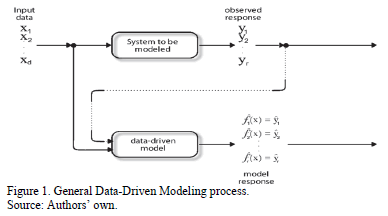
<body><![CDATA[<p><font size="3" face="Verdana, Arial, Helvetica, sans-serif"><b>3. Symbolic regression by genetic programming</b></font></p>     <p><font size="2" face="Verdana, Arial, Helvetica, sans-serif">Genetic Programming is a bio-inspired  method used in the field of machine learning &#91;26&#93;. An introduction and review  of the GP literature is provided by &#91;27&#93;. The main difference between Genetic  Algorithms (GA) and GP is the representation of individuals. In the GA  individuals are expressed as linear strings of fixed length (chromosome) through  all evolution steps; whereas in GP, individuals are expressed as nonlinear  objects with different sizes and shapes, normally these nonlinear objects are  expression trees. Thus, motivated by the evolutionary process observed in  nature, computer programs are evolved to solve a given task. This process is  done by randomly generating an initial population of trees and then, by using  operations such as crossover and mutation, a new population of offspring is  created &#91;26&#93;. A new parent population is selected from the initial and  offspring populations, based on how good these trees perform for the given  task. The best offspring resulting from this process is the solution of the  problem. GP is implemented as per the following five steps:</font></p> <ol>       <li><font size="2" face="Verdana, Arial, Helvetica, sans-serif">Generate an initial population of individuals formed as expression trees, consisting of the functions (arithmetic, basic mathematical and Boolean functions) and terminals (constants and inputs variables) of the problem.</font></li>       <li><font size="2" face="Verdana, Arial, Helvetica, sans-serif">The fitness of each individual in a population is measured through a criterion such as the mean squared error.</font></li>       <li><font size="2" face="Verdana, Arial, Helvetica, sans-serif">Likewise, the complexity of the individual is measured through a criterion such as the sum of all nodes in the tree.</font></li>       <li><font size="2" face="Verdana, Arial, Helvetica, sans-serif">Better parents are usually     selected through a tournament involving comparison of two parents at a time and     thereafter, short listing the winner for further competition with the hope that     it has a better chance of producing better offspring. The concept of what is     &quot;best&quot; may be multi-objective, this means that there are two or more     criteria used for selecting &quot;good individuals&quot; for further     propagation. Often these criteria are prediction error and model complexity.</font></li>       <li><font size="2" face="Verdana, Arial, Helvetica, sans-serif">New offspring are generated by     changing the parents through three genetic operations: reproduction, crossover     and mutation. After finishing the first cycle of the five steps listed, steps 2     to 5 are iterated. After some condition is reached, the evolutionary process is     stopped. This gives rise to a set of solutions ranging from less complex     individuals but with high error, to those highly complex individuals that have     minimum error.</font></li>     </ol>     <p><font size="2" face="Verdana, Arial, Helvetica, sans-serif">When GP is used to create empirical  mathematical models of data acquired from a process or system, it is commonly  referred to as symbolic regression &#91;28&#93;. SRGP is an iterative search technique,  that looks for appropriate expressions of the response variable in a space of  all valid formulae containing some of the given input variables and some  predefined functional operators, like summation, multiplication, division,  exponentiation, sine, and so on.</font></p>     <p><font size="2" face="Verdana, Arial, Helvetica, sans-serif">The task of symbolic regression can be  stated as follows. Given a set of <img src="/img/revistas/dyna/v83n197/v83n197a17eq010.gif">; where <img src="/img/revistas/dyna/v83n197/v83n197a17eq012.gif"> is  a <img src="/img/revistas/dyna/v83n197/v83n197a17eq014.gif">dimensional input <img src="/img/revistas/dyna/v83n197/v83n197a17eq016.gif"> <img src="/img/revistas/dyna/v83n197/v83n197a17eq018.gif"> is a corresponding output  value, <img src="/img/revistas/dyna/v83n197/v83n197a17eq020.gif"> is a set of user-specified  functions, <img src="/img/revistas/dyna/v83n197/v83n197a17eq022.gif"> is the universe of all  mathematical expressions formed from <img src="/img/revistas/dyna/v83n197/v83n197a17eq020.gif">, the task of symbolic regression is to determine a function <img src="/img/revistas/dyna/v83n197/v83n197a17eq024.gif">, which provides a small prediction error. The resulting function <img src="/img/revistas/dyna/v83n197/v83n197a17eq026.gif"> is later used to predict the  output for a new given input. The quality of <img src="/img/revistas/dyna/v83n197/v83n197a17eq026.gif"> is determined by how well it  maps the given inputs to their corresponding outputs. An advantage of symbolic  regression in contrast to classical regression analysis, is that GP  automatically evolves the structure and the parameters of the mathematical  model.</font></p>     ]]></body>

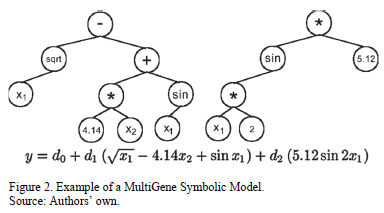
<body><![CDATA[<p><font size="2" face="Verdana, Arial, Helvetica, sans-serif">In contrast to the classical GP, in  MultiGene Genetic Programming (MGGP) each symbolic model (expression tree) in  the GP population is made from several trees instead of one &#91;28,29&#93;. All of the  genes have specific optimal weights and the summation of the weighted genes  plus a bias term form the final formula. The mathematical form of the multigene  representation is shown in (1) &#91;28&#93;.</font></p>     <p><img src="/img/revistas/dyna/v83n197/v83n197a17eq01.gif"></p>     <p><font size="2" face="Verdana, Arial, Helvetica, sans-serif">Where <img src="/img/revistas/dyna/v83n197/v83n197a17eq030.gif"> is the predicted output, <img src="/img/revistas/dyna/v83n197/v83n197a17eq032.gif"> is the value of the <img src="/img/revistas/dyna/v83n197/v83n197a17eq034.gif"> gene and is a function of one or more of the input variables, <img src="/img/revistas/dyna/v83n197/v83n197a17eq036.gif"> is the <img src="/img/revistas/dyna/v83n197/v83n197a17eq034.gif"> weighting coefficient, <img src="/img/revistas/dyna/v83n197/v83n197a17eq038.gif"> is the number  of genes and <img src="/img/revistas/dyna/v83n197/v83n197a17eq040.gif"> is a set term. For example, a multigene model that predicts an output variable <img src="/img/revistas/dyna/v83n197/v83n197a17eq042.gif"> using input variables <img src="/img/revistas/dyna/v83n197/v83n197a17eq044.gif"> and <img src="/img/revistas/dyna/v83n197/v83n197a17eq046.gif"> is shown in <a href="#fig02">Fig. 2</a>.</font></p>     <p align="center"><font size="2" face="Verdana, Arial, Helvetica, sans-serif"><a name="fig02"></a></font><img src="/img/revistas/dyna/v83n197/v83n197a17fig02.gif"></p>     <p><font size="2" face="Verdana, Arial, Helvetica, sans-serif">The software GPTIPS &#91;29&#93; is used in the  current study to perform MGGP, which produces the symbolic modeling of the optimal  sizes W and L of a VF and a CF whose data sets are collected in Section 5.  GPTIPS is a SRGP code which was written based on Multigene Symbolic Regression  to be used with MATLAB<sup>®</sup>. This software has the ability of avoiding  most bloat problems by imposing restrictions on the maximum value of parameters  such as the maximum number of genes, the maximum depth of trees and genes, the  maximum number of nodes per tree, and so on.</font></p>     <p>&nbsp;</p>     <p><font size="3" face="Verdana, Arial, Helvetica, sans-serif"><b>4. Methodology</b></font></p>     <p><font size="2" face="Verdana, Arial, Helvetica, sans-serif">The methodology used is comprised of two  steps: Pareto Front Generation and obtaining the white box model by using MGGP.</font></p>     <p><font size="2" face="Verdana, Arial, Helvetica, sans-serif"><b><i>4.1. Pareto front generation</i></b></font></p>     <p><font size="2" face="Verdana, Arial, Helvetica, sans-serif">The basic cells for designing analog  integrated circuits are several, such as OPAMP, OTA, CC, and so on; but &#91;9&#93;  highlights the UGCs: VF, CF, VM and CM. The interconnection of UGCs generates  more complex ICs, such as the Current Feedback Operational Amplifier (CFOA).  These kinds of ICs have been sized with different optimization methodologies  such as the Evolutionary Algorithms &#91;9,10,30,31&#93;, with the aim of generating optimal  behavior through the evaluation of multiple objectives &#91;32-34&#93; (performance  parameters). Evolutionary Algorithms generate populations of feasible  solutions, which approximate the Optimal Pareto set &#91;35&#93;. However, in the  optimization of analog ICs, much of the time the best solutions include extreme  performance requirements such as ultra-low power, low voltage and high  frequency. Therefore, </font><font size="2" face="Verdana, Arial, Helvetica, sans-serif">the set of  optimal solutions is located in some region of the periphery of the feasible  solutions.</font></p>     ]]></body>
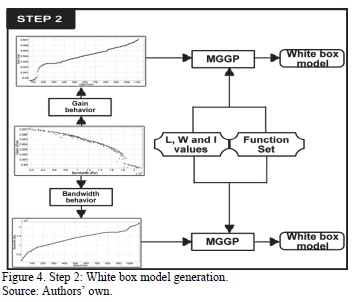
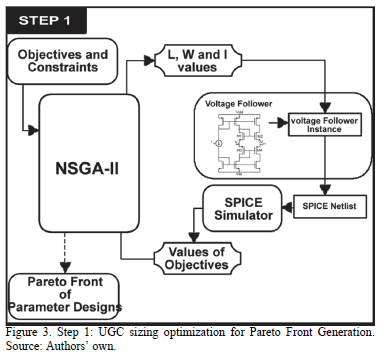
<body><![CDATA[<p><font size="2" face="Verdana, Arial, Helvetica, sans-serif">Multi-objective optimization is a  convenient tool to exploit the feasible and optimal solutions in situations  where two or more objectives are in conflict and have to be maximized or  minimized at the same time. Thus, the first step of the methodology is to  identify the optimal I, W and L sizes of two UCGs, a VF and a CF, maximizing  the unity gain and bandwidth of such circuits. This is carried out using the  process depicted in <a href="#fig03">Fig. 3</a> &#91;14&#93;.</font></p>     <p align="center"><font size="2" face="Verdana, Arial, Helvetica, sans-serif"><a name="fig03"></a></font><img src="/img/revistas/dyna/v83n197/v83n197a17fig03.gif"></p>     <p><font size="2" face="Verdana, Arial, Helvetica, sans-serif">The optimization stage is performed by applying the NSGA-  II algorithm &#91;14, 32, 36, 37&#93;, to minimize a problem of the form:</font></p>     <p><img src="/img/revistas/dyna/v83n197/v83n197a17eq02.gif"></p>     <p><font size="2" face="Verdana, Arial, Helvetica, sans-serif">where function <img src="/img/revistas/dyna/v83n197/v83n197a17eq054.gif"> is the decision vector and <img src="/img/revistas/dyna/v83n197/v83n197a17eq038.gif"> is the number of variables; <img src="/img/revistas/dyna/v83n197/v83n197a17eq056.gif">, where <img src="/img/revistas/dyna/v83n197/v83n197a17eq058.gif">  is the decision space for the variables.</font></p>     <p><font size="2" face="Verdana, Arial, Helvetica, sans-serif">All objective functions <img src="/img/revistas/dyna/v83n197/v83n197a17eq060.gif"> and <img src="/img/revistas/dyna/v83n197/v83n197a17eq062.gif"> are performance constraints. Very often,  since the objectives in (2) contradict each other, no point <img src="/img/revistas/dyna/v83n197/v83n197a17eq056.gif"> minimizes the objectives simultaneously. The best  trade-offs among the objectives can be defined in terms of the Pareto optimal  &#91;36,37&#93;.</font></p>     <p><font size="2" face="Verdana, Arial, Helvetica, sans-serif">The NSGA-II Algorithm is based on Pareto ranking. Firstly, two populations <img src="/img/revistas/dyna/v83n197/v83n197a17eq064.gif"> are generated, each one of size <img src="/img/revistas/dyna/v83n197/v83n197a17eq066.gif">. The NSGA-II procedure in each generation consists of rebuilding the current <img src="/img/revistas/dyna/v83n197/v83n197a17eq068.gif"> population <img src="/img/revistas/dyna/v83n197/v83n197a17eq070.gif"> from the two original  population fronts &#91;36&#93;. In the next step, new offspring <img src="/img/revistas/dyna/v83n197/v83n197a17eq072.gif"> are created from the current population <img src="/img/revistas/dyna/v83n197/v83n197a17eq074.gif">  (previously ranked  and ordered by sub-front number), in order to choose from a population of size <img src="/img/revistas/dyna/v83n197/v83n197a17eq076.gif"><i>,</i><img src="/img/revistas/dyna/v83n197/v83n197a17eq066.gif"> solutions belonging to the first sub-front. In addition, the last sub-front could be greater than  necessary, and the measure <img src="/img/revistas/dyna/v83n197/v83n197a17eq078.gif"> is used to preserve diversity by the selection of the solutions that are far from the rest &#91;38&#93;. To build new generations, we use multi-point crossover and single point mutation as genetic operators. The optimization loop is iteratively applied until some stopping criterion is met, e.g., a certain number of iterations are executed or a sufficient convergence to the Pareto front with  appropriate diversity is achieved  &#91;37,39&#93;.</font></p>     <p><font size="2" face="Verdana, Arial, Helvetica, sans-serif">In this  case, each variable <img src="/img/revistas/dyna/v83n197/v83n197a17eq080.gif"> represents the Width (W) or Length (L) of the  MOSFETs, or the bias current (I). Those values are integer-multiples of a  minimum value allowed by the fabrication process. The objectives <img src="/img/revistas/dyna/v83n197/v83n197a17eq082.gif"> are the circuit performances which are unity  gain and high bandwidth, that are extracted from the output of the SPICE  simulation. The output of the first step is a set of points of the Pareto  front, as is shown in <a href="#fig03">Fig. 3</a>.</font></p>     <p><font size="2" face="Verdana, Arial, Helvetica, sans-serif"><b><i>4.2. White box model  generation</i></b></font></p>     <p><font size="2" face="Verdana, Arial, Helvetica, sans-serif">A set of  samples of the Pareto front can provide information to answer questions on  feasibility and performance trends. The proposed approach includes a second  step: white box model generation. For this paper the models are of gain and  bandwidth performances of the sizes W and L of the UGCs. These are obtained by  using symbolic modeling through MGGP. <a href="#fig04">Fig. 4</a> depicts the process of  construction of the white box models of feasible performance solutions of the  UGCs.</font></p>     ]]></body>
<body><![CDATA[<p align="center"><font size="2" face="Verdana, Arial, Helvetica, sans-serif"><a name="fig04"></a></font><img src="/img/revistas/dyna/v83n197/v83n197a17fig04.gif"></p>     <p><font size="2" face="Verdana, Arial, Helvetica, sans-serif">The aim of symbolic modeling is to use  simulation data to generate interpretable mathematical expressions that relate  the circuit performances to the design variables &#91;13&#93;. Thus, those mathematical  expressions replace complex systems whose performance evaluation is  computationally expensive. Moreover, the symbolic models obtained can provide  insight into the underlying system, unlike other modeling methods like kriging,  neural networks or support vector machines.</font></p>     <p><font size="2" face="Verdana, Arial, Helvetica, sans-serif">Generating a white box model by symbolic regression   usually involves three steps:</font></p> <ol>       <li><font size="2" face="Verdana, Arial, Helvetica, sans-serif">Design of experiments. It     encompasses the selection of sample vectors to build the model. A wide variety     of techniques are available, ranging from the classical Monte Carlo sampling,     to latin hypercube sampling &#91;40&#93;. Basically, it tries to achieve a more uniform     coverage of the search space with the minimum number of samples.</font></li>       <li><font size="2" face="Verdana, Arial, Helvetica, sans-serif">Accurate evaluation. SPICE     simulations are used to evaluate the performances for the sample circuits     selected in step 1. This is the most computationally expensive step.</font></li>       <li><font size="2" face="Verdana, Arial, Helvetica, sans-serif">Model construction. This part     concerns building the symbolic model using the data sets obtained in step 2.     For the model to be easily understood, low complexity is essential.</font></li>     </ol>     <p><font size="2" face="Verdana, Arial, Helvetica, sans-serif">Experimental design is not used in step  2. The sample vectors to build the symbolic model correspond to the samples of  the Pareto front obtained in step 1 (<a href="#fig03">Fig 3</a>). In this case, the Pareto optimal  front has relatively few samples representing the best configurations in the  design space. Multi-objective optimization algorithms use different strategies  to ensure a good convergence to the ideal Pareto front and a good diversity of  solutions within that front; e.g., ranking of solutions and maximization of the  crowding distance of non-dominated solutions are used in NSGA-II &#91;36&#93;.  Therefore, Multi-objective algorithms play the role of experimental design,  i.e. the NSGA-II algorithm gets the sampling set to perform the white box  modeling instead of using statistical sampling.</font></p>     <p>&nbsp;</p>     <p><font size="3" face="Verdana, Arial, Helvetica, sans-serif"><b>5. Experiments and Results</b></font></p>     ]]></body>
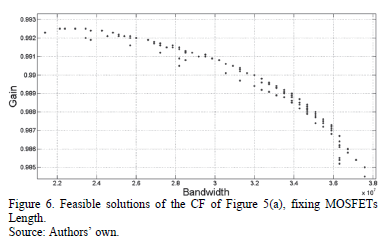
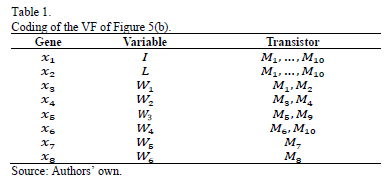
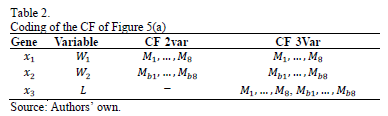
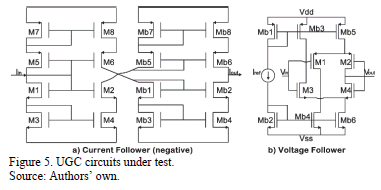
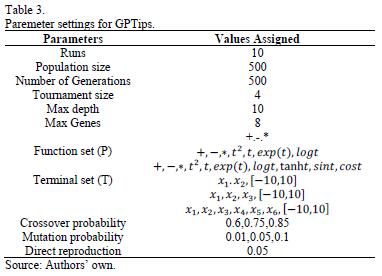
<body><![CDATA[<p><font size="2" face="Verdana, Arial, Helvetica, sans-serif">The optimization system has been  programmed in standard C, and evolves the Widths (W), Lengths (L) and current  bias (I) for each transistor of the UGC. Results are provided by TopSPICE as a  listing of output data and are used for evaluating the individuals. The UGCs  are coded using eight design variables for the VF and two or three for the CF,  as can be seen in <a href="#tab01">Table 1</a> and <a href="#tab02">Table 2</a> respectively. For illustrative purposes, two conflicting objectives are shown  in <a href="#fig04">Fig. 4</a>; but any number of objectives may be used. The UGCs used are shown in  <a href="#fig05">Fig. 5</a>.</font></p>     <p align="center"><font size="2" face="Verdana, Arial, Helvetica, sans-serif"><a name="tab01"></a></font><img src="/img/revistas/dyna/v83n197/v83n197a17tab01.gif"></p>     <p align="center"><font size="2" face="Verdana, Arial, Helvetica, sans-serif"><a name="tab02"></a></font><img src="/img/revistas/dyna/v83n197/v83n197a17tab02.gif"></p>     <p align="center"><font size="2" face="Verdana, Arial, Helvetica, sans-serif"><a name="fig05"></a></font><img src="/img/revistas/dyna/v83n197/v83n197a17fig05.gif"></p>     <p><font size="2" face="Verdana, Arial, Helvetica, sans-serif">To perform symbolic modeling using GPTIPS, the parameters shown in     <a href="#tab03">Table 3</a> are used. Parameter settings play a major role in implementing the MGGP  efficiently. The majority of parameters were selected based on the most  frequently cited values in the literature &#91;2,3,9,29,31&#93;. The function set may  include a broad selection of primitives so as to evolve a variety of nonlinear models. Of the three functional sets  in <a href="#tab03">Table 3</a>, it chooses the smallest. Although  the larger sets give slightly more accurate models, their complexity makes them  too obscure for practical use. The values of population size and number of generations  depend on the complexity of the data. In addition, the number of genes and the  maximum depth of a gene influences the size and the number of models to be  searched for in the global space.</font></p>     <p align="center"><font size="2" face="Verdana, Arial, Helvetica, sans-serif"><a name="tab03"></a></font><img src="/img/revistas/dyna/v83n197/v83n197a17tab03.gif"></p>     <p><font size="2" face="Verdana, Arial, Helvetica, sans-serif">The evaluation criteria for symbolic  models are model precision and model complexity. Model precision is the  adjustment for training and test data, using the Root Mean Square Error (RMSE)  as an adjustment measure, as in <b>(3)</b>, where <img src="/img/revistas/dyna/v83n197/v83n197a17eq148.gif"> is the value of the <img src="/img/revistas/dyna/v83n197/v83n197a17eq150.gif"> data sample predicted by the symbolic model, <img src="/img/revistas/dyna/v83n197/v83n197a17eq152.gif"> is the actual value of the <img src="/img/revistas/dyna/v83n197/v83n197a17eq150.gif"> data sample and <img src="/img/revistas/dyna/v83n197/v83n197a17eq066.gif"> is the number of training samples. Model complexity was evaluated as the sum of all nodes in the genes. Using  this method we selected symbolic models that were sufficiently accurate and highly interpretable.</font></p>     <p><img src="/img/revistas/dyna/v83n197/v83n197a17eq03.gif"></p>     <p><font size="2" face="Verdana, Arial, Helvetica, sans-serif"><b><i>5.1. Current Follower</i></b></font></p>     <p><font size="2" face="Verdana, Arial, Helvetica, sans-serif">The first example of using this  methodology is the modeling of the Pareto Optimal Front (POF) of a CF shown in  <a href="#fig05">Fig. 5(a)</a>. It has L fixed at <img src="/img/revistas/dyna/v83n197/v83n197a17eq156.gif">, so there are only two variables to model, <img src="/img/revistas/dyna/v83n197/v83n197a17eq158.gif"> and <img src="/img/revistas/dyna/v83n197/v83n197a17eq160.gif">; MOSFET <img src="/img/revistas/dyna/v83n197/v83n197a17eq066.gif"> and <img src="/img/revistas/dyna/v83n197/v83n197a17eq020.gif">, respectively. These feasible solutions are depicted in <a href="#fig06">Fig 6</a>.</font></p>     ]]></body>
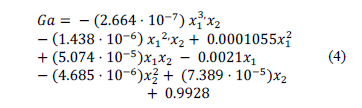
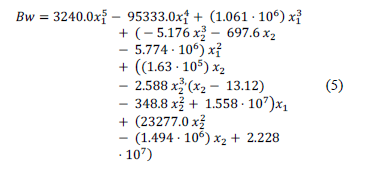
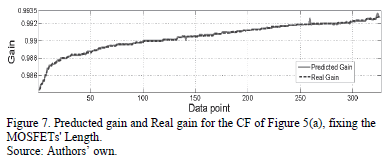
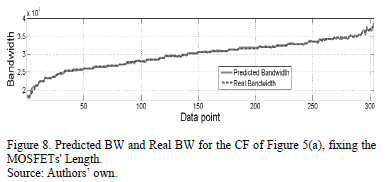
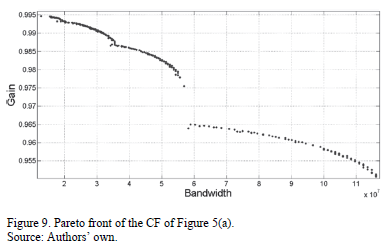
<body><![CDATA[<p align="center"><font size="2" face="Verdana, Arial, Helvetica, sans-serif"><a name="fig06"></a></font><img src="/img/revistas/dyna/v83n197/v83n197a17fig06.gif"></p>     <p><font size="2" face="Verdana, Arial, Helvetica, sans-serif">Once the feasible solutions are obtained,  each performance parameter is modeled separately using the MGGP method, as  described in Section IV. The symbolic model obtained for the unitary gain of  the CF of <a href="#fig05">Fig. 5(a)</a> is shown in (4),  where <img src="/img/revistas/dyna/v83n197/v83n197a17eq174.gif"> and <img src="/img/revistas/dyna/v83n197/v83n197a17eq176.gif">. Its approximation behavior is depicted in <a href="#fig07">Fig. 7</a> where the  predicted gain is the value obtained from the symbolic model (4) using  the test data; its RMSE is <img src="/img/revistas/dyna/v83n197/v83n197a17eq178.gif">.</font></p>     <p><img src="/img/revistas/dyna/v83n197/v83n197a17eq04.gif"></p>     <p align="center"><font size="2" face="Verdana, Arial, Helvetica, sans-serif"><a name="fig07"></a></font><img src="/img/revistas/dyna/v83n197/v83n197a17fig07.gif"></p>     <p><font size="2" face="Verdana, Arial, Helvetica, sans-serif">The symbolic model obtained for the   bandwidth of the feasible solutions for the CF (<a href="#fig05">Fig. 5(a)</a>) is shown in (5). </font></p>     <p><img src="/img/revistas/dyna/v83n197/v83n197a17eq05.gif"></p>     <p><font size="2" face="Verdana, Arial, Helvetica, sans-serif"><a href="#fig08">Fig. 8</a> shows   the results of the symbolic model and the SPICE simulation using test data.</font></p>     <p align="center"><font size="2" face="Verdana, Arial, Helvetica, sans-serif"><a name="fig08"></a></font><img src="/img/revistas/dyna/v83n197/v83n197a17fig08.gif"></p>     <p><font size="2" face="Verdana, Arial, Helvetica, sans-serif">The second example is the modeling of  the POF of the same CF, but in this case, one variable was added to the  optimization process. The modeling variables are <img src="/img/revistas/dyna/v83n197/v83n197a17eq182.gif"> and<img src="/img/revistas/dyna/v83n197/v83n197a17eq184.gif">. <img src="/img/revistas/dyna/v83n197/v83n197a17eq186.gif"> can take values of <img src="/img/revistas/dyna/v83n197/v83n197a17eq188.gif"> </font><font size="2" face="Verdana, Arial, Helvetica, sans-serif">and <img src="/img/revistas/dyna/v83n197/v83n197a17eq194.gif">. The feasible solutions are depicted in <a href="#fig09">Fig. 9</a>. The feasible  solutions from <a href="#fig06">Fig. 6</a> are part of this set.</font></p>     <p align="center"><font size="2" face="Verdana, Arial, Helvetica, sans-serif"><a name="fig09"></a></font><img src="/img/revistas/dyna/v83n197/v83n197a17fig09.gif"></p>     ]]></body>
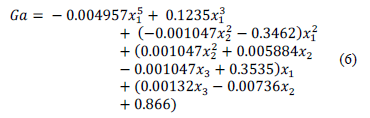
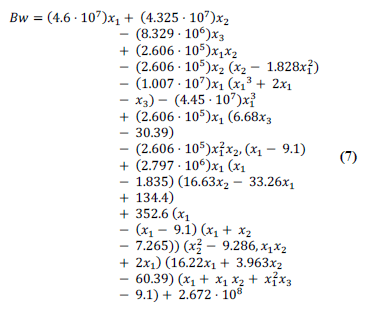
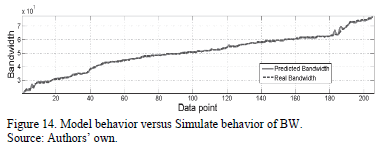
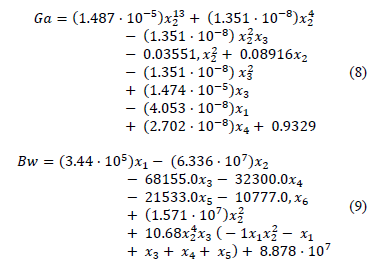
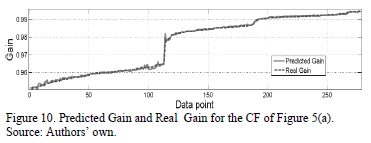
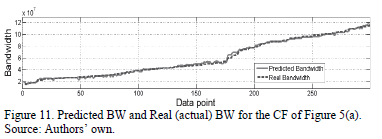
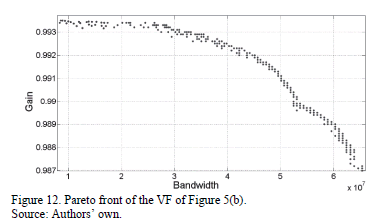
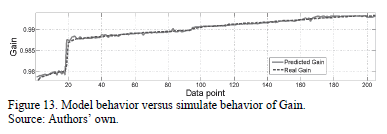
<body><![CDATA[<p><font size="2" face="Verdana, Arial, Helvetica, sans-serif">Following  the steps in Section IV, feasible design parameter solutions for the CF (<a href="#fig05">Fig.  5(a)</a>) are first obtained, and then each performance parameter of the  optimization process is modeled with GPTIPS. These produce symbolic models of  the gain and CF bandwidth. The symbolic model obtained for the current follower  bandwidth is expression (6). The approximation behavior is  depicted in <a href="#fig10">Fig. 10</a>; the predicted gain is the value obtained from the symbolic  model (6) and the actual gain is the value  obtained from the test data (SPICE). The symbolic model  obtained for the bandwidth of the feasible solutions for the CF is shown in (7). <a href="#fig11">Fig.  11</a> shows the behavior of the obtained symbolic model (7) versus the real data obtained using the test data (SPICE).</font></p>     <p><img src="/img/revistas/dyna/v83n197/v83n197a17eq06.gif"></p>     <p><img src="/img/revistas/dyna/v83n197/v83n197a17eq07.gif"></p>     <p align="center"><font size="2" face="Verdana, Arial, Helvetica, sans-serif"><a name="fig10"></a></font><img src="/img/revistas/dyna/v83n197/v83n197a17fig10.gif"></p>     <p align="center"><font size="2" face="Verdana, Arial, Helvetica, sans-serif"><a name="fig11"></a></font><img src="/img/revistas/dyna/v83n197/v83n197a17fig11.gif"></p>     <p><font size="2" face="Verdana, Arial, Helvetica, sans-serif"><b><i>5.2. Voltage Follower</i></b></font></p>     <p><font size="2" face="Verdana, Arial, Helvetica, sans-serif">Finally, the proposed methodology is  applied for modeling the Pareto optimal front of a VF, shown in <a href="#fig05">Fig. 5(b)</a>. This  VF has eight variables to encode, as seen in <a href="#tab01">Table 1</a>. The  Pareto optimal front to be modeled is depicted in <a href="#fig12">Fig. 12</a>. The symbolic models  obtained for gain and bandwidth are presented in (8) and (9).</font></p>     <p align="center"><font size="2" face="Verdana, Arial, Helvetica, sans-serif"><a name="fig12"></a></font><img src="/img/revistas/dyna/v83n197/v83n197a17fig12.gif"></p>     <p><font size="2" face="Verdana, Arial, Helvetica, sans-serif">The behavior of the Gain symbolic model (8) and  the SPICE simulation result (Actual Gain) are shown in <a href="#fig13">Fig. 13</a>. It can be  observed that MGGP is capable of approximating the behavior of actual gain  solutions; its RSME is <img src="/img/revistas/dyna/v83n197/v83n197a17eq202.gif">. The symbolic model obtained by using the MGGP method is shown in (8). As  can be seen, the model is highly interpretable given that it is formed only by  additions and subtractions of polynomials. Likewise, the BW symbolic model  obtained is shown in (9). <a href="#fig14">Fig. 14</a> shows the behavior</font> <font size="2" face="Verdana, Arial, Helvetica, sans-serif">of the symbolic  model for the bandwidth and the behavior of the actual (SPICE simulated)  bandwidth.</font></p>     <p align="center"><font size="2" face="Verdana, Arial, Helvetica, sans-serif"><a name="fig13"></a></font><img src="/img/revistas/dyna/v83n197/v83n197a17fig13.gif"></p>     ]]></body>
<body><![CDATA[<p align="center"><font size="2" face="Verdana, Arial, Helvetica, sans-serif"><a name="fig14"></a></font><img src="/img/revistas/dyna/v83n197/v83n197a17fig14.gif"></p>     <p><img src="/img/revistas/dyna/v83n197/v83n197a17eq0809.gif"></p>     <p>&nbsp;</p>     <p><font size="3" face="Verdana, Arial, Helvetica, sans-serif"><b>6. Discussion of Results</b></font></p>     <p><font size="2" face="Verdana, Arial, Helvetica, sans-serif">The symbolic regression process provides  an abundant population of different types of symbolic models with different  values in RMSE and complexity. Some having a smaller error, have complexities  exceeding the hundreds of nodes, making them uninterpretable. In addition to  the above, enlarging the functional set drastically increases the complexity of  the symbolic models obtained. For that reason, the functional set is limited to  only three functions: addition, subtraction and multiplication. In Section 5  symbolic models and their behavior against SPICE simulated data are shown. As  mentioned above, symbolic models that are highly interpretable by human beings  and can be of practical use are selected.</font></p>     <p><font size="2" face="Verdana, Arial, Helvetica, sans-serif">Given the quantity of individuals that  form the population of symbolic models and the complexity and adjustment of  each one, this work focused on those models that dominate others for the  selection of symbolic models. In other words, individuals in the knee of the  Pareto Front of models are selected; this guarantees that selected models are  highly interpretable and have a good adjustment.</font></p>     <p><font size="2" face="Verdana, Arial, Helvetica, sans-serif">As is well known, the Pareto-domination  based selection of the NSGA-II algorithm succeeds at driving the whole  population towards the Pareto optimal set or Pareto Front. However, it has no  direct control over the evolution of each individual in the population and thus  it has no good mechanism to control the distribution over the PF. That is why  repetition is recommended to ensure the location of the real Pareto front.  Moreover, the NSGA-II groups individuals from different regions of the design  space in the Pareto front. The interpolation of antecedents of two neighbors of  the Pareto front may not necessarily be valid.</font></p>     <p>&nbsp;</p>     <p><font size="3" face="Verdana, Arial, Helvetica, sans-serif"><b>7. Conclusions</b></font></p>     <p><font size="2" face="Verdana, Arial, Helvetica, sans-serif">This paper has presented a procedure to  data-mine the results of a circuit sizing to extract domain knowledge that can  be immediately used by IC experts. Thus, the knowledge can be distributed to  designers or students, without the need for more synthesis, since the symbolic  models, which have been generated using MGGP, are human-interpretable  mathematical models.</font></p>     ]]></body>
<body><![CDATA[<p><font size="2" face="Verdana, Arial, Helvetica, sans-serif">The procedure presented involves two  steps: the generation of samples of the Pareto-optimal performance sizes of a  UGC using the MOGA and the generation of white box models of each of the  objectives of this Pareto Front.</font></p>     <p><font size="2" face="Verdana, Arial, Helvetica, sans-serif">The symbolic models are formed by  additions and subtractions of polynomials; thus, their form is highly  interpretable. Nevertheless, these are very hard to invert, so it is necessary  to go back to the antecedent simulations.</font></p>     <p><font size="2" face="Verdana, Arial, Helvetica, sans-serif">For values between two or more simulation  points, interpolation does not always make sense. This is because the  antecedent points come from distant regions in the design space. It is  important to highlight that in this work, less complex symbolic models were  selected despite having a less precise adjustment. Thus, selecting complex  models that are obscure as a neural network is avoided.</font></p>     <p>&nbsp;</p>     <p><font size="3" face="Verdana, Arial, Helvetica, sans-serif"><b>References</b></font></p>     <!-- ref --><p><font size="2" face="Verdana, Arial, Helvetica, sans-serif"><b>&#91;1&#93;</b> Rutenbar, R.A., Gielen, G. and  Antao, B., Computer-aided design of analog integrated circuits and systems,  Piscataway, NJ, USA: Wiley-IEEE Press, 2002. ISBN: 978-0-471-22782-3 </font>&nbsp;&nbsp;&nbsp;&nbsp;&nbsp;&nbsp;&nbsp;&nbsp;[&#160;<a href="javascript:void(0);" onclick="javascript: window.open('/scielo.php?script=sci_nlinks&ref=1126813&pid=S0012-7353201600030001700001&lng=','','width=640,height=500,resizable=yes,scrollbars=1,menubar=yes,');">Links</a>&#160;]<!-- end-ref --><!-- ref --><p><font size="2" face="Verdana, Arial, Helvetica, sans-serif"><b>&#91;2&#93;</b> Razavi, B., Design of analog  CMOS integrated circuits: Tata McGraw-Hill Education, 2002. ISBN-10: 0072380322 </font>&nbsp;&nbsp;&nbsp;&nbsp;&nbsp;&nbsp;&nbsp;&nbsp;[&#160;<a href="javascript:void(0);" onclick="javascript: window.open('/scielo.php?script=sci_nlinks&ref=1126814&pid=S0012-7353201600030001700002&lng=','','width=640,height=500,resizable=yes,scrollbars=1,menubar=yes,');">Links</a>&#160;]<!-- end-ref --><!-- ref --><p><font size="2" face="Verdana, Arial, Helvetica, sans-serif"><b>&#91;3&#93;</b> Tlelo-Cuautle, E., Integrated  circuits for analog signal processing. Tlelo-Cuautle E., ed., Springer New  York, USA, 2013. ISBN: 9781461413820 </font>&nbsp;&nbsp;&nbsp;&nbsp;&nbsp;&nbsp;&nbsp;&nbsp;[&#160;<a href="javascript:void(0);" onclick="javascript: window.open('/scielo.php?script=sci_nlinks&ref=1126815&pid=S0012-7353201600030001700003&lng=','','width=640,height=500,resizable=yes,scrollbars=1,menubar=yes,');">Links</a>&#160;]<!-- end-ref --><!-- ref --><p><font size="2" face="Verdana, Arial, Helvetica, sans-serif"><b>&#91;4&#93;</b> S&aacute;nchez-L&oacute;pez, C.,  Mart&iacute;nez-Romero, E. and Tlelo-Cuautle, E., Symbolic analysis of OTRAs-based  circuits. Journal of applied research and technology &#91;online&#93;, 9(1), pp. 69-80,  2011. &#91;date of reference Dec. 11th, 2015&#93;. Available at:  <a href="http://www.revistas.unam.mx/index.php/jart/article/view/25278/23750" target="_blank">http://www.revistas.unam.mx/index.php/jart/article/view/25278/23750</a></font>&nbsp;&nbsp;&nbsp;&nbsp;&nbsp;&nbsp;&nbsp;&nbsp;[&#160;<a href="javascript:void(0);" onclick="javascript: window.open('/scielo.php?script=sci_nlinks&ref=1126816&pid=S0012-7353201600030001700004&lng=','','width=640,height=500,resizable=yes,scrollbars=1,menubar=yes,');">Links</a>&#160;]<!-- end-ref --><!-- ref --><p><font size="2" face="Verdana, Arial, Helvetica, sans-serif"><b>&#91;5&#93;</b> Khateb, F. and Biolek, D.,  Bulk-driven current differencing transconductance amplifier, Circuits, Systems,  and Signal Processing, 30(5), pp.1071-1089, 2011. DOI:  10.1007/s00034-010-9254-9</font>&nbsp;&nbsp;&nbsp;&nbsp;&nbsp;&nbsp;&nbsp;&nbsp;[&#160;<a href="javascript:void(0);" onclick="javascript: window.open('/scielo.php?script=sci_nlinks&ref=1126817&pid=S0012-7353201600030001700005&lng=','','width=640,height=500,resizable=yes,scrollbars=1,menubar=yes,');">Links</a>&#160;]<!-- end-ref --><!-- ref --><p><font size="2" face="Verdana, Arial, Helvetica, sans-serif"><b>&#91;6&#93;</b> Campos-Cant&oacute;n,  I., Desarrollo de celdas l&oacute;gicas por medio del espacio de estados en un sistema  bidimensional, Revista Mexicana de F&iacute;sica, &#91;online&#93;. 57(2),  pp. 106-109, 2011.&#91;date of reference Dec. 11th, 2015&#93;</b> Available at:  <a href="http://revistas.unam.mx/index.php/rmf/article/view/25225/23707" target="_blank">http://revistas.unam.mx/index.php/rmf/article/view/25225/23707</a></font>&nbsp;&nbsp;&nbsp;&nbsp;&nbsp;&nbsp;&nbsp;&nbsp;[&#160;<a href="javascript:void(0);" onclick="javascript: window.open('/scielo.php?script=sci_nlinks&ref=1126818&pid=S0012-7353201600030001700006&lng=','','width=640,height=500,resizable=yes,scrollbars=1,menubar=yes,');">Links</a>&#160;]<!-- end-ref --><!-- ref --><p><font size="2" face="Verdana, Arial, Helvetica, sans-serif"><b>&#91;7&#93;</b> Swamy, M., Mutators,  generalized impedance converters and inverters, and their realization using  generalized current conveyors. Circuits, Systems, and Signal Processing, 30(1),  pp.209-232, 2011. DOI: 10.1007/s00034-010-9208-2</font>&nbsp;&nbsp;&nbsp;&nbsp;&nbsp;&nbsp;&nbsp;&nbsp;[&#160;<a href="javascript:void(0);" onclick="javascript: window.open('/scielo.php?script=sci_nlinks&ref=1126819&pid=S0012-7353201600030001700007&lng=','','width=640,height=500,resizable=yes,scrollbars=1,menubar=yes,');">Links</a>&#160;]<!-- end-ref --><!-- ref --><p><font size="2" face="Verdana, Arial, Helvetica, sans-serif"><b>&#91;8&#93;</b> Pathak, J., Singh, A.K. and  Senani, R., Systematic realisation of quadrature oscillators using current  differencing buffered amplifiers. IET Circuits, Devices &amp; Systems, 5(3),  pp. 203-211, 2011. DOI: 10.1049/iet-cds.2010.0227</font>&nbsp;&nbsp;&nbsp;&nbsp;&nbsp;&nbsp;&nbsp;&nbsp;[&#160;<a href="javascript:void(0);" onclick="javascript: window.open('/scielo.php?script=sci_nlinks&ref=1126820&pid=S0012-7353201600030001700008&lng=','','width=640,height=500,resizable=yes,scrollbars=1,menubar=yes,');">Links</a>&#160;]<!-- end-ref --><!-- ref --><p><font size="2" face="Verdana, Arial, Helvetica, sans-serif"><b>&#91;9&#93;</b> Duarte-Villase&ntilde;or, M.A.,  Tlelo-Cuautle, E. and de la Fraga L.G., Binary genetic encoding for the  synthesis of mixed-mode circuit topologies. Circuits, Systems, and Signal  Processing, 31(3), pp. 849-863, 2012. DOI: 10.1007/s00034-011-9353-2</font>&nbsp;&nbsp;&nbsp;&nbsp;&nbsp;&nbsp;&nbsp;&nbsp;[&#160;<a href="javascript:void(0);" onclick="javascript: window.open('/scielo.php?script=sci_nlinks&ref=1126821&pid=S0012-7353201600030001700009&lng=','','width=640,height=500,resizable=yes,scrollbars=1,menubar=yes,');">Links</a>&#160;]<!-- end-ref --><!-- ref --><p><font size="2" face="Verdana, Arial, Helvetica, sans-serif"><b>&#91;10&#93;</b> Coello-Coello C.A., Van  Veldhuizen, D.A. and Lamont, G.B., Evolutionary algorithms for solving  multi-objective problems, Second ed, Springer US, 2002. ISBN: 978-0-387-33254-3 </font>&nbsp;&nbsp;&nbsp;&nbsp;&nbsp;&nbsp;&nbsp;&nbsp;[&#160;<a href="javascript:void(0);" onclick="javascript: window.open('/scielo.php?script=sci_nlinks&ref=1126822&pid=S0012-7353201600030001700010&lng=','','width=640,height=500,resizable=yes,scrollbars=1,menubar=yes,');">Links</a>&#160;]<!-- end-ref --><!-- ref --><p><font size="2" face="Verdana, Arial, Helvetica, sans-serif"><b>&#91;11&#93;</b> Sheldon, X. and Tlelo-Cuautle,  E., Recent development in symbolic analysis: An overview. In: Fakhfakh, M.,  Tlelo-Cuautle, E. and Fern&aacute;ndez, F.V., eds. Design of analog circuits through  symbolic analysis: Bentham Science Publishers, 2012, pp. 3-18. ISBN:  9781608050956</font>&nbsp;&nbsp;&nbsp;&nbsp;&nbsp;&nbsp;&nbsp;&nbsp;[&#160;<a href="javascript:void(0);" onclick="javascript: window.open('/scielo.php?script=sci_nlinks&ref=1126823&pid=S0012-7353201600030001700011&lng=','','width=640,height=500,resizable=yes,scrollbars=1,menubar=yes,');">Links</a>&#160;]<!-- end-ref --><!-- ref --><p><font size="2" face="Verdana, Arial, Helvetica, sans-serif"><b>&#91;12&#93;</b> McConaghy, T. and Gielen,  G.G.E., Globally reliable variation-aware sizing of analog integrated circuits  via response surfaces and structural homotopy. Computer-Aided Design of  Integrated Circuits and Systems, IEEE Transactions on, 28(11), pp.1627-1640,  2009. DOI: 10.1109/TCAD.2009.2030351</font>&nbsp;&nbsp;&nbsp;&nbsp;&nbsp;&nbsp;&nbsp;&nbsp;[&#160;<a href="javascript:void(0);" onclick="javascript: window.open('/scielo.php?script=sci_nlinks&ref=1126824&pid=S0012-7353201600030001700012&lng=','','width=640,height=500,resizable=yes,scrollbars=1,menubar=yes,');">Links</a>&#160;]<!-- end-ref --><!-- ref --><p><font size="2" face="Verdana, Arial, Helvetica, sans-serif"><b>&#91;13&#93;</b> McConaghy, T. and Gielen, G.G.,  Nonlinear template-free symbolic performance modeling for design and process  variation analysis of analog circuits. In: Fakhfakh, M., Tlelo-Cuautle, E. and Fern&aacute;ndez,  F.V., eds. Design of analog circuits through symbolic analysis, Bentham Science  Publishers, 2012, pp. 3-18. ISBN: 9781608050956</font>&nbsp;&nbsp;&nbsp;&nbsp;&nbsp;&nbsp;&nbsp;&nbsp;[&#160;<a href="javascript:void(0);" onclick="javascript: window.open('/scielo.php?script=sci_nlinks&ref=1126825&pid=S0012-7353201600030001700013&lng=','','width=640,height=500,resizable=yes,scrollbars=1,menubar=yes,');">Links</a>&#160;]<!-- end-ref --><!-- ref --><p><font size="2" face="Verdana, Arial, Helvetica, sans-serif"><b>&#91;14&#93;</b> Polanco-Martag&oacute;n, S.,  Reyes-Salgado, G., De la Fraga, L.G., Tlelo-Cuautle, E., Guerra-G&oacute;mez, I.,  Flores-Becerra, G., et al., Optimal sizing of analog integrated circuits by  applying genetic algorithms. In: Ramirez-Mu&ntilde;oz, A. and Garza-Rodriguez, I.,  eds. Handbook of Genetic Algorithms: New research. Mathematics Research  Developments, Nova Science Publishers; 2012. ISBN: 978-1-62081-184-9</font>&nbsp;&nbsp;&nbsp;&nbsp;&nbsp;&nbsp;&nbsp;&nbsp;[&#160;<a href="javascript:void(0);" onclick="javascript: window.open('/scielo.php?script=sci_nlinks&ref=1126826&pid=S0012-7353201600030001700014&lng=','','width=640,height=500,resizable=yes,scrollbars=1,menubar=yes,');">Links</a>&#160;]<!-- end-ref --><!-- ref --><p><font size="2" face="Verdana, Arial, Helvetica, sans-serif"><b>&#91;15&#93;</b> McConaghy, T. and Gielen, G.,  Analysis of simulation-driven numerical performance modeling techniques for  application to analog circuit optimization, in Circuits and Systems, 2005 ISCAS  2005 IEEE International Symposium; pp. 1298-1301, 2005. DOI:  10.1109/ISCAS.2005.1464833 </font>&nbsp;&nbsp;&nbsp;&nbsp;&nbsp;&nbsp;&nbsp;&nbsp;[&#160;<a href="javascript:void(0);" onclick="javascript: window.open('/scielo.php?script=sci_nlinks&ref=1126827&pid=S0012-7353201600030001700015&lng=','','width=640,height=500,resizable=yes,scrollbars=1,menubar=yes,');">Links</a>&#160;]<!-- end-ref --><!-- ref --><p><font size="2" face="Verdana, Arial, Helvetica, sans-serif"><b>&#91;16&#93;</b> Wolfe, G. and Vemuri, R.,  Extraction and use of neural network models in automated synthesis of  operational amplifiers. Computer-Aided Design of Integrated Circuits and  Systems, IEEE Transactions on, 22(2), pp.198-212, 2003. DOI:  10.1109/TCAD.2002.806600</font>&nbsp;&nbsp;&nbsp;&nbsp;&nbsp;&nbsp;&nbsp;&nbsp;[&#160;<a href="javascript:void(0);" onclick="javascript: window.open('/scielo.php?script=sci_nlinks&ref=1126828&pid=S0012-7353201600030001700016&lng=','','width=640,height=500,resizable=yes,scrollbars=1,menubar=yes,');">Links</a>&#160;]<!-- end-ref --><!-- ref --><p><font size="2" face="Verdana, Arial, Helvetica, sans-serif"><b>&#91;17&#93;</b> Sarmiento, A.T. and Soto, O.C.,  New product forecasting demand by using neural networks and similar product  analysis. DYNA. 81(186), pp. 311-317, 2014. DOI: 10.15446/dyna.v81n186.45223</font>&nbsp;&nbsp;&nbsp;&nbsp;&nbsp;&nbsp;&nbsp;&nbsp;[&#160;<a href="javascript:void(0);" onclick="javascript: window.open('/scielo.php?script=sci_nlinks&ref=1126829&pid=S0012-7353201600030001700017&lng=','','width=640,height=500,resizable=yes,scrollbars=1,menubar=yes,');">Links</a>&#160;]<!-- end-ref --><!-- ref --><p><font size="2" face="Verdana, Arial, Helvetica, sans-serif"><b>&#91;18&#93;</b> Lizarazo-Marriaga,  J.M. and G&oacute;mez-Cort&eacute;s, J.G., Desarrollo de un modelo de redes neuronales  artificiales para predecir la resistencia a la compresi&oacute;n y la resistividad  el&eacute;ctrica del concreto, Ingenier&iacute;a e Investigaci&oacute;n, &#91;online&#93;. 27(1), pp. 11-18. 2007. &#91;date of reference Dec. 11th, 2015&#93;. Available  at: <a href="http://revistas.unal.edu.co/index.php/ingeinv/article/view/14771" target="_blank">http://revistas.unal.edu.co/index.php/ingeinv/article/view/14771</a></font>&nbsp;&nbsp;&nbsp;&nbsp;&nbsp;&nbsp;&nbsp;&nbsp;[&#160;<a href="javascript:void(0);" onclick="javascript: window.open('/scielo.php?script=sci_nlinks&ref=1126830&pid=S0012-7353201600030001700018&lng=','','width=640,height=500,resizable=yes,scrollbars=1,menubar=yes,');">Links</a>&#160;]<!-- end-ref --><!-- ref --><p><font size="2" face="Verdana, Arial, Helvetica, sans-serif"><b>&#91;19&#93;</b> Boolchandani, D., Ahmed, A. and  Sahula, V., Efficient kernel functions for support vector machine regression  model for analog circuits' performance evaluation. Analog Integrated Circuits  and Signal Processing, 66(1), pp. 117-128, 2011. DOI: 10.1007/s10470-010-9476-6 </font>&nbsp;&nbsp;&nbsp;&nbsp;&nbsp;&nbsp;&nbsp;&nbsp;[&#160;<a href="javascript:void(0);" onclick="javascript: window.open('/scielo.php?script=sci_nlinks&ref=1126831&pid=S0012-7353201600030001700019&lng=','','width=640,height=500,resizable=yes,scrollbars=1,menubar=yes,');">Links</a>&#160;]<!-- end-ref --><!-- ref --><p><font size="2" face="Verdana, Arial, Helvetica, sans-serif"><b>&#91;20&#93;</b> Kotti, M., Gonz&aacute;lez-Echevarr&iacute;a,  R., Fern&aacute;ndez, F.V., Roca, E., Sieiro, J., Castro-L&oacute;pez, R., et al., Generation  of surrogate models of Pareto-optimal performance trade-offs of planar  inductors. Analog Integrated Circuits and Signal Processing, 78(1), pp. 87-97,  2014. DOI: 10.1007/s10470-013-0230-8 </font>&nbsp;&nbsp;&nbsp;&nbsp;&nbsp;&nbsp;&nbsp;&nbsp;[&#160;<a href="javascript:void(0);" onclick="javascript: window.open('/scielo.php?script=sci_nlinks&ref=1126832&pid=S0012-7353201600030001700020&lng=','','width=640,height=500,resizable=yes,scrollbars=1,menubar=yes,');">Links</a>&#160;]<!-- end-ref --><!-- ref --><p><font size="2" face="Verdana, Arial, Helvetica, sans-serif"><b>&#91;21&#93;</b> Li, X. and Cao, Y.,  Projection-based piecewise-linear response surface modeling for strongly  nonlinear VLSI performance variations. Quality Electronic Design, in 9th  International Symposium; pp. 108-113, 2008. DOI: 10.1109/ISQED.2008.4479708</font>&nbsp;&nbsp;&nbsp;&nbsp;&nbsp;&nbsp;&nbsp;&nbsp;[&#160;<a href="javascript:void(0);" onclick="javascript: window.open('/scielo.php?script=sci_nlinks&ref=1126833&pid=S0012-7353201600030001700021&lng=','','width=640,height=500,resizable=yes,scrollbars=1,menubar=yes,');">Links</a>&#160;]<!-- end-ref --><!-- ref --><p><font size="2" face="Verdana, Arial, Helvetica, sans-serif"><b>&#91;22&#93;</b> McConaghy, T., Palmers, P.,  Gielen, G. and Steyaert, M., Automated extraction of expert knowledge in analog  topology selection and sizing, in Computer-Aided Design, 2008 ICCAD 2008  IEEE/ACM International Conference, pp. 392-395, 2008. DOI:  10.1109/ICCAD.2008.4681603</font>&nbsp;&nbsp;&nbsp;&nbsp;&nbsp;&nbsp;&nbsp;&nbsp;[&#160;<a href="javascript:void(0);" onclick="javascript: window.open('/scielo.php?script=sci_nlinks&ref=1126834&pid=S0012-7353201600030001700022&lng=','','width=640,height=500,resizable=yes,scrollbars=1,menubar=yes,');">Links</a>&#160;]<!-- end-ref --><!-- ref --><p><font size="2" face="Verdana, Arial, Helvetica, sans-serif"><b>&#91;23&#93;</b> Vladislavleva, E.J., Smits,  G.F. and den Hertog, D., Order of nonlinearity as a complexity measure for  models generated by symbolic regression via Pareto genetic programming.  Evolutionary Computation, IEEE Transactions on, 13(2), pp. 333-349, 2009. DOI:  10.1109/TEVC.2008.926486 </font>&nbsp;&nbsp;&nbsp;&nbsp;&nbsp;&nbsp;&nbsp;&nbsp;[&#160;<a href="javascript:void(0);" onclick="javascript: window.open('/scielo.php?script=sci_nlinks&ref=1126835&pid=S0012-7353201600030001700023&lng=','','width=640,height=500,resizable=yes,scrollbars=1,menubar=yes,');">Links</a>&#160;]<!-- end-ref --><!-- ref --><p><font size="2" face="Verdana, Arial, Helvetica, sans-serif"><b>&#91;24&#93;</b> Aggarwal, V. and O'Reilly,  U-M., Simulation-based reusable posynomial models for MOS transistor  parameters, in Conference on Design, Automation and Test in Europe, San Jose,  CA, USA: EDA Consortium, 2007, pp. 69-74. 2007. DOI: 10.1109/DATE.2007.364569</font>&nbsp;&nbsp;&nbsp;&nbsp;&nbsp;&nbsp;&nbsp;&nbsp;[&#160;<a href="javascript:void(0);" onclick="javascript: window.open('/scielo.php?script=sci_nlinks&ref=1126836&pid=S0012-7353201600030001700024&lng=','','width=640,height=500,resizable=yes,scrollbars=1,menubar=yes,');">Links</a>&#160;]<!-- end-ref --><!-- ref --><p><font size="2" face="Verdana, Arial, Helvetica, sans-serif"><b>&#91;25&#93;</b> McConaghy, T. and Gielen, G.G.E.,  Template-Free symbolic performance modeling of analog circuits via  Canonical-Form functions and genetic programming. Computer-Aided Design of  Integrated Circuits and Systems, IEEE Transactions on, 28(8), pp. 1162-1175,  2009. DOI: 10.1109/TCAD.2009.2021034</font>&nbsp;&nbsp;&nbsp;&nbsp;&nbsp;&nbsp;&nbsp;&nbsp;[&#160;<a href="javascript:void(0);" onclick="javascript: window.open('/scielo.php?script=sci_nlinks&ref=1126837&pid=S0012-7353201600030001700025&lng=','','width=640,height=500,resizable=yes,scrollbars=1,menubar=yes,');">Links</a>&#160;]<!-- end-ref --><!-- ref --><p><font size="2" face="Verdana, Arial, Helvetica, sans-serif"><b>&#91;26&#93;</b> Koza, J.R., Genetic  programming: On the programming of computers by means of natural selection.  Cambridge: MIT press; 1992. ISBN: 9780262111706</font>&nbsp;&nbsp;&nbsp;&nbsp;&nbsp;&nbsp;&nbsp;&nbsp;[&#160;<a href="javascript:void(0);" onclick="javascript: window.open('/scielo.php?script=sci_nlinks&ref=1126838&pid=S0012-7353201600030001700026&lng=','','width=640,height=500,resizable=yes,scrollbars=1,menubar=yes,');">Links</a>&#160;]<!-- end-ref --><!-- ref --><p><font size="2" face="Verdana, Arial, Helvetica, sans-serif"><b>&#91;27&#93;</b> Poli, R., Langdon, W.B.,  McPhee, N.F. and Koza, J.R., A field guide to genetic programming &#91;online&#93;  Published via <a href="http://lulu.com" target="_blank">http://lulu.com</a>; 2008.&#91;consulted, December 10th, 2015&#93;. Available  at <a href="http://www.gp-field-guide.org.uk" target="_blank">http://www.gp-field-guide.org.uk</a>.    &nbsp;&nbsp;&nbsp;&nbsp;&nbsp;&nbsp;&nbsp;&nbsp;[&#160;<a href="javascript:void(0);" onclick="javascript: window.open('/scielo.php?script=sci_nlinks&ref=1126839&pid=S0012-7353201600030001700027&lng=','','width=640,height=500,resizable=yes,scrollbars=1,menubar=yes,');">Links</a>&#160;]<!-- end-ref --></font></p>     <!-- ref --><p><font size="2" face="Verdana, Arial, Helvetica, sans-serif"><b>&#91;28&#93;</b> Hii, C., Searson, D. and  Willis, M., Evolving toxicity models using multigene symbolic regression and  multiple objectives. International Journal of Machine Learning and Computing,  1(1), pp. 30-35, 2011.    &nbsp;&nbsp;&nbsp;&nbsp;&nbsp;&nbsp;&nbsp;&nbsp;[&#160;<a href="javascript:void(0);" onclick="javascript: window.open('/scielo.php?script=sci_nlinks&ref=1126841&pid=S0012-7353201600030001700028&lng=','','width=640,height=500,resizable=yes,scrollbars=1,menubar=yes,');">Links</a>&#160;]<!-- end-ref --></font></p>     <!-- ref --><p><font size="2" face="Verdana, Arial, Helvetica, sans-serif"><b>&#91;29&#93;</b> Searson, D.P., Leahy, D.E. and  Willis, M.J., GPTIPS: An open source genetic programming toolbox for multigene  symbolic regression, in International Multiconference of Engineers and Computer  Scientists, pp. 77-80, 2010.    &nbsp;&nbsp;&nbsp;&nbsp;&nbsp;&nbsp;&nbsp;&nbsp;[&#160;<a href="javascript:void(0);" onclick="javascript: window.open('/scielo.php?script=sci_nlinks&ref=1126843&pid=S0012-7353201600030001700029&lng=','','width=640,height=500,resizable=yes,scrollbars=1,menubar=yes,');">Links</a>&#160;]<!-- end-ref --></font></p>     <!-- ref --><p><font size="2" face="Verdana, Arial, Helvetica, sans-serif"><b>&#91;30&#93;</b> Sallem, A., Benhala, B., Kotti,  M., Fakhfakh, M., Ahaitouf, A. and Loulou, M., Application of swarm  intelligence techniques to the design of analog circuits: Evaluation and  comparison. Analog Integrated Circuits and Signal Processing, 75(3), pp.  499-516, 2013. DOI: 10.1007/s10470-013-0054-6</font>&nbsp;&nbsp;&nbsp;&nbsp;&nbsp;&nbsp;&nbsp;&nbsp;[&#160;<a href="javascript:void(0);" onclick="javascript: window.open('/scielo.php?script=sci_nlinks&ref=1126845&pid=S0012-7353201600030001700030&lng=','','width=640,height=500,resizable=yes,scrollbars=1,menubar=yes,');">Links</a>&#160;]<!-- end-ref --><!-- ref --><p><font size="2" face="Verdana, Arial, Helvetica, sans-serif"><b>&#91;31&#93;</b> Polanco-Martag&oacute;n, S.,  Reyes-Salgado, G., Flores-Becerra, G., Tlelo-Cuautle, E., de la Fraga, L.G.,  Guerra-G&oacute;mez, I., et al., Selection of MOSFET sizes by fuzzy sets intersection  in the feasible solutions space, Journal of Applied Research and Technology.  &#91;online&#93;. 10(3), pp. 472-483, 2012. &#91;date of reference Dec. 11th, 2015&#93;.  Available at: <a href="http://www.jart.ccadet.unam.mx/jart/vol10_3/selection_15.pdf" target="_blank">http://www.jart.ccadet.unam.mx/jart/vol10_3/selection_15.pdf</a></font>&nbsp;&nbsp;&nbsp;&nbsp;&nbsp;&nbsp;&nbsp;&nbsp;[&#160;<a href="javascript:void(0);" onclick="javascript: window.open('/scielo.php?script=sci_nlinks&ref=1126846&pid=S0012-7353201600030001700031&lng=','','width=640,height=500,resizable=yes,scrollbars=1,menubar=yes,');">Links</a>&#160;]<!-- end-ref --><!-- ref --><p><font size="2" face="Verdana, Arial, Helvetica, sans-serif"><b>&#91;32&#93;</b> Santos-Azevedo, M.S.,  P&eacute;rez-Abril, I., Le&oacute;n-Ben&iacute;tez, C.D., Cabral-Leite, J. and Holanda-Bezerra, U.,  Multiobjective optimization of the reactive power compensation in electric  distribution systems. DYNA, 81(187), pp. 175-183, 2014. DOI:  10.15446/dyna.v81n186.40979</font>&nbsp;&nbsp;&nbsp;&nbsp;&nbsp;&nbsp;&nbsp;&nbsp;[&#160;<a href="javascript:void(0);" onclick="javascript: window.open('/scielo.php?script=sci_nlinks&ref=1126847&pid=S0012-7353201600030001700032&lng=','','width=640,height=500,resizable=yes,scrollbars=1,menubar=yes,');">Links</a>&#160;]<!-- end-ref --><!-- ref --><p><font size="2" face="Verdana, Arial, Helvetica, sans-serif"><b>&#91;33&#93;</b> Ocampo,  R.A.B., Fl&oacute;rez, C.A.C. y Zuluaga, A.H.E., Planeamiento multiobjetivo de la  expansi&oacute;n de la transmisi&oacute;n considerando seguridad e incertidumbre en la  demanda, Ingenier&iacute;a e Investigaci&oacute;n, &#91;online&#93;. 29(3),  74-78, 2009. &#91;date of reference December. 11th, 2015&#93;. Available at:  <a href="http://www.revistas.unal.edu.co/index.php/ingeinv/article/view/15186/34199" target="_blank">http://www.revistas.unal.edu.co/index.php/ingeinv/article/view/15186/34199</a></font>&nbsp;&nbsp;&nbsp;&nbsp;&nbsp;&nbsp;&nbsp;&nbsp;[&#160;<a href="javascript:void(0);" onclick="javascript: window.open('/scielo.php?script=sci_nlinks&ref=1126848&pid=S0012-7353201600030001700033&lng=','','width=640,height=500,resizable=yes,scrollbars=1,menubar=yes,');">Links</a>&#160;]<!-- end-ref --><!-- ref --><p><font size="2" face="Verdana, Arial, Helvetica, sans-serif"><b>&#91;34&#93;</b> Zitzler, E., Thiele, L. and  Bader, J., On Set-Based multiobjective optimization. Evolutionary Computation,  IEEE Transactions on, 14(1), pp. 58-79, 2010. DOI: 10.1109/TEVC.2009.2016569</font>&nbsp;&nbsp;&nbsp;&nbsp;&nbsp;&nbsp;&nbsp;&nbsp;[&#160;<a href="javascript:void(0);" onclick="javascript: window.open('/scielo.php?script=sci_nlinks&ref=1126849&pid=S0012-7353201600030001700034&lng=','','width=640,height=500,resizable=yes,scrollbars=1,menubar=yes,');">Links</a>&#160;]<!-- end-ref --><!-- ref --><p><font size="2" face="Verdana, Arial, Helvetica, sans-serif"><b>&#91;35&#93;</b> Mueller-Gritschneder, D.,  Graeb, H. and Schlichtmann, U., A Successive approach to compute the bounded  Pareto front of practical multiobjective optimization problems. SIAM Journal on  Optimization, 20(2), pp. 915-934, 2009. DOI: 10.1137/080729013 </font>&nbsp;&nbsp;&nbsp;&nbsp;&nbsp;&nbsp;&nbsp;&nbsp;[&#160;<a href="javascript:void(0);" onclick="javascript: window.open('/scielo.php?script=sci_nlinks&ref=1126850&pid=S0012-7353201600030001700035&lng=','','width=640,height=500,resizable=yes,scrollbars=1,menubar=yes,');">Links</a>&#160;]<!-- end-ref --><!-- ref --><p><font size="2" face="Verdana, Arial, Helvetica, sans-serif"><b>&#91;36&#93;</b> Deb, K., Pratap, A., Agarwal,  S. and Meyarivan, T., A fast and elitist multiobjective genetic algorithm:  NSGA-II. Evolutionary Computation, IEEE Transactions on, 6(2), 182-197, 2002.  DOI: 10.1109/4235.996017</font>&nbsp;&nbsp;&nbsp;&nbsp;&nbsp;&nbsp;&nbsp;&nbsp;[&#160;<a href="javascript:void(0);" onclick="javascript: window.open('/scielo.php?script=sci_nlinks&ref=1126851&pid=S0012-7353201600030001700036&lng=','','width=640,height=500,resizable=yes,scrollbars=1,menubar=yes,');">Links</a>&#160;]<!-- end-ref --><!-- ref --><p><font size="2" face="Verdana, Arial, Helvetica, sans-serif"><b>&#91;37&#93;</b> Li, M., Liu, L. and Lin, D., A  fast steady-state  <font face="Symbol">e</font>-dominance multi-objective evolutionary algorithm.  Computational Optimization and Applications, 48(1), pp. 109-138, 2011. DOI:  10.1007/s10589-009-9241-x </font>&nbsp;&nbsp;&nbsp;&nbsp;&nbsp;&nbsp;&nbsp;&nbsp;[&#160;<a href="javascript:void(0);" onclick="javascript: window.open('/scielo.php?script=sci_nlinks&ref=1126852&pid=S0012-7353201600030001700037&lng=','','width=640,height=500,resizable=yes,scrollbars=1,menubar=yes,');">Links</a>&#160;]<!-- end-ref --><!-- ref --><p><font size="2" face="Verdana, Arial, Helvetica, sans-serif"><b>&#91;38&#93;</b> Guerra-G&oacute;mez, I.,  Tlelo-Cuautle, E., McConaghy, T. and Gielen, G., Optimizing current conveyors  by evolutionary algorithms including differential evolution. In: 16th  Electronics, Circuits, and Systems, ICECS 2009 IEEE International Conference  on; 2009, pp. 259-262. DOI: 10.1109/ICECS.2009.5410989</font>&nbsp;&nbsp;&nbsp;&nbsp;&nbsp;&nbsp;&nbsp;&nbsp;[&#160;<a href="javascript:void(0);" onclick="javascript: window.open('/scielo.php?script=sci_nlinks&ref=1126853&pid=S0012-7353201600030001700038&lng=','','width=640,height=500,resizable=yes,scrollbars=1,menubar=yes,');">Links</a>&#160;]<!-- end-ref --><!-- ref --><p><font size="2" face="Verdana, Arial, Helvetica, sans-serif"><b>&#91;39&#93;</b> Fernandez, F.V.,  Esteban-Muller, J., Roca, E. and Castro-L&oacute;pez, R., Stopping criteria in  evolutionary algorithms for multi-objective performance optimization of  integrated inductors, In Evolutionary Computation (CEC), 2010 IEEE Congress;  pp. 1-8, 2010. DOI:10.1109/CEC.2010.5586196</font>&nbsp;&nbsp;&nbsp;&nbsp;&nbsp;&nbsp;&nbsp;&nbsp;[&#160;<a href="javascript:void(0);" onclick="javascript: window.open('/scielo.php?script=sci_nlinks&ref=1126854&pid=S0012-7353201600030001700039&lng=','','width=640,height=500,resizable=yes,scrollbars=1,menubar=yes,');">Links</a>&#160;]<!-- end-ref --><!-- ref --><p><font size="2" face="Verdana, Arial, Helvetica, sans-serif"><b>&#91;40&#93;</b> Keramat, M., Kielbasa, R.,  Modified latin hypercube sampling Monte Carlo (MLHSMC) estimation for average  quality index. Analog Integrated Circuits and Signal Processing, 19(1), pp.  87-98, 1999. DOI: 10.1023/A:1008386501079</font>&nbsp;&nbsp;&nbsp;&nbsp;&nbsp;&nbsp;&nbsp;&nbsp;[&#160;<a href="javascript:void(0);" onclick="javascript: window.open('/scielo.php?script=sci_nlinks&ref=1126855&pid=S0012-7353201600030001700040&lng=','','width=640,height=500,resizable=yes,scrollbars=1,menubar=yes,');">Links</a>&#160;]<!-- end-ref --><p>&nbsp;</p>     <p><font size="2" face="Verdana, Arial, Helvetica, sans-serif"><b>S. Polanco-Martag&oacute;n,</b> received a BSc.  degree in Computer Science at the Technological Institute of Puebla, Puebla,  M&eacute;xico, in 2006. He earned his MSc. Degree in Engineering, with honors, in the  area of Information Technologies from the Institute of Technology in Puebla,  Puebla, M&eacute;xico in the year of 2010. He received his Dr.  degree in July 2015 from the Centro Nacional de Investigaci&oacute;n y Desarrollo Tecnol&oacute;gico (CENIDET),  Cuernavaca, Morelos, M&eacute;xico. Currently, he is working  as a professor and researcher at the Universidad Polit&eacute;cnica de Victoria,  Ciudad Victoria, Tamaulipas, M&eacute;xico. His main areas of interest are artificial  neural networks, fuzzy systems and bio-inspired algorithms. He has published  about eight papers in book chapters, journals and conferences. ORCID: 0000-0001-8473-0534</font></p>     ]]></body>
<body><![CDATA[<p><font size="2" face="Verdana, Arial, Helvetica, sans-serif"><b>J. Ruiz-Ascencio,</b> received his BSc.  degree in physics from Universidad Nacional Aut&oacute;noma de M&eacute;xico (UNAM), Mexico,  in1971, a MSc. degree in Electrical Engineering in 1973, from Stanford  University, USA, and the DPhil. degree in Engineering and Applied Science in  1989, from the University of Sussex, USA. He has been a researcher at the  Institute of Applied Mathematics, IIMAS-UNAM, a full-time lecturer at the  Autonomous University of Barcelona, automation project leader for  Allen-Bradley, a researcher at the Instituto Tecnol&oacute;gico de Monterrey, and an  invited scholar at McGill University's Center for Intelligent Machines in 2003  and again in 2010. He joined the Computer Science Department at the Centro  Nacional de Investigaci&oacute;n y Desarrollo Tecnol&oacute;gico (CENIDET) in 1995, where he  is a member of the Artificial Intelligence Group. His current interests are  machine vision and intelligent control. ORCID: 0000-0001-8411-6817</font></p>     <p><font size="2" face="Verdana, Arial, Helvetica, sans-serif"><b>M.A. Duarte-Villase&ntilde;or,</b> received his  BSc. degree of in Electronics from the Benem&eacute;rita Universidad Aut&oacute;noma de  Puebla (BUAP), Mexico, in 2005. He received his MSc. and Dr. degree in the  National Institute of Astrophysics, Optics and Electronics (INAOE), in 2007 and  2010. He has been a professor and researcher at the Instituto Tecnol&oacute;gico de  Tijuana (ITT), Mexico since 2014. He is interested in the design of integrated  circuits, artificial intelligence, automation and evolutionary algorithms. He  has authored more than 20 works including book chapters, journals and  conferences. ORCID: 0000-0002-8858-8595 </font></p>      ]]></body><back>
<ref-list>
<ref id="B1">
<label>1</label><nlm-citation citation-type="book">
<person-group person-group-type="author">
<name>
<surname><![CDATA[Rutenbar]]></surname>
<given-names><![CDATA[R.A.]]></given-names>
</name>
<name>
<surname><![CDATA[Gielen]]></surname>
<given-names><![CDATA[G.]]></given-names>
</name>
<name>
<surname><![CDATA[Antao]]></surname>
<given-names><![CDATA[B.]]></given-names>
</name>
</person-group>
<source><![CDATA[Computer-aided design of analog integrated circuits and systems]]></source>
<year>2002</year>
<publisher-loc><![CDATA[Piscataway^eNJ NJ]]></publisher-loc>
<publisher-name><![CDATA[Wiley-IEEE Press]]></publisher-name>
</nlm-citation>
</ref>
<ref id="B2">
<label>2</label><nlm-citation citation-type="">
<person-group person-group-type="author">
<name>
<surname><![CDATA[Razavi]]></surname>
<given-names><![CDATA[B.]]></given-names>
</name>
</person-group>
<source><![CDATA[Design of analog CMOS integrated circuits: Tata McGraw-Hill Education]]></source>
<year>2002</year>
</nlm-citation>
</ref>
<ref id="B3">
<label>3</label><nlm-citation citation-type="book">
<person-group person-group-type="author">
<name>
<surname><![CDATA[Tlelo-Cuautle]]></surname>
<given-names><![CDATA[E.]]></given-names>
</name>
<name>
<surname><![CDATA[processing.]]></surname>
<given-names><![CDATA[Integrated circuits for analog signal]]></given-names>
</name>
</person-group>
<source><![CDATA[]]></source>
<year>2013</year>
<publisher-loc><![CDATA[New York ]]></publisher-loc>
<publisher-name><![CDATA[Springer]]></publisher-name>
</nlm-citation>
</ref>
<ref id="B4">
<label>4</label><nlm-citation citation-type="journal">
<person-group person-group-type="author">
<name>
<surname><![CDATA[Sánchez-López]]></surname>
<given-names><![CDATA[C.]]></given-names>
</name>
<name>
<surname><![CDATA[Martínez-Romero]]></surname>
<given-names><![CDATA[E.]]></given-names>
</name>
<name>
<surname><![CDATA[Tlelo-Cuautle]]></surname>
<given-names><![CDATA[E.]]></given-names>
</name>
</person-group>
<article-title xml:lang="en"><![CDATA[Symbolic analysis of OTRAs-based circuits]]></article-title>
<source><![CDATA[Journal of applied research and technology]]></source>
<year>2011</year>
<volume>9</volume>
<numero>1</numero>
<issue>1</issue>
<page-range>69-80</page-range></nlm-citation>
</ref>
<ref id="B5">
<label>5</label><nlm-citation citation-type="journal">
<person-group person-group-type="author">
<name>
<surname><![CDATA[Khateb]]></surname>
<given-names><![CDATA[F.]]></given-names>
</name>
<name>
<surname><![CDATA[Biolek]]></surname>
<given-names><![CDATA[D.]]></given-names>
</name>
</person-group>
<article-title xml:lang="en"><![CDATA[Bulk-driven current differencing transconductance amplifier]]></article-title>
<source><![CDATA[Circuits, Systems, and Signal Processing]]></source>
<year>2011</year>
<volume>30</volume>
<numero>5</numero>
<issue>5</issue>
<page-range>1071-1089</page-range></nlm-citation>
</ref>
<ref id="B6">
<label>6</label><nlm-citation citation-type="journal">
<person-group person-group-type="author">
<name>
<surname><![CDATA[Campos-Cantón]]></surname>
<given-names><![CDATA[I.]]></given-names>
</name>
</person-group>
<article-title xml:lang="es"><![CDATA[Desarrollo de celdas lógicas por medio del espacio de estados en un sistema bidimensional]]></article-title>
<source><![CDATA[Revista Mexicana de Física]]></source>
<year>2011</year>
<volume>57</volume>
<numero>2</numero>
<issue>2</issue>
<page-range>106-109</page-range></nlm-citation>
</ref>
<ref id="B7">
<label>7</label><nlm-citation citation-type="journal">
<person-group person-group-type="author">
<name>
<surname><![CDATA[Swamy]]></surname>
<given-names><![CDATA[M.]]></given-names>
</name>
</person-group>
<article-title xml:lang="en"><![CDATA[Mutators, generalized impedance converters and inverters, and their realization using generalized current conveyors.]]></article-title>
<source><![CDATA[Circuits, Systems, and Signal Processing]]></source>
<year>2011</year>
<volume>30</volume>
<numero>1</numero>
<issue>1</issue>
<page-range>209-232</page-range></nlm-citation>
</ref>
<ref id="B8">
<label>8</label><nlm-citation citation-type="journal">
<person-group person-group-type="author">
<name>
<surname><![CDATA[Pathak]]></surname>
<given-names><![CDATA[J.]]></given-names>
</name>
<name>
<surname><![CDATA[Singh]]></surname>
<given-names><![CDATA[A.K.]]></given-names>
</name>
<name>
<surname><![CDATA[Senani]]></surname>
<given-names><![CDATA[R.]]></given-names>
</name>
</person-group>
<article-title xml:lang="en"><![CDATA[Systematic realisation of quadrature oscillators using current differencing buffered amplifiers.]]></article-title>
<source><![CDATA[IET Circuits, Devices & Systems]]></source>
<year>2011</year>
<volume>5</volume>
<numero>3</numero>
<issue>3</issue>
<page-range>203-211</page-range></nlm-citation>
</ref>
<ref id="B9">
<label>9</label><nlm-citation citation-type="journal">
<person-group person-group-type="author">
<name>
<surname><![CDATA[Duarte-Villaseñor]]></surname>
<given-names><![CDATA[M.A.]]></given-names>
</name>
<name>
<surname><![CDATA[Tlelo-Cuautle]]></surname>
<given-names><![CDATA[E.]]></given-names>
</name>
<name>
<surname><![CDATA[de la Fraga]]></surname>
<given-names><![CDATA[L.G.]]></given-names>
</name>
</person-group>
<article-title xml:lang="en"><![CDATA[Binary genetic encoding for the synthesis of mixed-mode circuit topologies.]]></article-title>
<source><![CDATA[Circuits, Systems, and Signal Processing]]></source>
<year>2012</year>
<volume>31</volume>
<numero>3</numero>
<issue>3</issue>
<page-range>849-863</page-range></nlm-citation>
</ref>
<ref id="B10">
<label>10</label><nlm-citation citation-type="book">
<person-group person-group-type="author">
<name>
<surname><![CDATA[Coello-Coello]]></surname>
<given-names><![CDATA[C.A.]]></given-names>
</name>
<name>
<surname><![CDATA[Van Veldhuizen]]></surname>
<given-names><![CDATA[D.A.]]></given-names>
</name>
<name>
<surname><![CDATA[Lamont]]></surname>
<given-names><![CDATA[G.B.]]></given-names>
</name>
</person-group>
<source><![CDATA[Evolutionary algorithms for solving multi-objective problems]]></source>
<year>2002</year>
<edition>Second</edition>
<publisher-name><![CDATA[Springer]]></publisher-name>
</nlm-citation>
</ref>
<ref id="B11">
<label>11</label><nlm-citation citation-type="">
<person-group person-group-type="author">
<name>
<surname><![CDATA[Sheldon]]></surname>
<given-names><![CDATA[X.]]></given-names>
</name>
<name>
<surname><![CDATA[Tlelo-Cuautle]]></surname>
<given-names><![CDATA[E.]]></given-names>
</name>
</person-group>
<article-title xml:lang="en"><![CDATA[Recent development in symbolic analysis: An overview]]></article-title>
<person-group person-group-type="editor">
<name>
<surname><![CDATA[Fakhfakh]]></surname>
<given-names><![CDATA[M.]]></given-names>
</name>
<name>
<surname><![CDATA[Tlelo-Cuautle]]></surname>
<given-names><![CDATA[E.]]></given-names>
</name>
<name>
<surname><![CDATA[Fernández]]></surname>
<given-names><![CDATA[F.V.]]></given-names>
</name>
</person-group>
<source><![CDATA[Design of analog circuits through symbolic analysis: Bentham Science Publishers]]></source>
<year>2012</year>
<page-range>3-18</page-range></nlm-citation>
</ref>
<ref id="B12">
<label>12</label><nlm-citation citation-type="journal">
<person-group person-group-type="author">
<name>
<surname><![CDATA[McConaghy]]></surname>
<given-names><![CDATA[T.]]></given-names>
</name>
<name>
<surname><![CDATA[Gielen]]></surname>
<given-names><![CDATA[G.G.E.]]></given-names>
</name>
</person-group>
<article-title xml:lang="en"><![CDATA[Globally reliable variation-aware sizing of analog integrated circuits via response surfaces and structural homotopy]]></article-title>
<source><![CDATA[Computer-Aided Design of Integrated Circuits and Systems, IEEE Transactions on]]></source>
<year>2009</year>
<volume>28</volume>
<numero>11</numero>
<issue>11</issue>
<page-range>1627-1640</page-range></nlm-citation>
</ref>
<ref id="B13">
<label>13</label><nlm-citation citation-type="book">
<person-group person-group-type="author">
<name>
<surname><![CDATA[McConaghy]]></surname>
<given-names><![CDATA[T.]]></given-names>
</name>
<name>
<surname><![CDATA[Gielen]]></surname>
<given-names><![CDATA[G.G.]]></given-names>
</name>
</person-group>
<article-title xml:lang="en"><![CDATA[Nonlinear template-free symbolic performance modeling for design and process variation analysis of analog circuits]]></article-title>
<person-group person-group-type="editor">
<name>
<surname><![CDATA[Fakhfakh]]></surname>
<given-names><![CDATA[M.]]></given-names>
</name>
<name>
<surname><![CDATA[Tlelo-Cuautle]]></surname>
<given-names><![CDATA[E.]]></given-names>
</name>
<name>
<surname><![CDATA[Fernández]]></surname>
<given-names><![CDATA[F.V.]]></given-names>
</name>
</person-group>
<source><![CDATA[Design of analog circuits through symbolic analysis]]></source>
<year>2012</year>
<page-range>3-18</page-range><publisher-name><![CDATA[Bentham Science Publishers]]></publisher-name>
</nlm-citation>
</ref>
<ref id="B14">
<label>14</label><nlm-citation citation-type="book">
<person-group person-group-type="author">
<name>
<surname><![CDATA[Polanco-Martagón]]></surname>
<given-names><![CDATA[S.]]></given-names>
</name>
<name>
<surname><![CDATA[Reyes-Salgado]]></surname>
<given-names><![CDATA[G.]]></given-names>
</name>
<name>
<surname><![CDATA[De la Fraga]]></surname>
<given-names><![CDATA[L.G.]]></given-names>
</name>
<name>
<surname><![CDATA[Tlelo-Cuautle]]></surname>
<given-names><![CDATA[E.]]></given-names>
</name>
<name>
<surname><![CDATA[Guerra-Gómez]]></surname>
<given-names><![CDATA[I.]]></given-names>
</name>
<name>
<surname><![CDATA[Flores-Becerra]]></surname>
<given-names><![CDATA[G.]]></given-names>
</name>
</person-group>
<article-title xml:lang="en"><![CDATA[Optimal sizing of analog integrated circuits by applying genetic algorithms]]></article-title>
<person-group person-group-type="editor">
<name>
<surname><![CDATA[Ramirez-Muñoz]]></surname>
<given-names><![CDATA[A.]]></given-names>
</name>
<name>
<surname><![CDATA[Garza-Rodriguez]]></surname>
<given-names><![CDATA[I.]]></given-names>
</name>
</person-group>
<source><![CDATA[Handbook of Genetic Algorithms: New research]]></source>
<year>2012</year>
<publisher-name><![CDATA[Mathematics Research Developments, Nova Science Publishers]]></publisher-name>
</nlm-citation>
</ref>
<ref id="B15">
<label>15</label><nlm-citation citation-type="confpro">
<person-group person-group-type="author">
<name>
<surname><![CDATA[McConaghy]]></surname>
<given-names><![CDATA[T.]]></given-names>
</name>
<name>
<surname><![CDATA[Gielen]]></surname>
<given-names><![CDATA[G.]]></given-names>
</name>
</person-group>
<article-title xml:lang="en"><![CDATA[Analysis of simulation-driven numerical performance modeling techniques for application to analog circuit optimization]]></article-title>
<source><![CDATA[Circuits and Systems]]></source>
<year>2005</year>
<conf-name><![CDATA[ ISCAS 2005 IEEE International Symposium]]></conf-name>
<conf-date>2005</conf-date>
<conf-loc> </conf-loc>
<page-range>1298-1301</page-range></nlm-citation>
</ref>
<ref id="B16">
<label>16</label><nlm-citation citation-type="journal">
<person-group person-group-type="author">
<name>
<surname><![CDATA[Wolfe]]></surname>
<given-names><![CDATA[G.]]></given-names>
</name>
<name>
<surname><![CDATA[Vemuri]]></surname>
<given-names><![CDATA[R.]]></given-names>
</name>
</person-group>
<article-title xml:lang="en"><![CDATA[Extraction and use of neural network models in automated synthesis of operational amplifiers]]></article-title>
<source><![CDATA[Computer-Aided Design of Integrated Circuits and SystemsIEEE Transactions on]]></source>
<year>2003</year>
<volume>22</volume>
<numero>2</numero>
<issue>2</issue>
<page-range>198-212</page-range></nlm-citation>
</ref>
<ref id="B17">
<label>17</label><nlm-citation citation-type="journal">
<person-group person-group-type="author">
<name>
<surname><![CDATA[Sarmiento]]></surname>
<given-names><![CDATA[A.T.]]></given-names>
</name>
<name>
<surname><![CDATA[Soto]]></surname>
<given-names><![CDATA[O.C.]]></given-names>
</name>
</person-group>
<article-title xml:lang="en"><![CDATA[New product forecasting demand by using neural networks and similar product analysis]]></article-title>
<source><![CDATA[DYNA]]></source>
<year>2014</year>
<volume>81</volume>
<numero>186</numero>
<issue>186</issue>
<page-range>311-317</page-range></nlm-citation>
</ref>
<ref id="B18">
<label>18</label><nlm-citation citation-type="journal">
<person-group person-group-type="author">
<name>
<surname><![CDATA[Lizarazo-Marriaga]]></surname>
<given-names><![CDATA[J.M.]]></given-names>
</name>
<name>
<surname><![CDATA[Gómez-Cortés]]></surname>
<given-names><![CDATA[J.G.]]></given-names>
</name>
</person-group>
<article-title xml:lang="es"><![CDATA[Desarrollo de un modelo de redes neuronales artificiales para predecir la resistencia a la compresión y la resistividad eléctrica del concreto]]></article-title>
<source><![CDATA[Ingeniería e Investigación]]></source>
<year>2007</year>
<volume>27</volume>
<numero>1</numero>
<issue>1</issue>
<page-range>11-18</page-range></nlm-citation>
</ref>
<ref id="B19">
<label>19</label><nlm-citation citation-type="journal">
<person-group person-group-type="author">
<name>
<surname><![CDATA[Boolchandani]]></surname>
<given-names><![CDATA[D.]]></given-names>
</name>
<name>
<surname><![CDATA[Ahmed]]></surname>
<given-names><![CDATA[A.]]></given-names>
</name>
<name>
<surname><![CDATA[Sahula]]></surname>
<given-names><![CDATA[V.]]></given-names>
</name>
</person-group>
<article-title xml:lang="en"><![CDATA[Efficient kernel functions for support vector machine regression model for analog circuits' performance evaluation.]]></article-title>
<source><![CDATA[Analog Integrated Circuits and Signal Processing]]></source>
<year>2011</year>
<volume>66</volume>
<numero>1</numero>
<issue>1</issue>
<page-range>117-128</page-range></nlm-citation>
</ref>
<ref id="B20">
<label>20</label><nlm-citation citation-type="journal">
<person-group person-group-type="author">
<name>
<surname><![CDATA[Kotti]]></surname>
<given-names><![CDATA[M.]]></given-names>
</name>
<name>
<surname><![CDATA[González-Echevarría]]></surname>
<given-names><![CDATA[R.]]></given-names>
</name>
<name>
<surname><![CDATA[Fernández]]></surname>
<given-names><![CDATA[F.V.]]></given-names>
</name>
<name>
<surname><![CDATA[Roca]]></surname>
<given-names><![CDATA[E.]]></given-names>
</name>
<name>
<surname><![CDATA[Sieiro]]></surname>
<given-names><![CDATA[J.]]></given-names>
</name>
<name>
<surname><![CDATA[Castro-López]]></surname>
<given-names><![CDATA[R.]]></given-names>
</name>
</person-group>
<article-title xml:lang="en"><![CDATA[Generation of surrogate models of Pareto-optimal performance trade-offs of planar inductors.]]></article-title>
<source><![CDATA[Analog Integrated Circuits and Signal Processing]]></source>
<year>2014</year>
<volume>78</volume>
<numero>1</numero>
<issue>1</issue>
<page-range>87-97</page-range></nlm-citation>
</ref>
<ref id="B21">
<label>21</label><nlm-citation citation-type="confpro">
<person-group person-group-type="author">
<name>
<surname><![CDATA[Li]]></surname>
<given-names><![CDATA[X.]]></given-names>
</name>
<name>
<surname><![CDATA[Cao]]></surname>
<given-names><![CDATA[Y.]]></given-names>
</name>
</person-group>
<article-title xml:lang="en"><![CDATA[Projection-based piecewise-linear response surface modeling for strongly nonlinear VLSI performance variations.]]></article-title>
<source><![CDATA[Quality Electronic Design]]></source>
<year>2008</year>
<conf-name><![CDATA[9th International Symposium]]></conf-name>
<conf-loc> </conf-loc>
<page-range>108-113</page-range></nlm-citation>
</ref>
<ref id="B22">
<label>22</label><nlm-citation citation-type="confpro">
<person-group person-group-type="author">
<name>
<surname><![CDATA[McConaghy]]></surname>
<given-names><![CDATA[T.]]></given-names>
</name>
<name>
<surname><![CDATA[Palmers]]></surname>
<given-names><![CDATA[P.]]></given-names>
</name>
<name>
<surname><![CDATA[Gielen]]></surname>
<given-names><![CDATA[G.]]></given-names>
</name>
<name>
<surname><![CDATA[Steyaert]]></surname>
<given-names><![CDATA[M.]]></given-names>
</name>
</person-group>
<article-title xml:lang="en"><![CDATA[Automated extraction of expert knowledge in analog topology selection and sizing]]></article-title>
<source><![CDATA[Computer-Aided Design]]></source>
<year>2008</year>
<conf-name><![CDATA[ ICCAD 2008 IEEE/ACM International Conference]]></conf-name>
<conf-date>2008</conf-date>
<conf-loc> </conf-loc>
<page-range>392-395</page-range></nlm-citation>
</ref>
<ref id="B23">
<label>23</label><nlm-citation citation-type="journal">
<person-group person-group-type="author">
<name>
<surname><![CDATA[Vladislavleva]]></surname>
<given-names><![CDATA[E.J.]]></given-names>
</name>
<name>
<surname><![CDATA[Smits]]></surname>
<given-names><![CDATA[G.F.]]></given-names>
</name>
<name>
<surname><![CDATA[den Hertog]]></surname>
<given-names><![CDATA[D.]]></given-names>
</name>
</person-group>
<article-title xml:lang="en"><![CDATA[Order of nonlinearity as a complexity measure for models generated by symbolic regression via Pareto genetic programming.]]></article-title>
<source><![CDATA[Evolutionary Computation, IEEE Transactions on]]></source>
<year>2009</year>
<volume>13</volume>
<numero>2</numero>
<issue>2</issue>
<page-range>333-349</page-range></nlm-citation>
</ref>
<ref id="B24">
<label>24</label><nlm-citation citation-type="confpro">
<person-group person-group-type="author">
<name>
<surname><![CDATA[Aggarwal]]></surname>
<given-names><![CDATA[V.]]></given-names>
</name>
<name>
<surname><![CDATA[O'Reilly]]></surname>
<given-names><![CDATA[U-M.]]></given-names>
</name>
</person-group>
<article-title xml:lang="en"><![CDATA[Simulation-based reusable posynomial models for MOS transistor parameters]]></article-title>
<source><![CDATA[]]></source>
<year>2007</year>
<month>20</month>
<day>07</day>
<conf-name><![CDATA[ Conference on Design, Automation and Test in Europe]]></conf-name>
<conf-loc>San Jose CA</conf-loc>
<page-range>69-74</page-range><publisher-name><![CDATA[EDA Consortium]]></publisher-name>
</nlm-citation>
</ref>
<ref id="B25">
<label>25</label><nlm-citation citation-type="journal">
<person-group person-group-type="author">
<name>
<surname><![CDATA[McConaghy]]></surname>
<given-names><![CDATA[T.]]></given-names>
</name>
<name>
<surname><![CDATA[Gielen]]></surname>
<given-names><![CDATA[G.G.E.]]></given-names>
</name>
</person-group>
<article-title xml:lang="en"><![CDATA[Template-Free symbolic performance modeling of analog circuits via Canonical-Form functions and genetic programming]]></article-title>
<source><![CDATA[Computer-Aided Design of Integrated Circuits and Systems]]></source>
<year>2009</year>
<volume>28</volume>
<numero>8</numero>
<issue>8</issue>
<page-range>1162-1175</page-range></nlm-citation>
</ref>
<ref id="B26">
<label>26</label><nlm-citation citation-type="book">
<person-group person-group-type="author">
<name>
<surname><![CDATA[Koza]]></surname>
<given-names><![CDATA[J.R.]]></given-names>
</name>
</person-group>
<source><![CDATA[Genetic programming: On the programming of computers by means of natural selection]]></source>
<year>1992</year>
<publisher-loc><![CDATA[Cambridge ]]></publisher-loc>
<publisher-name><![CDATA[MIT press]]></publisher-name>
</nlm-citation>
</ref>
<ref id="B27">
<label>27</label><nlm-citation citation-type="">
<person-group person-group-type="author">
<name>
<surname><![CDATA[Poli]]></surname>
<given-names><![CDATA[R.]]></given-names>
</name>
<name>
<surname><![CDATA[Langdon]]></surname>
<given-names><![CDATA[W.B.]]></given-names>
</name>
<name>
<surname><![CDATA[McPhee]]></surname>
<given-names><![CDATA[N.F.]]></given-names>
</name>
<name>
<surname><![CDATA[Koza]]></surname>
<given-names><![CDATA[J.R.]]></given-names>
</name>
</person-group>
<source><![CDATA[A field guide to genetic programming]]></source>
<year>2008</year>
</nlm-citation>
</ref>
<ref id="B28">
<label>28</label><nlm-citation citation-type="journal">
<person-group person-group-type="author">
<name>
<surname><![CDATA[Hii]]></surname>
<given-names><![CDATA[C.]]></given-names>
</name>
<name>
<surname><![CDATA[Searson]]></surname>
<given-names><![CDATA[D.]]></given-names>
</name>
<name>
<surname><![CDATA[Willis]]></surname>
<given-names><![CDATA[M.]]></given-names>
</name>
</person-group>
<article-title xml:lang="en"><![CDATA[Evolving toxicity models using multigene symbolic regression and multiple objectives.]]></article-title>
<source><![CDATA[International Journal of Machine Learning and Computing]]></source>
<year>2011</year>
<volume>1</volume>
<numero>1</numero>
<issue>1</issue>
<page-range>30-35</page-range></nlm-citation>
</ref>
<ref id="B29">
<label>29</label><nlm-citation citation-type="confpro">
<person-group person-group-type="author">
<name>
<surname><![CDATA[Searson]]></surname>
<given-names><![CDATA[D.P.]]></given-names>
</name>
<name>
<surname><![CDATA[Leahy]]></surname>
<given-names><![CDATA[D.E.]]></given-names>
</name>
<name>
<surname><![CDATA[Willis]]></surname>
<given-names><![CDATA[M.J.]]></given-names>
</name>
</person-group>
<article-title xml:lang="en"><![CDATA[GPTIPS: An open source genetic programming toolbox for multigene symbolic regression]]></article-title>
<source><![CDATA[]]></source>
<year>2010</year>
<conf-name><![CDATA[ International Multiconference of Engineers and Computer Scientists]]></conf-name>
<conf-loc> </conf-loc>
<page-range>77-80</page-range></nlm-citation>
</ref>
<ref id="B30">
<label>30</label><nlm-citation citation-type="journal">
<person-group person-group-type="author">
<name>
<surname><![CDATA[Sallem]]></surname>
<given-names><![CDATA[A.]]></given-names>
</name>
<name>
<surname><![CDATA[Benhala]]></surname>
<given-names><![CDATA[B.]]></given-names>
</name>
<name>
<surname><![CDATA[Kotti]]></surname>
<given-names><![CDATA[M.]]></given-names>
</name>
<name>
<surname><![CDATA[Fakhfakh]]></surname>
<given-names><![CDATA[M.]]></given-names>
</name>
<name>
<surname><![CDATA[Ahaitouf]]></surname>
<given-names><![CDATA[A.]]></given-names>
</name>
<name>
<surname><![CDATA[Loulou]]></surname>
<given-names><![CDATA[M.]]></given-names>
</name>
</person-group>
<article-title xml:lang="en"><![CDATA[Application of swarm intelligence techniques to the design of analog circuits: Evaluation and comparison]]></article-title>
<source><![CDATA[Analog Integrated Circuits and Signal Processing]]></source>
<year>2013</year>
<volume>75</volume>
<numero>3</numero>
<issue>3</issue>
<page-range>499-516</page-range></nlm-citation>
</ref>
<ref id="B31">
<label>31</label><nlm-citation citation-type="journal">
<person-group person-group-type="author">
<name>
<surname><![CDATA[Polanco-Martagón]]></surname>
<given-names><![CDATA[S.]]></given-names>
</name>
<name>
<surname><![CDATA[Reyes-Salgado]]></surname>
<given-names><![CDATA[G.]]></given-names>
</name>
<name>
<surname><![CDATA[Flores-Becerra]]></surname>
<given-names><![CDATA[G.]]></given-names>
</name>
<name>
<surname><![CDATA[Tlelo-Cuautle]]></surname>
<given-names><![CDATA[E.]]></given-names>
</name>
<name>
<surname><![CDATA[de la Fraga]]></surname>
<given-names><![CDATA[L.G.]]></given-names>
</name>
<name>
<surname><![CDATA[Guerra-Gómez]]></surname>
<given-names><![CDATA[I.]]></given-names>
</name>
</person-group>
<article-title xml:lang="en"><![CDATA[Selection of MOSFET sizes by fuzzy sets intersection in the feasible solutions space]]></article-title>
<source><![CDATA[Journal of Applied Research and Technology]]></source>
<year>2012</year>
<volume>10</volume>
<numero>3</numero>
<issue>3</issue>
<page-range>472-483</page-range></nlm-citation>
</ref>
<ref id="B32">
<label>32</label><nlm-citation citation-type="journal">
<person-group person-group-type="author">
<name>
<surname><![CDATA[Santos-Azevedo]]></surname>
<given-names><![CDATA[M.S.]]></given-names>
</name>
<name>
<surname><![CDATA[Pérez-Abril]]></surname>
<given-names><![CDATA[I.]]></given-names>
</name>
<name>
<surname><![CDATA[León-Benítez]]></surname>
<given-names><![CDATA[C.D.]]></given-names>
</name>
<name>
<surname><![CDATA[Cabral-Leite]]></surname>
<given-names><![CDATA[J.]]></given-names>
</name>
<name>
<surname><![CDATA[Holanda-Bezerra]]></surname>
<given-names><![CDATA[U.]]></given-names>
</name>
</person-group>
<article-title xml:lang="en"><![CDATA[Multiobjective optimization of the reactive power compensation in electric distribution systems.]]></article-title>
<source><![CDATA[DYNA]]></source>
<year>2014</year>
<volume>81</volume>
<numero>187</numero>
<issue>187</issue>
<page-range>175-183</page-range></nlm-citation>
</ref>
<ref id="B33">
<label>33</label><nlm-citation citation-type="journal">
<person-group person-group-type="author">
<name>
<surname><![CDATA[Ocampo]]></surname>
<given-names><![CDATA[R.A.B.]]></given-names>
</name>
<name>
<surname><![CDATA[Flórez]]></surname>
<given-names><![CDATA[C.A.C.]]></given-names>
</name>
<name>
<surname><![CDATA[Zuluaga]]></surname>
<given-names><![CDATA[A.H.E.]]></given-names>
</name>
</person-group>
<article-title xml:lang="en"><![CDATA[Planeamiento multiobjetivo de la expansión de la transmisión considerando seguridad e incertidumbre en la demanda]]></article-title>
<source><![CDATA[Ingeniería e Investigación]]></source>
<year>2009</year>
<volume>29</volume>
<numero>3</numero>
<issue>3</issue>
<page-range>74-78</page-range></nlm-citation>
</ref>
<ref id="B34">
<label>34</label><nlm-citation citation-type="journal">
<person-group person-group-type="author">
<name>
<surname><![CDATA[Zitzler]]></surname>
<given-names><![CDATA[E.]]></given-names>
</name>
<name>
<surname><![CDATA[Thiele]]></surname>
<given-names><![CDATA[L.]]></given-names>
</name>
<name>
<surname><![CDATA[Bader]]></surname>
<given-names><![CDATA[J.]]></given-names>
</name>
</person-group>
<article-title xml:lang="en"><![CDATA[On Set-Based multiobjective optimization]]></article-title>
<source><![CDATA[Evolutionary Computation, IEEE Transactions on]]></source>
<year>2010</year>
<volume>14</volume>
<numero>1</numero>
<issue>1</issue>
<page-range>58-79</page-range></nlm-citation>
</ref>
<ref id="B35">
<label>35</label><nlm-citation citation-type="journal">
<person-group person-group-type="author">
<name>
<surname><![CDATA[Mueller-Gritschneder]]></surname>
<given-names><![CDATA[D.]]></given-names>
</name>
<name>
<surname><![CDATA[Graeb]]></surname>
<given-names><![CDATA[H.]]></given-names>
</name>
<name>
<surname><![CDATA[Schlichtmann]]></surname>
<given-names><![CDATA[U.]]></given-names>
</name>
</person-group>
<article-title xml:lang="en"><![CDATA[A Successive approach to compute the bounded Pareto front of practical multiobjective optimization problems]]></article-title>
<source><![CDATA[SIAM Journal on Optimization]]></source>
<year>2009</year>
<volume>20</volume>
<numero>2</numero>
<issue>2</issue>
<page-range>915-934</page-range></nlm-citation>
</ref>
<ref id="B36">
<label>36</label><nlm-citation citation-type="journal">
<person-group person-group-type="author">
<name>
<surname><![CDATA[Deb]]></surname>
<given-names><![CDATA[K.]]></given-names>
</name>
<name>
<surname><![CDATA[Pratap]]></surname>
<given-names><![CDATA[A.]]></given-names>
</name>
<name>
<surname><![CDATA[Agarwal]]></surname>
<given-names><![CDATA[S.]]></given-names>
</name>
<name>
<surname><![CDATA[Meyarivan]]></surname>
<given-names><![CDATA[T.]]></given-names>
</name>
</person-group>
<article-title xml:lang="en"><![CDATA[A fast and elitist multiobjective genetic algorithm: NSGA-II]]></article-title>
<source><![CDATA[Evolutionary Computation, IEEE Transactions on]]></source>
<year>2002</year>
<volume>6</volume>
<numero>2</numero>
<issue>2</issue>
<page-range>182-197</page-range></nlm-citation>
</ref>
<ref id="B37">
<label>37</label><nlm-citation citation-type="journal">
<person-group person-group-type="author">
<name>
<surname><![CDATA[Li]]></surname>
<given-names><![CDATA[M.]]></given-names>
</name>
<name>
<surname><![CDATA[Liu]]></surname>
<given-names><![CDATA[L.]]></given-names>
</name>
<name>
<surname><![CDATA[Lin]]></surname>
<given-names><![CDATA[D.]]></given-names>
</name>
</person-group>
<article-title xml:lang="en"><![CDATA[A fast steady-state epsilon-dominance multi-objective evolutionary algorithm.]]></article-title>
<source><![CDATA[Computational Optimization and Applications]]></source>
<year>2011</year>
<volume>48</volume>
<numero>1</numero>
<issue>1</issue>
<page-range>109-138</page-range></nlm-citation>
</ref>
<ref id="B38">
<label>38</label><nlm-citation citation-type="confpro">
<person-group person-group-type="author">
<name>
<surname><![CDATA[Guerra-Gómez]]></surname>
<given-names><![CDATA[I.]]></given-names>
</name>
<name>
<surname><![CDATA[Tlelo-Cuautle]]></surname>
<given-names><![CDATA[E.]]></given-names>
</name>
<name>
<surname><![CDATA[McConaghy]]></surname>
<given-names><![CDATA[T.]]></given-names>
</name>
<name>
<surname><![CDATA[Gielen]]></surname>
<given-names><![CDATA[G.]]></given-names>
</name>
</person-group>
<article-title xml:lang="en"><![CDATA[Optimizing current conveyors by evolutionary algorithms including differential evolution.]]></article-title>
<source><![CDATA[]]></source>
<year></year>
<conf-name><![CDATA[16th Electronics, Circuits, and Systems, ICECS 2009 IEEE International Conference on]]></conf-name>
<conf-date>2009</conf-date>
<conf-loc> </conf-loc>
<page-range>259-262</page-range></nlm-citation>
</ref>
<ref id="B39">
<label>39</label><nlm-citation citation-type="confpro">
<person-group person-group-type="author">
<name>
<surname><![CDATA[Fernandez]]></surname>
<given-names><![CDATA[F.V.]]></given-names>
</name>
<name>
<surname><![CDATA[Esteban-Muller]]></surname>
<given-names><![CDATA[J.]]></given-names>
</name>
<name>
<surname><![CDATA[Roca]]></surname>
<given-names><![CDATA[E.]]></given-names>
</name>
<name>
<surname><![CDATA[Castro-López]]></surname>
<given-names><![CDATA[R.]]></given-names>
</name>
</person-group>
<article-title xml:lang="en"><![CDATA[Stopping criteria in evolutionary algorithms for multi-objective performance optimization of integrated inductors]]></article-title>
<source><![CDATA[Evolutionary Computation (CEC)]]></source>
<year>2010</year>
<conf-name><![CDATA[ IEEE Congress]]></conf-name>
<conf-date>2010</conf-date>
<conf-loc> </conf-loc>
<page-range>1-8</page-range></nlm-citation>
</ref>
<ref id="B40">
<label>40</label><nlm-citation citation-type="journal">
<person-group person-group-type="author">
<name>
<surname><![CDATA[Keramat]]></surname>
<given-names><![CDATA[M.]]></given-names>
</name>
<name>
<surname><![CDATA[Kielbasa]]></surname>
<given-names><![CDATA[R.]]></given-names>
</name>
</person-group>
<article-title xml:lang="en"><![CDATA[Modified latin hypercube sampling Monte Carlo (MLHSMC) estimation for average quality index.]]></article-title>
<source><![CDATA[Analog Integrated Circuits and Signal Processing]]></source>
<year>1999</year>
<volume>19</volume>
<numero>1</numero>
<issue>1</issue>
<page-range>87-98</page-range></nlm-citation>
</ref>
</ref-list>
</back>
</article>