<?xml version="1.0" encoding="ISO-8859-1"?><article xmlns:mml="http://www.w3.org/1998/Math/MathML" xmlns:xlink="http://www.w3.org/1999/xlink" xmlns:xsi="http://www.w3.org/2001/XMLSchema-instance">
<front>
<journal-meta>
<journal-id>0012-7353</journal-id>
<journal-title><![CDATA[DYNA]]></journal-title>
<abbrev-journal-title><![CDATA[Dyna rev.fac.nac.minas]]></abbrev-journal-title>
<issn>0012-7353</issn>
<publisher>
<publisher-name><![CDATA[Universidad Nacional de Colombia]]></publisher-name>
</publisher>
</journal-meta>
<article-meta>
<article-id>S0012-73532016000300023</article-id>
<article-id pub-id-type="doi">10.15446/dyna.v83n197.52182</article-id>
<title-group>
<article-title xml:lang="en"><![CDATA[Heat flow assessment in an underground mine: An approach to improve the environmental conditions]]></article-title>
<article-title xml:lang="es"><![CDATA[Evaluación de los flujos de calor en una mina subterránea y enfoque para mejorar sus condiciones ambientales]]></article-title>
</title-group>
<contrib-group>
<contrib contrib-type="author">
<name>
<surname><![CDATA[Bascompta]]></surname>
<given-names><![CDATA[Marc]]></given-names>
</name>
<xref ref-type="aff" rid="A01"/>
</contrib>
<contrib contrib-type="author">
<name>
<surname><![CDATA[Castañón]]></surname>
<given-names><![CDATA[Ana María]]></given-names>
</name>
<xref ref-type="aff" rid="A02"/>
</contrib>
<contrib contrib-type="author">
<name>
<surname><![CDATA[Sanmiquel]]></surname>
<given-names><![CDATA[Lluís]]></given-names>
</name>
<xref ref-type="aff" rid="A01"/>
</contrib>
<contrib contrib-type="author">
<name>
<surname><![CDATA[Oliva]]></surname>
<given-names><![CDATA[Josep]]></given-names>
</name>
<xref ref-type="aff" rid="A01"/>
</contrib>
</contrib-group>
<aff id="A01">
<institution><![CDATA[,Polytechnic University of Catalonia Department of Mining and Natural Resources ]]></institution>
<addr-line><![CDATA[Barcelona ]]></addr-line>
<country>Spain</country>
</aff>
<aff id="A">
<institution><![CDATA[,sanmi@emrn.upc.edu  ]]></institution>
<addr-line><![CDATA[ ]]></addr-line>
</aff>
<aff id="A">
<institution><![CDATA[,josep@emrn.upc.edu  ]]></institution>
<addr-line><![CDATA[ ]]></addr-line>
</aff>
<aff id="A02">
<institution><![CDATA[,University of León Department of Mining, Topography and Structures ]]></institution>
<addr-line><![CDATA[León ]]></addr-line>
<country>Spain</country>
</aff>
<pub-date pub-type="pub">
<day>00</day>
<month>06</month>
<year>2016</year>
</pub-date>
<pub-date pub-type="epub">
<day>00</day>
<month>06</month>
<year>2016</year>
</pub-date>
<volume>83</volume>
<numero>197</numero>
<fpage>174</fpage>
<lpage>179</lpage>
<copyright-statement/>
<copyright-year/>
<self-uri xlink:href="http://www.scielo.org.co/scielo.php?script=sci_arttext&amp;pid=S0012-73532016000300023&amp;lng=en&amp;nrm=iso"></self-uri><self-uri xlink:href="http://www.scielo.org.co/scielo.php?script=sci_abstract&amp;pid=S0012-73532016000300023&amp;lng=en&amp;nrm=iso"></self-uri><self-uri xlink:href="http://www.scielo.org.co/scielo.php?script=sci_pdf&amp;pid=S0012-73532016000300023&amp;lng=en&amp;nrm=iso"></self-uri><abstract abstract-type="short" xml:lang="en"><p><![CDATA[The generation of heat in underground spaces due to working activities is a factor that influences production and productivity rates. This paper analyses the heat generation in an underground mine and provides a number of approaches to enhance the ventilation conditions using electrical, instead of diesel machines. This assessment has been carried out using theoretical equations and modelling software. Investigations prove that sensible and latent heat would be reduced by around 50% and 84% respectively if the change were applied in the case study. This reduction on heat input to the ventilation system would improve the workplace environment because of lower effective temperatures and gas concentrations, which would result in better safety conditions and higher employee efficiency.]]></p></abstract>
<abstract abstract-type="short" xml:lang="es"><p><![CDATA[La actividad minera en espacios subterráneos genera un aporte de calor al sistema de ventilación que tiene influencia en los niveles de producción y productividad. Este artículo analiza y cuantifica las fuentes de calor en una mina subterránea y propone una alternativa de mejora de las condiciones ambientales mediante un cambio de los equipos diésel por maquinaria eléctrica. Este análisis se apoya en varias expresiones teóricas y programas para modelizar la ventilación. Los resultados muestran una reducción del calor efectivo y aparente del 50% y 84%, respectivamente, una vez aplicados los cambios de equipos en el caso estudiado. La reducción del calor en el sistema de ventilación permitiría una mejora de las condiciones en el lugar de trabajo debido a una menor temperatura efectiva y del nivel de contaminantes, incrementado el nivel de eficiencia de los trabajadores y mejorando el nivel de seguridad.]]></p></abstract>
<kwd-group>
<kwd lng="en"><![CDATA[mine ventilation]]></kwd>
<kwd lng="en"><![CDATA[health and safety]]></kwd>
<kwd lng="en"><![CDATA[efficiency]]></kwd>
<kwd lng="en"><![CDATA[heat generation]]></kwd>
<kwd lng="en"><![CDATA[mining equipment]]></kwd>
<kwd lng="es"><![CDATA[ventilación subterránea]]></kwd>
<kwd lng="es"><![CDATA[seguridad y salud]]></kwd>
<kwd lng="es"><![CDATA[eficiencia]]></kwd>
<kwd lng="es"><![CDATA[maquinaria minera]]></kwd>
<kwd lng="es"><![CDATA[generación de calor]]></kwd>
</kwd-group>
</article-meta>
</front><body><![CDATA[ <p><font size="1" face="Verdana, Arial, Helvetica, sans-serif"><b>DOI:</b> <a href="http://dx.doi.org/10.15446/dyna.v83n197.52182" target="_blank">http://dx.doi.org/10.15446/dyna.v83n197.52182</a></font></p>     <p align="center"><font size="4" face="Verdana, Arial, Helvetica, sans-serif"><b>Heat flow assessment in an underground mine: An  approach to improve the environmental conditions</b></font></p>     <p align="center"><i><font size="3"><b><font face="Verdana, Arial, Helvetica, sans-serif">Evaluaci&oacute;n de los flujos de calor en una mina subterr&aacute;nea y enfoque para mejorar sus condiciones ambientales</font></b></font></i></p>     <p align="center">&nbsp;</p>     <p align="center"><font size="2" face="Verdana, Arial, Helvetica, sans-serif"><b>Marc Bascompta <i><sup>a</sup></i>,   Ana Mar&iacute;a Casta&ntilde;&oacute;n <i><sup>b</sup></i>,   Llu&iacute;s Sanmiquel <i><sup>a</sup></i> &amp;   Josep Oliva <i><sup>a</sup></i></b></font></p>     <p align="center">&nbsp;</p>     <p align="center"><font size="2" face="Verdana, Arial, Helvetica, sans-serif"><sup><i>a </i></sup><i>Department of   Mining and Natural Resources, Polytechnic University of Catalonia (UPC),   Barcelona, Spain. <a href="mailto:marc.bascompta@upc.edu">marc.bascompta@upc.edu</a>, <a href="mailto:sanmi@emrn.upc.edu">sanmi@emrn.upc.edu</a>, <a href="mailto:josep@emrn.upc.edu">josep@emrn.upc.edu</a>    <br>   <sup>b </sup>Department of     Mining, Topography and Structures, University of Le&oacute;n (ESTIM), Le&oacute;n, Spain. <a href="mailto:amcasg@unileon.es">amcasg@unileon.es</a></i></font></p>     <p align="center">&nbsp;</p>     <p align="center"><font size="2" face="Verdana, Arial, Helvetica, sans-serif"><b>Received: July 29<sup>th</sup>, 2015.   Received in revised form: February 5<sup>th</sup>, 2016. Accepted: February 24<sup>th</sup>,   2016.</b></font></p>     ]]></body>
<body><![CDATA[<p align="center">&nbsp;</p>     <p align="center"><font size="1" face="Verdana, Arial, Helvetica, sans-seriff"><b>This work is licensed under a</b> <a rel="license" href="http://creativecommons.org/licenses/by-nc-nd/4.0/">Creative Commons Attribution-NonCommercial-NoDerivatives 4.0 International License</a>.</font><br /><a rel="license" href="http://creativecommons.org/licenses/by-nc-nd/4.0/"><img style="border-width:0" src="https://i.creativecommons.org/l/by-nc-nd/4.0/88x31.png" /></a></p><hr>     <p><font size="2" face="Verdana, Arial, Helvetica, sans-serif"><b>Abstract    <br> </b></font><font size="2" face="Verdana, Arial, Helvetica, sans-serif">The generation of heat in underground spaces  due to working activities is a factor that influences production and  productivity rates. This paper analyses the heat generation in an underground  mine and provides a number of approaches to enhance the ventilation conditions  using electrical, instead of diesel machines. This assessment has been carried  out using theoretical equations and modelling software. Investigations prove  that sensible and latent heat would be reduced by around 50% and 84%  respectively if the change were applied in the case study. This reduction on  heat input to the ventilation system would improve the workplace environment  because of lower effective temperatures and gas concentrations, which would result in better safety conditions and higher employee efficiency.</font></p>     <p><font size="2" face="Verdana, Arial, Helvetica, sans-serif"><i>Keywords</i>: mine ventilation, health and  safety, efficiency, heat generation, mining equipment.</font></p>     <p><font size="2" face="Verdana, Arial, Helvetica, sans-serif"><b>Resumen    <br> </b></font><font size="2" face="Verdana, Arial, Helvetica, sans-serif">La actividad  minera en espacios subterr&aacute;neos genera un aporte de calor al sistema de  ventilaci&oacute;n que tiene influencia en los niveles de producci&oacute;n y productividad.  Este art&iacute;culo analiza y cuantifica las fuentes de calor en una mina subterr&aacute;nea  y propone una alternativa de mejora de las condiciones ambientales mediante un  cambio de los equipos di&eacute;sel por maquinaria el&eacute;ctrica. Este an&aacute;lisis se apoya  en varias expresiones te&oacute;ricas y programas para modelizar la ventilaci&oacute;n. Los  resultados muestran una reducci&oacute;n del calor efectivo y aparente del 50% y 84%,  respectivamente, una vez aplicados los cambios de equipos en el caso estudiado.  La reducci&oacute;n del calor en el sistema de ventilaci&oacute;n permitir&iacute;a una mejora de  las condiciones en el lugar de trabajo debido a una menor temperatura efectiva  y del nivel de contaminantes, incrementado el nivel de eficiencia de los trabajadores y mejorando el nivel de seguridad.</font></p>     <p><font size="2" face="Verdana, Arial, Helvetica, sans-serif"><i>Palabras clave</i>: ventilaci&oacute;n subterr&aacute;nea; seguridad y salud;  eficiencia; maquinaria minera; generaci&oacute;n de calor.</font></p> <hr>     <p>&nbsp;</p>     <p><font size="3" face="Verdana, Arial, Helvetica, sans-serif"><b>1. Introduction</b></font></p>     ]]></body>
<body><![CDATA[<p><font size="2" face="Verdana, Arial, Helvetica, sans-serif">Heat flow is an important aspect  associated to underground mine ventilation, on which mining equipment has a  significant impact. As the work goes deeper and the mine evolves, factors such  as temperature and humidity become crucial to keep acceptable environmental  conditions and fulfil the legal requirements. Besides, efficiency rates and  safety levels are also influenced by this factor. Many studies have been  carried out regarding gases generated by diesel engines &#91;1,2&#93; and the incidence  of temperature in underground mines &#91;3-5&#93;.</font></p>     <p><font size="2" face="Verdana, Arial, Helvetica, sans-serif">The reduction of heat flow in these cases  is usually focused on optimising the efficiency of the refrigeration system and  cutting down its operating costs through an improvement of the current systems  &#91;6-10&#93;, but this important issue has not been approached when trying to change  the mining equipment. Diesel equipment has an overall efficiency of about one  third of the electrical units. Hence, the usage of fuel will produce approximately  three times as much heat as electrical machines for the same mechanical work  output &#91;11&#93;. Moreover, the combustion process generates harmful pollutants that  have to be controlled, especially in the mining sector where the conditions are  quite adverse in terms of health and safety &#91;12&#93;.</font></p>     <p><font size="2" face="Verdana, Arial, Helvetica, sans-serif">Apart from the type of energy source,  there are other important factors that affect the underground air temperature;  for instance, the outer climate, the area's geological factors or the method  used for mineral extraction &#91;13&#93;. </font></p>     <p><font size="2" face="Verdana, Arial, Helvetica, sans-serif">This paper determines these different  heat inputs in an underground potash mine by means of empirical equations and  modelling software. After this, the heat flow contribution of electrical and  diesel equipment is compared in order to expose an alternative to improve the  environmental conditions in an underground infrastructure. The procedure  followed is:</font></p> <ul>       <li><font size="2" face="Verdana, Arial, Helvetica, sans-serif"> Determination of the heat     contribution of each source in the case study.</font></li>       <li><font size="2" face="Verdana, Arial, Helvetica, sans-serif"> A comparison of the situation     using electrical energy instead of diesel trucks and loaders.</font></li>     </ul>     <p>&nbsp;</p>     <p><font size="3" face="Verdana, Arial, Helvetica, sans-serif"><b>2. Heat input measurement methodology</b></font></p>     <p><font size="2" face="Verdana, Arial, Helvetica, sans-serif">The data used in theoretical equations  and modelling software have been provided by mine staff, and measured in situ  between 2008 and 2014 or extracted from bibliography in the case of the initial  iterations with the software. The equipment features have been obtained from  the manufacturer's data.</font></p>     ]]></body>
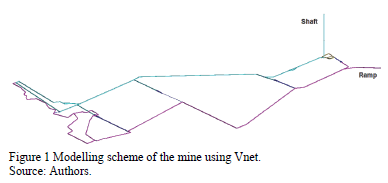
<body><![CDATA[<p><font size="2" face="Verdana, Arial, Helvetica, sans-serif">First, the airflow behaviour has been  determined using Vnet. <a href="#fig01">Fig. 1</a> is a scheme of the model achieved by means of the  software. These initial results will be used to know the climatic conditions of  the airways and the heat sources (strata heat, equipment and fragmented rock).</font></p>     <p align="center"><font size="2" face="Verdana, Arial, Helvetica, sans-serif"><a name="fig01"></a></font><img src="/img/revistas/dyna/v83n197/v83n197a23fig01.gif"></p>     <p><font size="2" face="Verdana, Arial, Helvetica, sans-serif"><b><i>2.1. Strata heat</i></b></font></p>     <p><font size="2" face="Verdana, Arial, Helvetica, sans-serif">Heat emission from the strata depends on  the type of rock, the exploitation method and depth and length of the airways.  However, the amount of heat transmitted decreases over time, the working faces  being where the greatest transmission takes place. Sometimes, strata heat can  be obtained using empirical methods based on other similar mines &#91;11&#93;.  Unfortunately, there is no such information in this case.</font></p>     <p><font size="2" face="Verdana, Arial, Helvetica, sans-serif">Whillier &#91;14&#93; exposed an equation method  that defines two expressions depending on the time since the tunnel was opened.  If it has been open for more than 30 days, eq. (1) is used to determine the  radial heat flow.</font></p>     <p><img src="/img/revistas/dyna/v83n197/v83n197a23eq01.gif"></p>     <p><font size="2" face="Verdana, Arial, Helvetica, sans-serif">Where q is heat flow from the strata (W);  L is length of the tunnel (m); k is thermal conductivity of the rock (W/m·ºC);  VRT is virgin rock temperature (ºC); <font face="Symbol">q</font>d is mean dry bulb temperature (ºC).  Meanwhile eq. (2) is applied if the advance has taken place within the last 30  days.</font></p>     <p><img src="/img/revistas/dyna/v83n197/v83n197a23eq02.gif"></p>     <p><font size="2" face="Verdana, Arial, Helvetica, sans-serif">Where L is the length of the drift dug  over the last 30 days (m), which cannot be greater than the length advanced in  the last month; DFA is daily face advance (m). The main problem from eq. (1) is  to find out the period that heat is transferred from the strata to the air  until thermal equilibrium is achieved. This setback has been solved by  modelling the strata behaviour using ClimSim. The software takes into account  the heat flow transferred to the air by radiation and convection methods,  determining the heat flow of a circular tunnel for a certain homogenous rock.  Heat flow determination is based on the radial heat conduction from Fourier's  equations, expressed in polar cylindrical coordinates (W/m<sup>2</sup>).</font></p>     <p><img src="/img/revistas/dyna/v83n197/v83n197a23eq03.gif"></p>     ]]></body>
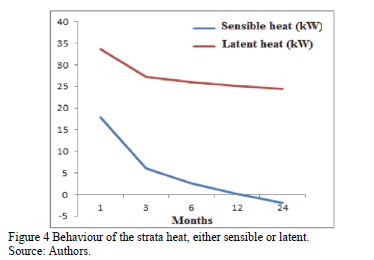
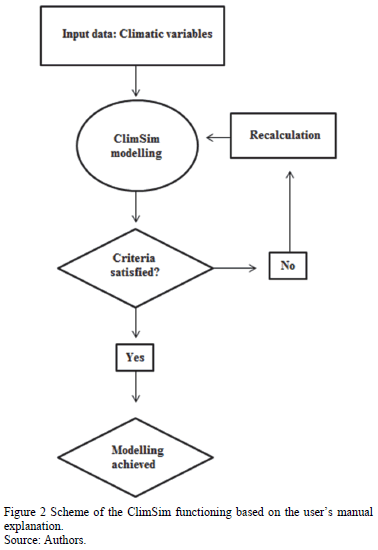
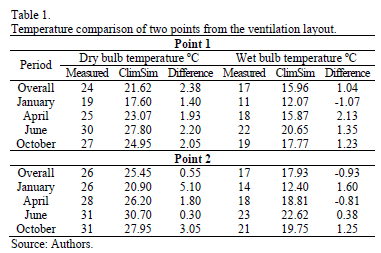
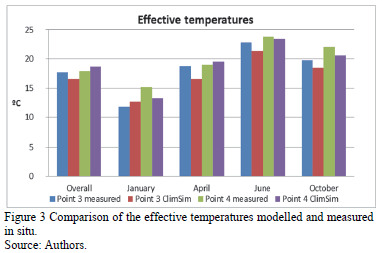
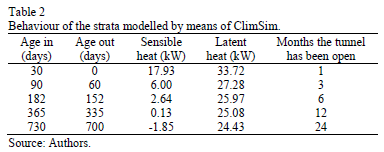
<body><![CDATA[<p><font size="2" face="Verdana, Arial, Helvetica, sans-serif">Heat transfer can be either from the  strata to the air or from the air to the strata depending on where temperature  is higher, this continues until there is thermal equilibrium. When airways have  been open for a long time, a phenomenon called &quot;thermal flywheel&quot; could arise,  transferring heat from the air to the strata during the day and the opposite at  night &#91;15&#93;. </font></p>     <p><font size="2" face="Verdana, Arial, Helvetica, sans-serif"><a href="#fig02">Fig. 2</a> explains the ClimSim functioning.  First, the climatic variables have to be calculated or measured. Once the  initial model is built, it has to be compared with real measures to validate  it, applying iterations as many times as necessary to achieve a proper model.</font></p>     <p align="center"><font size="2" face="Verdana, Arial, Helvetica, sans-serif"><a name="fig02"></a></font><img src="/img/revistas/dyna/v83n197/v83n197a23fig02.gif"></p>     <p><font size="2" face="Verdana, Arial, Helvetica, sans-serif">After several iterations, rock  conductivity and diffusivity were obtained, 6 W/mºC and 5.55 m<sup>2</sup>/s·10<sup>-6</sup> respectively. According to the manual, values are considered acceptable when  there is a difference of around ±1 ºC between modelled and measured mean  values, between 2008 and 2014 in this case. Moreover, the iterations have been  carried out in two different zones and four periods of the year in order to  achieve more reliable results. <a href="#tab01">Table 1</a> displays the temperature difference once  the modelling is correctly adjusted.</font></p>     <p align="center"><font size="2" face="Verdana, Arial, Helvetica, sans-serif"><a name="tab01"></a></font><img src="/img/revistas/dyna/v83n197/v83n197a23tab01.gif"></p>     <p><font size="2" face="Verdana, Arial, Helvetica, sans-serif">On the other hand, <a href="#fig03">Fig. 3</a> details the  effective temperatures, calculated according to Spanish law (RGNBSM, itc  04.7.02), te = 0.9·tw + 0.1·td, where te is effective temperature, tw wet  temperature, and td dry temperature.</font></p>     <p align="center"><font size="2" face="Verdana, Arial, Helvetica, sans-serif"><a name="fig03"></a></font><img src="/img/revistas/dyna/v83n197/v83n197a23fig03.gif"></p>     <p><font size="2" face="Verdana, Arial, Helvetica, sans-serif">Subsequently, base modelling has been  used to calculate the length of the tunnels giving heat to the airways,  changing the variables within the software called &quot;age in&quot; and &quot;age out&quot;, which  take into account the time since the tunnel was opened, until the sensible heat  reaches a value of zero. In this case, the contribution of sensible heat to the  airways is near zero after approximately one year.</font></p>     <p><font size="2" face="Verdana, Arial, Helvetica, sans-serif">After that, it has been calculated  theoretically to corroborate the modelled values, giving an average variation  of only 9.97% both ways. <a href="#tab02">Table 2</a> and <a href="#fig04">Fig. 4</a> detail the behaviour of the strata  heat using ClimSim.</font></p>     <p align="center"><font size="2" face="Verdana, Arial, Helvetica, sans-serif"><a name="tab02"></a></font><img src="/img/revistas/dyna/v83n197/v83n197a23tab02.gif"></p>     ]]></body>
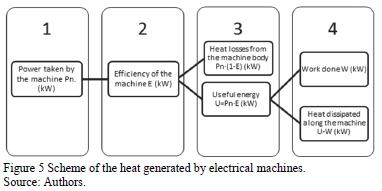
<body><![CDATA[<p align="center"><font size="2" face="Verdana, Arial, Helvetica, sans-serif"><a name="fig04"></a></font><img src="/img/revistas/dyna/v83n197/v83n197a23fig04.gif"></p>     <p><font size="2" face="Verdana, Arial, Helvetica, sans-serif"><b><i>2.2. Mechanized equipment</i></b></font></p>     <p><font size="2" face="Verdana, Arial, Helvetica, sans-serif">The exploitation method determines the  heat contribution from the equipment to the ventilation system, there being a  huge difference in terms of heat generation between the usage of diesel and  electrical energy. <a href="#fig05">Fig. 5</a> describes the steps to determine the heat input generated  by electrical machines. </font></p>     <p align="center"><font size="2" face="Verdana, Arial, Helvetica, sans-serif"><a name="fig05"></a></font><img src="/img/revistas/dyna/v83n197/v83n197a23fig05.gif"></p>     <p><font size="2" face="Verdana, Arial, Helvetica, sans-serif">On the other hand, the efficiency of  diesel machines is, approximately, 1/3 that of the electrical equipment and  produces either sensible or latent heat, whereas the electrical </font><font size="2" face="Verdana, Arial, Helvetica, sans-serif">equipment only produces sensible heat. The three main heat sources are:  1) radiator and body of the machine, 2) combustion gases, and 3) movement and  friction due to the usage of the machine &#91;11&#93;. Its quantification can be  achieved considering a ratio of 0.3 litres of diesel per 1 kW per hour, with a  calorific value of 34000 kJ/litre, and producing a heat generation of 2.83 kW  for each kilowatt of mechanical output.</font></p>     <p><font size="2" face="Verdana, Arial, Helvetica, sans-serif">Each  litre of fuel consumed produces around 1.1 litres of water due to combustion gases  &#91;16&#93;. However, this value could be several times higher because of the  refrigeration system. Some in situ analyses have pointed out that this ratio  could vary from 3 to 10 litres per litre of fuel consumed, depending on the  power and maintenance &#91;17&#93;. The following equation determines the total heat  generated, which comprises latent and sensible heat.</font></p>     <p><img src="/img/revistas/dyna/v83n197/v83n197a23eq04.gif"></p>     <p><font size="2" face="Verdana, Arial, Helvetica, sans-serif">Where qc is heat emitted by the  combustion (kW); c is combustible (l/s); Ec is combustion efficiency (%); and  PC is combustible calorific value (kJ/l). McPherson &#91;11&#93; gives some references  for combustion efficiency (95%), and the rate of liquid equivalent per litre of  fuel (5). This last parameter is necessary to calculate the quantity of water  generated by the combustion.</font></p>     <p><img src="/img/revistas/dyna/v83n197/v83n197a23eq05.gif"></p>     <p><font size="2" face="Verdana, Arial, Helvetica, sans-serif">Where W is water generated (l), and r is  rate of liquid equivalent. After determining the water generated, the latent  heat is obtained by taking into account a standard value of the water latent  vaporization heat, 2450 kJ/kg, and an equivalency of 1:1 litre-kilogram of  water.</font></p>     ]]></body>
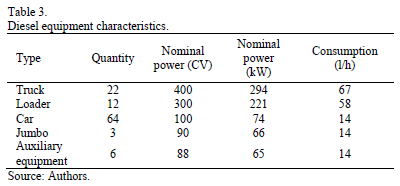
<body><![CDATA[<p><img src="/img/revistas/dyna/v83n197/v83n197a23eq06.gif"></p>     <p><font size="2" face="Verdana, Arial, Helvetica, sans-serif">Where ql is latent heat (kJ), and <font face="Symbol">l</font>w  is water latent vaporization heat (kJ/kg). Finally, sensible heat can be  obtained by deducting latent heat from the result in eq. 4. Later on, the  figures were transformed to kW in order to compare the values for 8 hours of  work.</font></p>     <p><font size="2" face="Verdana, Arial, Helvetica, sans-serif"><b><i>2.3. Fragmented rock</i></b></font></p>     <p><font size="2" face="Verdana, Arial, Helvetica, sans-serif">When fragmented rock is exposed to the  ventilation airstream and there is a difference between rock and air temperature,  heat transference is generated following the expression below &#91;11&#93;.</font></p>     <p><img src="/img/revistas/dyna/v83n197/v83n197a23eq07.gif"></p>     <p><font size="2" face="Verdana, Arial, Helvetica, sans-serif">Where qfr is  heat load due to rock fragmentation (kW); m is mass flow of the mineral  exploited (Kg/s); C is the specific heat of the rock (kJ/kgºC); <font face="Symbol">q</font><sub>1</sub> is the temperature of the rock immediately after fragmentation (ºC); and <font face="Symbol">q</font><sub>2</sub> is temperature of the fragmented rock at the exit of the ventilation system  (ºC). Temperature <font face="Symbol">q</font><sub>1 </sub>can be considered equivalent to the virgin  rock temperature with enough accuracy according to McPherson &#91;11&#93;.</font></p>     <p>&nbsp;</p>     <p><font size="3" face="Verdana, Arial, Helvetica, sans-serif"><b>3. Mining equipment</b></font></p>     <p><font size="2" face="Verdana, Arial, Helvetica, sans-serif"><a href="#tab03">Tables 3</a> and <a href="#tab04">4</a> detail the current mining  equipment in the case study and the features needed to determine the heat  input.</font></p>     <p align="center"><font size="2" face="Verdana, Arial, Helvetica, sans-serif"><a name="tab03"></a></font><img src="/img/revistas/dyna/v83n197/v83n197a23tab03.gif"></p>     ]]></body>
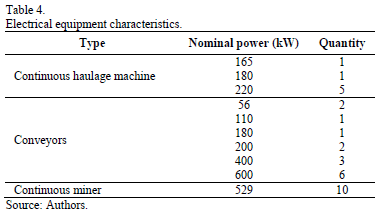
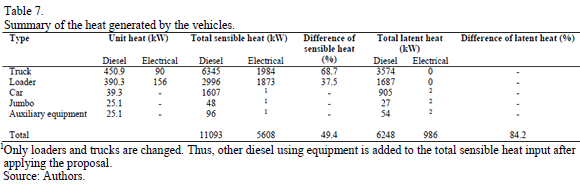
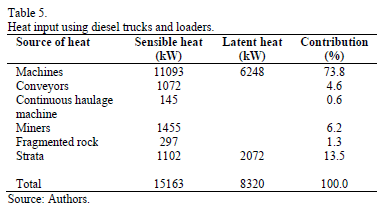
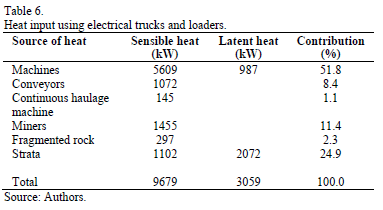
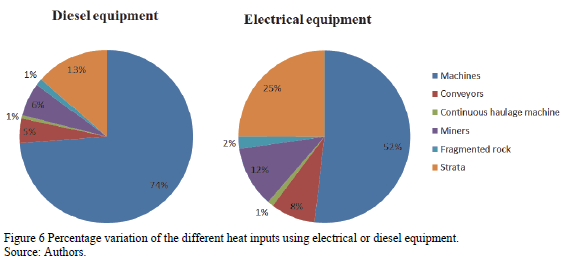
<body><![CDATA[<p align="center"><font size="2" face="Verdana, Arial, Helvetica, sans-serif"><a name="tab04"></a></font><img src="/img/revistas/dyna/v83n197/v83n197a23tab04.gif"></p>     <p><font size="2" face="Verdana, Arial, Helvetica, sans-serif">The electrical trucks and loaders chosen  have very similar sizes and capacities to the diesel ones. The models used were  the Scooptram ST1030 and Scooptram EST1030 for the diesel and electrical loader  respectively and the MT436B and EMT35 for the trucks.</font></p>     <p>&nbsp;</p>     <p><font size="3" face="Verdana, Arial, Helvetica, sans-serif"><b>4. Results and discussion</b></font></p>     <p><font size="2" face="Verdana, Arial, Helvetica, sans-serif">The heat inputs described above are shown  in <a href="#tab05">Tables 5</a> and <a href="#tab06">6</a>, taking into account the latent and sensible heat  contribution of each source. <a href="#tab05">Table 5</a> exposes the results for the current  situation (diesel loaders and trucks), whereas <a href="#tab06">Table 6</a> shows the results after  the change proposed; electrical loaders and trucks instead of diesel ones.</font></p>     <p align="center"><font size="2" face="Verdana, Arial, Helvetica, sans-serif"><a name="tab05"></a></font><img src="/img/revistas/dyna/v83n197/v83n197a23tab05.gif"></p>     <p align="center"><font size="2" face="Verdana, Arial, Helvetica, sans-serif"><a name="tab06"></a></font><img src="/img/revistas/dyna/v83n197/v83n197a23tab06.gif"></p>     <p><font size="2" face="Verdana, Arial, Helvetica, sans-serif">As can be deduced from tables above and     <a href="#fig06">Fig. 6</a>, the main source of sensible or latent heat is the machinery itself.  Overall, the change of the loaders and trucks would reduce the contribution of  heat from the mining equipment by 23%, and sensible and latent heat would  decrease by about 36% and 63% respectively. </font></p>     <p align="center"><font size="2" face="Verdana, Arial, Helvetica, sans-serif"><a name="fig06"></a></font><img src="/img/revistas/dyna/v83n197/v83n197a23fig06.gif"></p>     <p><font size="2" face="Verdana, Arial, Helvetica, sans-serif">Furthermore, <a href="#tab07">Table 7</a> exposes the current  fleet of vehicles using diesel and the proposal, together with their heat  generation and the percentage variation of both options.</font></p>     ]]></body>
<body><![CDATA[<p align="center"><font size="2" face="Verdana, Arial, Helvetica, sans-serif"><a name="tab07"></a></font><img src="/img/revistas/dyna/v83n197/v83n197a23tab07.gif"></p>     <p><font size="2" face="Verdana, Arial, Helvetica, sans-serif">The unit heat per machine is considerably  reduced using electrical equipment, and the results above show a huge  difference in terms of heat generation. Besides, as fuel consumption would be  cut down, the generation of pollutants such as NO<sub>x</sub>, CO or CO<sub>2</sub> would also decrease. Taking a ratio of 1:1 quantity of pollutants-litres of  diesel burned, the generation would be minimized by 88% based on the data used.</font></p>     <p><font size="2" face="Verdana, Arial, Helvetica, sans-serif">Despite the considerable improvements of the  hypothetical change, it has to be pointed out that these machines need a  trolley or a cable in the majority of the cases to match the power required,  reducing the flexibility of the vehicle fleet. Thus, a mixture of both kinds of  equipment may be necessary. On the other hand, more research to achieve  suitable batteries needs to be undertaken.</font></p>     <p>&nbsp;</p>     <p><font size="3" face="Verdana, Arial, Helvetica, sans-serif"><b>5. Conclusions</b></font></p>     <p><font size="2" face="Verdana, Arial, Helvetica, sans-serif">The usage of electrical loaders and  trucks decreases the generation of sensible heat by 49.4% and latent heat by  84.2%. Overall, the contribution of heat from machines dropped from 73.8% to  51.85%. In addition, the modelling by ClimSim allowed us to observe the  behaviour of strata heat in a potash mine, finding out the trend of sensible  and latent heat in the airways.</font></p>     <p><font size="2" face="Verdana, Arial, Helvetica, sans-serif">Apart from the electrical engines' higher  energy efficiency, less consumption of diesel would mean a drop in temperature  and pollutants concentration. Therefore, ventilation requirements would be  reduced and a better workplace environment could be achieved, leading to higher  productivity and production rates. The usage of electrical equipment can also  help to reduce the uncertainty in future mining activity due to oil price  variations and more restrictive legal requirements.</font></p>     <p>&nbsp;</p>     <p><font size="3" face="Verdana, Arial, Helvetica, sans-serif"><b>Acknowledgements</b></font></p>     <p><font size="2" face="Verdana, Arial, Helvetica, sans-serif">The authors would like to thank the staff  at ICL-Iberia for their willingness and the Iberpotash Chair in Sustainable  Mining from the Polytechnic University of Catalonia (UPC).</font></p>     ]]></body>
<body><![CDATA[<p>&nbsp;</p>     <p><font size="3" face="Verdana, Arial, Helvetica, sans-serif"><b>References</b></font></p>     <!-- ref --><p><font size="2" face="Verdana, Arial, Helvetica, sans-serif"><b>&#91;1&#93;</b> Kurnia, J.C., Sasmito, A.P.,  Wong. W.Y. and Mujumdar, A.S., Prediction and innovative control strategies for  oxygen and hazardous gases from diesel emission in underground mines. Science  of the Total Environment, 481, pp. 317-334, 2014. DOI: 10.1016/J.SCITOTENV.2014.02.058</font>&nbsp;&nbsp;&nbsp;&nbsp;&nbsp;&nbsp;&nbsp;&nbsp;[&#160;<a href="javascript:void(0);" onclick="javascript: window.open('/scielo.php?script=sci_nlinks&ref=1138723&pid=S0012-7353201600030002300001&lng=','','width=640,height=500,resizable=yes,scrollbars=1,menubar=yes,');">Links</a>&#160;]<!-- end-ref --><!-- ref --><p><font size="2" face="Verdana, Arial, Helvetica, sans-serif"><b>&#91;2&#93;</b> Mantilla-Gonzalez,  J.M., Roncancio, G.,J. y Acevedo, H.R., An&aacute;lisis comparativo del desempe&ntilde;o y  emisiones de un motor di&eacute;sel de gran capacidad operando bajo dos escenarios:  Trabajo en ruta activa y trabajo en banco. Ingenier&iacute;a e Investigaci&oacute;n, 30, pp.  118-124, 2010.    &nbsp;&nbsp;&nbsp;&nbsp;&nbsp;&nbsp;&nbsp;&nbsp;[&#160;<a href="javascript:void(0);" onclick="javascript: window.open('/scielo.php?script=sci_nlinks&ref=1138724&pid=S0012-7353201600030002300002&lng=','','width=640,height=500,resizable=yes,scrollbars=1,menubar=yes,');">Links</a>&#160;]<!-- end-ref --></font></p>     <!-- ref --><p><font size="2" face="Verdana, Arial, Helvetica, sans-serif"><b>&#91;3&#93;</b> Payne, T. and Mitra, R., A  review of heat issues in underground metalliferous mines. 12th U.S./North  American Mine Ventilation Symposium, pp. 197-202, 2008.    &nbsp;&nbsp;&nbsp;&nbsp;&nbsp;&nbsp;&nbsp;&nbsp;[&#160;<a href="javascript:void(0);" onclick="javascript: window.open('/scielo.php?script=sci_nlinks&ref=1138726&pid=S0012-7353201600030002300003&lng=','','width=640,height=500,resizable=yes,scrollbars=1,menubar=yes,');">Links</a>&#160;]<!-- end-ref --></font></p>     <!-- ref --><p><font size="2" face="Verdana, Arial, Helvetica, sans-serif"><b>&#91;4&#93;</b> Garcia-Herrero, S., Mariscal,  M,A,, Garc&iacute;a-Rodr&iacute;guez, J. and Ritzel, D.O., Working conditions psychological  physical symptoms and occupational accidents. Bayesian network models. Safety  Science, 50, pp. 1760-1774, 2012. DOI: 10.1016/J.SSCI.2012.04.005 </font>&nbsp;&nbsp;&nbsp;&nbsp;&nbsp;&nbsp;&nbsp;&nbsp;[&#160;<a href="javascript:void(0);" onclick="javascript: window.open('/scielo.php?script=sci_nlinks&ref=1138728&pid=S0012-7353201600030002300004&lng=','','width=640,height=500,resizable=yes,scrollbars=1,menubar=yes,');">Links</a>&#160;]<!-- end-ref --><!-- ref --><p><font size="2" face="Verdana, Arial, Helvetica, sans-serif"><b>&#91;5&#93;</b> Bluhm, S., Moreby, R., Von  Glehn, F. and Pascoe, C., Life-of-mine ventilation and refrigeration planning  for Resolution Copper Mine. The Journal of the Southern African Institute of  Mining and Metallurgy, 114, pp. 497-503, 2014.    &nbsp;&nbsp;&nbsp;&nbsp;&nbsp;&nbsp;&nbsp;&nbsp;[&#160;<a href="javascript:void(0);" onclick="javascript: window.open('/scielo.php?script=sci_nlinks&ref=1138729&pid=S0012-7353201600030002300005&lng=','','width=640,height=500,resizable=yes,scrollbars=1,menubar=yes,');">Links</a>&#160;]<!-- end-ref --></font></p>     ]]></body>
<body><![CDATA[<!-- ref --><p><font size="2" face="Verdana, Arial, Helvetica, sans-serif"><b>&#91;6&#93;</b> Del Castillo, D., Air cycle  refrigeration system for cooling deep mines. International Journal of  Refrigeration, 11(2), pp. 87-91, 1988.    &nbsp;&nbsp;&nbsp;&nbsp;&nbsp;&nbsp;&nbsp;&nbsp;[&#160;<a href="javascript:void(0);" onclick="javascript: window.open('/scielo.php?script=sci_nlinks&ref=1138731&pid=S0012-7353201600030002300006&lng=','','width=640,height=500,resizable=yes,scrollbars=1,menubar=yes,');">Links</a>&#160;]<!-- end-ref --></font></p>     <!-- ref --><p><font size="2" face="Verdana, Arial, Helvetica, sans-serif"><b>&#91;7&#93;</b> Swart, C., Optimising the  operation of underground mine refrigeration plants and ventilation fans for  minimum electricity cost. Dissertation for Doctoral DegreeNorth-West  University, USA, 2003.    &nbsp;&nbsp;&nbsp;&nbsp;&nbsp;&nbsp;&nbsp;&nbsp;[&#160;<a href="javascript:void(0);" onclick="javascript: window.open('/scielo.php?script=sci_nlinks&ref=1138733&pid=S0012-7353201600030002300007&lng=','','width=640,height=500,resizable=yes,scrollbars=1,menubar=yes,');">Links</a>&#160;]<!-- end-ref --></font></p>     <!-- ref --><p><font size="2" face="Verdana, Arial, Helvetica, sans-serif"><b>&#91;8&#93;</b> Hardcastle, S., Kocsis, C. and  Li, G., Analyzing ventilation requirements and the utilization efficiency of  the Kidd Creek mine ventilation system. 12th U.S./North American Mine  Ventilation Symposium, pp. 27-36, 2008.    &nbsp;&nbsp;&nbsp;&nbsp;&nbsp;&nbsp;&nbsp;&nbsp;[&#160;<a href="javascript:void(0);" onclick="javascript: window.open('/scielo.php?script=sci_nlinks&ref=1138735&pid=S0012-7353201600030002300008&lng=','','width=640,height=500,resizable=yes,scrollbars=1,menubar=yes,');">Links</a>&#160;]<!-- end-ref --></font></p>     <!-- ref --><p><font size="2" face="Verdana, Arial, Helvetica, sans-serif"><b>&#91;9&#93;</b> Vosloo, J., Liebenberg, L. and  Velleman, D., Case study: Energy savings for a deep-mine water reticulation  system. Applied Energy, 92, pp. 328-335, 2012.    &nbsp;&nbsp;&nbsp;&nbsp;&nbsp;&nbsp;&nbsp;&nbsp;[&#160;<a href="javascript:void(0);" onclick="javascript: window.open('/scielo.php?script=sci_nlinks&ref=1138737&pid=S0012-7353201600030002300009&lng=','','width=640,height=500,resizable=yes,scrollbars=1,menubar=yes,');">Links</a>&#160;]<!-- end-ref --></font></p>     <!-- ref --><p><font size="2" face="Verdana, Arial, Helvetica, sans-serif"><b>&#91;10&#93;</b> Edgar, G., Plessis, D.,  Liebenberg, L., Mathews, E.H. and Nicolaas, J., A versatile energy management  system for large integrated cooling systems. Energy Conversion and Management,  66, pp. 312-325, 2013.    &nbsp;&nbsp;&nbsp;&nbsp;&nbsp;&nbsp;&nbsp;&nbsp;[&#160;<a href="javascript:void(0);" onclick="javascript: window.open('/scielo.php?script=sci_nlinks&ref=1138739&pid=S0012-7353201600030002300010&lng=','','width=640,height=500,resizable=yes,scrollbars=1,menubar=yes,');">Links</a>&#160;]<!-- end-ref --></font></p>     ]]></body>
<body><![CDATA[<!-- ref --><p><font size="2" face="Verdana, Arial, Helvetica, sans-serif"><b>&#91;11&#93;</b> McPherson, M.J., Subsurface  ventilation engineering. USA: Springer, 1993, ISBN: 978-94-010-4677-0.    &nbsp;&nbsp;&nbsp;&nbsp;&nbsp;&nbsp;&nbsp;&nbsp;[&#160;<a href="javascript:void(0);" onclick="javascript: window.open('/scielo.php?script=sci_nlinks&ref=1138741&pid=S0012-7353201600030002300011&lng=','','width=640,height=500,resizable=yes,scrollbars=1,menubar=yes,');">Links</a>&#160;]<!-- end-ref --></font></p>     <!-- ref --><p><font size="2" face="Verdana, Arial, Helvetica, sans-serif"><b>&#91;12&#93;</b> Freijo,  M., Sanmiquel, Ll., Edo, J.J. y Vintr&oacute;, C., Estudio de los accidentes laborales  en la industria minera y en la construcci&oacute;n en Espa&ntilde;a en la &uacute;ltima d&eacute;cada. DYNA, 86(6), pp. 726, 2011.    &nbsp;&nbsp;&nbsp;&nbsp;&nbsp;&nbsp;&nbsp;&nbsp;[&#160;<a href="javascript:void(0);" onclick="javascript: window.open('/scielo.php?script=sci_nlinks&ref=1138743&pid=S0012-7353201600030002300012&lng=','','width=640,height=500,resizable=yes,scrollbars=1,menubar=yes,');">Links</a>&#160;]<!-- end-ref --></font></p>     <!-- ref --><p><font size="2" face="Verdana, Arial, Helvetica, sans-serif"><b>&#91;13&#93;</b> Xiaojie, Y., Qiaoyun, H.,  Jiewen, P., Xiaowei, S., Dinggui, H. and Chao, L., Progress of heat-hazard  treatment in deep mines. Mining Science and Technology (China), 21(2), pp.  295-299, 2011.    &nbsp;&nbsp;&nbsp;&nbsp;&nbsp;&nbsp;&nbsp;&nbsp;[&#160;<a href="javascript:void(0);" onclick="javascript: window.open('/scielo.php?script=sci_nlinks&ref=1138745&pid=S0012-7353201600030002300013&lng=','','width=640,height=500,resizable=yes,scrollbars=1,menubar=yes,');">Links</a>&#160;]<!-- end-ref --></font></p>     <!-- ref --><p><font size="2" face="Verdana, Arial, Helvetica, sans-serif"><b>&#91;14&#93;</b> Whillier, A., Predicting  cooling requirements for caving and sublevel stoping in hot rock. Int. Conf. on  Caving and Sublevel Stoping. AIME Denver, 1981.    &nbsp;&nbsp;&nbsp;&nbsp;&nbsp;&nbsp;&nbsp;&nbsp;[&#160;<a href="javascript:void(0);" onclick="javascript: window.open('/scielo.php?script=sci_nlinks&ref=1138747&pid=S0012-7353201600030002300014&lng=','','width=640,height=500,resizable=yes,scrollbars=1,menubar=yes,');">Links</a>&#160;]<!-- end-ref --></font></p>     <!-- ref --><p><font size="2" face="Verdana, Arial, Helvetica, sans-serif"><b>&#91;15&#93;</b> Stroh, R., A note on the  downcast shaft as a thermal flywheel. Journal of the Mine Ventilation Society  of South Africa, 32, pp.77-80, 1979.    &nbsp;&nbsp;&nbsp;&nbsp;&nbsp;&nbsp;&nbsp;&nbsp;[&#160;<a href="javascript:void(0);" onclick="javascript: window.open('/scielo.php?script=sci_nlinks&ref=1138749&pid=S0012-7353201600030002300015&lng=','','width=640,height=500,resizable=yes,scrollbars=1,menubar=yes,');">Links</a>&#160;]<!-- end-ref --></font></p>     ]]></body>
<body><![CDATA[<!-- ref --><p><font size="2" face="Verdana, Arial, Helvetica, sans-serif"><b>&#91;16&#93;</b> Kibble, J.D., Some notes on  mining diesels. Mining Technology, pp. 393-400, 1978.    &nbsp;&nbsp;&nbsp;&nbsp;&nbsp;&nbsp;&nbsp;&nbsp;[&#160;<a href="javascript:void(0);" onclick="javascript: window.open('/scielo.php?script=sci_nlinks&ref=1138751&pid=S0012-7353201600030002300016&lng=','','width=640,height=500,resizable=yes,scrollbars=1,menubar=yes,');">Links</a>&#160;]<!-- end-ref --></font></p>     <!-- ref --><p><font size="2" face="Verdana, Arial, Helvetica, sans-serif"><b>&#91;17&#93;</b> McPherson, M.J., The analysis  and simulation of heat flow into underground airways. International Journal of  Mining and Geological Engineering, 4, pp. 165-196, 1986.    &nbsp;&nbsp;&nbsp;&nbsp;&nbsp;&nbsp;&nbsp;&nbsp;[&#160;<a href="javascript:void(0);" onclick="javascript: window.open('/scielo.php?script=sci_nlinks&ref=1138753&pid=S0012-7353201600030002300017&lng=','','width=640,height=500,resizable=yes,scrollbars=1,menubar=yes,');">Links</a>&#160;]<!-- end-ref --></font></p>     <p>&nbsp;</p>     <p><font size="2" face="Verdana, Arial, Helvetica, sans-serif"><b>M. Bascompta, </b>MSc., is working as a  graduate research assistant in the Polytechnic University of Catalonia, in the  Department of Mining and Natural Resources. ORCID: 0000-0003-1519-6133</font></p>     <p><font size="2" face="Verdana, Arial, Helvetica, sans-serif"><b>A.M. Casta&ntilde;&oacute;n,</b> PhD is working as a  professor at the University of Leon in the Department of Mining, Topography and  Structures. ORCID: 0000-0002-3177-5111</font></p>     <p><font size="2" face="Verdana, Arial, Helvetica, sans-serif"><b>L. Sanmiquel,</b> PhD is working as a  professor at the Polytechnic University of Catalonia, in the Department of  Mining and Natural Resources. ORCID: 0000-0001-5612-4713</font></p>     <p><font size="2" face="Verdana, Arial, Helvetica, sans-serif"><b>J. Oliva,</b> PhD is working as a professor  at the Polytechnic University of Catalonia, in the Department of Mining and  Natural Resources. ORCID: 0000-0001-6214-5713</font></p>      ]]></body><back>
<ref-list>
<ref id="B1">
<label>1</label><nlm-citation citation-type="journal">
<person-group person-group-type="author">
<name>
<surname><![CDATA[Kurnia]]></surname>
<given-names><![CDATA[J.C.]]></given-names>
</name>
<name>
<surname><![CDATA[Sasmito]]></surname>
<given-names><![CDATA[A.P.]]></given-names>
</name>
<name>
<surname><![CDATA[Wong.]]></surname>
<given-names><![CDATA[W.Y.]]></given-names>
</name>
<name>
<surname><![CDATA[Mujumdar]]></surname>
<given-names><![CDATA[A.S.]]></given-names>
</name>
</person-group>
<article-title xml:lang="en"><![CDATA[Prediction and innovative control strategies for oxygen and hazardous gases from diesel emission in underground mines.]]></article-title>
<source><![CDATA[Science of the Total Environment]]></source>
<year>2014</year>
<numero>481</numero>
<issue>481</issue>
<page-range>317-334</page-range></nlm-citation>
</ref>
<ref id="B2">
<label>2</label><nlm-citation citation-type="journal">
<person-group person-group-type="author">
<name>
<surname><![CDATA[Mantilla-Gonzalez]]></surname>
<given-names><![CDATA[J.M.]]></given-names>
</name>
<name>
<surname><![CDATA[Roncancio]]></surname>
<given-names><![CDATA[G.,J.]]></given-names>
</name>
<name>
<surname><![CDATA[Acevedo]]></surname>
<given-names><![CDATA[H.R.]]></given-names>
</name>
</person-group>
<article-title xml:lang="es"><![CDATA[Análisis comparativo del desempeño y emisiones de un motor diésel de gran capacidad operando bajo dos escenarios: Trabajo en ruta activa y trabajo en banco.]]></article-title>
<source><![CDATA[Ingeniería e Investigación]]></source>
<year>2010</year>
<numero>30</numero>
<issue>30</issue>
<page-range>118-124</page-range></nlm-citation>
</ref>
<ref id="B3">
<label>3</label><nlm-citation citation-type="confpro">
<person-group person-group-type="author">
<name>
<surname><![CDATA[Payne]]></surname>
<given-names><![CDATA[T.]]></given-names>
</name>
<name>
<surname><![CDATA[Mitra]]></surname>
<given-names><![CDATA[R.]]></given-names>
</name>
</person-group>
<article-title xml:lang="en"><![CDATA[A review of heat issues in underground metalliferous mines.]]></article-title>
<source><![CDATA[]]></source>
<year>2008</year>
<conf-name><![CDATA[12th U.S./North American Mine Ventilation Symposium]]></conf-name>
<conf-loc> </conf-loc>
<page-range>197-202</page-range></nlm-citation>
</ref>
<ref id="B4">
<label>4</label><nlm-citation citation-type="journal">
<person-group person-group-type="author">
<name>
<surname><![CDATA[Garcia-Herrero]]></surname>
<given-names><![CDATA[S.]]></given-names>
</name>
<name>
<surname><![CDATA[Mariscal]]></surname>
<given-names><![CDATA[M,A]]></given-names>
</name>
<name>
<surname><![CDATA[García-Rodríguez]]></surname>
<given-names><![CDATA[J.]]></given-names>
</name>
<name>
<surname><![CDATA[Ritzel]]></surname>
<given-names><![CDATA[D.O.]]></given-names>
</name>
</person-group>
<article-title xml:lang="en"><![CDATA[Working conditions psychological physical symptoms and occupational accidents. Bayesian network models.]]></article-title>
<source><![CDATA[Safety Science]]></source>
<year>2012</year>
<numero>50</numero>
<issue>50</issue>
<page-range>1760-1774</page-range></nlm-citation>
</ref>
<ref id="B5">
<label>5</label><nlm-citation citation-type="journal">
<person-group person-group-type="author">
<name>
<surname><![CDATA[Bluhm]]></surname>
<given-names><![CDATA[S.]]></given-names>
</name>
<name>
<surname><![CDATA[Moreby]]></surname>
<given-names><![CDATA[R.]]></given-names>
</name>
<name>
<surname><![CDATA[Von Glehn]]></surname>
<given-names><![CDATA[F.]]></given-names>
</name>
<name>
<surname><![CDATA[Pascoe]]></surname>
<given-names><![CDATA[C.]]></given-names>
</name>
</person-group>
<article-title xml:lang="en"><![CDATA[Life-of-mine ventilation and refrigeration planning for Resolution Copper Mine.]]></article-title>
<source><![CDATA[The Journal of the Southern African Institute of Mining and Metallurgy]]></source>
<year>2014</year>
<numero>114</numero>
<issue>114</issue>
<page-range>497-503</page-range></nlm-citation>
</ref>
<ref id="B6">
<label>6</label><nlm-citation citation-type="journal">
<person-group person-group-type="author">
<name>
<surname><![CDATA[Del Castillo]]></surname>
<given-names><![CDATA[D.]]></given-names>
</name>
</person-group>
<article-title xml:lang="en"><![CDATA[Air cycle refrigeration system for cooling deep mines.]]></article-title>
<source><![CDATA[International Journal of Refrigeration]]></source>
<year>1988</year>
<volume>11</volume>
<numero>2</numero>
<issue>2</issue>
<page-range>87-91</page-range></nlm-citation>
</ref>
<ref id="B7">
<label>7</label><nlm-citation citation-type="">
<person-group person-group-type="author">
<name>
<surname><![CDATA[Swart]]></surname>
<given-names><![CDATA[C.]]></given-names>
</name>
</person-group>
<source><![CDATA[Optimising the operation of underground mine refrigeration plants and ventilation fans for minimum electricity cost.]]></source>
<year></year>
</nlm-citation>
</ref>
<ref id="B8">
<label>8</label><nlm-citation citation-type="confpro">
<person-group person-group-type="author">
<name>
<surname><![CDATA[Hardcastle]]></surname>
<given-names><![CDATA[S.]]></given-names>
</name>
<name>
<surname><![CDATA[Kocsis]]></surname>
<given-names><![CDATA[C.]]></given-names>
</name>
<name>
<surname><![CDATA[Li]]></surname>
<given-names><![CDATA[G.]]></given-names>
</name>
</person-group>
<article-title xml:lang="en"><![CDATA[Analyzing ventilation requirements and the utilization efficiency of the Kidd Creek mine ventilation system.]]></article-title>
<source><![CDATA[]]></source>
<year>2008</year>
<conf-name><![CDATA[12th U.S./North American Mine Ventilation Symposium]]></conf-name>
<conf-loc> </conf-loc>
<page-range>27-36</page-range></nlm-citation>
</ref>
<ref id="B9">
<label>9</label><nlm-citation citation-type="journal">
<person-group person-group-type="author">
<name>
<surname><![CDATA[Vosloo]]></surname>
<given-names><![CDATA[J.]]></given-names>
</name>
<name>
<surname><![CDATA[Liebenberg]]></surname>
<given-names><![CDATA[L.]]></given-names>
</name>
<name>
<surname><![CDATA[Velleman]]></surname>
<given-names><![CDATA[D.]]></given-names>
</name>
</person-group>
<article-title xml:lang="en"><![CDATA[Case study: Energy savings for a deep-mine water reticulation system]]></article-title>
<source><![CDATA[Applied Energy]]></source>
<year>2012</year>
<numero>92</numero>
<issue>92</issue>
<page-range>328-335</page-range></nlm-citation>
</ref>
<ref id="B10">
<label>10</label><nlm-citation citation-type="journal">
<person-group person-group-type="author">
<name>
<surname><![CDATA[Edgar]]></surname>
<given-names><![CDATA[G.]]></given-names>
</name>
<name>
<surname><![CDATA[Plessis]]></surname>
<given-names><![CDATA[D.]]></given-names>
</name>
<name>
<surname><![CDATA[Liebenberg]]></surname>
<given-names><![CDATA[L.]]></given-names>
</name>
<name>
<surname><![CDATA[Mathews]]></surname>
<given-names><![CDATA[E.H.]]></given-names>
</name>
<name>
<surname><![CDATA[Nicolaas]]></surname>
<given-names><![CDATA[J.]]></given-names>
</name>
</person-group>
<article-title xml:lang="en"><![CDATA[A versatile energy management system for large integrated cooling systems.]]></article-title>
<source><![CDATA[Energy Conversion and Management]]></source>
<year>2013</year>
<numero>66</numero>
<issue>66</issue>
<page-range>312-325</page-range></nlm-citation>
</ref>
<ref id="B11">
<label>11</label><nlm-citation citation-type="book">
<person-group person-group-type="author">
<name>
<surname><![CDATA[McPherson]]></surname>
<given-names><![CDATA[M.J.]]></given-names>
</name>
</person-group>
<source><![CDATA[Subsurface ventilation engineering]]></source>
<year>1993</year>
<publisher-name><![CDATA[Springer]]></publisher-name>
</nlm-citation>
</ref>
<ref id="B12">
<label>12</label><nlm-citation citation-type="journal">
<person-group person-group-type="author">
<name>
<surname><![CDATA[Freijo]]></surname>
<given-names><![CDATA[M.]]></given-names>
</name>
<name>
<surname><![CDATA[Sanmiquel]]></surname>
<given-names><![CDATA[Ll.]]></given-names>
</name>
<name>
<surname><![CDATA[Edo]]></surname>
<given-names><![CDATA[J.J.]]></given-names>
</name>
<name>
<surname><![CDATA[Vintró]]></surname>
<given-names><![CDATA[C.]]></given-names>
</name>
</person-group>
<article-title xml:lang="es"><![CDATA[Estudio de los accidentes laborales en la industria minera y en la construcción en España en la última década.]]></article-title>
<source><![CDATA[DYNA]]></source>
<year>2011</year>
<volume>86</volume>
<numero>6</numero>
<issue>6</issue>
<page-range>726</page-range></nlm-citation>
</ref>
<ref id="B13">
<label>13</label><nlm-citation citation-type="journal">
<person-group person-group-type="author">
<name>
<surname><![CDATA[Xiaojie]]></surname>
<given-names><![CDATA[Y.]]></given-names>
</name>
<name>
<surname><![CDATA[Qiaoyun]]></surname>
<given-names><![CDATA[H.]]></given-names>
</name>
<name>
<surname><![CDATA[Jiewen]]></surname>
<given-names><![CDATA[P.]]></given-names>
</name>
<name>
<surname><![CDATA[Xiaowei]]></surname>
<given-names><![CDATA[S.]]></given-names>
</name>
<name>
<surname><![CDATA[Dinggui]]></surname>
<given-names><![CDATA[H.]]></given-names>
</name>
<name>
<surname><![CDATA[Chao]]></surname>
<given-names><![CDATA[L.]]></given-names>
</name>
</person-group>
<article-title xml:lang="en"><![CDATA[Progress of heat-hazard treatment in deep mines.]]></article-title>
<source><![CDATA[Mining Science and Technology]]></source>
<year>2011</year>
<volume>21</volume>
<numero>2</numero>
<issue>2</issue>
<page-range>295-299</page-range></nlm-citation>
</ref>
<ref id="B14">
<label>14</label><nlm-citation citation-type="confpro">
<person-group person-group-type="author">
<name>
<surname><![CDATA[Whillier]]></surname>
<given-names><![CDATA[A.]]></given-names>
</name>
</person-group>
<article-title xml:lang="en"><![CDATA[Predicting cooling requirements for caving and sublevel stoping in hot rock.]]></article-title>
<source><![CDATA[]]></source>
<year></year>
<conf-name><![CDATA[ Int. Conf. on Caving and Sublevel Stoping.]]></conf-name>
<conf-loc>Denver </conf-loc>
</nlm-citation>
</ref>
<ref id="B15">
<label>15</label><nlm-citation citation-type="journal">
<person-group person-group-type="author">
<name>
<surname><![CDATA[Stroh]]></surname>
<given-names><![CDATA[R.]]></given-names>
</name>
</person-group>
<article-title xml:lang="en"><![CDATA[A note on the downcast shaft as a thermal flywheel.]]></article-title>
<source><![CDATA[Journal of the Mine Ventilation Society of South Africa]]></source>
<year>1979</year>
<numero>32</numero>
<issue>32</issue>
<page-range>77-80</page-range></nlm-citation>
</ref>
<ref id="B16">
<label>16</label><nlm-citation citation-type="journal">
<person-group person-group-type="author">
<name>
<surname><![CDATA[Kibble]]></surname>
<given-names><![CDATA[J.D.]]></given-names>
</name>
</person-group>
<article-title xml:lang="en"><![CDATA[Some notes on mining diesels]]></article-title>
<source><![CDATA[Mining Technology]]></source>
<year>1978</year>
<page-range>393-400</page-range></nlm-citation>
</ref>
<ref id="B17">
<label>17</label><nlm-citation citation-type="journal">
<person-group person-group-type="author">
<name>
<surname><![CDATA[McPherson]]></surname>
<given-names><![CDATA[M.J.]]></given-names>
</name>
</person-group>
<article-title xml:lang="en"><![CDATA[The analysis and simulation of heat flow into underground airways]]></article-title>
<source><![CDATA[International Journal of Mining and Geological Engineering]]></source>
<year>1986</year>
<numero>4</numero>
<issue>4</issue>
<page-range>165-196</page-range></nlm-citation>
</ref>
</ref-list>
</back>
</article>