<?xml version="1.0" encoding="ISO-8859-1"?><article xmlns:mml="http://www.w3.org/1998/Math/MathML" xmlns:xlink="http://www.w3.org/1999/xlink" xmlns:xsi="http://www.w3.org/2001/XMLSchema-instance">
<front>
<journal-meta>
<journal-id>0012-7353</journal-id>
<journal-title><![CDATA[DYNA]]></journal-title>
<abbrev-journal-title><![CDATA[Dyna rev.fac.nac.minas]]></abbrev-journal-title>
<issn>0012-7353</issn>
<publisher>
<publisher-name><![CDATA[Universidad Nacional de Colombia]]></publisher-name>
</publisher>
</journal-meta>
<article-meta>
<article-id>S0012-73532016000300024</article-id>
<article-id pub-id-type="doi">10.15446/dyna.v83n197.53506</article-id>
<title-group>
<article-title xml:lang="en"><![CDATA[Secure point-to-point communication using chaos]]></article-title>
<article-title xml:lang="es"><![CDATA[Comunicación punto a punto segura usando caos]]></article-title>
</title-group>
<contrib-group>
<contrib contrib-type="author">
<name>
<surname><![CDATA[Jiménez-Rodríguez]]></surname>
<given-names><![CDATA[Maricela]]></given-names>
</name>
<xref ref-type="aff" rid="A01"/>
</contrib>
<contrib contrib-type="author">
<name>
<surname><![CDATA[González-Novoa]]></surname>
<given-names><![CDATA[María Guadalupe]]></given-names>
</name>
<xref ref-type="aff" rid="A01"/>
</contrib>
<contrib contrib-type="author">
<name>
<surname><![CDATA[Estrada-Gutiérrez]]></surname>
<given-names><![CDATA[Juan Carlos]]></given-names>
</name>
<xref ref-type="aff" rid="A01"/>
</contrib>
<contrib contrib-type="author">
<name>
<surname><![CDATA[Acosta-Lúa]]></surname>
<given-names><![CDATA[Cuauhtemoc]]></given-names>
</name>
<xref ref-type="aff" rid="A01"/>
</contrib>
<contrib contrib-type="author">
<name>
<surname><![CDATA[Flores-Siordia]]></surname>
<given-names><![CDATA[Octavio]]></given-names>
</name>
<xref ref-type="aff" rid="A01"/>
</contrib>
</contrib-group>
<aff id="A01">
<institution><![CDATA[,Universidad de Guadalajara Centro Universitario de la Ciénega Departamento de Ciencias Tecnológicas]]></institution>
<addr-line><![CDATA[Ocotlán Jalisco]]></addr-line>
<country>México</country>
</aff>
<aff id="A">
<institution><![CDATA[,gleznogpe@hotmail.com  ]]></institution>
<addr-line><![CDATA[ ]]></addr-line>
</aff>
<aff id="A">
<institution><![CDATA[,jcarlosredes@gmail.com  ]]></institution>
<addr-line><![CDATA[ ]]></addr-line>
</aff>
<aff id="A">
<institution><![CDATA[,temo09@gmail.com  ]]></institution>
<addr-line><![CDATA[ ]]></addr-line>
</aff>
<aff id="A">
<institution><![CDATA[,o_flores@live.com.mx  ]]></institution>
<addr-line><![CDATA[ ]]></addr-line>
</aff>
<pub-date pub-type="pub">
<day>00</day>
<month>06</month>
<year>2016</year>
</pub-date>
<pub-date pub-type="epub">
<day>00</day>
<month>06</month>
<year>2016</year>
</pub-date>
<volume>83</volume>
<numero>197</numero>
<fpage>180</fpage>
<lpage>186</lpage>
<copyright-statement/>
<copyright-year/>
<self-uri xlink:href="http://www.scielo.org.co/scielo.php?script=sci_arttext&amp;pid=S0012-73532016000300024&amp;lng=en&amp;nrm=iso"></self-uri><self-uri xlink:href="http://www.scielo.org.co/scielo.php?script=sci_abstract&amp;pid=S0012-73532016000300024&amp;lng=en&amp;nrm=iso"></self-uri><self-uri xlink:href="http://www.scielo.org.co/scielo.php?script=sci_pdf&amp;pid=S0012-73532016000300024&amp;lng=en&amp;nrm=iso"></self-uri><abstract abstract-type="short" xml:lang="en"><p><![CDATA[This article presents an alternative for resolving the existing vulnerability of systems that implement masking by means of chaotic synchronization. This system avoids detection of the parameters used as the cipher key by an attacker on implementing encryption by means of synchronized chaotic-phase masks of the Rössler oscillator, for encoding and establishing synchronization among transmitter-receiver devices. In addition, it employs two ciphering keys: the first, with a recommended length of 2,048 characters, and the second, which is used as an initial value. Both keys are employed for continual modification of one of the oscillator's parameters. This strengthens the security system and avoiding an attacker from obtaining the oscillator's parametric values by calculating the least average synchronization error. The use of the system developed provides a cipher, which is resistant to statistical attacks. In addition, our system validates the data of the transmitter device (username, password, etc.) in order to authorize transmission.]]></p></abstract>
<abstract abstract-type="short" xml:lang="es"><p><![CDATA[Este artículo presenta una alternativa para resolver la vulnerabilidad existente en los sistemas que implementan el enmascaramiento mediante la sincronización caótica, este sistema evita que los parámetros utilizados como clave de cifrado puedan ser detectados por un atacante al implementar el modelo matemático caótico del oscilador de Rössler para codificar y establecer la sincronización entre los dispositivos transmisor-receptor; además usa dos llaves de cifrado: la primera con una longitud recomendable de 2048 caracteres y la segunda se utiliza como un valor inicial. Ambas llaves se emplean para modificar continuamente uno de los parámetros del oscilador, esto fortalece la seguridad del sistema y evita que un atacante obtenga los valores del parámetro del oscilador calculando el error de sincronización promedio menor. El uso del sistema desarrollado proporciona un cifrado resistente a ataques estadísticos, además valida datos del dispositivo transmisor (nombre de usuario, password, etc.) para autorizar la transmisión hacia el destino.]]></p></abstract>
<kwd-group>
<kwd lng="en"><![CDATA[authentication]]></kwd>
<kwd lng="en"><![CDATA[data encryption]]></kwd>
<kwd lng="en"><![CDATA[security]]></kwd>
<kwd lng="en"><![CDATA[integrity]]></kwd>
<kwd lng="en"><![CDATA[chaos]]></kwd>
<kwd lng="es"><![CDATA[autenticación]]></kwd>
<kwd lng="es"><![CDATA[encriptación de datos]]></kwd>
<kwd lng="es"><![CDATA[seguridad]]></kwd>
<kwd lng="es"><![CDATA[integridad]]></kwd>
<kwd lng="es"><![CDATA[caos]]></kwd>
</kwd-group>
</article-meta>
</front><body><![CDATA[ <p><font size="1" face="Verdana, Arial, Helvetica, sans-serif"><b>DOI:</b> <a href="http://dx.doi.org/10.15446/dyna.v83n197.53506" target="_blank">http://dx.doi.org/10.15446/dyna.v83n197.53506</a></font></p>     <p align="center"><font size="4" face="Verdana, Arial, Helvetica, sans-serif"><b>Secure  point-to-point communication using chaos</b></font></p>     <p align="center"><i><b><font size="3" face="Verdana, Arial, Helvetica, sans-serif">Comunicaci&oacute;n punto a punto segura usando caos</font></b></i></p>     <p align="center">&nbsp;</p>     <p align="center"><b><font size="2" face="Verdana, Arial, Helvetica, sans-serif">Maricela Jim&eacute;nez-Rodr&iacute;guez <i><sup>a</sup></i>, Mar&iacute;a Guadalupe Gonz&aacute;lez-Novoa <i><sup>a</sup></i>, Juan Carlos Estrada-Guti&eacute;rrez <i><sup>a</sup></i>, Cuauhtemoc Acosta-L&uacute;a <i><sup>a</sup></i> &amp; Octavio Flores-Siordia <i><sup>a</sup></i></font></b></p>     <p align="center">&nbsp;</p>     <p align="center"><font size="2" face="Verdana, Arial, Helvetica, sans-serif"><sup><i>a </i></sup><i>Departamento de Ciencias Tecnol&oacute;gicas, Centro Universitario de la   Ci&eacute;nega, Universidad de Guadalajara, Ocotl&aacute;n, Jalisco, M&eacute;xico. <a href="mailto:m_jimenez_r@yahoo.com">m_jimenez_r@yahoo.com</a>,     <a href="mailto:gleznogpe@hotmail.com">gleznogpe@hotmail.com</a>, <a href="mailto:jcarlosredes@gmail.com">jcarlosredes@gmail.com</a>, <a href="mailto:temo09@gmail.com">temo09@gmail.com</a>, <a href="mailto:o_flores@live.com.mx">o_flores@live.com.mx</a></i></font></p>     <p align="center">&nbsp;</p>     <p align="center"><font size="2" face="Verdana, Arial, Helvetica, sans-serif"><b>Received: October 9<sup>th</sup>, de 2015. Received   in revised form: Mach 1<sup>rd</sup>, 2016. Accepted: Mach 15<sup>th</sup>,   2016</b></font></p>     <p align="center">&nbsp;</p>     ]]></body>
<body><![CDATA[<p align="center"><font size="1" face="Verdana, Arial, Helvetica, sans-seriff"><b>This work is licensed under a</b> <a rel="license" href="http://creativecommons.org/licenses/by-nc-nd/4.0/">Creative Commons Attribution-NonCommercial-NoDerivatives 4.0 International License</a>.</font><br /><a rel="license" href="http://creativecommons.org/licenses/by-nc-nd/4.0/"><img style="border-width:0" src="https://i.creativecommons.org/l/by-nc-nd/4.0/88x31.png" /></a></p><hr>     <p><font size="2" face="Verdana, Arial, Helvetica, sans-serif"><b>Abstract    <br> </b></font><font size="2" face="Verdana, Arial, Helvetica, sans-serif">This  article presents an alternative for resolving the existing vulnerability of  systems that implement masking by means of chaotic synchronization. This system  avoids detection of the parameters used as the cipher key by an attacker on  implementing encryption by means of synchronized chaotic-phase masks of the  Rössler oscillator, for encoding and establishing synchronization among transmitter-receiver  devices. In addition, it employs two ciphering keys: the first, with a  recommended length of 2,048 characters, and the second, which is used as an  initial value. Both keys are employed for continual modification of one of the  oscillator's parameters. This strengthens the security system and avoiding an  attacker from obtaining the oscillator's parametric values by calculating the  least average synchronization error. The use of the system developed provides a  cipher, which is resistant to statistical attacks. In addition, our system  validates the data of the transmitter device (username, password, etc.) in order to authorize transmission.</font></p>     <p><font size="2" face="Verdana, Arial, Helvetica, sans-serif"><i>Keywords</i>: authentication;  data encryption; security; integrity; chaos.</font></p>     <p><font size="2" face="Verdana, Arial, Helvetica, sans-serif"><b>Resumen    <br> </b></font><font size="2" face="Verdana, Arial, Helvetica, sans-serif">Este art&iacute;culo presenta una alternativa para resolver la vulnerabilidad  existente en los sistemas que implementan el enmascaramiento mediante la  sincronizaci&oacute;n ca&oacute;tica, este sistema  evita que los par&aacute;metros utilizados como clave de cifrado puedan ser detectados  por un atacante al implementar el modelo matem&aacute;tico ca&oacute;tico del oscilador de  Rössler para codificar y establecer la sincronizaci&oacute;n entre los dispositivos  transmisor-receptor; adem&aacute;s usa dos  llaves de cifrado: la primera con una longitud recomendable de 2048 caracteres  y la segunda se utiliza como un valor inicial. Ambas llaves se emplean para  modificar continuamente uno de los par&aacute;metros del oscilador, esto fortalece la  seguridad del sistema y evita que un atacante obtenga los valores del par&aacute;metro  del oscilador calculando el error de sincronizaci&oacute;n promedio menor. El uso del  sistema desarrollado proporciona un cifrado resistente a ataques estad&iacute;sticos,  adem&aacute;s valida datos del dispositivo transmisor (nombre de usuario, password, etc.) para autorizar la transmisi&oacute;n hacia el destino.</font></p>     <p><font size="2" face="Verdana, Arial, Helvetica, sans-serif"><i>Palabras clave</i>: autenticaci&oacute;n; encriptaci&oacute;n de datos; seguridad;  integridad; caos.</font></p> <hr>     <p>&nbsp;</p>     <p><font size="3" face="Verdana, Arial, Helvetica, sans-serif"><b>1. Introduction</b></font></p>     <p><font size="2" face="Verdana, Arial, Helvetica, sans-serif">The role of chaotic systems is an  excellent alternative for information security and privacy. This is due to such  systems' great properties, such as high sensitivity to the initial conditions  and to the parameters. Another interesting characteristic is that chaos uses  frequencies that render it resistant to the customary filtering techniques to  separate information superimposed on a signal &#91;1&#93;. In other words, a message  transmitted through a network can be encoded by chaos, using previously cited  characteristics. Once transmitted, the information would be very difficult to  decode, unless the receptor possesses the inverse-way method, considering the  exact values of the parameters, in order to recover and be able to extract the  original message with certainty. Some discreet chaotic systems have been used  to cipher information, such as the technique implemented by Ranjan and Saumitr,  in which the authors compress and encode text using chaotic Logistic Map  system. The authors employ an insecure channel to transmit the encoded data and  another, secure channel to send the key &#91;2&#93;. Pareek et al. developed a  symmetrical key algorithm for ciphering, in which they used multiple  one-dimensional chaotic maps and an external key of 128 bits. Plain text is encoded  sequentially using a set of chaotic maps in random fashion &#91;3&#93;. In addition,  Pisarchik and Carmona elaborated chaotic map network-based algorithms to  encrypt images in color. These authors used the Logistic Map, and as ciphered  keys, they used the parameters, the number of iterations, the number of cycles,  and the size of the image &#91;4&#93;. Hossam et al. proposed a cryptosystem for  encrypting color images or videos that employs a mechanism of iterative  encryption, in which each of the image's pixels depends on a secret key, of the  logistic map exit and of the previously encrypted pixel &#91;5&#93;. Chaos is also used  in the world of medicine. Barbara et al. proposes a transmission method  allowing electrocardiogram (ECG) signals obtained from a patient to be combined  with algorithms generating chaotic signals, based on the Lorenz equation system  &#91;6&#93;. Another very important technique employed in secure communications is the  synchronization of chaotic systems &#91;7-13&#93;. Tao and Len used the Chua circuit to  modulate a signal in a parameter in a transmitter; subsequently, the authors  used an adaptive controller in the receiver to maintain the synchronization and  to recover the signal &#91;14&#93;. They developed an Image Encryption Algorithm where  logistic map and iterative equation are used, and they switch the position and  the pixels values &#91;15&#93;. The authors also employed two different chaotic  cryptography techniques in which they employed the logistic map to apply the  diffusion technique, and the chaotic synchronization of two, coupled Rössler  oscillators to apply the confusion &#91;16&#93;. Zanin and colleagues carried out a  systems cryptanalysis that uses synchronization for encryption through message  masking, and the authors demonstrated how to detect the parameters used as  encrypted keys, calculating the least synchronization error &#91;17&#93;. Thus, in this  work, we implemented a method to strengthen the security of systems that use  chaotic masking, avoiding the detection of parameters used as the encrypted  key. In other studies, the authors have recommended prior encryption of the  information before employing synchronization, in order to avoid detection of  the parameters, but this approach implies more time to encode and decode &#91;16,17&#93;.  A security analysis was carried out on different Wireless Local Area Networks  (WLAN), where it was determined that one of the risks comprises the absence of  mechanisms of authentication &#91;18&#93;. The method recommended in this work varies  the parameter according to the way in which the mathematical system used for  synchronizing conducts solving. Therefore, no extra time is required for  previous ciphering. The identification of users who transmit information  provides greater security. Thus, in this work, in addition to encoding, a  technique is performed to validate users who attempt to transmit. The remainder  of this article is organized as follows: in Section 2, the methodology for  developing the system used is clearly explained, and in Section 3, we show how  the communication channels for transmitting encrypted information in a  point-to-point network using chaos are implemented. Later, in Section 4, we  show the results of using tests to evaluate the system's functionality; we have  also included a statistical analysis and the conclusions obtained.</font></p>     ]]></body>
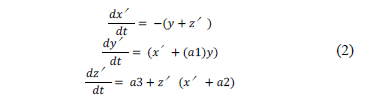
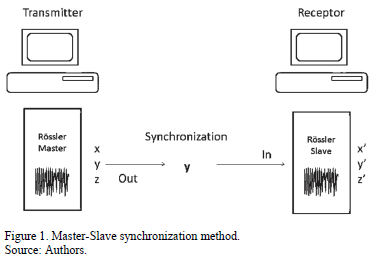
<body><![CDATA[<p>&nbsp;</p>     <p><font size="3" face="Verdana, Arial, Helvetica, sans-serif"><b>2. Methodology</b></font></p>     <p><font size="2" face="Verdana, Arial, Helvetica, sans-serif"><b><i>2.1. Chaotic synchronization </i></b></font></p>     <p><font size="2" face="Verdana, Arial, Helvetica, sans-serif">Pecora and Carroll demonstrated  unidirectional coupled chaotic systems &#91;19&#93;, an excellent tool used in the area  of secure communication. In this investigation, the Rössler oscillator is implemented to transmit  encrypted information employing chaotic synchronization where the Master <img src="/img/revistas/dyna/v83n197/v83n197a24eq002.gif"> oscillator is described in an  eq. (1) system &#91;20&#93;, in which <img src="/img/revistas/dyna/v83n197/v83n197a24eq006.gif">, <img src="/img/revistas/dyna/v83n197/v83n197a24eq008.gif">, are the system's state variables, and the system's parameters are  rendered by: <img src="/img/revistas/dyna/v83n197/v83n197a24eq012.gif">. </font></p>     <p><img src="/img/revistas/dyna/v83n197/v83n197a24eq01.gif"></p>     <p><font size="2" face="Verdana, Arial, Helvetica, sans-serif">The Slave oscillator <img src="/img/revistas/dyna/v83n197/v83n197a24eq020.gif"> is defined by the eq. (2)  system, where <img src="/img/revistas/dyna/v83n197/v83n197a24eq026.gif"><img src="/img/revistas/dyna/v83n197/v83n197a24eq030.gif"> are state variables and the  system's parameters are: <img src="/img/revistas/dyna/v83n197/v83n197a24eq032.gif">.</font></p>     <p><img src="/img/revistas/dyna/v83n197/v83n197a24eq02.gif"></p>     <p><font size="2" face="Verdana, Arial, Helvetica, sans-serif">Complete synchronization is an entity  between the trajectories of two Master-Slave systems &#91;19, 21&#93;, which can be  determined by the synchronization error <img src="/img/revistas/dyna/v83n197/v83n197a24eq042.gif">, that is <img src="/img/revistas/dyna/v83n197/v83n197a24eq044.gif">, where <img src="/img/revistas/dyna/v83n197/v83n197a24eq050.gif">&#91;21&#93;.</font></p>     <p><font size="2" face="Verdana, Arial, Helvetica, sans-serif">In this study, chaotic synchronization is  implemented using the Rössler oscillator for point-to-point communication in a  secure manner, where the Master <img src="/img/revistas/dyna/v83n197/v83n197a24eq054.gif"> system is used to encrypt in  the transmitter and the Slave <img src="/img/revistas/dyna/v83n197/v83n197a24eq057.gif"> in order to decrypt in the  receptor; however, prior to this, these should be synchronized using variable <img src="/img/revistas/dyna/v83n197/v83n197a24eq061.gif"> for coupling &#91;19&#93;. That is,  the exit <img src="/img/revistas/dyna/v83n197/v83n197a24eq065.gif"> is coupled with the entry <img src="/img/revistas/dyna/v83n197/v83n197a24eq069.gif"> to ensure synchronization.  Functioning is exhibited in <a href="#fig01">Fig. 1</a>.</font></p>     <p align="center"><font size="2" face="Verdana, Arial, Helvetica, sans-serif"><a name="fig01"></a></font><img src="/img/revistas/dyna/v83n197/v83n197a24fig01.gif"></p>     ]]></body>
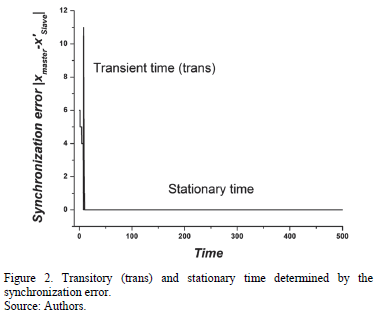
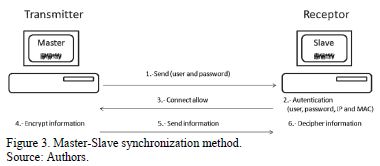
<body><![CDATA[<p><font size="2" face="Verdana, Arial, Helvetica, sans-serif">Prior to the synchronization, a  transitory time <img src="/img/revistas/dyna/v83n197/v83n197a24eq077.gif"> should pass, during which the  Master-Slave systems yield different results until the stationary time, which  is when the exit variables <img src="/img/revistas/dyna/v83n197/v83n197a24eq081.gif"> of the Master system are  identical to those of the exit variables <img src="/img/revistas/dyna/v83n197/v83n197a24eq085.gif"> of the Slave system. Thus,  the synchronization error <img src="/img/revistas/dyna/v83n197/v83n197a24eq087.gif"> and the synchronization  itself is complete, as depicted in <a href="#fig02">Fig. 2</a>.</font></p>     <p align="center"><font size="2" face="Verdana, Arial, Helvetica, sans-serif"><a name="fig02"></a></font><img src="/img/revistas/dyna/v83n197/v83n197a24fig02.gif"></p>     <p><font size="2" face="Verdana, Arial, Helvetica, sans-serif">When the encrypted transmitter and the  receptor are completely synchronized, the receptor can decipher without any  problem because both the transmitter and the receptor generate the same values  of the variables. This technique is used for encoding information because it is  very interesting that two irregular behaviors are based on a sole behavior,  generating a chaotic orbit that is similar to noise that is very difficult to  predict. This represents an important application in secure communications and  cryptography. It is for this reason that this work was implemented.</font></p>     <p>&nbsp;</p>     <p><font size="3" face="Verdana, Arial, Helvetica, sans-serif"><b>3. System functioning</b></font></p>     <p><font size="2" face="Verdana, Arial, Helvetica, sans-serif">The system  allows for point-to-point communication establishing channels to encrypt and  transmit information with greater security through the network. In addition,  the system is more robust because the transmitter should authenticate it in  order to permit it to send information. Next, chaotic synchronization is  implemented by means of the Rössler Master oscillator, equation system (1) to  encrypt the final decrypted outcome using equation system (2). Below are the  steps to follow: </font></p> <ol>       <li><font size="2" face="Verdana, Arial, Helvetica, sans-serif"> The transmitter sends the name and password of the user to the     receptor.</font></li>       <li><font size="2" face="Verdana, Arial, Helvetica, sans-serif"> The receptor authenticates the user's data and the IP and MAC     electronic addresses of the transmitter. If the latter are not correct, the     transmission is cancelled.</font></li>       <li><font size="2" face="Verdana, Arial, Helvetica, sans-serif"> If it is an allowed user, the authorization is sent.</font></li>       <li><font size="2" face="Verdana, Arial, Helvetica, sans-serif"> The transmitter uses the algorithm to encrypt what is explained in     Section 3.2.</font></li>       ]]></body>
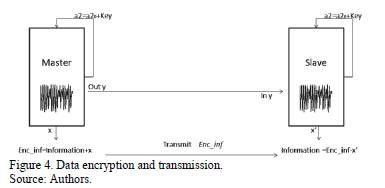
<body><![CDATA[<li><font size="2" face="Verdana, Arial, Helvetica, sans-serif"> The information is sent.</font></li>       <li><font size="2" face="Verdana, Arial, Helvetica, sans-serif"> The receptor uses an algorithm of Section 3.2 for deciphering.</font></li>     </ol>     <p><font size="2" face="Verdana, Arial, Helvetica, sans-serif">This process is illustrated in  <a href="#fig03">Fig. 3</a>.</font></p>     <p align="center"><font size="2" face="Verdana, Arial, Helvetica, sans-serif"><a name="fig03"></a></font><img src="/img/revistas/dyna/v83n197/v83n197a24fig03.gif"></p>     <p><font size="2" face="Verdana, Arial, Helvetica, sans-serif"><b><i>3.1. Encryption with parameter variation</i></b></font></p>     <p><font size="2" face="Verdana, Arial, Helvetica, sans-serif">The transmitter solves equation system  (1), modifying the value of parameter <img src="/img/revistas/dyna/v83n197/v83n197a24eq095.gif"> that is used as the  encrypting key <img src="/img/revistas/dyna/v83n197/v83n197a24eq097.gif">to avoid detection by an attacker. Once the transitory time <img src="/img/revistas/dyna/v83n197/v83n197a24eq101.gif"> has passed and complete  synchronization is initiated, the transmitter encrypts the information by  adding up <img src="/img/revistas/dyna/v83n197/v83n197a24eq105.gif">. After encrypting it together with the coupling variable <img src="/img/revistas/dyna/v83n197/v83n197a24eq065.gif"> so that the receptor can  synchronize itself, solving equation system (2), modifying the parameter. After  this, it deciphers, subtracting<img src="/img/revistas/dyna/v83n197/v83n197a24eq111.gif">. This procedure is shown in <a href="#fig04">Fig. 4</a>.</font></p>     <p align="center"><font size="2" face="Verdana, Arial, Helvetica, sans-serif"><a name="fig04"></a></font><img src="/img/revistas/dyna/v83n197/v83n197a24fig04.gif"></p>     <p><font size="2" face="Verdana, Arial, Helvetica, sans-serif"><b><i>3.2. Algorithms</i></b></font></p>     <p><font size="2" face="Verdana, Arial, Helvetica, sans-serif">In this section, we describe the  functioning of the algorithms for encrypting and deciphering an archive of  text, but any type of information can be encrypted by dividing it into  bytes. </font></p>     ]]></body>


<body><![CDATA[<p><font size="2" face="Verdana, Arial, Helvetica, sans-serif"><b>Nomenclature:</b></font></p> <ul>       <li><font size="2" face="Verdana, Arial, Helvetica, sans-serif">· <img src="/img/revistas/dyna/v83n197/v83n197a24eq115.gif">: Original information, with values between 0 and 255.</font></li>       <li><font size="2" face="Verdana, Arial, Helvetica, sans-serif">· <img src="/img/revistas/dyna/v83n197/v83n197a24eq119.gif">: Length of original information.</font></li>       <li><font size="2" face="Verdana, Arial, Helvetica, sans-serif">· <img src="/img/revistas/dyna/v83n197/v83n197a24eq077.gif">: Number if iterations necessary to achieve synchronization     (transitory time).</font></li>       <li><font size="2" face="Verdana, Arial, Helvetica, sans-serif">· <img src="/img/revistas/dyna/v83n197/v83n197a24eq124.gif">: Length of the key <img src="/img/revistas/dyna/v83n197/v83n197a24eq128.gif">.</font></li>       <li><font size="2" face="Verdana, Arial, Helvetica, sans-serif">· Encrypting keys:</font>     <ol type="a">           <li><font size="2" face="Verdana, Arial, Helvetica, sans-serif"><img src="/img/revistas/dyna/v83n197/v83n197a24eq130.gif">: External key used to modify parameter <img src="/img/revistas/dyna/v83n197/v83n197a24eq135.gif"> and to encrypt the         information.</font></li>           <li><font size="2" face="Verdana, Arial, Helvetica, sans-serif"><img src="/img/revistas/dyna/v83n197/v83n197a24eq137.gif">: Initial value of parameter <img src="/img/revistas/dyna/v83n197/v83n197a24eq135.gif"> in the chaotic regime. </font></li>         </ol>   </li>     </ul>     ]]></body>
<body><![CDATA[<p><font size="2" face="Verdana, Arial, Helvetica, sans-serif"><i>3.2.1. Algorithm for encryption </i></font></p>     <p><font size="2" face="Verdana, Arial, Helvetica, sans-serif">Step 1. Convert each character of the  text file into its American Standard (ASCII) value. </font></p>     <blockquote>       <p><font size="2" face="Verdana, Arial, Helvetica, sans-serif"><img src="/img/revistas/dyna/v83n197/v83n197a24eq141.gif"></font></p> </blockquote>     <p><font size="2" face="Verdana, Arial, Helvetica, sans-serif">Step 2. Divide each element that contains  the <img src="/img/revistas/dyna/v83n197/v83n197a24eq145.gif"> vector by <img src="/img/revistas/dyna/v83n197/v83n197a24eq149.gif"> to obtain values between <img src="/img/revistas/dyna/v83n197/v83n197a24eq153.gif"> and <img src="/img/revistas/dyna/v83n197/v83n197a24eq157.gif">.</font></p>     <blockquote>       <p><font size="2" face="Verdana, Arial, Helvetica, sans-serif"><img src="/img/revistas/dyna/v83n197/v83n197a24eq159.gif"></font></p> </blockquote>     <p><font size="2" face="Verdana, Arial, Helvetica, sans-serif">Step 3. Convert the key <img src="/img/revistas/dyna/v83n197/v83n197a24eq161.gif">into its ASCII value and store it in the vector.</font></p>     <blockquote>       <p><font size="2" face="Verdana, Arial, Helvetica, sans-serif"><img src="/img/revistas/dyna/v83n197/v83n197a24eq163.gif"></font></p> </blockquote>     ]]></body>
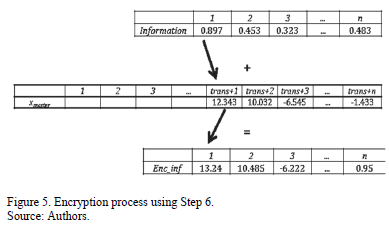
<body><![CDATA[<p><font size="2" face="Verdana, Arial, Helvetica, sans-serif">Step 4. Divide each element of the key <img src="/img/revistas/dyna/v83n197/v83n197a24eq128.gif"> by 255 to obtain values  between <img src="/img/revistas/dyna/v83n197/v83n197a24eq153.gif"> and <img src="/img/revistas/dyna/v83n197/v83n197a24eq157.gif">.</font></p>     <blockquote>       <p><font size="2" face="Verdana, Arial, Helvetica, sans-serif"><img src="/img/revistas/dyna/v83n197/v83n197a24eq165.gif"></font></p> </blockquote>     <p><font size="2" face="Verdana, Arial, Helvetica, sans-serif">To vary parameter<img src="/img/revistas/dyna/v83n197/v83n197a24eq169.gif"></font></p>     <p><font size="2" face="Verdana, Arial, Helvetica, sans-serif">Step 5. Calculate the value of <img src="/img/revistas/dyna/v83n197/v83n197a24eq171.gif"> by adding <img src="/img/revistas/dyna/v83n197/v83n197a24eq173.gif"> plus an element of the vector <img src="/img/revistas/dyna/v83n197/v83n197a24eq179.gif"> and solve equation system  (1). In the case of all of the elements of <img src="/img/revistas/dyna/v83n197/v83n197a24eq179.gif"> having been already used,  initiate the re-run of the vector <img src="/img/revistas/dyna/v83n197/v83n197a24eq179.gif"> form the first position.</font></p>     <blockquote>       <p><font size="2" face="Verdana, Arial, Helvetica, sans-serif"><img src="/img/revistas/dyna/v83n197/v83n197a24eq181.gif"></font></p> </blockquote>     <p><font size="2" face="Verdana, Arial, Helvetica, sans-serif">Step 6. After  solving the system <img src="/img/revistas/dyna/v83n197/v83n197a24eq077.gif"> times, encrypt the  information by adding <img src="/img/revistas/dyna/v83n197/v83n197a24eq183.gif"> and storing the result in vector <img src="/img/revistas/dyna/v83n197/v83n197a24eq187.gif">. Observe the functioning in <a href="#fig05">Fig. 5</a>. </font></p>     <p align="center"><font size="2" face="Verdana, Arial, Helvetica, sans-serif"><a name="fig05"></a></font><img src="/img/revistas/dyna/v83n197/v83n197a24fig05.gif"></p>     <p><font size="2" face="Verdana, Arial, Helvetica, sans-serif">Step 7. Store <img src="/img/revistas/dyna/v83n197/v83n197a24eq191.gif"> in vector <img src="/img/revistas/dyna/v83n197/v83n197a24eq193.gif"></font></p>     ]]></body>

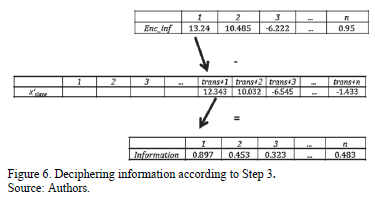
<body><![CDATA[<p><font size="2" face="Verdana, Arial, Helvetica, sans-serif">Step 8. Repeat  steps 5 through 7 <img src="/img/revistas/dyna/v83n197/v83n197a24eq197.gif"> times.</font></p>     <p><font size="2" face="Verdana, Arial, Helvetica, sans-serif"><i>3.2.2. Algorithm for deciphering </i></font></p>     <p><font size="2" face="Verdana, Arial, Helvetica, sans-serif">It is  necessary to possess the encrypted information <img src="/img/revistas/dyna/v83n197/v83n197a24eq187.gif">, the values of <img src="/img/revistas/dyna/v83n197/v83n197a24eq199.gif"> for synchronization of the  Slave and the encrypted keys <img src="/img/revistas/dyna/v83n197/v83n197a24eq205.gif"><sub>.</sub></font></p>     <p><font size="2" face="Verdana, Arial, Helvetica, sans-serif">Step 1. Perform Steps 3 and 4 of the  algorithm to encrypt.</font></p>     <p><font size="2" face="Verdana, Arial, Helvetica, sans-serif">Step 2.  Calculate the value <img src="/img/revistas/dyna/v83n197/v83n197a24eq095.gif"> by adding <img src="/img/revistas/dyna/v83n197/v83n197a24eq207.gif"> plus one element of the  vector <img src="/img/revistas/dyna/v83n197/v83n197a24eq179.gif"> and solve equation system  (2). In the case that all of the elements of the <img src="/img/revistas/dyna/v83n197/v83n197a24eq179.gif"> have already been used,  initiate the re-run from the first position. </font></p>     <p><font size="2" face="Verdana, Arial, Helvetica, sans-serif"><img src="/img/revistas/dyna/v83n197/v83n197a24eq181.gif"></font></p>     <p><font size="2" face="Verdana, Arial, Helvetica, sans-serif">Step 3. After solving the <img src="/img/revistas/dyna/v83n197/v83n197a24eq077.gif"> times system, decipher the  remaining information <img src="/img/revistas/dyna/v83n197/v83n197a24eq215.gif"> and store the result in the  vector <img src="/img/revistas/dyna/v83n197/v83n197a24eq145.gif">. Observe the functioning in <a href="#fig06">Fig. 6</a>. </font></p>     <p align="center"><font size="2" face="Verdana, Arial, Helvetica, sans-serif"><a name="fig06"></a></font><img src="/img/revistas/dyna/v83n197/v83n197a24fig06.gif"></p>     <p><font size="2" face="Verdana, Arial, Helvetica, sans-serif">Step 4. Perform Steps 2 and 3 <img src="/img/revistas/dyna/v83n197/v83n197a24eq197.gif"> times to decipher all of the  information.</font></p>     <p><font size="2" face="Verdana, Arial, Helvetica, sans-serif">Step 5. Multiply each element of the  vector <img src="/img/revistas/dyna/v83n197/v83n197a24eq217.gif"> by 255 to obtain the original  information.</font></p>     ]]></body>
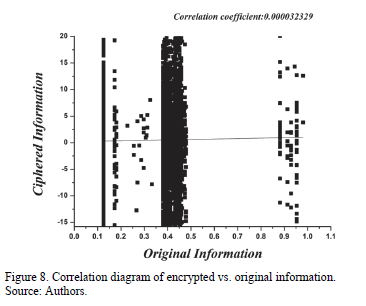
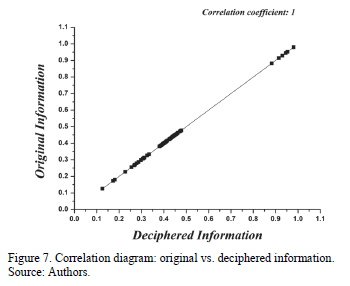
<body><![CDATA[<blockquote>       <p><font size="2" face="Verdana, Arial, Helvetica, sans-serif"><img src="/img/revistas/dyna/v83n197/v83n197a24eq219.gif"></font></p> </blockquote>     <p>&nbsp;</p>     <p><font size="3" face="Verdana, Arial, Helvetica, sans-serif"><b>4. Results and Conclusions</b></font></p>     <p><font size="2" face="Verdana, Arial, Helvetica, sans-serif">The results obtained in the statistical  tests employed to determine the system's robustness on encrypting and sending a  text message are shown below.</font></p>     <p><font size="2" face="Verdana, Arial, Helvetica, sans-serif"><b><i>4.1. Correlation diagram</i></b></font></p>     <p><font size="2" face="Verdana, Arial, Helvetica, sans-serif">These allow  us to demonstrate graphically the relationship between two variables and in  addition how to obtain the correlation coefficient, which can fall within the  range of <img src="/img/revistas/dyna/v83n197/v83n197a24eq223.gif"> and <img src="/img/revistas/dyna/v83n197/v83n197a24eq157.gif">, indicating that the nearer the two  they are to each other, the stronger the linear association will be. In the  case of its nearing a<img src="/img/revistas/dyna/v83n197/v83n197a24eq227.gif">, this indicates a weak or null  association if this is <img src="/img/revistas/dyna/v83n197/v83n197a24eq153.gif">.</font></p>     <p><font size="2" face="Verdana, Arial, Helvetica, sans-serif">The correlation diagram (<a href="#fig07">Fig. 7</a>) depicts  the values of the deciphered information in the horizontal axis, and the values  of the original information in the vertical axis. We can observe that the  correlation coefficient is 1. Thus, the original information and the  information that was deciphered is identical; that is, the system manages  excellent data integrity, therefore, there is no information deformation at the  moment of encrypting and deciphering.</font></p>     <p align="center"><font size="2" face="Verdana, Arial, Helvetica, sans-serif"><a name="fig07"></a></font><img src="/img/revistas/dyna/v83n197/v83n197a24fig07.gif"></p>     <p><font size="2" face="Verdana, Arial, Helvetica, sans-serif">In the  correlation diagram (<a href="#fig08">Fig. 8</a>), the original vs. encrypted information is shown,  and it yields a correlation coefficient of 0.000032329, which indicates that  the relationship between encrypted and original information is nearly null.  This is very favorable because some attackers study the relationship that  exists between these two variables in order to attempt to determine the  encryption key that has been employed.</font></p>     ]]></body>
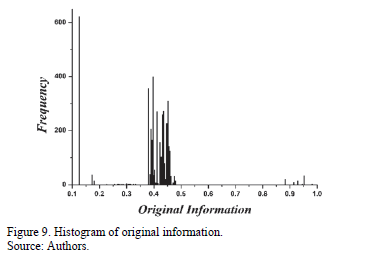
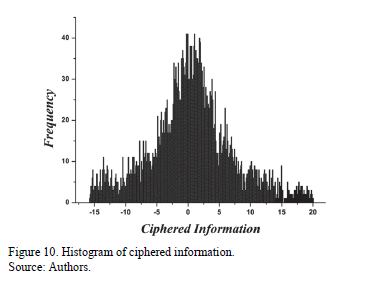
<body><![CDATA[<p align="center"><font size="2" face="Verdana, Arial, Helvetica, sans-serif"><a name="fig08"></a></font><img src="/img/revistas/dyna/v83n197/v83n197a24fig08.gif"></p>     <p><font size="2" face="Verdana, Arial, Helvetica, sans-serif"><b><i>4.2. Histograms</i></b></font></p>     <p><font size="2" face="Verdana, Arial, Helvetica, sans-serif">These are used to represent the  distribution of the message, where the horizontal axis is shown with vertical  bars and the data that are being transmitted. The height of each bar  corresponds the number of frequencies of the data. </font></p>     <p><font size="2" face="Verdana, Arial, Helvetica, sans-serif">In <a href="#fig09">Fig. 9</a>,  the data that are being transmitted (the original information) are between 0.1  and 1, with the majority of data being between 0.375 and 0.475.</font></p>     <p align="center"><font size="2" face="Verdana, Arial, Helvetica, sans-serif"><a name="fig09"></a></font><img src="/img/revistas/dyna/v83n197/v83n197a24fig09.gif"></p>     <p><font size="2" face="Verdana, Arial, Helvetica, sans-serif"><a href="#fig10">Fig. 10</a> shows the histogram of the  encrypted information, where it is clear that the encrypted data are found  within the range of -15.25 and 20. If <a href="#fig09">Figs. 9</a> and <a href="#fig10">10</a> are compared, we can  observe that there is no relationship between the number of frequencies and the  range of values of the graphs' horizontal</font> <font size="2" face="Verdana, Arial, Helvetica, sans-serif">axis. This helps to make it more difficult for an attacker to find a  relationship between original and encrypted information.</font></p>     <p align="center"><font size="2" face="Verdana, Arial, Helvetica, sans-serif"><a name="fig10"></a></font><img src="/img/revistas/dyna/v83n197/v83n197a24fig10.gif"></p>     <p><font size="2" face="Verdana, Arial, Helvetica, sans-serif"><b><i>4.3. Conclusions</i></b></font></p>     <p><font size="2" face="Verdana, Arial, Helvetica, sans-serif">The  communications system developed truncates the orbit or trajectory by constantly  changing one of the chaotic mathematical model's parameters; this speeds up the  encoding time in comparison with other cryptographic systems that employ various  orbits. Thus, more computer processing is necessary.  Our system guarantees confidentiality because only the receiver, which  possesses the keys used for encoding, can calculate the parameter's different  values, in order to reconstruct the orbit;  thus, decoding the information received. The constant change of the parameter  employed avoids an attacker from detecting the parameter by using the least  average synchronization error. </font></p>     <p><font size="2" face="Verdana, Arial, Helvetica, sans-serif">To verify the robustness of the system developed, the  original information (plaintext) is compared to the ciphered text (ciphertext),  using the correlation diagram depicted in <a href="#fig08">Fig. 8</a>, in which a coefficient near  the value of 0 is exhibited. This indicates that the linear association is nearly null. With the  latter, it is proven that the system is resistant to statistical attacks, such  as those based on clear text (differential and linear), in which an attempt was  made to determine the key on searching for some relationship between the ciphertext and the plaintext. Another of the  tests conducted is illustrated in the histograms shown in <a href="#fig09">Figs. 9</a> and <a href="#fig10">10</a>, in  which there are very different ranges of values and frequencies. This renders  the system sufficiently robust for avoiding an attack in which the frequencies  or repeat chains are analyzed in order to attempt to find correspondence  between ciphered and deciphered information.</font></p>     ]]></body>
<body><![CDATA[<p><font size="2" face="Verdana, Arial, Helvetica, sans-serif">To evaluate the integrity of the data transmitted vs. the  data received once the encoding and decoding process was accomplished, the  correlation diagram in <a href="#fig07">Fig. 7</a> provides a coefficient with a value of 1. This  indicates that the information is not altered on passing through the ciphering  and communications process. </font></p>     <p><font size="2" face="Verdana, Arial, Helvetica, sans-serif">The  system employed within this investigation protects the communication  point-to-point, combining authentication and encoding techniques, in order to  safeguard the information transmitted from one point to another. In this way,  it complies with integrity, confidentiality, and security services.  Additionally, the technique used for varying the parameter contributes  robustness to the communications system. </font></p>     <p>&nbsp;</p>     <p><font size="3" face="Verdana, Arial, Helvetica, sans-serif"><b>Acknowledgment</b></font></p>     <p><font size="2" face="Verdana, Arial, Helvetica, sans-serif">The  authors acknowledge the support from PRODEP-SEP (Convocatoria de  Fortalecimiento de Cuerpos acad&eacute;micos) (Mexico).</font></p>     <p>&nbsp;</p>     <p><font size="3" face="Verdana, Arial, Helvetica, sans-serif"><b>References</b></font></p>     <!-- ref --><p><font size="2" face="Verdana, Arial, Helvetica, sans-serif"><b>&#91;1&#93;</b> Hilborn, R.C., Chaos and  Nonlinear Dynamics. New York: Oxford University Press, 2000.    &nbsp;&nbsp;&nbsp;&nbsp;&nbsp;&nbsp;&nbsp;&nbsp;[&#160;<a href="javascript:void(0);" onclick="javascript: window.open('/scielo.php?script=sci_nlinks&ref=1140759&pid=S0012-7353201600030002400001&lng=','','width=640,height=500,resizable=yes,scrollbars=1,menubar=yes,');">Links</a>&#160;]<!-- end-ref --> </font></p>     <!-- ref --><p><font size="2" face="Verdana, Arial, Helvetica, sans-serif"><b>&#91;2&#93;</b> Ranjan, B. and Sumitr, P., A  novel compression and encryption scheme using variable model arithmetic coding  and coupled chaotic system. IEEE Transactions on Circuits and System-I, 53(4),  pp. 848-857, 2006. DOI: 10.1109/TCSI.2005.859617.    &nbsp;&nbsp;&nbsp;&nbsp;&nbsp;&nbsp;&nbsp;&nbsp;[&#160;<a href="javascript:void(0);" onclick="javascript: window.open('/scielo.php?script=sci_nlinks&ref=1140761&pid=S0012-7353201600030002400002&lng=','','width=640,height=500,resizable=yes,scrollbars=1,menubar=yes,');">Links</a>&#160;]<!-- end-ref --> </font></p>     <!-- ref --><p><font size="2" face="Verdana, Arial, Helvetica, sans-serif"><b>&#91;3&#93;</b> Pareek, N., Patidar, V. and  Sud, K., Cryptography using multiple one-dimensional chaotic maps.  Communications in Nonlinear Science and Numerical Simulation, 10(7), pp.  715-723, 2005. DOI: 10.1016/j.cnsns.2004.03.006</font>&nbsp;&nbsp;&nbsp;&nbsp;&nbsp;&nbsp;&nbsp;&nbsp;[&#160;<a href="javascript:void(0);" onclick="javascript: window.open('/scielo.php?script=sci_nlinks&ref=1140763&pid=S0012-7353201600030002400003&lng=','','width=640,height=500,resizable=yes,scrollbars=1,menubar=yes,');">Links</a>&#160;]<!-- end-ref --><!-- ref --><p><font size="2" face="Verdana, Arial, Helvetica, sans-serif"><b>&#91;4&#93;</b> Alexander, P. and Flores, N.,  Computer algorithms for direct encryption and decryption of digital images for  secure communication. Proceedings of the 6th WSEAS International Conference on  Applied Computer Science, (Tenerife, Canary Islands, Spain), pp. 29-34, 2006.    &nbsp;&nbsp;&nbsp;&nbsp;&nbsp;&nbsp;&nbsp;&nbsp;[&#160;<a href="javascript:void(0);" onclick="javascript: window.open('/scielo.php?script=sci_nlinks&ref=1140764&pid=S0012-7353201600030002400004&lng=','','width=640,height=500,resizable=yes,scrollbars=1,menubar=yes,');">Links</a>&#160;]<!-- end-ref --></font></p>     <!-- ref --><p><font size="2" face="Verdana, Arial, Helvetica, sans-serif"><b>&#91;5&#93;</b> Hossam, E., Ahmed, H., Haamdy,  K. and Osama, F., An Efficient chaos-based feedback stream cipher (ECBFSC) for  image encryption and decryption. Informatica, 31, pp. 121-129, 2007.    &nbsp;&nbsp;&nbsp;&nbsp;&nbsp;&nbsp;&nbsp;&nbsp;[&#160;<a href="javascript:void(0);" onclick="javascript: window.open('/scielo.php?script=sci_nlinks&ref=1140766&pid=S0012-7353201600030002400005&lng=','','width=640,height=500,resizable=yes,scrollbars=1,menubar=yes,');">Links</a>&#160;]<!-- end-ref --> </font></p>     <!-- ref --><p><font size="2" face="Verdana, Arial, Helvetica, sans-serif"><b>&#91;6&#93;</b> Barbara, E., Alba, E. and  Rodr&iacute;guez, O., Modulating electrocardiographic signals with chaotic algorithms.  Ingenier&iacute;a e Investigaci&oacute;n, 32(2), pp. 46-50, 2012.    &nbsp;&nbsp;&nbsp;&nbsp;&nbsp;&nbsp;&nbsp;&nbsp;[&#160;<a href="javascript:void(0);" onclick="javascript: window.open('/scielo.php?script=sci_nlinks&ref=1140768&pid=S0012-7353201600030002400006&lng=','','width=640,height=500,resizable=yes,scrollbars=1,menubar=yes,');">Links</a>&#160;]<!-- end-ref --></font></p>     <!-- ref --><p><font size="2" face="Verdana, Arial, Helvetica, sans-serif"><b>&#91;7&#93;</b> Sundar, S. and Minai, A.,  Synchronization of randomly multiplexed chaotic systems with application to  communication. Physical Review Letters, 85(25), pp. 5456-5459, 2000. DOI: 10.1103/PhysRevLett.85.5456</font>&nbsp;&nbsp;&nbsp;&nbsp;&nbsp;&nbsp;&nbsp;&nbsp;[&#160;<a href="javascript:void(0);" onclick="javascript: window.open('/scielo.php?script=sci_nlinks&ref=1140770&pid=S0012-7353201600030002400007&lng=','','width=640,height=500,resizable=yes,scrollbars=1,menubar=yes,');">Links</a>&#160;]<!-- end-ref --><!-- ref --><p><font size="2" face="Verdana, Arial, Helvetica, sans-serif"><b>&#91;8&#93;</b> Parlitz, U., Kocarev, L.,  Stonjanovski, T. and Preckel. H., Encoding messages using chaotic  synchronization. Physical Review E, 53(5), pp. 4351-4361, 1996. DOI:  10.1103/PhysRevE.53.4351</font>&nbsp;&nbsp;&nbsp;&nbsp;&nbsp;&nbsp;&nbsp;&nbsp;[&#160;<a href="javascript:void(0);" onclick="javascript: window.open('/scielo.php?script=sci_nlinks&ref=1140771&pid=S0012-7353201600030002400008&lng=','','width=640,height=500,resizable=yes,scrollbars=1,menubar=yes,');">Links</a>&#160;]<!-- end-ref --><!-- ref --><p><font size="2" face="Verdana, Arial, Helvetica, sans-serif"><b>&#91;9&#93;</b> Partlitz, U., Chua, L.,  Kocarev, Lj., Halle, K. and Shang. A., Transmission of digital signals by  chaotic synchronization. International Journal of Bifurcation and Chaos, 2(4),  pp. 973-977, 1992. DOI: 10.1142/S0218127492000562 </font>&nbsp;&nbsp;&nbsp;&nbsp;&nbsp;&nbsp;&nbsp;&nbsp;[&#160;<a href="javascript:void(0);" onclick="javascript: window.open('/scielo.php?script=sci_nlinks&ref=1140772&pid=S0012-7353201600030002400009&lng=','','width=640,height=500,resizable=yes,scrollbars=1,menubar=yes,');">Links</a>&#160;]<!-- end-ref --><!-- ref --><p><font size="2" face="Verdana, Arial, Helvetica, sans-serif"><b>&#91;10&#93;</b> Annovazzi, V., Donati, S. and  Scir&eacute;, A., Synchronization of chaotic lasers by optical feedback for  cryptographic applications. IEEE Journal of Quantum Electronics, 33(9), pp.  1449-1454, 1997. DOI: 10.1109/3.622622</font>&nbsp;&nbsp;&nbsp;&nbsp;&nbsp;&nbsp;&nbsp;&nbsp;[&#160;<a href="javascript:void(0);" onclick="javascript: window.open('/scielo.php?script=sci_nlinks&ref=1140773&pid=S0012-7353201600030002400010&lng=','','width=640,height=500,resizable=yes,scrollbars=1,menubar=yes,');">Links</a>&#160;]<!-- end-ref --><!-- ref --><p><font size="2" face="Verdana, Arial, Helvetica, sans-serif"><b>&#91;11&#93;</b> Kocarev, L. and Parlitz, U.,  General approach for chaotic synchronization with applications to  communication. Physical Review Letters, 74(25), pp. 5028-5031, 1995. DOI:  10.1103/PhysRevLett.74.5028</font>&nbsp;&nbsp;&nbsp;&nbsp;&nbsp;&nbsp;&nbsp;&nbsp;[&#160;<a href="javascript:void(0);" onclick="javascript: window.open('/scielo.php?script=sci_nlinks&ref=1140774&pid=S0012-7353201600030002400011&lng=','','width=640,height=500,resizable=yes,scrollbars=1,menubar=yes,');">Links</a>&#160;]<!-- end-ref --><!-- ref --><p><font size="2" face="Verdana, Arial, Helvetica, sans-serif"><b>&#91;12&#93;</b> Zhao, Y., Experimental  demonstration of chaotic synchronization in the modified Chua's  oscillators. International Journal of  Bifurcation and Chaos, 7(6), pp. 1401-1410, 1997. DOI:  10.1142/S0218127497001126</font>&nbsp;&nbsp;&nbsp;&nbsp;&nbsp;&nbsp;&nbsp;&nbsp;[&#160;<a href="javascript:void(0);" onclick="javascript: window.open('/scielo.php?script=sci_nlinks&ref=1140775&pid=S0012-7353201600030002400012&lng=','','width=640,height=500,resizable=yes,scrollbars=1,menubar=yes,');">Links</a>&#160;]<!-- end-ref --><!-- ref --><p><font size="2" face="Verdana, Arial, Helvetica, sans-serif"><b>&#91;13&#93;</b> Cuomo, K., Oppenheim, A. and Strogatz,  S., Synchronization of Lorenz-based chaotic circuits with applications to  communications, IEEE Transactions on Circuits and Systems- II: Analog and  Digital Design Processing, 40(10), pp. 626-633, 1993. DOI: 10.1109/82.246163</font>&nbsp;&nbsp;&nbsp;&nbsp;&nbsp;&nbsp;&nbsp;&nbsp;[&#160;<a href="javascript:void(0);" onclick="javascript: window.open('/scielo.php?script=sci_nlinks&ref=1140776&pid=S0012-7353201600030002400013&lng=','','width=640,height=500,resizable=yes,scrollbars=1,menubar=yes,');">Links</a>&#160;]<!-- end-ref --><!-- ref --><p><font size="2" face="Verdana, Arial, Helvetica, sans-serif"><b>&#91;14&#93;</b> Yang, T. and Chua, L.O., Secure  communication via chaotic parameter modulation. IEEE Transactions on Circuits  and Systems - I: Fundamental Theory and Applications, 43(9), pp. 817-819, 1996.  DOI: 10.1109/81.536758</font>&nbsp;&nbsp;&nbsp;&nbsp;&nbsp;&nbsp;&nbsp;&nbsp;[&#160;<a href="javascript:void(0);" onclick="javascript: window.open('/scielo.php?script=sci_nlinks&ref=1140777&pid=S0012-7353201600030002400014&lng=','','width=640,height=500,resizable=yes,scrollbars=1,menubar=yes,');">Links</a>&#160;]<!-- end-ref --><!-- ref --><p><font size="2" face="Verdana, Arial, Helvetica, sans-serif"><b>&#91;15&#93;</b> Zhang, J. and Zhang, Y., An image encryption  algorithm based on balanced pixel and chaotic map. Hindawi Publishing  Corporation: Mathematical Problems in Engineering, 2014, pp. 1-7, 2014. DOI:  10.1155/2014/216048</font>&nbsp;&nbsp;&nbsp;&nbsp;&nbsp;&nbsp;&nbsp;&nbsp;[&#160;<a href="javascript:void(0);" onclick="javascript: window.open('/scielo.php?script=sci_nlinks&ref=1140778&pid=S0012-7353201600030002400015&lng=','','width=640,height=500,resizable=yes,scrollbars=1,menubar=yes,');">Links</a>&#160;]<!-- end-ref --><!-- ref --><p><font size="2" face="Verdana, Arial, Helvetica, sans-serif"><b>&#91;16&#93;</b> Jim&eacute;nez, M., Rider, J. and  Alexander, P., Secure communication based on chaotic cipher and chaos  synchronization. Discontinuity, Nonlinearity and Complexity, 1, pp. 57-68,  2012. DOI: 10.5890/DNC.2012.02.003</font>&nbsp;&nbsp;&nbsp;&nbsp;&nbsp;&nbsp;&nbsp;&nbsp;[&#160;<a href="javascript:void(0);" onclick="javascript: window.open('/scielo.php?script=sci_nlinks&ref=1140779&pid=S0012-7353201600030002400016&lng=','','width=640,height=500,resizable=yes,scrollbars=1,menubar=yes,');">Links</a>&#160;]<!-- end-ref --><!-- ref --><p><font size="2" face="Verdana, Arial, Helvetica, sans-serif"><b>&#91;17&#93;</b> Zanin, M., Sevilla, J., Jaimes,  R., Garc&iacute;a, J., Huerta, G. and Pisarchik, A.N., Synchronization attack to  chaotic communication systems. Discontinuity, Nonlinearity, and Complexity,  2(4), pp. 333-343, 2013. DOI: 10.5890/DNC.2013.11.003.    &nbsp;&nbsp;&nbsp;&nbsp;&nbsp;&nbsp;&nbsp;&nbsp;[&#160;<a href="javascript:void(0);" onclick="javascript: window.open('/scielo.php?script=sci_nlinks&ref=1140780&pid=S0012-7353201600030002400017&lng=','','width=640,height=500,resizable=yes,scrollbars=1,menubar=yes,');">Links</a>&#160;]<!-- end-ref --></font></p>     ]]></body>
<body><![CDATA[<!-- ref --><p><font size="2" face="Verdana, Arial, Helvetica, sans-serif"><b>&#91;18&#93;</b> Juli&aacute;n, M., Fredy, A. and  Fabi&aacute;n, Ch., Security analysis of a WLAN network sample in Tunja, Boyac&aacute;,  Colombia. DYNA, pp. 226-232, 2015. DOI: 10.15446/dyna.v82n189.43259</font>&nbsp;&nbsp;&nbsp;&nbsp;&nbsp;&nbsp;&nbsp;&nbsp;[&#160;<a href="javascript:void(0);" onclick="javascript: window.open('/scielo.php?script=sci_nlinks&ref=1140782&pid=S0012-7353201600030002400018&lng=','','width=640,height=500,resizable=yes,scrollbars=1,menubar=yes,');">Links</a>&#160;]<!-- end-ref --><!-- ref --><p><font size="2" face="Verdana, Arial, Helvetica, sans-serif"><b>&#91;19&#93;</b> Carroll, T.L. and Pecora, L.M.,  Synchronizing chaotic circuits. IEEE Transactions on Circuits and Systems, pp.  453-456, 1991. DOI: 10.1109/31.75404</font>&nbsp;&nbsp;&nbsp;&nbsp;&nbsp;&nbsp;&nbsp;&nbsp;[&#160;<a href="javascript:void(0);" onclick="javascript: window.open('/scielo.php?script=sci_nlinks&ref=1140783&pid=S0012-7353201600030002400019&lng=','','width=640,height=500,resizable=yes,scrollbars=1,menubar=yes,');">Links</a>&#160;]<!-- end-ref --><!-- ref --><p><font size="2" face="Verdana, Arial, Helvetica, sans-serif"><b>&#91;20&#93;</b> Ram&iacute;rez, C.A., Masking  information through synchronized chaotic systems, MSc. Thesis, Department of Mathematics, Universidad  Nacional de Colombia, Bogot&aacute;, Colombia, 2011.    &nbsp;&nbsp;&nbsp;&nbsp;&nbsp;&nbsp;&nbsp;&nbsp;[&#160;<a href="javascript:void(0);" onclick="javascript: window.open('/scielo.php?script=sci_nlinks&ref=1140784&pid=S0012-7353201600030002400020&lng=','','width=640,height=500,resizable=yes,scrollbars=1,menubar=yes,');">Links</a>&#160;]<!-- end-ref --></font></p>     <!-- ref --><p><font size="2" face="Verdana, Arial, Helvetica, sans-serif"><b>&#91;21&#93;</b> Schuster, H.G., Handbook of  chaos control. New York: Wiley-VCH, 1999.    &nbsp;&nbsp;&nbsp;&nbsp;&nbsp;&nbsp;&nbsp;&nbsp;[&#160;<a href="javascript:void(0);" onclick="javascript: window.open('/scielo.php?script=sci_nlinks&ref=1140786&pid=S0012-7353201600030002400021&lng=','','width=640,height=500,resizable=yes,scrollbars=1,menubar=yes,');">Links</a>&#160;]<!-- end-ref --> </font></p>     <p>&nbsp;</p>     <p><font size="2" face="Verdana, Arial, Helvetica, sans-serif"><b>M. Jim&eacute;nez-Rodr&iacute;guez,</b> has an BSc. degree  in Computation Engineering, from the UdeG in 1999, a MSc. degree in Applied  Computation in 2003, Universidad Central Martha Abreu, Cuba. In 2005, she  obtained a Cisco Certified Network Associate certification, and in 2007, a  Cisco Certified Academy Instructor certification. She was awarded a Dr. degree  in Science and Technology at the Centro Universitario de los Lagos (CULagos),  UdeG, in 2012. Currently, she is a professor in the Department of Technological  Sciences at the Centro Universitario de la Ci&eacute;nega (CUCI&eacute;nega) and conducts  investigation in the areas of Security Systems and Communications and Systems  Elaboration, in addition to Applied Mathematics in Systems Development. ORCID: orcid.org/0000-0002-4935-2731</font></p>     <p><font size="2" face="Verdana, Arial, Helvetica, sans-serif"><b>M.G. Gonz&aacute;lez-Novoa,</b> is a full-time  professor, working at the Department of Basic Sciences of the UdeG, Ci&eacute;nega.  She has a MSc. degree in Applied Communications with a specialty in databases,  awarded in 2005. Her area of specialization is object-oriented programming and  software development, distributed systems, the application of algorithms, and  data structure. She Participates in diverse investigation projects, is the  author of various international and national publications, books and  peer-review articles, all with reference to the line of investigation with  which she collaborates: Elaboration of Security Systems and Communications.  Currently she is working on the development of applications with technology for  networks and security. ORCID: orcid.org/0000-0002-1170-1238</font></p>     <p><font size="2" face="Verdana, Arial, Helvetica, sans-serif"><b>J.C. Estrada-Guti&eacute;rrez,</b> has an BSc.  degree in Computational Engineering 2001, a MSc. degree in Applied Computation  from the UdeG, in 2005, a PhD in Sciences from the UdeG in 2014, awarded in  2005 by Cisco CCNA (Cisco Certified Network Associate), and in 2007 received a  certification as a Cisco Certified Academy Instructor. He is also a Candidate  to be a National Instructor in the Mexican National System of National  Investigators (SNICONACYT) 2014-2016. He is a professor at the Department of  Technological Sciences, CUCi&eacute;nega, and carries out research in the areas of  Telecommunications, Applied Physics, and Biomedical Engineering. ORCID: orcid.org/0000-0002-6727-3500</font></p>     ]]></body>
<body><![CDATA[<p><font size="2" face="Verdana, Arial, Helvetica, sans-serif"><b>C. Acosta-L&uacute;a,</b> obtained his BSc.in Electronic  Engineering from the Technological Institute of Morelia in 2001. He completed  his MSc.degree in 2003 and Ph.D. in 2007 in Science in Electrical Engineering  at CINVESTAV Guadalajara Unit. He participated in stays at INSA Lyon, France  and DEWS Research Center in L'Aquila Italy. He carried out his Postdoctoral  studies at DEWS Research Center in L' Aquila, Italy and the Centre for Research  and Implementation of the Ford Motor Company. Since 2009, he has been an  Associate Professor of Automatic Control at the University of Guadalajara. He  is currently engaged in the development of nonlinear techniques for vehicle  control and observers for nonlinear subsystems thereof. ORCID: orcid.org/0000-0002-7398-2629.</font></p>     <p><font size="2" face="Verdana, Arial, Helvetica, sans-serif"><b>O. Flores-Siordia,</b> is a full-time  professor in the Department of Technological Sciences at CUCi&eacute;nega, UdeG. He  has an BSc. degree in Chemical Engineering, a MSc. degree in Chemical  Engineering, and a PhD in the Teaching Methodology. His areas of specialization  include applied mathematics. He participates in the following lines of investigation:  Elaboration of Security Systems and Communications, and collaborates in diverse  research projects, and has various international and national publications,  books and peer-reviewed articles, in reference to the development of  applications with technology for networks and security. ORCID: orcid.org/0000-0003-3611-4512</font></p>      ]]></body><back>
<ref-list>
<ref id="B1">
<label>1</label><nlm-citation citation-type="book">
<person-group person-group-type="author">
<name>
<surname><![CDATA[Hilborn]]></surname>
<given-names><![CDATA[R.C.]]></given-names>
</name>
</person-group>
<source><![CDATA[Chaos and Nonlinear Dynamics.]]></source>
<year>2000</year>
<publisher-loc><![CDATA[New York ]]></publisher-loc>
<publisher-name><![CDATA[Oxford University Press]]></publisher-name>
</nlm-citation>
</ref>
<ref id="B2">
<label>2</label><nlm-citation citation-type="journal">
<person-group person-group-type="author">
<name>
<surname><![CDATA[Ranjan]]></surname>
<given-names><![CDATA[B.]]></given-names>
</name>
<name>
<surname><![CDATA[Sumitr]]></surname>
<given-names><![CDATA[P.]]></given-names>
</name>
</person-group>
<article-title xml:lang="en"><![CDATA[A novel compression and encryption scheme using variable model arithmetic coding and coupled chaotic system.]]></article-title>
<source><![CDATA[IEEE Transactions on Circuits and System-I]]></source>
<year>2006</year>
<volume>53</volume>
<numero>4</numero>
<issue>4</issue>
<page-range>848-857</page-range></nlm-citation>
</ref>
<ref id="B3">
<label>3</label><nlm-citation citation-type="journal">
<person-group person-group-type="author">
<name>
<surname><![CDATA[Pareek]]></surname>
<given-names><![CDATA[N.]]></given-names>
</name>
<name>
<surname><![CDATA[Patidar]]></surname>
<given-names><![CDATA[V.]]></given-names>
</name>
<name>
<surname><![CDATA[Sud]]></surname>
<given-names><![CDATA[K.]]></given-names>
</name>
</person-group>
<article-title xml:lang="en"><![CDATA[Cryptography using multiple one-dimensional chaotic maps.]]></article-title>
<source><![CDATA[Communications in Nonlinear Science and Numerical Simulation]]></source>
<year>2005</year>
<volume>10</volume>
<numero>7</numero>
<issue>7</issue>
<page-range>715-723</page-range></nlm-citation>
</ref>
<ref id="B4">
<label>4</label><nlm-citation citation-type="confpro">
<person-group person-group-type="author">
<name>
<surname><![CDATA[Alexander]]></surname>
<given-names><![CDATA[P.]]></given-names>
</name>
<name>
<surname><![CDATA[Flores]]></surname>
<given-names><![CDATA[N.]]></given-names>
</name>
</person-group>
<article-title xml:lang="en"><![CDATA[Computer algorithms for direct encryption and decryption of digital images for secure communication.]]></article-title>
<source><![CDATA[]]></source>
<year>2006</year>
<conf-name><![CDATA[6th WSEAS International Conference on Applied Computer Science]]></conf-name>
<conf-loc>Tenerife Canary Islands</conf-loc>
<page-range>29-34</page-range></nlm-citation>
</ref>
<ref id="B5">
<label>5</label><nlm-citation citation-type="journal">
<person-group person-group-type="author">
<name>
<surname><![CDATA[Hossam]]></surname>
<given-names><![CDATA[E.]]></given-names>
</name>
<name>
<surname><![CDATA[Ahmed]]></surname>
<given-names><![CDATA[H.]]></given-names>
</name>
<name>
<surname><![CDATA[Haamdy]]></surname>
<given-names><![CDATA[K.]]></given-names>
</name>
<name>
<surname><![CDATA[Osama]]></surname>
<given-names><![CDATA[F.]]></given-names>
</name>
</person-group>
<article-title xml:lang="en"><![CDATA[An Efficient chaos-based feedback stream cipher (ECBFSC) for image encryption and decryption.]]></article-title>
<source><![CDATA[Informatica]]></source>
<year>2007</year>
<numero>31</numero>
<issue>31</issue>
<page-range>121-129</page-range></nlm-citation>
</ref>
<ref id="B6">
<label>6</label><nlm-citation citation-type="journal">
<person-group person-group-type="author">
<name>
<surname><![CDATA[Barbara]]></surname>
<given-names><![CDATA[E.]]></given-names>
</name>
<name>
<surname><![CDATA[Alba]]></surname>
<given-names><![CDATA[E.]]></given-names>
</name>
<name>
<surname><![CDATA[Rodríguez]]></surname>
<given-names><![CDATA[O.]]></given-names>
</name>
</person-group>
<article-title xml:lang="en"><![CDATA[Modulating electrocardiographic signals with chaotic algorithms.]]></article-title>
<source><![CDATA[Ingeniería e Investigación]]></source>
<year>2012</year>
<volume>32</volume>
<numero>2</numero>
<issue>2</issue>
<page-range>46-50</page-range></nlm-citation>
</ref>
<ref id="B7">
<label>7</label><nlm-citation citation-type="journal">
<person-group person-group-type="author">
<name>
<surname><![CDATA[Sundar]]></surname>
<given-names><![CDATA[S.]]></given-names>
</name>
<name>
<surname><![CDATA[Minai]]></surname>
<given-names><![CDATA[A.]]></given-names>
</name>
</person-group>
<article-title xml:lang="en"><![CDATA[Synchronization of randomly multiplexed chaotic systems with application to communication.]]></article-title>
<source><![CDATA[Physical Review Letters]]></source>
<year>2000</year>
<volume>85</volume>
<numero>25</numero>
<issue>25</issue>
<page-range>5456-5459</page-range></nlm-citation>
</ref>
<ref id="B8">
<label>8</label><nlm-citation citation-type="journal">
<person-group person-group-type="author">
<name>
<surname><![CDATA[Parlitz]]></surname>
<given-names><![CDATA[U.]]></given-names>
</name>
<name>
<surname><![CDATA[Kocarev]]></surname>
<given-names><![CDATA[L.]]></given-names>
</name>
<name>
<surname><![CDATA[Stonjanovski]]></surname>
<given-names><![CDATA[T.]]></given-names>
</name>
<name>
<surname><![CDATA[Preckel.]]></surname>
<given-names><![CDATA[H.]]></given-names>
</name>
</person-group>
<article-title xml:lang="en"><![CDATA[Encoding messages using chaotic synchronization.]]></article-title>
<source><![CDATA[Physical Review E]]></source>
<year>1996</year>
<volume>53</volume>
<numero>5</numero>
<issue>5</issue>
<page-range>4351-4361</page-range></nlm-citation>
</ref>
<ref id="B9">
<label>9</label><nlm-citation citation-type="journal">
<person-group person-group-type="author">
<name>
<surname><![CDATA[Partlitz]]></surname>
<given-names><![CDATA[U.]]></given-names>
</name>
<name>
<surname><![CDATA[Chua]]></surname>
<given-names><![CDATA[L.]]></given-names>
</name>
<name>
<surname><![CDATA[Kocarev]]></surname>
<given-names><![CDATA[Lj.]]></given-names>
</name>
<name>
<surname><![CDATA[Halle]]></surname>
<given-names><![CDATA[K.]]></given-names>
</name>
<name>
<surname><![CDATA[Shang.]]></surname>
<given-names><![CDATA[A.]]></given-names>
</name>
</person-group>
<article-title xml:lang="en"><![CDATA[Transmission of digital signals by chaotic synchronization.]]></article-title>
<source><![CDATA[International Journal of Bifurcation and Chaos]]></source>
<year>1992</year>
<volume>2</volume>
<numero>^s4</numero>
<issue>^s4</issue>
<supplement>4</supplement>
<page-range>973-977</page-range></nlm-citation>
</ref>
<ref id="B10">
<label>10</label><nlm-citation citation-type="journal">
<person-group person-group-type="author">
<name>
<surname><![CDATA[Annovazzi]]></surname>
<given-names><![CDATA[V.]]></given-names>
</name>
<name>
<surname><![CDATA[Donati]]></surname>
<given-names><![CDATA[S.]]></given-names>
</name>
<name>
<surname><![CDATA[Sciré]]></surname>
<given-names><![CDATA[A.]]></given-names>
</name>
</person-group>
<article-title xml:lang="en"><![CDATA[Synchronization of chaotic lasers by optical feedback for cryptographic applications.]]></article-title>
<source><![CDATA[IEEE Journal of Quantum Electronics]]></source>
<year>1997</year>
<volume>33</volume>
<numero>9</numero>
<issue>9</issue>
<page-range>1449-1454</page-range></nlm-citation>
</ref>
<ref id="B11">
<label>11</label><nlm-citation citation-type="journal">
<person-group person-group-type="author">
<name>
<surname><![CDATA[Kocarev]]></surname>
<given-names><![CDATA[L.]]></given-names>
</name>
<name>
<surname><![CDATA[Parlitz]]></surname>
<given-names><![CDATA[U.]]></given-names>
</name>
</person-group>
<article-title xml:lang="en"><![CDATA[General approach for chaotic synchronization with applications to communication]]></article-title>
<source><![CDATA[Physical Review Letters]]></source>
<year>1995</year>
<volume>74</volume>
<numero>25</numero>
<issue>25</issue>
<page-range>5028-5031</page-range></nlm-citation>
</ref>
<ref id="B12">
<label>12</label><nlm-citation citation-type="journal">
<person-group person-group-type="author">
<name>
<surname><![CDATA[Zhao]]></surname>
<given-names><![CDATA[Y.]]></given-names>
</name>
</person-group>
<article-title xml:lang="en"><![CDATA[Experimental demonstration of chaotic synchronization in the modified Chua's oscillators.]]></article-title>
<source><![CDATA[International Journal of Bifurcation and Chaos]]></source>
<year>1997</year>
<volume>7</volume>
<numero>6</numero>
<issue>6</issue>
<page-range>1401-1410</page-range></nlm-citation>
</ref>
<ref id="B13">
<label>13</label><nlm-citation citation-type="journal">
<person-group person-group-type="author">
<name>
<surname><![CDATA[Cuomo]]></surname>
<given-names><![CDATA[K.]]></given-names>
</name>
<name>
<surname><![CDATA[Oppenheim]]></surname>
<given-names><![CDATA[A.]]></given-names>
</name>
<name>
<surname><![CDATA[Strogatz]]></surname>
<given-names><![CDATA[S.]]></given-names>
</name>
</person-group>
<article-title xml:lang="en"><![CDATA[Synchronization of Lorenz-based chaotic circuits with applications to communications]]></article-title>
<source><![CDATA[IEEE Transactions on Circuits and Systems- II: Analog and Digital Design Processing]]></source>
<year>1993</year>
<volume>40</volume>
<numero>10</numero>
<issue>10</issue>
<page-range>626-633</page-range></nlm-citation>
</ref>
<ref id="B14">
<label>14</label><nlm-citation citation-type="journal">
<person-group person-group-type="author">
<name>
<surname><![CDATA[Yang]]></surname>
<given-names><![CDATA[T.]]></given-names>
</name>
<name>
<surname><![CDATA[Chua]]></surname>
<given-names><![CDATA[L.O.]]></given-names>
</name>
</person-group>
<article-title xml:lang="en"><![CDATA[Secure communication via chaotic parameter modulation.]]></article-title>
<source><![CDATA[IEEE Transactions on Circuits and Systems - I: Fundamental Theory and Applications]]></source>
<year>1996</year>
<volume>43</volume>
<numero>9</numero>
<issue>9</issue>
<page-range>817-819</page-range></nlm-citation>
</ref>
<ref id="B15">
<label>15</label><nlm-citation citation-type="journal">
<person-group person-group-type="author">
<name>
<surname><![CDATA[Zhang]]></surname>
<given-names><![CDATA[J.]]></given-names>
</name>
<name>
<surname><![CDATA[Zhang]]></surname>
<given-names><![CDATA[Y.]]></given-names>
</name>
</person-group>
<article-title xml:lang="en"><![CDATA[An image encryption algorithm based on balanced pixel and chaotic map.]]></article-title>
<source><![CDATA[Hindawi Publishing Corporation: Mathematical Problems in Engineering]]></source>
<year>2014</year>
<month>20</month>
<day>14</day>
<page-range>1-7</page-range></nlm-citation>
</ref>
<ref id="B16">
<label>16</label><nlm-citation citation-type="journal">
<person-group person-group-type="author">
<name>
<surname><![CDATA[Jiménez]]></surname>
<given-names><![CDATA[M.]]></given-names>
</name>
<name>
<surname><![CDATA[Rider]]></surname>
<given-names><![CDATA[J.]]></given-names>
</name>
<name>
<surname><![CDATA[Alexander]]></surname>
<given-names><![CDATA[P.]]></given-names>
</name>
</person-group>
<article-title xml:lang="en"><![CDATA[Secure communication based on chaotic cipher and chaos synchronization]]></article-title>
<source><![CDATA[Discontinuity, Nonlinearity and Complexity]]></source>
<year>2012</year>
<numero>1</numero>
<issue>1</issue>
<page-range>57-68</page-range></nlm-citation>
</ref>
<ref id="B17">
<label>17</label><nlm-citation citation-type="journal">
<person-group person-group-type="author">
<name>
<surname><![CDATA[Zanin]]></surname>
<given-names><![CDATA[M.]]></given-names>
</name>
<name>
<surname><![CDATA[Sevilla]]></surname>
<given-names><![CDATA[J.]]></given-names>
</name>
<name>
<surname><![CDATA[Jaimes]]></surname>
<given-names><![CDATA[R.]]></given-names>
</name>
<name>
<surname><![CDATA[García]]></surname>
<given-names><![CDATA[J.]]></given-names>
</name>
<name>
<surname><![CDATA[Huerta]]></surname>
<given-names><![CDATA[G.]]></given-names>
</name>
<name>
<surname><![CDATA[Pisarchik]]></surname>
<given-names><![CDATA[A.N.]]></given-names>
</name>
</person-group>
<article-title xml:lang="en"><![CDATA[Synchronization attack to chaotic communication systems.]]></article-title>
<source><![CDATA[Discontinuity, Nonlinearity, and Complexity]]></source>
<year>2013</year>
<volume>2</volume>
<numero>4</numero>
<issue>4</issue>
<page-range>333-343</page-range></nlm-citation>
</ref>
<ref id="B18">
<label>18</label><nlm-citation citation-type="journal">
<person-group person-group-type="author">
<name>
<surname><![CDATA[Julián]]></surname>
<given-names><![CDATA[M.]]></given-names>
</name>
<name>
<surname><![CDATA[Fredy]]></surname>
<given-names><![CDATA[A.]]></given-names>
</name>
<name>
<surname><![CDATA[Fabián]]></surname>
<given-names><![CDATA[Ch.]]></given-names>
</name>
</person-group>
<article-title xml:lang="en"><![CDATA[Security analysis of a WLAN network sample in Tunja, Boyacá, Colombia.]]></article-title>
<source><![CDATA[DYNA]]></source>
<year>2015</year>
<page-range>226-232</page-range></nlm-citation>
</ref>
<ref id="B19">
<label>19</label><nlm-citation citation-type="journal">
<person-group person-group-type="author">
<name>
<surname><![CDATA[Carroll]]></surname>
<given-names><![CDATA[T.L.]]></given-names>
</name>
<name>
<surname><![CDATA[Pecora]]></surname>
<given-names><![CDATA[L.M.]]></given-names>
</name>
</person-group>
<article-title xml:lang="en"><![CDATA[Synchronizing chaotic circuits.]]></article-title>
<source><![CDATA[IEEE Transactions on Circuits and Systems]]></source>
<year>1991</year>
<page-range>453-456</page-range></nlm-citation>
</ref>
<ref id="B20">
<label>20</label><nlm-citation citation-type="">
<person-group person-group-type="author">
<name>
<surname><![CDATA[Ramírez]]></surname>
<given-names><![CDATA[C.A.]]></given-names>
</name>
</person-group>
<source><![CDATA[Masking information through synchronized chaotic systems]]></source>
<year></year>
</nlm-citation>
</ref>
<ref id="B21">
<label>21</label><nlm-citation citation-type="book">
<person-group person-group-type="author">
<name>
<surname><![CDATA[Schuster]]></surname>
<given-names><![CDATA[H.G.]]></given-names>
</name>
</person-group>
<source><![CDATA[Handbook of chaos control.]]></source>
<year>1999</year>
<publisher-loc><![CDATA[New York ]]></publisher-loc>
<publisher-name><![CDATA[Wiley-VCH]]></publisher-name>
</nlm-citation>
</ref>
</ref-list>
</back>
</article>